Unit Plan

Title: Flight and Space

Unit Length: 5 weeks

Written by: Jim Roland

Subject/Grade: 8th Grade Technology

Standard 5: Students will apply technological knowledge and skills to design, construct, use, and
evaluate products and systems to satisfy human and environmental needs.

Performance Indicators:

4:             Develop plans and construct a model of the solution.
5:             Test a solution, present and evaluate results, and describe possible modifications.
11:            Access needed information from various Internet sites.
19:            Describe how the evolution of technology led to the shift in society.
20:            Understand the contributions of people to technological development.
21:            Describe how new technologies have evolved.
24:            Manage resources in a technological project.
25:            Describe products that are well designed and made.
26:            Assume leadership responsibilities.

Rationale: To promote Technological Literacy, PLTW has justified the importance of Flight and
Space. Students will learn the content of this curriculum while strengthening skills of literacy to
become better learners. The application of content learned will be the greatest learning experience
for students through several activities, including a flight simulator.

Launch: Show Hindenburg video and discuss the importance of the history and evolution of flight.

Essential Question: How has flight impacted society as well as our personal lives throughout
different decades.

Critical Thinking Skill: Problem Solving,         ,

Sub Skills: Investigation,      ,

Assessments:           Formative: Daily Bell Ringer, Quizzes, Homework, Activity Participation,
Daily Participation

                       Summative: Hot Air Balloon construction and testing

Vocabulary: NYS Test: Conclusion, Elaborate, Reflect

Unit Vocab: aerodynamics, airfoil, drag, roll, pitch, yaw, weight, gravity, thrust, lift, wind,
aeronautics, Bernoulli's Principle, atmospheric pressure, altitude, force, propulsion, velocity,
acceleration, center of gravity, jet stream, temperature differential, gore, panel, parachute valve,
envelope, basket, ballast, burner
Guiding Questions: List the different types of flight vehicles. Propose what possibilities for flight
are in the future. Who were the pioneers of flight? Determine who/what were the first passengers of
a hot air balloon. Theorize what causes wind. Justify if there were no wind, animals would not
survive in the North Pole. Modify the Hindenburg design so it would've flown successfully. Assess
what causes lift. Compare and contrast gravity to weight. Relate Newton's Laws to propulsion.

Student Engagement: participation in activities, observation throughout direct instruction,
accountability by asking all students for answers randomly, answer individual questions, include
students throughout instruction as helpers or assisting teachers, group or teamwork

Meaningful Use (real world application): Students will apply measurements and scale drawings
to produce a working prototype "Zoon Balloon". This balloon will represent studies of flight and
atmospheric conditions. Students will encounter problems such as balance, envelope leaks, weather
conditions, and aerodynamics. Students will also participate in the most recent version of flight
simulator with advanced throttle, yoke, and rudder controls. They will experience the virtual
challenges of a pilot.

Materials/Resources: Zoon Balloon kit, balloon launcher, scissors, glue sticks (~35), flight
simulator, yoke and throttle controller, rudder pedals, USB extension cable

How did it go?: Again, students enjoyed the flight simulator but there was some difficulty in giving
all students enough time to work on it. Students liked working on the hot air balloons and did not
get nearly as frustrated. With extra encouragement, students took advantage of time to work and
patch their envelopes. On launch day, equipment was all ready but I had to get it from several
separate places. This activity must be completed during the first part of semester two in order to be
successful. Some students finished early and helped construct a balloon that was six feet in
diameter. Students really loved seeing the balloons fly.

What changes?: For next time, I have already created better storage for materials and equipment so
that it is not so scattered. I would like to challenge more students to build the larger balloons and get
better footage and pictures for school newspaper, etc. I would also like to set up some sort of
stations for it to be feasible for all students to complete the flight simulator. The last change I would
like is to be able to launch several balloons at a time but at this time that is not feasible.

Why different?: The updated storage allows me to be even more organized and readily prepared
for activities. Encouraging students to construct the larger balloons and launching several at a time
would be a great spectacle and rather impressive. Lastly, I would like to implement stations for this
activity so that all students get a fair chance to work with the simulator.
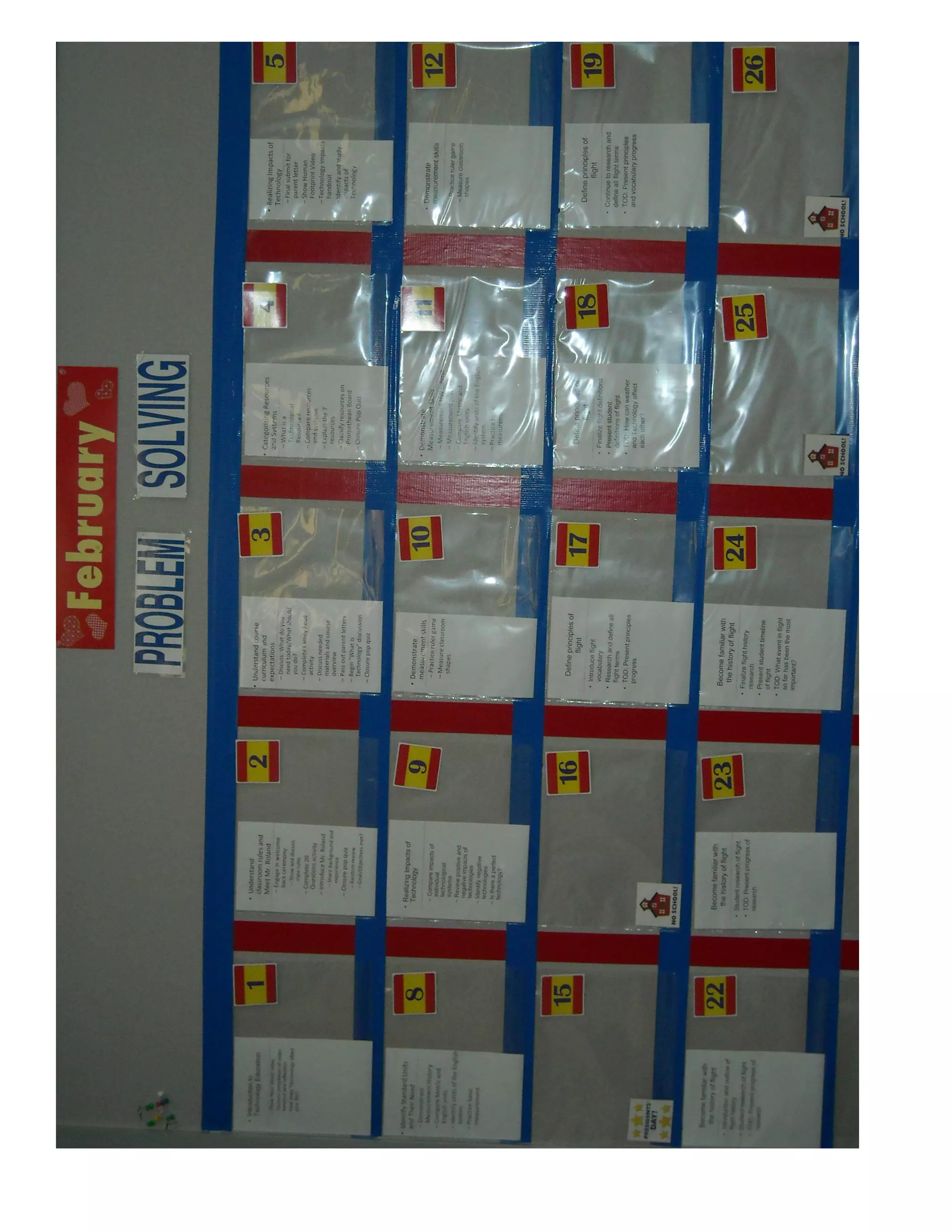
Flight and space ii
Flight and space ii
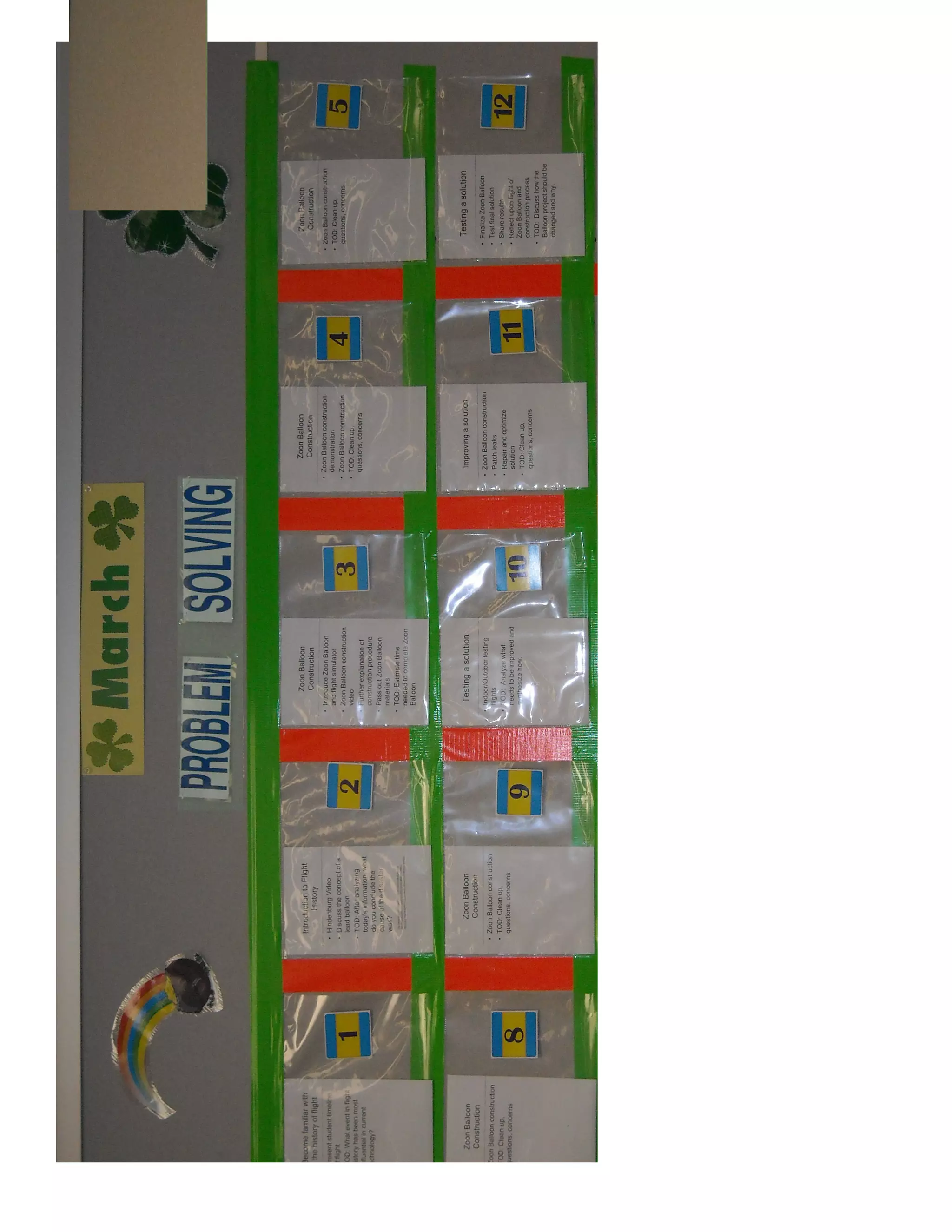
Flight and space ii

Flight and space ii

  • 1.
    Unit Plan Title: Flightand Space Unit Length: 5 weeks Written by: Jim Roland Subject/Grade: 8th Grade Technology Standard 5: Students will apply technological knowledge and skills to design, construct, use, and evaluate products and systems to satisfy human and environmental needs. Performance Indicators: 4: Develop plans and construct a model of the solution. 5: Test a solution, present and evaluate results, and describe possible modifications. 11: Access needed information from various Internet sites. 19: Describe how the evolution of technology led to the shift in society. 20: Understand the contributions of people to technological development. 21: Describe how new technologies have evolved. 24: Manage resources in a technological project. 25: Describe products that are well designed and made. 26: Assume leadership responsibilities. Rationale: To promote Technological Literacy, PLTW has justified the importance of Flight and Space. Students will learn the content of this curriculum while strengthening skills of literacy to become better learners. The application of content learned will be the greatest learning experience for students through several activities, including a flight simulator. Launch: Show Hindenburg video and discuss the importance of the history and evolution of flight. Essential Question: How has flight impacted society as well as our personal lives throughout different decades. Critical Thinking Skill: Problem Solving, , Sub Skills: Investigation, , Assessments: Formative: Daily Bell Ringer, Quizzes, Homework, Activity Participation, Daily Participation Summative: Hot Air Balloon construction and testing Vocabulary: NYS Test: Conclusion, Elaborate, Reflect Unit Vocab: aerodynamics, airfoil, drag, roll, pitch, yaw, weight, gravity, thrust, lift, wind, aeronautics, Bernoulli's Principle, atmospheric pressure, altitude, force, propulsion, velocity, acceleration, center of gravity, jet stream, temperature differential, gore, panel, parachute valve, envelope, basket, ballast, burner
  • 2.
    Guiding Questions: Listthe different types of flight vehicles. Propose what possibilities for flight are in the future. Who were the pioneers of flight? Determine who/what were the first passengers of a hot air balloon. Theorize what causes wind. Justify if there were no wind, animals would not survive in the North Pole. Modify the Hindenburg design so it would've flown successfully. Assess what causes lift. Compare and contrast gravity to weight. Relate Newton's Laws to propulsion. Student Engagement: participation in activities, observation throughout direct instruction, accountability by asking all students for answers randomly, answer individual questions, include students throughout instruction as helpers or assisting teachers, group or teamwork Meaningful Use (real world application): Students will apply measurements and scale drawings to produce a working prototype "Zoon Balloon". This balloon will represent studies of flight and atmospheric conditions. Students will encounter problems such as balance, envelope leaks, weather conditions, and aerodynamics. Students will also participate in the most recent version of flight simulator with advanced throttle, yoke, and rudder controls. They will experience the virtual challenges of a pilot. Materials/Resources: Zoon Balloon kit, balloon launcher, scissors, glue sticks (~35), flight simulator, yoke and throttle controller, rudder pedals, USB extension cable How did it go?: Again, students enjoyed the flight simulator but there was some difficulty in giving all students enough time to work on it. Students liked working on the hot air balloons and did not get nearly as frustrated. With extra encouragement, students took advantage of time to work and patch their envelopes. On launch day, equipment was all ready but I had to get it from several separate places. This activity must be completed during the first part of semester two in order to be successful. Some students finished early and helped construct a balloon that was six feet in diameter. Students really loved seeing the balloons fly. What changes?: For next time, I have already created better storage for materials and equipment so that it is not so scattered. I would like to challenge more students to build the larger balloons and get better footage and pictures for school newspaper, etc. I would also like to set up some sort of stations for it to be feasible for all students to complete the flight simulator. The last change I would like is to be able to launch several balloons at a time but at this time that is not feasible. Why different?: The updated storage allows me to be even more organized and readily prepared for activities. Encouraging students to construct the larger balloons and launching several at a time would be a great spectacle and rather impressive. Lastly, I would like to implement stations for this activity so that all students get a fair chance to work with the simulator.