Employer Branding: The Key to
Recruiting Star Candidates
There are jobs and there are dream jobs—the roles at organizations that
you aspire to join. Maybe they make a product or service that you love,
maybe they have an amazing corporate culture in which you know you
could thrive, or maybe they have a mission statement which you could
really believe in. If given the opportunity you would drop everything,
move across the country and even take a pay cut just to get your foot in
the door—and as an employer there is no better position to be in.
Google is already one of those places—ranked as the best place to
work by FORTUNE magazine in four of the last seven years—yet
even they have turned to what some would call extreme means to
further that devotion to their employer brand. A recent movie, The
Internship, which takes place at Google headquarters, showcases
the company’s legendary Mountain View, CA campus and
corporate culture, complete with hazing, scary managers and wild
goose-chasing pranks. While the movie makes light of the highly
sought-after Google internship, it was seen by executives as a good
way to further expose the company's "do-no-evil" culture and get
more potential candidates interested in technology, computers, and
ultimately becoming “Googlers.” That such a highly sought after
employer still sees the need to go to such lengths highlights the need
for branding to attract top candidates in today’s economic climate.
Locating exceptional talent continues to be an ongoing challenge,
particularly in the executive and managerial space. Growing companies
recognize the necessity of expanding resources and leadership to remain
competitive, however the talent pool is competitive among mid-to-high-
level executives and top candidates often need to be recruited out of
current roles. Although recent unemployment data suggests a slow
rebound of the overall U.S. economy due to an employer-driven market,
the unemployment rate for this sector is considerably lower than general
unemployment – 3.5 percent versus 7.3 percent in May. In May of 2012
those rates were 4.0 percent versus 7.9 percent, indicating that the job
market in the executive recruitment space is increasingly employee-
driven, making branding essential to entice A-players.
“When it comes to post-recession recruitment efforts, where companies
are focused on finding the best candidates, branding is more important
than ever in the search process, says Rob Romaine, president of
MRINetwork. “A concerted effort to communicate clear messaging
about the company’s culture, mission, products and services, both
internally and externally is key in attracting the right people.
Essentially, recruitment begins well before positions are even posted.”
Considering Google’s market recognition in the technology arena, its
participation in the movie underscores the organization’s insight into
VOLUMEVI||ISSUE7July122013
© 2012 Management Recruiters International, Inc. An Equal Opportunity Employer
the technology talent pool where unemployment is lower than in
other industries and the number of star candidates for potential
hire is smaller. “Google’s awareness of the value of employer
branding proves that even large, renowned companies must be
tireless and innovative in their efforts to create, maintain and
promote a corporate culture that is appealing to multiple
audiences including exceptional candidates, investors and the
public,” says Romaine.
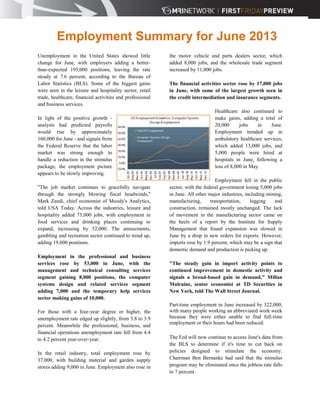
Since 2003, he notes, employment in the IT industry has grown
by 37 percent. According to the Bureau of Labor Statistics
(BLS), during the recent recession, the industry lost only 1
percent of its workforce in 2009, but otherwise maintained
employment. By 2010, employment had recovered and was
higher than it had been in 2008.
How should companies develop branding initiatives and
maximize these efforts for recruitment purposes? “First the
organization has to be honest about its corporate culture
and create brand messaging based on this premise, not the
brand that it aspires to be,” says Romaine. “Second, the
company should identify and promote differentiating
factors that separate it from industry competitors –
qualities that will not only be attractive to the general
public or investors, but incoming talent as well. Third, the
business must constantly assess whether public
perception of the company matches the corporate imaging
and messaging that are being communicated.”
At the end of the day, employer branding and recruitment must
go hand-in-hand to attract impact player candidates. Whether
it’s for an internship or a senior-level position, company imaging
and messaging are increasingly major components of the hiring
process, helping ensure that employers locate talent that will
not only fulfill job requirements, but will also be a good match
with the company culture.Source: Department of Labor
Submitted by: Joe Cianciolo, Senior Account Manager
Management Recruiters of Cleveland-Southwest
>Experts in Global Search
(330) 273-4300 ext. 109
JoeCC@MRCSW.com
Call me to help you attract the impact player who can push
you beyond your 2013 goals.
What is an impact player? Click Video
Unemployment in the United States showed little
change for June, with employers adding a better-
than-expected 195,000 positions, leaving the rate
steady at 7.6 percent, according to the Bureau of
Labor Statistics (BLS). Some of the biggest gains
were seen in the leisure and hospitality sector, retail
trade, healthcare, financial activities and professional
and business services.
In light of the positive growth -
analysts had predicted payrolls
would rise by approximately
160,000 for June - and signals from
the Federal Reserve that the labor
market was strong enough to
handle a reduction in the stimulus
package, the employment picture
appears to be slowly improving.
"The job market continues to gracefully navigate
through the strongly blowing fiscal headwinds,"
Mark Zandi, chief economist of Moody's Analytics,
told USA Today. Across the industries, leisure and
hospitality added 75,000 jobs, with employment in
food services and drinking places continuing to
expand, increasing by 52,000. The amusements,
gambling and recreation sector continued to trend up,
adding 19,000 positions.
Employment in the professional and business
services rose by 53,000 in June, with the
management and technical consulting services
segment gaining 8,000 positions, the computer
systems design and related services segment
adding 7,000 and the temporary help services
sector making gains of 10,000.
For those with a four-year degree or higher, the
unemployment rate edged up slightly, from 3.8 to 3.9
percent. Meanwhile the professional, business, and
financial operations unemployment rate fell from 4.4
to 4.2 percent year-over-year.
In the retail industry, total employment rose by
37,000, with building material and garden supply
stores adding 9,000 in June. Employment also rose in
the motor vehicle and parts dealers sector, which
added 8,000 jobs, and the wholesale trade segment
increased by 11,000 jobs.
The financial activities sector rose by 17,000 jobs
in June, with some of the largest growth seen in
the credit intermediation and insurance segments.
Healthcare also continued to
make gains, adding a total of
20,000 jobs in June.
Employment trended up in
ambulatory healthcare services,
which added 13,000 jobs, and
5,000 people were hired at
hospitals in June, following a
loss of 8,000 in May.
Employment fell in the public
sector, with the federal government losing 5,000 jobs
in June. All other major industries, including mining,
manufacturing, transportation, logging and
construction, remained mostly unchanged. The lack
of movement in the manufacturing sector came on
the heels of a report by the Institute for Supply
Management that found expansion was slowed in
June by a drop in new orders for exports. However,
imports rose by 1.9 percent, which may be a sign that
domestic demand and production is picking up.
"The steady gain in import activity points to
continued improvement in domestic activity and
signals a broad-based gain in demand," Millan
Mulraine, senior economist at TD Securities in
New York, told The Wall Street Journal.
Part-time employment in June increased by 322,000,
with many people working an abbreviated work week
because they were either unable to find full-time
employment or their hours had been reduced.
The Fed will now continue to access June's data from
the BLS to determine if it's time to cut back on
policies designed to stimulate the economy.
Chairman Ben Bernanke had said that the stimulus
program may be eliminated once the jobless rate falls
to 7 percent.
Employment Summary for June 2013

First friday july 2013

  • 1.
    Employer Branding: TheKey to Recruiting Star Candidates There are jobs and there are dream jobs—the roles at organizations that you aspire to join. Maybe they make a product or service that you love, maybe they have an amazing corporate culture in which you know you could thrive, or maybe they have a mission statement which you could really believe in. If given the opportunity you would drop everything, move across the country and even take a pay cut just to get your foot in the door—and as an employer there is no better position to be in. Google is already one of those places—ranked as the best place to work by FORTUNE magazine in four of the last seven years—yet even they have turned to what some would call extreme means to further that devotion to their employer brand. A recent movie, The Internship, which takes place at Google headquarters, showcases the company’s legendary Mountain View, CA campus and corporate culture, complete with hazing, scary managers and wild goose-chasing pranks. While the movie makes light of the highly sought-after Google internship, it was seen by executives as a good way to further expose the company's "do-no-evil" culture and get more potential candidates interested in technology, computers, and ultimately becoming “Googlers.” That such a highly sought after employer still sees the need to go to such lengths highlights the need for branding to attract top candidates in today’s economic climate. Locating exceptional talent continues to be an ongoing challenge, particularly in the executive and managerial space. Growing companies recognize the necessity of expanding resources and leadership to remain competitive, however the talent pool is competitive among mid-to-high- level executives and top candidates often need to be recruited out of current roles. Although recent unemployment data suggests a slow rebound of the overall U.S. economy due to an employer-driven market, the unemployment rate for this sector is considerably lower than general unemployment – 3.5 percent versus 7.3 percent in May. In May of 2012 those rates were 4.0 percent versus 7.9 percent, indicating that the job market in the executive recruitment space is increasingly employee- driven, making branding essential to entice A-players. “When it comes to post-recession recruitment efforts, where companies are focused on finding the best candidates, branding is more important than ever in the search process, says Rob Romaine, president of MRINetwork. “A concerted effort to communicate clear messaging about the company’s culture, mission, products and services, both internally and externally is key in attracting the right people. Essentially, recruitment begins well before positions are even posted.” Considering Google’s market recognition in the technology arena, its participation in the movie underscores the organization’s insight into VOLUMEVI||ISSUE7July122013 © 2012 Management Recruiters International, Inc. An Equal Opportunity Employer the technology talent pool where unemployment is lower than in other industries and the number of star candidates for potential hire is smaller. “Google’s awareness of the value of employer branding proves that even large, renowned companies must be tireless and innovative in their efforts to create, maintain and promote a corporate culture that is appealing to multiple audiences including exceptional candidates, investors and the public,” says Romaine. Since 2003, he notes, employment in the IT industry has grown by 37 percent. According to the Bureau of Labor Statistics (BLS), during the recent recession, the industry lost only 1 percent of its workforce in 2009, but otherwise maintained employment. By 2010, employment had recovered and was higher than it had been in 2008. How should companies develop branding initiatives and maximize these efforts for recruitment purposes? “First the organization has to be honest about its corporate culture and create brand messaging based on this premise, not the brand that it aspires to be,” says Romaine. “Second, the company should identify and promote differentiating factors that separate it from industry competitors – qualities that will not only be attractive to the general public or investors, but incoming talent as well. Third, the business must constantly assess whether public perception of the company matches the corporate imaging and messaging that are being communicated.” At the end of the day, employer branding and recruitment must go hand-in-hand to attract impact player candidates. Whether it’s for an internship or a senior-level position, company imaging and messaging are increasingly major components of the hiring process, helping ensure that employers locate talent that will not only fulfill job requirements, but will also be a good match with the company culture.Source: Department of Labor Submitted by: Joe Cianciolo, Senior Account Manager Management Recruiters of Cleveland-Southwest >Experts in Global Search (330) 273-4300 ext. 109 JoeCC@MRCSW.com Call me to help you attract the impact player who can push you beyond your 2013 goals. What is an impact player? Click Video
  • 2.
    Unemployment in theUnited States showed little change for June, with employers adding a better- than-expected 195,000 positions, leaving the rate steady at 7.6 percent, according to the Bureau of Labor Statistics (BLS). Some of the biggest gains were seen in the leisure and hospitality sector, retail trade, healthcare, financial activities and professional and business services. In light of the positive growth - analysts had predicted payrolls would rise by approximately 160,000 for June - and signals from the Federal Reserve that the labor market was strong enough to handle a reduction in the stimulus package, the employment picture appears to be slowly improving. "The job market continues to gracefully navigate through the strongly blowing fiscal headwinds," Mark Zandi, chief economist of Moody's Analytics, told USA Today. Across the industries, leisure and hospitality added 75,000 jobs, with employment in food services and drinking places continuing to expand, increasing by 52,000. The amusements, gambling and recreation sector continued to trend up, adding 19,000 positions. Employment in the professional and business services rose by 53,000 in June, with the management and technical consulting services segment gaining 8,000 positions, the computer systems design and related services segment adding 7,000 and the temporary help services sector making gains of 10,000. For those with a four-year degree or higher, the unemployment rate edged up slightly, from 3.8 to 3.9 percent. Meanwhile the professional, business, and financial operations unemployment rate fell from 4.4 to 4.2 percent year-over-year. In the retail industry, total employment rose by 37,000, with building material and garden supply stores adding 9,000 in June. Employment also rose in the motor vehicle and parts dealers sector, which added 8,000 jobs, and the wholesale trade segment increased by 11,000 jobs. The financial activities sector rose by 17,000 jobs in June, with some of the largest growth seen in the credit intermediation and insurance segments. Healthcare also continued to make gains, adding a total of 20,000 jobs in June. Employment trended up in ambulatory healthcare services, which added 13,000 jobs, and 5,000 people were hired at hospitals in June, following a loss of 8,000 in May. Employment fell in the public sector, with the federal government losing 5,000 jobs in June. All other major industries, including mining, manufacturing, transportation, logging and construction, remained mostly unchanged. The lack of movement in the manufacturing sector came on the heels of a report by the Institute for Supply Management that found expansion was slowed in June by a drop in new orders for exports. However, imports rose by 1.9 percent, which may be a sign that domestic demand and production is picking up. "The steady gain in import activity points to continued improvement in domestic activity and signals a broad-based gain in demand," Millan Mulraine, senior economist at TD Securities in New York, told The Wall Street Journal. Part-time employment in June increased by 322,000, with many people working an abbreviated work week because they were either unable to find full-time employment or their hours had been reduced. The Fed will now continue to access June's data from the BLS to determine if it's time to cut back on policies designed to stimulate the economy. Chairman Ben Bernanke had said that the stimulus program may be eliminated once the jobless rate falls to 7 percent. Employment Summary for June 2013