OBJECTIVES
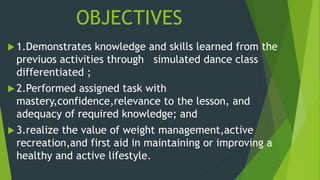
 1.Demonstrates knowledge and skills learned from the
previuos activities through simulated dance class
differentiated ;
 2.Performed assigned task with
mastery,confidence,relevance to the lesson, and
adequacy of required knowledge; and
 3.realize the value of weight management,active
recreation,and first aid in maintaining or improving a
healthy and active lifestyle.
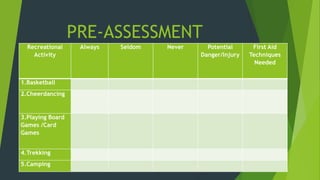
PRE-ASSESSMENT
Recreational
Activity
Always Seldom Never Potential
Danger/Injury
First Aid
Techniques
Needed
1.Basketball
2.Cheerdancing
3.Playing Board
Games /Card
Games
4.Trekking
5.Camping
QUESTIONS :
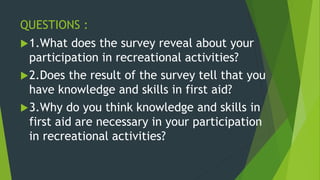
1.What does the survey reveal about your
participation in recreational activities?
2.Does the result of the survey tell that you
have knowledge and skills in first aid?
3.Why do you think knowledge and skills in
first aid are necessary in your participation
in recreational activities?
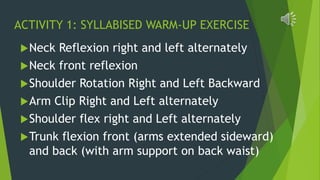
ACTIVITY 1: SYLLABISED WARM-UP EXERCISE
Neck Reflexion right and left alternately
Neck front reflexion
Shoulder Rotation Right and Left Backward
Arm Clip Right and Left alternately
Shoulder flex right and Left alternately
Trunk flexion front (arms extended sideward)
and back (with arm support on back waist)
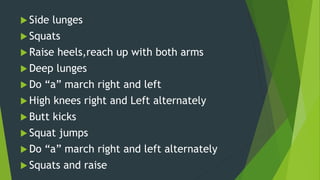
 Side lunges
 Squats
 Raise heels,reach up with both arms
 Deep lunges
 Do “a” march right and left
 High knees right and Left alternately
 Butt kicks
 Squat jumps
 Do “a” march right and left alternately
 Squats and raise
QUESTIONS :
 How did you feel about the warm up drills
exercise?
 What benefits you can gain when doing warm-up
before the performance of a more strenuous
physical exercise?
 Why is there a need to warm-up before
cheerdancing?
 What other warm-up exercise can you suggest
other than those you have already performed?
ACTIVITY 2
 Each group will be assigned an activity to
perform :
 Group 1 : Fitness lecture with focus on
weight management.
 Group 2 : Dance group with emphasis on
recreational activities chosen
 Group 3 : First Aid group focusing on
dislocations,sprains and lacerations.
CRITERIA :
1.Relevance of the activities presented 40%
2.Adequacy of the knowledge demonstrated
relative to the given topic 40%
3.Teamwork 20%
Total 100 %
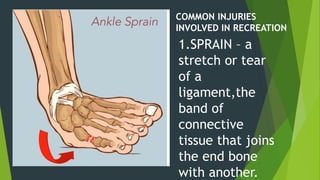
COMMON INJURIES
INVOLVED IN RECREATION
1.SPRAIN – a
stretch or tear
of a
ligament,the
band of
connective
tissue that joins
the end bone
with another.
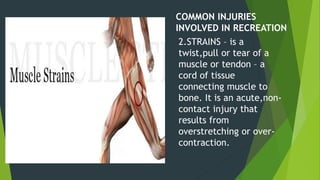
COMMON INJURIES
INVOLVED IN RECREATION
2.STRAINS – is a
twist,pull or tear of a
muscle or tendon – a
cord of tissue
connecting muscle to
bone. It is an acute,non-
contact injury that
results from
overstretching or over-
contraction.
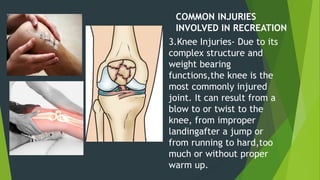
COMMON INJURIES
INVOLVED IN RECREATION
3.Knee Injuries- Due to its
complex structure and
weight bearing
functions,the knee is the
most commonly injured
joint. It can result from a
blow to or twist to the
knee, from improper
landingafter a jump or
from running to hard,too
much or without proper
warm up.
COMMON INJURIES
INVOLVED IN RECREATION
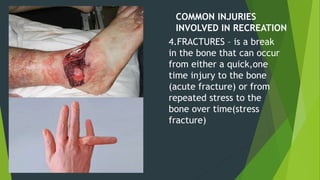
4.FRACTURES – is a break
in the bone that can occur
from either a quick,one
time injury to the bone
(acute fracture) or from
repeated stress to the
bone over time(stress
fracture)
COMMON INJURIES
INVOLVED IN RECREATION
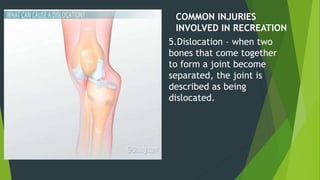
5.Dislocation – when two
bones that come together
to form a joint become
separated, the joint is
described as being
dislocated.
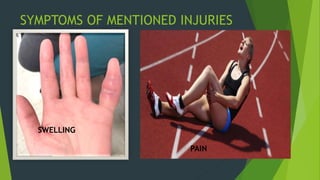
SYMPTOMS OF MENTIONED INJURIES
SWELLING
PAIN
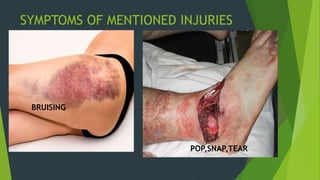
SYMPTOMS OF MENTIONED INJURIES
BRUISING
POP,SNAP,TEAR
FIRST AID GOAL
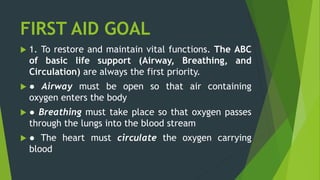
 1. To restore and maintain vital functions. The ABC
of basic life support (Airway, Breathing, and
Circulation) are always the first priority.
 ● Airway must be open so that air containing
oxygen enters the body
 ● Breathing must take place so that oxygen passes
through the lungs into the blood stream
 ● The heart must circulate the oxygen carrying
blood
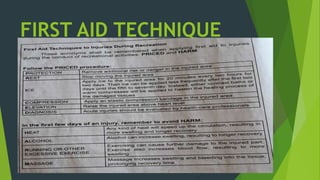
FIRST AID TECHNIQUE
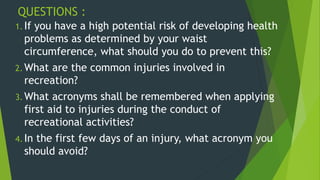
QUESTIONS :
1. If you have a high potential risk of developing health
problems as determined by your waist
circumference, what should you do to prevent this?
2. What are the common injuries involved in
recreation?
3. What acronyms shall be remembered when applying
first aid to injuries during the conduct of
recreational activities?
4. In the first few days of an injury, what acronym you
should avoid?
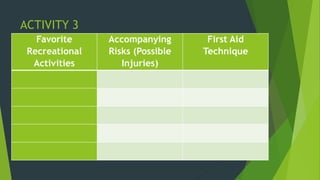
ACTIVITY 3
Favorite
Recreational
Activities
Accompanying
Risks (Possible
Injuries)
First Aid
Technique
ACTIVITY 4 : SEARCH FOR MS. & MR. Q & A 2019
*Choose 2 representatives in your group to answer the Q & A 2019.
QUESTIONS :
1. If you were to choose among sedentary, moderately active or
active lifestyle,which would you prefer?Why?
2. Which do you think is better, passive or active recreation?why?
3. What suggestions can you give to minimize the potential risks in
such physical activity?
4. Why is it important to have a balanced lifestyle?
5. Do you need to learn first aid techniques?Why?
6. What is the first aid technique for sprains and strains?
EVALUATION
1.If you have a high potential risk of developing health problems as determined by your waist
circumference, what should you do to prevent this?
a.perform physical activity
b.have an imbalanced lifestyle
c.having a sedentary lifestyle
d.all of the above
2. What are the common injuries involved in recreation?
a.sprains b.strains c.knee injuries d.all of the above
3. What acronyms shall be remembered when applying first aid to injuries during the conduct of
recreational activities?
a.PRICED b.PRICE c.ICED d. RICED
4. In the first few days of an injury, what acronym you should avoid?
a.HARM b.ARM c.HEAT d. ICE
5. Who will conduct diagnosis for acute injuries?
a.healthcare professionals c.Medical Technologists
b.teachers d.all of the above

First aid technique demo teaching cot 3

  • 2.
    OBJECTIVES  1.Demonstrates knowledgeand skills learned from the previuos activities through simulated dance class differentiated ;  2.Performed assigned task with mastery,confidence,relevance to the lesson, and adequacy of required knowledge; and  3.realize the value of weight management,active recreation,and first aid in maintaining or improving a healthy and active lifestyle.
  • 3.
    PRE-ASSESSMENT Recreational Activity Always Seldom NeverPotential Danger/Injury First Aid Techniques Needed 1.Basketball 2.Cheerdancing 3.Playing Board Games /Card Games 4.Trekking 5.Camping
  • 4.
    QUESTIONS : 1.What doesthe survey reveal about your participation in recreational activities? 2.Does the result of the survey tell that you have knowledge and skills in first aid? 3.Why do you think knowledge and skills in first aid are necessary in your participation in recreational activities?
  • 5.
    ACTIVITY 1: SYLLABISEDWARM-UP EXERCISE Neck Reflexion right and left alternately Neck front reflexion Shoulder Rotation Right and Left Backward Arm Clip Right and Left alternately Shoulder flex right and Left alternately Trunk flexion front (arms extended sideward) and back (with arm support on back waist)
  • 6.
     Side lunges Squats  Raise heels,reach up with both arms  Deep lunges  Do “a” march right and left  High knees right and Left alternately  Butt kicks  Squat jumps  Do “a” march right and left alternately  Squats and raise
  • 7.
    QUESTIONS :  Howdid you feel about the warm up drills exercise?  What benefits you can gain when doing warm-up before the performance of a more strenuous physical exercise?  Why is there a need to warm-up before cheerdancing?  What other warm-up exercise can you suggest other than those you have already performed?
  • 8.
    ACTIVITY 2  Eachgroup will be assigned an activity to perform :  Group 1 : Fitness lecture with focus on weight management.  Group 2 : Dance group with emphasis on recreational activities chosen  Group 3 : First Aid group focusing on dislocations,sprains and lacerations.
  • 9.
    CRITERIA : 1.Relevance ofthe activities presented 40% 2.Adequacy of the knowledge demonstrated relative to the given topic 40% 3.Teamwork 20% Total 100 %
  • 10.
    COMMON INJURIES INVOLVED INRECREATION 1.SPRAIN – a stretch or tear of a ligament,the band of connective tissue that joins the end bone with another.
  • 11.
    COMMON INJURIES INVOLVED INRECREATION 2.STRAINS – is a twist,pull or tear of a muscle or tendon – a cord of tissue connecting muscle to bone. It is an acute,non- contact injury that results from overstretching or over- contraction.
  • 12.
    COMMON INJURIES INVOLVED INRECREATION 3.Knee Injuries- Due to its complex structure and weight bearing functions,the knee is the most commonly injured joint. It can result from a blow to or twist to the knee, from improper landingafter a jump or from running to hard,too much or without proper warm up.
  • 13.
    COMMON INJURIES INVOLVED INRECREATION 4.FRACTURES – is a break in the bone that can occur from either a quick,one time injury to the bone (acute fracture) or from repeated stress to the bone over time(stress fracture)
  • 14.
    COMMON INJURIES INVOLVED INRECREATION 5.Dislocation – when two bones that come together to form a joint become separated, the joint is described as being dislocated.
  • 15.
    SYMPTOMS OF MENTIONEDINJURIES SWELLING PAIN
  • 16.
    SYMPTOMS OF MENTIONEDINJURIES BRUISING POP,SNAP,TEAR
  • 17.
    FIRST AID GOAL 1. To restore and maintain vital functions. The ABC of basic life support (Airway, Breathing, and Circulation) are always the first priority.  ● Airway must be open so that air containing oxygen enters the body  ● Breathing must take place so that oxygen passes through the lungs into the blood stream  ● The heart must circulate the oxygen carrying blood
  • 18.
  • 19.
    QUESTIONS : 1. Ifyou have a high potential risk of developing health problems as determined by your waist circumference, what should you do to prevent this? 2. What are the common injuries involved in recreation? 3. What acronyms shall be remembered when applying first aid to injuries during the conduct of recreational activities? 4. In the first few days of an injury, what acronym you should avoid?
  • 20.
  • 21.
    ACTIVITY 4 :SEARCH FOR MS. & MR. Q & A 2019 *Choose 2 representatives in your group to answer the Q & A 2019. QUESTIONS : 1. If you were to choose among sedentary, moderately active or active lifestyle,which would you prefer?Why? 2. Which do you think is better, passive or active recreation?why? 3. What suggestions can you give to minimize the potential risks in such physical activity? 4. Why is it important to have a balanced lifestyle? 5. Do you need to learn first aid techniques?Why? 6. What is the first aid technique for sprains and strains?
  • 22.
    EVALUATION 1.If you havea high potential risk of developing health problems as determined by your waist circumference, what should you do to prevent this? a.perform physical activity b.have an imbalanced lifestyle c.having a sedentary lifestyle d.all of the above 2. What are the common injuries involved in recreation? a.sprains b.strains c.knee injuries d.all of the above 3. What acronyms shall be remembered when applying first aid to injuries during the conduct of recreational activities? a.PRICED b.PRICE c.ICED d. RICED 4. In the first few days of an injury, what acronym you should avoid? a.HARM b.ARM c.HEAT d. ICE 5. Who will conduct diagnosis for acute injuries? a.healthcare professionals c.Medical Technologists b.teachers d.all of the above