ICS312 Set 29
Deterministic Finite Automata
Nondeterministic Finite Automata
Deterministic Finite Automata
• A regular expression can be represented (and recognized) by a
machine called a deterministic finite automaton (dfa).
• A dfa can then be used to generate the matrix (or table) used by
the scanner (or lexical analyzer).
• Deterministic finite automata are frequently also called simply
finite automata (fa).
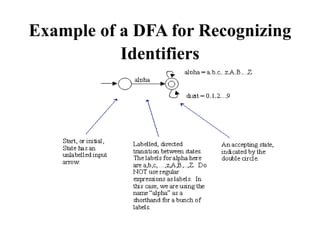
Example of a DFA for Recognizing
Identifiers
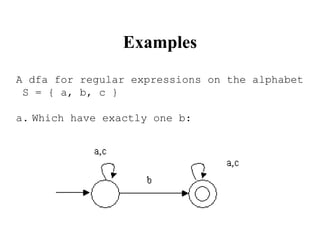
Examples
A dfa for regular expressions on the alphabet
S = { a, b, c }
a. Which have exactly one b:
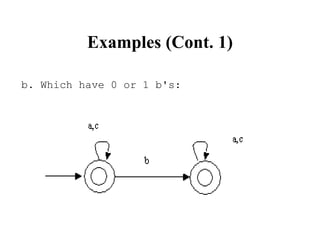
Examples (Cont. 1)
b. Which have 0 or 1 b's:
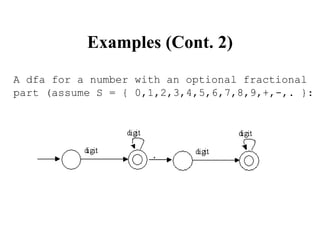
Examples (Cont. 2)
A dfa for a number with an optional fractional
part (assume S = { 0,1,2,3,4,5,6,7,8,9,+,-,. }:
Constructing DFA
• Regular expressions give us rules for recognizing the
symbols or tokens of a programming language.
• The way a lexical analyzer can recognize the symbols
is to use a DFA (machine) to construct a matrix, or
table, that reports when a particular kind of symbol
has been recognized.
• In order to recognize symbols, we need to know how
to (efficiently) construct a DFA from a regular
expression.
How to Construct a DFA from a
Regular Expression
• Construct a nondeterministic finite automata
(nfa)
• Using the nfa, construct a dfa
• Minimize the number of states in the dfa to get
a smaller dfa
Nondeterministic Finite Automata
• A nondeterministic finite automata (NFA) allows
transitions on a symbol from one state to possibly
more than one other state.
• Allows e-transitions from one state to another
whereby we can move from the first state to the
second without inputting the next character.
• In a NFA, a string is matched if there is any path from
the start state to an accepting state using that string.
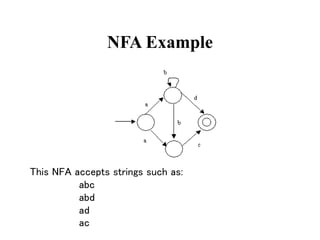
NFA Example
This NFA accepts strings such as:
abc
abd
ad
ac
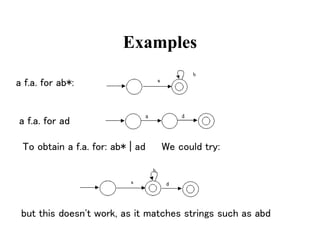
Examples
a f.a. for ab*:
a f.a. for ad
To obtain a f.a. for: ab* | ad We could try:
but this doesn't work, as it matches strings such as abd
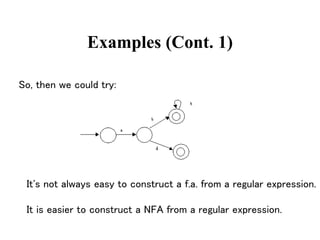
Examples (Cont. 1)
So, then we could try:
It's not always easy to construct a f.a. from a regular expression.
It is easier to construct a NFA from a regular expression.
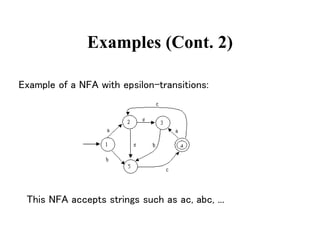
Examples (Cont. 2)
Example of a NFA with epsilon-transitions:
This NFA accepts strings such as ac, abc, ...
Algorithm to employ in getting a
computer program to construct a
NFA for any regular expression
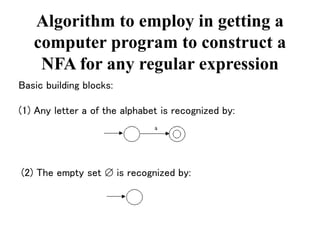
Basic building blocks:
(1) Any letter a of the alphabet is recognized by:
(2) The empty set  is recognized by:
Note: it is possible to avoid including some of the ε-productions
employed by the algorithm, but the increase in speed, if any, is
negligible.
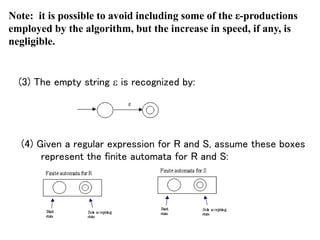
(3) The empty string e is recognized by:
(4) Given a regular expression for R and S, assume these boxes
represent the finite automata for R and S:
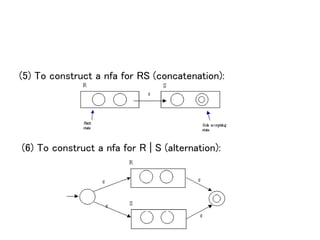
(5) To construct a nfa for RS (concatenation):
(6) To construct a nfa for R | S (alternation):
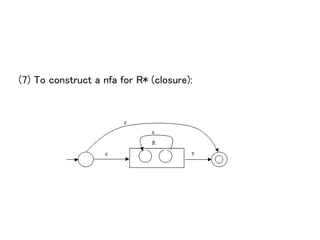
(7) To construct a nfa for R* (closure):
NOTE: In 1-3 above we supply finite automata for
some basic regular expressions, and in 4-6 we
supply 3 methods of composition to form finite
automata for more complicated regular expressions.
These, in particular, provide methods for
constructing finite automata for regular expressions
such as, e.g.:
R+ = RR*
R? = R | ε
[1-3ab] = 1|2|3|a|b
Example
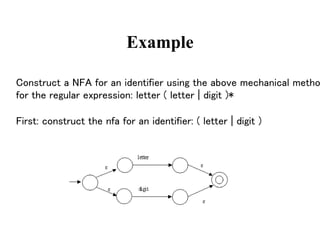
Construct a NFA for an identifier using the above mechanical metho
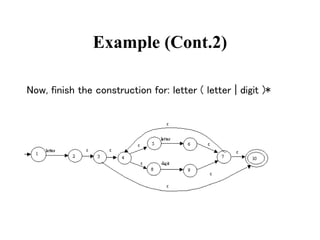
for the regular expression: letter ( letter | digit )*
First: construct the nfa for an identifier: ( letter | digit )
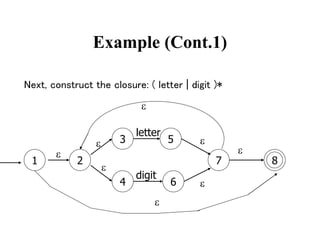
Example (Cont.1)
Next, construct the closure: ( letter | digit )*
1 2
3
4
5
6
7 8
e
e
e
e
e
e
e
e
letter
digit
Example (Cont.2)
Now, finish the construction for: letter ( letter | digit )*

finite_automata.ppt

  • 1.
    ICS312 Set 29 DeterministicFinite Automata Nondeterministic Finite Automata
  • 2.
    Deterministic Finite Automata •A regular expression can be represented (and recognized) by a machine called a deterministic finite automaton (dfa). • A dfa can then be used to generate the matrix (or table) used by the scanner (or lexical analyzer). • Deterministic finite automata are frequently also called simply finite automata (fa).
  • 3.
    Example of aDFA for Recognizing Identifiers
  • 4.
    Examples A dfa forregular expressions on the alphabet S = { a, b, c } a. Which have exactly one b:
  • 5.
    Examples (Cont. 1) b.Which have 0 or 1 b's:
  • 6.
    Examples (Cont. 2) Adfa for a number with an optional fractional part (assume S = { 0,1,2,3,4,5,6,7,8,9,+,-,. }:
  • 7.
    Constructing DFA • Regularexpressions give us rules for recognizing the symbols or tokens of a programming language. • The way a lexical analyzer can recognize the symbols is to use a DFA (machine) to construct a matrix, or table, that reports when a particular kind of symbol has been recognized. • In order to recognize symbols, we need to know how to (efficiently) construct a DFA from a regular expression.
  • 8.
    How to Constructa DFA from a Regular Expression • Construct a nondeterministic finite automata (nfa) • Using the nfa, construct a dfa • Minimize the number of states in the dfa to get a smaller dfa
  • 9.
    Nondeterministic Finite Automata •A nondeterministic finite automata (NFA) allows transitions on a symbol from one state to possibly more than one other state. • Allows e-transitions from one state to another whereby we can move from the first state to the second without inputting the next character. • In a NFA, a string is matched if there is any path from the start state to an accepting state using that string.
  • 10.
    NFA Example This NFAaccepts strings such as: abc abd ad ac
  • 11.
    Examples a f.a. forab*: a f.a. for ad To obtain a f.a. for: ab* | ad We could try: but this doesn't work, as it matches strings such as abd
  • 12.
    Examples (Cont. 1) So,then we could try: It's not always easy to construct a f.a. from a regular expression. It is easier to construct a NFA from a regular expression.
  • 13.
    Examples (Cont. 2) Exampleof a NFA with epsilon-transitions: This NFA accepts strings such as ac, abc, ...
  • 14.
    Algorithm to employin getting a computer program to construct a NFA for any regular expression Basic building blocks: (1) Any letter a of the alphabet is recognized by: (2) The empty set  is recognized by:
  • 15.
    Note: it ispossible to avoid including some of the ε-productions employed by the algorithm, but the increase in speed, if any, is negligible. (3) The empty string e is recognized by: (4) Given a regular expression for R and S, assume these boxes represent the finite automata for R and S:
  • 16.
    (5) To constructa nfa for RS (concatenation): (6) To construct a nfa for R | S (alternation):
  • 17.
    (7) To constructa nfa for R* (closure):
  • 18.
    NOTE: In 1-3above we supply finite automata for some basic regular expressions, and in 4-6 we supply 3 methods of composition to form finite automata for more complicated regular expressions. These, in particular, provide methods for constructing finite automata for regular expressions such as, e.g.: R+ = RR* R? = R | ε [1-3ab] = 1|2|3|a|b
  • 19.
    Example Construct a NFAfor an identifier using the above mechanical metho for the regular expression: letter ( letter | digit )* First: construct the nfa for an identifier: ( letter | digit )
  • 20.
    Example (Cont.1) Next, constructthe closure: ( letter | digit )* 1 2 3 4 5 6 7 8 e e e e e e e e letter digit
  • 21.
    Example (Cont.2) Now, finishthe construction for: letter ( letter | digit )*