Neural Network Time Series
Forecasting of Finite-Element Mesh
Adaptation
Adaptation
Content
Content
 Introduction to Finite Element Method
Introduction to Finite Element Method
 Time Dependent Partial Differential Equations
Time Dependent Partial Differential Equations
 The Finite Element Mesh Adaptation Problem
The Finite Element Mesh Adaptation Problem
Introduction to Neural Networks
Introduction to Neural Networks
Time Series Prediction with Neural Networks
Time Series Prediction with Neural Networks
 Our Method For Solving The Mesh Adaptation
Our Method For Solving The Mesh Adaptation
Problem
Problem
Finite Element Method (FEM)
 What is it ?
What is it ?
 The most effective numerical techniques for
The most effective numerical techniques for
solving various problems arising from
mathematical physics and engineering
 The widely used numerical techniques for
The widely used numerical techniques for
solving partial differential equations (PDEs)
Finite Element Method (FEM)
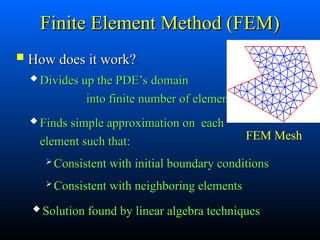
 Divides up the PDE’s domain
Divides up the PDE’s domain
into finite number of elements
FEM Mesh
 Solution found by linear algebra techniques
Solution found by linear algebra techniques
 Finds simple approximation on each
Finds simple approximation on each
element such that:
element such that:
 Consistent with initial boundary conditions
Consistent with initial boundary conditions
 Consistent with neighboring elements
Consistent with neighboring elements
 How does it work?
How does it work?
Time Dependent Partial
Differential Equations
 Hyperbolic
Hyperbolic
 Wave Equations
Wave Equations
 Parabolic
Parabolic
 Heat Equations
Heat Equations
FEM and Time Dependent PDEs
 The time dependent
The time dependent PDEs are repeatedly solved
PDEs are repeatedly solved
for different constant times
for different constant times using the previous
using the previous
solution
solution as start condition for the next one
as start condition for the next one
 The
The “areas of interest”
“areas of interest” are
are propagated
propagated through
through
the FEM mesh
the FEM mesh
 In order to achieve a good approximation the
In order to achieve a good approximation the mesh
mesh
should be
should be dynamic and varying with time
dynamic and varying with time
FEM and Time Dependent PDEs
 For time dependent
For time dependent PDEs
PDEs a
a critical regions
critical regions should
should
be subject to
be subject to local mesh refinement
local mesh refinement.
.
 The
The critical regions
critical regions are identified by the regions,
are identified by the regions,
which their local
which their local gradient shows bigger changes
gradient shows bigger changes.
.
Mesh Adaptations Problem
 In current usage, the method is to
In current usage, the method is to use indicators
use indicators
(e.g. gradients)
(e.g. gradients) from the solution at the
from the solution at the current
current
time
time to identify where the mesh
to identify where the mesh should be refined
should be refined
at the
at the next time
next time.
.
 The
The defect
defect of this method that one is
of this method that one is always
always
operating one step behind
operating one step behind (behind the “area of
(behind the “area of
interest”)
interest”)
Mesh Adaptation Problem
u
x
n
t
Time 
. .
.
.
.
.
. .
.
.
.
.
.
.
. . . . . .
Refine
We miss the action
u
x
1

 n
t
Time
. .
. .
.
.
.
.
. .
.
.
..
.
.
. . . . . .
.
.
Our Method
Our Method
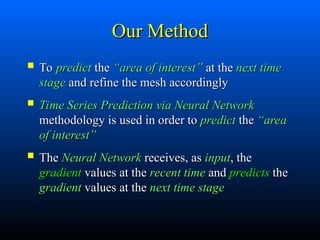
 To
To predict
predict the
the “area of interest”
“area of interest” at the
at the next time
next time
stage
stage and refine the mesh accordingly
and refine the mesh accordingly
 Time Series Prediction via Neural Network
Time Series Prediction via Neural Network
methodology is used in order to
methodology is used in order to predict
predict the
the “area
“area
of interest”
of interest”
 The
The Neural Network
Neural Network receives, as
receives, as input
input,
, the
the
gradient
gradient values at the
values at the recent time
recent time and
and predicts
predicts the
the
gradient
gradient values at the
values at the next time stage
next time stage
Neural Networks (NN)
 What is it?
What is it?
 A biologically inspired model, which tries to simulate the human
A biologically inspired model, which tries to simulate the human
nervous system
nervous system
 Consists of elements (
Consists of elements (neurons
neurons) and connections between them
) and connections between them
(
(weights
weights)
)
 Can be trained to perform complex functions (e.g. classifications) by
Can be trained to perform complex functions (e.g. classifications) by
adjusting the value of the weights.
Neural Networks (NN)
 How does it work?
How does it work?
 The input signal is multiplied by the weights, summed together and then processed by the neuron
The input signal is multiplied by the weights, summed together and then processed by the neuron
 Updates the NN weights through training scheme (e.g. Back-Propagation algorithm)
Updates the NN weights through training scheme (e.g. Back-Propagation algorithm)
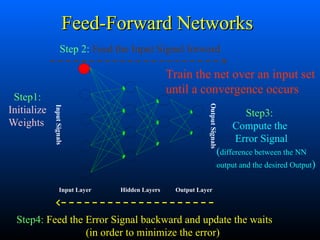
Feed-Forward Networks
Input Layer Hidden Layers Output Layer
Input
Signals
Output
Signals
Step 2: Feed the Input Signal forward
Step3:
Compute the
Error Signal
(difference between the NN
output and the desired Output)
Step4: Feed the Error Signal backward and update the waits
(in order to minimize the error)
Step1:
Initialize
Weights
Train the net over an input set
until a convergence occurs
 What is time series?
What is time series?
 A series of data where the
A series of data where the past values
past values in the
in the
series may
series may influence the future values
influence the future values. (the
. (the
future value is a nonlinear function of its past m
values)
values)
 The
The Neural Network
Neural Network can be used
can be used as a nonlinear
as a nonlinear
model that can be trained
model that can be trained to map past
to map past and
and
future values
future values of a
of a time series
time series
Time Series Predicting Using NN
))
(
),....,
2
(
),
1
(
(
)
( m
n
x
n
x
n
x
f
n
x 



Applying NNs to Time
Dependent PDES
Dependent PDES
Neural Network Architecture
 Two networks
Two networks
– One is for
One is for boundary elements
boundary elements and the other is for
and the other is for interior
interior
elements
elements
 Network input
Network input
– Eight input units (six for boundary element network), the
Eight input units (six for boundary element network), the
gradient of the element and its neighbors in the current and
previous times
previous times
 Hidden Layers
Hidden Layers
– One hidden layer with six units
One hidden layer with six units
 Network output
Network output
– One output unit, that gives the prediction of the gradient
One output unit, that gives the prediction of the gradient
value at the next time stage
Training Phase
Training Phase
 Training Set
Training Set
– We calculate the solution on the initial
We calculate the solution on the initial
nondynamic mesh over all the given time space
– We chose random examples (about 600) and
We chose random examples (about 600) and
trained the net over this set to predict the
gradient
gradient
 Training Performance
Training Performance
– For all the experiments that we did so far, the
For all the experiments that we did so far, the
network training took at most 200 epochs to
converge to an extremely small error
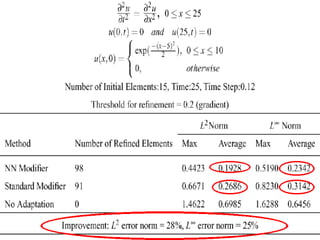
One Dimension Wave Equation
PDE Analytic Solution
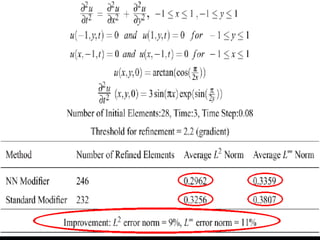
Two Dimension Wave Equation
PDE Analytic Solution
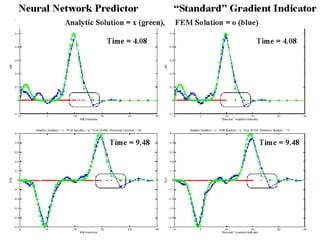
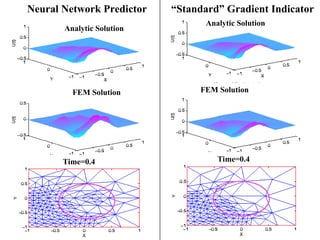
Neural Network Predictor “Standard” Gradient Indicator
Analytic Solution
FEM Solution
Time=0.4
Analytic Solution
FEM Solution
Time=0.4
Summary
Summary
 We have shown that the Time Series Prediction
We have shown that the Time Series Prediction
via Neural Network can accurately predict the
gradient values
gradient values
 By applying the NN predictor we obtained a
By applying the NN predictor we obtained a
substantial numerical improvement over the
current methods
current methods

Finite Element Methods introduction and discretization

  • 1.
    Neural Network TimeSeries Neural Network Time Series Forecasting of Finite-Element Mesh Forecasting of Finite-Element Mesh Adaptation Adaptation
  • 2.
    Content Content  Introduction toFinite Element Method Introduction to Finite Element Method  Time Dependent Partial Differential Equations Time Dependent Partial Differential Equations  The Finite Element Mesh Adaptation Problem The Finite Element Mesh Adaptation Problem Introduction to Neural Networks Introduction to Neural Networks Time Series Prediction with Neural Networks Time Series Prediction with Neural Networks  Our Method For Solving The Mesh Adaptation Our Method For Solving The Mesh Adaptation Problem Problem
  • 3.
    Finite Element Method(FEM) Finite Element Method (FEM)  What is it ? What is it ?  The most effective numerical techniques for The most effective numerical techniques for solving various problems arising from solving various problems arising from mathematical physics and engineering mathematical physics and engineering  The widely used numerical techniques for The widely used numerical techniques for solving partial differential equations (PDEs) solving partial differential equations (PDEs)
  • 4.
    Finite Element Method(FEM) Finite Element Method (FEM)  Divides up the PDE’s domain Divides up the PDE’s domain into finite number of elements into finite number of elements FEM Mesh  Solution found by linear algebra techniques Solution found by linear algebra techniques  Finds simple approximation on each Finds simple approximation on each element such that: element such that:  Consistent with initial boundary conditions Consistent with initial boundary conditions  Consistent with neighboring elements Consistent with neighboring elements  How does it work? How does it work?
  • 5.
    Time Dependent Partial TimeDependent Partial Differential Equations Differential Equations  Hyperbolic Hyperbolic  Wave Equations Wave Equations  Parabolic Parabolic  Heat Equations Heat Equations
  • 6.
    FEM and TimeDependent PDEs FEM and Time Dependent PDEs  The time dependent The time dependent PDEs are repeatedly solved PDEs are repeatedly solved for different constant times for different constant times using the previous using the previous solution solution as start condition for the next one as start condition for the next one  The The “areas of interest” “areas of interest” are are propagated propagated through through the FEM mesh the FEM mesh  In order to achieve a good approximation the In order to achieve a good approximation the mesh mesh should be should be dynamic and varying with time dynamic and varying with time
  • 7.
    FEM and TimeDependent PDEs FEM and Time Dependent PDEs  For time dependent For time dependent PDEs PDEs a a critical regions critical regions should should be subject to be subject to local mesh refinement local mesh refinement. .  The The critical regions critical regions are identified by the regions, are identified by the regions, which their local which their local gradient shows bigger changes gradient shows bigger changes. .
  • 8.
    Mesh Adaptations Problem MeshAdaptations Problem  In current usage, the method is to In current usage, the method is to use indicators use indicators (e.g. gradients) (e.g. gradients) from the solution at the from the solution at the current current time time to identify where the mesh to identify where the mesh should be refined should be refined at the at the next time next time. .  The The defect defect of this method that one is of this method that one is always always operating one step behind operating one step behind (behind the “area of (behind the “area of interest”) interest”)
  • 9.
    Mesh Adaptation Problem MeshAdaptation Problem u x n t Time  . . . . . . . . . . . . . . . . . . . . Refine We miss the action u x 1   n t Time . . . . . . . . . . . . .. . . . . . . . . . .
  • 10.
    Our Method Our Method To To predict predict the the “area of interest” “area of interest” at the at the next time next time stage stage and refine the mesh accordingly and refine the mesh accordingly  Time Series Prediction via Neural Network Time Series Prediction via Neural Network methodology is used in order to methodology is used in order to predict predict the the “area “area of interest” of interest”  The The Neural Network Neural Network receives, as receives, as input input, , the the gradient gradient values at the values at the recent time recent time and and predicts predicts the the gradient gradient values at the values at the next time stage next time stage
  • 11.
    Neural Networks (NN) NeuralNetworks (NN)  What is it? What is it?  A biologically inspired model, which tries to simulate the human A biologically inspired model, which tries to simulate the human nervous system nervous system  Consists of elements ( Consists of elements (neurons neurons) and connections between them ) and connections between them ( (weights weights) )  Can be trained to perform complex functions (e.g. classifications) by Can be trained to perform complex functions (e.g. classifications) by adjusting the value of the weights. adjusting the value of the weights.
  • 12.
    Neural Networks (NN) NeuralNetworks (NN)  How does it work? How does it work?  The input signal is multiplied by the weights, summed together and then processed by the neuron The input signal is multiplied by the weights, summed together and then processed by the neuron  Updates the NN weights through training scheme (e.g. Back-Propagation algorithm) Updates the NN weights through training scheme (e.g. Back-Propagation algorithm)
  • 13.
    Feed-Forward Networks Feed-Forward Networks InputLayer Hidden Layers Output Layer Input Signals Output Signals Step 2: Feed the Input Signal forward Step3: Compute the Error Signal (difference between the NN output and the desired Output) Step4: Feed the Error Signal backward and update the waits (in order to minimize the error) Step1: Initialize Weights Train the net over an input set until a convergence occurs
  • 14.
     What istime series? What is time series?  A series of data where the A series of data where the past values past values in the in the series may series may influence the future values influence the future values. (the . (the future value is a nonlinear function of its past m future value is a nonlinear function of its past m values) values)  The The Neural Network Neural Network can be used can be used as a nonlinear as a nonlinear model that can be trained model that can be trained to map past to map past and and future values future values of a of a time series time series Time Series Predicting Using NN Time Series Predicting Using NN )) ( ),...., 2 ( ), 1 ( ( ) ( m n x n x n x f n x    
  • 15.
    Applying NNs toTime Applying NNs to Time Dependent PDES Dependent PDES
  • 16.
    Neural Network Architecture NeuralNetwork Architecture  Two networks Two networks – One is for One is for boundary elements boundary elements and the other is for and the other is for interior interior elements elements  Network input Network input – Eight input units (six for boundary element network), the Eight input units (six for boundary element network), the gradient of the element and its neighbors in the current and gradient of the element and its neighbors in the current and previous times previous times  Hidden Layers Hidden Layers – One hidden layer with six units One hidden layer with six units  Network output Network output – One output unit, that gives the prediction of the gradient One output unit, that gives the prediction of the gradient value at the next time stage value at the next time stage
  • 17.
    Training Phase Training Phase Training Set Training Set – We calculate the solution on the initial We calculate the solution on the initial nondynamic mesh over all the given time space nondynamic mesh over all the given time space – We chose random examples (about 600) and We chose random examples (about 600) and trained the net over this set to predict the trained the net over this set to predict the gradient gradient  Training Performance Training Performance – For all the experiments that we did so far, the For all the experiments that we did so far, the network training took at most 200 epochs to network training took at most 200 epochs to converge to an extremely small error converge to an extremely small error
  • 18.
    One Dimension WaveEquation One Dimension Wave Equation PDE Analytic Solution
  • 24.
    Two Dimension WaveEquation Two Dimension Wave Equation PDE Analytic Solution
  • 26.
    Neural Network Predictor“Standard” Gradient Indicator Analytic Solution FEM Solution Time=0.4 Analytic Solution FEM Solution Time=0.4
  • 28.
    Summary Summary  We haveshown that the Time Series Prediction We have shown that the Time Series Prediction via Neural Network can accurately predict the via Neural Network can accurately predict the gradient values gradient values  By applying the NN predictor we obtained a By applying the NN predictor we obtained a substantial numerical improvement over the substantial numerical improvement over the current methods current methods