Different types of
fingerprint patterns and
fingerprint minutiae's
Fingerprint Types: A
Comprehensive
Exploration
Fingerprints are unique identifiers, crucial for personal identification. The
intricate patterns on fingertips provide a valuable tool for forensics, security, and
personal identification. Explore the fascinating world of fingerprint types and
their classifications.
Introduction to Fingerprints
1 Skin Ridges
Fingerprints are formed by
friction ridges, raised skin
patterns that develop during fetal
development.
2 Uniqueness
No two individuals have
identical fingerprints, making
them a reliable means of
personal identification.
3 Persistence
Fingerprint patterns remain
unchanged throughout a person's
lifetime, except for damage or
scarring.
The Ridge Pattern Basics
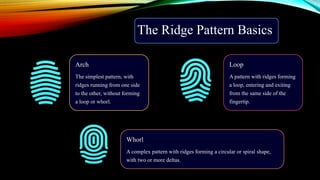
Arch
The simplest pattern, with
ridges running from one side
to the other, without forming
a loop or whorl.
Loop
A pattern with ridges forming
a loop, entering and exiting
from the same side of the
fingertip.
Whorl
A complex pattern with ridges forming a circular or spiral shape,
with two or more deltas.
Arch Fingerprints
Plain Arch
A simple arch with ridges flowing smoothly from one side
to the other.
Tented Arch
An arch with a pointed or tent-like ridge in the center,
resembling a tent peak.
Loop Fingerprints
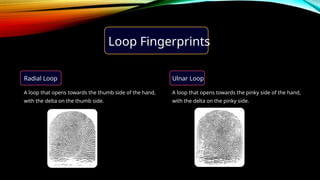
Radial Loop
A loop that opens towards the thumb side of the hand,
with the delta on the thumb side.
Ulnar Loop
A loop that opens towards the pinky side of the hand,
with the delta on the pinky side.
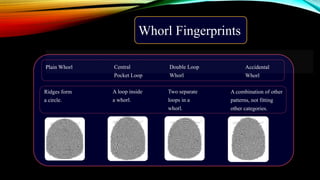
Whorl Fingerprints
Plain Whorl Central
Pocket Loop
Double Loop
Whorl
Accidental
Whorl
Ridges form
a circle.
A loop inside
a whorl.
Two separate
loops in a
whorl.
A combination of other
patterns, not fitting
other categories.
Composite Fingerprints
Composite fingerprints occur when multiple fingerprint patterns merge
on a single fingertip. These patterns are complex and present a unique
challenge in fingerprint analysis.
Fingerprint Minutiae:
The Intricate Details
Fingerprint minutiae are the unique characteristics that distinguish one
fingerprint from another. These are tiny details in the ridge patterns of
fingerprints. They are often referred to as "ridge characteristics" and are
used for fingerprint identification.
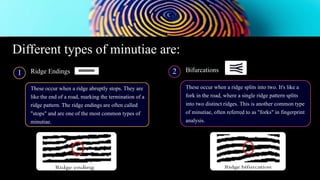
Different types of minutiae are:
1 Ridge Endings
These occur when a ridge abruptly stops. They are
like the end of a road, marking the termination of a
ridge pattern. The ridge endings are often called
"stops" and are one of the most common types of
minutiae.
2 Bifurcations
These occur when a ridge splits into two. It's like a
fork in the road, where a single ridge pattern splits
into two distinct ridges. This is another common type
of minutiae, often referred to as "forks" in fingerprint
analysis.
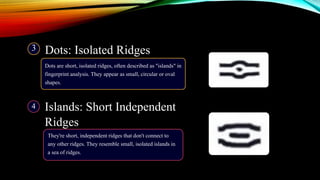
Dots: Isolated Ridges
Dots are short, isolated ridges, often described as "islands" in
fingerprint analysis. They appear as small, circular or oval
shapes.
3
Islands: Short Independent
Ridges
4
They're short, independent ridges that don't connect to
any other ridges. They resemble small, isolated islands in
a sea of ridges.
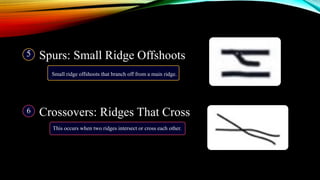
Spurs: Small Ridge Offshoots
Small ridge offshoots that branch off from a main ridge.
5
Crossovers: Ridges That Cross
6
This occurs when two ridges intersect or cross each other.
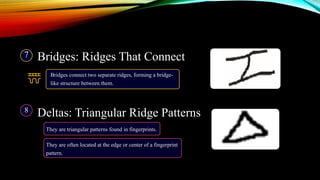
Bridges: Ridges That Connect
Bridges connect two separate ridges, forming a bridge-
like structure between them.
7
Deltas: Triangular Ridge Patterns
8
They are triangular patterns found in fingerprints.
They are often located at the edge or center of a fingerprint
pattern.
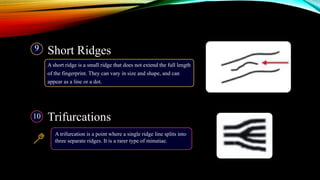
Short Ridges
A short ridge is a small ridge that does not extend the full length
of the fingerprint. They can vary in size and shape, and can
appear as a line or a dot.
9
Trifurcations
10
A trifurcation is a point where a single ridge line splits into
three separate ridges. It is a rarer type of minutiae.
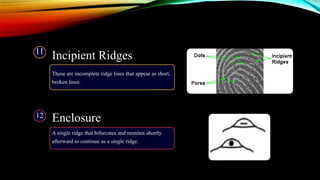
Incipient Ridges
These are incomplete ridge lines that appear as short,
broken lines.
A single ridge that bifurcates and reunites shortly
afterward to continue as a single ridge.
Enclosure
11
12
Thank you !

Fingerprint-Types-A-Comprehensive-Exploration.pptx

  • 1.
    Different types of fingerprintpatterns and fingerprint minutiae's
  • 2.
    Fingerprint Types: A Comprehensive Exploration Fingerprintsare unique identifiers, crucial for personal identification. The intricate patterns on fingertips provide a valuable tool for forensics, security, and personal identification. Explore the fascinating world of fingerprint types and their classifications.
  • 3.
    Introduction to Fingerprints 1Skin Ridges Fingerprints are formed by friction ridges, raised skin patterns that develop during fetal development. 2 Uniqueness No two individuals have identical fingerprints, making them a reliable means of personal identification. 3 Persistence Fingerprint patterns remain unchanged throughout a person's lifetime, except for damage or scarring.
  • 4.
    The Ridge PatternBasics Arch The simplest pattern, with ridges running from one side to the other, without forming a loop or whorl. Loop A pattern with ridges forming a loop, entering and exiting from the same side of the fingertip. Whorl A complex pattern with ridges forming a circular or spiral shape, with two or more deltas.
  • 5.
    Arch Fingerprints Plain Arch Asimple arch with ridges flowing smoothly from one side to the other. Tented Arch An arch with a pointed or tent-like ridge in the center, resembling a tent peak.
  • 6.
    Loop Fingerprints Radial Loop Aloop that opens towards the thumb side of the hand, with the delta on the thumb side. Ulnar Loop A loop that opens towards the pinky side of the hand, with the delta on the pinky side.
  • 7.
    Whorl Fingerprints Plain WhorlCentral Pocket Loop Double Loop Whorl Accidental Whorl Ridges form a circle. A loop inside a whorl. Two separate loops in a whorl. A combination of other patterns, not fitting other categories.
  • 8.
    Composite Fingerprints Composite fingerprintsoccur when multiple fingerprint patterns merge on a single fingertip. These patterns are complex and present a unique challenge in fingerprint analysis.
  • 9.
    Fingerprint Minutiae: The IntricateDetails Fingerprint minutiae are the unique characteristics that distinguish one fingerprint from another. These are tiny details in the ridge patterns of fingerprints. They are often referred to as "ridge characteristics" and are used for fingerprint identification.
  • 10.
    Different types ofminutiae are: 1 Ridge Endings These occur when a ridge abruptly stops. They are like the end of a road, marking the termination of a ridge pattern. The ridge endings are often called "stops" and are one of the most common types of minutiae. 2 Bifurcations These occur when a ridge splits into two. It's like a fork in the road, where a single ridge pattern splits into two distinct ridges. This is another common type of minutiae, often referred to as "forks" in fingerprint analysis.
  • 11.
    Dots: Isolated Ridges Dotsare short, isolated ridges, often described as "islands" in fingerprint analysis. They appear as small, circular or oval shapes. 3 Islands: Short Independent Ridges 4 They're short, independent ridges that don't connect to any other ridges. They resemble small, isolated islands in a sea of ridges.
  • 12.
    Spurs: Small RidgeOffshoots Small ridge offshoots that branch off from a main ridge. 5 Crossovers: Ridges That Cross 6 This occurs when two ridges intersect or cross each other.
  • 13.
    Bridges: Ridges ThatConnect Bridges connect two separate ridges, forming a bridge- like structure between them. 7 Deltas: Triangular Ridge Patterns 8 They are triangular patterns found in fingerprints. They are often located at the edge or center of a fingerprint pattern.
  • 14.
    Short Ridges A shortridge is a small ridge that does not extend the full length of the fingerprint. They can vary in size and shape, and can appear as a line or a dot. 9 Trifurcations 10 A trifurcation is a point where a single ridge line splits into three separate ridges. It is a rarer type of minutiae.
  • 15.
    Incipient Ridges These areincomplete ridge lines that appear as short, broken lines. A single ridge that bifurcates and reunites shortly afterward to continue as a single ridge. Enclosure 11 12
  • 16.