Finding and Using Online Open Educational ResourcesMelissa A. Venable, PhDKaplan UniversityCenter for Teaching and Learning June 22, 2010
Introduction and DefinitionsSources – repositories and artifactsCopyright and Fair UseConsiderations – integrating open optionsKeeping the conversation goingReferences
Let’s define…OpenOpen Educational Resources (OER)Open Education MovementCreative Commons
“Creative Commons is a nonprofit corporation dedicated to making it easier for people to share and build upon the work of others, consistent with the rules of copyright.We provide free licenses and other legal tools to mark creative work with the freedom the creator wants it to carry, so others can share, remix, use commercially, or any combination thereof.”http://creativecommons.org/about/
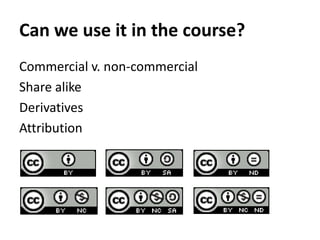
Can we use it in the course?Commercial v. non-commercialShare alikeDerivativesAttribution
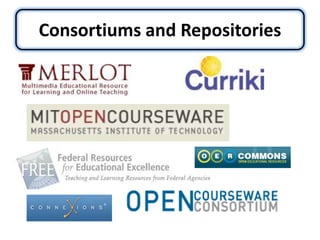
Consortiums and Repositories
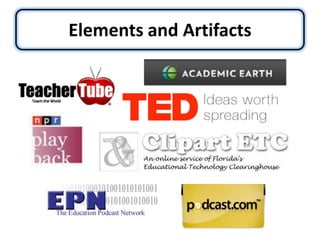
Elements and Artifacts
Copyright and Fair UseCopyright Crash Course - Univ. of TexasCopyright Term and the Public Domain - CornellBasic Guidelines - Univ. of MarylandKnow Your Copy Rights - Assoc. Research LibrariesFair Use – U.S. Copyright Office
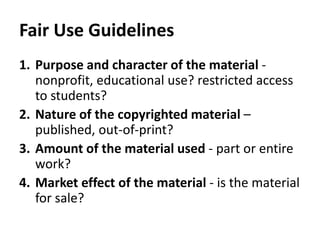
Fair Use GuidelinesPurpose and character of the material - nonprofit, educational use? restricted access to students?Nature of the copyrighted material – published, out-of-print?Amount of the material used - part or entire work?Market effect of the material - is the material for sale?
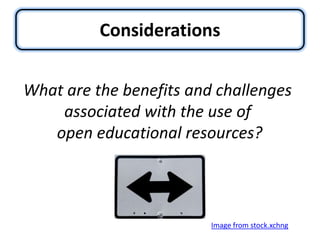
ConsiderationsWhat are the benefits and challenges associated with the use of open educational resources?Image from stock.xchng
Using OERAttribute the work to the originator – the material may be free for use, but give credit!When in doubt, ask permission – contact the publisher, author, or other contact.Think about the definition of Commercial Use.Seek guidance from your organization.
Keep the conversation going…Other types of materials? – Textbooks! Music!Commercial vs. Non-commercialIt’s an exchange – what can you donate for others to use?Image from stock.xchng
ReferencesBaker, J. (2009, April 17). Introduction to Open Educational Resources. Retrieved from the Connexions Web site: http://cnx.org/content/col10413/1.3/Creative Commons. (n.d.). CC in Education. Retrieved from: http://creativecommons.org/educationHoon, P. (2007). Know your copy rights – What you can do. Washington, DC: Association of Research Libraries. Retrieved from http://www.knowyourcopyrights.org/bm~doc/kycrbrochure.pdfVenable, M. (2009, May 15). Can we post this in the course? [Web log post]. Retrieved from http://mvenable.wordpress.com/2009/05/15/can-we-post-this-in-the-course/Note: Image on title page from: stock.xchng
Melissa A. Venable, PhDmvenable@kaplan.eduImage from stock.xchng

Finding and Using OER

  • 1.
    Finding and UsingOnline Open Educational ResourcesMelissa A. Venable, PhDKaplan UniversityCenter for Teaching and Learning June 22, 2010
  • 2.
    Introduction and DefinitionsSources– repositories and artifactsCopyright and Fair UseConsiderations – integrating open optionsKeeping the conversation goingReferences
  • 3.
    Let’s define…OpenOpen EducationalResources (OER)Open Education MovementCreative Commons
  • 4.
    “Creative Commons isa nonprofit corporation dedicated to making it easier for people to share and build upon the work of others, consistent with the rules of copyright.We provide free licenses and other legal tools to mark creative work with the freedom the creator wants it to carry, so others can share, remix, use commercially, or any combination thereof.”http://creativecommons.org/about/
  • 5.
    Can we useit in the course?Commercial v. non-commercialShare alikeDerivativesAttribution
  • 6.
  • 7.
  • 8.
    Copyright and FairUseCopyright Crash Course - Univ. of TexasCopyright Term and the Public Domain - CornellBasic Guidelines - Univ. of MarylandKnow Your Copy Rights - Assoc. Research LibrariesFair Use – U.S. Copyright Office
  • 9.
    Fair Use GuidelinesPurposeand character of the material - nonprofit, educational use? restricted access to students?Nature of the copyrighted material – published, out-of-print?Amount of the material used - part or entire work?Market effect of the material - is the material for sale?
  • 10.
    ConsiderationsWhat are thebenefits and challenges associated with the use of open educational resources?Image from stock.xchng
  • 11.
    Using OERAttribute thework to the originator – the material may be free for use, but give credit!When in doubt, ask permission – contact the publisher, author, or other contact.Think about the definition of Commercial Use.Seek guidance from your organization.
  • 12.
    Keep the conversationgoing…Other types of materials? – Textbooks! Music!Commercial vs. Non-commercialIt’s an exchange – what can you donate for others to use?Image from stock.xchng
  • 13.
    ReferencesBaker, J. (2009,April 17). Introduction to Open Educational Resources. Retrieved from the Connexions Web site: http://cnx.org/content/col10413/1.3/Creative Commons. (n.d.). CC in Education. Retrieved from: http://creativecommons.org/educationHoon, P. (2007). Know your copy rights – What you can do. Washington, DC: Association of Research Libraries. Retrieved from http://www.knowyourcopyrights.org/bm~doc/kycrbrochure.pdfVenable, M. (2009, May 15). Can we post this in the course? [Web log post]. Retrieved from http://mvenable.wordpress.com/2009/05/15/can-we-post-this-in-the-course/Note: Image on title page from: stock.xchng
  • 14.
    Melissa A. Venable,PhDmvenable@kaplan.eduImage from stock.xchng

Editor's Notes

  • #4 Open – what does it mean when something is “open”? (free, available, ….)Open Educational Resources (OER) – have you heard this term before? What does it mean to you?Open Education Movement - "The Open Educational Resources movement began in 2001 when the Hewlett and the Andrew W. Mellon foundations jointly funded MIT OpenCourseWare (OCW), the first institution committed to making all of its course materials freely available. Since then, more than 60 additional institutions have launched OpenCourseWare Web sites.“ (Baker, 2009)
  • #5 http://creativecommons.org/education?utm_source=ccorg&utm_medium=ccedu
  • #6 Creative Commons – a nonprofit organization
  • #7 Many sites offer groups of materials already provided in whole course format or in learning modules. OCW – 50+ participating universities and affiliatesKaplan offers 11 courses under the CC-BY-NC-ND license as part of the OCW
  • #8 We seem to always be looking for ways to add interest to our courses. This usually takes the form of visual elements and multimedia – these can be the most problematic in terms of time and resources – take a look at some of the existing online items that could be helpful to your students – video, audio (podcasts), images…
  • #11 From: http://cnx.org/content/m14466/latest/ - Judy Baker (2009)Some benefits of OER include: * Fosters pedagogical innovation and relevance that avoids teaching from the textbook * Broadens use of alternatives to textbooks while maintaining instructional quality * Lowers costs of course materials for studentsSome disadvantages of OER include: * Quality of available OER materials inconsistent * Materials may not meet Section 508 ADA accessibility or SCORM requirements and must be modify to bring into compliance * No common standard for review of OER accuracy and quality * Need to check accuracy of content * Customization necessary to match departmental and/or college curriculum requirements * Technical requirements to access vary * Technological determinism created by the delivery tool
  • #12 1)Commercial v. non-commercial – should others be allowed to offer the material for a fee?Share alike – should others be required to make their versions and revisions of the original work available for yet others to revise?Derivatives – should the original work be considered only as-is, as a whole, without changes or can the original work be modified or used in part?
  • #15 Questions about this presentation?What related topics are you interested in? Where do you need more information?