Financial Sector In India
Introduction to the Financial Sector in India
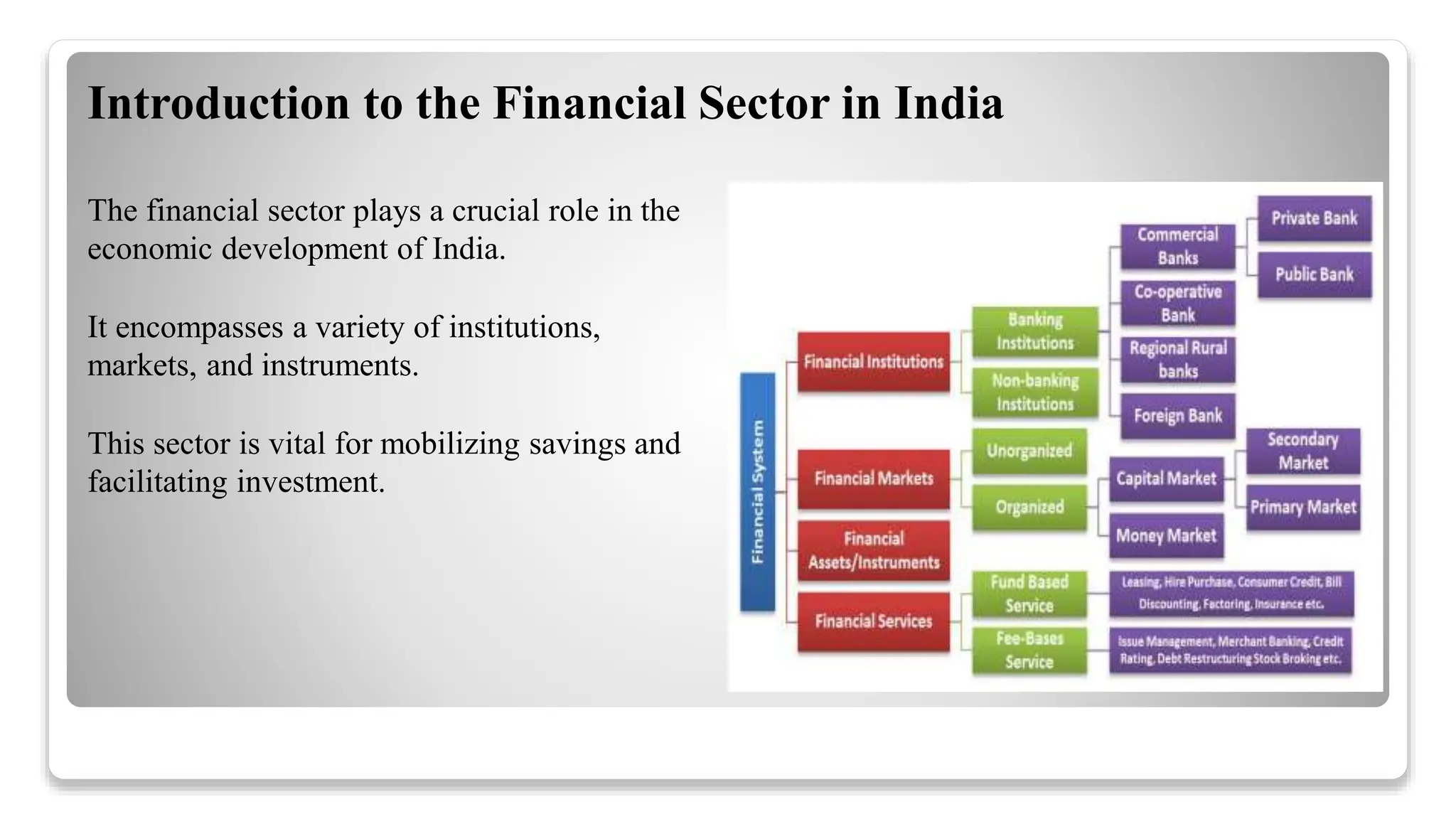
The financial sector plays a crucial role in the
economic development of India.
It encompasses a variety of institutions,
markets, and instruments.
This sector is vital for mobilizing savings and
facilitating investment.
Key Components of the Financial Sector
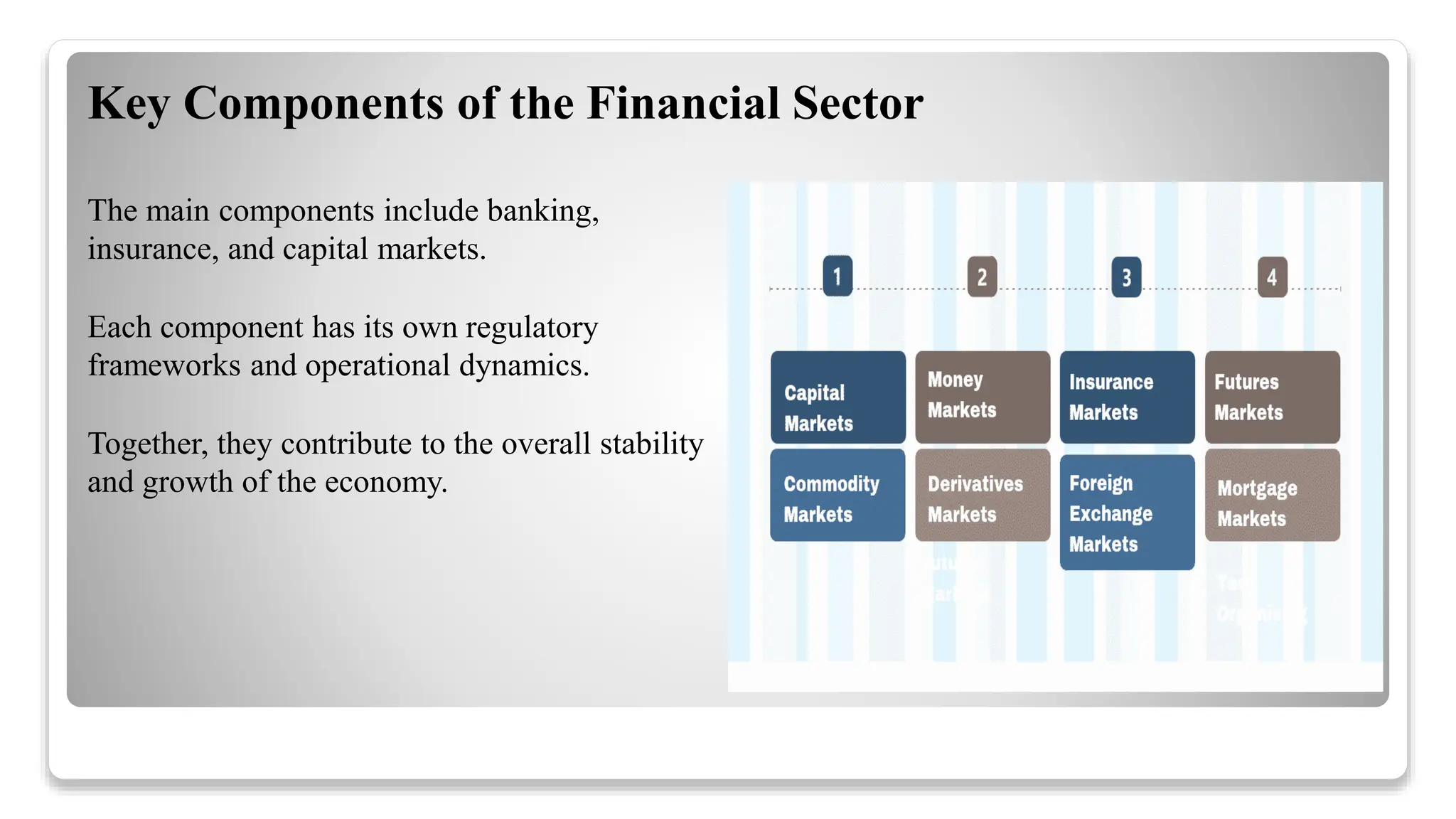
The main components include banking,
insurance, and capital markets.
Each component has its own regulatory
frameworks and operational dynamics.
Together, they contribute to the overall stability
and growth of the economy.
Banking Sector Overview
The banking sector is dominated by public
sector banks, followed by private and foreign
banks.
It provides essential services such as savings
accounts, loans, and payment systems.
The Reserve Bank of India (RBI) regulates and
supervises the banking system.
Role of the Reserve Bank of India (RBI)
The RBI acts as the central bank and plays a
pivotal role in monetary policy.
It regulates the financial system to ensure
stability and manage inflation.
The RBI also oversees foreign exchange and
payment systems in India.
Non-Banking Financial Companies (NBFCs)
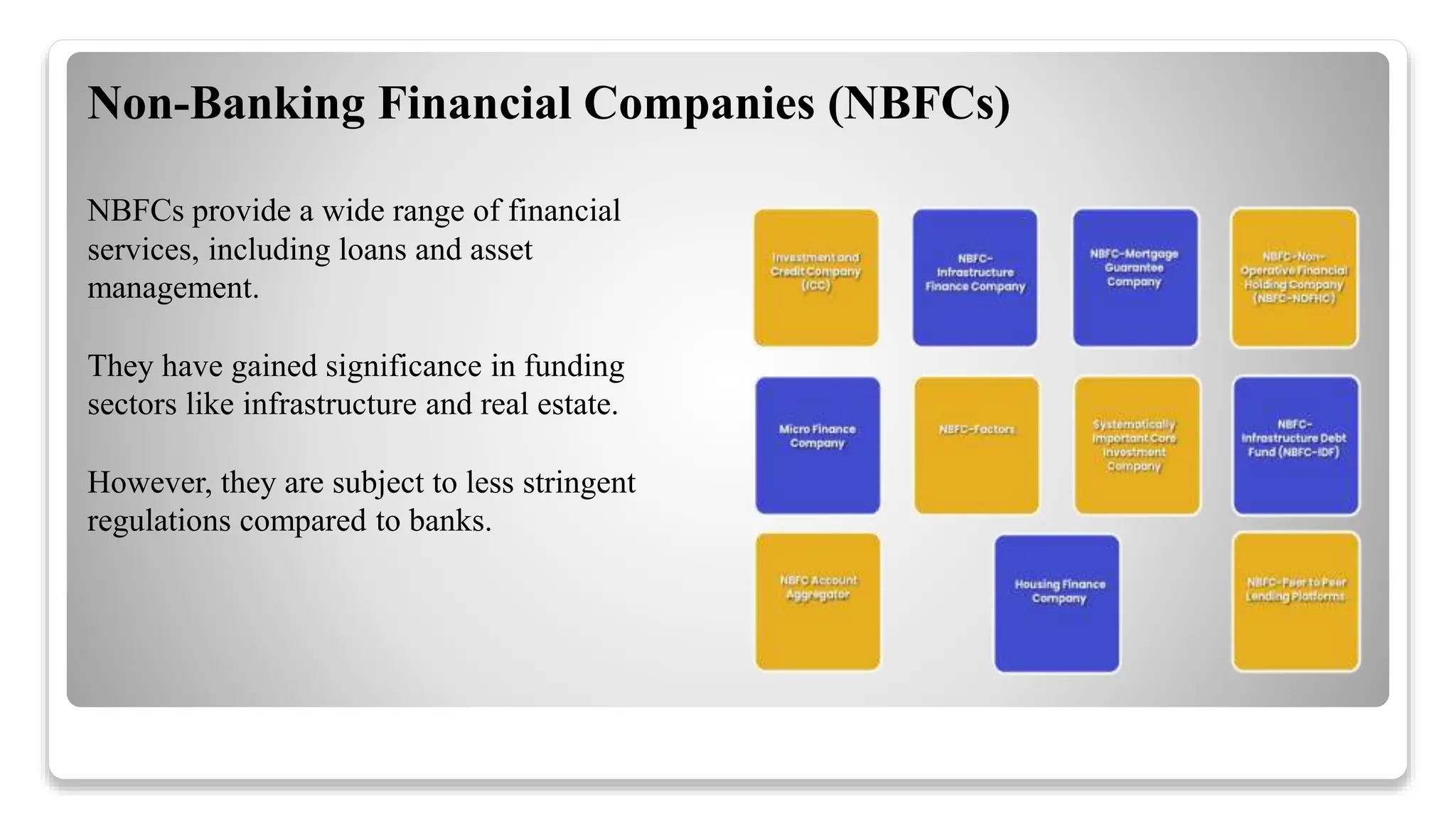
NBFCs provide a wide range of financial
services, including loans and asset
management.
They have gained significance in funding
sectors like infrastructure and real estate.
However, they are subject to less stringent
regulations compared to banks.
Capital Markets in India
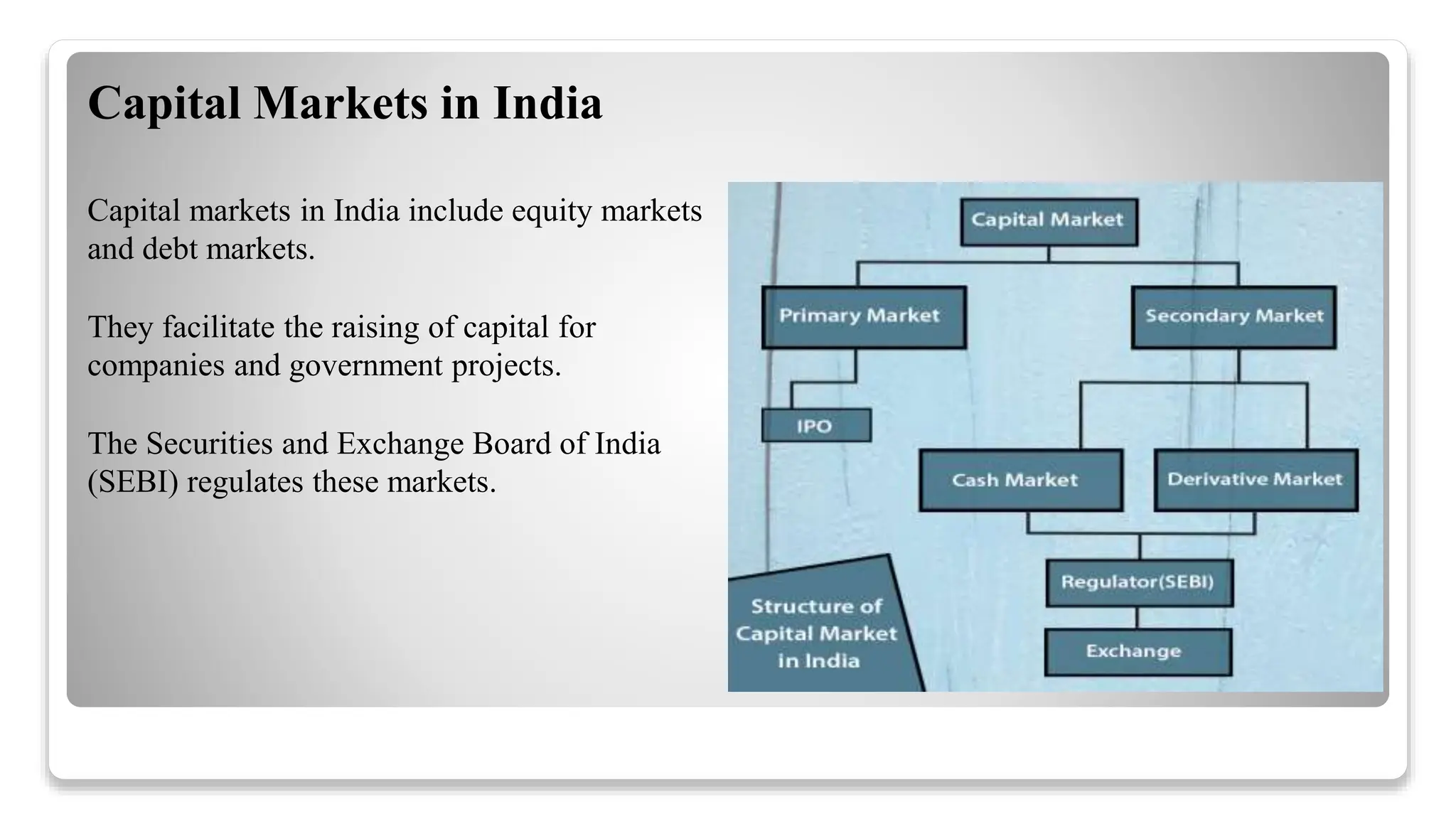
Capital markets in India include equity markets
and debt markets.
They facilitate the raising of capital for
companies and government projects.
The Securities and Exchange Board of India
(SEBI) regulates these markets.
Insurance Sector Overview
The insurance sector is crucial for risk
management and financial security.
It includes life insurance, general insurance,
and health insurance segments.
The Insurance Regulatory and Development
Authority of India (IRDAI) oversees this sector.
Financial Inclusion Initiatives
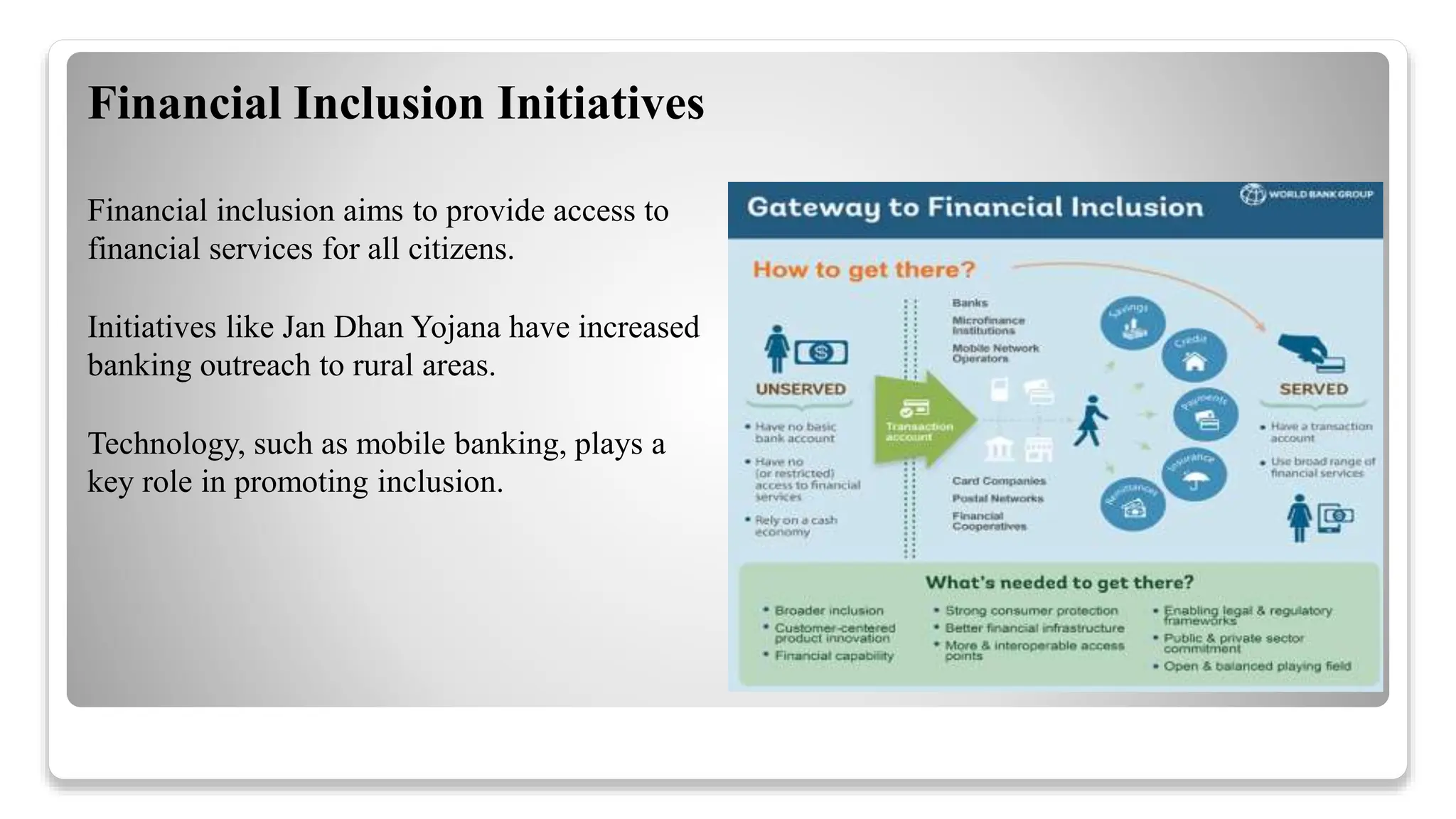
Financial inclusion aims to provide access to
financial services for all citizens.
Initiatives like Jan Dhan Yojana have increased
banking outreach to rural areas.
Technology, such as mobile banking, plays a
key role in promoting inclusion.
Impact of Technology on the Financial Sector
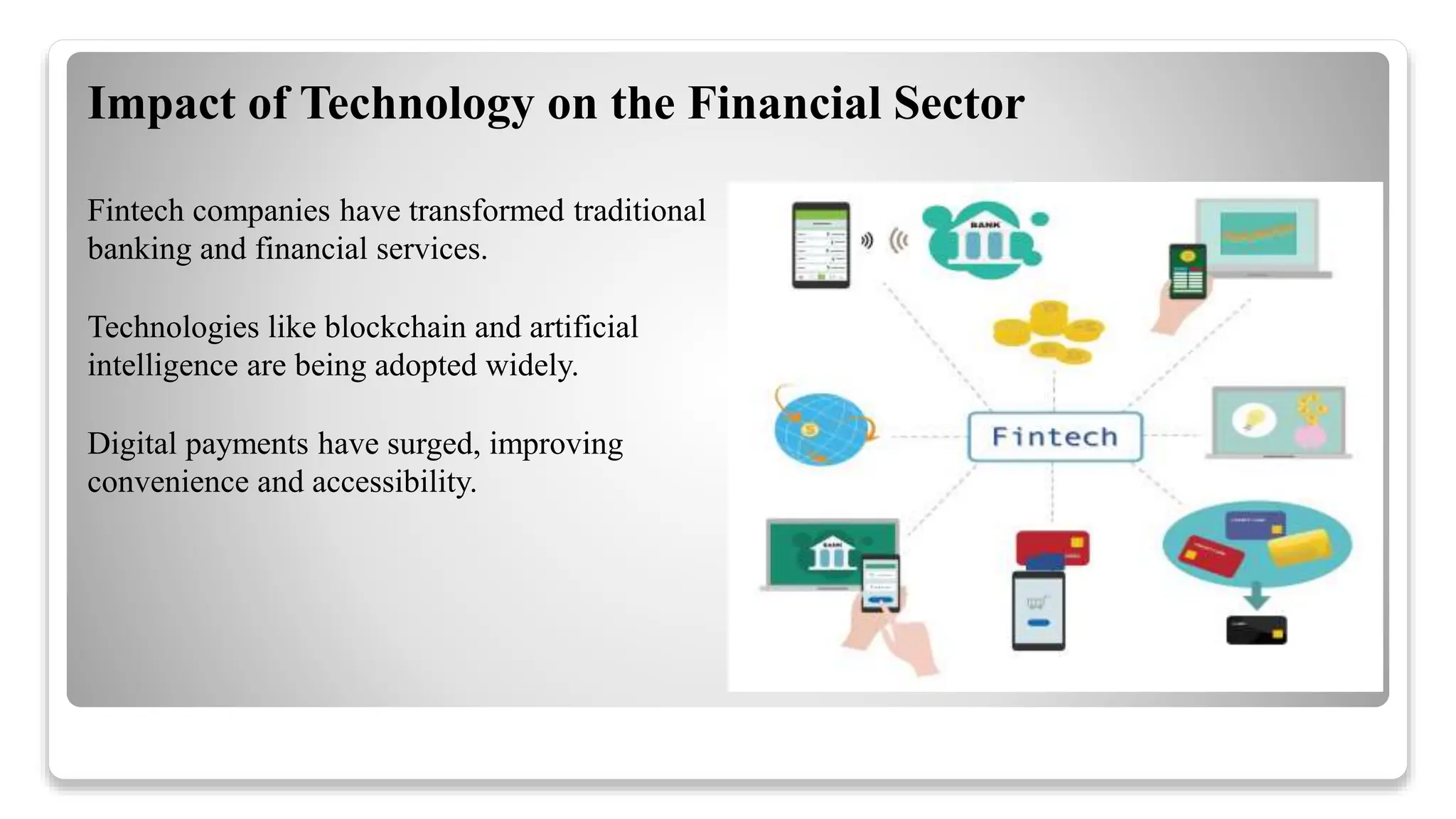
Fintech companies have transformed traditional
banking and financial services.
Technologies like blockchain and artificial
intelligence are being adopted widely.
Digital payments have surged, improving
convenience and accessibility.
Challenges in the Financial Sector
The financial sector faces challenges such as
non-performing assets (NPAs) in banks.
Regulatory compliance and cybersecurity
threats are also significant concerns.
Economic fluctuations can impact the overall
stability of the financial system.
Government Policies and Reforms
The Indian government has implemented
various reforms to strengthen the financial
sector.
Policies like the Insolvency and Bankruptcy
Code aim to resolve NPAs effectively.
Initiatives to boost foreign investment have also
been introduced.
Foreign Direct Investment (FDI) in Finance
The financial sector attracts significant foreign
direct investment in India.
FDI policies have been liberalized to encourage
international participation.
This inflow of capital helps enhance
competition and innovation in the sector.
Role of Microfinance Institutions
Microfinance institutions (MFIs) provide small
loans to underserved populations.
They play a pivotal role in promoting
entrepreneurship and self-employment.
MFIs contribute to poverty alleviation and
overall economic growth.
Future Trends in the Financial Sector
The financial sector in India is expected to
continue evolving with technology.
Sustainable finance and green investments are
gaining traction.
The sector will likely see an increased focus on
customer-centric services.
Conclusion
The financial sector is a backbone of the Indian
economy, driving growth and development.
Continuous reforms and innovations are
essential to address existing challenges.
A robust and inclusive financial sector is crucial
for India's long-term prosperity.
Feel free to customize these slides further based
on your presentation needs!

Financial Sector In India ppt in different sector

  • 1.
  • 2.
    Introduction to theFinancial Sector in India The financial sector plays a crucial role in the economic development of India. It encompasses a variety of institutions, markets, and instruments. This sector is vital for mobilizing savings and facilitating investment.
  • 3.
    Key Components ofthe Financial Sector The main components include banking, insurance, and capital markets. Each component has its own regulatory frameworks and operational dynamics. Together, they contribute to the overall stability and growth of the economy.
  • 4.
    Banking Sector Overview Thebanking sector is dominated by public sector banks, followed by private and foreign banks. It provides essential services such as savings accounts, loans, and payment systems. The Reserve Bank of India (RBI) regulates and supervises the banking system.
  • 5.
    Role of theReserve Bank of India (RBI) The RBI acts as the central bank and plays a pivotal role in monetary policy. It regulates the financial system to ensure stability and manage inflation. The RBI also oversees foreign exchange and payment systems in India.
  • 6.
    Non-Banking Financial Companies(NBFCs) NBFCs provide a wide range of financial services, including loans and asset management. They have gained significance in funding sectors like infrastructure and real estate. However, they are subject to less stringent regulations compared to banks.
  • 7.
    Capital Markets inIndia Capital markets in India include equity markets and debt markets. They facilitate the raising of capital for companies and government projects. The Securities and Exchange Board of India (SEBI) regulates these markets.
  • 8.
    Insurance Sector Overview Theinsurance sector is crucial for risk management and financial security. It includes life insurance, general insurance, and health insurance segments. The Insurance Regulatory and Development Authority of India (IRDAI) oversees this sector.
  • 9.
    Financial Inclusion Initiatives Financialinclusion aims to provide access to financial services for all citizens. Initiatives like Jan Dhan Yojana have increased banking outreach to rural areas. Technology, such as mobile banking, plays a key role in promoting inclusion.
  • 10.
    Impact of Technologyon the Financial Sector Fintech companies have transformed traditional banking and financial services. Technologies like blockchain and artificial intelligence are being adopted widely. Digital payments have surged, improving convenience and accessibility.
  • 11.
    Challenges in theFinancial Sector The financial sector faces challenges such as non-performing assets (NPAs) in banks. Regulatory compliance and cybersecurity threats are also significant concerns. Economic fluctuations can impact the overall stability of the financial system.
  • 12.
    Government Policies andReforms The Indian government has implemented various reforms to strengthen the financial sector. Policies like the Insolvency and Bankruptcy Code aim to resolve NPAs effectively. Initiatives to boost foreign investment have also been introduced.
  • 13.
    Foreign Direct Investment(FDI) in Finance The financial sector attracts significant foreign direct investment in India. FDI policies have been liberalized to encourage international participation. This inflow of capital helps enhance competition and innovation in the sector.
  • 14.
    Role of MicrofinanceInstitutions Microfinance institutions (MFIs) provide small loans to underserved populations. They play a pivotal role in promoting entrepreneurship and self-employment. MFIs contribute to poverty alleviation and overall economic growth.
  • 15.
    Future Trends inthe Financial Sector The financial sector in India is expected to continue evolving with technology. Sustainable finance and green investments are gaining traction. The sector will likely see an increased focus on customer-centric services.
  • 16.
    Conclusion The financial sectoris a backbone of the Indian economy, driving growth and development. Continuous reforms and innovations are essential to address existing challenges. A robust and inclusive financial sector is crucial for India's long-term prosperity. Feel free to customize these slides further based on your presentation needs!

Editor's Notes

  • #3 Image source: https://bbamantra.com/indian-financial-system-introduction/
  • #4 Image source: https://www.predictiveanalyticstoday.com/what-are-financial-markets/
  • #5 Image source: https://www.enterpriseedges.com/classification-of-banking-india
  • #6 Image source: https://www.wbpscupsc.com/reserve-bank-of-india-rbi-role-functions/
  • #7 Image source: https://www.iasgyan.in/blogs/nbfcs-and-its-types
  • #8 Image source: https://rmoneyindia.com/structure-capital-market-india/
  • #9 Image source: https://www.javatpoint.com/how-does-insurance-sector-work
  • #10 Image source: https://www.worldbank.org/en/news/immersive-story/2018/05/18/gains-in-financial-inclusion-gains-for-a-sustainable-world
  • #11 Image source: https://www.enterpriseedges.com/fintech-ecosystem-in-india
  • #12 Image source: https://www.jksecurities.com/blogs/challenges-facing-indian-financial-services-sector
  • #13 Image source: https://www.studyiq.com/articles/schemes-of-indian-government/
  • #14 Image source: https://ebizfiling.com/blog/foreign-direct-investment-in-india/
  • #15 Image source: https://www.researchgate.net/publication/307531223_Role_of_Microfinance_Institutions_in_the_Development_of_Entrepreneurs
  • #16 Image source: https://www.slideshare.net/nitin5062/present-trends-of-financial-sector-in-india-final
  • #17 Image source: https://blog.leveragedgrowth.in/msme-backbone-of-the-indian-economy/