Financial
Regulation
  2012 Q&A
   Review
    January 2013
01.04.13 www.bloombergbriefs.com	                                                          Bloomberg Brief | Financial Regulation                               2


Editor’s Note                                           Contents

Bloomberg Brief: Financial                              Anat admati
                                                        Anat Admati, a member of the FDIC-appointed Systemic Resolution Advisory Committee, discusses Ba-
Regulation’s Q&A Issue                                  sel equity levels for banks and lessons from the financial crisis (originally published May 2, 2012). page 3
                                                        Verena Ross
  Every week, Bloomberg Brief: Finan-                   Verena Ross, executive director of the European Securities and Markets Authority, discusses how
cial Regulation features an interview                   national cooperation can produce effective financial regulation across borders (originally published
                                                        June 1, 2012). page 4
in a question and answer format with
an industry participant on relevant and                 mark austen
                                                        Mark Austen, CEO of the Asia Securities Industry & Financial Markets Association, discusses
timely financial regulatory topics.                     regulatory approaches in Asia and how those differ from the European regulatory regime (originally
  We have compiled some of these Q&A                    published June 8, 2012). page 5
discussions, held since May 2012, and
                                                        Daniel Ryan
are pleased to share them with readers                  Daniel Ryan, leader of the financial services regulatory practice at Pricewaterhouse Coopers, says
just in time for the new year. The pieces               it may take three to five years for living wills filed by the largest banks to be final (originally published
are arranged in reverse order, from old-                July 6, 2012). page 6
est to newest, and are presented in their               David Wright
original format.                                        David Wright, secretary general of IOSCO, discusses global regulatory cooperation and how the
  We’d like to thank our contributors for               joint proposal on margin rules for non-centrally cleared derivatives fit into that framework (originally
                                                        published July 13, 2012). page 7
sharing their time and perspectives. As
the Financial Regulation Brief enters                   Phil Angelides
2013, we will continue to provide more                  Phil Angelides, the former chairman of the Financial Crisis Inquiry Commission, discusses rules that
                                                        allow regulators to break up the nation’s largest banks (originally published July 27, 2012). page 8
of these interviews, as well as financial
regulation news, data, commentaries                     rutH fox & ben kingsley
                                                        Ruth Fox and Ben Kingsley, both partners at Slaughter and May, discuss regulatory action taken
and analyses.                                           against HSBC for alleged lapses in its anti-money laundering compliance program and the implica-
  Thank you for your continued reading                  tions for AML professionals (originally published Aug. 3, 2012). page 9
of the Financial Regulation Brief. If you
                                                        david weild
have any suggestions for new content or                 David Weild, head of capital markets at Grant Thornton and CEO of Capital Markets Advisory Part-
any other feedback please e-mail me at                  ners, discusses a fail-safe rule in trading algorithms (originally published Aug. 31, 2012). page 10
the address below.
                                                        carlo di florio
                                                        Carlo di Florio, director of the SEC’s Office of Compliance Inspections and Examinations, discusses com-
 Melissa Karsh                                          pliance issues for muni issuers in a recent pay-to-play alert (originally published Sept. 7 2012). page 11
                                                                                                                                                   ,
 mkarsh@bloomberg.net
                                                        richard saunders
                                                        Richard Saunders, CEO at the Investment Management Association, discusses the regulatory con-
                                                        cerns of U.K. asset managers (originally published Sept. 21, 2012). page 12
 Bloomberg Brief Financial Regulation
                                                        markus boehme
     Bloomberg Brief Ted Merz                           Markus Boehme, senior partner at Roland Berger Strategy Consultants, discusses the impact of
     Executive Editor tmerz@bloomberg.net               new regulation on investment banks (originally published Sept. 28, 2012). page 13
                      212-617-2309
    Bloomberg News Otis Bilodeau                        peter braumuller
    Managing Editor obilodeau@bloomberg.net             Peter Braumüller, International Association of Insurance Supervisors chairman, discusses what may
                    212-617-3921
                                                        make insurers systemically important (originally published Oct. 5, 2012). page 14
 Financial Regulation Melissa Karsh
               Editor mkarsh@bloomberg.net              hans montag
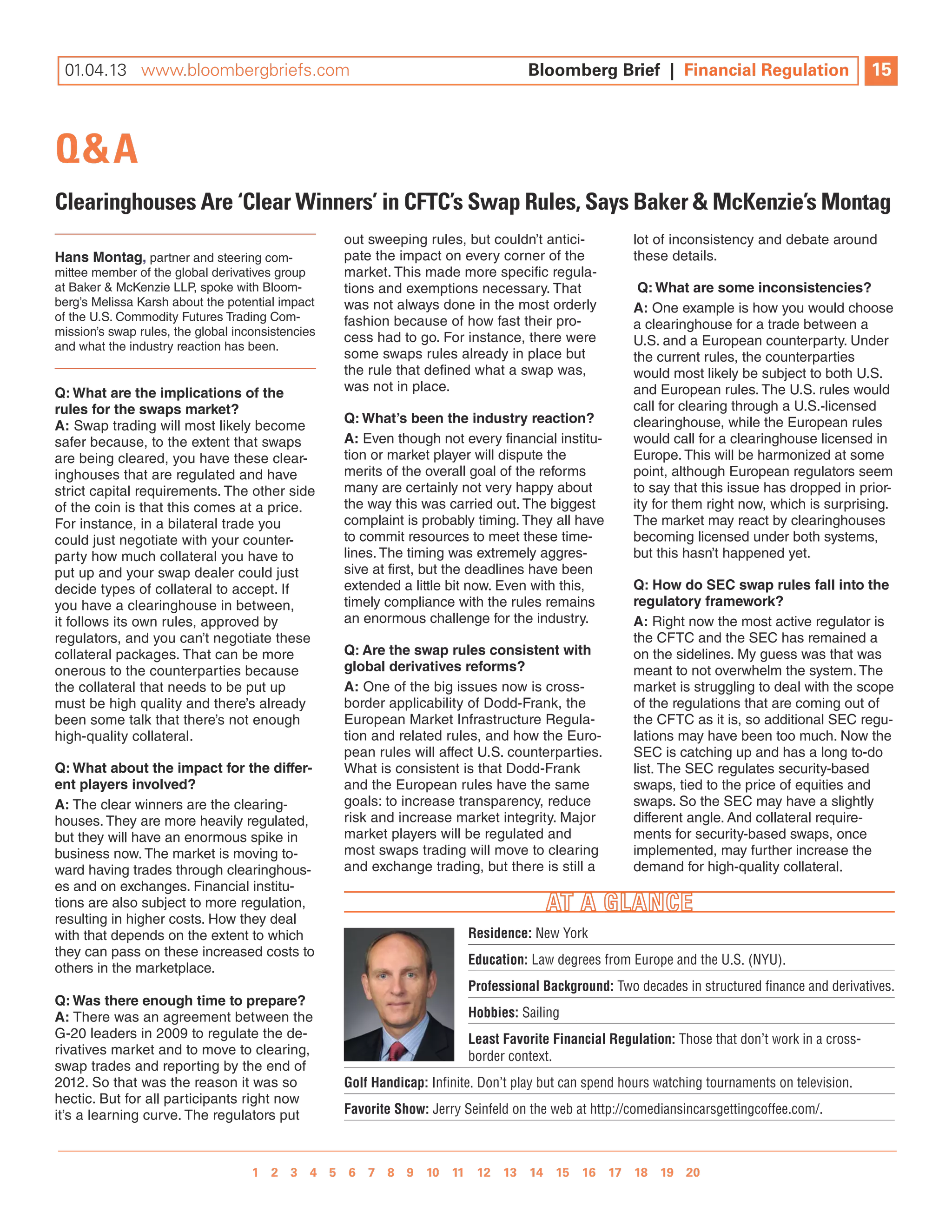
                      212-617-4557                      Hans Montag, partner at Baker & McKenzie LLP, discusses the CFTC’s new swap rules and the
             Reporter Dana Wilkie
                                                        implications for market participants (originally published Oct. 5, 2012). page 15
                      dwilkie2@bloomberg.net
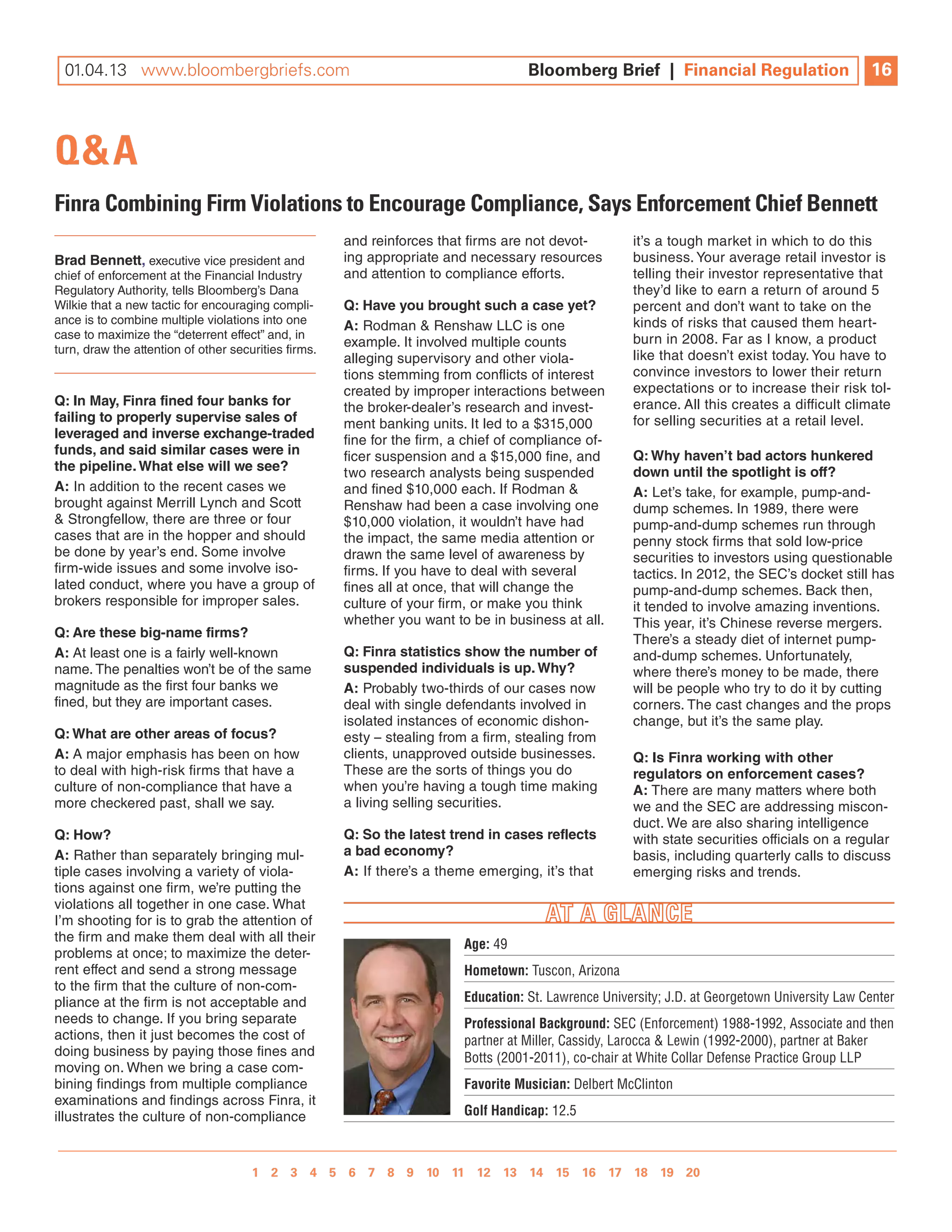
                      202-654-7353                      brad bennetT
                                                        Brad Bennett, executive vice president and chief of enforcement at Finra, says a new tactic for
           Newsletter Nick Ferris                       encouraging compliance is to combine multiple violations into one case to maxmize the “deterrent
            Business nferris2@bloomberg.net             effect.” (originally published Oct. 26, 2012). page 16
            Manager 212-617-6975
                                                        vladimir maly and stephen wink
          Advertising bbrief@bloomberg.net              Vladimir Maly and Stephen Wink, partners at Latham & Watkins LLP, discuss the EU’s new short-
                      212-617-6975
                                                        selling regulation, which took effect Nov. 1. (originally published Nov. 2, 2012). page 17
           Reprints & Lori Husted
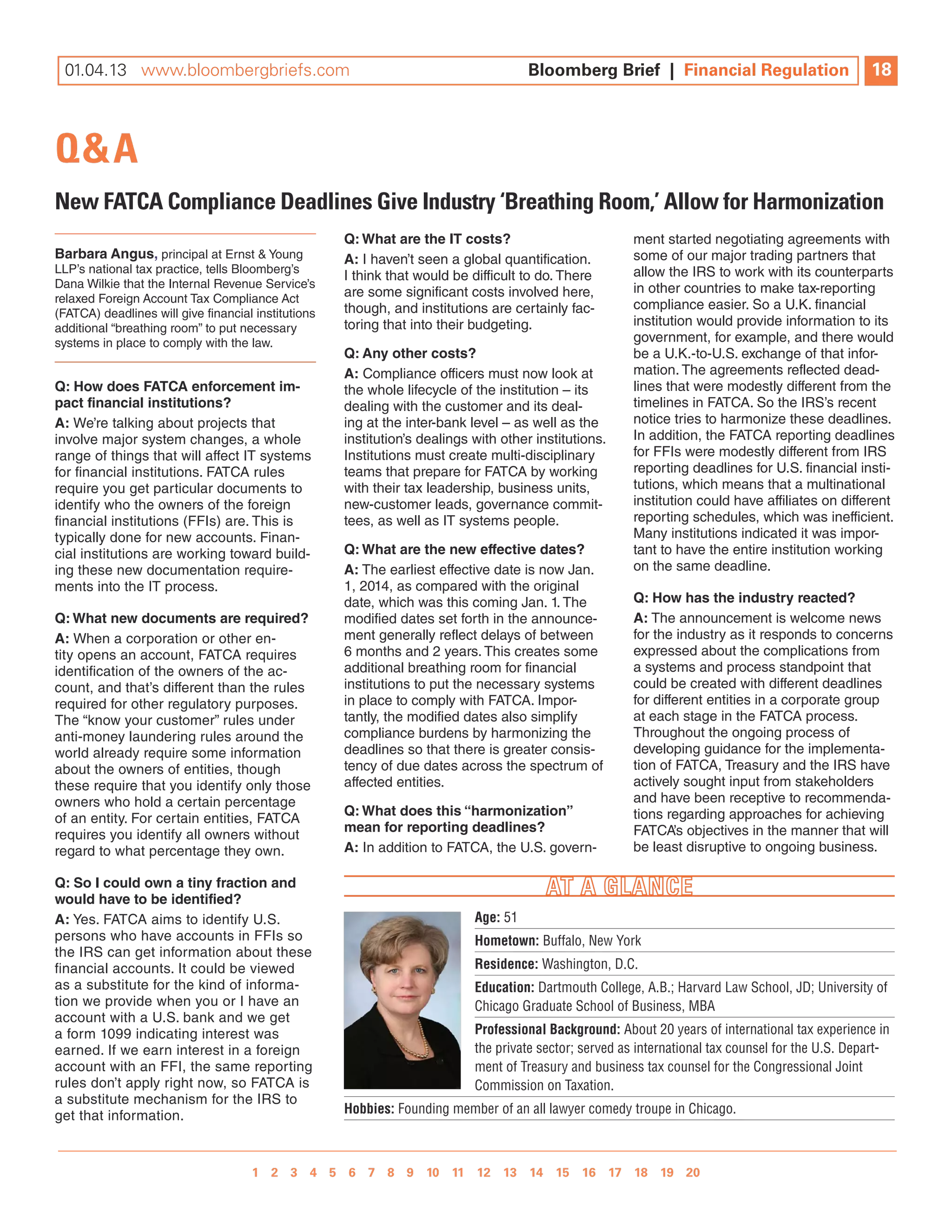
         Permissions lori.husted@theygsgroup.com        barbara angus
                      717-505-9701
                                                        Ernst & Young’s Barbara Angus discusses new compliance deadlines for institutions under the For-
 To subscribe via the Bloomberg Terminal type           eign Account Tax Compliance Act (originally published Nov. 9, 2012). page 18
 BRIEF <GO> or on the web at
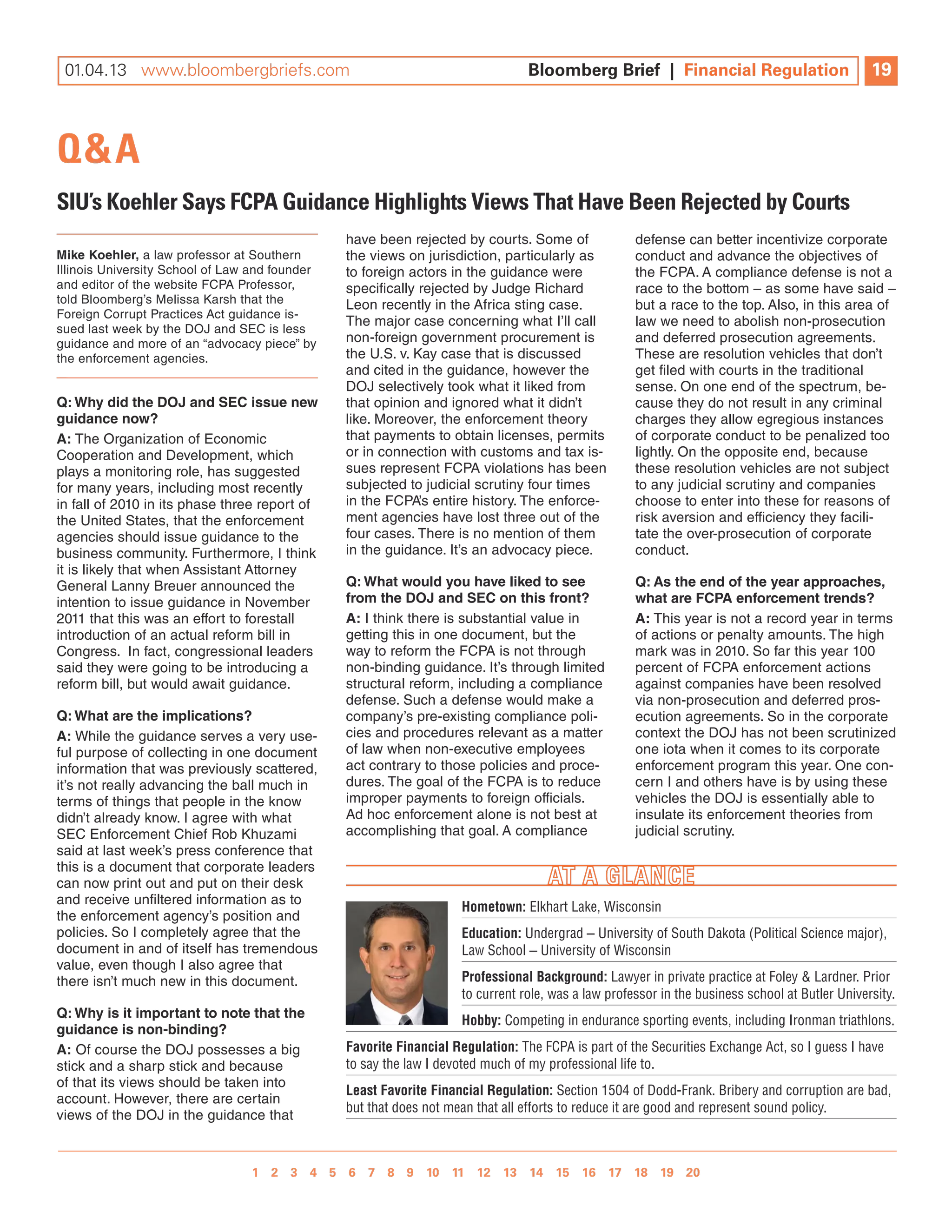
 www.bloombergbriefs.com.                               mike koehler
 To contact the editors: finregbrief@bloomberg.net      Southern Illinois University law professor Mike Koehler discusses the DOJ’s and SEC’s guidance on
 © 2013 Bloomberg LP. All rights reserved.              the Foreign Corrupt Practices Act (originally published Nov. 23, 2012). page 19
 This newsletter and its contents may not be for-
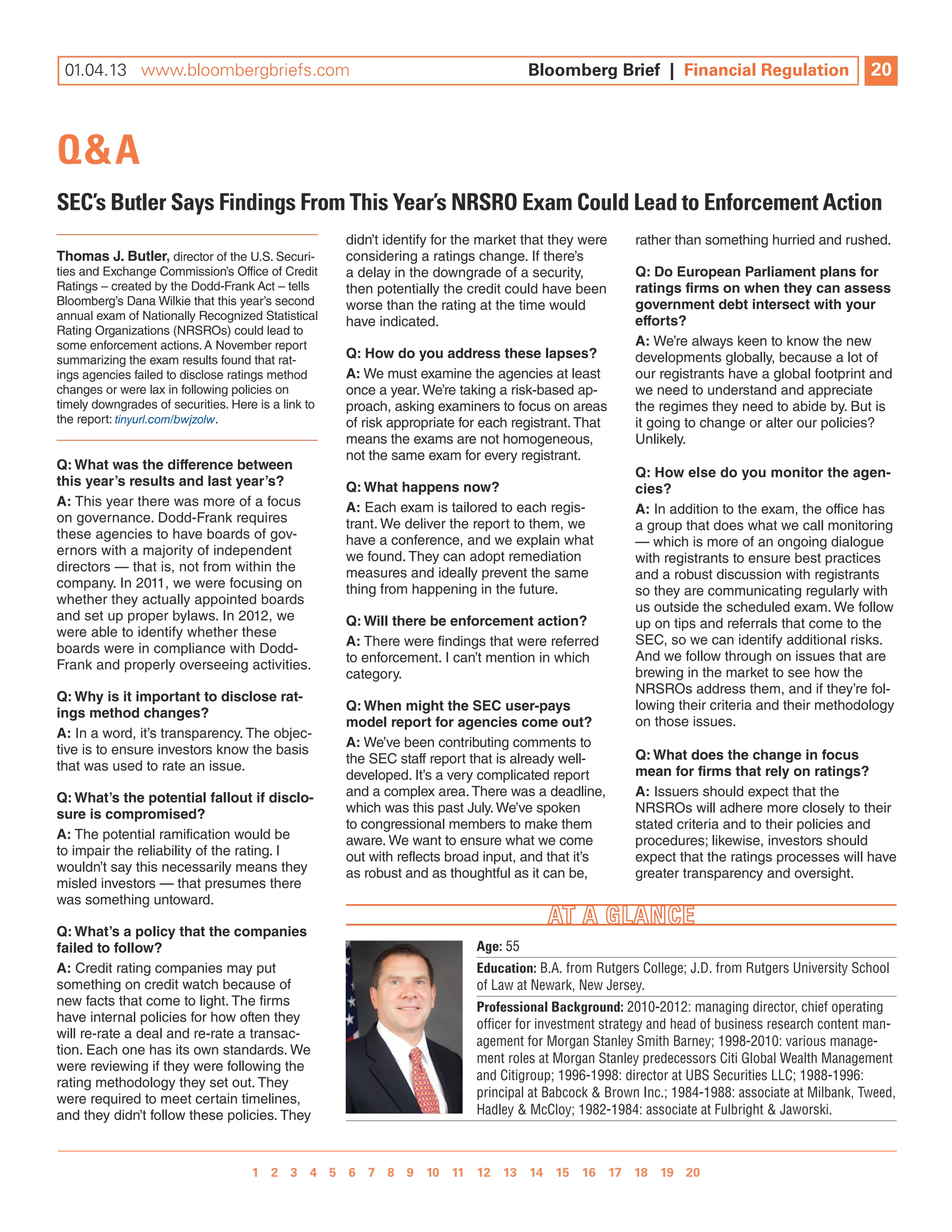
 warded or redistributed without the prior consent of   thomas j. butler
 Bloomberg.Please contact our reprints and permis-      The SEC’s Thomas J. Butler says exams of nationally recognized statistical ratings organizations
 sions group listed above for more information.         may lead to enforcement (originally published Dec. 7, 2012). page 20


                                       1 2 3 4 5 6 7 8 9 10 11 12 13 14 15 16 17 18 19 20 
01.04.13 www.bloombergbriefs.com	
 05.04.12 www.bloombergbriefs.com                                                      Bloomberg Brief | Financial Regulation
                                                                                       Bloomberg Brief | Financial Regulation                       3
                                                                                                                                                    12


Q&A                     basel equity levels for banks ‘Not to be Trusted’ to Protect Against Crisis

Anat Admati, a member of the FDIC-appoint-
ed Systemic Resolution Advisory Committee,
tells Dana Wilkie that the Federal Reserve Board
                                                      Q: Why are the risk weights problematic?
                                                      A: Basel II moved to sophisticated risk
                                                      weights and allowed the industry to
                                                                                                           for their shareholders, or pay down debt.
                                                                                                           There’s no urgency for them to pay divi-
                                                                                                           dends, because it endangers the system.
                                                      decide what the risk weight was in some
is ignoring key lessons from the financial crisis,                                                         Q: How does this affect the work of
one being that in times of stress, the only capital   cases, which allows those to be manipu-
                                                      lated. Banks can play various games with             the Systemic Resolution Advisory
that investors trust is common equity that can
                                                      their models of how risky loans are. These           Committee?
absorb losses.
                                                      models have not worked well before a cri-            A: The FDIC is trying to do its job to
                                                      sis, but they’re still allowing weak models          create a resolution process for sys-
                                                      to affect requirements. The resulting eq-            temic financial institutions without using
Q: You write that the Federal Reserve                 uity levels are not to be trusted to protect         taxpayer money. If the institutions do not
Board ‘ignored two of the most impor-                 us from a crisis.                                    have enough loss-absorbing equity, this
tant lessons of the crisis.’ What are                                                                      would become very difficult. We will then
those lessons?                                        Q: How did the proliferation of syn-                 keep having banks that are “too big to
A: The two lessons are: First, that banks             thetic AAA securities before the crisis              fail” which is a very dangerous situation
must use a lot more equity funding, which             illustrate that the risk weight system               for all of us.
is the only reliable loss-absorbing capital           undermines capital regulation?
if we want to prevent crises. Second, that            A: Banks can bunch together loans and                Q: Has there been any response to
the use of risk weights is very problematic.          create securities. If the security gets rated        your comments?
                                                      AAA, it’s considered riskless. yet banks             A: The recommendation to re-examine
Q: You also say Basel III’s bank regula-              lost a lot of money, and some were on                the Basel III capital requirements and to
tions fail to address structural flaws in             the verge of collapse, from these suppos-            ban dividends to build banks’ ability to
the current system. Can you elaborate?                edly “safe” investments. That’s part of our          absorb losses on their own was made in
A: Basel III recognizes that tangible                 complaint. These risk weights are hiding a           fall 2010. yet the Fed has not seriously
common equity is the best type of                     lot of systemic risks, and also bias banks           engaged with those of us who hold these
capital. Basel III still allows other forms           away from business lending.                          views and has not followed the advice
of “regulatory capital” that have proven                                                                   last year or this.
unreliable in the crisis. Most importantly,           Q: Why are you concerned about
the requirements it sets are too low, and             premature capital distributions?                     Q: You recommend ‘simple, straightfor-
they depend on assigning “risk weights”               A: The regulators depend on their models             ward rules,’ not those ‘heavily reliant
to different investment, which hides risks            for allowing banks to pay dividends or               on supervisory judgment.’ Are the rules
and creates distortions.                              buy back shares. Making these payouts                too open to interpretation?
                                                      is premature and misguided. Banks could              A: When rules are too complicated, super-
Q: You write that if a much larger                    do many other things with the money –                vision becomes more difficult and there
fraction of banks’ total, non-risk-                   for example lend it or invest prudently              are more ways to get around them.
weighted assets were funded by
equity, the social benefits would be
substantial and the social costs mini-
mal. What should that fraction be?                                         Age: 55
A: We think they should have at least 20                                   Hometown: Stanford, California
percent or 30 percent — relative to their
total assets — of loss-absorbing fund-                                     College/university/Grad School(s): Hebrew University, Jerusalem;
ing, ideally equity. Basel, however, asks                                  Yale University
banks to have between 4.5 percent and 7
percent equity, and that’s very little. And                                Professional background: B.Sc in math and statistics, M.Phi, Ph.D in Financial
it’s not even a percentage of total assets.                                Economics, Professor of Finance and Economics at Stanford Graduate School
It’s only a percentage of what they call
                                                                           of Business.
“risk weighted assets,” and risk weights
are a big problem.                                    Mentor: Stephen A. Ross, now at MIT Sloan School.
                                                      Family: Married. Three children, ages 25 (girl), 18 (boy), 15.5 (boy).
                                                      Favorite Hobbies: Traveling and reading.


                                    1 2 3 4 5 6 7 8 9 10 11 12 13 14 15 16 17 18 19 20 
                                               1 2 3 4 5 6 7 8 9 10 11 12
06.01.12 www.bloombergbriefs.com 	
 01.04.13 www.bloombergbriefs.com                                             Bloomberg Brief || Financial Regulation
                                                                              Bloomberg Brief Financial Regulation                          4
                                                                                                                                           11


Q&A
eSMA Rules on Short Selling, CDS Will Showcase Harmonized eu Regime for First Time
                                                cies is a continuing challenge. We need to         markets. It’s important to avoid regula-
 Verena Ross, executive director of the         engage with market participants and other          tory competition – where regions end up
 European Securities and Markets Authority,     stakeholders so we get feedback on policy          with fundamentally different and poten-
 tells Dana Wilkie that Europe will “lead by    proposals from those who may be most               tially lower standards, and ultimately, a
 example” and demonstrate how coopera-          affected by them. This includes relevant           more risky environment for everyone.
 tion between nations can produce effective
                                                industry players, but also investors and           The world is strongly linked and any
 financial regulation across borders.
                                                users of the markets.                              one financial market may be damaged
                                                                                                   by another market that isn’t sufficiently
Q: What are you working on now?                  Q: How will ESMA regulations on short             regulated. With regulatory competition,
A: We are on track to deliver our               selling and credit-default swaps create            investors can’t benefit from appropriate
consultation paper on regulating OTC            a harmonized framework in the EU?                  protection, which can’t be in the interest
derivatives, central counterparties             A: The regulation will set out a single            of any regulator or society as a whole.
and trade repositories to our board of          framework for how EU member states
supervisors’ meeting in Copenhagen              require market participants to disclose            Q: Where is this type of cooperation
June 19. After that, we finalize our work       net short positions – to the public and to         important?
and prepare for publication at the end of       regulators from EU member states – as              A: OTC derivatives are a good example
June, or the beginning of July. It will be      well as some restrictions on credit-de-            of this need for convergence and co-
an accelerated consultation on a tight          fault swaps. It will be the first time such        operation at a global level. In Europe,
deadline – which will include an open           a harmonized EU regime exists. This                the result from the G20 commitments
hearing on the issues – but we intend           will provide regulators with a toolbox to          has been EMIR and, to a degree, the
to submit our draft technical standards         monitor the actual use of short selling.           provisions on derivatives transparency
to the European Commission in time to           EU regulators and ESMA will have the               in MiFID II. But the same issues are
meet the G20 deadline. That deadline            power to temporarily intervene to ensure           occupying our counterparts in the U.S.,
says that by the end of 2012, standard-         markets function orderly and investors             Asia and other parts of the world. As
ized OTC derivatives contracts should           are properly protected.                            no single regulator can seek to regulate
be traded on exchanges or electronic                                                               global financial markets from one loca-
trading platforms and cleared through           Q: How can nations collaborate on                  tion, we will need to rely on equivalence,
central counterparties. OTC derivatives         financial regulation?                              mutual recognition and cooperation to
contracts should be reported to trade           A: I strongly believe Europe can lead by           make progress. There is no alternative
repositories and non-centrally cleared          example here, to show how convergence              to close international cooperation, both
contracts should be subject to higher           and good cooperation between different             in the setting of standards and in the
capital requirements.                           national member states and their regula-           execution of day-to-day supervision, if
                                                tors provides more effective and efficient         we want to achieve an efficient system
Q: What types of questions do you               regulation of cross-border entities and            for global financial markets.
anticipate?
A: The inevitable questions that arise
when translating legislative text into
standards that apply to complex ac-
tivities across 27 member states. It’s too
early to second guess what issues will be
encountered by our team, but based on
past experience, these will be many and                            Age: 44
varied – requiring the allocation of pre-                          Hometown: Hamburg
cious resources. It is incumbent on us to
do as much planning and preparation as                             Residence: Paris
feasible. I suspect one likely area that will                      College/university/Grad School(s): Hamburg University; School of Oriental
mean significant work is the non-equity
transparency requirements in MiFID II.                             and African Studies (London).
                                                                   Professional background: Bank of England (1994 to 1998); Financial Services
Q: What has been challenging?
                                                                   Authority (1998 to 2011); European Securities and Markets Authority
A: ESMA receives valuable and timely
feedback from the industry, but getting                            (appointed in 2011).
data on the likely impact of different poli-                      Hobbies: Tennis


                                 1 2 3 4 5 6 7 8 9 10 11 12 13 14 15 16 17 18 19 20 
                                             1 2 3 4 5 6 7 8 9 10 11
06.08.12 www.bloombergbriefs.com	
 01.04.13                                                                            Bloomberg Brief || Financial Regulation
                                                                                     Bloomberg Brief Financial Regulation                              5
                                                                                                                                                      11


Q&A
ASIFMA’s Austen on Asian Regulators Taking a More Active Role in Global Rule Innovation
                                                    are the region’s regulatory and cultural              individuals who may not conduct interna-
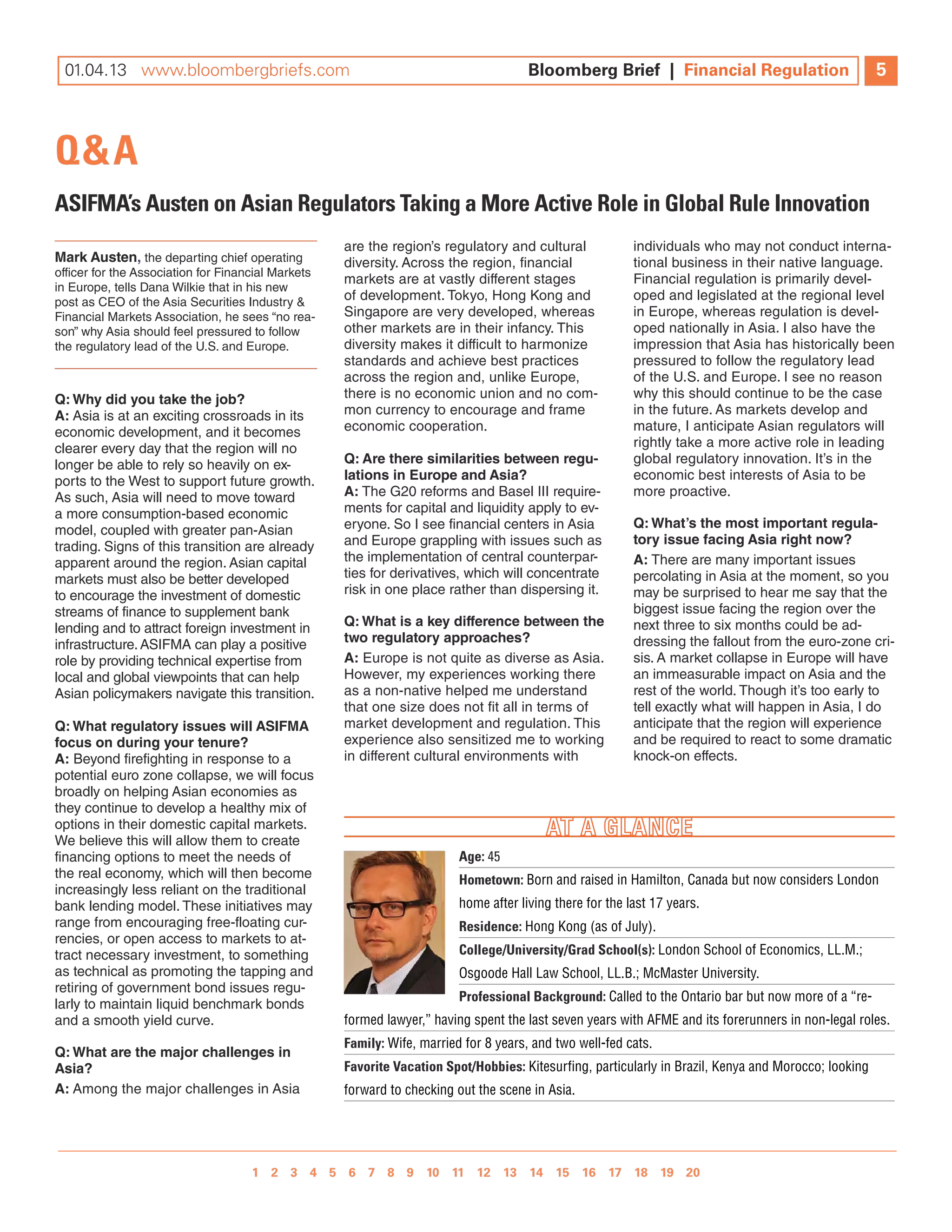
Mark Austen, the departing chief operating          diversity. Across the region, financial               tional business in their native language.
officer for the Association for Financial Markets
                                                    markets are at vastly different stages                Financial regulation is primarily devel-
in Europe, tells Dana Wilkie that in his new
post as CEO of the Asia Securities Industry &       of development. Tokyo, Hong Kong and                  oped and legislated at the regional level
Financial Markets Association, he sees “no rea-     Singapore are very developed, whereas                 in Europe, whereas regulation is devel-
son” why Asia should feel pressured to follow       other markets are in their infancy. This              oped nationally in Asia. I also have the
the regulatory lead of the U.S. and Europe.         diversity makes it difficult to harmonize             impression that Asia has historically been
                                                    standards and achieve best practices                  pressured to follow the regulatory lead
                                                    across the region and, unlike Europe,                 of the U.S. and Europe. I see no reason
Q: Why did you take the job?                        there is no economic union and no com-                why this should continue to be the case
A: Asia is at an exciting crossroads in its         mon currency to encourage and frame                   in the future. As markets develop and
economic development, and it becomes                economic cooperation.                                 mature, I anticipate Asian regulators will
clearer every day that the region will no                                                                 rightly take a more active role in leading
longer be able to rely so heavily on ex-            Q: Are there similarities between regu-               global regulatory innovation. It’s in the
ports to the West to support future growth.         lations in Europe and Asia?                           economic best interests of Asia to be
As such, Asia will need to move toward              A: The G20 reforms and Basel III require-             more proactive.
a more consumption-based economic                   ments for capital and liquidity apply to ev-
model, coupled with greater pan-Asian               eryone. So I see financial centers in Asia            Q: What’s the most important regula-
trading. Signs of this transition are already       and Europe grappling with issues such as              tory issue facing Asia right now?
apparent around the region. Asian capital           the implementation of central counterpar-             A: There are many important issues
markets must also be better developed               ties for derivatives, which will concentrate          percolating in Asia at the moment, so you
to encourage the investment of domestic             risk in one place rather than dispersing it.          may be surprised to hear me say that the
streams of finance to supplement bank                                                                     biggest issue facing the region over the
lending and to attract foreign investment in        Q: What is a key difference between the               next three to six months could be ad-
infrastructure. ASIFMA can play a positive          two regulatory approaches?                            dressing the fallout from the euro-zone cri-
role by providing technical expertise from          A: Europe is not quite as diverse as Asia.            sis. A market collapse in Europe will have
local and global viewpoints that can help           However, my experiences working there                 an immeasurable impact on Asia and the
Asian policymakers navigate this transition.        as a non-native helped me understand                  rest of the world. Though it’s too early to
                                                    that one size does not fit all in terms of            tell exactly what will happen in Asia, I do
Q: What regulatory issues will ASIFMA               market development and regulation. This               anticipate that the region will experience
focus on during your tenure?                        experience also sensitized me to working              and be required to react to some dramatic
A: Beyond firefighting in response to a             in different cultural environments with               knock-on effects.
potential euro zone collapse, we will focus
broadly on helping Asian economies as
they continue to develop a healthy mix of
options in their domestic capital markets.
We believe this will allow them to create
financing options to meet the needs of                                   Age: 45
the real economy, which will then become                                 hometown: Born and raised in Hamilton, Canada but now considers London
increasingly less reliant on the traditional
bank lending model. These initiatives may                                home after living there for the last 17 years.
range from encouraging free-floating cur-                                Residence: Hong Kong (as of July).
rencies, or open access to markets to at-
tract necessary investment, to something                                 College/university/Grad School(s): London School of Economics, LL.M.;
as technical as promoting the tapping and                                Osgoode Hall Law School, LL.B.; McMaster University.
retiring of government bond issues regu-
                                                                         Professional background: Called to the Ontario bar but now more of a “re-
larly to maintain liquid benchmark bonds
and a smooth yield curve.                           formed lawyer,” having spent the last seven years with AFME and its forerunners in non-legal roles.
                                                    Family: Wife, married for 8 years, and two well-fed cats.
Q: What are the major challenges in
Asia?                                               Favorite vacation Spot/hobbies: Kitesurfing, particularly in Brazil, Kenya and Morocco; looking
A: Among the major challenges in Asia               forward to checking out the scene in Asia.


                                   1 2 3 4 5 6 7 8 9 10 11 12 13 14 15 16 17 18 19 20 
                                               1 2 3 4 5 6 7 8 9 10 11
01.04.13 www.bloombergbriefs.com 	
 07.06.12 www.bloombergbriefs.com                                                   Bloomberg Brief || Financial Regulation
                                                                                    Bloomberg Brief Financial Regulation                          6
                                                                                                                                                 12


Q&A
living Wills May Not be Finalized for Three to Five Years, International Cooperation a Factor
                                                    which entities are the primary funding             gies for resolving themselves. Dodd-Frank
Daniel Ryan, leader of the financial services       sources, and how entities within the bank-         also gives the FDIC orderly liquidation
regulatory practice at PricewaterhouseCoopers
                                                    ing organizations are interconnected.              authority that would give it additional
in New york, tells Dana Wilkie that the living
wills submitted by five major U.S. banks and                                                           powers beyond these bank plans to step
four foreign banks with U.S. operations to U.S.     Q: Don’t those details change a lot?               in and resolve these banks. In my opinion,
regulators last week may not be final for three     A: Not as much as you’d think. Largely,            we are in a much better place than in the
to five years. He says there’s still much work to   once banks put these structures in place,          crisis of 2008.
do in the living will process involving interna-    it’s difficult to modify them without incur-
tional cooperation.                                 ring additional costs or disrupting clients.       Q: How do U.K. and U.S. plans differ?
                                                    And under Dodd-Frank, banks must                   A: In the U.K., there are smaller organiza-
                                                    update plans within 45 days of any mate-           tions required to submit living wills than
Q: Were you busy last week with the                 rial change and refresh their plan at least        in the U.S. In the U.S., living wills are
deadline for the largest banks to file?             annually in writing.                               required from banks with $50 billion or
                                                                                                       more in assets. In the U.K., it’s 15 billion
A: yes. We had nearly 150 people around             Q: Why were the biggest banks                      pounds. More importantly, the U.K. did not
the world assisting our clients with this           required to file before smaller banks?             require a Title I type plan from the banks;
process during the past six to 18 months.                                                              instead, the plan is being prepared by the
While last week was a very hectic getting           A: One of the things U.S. regulators did
                                                    that was very smart was to separate the            U.K. regulators.
the i’s dotted and t’s crossed, most of
the heavy lifting was actually done in the          biggest, most complex banks from the
                                                    plain vanilla organizations so they could          Q: How will living wills work
past several months. The plans had to                                                                  regarding conflicts in international
be approved by the boards of directors of           spend a lot of time working with the for-
                                                    mer to develop a robust and credible plan.         law between jurisdictions?
each of the banks prior to submission, so
that meant all of the substantive work had                                                             A: This is more than just local regulators
                                                    Q: What’s next?                                    meeting with the banks to discuss regula-
to be completed by no later than Memo-
rial Day in most cases to give the boards           A: The filing of these documents is really         tions. There’s a large assumption in the
and senior management sufficient time to            the first step in what’s likely to be a three-     living will process that there will be inter-
review the filings.                                 to five-year process. We don’t expect the          national cooperation and that regulators
                                                    perfect living will to be in place within the      globally will work together to cooperate
Q: What will the drafts look like?                  next week or six months.                           in resolving large systemically important
                                                                                                       financial institutions. Because coopera-
A: Under the Dodd-Frank Act, banks and                                                                 tion alone will not be sufficient in a severe
                                                    Q: What if there’s a crisis in 9 months?
regulators must imagine liquidations in                                                                crisis, there is still much work to do here,
two different ways. Title I, which was the          A: The regulators now have lots of details
                                                    about banks to assess how they would               and this is one of the reasons why I say
plan prepared by the banks, addresses                                                                  the process would take three to five years.
how banks would resolve themselves                  manage a crisis. The banks have strate-
under the bankruptcy code without federal
assistance. Title II, the plan prepared by
the U.S. Federal Deposit Insurance Corp.,                               Age: 49
addresses how the FDIC would resolve
the banks using the orderly liquidation                                 Hometown: Bronx, NY
authority granted by Dodd-Frank.                                        education: Manhattan College, BS in Accounting; Columbia University,
                                                                        MBA in Finance.
Q: How will the living wills help
regulators in a future crisis?                                          Professional background: Started career at PricewaterhouseCoopers in the
A: One of the big issues with the financial                             audit department, auditing banks. Rejoined PwC in 2006 in advisory services.
crisis was that regulators did not have
                                                                        Advised the boards of many major banks during the financial crisis. Chairman
good information about important details
on the banks they regulated to evalu-                                   of Regulatory Advisory Services.
ate the impact of the crisis so they could          Family: Wife Susan and four children.
decide if the entities should be put out of
business or be sold, or some combination            Favorite Vacation Spot: Spending as much time as possible with his family at their summer place in
of that. They were flying blind. With the liv-      Ogunquit, Maine, just north of Boston.
ing wills, we’re talking about granular level
detail as to where derivatives are booked,          Hobbies: Running marathons, fitness.


                                    1 2 3 4 5 6 7 8 9 10 11 12 13 14 15 16 17 18 19 20 
                                               1 2 3 4 5 6 7 8 9 10 11 12
01.04.13 www.bloombergbriefs.com 	
 07.13.12 www.bloombergbriefs.com                                                 Bloomberg Brief || Financial Regulation
                                                                                  Bloomberg Brief Financial Regulation                                 7
                                                                                                                                                      11


Q&A
Don’t expect Fully Harmonized global Financial Regulation, Says IoSCo’s Wright
                                                   traditions. But I’ve not seen many ex-               forum bringing together the securities,
David Wright, secretary general at the             amples of over-protectionism in this crisis.         banking and insurance regulators to work
International Organization of Securities Com-
                                                   Compare this to the 1920s crash and the              together on regulating conglomerates.
missions, tells Dana Wilkie that the world can’t
expect fully harmonized financial regulation,      extreme measures that were taken then.
and that the “second-best” option is for global    There’s not a lot of evidence that the major         Q: Will consistency in the application
regulators to agree on as many specifics of key    jurisdictions with big capital markets have          of the rules ensure a level playing field
issues as possible.                                deliberately taken measures to protect their         between firms in different countries?
                                                   financial markets from the free flow of capi-        A: We must first determine the margin re-
                                                   tal and from competition from the outside.           quirements to a sufficient level of granular-
Q: What will motivate global                                                                            ity. Second, we must monitor the trans-
regulatory cooperation?                            Q: Are EU equivalence measures                       position into domestic and regional laws.
                                                   a form of protectionism?                             Third, ensure that actual implementation
A: We’re not going to get fully harmonized
law at a global level. For that to happen,         A: Equivalence is not a protectionist                in the markets is consistent on a day-by
you need global financial institutions with        instrument. Equivalence is like saying, ‘We          day-basis. There are no binding, legally
global regulatory powers, including global         don’t mind if you trade on our market, but           enforceable global securities, banking or
enforcement power. you could argue that            you have to trade on the same basis and              insurance laws. But major efforts are un-
would be a good way to go, but that’s              rules that we do.’ If you didn’t have that,          derway with the G-20, Financial Stability
not going to happen. We’re looking at a            you’d be saying, ‘We have these high-level           Board, IOSCO, International Association
second-best world here, which is a world           standards in the EU, but anybody outside             of Insurance Supervisors, Committee on
where we’re trying to determine collectively       the EU can come in and trade using much              Payment and Settlement Systems and
what are the key issues we can agree on,           lower standards.’ I’m not defending the              the Basel Committee to do everything
and trying to work our damndest so we can          EU perspective, but why should a firm                possible to ensure even and consistent
all agree on as many specifics as possible.        from Australia not apply key prudential or           outcomes in all jurisdictions, applying the
                                                   trading rules when they trade in the EU? It          rules to avoid regulatory arbitrage and
Q: One holdup is the industry’s concern            would give them a competitive advantage.             global competitive distortion.
about the high cost of regulation.
                                                   Q: How does last week’s joint margin                 Q: What else is on your agenda?
A: If I was on the industry side, I’d be           requirements proposal for non-
concerned about costs and what it meant                                                                 A: One thing that keeps us up at night is
                                                   centrally cleared derivatives fit into               how to identify emerging risks in securities
for my business. That’s natural. But this is       a global regulatory framework?
the industry that caused unemployment to                                                                markets. We need to identify these risks
increase and a great deal of hardship for          A: This is a very good example of how                earlier and bring everybody around the
many people. We have suffered colossal             global regulators are working together to            table so we can shape a solution before
damage. When the lobbyists and industry            repair the global financial system. IOSCO            national or regional regulators start form-
complain about costs, I often say to them,         is cooperating with the Basel Committee              ing their rules. This will allow us to play a
‘Now tell me what the benefits of regula-          on Banking Supervision in many areas,                bigger role in this process of global financial
tion are? What are the benefits to a safer         such as determining capital requirements             repair. If we enter the regulatory space too
financial system, where we don’t have the          for non-cleared derivatives. IOSCO works             long after the EU and the U.S. and Japan
disruption we’ve had the last five years?’         closely with many Financial Stability                and Australia are beginning to regulate, then
you’ve got to look at the benefits of creat-       Board work streams. There is also a joint            that’s where laws start to diverge.
ing a financial system that is much safer
in the future. The financial industry has
to go to work for the economy – not the
economy for the financial industry.                                   Age: 60    Hometown: London         Residence: Madrid
Q: How does political pressure                                        education: Graduated from Worcester College in Oxford in 1974 with a degree
affect regulation?                                                    in politics, economics and philosophy.
A: No regulator I know has any intention                              Professional background: Held a variety of positions in the European Commission
of making change for the sake of making
change. What we’re trying to do is make                               from 1977 to 2011, including deputy director-general for securities and financial
sure that the sorts of events we’ve seen                              markets and for all financial services policy in DG Internal Market and Services.
do not repeat themselves. Politicians
will draw up their laws according to their                            Family: Married, no children. Favorite Hobbies: The arts, opera, sports, golf, travel.


                                   1 2 3 4 5 6 7 8 9 10 11 12 13 14 15 16 17 18 19 20 
                                               1 2 3 4 5 6 7 8 9 10 11
07 .12 www.bloombergbriefs.com 	
 01.04.13 www.bloombergbriefs.com
   .27                                                                          Bloomberg Brief || Financial Regulation
                                                                                Bloomberg Brief Financial Regulation                             8
                                                                                                                                                11


Q&A
Regulators Ignoring Dodd-Frank Rules That Allow Them to break up big banks
                                                brilliant management team in banking,               the Financial Stability Oversight Council
Phil Angelides, president of Riverview          but they couldn’t see this disaster. Clearly        (FSOC) to order divestiture if it reviews a
Capital Investments and the former chair-
                                                regulators didn’t have the capacity to over-        bank’s living will and determines that the
man of the congressionally appointed
Financial Crisis Inquiry Commission, tells
                                                see all of this bank’s activities.                  bank is too big to resolve through Dodd-
Dana wilkie that regulators are ignoring                                                            Frank or bankruptcy. Section 121 allows
Dodd-Frank provisions that give them pow-        Q: Given JPMorgan’s losses, what                   the FSOC, by a two-thirds vote, to limit
er to break up the nation’s largest banks.      should change?                                      a bank’s expansion and order break-up
                                                A: One thing that should change in the              remedies. I think it’s high time they begin
                                                wake of the JPMorgan fiasco is that there           to think about the use of these powers for
Q: Why do you want regulators to break          should not be an allowance for portfolio            the benefit of the financial system.
up big banks?                                   hedging. That’s the camel’s nose under
                                                the tent to allow proprietary trading. what         Q: Why haven’t regulators taken advan-
A: I have a growing concern about the                                                               tage of these provisions?
sheer size of these institutions. I’ve          ought to be allowed are specific hedges
come to the conclusion that they’re too         for specific transactions, period. Still, we’re     A: There’s a long-term mindset among
big to fail, too big to manage, too big to      better off if we strip off the market-making        regulators to be overly accommodating.
regulate, too complex to understand and         speculative activities from depository              This isn’t something they’ve done since
therefore too risky to exist. In their cur-     insured banks.                                      the late 80s and early 90s when we had
rent form they distort not only the market,                                                         very aggressive regulations in the wake of
                                                Q: What are the political implications of           the savings and loan crisis. This requires
but our democracy.
                                                breaking up the biggest banks?                      a cultural change.
Q: Haven’t Dodd-Frank rules reduced             A: There’s a growing chorus from many
their power and influence?                      people expressing concerns about the                Q: Are capital requirements for SIFIs a
                                                sheer scale of these institutions – Tom             step in the right direction?
A: One could argue that the Volcker rule
modestly shrinks them because they              Hoenig, Sheila Bair, Chuck Hagel, alan              A: The capital standards are a positive,
have to spin off some of their proprietary      Simpson – mainstream, non-radical                   but they’re pretty modest. They’re now
trading, or that derivatives rules for clear-   voices expressing deep concern about                at 4.5 percent of risk-weighted assets,
ing houses might put a small dent in the        how the market and democracy are being              and they go to 7 percent by 2019. They
oligarchy of a handful of large banks that      distorted. Regulators do have discretion-           ought to move up to 7 percent much
control the majority of derivatives. But the    ary powers under Dodd-Frank to do this.             more quickly than 2019. at the very mini-
top 10 U.S. banks still have 77 percent of                                                          mum, it should be 5 percent of all as-
                                                Q: What powers?                                     sets, regardless of risk, and 10 percent
banking assets – and that’s up from 17
percent in 1970. and look at what regula-       A: Section 165B of Dodd-Frank allows                for very large institutions.
tors did earlier this year – they approved
a direct merger of Capital One and InG,
which created the fifth-largest financial
institution in the U.S. Dodd-Frank was                              Age: 59
supposed to tie down Gulliver, but I don’t                          Hometown/Residence: Sacramento, California
know that that’s possible.
                                                                    education: Harvard College, B.A. cum laude, 1974; Coro Foundation Fellow.
Q: How could Volcker be tougher?                                    Professional background: President, Riverview Capital Investments,
A: a good start would be to separate true
                                                                    2007-current; Chairman, Financial Crisis Inquiry Commission, 2009-2011;
banking functions from speculative activi-
ties and investment banking activities – a                          California State Treasurer, 1999-2007; President, River West Investments,
21st century version of Glass-Steagall.                             1986-1998; Chairman, California Democratic Party, 1991-1993.
There ought to be institutions that take
deposits and make loans, but if you want        Family: Married to Julie Angelides, three daughters - Megan, Christina and Arianna.
to be a market maker, you ought not to          Favorite Restaurant: Hana Tsubaki in Sacramento
take deposits. JPMorgan stands out as a
shining example for why we need to move         Favorite Vacation Spot: Sunriver, Oregon
institutions to a more reasonable scale         Favorite Charity: Vincent Academy
so we can properly regulate them. we
                                                Hobbies: Tennis, spending time with family, new granddaughter Alexandra.
supposedly had at JPMorgan the most


                                 1 2 3 4 5 6 7 8 9 10 11 12 13 14 15 16 17 18 19 20 
                                            1 2 3 4 5 6 7 8 9 10 11 12
08.03.12 www.bloombergbriefs.com	
 01.04.13                                                                            Bloomberg Brief || Financial Regulation
                                                                                     Bloomberg Brief Financial Regulation                          9
                                                                                                                                                  12


Q&A
hSbC Action highlights Difficulties for Anti-Money laundering Chiefs in emerging Markets
                                                   and of action under criminal frameworks           suffering is exactly the sort of thing which
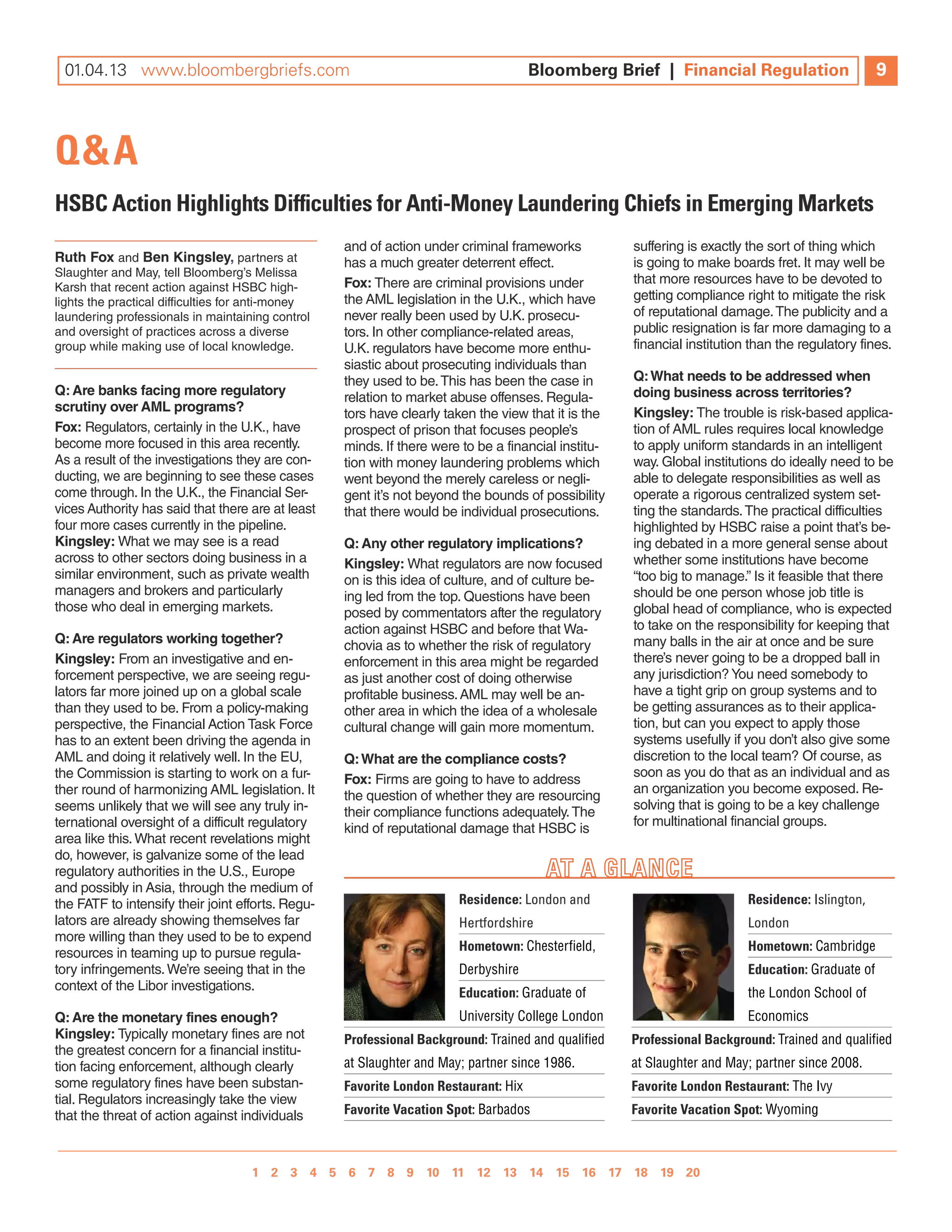
Ruth Fox and Ben Kingsley, partners at             has a much greater deterrent effect.              is going to make boards fret. it may well be
Slaughter and May, tell Bloomberg’s Melissa
                                                   Fox: There are criminal provisions under          that more resources have to be devoted to
karsh that recent action against HSBC high-
lights the practical difficulties for anti-money   the AML legislation in the U.k., which have       getting compliance right to mitigate the risk
laundering professionals in maintaining control    never really been used by U.k. prosecu-           of reputational damage. The publicity and a
and oversight of practices across a diverse        tors. in other compliance-related areas,          public resignation is far more damaging to a
group while making use of local knowledge.         U.k. regulators have become more enthu-           financial institution than the regulatory fines.
                                                   siastic about prosecuting individuals than
                                                   they used to be. This has been the case in        Q: What needs to be addressed when
Q: Are banks facing more regulatory                relation to market abuse offenses. Regula-        doing business across territories?
scrutiny over AML programs?                        tors have clearly taken the view that it is the   Kingsley: The trouble is risk-based applica-
Fox: Regulators, certainly in the U.k., have       prospect of prison that focuses people’s          tion of AML rules requires local knowledge
become more focused in this area recently.         minds. if there were to be a financial institu-   to apply uniform standards in an intelligent
As a result of the investigations they are con-    tion with money laundering problems which         way. Global institutions do ideally need to be
ducting, we are beginning to see these cases       went beyond the merely careless or negli-         able to delegate responsibilities as well as
come through. in the U.k., the Financial Ser-      gent it’s not beyond the bounds of possibility    operate a rigorous centralized system set-
vices Authority has said that there are at least   that there would be individual prosecutions.      ting the standards. The practical difficulties
four more cases currently in the pipeline.                                                           highlighted by HSBC raise a point that’s be-
Kingsley: what we may see is a read                Q: Any other regulatory implications?             ing debated in a more general sense about
across to other sectors doing business in a        Kingsley: what regulators are now focused         whether some institutions have become
similar environment, such as private wealth        on is this idea of culture, and of culture be-    “too big to manage.” is it feasible that there
managers and brokers and particularly              ing led from the top. Questions have been         should be one person whose job title is
those who deal in emerging markets.                posed by commentators after the regulatory        global head of compliance, who is expected
                                                   action against HSBC and before that wa-           to take on the responsibility for keeping that
Q: Are regulators working together?                chovia as to whether the risk of regulatory       many balls in the air at once and be sure
Kingsley: From an investigative and en-            enforcement in this area might be regarded        there’s never going to be a dropped ball in
forcement perspective, we are seeing regu-         as just another cost of doing otherwise           any jurisdiction? you need somebody to
lators far more joined up on a global scale        profitable business. AML may well be an-          have a tight grip on group systems and to
than they used to be. From a policy-making         other area in which the idea of a wholesale       be getting assurances as to their applica-
perspective, the Financial Action Task Force       cultural change will gain more momentum.          tion, but can you expect to apply those
has to an extent been driving the agenda in                                                          systems usefully if you don’t also give some
AML and doing it relatively well. in the eU,       Q: What are the compliance costs?                 discretion to the local team? Of course, as
the Commission is starting to work on a fur-                                                         soon as you do that as an individual and as
                                                   Fox: Firms are going to have to address
ther round of harmonizing AML legislation. it                                                        an organization you become exposed. Re-
                                                   the question of whether they are resourcing
seems unlikely that we will see any truly in-                                                        solving that is going to be a key challenge
                                                   their compliance functions adequately. The
ternational oversight of a difficult regulatory                                                      for multinational financial groups.
                                                   kind of reputational damage that HSBC is
area like this. what recent revelations might
do, however, is galvanize some of the lead
regulatory authorities in the U.S., europe
and possibly in Asia, through the medium of
the FATF to intensify their joint efforts. Regu-                       Residence: London and                              Residence: Islington,
lators are already showing themselves far                              Hertfordshire                                      London
more willing than they used to be to expend
resources in teaming up to pursue regula-                              hometown: Chesterfield,                            hometown: Cambridge
tory infringements. we’re seeing that in the                           Derbyshire                                         education: Graduate of
context of the Libor investigations.
                                                                       education: Graduate of                             the London School of
Q: Are the monetary fines enough?                                      University College London                          Economics
Kingsley: Typically monetary fines are not         Professional background: Trained and qualified    Professional background: Trained and qualified
the greatest concern for a financial institu-
tion facing enforcement, although clearly          at Slaughter and May; partner since 1986.         at Slaughter and May; partner since 2008.
some regulatory fines have been substan-           Favorite london Restaurant: Hix                   Favorite london Restaurant: The Ivy
tial. Regulators increasingly take the view
that the threat of action against individuals      Favorite Vacation Spot: Barbados                  Favorite Vacation Spot: Wyoming


                                   1 2 3 4 5 6 7 8 9 10 11 12 13 14 15 16 17 18 19 20 
                                              1 2 3 4 5 6 7 8 9 10 11 12
01.04.13 www.bloombergbriefs.com 	
 12.17.12 www.bloombergbriefs.com                                                   Bloomberg Brief || Financial Regulation
                                                                                    Bloomberg Brief Financial Regulation                          10
                                                                                                                                                  9


Q&A
Fail-Safe Rule in Algorithms, Enforced by the SEC, May Limit Unforeseen Trading Errors
                                                    strategies to minimize the number and im-           byists, most which is based on S&P 500
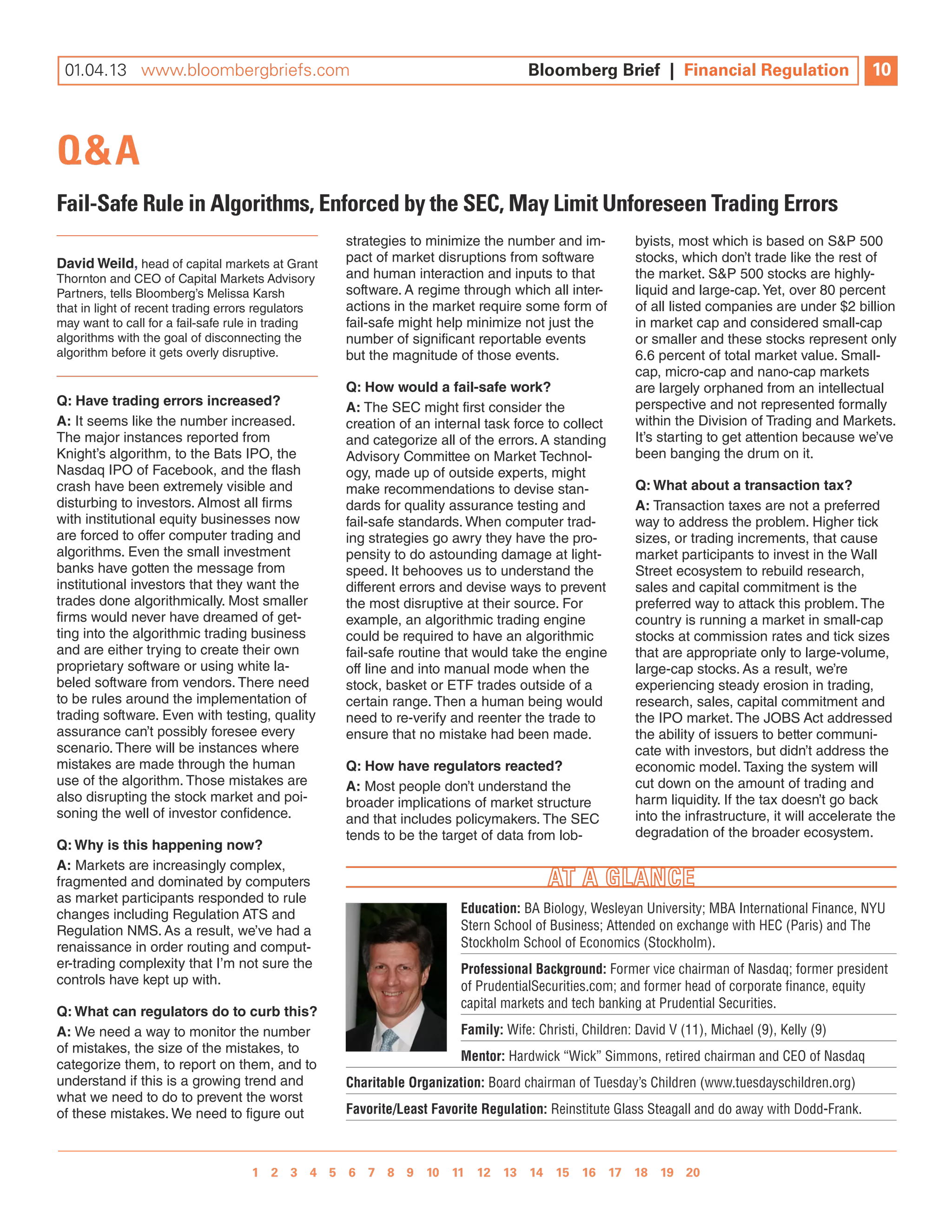
David Weild, head of capital markets at Grant       pact of market disruptions from software            stocks, which don’t trade like the rest of
Thornton and CEO of Capital Markets Advisory        and human interaction and inputs to that            the market. S&P 500 stocks are highly-
Partners, tells Bloomberg’s Melissa Karsh           software. A regime through which all inter-         liquid and large-cap. Yet, over 80 percent
that in light of recent trading errors regulators   actions in the market require some form of          of all listed companies are under $2 billion
may want to call for a fail-safe rule in trading    fail-safe might help minimize not just the          in market cap and considered small-cap
algorithms with the goal of disconnecting the       number of significant reportable events             or smaller and these stocks represent only
algorithm before it gets overly disruptive.         but the magnitude of those events.                  6.6 percent of total market value. Small-
                                                                                                        cap, micro-cap and nano-cap markets
                                                    Q: How would a fail-safe work?                      are largely orphaned from an intellectual
Q: Have trading errors increased?                   A: The SEC might first consider the                 perspective and not represented formally
A: It seems like the number increased.              creation of an internal task force to collect       within the Division of Trading and Markets.
The major instances reported from                   and categorize all of the errors. A standing        It’s starting to get attention because we’ve
Knight’s algorithm, to the Bats IPO, the            Advisory Committee on Market Technol-               been banging the drum on it.
Nasdaq IPO of Facebook, and the flash               ogy, made up of outside experts, might
crash have been extremely visible and               make recommendations to devise stan-                Q: What about a transaction tax?
disturbing to investors. Almost all firms           dards for quality assurance testing and             A: Transaction taxes are not a preferred
with institutional equity businesses now            fail-safe standards. When computer trad-            way to address the problem. Higher tick
are forced to offer computer trading and            ing strategies go awry they have the pro-           sizes, or trading increments, that cause
algorithms. Even the small investment               pensity to do astounding damage at light-           market participants to invest in the Wall
banks have gotten the message from                  speed. It behooves us to understand the             Street ecosystem to rebuild research,
institutional investors that they want the          different errors and devise ways to prevent         sales and capital commitment is the
trades done algorithmically. Most smaller           the most disruptive at their source. For            preferred way to attack this problem. The
firms would never have dreamed of get-              example, an algorithmic trading engine              country is running a market in small-cap
ting into the algorithmic trading business          could be required to have an algorithmic            stocks at commission rates and tick sizes
and are either trying to create their own           fail-safe routine that would take the engine        that are appropriate only to large-volume,
proprietary software or using white la-             off line and into manual mode when the              large-cap stocks. As a result, we’re
beled software from vendors. There need             stock, basket or ETF trades outside of a            experiencing steady erosion in trading,
to be rules around the implementation of            certain range. Then a human being would             research, sales, capital commitment and
trading software. Even with testing, quality        need to re-verify and reenter the trade to          the IPO market. The JOBS Act addressed
assurance can’t possibly foresee every              ensure that no mistake had been made.               the ability of issuers to better communi-
scenario. There will be instances where                                                                 cate with investors, but didn’t address the
mistakes are made through the human                 Q: How have regulators reacted?                     economic model. Taxing the system will
use of the algorithm. Those mistakes are            A: Most people don’t understand the                 cut down on the amount of trading and
also disrupting the stock market and poi-           broader implications of market structure            harm liquidity. If the tax doesn’t go back
soning the well of investor confidence.             and that includes policymakers. The SEC             into the infrastructure, it will accelerate the
                                                    tends to be the target of data from lob-            degradation of the broader ecosystem.
Q: Why is this happening now?
A: Markets are increasingly complex,
fragmented and dominated by computers
as market participants responded to rule
changes including Regulation ATS and                                    Education: BA Biology, Wesleyan University; MBA International Finance, NYU
Regulation NMS. As a result, we’ve had a                                Stern School of Business; Attended on exchange with HEC (Paris) and The
renaissance in order routing and comput-                                Stockholm School of Economics (Stockholm).
er-trading complexity that I’m not sure the                             Professional Background: Former vice chairman of Nasdaq; former president
controls have kept up with.                                             of PrudentialSecurities.com; and former head of corporate finance, equity
                                                                        capital markets and tech banking at Prudential Securities.
Q: What can regulators do to curb this?
A: We need a way to monitor the number                                  Family: Wife: Christi, Children: David V (11), Michael (9), Kelly (9)
of mistakes, the size of the mistakes, to
                                                                        Mentor: Hardwick “Wick” Simmons, retired chairman and CEO of Nasdaq
categorize them, to report on them, and to
understand if this is a growing trend and           Charitable Organization: Board chairman of Tuesday’s Children (www.tuesdayschildren.org)
what we need to do to prevent the worst
of these mistakes. We need to figure out            Favorite/Least Favorite Regulation: Reinstitute Glass Steagall and do away with Dodd-Frank.


                                   1 2 3 4 5 6 7 8 9 10 11 12 13 14 15 16 17 18 19 20 
                                                  1 2 3 4 5 6 7 8 9
01.04.13 www.bloombergbriefs.com 	
 09.07.12 www.bloombergbriefs.com                                              Bloomberg Brief || Financial Regulation
                                                                               Bloomberg Brief Financial Regulation                           11
                                                                                                                                              10


Q&A
Compliance Issues Found in ‘Dozens of Cases’ Prior to Muni Pay-to-Play Alert, Says di Florio
                                                 curities business. Some may not give an           the line. if it’s done intentionally, then an
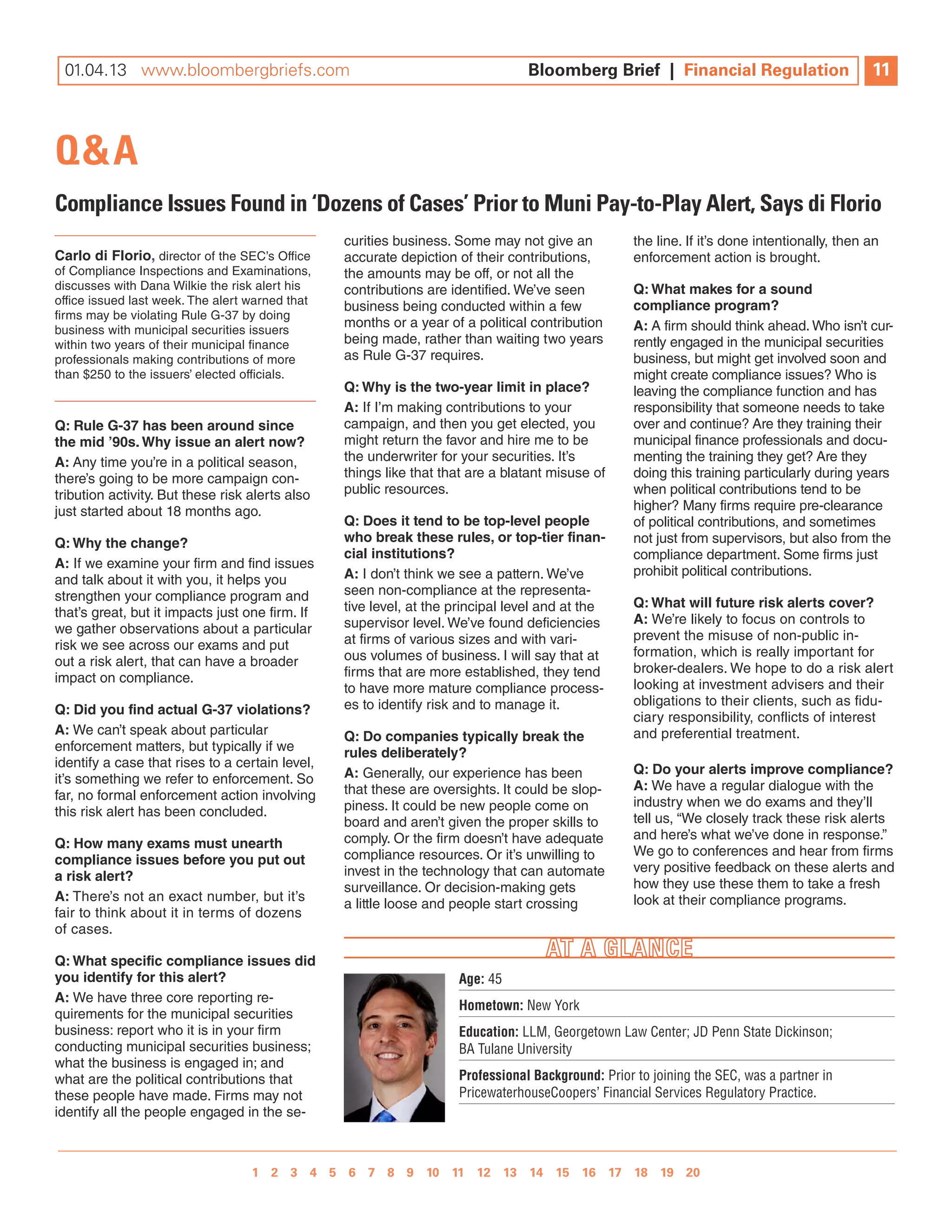
Carlo di florio, director of the SeC’s Office    accurate depiction of their contributions,        enforcement action is brought.
of Compliance inspections and examinations,      the amounts may be off, or not all the
discusses with Dana Wilkie the risk alert his    contributions are identified. We’ve seen          Q: What makes for a sound
office issued last week. The alert warned that   business being conducted within a few             compliance program?
firms may be violating Rule G-37 by doing
business with municipal securities issuers
                                                 months or a year of a political contribution      A: a firm should think ahead. Who isn’t cur-
within two years of their municipal finance      being made, rather than waiting two years         rently engaged in the municipal securities
professionals making contributions of more       as Rule G-37 requires.                            business, but might get involved soon and
than $250 to the issuers’ elected officials.                                                       might create compliance issues? Who is
                                                 Q: Why is the two-year limit in place?            leaving the compliance function and has
                                                 A: if i’m making contributions to your            responsibility that someone needs to take
Q: Rule G-37 has been around since               campaign, and then you get elected, you           over and continue? are they training their
the mid ’90s. Why issue an alert now?            might return the favor and hire me to be          municipal finance professionals and docu-
A: any time you’re in a political season,        the underwriter for your securities. it’s         menting the training they get? are they
there’s going to be more campaign con-           things like that that are a blatant misuse of     doing this training particularly during years
tribution activity. But these risk alerts also   public resources.                                 when political contributions tend to be
just started about 18 months ago.                                                                  higher? Many firms require pre-clearance
                                                 Q: does it tend to be top-level people            of political contributions, and sometimes
Q: Why the change?                               who break these rules, or top-tier finan-         not just from supervisors, but also from the
                                                 cial institutions?                                compliance department. Some firms just
A: if we examine your firm and find issues
                                                 A: i don’t think we see a pattern. We’ve          prohibit political contributions.
and talk about it with you, it helps you
strengthen your compliance program and           seen non-compliance at the representa-
                                                 tive level, at the principal level and at the     Q: What will future risk alerts cover?
that’s great, but it impacts just one firm. if                                                     A: We’re likely to focus on controls to
we gather observations about a particular        supervisor level. We’ve found deficiencies
                                                 at firms of various sizes and with vari-          prevent the misuse of non-public in-
risk we see across our exams and put                                                               formation, which is really important for
out a risk alert, that can have a broader        ous volumes of business. i will say that at
                                                 firms that are more established, they tend        broker-dealers. We hope to do a risk alert
impact on compliance.                                                                              looking at investment advisers and their
                                                 to have more mature compliance process-
                                                 es to identify risk and to manage it.             obligations to their clients, such as fidu-
Q: did you find actual G-37 violations?
                                                                                                   ciary responsibility, conflicts of interest
A: We can’t speak about particular               Q: do companies typically break the               and preferential treatment.
enforcement matters, but typically if we         rules deliberately?
identify a case that rises to a certain level,                                                     Q: do your alerts improve compliance?
it’s something we refer to enforcement. So       A: Generally, our experience has been
                                                 that these are oversights. it could be slop-      A: We have a regular dialogue with the
far, no formal enforcement action involving                                                        industry when we do exams and they’ll
this risk alert has been concluded.              piness. it could be new people come on
                                                 board and aren’t given the proper skills to       tell us, “We closely track these risk alerts
                                                 comply. Or the firm doesn’t have adequate         and here’s what we’ve done in response.”
Q: how many exams must unearth
                                                 compliance resources. Or it’s unwilling to        We go to conferences and hear from firms
compliance issues before you put out
                                                 invest in the technology that can automate        very positive feedback on these alerts and
a risk alert?
                                                 surveillance. Or decision-making gets             how they use these them to take a fresh
A: There’s not an exact number, but it’s                                                           look at their compliance programs.
                                                 a little loose and people start crossing
fair to think about it in terms of dozens
of cases.

Q: What specific compliance issues did
you identify for this alert?                                        Age: 45
A: We have three core reporting re-
                                                                    Hometown: New York
quirements for the municipal securities
business: report who it is in your firm                             Education: LLM, Georgetown Law Center; JD Penn State Dickinson;
conducting municipal securities business;                           BA Tulane University
what the business is engaged in; and
what are the political contributions that                           Professional Background: Prior to joining the SEC, was a partner in
these people have made. Firms may not                               PricewaterhouseCoopers’ Financial Services Regulatory Practice.
identify all the people engaged in the se-


                                  1 2 3 4 5 6 7 8 9 10 11 12 13 14 15 16 17 18 19 20 
                                                1 2 3 4 5 6 7 8 9 10
09.21.12 www.bloombergbriefs.com 	
 01.04.13 www.bloombergbriefs.com                                                 Bloomberg Brief || Financial Regulation
                                                                                  Bloomberg Brief Financial Regulation                         12
                                                                                                                                               10


Q&A
IMA’s Saunders on What the volume of new Regulation Means for U.k. Asset Managers
                                                Q: Sick leave?                                       clients are exposed to more risk.
Richard Saunders, chief executive at the        a: I’ve had conversations with senior
Investment Management Association, tells        people saying the amount of people work-             Q: What is the affect of consumer risk?
Bloomberg’s Dana Wilkie that asset manage-      ing in this area who go on long-term sick            a: The asset management business relies
ment executives are reporting that regulatory   leave has gone up.
staffers are taking more long-term sick leave
                                                                                                     on investors wanting to place money with
due to “the sheer volume of stress” they are                                                         them. And if investors perceive the market
                                                Q: What are the biggest regulatory con-              you’re operating in is a high-cost market
under from post-crisis regulations.
                                                cerns among asset managers?                          without proper choice, then they won’t
                                                a: There are fears about the detailed                want to place money with you.
                                                rules under the directive on Alternative
Q: What were key regulatory takeaways           Investment Fund Managers. This direc-
from your u.k. asset manager survey?                                                                 Q: Which rules are bringing real benefits
                                                tive covers hedge funds, closed ended                to end investors?
a: The main finding is that regulation          investment trusts, real estate funds,                a: In Europe there has been a succession
has risen to the top of the agenda of           charity funds and certain pooled pension             of Undertakings for Collective Investment
asset management CEOs in the U.k. in            vehicles. Some of the rules that were                in Transferable Securities directives, which
a way that was probably unthinkable 10          introduced are aimed at countering so-               is basically the European mutual fund
years ago. The principal concerns are the       called “letter box entities,” and the fear is        model. This has undoubtedly worked to the
extraterritorial measures, the potential for    that they may take too narrow a view of              benefit of investors. It’s developed a well-
protectionism and that global regulatory        what can and cannot be delegated by the              regulated and safe model that’s applied
initiatives under the auspices of the G20       manager of a fund vehicle.                           universally across Europe and has given
are not being implemented in a universal                                                             very wide choice to consumers. Anything
or consistent way.                              Q: how is a narrow view problematic?                 that moves us toward better protection of
                                                a: One of the worries is that we won’t be            client assets is a good thing. But the regu-
Q: What are some extraterritoriality is-        able to delegate portfolio management.               lations do sometimes get it wrong.
sues on both sides of the atlantic?             For instance, say you run a Japanese
a: In the U.S., the Foreign Account Tax         fund and you want to delegate portfolio              Q: You’re urging regulators to improve
Compliance Act is imposing require-             management to a desk in Tokyo. you have              the dialogue with the industry. how
ments on financial institutions operating       to manage it from somewhere else, and                has that been lacking?
in non-U.S. jurisdictions that have U.S.        you may not have the expertise in a new              a: Sometimes the problem is when things
investors. On the other side of the coin,       place that you could have had if you man-            get political. politicians, particularly in
we are seeing increasing attempts by            aged it in Tokyo. Or you may just decide             Europe, are driven by widespread miscon-
the European Commission to introduce            you can no longer have a Japanese fund.              ceptions among voters about the causes
into European legislation the doctrine of                                                            of the financial crisis. Then it becomes
“reciprocity and equivalence,” which says       Q: What about otc derivatives rules?                 difficult to just sit down and say, “Look,
if people wish access to the European           a: The way the OTC derivatives clear-                this is what we think are the unintended
market, they must have domestic rules           ing is being introduced on this side of the          consequences of this piece of legislation,”
that are equivalent to European rules.          Atlantic, it’s going to make hedging of cli-         because it’s assumed you’re trying to talk
So you have the U.S. exporting require-         ent portfolios more difficult, which means           your own book as an industry.
ments one way and Europeans exporting
them the other way, and the industry gets
caught in the middle.

Q: What does the volume of new regu-                                    Age: 60
lation mean for asset managers?                                         Hometown: Llanelli, South Wales. Now lives in London.
a: It’s certainly having an impact on
cost and hiring. We haven’t attempted a                                 Education: Master of Mathematics, Cambridge University
systemic measurement of this, but we do                                 Professional Background: HM Treasury until 1995
hear very persistently that while all these
regulations are not seriously damaging                                  Family: Married, two adult sons.
profit margins, they are nonetheless hav-
ing a significant impact. We’re also hear-                              Favorite Hobbies: Athletics (track and field in U.S. English), chess
ing stories about more sick leave because       Favorite/Least Favorite Financial Regulation: Least: Alternative Investment Fund Managers Direc-
of the sheer volume of stress being put on
regulatory people.                              tive. Most: UCITS Directive.


                                  1 2 3 4 5 6 7 8 9 10 11 12 13 14 15 16 17 18 19 20 
                                                1 2 3 4 5 6 7 8 9 10
09.28.12 www.bloombergbriefs.com	
 01.04.13                                                                          Bloomberg Brief || Financial Regulation
                                                                                   Bloomberg Brief Financial Regulation                          13
                                                                                                                                                 10


Q&A
One-Third of the Decline in Banks’ ROE Related to Regulation, Says Roland Berger’s Boehme
                                                    testing we had to do for living wills; the         trader is doing, you need to have someone
Markus Boehme, senior partner and global            European Market infrastructure Regula-             from risk management who understands
head of investment banking at Roland Berger         tion; the Markets in Financial instruments         what each trader is doing as well.
Strategy Consultants, tells Bloomberg’s Dana        Directive; and new reporting and record-
Wilkie that as much as one-third of the drop that   keeping requirements. Just with the re-            Q: What are these departments doing
global investment banks saw last year in return     quirement to clear swaps centrally, there          to prepare for upcoming rules?
on equity is related to regulatory requirements.    is the threat that – not only will it cost         a: Market risk management depart-
                                                    money – the rules might also be stricter           ments are investing in methodological
                                                    than anyone imagined.                              improvements to more effectively measure
Q: What’s the impact of new regulation                                                                 value-at-risk, market risk-weighted asset
on investment banks?                                Q: can you quantify these costs?                   consumption. Since the consumption is
a: if you look at our figures on return on          a: There are studies that look at the cost         now much higher than before Basel 2.5, it
equity, you get a sense of how much of an           of compliance, and while they indicate             pays to make these investments. Before, it
impact there is. ROE dropped from 15 to             that regulatory costs have risen dramati-          didn’t matter all that much if the figure was
7 percent between 2010 and 2011. Maybe              cally, to be fair, that rise starts from a         overstated by 10 percent or so. Compli-
a third or so of that is directly related to        very low base. Theoretically, it may have          ance and regulatory departments are add-
regulations such as the Basel accords.              risen by 50 percent, but the original              ing staff to cover the additional reporting
Everyone who moved from Basel ii to Ba-             regulatory costs for banks may have                and oversight needs.
sel 2.5 at the end of last year took a direct       started at only 1.5 percent or 2 percent of
hit on their ROE.                                   a bank’s cost structure.                           Q: What role is regulation playing in
                                                                                                       bank restructuring?
Q: What aspect of the Basel accords                 Q: Which departments are most affected?            a: We’ve recently seen a lot of tactical
hit banks the hardest?                              a: Departments few people consider.                moves such as weeding out low perform-
a: The capital requirements. Last year,             There is increased cost pressure on cor-           ers, things like that, which relatively quick-
when Basel 2.5 came into effect, banks              porate finance, trading, the front office, the     ly can help to control 5 to 10 percent of
had substantial increases in capital re-            people who do operations and those who             your costs. Banks are also rethinking the
quirements. Basel 2.5 sets higher market            do iT. There were a lot of regulatory calls        way they do business, including whether it
risk-weighted asset requirements through            to beef up risk management, so when it             makes sense to offer the types of complex
comprehensive risk measurement on cor-              comes to the cost for risk management              products that have been offered in the
relation trading and specific – and much            staff alone, it can quickly add up. But            past. Finally, banks are pooling certain ac-
higher – capital requirements on certain            banks can’t write a blank check because            tivities, partnering with other institutions to
securitization tranches held in trading             these departments have a major impact              share the costs of certain activities, such
books.                                              on costs. And these days, controlling regu-        as combining back office functions.
                                                    latory risk is very complex.
Q: What about Basel iii?                                                                               Q: What role did regulations play in
a: Basel iii will increase counterparty             Q: how so?                                         recently reported bank layoffs?
risk-weighted assets and set more strin-            a: Because financial products have be-             a: They were the key catalyst for banks
gent requirements on funding and liquid-            come extremely complex. it is sometimes            to take action. Capital requirements grew
ity, which will increase the cost of funding        mind boggling how many different prod-             at the same time that markets converged
both trading and banking book position. in          ucts and variations are out there. To have         to what will likely be permanently lower
addition, it will – step by step – raise the        someone who properly understands what a            production levels.
amount of capital to be held against the
bank’s risk-weighted assets.

Q: have other regulations had a similar
impact on Roe?                                                          hometown: Munich, Germany
a: The impact of other regulations is                                   residence: Singapore
probably more subtle. Taken together,
they have a major impact, but we can’t                                  education: University of Munich, Harvard University for Ph.D. and master’s
pinpoint the impact regulation by regula-                               degree in business administration.
tion. Banks have to consider the time                                   professional Background: 15 years in management consulting with global
and effort it takes to comply with the
                                                                        investment banks and corporate and investment banking divisions in Asia, New
whole set of provisions under Dodd-
                                                                        York, London, Europe and Latin America.
Frank, including the Volcker rule; all the


                                    1 2 3 4 5 6 7 8 9 10 11 12 13 14 15 16 17 18 19 20 
                                                  1 2 3 4 5 6 7 8 9 10
10.05.12 www.bloombergbriefs.com 	
 01.04.13                                                                               Bloomberg Brief || Financial Regulation
                                                                                        Bloomberg Brief Financial Regulation                          14
                                                                                                                                                      10


Q&A
Non-insurance Activities, interconnectedness Likely to Make insurers Systemically Relevant
                                                       with 10 of those joining this year.                 concentration, management complexity
                                                                                                           and conflicts of interest. And they address
Peter Braumüller, chairman of the interna-
tional Association of insurance Supervisors,           Q: What’s the goal of the revised guide-            how to minimize regulatory arbitrage.
tells Bloomberg’s Dana wilkie that the insur-          lines for financial conglomerates?
ance watchdog is reviewing several “difficult          a: The guidelines, which we issued along            Q: how do they minimize regulatory
issues” that are likely to make insurers systemi-      with the Basel Committee and the interna-           arbitrage?
cally relevant, including non-traditional activities                                                       a: we wanted to look at the regulatory
                                                       tional Organization of Securities Commis-
and financial system interconnectedness.
                                                       sions, are designed to improve superviso-           blind spots, or gaps, from jurisdiction to
                                                       ry oversight of financial conglomerates in          jurisdiction to make sure there is compre-
                                                       banking, insurance and securities trading.          hensive oversight of financial conglom-
Q: What’s next for the plan to identify                                                                    erates, which we hope will reduce the
systemically important insurers?                       Q: Why are they being revised?                      chance of regulatory arbitrage. The most
a: we are reviewing the comments over                  a: The financial crisis highlighted the             important improvements are in corporate
the next few weeks. There are several                  significant role that financial groups,             governance and risk management.
very difficult issues when trying to get the           including financial conglomerates, play in
methodology right for insurance.                       the stability of global and local economies.        Q: What are the corporate governance
                                                       Due to their economic reach and their               improvements?
Q: What’s difficult?                                   mix of regulated and unregulated entities           a: The key improvement is requiring a
a: it is mainly non-traditional insurance              across borders, such as special purpose             robust governing framework — one that
and non-insurance activities, as well as in-           entities and unregulated holding com-               clearly works in practice. One guideline
terconnectedness to the financial system,              panies, financial conglomerates present             focuses on the composition of the board,
that are likely to make insurers systemi-              challenges for supervisory oversight. in            ensuring that among board members,
cally relevant. Since this is not normally at          hindsight, the crisis exposed situations in         there is sufficient experience and aware-
the core of an insurer’s business, or in the           which regulatory requirements and over-             ness of risks arising across the conglom-
focus of insurance supervisors, it can be              sight did not fully capture all the activities      erate. Also, the growing scale and com-
challenging to get the definitions right for           of financial conglomerates or fully con-            plexity of financial conglomerates has led
some items and to collect the appropriate              sider the impact and cost that these activi-        to an increase in the volume of entities,
data. Furthermore, it is important to reach            ties may pose to the financial system.              risks and operations to which the financial
global consistency in terms of definitions                                                                 conglomerate has been exposed. The
and data, which is challenging because of              Q: how is this addressed for insurers?              revisions direct the board to oversee these
the differing treatment of these definitions           a: The revisions are designed to em-                additional exposures and complexities.
and data from jurisdiction to jurisdiction.            phasize essential elements of financial
For example, variable annuities could be               conglomerate supervision, such as the               Q: What about risk management?
defined differently in different jurisdictions         detection and correction of multiple uses           a: The focus is on having risk manage-
and also contain different levels and types            of capital – for example, double- or multi-         ment across the entire level of a conglom-
of embedded guarantees.                                ple-gearing. They emphasize the assess-             erate, with group-wide risk concentration
                                                       ment of group risks, such as contagion,             and intra-group transactions.
Q: how’s the iais working with other
international regulatory bodies?
a: we need cooperation across borders
to adequately supervise insurers and                                          Age: 53
insurance groups. That’s difficult un-
less supervisors can quickly and easily                                       Hometown: Vienna
share confidential information. To do that,
                                                                              Professional Background: Almost 30 years of experience as an insurance
supervisors need assurances that the
                                                                              supervisor. Worked with the European Commission and European Free
information being requested is for a legiti-
                                                                              Trade Association in Brussels. Member of the management board of the
mate purpose and that it will be treated
confidentially. This can be provided by                                       European Insurance Occupational Pensions Authority (EIOPA).
the Multilateral Memorandum of Under-                                         Family: Divorced, one son.
standing. The iAiS recently reached a
milestone when Connecticut became                                             Hobbies: Mountain biking, skiing, running, theatre, writing.
the first U.S. signatory. we are now at 32
                                                       Favorite/Least Favorite Financial Regulation: Most: Global principles for the financial sector (FSB,
signatories representing more than 48
                                                       IAIS, BCBS, IOSCO).
percent of worldwide premium volume,


                                     1 2 3 4 5 6 7 8 9 10 11 12 13 14 15 16 17 18 19 20 
                                                   1 2 3 4 5 6 7 8 9 10
10.19.12 www.bloombergbriefs.com 	
 01.04.13 www.bloombergbriefs.com                                                  Bloomberg Brief || Financial Regulation
                                                                                   Bloomberg Brief Financial Regulation                           15
                                                                                                                                                  10


Q&A
Clearinghouses Are ‘Clear Winners’ in CFTC’s Swap Rules, Says Baker & Mckenzie’s Montag
                                                   out sweeping rules, but couldn’t antici-           lot of inconsistency and debate around
hans Montag, partner and steering com-             pate the impact on every corner of the             these details.
mittee member of the global derivatives group      market. This made more specific regula-
at Baker & McKenzie llP, spoke with Bloom-         tions and exemptions necessary. That                Q: What are some inconsistencies?
berg’s Melissa Karsh about the potential impact    was not always done in the most orderly            a: One example is how you would choose
of the U.S. Commodity Futures Trading Com-         fashion because of how fast their pro-
mission’s swap rules, the global inconsistencies
                                                                                                      a clearinghouse for a trade between a
                                                   cess had to go. For instance, there were           U.S. and a European counterparty. Under
and what the industry reaction has been.
                                                   some swaps rules already in place but              the current rules, the counterparties
                                                   the rule that defined what a swap was,             would most likely be subject to both U.S.
Q: What are the implications of the                was not in place.                                  and European rules. The U.S. rules would
rules for the swaps market?                                                                           call for clearing through a U.S.-licensed
                                                   Q: What’s been the industry reaction?              clearinghouse, while the European rules
a: Swap trading will most likely become
safer because, to the extent that swaps            a: Even though not every financial institu-        would call for a clearinghouse licensed in
are being cleared, you have these clear-           tion or market player will dispute the             Europe. This will be harmonized at some
inghouses that are regulated and have              merits of the overall goal of the reforms          point, although European regulators seem
strict capital requirements. The other side        many are certainly not very happy about            to say that this issue has dropped in prior-
of the coin is that this comes at a price.         the way this was carried out. The biggest          ity for them right now, which is surprising.
For instance, in a bilateral trade you             complaint is probably timing. They all have        The market may react by clearinghouses
could just negotiate with your counter-            to commit resources to meet these time-            becoming licensed under both systems,
party how much collateral you have to              lines. The timing was extremely aggres-            but this hasn’t happened yet.
put up and your swap dealer could just             sive at first, but the deadlines have been
decide types of collateral to accept. if           extended a little bit now. Even with this,         Q: how do Sec swap rules fall into the
you have a clearinghouse in between,               timely compliance with the rules remains           regulatory framework?
it follows its own rules, approved by              an enormous challenge for the industry.            a: right now the most active regulator is
regulators, and you can’t negotiate these                                                             the CFTC and the SEC has remained a
collateral packages. That can be more              Q: are the swap rules consistent with              on the sidelines. My guess was that was
onerous to the counterparties because              global derivatives reforms?                        meant to not overwhelm the system. The
the collateral that needs to be put up             a: One of the big issues now is cross-             market is struggling to deal with the scope
must be high quality and there’s already           border applicability of dodd-Frank, the            of the regulations that are coming out of
been some talk that there’s not enough             European Market infrastructure regula-             the CFTC as it is, so additional SEC regu-
high-quality collateral.                           tion and related rules, and how the Euro-          lations may have been too much. now the
                                                   pean rules will affect U.S. counterparties.        SEC is catching up and has a long to-do
Q: What about the impact for the differ-           what is consistent is that dodd-Frank              list. The SEC regulates security-based
ent players involved?                              and the European rules have the same               swaps, tied to the price of equities and
a: The clear winners are the clearing-             goals: to increase transparency, reduce            swaps. So the SEC may have a slightly
houses. They are more heavily regulated,           risk and increase market integrity. Major          different angle. And collateral require-
but they will have an enormous spike in            market players will be regulated and               ments for security-based swaps, once
business now. The market is moving to-             most swaps trading will move to clearing           implemented, may further increase the
ward having trades through clearinghous-           and exchange trading, but there is still a         demand for high-quality collateral.
es and on exchanges. Financial institu-
tions are also subject to more regulation,
resulting in higher costs. How they deal
with that depends on the extent to which                                 residence: New York
they can pass on these increased costs to
                                                                         education: Law degrees from Europe and the U.S. (NYU).
others in the marketplace.
                                                                         professional background: Two decades in structured finance and derivatives.
Q: Was there enough time to prepare?
a: There was an agreement between the                                    hobbies: Sailing
g-20 leaders in 2009 to regulate the de-                                 least favorite financial regulation: Those that don’t work in a cross-
rivatives market and to move to clearing,                                border context.
swap trades and reporting by the end of
2012. So that was the reason it was so             golf handicap: Infinite. Don’t play but can spend hours watching tournaments on television.
hectic. But for all participants right now
it’s a learning curve. The regulators put          favorite show: Jerry Seinfeld on the web at http://comediansincarsgettingcoffee.com/.


                                  1 2 3 4 5 6 7 8 9 10 11 12 13 14 15 16 17 18 19 20 
                                                1 2 3 4 5 6 7 8 9 10
10.26.12 www.bloombergbriefs.com 	
 01.04.13                                                                           Bloomberg Brief | | Financial Regulation
                                                                                    Bloomberg Brief Financial Regulation                         16
                                                                                                                                                 10


Q&A
Finra Combining Firm Violations to Encourage Compliance, Says Enforcement Chief Bennett
                                                      and reinforces that firms are not devot-         it’s a tough market in which to do this
Brad Bennett, executive vice president and            ing appropriate and necessary resources          business. your average retail investor is
chief of enforcement at the Financial industry        and attention to compliance efforts.             telling their investor representative that
Regulatory Authority, tells Bloomberg’s Dana                                                           they’d like to earn a return of around 5
Wilkie that a new tactic for encouraging compli-      Q: have you brought such a case yet?             percent and don’t want to take on the
ance is to combine multiple violations into one                                                        kinds of risks that caused them heart-
                                                      a: Rodman & Renshaw llC is one
case to maximize the “deterrent effect” and, in                                                        burn in 2008. Far as i know, a product
turn, draw the attention of other securities firms.
                                                      example. it involved multiple counts
                                                      alleging supervisory and other viola-            like that doesn’t exist today. you have to
                                                      tions stemming from conflicts of interest        convince investors to lower their return
                                                      created by improper interactions between         expectations or to increase their risk tol-
Q: in May, finra fined four banks for                 the broker-dealer’s research and invest-         erance. All this creates a difficult climate
failing to properly supervise sales of                ment banking units. it led to a $315,000         for selling securities at a retail level.
leveraged and inverse exchange-traded                 fine for the firm, a chief of compliance of-
funds, and said similar cases were in                 ficer suspension and a $15,000 fine, and         Q: Why haven’t bad actors hunkered
the pipeline. What else will we see?                  two research analysts being suspended            down until the spotlight is off?
a: in addition to the recent cases we                 and fined $10,000 each. if Rodman &              a: let’s take, for example, pump-and-
brought against Merrill lynch and Scott               Renshaw had been a case involving one            dump schemes. in 1989, there were
& Strongfellow, there are three or four               $10,000 violation, it wouldn’t have had          pump-and-dump schemes run through
cases that are in the hopper and should               the impact, the same media attention or          penny stock firms that sold low-price
be done by year’s end. Some involve                   drawn the same level of awareness by             securities to investors using questionable
firm-wide issues and some involve iso-                firms. if you have to deal with several          tactics. in 2012, the SEC’s docket still has
lated conduct, where you have a group of              fines all at once, that will change the          pump-and-dump schemes. Back then,
brokers responsible for improper sales.               culture of your firm, or make you think          it tended to involve amazing inventions.
                                                      whether you want to be in business at all.       This year, it’s Chinese reverse mergers.
Q: are these big-name firms?                                                                           There’s a steady diet of internet pump-
a: At least one is a fairly well-known                Q: finra statistics show the number of           and-dump schemes. unfortunately,
name. The penalties won’t be of the same              suspended individuals is up. Why?                where there’s money to be made, there
magnitude as the first four banks we                  a: Probably two-thirds of our cases now          will be people who try to do it by cutting
fined, but they are important cases.                  deal with single defendants involved in          corners. The cast changes and the props
                                                      isolated instances of economic dishon-           change, but it’s the same play.
Q: What are other areas of focus?                     esty – stealing from a firm, stealing from
a: A major emphasis has been on how                   clients, unapproved outside businesses.          Q: is finra working with other
to deal with high-risk firms that have a              These are the sorts of things you do             regulators on enforcement cases?
culture of non-compliance that have a                 when you’re having a tough time making           a: There are many matters where both
more checkered past, shall we say.                    a living selling securities.                     we and the SEC are addressing miscon-
                                                                                                       duct. We are also sharing intelligence
Q: how?                                               Q: So the latest trend in cases reflects         with state securities officials on a regular
a: Rather than separately bringing mul-               a bad economy?                                   basis, including quarterly calls to discuss
tiple cases involving a variety of viola-             a: if there’s a theme emerging, it’s that        emerging risks and trends.
tions against one firm, we’re putting the
violations all together in one case. What
i’m shooting for is to grab the attention of
the firm and make them deal with all their
                                                                          Age: 49
problems at once; to maximize the deter-
rent effect and send a strong message                                     Hometown: Tuscon, Arizona
to the firm that the culture of non-com-
pliance at the firm is not acceptable and                                 Education: St. Lawrence University; J.D. at Georgetown University Law Center
needs to change. if you bring separate                                    Professional Background: SEC (Enforcement) 1988-1992, Associate and then
actions, then it just becomes the cost of                                 partner at Miller, Cassidy, Larocca & Lewin (1992-2000), partner at Baker
doing business by paying those fines and                                  Botts (2001-2011), co-chair at White Collar Defense Practice Group LLP
moving on. When we bring a case com-
bining findings from multiple compliance                                  Favorite Musician: Delbert McClinton
examinations and findings across Finra, it
illustrates the culture of non-compliance                                 Golf Handicap: 12.5


                                    1 2 3 4 5 6 7 8 9 10 11 12 13 14 15 16 17 18 19 20 
                                                  1 2 3 4 5 6 7 8 9 10
11.02.12 www.bloombergbriefs.com 	
  01.04.13 www.bloombergbriefs.com                                             Bloomberg Brief | | Financial Regulation
                                                                               Bloomberg Brief Financial Regulation                     17
                                                                                                                                        10


Q&A
U.S. Market Activities Fall Under EU Regulation for First Time With Short Selling Rule
                                                  default swaps that relate to european         they have extraterritorial reach, right?
                Vladimir Maly (top) and           sovereign debt issuers are exempt             Wink: They do, but it doesn’t apply to
                Stephen Wink, finan-              when the swaps demonstrably hedge             all market participants and it’s limited to
                cial regulatory partners at       counterparty or systemic risk. They are       certain banks. Technically, this is the first
                latham & Watkins llP and          allowed, but they must still be disclosed     eu regulation coming from eu authori-
                authors of a report on the        to regulators.                                ties that affects the u.S. and countries
                european union short sell-
                                                                                                outside the eu states.
                ing regulation that took effect   Q: how do the disclosure require-
                yesterday, tell Bloomberg’s       ments work?
                dana Wilkie that the rule
                                                                                                Q: What types of u.S. firms may have
                marks the first time the eu       Maly: reporting now applies to all issu-      to report under the rule?
                will regulate market activities   ers of shares and sovereign debt traded       Maly: It will primarily be hedge funds,
                taking place in the united        on a european trading bank. It does not       most likely a trading shop involved with
                States. They say the rule         matter if the underlying issuer is French     hedging eu instruments. Certainly the
                will primarily affect hedge       or British as long as their instruments       investment banks, when they’re en-
                funds and trading firms and       are traded on a european trading venue.       gaged in hedging, will be involved.
                investment banks engaged
                in hedging eu instruments.        Q: What’s the reporting threshold?            Q: Can you give an example of the
                                                  Maly: It’s 0.2 percent of the issued          rule’s reach?
                                                  share capital of the issuer. every corpo-     Wink: let’s say you have a u.S. hedge
Q: give some background on the new                rate has issued share capital, which is
eu short selling regulation.                                                                    fund that takes positions globally on
                                                  the number of shares it has in circula-       stock, and part of its strategy is to put
Maly: The rule harmonizes the regula-             tion. you must determine daily what your      on its books short positions in a euro-
tion of short sales on shares, sovereign          institution’s net-short position is in the    pean listed company. So even if you’re
debt and certain credit-default swaps             underlying share, and that determina-         sitting in California, by midnight that day,
across the european union.                        tion has to be done as of midnight every      european time, you must have your sys-
                                                  trading day.                                  tems pick up all your net worth positions
Q: how?
                                                                                                and make sure they’re properly reported
Maly: It creates restrictions on and              Q: Don’t some european states re-             to the european regulators.
disclosure requirements for significant           quire reporting now?
net short positions. It also prohibits            Maly: reporting obligations do exist          Q: any additional costs?
uncovered short sales. also referred to           in some european jurisdictions, but           Maly: Most of the pain will probably
as “naked” short selling, it’s where the          not all. even where there is reporting,       come to the smaller hedge funds that
seller has not borrowed the securities            sometimes it’s limited to only a certain      suddenly have to come up with all this
at the time of the short sale, or ensured         financial sector. now, reporting will ap-     compliance apparatus. But it will also
they can be borrowed. The idea is to re-          ply to all corporates, irrespective of what   affect the Blackrocks and larger firms,
duce the risk of settlement failures and          sector they’re in, and at all times.          though it will be some of the smaller
increased price volatility.                                                                     players that may just exit these short-
                                                  Q: to whom do issuers report?                 selling strategies.
Q: What are some of the new                       Maly: To the entity that regulates the
restrictions?                                     trading venue on which the instrument is      Q: how will the rule help regulators?
Maly: To enter a short sale of shares or          being traded.                                 Maly: The goal is to have one set of
sovereign debt, an investor must have                                                           regulations rather than have to apply
borrowed the instruments concerned,               Q: Does this affect u.S. financial            regulations from each member state.
entered into an agreement to borrow               institutions?                                 With this new rule, regulators hope to be
them, or have an arrangement with                 Wink: yes. It wasn’t until the regulation     able to react to significant movements
a third party in which the third party            became available in September that the        of prices so they can step in if they see
confirms that the share or bond has               extent of its reach became clear, and         that short positions are having a nega-
been located and has taken measures               it caught most people off guard. up to        tive effect on the markets. For sovereign
through third parties to ensure the               now, I don’t think any trader in the u.S.     debt short sales, clearly regulators are
settlement can take place.                        had to worry about the application of         trying to prevent a run on the bond mar-
                                                  some non-u.S. law to his trading in the       kets. limiting the marketplace’s ability to
Q: are there exemptions for uncov-                u.S. This is really a first.                  short sell bonds is a way to reduce the
ered positions?                                                                                 chances that the prices of those bonds
Maly: uncovered positions in credit-              Q: What about the Basel accords,              would be driven down.


                                 1 2 3 4 5 6 7 8 9 10 11 12 13 14 15 16 17 18 19 20 
                                               1 2 3 4 5 6 7 8 9 10
11.09.12 www.bloombergbriefs.com 	
 01.04.13 www.bloombergbriefs.com                                                     Bloomberg Brief || Financial Regulation
                                                                                      Bloomberg Brief Financial Regulation                          18
                                                                                                                                                    10


Q&A
New FATcA compliance Deadlines give industry ‘Breathing Room,’ Allow for harmonization
                                                     Q: What are the it costs?                           ment started negotiating agreements with
Barbara angus, principal at ernst & young            a: i haven’t seen a global quantification.          some of our major trading partners that
llP’s national tax practice, tells Bloomberg’s                                                           allow the iRs to work with its counterparts
                                                     i think that would be difficult to do. There
Dana Wilkie that the internal Revenue service’s                                                          in other countries to make tax-reporting
relaxed Foreign Account Tax Compliance Act           are some significant costs involved here,
                                                     though, and institutions are certainly fac-         compliance easier. so a U.K. financial
(FATCA) deadlines will give financial institutions
additional “breathing room” to put necessary         toring that into their budgeting.                   institution would provide information to its
systems in place to comply with the law.                                                                 government, for example, and there would
                                                     Q: any other costs?                                 be a U.K.-to-U.s. exchange of that infor-
                                                     a: Compliance officers must now look at             mation. The agreements reflected dead-
Q: how does fatca enforcement im-                    the whole lifecycle of the institution – its        lines that were modestly different from the
pact financial institutions?                         dealing with the customer and its deal-             timelines in FATCA. so the iRs’s recent
a: We’re talking about projects that                 ing at the inter-bank level – as well as the        notice tries to harmonize these deadlines.
involve major system changes, a whole                institution’s dealings with other institutions.     in addition, the FATCA reporting deadlines
range of things that will affect iT systems          institutions must create multi-disciplinary         for FFis were modestly different from iRs
for financial institutions. FATCA rules              teams that prepare for FATCA by working             reporting deadlines for U.s. financial insti-
require you get particular documents to              with their tax leadership, business units,          tutions, which means that a multinational
identify who the owners of the foreign               new-customer leads, governance commit-              institution could have affiliates on different
financial institutions (FFis) are. This is           tees, as well as iT systems people.                 reporting schedules, which was inefficient.
typically done for new accounts. Finan-                                                                  Many institutions indicated it was impor-
cial institutions are working toward build-          Q: What are the new effective dates?                tant to have the entire institution working
ing these new documentation require-                 a: The earliest effective date is now Jan.          on the same deadline.
ments into the iT process.                           1, 2014, as compared with the original
                                                     date, which was this coming Jan. 1. The             Q: how has the industry reacted?
Q: What new documents are required?                  modified dates set forth in the announce-           a: The announcement is welcome news
a: When a corporation or other en-                   ment generally reflect delays of between            for the industry as it responds to concerns
tity opens an account, FATCA requires                6 months and 2 years. This creates some             expressed about the complications from
identification of the owners of the ac-              additional breathing room for financial             a systems and process standpoint that
count, and that’s different than the rules           institutions to put the necessary systems           could be created with different deadlines
required for other regulatory purposes.              in place to comply with FATCA. impor-               for different entities in a corporate group
The “know your customer” rules under                 tantly, the modified dates also simplify            at each stage in the FATCA process.
anti-money laundering rules around the               compliance burdens by harmonizing the               Throughout the ongoing process of
world already require some information               deadlines so that there is greater consis-          developing guidance for the implementa-
about the owners of entities, though                 tency of due dates across the spectrum of           tion of FATCA, Treasury and the iRs have
these require that you identify only those           affected entities.                                  actively sought input from stakeholders
owners who hold a certain percentage                                                                     and have been receptive to recommenda-
                                                     Q: What does this “harmonization”                   tions regarding approaches for achieving
of an entity. For certain entities, FATCA
                                                     mean for reporting deadlines?                       FATCA’s objectives in the manner that will
requires you identify all owners without
regard to what percentage they own.                  a: in addition to FATCA, the U.s. govern-           be least disruptive to ongoing business.

Q: so i could own a tiny fraction and
would have to be identified?
a: yes. FATCA aims to identify U.s.                                         Age: 51
persons who have accounts in FFis so                                        Hometown: Buffalo, New York
the iRs can get information about these
financial accounts. it could be viewed                                      Residence: Washington, D.C.
as a substitute for the kind of informa-                                    Education: Dartmouth College, A.B.; Harvard Law School, JD; University of
tion we provide when you or i have an                                       Chicago Graduate School of Business, MBA
account with a U.s. bank and we get
a form 1099 indicating interest was                                         Professional Background: About 20 years of international tax experience in
earned. if we earn interest in a foreign                                    the private sector; served as international tax counsel for the U.S. Depart-
account with an FFi, the same reporting                                     ment of Treasury and business tax counsel for the Congressional Joint
rules don’t apply right now, so FATCA is                                    Commission on Taxation.
a substitute mechanism for the iRs to
get that information.                                Hobbies: Founding member of an all lawyer comedy troupe in Chicago.


                                    1 2 3 4 5 6 7 8 9 10 11 12 13 14 15 16 17 18 19 20 
                                                  1 2 3 4 5 6 7 8 9 10
11.23.12 www.bloombergbriefs.com 	
 01.04.13 www.bloombergbriefs.com                                               Bloomberg Brief || Financial Regulation
                                                                                Bloomberg Brief Financial Regulation                            19
                                                                                                                                                8


Q&A
SiU’s koehler Says FCPA Guidance Highlights views That Have Been Rejected by Courts
                                                have been rejected by courts. Some of               defense can better incentivize corporate
Mike koehler, a law professor at Southern       the views on jurisdiction, particularly as          conduct and advance the objectives of
illinois University School of law and founder   to foreign actors in the guidance were              the FCPA. A compliance defense is not a
and editor of the website FCPA Professor,       specifically rejected by Judge Richard              race to the bottom – as some have said –
told Bloomberg’s Melissa karsh that the         leon recently in the Africa sting case.             but a race to the top. Also, in this area of
Foreign Corrupt Practices Act guidance is-
                                                The major case concerning what i’ll call            law we need to abolish non-prosecution
sued last week by the DOJ and SeC is less
guidance and more of an “advocacy piece” by     non-foreign government procurement is               and deferred prosecution agreements.
the enforcement agencies.                       the U.S. v. kay case that is discussed              These are resolution vehicles that don’t
                                                and cited in the guidance, however the              get filed with courts in the traditional
                                                DOJ selectively took what it liked from             sense. On one end of the spectrum, be-
Q: Why did the doJ and sec issue new            that opinion and ignored what it didn’t             cause they do not result in any criminal
guidance now?                                   like. Moreover, the enforcement theory              charges they allow egregious instances
a: The Organization of economic                 that payments to obtain licenses, permits           of corporate conduct to be penalized too
Cooperation and Development, which              or in connection with customs and tax is-           lightly. On the opposite end, because
plays a monitoring role, has suggested          sues represent FCPA violations has been             these resolution vehicles are not subject
for many years, including most recently         subjected to judicial scrutiny four times           to any judicial scrutiny and companies
in fall of 2010 in its phase three report of    in the FCPA’s entire history. The enforce-          choose to enter into these for reasons of
the United States, that the enforcement         ment agencies have lost three out of the            risk aversion and efficiency they facili-
agencies should issue guidance to the           four cases. There is no mention of them             tate the over-prosecution of corporate
business community. Furthermore, i think        in the guidance. it’s an advocacy piece.            conduct.
it is likely that when Assistant Attorney
General lanny Breuer announced the              Q: What would you have liked to see                 Q: as the end of the year approaches,
intention to issue guidance in november         from the doJ and sec on this front?                 what are fcPa enforcement trends?
2011 that this was an effort to forestall       a: i think there is substantial value in            a: This year is not a record year in terms
introduction of an actual reform bill in        getting this in one document, but the               of actions or penalty amounts. The high
Congress. in fact, congressional leaders        way to reform the FCPA is not through               mark was in 2010. So far this year 100
said they were going to be introducing a        non-binding guidance. it’s through limited          percent of FCPA enforcement actions
reform bill, but would await guidance.          structural reform, including a compliance           against companies have been resolved
                                                defense. Such a defense would make a                via non-prosecution and deferred pros-
Q: What are the implications?                   company’s pre-existing compliance poli-             ecution agreements. So in the corporate
a: While the guidance serves a very use-        cies and procedures relevant as a matter            context the DOJ has not been scrutinized
ful purpose of collecting in one document       of law when non-executive employees                 one iota when it comes to its corporate
information that was previously scattered,      act contrary to those policies and proce-           enforcement program this year. One con-
it’s not really advancing the ball much in      dures. The goal of the FCPA is to reduce            cern i and others have is by using these
terms of things that people in the know         improper payments to foreign officials.             vehicles the DOJ is essentially able to
didn’t already know. i agree with what          Ad hoc enforcement alone is not best at             insulate its enforcement theories from
SeC enforcement Chief Rob khuzami               accomplishing that goal. A compliance               judicial scrutiny.
said at last week’s press conference that
this is a document that corporate leaders
can now print out and put on their desk
and receive unfiltered information as to
                                                                    Hometown: Elkhart Lake, Wisconsin
the enforcement agency’s position and
policies. So i completely agree that the                            Education: Undergrad – University of South Dakota (Political Science major),
document in and of itself has tremendous                            Law School – University of Wisconsin
value, even though i also agree that
there isn’t much new in this document.                              Professional Background: Lawyer in private practice at Foley & Lardner. Prior
                                                                    to current role, was a law professor in the business school at Butler University.
Q: Why is it important to note that the
                                                                    Hobby: Competing in endurance sporting events, including Ironman triathlons.
guidance is non-binding?
a: Of course the DOJ possesses a big            Favorite Financial Regulation: The FCPA is part of the Securities Exchange Act, so I guess I have
stick and a sharp stick and because             to say the law I devoted much of my professional life to.
of that its views should be taken into
                                                Least Favorite Financial Regulation: Section 1504 of Dodd-Frank. Bribery and corruption are bad,
account. However, there are certain
                                                but that does not mean that all efforts to reduce it are good and represent sound policy.
views of the DOJ in the guidance that


                                1 2 3 4 5 6 7 8 9 10 11 12 13 14 15 16 17 18 19 20 
                                                1 2 3 4 5 6 7 8
01.04.13 www.bloombergbriefs.com 	
 12.07.12 www.bloombergbriefs.com                                                    Bloomberg Brief || Financial Regulation
                                                                                     Bloomberg Brief Financial Regulation                       20
                                                                                                                                                10


Q&A
SEC’s Butler Says Findings From This Year’s nRSRO Exam Could Lead to Enforcement Action
                                                     didn’t identify for the market that they were     rather than something hurried and rushed.
thomas J. Butler, director of the U.S. Securi-       considering a ratings change. if there’s
ties and exchange Commission’s Office of Credit      a delay in the downgrade of a security,           Q: do european Parliament plans for
Ratings – created by the Dodd-Frank act – tells      then potentially the credit could have been       ratings firms on when they can assess
Bloomberg’s Dana Wilkie that this year’s second      worse than the rating at the time would           government debt intersect with your
annual exam of nationally Recognized Statistical                                                       efforts?
                                                     have indicated.
Rating Organizations (nRSROs) could lead to
some enforcement actions. a november report                                                            a: We’re always keen to know the new
summarizing the exam results found that rat-         Q: how do you address these lapses?               developments globally, because a lot of
ings agencies failed to disclose ratings method      a: We must examine the agencies at least          our registrants have a global footprint and
changes or were lax in following policies on         once a year. We’re taking a risk-based ap-        we need to understand and appreciate
timely downgrades of securities. Here is a link to   proach, asking examiners to focus on areas        the regimes they need to abide by. But is
the report: tinyurl.com/bwjzolw.                     of risk appropriate for each registrant. That     it going to change or alter our policies?
                                                     means the exams are not homogeneous,              Unlikely.
                                                     not the same exam for every registrant.
Q: What was the difference between
                                                                                                       Q: how else do you monitor the agen-
this year’s results and last year’s?                 Q: What happens now?                              cies?
a: This year there was more of a focus               a: each exam is tailored to each regis-           a: in addition to the exam, the office has
on governance. Dodd-Frank requires                   trant. We deliver the report to them, we          a group that does what we call monitoring
these agencies to have boards of gov-                have a conference, and we explain what            — which is more of an ongoing dialogue
ernors with a majority of independent                we found. They can adopt remediation              with registrants to ensure best practices
directors — that is, not from within the             measures and ideally prevent the same             and a robust discussion with registrants
company. in 2011, we were focusing on                thing from happening in the future.               so they are communicating regularly with
whether they actually appointed boards
                                                                                                       us outside the scheduled exam. We follow
and set up proper bylaws. in 2012, we                Q: Will there be enforcement action?              up on tips and referrals that come to the
were able to identify whether these
                                                     a: There were findings that were referred         SeC, so we can identify additional risks.
boards were in compliance with Dodd-
                                                     to enforcement. i can’t mention in which          and we follow through on issues that are
Frank and properly overseeing activities.
                                                     category.                                         brewing in the market to see how the
                                                                                                       nRSROs address them, and if they’re fol-
Q: Why is it important to disclose rat-
                                                     Q: When might the sec user-pays                   lowing their criteria and their methodology
ings method changes?
                                                     model report for agencies come out?               on those issues.
a: in a word, it’s transparency. The objec-
                                                     a: We’ve been contributing comments to
tive is to ensure investors know the basis                                                             Q: What does the change in focus
                                                     the SeC staff report that is already well-
that was used to rate an issue.                                                                        mean for firms that rely on ratings?
                                                     developed. it’s a very complicated report
Q: What’s the potential fallout if disclo-           and a complex area. There was a deadline,         a: issuers should expect that the
sure is compromised?                                 which was this past July. We’ve spoken            nRSROs will adhere more closely to their
                                                     to congressional members to make them             stated criteria and to their policies and
a: The potential ramification would be               aware. We want to ensure what we come             procedures; likewise, investors should
to impair the reliability of the rating. i           out with reflects broad input, and that it’s      expect that the ratings processes will have
wouldn’t say this necessarily means they             as robust and as thoughtful as it can be,         greater transparency and oversight.
misled investors — that presumes there
was something untoward.

Q: What’s a policy that the companies
failed to follow?                                                          Age: 55
a: Credit rating companies may put                                         Education: B.A. from Rutgers College; J.D. from Rutgers University School
something on credit watch because of                                       of Law at Newark, New Jersey.
new facts that come to light. The firms                                    Professional Background: 2010-2012: managing director, chief operating
have internal policies for how often they                                  officer for investment strategy and head of business research content man-
will re-rate a deal and re-rate a transac-
                                                                           agement for Morgan Stanley Smith Barney; 1998-2010: various manage-
tion. each one has its own standards. We
                                                                           ment roles at Morgan Stanley predecessors Citi Global Wealth Management
were reviewing if they were following the
                                                                           and Citigroup; 1996-1998: director at UBS Securities LLC; 1988-1996:
rating methodology they set out. They
were required to meet certain timelines,                                   principal at Babcock & Brown Inc.; 1984-1988: associate at Milbank, Tweed,
and they didn’t follow these policies. They                                Hadley & McCloy; 1982-1984: associate at Fulbright & Jaworski.


                                   1 2 3 4 5 6 7 8 9 10 11 12 13 14 15 16 17 18 19 20 
                                                 1 2 3 4 5 6 7 8 9 10

Financial Regulation 2012 Q&A Review

  • 1.
    Financial Regulation 2012Q&A Review January 2013
  • 2.
    01.04.13 www.bloombergbriefs.com Bloomberg Brief | Financial Regulation 2 Editor’s Note Contents Bloomberg Brief: Financial Anat admati Anat Admati, a member of the FDIC-appointed Systemic Resolution Advisory Committee, discusses Ba- Regulation’s Q&A Issue sel equity levels for banks and lessons from the financial crisis (originally published May 2, 2012). page 3 Verena Ross Every week, Bloomberg Brief: Finan- Verena Ross, executive director of the European Securities and Markets Authority, discusses how cial Regulation features an interview national cooperation can produce effective financial regulation across borders (originally published June 1, 2012). page 4 in a question and answer format with an industry participant on relevant and mark austen Mark Austen, CEO of the Asia Securities Industry & Financial Markets Association, discusses timely financial regulatory topics. regulatory approaches in Asia and how those differ from the European regulatory regime (originally We have compiled some of these Q&A published June 8, 2012). page 5 discussions, held since May 2012, and Daniel Ryan are pleased to share them with readers Daniel Ryan, leader of the financial services regulatory practice at Pricewaterhouse Coopers, says just in time for the new year. The pieces it may take three to five years for living wills filed by the largest banks to be final (originally published are arranged in reverse order, from old- July 6, 2012). page 6 est to newest, and are presented in their David Wright original format. David Wright, secretary general of IOSCO, discusses global regulatory cooperation and how the We’d like to thank our contributors for joint proposal on margin rules for non-centrally cleared derivatives fit into that framework (originally published July 13, 2012). page 7 sharing their time and perspectives. As the Financial Regulation Brief enters Phil Angelides 2013, we will continue to provide more Phil Angelides, the former chairman of the Financial Crisis Inquiry Commission, discusses rules that allow regulators to break up the nation’s largest banks (originally published July 27, 2012). page 8 of these interviews, as well as financial regulation news, data, commentaries rutH fox & ben kingsley Ruth Fox and Ben Kingsley, both partners at Slaughter and May, discuss regulatory action taken and analyses. against HSBC for alleged lapses in its anti-money laundering compliance program and the implica- Thank you for your continued reading tions for AML professionals (originally published Aug. 3, 2012). page 9 of the Financial Regulation Brief. If you david weild have any suggestions for new content or David Weild, head of capital markets at Grant Thornton and CEO of Capital Markets Advisory Part- any other feedback please e-mail me at ners, discusses a fail-safe rule in trading algorithms (originally published Aug. 31, 2012). page 10 the address below. carlo di florio Carlo di Florio, director of the SEC’s Office of Compliance Inspections and Examinations, discusses com- Melissa Karsh pliance issues for muni issuers in a recent pay-to-play alert (originally published Sept. 7 2012). page 11 , mkarsh@bloomberg.net richard saunders Richard Saunders, CEO at the Investment Management Association, discusses the regulatory con- cerns of U.K. asset managers (originally published Sept. 21, 2012). page 12 Bloomberg Brief Financial Regulation markus boehme Bloomberg Brief Ted Merz Markus Boehme, senior partner at Roland Berger Strategy Consultants, discusses the impact of Executive Editor tmerz@bloomberg.net new regulation on investment banks (originally published Sept. 28, 2012). page 13 212-617-2309 Bloomberg News Otis Bilodeau peter braumuller Managing Editor obilodeau@bloomberg.net Peter Braumüller, International Association of Insurance Supervisors chairman, discusses what may 212-617-3921 make insurers systemically important (originally published Oct. 5, 2012). page 14 Financial Regulation Melissa Karsh Editor mkarsh@bloomberg.net hans montag 212-617-4557 Hans Montag, partner at Baker & McKenzie LLP, discusses the CFTC’s new swap rules and the Reporter Dana Wilkie implications for market participants (originally published Oct. 5, 2012). page 15 dwilkie2@bloomberg.net 202-654-7353 brad bennetT Brad Bennett, executive vice president and chief of enforcement at Finra, says a new tactic for Newsletter Nick Ferris encouraging compliance is to combine multiple violations into one case to maxmize the “deterrent Business nferris2@bloomberg.net effect.” (originally published Oct. 26, 2012). page 16 Manager 212-617-6975 vladimir maly and stephen wink Advertising bbrief@bloomberg.net Vladimir Maly and Stephen Wink, partners at Latham & Watkins LLP, discuss the EU’s new short- 212-617-6975 selling regulation, which took effect Nov. 1. (originally published Nov. 2, 2012). page 17 Reprints & Lori Husted Permissions lori.husted@theygsgroup.com barbara angus 717-505-9701 Ernst & Young’s Barbara Angus discusses new compliance deadlines for institutions under the For- To subscribe via the Bloomberg Terminal type eign Account Tax Compliance Act (originally published Nov. 9, 2012). page 18 BRIEF <GO> or on the web at www.bloombergbriefs.com. mike koehler To contact the editors: finregbrief@bloomberg.net Southern Illinois University law professor Mike Koehler discusses the DOJ’s and SEC’s guidance on © 2013 Bloomberg LP. All rights reserved. the Foreign Corrupt Practices Act (originally published Nov. 23, 2012). page 19 This newsletter and its contents may not be for- warded or redistributed without the prior consent of thomas j. butler Bloomberg.Please contact our reprints and permis- The SEC’s Thomas J. Butler says exams of nationally recognized statistical ratings organizations sions group listed above for more information. may lead to enforcement (originally published Dec. 7, 2012). page 20  1 2 3 4 5 6 7 8 9 10 11 12 13 14 15 16 17 18 19 20 
  • 3.
    01.04.13 www.bloombergbriefs.com 05.04.12www.bloombergbriefs.com Bloomberg Brief | Financial Regulation Bloomberg Brief | Financial Regulation 3 12 Q&A basel equity levels for banks ‘Not to be Trusted’ to Protect Against Crisis Anat Admati, a member of the FDIC-appoint- ed Systemic Resolution Advisory Committee, tells Dana Wilkie that the Federal Reserve Board Q: Why are the risk weights problematic? A: Basel II moved to sophisticated risk weights and allowed the industry to for their shareholders, or pay down debt. There’s no urgency for them to pay divi- dends, because it endangers the system. decide what the risk weight was in some is ignoring key lessons from the financial crisis, Q: How does this affect the work of one being that in times of stress, the only capital cases, which allows those to be manipu- lated. Banks can play various games with the Systemic Resolution Advisory that investors trust is common equity that can their models of how risky loans are. These Committee? absorb losses. models have not worked well before a cri- A: The FDIC is trying to do its job to sis, but they’re still allowing weak models create a resolution process for sys- to affect requirements. The resulting eq- temic financial institutions without using Q: You write that the Federal Reserve uity levels are not to be trusted to protect taxpayer money. If the institutions do not Board ‘ignored two of the most impor- us from a crisis. have enough loss-absorbing equity, this tant lessons of the crisis.’ What are would become very difficult. We will then those lessons? Q: How did the proliferation of syn- keep having banks that are “too big to A: The two lessons are: First, that banks thetic AAA securities before the crisis fail” which is a very dangerous situation must use a lot more equity funding, which illustrate that the risk weight system for all of us. is the only reliable loss-absorbing capital undermines capital regulation? if we want to prevent crises. Second, that A: Banks can bunch together loans and Q: Has there been any response to the use of risk weights is very problematic. create securities. If the security gets rated your comments? AAA, it’s considered riskless. yet banks A: The recommendation to re-examine Q: You also say Basel III’s bank regula- lost a lot of money, and some were on the Basel III capital requirements and to tions fail to address structural flaws in the verge of collapse, from these suppos- ban dividends to build banks’ ability to the current system. Can you elaborate? edly “safe” investments. That’s part of our absorb losses on their own was made in A: Basel III recognizes that tangible complaint. These risk weights are hiding a fall 2010. yet the Fed has not seriously common equity is the best type of lot of systemic risks, and also bias banks engaged with those of us who hold these capital. Basel III still allows other forms away from business lending. views and has not followed the advice of “regulatory capital” that have proven last year or this. unreliable in the crisis. Most importantly, Q: Why are you concerned about the requirements it sets are too low, and premature capital distributions? Q: You recommend ‘simple, straightfor- they depend on assigning “risk weights” A: The regulators depend on their models ward rules,’ not those ‘heavily reliant to different investment, which hides risks for allowing banks to pay dividends or on supervisory judgment.’ Are the rules and creates distortions. buy back shares. Making these payouts too open to interpretation? is premature and misguided. Banks could A: When rules are too complicated, super- Q: You write that if a much larger do many other things with the money – vision becomes more difficult and there fraction of banks’ total, non-risk- for example lend it or invest prudently are more ways to get around them. weighted assets were funded by equity, the social benefits would be substantial and the social costs mini- mal. What should that fraction be? Age: 55 A: We think they should have at least 20 Hometown: Stanford, California percent or 30 percent — relative to their total assets — of loss-absorbing fund- College/university/Grad School(s): Hebrew University, Jerusalem; ing, ideally equity. Basel, however, asks Yale University banks to have between 4.5 percent and 7 percent equity, and that’s very little. And Professional background: B.Sc in math and statistics, M.Phi, Ph.D in Financial it’s not even a percentage of total assets. Economics, Professor of Finance and Economics at Stanford Graduate School It’s only a percentage of what they call of Business. “risk weighted assets,” and risk weights are a big problem. Mentor: Stephen A. Ross, now at MIT Sloan School. Family: Married. Three children, ages 25 (girl), 18 (boy), 15.5 (boy). Favorite Hobbies: Traveling and reading.  1 2 3 4 5 6 7 8 9 10 11 12 13 14 15 16 17 18 19 20  1 2 3 4 5 6 7 8 9 10 11 12
  • 4.
    06.01.12 www.bloombergbriefs.com 01.04.13 www.bloombergbriefs.com Bloomberg Brief || Financial Regulation Bloomberg Brief Financial Regulation 4 11 Q&A eSMA Rules on Short Selling, CDS Will Showcase Harmonized eu Regime for First Time cies is a continuing challenge. We need to markets. It’s important to avoid regula- Verena Ross, executive director of the engage with market participants and other tory competition – where regions end up European Securities and Markets Authority, stakeholders so we get feedback on policy with fundamentally different and poten- tells Dana Wilkie that Europe will “lead by proposals from those who may be most tially lower standards, and ultimately, a example” and demonstrate how coopera- affected by them. This includes relevant more risky environment for everyone. tion between nations can produce effective industry players, but also investors and The world is strongly linked and any financial regulation across borders. users of the markets. one financial market may be damaged by another market that isn’t sufficiently Q: What are you working on now? Q: How will ESMA regulations on short regulated. With regulatory competition, A: We are on track to deliver our selling and credit-default swaps create investors can’t benefit from appropriate consultation paper on regulating OTC a harmonized framework in the EU? protection, which can’t be in the interest derivatives, central counterparties A: The regulation will set out a single of any regulator or society as a whole. and trade repositories to our board of framework for how EU member states supervisors’ meeting in Copenhagen require market participants to disclose Q: Where is this type of cooperation June 19. After that, we finalize our work net short positions – to the public and to important? and prepare for publication at the end of regulators from EU member states – as A: OTC derivatives are a good example June, or the beginning of July. It will be well as some restrictions on credit-de- of this need for convergence and co- an accelerated consultation on a tight fault swaps. It will be the first time such operation at a global level. In Europe, deadline – which will include an open a harmonized EU regime exists. This the result from the G20 commitments hearing on the issues – but we intend will provide regulators with a toolbox to has been EMIR and, to a degree, the to submit our draft technical standards monitor the actual use of short selling. provisions on derivatives transparency to the European Commission in time to EU regulators and ESMA will have the in MiFID II. But the same issues are meet the G20 deadline. That deadline power to temporarily intervene to ensure occupying our counterparts in the U.S., says that by the end of 2012, standard- markets function orderly and investors Asia and other parts of the world. As ized OTC derivatives contracts should are properly protected. no single regulator can seek to regulate be traded on exchanges or electronic global financial markets from one loca- trading platforms and cleared through Q: How can nations collaborate on tion, we will need to rely on equivalence, central counterparties. OTC derivatives financial regulation? mutual recognition and cooperation to contracts should be reported to trade A: I strongly believe Europe can lead by make progress. There is no alternative repositories and non-centrally cleared example here, to show how convergence to close international cooperation, both contracts should be subject to higher and good cooperation between different in the setting of standards and in the capital requirements. national member states and their regula- execution of day-to-day supervision, if tors provides more effective and efficient we want to achieve an efficient system Q: What types of questions do you regulation of cross-border entities and for global financial markets. anticipate? A: The inevitable questions that arise when translating legislative text into standards that apply to complex ac- tivities across 27 member states. It’s too early to second guess what issues will be encountered by our team, but based on past experience, these will be many and Age: 44 varied – requiring the allocation of pre- Hometown: Hamburg cious resources. It is incumbent on us to do as much planning and preparation as Residence: Paris feasible. I suspect one likely area that will College/university/Grad School(s): Hamburg University; School of Oriental mean significant work is the non-equity transparency requirements in MiFID II. and African Studies (London). Professional background: Bank of England (1994 to 1998); Financial Services Q: What has been challenging? Authority (1998 to 2011); European Securities and Markets Authority A: ESMA receives valuable and timely feedback from the industry, but getting (appointed in 2011). data on the likely impact of different poli- Hobbies: Tennis  1 2 3 4 5 6 7 8 9 10 11 12 13 14 15 16 17 18 19 20  1 2 3 4 5 6 7 8 9 10 11
  • 5.
    06.08.12 www.bloombergbriefs.com 01.04.13 Bloomberg Brief || Financial Regulation Bloomberg Brief Financial Regulation 5 11 Q&A ASIFMA’s Austen on Asian Regulators Taking a More Active Role in Global Rule Innovation are the region’s regulatory and cultural individuals who may not conduct interna- Mark Austen, the departing chief operating diversity. Across the region, financial tional business in their native language. officer for the Association for Financial Markets markets are at vastly different stages Financial regulation is primarily devel- in Europe, tells Dana Wilkie that in his new post as CEO of the Asia Securities Industry & of development. Tokyo, Hong Kong and oped and legislated at the regional level Financial Markets Association, he sees “no rea- Singapore are very developed, whereas in Europe, whereas regulation is devel- son” why Asia should feel pressured to follow other markets are in their infancy. This oped nationally in Asia. I also have the the regulatory lead of the U.S. and Europe. diversity makes it difficult to harmonize impression that Asia has historically been standards and achieve best practices pressured to follow the regulatory lead across the region and, unlike Europe, of the U.S. and Europe. I see no reason Q: Why did you take the job? there is no economic union and no com- why this should continue to be the case A: Asia is at an exciting crossroads in its mon currency to encourage and frame in the future. As markets develop and economic development, and it becomes economic cooperation. mature, I anticipate Asian regulators will clearer every day that the region will no rightly take a more active role in leading longer be able to rely so heavily on ex- Q: Are there similarities between regu- global regulatory innovation. It’s in the ports to the West to support future growth. lations in Europe and Asia? economic best interests of Asia to be As such, Asia will need to move toward A: The G20 reforms and Basel III require- more proactive. a more consumption-based economic ments for capital and liquidity apply to ev- model, coupled with greater pan-Asian eryone. So I see financial centers in Asia Q: What’s the most important regula- trading. Signs of this transition are already and Europe grappling with issues such as tory issue facing Asia right now? apparent around the region. Asian capital the implementation of central counterpar- A: There are many important issues markets must also be better developed ties for derivatives, which will concentrate percolating in Asia at the moment, so you to encourage the investment of domestic risk in one place rather than dispersing it. may be surprised to hear me say that the streams of finance to supplement bank biggest issue facing the region over the lending and to attract foreign investment in Q: What is a key difference between the next three to six months could be ad- infrastructure. ASIFMA can play a positive two regulatory approaches? dressing the fallout from the euro-zone cri- role by providing technical expertise from A: Europe is not quite as diverse as Asia. sis. A market collapse in Europe will have local and global viewpoints that can help However, my experiences working there an immeasurable impact on Asia and the Asian policymakers navigate this transition. as a non-native helped me understand rest of the world. Though it’s too early to that one size does not fit all in terms of tell exactly what will happen in Asia, I do Q: What regulatory issues will ASIFMA market development and regulation. This anticipate that the region will experience focus on during your tenure? experience also sensitized me to working and be required to react to some dramatic A: Beyond firefighting in response to a in different cultural environments with knock-on effects. potential euro zone collapse, we will focus broadly on helping Asian economies as they continue to develop a healthy mix of options in their domestic capital markets. We believe this will allow them to create financing options to meet the needs of Age: 45 the real economy, which will then become hometown: Born and raised in Hamilton, Canada but now considers London increasingly less reliant on the traditional bank lending model. These initiatives may home after living there for the last 17 years. range from encouraging free-floating cur- Residence: Hong Kong (as of July). rencies, or open access to markets to at- tract necessary investment, to something College/university/Grad School(s): London School of Economics, LL.M.; as technical as promoting the tapping and Osgoode Hall Law School, LL.B.; McMaster University. retiring of government bond issues regu- Professional background: Called to the Ontario bar but now more of a “re- larly to maintain liquid benchmark bonds and a smooth yield curve. formed lawyer,” having spent the last seven years with AFME and its forerunners in non-legal roles. Family: Wife, married for 8 years, and two well-fed cats. Q: What are the major challenges in Asia? Favorite vacation Spot/hobbies: Kitesurfing, particularly in Brazil, Kenya and Morocco; looking A: Among the major challenges in Asia forward to checking out the scene in Asia.  1 2 3 4 5 6 7 8 9 10 11 12 13 14 15 16 17 18 19 20  1 2 3 4 5 6 7 8 9 10 11
  • 6.
    01.04.13 www.bloombergbriefs.com 07.06.12 www.bloombergbriefs.com Bloomberg Brief || Financial Regulation Bloomberg Brief Financial Regulation 6 12 Q&A living Wills May Not be Finalized for Three to Five Years, International Cooperation a Factor which entities are the primary funding gies for resolving themselves. Dodd-Frank Daniel Ryan, leader of the financial services sources, and how entities within the bank- also gives the FDIC orderly liquidation regulatory practice at PricewaterhouseCoopers ing organizations are interconnected. authority that would give it additional in New york, tells Dana Wilkie that the living wills submitted by five major U.S. banks and powers beyond these bank plans to step four foreign banks with U.S. operations to U.S. Q: Don’t those details change a lot? in and resolve these banks. In my opinion, regulators last week may not be final for three A: Not as much as you’d think. Largely, we are in a much better place than in the to five years. He says there’s still much work to once banks put these structures in place, crisis of 2008. do in the living will process involving interna- it’s difficult to modify them without incur- tional cooperation. ring additional costs or disrupting clients. Q: How do U.K. and U.S. plans differ? And under Dodd-Frank, banks must A: In the U.K., there are smaller organiza- update plans within 45 days of any mate- tions required to submit living wills than Q: Were you busy last week with the rial change and refresh their plan at least in the U.S. In the U.S., living wills are deadline for the largest banks to file? annually in writing. required from banks with $50 billion or more in assets. In the U.K., it’s 15 billion A: yes. We had nearly 150 people around Q: Why were the biggest banks pounds. More importantly, the U.K. did not the world assisting our clients with this required to file before smaller banks? require a Title I type plan from the banks; process during the past six to 18 months. instead, the plan is being prepared by the While last week was a very hectic getting A: One of the things U.S. regulators did that was very smart was to separate the U.K. regulators. the i’s dotted and t’s crossed, most of the heavy lifting was actually done in the biggest, most complex banks from the plain vanilla organizations so they could Q: How will living wills work past several months. The plans had to regarding conflicts in international be approved by the boards of directors of spend a lot of time working with the for- mer to develop a robust and credible plan. law between jurisdictions? each of the banks prior to submission, so that meant all of the substantive work had A: This is more than just local regulators Q: What’s next? meeting with the banks to discuss regula- to be completed by no later than Memo- rial Day in most cases to give the boards A: The filing of these documents is really tions. There’s a large assumption in the and senior management sufficient time to the first step in what’s likely to be a three- living will process that there will be inter- review the filings. to five-year process. We don’t expect the national cooperation and that regulators perfect living will to be in place within the globally will work together to cooperate Q: What will the drafts look like? next week or six months. in resolving large systemically important financial institutions. Because coopera- A: Under the Dodd-Frank Act, banks and tion alone will not be sufficient in a severe Q: What if there’s a crisis in 9 months? regulators must imagine liquidations in crisis, there is still much work to do here, two different ways. Title I, which was the A: The regulators now have lots of details about banks to assess how they would and this is one of the reasons why I say plan prepared by the banks, addresses the process would take three to five years. how banks would resolve themselves manage a crisis. The banks have strate- under the bankruptcy code without federal assistance. Title II, the plan prepared by the U.S. Federal Deposit Insurance Corp., Age: 49 addresses how the FDIC would resolve the banks using the orderly liquidation Hometown: Bronx, NY authority granted by Dodd-Frank. education: Manhattan College, BS in Accounting; Columbia University, MBA in Finance. Q: How will the living wills help regulators in a future crisis? Professional background: Started career at PricewaterhouseCoopers in the A: One of the big issues with the financial audit department, auditing banks. Rejoined PwC in 2006 in advisory services. crisis was that regulators did not have Advised the boards of many major banks during the financial crisis. Chairman good information about important details on the banks they regulated to evalu- of Regulatory Advisory Services. ate the impact of the crisis so they could Family: Wife Susan and four children. decide if the entities should be put out of business or be sold, or some combination Favorite Vacation Spot: Spending as much time as possible with his family at their summer place in of that. They were flying blind. With the liv- Ogunquit, Maine, just north of Boston. ing wills, we’re talking about granular level detail as to where derivatives are booked, Hobbies: Running marathons, fitness.  1 2 3 4 5 6 7 8 9 10 11 12 13 14 15 16 17 18 19 20  1 2 3 4 5 6 7 8 9 10 11 12
  • 7.
    01.04.13 www.bloombergbriefs.com 07.13.12 www.bloombergbriefs.com Bloomberg Brief || Financial Regulation Bloomberg Brief Financial Regulation 7 11 Q&A Don’t expect Fully Harmonized global Financial Regulation, Says IoSCo’s Wright traditions. But I’ve not seen many ex- forum bringing together the securities, David Wright, secretary general at the amples of over-protectionism in this crisis. banking and insurance regulators to work International Organization of Securities Com- Compare this to the 1920s crash and the together on regulating conglomerates. missions, tells Dana Wilkie that the world can’t expect fully harmonized financial regulation, extreme measures that were taken then. and that the “second-best” option is for global There’s not a lot of evidence that the major Q: Will consistency in the application regulators to agree on as many specifics of key jurisdictions with big capital markets have of the rules ensure a level playing field issues as possible. deliberately taken measures to protect their between firms in different countries? financial markets from the free flow of capi- A: We must first determine the margin re- tal and from competition from the outside. quirements to a sufficient level of granular- Q: What will motivate global ity. Second, we must monitor the trans- regulatory cooperation? Q: Are EU equivalence measures position into domestic and regional laws. a form of protectionism? Third, ensure that actual implementation A: We’re not going to get fully harmonized law at a global level. For that to happen, A: Equivalence is not a protectionist in the markets is consistent on a day-by you need global financial institutions with instrument. Equivalence is like saying, ‘We day-basis. There are no binding, legally global regulatory powers, including global don’t mind if you trade on our market, but enforceable global securities, banking or enforcement power. you could argue that you have to trade on the same basis and insurance laws. But major efforts are un- would be a good way to go, but that’s rules that we do.’ If you didn’t have that, derway with the G-20, Financial Stability not going to happen. We’re looking at a you’d be saying, ‘We have these high-level Board, IOSCO, International Association second-best world here, which is a world standards in the EU, but anybody outside of Insurance Supervisors, Committee on where we’re trying to determine collectively the EU can come in and trade using much Payment and Settlement Systems and what are the key issues we can agree on, lower standards.’ I’m not defending the the Basel Committee to do everything and trying to work our damndest so we can EU perspective, but why should a firm possible to ensure even and consistent all agree on as many specifics as possible. from Australia not apply key prudential or outcomes in all jurisdictions, applying the trading rules when they trade in the EU? It rules to avoid regulatory arbitrage and Q: One holdup is the industry’s concern would give them a competitive advantage. global competitive distortion. about the high cost of regulation. Q: How does last week’s joint margin Q: What else is on your agenda? A: If I was on the industry side, I’d be requirements proposal for non- concerned about costs and what it meant A: One thing that keeps us up at night is centrally cleared derivatives fit into how to identify emerging risks in securities for my business. That’s natural. But this is a global regulatory framework? the industry that caused unemployment to markets. We need to identify these risks increase and a great deal of hardship for A: This is a very good example of how earlier and bring everybody around the many people. We have suffered colossal global regulators are working together to table so we can shape a solution before damage. When the lobbyists and industry repair the global financial system. IOSCO national or regional regulators start form- complain about costs, I often say to them, is cooperating with the Basel Committee ing their rules. This will allow us to play a ‘Now tell me what the benefits of regula- on Banking Supervision in many areas, bigger role in this process of global financial tion are? What are the benefits to a safer such as determining capital requirements repair. If we enter the regulatory space too financial system, where we don’t have the for non-cleared derivatives. IOSCO works long after the EU and the U.S. and Japan disruption we’ve had the last five years?’ closely with many Financial Stability and Australia are beginning to regulate, then you’ve got to look at the benefits of creat- Board work streams. There is also a joint that’s where laws start to diverge. ing a financial system that is much safer in the future. The financial industry has to go to work for the economy – not the economy for the financial industry. Age: 60 Hometown: London Residence: Madrid Q: How does political pressure education: Graduated from Worcester College in Oxford in 1974 with a degree affect regulation? in politics, economics and philosophy. A: No regulator I know has any intention Professional background: Held a variety of positions in the European Commission of making change for the sake of making change. What we’re trying to do is make from 1977 to 2011, including deputy director-general for securities and financial sure that the sorts of events we’ve seen markets and for all financial services policy in DG Internal Market and Services. do not repeat themselves. Politicians will draw up their laws according to their Family: Married, no children. Favorite Hobbies: The arts, opera, sports, golf, travel.  1 2 3 4 5 6 7 8 9 10 11 12 13 14 15 16 17 18 19 20  1 2 3 4 5 6 7 8 9 10 11
  • 8.
    07 .12 www.bloombergbriefs.com 01.04.13 www.bloombergbriefs.com .27 Bloomberg Brief || Financial Regulation Bloomberg Brief Financial Regulation 8 11 Q&A Regulators Ignoring Dodd-Frank Rules That Allow Them to break up big banks brilliant management team in banking, the Financial Stability Oversight Council Phil Angelides, president of Riverview but they couldn’t see this disaster. Clearly (FSOC) to order divestiture if it reviews a Capital Investments and the former chair- regulators didn’t have the capacity to over- bank’s living will and determines that the man of the congressionally appointed Financial Crisis Inquiry Commission, tells see all of this bank’s activities. bank is too big to resolve through Dodd- Dana wilkie that regulators are ignoring Frank or bankruptcy. Section 121 allows Dodd-Frank provisions that give them pow- Q: Given JPMorgan’s losses, what the FSOC, by a two-thirds vote, to limit er to break up the nation’s largest banks. should change? a bank’s expansion and order break-up A: One thing that should change in the remedies. I think it’s high time they begin wake of the JPMorgan fiasco is that there to think about the use of these powers for Q: Why do you want regulators to break should not be an allowance for portfolio the benefit of the financial system. up big banks? hedging. That’s the camel’s nose under the tent to allow proprietary trading. what Q: Why haven’t regulators taken advan- A: I have a growing concern about the tage of these provisions? sheer size of these institutions. I’ve ought to be allowed are specific hedges come to the conclusion that they’re too for specific transactions, period. Still, we’re A: There’s a long-term mindset among big to fail, too big to manage, too big to better off if we strip off the market-making regulators to be overly accommodating. regulate, too complex to understand and speculative activities from depository This isn’t something they’ve done since therefore too risky to exist. In their cur- insured banks. the late 80s and early 90s when we had rent form they distort not only the market, very aggressive regulations in the wake of Q: What are the political implications of the savings and loan crisis. This requires but our democracy. breaking up the biggest banks? a cultural change. Q: Haven’t Dodd-Frank rules reduced A: There’s a growing chorus from many their power and influence? people expressing concerns about the Q: Are capital requirements for SIFIs a sheer scale of these institutions – Tom step in the right direction? A: One could argue that the Volcker rule modestly shrinks them because they Hoenig, Sheila Bair, Chuck Hagel, alan A: The capital standards are a positive, have to spin off some of their proprietary Simpson – mainstream, non-radical but they’re pretty modest. They’re now trading, or that derivatives rules for clear- voices expressing deep concern about at 4.5 percent of risk-weighted assets, ing houses might put a small dent in the how the market and democracy are being and they go to 7 percent by 2019. They oligarchy of a handful of large banks that distorted. Regulators do have discretion- ought to move up to 7 percent much control the majority of derivatives. But the ary powers under Dodd-Frank to do this. more quickly than 2019. at the very mini- top 10 U.S. banks still have 77 percent of mum, it should be 5 percent of all as- Q: What powers? sets, regardless of risk, and 10 percent banking assets – and that’s up from 17 percent in 1970. and look at what regula- A: Section 165B of Dodd-Frank allows for very large institutions. tors did earlier this year – they approved a direct merger of Capital One and InG, which created the fifth-largest financial institution in the U.S. Dodd-Frank was Age: 59 supposed to tie down Gulliver, but I don’t Hometown/Residence: Sacramento, California know that that’s possible. education: Harvard College, B.A. cum laude, 1974; Coro Foundation Fellow. Q: How could Volcker be tougher? Professional background: President, Riverview Capital Investments, A: a good start would be to separate true 2007-current; Chairman, Financial Crisis Inquiry Commission, 2009-2011; banking functions from speculative activi- ties and investment banking activities – a California State Treasurer, 1999-2007; President, River West Investments, 21st century version of Glass-Steagall. 1986-1998; Chairman, California Democratic Party, 1991-1993. There ought to be institutions that take deposits and make loans, but if you want Family: Married to Julie Angelides, three daughters - Megan, Christina and Arianna. to be a market maker, you ought not to Favorite Restaurant: Hana Tsubaki in Sacramento take deposits. JPMorgan stands out as a shining example for why we need to move Favorite Vacation Spot: Sunriver, Oregon institutions to a more reasonable scale Favorite Charity: Vincent Academy so we can properly regulate them. we Hobbies: Tennis, spending time with family, new granddaughter Alexandra. supposedly had at JPMorgan the most  1 2 3 4 5 6 7 8 9 10 11 12 13 14 15 16 17 18 19 20  1 2 3 4 5 6 7 8 9 10 11 12
  • 9.
    08.03.12 www.bloombergbriefs.com 01.04.13 Bloomberg Brief || Financial Regulation Bloomberg Brief Financial Regulation 9 12 Q&A hSbC Action highlights Difficulties for Anti-Money laundering Chiefs in emerging Markets and of action under criminal frameworks suffering is exactly the sort of thing which Ruth Fox and Ben Kingsley, partners at has a much greater deterrent effect. is going to make boards fret. it may well be Slaughter and May, tell Bloomberg’s Melissa Fox: There are criminal provisions under that more resources have to be devoted to karsh that recent action against HSBC high- lights the practical difficulties for anti-money the AML legislation in the U.k., which have getting compliance right to mitigate the risk laundering professionals in maintaining control never really been used by U.k. prosecu- of reputational damage. The publicity and a and oversight of practices across a diverse tors. in other compliance-related areas, public resignation is far more damaging to a group while making use of local knowledge. U.k. regulators have become more enthu- financial institution than the regulatory fines. siastic about prosecuting individuals than they used to be. This has been the case in Q: What needs to be addressed when Q: Are banks facing more regulatory relation to market abuse offenses. Regula- doing business across territories? scrutiny over AML programs? tors have clearly taken the view that it is the Kingsley: The trouble is risk-based applica- Fox: Regulators, certainly in the U.k., have prospect of prison that focuses people’s tion of AML rules requires local knowledge become more focused in this area recently. minds. if there were to be a financial institu- to apply uniform standards in an intelligent As a result of the investigations they are con- tion with money laundering problems which way. Global institutions do ideally need to be ducting, we are beginning to see these cases went beyond the merely careless or negli- able to delegate responsibilities as well as come through. in the U.k., the Financial Ser- gent it’s not beyond the bounds of possibility operate a rigorous centralized system set- vices Authority has said that there are at least that there would be individual prosecutions. ting the standards. The practical difficulties four more cases currently in the pipeline. highlighted by HSBC raise a point that’s be- Kingsley: what we may see is a read Q: Any other regulatory implications? ing debated in a more general sense about across to other sectors doing business in a Kingsley: what regulators are now focused whether some institutions have become similar environment, such as private wealth on is this idea of culture, and of culture be- “too big to manage.” is it feasible that there managers and brokers and particularly ing led from the top. Questions have been should be one person whose job title is those who deal in emerging markets. posed by commentators after the regulatory global head of compliance, who is expected action against HSBC and before that wa- to take on the responsibility for keeping that Q: Are regulators working together? chovia as to whether the risk of regulatory many balls in the air at once and be sure Kingsley: From an investigative and en- enforcement in this area might be regarded there’s never going to be a dropped ball in forcement perspective, we are seeing regu- as just another cost of doing otherwise any jurisdiction? you need somebody to lators far more joined up on a global scale profitable business. AML may well be an- have a tight grip on group systems and to than they used to be. From a policy-making other area in which the idea of a wholesale be getting assurances as to their applica- perspective, the Financial Action Task Force cultural change will gain more momentum. tion, but can you expect to apply those has to an extent been driving the agenda in systems usefully if you don’t also give some AML and doing it relatively well. in the eU, Q: What are the compliance costs? discretion to the local team? Of course, as the Commission is starting to work on a fur- soon as you do that as an individual and as Fox: Firms are going to have to address ther round of harmonizing AML legislation. it an organization you become exposed. Re- the question of whether they are resourcing seems unlikely that we will see any truly in- solving that is going to be a key challenge their compliance functions adequately. The ternational oversight of a difficult regulatory for multinational financial groups. kind of reputational damage that HSBC is area like this. what recent revelations might do, however, is galvanize some of the lead regulatory authorities in the U.S., europe and possibly in Asia, through the medium of the FATF to intensify their joint efforts. Regu- Residence: London and Residence: Islington, lators are already showing themselves far Hertfordshire London more willing than they used to be to expend resources in teaming up to pursue regula- hometown: Chesterfield, hometown: Cambridge tory infringements. we’re seeing that in the Derbyshire education: Graduate of context of the Libor investigations. education: Graduate of the London School of Q: Are the monetary fines enough? University College London Economics Kingsley: Typically monetary fines are not Professional background: Trained and qualified Professional background: Trained and qualified the greatest concern for a financial institu- tion facing enforcement, although clearly at Slaughter and May; partner since 1986. at Slaughter and May; partner since 2008. some regulatory fines have been substan- Favorite london Restaurant: Hix Favorite london Restaurant: The Ivy tial. Regulators increasingly take the view that the threat of action against individuals Favorite Vacation Spot: Barbados Favorite Vacation Spot: Wyoming  1 2 3 4 5 6 7 8 9 10 11 12 13 14 15 16 17 18 19 20  1 2 3 4 5 6 7 8 9 10 11 12
  • 10.
    01.04.13 www.bloombergbriefs.com 12.17.12 www.bloombergbriefs.com Bloomberg Brief || Financial Regulation Bloomberg Brief Financial Regulation 10 9 Q&A Fail-Safe Rule in Algorithms, Enforced by the SEC, May Limit Unforeseen Trading Errors strategies to minimize the number and im- byists, most which is based on S&P 500 David Weild, head of capital markets at Grant pact of market disruptions from software stocks, which don’t trade like the rest of Thornton and CEO of Capital Markets Advisory and human interaction and inputs to that the market. S&P 500 stocks are highly- Partners, tells Bloomberg’s Melissa Karsh software. A regime through which all inter- liquid and large-cap. Yet, over 80 percent that in light of recent trading errors regulators actions in the market require some form of of all listed companies are under $2 billion may want to call for a fail-safe rule in trading fail-safe might help minimize not just the in market cap and considered small-cap algorithms with the goal of disconnecting the number of significant reportable events or smaller and these stocks represent only algorithm before it gets overly disruptive. but the magnitude of those events. 6.6 percent of total market value. Small- cap, micro-cap and nano-cap markets Q: How would a fail-safe work? are largely orphaned from an intellectual Q: Have trading errors increased? A: The SEC might first consider the perspective and not represented formally A: It seems like the number increased. creation of an internal task force to collect within the Division of Trading and Markets. The major instances reported from and categorize all of the errors. A standing It’s starting to get attention because we’ve Knight’s algorithm, to the Bats IPO, the Advisory Committee on Market Technol- been banging the drum on it. Nasdaq IPO of Facebook, and the flash ogy, made up of outside experts, might crash have been extremely visible and make recommendations to devise stan- Q: What about a transaction tax? disturbing to investors. Almost all firms dards for quality assurance testing and A: Transaction taxes are not a preferred with institutional equity businesses now fail-safe standards. When computer trad- way to address the problem. Higher tick are forced to offer computer trading and ing strategies go awry they have the pro- sizes, or trading increments, that cause algorithms. Even the small investment pensity to do astounding damage at light- market participants to invest in the Wall banks have gotten the message from speed. It behooves us to understand the Street ecosystem to rebuild research, institutional investors that they want the different errors and devise ways to prevent sales and capital commitment is the trades done algorithmically. Most smaller the most disruptive at their source. For preferred way to attack this problem. The firms would never have dreamed of get- example, an algorithmic trading engine country is running a market in small-cap ting into the algorithmic trading business could be required to have an algorithmic stocks at commission rates and tick sizes and are either trying to create their own fail-safe routine that would take the engine that are appropriate only to large-volume, proprietary software or using white la- off line and into manual mode when the large-cap stocks. As a result, we’re beled software from vendors. There need stock, basket or ETF trades outside of a experiencing steady erosion in trading, to be rules around the implementation of certain range. Then a human being would research, sales, capital commitment and trading software. Even with testing, quality need to re-verify and reenter the trade to the IPO market. The JOBS Act addressed assurance can’t possibly foresee every ensure that no mistake had been made. the ability of issuers to better communi- scenario. There will be instances where cate with investors, but didn’t address the mistakes are made through the human Q: How have regulators reacted? economic model. Taxing the system will use of the algorithm. Those mistakes are A: Most people don’t understand the cut down on the amount of trading and also disrupting the stock market and poi- broader implications of market structure harm liquidity. If the tax doesn’t go back soning the well of investor confidence. and that includes policymakers. The SEC into the infrastructure, it will accelerate the tends to be the target of data from lob- degradation of the broader ecosystem. Q: Why is this happening now? A: Markets are increasingly complex, fragmented and dominated by computers as market participants responded to rule changes including Regulation ATS and Education: BA Biology, Wesleyan University; MBA International Finance, NYU Regulation NMS. As a result, we’ve had a Stern School of Business; Attended on exchange with HEC (Paris) and The renaissance in order routing and comput- Stockholm School of Economics (Stockholm). er-trading complexity that I’m not sure the Professional Background: Former vice chairman of Nasdaq; former president controls have kept up with. of PrudentialSecurities.com; and former head of corporate finance, equity capital markets and tech banking at Prudential Securities. Q: What can regulators do to curb this? A: We need a way to monitor the number Family: Wife: Christi, Children: David V (11), Michael (9), Kelly (9) of mistakes, the size of the mistakes, to Mentor: Hardwick “Wick” Simmons, retired chairman and CEO of Nasdaq categorize them, to report on them, and to understand if this is a growing trend and Charitable Organization: Board chairman of Tuesday’s Children (www.tuesdayschildren.org) what we need to do to prevent the worst of these mistakes. We need to figure out Favorite/Least Favorite Regulation: Reinstitute Glass Steagall and do away with Dodd-Frank.  1 2 3 4 5 6 7 8 9 10 11 12 13 14 15 16 17 18 19 20  1 2 3 4 5 6 7 8 9
  • 11.
    01.04.13 www.bloombergbriefs.com 09.07.12 www.bloombergbriefs.com Bloomberg Brief || Financial Regulation Bloomberg Brief Financial Regulation 11 10 Q&A Compliance Issues Found in ‘Dozens of Cases’ Prior to Muni Pay-to-Play Alert, Says di Florio curities business. Some may not give an the line. if it’s done intentionally, then an Carlo di florio, director of the SeC’s Office accurate depiction of their contributions, enforcement action is brought. of Compliance inspections and examinations, the amounts may be off, or not all the discusses with Dana Wilkie the risk alert his contributions are identified. We’ve seen Q: What makes for a sound office issued last week. The alert warned that business being conducted within a few compliance program? firms may be violating Rule G-37 by doing business with municipal securities issuers months or a year of a political contribution A: a firm should think ahead. Who isn’t cur- within two years of their municipal finance being made, rather than waiting two years rently engaged in the municipal securities professionals making contributions of more as Rule G-37 requires. business, but might get involved soon and than $250 to the issuers’ elected officials. might create compliance issues? Who is Q: Why is the two-year limit in place? leaving the compliance function and has A: if i’m making contributions to your responsibility that someone needs to take Q: Rule G-37 has been around since campaign, and then you get elected, you over and continue? are they training their the mid ’90s. Why issue an alert now? might return the favor and hire me to be municipal finance professionals and docu- A: any time you’re in a political season, the underwriter for your securities. it’s menting the training they get? are they there’s going to be more campaign con- things like that that are a blatant misuse of doing this training particularly during years tribution activity. But these risk alerts also public resources. when political contributions tend to be just started about 18 months ago. higher? Many firms require pre-clearance Q: does it tend to be top-level people of political contributions, and sometimes Q: Why the change? who break these rules, or top-tier finan- not just from supervisors, but also from the cial institutions? compliance department. Some firms just A: if we examine your firm and find issues A: i don’t think we see a pattern. We’ve prohibit political contributions. and talk about it with you, it helps you strengthen your compliance program and seen non-compliance at the representa- tive level, at the principal level and at the Q: What will future risk alerts cover? that’s great, but it impacts just one firm. if A: We’re likely to focus on controls to we gather observations about a particular supervisor level. We’ve found deficiencies at firms of various sizes and with vari- prevent the misuse of non-public in- risk we see across our exams and put formation, which is really important for out a risk alert, that can have a broader ous volumes of business. i will say that at firms that are more established, they tend broker-dealers. We hope to do a risk alert impact on compliance. looking at investment advisers and their to have more mature compliance process- es to identify risk and to manage it. obligations to their clients, such as fidu- Q: did you find actual G-37 violations? ciary responsibility, conflicts of interest A: We can’t speak about particular Q: do companies typically break the and preferential treatment. enforcement matters, but typically if we rules deliberately? identify a case that rises to a certain level, Q: do your alerts improve compliance? it’s something we refer to enforcement. So A: Generally, our experience has been that these are oversights. it could be slop- A: We have a regular dialogue with the far, no formal enforcement action involving industry when we do exams and they’ll this risk alert has been concluded. piness. it could be new people come on board and aren’t given the proper skills to tell us, “We closely track these risk alerts comply. Or the firm doesn’t have adequate and here’s what we’ve done in response.” Q: how many exams must unearth compliance resources. Or it’s unwilling to We go to conferences and hear from firms compliance issues before you put out invest in the technology that can automate very positive feedback on these alerts and a risk alert? surveillance. Or decision-making gets how they use these them to take a fresh A: There’s not an exact number, but it’s look at their compliance programs. a little loose and people start crossing fair to think about it in terms of dozens of cases. Q: What specific compliance issues did you identify for this alert? Age: 45 A: We have three core reporting re- Hometown: New York quirements for the municipal securities business: report who it is in your firm Education: LLM, Georgetown Law Center; JD Penn State Dickinson; conducting municipal securities business; BA Tulane University what the business is engaged in; and what are the political contributions that Professional Background: Prior to joining the SEC, was a partner in these people have made. Firms may not PricewaterhouseCoopers’ Financial Services Regulatory Practice. identify all the people engaged in the se-  1 2 3 4 5 6 7 8 9 10 11 12 13 14 15 16 17 18 19 20  1 2 3 4 5 6 7 8 9 10
  • 12.
    09.21.12 www.bloombergbriefs.com 01.04.13 www.bloombergbriefs.com Bloomberg Brief || Financial Regulation Bloomberg Brief Financial Regulation 12 10 Q&A IMA’s Saunders on What the volume of new Regulation Means for U.k. Asset Managers Q: Sick leave? clients are exposed to more risk. Richard Saunders, chief executive at the a: I’ve had conversations with senior Investment Management Association, tells people saying the amount of people work- Q: What is the affect of consumer risk? Bloomberg’s Dana Wilkie that asset manage- ing in this area who go on long-term sick a: The asset management business relies ment executives are reporting that regulatory leave has gone up. staffers are taking more long-term sick leave on investors wanting to place money with due to “the sheer volume of stress” they are them. And if investors perceive the market Q: What are the biggest regulatory con- you’re operating in is a high-cost market under from post-crisis regulations. cerns among asset managers? without proper choice, then they won’t a: There are fears about the detailed want to place money with you. rules under the directive on Alternative Q: What were key regulatory takeaways Investment Fund Managers. This direc- from your u.k. asset manager survey? Q: Which rules are bringing real benefits tive covers hedge funds, closed ended to end investors? a: The main finding is that regulation investment trusts, real estate funds, a: In Europe there has been a succession has risen to the top of the agenda of charity funds and certain pooled pension of Undertakings for Collective Investment asset management CEOs in the U.k. in vehicles. Some of the rules that were in Transferable Securities directives, which a way that was probably unthinkable 10 introduced are aimed at countering so- is basically the European mutual fund years ago. The principal concerns are the called “letter box entities,” and the fear is model. This has undoubtedly worked to the extraterritorial measures, the potential for that they may take too narrow a view of benefit of investors. It’s developed a well- protectionism and that global regulatory what can and cannot be delegated by the regulated and safe model that’s applied initiatives under the auspices of the G20 manager of a fund vehicle. universally across Europe and has given are not being implemented in a universal very wide choice to consumers. Anything or consistent way. Q: how is a narrow view problematic? that moves us toward better protection of a: One of the worries is that we won’t be client assets is a good thing. But the regu- Q: What are some extraterritoriality is- able to delegate portfolio management. lations do sometimes get it wrong. sues on both sides of the atlantic? For instance, say you run a Japanese a: In the U.S., the Foreign Account Tax fund and you want to delegate portfolio Q: You’re urging regulators to improve Compliance Act is imposing require- management to a desk in Tokyo. you have the dialogue with the industry. how ments on financial institutions operating to manage it from somewhere else, and has that been lacking? in non-U.S. jurisdictions that have U.S. you may not have the expertise in a new a: Sometimes the problem is when things investors. On the other side of the coin, place that you could have had if you man- get political. politicians, particularly in we are seeing increasing attempts by aged it in Tokyo. Or you may just decide Europe, are driven by widespread miscon- the European Commission to introduce you can no longer have a Japanese fund. ceptions among voters about the causes into European legislation the doctrine of of the financial crisis. Then it becomes “reciprocity and equivalence,” which says Q: What about otc derivatives rules? difficult to just sit down and say, “Look, if people wish access to the European a: The way the OTC derivatives clear- this is what we think are the unintended market, they must have domestic rules ing is being introduced on this side of the consequences of this piece of legislation,” that are equivalent to European rules. Atlantic, it’s going to make hedging of cli- because it’s assumed you’re trying to talk So you have the U.S. exporting require- ent portfolios more difficult, which means your own book as an industry. ments one way and Europeans exporting them the other way, and the industry gets caught in the middle. Q: What does the volume of new regu- Age: 60 lation mean for asset managers? Hometown: Llanelli, South Wales. Now lives in London. a: It’s certainly having an impact on cost and hiring. We haven’t attempted a Education: Master of Mathematics, Cambridge University systemic measurement of this, but we do Professional Background: HM Treasury until 1995 hear very persistently that while all these regulations are not seriously damaging Family: Married, two adult sons. profit margins, they are nonetheless hav- ing a significant impact. We’re also hear- Favorite Hobbies: Athletics (track and field in U.S. English), chess ing stories about more sick leave because Favorite/Least Favorite Financial Regulation: Least: Alternative Investment Fund Managers Direc- of the sheer volume of stress being put on regulatory people. tive. Most: UCITS Directive.  1 2 3 4 5 6 7 8 9 10 11 12 13 14 15 16 17 18 19 20  1 2 3 4 5 6 7 8 9 10
  • 13.
    09.28.12 www.bloombergbriefs.com 01.04.13 Bloomberg Brief || Financial Regulation Bloomberg Brief Financial Regulation 13 10 Q&A One-Third of the Decline in Banks’ ROE Related to Regulation, Says Roland Berger’s Boehme testing we had to do for living wills; the trader is doing, you need to have someone Markus Boehme, senior partner and global European Market infrastructure Regula- from risk management who understands head of investment banking at Roland Berger tion; the Markets in Financial instruments what each trader is doing as well. Strategy Consultants, tells Bloomberg’s Dana Directive; and new reporting and record- Wilkie that as much as one-third of the drop that keeping requirements. Just with the re- Q: What are these departments doing global investment banks saw last year in return quirement to clear swaps centrally, there to prepare for upcoming rules? on equity is related to regulatory requirements. is the threat that – not only will it cost a: Market risk management depart- money – the rules might also be stricter ments are investing in methodological than anyone imagined. improvements to more effectively measure Q: What’s the impact of new regulation value-at-risk, market risk-weighted asset on investment banks? Q: can you quantify these costs? consumption. Since the consumption is a: if you look at our figures on return on a: There are studies that look at the cost now much higher than before Basel 2.5, it equity, you get a sense of how much of an of compliance, and while they indicate pays to make these investments. Before, it impact there is. ROE dropped from 15 to that regulatory costs have risen dramati- didn’t matter all that much if the figure was 7 percent between 2010 and 2011. Maybe cally, to be fair, that rise starts from a overstated by 10 percent or so. Compli- a third or so of that is directly related to very low base. Theoretically, it may have ance and regulatory departments are add- regulations such as the Basel accords. risen by 50 percent, but the original ing staff to cover the additional reporting Everyone who moved from Basel ii to Ba- regulatory costs for banks may have and oversight needs. sel 2.5 at the end of last year took a direct started at only 1.5 percent or 2 percent of hit on their ROE. a bank’s cost structure. Q: What role is regulation playing in bank restructuring? Q: What aspect of the Basel accords Q: Which departments are most affected? a: We’ve recently seen a lot of tactical hit banks the hardest? a: Departments few people consider. moves such as weeding out low perform- a: The capital requirements. Last year, There is increased cost pressure on cor- ers, things like that, which relatively quick- when Basel 2.5 came into effect, banks porate finance, trading, the front office, the ly can help to control 5 to 10 percent of had substantial increases in capital re- people who do operations and those who your costs. Banks are also rethinking the quirements. Basel 2.5 sets higher market do iT. There were a lot of regulatory calls way they do business, including whether it risk-weighted asset requirements through to beef up risk management, so when it makes sense to offer the types of complex comprehensive risk measurement on cor- comes to the cost for risk management products that have been offered in the relation trading and specific – and much staff alone, it can quickly add up. But past. Finally, banks are pooling certain ac- higher – capital requirements on certain banks can’t write a blank check because tivities, partnering with other institutions to securitization tranches held in trading these departments have a major impact share the costs of certain activities, such books. on costs. And these days, controlling regu- as combining back office functions. latory risk is very complex. Q: What about Basel iii? Q: What role did regulations play in a: Basel iii will increase counterparty Q: how so? recently reported bank layoffs? risk-weighted assets and set more strin- a: Because financial products have be- a: They were the key catalyst for banks gent requirements on funding and liquid- come extremely complex. it is sometimes to take action. Capital requirements grew ity, which will increase the cost of funding mind boggling how many different prod- at the same time that markets converged both trading and banking book position. in ucts and variations are out there. To have to what will likely be permanently lower addition, it will – step by step – raise the someone who properly understands what a production levels. amount of capital to be held against the bank’s risk-weighted assets. Q: have other regulations had a similar impact on Roe? hometown: Munich, Germany a: The impact of other regulations is residence: Singapore probably more subtle. Taken together, they have a major impact, but we can’t education: University of Munich, Harvard University for Ph.D. and master’s pinpoint the impact regulation by regula- degree in business administration. tion. Banks have to consider the time professional Background: 15 years in management consulting with global and effort it takes to comply with the investment banks and corporate and investment banking divisions in Asia, New whole set of provisions under Dodd- York, London, Europe and Latin America. Frank, including the Volcker rule; all the  1 2 3 4 5 6 7 8 9 10 11 12 13 14 15 16 17 18 19 20  1 2 3 4 5 6 7 8 9 10
  • 14.
    10.05.12 www.bloombergbriefs.com 01.04.13 Bloomberg Brief || Financial Regulation Bloomberg Brief Financial Regulation 14 10 Q&A Non-insurance Activities, interconnectedness Likely to Make insurers Systemically Relevant with 10 of those joining this year. concentration, management complexity and conflicts of interest. And they address Peter Braumüller, chairman of the interna- tional Association of insurance Supervisors, Q: What’s the goal of the revised guide- how to minimize regulatory arbitrage. tells Bloomberg’s Dana wilkie that the insur- lines for financial conglomerates? ance watchdog is reviewing several “difficult a: The guidelines, which we issued along Q: how do they minimize regulatory issues” that are likely to make insurers systemi- with the Basel Committee and the interna- arbitrage? cally relevant, including non-traditional activities a: we wanted to look at the regulatory tional Organization of Securities Commis- and financial system interconnectedness. sions, are designed to improve superviso- blind spots, or gaps, from jurisdiction to ry oversight of financial conglomerates in jurisdiction to make sure there is compre- banking, insurance and securities trading. hensive oversight of financial conglom- Q: What’s next for the plan to identify erates, which we hope will reduce the systemically important insurers? Q: Why are they being revised? chance of regulatory arbitrage. The most a: we are reviewing the comments over a: The financial crisis highlighted the important improvements are in corporate the next few weeks. There are several significant role that financial groups, governance and risk management. very difficult issues when trying to get the including financial conglomerates, play in methodology right for insurance. the stability of global and local economies. Q: What are the corporate governance Due to their economic reach and their improvements? Q: What’s difficult? mix of regulated and unregulated entities a: The key improvement is requiring a a: it is mainly non-traditional insurance across borders, such as special purpose robust governing framework — one that and non-insurance activities, as well as in- entities and unregulated holding com- clearly works in practice. One guideline terconnectedness to the financial system, panies, financial conglomerates present focuses on the composition of the board, that are likely to make insurers systemi- challenges for supervisory oversight. in ensuring that among board members, cally relevant. Since this is not normally at hindsight, the crisis exposed situations in there is sufficient experience and aware- the core of an insurer’s business, or in the which regulatory requirements and over- ness of risks arising across the conglom- focus of insurance supervisors, it can be sight did not fully capture all the activities erate. Also, the growing scale and com- challenging to get the definitions right for of financial conglomerates or fully con- plexity of financial conglomerates has led some items and to collect the appropriate sider the impact and cost that these activi- to an increase in the volume of entities, data. Furthermore, it is important to reach ties may pose to the financial system. risks and operations to which the financial global consistency in terms of definitions conglomerate has been exposed. The and data, which is challenging because of Q: how is this addressed for insurers? revisions direct the board to oversee these the differing treatment of these definitions a: The revisions are designed to em- additional exposures and complexities. and data from jurisdiction to jurisdiction. phasize essential elements of financial For example, variable annuities could be conglomerate supervision, such as the Q: What about risk management? defined differently in different jurisdictions detection and correction of multiple uses a: The focus is on having risk manage- and also contain different levels and types of capital – for example, double- or multi- ment across the entire level of a conglom- of embedded guarantees. ple-gearing. They emphasize the assess- erate, with group-wide risk concentration ment of group risks, such as contagion, and intra-group transactions. Q: how’s the iais working with other international regulatory bodies? a: we need cooperation across borders to adequately supervise insurers and Age: 53 insurance groups. That’s difficult un- less supervisors can quickly and easily Hometown: Vienna share confidential information. To do that, Professional Background: Almost 30 years of experience as an insurance supervisors need assurances that the supervisor. Worked with the European Commission and European Free information being requested is for a legiti- Trade Association in Brussels. Member of the management board of the mate purpose and that it will be treated confidentially. This can be provided by European Insurance Occupational Pensions Authority (EIOPA). the Multilateral Memorandum of Under- Family: Divorced, one son. standing. The iAiS recently reached a milestone when Connecticut became Hobbies: Mountain biking, skiing, running, theatre, writing. the first U.S. signatory. we are now at 32 Favorite/Least Favorite Financial Regulation: Most: Global principles for the financial sector (FSB, signatories representing more than 48 IAIS, BCBS, IOSCO). percent of worldwide premium volume,  1 2 3 4 5 6 7 8 9 10 11 12 13 14 15 16 17 18 19 20  1 2 3 4 5 6 7 8 9 10
  • 15.
    10.19.12 www.bloombergbriefs.com 01.04.13 www.bloombergbriefs.com Bloomberg Brief || Financial Regulation Bloomberg Brief Financial Regulation 15 10 Q&A Clearinghouses Are ‘Clear Winners’ in CFTC’s Swap Rules, Says Baker & Mckenzie’s Montag out sweeping rules, but couldn’t antici- lot of inconsistency and debate around hans Montag, partner and steering com- pate the impact on every corner of the these details. mittee member of the global derivatives group market. This made more specific regula- at Baker & McKenzie llP, spoke with Bloom- tions and exemptions necessary. That Q: What are some inconsistencies? berg’s Melissa Karsh about the potential impact was not always done in the most orderly a: One example is how you would choose of the U.S. Commodity Futures Trading Com- fashion because of how fast their pro- mission’s swap rules, the global inconsistencies a clearinghouse for a trade between a cess had to go. For instance, there were U.S. and a European counterparty. Under and what the industry reaction has been. some swaps rules already in place but the current rules, the counterparties the rule that defined what a swap was, would most likely be subject to both U.S. Q: What are the implications of the was not in place. and European rules. The U.S. rules would rules for the swaps market? call for clearing through a U.S.-licensed Q: What’s been the industry reaction? clearinghouse, while the European rules a: Swap trading will most likely become safer because, to the extent that swaps a: Even though not every financial institu- would call for a clearinghouse licensed in are being cleared, you have these clear- tion or market player will dispute the Europe. This will be harmonized at some inghouses that are regulated and have merits of the overall goal of the reforms point, although European regulators seem strict capital requirements. The other side many are certainly not very happy about to say that this issue has dropped in prior- of the coin is that this comes at a price. the way this was carried out. The biggest ity for them right now, which is surprising. For instance, in a bilateral trade you complaint is probably timing. They all have The market may react by clearinghouses could just negotiate with your counter- to commit resources to meet these time- becoming licensed under both systems, party how much collateral you have to lines. The timing was extremely aggres- but this hasn’t happened yet. put up and your swap dealer could just sive at first, but the deadlines have been decide types of collateral to accept. if extended a little bit now. Even with this, Q: how do Sec swap rules fall into the you have a clearinghouse in between, timely compliance with the rules remains regulatory framework? it follows its own rules, approved by an enormous challenge for the industry. a: right now the most active regulator is regulators, and you can’t negotiate these the CFTC and the SEC has remained a collateral packages. That can be more Q: are the swap rules consistent with on the sidelines. My guess was that was onerous to the counterparties because global derivatives reforms? meant to not overwhelm the system. The the collateral that needs to be put up a: One of the big issues now is cross- market is struggling to deal with the scope must be high quality and there’s already border applicability of dodd-Frank, the of the regulations that are coming out of been some talk that there’s not enough European Market infrastructure regula- the CFTC as it is, so additional SEC regu- high-quality collateral. tion and related rules, and how the Euro- lations may have been too much. now the pean rules will affect U.S. counterparties. SEC is catching up and has a long to-do Q: What about the impact for the differ- what is consistent is that dodd-Frank list. The SEC regulates security-based ent players involved? and the European rules have the same swaps, tied to the price of equities and a: The clear winners are the clearing- goals: to increase transparency, reduce swaps. So the SEC may have a slightly houses. They are more heavily regulated, risk and increase market integrity. Major different angle. And collateral require- but they will have an enormous spike in market players will be regulated and ments for security-based swaps, once business now. The market is moving to- most swaps trading will move to clearing implemented, may further increase the ward having trades through clearinghous- and exchange trading, but there is still a demand for high-quality collateral. es and on exchanges. Financial institu- tions are also subject to more regulation, resulting in higher costs. How they deal with that depends on the extent to which residence: New York they can pass on these increased costs to education: Law degrees from Europe and the U.S. (NYU). others in the marketplace. professional background: Two decades in structured finance and derivatives. Q: Was there enough time to prepare? a: There was an agreement between the hobbies: Sailing g-20 leaders in 2009 to regulate the de- least favorite financial regulation: Those that don’t work in a cross- rivatives market and to move to clearing, border context. swap trades and reporting by the end of 2012. So that was the reason it was so golf handicap: Infinite. Don’t play but can spend hours watching tournaments on television. hectic. But for all participants right now it’s a learning curve. The regulators put favorite show: Jerry Seinfeld on the web at http://comediansincarsgettingcoffee.com/.  1 2 3 4 5 6 7 8 9 10 11 12 13 14 15 16 17 18 19 20  1 2 3 4 5 6 7 8 9 10
  • 16.
    10.26.12 www.bloombergbriefs.com 01.04.13 Bloomberg Brief | | Financial Regulation Bloomberg Brief Financial Regulation 16 10 Q&A Finra Combining Firm Violations to Encourage Compliance, Says Enforcement Chief Bennett and reinforces that firms are not devot- it’s a tough market in which to do this Brad Bennett, executive vice president and ing appropriate and necessary resources business. your average retail investor is chief of enforcement at the Financial industry and attention to compliance efforts. telling their investor representative that Regulatory Authority, tells Bloomberg’s Dana they’d like to earn a return of around 5 Wilkie that a new tactic for encouraging compli- Q: have you brought such a case yet? percent and don’t want to take on the ance is to combine multiple violations into one kinds of risks that caused them heart- a: Rodman & Renshaw llC is one case to maximize the “deterrent effect” and, in burn in 2008. Far as i know, a product turn, draw the attention of other securities firms. example. it involved multiple counts alleging supervisory and other viola- like that doesn’t exist today. you have to tions stemming from conflicts of interest convince investors to lower their return created by improper interactions between expectations or to increase their risk tol- Q: in May, finra fined four banks for the broker-dealer’s research and invest- erance. All this creates a difficult climate failing to properly supervise sales of ment banking units. it led to a $315,000 for selling securities at a retail level. leveraged and inverse exchange-traded fine for the firm, a chief of compliance of- funds, and said similar cases were in ficer suspension and a $15,000 fine, and Q: Why haven’t bad actors hunkered the pipeline. What else will we see? two research analysts being suspended down until the spotlight is off? a: in addition to the recent cases we and fined $10,000 each. if Rodman & a: let’s take, for example, pump-and- brought against Merrill lynch and Scott Renshaw had been a case involving one dump schemes. in 1989, there were & Strongfellow, there are three or four $10,000 violation, it wouldn’t have had pump-and-dump schemes run through cases that are in the hopper and should the impact, the same media attention or penny stock firms that sold low-price be done by year’s end. Some involve drawn the same level of awareness by securities to investors using questionable firm-wide issues and some involve iso- firms. if you have to deal with several tactics. in 2012, the SEC’s docket still has lated conduct, where you have a group of fines all at once, that will change the pump-and-dump schemes. Back then, brokers responsible for improper sales. culture of your firm, or make you think it tended to involve amazing inventions. whether you want to be in business at all. This year, it’s Chinese reverse mergers. Q: are these big-name firms? There’s a steady diet of internet pump- a: At least one is a fairly well-known Q: finra statistics show the number of and-dump schemes. unfortunately, name. The penalties won’t be of the same suspended individuals is up. Why? where there’s money to be made, there magnitude as the first four banks we a: Probably two-thirds of our cases now will be people who try to do it by cutting fined, but they are important cases. deal with single defendants involved in corners. The cast changes and the props isolated instances of economic dishon- change, but it’s the same play. Q: What are other areas of focus? esty – stealing from a firm, stealing from a: A major emphasis has been on how clients, unapproved outside businesses. Q: is finra working with other to deal with high-risk firms that have a These are the sorts of things you do regulators on enforcement cases? culture of non-compliance that have a when you’re having a tough time making a: There are many matters where both more checkered past, shall we say. a living selling securities. we and the SEC are addressing miscon- duct. We are also sharing intelligence Q: how? Q: So the latest trend in cases reflects with state securities officials on a regular a: Rather than separately bringing mul- a bad economy? basis, including quarterly calls to discuss tiple cases involving a variety of viola- a: if there’s a theme emerging, it’s that emerging risks and trends. tions against one firm, we’re putting the violations all together in one case. What i’m shooting for is to grab the attention of the firm and make them deal with all their Age: 49 problems at once; to maximize the deter- rent effect and send a strong message Hometown: Tuscon, Arizona to the firm that the culture of non-com- pliance at the firm is not acceptable and Education: St. Lawrence University; J.D. at Georgetown University Law Center needs to change. if you bring separate Professional Background: SEC (Enforcement) 1988-1992, Associate and then actions, then it just becomes the cost of partner at Miller, Cassidy, Larocca & Lewin (1992-2000), partner at Baker doing business by paying those fines and Botts (2001-2011), co-chair at White Collar Defense Practice Group LLP moving on. When we bring a case com- bining findings from multiple compliance Favorite Musician: Delbert McClinton examinations and findings across Finra, it illustrates the culture of non-compliance Golf Handicap: 12.5  1 2 3 4 5 6 7 8 9 10 11 12 13 14 15 16 17 18 19 20  1 2 3 4 5 6 7 8 9 10
  • 17.
    11.02.12 www.bloombergbriefs.com 01.04.13 www.bloombergbriefs.com Bloomberg Brief | | Financial Regulation Bloomberg Brief Financial Regulation 17 10 Q&A U.S. Market Activities Fall Under EU Regulation for First Time With Short Selling Rule default swaps that relate to european they have extraterritorial reach, right? Vladimir Maly (top) and sovereign debt issuers are exempt Wink: They do, but it doesn’t apply to Stephen Wink, finan- when the swaps demonstrably hedge all market participants and it’s limited to cial regulatory partners at counterparty or systemic risk. They are certain banks. Technically, this is the first latham & Watkins llP and allowed, but they must still be disclosed eu regulation coming from eu authori- authors of a report on the to regulators. ties that affects the u.S. and countries european union short sell- outside the eu states. ing regulation that took effect Q: how do the disclosure require- yesterday, tell Bloomberg’s ments work? dana Wilkie that the rule Q: What types of u.S. firms may have marks the first time the eu Maly: reporting now applies to all issu- to report under the rule? will regulate market activities ers of shares and sovereign debt traded Maly: It will primarily be hedge funds, taking place in the united on a european trading bank. It does not most likely a trading shop involved with States. They say the rule matter if the underlying issuer is French hedging eu instruments. Certainly the will primarily affect hedge or British as long as their instruments investment banks, when they’re en- funds and trading firms and are traded on a european trading venue. gaged in hedging, will be involved. investment banks engaged in hedging eu instruments. Q: What’s the reporting threshold? Q: Can you give an example of the Maly: It’s 0.2 percent of the issued rule’s reach? share capital of the issuer. every corpo- Wink: let’s say you have a u.S. hedge Q: give some background on the new rate has issued share capital, which is eu short selling regulation. fund that takes positions globally on the number of shares it has in circula- stock, and part of its strategy is to put Maly: The rule harmonizes the regula- tion. you must determine daily what your on its books short positions in a euro- tion of short sales on shares, sovereign institution’s net-short position is in the pean listed company. So even if you’re debt and certain credit-default swaps underlying share, and that determina- sitting in California, by midnight that day, across the european union. tion has to be done as of midnight every european time, you must have your sys- trading day. tems pick up all your net worth positions Q: how? and make sure they’re properly reported Maly: It creates restrictions on and Q: Don’t some european states re- to the european regulators. disclosure requirements for significant quire reporting now? net short positions. It also prohibits Maly: reporting obligations do exist Q: any additional costs? uncovered short sales. also referred to in some european jurisdictions, but Maly: Most of the pain will probably as “naked” short selling, it’s where the not all. even where there is reporting, come to the smaller hedge funds that seller has not borrowed the securities sometimes it’s limited to only a certain suddenly have to come up with all this at the time of the short sale, or ensured financial sector. now, reporting will ap- compliance apparatus. But it will also they can be borrowed. The idea is to re- ply to all corporates, irrespective of what affect the Blackrocks and larger firms, duce the risk of settlement failures and sector they’re in, and at all times. though it will be some of the smaller increased price volatility. players that may just exit these short- Q: to whom do issuers report? selling strategies. Q: What are some of the new Maly: To the entity that regulates the restrictions? trading venue on which the instrument is Q: how will the rule help regulators? Maly: To enter a short sale of shares or being traded. Maly: The goal is to have one set of sovereign debt, an investor must have regulations rather than have to apply borrowed the instruments concerned, Q: Does this affect u.S. financial regulations from each member state. entered into an agreement to borrow institutions? With this new rule, regulators hope to be them, or have an arrangement with Wink: yes. It wasn’t until the regulation able to react to significant movements a third party in which the third party became available in September that the of prices so they can step in if they see confirms that the share or bond has extent of its reach became clear, and that short positions are having a nega- been located and has taken measures it caught most people off guard. up to tive effect on the markets. For sovereign through third parties to ensure the now, I don’t think any trader in the u.S. debt short sales, clearly regulators are settlement can take place. had to worry about the application of trying to prevent a run on the bond mar- some non-u.S. law to his trading in the kets. limiting the marketplace’s ability to Q: are there exemptions for uncov- u.S. This is really a first. short sell bonds is a way to reduce the ered positions? chances that the prices of those bonds Maly: uncovered positions in credit- Q: What about the Basel accords, would be driven down.  1 2 3 4 5 6 7 8 9 10 11 12 13 14 15 16 17 18 19 20  1 2 3 4 5 6 7 8 9 10
  • 18.
    11.09.12 www.bloombergbriefs.com 01.04.13 www.bloombergbriefs.com Bloomberg Brief || Financial Regulation Bloomberg Brief Financial Regulation 18 10 Q&A New FATcA compliance Deadlines give industry ‘Breathing Room,’ Allow for harmonization Q: What are the it costs? ment started negotiating agreements with Barbara angus, principal at ernst & young a: i haven’t seen a global quantification. some of our major trading partners that llP’s national tax practice, tells Bloomberg’s allow the iRs to work with its counterparts i think that would be difficult to do. There Dana Wilkie that the internal Revenue service’s in other countries to make tax-reporting relaxed Foreign Account Tax Compliance Act are some significant costs involved here, though, and institutions are certainly fac- compliance easier. so a U.K. financial (FATCA) deadlines will give financial institutions additional “breathing room” to put necessary toring that into their budgeting. institution would provide information to its systems in place to comply with the law. government, for example, and there would Q: any other costs? be a U.K.-to-U.s. exchange of that infor- a: Compliance officers must now look at mation. The agreements reflected dead- Q: how does fatca enforcement im- the whole lifecycle of the institution – its lines that were modestly different from the pact financial institutions? dealing with the customer and its deal- timelines in FATCA. so the iRs’s recent a: We’re talking about projects that ing at the inter-bank level – as well as the notice tries to harmonize these deadlines. involve major system changes, a whole institution’s dealings with other institutions. in addition, the FATCA reporting deadlines range of things that will affect iT systems institutions must create multi-disciplinary for FFis were modestly different from iRs for financial institutions. FATCA rules teams that prepare for FATCA by working reporting deadlines for U.s. financial insti- require you get particular documents to with their tax leadership, business units, tutions, which means that a multinational identify who the owners of the foreign new-customer leads, governance commit- institution could have affiliates on different financial institutions (FFis) are. This is tees, as well as iT systems people. reporting schedules, which was inefficient. typically done for new accounts. Finan- Many institutions indicated it was impor- cial institutions are working toward build- Q: What are the new effective dates? tant to have the entire institution working ing these new documentation require- a: The earliest effective date is now Jan. on the same deadline. ments into the iT process. 1, 2014, as compared with the original date, which was this coming Jan. 1. The Q: how has the industry reacted? Q: What new documents are required? modified dates set forth in the announce- a: The announcement is welcome news a: When a corporation or other en- ment generally reflect delays of between for the industry as it responds to concerns tity opens an account, FATCA requires 6 months and 2 years. This creates some expressed about the complications from identification of the owners of the ac- additional breathing room for financial a systems and process standpoint that count, and that’s different than the rules institutions to put the necessary systems could be created with different deadlines required for other regulatory purposes. in place to comply with FATCA. impor- for different entities in a corporate group The “know your customer” rules under tantly, the modified dates also simplify at each stage in the FATCA process. anti-money laundering rules around the compliance burdens by harmonizing the Throughout the ongoing process of world already require some information deadlines so that there is greater consis- developing guidance for the implementa- about the owners of entities, though tency of due dates across the spectrum of tion of FATCA, Treasury and the iRs have these require that you identify only those affected entities. actively sought input from stakeholders owners who hold a certain percentage and have been receptive to recommenda- Q: What does this “harmonization” tions regarding approaches for achieving of an entity. For certain entities, FATCA mean for reporting deadlines? FATCA’s objectives in the manner that will requires you identify all owners without regard to what percentage they own. a: in addition to FATCA, the U.s. govern- be least disruptive to ongoing business. Q: so i could own a tiny fraction and would have to be identified? a: yes. FATCA aims to identify U.s. Age: 51 persons who have accounts in FFis so Hometown: Buffalo, New York the iRs can get information about these financial accounts. it could be viewed Residence: Washington, D.C. as a substitute for the kind of informa- Education: Dartmouth College, A.B.; Harvard Law School, JD; University of tion we provide when you or i have an Chicago Graduate School of Business, MBA account with a U.s. bank and we get a form 1099 indicating interest was Professional Background: About 20 years of international tax experience in earned. if we earn interest in a foreign the private sector; served as international tax counsel for the U.S. Depart- account with an FFi, the same reporting ment of Treasury and business tax counsel for the Congressional Joint rules don’t apply right now, so FATCA is Commission on Taxation. a substitute mechanism for the iRs to get that information. Hobbies: Founding member of an all lawyer comedy troupe in Chicago.  1 2 3 4 5 6 7 8 9 10 11 12 13 14 15 16 17 18 19 20  1 2 3 4 5 6 7 8 9 10
  • 19.
    11.23.12 www.bloombergbriefs.com 01.04.13 www.bloombergbriefs.com Bloomberg Brief || Financial Regulation Bloomberg Brief Financial Regulation 19 8 Q&A SiU’s koehler Says FCPA Guidance Highlights views That Have Been Rejected by Courts have been rejected by courts. Some of defense can better incentivize corporate Mike koehler, a law professor at Southern the views on jurisdiction, particularly as conduct and advance the objectives of illinois University School of law and founder to foreign actors in the guidance were the FCPA. A compliance defense is not a and editor of the website FCPA Professor, specifically rejected by Judge Richard race to the bottom – as some have said – told Bloomberg’s Melissa karsh that the leon recently in the Africa sting case. but a race to the top. Also, in this area of Foreign Corrupt Practices Act guidance is- The major case concerning what i’ll call law we need to abolish non-prosecution sued last week by the DOJ and SeC is less guidance and more of an “advocacy piece” by non-foreign government procurement is and deferred prosecution agreements. the enforcement agencies. the U.S. v. kay case that is discussed These are resolution vehicles that don’t and cited in the guidance, however the get filed with courts in the traditional DOJ selectively took what it liked from sense. On one end of the spectrum, be- Q: Why did the doJ and sec issue new that opinion and ignored what it didn’t cause they do not result in any criminal guidance now? like. Moreover, the enforcement theory charges they allow egregious instances a: The Organization of economic that payments to obtain licenses, permits of corporate conduct to be penalized too Cooperation and Development, which or in connection with customs and tax is- lightly. On the opposite end, because plays a monitoring role, has suggested sues represent FCPA violations has been these resolution vehicles are not subject for many years, including most recently subjected to judicial scrutiny four times to any judicial scrutiny and companies in fall of 2010 in its phase three report of in the FCPA’s entire history. The enforce- choose to enter into these for reasons of the United States, that the enforcement ment agencies have lost three out of the risk aversion and efficiency they facili- agencies should issue guidance to the four cases. There is no mention of them tate the over-prosecution of corporate business community. Furthermore, i think in the guidance. it’s an advocacy piece. conduct. it is likely that when Assistant Attorney General lanny Breuer announced the Q: What would you have liked to see Q: as the end of the year approaches, intention to issue guidance in november from the doJ and sec on this front? what are fcPa enforcement trends? 2011 that this was an effort to forestall a: i think there is substantial value in a: This year is not a record year in terms introduction of an actual reform bill in getting this in one document, but the of actions or penalty amounts. The high Congress. in fact, congressional leaders way to reform the FCPA is not through mark was in 2010. So far this year 100 said they were going to be introducing a non-binding guidance. it’s through limited percent of FCPA enforcement actions reform bill, but would await guidance. structural reform, including a compliance against companies have been resolved defense. Such a defense would make a via non-prosecution and deferred pros- Q: What are the implications? company’s pre-existing compliance poli- ecution agreements. So in the corporate a: While the guidance serves a very use- cies and procedures relevant as a matter context the DOJ has not been scrutinized ful purpose of collecting in one document of law when non-executive employees one iota when it comes to its corporate information that was previously scattered, act contrary to those policies and proce- enforcement program this year. One con- it’s not really advancing the ball much in dures. The goal of the FCPA is to reduce cern i and others have is by using these terms of things that people in the know improper payments to foreign officials. vehicles the DOJ is essentially able to didn’t already know. i agree with what Ad hoc enforcement alone is not best at insulate its enforcement theories from SeC enforcement Chief Rob khuzami accomplishing that goal. A compliance judicial scrutiny. said at last week’s press conference that this is a document that corporate leaders can now print out and put on their desk and receive unfiltered information as to Hometown: Elkhart Lake, Wisconsin the enforcement agency’s position and policies. So i completely agree that the Education: Undergrad – University of South Dakota (Political Science major), document in and of itself has tremendous Law School – University of Wisconsin value, even though i also agree that there isn’t much new in this document. Professional Background: Lawyer in private practice at Foley & Lardner. Prior to current role, was a law professor in the business school at Butler University. Q: Why is it important to note that the Hobby: Competing in endurance sporting events, including Ironman triathlons. guidance is non-binding? a: Of course the DOJ possesses a big Favorite Financial Regulation: The FCPA is part of the Securities Exchange Act, so I guess I have stick and a sharp stick and because to say the law I devoted much of my professional life to. of that its views should be taken into Least Favorite Financial Regulation: Section 1504 of Dodd-Frank. Bribery and corruption are bad, account. However, there are certain but that does not mean that all efforts to reduce it are good and represent sound policy. views of the DOJ in the guidance that  1 2 3 4 5 6 7 8 9 10 11 12 13 14 15 16 17 18 19 20  1 2 3 4 5 6 7 8
  • 20.
    01.04.13 www.bloombergbriefs.com 12.07.12 www.bloombergbriefs.com Bloomberg Brief || Financial Regulation Bloomberg Brief Financial Regulation 20 10 Q&A SEC’s Butler Says Findings From This Year’s nRSRO Exam Could Lead to Enforcement Action didn’t identify for the market that they were rather than something hurried and rushed. thomas J. Butler, director of the U.S. Securi- considering a ratings change. if there’s ties and exchange Commission’s Office of Credit a delay in the downgrade of a security, Q: do european Parliament plans for Ratings – created by the Dodd-Frank act – tells then potentially the credit could have been ratings firms on when they can assess Bloomberg’s Dana Wilkie that this year’s second worse than the rating at the time would government debt intersect with your annual exam of nationally Recognized Statistical efforts? have indicated. Rating Organizations (nRSROs) could lead to some enforcement actions. a november report a: We’re always keen to know the new summarizing the exam results found that rat- Q: how do you address these lapses? developments globally, because a lot of ings agencies failed to disclose ratings method a: We must examine the agencies at least our registrants have a global footprint and changes or were lax in following policies on once a year. We’re taking a risk-based ap- we need to understand and appreciate timely downgrades of securities. Here is a link to proach, asking examiners to focus on areas the regimes they need to abide by. But is the report: tinyurl.com/bwjzolw. of risk appropriate for each registrant. That it going to change or alter our policies? means the exams are not homogeneous, Unlikely. not the same exam for every registrant. Q: What was the difference between Q: how else do you monitor the agen- this year’s results and last year’s? Q: What happens now? cies? a: This year there was more of a focus a: each exam is tailored to each regis- a: in addition to the exam, the office has on governance. Dodd-Frank requires trant. We deliver the report to them, we a group that does what we call monitoring these agencies to have boards of gov- have a conference, and we explain what — which is more of an ongoing dialogue ernors with a majority of independent we found. They can adopt remediation with registrants to ensure best practices directors — that is, not from within the measures and ideally prevent the same and a robust discussion with registrants company. in 2011, we were focusing on thing from happening in the future. so they are communicating regularly with whether they actually appointed boards us outside the scheduled exam. We follow and set up proper bylaws. in 2012, we Q: Will there be enforcement action? up on tips and referrals that come to the were able to identify whether these a: There were findings that were referred SeC, so we can identify additional risks. boards were in compliance with Dodd- to enforcement. i can’t mention in which and we follow through on issues that are Frank and properly overseeing activities. category. brewing in the market to see how the nRSROs address them, and if they’re fol- Q: Why is it important to disclose rat- Q: When might the sec user-pays lowing their criteria and their methodology ings method changes? model report for agencies come out? on those issues. a: in a word, it’s transparency. The objec- a: We’ve been contributing comments to tive is to ensure investors know the basis Q: What does the change in focus the SeC staff report that is already well- that was used to rate an issue. mean for firms that rely on ratings? developed. it’s a very complicated report Q: What’s the potential fallout if disclo- and a complex area. There was a deadline, a: issuers should expect that the sure is compromised? which was this past July. We’ve spoken nRSROs will adhere more closely to their to congressional members to make them stated criteria and to their policies and a: The potential ramification would be aware. We want to ensure what we come procedures; likewise, investors should to impair the reliability of the rating. i out with reflects broad input, and that it’s expect that the ratings processes will have wouldn’t say this necessarily means they as robust and as thoughtful as it can be, greater transparency and oversight. misled investors — that presumes there was something untoward. Q: What’s a policy that the companies failed to follow? Age: 55 a: Credit rating companies may put Education: B.A. from Rutgers College; J.D. from Rutgers University School something on credit watch because of of Law at Newark, New Jersey. new facts that come to light. The firms Professional Background: 2010-2012: managing director, chief operating have internal policies for how often they officer for investment strategy and head of business research content man- will re-rate a deal and re-rate a transac- agement for Morgan Stanley Smith Barney; 1998-2010: various manage- tion. each one has its own standards. We ment roles at Morgan Stanley predecessors Citi Global Wealth Management were reviewing if they were following the and Citigroup; 1996-1998: director at UBS Securities LLC; 1988-1996: rating methodology they set out. They were required to meet certain timelines, principal at Babcock & Brown Inc.; 1984-1988: associate at Milbank, Tweed, and they didn’t follow these policies. They Hadley & McCloy; 1982-1984: associate at Fulbright & Jaworski.  1 2 3 4 5 6 7 8 9 10 11 12 13 14 15 16 17 18 19 20  1 2 3 4 5 6 7 8 9 10