The Financial Crisis throughArianna. David. Meg. Tom. Hsin-Hsin.
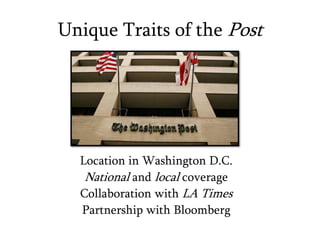
Unique Traits of the PostLocation in Washington D.C.National and local coverageCollaboration with LA TimesPartnership with Bloomberg
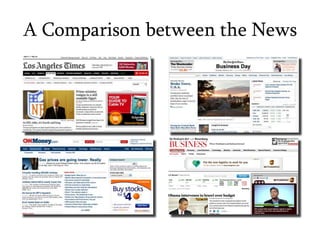
A Comparison between the News
Characteristics of Effective Financial News Explanation in layman’s terms of what happenedEffects on the global economy and people personallyExplanation of the key companies involvedGovernment’s role in the crisisKey players and their positionsDefinitions and requirements for loansHow will this affect the job and housing market?Changes in lifestyles, how long will this last, what are the long term effects, and what can I do?
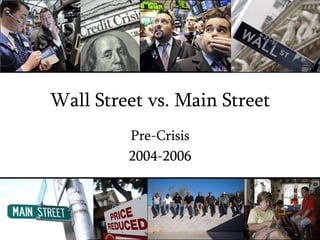
Wall Street vs. Main StreetPre-Crisis2004-2006
‘Is Housing Headed for a Fall?’ April 15, 2004Critical look at the huge increases in housing market“How could there not be a bubble?”Some data says that’s its not all areas, “It’s not a bubble unless it’s coast to coast”‘Housing ‘Bubble’ Disputed’June 23, 2004Fed Reserve Bank says housing market is not in a bubble, little evidence to support it. Prices have risen in line with increases in income
‘Waiting for a Soft Landing’January 4, 2006Explores potential economic issues that could arise, takes a critical, oppositional look at the positive outlookHousing bubble bursts, US dollar crashes, GM files for bankruptcy (due to strikes)‘With Rosy Predictions, Pundits Missing 2006’s Warning Signs’January 4, 2006“Let’s not fall into the trap of confusing that [positive outlook] with long term economic health”Warning signs – housing boom, hedge funds over lending into real estate, auto industry restructuring, bond-markets making it easy to borrow money at fixed ratesMore realistic than the “rosy scenario embraced by Washington and Wall Street.”
‘Economy Gained Muscle Last Year, Expanding Jobs - In Chicago, Bush Rejoices and Says Policies Are Working’January 7, 2006Job market is doing great, 2 million new jobs in 2005, and unemployment rate fell to 4.9%, 2006 the housing market peaks200,00 more jobs per month, “the economy is gaining momentum,” average earning have increasedWall Street and Main Street are on the same page, everyone is winningThe Post offers easy to understand coverage – layman’s terms, they focus on data that matters to citizens
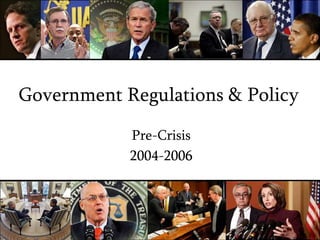
Government Regulations & PolicyPre-Crisis2004-2006
‘Economy Gained Muscle Last Year, Expanding Jobs - In Chicago, Bush Rejoices and Says Policies Are Working’January 7, 2006Bush convincing Americans that tax and budget policies are working, new plans coming soonDemocrats say job growth is slowing, prices are rising faster than wagesThe Post offers Republican and Democratic perspectives, in addition to context, facts, and information from The Post. ‘Waiting for a Soft Landing’January 4, 2006Concern about potential inversion of interest rates, transition from Greenspan to Bernake
‘With Rosy Predictions, Pundits Missing 2006’s Warning Signs’January 4, 2006Interest rates rise, monetary tightening by the fed Risks are there – could be addressed by Washington Policymakers, but it’s an election year so they probably won’tThe Post article takes a critical look at what Wall Street and Washington’s predictions are and notes potential flaws – suggests they are skeptic of the bubble / Washington ‘The Big Economic Worry – Productivity Is Slowing’January 3, 2007Productivity falling, critical look at the economy focused on data analysis – questions economists / Bernanke’s ability to predict trends
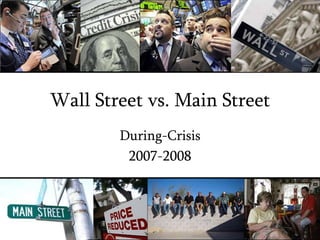
Wall Street vs. Main StreetDuring-Crisis2007-2008
December 12, 2007: “On Wall St., Mortgage-Finance Chiefs Take Apologetic Tone”Pertinent Background Information on the Housing Bubble“Fannie Mae and Freddie Mac contributed to the problem by spreading the message that everybody should own a house…many people who should not have owned houses bought them…the nation will have to come to terms with the big political challenge of converting much of that real estate into rental housing, Syron said”Effect on the Public“Although many foreclosure notices have been issued, the public hasn’t seen a lot of forced evictions or pictures of people standing in front of their houses with their furniture on the lawn, Syron said. When that happens, the effect on consumer confidence could inflict deeper damage on the economy, Syron said”Placing Blame“Syron traced the trouble in the mortgage business to a housing bubble and accepted some responsibility”
December 2, 2008“Stocks Tank as Recession Declines”Effects on the Stock Market“Investors were in full retreat yesterday, sending stocks tumbling after a panel of economists confirmed that the country has been in a recession for about a year”Consequences and Predictions“Pulling credit at a time when job losses are increasing by over 50% year on year in most key states is a dangerous and unprecedented combination…this makes for an unprecedented challenge for the banks…what we believe will be of far greater importance will be the protracted and intense impact this will have on consumer spending”“Crude oil prices fell 9.5 percent…Analysts have been concerned that the recession would continue to curtail demand for fuel and have predicted that prices could fall to $35 to $45 a barrel by the end of the year” Global Effects“The sell-off eroded much of the gains from last week, when the Dow and S&P 500 jumped 10 percent to 12 percent respectively. The losses spread to Asia today…”
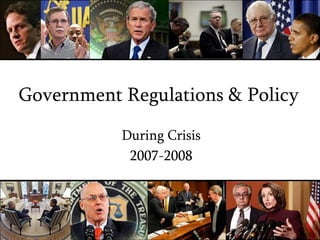
Government Regulations & PolicyDuring Crisis2007-2008
March 19, 2008: “What if the Fed Fails?”The  Fed: Too big to fail?“But is the Fed itself too big to fail? And what institution would step in as the buyer of last, last resort -- if the buyer of last resort should prove insufficient to the challenge?”Wall Street to Main Street“The danger is acute because the financial crisis is moving from Wall Street to Main Street. So far, the panic has been confined to people in the financial world who understood the exotic securities that were imploding and knew just how bad the credit crisis was. Now we're entering a new phase, where Mom and Pop will be losing their homes, and maybe their jobs -- and the public will be getting plenty scared.”Did the Fed do the right thing? “The Fed, in my view, had no choice but to step in decisively this week and try to stop the Wall Street bank run. But when the panic hits Main Street, the Fed will have to be even more creative -- in fashioning a package that restores confidence but also allows real estate prices to fall and the market to clear.”
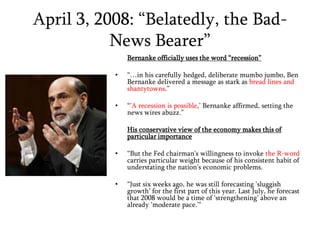
April 3, 2008: “Belatedly, the Bad-News Bearer” Bernanke officially uses the word “recession”“…in his carefully hedged, deliberate mumbo jumbo, Ben Bernanke delivered a message as stark as bread lines and shantytowns.”“’A recession is possible,’ Bernanke affirmed, setting the news wires abuzz.”His conservative view of the economy makes this of particular importance“But the Fed chairman's willingness to invoke the R-word carries particular weight because of his consistent habit of understating the nation's economic problems. “Just six weeks ago, he was still forecasting ‘sluggish growth’ for the first part of this year. Last July, he forecast that 2008 would be a time of ‘strengthening’ above an already ‘moderate pace.’"
May 28, 2008“The Fading of the Mirage Economy”Interconnectivity“The tendency is to see these as separate developments, each with its own causes and dynamic. Fundamentally, however, they are all part of the same story”The “bubbles”“But the thing to remember is that it's not just residential real estate. The same factors that were behind the housing bubble were also at work, to varying degrees, in the auto bubble, the commercial real estate bubble, the travel bubble, the college tuition bubble, the retail bubble, the Web 2.0 bubble and most recently the commodities bubble.”What to do“One option is to raise taxes and leave less money for private spending, which is what many state and local governments have begun to do. The other is to accept lower levels of government service and subsidies, which inevitably will lower the incomes of some households while forcing others to go without services or pay for them privately.”
December 13, 2008“White House Move Toward Auto Bailout”Fears, Explanations, and Possible Solutions“Fed Chairman Ben S. Bernanke said the central bank is reluctant to get involved in industrial policy, or in deciding which industries win and lose.”“Many lawmakers and analysts fear that tapping the TARP to rescue the auto companies could open the way for other aid requests from ailing companies outside the financial sector” “‘Under normal economic conditions, we would prefer that markets determine the ultimate fate of private firms,’ said White House spokeswoman Dana Perino. ‘However, given the current weakened state of the U.S. economy, we will consider other options if necessary…to prevent a collapse of troubled automakers. A precipitous collapse of this industry would have a severe impact on our economy, and it would be irresponsible to further weaken and destabilize our economy at this time.’”“The White House said it would explore all financing options, including drawing on the Treasury’s Troubled Asset Relief Program (TARP), which until now has been used exclusively to aid banks and other financial firms”
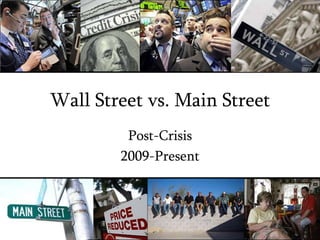
Wall Street vs. Main StreetPost-Crisis2009-Present
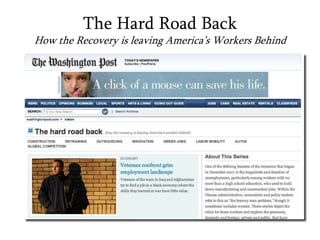
The Hard Road BackHow the Recovery is leaving America’s Workers Behind
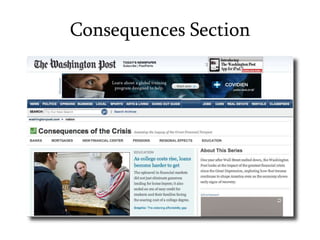
Consequences Section
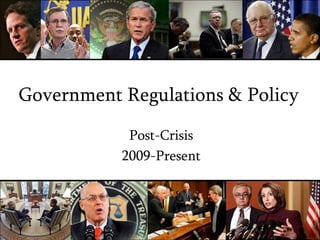
Government Regulations & PolicyPost-Crisis2009-Present
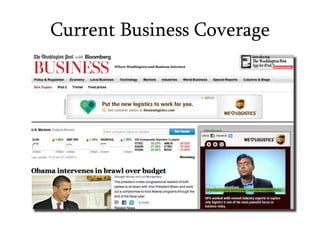
Current Business Coverage
Characteristics of Effective Financial NewsExplanation in layman’s terms of what happenedEffects on the global economy and people personallyExplanation of the key companies involvedGovernment’s role in the crisisKey players and their positionsDefinitions and requirements for loansHow will this affect the job and housing market?Changes in lifestyles, how long will this last, what are the long term effects, and what can I do?
ConclusionsWashington Post has been skeptical since the beginning of the housing bubble--informed readers of potential pitfallsMade good use of editorials--opinionated but informativeReports are clear in layman’s termsSome reports were fear-inducing

Financial crisis ppt final

  • 1.
    The Financial CrisisthroughArianna. David. Meg. Tom. Hsin-Hsin.
  • 2.
    Unique Traits ofthe PostLocation in Washington D.C.National and local coverageCollaboration with LA TimesPartnership with Bloomberg
  • 3.
  • 4.
    Characteristics of EffectiveFinancial News Explanation in layman’s terms of what happenedEffects on the global economy and people personallyExplanation of the key companies involvedGovernment’s role in the crisisKey players and their positionsDefinitions and requirements for loansHow will this affect the job and housing market?Changes in lifestyles, how long will this last, what are the long term effects, and what can I do?
  • 5.
    Wall Street vs.Main StreetPre-Crisis2004-2006
  • 6.
    ‘Is Housing Headedfor a Fall?’ April 15, 2004Critical look at the huge increases in housing market“How could there not be a bubble?”Some data says that’s its not all areas, “It’s not a bubble unless it’s coast to coast”‘Housing ‘Bubble’ Disputed’June 23, 2004Fed Reserve Bank says housing market is not in a bubble, little evidence to support it. Prices have risen in line with increases in income
  • 7.
    ‘Waiting for aSoft Landing’January 4, 2006Explores potential economic issues that could arise, takes a critical, oppositional look at the positive outlookHousing bubble bursts, US dollar crashes, GM files for bankruptcy (due to strikes)‘With Rosy Predictions, Pundits Missing 2006’s Warning Signs’January 4, 2006“Let’s not fall into the trap of confusing that [positive outlook] with long term economic health”Warning signs – housing boom, hedge funds over lending into real estate, auto industry restructuring, bond-markets making it easy to borrow money at fixed ratesMore realistic than the “rosy scenario embraced by Washington and Wall Street.”
  • 8.
    ‘Economy Gained MuscleLast Year, Expanding Jobs - In Chicago, Bush Rejoices and Says Policies Are Working’January 7, 2006Job market is doing great, 2 million new jobs in 2005, and unemployment rate fell to 4.9%, 2006 the housing market peaks200,00 more jobs per month, “the economy is gaining momentum,” average earning have increasedWall Street and Main Street are on the same page, everyone is winningThe Post offers easy to understand coverage – layman’s terms, they focus on data that matters to citizens
  • 9.
    Government Regulations &PolicyPre-Crisis2004-2006
  • 10.
    ‘Economy Gained MuscleLast Year, Expanding Jobs - In Chicago, Bush Rejoices and Says Policies Are Working’January 7, 2006Bush convincing Americans that tax and budget policies are working, new plans coming soonDemocrats say job growth is slowing, prices are rising faster than wagesThe Post offers Republican and Democratic perspectives, in addition to context, facts, and information from The Post. ‘Waiting for a Soft Landing’January 4, 2006Concern about potential inversion of interest rates, transition from Greenspan to Bernake
  • 11.
    ‘With Rosy Predictions,Pundits Missing 2006’s Warning Signs’January 4, 2006Interest rates rise, monetary tightening by the fed Risks are there – could be addressed by Washington Policymakers, but it’s an election year so they probably won’tThe Post article takes a critical look at what Wall Street and Washington’s predictions are and notes potential flaws – suggests they are skeptic of the bubble / Washington ‘The Big Economic Worry – Productivity Is Slowing’January 3, 2007Productivity falling, critical look at the economy focused on data analysis – questions economists / Bernanke’s ability to predict trends
  • 12.
    Wall Street vs.Main StreetDuring-Crisis2007-2008
  • 13.
    December 12, 2007:“On Wall St., Mortgage-Finance Chiefs Take Apologetic Tone”Pertinent Background Information on the Housing Bubble“Fannie Mae and Freddie Mac contributed to the problem by spreading the message that everybody should own a house…many people who should not have owned houses bought them…the nation will have to come to terms with the big political challenge of converting much of that real estate into rental housing, Syron said”Effect on the Public“Although many foreclosure notices have been issued, the public hasn’t seen a lot of forced evictions or pictures of people standing in front of their houses with their furniture on the lawn, Syron said. When that happens, the effect on consumer confidence could inflict deeper damage on the economy, Syron said”Placing Blame“Syron traced the trouble in the mortgage business to a housing bubble and accepted some responsibility”
  • 14.
    December 2, 2008“StocksTank as Recession Declines”Effects on the Stock Market“Investors were in full retreat yesterday, sending stocks tumbling after a panel of economists confirmed that the country has been in a recession for about a year”Consequences and Predictions“Pulling credit at a time when job losses are increasing by over 50% year on year in most key states is a dangerous and unprecedented combination…this makes for an unprecedented challenge for the banks…what we believe will be of far greater importance will be the protracted and intense impact this will have on consumer spending”“Crude oil prices fell 9.5 percent…Analysts have been concerned that the recession would continue to curtail demand for fuel and have predicted that prices could fall to $35 to $45 a barrel by the end of the year” Global Effects“The sell-off eroded much of the gains from last week, when the Dow and S&P 500 jumped 10 percent to 12 percent respectively. The losses spread to Asia today…”
  • 15.
    Government Regulations &PolicyDuring Crisis2007-2008
  • 16.
    March 19, 2008:“What if the Fed Fails?”The Fed: Too big to fail?“But is the Fed itself too big to fail? And what institution would step in as the buyer of last, last resort -- if the buyer of last resort should prove insufficient to the challenge?”Wall Street to Main Street“The danger is acute because the financial crisis is moving from Wall Street to Main Street. So far, the panic has been confined to people in the financial world who understood the exotic securities that were imploding and knew just how bad the credit crisis was. Now we're entering a new phase, where Mom and Pop will be losing their homes, and maybe their jobs -- and the public will be getting plenty scared.”Did the Fed do the right thing? “The Fed, in my view, had no choice but to step in decisively this week and try to stop the Wall Street bank run. But when the panic hits Main Street, the Fed will have to be even more creative -- in fashioning a package that restores confidence but also allows real estate prices to fall and the market to clear.”
  • 17.
    April 3, 2008:“Belatedly, the Bad-News Bearer” Bernanke officially uses the word “recession”“…in his carefully hedged, deliberate mumbo jumbo, Ben Bernanke delivered a message as stark as bread lines and shantytowns.”“’A recession is possible,’ Bernanke affirmed, setting the news wires abuzz.”His conservative view of the economy makes this of particular importance“But the Fed chairman's willingness to invoke the R-word carries particular weight because of his consistent habit of understating the nation's economic problems. “Just six weeks ago, he was still forecasting ‘sluggish growth’ for the first part of this year. Last July, he forecast that 2008 would be a time of ‘strengthening’ above an already ‘moderate pace.’"
  • 18.
    May 28, 2008“TheFading of the Mirage Economy”Interconnectivity“The tendency is to see these as separate developments, each with its own causes and dynamic. Fundamentally, however, they are all part of the same story”The “bubbles”“But the thing to remember is that it's not just residential real estate. The same factors that were behind the housing bubble were also at work, to varying degrees, in the auto bubble, the commercial real estate bubble, the travel bubble, the college tuition bubble, the retail bubble, the Web 2.0 bubble and most recently the commodities bubble.”What to do“One option is to raise taxes and leave less money for private spending, which is what many state and local governments have begun to do. The other is to accept lower levels of government service and subsidies, which inevitably will lower the incomes of some households while forcing others to go without services or pay for them privately.”
  • 19.
    December 13, 2008“WhiteHouse Move Toward Auto Bailout”Fears, Explanations, and Possible Solutions“Fed Chairman Ben S. Bernanke said the central bank is reluctant to get involved in industrial policy, or in deciding which industries win and lose.”“Many lawmakers and analysts fear that tapping the TARP to rescue the auto companies could open the way for other aid requests from ailing companies outside the financial sector” “‘Under normal economic conditions, we would prefer that markets determine the ultimate fate of private firms,’ said White House spokeswoman Dana Perino. ‘However, given the current weakened state of the U.S. economy, we will consider other options if necessary…to prevent a collapse of troubled automakers. A precipitous collapse of this industry would have a severe impact on our economy, and it would be irresponsible to further weaken and destabilize our economy at this time.’”“The White House said it would explore all financing options, including drawing on the Treasury’s Troubled Asset Relief Program (TARP), which until now has been used exclusively to aid banks and other financial firms”
  • 20.
    Wall Street vs.Main StreetPost-Crisis2009-Present
  • 21.
    The Hard RoadBackHow the Recovery is leaving America’s Workers Behind
  • 22.
  • 23.
    Government Regulations &PolicyPost-Crisis2009-Present
  • 24.
  • 25.
    Characteristics of EffectiveFinancial NewsExplanation in layman’s terms of what happenedEffects on the global economy and people personallyExplanation of the key companies involvedGovernment’s role in the crisisKey players and their positionsDefinitions and requirements for loansHow will this affect the job and housing market?Changes in lifestyles, how long will this last, what are the long term effects, and what can I do?
  • 26.
    ConclusionsWashington Post hasbeen skeptical since the beginning of the housing bubble--informed readers of potential pitfallsMade good use of editorials--opinionated but informativeReports are clear in layman’s termsSome reports were fear-inducing

Editor's Notes

  • #17 -Editorial by David Ignatius-The Fed may have done the right thing, but they can’t just do it forever for every company that may fail…what’s the next step?-one of the first times we see the “Wall Street” vs “Main Street” dichotomy-also mention of a public fear of the economic crisis hitting close to home – this is important to the average American-While the Fed may have done the right thing at the time, we need to start looking to the future and what to do next…they can’t fix everything
  • #18 -This is the first time we see the word recession used by a political figure…now, we hear it all the time, but at this point in the story it was a big development, especially coming from Bernanke-Problem: bread lines and shantytowns sets a tone of fear reminiscent of the Great Depression…maybe not the best tactic at this time as well as “the R word” making it sound like a bad word…also invoking fear when the word itself invokes enough fear as is -This set off somewhat of a panic because Americans were told to be hopeful of an economic recovery but once the word “recession” is thrown around, it becomes a different story-This was covered in all the major news outlets but the Post delivered it in a timely manner and in multiple sections of the paper, including section A page 1 as well as the financial section
  • #19 -By Steven Pearlstein-He relates all the troubles to each other rather than discussing them as individual entities. This makes it easier for the reader to understand how our economy is wrapped up in everything that is going on in the U.S. and around the world rather than just assuming it’s related to the housing bubble. -He also suggests what could possibly be done and how this would affect the average American. It is as if he is foreshadowing what is to come so Americans can be prepared for some life changes.
  • #20 Section A1