Rajarshi Shahu Mahavidyalaya,Latur
(Autonomous)
Department Of Commerce
Financial Accounting I
B.Com I (Sem I)
Miss. S. N. Bagwan
M. Com., NET, SET.
2.
Introduction to Accountancy
Introduction
Inall activities and in all organisations which require money and other
economic resources accounting is required to account for these
resources.
In other words ,wherever money resource is involved accounting is
required to account for it.
3.
Meaning and Definition
Bookkeeping
Bookkeepingis a process of recording business transaction in the books of
accounts in very systematic manner.
According to J. R. Batliboi, “bookkeeping is an art of recording business
dealings in a set of books”
Accountancy
Accountancy refers to a systematic knowledge of accounting. It explains
‘why to do’ and ‘how to do’ of various aspects of accounting. It tells us why
and how to prepare the books of accounts and how to summarise the
accounting information and communicate it to the interested parties.
According to Kohler, “Accountancy refers to the entire body of theory and
process of accounting”.
4.
Accounting
Accounting is oftencalled as a language of a business. The basic
function of any language is to serve as a means of communication
accounting is also serve this function by communicating information to
the users.
According to American Accounting Association, 1966, “Accounting is
the process of identifying, measuring, and communicating economic
information to permit informed judgements and decisions by uses of
information.”
5.
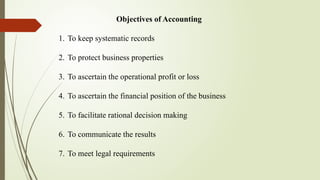
Objectives of Accounting
1.To keep systematic records
2. To protect business properties
3. To ascertain the operational profit or loss
4. To ascertain the financial position of the business
5. To facilitate rational decision making
6. To communicate the results
7. To meet legal requirements
6.
Rules of Debitand Credit
Personal Accounts
Debit the Receiver
Credit the Giver
Real Accounts
Debit what comes in
Credit what goes out
Nominal Accounts
Debit all expenses and losses
Credit all incomes and gains