Bike the Hooch:
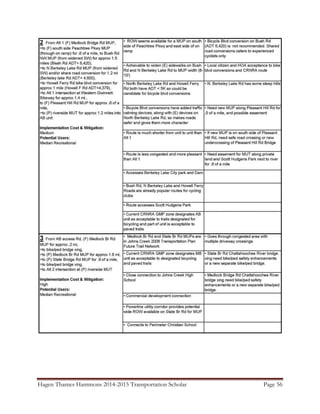
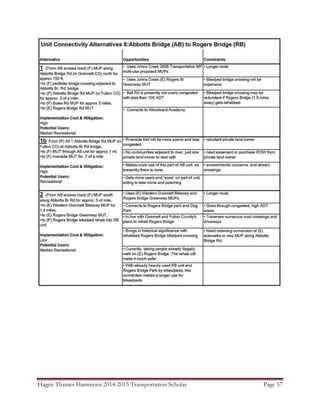
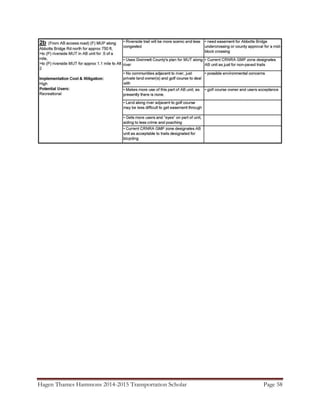
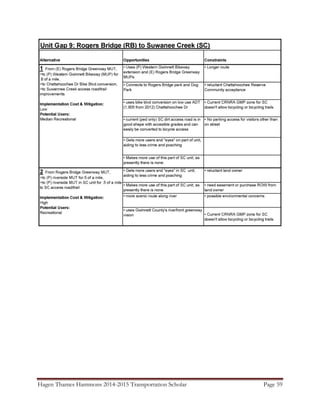
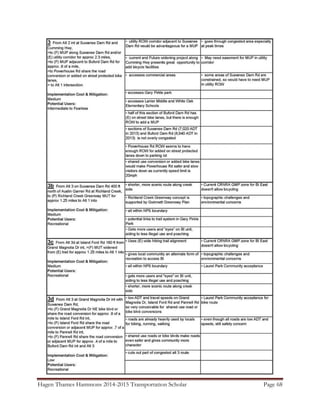
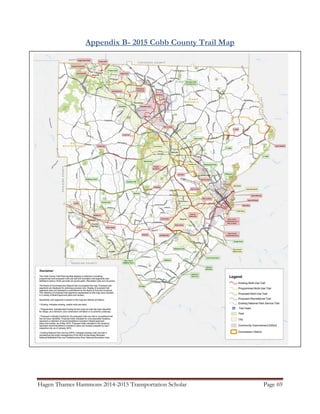
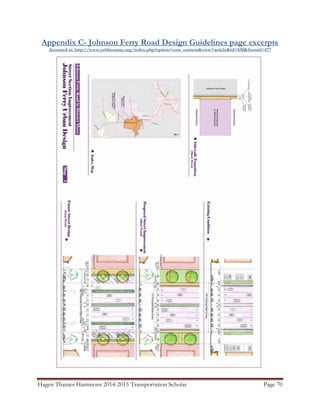
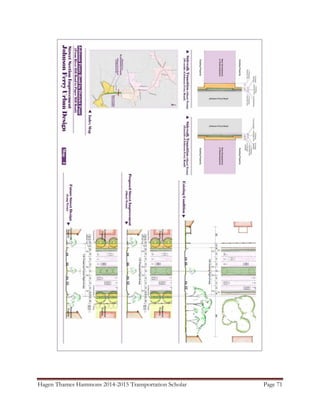
Developing Bicycle Connectivity to the
Chattahoochee River National Recreation Area
Hagen Thames Hammons
2014 - 2015 National Park Foundation Transporation Scholar
Acknowledgements
Thanks goes out to the following entities for helping the Transportation Scholar with valuable
feedback through in person and meeting times, and for data provided:
The Author
This document was authored by Hagen Thames Hammons, National Park Foundation
Transportation Scholar for 2014-2015, stationed at the Chattahoochee River National Recreation
Area.
 The whole Chattahoochee River National Recreation Area staff
 National Park Foundation
 Phil Shapiro, my mentor
 National Park Service Southeast Regional Office
 Gwinnett County Department of Transportation and Department of Community
Services
 Forsyth County Department of Planning & Community Development, Department of
Engineering, and Geographic Information Services
 Cobb County Department of Transportation
 City of Sandy Springs
 City of Roswell
 City of Johns Creek
 City of Suwanee
 City of Sugar Hill
 Atlanta Regional Commission
 Trust for Public Land
 Cumberland Community Improvement District
 Chattahoochee Nature Center
 Sandy Springs Conservancy
 PATH Foundation
 Roswell Inc.
 Georgia Department of Transportation
 Georgia Trail Summit
Hagen Thames Hammons 2014-2015 Transportation Scholar Page 1
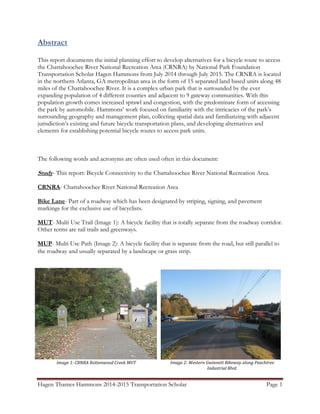
Image 1: CRNRA Rottenwood Creek MUT Image 2: Western Gwinnett Bikeway along Peachtree
Industrial Blvd.
Abstract
This report documents the initial planning effort to develop alternatives for a bicycle route to access
the Chattahoochee River National Recreation Area (CRNRA) by National Park Foundation
Transportation Scholar Hagen Hammons from July 2014 through July 2015. The CRNRA is located
in the northern Atlanta, GA metropolitan area in the form of 15 separated land based units along 48
miles of the Chattahoochee River. It is a complex urban park that is surrounded by the ever
expanding population of 4 different counties and adjacent to 9 gateway communities. With this
population growth comes increased sprawl and congestion, with the predominate form of accessing
the park by automobile. Hammons‟ work focused on familiarity with the intricacies of the park‟s
surrounding geography and management plan, collecting spatial data and familiarizing with adjacent
jurisdiction‟s existing and future bicycle transportation plans, and developing alternatives and
elements for establishing potential bicycle routes to access park units.
The following words and acronyms are often used often in this document:
Study- This report: Bicycle Connectivity to the Chattahoochee River National Recreation Area.
CRNRA- Chattahoochee River National Recreation Area
Bike Lane- Part of a roadway which has been designated by striping, signing, and pavement
markings for the exclusive use of bicyclists.
MUT- Multi Use Trail (Image 1): A bicycle facility that is totally separate from the roadway corridor.
Other terms are rail trails and greenways.
MUP- Multi Use Path (Image 2): A bicycle facility that is separate from the road, but still parallel to
the roadway and usually separated by a landscape or grass strip.
Hagen Thames Hammons 2014-2015 Transportation Scholar Page 2
Executive Summary
Located in the north Atlanta metropolitan region, the Chattahoochee River National Recreation
Area (CRNRA) is a unique urban park. The intricacies of this long, narrow disconnected park are
very complex because it has 15 distinct and disconnected park units adjacent to several different
jurisdictions and problematic because the corridor is surrounded by existing and continuously
developing communities and private land owners. With this growing region come continually
congested roads, which will unavoidably get worse into the future.
Presently, the park is accessed predominately by the automobile. However, the Atlanta metropolitan
area is steadily building bicycle path and trail connections throughout the region to serve the
continuous need and citizen desires for bicycle travel. To be relative to this alternate form of
transportation, and to combat the need to always access the park by automobile, this study is an
initial planning effort to develop bicycle connectivity to the CRNRA.
The objectives of this study were to:
 Become familiar with the region through site visits and reviewing relative governing and
transportation plans.
 Form relationships with adjacent jurisdictions to get feedback on bicycle travel to/from the
CRNRA and around the region.
 Retrieve and compile spatial data for bicycle transportation, roadways and land use
throughout the CRNRA corridor.
 Develop bicycle connectivity alternatives to connect to the 15 different CRNRA units.
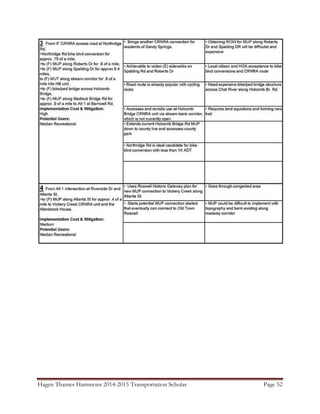
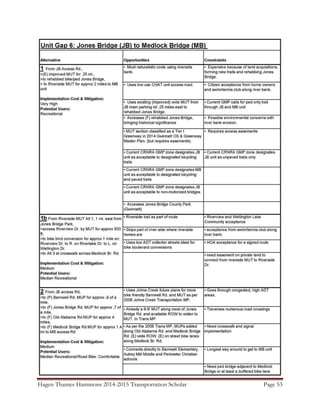
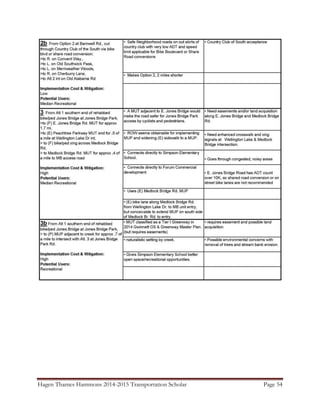
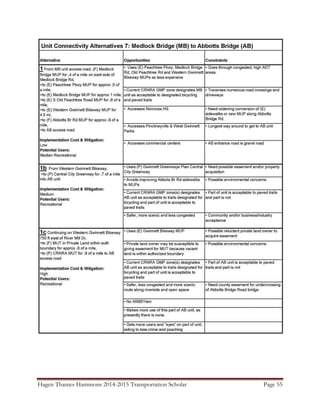
This study documents these alternatives where existing bicycle infrastructure exists, planned bicycle
improvements will be constructed, future bicycle routes are proposed, and further proposed
alternative routes where gaps still exist. The final product gives the CRNRA, adjacent counties and
gateway communities a document to collaborate on to plan for and eventually develop and embrace
a “Chattahoochee River national Recreation Area Bike Route.”
Hagen Thames Hammons 2014-2015 Transportation Scholar Page 3
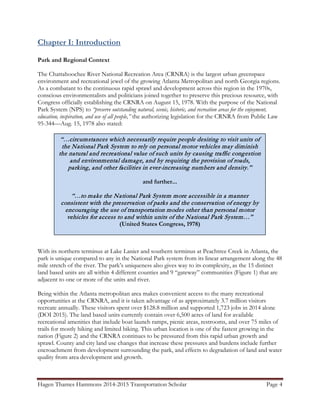
Table of Contents
Chapter I- Introduction ....................................................................................................................................4
Chapter II- Constituencies ............................................................................................................................8
Chapter III- Methodology ............................................................................................................................ 13
Become Familiar with CRNRA...................................................................................................................................... 13
Review Relative Plans, Sites & Future Projects ........................................................................................................... 15
Solicit Feedback & Retrieve Data from Stakeholders................................................................................................. 19
CRNRA Unit to Unit Connectivity Study ....................................................................................................................23
Chapter IV- Recommendations ...............................................................................................................38
Chapter V- Next Steps .....................................................................................................................................45
Chapter VI- Connection to Wider Transportation Community .....................................46
Bibliography ......................................................................................................................................................................47
Appendix A: CRNRA Unit to Unit Alternate Route Analysis..................................................................................48
Appendix B: Cobb County Trail Map...........................................................................................................................69
Appendix C: Johnson Ferry Road Design Guidelines................................................................................................70
Appendix D: Gwinnett County Greenways Plan Map Excerpt................................................................................73
Appendix E: Forsyth County Bicycle Transportation 2025 Plan..............................................................................74
Appendix F: Sandy Springs Bicycle, Pedestrian & Trails Plan Map Excerpts ........................................................75
Appendix G: Roswell Historic Gateway Study Preferred Alternative......................................................................78
Appendix H: Roswell Transportation Master Plan (Bicycle, Trail & Complete Streets)
& Eves Road Complete Street Rendering .........................................................................................79
Appendix I: Roswell Parks & Trails Map ..................................................................................................................... 81
Appendix J: Willeo Road Multi Use Trail Environmental Assessment
Preferred Alternative................................................................................................................................82
Appendix K: Johns Creek Future Trail Network & Barnwell Road Improvements ............................................83
Hagen Thames Hammons 2014-2015 Transportation Scholar Page 4
Chapter I: Introduction
Park and Regional Context
The Chattahoochee River National Recreation Area (CRNRA) is the largest urban greenspace
environment and recreational jewel of the growing Atlanta Metropolitan and north Georgia regions.
As a combatant to the continuous rapid sprawl and development across this region in the 1970s,
conscious environmentalists and politicians joined together to preserve this precious resource, with
Congress officially establishing the CRNRA on August 15, 1978. With the purpose of the National
Park System (NPS) to “preserve outstanding natural, scenic, historic, and recreation areas for the enjoyment,
education, inspiration, and use of all people,” the authorizing legislation for the CRNRA from Public Law
95-344—Aug. 15, 1978 also stated:
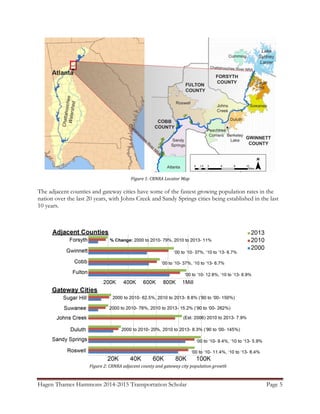
With its northern terminus at Lake Lanier and southern terminus at Peachtree Creek in Atlanta, the
park is unique compared to any in the National Park system from its linear arrangement along the 48
mile stretch of the river. The park’s uniqueness also gives way to its complexity, as the 15 distinct
land based units are all within 4 different counties and 9 “gateway” communities (Figure 1) that are
adjacent to one or more of the units and river.
Being within the Atlanta metropolitan area makes convenient access to the many recreational
opportunities at the CRNRA, and it is taken advantage of as approximately 3.7 million visitors
recreate annually. These visitors spent over $128.8 million and supported 1,723 jobs in 2014 alone
(DOI 2015). The land based units currently contain over 6,500 acres of land for available
recreational amenities that include boat launch ramps, picnic areas, restrooms, and over 75 miles of
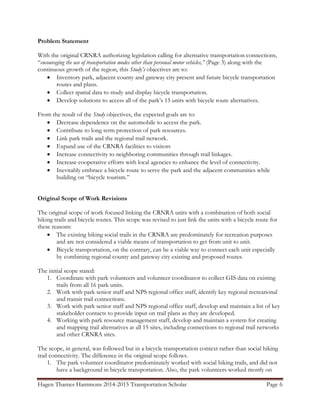
trails for mostly hiking and limited biking. This urban location is one of the fastest growing in the
nation (Figure 2) and the CRNRA continues to be pressured from this rapid urban growth and
sprawl. County and city land use changes that increase these pressures and burdens include further
encroachment from development surrounding the park, and effects to degradation of land and water
quality from area development and growth.
“…circumstances which necessarily require people desiring to visit units of
the National Park System to rely on personal motor vehicles may diminish
the natural and recreational value of such units by causing traffic congestion
and environmental damage, and by requiring the provision of roads,
parking, and other facilities in ever-increasing numbers and density.”
and further...
“…to make the National Park System more accessible in a manner
consistent with the preservation of parks and the conservation of energy by
encouraging the use of transportation modes other than personal motor
vehicles for access to and within units of the National Park System…”
(United States Congress, 1978)
Hagen Thames Hammons 2014-2015 Transportation Scholar Page 5
Figure 1: CRNRA Locator Map
The adjacent counties and gateway cities have some of the fastest growing population rates in the
nation over the last 20 years, with Johns Creek and Sandy Springs cities being established in the last
10 years.
Figure 2: CRNRA adjacent county and city population statistics
Data Source: US Census Bureau
Figure 2: CRNRA adjacent county and gateway city population growth
Hagen Thames Hammons 2014-2015 Transportation Scholar Page 6
Problem Statement
With the original CRNRA authorizing legislation calling for alternative transportation connections,
“encouraging the use of transportation modes other than personal motor vehicles,” (Page 3) along with the
continuous growth of the region, this Study’s objectives are to:
 Inventory park, adjacent county and gateway city present and future bicycle transportation
routes and plans.
 Collect spatial data to study and display bicycle transportation.
 Develop solutions to access all of the park‟s 15 units with bicycle route alternatives.
From the result of the Study objectives, the expected goals are to:
 Decrease dependence on the automobile to access the park.
 Contribute to long term protection of park resources.
 Link park trails and the regional trail network.
 Expand use of the CRNRA facilities to visitors
 Increase connectivity to neighboring communities through trail linkages.
 Increase cooperative efforts with local agencies to enhance the level of connectivity.
 Inevitably embrace a bicycle route to serve the park and the adjacent communities while
building on “bicycle tourism.”
Original Scope of Work Revisions
The original scope of work focused linking the CRNRA units with a combination of both social
hiking trails and bicycle routes. This scope was revised to just link the units with a bicycle route for
these reasons:
 The existing hiking social trails in the CRNRA are predominately for recreation purposes
and are not considered a viable means of transportation to get from unit to unit.
 Bicycle transportation, on the contrary, can be a viable way to connect each unit especially
by combining regional county and gateway city existing and proposed routes.
The initial scope stated:
1. Coordinate with park volunteers and volunteer coordinator to collect GIS data on existing
trails from all 16 park units.
2. Work with park senior staff and NPS regional office staff, identify key regional recreational
and transit trail connections.
3. Work with park senior staff and NPS regional office staff, develop and maintain a list of key
stakeholder contacts to provide input on trail plans as they are developed.
4. Working with park resource management staff, develop and maintain a system for creating
and mapping trail alternatives at all 15 sites, including connections to regional trail networks
and other CRNRA sites.
The scope, in general, was followed but in a bicycle transportation context rather than social hiking
trail connectivity. The difference in the original scope follows.
1. The park volunteer coordinator predominately worked with social hiking trails, and did not
have a background in bicycle transportation. Also, the park volunteers worked mostly on
Hagen Thames Hammons 2014-2015 Transportation Scholar Page 7
social hiking trails, and some refuted the additional use of bicycles in park units. For these
reasons, the scholar reported to the Chief of Planning and Resource Management for the
park.
2. The scholar did take site visits and get feedback from park senior staff, but did not “work”
much with this staff. Also, rather than work with the NPS regional office, the scholar
worked with the surrounding jurisdictions to identify key regional recreational and transit
trail connections.
3. The scholar followed this item and contacted and met with most of the key stakeholders,
listed in Chapter II.
4. The scholar followed this item, developing a system for creating bicycle route alternatives,
found in Chapter III, Section 4.
Hagen Thames Hammons 2014-2015 Transportation Scholar Page 8
Chapter II: Constituencies
The transportation scholar met and coordinated electronically with planning, engineering and public
figure representatives of each city and county to build relationships, get feedback about trail
planning existing and proposed projects, and acquire mapping and GIS shapefile data. The scholar
also met with parties and organizations that have a stake in the project. For every party the scholar
met with, the bicycle connectivity project goals and objectives were explained, and feedback was
received from each perspective in terms of present and future goals for bicycle route planning. The
following is a list of who the scholar met and/or coordinated with throughout the year.
Counties and Cities
Gwinnett County Department of Transportation and Department of Community Services:
Gwinnet County has 7 CRNRA park units and 5 gateway cities within its boundaries, and owns,
operates and maintains most all roads in the county that are proposed alternatives for bicycle
connectivity corridors. The county also shares pending future ownership and planning efforts for 2
key historic bridge rehabilitations across the Chattahoochee River that would serve as
bicycle/pedestrian only crossings and increase safer and direct connectivity. The county is also home
to several pending land acquisitions supported by the Trust for Public Land to further the CRNRA
goal of continuous open space connectivity along the river.
The scholar met with the county greenway planner and transportation engineer in August 2014 to
discuss connecting with the 7 CRNRA and the scholar acquired relevant documents and GIS
shapefile data. Throughout the process, the scholar also coordinated electronically to get data such
as Average Daily Traffic (ADT) for roads, land ownership, and any pertinent follow up questions
for future and proposed bicycle and trail infrastructure.
Gwinnett County hosted the Chattahoochee River Trail meeting in May 2015 that was led by
representatives from the Atlanta Regional Commission. In attendance were involved parties from
Gwinnett County and several Gwinnett gateway cities, as well as representatives from county
organizations, the Trust for Public Land, and the CRNRA Superintendent and Chief of Planning
and Resource Management. The main part of the meeting was a presentation by the transportation
scholar showing what was completed for connectivity alternatives for CRNRA units within the
county and design/planning elements. After the presentation, an in depth discussion was held on
how to follow up with this plan.
Forsyth County Department of Planning & Community Development, Department of
Engineering, and Geographic Information Services:
Although Forsyth County has only one CRNRA unit within its boundary, there are several key land
acquisitions on top of private land within authorized boundaries within the county that could play
key roles to increase land connectivity on the west side of the river. The county also has strong
aspirations to expand its greenway trail system with a plan for a riverside greenway trail that would
synchronize with the CRNRA plan. Along with Gwinnett County, Forsyth also borders the north
end of the CRNRA as well as the popular Buford Dam and Lake Lanier recreational areas that are
adjacent to CRNRA lands.
The scholar met with the county planner and transportation engineer in August 2014 and acquired
relevant documents and GIS shapefile data. The scholar also attended the Forsyth County Bicycle
Hagen Thames Hammons 2014-2015 Transportation Scholar Page 9
Pedestrian Plan meeting in December 2014, and further connected and got insight from county
representatives as well as private consultants that are working on the plan.
Cobb County Department of Transportation:
Cobb County has 4 CRNRA units, including the 2 busiest units in the whole park, Paces Mill and
Cochran Shoals, getting well over 2 million visitors a year. Being the closest to Atlanta, these Cobb
County units are surrounded by some of the densest urban areas, but the units are well connected
with existing bicycle infrastructure which include the Bob Callan Trail, the Cochran Shoals multi use
trail (MUT) system, the popular on street bike lane facility on Columns Drive, the Lower Roswell
multi use path (MUP), and the only paved MUT in any CRNRA unit, the Rottenwood Creek Trail.
The Rottenwood Creek Trail connects to the Cumberland Connector which connects to the
renowned, 62-mile Silver Comet Trail, creating the start of a well-connected regional trail system.
The scholar met with the Cobb County Natural Resources Manager and trails expert, as well as
county transportation planners in August 2014 to discuss goals acquired relevant documents and
GIS shapefile data. The scholar also coordinated electronically and by phone to a county planner
with regards to a key gap in bicycle connectivity along a busy arterial to discuss an ongoing plan
(Appendix C) to make the road more bicycle friendly.
Fulton County:
The scholar did not have meetings or contact with anyone specifically in Fulton County planning or
engineering, but there was contact with key organizations housed in the county that does
bicycle/trail connectivity on a regional level explained below. In the bigger picture, this plan hopes
to potentially link to the nationally known Atlanta Beltline greenway via Fulton County existing trails
like the Path 400 trail system and other future/proposed trails. The scholar did, however, meet and
coordinate with representatives from the three key Fulton County gateway communities in Sandy
Springs, Roswell, and Johns Creek.
City of Sandy Springs:
Sandy Springs is home of the CRNRA headquarters, the Island Ford unit, and the Palisades unit in
the southern part of the park. The city was established in 2005, but is already the 5th
largest city in
the state. It is a quintessential suburban city with no real city center and limited bicycle routes.
However, while meeting with the city transportation planner and other officials in August 2015, their
goal is to create better bicycle connectivity and to connect to the CRNRA. One priority between
Sandy Springs and the city of Roswell is the future bicycle/pedestrian bridge across the river,
scheduled to be completed by 2017. Other priorities for the city includes creating more bicycle
friendly roads, MUPs, and to re-visit another bicycle/pedestrian bridge linking the city to Cobb
County and the Gold Branch unit of the CRNRA.
The scholar met with the city transportation planner to discuss the plan and acquired relevant
documents and GIS shapefile data.
City of Roswell:
Of all the CRNRA gateway cities, Roswell is the most connected with MUTs and bicycle
infrastructure, especially with the Riverside MUT and on street system, and is the only gateway city
rated in the League of American Bicyclists system with a Bronze rating. The city is revitalizing its
southern entry from the Chattahoochee River with the Gateway project (Appendix G), which
Hagen Thames Hammons 2014-2015 Transportation Scholar Page 10
includes the proposal to make a better bicycle/pedestrian connection with the Vickery Creek unit
and further into Historic Roswell.
The scholar met with the city mayor and city transportation engineer in August 2014 to discuss the
plan and future projects. Also, the scholar coordinated with city GIS department to acquire GIS
shapefiles, and had phone coordination with other city planners to discuss future complete streets
road improvements that has an effect on the connectivity plan.
City of Johns Creek:
Johns Creek has 3 CRNRA units adjacent to the city, and has potentially 2 historic river bridge
crossings in 2 of these units that could be revitalized for bicycle/pedestrian only crossings. The
scholar met with transportation planners and engineers in August 2014 to discuss these potential
bridge crossings and the goals of the project, and to discuss and acquire the city‟s present and future
bicycle plans. The scholar also had phone coordination throughout part of the year to discuss certain
future complete street road projects that have an effect on connectivity.
City of Duluth:
The city of Duluth has 1 CRNRA unit adjacent to the city, as well as potentially a direct connection
to a second via one of the revitalized historic bridges that connect the city to Johns Creek. The
scholar met with city planners in August 2014 to discuss these connections and others, as well as the
goals of the connectivity plan.
City of Suwanee:
The city of Suwanee is adjacent to 2 CRNRA units. The scholar met with city planners in August
2014 and with the city mayor in September 2014 to discuss the project and connectivity.
City of Sugar Hill:
The city of Sugar Hill is also adjacent to 2 CRNRA units. The scholar met with the city planner in
August 2014 to discuss the project and connectivity.
Organizations
Atlanta Regional Commission:
The Atlanta Regional Commission (ARC) is the regional planning and intergovernmental
coordination agency for a 10 county area in the Metro Atlanta region, which includes 3 of the
counties adjacent to the CRNRA. Forsyth County is not included as one of the counties covered. As
the federally-designated Metropolitan Planning Organization for the Atlanta region, ARC is
responsible for developing a multi-modal, financially constrained transportation plan that meets all
federal transportation Clean Air Act planning requirements.
The scholar acquired transportation and land use mapping and shapefile data from ARC crucial to
the project. The scholar also met with the ARC Bicycle and Pedestrian Planner, and served on the
Regional Bicycle and Pedestrian Task Force subcommittee that consisted of city and county
transportation staff, recreation and planning departments within the Atlanta region, representatives
from state and federal agencies and advocacy groups. Being a part of this subcommittee helped the
scholar with knowledge of present and long term visions for regional bicycle connectivity. As stated
above, the scholar was also a key part to the Chattahoochee River Trail meeting for trail connectivity
in Gwinnett County in May 2015 meeting coordinated by ARC.
Hagen Thames Hammons 2014-2015 Transportation Scholar Page 11
Trust for Public Land- Georgia Office:
The Trust for Public Land (TPL) has been a key contributor for continued work to conserve,
expand and enhance the Chattahoochee River National Recreation Area. The TPL has acquired land
for donation along the river for over 10 years and continues to do so. In November 1999 the dream
of a 180-mile greenway along the Chattahoochee River came a step closer to reality as Congress
authorized enlargement of the Chattahoochee River National Recreation Area. This legislation will
allow the National Park Service to purchase land from willing sellers and connect existing units of
the recreation area. TPL, which is leading a coalition of business, government, and environmental
groups to create the Chattahoochee River Greenway, has optioned key properties within a new
boundary, and Congress has appropriated $25 million for land acquisition (TPL 2000).
Currently, there are 5 tracts of land that the TPL is helping to acquire. The scholar coordinated with
the TPL GA director electronically and in person at the Gwinnett Chattahoochee River Greenway
meeting in May 2015 to discuss these tracts of land and to acquire shapefiles. The scholar also met at
the TPL regional office in downtown Atlanta with the Senior Program Director in August 2014 to
learn how TPL works with the CRNRA and to go over the plan and goals for the project.
Cumberland Community Improvement District:
The Cumberland Community Improvement District (CCID) is a public-private assessment district in
Cobb County. It is the mechanism by which local commercial property owners advance needed
infrastructure projects that enhance property values as well as the greater community. These include
bicycle and walking trails and streetscapes and beautification projects. The Bob Callan Trail, a recent
project by the CCID, is a prime example of a project that will serve as a key connector in the bicycle
connectivity plan.
The scholar met with the CCID Manager of Outreach in August 2014 to discuss the goals of the
plan and other future CCID projects. On a further note, the scholar will be working with the CCID
in the second year for studies and planning for how the new Atlanta Braves baseball stadium will
affect one of CRNRA‟s busiest park units.
Sandy Springs Conservancy:
The Sandy Springs Conservancy‟s goals are to build partnerships to create, conserve, and connect
parks, trails and greenspace in Sandy Springs. The CRNRA and the City of Sandy Springs have goals
to connect the city to CRNRA via trails and bicycle infrastructure. The scholar met with the Sandy
Springs Conservancy Executive Director in August 2014 to discuss these goals.
PATH Foundation:
The Path Foundation is a nonprofit organization with a mission to develop a system of interlinking
greenway trails through metro Atlanta for commuting and recreating. The scholar met the executive
director of PATH in August 2014 to discuss goals of the project and how PATH can possibly help
with connectivity in the future.
Roswell Inc.:
Roswell Inc. encourages strong and sustainable economic development through a public-private
partnership with the City of Roswell. It is governed by the Roswell Convention and Visitors Bureau
Board of Directors, which is comprised of community leaders and business stakeholders. This
Hagen Thames Hammons 2014-2015 Transportation Scholar Page 12
public private partnership with the City of Roswell operates the tourism and economic development
programs, offering support and guidance for the two programs.
The scholar met several times in office and the field with the executive director and
Communications Strategist in September 2014 to discuss better connectivity with Roswell‟s CRNRA
unit, Vickery Creek from historic old town Roswell. This would undoubtedly increase tourism for
the city and awareness and visitation to the CRNRA.
National Park Service Southeast Regional Office:
The NPS has support offices and seven regional offices, which oversee park operations within their
geographic area. The Southeast Regional Office is in Atlanta, and the scholar visited the office in
October 2015 to acquire GIS data and get better acquainted with what is happening on a regional
level.
Georgia Department of Transportation:
The scholar coordinated electronically and met several times with the GDOT Bicycle and Pedestrian
Coordinator at the ARC Subcommittee meetings to discuss the project and obtain average daily
traffic data relative to the project.
Georgia Trail Summit:
The Georgia Trail Summit is an organization of concerned volunteer citizens dedicated to creating a
world-class network of trails in every corner of Georgia. Their primary activity is to host a statewide
summit once a year, and the scholar was invited to present as a speaker at the Summit in May 2015
on the bicycle connectivity planning project.
Hagen Thames Hammons 2014-2015 Transportation Scholar Page 13
Chapter III: Methodology
To develop a plan for bicycle route alternatives to connect to the CRNRA, the following work plan
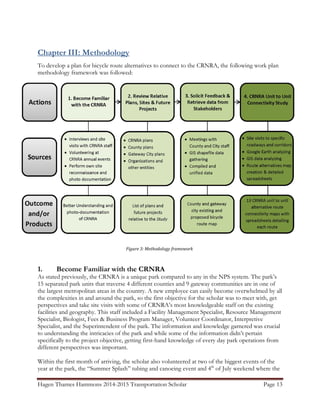
methodology framework was followed:
1. Become Familiar with the CRNRA
As stated previously, the CRNRA is a unique park compared to any in the NPS system. The park’s
15 separated park units that traverse 4 different counties and 9 gateway communities are in one of
the largest metropolitan areas in the country. A new employee can easily become overwhelmed by all
the complexities in and around the park, so the first objective for the scholar was to meet with, get
perspectives and take site visits with some of CRNRA’s most knowledgeable staff on the existing
facilities and geography. This staff included a Facility Management Specialist, Resource Management
Specialist, Biologist, Fees & Business Program Manager, Volunteer Coordinator, Interpretive
Specialist, and the Superintendent of the park. The information and knowledge garnered was crucial
to understanding the intricacies of the park and while some of the information didn’t pertain
specifically to the project objective, getting first-hand knowledge of every day park operations from
different perspectives was important.
Within the first month of arriving, the scholar also volunteered at two of the biggest events of the
year at the park, the “Summer Splash” tubing and canoeing event and 4th
of July weekend where the
Figure 3: Methodology framework
Hagen Thames Hammons 2014-2015 Transportation Scholar Page 14
most popular park units are packed to capacity. The scholar helped to monitor, direct traffic and
mitigate parking lot problems, whereas viewing the traffic problem first hand, solidified the need for
better alternative forms of transportation to the park. The scholar also set up at different boat
launches to make sure visitors had life jackets which was beneficial to view and have small talk with
the many eclectic groups of people that use the park.
Throughout the first 6 months, the scholar also got a cyclists perspective of the park by biking to
and from almost all of the 15 park units. While biking, the scholar came in contact with various
levels of cyclists and asked them their perspective of bicycle routes in the region and if CRNRA
bicycle route connectivity would be beneficial. The overwhelming response was that the CRNRA is
the recreational jewel of the region, and with the growing bicycle culture that is happening,
connecting to the valuable amenity will not only benefit the park itself, but create a viable bicycle
route destination. Some other observations while biking the units include:
• The southern half of the park, from Vickery Creek in Roswell south to the Paces Mill
unit has, by far, the most existing county, gateway city and park unit bicycle
infrastructure.
• The most urban and heavily used park units are in the southern part of the park which
includes Paces Mill and Cochran Shoals.
• The only existing CRNRA bicycle accessible routes are the 1.6 mile paved Rottenwood
Creek MUT in Paces Mill and the 1.6 mile crushed gravel MUT in Cochran Shoals.
• The city of Roswell, of any CRNRA gateway city, has the most riverside MUTs. It is
also the only city that has a League of American Bicyclists rating, at the Bronze level.
• The northern half of the park is the most disconnected with existing city and county
bicycle routes.
• The northern half of the park has the most housing developments, including gated
communities, along the river.
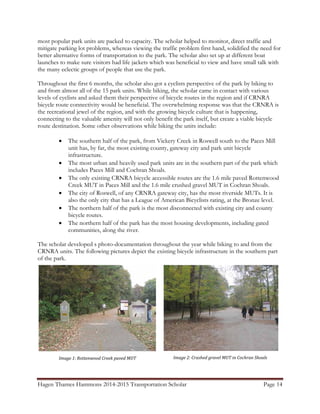
The scholar developed s photo-documentation throughout the year while biking to and from the
CRNRA units. The following pictures depict the existing bicycle infrastructure in the southern part
of the park.
Image 1: Rottenwood Creek paved MUT Image 2: Crushed gravel MUT in Cochran Shoals
Hagen Thames Hammons 2014-2015 Transportation Scholar Page 15
2. Review Relative Plans, Sites and Future Projects
The scholar reviewed the following documents and sites while developing the Study:
The Urban Agenda
This NPS document, published in March 2015, gave an enlightened context to the Study that relates
specifically to the CRNRA. The Urban Agenda‟s focus is to connect more of the NPS‟s urban parks,
like specifically the CRNRA, and how they can be more connected to adjacent communities. The
Agenda calls for the following principles, and how these principles relate to the project.
 Be Relative to All Americans: Challenge NPS units and adjacent gateway communities on
how to creatively connect with one another which includes the park design and its uses.
 Active “One NPS”: Promote healthy, active outdoor recreation while engaging the newest
generations, the millenials, as this generation wants more multi-modal transportation
connections.
 Nurture a Culture of Collaboration: Be more relative and further connect urban residents to
public lands with community engagement (NPS 2015).
2009 Chattahoochee River National Recreation Area General Management Plan
The essential document that lays out guidance for managing the CRNRA is the General
Management Plan (GMP). The document is revised approximately every 15 to 20 years and, in view
of the rapidly developing nature of the Chattahoochee River corridor and the intense use of the
park, it is a critical element in protecting the park‟s resources while at the same time providing for
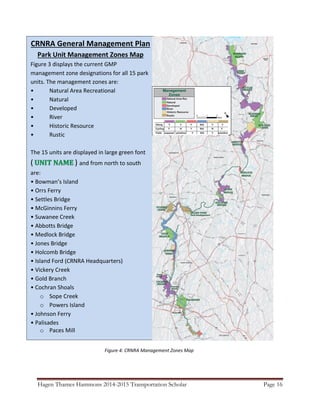
quality visitor experiences (NPS 2009). The GMP management zones in the CRNRA have a
significant impact on types of trails (paved or unpaved) that are allowed in the 15 specific units and
their allowable use in terms of allowable hiking and/or cycling. However, the GMP can be revised
to accommodate specific uses and surface types in the future with legislative approval. Figure 3
shows these management zones and takes out what is relative to this Study, the current trail use and
surface type restrictions and allowable uses.
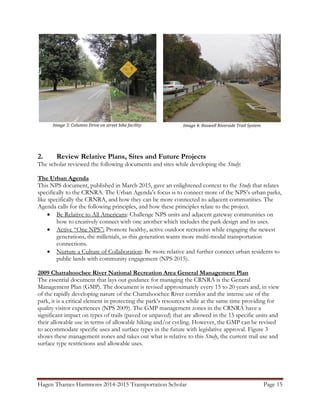
Image 3: Columns Drive on street bike facility Image 4: Roswell Riverside Trail System
Hagen Thames Hammons 2014-2015 Transportation Scholar Page 16
CRNRA General Management Plan
Park Unit Management Zones Map
Figure 3 displays the current GMP
management zone designations for all 15 park
units. The management zones are:
• Natural Area Recreational
• Natural
• Developed
• River
• Historic Resource
• Rustic
The 15 units are displayed in large green font
( ) and from north to south
are:
• Bowman’s Island
• Orrs Ferry
• Settles Bridge
• McGinnins Ferry
• Suwanee Creek
• Abbotts Bridge
• Medlock Bridge
• Jones Bridge
• Holcomb Bridge
• Island Ford (CRNRA Headquarters)
• Vickery Creek
• Gold Branch
• Cochran Shoals
o Sope Creek
o Powers Island
• Johnson Ferry
• Palisades
o Paces Mill
Figure 4: CRNRA Management Zones Map
Hagen Thames Hammons 2014-2015 Transportation Scholar Page 17
Cobb County Bicycle and Pedestrian Improvement Plan
This plan, done in 2010, is an update and expansion of an earlier plan done in 1993. The intent of
this project was to ascertain community needs with respect to bicycling and walking at a more
“micro” level by gathering and analyzing data to describe bicycling and walking conditions on all of
the County‟s major thoroughfares (Cobb County 2010). The map shown in Appendix B is an
updated version (2014) from this plan and is periodically updated to show both existing trails and
proposed future trails that have been identified by studies specific to local areas within the County.
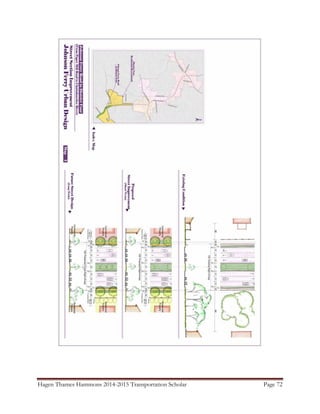
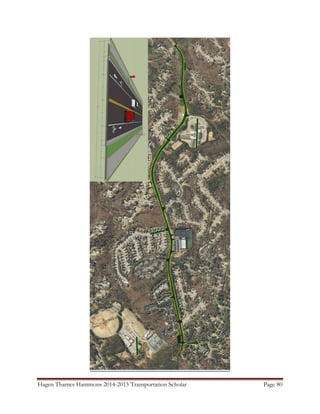
Johnson Ferry Road Design Guidelines- March 2013
Johnson Ferry Road is a key connector in the Study. This 1.7 mile section of the road connects the
Columns Drive on street bike facility with the MUP on Lower Roswell Road. Currently, the 3 lane
40,000+ ADT road is designated as a bike route, but with this high traffic on congestion, it will only
cater to expert and fearless cyclists. In 2013, the Cobb County Planning Commission and Board of
Commissioners finalized the Johnson Ferry Road Urban Design Plan. The improvements to the
corridor were based upon a model of implementing a “complete street” and were split into short-,
mid-, and long-term improvements. The proposed improvements that are relative to the Study along
Johnson Ferry Road from Lower Roswell Road to the Chattahoochee River from this plan are
located in Appendix C.
Cobb County Chattahoochee River Trail Feasibility Study and Conceptual Master Plan
This 2004 plan addresses the opportunities and constraints of developing a trail system through
Cobb County from the City of Roswell to the Paces Mill unit. The conclusion to the report indicated
that a continuous hard surface multi-use trail system adjacent to the Chattahoochee River was not
feasible because of regulatory restrictions, citizen opposition, and land ownership. However, the
plan identifies two different options for a connected trail system that bypasses a route adjacent to
the river and its constraints which include:
 Multi-use route that follows the public right-of-way along the major roadways
that traverse between the developments within Cobb County.
 Recreational route that utilizes the NPS land and creates a corridor with
connecting units between the various NPS units (Cobb County DOT 2004).
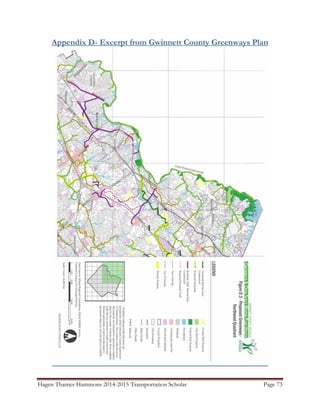
Gwinnett County, Georgia Open Space & Greenway Master Plan (2014)
This plan is a long-term vision for increasing recreational opportunities and building a system of
greenway trails, therefore reducing the environmental impact of development in Gwinnett County.
The plan details existing trails and two sets of proposed trails, which was very useful in identifying
where potential locations are being visioned for trails in the county. The scholar also obtained GIS
shapefile data from this plan for creating maps. An excerpt of the plan that covers the Study corridor
is located in Appendix D.
Gwinnett County Traffic Engineering 2014 Traffic Reports
The scholar used the following site to locate ADT data specifically for Gwinnett County:
https://www.gwinnettcounty.com/portal/gwinnett/Departments/Transportation/TrafficCounts2015
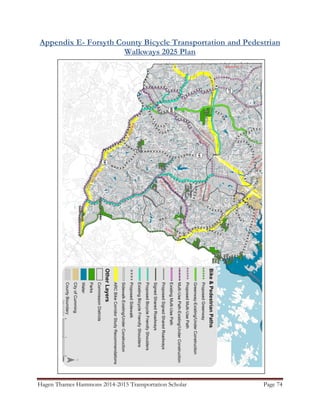
Forsyth County Bicycle Transportation and Pedestrian Walkways 2025 Plan
The scholar referenced this plan and obtained GIS shapefiles from the plan that identifies existing
bicycle facilities in the county as well as potential on road and road separated facilities. Part of the
Hagen Thames Hammons 2014-2015 Transportation Scholar                                       Page 18
										
plan that is adjacent to the CRNRA is cropped out and located in Appendix E.
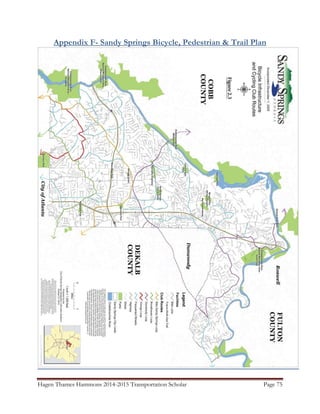
City of Sandy Springs Bicycle, Pedestrian and Trail Implementation Plan
This plan provides a long-range roadmap for bicycle and pedestrian infrastructure investment
and policy recommendations to complement the adopted Comprehensive Plan and
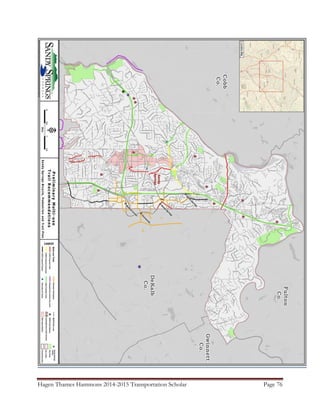
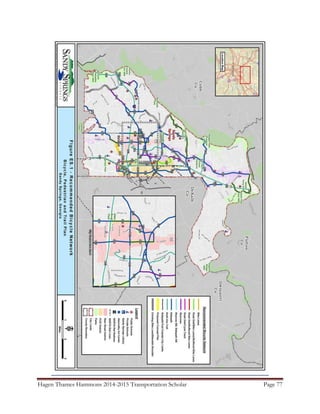
Transportation Master Plan. Taken from this plan, Appendix F displays the Existing Bicycle
Infrastructure, Preliminary Multi Use trail Recommendations and Existing Bike Infrastructure.
Roswell Historic Gateway
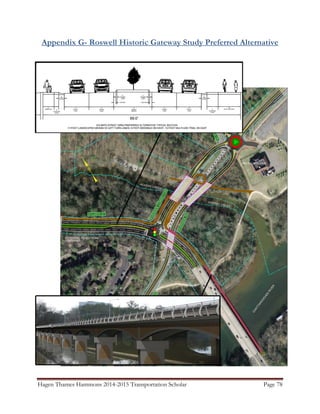
The Roswell Historic Gateway planning project is a planning effort to revitalize the south entry into
the city on Atlanta Street, GA 9, crossing the Chattahoochee River and passing the CRNRA Vickery
Creek unit. Part of the project aims to enhance bicycle access into the city from the river which
includes adding a separated bicycle/pedestrian bridge and an adjacent MUP leading up to the
Vickery Creek unit entrance off of Atlanta St. (Appendix G).
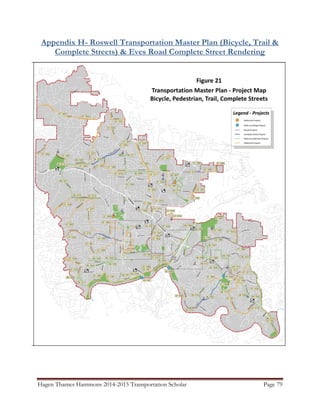
Roswell Transportation Master Plan
The city’s 2014 transportation plan update states that a focus on pedestrians and bicyclists have
made the city truly multimodal ensuring all citizens have access to a good transportation system
(City of Roswell 2014). From this plan, the city focuses on complete streets initiatives, and one
ongoing project on Eves Street is a preferred alternative in the Study (Appendix H). Also, the city’s
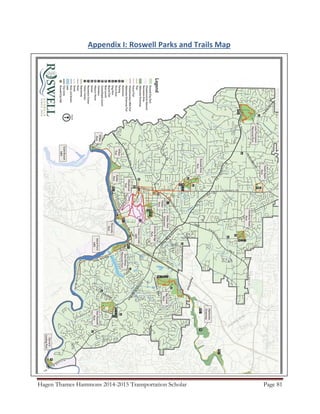
current and future trails master plan from the Recreation, Parks, Historic & Cultural Affairs
Department is in Appendix I.
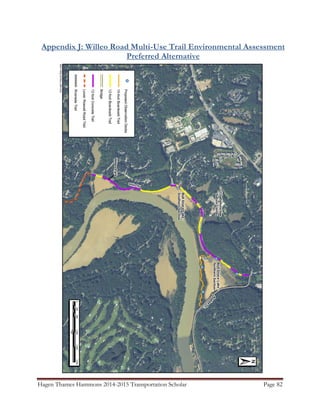
Willeo Road Multi-Use Trail Environmental Assessment
The City of Roswell, in cooperation with the NPS prepared a document in 2013 to evaluate
alternatives for improving trail within the Chattahoochee River corridor along Willeo Road.
Currently there is an existing share the road facility, which is beneficial but not safe and/or
recommended for recreational and families. The alternative in Appendix J show options around the
share the road facility that would make a safer recreational MUT or MUP route.
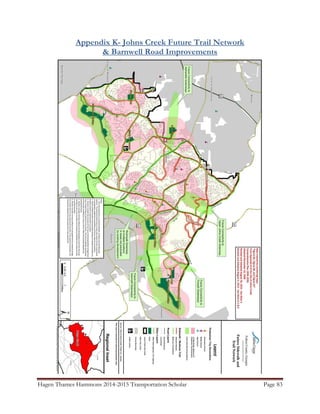
City of Johns Creek Transportation Master Plan
This 2008 citywide transportation plan’s recommendations respond directly to the established
transportation issues, opportunities, policies and strategies. The potential bicycle and pedestrian
improvements were developed by reviewing connectivity issues and existing proposals for future
facilities. Appendix J shows the future trails and sidewalk network envisioned for the city which
includes is a rendering on the future plans for Barnwell Road, which is a key connector for the Study.
Atlanta Region Bicycle Transportation and Pedestrian Walkways Plan
This 2007 plan envisions a regional scale bicycle network that includes on and off road facilities. It is
designed to improve mobility for the citizens of the Atlanta Region, thereby encouraging ancillary
benefits such as energy savings, air quality improvements, health benefits, and environmental justice
(Sprinkle Consulting 2007).
Georgia Department of Transportation (GDOT) TrafficServer
Locating potential roads for share the road facilities and to get a better perspective of how
congested interested roads are was important for the Study. The scholar used the following site to
obtain Average Daily Traffic (ADT): http://trafficserver.transmetric.com/gdot-prod/gdot_report.html
Hagen Thames Hammons 2014-2015 Transportation Scholar Page 19
Figure 5: Bicycle Connectivity Overall Location Map
Metropolitan River Protection Act
Relative to this Study, this law restricts and/or limits any new development and/or impervious
surface projects to be within 2,000 feet of the river that include the scraping, plowing, clearing,
dredging, grading, excavating, transporting or filling of land. It also restricts construction of
impervious surfaces within a 150‟ buffer.
3. Solicit Feedback & Retrieve Data from Stakeholders
Meetings
On top of reviewing relative studies and future projects relative to the Study, the scholar met with
county and gateway city staff that included transportation planners and engineers, to go over the
initial goals of creating bicycle connectivity alternatives. The scholar also discussed how they
approach bicycle and trail planning and their future and present plans, if applicable. A list of
meetings and the months they were held is listed under Constituencies in Chapter 2.
Retrieve Data
After becoming familiar with the CRNRA, reviewing plans and future projects relative to the Study,
and meeting with the stakeholders, the scholar then retrieved GIS shapefile data from the CRNRA,
counties, gateway cities and Atlanta Regional Commission. The data included:
 CRNRA unit boundaries and access roads
 Rivers and streams
 Existing, funded and future bicycle facilities that include on street and off street routes.
 City and County borders
 City and county roads
 State roads and highways
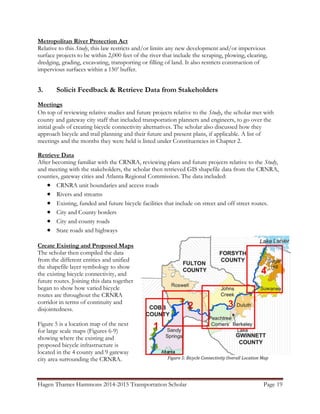
Create Existing and Proposed Maps
The scholar then compiled the data
from the different entities and unified
the shapefile layer symbology to show
the existing bicycle connectivity, and
future routes. Joining this data together
began to show how varied bicycle
routes are throughout the CRNRA
corridor in terms of continuity and
disjointedness.
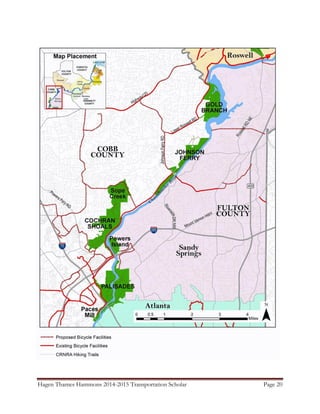
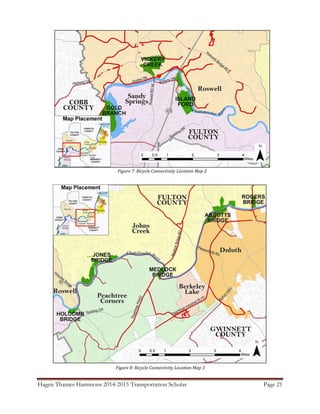
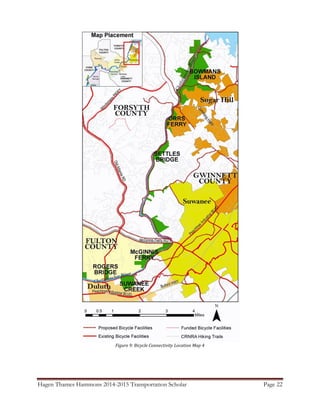
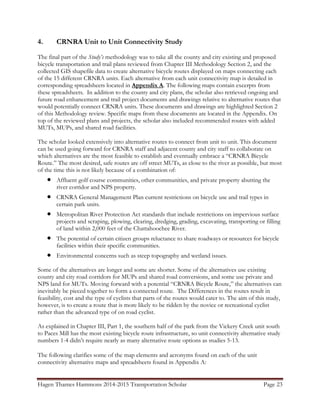
Figure 5 is a location map of the next
for large scale maps (Figures 6-9)
showing where the existing and
proposed bicycle infrastructure is
located in the 4 county and 9 gateway
city area surrounding the CRNRA.
Hagen Thames Hammons 2014-2015 Transportation Scholar Page 20
Figure 6: Bicycle Connectivity Location Map 1
Hagen Thames Hammons 2014-2015 Transportation Scholar Page 21
Figure 7: Bicycle Connectivity Location Map 2
Figure 8: Bicycle Connectivity Location Map 3
Hagen Thames Hammons 2014-2015 Transportation Scholar Page 22
Figure 9: Bicycle Connectivity Location Map 4
Hagen Thames Hammons 2014-2015 Transportation Scholar Page 23
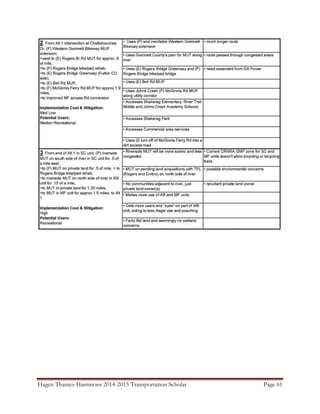
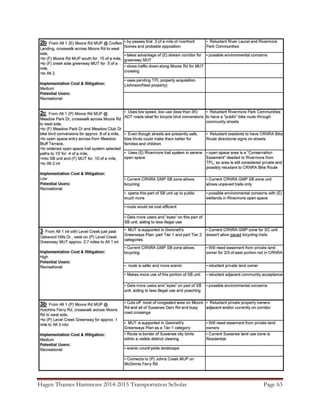
4. CRNRA Unit to Unit Connectivity Study
The final part of the Study’s methodology was to take all the county and city existing and proposed
bicycle transportation and trail plans reviewed from Chapter III Methodology Section 2, and the
collected GIS shapefile data to create alternative bicycle routes displayed on maps connecting each
of the 15 different CRNRA units. Each alternative from each unit connectivity map is detailed in
corresponding spreadsheets located in Appendix A. The following maps contain excerpts from
these spreadsheets. In addition to the county and city plans, the scholar also retrieved ongoing and
future road enhancement and trail project documents and drawings relative to alternative routes that
would potentially connect CRNRA units. These documents and drawings are highlighted Section 2
of this Methodology review. Specific maps from these documents are located in the Appendix. On
top of the reviewed plans and projects, the scholar also included recommended routes with added
MUTs, MUPs, and shared road facilities.
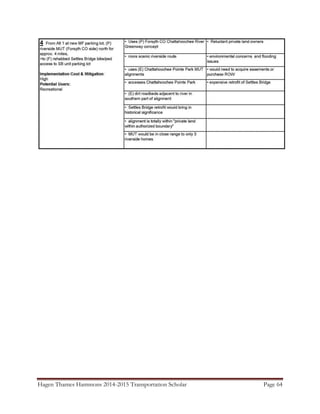
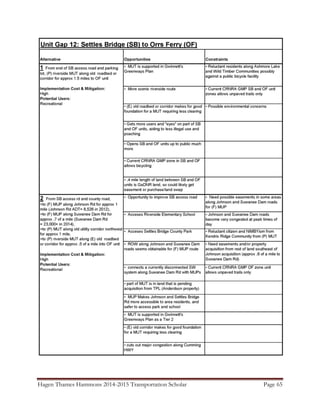
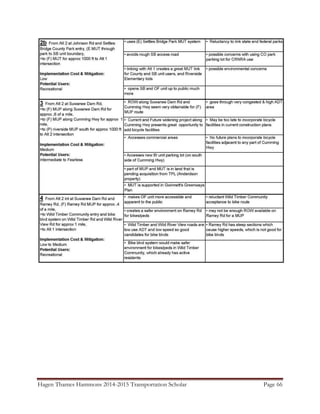
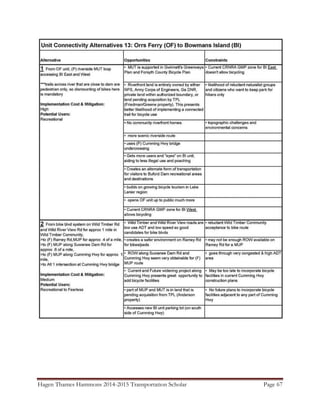
The scholar looked extensively into alternative routes to connect from unit to unit. This document
can be used going forward for CRNRA staff and adjacent county and city staff to collaborate on
which alternatives are the most feasible to establish and eventually embrace a “CRNRA Bicycle
Route.” The most desired, safe routes are off street MUTs, as close to the river as possible, but most
of the time this is not likely because of a combination of:
 Affluent golf course communities, other communities, and private property abutting the
river corridor and NPS property.
 CRNRA General Management Plan current restrictions on bicycle use and trail types in
certain park units.
 Metropolitan River Protection Act standards that include restrictions on impervious surface
projects and scraping, plowing, clearing, dredging, grading, excavating, transporting or filling
of land within 2,000 feet of the Chattahoochee River.
 The potential of certain citizen groups reluctance to share roadways or resources for bicycle
facilities within their specific communities.
 Environmental concerns such as steep topography and wetland issues.
Some of the alternatives are longer and some are shorter. Some of the alternatives use existing
county and city road corridors for MUPs and shared road conversions, and some use private and
NPS land for MUTs. Moving forward with a potential “CRNRA Bicycle Route,” the alternatives can
inevitably be pieced together to form a connected route. The Differences in the routes result in
feasibility, cost and the type of cyclists that parts of the routes would cater to. The aim of this study,
however, is to create a route that is more likely to be ridden by the novice or recreational cyclist
rather than the advanced type of on road cyclist.
As explained in Chapter III, Part 1, the southern half of the park from the Vickery Creek unit south
to Paces Mill has the most existing bicycle route infrastructure, so unit connectivity alternative study
numbers 1-4 didn‟t require nearly as many alternative route options as studies 5-13.
The following clarifies some of the map elements and acronyms found on each of the unit
connectivity alternative maps and spreadsheets found in Appendix A:
Hagen Thames Hammons 2014-2015 Transportation Scholar Page 24
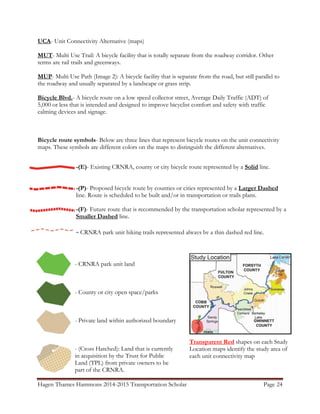
UCA- Unit Connectivity Alternative (maps)
MUT- Multi Use Trail: A bicycle facility that is totally separate from the roadway corridor. Other
terms are rail trails and greenways.
MUP- Multi Use Path (Image 2): A bicycle facility that is separate from the road, but still parallel to
the roadway and usually separated by a landscape or grass strip.
Bicycle Blvd.- A bicycle route on a low speed collector street, Average Daily Traffic (ADT) of
5,000 or less that is intended and designed to improve bicyclist comfort and safety with traffic
calming devices and signage.
Bicycle route symbols- Below are three lines that represent bicycle routes on the unit connectivity
maps. These symbols are different colors on the maps to distinguish the different alternatives.
-(E)- Existing CRNRA, county or city bicycle route represented by a Solid line.
-(P)- Proposed bicycle route by counties or cities represented by a Larger Dashed
line. Route is scheduled to be built and/or in transportation or trails plans.
-(F)- Future route that is recommended by the transportation scholar represented by a
Smaller Dashed line.
- CRNRA park unit hiking trails represented always by a thin dashed red line.
- CRNRA park unit land
- County or city open space/parks
- Private land within authorized boundary
- (Cross Hatched): Land that is currently
in acquisition by the Trust for Public
Land (TPL) from private owners to be
part of the CRNRA.
Transparent Red shapes on each Study
Location maps identify the study area of
each unit connectivity map
Hagen Thames Hammons 2014-2015 Transportation Scholar Page 25
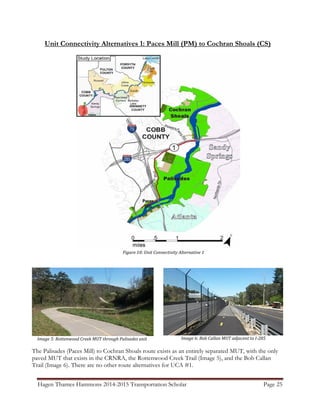
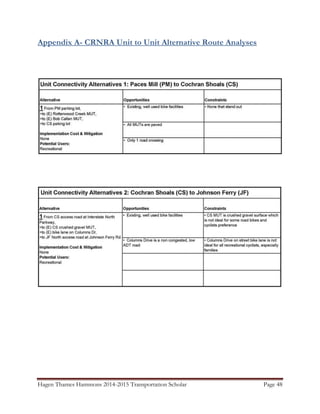
Unit Connectivity Alternatives 1: Paces Mill (PM) to Cochran Shoals (CS)
Figure 10: Unit Connectivity Alternative 1
Image 6: Bob Callan MUT adjacent to I-285Image 5: Rottenwood Creek MUT through Palisades unit
The Palisades (Paces Mill) to Cochran Shoals route exists as an entirely separated MUT, with the only
paved MUT that exists in the CRNRA, the Rottenwood Creek Trail (Image 5), and the Bob Callan
Trail (Image 6). There are no other route alternatives for UCA #1.
Hagen Thames Hammons 2014-2015 Transportation Scholar Page 27
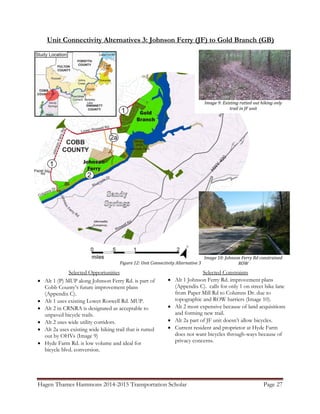
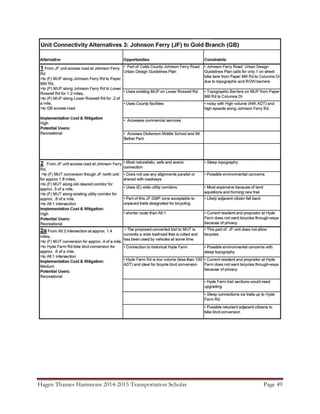
Unit Connectivity Alternatives 3: Johnson Ferry (JF) to Gold Branch (GB)
Figure 12: Unit Connectivity Alternative 3
Selected Opportunities
 Alt 1 (P) MUP along Johnson Ferry Rd. is part of
Cobb County‟s future improvement plans
(Appendix C).
 Alt 1 uses existing Lower Roswell Rd. MUP.
 Alt 2 in CRNRA is designated as acceptable to
unpaved bicycle trails.
 Alt 2 uses wide utility corridors.
 Alt 2a uses existing wide hiking trail that is rutted
out by OHVs (Image 9)
 Hyde Farm Rd. is low volume and ideal for
bicycle blvd. conversion.
Image 10: Johnson Ferry Rd constrained
ROW
Image 9: Existing rutted out hiking only
trail in JF unit
Selected Constraints
 Alt 1 Johnson Ferry Rd. improvement plans
(Appendix C). calls for only 1 on street bike lane
from Paper Mill Rd to Columns Dr. due to
topographic and ROW barriers (Image 10).
 Alt 2 most expensive because of land acquisitions
and forming new trail.
 Alt 2a part of JF unit doesn‟t allow bicycles.
 Current resident and proprietor at Hyde Farm
does not want bicycles through-ways because of
privacy concerns.
Hagen Thames Hammons 2014-2015 Transportation Scholar Page 28
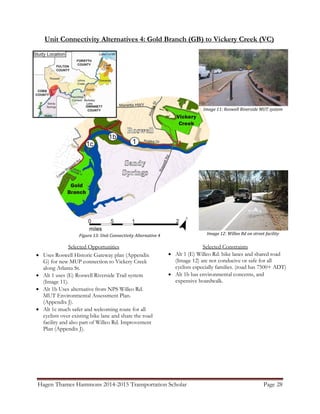
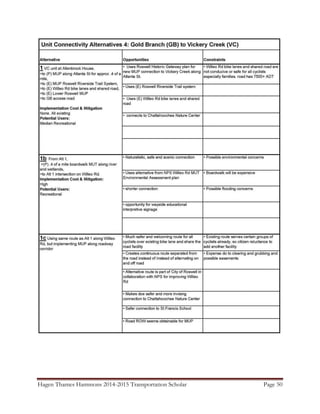
Unit Connectivity Alternatives 4: Gold Branch (GB) to Vickery Creek (VC)
Figure 13: Unit Connectivity Alternative 4
Selected Opportunities
 Uses Roswell Historic Gateway plan (Appendix
G) for new MUP connection to Vickery Creek
along Atlanta St.
 Alt 1 uses (E) Roswell Riverside Trail system
(Image 11).
 Alt 1b Uses alternative from NPS Willeo Rd.
MUT Environmental Assessment Plan.
(Appendix J).
 Alt 1c much safer and welcoming route for all
cyclists over existing bike lane and share the road
facility and also part of Willeo Rd. Improvement
Plan (Appendix J).
Selected Constraints
 Alt 1 (E) Willeo Rd. bike lanes and shared road
(Image 12) are not conducive or safe for all
cyclists especially families. (road has 7500+ ADT)
 Alt 1b has environmental concerns, and
expensive boardwalk.
Image 11: Roswell Riverside MUT system
Image 12: Willeo Rd on street facility
Hagen Thames Hammons 2014-2015 Transportation Scholar Page 29
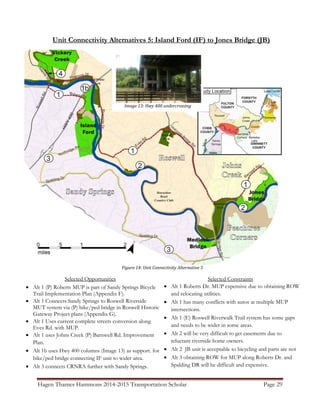
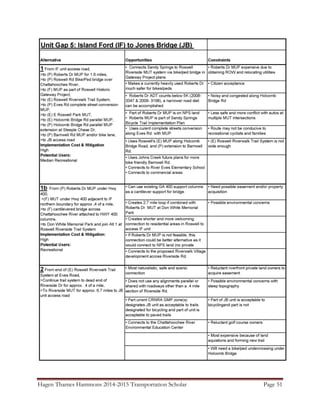
Unit Connectivity Alternatives 5: Island Ford (IF) to Jones Bridge (JB)
Figure 14: Unit Connectivity Alternative 5
Image 13: Hwy 400 undercrossing
Selected Opportunities
 Alt 1 (P) Roberts MUP is part of Sandy Springs Bicycle
Trail Implementation Plan (Appendix F).
 Alt 1 Connects Sandy Springs to Roswell Riverside
MUT system via (P) bike/ped bridge in Roswell Historic
Gateway Project plans (Appendix G).
 Alt 1 Uses current complete streets conversion along
Eves Rd. with MUP.
 Alt 1 uses Johns Creek (P) Barnwell Rd. Improvement
Plan.
 Alt 1b uses Hwy 400 columns (Image 13) as support. for
bike/ped bridge connecting IF unit to wider area.
 Alt 3 connects CRNRA further with Sandy Springs.
Selected Constraints
 Alt 1 Roberts Dr. MUP expensive due to obtaining ROW
and relocating utilities.
 Alt 1 has many conflicts with autos at multiple MUP
intersections.
 Alt 1 (E) Roswell Riverwalk Trail system has some gaps
and needs to be wider in some areas.
 Alt 2 will be very difficult to get easements due to
reluctant riverside home owners.
 Alt 2 JB unit is acceptable to bicycling and parts are not
 Alt 3 obtaining ROW for MUP along Roberts Dr. and
Spalding DR will be difficult and expensive.
Hagen Thames Hammons 2014-2015 Transportation Scholar Page 30
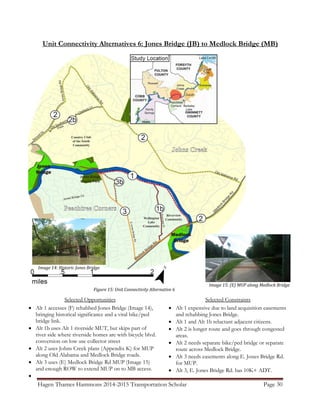
Unit Connectivity Alternatives 6: Jones Bridge (JB) to Medlock Bridge (MB)
Figure 15: Unit Connectivity Alternative 6
Image 14: Historic Jones Bridge
Image 15: (E) MUP along Medlock Bridge
Rd
Selected Opportunities
 Alt 1 accesses (F) rehabbed Jones Bridge (Image 14),
bringing historical significance and a vital bike/ped
bridge link.
 Alt 1b uses Alt 1 riverside MUT, but skips part of
river side where riverside homes are with bicycle blvd.
conversion on low use collector street
 Alt 2 uses Johns Creek plans (Appendix K) for MUP
along Old Alabama and Medlock Bridge roads.
 Alt 3 uses (E) Medlock Bridge Rd MUP (Image 15)
and enough ROW to extend MUP on to MB access.

Selected Constraints
 Alt 1 expensive due to land acquisition easements
and rehabbing Jones Bridge.
 Alt 1 and Alt 1b reluctant adjacent citizens.
 Alt 2 is longer route and goes through congested
areas.
 Alt 2 needs separate bike/ped bridge or separate
route across Medlock Bridge.
 Alt 3 needs easements along E. Jones Bridge Rd.
for MUP.
 Alt 3, E. Jones Bridge Rd. has 10K+ ADT.
Hagen Thames Hammons 2014-2015 Transportation Scholar Page 31
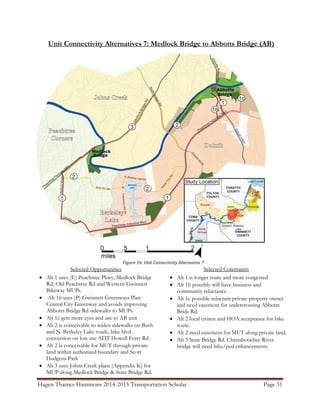
Unit Connectivity Alternatives 7: Medlock Bridge to Abbotts Bridge (AB)
Figure 16: Unit Connectivity Alternative 7
Selected Opportunities
 Alt 1 uses (E) Peachtree Pkwy, Medlock Bridge
Rd, Old Peachtree Rd and Western Gwinnett
Bikeway MUPs.
 Alt 1b uses (P) Gwinnett Greenways Plan
Central City Greenway and avoids improving
Abbotts Bridge Rd sidewalks to MUPs.
 Alt 1c gets more eyes and use to AB unit
 Alt 2 is conceivable to widen sidewalks on Bush
and N. Berkeley Lake roads, bike blvd.
conversion on low use ADT Howell Ferry Rd.
 Alt 2 is conceivable for MUT through private
land within authorized boundary and Scott
Hudgens Park
 Alt 3 uses Johns Creek plans (Appendix K) for
MUP along Medlock Bridge & State Bridge Rd.
Selected Constraints
 Alt 1 is longer route and more congested
 Alt 1b possibly will have business and
community reluctance.
 Alt 1c possible reluctant private property owner
and need easement for undercrossing Abbotts
Bride Rd.
 Alt 2 local citizen and HOA acceptance for bike
route.
 Alt 2 need easement for MUT along private land.
 Alt 3 State Bridge Rd. Chattahoochee River
bridge will need bike/ped enhancements.
Hagen Thames Hammons 2014-2015 Transportation Scholar Page 32
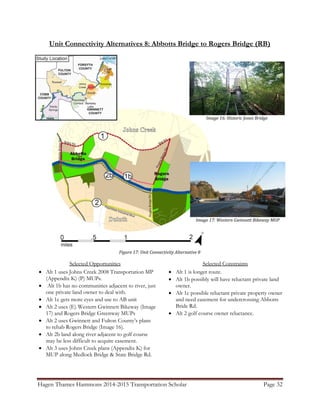
Unit Connectivity Alternatives 8: Abbotts Bridge to Rogers Bridge (RB)
Figure 17: Unit Connectivity Alternative 8
Image 16: Historic Jones Bridge
Image 17: Western Gwinnett Bikeway MUP
Selected Opportunities
 Alt 1 uses Johns Creek 2008 Transportation MP
(Appendix K) (P) MUPs.
 Alt 1b has no communities adjacent to river, just
one private land owner to deal with.
 Alt 1c gets more eyes and use to AB unit
 Alt 2 uses (E) Western Gwinnett Bikeway (Image
17) and Rogers Bridge Greenway MUPs
 Alt 2 uses Gwinnett and Fulton County‟s plans
to rehab Rogers Bridge (Image 16).
 Alt 2b land along river adjacent to golf course
may be less difficult to acquire easement.
 Alt 3 uses Johns Creek plans (Appendix K) for
MUP along Medlock Bridge & State Bridge Rd.
Selected Constraints
 Alt 1 is longer route.
 Alt 1b possibly will have reluctant private land
owner.
 Alt 1c possible reluctant private property owner
and need easement for undercrossing Abbotts
Bride Rd.
 Alt 2 golf course owner reluctance.
Hagen Thames Hammons 2014-2015 Transportation Scholar Page 33
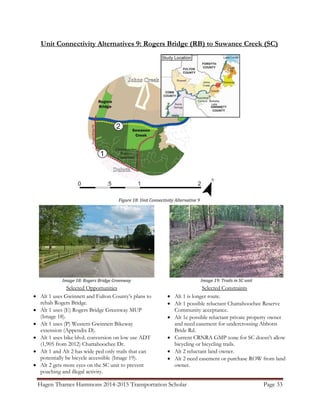
Unit Connectivity Alternatives 9: Rogers Bridge (RB) to Suwanee Creek (SC)
Figure 18: Unit Connectivity Alternative 9
Selected Opportunities
 Alt 1 uses Gwinnett and Fulton County‟s plans to
rehab Rogers Bridge.
 Alt 1 uses (E) Rogers Bridge Greenway MUP
(Image 18).
 Alt 1 uses (P) Western Gwinnett Bikeway
extension (Appendix D).
 Alt 1 uses bike blvd. conversion on low use ADT
(1,905 from 2012) Chattahoochee Dr.
 Alt 1 and Alt 2 has wide ped only trails that can
potentially be bicycle accessible (Image 19).
 Alt 2 gets more eyes on the SC unit to prevent
poaching and illegal activity.
Selected Constraints
 Alt 1 is longer route.
 Alt 1 possible reluctant Chattahoochee Reserve
Community acceptance.
 Alt 1c possible reluctant private property owner
and need easement for undercrossing Abbotts
Bride Rd.
 Current CRNRA GMP zone for SC doesn't allow
bicycling or bicycling trails.
 Alt 2 reluctant land owner.
 Alt 2 need easement or purchase ROW from land
owner.
Image 18: Rogers Bridge Greenway Image 19: Trails in SC unit
Hagen Thames Hammons 2014-2015 Transportation Scholar Page 34
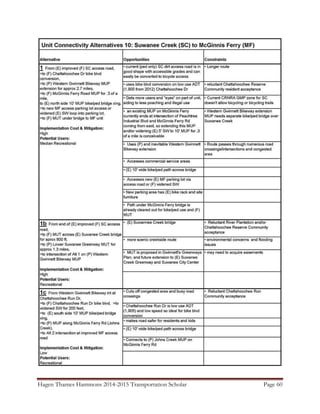
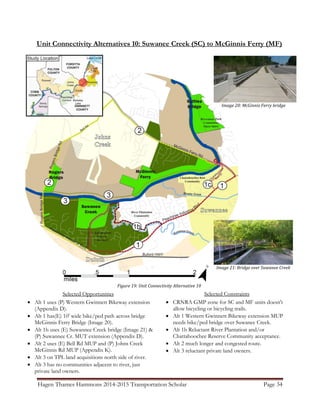
Unit Connectivity Alternatives 10: Suwanee Creek (SC) to McGinnis Ferry (MF)
Figure 19: Unit Connectivity Alternative 10
Selected Opportunities
 Alt 1 uses (P) Western Gwinnett Bikeway extension
(Appendix D).
 Alt 1 has(E) 10' wide bike/ped path across bridge
McGinnis Ferry Bridge (Image 20).
 Alt 1b uses (E) Suwannee Creek bridge (Image 21) &
(P) Suwannee Cr. MUT extension (Appendix D).
 Alt 2 uses (E) Bell Rd MUP and (P) Johns Creek
McGinnis Rd MUP (Appendix K).
 Alt 3 on TPL land acquisitions north side of river.
 Alt 3 has no communities adjacent to river, just
private land owners.
Selected Constraints
 CRNRA GMP zone for SC and MF units doesn't
allow bicycling or bicycling trails.
 Alt 1 Western Gwinnett Bikeway extension MUP
needs bike/ped bridge over Suwanee Creek.
 Alt 1b Reluctant River Plantation and/or
Chattahoochee Reserve Community acceptance.
 Alt 2 much longer and congested route.
 Alt 3 reluctant private land owners.
Image 21: Bridge over Suwanee Creek
Image 20: McGinnis Ferry bridge
Hagen Thames Hammons 2014-2015 Transportation Scholar Page 35
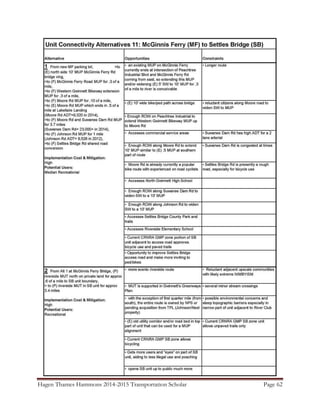
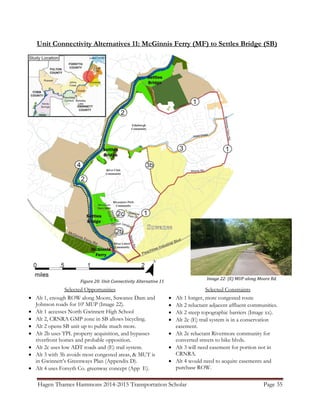
Unit Connectivity Alternatives 11: McGinnis Ferry (MF) to Settles Bridge (SB)
Figure 20: Unit Connectivity Alternative 11
Selected Opportunities
 Alt 1, enough ROW along Moore, Suwanee Dam and
Johnson roads for 10' MUP (Image 22).
 Alt 1 accesses North Gwinnett High School
 Alt 2, CRNRA GMP zone in SB allows bicycling.
 Alt 2 opens SB unit up to public much more.
 Alt 2b uses TPL property acquisition, and bypasses
riverfront homes and probable opposition.
 Alt 2c uses low ADT roads and (E) trail system.
 Alt 3 with 3b avoids most congested areas, & MUT is
in Gwinnett‟s Greenways Plan (Appendix D).
 Alt 4 uses Forsyth Co. greenway concept (App E).
Selected Constraints
 Alt 1 longer, more congested route
 Alt 2 reluctant adjacent affluent communities.
 Alt 2 steep topographic barriers (Image xx).
 Alt 2c (E) trail system is in a conservation
easement.
 Alt 2c reluctant Rivermore community for
converted streets to bike blvds.
 Alt 3 will need easement for portion not in
CRNRA.
 Alt 4 would need to acquire easements and
purchase ROW.
Image 22: (E) MUP along Moore Rd.
Hagen Thames Hammons 2014-2015 Transportation Scholar Page 36
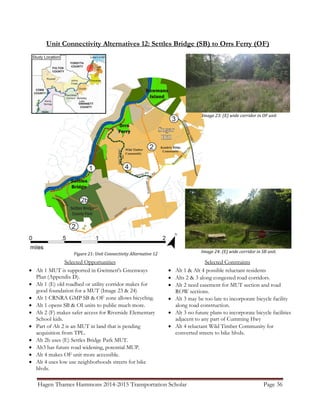
Unit Connectivity Alternatives 12: Settles Bridge (SB) to Orrs Ferry (OF)
Figure 21: Unit Connectivity Alternative 12
Selected Opportunities
 Alt 1 MUT is supported in Gwinnett's Greenways
Plan (Appendix D).
 Alt 1 (E) old roadbed or utility corridor makes for
good foundation for a MUT (Image 23 & 24)
 Alt 1 CRNRA GMP SB & OF zone allows bicycling.
 Alt 1 opens SB & OI units to public much more.
 Alt 2 (F) makes safer access for Riverside Elementary
School kids.
 Part of Alt 2 is an MUT in land that is pending
acquisition from TPL.
 Alt 2b uses (E) Settles Bridge Park MUT.
 Alt3 has future road widening, potential MUP.
 Alt 4 makes OF unit more accessible.
 Alt 4 uses low use neighborhoods streets for bike
blvds.
Selected Constraints
 Alt 1 & Alt 4 possible reluctant residents
 Alts 2 & 3 along congested road corridors.
 Alt 2 need easement for MUT section and road
ROW sections.
 Alt 3 may be too late to incorporate bicycle facility
along road construction.
 Alt 3 no future plans to incorporate bicycle facilities
adjacent to any part of Cumming Hwy
 Alt 4 reluctant Wild Timber Community for
converted streets to bike blvds.
Image 24: (E) wide corridor in SB unit.
Image 23: (E) wide corridor in OF unit
Hagen Thames Hammons 2014-2015 Transportation Scholar Page 37
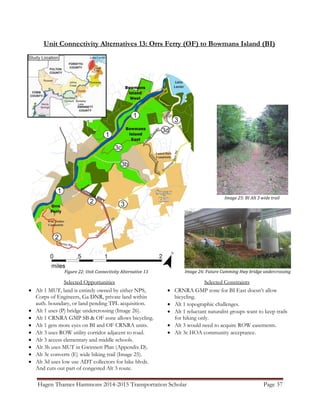
Unit Connectivity Alternatives 13: Orrs Ferry (OF) to Bowmans Island (BI)
Figure 22: Unit Connectivity Alternative 13
Selected Opportunities
 Alt 1 MUT, land is entirely owned by either NPS,
Corps of Engineers, Ga DNR, private land within
auth. boundary, or land pending TPL acquisition.
 Alt 1 uses (P) bridge undercrossing (Image 26).
 Alt 1 CRNRA GMP SB & OF zone allows bicycling.
 Alt 1 gets more eyes on BI and OF CRNRA units.
 Alt 3 uses ROW utility corridor adjacent to road.
 Alt 3 access elementary and middle schools.
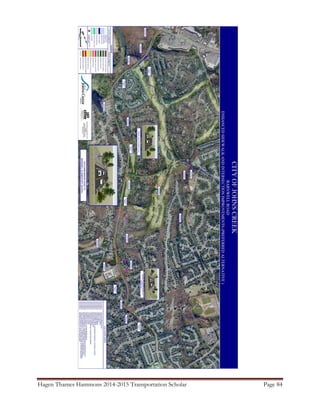
 Alt 3b uses MUT in Gwinnett Plan (Appendix D).
 Alt 3c converts (E) wide hiking trail (Image 25).
 Alt 3d uses low use ADT collectors for bike blvds.
And cuts out part of congested Alt 3 route.
Selected Constraints
 CRNRA GMP zone for BI East doesn‟t allow
bicycling.
 Alt 1 topographic challenges.
 Alt 1 reluctant naturalist groups want to keep trails
for hiking only.
 Alt 3 would need to acquire ROW easements.
 Alt 3c HOA community acceptance.
Image 26: Future Cumming Hwy bridge undercrossing
Image 25: BI Alt 3 wide trail
Hagen Thames Hammons 2014-2015 Transportation Scholar Page 38
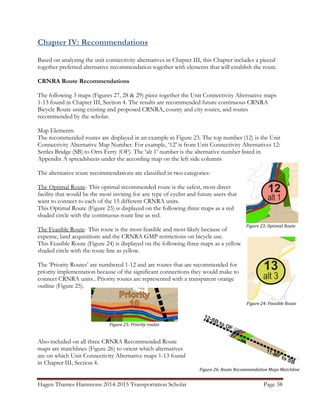
Figure 23: Optimal Route
Figure 24: Feasible Route
Figure 26: Route Recommendation Maps Matchline
Chapter IV: Recommendations
Based on analyzing the unit connectivity alternatives in Chapter III, this Chapter includes a pieced
together preferred alternative recommendation together with elements that will establish the route.
CRNRA Route Recommendations
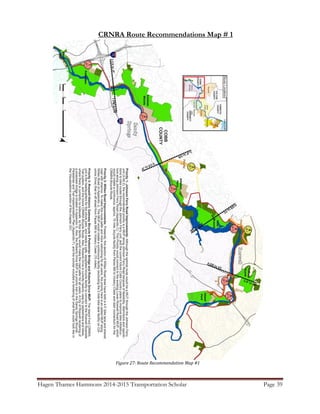
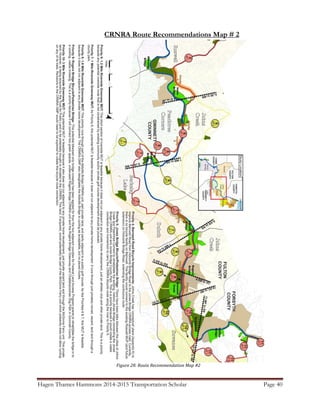
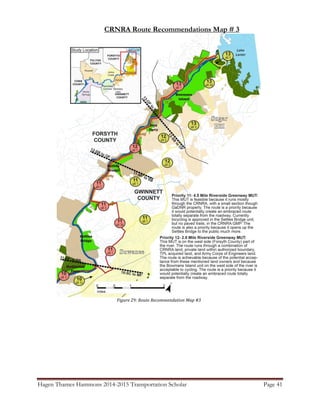
The following 3 maps (Figures 27, 28 & 29) piece together the Unit Connectivity Alternative maps
1-13 found in Chapter III, Section 4. The results are recommended future continuous CRNRA
Bicycle Route using existing and proposed CRNRA, county and city routes, and routes
recommended by the scholar.
Map Elements:
The recommended routes are displayed in an example in Figure 23. The top number (12) is the Unit
Connectivity Alternative Map Number. For example, ‘12’ is from Unit Connectivity Alternatives 12:
Settles Bridge (SB) to Orrs Ferry (OF). The ‘alt 1’ number is the alternative number listed in
Appendix A spreadsheets under the according map on the left side columns
The alternative route recommendations are classified in two categories:
The Optimal Route- This optimal recommended route is the safest, most direct
facility that would be the most inviting for any type of cyclist and future users that
want to connect to each of the 15 different CRNRA units.
This Optimal Route (Figure 23) is displayed on the following three maps as a red
shaded circle with the continuous route line as red.
The Feasible Route- This route is the most feasible and most likely because of
expense, land acquisitions and the CRNRA GMP restrictions on bicycle use.
This Feasible Route (Figure 24) is displayed on the following three maps as a yellow
shaded circle with the route line as yellow.
The ‘Priority Routes’ are numbered 1-12 and are routes that are recommended for
priority implementation because of the significant connections they would make to
connect CRNRA units.. Priority routes are represented with a transparent orange
outline (Figure 25).
Also included on all three CRNRA Recommended Route
maps are matchlines (Figure 26) to orient which alternatives
are on which Unit Connectivity Alternative maps 1-13 found
in Chapter III, Section 4.
Figure 25: Priority routes
Hagen Thames Hammons 2014-2015 Transportation Scholar Page 39
Figure 27: Route Recommendation Map #1
CRNRA Route Recommendations Map # 1
Hagen Thames Hammons 2014-2015 Transportation Scholar Page 40
Figure 28: Route Recommendation Map #2
CRNRA Route Recommendations Map # 2
Hagen Thames Hammons 2014-2015 Transportation Scholar Page 41
Figure 29: Route Recommendation Map #3
CRNRA Route Recommendations Map # 3
Hagen Thames Hammons 2014-2015 Transportation Scholar Page 42
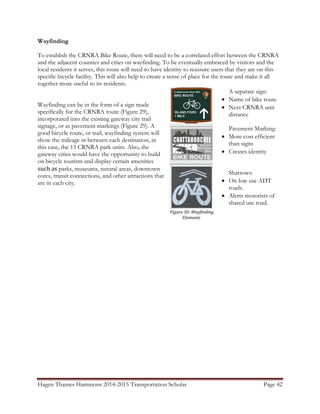
Figure 30: Wayfinding
Elements
Wayfinding
To establish the CRNRA Bike Route, there will need to be a correlated effort between the CRNRA
and the adjacent counties and cities on wayfinding. To be eventually embraced by visitors and the
local residents it serves, this route will need to have identity to reassure users that they are on this
specific bicycle facility. This will also help to create a sense of place for the route and make it all
together more useful to its residents.
Wayfinding can be in the form of a sign made
specifically for the CRNRA route (Figure 29),
incorporated into the existing gateway city trail
signage, or as pavement markings (Figure 29). A
good bicycle route, or trail, wayfinding system will
show the mileage in between each destination, in
this case, the 15 CRNRA park units. Also, the
gateway cities would have the opportunity to build
on bicycle tourism and display certain amenities
such as parks, museums, natural areas, downtown
cores, transit connections, and other attractions that
are in each city.
A separate sign:
 Name of bike route
 Next CRNRA unit
distance
Pavement Marking:
 More cost efficient
than signs
 Creates identity
Sharrows:
 On low use ADT
roads.
 Alerts motorists of
shared use road.
Hagen Thames Hammons 2014-2015 Transportation Scholar                                       Page 43
										
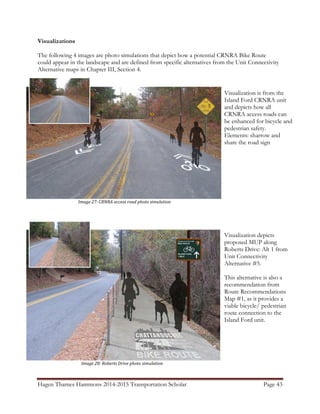
Visualizations
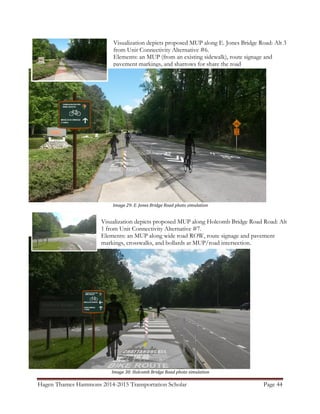
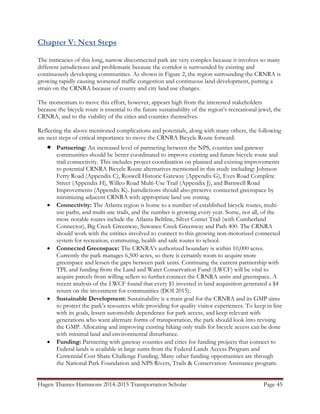
The following 4 images are photo simulations that depict how a potential CRNRA Bike Route
could appear in the landscape and are defined from specific alternatives from the Unit Connectivity
Alternative maps in Chapter III, Section 4.
   
	
																																																					Image	28:	Roberts	Drive	photo	simulation	
	
																																																		Image	27:	CRNRA	access	road	photo	simulation	
	
Visualization is from the
Island Ford CRNRA unit
and depicts how all
CRNRA access roads can
be enhanced for bicycle and
pedestrian safety.
Elements: sharrow and
share the road sign
Visualization depicts
proposed MUP along
Roberts Drive: Alt 1 from
Unit Connectivity
Alternative #5.
This alternative is also a
recommendation from
Route Recommendations
Map #1, as it provides a
viable bicycle/ pedestrian
route connection to the
Island Ford unit.
Hagen Thames Hammons 2014-2015 Transportation Scholar Page 44
Image 29: E. Jones Bridge Road photo simulation
Image 30: Holcomb Bridge Road photo simulation
Visualization depicts proposed MUP along E. Jones Bridge Road: Alt 3
from Unit Connectivity Alternative #6.
Elements: an MUP (from an existing sidewalk), route signage and
pavement markings, and sharrows for share the road
Visualization depicts proposed MUP along Holcomb Bridge Road Road: Alt
1 from Unit Connectivity Alternative #7.
Elements: an MUP along wide road ROW, route signage and pavement
markings, crosswalks, and bollards at MUP/road intersection.
Hagen Thames Hammons 2014-2015 Transportation Scholar Page 45
Chapter V: Next Steps
The intricacies of this long, narrow disconnected park are very complex because it involves so many
different jurisdictions and problematic because the corridor is surrounded by existing and
continuously developing communities. As shown in Figure 2, the region surrounding the CRNRA is
growing rapidly causing worsened traffic congestion and continuous land development, putting a
strain on the CRNRA because of county and city land use changes.
The momentum to move this effort, however, appears high from the interested stakeholders
because the bicycle route is essential to the future sustainability of the region‟s recreational jewel, the
CRNRA, and to the viability of the cities and counties themselves.
Reflecting the above mentioned complications and potentials, along with many others, the following
are next steps of critical importance to move the CRNRA Bicycle Route forward:
 Partnering: An increased level of partnering between the NPS, counties and gateway
communities should be better coordinated to improve existing and future bicycle route and
trail connectivity. This includes project coordination on planned and existing improvements
to potential CRNRA Bicycle Route alternatives mentioned in this study including: Johnson
Ferry Road (Appendix C), Roswell Historic Gateway (Appendix G), Eves Road Complete
Street (Appendix H), Willeo Road Multi-Use Trail (Appendix J), and Barnwell Road
Improvements (Appendix K). Jurisdictions should also preserve connected greenspace by
minimizing adjacent CRNRA with appropriate land use zoning.
 Connectivity: The Atlanta region is home to a number of established bicycle routes, multi-
use paths, and multi-use trails, and the number is growing every year. Some, not all, of the
more notable routes include the Atlanta Beltline, Silver Comet Trail (with Cumberland
Connector), Big Creek Greenway, Suwanee Creek Greenway and Path 400. The CRNRA
should work with the entities involved to connect to this growing non-motorized connected
system for recreation, commuting, health and safe routes to school.
 Connected Greenspace: The CRNRA‟s authorized boundary is within 10,000 acres.
Currently the park manages 6,500 acres, so there is certainly room to acquire more
greenspace and lessen the gaps between park units. Continuing the current partnership with
TPL and funding from the Land and Water Conservation Fund (LWCF) will be vital to
acquire parcels from willing sellers to further connect the CRNRA units and greenspace. A
recent analysis of the LWCF found that every $1 invested in land acquisition generated a $4
return on the investment for communities (DOI 2015).
 Sustainable Development: Sustainability is a main goal for the CRNRA and its GMP aims
to protect the park‟s resources while providing for quality visitor experiences. To keep in line
with its goals, lessen automobile dependence for park access, and keep relevant with
generations who want alternate forms of transportation, the park should look into revising
the GMP. Allocating and improving existing hiking only trails for bicycle access can be done
with minimal land and environmental disturbance.
 Funding: Partnering with gateway counties and cities for funding projects that connect to
Federal lands is available in large sums from the Federal Lands Access Program and
Centennial Cost Share Challenge Funding. Many other funding opportunities are through
the National Park Foundation and NPS Rivers, Trails & Conservation Assistance program.
Hagen Thames Hammons 2014-2015 Transportation Scholar Page 46
Chapter VI: Connection to Wider Transportation Community
This bicycle connectivity plan coincides with how future generations want better access to alternate
transportation modes and how the future of transportation planning, as a whole, is heading. The
plan‟s goals also correlate with the NPS‟s Urban Agenda, in that it promotes healthy, active outdoor
recreation while engaging the newest generations that want these alternate transportation
connections. Because the CRNRA is limited to how much land it can acquire, another critical
association to the Urban Agenda endeavor is the further connections that NPS urban parks need to
its gateway communities alternate transportation routes and greenways. Improving how the NPS
and gateway communities interact is key to creating connected alternative transportation systems
that serve both the NPS and its surrounding communities.
This Study’s focus is on creating a connected bicycle route so visitors can safely access the CRNRA
via bicycle. However, with the non-stop growth and sprawl of the region, traffic congestion will only
get worse and present environmental and health problems. For this reason, this proposed CRNRA
Bicycle Route should have an essential place in the wider, regional transportation network as not
only a recreational route, but a utilitarian commuter route.
The CRNRA has an opportunity to be an innovator in the NPS in creating this recreational
utilitarian bicycle route. If this urban park can adapt to the needs of its potential users and combat
the inevitable congestion that is present and increasing every year with a bicycle route, then it will
serve as an inspiration to other urban parks.
Hagen Thames Hammons 2014-2015 Transportation Scholar Page 47
Bibliography
City of Roswell (2014). Transportation Master Plan Update #3. Accessed from:
http://www.roswellgov.com/masterplan
Cobb County (2010). Cobb County Bicycle and Pedestrian Improvement Plan. Prepared by Sprinkle
Consultants. Accessed from:
http://www.cobbcounty.org/index.php?option=com_content&view=article&id=917&Itemid=610
Cobb County Department of Transportation (2004). Chattahoochee River Trail Conceptual Master Plan
and Feasibility Study. 14 December 2004. Retrieved from:
http://www.cobbcounty.org/index.php?option=com_content&view=article&id=2504&Itemid=610#ChatRiver
DOI, Department of Interior (2015). Press Release: Secretary Jewell Visits Chattahoochee River National
Recreation Area, Calls for Full-Funding, Reauthorization of Landmark Recreation, Conservation Program. 6 April
2015. Retrieved from:
http://www.doi.gov/news/pressreleases/secretary-jewell-visits-chattahoochee-river-national-recreation-area-calls-for-
full-funding-reauthorization-of-landmark.cfm
NPS, National Park Service (2015). The Urban Agenda. Accessed from:
http://www.nps.gov/subjects/urban/index.htm
Sprinkle Consulting (2007). Atlanta Region Bicycle Transportation and Pedestrian Walkways Plan. Prepared
for the Atlanta Regional Commission.
TPL, Trust For Public Land (2000). A Farm on a River. Accessed from:
https://www.tpl.org/magazine/farm-river%E2%80%94landpeople
United States Congress (1978). Act: To authorize the establishment of the Chattahoochee River National
Recreation Area in the State of Georgia, and for other purposes. Public Law 95—344, 92 Stat. 474, 95th
Congress. 15 August 1978
Retrieved from: https://www.congress.gov/bill/95th-congress/house-bill/8336
Hagen Thames Hammons 2014-2015 Transportation Scholar Page 48
Appendix A- CRNRA Unit to Unit Alternative Route Analyses
Hagen Thames Hammons 2014-2015 Transportation Scholar Page 49
Hagen Thames Hammons 2014-2015 Transportation Scholar Page 50
Hagen Thames Hammons 2014-2015 Transportation Scholar Page 51
Hagen Thames Hammons 2014-2015 Transportation Scholar Page 52
Hagen Thames Hammons 2014-2015 Transportation Scholar Page 53
Hagen Thames Hammons 2014-2015 Transportation Scholar Page 54
Hagen Thames Hammons 2014-2015 Transportation Scholar Page 55
Hagen Thames Hammons 2014-2015 Transportation Scholar Page 56
Hagen Thames Hammons 2014-2015 Transportation Scholar Page 57
Hagen Thames Hammons 2014-2015 Transportation Scholar Page 58
Hagen Thames Hammons 2014-2015 Transportation Scholar Page 59
Hagen Thames Hammons 2014-2015 Transportation Scholar Page 60
Hagen Thames Hammons 2014-2015 Transportation Scholar Page 61
Hagen Thames Hammons 2014-2015 Transportation Scholar Page 62
Hagen Thames Hammons 2014-2015 Transportation Scholar Page 63
Hagen Thames Hammons 2014-2015 Transportation Scholar Page 64
Hagen Thames Hammons 2014-2015 Transportation Scholar Page 65
Hagen Thames Hammons 2014-2015 Transportation Scholar Page 66
Hagen Thames Hammons 2014-2015 Transportation Scholar Page 67
Hagen Thames Hammons 2014-2015 Transportation Scholar Page 68
Hagen Thames Hammons 2014-2015 Transportation Scholar Page 69
Appendix B- 2015 Cobb County Trail Map
Hagen Thames Hammons 2014-2015 Transportation Scholar Page 70
Appendix C- Johnson Ferry Road Design Guidelines page excerpts
Accessed at: http://www.cobbcounty.org/index.php?option=com_content&view=article&id=830&Itemid=477
Hagen Thames Hammons 2014-2015 Transportation Scholar Page 71
Hagen Thames Hammons 2014-2015 Transportation Scholar Page 72
Hagen Thames Hammons 2014-2015 Transportation Scholar Page 73
Appendix D- Excerpt from Gwinnett County Greenways Plan
Hagen Thames Hammons 2014-2015 Transportation Scholar Page 74
Appendix E- Forsyth County Bicycle Transportation and Pedestrian
Walkways 2025 Plan
Hagen Thames Hammons 2014-2015 Transportation Scholar Page 75
Appendix F- Sandy Springs Bicycle, Pedestrian & Trail Plan
Hagen Thames Hammons 2014-2015 Transportation Scholar Page 76
Hagen Thames Hammons 2014-2015 Transportation Scholar Page 77
Hagen Thames Hammons 2014-2015 Transportation Scholar Page 78
Appendix G- Roswell Historic Gateway Study Preferred Alternative
Hagen Thames Hammons 2014-2015 Transportation Scholar Page 79
Appendix H- Roswell Transportation Master Plan (Bicycle, Trail &
Complete Streets) & Eves Road Complete Street Rendering
Hagen Thames Hammons 2014-2015 Transportation Scholar Page 80
Hagen Thames Hammons 2014-2015 Transportation Scholar Page 81
Appendix I: Roswell Parks and Trails Map
Hagen Thames Hammons 2014-2015 Transportation Scholar Page 82
Appendix J: Willeo Road Multi-Use Trail Environmental Assessment
Preferred Alternative
Hagen Thames Hammons 2014-2015 Transportation Scholar Page 83
Appendix K- Johns Creek Future Trail Network
& Barnwell Road Improvements
Hagen Thames Hammons 2014-2015 Transportation Scholar Page 84
Hagen Thames Hammons 2014-2015 Transportation Scholar Page 85

FINAL_Hammons_CRNRA_ScholarReport

  • 1.
    Bike the Hooch: DevelopingBicycle Connectivity to the Chattahoochee River National Recreation Area Hagen Thames Hammons 2014 - 2015 National Park Foundation Transporation Scholar
  • 2.
    Acknowledgements Thanks goes outto the following entities for helping the Transportation Scholar with valuable feedback through in person and meeting times, and for data provided: The Author This document was authored by Hagen Thames Hammons, National Park Foundation Transportation Scholar for 2014-2015, stationed at the Chattahoochee River National Recreation Area.  The whole Chattahoochee River National Recreation Area staff  National Park Foundation  Phil Shapiro, my mentor  National Park Service Southeast Regional Office  Gwinnett County Department of Transportation and Department of Community Services  Forsyth County Department of Planning & Community Development, Department of Engineering, and Geographic Information Services  Cobb County Department of Transportation  City of Sandy Springs  City of Roswell  City of Johns Creek  City of Suwanee  City of Sugar Hill  Atlanta Regional Commission  Trust for Public Land  Cumberland Community Improvement District  Chattahoochee Nature Center  Sandy Springs Conservancy  PATH Foundation  Roswell Inc.  Georgia Department of Transportation  Georgia Trail Summit
  • 3.
    Hagen Thames Hammons2014-2015 Transportation Scholar Page 1 Image 1: CRNRA Rottenwood Creek MUT Image 2: Western Gwinnett Bikeway along Peachtree Industrial Blvd. Abstract This report documents the initial planning effort to develop alternatives for a bicycle route to access the Chattahoochee River National Recreation Area (CRNRA) by National Park Foundation Transportation Scholar Hagen Hammons from July 2014 through July 2015. The CRNRA is located in the northern Atlanta, GA metropolitan area in the form of 15 separated land based units along 48 miles of the Chattahoochee River. It is a complex urban park that is surrounded by the ever expanding population of 4 different counties and adjacent to 9 gateway communities. With this population growth comes increased sprawl and congestion, with the predominate form of accessing the park by automobile. Hammons‟ work focused on familiarity with the intricacies of the park‟s surrounding geography and management plan, collecting spatial data and familiarizing with adjacent jurisdiction‟s existing and future bicycle transportation plans, and developing alternatives and elements for establishing potential bicycle routes to access park units. The following words and acronyms are often used often in this document: Study- This report: Bicycle Connectivity to the Chattahoochee River National Recreation Area. CRNRA- Chattahoochee River National Recreation Area Bike Lane- Part of a roadway which has been designated by striping, signing, and pavement markings for the exclusive use of bicyclists. MUT- Multi Use Trail (Image 1): A bicycle facility that is totally separate from the roadway corridor. Other terms are rail trails and greenways. MUP- Multi Use Path (Image 2): A bicycle facility that is separate from the road, but still parallel to the roadway and usually separated by a landscape or grass strip.
  • 4.
    Hagen Thames Hammons2014-2015 Transportation Scholar Page 2 Executive Summary Located in the north Atlanta metropolitan region, the Chattahoochee River National Recreation Area (CRNRA) is a unique urban park. The intricacies of this long, narrow disconnected park are very complex because it has 15 distinct and disconnected park units adjacent to several different jurisdictions and problematic because the corridor is surrounded by existing and continuously developing communities and private land owners. With this growing region come continually congested roads, which will unavoidably get worse into the future. Presently, the park is accessed predominately by the automobile. However, the Atlanta metropolitan area is steadily building bicycle path and trail connections throughout the region to serve the continuous need and citizen desires for bicycle travel. To be relative to this alternate form of transportation, and to combat the need to always access the park by automobile, this study is an initial planning effort to develop bicycle connectivity to the CRNRA. The objectives of this study were to:  Become familiar with the region through site visits and reviewing relative governing and transportation plans.  Form relationships with adjacent jurisdictions to get feedback on bicycle travel to/from the CRNRA and around the region.  Retrieve and compile spatial data for bicycle transportation, roadways and land use throughout the CRNRA corridor.  Develop bicycle connectivity alternatives to connect to the 15 different CRNRA units. This study documents these alternatives where existing bicycle infrastructure exists, planned bicycle improvements will be constructed, future bicycle routes are proposed, and further proposed alternative routes where gaps still exist. The final product gives the CRNRA, adjacent counties and gateway communities a document to collaborate on to plan for and eventually develop and embrace a “Chattahoochee River national Recreation Area Bike Route.”
  • 5.
    Hagen Thames Hammons2014-2015 Transportation Scholar Page 3 Table of Contents Chapter I- Introduction ....................................................................................................................................4 Chapter II- Constituencies ............................................................................................................................8 Chapter III- Methodology ............................................................................................................................ 13 Become Familiar with CRNRA...................................................................................................................................... 13 Review Relative Plans, Sites & Future Projects ........................................................................................................... 15 Solicit Feedback & Retrieve Data from Stakeholders................................................................................................. 19 CRNRA Unit to Unit Connectivity Study ....................................................................................................................23 Chapter IV- Recommendations ...............................................................................................................38 Chapter V- Next Steps .....................................................................................................................................45 Chapter VI- Connection to Wider Transportation Community .....................................46 Bibliography ......................................................................................................................................................................47 Appendix A: CRNRA Unit to Unit Alternate Route Analysis..................................................................................48 Appendix B: Cobb County Trail Map...........................................................................................................................69 Appendix C: Johnson Ferry Road Design Guidelines................................................................................................70 Appendix D: Gwinnett County Greenways Plan Map Excerpt................................................................................73 Appendix E: Forsyth County Bicycle Transportation 2025 Plan..............................................................................74 Appendix F: Sandy Springs Bicycle, Pedestrian & Trails Plan Map Excerpts ........................................................75 Appendix G: Roswell Historic Gateway Study Preferred Alternative......................................................................78 Appendix H: Roswell Transportation Master Plan (Bicycle, Trail & Complete Streets) & Eves Road Complete Street Rendering .........................................................................................79 Appendix I: Roswell Parks & Trails Map ..................................................................................................................... 81 Appendix J: Willeo Road Multi Use Trail Environmental Assessment Preferred Alternative................................................................................................................................82 Appendix K: Johns Creek Future Trail Network & Barnwell Road Improvements ............................................83
  • 6.
    Hagen Thames Hammons2014-2015 Transportation Scholar Page 4 Chapter I: Introduction Park and Regional Context The Chattahoochee River National Recreation Area (CRNRA) is the largest urban greenspace environment and recreational jewel of the growing Atlanta Metropolitan and north Georgia regions. As a combatant to the continuous rapid sprawl and development across this region in the 1970s, conscious environmentalists and politicians joined together to preserve this precious resource, with Congress officially establishing the CRNRA on August 15, 1978. With the purpose of the National Park System (NPS) to “preserve outstanding natural, scenic, historic, and recreation areas for the enjoyment, education, inspiration, and use of all people,” the authorizing legislation for the CRNRA from Public Law 95-344—Aug. 15, 1978 also stated: With its northern terminus at Lake Lanier and southern terminus at Peachtree Creek in Atlanta, the park is unique compared to any in the National Park system from its linear arrangement along the 48 mile stretch of the river. The park’s uniqueness also gives way to its complexity, as the 15 distinct land based units are all within 4 different counties and 9 “gateway” communities (Figure 1) that are adjacent to one or more of the units and river. Being within the Atlanta metropolitan area makes convenient access to the many recreational opportunities at the CRNRA, and it is taken advantage of as approximately 3.7 million visitors recreate annually. These visitors spent over $128.8 million and supported 1,723 jobs in 2014 alone (DOI 2015). The land based units currently contain over 6,500 acres of land for available recreational amenities that include boat launch ramps, picnic areas, restrooms, and over 75 miles of trails for mostly hiking and limited biking. This urban location is one of the fastest growing in the nation (Figure 2) and the CRNRA continues to be pressured from this rapid urban growth and sprawl. County and city land use changes that increase these pressures and burdens include further encroachment from development surrounding the park, and effects to degradation of land and water quality from area development and growth. “…circumstances which necessarily require people desiring to visit units of the National Park System to rely on personal motor vehicles may diminish the natural and recreational value of such units by causing traffic congestion and environmental damage, and by requiring the provision of roads, parking, and other facilities in ever-increasing numbers and density.” and further... “…to make the National Park System more accessible in a manner consistent with the preservation of parks and the conservation of energy by encouraging the use of transportation modes other than personal motor vehicles for access to and within units of the National Park System…” (United States Congress, 1978)
  • 7.
    Hagen Thames Hammons2014-2015 Transportation Scholar Page 5 Figure 1: CRNRA Locator Map The adjacent counties and gateway cities have some of the fastest growing population rates in the nation over the last 20 years, with Johns Creek and Sandy Springs cities being established in the last 10 years. Figure 2: CRNRA adjacent county and city population statistics Data Source: US Census Bureau Figure 2: CRNRA adjacent county and gateway city population growth
  • 8.
    Hagen Thames Hammons2014-2015 Transportation Scholar Page 6 Problem Statement With the original CRNRA authorizing legislation calling for alternative transportation connections, “encouraging the use of transportation modes other than personal motor vehicles,” (Page 3) along with the continuous growth of the region, this Study’s objectives are to:  Inventory park, adjacent county and gateway city present and future bicycle transportation routes and plans.  Collect spatial data to study and display bicycle transportation.  Develop solutions to access all of the park‟s 15 units with bicycle route alternatives. From the result of the Study objectives, the expected goals are to:  Decrease dependence on the automobile to access the park.  Contribute to long term protection of park resources.  Link park trails and the regional trail network.  Expand use of the CRNRA facilities to visitors  Increase connectivity to neighboring communities through trail linkages.  Increase cooperative efforts with local agencies to enhance the level of connectivity.  Inevitably embrace a bicycle route to serve the park and the adjacent communities while building on “bicycle tourism.” Original Scope of Work Revisions The original scope of work focused linking the CRNRA units with a combination of both social hiking trails and bicycle routes. This scope was revised to just link the units with a bicycle route for these reasons:  The existing hiking social trails in the CRNRA are predominately for recreation purposes and are not considered a viable means of transportation to get from unit to unit.  Bicycle transportation, on the contrary, can be a viable way to connect each unit especially by combining regional county and gateway city existing and proposed routes. The initial scope stated: 1. Coordinate with park volunteers and volunteer coordinator to collect GIS data on existing trails from all 16 park units. 2. Work with park senior staff and NPS regional office staff, identify key regional recreational and transit trail connections. 3. Work with park senior staff and NPS regional office staff, develop and maintain a list of key stakeholder contacts to provide input on trail plans as they are developed. 4. Working with park resource management staff, develop and maintain a system for creating and mapping trail alternatives at all 15 sites, including connections to regional trail networks and other CRNRA sites. The scope, in general, was followed but in a bicycle transportation context rather than social hiking trail connectivity. The difference in the original scope follows. 1. The park volunteer coordinator predominately worked with social hiking trails, and did not have a background in bicycle transportation. Also, the park volunteers worked mostly on
  • 9.
    Hagen Thames Hammons2014-2015 Transportation Scholar Page 7 social hiking trails, and some refuted the additional use of bicycles in park units. For these reasons, the scholar reported to the Chief of Planning and Resource Management for the park. 2. The scholar did take site visits and get feedback from park senior staff, but did not “work” much with this staff. Also, rather than work with the NPS regional office, the scholar worked with the surrounding jurisdictions to identify key regional recreational and transit trail connections. 3. The scholar followed this item and contacted and met with most of the key stakeholders, listed in Chapter II. 4. The scholar followed this item, developing a system for creating bicycle route alternatives, found in Chapter III, Section 4.
  • 10.
    Hagen Thames Hammons2014-2015 Transportation Scholar Page 8 Chapter II: Constituencies The transportation scholar met and coordinated electronically with planning, engineering and public figure representatives of each city and county to build relationships, get feedback about trail planning existing and proposed projects, and acquire mapping and GIS shapefile data. The scholar also met with parties and organizations that have a stake in the project. For every party the scholar met with, the bicycle connectivity project goals and objectives were explained, and feedback was received from each perspective in terms of present and future goals for bicycle route planning. The following is a list of who the scholar met and/or coordinated with throughout the year. Counties and Cities Gwinnett County Department of Transportation and Department of Community Services: Gwinnet County has 7 CRNRA park units and 5 gateway cities within its boundaries, and owns, operates and maintains most all roads in the county that are proposed alternatives for bicycle connectivity corridors. The county also shares pending future ownership and planning efforts for 2 key historic bridge rehabilitations across the Chattahoochee River that would serve as bicycle/pedestrian only crossings and increase safer and direct connectivity. The county is also home to several pending land acquisitions supported by the Trust for Public Land to further the CRNRA goal of continuous open space connectivity along the river. The scholar met with the county greenway planner and transportation engineer in August 2014 to discuss connecting with the 7 CRNRA and the scholar acquired relevant documents and GIS shapefile data. Throughout the process, the scholar also coordinated electronically to get data such as Average Daily Traffic (ADT) for roads, land ownership, and any pertinent follow up questions for future and proposed bicycle and trail infrastructure. Gwinnett County hosted the Chattahoochee River Trail meeting in May 2015 that was led by representatives from the Atlanta Regional Commission. In attendance were involved parties from Gwinnett County and several Gwinnett gateway cities, as well as representatives from county organizations, the Trust for Public Land, and the CRNRA Superintendent and Chief of Planning and Resource Management. The main part of the meeting was a presentation by the transportation scholar showing what was completed for connectivity alternatives for CRNRA units within the county and design/planning elements. After the presentation, an in depth discussion was held on how to follow up with this plan. Forsyth County Department of Planning & Community Development, Department of Engineering, and Geographic Information Services: Although Forsyth County has only one CRNRA unit within its boundary, there are several key land acquisitions on top of private land within authorized boundaries within the county that could play key roles to increase land connectivity on the west side of the river. The county also has strong aspirations to expand its greenway trail system with a plan for a riverside greenway trail that would synchronize with the CRNRA plan. Along with Gwinnett County, Forsyth also borders the north end of the CRNRA as well as the popular Buford Dam and Lake Lanier recreational areas that are adjacent to CRNRA lands. The scholar met with the county planner and transportation engineer in August 2014 and acquired relevant documents and GIS shapefile data. The scholar also attended the Forsyth County Bicycle
  • 11.
    Hagen Thames Hammons2014-2015 Transportation Scholar Page 9 Pedestrian Plan meeting in December 2014, and further connected and got insight from county representatives as well as private consultants that are working on the plan. Cobb County Department of Transportation: Cobb County has 4 CRNRA units, including the 2 busiest units in the whole park, Paces Mill and Cochran Shoals, getting well over 2 million visitors a year. Being the closest to Atlanta, these Cobb County units are surrounded by some of the densest urban areas, but the units are well connected with existing bicycle infrastructure which include the Bob Callan Trail, the Cochran Shoals multi use trail (MUT) system, the popular on street bike lane facility on Columns Drive, the Lower Roswell multi use path (MUP), and the only paved MUT in any CRNRA unit, the Rottenwood Creek Trail. The Rottenwood Creek Trail connects to the Cumberland Connector which connects to the renowned, 62-mile Silver Comet Trail, creating the start of a well-connected regional trail system. The scholar met with the Cobb County Natural Resources Manager and trails expert, as well as county transportation planners in August 2014 to discuss goals acquired relevant documents and GIS shapefile data. The scholar also coordinated electronically and by phone to a county planner with regards to a key gap in bicycle connectivity along a busy arterial to discuss an ongoing plan (Appendix C) to make the road more bicycle friendly. Fulton County: The scholar did not have meetings or contact with anyone specifically in Fulton County planning or engineering, but there was contact with key organizations housed in the county that does bicycle/trail connectivity on a regional level explained below. In the bigger picture, this plan hopes to potentially link to the nationally known Atlanta Beltline greenway via Fulton County existing trails like the Path 400 trail system and other future/proposed trails. The scholar did, however, meet and coordinate with representatives from the three key Fulton County gateway communities in Sandy Springs, Roswell, and Johns Creek. City of Sandy Springs: Sandy Springs is home of the CRNRA headquarters, the Island Ford unit, and the Palisades unit in the southern part of the park. The city was established in 2005, but is already the 5th largest city in the state. It is a quintessential suburban city with no real city center and limited bicycle routes. However, while meeting with the city transportation planner and other officials in August 2015, their goal is to create better bicycle connectivity and to connect to the CRNRA. One priority between Sandy Springs and the city of Roswell is the future bicycle/pedestrian bridge across the river, scheduled to be completed by 2017. Other priorities for the city includes creating more bicycle friendly roads, MUPs, and to re-visit another bicycle/pedestrian bridge linking the city to Cobb County and the Gold Branch unit of the CRNRA. The scholar met with the city transportation planner to discuss the plan and acquired relevant documents and GIS shapefile data. City of Roswell: Of all the CRNRA gateway cities, Roswell is the most connected with MUTs and bicycle infrastructure, especially with the Riverside MUT and on street system, and is the only gateway city rated in the League of American Bicyclists system with a Bronze rating. The city is revitalizing its southern entry from the Chattahoochee River with the Gateway project (Appendix G), which
  • 12.
    Hagen Thames Hammons2014-2015 Transportation Scholar Page 10 includes the proposal to make a better bicycle/pedestrian connection with the Vickery Creek unit and further into Historic Roswell. The scholar met with the city mayor and city transportation engineer in August 2014 to discuss the plan and future projects. Also, the scholar coordinated with city GIS department to acquire GIS shapefiles, and had phone coordination with other city planners to discuss future complete streets road improvements that has an effect on the connectivity plan. City of Johns Creek: Johns Creek has 3 CRNRA units adjacent to the city, and has potentially 2 historic river bridge crossings in 2 of these units that could be revitalized for bicycle/pedestrian only crossings. The scholar met with transportation planners and engineers in August 2014 to discuss these potential bridge crossings and the goals of the project, and to discuss and acquire the city‟s present and future bicycle plans. The scholar also had phone coordination throughout part of the year to discuss certain future complete street road projects that have an effect on connectivity. City of Duluth: The city of Duluth has 1 CRNRA unit adjacent to the city, as well as potentially a direct connection to a second via one of the revitalized historic bridges that connect the city to Johns Creek. The scholar met with city planners in August 2014 to discuss these connections and others, as well as the goals of the connectivity plan. City of Suwanee: The city of Suwanee is adjacent to 2 CRNRA units. The scholar met with city planners in August 2014 and with the city mayor in September 2014 to discuss the project and connectivity. City of Sugar Hill: The city of Sugar Hill is also adjacent to 2 CRNRA units. The scholar met with the city planner in August 2014 to discuss the project and connectivity. Organizations Atlanta Regional Commission: The Atlanta Regional Commission (ARC) is the regional planning and intergovernmental coordination agency for a 10 county area in the Metro Atlanta region, which includes 3 of the counties adjacent to the CRNRA. Forsyth County is not included as one of the counties covered. As the federally-designated Metropolitan Planning Organization for the Atlanta region, ARC is responsible for developing a multi-modal, financially constrained transportation plan that meets all federal transportation Clean Air Act planning requirements. The scholar acquired transportation and land use mapping and shapefile data from ARC crucial to the project. The scholar also met with the ARC Bicycle and Pedestrian Planner, and served on the Regional Bicycle and Pedestrian Task Force subcommittee that consisted of city and county transportation staff, recreation and planning departments within the Atlanta region, representatives from state and federal agencies and advocacy groups. Being a part of this subcommittee helped the scholar with knowledge of present and long term visions for regional bicycle connectivity. As stated above, the scholar was also a key part to the Chattahoochee River Trail meeting for trail connectivity in Gwinnett County in May 2015 meeting coordinated by ARC.
  • 13.
    Hagen Thames Hammons2014-2015 Transportation Scholar Page 11 Trust for Public Land- Georgia Office: The Trust for Public Land (TPL) has been a key contributor for continued work to conserve, expand and enhance the Chattahoochee River National Recreation Area. The TPL has acquired land for donation along the river for over 10 years and continues to do so. In November 1999 the dream of a 180-mile greenway along the Chattahoochee River came a step closer to reality as Congress authorized enlargement of the Chattahoochee River National Recreation Area. This legislation will allow the National Park Service to purchase land from willing sellers and connect existing units of the recreation area. TPL, which is leading a coalition of business, government, and environmental groups to create the Chattahoochee River Greenway, has optioned key properties within a new boundary, and Congress has appropriated $25 million for land acquisition (TPL 2000). Currently, there are 5 tracts of land that the TPL is helping to acquire. The scholar coordinated with the TPL GA director electronically and in person at the Gwinnett Chattahoochee River Greenway meeting in May 2015 to discuss these tracts of land and to acquire shapefiles. The scholar also met at the TPL regional office in downtown Atlanta with the Senior Program Director in August 2014 to learn how TPL works with the CRNRA and to go over the plan and goals for the project. Cumberland Community Improvement District: The Cumberland Community Improvement District (CCID) is a public-private assessment district in Cobb County. It is the mechanism by which local commercial property owners advance needed infrastructure projects that enhance property values as well as the greater community. These include bicycle and walking trails and streetscapes and beautification projects. The Bob Callan Trail, a recent project by the CCID, is a prime example of a project that will serve as a key connector in the bicycle connectivity plan. The scholar met with the CCID Manager of Outreach in August 2014 to discuss the goals of the plan and other future CCID projects. On a further note, the scholar will be working with the CCID in the second year for studies and planning for how the new Atlanta Braves baseball stadium will affect one of CRNRA‟s busiest park units. Sandy Springs Conservancy: The Sandy Springs Conservancy‟s goals are to build partnerships to create, conserve, and connect parks, trails and greenspace in Sandy Springs. The CRNRA and the City of Sandy Springs have goals to connect the city to CRNRA via trails and bicycle infrastructure. The scholar met with the Sandy Springs Conservancy Executive Director in August 2014 to discuss these goals. PATH Foundation: The Path Foundation is a nonprofit organization with a mission to develop a system of interlinking greenway trails through metro Atlanta for commuting and recreating. The scholar met the executive director of PATH in August 2014 to discuss goals of the project and how PATH can possibly help with connectivity in the future. Roswell Inc.: Roswell Inc. encourages strong and sustainable economic development through a public-private partnership with the City of Roswell. It is governed by the Roswell Convention and Visitors Bureau Board of Directors, which is comprised of community leaders and business stakeholders. This
  • 14.
    Hagen Thames Hammons2014-2015 Transportation Scholar Page 12 public private partnership with the City of Roswell operates the tourism and economic development programs, offering support and guidance for the two programs. The scholar met several times in office and the field with the executive director and Communications Strategist in September 2014 to discuss better connectivity with Roswell‟s CRNRA unit, Vickery Creek from historic old town Roswell. This would undoubtedly increase tourism for the city and awareness and visitation to the CRNRA. National Park Service Southeast Regional Office: The NPS has support offices and seven regional offices, which oversee park operations within their geographic area. The Southeast Regional Office is in Atlanta, and the scholar visited the office in October 2015 to acquire GIS data and get better acquainted with what is happening on a regional level. Georgia Department of Transportation: The scholar coordinated electronically and met several times with the GDOT Bicycle and Pedestrian Coordinator at the ARC Subcommittee meetings to discuss the project and obtain average daily traffic data relative to the project. Georgia Trail Summit: The Georgia Trail Summit is an organization of concerned volunteer citizens dedicated to creating a world-class network of trails in every corner of Georgia. Their primary activity is to host a statewide summit once a year, and the scholar was invited to present as a speaker at the Summit in May 2015 on the bicycle connectivity planning project.
  • 15.
    Hagen Thames Hammons2014-2015 Transportation Scholar Page 13 Chapter III: Methodology To develop a plan for bicycle route alternatives to connect to the CRNRA, the following work plan methodology framework was followed: 1. Become Familiar with the CRNRA As stated previously, the CRNRA is a unique park compared to any in the NPS system. The park’s 15 separated park units that traverse 4 different counties and 9 gateway communities are in one of the largest metropolitan areas in the country. A new employee can easily become overwhelmed by all the complexities in and around the park, so the first objective for the scholar was to meet with, get perspectives and take site visits with some of CRNRA’s most knowledgeable staff on the existing facilities and geography. This staff included a Facility Management Specialist, Resource Management Specialist, Biologist, Fees & Business Program Manager, Volunteer Coordinator, Interpretive Specialist, and the Superintendent of the park. The information and knowledge garnered was crucial to understanding the intricacies of the park and while some of the information didn’t pertain specifically to the project objective, getting first-hand knowledge of every day park operations from different perspectives was important. Within the first month of arriving, the scholar also volunteered at two of the biggest events of the year at the park, the “Summer Splash” tubing and canoeing event and 4th of July weekend where the Figure 3: Methodology framework
  • 16.
    Hagen Thames Hammons2014-2015 Transportation Scholar Page 14 most popular park units are packed to capacity. The scholar helped to monitor, direct traffic and mitigate parking lot problems, whereas viewing the traffic problem first hand, solidified the need for better alternative forms of transportation to the park. The scholar also set up at different boat launches to make sure visitors had life jackets which was beneficial to view and have small talk with the many eclectic groups of people that use the park. Throughout the first 6 months, the scholar also got a cyclists perspective of the park by biking to and from almost all of the 15 park units. While biking, the scholar came in contact with various levels of cyclists and asked them their perspective of bicycle routes in the region and if CRNRA bicycle route connectivity would be beneficial. The overwhelming response was that the CRNRA is the recreational jewel of the region, and with the growing bicycle culture that is happening, connecting to the valuable amenity will not only benefit the park itself, but create a viable bicycle route destination. Some other observations while biking the units include: • The southern half of the park, from Vickery Creek in Roswell south to the Paces Mill unit has, by far, the most existing county, gateway city and park unit bicycle infrastructure. • The most urban and heavily used park units are in the southern part of the park which includes Paces Mill and Cochran Shoals. • The only existing CRNRA bicycle accessible routes are the 1.6 mile paved Rottenwood Creek MUT in Paces Mill and the 1.6 mile crushed gravel MUT in Cochran Shoals. • The city of Roswell, of any CRNRA gateway city, has the most riverside MUTs. It is also the only city that has a League of American Bicyclists rating, at the Bronze level. • The northern half of the park is the most disconnected with existing city and county bicycle routes. • The northern half of the park has the most housing developments, including gated communities, along the river. The scholar developed s photo-documentation throughout the year while biking to and from the CRNRA units. The following pictures depict the existing bicycle infrastructure in the southern part of the park. Image 1: Rottenwood Creek paved MUT Image 2: Crushed gravel MUT in Cochran Shoals
  • 17.
    Hagen Thames Hammons2014-2015 Transportation Scholar Page 15 2. Review Relative Plans, Sites and Future Projects The scholar reviewed the following documents and sites while developing the Study: The Urban Agenda This NPS document, published in March 2015, gave an enlightened context to the Study that relates specifically to the CRNRA. The Urban Agenda‟s focus is to connect more of the NPS‟s urban parks, like specifically the CRNRA, and how they can be more connected to adjacent communities. The Agenda calls for the following principles, and how these principles relate to the project.  Be Relative to All Americans: Challenge NPS units and adjacent gateway communities on how to creatively connect with one another which includes the park design and its uses.  Active “One NPS”: Promote healthy, active outdoor recreation while engaging the newest generations, the millenials, as this generation wants more multi-modal transportation connections.  Nurture a Culture of Collaboration: Be more relative and further connect urban residents to public lands with community engagement (NPS 2015). 2009 Chattahoochee River National Recreation Area General Management Plan The essential document that lays out guidance for managing the CRNRA is the General Management Plan (GMP). The document is revised approximately every 15 to 20 years and, in view of the rapidly developing nature of the Chattahoochee River corridor and the intense use of the park, it is a critical element in protecting the park‟s resources while at the same time providing for quality visitor experiences (NPS 2009). The GMP management zones in the CRNRA have a significant impact on types of trails (paved or unpaved) that are allowed in the 15 specific units and their allowable use in terms of allowable hiking and/or cycling. However, the GMP can be revised to accommodate specific uses and surface types in the future with legislative approval. Figure 3 shows these management zones and takes out what is relative to this Study, the current trail use and surface type restrictions and allowable uses. Image 3: Columns Drive on street bike facility Image 4: Roswell Riverside Trail System
  • 18.
    Hagen Thames Hammons2014-2015 Transportation Scholar Page 16 CRNRA General Management Plan Park Unit Management Zones Map Figure 3 displays the current GMP management zone designations for all 15 park units. The management zones are: • Natural Area Recreational • Natural • Developed • River • Historic Resource • Rustic The 15 units are displayed in large green font ( ) and from north to south are: • Bowman’s Island • Orrs Ferry • Settles Bridge • McGinnins Ferry • Suwanee Creek • Abbotts Bridge • Medlock Bridge • Jones Bridge • Holcomb Bridge • Island Ford (CRNRA Headquarters) • Vickery Creek • Gold Branch • Cochran Shoals o Sope Creek o Powers Island • Johnson Ferry • Palisades o Paces Mill Figure 4: CRNRA Management Zones Map
  • 19.
    Hagen Thames Hammons2014-2015 Transportation Scholar Page 17 Cobb County Bicycle and Pedestrian Improvement Plan This plan, done in 2010, is an update and expansion of an earlier plan done in 1993. The intent of this project was to ascertain community needs with respect to bicycling and walking at a more “micro” level by gathering and analyzing data to describe bicycling and walking conditions on all of the County‟s major thoroughfares (Cobb County 2010). The map shown in Appendix B is an updated version (2014) from this plan and is periodically updated to show both existing trails and proposed future trails that have been identified by studies specific to local areas within the County. Johnson Ferry Road Design Guidelines- March 2013 Johnson Ferry Road is a key connector in the Study. This 1.7 mile section of the road connects the Columns Drive on street bike facility with the MUP on Lower Roswell Road. Currently, the 3 lane 40,000+ ADT road is designated as a bike route, but with this high traffic on congestion, it will only cater to expert and fearless cyclists. In 2013, the Cobb County Planning Commission and Board of Commissioners finalized the Johnson Ferry Road Urban Design Plan. The improvements to the corridor were based upon a model of implementing a “complete street” and were split into short-, mid-, and long-term improvements. The proposed improvements that are relative to the Study along Johnson Ferry Road from Lower Roswell Road to the Chattahoochee River from this plan are located in Appendix C. Cobb County Chattahoochee River Trail Feasibility Study and Conceptual Master Plan This 2004 plan addresses the opportunities and constraints of developing a trail system through Cobb County from the City of Roswell to the Paces Mill unit. The conclusion to the report indicated that a continuous hard surface multi-use trail system adjacent to the Chattahoochee River was not feasible because of regulatory restrictions, citizen opposition, and land ownership. However, the plan identifies two different options for a connected trail system that bypasses a route adjacent to the river and its constraints which include:  Multi-use route that follows the public right-of-way along the major roadways that traverse between the developments within Cobb County.  Recreational route that utilizes the NPS land and creates a corridor with connecting units between the various NPS units (Cobb County DOT 2004). Gwinnett County, Georgia Open Space & Greenway Master Plan (2014) This plan is a long-term vision for increasing recreational opportunities and building a system of greenway trails, therefore reducing the environmental impact of development in Gwinnett County. The plan details existing trails and two sets of proposed trails, which was very useful in identifying where potential locations are being visioned for trails in the county. The scholar also obtained GIS shapefile data from this plan for creating maps. An excerpt of the plan that covers the Study corridor is located in Appendix D. Gwinnett County Traffic Engineering 2014 Traffic Reports The scholar used the following site to locate ADT data specifically for Gwinnett County: https://www.gwinnettcounty.com/portal/gwinnett/Departments/Transportation/TrafficCounts2015 Forsyth County Bicycle Transportation and Pedestrian Walkways 2025 Plan The scholar referenced this plan and obtained GIS shapefiles from the plan that identifies existing bicycle facilities in the county as well as potential on road and road separated facilities. Part of the
  • 20.
    Hagen Thames Hammons2014-2015 Transportation Scholar                                       Page 18 plan that is adjacent to the CRNRA is cropped out and located in Appendix E. City of Sandy Springs Bicycle, Pedestrian and Trail Implementation Plan This plan provides a long-range roadmap for bicycle and pedestrian infrastructure investment and policy recommendations to complement the adopted Comprehensive Plan and Transportation Master Plan. Taken from this plan, Appendix F displays the Existing Bicycle Infrastructure, Preliminary Multi Use trail Recommendations and Existing Bike Infrastructure. Roswell Historic Gateway The Roswell Historic Gateway planning project is a planning effort to revitalize the south entry into the city on Atlanta Street, GA 9, crossing the Chattahoochee River and passing the CRNRA Vickery Creek unit. Part of the project aims to enhance bicycle access into the city from the river which includes adding a separated bicycle/pedestrian bridge and an adjacent MUP leading up to the Vickery Creek unit entrance off of Atlanta St. (Appendix G). Roswell Transportation Master Plan The city’s 2014 transportation plan update states that a focus on pedestrians and bicyclists have made the city truly multimodal ensuring all citizens have access to a good transportation system (City of Roswell 2014). From this plan, the city focuses on complete streets initiatives, and one ongoing project on Eves Street is a preferred alternative in the Study (Appendix H). Also, the city’s current and future trails master plan from the Recreation, Parks, Historic & Cultural Affairs Department is in Appendix I. Willeo Road Multi-Use Trail Environmental Assessment The City of Roswell, in cooperation with the NPS prepared a document in 2013 to evaluate alternatives for improving trail within the Chattahoochee River corridor along Willeo Road. Currently there is an existing share the road facility, which is beneficial but not safe and/or recommended for recreational and families. The alternative in Appendix J show options around the share the road facility that would make a safer recreational MUT or MUP route. City of Johns Creek Transportation Master Plan This 2008 citywide transportation plan’s recommendations respond directly to the established transportation issues, opportunities, policies and strategies. The potential bicycle and pedestrian improvements were developed by reviewing connectivity issues and existing proposals for future facilities. Appendix J shows the future trails and sidewalk network envisioned for the city which includes is a rendering on the future plans for Barnwell Road, which is a key connector for the Study. Atlanta Region Bicycle Transportation and Pedestrian Walkways Plan This 2007 plan envisions a regional scale bicycle network that includes on and off road facilities. It is designed to improve mobility for the citizens of the Atlanta Region, thereby encouraging ancillary benefits such as energy savings, air quality improvements, health benefits, and environmental justice (Sprinkle Consulting 2007). Georgia Department of Transportation (GDOT) TrafficServer Locating potential roads for share the road facilities and to get a better perspective of how congested interested roads are was important for the Study. The scholar used the following site to obtain Average Daily Traffic (ADT): http://trafficserver.transmetric.com/gdot-prod/gdot_report.html
  • 21.
    Hagen Thames Hammons2014-2015 Transportation Scholar Page 19 Figure 5: Bicycle Connectivity Overall Location Map Metropolitan River Protection Act Relative to this Study, this law restricts and/or limits any new development and/or impervious surface projects to be within 2,000 feet of the river that include the scraping, plowing, clearing, dredging, grading, excavating, transporting or filling of land. It also restricts construction of impervious surfaces within a 150‟ buffer. 3. Solicit Feedback & Retrieve Data from Stakeholders Meetings On top of reviewing relative studies and future projects relative to the Study, the scholar met with county and gateway city staff that included transportation planners and engineers, to go over the initial goals of creating bicycle connectivity alternatives. The scholar also discussed how they approach bicycle and trail planning and their future and present plans, if applicable. A list of meetings and the months they were held is listed under Constituencies in Chapter 2. Retrieve Data After becoming familiar with the CRNRA, reviewing plans and future projects relative to the Study, and meeting with the stakeholders, the scholar then retrieved GIS shapefile data from the CRNRA, counties, gateway cities and Atlanta Regional Commission. The data included:  CRNRA unit boundaries and access roads  Rivers and streams  Existing, funded and future bicycle facilities that include on street and off street routes.  City and County borders  City and county roads  State roads and highways Create Existing and Proposed Maps The scholar then compiled the data from the different entities and unified the shapefile layer symbology to show the existing bicycle connectivity, and future routes. Joining this data together began to show how varied bicycle routes are throughout the CRNRA corridor in terms of continuity and disjointedness. Figure 5 is a location map of the next for large scale maps (Figures 6-9) showing where the existing and proposed bicycle infrastructure is located in the 4 county and 9 gateway city area surrounding the CRNRA.
  • 22.
    Hagen Thames Hammons2014-2015 Transportation Scholar Page 20 Figure 6: Bicycle Connectivity Location Map 1
  • 23.
    Hagen Thames Hammons2014-2015 Transportation Scholar Page 21 Figure 7: Bicycle Connectivity Location Map 2 Figure 8: Bicycle Connectivity Location Map 3
  • 24.
    Hagen Thames Hammons2014-2015 Transportation Scholar Page 22 Figure 9: Bicycle Connectivity Location Map 4
  • 25.
    Hagen Thames Hammons2014-2015 Transportation Scholar Page 23 4. CRNRA Unit to Unit Connectivity Study The final part of the Study’s methodology was to take all the county and city existing and proposed bicycle transportation and trail plans reviewed from Chapter III Methodology Section 2, and the collected GIS shapefile data to create alternative bicycle routes displayed on maps connecting each of the 15 different CRNRA units. Each alternative from each unit connectivity map is detailed in corresponding spreadsheets located in Appendix A. The following maps contain excerpts from these spreadsheets. In addition to the county and city plans, the scholar also retrieved ongoing and future road enhancement and trail project documents and drawings relative to alternative routes that would potentially connect CRNRA units. These documents and drawings are highlighted Section 2 of this Methodology review. Specific maps from these documents are located in the Appendix. On top of the reviewed plans and projects, the scholar also included recommended routes with added MUTs, MUPs, and shared road facilities. The scholar looked extensively into alternative routes to connect from unit to unit. This document can be used going forward for CRNRA staff and adjacent county and city staff to collaborate on which alternatives are the most feasible to establish and eventually embrace a “CRNRA Bicycle Route.” The most desired, safe routes are off street MUTs, as close to the river as possible, but most of the time this is not likely because of a combination of:  Affluent golf course communities, other communities, and private property abutting the river corridor and NPS property.  CRNRA General Management Plan current restrictions on bicycle use and trail types in certain park units.  Metropolitan River Protection Act standards that include restrictions on impervious surface projects and scraping, plowing, clearing, dredging, grading, excavating, transporting or filling of land within 2,000 feet of the Chattahoochee River.  The potential of certain citizen groups reluctance to share roadways or resources for bicycle facilities within their specific communities.  Environmental concerns such as steep topography and wetland issues. Some of the alternatives are longer and some are shorter. Some of the alternatives use existing county and city road corridors for MUPs and shared road conversions, and some use private and NPS land for MUTs. Moving forward with a potential “CRNRA Bicycle Route,” the alternatives can inevitably be pieced together to form a connected route. The Differences in the routes result in feasibility, cost and the type of cyclists that parts of the routes would cater to. The aim of this study, however, is to create a route that is more likely to be ridden by the novice or recreational cyclist rather than the advanced type of on road cyclist. As explained in Chapter III, Part 1, the southern half of the park from the Vickery Creek unit south to Paces Mill has the most existing bicycle route infrastructure, so unit connectivity alternative study numbers 1-4 didn‟t require nearly as many alternative route options as studies 5-13. The following clarifies some of the map elements and acronyms found on each of the unit connectivity alternative maps and spreadsheets found in Appendix A:
  • 26.
    Hagen Thames Hammons2014-2015 Transportation Scholar Page 24 UCA- Unit Connectivity Alternative (maps) MUT- Multi Use Trail: A bicycle facility that is totally separate from the roadway corridor. Other terms are rail trails and greenways. MUP- Multi Use Path (Image 2): A bicycle facility that is separate from the road, but still parallel to the roadway and usually separated by a landscape or grass strip. Bicycle Blvd.- A bicycle route on a low speed collector street, Average Daily Traffic (ADT) of 5,000 or less that is intended and designed to improve bicyclist comfort and safety with traffic calming devices and signage. Bicycle route symbols- Below are three lines that represent bicycle routes on the unit connectivity maps. These symbols are different colors on the maps to distinguish the different alternatives. -(E)- Existing CRNRA, county or city bicycle route represented by a Solid line. -(P)- Proposed bicycle route by counties or cities represented by a Larger Dashed line. Route is scheduled to be built and/or in transportation or trails plans. -(F)- Future route that is recommended by the transportation scholar represented by a Smaller Dashed line. - CRNRA park unit hiking trails represented always by a thin dashed red line. - CRNRA park unit land - County or city open space/parks - Private land within authorized boundary - (Cross Hatched): Land that is currently in acquisition by the Trust for Public Land (TPL) from private owners to be part of the CRNRA. Transparent Red shapes on each Study Location maps identify the study area of each unit connectivity map
  • 27.
    Hagen Thames Hammons2014-2015 Transportation Scholar Page 25 Unit Connectivity Alternatives 1: Paces Mill (PM) to Cochran Shoals (CS) Figure 10: Unit Connectivity Alternative 1 Image 6: Bob Callan MUT adjacent to I-285Image 5: Rottenwood Creek MUT through Palisades unit The Palisades (Paces Mill) to Cochran Shoals route exists as an entirely separated MUT, with the only paved MUT that exists in the CRNRA, the Rottenwood Creek Trail (Image 5), and the Bob Callan Trail (Image 6). There are no other route alternatives for UCA #1.
  • 29.
    Hagen Thames Hammons2014-2015 Transportation Scholar Page 27 Unit Connectivity Alternatives 3: Johnson Ferry (JF) to Gold Branch (GB) Figure 12: Unit Connectivity Alternative 3 Selected Opportunities  Alt 1 (P) MUP along Johnson Ferry Rd. is part of Cobb County‟s future improvement plans (Appendix C).  Alt 1 uses existing Lower Roswell Rd. MUP.  Alt 2 in CRNRA is designated as acceptable to unpaved bicycle trails.  Alt 2 uses wide utility corridors.  Alt 2a uses existing wide hiking trail that is rutted out by OHVs (Image 9)  Hyde Farm Rd. is low volume and ideal for bicycle blvd. conversion. Image 10: Johnson Ferry Rd constrained ROW Image 9: Existing rutted out hiking only trail in JF unit Selected Constraints  Alt 1 Johnson Ferry Rd. improvement plans (Appendix C). calls for only 1 on street bike lane from Paper Mill Rd to Columns Dr. due to topographic and ROW barriers (Image 10).  Alt 2 most expensive because of land acquisitions and forming new trail.  Alt 2a part of JF unit doesn‟t allow bicycles.  Current resident and proprietor at Hyde Farm does not want bicycles through-ways because of privacy concerns.
  • 30.
    Hagen Thames Hammons2014-2015 Transportation Scholar Page 28 Unit Connectivity Alternatives 4: Gold Branch (GB) to Vickery Creek (VC) Figure 13: Unit Connectivity Alternative 4 Selected Opportunities  Uses Roswell Historic Gateway plan (Appendix G) for new MUP connection to Vickery Creek along Atlanta St.  Alt 1 uses (E) Roswell Riverside Trail system (Image 11).  Alt 1b Uses alternative from NPS Willeo Rd. MUT Environmental Assessment Plan. (Appendix J).  Alt 1c much safer and welcoming route for all cyclists over existing bike lane and share the road facility and also part of Willeo Rd. Improvement Plan (Appendix J). Selected Constraints  Alt 1 (E) Willeo Rd. bike lanes and shared road (Image 12) are not conducive or safe for all cyclists especially families. (road has 7500+ ADT)  Alt 1b has environmental concerns, and expensive boardwalk. Image 11: Roswell Riverside MUT system Image 12: Willeo Rd on street facility
  • 31.
    Hagen Thames Hammons2014-2015 Transportation Scholar Page 29 Unit Connectivity Alternatives 5: Island Ford (IF) to Jones Bridge (JB) Figure 14: Unit Connectivity Alternative 5 Image 13: Hwy 400 undercrossing Selected Opportunities  Alt 1 (P) Roberts MUP is part of Sandy Springs Bicycle Trail Implementation Plan (Appendix F).  Alt 1 Connects Sandy Springs to Roswell Riverside MUT system via (P) bike/ped bridge in Roswell Historic Gateway Project plans (Appendix G).  Alt 1 Uses current complete streets conversion along Eves Rd. with MUP.  Alt 1 uses Johns Creek (P) Barnwell Rd. Improvement Plan.  Alt 1b uses Hwy 400 columns (Image 13) as support. for bike/ped bridge connecting IF unit to wider area.  Alt 3 connects CRNRA further with Sandy Springs. Selected Constraints  Alt 1 Roberts Dr. MUP expensive due to obtaining ROW and relocating utilities.  Alt 1 has many conflicts with autos at multiple MUP intersections.  Alt 1 (E) Roswell Riverwalk Trail system has some gaps and needs to be wider in some areas.  Alt 2 will be very difficult to get easements due to reluctant riverside home owners.  Alt 2 JB unit is acceptable to bicycling and parts are not  Alt 3 obtaining ROW for MUP along Roberts Dr. and Spalding DR will be difficult and expensive.
  • 32.
    Hagen Thames Hammons2014-2015 Transportation Scholar Page 30 Unit Connectivity Alternatives 6: Jones Bridge (JB) to Medlock Bridge (MB) Figure 15: Unit Connectivity Alternative 6 Image 14: Historic Jones Bridge Image 15: (E) MUP along Medlock Bridge Rd Selected Opportunities  Alt 1 accesses (F) rehabbed Jones Bridge (Image 14), bringing historical significance and a vital bike/ped bridge link.  Alt 1b uses Alt 1 riverside MUT, but skips part of river side where riverside homes are with bicycle blvd. conversion on low use collector street  Alt 2 uses Johns Creek plans (Appendix K) for MUP along Old Alabama and Medlock Bridge roads.  Alt 3 uses (E) Medlock Bridge Rd MUP (Image 15) and enough ROW to extend MUP on to MB access.  Selected Constraints  Alt 1 expensive due to land acquisition easements and rehabbing Jones Bridge.  Alt 1 and Alt 1b reluctant adjacent citizens.  Alt 2 is longer route and goes through congested areas.  Alt 2 needs separate bike/ped bridge or separate route across Medlock Bridge.  Alt 3 needs easements along E. Jones Bridge Rd. for MUP.  Alt 3, E. Jones Bridge Rd. has 10K+ ADT.
  • 33.
    Hagen Thames Hammons2014-2015 Transportation Scholar Page 31 Unit Connectivity Alternatives 7: Medlock Bridge to Abbotts Bridge (AB) Figure 16: Unit Connectivity Alternative 7 Selected Opportunities  Alt 1 uses (E) Peachtree Pkwy, Medlock Bridge Rd, Old Peachtree Rd and Western Gwinnett Bikeway MUPs.  Alt 1b uses (P) Gwinnett Greenways Plan Central City Greenway and avoids improving Abbotts Bridge Rd sidewalks to MUPs.  Alt 1c gets more eyes and use to AB unit  Alt 2 is conceivable to widen sidewalks on Bush and N. Berkeley Lake roads, bike blvd. conversion on low use ADT Howell Ferry Rd.  Alt 2 is conceivable for MUT through private land within authorized boundary and Scott Hudgens Park  Alt 3 uses Johns Creek plans (Appendix K) for MUP along Medlock Bridge & State Bridge Rd. Selected Constraints  Alt 1 is longer route and more congested  Alt 1b possibly will have business and community reluctance.  Alt 1c possible reluctant private property owner and need easement for undercrossing Abbotts Bride Rd.  Alt 2 local citizen and HOA acceptance for bike route.  Alt 2 need easement for MUT along private land.  Alt 3 State Bridge Rd. Chattahoochee River bridge will need bike/ped enhancements.
  • 34.
    Hagen Thames Hammons2014-2015 Transportation Scholar Page 32 Unit Connectivity Alternatives 8: Abbotts Bridge to Rogers Bridge (RB) Figure 17: Unit Connectivity Alternative 8 Image 16: Historic Jones Bridge Image 17: Western Gwinnett Bikeway MUP Selected Opportunities  Alt 1 uses Johns Creek 2008 Transportation MP (Appendix K) (P) MUPs.  Alt 1b has no communities adjacent to river, just one private land owner to deal with.  Alt 1c gets more eyes and use to AB unit  Alt 2 uses (E) Western Gwinnett Bikeway (Image 17) and Rogers Bridge Greenway MUPs  Alt 2 uses Gwinnett and Fulton County‟s plans to rehab Rogers Bridge (Image 16).  Alt 2b land along river adjacent to golf course may be less difficult to acquire easement.  Alt 3 uses Johns Creek plans (Appendix K) for MUP along Medlock Bridge & State Bridge Rd. Selected Constraints  Alt 1 is longer route.  Alt 1b possibly will have reluctant private land owner.  Alt 1c possible reluctant private property owner and need easement for undercrossing Abbotts Bride Rd.  Alt 2 golf course owner reluctance.
  • 35.
    Hagen Thames Hammons2014-2015 Transportation Scholar Page 33 Unit Connectivity Alternatives 9: Rogers Bridge (RB) to Suwanee Creek (SC) Figure 18: Unit Connectivity Alternative 9 Selected Opportunities  Alt 1 uses Gwinnett and Fulton County‟s plans to rehab Rogers Bridge.  Alt 1 uses (E) Rogers Bridge Greenway MUP (Image 18).  Alt 1 uses (P) Western Gwinnett Bikeway extension (Appendix D).  Alt 1 uses bike blvd. conversion on low use ADT (1,905 from 2012) Chattahoochee Dr.  Alt 1 and Alt 2 has wide ped only trails that can potentially be bicycle accessible (Image 19).  Alt 2 gets more eyes on the SC unit to prevent poaching and illegal activity. Selected Constraints  Alt 1 is longer route.  Alt 1 possible reluctant Chattahoochee Reserve Community acceptance.  Alt 1c possible reluctant private property owner and need easement for undercrossing Abbotts Bride Rd.  Current CRNRA GMP zone for SC doesn't allow bicycling or bicycling trails.  Alt 2 reluctant land owner.  Alt 2 need easement or purchase ROW from land owner. Image 18: Rogers Bridge Greenway Image 19: Trails in SC unit
  • 36.
    Hagen Thames Hammons2014-2015 Transportation Scholar Page 34 Unit Connectivity Alternatives 10: Suwanee Creek (SC) to McGinnis Ferry (MF) Figure 19: Unit Connectivity Alternative 10 Selected Opportunities  Alt 1 uses (P) Western Gwinnett Bikeway extension (Appendix D).  Alt 1 has(E) 10' wide bike/ped path across bridge McGinnis Ferry Bridge (Image 20).  Alt 1b uses (E) Suwannee Creek bridge (Image 21) & (P) Suwannee Cr. MUT extension (Appendix D).  Alt 2 uses (E) Bell Rd MUP and (P) Johns Creek McGinnis Rd MUP (Appendix K).  Alt 3 on TPL land acquisitions north side of river.  Alt 3 has no communities adjacent to river, just private land owners. Selected Constraints  CRNRA GMP zone for SC and MF units doesn't allow bicycling or bicycling trails.  Alt 1 Western Gwinnett Bikeway extension MUP needs bike/ped bridge over Suwanee Creek.  Alt 1b Reluctant River Plantation and/or Chattahoochee Reserve Community acceptance.  Alt 2 much longer and congested route.  Alt 3 reluctant private land owners. Image 21: Bridge over Suwanee Creek Image 20: McGinnis Ferry bridge
  • 37.
    Hagen Thames Hammons2014-2015 Transportation Scholar Page 35 Unit Connectivity Alternatives 11: McGinnis Ferry (MF) to Settles Bridge (SB) Figure 20: Unit Connectivity Alternative 11 Selected Opportunities  Alt 1, enough ROW along Moore, Suwanee Dam and Johnson roads for 10' MUP (Image 22).  Alt 1 accesses North Gwinnett High School  Alt 2, CRNRA GMP zone in SB allows bicycling.  Alt 2 opens SB unit up to public much more.  Alt 2b uses TPL property acquisition, and bypasses riverfront homes and probable opposition.  Alt 2c uses low ADT roads and (E) trail system.  Alt 3 with 3b avoids most congested areas, & MUT is in Gwinnett‟s Greenways Plan (Appendix D).  Alt 4 uses Forsyth Co. greenway concept (App E). Selected Constraints  Alt 1 longer, more congested route  Alt 2 reluctant adjacent affluent communities.  Alt 2 steep topographic barriers (Image xx).  Alt 2c (E) trail system is in a conservation easement.  Alt 2c reluctant Rivermore community for converted streets to bike blvds.  Alt 3 will need easement for portion not in CRNRA.  Alt 4 would need to acquire easements and purchase ROW. Image 22: (E) MUP along Moore Rd.
  • 38.
    Hagen Thames Hammons2014-2015 Transportation Scholar Page 36 Unit Connectivity Alternatives 12: Settles Bridge (SB) to Orrs Ferry (OF) Figure 21: Unit Connectivity Alternative 12 Selected Opportunities  Alt 1 MUT is supported in Gwinnett's Greenways Plan (Appendix D).  Alt 1 (E) old roadbed or utility corridor makes for good foundation for a MUT (Image 23 & 24)  Alt 1 CRNRA GMP SB & OF zone allows bicycling.  Alt 1 opens SB & OI units to public much more.  Alt 2 (F) makes safer access for Riverside Elementary School kids.  Part of Alt 2 is an MUT in land that is pending acquisition from TPL.  Alt 2b uses (E) Settles Bridge Park MUT.  Alt3 has future road widening, potential MUP.  Alt 4 makes OF unit more accessible.  Alt 4 uses low use neighborhoods streets for bike blvds. Selected Constraints  Alt 1 & Alt 4 possible reluctant residents  Alts 2 & 3 along congested road corridors.  Alt 2 need easement for MUT section and road ROW sections.  Alt 3 may be too late to incorporate bicycle facility along road construction.  Alt 3 no future plans to incorporate bicycle facilities adjacent to any part of Cumming Hwy  Alt 4 reluctant Wild Timber Community for converted streets to bike blvds. Image 24: (E) wide corridor in SB unit. Image 23: (E) wide corridor in OF unit
  • 39.
    Hagen Thames Hammons2014-2015 Transportation Scholar Page 37 Unit Connectivity Alternatives 13: Orrs Ferry (OF) to Bowmans Island (BI) Figure 22: Unit Connectivity Alternative 13 Selected Opportunities  Alt 1 MUT, land is entirely owned by either NPS, Corps of Engineers, Ga DNR, private land within auth. boundary, or land pending TPL acquisition.  Alt 1 uses (P) bridge undercrossing (Image 26).  Alt 1 CRNRA GMP SB & OF zone allows bicycling.  Alt 1 gets more eyes on BI and OF CRNRA units.  Alt 3 uses ROW utility corridor adjacent to road.  Alt 3 access elementary and middle schools.  Alt 3b uses MUT in Gwinnett Plan (Appendix D).  Alt 3c converts (E) wide hiking trail (Image 25).  Alt 3d uses low use ADT collectors for bike blvds. And cuts out part of congested Alt 3 route. Selected Constraints  CRNRA GMP zone for BI East doesn‟t allow bicycling.  Alt 1 topographic challenges.  Alt 1 reluctant naturalist groups want to keep trails for hiking only.  Alt 3 would need to acquire ROW easements.  Alt 3c HOA community acceptance. Image 26: Future Cumming Hwy bridge undercrossing Image 25: BI Alt 3 wide trail
  • 40.
    Hagen Thames Hammons2014-2015 Transportation Scholar Page 38 Figure 23: Optimal Route Figure 24: Feasible Route Figure 26: Route Recommendation Maps Matchline Chapter IV: Recommendations Based on analyzing the unit connectivity alternatives in Chapter III, this Chapter includes a pieced together preferred alternative recommendation together with elements that will establish the route. CRNRA Route Recommendations The following 3 maps (Figures 27, 28 & 29) piece together the Unit Connectivity Alternative maps 1-13 found in Chapter III, Section 4. The results are recommended future continuous CRNRA Bicycle Route using existing and proposed CRNRA, county and city routes, and routes recommended by the scholar. Map Elements: The recommended routes are displayed in an example in Figure 23. The top number (12) is the Unit Connectivity Alternative Map Number. For example, ‘12’ is from Unit Connectivity Alternatives 12: Settles Bridge (SB) to Orrs Ferry (OF). The ‘alt 1’ number is the alternative number listed in Appendix A spreadsheets under the according map on the left side columns The alternative route recommendations are classified in two categories: The Optimal Route- This optimal recommended route is the safest, most direct facility that would be the most inviting for any type of cyclist and future users that want to connect to each of the 15 different CRNRA units. This Optimal Route (Figure 23) is displayed on the following three maps as a red shaded circle with the continuous route line as red. The Feasible Route- This route is the most feasible and most likely because of expense, land acquisitions and the CRNRA GMP restrictions on bicycle use. This Feasible Route (Figure 24) is displayed on the following three maps as a yellow shaded circle with the route line as yellow. The ‘Priority Routes’ are numbered 1-12 and are routes that are recommended for priority implementation because of the significant connections they would make to connect CRNRA units.. Priority routes are represented with a transparent orange outline (Figure 25). Also included on all three CRNRA Recommended Route maps are matchlines (Figure 26) to orient which alternatives are on which Unit Connectivity Alternative maps 1-13 found in Chapter III, Section 4. Figure 25: Priority routes
  • 41.
    Hagen Thames Hammons2014-2015 Transportation Scholar Page 39 Figure 27: Route Recommendation Map #1 CRNRA Route Recommendations Map # 1
  • 42.
    Hagen Thames Hammons2014-2015 Transportation Scholar Page 40 Figure 28: Route Recommendation Map #2 CRNRA Route Recommendations Map # 2
  • 43.
    Hagen Thames Hammons2014-2015 Transportation Scholar Page 41 Figure 29: Route Recommendation Map #3 CRNRA Route Recommendations Map # 3
  • 44.
    Hagen Thames Hammons2014-2015 Transportation Scholar Page 42 Figure 30: Wayfinding Elements Wayfinding To establish the CRNRA Bike Route, there will need to be a correlated effort between the CRNRA and the adjacent counties and cities on wayfinding. To be eventually embraced by visitors and the local residents it serves, this route will need to have identity to reassure users that they are on this specific bicycle facility. This will also help to create a sense of place for the route and make it all together more useful to its residents. Wayfinding can be in the form of a sign made specifically for the CRNRA route (Figure 29), incorporated into the existing gateway city trail signage, or as pavement markings (Figure 29). A good bicycle route, or trail, wayfinding system will show the mileage in between each destination, in this case, the 15 CRNRA park units. Also, the gateway cities would have the opportunity to build on bicycle tourism and display certain amenities such as parks, museums, natural areas, downtown cores, transit connections, and other attractions that are in each city. A separate sign:  Name of bike route  Next CRNRA unit distance Pavement Marking:  More cost efficient than signs  Creates identity Sharrows:  On low use ADT roads.  Alerts motorists of shared use road.
  • 45.
    Hagen Thames Hammons2014-2015 Transportation Scholar                                       Page 43 Visualizations The following 4 images are photo simulations that depict how a potential CRNRA Bike Route could appear in the landscape and are defined from specific alternatives from the Unit Connectivity Alternative maps in Chapter III, Section 4.     Image 28: Roberts Drive photo simulation Image 27: CRNRA access road photo simulation Visualization is from the Island Ford CRNRA unit and depicts how all CRNRA access roads can be enhanced for bicycle and pedestrian safety. Elements: sharrow and share the road sign Visualization depicts proposed MUP along Roberts Drive: Alt 1 from Unit Connectivity Alternative #5. This alternative is also a recommendation from Route Recommendations Map #1, as it provides a viable bicycle/ pedestrian route connection to the Island Ford unit.
  • 46.
    Hagen Thames Hammons2014-2015 Transportation Scholar Page 44 Image 29: E. Jones Bridge Road photo simulation Image 30: Holcomb Bridge Road photo simulation Visualization depicts proposed MUP along E. Jones Bridge Road: Alt 3 from Unit Connectivity Alternative #6. Elements: an MUP (from an existing sidewalk), route signage and pavement markings, and sharrows for share the road Visualization depicts proposed MUP along Holcomb Bridge Road Road: Alt 1 from Unit Connectivity Alternative #7. Elements: an MUP along wide road ROW, route signage and pavement markings, crosswalks, and bollards at MUP/road intersection.
  • 47.
    Hagen Thames Hammons2014-2015 Transportation Scholar Page 45 Chapter V: Next Steps The intricacies of this long, narrow disconnected park are very complex because it involves so many different jurisdictions and problematic because the corridor is surrounded by existing and continuously developing communities. As shown in Figure 2, the region surrounding the CRNRA is growing rapidly causing worsened traffic congestion and continuous land development, putting a strain on the CRNRA because of county and city land use changes. The momentum to move this effort, however, appears high from the interested stakeholders because the bicycle route is essential to the future sustainability of the region‟s recreational jewel, the CRNRA, and to the viability of the cities and counties themselves. Reflecting the above mentioned complications and potentials, along with many others, the following are next steps of critical importance to move the CRNRA Bicycle Route forward:  Partnering: An increased level of partnering between the NPS, counties and gateway communities should be better coordinated to improve existing and future bicycle route and trail connectivity. This includes project coordination on planned and existing improvements to potential CRNRA Bicycle Route alternatives mentioned in this study including: Johnson Ferry Road (Appendix C), Roswell Historic Gateway (Appendix G), Eves Road Complete Street (Appendix H), Willeo Road Multi-Use Trail (Appendix J), and Barnwell Road Improvements (Appendix K). Jurisdictions should also preserve connected greenspace by minimizing adjacent CRNRA with appropriate land use zoning.  Connectivity: The Atlanta region is home to a number of established bicycle routes, multi- use paths, and multi-use trails, and the number is growing every year. Some, not all, of the more notable routes include the Atlanta Beltline, Silver Comet Trail (with Cumberland Connector), Big Creek Greenway, Suwanee Creek Greenway and Path 400. The CRNRA should work with the entities involved to connect to this growing non-motorized connected system for recreation, commuting, health and safe routes to school.  Connected Greenspace: The CRNRA‟s authorized boundary is within 10,000 acres. Currently the park manages 6,500 acres, so there is certainly room to acquire more greenspace and lessen the gaps between park units. Continuing the current partnership with TPL and funding from the Land and Water Conservation Fund (LWCF) will be vital to acquire parcels from willing sellers to further connect the CRNRA units and greenspace. A recent analysis of the LWCF found that every $1 invested in land acquisition generated a $4 return on the investment for communities (DOI 2015).  Sustainable Development: Sustainability is a main goal for the CRNRA and its GMP aims to protect the park‟s resources while providing for quality visitor experiences. To keep in line with its goals, lessen automobile dependence for park access, and keep relevant with generations who want alternate forms of transportation, the park should look into revising the GMP. Allocating and improving existing hiking only trails for bicycle access can be done with minimal land and environmental disturbance.  Funding: Partnering with gateway counties and cities for funding projects that connect to Federal lands is available in large sums from the Federal Lands Access Program and Centennial Cost Share Challenge Funding. Many other funding opportunities are through the National Park Foundation and NPS Rivers, Trails & Conservation Assistance program.
  • 48.
    Hagen Thames Hammons2014-2015 Transportation Scholar Page 46 Chapter VI: Connection to Wider Transportation Community This bicycle connectivity plan coincides with how future generations want better access to alternate transportation modes and how the future of transportation planning, as a whole, is heading. The plan‟s goals also correlate with the NPS‟s Urban Agenda, in that it promotes healthy, active outdoor recreation while engaging the newest generations that want these alternate transportation connections. Because the CRNRA is limited to how much land it can acquire, another critical association to the Urban Agenda endeavor is the further connections that NPS urban parks need to its gateway communities alternate transportation routes and greenways. Improving how the NPS and gateway communities interact is key to creating connected alternative transportation systems that serve both the NPS and its surrounding communities. This Study’s focus is on creating a connected bicycle route so visitors can safely access the CRNRA via bicycle. However, with the non-stop growth and sprawl of the region, traffic congestion will only get worse and present environmental and health problems. For this reason, this proposed CRNRA Bicycle Route should have an essential place in the wider, regional transportation network as not only a recreational route, but a utilitarian commuter route. The CRNRA has an opportunity to be an innovator in the NPS in creating this recreational utilitarian bicycle route. If this urban park can adapt to the needs of its potential users and combat the inevitable congestion that is present and increasing every year with a bicycle route, then it will serve as an inspiration to other urban parks.
  • 49.
    Hagen Thames Hammons2014-2015 Transportation Scholar Page 47 Bibliography City of Roswell (2014). Transportation Master Plan Update #3. Accessed from: http://www.roswellgov.com/masterplan Cobb County (2010). Cobb County Bicycle and Pedestrian Improvement Plan. Prepared by Sprinkle Consultants. Accessed from: http://www.cobbcounty.org/index.php?option=com_content&view=article&id=917&Itemid=610 Cobb County Department of Transportation (2004). Chattahoochee River Trail Conceptual Master Plan and Feasibility Study. 14 December 2004. Retrieved from: http://www.cobbcounty.org/index.php?option=com_content&view=article&id=2504&Itemid=610#ChatRiver DOI, Department of Interior (2015). Press Release: Secretary Jewell Visits Chattahoochee River National Recreation Area, Calls for Full-Funding, Reauthorization of Landmark Recreation, Conservation Program. 6 April 2015. Retrieved from: http://www.doi.gov/news/pressreleases/secretary-jewell-visits-chattahoochee-river-national-recreation-area-calls-for- full-funding-reauthorization-of-landmark.cfm NPS, National Park Service (2015). The Urban Agenda. Accessed from: http://www.nps.gov/subjects/urban/index.htm Sprinkle Consulting (2007). Atlanta Region Bicycle Transportation and Pedestrian Walkways Plan. Prepared for the Atlanta Regional Commission. TPL, Trust For Public Land (2000). A Farm on a River. Accessed from: https://www.tpl.org/magazine/farm-river%E2%80%94landpeople United States Congress (1978). Act: To authorize the establishment of the Chattahoochee River National Recreation Area in the State of Georgia, and for other purposes. Public Law 95—344, 92 Stat. 474, 95th Congress. 15 August 1978 Retrieved from: https://www.congress.gov/bill/95th-congress/house-bill/8336
  • 50.
    Hagen Thames Hammons2014-2015 Transportation Scholar Page 48 Appendix A- CRNRA Unit to Unit Alternative Route Analyses
  • 51.
    Hagen Thames Hammons2014-2015 Transportation Scholar Page 49
  • 52.
    Hagen Thames Hammons2014-2015 Transportation Scholar Page 50
  • 53.
    Hagen Thames Hammons2014-2015 Transportation Scholar Page 51
  • 54.
    Hagen Thames Hammons2014-2015 Transportation Scholar Page 52
  • 55.
    Hagen Thames Hammons2014-2015 Transportation Scholar Page 53
  • 56.
    Hagen Thames Hammons2014-2015 Transportation Scholar Page 54
  • 57.
    Hagen Thames Hammons2014-2015 Transportation Scholar Page 55
  • 58.
    Hagen Thames Hammons2014-2015 Transportation Scholar Page 56
  • 59.
    Hagen Thames Hammons2014-2015 Transportation Scholar Page 57
  • 60.
    Hagen Thames Hammons2014-2015 Transportation Scholar Page 58
  • 61.
    Hagen Thames Hammons2014-2015 Transportation Scholar Page 59
  • 62.
    Hagen Thames Hammons2014-2015 Transportation Scholar Page 60
  • 63.
    Hagen Thames Hammons2014-2015 Transportation Scholar Page 61
  • 64.
    Hagen Thames Hammons2014-2015 Transportation Scholar Page 62
  • 65.
    Hagen Thames Hammons2014-2015 Transportation Scholar Page 63
  • 66.
    Hagen Thames Hammons2014-2015 Transportation Scholar Page 64
  • 67.
    Hagen Thames Hammons2014-2015 Transportation Scholar Page 65
  • 68.
    Hagen Thames Hammons2014-2015 Transportation Scholar Page 66
  • 69.
    Hagen Thames Hammons2014-2015 Transportation Scholar Page 67
  • 70.
    Hagen Thames Hammons2014-2015 Transportation Scholar Page 68
  • 71.
    Hagen Thames Hammons2014-2015 Transportation Scholar Page 69 Appendix B- 2015 Cobb County Trail Map
  • 72.
    Hagen Thames Hammons2014-2015 Transportation Scholar Page 70 Appendix C- Johnson Ferry Road Design Guidelines page excerpts Accessed at: http://www.cobbcounty.org/index.php?option=com_content&view=article&id=830&Itemid=477
  • 73.
    Hagen Thames Hammons2014-2015 Transportation Scholar Page 71
  • 74.
    Hagen Thames Hammons2014-2015 Transportation Scholar Page 72
  • 75.
    Hagen Thames Hammons2014-2015 Transportation Scholar Page 73 Appendix D- Excerpt from Gwinnett County Greenways Plan
  • 76.
    Hagen Thames Hammons2014-2015 Transportation Scholar Page 74 Appendix E- Forsyth County Bicycle Transportation and Pedestrian Walkways 2025 Plan
  • 77.
    Hagen Thames Hammons2014-2015 Transportation Scholar Page 75 Appendix F- Sandy Springs Bicycle, Pedestrian & Trail Plan
  • 78.
    Hagen Thames Hammons2014-2015 Transportation Scholar Page 76
  • 79.
    Hagen Thames Hammons2014-2015 Transportation Scholar Page 77
  • 80.
    Hagen Thames Hammons2014-2015 Transportation Scholar Page 78 Appendix G- Roswell Historic Gateway Study Preferred Alternative
  • 81.
    Hagen Thames Hammons2014-2015 Transportation Scholar Page 79 Appendix H- Roswell Transportation Master Plan (Bicycle, Trail & Complete Streets) & Eves Road Complete Street Rendering
  • 82.
    Hagen Thames Hammons2014-2015 Transportation Scholar Page 80
  • 83.
    Hagen Thames Hammons2014-2015 Transportation Scholar Page 81 Appendix I: Roswell Parks and Trails Map
  • 84.
    Hagen Thames Hammons2014-2015 Transportation Scholar Page 82 Appendix J: Willeo Road Multi-Use Trail Environmental Assessment Preferred Alternative
  • 85.
    Hagen Thames Hammons2014-2015 Transportation Scholar Page 83 Appendix K- Johns Creek Future Trail Network & Barnwell Road Improvements
  • 86.
    Hagen Thames Hammons2014-2015 Transportation Scholar Page 84
  • 87.
    Hagen Thames Hammons2014-2015 Transportation Scholar Page 85