Electrochemical Impedance
Detection of Pathogens
Glen Carter
Under The Supervision of Professor Robert J.
Forster.
Project Overview
[1]
2
Project
Overview
3018
2769
2604
2457
2200
2300
2400
2500
2600
2700
2800
2900
3000
3100
0 200 400 600 800 1000 1200 1400
ImpedanceZ'/Ohms
Cell Count
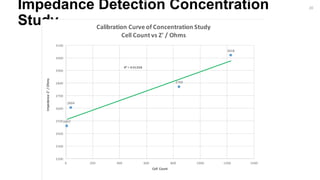
Calibration Curve of Concentration Study
Cell Count vs Z' / Ohms
-3.00
-2.00
-1.00
0.00
1.00
2.00
3.00
4.00
5.00
-0.3-0.2-0.100.10.20.30.40.50.60.70.80.911.11.21.31.41.51.6
Current/µA
Potential / V
CV of Bare Au Electrodes in H2SO4
Bare Electrode 1 Bare Electrode 2 Bare Electrode 3 Bare Electrode 4 Potential/V
-1400.00
-1200.00
-1000.00
-800.00
-600.00
-400.00
-200.00
0.00
0.00 500.00 1000.00 1500.00 2000.00 2500.00 3000.00 3500.00
Z'/Ohm
Z' / Ohm
Nyquest Plot of E. Coli Concentration Study
Bare Antibody Bacteria [Highest Concentration] Bacteria [Medium Concentration]
Bacteria [Low Concentration] Bacteria [Lowest Concentration] Thiol
3
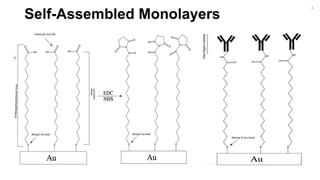
Self-Assembled Monolayers
4
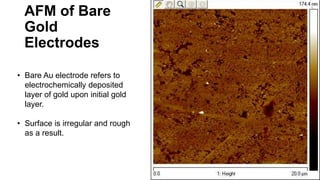
AFM of Bare
Gold
Electrodes
• Bare Au electrode refers to
electrochemically deposited
layer of gold upon initial gold
layer.
• Surface is irregular and rough
as a result.
5
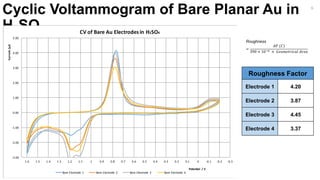
Cyclic Voltammogram of Bare Planar Au in
H2SO4
-3.00
-2.00
-1.00
0.00
1.00
2.00
3.00
4.00
5.00
-0.3-0.2-0.100.10.20.30.40.50.60.70.80.911.11.21.31.41.51.6
Current/µA
Potential / V
CV of Bare Au Electrodes in H2SO4
Bare Electrode 1 Bare Electrode 2 Bare Electrode 3 Bare Electrode 4 Potential/V
Roughness Factor
Electrode 1 4.20
Electrode 2 3.87
Electrode 3 4.45
Electrode 4 3.37
Roughness
=
𝐴𝑃 (𝐶
390 × 10−6 × 𝐺𝑒𝑜𝑚𝑒𝑡𝑟𝑖𝑐𝑎𝑙 𝐴𝑟𝑒𝑎
6
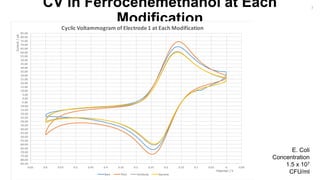
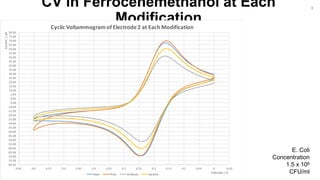
CV in Ferrocenemethanol at Each
Modification
-85.00
-80.00
-75.00
-70.00
-65.00
-60.00
-55.00
-50.00
-45.00
-40.00
-35.00
-30.00
-25.00
-20.00
-15.00
-10.00
-5.00
0.00
5.00
10.00
15.00
20.00
25.00
30.00
35.00
40.00
45.00
50.00
55.00
60.00
65.00
70.00
75.00
80.00
85.00
-0.0500.050.10.150.20.250.30.350.40.450.50.550.60.65
Current/µA
Potential / V
Cyclic Voltammogram of Electrode 1 at Each Modification
Bare Thiol Antibody Bacteria
E. Coli
Concentration
1.5 x 10⁷
CFU/ml
7
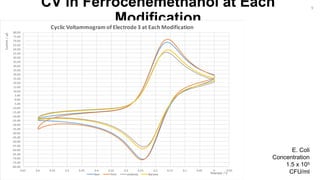
CV in Ferrocenemethanol at Each
Modification
-80.00
-75.00
-70.00
-65.00
-60.00
-55.00
-50.00
-45.00
-40.00
-35.00
-30.00
-25.00
-20.00
-15.00
-10.00
-5.00
0.00
5.00
10.00
15.00
20.00
25.00
30.00
35.00
40.00
45.00
50.00
55.00
60.00
65.00
70.00
75.00
80.00
-0.0500.050.10.150.20.250.30.350.40.450.50.550.60.65
Current/µA
Potential / V
Cyclic Voltammogram of Electrode 2 at Each Modification
Bare Thiol Antibody Bacteria
E. Coli
Concentration
1.5 x 10⁶
CFU/ml
8
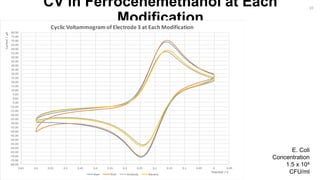
CV in Ferrocenemethanol at Each
Modification
-80.00
-75.00
-70.00
-65.00
-60.00
-55.00
-50.00
-45.00
-40.00
-35.00
-30.00
-25.00
-20.00
-15.00
-10.00
-5.00
0.00
5.00
10.00
15.00
20.00
25.00
30.00
35.00
40.00
45.00
50.00
55.00
60.00
65.00
70.00
75.00
80.00
-0.0500.050.10.150.20.250.30.350.40.450.50.550.60.65
Current/µA
Potential / V
Cyclic Voltammogram of Electrode 3 at Each Modification
Bare Thiol antibody Bacteria
E. Coli
Concentration
1.5 x 10⁵
CFU/ml
9
CV in Ferrocenemethanol at Each
Modification
-80.00
-75.00
-70.00
-65.00
-60.00
-55.00
-50.00
-45.00
-40.00
-35.00
-30.00
-25.00
-20.00
-15.00
-10.00
-5.00
0.00
5.00
10.00
15.00
20.00
25.00
30.00
35.00
40.00
45.00
50.00
55.00
60.00
65.00
70.00
75.00
80.00
-0.0500.050.10.150.20.250.30.350.40.450.50.550.60.65
Current/µA
Potential / V
Cyclic Voltammogram of Electrode 3 at Each Modification
Bare Thiol Antibody Bacteria
E. Coli
Concentration
1.5 x 10⁴
CFU/ml
10
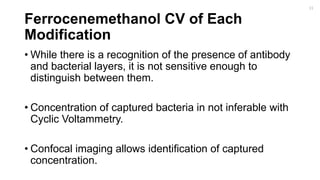
Ferrocenemethanol CV of Each
Modification
• While there is a recognition of the presence of antibody
and bacterial layers, it is not sensitive enough to
distinguish between them.
• Concentration of captured bacteria in not inferable with
Cyclic Voltammetry.
• Confocal imaging allows identification of captured
concentration.
11
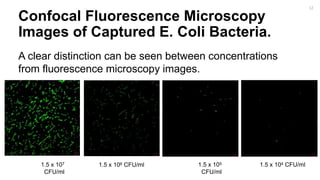
Confocal Fluorescence Microscopy
Images of Captured E. Coli Bacteria.
1.5 x 10⁴ CFU/ml
A clear distinction can be seen between concentrations
from fluorescence microscopy images.
1.5 x 10⁵
CFU/ml
1.5 x 10⁶ CFU/ml1.5 x 107
CFU/ml
12
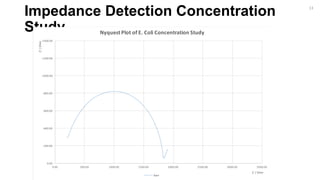
Impedance Detection Concentration
Study
-1400.00
-1200.00
-1000.00
-800.00
-600.00
-400.00
-200.00
0.00
0.00 500.00 1000.00 1500.00 2000.00 2500.00 3000.00 3500.00
Z'/Ohm
Z' / Ohm
Nyquest Plot of E. Coli Concentration Study
Bare
13
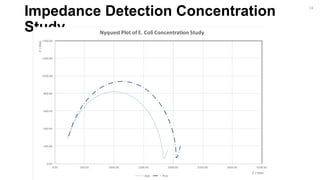
Impedance Detection Concentration
Study
-1400.00
-1200.00
-1000.00
-800.00
-600.00
-400.00
-200.00
0.00
0.00 500.00 1000.00 1500.00 2000.00 2500.00 3000.00 3500.00
Z'/Ohm
Z' / Ohm
Nyquest Plot of E. Coli Concentration Study
Bare Thiol
14
Impedance Detection Concentration
Study
-1400.00
-1200.00
-1000.00
-800.00
-600.00
-400.00
-200.00
0.00
0.00 500.00 1000.00 1500.00 2000.00 2500.00 3000.00 3500.00
Z'/Ohm
Z' / Ohm
Nyquest Plot of E. Coli Concentration Study
Bare Antibody Thiol
15
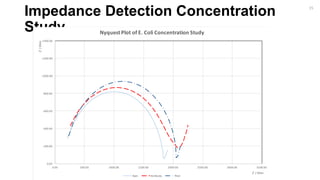
Impedance Detection Concentration
Study
-1400.00
-1200.00
-1000.00
-800.00
-600.00
-400.00
-200.00
0.00
0.00 500.00 1000.00 1500.00 2000.00 2500.00 3000.00 3500.00
Z'/Ohm
Z' / Ohm
Nyquest Plot of E. Coli Concentration Study
Bare Antibody Bacteria [Lowest Concentration] Thiol
16
Impedance Detection Concentration
Study
-1400.00
-1200.00
-1000.00
-800.00
-600.00
-400.00
-200.00
0.00
0.00 500.00 1000.00 1500.00 2000.00 2500.00 3000.00 3500.00
Z'/Ohm
Z' / Ohm
Nyquest Plot of E. Coli Concentration Study
Bare Antibody Bacteria [Low Concentration] Bacteria [Lowest Concentration] Thiol
17
Impedance Detection Concentration
Study
-1400.00
-1200.00
-1000.00
-800.00
-600.00
-400.00
-200.00
0.00
0.00 500.00 1000.00 1500.00 2000.00 2500.00 3000.00 3500.00
Z'/Ohm
Z' / Ohm
Nyquest Plot of E. Coli Concentration Study
Bare Antibody Bacteria [Medium Concentration] Bacteria [Low Concentration] Bacteria [Lowest Concentration] Thiol
18
Impedance Detection Concentration
Study
-1400.00
-1200.00
-1000.00
-800.00
-600.00
-400.00
-200.00
0.00
0.00 500.00 1000.00 1500.00 2000.00 2500.00 3000.00 3500.00
Z'/Ohm
Z' / Ohm
Nyquest Plot of E. Coli Concentration Study
Bare Antibody Bacteria [Highest Concentration] Bacteria [Medium Concentration]
Bacteria [Low Concentration] Bacteria [Lowest Concentration] Thiol
19
Impedance Detection Concentration
Study
3018
2769
2604
2457
R² = 0.91358
2200
2300
2400
2500
2600
2700
2800
2900
3000
3100
0 200 400 600 800 1000 1200 1400
ImpedanceZ'/Ohms
Cell Count
Calibration Curve of Concentration Study
Cell Count vs Z' / Ohms
20
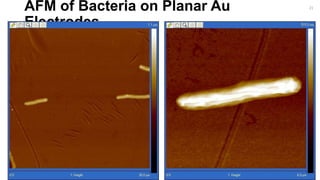
AFM of Bacteria on Planar Au
Electrodes.
21
Fabrication of Nanostructures to
Improve Bacteria Capture.
[2]
22
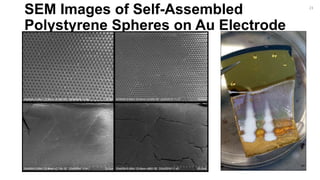
SEM Images of Self-Assembled
Polystyrene Spheres on Au Electrode
23
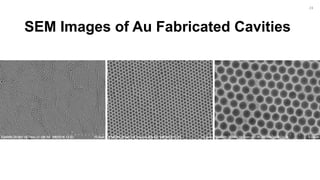
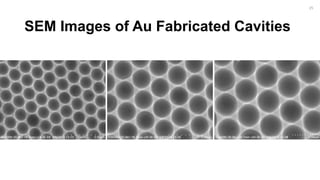
SEM Images of Au Fabricated Cavities
24
SEM Images of Au Fabricated Cavities
25
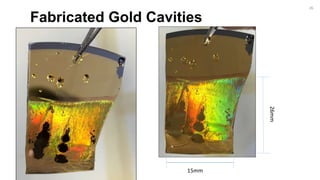
Fabricated Gold Cavities
15mm
26mm
26
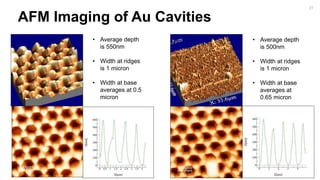
AFM Imaging of Au Cavities
• Average depth
is 550nm
• Width at ridges
is 1 micron
• Width at base
averages at 0.5
micron
• Average depth
is 500nm
• Width at ridges
is 1 micron
• Width at base
averages at
0.65 micron
27
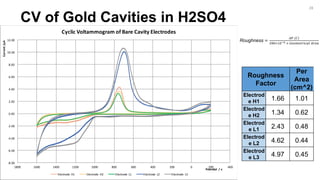
CV of Gold Cavities in H2SO4
-8.00
-6.00
-4.00
-2.00
0.00
2.00
4.00
6.00
8.00
10.00
12.00
-400-200020040060080010001200140016001800
Current/µA
Potential / v
Cyclic Voltammogram of Bare Cavity Electrodes
Electrode H1 Electrode H2 Electrode L1 Electrode L2 Electrode L3
Roughness =
𝐴𝑃 (𝐶
390×10−6 × 𝐺𝑒𝑜𝑚𝑒𝑡𝑟𝑖𝑐𝑎𝑙 𝐴𝑟𝑒𝑎
Roughness
Factor
Per
Area
(cm^2)
Electrod
e H1 1.66 1.01
Electrod
e H2 1.34 0.62
Electrod
e L1 2.43 0.48
Electrod
e L2 4.62 0.44
Electrod
e L3 4.97 0.45
28
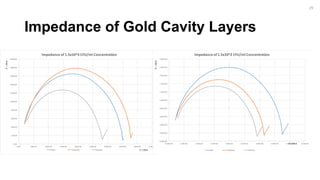
Impedance of Gold Cavity Layers
-2000.00
-1800.00
-1600.00
-1400.00
-1200.00
-1000.00
-800.00
-600.00
-400.00
-200.00
0.00
0.00 500.00 1000.00 1500.00 2000.00 2500.00 3000.00 3500.00 4000.00 4500.00
Impedance of 1.5x10^3 CFU/ml Concentration
Bare Antibody Bacteria Z' / Ohm
Z"/Ohm
-2.00E+03
-1.80E+03
-1.60E+03
-1.40E+03
-1.20E+03
-1.00E+03
-8.00E+02
-6.00E+02
-4.00E+02
-2.00E+02
0.00E+00
0.00E+00 5.00E+02 1.00E+03 1.50E+03 2.00E+03 2.50E+03 3.00E+03 3.50E+03 4.00E+03 4.50E+03
Impedance of 1.5x10^2 CFU/ml Concentration
Bare Antibody Bacteria
Z' / Ohm
Z"/Ohm
29
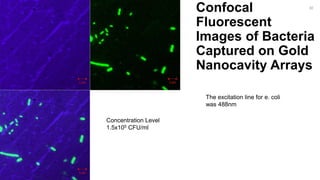
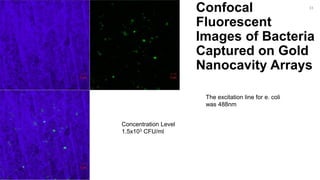
Confocal
Fluorescent
Images of Bacteria
Captured on Gold
Nanocavity Arrays
30
Concentration Level
1.5x10⁵ CFU/ml
The excitation line for e. coli
was 488nm
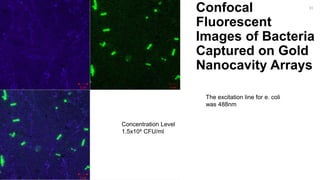
Confocal
Fluorescent
Images of Bacteria
Captured on Gold
Nanocavity Arrays
31
Concentration Level
1.5x10⁴ CFU/ml
The excitation line for e. coli
was 488nm
Confocal
Fluorescent
Images of Bacteria
Captured on Gold
Nanocavity Arrays
32
Concentration Level
1.5x10³ CFU/ml
The excitation line for e. coli
was 488nm
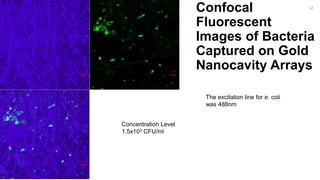
Confocal
Fluorescent
Images of Bacteria
Captured on Gold
Nanocavity Arrays
33
Concentration Level
1.5x10³ CFU/ml
The excitation line for e. coli
was 488nm
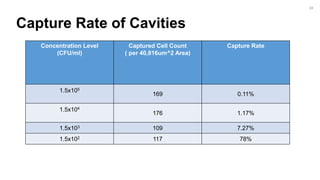
Capture Rate of Cavities
Concentration Level
(CFU/ml)
Captured Cell Count
( per 40,816um^2 Area)
Capture Rate
1.5x10⁵
169 0.11%
1.5x10⁴
176 1.17%
1.5x10³ 109 7.27%
1.5x10² 117 78%
34
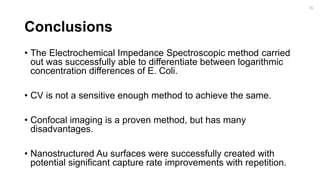
Conclusions
• The Electrochemical Impedance Spectroscopic method carried
out was successfully able to differentiate between logarithmic
concentration differences of E. Coli.
• CV is not a sensitive enough method to achieve the same.
• Confocal imaging is a proven method, but has many
disadvantages.
• Nanostructured Au surfaces were successfully created with
potential significant capture rate improvements with repetition.
35
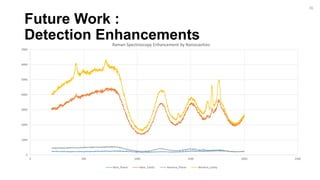
Future Work :
Detection Enhancements
0
1000
2000
3000
4000
5000
6000
7000
0 500 1000 1500 2000 2500
Raman Spectroscopy Enhancement by Nanocavities
Bare_Planar Bare_Cavity Bacteria_Planar Bacteria_Cavity
36
Future Work
• Impedance concentration study on nanostructured Au electrodes.
• Investigating new limits of detection.
• Application of method to cancer cell detection.
• Signal enhancment / amplification techniques.
• Applification of method to Microfluidic discs.
• Investigation into why E. Coli elongate on nanotextured gold surfaces.
37
References
1. Mary Artine. Ecoli bacteria dividing, YouTube, 2012.
2. Jose, B. Biomimetic Photonic Nanocavity Arrays. doctoral,
Dublin City University. School of Chemical Sciences, 2011.
38
Thank
You
39

Final Year Project Presentation

  • 1.
    Electrochemical Impedance Detection ofPathogens Glen Carter Under The Supervision of Professor Robert J. Forster.
  • 2.
  • 3.
    Project Overview 3018 2769 2604 2457 2200 2300 2400 2500 2600 2700 2800 2900 3000 3100 0 200 400600 800 1000 1200 1400 ImpedanceZ'/Ohms Cell Count Calibration Curve of Concentration Study Cell Count vs Z' / Ohms -3.00 -2.00 -1.00 0.00 1.00 2.00 3.00 4.00 5.00 -0.3-0.2-0.100.10.20.30.40.50.60.70.80.911.11.21.31.41.51.6 Current/µA Potential / V CV of Bare Au Electrodes in H2SO4 Bare Electrode 1 Bare Electrode 2 Bare Electrode 3 Bare Electrode 4 Potential/V -1400.00 -1200.00 -1000.00 -800.00 -600.00 -400.00 -200.00 0.00 0.00 500.00 1000.00 1500.00 2000.00 2500.00 3000.00 3500.00 Z'/Ohm Z' / Ohm Nyquest Plot of E. Coli Concentration Study Bare Antibody Bacteria [Highest Concentration] Bacteria [Medium Concentration] Bacteria [Low Concentration] Bacteria [Lowest Concentration] Thiol 3
  • 4.
  • 5.
    AFM of Bare Gold Electrodes •Bare Au electrode refers to electrochemically deposited layer of gold upon initial gold layer. • Surface is irregular and rough as a result. 5
  • 6.
    Cyclic Voltammogram ofBare Planar Au in H2SO4 -3.00 -2.00 -1.00 0.00 1.00 2.00 3.00 4.00 5.00 -0.3-0.2-0.100.10.20.30.40.50.60.70.80.911.11.21.31.41.51.6 Current/µA Potential / V CV of Bare Au Electrodes in H2SO4 Bare Electrode 1 Bare Electrode 2 Bare Electrode 3 Bare Electrode 4 Potential/V Roughness Factor Electrode 1 4.20 Electrode 2 3.87 Electrode 3 4.45 Electrode 4 3.37 Roughness = 𝐴𝑃 (𝐶 390 × 10−6 × 𝐺𝑒𝑜𝑚𝑒𝑡𝑟𝑖𝑐𝑎𝑙 𝐴𝑟𝑒𝑎 6
  • 7.
    CV in Ferrocenemethanolat Each Modification -85.00 -80.00 -75.00 -70.00 -65.00 -60.00 -55.00 -50.00 -45.00 -40.00 -35.00 -30.00 -25.00 -20.00 -15.00 -10.00 -5.00 0.00 5.00 10.00 15.00 20.00 25.00 30.00 35.00 40.00 45.00 50.00 55.00 60.00 65.00 70.00 75.00 80.00 85.00 -0.0500.050.10.150.20.250.30.350.40.450.50.550.60.65 Current/µA Potential / V Cyclic Voltammogram of Electrode 1 at Each Modification Bare Thiol Antibody Bacteria E. Coli Concentration 1.5 x 10⁷ CFU/ml 7
  • 8.
    CV in Ferrocenemethanolat Each Modification -80.00 -75.00 -70.00 -65.00 -60.00 -55.00 -50.00 -45.00 -40.00 -35.00 -30.00 -25.00 -20.00 -15.00 -10.00 -5.00 0.00 5.00 10.00 15.00 20.00 25.00 30.00 35.00 40.00 45.00 50.00 55.00 60.00 65.00 70.00 75.00 80.00 -0.0500.050.10.150.20.250.30.350.40.450.50.550.60.65 Current/µA Potential / V Cyclic Voltammogram of Electrode 2 at Each Modification Bare Thiol Antibody Bacteria E. Coli Concentration 1.5 x 10⁶ CFU/ml 8
  • 9.
    CV in Ferrocenemethanolat Each Modification -80.00 -75.00 -70.00 -65.00 -60.00 -55.00 -50.00 -45.00 -40.00 -35.00 -30.00 -25.00 -20.00 -15.00 -10.00 -5.00 0.00 5.00 10.00 15.00 20.00 25.00 30.00 35.00 40.00 45.00 50.00 55.00 60.00 65.00 70.00 75.00 80.00 -0.0500.050.10.150.20.250.30.350.40.450.50.550.60.65 Current/µA Potential / V Cyclic Voltammogram of Electrode 3 at Each Modification Bare Thiol antibody Bacteria E. Coli Concentration 1.5 x 10⁵ CFU/ml 9
  • 10.
    CV in Ferrocenemethanolat Each Modification -80.00 -75.00 -70.00 -65.00 -60.00 -55.00 -50.00 -45.00 -40.00 -35.00 -30.00 -25.00 -20.00 -15.00 -10.00 -5.00 0.00 5.00 10.00 15.00 20.00 25.00 30.00 35.00 40.00 45.00 50.00 55.00 60.00 65.00 70.00 75.00 80.00 -0.0500.050.10.150.20.250.30.350.40.450.50.550.60.65 Current/µA Potential / V Cyclic Voltammogram of Electrode 3 at Each Modification Bare Thiol Antibody Bacteria E. Coli Concentration 1.5 x 10⁴ CFU/ml 10
  • 11.
    Ferrocenemethanol CV ofEach Modification • While there is a recognition of the presence of antibody and bacterial layers, it is not sensitive enough to distinguish between them. • Concentration of captured bacteria in not inferable with Cyclic Voltammetry. • Confocal imaging allows identification of captured concentration. 11
  • 12.
    Confocal Fluorescence Microscopy Imagesof Captured E. Coli Bacteria. 1.5 x 10⁴ CFU/ml A clear distinction can be seen between concentrations from fluorescence microscopy images. 1.5 x 10⁵ CFU/ml 1.5 x 10⁶ CFU/ml1.5 x 107 CFU/ml 12
  • 13.
    Impedance Detection Concentration Study -1400.00 -1200.00 -1000.00 -800.00 -600.00 -400.00 -200.00 0.00 0.00500.00 1000.00 1500.00 2000.00 2500.00 3000.00 3500.00 Z'/Ohm Z' / Ohm Nyquest Plot of E. Coli Concentration Study Bare 13
  • 14.
    Impedance Detection Concentration Study -1400.00 -1200.00 -1000.00 -800.00 -600.00 -400.00 -200.00 0.00 0.00500.00 1000.00 1500.00 2000.00 2500.00 3000.00 3500.00 Z'/Ohm Z' / Ohm Nyquest Plot of E. Coli Concentration Study Bare Thiol 14
  • 15.
    Impedance Detection Concentration Study -1400.00 -1200.00 -1000.00 -800.00 -600.00 -400.00 -200.00 0.00 0.00500.00 1000.00 1500.00 2000.00 2500.00 3000.00 3500.00 Z'/Ohm Z' / Ohm Nyquest Plot of E. Coli Concentration Study Bare Antibody Thiol 15
  • 16.
    Impedance Detection Concentration Study -1400.00 -1200.00 -1000.00 -800.00 -600.00 -400.00 -200.00 0.00 0.00500.00 1000.00 1500.00 2000.00 2500.00 3000.00 3500.00 Z'/Ohm Z' / Ohm Nyquest Plot of E. Coli Concentration Study Bare Antibody Bacteria [Lowest Concentration] Thiol 16
  • 17.
    Impedance Detection Concentration Study -1400.00 -1200.00 -1000.00 -800.00 -600.00 -400.00 -200.00 0.00 0.00500.00 1000.00 1500.00 2000.00 2500.00 3000.00 3500.00 Z'/Ohm Z' / Ohm Nyquest Plot of E. Coli Concentration Study Bare Antibody Bacteria [Low Concentration] Bacteria [Lowest Concentration] Thiol 17
  • 18.
    Impedance Detection Concentration Study -1400.00 -1200.00 -1000.00 -800.00 -600.00 -400.00 -200.00 0.00 0.00500.00 1000.00 1500.00 2000.00 2500.00 3000.00 3500.00 Z'/Ohm Z' / Ohm Nyquest Plot of E. Coli Concentration Study Bare Antibody Bacteria [Medium Concentration] Bacteria [Low Concentration] Bacteria [Lowest Concentration] Thiol 18
  • 19.
    Impedance Detection Concentration Study -1400.00 -1200.00 -1000.00 -800.00 -600.00 -400.00 -200.00 0.00 0.00500.00 1000.00 1500.00 2000.00 2500.00 3000.00 3500.00 Z'/Ohm Z' / Ohm Nyquest Plot of E. Coli Concentration Study Bare Antibody Bacteria [Highest Concentration] Bacteria [Medium Concentration] Bacteria [Low Concentration] Bacteria [Lowest Concentration] Thiol 19
  • 20.
    Impedance Detection Concentration Study 3018 2769 2604 2457 R²= 0.91358 2200 2300 2400 2500 2600 2700 2800 2900 3000 3100 0 200 400 600 800 1000 1200 1400 ImpedanceZ'/Ohms Cell Count Calibration Curve of Concentration Study Cell Count vs Z' / Ohms 20
  • 21.
    AFM of Bacteriaon Planar Au Electrodes. 21
  • 22.
    Fabrication of Nanostructuresto Improve Bacteria Capture. [2] 22
  • 23.
    SEM Images ofSelf-Assembled Polystyrene Spheres on Au Electrode 23
  • 24.
    SEM Images ofAu Fabricated Cavities 24
  • 25.
    SEM Images ofAu Fabricated Cavities 25
  • 26.
  • 27.
    AFM Imaging ofAu Cavities • Average depth is 550nm • Width at ridges is 1 micron • Width at base averages at 0.5 micron • Average depth is 500nm • Width at ridges is 1 micron • Width at base averages at 0.65 micron 27
  • 28.
    CV of GoldCavities in H2SO4 -8.00 -6.00 -4.00 -2.00 0.00 2.00 4.00 6.00 8.00 10.00 12.00 -400-200020040060080010001200140016001800 Current/µA Potential / v Cyclic Voltammogram of Bare Cavity Electrodes Electrode H1 Electrode H2 Electrode L1 Electrode L2 Electrode L3 Roughness = 𝐴𝑃 (𝐶 390×10−6 × 𝐺𝑒𝑜𝑚𝑒𝑡𝑟𝑖𝑐𝑎𝑙 𝐴𝑟𝑒𝑎 Roughness Factor Per Area (cm^2) Electrod e H1 1.66 1.01 Electrod e H2 1.34 0.62 Electrod e L1 2.43 0.48 Electrod e L2 4.62 0.44 Electrod e L3 4.97 0.45 28
  • 29.
    Impedance of GoldCavity Layers -2000.00 -1800.00 -1600.00 -1400.00 -1200.00 -1000.00 -800.00 -600.00 -400.00 -200.00 0.00 0.00 500.00 1000.00 1500.00 2000.00 2500.00 3000.00 3500.00 4000.00 4500.00 Impedance of 1.5x10^3 CFU/ml Concentration Bare Antibody Bacteria Z' / Ohm Z"/Ohm -2.00E+03 -1.80E+03 -1.60E+03 -1.40E+03 -1.20E+03 -1.00E+03 -8.00E+02 -6.00E+02 -4.00E+02 -2.00E+02 0.00E+00 0.00E+00 5.00E+02 1.00E+03 1.50E+03 2.00E+03 2.50E+03 3.00E+03 3.50E+03 4.00E+03 4.50E+03 Impedance of 1.5x10^2 CFU/ml Concentration Bare Antibody Bacteria Z' / Ohm Z"/Ohm 29
  • 30.
    Confocal Fluorescent Images of Bacteria Capturedon Gold Nanocavity Arrays 30 Concentration Level 1.5x10⁵ CFU/ml The excitation line for e. coli was 488nm
  • 31.
    Confocal Fluorescent Images of Bacteria Capturedon Gold Nanocavity Arrays 31 Concentration Level 1.5x10⁴ CFU/ml The excitation line for e. coli was 488nm
  • 32.
    Confocal Fluorescent Images of Bacteria Capturedon Gold Nanocavity Arrays 32 Concentration Level 1.5x10³ CFU/ml The excitation line for e. coli was 488nm
  • 33.
    Confocal Fluorescent Images of Bacteria Capturedon Gold Nanocavity Arrays 33 Concentration Level 1.5x10³ CFU/ml The excitation line for e. coli was 488nm
  • 34.
    Capture Rate ofCavities Concentration Level (CFU/ml) Captured Cell Count ( per 40,816um^2 Area) Capture Rate 1.5x10⁵ 169 0.11% 1.5x10⁴ 176 1.17% 1.5x10³ 109 7.27% 1.5x10² 117 78% 34
  • 35.
    Conclusions • The ElectrochemicalImpedance Spectroscopic method carried out was successfully able to differentiate between logarithmic concentration differences of E. Coli. • CV is not a sensitive enough method to achieve the same. • Confocal imaging is a proven method, but has many disadvantages. • Nanostructured Au surfaces were successfully created with potential significant capture rate improvements with repetition. 35
  • 36.
    Future Work : DetectionEnhancements 0 1000 2000 3000 4000 5000 6000 7000 0 500 1000 1500 2000 2500 Raman Spectroscopy Enhancement by Nanocavities Bare_Planar Bare_Cavity Bacteria_Planar Bacteria_Cavity 36
  • 37.
    Future Work • Impedanceconcentration study on nanostructured Au electrodes. • Investigating new limits of detection. • Application of method to cancer cell detection. • Signal enhancment / amplification techniques. • Applification of method to Microfluidic discs. • Investigation into why E. Coli elongate on nanotextured gold surfaces. 37
  • 38.
    References 1. Mary Artine.Ecoli bacteria dividing, YouTube, 2012. 2. Jose, B. Biomimetic Photonic Nanocavity Arrays. doctoral, Dublin City University. School of Chemical Sciences, 2011. 38
  • 39.

Editor's Notes

  • #3 This is a video showing the rapid cell multiplication of E. Coli over just a few hours time. This is similar to that which would occur in drinking water and food. Currently employed methods of detection can take days for accurate results and this highlights the need for methods of rapid pathogenic detection.
  • #4 Overall aim of the project is to detect ultra-low concentrations of pathogens. This was achieved through a plethora of electrochemical and characterisation techniques. In order to detect and analyse the pathogens, we first had to be able to capture them. Successful cell capture was achieved through the creation of self-assembled monolayers, which were and then modified to facilitate selective capture of E. Coli.Using a 3 Electrode system in phosphate buffer solution EIS measurements were conducted to detect the presence of bacteria by examining the change in charge transfer resistance. A concentration study was carried out. Using the same 3 electrode system in a ferrocenemethanol solution, Cyclic voltammetric assays were also conducted to examine if the presence of bacteria has an effect on the redox potential of the gold electrodes. Various characterisation methods were conducted on the modified electrodes.
  • #5 This schematic represents the strategy for selective capture of E. Coli and the modifications required. A 3-carbon chain was used initially for CV assays because the chain was close enough to the electrical environment for sufficient probing from the interface. When Impedance became the focal point of the study, a 16 carbon chain was used as this optimised impedance measurements.
  • #6 A bare electrode in the context of this project refers to an electrohemically deposited layer of gold ontop of a silicone wafer. The roughness of the surface is quite high. This was calculated by Cyclic voltammetry.
  • #7 CV of the planar, bare Au electrodes in sulfuric acid was conducted to calculate the surface roughness factor of the electrodes. Geometrically measured area of the electrodes was 0.3cm^2,
  • #8 CVs of the electrodes were conducted at each stage of electrode modification and the capture of bacteria to identify the effect of each on the redox potential of the electrode. It can be seen that there is an increase in redox potential with the addition of the thiol. This is due to the increased presence of electrons so close to the electrical environment of the metal surface with the 3-carbon chain. We expect a contraction of the peaks with the addition of antibodies and bacteria as they block more of the surface from redox reactions. However, there is virtually no distinction between the antibody layer and the captured pathogen layer. This trend is seen in assays where n=12 and lead to the conclusion that CV is not a sensitive enough method. Focus then shifted to impedance detection.
  • #9 Cv in fe..at each modification, on planar gold. Show 4 CVs and explain the concentrations. Show the confocal images on next slide corresponding to those
  • #10 Cv in fe..at each modification, on planar gold. Show 4 CVs and explain the concentrations. Show the confocal images on next slide corresponding to those
  • #13 These are the corresponding confocal images of the CVs 1-4 shown. Just by observation it is clear to see that there is a distinction between the concentrations, but this was not inferable from CV assays. 1:10 serial dilutions created the changes in order of magnitude. The concentrations were calculated by conducting a colony culture growth and calculating the colonies formed.
  • #14 We then moved on to impedance detection, where each of the layers were analysed by measuring the charge transfer resistance of each of the layers on the electrodes. What we are interested in here is the extrapolation of the right-side end of the semi-circles to the x-axis. And the differentiation of these values from each other at different layers of the biosensor device. A concentration study was conducted and showed clear results.
  • #17 This shows the 1.5 x 10 ^ 4 CFU/ml concentration. Which was the lowest. As expected, it gave an increase in impedance compared to the antibody layer. Increasing concentrations also gave increased impedance values.
  • #18 1.5 x 10 ^ 5
  • #19 1.5 x 10 ^ 6
  • #20 1.5 x 10 ^ 7
  • #21 The concentration study confirmed the potential of Impedance as a rapid detection method . The focus of the project was now on optimisation of the method.
  • #22 Confocal imaging confirmed the concentration differences but what was observed was irregular elongation of the e. coli. AFM imaging was done to analyse this elongation as E. coli bacteria is supposed to be between 2-3 micrometers in length. And this is an area requiring further investigation.
  • #23 In order to enhance the capture of bacteria, nanocavities were fabricated which would increase the surface area available for capture. The hypothesis was that an increased surface area would enhance the capture rate of pathogens and make analysis of the analyte more sensitive. To achieve this, template electrochemical deposition and nanolitography were used where polystyrene spheres of a uniform 1 micron diameter were packed onto an AU electrode surface, the cavities were constructed with Au electrochemical deposition, and the spheres dissolved with THF
  • #24 Polystyrene spheres in aqueous Solution. Close-packing achieved with room temperature evaporation. Increased surface area should increase effective cell capture. CAPILLARY ACTION OF WATER PUTTING PRESSURE ON SPHERES TO PACK NICELY
  • #27 The highly reflective surface of the cavities seen by eye is an indicator that a uniform monolayer of nanocavity arrays were constructed. We then wanted to determine the depth and topography of the cavities so we conducted AFM imaging. In papers it’s usually reported that the reproducibility of the cavity construction is dependant on the thickness of the gold cavities which varies between the slides. Hard to get a large surface area on a single slide as thickness varies between the slides. Usually only micrometres are reported in papers.
  • #29 As with the planar electrodes, CVs in sulfuric acid were conducted to calculate the surface roughness. The roughness factors varied due to the difference in size of the electrodes. An overall increase of ~60 surface area was achieved as compared to planar electrodes geometrical area.
  • #30 Due to time constraints, Antibody stamping, an alternative method of antibody immobilisation was done on the cavity arrays. Impedance here did not yield the same trend seen previously . What was concluded was that the consistency in thiol monolayers contributes greatly to the sensitivity of impedance readings. Stamping is not ideal because it is not consistent and the bacteria binds by non-specific binding which is not reliable for pathogen capture and detection. This was confirmed by the absence of a clear concentration differentiation from confocal fluorescence imaging.
  • #31 3 channel scattering was used in order to show the cavities and overlay the bacteria to see where they were locating.
  • #32 The non-specific binding of the stamping method did not allow selective capture of bacteria.
  • #35  Although the concentration levels of the bacteria ranged from 150 CFU/ml to 1.5x10^5 CFU/ml, the capture rate was similar ranging from 117 to 169 captured captured cells respectively. This is most likely due to the non-specific binding of the bacteria because of the antibody stamping immobilisation method. I tried to repeat this experiment to use the thiol monolayer for covalent antibody fixation but creating the nanocavities again was not working.
  • #36 Mention that you learned a lot of techniques : IT etc etc…
  • #37 Before I finished up I investigated reported signal enhancement of Raman spectroscopy by the nanocavities. Explain the lines…... We can see that there are some raman peaks which may be from raman-active species in the bacteria, but further investigation is required and this is an area for future work.