Word parts and meanings
START
Vocabulary Prefixes Root words Suffixes Engage
Word parts and meanings
Once you learn the building
blocks with which words are
made, many
previously
unknown
words
become
meaningful and useful
NEXT
HOME
Many English words were taken
from Greek or Latin roots
Word parts and meanings
These units are often
not words themselves,
but are
combined
with other
elements
to form words.
NEXT
HOME BACK
The quickest and easiest way to
increase your vocabulary is to analyse
the word in question and deduct the
meaning of the word from the meaning
of the different word parts
ROOT WORDS
The most basic part of a word. It stands on
its own as a word and has meaning.
Example:
PHOTO:
Photograph
Photosynthesis
HOME LEARN MORE
ROOT WORDS
⮚ The meaning of root words never
changes even though other letter or
word parts may change
⮚ Are used in combination with other word-
building blocks like prefixes and
suffixes
HOME LEARN MORE
The most basic part of a word. It stands on
its own as a word and has meaning.
Example:
Photo: Meaning: a representation of a
person or scene in the form of a
print or transparent slide; recorded
by a camera on light-sensitive
material
Photograph
Photosynthesis
HOME LEARN MORE
When added to another word part:
a combining form meaning “light”
Examples
CARE
HAPPY
WALK
Meaning
look after
feeling excitement
carefully
unhappy,
happiness
walked, walking
BACK
act of travelling
NEXT
Examples:
A letter or group of letters placed
before a root word that changes the
meaning
PREFIXES:
DIS-
When the prefix ‘dis-’ is added to the word
‘appear’, it makes the word opposite in meaning
(‘disappear’)
LEARN MORE
HOME
Example:
A letter or group of letters placed
before a root word that changes the
meaning
PREFIXES:
EX- CO- DE- SEMI-
LEARN MORE
HOME
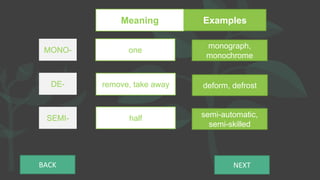
More examples:
Examples
MONO-
DE-
SEMI-
Meaning
one
monograph,
monochrome
deform, defrost
semi-automatic,
semi-skilled
BACK
remove, take away
half
NEXT
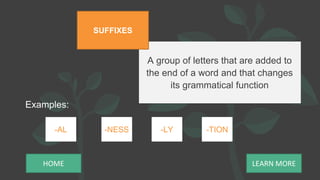
SUFFIXES
A group of letters that are added to
the end of a word and that changes
its grammatical function
Examples:
-AL -NESS -LY -TION
LEARN MORE
HOME
Tell us whether a word is used as an action
word (verb), a modifier (adjective or adverb),
or name of a person, place or thing (noun).
SUFFIXES
Example:
employee-employees
Serve to distinguish between number and tense
employ-employed
NEXT
BACK
Examples
-AL
-LY
-TION
Meaning
action/result national, accidental
lovely, quickly
education,
collaboration
BACK
adverb
action/instance
NEXT
ENGAGE
Try to guess the meaning of these prefixes,
root words and suffixes on your own
VOCABULARY
BUILDING
START
Ante- means
before
How does the prefix ante- change the meaning of the words:
anteroom; antedate.
Ante- means
after
Ante- means
against
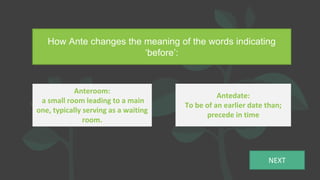
Anteroom:
a small room leading to a main
one, typically serving as a waiting
room.
How Ante changes the meaning of the words indicating
‘before’:
Antedate:
To be of an earlier date than;
precede in time
NEXT
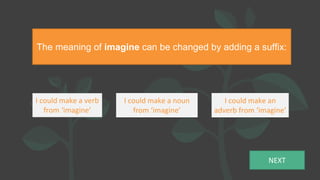
I could make a verb
from ‘imagine’
The meaning of imagine can be changed by adding a suffix:
I could make a noun
from ‘imagine’
I could make an
adverb from ‘imagine’
NEXT
a verb: imagined
Change the meaning of the following word by adding a suffix:
imagine
a noun: imagination
an adverb:
imaginatively
NEXT
enjoy
What is the root for the following word: enjoyment
joyment joy
CORRECT!
NEXT
CORRECT!
NEXT
CORRECT!
NEXT
INCORRECT!
TRY AGAIN
GO BACK TO
PREFIXES
INCORRECT!
TRY AGAIN
GO BACK TO
SUFFIXES
INCORRECT!
TRY AGAIN
GO BACK TO
ROOT WORDS
WELL DONE!
Close the presentation and continue with the content of
the module on clickUP

FINAL Unit 1 Presentation (1).ppsx

  • 1.
    Word parts andmeanings START Vocabulary Prefixes Root words Suffixes Engage
  • 2.
    Word parts andmeanings Once you learn the building blocks with which words are made, many previously unknown words become meaningful and useful NEXT HOME Many English words were taken from Greek or Latin roots
  • 3.
    Word parts andmeanings These units are often not words themselves, but are combined with other elements to form words. NEXT HOME BACK The quickest and easiest way to increase your vocabulary is to analyse the word in question and deduct the meaning of the word from the meaning of the different word parts
  • 4.
    ROOT WORDS The mostbasic part of a word. It stands on its own as a word and has meaning. Example: PHOTO: Photograph Photosynthesis HOME LEARN MORE
  • 5.
    ROOT WORDS ⮚ Themeaning of root words never changes even though other letter or word parts may change ⮚ Are used in combination with other word- building blocks like prefixes and suffixes HOME LEARN MORE
  • 6.
    The most basicpart of a word. It stands on its own as a word and has meaning. Example: Photo: Meaning: a representation of a person or scene in the form of a print or transparent slide; recorded by a camera on light-sensitive material Photograph Photosynthesis HOME LEARN MORE When added to another word part: a combining form meaning “light”
  • 7.
  • 8.
    A letter orgroup of letters placed before a root word that changes the meaning PREFIXES: DIS- When the prefix ‘dis-’ is added to the word ‘appear’, it makes the word opposite in meaning (‘disappear’) LEARN MORE HOME Example:
  • 9.
    A letter orgroup of letters placed before a root word that changes the meaning PREFIXES: EX- CO- DE- SEMI- LEARN MORE HOME More examples:
  • 10.
  • 11.
    SUFFIXES A group ofletters that are added to the end of a word and that changes its grammatical function Examples: -AL -NESS -LY -TION LEARN MORE HOME
  • 12.
    Tell us whethera word is used as an action word (verb), a modifier (adjective or adverb), or name of a person, place or thing (noun). SUFFIXES Example: employee-employees Serve to distinguish between number and tense employ-employed NEXT BACK
  • 13.
    Examples -AL -LY -TION Meaning action/result national, accidental lovely,quickly education, collaboration BACK adverb action/instance NEXT
  • 14.
    ENGAGE Try to guessthe meaning of these prefixes, root words and suffixes on your own VOCABULARY BUILDING START
  • 15.
    Ante- means before How doesthe prefix ante- change the meaning of the words: anteroom; antedate. Ante- means after Ante- means against
  • 16.
    Anteroom: a small roomleading to a main one, typically serving as a waiting room. How Ante changes the meaning of the words indicating ‘before’: Antedate: To be of an earlier date than; precede in time NEXT
  • 17.
    I could makea verb from ‘imagine’ The meaning of imagine can be changed by adding a suffix: I could make a noun from ‘imagine’ I could make an adverb from ‘imagine’ NEXT
  • 18.
    a verb: imagined Changethe meaning of the following word by adding a suffix: imagine a noun: imagination an adverb: imaginatively NEXT
  • 19.
    enjoy What is theroot for the following word: enjoyment joyment joy
  • 20.
  • 21.
  • 22.
  • 23.
  • 24.
  • 25.
  • 26.
    WELL DONE! Close thepresentation and continue with the content of the module on clickUP