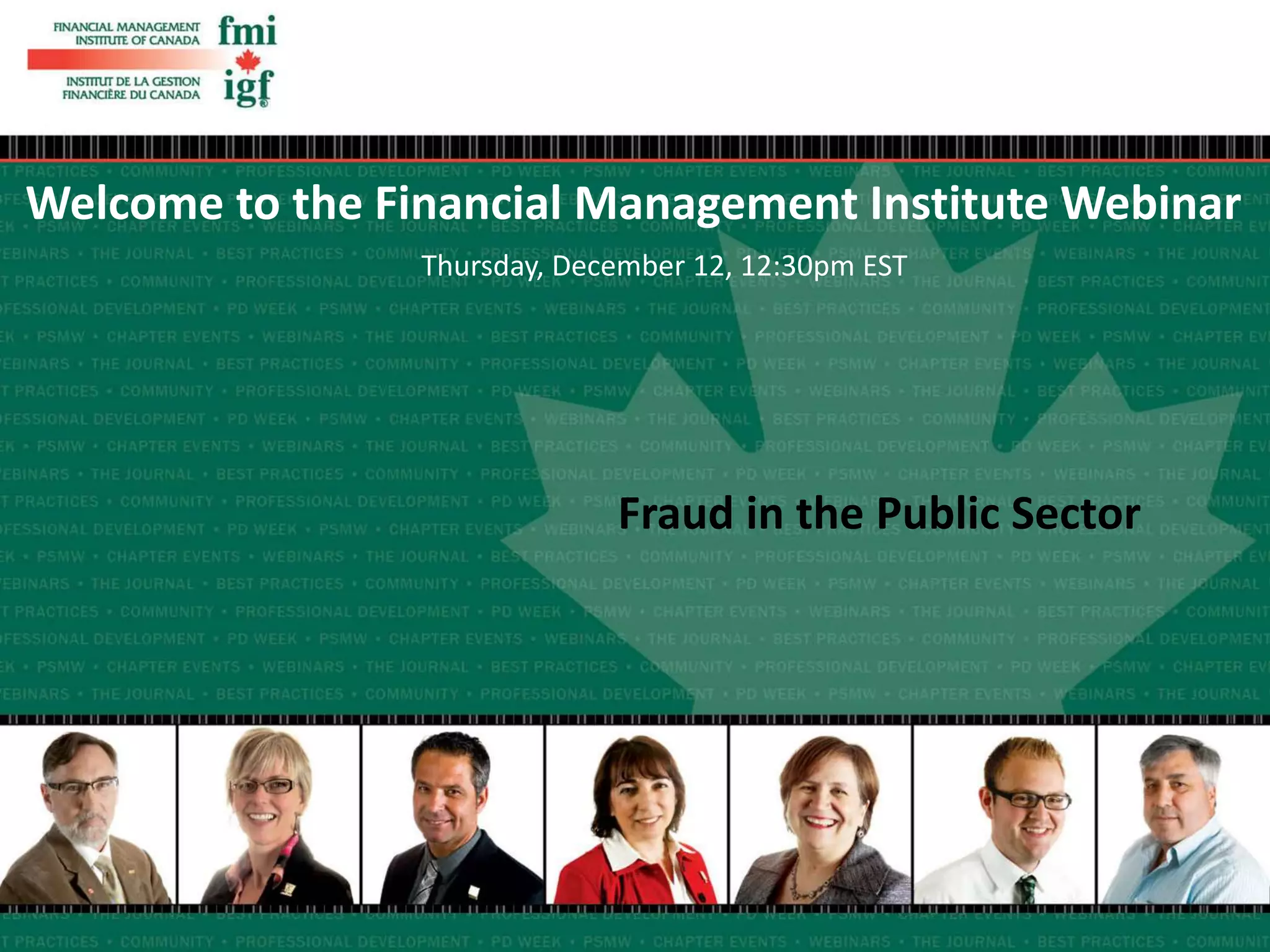
Fraud in the Public Sector
Welcome to the Financial Management Institute Webinar
Thursday, December 12, 12:30pm EST
Panel:
• Francis Liska, CGA, CISA, CICA, CMC - CEO OTUS
Group
Marc-André Audette, CMA, CFE, Director, Integrity
Policy and Program Development, Service Canada
Moderator:
• Steve Whitla, Partner for Fraud Investigations and
Dispute Services, Ernst & Young Canada
2
What is Fraud?
Fraud is the use of one’s occupation for personal
enrichment through deliberate misuse or
misapplication of the employing organization’s
resources or assets
3
• Nature and threat of fraud is almost universal across
sectors and regions
• Most commonly victimized industries in 2012 were
the banking and financial services, government and
public administration, and manufacturing sectors
(2102 Global Fraud Study – Association of Certified Fraud Examiners)
Where is Fraud Most Prevalent?
4
• Most fraudsters are first time offenders with clean
employment history
• The vast majority of frauds were committed by
people in one of six departments – accounting,
operations, sales, executive/upper management,
customer service and purchasing
(2102 Global Fraud Study – Association of Certified Fraud Examiners)
Who Commits Fraud?
5
• We live in a culture of trust
• There is a perception that that people are usually
ethical
• Adequate controls are not in place – fraud is most
often a crime of opportunity
Why Does Fraud Occur?
6
• Targets
– Revenue – Income tax, HST, custom duties
– Benefits – Employment Insurance, Retirement Benefits
– Property – Computers, phones, supplies
– Entitlements – Payroll, expenses, travel allowances
– Facilities – Unauthorized use of vehicles, tools, etc.
• Methods
– Theft, credit card misuse
– Counterfeiting documents, providing false information
– Bribery, corruption, abuse of office, collusion
(Australian Institute of Criminology)
The Nature of Public Sector Fraud
7
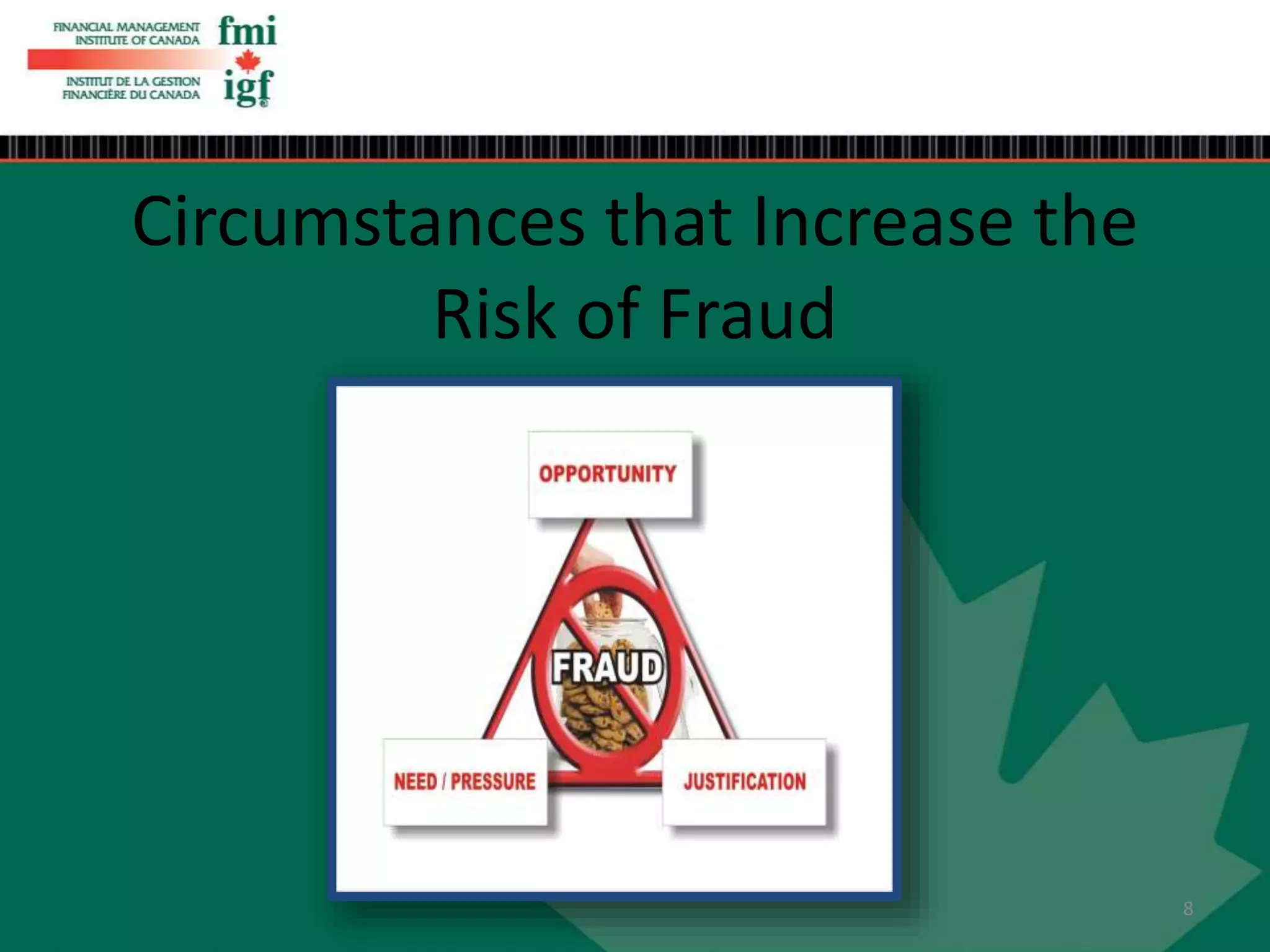
Circumstances that Increase the
Risk of Fraud
8
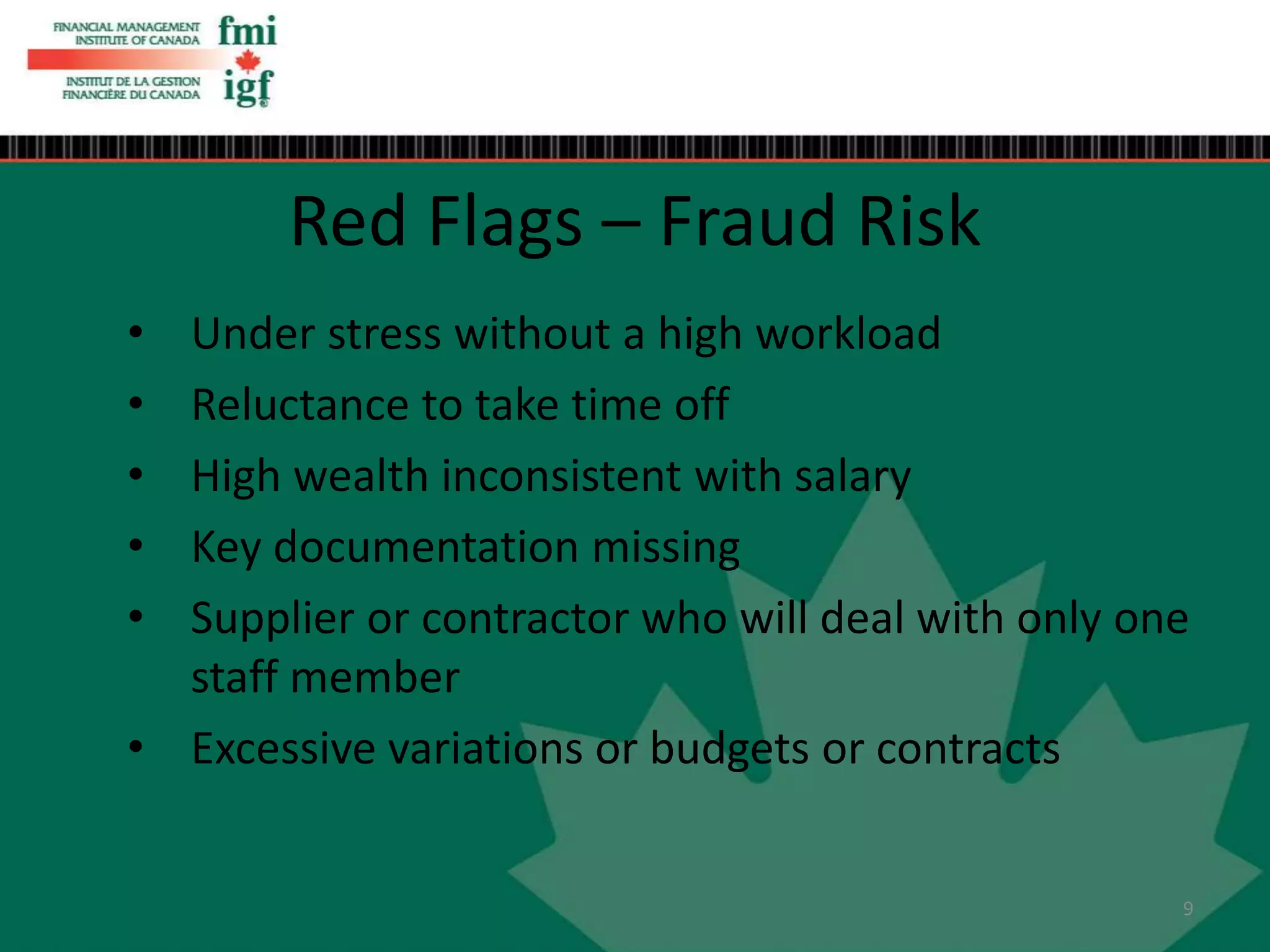
• Under stress without a high workload
• Reluctance to take time off
• High wealth inconsistent with salary
• Key documentation missing
• Supplier or contractor who will deal with only one
staff member
• Excessive variations or budgets or contracts
Red Flags – Fraud Risk
9
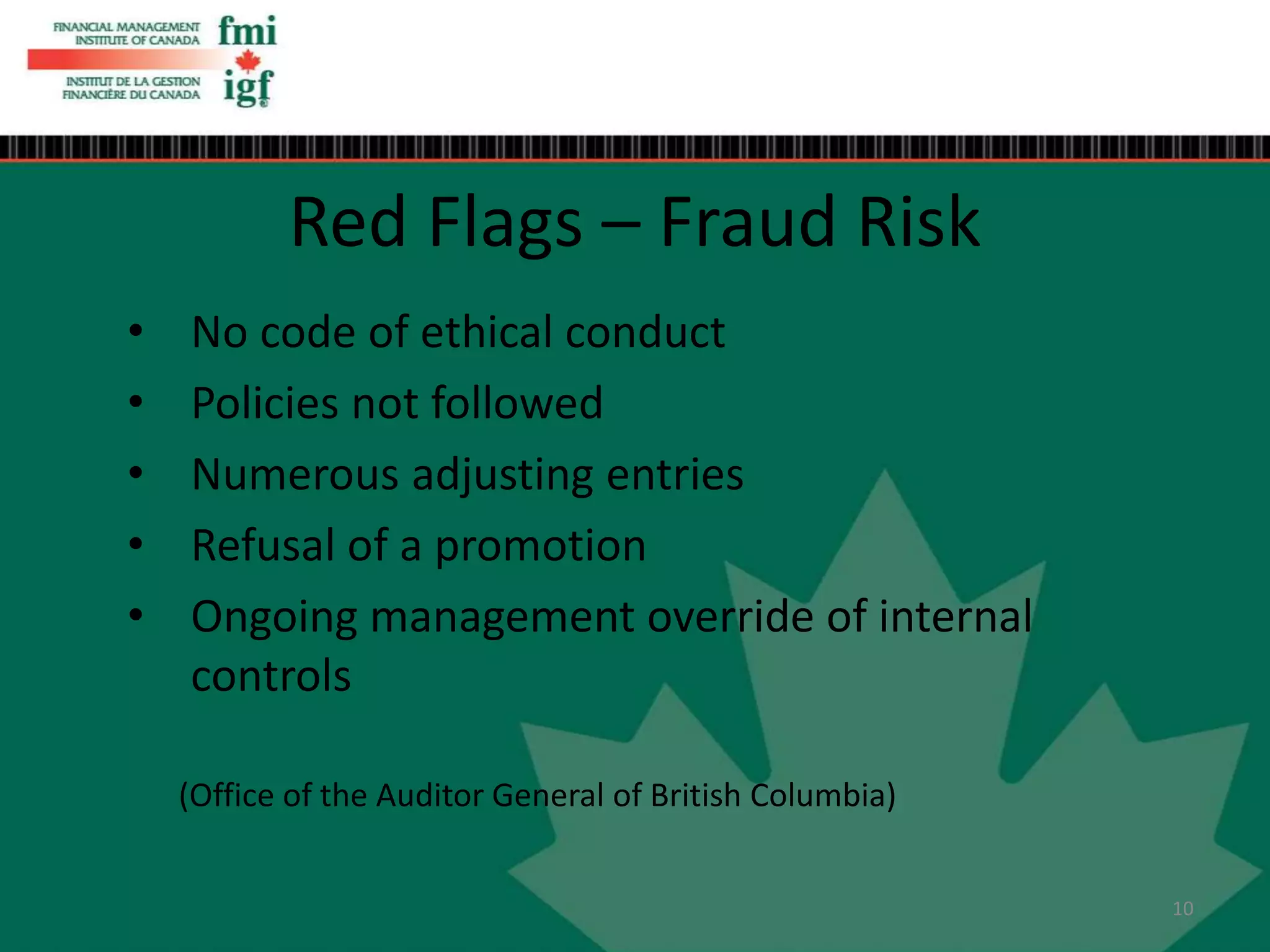
• No code of ethical conduct
• Policies not followed
• Numerous adjusting entries
• Refusal of a promotion
• Ongoing management override of internal
controls
Red Flags – Fraud Risk
(Office of the Auditor General of British Columbia)
10
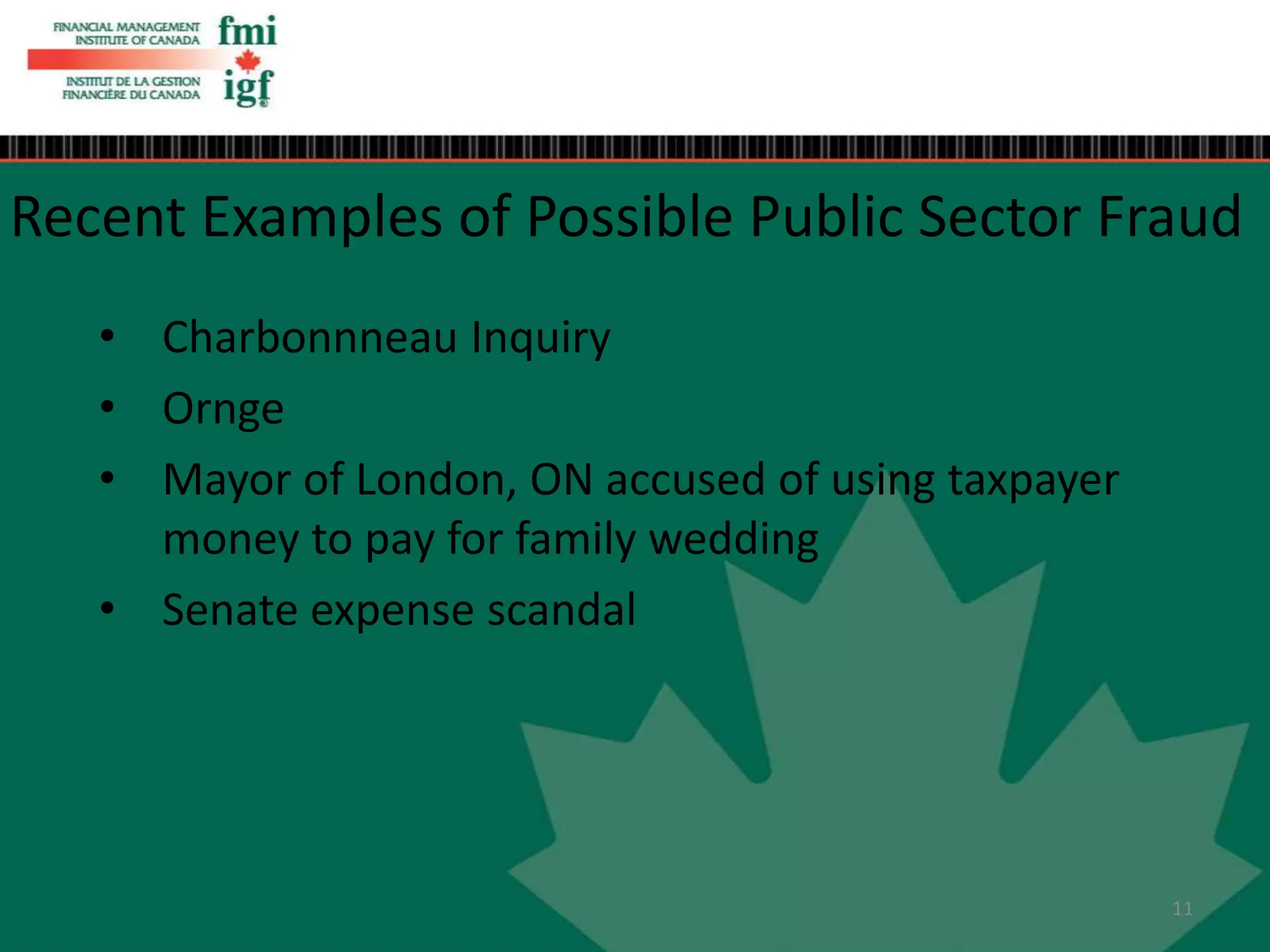
• Charbonnneau Inquiry
• Ornge
• Mayor of London, ON accused of using taxpayer
money to pay for family wedding
• Senate expense scandal
Recent Examples of Possible Public Sector Fraud
11
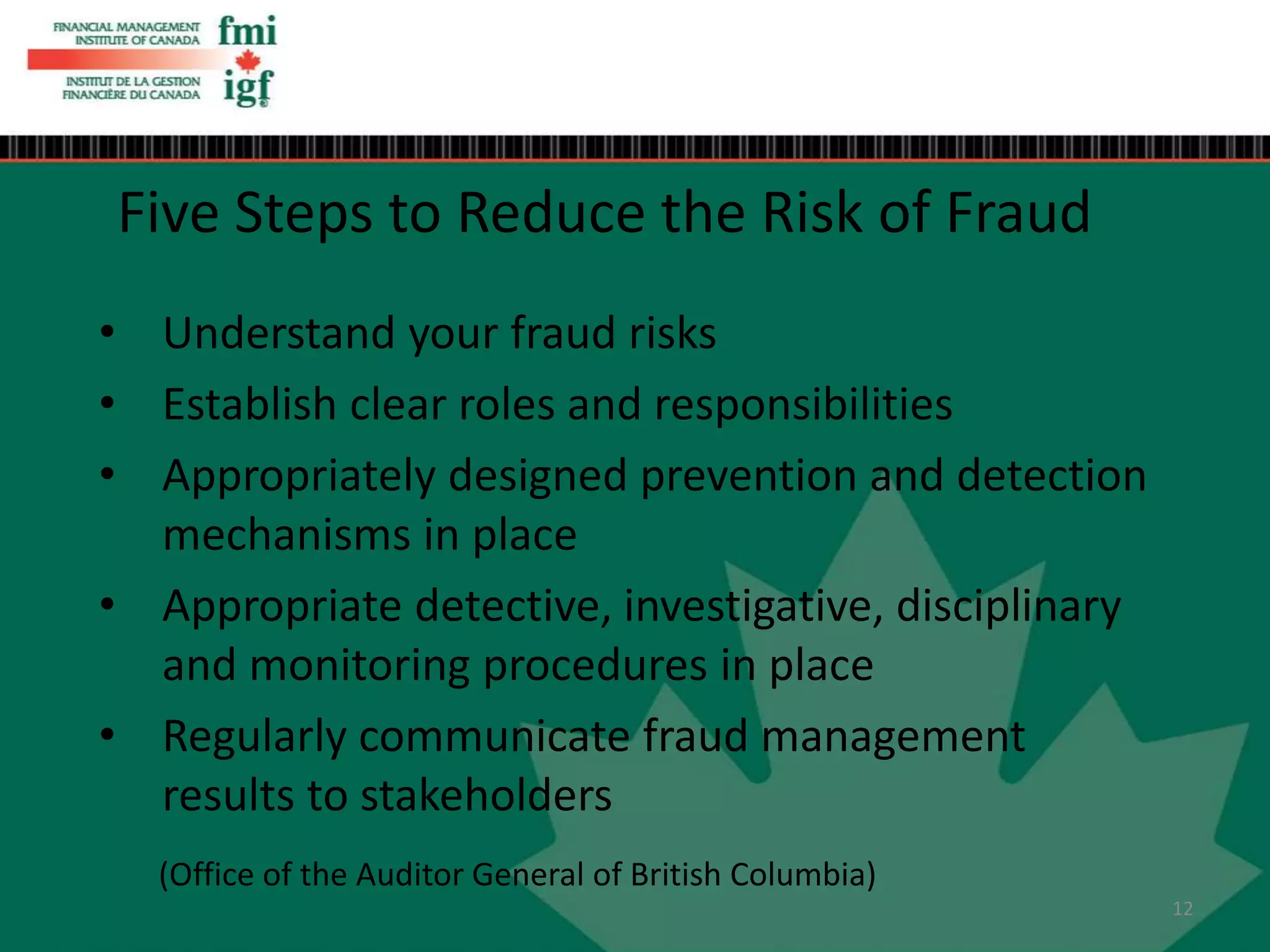
• Understand your fraud risks
• Establish clear roles and responsibilities
• Appropriately designed prevention and detection
mechanisms in place
• Appropriate detective, investigative, disciplinary
and monitoring procedures in place
• Regularly communicate fraud management
results to stakeholders
Five Steps to Reduce the Risk of Fraud
(Office of the Auditor General of British Columbia)
12
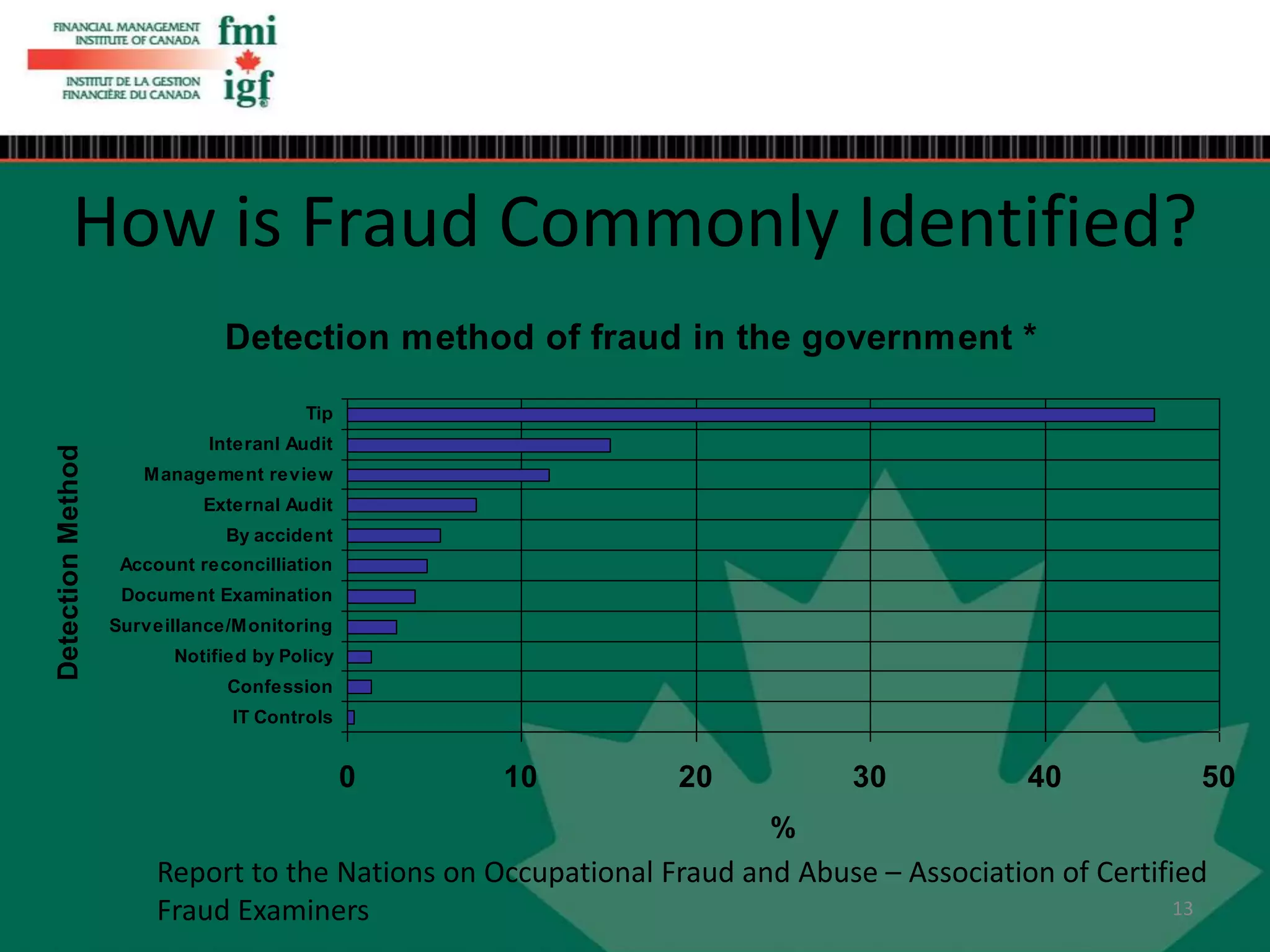
Detection method of fraud in the government *
0 10 20 30 40 50
IT Controls
Confession
Notified by Policy
Surveillance/Monitoring
Document Examination
Account reconcilliation
By accident
External Audit
Management review
Interanl Audit
Tip
DetectionMethod
%
Report to the Nations on Occupational Fraud and Abuse – Association of Certified
Fraud Examiners
How is Fraud Commonly Identified?
13
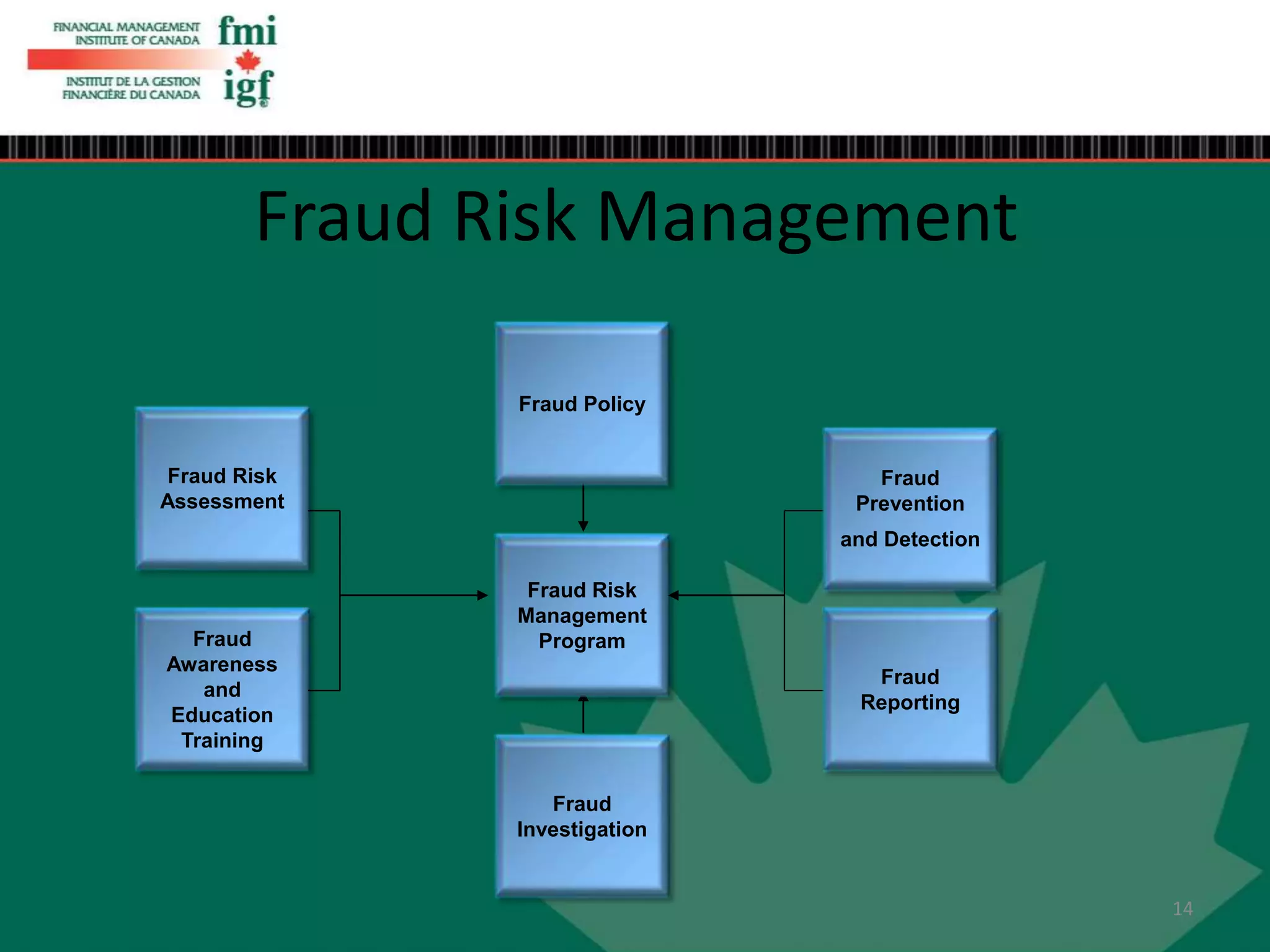
Fraud Risk
Assessment
Fraud
Awareness
and
Education
Training
Fraud Policy
Fraud Risk
Management
Program
Fraud
Prevention
and Detection
Fraud
Reporting
Fraud
Investigation
Fraud Risk Management
14
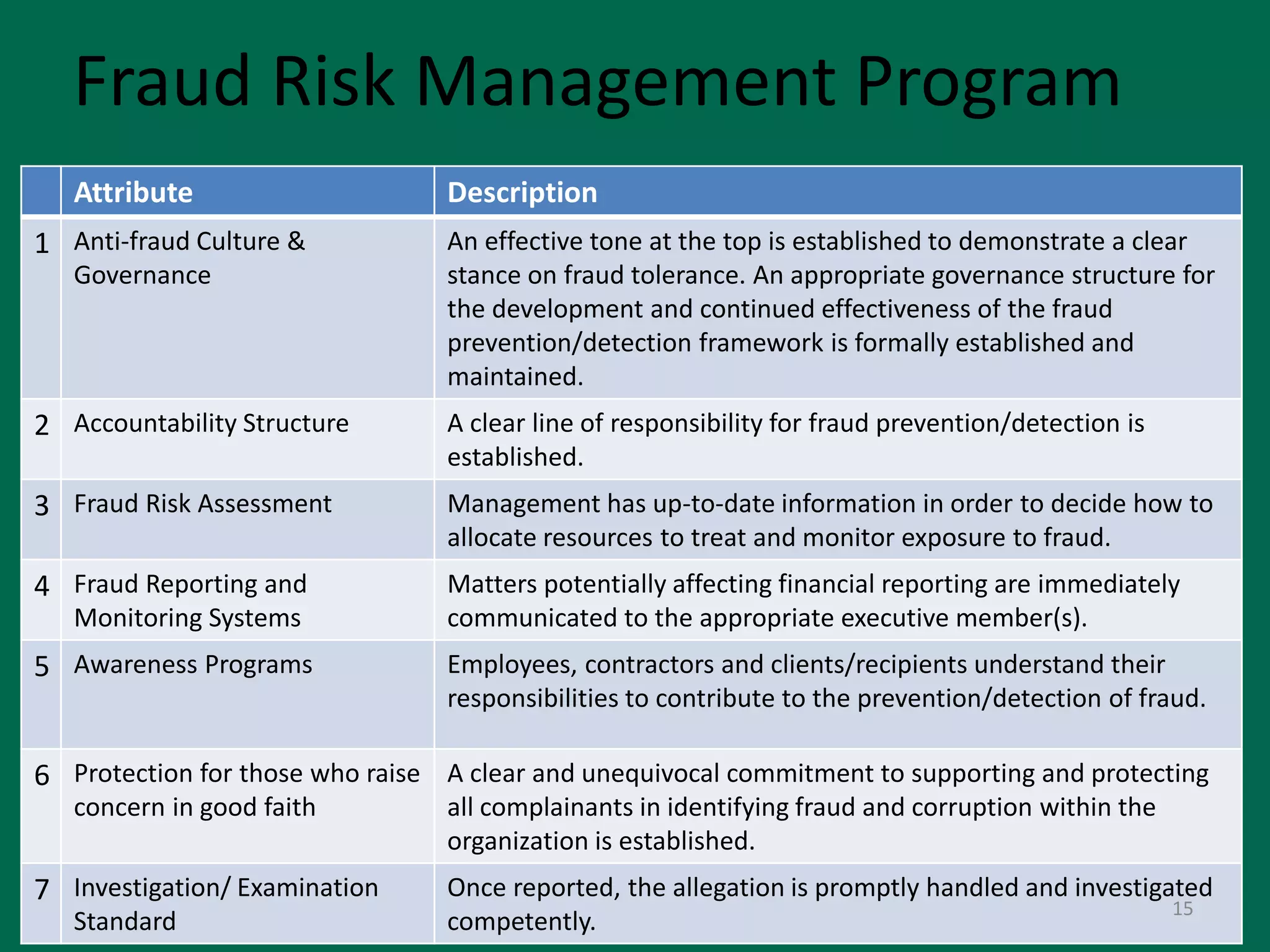
Attribute Description
1 Anti-fraud Culture &
Governance
An effective tone at the top is established to demonstrate a clear
stance on fraud tolerance. An appropriate governance structure for
the development and continued effectiveness of the fraud
prevention/detection framework is formally established and
maintained.
2 Accountability Structure A clear line of responsibility for fraud prevention/detection is
established.
3 Fraud Risk Assessment Management has up-to-date information in order to decide how to
allocate resources to treat and monitor exposure to fraud.
4 Fraud Reporting and
Monitoring Systems
Matters potentially affecting financial reporting are immediately
communicated to the appropriate executive member(s).
5 Awareness Programs Employees, contractors and clients/recipients understand their
responsibilities to contribute to the prevention/detection of fraud.
6 Protection for those who raise
concern in good faith
A clear and unequivocal commitment to supporting and protecting
all complainants in identifying fraud and corruption within the
organization is established.
7 Investigation/ Examination
Standard
Once reported, the allegation is promptly handled and investigated
competently.
Fraud Risk Management Program
15
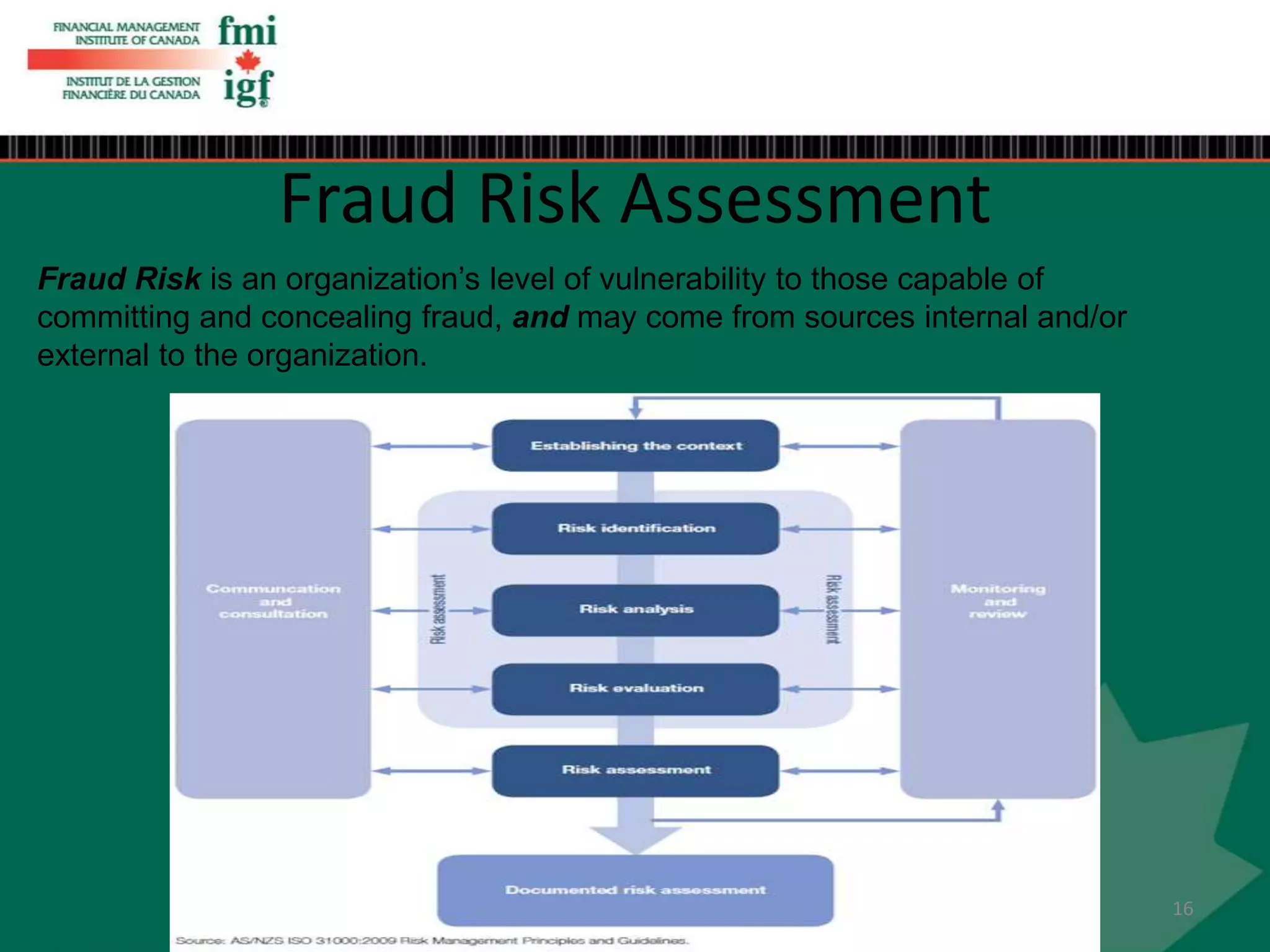
Fraud Risk is an organization’s level of vulnerability to those capable of
committing and concealing fraud, and may come from sources internal and/or
external to the organization.
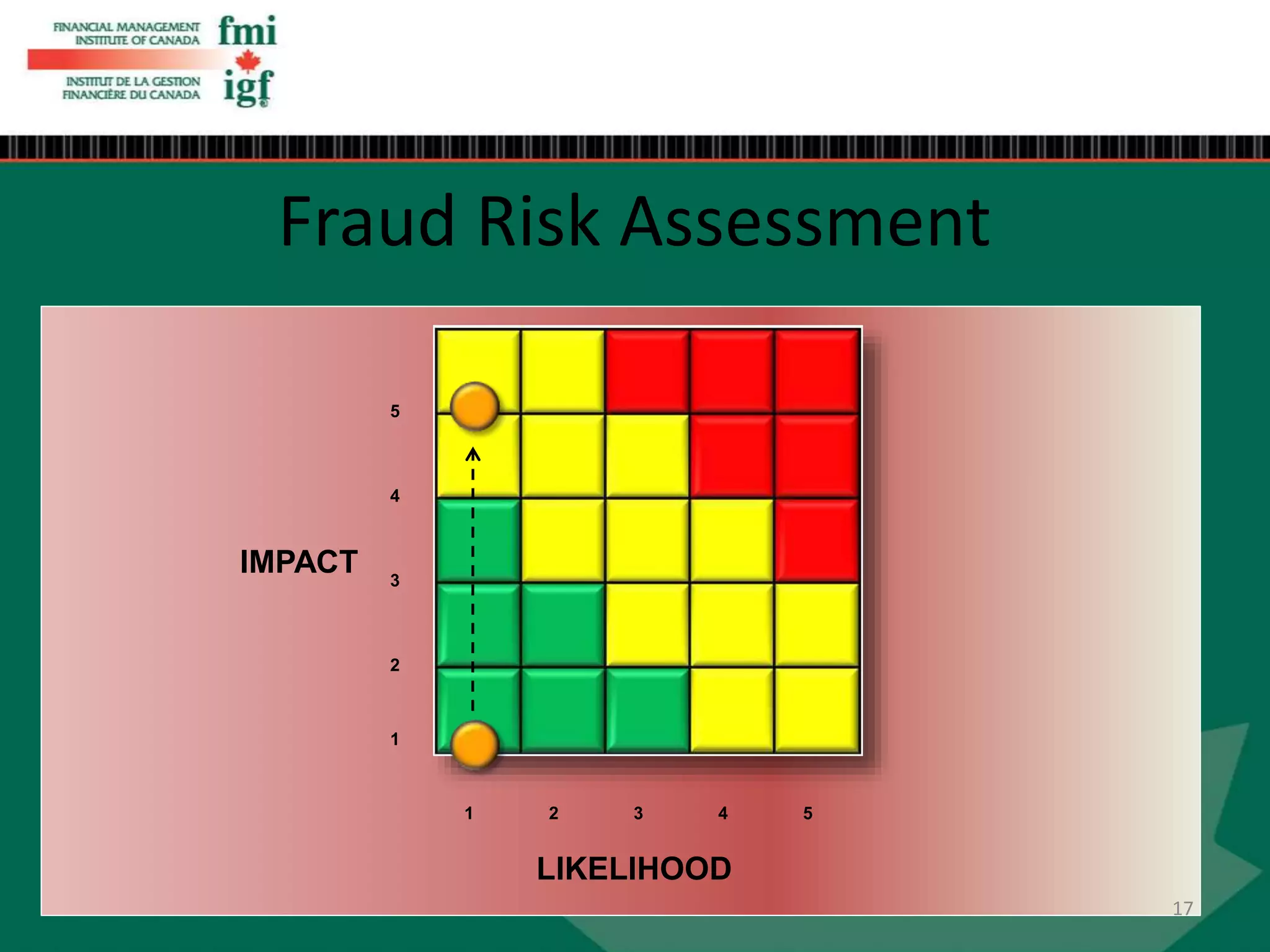
Fraud Risk Assessment
16
LIKELIHOOD
IMPACT
5
4
3
2
1
1 2 3 4 5
Fraud Risk Assessment
17
Questions and Answers
Be sure to tune in to next month’s webinar!
• “CFO Attestation”
• Presenters: Jean Roussel and Donna Dériger
• Thursday, January 16th, 2013 at 12:00pm EST
18

Fraud in the Public Sector

  • 1.
    Fraud in thePublic Sector Welcome to the Financial Management Institute Webinar Thursday, December 12, 12:30pm EST
  • 2.
    Panel: • Francis Liska,CGA, CISA, CICA, CMC - CEO OTUS Group Marc-André Audette, CMA, CFE, Director, Integrity Policy and Program Development, Service Canada Moderator: • Steve Whitla, Partner for Fraud Investigations and Dispute Services, Ernst & Young Canada 2
  • 3.
    What is Fraud? Fraudis the use of one’s occupation for personal enrichment through deliberate misuse or misapplication of the employing organization’s resources or assets 3
  • 4.
    • Nature andthreat of fraud is almost universal across sectors and regions • Most commonly victimized industries in 2012 were the banking and financial services, government and public administration, and manufacturing sectors (2102 Global Fraud Study – Association of Certified Fraud Examiners) Where is Fraud Most Prevalent? 4
  • 5.
    • Most fraudstersare first time offenders with clean employment history • The vast majority of frauds were committed by people in one of six departments – accounting, operations, sales, executive/upper management, customer service and purchasing (2102 Global Fraud Study – Association of Certified Fraud Examiners) Who Commits Fraud? 5
  • 6.
    • We livein a culture of trust • There is a perception that that people are usually ethical • Adequate controls are not in place – fraud is most often a crime of opportunity Why Does Fraud Occur? 6
  • 7.
    • Targets – Revenue– Income tax, HST, custom duties – Benefits – Employment Insurance, Retirement Benefits – Property – Computers, phones, supplies – Entitlements – Payroll, expenses, travel allowances – Facilities – Unauthorized use of vehicles, tools, etc. • Methods – Theft, credit card misuse – Counterfeiting documents, providing false information – Bribery, corruption, abuse of office, collusion (Australian Institute of Criminology) The Nature of Public Sector Fraud 7
  • 8.
    Circumstances that Increasethe Risk of Fraud 8
  • 9.
    • Under stresswithout a high workload • Reluctance to take time off • High wealth inconsistent with salary • Key documentation missing • Supplier or contractor who will deal with only one staff member • Excessive variations or budgets or contracts Red Flags – Fraud Risk 9
  • 10.
    • No codeof ethical conduct • Policies not followed • Numerous adjusting entries • Refusal of a promotion • Ongoing management override of internal controls Red Flags – Fraud Risk (Office of the Auditor General of British Columbia) 10
  • 11.
    • Charbonnneau Inquiry •Ornge • Mayor of London, ON accused of using taxpayer money to pay for family wedding • Senate expense scandal Recent Examples of Possible Public Sector Fraud 11
  • 12.
    • Understand yourfraud risks • Establish clear roles and responsibilities • Appropriately designed prevention and detection mechanisms in place • Appropriate detective, investigative, disciplinary and monitoring procedures in place • Regularly communicate fraud management results to stakeholders Five Steps to Reduce the Risk of Fraud (Office of the Auditor General of British Columbia) 12
  • 13.
    Detection method offraud in the government * 0 10 20 30 40 50 IT Controls Confession Notified by Policy Surveillance/Monitoring Document Examination Account reconcilliation By accident External Audit Management review Interanl Audit Tip DetectionMethod % Report to the Nations on Occupational Fraud and Abuse – Association of Certified Fraud Examiners How is Fraud Commonly Identified? 13
  • 14.
    Fraud Risk Assessment Fraud Awareness and Education Training Fraud Policy FraudRisk Management Program Fraud Prevention and Detection Fraud Reporting Fraud Investigation Fraud Risk Management 14
  • 15.
    Attribute Description 1 Anti-fraudCulture & Governance An effective tone at the top is established to demonstrate a clear stance on fraud tolerance. An appropriate governance structure for the development and continued effectiveness of the fraud prevention/detection framework is formally established and maintained. 2 Accountability Structure A clear line of responsibility for fraud prevention/detection is established. 3 Fraud Risk Assessment Management has up-to-date information in order to decide how to allocate resources to treat and monitor exposure to fraud. 4 Fraud Reporting and Monitoring Systems Matters potentially affecting financial reporting are immediately communicated to the appropriate executive member(s). 5 Awareness Programs Employees, contractors and clients/recipients understand their responsibilities to contribute to the prevention/detection of fraud. 6 Protection for those who raise concern in good faith A clear and unequivocal commitment to supporting and protecting all complainants in identifying fraud and corruption within the organization is established. 7 Investigation/ Examination Standard Once reported, the allegation is promptly handled and investigated competently. Fraud Risk Management Program 15
  • 16.
    Fraud Risk isan organization’s level of vulnerability to those capable of committing and concealing fraud, and may come from sources internal and/or external to the organization. Fraud Risk Assessment 16
  • 17.
    LIKELIHOOD IMPACT 5 4 3 2 1 1 2 34 5 Fraud Risk Assessment 17
  • 18.
    Questions and Answers Besure to tune in to next month’s webinar! • “CFO Attestation” • Presenters: Jean Roussel and Donna Dériger • Thursday, January 16th, 2013 at 12:00pm EST 18