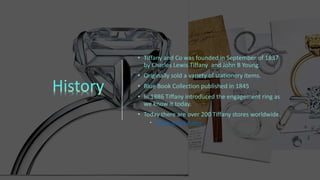
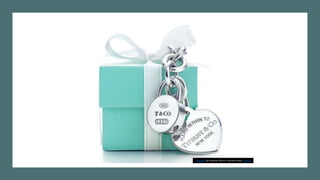
• Tiffany and Co was founded in September of 1837
by Charles Lewis Tiffany and John B Young.
• Originally sold a variety of stationery items.
• Blue Book Collection published in 1845
• In 1886 Tiffany introduced the engagement ring as
we know it today.
• Today there are over 200 Tiffany stores worldwide.
• Tiffany & Co Timeline
• At Tiffany’s & Co., we believe it is our moral duty to
sustain the natural environment. As a result we are
committed to not only minimizing our impact as a
business but also using our voice and actions to
positively affect communities and protect the planet.
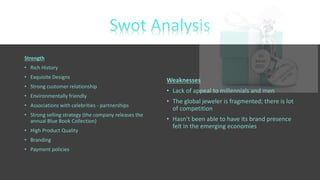
Strength
• Rich History
• Exquisite Designs
• Strong customer relationship
• Environmentally friendly
• Associations with celebrities - partnerships
• Strong selling strategy (the company releases the
annual Blue Book Collection)
• High Product Quality
• Branding
• Payment policies
Weaknesses
• Lack of appeal to millennials and men
• The global jeweler is fragmented; there is lot
of competition
• Hasn’t been able to have its brand presence
felt in the emerging economies
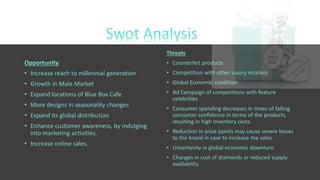
Opportunity
• Increase reach to millennial generation
• Growth in Male Market
• Expand locations of Blue Box Cafe
• More designs in seasonality changes
• Expand its global distribution
• Enhance customer awareness, by indulging
into marketing activities.
• Increase online sales.
Threats
• Counterfeit products
• Competition with other luxury retailers
• Global Economic condition
• Ad Campaign of competitions with feature
celebrities
• Consumer spending decreases in times of falling
consumer confidence in terms of the products,
resulting in high Inventory costs.
• Reduction in price points may cause severe losses
to the brand in case to increase the sales
• Uncertainty in global economic downturn
• Changes in cost of diamonds or reduced supply
availability.
• The Luxury Jewelry Market is known
for its profound designs and its
usage if the finest materials put into
their products. The market of these
luxury jewelry brands is a fast-
growing market. They are driven by
consumer behavior including
celebrities, as well as the upcoming
fashion trends. The firm has
traditionally found success in the
diamond engagement ring industry,
statement jewelry, and sterling silver
items.
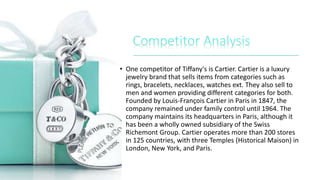
• One competitor of Tiffany's is Cartier. Cartier is a luxury
jewelry brand that sells items from categories such as
rings, bracelets, necklaces, watches ext. They also sell to
men and women providing different categories for both.
Founded by Louis-François Cartier in Paris in 1847, the
company remained under family control until 1964. The
company maintains its headquarters in Paris, although it
has been a wholly owned subsidiary of the Swiss
Richemont Group. Cartier operates more than 200 stores
in 125 countries, with three Temples (Historical Maison) in
London, New York, and Paris.
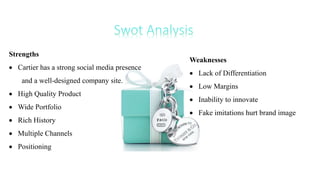
Strengths
 Cartier has a strong social media presence
and a well-designed company site.
 High Quality Product
 Wide Portfolio
 Rich History
 Multiple Channels
 Positioning
Weaknesses
 Lack of Differentiation
 Low Margins
 Inability to innovate
 Fake imitations hurt brand image
• Opportunities
• New Markets
• High growth in the luxury watches
segment in emerging economies
•
• Threats
• Competition
• Difficulty to attract customers
• Counterfeits
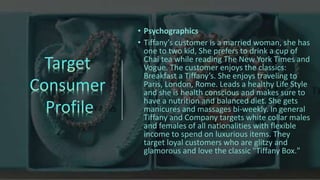
• Psychographics
• Tiffany’s customer is a married woman, she has
one to two kid, She prefers to drink a cup of
Chai tea while reading The New York Times and
Vogue. The customer enjoys the classics:
Breakfast a Tiffany’s. She enjoys traveling to
Paris, London, Rome. Leads a healthy Life Style
and she is health conscious and makes sure to
have a nutrition and balanced diet. She gets
manicures and massages bi-weekly. In general
Tiffany and Company targets white collar males
and females of all nationalities with flexible
income to spend on luxurious items. They
target loyal customers who are glitzy and
glamorous and love the classic "Tiffany Box."
• Overall, Tiffany & Co is a financially stable company and is a great opportunity for
investment. It demonstrates a strong financial performance year after year,
considering a high premium price it charges for its products, lack of discounts. It
indicates that Tiffany & Co has a strong, and loyal customer base who are willing
to pay premium price and a perception of the brand that inspires respect and a
show of status. Tiffany & Co has a very strong Balance Sheet, a significant cash
flow from its operating activities, and is not overly leveraged when compared to
its peers and an industry average. The strong position that they have established
in the marketplace is not likely to disappear, and it will only continue to grow
once they counteract the changing environment with implementing a strategy
that reiterates their founding vision.
This Photo by Unknown Author is licensed under CC BY-SA

Final presentation

  • 2.
    • Tiffany andCo was founded in September of 1837 by Charles Lewis Tiffany and John B Young. • Originally sold a variety of stationery items. • Blue Book Collection published in 1845 • In 1886 Tiffany introduced the engagement ring as we know it today. • Today there are over 200 Tiffany stores worldwide. • Tiffany & Co Timeline
  • 3.
    • At Tiffany’s& Co., we believe it is our moral duty to sustain the natural environment. As a result we are committed to not only minimizing our impact as a business but also using our voice and actions to positively affect communities and protect the planet.
  • 4.
    Strength • Rich History •Exquisite Designs • Strong customer relationship • Environmentally friendly • Associations with celebrities - partnerships • Strong selling strategy (the company releases the annual Blue Book Collection) • High Product Quality • Branding • Payment policies Weaknesses • Lack of appeal to millennials and men • The global jeweler is fragmented; there is lot of competition • Hasn’t been able to have its brand presence felt in the emerging economies
  • 5.
    Opportunity • Increase reachto millennial generation • Growth in Male Market • Expand locations of Blue Box Cafe • More designs in seasonality changes • Expand its global distribution • Enhance customer awareness, by indulging into marketing activities. • Increase online sales. Threats • Counterfeit products • Competition with other luxury retailers • Global Economic condition • Ad Campaign of competitions with feature celebrities • Consumer spending decreases in times of falling consumer confidence in terms of the products, resulting in high Inventory costs. • Reduction in price points may cause severe losses to the brand in case to increase the sales • Uncertainty in global economic downturn • Changes in cost of diamonds or reduced supply availability.
  • 6.
    • The LuxuryJewelry Market is known for its profound designs and its usage if the finest materials put into their products. The market of these luxury jewelry brands is a fast- growing market. They are driven by consumer behavior including celebrities, as well as the upcoming fashion trends. The firm has traditionally found success in the diamond engagement ring industry, statement jewelry, and sterling silver items.
  • 7.
    • One competitorof Tiffany's is Cartier. Cartier is a luxury jewelry brand that sells items from categories such as rings, bracelets, necklaces, watches ext. They also sell to men and women providing different categories for both. Founded by Louis-François Cartier in Paris in 1847, the company remained under family control until 1964. The company maintains its headquarters in Paris, although it has been a wholly owned subsidiary of the Swiss Richemont Group. Cartier operates more than 200 stores in 125 countries, with three Temples (Historical Maison) in London, New York, and Paris.
  • 8.
    Strengths  Cartier hasa strong social media presence and a well-designed company site.  High Quality Product  Wide Portfolio  Rich History  Multiple Channels  Positioning Weaknesses  Lack of Differentiation  Low Margins  Inability to innovate  Fake imitations hurt brand image
  • 9.
    • Opportunities • NewMarkets • High growth in the luxury watches segment in emerging economies • • Threats • Competition • Difficulty to attract customers • Counterfeits
  • 10.
    • Psychographics • Tiffany’scustomer is a married woman, she has one to two kid, She prefers to drink a cup of Chai tea while reading The New York Times and Vogue. The customer enjoys the classics: Breakfast a Tiffany’s. She enjoys traveling to Paris, London, Rome. Leads a healthy Life Style and she is health conscious and makes sure to have a nutrition and balanced diet. She gets manicures and massages bi-weekly. In general Tiffany and Company targets white collar males and females of all nationalities with flexible income to spend on luxurious items. They target loyal customers who are glitzy and glamorous and love the classic "Tiffany Box."
  • 11.
    • Overall, Tiffany& Co is a financially stable company and is a great opportunity for investment. It demonstrates a strong financial performance year after year, considering a high premium price it charges for its products, lack of discounts. It indicates that Tiffany & Co has a strong, and loyal customer base who are willing to pay premium price and a perception of the brand that inspires respect and a show of status. Tiffany & Co has a very strong Balance Sheet, a significant cash flow from its operating activities, and is not overly leveraged when compared to its peers and an industry average. The strong position that they have established in the marketplace is not likely to disappear, and it will only continue to grow once they counteract the changing environment with implementing a strategy that reiterates their founding vision.
  • 12.
    This Photo byUnknown Author is licensed under CC BY-SA