

A Presentation On

Corporate Debt Restructuring
        Mechanism


             By
     CA Rajesh Chaturvedi


      February 4 , 2012
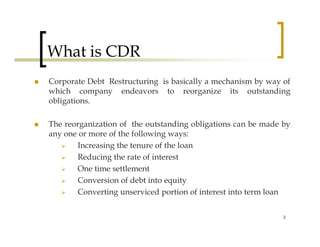
What is CDR
Corporate Debt Restructuring is basically a mechanism by way of
which company endeavors to reorganize its outstanding
obligations.

The reorganization of the outstanding obligations can be made by
any one or more of the following ways:
       Increasing the tenure of the loan
       Reducing the rate of interest
       One time settlement
       Conversion of debt into equity
       Converting unserviced portion of interest into term loan

                                                              2
Why CDR

When a corporate is having severe financial crisis in
terms of :

     Trouble in repaying it’s debt obligation
     Inability in timely servicing of it’s interest

It generally resorts to Corporate Debt Restructuring
Mechanism


                                                      3
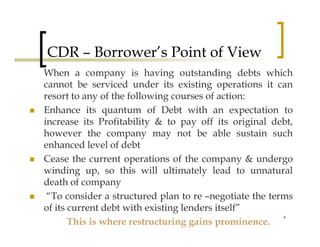
CDR – Borrower’s Point of View
When a company is having outstanding debts which
cannot be serviced under its existing operations it can
resort to any of the following courses of action:
Enhance its quantum of Debt with an expectation to
increase its Profitability & to pay off its original debt,
however the company may not be able sustain such
enhanced level of debt
Cease the current operations of the company & undergo
winding up, so this will ultimately lead to unnatural
death of company
 “To consider a structured plan to re –negotiate the terms
of its current debt with existing lenders itself”
                                                        4
       This is where restructuring gains prominence.
CDR- Lender’s perspective
   CDR gives the lenders a unique opportunity to
   avoid being encumbered with NPA’s.
   The primary interest of lenders always lies in
   recovering the principle amount lent to corporate
   along with returns on that investment & not in
   liquidation of assets
   Apart from this Liquidation proceedings are
   notorious for yielding low returns for creditors

Therefore, CDR becomes an instrument for the
lenders, i.e. the banks, to aid the transformation of
otherwise Non-Performing Assets into productive
assets
                                                    5
CDR – Is it legitimate in every case
Whether a case should be referred for restructuring or
not is based upon thorough examination of facts &
viability of the case.


However, wherever the demand for restructuring is
legitimate, and there is a good reason to believe that
the corporation may be revived, it must be considered
for restructuring.


                                                         6
Objectives of CDR
By way of CDR there is a hope of preservation of
Viable corporate      that are affected by certain
internal & external factors

CDR aims at minimising the losses to creditors &
other stakeholders through an orderly & co-
ordinates restructuring programme

To support continuing economic recovery


                                                     7
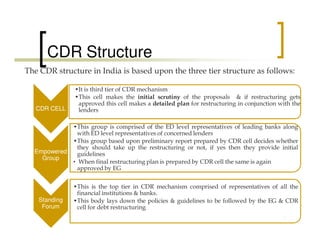
CDR Structure
The CDR structure in India is based upon the three tier structure as follows:

              •It is third tier of CDR mechanism
              •This cell makes the initial scrutiny of the proposals & if restructuring gets
               approved this cell makes a detailed plan for restructuring in conjunction with the
   CDR CELL    lenders

              •This group is comprised of the ED level representatives of leading banks along
                with ED level representatives of concerned lenders
              •This group based upon preliminary report prepared by CDR cell decides whether
                they should take up the restructuring or not, if yes then they provide initial
  Empowered     guidelines
    Group
              • When final restructuring plan is prepared by CDR cell the same is again
                approved by EG


              •This is the top tier in CDR mechanism comprised of representatives of all the
               financial institutions & banks.
   Standing   •This body lays down the policies & guidelines to be followed by the EG & CDR
    Forum      cell for debt restructuring
                                                                                          8
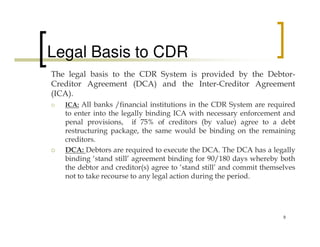
Legal Basis to CDR
The legal basis to the CDR System is provided by the Debtor-
Creditor Agreement (DCA) and the Inter-Creditor Agreement
(ICA).
   ICA: All banks /financial institutions in the CDR System are required
   to enter into the legally binding ICA with necessary enforcement and
   penal provisions, if 75% of creditors (by value) agree to a debt
   restructuring package, the same would be binding on the remaining
   creditors.
   DCA: Debtors are required to execute the DCA. The DCA has a legally
   binding ‘stand still’ agreement binding for 90/180 days whereby both
   the debtor and creditor(s) agree to ‘stand still’ and commit themselves
   not to take recourse to any legal action during the period.


                                                                      9
Certain Instances of CDR
In the past, there have been several companies which have been
referred to CDR, few of them are as follows:

   Subhiksha Retail
   Vishal Retail
   GTL Infra
   Air India
   Wockhardt
   India cements
   Jindal Steel
   Essar Steel
   HPL


                                                                 10
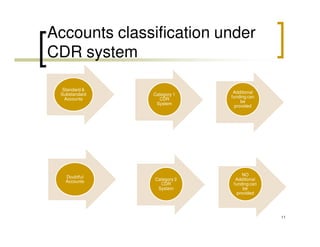
Accounts classification under
CDR system

  Standard &
 Substandard   Category 1    Additional
   Accounts      CDR        funding can
                System           be
                              provided


   Doubtful                       NO
   Accounts    Category 2     Additional
                 CDR         funding can
                System            be
                               provided


                                           11
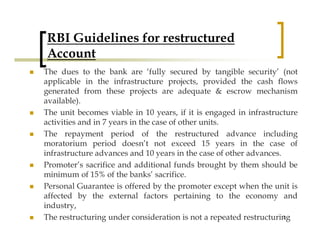
RBI Guidelines for restructured
Account
The dues to the bank are ‘fully secured by tangible security’ (not
applicable in the infrastructure projects, provided the cash flows
generated from these projects are adequate & escrow mechanism
available).
The unit becomes viable in 10 years, if it is engaged in infrastructure
activities and in 7 years in the case of other units.
The repayment period of the restructured advance including
moratorium period doesn’t not exceed 15 years in the case of
infrastructure advances and 10 years in the case of other advances.
Promoter’s sacrifice and additional funds brought by them should be
minimum of 15% of the banks’ sacrifice.
Personal Guarantee is offered by the promoter except when the unit is
affected by the external factors pertaining to the economy and
industry,
The restructuring under consideration is not a repeated restructuring
                                                                   12
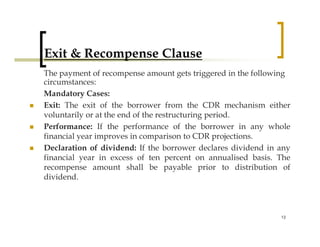
Exit & Recompense Clause
The payment of recompense amount gets triggered in the following
circumstances:
Mandatory Cases:
Exit: The exit of the borrower from the CDR mechanism either
voluntarily or at the end of the restructuring period.
Performance: If the performance of the borrower in any whole
financial year improves in comparison to CDR projections.
Declaration of dividend: If the borrower declares dividend in any
financial year in excess of ten percent on annualised basis. The
recompense amount shall be payable prior to distribution of
dividend.


                                                              13
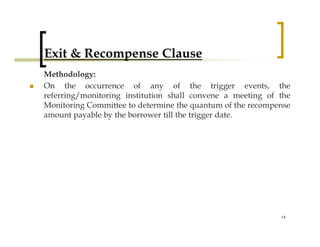
Exit & Recompense Clause
Methodology:
On the occurrence of any of the trigger events, the
referring/monitoring institution shall convene a meeting of the
Monitoring Committee to determine the quantum of the recompense
amount payable by the borrower till the trigger date.


                                                            14
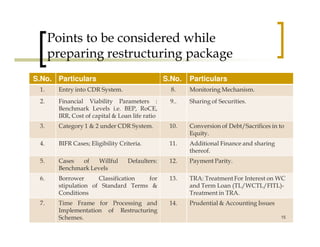
Points to be considered while
      preparing restructuring package
S.No. Particulars                               S.No.   Particulars
 1.    Entry into CDR System.                     8.    Monitoring Mechanism.
 2.    Financial Viability Parameters :          9..    Sharing of Securities.
       Benchmark Levels i.e. BEP, RoCE,
       IRR, Cost of capital & Loan life ratio
 3.    Category 1 & 2 under CDR System.          10.    Conversion of Debt/Sacrifices in to
                                                        Equity.
 4.    BIFR Cases; Eligibility Criteria.         11.    Additional Finance and sharing
                                                        thereof.
 5.    Cases  of    Willful       Defaulters:    12.    Payment Parity.
       Benchmark Levels
 6.    Borrower      Classification for          13.    TRA: Treatment For Interest on WC
       stipulation of Standard Terms &                  and Term Loan (TL/WCTL/FITL)-
       Conditions                                       Treatment in TRA.
 7.    Time Frame for Processing and             14.    Prudential & Accounting Issues
       Implementation of Restructuring
       Schemes.                                                                          15
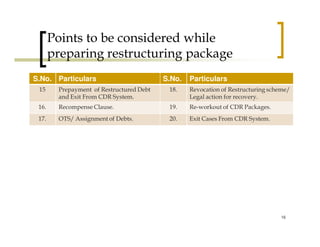
Points to be considered while
       preparing restructuring package
S.No. Particulars                         S.No.   Particulars
 15     Prepayment of Restructured Debt    18.    Revocation of Restructuring scheme/
        and Exit From CDR System.                 Legal action for recovery.
 16.    Recompense Clause.                 19.    Re-workout of CDR Packages.
 17.    OTS/ Assignment of Debts.          20.    Exit Cases From CDR System.


                                                                                 16
Certain Case studies
Case Study -1


 KSL & Industries Ltd.
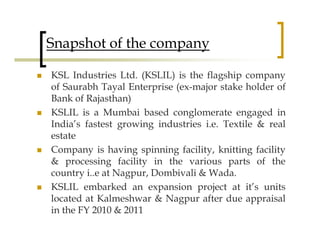
Snapshot of the company

KSL Industries Ltd. (KSLIL) is the flagship company
of Saurabh Tayal Enterprise (ex-major stake holder of
Bank of Rajasthan)
KSLIL is a Mumbai based conglomerate engaged in
India’s fastest growing industries i.e. Textile & real
estate
Company is having spinning facility, knitting facility
& processing facility in the various parts of the
country i..e at Nagpur, Dombivali & Wada.
KSLIL embarked an expansion project at it’s units
located at Kalmeshwar & Nagpur after due appraisal
in the FY 2010 & 2011
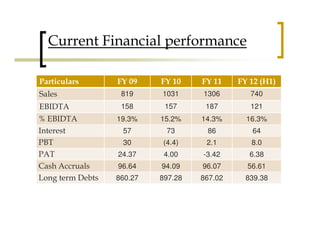
Current Financial performance

Particulars       FY 09    FY 10    FY 11    FY 12 (H1)
Sales              819     1031     1306        740
EBIDTA             158      157      187        121
% EBIDTA          19.3%    15.2%    14.3%      16.3%
Interest           57       73       86         64
PBT                30      (4.4)     2.1        8.0
PAT               24.37     4.00    -3.42       6.38
Cash Accruals     96.64    94.09    96.07      56.61
Long term Debts   860.27   897.28   867.02     839.38
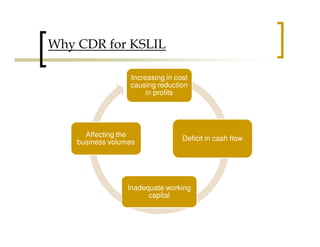
Why CDR for KSLIL

                  Increasing in cost
                  causing reduction
                       in profits


      Affecting the
                                  Deficit in cash flow
    business volumes


                 Inadequate working
                       capital
Reasons for deterioration of financial
 position
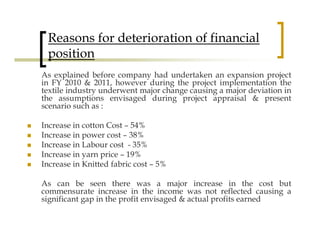
As explained before company had undertaken an expansion project
in FY 2010 & 2011, however during the project implementation the
textile industry underwent major change causing a major deviation in
the assumptions envisaged during project appraisal & present
scenario such as :

Increase in cotton Cost – 54%
Increase in power cost – 38%
Increase in Labour cost - 35%
Increase in yarn price – 19%
Increase in Knitted fabric cost – 5%

As can be seen there was a major increase in the cost but
commensurate increase in the income was not reflected causing a
significant gap in the profit envisaged & actual profits earned
Other Reasons for deterioration
of financial position
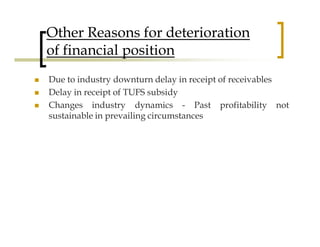
Due to industry downturn delay in receipt of receivables
Delay in receipt of TUFS subsidy
Changes industry dynamics - Past profitability not
sustainable in prevailing circumstances
Cash flow Analysis

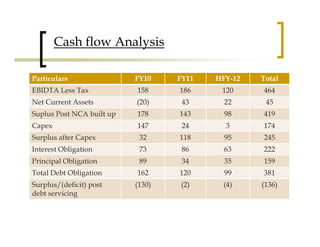
Particulars                FY10    FY11   HFY-12   Total
EBIDTA Less Tax            158     186     120     464
Net Current Assets         (20)     43      22      45
Suplus Post NCA built up   178     143      98     419
Capex                      147      24      3      174
Surplus after Capex         32     118      95     245
Interest Obligation         73      86      63     222
Principal Obligation        89      34      35     159
Total Debt Obligation      162     120      99     381
Surplus/(deficit) post     (130)   (2)     (4)     (136)
debt servicing
Management Initiatives & Business plan

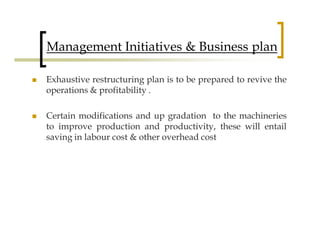
Exhaustive restructuring plan is to be prepared to revive the
operations & profitability .

Certain modifications and up gradation to the machineries
to improve production and productivity, these will entail
saving in labour cost & other overhead cost
Debt realignment proposal (Holding on
   operations)

Till the time of designing & implementation of restructuring
following steps shall be taken
Lenders not to recover any Loan installments and interest
Lenders not to levy of any penal charges for delays /
irregularities
Continuation of working capital limits at existing levels
Till implementation of restructuring package, cash / cheque
deposits made in the KSL’s accounts, would be allowed to be
withdrawn, without any adjustment against any dues payable
to the bank.
Debt realignment proposal
1.   Term loans:
         Repayable in 10 years
         No moratorium period available in order to comply with
         subsidy guidelines
         Interest to be charged at concessional rate of 10%
         Waiver of the unpaid penal & compound interest

2.   Working capital limits:
         Working capital limit to be assessed based on FY13 numbers
         Reduced rate of interest @10%
         Reduction in working capital margins from earlier 25% to 10%
         LC & BG margins also reduced
Debt realignment proposal
3.   Funding of Interest:
         Interest due upon the term loans & working capital loans
         to be converted into Funded interest term loan
         Repayable in 2 years starting from 30th June 2015
         Interest on FITL to be charged @5%

4.   Foreign Currency convertible Bonds(FCCB’s):
         25% of the FCCB amount to be paid within 6 months of
         restructuring
         Reduced coupon rate @2%
         Yield to maturity of 4%
Debt realignment proposal
5.   Promoter’s Contribution:
         Promoter’s to infuse fresh contribution to the extent
         of 15% of lenders sacrifice
         50% of the same to be infused immediately &
         remaining within 6 months
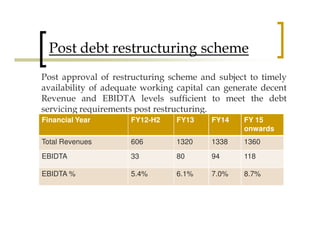
Post debt restructuring scheme
Post approval of restructuring scheme and subject to timely
availability of adequate working capital can generate decent
Revenue and EBIDTA levels sufficient to meet the debt
servicing requirements post restructuring.
Financial Year       FY12-H2     FY13    FY14    FY 15
                                                 onwards
Total Revenues       606         1320    1338    1360
EBIDTA               33          80      94      118

EBIDTA %             5.4%        6.1%    7.0%    8.7%
Post debt restructuring scheme
The above projections are fully sensitized for further
downside risks, so it is very much likely that after
implementation of the package the company will able to
restore its old shape.

The restructuring package is expected to act as a breather for
the company.
Case study -2

        Kingfisher Airlines
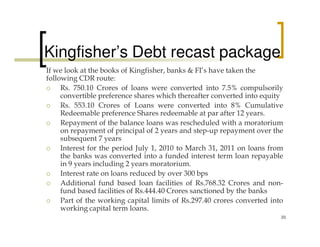
Kingfisher’s Debt recast package
If we look at the books of Kingfisher, banks & FI’s have taken the
following CDR route:
     Rs. 750.10 Crores of loans were converted into 7.5% compulsorily
     convertible preference shares which thereafter converted into equity
     Rs. 553.10 Crores of Loans were converted into 8% Cumulative
     Redeemable preference Shares redeemable at par after 12 years.
     Repayment of the balance loans was rescheduled with a moratorium
     on repayment of principal of 2 years and step-up repayment over the
     subsequent 7 years
     Interest for the period July 1, 2010 to March 31, 2011 on loans from
     the banks was converted into a funded interest term loan repayable
     in 9 years including 2 years moratorium.
     Interest rate on loans reduced by over 300 bps
     Additional fund based loan facilities of Rs.768.32 Crores and non-
     fund based facilities of Rs.444.40 Crores sanctioned by the banks
     Part of the working capital limits of Rs.297.40 crores converted into
     working capital term loans.
                                                                         33
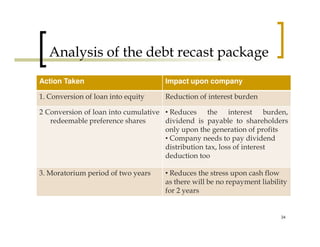
Analysis of the debt recast package
Action Taken                        Impact upon company

1. Conversion of loan into equity   Reduction of interest burden

2 Conversion of loan into cumulative • Reduces the interest burden,
   redeemable preference shares      dividend is payable to shareholders
                                     only upon the generation of profits
                                     • Company needs to pay dividend
                                     distribution tax, loss of interest
                                     deduction too

3. Moratorium period of two years   • Reduces the stress upon cash flow
                                    as there will be no repayment liability
                                    for 2 years


                                                                         34
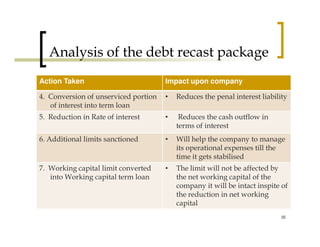
Analysis of the debt recast package
Action Taken                          Impact upon company

4. Conversion of unserviced portion   •   Reduces the penal interest liability
   of interest into term loan
5. Reduction in Rate of interest      •    Reduces the cash outflow in
                                          terms of interest
6. Additional limits sanctioned       •   Will help the company to manage
                                          its operational expenses till the
                                          time it gets stabilised
7. Working capital limit converted    •   The limit will not be affected by
   into Working capital term loan         the net working capital of the
                                          company it will be intact inspite of
                                          the reduction in net working
                                          capital
                                                                            35
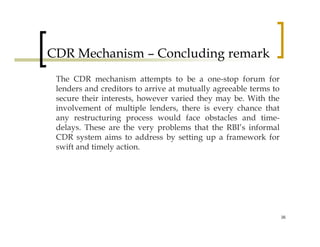
CDR Mechanism – Concluding remark
 The CDR mechanism attempts to be a one-stop forum for
 lenders and creditors to arrive at mutually agreeable terms to
 secure their interests, however varied they may be. With the
 involvement of multiple lenders, there is every chance that
 any restructuring process would face obstacles and time-
 delays. These are the very problems that the RBI’s informal
 CDR system aims to address by setting up a framework for
 swift and timely action.


                                                                  36
Thank You

Final cdr-presentation-03022012

  • 1.
    A Presentation On CorporateDebt Restructuring Mechanism By CA Rajesh Chaturvedi February 4 , 2012
  • 2.
    What is CDR CorporateDebt Restructuring is basically a mechanism by way of which company endeavors to reorganize its outstanding obligations. The reorganization of the outstanding obligations can be made by any one or more of the following ways: Increasing the tenure of the loan Reducing the rate of interest One time settlement Conversion of debt into equity Converting unserviced portion of interest into term loan 2
  • 3.
    Why CDR When acorporate is having severe financial crisis in terms of : Trouble in repaying it’s debt obligation Inability in timely servicing of it’s interest It generally resorts to Corporate Debt Restructuring Mechanism 3
  • 4.
    CDR – Borrower’sPoint of View When a company is having outstanding debts which cannot be serviced under its existing operations it can resort to any of the following courses of action: Enhance its quantum of Debt with an expectation to increase its Profitability & to pay off its original debt, however the company may not be able sustain such enhanced level of debt Cease the current operations of the company & undergo winding up, so this will ultimately lead to unnatural death of company “To consider a structured plan to re –negotiate the terms of its current debt with existing lenders itself” 4 This is where restructuring gains prominence.
  • 5.
    CDR- Lender’s perspective CDR gives the lenders a unique opportunity to avoid being encumbered with NPA’s. The primary interest of lenders always lies in recovering the principle amount lent to corporate along with returns on that investment & not in liquidation of assets Apart from this Liquidation proceedings are notorious for yielding low returns for creditors Therefore, CDR becomes an instrument for the lenders, i.e. the banks, to aid the transformation of otherwise Non-Performing Assets into productive assets 5
  • 6.
    CDR – Isit legitimate in every case Whether a case should be referred for restructuring or not is based upon thorough examination of facts & viability of the case. However, wherever the demand for restructuring is legitimate, and there is a good reason to believe that the corporation may be revived, it must be considered for restructuring. 6
  • 7.
    Objectives of CDR Byway of CDR there is a hope of preservation of Viable corporate that are affected by certain internal & external factors CDR aims at minimising the losses to creditors & other stakeholders through an orderly & co- ordinates restructuring programme To support continuing economic recovery 7
  • 8.
    CDR Structure The CDRstructure in India is based upon the three tier structure as follows: •It is third tier of CDR mechanism •This cell makes the initial scrutiny of the proposals & if restructuring gets approved this cell makes a detailed plan for restructuring in conjunction with the CDR CELL lenders •This group is comprised of the ED level representatives of leading banks along with ED level representatives of concerned lenders •This group based upon preliminary report prepared by CDR cell decides whether they should take up the restructuring or not, if yes then they provide initial Empowered guidelines Group • When final restructuring plan is prepared by CDR cell the same is again approved by EG •This is the top tier in CDR mechanism comprised of representatives of all the financial institutions & banks. Standing •This body lays down the policies & guidelines to be followed by the EG & CDR Forum cell for debt restructuring 8
  • 9.
    Legal Basis toCDR The legal basis to the CDR System is provided by the Debtor- Creditor Agreement (DCA) and the Inter-Creditor Agreement (ICA). ICA: All banks /financial institutions in the CDR System are required to enter into the legally binding ICA with necessary enforcement and penal provisions, if 75% of creditors (by value) agree to a debt restructuring package, the same would be binding on the remaining creditors. DCA: Debtors are required to execute the DCA. The DCA has a legally binding ‘stand still’ agreement binding for 90/180 days whereby both the debtor and creditor(s) agree to ‘stand still’ and commit themselves not to take recourse to any legal action during the period. 9
  • 10.
    Certain Instances ofCDR In the past, there have been several companies which have been referred to CDR, few of them are as follows: Subhiksha Retail Vishal Retail GTL Infra Air India Wockhardt India cements Jindal Steel Essar Steel HPL 10
  • 11.
    Accounts classification under CDRsystem Standard & Substandard Category 1 Additional Accounts CDR funding can System be provided Doubtful NO Accounts Category 2 Additional CDR funding can System be provided 11
  • 12.
    RBI Guidelines forrestructured Account The dues to the bank are ‘fully secured by tangible security’ (not applicable in the infrastructure projects, provided the cash flows generated from these projects are adequate & escrow mechanism available). The unit becomes viable in 10 years, if it is engaged in infrastructure activities and in 7 years in the case of other units. The repayment period of the restructured advance including moratorium period doesn’t not exceed 15 years in the case of infrastructure advances and 10 years in the case of other advances. Promoter’s sacrifice and additional funds brought by them should be minimum of 15% of the banks’ sacrifice. Personal Guarantee is offered by the promoter except when the unit is affected by the external factors pertaining to the economy and industry, The restructuring under consideration is not a repeated restructuring 12
  • 13.
    Exit & RecompenseClause The payment of recompense amount gets triggered in the following circumstances: Mandatory Cases: Exit: The exit of the borrower from the CDR mechanism either voluntarily or at the end of the restructuring period. Performance: If the performance of the borrower in any whole financial year improves in comparison to CDR projections. Declaration of dividend: If the borrower declares dividend in any financial year in excess of ten percent on annualised basis. The recompense amount shall be payable prior to distribution of dividend. 13
  • 14.
    Exit & RecompenseClause Methodology: On the occurrence of any of the trigger events, the referring/monitoring institution shall convene a meeting of the Monitoring Committee to determine the quantum of the recompense amount payable by the borrower till the trigger date. 14
  • 15.
    Points to beconsidered while preparing restructuring package S.No. Particulars S.No. Particulars 1. Entry into CDR System. 8. Monitoring Mechanism. 2. Financial Viability Parameters : 9.. Sharing of Securities. Benchmark Levels i.e. BEP, RoCE, IRR, Cost of capital & Loan life ratio 3. Category 1 & 2 under CDR System. 10. Conversion of Debt/Sacrifices in to Equity. 4. BIFR Cases; Eligibility Criteria. 11. Additional Finance and sharing thereof. 5. Cases of Willful Defaulters: 12. Payment Parity. Benchmark Levels 6. Borrower Classification for 13. TRA: Treatment For Interest on WC stipulation of Standard Terms & and Term Loan (TL/WCTL/FITL)- Conditions Treatment in TRA. 7. Time Frame for Processing and 14. Prudential & Accounting Issues Implementation of Restructuring Schemes. 15
  • 16.
    Points to beconsidered while preparing restructuring package S.No. Particulars S.No. Particulars 15 Prepayment of Restructured Debt 18. Revocation of Restructuring scheme/ and Exit From CDR System. Legal action for recovery. 16. Recompense Clause. 19. Re-workout of CDR Packages. 17. OTS/ Assignment of Debts. 20. Exit Cases From CDR System. 16
  • 17.
  • 18.
    Case Study -1 KSL & Industries Ltd.
  • 19.
    Snapshot of thecompany KSL Industries Ltd. (KSLIL) is the flagship company of Saurabh Tayal Enterprise (ex-major stake holder of Bank of Rajasthan) KSLIL is a Mumbai based conglomerate engaged in India’s fastest growing industries i.e. Textile & real estate Company is having spinning facility, knitting facility & processing facility in the various parts of the country i..e at Nagpur, Dombivali & Wada. KSLIL embarked an expansion project at it’s units located at Kalmeshwar & Nagpur after due appraisal in the FY 2010 & 2011
  • 20.
    Current Financial performance Particulars FY 09 FY 10 FY 11 FY 12 (H1) Sales 819 1031 1306 740 EBIDTA 158 157 187 121 % EBIDTA 19.3% 15.2% 14.3% 16.3% Interest 57 73 86 64 PBT 30 (4.4) 2.1 8.0 PAT 24.37 4.00 -3.42 6.38 Cash Accruals 96.64 94.09 96.07 56.61 Long term Debts 860.27 897.28 867.02 839.38
  • 21.
    Why CDR forKSLIL Increasing in cost causing reduction in profits Affecting the Deficit in cash flow business volumes Inadequate working capital
  • 22.
    Reasons for deteriorationof financial position As explained before company had undertaken an expansion project in FY 2010 & 2011, however during the project implementation the textile industry underwent major change causing a major deviation in the assumptions envisaged during project appraisal & present scenario such as : Increase in cotton Cost – 54% Increase in power cost – 38% Increase in Labour cost - 35% Increase in yarn price – 19% Increase in Knitted fabric cost – 5% As can be seen there was a major increase in the cost but commensurate increase in the income was not reflected causing a significant gap in the profit envisaged & actual profits earned
  • 23.
    Other Reasons fordeterioration of financial position Due to industry downturn delay in receipt of receivables Delay in receipt of TUFS subsidy Changes industry dynamics - Past profitability not sustainable in prevailing circumstances
  • 24.
    Cash flow Analysis Particulars FY10 FY11 HFY-12 Total EBIDTA Less Tax 158 186 120 464 Net Current Assets (20) 43 22 45 Suplus Post NCA built up 178 143 98 419 Capex 147 24 3 174 Surplus after Capex 32 118 95 245 Interest Obligation 73 86 63 222 Principal Obligation 89 34 35 159 Total Debt Obligation 162 120 99 381 Surplus/(deficit) post (130) (2) (4) (136) debt servicing
  • 25.
    Management Initiatives &Business plan Exhaustive restructuring plan is to be prepared to revive the operations & profitability . Certain modifications and up gradation to the machineries to improve production and productivity, these will entail saving in labour cost & other overhead cost
  • 26.
    Debt realignment proposal(Holding on operations) Till the time of designing & implementation of restructuring following steps shall be taken Lenders not to recover any Loan installments and interest Lenders not to levy of any penal charges for delays / irregularities Continuation of working capital limits at existing levels Till implementation of restructuring package, cash / cheque deposits made in the KSL’s accounts, would be allowed to be withdrawn, without any adjustment against any dues payable to the bank.
  • 27.
    Debt realignment proposal 1. Term loans: Repayable in 10 years No moratorium period available in order to comply with subsidy guidelines Interest to be charged at concessional rate of 10% Waiver of the unpaid penal & compound interest 2. Working capital limits: Working capital limit to be assessed based on FY13 numbers Reduced rate of interest @10% Reduction in working capital margins from earlier 25% to 10% LC & BG margins also reduced
  • 28.
    Debt realignment proposal 3. Funding of Interest: Interest due upon the term loans & working capital loans to be converted into Funded interest term loan Repayable in 2 years starting from 30th June 2015 Interest on FITL to be charged @5% 4. Foreign Currency convertible Bonds(FCCB’s): 25% of the FCCB amount to be paid within 6 months of restructuring Reduced coupon rate @2% Yield to maturity of 4%
  • 29.
    Debt realignment proposal 5. Promoter’s Contribution: Promoter’s to infuse fresh contribution to the extent of 15% of lenders sacrifice 50% of the same to be infused immediately & remaining within 6 months
  • 30.
    Post debt restructuringscheme Post approval of restructuring scheme and subject to timely availability of adequate working capital can generate decent Revenue and EBIDTA levels sufficient to meet the debt servicing requirements post restructuring. Financial Year FY12-H2 FY13 FY14 FY 15 onwards Total Revenues 606 1320 1338 1360 EBIDTA 33 80 94 118 EBIDTA % 5.4% 6.1% 7.0% 8.7%
  • 31.
    Post debt restructuringscheme The above projections are fully sensitized for further downside risks, so it is very much likely that after implementation of the package the company will able to restore its old shape. The restructuring package is expected to act as a breather for the company.
  • 32.
    Case study -2 Kingfisher Airlines
  • 33.
    Kingfisher’s Debt recastpackage If we look at the books of Kingfisher, banks & FI’s have taken the following CDR route: Rs. 750.10 Crores of loans were converted into 7.5% compulsorily convertible preference shares which thereafter converted into equity Rs. 553.10 Crores of Loans were converted into 8% Cumulative Redeemable preference Shares redeemable at par after 12 years. Repayment of the balance loans was rescheduled with a moratorium on repayment of principal of 2 years and step-up repayment over the subsequent 7 years Interest for the period July 1, 2010 to March 31, 2011 on loans from the banks was converted into a funded interest term loan repayable in 9 years including 2 years moratorium. Interest rate on loans reduced by over 300 bps Additional fund based loan facilities of Rs.768.32 Crores and non- fund based facilities of Rs.444.40 Crores sanctioned by the banks Part of the working capital limits of Rs.297.40 crores converted into working capital term loans. 33
  • 34.
    Analysis of thedebt recast package Action Taken Impact upon company 1. Conversion of loan into equity Reduction of interest burden 2 Conversion of loan into cumulative • Reduces the interest burden, redeemable preference shares dividend is payable to shareholders only upon the generation of profits • Company needs to pay dividend distribution tax, loss of interest deduction too 3. Moratorium period of two years • Reduces the stress upon cash flow as there will be no repayment liability for 2 years 34
  • 35.
    Analysis of thedebt recast package Action Taken Impact upon company 4. Conversion of unserviced portion • Reduces the penal interest liability of interest into term loan 5. Reduction in Rate of interest • Reduces the cash outflow in terms of interest 6. Additional limits sanctioned • Will help the company to manage its operational expenses till the time it gets stabilised 7. Working capital limit converted • The limit will not be affected by into Working capital term loan the net working capital of the company it will be intact inspite of the reduction in net working capital 35
  • 36.
    CDR Mechanism –Concluding remark The CDR mechanism attempts to be a one-stop forum for lenders and creditors to arrive at mutually agreeable terms to secure their interests, however varied they may be. With the involvement of multiple lenders, there is every chance that any restructuring process would face obstacles and time- delays. These are the very problems that the RBI’s informal CDR system aims to address by setting up a framework for swift and timely action. 36
  • 37.