__________________________________________________________
A Growing Problem
A Policy Proposal for Native American Reservations Struggling to Beat the Obesity Epidemic
in the United States of America
_____________________________________________________________________________
______________________________________________________________________________
Stephanie A. Shoenfelt
The Ohio State University
John Glenn School of Public Affairs
Senior Capstone 2014
Table of Contents
_____________________________________________________
I. Executive Summary 1
II. Problem Identification 2-3
III. Obesity on Reservations 3-5
IV. SNAP vs. FDPIR 5-6
V. Trends at Spirit Lake 6-7
VI. Alternatives and Community Initiatives 7-10
VII. Policy Proposal 10-11
VIII. Conclusion 11-12
IX. Acknowledgements 13
X. Works Cited 14-15
!
! "!
I. Executive Summary
______________________________________________________
American Indians are more susceptible to the obesity epidemic than any other ethnic
group in the United States. The prevalence of obesity in American Indian (AI) children is 48.3%
compared to 29.0% in non-Hispanic White children of the same age. (Ness) AI adults are 60
percent more likely to be obese than their non-Hispanic White peers. As poverty rates
increased amongst AI people, they had to consume food provided by the federal government.
(Compher) With the adoption of Western values, high fat food became a norm on reservations.
Tribal members of Spirit Lake Nation in North Dakota depend upon two federal food
assistance programs: Supplemental Nutrition Assistance Program (SNAP) and the Food
Distribution Program on Indian Reservations (FDPIR). Both of these programs provide basic
food needs to the people, but they are calorie-rich and nutrient poor. With a reservation living
in poverty, the majority relies on food assistance. They cannot afford fresh food and eat what
they are given. As reliance upon federal food provision increases among AI populations, so do
obesity rates. Spirit Lake Nation is failing to offer nutrition education and supplemental
activities to increase health awareness. It has seen a sharp rise in food distribution program
participation over the past year that has not been accompanied by a rise in educational efforts.
If obesity continues without nutrition education efforts and access to fresh foods, the
reservation will risk a 52 percent obesity prevalence rate in the next fifteen years. With only
one grocery store on the reservation, access will remain limited on Spirit Lake unless
something is done. Healthcare costs will stretch into the billions and the four health clinics will
receive an influx of patients as more individuals develop obesity-related diseases such as
diabetes and coronary heart disease. Prescription costs for these individuals are 100 percent
higher than those for non-obese individuals. This poverty stricken reservation cannot handle
the impending costs.
Spirit Lake Nation needs to implement a Family Agricultural Development Pilot
Program. This is a three-year program designed to help families create personal gardens of
fruits and vegetables by providing seeds, tilling soil, and installing irrigation systems.
Collaboration between the local school and health clinics serves to identify willing and
responsible families to be a part of the program. Small plots are assigned to each family and
education is provided on how to grow a successful garden and the importance of fresh food for
maintaining a balanced diet. Initial implementation costs will be high, but the program will
become self-sustaining throughout the three-year pilot program.
As progress is made, the program will expand to the entire tribe through an Integrated
Food System. The family farms will come together to provide food for each other through
farmers markets, picking days, and awareness events. This will increase healthy living within
the reservation and decrease obesity rates over time. The tribal government must place
nutrition at the top of the political agenda for Spirit Lake in order for these efforts to be
successful. An Integrated Food System cannot exist without the support of the government and
health clinics, but it is a necessary program to implement regardless of initial costs. The long-
term benefits of better health and increased food access validate immediate implementation.
! #!
II. What is the Problem?
_________________________________________________________
American Indian populations are far from being exempt from the current obesity
epidemic. They constitute 1.2% of the United States population and are often forgotten by the
rest of the American public. Regardless, American Indians (AI) have the highest obesity rates
in the United States. Their youth are drastically affected by the growing weights, boasting of a
48.3% obesity prevalence compared to a 29.0% prevalence in non-Hispanic white youth of the
same age. American Indian adults managed to reach a 40.8% obesity rate in 2011 compared to
non-Hispanic white adults rate of 26.2% (Obesity, OMH). Women are most at risk considering
they are 60% more likely than their non-AI peers to become overweight.
One of the largest contributors to the high obesity rates on Indian reservations is the
nutritional transition that began on reservations in the 19th century. This is when the AI
population was forced to adopt the Western lifestyle of eating foods high in fat and calories due
to treaties between tribal governments and the federal government. This was coupled with a
decrease in physical activity as many tribes were now sequestered to a specified area of land.
Several reservations fell into poverty. They lost the land they had used for agriculture while
simultaneously becoming reliant on federally provided food rations of sugar, lard, and flour,
resulting in a decrease of traditionally fresh grown food (Marchand).
Time passed and more government welfare programs were established. The American
Indian people could now take advantage of benefits provided by the Supplemental Nutrition
Assistance Program (SNAP) and the Food Distribution Program for Indian Reservations
(FDPIR). These programs became available on nearly all of the reservations through the
United States. Currently, tribal members must choose between SNAP and FDPIR for any
given month. Many flip-flop between the two depending on current health and nutrition needs,
access to transportation, and employment status. (Tannehill, 5)
The SNAP program offers electronic benefits via a debit card to be used at SNAP
approved grocery stores. FDPIR is a benefit-in-kind program that allocates commodity food
packages to families on a monthly basis. Both programs give individuals choices on which foods
they would like to consume, but there are minor eligibility differences (Tannehill, 4). The
amount of people utilizing each program on AI reservations fluctuates every few years due to
changing economic situations. This policy focuses specifically on the Spirit Lake Tribe in North
Dakota and their use of the FDPIR and SNAP program and how this is affecting the health of
tribal members.
Socioeconomic status also influences obesity. People living in poverty are more likely to
be overweight as they are forced to rely on government handouts and inexpensive foods. These
low-cost foods are found at Spirit Lake’s single grocery store and gas station, the two places on
the reservation to obtain food. There is a direct correlation between obesity rates and the
consumption of fast food and convenience foods. Consuming these foods may be a necessity for
Spirit Lake residents. Many have limited resources and are forced to eat unhealthy foods.
Higher socioeconomic status affords individual choices in food consumption. Spirit Lake tribal
members have no choice. They must choose processed food (Caprio, 2219).
Government programs such as FDPIR and SNAP provide a foundation of nutrition,
however, they fail to provide proper nutrition education and adequate supplies of fresh foods.
! $!
American Indian tribes are losing touch with their traditional food preparation because they
have no way to obtain necessary produce. Spirit Lake Nation is one of these reservations. With
no consistent access to fresh foods and rare nutrition education programming, it is imperative
that the reservation gains greater food access and nutrition education to buffer the increasing
healthcare costs associated with obesity.
III. Obesity on Reservations
___________________________________________________
American Indians are more obese than any other ethnic group, but little has been done
to combat this issue. American Indian adults have a 60 percent greater chance of being
overweight or obese than non-Hispanic white adults. American Indian women have one of the
highest obesity rates at 66 percent while non-Hispanic white women had a low rate of 28
percent. (Story, 1) The figure below illustrates the differences between ethnicities in percent of
total population and weights among adults age 18 and over.
Obesity Rates in Relation to Percent of Total Population
Created with data provided in the National Health Statistics Report (Barnes, 3)
This visual clearly indicates that, although society focuses on the weight gain of whites,
their obesity rates are small relative to the their total population. Whereas, American Indians
make up only 1.2 percent of the United State population, but a third of that 1.2 percent is obese.
The difference is evident. Concern needs to be shifted to this ignored and invisible ethnicity.
Furthermore, large weight discrepancies are evident across ethnic groups between children as
young as four years old. This is a clear indicator that the obesity epidemic will be a perpetual
problem for this country as obese youth grow into obese adults.
Obesity Rates Among 4-Year Olds
Created with data from “Obesity Rates Differ Among Racial/Ethnic Groups In Kids As Young As Age 4.” The Ohio State University Research
News
%!
#%!
&%!
'%!
(%!
American
Indian
Hispanic
African
American
White
Asian
Percent of Total
US Population by
Ethnicity
Percentage of
Obese People per
Ethnicity
! &!
The majority of school-age children receive at least two of their meals each day from the
school feeding programs run by the federal government. This is especially true at Four Winds,
the school on Spirit Lake Reservation. A conversation with Kaye Knudson, the School
Nutrition Program Manager for the North Dakota Department of Public Instruction, revealed
that the current enrollment at the high school level is 135 students and the enrollment at the
elementary level is 553 students. The graph below illustrates how many of these students are
participating in the National School Breakfast and Lunch Programs at Four Winds in the
current 2013-14 academic year.
Four Winds Students Participating in Federally Funded School Feeding Programs
Created with data provided by Kaye Knudson, School Nutrition Program Manager for ND Dept. of Public Instruction
The majority of students (over 75 percent) are receiving food provided by the federal
government through the school system. The schools control which food they want to provide
the students with each month. The past few months have included no fresh fruit, pre-made
eggs, and synthetic cheese. (NDFoods, 1) These foods are not nutritious, but the children lack
control over their consumption choices and some will not receive any other meal in their day.
This leads the children to consume all that is given to them by the federal government with no
concern for the nutritional value of their meals. A popular lunch item is a small, microwaveable
burrito. The nutrition label provided by the manufacturer, MCI Foods, Inc., is below:
Recommended DV for Ages 4-13 % Daily Value in Bean & Cheese Burrito
Sodium: 1900-2200 mg 26.666%- 30.876%
Saturated Fat: 18 g 22.33%
Vitamin C: 25-45 mg <0.5%
Calcium: 800-1300 mg <0.5%
%!
"%%!
#%%!
$%%!
&%%!
)%%!
'%%!
*+,-,./012! 3456!78699+!
:,;,10++2!:<.;,;!
=1,0>?0@/!
78699+!A<.86!
B19510-!
C9/0+!*.19++-,./!
! )!
The FDA sets a guideline that all foods should contain a percent daily value of each
nutrient ranging between 5 percent and 20 percent. Any food that contains less than 5 percent
of any nutrient is low in nutritional value. Foods that have nutrients with upwards of 20
percent the recommended daily value are high and should be avoided. Sodium and saturated
fats should always be consumed in moderation. Excess consumption can cause negative health
effects and the item above is just one example of how the children at Four Winds are
consuming far more than the recommended value in one food item. On the contrary, Vitamin C
and Calcium are desired nutrients. An individual must consume the daily-recommended amount
to maintain a healthy weight and a balanced diet. (Food and Drug, 1) These two are
exceedingly low for this one product.
IV. SNAP vs. FDPIR
____________________________________________________________
Tribal members of Spirit Lake Nation have a choice between participating in the
Supplemental Nutrition Assistance Program (SNAP) and the Food Distribution Program on
Indian Reservations (FDPIR) when considering the best way to obtain food and commodities.
(Tannehill, 2) They cannot participate in both.
SNAP: Electronic benefits to be used at approved grocery stores
and supermarkets to purchase basic food products; Set monetary
amounts per month based upon family income; Complex eligibility
requirements
FDPIR: Basic food commodity package distributed monthly on the
reservation; Indian Tribal Organization decides if FDPIR packages
will be available; Individuals choose their food from a list of
available options
FDPIR was created as an alternative to SNAP because many
reservations do not have access to grocery stores and SNAP offices. FDPIR has focused on
becoming more nutritious by offering the option of fresh fruits and vegetables. They have also
begun to put nutrition labels on their products to aid individuals in choosing healthier foods,
however, some still prefer SNAP. (Tannehill, 3) Despite this, the FDPIR program on Spirit
Lake has experienced a significant increase in participation on Spirit Lake Reservation
compared to other reservations throughout the United States.
National FDPIR Participation: FY ’11- FY ‘13
Created from data provided by ND Food and Nutrition Service
'%%%%!
')%%%!
D%%%%!
D)%%%!
(%%%%!
()%%%!
E8/F"&!
G,8F"&!
:,HF")!
IJ1F")!
K<.F")!
I<5F")!
E8/F")!
G,8F")!
:,HF"'!
IJ1F"'!
K<.F"'!
I<5F"'!
E8/F"'!
G,8F"'!
:,HF"D!
IJ1F"D!
K<.F"D!
I<5F"D!
!"#$%&!''(&)'**'(+,-&
#./0.12&34,+'56&
FL0..,;!?1<4/@!
FG,62;10/,;!J9/0/9,@!
F=,0.@!
FM4N,;!?19O,.!
P,5,/0H+,@!
FL91.!Q!148,!8,1,0+!
F:19O,.!-,0/!
FL0..,;!H,,?!Q!/<.0!
F*55!M4N!
FR</@S!?+9<1S!-08019.4!
! '!
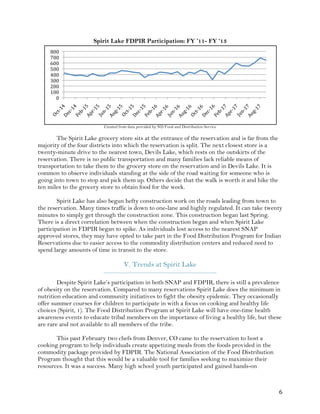
Spirit Lake FDPIR Participation: FY ’11- FY ‘13
Created from data provided by ND Food and Distribution Service
The Spirit Lake grocery store sits at the entrance of the reservation and is far from the
majority of the four districts into which the reservation is split. The next closest store is a
twenty-minute drive to the nearest town, Devils Lake, which rests on the outskirts of the
reservation. There is no public transportation and many families lack reliable means of
transportation to take them to the grocery store on the reservation and in Devils Lake. It is
common to observe individuals standing at the side of the road waiting for someone who is
going into town to stop and pick them up. Others decide that the walk is worth it and hike the
ten miles to the grocery store to obtain food for the week.
Spirit Lake has also begun hefty construction work on the roads leading from town to
the reservation. Many times traffic is down to one-lane and highly regulated. It can take twenty
minutes to simply get through the construction zone. This construction began last Spring.
There is a direct correlation between when the construction began and when Spirit Lake
participation in FDPIR began to spike. As individuals lost access to the nearest SNAP
approved stores, they may have opted to take part in the Food Distribution Program for Indian
Reservations due to easier access to the commodity distribution centers and reduced need to
spend large amounts of time in transit to the store.
V. Trends at Spirit Lake
________________________________________________
Despite Spirit Lake’s participation in both SNAP and FDPIR, there is still a prevalence
of obesity on the reservation. Compared to many reservations Spirit Lake does the minimum in
nutrition education and community initiatives to fight the obesity epidemic. They occasionally
offer summer courses for children to participate in with a focus on cooking and healthy life
choices (Spirit, 1). The Food Distribution Program at Spirit Lake will have one-time health
awareness events to educate tribal members on the importance of living a healthy life, but these
are rare and not available to all members of the tribe.
This past February two chefs from Denver, CO came to the reservation to host a
cooking program to help individuals create appetizing meals from the foods provided in the
commodity package provided by FDPIR. The National Association of the Food Distribution
Program thought that this would be a valuable tool for families seeking to maximize their
resources. It was a success. Many high school youth participated and gained hands-on
%!
"%%!
#%%!
$%%!
&%%!
)%%!
'%%!
D%%!
(%%!
! D!
experience with cooking (Fehrs, 1-6). This was a unique opportunity for all involved, but it
reached a small handful of people. Spirit Lake needs a consistent program that will allow all
members of the tribe to experience healthy living and maximize the resources available on the
reservation in order to live a balanced and nutritious life. Tribal members have little control
over the food they consume, but this can be rectified.
VI. Alternatives and Community Initiatives
_________________________________________________________________________
1. Status Quo
Maintain current nutrition programs and provide sparse opportunities for supplemental
nutrition education
There are significant risks associated with not addressing any of the nutrition and
health issues on Spirit Lake reservation. Obesity rates will continue to grow without restraint
as they have been doing for the past two decades. At this point, all states in America have an
obesity rate over twenty percent. North Dakota boasts a 29.7% adult obesity rate, one of the
highest in the country. If obesity continues unabated, 57.1% of North Dakota adults will be
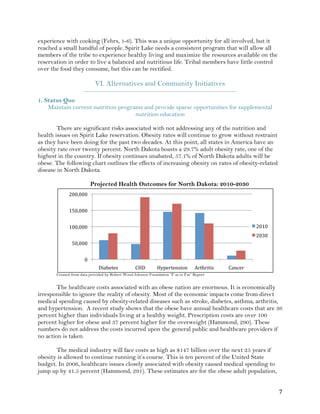
obese. The following chart outlines the effects of increasing obesity on rates of obesity-related
disease in North Dakota.
Projected Health Outcomes for North Dakota: 2010-2030
Created from data provided by Robert Wood Johnson Foundation “F as in Fat” Report
The healthcare costs associated with an obese nation are enormous. It is economically
irresponsible to ignore the reality of obesity. Most of the economic impacts come from direct
medical spending caused by obesity-related diseases such as stroke, diabetes, asthma, arthritis,
and hypertension. A recent study shows that the obese have annual healthcare costs that are 36
percent higher than individuals living at a healthy weight. Prescription costs are over 100
percent higher for obese and 37 percent higher for the overweight (Hammond, 290). These
numbers do not address the costs incurred upon the general public and healthcare providers if
no action is taken.
The medical industry will face costs as high as $147 billion over the next 25 years if
obesity is allowed to continue running it’s course. This is ten percent of the United State
budget. In 2006, healthcare issues closely associated with obesity caused medical spending to
jump up by 41.5 percent (Hammond, 291). These estimates are for the obese adult population,
%!
)%S%%%!
"%%S%%%!
")%S%%%!
#%%S%%%!
G40H,/,@! L3G! 32J,1/,.@49.! I1/614/4@! L0.8,1!
#%"%!
#%$%!
! (!
but childhood obesity is a source of budgetary strain as well. Immediate direct annual costs
increases are projected to be around $14.3 billion, but this does not take into account the costs
that will be incurred as these children grow into obese adults (292). The weight gained by
American Indians will have direct economic consequences upon the rest of the nation.
Access to proper healthcare to address these foreboding health needs is limited on Spirit
Lake Reservation. There are four health clinics throughout the reservation that are staffed by
four registered nurses and one dietician. The Spirit Lake health system provides transportation
to these locations as needed, but appointments can only be scheduled during a two-hour time
period to “fit the schedule of the driver” (Native, 1). Tribal members are at risk of losing this
transportation service for half of a year if they miss the shuttle once. (1)
Maintaining the status quo may be the most politically feasible option at this time
because the Spirit Lake tribal government is in upheaval. Obesity and healthcare are not at the
top of the political agenda. Tribal members are focusing on ousting the current chairman and
responding to accusations of covering up a child abuse case. (Childress, 1) Obesity will continue
to rise until there are major changes in the agenda of the tribal government. The federal
government will also be required to step in to address rising healthcare costs on reservations
and the lack of nutritional value in the foods they provide.
2. Family Agricultural Development Pilot Program
A program that helps families establish their own personal gardens by providing seeds,
irrigation, and training
A family agricultural development project is a personal initiative among individual
families that has been effectively implemented on comparable reservations throughout South
Dakota. The project seeks to help families create their own personal gardens of fruits and
vegetables by providing seeds, tilling soil, and installing irrigation systems throughout the
reservation. This process also creates jobs for youth by allowing them the opportunity to
deliver seeds, drive tractors, and work within the gardens.
This project was successfully implemented on Pine Ridge Reservation in South Dakota.
The Slim Buttes Agricultural Development Program (SBAG) was founded on Pine Ridge
Indian Reservation by a non-profit organization known as Running Strong for American
Indian Youth. SBAG has found that initial implementation costs of this project were high, but
it is less expensive once it is established on the reservation. Running Strong for American
Indian Youth is a not-for-profit organization seeking to expand their reach and is a potential
source of funding for this project on Spirit Lake (US Dept).
Spirit Lake would benefit from a program similar to SBAG. Families throughout Spirit
Lake are broken and violence is rampant. Within a five-week period in the summer of 2013
there were two suicides and five shootings on Spirit Lake. There is little healthy interaction
between children and parents. A family agricultural development project has potential to
increase family ties and renew relationships between parents and children while benefitting the
community. Having a family garden to work on and reap the benefits of things sown would aid
the entire family unit in becoming active and more cohesive.
! T!
To test the feasibility of this proposal, it would be best to start it as a pilot program
with potential for permanent implementation:
It is important for participants in the pilot program to receive benefits of some sort for
their efforts and cooperation. A large benefit would be a relaxed health transportation policy to
help families obtain proper healthcare or discounted tuition for those with students at Four
Winds. The amount discounted would be the amount spent on seeds throughout the year. Once
the initial steps are made and the program is established, all that is needed to continue are land,
seeds, and continued cooperation. Land is readily available throughout the reservation and the
lake in the middle of the reservation is a key element needed to aid in proper irrigation.
3. Expanded Integrated Food System
A program implemented to create local farms that grow traditional foods
An integrated food system on Spirit Lake Reservation would provide access to
traditional food products, create a local economy, foster community development, and provide
long-term solutions to nutrition issues. This system has been successfully implemented in the
Oneida Community of Oklahoma to resolve issues similar problems to what Spirit Lake Nation
is facing now with lack of access and nutrition education.
Before the Oneida Community in Oklahoma worked on their integrated food system, the
tribe was living off of the FDPIR commodity package and SNAP benefits, just as Spirit Lake is
doing now. Students were receiving limited physical activity and consuming the foods provided
by the federal government through the National School Lunch Program. The tribe had low
access to fully stocked grocery stores and schools struggled to provide nutritious meals. This
led the founders of the Oneida Community Integrated Food System (OCIFS) to explore ways
to bring traditional Native American foods back to the reservation. (US Dept. of Interior)
This was accomplished through implementing community gardens and farms
throughout Oneida. The farms provide corn, beans, squash, medicinal herbs, eggs, and a pick-
your-own berry patch. Some farmers raise free-range bison and beef. A fruit orchard provides
raspberries, blueberries, squash, pumpkins, and apples. None of these fresh foods are provided
through FDPIR or SNAP. The community has added jobs while maintaining healthier lives
and fostering community development. (US Dept. of Interior)
This program would be implemented on Spirit Lake after a 3-year test of the Family
Agricultural Development Pilot Program. This allows ample time for a large amount of tribal
members to receive nutrition education, invest in gardening, and reap the rewards of fresh
foods. If success was seen with the pilot program, it would be easier to implement a larger
1) Health clinic works in conjunction with Four Winds to identify willing
and responsible families
2) Education sessions to teach families about the need for fresh fruits and
vegetables & proper nutrition
3) Establish expectations and guidelines for the first year
4) Aid families in beginning their individual plots
5) Monitor progress, changes, challenges, and successes
6) Determine the rate of growth for more plots and families to join
!
! "%!
program, such as community gardens. The tribal government needs to see that the program
has tangible benefits and is self-sustaining in order to place it near the top of their agenda. A
longer pilot program will also allow the community to gain enthusiasm for the new changes
and expansion of gardening throughout the reservation.
Spirit Lake is in desperate need of this program, although it could not be implemented
for a few years. It helps add physical activity to the day while providing nutrition education.
This is especially important for the students at Four Winds due to their dependence on federal
food programs and increasing rates of obesity. A positive way to begin implementation of a
large-scale community garden would be to place the first set of gardens on the grounds of Four
Winds.
Time would be integrated into the school day to allow the children to go outside, tend
the garden, and learn about what foods they are planting. This information would be carried
back to the homes and shared with family members. There is plenty of land surrounding the
school that would be suitable for small garden plots for each class. The grounds of Four Winds
are well kept and ideal for small garden plots. This entire project will increase personal
responsibility and dedication while teaching important life skills to help youth implement
traditional food preparation into their lives, as they grow older and begin their own families.
VII. Policy Proposal
___________________________________________
It is in Spirit Lake Nation’s best interest to establish a Family Agricultural
Development Pilot Program to address the growing health needs and lack of access to healthy
foods on the reservation. These projects will allow families to grow fresh fruits and vegetables
in their own backyard. These foods can supplement the commodities provided by SNAP or
FDPIR and be added into a nutritious meal regiment for families. Any food grown and
consumed by families is a step in the direction of healthier living.
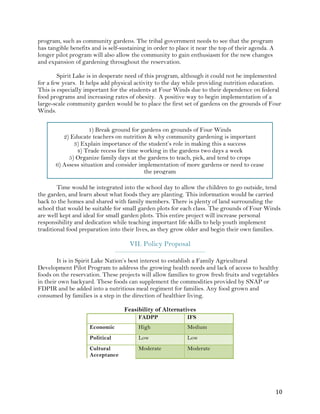
Feasibility of Alternatives
FADPP IFS
Economic High Medium
Political Low Low
Cultural
Acceptance
Moderate Moderate
1) Break ground for gardens on grounds of Four Winds
2) Educate teachers on nutrition & why community gardening is important
3) Explain importance of the student’s role in making this a success
4) Trade recess for time working in the gardens two days a week
5) Organize family days at the gardens to teach, pick, and tend to crops
6) Assess situation and consider implementation of more gardens or need to cease
the program
! ""!
A large amount of work would have to go into implementing a program like this across
the reservation, but it is possible with collaboration and dedication. Healthcare benefits, tuition
breaks, and other incentives would be provided to increase the desire of families to participate
in the program. The local health clinics and Four Winds would also choose the families. It
would be progressively implemented over three years to allow for steady growth and
reassessment of progress as each year passes. Upon establishment, the gardens can be passed
down through generations of families and become an important tool for tradition building
while restoring cultural ties. Participants in the program will have a choice in which seeds to
receive based upon personal preferences. This encourages individuals to only grow what they
know that they will eat, instead of having limited choices of fruits and vegetables available
through SNAP or FDPIR.
A personal garden allows for consistency in provision of fresh foods. Weather is always
a concern, but fruit and vegetable options can be tailored to the climate of the area to ensure
greater consistency in growing conditions. It is important to note that there will be times when
growing crops is not feasible due to winter weather. These months could be utilized by adding
cooking classes and nutrition workshops. It would be a great time to also review the year and
plan how to execute future years. The off-season may not be ideal for growing, but it can be
positively used to help move the Agricultural Development Project forward.
One of the greatest challenges when working with the American Indian population is
creating programs that appeal to their unique culture. The way AI people live is radically
different than how the rest of America lives. (Tannehill, 5) The Family Agricultural
Development Pilot Program allows for a return to cultural roots of working as a community to
achieve a common good. Cultural competency needs to be held at the forefront of any program
that may be implemented on a reservation. This program can be run solely by the people of
Spirit Lake, which will help members of the tribe to be more receptive to incoming changes.
No matter what happens with SNAP, FDPIR, and transportation to nearby grocery
stores, families will at least have some fresh food provided by the work of their hands. Children
will enter into a cycle of gardening through which they will be able to feed themselves and
their future families for years to come. The physical activity provided by creating and
maintaining a family garden will also aid in reduction of weight and prevention of excess
weight gain. The exposure to the outdoors gets families moving and outside of the house to
create a more active tradition. Family agricultural development projects are the least expensive
and most efficient way to begin fighting the obesity epidemic that is raging on American Indian
reservations.
VIII. Conclusion
____________________________________
There is an epidemic overtaking America. It is relentless in its pursuit of victims.
Obesity is affecting the lives of millions both directly and indirectly. One third of American
Indians are living at an undesirable and unhealthy weight due to lack of food access and proper
nutrition education. Members of Spirit Lake Nation in North Dakota are increasingly
dependent upon food provisions obtained through the Food Distribution Program on Indian
Reservations. The foods contained in a FDPIR commodity package lack nutritional value and
the people have little choice in the food they choose to consume.
! "#!
Spirit Lake Nation lives in a state of poverty. Tribal members do not have means of
transportation to obtain food or proper healthcare. They are dependent upon what is given
them by the federal government. Children are subject to consuming the federally provided
breakfasts and lunches at school. These meals are rarely nutritious and seldom appealing.
Students are forced to consume these meals because, for many, it is the only source of food they
have each day.
Spirit Lake must take immediate action to curb the health effects associated with
obesity. The tribe cannot afford to confront the increasing healthcare costs that are inevitable
with the rapid weight gain observed in tribal members. Due to the poverty on Spirit Lake, a
small-scale project provides the most effective means to begin addressing the situation. Family
agricultural development projects allow for small changes with large impact. They are
inexpensive, self-perpetuating, and culturally appropriate. Gardening and traditional food
preparation allows American Indians to return to their roots and regain cultural norms while
allowing for health conscious consumption choices. These are crucial changes that must be
made if Spirit Lake Nation is to live well and without fear of the future.
! "$!
IX. Acknowledgements
__________________________________________
This report would not be possible without the help of the North Dakota Food
Distribution Headquarters in obtaining current data on the state of Spirit Lake Nation. Thank
you, Mary Greene Trottier, for discussing the various food distribution programs on the
reservation and obtaining information for me from headquarters regarding annual participation
trends in FDPIR. Kaye Knudson, the School Nutrition Programs Manager for North Dakota,
provided information regarding Four Winds School and participation in the National School
Breakfast and Lunch Programs. This information was indispensable to the success of this
proposal. This proposal could not have been completed without the help of Glenn School
professor, Dr. Neal Hooker, and writing associate, Aubrey Beltran. Thank you to both of you
for your support and guidance throughout this process. An additional thank you to Michael
Faga and Elisabeth Nadler for their assistance in creating graphs and charts that accurately
portray the data of this report as high-impact and to-scale visuals. Ultimately, thank you to
Spirit Lake Nation for welcoming me for six weeks in 2013 and allowing me to be a part of the
culture and daily life. My experiences on the reservation remain in my heart forever and have
inspired me to return to North Dakota to continue helping the people who so warmly
welcomed me and taught me the importance of healthy and wholehearted living.
! "&!
X. Works Cited
_______________________________________
Barnes, MA, Patricia M., Patricia F. Adams, and Eve Powell-Griner, Ph.D, National Center for
Health Statistics. Health Characteristics of the American Indian or Alaska Native Adult
Population: United States, 2004–2008. Report 20. Washington, DC: HHS, 2009. Web.
Caldwell, Emily. “Obesity Rates Differ Among Racial/Ethnic Groups In Kids As Young As
Age 4.” The Ohio State University Research News. The Ohio State University, 6 Apr. 2009.
Web. 28 Feb. 2014.
Caprio, MD, Sonia, Stephen R. Daniels, MD, Ph. D., Adam Drewnowski, Ph. D., Francine R.
Kaufman, MD, and Arlen R. Rosenbloom, MD. “Influence of Race, Ethnicity, and
Culture on Childhood Obesity: Implications for Prevention and Treatment.” Diabetes
Care. 31. 11 (2008): 2211-2221. Web. 14 Mar. 2014.
Childress, Sarah. "Spirit Lake Elders Vote to Oust Tribal Council." Frontline. PBS,
12 Apr. 2013. Web. 17 Apr. 2014.
Food and Drug Administration. "How to Understand and Use the Nutrition Facts Label." U S
Food and Drug Administration Home Page. US Department of Health and Human
Services, Nov. 2004. Web. 17 Apr. 2014.
Fehrs, Adriana. "Reinventing commodity food to make healthy cuisine." Char-Koosta
News [Pablo] 6 Mar. 2014: 1-6. Print.
Food and Nutrition Service. Historical Participation Full Year Chart FY 2011- FY 2013. North
Dakota: FNS Program Support Branch, 2013. Web. 27 Jan. 2014.
Hammond, Ross A., and Ruth Levine. "The economic impact of obesity in the United
States." Journal of Diabetes, Metabolic Syndrome and Obesity 3 (2010): 285-295. Web.
14 Oct. 2013.
Marchand, Lorraine. "Obesity Associated with High Rates of Diabetes in the Pima
Indians." The Pima Indians: Pathfinders for Health. National Institute of Health, 1 May
2002. Web. 14 Oct. 2013. <http://diabetes.niddk.nih.gov/dm/pubs/p!
!
MCI Foods. "Los Cabos Specification Sheet." MCI Foods, Inc., 30 Jan. 2008. Web.
<http://portal.esc20.net/portal/page/portal/TEXAS20/CN%20Label/LOS%20CABO
S/MCI%20Foods%2097575CN%20Bn%20Chs%20Bur.pdf>.
Native Community Health Representatives. CHR Transportation Guidelines. Fort Totten, ND:
Spirit Lake Tribe, 2014. Print.
NDFoods. "Four Winds Customer Order." North Dakota State Government. ND Dept. of Public
Instruction, 24 Mar. 2014. Web. 14 Mar. 2014.
! ")!
"Obesity and American Indians/Alaska Natives." Office of Minority Health. Department of
Health and Human Services, 17 Oct. 2013. Web. 1 Nov. 2013.
<http://minorityhealth.hhs.gov/templates/content.aspx?lvl=3&lvlID=537&ID=6457
>.
Robert Wood Johnson Foundation. “The State of Obesity: North Dakota.” F as in Fat: Obesity
Data Trends and Policy Analysis. Trust for America’s Health, 2013. Web. 13 Apr. 2014.
Spirit Lake Tribe. “SLT Food Distribution Program.” Spirit Lake Tribe Nation. N.p., Mar. 2014.
Web. 20 Sept. 2013. http://www.spiritlakenation.com/FoodDistrProgram.htm.
Story, Mary, Marguerite Evans, Richard R. Fabsitz, Bonnie Holy Rock, and Brenda Broussard.
"The epidemic of obesity in American Indian communities and the need for childhood
obesity-prevention programs." The American Journal of Clinical Nutrition 69.4 (1999):
747-754. Web. 14 Oct. 2013.
Tannehill, Tess, Kenneth Finnegold, Diane Levy, and Nancy Pindus. Tribal Food Assistance: A
Comparison of the Food Distribution Program on Indian Reservations (FDPIR) and the
Supplemental Nutrition Assistance Program (SNAP). The Urban Institute, 2009. Web.
2 Mar. 2014.
US Department of the Interior. “Wellness in Native America: Traditional Foods.” Let’s Move in
Indian Country. US Dept. of the Interior, 16 July 2012. Web. 15 Jan. 2014.

FINAL CAPSTONE

  • 1.
    __________________________________________________________ A Growing Problem APolicy Proposal for Native American Reservations Struggling to Beat the Obesity Epidemic in the United States of America _____________________________________________________________________________ ______________________________________________________________________________ Stephanie A. Shoenfelt The Ohio State University John Glenn School of Public Affairs Senior Capstone 2014
  • 2.
    Table of Contents _____________________________________________________ I.Executive Summary 1 II. Problem Identification 2-3 III. Obesity on Reservations 3-5 IV. SNAP vs. FDPIR 5-6 V. Trends at Spirit Lake 6-7 VI. Alternatives and Community Initiatives 7-10 VII. Policy Proposal 10-11 VIII. Conclusion 11-12 IX. Acknowledgements 13 X. Works Cited 14-15 !
  • 3.
    ! "! I. ExecutiveSummary ______________________________________________________ American Indians are more susceptible to the obesity epidemic than any other ethnic group in the United States. The prevalence of obesity in American Indian (AI) children is 48.3% compared to 29.0% in non-Hispanic White children of the same age. (Ness) AI adults are 60 percent more likely to be obese than their non-Hispanic White peers. As poverty rates increased amongst AI people, they had to consume food provided by the federal government. (Compher) With the adoption of Western values, high fat food became a norm on reservations. Tribal members of Spirit Lake Nation in North Dakota depend upon two federal food assistance programs: Supplemental Nutrition Assistance Program (SNAP) and the Food Distribution Program on Indian Reservations (FDPIR). Both of these programs provide basic food needs to the people, but they are calorie-rich and nutrient poor. With a reservation living in poverty, the majority relies on food assistance. They cannot afford fresh food and eat what they are given. As reliance upon federal food provision increases among AI populations, so do obesity rates. Spirit Lake Nation is failing to offer nutrition education and supplemental activities to increase health awareness. It has seen a sharp rise in food distribution program participation over the past year that has not been accompanied by a rise in educational efforts. If obesity continues without nutrition education efforts and access to fresh foods, the reservation will risk a 52 percent obesity prevalence rate in the next fifteen years. With only one grocery store on the reservation, access will remain limited on Spirit Lake unless something is done. Healthcare costs will stretch into the billions and the four health clinics will receive an influx of patients as more individuals develop obesity-related diseases such as diabetes and coronary heart disease. Prescription costs for these individuals are 100 percent higher than those for non-obese individuals. This poverty stricken reservation cannot handle the impending costs. Spirit Lake Nation needs to implement a Family Agricultural Development Pilot Program. This is a three-year program designed to help families create personal gardens of fruits and vegetables by providing seeds, tilling soil, and installing irrigation systems. Collaboration between the local school and health clinics serves to identify willing and responsible families to be a part of the program. Small plots are assigned to each family and education is provided on how to grow a successful garden and the importance of fresh food for maintaining a balanced diet. Initial implementation costs will be high, but the program will become self-sustaining throughout the three-year pilot program. As progress is made, the program will expand to the entire tribe through an Integrated Food System. The family farms will come together to provide food for each other through farmers markets, picking days, and awareness events. This will increase healthy living within the reservation and decrease obesity rates over time. The tribal government must place nutrition at the top of the political agenda for Spirit Lake in order for these efforts to be successful. An Integrated Food System cannot exist without the support of the government and health clinics, but it is a necessary program to implement regardless of initial costs. The long- term benefits of better health and increased food access validate immediate implementation.
  • 4.
    ! #! II. Whatis the Problem? _________________________________________________________ American Indian populations are far from being exempt from the current obesity epidemic. They constitute 1.2% of the United States population and are often forgotten by the rest of the American public. Regardless, American Indians (AI) have the highest obesity rates in the United States. Their youth are drastically affected by the growing weights, boasting of a 48.3% obesity prevalence compared to a 29.0% prevalence in non-Hispanic white youth of the same age. American Indian adults managed to reach a 40.8% obesity rate in 2011 compared to non-Hispanic white adults rate of 26.2% (Obesity, OMH). Women are most at risk considering they are 60% more likely than their non-AI peers to become overweight. One of the largest contributors to the high obesity rates on Indian reservations is the nutritional transition that began on reservations in the 19th century. This is when the AI population was forced to adopt the Western lifestyle of eating foods high in fat and calories due to treaties between tribal governments and the federal government. This was coupled with a decrease in physical activity as many tribes were now sequestered to a specified area of land. Several reservations fell into poverty. They lost the land they had used for agriculture while simultaneously becoming reliant on federally provided food rations of sugar, lard, and flour, resulting in a decrease of traditionally fresh grown food (Marchand). Time passed and more government welfare programs were established. The American Indian people could now take advantage of benefits provided by the Supplemental Nutrition Assistance Program (SNAP) and the Food Distribution Program for Indian Reservations (FDPIR). These programs became available on nearly all of the reservations through the United States. Currently, tribal members must choose between SNAP and FDPIR for any given month. Many flip-flop between the two depending on current health and nutrition needs, access to transportation, and employment status. (Tannehill, 5) The SNAP program offers electronic benefits via a debit card to be used at SNAP approved grocery stores. FDPIR is a benefit-in-kind program that allocates commodity food packages to families on a monthly basis. Both programs give individuals choices on which foods they would like to consume, but there are minor eligibility differences (Tannehill, 4). The amount of people utilizing each program on AI reservations fluctuates every few years due to changing economic situations. This policy focuses specifically on the Spirit Lake Tribe in North Dakota and their use of the FDPIR and SNAP program and how this is affecting the health of tribal members. Socioeconomic status also influences obesity. People living in poverty are more likely to be overweight as they are forced to rely on government handouts and inexpensive foods. These low-cost foods are found at Spirit Lake’s single grocery store and gas station, the two places on the reservation to obtain food. There is a direct correlation between obesity rates and the consumption of fast food and convenience foods. Consuming these foods may be a necessity for Spirit Lake residents. Many have limited resources and are forced to eat unhealthy foods. Higher socioeconomic status affords individual choices in food consumption. Spirit Lake tribal members have no choice. They must choose processed food (Caprio, 2219). Government programs such as FDPIR and SNAP provide a foundation of nutrition, however, they fail to provide proper nutrition education and adequate supplies of fresh foods.
  • 5.
    ! $! American Indiantribes are losing touch with their traditional food preparation because they have no way to obtain necessary produce. Spirit Lake Nation is one of these reservations. With no consistent access to fresh foods and rare nutrition education programming, it is imperative that the reservation gains greater food access and nutrition education to buffer the increasing healthcare costs associated with obesity. III. Obesity on Reservations ___________________________________________________ American Indians are more obese than any other ethnic group, but little has been done to combat this issue. American Indian adults have a 60 percent greater chance of being overweight or obese than non-Hispanic white adults. American Indian women have one of the highest obesity rates at 66 percent while non-Hispanic white women had a low rate of 28 percent. (Story, 1) The figure below illustrates the differences between ethnicities in percent of total population and weights among adults age 18 and over. Obesity Rates in Relation to Percent of Total Population Created with data provided in the National Health Statistics Report (Barnes, 3) This visual clearly indicates that, although society focuses on the weight gain of whites, their obesity rates are small relative to the their total population. Whereas, American Indians make up only 1.2 percent of the United State population, but a third of that 1.2 percent is obese. The difference is evident. Concern needs to be shifted to this ignored and invisible ethnicity. Furthermore, large weight discrepancies are evident across ethnic groups between children as young as four years old. This is a clear indicator that the obesity epidemic will be a perpetual problem for this country as obese youth grow into obese adults. Obesity Rates Among 4-Year Olds Created with data from “Obesity Rates Differ Among Racial/Ethnic Groups In Kids As Young As Age 4.” The Ohio State University Research News %! #%! &%! '%! (%! American Indian Hispanic African American White Asian Percent of Total US Population by Ethnicity Percentage of Obese People per Ethnicity
  • 6.
    ! &! The majorityof school-age children receive at least two of their meals each day from the school feeding programs run by the federal government. This is especially true at Four Winds, the school on Spirit Lake Reservation. A conversation with Kaye Knudson, the School Nutrition Program Manager for the North Dakota Department of Public Instruction, revealed that the current enrollment at the high school level is 135 students and the enrollment at the elementary level is 553 students. The graph below illustrates how many of these students are participating in the National School Breakfast and Lunch Programs at Four Winds in the current 2013-14 academic year. Four Winds Students Participating in Federally Funded School Feeding Programs Created with data provided by Kaye Knudson, School Nutrition Program Manager for ND Dept. of Public Instruction The majority of students (over 75 percent) are receiving food provided by the federal government through the school system. The schools control which food they want to provide the students with each month. The past few months have included no fresh fruit, pre-made eggs, and synthetic cheese. (NDFoods, 1) These foods are not nutritious, but the children lack control over their consumption choices and some will not receive any other meal in their day. This leads the children to consume all that is given to them by the federal government with no concern for the nutritional value of their meals. A popular lunch item is a small, microwaveable burrito. The nutrition label provided by the manufacturer, MCI Foods, Inc., is below: Recommended DV for Ages 4-13 % Daily Value in Bean & Cheese Burrito Sodium: 1900-2200 mg 26.666%- 30.876% Saturated Fat: 18 g 22.33% Vitamin C: 25-45 mg <0.5% Calcium: 800-1300 mg <0.5% %! "%%! #%%! $%%! &%%! )%%! '%%! *+,-,./012! 3456!78699+! :,;,10++2!:<.;,;! =1,0>?0@/! 78699+!A<.86! B19510-! C9/0+!*.19++-,./!
  • 7.
    ! )! The FDAsets a guideline that all foods should contain a percent daily value of each nutrient ranging between 5 percent and 20 percent. Any food that contains less than 5 percent of any nutrient is low in nutritional value. Foods that have nutrients with upwards of 20 percent the recommended daily value are high and should be avoided. Sodium and saturated fats should always be consumed in moderation. Excess consumption can cause negative health effects and the item above is just one example of how the children at Four Winds are consuming far more than the recommended value in one food item. On the contrary, Vitamin C and Calcium are desired nutrients. An individual must consume the daily-recommended amount to maintain a healthy weight and a balanced diet. (Food and Drug, 1) These two are exceedingly low for this one product. IV. SNAP vs. FDPIR ____________________________________________________________ Tribal members of Spirit Lake Nation have a choice between participating in the Supplemental Nutrition Assistance Program (SNAP) and the Food Distribution Program on Indian Reservations (FDPIR) when considering the best way to obtain food and commodities. (Tannehill, 2) They cannot participate in both. SNAP: Electronic benefits to be used at approved grocery stores and supermarkets to purchase basic food products; Set monetary amounts per month based upon family income; Complex eligibility requirements FDPIR: Basic food commodity package distributed monthly on the reservation; Indian Tribal Organization decides if FDPIR packages will be available; Individuals choose their food from a list of available options FDPIR was created as an alternative to SNAP because many reservations do not have access to grocery stores and SNAP offices. FDPIR has focused on becoming more nutritious by offering the option of fresh fruits and vegetables. They have also begun to put nutrition labels on their products to aid individuals in choosing healthier foods, however, some still prefer SNAP. (Tannehill, 3) Despite this, the FDPIR program on Spirit Lake has experienced a significant increase in participation on Spirit Lake Reservation compared to other reservations throughout the United States. National FDPIR Participation: FY ’11- FY ‘13 Created from data provided by ND Food and Nutrition Service '%%%%! ')%%%! D%%%%! D)%%%! (%%%%! ()%%%! E8/F"&! G,8F"&! :,HF")! IJ1F")! K<.F")! I<5F")! E8/F")! G,8F")! :,HF"'! IJ1F"'! K<.F"'! I<5F"'! E8/F"'! G,8F"'! :,HF"D! IJ1F"D! K<.F"D! I<5F"D! !"#$%&!''(&)'**'(+,-& #./0.12&34,+'56& FL0..,;!?1<4/@! FG,62;10/,;!J9/0/9,@! F=,0.@! FM4N,;!?19O,.! P,5,/0H+,@! FL91.!Q!148,!8,1,0+! F:19O,.!-,0/! FL0..,;!H,,?!Q!/<.0! F*55!M4N! FR</@S!?+9<1S!-08019.4!
  • 8.
    ! '! Spirit LakeFDPIR Participation: FY ’11- FY ‘13 Created from data provided by ND Food and Distribution Service The Spirit Lake grocery store sits at the entrance of the reservation and is far from the majority of the four districts into which the reservation is split. The next closest store is a twenty-minute drive to the nearest town, Devils Lake, which rests on the outskirts of the reservation. There is no public transportation and many families lack reliable means of transportation to take them to the grocery store on the reservation and in Devils Lake. It is common to observe individuals standing at the side of the road waiting for someone who is going into town to stop and pick them up. Others decide that the walk is worth it and hike the ten miles to the grocery store to obtain food for the week. Spirit Lake has also begun hefty construction work on the roads leading from town to the reservation. Many times traffic is down to one-lane and highly regulated. It can take twenty minutes to simply get through the construction zone. This construction began last Spring. There is a direct correlation between when the construction began and when Spirit Lake participation in FDPIR began to spike. As individuals lost access to the nearest SNAP approved stores, they may have opted to take part in the Food Distribution Program for Indian Reservations due to easier access to the commodity distribution centers and reduced need to spend large amounts of time in transit to the store. V. Trends at Spirit Lake ________________________________________________ Despite Spirit Lake’s participation in both SNAP and FDPIR, there is still a prevalence of obesity on the reservation. Compared to many reservations Spirit Lake does the minimum in nutrition education and community initiatives to fight the obesity epidemic. They occasionally offer summer courses for children to participate in with a focus on cooking and healthy life choices (Spirit, 1). The Food Distribution Program at Spirit Lake will have one-time health awareness events to educate tribal members on the importance of living a healthy life, but these are rare and not available to all members of the tribe. This past February two chefs from Denver, CO came to the reservation to host a cooking program to help individuals create appetizing meals from the foods provided in the commodity package provided by FDPIR. The National Association of the Food Distribution Program thought that this would be a valuable tool for families seeking to maximize their resources. It was a success. Many high school youth participated and gained hands-on %! "%%! #%%! $%%! &%%! )%%! '%%! D%%! (%%!
  • 9.
    ! D! experience withcooking (Fehrs, 1-6). This was a unique opportunity for all involved, but it reached a small handful of people. Spirit Lake needs a consistent program that will allow all members of the tribe to experience healthy living and maximize the resources available on the reservation in order to live a balanced and nutritious life. Tribal members have little control over the food they consume, but this can be rectified. VI. Alternatives and Community Initiatives _________________________________________________________________________ 1. Status Quo Maintain current nutrition programs and provide sparse opportunities for supplemental nutrition education There are significant risks associated with not addressing any of the nutrition and health issues on Spirit Lake reservation. Obesity rates will continue to grow without restraint as they have been doing for the past two decades. At this point, all states in America have an obesity rate over twenty percent. North Dakota boasts a 29.7% adult obesity rate, one of the highest in the country. If obesity continues unabated, 57.1% of North Dakota adults will be obese. The following chart outlines the effects of increasing obesity on rates of obesity-related disease in North Dakota. Projected Health Outcomes for North Dakota: 2010-2030 Created from data provided by Robert Wood Johnson Foundation “F as in Fat” Report The healthcare costs associated with an obese nation are enormous. It is economically irresponsible to ignore the reality of obesity. Most of the economic impacts come from direct medical spending caused by obesity-related diseases such as stroke, diabetes, asthma, arthritis, and hypertension. A recent study shows that the obese have annual healthcare costs that are 36 percent higher than individuals living at a healthy weight. Prescription costs are over 100 percent higher for obese and 37 percent higher for the overweight (Hammond, 290). These numbers do not address the costs incurred upon the general public and healthcare providers if no action is taken. The medical industry will face costs as high as $147 billion over the next 25 years if obesity is allowed to continue running it’s course. This is ten percent of the United State budget. In 2006, healthcare issues closely associated with obesity caused medical spending to jump up by 41.5 percent (Hammond, 291). These estimates are for the obese adult population, %! )%S%%%! "%%S%%%! ")%S%%%! #%%S%%%! G40H,/,@! L3G! 32J,1/,.@49.! I1/614/4@! L0.8,1! #%"%! #%$%!
  • 10.
    ! (! but childhoodobesity is a source of budgetary strain as well. Immediate direct annual costs increases are projected to be around $14.3 billion, but this does not take into account the costs that will be incurred as these children grow into obese adults (292). The weight gained by American Indians will have direct economic consequences upon the rest of the nation. Access to proper healthcare to address these foreboding health needs is limited on Spirit Lake Reservation. There are four health clinics throughout the reservation that are staffed by four registered nurses and one dietician. The Spirit Lake health system provides transportation to these locations as needed, but appointments can only be scheduled during a two-hour time period to “fit the schedule of the driver” (Native, 1). Tribal members are at risk of losing this transportation service for half of a year if they miss the shuttle once. (1) Maintaining the status quo may be the most politically feasible option at this time because the Spirit Lake tribal government is in upheaval. Obesity and healthcare are not at the top of the political agenda. Tribal members are focusing on ousting the current chairman and responding to accusations of covering up a child abuse case. (Childress, 1) Obesity will continue to rise until there are major changes in the agenda of the tribal government. The federal government will also be required to step in to address rising healthcare costs on reservations and the lack of nutritional value in the foods they provide. 2. Family Agricultural Development Pilot Program A program that helps families establish their own personal gardens by providing seeds, irrigation, and training A family agricultural development project is a personal initiative among individual families that has been effectively implemented on comparable reservations throughout South Dakota. The project seeks to help families create their own personal gardens of fruits and vegetables by providing seeds, tilling soil, and installing irrigation systems throughout the reservation. This process also creates jobs for youth by allowing them the opportunity to deliver seeds, drive tractors, and work within the gardens. This project was successfully implemented on Pine Ridge Reservation in South Dakota. The Slim Buttes Agricultural Development Program (SBAG) was founded on Pine Ridge Indian Reservation by a non-profit organization known as Running Strong for American Indian Youth. SBAG has found that initial implementation costs of this project were high, but it is less expensive once it is established on the reservation. Running Strong for American Indian Youth is a not-for-profit organization seeking to expand their reach and is a potential source of funding for this project on Spirit Lake (US Dept). Spirit Lake would benefit from a program similar to SBAG. Families throughout Spirit Lake are broken and violence is rampant. Within a five-week period in the summer of 2013 there were two suicides and five shootings on Spirit Lake. There is little healthy interaction between children and parents. A family agricultural development project has potential to increase family ties and renew relationships between parents and children while benefitting the community. Having a family garden to work on and reap the benefits of things sown would aid the entire family unit in becoming active and more cohesive.
  • 11.
    ! T! To testthe feasibility of this proposal, it would be best to start it as a pilot program with potential for permanent implementation: It is important for participants in the pilot program to receive benefits of some sort for their efforts and cooperation. A large benefit would be a relaxed health transportation policy to help families obtain proper healthcare or discounted tuition for those with students at Four Winds. The amount discounted would be the amount spent on seeds throughout the year. Once the initial steps are made and the program is established, all that is needed to continue are land, seeds, and continued cooperation. Land is readily available throughout the reservation and the lake in the middle of the reservation is a key element needed to aid in proper irrigation. 3. Expanded Integrated Food System A program implemented to create local farms that grow traditional foods An integrated food system on Spirit Lake Reservation would provide access to traditional food products, create a local economy, foster community development, and provide long-term solutions to nutrition issues. This system has been successfully implemented in the Oneida Community of Oklahoma to resolve issues similar problems to what Spirit Lake Nation is facing now with lack of access and nutrition education. Before the Oneida Community in Oklahoma worked on their integrated food system, the tribe was living off of the FDPIR commodity package and SNAP benefits, just as Spirit Lake is doing now. Students were receiving limited physical activity and consuming the foods provided by the federal government through the National School Lunch Program. The tribe had low access to fully stocked grocery stores and schools struggled to provide nutritious meals. This led the founders of the Oneida Community Integrated Food System (OCIFS) to explore ways to bring traditional Native American foods back to the reservation. (US Dept. of Interior) This was accomplished through implementing community gardens and farms throughout Oneida. The farms provide corn, beans, squash, medicinal herbs, eggs, and a pick- your-own berry patch. Some farmers raise free-range bison and beef. A fruit orchard provides raspberries, blueberries, squash, pumpkins, and apples. None of these fresh foods are provided through FDPIR or SNAP. The community has added jobs while maintaining healthier lives and fostering community development. (US Dept. of Interior) This program would be implemented on Spirit Lake after a 3-year test of the Family Agricultural Development Pilot Program. This allows ample time for a large amount of tribal members to receive nutrition education, invest in gardening, and reap the rewards of fresh foods. If success was seen with the pilot program, it would be easier to implement a larger 1) Health clinic works in conjunction with Four Winds to identify willing and responsible families 2) Education sessions to teach families about the need for fresh fruits and vegetables & proper nutrition 3) Establish expectations and guidelines for the first year 4) Aid families in beginning their individual plots 5) Monitor progress, changes, challenges, and successes 6) Determine the rate of growth for more plots and families to join !
  • 12.
    ! "%! program, suchas community gardens. The tribal government needs to see that the program has tangible benefits and is self-sustaining in order to place it near the top of their agenda. A longer pilot program will also allow the community to gain enthusiasm for the new changes and expansion of gardening throughout the reservation. Spirit Lake is in desperate need of this program, although it could not be implemented for a few years. It helps add physical activity to the day while providing nutrition education. This is especially important for the students at Four Winds due to their dependence on federal food programs and increasing rates of obesity. A positive way to begin implementation of a large-scale community garden would be to place the first set of gardens on the grounds of Four Winds. Time would be integrated into the school day to allow the children to go outside, tend the garden, and learn about what foods they are planting. This information would be carried back to the homes and shared with family members. There is plenty of land surrounding the school that would be suitable for small garden plots for each class. The grounds of Four Winds are well kept and ideal for small garden plots. This entire project will increase personal responsibility and dedication while teaching important life skills to help youth implement traditional food preparation into their lives, as they grow older and begin their own families. VII. Policy Proposal ___________________________________________ It is in Spirit Lake Nation’s best interest to establish a Family Agricultural Development Pilot Program to address the growing health needs and lack of access to healthy foods on the reservation. These projects will allow families to grow fresh fruits and vegetables in their own backyard. These foods can supplement the commodities provided by SNAP or FDPIR and be added into a nutritious meal regiment for families. Any food grown and consumed by families is a step in the direction of healthier living. Feasibility of Alternatives FADPP IFS Economic High Medium Political Low Low Cultural Acceptance Moderate Moderate 1) Break ground for gardens on grounds of Four Winds 2) Educate teachers on nutrition & why community gardening is important 3) Explain importance of the student’s role in making this a success 4) Trade recess for time working in the gardens two days a week 5) Organize family days at the gardens to teach, pick, and tend to crops 6) Assess situation and consider implementation of more gardens or need to cease the program
  • 13.
    ! ""! A largeamount of work would have to go into implementing a program like this across the reservation, but it is possible with collaboration and dedication. Healthcare benefits, tuition breaks, and other incentives would be provided to increase the desire of families to participate in the program. The local health clinics and Four Winds would also choose the families. It would be progressively implemented over three years to allow for steady growth and reassessment of progress as each year passes. Upon establishment, the gardens can be passed down through generations of families and become an important tool for tradition building while restoring cultural ties. Participants in the program will have a choice in which seeds to receive based upon personal preferences. This encourages individuals to only grow what they know that they will eat, instead of having limited choices of fruits and vegetables available through SNAP or FDPIR. A personal garden allows for consistency in provision of fresh foods. Weather is always a concern, but fruit and vegetable options can be tailored to the climate of the area to ensure greater consistency in growing conditions. It is important to note that there will be times when growing crops is not feasible due to winter weather. These months could be utilized by adding cooking classes and nutrition workshops. It would be a great time to also review the year and plan how to execute future years. The off-season may not be ideal for growing, but it can be positively used to help move the Agricultural Development Project forward. One of the greatest challenges when working with the American Indian population is creating programs that appeal to their unique culture. The way AI people live is radically different than how the rest of America lives. (Tannehill, 5) The Family Agricultural Development Pilot Program allows for a return to cultural roots of working as a community to achieve a common good. Cultural competency needs to be held at the forefront of any program that may be implemented on a reservation. This program can be run solely by the people of Spirit Lake, which will help members of the tribe to be more receptive to incoming changes. No matter what happens with SNAP, FDPIR, and transportation to nearby grocery stores, families will at least have some fresh food provided by the work of their hands. Children will enter into a cycle of gardening through which they will be able to feed themselves and their future families for years to come. The physical activity provided by creating and maintaining a family garden will also aid in reduction of weight and prevention of excess weight gain. The exposure to the outdoors gets families moving and outside of the house to create a more active tradition. Family agricultural development projects are the least expensive and most efficient way to begin fighting the obesity epidemic that is raging on American Indian reservations. VIII. Conclusion ____________________________________ There is an epidemic overtaking America. It is relentless in its pursuit of victims. Obesity is affecting the lives of millions both directly and indirectly. One third of American Indians are living at an undesirable and unhealthy weight due to lack of food access and proper nutrition education. Members of Spirit Lake Nation in North Dakota are increasingly dependent upon food provisions obtained through the Food Distribution Program on Indian Reservations. The foods contained in a FDPIR commodity package lack nutritional value and the people have little choice in the food they choose to consume.
  • 14.
    ! "#! Spirit LakeNation lives in a state of poverty. Tribal members do not have means of transportation to obtain food or proper healthcare. They are dependent upon what is given them by the federal government. Children are subject to consuming the federally provided breakfasts and lunches at school. These meals are rarely nutritious and seldom appealing. Students are forced to consume these meals because, for many, it is the only source of food they have each day. Spirit Lake must take immediate action to curb the health effects associated with obesity. The tribe cannot afford to confront the increasing healthcare costs that are inevitable with the rapid weight gain observed in tribal members. Due to the poverty on Spirit Lake, a small-scale project provides the most effective means to begin addressing the situation. Family agricultural development projects allow for small changes with large impact. They are inexpensive, self-perpetuating, and culturally appropriate. Gardening and traditional food preparation allows American Indians to return to their roots and regain cultural norms while allowing for health conscious consumption choices. These are crucial changes that must be made if Spirit Lake Nation is to live well and without fear of the future.
  • 15.
    ! "$! IX. Acknowledgements __________________________________________ Thisreport would not be possible without the help of the North Dakota Food Distribution Headquarters in obtaining current data on the state of Spirit Lake Nation. Thank you, Mary Greene Trottier, for discussing the various food distribution programs on the reservation and obtaining information for me from headquarters regarding annual participation trends in FDPIR. Kaye Knudson, the School Nutrition Programs Manager for North Dakota, provided information regarding Four Winds School and participation in the National School Breakfast and Lunch Programs. This information was indispensable to the success of this proposal. This proposal could not have been completed without the help of Glenn School professor, Dr. Neal Hooker, and writing associate, Aubrey Beltran. Thank you to both of you for your support and guidance throughout this process. An additional thank you to Michael Faga and Elisabeth Nadler for their assistance in creating graphs and charts that accurately portray the data of this report as high-impact and to-scale visuals. Ultimately, thank you to Spirit Lake Nation for welcoming me for six weeks in 2013 and allowing me to be a part of the culture and daily life. My experiences on the reservation remain in my heart forever and have inspired me to return to North Dakota to continue helping the people who so warmly welcomed me and taught me the importance of healthy and wholehearted living.
  • 16.
    ! "&! X. WorksCited _______________________________________ Barnes, MA, Patricia M., Patricia F. Adams, and Eve Powell-Griner, Ph.D, National Center for Health Statistics. Health Characteristics of the American Indian or Alaska Native Adult Population: United States, 2004–2008. Report 20. Washington, DC: HHS, 2009. Web. Caldwell, Emily. “Obesity Rates Differ Among Racial/Ethnic Groups In Kids As Young As Age 4.” The Ohio State University Research News. The Ohio State University, 6 Apr. 2009. Web. 28 Feb. 2014. Caprio, MD, Sonia, Stephen R. Daniels, MD, Ph. D., Adam Drewnowski, Ph. D., Francine R. Kaufman, MD, and Arlen R. Rosenbloom, MD. “Influence of Race, Ethnicity, and Culture on Childhood Obesity: Implications for Prevention and Treatment.” Diabetes Care. 31. 11 (2008): 2211-2221. Web. 14 Mar. 2014. Childress, Sarah. "Spirit Lake Elders Vote to Oust Tribal Council." Frontline. PBS, 12 Apr. 2013. Web. 17 Apr. 2014. Food and Drug Administration. "How to Understand and Use the Nutrition Facts Label." U S Food and Drug Administration Home Page. US Department of Health and Human Services, Nov. 2004. Web. 17 Apr. 2014. Fehrs, Adriana. "Reinventing commodity food to make healthy cuisine." Char-Koosta News [Pablo] 6 Mar. 2014: 1-6. Print. Food and Nutrition Service. Historical Participation Full Year Chart FY 2011- FY 2013. North Dakota: FNS Program Support Branch, 2013. Web. 27 Jan. 2014. Hammond, Ross A., and Ruth Levine. "The economic impact of obesity in the United States." Journal of Diabetes, Metabolic Syndrome and Obesity 3 (2010): 285-295. Web. 14 Oct. 2013. Marchand, Lorraine. "Obesity Associated with High Rates of Diabetes in the Pima Indians." The Pima Indians: Pathfinders for Health. National Institute of Health, 1 May 2002. Web. 14 Oct. 2013. <http://diabetes.niddk.nih.gov/dm/pubs/p! ! MCI Foods. "Los Cabos Specification Sheet." MCI Foods, Inc., 30 Jan. 2008. Web. <http://portal.esc20.net/portal/page/portal/TEXAS20/CN%20Label/LOS%20CABO S/MCI%20Foods%2097575CN%20Bn%20Chs%20Bur.pdf>. Native Community Health Representatives. CHR Transportation Guidelines. Fort Totten, ND: Spirit Lake Tribe, 2014. Print. NDFoods. "Four Winds Customer Order." North Dakota State Government. ND Dept. of Public Instruction, 24 Mar. 2014. Web. 14 Mar. 2014.
  • 17.
    ! ")! "Obesity andAmerican Indians/Alaska Natives." Office of Minority Health. Department of Health and Human Services, 17 Oct. 2013. Web. 1 Nov. 2013. <http://minorityhealth.hhs.gov/templates/content.aspx?lvl=3&lvlID=537&ID=6457 >. Robert Wood Johnson Foundation. “The State of Obesity: North Dakota.” F as in Fat: Obesity Data Trends and Policy Analysis. Trust for America’s Health, 2013. Web. 13 Apr. 2014. Spirit Lake Tribe. “SLT Food Distribution Program.” Spirit Lake Tribe Nation. N.p., Mar. 2014. Web. 20 Sept. 2013. http://www.spiritlakenation.com/FoodDistrProgram.htm. Story, Mary, Marguerite Evans, Richard R. Fabsitz, Bonnie Holy Rock, and Brenda Broussard. "The epidemic of obesity in American Indian communities and the need for childhood obesity-prevention programs." The American Journal of Clinical Nutrition 69.4 (1999): 747-754. Web. 14 Oct. 2013. Tannehill, Tess, Kenneth Finnegold, Diane Levy, and Nancy Pindus. Tribal Food Assistance: A Comparison of the Food Distribution Program on Indian Reservations (FDPIR) and the Supplemental Nutrition Assistance Program (SNAP). The Urban Institute, 2009. Web. 2 Mar. 2014. US Department of the Interior. “Wellness in Native America: Traditional Foods.” Let’s Move in Indian Country. US Dept. of the Interior, 16 July 2012. Web. 15 Jan. 2014.