Break Out
Sessions

The breadth of the
subject matter and
the wealth of
expertise in the
room require a
format of break-out
discussion groups.

Groups are given a
question on which
to focus, and are facilitated to keep discussion on-topic.

The discussion groups aim to tap into the knowledge and insights in the room. All
participants will be given the opportunity to contribute to discussion. However, each
breakout session will feature 2-3 short initial presentations by invited expert speakers, to
initiate and frame discussions.

Key outcomes from the each group discussion will be recorded and reported the entire
group on Day 2.

DAY 1 BREAK OUT SESSIONS , Tuesday 5 April 2011

IDENTIFYING THE KEY SHAPERS AND CHALLENGES FOR OUR FUTURE FOOD
SYSTEM

What are the key shapers and issues for Australian food and agriculture in the
21st Century?

Break Out Groups A-D (1:45pm – 3:00pm)
Group A Sustainable farming and resource management

SUGGESTED DISCUSSION POINTS:
• What is the role for biotechnology?
• What are the barriers to change, and the emerging opportunities?
• What are the likely shocks that will affect food security?
• How will we address labour shortages for the industry ?
Ian Porter, CEO, ATA (facilitator)
Anna Griggs (Scribe)
Corey Watts, Regional Projects Manager, The Climate Institute
Patrick Hone, Executive Director, Fisheries Research and Development Corporation
Roger Landsberg, Producer, Trafalgar Station, Queensland
Group B Food Processing and distribution

SUGGESTED DISCUSSION POINTS:
• How resilient is Australia’s agriculture and food manufacturing system?
• How will we ensure continuity of food supply in the face of sudden disruptions?
• What are the barriers to change, and the emerging opportunities?
Tom Zielinski, Associate Partner, IBM Global Business Services (facilitator)
Adam Grubb (scribe)
Kirsten Larsen, Policy Research Manager, VEIL
Jay Sellahewa, Food and Nutritional Science’s sustainability program, CSIRO
Tom McGuire, General Manager, Teys Brothers


Group C Consumption

SUGGESTED DISCUSSION POINTS:
• Will Australians understand the issues around farming and food security?
• What are the barriers to change, and the emerging opportunities?
Liam Egerton, Global Foresight Network (facilitator)
Anne Cameron (scribe)
Dr Jaz Choi, Institute for creative industries and innovation, QUT
Howard Parry Husbands, Managing Director, Pollinate


Group D Food waste

SUGGESTED DISCUSSION POINTS:
• What are the barriers to change, and the emerging opportunities?
• Food Waste Mapping
• Food rescue and recovery
Ross Wyatt, Associate Director, Net Balance (facilitator)
Marianne Bridgart (scribe)
Leah Mason, Research Consultant, Institute of Sustainable Futures, UTS
John Webster, CEO, Foodbank

Break Out Groups Group E–H (3:10pm – 4:20pm)

Group E Supply chain transparency and traceability

SUGGESTED DISCUSSION POINTS:
• Can labelling schemes be sufficiently robust, and will people trust them?
• How do the issues of palm oil fit within a sustainable food system?
• What are the barriers to change, and the emerging opportunities?
Ross Wyatt, Associate Director, Net Balance (facilitator)
Anna Griggs (Scribe)
Andrew Rouse – Resource Conservation Manager, WWF
Angela McClowry, Sustainability Policy Analyst, AFGC
Andrew Monk, Director, Biological Farmers of Australia


Group F Stakeholder engagement

SUGGESTED DISCUSSION POINTS:
• What are the barriers to change, and the emerging opportunities?
Ian Porter, CEO, ATA (facilitator)
Anne Cameron (scribe)
Greg Brown, President, Cattle Council


Group G Equity and fair trade

SUGGESTED DISCUSSION POINTS
• What impact will issues around food sovereignty have in Australia?
• How will we allocate water, and for what? Who pays?
• How will peak oil and energy prices affect food and agriculture?

Cameron Neil, Net Balance (facilitator)
Adam Grubb (scribe)
Sasha Courville, Executive Director, ISEAL Alliance


Group H Local food economies

SUGGESTED DISCUSSION POINTS:
• Will economic drivers increase globalisation, or might economic downturn lead to stronger
local food economies?
• How do we improve the food security of Australians living in rural and remote
    indigenous communities?
Liam Egerton, Global Foresight Network (facilitator)
Marianne Bridgart (scribe)
Robert Pekin, Founder, Food Connect
Nick Rose, Co-Founder, Australian Food Sovereignty Alliance


DAY 2 BREAK OUT SESSIONS, Wednesday 6 April 2011
DESIGNING FOOD SYSTEMS TO MEET THE CHALLENGES OF THE 21st CENTURY

• What do food systems designed to meet the challenges of the 21st Century
  look like?

• What capabilities and business models do we need to create these systems,
  and how do they create value?


Break Out Groups A- D (11:10am – 12:30pm)

Group A Sustainable farming and land management

SUGGESTED DISCUSSION POINTS:
• What investment is required in R&D for low-input farming systems?
• What does climate-resilient farming look like?
• Urban agriculture & using productive land on the city fringe
Ian Porter, CEO, ATA (facilitator)
Anna Griggs (Scribe)
Mick Keogh, Executive Director, The Australian Farm Institute
Matthew Wright, Managing Director, Beyond Zero Emissions
Brad Warren, Executive Chair, Oceanwatch
Sam Archer, Producer, Gundagai, NSW


Group B Food Processing and distribution

SUGGESTED DISCUSSION POINTS:
• What can industry do now to develop a sustainable food system for the future?
   (Fonterra)
• How do we assess the sustainability and resilience of food production through the
   supply chain? (Fonterra)
• Developing localised supply chains and distributed systems
• Will we still need packaging?
• The future of packaging – the importance of sustainable design
Tom Zielinski, Associate Partner, IBM Global Business Services (facilitator)
Marianne Bridgart (scribe)
Bruce Donnison, General Manager, Sustainability ANZ, Fonterra
Tony Maher, Director, Sustainable Development, AFGC
Steve Newton, General Manager Risk, Metcash


Group C Consumption

SUGGESTED DISCUSSION POINTS:
• What is the role of consumers in food policy?
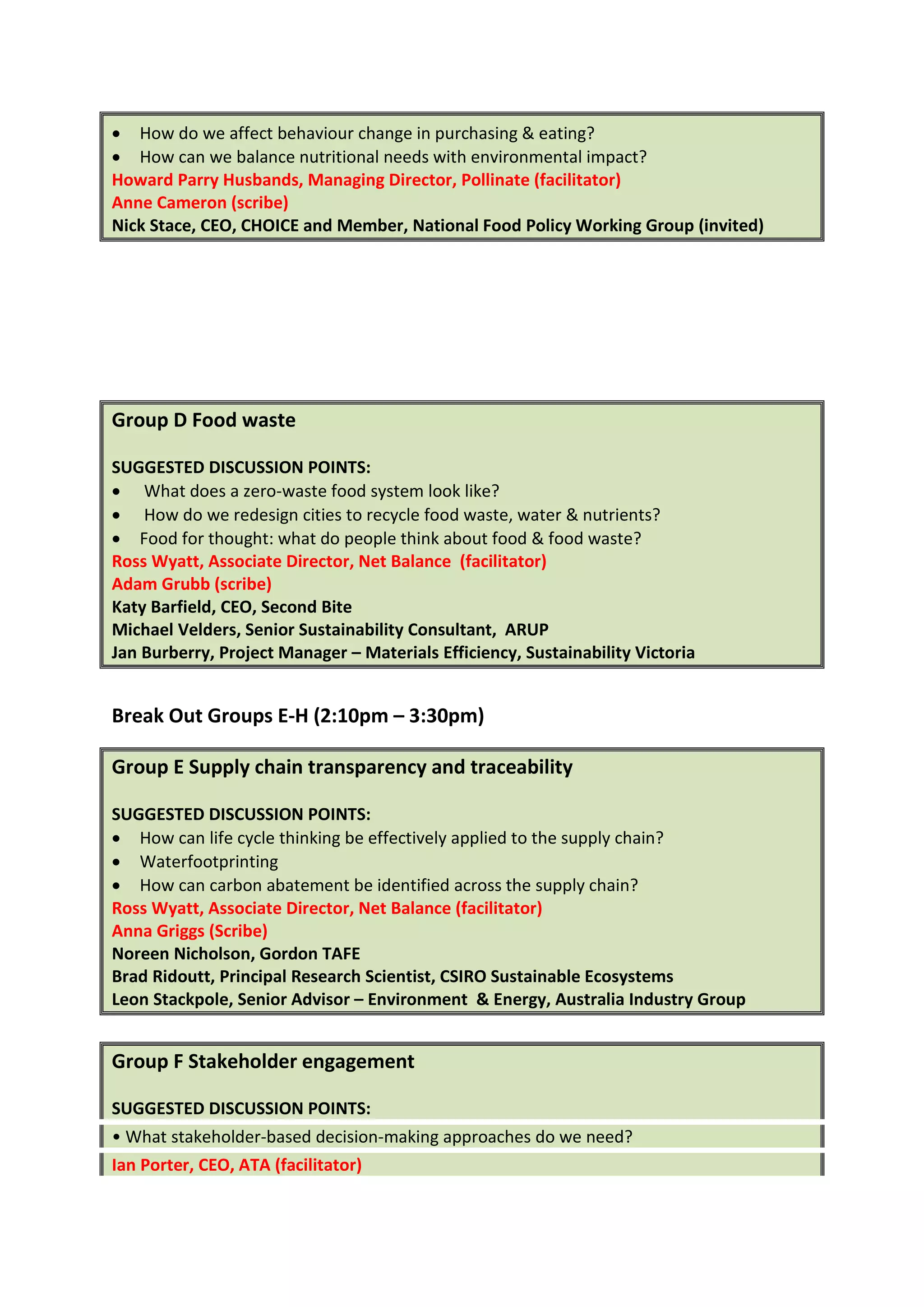
• How do we affect behaviour change in purchasing & eating?
• How can we balance nutritional needs with environmental impact?
Howard Parry Husbands, Managing Director, Pollinate (facilitator)
Anne Cameron (scribe)
Nick Stace, CEO, CHOICE and Member, National Food Policy Working Group (invited)


Group D Food waste

SUGGESTED DISCUSSION POINTS:
• What does a zero-waste food system look like?
• How do we redesign cities to recycle food waste, water & nutrients?
• Food for thought: what do people think about food & food waste?
Ross Wyatt, Associate Director, Net Balance (facilitator)
Adam Grubb (scribe)
Katy Barfield, CEO, Second Bite
Michael Velders, Senior Sustainability Consultant, ARUP
Jan Burberry, Project Manager – Materials Efficiency, Sustainability Victoria


Break Out Groups E-H (2:10pm – 3:30pm)

Group E Supply chain transparency and traceability

SUGGESTED DISCUSSION POINTS:
• How can life cycle thinking be effectively applied to the supply chain?
• Waterfootprinting
• How can carbon abatement be identified across the supply chain?
Ross Wyatt, Associate Director, Net Balance (facilitator)
Anna Griggs (Scribe)
Noreen Nicholson, Gordon TAFE
Brad Ridoutt, Principal Research Scientist, CSIRO Sustainable Ecosystems
Leon Stackpole, Senior Advisor – Environment & Energy, Australia Industry Group


Group F Stakeholder engagement

SUGGESTED DISCUSSION POINTS:
• What stakeholder-based decision-making approaches do we need?
Ian Porter, CEO, ATA (facilitator)
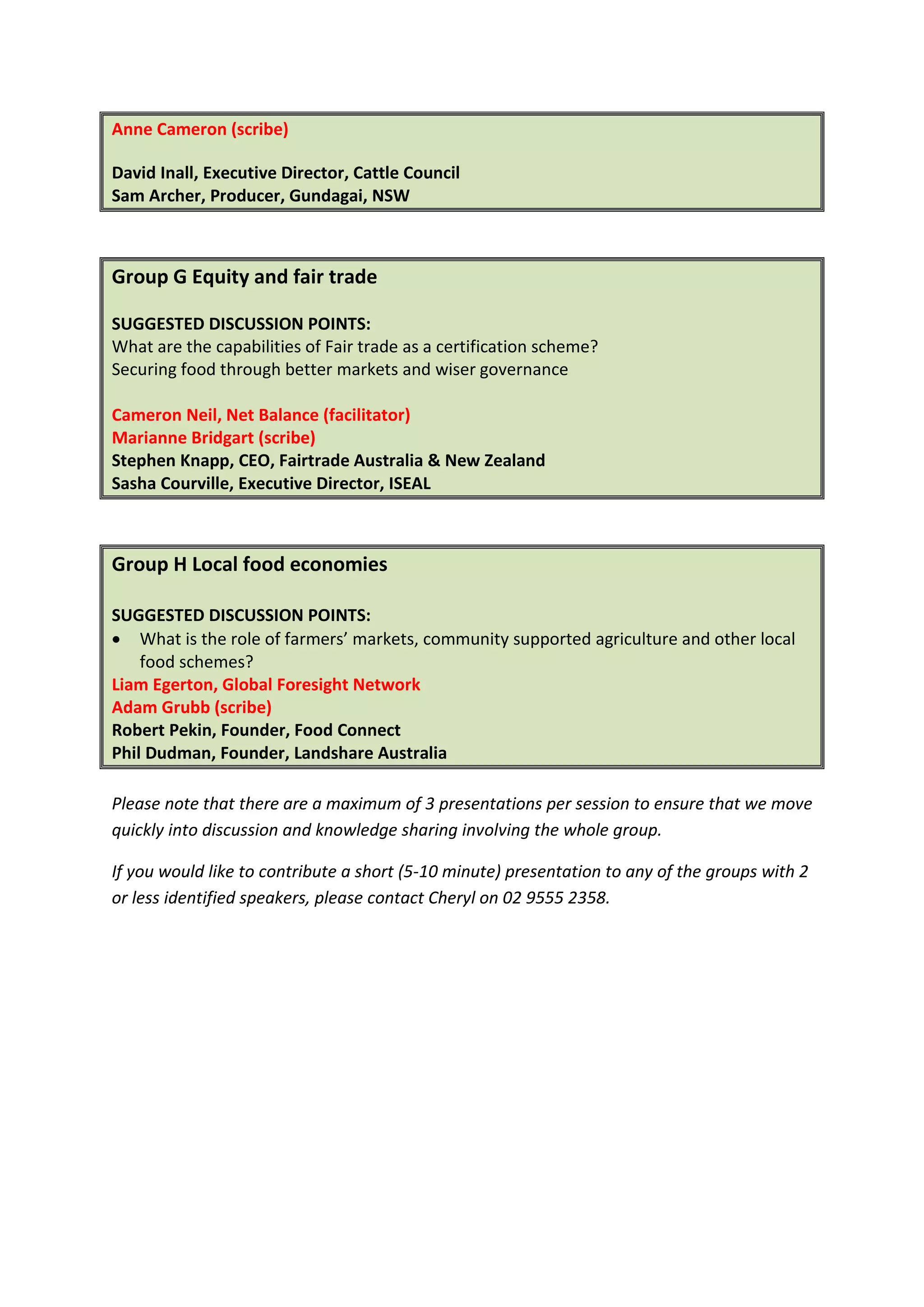
Anne Cameron (scribe)

David Inall, Executive Director, Cattle Council
Sam Archer, Producer, Gundagai, NSW


Group G Equity and fair trade

SUGGESTED DISCUSSION POINTS:
What are the capabilities of Fair trade as a certification scheme?
Securing food through better markets and wiser governance

Cameron Neil, Net Balance (facilitator)
Marianne Bridgart (scribe)
Stephen Knapp, CEO, Fairtrade Australia & New Zealand
Sasha Courville, Executive Director, ISEAL


Group H Local food economies

SUGGESTED DISCUSSION POINTS:
• What is the role of farmers’ markets, community supported agriculture and other local
    food schemes?
Ian Porter, CEO, ATA (facilitator)
Adam Grubb (scribe)
Robert Pekin, Founder, Food Connect
Liam Egerton, Global Foresight Network
Phil Dudman, Founder, Landshare Australia

Please note that there are a maximum of 3 presentations per session to ensure that we move
quickly into discussion and knowledge sharing involving the whole group.

If you would like to contribute a short (5-10 minute) presentation to any of the groups with 2
or less identified speakers, please contact Cheryl on 02 9555 2358.

Final break out group speakers

  • 1.
    Break Out Sessions The breadthof the subject matter and the wealth of expertise in the room require a format of break-out discussion groups. Groups are given a question on which to focus, and are facilitated to keep discussion on-topic. The discussion groups aim to tap into the knowledge and insights in the room. All participants will be given the opportunity to contribute to discussion. However, each breakout session will feature 2-3 short initial presentations by invited expert speakers, to initiate and frame discussions. Key outcomes from the each group discussion will be recorded and reported the entire group on Day 2. DAY 1 BREAK OUT SESSIONS , Tuesday 5 April 2011 IDENTIFYING THE KEY SHAPERS AND CHALLENGES FOR OUR FUTURE FOOD SYSTEM What are the key shapers and issues for Australian food and agriculture in the 21st Century? Break Out Groups A-D (1:45pm – 3:00pm) Group A Sustainable farming and resource management SUGGESTED DISCUSSION POINTS: • What is the role for biotechnology? • What are the barriers to change, and the emerging opportunities? • What are the likely shocks that will affect food security? • How will we address labour shortages for the industry ? Ian Porter, CEO, ATA (facilitator) Anna Griggs (Scribe) Corey Watts, Regional Projects Manager, The Climate Institute Patrick Hone, Executive Director, Fisheries Research and Development Corporation Roger Landsberg, Producer, Trafalgar Station, Queensland
  • 2.
    Group B FoodProcessing and distribution SUGGESTED DISCUSSION POINTS: • How resilient is Australia’s agriculture and food manufacturing system? • How will we ensure continuity of food supply in the face of sudden disruptions? • What are the barriers to change, and the emerging opportunities? Tom Zielinski, Associate Partner, IBM Global Business Services (facilitator) Adam Grubb (scribe) Kirsten Larsen, Policy Research Manager, VEIL Jay Sellahewa, Food and Nutritional Science’s sustainability program, CSIRO Tom McGuire, General Manager, Teys Brothers Group C Consumption SUGGESTED DISCUSSION POINTS: • Will Australians understand the issues around farming and food security? • What are the barriers to change, and the emerging opportunities? Liam Egerton, Global Foresight Network (facilitator) Anne Cameron (scribe) Dr Jaz Choi, Institute for creative industries and innovation, QUT Howard Parry Husbands, Managing Director, Pollinate Group D Food waste SUGGESTED DISCUSSION POINTS: • What are the barriers to change, and the emerging opportunities? • Food Waste Mapping • Food rescue and recovery Ross Wyatt, Associate Director, Net Balance (facilitator) Marianne Bridgart (scribe) Leah Mason, Research Consultant, Institute of Sustainable Futures, UTS John Webster, CEO, Foodbank Break Out Groups Group E–H (3:10pm – 4:20pm) Group E Supply chain transparency and traceability SUGGESTED DISCUSSION POINTS: • Can labelling schemes be sufficiently robust, and will people trust them? • How do the issues of palm oil fit within a sustainable food system? • What are the barriers to change, and the emerging opportunities? Ross Wyatt, Associate Director, Net Balance (facilitator) Anna Griggs (Scribe)
  • 3.
    Andrew Rouse –Resource Conservation Manager, WWF Angela McClowry, Sustainability Policy Analyst, AFGC Andrew Monk, Director, Biological Farmers of Australia Group F Stakeholder engagement SUGGESTED DISCUSSION POINTS: • What are the barriers to change, and the emerging opportunities? Ian Porter, CEO, ATA (facilitator) Anne Cameron (scribe) Greg Brown, President, Cattle Council Group G Equity and fair trade SUGGESTED DISCUSSION POINTS • What impact will issues around food sovereignty have in Australia? • How will we allocate water, and for what? Who pays? • How will peak oil and energy prices affect food and agriculture? Cameron Neil, Net Balance (facilitator) Adam Grubb (scribe) Sasha Courville, Executive Director, ISEAL Alliance Group H Local food economies SUGGESTED DISCUSSION POINTS: • Will economic drivers increase globalisation, or might economic downturn lead to stronger local food economies? • How do we improve the food security of Australians living in rural and remote indigenous communities? Liam Egerton, Global Foresight Network (facilitator) Marianne Bridgart (scribe) Robert Pekin, Founder, Food Connect Nick Rose, Co-Founder, Australian Food Sovereignty Alliance DAY 2 BREAK OUT SESSIONS, Wednesday 6 April 2011
  • 4.
    DESIGNING FOOD SYSTEMSTO MEET THE CHALLENGES OF THE 21st CENTURY • What do food systems designed to meet the challenges of the 21st Century look like? • What capabilities and business models do we need to create these systems, and how do they create value? Break Out Groups A- D (11:10am – 12:30pm) Group A Sustainable farming and land management SUGGESTED DISCUSSION POINTS: • What investment is required in R&D for low-input farming systems? • What does climate-resilient farming look like? • Urban agriculture & using productive land on the city fringe Ian Porter, CEO, ATA (facilitator) Anna Griggs (Scribe) Mick Keogh, Executive Director, The Australian Farm Institute Matthew Wright, Managing Director, Beyond Zero Emissions Brad Warren, Executive Chair, Oceanwatch Sam Archer, Producer, Gundagai, NSW Group B Food Processing and distribution SUGGESTED DISCUSSION POINTS: • What can industry do now to develop a sustainable food system for the future? (Fonterra) • How do we assess the sustainability and resilience of food production through the supply chain? (Fonterra) • Developing localised supply chains and distributed systems • Will we still need packaging? • The future of packaging – the importance of sustainable design Tom Zielinski, Associate Partner, IBM Global Business Services (facilitator) Marianne Bridgart (scribe) Bruce Donnison, General Manager, Sustainability ANZ, Fonterra Tony Maher, Director, Sustainable Development, AFGC Steve Newton, General Manager Risk, Metcash Group C Consumption SUGGESTED DISCUSSION POINTS:
  • 5.
    • What isthe role of consumers in food policy? • How do we affect behaviour change in purchasing & eating? • How can we balance nutritional needs with environmental impact? Howard Parry Husbands, Managing Director, Pollinate (facilitator) Anne Cameron (scribe) Nick Stace, CEO, CHOICE and Member, National Food Policy Working Group (invited) Group D Food waste SUGGESTED DISCUSSION POINTS: • What does a zero-waste food system look like? • How do we redesign cities to recycle food waste, water & nutrients? • Food for thought: what do people think about food & food waste? Ross Wyatt, Associate Director, Net Balance (facilitator) Adam Grubb (scribe) Katy Barfield, CEO, Second Bite Michael Velders, Senior Sustainability Consultant, ARUP Jan Burberry, Project Manager – Materials Efficiency, Sustainability Victoria Break Out Groups E-H (2:10pm – 3:30pm) Group E Supply chain transparency and traceability SUGGESTED DISCUSSION POINTS: • How can life cycle thinking be effectively applied to the supply chain? • Waterfootprinting • How can carbon abatement be identified across the supply chain? Ross Wyatt, Associate Director, Net Balance (facilitator) Anna Griggs (Scribe) Noreen Nicholson, Gordon TAFE Brad Ridoutt, Principal Research Scientist, CSIRO Sustainable Ecosystems Leon Stackpole, Senior Advisor – Environment & Energy, Australia Industry Group Group F Stakeholder engagement SUGGESTED DISCUSSION POINTS: • What stakeholder-based decision-making approaches do we need?
  • 6.
    Ian Porter, CEO,ATA (facilitator) Anne Cameron (scribe) David Inall, Executive Director, Cattle Council Sam Archer, Producer, Gundagai, NSW Group G Equity and fair trade SUGGESTED DISCUSSION POINTS: What are the capabilities of Fair trade as a certification scheme? Securing food through better markets and wiser governance Cameron Neil, Net Balance (facilitator) Marianne Bridgart (scribe) Stephen Knapp, CEO, Fairtrade Australia & New Zealand Sasha Courville, Executive Director, ISEAL Group H Local food economies SUGGESTED DISCUSSION POINTS: • What is the role of farmers’ markets, community supported agriculture and other local food schemes? Ian Porter, CEO, ATA (facilitator) Adam Grubb (scribe) Robert Pekin, Founder, Food Connect Liam Egerton, Global Foresight Network Phil Dudman, Founder, Landshare Australia Please note that there are a maximum of 3 presentations per session to ensure that we move quickly into discussion and knowledge sharing involving the whole group. If you would like to contribute a short (5-10 minute) presentation to any of the groups with 2 or less identified speakers, please contact Cheryl on 02 9555 2358.