UNIVERSITY OF DAR ES SALAAM
Introduction Slide 1
Establishment
The University of Dar es Salaam (UDSM) was established in 1961.
This university is the oldest and largest university in Tanzania in
terms of yearly student intake, number of staff and courses
offered from several campuses and colleges
UNIVERSITY OF DAR ES SALAAM
Introduction Slide 2
Profile
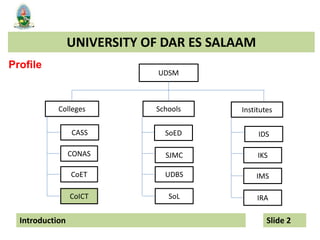
UDSM
Institutes
Schools
Colleges
CASS
CONAS
CoET
CoICT
SoED
SJMC
UDBS
SoL
IDS
IKS
IMS
IRA
COLLEGE OF INFORMATION AND COMMUNICATION TECHNOLOGIES
Introduction Slide 3
Establishment
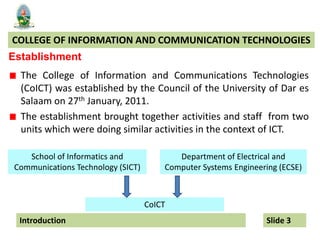
The College of Information and Communications Technologies
(CoICT) was established by the Council of the University of Dar es
Salaam on 27th January, 2011.
The establishment brought together activities and staff from two
units which were doing similar activities in the context of ICT.
School of Informatics and
Communications Technology (SICT)
Department of Electrical and
Computer Systems Engineering (ECSE)
CoICT
COLLEGE OF INFORMATION AND COMMUNICATION TECHNOLOGIES
Introduction Slide 4
Profile
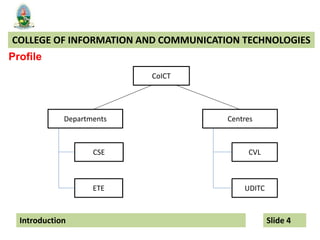
CoICT
CSE
ETE
Departments Centres
CVL
UDITC
Introduction Slide 5
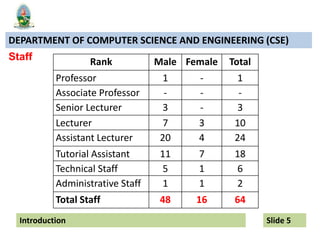
DEPARTMENT OF COMPUTER SCIENCE AND ENGINEERING (CSE)
Staff Rank Male Female Total
Professor 1 - 1
Associate Professor - - -
Senior Lecturer 3 - 3
Lecturer 7 3 10
Assistant Lecturer 20 4 24
Tutorial Assistant 11 7 18
Technical Staff 5 1 6
Administrative Staff 1 1 2
Total Staff 48 16 64
Introduction Slide 6
DEPARTMENT OF COMPUTER SCIENCE AND ENGINEERING (CSE)
Undergraduate Programmes
SN PROGRAMME DURATION CAPACITY
1. B.Sc. In Computer Science 3 years 100
2. B.Sc. With Computer Science 3 years 70
3. B.Sc. In Computer Engineering and IT 4 years 60
Currently all programmes are under review and new ones are in
the process of being introduced.
Introduction Slide 7
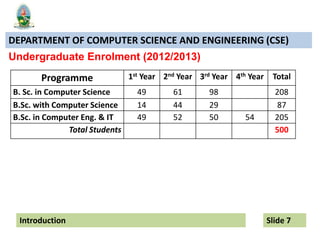
DEPARTMENT OF COMPUTER SCIENCE AND ENGINEERING (CSE)
Undergraduate Enrolment (2012/2013)
Programme 1st Year 2nd Year 3rd Year 4th Year Total
B. Sc. in Computer Science 49 61 98 208
B.Sc. with Computer Science 14 44 29 87
B.Sc. in Computer Eng. & IT 49 52 50 54 205
Total Students 500
Introduction Slide 8
DEPARTMENT OF COMPUTER SCIENCE AND ENGINEERING (CSE)
Postgraduate Programmes
SN PROGRAMME DURATION CAPACITY
1. M.Sc. In Computer Science 18 months 25
2. M.Sc. In Health Informatics 24 months 30
3. PhD 3 years 5
Postgraduate Enrolment (2012/2013)
Programme 1st Year 2nd Year 3rd Year Total
M. Sc. in Computer Science 7 12 19
M.Sc. In Health Informatics 12 18 30
PhD 2 - 1 3
Total Students 52
Staff Slide 9
ELECTRONICS AND TELECOMMUNICATIONS ENGINEERING (ETE)
Staff Rank Male Female Total
Professor 2 - 2
Associate Professor 1 - 1
Senior Lecturer 2 2
Lecturer 3 1 4
Assistant Lecturer 9 3 12
Tutorial Assistant 6 4 10
Technical Staff 2 2 4
Administrative Staff - 2 2
Total Staff 25 12 37
Training Programmes Slide 10
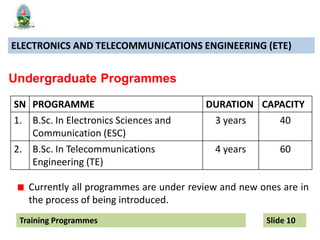
ELECTRONICS AND TELECOMMUNICATIONS ENGINEERING (ETE)
Undergraduate Programmes
SN PROGRAMME DURATION CAPACITY
1. B.Sc. In Electronics Sciences and
Communication (ESC)
3 years 40
2. B.Sc. In Telecommunications
Engineering (TE)
4 years 60
Currently all programmes are under review and new ones are in
the process of being introduced.
Training Programmes Slide 11
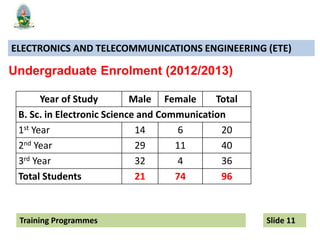
ELECTRONICS AND TELECOMMUNICATIONS ENGINEERING (ETE)
Undergraduate Enrolment (2012/2013)
Year of Study Male Female Total
B. Sc. in Electronic Science and Communication
1st Year 14 6 20
2nd Year 29 11 40
3rd Year 32 4 36
Total Students 21 74 96
Training Programmes Slide 12
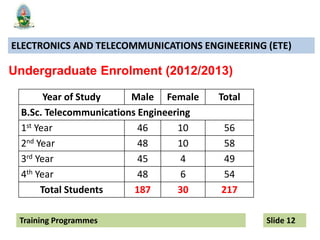
ELECTRONICS AND TELECOMMUNICATIONS ENGINEERING (ETE)
Undergraduate Enrolment (2012/2013)
Year of Study Male Female Total
B.Sc. Telecommunications Engineering
1st Year 46 10 56
2nd Year 48 10 58
3rd Year 45 4 49
4th Year 48 6 54
Total Students 187 30 217
Training Programmes Slide 13
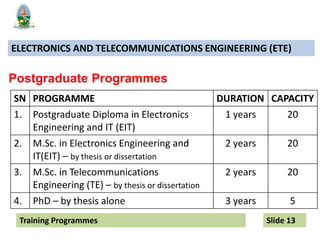
ELECTRONICS AND TELECOMMUNICATIONS ENGINEERING (ETE)
Postgraduate Programmes
SN PROGRAMME DURATION CAPACITY
1. Postgraduate Diploma in Electronics
Engineering and IT (EIT)
1 years 20
2. M.Sc. in Electronics Engineering and
IT(EIT) – by thesis or dissertation
2 years 20
3. M.Sc. in Telecommunications
Engineering (TE) – by thesis or dissertation
2 years 20
4. PhD – by thesis alone 3 years 5
COLLEGE OF INFORMATION AND COMMUNICATION TECHNOLOGIES
Training Programmes Slide 14
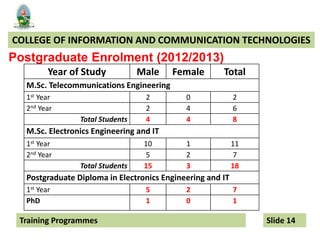
Postgraduate Enrolment (2012/2013)
Year of Study Male Female Total
M.Sc. Telecommunications Engineering
1st Year 2 0 2
2nd Year 2 4 6
Total Students 4 4 8
M.Sc. Electronics Engineering and IT
1st Year 10 1 11
2nd Year 5 2 7
Total Students 15 3 18
Postgraduate Diploma in Electronics Engineering and IT
1st Year 5 2 7
PhD 1 0 1
COLLEGE OF INFORMATION AND COMMUNICATION TECHNOLOGIES
Training Programmes Slide 15
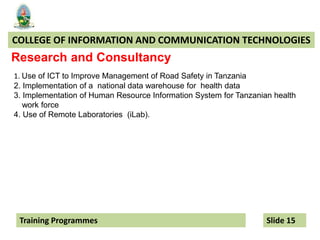
Research and Consultancy
1. Use of ICT to Improve Management of Road Safety in Tanzania
2. Implementation of a national data warehouse for health data
3. Implementation of Human Resource Information System for Tanzanian health
work force
4. Use of Remote Laboratories (iLab).

Introductory Presentation on CoICT of UDSM

  • 1.
    UNIVERSITY OF DARES SALAAM Introduction Slide 1 Establishment The University of Dar es Salaam (UDSM) was established in 1961. This university is the oldest and largest university in Tanzania in terms of yearly student intake, number of staff and courses offered from several campuses and colleges
  • 2.
    UNIVERSITY OF DARES SALAAM Introduction Slide 2 Profile UDSM Institutes Schools Colleges CASS CONAS CoET CoICT SoED SJMC UDBS SoL IDS IKS IMS IRA
  • 3.
    COLLEGE OF INFORMATIONAND COMMUNICATION TECHNOLOGIES Introduction Slide 3 Establishment The College of Information and Communications Technologies (CoICT) was established by the Council of the University of Dar es Salaam on 27th January, 2011. The establishment brought together activities and staff from two units which were doing similar activities in the context of ICT. School of Informatics and Communications Technology (SICT) Department of Electrical and Computer Systems Engineering (ECSE) CoICT
  • 4.
    COLLEGE OF INFORMATIONAND COMMUNICATION TECHNOLOGIES Introduction Slide 4 Profile CoICT CSE ETE Departments Centres CVL UDITC
  • 5.
    Introduction Slide 5 DEPARTMENTOF COMPUTER SCIENCE AND ENGINEERING (CSE) Staff Rank Male Female Total Professor 1 - 1 Associate Professor - - - Senior Lecturer 3 - 3 Lecturer 7 3 10 Assistant Lecturer 20 4 24 Tutorial Assistant 11 7 18 Technical Staff 5 1 6 Administrative Staff 1 1 2 Total Staff 48 16 64
  • 6.
    Introduction Slide 6 DEPARTMENTOF COMPUTER SCIENCE AND ENGINEERING (CSE) Undergraduate Programmes SN PROGRAMME DURATION CAPACITY 1. B.Sc. In Computer Science 3 years 100 2. B.Sc. With Computer Science 3 years 70 3. B.Sc. In Computer Engineering and IT 4 years 60 Currently all programmes are under review and new ones are in the process of being introduced.
  • 7.
    Introduction Slide 7 DEPARTMENTOF COMPUTER SCIENCE AND ENGINEERING (CSE) Undergraduate Enrolment (2012/2013) Programme 1st Year 2nd Year 3rd Year 4th Year Total B. Sc. in Computer Science 49 61 98 208 B.Sc. with Computer Science 14 44 29 87 B.Sc. in Computer Eng. & IT 49 52 50 54 205 Total Students 500
  • 8.
    Introduction Slide 8 DEPARTMENTOF COMPUTER SCIENCE AND ENGINEERING (CSE) Postgraduate Programmes SN PROGRAMME DURATION CAPACITY 1. M.Sc. In Computer Science 18 months 25 2. M.Sc. In Health Informatics 24 months 30 3. PhD 3 years 5 Postgraduate Enrolment (2012/2013) Programme 1st Year 2nd Year 3rd Year Total M. Sc. in Computer Science 7 12 19 M.Sc. In Health Informatics 12 18 30 PhD 2 - 1 3 Total Students 52
  • 9.
    Staff Slide 9 ELECTRONICSAND TELECOMMUNICATIONS ENGINEERING (ETE) Staff Rank Male Female Total Professor 2 - 2 Associate Professor 1 - 1 Senior Lecturer 2 2 Lecturer 3 1 4 Assistant Lecturer 9 3 12 Tutorial Assistant 6 4 10 Technical Staff 2 2 4 Administrative Staff - 2 2 Total Staff 25 12 37
  • 10.
    Training Programmes Slide10 ELECTRONICS AND TELECOMMUNICATIONS ENGINEERING (ETE) Undergraduate Programmes SN PROGRAMME DURATION CAPACITY 1. B.Sc. In Electronics Sciences and Communication (ESC) 3 years 40 2. B.Sc. In Telecommunications Engineering (TE) 4 years 60 Currently all programmes are under review and new ones are in the process of being introduced.
  • 11.
    Training Programmes Slide11 ELECTRONICS AND TELECOMMUNICATIONS ENGINEERING (ETE) Undergraduate Enrolment (2012/2013) Year of Study Male Female Total B. Sc. in Electronic Science and Communication 1st Year 14 6 20 2nd Year 29 11 40 3rd Year 32 4 36 Total Students 21 74 96
  • 12.
    Training Programmes Slide12 ELECTRONICS AND TELECOMMUNICATIONS ENGINEERING (ETE) Undergraduate Enrolment (2012/2013) Year of Study Male Female Total B.Sc. Telecommunications Engineering 1st Year 46 10 56 2nd Year 48 10 58 3rd Year 45 4 49 4th Year 48 6 54 Total Students 187 30 217
  • 13.
    Training Programmes Slide13 ELECTRONICS AND TELECOMMUNICATIONS ENGINEERING (ETE) Postgraduate Programmes SN PROGRAMME DURATION CAPACITY 1. Postgraduate Diploma in Electronics Engineering and IT (EIT) 1 years 20 2. M.Sc. in Electronics Engineering and IT(EIT) – by thesis or dissertation 2 years 20 3. M.Sc. in Telecommunications Engineering (TE) – by thesis or dissertation 2 years 20 4. PhD – by thesis alone 3 years 5
  • 14.
    COLLEGE OF INFORMATIONAND COMMUNICATION TECHNOLOGIES Training Programmes Slide 14 Postgraduate Enrolment (2012/2013) Year of Study Male Female Total M.Sc. Telecommunications Engineering 1st Year 2 0 2 2nd Year 2 4 6 Total Students 4 4 8 M.Sc. Electronics Engineering and IT 1st Year 10 1 11 2nd Year 5 2 7 Total Students 15 3 18 Postgraduate Diploma in Electronics Engineering and IT 1st Year 5 2 7 PhD 1 0 1
  • 15.
    COLLEGE OF INFORMATIONAND COMMUNICATION TECHNOLOGIES Training Programmes Slide 15 Research and Consultancy 1. Use of ICT to Improve Management of Road Safety in Tanzania 2. Implementation of a national data warehouse for health data 3. Implementation of Human Resource Information System for Tanzanian health work force 4. Use of Remote Laboratories (iLab).