File security and integrity 03 March 2008
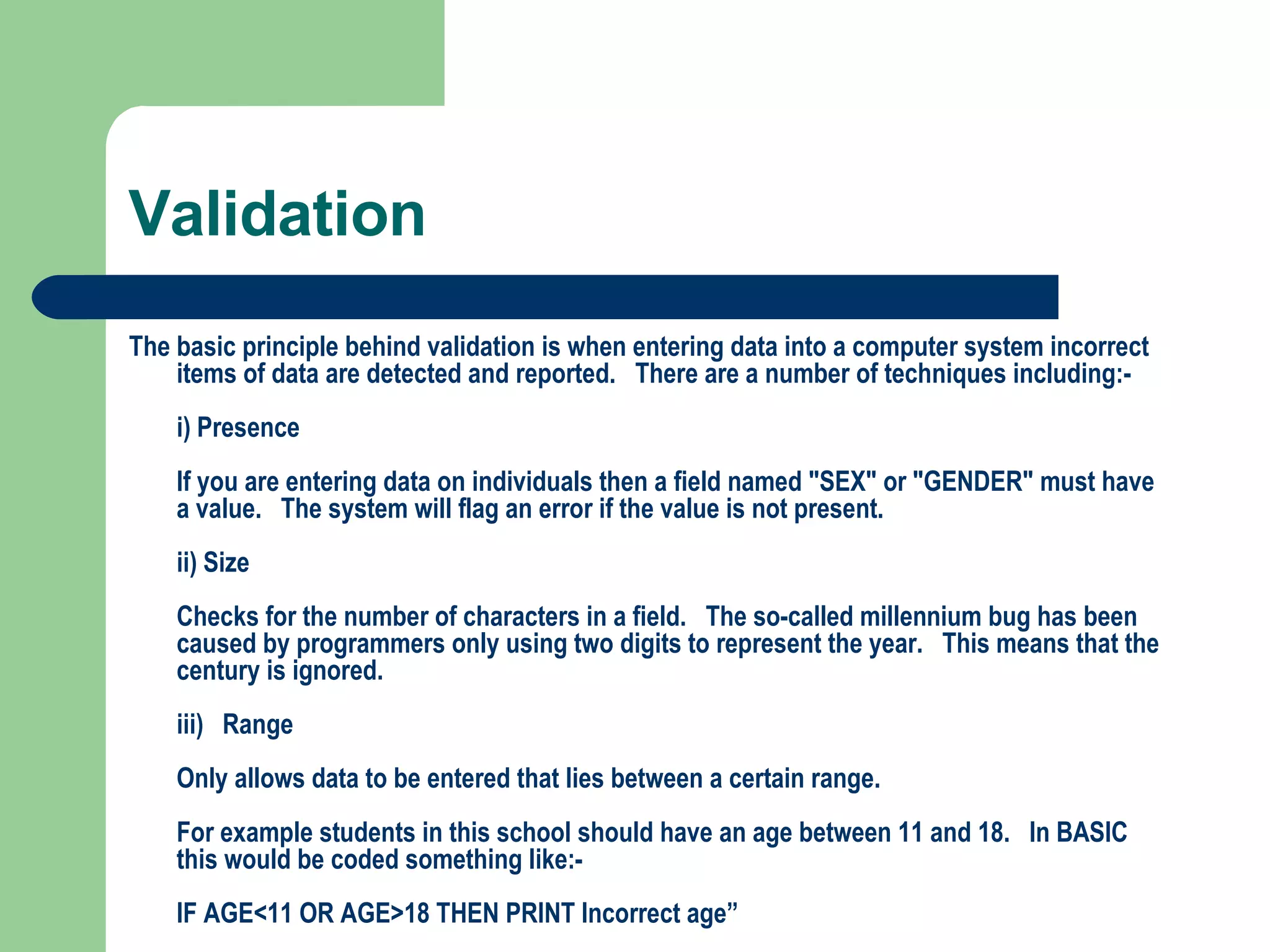
Validation The basic principle behind validation is when entering data into a computer system incorrect items of data are detected and reported.  There are a number of techniques including:- i) Presence      If you are entering data on individuals then a field named &quot;SEX&quot; or &quot;GENDER&quot; must have a value.  The system will flag an error if the value is not present. ii) Size Checks for the number of characters in a field.  The so-called millennium bug has been caused by programmers only using two digits to represent the year.  This means that the century is ignored. iii)  Range Only allows data to be entered that lies between a certain range.   For example students in this school should have an age between 11 and 18.  In BASIC this would be coded something like:- IF AGE<11 OR AGE>18 THEN PRINT Incorrect age”
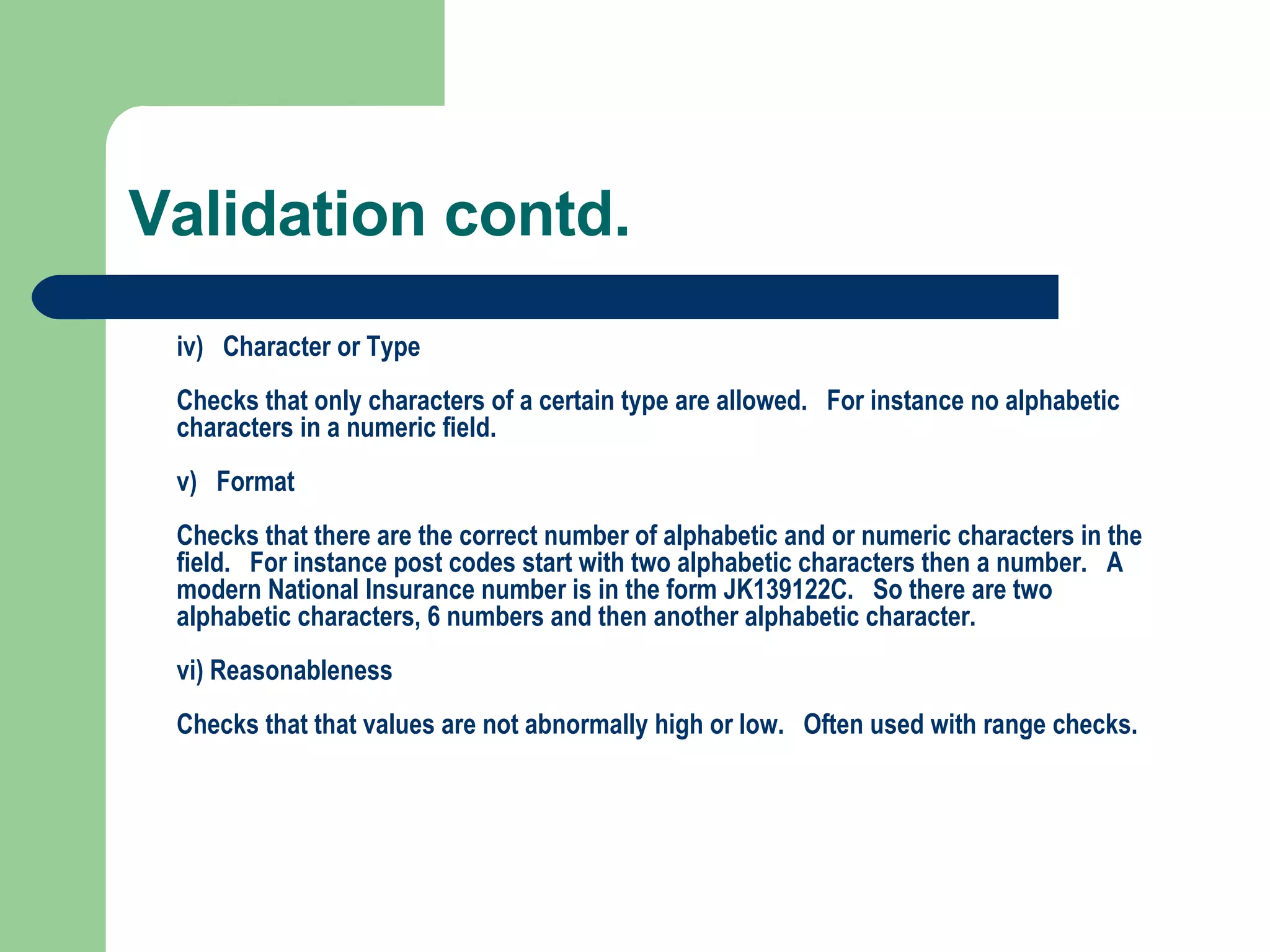
Validation contd. iv)  Character or Type Checks that only characters of a certain type are allowed.  For instance no alphabetic characters in a numeric field. v)  Format Checks that there are the correct number of alphabetic and or numeric characters in the field.  For instance post codes start with two alphabetic characters then a number.  A  modern National Insurance number is in the form JK139122C.  So there are two alphabetic characters, 6 numbers and then another alphabetic character. vi) Reasonableness Checks that that values are not abnormally high or low.  Often used with range checks.
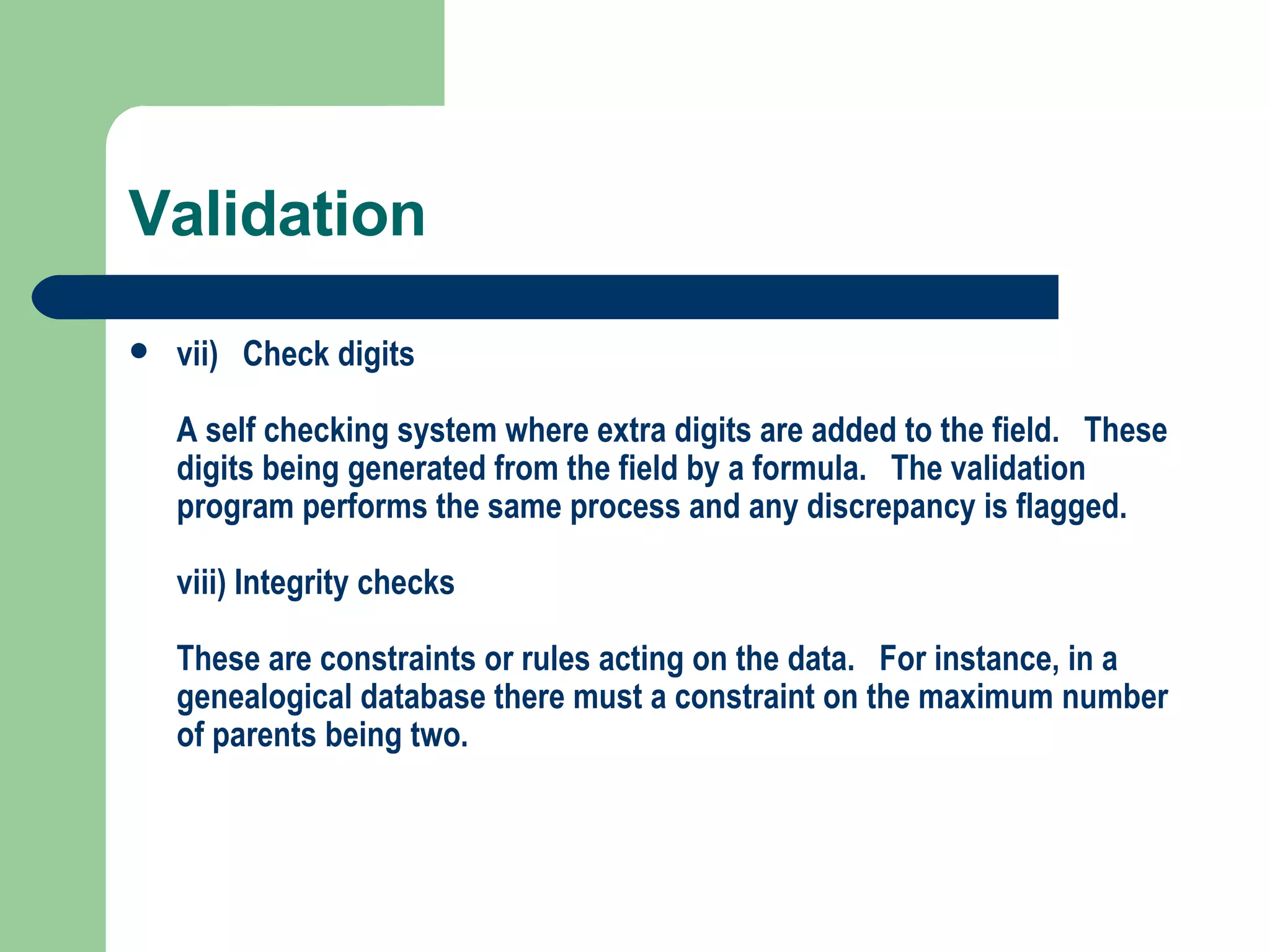
Validation vii)  Check digits A self checking system where extra digits are added to the field.  These digits being generated from the field by a formula.  The validation program performs the same process and any discrepancy is flagged. viii) Integrity checks These are constraints or rules acting on the data.  For instance, in a genealogical database there must a constraint on the maximum number of parents being two.  

File Security And Integrity 03 March 08

  • 1.
    File security andintegrity 03 March 2008
  • 2.
    Validation The basicprinciple behind validation is when entering data into a computer system incorrect items of data are detected and reported.  There are a number of techniques including:- i) Presence      If you are entering data on individuals then a field named &quot;SEX&quot; or &quot;GENDER&quot; must have a value.  The system will flag an error if the value is not present. ii) Size Checks for the number of characters in a field.  The so-called millennium bug has been caused by programmers only using two digits to represent the year.  This means that the century is ignored. iii)  Range Only allows data to be entered that lies between a certain range.  For example students in this school should have an age between 11 and 18.  In BASIC this would be coded something like:- IF AGE<11 OR AGE>18 THEN PRINT Incorrect age”
  • 3.
    Validation contd. iv) Character or Type Checks that only characters of a certain type are allowed.  For instance no alphabetic characters in a numeric field. v)  Format Checks that there are the correct number of alphabetic and or numeric characters in the field.  For instance post codes start with two alphabetic characters then a number.  A  modern National Insurance number is in the form JK139122C.  So there are two alphabetic characters, 6 numbers and then another alphabetic character. vi) Reasonableness Checks that that values are not abnormally high or low.  Often used with range checks.
  • 4.
    Validation vii)  Checkdigits A self checking system where extra digits are added to the field.  These digits being generated from the field by a formula.  The validation program performs the same process and any discrepancy is flagged. viii) Integrity checks These are constraints or rules acting on the data.  For instance, in a genealogical database there must a constraint on the maximum number of parents being two.