Computer Science
Class XII ( As per
CBSE Board)
Chapter 4
File Handling
Visit : python.mykvs.in for regular
New
syllabu
s 2023-
24
Need for
a data
file
• To Store data in organized
manner
• To store data permanently
• To access data faster
• To Search data faster
• To easily modify data later on
Visit : python.mykvs.in for regular
File Handling
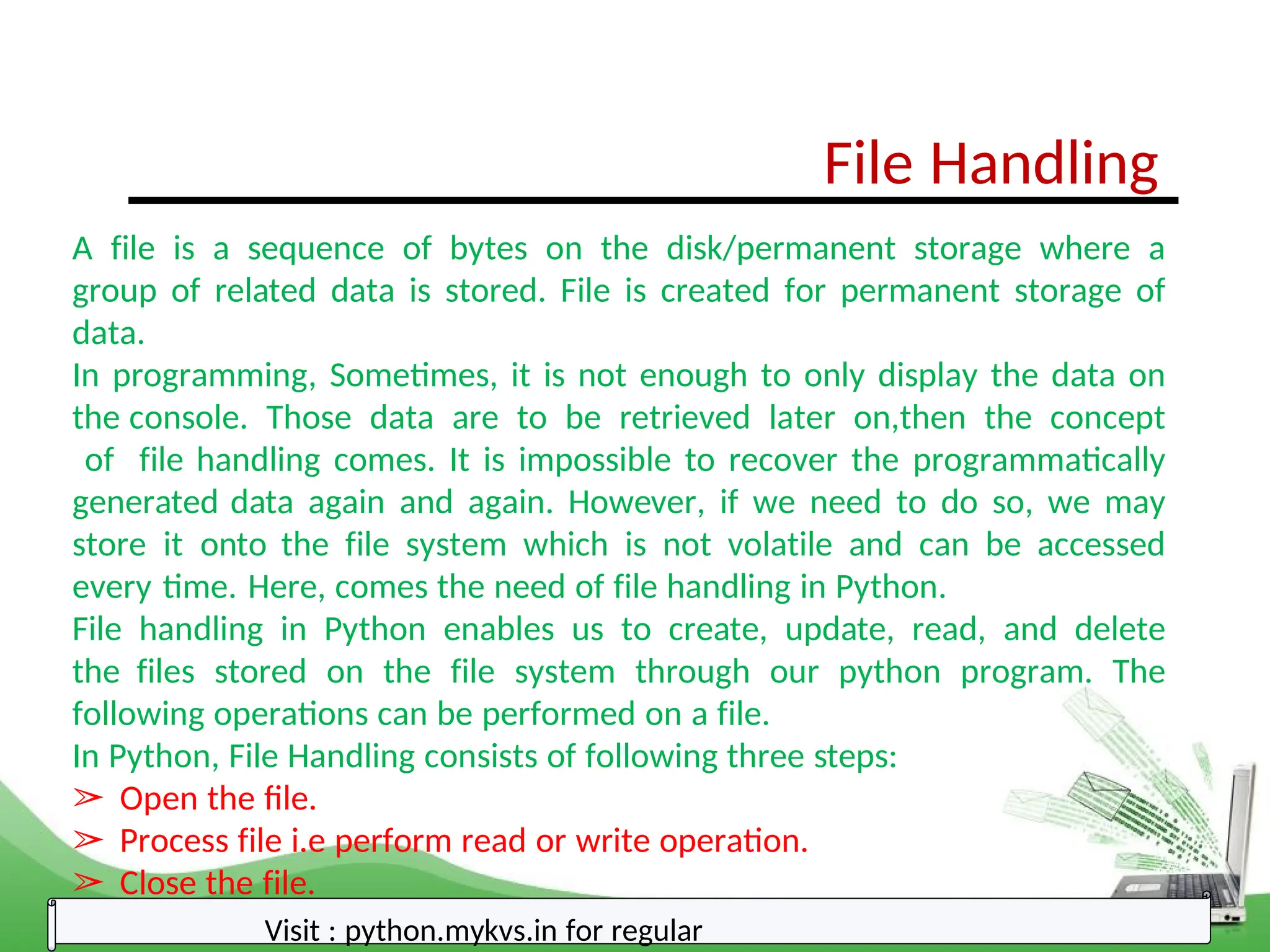
A file is a sequence of bytes on the disk/permanent storage where a
group of related data is stored. File is created for permanent storage of
data.
In programming, Sometimes, it is not enough to only display the data on
the console. Those data are to be retrieved later on,then the concept
of file handling comes. It is impossible to recover the programmatically
generated data again and again. However, if we need to do so, we may
store it onto the file system which is not volatile and can be accessed
every time. Here, comes the need of file handling in Python.
File handling in Python enables us to create, update, read, and delete
the files stored on the file system through our python program. The
following operations can be performed on a file.
In Python, File Handling consists of following three steps:
➢ Open the file.
➢ Process file i.e perform read or write operation.
➢ Close the file.
Visit : python.mykvs.in for regular
File Handling
Types of
File
Visit : python.mykvs.in for regular
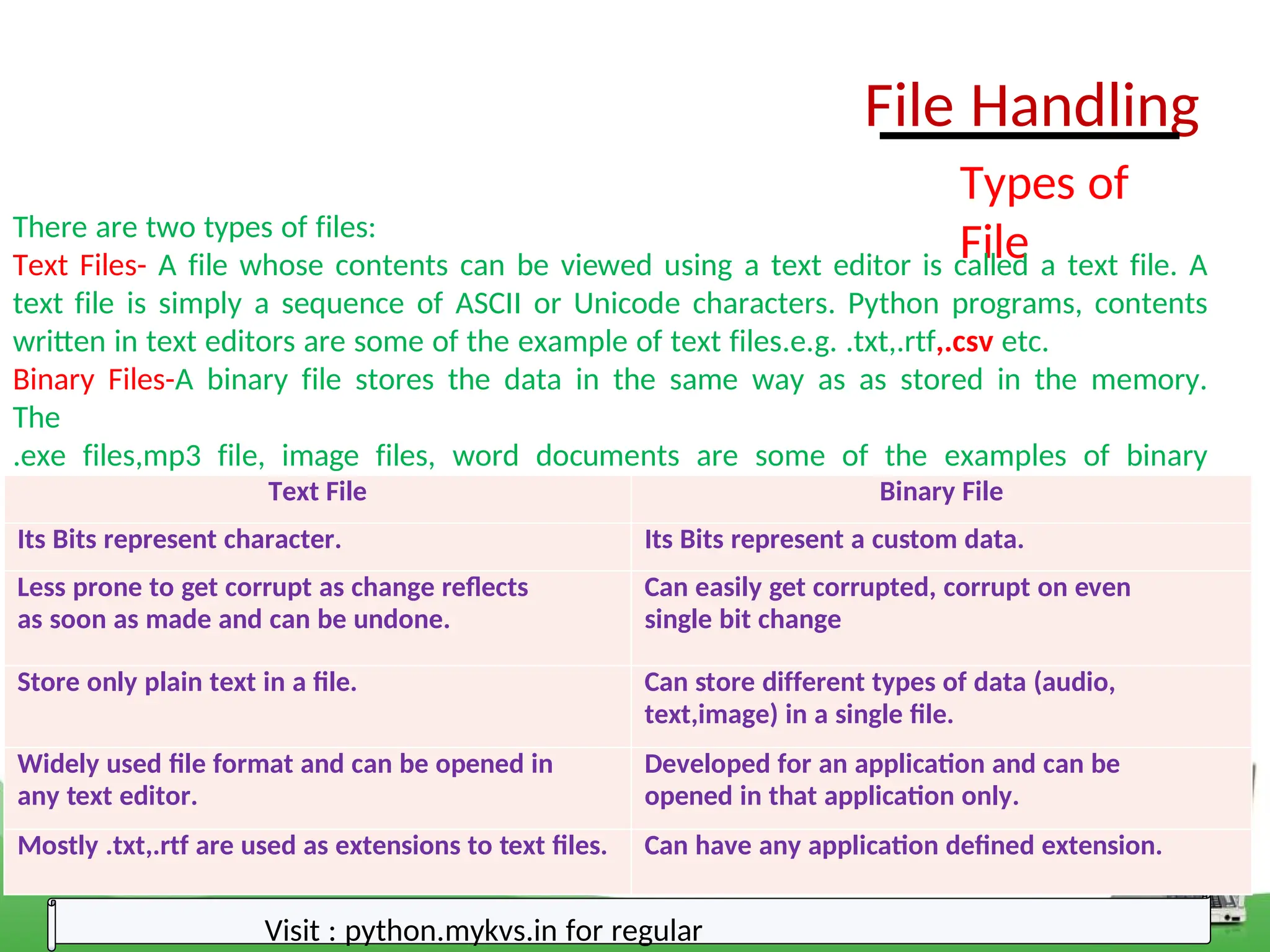
There are two types of files:
Text Files- A file whose contents can be viewed using a text editor is called a text file. A
text file is simply a sequence of ASCII or Unicode characters. Python programs, contents
written in text editors are some of the example of text files.e.g. .txt,.rtf,.csv etc.
Binary Files-A binary file stores the data in the same way as as stored in the memory.
The
.exe files,mp3 file, image files, word documents are some of the examples of binary
files.we
can’t read a binary file using a text editor.e.g. .bmp,.cdr etc.
Text File Binary File
Its Bits represent character. Its Bits represent a custom data.
Less prone to get corrupt as change reflects
as soon as made and can be undone.
Can easily get corrupted, corrupt on even
single bit change
Store only plain text in a file. Can store different types of data (audio,
text,image) in a single file.
Widely used file format and can be opened in
any text editor.
Developed for an application and can be
opened in that application only.
Mostly .txt,.rtf are used as extensions to text files. Can have any application defined extension.
File
Handling
Opening and Closing
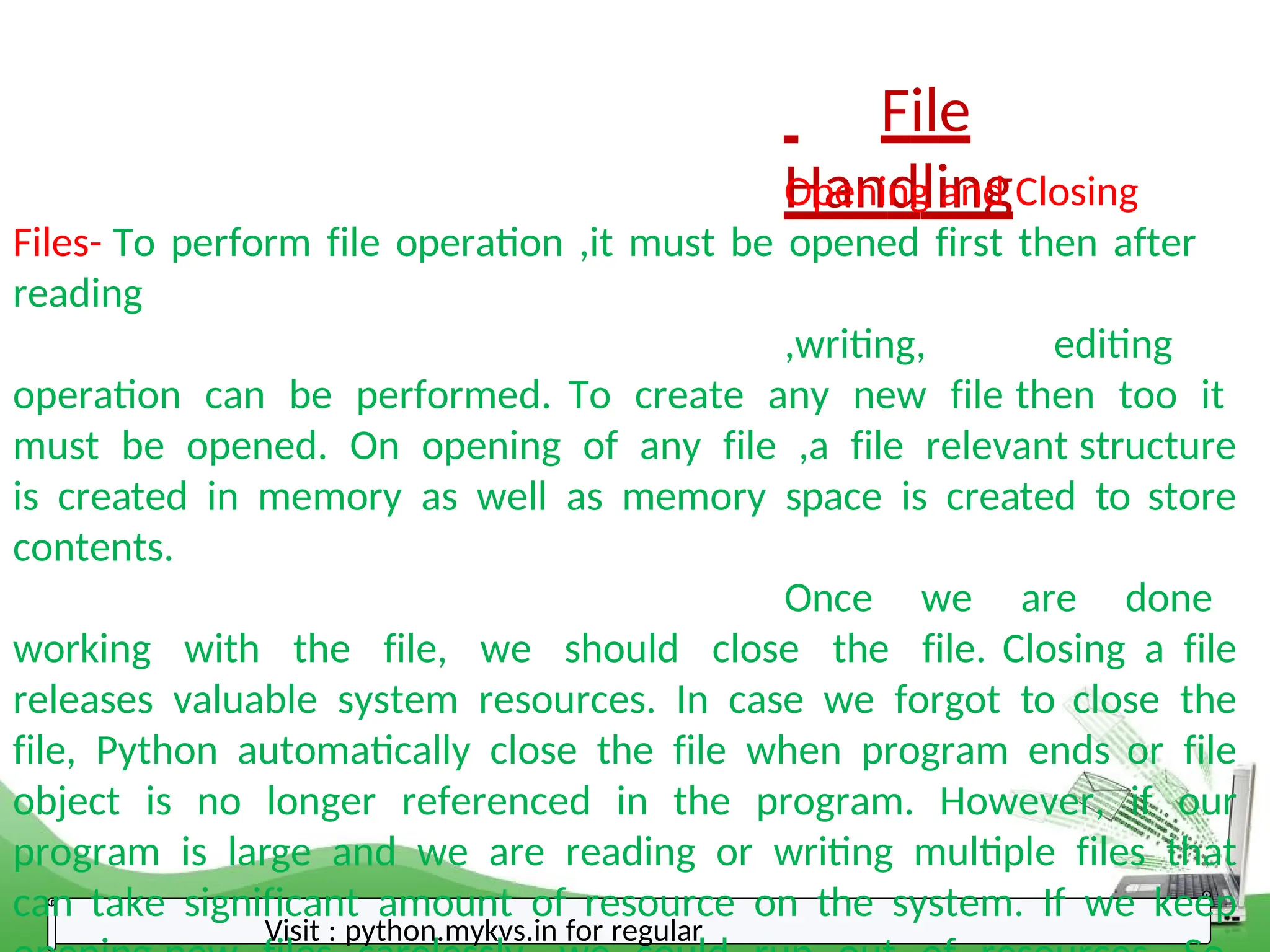
Files- To perform file operation ,it must be opened first then after
reading
,writing, editing
operation can be performed. To create any new file then too it
must be opened. On opening of any file ,a file relevant structure
is created in memory as well as memory space is created to store
contents.
Once we are done
working with the file, we should close the file. Closing a file
releases valuable system resources. In case we forgot to close the
file, Python automatically close the file when program ends or file
object is no longer referenced in the program. However, if our
program is large and we are reading or writing multiple files that
can take significant amount of resource on the system. If we keep
Visit : python.mykvs.in for regular
File Handling
open Function-
Before any reading or writing operation of any file,it must
be opened first
of all.Python
provide built in function open() for it.On calling of this function
creates file object for file operations.
Syntax
file object =
open(<file_name>, <access_mode>,< buffering>) file_name =
name of the file ,enclosed in double quotes. access_mode=
Determines the what kind of operations can be performed
with file,like read,write etc.
Buffering = for
no buffering set it to 0.for line buffering set it to 1.if it is
Visit : python.mykvs.in for regular
File Handling
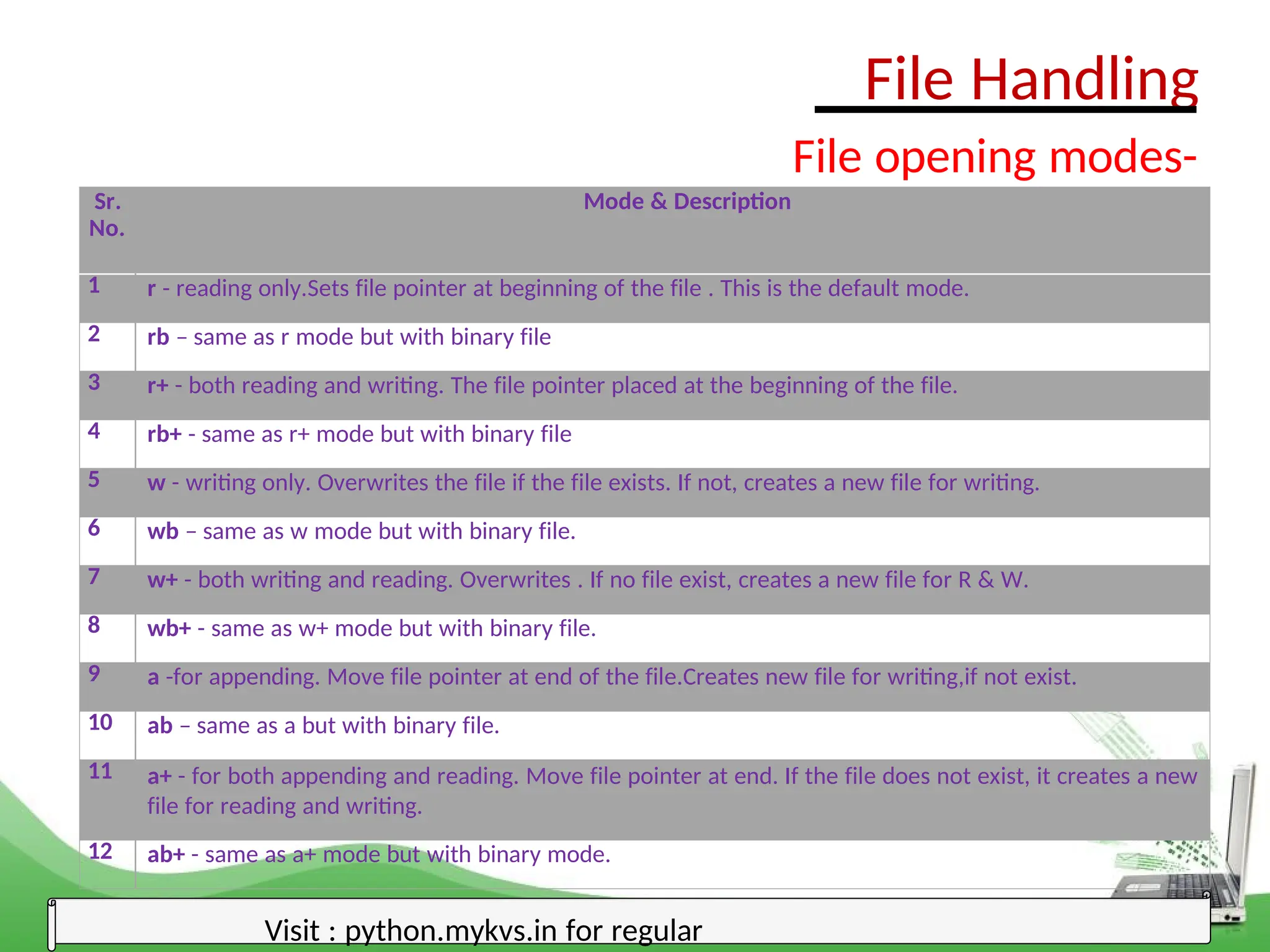
File opening modes-
Visit : python.mykvs.in for regular
Sr. Mode & Description
No.
1 r - reading only.Sets file pointer at beginning of the file . This is the default mode.
2 rb – same as r mode but with binary file
3 r+ - both reading and writing. The file pointer placed at the beginning of the file.
4 rb+ - same as r+ mode but with binary file
5 w - writing only. Overwrites the file if the file exists. If not, creates a new file for writing.
6 wb – same as w mode but with binary file.
7 w+ - both writing and reading. Overwrites . If no file exist, creates a new file for R & W.
8 wb+ - same as w+ mode but with binary file.
9 a -for appending. Move file pointer at end of the file.Creates new file for writing,if not exist.
10 ab – same as a but with binary file.
11 a+ - for both appending and reading. Move file pointer at end. If the file does not exist, it creates a new
file for reading and writing.
12 ab+ - same as a+ mode but with binary mode.
File Handling
Basic Text file
operations
• Open (filename – absolute or relative path,
mode)
• Close a text file
• Reading/Writing data
• Manipulation of data
• Appending data into a text file
Visit : python.mykvs.in for regular
File Handling
Methods of os module
Before Starting file operation following methods must be learn by a
programmer to perform file system related methods available in os
module(standard module) which can be used during file operations.
Visit : python.mykvs.in for regular
1.The rename() method used to rename the file.
Syntax os.rename(current_file_name,
new_file_name)
2.The remove() method to delete file.
Syntax os.remove(file_name)
3.The mkdir() method of the os
module to create
directories in the current
directory. Syntax
os.mkdir("newdir")
4.The chdir() method to change
the current directory.
Syntax os.chdir("newdir")
5.The getcwd() method displays the current
e.g.program
import os
print(os.getcwd())
os.mkdir("newdir")
os.chdir("newdir")
print(os.getcwd())
File Handling
Absolute Path vs Relative
Path
One must be familiar with absolute & relative path before starting file related operations.
The absolute path is the full path to some place on your computer. The relative path is the
path to some file with respect to your current working directory (PWD). For example:
Absolute path: C:/users/admin/docs/staff.txt
If PWD is C:/users/admin/, then the relative path to staff.txt would be:
docs/staff.txt Note, PWD + relative path = absolute path.
Cool, awesome. Now, if we write some scripts which check if a file exists.
os.chdir("C:/users/admin/docs")
os.path.exists("staff.txt")
This returns TRUE if stuff.txt exists and it
works. Now, instead if we write,
os.path.exists("C:/users/admin/docs/staff.txt")
This will returns TRUE.
If we don't know where the user executing
the script from, it is best to compute the
absolute path on the user's system using os and
file__.
file__ is a global variable set on every Python
script that returns the relative path to the *.py
file that contains it.
e.g.program
import os
print(os.getcwd())
os.mkdir("newdir1")
os.chdir("newdir1")
print(os.getcwd())
my_absolute_dirpath =
os.path.abspath(os.path.dirname(__file__))
print(my_absolute_dirpath)
Visit : python.mykvs.in for regular
File Handling
File object attributes /
1. open a text file
➢ closed: It returns true if the file is closed and false when the file is open.
➢ encoding: Encoding used for byte string conversion.
➢ mode: Returns file opening mode
➢ name: Returns the name of the file which file object holds.
➢ newlines: Returns “r”, “n”, “rn”, None or a tuple containing all the newline
types seen.
E.g. Program
Visit : python.mykvs.in for regular
f = open("a.txt", 'a+')
print(f.closed)
print(f.encoding)
print(f.mode)
print(f.newlines)
print(f.name)
OUTPUT
False
cp1252
a+
None
a.txt
#1 open text file
File Handling
2. Close a text file
close(): Used to close an open file. After using this method,an opened
file will be closed and a closed file cannot be read or written any
more.
E.g. program
f = open("a.txt", 'a+')
print(f.closed)
print("Name of the file is",f.name)
Visit : python.mykvs.in for regular
f.close()
print(f.closed
) OUTPUT
False
Name of the file is
a.txt True
#2 close text
file
File Handling
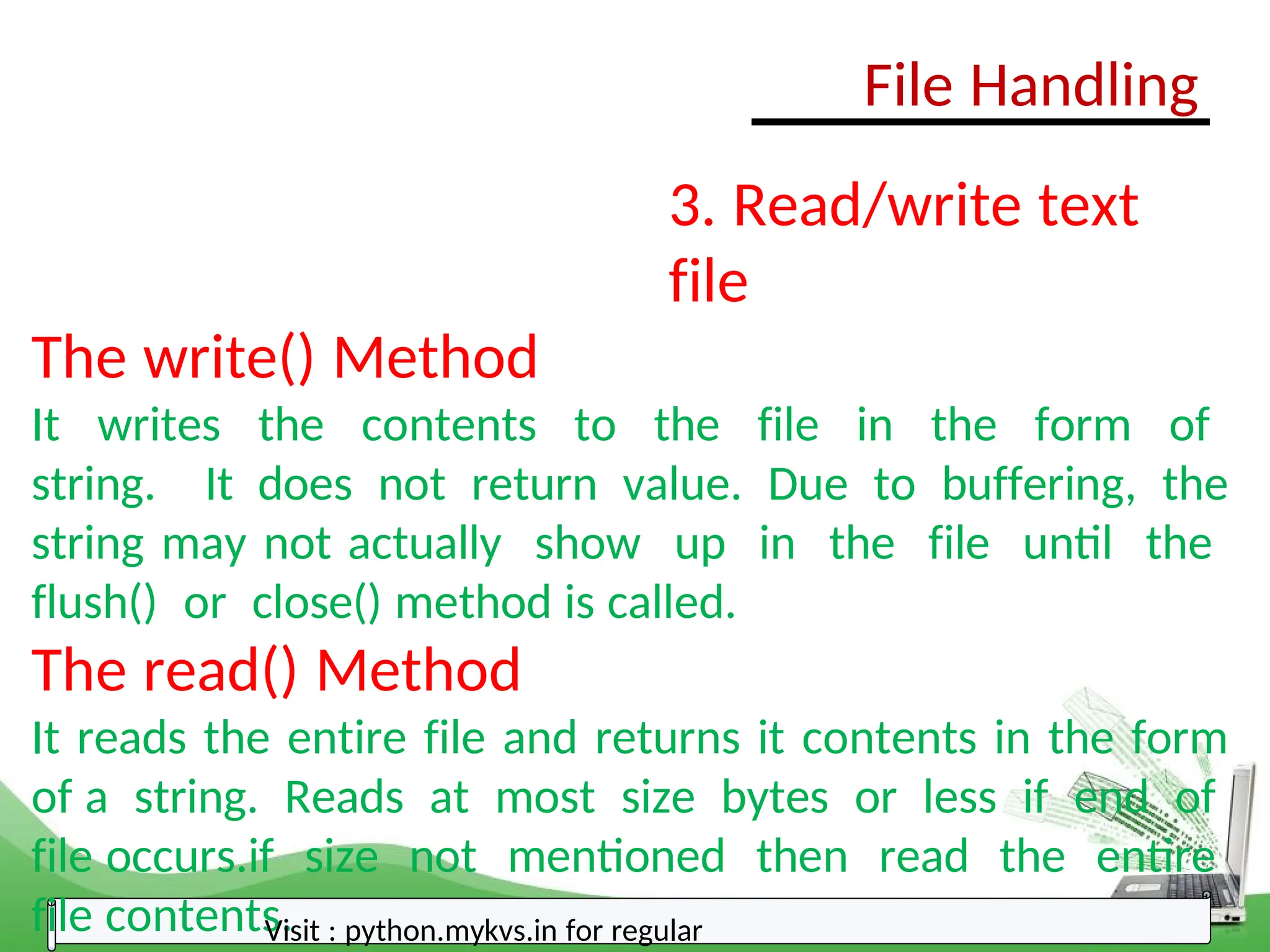
3. Read/write text
file
The write() Method
It writes the contents to the file in the form of
string. It does not return value. Due to buffering, the
string may not actually show up in the file until the
flush() or close() method is called.
The read() Method
It reads the entire file and returns it contents in the form
of a string. Reads at most size bytes or less if end of
file occurs.if size not mentioned then read the entire
file contents.
Visit : python.mykvs.in for regular
File Handling
Read/Write a Text
file
Visit : python.mykvs.in for regular
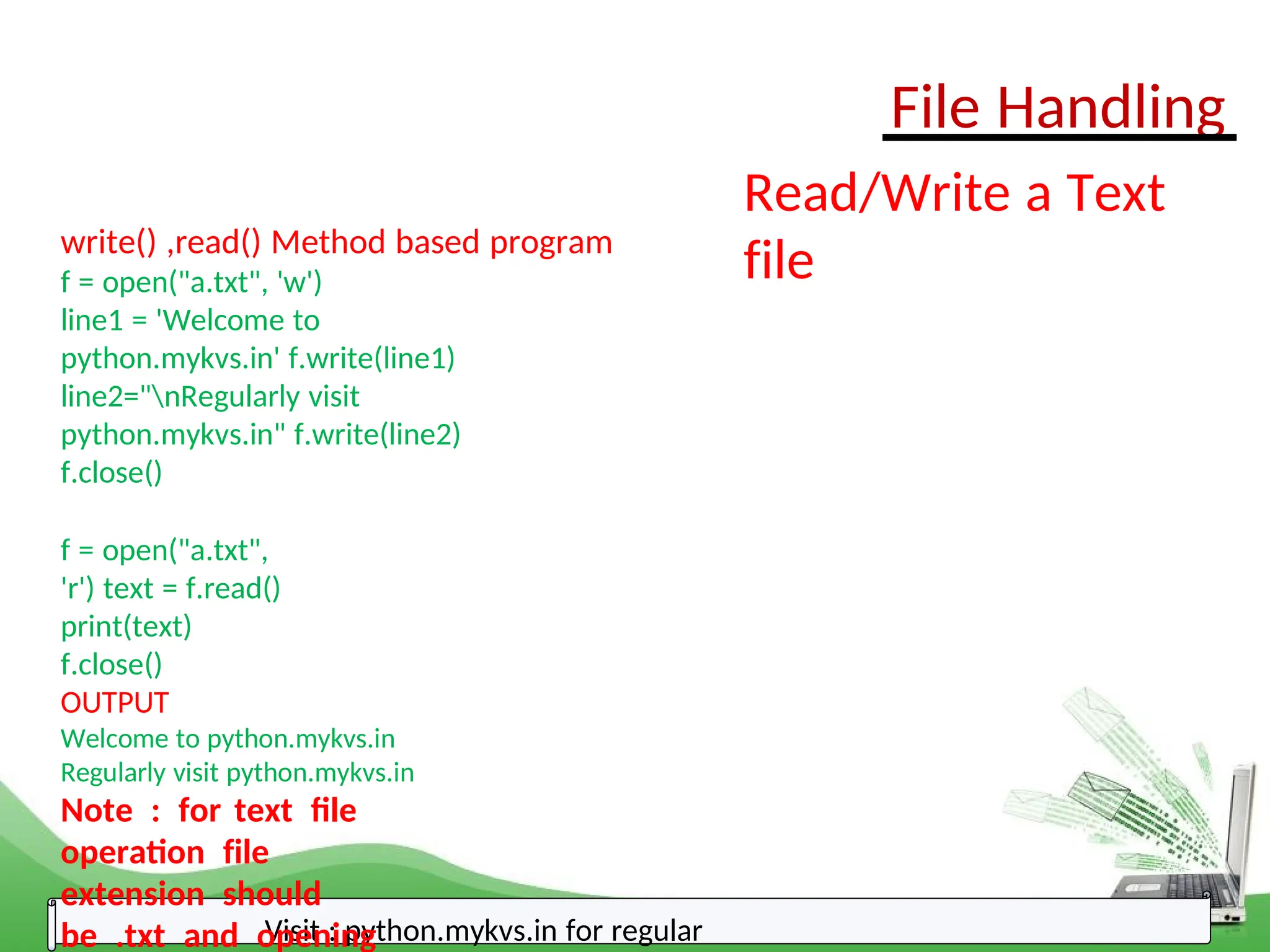
write() ,read() Method based program
f = open("a.txt", 'w')
line1 = 'Welcome to
python.mykvs.in' f.write(line1)
line2="nRegularly visit
python.mykvs.in" f.write(line2)
f.close()
f = open("a.txt",
'r') text = f.read()
print(text)
f.close()
OUTPUT
Welcome to python.mykvs.in
Regularly visit python.mykvs.in
Note : for text file
operation file
extension should
be .txt and opening
File Handling
Writelines()
Using writelines() multiple lines can be written in
file.
f = open(“d.txt",
"a")
f.writ
elines(["See you soon!", "Over and out."])
f.close()
#ope
n and read the file after the appending:
Visit : python.mykvs.in for regular
File Handling
Read Text file
readline([size]) method: Read no of characters from file if size is mentioned till
eof.read line till new line character.returns empty string on EOF.
e.g. program
f = open("a.txt", 'w')
line1 = 'Welcome to
python.mykvs.in' f.write(line1)
line2="nRegularly visit
python.mykvs.in"
f.write(line2
) f.close()
f = open("a.txt", 'r')
text = f.readline()
print(text)
text =
f.readline()
print(text)
f.close()
OUTPUT
Welcome to python.mykvs.in
Visit : python.mykvs.in for regular
File Handling
Read Text file
readlines([size]) method: Read no of lines from file if size is mentioned or
all contents if size is not mentioned.
e.g.program
f = open("a.txt", 'w')
line1 = 'Welcome to
python.mykvs.in' f.write(line1)
line2="nRegularly visit python.mykvs.in"
f.write(line2)
f.close()
f = open("a.txt", 'r')
text =
f.readlines(1)
print(text)
f.close()
OUTPUT
['Welcome to
python.mykvs.inVisit : python.mykvs.in for regular
File Handling
Read a Text File
Visit : python.mykvs.in for regular
Iterating over lines in a
file e.g.program
f = open("a.txt", 'w')
line1 = 'Welcome to
python.mykvs.in' f.write(line1)
line2="nRegularly visit
python.mykvs.in"
f.write(line2)
f.close()
f = open("a.txt", 'r')
for text in f.readlines():
print(text
) f.close()
File Handling
Read a Text
file
Visit : python.mykvs.in for regular
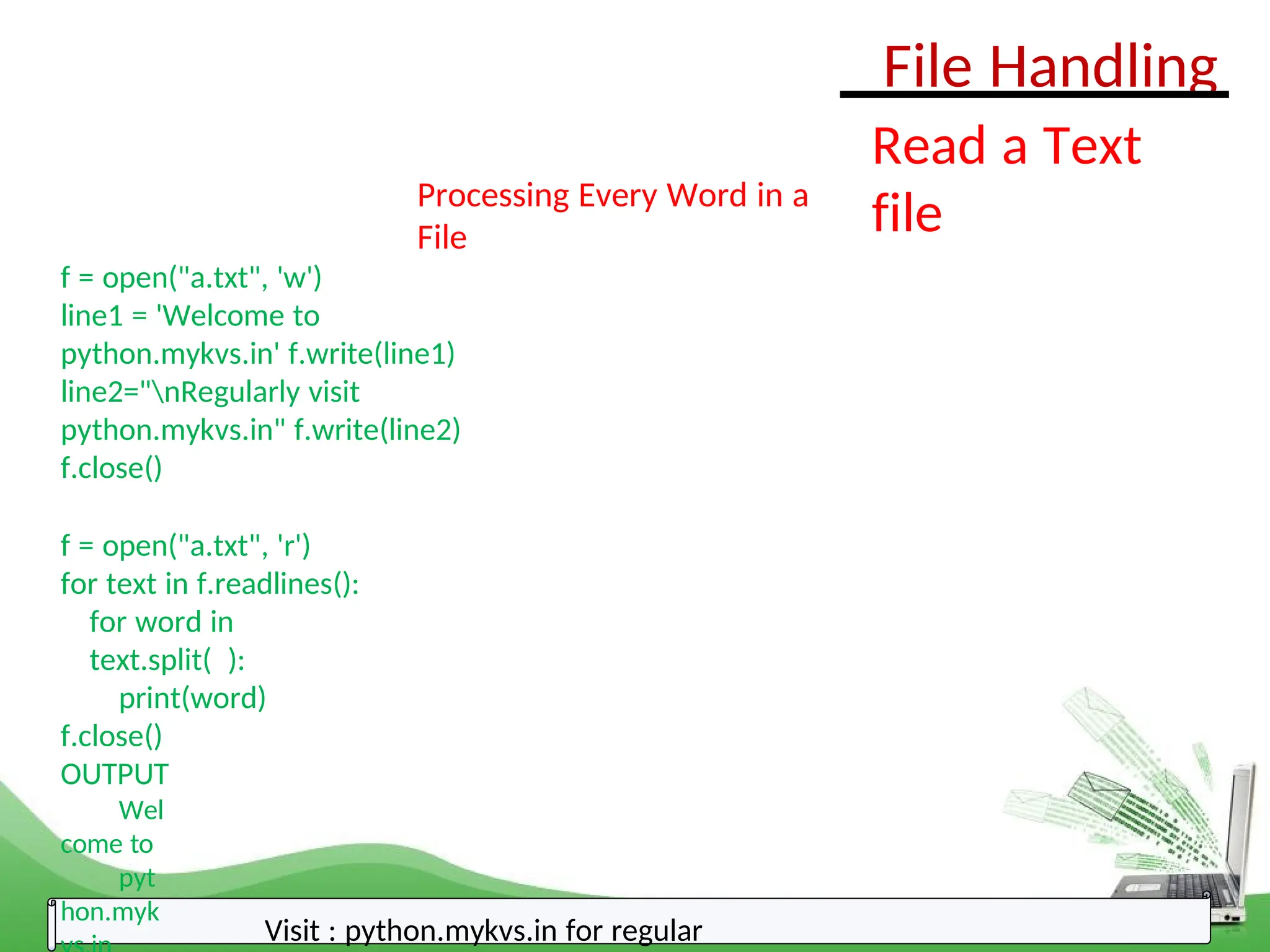
Processing Every Word in a
File
f = open("a.txt", 'w')
line1 = 'Welcome to
python.mykvs.in' f.write(line1)
line2="nRegularly visit
python.mykvs.in" f.write(line2)
f.close()
f = open("a.txt", 'r')
for text in f.readlines():
for word in
text.split( ):
print(word)
f.close()
OUTPUT
Wel
come to
pyt
hon.myk
File Handling
Getting & Resetting the Files
Position
The tell() method of python tells us the current position within the file,where as The
seek(offset[, from]) method changes the current file position. If from is 0, the beginning of the file to
seek. If it is set to 1, the current position is used . If it is set to 2 then the end of the file would
be taken as seek position. The offset argument indicates the number of bytes to be moved.
e.g.program
Visit : python.mykvs.in for regular
f = open("a.txt", 'w')
line = 'Welcome to python.mykvs.innRegularly visit
python.mykvs.in' f.write(line)
f.close()
f = open("a.txt",
'rb+') print(f.tell())
print(f.read(7)) # read seven
characters print(f.tell())
print(f.read())
print(f.tell())
f.seek(9,0) # moves to 9 position from
begining print(f.read(5))
f.seek(4, 1) # moves to 4 position from current
location
print(f.read(5))
f.seek(-5, 2) # Go to the 5th byte before the
end print(f.read(5))
f.close()
OUTPUT
0
b'Welcome'
7
b' to python.mykvs.in
rnRe gularly visit
python.mykvs.in'
59
b'o pyt'
b'mykvs'
b'vs.in'
File Handling
4. Modify a Text
file
There is no way to insert into the middle of a file without re-writing
it. We can append to a file or overwrite part of it using seek but if
we want to add text at the beginning or the middle, we'll have to
rewrite it.
It is an operating system task, not a Python task. It is the same in all
languages.
What we usually do for modification is read from the file, make
the modifications and write it out to a new file called
temp.txt or something like that. This is better than reading the
whole file into memory because the file may be too large for
that. Once the temporary file is completed, rename it the same as
the original file.
This is a good, safe way to do it because if the file write crashes
or aborts for any reason in between, we still have our
Visit : python.mykvs.in for regular
File Handling
Modify a Text
file
Note :- above program is suitable for file with small
size.
Replace string in the same File
fin = open("dummy.txt",
"rt") data = fin.read()
data = data.replace(‘my',
‘your')
fin.close()
fin = open("dummy.txt",
"wt") fin.write(data)
fin.close()
What have we done here?
Open file dummy.txt in read
text mode rt.
fin.read() reads whole text in
dummy.txt to the variable
data.
data.replace() replaces all the
occurrences of my with your
File Handling
Modify a Text
file
Replace string using temporary
file
program and check changes.
Visit : python.mykvs.in for regular
import os
f=open("d:a.txt","r")
g=open("d:c.txt","w")
for text in f.readlines():
text=text.replace('m
y','your')
g.write(text)
f.close()
g.close()
os.remove("d:a.txt")
os.rename("d:
c.txt","d:a.txt")
print("file contents
modified")
Note- above program is suitable for large file.Here line by line is being read from a.txt
file in text string and text string been replaced ‘my’ with ‘your’ through
replace() method.Each text is written in c.txt file then close both files ,remove old file
a.txt through remove method of os module and rename c.txt(temporary file) file with
a.txt file.After execution of above program all occurances of ‘my’ will be replaced with
File Handling
5. Append content to a Text
file
f.write(line
) f.close()
f = open("a.txt", 'a+')
f.write("nthanks")
f.close()
f = open("a.txt",
'r') text = f.read()
print(text)
f.close()
OUTPUT
Welcome to python.mykvs.in
Regularly visit
python.mykvs.in thanks
f = open("a.txt", 'w')
line = 'Welcome to python.mAykvs.innRegularly visit
python.mykvs.in'
P
Visit : python.mykvs.in for regular
P
E
N
D
C
O
D
E
File Handling
Standard input, output,
and error streams in
python
Most programs make output to "standard out“,input from
"standard in“, and error messages go to standard error).standard
output is to monitor and standard input is from keyboard.
e.g.program
import sys
a =
sys.stdin.readline()
sys.stdout.write(a)
a =
sys.stdin.read(5)#ente
red 10 characters.a
contains 5 characters.
#The remaining characters are waiting to
Visit : python.mykvs.in for regular
File Handling
Write and read a Binary
file
Visit : python.mykvs.in for regular
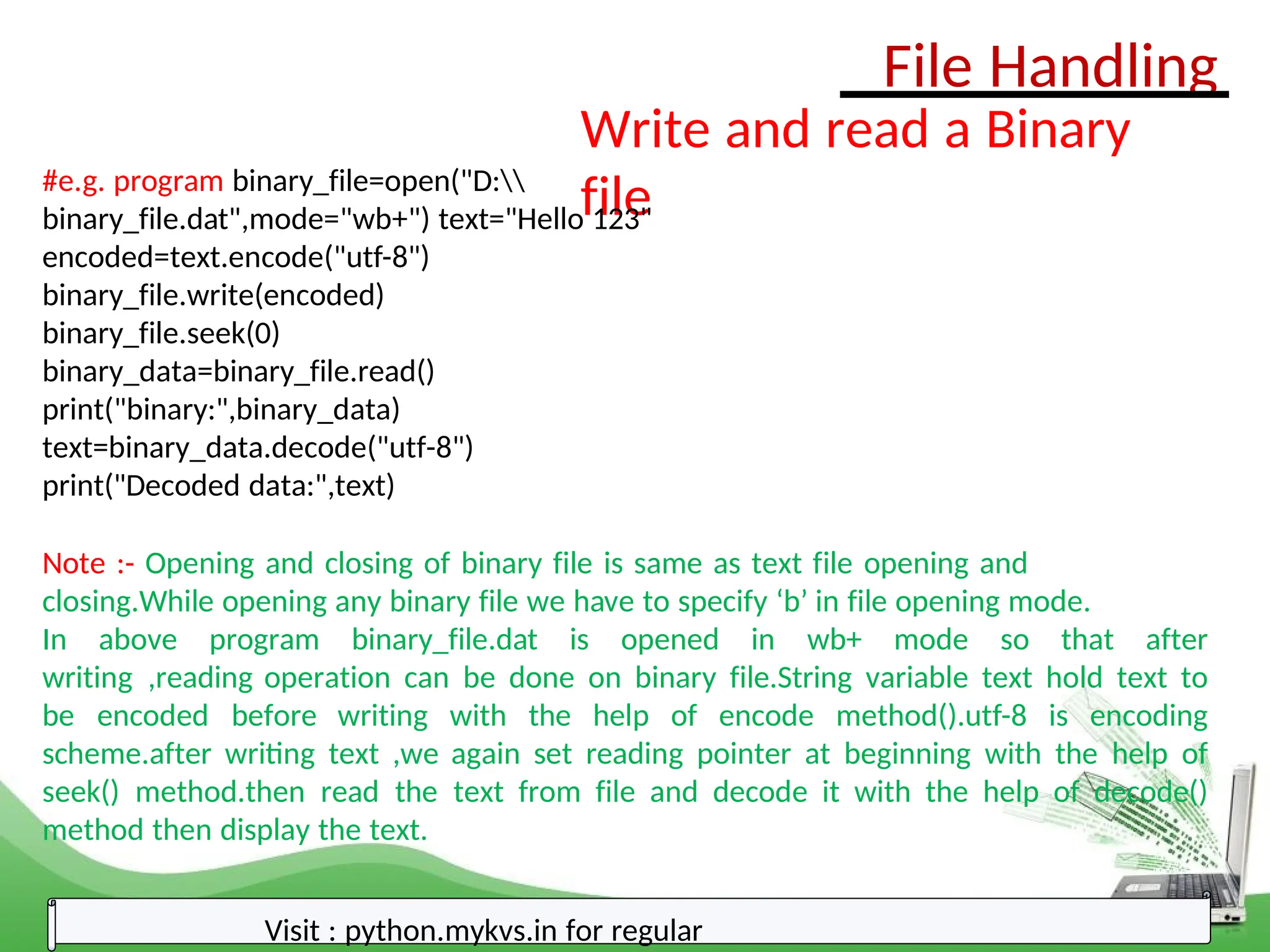
#e.g. program binary_file=open("D:
binary_file.dat",mode="wb+") text="Hello 123"
encoded=text.encode("utf-8")
binary_file.write(encoded)
binary_file.seek(0)
binary_data=binary_file.read()
print("binary:",binary_data)
text=binary_data.decode("utf-8")
print("Decoded data:",text)
Note :- Opening and closing of binary file is same as text file opening and
closing.While opening any binary file we have to specify ‘b’ in file opening mode.
In above program binary_file.dat is opened in wb+ mode so that after
writing ,reading operation can be done on binary file.String variable text hold text to
be encoded before writing with the help of encode method().utf-8 is encoding
scheme.after writing text ,we again set reading pointer at beginning with the help of
seek() method.then read the text from file and decode it with the help of decode()
method then display the text.
File Handling
Binary file
Operation
using pickle
module
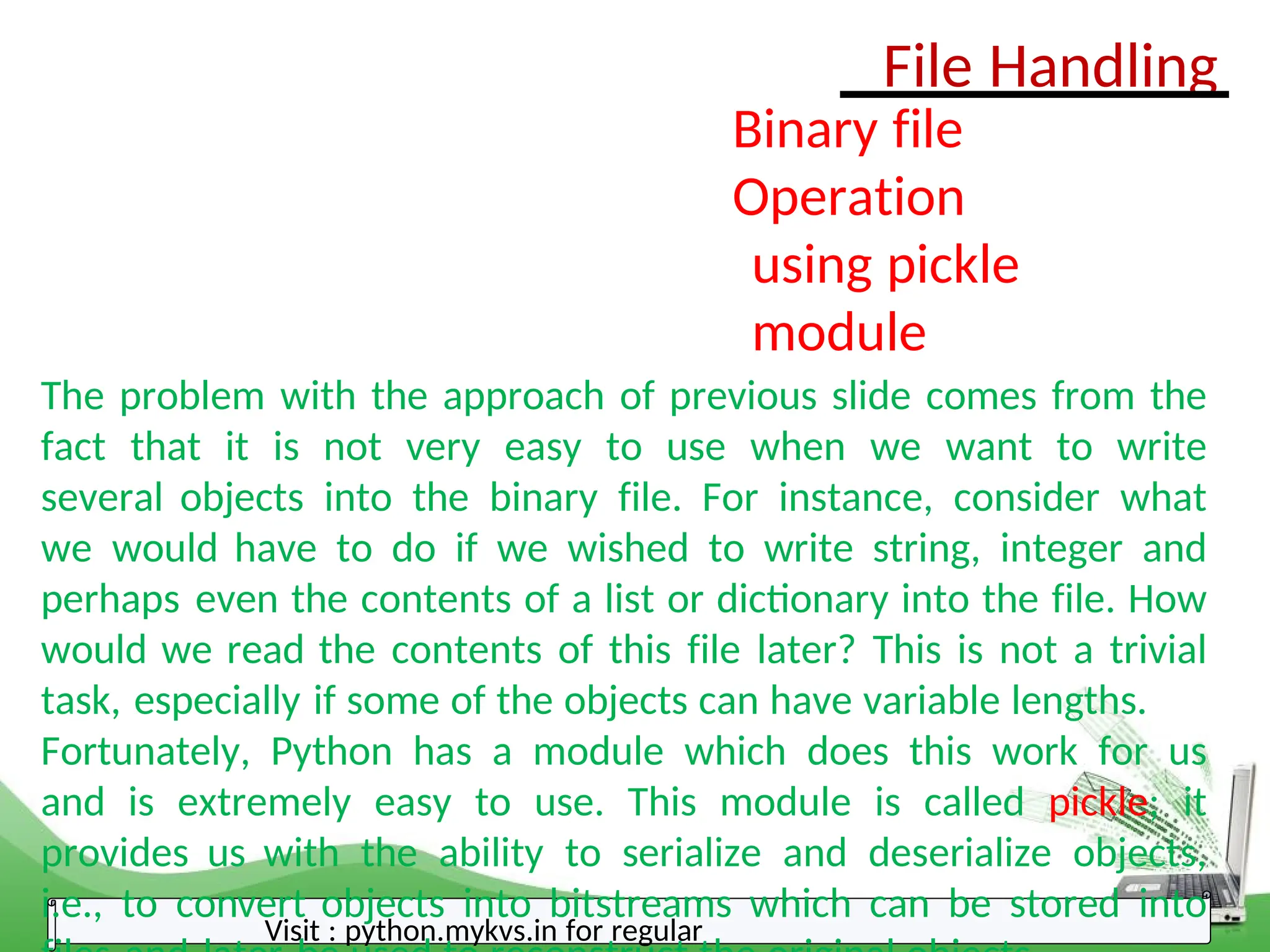
The problem with the approach of previous slide comes from the
fact that it is not very easy to use when we want to write
several objects into the binary file. For instance, consider what
we would have to do if we wished to write string, integer and
perhaps even the contents of a list or dictionary into the file. How
would we read the contents of this file later? This is not a trivial
task, especially if some of the objects can have variable lengths.
Fortunately, Python has a module which does this work for us
and is extremely easy to use. This module is called pickle; it
provides us with the ability to serialize and deserialize objects,
i.e., to convert objects into bitstreams which can be stored into
Visit : python.mykvs.in for regular
File Handling
Binary file
Operation
using pickle
module
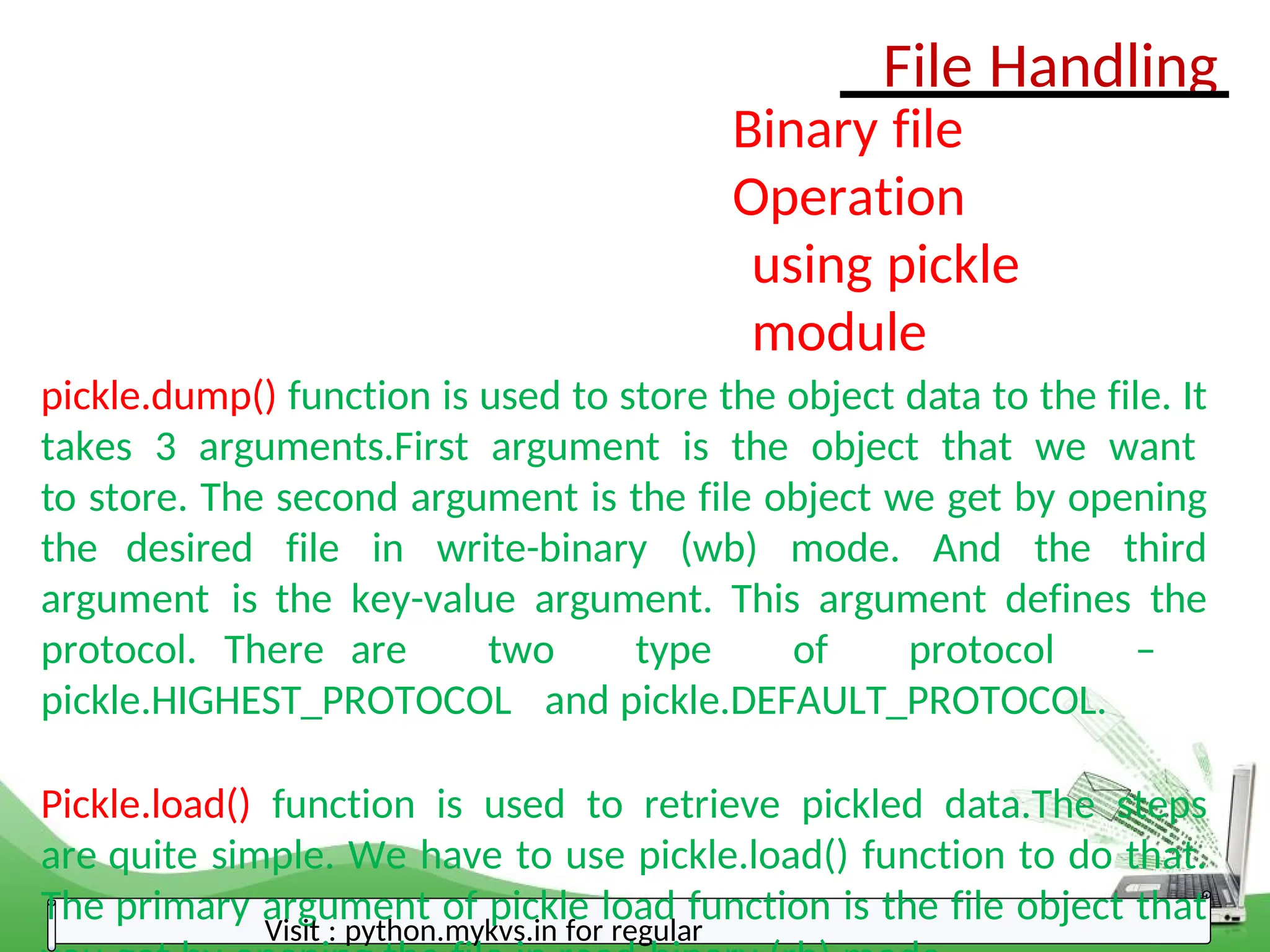
pickle.dump() function is used to store the object data to the file. It
takes 3 arguments.First argument is the object that we want
to store. The second argument is the file object we get by opening
the desired file in write-binary (wb) mode. And the third
argument is the key-value argument. This argument defines the
protocol. There are two type of protocol –
pickle.HIGHEST_PROTOCOL and pickle.DEFAULT_PROTOCOL.
Pickle.load() function is used to retrieve pickled data.The steps
are quite simple. We have to use pickle.load() function to do that.
The primary argument of pickle load function is the file object that
Visit : python.mykvs.in for regular
File Handling
Binary file R/W Operation
using pickle module
In this program we open a.bin file in
binary mode using ‘wb’
specification and create and store
value in 4
Visit : python.mykvs.in for regular
import pickle
output_file = open("d:a.bin", "wb")
myint = 42
mystring = "Python.mykvs.in!"
mylist = ["python", "sql",
"mysql"]
mydict = { "name": "ABC", "job": "XYZ" }
pickle.dump(myint, output_file)
pickle.dump(mystring, output_file)
pickle.dump(mylist, output_file)
pickle.dump(mydict, output_file)
output_file.close()
input_file = open("d:a.bin", "rb")
myint = pickle.load(input_file)
mystring = pickle.load(input_file)
mylist = pickle.load(input_file)
mydict = pickle.load(input_file)
print("myint = %s" % myint)
print("mystring = %s" % mystring)
print("mylist = %s" % mylist)
print("mydict = %s" % mydict)
input_file.close()
different data objects
these
i.e.
into
int,string,list,dict.Writ
e
binary file using pickle.dump()
method then close this file and open
the same for reading
operation.We read the content using
load method() and display the value
read from file.
To use dump and load we have
to import pickle module first of all.
File Handling
Iteration
over
Binary file - pickle
module
import pickle
output_file = open("d:a.bin", "wb")
myint = 42
mystring = "Python.mykvs.in!"
mylist = ["python", "sql",
"mysql"]
mydict = { "name": "ABC", "job":
"XYZ" } pickle.dump(myint, output_file)
pickle.dump(mystring, output_file)
pickle.dump(mylist, output_file)
pickle.dump(mydict, output_file)
output_file.close()
with open("d:a.bin", "rb") as f:
while True:
try:
r=pickle.load(f)
print(r)
print(“Next
data")
except
EOFError:
break
Read objects
one by one
Visit : python.mykvs.in for regular
File Handling
Insert/append record in a Binary
file
- pickle
module
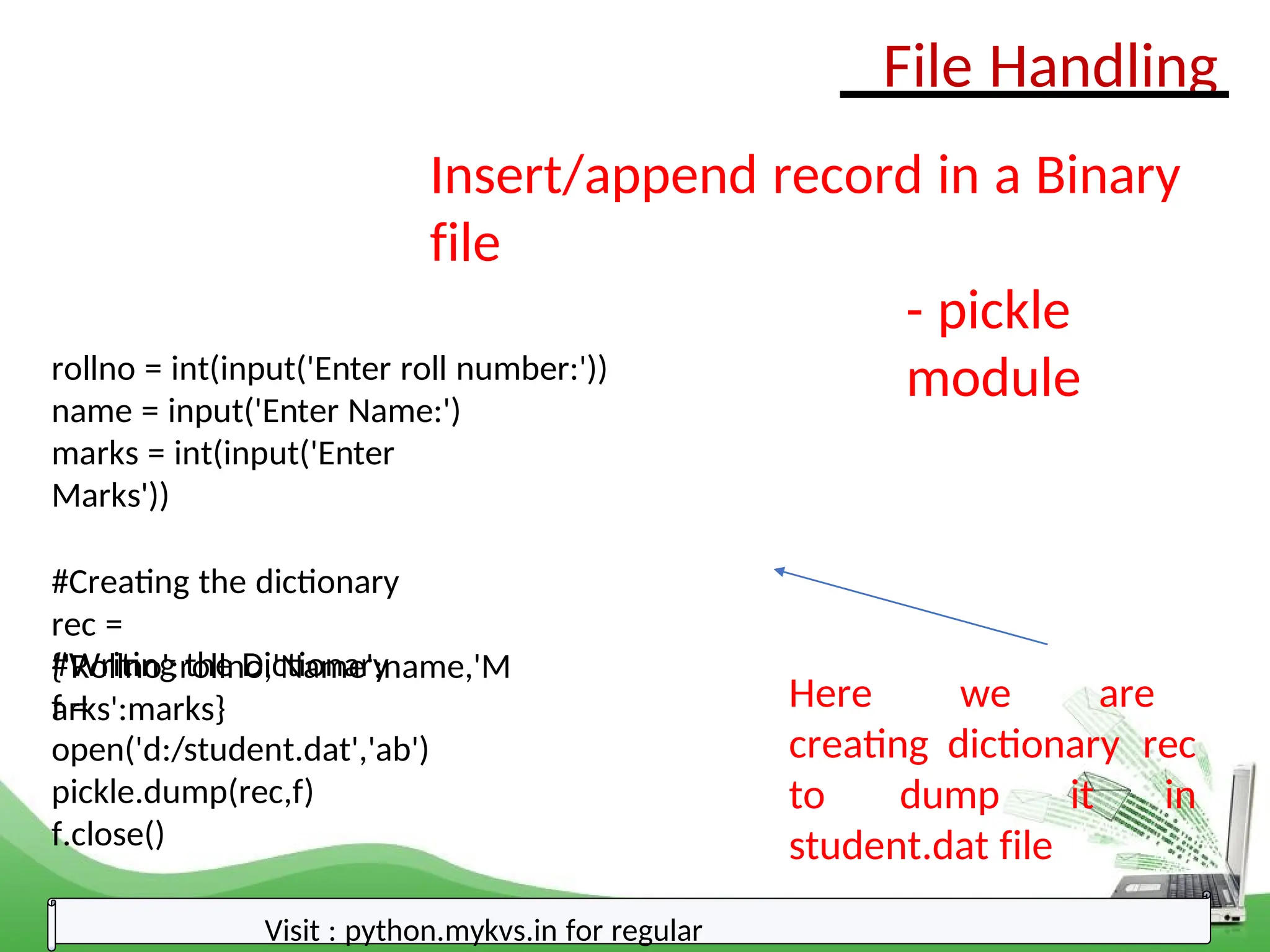
rollno = int(input('Enter roll number:'))
name = input('Enter Name:')
marks = int(input('Enter
Marks'))
#Creating the dictionary
rec =
{'Rollno':rollno,'Name':name,'M
arks':marks}
#Writing the Dictionary
f =
open('d:/student.dat','ab')
pickle.dump(rec,f)
f.close()
Here we are
creating dictionary rec
to dump it in
student.dat file
Visit : python.mykvs.in for regular
File Handling
Read records from a Binary
file
- pickle
module
f = open('d:/student.dat','rb')
while
True:
try:
rec =
pickle.
load(f)
print('Ro
ll
Num:',
rec['R
ollno']
)
print('Na
loop and exit on end of
file is reached.at each
iteration
data is
a dictionary
read into rec
are
and then
values being
displayed
Visit : python.mykvs.in for regular
Here we will iterate
using infinite while
File Handling
Search record in a Binary
file
- pickle
module
f =
open('d:/student.dat','rb')
flag = False
r=int(input(“Enter rollno to be
searched”))
while
True:
try:
rec = pickle.load(f) if
rec['Rollno'] == r:
print('Roll
Num:',rec['Rolln
o'])
print('Name:',rec['
Name'])
print('Marks:',rec['Marks'])
flag = True
except
Here value of r to
be searched will be
compared with rollno
value of file in
each iteration/
next
and if matches
record
then
relevant data will be
shown and flag will be set
to True otherwise it will
remain False and ‘No
Record Found message will
be displayed’
Visit : python.mykvs.in for regular
File Handling
Update record of a Binary
file
- pickle
module
f =
open('d:/student.dat','rb')
reclst = []
r=int(input(“enter roll no to
be updated”))
m=int(input(“enter correct
marks”))
while
True:
try:
rec =
pickle.
load(f)
reclst.ap
pend(
rec)
except
EOFError:
break
Here we are reading all records
from binary file and storing those in
reclst list then update relevant
roll no
/marks data in reclst list and
create
/replace student.dat file with
all
data of reclst.
If large data are in student.dat
file then It’s alternative way
can be using temporary file
creation with corrected data then
using os module for remove and
rename method (just similar to
Visit : python.mykvs.in for regular
File Handling
Delete record of a Binary
file
- pickle
module
f =
open('d:/student.dat','rb')
reclst = []
r=int(input(“enter roll no to
be deleted”))
while
True:
try:
rec = pickle.load(f)
reclst.append(rec)
except EOFError:
break
f.close()
f =
open('d:/student.dat','wb')
for x in reclst:
if x['Rollno']==r:
continue
pickle.dump(x,f)
Here we are reading all records
from binary file and storing those in
reclst list then write all records
except matching roll no(with the
help of continue statement) in
student.dat file.Due to wb mode old
data will be removed.
If large data are in student.dat
file then It’s alternative way
can be using temporary file
creation with corrected data then
using os module for remove and
rename method (just similar to
deletion from text file)
Visit : python.mykvs.in for regular
File Handling
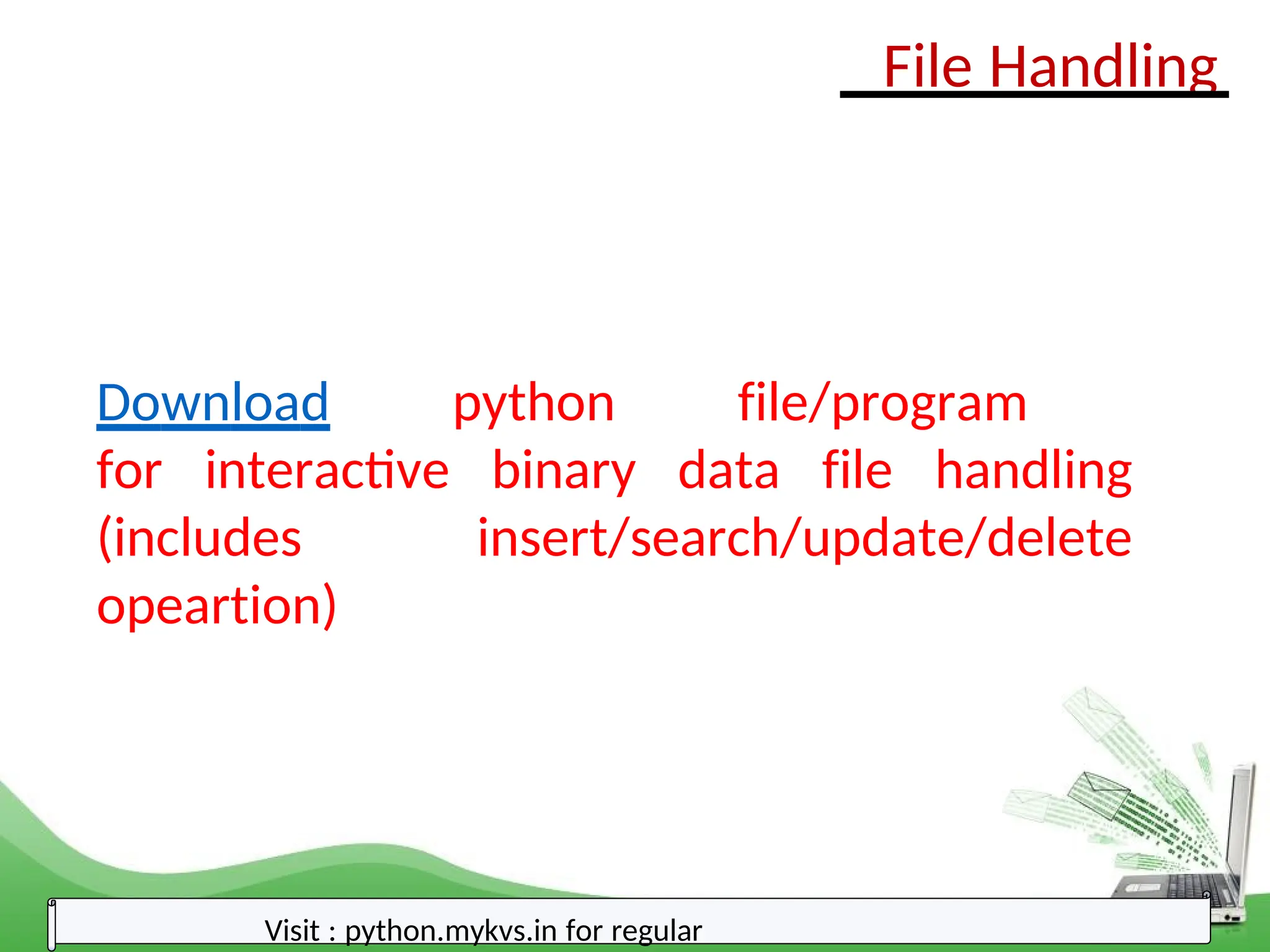
Download python file/program
for interactive binary data file handling
(includes insert/search/update/delete
opeartion)
Visit : python.mykvs.in for regular
File Handling
CSV FILE
(Comma separated value)
CSV (Comma Separated Values) is a file format for data storage which looks like
a text file. The information is organized with one record on each line and each
field is separated by comma.
CSV File Characteristics
•One line for each record
• Comma separated fields
• Space-characters adjacent to commas are ignored
•Fields with in-built commas are separated by double quote characters.
When Use CSV?
• When data has a strict tabular structure
• To transfer large database between programs
• To import and export data to office applications, Qedoc modules
• To store, manage and modify shopping cart catalogue
Visit : python.mykvs.in for regular
File Handling
CSV FILE
(Comma separated
value)
Visit : python.mykvs.in for regular
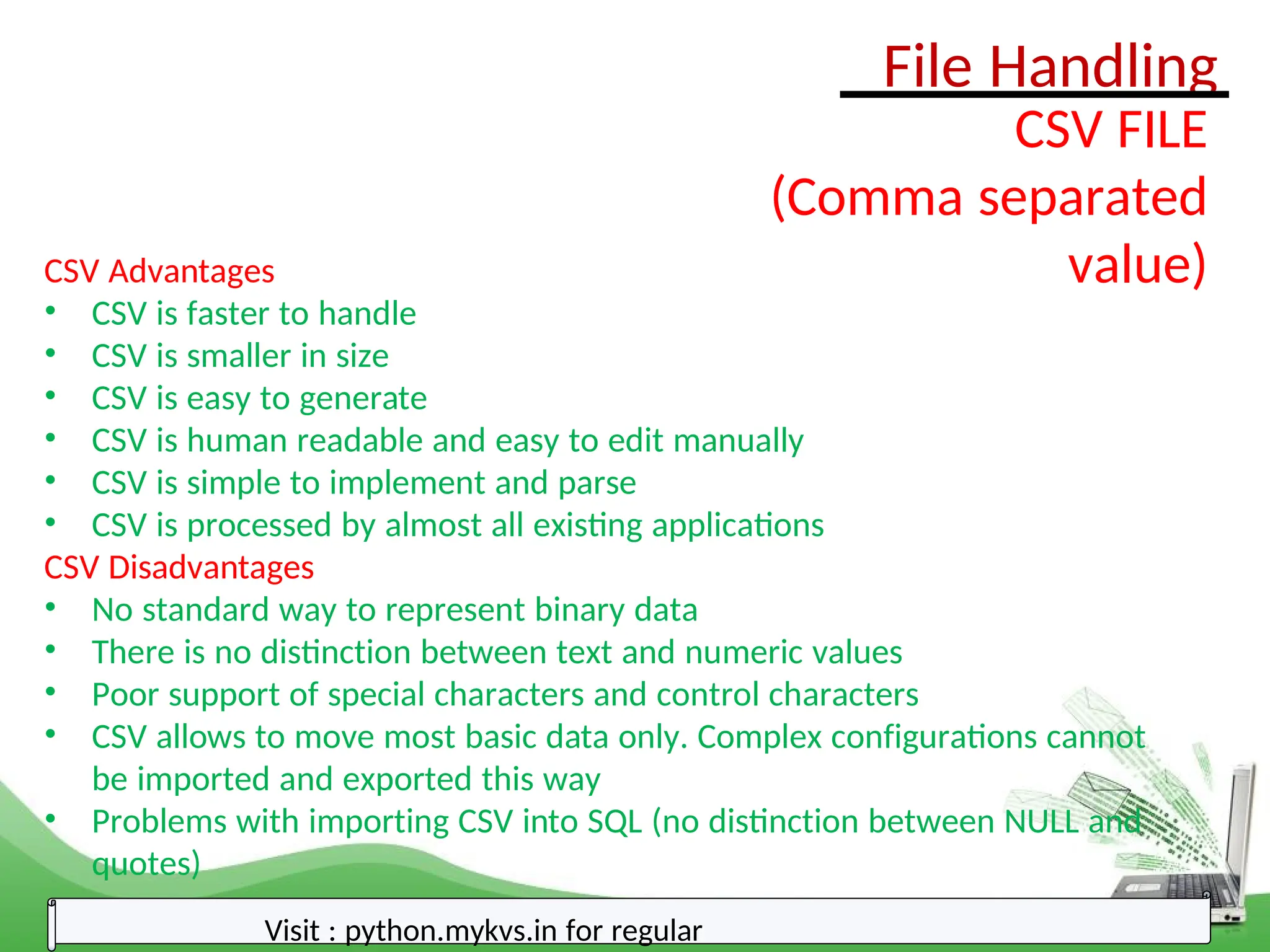
CSV Advantages
• CSV is faster to handle
• CSV is smaller in size
• CSV is easy to generate
• CSV is human readable and easy to edit manually
• CSV is simple to implement and parse
• CSV is processed by almost all existing applications
CSV Disadvantages
• No standard way to represent binary data
• There is no distinction between text and numeric values
• Poor support of special characters and control characters
• CSV allows to move most basic data only. Complex configurations cannot
be imported and exported this way
• Problems with importing CSV into SQL (no distinction between NULL and
quotes)
File Handling
Write / Read CSV FILE
Writing and reading operation
from text file is very easy.First of all
we have to import csv module
for file operation/method call.
For writing ,we open file in ‘w’ writing
import csv
#csv file writing code
with open('d:a.csv','w') as
newFile:
newFileWriter =
csv.writer(newFile)
newFileWriter.writerow(['user_id','beneficiary'])
mode
newFileWriter.writerow([1,'xyz']
)
newFileWriter.writerow([2,'pqr']
) newFile.close()
#csv file reading code
with open('d:a.csv','r') as newFile:
newFileReader =
csv.reader(newFile) for row in
newFileReader:
print (row)
newFile.close()
using open() method which
create newFile like
object.
Through csv.writer()
method ,we create writer object to
call writerow() method to write
objects.
Similarly for reading ,we open the
file in ‘r’ mode and create newFile
like object,further we create
newfilereader object using
csv.reader()method to read each row
of the file.
Three file opening modes are
there
‘w’,’r’,’a’. ‘a’ for append
Visit : python.mykvs.in for regular

File handling for reference class 12.pptx

  • 1.
    Computer Science Class XII( As per CBSE Board) Chapter 4 File Handling Visit : python.mykvs.in for regular New syllabu s 2023- 24
  • 2.
    Need for a data file •To Store data in organized manner • To store data permanently • To access data faster • To Search data faster • To easily modify data later on Visit : python.mykvs.in for regular
  • 3.
    File Handling A fileis a sequence of bytes on the disk/permanent storage where a group of related data is stored. File is created for permanent storage of data. In programming, Sometimes, it is not enough to only display the data on the console. Those data are to be retrieved later on,then the concept of file handling comes. It is impossible to recover the programmatically generated data again and again. However, if we need to do so, we may store it onto the file system which is not volatile and can be accessed every time. Here, comes the need of file handling in Python. File handling in Python enables us to create, update, read, and delete the files stored on the file system through our python program. The following operations can be performed on a file. In Python, File Handling consists of following three steps: ➢ Open the file. ➢ Process file i.e perform read or write operation. ➢ Close the file. Visit : python.mykvs.in for regular
  • 4.
    File Handling Types of File Visit: python.mykvs.in for regular There are two types of files: Text Files- A file whose contents can be viewed using a text editor is called a text file. A text file is simply a sequence of ASCII or Unicode characters. Python programs, contents written in text editors are some of the example of text files.e.g. .txt,.rtf,.csv etc. Binary Files-A binary file stores the data in the same way as as stored in the memory. The .exe files,mp3 file, image files, word documents are some of the examples of binary files.we can’t read a binary file using a text editor.e.g. .bmp,.cdr etc. Text File Binary File Its Bits represent character. Its Bits represent a custom data. Less prone to get corrupt as change reflects as soon as made and can be undone. Can easily get corrupted, corrupt on even single bit change Store only plain text in a file. Can store different types of data (audio, text,image) in a single file. Widely used file format and can be opened in any text editor. Developed for an application and can be opened in that application only. Mostly .txt,.rtf are used as extensions to text files. Can have any application defined extension.
  • 5.
    File Handling Opening and Closing Files-To perform file operation ,it must be opened first then after reading ,writing, editing operation can be performed. To create any new file then too it must be opened. On opening of any file ,a file relevant structure is created in memory as well as memory space is created to store contents. Once we are done working with the file, we should close the file. Closing a file releases valuable system resources. In case we forgot to close the file, Python automatically close the file when program ends or file object is no longer referenced in the program. However, if our program is large and we are reading or writing multiple files that can take significant amount of resource on the system. If we keep Visit : python.mykvs.in for regular
  • 6.
    File Handling open Function- Beforeany reading or writing operation of any file,it must be opened first of all.Python provide built in function open() for it.On calling of this function creates file object for file operations. Syntax file object = open(<file_name>, <access_mode>,< buffering>) file_name = name of the file ,enclosed in double quotes. access_mode= Determines the what kind of operations can be performed with file,like read,write etc. Buffering = for no buffering set it to 0.for line buffering set it to 1.if it is Visit : python.mykvs.in for regular
  • 7.
    File Handling File openingmodes- Visit : python.mykvs.in for regular Sr. Mode & Description No. 1 r - reading only.Sets file pointer at beginning of the file . This is the default mode. 2 rb – same as r mode but with binary file 3 r+ - both reading and writing. The file pointer placed at the beginning of the file. 4 rb+ - same as r+ mode but with binary file 5 w - writing only. Overwrites the file if the file exists. If not, creates a new file for writing. 6 wb – same as w mode but with binary file. 7 w+ - both writing and reading. Overwrites . If no file exist, creates a new file for R & W. 8 wb+ - same as w+ mode but with binary file. 9 a -for appending. Move file pointer at end of the file.Creates new file for writing,if not exist. 10 ab – same as a but with binary file. 11 a+ - for both appending and reading. Move file pointer at end. If the file does not exist, it creates a new file for reading and writing. 12 ab+ - same as a+ mode but with binary mode.
  • 8.
    File Handling Basic Textfile operations • Open (filename – absolute or relative path, mode) • Close a text file • Reading/Writing data • Manipulation of data • Appending data into a text file Visit : python.mykvs.in for regular
  • 9.
    File Handling Methods ofos module Before Starting file operation following methods must be learn by a programmer to perform file system related methods available in os module(standard module) which can be used during file operations. Visit : python.mykvs.in for regular 1.The rename() method used to rename the file. Syntax os.rename(current_file_name, new_file_name) 2.The remove() method to delete file. Syntax os.remove(file_name) 3.The mkdir() method of the os module to create directories in the current directory. Syntax os.mkdir("newdir") 4.The chdir() method to change the current directory. Syntax os.chdir("newdir") 5.The getcwd() method displays the current e.g.program import os print(os.getcwd()) os.mkdir("newdir") os.chdir("newdir") print(os.getcwd())
  • 10.
    File Handling Absolute Pathvs Relative Path One must be familiar with absolute & relative path before starting file related operations. The absolute path is the full path to some place on your computer. The relative path is the path to some file with respect to your current working directory (PWD). For example: Absolute path: C:/users/admin/docs/staff.txt If PWD is C:/users/admin/, then the relative path to staff.txt would be: docs/staff.txt Note, PWD + relative path = absolute path. Cool, awesome. Now, if we write some scripts which check if a file exists. os.chdir("C:/users/admin/docs") os.path.exists("staff.txt") This returns TRUE if stuff.txt exists and it works. Now, instead if we write, os.path.exists("C:/users/admin/docs/staff.txt") This will returns TRUE. If we don't know where the user executing the script from, it is best to compute the absolute path on the user's system using os and file__. file__ is a global variable set on every Python script that returns the relative path to the *.py file that contains it. e.g.program import os print(os.getcwd()) os.mkdir("newdir1") os.chdir("newdir1") print(os.getcwd()) my_absolute_dirpath = os.path.abspath(os.path.dirname(__file__)) print(my_absolute_dirpath) Visit : python.mykvs.in for regular
  • 11.
    File Handling File objectattributes / 1. open a text file ➢ closed: It returns true if the file is closed and false when the file is open. ➢ encoding: Encoding used for byte string conversion. ➢ mode: Returns file opening mode ➢ name: Returns the name of the file which file object holds. ➢ newlines: Returns “r”, “n”, “rn”, None or a tuple containing all the newline types seen. E.g. Program Visit : python.mykvs.in for regular f = open("a.txt", 'a+') print(f.closed) print(f.encoding) print(f.mode) print(f.newlines) print(f.name) OUTPUT False cp1252 a+ None a.txt #1 open text file
  • 12.
    File Handling 2. Closea text file close(): Used to close an open file. After using this method,an opened file will be closed and a closed file cannot be read or written any more. E.g. program f = open("a.txt", 'a+') print(f.closed) print("Name of the file is",f.name) Visit : python.mykvs.in for regular f.close() print(f.closed ) OUTPUT False Name of the file is a.txt True #2 close text file
  • 13.
    File Handling 3. Read/writetext file The write() Method It writes the contents to the file in the form of string. It does not return value. Due to buffering, the string may not actually show up in the file until the flush() or close() method is called. The read() Method It reads the entire file and returns it contents in the form of a string. Reads at most size bytes or less if end of file occurs.if size not mentioned then read the entire file contents. Visit : python.mykvs.in for regular
  • 14.
    File Handling Read/Write aText file Visit : python.mykvs.in for regular write() ,read() Method based program f = open("a.txt", 'w') line1 = 'Welcome to python.mykvs.in' f.write(line1) line2="nRegularly visit python.mykvs.in" f.write(line2) f.close() f = open("a.txt", 'r') text = f.read() print(text) f.close() OUTPUT Welcome to python.mykvs.in Regularly visit python.mykvs.in Note : for text file operation file extension should be .txt and opening
  • 15.
    File Handling Writelines() Using writelines()multiple lines can be written in file. f = open(“d.txt", "a") f.writ elines(["See you soon!", "Over and out."]) f.close() #ope n and read the file after the appending: Visit : python.mykvs.in for regular
  • 16.
    File Handling Read Textfile readline([size]) method: Read no of characters from file if size is mentioned till eof.read line till new line character.returns empty string on EOF. e.g. program f = open("a.txt", 'w') line1 = 'Welcome to python.mykvs.in' f.write(line1) line2="nRegularly visit python.mykvs.in" f.write(line2 ) f.close() f = open("a.txt", 'r') text = f.readline() print(text) text = f.readline() print(text) f.close() OUTPUT Welcome to python.mykvs.in Visit : python.mykvs.in for regular
  • 17.
    File Handling Read Textfile readlines([size]) method: Read no of lines from file if size is mentioned or all contents if size is not mentioned. e.g.program f = open("a.txt", 'w') line1 = 'Welcome to python.mykvs.in' f.write(line1) line2="nRegularly visit python.mykvs.in" f.write(line2) f.close() f = open("a.txt", 'r') text = f.readlines(1) print(text) f.close() OUTPUT ['Welcome to python.mykvs.inVisit : python.mykvs.in for regular
  • 18.
    File Handling Read aText File Visit : python.mykvs.in for regular Iterating over lines in a file e.g.program f = open("a.txt", 'w') line1 = 'Welcome to python.mykvs.in' f.write(line1) line2="nRegularly visit python.mykvs.in" f.write(line2) f.close() f = open("a.txt", 'r') for text in f.readlines(): print(text ) f.close()
  • 19.
    File Handling Read aText file Visit : python.mykvs.in for regular Processing Every Word in a File f = open("a.txt", 'w') line1 = 'Welcome to python.mykvs.in' f.write(line1) line2="nRegularly visit python.mykvs.in" f.write(line2) f.close() f = open("a.txt", 'r') for text in f.readlines(): for word in text.split( ): print(word) f.close() OUTPUT Wel come to pyt hon.myk
  • 20.
    File Handling Getting &Resetting the Files Position The tell() method of python tells us the current position within the file,where as The seek(offset[, from]) method changes the current file position. If from is 0, the beginning of the file to seek. If it is set to 1, the current position is used . If it is set to 2 then the end of the file would be taken as seek position. The offset argument indicates the number of bytes to be moved. e.g.program Visit : python.mykvs.in for regular f = open("a.txt", 'w') line = 'Welcome to python.mykvs.innRegularly visit python.mykvs.in' f.write(line) f.close() f = open("a.txt", 'rb+') print(f.tell()) print(f.read(7)) # read seven characters print(f.tell()) print(f.read()) print(f.tell()) f.seek(9,0) # moves to 9 position from begining print(f.read(5)) f.seek(4, 1) # moves to 4 position from current location print(f.read(5)) f.seek(-5, 2) # Go to the 5th byte before the end print(f.read(5)) f.close() OUTPUT 0 b'Welcome' 7 b' to python.mykvs.in rnRe gularly visit python.mykvs.in' 59 b'o pyt' b'mykvs' b'vs.in'
  • 21.
    File Handling 4. Modifya Text file There is no way to insert into the middle of a file without re-writing it. We can append to a file or overwrite part of it using seek but if we want to add text at the beginning or the middle, we'll have to rewrite it. It is an operating system task, not a Python task. It is the same in all languages. What we usually do for modification is read from the file, make the modifications and write it out to a new file called temp.txt or something like that. This is better than reading the whole file into memory because the file may be too large for that. Once the temporary file is completed, rename it the same as the original file. This is a good, safe way to do it because if the file write crashes or aborts for any reason in between, we still have our Visit : python.mykvs.in for regular
  • 22.
    File Handling Modify aText file Note :- above program is suitable for file with small size. Replace string in the same File fin = open("dummy.txt", "rt") data = fin.read() data = data.replace(‘my', ‘your') fin.close() fin = open("dummy.txt", "wt") fin.write(data) fin.close() What have we done here? Open file dummy.txt in read text mode rt. fin.read() reads whole text in dummy.txt to the variable data. data.replace() replaces all the occurrences of my with your
  • 23.
    File Handling Modify aText file Replace string using temporary file program and check changes. Visit : python.mykvs.in for regular import os f=open("d:a.txt","r") g=open("d:c.txt","w") for text in f.readlines(): text=text.replace('m y','your') g.write(text) f.close() g.close() os.remove("d:a.txt") os.rename("d: c.txt","d:a.txt") print("file contents modified") Note- above program is suitable for large file.Here line by line is being read from a.txt file in text string and text string been replaced ‘my’ with ‘your’ through replace() method.Each text is written in c.txt file then close both files ,remove old file a.txt through remove method of os module and rename c.txt(temporary file) file with a.txt file.After execution of above program all occurances of ‘my’ will be replaced with
  • 24.
    File Handling 5. Appendcontent to a Text file f.write(line ) f.close() f = open("a.txt", 'a+') f.write("nthanks") f.close() f = open("a.txt", 'r') text = f.read() print(text) f.close() OUTPUT Welcome to python.mykvs.in Regularly visit python.mykvs.in thanks f = open("a.txt", 'w') line = 'Welcome to python.mAykvs.innRegularly visit python.mykvs.in' P Visit : python.mykvs.in for regular P E N D C O D E
  • 25.
    File Handling Standard input,output, and error streams in python Most programs make output to "standard out“,input from "standard in“, and error messages go to standard error).standard output is to monitor and standard input is from keyboard. e.g.program import sys a = sys.stdin.readline() sys.stdout.write(a) a = sys.stdin.read(5)#ente red 10 characters.a contains 5 characters. #The remaining characters are waiting to Visit : python.mykvs.in for regular
  • 26.
    File Handling Write andread a Binary file Visit : python.mykvs.in for regular #e.g. program binary_file=open("D: binary_file.dat",mode="wb+") text="Hello 123" encoded=text.encode("utf-8") binary_file.write(encoded) binary_file.seek(0) binary_data=binary_file.read() print("binary:",binary_data) text=binary_data.decode("utf-8") print("Decoded data:",text) Note :- Opening and closing of binary file is same as text file opening and closing.While opening any binary file we have to specify ‘b’ in file opening mode. In above program binary_file.dat is opened in wb+ mode so that after writing ,reading operation can be done on binary file.String variable text hold text to be encoded before writing with the help of encode method().utf-8 is encoding scheme.after writing text ,we again set reading pointer at beginning with the help of seek() method.then read the text from file and decode it with the help of decode() method then display the text.
  • 27.
    File Handling Binary file Operation usingpickle module The problem with the approach of previous slide comes from the fact that it is not very easy to use when we want to write several objects into the binary file. For instance, consider what we would have to do if we wished to write string, integer and perhaps even the contents of a list or dictionary into the file. How would we read the contents of this file later? This is not a trivial task, especially if some of the objects can have variable lengths. Fortunately, Python has a module which does this work for us and is extremely easy to use. This module is called pickle; it provides us with the ability to serialize and deserialize objects, i.e., to convert objects into bitstreams which can be stored into Visit : python.mykvs.in for regular
  • 28.
    File Handling Binary file Operation usingpickle module pickle.dump() function is used to store the object data to the file. It takes 3 arguments.First argument is the object that we want to store. The second argument is the file object we get by opening the desired file in write-binary (wb) mode. And the third argument is the key-value argument. This argument defines the protocol. There are two type of protocol – pickle.HIGHEST_PROTOCOL and pickle.DEFAULT_PROTOCOL. Pickle.load() function is used to retrieve pickled data.The steps are quite simple. We have to use pickle.load() function to do that. The primary argument of pickle load function is the file object that Visit : python.mykvs.in for regular
  • 29.
    File Handling Binary fileR/W Operation using pickle module In this program we open a.bin file in binary mode using ‘wb’ specification and create and store value in 4 Visit : python.mykvs.in for regular import pickle output_file = open("d:a.bin", "wb") myint = 42 mystring = "Python.mykvs.in!" mylist = ["python", "sql", "mysql"] mydict = { "name": "ABC", "job": "XYZ" } pickle.dump(myint, output_file) pickle.dump(mystring, output_file) pickle.dump(mylist, output_file) pickle.dump(mydict, output_file) output_file.close() input_file = open("d:a.bin", "rb") myint = pickle.load(input_file) mystring = pickle.load(input_file) mylist = pickle.load(input_file) mydict = pickle.load(input_file) print("myint = %s" % myint) print("mystring = %s" % mystring) print("mylist = %s" % mylist) print("mydict = %s" % mydict) input_file.close() different data objects these i.e. into int,string,list,dict.Writ e binary file using pickle.dump() method then close this file and open the same for reading operation.We read the content using load method() and display the value read from file. To use dump and load we have to import pickle module first of all.
  • 30.
    File Handling Iteration over Binary file- pickle module import pickle output_file = open("d:a.bin", "wb") myint = 42 mystring = "Python.mykvs.in!" mylist = ["python", "sql", "mysql"] mydict = { "name": "ABC", "job": "XYZ" } pickle.dump(myint, output_file) pickle.dump(mystring, output_file) pickle.dump(mylist, output_file) pickle.dump(mydict, output_file) output_file.close() with open("d:a.bin", "rb") as f: while True: try: r=pickle.load(f) print(r) print(“Next data") except EOFError: break Read objects one by one Visit : python.mykvs.in for regular
  • 31.
    File Handling Insert/append recordin a Binary file - pickle module rollno = int(input('Enter roll number:')) name = input('Enter Name:') marks = int(input('Enter Marks')) #Creating the dictionary rec = {'Rollno':rollno,'Name':name,'M arks':marks} #Writing the Dictionary f = open('d:/student.dat','ab') pickle.dump(rec,f) f.close() Here we are creating dictionary rec to dump it in student.dat file Visit : python.mykvs.in for regular
  • 32.
    File Handling Read recordsfrom a Binary file - pickle module f = open('d:/student.dat','rb') while True: try: rec = pickle. load(f) print('Ro ll Num:', rec['R ollno'] ) print('Na loop and exit on end of file is reached.at each iteration data is a dictionary read into rec are and then values being displayed Visit : python.mykvs.in for regular Here we will iterate using infinite while
  • 33.
    File Handling Search recordin a Binary file - pickle module f = open('d:/student.dat','rb') flag = False r=int(input(“Enter rollno to be searched”)) while True: try: rec = pickle.load(f) if rec['Rollno'] == r: print('Roll Num:',rec['Rolln o']) print('Name:',rec[' Name']) print('Marks:',rec['Marks']) flag = True except Here value of r to be searched will be compared with rollno value of file in each iteration/ next and if matches record then relevant data will be shown and flag will be set to True otherwise it will remain False and ‘No Record Found message will be displayed’ Visit : python.mykvs.in for regular
  • 34.
    File Handling Update recordof a Binary file - pickle module f = open('d:/student.dat','rb') reclst = [] r=int(input(“enter roll no to be updated”)) m=int(input(“enter correct marks”)) while True: try: rec = pickle. load(f) reclst.ap pend( rec) except EOFError: break Here we are reading all records from binary file and storing those in reclst list then update relevant roll no /marks data in reclst list and create /replace student.dat file with all data of reclst. If large data are in student.dat file then It’s alternative way can be using temporary file creation with corrected data then using os module for remove and rename method (just similar to Visit : python.mykvs.in for regular
  • 35.
    File Handling Delete recordof a Binary file - pickle module f = open('d:/student.dat','rb') reclst = [] r=int(input(“enter roll no to be deleted”)) while True: try: rec = pickle.load(f) reclst.append(rec) except EOFError: break f.close() f = open('d:/student.dat','wb') for x in reclst: if x['Rollno']==r: continue pickle.dump(x,f) Here we are reading all records from binary file and storing those in reclst list then write all records except matching roll no(with the help of continue statement) in student.dat file.Due to wb mode old data will be removed. If large data are in student.dat file then It’s alternative way can be using temporary file creation with corrected data then using os module for remove and rename method (just similar to deletion from text file) Visit : python.mykvs.in for regular
  • 36.
    File Handling Download pythonfile/program for interactive binary data file handling (includes insert/search/update/delete opeartion) Visit : python.mykvs.in for regular
  • 37.
    File Handling CSV FILE (Commaseparated value) CSV (Comma Separated Values) is a file format for data storage which looks like a text file. The information is organized with one record on each line and each field is separated by comma. CSV File Characteristics •One line for each record • Comma separated fields • Space-characters adjacent to commas are ignored •Fields with in-built commas are separated by double quote characters. When Use CSV? • When data has a strict tabular structure • To transfer large database between programs • To import and export data to office applications, Qedoc modules • To store, manage and modify shopping cart catalogue Visit : python.mykvs.in for regular
  • 38.
    File Handling CSV FILE (Commaseparated value) Visit : python.mykvs.in for regular CSV Advantages • CSV is faster to handle • CSV is smaller in size • CSV is easy to generate • CSV is human readable and easy to edit manually • CSV is simple to implement and parse • CSV is processed by almost all existing applications CSV Disadvantages • No standard way to represent binary data • There is no distinction between text and numeric values • Poor support of special characters and control characters • CSV allows to move most basic data only. Complex configurations cannot be imported and exported this way • Problems with importing CSV into SQL (no distinction between NULL and quotes)
  • 39.
    File Handling Write /Read CSV FILE Writing and reading operation from text file is very easy.First of all we have to import csv module for file operation/method call. For writing ,we open file in ‘w’ writing import csv #csv file writing code with open('d:a.csv','w') as newFile: newFileWriter = csv.writer(newFile) newFileWriter.writerow(['user_id','beneficiary']) mode newFileWriter.writerow([1,'xyz'] ) newFileWriter.writerow([2,'pqr'] ) newFile.close() #csv file reading code with open('d:a.csv','r') as newFile: newFileReader = csv.reader(newFile) for row in newFileReader: print (row) newFile.close() using open() method which create newFile like object. Through csv.writer() method ,we create writer object to call writerow() method to write objects. Similarly for reading ,we open the file in ‘r’ mode and create newFile like object,further we create newfilereader object using csv.reader()method to read each row of the file. Three file opening modes are there ‘w’,’r’,’a’. ‘a’ for append Visit : python.mykvs.in for regular