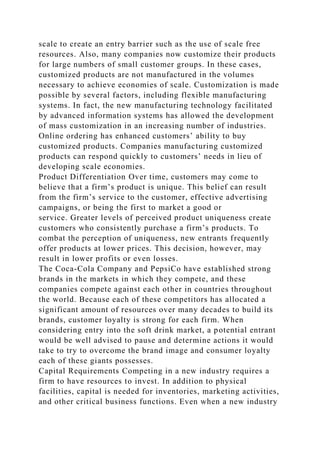
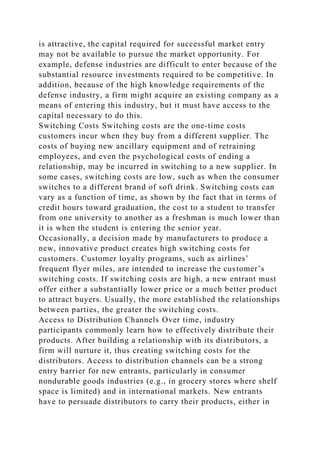
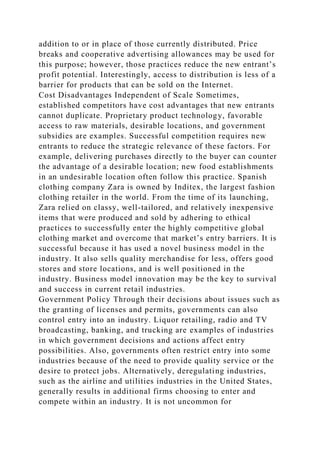
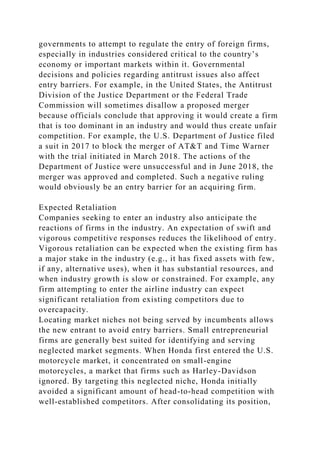
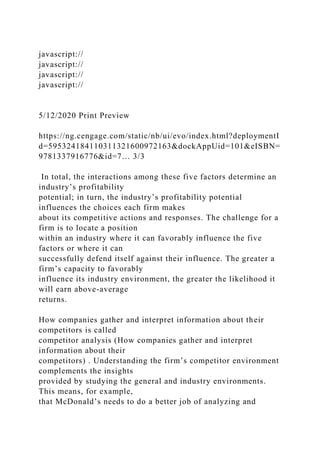
Figure 2.2The Five Forces of Competition Model
The five forces of competition model depicted in Figure
2.2 expands the scope of a firm’s competitive analysis.
Historically, when studying the competitive environment, firms
concentrated on companies with which they directly competed.
However, firms must search more broadly to recognize current
and potential competitors by identifying potential customers as
well as the firms serving them. For example, the
communications industry is now broadly defined as
encompassing media companies, telecoms, entertainment
companies, and companies producing devices such as
smartphones. In such an environment, firms must study many
other industries to identify companies with capabilities
(especially technology-based capabilities) that might be the
foundation for producing a good or a service that can compete
against what they are producing.
When studying the industry environment, firms must also
recognize that suppliers can become a firm’s competitors (by
integrating forward) as can buyers (by integrating backward).
For example, several firms have integrated forward in the
pharmaceutical industry by acquiring distributors or
wholesalers. In addition, firms choosing to enter a new market
and those producing products that are adequate substitutes for
existing products can become a company’s competitors.
Next, we examine the five forces the firm needs to analyze in
order to understand the profitability potential within an industry
(or a segment of an industry) in which it competes or may
choose to compete.
The Internal Organization: Resources, Capabilities, Core
Competencies, and Competitive Advantages
· Chapter Introduction
· 3-1Analyzing the Internal Organization
· 3-1aThe Context of Internal Analysis
· 3-1bCreating Value
· 3-1cThe Challenge of Analyzing the Internal Organization
· 3-2Resources, Capabilities, and Core Competencies
· 3-2aResources
· 3-2bCapabilities
· 3-2cCore Competencies
· 3-3Building Core Competencies
· 3-3aThe Four Criteria of Sustainable Competitive Advantage
· 3-3bValue Chain Analysis
· 3-4Outsourcing
· 3-5Competencies, Strengths, Weaknesses, and Strategic
Decisions
· Chapter Review
· Summary
· Key Terms
· Review Questions
· Mini-Case Is Strengthening the Superdry Brand a Foundation
to Strategic Success?Chapter Introduction
iStock.com/DNY59Learning Objectives
Studying this chapter should provide you with the strategic
management knowledge needed to:
· 3-1Explain why firms need to study and understand their
internal organization.
· 3-2Define value and discuss its importance.
· 3-3Describe the differences between tangible and intangible
resources.
· 3-4Define capabilities and discuss their development.
· 3-5Describe four criteria used to determine if resources and
capabilities are core competencies.
· 3-6Explain how firms analyze their value chain to determine
where they are able to create value when using their resources,
capabilities, and core competencies.
· 3-7Define outsourcing and discuss reasons for its use.
· 3-8Discuss the importance of identifying internal strengths
and weaknesses.
· 3-9Describe the importance of avoiding core rigidities.
Large Pharmaceutical Companies, Big Data Analytics, Artificial
Intelligence and Core Competencies: A Brave New World
To date, and perhaps surprisingly, the idea of using data
strategically remains somewhat novel in some organizations.
However, the reality of “big data” and “big data analytics”
(which is “the process of examining big data to uncover hidden
patterns, unknown correlations, and other useful information
that can be used to make better decisions”) is becoming
increasingly popular in business. Indeed, in the current
competitive landscape, most businesses must use big data
analytics (BDA) across all customer channels (mobile, Web, e-
mail, and physical stores) throughout their supply chain to help
them become more innovative.
This is the situation for large pharmaceutical companies (the
firms often called “big pharma”) in that many have been
working to develop a core competence in BDA. (We define and
discuss core competencies in this chapter.) There are several
reasons they are doing this. In addition to the vast increases in
the amounts of data that must be studied and interpreted for
competitive purposes, “health care reform and the changing
landscape of health care delivery” systems throughout the world
are influencing these firms to think about developing BDA as a
core competence.
AI can help analyze data on clinical trials, health records,
genetic profiles, and preclinical studies. China has a goal to
become the world leader in AI.
Creativa Images/ Shutterstock.com
Many benefits can accrue to big pharma firms that develop BDA
as a core competence. For example, having BDA as a core
competence can help a firm quickly identify trial candidates and
accelerate their recruitment, develop improved inclusion and
exclusion criteria to use in clinical trials, and uncover
unintended uses and indications for products. In terms of
customer functionality, superior products can be provided at a
faster pace as a foundation for helping patients live better and
healthier lives.
In developing their BDA capabilities, many of the big pharma
companies are investing in artificial intelligence (AI). AI
provides the capability to analyze many different sets of
information. For example, AI can help analyze data on clinical
trials, health records, genetic profiles, and preclinical studies.
AI can analyze and integrate these data to identify patterns in
the data and suggest hypotheses about relationships. A new drug
generally requires a decade of research and $2.6 billion of
investment. And only about 5 percent of the drugs that enter
experimental research make it to the market and are successful.
Eventually, it is expected that the use of AI could reduce the
early research development time from 4-6 years to 1 year, not
only greatly reducing the time of development but also the
costs.
As we discuss in this chapter, capabilities are the foundation for
developing core competencies. There are several capabilities
big pharma companies need for BDA to be a core competence.
Supportive architecture, the proper mix of data scientists, and
“technology that integrates and manages new types and sources
of data flexibility and scalability while maintaining the highest
standards of data governance, data quality, and data security”
are examples of capabilities that big pharma need if they wish
to develop BDA as a core competence. Of course, using
artificial intelligence provides strong support for the application
of BDA.
Having a strong BDA competence could be critical for
pharmaceutical firms in the future. Most Chinese
pharmaceutical firms are medium-sized and sell generic drugs
and therapeutic medicines, investing in R&D at only about 25%
of the amount invested by big pharma in developed countries.
However, China has a plan to develop large, competitive
pharmaceutical firms by 2025. In 2017, for example, China’s
second largest class of investments was biopharma.
Interestingly, the largest Chinese investment that year was in
information systems, including AI. China has a goal to become
the world leader in AI.
In recent years, big pharma has been earning mediocre returns
of about 3 percent ROI, down from 10 percent a decade earlier.
Thus, big pharma executives feel pressure especially with the
initial costs of developing BDA and AI. Hopefully, they soon
will be able to reduce their costs and experience higher rates of
success in the development of new drugs. Until then, however,
analysts are predicting record numbers of mergers and
acquisitions in the pharmaceutical industry, with big pharma
acquiring successful medium-sized pharmaceuticals and
biotechnology firms.
Sources: S. Mukherjee, 2018, How big pharma is using AI to
make better drugs, Fortune, fortune.com, March 19: Z. Torrey,
2018, China prepares for big pharma, thediplomat.com, March
14; E. Corbett, 2018, European mid-sized pharma companies-
biotechs and big pharma? The
Pharmaletter, www.thepharmaletter.com, March 9; M. Jewel,
2018, Signs that 2018 will be a record year for pharma
M&A, The Pharmaletter, www.thepharmaletter.com, March1; B.
Nelson, 2018, Why big pharma and biotech are betting big on
AI, NBC News, www.nbc.news, March 1; Big data analytics:
What it is & why it matters, 2015, SAS, www.sas.com, April 2;
Big data for the pharmaceutical
industry, Informatica, www.informatica.com, March 17; B.
Atkins, 2015, Big data and the board, Wall Street Journal
Online, www.wsj.com, April 16; S. F. DeAngelis, 2014,
Pharmaceutical big data analytics promises a healthier
future, Enterrasolutions, www.enterrasolutions.com, June 5; T.
Wolfram, 2014, Data analytics has big pharma rethinking its
core competencies, Forbes Online, www.forbes.com, December
22.
As discussed in the first two chapters, several factors in the
global economy, including the rapid development of the
Internet’s capabilities and globalization in general, are making
it difficult for firms to develop competitive
advantages. Increasingly, innovation appears to be a vital path
to efforts to develop competitive advantages, particularly
sustainable ones. Innovative actions are required by big pharma
companies, and they need to develop new drugs more quickly
and at lower costs while improving the success of the drugs that
they develop. As the Opening Case shows, they are trying to use
artificial intelligence to help develop capabilities in big data
analytics that hopefully can become a core competence.
As is the case for big pharma companies, innovation is critical
to most firms’ success. This means that many firms seek to
develop innovation as a core competence. We define and discuss
core competencies in this chapter and explain how firms use
their resources and capabilities to form them. As a core
competence, innovation has long been critical to Boeing’s
success, too. Today, however, the firm is focusing on
incremental innovations as well as developing new technologies
that are linked to major innovations and the projects they
spawn, such as the 787 Dreamliner. The first delivery of the
787-10 Dreamliner was made to Singapore Airlines on March
26, 2018. Boeing believes its incremental innovations enable
the firm to deliver reliable products to customers more quickly
and at a lower cost. As we discuss in this chapter, firms and
organizations—such as those we mention here—achieve
strategic competitiveness and earn above-average returns by
acquiring, bundling, and leveraging their resources for the
purpose of taking advantage of opportunities in the external
environment in ways that create value for customers.
Even if the firm develops and manages resources in ways that
create core competencies and competitive advantages,
competitors will eventually learn how to duplicate the benefits
of any firm’s value-creating strategy; thus, all competitive
advantages have a limited life. Because of this, the question of
duplication of a competitive advantage is not if it will happen,
but when. In general, a competitive advantage’s sustainability is
a function of three factors:
1. The rate of core competence obsolescence because of
environmental changes
2. The availability of substitutes for the core competence
3. The imitability of the core competence
For all firms, the challenge is to effectively manage current core
competencies while simultaneously developing new ones. Only
when firms are able to do this can they expect to achieve
strategic competitiveness, earn above-average returns, and
remain ahead of competitors in both the short and long term.
We studied the general, industry, and competitor environments
in Chapter 2. Armed with knowledge about the realities and
conditions of their external environment, firms have a better
understanding of marketplace opportunities and the
characteristics of the competitive environment in which those
opportunities exist. In this chapter, we focus on the firm. By
analyzing its internal organization, a firm determines what it
can do. Matching what a firm can do (a function of its
resources, capabilities, and core competencies in the internal
organization) with what it might do (a function of opportunities
and threats in the external environment) yields insights for the
firm to select strategies from among those we discuss
in Chapters 4, 5, 6, 7, 8, and 9.
We begin this chapter by briefly describing conditions
associated with analyzing the firm’s internal organization. We
then discuss the roles of resources and capabilities in
developing core competencies, which are the sources of the
firm’s competitive advantages. Included in this discussion are
the techniques firms use to identify and evaluate resources and
capabilities and the criteria for identifying core competencies
from among them. Resources alone typically do not provide
competitive advantages. Instead, resources create value when
the firm uses them to form capabilities, some of which become
core competencies, and hopefully competitive advantages.
Because of the relationship among resources, capabilities, and
core competencies, we also discuss the value chain and examine
four criteria that firms use to determine if their capabilities are
core competencies and, as such, sources of competitive
advantage. The chapter closes with comments about outsourcing
as well as the need for firms to prevent their core competencies
from becoming core rigidities. The existence of core rigidities
indicates that the firm is too anchored to its past, a situation
that prevents it from continuously developing new capabilities
and core competencies.3-1Analyzing the Internal Organization
3-1aThe Context of Internal Analysis
One of the conditions associated with analyzing a firm’s
internal organization is the reality that in today’s global
economy, some of the resources that were traditionally critical
to firms’ efforts to produce, sell, and distribute their goods or
services—such as labor costs, access to financial resources and
raw materials, and protected or regulated markets—although
still important, are now less likely to be the source of
competitive advantages. An important reason for this is that an
increasing number of firms are using their resources to form
core competencies through which they successfully implement
an international strategy (discussed in Chapter 8) as a means of
overcoming the advantages created by more traditional
resources.
Given the increasing importance of the global economy, those
analyzing their firm’s internal organization should use a global
mind-set to do so. A global mind-set is the ability to analyze,
understand, and manage an internal organization in ways that
are not dependent on the assumptions of a single country,
culture, or context. Because they are able to span artificial
boundaries, those with a global mind-set recognize that their
firms must possess resources and capabilities that allow
understanding of and appropriate responses to competitive
situations that are influenced by country-specific factors and
unique cultures. Using a global mind-set to analyze the internal
organization has the potential to significantly help the firm in
its efforts to outperform rivals.
Finally, analyzing the firm’s internal organization requires that
evaluators examine the firm’s entire portfolio of resources and
capabilities. This perspective suggests that individual firms
possess at least some resources and capabilities that other
companies do not—at least not in the same combination.
Resources are the source of capabilities, some of which lead to
the development of core competencies; in turn, some core
competencies may lead to a competitive advantage for the
firm. Understanding how to leverage the firm’s unique bundle
of resources and capabilities is a key outcome decision makers
seek when analyzing the internal organization.Figure
3.1 illustrates the relationships among resources, capabilities,
core competencies, and competitive advantages and shows how
their integrated use can lead to strategic competitiveness. As we
discuss next, firms use the resources in their internal
organization to create value for customers.
Figure 3.1Components of an Internal Analysis
3-1bCreating Value
Firms use their resources as the foundation for producing goods
or services that will create value for customers.Value is
measured by a product’s performance characteristics and by its
attributes for which customers are willing to pay. Firms create
value by innovatively bundling and leveraging their resources to
form capabilities and core competencies. Firms with a
competitive advantage create more value for customers than do
competitors. Walmart uses its “every day low price” approach to
doing business (an approach that is grounded in the firm’s core
competencies, such as information technology and
distribution channels) to create value for those seeking to buy
products at a low price compared to competitors’ prices for
those products. The stronger these firms’ core competencies, the
greater the amount of value they’re able to create for their
customers.
Ultimately, creating value for customers is the source of above-
average returns for a firm. What the firm intends regarding
value creation affects its choice of business-level strategy
(see Chapter 4) and its organizational structure (see Chapter
11). In Chapter 4’s discussion of business-level strategies, we
note that value is created by a product’s low cost, by its highly
differentiated features, or by a combination of low cost and high
differentiation compared to competitors’ offerings. A business-
level strategy is effective only when it is grounded in exploiting
the firm’s capabilities and core competencies. Thus, the
successful firm continuously examines the effectiveness of
current capabilities and core competencies while thinking about
the capabilities and competencies it will require for future
success.
At one time, firms’ efforts to create value were largely oriented
toward understanding the characteristics of the industry in
which they competed and, in light of those characteristics,
determining how they should be positioned relative to
competitors. This emphasis on industry characteristics and
competitive strategy underestimated the role of the firm’s
resources and capabilities in developing core competencies as
the source of competitive advantages. In fact, core
competencies, in combination with product-market positions,
are the firm’s most important sources of competitive
advantage. A firm’s core competencies, integrated with an
understanding of the results of studying the conditions in the
external environment, should drive the selection of
strategies. As Clayton Christensen noted, “successful strategists
need to cultivate a deep understanding of the processes of
competition and progress and of the factors that undergird each
advantage. Only thus will they be able to see when old
advantages are poised to disappear and how new advantages can
be built in their stead.” By emphasizing core competencies
when selecting and implementing strategies, companies learn to
compete primarily on the basis of firm-specific differences.
However, while doing so they must be simultaneously aware of
changes in the firm’s external environment.
3-1cThe Challenge of Analyzing the Internal Organization
The strategic decisions managers make about the internal
organization are nonroutine, have ethical implications, and
significantly influence the firm’s ability to earn above-average
returns. These decisions involve choices about the resources the
firm needs to collect and how to best manage and leverage
them.
Making decisions involving the firm’s assets—identifying,
developing, deploying, and protecting resources, capabilities,
and core competencies—may appear to be relatively easy.
However, this task is as challenging and difficult as any other
with which managers are involved; moreover, the task is
increasingly internationalized. Some believe that the pressure
on managers to pursue only decisions that help the firm meet
anticipated quarterly earnings makes it difficult to accurately
examine the firm’s internal organization.
The challenge and difficulty of making effective decisions are
implied by preliminary evidence suggesting that one-half of
organizational decisions fail. Sometimes, mistakes are made as
the firm analyzes conditions in its internal
organization. Managers might, for example, think a capability is
a core competence when it is not. This may have been the case
at Polaroid Corporation, as decision makers continued to
believe that the capabilities it used to build its instant film
cameras were highly relevant at the time its competitors were
preparing to introduce digital cameras. In this instance,
Polaroid’s decision makers may have concluded that superior
manufacturing was a core competence, as was the firm’s ability
to innovate in terms of creating value-adding features for its
instant cameras. If a mistake is made when analyzing and
managing a firm’s resources, decision makers must have the
confidence to admit it and take corrective actions.
At one time, Polaroid’s cameras created a significant amount of
value for customers. Poor decisions may have contributed to the
firm’s subsequent inability to create value and its initial filing
for bankruptcy in 2001.
Gene Blevins/Polaris/Newscom
A firm can improve by studying its mistakes; in fact, the
learning generated by making and correcting mistakes can be
important in the creation of new capabilities and core
competencies. One capability that can be learned from failure is
when to quit. Polaroid should have obviously changed its
strategy earlier than it did, so it could have been able to avoid
demise. Another potential example concerns News Corp.’s
Amplify unit (founded 2011), which was created to change the
way children are taught. As of mid-2015, the firm had invested
over $1 billion in the unit, which makes tablets, sells online
curricula, and offers testing services. In 2014, Amplify
generated a $193 million loss, facing competition from well-
established textbook publishers enhancing their own ability to
sell similar digital products. In September 2015, News Corp.
decided to sell Amplify to a team of managers and private
investors, incurring a significant loss.
As we discuss next, three conditions—uncertainty, complexity,
and intraorganizational conflict—affect managers as they
analyze the internal organization and make decisions about
resources (see Figure 3.2).
Figure 3.2Conditions Affecting Managerial Decisions about
Resources, Capabilities, and Core Competencies
When studying the internal organization, managers face
uncertainty because of a number of issues, including those of
new proprietary technologies, rapidly changing economic and
political trends, transformations in societal values, and shifts in
customers’ demands. Environmental uncertainty increases the
complexity and range of issues to examine when studying the
internal environment. Consider how uncertainty affects the ways
to use resources at coal companies such as Peabody Energy
Corp. and Murray Energy Corp. Coal companies have been
suffering in the last decade or more with significant regulations
and the competition from cleaner forms of energy such as
natural gas. They have been aided some by the reduction of
regulations by the Trump administration, but the competition
from cleaner and cheaper forms of energy remains. Thus, they
still have to deal with a complex and uncertain environment.
Biases regarding how to cope with uncertainty affect decisions
made about how to manage the firm’s resources and capabilities
to form core competencies. Additionally, intraorganizational
conflict may surface when decisions are made about the core
competencies a firm should develop and nurture. Conflict might
surface in the energy companies mentioned above about the
degree to which resources and capabilities should be used to
form new core competencies to support newer “clean
technologies.”
In making decisions affected by these three conditions,
judgment is required. Judgment is the capability of making
successful decisions when no obviously correct model or rule is
available or when relevant data are unreliable or incomplete. In
such situations, decision makers must be aware of possible
cognitive biases, such as overconfidence. Individuals who are
too confident in the decisions they make about how to use the
firm’s resources may fail to fully evaluate contingencies that
could affect those decisions.
When exercising judgment, decision makers often take
intelligent risks. In the current competitive landscape, executive
judgment can become a valuable capability. One reason is that,
over time, effective judgment that decision makers demonstrate
allows a firm to build a strong reputation and retain the loyalty
of stakeholders whose support is linked to above-average
returns.
Finding individuals who can make the most successful decisions
about using the organization’s resources is challenging, and
important. The quality of decisions regarding resources and
their management affect a firm’s ability to achieve strategic
competitiveness. Individuals holding such key decision-making
positions are called strategic leaders. Discussed fully in Chapter
12 and for our purposes in this chapter, we can think of
strategic leaders as individuals with an ability to examine the
firm’s resources, capabilities, and core competencies and make
effective choices about their use.
Next, we consider the relationships among a firm’s resources,
capabilities, and core competencies. While reading these
sections, keep in mind that organizations have more resources
than capabilities and more capabilities than core
competencies.3-2Resources, Capabilities, and Core
Competencies
Resources, capabilities, and core competencies are the
foundation of competitive advantage. Resources are bundled to
create organizational capabilities. In turn, capabilities are the
source of a firm’s core competencies, which are the basis of
establishing competitive advantages. We show these
relationships in Figure 3.1 and discuss them next.
3-2aResources
Broad in scope, resources cover a spectrum of individual,
social, and organizational phenomena. By themselves, resources
do not allow firms to create value for customers as the
foundation for earning above-average returns. Indeed, resources
are combined to form capabilities. For example, Subway links
its fresh ingredients with several other resources, including the
continuous training it provides to those running the firm’s fast
food restaurants, as the foundation for customer service as a
capability; customer service is also a core competence for
Subway.
As its sole distribution channel, the Internet is a resource for
Amazon.com. The firm uses the Internet to sell goods at prices
that typically are lower than those offered by competitors
selling the same goods through more costly brick-and-mortar
storefronts. By combining other resources (such as access to a
wide product inventory), Amazon has developed a reputation for
excellent customer service. Amazon’s capability in terms of
customer service is a core competence as well in that the firm
creates unique value for customers through the services it
provides to them.
Some of a firm’s resources (defined in Chapter 1 as inputs to
the firm’s production process) are tangible while others are
intangible. Tangible resources are assets that can be observed
and quantified. Production equipment, manufacturing facilities,
distribution centers, and formal reporting structures are
examples of tangible resources. For energy giant Kinder
Morgan, its stock of oil and gas pipelines are a key tangible
resource. Intangible resources are assets that are rooted deeply
in the firm’s history, accumulate over time, and are relatively
difficult for competitors to analyze and imitate. Because they
are embedded in unique patterns of routines, intangible
resources are difficult for competitors to analyze and imitate.
Knowledge, trust between managers and employees, managerial
capabilities, organizational routines (the unique ways people
work together), scientific capabilities, the capacity for
innovation, brand name, the firm’s reputation for its goods or
services and how it interacts with people (such as employees,
customers, and suppliers), and organizational culture are
intangible resources.
Intangible resources require nurturing to maintain their ability
to help firms engage in competitive battles. For example, brand
has long been a valuable intangible resource for Coca-Cola
Company. The same is true for “logo-laden British brand
Superdry,” a case highlighted at the end of the chapter. As you
will read, SuperGroup PLC, the owner of Superdry, encountered
problems a few years ago in its efforts to maintain and enhance
the value of the Superdry brand. New management and a new
approach are attempting to renew the Superdry brand.
As noted in the Strategic Focus, intangible resources may be
even more important in the development of core competencies.
Of course, three of the firms described in the Strategic Focus—
Fainsbert Mase Brown & Susmann, Genpact, and Document
Security Systems—were service firms, which commonly base
their core competencies on their human capital. However, even
Hecla Mining Company, which has significant investments in
specialized mining equipment, must also have valuable human
capital for its core competence in “high grade, narrow-vein
underground mining.”
For each analysis, tangible and intangible resources are grouped
into categories. The four primary categories of tangible
resources are financial, organizational, physical, and
technological (see Table 3.1). The three primary categories of
intangible resources are human, innovation, and reputational
(see Table 3.2).
Table 3.1Tangible Resources
Financial Resources
· The firm’s capacity to borrow
· The firm’s ability to generate funds through internal
operations
Organizational Resources
· Formal reporting structures
Physical Resources
· The sophistication of a firm’s plant and equipment and the
attractiveness of its location
· Distribution facilities
· Product inventory
Technological Resources
· Availability of technology-related resources such as
copyrights, patents, trademarks, and trade secrets
Sources: Adapted from J. B. Barney, 1991, Firm resources and
sustained competitive advantage, Journal of Management, 17:
101; R. M. Grant, 1991, Contemporary Strategy Analysis,
Cambridge: U.K.: Blackwell Business, 100–102.
Table 3.2Intangible Resources
Human Resources
· Knowledge
· Trust
· Skills
· Abilities to collaborate with others
Innovation Resources
· Ideas
· Scientific capabilities
· Capacity to innovate
Reputational Resources
· Brand name
· Perceptions of product quality, durability, and reliability
· Positive reputation with stakeholders such as suppliers and
customers
Sources: Adapted from R. Hall, 1992, The strategic analysis of
intangible resources, Strategic Management Journal, 13: 136–
139: R. M. Grant, 1991, Contemporary Strategy Analysis,
Cambridge: U.K.: Blackwell Business, 101–104.
Strategic FocusTangible and Intangible Resources as the Base
for Core Competencies
While tangible resources are important, intangible resources are
perhaps even more important in the development of firms’ core
competencies. Understandably, most professional service firms
have few tangible resources but can have high market value
primarily because of their intangible resources. For example,
Fainsbert Mase Brown & Susmann, LLP is a premier law firm
located in Los Angeles, California. Obviously, its goal is to
provide superior legal services to its clients. Within this broad
frame, however, there is a core competence. The firm provides
legal advice and support on significant real estate, business, and
corporate transactions for large institutions, high net-worth
individuals, and privately owned businesses. For example, in
2018 the firm provided the legal services to conclude the
negotiations for the Industrial Realty Group’s purchase of the
3.1 million square foot IBM technology campus in Rochester,
Minnesota. This complex transaction required more than one
year to negotiate with a multi-level corporate legal team.
Likewise, other major service firms are heavily dependent on
their intangible assets. For example, Genpact requires highly
knowledgeable human capital for its core competence. Genpact
provides solutions to major process problems for its clients.
Genpact describes its competence as providing “digital-led
innovation and digitally enabled intelligent operations” for
clients. The firm solves clients’ problems using data analytics,
helping its clients transform their operations. Another
technology-based service firm is Document Security Systems,
Inc. (DSS). DSS has a core competence in the development of
anti-counterfeit, authentication, and diversion software that
protects organizations against Internet fraud and theft. And it
tries to remain a leader in this field through continued
investment in research and new technology. In 2018, it
announced an agreement to partner with the Hong Kong R&D
Center for Logistics and Supply Chain to develop the next
generation of protection products using blockchain technology.
Firms with larger amounts of tangible resources also need
valuable intangible resources. For example, Hecla Mining
Company has a core competence in “high grade, narrow-vein
underground mining.” Obviously, the company has significant
investments in specialized mining equipment in order to employ
this core competence. But significant engineering and mining
knowledge and expertise is required to successfully engage in
this type of mining. This knowledge and expertise resides in the
human capital (intangible assets) within the firm.
It is important to note that firms’ reputations are often
significant intangible assets. For example, professional service
firms must be considered not only highly knowledgeable in the
areas in which they compete, but also must be considered honest
and highly trustworthy. In meeting this challenge, Genpact was
selected as one of the “World’s Most Ethical Companies” in
2018. Companies can also enhance intangible assets, such as
their reputation, through use of their core competencies. For
example, in the aftermath of Hurricane Harvey in 2017, Johnson
& Johnson provided medical supplies, FedEx provided logistical
support to provide bottled water, and Butterball provided
40,000 pounds of canned turkey to help citizens in the recovery.
Companies that are ethical and good corporate citizens often are
highly respected and are called on to use their core
competencies to serve an increasing number of customers.
In 2018, Genpact announced an agreement to partner with the
Hong Kong R&D Center for Logistics and Supply Chain to
develop the next generation of protection products using
blockchain technology.
360b/Alamy Stock Photo
Sources: Document Security Systems, Inc., 2018, DSS Partners
with Hong Kong R&D Centre for logistics and supply chain
management enabling technologies for blockchain
research, globenewswire.com, March 19; StreetInsider, 2018,
Hecla Mining (HL) Announces $462 million Acquisition of
Klondes Mines, Ltd. (K), www.streetinsider.com, March
19; BusinessInsider, 2018, Genpact named one of the 2018
world’s most ethical companies by the Ethisphere
Institute, markets.businessinsider.com, March14; Cision PR
Newswire, 2018, Fainsbert Mase Brown & Sussmann, LLP
completes acquisition closing on 3.1 million sq. ft. IBM campus
in Minnesota, www.prnewswire, February 23; P. N. Danziger,
2018, Fire, floods, hurricanes: How and why corporations must
help, Forbes, www.forbes.com, October 20.
Tangible Resources
As tangible resources, a firm’s borrowing capacity and the
status of its physical facilities are visible. The value of many
tangible resources can be established through financial
statements, but these statements do not account for the value of
all of the firm’s assets because they disregard some intangible
resources. The value of tangible resources is also constrained
because they are hard to leverage—it is difficult to derive
additional business or value from a tangible resource. For
example, an airplane is a tangible resource, but “you can’t use
the same airplane on five different routes at the same time. You
can’t put the same crew on five different routes at the same
time. And the same goes for the financial investment you’ve
made in the airplane.”
Although production assets are tangible, many of the processes
necessary to use them are intangible as in the case of Hecla
Mining Company described in the Strategic Focus. Thus, the
learning and potential proprietary processes associated with a
tangible resource, such as manufacturing facilities, can have
unique intangible attributes, such as quality control processes,
unique manufacturing processes, and technologies that develop
over time.Intangible Resources
Compared to tangible resources, intangible resources are a
superior source of capabilities and subsequently, core
competencies. In fact, in the global economy, a firm’s
intellectual capital often plays a more critical role in corporate
success than do physical assets. Because of this, being able to
effectively manage intellectual capital is an increasingly
important skill for today’s leaders to develop.
Because intangible resources are less visible and more difficult
for competitors to understand, purchase, imitate, or substitute
for, firms prefer to rely on them rather than on tangible
resources as the foundation for their capabilities. In fact, the
more unobservable (i.e., intangible) a resource is, the more
valuable that resource is to create capabilities. Another benefit
of intangible resources is that, unlike most tangible resources,
their use can be leveraged. For instance, sharing knowledge
among employees does not diminish its value for any one
person. To the contrary, two people sharing their individualized
knowledge sets often can be leveraged to create additional
knowledge that, although new to each individual, contributes
potentially to performance improvements for the firm.
Reputational resources (see Table 3.2) are important sources of
a firm’s capabilities and core competencies. Indeed, some argue
that a positive reputation can even be a source of competitive
advantage. Earned through the firm’s actions as well as its
words, a value-creating reputation is a product of years of
superior marketplace competence as perceived by
stakeholders. A reputation indicates the level of awareness a
firm has been able to develop among stakeholders and the
degree to which they hold the firm in high esteem.
Developing capabilities in specific functional areas can give
companies a competitive edge. The effective use of social media
to direct advertising to specific market segments has given some
firms an advantage over their rivals.
iStock.com/Courtney Keating
A well-known and highly valued brand name is a specific
reputational resource. A continuing commitment to innovation
and aggressive advertising facilitates firms’ efforts to take
advantage of the reputation associated with their
brands. Harley-Davidson has a reputation for producing and
servicing high-quality motorcycles with unique designs.
Because of the desirability of its reputation, the company also
produces a wide range of accessory items that it sells based on
its reputation for offering unique products with high quality.
Sunglasses, jewelry, belts, wallets, shirts, slacks, and hats are
just a few of the large variety of accessories customers can
purchase from a Harley-Davidson dealer or from its online
store.
Taking advantage of today’s technologies, some firms are using
social media as a means of influencing their reputation.
Recognizing that thousands of conversations occur daily
throughout the world and that what is being said can affect its
reputation, Coca-Cola company encourages its employees to be
a part of these social media-based discussions as a means of
positively influencing the company’s reputation. Driving the
nature of these conversations is a set of social media principles
that Coca-Cola employees use as a foundation for how they will
engage with various social media. Being transparent and
protecting consumers’ privacy are examples of the commitments
the firm established.
3-2bCapabilities
The firm combines individual tangible and intangible resources
to create capabilities. In turn, capabilities are used to complete
the organizational tasks required to produce, distribute, and
service the goods or services the firm provides to customers for
the purpose of creating value for them. As a foundation for
building core competencies and hopefully competitive
advantages, capabilities are often based on developing,
carrying, and exchanging information and knowledge through
the firm’s human capital. Hence, the value of human capital in
developing and using capabilities and, ultimately, core
competencies cannot be overstated. In fact, it seems to be “well
known that human capital makes or breaks companies.” At
pizza-maker Domino’s, human capital is critical to the firm’s
efforts to change how it competes. Describing this, CEO Patrick
Doyle says that, in many ways, Domino’s is becoming “a
technology company … that has adapted the art of pizza-making
to the digital age.”
As illustrated in Table 3.3, capabilities are often developed in
specific functional areas (such as manufacturing, R&D, and
marketing) or in a part of a functional area (e.g.,
advertising). Table 3.3 shows a grouping of organizational
functions and the capabilities that some companies are thought
to possess in terms of all or parts of those functions.
Table 3.3Example of Firms’ Capabilities
Functional Areas
Capabilities
Examples of Firms
Distribution
· Effective use of logistics management techniques
· Walmart
Human Resources
· Motivating, empowering, and retaining employees
· Microsoft
Management Information Systems
· Effective and efficient control of inventories through point-of-
purchase data collection methods
· Walmart
Marketing
· Effective promotion of brand-name products
· Effective customer service
· Innovative merchandising
· Procter & Gamble
· Ralph Lauren Corp.
· McKinsey & Co.
· Nordstrom Inc.
· Crate & Barrel
Management
· Ability to envision the future of clothing
· Hugo Boss
· Zara
Manufacturing
· Design and production skills yielding reliable products
· Product and design quality
· Miniaturization of components and products
· Komatsu
· Witt Gas Technology
· Sony
Research & Development
· Innovative technology
· Development of sophisticated elevator control solutions
· Rapid transformation of technology into new products and
processes
· Digital technology
· Caterpillar
· Otis Elevator Co.
· Chaparral Steel
· Thomson Consumer Electronics
Table 3.3
Example of Firms’ Capabilities
Functional Areas
Capabilities
Examples of Firms
Distribution
· Effective use of logistics management techniques
· Walmart
Human Resources
· Motivating, empowering, and retaining employees
· Microsoft
Management Information Systems
· Effective and efficient control of inventories through point-of-
purchase data collection methods
· Walmart
Marketing
· Effective promotion of brand-name products
· Effective customer service
· Innovative merchandising
· Procter & Gamble
· Ralph Lauren Corp.
· McKinsey & Co.
· Nordstrom Inc.
· Crate & Barrel
Management
· Ability to envision the future of clothing
· Hugo Boss
· Zara
Manufacturing
· Design and production skills yielding reliable products
· Product and design quality
· Miniaturization of components and products
· Komatsu
· Witt Gas Technology
· Sony
Research & Development
· Innovative technology
· Development of sophisticated elevator control solutions
· Rapid transformation of technology into new products and
processes
· Digital technology
· Caterpillar
· Otis Elevator Co.
· Chaparral Steel
· Thomson Consumer Electronics
Main content
3-2cCore Competencies
Defined in Chapter 1, core competencies are capabilities that
serve as a source of competitive advantage for a firm over its
rivals. Core competencies distinguish a company competitively
and reflect its personality. Core competencies emerge over time
through an organizational process of accumulating and learning
how to deploy different resources and capabilities. As the
capacity to take action, core competencies are the “crown
jewels of a company,” the activities the company performs
especially well compared to competitors and through which the
firm adds unique value to the goods or services it sells to
customers. Thus, if a big pharma company (such as Pfizer)
developed big data analytics as a core competence, one could
conclude that the firm had formed capabilities through which it
was able to analyze and effectively use huge amounts of data in
a competitively superior manner.
Innovation is thought to be a core competence at Apple. As a
capability, R&D activities are the source of this core
competence. More specifically, the way Apple has combined
some of its tangible (e.g., financial resources and research
laboratories) and intangible (e.g., scientists and engineers and
organizational routines) resources to complete research and
development tasks creates a capability in R&D. By emphasizing
its R&D capability, Apple can innovate in ways that create
unique value for customers in the form of the products it sells,
suggesting that innovation is a core competence for Apple.
Excellent customer service in its retail stores is another of
Apple’s core competencies. In this instance, unique and
contemporary store designs (a tangible resource) are combined
with knowledgeable and skilled employees (an intangible
resource) to provide superior service to customers. A number of
carefully developed training and development procedures are
capabilities on which Apple’s core competence of excellent
customer service is based. The procedures that are capabilities
include specification of how employees are to interact with
customers, carefully written training manuals to describe on-site
tech support that is to be provided to customers, and deep
thinking about every aspect of the store’s design including
music that is played. Apple has a special training program
designed to build associates’ knowledge of Apple products and
how to sell them.3-3Building Core Competencies
Two tools help firms identify their core competencies. The first
consists of four specific criteria of sustainable competitive
advantage that can be used to determine which capabilities are
core competencies. Because the capabilities shown in Table
3.3 have satisfied these four criteria, they are core
competencies. The second tool is the value chain analysis.
Firms use this tool to select the value-creating competencies
that should be maintained, upgraded, or developed and those
that should be outsourced.
3-3aThe Four Criteria of Sustainable Competitive Advantage
Capabilities that are valuable, rare, costly to imitate, and
nonsubstitutable are core competencies (see Table 3.4). In turn,
core competencies help firms to gain competitive advantages
over their rivals. Capabilities failing to satisfy the four criteria
are not core competencies, meaning that although every core
competence is a capability, not every capability is a core
competence. In slightly different words, for a capability to be a
core competence, it must be valuable and unique from a
customer’s point of view. For a core competence to be a
potential source of competitive advantage, it must be inimitable
and nonsubstitutable by competitors.
Table 3.4The Four Criteria of Sustainable Competitive
Advantage
Valuable Capabilities
· Help a firm neutralize threats or exploit opportunities
Rare Capabilities
· Are not possessed by many others
Costly-to-Imitate Capabilities
· Historical: A unique and a valuable organizational culture or
brand name
· Ambiguous cause: The causes and uses of a competence are
unclear
· Social complexity: Interpersonal relationships, trust, and
friendship among managers, suppliers, and customers
Nonsubstitutable Capabilities
· No strategic equivalent
A sustainable competitive advantage exists only when
competitors are unable to duplicate the benefits of a firm’s
strategy or when they lack the resources to attempt imitation.
For some period of time, the firm may have a core competence
by using capabilities that are valuable and rare, but imitable.
For example, some firms are trying to develop a core
competence and potentially, a competitive advantage by out-
greening their competitors. (Interestingly, developing a “green”
core competence can contribute to the firm’s efforts to earn
above-average returns while benefitting the broader society.)
For many years, Walmart has been committed to using its
resources in ways that support environmental sustainability
while pursuing a competitive advantage in the process. In this
regard, Walmart has three major end goals: to create zero waste,
operate with 100 percent renewable energy, and sell products
that sustain our resources and the environment. To facilitate
these efforts, Walmart recently labeled over 10,000 products on
its e-commerce site as products that are “Made by a
Sustainability Leader.” Initially, these items were batched into
roughly 80 product categories. In addition to seeking a
competitive advantage through these actions, Walmart hoped to
make it easier for customers to make “sustainable choices”
when purchasing products. Walmart is also working to lead the
industry in deploying clean technologies as a means of reducing
fuel consumption and air pollution. Of course, Walmart
competitors such as Target are engaging in similar actions.
Time will reveal the degree to which Walmart’s green practices
can be imitated.
The length of time a firm can expect to create value by using its
core competencies is a function of how quickly competitors can
successfully imitate a good, service, or process. Value-creating
core competencies may last for a relatively long period of time
only when all four of the criteria we discuss next are satisfied.
Thus, Walmart would know that it has a core competence and
possibly, a competitive advantage in terms of green practices if
the ways the firm uses its resources to complete these practices
satisfy the four criteria.Valuable
Valuable capabilities allow the firm to exploit opportunities or
neutralize threats in its external environment. By effectively
using capabilities to exploit opportunities or neutralize threats,
a firm creates value for customers. For example, Groupon
created the “daily deal” marketing space; the firm reached $1
billion in revenue faster than any other company in history. In
essence, the opportunity Groupon’s founders pursued was to
create a marketplace through which businesses could introduce
their goods or services to customers who would be able to
experience them at a discounted price. Restaurants, hair and nail
salons, and hotels are examples of the types of companies
making frequent use of Groupon’s services. Young, urban
professionals desiring to affordably experience the cities in
which they live are the firm’s target customers. But, Groupon’s
financial performance has been lower than desired by investors
primarily because of competition. While offering value to
customers, the capabilities to offer its services can be imitated
and its initial success invited rivals to enter the market.
Competing daily-deal websites such as LivingSocial quickly
surfaced and offered similar and often less expensive deals. In
fact, many competitors have entered the market, to include
Yipit, Woot, RetailMeNot, Tanga, and Ebate in addition to
LivingSocial.Rare
Rare capabilities are capabilities that few, if any, competitors
possess. A key question to be answered when evaluating this
criterion is “how many rival firms possess these valuable
capabilities?” Capabilities possessed by many rivals are
unlikely to become core competencies for any of the involved
firms. Instead, valuable but common (i.e., not rare) capabilities
are sources of competitive parity. Competitive advantage results
only when firms develop and exploit valuable capabilities that
become core competencies and that differ from those shared
with competitors. The central problem for Groupon is that its
capabilities to produce the “daily deal” reached competitive
parity quickly. Similarly, Walmart has developed valuable
capabilities that it uses to engage in green practices; but, as
mentioned previously, Target seeks to develop sustainability
capabilities through which it can duplicate Walmart’s green
practices. Target’s success in doing so, if this happens, suggests
that Walmart’s green practices are valuable but not rare.Costly
to Imitate
Costly-to-imitate capabilities are capabilities that other firms
cannot easily develop. Capabilities that are costly to imitate are
created because of one reason or a combination of three reasons
(see Table 3.4). First, a firm sometimes is able to
develop capabilities because of unique historical conditions. As
firms evolve, they often acquire or develop capabilities that are
unique to them. A firm with a unique and
valuable organizational culture that emerged in the early stages
of the company’s history “may have an imperfectly imitable
advantage over firms founded in another historical period,” one
in which less valuable or less competitively useful values and
beliefs strongly influenced the development of the firm’s
culture. Briefly discussed in Chapter 1, organizational culture is
a set of values that are shared by members in the organization.
An organizational culture is a source of advantage when
employees are held together tightly by their belief in it and the
leaders who helped to create it. Historically, emphasizing
cleanliness, consistency, and service and the training that
reinforces the value of these characteristics created a culture at
McDonald’s that some thought was a core competence and a
competitive advantage for the firm. However, as explained
in Chapter 2’s Opening Case, McDonald’s has experienced
problems with a number of strategic actions taken by
competitors. McDonald’s hired a new CEO in 2015 and is now
making a number of menu changes to make its food offerings
healthier and more attractive overall to customers. McDonald’s
hopes these changes along with others will help it to
reinvigorate its historically unique culture as a core
competence.
Southwest Airlines crew hold puppies who became homeless
after Hurricane Maria damaged the island of Puerto Rico. The
flight, which was donated by Southwest Airlines, carried 14,000
pounds of supplies.
The Washington Post/Getty Images
A second condition of being costly to imitate occurs when the
link between the firm’s core competencies and its competitive
advantage is causally ambiguous. In these instances,
competitors can’t clearly understand how a firm uses its
capabilities that are core competencies as the foundation for
competitive advantage. As a result, firms are uncertain about
the capabilities they should develop to duplicate the benefits of
a competitor’s value-creating strategy. For years, firms tried to
imitate Southwest Airlines’ low-cost strategy, but most have
been unable to do so, primarily because they can’t duplicate this
firm’s unique culture.
Social complexity is the third reason that capabilities can be
costly to imitate. Social complexity means that at least some,
and frequently many, of the firm’s capabilities are the product
of complex social phenomena. Interpersonal relationships, trust,
friendships among managers and between managers and
employees, and a firm’s reputation with suppliers and customers
are examples of socially complex capabilities. Southwest
Airlines is careful to hire people who fit with its culture. This
complex interrelationship between the culture and human
capital adds value in ways that other airlines cannot, such as
jokes on flights by the flight attendants or the cooperation
between gate personnel and pilots.Nonsubstitutable
Nonsubstitutable capabilities are capabilities that do not have
strategic equivalents. This final criterion “is that there must be
no strategically equivalent valuable resources that are
themselves either not rare or imitable. Two valuable firm
resources (or two bundles of firm resources) are strategically
equivalent when they each can be separately exploited to
implement the same strategies.” In general, the strategic value
of capabilities increases as they become more difficult to
substitute. The more intangible, and hence invisible,
capabilities are, the more difficult it is for firms to find
substitutes and the greater the challenge is to competitors trying
to imitate a firm’s value-creating strategy. Firm-specific
knowledge and trust-based working relationships between
managers and nonmanagerial personnel, such as has existed for
years at Southwest Airlines, are examples of capabilities that
are difficult to identify and for which finding a substitute is
challenging. However, causal ambiguity may make it difficult
for the firm to learn and may stifle progress because the firm
may not know how to improve processes that are not easily
codified and thus are ambiguous.
In summary, only using valuable, rare, costly-to-imitate, and
nonsubstitutable capabilities has the potential for the firm to
create sustainable competitive advantages. Table 3.5 shows the
competitive consequences and performance implications
resulting from combinations of the four criteria of
sustainability. The analysis suggested by the table helps
managers determine the strategic value of a firm’s capabilities.
The firm should not emphasize capabilities that fit the criteria
described in the first row in the table (i.e., resources and
capabilities that are neither valuable nor rare and that are
imitable and for which strategic substitutes exist). Capabilities
yielding competitive parity and either temporary or sustainable
competitive advantage, however, should be supported. Some
competitors such as Coca-Cola and PepsiCo and Boeing and
Airbus may have capabilities that result in competitive parity.
In such cases, the firms will nurture these capabilities while
simultaneously trying to develop capabilities that can yield
either a temporary or sustainable competitive advantage.
Table 3.5Outcomes from Combinations of the Criteria for
Sustainable Competitive Advantage
Is the Capability Valuable?
Is the Capability Rare?
Is the Capability Costly to Imitate?
Is the Capability Nonsubstitutable?
Competitive Consequences
Performance Implications
No
No
No
No
· Competitive disadvantage
· Below-average returns
Yes
No
No
Yes/no
· Competitive parity
· Average returns
Yes
Yes
No
Yes/no
· Temporary competitive advantage
· Average returns to above-average returns
Yes
Yes
Yes
Yes/no
· Sustainable competitive advantage
· Above-average returns
3-3bValue Chain Analysis
Value chain analysis allows the firm to understand the parts of
its operations that create value and those that do
not. Understanding these issues is important because the firm
earns above-average returns only when the value it creates is
greater than the costs incurred to create that value.
The value chain is a template that firms use to analyze their cost
position and to identify the multiple means that can be used to
facilitate implementation of a chosen strategy. Today’s
competitive landscape demands that firms examine their value
chains in a global rather than a domestic-only context. In
particular, activities associated with supply chains should be
studied within a global context.
We show a model of the value chain in Figure 3.3. As depicted
in the model, a firm’s value chain is segmented into value chain
activities and support functions. Value chain activities are
activities or tasks the firm completes in order to produce
products and then sell, distribute, and service those products in
ways that create value for customers. Support functions include
the activities or tasks the firm completes in order to support the
work being done to produce, sell, distribute, and service the
products the firm is producing. A firm can develop a capability
and/or a core competence in any of the value chain activities
and in any of the support functions. When it does so, it has
established an ability to create value for customers. In fact, as
shown in Figure 3.3, customers are the ones firms seek to serve
when using value chain analysis to identify their capabilities
and core competencies. When using their unique core
competencies to create unique value for customers that
competitors cannot duplicate, firms have established one or
more competitive advantages. Deutsche Bank believes that its
application development and information security technologies
are proprietary core competencies that are a source of
competitive differentiation for the firm. As explained in a
Strategic Focus about outsourcing later in the chapter, Deutsche
Bank will not outsource these two technologies given that the
firm concentrates on them as a means of creating value for
customers.
Figure 3.3A Model of the Value Chain
The activities associated with each part of the value chain are
shown in Figure 3.4, while the activities that are part of the
tasks firms complete when dealing with support functions
appear in Figure 3.5. All items in both figures should be
evaluated relative to competitors’ capabilities and core
competencies. To become a core competence and a source of
competitive advantage, a capability must allow the firm to
either:
1. Perform an activity in a manner that provides value superior
to that provided by competitors, or
2. Perform a value-creating activity that competitors cannot
perform.
Only under these conditions does a firm create value for
customers and have opportunities to capture that value.
Figure 3.4Creating Value through Value Chain Activities
Figure 3.5Creating Value through Support Functions
Creating value for customers by completing activities that are
part of the value chain often requires building effective
alliances with suppliers (and sometimes others to which the firm
outsources activities, as discussed in the next section) and
developing strong positive relationships with customers. When
firms have strong positive relationships with suppliers and
customers, they are said to have social capital. The relationships
themselves have value because they lead to transfers of
knowledge as well as to access to resources that a firm may not
hold internally. To build social capital whereby resources such
as knowledge are transferred across organizations requires trust
between partners. Indeed, partners must trust each other to
allow their resources to be used in such a way that both parties
will benefit over time while neither party will take advantage of
the other.
Evaluating a firm’s capability to execute its value chain
activities and support functions is challenging. Earlier in the
chapter, we noted that identifying and assessing the value of a
firm’s resources and capabilities requires judgment. Judgment is
equally necessary when using value chain analysis, because no
obviously correct model or rule is universally available to help
in the process.
What should a firm do about value chain activities and support
functions in which its resources and capabilities are not a
source of core competence? Outsourcing is one solution to
consider.3-4Outsourcing
Concerned with how components, finished goods, or services
will be obtained, outsourcing is the purchase of a value-creating
activity or a support function activity from an external supplier.
Not-for-profit agencies as well as for-profit organizations
actively engage in outsourcing. Firms engaging in effective
outsourcing increase their flexibility, mitigate risks, and reduce
their capital investments. Moreover, in some industries virtually
all firms seek the value that can be captured through effective
outsourcing. However, as is the case with other strategic
management process decisions, careful analysis is required
before the firm decides to outsource. And if outsourcing is to be
used, firms must recognize that only activities where they
cannot create value or where they are at a substantial
disadvantage compared to competitors should be
outsourced. Experience suggests that virtually any activity
associated with the value chain functions or the support
functions may fall into this category. We discuss different
activities that some firms outsource in the Strategic Focus. We
also consider core competencies that firms to whom others
outsource activities may try to develop to satisfy customers’
future outsourcing needs.
Outsourcing can be effective because few, if any, organizations
possess the resources and capabilities required to achieve
competitive superiority in each value chain activity and support
function. For example, research suggests that few companies
can afford to internally develop all the technologies that might
lead to competitive advantage. By nurturing a smaller number of
capabilities, a firm increases the probability of developing core
competencies and achieving a competitive advantage because it
does not become overextended. In addition, by outsourcing
activities in which it lacks competence, the firm can fully
concentrate on those areas in which it has the potential to create
value.
There are concerns associated with outsourcing. Two significant
ones are the potential loss in a firm’s ability to innovate and the
loss of jobs within the focal firm. When evaluating the
possibility of outsourcing, firms should anticipate possible
effects on their ability to innovate in the future as well as the
impact of losing some of their human capital. On the other
hand, firms are sometimes able to enhance their own innovation
capabilities by studying how the companies to which they’ve
outsourced complete those activities. Because a focal firm
likely knows less about a foreign company to which it chooses
to outsource, concerns about potential negative outsourcing
effects in these cases may be particularly acute, requiring
careful study and analysis as a result. Deciding to outsource to a
foreign supplier is commonly called offshoring.3-
5Competencies, Strengths, Weaknesses, and Strategic Decisions
By analyzing the internal organization, firms identify their
strengths and weaknesses as reflected by their resources,
capabilities, and core competencies. If a firm has weak
capabilities or does not have core competencies in areas
required to achieve a competitive advantage, it must acquire
those resources and build the needed capabilities and
competencies.
As noted in the Strategic Focus, some firms decide to outsource
a function or activity where it is weak in order to improve its
ability to use its remaining resources to create value. Many
financial institutions are outsourcing functions that support
cashless transaction because their IT systems cannot handle
these activities efficiently. Some governments are outsourcing
services to increase the quality and efficiency with which the
services are delivered (e.g., U.K. outsourcing some surgeries to
French healthcare providers). Outsourcing decisions must be
made carefully, considering all of the options. However, when
done effectively, outsourcing can provide access to needed
resources.
In considering the results of examining the firm’s internal
organization, managers should understand that having a
significant quantity of resources is not the same as having the
“right” resources. The “right” resources are those with the
potential to be formed into core competencies as the foundation
for creating value for customers and developing competitive
advantages because of doing so. Interestingly, decision makers
sometimes become more focused and productive when seeking
to find the right resources when the firm’s total set of resources
is constrained.
Tools such as outsourcing help the firm focus on its core
competencies as the source of its competitive advantages.
However, evidence shows that the value-creating ability of core
competencies should never be taken for granted. Moreover, the
ability of a core competence to be a permanent competitive
advantage can’t be assumed. The reason for these cautions is
that all core competencies have the potential to become core
rigidities. Typically, events occurring in the firm’s external
environment create conditions through which core competencies
can become core rigidities, generate inertia, and stifle
innovation.
After studying its external environment to determine what
it might choose to do (as explained in Chapter 2) and its
internal organization to understand what it can do (as explained
in this chapter), the firm has the information required to select a
business-level strategy that it will use to compete against rivals.
We describe different business-level strategies in the next
chapter.
Strategic FocusThe Extreme Specialization of Outsourcing:
Who Is Doing It and Who Is Not?
Outsourcing activities and functions has been growing
dramatically over the last decade. With the election of Donald
Trump, companies in some industries—particularly
manufacturing—have reduced their outsourcing outside of the
United States for fear of government actions against them.
However, outsourcing remains strong in other sectors of the
economy.
As we discussed in the Opening Case, big pharma companies
are using some of their resources and capabilities to develop
“big data analytics” as a core competence because of the value
of these analytics to these firms. In contrast, these same firms
are outsourcing drug safety processes and procedures to other
firms, many of which are located in India or have offices
located there. In fact, monitoring drug safety is “one of
outsourcing’s newest frontiers, and the now $2 billion business
is booming as regulators require closer tracking of rare side
effects and interactions between medicines.” Accenture,
Cognizant, and Tata Consultancy Services Ltd. are some of the
firms to which big pharma companies AstraZeneca PLC,
Novartis AG, and Bristol-Myers Squibb Co. are outsourcing the
monitoring of drug safety. Thus, the big pharma firms have
decided that data analytics processes are an activity in which
they can capture value while monitoring drug safety is not.
Similar examples exist within firms competing in other
industries. Deutsche Bank has outsourced some data center
services to Hewlett-Packard; however, it is retaining control
over certain technology application areas it believes are
proprietary and, as such, are core competencies through which
the firm creates value. In fact, outsourcing information
technology activities has been growing in banking and the
financial sector. This is due to the rapid move to cashless
transaction and mobile banking. Many of the banks have
“legacy” information technology systems that are difficult to
change over to handle these new functions. As such, they are
outsourcing many activities such as commercial credit card
payments to what is referred to as fintech firms. The number of
these specialized fintech firms is growing dramatically because
of the increasing amount of cashless transactions and the need
for help by banks and other financial institutions such as credit
unions.
Interestingly, government has become a major outsourcer.
Governments are trying to outsource the provision of services
from government agencies to private and non-profit
organizations who can perform the services more efficiently and
with higher quality. In fact, even the British Health Service is
outsourcing some health services (e.g., surgeries) to healthcare
organizations in other European countries (e.g., France), trying
to manage its own backlog of requests for healthcare services.
Wipro and Infosys have historically been successful as firms to
whom others outsource activities. However, this success has
been largely a product of being able to employ relatively
inexpensive programmers to complete tasks lacking significant
amounts of complexity. The technology service needs have
become more sophisticated and challenging. And, with the
reductions of outsourcing in some sectors, some of these firms
are struggling. For example, Infosys and Cognizant have laid
off many employees in India and Infosys is trying to establish
operations in the United States.
These individuals are working in a firm to which other
companies have outsourced certain activities for completion.
Stuart Forster/Alamy Stock Photo
Therefore, the nature of outsourcing is changing and firms are
becoming more specialized. Additionally, some industries are
outsourcing less (e.g., manufacturing) and others are
outsourcing more (financial institutions). Nevertheless,
outsourcing remains a critical means for firms to gain access to
valuable resources that they need to seize and maintain a
competitive advantage.
Sources: R. Koczkar, 2018, Governmental outsourcing a boon
for service providers, The Australian, www.australian.com,
March 22; K. Ferguson, 2018, Why outsourcing can leave a
lasting mark on the US banking industry, Payments
Journal, paymentsjournal.com, March 23; A. Frazzetto, 2018,
Outsourcing in the new normal: Three trends reshaping the
global industry, Forbes, www.forbes.com, March 21; K. de
Freytas-Tamura, 2018, U.K., Land of ‘brexit’, quietly
outsources some surgeries to France, New York
Times, www.nytimes.com, March 17; A. Jain, 2018, This global
fintech enabler has a strategy to enter India’s crowded payment
space, Entrepreneur, www.entrepreneur.com, March 9; L. Joyce,
2018, Six Strategic keys to becoming a mobile-centric
bank, The Financial Brand, thefinancialbrand.com, March 6;
2015, Deutsche Bank, H-P divide IT responsibility in cloud
deal, Wall Street Journal Online, www.wsj.com, February 25;
D. A. Thoppil, 2015, Indian outsourcers struggle to evolve as
growth slows, Wall Street Journal Online, www.wsj.com,
February 22; S McLain, 2015, Big Pharma farms out drug safety
to India, Wall Street Journal Online, www.wsj.com, February 2;
S. McLain, 2015, New outsourcing frontier in India: Monitoring
drug safety, Wall Street Journal Online, www.wsj.com,
February 1.Chapter ReviewSummary
· In the current competitive landscape, the most effective
organizations recognize that strategic competitiveness and
above-average returns result only when core competencies
(identified by studying the firm’s internal organization) are
matched with opportunities (determined by studying the firm’s
external environment).
· No competitive advantage lasts forever. Over time, rivals use
their own unique resources, capabilities, and core competencies
to form different value-creating propositions that duplicate the
focal firm’s ability to create value for customers. Because
competitive advantages are not permanently sustainable, firms
must exploit their current advantages while simultaneously
using their resources and capabilities to form new advantages
that can lead to future competitive success.
· Effectively managing core competencies requires careful
analysis of the firm’s resources (inputs to the production
process) and capabilities (resources that have been purposely
integrated to achieve a specific task or set of tasks). The
knowledge the firm’s human capital possesses is among the
most significant of an organization’s capabilities and ultimately
provides the base for most competitive advantages. The firm
must create an organizational culture that allows people to
integrate their individual knowledge with that held by others so
that, collectively, the firm has a significant amount of value-
creating organizational knowledge.
· Capabilities are a more likely source of core competence and
subsequently of competitive advantages than are individual
resources. How a firm nurtures and supports its capabilities to
become core competencies is less visible to rivals, making
efforts to understand and imitate the focal firm’s capabilities
difficult.
· Only when a capability is valuable, rare, costly to imitate, and
nonsubstitutable is it a core competence and a source of
competitive advantage. Over time, core competencies must be
supported, but they cannot be allowed to become core rigidities.
Core competencies are a source of competitive advantage only
when they allow the firm to create value by exploiting
opportunities in its external environment. When this is no
longer possible, the company shifts its attention to forming
other capabilities that satisfy the four criteria of sustainable
competitive advantage.
· Value chain analysis is used to identify and evaluate the
competitive potential of resources and capabilities. By studying
their skills relative to those associated with value chain
activities and support functions, firms can understand their cost
structure and identify the activities through which they are able
to create value.
· When the firm cannot create value in either a value chain
activity or a support function, outsourcing is considered. Used
commonly in the global economy, outsourcing is the purchase of
a value-creating activity from an external supplier. The firm
should outsource only to companies possessing a competitive
advantage in terms of the particular value chain activity or
support function under consideration. In addition, the firm must
continuously verify that it is not outsourcing activities through
which it could create value.Chapter ReviewKey Terms
· costly-to-imitate capabilities
· global mind-set
· intangible resources
· nonsubstitutable capabilities
· outsourcing
· rare capabilities
· support functions
· tangible resources
· valuable capabilities
· value
· value chain activitiesChapter ReviewMini-Case Is
Strengthening the Superdry Brand a Foundation to Strategic
Success?
British-based SuperGroup, owner of Superdry and its carefully
banded product lines, is taking actions to deal with recent
performance problems. These problems manifested themselves
in various ways, including the need for the firm to issue three
profit warnings in one six-month period and a 34 percent
decline in the price of its stock in 2014 compared to 2013.
Founded in 1985, the firm is recognized as a distinctive,
branded fashion retailer selling quality clothing and accessories.
In fact, the firm says that “the Superdry brand is at the heart of
the business.” The brand is targeted to discerning customers
who seek to purchase “stylish clothing that is uniquely designed
and well made.” In this sense, the company believes that its
men’s and women’s products have “wide appeal, capturing
elements of ‘urban’ and ‘streetwear’ designs with subtle
combinations of vintage Americana, Japanese imagery, and
British tailoring, all with strong attention to detail.” Thus, the
firm’s brand is critical to the image it conveys with its
historical target customer—teens and those in their early
twenties. Those leading SuperGroup believe that customers love
the Superdry products as well as the “theatre and personality”
of the stores in which they are sold. These outcomes are
important given the company’s intention of providing customers
with “personalized shopping experiences that enhance the brand
rather than just selling clothes.”
As noted above, problems have affected the firm’s performance.
What the firm wants to do, of course, is correct the problems
before the Superdry brand is damaged. Management turmoil is
one of the firm’s problems. In January of 2015, the CEO
abruptly left. Almost simultaneously, the CFO was suspended
for filing for personal bankruptcy, and the Chief Operating
Officer left to explore other options. Some analysts believe that
the firm’s growth had been ill-conceived, signaling the
possibility of ineffective strategic decisions on the part of the
firm’s upper-level leaders. As one analyst said: “The issue with
SuperGroup is that they’ve expanded too quickly, without the
supporting infrastructure.”
Efforts are now underway to address these problems. In
particular, those now leading SuperGroup intend to better
control the firm as a means of protecting the value of its brand.
A new CEO has been appointed who believes that “the business
is very much more in control” today than has been the case
recently. A well-regarded interim CFO has been appointed, and
the firm’s board has been strengthened by added experienced
individuals. Commenting about these changes, an observer said
that SuperGroup has “moved from an owner-entrepreneurial
style of management to a more professional and experienced
type of management. The key thing is, it is much better now
than it was.”
Direct actions are also being taken to enhance the Superdry
brand. The appointment of Idris Elba, actor from The Wire, is
seen as a major attempt to reignite the brand’s image. In fact,
SuperGroup says that Elba epitomizes what the Superdry brand
is—British, grounded, and cool. The thinking here, too, is that
Elba, who at the time of his selection was 42, would appeal to
the customer who was “growing up” with the Superdry brand.
For these customers, who are 25 and older, SuperGroup is
developing Superdry products with less dramatic presentations
of the brand’s well-known large logos. Additional lines of
clothing, for skiing and rugby for example, are being developed
for the more mature Superdry customer. After correcting the
recently encountered problems, SuperGroup intends to expand
into additional markets, including China. In every instance
though, the firm will protect the brand when entering new
competitive arenas and will rely on it as the foundation for
intended success.
Sources: About SuperGroup,
2015, SuperGroupPLC.com, www.supergroup.co.uk, April 5; S.
Chaudhuri, 2015, Superdry brand works to iron out
problems, Wall Street Journal Online, www.wsj.com, April 15;
S. Chaudhuri, 2015, Superdry looks to U.S. to drive
growth, Wall Street Journal Online, www.wsj.com, March 26;
H. Mann, 2015, SuperGroup strategy oozes Hollywood
glamour, Interactive Investor, www.iii.co.uk, March 26; A.
Monaghan & S. Butler, 2015, Superdry signs up Idris Elba, The
Guardian Online, www.theguardian.com, March 26; A. Petroff,
2015, Is this the worst CFO
ever? CNNMoney, www.money.cnn.com, February 25.Case
Discussion Questions
1. What influences from the external environment over the next
several years do you think might affect SuperDry’s ability to
compete?
2. Does Superdry have one or more capabilities that are
valuable, rare, costly to imitate, and nonsubstitutable? If so,
what are they? If not, on which criteria do they fall short?
3. Will the actions that Superdry is taking solve its problems?
Why or why not?
4. What value does Superdry create for its customers?
5. What actions would you recommend the management of
Superdry take to resolve its problems and turn around the
performance of the firm?
Chapter Introduction
iStock.com/DNY59
Learning Objectives
Studying this chapter should provide you with the strategic
management knowledge needed to:
· 2-1Explain the importance of analyzing and understanding the
firm’s external environment.
· 2-2Define and describe the general environment and the
industry environment.
· 2-3Discuss the four parts of the external environmental
analysis process.
· 2-4Name and describe the general environment’s seven
segments.
· 2-5Identify the five competitive forces and explain how they
determine an industry’s profitability potential.
· 2-6Define strategic groups and describe their influence on
firms.
· 2-7Describe what firms need to know about their competitors
and different methods (including ethical standards) used to
collect intelligence about them.
Cracks in the Golden Arches and Mcdonald’s New Glue
McDonald’s is the largest restaurant chain in the world. It has
14,155 restaurants in the United States, and 36,899 restaurants
worldwide—in more than 100 countries. It employs 1.5 million
people and serves approximately 69 million customers daily. It
sells 9 million pounds of french fries daily and sells 550 million
Big Macs annually. Over the years, McDonald’s was a leader,
not only in market share, but also with the introduction of new
menu items to the fast food market. For example, it first
introduced breakfast items to this market, and its breakfast
menu now accounts for about 25 percent of its sales. It
successfully introduced Chicken McNuggets to this market, and
also successfully introduced gourmet coffee products and began
to compete against Starbucks. With all this success, what is the
problem?
The problems revolve around competition and changing
consumer tastes. Consumers have become more health-
conscious, and competitors have been more attuned to customer
desires. As a result, McDonald’s suffered a decline in its total
sales revenue of 18.9 percent from its high point in 2013 of
$28.1 billion to $22.8 billion in 2017. It seems that McDonald’s
did a poor job of analyzing its environment and especially its
customers and competitors. During this same time, some of
McDonald’s competitors flourished. For example, Sonic and
Chipotle recorded significant increases in their annual sales.
Other specialty burger restaurants, such as Smashburger, have
stolen business from McDonald’s even though their burgers are
priced higher. The quality of these competitors’ products is
perceived to be higher, and many are “made to order” and thus
customized to the customer’s desires. And, partly because the
volume and complexity of the McDonald’s menu items have
grown, the time required to provide service has also increased.
Healthier choice options now available at McDonald’s to satisfy
the more health-conscious consumer.
Ruaridh Stewart/ZUMA Press/Newscom
Failing to understand the changing market and competitive
landscape, McDonald’s was unable to be proactive and thus
tried to be reactive but without much success. Because of these
problems, McDonald’s hired a new CEO in 2015, hoping to
overcome its woes. With a thorough analysis of its customers
and competition and its products and services, McDonald’s
developed a strategy to achieve a multi-year turnaround. It is
adding new products to its menu and has enhanced the
healthiness of those products along with enhancing their
quality. For example, McDonald’s announced that it will now
use only chickens raised without antibiotics to be sensitive to
human health concerns. Changing vegetables in Happy Meals
(e.g., adding baby carrots) and implementing new wraps that
require additional (new) vegetables (such as cucumbers) are
meant to enhance the healthiness of the McDonald’s menu. It
has also introduced signature sandwiches, Quarter Pounders
cooked with fresh meat only (not frozen), new espresso-based
drinks, and other quality items.
Other parts of its multi-year strategy include renovated
restaurants, digital ordering, and new delivery services.
McDonald’s was once a leader, and now it is fighting regain its
position, trying to stem the downturn. It is now responding to
its external environment, especially its customers and
competitors. Sales began to pick up in the last part of 2017.
Within the next few years, we will know whether these changes
succeed.
Sources: C. Smith, 2018, 40 Interesting McDonald’s facts and
statistics, DMR Business
Statistics, https://expandedramblings.com/index.php/mcdonalds-
statistics/, February 19; J. Wohl, 2018, McDonald’s makes
happy meals (slightly) healthier, AdAge, http://adage.com,
February 15; J. Wohl, 2018, McDonald’s CMO bullish on tiered
value menu amid competition, AdAge, http://adage.com,
January 5; K. Taylor, 2017, McDonald’s makes 6 major changes
that totally turned business around, Business
Insider, www.businessinsider.com, October 24; S. Whitten,
2017, 4 ways McDonald’s is about to change,
CNBC, www.cnbc.com; A. Gasparro, 2015, McDonald’s new
chief plots counter attack, Wall Street Journal, www.wsj.com,
March 1; D. Shanker, 2015, Dear McDonald’s new CEO: Happy
first day. Here’s some (unsolicited)
advice, Fortune, www.Fortune.com, March 2; S. Strom, 2015,
McDonald’s seeks its fast-food soul, New York
Times, www.nytimes.com, March 7; S. Strom, 2015,
McDonald’s tests custom burgers and other new concepts as
sales drop, New York Times, www.nytimes.com, January 23; B.
Kowitt, 2014, Fallen Arches, Fortune, December, 106–116.
As suggested in the Opening Case and by research, the external
environment (which includes the industry in which a firm
competes as well as those against whom it competes) affects the
competitive actions and responses firms take to outperform
competitors and earn above-average returns. For example,
McDonald’s has been experiencing a reduction in returns in
recent times because of changing consumer tastes and enhanced
competition. McDonald’s is attempting to respond to the threats
from its environment by changing its menu, revising the types
of supplies it purchases, remodeling its restaurants, and
implementing digital sales and home delivery of food orders.
The sociocultural segment of the general environment
(discussed in this chapter) is the driver of some of the changing
values in society that are now placing greater emphasis on
healthy food choices. As the Opening Case describes,
McDonald’s is responding to these changing values by, for
example, using only antibiotic-free chicken and making its
Happy Meals healthier.
As noted in Chapter 1, the characteristics of today’s external
environment differ from historical conditions. For example,
technological changes and the continuing growth of information
gathering and processing capabilities increase the need for firms
to develop effective competitive actions and responses on a
timely basis. (We fully discuss competitive actions and
responses in Chapter 5.) Additionally, the rapid sociological
changes occurring in many countries affect labor practices and
the nature of products that increasingly diverse consumers
demand. Governmental policies and laws also affect where and
how firms choose to compete. And, changes to several nations’
financial regulatory systems were enacted after the financial
crisis in 2008–2009 that increased the complexity of
organizations’ financial transactions. (However, in 2018 the
Trump administration weakened or eliminated some of those
regulations in the United States.)
Firms understand the external environment by acquiring
information about competitors, customers, and other
stakeholders to build their own base of knowledge and
capabilities. On the basis of the new information, firms take
actions, such as building new capabilities and core
competencies, in hopes of buffering themselves from any
negative environmental effects and to pursue opportunities to
better serve their stakeholders’ needs.
In summary, a firm’s competitive actions and responses are
influenced by the conditions in the three parts (the general,
industry, and competitor) of its external environment
(see Figure 2.1) and its understanding of those conditions. Next,
we fully describe each part of the firm’s external environment.
Figure 2.1The External Environment
2-1The General, Industry, and Competitor Environments
The general environment is composed of dimensions in the
broader society that influence an industry and the firms within
it. We group these dimensions into seven
environmental segments: demographic, economic,
political/legal, sociocultural, technological, global, and
sustainable physical. Examples of elements analyzed in each of
these segments are shown in Table 2.1.
Table 2.1
The General Environment: Segments and Elements
Demographic segment
· Population size
· Age structure
· Geographic distribution
· Ethnic mix
· Income distribution
Economic segment
· Inflation rates
· Interest rates
· Trade deficits or surpluses
· Budget deficits or surpluses
· Personal savings rate
· Business savings rates
· Gross domestic product
Political/Legal segment
· Antitrust laws
· Taxation laws
· Deregulation philosophies
· Labor training laws
· Educational philosophies and policies
Sociocultural segment
· Women in the workforce
· Workforce diversity
· Attitudes about the quality of work life
· Shifts in work and career preferences
· Shifts in preferences regarding product and service
characteristics
Technological segment
· Product innovations
· Applications of knowledge
· Focus of private and government-supported R&D
expenditures
· New communication technologies
Global segment
· Important political events
· Critical global markets
· Newly industrialized countries
· Different cultural and institutional attributes
Sustainable physical environment segment
· Energy consumption
· Practices used to develop energy sources
· Renewable energy efforts
· Minimizing a firm’s environmental footprint
· Availability of water as a resource
· Producing environmentally friendly products
· Reacting to natural or man-made disasters
Firms cannot directly control the general environment’s
segments. Accordingly, what a company seeks to do is
recognize trends in each segment of the general environment
and then predict each trend’s effect on it. For example, it has
been predicted that over the next 10 to 20 years, millions of
people living in emerging market countries will join the middle
class. In fact, by 2030, it is predicted that two-thirds of the
global middle class, about 525 million people, will live in the
Asia-Pacific region of the world. Of course, this is not
surprising given that almost 60 percent of the world’s
population is located in Asia. No firm, including large
multinationals, is able to control where growth in potential
customers may take place in the next decade or two.
Nonetheless, firms must study this anticipated trend as a
foundation for predicting its effects on their ability to identify
strategies to use that will allow them to remain successful as
market conditions change.
The industry environment is the set of factors that directly
influences a firm and its competitive actions and responses: the
threat of new entrants, the power of suppliers, the power of
buyers, the threat of product substitutes, and the intensity of
rivalry among competing firms. In total, the interactions among
these five factors determine an industry’s profitability potential;
in turn, the industry’s profitability potential influences the
choices each firm makes about its competitive actions and
responses. The challenge for a firm is to locate a position within
an industry where it can favorably influence the five factors or
where it can successfully defend itself against their influence.
The greater a firm’s capacity to favorably influence its industry
environment, the greater the likelihood it will earn above-
average returns.
How companies gather and interpret information about their
competitors is called competitor analysis. Understanding the
firm’s competitor environment complements the insights
provided by studying the general and industry
environments. This means, for example, that McDonald’s needs
to do a better job of analyzing and understanding its general and
industry environments.
An analysis of the general environment focuses on
environmental trends and their implications, an analysis of the
industry environment focuses on the factors and conditions
influencing an industry’s profitability potential, and an analysis
of competitors is focused on predicting competitors’ actions,
responses, and intentions. In combination, the results of these
three analyses influence the firm’s vision, mission, choice of
strategies, and the competitive actions and responses it will take
to implement those strategies. Although we discuss each
analysis separately, the firm can develop and implement a more
effective strategy when it successfully integrates the insights
provided by analyses of the general environment, the industry
environment, and the competitor environment.
2-2External Environmental Analysis
Most firms face external environments that are turbulent,
complex, and global—conditions that make interpreting those
environments difficult. To cope with often ambiguous and
incomplete environmental data and to increase understanding of
the general environment, firms complete an external
environmental analysis. This analysis has four parts: scanning,
monitoring, forecasting, and assessing (see Table 2.2).
Table 2.2
Parts of the External Environment Analysis
Scanning
· Identifying early signals of environmental changes and trends
Monitoring
· etecting meaning through ongoing observations of
environmental changes and trends
Forecasting
· Developing projections of anticipated outcomes based on
monitored changes and trends
Assessing
· Determining the timing and importance of environmental
changes and trends for firms’ strategies and their management
Identifying opportunities and threats is an important objective
of studying the general environment. An opportunity is a
condition in the general environment that, if exploited
effectively, helps a company reach strategic competitiveness.
Most companies—and certainly large ones—continuously
encounter multiple opportunities as well as threats.
In terms of possible opportunities, a combination of cultural,
political, and economic factors is resulting in rapid retail
growth in parts of Africa, Asia, and Latin America.
Accordingly, Walmart, the world’s largest retailer, and the next
three largest global giants (France’s Carrefour, UK–based
Tesco, and Germany’s Metro) are expanding in these regions.
Walmart is expanding its number of retail units in Chile (404
units), India (20 units), and South Africa (360 units).
Interestingly, Carrefour exited India after four years and in the
same year that Tesco opened stores in India. While Metro
closed its operations in Egypt, it has stores in China, Russia,
Japan, Vietnam, and India in addition to many eastern European
countries.
A threat is a condition in the general environment that may
hinder a company’s efforts to achieve strategic
competitiveness. Intellectual property protection has become a
significant issue not only within a country but also across
country borders. For example, in 2018 President Trump placed
tariffs on goods exported from China into the United States. The
primary reason given for the tariffs was the theft of U.S. firms’
intellectual property by Chinese firms. As is common in these
cases, China responded by placing tariffs on a large number of
U.S. products exported to China, sparking fears of a potential
trade war between the two countries with the largest economies
in the world. This type of threat obviously deals with the
political/legal segment.
Firms use multiple sources to analyze the general environment
through scanning, monitoring, forecasting, and assessing.
Examples of these sources include a wide variety of printed
materials (such as trade publications, newspapers, business
publications, and the results of academic research and public
polls), trade shows, and suppliers, customers, and employees of
public-sector organizations. Of course, the information
available from Internet sources is of increasing importance to a
firm’s efforts to study the general environment.
2-2aScanning
Scanning entails the study of all segments in the general
environment. Although challenging, scanning is critically
important to the firms’ efforts to understand trends in
the general environment and to predict their implications. This
is particularly the case for companies competing in highly
volatile environments.
Through scanning, firms identify early signals of potential
changes in the general environment and detect changes that are
already under way. Scanning activities must be aligned with the
organizational context; a scanning system designed for a
volatile environment is inappropriate for a firm in a stable
environment. Scanning often reveals ambiguous, incomplete, or
unconnected data and information that require careful analysis.
Many firms use special software to help them identify events
that are taking place in the environment and that are announced
in public sources. For example, news event detection uses
information-based systems to categorize text and reduce the
trade-off between an important missed event and false alarm
rates. Increasingly, these systems are used to study social media
outlets as sources of information.
Broadly speaking, the Internet provides a wealth of
opportunities for scanning. Amazon.com, for example, records
information about individuals visiting its website, particularly if
a purchase is made. Amazon then welcomes these customers by
name when they visit the website again. The firm sends
messages to customers about specials and new products similar
to those they purchased in previous visits. A number of other
companies, such as Netflix, also collect demographic data about
their customers in an attempt to identify their unique
preferences (demographics is one of the segments in the general
environment). Approximately 4 billion people use the Internet
in some way, including more than 738 million in China and 287
million in the United States. So, the Internet represents a
healthy opportunity to gather information on users.
2-2bMonitoring
When monitoring, analysts observe environmental changes to
see if an important trend is emerging from among those spotted
through scanning. Critical to successful monitoring is the firm’s
ability to detect meaning in environmental events and trends.
For example, those monitoring retirement trends in the United
States learned that the median retirement savings of U.S.
workers was only $5000. And for those who are aged 56-61, the
median savings for retirement was only $17,000. For a
reasonable retirement, Fidelity estimates that people should
have saved 10 times their annual salary. Firms seeking to serve
retirees’ financial needs will continue monitoring workers’
savings and investment patterns to see if a trend is developing.
If, say, they identify that saving less for retirement (or other
needs) is indeed a trend, these firms will seek to understand its
competitive implications.
Effective monitoring requires the firm to identify important
stakeholders and understand its reputation among these
stakeholders as the foundation for serving their unique
needs. (Stakeholders’ unique needs are described in Chapter 1.)
One means of monitoring major stakeholders is by using
directors that serve on other boards of directors (referred to as
interlocking directorates). They facilitate information and
knowledge transfer from external sources. Scanning and
monitoring are particularly important when a firm competes in
an industry with high technological uncertainty. Scanning and
monitoring can provide the firm with information. These
activities also serve as a means of importing knowledge about
markets and about how to successfully commercialize the new
technologies the firm has developed.
2-2cForecasting
Scanning and monitoring are concerned with events and trends
in the general environment at a point in time. When forecasting,
analysts develop feasible projections of what might happen, and
how quickly, as a result of the events and trends detected
through scanning and monitoring. For example, analysts might
forecast the time that will be required for a new technology to
reach the marketplace, the length of time before different
corporate training procedures are required to deal with
anticipated changes in the composition of the workforce, or how
much time will elapse before changes in governmental taxation
policies affect consumers’ purchasing patterns.
Forecasting events and outcomes accurately is challenging.
Forecasting demand for new technological products is difficult
because technology trends are continually shortening product
life cycles. This is particularly difficult for a firm such as Intel,
whose products go into many customers’ technological
products, which are frequently updated. Thus, having access to
tools that allow better forecasting of electronic product demand
is of value to Intel as the firm studies conditions in its external
environment.
2-2dAssessing
When assessing, the objective is to determine the timing and
significance of the effects of environmental changes and trends
that have been identified. Through scanning, monitoring, and
forecasting, analysts are able to understand the general
environment. Additionally, the intent of assessment is to specify
the implications of that understanding. Without assessment, the
firm has data that may be interesting but of unknown
competitive relevance. Even if formal assessment is inadequate,
the appropriate interpretation of that information is important.
Accurately assessing the trends expected to take place in the
segments of a firm’s general environment is important.
However, accurately interpreting the meaning of those trends is
even more important. In slightly different words, although
gathering and organizing information is important,
appropriately interpreting that information to determine if an
identified trend in the general environment is an opportunity or
threat is critical.
2-3Segments of the General Environment
The general environment is composed of segments that are
external to the firm (see Table 2.1). Although the degree of
impact varies, these environmental segments affect all
industries and the firms competing in them. The challenge to
each firm is to scan, monitor, forecast, and assess the elements
in each segment to predict their effects on it. Effective
scanning, monitoring, forecasting, and assessing are vital to the
firm’s efforts to recognize and evaluate opportunities and
threats.
2-3aThe Demographic Segment
The demographic segment is concerned with a population’s size,
age structure, geographic distribution, ethnic mix, and income
distribution. Demographic segments are commonly analyzed on
a global basis because of their potential effects across
countries’ borders and because many firms compete in global
markets.Population Size
The world’s population doubled (from 3 billion to 6 billion)
between 1959 and 1999. Current projections suggest that
population growth will continue in the twenty-first century, but
at a slower pace. In 2018, the world’s population was 7.6
billion, and it is projected to be 9.2 billion by 2040 and roughly
10 billion by 2055. In 2018, China was the world’s largest
country by population with slightly more than 1.4 billion
people. By 2050, however, India is expected to be the most
populous nation in the world followed by China, the United
States, Indonesia, and Pakistan. Firms seeking to find growing
markets in which to sell their goods and services want to
recognize the market potential that may exist for them in these
five nations.
Firms also want to study changes occurring within the
populations of different nations and regions of the world to
assess their strategic implications. For example, 28 percent of
Japan’s citizens are 65 or older, while the figures for the United
States and China are 15 percent and 11 percent, respectively.
However, the population in both countries is aging rapidly and
could match that in Japan by 2040. Aging populations are a
significant problem for countries because of the need for
workers and the burden of supporting retirement programs. In
Japan and some other countries, employees are urged to work
longer to overcome these problems.Age Structure
The most noteworthy aspect of this element of the demographic
segment is that the world’s population is rapidly aging, as noted
above. For example, predictions are that the number of
centenarians worldwide will double by 2023 and double again
by 2035. Projections suggest life expectancy will surpass 100 in
some industrialized countries by the second half of this
century—roughly triple the lifespan of the population in earlier
years. In the 1950s, Japan’s population was one of the youngest
in the world. However, 45 is now the median age in Japan, with
the projection that it will be 55 by 2040. With a fertility rate
that is below replacement value, another prediction is that by
2040 there will be almost as many Japanese people 100 years
old or older as there are newborns. By 2050, almost 25 percent
of the world’s population will be aged 65 or older. These
changes in the age of the population have significant
implications for availability of qualified labor, health care,
retirement policies, and business opportunities among others.
This aging of the population threatens the ability of firms to
hire and retain a workforce that meets their needs. Thus, firms
are challenged to increase the productivity of their workers
and/or to establish additional operations in other nations in
order to access the potential working age population. A
potential opportunity is represented by delayed retirements;
older workers with extended life expectancies may need to work
longer in order to eventually afford retirement. Delayed
retirements may help companies to retain experienced and
knowledgeable workers. In this sense, “organizations now have
a fresh opportunity to address the talent gap created by a
shortage of critical skills in the marketplace as well as the
experience gap created by multiple waves of downsizing over
the past decade.” Firms can also use their older, more
experienced workers to transfer their knowledge to younger
employees, helping them to quickly gain valuable skills. There
is also an opportunity for firms to more effectively use the
talent available in the workforce. For example, moving women
into higher level professional and managerial jobs could offset
the challenges created by decline in overall talent availability.
And, based on research, it may even enhance overall
outcomes.Geographic Distribution
How a population is distributed within countries and regions is
subject to change over time. For example, over the last few
decades, the U.S. population has shifted from states in the
Northeast and Great Lakes region to states in the West
(California), South (Florida), and Southwest (Texas). Based on
data in 2018, California’s population has grown by
approximately 2.3 million since 2010, while Texas’s population
has grown by 3.2 million in the same time period. These
changes are characterized as moving from the “Frost Belt” to
the “Sun Belt.” Outcomes from these shifts include the fact that
the gross domestic product (GDP) of California in 2017 was
slightly more than $2.75 trillion, an amount that makes
California the sixth-largest economy in the world. In this same
year, at a value of $1.6 trillion, Texas’ GDP was second to that
of California.
The least popular states are Illinois, Vermont, and West
Virginia, which experienced population declines between 2010
and 2018. During the same time period, the population of
Connecticut, Maine, Michigan, Mississippi, Pennsylvania and
Rhode Island grew less than one percent. In the coming years,
California, Florida and Texas are forecasted to have the largest
gains in population.
Firms want to carefully study the patterns of population
distributions in countries and regions to identify opportunities
and threats. Thus, in the United States, current patterns suggest
the possibility of opportunities in states on the West Coast and
some in the South and Southwest. In contrast, firms competing
in the Northeast and Great Lakes areas may concentrate on
identifying threats to their ability to operate profitably in those
areas.
Of course, geographic distribution patterns differ throughout the
world. For example, in past years, the majority of the
population in China lived in rural areas; however, growth
patterns have been shifting to urban communities such as
Shanghai and Beijing. In fact, in 2006, there were 148.7 million
more people living in rural areas than in urban areas in China.
However, by 2016, 203.2 million more people lived in urban
than in rural areas within China, a substantial shift in a only
ten-year period. Recent shifts in Europe show small population
gains for countries such as France, Germany, and the United
Kingdom, while Greece experienced a small population decline.
Overall, the geographic distribution patterns in Europe have
been reasonably stable.Ethnic Mix
The ethnic mix of countries’ populations continues to change,
creating opportunities and threats for many companies as a
result. For example, Hispanics have become the largest ethnic
minority in the United States. In fact, the U.S. Hispanic market
is the third largest “Latin American” economy behind Brazil
and Mexico. Spanish is now the dominant language in parts of
the United States such as Texas, California, Florida, and New
Mexico. Given these facts, some firms might want to assess how
their goods or services could be adapted to serve the unique
needs of Hispanic consumers. Interestingly, by 2020, more than
50 percent of children in the United States will be a member of
a minority ethnic group, and the population in the United States
is projected to have a majority of minority ethnic members by
2044. And, by 2060, whites are projected to compose
approximately 44 percent of the U.S. population. The ethnic
diversity of the population is important not only because of
consumer needs but also because of the labor force composition.
Interestingly, research has shown that firms with greater ethnic
diversity in their managerial team are likely to enjoy higher
performance.
Additional evidence is of interest to firms when examining this
segment. For example, African countries are the most ethnically
diverse in the world, with Uganda having the highest ethnic
diversity rating and Liberia having the second highest. In
contrast, Japan and the Koreas are the least ethnically
diversified in their populations. European countries are largely
ethnically homogeneous while the Americas are more diverse.
“From the United States through Central America down to
Brazil, the ‘new world’ countries, maybe in part because of
their histories of relatively open immigration (and, in some
cases, intermingling between natives and new arrivals) tend to
be pretty diverse.”Income Distribution
Understanding how income is distributed within and across
populations informs firms of different groups’ purchasing power
and discretionary income. Of particular interest to firms are the
average incomes of households and individuals. For instance,
the increase in dual-career couples has had a notable effect on
average incomes. Although real income has been declining in
general in some nations, the household income of dual-career
couples has increased, especially in the United States. These
figures yield strategically relevant information for firms. For
instance, research indicates that whether an employee is part of
a dual-career couple can strongly influence the willingness of
the employee to accept an international assignment. Worldwide
it is estimated that there were almost 57 million expatriates in
2017, with Saudi Arabia, United Arab Emirates, and the United
States as the top three destinations.
The growth of the economy in China has drawn many firms, not
only for the low-cost production, but also because of the large
potential demand for products, given its large population base.
However, in recent times, the amount of China’s gross domestic
product that makes up domestic consumption is the lowest of
any major economy at less than one-third. In comparison,
India’s domestic consumption of consumer goods accounts for
two-thirds of its economy, or twice China’s level. For this
reason, many western multinationals are interested in India as a
consumption market as its middle class grows extensively;
although India has poor infrastructure, its consumers are in a
better position to spend. Because of situations such as this,
paying attention to the differences between markets based on
income distribution can be very important. These differences
across nations suggest it is important for most firms to identify
the economic systems that are most likely to produce the most
income growth and market opportunities. Thus, the economic
segment is a critically important focus of firms’ environmental
analysis.
2-3bThe Economic Segment
The economic environment refers to the nature and direction of
the economy in which a firm competes or may compete. In
general, firms seek to compete in relatively stable economies
with strong growth potential. Because nations are
interconnected as a result of the global economy, firms must
scan, monitor, forecast, and assess the health of their host
nation as well as the health of the economies outside it.
It is challenging for firms studying the economic environment
to predict economic trends that may occur and their effects on
them. There are at least two reasons for this. First, the global
recession of 2008 and 2009 created numerous problems for
companies throughout the world, including problems of reduced
consumer demand, increases in firms’ inventory levels,
development of additional governmental regulations, and a
tightening of access to financial resources. Second, the global
recovery from the economic shock in 2008 and 2009 was
persistently slow compared to previous recoveries. Firms must
adjust to the economic shock and try to recover from it. And
although the world economic prospects appear to be good in
2018, the recovery has been uneven across countries. For
example, the economies in several European countries continue
to struggle (e.g., Greece, Spain). And, perhaps partly due to
political uncertainties (e.g., in the United States), there continue
to be concerns about economic uncertainty. And again,
according to some research, “it is clear that (economic)
uncertainty has increased in recent times.” This current degree
of economic uncertainty makes it challenging to develop
effective strategies.
When facing economic uncertainty, firms especially want to
study closely the economic environment in multiple regions and
countries throughout the world. Although economic growth
remains relatively weak and economic uncertainty has been
strong in Europe, economic growth has been better in the United
States in recent times. For example, the projected average
annual economic growth in Europe for 2018–2020 is 1.75
percent, while in the United States it is 2.25 percent.
Alternatively, the projected average annual economic growth for
2018–2020 is 6.3 percent in China, 7.45 percent in India, 2.25
percent in Brazil, and 2.45 percent in Mexico. These estimates
highlight the anticipation of the continuing development of
emerging economies. Ideally, firms will be able to pursue
higher growth opportunities in regions and nations where they
exist while avoiding the threats of slow growth periods in other
settings.
A marijuana Budtender sorts strands of marijuana for sale at a
retail and medical cannabis dispensary in Boulder, Colorado.
AP Images/Brennan Linsley
2-3cThe Political/Legal Segment
The political/legal segment is the arena in which organizations
and interest groups compete for attention, resources, and a voice
in overseeing the body of laws and regulations guiding
interactions among nations as well as between firms and various
local governmental agencies. Essentially, this segment is
concerned with how organizations try to influence governments
and how they try to understand the influences (current and
projected) of those governments on their competitive actions
and responses. Commonly, firms develop a political strategy to
specify how they will analyze and the political/legal to develop
approaches they can take (such as lobbying efforts) to
successfully deal with opportunities and threats that surface
within this segment of the environment.
Regulations formed in response to new national, regional, state,
and/or local laws that are legislated often influence a firm’s
competitive actions and responses. For example, the state of
California in the United States recently legalized the retail
selling of cannabis (also known as marijuana). This action
follows similar laws legalizing the sale of cannabis in other
states such as Colorado and Washington. The immediate
concern is the risk that firms take to invest capital in this
business, given that it is unknown whether the U.S. Department
of Justice will allow the states to proceed without enforcing
federal law against the sale of this product. Thus, the
relationship between national, regional, and local laws and
regulations creates a highly complex environment within which
businesses must navigate.
For interactive, technology-based firms such as Facebook,
Google, and Amazon, among others, the effort in Europe to
adopt the world’s strongest data protection law has significant
challenges. Highly restrictive laws about consumer privacy
could threaten how these firms conduct business in the
European Union. Alternatively, firms must deal with quite
different challenges when they operate in countries with weak
formal institutions (e.g., weak legal protection of intellectual
property). Laws and regulations provide structure to guide
strategic and competitive actions; without such structure, it is
difficult to identify the best strategic actions.
2-3dThe Sociocultural Segment
The sociocultural segment is concerned with a society’s
attitudes and cultural values. Because attitudes and values form
the cornerstone of a society, they often drive demographic,
economic, political/legal, and technological conditions and
changes.
Individual societies’ attitudes and cultural orientations are
relatively stable, but they can and often do change over time.
Thus, firms must carefully scan, monitor, forecast, and assess
them to recognize and study associated opportunities and
threats. Successful firms must also be aware of changes taking
place in the societies and their associated cultural values in
which they are competing. Indeed, firms must identify changes
in cultural values, norms, and attitudes in order to “adapt to
stay ahead of their competitors and stay relevant in the minds of
their consumers.” Research has shown that sociocultural factors
influence the entry into new markets and the development of
new firms in a country.
Attitudes about and approaches to health care are being
evaluated in nations and regions throughout the world. For
Europe, the European Commission has developed a health care
strategy for all of Europe that is oriented to preventing diseases
while tackling lifestyle factors influencing health such as
nutrition, working conditions, and physical activity. This
Commission argues that promoting attitudes to take care of
one’s health is especially important in the context of an aging
Europe, as shown by the projection that the proportion of people
over 65 living in Europe and in most of the developed nations
throughout the world will continue to grow. At issue for
business firms is that attitudes and values about health care can
affect them; accordingly, they must carefully examine trends
regarding health care in order to anticipate the effects on their
operations.
The U.S. labor force has evolved to become more diverse, with
significantly more women and minorities from a variety of
cultures entering the workplace. For example, women were 46.8
percent of the workforce in 2014, a number projected to grow to
47.2 percent by 2024. Hispanics are expected to be about 20
percent of the workforce by 2024. In 2005, the total U.S.
workforce was slightly greater than 148 million, and it is
predicted to grow to approximately 164 million by 2024.
However, the rate of growth in the U.S. labor force has declined
over the past two decades largely because of slower growth of
the nation’s population and because of a downward trend in the
labor force participation rate. More specifically, data show that
the overall participation rate (the proportion of the civilian non-
institutional population in the labor force) peaked at an annual
average of 67.1 percent in 2000. But the rate has declined since
that time and is expected to fall to 58.5 percent by 2050. Other
changes in the U.S. labor force between 2010 and 2050 are
expected. During this time, Asian membership in the labor force
is projected to more than double in size, while the growth in
Caucasian members of the labor force is predicted to be much
slower compared to other racial groups. In contrast, people of
Hispanic origin are expected to account for roughly 80 percent
of the total growth in the labor force.
Healthcare is becoming increasingly important as the proportion
of people older than 65 is growing larger in many nations
throughout the world.
Alexander Raths/ Shutterstock.com
Greater diversity in the workforce creates challenges and
opportunities, including combining the best of both men’s and
women’s traditional leadership styles. Although diversity in the
workforce has the potential to improve performance, research
indicates that diversity initiatives must be successfully managed
to reap these organizational benefits.
Although the lifestyle and workforce changes referenced
previously reflect the attitudes and values of the U.S.
population, each country is unique with respect to these
sociocultural indicators. National cultural values affect behavior
in organizations and thus also influence organizational
outcomes such as differences in managerial styles. Likewise,
the national culture influences a large portion of the
internationalization strategy that firms pursue relative to one’s
home country. Knowledge sharing is important for dispersing
new knowledge in organizations and increasing the speed in
implementing innovations. Personal relationships are especially
important in China; the concept of guanxi (personal
relationships or good connections) is important in doing
business within the country and for individuals to advance their
careers in what is becoming a more open market society.
Understanding the importance of guanxi is critical for foreign
firms doing business in China.
2-3eThe Technological Segment
Pervasive and diversified in scope, technological changes affect
many parts of societies. These effects occur primarily through
new products, processes, and materials. The technological
segment includes the institutions and activities involved in
creating new knowledge and translating that knowledge into
new outputs, products, processes, and materials.
Given the rapid pace of technological change and risk of
disruption, it is vital for firms to thoroughly study the
technological segment. The importance of these efforts is shown
by the fact that early adopters of new technology often achieve
higher market shares and earn higher returns. Thus, both large
and small firms should continuously scan the general
environment to identify potential substitutes for technologies
that are in current use, as well as to identify newly emerging
technologies from which their firm could derive competitive
advantage.
New technology and innovations are changing many
industries. These changes are exemplified by the change to
digital publishing (e.g., electronic books) and retail industries
moving from brick and mortar stores to Internet sales. As such,
firms in all industries must become more innovative in order to
survive, and must develop new or at least comparable
technology—and continuously improve it. In so doing, most
firms must have a sophisticated information system to support
their new product development efforts. In fact, because the
adoption and efficient use of new technology has become
critical to global competitiveness in many or most industries,
countries have begun to offer special forms of support, such as
the development of technology business incubators, which
provide several types of assistance to increase the success rate
of new technology ventures.
As a significant technological development, the Internet offers
firms a remarkable capability in terms of their efforts to scan,
monitor, forecast, and assess conditions in their general
environment. Companies continue to study the Internet’s
capabilities to anticipate how it may allow them to create more
value for customers and to anticipate future trends.
Additionally, the Internet generates a significant number of
opportunities and threats for firms across the world. As noted
earlier, there are approximately 4 billion Internet users globally.
Despite the Internet’s far-reaching effects and the opportunities
and threats associated with its potential, wireless
communication technology has become a
significant technological opportunity for companies. Handheld
devices and other wireless communications equipment are used
to access a variety of network-based services. The use of
handheld computers (of many types) with wireless network
connectivity has become the dominant form of communication
and commerce, and additional functionalities and software
applications are generating multiple opportunities—and
potential threats—for companies of all types.
2-3fThe Global Segment
The global segment includes relevant new global markets and
their critical cultural and institutional characteristics, existing
markets that are changing, and important international political
events. For example, firms competing in the automobile
industry must study the global segment. The fact that consumers
in multiple nations are willing to buy cars and trucks “from
whatever area of the world” supports this position.
When studying the global segment, firms should recognize that
globalization of business markets may create opportunities to
enter new markets, as well as threats that new competitors from
other economies may also enter their market. In terms of an
opportunity for automobile manufacturers, the possibility for
these firms to sell their products outside of their home market
would seem attractive. But what markets might firms choose to
enter? Currently, automobile and truck sales are expected to
increase in Brazil, Russia, India, China, and Eastern Europe. In
contrast, sales are expected to decline, at least in the near term,
in the United States, Western Europe, and Japan. These markets,
then, are the most and least attractive ones for automobile
manufacturers desiring to sell outside their domestic market. At
the same time, from the perspective of a threat, Japan,
Germany, Korea, Spain, France, and the United States appear to
have excess production capacity in the automobile
manufacturing industry. In turn, overcapacity signals the
possibility that companies based in markets where this is the
case will simultaneously attempt to increase their exports as
well as sales in their domestic market. Thus, global automobile
manufacturers should carefully examine the global segment to
precisely identify all opportunities and threats.
In light of threats associated with participating in international
markets, some firms choose to take a more cautious approach to
globalization. For example, family business firms, even the
larger ones, often take a conservative approach to entering
international markets in a manner very similar to how they
approach the development and introduction of new technology.
They try to manage their risk. These firms participate in what
some refer to as globalfocusing. Globalfocusing often is used by
firms with moderate levels of international operations who
increase their internationalization by focusing on global niche
markets. This approach allows firms to build onto and use their
core competencies while limiting their risks within the niche
market. Another way in which firms limit their risks in
international markets is to focus their operations and sales in
one region of the world. Success with these efforts finds a firm
building relationships in and knowledge of its markets. As the
firm builds these strengths, rivals find it more difficult to enter
its markets and compete successfully.
Firms competing in global markets should recognize each
market’s sociocultural and institutional attributes. For example,
Korean ideology emphasizes communitarianism, a characteristic
of many Asian countries. Alternatively, the ideology in China
calls for an emphasis on guanxi—personal connections—while
in Japan, the focus is on wa—group harmony and social
cohesion. The institutional context of China suggests a major
emphasis on centralized planning by the government. The
Chinese government provides incentives to firms to develop
alliances with foreign firms having sophisticated technology, in
hopes of building knowledge and introducing new technologies
to the Chinese markets over time. As such, it is important to
analyze the strategic intent of foreign firms when pursuing
alliances and joint ventures abroad, especially where the local
partners are receiving technology that may in the long run
reduce the foreign firms’ advantages.
Increasingly, the informal economy as it exists throughout the
world is another aspect of the global segment requiring
analysis. Growing in size, this economy has implications for
firms’ competitive actions and responses in that increasingly,
firms competing in the formal economy will find that they are
competing against informal economy companies as well.
2-3gThe Sustainable Physical Environment Segment
The sustainable physical environment segment refers to
potential and actual changes in the physical environment and
business practices that are intended to positively respond to
those changes in order to create a sustainable
environment. Concerned with trends oriented to sustaining the
world’s physical environment, firms recognize that ecological,
social, and economic systems interactively influence what
happens in this particular segment and that they are part of an
interconnected global society.
Companies across the globe are concerned about the physical
environment, and many record the actions they are taking in
reports with names such as “Sustainability” and “Corporate
Social Responsibility.” Moreover, and in a comprehensive
sense, an increasing number of companies are investing in
sustainable development.
There are many parts or attributes of the physical environment
that firms consider as they try to identify trends in the physical
environment. Because of the importance to firms of becoming
sustainable, certification programs have been developed to help
them understand how to be sustainable organizations. As the
world’s largest retailer, Walmart’s environmental footprint is
huge, meaning that trends in the physical environment can
significantly affect this firm and how it chooses to operate.
Because of this, Walmart’s goal is to produce zero waste and to
use 100 percent renewable energy to power its
operations. Environmental sustainability is important to all
societal citizens and because of its importance, customers react
more positively to firms taking actions such as those by
Walmart. To build and maintain sustainable operations in
companies that directly service retail customers requires
sustainable supply chain management practices. Thus, top
managers must focus on managing any of the firm’s practices
that have effects on the physical environment. In doing so, they
not only contribute to a cleaner environment but also reap
financial rewards from being an effective competitor due to
positive customer responses.
As our discussion of the general environment shows, identifying
anticipated changes and trends among segments and their
elements is a key objective of analyzing this environment. With
a focus on the future, the analysis of the general environment
allows firms to identify opportunities and threats. It is
necessary to have a top management team with the experience,
knowledge, and sensitivity required to effectively analyze the
conditions in a firm’s general environment—as well as other
facets such as the industry environment and competitors. In
fact, as you noted in the Strategic Focus on Target, the lack of a
commitment to analyzing the environment in depth can have
serious, company-wide ramifications.
Strategic FocusTarget (Tar-zhey) Is Trying to Navigate in a
New and Rapidly Changing Competitive Landscape
Target became known by consumers as Tar-zhey, the retailer of
cheaper but ‘chic’ products. The firm offered a step up in
quality goods at a slightly higher price than discount retailers
such as Walmart, but was targeted below major, first line
retailers such Macy’s and Nordstrom. Additionally, it promoted
its stores to offer one-stop shopping with clothing, toys, health
products, and food goods, among other products. For many
years, Tar-zhey “hit the bullseye” and performed well serving
this large niche in the market. But the company took its eye off
the target and began losing market share (along with other poor
strategic actions).
The first major crack in the ship appeared with the
announcement of a massive cyberattack on Target’s computer
system that netted customers’ personal information. Not only
was this a public relations disaster, it drew a focus on Target
that identified other problems. For example, careful analysis
showed that Target was losing customers to established
competitors and new rivals, especially Internet retailers
(e.g., Amazon.com).
Target’s marketing chief stated that “it’s not that we became
insular. We were insular.” This suggests that the firm was not
analyzing its environment. By allowing rivals, and especially
Internet competitors, to woo the company’s customers, it lost
sales, market share, and profits. It obviously did not predict and
prepare for the significant competition from Internet rivals that
is now reshaping most all retail industries. Competitors were
offering better value to customers (perhaps more variety and
convenience through online sales). Thus, Target’s reputation
and market share were simultaneously harmed.
Because of all the problems experienced, Target hired a new
CEO, Brian Cornell, in 2014. Cornell has made a number of
changes, but the continued revolution in the industry, largely
driven by Amazon, continued to gnaw away Target’s annual
sales. Target’s annual sales declined by approximately 5 percent
in 2017 and its stock price suffered as a result. Target was
forced to develop a new strategy, which involves a major
rebranding. It launched four new brands late in 2017, including
A New Day, a fashionable line of women’s clothes, and
Goodfellow & Co, a modern line of menswear, with the intent to
make an emotional connection with customers. It also plans to
remodel 100 of its stores and change in-store displays to
improve customer experiences. It will add 30 small stores that
offer innovative designs and, to compete with Amazon, is
emphasizing its digital sales and delivery of products. Up to
now its digital strategy has not been highly successful, so it is
narrowing its focus to increase its effectiveness.
Goodfellow & Co menswear, a new line introduced by Target in
late 2017.
Glen Stubbe/ZUMA Press/Minneapolis/Minnesota/USA
Target plans to discontinue several major brands by 2019 and
will continue to introduce new brands (12 in total are planned).
The intent is to increase the appeal of Target and its products to
millennials. These actions alone suggest the importance of
gathering and analyzing data on the market and competitors’
actions. The next few years will show the fruits of all of
Target’s changes. If they are successful, Target will still face
substantial competition from Amazon and Walmart; if they are
not successful, Target suffer the same fate of of many other
large and formerly successful retailers that no exist.
Sources: A. Pasquarelli, 2017, Our strategy is working: Target
plows into the holidays, AdAge, http://adage.com, October 19;
S. Heller, 2017, Target’s biggest brands are about to disappear
from stores, The Insider, www.theinsider.com, July 6; 2017,
Rebranding its wheel: Target’s new strategy, Seeking
Alpha, http://seekingalpha.com, July 4;K. Safdar, 2017,
Target’s new online strategy: Less is more, Wall Street
Journal, www.wsj.com, May 15; 2015, What your new CEO is
reading: Smell ya later; Target’s new CEO, CIO Journal/Wall
Street Journal, www.wsj.com/cio, March 6; J. Reingold, 2014,
Can Target’s new CEO get the struggling retailer back on
target? Fortune, www.fortune.com, July 31; G. Smith, 2014,
Target turns to PepsiCo’s Brian Cornell to restore its
fortunes, Fortune, www.fortune.com, July 31; P. Ziobro, M.
Langley, & J. S. Lublin, 2014, Target’s problem: Tar-zhey isn’t
working. Wall Street Journal, www.wsj.com, May 5.
As described in the Strategic Focus, Target failed to maintain a
good understanding of its industry and hence, lost market share
to Internet company rivals and other more established
competitors. We conclude that critical to a firm’s choices of
strategies and their associated competitive actions and
responses is an understanding of its industry environment, its
competitors, and the general environment of the countries in
which it operates. Next, we discuss the analyses firms complete
to gain such an understanding.2-4Industry Environment
Analysis
An industry is a group of firms producing products that are
close substitutes. In the course of competition, these firms
influence one another. Typically, companies use a rich mix of
different competitive strategies to pursue above-average returns
when competing in a particular industry. An industry’s
structural characteristics influence a firm’s choice of strategies.
Compared with the general environment, the industry
environment (measured primarily in the form of its
characteristics) has a more direct effect on the competitive
actions and responses a firm takes to succeed. To study an
industry, the firm examines five forces that affect the ability of
all firms to operate profitably within a given industry. Shown
in Figure 2.2, the five forces are: the threats posed by new
entrants, the power of suppliers, the power of buyers, product
substitutes, and the intensity of rivalry among competitors.
Figure 2.2The Five Forces of Competition Model
The five forces of competition model depicted in Figure
2.2 expands the scope of a firm’s competitive analysis.
Historically, when studying the competitive environment, firms
concentrated on companies with which they directly competed.
However, firms must search more broadly to recognize current
and potential competitors by identifying potential customers as
well as the firms serving them. For example, the
communications industry is now broadly defined as
encompassing media companies, telecoms, entertainment
companies, and companies producing devices such as
smartphones. In such an environment, firms must study many
other industries to identify companies with capabilities
(especially technology-based capabilities) that might be the
foundation for producing a good or a service that can compete
against what they are producing.
When studying the industry environment, firms must also
recognize that suppliers can become a firm’s competitors (by
integrating forward) as can buyers (by integrating backward).
For example, several firms have integrated forward in the
pharmaceutical industry by acquiring distributors or
wholesalers. In addition, firms choosing to enter a new market
and those producing products that are adequate substitutes for
existing products can become a company’s competitors.
Next, we examine the five forces the firm needs to analyze in
order to understand the profitability potential within an industry
(or a segment of an industry) in which it competes or may
choose to compete.
Main content
2-4aThreat of New Entrants
Identifying new entrants is important because they can threaten
the market share of existing competitors. One reason new
entrants pose such a threat is that they bring additional
production capacity. Unless the demand for a good or service is
increasing, additional capacity holds consumers’ costs down,
resulting in less revenue and lower returns for competing firms.
Often, new entrants have a keen interest in gaining a large
market share. As a result, new competitors may force existing
firms to be more efficient and to learn how to compete in new
dimensions (e.g., using an Internet-based distribution channel).
The likelihood that firms will enter an industry is a function of
two factors: barriers to entry and the retaliation expected from
current industry participants. Entry barriers make it difficult for
new firms to enter an industry and often place them at a
competitive disadvantage even when they can enter. As such,
high entry barriers tend to increase the returns for existing firms
in the industry and may allow some firms to dominate the
industry. Thus, firms competing successfully in an industry
want to maintain high entry barriers to discourage potential
competitors from deciding to enter the industry.Barriers to
Entry
Firms competing in an industry (and especially those earning
above-average returns) try to develop entry barriers to thwart
potential competitors. In general, more is known about entry
barriers (with respect to how they are developed as well as
paths firms can pursue to overcome them) in industrialized
countries such as those in North America and Western Europe.
In contrast, relatively little is known about barriers to entry in
the rapidly emerging markets such as those in China.
There are different kinds of barriers to entering a market to
consider when examining an industry environment. Companies
competing within a particular industry study these barriers to
determine the degree to which their competitive position
reduces the likelihood of new competitors being able to enter
the industry to compete against them. Firms considering
entering an industry study entry barriers to determine the
likelihood of being able to identify an attractive competitive
position within the industry. Next, we discuss several
significant entry barriers that may discourage competitors from
entering a market and that may facilitate a firm’s ability to
remain competitive in a market in which it currently competes.
Economies of Scale Economies of scale are derived from
incremental efficiency improvements through experience as a
firm grows larger. Therefore, the cost of producing each unit
declines as the quantity of a product produced during a given
period increases. A new entrant is unlikely to quickly generate
the level of demand for its product that in turn would allow it to
develop economies of scale.
Economies of scale can be developed in most business
functions, such as marketing, manufacturing, research and
development, and purchasing. Firms sometimes form strategic
alliances or joint ventures to gain scale economies. And, other
firms acquire rivals in order to build economies of scale in the
operations and to increase their market share as well.
Becoming more flexible in terms of being able to meet shifts in
customer demand is another benefit for an industry incumbent
and a possible entry barrier for the firms considering entering
the industry. For example, a firm may choose to reduce its price
with the intention of capturing a larger share of the market.
Alternatively, it may keep its price constant to increase profits.
In so doing, it likely will increase its free cash flow, which is
very helpful during financially challenging times.
Some competitive conditions reduce the ability of economies of
scale to create an entry barrier such as the use of scale free
resources. Also, many companies now customize their products
for large numbers of small customer groups. In these cases,
customized products are not manufactured in the volumes
necessary to achieve economies of scale. Customization is made
possible by several factors, including flexible manufacturing
systems. In fact, the new manufacturing technology facilitated
by advanced information systems has allowed the development
of mass customization in an increasing number of industries.
Online ordering has enhanced customers’ ability to buy
customized products. Companies manufacturing customized
products can respond quickly to customers’ needs in lieu of
developing scale economies.
Product Differentiation Over time, customers may come to
believe that a firm’s product is unique. This belief can result
from the firm’s service to the customer, effective advertising
campaigns, or being the first to market a good or
service. Greater levels of perceived product uniqueness create
customers who consistently purchase a firm’s products. To
combat the perception of uniqueness, new entrants frequently
offer products at lower prices. This decision, however, may
result in lower profits or even losses.
The Coca-Cola Company and PepsiCo have established strong
brands in the markets in which they compete, and these
companies compete against each other in countries throughout
the world. Because each of these competitors has allocated a
significant amount of resources over many decades to build its
brands, customer loyalty is strong for each firm. When
considering entry into the soft drink market, a potential entrant
would be well advised to pause and determine actions it would
take to try to overcome the brand image and consumer loyalty
each of these giants possesses.
Capital Requirements Competing in a new industry requires a
firm to have resources to invest. In addition to physical
facilities, capital is needed for inventories, marketing activities,
and other critical business functions. Even when a new industry
is attractive, the capital required for successful market entry
may not be available to pursue the market opportunity. For
example, defense industries are difficult to enter because of the
substantial resource investments required to be competitive. In
addition, because of the high knowledge requirements of the
defense industry, a firm might acquire an existing company as a
means of entering this industry, but it must have access to the
capital necessary to do this.
Switching Costs Switching costs are the one-time costs
customers incur when they buy from a different supplier. The
costs of buying new ancillary equipment and of retraining
employees, and even the psychological costs of ending a
relationship, may be incurred in switching to a new supplier. In
some cases, switching costs are low, such as when the consumer
switches to a different brand of soft drink. Switching costs can
vary as a function of time, as shown by the fact that in terms of
credit hours toward graduation, the cost to a student to transfer
from one university to another as a freshman is much lower than
it is when the student is entering the senior year.
Occasionally, a decision made by manufacturers to produce a
new, innovative product creates high switching costs for
customers. Customer loyalty programs, such as airlines’
frequent flyer miles, are intended to increase the customer’s
switching costs. If switching costs are high, a new entrant must
offer either a substantially lower price or a much better product
to attract buyers. Usually, the more established the relationships
between parties, the greater the switching costs.
Access to Distribution Channels Over time, industry
participants commonly learn how to effectively distribute their
products. After building a relationship with its distributors, a
firm will nurture it, thus creating switching costs for the
distributors. Access to distribution channels can be a strong
entry barrier for new entrants, particularly in consumer
nondurable goods industries (e.g., in grocery stores where shelf
space is limited) and in international markets. New entrants
have to persuade distributors to carry their products, either in
addition to or in place of those currently distributed. Price
breaks and cooperative advertising allowances may be used for
this purpose; however, those practices reduce the new entrant’s
profit potential. Interestingly, access to distribution is less of a
barrier for products that can be sold on the Internet.
Cost Disadvantages Independent of Scale Sometimes,
established competitors have cost advantages that new entrants
cannot duplicate. Proprietary product technology, favorable
access to raw materials, desirable locations, and government
subsidies are examples. Successful competition requires new
entrants to reduce the strategic relevance of these factors. For
example, delivering purchases directly to the buyer can counter
the advantage of a desirable location; new food establishments
in an undesirable location often follow this practice. Spanish
clothing company Zara is owned by Inditex, the largest fashion
clothing retailer in the world. From the time of its launching,
Zara relied on classy, well-tailored, and relatively inexpensive
items that were produced and sold by adhering to ethical
practices to successfully enter the highly competitive global
clothing market and overcome that market’s entry barriers. It is
successful because it has used a novel business model in the
industry. It also sells quality merchandise for less, offers good
stores and store locations, and is well positioned in the
industry. Business model innovation may be the key to survival
and success in current retail industries.
Government Policy Through their decisions about issues such as
the granting of licenses and permits, governments can also
control entry into an industry. Liquor retailing, radio and TV
broadcasting, banking, and trucking are examples of industries
in which government decisions and actions affect entry
possibilities. Also, governments often restrict entry into some
industries because of the need to provide quality service or the
desire to protect jobs. Alternatively, deregulating industries,
such as the airline and utilities industries in the United States,
generally results in additional firms choosing to enter and
compete within an industry. It is not uncommon for
governments to attempt to regulate the entry of foreign firms,
especially in industries considered critical to the country’s
economy or important markets within it. Governmental
decisions and policies regarding antitrust issues also affect
entry barriers. For example, in the United States, the Antitrust
Division of the Justice Department or the Federal Trade
Commission will sometimes disallow a proposed merger
because officials conclude that approving it would create a firm
that is too dominant in an industry and would thus create unfair
competition. For example, the U.S. Department of Justice filed
a suit in 2017 to block the merger of AT&T and Time Warner
with the trial initiated in March 2018. The actions of the
Department of Justice were unsuccessful and in June 2018, the
merger was approved and completed. Such a negative ruling
would obviously be an entry barrier for an acquiring firm.
Expected Retaliation
Companies seeking to enter an industry also anticipate the
reactions of firms in the industry. An expectation of swift and
vigorous competitive responses reduces the likelihood of entry.
Vigorous retaliation can be expected when the existing firm has
a major stake in the industry (e.g., it has fixed assets with few,
if any, alternative uses), when it has substantial resources, and
when industry growth is slow or constrained. For example, any
firm attempting to enter the airline industry can expect
significant retaliation from existing competitors due to
overcapacity.
Locating market niches not being served by incumbents allows
the new entrant to avoid entry barriers. Small entrepreneurial
firms are generally best suited for identifying and serving
neglected market segments. When Honda first entered the U.S.
motorcycle market, it concentrated on small-engine
motorcycles, a market that firms such as Harley-Davidson
ignored. By targeting this neglected niche, Honda initially
avoided a significant amount of head-to-head competition with
well-established competitors. After consolidating its position,
Honda used its strength to attack rivals by introducing larger
motorcycles and competing in the broader market.
2-4bBargaining Power of Suppliers
Increasing prices and reducing the quality of their products are
potential means suppliers use to exert power over firms
competing within an industry. If a firm is unable to recover cost
increases by its suppliers through its own pricing structure, its
profitability is reduced by its suppliers’ actions. A supplier
group is powerful when:
· It is dominated by a few large companies and is more
concentrated than the industry to which it sells.
· Satisfactory substitute products are not available to industry
firms.
· Industry firms are not a significant customer for the supplier
group.
· Suppliers’ goods are critical to buyers’ marketplace success.
· The effectiveness of suppliers’ products has created high
switching costs for industry firms.
· It poses a credible threat to integrate forward into the buyers’
industry. Credibility is enhanced when suppliers have
substantial resources and provide a highly differentiated
product.
Honda’s entry into the large motorcycle market is changing the
competitive landscape especially for the traditional competitors
in this market such as Harley-Davidson.
DWImages Northern Ireland/Alamy Stock Photo
Some buyers attempt to manage or reduce suppliers’ power by
developing a long-term relationship with them. Although long-
term arrangements reduce buyer power, they also increase the
suppliers’ incentive to be helpful and cooperative in
appreciation of the longer-term relationship (guaranteed sales).
This is especially true when the partners develop trust in one
another.
The airline industry is one in which suppliers’ bargaining power
is changing. Though the number of suppliers is low, the demand
for major aircraft is also relatively low. Boeing and Airbus
aggressively compete for orders of major aircraft, creating more
power for buyers in the process. When a large airline signals
that it might place a “significant” order for wide-body airliners
that either Airbus or Boeing might produce, both companies are
likely to battle for the business and include a financing
arrangement, highlighting the buyer’s power in the potential
transaction. And, with China’s entry into the large commercial
airliner industry, buyer power has increased.
2-4cBargaining Power of Buyers
Firms seek to maximize the return on their invested capital.
Alternatively, buyers (customers of an industry or a firm) want
to buy products at the lowest possible price—the point at which
the industry earns the lowest acceptable rate of return on its
invested capital. To reduce their costs, buyers bargain for
higher quality, greater levels of service, and lower prices. These
outcomes are achieved by encouraging competitive battles
among the industry’s firms. Customers (buyer groups) are
powerful when:
· They purchase a large portion of an industry’s total output.
· The sales of the product being purchased account for a
significant portion of the seller’s annual revenues.
· They could switch to another product at little, if any, cost.
· The industry’s products are undifferentiated or standardized,
and the buyers pose a credible threat if they were to integrate
backward into the sellers’ industry.
Consumers armed with greater amounts of information about the
manufacturer’s costs and the power of the Internet as a
shopping and distribution alternative have increased bargaining
power in many industries. 2-4dThreat of Substitute Products
Substitute products are goods or services from outside a given
industry that perform similar or the same functions as a product
that the industry produces. For example, as a sugar substitute,
NutraSweet (and other sugar substitutes) places an upper limit
on sugar manufacturers’ prices—NutraSweet and sugar perform
the same function, though with different characteristics. Other
product substitutes include e-mail and fax machines instead of
overnight deliveries, plastic containers rather than glass jars,
and tea instead of coffee.
Newspaper firms have experienced significant circulation
declines over the past 20 years. The declines are a result of the
ready availability of substitute outlets for news including
Internet sources and cable television news channels, along with
e-mail and cell phone alerts. Likewise, satellite TV and cable
and telecommunication companies provide substitute services
for basic media services such as television, Internet, and phone.
The many electronic devices that provide services overlapping
with the personal computer (e.g., laptops) such as tablets,
watches (iWatch), etc. are changing markets for PCs, with
multiple niches in the market.
In general, product substitutes present a strong threat to a firm
when customers face few if any switching costs and when the
substitute product’s price is lower or its quality and
performance capabilities are equal to or greater than those of
the competing product. Interestingly, some firms that produce
substitutes have begun forming brand alliances, which research
shows can be effective when the two products are of relatively
equal quality. If there is a differential in quality, the firm with
the higher quality product will obtain lower returns from such
an alliance. Differentiating a product along dimensions that are
valuable to customers (such as quality, service after the sale,
and location) reduces a substitute’s attractiveness.
2-4eIntensity of Rivalry among Competitors
Because an industry’s firms are mutually dependent, actions
taken by one company usually invite responses. Competitive
rivalry intensifies when a firm is challenged by a competitor’s
actions or when a company recognizes an opportunity to
improve its market position.
Firms within industries are rarely homogeneous; they differ in
resources and capabilities and seek to differentiate themselves
from competitors. Typically, firms seek to differentiate their
products from competitors’ offerings in ways that customers
value and in which the firms have a competitive advantage.
Common dimensions on which rivalry is based include price,
service after the sale, and innovation. More recently, firms have
begun to act quickly (speed a new product to the market) in
order to gain a competitive advantage.
Next, we discuss the most prominent factors that experience
shows affect the intensity of rivalries among firms.Numerous or
Equally Balanced Competitors
Intense rivalries are common in industries with many
companies. With multiple competitors, it is common for a few
firms to believe they can act without eliciting a response.
However, evidence suggests that other firms generally are aware
of competitors’ actions, often choosing to respond to them. At
the other extreme, industries with only a few firms of equivalent
size and power also tend to have strong rivalries. The large and
often similar-sized resource bases of these firms permit
vigorous actions and responses. The competitive battles between
Airbus and Boeing and between Coca-Cola and PepsiCo
exemplify intense rivalry between relatively equal
competitors.Slow Industry Growth
When a market is growing, firms try to effectively use resources
to serve an expanding customer base. Markets increasing in size
reduce the pressure to take customers from competitors.
However, rivalry in no-growth or slow-growth markets becomes
more intense as firms battle to increase their market shares by
attracting competitors’ customers. Certainly, this has been the
case in the fast-food industry as explained in the Opening Case
about McDonald’s. McDonald’s, Wendy’s, and Burger King use
their resources, capabilities, and core competencies to try to win
each other’s customers. The instability in the market that results
from these competitive engagements may reduce the
profitability for all firms engaging in such battles. As noted in
the Opening Case, McDonald’s has suffered from this
competitive rivalry but is taking actions to rebuild its customer
base and achieve a competitive advantage or at least
competitive parity.
High Fixed Costs or High Storage Costs
When fixed costs account for a large part of total costs,
companies try to maximize the use of their productive capacity.
Doing so allows the firm to spread costs across a larger volume
of output. However, when many firms attempt to maximize their
productive capacity, excess capacity is created on an industry-
wide basis. To then reduce inventories, individual companies
typically cut the price of their product and offer rebates and
other special discounts to customers. However, doing this often
intensifies competition. The pattern of excess capacity at the
industry level followed by intense rivalry at the firm level is
frequently observed in industries with high storage costs.
Perishable products, for example, lose their value rapidly with
the passage of time. As their inventories grow, producers of
perishable goods often use pricing strategies to sell products
quickly.Lack of Differentiation or Low Switching Costs
When buyers find a differentiated product that satisfies their
needs, they frequently purchase the product loyally over time.
Industries with many companies that have successfully
differentiated their products have less rivalry, resulting in lower
competition for individual firms. Firms that develop and sustain
a differentiated product that cannot be easily imitated by
competitors often earn higher returns. However, when buyers
view products as commodities (i.e., as products with few
differentiated features or capabilities), rivalry intensifies. In
these instances, buyers’ purchasing decisions are based
primarily on price and, to a lesser degree, service. Personal
computers are a commodity product, and the cost to switch from
a computer manufactured by one firm to another is low. Thus,
the rivalry among Dell, Hewlett-Packard, Lenovo, and other
computer manufacturers is strong as these companies
consistently seek to find ways to differentiate their
offerings.High Strategic Stakes
Competitive rivalry is likely to be high when it is important for
several of the competitors to perform well in the market.
Competing in diverse businesses (such as petrochemicals,
fashion, medicine, and plant construction, among others),
Samsung is a formidable foe for Apple in the global smartphone
market. Samsung has committed a significant amount of
resources to develop innovative products as the foundation for
its efforts to try to outperform Apple in selling this particular
product. Only a few years ago, Samsung held a sizable lead in
market share. But in 2017, in the U.S. market, it was estimated
that the iPhone achieved a holiday period market share of 31.3
percent while Samsung’s Galaxy held 28.9 percent. Overall,
these firms are in a virtual dead heat in the smartphone
market. Because this market is extremely important to both
firms, the smart-phone rivalry between them (and others) will
likely remain quite intense.
High strategic stakes can also exist in terms of geographic
locations. For example, several automobile manufacturers have
established manufacturing facilities in China, which has been
the world’s largest car market since 2009. Because of the high
stakes involved in China for General Motors and other firms
(including domestic Chinese automobile manufacturers)
producing luxury cars (including Audi, BMW, and Mercedes-
Benz), rivalry among them in this market is quite intense.High
Exit Barriers
Sometimes companies continue competing in an industry even
though the returns on their invested capital are low or even
negative. Firms making this choice likely face high exit
barriers, which include economic, strategic, and emotional
factors causing them to remain in an industry when the
profitability of doing so is questionable.
Common exit barriers that firms face include the following:
· Specialized assets (assets with values linked to a business or
location)
· Fixed costs of exit (such as labor agreements)
· Strategic interrelationships (relationships of mutual
dependence, such as those between one business and other parts
of a company’s operations, including shared facilities and
access to financial markets)
· Emotional barriers (aversion to economically justified
business decisions because of fear for one’s own career, loyalty
to employees, and so forth)
· Government and social restrictions (often based on
government concerns for job losses and regional economic
effects; more common outside the United States)
Exit barriers are especially high in the airline industry.
Fortunately, profitability has returned to the industry following
the global financial crisis and is expected to reach its highest
level in 2018. Industry consolidation and efficiency
enhancements regarding airline alliances helped reduce airline
companies’ costs. This, combined with improving economic
conditions in several countries, resulted in a greater demand for
travel. This has helped eased the pressures on several firms that
may have been contemplating leaving the airline travel
industry.2-5Interpreting Industry Analyses
Effective industry analyses are products of careful study and
interpretation of data and information from multiple sources. A
wealth of industry-specific data is available for firms to analyze
to better understand an industry’s competitive realities. Because
of globalization, international markets and rivalries must be
included in the firm’s analyses. And, because of the
development of global markets, a country’s borders no longer
restrict industry structures. In fact, in general, entering
international markets enhances the chances of success for new
ventures as well as more established firms.
Analysis of the five forces within a given industry allows the
firm to determine the industry’s attractiveness in terms of the
potential to earn average or above-average returns. In general,
the stronger the competitive forces, the lower the potential for
firms to generate profits by implementing their strategies. An
unattractive industry has low entry barriers, suppliers and
buyers with strong bargaining positions, strong competitive
threats from product substitutes, and intense rivalry among
competitors. These industry characteristics make it difficult for
firms to achieve strategic competitiveness and earn above-
average returns. Alternatively, an attractive industry has high
entry barriers, suppliers and buyers with little bargaining
power, few competitive threats from product substitutes, and
relatively moderate rivalry. Next, we explain strategic groups as
an aspect of industry competition.2-6Strategic Groups
A set of firms emphasizing similar strategic dimensions and
using a similar strategy is called a strategic group. The
competition between firms within a strategic group is greater
than the competition between a member of a strategic group and
companies outside that strategic group. Therefore, intra-
strategic group competition is more intense than is inter-
strategic group competition. In fact, more heterogeneity is
evident in the performance of firms within strategic groups than
across the groups. The performance leaders within groups can
follow strategies similar to those of other firms in the group and
yet maintain strategic distinctiveness as a foundation for
earning above-average returns.
The extent of technological leadership, product quality, pricing
policies, distribution channels, and customer service are
examples of strategic dimensions that firms in a strategic group
may treat similarly. Thus, membership in a strategic group
defines the essential characteristics of the firm’s strategy.
The notion of strategic groups can be useful for analyzing an
industry’s competitive structure. Such analyses can be helpful
in diagnosing competition, positioning, and the profitability of
firms competing within an industry. High mobility barriers,
high rivalry, and low resources among the firms within an
industry limit the formation of strategic groups. However, after
strategic groups are formed, their membership remains
relatively stable over time. Using strategic groups to understand
an industry’s competitive structure requires the firm to plot
companies’ competitive actions and responses along strategic
dimensions, such as pricing decisions, product quality,
distribution channels, and so forth. This type of analysis shows
the firm how certain companies are competing similarly in
terms of how they use similar strategic dimensions.
Strategic groups have several implications. First, because firms
within a group offer similar products to the same customers, the
competitive rivalry among them can be intense. The more
intense the rivalry, the greater the threat to each firm’s
profitability. Second, the strengths of the five forces differ
across strategic groups. Third, the closer the strategic groups
are in terms of their strategies, the greater is the likelihood of
rivalry between the groups.
Strategic FocusToys ‘R’ Us Exemplifies the Apocalypse in the
Retail Industries
More than 10,000 stores closed in the United States in 2017.
The companies that have gone bankrupt or are in serious
financial trouble read like a list of Who’s Who in retailing, The
ones that could default in the near term include Sears, Neiman
Marcus, Payless, J. Crew, PetSmart, and Steak ‘n Shake, among
others. But, perhaps the bankruptcy of Toys ‘R’ Us in 2018
caused the most angst among consumers because they remember
what it used to be and know what it could have been.
Toys ‘R’ Us was a dominant retailer of toys that had devoted
customers and toy manufacturers. The stores had every
conceivable toy and became a ‘one-stop-shopping destination’
for most parents. It also reached out to and fostered the
development of many small and medium sized toy
manufacturers who largely owed their existence to Toys ‘R’ Us.
At one time it was perhaps the most significant toy retailer in
the world. As it grew, many of its competitors went out of
business. Yet, after the founder stepped down from the CEO
position, a succession of CEOs became complacent. Toys ‘R’
Us stopped analyzing its competitors, didn’t invest in and
update its stores, and began to lose the devotion of its
customers. This made it vulnerable to new competition.
Essentially, by ignoring competition and maintaining the status
quo, it let competitors take advantage by better serving its
customer base.
Large retailers such as Walmart and Target began to grow their
toy sales and take market share away from Toys ‘R’ Us. And
then Internet sales began to take market share. To respond, Toys
‘R’ Us signed an exclusive agreement to sell its toys over the
Internet with Amazon. The contract was expensive (about $50
million annually), and Amazon did not only sell the toys from
Toys ‘R’ Us. In fact, Amazon created an Internet marketplace
selling multiple brands’ and companies’ toys. As such, Toy ‘R’
Us paid Amazon to become a substantial competitor.
Toys ‘R’ Us filed for bankruptcy in 2018, closing all of its
stores.
Andrew Harrer/Bloomberg/Getty Images
At the height of these problems, Toys ‘R’ Us was sold to private
equity investors who completed a leveraged buyout that saddled
the company with substantial debt. With large debt payments,
fewer resources were available to invest in the stores and to
respond to competitors. Thus, in 2018 it filed for bankruptcy,
closing all of its stores.
The exit of Toys ‘R’ Us leaves its two biggest competitors,
Walmart and Amazon, now locked in a rivalry of their own.
Sources: H. Peterson, 2018, Retailers are filing for bankruptcy
at a staggering rate—and these 19 companies could be the next
to default. Business Insider, www.msn.com, March 18; 2018,
Toys R Us built a kingdom and the world’s biggest toy store.
Then, they lost it, MSN, www.msn.com, March 17; 2018,
Nostalgic shoppers shed tears over Toys ‘R’ Us demise,
CNBC, wwwcnbc.com, March 15; M. Corkery, 2018, Toys ‘R’
Us case is test of private equity in age of Amazon, New York
Times, nyti.ms/2DvabV5, March 15; M. Boyle, K. Bhasin & L.
Rupp, 2018, Walmart-Amazon battle takes to Manhattan with
dueling showcases, Bloomberg, Bloomberg.com, February 28; K
Taylor, 2017, Here are the 18 biggest bankruptcies of the ‘retail
apocalypse’ of 2017, Business
Insider, www.businessinsider.com, December 20.
As explained in the Strategic Focus, there is a massive ‘train
wreck’ occurring in the retail industries. Former stalwarts such
as Sears, Macy’s, JCPenney, and Toys ‘R’ Us are all failing,
largely because they ignored competition and it eventually
caught up to them. Although other rivals began to erode their
market share, the current problem revolves around the
formidable Amazon. Amazon has been winning competitive
battles against these weakened retailers, and even against other
more formidable rivals Google and Walmart. Toys ‘R’ Us sowed
the seeds of its demise a number of years ago by ignoring its
competition. It was dominant in its industry, and then focused
on growing its store base while paying little or no attention to
what new competitors were doing. In fact, unknowingly it
helped Amazon become a major competitor. The lesson in this
for Amazon is that even highly successful firms must
continuously analyze and understand their competitors if they
are to maintain their current market leading positions. If
Amazon continues to effectively analyze its competition across
industries, the question becomes, can any of its rivals beat it?
2-7Competitor Analysis
The competitor environment is the final part of the external
environment requiring study. Competitor analysis focuses on
each company against which a firm competes directly. The
Coca-Cola Company and PepsiCo, Home Depot and Lowe’s,
Carrefour SA and Tesco PLC, and Amazon and Google are
examples of competitors that are keenly interested in
understanding each other’s objectives, strategies, assumptions,
and capabilities. Indeed, intense rivalry creates a strong need to
understand competitors. In a competitor analysis, the firm seeks
to understand the following:
· What drives the competitor, as shown by its future objectives.
· What the competitor is doing and can do, as revealed by
its current strategy.
· What the competitor believes about the industry, as shown by
its assumptions.
· What the competitor’s capabilities are, as shown by
its strengths and weaknesses.
Knowledge about these four dimensions helps the firm prepare
an anticipated response profile for each competitor (see Figure
2.3). The results of an effective competitor analysis help a firm
understand, interpret, and predict its competitors’ actions and
responses. Understanding competitors’ actions and responses
clearly contributes to the firm’s ability to compete successfully
within the industry. Interestingly, research suggests that
executives often fail to analyze competitors’ possible reactions
to competitive actions their firm takes, placing their firm at a
potential competitive disadvantage as a result.
Figure 2.3Competitor Analysis Components
Critical to an effective competitor analysis is gathering data and
information that can help the firm understand its competitors’
intentions and the strategic implications resulting from
them. Useful data and information combine to form competitor
intelligence, which is the set of data and information the firm
gathers to better understand and anticipate competitors’
objectives, strategies, assumptions, and capabilities. In
competitor analysis, the firm gathers intelligence not only about
its competitors, but also regarding public policies in countries
around the world. Such intelligence facilitates an understanding
of the strategic posture of foreign competitors. Through
effective competitive and public policy intelligence, the firm
gains the insights needed to make effective strategic decisions
regarding how to compete against rivals.
When asked to describe competitive intelligence, phrases such
as “competitive spying” and “corporate espionage” come to
mind for some. These phrases underscore the fact that
competitive intelligence appears to involve trade-offs. The
reason for this is that “what is ethical in one country is different
from what is ethical in other countries.” This position implies
that the rules of engagement to follow when gathering
competitive intelligence change in different contexts. To avoid
the possibility of legal entanglements and ethical quandaries,
firms must govern their competitive intelligence gathering
methods by a strict set of legal and ethical guidelines. Ethical
behavior and actions, as well as the mandates of relevant laws
and regulations, should be the foundation on which a firm’s
competitive intelligence-gathering process is formed.
When gathering competitive intelligence, a firm must also pay
attention to the complementors of its products and
strategy.Complementors are companies or networks of
companies that sell complementary goods or services that are
compatible with the focal firm’s good or service. When a
complementor’s good or service contributes to the functionality
of a focal firm’s good or service, it in turn creates additional
value for that firm.
There are many examples of firms whose good or service
complements other companies’ offerings. For example, firms
manufacturing affordable home photo printers complement other
companies’ efforts to sell digital cameras. Intel and Microsoft
are perhaps the most widely recognized complementors. The
two firms do not directly buy from or sell to each other, but
their products are highly complementary.
Alliances among airline companies such as Oneworld and Star
involve member companies sharing their route structures and
customer loyalty programs as a means of complementing each
other’s operations. (Alliances and other cooperative strategies
are described in Chapter 9.) In this example, each of the two
alliances is a network of complementors. American Airlines,
British Airways, Finnair, Japan Airlines, and Royal Jordanian
are among the airlines forming the Oneworld alliance. Air
Canada, Brussels Airlines, Croatia Airlines, Lufthansa, and
United Airlines are five of the members forming the Star
alliance. Both alliances constantly adjust their members and
services offered to better meet customers’ needs.
As our discussion shows, complementors expand the set of
competitors that firms must evaluate when completing a
competitor analysis. In this sense, American Airlines and
United Airlines examine each other both as direct competitors
on multiple routes but also as complementors that are members
of different alliances (Oneworld for American and Star for
United). In all cases though, ethical commitments and actions
should be the foundation on which competitor analyses are
developed.2-8Ethical Considerations
Firms must follow relevant laws and regulations as well as
carefully articulated ethical guidelines when gathering
competitor intelligence. Industry associations often develop
lists of these practices that firms can adopt. Practices
considered both legal and ethical include:
1. Obtaining publicly available information (e.g., court records,
competitors’ help-wanted advertisements, annual reports,
financial reports of publicly held corporations, and Uniform
Commercial Code filings)
2. Attending trade fairs and shows to obtain competitors’
brochures, view their exhibits, and listen to discussions about
their products
In contrast, certain practices (including blackmail, trespassing,
eavesdropping, and stealing drawings, samples, or documents)
are widely viewed as unethical and often are illegal as well.
Some competitive intelligence practices may be legal, but a firm
must decide whether they are also ethical, given the image it
desires as a corporate citizen. Especially with electronic
transmissions, the line between legal and ethical practices can
be difficult to determine. For example, a firm may develop
website addresses that are like those of its competitors and thus
occasionally receive e-mail transmissions that were intended for
those competitors. The practice is an example of the challenges
companies face in deciding how to gather intelligence about
competitors while simultaneously determining how to prevent
competitors from learning too much about them. To deal with
these challenges, firms should establish principles and take
actions that are consistent with them.
Professional associations are available to firms as sources of
information regarding competitive intelligence practices. For
example, while pursuing its mission to help firms make “better
decisions through competitive intelligence,” the Strategy and
Competitive Intelligence Professionals association offers codes
of professional practice and ethics to firms for their possible
use when deciding how to gather competitive intelligence.
Open discussions of intelligence-gathering techniques can help
a firm ensure that employees, customers, suppliers, and even
potential competitors understand its convictions to follow
ethical practices when gathering intelligence about its
competitors. An appropriate guideline for competitor
intelligence practices is to respect the principles of common
morality and the right of competitors not to reveal certain
information about their products, operations, and
intentions.Chapter ReviewSummary
· The firm’s external environment is challenging and complex.
Because of its effect on performance, firms must develop the
skills required to identify opportunities and threats that are a
part of their external environment.
· The external environment has three major parts:
1. The general environment (segments and elements in the
broader society that affect industries and the firms competing in
them)
2. The industry environment (factors that influence a firm, its
competitive actions and responses, and the industry’s
profitability potential)
3. The competitor environment (in which the firm analyzes each
major competitor’s future objectives, current strategies,
assumptions, and capabilities)
· Scanning, monitoring, forecasting, and assessing are the four
parts of the external environmental analysis process. Effectively
using this process helps the firm in its efforts to identify
opportunities and threats.
· The general environment has seven segments: demographic,
economic, political/legal, sociocultural, technological, global,
and sustainable physical. For each segment, firms have to
determine the strategic relevance of environmental changes and
trends.
· Compared with the general environment, the industry
environment has a more direct effect on firms’ competitive
actions and responses. The five forces model of competition
includes the threat of entry, the power of suppliers, the power of
buyers, product substitutes, and the intensity of rivalry among
competitors. By studying these forces, a firm can identify a
position in an industry where it can influence the forces in its
favor or where it can buffer itself from the power of the forces
in order to achieve strategic competitiveness and earn above-
average returns.
· Industries are populated with different strategic groups. A
strategic group is a collection of firms following similar
strategies along similar dimensions. Competitive rivalry is
greater within a strategic group than between strategic groups.
· Competitor analysis informs the firm about the future
objectives, current strategies, assumptions, and capabilities of
the companies with which it competes directly. A thorough
competitor analysis examines complementors that support
forming and implementing rivals’ strategies.
· Different techniques are used to create competitor
intelligence: the set of data, information, and knowledge that
allow the firm to better understand its competitors and thereby
predict their likely competitive actions and responses. Firms
absolutely should use only legal and ethical practices to gather
intelligence. The Internet enhances firms’ ability to gather
insights about competitors and their strategic intentions.Chapter
ReviewKey Terms
· competitor analysis
· competitor intelligence
· complementors
· demographic segment
· economic environment
· general environment
· global segment
· industry
· industry environment
· opportunity
· political/legal segment
· sociocultural segment
· strategic group
· sustainable physical environment segment
· threat
· technological segmentChapter ReviewMini-Case Watch out
All Retailers, Here Comes Amazon; Watch out Amazon, Here
Comes Other Competitors
Amazon’s sales in 2014 were $88.99 billion, an increase of 19.4
percent over 2013. In fact, its sales in 2014 were a whopping
160 percent more than its sales in 2010, only four years prior.
Amazon has been able to achieve remarkable gains in sales by
providing high quality, rapid, and relatively inexpensive
(relative to competitors) service. Amazon has taken on such
formidable competitors as Walmart, Google, and Barnes &
Noble, among others, and has come out of it as a winner,
particularly in the last 4–5 years.
Walmart has been emphasizing its online sales as well. In 2014,
it grew online sales by about $3 billion, for a 30 percent
increase. That seems like excellent progress, until one compares
it to Amazon’s sales increase in 2014 of about $14.5 billion.
Much opportunity remains for both to improve as total 2014
online sales were $300 billion.
Google is clearly the giant search engine with 88 percent of the
information search market. However, when consumers are
shopping to purchase goods, Amazon is the leader. In the third
quarter of 2014, 39 percent of online shoppers in the United
States began their search on Amazon, compared to 11 percent
for Google. Interestingly, in 2009 the figures were 18 percent
for Amazon and 24 percent for Google. So, Amazon appears to
be winning this competitive battle with Google.
Barnes & Noble lost out to Google before by ignoring it as a
threat. Today, B&N has re-established itself in market niches
trying not to compete with Google. For example, its college
division largely sells through college bookstores, which have a
‘monopoly’ location granted by the university. However,
Amazon is now targeting the college market by developing
agreements with universities to operate co-branded websites to
sell textbooks, university t-shirts, etc. Most of the students
already shop on Amazon, making the promotion easier to market
to universities and to sell to students.
A few years ago, Amazon was referred to as the Walmart of the
Internet. But, Amazon has diversified its product/service line
much further than Walmart. For example, Amazon now
competes against Netflix and other services providing video
entertainment. In fact, Amazon won two Golden Globe Awards
in 2015 for programs it produced. Amazon also markets high
fashion clothing for men and women. Founder and CEO of
Amazon, Jeff Bezos, stated that Amazon’s goal is to become a
$200 billion company, and to do that, the firm must learn how
to sell clothes and food.
It appears that Amazon is beating all competitors, even
formidable ones such as Google and Walmart. But, Amazon still
needs to carefully watch its competition. A new
company, Jet.com, is targeting Amazon. Jet.com was founded
by Marc Lore, who founded the highly
successful Diaper.com and a former competitor of Amazon,
Quidsi. Amazon hurt Quidsi in a major price war and eventually
acquired the company for $550 million. Lore worked for
Amazon for two years thereafter but eventually quit to
found Jet.com. Jet.com plans to market 10 million products and
guarantee the lowest price. Its annual membership will be $50
compared to Amazon Prime’s cost of $99. Competing with
Amazon represents a major challenge. However, Jet.com has
raised about $240 million in venture funding with capital from
such players as Bain Capital Ventures, Google Ventures,
Goldman Sachs, and Norwest Venture partners. Its current
market value is estimated to be $600 million. The future
competition between the two companies should be interesting.
Sources: G. Bensinger, 2015, Amazon makes a push on college
campuses, Wall Street Journal, www.wsj.com, February 1; K.
Bhasin & L. Sherman, 2015, Amazon Coutre: Jeff Bezos wants
to sell fancy clothes, Bloomberg, www.bloomberg.com,
February 18; L. Dormehl, 2015, Amazon and Netflix score big
at the Golden Globe, Fast Company, www.fastcomany.com,
January 12; S. Soper, 2015, Amazon.com rival Jet.com raises
$140 million in new funding, Bloomberg, www.bloomberg.com,
February 11; B. Stone, 2015, Amazon bought this man’s
company. Now he is coming for
him, Bloomberg, www.bloomberg.com, January 7; M.
Kwatinetz, 2014, In online sales, could Walmart ever top
Amazon? Fortune, www.fortune.com, October 23; R. Winkler &
A. Barr, 2014, Google shopping to counter Amazon, Wall Street
Journal, www.wsj.com, December 15.Mini-Case Questions
1. Can any firm beat Amazon in the marketplace? If not, why
not? If so, how can they best do so?
2. How formidable a competitor is Google for Amazon? Please
explain.
3. What are Amazon’s major strengths? Does it have any
weaknesses? Please explain.
4. Is Jet.com a potential concern for Amazon? Why or why not?
5/12/2020 Print Preview
https://ng.cengage.com/static/nb/ui/evo/index.html?deploymentI
d=595324184110311321600972163&dockAppUid=101&eISBN=
9781337916776&id=7… 1/3
Chapter 2: The External Environment: Opportunities, Threats,
Industry Competition, and Competitor Analysis: 2-1 The
General,
Industry, and Competitor Environments
Book Title: Strategic Management: Competitiveness &
Globalization: Concepts and Cases
Printed By: Veronica Powell ([email protected])
© 2020 Cengage Learning, Inc.
2-1 The General, Industry, and Competitor Environments
The general environment (composed of dimensions in the
broader society that influence
an industry and the firms within it.) is composed of dimensions
in the broader society that
influence an industry and the firms within it. We group these
dimensions into seven
environmental segments: demographic, economic,
political/legal, sociocultural,
technological, global, and sustainable physical. Examples of
elements analyzed in each of
these segments are shown in Table 2.1.
Table 2.1
The General Environment: Segments and Elements
Demographic segment Population size
Age structure
Geographic distribution
Ethnic mix
Income distribution
Economic segment Inflation rates
Interest rates
Trade deficits or
surpluses
Budget deficits or
surpluses
Personal savings rate
Business savings rates
Gross domestic product
Political/Legal segment Antitrust laws
Taxation laws
Deregulation
philosophies
Labor training laws
Educational philosophies
and policies
Sociocultural segment Women in the workforce
Workforce diversity
Attitudes about the
quality of work life
Shifts in work and career
preferences
Shifts in preferences
regarding product and
javascript://
javascript://
javascript://
5/12/2020 Print Preview
https://ng.cengage.com/static/nb/ui/evo/index.html?deploymentI
d=595324184110311321600972163&dockAppUid=101&eISBN=
9781337916776&id=7… 2/3
service characteristics
Technological segment Product innovations
Applications of
knowledge
Focus of private and
government-supported
R&D expenditures
New communication
technologies
Global segment Important political events
Critical global markets
Newly industrialized
countries
Different cultural and
institutional attributes
Sustainable physical
environment segment
Energy consumption
Practices used to
develop energy sources
Renewable energy
efforts
Minimizing a firm’s
environmental footprint
Availability of water as a
resource
Producing
environmentally friendly
products
Reacting to natural or
man-made disasters
Firms cannot directly control the general environment’s
segments. Accordingly, what a
company seeks to do is recognize trends in each segment of the
general environment and
then predict each trend’s effect on it. For example, it has been
predicted that over the next
10 to 20 years, millions of people living in emerging market
countries will join the middle
class. In fact, by 2030, it is predicted that two-thirds of the
global middle class, about 525
million people, will live in the Asia-Pacific region of the world.
Of course, this is not
surprising given that almost 60 percent of the world’s
population is located in Asia. No
firm, including large multinationals, is able to control where
growth in potential customers
may take place in the next decade or two. Nonetheless, firms
must study this anticipated
trend as a foundation for predicting its effects on their ability to
identify strategies to use that
will allow them to remain successful as market conditions
change.
The industry environment (the set of factors that directly
influences a firm and its
competitive actions and responses: the threat of new entrants,
the power of suppliers, the
power of buyers, the threat of product substitutes, and the
intensity of rivalry among
competing firms.) is the set of factors that directly influences a
firm and its competitive
actions and responses: the threat of new entrants, the power of
suppliers, the power of
buyers, the threat of product substitutes, and the intensity of
rivalry among competing firms.
javascript://
javascript://
javascript://
javascript://
5/12/2020 Print Preview
https://ng.cengage.com/static/nb/ui/evo/index.html?deploymentI
d=595324184110311321600972163&dockAppUid=101&eISBN=
9781337916776&id=7… 3/3
In total, the interactions among these five factors determine an
industry’s profitability
potential; in turn, the industry’s profitability potential
influences the choices each firm makes
about its competitive actions and responses. The challenge for a
firm is to locate a position
within an industry where it can favorably influence the five
factors or where it can
successfully defend itself against their influence. The greater a
firm’s capacity to favorably
influence its industry environment, the greater the likelihood it
will earn above-average
returns.
How companies gather and interpret information about their
competitors is called
competitor analysis (How companies gather and interpret
information about their
competitors) . Understanding the firm’s competitor environment
complements the insights
provided by studying the general and industry environments.
This means, for example,
that McDonald’s needs to do a better job of analyzing and
understanding its general and
industry environments.
An analysis of the general environment focuses on
environmental trends and their
implications, an analysis of the industry environment focuses on
the factors and conditions
influencing an industry’s profitability potential, and an analysis
of competitors is focused on
predicting competitors’ actions, responses, and intentions. In
combination, the results of
these three analyses influence the firm’s vision, mission, choice
of strategies, and the
competitive actions and responses it will take to implement
those strategies. Although we
discuss each analysis separately, the firm can develop and
implement a more effective
strategy when it successfully integrates the insights provided by
analyses of the general
environment, the industry environment, and the competitor
environment.
Chapter 2: The External Environment: Opportunities, Threats,
Industry Competition, and Competitor Analysis: 2-1 The
General,
Industry, and Competitor Environments
Book Title: Strategic Management: Competitiveness &
Globalization: Concepts and Cases
Printed By: Veronica Powell ([email protected])
© 2020 Cengage Learning, Inc.
© 2020 Cengage Learning Inc. All rights reserved. No part of
this work may by reproduced or used in any form or by any
means -
graphic, electronic, or mechanical, or in any other manner -
without the written permission of the copyright holder.
javascript://
javascript://
javascript://
1
Figures title: 8Week 6 Assignment 2
Student’s Full Name
BUS499 Business Administration Capstone
Professor’s Name
Date
Template Instructions (delete this page before submitting)
This template is provided to help you meet the assignment
requirements.
This page should NOT be submitted with your assignment, as it
is not part of an academically written paper. Note the “Clarity,
writing mechanics, and formatting requirements” section of the
grading rubric.
HOW TO USE THIS TEMPLATE
· Read the explanations provided in the template for each
section of your paper.
· The explanations are in blue font below.
· You should have already read the assignment instructions in
Blackboard.
· Type your response to each of the assignment requirements
within the designated sections.
· Each assignment requirement is identified using a section
Heading that is in black font
· DO NOT add extra spaces between sections.
· DO NOT change the margins.
· You are required to have a heading for each of the sections in
your paper.
· The required headings have been provided for you.
· Follow the instructions below to customize the Headings as
directed.
· DO NOT type the assignment instructions into the sections.
· After typing your responses, change the font color to black
and make sure it is not in bold.
· Be sure to change the font color on the title page to black after
typing your name, professor’s name, and date.
· Everything in blue font below should be deleted and replaced
with your responses.
· DELETE this entire page before you submit your assignment
to avoid losing points. Do not leave a blank page here.
REMINDERS
· The assignment is due in week 6. Late submissions negatively
impact your grade.
· Use the same public corporation you used for assignment 1.
· Do not copy content from other assignments in this class or
others.
· Include at least 4 full and complete academically written
pages that address the requirements. The title page, this
instruction page, and the source page do not count.
· Use at least 3 quality sources, one of which MUST be the
course textbook.
· Strayer uses SafeAssign – an automated plagiarism checker. It
is advised that you do your own writing and use external
resources to support what you have written in your own words.
Week 6 Assignment 2
Write your introduction here. Include one (1) paragraph (not
more than 6 lines of text) that explains what your paper will
discuss. Much of your introduction may be taken from the
assignment instructions (in your own words). Read all
assignment resources to understand what should be included in
your paper. Be sure to review the assignment instructions in
Blackboard, the grading rubric, and relevant course
announcements to understand the requirements. Do not exceed 6
lines of text in this introduction. There should be no direct
quotes in this section. After reading these instructions, replace
this blue text with your introduction and change the font color
to black.General Environment
In this section you will choose the two (2) segments of the
general environment that would rank highest in their influence
on the public corporation you chose for assignment 1. You must
select from the segments discussed in the course. Hint: see table
2.1 in the textbook. Do not assess all the segments—only assess
the two (2) segments that rank highest in influencing your
corporation. You will then assess how these segments affect the
corporation and the industry in which it operates. There are two
(2) subsections below, each has a heading. The heading
“Segment 1” should be changed to the first segment of the
general environment you select. The heading “Segment 2”
should be changed to the second segment of the general
environment you select. Replace this paragraph with a very
brief introduction that includes the identification of the two (2)
segments of the general environment you selected and change
the font color to black.
Segment 1
This subsection is where you assess the first of the two (2)
segments of the general environment you think ranks highest in
its influence on the public corporation you chose for assignment
1. Change the subheading for this section, which currently says
“Segment 1” to the name of the selected segment. Assess how
this segment affects the corporation and the industry in which it
operates. Remember that to assess a concept, you will weigh all
aspects to judge the importance or relevance of that concept. Do
not simply define the segment. Do not copy from you
assignment 1 submission.
Your assessment should demonstrate that you have read,
understand, and can apply the concepts covered in the course
resources regarding the segment. Your writing here should
thoroughly assess how the selected segment influences your
corporation. Do not write about the general environment in
general terms. Your assessment should be directly related to
your selected corporation. A thorough assessment is defined as
providing a complete response that is not superficial or partial
regarding the various details of the concepts as described in the
course. You will need to apply and incorporate key concepts
from the course material to your assessment. Do not Google
“segments of the general environment” or provide high-level
summaries. You must display, in specific detail, an
understanding based on what is studied in this course and
demonstrate your ability to apply the concepts in a real-world
assessment of a corporation. Read chapter 2 in the course
textbook. Review the Week 2 Learn Reading for supporting
content. Properly cite your sources and avoid the use of direct
quotes. After reading these instructions, replace this blue text
with your assessment and change the font color to black.
Segment 2
This subsection is where you assess the second of the two (2)
segments of the general environment you selected. Change the
subheading for this section, which currently says “Segment 2”
to the name of the selected segment of the general environment
that would rank highest in its influence on the public
corporation you chose for assignment 1. Repeat the evaluation
instructions provided in the “Segment 1” subsection above for
this second segment of the general environment. Re-read the
instructions above to ensure you have covered all of the
requirements for this second segment of the general
environment. After completing this section, replace this blue
text with your evaluation and change the font color to
black.Five Forces of Competition
In this section you will consider the five (5) forces of
competition and choose the two (2) that you estimate are the
most significant for the corporation you chose in assignment 1.
Hint: see figure 2.2 in the textbook. You will then, evaluate
how well the company has addressed each of these two (2)
forces in the recent past. There are two (2) subsections below,
each has a heading. The heading “Force 1” should be changed to
the first of the two forces of competition you select. The
heading “Force 2” should be changed to the second of the two
forces of competition you select. Replace this paragraph with a
very brief introduction that includes the identification of the
two (2) forces of competition you selected and change the font
color to black.
Force 1
This subsection is where you evaluate the first of two (2)
forces of competition that you estimate to be the most
significant to the corporation you chose. Change the subheading
for this section, which currently says “Force 1” to the name of
your selected force. Provide a thorough assessment of why you
think the selected force is significant to your corporation. A
thorough assessment is defined as providing a complete
response that is not superficial or partial regarding the various
details of the concept as described in the course. Do not Google
“five forces of competition” or simply provide a definition. You
will need to apply and incorporate key concepts from the course
material in your assessment.
Evaluate how well the company addressed the selected force in
the recent past. This will require some research. Remember that
to evaluate a concept, you will break down all components to
determine or analyze facts, value, or views. Your evaluation
should demonstrate that you have read, understand, and can
apply the concepts covered in the textbook and course
resources. Do not write about the selected force in general
terms. Your evaluation should be directly related to your
selected corporation and include a thorough evaluation of how
the company has addressed the force recently. You must display
an understanding based on what is studied in this course and
demonstrate an ability to apply the concepts in a real-world
evaluation of a corporation. You will need to read the chapters
and listen to the lectures to understand the key concepts for
each force. Read chapter 2 in the course textbook and review
the Week 2 Learn Reading for supporting content. Cite all
sources and limit the use of direct quotes. After reading these
instructions, replace this blue text with your evaluation and
change the font color to black.
Force 2
Choose another one (1) of the five (5) forces of competition that
you estimate to be the most significant for the corporation you
chose. This should not be the same force assessed in the “Force
1” section above. Change the subheading for this section, which
currently says “Force 2” to the name of the selected force. This
subsection is where you evaluate the second of the two forces of
competition that you selected. Repeat the evaluation
instructions provided in the “Force 1” subsection above for this
second force of competition. Re-read the instructions above to
ensure you have covered all of the requirements for this second
force of competition. After completing this section, replace this
blue text with your evaluation and change the font color to
black.Future Improvements
With the same two (2) forces assessed and evaluated in the
previous two (2) sub-sections above, predict what the company
might do to improve its ability to address the forces in the near
future. Your writing here should provide a thorough prediction
of what the company should do to address impacts from the
selected forces. Do not simply discuss company information
published by your sources. This section should be your
prediction of what the corporation should do. Your prediction
should be your own, not predictions or recommendations from
your sources or actions your corporation has already taken or
plans to take. Remember that a thorough evaluation is defined
as providing a complete response that is not superficial or
partial regarding the various details of the concepts as described
in the course. Your prediction should be specific to your
selected corporation, relevant to the evaluation you conducted,
and directly related to improvements the corporation could
make to address the two forces you selected in the two (2) sub-
sections above. Read chapter 2 in the course textbook and
review the Week 2 Learn Reading for supporting content. Cite
your sources and avoid the use of direct quotes. After reading
these instructions, replace this blue text with your prediction
and change the font color to black.Greatest External Threat
Identify what you consider to be the greatest external threat to
the corporation you selected. The threat should be specific to
your corporation. Justify why you consider the threat to be the
greatest. Support your justification with an assessment of the
impact the threat has on the corporation. For example, your
justification could include a comparison of other threats or an
evaluation of facts that support the magnitude of the threat’s
impact. Follow this justification with a discussion on how the
corporation should address the threat. Specifically describe the
strategy and provide a justification that supports why you
believe the strategy will be successful in combating the threat.
This section must include both a clearly identified external
threat and a clearly articulated actionstrategy the corporation
should take to address the threat. Do not write in general terms.
Your writing here should be specific and incorporate the course
concepts relating to threats and the external environment. Read
chapter 2 in the course textbook. The textbook provides a solid
background for this section. Review the Week 2 Learn Reading
for supporting content. Cite your sources and avoid the use of
direct quotes. After reading these instructions, replace this blue
text with your response and change the font color to
black.Greatest Opportunity
Identify what you consider to be the greatest opportunity to the
corporation you selected. The opportunity should be specific to
your corporation. Justify why you consider the opportunity to
be the greatest. Support your justification with an assessment of
the impact the opportunity could have on the corporation. For
example, your justification could include a comparison of other
opportunities or an evaluation of facts that support the
magnitude of the opportunity’s impact. Follow this justification
with a discussion on how the corporation could best take
advantage of the opportunity. Specifically describe the strategy
and provide a justification that supports why you believe the
strategy will be successful in adding value to the corporation.
This section must include both a clearly identified opportunity
and a clearly articulated action the corporation should take to
take advantage of the opportunity. Do not write in general
terms. Your writing here should be specific and incorporate the
course concepts relating to opportunities and the external
environment. Read chapter 2 in the course textbook. The
textbook provides a solid background for this section. Review
the Week 2 Learn Reading for supporting content. Cite your
sources and avoid the use of direct quotes. After reading these
instructions, replace this blue text with your response and
change the font color to black.Strengths and Weaknesses
Give your opinion on the corporation's greatest strengths and
most significant weaknesses. Keep in mind that strengths and
weaknesses are internal to the organization (i.e. the internal
environment). You will need to address both the greatest
strengths and most significant weaknesses. Do not choose one
or the other. Both the greatest strengths and most significant
weaknesses must be addressed. Do not write in general terms.
The identified strengths and weaknesses should be specific to
your selected corporation. Include a justification that supports
your opinions. This section must include both clearly identified
strengths and clearly identified weaknesses. Read Chapter 2 and
3 in the course textbook. The textbook provides a solid
background for this section. Review the Week 2 and Week 3
Learn Reading for supporting content. Cite your sources and
avoid the use of direct quotes. After reading these instructions,
replace this blue text with your application and change the font
color to black.
Strategy or Tactic
Choose the strategies or tactics the corporation should select to
take maximum advantage of the strengths you identified in the
section above, and the strategies or tactics the corporation
should select to fix the most significant weaknesses you
identified. You will need to select strategies/tactics for both the
strengths and weaknesses. Do not choose one or the other.
Strategies/tactics for both the strengths and weaknesses must be
addressed. Justify your choices. Your justifications should be
sound and thoroughly explained. For example, do not simply
state that the corporation should choose a selected strategy, but
rather explain why the strategy is a good choice for your
corporations’ specific strengths or weaknesses. Read Chapter 2
and 3 in the course textbook. The textbook provides a solid
background for this section. Review the Week 2 and Week 3
Learn Reading for supporting content. Cite your sources and
avoid the use of direct quotes. After reading these instructions,
replace this blue text with your responses and change the font
color to black.Resources, Capabilities, and Core Competencies
Determine the company's resources, capabilities, and core
competencies. Your determination should include an
explanation of the relevance of each resource, capability, and
core competency. Do not simply list the resources, capabilities,
and core competencies. Remember that a thorough
determination will provide a complete response that is not
superficial or partial regarding the various details of the
concepts as described in the course. Use your course materials
to demonstrate your understanding of the key course concepts
regarding resources, capabilities, and core competencies. Do not
write in general terms. Your determination should display that
you can apply the course concepts to your selected corporation.
Read Chapter 3 in the course textbook. The textbook provides a
solid background to this section. Review the Week 3 Learn
Reading for supporting content. Cite your sources and avoid the
use of direct quotes. After reading these instructions, replace
this blue text with your determination and change the font color
to black.
Sources
1. Hitt, Ireland, & Hoskisson. 2020. Strategic management:
Concepts and cases: Competitiveness and globalization (13th
ed.). Mason, OH: South-Western Cengage Learning
2. Author. Publication Date. Title. Page # (written as p. #). How
to Find (e.g. web address)
3. Author. Publication Date. Title. Page # (written as p. #). How
to Find (e.g. web address)

Figure 2.2The Five Forces of Competition ModelThe five forces .docx

  • 1.
    Figure 2.2The FiveForces of Competition Model The five forces of competition model depicted in Figure 2.2 expands the scope of a firm’s competitive analysis. Historically, when studying the competitive environment, firms concentrated on companies with which they directly competed. However, firms must search more broadly to recognize current and potential competitors by identifying potential customers as well as the firms serving them. For example, the communications industry is now broadly defined as encompassing media companies, telecoms, entertainment companies, and companies producing devices such as smartphones. In such an environment, firms must study many other industries to identify companies with capabilities (especially technology-based capabilities) that might be the foundation for producing a good or a service that can compete against what they are producing. When studying the industry environment, firms must also recognize that suppliers can become a firm’s competitors (by integrating forward) as can buyers (by integrating backward). For example, several firms have integrated forward in the pharmaceutical industry by acquiring distributors or wholesalers. In addition, firms choosing to enter a new market and those producing products that are adequate substitutes for existing products can become a company’s competitors. Next, we examine the five forces the firm needs to analyze in order to understand the profitability potential within an industry (or a segment of an industry) in which it competes or may choose to compete. The Internal Organization: Resources, Capabilities, Core Competencies, and Competitive Advantages · Chapter Introduction
  • 2.
    · 3-1Analyzing theInternal Organization · 3-1aThe Context of Internal Analysis · 3-1bCreating Value · 3-1cThe Challenge of Analyzing the Internal Organization · 3-2Resources, Capabilities, and Core Competencies · 3-2aResources · 3-2bCapabilities · 3-2cCore Competencies · 3-3Building Core Competencies · 3-3aThe Four Criteria of Sustainable Competitive Advantage · 3-3bValue Chain Analysis · 3-4Outsourcing · 3-5Competencies, Strengths, Weaknesses, and Strategic Decisions · Chapter Review · Summary · Key Terms · Review Questions · Mini-Case Is Strengthening the Superdry Brand a Foundation to Strategic Success?Chapter Introduction iStock.com/DNY59Learning Objectives Studying this chapter should provide you with the strategic management knowledge needed to: · 3-1Explain why firms need to study and understand their internal organization. · 3-2Define value and discuss its importance. · 3-3Describe the differences between tangible and intangible resources. · 3-4Define capabilities and discuss their development. · 3-5Describe four criteria used to determine if resources and capabilities are core competencies. · 3-6Explain how firms analyze their value chain to determine where they are able to create value when using their resources, capabilities, and core competencies.
  • 3.
    · 3-7Define outsourcingand discuss reasons for its use. · 3-8Discuss the importance of identifying internal strengths and weaknesses. · 3-9Describe the importance of avoiding core rigidities. Large Pharmaceutical Companies, Big Data Analytics, Artificial Intelligence and Core Competencies: A Brave New World To date, and perhaps surprisingly, the idea of using data strategically remains somewhat novel in some organizations. However, the reality of “big data” and “big data analytics” (which is “the process of examining big data to uncover hidden patterns, unknown correlations, and other useful information that can be used to make better decisions”) is becoming increasingly popular in business. Indeed, in the current competitive landscape, most businesses must use big data analytics (BDA) across all customer channels (mobile, Web, e- mail, and physical stores) throughout their supply chain to help them become more innovative. This is the situation for large pharmaceutical companies (the firms often called “big pharma”) in that many have been working to develop a core competence in BDA. (We define and discuss core competencies in this chapter.) There are several reasons they are doing this. In addition to the vast increases in the amounts of data that must be studied and interpreted for competitive purposes, “health care reform and the changing landscape of health care delivery” systems throughout the world are influencing these firms to think about developing BDA as a core competence. AI can help analyze data on clinical trials, health records, genetic profiles, and preclinical studies. China has a goal to become the world leader in AI. Creativa Images/ Shutterstock.com Many benefits can accrue to big pharma firms that develop BDA as a core competence. For example, having BDA as a core competence can help a firm quickly identify trial candidates and
  • 4.
    accelerate their recruitment,develop improved inclusion and exclusion criteria to use in clinical trials, and uncover unintended uses and indications for products. In terms of customer functionality, superior products can be provided at a faster pace as a foundation for helping patients live better and healthier lives. In developing their BDA capabilities, many of the big pharma companies are investing in artificial intelligence (AI). AI provides the capability to analyze many different sets of information. For example, AI can help analyze data on clinical trials, health records, genetic profiles, and preclinical studies. AI can analyze and integrate these data to identify patterns in the data and suggest hypotheses about relationships. A new drug generally requires a decade of research and $2.6 billion of investment. And only about 5 percent of the drugs that enter experimental research make it to the market and are successful. Eventually, it is expected that the use of AI could reduce the early research development time from 4-6 years to 1 year, not only greatly reducing the time of development but also the costs. As we discuss in this chapter, capabilities are the foundation for developing core competencies. There are several capabilities big pharma companies need for BDA to be a core competence. Supportive architecture, the proper mix of data scientists, and “technology that integrates and manages new types and sources of data flexibility and scalability while maintaining the highest standards of data governance, data quality, and data security” are examples of capabilities that big pharma need if they wish to develop BDA as a core competence. Of course, using artificial intelligence provides strong support for the application of BDA. Having a strong BDA competence could be critical for pharmaceutical firms in the future. Most Chinese pharmaceutical firms are medium-sized and sell generic drugs and therapeutic medicines, investing in R&D at only about 25% of the amount invested by big pharma in developed countries.
  • 5.
    However, China hasa plan to develop large, competitive pharmaceutical firms by 2025. In 2017, for example, China’s second largest class of investments was biopharma. Interestingly, the largest Chinese investment that year was in information systems, including AI. China has a goal to become the world leader in AI. In recent years, big pharma has been earning mediocre returns of about 3 percent ROI, down from 10 percent a decade earlier. Thus, big pharma executives feel pressure especially with the initial costs of developing BDA and AI. Hopefully, they soon will be able to reduce their costs and experience higher rates of success in the development of new drugs. Until then, however, analysts are predicting record numbers of mergers and acquisitions in the pharmaceutical industry, with big pharma acquiring successful medium-sized pharmaceuticals and biotechnology firms. Sources: S. Mukherjee, 2018, How big pharma is using AI to make better drugs, Fortune, fortune.com, March 19: Z. Torrey, 2018, China prepares for big pharma, thediplomat.com, March 14; E. Corbett, 2018, European mid-sized pharma companies- biotechs and big pharma? The Pharmaletter, www.thepharmaletter.com, March 9; M. Jewel, 2018, Signs that 2018 will be a record year for pharma M&A, The Pharmaletter, www.thepharmaletter.com, March1; B. Nelson, 2018, Why big pharma and biotech are betting big on AI, NBC News, www.nbc.news, March 1; Big data analytics: What it is & why it matters, 2015, SAS, www.sas.com, April 2; Big data for the pharmaceutical industry, Informatica, www.informatica.com, March 17; B. Atkins, 2015, Big data and the board, Wall Street Journal Online, www.wsj.com, April 16; S. F. DeAngelis, 2014, Pharmaceutical big data analytics promises a healthier future, Enterrasolutions, www.enterrasolutions.com, June 5; T. Wolfram, 2014, Data analytics has big pharma rethinking its core competencies, Forbes Online, www.forbes.com, December 22.
  • 6.
    As discussed inthe first two chapters, several factors in the global economy, including the rapid development of the Internet’s capabilities and globalization in general, are making it difficult for firms to develop competitive advantages. Increasingly, innovation appears to be a vital path to efforts to develop competitive advantages, particularly sustainable ones. Innovative actions are required by big pharma companies, and they need to develop new drugs more quickly and at lower costs while improving the success of the drugs that they develop. As the Opening Case shows, they are trying to use artificial intelligence to help develop capabilities in big data analytics that hopefully can become a core competence. As is the case for big pharma companies, innovation is critical to most firms’ success. This means that many firms seek to develop innovation as a core competence. We define and discuss core competencies in this chapter and explain how firms use their resources and capabilities to form them. As a core competence, innovation has long been critical to Boeing’s success, too. Today, however, the firm is focusing on incremental innovations as well as developing new technologies that are linked to major innovations and the projects they spawn, such as the 787 Dreamliner. The first delivery of the 787-10 Dreamliner was made to Singapore Airlines on March 26, 2018. Boeing believes its incremental innovations enable the firm to deliver reliable products to customers more quickly and at a lower cost. As we discuss in this chapter, firms and organizations—such as those we mention here—achieve strategic competitiveness and earn above-average returns by acquiring, bundling, and leveraging their resources for the purpose of taking advantage of opportunities in the external environment in ways that create value for customers. Even if the firm develops and manages resources in ways that create core competencies and competitive advantages, competitors will eventually learn how to duplicate the benefits of any firm’s value-creating strategy; thus, all competitive advantages have a limited life. Because of this, the question of
  • 7.
    duplication of acompetitive advantage is not if it will happen, but when. In general, a competitive advantage’s sustainability is a function of three factors: 1. The rate of core competence obsolescence because of environmental changes 2. The availability of substitutes for the core competence 3. The imitability of the core competence For all firms, the challenge is to effectively manage current core competencies while simultaneously developing new ones. Only when firms are able to do this can they expect to achieve strategic competitiveness, earn above-average returns, and remain ahead of competitors in both the short and long term. We studied the general, industry, and competitor environments in Chapter 2. Armed with knowledge about the realities and conditions of their external environment, firms have a better understanding of marketplace opportunities and the characteristics of the competitive environment in which those opportunities exist. In this chapter, we focus on the firm. By analyzing its internal organization, a firm determines what it can do. Matching what a firm can do (a function of its resources, capabilities, and core competencies in the internal organization) with what it might do (a function of opportunities and threats in the external environment) yields insights for the firm to select strategies from among those we discuss in Chapters 4, 5, 6, 7, 8, and 9. We begin this chapter by briefly describing conditions associated with analyzing the firm’s internal organization. We then discuss the roles of resources and capabilities in developing core competencies, which are the sources of the firm’s competitive advantages. Included in this discussion are the techniques firms use to identify and evaluate resources and capabilities and the criteria for identifying core competencies from among them. Resources alone typically do not provide competitive advantages. Instead, resources create value when the firm uses them to form capabilities, some of which become core competencies, and hopefully competitive advantages.
  • 8.
    Because of therelationship among resources, capabilities, and core competencies, we also discuss the value chain and examine four criteria that firms use to determine if their capabilities are core competencies and, as such, sources of competitive advantage. The chapter closes with comments about outsourcing as well as the need for firms to prevent their core competencies from becoming core rigidities. The existence of core rigidities indicates that the firm is too anchored to its past, a situation that prevents it from continuously developing new capabilities and core competencies.3-1Analyzing the Internal Organization 3-1aThe Context of Internal Analysis One of the conditions associated with analyzing a firm’s internal organization is the reality that in today’s global economy, some of the resources that were traditionally critical to firms’ efforts to produce, sell, and distribute their goods or services—such as labor costs, access to financial resources and raw materials, and protected or regulated markets—although still important, are now less likely to be the source of competitive advantages. An important reason for this is that an increasing number of firms are using their resources to form core competencies through which they successfully implement an international strategy (discussed in Chapter 8) as a means of overcoming the advantages created by more traditional resources. Given the increasing importance of the global economy, those analyzing their firm’s internal organization should use a global mind-set to do so. A global mind-set is the ability to analyze, understand, and manage an internal organization in ways that are not dependent on the assumptions of a single country, culture, or context. Because they are able to span artificial boundaries, those with a global mind-set recognize that their firms must possess resources and capabilities that allow understanding of and appropriate responses to competitive situations that are influenced by country-specific factors and unique cultures. Using a global mind-set to analyze the internal
  • 9.
    organization has thepotential to significantly help the firm in its efforts to outperform rivals. Finally, analyzing the firm’s internal organization requires that evaluators examine the firm’s entire portfolio of resources and capabilities. This perspective suggests that individual firms possess at least some resources and capabilities that other companies do not—at least not in the same combination. Resources are the source of capabilities, some of which lead to the development of core competencies; in turn, some core competencies may lead to a competitive advantage for the firm. Understanding how to leverage the firm’s unique bundle of resources and capabilities is a key outcome decision makers seek when analyzing the internal organization.Figure 3.1 illustrates the relationships among resources, capabilities, core competencies, and competitive advantages and shows how their integrated use can lead to strategic competitiveness. As we discuss next, firms use the resources in their internal organization to create value for customers. Figure 3.1Components of an Internal Analysis 3-1bCreating Value Firms use their resources as the foundation for producing goods or services that will create value for customers.Value is measured by a product’s performance characteristics and by its attributes for which customers are willing to pay. Firms create value by innovatively bundling and leveraging their resources to form capabilities and core competencies. Firms with a competitive advantage create more value for customers than do competitors. Walmart uses its “every day low price” approach to doing business (an approach that is grounded in the firm’s core competencies, such as information technology and distribution channels) to create value for those seeking to buy products at a low price compared to competitors’ prices for those products. The stronger these firms’ core competencies, the
  • 10.
    greater the amountof value they’re able to create for their customers. Ultimately, creating value for customers is the source of above- average returns for a firm. What the firm intends regarding value creation affects its choice of business-level strategy (see Chapter 4) and its organizational structure (see Chapter 11). In Chapter 4’s discussion of business-level strategies, we note that value is created by a product’s low cost, by its highly differentiated features, or by a combination of low cost and high differentiation compared to competitors’ offerings. A business- level strategy is effective only when it is grounded in exploiting the firm’s capabilities and core competencies. Thus, the successful firm continuously examines the effectiveness of current capabilities and core competencies while thinking about the capabilities and competencies it will require for future success. At one time, firms’ efforts to create value were largely oriented toward understanding the characteristics of the industry in which they competed and, in light of those characteristics, determining how they should be positioned relative to competitors. This emphasis on industry characteristics and competitive strategy underestimated the role of the firm’s resources and capabilities in developing core competencies as the source of competitive advantages. In fact, core competencies, in combination with product-market positions, are the firm’s most important sources of competitive advantage. A firm’s core competencies, integrated with an understanding of the results of studying the conditions in the external environment, should drive the selection of strategies. As Clayton Christensen noted, “successful strategists need to cultivate a deep understanding of the processes of competition and progress and of the factors that undergird each advantage. Only thus will they be able to see when old advantages are poised to disappear and how new advantages can be built in their stead.” By emphasizing core competencies when selecting and implementing strategies, companies learn to
  • 11.
    compete primarily onthe basis of firm-specific differences. However, while doing so they must be simultaneously aware of changes in the firm’s external environment. 3-1cThe Challenge of Analyzing the Internal Organization The strategic decisions managers make about the internal organization are nonroutine, have ethical implications, and significantly influence the firm’s ability to earn above-average returns. These decisions involve choices about the resources the firm needs to collect and how to best manage and leverage them. Making decisions involving the firm’s assets—identifying, developing, deploying, and protecting resources, capabilities, and core competencies—may appear to be relatively easy. However, this task is as challenging and difficult as any other with which managers are involved; moreover, the task is increasingly internationalized. Some believe that the pressure on managers to pursue only decisions that help the firm meet anticipated quarterly earnings makes it difficult to accurately examine the firm’s internal organization. The challenge and difficulty of making effective decisions are implied by preliminary evidence suggesting that one-half of organizational decisions fail. Sometimes, mistakes are made as the firm analyzes conditions in its internal organization. Managers might, for example, think a capability is a core competence when it is not. This may have been the case at Polaroid Corporation, as decision makers continued to believe that the capabilities it used to build its instant film cameras were highly relevant at the time its competitors were preparing to introduce digital cameras. In this instance, Polaroid’s decision makers may have concluded that superior manufacturing was a core competence, as was the firm’s ability to innovate in terms of creating value-adding features for its instant cameras. If a mistake is made when analyzing and managing a firm’s resources, decision makers must have the confidence to admit it and take corrective actions.
  • 12.
    At one time,Polaroid’s cameras created a significant amount of value for customers. Poor decisions may have contributed to the firm’s subsequent inability to create value and its initial filing for bankruptcy in 2001. Gene Blevins/Polaris/Newscom A firm can improve by studying its mistakes; in fact, the learning generated by making and correcting mistakes can be important in the creation of new capabilities and core competencies. One capability that can be learned from failure is when to quit. Polaroid should have obviously changed its strategy earlier than it did, so it could have been able to avoid demise. Another potential example concerns News Corp.’s Amplify unit (founded 2011), which was created to change the way children are taught. As of mid-2015, the firm had invested over $1 billion in the unit, which makes tablets, sells online curricula, and offers testing services. In 2014, Amplify generated a $193 million loss, facing competition from well- established textbook publishers enhancing their own ability to sell similar digital products. In September 2015, News Corp. decided to sell Amplify to a team of managers and private investors, incurring a significant loss. As we discuss next, three conditions—uncertainty, complexity, and intraorganizational conflict—affect managers as they analyze the internal organization and make decisions about resources (see Figure 3.2). Figure 3.2Conditions Affecting Managerial Decisions about Resources, Capabilities, and Core Competencies When studying the internal organization, managers face uncertainty because of a number of issues, including those of new proprietary technologies, rapidly changing economic and political trends, transformations in societal values, and shifts in customers’ demands. Environmental uncertainty increases the complexity and range of issues to examine when studying the internal environment. Consider how uncertainty affects the ways
  • 13.
    to use resourcesat coal companies such as Peabody Energy Corp. and Murray Energy Corp. Coal companies have been suffering in the last decade or more with significant regulations and the competition from cleaner forms of energy such as natural gas. They have been aided some by the reduction of regulations by the Trump administration, but the competition from cleaner and cheaper forms of energy remains. Thus, they still have to deal with a complex and uncertain environment. Biases regarding how to cope with uncertainty affect decisions made about how to manage the firm’s resources and capabilities to form core competencies. Additionally, intraorganizational conflict may surface when decisions are made about the core competencies a firm should develop and nurture. Conflict might surface in the energy companies mentioned above about the degree to which resources and capabilities should be used to form new core competencies to support newer “clean technologies.” In making decisions affected by these three conditions, judgment is required. Judgment is the capability of making successful decisions when no obviously correct model or rule is available or when relevant data are unreliable or incomplete. In such situations, decision makers must be aware of possible cognitive biases, such as overconfidence. Individuals who are too confident in the decisions they make about how to use the firm’s resources may fail to fully evaluate contingencies that could affect those decisions. When exercising judgment, decision makers often take intelligent risks. In the current competitive landscape, executive judgment can become a valuable capability. One reason is that, over time, effective judgment that decision makers demonstrate allows a firm to build a strong reputation and retain the loyalty of stakeholders whose support is linked to above-average returns. Finding individuals who can make the most successful decisions about using the organization’s resources is challenging, and important. The quality of decisions regarding resources and
  • 14.
    their management affecta firm’s ability to achieve strategic competitiveness. Individuals holding such key decision-making positions are called strategic leaders. Discussed fully in Chapter 12 and for our purposes in this chapter, we can think of strategic leaders as individuals with an ability to examine the firm’s resources, capabilities, and core competencies and make effective choices about their use. Next, we consider the relationships among a firm’s resources, capabilities, and core competencies. While reading these sections, keep in mind that organizations have more resources than capabilities and more capabilities than core competencies.3-2Resources, Capabilities, and Core Competencies Resources, capabilities, and core competencies are the foundation of competitive advantage. Resources are bundled to create organizational capabilities. In turn, capabilities are the source of a firm’s core competencies, which are the basis of establishing competitive advantages. We show these relationships in Figure 3.1 and discuss them next. 3-2aResources Broad in scope, resources cover a spectrum of individual, social, and organizational phenomena. By themselves, resources do not allow firms to create value for customers as the foundation for earning above-average returns. Indeed, resources are combined to form capabilities. For example, Subway links its fresh ingredients with several other resources, including the continuous training it provides to those running the firm’s fast food restaurants, as the foundation for customer service as a capability; customer service is also a core competence for Subway. As its sole distribution channel, the Internet is a resource for Amazon.com. The firm uses the Internet to sell goods at prices that typically are lower than those offered by competitors selling the same goods through more costly brick-and-mortar storefronts. By combining other resources (such as access to a
  • 15.
    wide product inventory),Amazon has developed a reputation for excellent customer service. Amazon’s capability in terms of customer service is a core competence as well in that the firm creates unique value for customers through the services it provides to them. Some of a firm’s resources (defined in Chapter 1 as inputs to the firm’s production process) are tangible while others are intangible. Tangible resources are assets that can be observed and quantified. Production equipment, manufacturing facilities, distribution centers, and formal reporting structures are examples of tangible resources. For energy giant Kinder Morgan, its stock of oil and gas pipelines are a key tangible resource. Intangible resources are assets that are rooted deeply in the firm’s history, accumulate over time, and are relatively difficult for competitors to analyze and imitate. Because they are embedded in unique patterns of routines, intangible resources are difficult for competitors to analyze and imitate. Knowledge, trust between managers and employees, managerial capabilities, organizational routines (the unique ways people work together), scientific capabilities, the capacity for innovation, brand name, the firm’s reputation for its goods or services and how it interacts with people (such as employees, customers, and suppliers), and organizational culture are intangible resources. Intangible resources require nurturing to maintain their ability to help firms engage in competitive battles. For example, brand has long been a valuable intangible resource for Coca-Cola Company. The same is true for “logo-laden British brand Superdry,” a case highlighted at the end of the chapter. As you will read, SuperGroup PLC, the owner of Superdry, encountered problems a few years ago in its efforts to maintain and enhance the value of the Superdry brand. New management and a new approach are attempting to renew the Superdry brand. As noted in the Strategic Focus, intangible resources may be even more important in the development of core competencies. Of course, three of the firms described in the Strategic Focus—
  • 16.
    Fainsbert Mase Brown& Susmann, Genpact, and Document Security Systems—were service firms, which commonly base their core competencies on their human capital. However, even Hecla Mining Company, which has significant investments in specialized mining equipment, must also have valuable human capital for its core competence in “high grade, narrow-vein underground mining.” For each analysis, tangible and intangible resources are grouped into categories. The four primary categories of tangible resources are financial, organizational, physical, and technological (see Table 3.1). The three primary categories of intangible resources are human, innovation, and reputational (see Table 3.2). Table 3.1Tangible Resources Financial Resources · The firm’s capacity to borrow · The firm’s ability to generate funds through internal operations Organizational Resources · Formal reporting structures Physical Resources · The sophistication of a firm’s plant and equipment and the attractiveness of its location · Distribution facilities · Product inventory Technological Resources · Availability of technology-related resources such as copyrights, patents, trademarks, and trade secrets Sources: Adapted from J. B. Barney, 1991, Firm resources and sustained competitive advantage, Journal of Management, 17: 101; R. M. Grant, 1991, Contemporary Strategy Analysis, Cambridge: U.K.: Blackwell Business, 100–102. Table 3.2Intangible Resources Human Resources · Knowledge · Trust
  • 17.
    · Skills · Abilitiesto collaborate with others Innovation Resources · Ideas · Scientific capabilities · Capacity to innovate Reputational Resources · Brand name · Perceptions of product quality, durability, and reliability · Positive reputation with stakeholders such as suppliers and customers Sources: Adapted from R. Hall, 1992, The strategic analysis of intangible resources, Strategic Management Journal, 13: 136– 139: R. M. Grant, 1991, Contemporary Strategy Analysis, Cambridge: U.K.: Blackwell Business, 101–104. Strategic FocusTangible and Intangible Resources as the Base for Core Competencies While tangible resources are important, intangible resources are perhaps even more important in the development of firms’ core competencies. Understandably, most professional service firms have few tangible resources but can have high market value primarily because of their intangible resources. For example, Fainsbert Mase Brown & Susmann, LLP is a premier law firm located in Los Angeles, California. Obviously, its goal is to provide superior legal services to its clients. Within this broad frame, however, there is a core competence. The firm provides legal advice and support on significant real estate, business, and corporate transactions for large institutions, high net-worth individuals, and privately owned businesses. For example, in 2018 the firm provided the legal services to conclude the negotiations for the Industrial Realty Group’s purchase of the 3.1 million square foot IBM technology campus in Rochester, Minnesota. This complex transaction required more than one year to negotiate with a multi-level corporate legal team. Likewise, other major service firms are heavily dependent on their intangible assets. For example, Genpact requires highly
  • 18.
    knowledgeable human capitalfor its core competence. Genpact provides solutions to major process problems for its clients. Genpact describes its competence as providing “digital-led innovation and digitally enabled intelligent operations” for clients. The firm solves clients’ problems using data analytics, helping its clients transform their operations. Another technology-based service firm is Document Security Systems, Inc. (DSS). DSS has a core competence in the development of anti-counterfeit, authentication, and diversion software that protects organizations against Internet fraud and theft. And it tries to remain a leader in this field through continued investment in research and new technology. In 2018, it announced an agreement to partner with the Hong Kong R&D Center for Logistics and Supply Chain to develop the next generation of protection products using blockchain technology. Firms with larger amounts of tangible resources also need valuable intangible resources. For example, Hecla Mining Company has a core competence in “high grade, narrow-vein underground mining.” Obviously, the company has significant investments in specialized mining equipment in order to employ this core competence. But significant engineering and mining knowledge and expertise is required to successfully engage in this type of mining. This knowledge and expertise resides in the human capital (intangible assets) within the firm. It is important to note that firms’ reputations are often significant intangible assets. For example, professional service firms must be considered not only highly knowledgeable in the areas in which they compete, but also must be considered honest and highly trustworthy. In meeting this challenge, Genpact was selected as one of the “World’s Most Ethical Companies” in 2018. Companies can also enhance intangible assets, such as their reputation, through use of their core competencies. For example, in the aftermath of Hurricane Harvey in 2017, Johnson & Johnson provided medical supplies, FedEx provided logistical support to provide bottled water, and Butterball provided 40,000 pounds of canned turkey to help citizens in the recovery.
  • 19.
    Companies that areethical and good corporate citizens often are highly respected and are called on to use their core competencies to serve an increasing number of customers. In 2018, Genpact announced an agreement to partner with the Hong Kong R&D Center for Logistics and Supply Chain to develop the next generation of protection products using blockchain technology. 360b/Alamy Stock Photo Sources: Document Security Systems, Inc., 2018, DSS Partners with Hong Kong R&D Centre for logistics and supply chain management enabling technologies for blockchain research, globenewswire.com, March 19; StreetInsider, 2018, Hecla Mining (HL) Announces $462 million Acquisition of Klondes Mines, Ltd. (K), www.streetinsider.com, March 19; BusinessInsider, 2018, Genpact named one of the 2018 world’s most ethical companies by the Ethisphere Institute, markets.businessinsider.com, March14; Cision PR Newswire, 2018, Fainsbert Mase Brown & Sussmann, LLP completes acquisition closing on 3.1 million sq. ft. IBM campus in Minnesota, www.prnewswire, February 23; P. N. Danziger, 2018, Fire, floods, hurricanes: How and why corporations must help, Forbes, www.forbes.com, October 20. Tangible Resources As tangible resources, a firm’s borrowing capacity and the status of its physical facilities are visible. The value of many tangible resources can be established through financial statements, but these statements do not account for the value of all of the firm’s assets because they disregard some intangible resources. The value of tangible resources is also constrained because they are hard to leverage—it is difficult to derive additional business or value from a tangible resource. For example, an airplane is a tangible resource, but “you can’t use the same airplane on five different routes at the same time. You can’t put the same crew on five different routes at the same
  • 20.
    time. And thesame goes for the financial investment you’ve made in the airplane.” Although production assets are tangible, many of the processes necessary to use them are intangible as in the case of Hecla Mining Company described in the Strategic Focus. Thus, the learning and potential proprietary processes associated with a tangible resource, such as manufacturing facilities, can have unique intangible attributes, such as quality control processes, unique manufacturing processes, and technologies that develop over time.Intangible Resources Compared to tangible resources, intangible resources are a superior source of capabilities and subsequently, core competencies. In fact, in the global economy, a firm’s intellectual capital often plays a more critical role in corporate success than do physical assets. Because of this, being able to effectively manage intellectual capital is an increasingly important skill for today’s leaders to develop. Because intangible resources are less visible and more difficult for competitors to understand, purchase, imitate, or substitute for, firms prefer to rely on them rather than on tangible resources as the foundation for their capabilities. In fact, the more unobservable (i.e., intangible) a resource is, the more valuable that resource is to create capabilities. Another benefit of intangible resources is that, unlike most tangible resources, their use can be leveraged. For instance, sharing knowledge among employees does not diminish its value for any one person. To the contrary, two people sharing their individualized knowledge sets often can be leveraged to create additional knowledge that, although new to each individual, contributes potentially to performance improvements for the firm. Reputational resources (see Table 3.2) are important sources of a firm’s capabilities and core competencies. Indeed, some argue that a positive reputation can even be a source of competitive advantage. Earned through the firm’s actions as well as its words, a value-creating reputation is a product of years of superior marketplace competence as perceived by
  • 21.
    stakeholders. A reputationindicates the level of awareness a firm has been able to develop among stakeholders and the degree to which they hold the firm in high esteem. Developing capabilities in specific functional areas can give companies a competitive edge. The effective use of social media to direct advertising to specific market segments has given some firms an advantage over their rivals. iStock.com/Courtney Keating A well-known and highly valued brand name is a specific reputational resource. A continuing commitment to innovation and aggressive advertising facilitates firms’ efforts to take advantage of the reputation associated with their brands. Harley-Davidson has a reputation for producing and servicing high-quality motorcycles with unique designs. Because of the desirability of its reputation, the company also produces a wide range of accessory items that it sells based on its reputation for offering unique products with high quality. Sunglasses, jewelry, belts, wallets, shirts, slacks, and hats are just a few of the large variety of accessories customers can purchase from a Harley-Davidson dealer or from its online store. Taking advantage of today’s technologies, some firms are using social media as a means of influencing their reputation. Recognizing that thousands of conversations occur daily throughout the world and that what is being said can affect its reputation, Coca-Cola company encourages its employees to be a part of these social media-based discussions as a means of positively influencing the company’s reputation. Driving the nature of these conversations is a set of social media principles that Coca-Cola employees use as a foundation for how they will engage with various social media. Being transparent and protecting consumers’ privacy are examples of the commitments the firm established. 3-2bCapabilities
  • 22.
    The firm combinesindividual tangible and intangible resources to create capabilities. In turn, capabilities are used to complete the organizational tasks required to produce, distribute, and service the goods or services the firm provides to customers for the purpose of creating value for them. As a foundation for building core competencies and hopefully competitive advantages, capabilities are often based on developing, carrying, and exchanging information and knowledge through the firm’s human capital. Hence, the value of human capital in developing and using capabilities and, ultimately, core competencies cannot be overstated. In fact, it seems to be “well known that human capital makes or breaks companies.” At pizza-maker Domino’s, human capital is critical to the firm’s efforts to change how it competes. Describing this, CEO Patrick Doyle says that, in many ways, Domino’s is becoming “a technology company … that has adapted the art of pizza-making to the digital age.” As illustrated in Table 3.3, capabilities are often developed in specific functional areas (such as manufacturing, R&D, and marketing) or in a part of a functional area (e.g., advertising). Table 3.3 shows a grouping of organizational functions and the capabilities that some companies are thought to possess in terms of all or parts of those functions. Table 3.3Example of Firms’ Capabilities Functional Areas Capabilities Examples of Firms Distribution · Effective use of logistics management techniques · Walmart Human Resources · Motivating, empowering, and retaining employees · Microsoft Management Information Systems · Effective and efficient control of inventories through point-of- purchase data collection methods
  • 23.
    · Walmart Marketing · Effectivepromotion of brand-name products · Effective customer service · Innovative merchandising · Procter & Gamble · Ralph Lauren Corp. · McKinsey & Co. · Nordstrom Inc. · Crate & Barrel Management · Ability to envision the future of clothing · Hugo Boss · Zara Manufacturing · Design and production skills yielding reliable products · Product and design quality · Miniaturization of components and products · Komatsu · Witt Gas Technology · Sony Research & Development · Innovative technology · Development of sophisticated elevator control solutions · Rapid transformation of technology into new products and processes · Digital technology · Caterpillar · Otis Elevator Co. · Chaparral Steel · Thomson Consumer Electronics Table 3.3 Example of Firms’ Capabilities Functional Areas Capabilities
  • 24.
    Examples of Firms Distribution ·Effective use of logistics management techniques · Walmart Human Resources · Motivating, empowering, and retaining employees · Microsoft Management Information Systems · Effective and efficient control of inventories through point-of- purchase data collection methods · Walmart Marketing · Effective promotion of brand-name products · Effective customer service · Innovative merchandising · Procter & Gamble · Ralph Lauren Corp. · McKinsey & Co. · Nordstrom Inc. · Crate & Barrel Management · Ability to envision the future of clothing · Hugo Boss · Zara Manufacturing · Design and production skills yielding reliable products · Product and design quality · Miniaturization of components and products · Komatsu · Witt Gas Technology · Sony Research & Development · Innovative technology · Development of sophisticated elevator control solutions · Rapid transformation of technology into new products and processes
  • 25.
    · Digital technology ·Caterpillar · Otis Elevator Co. · Chaparral Steel · Thomson Consumer Electronics Main content 3-2cCore Competencies Defined in Chapter 1, core competencies are capabilities that serve as a source of competitive advantage for a firm over its rivals. Core competencies distinguish a company competitively and reflect its personality. Core competencies emerge over time through an organizational process of accumulating and learning how to deploy different resources and capabilities. As the capacity to take action, core competencies are the “crown jewels of a company,” the activities the company performs especially well compared to competitors and through which the firm adds unique value to the goods or services it sells to customers. Thus, if a big pharma company (such as Pfizer) developed big data analytics as a core competence, one could conclude that the firm had formed capabilities through which it was able to analyze and effectively use huge amounts of data in a competitively superior manner. Innovation is thought to be a core competence at Apple. As a capability, R&D activities are the source of this core competence. More specifically, the way Apple has combined some of its tangible (e.g., financial resources and research laboratories) and intangible (e.g., scientists and engineers and organizational routines) resources to complete research and development tasks creates a capability in R&D. By emphasizing its R&D capability, Apple can innovate in ways that create unique value for customers in the form of the products it sells, suggesting that innovation is a core competence for Apple. Excellent customer service in its retail stores is another of Apple’s core competencies. In this instance, unique and
  • 26.
    contemporary store designs(a tangible resource) are combined with knowledgeable and skilled employees (an intangible resource) to provide superior service to customers. A number of carefully developed training and development procedures are capabilities on which Apple’s core competence of excellent customer service is based. The procedures that are capabilities include specification of how employees are to interact with customers, carefully written training manuals to describe on-site tech support that is to be provided to customers, and deep thinking about every aspect of the store’s design including music that is played. Apple has a special training program designed to build associates’ knowledge of Apple products and how to sell them.3-3Building Core Competencies Two tools help firms identify their core competencies. The first consists of four specific criteria of sustainable competitive advantage that can be used to determine which capabilities are core competencies. Because the capabilities shown in Table 3.3 have satisfied these four criteria, they are core competencies. The second tool is the value chain analysis. Firms use this tool to select the value-creating competencies that should be maintained, upgraded, or developed and those that should be outsourced. 3-3aThe Four Criteria of Sustainable Competitive Advantage Capabilities that are valuable, rare, costly to imitate, and nonsubstitutable are core competencies (see Table 3.4). In turn, core competencies help firms to gain competitive advantages over their rivals. Capabilities failing to satisfy the four criteria are not core competencies, meaning that although every core competence is a capability, not every capability is a core competence. In slightly different words, for a capability to be a core competence, it must be valuable and unique from a customer’s point of view. For a core competence to be a potential source of competitive advantage, it must be inimitable and nonsubstitutable by competitors. Table 3.4The Four Criteria of Sustainable Competitive
  • 27.
    Advantage Valuable Capabilities · Helpa firm neutralize threats or exploit opportunities Rare Capabilities · Are not possessed by many others Costly-to-Imitate Capabilities · Historical: A unique and a valuable organizational culture or brand name · Ambiguous cause: The causes and uses of a competence are unclear · Social complexity: Interpersonal relationships, trust, and friendship among managers, suppliers, and customers Nonsubstitutable Capabilities · No strategic equivalent A sustainable competitive advantage exists only when competitors are unable to duplicate the benefits of a firm’s strategy or when they lack the resources to attempt imitation. For some period of time, the firm may have a core competence by using capabilities that are valuable and rare, but imitable. For example, some firms are trying to develop a core competence and potentially, a competitive advantage by out- greening their competitors. (Interestingly, developing a “green” core competence can contribute to the firm’s efforts to earn above-average returns while benefitting the broader society.) For many years, Walmart has been committed to using its resources in ways that support environmental sustainability while pursuing a competitive advantage in the process. In this regard, Walmart has three major end goals: to create zero waste, operate with 100 percent renewable energy, and sell products that sustain our resources and the environment. To facilitate these efforts, Walmart recently labeled over 10,000 products on its e-commerce site as products that are “Made by a Sustainability Leader.” Initially, these items were batched into roughly 80 product categories. In addition to seeking a competitive advantage through these actions, Walmart hoped to make it easier for customers to make “sustainable choices”
  • 28.
    when purchasing products.Walmart is also working to lead the industry in deploying clean technologies as a means of reducing fuel consumption and air pollution. Of course, Walmart competitors such as Target are engaging in similar actions. Time will reveal the degree to which Walmart’s green practices can be imitated. The length of time a firm can expect to create value by using its core competencies is a function of how quickly competitors can successfully imitate a good, service, or process. Value-creating core competencies may last for a relatively long period of time only when all four of the criteria we discuss next are satisfied. Thus, Walmart would know that it has a core competence and possibly, a competitive advantage in terms of green practices if the ways the firm uses its resources to complete these practices satisfy the four criteria.Valuable Valuable capabilities allow the firm to exploit opportunities or neutralize threats in its external environment. By effectively using capabilities to exploit opportunities or neutralize threats, a firm creates value for customers. For example, Groupon created the “daily deal” marketing space; the firm reached $1 billion in revenue faster than any other company in history. In essence, the opportunity Groupon’s founders pursued was to create a marketplace through which businesses could introduce their goods or services to customers who would be able to experience them at a discounted price. Restaurants, hair and nail salons, and hotels are examples of the types of companies making frequent use of Groupon’s services. Young, urban professionals desiring to affordably experience the cities in which they live are the firm’s target customers. But, Groupon’s financial performance has been lower than desired by investors primarily because of competition. While offering value to customers, the capabilities to offer its services can be imitated and its initial success invited rivals to enter the market. Competing daily-deal websites such as LivingSocial quickly surfaced and offered similar and often less expensive deals. In fact, many competitors have entered the market, to include
  • 29.
    Yipit, Woot, RetailMeNot,Tanga, and Ebate in addition to LivingSocial.Rare Rare capabilities are capabilities that few, if any, competitors possess. A key question to be answered when evaluating this criterion is “how many rival firms possess these valuable capabilities?” Capabilities possessed by many rivals are unlikely to become core competencies for any of the involved firms. Instead, valuable but common (i.e., not rare) capabilities are sources of competitive parity. Competitive advantage results only when firms develop and exploit valuable capabilities that become core competencies and that differ from those shared with competitors. The central problem for Groupon is that its capabilities to produce the “daily deal” reached competitive parity quickly. Similarly, Walmart has developed valuable capabilities that it uses to engage in green practices; but, as mentioned previously, Target seeks to develop sustainability capabilities through which it can duplicate Walmart’s green practices. Target’s success in doing so, if this happens, suggests that Walmart’s green practices are valuable but not rare.Costly to Imitate Costly-to-imitate capabilities are capabilities that other firms cannot easily develop. Capabilities that are costly to imitate are created because of one reason or a combination of three reasons (see Table 3.4). First, a firm sometimes is able to develop capabilities because of unique historical conditions. As firms evolve, they often acquire or develop capabilities that are unique to them. A firm with a unique and valuable organizational culture that emerged in the early stages of the company’s history “may have an imperfectly imitable advantage over firms founded in another historical period,” one in which less valuable or less competitively useful values and beliefs strongly influenced the development of the firm’s culture. Briefly discussed in Chapter 1, organizational culture is a set of values that are shared by members in the organization. An organizational culture is a source of advantage when employees are held together tightly by their belief in it and the
  • 30.
    leaders who helpedto create it. Historically, emphasizing cleanliness, consistency, and service and the training that reinforces the value of these characteristics created a culture at McDonald’s that some thought was a core competence and a competitive advantage for the firm. However, as explained in Chapter 2’s Opening Case, McDonald’s has experienced problems with a number of strategic actions taken by competitors. McDonald’s hired a new CEO in 2015 and is now making a number of menu changes to make its food offerings healthier and more attractive overall to customers. McDonald’s hopes these changes along with others will help it to reinvigorate its historically unique culture as a core competence. Southwest Airlines crew hold puppies who became homeless after Hurricane Maria damaged the island of Puerto Rico. The flight, which was donated by Southwest Airlines, carried 14,000 pounds of supplies. The Washington Post/Getty Images A second condition of being costly to imitate occurs when the link between the firm’s core competencies and its competitive advantage is causally ambiguous. In these instances, competitors can’t clearly understand how a firm uses its capabilities that are core competencies as the foundation for competitive advantage. As a result, firms are uncertain about the capabilities they should develop to duplicate the benefits of a competitor’s value-creating strategy. For years, firms tried to imitate Southwest Airlines’ low-cost strategy, but most have been unable to do so, primarily because they can’t duplicate this firm’s unique culture. Social complexity is the third reason that capabilities can be costly to imitate. Social complexity means that at least some, and frequently many, of the firm’s capabilities are the product of complex social phenomena. Interpersonal relationships, trust, friendships among managers and between managers and employees, and a firm’s reputation with suppliers and customers
  • 31.
    are examples ofsocially complex capabilities. Southwest Airlines is careful to hire people who fit with its culture. This complex interrelationship between the culture and human capital adds value in ways that other airlines cannot, such as jokes on flights by the flight attendants or the cooperation between gate personnel and pilots.Nonsubstitutable Nonsubstitutable capabilities are capabilities that do not have strategic equivalents. This final criterion “is that there must be no strategically equivalent valuable resources that are themselves either not rare or imitable. Two valuable firm resources (or two bundles of firm resources) are strategically equivalent when they each can be separately exploited to implement the same strategies.” In general, the strategic value of capabilities increases as they become more difficult to substitute. The more intangible, and hence invisible, capabilities are, the more difficult it is for firms to find substitutes and the greater the challenge is to competitors trying to imitate a firm’s value-creating strategy. Firm-specific knowledge and trust-based working relationships between managers and nonmanagerial personnel, such as has existed for years at Southwest Airlines, are examples of capabilities that are difficult to identify and for which finding a substitute is challenging. However, causal ambiguity may make it difficult for the firm to learn and may stifle progress because the firm may not know how to improve processes that are not easily codified and thus are ambiguous. In summary, only using valuable, rare, costly-to-imitate, and nonsubstitutable capabilities has the potential for the firm to create sustainable competitive advantages. Table 3.5 shows the competitive consequences and performance implications resulting from combinations of the four criteria of sustainability. The analysis suggested by the table helps managers determine the strategic value of a firm’s capabilities. The firm should not emphasize capabilities that fit the criteria described in the first row in the table (i.e., resources and capabilities that are neither valuable nor rare and that are
  • 32.
    imitable and forwhich strategic substitutes exist). Capabilities yielding competitive parity and either temporary or sustainable competitive advantage, however, should be supported. Some competitors such as Coca-Cola and PepsiCo and Boeing and Airbus may have capabilities that result in competitive parity. In such cases, the firms will nurture these capabilities while simultaneously trying to develop capabilities that can yield either a temporary or sustainable competitive advantage. Table 3.5Outcomes from Combinations of the Criteria for Sustainable Competitive Advantage Is the Capability Valuable? Is the Capability Rare? Is the Capability Costly to Imitate? Is the Capability Nonsubstitutable? Competitive Consequences Performance Implications No No No No · Competitive disadvantage · Below-average returns Yes No No Yes/no · Competitive parity · Average returns Yes Yes No Yes/no · Temporary competitive advantage · Average returns to above-average returns Yes Yes
  • 33.
    Yes Yes/no · Sustainable competitiveadvantage · Above-average returns 3-3bValue Chain Analysis Value chain analysis allows the firm to understand the parts of its operations that create value and those that do not. Understanding these issues is important because the firm earns above-average returns only when the value it creates is greater than the costs incurred to create that value. The value chain is a template that firms use to analyze their cost position and to identify the multiple means that can be used to facilitate implementation of a chosen strategy. Today’s competitive landscape demands that firms examine their value chains in a global rather than a domestic-only context. In particular, activities associated with supply chains should be studied within a global context. We show a model of the value chain in Figure 3.3. As depicted in the model, a firm’s value chain is segmented into value chain activities and support functions. Value chain activities are activities or tasks the firm completes in order to produce products and then sell, distribute, and service those products in ways that create value for customers. Support functions include the activities or tasks the firm completes in order to support the work being done to produce, sell, distribute, and service the products the firm is producing. A firm can develop a capability and/or a core competence in any of the value chain activities and in any of the support functions. When it does so, it has established an ability to create value for customers. In fact, as shown in Figure 3.3, customers are the ones firms seek to serve when using value chain analysis to identify their capabilities and core competencies. When using their unique core competencies to create unique value for customers that competitors cannot duplicate, firms have established one or
  • 34.
    more competitive advantages.Deutsche Bank believes that its application development and information security technologies are proprietary core competencies that are a source of competitive differentiation for the firm. As explained in a Strategic Focus about outsourcing later in the chapter, Deutsche Bank will not outsource these two technologies given that the firm concentrates on them as a means of creating value for customers. Figure 3.3A Model of the Value Chain The activities associated with each part of the value chain are shown in Figure 3.4, while the activities that are part of the tasks firms complete when dealing with support functions appear in Figure 3.5. All items in both figures should be evaluated relative to competitors’ capabilities and core competencies. To become a core competence and a source of competitive advantage, a capability must allow the firm to either: 1. Perform an activity in a manner that provides value superior to that provided by competitors, or 2. Perform a value-creating activity that competitors cannot perform. Only under these conditions does a firm create value for customers and have opportunities to capture that value. Figure 3.4Creating Value through Value Chain Activities Figure 3.5Creating Value through Support Functions Creating value for customers by completing activities that are part of the value chain often requires building effective alliances with suppliers (and sometimes others to which the firm outsources activities, as discussed in the next section) and developing strong positive relationships with customers. When
  • 35.
    firms have strongpositive relationships with suppliers and customers, they are said to have social capital. The relationships themselves have value because they lead to transfers of knowledge as well as to access to resources that a firm may not hold internally. To build social capital whereby resources such as knowledge are transferred across organizations requires trust between partners. Indeed, partners must trust each other to allow their resources to be used in such a way that both parties will benefit over time while neither party will take advantage of the other. Evaluating a firm’s capability to execute its value chain activities and support functions is challenging. Earlier in the chapter, we noted that identifying and assessing the value of a firm’s resources and capabilities requires judgment. Judgment is equally necessary when using value chain analysis, because no obviously correct model or rule is universally available to help in the process. What should a firm do about value chain activities and support functions in which its resources and capabilities are not a source of core competence? Outsourcing is one solution to consider.3-4Outsourcing Concerned with how components, finished goods, or services will be obtained, outsourcing is the purchase of a value-creating activity or a support function activity from an external supplier. Not-for-profit agencies as well as for-profit organizations actively engage in outsourcing. Firms engaging in effective outsourcing increase their flexibility, mitigate risks, and reduce their capital investments. Moreover, in some industries virtually all firms seek the value that can be captured through effective outsourcing. However, as is the case with other strategic management process decisions, careful analysis is required before the firm decides to outsource. And if outsourcing is to be used, firms must recognize that only activities where they cannot create value or where they are at a substantial disadvantage compared to competitors should be outsourced. Experience suggests that virtually any activity
  • 36.
    associated with thevalue chain functions or the support functions may fall into this category. We discuss different activities that some firms outsource in the Strategic Focus. We also consider core competencies that firms to whom others outsource activities may try to develop to satisfy customers’ future outsourcing needs. Outsourcing can be effective because few, if any, organizations possess the resources and capabilities required to achieve competitive superiority in each value chain activity and support function. For example, research suggests that few companies can afford to internally develop all the technologies that might lead to competitive advantage. By nurturing a smaller number of capabilities, a firm increases the probability of developing core competencies and achieving a competitive advantage because it does not become overextended. In addition, by outsourcing activities in which it lacks competence, the firm can fully concentrate on those areas in which it has the potential to create value. There are concerns associated with outsourcing. Two significant ones are the potential loss in a firm’s ability to innovate and the loss of jobs within the focal firm. When evaluating the possibility of outsourcing, firms should anticipate possible effects on their ability to innovate in the future as well as the impact of losing some of their human capital. On the other hand, firms are sometimes able to enhance their own innovation capabilities by studying how the companies to which they’ve outsourced complete those activities. Because a focal firm likely knows less about a foreign company to which it chooses to outsource, concerns about potential negative outsourcing effects in these cases may be particularly acute, requiring careful study and analysis as a result. Deciding to outsource to a foreign supplier is commonly called offshoring.3- 5Competencies, Strengths, Weaknesses, and Strategic Decisions By analyzing the internal organization, firms identify their strengths and weaknesses as reflected by their resources, capabilities, and core competencies. If a firm has weak
  • 37.
    capabilities or doesnot have core competencies in areas required to achieve a competitive advantage, it must acquire those resources and build the needed capabilities and competencies. As noted in the Strategic Focus, some firms decide to outsource a function or activity where it is weak in order to improve its ability to use its remaining resources to create value. Many financial institutions are outsourcing functions that support cashless transaction because their IT systems cannot handle these activities efficiently. Some governments are outsourcing services to increase the quality and efficiency with which the services are delivered (e.g., U.K. outsourcing some surgeries to French healthcare providers). Outsourcing decisions must be made carefully, considering all of the options. However, when done effectively, outsourcing can provide access to needed resources. In considering the results of examining the firm’s internal organization, managers should understand that having a significant quantity of resources is not the same as having the “right” resources. The “right” resources are those with the potential to be formed into core competencies as the foundation for creating value for customers and developing competitive advantages because of doing so. Interestingly, decision makers sometimes become more focused and productive when seeking to find the right resources when the firm’s total set of resources is constrained. Tools such as outsourcing help the firm focus on its core competencies as the source of its competitive advantages. However, evidence shows that the value-creating ability of core competencies should never be taken for granted. Moreover, the ability of a core competence to be a permanent competitive advantage can’t be assumed. The reason for these cautions is that all core competencies have the potential to become core rigidities. Typically, events occurring in the firm’s external environment create conditions through which core competencies can become core rigidities, generate inertia, and stifle
  • 38.
    innovation. After studying itsexternal environment to determine what it might choose to do (as explained in Chapter 2) and its internal organization to understand what it can do (as explained in this chapter), the firm has the information required to select a business-level strategy that it will use to compete against rivals. We describe different business-level strategies in the next chapter. Strategic FocusThe Extreme Specialization of Outsourcing: Who Is Doing It and Who Is Not? Outsourcing activities and functions has been growing dramatically over the last decade. With the election of Donald Trump, companies in some industries—particularly manufacturing—have reduced their outsourcing outside of the United States for fear of government actions against them. However, outsourcing remains strong in other sectors of the economy. As we discussed in the Opening Case, big pharma companies are using some of their resources and capabilities to develop “big data analytics” as a core competence because of the value of these analytics to these firms. In contrast, these same firms are outsourcing drug safety processes and procedures to other firms, many of which are located in India or have offices located there. In fact, monitoring drug safety is “one of outsourcing’s newest frontiers, and the now $2 billion business is booming as regulators require closer tracking of rare side effects and interactions between medicines.” Accenture, Cognizant, and Tata Consultancy Services Ltd. are some of the firms to which big pharma companies AstraZeneca PLC, Novartis AG, and Bristol-Myers Squibb Co. are outsourcing the monitoring of drug safety. Thus, the big pharma firms have decided that data analytics processes are an activity in which they can capture value while monitoring drug safety is not. Similar examples exist within firms competing in other industries. Deutsche Bank has outsourced some data center services to Hewlett-Packard; however, it is retaining control
  • 39.
    over certain technologyapplication areas it believes are proprietary and, as such, are core competencies through which the firm creates value. In fact, outsourcing information technology activities has been growing in banking and the financial sector. This is due to the rapid move to cashless transaction and mobile banking. Many of the banks have “legacy” information technology systems that are difficult to change over to handle these new functions. As such, they are outsourcing many activities such as commercial credit card payments to what is referred to as fintech firms. The number of these specialized fintech firms is growing dramatically because of the increasing amount of cashless transactions and the need for help by banks and other financial institutions such as credit unions. Interestingly, government has become a major outsourcer. Governments are trying to outsource the provision of services from government agencies to private and non-profit organizations who can perform the services more efficiently and with higher quality. In fact, even the British Health Service is outsourcing some health services (e.g., surgeries) to healthcare organizations in other European countries (e.g., France), trying to manage its own backlog of requests for healthcare services. Wipro and Infosys have historically been successful as firms to whom others outsource activities. However, this success has been largely a product of being able to employ relatively inexpensive programmers to complete tasks lacking significant amounts of complexity. The technology service needs have become more sophisticated and challenging. And, with the reductions of outsourcing in some sectors, some of these firms are struggling. For example, Infosys and Cognizant have laid off many employees in India and Infosys is trying to establish operations in the United States. These individuals are working in a firm to which other companies have outsourced certain activities for completion. Stuart Forster/Alamy Stock Photo
  • 40.
    Therefore, the natureof outsourcing is changing and firms are becoming more specialized. Additionally, some industries are outsourcing less (e.g., manufacturing) and others are outsourcing more (financial institutions). Nevertheless, outsourcing remains a critical means for firms to gain access to valuable resources that they need to seize and maintain a competitive advantage. Sources: R. Koczkar, 2018, Governmental outsourcing a boon for service providers, The Australian, www.australian.com, March 22; K. Ferguson, 2018, Why outsourcing can leave a lasting mark on the US banking industry, Payments Journal, paymentsjournal.com, March 23; A. Frazzetto, 2018, Outsourcing in the new normal: Three trends reshaping the global industry, Forbes, www.forbes.com, March 21; K. de Freytas-Tamura, 2018, U.K., Land of ‘brexit’, quietly outsources some surgeries to France, New York Times, www.nytimes.com, March 17; A. Jain, 2018, This global fintech enabler has a strategy to enter India’s crowded payment space, Entrepreneur, www.entrepreneur.com, March 9; L. Joyce, 2018, Six Strategic keys to becoming a mobile-centric bank, The Financial Brand, thefinancialbrand.com, March 6; 2015, Deutsche Bank, H-P divide IT responsibility in cloud deal, Wall Street Journal Online, www.wsj.com, February 25; D. A. Thoppil, 2015, Indian outsourcers struggle to evolve as growth slows, Wall Street Journal Online, www.wsj.com, February 22; S McLain, 2015, Big Pharma farms out drug safety to India, Wall Street Journal Online, www.wsj.com, February 2; S. McLain, 2015, New outsourcing frontier in India: Monitoring drug safety, Wall Street Journal Online, www.wsj.com, February 1.Chapter ReviewSummary · In the current competitive landscape, the most effective organizations recognize that strategic competitiveness and above-average returns result only when core competencies (identified by studying the firm’s internal organization) are matched with opportunities (determined by studying the firm’s external environment).
  • 41.
    · No competitiveadvantage lasts forever. Over time, rivals use their own unique resources, capabilities, and core competencies to form different value-creating propositions that duplicate the focal firm’s ability to create value for customers. Because competitive advantages are not permanently sustainable, firms must exploit their current advantages while simultaneously using their resources and capabilities to form new advantages that can lead to future competitive success. · Effectively managing core competencies requires careful analysis of the firm’s resources (inputs to the production process) and capabilities (resources that have been purposely integrated to achieve a specific task or set of tasks). The knowledge the firm’s human capital possesses is among the most significant of an organization’s capabilities and ultimately provides the base for most competitive advantages. The firm must create an organizational culture that allows people to integrate their individual knowledge with that held by others so that, collectively, the firm has a significant amount of value- creating organizational knowledge. · Capabilities are a more likely source of core competence and subsequently of competitive advantages than are individual resources. How a firm nurtures and supports its capabilities to become core competencies is less visible to rivals, making efforts to understand and imitate the focal firm’s capabilities difficult. · Only when a capability is valuable, rare, costly to imitate, and nonsubstitutable is it a core competence and a source of competitive advantage. Over time, core competencies must be supported, but they cannot be allowed to become core rigidities. Core competencies are a source of competitive advantage only when they allow the firm to create value by exploiting opportunities in its external environment. When this is no longer possible, the company shifts its attention to forming other capabilities that satisfy the four criteria of sustainable competitive advantage. · Value chain analysis is used to identify and evaluate the
  • 42.
    competitive potential ofresources and capabilities. By studying their skills relative to those associated with value chain activities and support functions, firms can understand their cost structure and identify the activities through which they are able to create value. · When the firm cannot create value in either a value chain activity or a support function, outsourcing is considered. Used commonly in the global economy, outsourcing is the purchase of a value-creating activity from an external supplier. The firm should outsource only to companies possessing a competitive advantage in terms of the particular value chain activity or support function under consideration. In addition, the firm must continuously verify that it is not outsourcing activities through which it could create value.Chapter ReviewKey Terms · costly-to-imitate capabilities · global mind-set · intangible resources · nonsubstitutable capabilities · outsourcing · rare capabilities · support functions · tangible resources · valuable capabilities · value · value chain activitiesChapter ReviewMini-Case Is Strengthening the Superdry Brand a Foundation to Strategic Success? British-based SuperGroup, owner of Superdry and its carefully banded product lines, is taking actions to deal with recent performance problems. These problems manifested themselves in various ways, including the need for the firm to issue three profit warnings in one six-month period and a 34 percent decline in the price of its stock in 2014 compared to 2013. Founded in 1985, the firm is recognized as a distinctive, branded fashion retailer selling quality clothing and accessories. In fact, the firm says that “the Superdry brand is at the heart of
  • 43.
    the business.” Thebrand is targeted to discerning customers who seek to purchase “stylish clothing that is uniquely designed and well made.” In this sense, the company believes that its men’s and women’s products have “wide appeal, capturing elements of ‘urban’ and ‘streetwear’ designs with subtle combinations of vintage Americana, Japanese imagery, and British tailoring, all with strong attention to detail.” Thus, the firm’s brand is critical to the image it conveys with its historical target customer—teens and those in their early twenties. Those leading SuperGroup believe that customers love the Superdry products as well as the “theatre and personality” of the stores in which they are sold. These outcomes are important given the company’s intention of providing customers with “personalized shopping experiences that enhance the brand rather than just selling clothes.” As noted above, problems have affected the firm’s performance. What the firm wants to do, of course, is correct the problems before the Superdry brand is damaged. Management turmoil is one of the firm’s problems. In January of 2015, the CEO abruptly left. Almost simultaneously, the CFO was suspended for filing for personal bankruptcy, and the Chief Operating Officer left to explore other options. Some analysts believe that the firm’s growth had been ill-conceived, signaling the possibility of ineffective strategic decisions on the part of the firm’s upper-level leaders. As one analyst said: “The issue with SuperGroup is that they’ve expanded too quickly, without the supporting infrastructure.” Efforts are now underway to address these problems. In particular, those now leading SuperGroup intend to better control the firm as a means of protecting the value of its brand. A new CEO has been appointed who believes that “the business is very much more in control” today than has been the case recently. A well-regarded interim CFO has been appointed, and the firm’s board has been strengthened by added experienced individuals. Commenting about these changes, an observer said that SuperGroup has “moved from an owner-entrepreneurial
  • 44.
    style of managementto a more professional and experienced type of management. The key thing is, it is much better now than it was.” Direct actions are also being taken to enhance the Superdry brand. The appointment of Idris Elba, actor from The Wire, is seen as a major attempt to reignite the brand’s image. In fact, SuperGroup says that Elba epitomizes what the Superdry brand is—British, grounded, and cool. The thinking here, too, is that Elba, who at the time of his selection was 42, would appeal to the customer who was “growing up” with the Superdry brand. For these customers, who are 25 and older, SuperGroup is developing Superdry products with less dramatic presentations of the brand’s well-known large logos. Additional lines of clothing, for skiing and rugby for example, are being developed for the more mature Superdry customer. After correcting the recently encountered problems, SuperGroup intends to expand into additional markets, including China. In every instance though, the firm will protect the brand when entering new competitive arenas and will rely on it as the foundation for intended success. Sources: About SuperGroup, 2015, SuperGroupPLC.com, www.supergroup.co.uk, April 5; S. Chaudhuri, 2015, Superdry brand works to iron out problems, Wall Street Journal Online, www.wsj.com, April 15; S. Chaudhuri, 2015, Superdry looks to U.S. to drive growth, Wall Street Journal Online, www.wsj.com, March 26; H. Mann, 2015, SuperGroup strategy oozes Hollywood glamour, Interactive Investor, www.iii.co.uk, March 26; A. Monaghan & S. Butler, 2015, Superdry signs up Idris Elba, The Guardian Online, www.theguardian.com, March 26; A. Petroff, 2015, Is this the worst CFO ever? CNNMoney, www.money.cnn.com, February 25.Case Discussion Questions 1. What influences from the external environment over the next several years do you think might affect SuperDry’s ability to compete?
  • 45.
    2. Does Superdryhave one or more capabilities that are valuable, rare, costly to imitate, and nonsubstitutable? If so, what are they? If not, on which criteria do they fall short? 3. Will the actions that Superdry is taking solve its problems? Why or why not? 4. What value does Superdry create for its customers? 5. What actions would you recommend the management of Superdry take to resolve its problems and turn around the performance of the firm? Chapter Introduction iStock.com/DNY59 Learning Objectives Studying this chapter should provide you with the strategic management knowledge needed to: · 2-1Explain the importance of analyzing and understanding the firm’s external environment. · 2-2Define and describe the general environment and the industry environment. · 2-3Discuss the four parts of the external environmental analysis process. · 2-4Name and describe the general environment’s seven segments. · 2-5Identify the five competitive forces and explain how they determine an industry’s profitability potential. · 2-6Define strategic groups and describe their influence on firms. · 2-7Describe what firms need to know about their competitors and different methods (including ethical standards) used to collect intelligence about them. Cracks in the Golden Arches and Mcdonald’s New Glue McDonald’s is the largest restaurant chain in the world. It has 14,155 restaurants in the United States, and 36,899 restaurants
  • 46.
    worldwide—in more than100 countries. It employs 1.5 million people and serves approximately 69 million customers daily. It sells 9 million pounds of french fries daily and sells 550 million Big Macs annually. Over the years, McDonald’s was a leader, not only in market share, but also with the introduction of new menu items to the fast food market. For example, it first introduced breakfast items to this market, and its breakfast menu now accounts for about 25 percent of its sales. It successfully introduced Chicken McNuggets to this market, and also successfully introduced gourmet coffee products and began to compete against Starbucks. With all this success, what is the problem? The problems revolve around competition and changing consumer tastes. Consumers have become more health- conscious, and competitors have been more attuned to customer desires. As a result, McDonald’s suffered a decline in its total sales revenue of 18.9 percent from its high point in 2013 of $28.1 billion to $22.8 billion in 2017. It seems that McDonald’s did a poor job of analyzing its environment and especially its customers and competitors. During this same time, some of McDonald’s competitors flourished. For example, Sonic and Chipotle recorded significant increases in their annual sales. Other specialty burger restaurants, such as Smashburger, have stolen business from McDonald’s even though their burgers are priced higher. The quality of these competitors’ products is perceived to be higher, and many are “made to order” and thus customized to the customer’s desires. And, partly because the volume and complexity of the McDonald’s menu items have grown, the time required to provide service has also increased. Healthier choice options now available at McDonald’s to satisfy the more health-conscious consumer. Ruaridh Stewart/ZUMA Press/Newscom Failing to understand the changing market and competitive landscape, McDonald’s was unable to be proactive and thus tried to be reactive but without much success. Because of these
  • 47.
    problems, McDonald’s hireda new CEO in 2015, hoping to overcome its woes. With a thorough analysis of its customers and competition and its products and services, McDonald’s developed a strategy to achieve a multi-year turnaround. It is adding new products to its menu and has enhanced the healthiness of those products along with enhancing their quality. For example, McDonald’s announced that it will now use only chickens raised without antibiotics to be sensitive to human health concerns. Changing vegetables in Happy Meals (e.g., adding baby carrots) and implementing new wraps that require additional (new) vegetables (such as cucumbers) are meant to enhance the healthiness of the McDonald’s menu. It has also introduced signature sandwiches, Quarter Pounders cooked with fresh meat only (not frozen), new espresso-based drinks, and other quality items. Other parts of its multi-year strategy include renovated restaurants, digital ordering, and new delivery services. McDonald’s was once a leader, and now it is fighting regain its position, trying to stem the downturn. It is now responding to its external environment, especially its customers and competitors. Sales began to pick up in the last part of 2017. Within the next few years, we will know whether these changes succeed. Sources: C. Smith, 2018, 40 Interesting McDonald’s facts and statistics, DMR Business Statistics, https://expandedramblings.com/index.php/mcdonalds- statistics/, February 19; J. Wohl, 2018, McDonald’s makes happy meals (slightly) healthier, AdAge, http://adage.com, February 15; J. Wohl, 2018, McDonald’s CMO bullish on tiered value menu amid competition, AdAge, http://adage.com, January 5; K. Taylor, 2017, McDonald’s makes 6 major changes that totally turned business around, Business Insider, www.businessinsider.com, October 24; S. Whitten, 2017, 4 ways McDonald’s is about to change, CNBC, www.cnbc.com; A. Gasparro, 2015, McDonald’s new chief plots counter attack, Wall Street Journal, www.wsj.com,
  • 48.
    March 1; D.Shanker, 2015, Dear McDonald’s new CEO: Happy first day. Here’s some (unsolicited) advice, Fortune, www.Fortune.com, March 2; S. Strom, 2015, McDonald’s seeks its fast-food soul, New York Times, www.nytimes.com, March 7; S. Strom, 2015, McDonald’s tests custom burgers and other new concepts as sales drop, New York Times, www.nytimes.com, January 23; B. Kowitt, 2014, Fallen Arches, Fortune, December, 106–116. As suggested in the Opening Case and by research, the external environment (which includes the industry in which a firm competes as well as those against whom it competes) affects the competitive actions and responses firms take to outperform competitors and earn above-average returns. For example, McDonald’s has been experiencing a reduction in returns in recent times because of changing consumer tastes and enhanced competition. McDonald’s is attempting to respond to the threats from its environment by changing its menu, revising the types of supplies it purchases, remodeling its restaurants, and implementing digital sales and home delivery of food orders. The sociocultural segment of the general environment (discussed in this chapter) is the driver of some of the changing values in society that are now placing greater emphasis on healthy food choices. As the Opening Case describes, McDonald’s is responding to these changing values by, for example, using only antibiotic-free chicken and making its Happy Meals healthier. As noted in Chapter 1, the characteristics of today’s external environment differ from historical conditions. For example, technological changes and the continuing growth of information gathering and processing capabilities increase the need for firms to develop effective competitive actions and responses on a timely basis. (We fully discuss competitive actions and responses in Chapter 5.) Additionally, the rapid sociological changes occurring in many countries affect labor practices and the nature of products that increasingly diverse consumers demand. Governmental policies and laws also affect where and
  • 49.
    how firms chooseto compete. And, changes to several nations’ financial regulatory systems were enacted after the financial crisis in 2008–2009 that increased the complexity of organizations’ financial transactions. (However, in 2018 the Trump administration weakened or eliminated some of those regulations in the United States.) Firms understand the external environment by acquiring information about competitors, customers, and other stakeholders to build their own base of knowledge and capabilities. On the basis of the new information, firms take actions, such as building new capabilities and core competencies, in hopes of buffering themselves from any negative environmental effects and to pursue opportunities to better serve their stakeholders’ needs. In summary, a firm’s competitive actions and responses are influenced by the conditions in the three parts (the general, industry, and competitor) of its external environment (see Figure 2.1) and its understanding of those conditions. Next, we fully describe each part of the firm’s external environment. Figure 2.1The External Environment
  • 50.
    2-1The General, Industry,and Competitor Environments The general environment is composed of dimensions in the broader society that influence an industry and the firms within it. We group these dimensions into seven environmental segments: demographic, economic, political/legal, sociocultural, technological, global, and sustainable physical. Examples of elements analyzed in each of these segments are shown in Table 2.1. Table 2.1 The General Environment: Segments and Elements Demographic segment · Population size · Age structure · Geographic distribution · Ethnic mix · Income distribution Economic segment · Inflation rates · Interest rates · Trade deficits or surpluses · Budget deficits or surpluses · Personal savings rate · Business savings rates · Gross domestic product Political/Legal segment · Antitrust laws · Taxation laws · Deregulation philosophies · Labor training laws · Educational philosophies and policies Sociocultural segment · Women in the workforce · Workforce diversity · Attitudes about the quality of work life · Shifts in work and career preferences · Shifts in preferences regarding product and service
  • 51.
    characteristics Technological segment · Productinnovations · Applications of knowledge · Focus of private and government-supported R&D expenditures · New communication technologies Global segment · Important political events · Critical global markets · Newly industrialized countries · Different cultural and institutional attributes Sustainable physical environment segment · Energy consumption · Practices used to develop energy sources · Renewable energy efforts · Minimizing a firm’s environmental footprint · Availability of water as a resource · Producing environmentally friendly products · Reacting to natural or man-made disasters Firms cannot directly control the general environment’s segments. Accordingly, what a company seeks to do is recognize trends in each segment of the general environment and then predict each trend’s effect on it. For example, it has been predicted that over the next 10 to 20 years, millions of people living in emerging market countries will join the middle class. In fact, by 2030, it is predicted that two-thirds of the global middle class, about 525 million people, will live in the Asia-Pacific region of the world. Of course, this is not surprising given that almost 60 percent of the world’s population is located in Asia. No firm, including large multinationals, is able to control where growth in potential customers may take place in the next decade or two. Nonetheless, firms must study this anticipated trend as a foundation for predicting its effects on their ability to identify
  • 52.
    strategies to usethat will allow them to remain successful as market conditions change. The industry environment is the set of factors that directly influences a firm and its competitive actions and responses: the threat of new entrants, the power of suppliers, the power of buyers, the threat of product substitutes, and the intensity of rivalry among competing firms. In total, the interactions among these five factors determine an industry’s profitability potential; in turn, the industry’s profitability potential influences the choices each firm makes about its competitive actions and responses. The challenge for a firm is to locate a position within an industry where it can favorably influence the five factors or where it can successfully defend itself against their influence. The greater a firm’s capacity to favorably influence its industry environment, the greater the likelihood it will earn above- average returns. How companies gather and interpret information about their competitors is called competitor analysis. Understanding the firm’s competitor environment complements the insights provided by studying the general and industry environments. This means, for example, that McDonald’s needs to do a better job of analyzing and understanding its general and industry environments. An analysis of the general environment focuses on environmental trends and their implications, an analysis of the industry environment focuses on the factors and conditions influencing an industry’s profitability potential, and an analysis of competitors is focused on predicting competitors’ actions, responses, and intentions. In combination, the results of these three analyses influence the firm’s vision, mission, choice of strategies, and the competitive actions and responses it will take to implement those strategies. Although we discuss each analysis separately, the firm can develop and implement a more effective strategy when it successfully integrates the insights provided by analyses of the general environment, the industry environment, and the competitor environment.
  • 53.
    2-2External Environmental Analysis Mostfirms face external environments that are turbulent, complex, and global—conditions that make interpreting those environments difficult. To cope with often ambiguous and incomplete environmental data and to increase understanding of the general environment, firms complete an external environmental analysis. This analysis has four parts: scanning, monitoring, forecasting, and assessing (see Table 2.2). Table 2.2 Parts of the External Environment Analysis Scanning · Identifying early signals of environmental changes and trends Monitoring · etecting meaning through ongoing observations of environmental changes and trends Forecasting · Developing projections of anticipated outcomes based on
  • 54.
    monitored changes andtrends Assessing · Determining the timing and importance of environmental changes and trends for firms’ strategies and their management Identifying opportunities and threats is an important objective of studying the general environment. An opportunity is a condition in the general environment that, if exploited effectively, helps a company reach strategic competitiveness. Most companies—and certainly large ones—continuously encounter multiple opportunities as well as threats. In terms of possible opportunities, a combination of cultural, political, and economic factors is resulting in rapid retail growth in parts of Africa, Asia, and Latin America. Accordingly, Walmart, the world’s largest retailer, and the next three largest global giants (France’s Carrefour, UK–based Tesco, and Germany’s Metro) are expanding in these regions. Walmart is expanding its number of retail units in Chile (404 units), India (20 units), and South Africa (360 units). Interestingly, Carrefour exited India after four years and in the same year that Tesco opened stores in India. While Metro closed its operations in Egypt, it has stores in China, Russia, Japan, Vietnam, and India in addition to many eastern European countries. A threat is a condition in the general environment that may hinder a company’s efforts to achieve strategic competitiveness. Intellectual property protection has become a significant issue not only within a country but also across country borders. For example, in 2018 President Trump placed tariffs on goods exported from China into the United States. The primary reason given for the tariffs was the theft of U.S. firms’ intellectual property by Chinese firms. As is common in these cases, China responded by placing tariffs on a large number of U.S. products exported to China, sparking fears of a potential trade war between the two countries with the largest economies in the world. This type of threat obviously deals with the political/legal segment.
  • 55.
    Firms use multiplesources to analyze the general environment through scanning, monitoring, forecasting, and assessing. Examples of these sources include a wide variety of printed materials (such as trade publications, newspapers, business publications, and the results of academic research and public polls), trade shows, and suppliers, customers, and employees of public-sector organizations. Of course, the information available from Internet sources is of increasing importance to a firm’s efforts to study the general environment. 2-2aScanning Scanning entails the study of all segments in the general environment. Although challenging, scanning is critically important to the firms’ efforts to understand trends in the general environment and to predict their implications. This is particularly the case for companies competing in highly volatile environments. Through scanning, firms identify early signals of potential changes in the general environment and detect changes that are already under way. Scanning activities must be aligned with the organizational context; a scanning system designed for a volatile environment is inappropriate for a firm in a stable environment. Scanning often reveals ambiguous, incomplete, or unconnected data and information that require careful analysis. Many firms use special software to help them identify events that are taking place in the environment and that are announced
  • 56.
    in public sources.For example, news event detection uses information-based systems to categorize text and reduce the trade-off between an important missed event and false alarm rates. Increasingly, these systems are used to study social media outlets as sources of information. Broadly speaking, the Internet provides a wealth of opportunities for scanning. Amazon.com, for example, records information about individuals visiting its website, particularly if a purchase is made. Amazon then welcomes these customers by name when they visit the website again. The firm sends messages to customers about specials and new products similar to those they purchased in previous visits. A number of other companies, such as Netflix, also collect demographic data about their customers in an attempt to identify their unique preferences (demographics is one of the segments in the general environment). Approximately 4 billion people use the Internet in some way, including more than 738 million in China and 287 million in the United States. So, the Internet represents a healthy opportunity to gather information on users. 2-2bMonitoring When monitoring, analysts observe environmental changes to see if an important trend is emerging from among those spotted through scanning. Critical to successful monitoring is the firm’s ability to detect meaning in environmental events and trends. For example, those monitoring retirement trends in the United States learned that the median retirement savings of U.S. workers was only $5000. And for those who are aged 56-61, the median savings for retirement was only $17,000. For a reasonable retirement, Fidelity estimates that people should have saved 10 times their annual salary. Firms seeking to serve
  • 57.
    retirees’ financial needswill continue monitoring workers’ savings and investment patterns to see if a trend is developing. If, say, they identify that saving less for retirement (or other needs) is indeed a trend, these firms will seek to understand its competitive implications. Effective monitoring requires the firm to identify important stakeholders and understand its reputation among these stakeholders as the foundation for serving their unique needs. (Stakeholders’ unique needs are described in Chapter 1.) One means of monitoring major stakeholders is by using directors that serve on other boards of directors (referred to as interlocking directorates). They facilitate information and knowledge transfer from external sources. Scanning and monitoring are particularly important when a firm competes in an industry with high technological uncertainty. Scanning and monitoring can provide the firm with information. These activities also serve as a means of importing knowledge about markets and about how to successfully commercialize the new technologies the firm has developed. 2-2cForecasting Scanning and monitoring are concerned with events and trends in the general environment at a point in time. When forecasting, analysts develop feasible projections of what might happen, and how quickly, as a result of the events and trends detected through scanning and monitoring. For example, analysts might forecast the time that will be required for a new technology to reach the marketplace, the length of time before different corporate training procedures are required to deal with anticipated changes in the composition of the workforce, or how
  • 58.
    much time willelapse before changes in governmental taxation policies affect consumers’ purchasing patterns. Forecasting events and outcomes accurately is challenging. Forecasting demand for new technological products is difficult because technology trends are continually shortening product life cycles. This is particularly difficult for a firm such as Intel, whose products go into many customers’ technological products, which are frequently updated. Thus, having access to tools that allow better forecasting of electronic product demand is of value to Intel as the firm studies conditions in its external environment. 2-2dAssessing When assessing, the objective is to determine the timing and significance of the effects of environmental changes and trends that have been identified. Through scanning, monitoring, and forecasting, analysts are able to understand the general environment. Additionally, the intent of assessment is to specify the implications of that understanding. Without assessment, the firm has data that may be interesting but of unknown competitive relevance. Even if formal assessment is inadequate, the appropriate interpretation of that information is important. Accurately assessing the trends expected to take place in the segments of a firm’s general environment is important.
  • 59.
    However, accurately interpretingthe meaning of those trends is even more important. In slightly different words, although gathering and organizing information is important, appropriately interpreting that information to determine if an identified trend in the general environment is an opportunity or threat is critical. 2-3Segments of the General Environment The general environment is composed of segments that are external to the firm (see Table 2.1). Although the degree of impact varies, these environmental segments affect all industries and the firms competing in them. The challenge to each firm is to scan, monitor, forecast, and assess the elements in each segment to predict their effects on it. Effective scanning, monitoring, forecasting, and assessing are vital to the firm’s efforts to recognize and evaluate opportunities and threats.
  • 60.
    2-3aThe Demographic Segment Thedemographic segment is concerned with a population’s size, age structure, geographic distribution, ethnic mix, and income distribution. Demographic segments are commonly analyzed on a global basis because of their potential effects across countries’ borders and because many firms compete in global markets.Population Size The world’s population doubled (from 3 billion to 6 billion) between 1959 and 1999. Current projections suggest that population growth will continue in the twenty-first century, but at a slower pace. In 2018, the world’s population was 7.6 billion, and it is projected to be 9.2 billion by 2040 and roughly 10 billion by 2055. In 2018, China was the world’s largest country by population with slightly more than 1.4 billion people. By 2050, however, India is expected to be the most populous nation in the world followed by China, the United States, Indonesia, and Pakistan. Firms seeking to find growing markets in which to sell their goods and services want to recognize the market potential that may exist for them in these five nations. Firms also want to study changes occurring within the populations of different nations and regions of the world to
  • 61.
    assess their strategicimplications. For example, 28 percent of Japan’s citizens are 65 or older, while the figures for the United States and China are 15 percent and 11 percent, respectively. However, the population in both countries is aging rapidly and could match that in Japan by 2040. Aging populations are a significant problem for countries because of the need for workers and the burden of supporting retirement programs. In Japan and some other countries, employees are urged to work longer to overcome these problems.Age Structure The most noteworthy aspect of this element of the demographic segment is that the world’s population is rapidly aging, as noted above. For example, predictions are that the number of centenarians worldwide will double by 2023 and double again by 2035. Projections suggest life expectancy will surpass 100 in some industrialized countries by the second half of this century—roughly triple the lifespan of the population in earlier years. In the 1950s, Japan’s population was one of the youngest in the world. However, 45 is now the median age in Japan, with the projection that it will be 55 by 2040. With a fertility rate that is below replacement value, another prediction is that by 2040 there will be almost as many Japanese people 100 years old or older as there are newborns. By 2050, almost 25 percent of the world’s population will be aged 65 or older. These changes in the age of the population have significant implications for availability of qualified labor, health care, retirement policies, and business opportunities among others. This aging of the population threatens the ability of firms to hire and retain a workforce that meets their needs. Thus, firms are challenged to increase the productivity of their workers and/or to establish additional operations in other nations in order to access the potential working age population. A potential opportunity is represented by delayed retirements; older workers with extended life expectancies may need to work longer in order to eventually afford retirement. Delayed retirements may help companies to retain experienced and knowledgeable workers. In this sense, “organizations now have
  • 62.
    a fresh opportunityto address the talent gap created by a shortage of critical skills in the marketplace as well as the experience gap created by multiple waves of downsizing over the past decade.” Firms can also use their older, more experienced workers to transfer their knowledge to younger employees, helping them to quickly gain valuable skills. There is also an opportunity for firms to more effectively use the talent available in the workforce. For example, moving women into higher level professional and managerial jobs could offset the challenges created by decline in overall talent availability. And, based on research, it may even enhance overall outcomes.Geographic Distribution How a population is distributed within countries and regions is subject to change over time. For example, over the last few decades, the U.S. population has shifted from states in the Northeast and Great Lakes region to states in the West (California), South (Florida), and Southwest (Texas). Based on data in 2018, California’s population has grown by approximately 2.3 million since 2010, while Texas’s population has grown by 3.2 million in the same time period. These changes are characterized as moving from the “Frost Belt” to the “Sun Belt.” Outcomes from these shifts include the fact that the gross domestic product (GDP) of California in 2017 was slightly more than $2.75 trillion, an amount that makes California the sixth-largest economy in the world. In this same year, at a value of $1.6 trillion, Texas’ GDP was second to that of California. The least popular states are Illinois, Vermont, and West Virginia, which experienced population declines between 2010 and 2018. During the same time period, the population of Connecticut, Maine, Michigan, Mississippi, Pennsylvania and Rhode Island grew less than one percent. In the coming years, California, Florida and Texas are forecasted to have the largest gains in population. Firms want to carefully study the patterns of population distributions in countries and regions to identify opportunities
  • 63.
    and threats. Thus,in the United States, current patterns suggest the possibility of opportunities in states on the West Coast and some in the South and Southwest. In contrast, firms competing in the Northeast and Great Lakes areas may concentrate on identifying threats to their ability to operate profitably in those areas. Of course, geographic distribution patterns differ throughout the world. For example, in past years, the majority of the population in China lived in rural areas; however, growth patterns have been shifting to urban communities such as Shanghai and Beijing. In fact, in 2006, there were 148.7 million more people living in rural areas than in urban areas in China. However, by 2016, 203.2 million more people lived in urban than in rural areas within China, a substantial shift in a only ten-year period. Recent shifts in Europe show small population gains for countries such as France, Germany, and the United Kingdom, while Greece experienced a small population decline. Overall, the geographic distribution patterns in Europe have been reasonably stable.Ethnic Mix The ethnic mix of countries’ populations continues to change, creating opportunities and threats for many companies as a result. For example, Hispanics have become the largest ethnic minority in the United States. In fact, the U.S. Hispanic market is the third largest “Latin American” economy behind Brazil and Mexico. Spanish is now the dominant language in parts of the United States such as Texas, California, Florida, and New Mexico. Given these facts, some firms might want to assess how their goods or services could be adapted to serve the unique needs of Hispanic consumers. Interestingly, by 2020, more than 50 percent of children in the United States will be a member of a minority ethnic group, and the population in the United States is projected to have a majority of minority ethnic members by 2044. And, by 2060, whites are projected to compose approximately 44 percent of the U.S. population. The ethnic diversity of the population is important not only because of consumer needs but also because of the labor force composition.
  • 64.
    Interestingly, research hasshown that firms with greater ethnic diversity in their managerial team are likely to enjoy higher performance. Additional evidence is of interest to firms when examining this segment. For example, African countries are the most ethnically diverse in the world, with Uganda having the highest ethnic diversity rating and Liberia having the second highest. In contrast, Japan and the Koreas are the least ethnically diversified in their populations. European countries are largely ethnically homogeneous while the Americas are more diverse. “From the United States through Central America down to Brazil, the ‘new world’ countries, maybe in part because of their histories of relatively open immigration (and, in some cases, intermingling between natives and new arrivals) tend to be pretty diverse.”Income Distribution Understanding how income is distributed within and across populations informs firms of different groups’ purchasing power and discretionary income. Of particular interest to firms are the average incomes of households and individuals. For instance, the increase in dual-career couples has had a notable effect on average incomes. Although real income has been declining in general in some nations, the household income of dual-career couples has increased, especially in the United States. These figures yield strategically relevant information for firms. For instance, research indicates that whether an employee is part of a dual-career couple can strongly influence the willingness of the employee to accept an international assignment. Worldwide it is estimated that there were almost 57 million expatriates in 2017, with Saudi Arabia, United Arab Emirates, and the United States as the top three destinations. The growth of the economy in China has drawn many firms, not only for the low-cost production, but also because of the large potential demand for products, given its large population base. However, in recent times, the amount of China’s gross domestic product that makes up domestic consumption is the lowest of any major economy at less than one-third. In comparison,
  • 65.
    India’s domestic consumptionof consumer goods accounts for two-thirds of its economy, or twice China’s level. For this reason, many western multinationals are interested in India as a consumption market as its middle class grows extensively; although India has poor infrastructure, its consumers are in a better position to spend. Because of situations such as this, paying attention to the differences between markets based on income distribution can be very important. These differences across nations suggest it is important for most firms to identify the economic systems that are most likely to produce the most income growth and market opportunities. Thus, the economic segment is a critically important focus of firms’ environmental analysis. 2-3bThe Economic Segment The economic environment refers to the nature and direction of the economy in which a firm competes or may compete. In general, firms seek to compete in relatively stable economies with strong growth potential. Because nations are interconnected as a result of the global economy, firms must scan, monitor, forecast, and assess the health of their host nation as well as the health of the economies outside it. It is challenging for firms studying the economic environment to predict economic trends that may occur and their effects on them. There are at least two reasons for this. First, the global recession of 2008 and 2009 created numerous problems for companies throughout the world, including problems of reduced consumer demand, increases in firms’ inventory levels, development of additional governmental regulations, and a tightening of access to financial resources. Second, the global recovery from the economic shock in 2008 and 2009 was persistently slow compared to previous recoveries. Firms must
  • 66.
    adjust to theeconomic shock and try to recover from it. And although the world economic prospects appear to be good in 2018, the recovery has been uneven across countries. For example, the economies in several European countries continue to struggle (e.g., Greece, Spain). And, perhaps partly due to political uncertainties (e.g., in the United States), there continue to be concerns about economic uncertainty. And again, according to some research, “it is clear that (economic) uncertainty has increased in recent times.” This current degree of economic uncertainty makes it challenging to develop effective strategies. When facing economic uncertainty, firms especially want to study closely the economic environment in multiple regions and countries throughout the world. Although economic growth remains relatively weak and economic uncertainty has been strong in Europe, economic growth has been better in the United States in recent times. For example, the projected average annual economic growth in Europe for 2018–2020 is 1.75 percent, while in the United States it is 2.25 percent. Alternatively, the projected average annual economic growth for 2018–2020 is 6.3 percent in China, 7.45 percent in India, 2.25 percent in Brazil, and 2.45 percent in Mexico. These estimates highlight the anticipation of the continuing development of emerging economies. Ideally, firms will be able to pursue higher growth opportunities in regions and nations where they exist while avoiding the threats of slow growth periods in other settings. A marijuana Budtender sorts strands of marijuana for sale at a retail and medical cannabis dispensary in Boulder, Colorado. AP Images/Brennan Linsley
  • 67.
    2-3cThe Political/Legal Segment Thepolitical/legal segment is the arena in which organizations and interest groups compete for attention, resources, and a voice in overseeing the body of laws and regulations guiding interactions among nations as well as between firms and various local governmental agencies. Essentially, this segment is concerned with how organizations try to influence governments and how they try to understand the influences (current and projected) of those governments on their competitive actions and responses. Commonly, firms develop a political strategy to specify how they will analyze and the political/legal to develop approaches they can take (such as lobbying efforts) to successfully deal with opportunities and threats that surface within this segment of the environment. Regulations formed in response to new national, regional, state, and/or local laws that are legislated often influence a firm’s competitive actions and responses. For example, the state of California in the United States recently legalized the retail selling of cannabis (also known as marijuana). This action follows similar laws legalizing the sale of cannabis in other states such as Colorado and Washington. The immediate concern is the risk that firms take to invest capital in this business, given that it is unknown whether the U.S. Department of Justice will allow the states to proceed without enforcing federal law against the sale of this product. Thus, the relationship between national, regional, and local laws and regulations creates a highly complex environment within which businesses must navigate. For interactive, technology-based firms such as Facebook, Google, and Amazon, among others, the effort in Europe to
  • 68.
    adopt the world’sstrongest data protection law has significant challenges. Highly restrictive laws about consumer privacy could threaten how these firms conduct business in the European Union. Alternatively, firms must deal with quite different challenges when they operate in countries with weak formal institutions (e.g., weak legal protection of intellectual property). Laws and regulations provide structure to guide strategic and competitive actions; without such structure, it is difficult to identify the best strategic actions. 2-3dThe Sociocultural Segment The sociocultural segment is concerned with a society’s attitudes and cultural values. Because attitudes and values form the cornerstone of a society, they often drive demographic, economic, political/legal, and technological conditions and changes. Individual societies’ attitudes and cultural orientations are relatively stable, but they can and often do change over time. Thus, firms must carefully scan, monitor, forecast, and assess them to recognize and study associated opportunities and threats. Successful firms must also be aware of changes taking place in the societies and their associated cultural values in which they are competing. Indeed, firms must identify changes in cultural values, norms, and attitudes in order to “adapt to stay ahead of their competitors and stay relevant in the minds of their consumers.” Research has shown that sociocultural factors influence the entry into new markets and the development of new firms in a country. Attitudes about and approaches to health care are being evaluated in nations and regions throughout the world. For Europe, the European Commission has developed a health care strategy for all of Europe that is oriented to preventing diseases while tackling lifestyle factors influencing health such as nutrition, working conditions, and physical activity. This
  • 69.
    Commission argues thatpromoting attitudes to take care of one’s health is especially important in the context of an aging Europe, as shown by the projection that the proportion of people over 65 living in Europe and in most of the developed nations throughout the world will continue to grow. At issue for business firms is that attitudes and values about health care can affect them; accordingly, they must carefully examine trends regarding health care in order to anticipate the effects on their operations. The U.S. labor force has evolved to become more diverse, with significantly more women and minorities from a variety of cultures entering the workplace. For example, women were 46.8 percent of the workforce in 2014, a number projected to grow to 47.2 percent by 2024. Hispanics are expected to be about 20 percent of the workforce by 2024. In 2005, the total U.S. workforce was slightly greater than 148 million, and it is predicted to grow to approximately 164 million by 2024. However, the rate of growth in the U.S. labor force has declined over the past two decades largely because of slower growth of the nation’s population and because of a downward trend in the labor force participation rate. More specifically, data show that the overall participation rate (the proportion of the civilian non- institutional population in the labor force) peaked at an annual average of 67.1 percent in 2000. But the rate has declined since that time and is expected to fall to 58.5 percent by 2050. Other changes in the U.S. labor force between 2010 and 2050 are expected. During this time, Asian membership in the labor force is projected to more than double in size, while the growth in Caucasian members of the labor force is predicted to be much slower compared to other racial groups. In contrast, people of Hispanic origin are expected to account for roughly 80 percent of the total growth in the labor force. Healthcare is becoming increasingly important as the proportion of people older than 65 is growing larger in many nations throughout the world.
  • 70.
    Alexander Raths/ Shutterstock.com Greaterdiversity in the workforce creates challenges and opportunities, including combining the best of both men’s and women’s traditional leadership styles. Although diversity in the workforce has the potential to improve performance, research indicates that diversity initiatives must be successfully managed to reap these organizational benefits. Although the lifestyle and workforce changes referenced previously reflect the attitudes and values of the U.S. population, each country is unique with respect to these sociocultural indicators. National cultural values affect behavior in organizations and thus also influence organizational outcomes such as differences in managerial styles. Likewise, the national culture influences a large portion of the internationalization strategy that firms pursue relative to one’s home country. Knowledge sharing is important for dispersing new knowledge in organizations and increasing the speed in implementing innovations. Personal relationships are especially important in China; the concept of guanxi (personal relationships or good connections) is important in doing business within the country and for individuals to advance their careers in what is becoming a more open market society. Understanding the importance of guanxi is critical for foreign firms doing business in China. 2-3eThe Technological Segment Pervasive and diversified in scope, technological changes affect many parts of societies. These effects occur primarily through new products, processes, and materials. The technological segment includes the institutions and activities involved in creating new knowledge and translating that knowledge into new outputs, products, processes, and materials. Given the rapid pace of technological change and risk of disruption, it is vital for firms to thoroughly study the technological segment. The importance of these efforts is shown by the fact that early adopters of new technology often achieve
  • 71.
    higher market sharesand earn higher returns. Thus, both large and small firms should continuously scan the general environment to identify potential substitutes for technologies that are in current use, as well as to identify newly emerging technologies from which their firm could derive competitive advantage. New technology and innovations are changing many industries. These changes are exemplified by the change to digital publishing (e.g., electronic books) and retail industries moving from brick and mortar stores to Internet sales. As such, firms in all industries must become more innovative in order to survive, and must develop new or at least comparable technology—and continuously improve it. In so doing, most firms must have a sophisticated information system to support their new product development efforts. In fact, because the adoption and efficient use of new technology has become critical to global competitiveness in many or most industries, countries have begun to offer special forms of support, such as the development of technology business incubators, which provide several types of assistance to increase the success rate of new technology ventures. As a significant technological development, the Internet offers firms a remarkable capability in terms of their efforts to scan, monitor, forecast, and assess conditions in their general environment. Companies continue to study the Internet’s capabilities to anticipate how it may allow them to create more value for customers and to anticipate future trends. Additionally, the Internet generates a significant number of opportunities and threats for firms across the world. As noted earlier, there are approximately 4 billion Internet users globally. Despite the Internet’s far-reaching effects and the opportunities and threats associated with its potential, wireless communication technology has become a significant technological opportunity for companies. Handheld devices and other wireless communications equipment are used to access a variety of network-based services. The use of
  • 72.
    handheld computers (ofmany types) with wireless network connectivity has become the dominant form of communication and commerce, and additional functionalities and software applications are generating multiple opportunities—and potential threats—for companies of all types. 2-3fThe Global Segment The global segment includes relevant new global markets and their critical cultural and institutional characteristics, existing markets that are changing, and important international political events. For example, firms competing in the automobile industry must study the global segment. The fact that consumers in multiple nations are willing to buy cars and trucks “from whatever area of the world” supports this position. When studying the global segment, firms should recognize that globalization of business markets may create opportunities to enter new markets, as well as threats that new competitors from other economies may also enter their market. In terms of an opportunity for automobile manufacturers, the possibility for these firms to sell their products outside of their home market would seem attractive. But what markets might firms choose to enter? Currently, automobile and truck sales are expected to increase in Brazil, Russia, India, China, and Eastern Europe. In contrast, sales are expected to decline, at least in the near term, in the United States, Western Europe, and Japan. These markets, then, are the most and least attractive ones for automobile manufacturers desiring to sell outside their domestic market. At the same time, from the perspective of a threat, Japan, Germany, Korea, Spain, France, and the United States appear to have excess production capacity in the automobile manufacturing industry. In turn, overcapacity signals the possibility that companies based in markets where this is the case will simultaneously attempt to increase their exports as well as sales in their domestic market. Thus, global automobile manufacturers should carefully examine the global segment to precisely identify all opportunities and threats.
  • 73.
    In light ofthreats associated with participating in international markets, some firms choose to take a more cautious approach to globalization. For example, family business firms, even the larger ones, often take a conservative approach to entering international markets in a manner very similar to how they approach the development and introduction of new technology. They try to manage their risk. These firms participate in what some refer to as globalfocusing. Globalfocusing often is used by firms with moderate levels of international operations who increase their internationalization by focusing on global niche markets. This approach allows firms to build onto and use their core competencies while limiting their risks within the niche market. Another way in which firms limit their risks in international markets is to focus their operations and sales in one region of the world. Success with these efforts finds a firm building relationships in and knowledge of its markets. As the firm builds these strengths, rivals find it more difficult to enter its markets and compete successfully. Firms competing in global markets should recognize each market’s sociocultural and institutional attributes. For example, Korean ideology emphasizes communitarianism, a characteristic of many Asian countries. Alternatively, the ideology in China calls for an emphasis on guanxi—personal connections—while in Japan, the focus is on wa—group harmony and social cohesion. The institutional context of China suggests a major emphasis on centralized planning by the government. The Chinese government provides incentives to firms to develop alliances with foreign firms having sophisticated technology, in hopes of building knowledge and introducing new technologies to the Chinese markets over time. As such, it is important to analyze the strategic intent of foreign firms when pursuing alliances and joint ventures abroad, especially where the local partners are receiving technology that may in the long run reduce the foreign firms’ advantages. Increasingly, the informal economy as it exists throughout the world is another aspect of the global segment requiring
  • 74.
    analysis. Growing insize, this economy has implications for firms’ competitive actions and responses in that increasingly, firms competing in the formal economy will find that they are competing against informal economy companies as well. 2-3gThe Sustainable Physical Environment Segment The sustainable physical environment segment refers to potential and actual changes in the physical environment and business practices that are intended to positively respond to those changes in order to create a sustainable environment. Concerned with trends oriented to sustaining the world’s physical environment, firms recognize that ecological, social, and economic systems interactively influence what happens in this particular segment and that they are part of an interconnected global society. Companies across the globe are concerned about the physical environment, and many record the actions they are taking in reports with names such as “Sustainability” and “Corporate Social Responsibility.” Moreover, and in a comprehensive sense, an increasing number of companies are investing in sustainable development. There are many parts or attributes of the physical environment that firms consider as they try to identify trends in the physical environment. Because of the importance to firms of becoming sustainable, certification programs have been developed to help them understand how to be sustainable organizations. As the world’s largest retailer, Walmart’s environmental footprint is huge, meaning that trends in the physical environment can significantly affect this firm and how it chooses to operate. Because of this, Walmart’s goal is to produce zero waste and to use 100 percent renewable energy to power its operations. Environmental sustainability is important to all societal citizens and because of its importance, customers react more positively to firms taking actions such as those by Walmart. To build and maintain sustainable operations in companies that directly service retail customers requires
  • 75.
    sustainable supply chainmanagement practices. Thus, top managers must focus on managing any of the firm’s practices that have effects on the physical environment. In doing so, they not only contribute to a cleaner environment but also reap financial rewards from being an effective competitor due to positive customer responses. As our discussion of the general environment shows, identifying anticipated changes and trends among segments and their elements is a key objective of analyzing this environment. With a focus on the future, the analysis of the general environment allows firms to identify opportunities and threats. It is necessary to have a top management team with the experience, knowledge, and sensitivity required to effectively analyze the conditions in a firm’s general environment—as well as other facets such as the industry environment and competitors. In fact, as you noted in the Strategic Focus on Target, the lack of a commitment to analyzing the environment in depth can have serious, company-wide ramifications. Strategic FocusTarget (Tar-zhey) Is Trying to Navigate in a New and Rapidly Changing Competitive Landscape Target became known by consumers as Tar-zhey, the retailer of cheaper but ‘chic’ products. The firm offered a step up in quality goods at a slightly higher price than discount retailers such as Walmart, but was targeted below major, first line retailers such Macy’s and Nordstrom. Additionally, it promoted its stores to offer one-stop shopping with clothing, toys, health products, and food goods, among other products. For many years, Tar-zhey “hit the bullseye” and performed well serving this large niche in the market. But the company took its eye off the target and began losing market share (along with other poor strategic actions). The first major crack in the ship appeared with the announcement of a massive cyberattack on Target’s computer system that netted customers’ personal information. Not only was this a public relations disaster, it drew a focus on Target that identified other problems. For example, careful analysis
  • 76.
    showed that Targetwas losing customers to established competitors and new rivals, especially Internet retailers (e.g., Amazon.com). Target’s marketing chief stated that “it’s not that we became insular. We were insular.” This suggests that the firm was not analyzing its environment. By allowing rivals, and especially Internet competitors, to woo the company’s customers, it lost sales, market share, and profits. It obviously did not predict and prepare for the significant competition from Internet rivals that is now reshaping most all retail industries. Competitors were offering better value to customers (perhaps more variety and convenience through online sales). Thus, Target’s reputation and market share were simultaneously harmed. Because of all the problems experienced, Target hired a new CEO, Brian Cornell, in 2014. Cornell has made a number of changes, but the continued revolution in the industry, largely driven by Amazon, continued to gnaw away Target’s annual sales. Target’s annual sales declined by approximately 5 percent in 2017 and its stock price suffered as a result. Target was forced to develop a new strategy, which involves a major rebranding. It launched four new brands late in 2017, including A New Day, a fashionable line of women’s clothes, and Goodfellow & Co, a modern line of menswear, with the intent to make an emotional connection with customers. It also plans to remodel 100 of its stores and change in-store displays to improve customer experiences. It will add 30 small stores that offer innovative designs and, to compete with Amazon, is emphasizing its digital sales and delivery of products. Up to now its digital strategy has not been highly successful, so it is narrowing its focus to increase its effectiveness. Goodfellow & Co menswear, a new line introduced by Target in late 2017. Glen Stubbe/ZUMA Press/Minneapolis/Minnesota/USA Target plans to discontinue several major brands by 2019 and will continue to introduce new brands (12 in total are planned).
  • 77.
    The intent isto increase the appeal of Target and its products to millennials. These actions alone suggest the importance of gathering and analyzing data on the market and competitors’ actions. The next few years will show the fruits of all of Target’s changes. If they are successful, Target will still face substantial competition from Amazon and Walmart; if they are not successful, Target suffer the same fate of of many other large and formerly successful retailers that no exist. Sources: A. Pasquarelli, 2017, Our strategy is working: Target plows into the holidays, AdAge, http://adage.com, October 19; S. Heller, 2017, Target’s biggest brands are about to disappear from stores, The Insider, www.theinsider.com, July 6; 2017, Rebranding its wheel: Target’s new strategy, Seeking Alpha, http://seekingalpha.com, July 4;K. Safdar, 2017, Target’s new online strategy: Less is more, Wall Street Journal, www.wsj.com, May 15; 2015, What your new CEO is reading: Smell ya later; Target’s new CEO, CIO Journal/Wall Street Journal, www.wsj.com/cio, March 6; J. Reingold, 2014, Can Target’s new CEO get the struggling retailer back on target? Fortune, www.fortune.com, July 31; G. Smith, 2014, Target turns to PepsiCo’s Brian Cornell to restore its fortunes, Fortune, www.fortune.com, July 31; P. Ziobro, M. Langley, & J. S. Lublin, 2014, Target’s problem: Tar-zhey isn’t working. Wall Street Journal, www.wsj.com, May 5. As described in the Strategic Focus, Target failed to maintain a good understanding of its industry and hence, lost market share to Internet company rivals and other more established competitors. We conclude that critical to a firm’s choices of strategies and their associated competitive actions and responses is an understanding of its industry environment, its competitors, and the general environment of the countries in which it operates. Next, we discuss the analyses firms complete to gain such an understanding.2-4Industry Environment Analysis An industry is a group of firms producing products that are close substitutes. In the course of competition, these firms
  • 78.
    influence one another.Typically, companies use a rich mix of different competitive strategies to pursue above-average returns when competing in a particular industry. An industry’s structural characteristics influence a firm’s choice of strategies. Compared with the general environment, the industry environment (measured primarily in the form of its characteristics) has a more direct effect on the competitive actions and responses a firm takes to succeed. To study an industry, the firm examines five forces that affect the ability of all firms to operate profitably within a given industry. Shown in Figure 2.2, the five forces are: the threats posed by new entrants, the power of suppliers, the power of buyers, product substitutes, and the intensity of rivalry among competitors. Figure 2.2The Five Forces of Competition Model The five forces of competition model depicted in Figure 2.2 expands the scope of a firm’s competitive analysis. Historically, when studying the competitive environment, firms concentrated on companies with which they directly competed. However, firms must search more broadly to recognize current and potential competitors by identifying potential customers as well as the firms serving them. For example, the communications industry is now broadly defined as encompassing media companies, telecoms, entertainment companies, and companies producing devices such as smartphones. In such an environment, firms must study many other industries to identify companies with capabilities (especially technology-based capabilities) that might be the foundation for producing a good or a service that can compete against what they are producing. When studying the industry environment, firms must also recognize that suppliers can become a firm’s competitors (by integrating forward) as can buyers (by integrating backward). For example, several firms have integrated forward in the pharmaceutical industry by acquiring distributors or wholesalers. In addition, firms choosing to enter a new market
  • 79.
    and those producingproducts that are adequate substitutes for existing products can become a company’s competitors. Next, we examine the five forces the firm needs to analyze in order to understand the profitability potential within an industry (or a segment of an industry) in which it competes or may choose to compete. Main content 2-4aThreat of New Entrants Identifying new entrants is important because they can threaten the market share of existing competitors. One reason new entrants pose such a threat is that they bring additional production capacity. Unless the demand for a good or service is increasing, additional capacity holds consumers’ costs down, resulting in less revenue and lower returns for competing firms. Often, new entrants have a keen interest in gaining a large market share. As a result, new competitors may force existing firms to be more efficient and to learn how to compete in new dimensions (e.g., using an Internet-based distribution channel). The likelihood that firms will enter an industry is a function of two factors: barriers to entry and the retaliation expected from current industry participants. Entry barriers make it difficult for new firms to enter an industry and often place them at a competitive disadvantage even when they can enter. As such, high entry barriers tend to increase the returns for existing firms in the industry and may allow some firms to dominate the industry. Thus, firms competing successfully in an industry want to maintain high entry barriers to discourage potential competitors from deciding to enter the industry.Barriers to Entry Firms competing in an industry (and especially those earning above-average returns) try to develop entry barriers to thwart potential competitors. In general, more is known about entry barriers (with respect to how they are developed as well as paths firms can pursue to overcome them) in industrialized countries such as those in North America and Western Europe.
  • 80.
    In contrast, relativelylittle is known about barriers to entry in the rapidly emerging markets such as those in China. There are different kinds of barriers to entering a market to consider when examining an industry environment. Companies competing within a particular industry study these barriers to determine the degree to which their competitive position reduces the likelihood of new competitors being able to enter the industry to compete against them. Firms considering entering an industry study entry barriers to determine the likelihood of being able to identify an attractive competitive position within the industry. Next, we discuss several significant entry barriers that may discourage competitors from entering a market and that may facilitate a firm’s ability to remain competitive in a market in which it currently competes. Economies of Scale Economies of scale are derived from incremental efficiency improvements through experience as a firm grows larger. Therefore, the cost of producing each unit declines as the quantity of a product produced during a given period increases. A new entrant is unlikely to quickly generate the level of demand for its product that in turn would allow it to develop economies of scale. Economies of scale can be developed in most business functions, such as marketing, manufacturing, research and development, and purchasing. Firms sometimes form strategic alliances or joint ventures to gain scale economies. And, other firms acquire rivals in order to build economies of scale in the operations and to increase their market share as well. Becoming more flexible in terms of being able to meet shifts in customer demand is another benefit for an industry incumbent and a possible entry barrier for the firms considering entering the industry. For example, a firm may choose to reduce its price with the intention of capturing a larger share of the market. Alternatively, it may keep its price constant to increase profits. In so doing, it likely will increase its free cash flow, which is very helpful during financially challenging times. Some competitive conditions reduce the ability of economies of
  • 81.
    scale to createan entry barrier such as the use of scale free resources. Also, many companies now customize their products for large numbers of small customer groups. In these cases, customized products are not manufactured in the volumes necessary to achieve economies of scale. Customization is made possible by several factors, including flexible manufacturing systems. In fact, the new manufacturing technology facilitated by advanced information systems has allowed the development of mass customization in an increasing number of industries. Online ordering has enhanced customers’ ability to buy customized products. Companies manufacturing customized products can respond quickly to customers’ needs in lieu of developing scale economies. Product Differentiation Over time, customers may come to believe that a firm’s product is unique. This belief can result from the firm’s service to the customer, effective advertising campaigns, or being the first to market a good or service. Greater levels of perceived product uniqueness create customers who consistently purchase a firm’s products. To combat the perception of uniqueness, new entrants frequently offer products at lower prices. This decision, however, may result in lower profits or even losses. The Coca-Cola Company and PepsiCo have established strong brands in the markets in which they compete, and these companies compete against each other in countries throughout the world. Because each of these competitors has allocated a significant amount of resources over many decades to build its brands, customer loyalty is strong for each firm. When considering entry into the soft drink market, a potential entrant would be well advised to pause and determine actions it would take to try to overcome the brand image and consumer loyalty each of these giants possesses. Capital Requirements Competing in a new industry requires a firm to have resources to invest. In addition to physical facilities, capital is needed for inventories, marketing activities, and other critical business functions. Even when a new industry
  • 82.
    is attractive, thecapital required for successful market entry may not be available to pursue the market opportunity. For example, defense industries are difficult to enter because of the substantial resource investments required to be competitive. In addition, because of the high knowledge requirements of the defense industry, a firm might acquire an existing company as a means of entering this industry, but it must have access to the capital necessary to do this. Switching Costs Switching costs are the one-time costs customers incur when they buy from a different supplier. The costs of buying new ancillary equipment and of retraining employees, and even the psychological costs of ending a relationship, may be incurred in switching to a new supplier. In some cases, switching costs are low, such as when the consumer switches to a different brand of soft drink. Switching costs can vary as a function of time, as shown by the fact that in terms of credit hours toward graduation, the cost to a student to transfer from one university to another as a freshman is much lower than it is when the student is entering the senior year. Occasionally, a decision made by manufacturers to produce a new, innovative product creates high switching costs for customers. Customer loyalty programs, such as airlines’ frequent flyer miles, are intended to increase the customer’s switching costs. If switching costs are high, a new entrant must offer either a substantially lower price or a much better product to attract buyers. Usually, the more established the relationships between parties, the greater the switching costs. Access to Distribution Channels Over time, industry participants commonly learn how to effectively distribute their products. After building a relationship with its distributors, a firm will nurture it, thus creating switching costs for the distributors. Access to distribution channels can be a strong entry barrier for new entrants, particularly in consumer nondurable goods industries (e.g., in grocery stores where shelf space is limited) and in international markets. New entrants have to persuade distributors to carry their products, either in
  • 83.
    addition to orin place of those currently distributed. Price breaks and cooperative advertising allowances may be used for this purpose; however, those practices reduce the new entrant’s profit potential. Interestingly, access to distribution is less of a barrier for products that can be sold on the Internet. Cost Disadvantages Independent of Scale Sometimes, established competitors have cost advantages that new entrants cannot duplicate. Proprietary product technology, favorable access to raw materials, desirable locations, and government subsidies are examples. Successful competition requires new entrants to reduce the strategic relevance of these factors. For example, delivering purchases directly to the buyer can counter the advantage of a desirable location; new food establishments in an undesirable location often follow this practice. Spanish clothing company Zara is owned by Inditex, the largest fashion clothing retailer in the world. From the time of its launching, Zara relied on classy, well-tailored, and relatively inexpensive items that were produced and sold by adhering to ethical practices to successfully enter the highly competitive global clothing market and overcome that market’s entry barriers. It is successful because it has used a novel business model in the industry. It also sells quality merchandise for less, offers good stores and store locations, and is well positioned in the industry. Business model innovation may be the key to survival and success in current retail industries. Government Policy Through their decisions about issues such as the granting of licenses and permits, governments can also control entry into an industry. Liquor retailing, radio and TV broadcasting, banking, and trucking are examples of industries in which government decisions and actions affect entry possibilities. Also, governments often restrict entry into some industries because of the need to provide quality service or the desire to protect jobs. Alternatively, deregulating industries, such as the airline and utilities industries in the United States, generally results in additional firms choosing to enter and compete within an industry. It is not uncommon for
  • 84.
    governments to attemptto regulate the entry of foreign firms, especially in industries considered critical to the country’s economy or important markets within it. Governmental decisions and policies regarding antitrust issues also affect entry barriers. For example, in the United States, the Antitrust Division of the Justice Department or the Federal Trade Commission will sometimes disallow a proposed merger because officials conclude that approving it would create a firm that is too dominant in an industry and would thus create unfair competition. For example, the U.S. Department of Justice filed a suit in 2017 to block the merger of AT&T and Time Warner with the trial initiated in March 2018. The actions of the Department of Justice were unsuccessful and in June 2018, the merger was approved and completed. Such a negative ruling would obviously be an entry barrier for an acquiring firm. Expected Retaliation Companies seeking to enter an industry also anticipate the reactions of firms in the industry. An expectation of swift and vigorous competitive responses reduces the likelihood of entry. Vigorous retaliation can be expected when the existing firm has a major stake in the industry (e.g., it has fixed assets with few, if any, alternative uses), when it has substantial resources, and when industry growth is slow or constrained. For example, any firm attempting to enter the airline industry can expect significant retaliation from existing competitors due to overcapacity. Locating market niches not being served by incumbents allows the new entrant to avoid entry barriers. Small entrepreneurial firms are generally best suited for identifying and serving neglected market segments. When Honda first entered the U.S. motorcycle market, it concentrated on small-engine motorcycles, a market that firms such as Harley-Davidson ignored. By targeting this neglected niche, Honda initially avoided a significant amount of head-to-head competition with well-established competitors. After consolidating its position,
  • 85.
    Honda used itsstrength to attack rivals by introducing larger motorcycles and competing in the broader market. 2-4bBargaining Power of Suppliers Increasing prices and reducing the quality of their products are potential means suppliers use to exert power over firms competing within an industry. If a firm is unable to recover cost increases by its suppliers through its own pricing structure, its profitability is reduced by its suppliers’ actions. A supplier group is powerful when: · It is dominated by a few large companies and is more concentrated than the industry to which it sells. · Satisfactory substitute products are not available to industry firms. · Industry firms are not a significant customer for the supplier group. · Suppliers’ goods are critical to buyers’ marketplace success. · The effectiveness of suppliers’ products has created high switching costs for industry firms. · It poses a credible threat to integrate forward into the buyers’ industry. Credibility is enhanced when suppliers have substantial resources and provide a highly differentiated product. Honda’s entry into the large motorcycle market is changing the competitive landscape especially for the traditional competitors in this market such as Harley-Davidson. DWImages Northern Ireland/Alamy Stock Photo Some buyers attempt to manage or reduce suppliers’ power by developing a long-term relationship with them. Although long- term arrangements reduce buyer power, they also increase the suppliers’ incentive to be helpful and cooperative in appreciation of the longer-term relationship (guaranteed sales). This is especially true when the partners develop trust in one another. The airline industry is one in which suppliers’ bargaining power
  • 86.
    is changing. Thoughthe number of suppliers is low, the demand for major aircraft is also relatively low. Boeing and Airbus aggressively compete for orders of major aircraft, creating more power for buyers in the process. When a large airline signals that it might place a “significant” order for wide-body airliners that either Airbus or Boeing might produce, both companies are likely to battle for the business and include a financing arrangement, highlighting the buyer’s power in the potential transaction. And, with China’s entry into the large commercial airliner industry, buyer power has increased. 2-4cBargaining Power of Buyers Firms seek to maximize the return on their invested capital. Alternatively, buyers (customers of an industry or a firm) want to buy products at the lowest possible price—the point at which the industry earns the lowest acceptable rate of return on its invested capital. To reduce their costs, buyers bargain for higher quality, greater levels of service, and lower prices. These outcomes are achieved by encouraging competitive battles among the industry’s firms. Customers (buyer groups) are powerful when: · They purchase a large portion of an industry’s total output. · The sales of the product being purchased account for a significant portion of the seller’s annual revenues. · They could switch to another product at little, if any, cost. · The industry’s products are undifferentiated or standardized, and the buyers pose a credible threat if they were to integrate backward into the sellers’ industry. Consumers armed with greater amounts of information about the manufacturer’s costs and the power of the Internet as a shopping and distribution alternative have increased bargaining power in many industries. 2-4dThreat of Substitute Products Substitute products are goods or services from outside a given industry that perform similar or the same functions as a product that the industry produces. For example, as a sugar substitute,
  • 87.
    NutraSweet (and othersugar substitutes) places an upper limit on sugar manufacturers’ prices—NutraSweet and sugar perform the same function, though with different characteristics. Other product substitutes include e-mail and fax machines instead of overnight deliveries, plastic containers rather than glass jars, and tea instead of coffee. Newspaper firms have experienced significant circulation declines over the past 20 years. The declines are a result of the ready availability of substitute outlets for news including Internet sources and cable television news channels, along with e-mail and cell phone alerts. Likewise, satellite TV and cable and telecommunication companies provide substitute services for basic media services such as television, Internet, and phone. The many electronic devices that provide services overlapping with the personal computer (e.g., laptops) such as tablets, watches (iWatch), etc. are changing markets for PCs, with multiple niches in the market. In general, product substitutes present a strong threat to a firm when customers face few if any switching costs and when the substitute product’s price is lower or its quality and performance capabilities are equal to or greater than those of the competing product. Interestingly, some firms that produce substitutes have begun forming brand alliances, which research shows can be effective when the two products are of relatively equal quality. If there is a differential in quality, the firm with the higher quality product will obtain lower returns from such an alliance. Differentiating a product along dimensions that are valuable to customers (such as quality, service after the sale, and location) reduces a substitute’s attractiveness. 2-4eIntensity of Rivalry among Competitors Because an industry’s firms are mutually dependent, actions taken by one company usually invite responses. Competitive rivalry intensifies when a firm is challenged by a competitor’s actions or when a company recognizes an opportunity to improve its market position.
  • 88.
    Firms within industriesare rarely homogeneous; they differ in resources and capabilities and seek to differentiate themselves from competitors. Typically, firms seek to differentiate their products from competitors’ offerings in ways that customers value and in which the firms have a competitive advantage. Common dimensions on which rivalry is based include price, service after the sale, and innovation. More recently, firms have begun to act quickly (speed a new product to the market) in order to gain a competitive advantage. Next, we discuss the most prominent factors that experience shows affect the intensity of rivalries among firms.Numerous or Equally Balanced Competitors Intense rivalries are common in industries with many companies. With multiple competitors, it is common for a few firms to believe they can act without eliciting a response. However, evidence suggests that other firms generally are aware of competitors’ actions, often choosing to respond to them. At the other extreme, industries with only a few firms of equivalent size and power also tend to have strong rivalries. The large and often similar-sized resource bases of these firms permit vigorous actions and responses. The competitive battles between Airbus and Boeing and between Coca-Cola and PepsiCo exemplify intense rivalry between relatively equal competitors.Slow Industry Growth When a market is growing, firms try to effectively use resources to serve an expanding customer base. Markets increasing in size reduce the pressure to take customers from competitors. However, rivalry in no-growth or slow-growth markets becomes more intense as firms battle to increase their market shares by attracting competitors’ customers. Certainly, this has been the case in the fast-food industry as explained in the Opening Case about McDonald’s. McDonald’s, Wendy’s, and Burger King use their resources, capabilities, and core competencies to try to win each other’s customers. The instability in the market that results from these competitive engagements may reduce the profitability for all firms engaging in such battles. As noted in
  • 89.
    the Opening Case,McDonald’s has suffered from this competitive rivalry but is taking actions to rebuild its customer base and achieve a competitive advantage or at least competitive parity. High Fixed Costs or High Storage Costs When fixed costs account for a large part of total costs, companies try to maximize the use of their productive capacity. Doing so allows the firm to spread costs across a larger volume of output. However, when many firms attempt to maximize their productive capacity, excess capacity is created on an industry- wide basis. To then reduce inventories, individual companies typically cut the price of their product and offer rebates and other special discounts to customers. However, doing this often intensifies competition. The pattern of excess capacity at the industry level followed by intense rivalry at the firm level is frequently observed in industries with high storage costs. Perishable products, for example, lose their value rapidly with the passage of time. As their inventories grow, producers of perishable goods often use pricing strategies to sell products quickly.Lack of Differentiation or Low Switching Costs When buyers find a differentiated product that satisfies their needs, they frequently purchase the product loyally over time. Industries with many companies that have successfully differentiated their products have less rivalry, resulting in lower competition for individual firms. Firms that develop and sustain a differentiated product that cannot be easily imitated by competitors often earn higher returns. However, when buyers view products as commodities (i.e., as products with few differentiated features or capabilities), rivalry intensifies. In these instances, buyers’ purchasing decisions are based primarily on price and, to a lesser degree, service. Personal computers are a commodity product, and the cost to switch from a computer manufactured by one firm to another is low. Thus, the rivalry among Dell, Hewlett-Packard, Lenovo, and other computer manufacturers is strong as these companies
  • 90.
    consistently seek tofind ways to differentiate their offerings.High Strategic Stakes Competitive rivalry is likely to be high when it is important for several of the competitors to perform well in the market. Competing in diverse businesses (such as petrochemicals, fashion, medicine, and plant construction, among others), Samsung is a formidable foe for Apple in the global smartphone market. Samsung has committed a significant amount of resources to develop innovative products as the foundation for its efforts to try to outperform Apple in selling this particular product. Only a few years ago, Samsung held a sizable lead in market share. But in 2017, in the U.S. market, it was estimated that the iPhone achieved a holiday period market share of 31.3 percent while Samsung’s Galaxy held 28.9 percent. Overall, these firms are in a virtual dead heat in the smartphone market. Because this market is extremely important to both firms, the smart-phone rivalry between them (and others) will likely remain quite intense. High strategic stakes can also exist in terms of geographic locations. For example, several automobile manufacturers have established manufacturing facilities in China, which has been the world’s largest car market since 2009. Because of the high stakes involved in China for General Motors and other firms (including domestic Chinese automobile manufacturers) producing luxury cars (including Audi, BMW, and Mercedes- Benz), rivalry among them in this market is quite intense.High Exit Barriers Sometimes companies continue competing in an industry even though the returns on their invested capital are low or even negative. Firms making this choice likely face high exit barriers, which include economic, strategic, and emotional factors causing them to remain in an industry when the profitability of doing so is questionable. Common exit barriers that firms face include the following: · Specialized assets (assets with values linked to a business or location)
  • 91.
    · Fixed costsof exit (such as labor agreements) · Strategic interrelationships (relationships of mutual dependence, such as those between one business and other parts of a company’s operations, including shared facilities and access to financial markets) · Emotional barriers (aversion to economically justified business decisions because of fear for one’s own career, loyalty to employees, and so forth) · Government and social restrictions (often based on government concerns for job losses and regional economic effects; more common outside the United States) Exit barriers are especially high in the airline industry. Fortunately, profitability has returned to the industry following the global financial crisis and is expected to reach its highest level in 2018. Industry consolidation and efficiency enhancements regarding airline alliances helped reduce airline companies’ costs. This, combined with improving economic conditions in several countries, resulted in a greater demand for travel. This has helped eased the pressures on several firms that may have been contemplating leaving the airline travel industry.2-5Interpreting Industry Analyses Effective industry analyses are products of careful study and interpretation of data and information from multiple sources. A wealth of industry-specific data is available for firms to analyze to better understand an industry’s competitive realities. Because of globalization, international markets and rivalries must be included in the firm’s analyses. And, because of the development of global markets, a country’s borders no longer restrict industry structures. In fact, in general, entering international markets enhances the chances of success for new ventures as well as more established firms. Analysis of the five forces within a given industry allows the firm to determine the industry’s attractiveness in terms of the potential to earn average or above-average returns. In general, the stronger the competitive forces, the lower the potential for firms to generate profits by implementing their strategies. An
  • 92.
    unattractive industry haslow entry barriers, suppliers and buyers with strong bargaining positions, strong competitive threats from product substitutes, and intense rivalry among competitors. These industry characteristics make it difficult for firms to achieve strategic competitiveness and earn above- average returns. Alternatively, an attractive industry has high entry barriers, suppliers and buyers with little bargaining power, few competitive threats from product substitutes, and relatively moderate rivalry. Next, we explain strategic groups as an aspect of industry competition.2-6Strategic Groups A set of firms emphasizing similar strategic dimensions and using a similar strategy is called a strategic group. The competition between firms within a strategic group is greater than the competition between a member of a strategic group and companies outside that strategic group. Therefore, intra- strategic group competition is more intense than is inter- strategic group competition. In fact, more heterogeneity is evident in the performance of firms within strategic groups than across the groups. The performance leaders within groups can follow strategies similar to those of other firms in the group and yet maintain strategic distinctiveness as a foundation for earning above-average returns. The extent of technological leadership, product quality, pricing policies, distribution channels, and customer service are examples of strategic dimensions that firms in a strategic group may treat similarly. Thus, membership in a strategic group defines the essential characteristics of the firm’s strategy. The notion of strategic groups can be useful for analyzing an industry’s competitive structure. Such analyses can be helpful in diagnosing competition, positioning, and the profitability of firms competing within an industry. High mobility barriers, high rivalry, and low resources among the firms within an industry limit the formation of strategic groups. However, after strategic groups are formed, their membership remains relatively stable over time. Using strategic groups to understand an industry’s competitive structure requires the firm to plot
  • 93.
    companies’ competitive actionsand responses along strategic dimensions, such as pricing decisions, product quality, distribution channels, and so forth. This type of analysis shows the firm how certain companies are competing similarly in terms of how they use similar strategic dimensions. Strategic groups have several implications. First, because firms within a group offer similar products to the same customers, the competitive rivalry among them can be intense. The more intense the rivalry, the greater the threat to each firm’s profitability. Second, the strengths of the five forces differ across strategic groups. Third, the closer the strategic groups are in terms of their strategies, the greater is the likelihood of rivalry between the groups. Strategic FocusToys ‘R’ Us Exemplifies the Apocalypse in the Retail Industries More than 10,000 stores closed in the United States in 2017. The companies that have gone bankrupt or are in serious financial trouble read like a list of Who’s Who in retailing, The ones that could default in the near term include Sears, Neiman Marcus, Payless, J. Crew, PetSmart, and Steak ‘n Shake, among others. But, perhaps the bankruptcy of Toys ‘R’ Us in 2018 caused the most angst among consumers because they remember what it used to be and know what it could have been. Toys ‘R’ Us was a dominant retailer of toys that had devoted customers and toy manufacturers. The stores had every conceivable toy and became a ‘one-stop-shopping destination’ for most parents. It also reached out to and fostered the development of many small and medium sized toy manufacturers who largely owed their existence to Toys ‘R’ Us. At one time it was perhaps the most significant toy retailer in the world. As it grew, many of its competitors went out of business. Yet, after the founder stepped down from the CEO position, a succession of CEOs became complacent. Toys ‘R’ Us stopped analyzing its competitors, didn’t invest in and update its stores, and began to lose the devotion of its customers. This made it vulnerable to new competition.
  • 94.
    Essentially, by ignoringcompetition and maintaining the status quo, it let competitors take advantage by better serving its customer base. Large retailers such as Walmart and Target began to grow their toy sales and take market share away from Toys ‘R’ Us. And then Internet sales began to take market share. To respond, Toys ‘R’ Us signed an exclusive agreement to sell its toys over the Internet with Amazon. The contract was expensive (about $50 million annually), and Amazon did not only sell the toys from Toys ‘R’ Us. In fact, Amazon created an Internet marketplace selling multiple brands’ and companies’ toys. As such, Toy ‘R’ Us paid Amazon to become a substantial competitor. Toys ‘R’ Us filed for bankruptcy in 2018, closing all of its stores. Andrew Harrer/Bloomberg/Getty Images At the height of these problems, Toys ‘R’ Us was sold to private equity investors who completed a leveraged buyout that saddled the company with substantial debt. With large debt payments, fewer resources were available to invest in the stores and to respond to competitors. Thus, in 2018 it filed for bankruptcy, closing all of its stores. The exit of Toys ‘R’ Us leaves its two biggest competitors, Walmart and Amazon, now locked in a rivalry of their own. Sources: H. Peterson, 2018, Retailers are filing for bankruptcy at a staggering rate—and these 19 companies could be the next to default. Business Insider, www.msn.com, March 18; 2018, Toys R Us built a kingdom and the world’s biggest toy store. Then, they lost it, MSN, www.msn.com, March 17; 2018, Nostalgic shoppers shed tears over Toys ‘R’ Us demise, CNBC, wwwcnbc.com, March 15; M. Corkery, 2018, Toys ‘R’ Us case is test of private equity in age of Amazon, New York Times, nyti.ms/2DvabV5, March 15; M. Boyle, K. Bhasin & L. Rupp, 2018, Walmart-Amazon battle takes to Manhattan with dueling showcases, Bloomberg, Bloomberg.com, February 28; K Taylor, 2017, Here are the 18 biggest bankruptcies of the ‘retail
  • 95.
    apocalypse’ of 2017,Business Insider, www.businessinsider.com, December 20. As explained in the Strategic Focus, there is a massive ‘train wreck’ occurring in the retail industries. Former stalwarts such as Sears, Macy’s, JCPenney, and Toys ‘R’ Us are all failing, largely because they ignored competition and it eventually caught up to them. Although other rivals began to erode their market share, the current problem revolves around the formidable Amazon. Amazon has been winning competitive battles against these weakened retailers, and even against other more formidable rivals Google and Walmart. Toys ‘R’ Us sowed the seeds of its demise a number of years ago by ignoring its competition. It was dominant in its industry, and then focused on growing its store base while paying little or no attention to what new competitors were doing. In fact, unknowingly it helped Amazon become a major competitor. The lesson in this for Amazon is that even highly successful firms must continuously analyze and understand their competitors if they are to maintain their current market leading positions. If Amazon continues to effectively analyze its competition across industries, the question becomes, can any of its rivals beat it? 2-7Competitor Analysis The competitor environment is the final part of the external environment requiring study. Competitor analysis focuses on each company against which a firm competes directly. The Coca-Cola Company and PepsiCo, Home Depot and Lowe’s, Carrefour SA and Tesco PLC, and Amazon and Google are examples of competitors that are keenly interested in understanding each other’s objectives, strategies, assumptions, and capabilities. Indeed, intense rivalry creates a strong need to understand competitors. In a competitor analysis, the firm seeks to understand the following: · What drives the competitor, as shown by its future objectives. · What the competitor is doing and can do, as revealed by its current strategy. · What the competitor believes about the industry, as shown by
  • 96.
    its assumptions. · Whatthe competitor’s capabilities are, as shown by its strengths and weaknesses. Knowledge about these four dimensions helps the firm prepare an anticipated response profile for each competitor (see Figure 2.3). The results of an effective competitor analysis help a firm understand, interpret, and predict its competitors’ actions and responses. Understanding competitors’ actions and responses clearly contributes to the firm’s ability to compete successfully within the industry. Interestingly, research suggests that executives often fail to analyze competitors’ possible reactions to competitive actions their firm takes, placing their firm at a potential competitive disadvantage as a result. Figure 2.3Competitor Analysis Components Critical to an effective competitor analysis is gathering data and information that can help the firm understand its competitors’ intentions and the strategic implications resulting from them. Useful data and information combine to form competitor intelligence, which is the set of data and information the firm gathers to better understand and anticipate competitors’ objectives, strategies, assumptions, and capabilities. In competitor analysis, the firm gathers intelligence not only about its competitors, but also regarding public policies in countries around the world. Such intelligence facilitates an understanding of the strategic posture of foreign competitors. Through effective competitive and public policy intelligence, the firm gains the insights needed to make effective strategic decisions regarding how to compete against rivals. When asked to describe competitive intelligence, phrases such as “competitive spying” and “corporate espionage” come to mind for some. These phrases underscore the fact that competitive intelligence appears to involve trade-offs. The reason for this is that “what is ethical in one country is different from what is ethical in other countries.” This position implies
  • 97.
    that the rulesof engagement to follow when gathering competitive intelligence change in different contexts. To avoid the possibility of legal entanglements and ethical quandaries, firms must govern their competitive intelligence gathering methods by a strict set of legal and ethical guidelines. Ethical behavior and actions, as well as the mandates of relevant laws and regulations, should be the foundation on which a firm’s competitive intelligence-gathering process is formed. When gathering competitive intelligence, a firm must also pay attention to the complementors of its products and strategy.Complementors are companies or networks of companies that sell complementary goods or services that are compatible with the focal firm’s good or service. When a complementor’s good or service contributes to the functionality of a focal firm’s good or service, it in turn creates additional value for that firm. There are many examples of firms whose good or service complements other companies’ offerings. For example, firms manufacturing affordable home photo printers complement other companies’ efforts to sell digital cameras. Intel and Microsoft are perhaps the most widely recognized complementors. The two firms do not directly buy from or sell to each other, but their products are highly complementary. Alliances among airline companies such as Oneworld and Star involve member companies sharing their route structures and customer loyalty programs as a means of complementing each other’s operations. (Alliances and other cooperative strategies are described in Chapter 9.) In this example, each of the two alliances is a network of complementors. American Airlines, British Airways, Finnair, Japan Airlines, and Royal Jordanian are among the airlines forming the Oneworld alliance. Air Canada, Brussels Airlines, Croatia Airlines, Lufthansa, and United Airlines are five of the members forming the Star alliance. Both alliances constantly adjust their members and services offered to better meet customers’ needs. As our discussion shows, complementors expand the set of
  • 98.
    competitors that firmsmust evaluate when completing a competitor analysis. In this sense, American Airlines and United Airlines examine each other both as direct competitors on multiple routes but also as complementors that are members of different alliances (Oneworld for American and Star for United). In all cases though, ethical commitments and actions should be the foundation on which competitor analyses are developed.2-8Ethical Considerations Firms must follow relevant laws and regulations as well as carefully articulated ethical guidelines when gathering competitor intelligence. Industry associations often develop lists of these practices that firms can adopt. Practices considered both legal and ethical include: 1. Obtaining publicly available information (e.g., court records, competitors’ help-wanted advertisements, annual reports, financial reports of publicly held corporations, and Uniform Commercial Code filings) 2. Attending trade fairs and shows to obtain competitors’ brochures, view their exhibits, and listen to discussions about their products In contrast, certain practices (including blackmail, trespassing, eavesdropping, and stealing drawings, samples, or documents) are widely viewed as unethical and often are illegal as well. Some competitive intelligence practices may be legal, but a firm must decide whether they are also ethical, given the image it desires as a corporate citizen. Especially with electronic transmissions, the line between legal and ethical practices can be difficult to determine. For example, a firm may develop website addresses that are like those of its competitors and thus occasionally receive e-mail transmissions that were intended for those competitors. The practice is an example of the challenges companies face in deciding how to gather intelligence about competitors while simultaneously determining how to prevent competitors from learning too much about them. To deal with these challenges, firms should establish principles and take actions that are consistent with them.
  • 99.
    Professional associations areavailable to firms as sources of information regarding competitive intelligence practices. For example, while pursuing its mission to help firms make “better decisions through competitive intelligence,” the Strategy and Competitive Intelligence Professionals association offers codes of professional practice and ethics to firms for their possible use when deciding how to gather competitive intelligence. Open discussions of intelligence-gathering techniques can help a firm ensure that employees, customers, suppliers, and even potential competitors understand its convictions to follow ethical practices when gathering intelligence about its competitors. An appropriate guideline for competitor intelligence practices is to respect the principles of common morality and the right of competitors not to reveal certain information about their products, operations, and intentions.Chapter ReviewSummary · The firm’s external environment is challenging and complex. Because of its effect on performance, firms must develop the skills required to identify opportunities and threats that are a part of their external environment. · The external environment has three major parts: 1. The general environment (segments and elements in the broader society that affect industries and the firms competing in them) 2. The industry environment (factors that influence a firm, its competitive actions and responses, and the industry’s profitability potential) 3. The competitor environment (in which the firm analyzes each major competitor’s future objectives, current strategies, assumptions, and capabilities) · Scanning, monitoring, forecasting, and assessing are the four parts of the external environmental analysis process. Effectively using this process helps the firm in its efforts to identify opportunities and threats. · The general environment has seven segments: demographic, economic, political/legal, sociocultural, technological, global,
  • 100.
    and sustainable physical.For each segment, firms have to determine the strategic relevance of environmental changes and trends. · Compared with the general environment, the industry environment has a more direct effect on firms’ competitive actions and responses. The five forces model of competition includes the threat of entry, the power of suppliers, the power of buyers, product substitutes, and the intensity of rivalry among competitors. By studying these forces, a firm can identify a position in an industry where it can influence the forces in its favor or where it can buffer itself from the power of the forces in order to achieve strategic competitiveness and earn above- average returns. · Industries are populated with different strategic groups. A strategic group is a collection of firms following similar strategies along similar dimensions. Competitive rivalry is greater within a strategic group than between strategic groups. · Competitor analysis informs the firm about the future objectives, current strategies, assumptions, and capabilities of the companies with which it competes directly. A thorough competitor analysis examines complementors that support forming and implementing rivals’ strategies. · Different techniques are used to create competitor intelligence: the set of data, information, and knowledge that allow the firm to better understand its competitors and thereby predict their likely competitive actions and responses. Firms absolutely should use only legal and ethical practices to gather intelligence. The Internet enhances firms’ ability to gather insights about competitors and their strategic intentions.Chapter ReviewKey Terms · competitor analysis · competitor intelligence · complementors · demographic segment · economic environment · general environment
  • 101.
    · global segment ·industry · industry environment · opportunity · political/legal segment · sociocultural segment · strategic group · sustainable physical environment segment · threat · technological segmentChapter ReviewMini-Case Watch out All Retailers, Here Comes Amazon; Watch out Amazon, Here Comes Other Competitors Amazon’s sales in 2014 were $88.99 billion, an increase of 19.4 percent over 2013. In fact, its sales in 2014 were a whopping 160 percent more than its sales in 2010, only four years prior. Amazon has been able to achieve remarkable gains in sales by providing high quality, rapid, and relatively inexpensive (relative to competitors) service. Amazon has taken on such formidable competitors as Walmart, Google, and Barnes & Noble, among others, and has come out of it as a winner, particularly in the last 4–5 years. Walmart has been emphasizing its online sales as well. In 2014, it grew online sales by about $3 billion, for a 30 percent increase. That seems like excellent progress, until one compares it to Amazon’s sales increase in 2014 of about $14.5 billion. Much opportunity remains for both to improve as total 2014 online sales were $300 billion. Google is clearly the giant search engine with 88 percent of the information search market. However, when consumers are shopping to purchase goods, Amazon is the leader. In the third quarter of 2014, 39 percent of online shoppers in the United States began their search on Amazon, compared to 11 percent for Google. Interestingly, in 2009 the figures were 18 percent for Amazon and 24 percent for Google. So, Amazon appears to be winning this competitive battle with Google. Barnes & Noble lost out to Google before by ignoring it as a
  • 102.
    threat. Today, B&Nhas re-established itself in market niches trying not to compete with Google. For example, its college division largely sells through college bookstores, which have a ‘monopoly’ location granted by the university. However, Amazon is now targeting the college market by developing agreements with universities to operate co-branded websites to sell textbooks, university t-shirts, etc. Most of the students already shop on Amazon, making the promotion easier to market to universities and to sell to students. A few years ago, Amazon was referred to as the Walmart of the Internet. But, Amazon has diversified its product/service line much further than Walmart. For example, Amazon now competes against Netflix and other services providing video entertainment. In fact, Amazon won two Golden Globe Awards in 2015 for programs it produced. Amazon also markets high fashion clothing for men and women. Founder and CEO of Amazon, Jeff Bezos, stated that Amazon’s goal is to become a $200 billion company, and to do that, the firm must learn how to sell clothes and food. It appears that Amazon is beating all competitors, even formidable ones such as Google and Walmart. But, Amazon still needs to carefully watch its competition. A new company, Jet.com, is targeting Amazon. Jet.com was founded by Marc Lore, who founded the highly successful Diaper.com and a former competitor of Amazon, Quidsi. Amazon hurt Quidsi in a major price war and eventually acquired the company for $550 million. Lore worked for Amazon for two years thereafter but eventually quit to found Jet.com. Jet.com plans to market 10 million products and guarantee the lowest price. Its annual membership will be $50 compared to Amazon Prime’s cost of $99. Competing with Amazon represents a major challenge. However, Jet.com has raised about $240 million in venture funding with capital from such players as Bain Capital Ventures, Google Ventures, Goldman Sachs, and Norwest Venture partners. Its current market value is estimated to be $600 million. The future
  • 103.
    competition between thetwo companies should be interesting. Sources: G. Bensinger, 2015, Amazon makes a push on college campuses, Wall Street Journal, www.wsj.com, February 1; K. Bhasin & L. Sherman, 2015, Amazon Coutre: Jeff Bezos wants to sell fancy clothes, Bloomberg, www.bloomberg.com, February 18; L. Dormehl, 2015, Amazon and Netflix score big at the Golden Globe, Fast Company, www.fastcomany.com, January 12; S. Soper, 2015, Amazon.com rival Jet.com raises $140 million in new funding, Bloomberg, www.bloomberg.com, February 11; B. Stone, 2015, Amazon bought this man’s company. Now he is coming for him, Bloomberg, www.bloomberg.com, January 7; M. Kwatinetz, 2014, In online sales, could Walmart ever top Amazon? Fortune, www.fortune.com, October 23; R. Winkler & A. Barr, 2014, Google shopping to counter Amazon, Wall Street Journal, www.wsj.com, December 15.Mini-Case Questions 1. Can any firm beat Amazon in the marketplace? If not, why not? If so, how can they best do so? 2. How formidable a competitor is Google for Amazon? Please explain. 3. What are Amazon’s major strengths? Does it have any weaknesses? Please explain. 4. Is Jet.com a potential concern for Amazon? Why or why not?
  • 104.
    5/12/2020 Print Preview https://ng.cengage.com/static/nb/ui/evo/index.html?deploymentI d=595324184110311321600972163&dockAppUid=101&eISBN= 9781337916776&id=7…1/3 Chapter 2: The External Environment: Opportunities, Threats, Industry Competition, and Competitor Analysis: 2-1 The General, Industry, and Competitor Environments Book Title: Strategic Management: Competitiveness & Globalization: Concepts and Cases Printed By: Veronica Powell ([email protected]) © 2020 Cengage Learning, Inc. 2-1 The General, Industry, and Competitor Environments The general environment (composed of dimensions in the broader society that influence an industry and the firms within it.) is composed of dimensions in the broader society that influence an industry and the firms within it. We group these dimensions into seven environmental segments: demographic, economic, political/legal, sociocultural, technological, global, and sustainable physical. Examples of elements analyzed in each of these segments are shown in Table 2.1. Table 2.1 The General Environment: Segments and Elements Demographic segment Population size
  • 105.
    Age structure Geographic distribution Ethnicmix Income distribution Economic segment Inflation rates Interest rates Trade deficits or surpluses Budget deficits or surpluses Personal savings rate Business savings rates Gross domestic product Political/Legal segment Antitrust laws Taxation laws Deregulation philosophies Labor training laws Educational philosophies and policies
  • 106.
    Sociocultural segment Womenin the workforce Workforce diversity Attitudes about the quality of work life Shifts in work and career preferences Shifts in preferences regarding product and javascript:// javascript:// javascript:// 5/12/2020 Print Preview https://ng.cengage.com/static/nb/ui/evo/index.html?deploymentI d=595324184110311321600972163&dockAppUid=101&eISBN= 9781337916776&id=7… 2/3 service characteristics Technological segment Product innovations Applications of knowledge Focus of private and government-supported R&D expenditures
  • 107.
    New communication technologies Global segmentImportant political events Critical global markets Newly industrialized countries Different cultural and institutional attributes Sustainable physical environment segment Energy consumption Practices used to develop energy sources Renewable energy efforts Minimizing a firm’s environmental footprint Availability of water as a resource Producing environmentally friendly products Reacting to natural or man-made disasters
  • 108.
    Firms cannot directlycontrol the general environment’s segments. Accordingly, what a company seeks to do is recognize trends in each segment of the general environment and then predict each trend’s effect on it. For example, it has been predicted that over the next 10 to 20 years, millions of people living in emerging market countries will join the middle class. In fact, by 2030, it is predicted that two-thirds of the global middle class, about 525 million people, will live in the Asia-Pacific region of the world. Of course, this is not surprising given that almost 60 percent of the world’s population is located in Asia. No firm, including large multinationals, is able to control where growth in potential customers may take place in the next decade or two. Nonetheless, firms must study this anticipated trend as a foundation for predicting its effects on their ability to identify strategies to use that will allow them to remain successful as market conditions change. The industry environment (the set of factors that directly influences a firm and its competitive actions and responses: the threat of new entrants, the power of suppliers, the power of buyers, the threat of product substitutes, and the intensity of rivalry among competing firms.) is the set of factors that directly influences a firm and its competitive actions and responses: the threat of new entrants, the power of suppliers, the power of buyers, the threat of product substitutes, and the intensity of rivalry among competing firms.
  • 109.
    javascript:// javascript:// javascript:// javascript:// 5/12/2020 Print Preview https://ng.cengage.com/static/nb/ui/evo/index.html?deploymentI d=595324184110311321600972163&dockAppUid=101&eISBN= 9781337916776&id=7…3/3 In total, the interactions among these five factors determine an industry’s profitability potential; in turn, the industry’s profitability potential influences the choices each firm makes about its competitive actions and responses. The challenge for a firm is to locate a position within an industry where it can favorably influence the five factors or where it can successfully defend itself against their influence. The greater a firm’s capacity to favorably influence its industry environment, the greater the likelihood it will earn above-average returns. How companies gather and interpret information about their competitors is called competitor analysis (How companies gather and interpret information about their competitors) . Understanding the firm’s competitor environment complements the insights provided by studying the general and industry environments. This means, for example, that McDonald’s needs to do a better job of analyzing and
  • 110.
    understanding its generaland industry environments. An analysis of the general environment focuses on environmental trends and their implications, an analysis of the industry environment focuses on the factors and conditions influencing an industry’s profitability potential, and an analysis of competitors is focused on predicting competitors’ actions, responses, and intentions. In combination, the results of these three analyses influence the firm’s vision, mission, choice of strategies, and the competitive actions and responses it will take to implement those strategies. Although we discuss each analysis separately, the firm can develop and implement a more effective strategy when it successfully integrates the insights provided by analyses of the general environment, the industry environment, and the competitor environment. Chapter 2: The External Environment: Opportunities, Threats, Industry Competition, and Competitor Analysis: 2-1 The General, Industry, and Competitor Environments Book Title: Strategic Management: Competitiveness & Globalization: Concepts and Cases Printed By: Veronica Powell ([email protected]) © 2020 Cengage Learning, Inc. © 2020 Cengage Learning Inc. All rights reserved. No part of this work may by reproduced or used in any form or by any means - graphic, electronic, or mechanical, or in any other manner - without the written permission of the copyright holder.
  • 111.
    javascript:// javascript:// javascript:// 1 Figures title: 8Week6 Assignment 2 Student’s Full Name BUS499 Business Administration Capstone Professor’s Name Date Template Instructions (delete this page before submitting) This template is provided to help you meet the assignment requirements. This page should NOT be submitted with your assignment, as it is not part of an academically written paper. Note the “Clarity, writing mechanics, and formatting requirements” section of the grading rubric. HOW TO USE THIS TEMPLATE · Read the explanations provided in the template for each section of your paper. · The explanations are in blue font below. · You should have already read the assignment instructions in Blackboard. · Type your response to each of the assignment requirements within the designated sections. · Each assignment requirement is identified using a section Heading that is in black font · DO NOT add extra spaces between sections. · DO NOT change the margins. · You are required to have a heading for each of the sections in your paper. · The required headings have been provided for you. · Follow the instructions below to customize the Headings as
  • 112.
    directed. · DO NOTtype the assignment instructions into the sections. · After typing your responses, change the font color to black and make sure it is not in bold. · Be sure to change the font color on the title page to black after typing your name, professor’s name, and date. · Everything in blue font below should be deleted and replaced with your responses. · DELETE this entire page before you submit your assignment to avoid losing points. Do not leave a blank page here. REMINDERS · The assignment is due in week 6. Late submissions negatively impact your grade. · Use the same public corporation you used for assignment 1. · Do not copy content from other assignments in this class or others. · Include at least 4 full and complete academically written pages that address the requirements. The title page, this instruction page, and the source page do not count. · Use at least 3 quality sources, one of which MUST be the course textbook. · Strayer uses SafeAssign – an automated plagiarism checker. It is advised that you do your own writing and use external resources to support what you have written in your own words. Week 6 Assignment 2 Write your introduction here. Include one (1) paragraph (not more than 6 lines of text) that explains what your paper will discuss. Much of your introduction may be taken from the assignment instructions (in your own words). Read all assignment resources to understand what should be included in your paper. Be sure to review the assignment instructions in Blackboard, the grading rubric, and relevant course
  • 113.
    announcements to understandthe requirements. Do not exceed 6 lines of text in this introduction. There should be no direct quotes in this section. After reading these instructions, replace this blue text with your introduction and change the font color to black.General Environment In this section you will choose the two (2) segments of the general environment that would rank highest in their influence on the public corporation you chose for assignment 1. You must select from the segments discussed in the course. Hint: see table 2.1 in the textbook. Do not assess all the segments—only assess the two (2) segments that rank highest in influencing your corporation. You will then assess how these segments affect the corporation and the industry in which it operates. There are two (2) subsections below, each has a heading. The heading “Segment 1” should be changed to the first segment of the general environment you select. The heading “Segment 2” should be changed to the second segment of the general environment you select. Replace this paragraph with a very brief introduction that includes the identification of the two (2) segments of the general environment you selected and change the font color to black. Segment 1 This subsection is where you assess the first of the two (2) segments of the general environment you think ranks highest in its influence on the public corporation you chose for assignment 1. Change the subheading for this section, which currently says “Segment 1” to the name of the selected segment. Assess how this segment affects the corporation and the industry in which it operates. Remember that to assess a concept, you will weigh all aspects to judge the importance or relevance of that concept. Do not simply define the segment. Do not copy from you assignment 1 submission. Your assessment should demonstrate that you have read, understand, and can apply the concepts covered in the course resources regarding the segment. Your writing here should thoroughly assess how the selected segment influences your
  • 114.
    corporation. Do notwrite about the general environment in general terms. Your assessment should be directly related to your selected corporation. A thorough assessment is defined as providing a complete response that is not superficial or partial regarding the various details of the concepts as described in the course. You will need to apply and incorporate key concepts from the course material to your assessment. Do not Google “segments of the general environment” or provide high-level summaries. You must display, in specific detail, an understanding based on what is studied in this course and demonstrate your ability to apply the concepts in a real-world assessment of a corporation. Read chapter 2 in the course textbook. Review the Week 2 Learn Reading for supporting content. Properly cite your sources and avoid the use of direct quotes. After reading these instructions, replace this blue text with your assessment and change the font color to black. Segment 2 This subsection is where you assess the second of the two (2) segments of the general environment you selected. Change the subheading for this section, which currently says “Segment 2” to the name of the selected segment of the general environment that would rank highest in its influence on the public corporation you chose for assignment 1. Repeat the evaluation instructions provided in the “Segment 1” subsection above for this second segment of the general environment. Re-read the instructions above to ensure you have covered all of the requirements for this second segment of the general environment. After completing this section, replace this blue text with your evaluation and change the font color to black.Five Forces of Competition In this section you will consider the five (5) forces of competition and choose the two (2) that you estimate are the most significant for the corporation you chose in assignment 1. Hint: see figure 2.2 in the textbook. You will then, evaluate how well the company has addressed each of these two (2) forces in the recent past. There are two (2) subsections below,
  • 115.
    each has aheading. The heading “Force 1” should be changed to the first of the two forces of competition you select. The heading “Force 2” should be changed to the second of the two forces of competition you select. Replace this paragraph with a very brief introduction that includes the identification of the two (2) forces of competition you selected and change the font color to black. Force 1 This subsection is where you evaluate the first of two (2) forces of competition that you estimate to be the most significant to the corporation you chose. Change the subheading for this section, which currently says “Force 1” to the name of your selected force. Provide a thorough assessment of why you think the selected force is significant to your corporation. A thorough assessment is defined as providing a complete response that is not superficial or partial regarding the various details of the concept as described in the course. Do not Google “five forces of competition” or simply provide a definition. You will need to apply and incorporate key concepts from the course material in your assessment. Evaluate how well the company addressed the selected force in the recent past. This will require some research. Remember that to evaluate a concept, you will break down all components to determine or analyze facts, value, or views. Your evaluation should demonstrate that you have read, understand, and can apply the concepts covered in the textbook and course resources. Do not write about the selected force in general terms. Your evaluation should be directly related to your selected corporation and include a thorough evaluation of how the company has addressed the force recently. You must display an understanding based on what is studied in this course and demonstrate an ability to apply the concepts in a real-world evaluation of a corporation. You will need to read the chapters and listen to the lectures to understand the key concepts for each force. Read chapter 2 in the course textbook and review the Week 2 Learn Reading for supporting content. Cite all
  • 116.
    sources and limitthe use of direct quotes. After reading these instructions, replace this blue text with your evaluation and change the font color to black. Force 2 Choose another one (1) of the five (5) forces of competition that you estimate to be the most significant for the corporation you chose. This should not be the same force assessed in the “Force 1” section above. Change the subheading for this section, which currently says “Force 2” to the name of the selected force. This subsection is where you evaluate the second of the two forces of competition that you selected. Repeat the evaluation instructions provided in the “Force 1” subsection above for this second force of competition. Re-read the instructions above to ensure you have covered all of the requirements for this second force of competition. After completing this section, replace this blue text with your evaluation and change the font color to black.Future Improvements With the same two (2) forces assessed and evaluated in the previous two (2) sub-sections above, predict what the company might do to improve its ability to address the forces in the near future. Your writing here should provide a thorough prediction of what the company should do to address impacts from the selected forces. Do not simply discuss company information published by your sources. This section should be your prediction of what the corporation should do. Your prediction should be your own, not predictions or recommendations from your sources or actions your corporation has already taken or plans to take. Remember that a thorough evaluation is defined as providing a complete response that is not superficial or partial regarding the various details of the concepts as described in the course. Your prediction should be specific to your selected corporation, relevant to the evaluation you conducted, and directly related to improvements the corporation could make to address the two forces you selected in the two (2) sub- sections above. Read chapter 2 in the course textbook and review the Week 2 Learn Reading for supporting content. Cite
  • 117.
    your sources andavoid the use of direct quotes. After reading these instructions, replace this blue text with your prediction and change the font color to black.Greatest External Threat Identify what you consider to be the greatest external threat to the corporation you selected. The threat should be specific to your corporation. Justify why you consider the threat to be the greatest. Support your justification with an assessment of the impact the threat has on the corporation. For example, your justification could include a comparison of other threats or an evaluation of facts that support the magnitude of the threat’s impact. Follow this justification with a discussion on how the corporation should address the threat. Specifically describe the strategy and provide a justification that supports why you believe the strategy will be successful in combating the threat. This section must include both a clearly identified external threat and a clearly articulated actionstrategy the corporation should take to address the threat. Do not write in general terms. Your writing here should be specific and incorporate the course concepts relating to threats and the external environment. Read chapter 2 in the course textbook. The textbook provides a solid background for this section. Review the Week 2 Learn Reading for supporting content. Cite your sources and avoid the use of direct quotes. After reading these instructions, replace this blue text with your response and change the font color to black.Greatest Opportunity Identify what you consider to be the greatest opportunity to the corporation you selected. The opportunity should be specific to your corporation. Justify why you consider the opportunity to be the greatest. Support your justification with an assessment of the impact the opportunity could have on the corporation. For example, your justification could include a comparison of other opportunities or an evaluation of facts that support the magnitude of the opportunity’s impact. Follow this justification with a discussion on how the corporation could best take advantage of the opportunity. Specifically describe the strategy and provide a justification that supports why you believe the
  • 118.
    strategy will besuccessful in adding value to the corporation. This section must include both a clearly identified opportunity and a clearly articulated action the corporation should take to take advantage of the opportunity. Do not write in general terms. Your writing here should be specific and incorporate the course concepts relating to opportunities and the external environment. Read chapter 2 in the course textbook. The textbook provides a solid background for this section. Review the Week 2 Learn Reading for supporting content. Cite your sources and avoid the use of direct quotes. After reading these instructions, replace this blue text with your response and change the font color to black.Strengths and Weaknesses Give your opinion on the corporation's greatest strengths and most significant weaknesses. Keep in mind that strengths and weaknesses are internal to the organization (i.e. the internal environment). You will need to address both the greatest strengths and most significant weaknesses. Do not choose one or the other. Both the greatest strengths and most significant weaknesses must be addressed. Do not write in general terms. The identified strengths and weaknesses should be specific to your selected corporation. Include a justification that supports your opinions. This section must include both clearly identified strengths and clearly identified weaknesses. Read Chapter 2 and 3 in the course textbook. The textbook provides a solid background for this section. Review the Week 2 and Week 3 Learn Reading for supporting content. Cite your sources and avoid the use of direct quotes. After reading these instructions, replace this blue text with your application and change the font color to black. Strategy or Tactic Choose the strategies or tactics the corporation should select to take maximum advantage of the strengths you identified in the section above, and the strategies or tactics the corporation should select to fix the most significant weaknesses you identified. You will need to select strategies/tactics for both the strengths and weaknesses. Do not choose one or the other.
  • 119.
    Strategies/tactics for boththe strengths and weaknesses must be addressed. Justify your choices. Your justifications should be sound and thoroughly explained. For example, do not simply state that the corporation should choose a selected strategy, but rather explain why the strategy is a good choice for your corporations’ specific strengths or weaknesses. Read Chapter 2 and 3 in the course textbook. The textbook provides a solid background for this section. Review the Week 2 and Week 3 Learn Reading for supporting content. Cite your sources and avoid the use of direct quotes. After reading these instructions, replace this blue text with your responses and change the font color to black.Resources, Capabilities, and Core Competencies Determine the company's resources, capabilities, and core competencies. Your determination should include an explanation of the relevance of each resource, capability, and core competency. Do not simply list the resources, capabilities, and core competencies. Remember that a thorough determination will provide a complete response that is not superficial or partial regarding the various details of the concepts as described in the course. Use your course materials to demonstrate your understanding of the key course concepts regarding resources, capabilities, and core competencies. Do not write in general terms. Your determination should display that you can apply the course concepts to your selected corporation. Read Chapter 3 in the course textbook. The textbook provides a solid background to this section. Review the Week 3 Learn Reading for supporting content. Cite your sources and avoid the use of direct quotes. After reading these instructions, replace this blue text with your determination and change the font color to black. Sources 1. Hitt, Ireland, & Hoskisson. 2020. Strategic management: Concepts and cases: Competitiveness and globalization (13th ed.). Mason, OH: South-Western Cengage Learning 2. Author. Publication Date. Title. Page # (written as p. #). How to Find (e.g. web address)
  • 120.
    3. Author. PublicationDate. Title. Page # (written as p. #). How to Find (e.g. web address)