Counsel to the Special Committee 

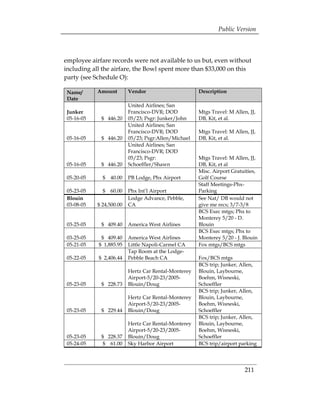
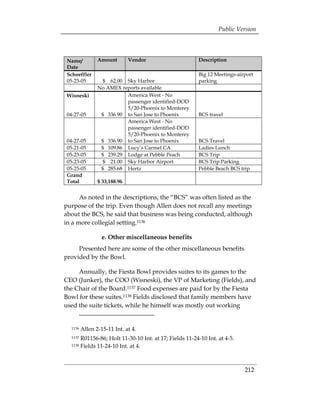
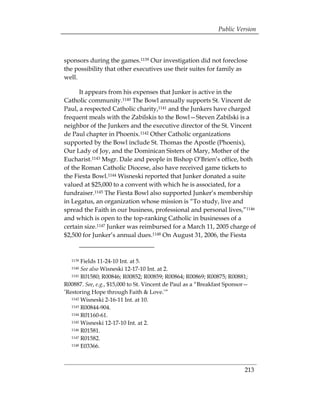
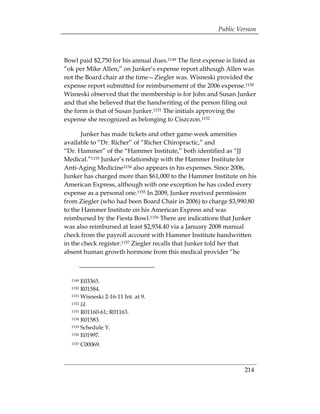
of the Board of Directors of the Fiesta Bowl 


               Final Report

                 Public Version

                 March 21, 2011


             Christopher W. Madel 

              Bruce D. Manning 

                Sara A. Poulos 


               2800 LaSalle Plaza 

              800 LaSalle Avenue 

             Minneapolis, MN 55402
 

                Tel: 612-349-8500 

               Fax: 612-339-4181 

                www.rkmc.com
Public Version


      This report is addressed to the Special Committee of the Board
of Directors of the Fiesta Bowl from its counsel. The report is
counsel’s report—as reviewed and approved by the Special
Committee. This public version has had removed from it
information subject to contractual confidentiality provisions, as
determined by the Fiesta Bowl. All decisions related to the
publication of this report, and the scope of any waivers needed to
make it publicly available, have been made by the Fiesta Bowl, and
not by the Special Committee or its counsel.

I. Investigative procedure ............................................................... 1
 

II. Scope and genesis of the investigation .................................. 9
 

III. Reported facts ................................................................................. 14 

    A. Background on the Fiesta Bowl .............................................. 14
 

            1. 	Bowl games and other events............................................... 17 

            2. Economic impact, community impact, and charitable 

               giving ....................................................................................... 19 

    B. The Fiesta Bowl’s alleged reimbursement of campaign 

        contributions ................................................................................ 25

            1. The analysis and development of the campaign-

               contribution spreadsheet ...................................................... 25 

            2. 	If the 11 individuals’ statements are accurate, the Fiesta 

                Bowl reimbursed individuals at least $46,539 for 

                campaign contributions since 2000...................................... 29 

            3. How contributions were allegedly sought 

               and reimbursed ...................................................................... 33 

                    a. The alleged practice of reimbursing for campaign 

                       contributions dates back to at least 2002................... 33 

                    b. How contributions were allegedly sought ............... 35 

                    c. 	How reimbursements were allegedly made ............ 37 


                                                                                                             i
Public Version


                   i. 	 Alleged “bonus” checks to employees............... 37 

                   ii. 	 Checks to one employee for the alleged 

                         reimbursement of others ..................................... 43 

                          a. The $15,000 check to Laybourne ..................... 43 

                          b. The $15,000 check to Aguilar........................... 46 

                          c. Check(s) to Wisneski......................................... 49 

                   iii.	 Alleged increased expense-reimbursement 

                         checks ...................................................................... 50 

                   iv. Other methods ....................................................... 51 

       4. No contributors said they knew the reimbursement 	                         

          practice could be illegal......................................................... 51 

       5. Laybourne’s alleged concerns about political-

          contribution reimbursements............................................... 52 

       6. 	Several employees made contributions reportedly 

           against their stated political inclinations ............................ 54 

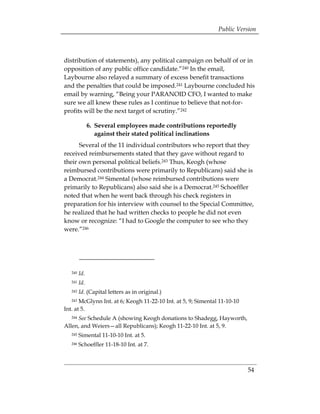
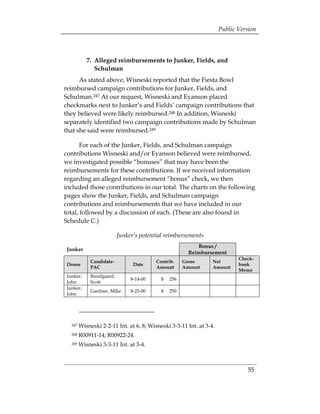
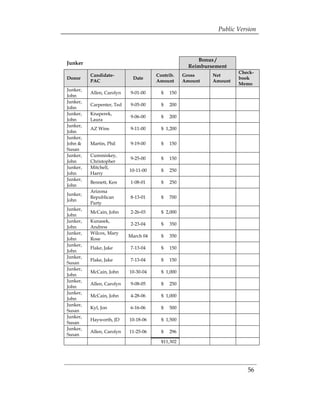
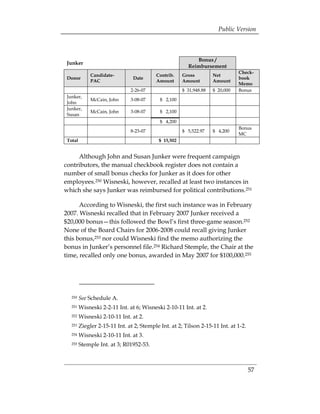
       7. Alleged reimbursements to Junker, Fields, 

          and Schulman ......................................................................... 55 

C. The first investigation............................................................. 67
 

       1. The Arizona Republic article .................................................... 67 

       2. 	Junker’s alleged concerns regarding the 

           Harris article ........................................................................... 72 

       3. 	Genesis of first internal investigation.................................. 74 

               a. Dallas conversation....................................................... 74 

               b. Board discussion and retention of 

                  Grant Woods ................................................................. 75 

               c. December 14, 2009 Executive Committee 

                  meeting........................................................................... 77 

               d. Husk’s role in the investigation.................................. 80 


                                                                                                     ii
Public Version


e. What Husk said he said to Fiesta Bowl 

   employees ..................................................................... 81 

f. What six Fiesta Bowl employees said ......................... 83
 

    i. 	 Wisneski’s allegations regarding her 

         discussions with Husk.......................................... 84 

    ii. 	 Keogh’s allegations regarding her 

          discussions with Husk.......................................... 86 

   iii.	 Eyanson’s allegations regarding her 

         discussions with Husk.......................................... 88 

   iv. 	 McGlynn’s allegations regarding her 

         discussions with Husk.......................................... 91 

   v. 	 Simental’s allegations regarding her 

        discussions with Husk.......................................... 92 

   vi. 	 Holt’s allegations regarding her 

         discussions with Husk.......................................... 95 

g. Grant Woods’ interviews ............................................ 98 

    i. 	 Interviews of current employees......................... 98 

    ii. 	 Interviews of former employees ....................... 105 

h. Grant Woods’ oral report at the 

   December 22, 2009 Executive 

   Committee meeting ................................................... 108 

i. 	The draft letter to Schoeffler...................................... 109 

j. 	Woods’ and Husk’s review of documents and 

    collection of data......................................................... 114 

k. 	Husk’s presentation at the January 22, 2010 

    Board of Directors meeting ....................................... 119 

l. 	Snell attorneys’ discussion with Junker .................. 121 


                                                                                iii
Public Version


D. The Arizona Secretary of State and Attorney 
                        	
   General investigations and the formation of the 

   Special Committee .................................................................... 126

       1. The Secretary of State requested information 

          in early 2010 .......................................................................... 126 

       2. An incomplete spreadsheet of contributions, bonuses, 

          and expense reimbursements was provided to the 

          Secretary of State on February 22, 2010 ............................ 132 

       3. 	Wisneski and Eyanson alleged that they were told to 

           delete and alter information regarding bonuses ............. 142 

        4. Wisneski altered documents............................................... 146 

        5. The FBI interviewed an employee ..................................... 148 

        6. The Secretary of State referred the Fiesta Bowl 	
                                                           

           investigation to the Arizona Attorney General............... 150 

        7. The Special Committee is formed ...................................... 153 

E. 	Expenditures by the Bowl ........................................................ 157
 

       1. Fiesta Bowl expense procedures......................................... 158 

       2. The expense account analysis ............................................. 166 

               a. How the analysis was performed ............................. 166 

               b. Categorization by subject matter .............................. 167 

               c. Determination of whether expenses are 
       	
                  appropriate business expenses ................................. 170 

               d. What the expense account analysis shows.............. 174 

       3. Political expenditures........................................................... 175 

               a. Legislative trips ........................................................... 175 

               b. Events at the Museum and other fundraisers......... 183 

               c. Tickets for legislators ................................................. 186 


                                                                                                 iv
Public Version


        d. Items of value given to politicians .......................... 191 

4. Entertainment and relationship-building expenses......... 193 

        a. Fiesta Frolic/Spring College Football Seminars .... 193 

        b. Other relationship-building expenses ..................... 198 

5. Employee perks..................................................................... 201 

        a. Golf course memberships.......................................... 201 

        b. Cars for senior executives ......................................... 206 

        c. Home internet, cable, and cell phones .................... 209 

        d. Junker’s 50th birthday celebration........................... 210 

        e. Other miscellaneous benefits ................................... 212 

6. Confidential separation agreements .................................. 215 

        a. 	Blouin ........................................................................... 216 

        b. 	Schoeffler ..................................................................... 222 

        c. 	Allegations of fraud with respect to another 

            employee...................................................................... 223 

7. Employee gifts....................................................................... 224 

        a. The Keogh wedding.................................................... 225 

        b. iPad purchases............................................................. 229 

        c. Miscellaneous examples of employee gifts.............. 231 

8. Travel with family members .............................................. 232 

9. 	Travel and entertainment with employees and 

    consultants ............................................................................ 236 

          a. Strip club visits ........................................................ 239 

          b. Grand Del Mar trip ................................................. 241 

10. Financial-advice subscriptions ........................................ 242 

11. Gold coins ........................................................................... 244 


                                                                                              v
Public Version


             12. 	Expenditures on consultants/independent 

                  contractors ......................................................................... 246 

                    a. Blue Steel Consulting.................................................. 246 

                    b. Payments to a third party related to the Parade .... 250 

                    c. Husk Partners/HighGround .................................... 255 

                    d. Donnie Duncan ........................................................... 260 

                    e. Chuck Johnson ............................................................ 262 

                    f. Renaissance Companies ............................................ 265 

            13. 	Auditors .............................................................................. 271 

IV. Conclusion .................................................................................... 276 


                                                                                                       vi
Public Version


I. Investigative procedure
      The Special Committee retained counsel to conduct its
investigation, and this report is counsel’s report to the Special
Committee. Robins, Kaplan, Miller & Ciresi L.L.P., in conjunction
with independent professional investigators it selected, conducted
the investigation by interviewing witnesses, reviewing electronically
swept documents, reviewing paper documents, and making targeted
requests for materials from certain witnesses. The investigation was
conducted entirely by attorneys or professionals working at the law
firm at the direction of attorneys, including a former auditor and a
certified public accountant. Nevertheless, the report, including any
and all data set forth herein, should not be used as a basis on which
to create or modify tax returns. Preparing or amending the Fiesta
Bowl’s tax returns was not part of the Special Committee’s charge
and will require the additional rigor associated with such an
endeavor.

      Counsel to the Special Committee reviewed more than 55GB of
electronic data, roughly 10,000 additional documents that had been
scanned and coded, and thousands of pages of additional paper
materials gathered from the Fiesta Bowl’s offices or from its
employees’ or consultants’ records.

      Cites to selected portions of these records are made in the
footnotes of this report using a prefix and a number. The first-letter
prefix of these cites refer to the supporting materials gathered by
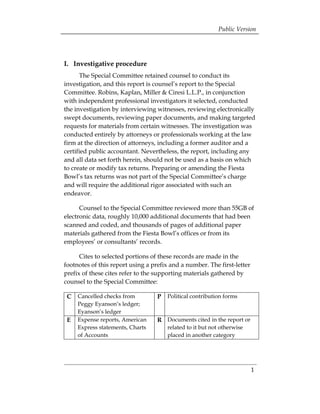
counsel to the Special Committee:

 C   Cancelled checks from         P   Political contribution forms
     Peggy Eyanson’s ledger;
     Eyanson’s ledger
 E   Expense reports, American     R Documents cited in the report or
     Express statements, Charts        related to it but not otherwise
     of Accounts                       placed in another category


                                                                         1
Public Version


Citations to “Schedules” are to spreadsheets created by counsel to
the Special Committee from public documents or from the record
documents.

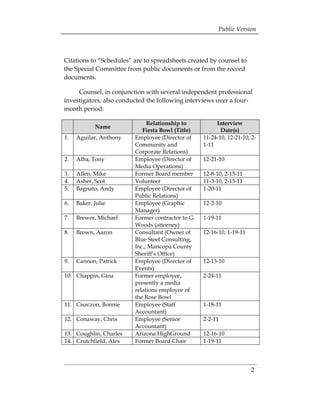
     Counsel, in conjunction with several independent professional
investigators, also conducted the following interviews over a four-
month period:

                              Relationship to           Interview
            Name
                            Fiesta Bowl (Title)           Date(s)
1.   Aguilar, Anthony    Employee (Director of     11-24-10, 12-21-10, 2­
                         Community and             1-11
                         Corporate Relations)
2.   Alba, Tony          Employee (Director of     12-21-10
                         Media Operations)
3.   Allen, Mike         Former Board member       12-8-10, 2-15-11
4.   Asher, Scot         Volunteer                 11-3-10, 2-15-11
5.   Bagnato, Andy       Employee (Director of     1-20-11
                         Public Relations)
6.   Baker, Julie        Employee (Graphic         12-2-10
                         Manager)
7.   Brewer, Michael     Former contractor to G.   1-19-11
                         Woods (attorney)
8.   Brown, Aaron        Consultant (Owner of      12-16-10, 1-19-11
                         Blue Steel Consulting,
                         Inc.; Maricopa County
                         Sheriff’s Office)
9.   Cannon, Patrick     Employee (Director of     12-13-10
                         Events)
10. Chappin, Gina        Former employee,          2-24-11
                         presently a media
                         relations employee of
                         the Rose Bowl
11. Ciszczon, Bonnie     Employee (Staff           1-18-11
                         Accountant)
12. Conaway, Chris       Employee (Senior          2-2-11
                         Accountant)
13. Coughlin, Charles    Arizona HighGround        12-16-10
14. Crutchfield, Alex    Former Board Chair        1-19-11


                                                                       2
Public Version


                                Relationship to             Interview
            Name
                               Fiesta Bowl (Title)            Date(s)
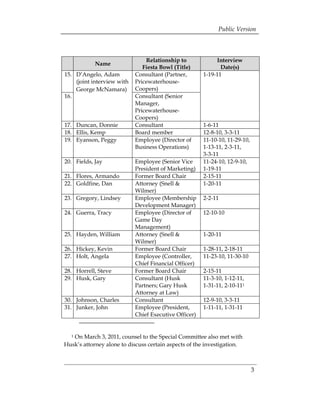
15. D’Angelo, Adam          Consultant (Partner,       1-19-11
    (joint interview with   Pricewaterhouse-
    George McNamara)        Coopers)
16.                         Consultant (Senior
                            Manager,
                            Pricewaterhouse-
                            Coopers)
17. Duncan, Donnie          Consultant                 1-6-11
18. Ellis, Kemp             Board member               12-8-10, 3-3-11
19. Eyanson, Peggy          Employee (Director of      11-10-10, 11-29-10,
                            Business Operations)       1-13-11, 2-3-11,
                                                       3-3-11
20. Fields, Jay             Employee (Senior Vice      11-24-10, 12-9-10,
                            President of Marketing)    1-19-11
21. Flores, Armando         Former Board Chair         2-15-11
22. Goldfine, Dan           Attorney (Snell &          1-20-11
                            Wilmer)
23. Gregory, Lindsey        Employee (Membership       2-2-11
                            Development Manager)
24. Guerra, Tracy           Employee (Director of      12-10-10
                            Game Day
                            Management)
25. Hayden, William         Attorney (Snell &          1-20-11
                            Wilmer)
26. Hickey, Kevin           Former Board Chair         1-28-11, 2-18-11
27. Holt, Angela            Employee (Controller,      11-23-10, 11-30-10
                            Chief Financial Officer)
28. Horrell, Steve          Former Board Chair         2-15-11
29. Husk, Gary              Consultant (Husk           11-3-10, 1-12-11,
                            Partners; Gary Husk        1-31-11, 2-10-111
                            Attorney at Law)
30. Johnson, Charles        Consultant                 12-9-10, 3-3-11
31. Junker, John            Employee (President,       1-11-11, 1-31-11
                            Chief Executive Officer)


  1On March 3, 2011, counsel to the Special Committee also met with
Husk’s attorney alone to discuss certain aspects of the investigation.


                                                                             3
Public Version


                              Relationship to           Interview
             Name
                             Fiesta Bowl (Title)          Date(s)
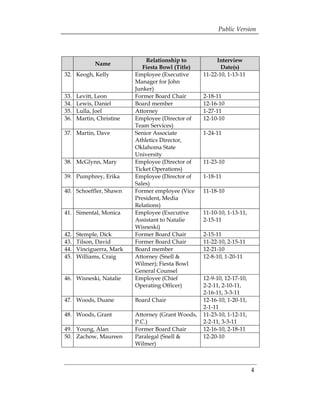
32. Keogh, Kelly          Employee (Executive      11-22-10, 1-13-11
                          Manager for John
                          Junker)
33.   Levitt, Leon        Former Board Chair       2-18-11
34.   Lewis, Daniel       Board member             12-16-10
35.   Lulla, Joel         Attorney                 1-27-11
36.   Martin, Christine   Employee (Director of    12-10-10
                          Team Services)
37. Martin, Dave          Senior Associate         1-24-11
                          Athletics Director,
                          Oklahoma State
                          University
38. McGlynn, Mary         Employee (Director of    11-23-10
                          Ticket Operations)
39. Pumphrey, Erika       Employee (Director of    1-18-11
                          Sales)
40. Schoeffler, Shawn     Former employee (Vice    11-18-10
                          President, Media
                          Relations)
41. Simental, Monica      Employee (Executive      11-10-10, 1-13-11,
                          Assistant to Natalie     2-15-11
                          Wisneski)
42.   Stemple, Dick       Former Board Chair       2-15-11
43.   Tilson, David       Former Board Chair       11-22-10, 2-15-11
44.   Vinciguerra, Mark   Board member             12-21-10
45.   Williams, Craig     Attorney (Snell &        12-8-10, 1-20-11
                          Wilmer); Fiesta Bowl
                          General Counsel
46. Wisneski, Natalie     Employee (Chief          12-9-10, 12-17-10,
                          Operating Officer)       2-2-11, 2-10-11,
                                                   2-16-11, 3-3-11
47. Woods, Duane          Board Chair              12-16-10, 1-20-11,
                                                   2-1-11
48. Woods, Grant          Attorney (Grant Woods,   11-23-10, 1-12-11,
                          P.C.)                    2-2-11, 3-3-11
49. Young, Alan           Former Board Chair       12-16-10, 2-18-11
50. Zachow, Maureen       Paralegal (Snell &       12-20-10
                          Wilmer)


                                                                        4
Public Version


                              Relationship to            Interview
            Name
                            Fiesta Bowl (Title)            Date(s)
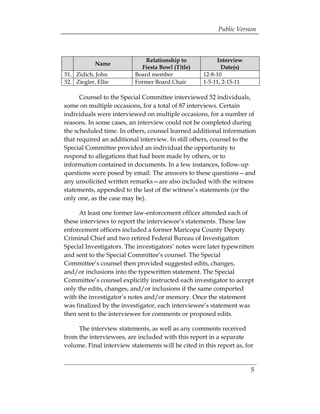
51. Zidich, John          Board member              12-8-10
52. Ziegler, Ellie        Former Board Chair        1-5-11, 2-15-11

      Counsel to the Special Committee interviewed 52 individuals,
some on multiple occasions, for a total of 87 interviews. Certain
individuals were interviewed on multiple occasions, for a number of
reasons. In some cases, an interview could not be completed during
the scheduled time. In others, counsel learned additional information
that required an additional interview. In still others, counsel to the
Special Committee provided an individual the opportunity to
respond to allegations that had been made by others, or to
information contained in documents. In a few instances, follow-up
questions were posed by email. The answers to these questions—and
any unsolicited written remarks—are also included with the witness
statements, appended to the last of the witness’s statements (or the
only one, as the case may be).

      At least one former law-enforcement officer attended each of
these interviews to report the interviewee’s statements. These law
enforcement officers included a former Maricopa County Deputy
Criminal Chief and two retired Federal Bureau of Investigation
Special Investigators. The investigators’ notes were later typewritten
and sent to the Special Committee’s counsel. The Special
Committee’s counsel then provided suggested edits, changes,
and/or inclusions into the typewritten statement. The Special
Committee’s counsel explicitly instructed each investigator to accept
only the edits, changes, and/or inclusions if the same comported
with the investigator’s notes and/or memory. Once the statement
was finalized by the investigator, each interviewee’s statement was
then sent to the interviewee for comments or proposed edits.

     The interview statements, as well as any comments received
from the interviewees, are included with this report in a separate
volume. Final interview statements will be cited in this report as, for


                                                                      5
Public Version


example, Junker [date] Int. at ___. Within those statements, sections
which the interviewee wished deleted, but that the Special
Committee’s investigators did not believe should be deleted, are
shown in underscore. Sections that the witness added but which the
Special Committee’s investigators did not believe should be added
are shown in italics. The unadorned text of each interview statement
thus may include comments from the interviewee which the Special
Committee’s investigators decided were accurate or appropriate.
When citing to a statement for an interviewee’s added comments,
the cite herein will read, for example, Junker [date] Int. at ___
(redline). Comments that the interviewee wished deleted are
generally not noted as such within this report. Citations to a
witness’s answers to questions posed by email or to the witness’s
unsolicited remarks are cited as, for example, Johnson 3-3-11 at
Addendum.

      In some cases, the witness or counsel specifically declined to
return comments on the interview statements. In other cases, despite
requests made that they do so, witnesses or their counsel simply
failed to return comments on the interview statements. In the case of
attorneys at Snell & Wilmer, the comments returned were
specifically noted to be those of the attorney representing the
interviewees, and not of the interviewees themselves. In a handful of
instances, the witnesses were unavailable on the time schedule
required. In that case, the interview statements are so marked.

      The Special Committee’s counsel advised each interviewee that
the report’s contents may become public or otherwise disseminated.
Fiesta Bowl employees, Board members, and former employees were
all provided the opportunity to retain counsel at the Bowl’s expense,
contingent only upon full, complete, and truthful cooperation with
the Special Committee’s investigation. As discussed in more detail
below, one current Fiesta Bowl employee, John Junker, did not
provide full and complete cooperation and the Fiesta Bowl declined
to pay Junker’s legal expenses. Another former employee, Shawn


                                                                    6
Public Version


Schoeffler, changed his position on cooperation and the Fiesta Bowl
ceased paying his legal expenses. All current Fiesta Bowl employees
who participated in interviews with the Special Committee’s counsel
were represented by counsel. On two occasions, counsel to the
Special Committee emailed all Fiesta Bowl employees and invited
them to contact pool counsel (Lee Stein of Perkins, Coie, Brown &
Bain) and set up an interview if they had any information relevant to
four broadly enumerated topics of the investigation.2 No additional
employees came forward, and a number wrote to explicitly say they
had no information to communicate.3

      Current and former Fiesta Bowl Board members also
participated in interviews. Two of these members, Duane Woods
and Alan Young, were represented by counsel paid for by the Fiesta
Bowl. No other Board member requested the assistance of counsel.

      Outside consultants were often represented by counsel. Among
these consultants, Gary Husk and the employees of Snell & Wilmer
were represented by counsel at their interviews, at their own
expense. Grant Woods retained counsel after his penultimate
interview was conducted, at his own expense.

      Scot Asher and Shawn Schoeffler elected to participate in their
November 2010 interviews without the assistance of counsel. At the
suggestion of the Special Committee’s counsel, they later retained
counsel and did not appear for their second, scheduled interviews.
Schoeffler, through counsel, asserted that he believed his first
interview was covered by a privilege held by him and thus cannot be
disclosed without his permission.4 Asher, through the same counsel,


  2   R00001-2; R00018-19.
  3   R00001-20.
  4   R02382-402.


                                                                   7
Public Version


made the same claim.5 These are the only two witnesses who have
made such an allegation, and the allegation was contradicted by,
among other things, a sworn affidavit from Investigator Patrick C.
Cooper.6 Asher, after his counsel reviewed Cooper’s affidavit,
elected to appear for another interview, with counsel.

      Schoeffler asked for and received a letter from the Bowl stating
that he could talk with counsel to the Special Committee. The letter
specifically identified the counsel to whom Schoeffler was to speak
as “outside counsel,” and “counsel to the Special Committee.”7 Later,
he claimed he thought the Special Committee’s counsel were his
own, although his severance agreement—the cause for his earlier
concern—explicitly allowed him to talk with his own counsel. He
declined any further contact.8 The Special Committee’s counsel
considers Schoeffler to be non-cooperative with the Committee’s
investigation and his wrongful claim of privilege to be an attempt to
obstruct it. An earlier commitment to pay the attorneys’ fees for
Schoeffler that did not contain a cooperation provision was
rescinded on the date Schoeffler ceased cooperating, although the
Bowl agreed to pay his fees through that date.

     John Junker agreed to be interviewed by the Special
Committee’s counsel but refused to answer any questions relating to
campaign contributions, allegations of the reimbursement of
campaign contributions, or the first investigation into allegations of
reimbursement of campaign contributions by the Fiesta Bowl. For
these reasons, the Special Committee’s counsel considers Junker to
be non-cooperative with the Committee’s investigation. Junker was
provided two written directives by the Fiesta Bowl to answer all


  5   Id.
  6   R01594-96.
  7   R01556.
  8   R00461-66; R02776.


                                                                     8
Public Version


questions of the Special Committee’s counsel.9 He declined to do so
and was placed on administrative leave after failing to comply.

      Former employees Doug Blouin (through counsel), Marc
Schulman (through counsel), and Stan Laybourne refused to be
interviewed by counsel to the Special Committee. Laybourne mailed
a letter stating he had no knowledge about campaign-contribution
reimbursements, which is cited to in this report together with
another witness’s allegations that Laybourne did have such
knowledge. When sent a follow-up letter noting that the
investigation’s scope was broader, Laybourne did not respond.10
Patricia McQuivey and Nat Stout did not return telephone calls or
respond to letters requesting their participation. One consultant
failed to respond to the Special Committee’s counsel’s calls for
nearly a month, and can be deemed to have refused to participate or
cooperate.

     A list of the counsel representing each of the represented
individuals, including counsel to the Special Committee and its
investigators, is provided in a separate document.

II.        Scope and genesis of the investigation
      On December 18, 2009, The Arizona Republic published an article
by Craig Harris entitled “Fiesta Bowl employees say bowl repaid
political contributions /CEO John Junker denies repayments, which
would violate election laws.”11 In this article, The Arizona Republic
reported that past and present Fiesta Bowl employees stated that
they were encouraged to write checks to specific political candidates
and then were reimbursed by the Fiesta Bowl for their


      9   R02747; R02743-53.
      10   R01982.
      11   R01550.


                                                                   9
Public Version


contributions.12 The article also highlighted certain information from
the Fiesta Bowl tax returns, including expenditures for entertainment
and lobbyists, and tickets and trips for legislators.13 Certain
employees and Board members of the Fiesta Bowl had learned in
advance of the likely content of the article—through questions posed
by reporter Harris orally and by email.14 The framework for a
response, including consideration of an internal investigation, had
been set up before the article was published.15

      In mid-December 2009, the Fiesta Bowl retained Grant Woods,
a former Arizona Attorney General, to conduct an investigation as to
certain of the allegations in The Arizona Republic article.16 This
investigation was completed, and an oral report was made to the
Fiesta Bowl’s Board of Directors’ Executive Committee on
December 22, 2009.17 On that date, Grant Woods reported to the
Executive Committee that there was “no credible evidence” to
support the allegations that employees’ campaign contributions had
been reimbursed by the Fiesta Bowl.18 Nevertheless, continued
investigations by governmental regulators—the Arizona Secretary of
State’s Office and eventually the Arizona Attorney General’s
Office—meant that the Bowl’s staff, consultants, and attorneys
worked throughout 2010 to respond to official requests and develop
strategies related to any official inquiry.19


  12   Id.
  13   R01555.
  14   R01964-65.
  15   Alba Int. at 3.
  16   G. Woods 11-23-10 Int. at 2.
  17   G. Woods 11-23-10 Int. at 4.
  18   G. Woods 2-2-11 Int. at 2.
  19   R00030-32; R01568-1569.


                                                                   10
Public Version


      Chairman of the Board Duane Woods (no relation to Grant
Woods) recalled a late September 2010 visit by Kelly Keogh, assistant
to Fiesta Bowl President and CEO John Junker, to his office at Waste
Management to make a delivery.20 Because she seemed stressed, he
engaged her in a conversation and Keogh explained that the earlier
investigation had been conducted not just by former Arizona
Attorney General Grant Woods, but also by Gary Husk, an attorney
and public affairs professional on retainer with the Fiesta Bowl.21
Keogh communicated to Duane Woods her belief that the earlier
investigation had been a cover-up, in that at least Husk knew that
the Fiesta Bowl had reimbursed certain individuals (such as Keogh)
for campaign contributions contrary to what was publicly reported.22

      In reaction to Keogh’s statements, Duane Woods, after
receiving advice from Board counsel Daniel Goldfine of Snell &
Wilmer L.L.P., formed a Special Committee of the Board of Directors
for the purposes of re-investigating the campaign-contribution­
reimbursement allegations and examining the earlier investigation.23
The Board passed a resolution empowering a Special Committee on
October 8, 2010, after a meeting at Snell & Wilmer.24

     The Board resolution stated that “the Special Committee shall
be comprised of Jim Bruner, Steve Whiteman, and a third non-
Company related person.”25 The Honorable Ruth McGregor, a


   20   D. Woods 12-16-10 Int. at 3.
   21   Id.
   22See Keogh 11-22-10 Int. at 3-4; Keogh 1-13-11 Int. at 2; D. Woods 12-16­
10 Int. at 3.
   23   D. Woods 2-16-10 Int. at 3-5.
   24   R00021-23.
   25   Id. at R00021.


                                                                          11
Public Version


former Chief Justice of the Arizona Supreme Court, agreed to fill the
third spot on the Special Committee.26

      Among the directives of the Board’s resolution were the
following:

          WHEREAS, the Executive Committee unanimously
          recommended the formation and appointment of a special
          committee (the “Special Committee”) in order to conduct
          and complete its own independent and separate
          investigation (the “Investigation”) as to all such matters and
          any other matters identified by the Executive Committee
          from time to time. . . .

          ***

          FURTHER RESOLVED, the Board recognizes and advises
          the Special Committee that there had been a previous
          internal investigation that had reached conclusions, and the
          Board directs the Special Committee neither to accept nor
          reject any conclusion or evidence from that previous
          internal investigation but to complete a new internal
          investigation independent from the previous internal
          investigation.27

     After a competitive selection process, Robins, Kaplan, Miller &
Ciresi L.L.P. was selected as counsel to the Special Committee. The
Special Committee empowered its counsel with the full authority
allowed under the October 8, 2010 Board resolution and a
subsequent resolution.28 The Special Committee defined the


  26 Justice McGregor is being compensated hourly by the Bowl, while
Whiteman and Bruner are volunteering their time, as they have for Bowl-
related activities in the past.
  27   R00021-22. 

  28   R02775. 


                                                                           12
Public Version


“Investigation” to mean “an investigation of any and all potential
violations of internal Fiesta Bowl policies, state laws, and/or federal
laws relating to the Fiesta Bowl,” and defined the scope as follows:

               The scope of the Investigation is to include (1) political
               contributions, particularly in Arizona and to Arizona
               candidates, (2) allegations raised by Playoff PAC regarding
               conduct of Fiesta Bowl personnel, (3) circumstances and
               conduct of the initial internal investigation and responses
               thereto by Fiesta Bowl employees or consultants, and
               (4) recommendations for future operations relating to
               compliance policies, governance, and other issues.29

      The engagement letter with Robins, Kaplan, Miller & Ciresi
L.L.P. was assented to by the four entities that comprise the Fiesta
Bowl, and the Fiesta Bowl agreed to pay the fees and costs associated
with the investigation, although it had no rights or input as a client
to direct or affect the investigation.30

      As can be seen from the scope defined by the Special
Committee, the present investigation’s purview is broader than that
of the earlier investigation. Its reach includes the “allegations raised
by Playoff PAC regarding the conduct of Fiesta Bowl personnel.”31
Playoff PAC describes itself as “a federal political committee
dedicated to establishing a competitive post-season championship
for college football.”32 The expanded scope in the engagement letter
empowered the Special Committee, through its counsel, to
investigate the myriad allegations raised by Playoff PAC in a
complaint filed with the Arizona Secretary of State in December 2009


  29   R00024. 

  30   Id. 

  31   Id.
  32   R00029.


                                                                             13
Public Version


and in a formal complaint filed with the Internal Revenue Service on
September 23, 2010.33

     The Special Committee’s primary responsibility is to report
those facts discovered in its investigation. In addition, the Special
Committee has, under separate cover, made recommendations for
changes in the governance of the four nonprofit entities that make
up the Fiesta Bowl, several of which recommendations have already
been implemented during the course of the investigation under the
independent aegis of the Board of Directors and its counsel.

      The Fiesta Bowl’s Board of Directors, the Executive Committee,
the Fiesta Bowl, its counsel, and any and all others associated with
the Fiesta Bowl have been kept apart from the investigation and
have not commented on, drafted, edited, steered, or otherwise
guided the investigation or this report. The Special Committee,
through its counsel, completed its investigation without any purpose
to prosecute, defend, or implicate any entity or person. It
accordingly disclaims any attempt to view its report in any such
light.

III. Reported facts

  A. Background on the Fiesta Bowl
      The recently completed Insight Bowl, Fiesta Bowl, and BCS
National Championship Game marked the end of the 2010 season for
the four, linked nonprofit entities that are collectively referred to as
the Fiesta Bowl. The Fiesta Bowl is comprised of four separate
nonprofit entities: The Arizona Sports Foundation (“ASF”), Fiesta
Events, Inc. (“FEI”), The Valley of the Sun Bowl Foundation (“VSF”),
and The Arizona College Football Championship Foundation


  33   R00024; R00030-32; R00813-42.


                                                                     14
Public Version


(“ACFCF”).34 The organization also operates an apparel company for
its “1882” brand, which licenses Fiesta-Bowl-branded merchandise
for national distribution.35

      The Articles of Incorporation of The Arizona Sports Foundation
state, in part, that

                                       Article III

           The objects, purposes and powers of this corporation and
           the general nature of the business it proposes to transact are:

           1. To promote, encourage, sponsor, manage, establish and
           otherwise generate interest in a post-season collegiate
           football bowl game or games and in addition, to promote,
           encourage, sponsor, manage, and otherwise participate in
           collegiate sports events, contests and activities in the
           metropolitan Phoenix area and otherwise to promote,
           sponsor and encourage persons, groups, institutions,
           societies, associations, both within and without the State of
           Arizona to sponsor, conduct, promote and encourage
           collegiate sports events and activities in the metropolitan
           Phoenix area.

           2. To operate without profit and so that no part of its net
           earning or assets shall ever be distributed as a dividend or
           inure to the benefit of any private shareholder or individual
           and thereby to promote, foster, encourage and increase
           collegiate sports events, contests and activities in the
           metropolitan Phoenix area. The proceeds, if any, from such
           events and activities shall be used for educational and
           charitable purposes.


  34   R02306. 

  35   Wisneski 2-16-11 Int. at 2. 


                                                                             15
Public Version


          3. To accomplish the charitable and educational purposes set
          forth in paragraphs 1 and 2 above, the corporation shall
          stage a post-season collegiate football bowl game which
          shall be designated the “Fiesta Bowl”. The Fiesta Bowl shall
          be sanctioned by the National Collegiate Athletics
          Association. Proceeds from the Fiesta Bowl shall be paid to
          the participating colleges to be used by such colleges to
          improve their educational facilities and their athletic
          capabilities. All funds not paid to the participating colleges
          shall be used by the corporation for educational and
          charitable purposes.

          ***

          20. It is intended that this corporation shall not at any time
          engage in any business activity or transaction which would
          cause it to lose its status as a non-profit corporation or its tax
          exempt status under the United States Internal Revenue
          Code as now enacted or as may hereafter be amended and
          that this corporation shall, if possible, at all times be a tax
          exempt charitable corporation to which tax deductible
          contributions of property or all kinds may be made by
          persons, corporations and other legal entities. . . .36

The Articles date from 1969 and are in the process of being amended.

     The Fiesta Bowl’s place in Arizona is much larger than the
football games it hosts every year. As it states its mission,

          The Fiesta Bowl annually strives:

          1. To stage two of the top college football bowl games in the
          nation, and to assist the cause of higher education with the
          highest university payments possible.


  36   R01874-1903.


                                                                               16
Public Version


             2. To have the people of Arizona host the most
             comprehensive pageant of community activities in the
             United States.

             3. To be Arizona’s leading outlet for year-round sports and
             pageantry-related volunteer participation.

             4. To give companies and organizations unique
             opportunities for involvement in supporting our efforts.

             5. To be financially sound, and to contribute strongly and
             regularly to the state’s economic development and to higher
             education nationwide.

             6. To be a source of national pride for all Arizonans.37

             1. Bowl games and other events
       This year, 2011, was the 40th year for the Fiesta Bowl. Since its
founding in 1971, it has progressed from a small operation designed
to provide a forum for Arizona State University’s Sun Devils to get a
quality post-season berth to one of the top Bowls in the country.38
This year’s national championship game on ESPN drew the largest
audience in cable television history.39 Two of the three Fiesta Bowl-
affiliated games set attendance records,40 with the Championship
Game setting the building attendance record in the home stadium of
the NFL’s Arizona Cardinals.41 A “game that began as an upstart in
1971, the Fiesta Bowl elbowed its way to equal standing with three
elders—the Rose, Orange and Sugar Bowls—in the Bowl


  37 R00033. Earlier versions of the mission statement included a seventh
point: “to have fun.” See, e.g., R00039.
  38   R01527.
  39   R01529; R01530.
  40   Id.
  41   R01532.


                                                                             17
Public Version


Championship Series, alternately hosting college football’s
championship game.”42

      The Valley of the Sun Bowl Foundation also runs the Insight
Bowl game, which is currently sponsored by Insight Enterprises, a
Tempe-based information technology company.43 The Insight Bowl
recently signed a broadcast deal with ESPN, increased its payouts
quite significantly, and improved its team selection rights.44

      In addition to football games, this year’s Fiesta Bowl included
more than 40 other statewide events, such as the Fort McDowell
Fiesta Bowl Parade presented by the Fort McDowell Yavapai Nation
(the largest spectator event in Arizona), and the Fiesta Bowl Block
Party.45 These non-football events include a senior tennis
tournament, a youth-football clinic, the Scottsdale ArtWalk, a high-
school band championship, the Honeywell Fiesta Bowl Aerospace
Challenge, a Junior College Shootout, the Northern Arizona
University Volleyball tournament (September), the Annual Fiesta
Bowl Million Dollar Hole-in-One presented by Fox Sports Arizona
(November), a half marathon/5k (December), and a gymnastics meet
(February).46

      The bowl games and other events are supported by a staff of 44
and thousands of volunteers.47 When John Junker started at the
Fiesta Bowl, he reported it had only $16,000 in the bank.48 Today, the


  42   R01526.
  43   R01533.
  44   R01534.
  45   R00215; R00172.
  46   R00236-37.
  47   R00224.
  48   Junker 1-11-11 Int. at 5.


                                                                   18
Public Version


Fiesta Bowl has “$15-20 million in the bank.”49 Many credit Junker’s
management with the Bowl’s success.50 As The Arizona Republic
reported in December 2010: “Junker and his Fiesta Bowl team are
credited with building Arizona’s reputation as a premier host for
college bowls, says professor Michael Mokwa, chairman of the
marketing department at the W.P. Carey School of Business.”51

             2. Economic impact, community impact, and charitable
                giving
      Mokwa studied the economic impact of the Fiesta Bowl’s
hosting of the 2006 Insight Bowl, the 2007 Fiesta Bowl, and the 2007
National Championship. According to Mokwa’s analysis, the three
bowls—over 11 days—were unprecedented, and the economic
impact was significant.52 His report estimated that that brief period
generated $401.7 million for the state, 3,576 jobs, and $10.1 million in
state and local taxes.53 This statewide spending came from football
fans spending on lodging, dining, entertainment, and other
services.54

     After the W.P. Carey School’s study was concluded, an Arizona
Sports and Tourism Authority press release included praise from
some notable sources:

             “This is spectacular news and verifies the importance of the
             Fiesta Bowl and the Insight Bowl to Arizona,” said Arizona
             Governor Janet Napolitano. “The economic impact that
             these games and the Fiesta Bowl festival bring our state is


  49   Junker 1-11-11 Int. at 13.
  50   See, e.g., Allen 2-15-11 Int. at 3; Stemple Int. at 3; Flores Int. at 3.
  51   R01535.
  52   Id.
  53   Id.
  54   Id.


                                                                                  19
Public Version


          remarkable, but even more important is the hundreds of
          thousands of visitors and our own citizens who will always
          carry warm memories of these events in Arizona.
          Thousands of Arizonans who supported this as volunteers
          or through their work in the hospitality industry deserve
          our congratulations for making these events crown jewels of
          our state’s economic development.”

          Other civic leaders also noted their appreciation, including:
          “It is an exciting time in Glendale and our partnership with
          The Fiesta Bowl organization is an important part of the
          great things happening,” said Glendale Mayor Elaine
          Scruggs. “We are very pleased to learn that the incredible
          Fiesta Bowl and BCS Championship games played in
          Glendale produced such a tremendous economic impact for
          our community, the surrounding metropolitan area and the
          state of Arizona. We look forward to hosting many more in
          the future and having them all be just as successful.”55

The Fiesta Bowl reports that for the period 2000-07, the Bowl’s
economic impact on Arizona exceeded $1 billion.56 As Michael
Martin, vice president of Tempe Convention and Visitors Bureau has
reportedly stated, “It’s pretty exciting for any community to have
one bowl game, so for us to have two prestigious bowls in the Valley
every year is amazing.”57

      The Fiesta Bowl also provides monetary contributions to
traditional non-profit entities. The largest recipients of the Fiesta
Bowl’s payments, in any given year and throughout its lifetime, have
been the nonprofit colleges and universities that come to play in its


  55   R01538. 

  56   R01541. 

  57   R01537. 


                                                                          20
Public Version


games.58 For the Bowl’s first 39 years, these payments totaled
$486,406,260, according to Fiesta Bowl materials.59

      The Fiesta Bowl does not characterize its payments to colleges
and universities as charitable contributions.60 The BCS cites these
payments as benefiting educational institutions.61 A complaint filed
by Playoff PAC with the IRS does not include the payments to the
colleges and universities in its tally of giving by the Fiesta Bowl.62

      In addition to payments to educational institutions, the Fiesta
Bowl also sponsors several charitable events. These include the Hole-
in-One event, in which more than 1,000 golfers pay $1 a shot to try to
win prizes and, potentially, $1 million. A portion of the proceeds of
that event goes to The 100 Club, a support society for families of
police officers and fire fighters dealing with tragedies.63 A portion of
the fees from the Fiesta Bowl Fall Golf Invitational benefits the
Boys & Girls Clubs of Tucson.64

     Unlike a typical nonprofit, the Bowl takes in most of its money
by delivering a product people want to purchase.65 It has distributed
a portion of that money to other charitable organizations.66 The
giving includes cash contributions, as well as packages of game


  58   Junker 1-31-11 Int. at 4.
 

  59   R00313; see also Junker 1-31-11 Int. at 4. 

  60   See, e.g., R02268. 

  61   R02575-85; R0813-43. 

  62   R00813-43. 

  63   R00223; R00246. 

  64   Id.; R00341-44. 

  65   Junker 1-11-11 Int. at 12. 

  66   Junker 1-11-11 Int. at 12; R00844-904. 


                                                                    21
Public Version


tickets and parking passes, which are intended for use by the
receiving organizations in silent auctions and the like.67

     In recent years, the Bowl has supported a wide variety of
Arizona-based or Arizona-focused charitable organizations,
including Arizona State University, the University of Arizona,
Northern Arizona University, Hospice of Arizona, Aquila Youth
Leadership Institute, the Pat Tillman Foundation, Parenting Arizona,
Maricopa Community College Foundation, and the Phoenix
Children’s Hospital.68 The Fiesta Bowl also supports national
organizations active in Arizona, including the American Red Cross,
the Salvation Army, the ALS Association, the Leukemia &
Lymphoma Society, St. Vincent de Paul, and the March of Dimes.69
Some of the charitable giving is to out-of-state organizations.70

      Some of the charitable donations reported by Fiesta Events, Inc.
are related to college football athletics. Among these donations are a
2010 $1,000 donation to Rhode Island Community Food Bank in
memory of Susan Hunterman, the wife of former Big East
Commissioner Mike Tranghese,71 a 2009 $1,000 donation to the
capital campaign of the Caring Days Adult Day Care in memory of
Charlotte Davis Moore, the wife of Alabama’s athletic director,72 a
2008 $1,000 donation to the American Cancer Society in memory of
Stephen Schnellenberger, the son of prominent football coach


  67   R00844-904; Wisneski 2-10-11 Int. at 18.
  68   R00223; R00345; R00844-904.
  69   R00223; R00844-904.
  70   R00844-904.
  71   R00845.
  72   R00851; R00905.


                                                                   22
Public Version


Howard Schnellenberger,73 and a 2007 $5,000 donation to Indiana
University in memory of Coach Terry Hoeppner.74

       Some of the charitable donations support causes associated
with Fiesta Bowl employees or committee members. For example, in
2009, the Bowl made a $250 contribution to the Touching Tiny Lives
Foundation and noted it as “Donation—Chicago Marathon
Participant: Emily Herzig.”75 Herzig is the Fiesta Bowl’s Team
Services Coordinator. In 2007, the Bowl made a $10,000 donation to
the Dave Eskridge Support Trust, a fund set up to support a Life
Member of the Fiesta Bowl Committee who was stricken with
cancer.76 The Fiesta Bowl also permits at least some employees to
cause the Bowl to make donations or in-kind contributions to causes
affiliated with the employees.77 Thus, the Bowl has made
contributions to the schools attended by, among others, Junker’s and
Fiesta Bowl Chief Operating Officer Natalie Wisneski’s children.78
Similarly, the Bowl has made donations to charitable causes
supported by its Board members.79

     Board members provided mixed reports on whether a formal
process existed for giving charitable donations.80 Former Board
Chair Ziegler reported that at least for some period of her time
before her tenure as Chair (2005), a Board committee did operate,


   73   R01542.
   74   R00864; R01547.
   75   R00853.
   76   R00212; R00863.
   77   Wisneski 12-10-10 Int. at 18.
    Wisneski 12-17-10 Int. at 2; Wisneski 3-3-11 Int. at 6; R00853; R00860;
   78

R00866; R00870; R02666-68.
   79   See, e.g., R00874; Ziegler 1-5-11 Int. at 4; Hickey 1-28-11 Int. at 11.
    Hickey 1-28-11 Int. at 11; Ziegler 1-5-11 Int. at 4; Vinciguerra Int. at 9;
   80

D. Woods 12-16-10 Int. at 1; Stemple Int. at 4; Young 2-18-11 Int. at 3.


                                                                                  23
Public Version


and described the process this way: “Different members of the
Executive Committee would make recommendations on behalf of
the Board for charitable contributions and then we would
recommend those to John Junker and Junker made the decision on
whether or not those requests would be funded.”81 She stated that
ultimately, the decision was Junker’s: “We knew some of the
organizations that he funded, which I can name, but certainly not all
of them.”82 Ziegler also said that some of the organizations the Fiesta
Bowl supported never came through the committee.83 Others did not
recall the existence or operation of such a committee.84

       The Fiesta Bowl has provided contributions to entities that
appear to be aligned with Junker’s political views. In 2010, for
example, the Fiesta Bowl made a donation to support the Grand
Rapids, Michigan-based Acton Institute, an organization whose core
principle is “integrating Judeo-Christian truths with free market
principles.”85 In 2007, the Bowl made a $4,000 contribution to the
Bio-Ethics Defense Fund, “a public-interest law firm whose mission
is to advocate for the human right to life through litigation,
legislation and public education,” which Wisneski said is run by a
friend of Junker’s.86 The Bowl made two more contributions to the
Bio-Ethics Defense Fund totaling $3,824.92 in 2008.87


  81   Ziegler 1-5-11 Int. at 2-3.
  82   Id. at 3.
  83   Id. at 3.
  84   Hickey 1-28-11 Int. at 11.
  85   R00347; R00850.
  86   R00350; Wisneski 2-10-11 Int. at 18; R00863.
  87   R00857.


                                                                    24
Public Version


  B. The Fiesta Bowl’s alleged reimbursement of campaign
      contributions

           1. The analysis and development of the campaign-
              contribution spreadsheet
      To investigate the allegations that the Fiesta Bowl had
reimbursed individuals for political-campaign contributions, we
created a spreadsheet showing campaign contributions made by
each current and former employee of the Fiesta Bowl since 2000, as
well as contributions made by each current and former member of
the Board of Directors for this same time period.88 We obtained lists
of current and former employees and current and former members
of the Board of Directors from Peggy Eyanson, Director of Business
Operations for the Fiesta Bowl.89 This spreadsheet also includes
contributions from certain consultants of the Bowl as well as
contributions of one volunteer—Scot Asher—who stated that he was
reimbursed for at least one campaign contribution by a Fiesta Bowl
employee.90

     To find the campaign contributions made by each of these
individuals, we searched a number of publicly available databases.

     First, with respect to contributions to candidates running for
federal office, we searched the Federal Election Commission’s online
campaign finance database, which appeared accurate and
complete.91

     Second, we obtained state political contribution information
from the Arizona Office of the Secretary of State’s online campaign-


  88   Schedule A.
  89   R02777-80; R02781-83.
  90   Schedule A; Asher 11-3-10 Int. at 3.
  91   http://www.fec.gov/finance/disclosure/advindsea.shtm.


                                                                   25
Public Version


finance database.92 While this database captures the majority of state
campaign contributions, we noted—and others confirmed—that this
database does not consistently include every political contribution
for individual donors. For example, we determined that
contributions were sometimes missing because the name of the
donor was misspelled. We were able to find some of these additional
missing contributions by going directly to the campaign-finance
database’s source documents, which are the candidates’ actual
campaign-finance reports, and searching for each donor’s name. For
example, Anthony Aguilar gave a $410 donation to the Pearce
Exploratory Committee on November 26, 2009.93 This donation,
however, is not found in the online campaign-finance database but is
found in Pearce’s campaign-finance report presumably because
Anthony Aguilar’s name was misspelled in Pearce’s report as
“Anthony Agilar.”94

      Thus, to be as thorough as possible for key employees, we
searched campaign-finance reports available online since 2000 for
state candidates whom we identified through the investigation as
ones likely to receive contributions from individuals connected to
the Fiesta Bowl. This search revealed a handful of additional
contributions that did not appear in the Secretary of State’s online
database. Although we believe that we have found most of the state
contributions made by Fiesta Bowl employees and directors, given
the limitations of Arizona’s campaign-finance database, it remains
possible that additional state contributions exist.

      In addition to federal and state reports, we searched all
available campaign-finance reports since 2000 for each of the current


  92   http://www.azsos.gov/cfs/ContributorSummarySearch.aspx.
  93   Schedule A.
  94   P00008.


                                                                   26
Public Version


members of the Maricopa Board of Supervisors.95 We also searched
all campaign-finance reports for local politicians on the websites of
Glendale,96 Scottsdale,97 Tempe,98 and Phoenix99 from 2000 to the
present. Local politicians were searched as their names were
identified in the course of the investigation. We did not search for
each local politician, so again, it remains possible that additional
Fiesta Bowl employees’ contributions to local politicians exist.

      Having identified campaign contributions, we next entered
information from the Arizona Sports Foundation manual payroll
checkbook into the spreadsheet. Wisneski and Eyanson identified
this payroll account as the primary method used to reimburse
certain current and former Fiesta Bowl employees for political
contributions.100 This manual payroll checkbook contains records
dating back to 1999, although records for the earlier years are not as
complete as those for later years.101


  95 Fulton Brock, Don Stapley, Andrew Kunasek, Max Wilson, and Mary
Rose Wilcox. These reports are available at
http://recorder.maricopa.gov/web/candcamp.aspx.
  96

www.glendaleaz.com/Clerk/politicalcommitteecampaignfinancereports.cf
m.
  97

https://eservices.scottsdaleaz.gov/eservices/CampaignfinanceReports/D
efault.aspx.
  98

www.tempe.gov/clerk/Election/Political%20Committee%20Campaign%2
0Finance%20Reports/political%20committee%20campaign%20reports.htm
  99   http://phoenix.gov/phxd/ccimages/advSearchPageOut.jsp.
  100   Eyanson 11-29-10 Int. at 10; Wisneski 3-3-11 Int. at 6.
  101   C00001-314.


                                                                            27
Public Version


      Our spreadsheet enabled us to compare the transaction dates
and amounts of political contributions to the transaction dates and
amounts of bonuses or reimbursement checks.102 We also prepared
shorthand versions of this spreadsheet as charts for Eyanson and
Wisneski, and asked each to indicate which bonus checks they
recalled likely reflected or included the Fiesta Bowl’s
reimbursements for political contributions.103 Finally, we used this
spreadsheet to discern patterns, such as a number of individuals
connected with the Fiesta Bowl giving the same amount to the same
candidate on the same day. A copy of this spreadsheet is attached to
this Report as Schedule A.

      As is discussed more fully below, 11 individuals reported that
the Fiesta Bowl reimbursed them for political contributions: Anthony
Aguilar, Scot Asher, Gina Chappin, Peggy Eyanson, Tracy
(Kusmider) Guerra, Kelly (Peterson) Keogh, Christine Martin, Mary
McGlynn, Shawn Schoeffler, Monica Simental, and Natalie (Aguilar)
Wisneski. Moreover, as is noted below, several of these individuals
stated that additional current and former Fiesta Bowl employees’
campaign contributions were also reimbursed; certain of these
former employees refused to be interviewed by the Special
Committee’s counsel.104 If one adds the 11 individuals above, seven
of their spouses, and the three additional individuals whom certain
employees implicated, the Fiesta Bowl allegedly reimbursed at least
21 individuals for political contributions.


  102   Schedule A.
  103   R00906-24; R01614-15.
  104 The former employees who refused to be interviewed are Doug
Blouin, Nat Stout, Marc Schulman, Patricia McQuivey, and Stan
Laybourne. Stout, Schulman, and McQuivey each worked for Blouin.
Wisneski 2-2-11 Int. at 8, 9; R02753. Former employees Shawn Schoeffler
(on one occasion) and Gina Chappin agreed to be interviewed by counsel
to the Special Committee.


                                                                      28
Public Version


           2. 	If the 11 individuals’ statements are accurate, the Fiesta
               Bowl reimbursed individuals at least $46,539 for
               campaign contributions since 2000
      In sum, we examined campaign contributions of 83 Fiesta Bowl
employees and spouses, 247 former employees, 22 members of the
Board of Directors, 40 former members of the Board of Directors, and
7 other individuals totaling $1,210,164.105 Of these 399 individuals,
we found campaign contributions for 120. Out of those 120
contributors, if certain statements from current and former Fiesta
Bowl employees and others are accurate, the Fiesta Bowl reimbursed
the campaign contributions for at least 21 individuals, including ten
current employees, three former employees, seven spouses of
current and former employees, and one volunteer since 2000.

      Assuming the information reported in the spreadsheets and
statements of current and former employees is accurate, we estimate
that the total amount of campaign contributions reimbursed by the
Fiesta Bowl since 2000 is at least $46,539. Although there are reasons
to believe that at least one other former employee, Doug Blouin, may
have been reimbursed for campaign contributions (for the reasons
set forth below) we have not included any potential reimbursements
to this individual in the total.

      In our interviews, eight employees, two former employees, and
one Fiesta Bowl Committee volunteer member stated that they
received reimbursements for campaign contributions they made
while employed by or associated with the Fiesta Bowl.106 For some


   105   Schedule A.
   106See Aguilar 11-24-10 Int. at 4; Asher 11-3-10 Int. at 2; Chappin Int. at 2
(recalled a promise of reimbursement, but not the check, and stated that
she did not dispute the records); Eyanson 11-10-10 Int. at 3; Guerra Int. at 6;
Keogh 11-22-10 Int. at 8-9; Keogh 1-13-11 Int. at 3; C. Martin Int. at 2;


                                                                            29
Public Version


individuals, contributions were made in the names of their spouses
as well.107 The best estimate shows that the reimbursements for
contributions made by these 11 individuals and their spouses total
$29,386, as is set forth in Schedule B.108

      The contributions on Schedule B were determined by
reviewing federal, state, and local political records, as described
above, to determine each contribution made by these 11 individuals
and their spouses. Because ten of these individuals stated that it was
likely that all of their campaign contributions were reimbursed, we
have included every contribution for these ten individuals in this
spreadsheet. The 11th individual—Wisneski—could not
affirmatively state that she received a reimbursement for every
contribution she made;109 we have thus included in this spreadsheet
only those contributions that she believed were definitely or
probably reimbursed. Eyanson, however, identified three additional
Wisneski contributions totaling $1,780 that she believed were
reimbursed, but Wisneski could not recall if she was reimbursed for
these contributions.110 We have not included these three potential
reimbursements in the total.

      In addition to the contributions made by these 11 individuals
and certain of their spouses, based upon our interviews and the
documents we have reviewed, there was evidence (albeit not
uncontroverted) that the Fiesta Bowl reimbursed campaign
contributions for at least two other employees, Junker and Fields, as
well as for at least two additional former employees, Blouin and


McGlynn Int. at 6; Schoeffler 11-18-10 Int. at 4; Simental 11-10-10 Int. at 4, 5;
Wisneski 2-2-11 Int. at 2.
   107   Schedule A.
   108   Schedule B.
   109   R00921-22.
   110   R01614-15; R00921-22.


                                                                             30
Public Version


Schulman. Junker refused to discuss political contributions or
reimbursements with counsel to the Special Committee.111 Fields
denied that he received political-contribution reimbursements from
the Fiesta Bowl.112 And, despite several requests, Blouin and
Schulman have refused to speak with counsel to the Special
Committee.113 There is also some evidence that Stan Laybourne, the
Fiesta Bowl’s former chief financial officer, may have been involved
in or aware of the alleged reimbursement arrangements, although he
denied this in correspondence.114 Laybourne has also refused to
speak with counsel to the Special Committee.115

      If statements made by certain current and former employees
are accurate, it appears that Junker, Schulman, and Fields may have
received reimbursements from the Fiesta Bowl for campaign
contributions in an amount totaling at least $17,153.116 We have set
forth these contributions on Schedule C, which will be discussed in
further detail below.

     Although Grant Woods stated that Blouin told Woods he had
been reimbursed for campaign contributions, no Fiesta Bowl
employee could point to any such reimbursement that they believed
was paid to Blouin. Similarly, although there are allegations that
Blouin may have received reimbursements for expenses that were


  111   Junker 1-31-11 Int. at 6.
 

  112   Fields 11-24-10 Int. at 7, 8. 

  113   R01973-78.
 

  114   See Section III.B.3.c.ii.a. 

  115   R00925-30.
 

  116 Schedule C. Eyanson and/or Wisneski stated that these contributions 

were likely reimbursed by the Fiesta Bowl; R00911-14; R00922-24; Eyanson
11-29-10 Int. at 12, 16; see also Schoeffler 11-18-10 Int. at 9.


                                                                       31
Public Version


not actually incurred, whether these were reimbursements for
campaign contributions remains unclear.117

     Thus the total of $46,539 as identified above represents the
contributions of the 11 individuals who have confirmed that they
were reimbursed ($29,386), plus certain contributions of Junker,
Fields, and Schulman ($17,153) (the last of which were identified
based on allegations made by Wisneski and/or Eyanson).

     Significantly, the practice of reimbursing for campaign
contributions appears to have been limited to a comparatively small
group of Fiesta Bowl employees (with the exception of Asher, who
was a volunteer). No one we spoke to alleged that current or former
Board members or consultants had ever been reimbursed for
campaign contributions, and our spreadsheet analysis showed no
such reimbursements.

      Our research shows that over the past decade, the Fiesta Bowl
reimbursed for contributions made for the following candidates or
political entities:

         Allen, Carolyn                   Kyl, Jon
         Arizona Republican Party         Lane, Jim
         AZ Wins                          Manross, Mary
         Bennett, Ken                     Martin, Phil
         Brewer, Jan                      McCain, John
         Bundgaard, Scott                 Mitchell, Harry
         Carpenter, Ted                   Navarro for City Council
         Cummiskey, Christopher           Pearce, Russell


     Wisneski 2-10-11 Int. at 4; see Section III.E.6 for additional
   117

information.


                                                                          32
Public Version


         Flake, Jake                  Rios, Pete
         Gardner, Mike                Shadegg, John
         Hayworth, JD                 Weiers, James
         Knaperek, Laura              Wilcox, Mary118
         Kunasek, Andrew


Although we have not interviewed any of these individuals or
entities, no one we spoke to alleged that any of these candidates had
any knowledge that the Fiesta Bowl reimbursed contributions to
their campaigns or related entities.

           3. How contributions were allegedly sought and
              reimbursed

                 a. The alleged practice of reimbursing for campaign
                    contributions dates back to at least 2002
     Fiesta Bowl employees report that the alleged practice of
reimbursing certain individuals for campaign contributions goes
back to at least 2002, and likely began before then.119 As noted above,
our analysis attempted to match publicly-available information
regarding campaign contributions to reimbursement or bonus
checks since 2000 (the first date for which we have meaningful
information from the Fiesta Bowl on bonus/reimbursement
checks).120

      Shawn Schoeffler, the former Vice President of Media
Relations, stated that he believed (although he could not guarantee)
that every contribution he made while employed by the Fiesta Bowl


  118   Schedule A.
  119   Wisneski 2-2-11 Int. at 2.
  120   C00001-1042.


                                                                    33
Public Version


was reimbursed.121 Our analysis showed that Schoeffler made two
campaign contributions in 2000—one on September 6, 2000, for
candidate Scott Bundgaard, and another on September 25, 2000, for
candidate Christopher Cummiskey.122

      Tracy Guerra, the director of Game Day Management, recalled
that she made two political contributions, both of which were
reimbursed by the Fiesta Bowl.123 Guerra could not recall to whom
the first check was written, but did remember that the first
contribution was made before she was married in 2002, when her
name was Tracy Kusmider.124

       Several of the individuals who stated that they were
reimbursed for campaign contributions explained how they were
first asked to contribute.125 Keogh, for example, said that in or
around 2006 there was a stadium bill issue and, though she knew the
Bowl had collected checks in the past for political candidates, she
had never written one.126 Keogh said she told Wisneski that she
wished she could help but that she could not afford to give any
money, to which “Natalie said ‘don’t worry, we will get you
reimbursed,’ and I remember I told her ‘that’s great, I’ll write a lot of
checks.’”127


  121   Schoeffler 11-18-10 Int. at 4.
  122   Schedule A.
  123   Guerra Int. at 6.
  124 Id. We were unable to locate any donations in the 2000-2010
timeframe for Tracy Kusmider.
  125   McGlynn Int. at 6; Keogh 11-22-10 Int. at 8; Simental 11-10-10 Int. at 5.
  126   Keogh 11-22-10 Int. at 8.
  127   Id.


                                                                             34
Public Version


      Anthony Aguilar, who is Natalie Wisneski’s brother,128 stated
that the first time he was reimbursed for a political contribution was
in either 2005 or 2006 when he wrote a check to Carolyn Allen, a
state Senator.129 He recalls receiving a reimbursement check back
that week from either Wisneski or Eyanson.130 At that time, Aguilar
stated, he drew the link in his own mind that the check was to
reimburse him for the contribution he had given earlier.131

                    b. How contributions were allegedly sought
     Each individual who confirmed being reimbursed explained
how the alleged contribution and reimbursement process worked for
them. Aguilar stated that usually Wisneski, Junker, or Husk
requested contributions. “They would just say, ‘Hey we’re getting
some checks together for a campaign or fundraiser,’“ he recalled.132

     Keogh said that a request saying “we need to get so many
checks” sometimes would come via email from Husk’s office to
Wisneski, Junker, and/or Aguilar, and then a copy of this email
would be sent “to the rest of us.”133

      Schoeffler noted that he was not “forced” to contribute, “but if
you want to stay on the good side you need[ed] to do it. It was kind
of like, if you put $1,000 under a rock and a month later it would still
be there, it’s like, why wouldn’t you do it?”134 Schoeffler did,
however, recall some resistance from his wife:


  128   Id. at 8.
  129   Aguilar 11-24-10 Int. at 5.
  130   Id.
  131   Id.
  132   Id. at 6.
  133   Keogh 11-22-10 Int. at 6; see, e.g., R00354; R01870.
  134   Schoeffler 11-18-10 Int. at 6.


                                                                         35
Public Version


              It was kind of like, “Hey you need to write a check.” Several
              times I had to tell my wife, “Hey, honey, I gotta write a
              check.” And she’d say “Why do you have to do that?” So I
              said, “Well, you have to.”135

   Eyanson stated that she was upset at being asked to contribute:

              One time Monica [Simental] asked me to give $1,000. That’s
              a lot, and it was before the newspaper articles and I had said
              “no.” She came back and said we really need you to donate
              this and I will get you the reimbursement as soon as
              possible. We did, and I was pretty upset. I was mad because
              the reimbursement took longer than expected. It was a lot of
              money.136

     Former Fiesta Bowl employee Gina Chappin said that she was
asked by her boss, Schoeffler, to contribute to a political campaign.137
She recalled that Schoeffler had asked to meet with her privately and
then asked her to make a campaign contribution.138 Chappin
reported that she believed Schoeffler did so at the request of
Junker.139 Chappin said that Schoeffler told her that she would be
reimbursed and told her not to discuss campaign donations with
others in the office.140

     Fiesta Bowl employees reported that Bowl employees collected
checks payable to candidates in several different ways. Keogh stated
“[s]ometimes I collected them, sometimes it was Natalie [Wisneski]


  135   Id.
  136   Eyanson 11-10-10 Int. at 12. 

  137   Chappin Int. at 2. 

  138   Id.
  139   Id. (redline). 

  140   Id. 


                                                                               36
Public Version


and sometimes it was John [Junker].”141 Eyanson stated that while
Simental, Aguilar, and Keogh would sometimes collect checks, most
of hers went directly to Wisneski.142 Aguilar stated that he routinely
gave his contributions to Husk and Wisneski and, on occasion, to
Junker or one of Husk’s partners or employees.143 Aguilar also said
that, when asked by Husk or Wisneski, Aguilar would sometimes
pick up a check or two from others.144 Schoeffler recalled giving
checks to Wisneski, Keogh, Simental, and Husk.145 Individuals also
reported that contributors would occasionally attend a fundraiser
where checks were collected.146

                  c. How reimbursements were allegedly made

                      i. Alleged “bonus” checks to employees
     According to the individuals we interviewed, the predominant
means of reimbursing employees for campaign contributions was
through the receipt of a subsequent “bonus” check. Several
individuals described the following process. At some point after a
donor had made his or her campaign contribution, the contributor
would receive a reimbursement check—usually hand-delivered by
Wisneski.147 Keogh estimated that the reimbursements “usually only
took a few days to a three-week timeframe.”148 Some


   141   Keogh 11-22-10 Int. at 7.
   142   Eyanson 11-10-10 Int. at 9.
   143   Aguilar 11-24-10 Int. at 7.
   144   Id.
   145   Schoeffler 11-18-10 Int. at 10.
   146   Schoeffler 11-18-10 Int. at 9-10.
     Schoeffler 11-18-10 Int. at 11; Simental 11-10-10 Int. at 5; see also
   147

C. Martin Int. at 3.
   148   Keogh 11-22-10 Int. at 6.


                                                                             37
Public Version


reimbursements took longer: Eyanson recalled that she once had to
wait three months to receive reimbursement.149

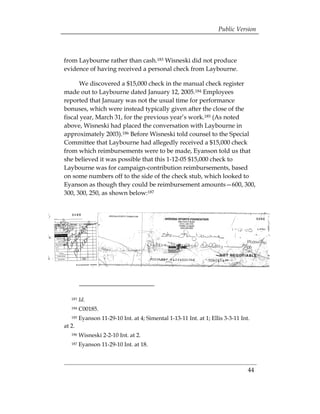
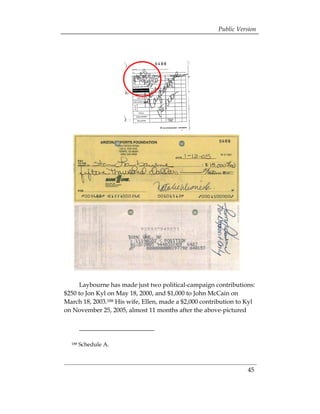
       Eyanson explained that the reimbursement checks were written
from a manual checkbook for the Arizona Sports Foundation.150 The
checks in this account typically were used to pay non-payroll items
such as bills from independent contractors or other miscellaneous
bills.151 Manual checks were also written from this account to
employees for actual bonuses.152 Eyanson also identified a small
number of ADP-generated checks as potential reimbursement
checks.153 (ADP is a full-service third-party payroll administrator
that provides payroll-check issuing services to the Fiesta Bowl.)154

      At the Fiesta Bowl, bonuses were given for multiple occasions.
For example, at Christmas, each full-time staff member (other than
the executive staff) received a $500 bonus.155 Bonuses were also
given to employees for special occasions such as having babies or
getting married, or for those who encountered special hardships.156

     According to Wisneski, Junker preferred to “bonus” Fiesta
Bowl employees for campaign contributions.157 Wisneski said that
Junker would direct her to give bonuses to other individuals who
had not made campaign contributions at the same time she was


  149   Eyanson 11-10-10 Int. at 12; Eyanson 1-13-11 Int. at 16 ; R00906-14.
  150   Eyanson 11-29-10 Int. at 2; see C00001-1042.
  151   Eyanson 11-29-10 Int. at 2-3.
  152   Id. at 3.
  153   R01827; R01614-15.
  154   www.adp.com/about-us.aspx; Eyanson 3-3-11 Int. at 1.
  155   Eyanson 11-29-10 Int. at 3.
  156   Id.; Keogh 1-31-11 Int. at 10-11; McGlynn Int. at 8.
  157   Wisneski 2-2-11 Int. at 3.


                                                                               38
Public Version


giving reimbursements to those who had contributed so as to
disguise the purpose of the reimbursements:158

           He [Junker] would just say “I need contributions. We need
           contributions to friends of Jon Kyl,” or, “the check needs to
           be made out to friends of,” whoever, like Russell Pearce.
           Later, he started using the term bonus and would say “Did
           you bonus staff out?”. . . “John would say, ‘Did you bonus
           staff out and did you put some other staff members in
           there—put Erika in there,”—people that didn’t contribute—
           to cover it. Sometimes he would be pretty rude and
           adamant and tell me, “Bonus the staff,” because I wasn’t
           doing it and people must have been telling him that they
           weren’t getting their reimbursements. It would be like a
           constant pounding on me to bonus the staff and I knew he
           was only talking about the ones that were getting the
           campaign reimbursements.159

      According to Wisneski, Junker asked Wisneski to come up with
pretextual reasons for the “bonuses.”160 But Wisneski said she had a
difficult time doing this:

           He wanted me to tell Monica [Simental] or Kelly [Keogh]
           when I was handing them the bonus, he wanted me to give
           an example for why we were giving them a bonus. But I
           couldn’t face it, I had a hard time doing it. [Wisneski is
           emotional at this point.] I couldn't do it. I couldn’t look at
           Monica and tell her it was something we both knew it
           wasn’t.161


  158.Wisneski     2-2-11 Int. at 3-4. 

  159   Wisneski 2-2-11 Int. at 3. 

  160   Id. at 3-4. 

  161   Wisneski 2-2-11 Int. at 3. 


                                                                            39
Public Version


      Based on our interviews and review of documents, the checks
that were written from the manual-checkbook account that were
identified as reimbursing employees for campaign contributions
were usually signed by Wisneski.162 Besides the signature, the other
information on these checks (e.g., the date and amount, and almost
always the payee) was normally written by Eyanson.163 Eyanson and
others stated that bonus-reimbursement amounts were typically
“grossed up” to account for state and federal taxes.164 Eyanson stated
that she normally performed this calculation using a calculator in her
payroll system165 and reported that she sometimes added five to ten
dollars extra, “just to make it close.”166 At Eyanson’s discretion, this
manual checkbook rolls up into the payroll account ledger, from
which the employees’ W-2s were eventually created.167

      Our interviews and review of documents revealed the
following illustrative example of the alleged collection/
reimbursement process relating to the November 2006 collection of
contribution checks for Carolyn Allen, a Republican State Senator
from Arizona District 8, which covers Fountain Hills, Rio Verde, and
Scottsdale. On August 28, 2006, Husk sent this email to Junker:

           John: I spoke with Senator Carloyn [sic] Allen and said we
           would round-up some checks for her campaign: [¶] Checks
           should be made out to CAROLYN ALLEN 2006 [¶] The
           maximum individual contribution is $296.00 [¶] I told her
           we would have them by Friday. Thanks. GH168


  162   Schedule D. 

  163   Wisneski 2-2-11 Int. at 4. 

  164   Id.; Eyanson 11-29-10 Int. at 6. 

  165   Eyanson 1-13-11 Int. at 2. 

  166   Eyanson 11-10-10 Int. at 9. 

  167   Eyanson 3-3-11 Int. at 11. 

  168   R00355. 


                                                                        40
Public Version


      Although we found no Fiesta Bowl contributions in late August
or early September as suggested by Husk’s email, our investigation
revealed six contributions from individuals connected with the
Fiesta Bowl to Allen’s campaign on November 25, 2006.169 A little
over a month later, the Arizona Sports Foundation’s manual check
ledger showed four “bonus” checks; Eyanson and Wisneski stated
that each of these bonus checks constitutes a reimbursement for
these campaign contributions:170

                                                        Bonus /
                                                     Reimbursement
                                                                         Check-
                Candi-              Contrib.     Gross        Net        book
Donor                    Date
                date                Amount       Amount       Amount     register
                                                                         note
Keogh,
Kelly           Allen    11-25-06   $   296.00
(Peterson)
                                                      —           —          —
Simental,                11-25-06   $   200.00
                Allen
Monica                   12-27-06                $ 216.56     $ 200.00
                         11-25-06   $   200.00
Wisneski,
                Allen                                                    Child
Natalie                  12-27-06                $ 202.94     $ 200.00
                                                                         care
Eyanson,                 11-25-06   $   296.00
                Allen
Peggy                    12-30-06                $ 324.84     $ 300.00   Bonus
Fields,                  11-25-06   $   296.00
                Allen
Jay                      12-27-06                $ 304.71     $ 300.00

Junker,                                          *            *          *
John (Susan     Allen    11-25-06   $   296.00
Junker)                                          * Junker’s alleged reimbursements
                                                 are addressed in Section III.B.7


   169   Schedule A.
   170   R00906-24.


                                                                               41
Public Version


      If the statements of Eyanson and Wisneski are accurate, the
above chart illustrates that contributions and reimbursements were
not all treated the same. For example, although Keogh said that she
never made a contribution that was not reimbursed,171 we could find
no record that Keogh was reimbursed for her November 25, 2006
contribution to Allen’s campaign, despite the fact that four of her
colleagues (all of whom donated the same day as Keogh) were
allegedly reimbursed.172 The checkbook memo/notation indicates
that Wisneski’s check was for “child care,” and that Eyanson’s was a
“bonus.”173 There is no checkbook notation for either Fields’ alleged
reimbursement check or for Simental’s reimbursement check.174 And
while Simental and Wisneski both contributed $200, Fields and
Eyanson contributed $296.175 Simental and Wisneski’s “net” amount
was for the exact amount of the contribution, while Fields (who
denies this was a reimbursement)176 and Eyanson each received an
additional $4.177

     Schoeffler, Keogh, and Eyanson all said that some of the
contributions for which they were reimbursed were made in the
names of their spouses.178 For example, a $500 donation was made in
the name of Eyanson’s husband, Lee Eyanson, on May 6, 2006, to
Congressman John Shadegg, a Republican representing Arizona’s


   171   Keogh 1-13-11 Int. at 3.
   172   See R00906-24.
   173   C00258; C00257; see also Section III.D.4.
   174   C00258.
   175   Schedule A.
   176   See Fields 11-24-10 Int. at 7, 8; Fields 12-9-10 Int. at 5.
   177   Schedule A.
   178Schoeffler 11-18-10 Int. at 6; Eyanson 11-10-10 Int. at 9; see Keogh 11­
22-10 Int. at 5; Keogh 1-13-11 Int. at 4.


                                                                                 42
Public Version


Third Congressional District.179 Three days later, on May 9, 2006,
Peggy Eyanson received a reimbursement check for $517.56.180

                    ii. 	 Checks to one employee for the alleged
                          reimbursement of others
     Another reported means of reimbursing for campaign
contributions was to have one employee receive a large bonus check
and for that employee to then reimburse others. Our investigation
shows that this process was allegedly attempted at least three times,
although we were unable to definitely determine or calculate how
much, if any, of these bonuses were actually used to reimburse for
campaign contributions. Nor were we able to determine to whom
such reimbursements were paid.

                         a. The $15,000 check to Laybourne
       Wisneski recalled that during one of the first times she was
asked to contribute to a political campaign, Laybourne (to whom she
reported at the time) told her that she and the other employees who
gave would be reimbursed by the Fiesta Bowl for their contributions:
“I remember Stan explained, ‘How this is going to work is I’m going
to be paid a bonus, like $10,000 or $15,000, and then I’m going to pay
all of you back.’”181 Wisneski recalled that the bonus Laybourne was
to receive was in or around 2003.182 She could not specifically recall
actually receiving a direct reimbursement from Laybourne, although
she thought that if she had been reimbursed from this $15,000 check,
it was more likely that she would have received a personal check


  179 Schedule A. Kelly (Peterson) Keogh and Husk also made donations
to Shadegg on May 6, 2006, in the amount of $250 each. Schedule A.
  180 Schedule A. Also on May 9, 2006, Kelly (Peterson) Keogh received a
reimbursement check in the amount of $277.05 for her earlier donation of
$250. Schedule A.
  181   Wisneski 2-2-11 Int. at 2.
  182   Id.


                                                                       43
Public Version


from Laybourne rather than cash.183 Wisneski did not produce
evidence of having received a personal check from Laybourne.

      We discovered a $15,000 check in the manual check register
made out to Laybourne dated January 12, 2005.184 Employees
reported that January was not the usual time for performance
bonuses, which were instead typically given after the close of the
fiscal year, March 31, for the previous year’s work.185 (As noted
above, Wisneski had placed the conversation with Laybourne in
approximately 2003).186 Before Wisneski told counsel to the Special
Committee that Laybourne had allegedly received a $15,000 check
from which reimbursements were to be made, Eyanson told us that
she believed it was possible that this 1-12-05 $15,000 check to
Laybourne was for campaign-contribution reimbursements, based
on some numbers off to the side of the check stub, which looked to
Eyanson as though they could be reimbursement amounts—600, 300,
300, 300, 250, as shown below:187


   183   Id.
   184   C00185. 

   185   Eyanson 11-29-10 Int. at 4; Simental 1-13-11 Int. at 1; Ellis 3-3-11 Int. 

at 2.
   186   Wisneski 2-2-10 Int. at 2.
   187   Eyanson 11-29-10 Int. at 18.


                                                                                  44
Public Version


     Laybourne has made just two political-campaign contributions:
$250 to Jon Kyl on May 18, 2000, and $1,000 to John McCain on
March 18, 2003.188 His wife, Ellen, made a $2,000 contribution to Kyl
on November 25, 2005, almost 11 months after the above-pictured


  188   Schedule A.


                                                                  45
Public Version


check.189 The year before the above-pictured check and the year after
show contributions by Fiesta Bowl employees in the amounts of $300
(one contribution) and $250 (three contributions), but no $600
contribution or multiple $300 contributions were found, as might be
suggested by the check register.190

      As noted above, Laybourne refused to speak with counsel to
the Special Committee.191 He did, however, state in a letter mailed to
the Special Committee’s counsel: “Regarding the issue of political
contributions, I told [Special Committee members] Mr. Bruner and
Mr. Steve Whiteman that I had no knowledge of this matter at the
time I left the Fiesta Bowl organization.”192 Grant Woods also
reported that when he spoke to Laybourne, Laybourne was
“adamant” that the allegations regarding the Fiesta Bowl’s
reimbursement for campaign contributions were not true.193

                        b. The $15,000 check to Aguilar
     Similar to Wisneski’s recollection of the $15,000 Laybourne
check, Eyanson said that Wisneski told her in late 2006 that Aguilar
was going to get a bonus in the amount of $15,000 so that he could
give people cash reimbursements for political contributions.194


  189   Id.
  190 Schedule A. Also, as noted earlier, although we found no evidence of
reimbursements to anyone outside of the staff (with the exception of
volunteer Asher), a review of contribution records shows that within the
week surrounding Laybourne’s November 2005 contribution, Gary Husk
($1,000 on November 28) and five board members and a board member’s
spouse also contributed to Kyl (eight contributions totaling $13,600). See
Schedule A.
  191   R00925.
  192   Id.
  193   G. Woods 11-23-10 Int. at 6.
  194   Eyanson 11-29-10 Int. at 17.


                                                                       46
Public Version


Aguilar confirmed that he had received a $15,000 check on
October 24, 2006, and that the purpose of that $15,000 check was to
reimburse others for campaign contributions.195 (Aguilar did not
discuss the $15,000 check until his third interview with the Special
Committee’s counsel. The Special Committee’s counsel provided
Aguilar’s counsel with information regarding the $15,000 check
before his third interview, and then, during that third interview,
Aguilar confirmed that he withheld information regarding the check
from the Special Committee’s counsel during his first two
interviews.)196

      The copy of the $15,000 check to Aguilar has the word “VOID”
scrawled through it on the duplicate check register.197 Eyanson
stated she wrote “VOID” on the duplicate check in her register
because she understood that Junker vetoed the plan before Aguilar
cashed or deposited the check.198

      Aguilar, however, said he did cash this check.199 His personal
banking records show that he deposited $15,000 on October 24, 2006,
and he made two large withdrawals, $6,484 on October 28, 2006, and
$7,140 on May 22, 2007.200 With respect to the first $6,484
withdrawal, to Aguilar’s best recollection, he kept this money in his
office for some period of time, and then used it to reimburse people
for campaign contributions.201 He cannot specifically recall whether
or not he gave individuals cash or wrote personal checks to them.202


  195   Aguilar 2-1-11 Int. at 4.
  196   Id.
  197   Id. at 10; C00250.
  198   Eyanson 11-29-10 Int. at 17.
  199   Aguilar 2-1-11 Int. at 5.
  200   Aguilar 2-1-11 Int. at 3; see also R01985-1991.
  201   Aguilar 2-1-11 Int. at 5.
  202   Id. at 4.


                                                                    47
Public Version


Aguilar has a vague recollection that he may have given some or all
of this money to another individual at the Fiesta Bowl in one of the
corner offices (which he thought could have been either Fields or
Schoeffler) and that this individual may then have distributed the
money.203 At the time this information was provided by Aguilar,
Schoeffler had ceased cooperating with the investigation.204 Fields
has denied any awareness of any campaign contribution
reimbursement scheme.205

      Although none of the individuals who were interviewed
recalled being reimbursed by Aguilar, there were a series of
campaign contributions made on October 18, 2006, for which we
were unable to determine any likely matching bonuses.206 These
contributions, made to Weiers and Hayworth, total $4,484; it is thus
possible that the $6,484 Aguilar withdrew on October 28, 2006, was
in part used to reimburse individuals for contributions made on
October 18, 2006.

     Aguilar does not believe he used the remaining $8,516 of the
$15,000 bonus check to reimburse Fiesta Bowl employees for
campaign contributions.207 Rather, he stated that the second large
withdrawal from his bank account ($7,140 on May 22, 2007) was to
make a repayment to the Fiesta Bowl. Eyanson confirmed that
Aguilar ultimately paid back $7,200 of the $15,000 bonus.208 The
disposition of the remaining $1,316 ($8,516 - $7,200 = $1,316) is
unknown.


  203   Id. at 6.
  204   Schoeffler refused to cooperate on January 31, 2011; R02382-402.
  205   Fields 11-24-10 Int. at 7, 8.
  206   Schedule A.
  207   Aguilar 2-1-11 Int. at 8.
  208   Eyanson 1-13-11 Int. at 3.


                                                                           48
Public Version


                         c. Check(s) to Wisneski
      Wisneski said that at some point after Laybourne was given a
$15,000 bonus check, she and Junker contacted Husk to see if
Wisneski could get a “bonus” that she could use to reimburse others
for their campaign contributions.209 According to Wisneski, Husk
told Junker and her, “Yeah, it’s done all the time.”210

      Wisneski said she then received a $5,000 check that she was
supposed to use to reimburse people.211 Wisneski received two
$5,000 (gross) checks—one on August 22, 2008, and another on
January 21, 2009.212 Wisneski stated that she believes that it was the
January 21, 2009 check from which she was supposed to reimburse
Fiesta Bowl employees for campaign contributions.213 She had no
specific recollection of reimbursing individuals from this amount,
but stated that she does not believe she would have given cash to
anyone.214 At the Special Committee’s counsel’s request, Wisneski
subsequently checked her personal checkbook and stated that she
could not find any personal checks she had written which appeared
to be campaign-contribution reimbursements.215

     Husk denied that he ever told anyone that the Fiesta Bowl
could reimburse anyone for a campaign donation, and he specifically
denied that he spoke to Junker and Wisneski about whether
Wisneski could receive a bonus and then reimburse others from that


  209   Wisneski 2-2-11 Int. at 5.
  210   Id.
  211   Id.
  212   Schedule A.
  213   Wisneski 2-10-11 Int. at 5.
  214   Wisneski 2-2-11 Int. at 5.
  215   Wisneski 2-10-11 Int. at 5-6.


                                                                    49
Public Version


bonus money.216 He denied that he told them “everybody does it”
(or words to that effect).217 He also stated that he understood (and
understands) that the law prohibited such a practice, and that he
would never advise a client to break the law.218

                     iii. Alleged increased expense-reimbursement
                          checks
     Some individuals interviewed stated that not all of the Fiesta
Bowl’s campaign-contribution reimbursements were made via
“bonus” checks. Schoeffler stated that he was sometimes reimbursed
through bonus checks, and other times, through an expense check.219
For example, on June 30, 2009, Schoeffler contributed $1,000 to John
McCain.220 On August 25, 2009, he received a check for the net
amount of $4,000—$3,000 of which he stated was to be used as a
down payment on a car, and the remaining $1,000 was for
reimbursement for his contribution to McCain.221

     During his interview with counsel to the Special Committee,
Grant Woods stated that Blouin had told him that he had been
reimbursed for campaign contributions through his expense
reimbursements.222


  216   Husk 2-10-11 Int. at 5.
  217   See id.
  218   Id.
  219   Schoeffler 11-18-10 Int. at 4. 

  220   Schedule A.
 

  221Schoeffler 11-18-10 Int. at 4. The Arizona Sports Foundation check 

ledger just includes the notation “veh Dpmt” on the $4,000 check. See
C00011.
  222   G. Woods 11-23-10 Int. at 6.


                                                                        50
Public Version


                      iv. Other methods
      Counsel to the Special Committee asked employees about
whether gift cards, contributions to savings accounts, padding
expense reimbursements, or other forms of transferring value could
have been used to provide reimbursements for campaign
contributions.223 Although gift cards were frequently given out to
Fiesta Bowl employees, no employee identified this or any other
method of receiving reimbursements other than those described
above.224

            4. No contributors said they knew the reimbursement
               practice could be illegal
       A number of the reimbursed contributors stated that they did
not know the practice of receiving reimbursements for their political
contributions could be illegal until they read the article in The
Arizona Republic.225 McGlynn said she was “stunned” when she read
on the Arizona Central website that making these contributions
could be a Class 6 felony violation.226 Likewise, Asher recalled, “I
read it in the newspaper and I remember that I told my wife, ‘Hey,
this is a felony—I did this.’“227 Aguilar reported, “I can tell you that
as recent as last year, and this is my ignorance coming, I never felt all
along that anything was being done illegally or wrong. I felt at this


   223 Simental 1-13-11 Int. at 4; Wisneski 2-2-11 Int. at 12; Keogh 1-13-11
Int. at 3; Eyanson 3-31-11 Int. at 8-9.
   224   See Section III.E.7.
     C. Martin Int. at 4; McGlynn Int. at 6, 7; Simental 11-10-10 Int. at 10;
   225

Asher 11-3-10 Int. at 3; Eyanson 11-29-10 Int. at 21; Chappin Int. at 2; see also
Aguilar 11-24-10 Int. at 4 (noting that people were talking before the article
came out, after it was known it was coming).
   226   McGlynn Int. at 6, 7.
   227   Asher 11-3-10 Int. at 3.


                                                                               51
Public Version


point I was still just doing my job, and I felt, who would put me in
this predicament?”228

      Eyanson noted that, before seeing the article, she had asked if
the Fiesta Bowl could lose its nonprofit status as a result of the
reimbursements: “That’s a big deal, and we all freaked out.”229 Later,
when the article in The Arizona Republic was published, Eyanson
looked up “Class 6 felony” on the Internet.230 When she learned that
violators could get prison time, she was “scared, upset and sick to
my stomach.”231

              5. Laybourne’s alleged concerns about political-
                 contribution reimbursements
      Like most of the other individuals who were reimbursed,
Wisneski said she did not realize that the practice could be a criminal
violation until she read The Arizona Republic article.232 Wisneski said,
however, that she understood before reading the article that the
practice of reimbursing for political contributions could affect the
Fiesta Bowl entities’ 501(c)(3) status.233

      Wisneski recalled that Laybourne was upset with Junker over
the reimbursements and that he had confronted Junker, saying,
“This could jeopardize our 501(c)(3) status.”234 She said Laybourne
would also come to Wisneski and tell her, “[H]e [Stan] was not very
happy about it. I think he even told me that he was hoping it was


  228   Aguilar 2-1-11 Int. at 10.
  229   Eyanson 1-10-10 Int. at 12.
  230   Id.
  231   Id.
  232   Wisneski 2-2-11 Int. at 3.
  233   Id. at 2.
  234   Id.


                                                                     52
Public Version


just going to be one or two times, but it wasn’t, it just kept
happening.”235 Laybourne’s alleged concerns prompted Wisneski to
speak to Junker as well, but she said that Junker denied that the
organization’s nonprofit status was in jeopardy and instead
instructed her to cut Laybourne out of the reimbursement process.236

       As noted above, Laybourne declined to speak with counsel to
the Special Committee. Certain memoranda from the Fiesta Bowl’s
files, however, appear consistent with Wisneski’s recollection that
Laybourne was concerned about the Fiesta Bowl’s 501(c)(3) status,
among other things. For example, in 2003, Laybourne and Wisneski
received a memo from an individual named Amy Day that explained
that 501(c)(3) organizations could be liable for a tax on each political
expenditure and that “in addition, ‘a tax of 2.5% (up to $5,000 per
expenditure) is imposed on any organization manager who willfully,
and without reasonable cause, agrees to the expenditure.’”237 In
addition to political expenditures, the memo also discussed the tax
penalties associated with persons who benefit from excess benefit
transactions.238

      Laybourne appears to have summarized this memorandum
from Amy Day in a September 29, 2003 email he sent to Junker,
Craig Williams (General Counsel, member of the Snell & Wilmer
firm), Leon Levitt (then-Chairman of the Board), and Wisneski.239 In
this email, Laybourne underscored the definition of political
expenditure—the text is underlined in the original by Laybourne:
“‘Political Expenditure’ means any amount paid or incurred for any
participation in, or intervention in (including publication or


  235   Id.
  236   Id. at 4.
  237   R00356-58.
  238   Id.
  239   R00359.


                                                                    53
Public Version


distribution of statements), any political campaign on behalf of or in
opposition of any public office candidate.”240 In the email,
Laybourne also relayed a summary of excess benefit transactions
and the penalties that could be imposed.241 Laybourne concluded his
email by warning, “Being your PARANOID CFO, I wanted to make
sure we all knew these rules as I continue to believe that not-for­
profits will be the next target of scrutiny.”242

               6. 	Several employees made contributions reportedly
                   against their stated political inclinations
      Several of the 11 individual contributors who report that they
received reimbursements stated that they gave without regard to
their own personal political beliefs.243 Thus, Keogh (whose
reimbursed contributions were primarily to Republicans) said she is
a Democrat.244 Simental (whose reimbursed contributions were
primarily to Republicans) also said she is a Democrat.245 Schoeffler
noted that when he went back through his check registers in
preparation for his interview with counsel to the Special Committee,
he realized that he had written checks to people he did not even
know or recognize: “I had to Google the computer to see who they
were.”246


   240   Id.
   241   Id.
   242   Id. (Capital letters as in original.)
   243 McGlynn Int. at 6; Keogh 11-22-10 Int. at 5, 9; Simental 11-10-10
Int. at 5.
     See Schedule A (showing Keogh donations to Shadegg, Hayworth,
   244

Allen, and Weiers—all Republicans); Keogh 11-22-10 Int. at 5, 9.
   245   Simental 11-10-10 Int. at 5.
   246   Schoeffler 11-18-10 Int. at 7.


                                                                           54
Public Version


            7. Alleged reimbursements to Junker, Fields, and
               Schulman
      As stated above, Wisneski reported that the Fiesta Bowl
reimbursed campaign contributions for Junker, Fields, and
Schulman.247 At our request, Wisneski and Eyanson placed
checkmarks next to Junker’s and Fields’ campaign contributions that
they believed were likely reimbursed.248 In addition, Wisneski
separately identified two campaign contributions made by Schulman
that she said were reimbursed.249

       For each of the Junker, Fields, and Schulman campaign
contributions Wisneski and/or Eyanson believed were reimbursed,
we investigated possible “bonuses” that may have been the
reimbursements for these contributions. If we received information
regarding an alleged reimbursement “bonus” check, we then
included those contributions in our total. The charts on the following
pages show the Junker, Fields, and Schulman campaign
contributions and reimbursements that we have included in our
total, followed by a discussion of each. (These are also found in
Schedule C.)

                           Junker’s potential reimbursements
                                                           Bonus /
 Junker
                                                        Reimbursement
                                                                           Check-
              Candidate-                  Contrib.    Gross       Net
 Donor                           Date                                      book
              PAC                         Amount      Amount      Amount
                                                                           Memo
 Junker,      Bundgaard,
                                8-14-00     $   256
 John         Scott
 Junker,
              Gardner, Mike     8-23-00     $   250
 John


   247   Wisneski 2-2-11 Int. at 6, 8; Wisneski 3-3-11 Int. at 3-4. 

   248   R00911-14; R00922-24. 

   249   Wisneski 3-3-11 Int. at 3-4. 


                                                                              55
Public Version


                                                       Bonus /
Junker
                                                    Reimbursement
                                                                     Check-
          Candidate-                  Contrib.    Gross     Net
Donor                       Date                                     book
          PAC                         Amount      Amount    Amount
                                                                     Memo
Junker,
          Allen, Carolyn   9-01-00      $   150
John
Junker,
          Carpenter, Ted   9-05-00      $   200
John
Junker,   Knaperek,
                           9-06-00      $   200
John      Laura
Junker,
          AZ Wins          9-11-00      $ 1,200
John
Junker,
John &    Martin, Phil     9-19-00      $   150
Susan
Junker,   Cummiskey,
                           9-25-00      $   150
John      Christopher
Junker,   Mitchell,
                           10-11-00     $   250
John      Harry
Junker,
          Bennett, Ken     1-08-01      $   250
John
          Arizona
Junker,
          Republican       8-13-01      $   700
John
          Party
Junker,
          McCain, John     2-26-03      $ 2,000
John
Junker,   Kunasek,
                           2-23-04      $   350
John      Andrew
Junker,   Wilcox, Mary
                           March 04     $   350
John      Rose
Junker,
          Flake, Jake      7-13-04      $   150
John
Junker,
          Flake, Jake      7-13-04      $   150
Susan
Junker,
          McCain, John     10-30-04     $ 1,000
John
Junker,
          Allen, Carolyn   9-08-05      $   250
John
Junker,
          McCain, John     4-28-06      $ 1,000
John
Junker,
          Kyl, Jon         6-16-06      $   500
Susan
Junker,
          Hayworth, JD     10-18-06     $ 1,500
Susan
Junker,
          Allen, Carolyn   11-25-06     $   296
Susan
                                        $11,302


                                                                        56
Public Version


                                                            Bonus /
 Junker
                                                         Reimbursement
                                                                                Check-
              Candidate-                   Contrib.    Gross         Net
 Donor                          Date                                            book
              PAC                          Amount      Amount        Amount
                                                                                Memo
                               2-26-07                 $ 31,948.88   $ 20,000   Bonus
 Junker,
              McCain, John     3-08-07      $ 2,100
 John
 Junker,
              McCain, John     3-08-07      $ 2,100
 Susan
                                            $ 4,200
                                                                                Bonus
                               8-23-07                 $ 5,522.97    $ 4,200
                                                                                MC
 Total                                      $ 15,502


     Although John and Susan Junker were frequent campaign
contributors, the manual checkbook register does not contain a
number of small bonus checks for Junker as it does for other
employees.250 Wisneski, however, recalled at least two instances in
which she says Junker was reimbursed for political contributions.251

      According to Wisneski, the first such instance was in February
2007. Wisneski recalled that in February 2007 Junker received a
$20,000 bonus—this followed the Bowl’s first three-game season.252
None of the Board Chairs for 2006-2008 could recall giving Junker
this bonus,253 nor could Wisneski find the memo authorizing the
bonus in Junker’s personnel file.254 Richard Stemple, the Chair at the
time, recalled only one bonus, awarded in May 2007 for $100,000.255


   250   See Schedule A. 

   251   Wisneski 2-2-11 Int. at 6; Wisneski 2-10-11 Int. at 2. 

   252   Wisneski 2-10-11 Int. at 2. 

   253   Ziegler 2-15-11 Int. at 2; Stemple Int. at 2; Tilson 2-15-11 Int. at 1-2. 

   254   Wisneski 2-10-11 Int. at 3. 

   255   Stemple Int. at 3; R01952-53. 


                                                                                   57
Public Version


Only the Compensation Committee of the Board is authorized to
award Junker a bonus.256

       According to Wisneski, before this $20,000 bonus check had
been issued, Junker came into her office holding a list of campaign
contributions that he and his wife had made over the years.257
Wisneski said Junker told her he needed to be reimbursed for all
these contributions.258 Wisneski stated that Junker showed her the
list, but did not give it to her.259

      Wisneski said she was upset about Junker’s request, but that
she went into Eyanson’s office and asked Eyanson what amount
Junker would receive if they “grossed up” the bonus so that instead
of receiving a gross bonus of $20,000, Junker would receive a bonus
that netted to $20,000.260 Eyanson’s calculations showed that if they
paid Junker $31,948.88 (or $11,948.88 more), then his bonus would
net to $20,000.261 Wisneski recalled that this $11,948.88 was close to—
but slightly higher than—the tally of campaign contributions Junker
had given her, so she instructed Eyanson to make a bonus to Junker
of $31,948.88.262

     Junker’s bonus check for $31,948.88 is dated February 26,
2007.263
       The total of all the campaign contributions Junker and his
wife Susan gave from 2000 up until this date is $11,302.264 We have


  256   Hickey 2-18-11 at 1-2; Tilson 2-15-11 Int. at 2; Young 2-18-11 Int. at 2.
  257   Wisneski 2-10-11 Int. at 2.
  258   Id.
  259   Id.
  260   Id.
  261   Id.
  262   Id.
  263   C00117.
  264   Schedule C.


                                                                               58
Public Version


included this $11,302 amount in our calculations of contributions
that were allegedly reimbursed by the Fiesta Bowl.

      Junker’s annual bonuses were issued in round-number
amounts, and the Compensation Committee’s memos authorizing
the bonuses do not state that they should be grossed up for taxes.265
One Board member commented that to interpret the bonus as
something that should be grossed up would be deceitful.266 Junker’s
earlier, annual bonuses were not grossed up for taxes.267 With the
exception of the Whisper Rock payments—which were designed to
net $10,000—Junker’s performance bonuses were round-number
gross amounts.268

      According to Wisneski, the second alleged Junker
reimbursement check was written in August 2007.269 On March 8,
2007, John and Susan Junker each gave $2,100 to McCain’s campaign,
for a total of $4,200.270 Wisneski recalled that the Fiesta Bowl
provided Junker with a $100,000 bonus in May 2007.271 A few
months after Junker received this $100,000 bonus, Wisneski stated
that Junker came to her and said, “I haven’t received my
reimbursement yet.”272 Wisneski stated that she was uncomfortable,
but went to Eyanson and told her Junker wanted to be reimbursed so
she should write out a check.273


  265   See, e.g., R00601-02; R01952-62.
  266   Ellis 3-3-11 Int. at 2.
  267   Schedule A; see also Section E.5.A.
  268   Id.; see e.g., R00601-2; R01952-62.
  269   Wisneski 2-10-11 Int. at 2.
  270   Schedule A.
  271   Wisneski 2-2-11 Int. at 6.
  272   Id. at 5-6.
  273   Id. at 6.


                                                                    59
Public Version


       On August 23, 2007, Junker received a $4,200 net bonus
check.274 Eyanson identified this check as a likely reimbursement for
the Junkers’ $4,200 campaign contribution to Senator McCain.275 In
fact, as Eyanson noted, the check register contains the letters “MC”
in Eyanson’s handwriting, which Eyanson believes stands for
McCain:


  274   C00100.
  275   R00913.


                                                                   60
Public Version


      Stemple, the Chair at the time, stated that he was not aware of
any means by which Junker could receive a bonus other than
through Board authorization.276 Stemple also stated that he did not
recall any $4,200 net bonus to Junker in August 2007.277


  276   Stemple 2-15-11 Int. at 2.
  277   Id.


                                                                   61
Public Version


     As noted earlier, Junker refused to talk with the Special
Committee’s counsel about political contributions or their alleged
reimbursement.278

                            Fields’ potential reimbursements
                                                               Bonus /
Fields
                                                            Reimbursement
                                                                                   Check-
              Candidate                     Contrib.    Gross         Net
Donor                         Date                                                 book
              PAC                           Amount      Amount        Amount
                                                                                   Memo
Fields,       McCain,
                             4-28-06         $ 1,000
Jamie         John
                                                                                   Bonus­
                             5-19-06                    $ 1,600.00    $ 1,408.67   Frito lay
                                                                                   NFL
Fields,       Allen,
                             11-25-06         $   296
Jay           Carolyn
                             12-27-06                   $    304.71   $   300.00
Fields,
              Brewer, Jan    11-05-09         $   140
Jay
Fields,
              Brewer, Jan    11-05-09         $   140
Jamie
                                              $   280
                             11-19-09                   $    500.00   $   340.37   Bonus
Total                                         $ 1,576


     As noted above, Fields has denied being reimbursed for
campaign contributions.279 Wisneski, Eyanson, and Schoeffler,
however, have each stated that they believe Fields was
reimbursed.280

    Our master campaign spreadsheet (Schedule A) shows nine
campaign contributions by Fields and his wife, Jamie.281 This


   278    Junker 1-31-11 Int. at 6.
 

   279    Fields 11-24-10 Int. at 7, 8. 

   280Wisneski 2-2-11 Int. at 8; Schoeffler 11-18-10 Int. at 9; Eyanson 11-13­

11 Int. at 9-10; R00911-12; R00922.
   281    Schedule A.


                                                                                               62
Public Version


schedule also shows that Fields received 18 checks from the manual
payroll checkbook. It appears that many of these 18 checks are for
bonuses and expense reimbursements for Fields’ work as an
independent contractor, before he became a regular employee of the
Fiesta Bowl, and that may thus bear no connection to campaign
contributions.282

     Certain checks, however, could be campaign reimbursements.
We provided these to Fields and his counsel, and they in turn
supplied information with respect to several of these checks to
support Fields’ contention that they were in fact legitimate bonuses
and not reimbursements for campaign contributions.283

       Conversely, Wisneski has stated that she believes Fields was
reimbursed for at least seven of the nine donations Fields and his
wife made over the past decade.284 For three of these seven campaign
contributions, we found no readily apparent subsequent bonus that
ties to those contributions, and we thus elected not to include them
in our total count.

      Four of the Fields contributions identified by Wisneski and
Eyanson, however, are followed by bonus checks that—if Wisneski,
Schoeffler, and Eyanson are correct—may have been campaign-
contribution reimbursements. Each of these were given on the same
day that others at the Fiesta Bowl made contributions, and each is
followed by a bonus check that was given to Fields on the same day
that at least one other employee received a bonus that is an admitted
campaign-contribution reimbursement. For example:


  282   Schedule A.
  283   Fields 1-19-11 Int. at 1-2, 5.
  284R00922; Eyanson believes Fields was reimbursed for at least four
donations. R00911-12.


                                                                        63
Public Version


            1.	 Fields’ wife Jamie gave $1,000 to “Straight Talk
                America” (a John McCain PAC) on April 28, 2006
                (along with Junker, Wisneski, and McGlynn).285 Fields
                and McGlynn both received bonus checks three weeks
                later on May 19, 2006.286 McGlynn remembered that
                she was reimbursed for this contribution.287 Fields
                stated that he did not specifically recall the $1,600
                bonus he received on May 19, but noted that the bonus
                is labeled “Frito-lay NFL” and provided
                documentation showing that the agreement between
                the Insight Bowl and the NFL was signed on April 21,
                2006, and that there were emails regarding the local
                agreement between the Fiesta Bowl and Tostitos in the
                early May 2006 time frame.288

            2.	 Fields gave $296 to Carolyn Allen’s campaign on
                November 25, 2006.289 Five others also contributed to
                Carolyn Allen’s campaign on November 25, 2006.290 A
                month later, Fields and three of his colleagues
                (Simental, Wisneski, and Eyanson) received what
                Simental, Wisneski, and Eyanson said were
                reimbursement checks.291 Fields stated that he does not
                recall the purpose of the $300 check he received on
                December 27, 2006.292


285   Schedule A.
286   Id.
287   McGlynn Int. at 6.
288   R00376-89.
289   Schedule A.
290   Id.
291   R00907-12; R00917-22; Simental 1-13-11 Int. at 4, 6.
292   Fields 12-9-10 Int. at 5.


                                                                       64
Public Version


            3.	 Fields and his wife each gave a $140 campaign
                contribution to Jan Brewer on November 5, 2009.293
                Wisneski also gave a $140 contribution on that date.294
                Both Wisneski and Fields received bonus checks two
                weeks later, on November 19, 2009.295 Wisneski’s check
                was for $250; Fields (who had given twice as much)
                received $500.296 Wisneski said the checks given to
                herself and Fields were reimbursements for their
                contributions to Jan Brewer’s gubernatorial
                campaign.297 Fields, however, stated that this bonus
                was given as a result of his successful closing on an
                extension for the Insight Bowl sponsorship, and he has
                supplied documents showing that he was in
                negotiations during this time period and that the deal
                closed on November 11, 2009.298 Wisneski reviewed the
                documents Fields provided to support his position on
                this bonus and said that they did not alter her opinion
                that Fields was reimbursed for the campaign
                contributions.299 She further noted that it was, in her
                opinion, highly unlikely that Fields would receive such
                a small bonus for such a large endorsement, and that it
                was not the right time to be receiving bonuses in any
                case.300


293   Schedule A.
294   Id.
295   Id.
296   Id.
297   R00922; Wisneski 2-10-11 Int. at 6; Wisneski 2-16-11 Int. at 5.
298   R00363-72; Fields 12-9-10 Int. at 4; Fields 1-19-11 Int. at 4.
299   Wisneski 2-10-11 Int. at 6.
300   Id.


                                                                            65
Public Version


      As discussed above, if one includes these four contributions,
the total amount of campaign contributions allegedly reimbursed by
the Fiesta Bowl is $46,539. If all the Fields campaign contributions
Wisneski and Eyanson have said were reimbursed were included in
the count, the total would be $48,529; if none of the Fields
contributions were included, the total would be $44,963.

                      Schulman’s potential reimbursements
                                                           Bonus-
 Schulman                                              Reimbursement
                                                                          Check-
               Candidate                 Contrib.    Gross      Net       book
 Donor         /PAC         Date         Amount      Amt.       Amt.      Memo
 Schulman,     Kunasek,
 Marc          Andrew         02-22-04   $   50.00
 Schulman,     Wilcox,          March
 Marc          Mary Rose          2004   $   25.00
                              05-24-04               $ 350.00   $323.22
 Total                                   $   75.00


     Schulman made two campaign contributions—a $50 donation
to Andrew Kunasek on February 22, 2004, and a $25 donation to
Mary Rose Wilcox in March 2004.301 Wisneski has identified both of
these contributions as ones that she believed were reimbursed by a
subsequent bonus check Schulman received on May 24, 2004 for
$350.302 With respect to Schulman’s two donations of $25 and $50,
Wisneski stated (without prompting as to the amounts) that Junker
was annoyed at Schulman because the donation amounts were so
small.303 In addition to Schulman, twelve other individuals received
bonuses on May 24, 2004; of those twelve at least eight, including
Blouin, had given earlier campaign contributions to Wilcox and/or


  301   Schedule C.
  302   Wisneski 3-3-11 Int. at 4.
  303   Id.


                                                                              66
Public Version


Kunasek.304 Based on Wisneski’s recollection and the pattern
demonstrated by our spreadsheet (Schedule A), we have elected to
count Schulman’s $75 in contributions in the total.


  C. The first investigation

              1. The Arizona Republic article
      On December 18, 2009, The Arizona Republic published an article
written by reporter Craig Harris titled “Fiesta Bowl employees say
bowl repaid political contributions/CEO John Junker denies
repayments, which would violate election laws.”305 In this article, The
Arizona Republic reported that past and present Fiesta Bowl
employees stated that they were encouraged to write checks to
specific political candidates and then were reimbursed by the Fiesta
Bowl for their contributions.306 The article also highlighted certain
information from the Fiesta Bowl tax returns, including expenditures
for entertainment and lobbyists (including Husk Partners) and
tickets and trips for legislators.307

      In approximately October-November 2009, a number of
individuals associated with the Fiesta Bowl were aware that The
Arizona Republic was planning to publish an article alleging that the
Fiesta Bowl reimbursed employees for campaign contributions they
had made.308 These individuals knew that Harris was asking


  304   Schedule A.
  305   R01550.
  306   Id.
  307   R01554.
  308   R01360-61.


                                                                   67
Public Version


questions about the Fiesta Bowl’s alleged reimbursement of
campaign contributions.309

      Tony Alba, Director of Media Operations for the Fiesta Bowl,
stated that Harris called him before the article and laid out a number
of subjects he currently was writing about, including campaign
contributions, salaries and bonuses of employees, and two
unsecured loans the Fiesta Bowl had given to Junker and another
individual.310 Alba said he took notes on the questions Harris was
asking (which Alba called “pretty serious issues”) and then took his
notes to Junker and Wisneski, who told him that he should not
worry because Harris called every year and always published
negative articles about the Fiesta Bowl.311 Similar to what Alba
reported, a number of other individuals told counsel to the Special
Committee that Harris regularly wrote negative-leaning articles
regarding the Fiesta Bowl.312

     A review of Harris’ articles published before his December
2009 article regarding campaign contributions, however, appears to
show that Harris had written few, if any, articles about the Bowl that
could fairly be described as completely negative313 and that, in fact,


   309   Id.
   310   Alba Int. at 3; R01964-65.
   311   Id.
   312 See Husk 11-3-10 Int. at 4; Williams 12-8-10 Int. at 3; Young 12-16-10
Int. at 2 (claiming Junker said Harris’ article was usual negative article
about the Bowl); Bagnato Int. at 6-7 (“I think he has an agenda—and I have
been very slow coming to that conclusion. It is not to say that his stories
have been inaccurate.”).
   313See, e.g., Craig Harris, Bowls’ Execs Make Top Dollar, THE ARIZONA
REPUBLIC, Dec. 17, 2004 (comparing Junker’s and Blouin’s salaries to other
bowl executives, but also quoting Fiesta Bowl board chairman’s praise for
Junker as well as Junker’s praise for Blouin) (R01907-08); Craig Harris,
Insight Bowl Loses Money But Won’t Be Canceled, THE ARIZONA REPUBLIC,


                                                                          68
Public Version


the majority of Harris’ pre-2009 articles regarding the Bowl appeared
generally positive.314

      In his discussion regarding the Harris allegations, Alba
specifically remembered Junker stating, “I have never made a
campaign contribution reimbursement, never.”315 He also recalled
that Wisneski had told him that the Fiesta Bowl gave frequent
bonuses to employees but had not reimbursed for campaign
contributions.316 Alba said he turned his notes over to Junker and did
not hear anything further until Harris called again about two weeks
later asking about Blue Steel Consulting.317 With respect to this


Aug. 22, 2003 (discussing fact that Insight Bowl lost money and noting
Junker’s increased salary, but also quoting past board president’s praise for
Junker and noting economic impact bowls have on Phoenix) (R01919-20);
Craig Harris, Fiesta Bowl: A Blend of Power, Cash, THE ARIZONA REPUBLIC,
Nov. 30, 2002 (discussing revenue generated by major bowls, amounts
bowls must expend in wooing top teams, and noting Junker’s and Blouin’s
salaries but also quoting board chairman’s praise of Junker and other
executives’ praise of Blouin) (R01911-14).
   314See, e.g., Craig Harris, Proposed Bowl Plan a Boost For Valley, THE
ARIZONA REPUBLIC, June 10, 2004 (R01925-26); Craig Harris, Post-Christmas
Pick-Me-Up; Hotels to Benefit From Insight Bowl, THE ARIZONA REPUBLIC,
Dec. 25, 2003 (R01923-24); Craig Harris, Matchup Hits Pay Dirt; Teams’
Strong Fans an Economic Boon, THE ARIZONA REPUBLIC, Dec. 19, 2003
(R01921-22); Craig Harris, Fiesta Bowl Scored TD for Economy; Title Game
Generated $153 Mil., THE ARIZONA REPUBLIC, May 5, 2003 (R01917-18);
Craig Harris, Bowl Game Fans to Buy; Shops, Restaurants, Hotels and Strip
Clubs Cashing In, THE ARIZONA REPUBLIC, Jan. 3, 2003 (R01909-10); Craig
Harris, Fiesta Bowl Filling Up Valley Hotel Rooms Fast, THE ARIZONA
REPUBLIC, Dec. 11, 2002 (R01915-16).
   315   Alba Int. at 4.
   316   Id.
    Id. See Section III.E.12.a for additional discussion of Blue Steel
   317

Consulting.


                                                                         69
Public Version


second call from Harris, Alba said he was told by his superiors to
notify Husk and run everything through Husk, which he did.318 Alba
reported that Husk helped him by suggesting ways he could
respond to reporters’ future requests.319

      Husk stated that he first heard about the allegations regarding
political-contribution reimbursements when he learned from Fiesta
Bowl employees that Harris was making calls and asking about
political contributions made by employees on the same day.320 Husk
said he attempted to explain to Harris that there were instances
when employees had all made contributions on the same day either
because there was a fundraiser or because it was the last day before
the contribution deadline.321 Husk said he was “pissed off” because
he thought he had personally and successfully explained to Harris
why employees made contributions on the same day, and yet Harris
wrote the article anyway.322 Husk called the article “total garbage”
and stated that “it was obvious to us that he was just out to get
us.”323

      Then-Board Chair Young recalled Harris contacted him before
the article was published (perhaps in late October 2009) and asked
about topics such as reimbursements for campaign contributions,
Junker’s salary, loans to Junker, and legislative trips.324 Young said
he asked Junker directly about the campaign-contribution allegations
and was told by Junker that he had no idea what Harris was talking


  318   Id. at 5. 

  319   Id. 

  320   Husk 11-3-10 Int. at 3.
  321   Id. at 4.
  322   Id.
  323   Id.
  324   Young 12-16-10 Int. at 1, 2.


                                                                   70
Public Version


about.325 Young noted that he and Junker thought that the
allegations must have stemmed from a disgruntled ex-employee.326
Current Board Chair, and then-Board member, Duane Woods also
believes he was contacted by Harris in November 2009.327

      John Zidich, publisher of The Arizona Republic and also a
member of the Fiesta Bowl Board, said he received a “heads up”
from someone at the paper shortly before the article was published
but that he had never heard of the allegations in the article before
then.328 Zidich said he had a conversation with Junker around the
time that the article was to be published in which Zidich told Junker
that if there was “anything unusual, it needed to come out.”329
According to Zidich, Junker did not react to Zidich’s comment.330

      Zidich said he has made it clear to The Arizona Republic editor,
Randy Lovely, that because of his position on the Fiesta Bowl Board,
he would not be involved in any news articles or editorials regarding
the Fiesta Bowl.331 Zidich noted that he has not influenced Harris’
stories, as should be clear from the fact that Harris has continued to
write articles about the Fiesta Bowl, even though Zidich remains on
the Board.332

    Andy Bagnato, the Director of Public Relations for the Fiesta
Bowl, did not start work at the Fiesta Bowl until February 2010.
Bagnato recalled advising Junker that he had actually worked with


  325   Id. at 2. 

  326   Id. 

  327   D. Woods 12-16-10 Int. at 2.
  328   Zidich Int. at 2.
  329   Zidich Int. at 1.
  330   Zidich Int. at 1-2.
  331   Zidich Int. at 2.
  332   Id.


                                                                   71
Public Version


Harris for a couple years and never had any issues with him.333
Bagnato said that once he was employed by the Fiesta Bowl, he had
every intention of reaching out to Harris to have a general discussion
with him, “but John [Junker] said no to that.”334 Bagnato further
related that during his discussion with Junker, “I told him I thought
it would be helpful if I had a talk with Mr. Harris, that it might help
in trying to get an understanding what his problem was about the
Bowl and maybe even see what motivates him, but John just said
‘that’s not a good idea’, so I said okay—I didn’t argue with him.”335

              2. Junker’s alleged concerns regarding the Harris article
      Wisneski said that once Junker became aware that the
campaign-contribution reimbursement allegations were going to
become public, he became concerned about the August 23, 2007
$4,200 check that Wisneski said had been written to him to
reimburse him for his and his wife’s $4,200 contributions to
McCain.336 Wisneski explained that for Junker, unlike for other
employees, only the Board of Directors could authorize a bonus, and
there was no Board authorization for this check.337 Wisneski recalled
Junker saying, “Oh my gosh, there’s that check. What am I going to
do?”338

     According to Wisneski, Junker said he was going to ask Husk
what he should do and that the two of them would come up with
something.339 Wisneski said Husk came up with the idea that he


  333   Bagnato Int. at 2.
  334   Id. at 5.
  335   Id.
  336   Wisneski 3-3-11 Int. at 8.
  337   Id.
  338   Wisneski 2-2-11 Int. at 6.
  339   Id.


                                                                          72
Public Version


would submit an invoice for personal legal services to Junker.340 The
plan, Wisneski said, was that Junker would then go to Stemple (who
was Chairman of the Board at the time the check was written) and
request that Stemple say that as part of Junker’s review he had
approved that the Bowl would cover some of Junker’s personal legal
fees.341 (Wisneski pointed out it was not uncommon for Junker, at his
year-end review, to receive a new perquisite from the Board, such as
an additional reimbursement for medical expenses.)342

      Wisneski said that she did not know why, but this plan fell
through and she never received an invoice from Husk for Junker’s
purported personal legal fees.343 She said Junker then told her that he
was going to say that he had been authorized by Stemple to receive
this money to pay for medical expenses.344 Like the first plan,
however, Wisneski said she believes this one fell through as well.345

      Stemple denied any knowledge of either alleged plan and said
he was never contacted by Junker regarding Junker’s personal legal
fees.346 Wisneski said she does not believe Stemple was ever
contacted.347

     Husk denied knowing about any campaign-contribution
reimbursements by the Fiesta Bowl, including the alleged $4,200
reimbursement check to Junker in August 2007.348 He specifically


  340   Id.
  341   Id.
  342   Id.
  343   Id.
  344   Id.
  345   Id. at 6-7.
  346   Stemple Int. at 2.
  347   Wisneski 3-3-11 Int. at 8.
  348   Husk 2-10-11 Int. at Addendum p. 25.


                                                                    73
Public Version


denied talking with Wisneski about any purported plan to submit an
invoice to Junker for personal legal fees to conceal the source of the
alleged $4,200 reimbursement.349 And as stated above, Junker
refused to discuss the topic of campaign contributions with counsel
to the Special Committee.

               3. Genesis of first internal investigation

                    a. Dallas conversation
      According to Husk, on the first Saturday in December 2009
(which would have been December 5, 2009), he attended the Big 12
Championship Game in Dallas, Texas, with Junker and Young.350
Husk stated, “we talked about it [the allegations in the forthcoming
article] and agreed to bring in a third party to investigate the rumors
and allegations.”351 Husk said he was asked by Junker and Young
who should do the investigation and Husk gave them several names,
including that of former Arizona Attorney General Grant Woods.352
A couple days later, according to Husk, Young called him and said,
“Let’s go with Grant Woods.”353 Husk said Young told Husk to
contact Woods and tell him that he had been selected.354

     Young also recalled that he, Husk, and Junker discussed the
campaign-contribution reimbursement allegations at the game in
Dallas.355 He recalled that both Husk and Junker proposed several
options of how to address the allegations, but that it was Husk who


  349   Id.
  350   Husk 11-3-10 Int. at 4.
  351   Id. 

  352   Id.

  353   Id. 

  354   Id.
  355   Young 12-16-10 Int. at 3.


                                                                      74
Public Version


said that they should hire Grant Woods to do an internal
investigation.356 Young recalled, “I remember I said there were other
attorneys, but Grant Woods had a good reputation so we agreed
with Woods.”357

                 b. Board discussion and retention of Grant Woods
     Before the discussion at the December Big 12 championship
game in Dallas, some discussion may have occurred at the
November 23, 2009 Board of Directors’ meeting about retaining
someone to do an investigation of the allegations regarding
reimbursement of campaign contributions.

      The meeting minutes for the November 23, 2009 meeting state,
“Junker reported that it has come to his attention that a reporter at
the Arizona Republic is working on a story regarding our organization
and some of our activities, including lobbying interests and
memberships.”358 Although he cannot recall whether he was present
at the November 23 Board meeting, Board member (and 2005 Board
Chair) Mike Allen said it was his understanding that there had been
discussion at that meeting about the article that was to appear in The
Arizona Republic.359 Board Member (and 2007 Board Chair) Tilson
remembered that Husk was present at the first Board meeting in
which the investigation was discussed, and that Husk told the
Board, “[I]f you think Grant Woods is the guy—I will go pitch it.
He’s credible. I think he is the guy.”360 Then-Board member and


  356   Id.
  357   Id.
  358 In a draft of the minutes, someone has deleted the next sentence,
which read: “He said that on all items that have come to his attention we
are legal and right in our operations.” R00397; R02669-86; R02699-702.
  359   Allen 12-8-10 Int. at 1.
  360 Tilson 11-22-10 Int. at 4; the November 23 Board meeting minutes do
not show Husk as present. R00396-98.


                                                                        75
Public Version


current Board Chair Duane Woods recalled that there was no
particular process involved to determine who should conduct the
investigation, but that Husk made the recommendation to have
Grant Woods lead it, and “because Husk was acting as counsel to the
Bowl, the Board relied on his advice.”361

      Grant Woods—no relation to Duane Woods—served as
Arizona’s Attorney General from 1991 to 1999.362 Before that, he had
a private law practice, handling both civil and criminal matters
(1984-90) and served as John McCain’s chief of staff (1983-84).363 He
had not previously done any work for the Fiesta Bowl.364 During at
least their initial interviews with counsel to the Special Committee,
Grant Woods and Husk each described having a warm relationship
with one another and noted that they were former co-workers.365
When he was Attorney General, Woods hired Husk to work in his
office and they worked together when Woods was Attorney
General.366

    In September 2010, Woods, a self-described “Goldwater
Republican,” endorsed the campaign of Felecia Rotellini, a
Democrat, who lost the election to current Arizona Attorney General
Tom Horne.367 At the time he was retained by the Fiesta Bowl,
Woods was also serving as the co-campaign chair for the re-election
campaign of Arizona’s Republican Governor, Jan Brewer.368 Before


  361   D. Woods 12-16-10 Int. at 2.
  362   G. Woods 11-23-10 Int. at 1.
  363   Id.
  364   Id.
  365   G. Woods 11-23-10 Int. at 1; Husk 11-3-10 Int. at 6.
  366   G. Woods 11-23-10 Int. at 1.
  367   Id.; R02687.
  368   R02688-89.


                                                                         76
Public Version


Woods was retained by the Fiesta Bowl, four Bowl employees and
two employee spouses contributed $840 to Brewer’s campaign and
one former employee and one former Board member each
contributed $280.369 After Woods’ retention, no one connected to the
Bowl contributed to Brewer’s campaign.370

      Grant Woods recalled that Husk asked him if he would
investigate allegations that Fiesta Bowl employees were asked to
contribute to political campaigns and then were reimbursed by the
Fiesta Bowl for those contributions.371 Woods stated that it was his
understanding that the impetus for the investigation was The Arizona
Republic newspaper article.372 Woods believed the allegations were
all made anonymously, either by former employees of the Fiesta
Bowl or by members of an organization known as Playoff PAC,
which he described as an organization with a history of complaining
about the Fiesta Bowl and the BCS.373

                 c. December 14, 2009 Executive Committee meeting
      At the request of Husk, Woods met with the Fiesta Bowl
Executive Committee on December 14, 2009.374 Husk also attended
this meeting.375 (According to Grant Woods, Husk was at all the
Board meetings that Woods attended.)376


  369   Schedule A; see also R01870.
  370   Id.
  371   G. Woods 11-23-10 Int. at 2.
  372   Id.
  373   Id.
  374   Id.; R02692-93.
  375   Husk 11-3-10 Int. at 5; G. Woods 11-23-10 Int. at 2.
  376   G. Woods 11-23-10 Int. at 2.


                                                                         77
Public Version


     In preparation for the December 14, 2009 meeting with the
Executive Committee, Husk said that he and Woods drafted a
“Fiesta Bowl Investigation Outline” (“Investigation Outline”).377
According to Husk, Woods reviewed this outline with the Executive
Committee at this first meeting.378 Husk said he is uncertain if the
Executive Committee received a copy of this outline.379

      Grant Woods said he did not draft the Investigation Outline,
and presumes that it must have been Husk who drafted it.380 Woods,
in fact, said that Husk “prepared everything. I didn’t prepare or
generate any paper because they had told me when they hired me
that they didn’t want me to generate paper and for me to just tell
them—give them a final conclusion.”381

      The “Investigation Outline” indicated that “current employees”
to be interviewed included Junker, Wisneski, Fields, Keogh,
“Chairmen,” and “Monica,” presumably a reference to Monica
Simental.382 Former employees to be interviewed were Schoeffler,
Blouin, and “Stan,” presumably a reference to Stan Laybourne.383
The Investigation Outline included a long list of areas of inquiry:
“salary, entertaining, lobbying, consulting, policies, political activity,
corporate contributions, individual contributions, solicitation
process, checks on the same dates, same contributors, repayment for
employee contributions, bonuses, bonuses dependent on political


  377   Husk 11-3-10 Int. at 5; see R00399.
  378   Husk 11-3-10 Int. at 5.
  379   Id.
  380   G. Woods 1-12-11 Int. at 2.
  381   Id.
  382   R00400.
  383   Id.


                                                                      78
Public Version


contributions, [and] circumstances surrounding resignation from
Bowl.”384

     Under “scope of inquiry,” the Investigation Outline lists
“Employee Compensation Review, Legal Overview and Existence of
any Loans to Employees or Directors, Reimbursement of Campaign
Contributions made by Staff or Directors, Legislative Familiarization
Activities and Trips, Determination of Threshold for Lobbying
Activities for Tax Filings [and] Review of Severance Agreements and
Background Regarding Departures of Former Senior Staff
Members.”385

      Despite the broad scope of the matters set forth in this
“Investigation Outline,” those present at the December 14, 2009
meeting recall that the primary scope of the investigation was to be
the allegations that the Fiesta Bowl had reimbursed campaign
contributions.386 Tilson recalled that there was to be a focus on
former employees.387 He remembered that Alan Young ran the
meeting and that “we discussed former employees as being the
cause.”388 Board member Mike Allen recalled that Grant Woods
“made a presentation on what was going to happen,” and that the


   384   Id.
   385   R00401.
   386Allen 12-8-10 Int. at 2; Ellis 12-18-10 Int. at 3; see, however, G. Woods
11-23-10 Int. at 2 in which Woods says that campaign contributions and
subsequent reimbursement were “not really” the principal focus of his
investigation, but that was the area that needed most of his investigative
attention.
   387   Tilson 11-22-10 Int. at 4.
   388   Id. at 5.


                                                                              79
Public Version


focus of the investigation was political contributions and subsequent
reimbursement.389

     Both Husk and Woods recalled that the Executive Committee
asked that the investigation be done “very quickly” and that it
needed to be completed before the Fiesta Bowl, which was on
January 4, 2010.390 Woods said he did not believe that the Executive
Committee tried to influence the result of the investigation.391

                 d. Husk’s role in the investigation
      According to Grant Woods, Husk told Woods that he would be
willing to act as Woods’ “liaison” with the Executive Committee
because Husk was familiar with the Fiesta Bowl.392 Woods was paid
$55,000 by the Fiesta Bowl for his services; out of this $55,000 he paid
Husk $20,000.393 2010 Board Chair Duane Woods stated that he was
unaware of any payment to Husk relating to the investigation.394

      As discussed in more detail later in this report, Husk, and his
company Husk Partners, were public-affairs consultants or lobbyists
for the Fiesta Bowl.395 By December 2009, Husk Partners had charged
the Bowl $661,644 for its services since approximately April 2005,
and Husk had charged the Bowl $30,148 for his legal services from
approximately June 2004.396


  389   Allen 12-8-10 Int. at 2.
  390   Husk 11-3-10 Int. at 5; G. Woods 11-23-10 Int. at 2.
  391   G. Woods 11-23-10 Int. at 2.
  392   Id.
  393   Id. at 2-3; R00402.
  394   D. Woods 12-16-10 Int. at 3.
  395   Husk 11-3-10 Int. at 2.
  396Schedule V. In addition, the Fiesta Bowl paid Husk Partners $407,479
from approximately April 2003 through March 2005; these amounts also


                                                                         80
Public Version


       Board members differ in their recollections as to what was to
be Husk’s role in the investigation. Husk stated that at the
December 14 meeting when Woods first met with the Executive
Committee, Grant Woods specifically told the committee that he
needed Husk to assist him with the investigation and that Woods
would personally work out an appropriate fee so there would be no
further cost to the committee.397 In contrast, Allen understood that
Woods was to be doing all of the investigation himself and that
Husk would not be involved.398 Likewise, Tilson understood that no
one other than Grant Woods was to be leading the investigation.399
Young said that he saw Husk’s role as the person who was
contacting Grant Woods, but that he did not believe Husk would be
involved in setting up interviews for the investigation or obtaining
documents for Grant Woods.400 Likewise, Duane Woods stated that
he had understood that Husk would be the “facilitator,” but that
Grant Woods would do the internal investigation.401

    In contrast, from Board member Daniel Lewis’ perspective,
Husk was working with Woods: “To me it was always a Husk-
Woods investigation. They did it together.”402

                   e. What Husk said he said to Fiesta Bowl employees
      Husk stated that Grant Woods was “primarily responsible” for
the investigation and that Woods would “simply tell me what he


included charges for the work of other public affairs firms, but we do not
have these invoices so we are unable to itemize these charges.
   397   Husk 11-3-10 Int. at 5.
   398   Allen 12-8-11 Int. at .2.
   399   Tilson 11-22-10 Int. at 5.
   400   Young 12-16-10 Int. at 4.
   401   D. Woods 12-16-10 Int. at 3.
   402   Lewis Int. at 3.


                                                                         81
Public Version


needed and I would gather the documents or information that he
requested.”403 Husk said that he was present during some of the
interviews conducted by Woods but he did not ask any questions or
take any notes.404 Husk believed that Woods made the list of
employees to interview by reviewing the list of contributions, and
that Woods also tried to find employees randomly throughout the
office “so that every department was talked to.”405

      Husk said he spoke to interviewees prior to the interviews, but
that these pre-interview conversations did not last more than five
minutes and that he never asked or discussed anything substantive
with any Fiesta Bowl employee.406 Instead, he said, these
conversations were “just the normal spiel about interviews” in which
he told employees that they needed to be upfront and to tell the
truth.407 In both his first and second interviews with counsel to the
Special Committee, Husk emphasized that he did not have any
conversations alone with any Fiesta Bowl employee about
reimbursement of political contributions.408

      Grant Woods said that there was “absolutely no question” that
Husk was not supposed to “prep” the individuals being
interviewed: “I made it crystal clear that this was to be their first
interview. Gary Husk’s job was to just set up the interviews, not to
have any substantive talks.”409


  403   Husk 11-3-10 Int. at 5.
  404   Id.
  405   Id.
  406   Id.
  407   Id.
  408   Id.
  409   G. Woods 1-12-11 Int. at 4, 5; see also G. Woods 2-2-11 at 5-6.


                                                                            82
Public Version


                  f. What six Fiesta Bowl employees said
     Six Fiesta Bowl employees, however, stated that Husk had
substantive conversations with them about campaign contributions
and the reimbursement of campaign contributions.410 Four of these
individuals—Eyanson, McGlynn, Simental, and Holt—said they told
Husk that they were aware that Fiesta Bowl had reimbursed for
campaign contributions and, that after telling Husk this information,
they were not interviewed by Grant Woods.411

    According to email correspondence, on December 14—the
same day as the Executive Committee meeting—Husk asked
Wisneski to set up meetings that afternoon in a private conference
room with six different employees.412 At 8:35 a.m. on Monday,
December 14, 2009, Husk sent the following email to Wisneski:

           Nat:
           I would like to meet with the following employees from 1:00
           to 2 p.m. today. Would you mind making them available to
           me? I will meet with them individually for about 10 minutes
           and would need a private office or conference room to do
           so.


                  Anthony
                  Peggy
                  Monica
                  Kelly
                  Mary
                  Jay


  410   Holt 11-23-10 Int. at 7. 

  411   Holt 11-23-10 Int. at 7-8. 

  412   R00403; R00404; see also R02694-95.


                                                                         83
Public Version


               Thanks. GH413

(The email refers to Aguilar, Eyanson, Simental, Keogh, McGlynn,
and Fields.)

      Each of the employees listed in this email said they had a brief
meeting with Husk.414 Three of them—Eyanson, Simental, and
McGlynn—said that after they told Husk they had been reimbursed
for campaign contributions they were not interviewed by Woods, as
discussed below.415

                       i. 	 Wisneski’s allegations regarding her
                            discussions with Husk
     Wisneski said she recalled Husk telling her that there was
going to be an investigation involving Grant Woods and that she
should come to his house to go over what Woods would ask.416
Wisneski recalled going to Husk’s home, that his son was there (in
another room), and that the house was decorated for Christmas.417
She said she sat at Husk’s dining room table and they discussed the
investigation.418 Wisneski recalled, “He just said ‘we’re going to go
through a list of questions and I want you to answer them.’ We went
through them. And I remember. . . . I gave an answer, and he said
‘why don’t you answer it this way.’“419


   413   R00403.
   414See Aguilar 11-24-10 Int. at 3; Eyanson 11-10-10 Int. at 3; Simental 11­
10-10 Int. at 4; Keogh 11-22-10 Int. at 3-4; McGlynn Int. at 7.
    See Eyanson 11-10-10 Int. at 3; Simental 11-10-10 Int. at 3-4, 6;
   415

McGlynn Int. at 7-8.
   416   Wisneski 2-2-11 Int. at 4.
   417   Id.
   418   Id.
   419   Id. at 15.


                                                                            84
Public Version


     According to Wisneski, she became upset and cried during the
meeting with Husk:

              I didn’t want to do this, it was enough and I kind of had a
              breakdown, and I said, “I just want this to go away.” And I
              was upset. And he said “if you don’t do this, it won’t go
              away.” “It” meant if I don’t go through the questions, and
              answer the way you’re supposed to answer, it won’t go
              away.420

     Wisneski said she and Husk discussed getting a list together of
people for Woods to interview.421 Wisneski recalled that Husk
wanted Woods to interview some people who had not been
reimbursed for campaign contributions: “He wanted to put in some
people who had nothing to do with it.”422 Wisneski recalled that, at a
another time, Junker also participated in discussions about who
should be interviewed by Woods.423 “Erika [Pumphrey] and Patrick
[Cannon] were selected. John would ask ‘did you ever go to Erika,’
and I would say ‘no’ and so they would get put before Grant,”
Wisneski said.424

     Husk stated that although Wisneski did meet with him at his
house one evening in December 2009,425 they did not talk about
campaign-contribution reimbursements426 or the Woods
investigation.427 Rather, according to Husk, Wisneski asked to meet


  420   Id.
  421   Id at 16. 

  422   Id.
 

  423   Id.
  424   Id.
  425   Husk 2-10-11 Int. at 5.
  426   Id.
  427   Id.


                                                                            85
Public Version


Husk at his house because she was upset about Junker and how
difficult it was to work with him.428 Husk denied that he ever
requested that anyone lie to Woods or that he selectively chose
people to be interviewed by Grant Woods based upon whether they
would deny receiving reimbursements for campaign
contributions.429

                     ii. 	 Keogh’s allegations regarding her discussions
                           with Husk
      Keogh stated that Wisneski told her that Husk would be
coming to talk to her and that Wisneski told her, “[T]his is very
important, you need to listen to Gary this is very important.”430
Keogh said that when Husk came to the Fiesta Bowl offices, she went
to the Fiesta Bowl library and met with Husk alone.431 The library is
a conference room between Junker’s and Wisneski’s offices, with a
sliding door that opens to Junker’s office.432 During the meeting,
Keogh said Husk told her that he was giving her a head’s up about
the investigation so that she would feel more comfortable.433 Keogh
described her conversation with Husk as follows: Husk told her that
Woods was going to ask her if she had ever made a contribution;
Husk paused; Keogh said “yes”; Husk then asked Keogh if she had
ever received reimbursements; Husk raised his hands with his palms
upward to indicate that she was to answer; Keogh said “No” in a
questioning way to Husk to ascertain if that was the correct answer;


  428   Id.
  429   Id.
  430   Keogh 11-22-10 Int. at 3.
  431   Id.
  432   R01855-56.
 

  433   Keogh 11-22-10 Int. at 3.


                                                                      86
Public Version


Husk then nodded in a manner Keogh described as “like you know
you have to answer this way.”434

      According to Keogh, her meeting with Husk lasted
approximately two minutes.435 In her subsequent interview with
Grant Woods (which she estimates lasted approximately five
minutes),436 Keogh said that she interpreted Woods’ questions to be
structured in such a way that she could generally answer them
truthfully, although she stated that she did lie to him with respect to
one question, namely, whether she believed John Junker ever
violated the law.437

       Grant Woods disputed Keogh’s allegation that the questions
were structured so that she could answer truthfully without
revealing that she had been reimbursed for campaign
contributions.438 Woods said that he directly asked each Fiesta Bowl
employee about whether he or she was reimbursed for any
campaign contribution.439

       Husk denied that he had any substantive conversations
regarding the reimbursement of political contributions with anyone,
including Keogh, before Grant Woods’ interviews of Fiesta Bowl
employees.440 In a memo to counsel to the Special Committee dated
February 25, 2011, Husk’s lawyer wrote:


  434   Id.
  435   Id.
  436   Id. at 4.
  437   Id. at 5.
  438   G. Woods 1-12-11 Int. at 6.
  439   Id. (redline)
  440   Husk 2-10-11 Int. at 7-8; Husk 11-3-10 Int. at 6.


                                                                      87
Public Version


              As you are aware, Kelly Keogh is the administrative
              assistant to John Junker. She is a close friend with Monica
              Simental and their work stations are located approximately
              20 feet from each other at the Fiesta Bowl offices. This is
              significant given the similarities of the allegations against
              my client made by Ms. Keogh and Ms. Simental.

              Specifically, it is our understanding that Ms. Keogh has
              alleged that she too advised Gary that she had been
              reimbursed for political contributions during her brief pre­
              interview meeting. According to Ms. Keogh, my client
              supposedly responded with something of a shrugging
              “gesture” that somehow forced her subsequently to deny
              that reimbursement occurred. Like her friend Ms. Simental,
              Ms. Keogh does not claim that my client asked or told her to
              lie, only that he communicated that request through a
              gesture. . . . It is inconceivable that my client communicated
              that a witness should lie in an important investigation
              through only a certain “gesture.”441

                           iii. Eyanson’s allegations regarding her
                                discussions with Husk
      Eyanson also recalled a substantive meeting with Husk.442
Eyanson said that Husk spoke with her before Grant Woods began
his investigation.443

    In addition to the December 14 email cited above in which
Husk asks Wisneski to arrange a meeting between Husk and
Eyanson (among others), there is also email correspondence between
Wisneski and Eyanson on December 14, 2009, titled “Meeting
w/Gary” in which Wisneski asked Eyanson: “Peggy, Are you


  441   R00416-17. 

  442   Eyanson 11-10-10 Int. at 3. 

  443   Id.


                                                                               88
Public Version


available at 1:30 to meet with Gary in the library today for about 10
mins? Nat.” 444 Eyanson replied “yes” to this email.445

       Eyanson told counsel to the Special Committee: “Husk told me
there was going to be an investigation and I told him everything I
knew.”446 She further stated: “He [Husk] told me there was going to
be an investigation because of some allegations and then he asked
me if I made any contributions. I told him yes. He then asked me if I
got reimbursed and I told him yes.”447 Eyanson stated that she got
irritated with Husk because she believed he knew the answers
already and told him, “You know what I know—I’m not going to lie
under oath.”448 In response to this statement, she reported that Husk
told her, “We are going to steer the investigation another way and
we are not going to let them talk to you.”449 Eyanson estimated that
her entire conversation with Husk lasted approximately 10 minutes
or less, and said that it ended abruptly.450

      Eyanson said she was concerned and frustrated with respect to
this brief conversation with Husk and immediately went next door
to discuss the matter with Wisneski.451 Eyanson said she told
Wisneski that she had a “weird” conversation with Husk, who had


  444   R00404.
  445   Id.
  446   Eyanson 11-10-10 Int. at 3.
  447   Id.
  448 Id. Eyanson later remembered that she may have used the phrase “lie
under oath” when recounting the meeting with Husk to McGlynn instead
of with Husk. See id. at 5.
  449   Id. at 3. 

  450   Id. 

  451   Id. at 3-4.


                                                                      89
Public Version


told her he would steer the conversation in another way.452 Eyanson
said Wisneski told her, “That’s between you and him.”453

      Wisneski recalled that Eyanson was upset after what Wisneski
called her “pre-interview” with Husk.454 Wisneski said Eyanson told
her she was “struggling with it,” which Wisneski understood to
mean that Eyanson was “having a hard time answering the way she
felt Gary wanted her to answer.”455

     Husk denied that he had any conversation with Eyanson
regarding the reimbursement of political contributions.456 With
respect to Eyanson’s allegations, Husk’s lawyer wrote to counsel to
the Special Committee:

              My client has no recollection of meeting with Ms. Eyanson
              to discuss the subject of reimbursement of political
              contributions. Given the importance, he would have
              certainly recalled any employee who would have confirmed
              reimbursements and he does not. In addition, it is illogical
              to suggest that my client, if intending to engage in a “cover­
              up,” would openly disclose his intentions to Ms. Eyanson.
              Gary did not know Ms. Eyanson well enough to take her
              into his confidence about anything, let alone in a matter that
              he is alleged to have engaged in wrongdoing.457


  452   Id. at 4.
  453   Id.
  454   Wisneski 2-2-11 Int. at 16.
  455   Id.
  456   Husk 2-10-11 Int. at 6.
  457   R00418.


                                                                               90
Public Version


     Although Eyanson had given a number of campaign
contributions,458 she was not interviewed by Grant Woods.459

                          iv. 	 McGlynn’s allegations regarding her
                                discussions with Husk
      Mary McGlynn, the Director of Ticket Operations for the Fiesta
Bowl Center & Museum, stated she also met with Husk.460 She
recalled that she was contacted by Wisneski, who asked her to come
to her office.461 McGlynn said they discussed other matters until
Husk arrived.462 Husk and McGlynn then went into the library
alone, where, according to McGlynn, Husk asked her if she had been
reimbursed for any political contributions.463 She said she told him
“yes.”464 McGlynn said Husk then asked if it was for the straight
amount, and she told him that she was reimbursed for the
contribution amount plus taxes, and that the reimbursement was
treated as a bonus.465 McGlynn said “she could see the wheels
turning” in Husk’s head.466 According to McGlynn, Husk took notes,
and when they were done, he told her, “I don’t think you’ll be called
on to talk—I think you’re done.”467 McGlynn said she took this to


  458   See Schedule A.
  459   Eyanson 11-10-10 Int. at 6.
  460   McGlynn Int. at 7.
  461   Id. 

  462   Id. 

  463   Id. 

  464   Id. 

  465   Id. 

  466   Id. 

  467   Id. at 7-8. 


                                                                      91
Public Version


mean that the answers she gave were not what Husk wanted anyone
to tell Grant Woods.468

      Like Eyanson, McGlynn had given a number of campaign
contributions in recent years.469 McGlynn said she was never
interviewed by Woods.470 She also stated that Husk did not speak to
her again.471

     Husk denied that he ever spoke with anyone, including
McGlynn, about the reimbursement of political contributions.472
With respect to McGlynn’s allegations, Husk’s lawyer wrote:

               My client has no recollection of meeting with Ms. McGlynn
              to discuss anything related to the reimbursement of political
              contributions. Given the importance of this issue, he would
              have certainly recalled any employee who would have
              confirmed this action and he does not. In addition, it is
              illogical to suggest that my client was in a position to
              provide any assurance that this matter was “done” as far as
              she was concerned.473

                           v. 	 Simental’s allegations regarding her
                                discussions with Husk
     Monica Simental, Wisneski’s executive assistant, stated that
Husk did not set up a formal interview with her, but rather Husk
was in and out of Wisneski’s office, and at one point said to her,
“You got a moment?”474 Simental said she then went to the library


  468   Id. at 8. 

  469   See Schedule A. 

  470   McGlynn Int. at 8. 

  471   Id.
  472   Husk 2-10 -11 Int. at 10.
 

  473   R00419. 

  474   Simental 11-10-10 Int. at 3-4. 


                                                                              92
Public Version


with Husk, alone.475 Simental said Husk asked her if there was a
policy on reimbursements and if she had ever been reimbursed by
the Fiesta Bowl for political contributions.476 “I told him yes and he
paused—so then I said no, like maybe I should have said no.” 477
Simental noted that Husk had given her a look, “like I had said the
wrong thing.”478 She further stated, “I felt he already knew what was
going on and thought—why is he asking me this. It was his look and
the fact that he paused when I gave him my response.”479 Simental
stated that the conversation then turned to other matters and lasted
about five minutes: “I got the feeling that he didn’t like my answers
or how I was answering so we finished.”480

      Simental knew Husk outside the context of her work at the
Bowl because Husk had represented her on a pro bono basis on a
legal matter that was personally very significant to Simental.481
According to Simental, when the murderer of a member of
Simental’s family had been eligible for early release, Husk twice
helped her family write letters in opposition, wrote one himself, and
delivered the letters to the Governor’s office.482

      Husk denied having any discussion with Simental regarding
the reimbursement of political contributions.483 His lawyer wrote:


  475   Id. at 4.
  476   Id.
  477   Id.
  478   Id.
  479   Id.
  480   Id.
  481   Simental 2-15-11 Int. at 7; R02696-98.
  482   Simental 2-15-11 Int. at 7-8.
  483   Husk 2-10-11 Int. at 9.


                                                                     93
Public Version


             According to Ms. Simental, my client supposedly responded
             by “giving her a look” that somehow forced her to deny that
             the reimbursement occurred. It is my understanding that
             Ms. Simental does not claim that my client specifically asked
             or told her to lie, only that he gave her a “look” or “stare.”
             Ms. Simental apparently admitted that she proceeded to lie
             during her interview with Grant Woods when she denied
             having been reimbursed or having any knowledge of
             reimbursements for political contributions.

             Simply stated, Ms. Simental’s allegation is incredible on its
             face. It is inconceivable that my client, or anyone else, could
             communicate that a witness should lie in an important
             investigation by only through a certain “look” or a “stare”.
             Even Ms. Simental agrees that there was no verbal
             communication on this issue between her and my client.
             Hence, assuming her statement is credible, her allegations
             are based entirely on her subjective interpretation of my
             client’s looks. My client has unequivocally stated that
             Ms. Simental did not state or imply by looks or otherwise
             that she had been reimbursed. My client also unequivocally
             stated that he did not respond to Ms. Simental with any type
             of disapproving expression.484

     Husk’s attorney appears to be under the misimpression that
Simental “proceeded to lie during her interview with Grant
Woods.”485 In fact, Simental was not interviewed by Grant Woods,
an omission she reported surprised her.486 Like Eyanson and


   484   R00415-16. 

   485   Id. 

   486 Simental 11-10-10 Int. at 6. But see redline comments: “I don’t recall 

this statement.”


                                                                               94
Public Version


McGlynn, Simental had also given a number of campaign
contributions over the years.487

      Simental said she and Eyanson later spoke about the fact that
Woods did not interview either of them.488 Simental says she told
Eyanson that she had informed Husk that she had been reimbursed
for campaign contributions.489 Eyanson remembered this
conversation with Simental as well.490

                         vi. 	 Holt’s allegations regarding her
                               discussions with Husk
      Angela Holt, the Fiesta Bowl Controller, stated that she was
interviewed by Husk in late 2009.491 Holt said she had never been
asked to give a campaign contribution, so had personally never
given one and therefore had never been reimbursed by the Fiesta
Bowl.492 Holt reported that Eyanson, however, had spoken with her
and had told her that other employees, including Eyanson, had been
reimbursed by the Fiesta Bowl for campaign contributions.493

      According to Holt, in her interview with Husk, she told him
that Eyanson had told her that Eyanson had been solicited for
campaign contributions and had been reimbursed.494 Although Holt
felt badly about violating Eyanson’s trust, Holt said she thought that
it was important to tell Husk the truth.495 Holt recalled that, in


  487   Schedule A.
  488   Simental 11-10-10 Int. at 6.
  489   Id.
  490   Eyanson 11-10-10 Int. at 5.
  491   Holt 11-23-10 Int. at 7.
  492   Id.
  493   Id. at 7-8. 

  494   Id. 

  495   Id. at 8.


                                                                      95
Public Version


response to her statement about Eyanson’s alleged reimbursements,
Husk said, “That’s fine.”496 She said that the conversation lasted no
more than 10 or 15 minutes.497

      Holt stated that she was worried that she had betrayed
Eyanson’s confidences about the campaign-contribution
reimbursements to Husk so she went to Wisneski about her
concern.498 According to Holt, she told Wisneski that Eyanson had
said she had been reimbursed for campaign contributions.499 Holt
said she also told Wisneski about her interview with Husk, and that
she had informed Husk about her conversation with Eyanson.500
Holt stated that Wisneski said she was “very disappointed” that Holt
would talk about the reimbursement of campaign contributions with
Husk.501

     According to Wisneski, after Husk met with Holt, he came to
Wisneski and told her that Holt was told by Eyanson, “Oh yeah, we
do contributions and get reimbursed.”502 Wisneski recalled, “And I
remember saying ‘what, why would Peggy say that to her?’“503
Wisneski said she was surprised Eyanson would talk about the
reimbursements with Holt, who was brand-new to their business,
“because we just didn’t talk about it.”504


  496   Id. at 7. 

  497   Id. 

  498   Id. at 8.
  499   Id.
  500   Id.
  501   Id.
  502   Wisneski 2-2-11 at 15.
  503   Id.
  504   Id. at 16.


                                                                   96
Public Version


      Wisneski said that she discussed Holt’s conversation with
Husk, and that Husk said he could not use Holt in the interviews
with Woods.505 Like Eyanson, McGlynn, and Simental, Holt was not
interviewed by Grant Woods.506

     Again, Husk specifically denied that he had any substantive
communications about the reimbursement of political contributions
with Holt.507 In a March 4, 2011 email to counsel to the Special
Committee, Husk wrote:

              Although I worked regularly with Angela Holt in
              addressing the tax audit matters for the Fiesta Bowl, I do not
              recall ever having a conversation with her regarding
              political contributions and/or reimbursements. In
              particular, I was never told by Angela that Peggy had
              admitted that she was reimbursed for political
              contributions. Angela was a relatively new employee at that
              time and had limited knowledge of the operations of the
              organization. Thus, I had no basis for discussing those
              issues with her.508

      As noted above, Husk rejected each of the allegations of Fiesta
Bowl employees who state that Husk pre-interviewed them.509 Husk
stated that these employees are either lying or misremembering, and
further said that they may be attempting to deflect blame for their
own illegal conduct by pointing their fingers at him.510 Husk’s
attorney further pointed out that his client has provided the names
of character witnesses who would attest to Husk’s excellent


  505   Id. at 15. 

  506   Holt 11-23-10 Int. at 8. 

  507   R00467. 

  508   Id.
  509   Husk 2-10-11 Int. at 11.
  510   Id.


                                                                               97
Public Version


reputation for honesty and integrity, and that it is not logical to
presume that he would endanger his reputation for the Fiesta Bowl,
which provided only a small part of his firm’s business:

              Finally, the Fiesta Bowl constituted approximately 6% of the
              annual revenues for Husk Partners and approximately 10%
              of the revenues for Gary’s legal practice in 2010. This latter
              amount was unusually high in 2010 due to the legal services
              provided primarily on the Fiesta Bowl audit issues. In most
              years, he provided no legal services to the Fiesta Bowl.
              These percentages are significant when one considers
              whether my client would reasonably risk his professional
              reputation for the relatively small portion of his business
              that was directly attributed to the Fiesta Bowl.511

                    g. Grant Woods’ interviews

                       i.   Interviews of current employees
      According to Grant Woods, he and Husk discussed who
should be interviewed for the investigation, and Husk was
responsible for choosing “random” current Fiesta Bowl employees to
be interviewed.512 Woods stated that he planned to interview the
“top level” people, and then “some of the workers.”513 He recalled,
“I asked Gary to pick the people out. We didn’t have time to do
everyone.”514

      Husk disagreed that he selected the people for Woods to
interview. 515 Husk stated that Woods himself made the selections
and that Husk’s role was to collect them from their offices and bring


  511   R00408. 

  512   G. Woods 11-23-10 Int. at 3. 

  513   G. Woods 1-12-11 Int. at 4. 

  514   Id.
  515   Husk 11-3-10 Int. at 6.


                                                                               98
Public Version


them to be interviewed by Woods.516 Woods has stated that, having
no prior contact with the Fiesta Bowl, he did not know anyone there
and would not have known whom to interview.517

      All agreed that the interviews were held at the Fiesta Bowl
offices in a conference room (also called the library) that has a sliding
door that connects to Junker’s office.518

      Keogh reported that during her interview with Grant Woods,
Husk was not present.519 Other employees did not specify who led
the interview, but talked about both Husk and Woods.520 Each
interview lasted no more than one hour.521 Woods said that most of
them were in fact “quite brief.”522 According to Woods, it was
Husk’s duty to take notes and Woods reports that he did not take
many himself.523 Husk, however, stated that he did not ask questions
or take notes; rather, Husk stated that it was Woods who took the
notes and asked the questions.524

      Woods interviewed seven current employees: Aguilar,
Pumphrey, Fields, Junker, Keogh, Wisneski, and Cannon.525 Husk
said that Woods followed a “script” in the interviews, as set forth in


   516   Id.
   517   G. Woods 1-12-11 Int. at 4-5.
   518   G. Woods 11-23-10 Int. at 3; R01855-56.
   519   Keogh 1-13-11 Int. at 11 (redline).
   520 See, e.g., Fields 11-24-10 Int. at 9; Aguilar 11-24-10 Int. at 3; Pumphrey
Int. at 8; Cannon Int. at 2.
   521   G. Woods 11-23-10 Int. at 3.
   522   Id.
   523   Id.
   524   Husk 11-3-10 Int. at 6.
   525   R00427-53.


                                                                              99
Public Version


a typewritten outline titled “Employee Interviews.”526 Woods took
notes on these outlines.527 According to Husk, “Grant asked the
questions and I would follow the outline and if he forgot to ask
anything or missed something I would point it out to him.”528

      The interview outline contains a series of questions in three
areas: “political contributions,” “bonus program,” and “John
Junker.”529 There are sparse notes on the outlines retrieved from
Grant Woods’ files for each of the seven current employees
interviewed.530 The list of questions for political contributions
contained the following:

            •	 Does the Fiesta Bowl have a policy to reimburse
               employees for political contributions?

            •	 Do you know whether Fiesta Bowl employees have ever
               made political contributions?

            •	 Are political contributions encouraged by the Fiesta
               Bowl management?

            •	 Are you aware of the method for
               soliciting/collecting/delivering political contributions?

            •	 Have you made political contributions to candidates?

                     o	 Solicited by whom?


  526   Husk 11-3-10 Int. at 7; see also R00454-59.
  527   R00427-53.
  528   Husk 11-3-10 Int. at 7.
  529   R00427-53.
  530   See id.


                                                                      100
Public Version


      o	 	 Has John Junker ever forced you to make such
           contributions?

      o	 	 Selection of candidates?

      o	 	 Have you ever submitted a request for
           reimbursement for political contributions?

      o	 	 Have you ever directly reimbursed (sic) for those
           contributions?

•	 Are you aware of allegations that John Junker has forced
   employees to make political contributions?

      o	 	 Are you aware of who might make such
           allegations?

      o	 	 Who?

      o	 	 Are you aware of the motives for such
           allegations?

      o	 Have you ever witnessed John Junker force an
         employee to make a political contribution?

•	 Are you aware of allegations that the Fiesta Bowl has
   reimbursed employees for political contributions?

      o	 	 Are you aware of who might make such
           allegations?

      o	 	 Who?

      o	 Are you aware of the motives for such
         allegations?


                                                           101
Public Version


                    o	 Did anyone in management ever tell you that you
                       would be reimbursed for political
                       contributions?531

      Woods stated that this list was just a guide and said he
specifically recalls that he did not simply go through the form
questionnaire question by question.532 Woods also stated that he is
certain that he asked each employee whether he or she was
reimbursed for any campaign contributions.533

      Woods said all of the current Fiesta Bowl employees whom he
interviewed told him they had not been reimbursed by the Fiesta
Bowl for campaign contributions: “None of the employees said there
was any reimbursement, so on that it was unanimous.”534 Woods
said he did determine that some employees had been solicited for
political contributions, but that such solicitations were “very low­
key.”535 With respect to Junker and Wisneski, Woods said they told
him that the Fiesta Bowl had not reimbursed for campaign
contributions.536 Wisneski, he said, “even told me that she had
examined all the records.”537

      All of the employees interviewed by Woods agreed to talk with
counsel to the Special Committee and all reported that their
interviews with Woods were brief.538 As noted above, in her
interview with Woods, Keogh said she believed the questions to her


  531   Id.
  532   G. Woods 1-21-11 Int. at 6.
  533   Id. (redline)
  534   G. Woods 11-23-10 Int. at 3.
  535   Id.
  536   G. Woods 1-12-11 Int. at 7.
  537   Id.
  538   Aguilar 11-24-10 Int. at 4.


                                                                  102
Public Version


were structured in such a way as to allow her to be generally
truthful.539 For example, Keogh stated that Woods had asked if
Junker had ever asked her to make contributions and if Junker ever
reimbursed her for the contributions, but never asked if anyone else
had asked her to make contributions or reimbursed her.540 Keogh
said she believed the way that Woods’ questions were framed was
“deliberate.”541 In recounting her experience with Woods, Keogh
stated that she did lie to Grant Woods when discussing allegations
about Junker’s alleged illegal activities.542 She explained, “If he had
said—I don’t care what you’ve said to Gary or anybody, I just want
you to tell me the truth—I probably would have told the truth.”543

     Aguilar recalled that prior to his interview with Woods, he had
talked with Husk on the phone.544 Aguilar said, “He [Husk] was
kind of, in lack of a better term, ‘prepping me’ for the interview.”545
Aguilar said that the telephone conversation with Husk was “very
casual and he basically asked me a few things about this and that
and he told me to make sure I mentioned that I received bonuses
from time to time. He asked me if I was ever forced to make
campaign contributions and that Grant would ask me about bonuses
and a few things and it will be very casual.”546

    Aguilar said that his subsequent interview with Woods and
Husk was very brief, lasting approximately 10 to 15 minutes, even


  539   Keogh 11-22-10 Int. at 5.
  540   Id.
  541   Id.
  542   Id.
  543   Id.
  544   Aguilar 2-1-11 Int. at 13.
  545   Id.
  546   Id.


                                                                    103
Public Version


with “hellos” and introductions.547 According to Aguilar, Woods
asked him only a few questions—about campaign contributions,
about trips, and about what he thought of Junker.548 Aguilar said he
was not asked about whether the Fiesta Bowl had reimbursed
employees for campaign contributions.549

     In response to allegations by Aguilar and Keogh that Woods
skipped the most pertinent question on the form (whether anyone in
management told the employee he or she would be reimbursed),
Woods shook his head and said, “I can’t imagine skipping that one. I
mean, it’s the main topic.”550

      Fields reported that his interview with Woods and Husk was
also brief, lasting about 5 to 10 minutes.551 He said he was asked if he
had been compensated for making a campaign contribution and he
said, “No.”552 Fields said he was not asked about any of the
contributions he did make, or whether Wisneski had asked him to
make contributions.553

      Cannon, who said that he has never made any political
contributions (and thus was never reimbursed by the Fiesta Bowl)
recalled that in his interview with Husk and Woods, he was asked if
he had any issues with Junker and was asked to assess Junker’s
character.554 Cannon recalled that he told Husk and Woods that he
had the “utmost respect for Junker,” that people in the football


  547   Aguilar 11-24-10 Int. at 4.
  548   Id.
  549   Id. at 6.
  550   G. Woods 1-21-10 Int. at 6.
  551   Fields 11-24-10 Int. at 9.
  552   Id.
  553   Id.
  554   Cannon Int. at 2.


                                                                    104
Public Version


industry had the utmost respect for Junker, and that he was “always
amazed each and every day” at Junker.555

      Pumphrey described her meeting with Woods and Husk as
impromptu and brief. 556 Pumphrey recalls that Husk came to her
office and asked if she had a few minutes to talk.557 He took her to
the Fiesta Bowl library where she met Grant Woods.558 She told
Woods that she has never been asked to contribute by anyone at the
Fiesta Bowl and thus has never been reimbursed for a political
donation.559

     As noted above, Wisneski stated that Husk chose Pumphrey
and Cannon to be interviewed by Woods because they had never
been reimbursed for campaign contributions.560 She stated that
Junker was in the room during this discussion.561

                    ii. Interviews of former employees
     In addition to speaking with seven current employees, Grant
Woods contacted, or attempted to contact, five former Fiesta Bowl
employees: Doug Blouin, Shawn Schoeffler, Marc Schulman, Nat
Stout, and Stan Laybourne.562 Husk did not assist Woods in
conducting these interviews, or attempted interviews.563


  555   Id.
  556   Pumphrey Int. at 8, 10.
  557   Id. at 8.
  558   Id. at 9.
  559   Id.
  560   Wisneski 2-2-11 at 16.
  561   Id.
  562   G. Woods 11-23-10 Int. at 6; R00460.
  563   Husk 1-12-11 Int. at 3.


                                                                  105
Public Version


     Woods said that neither Stout’s attorney (Stan Feldman) nor
Schulman returned his calls.564

      Woods said he did speak with Laybourne, whom Woods found
to be a very credible “multi-faceted critic of Mr. Junker and
Ms. Wisneski.”565 According to Tilson, Laybourne was terminated by
Tilson, who was the Immediate Past Chair at the time of Laybourne’s
departure (Young was Chair), and Junker.566 At the time of his
departure, Laybourne sent a long letter detailing 29 concerns about
the management of the Fiesta Bowl.567 Tilson suggested that
Laybourne was also upset that Wisneski had been promoted ahead
of him. 568 Woods recalled that Laybourne was “adamant” that the
allegations regarding reimbursement for campaign contributions
were not true.569 (Laybourne repeated this denial in a letter mailed to
the Special Committee, as discussed above.)570 Woods said
Laybourne told him that Laybourne knew that reimbursement for
political contributions was illegal and that he would have resigned
had the allegations been true.571

      Woods said that former employee Blouin told Woods that the
Fiesta Bowl had reimbursed him for campaign contributions.572


  564   G. Woods 11-23-10 Int. at 6.
  565   Id.
  566   Tilson 11-22-10 Int. at 7-8.
  567   R01189-91.
  568   Tilson 2-15-11 Int. at 2-3.
  569   G. Woods 11-23-10 Int. at 6.
  570   R00925.
  571 G. Woods 11-23-10 Int. at 6. Laybourne has refused requests to speak
with counsel to the Special Committee. R00925-30.
  572   G. Woods 11-23-10 Int. at 6.


                                                                      106
Public Version


Woods stated that Blouin was very clear about this.573 Husk recalled
that “Blouin said he got it and that everyone did.”574 Blouin has
refused to be interviewed by the Special Committee’s counsel.575

      Finally, Woods spoke to Schoeffler, who said he was concerned
that his cooperation would affect his severance package with the
Fiesta Bowl.576 Schoeffler reported that Woods called him on the
morning of December 21, 2009.577 Schoeffler said he told Woods that
he had a separation agreement with the Bowl and that he did not feel
comfortable talking with Woods unless he had a letter giving him
permission to talk with Woods.578 Schoeffler’s separation agreement
included the following non-disparagement clause:

         Mr. Schoeffler and the Company hereby mutually agree to refrain
         from making any disparaging or derogatory remarks, statements
         and/or publications regarding each other’s efforts, character or
         reputation.579

      Schoeffler said, “I said [to Woods] before we do anything I
want something in writing and he said, ‘all right, it probably won’t
get to that point but if I need anything else I’ll contact you again.’”580


   573   Id.
     Husk 11-3-10 Int. at 8. Like Laybourne, Blouin has also refused
   574

requests to speak with counsel to the Special Committee. R01973-76.
   575   R01973-76
   576   G. Woods 11-23-10 Int. at 6.
   577Schoeffler 11-18-10 Int. at 3. The Fiesta Bowl’s non-response to
Schoeffler’s professed concerns in December 2009 is addressed at
Section III.C.i.
   578   Id.
   579   R00464. 

   580   Schoeffler 11-18-10 Int. at 3.


                                                                         107
Public Version


As is discussed below, Schoeffler was not provided a letter to this
effect until the Special Committee’s counsel requested the same.581

     It appears that Grant Woods completed all of his interviews in
the week between the December 14, 2009 meeting with the Executive
Committee, and the December 22, 2009 Executive Committee
Meeting.582

                    h. Grant Woods’ oral report at the December 22, 2009
                       Executive Committee meeting
      On December 22, 2009, Woods and Husk met with the
Executive Committee to give them an oral report of the results of the
investigation.583 Husk recalled that he was late for the meeting
because he was returning from San Diego.584 Board members’
recollections of this meeting are divergent and apparently confused
by a later, more formal, presentation in January 2010 (at which
Woods was not present).585 Nevertheless, it appears that it was at this
meeting on December 22, 2009, that Woods first stated that he had
found “no credible evidence” supporting the allegation that the
Fiesta Bowl had reimbursed for campaign contributions.586

      Woods stated he used the term “credible” to specifically note
that there was some evidence that the Fiesta Bowl had reimbursed
employees for campaign contributions, but that he considered the
evidence not to be credible because the source was a single former


   581   See infra. 

   582   See Husk 11-3-10 Int. at 5, 9; G. Woods 11-23-10 at 2, 4. 

   583   G. Woods 11-23-10 Int. at 4. 

   584   Husk 11-3-10 Int. at 9. 

   585 Young 12-16-10 Int. at 4; Vinciguerra Int. at 4-5; Allen 12-8-10 Int. at 1­
2; Ellis 12-8-10 Int. at 3; Lewis Int. at 2-3; Tilson 11-22-10 Int. at 3-4.
   586   G. Woods 2-2-11 Int. at 2.


                                                                             108
Public Version


employee, Blouin, who Woods determined was disgruntled.587 In an
interview with the Special Committee’s counsel, Woods stated that
he could not recall specifically why he believed Blouin was
disgruntled, but that “it had been made clear to me that he had left
under a cloud of some sort.”588

        Woods recalled that the Executive Committee wanted to go
public with a statement and that Woods had suggested that they say
“we have no evidence at this time.”589 Woods said Husk told him
that the Committee did not like that phrase, so Woods came up with
the statement of “no credible evidence.”590 Woods said he made it
clear to the Executive Committee that there was more investigation
to be done.591

       Although Board member Lewis could not remember the
specific date, he distinctly recalls the phrase “no credible evidence”
was used “at the Grant Woods presentation.”592 Lewis recalled, “You
know I don’t know why he used those words, but I do know that he
used the word credible, in fact he emphasized credible when he said
it, that there was no ‘credible’ evidence.”593

                    i. The draft letter to Schoeffler
     Executive Committee member and Fiesta Bowl General
Counsel Craig Williams of Snell & Wilmer recalled that at that
second Board meeting in December, when Grant Woods discussed


  587   Id. at 4.
  588   Id.
  589   G. Woods 3-3-11 Int. at 2.
  590   Id. 

  591   Id. 

  592   Lewis Int. at 3.
  593   Id. (emphasis added).


                                                                  109
Public Version


his findings, he [Woods] brought up the fact that he tried to talk with
Schoeffler, but that Schoeffler stated he was worried about violating
his separation agreement with the Fiesta Bowl.594

     Williams said that the Executive Committee discussed this and
was in favor of sending a letter to Schoeffler so that he could
cooperate with Woods.595 Williams recalled:

              The Executive Committee was in favor of giving him the
              letter. There was no discussion on the other side. Did it stall
              out and didn’t get done? Sounds like it. Why? I don’t know,
              but it wasn’t any direction from the Executive Committee
              not to do it. It was “whatever we gotta do, we do.” Maybe
              Grant or Gary decided not to put a point on it and get the
              letter, or if they had other things to do, I don’t know.596

      Williams’ law partner, William Hayden (who practices in the
area of employment law), recalled that the subject of Schoeffler
requesting a letter was raised with him.597 Hayden recalled that, in
his view, the request was reasonable and that he advised that
Schoeffler should get a letter assuring him that an interview with
Grant Woods did not violate the severance agreement.598 Hayden
did not believe that Williams asked for his views on this, but rather
thought that the request came from Wisneski or Eyanson (the two
individuals with whom he had the most contact at the Fiesta
Bowl).599 Hayden stated that no one asked him to draft the letter, and


  594   Williams 12-8-10 Int. at 6; Williams 1-20-11 Int. at 2. 

  595   Williams 12-8-10 Int. at 6. 

  596   Id. 

  597   Hayden Int. at 5.
  598   Id.
  599   Id.


                                                                                110
Public Version


he had no knowledge as to whether this letter was ever prepared or
sent.600

    After Hayden’s and Williams’ interviews, counsel to the Special
Committee located email correspondence between Wisneski and
Hayden on December 23, 2009, in which Hayden stated:

              Craig Williams asked me to draft the attached confirmation
              letter for Shawn. I am going to try to reach you to discuss
              the advantages and disadvantages of including the second
              sentence. Basically, we think you can issue it either with, or
              without, the second sentence.601

      The draft letter that Hayden prepared is attached to his email.
It reads:

              Shawn Schoeffler:

              This will confirm that your speaking with Grant Woods and
              answering any questions he may have in connection with
              his current independent investigation will not be considered
              a breach of the terms of your Separation Agreement dated
              September 22, 2009. However, with the exception of
              speaking with Mr. Woods, all of the terms and conditions
              contained in your Separation Agreement remain in full force
              and effect and, in particular, I remind you of your
              contractual commitment to refrain from making disparaging
              remarks regarding your former employer.

              Natalie Wisneski602


  600   Id.
  601   R00469.
  602  R00470. In addition, Eyanson emailed Wisneski on December 23,
2009, and told Wisneski that Bill Hayden was looking for her and wanted
to talk to Wisneski about the email he had just sent her. R00471.


                                                                               111
Public Version


      This letter was never sent, according to Wisneski.603 She stated
Husk had come to her and said that she should ask Hayden for a
draft letter and that they would then hold it until they made a
decision whether to send it.604 Wisneski recalled:

               When I got the letter back, I printed it out. Gary came into
               my office and said ‘what do you think we should do, should
               we send it?’ I said ‘if we let him out of his separation
               agreement, he’s going to talk.’ We both knew that Shawn
               had been reimbursed for campaign contributions and that it
               was going to go against the investigation Gary was running.
               Gary had a bigger picture answer, I believe he said to me, if
               we let him out of the separation agreement, we have to let
               everyone out of their agreements. Gary made the decision
               not to send that letter.605

       Husk denied Wisneski’s allegations that he made the decision
not to send Schoeffler the letter.606 In a March 4, 2011 email to
counsel to the Special Committee, Husk wrote:

               I was not the person who made the decision and/or directed
               that the Fiesta Bowl not provide Shawn Schoeffler with a
               letter regarding his severance agreement. All issues
               regarding the severance agreements of former employees
               would have been referred to the attorneys from Snell &
               Wilmer who prepared the agreements. As indicated by
               various documents previously disclosed, that was the same
               process followed with Doug Blouin’s severance agreement
               several months later. I have no expertise in the area of


   603Wisneski 2-10-11 Int. at 18; Schoeffler was not cooperating with the
investigation at the time this letter was discovered and thus it could not be
determined if he received it.
   604   Id.
   605   Id.
   606   R00467.


                                                                               112
Public Version


              employment law and would not have been in a position to
              independently make such a decision or issue such a
              directive.607

      This was not the first draft letter to Schoeffler. A letter dated
November 25, 2009 from an attorney at Snell & Wilmer to Schoeffler
(but not on letterhead and unsigned) was found among the Fiesta
Bowl’s materials.608 The letter restated the non-disparagement
portion of Schoeffler’s separation agreement and stated, among
other things:

              The Company is in possession of information, including
              witness statements that strongly suggest you have recently
              breached your contractual commitments under the terms of
              your Separation Agreement, in particular, your commitment
              to refrain from making derogatory statements regarding
              your former Employer. By doing so, you have jeopardized
              your entitlement to continued severance payments from
              your former Employer.609

The letter noted that “this correspondence [is] your first, and final
warning.”610 Wisneski stated that the information that gave rise to
the letter was employees had heard Schoeffler—who had departed
just two months earlier611—said negative things about Junker while
at the Coach House, a tavern near the Fiesta Bowl offices.612 Wisneski
stated she did not recall much about the letter’s provenance but
stated that she did not believe it was related to potentially
contemporaneous revelations that Craig Harris was writing an


  607   Id.
  608   R01192-93.
  609   Id.
  610   Id.
  611   R00464. 

  612   Wisneski 2-2-11 Int. at 14; Aguilar 11-24-10 Int. at 6. 


                                                                             113
Public Version


article about the Fiesta Bowl, and stated that she did not believe the
letter was sent.613

                  j. 	 Woods’ and Husk’s review of documents and
                       collection of data
     At least certain Fiesta Bowl Board members recall that at the
December 22, 2009 Executive Committee meeting, in addition to
discussing his interviews of employees and former employees, Grant
Woods also referred to an analysis of campaign contributions and
bonuses.614 It remains unclear what analysis of Fiesta Bowl current or
former employees’ campaign contributions, if any, was done prior to
the December 22, 2009 meeting.

     The file that Grant Woods produced to counsel to the Special
Committee includes a spreadsheet that contains bonus or payment
information for 79 current and former Fiesta Bowl employees.615
Woods acknowledged that it is his handwriting on the cover of this
spreadsheet (“FB Bonuses”),616 but stated that he did not prepare any
spreadsheets and that either Husk or someone at the Fiesta Bowl
prepared it.617

       Eyanson recalled creating a spreadsheet containing all
employee bonuses from 2004 to 2009 at Wisneski’s and Husk’s
request.618 The analysis of the electronic documents collected from
the Fiesta Bowl shows that an earlier version of this spreadsheet was
first created on December 9, 2009.619 (The printed spreadsheet in


  613   Wisneski 2-2-11 Int. at 14.
  614   D. Woods 2-1-11 Int. at 5-6.
  615   R00473. (The document was numbered by Snell & Wilmer.)
  616   R00472.
  617   G. Woods 11-23-10 Int. at 5.
  618   Eyanson 11-10-10 Int. at 9-10.
  619   R00478-83; R02754-59; R02760.


                                                                   114
Public Version


Woods’ file was black and white, with many shaded areas; the
electronic copies for the Fiesta Bowl versions/documents are multi­
colored.) Two different versions of these documents were likely
viewed via an internet connection and cache versions were created
and then captured in the collection process.620

      When shown this bonus spreadsheet (GW 000069-74), Husk
stated that he did not recognize it.621 Husk said he did not think he
had ever seen the document before and said he did not even
recognize many of the names on the document.622

     GW 000069-74 contains no contribution information, only
bonus or payment data.623 We asked and searched for evidence that
Woods and/or Husk analyzed information comparing campaign
contributions with bonuses before Woods gave his December 22,
2009 report. We discovered, and were provided with, none. We also
asked and searched for evidence that Woods and/or Husk collected
information regarding Fiesta Bowl current or former employees’
campaign contributions before Woods’ December 22, 2009
presentation. (Such data would be helpful to identify Fiesta Bowl
employees that may have received reimbursement for campaign
contributions.) Again, we discovered, and were provided with, none.

      Husk said he never did any investigation or analysis of
campaign contributions and that he has never visited the online
state-contributions website.624 Woods stated he cannot specifically
remember anyone doing any comparison of contributions with
bonuses or reimbursements prior to the December 22, 2009 Board


  620   R00479-83; R02754-59; R02760.
  621   Husk 1-31-11 Int. at 2.
  622   Id.
  623   R00472-77.
  624   Husk 1-31-11 Int. at 2.


                                                                   115
Public Version


meeting.625 Woods stated, “I remember when we told them there
was no credible evidence, it may be that we hadn’t actually
compared with the records at that point of time.”626 Woods said he
personally never compiled any information regarding campaign
contributions.627

      Woods stated there was little time to do such an analysis before
his December 22, 2009 oral report.628 As noted above, the first
“bonus” spreadsheet that the Special Committee’s counsel
discovered in the Fiesta Bowl’s electronic files appears to have been
created on December 9, 2009.629 Woods and Husk met with the
Executive Committee on December 14, 2009 to outline what they
intended to do.630 During the next eight days—until his
December 22, 2009 report to the Executive Committee—Woods’
internal investigation was not a full-time endeavor. Woods himself
has stated “we only had, like, three days“ and called his
investigation a “seat of the pants” investigation.631 Other than Husk,
Woods had no one working with him to assist him in his
investigation during the week leading up to December 22, 2009.632

     Woods stated that the first and only time he can remember
asking someone to compile campaign-contribution data was in
January 2010, after he had already made his oral presentation to the


  625   G. Woods 2-2-11 Int. at 2.
  626   Id.
  627   Id.
  628   Id.
  629   R02760.
  630   G. Woods 11-23-10 Int. at 2.
  631   G. Woods 2-2-11 Int. at 2, 4.
  632   Id. at 2.


                                                                  116
Public Version


Executive Committee.633 In January 2010, Woods asked Michael
Brewer, Governor Jan Brewer’s son, to accumulate information
regarding certain Fiesta Bowl employees’ campaign contributions.634
To complete this task, Woods provided Brewer with a list of nine
current and former senior Fiesta Bowl employees: Junker, Wisneski,
Schoeffler, Fields, Blouin, Laybourne, Stout, Schulman, and
Cannon.635 Woods said he got this list from Husk.636 Husk denied
giving Woods this list.637

     Absent from the list of names Woods provided to Brewer were
the names of a number of Fiesta Bowl employees that the federal and
Arizona state campaign-contributions databases show provided
campaign contributions, including Kelly (Peterson) Keogh, Aguilar,
Simental, McGlynn, and Eyanson.638

     Using the list provided by Woods, Brewer said he went to the
federal and Arizona state campaign-contribution databases to
research the campaign contributions.639 While conducting this
research, Brewer noticed that several Fiesta Bowl employees
provided campaign contributions on October 18, 2006—four of
whom were not included in the list Woods had provided.640 Brewer
decided to add these four individuals—Aguilar, McGlynn, Eyanson,


  633   Id.
  634   G. Woods 1-12-11 Int. at 4; G. Woods 2-2-11 Int. at 2; Brewer Int. at 2.
  635   R0484-85.
  636  G. Woods 1-12-11 Int. at 4; but see G. Woods 2-2-11 Int. at 3
(“Ms. Poulos again asked Mr. Woods if he knew where the original list
came from and he responded, ‘I have tried to piece it together but sorry no,
it’s fuzzy.’”).
  637   Husk 1-12-11 Int. at 3.
  638   Schedule A.
  639   Brewer Int. at 3.
  640   Id.


                                                                            117
Public Version


and Steve Whiteman641—to the spreadsheet he prepared.642 On this
spreadsheet he highlighted these four names to call attention to the
fact that he had found them and had personally added their
names.643 Although Aguilar had been interviewed by Woods in
December, Woods never interviewed any of the other three
individuals Brewer found.644 Brewer apparently noticed that a
number of spouses of the individuals he researched made campaign
contributions, so he included the spouses on his spreadsheet as
well.645

     Brewer emailed this spreadsheet to Grant Woods on
January 18, 2010.646 In the email accompanying this spreadsheet,
Brewer noted, among other things:

              •	 He did not find any contributions for Cannon or Stout
                 (two of the individuals whom Woods had interviewed
                 or attempted to interview in December).647

              •	 He only found one $50 contribution, made in 2000, for
                 Schulman (another former employee Woods had
                 unsuccessfully attempted to interview in December).648


    In one of the databases, Steve Whiteman was erroneously listed as an
  641

employee of the Fiesta Bowl.
  642   Brewer Int. at 3.
  643   Id.
  644   R0427-53.
  645   Brewer Int. at 3.
  646   R00484-87.
  647   R00484.
  648   Id.


                                                                    118
Public Version


               •	 There were several contributions given to Weiers on
                  12-11-07 that appeared to be “the most coordinated
                  giving. . . if this was going on.”649

               •	 There were multiple contributions on 10-18-06, which
                  Brewer noted was “also odd.”650

     When asked if he had recommended to the Board that they do
further investigation, Woods stated that he had raised the issue with
Husk and that Husk had told him in no uncertain terms that the
Board wanted the investigation to be completed and did not want
any additional work to be done.651

     During his interview with counsel to the Special Committee,
Husk said he had not seen the Brewer campaign-contribution
spreadsheet until counsel to the Special Committee provided it to
him.652 Grant Woods could not recall what, if anything, he
personally did with the Brewer spreadsheet.653

                   k. Husk’s presentation at the January 22, 2010 Board
                      of Directors meeting
    Grant Woods’ wife was in a car accident in January 2010.654
Husk thus filled in for Woods and gave a presentation regarding the


   649   R00485.
   650   Id.
   651G. Woods 2-2-11 Int. at 2; see also G. Woods. 2-2-11 Int. at 2 (redline)
(“What Gary told me was that nobody was interested in doing any further
interviews or investigation. They simply wanted me to transmit the
records they prepared and then to explain to the SOS how I had come to
my conclusions”).
   652   Husk 1-31-11 Int. at 1.
   653   G. Woods 2-2-11 Int. at 3.
   654   R00496; R00514.


                                                                          119
Public Version


findings of the first investigation to the Fiesta Bowl’s Board of
Directors at their January 22, 2010 meeting.655 According to the Fiesta
Bowl’s Board of Directors’ minutes, Husk presented a PowerPoint
prepared by Grant Woods that had been presented to the Secretary
of State “outlining the areas of concern and the Bowl’s response.”656

        An earlier draft of the minutes for this Board meeting read:

              Special Report: Young outlined the progress undertaken by
              Mr. Grant Woods in review of business operations as related
              to recent media reports. He turned the meeting over to
              Mr. Gary Husk, reporting for Woods who was occupied
              because of a recent serious accident involving his spouse.
              Husk presented via Power Point a letter prepared by Woods
              as submitted to the Arizona Secretary of State that
              specifically outlined the areas of concern and the Bowl’s
              response. Husk reported that their observations of the
              information were positive on all fronts. Discussion ensued
              regarding the letter and Young requested the interest of the
              Board to accept the report. Lewis made motion to accept
              report, seconded by Tilson. Report accepted by unanimous
              vote.657

      This draft was then redlined by “GH” (presumably Gary Husk)
as follows:

              Husk reported that their observations of the information
              were positive on all fronts. Woods’ review concluded that
              there was no credible evidence to support any improprieties
              on the part of the Fiesta Bowl. Discussion ensued regarding


  655   R00496.
  656   Id.
  657   R00488.


                                                                             120
Public Version


           the letter and Young requested the interest of the Board to
           accept the report.658

     Thus, according to the final minutes, Husk reported that
Woods’ review concluded that there was no credible evidence to
support any improprieties on the part of the Fiesta Bowl.659 The
Board accepted the report by unanimous vote.660

                    l. Snell attorneys’ discussion with Junker
      In the December 2009-January 2010 time frame, Snell partners
Williams, Hayden, and Goldfine discussed with one another their
concerns about the investigation Woods and Husk were
performing.661 Goldfine, chair of Snell’s white collar crime practice
group, stated that he was concerned that the short time frame (about
a week) of the investigation would neither serve the internal purpose
of getting to the bottom of the allegations nor serve the ancillary
purposes of persuading the public or law-enforcement officials that a
thorough investigation had been done.662 Williams and Hayden also
discussed their concerns that the investigation was “more of a
friendly internal investigation.”663 Williams stated that when he first
learned that Grant Woods would be doing the investigation, he had
not understood that Husk would have a role in the investigation.664

    On December 14, 2009, Williams sent the following email to
Husk:


  658   R00492. 

  659   R00496. 

  660   R00500. 

  661   Hayden Int. at 3; Goldfine Int. at 2, 3; Williams 12-8-10 Int. at 5. 

  662   Goldfine Int. at 3. 

  663   Williams 12-8-10 Int. at 5; Hayden Int. at 3. 

  664   Williams 12-8-10 Int. at 2. 


                                                                                 121
Public Version


            Gary,

            sorry i missed your call.

            need to get caught up on various matters some cryptic
            thoughts on Bowl issues from last week:

            -i think we may want to set up outside (Grant) and inside
            counsel for investigation, inside would communicate with
            outside and also communicate with Bowl. atty client issues
            and also i think this is a fairly standard set up for this type
            of work??

            -i would like to get out on the table all of the skeletons so to
            speak and work with the bowl on that so that we can
            evaluate the worst case scenario, need to get bill hayden
            involved as he knows some of this stuff already.

            call and we can discuss.

            thanks665

      After the meetings in December, it became apparent to
Williams that Husk had a long-term relationship with Grant Woods,
and that he was doing a lot of work for Woods in connection with
the investigation.666 In addition, Williams said, although at that time
he was not aware of the full extent of Husk’s involvement with the
Fiesta Bowl, Williams was aware that Husk had done lobbying work
and was “extremely” tied to the Fiesta Bowl.667

      Hayden said that he and his partners were “hurt” that the
Fiesta Bowl did not come to them for advice regarding the internal


   665   R00502.
     Williams 12-8-10 Int. at 7; but see Williams 1-20-11 Int. at 2 (comments
   666

from Williams’ attorney on the notes from Williams’ interview).
   667   Williams 12-8-10 Int. at 5; Williams 1-20-11 Int. at 2.


                                                                               122
Public Version


investigation.668 Hayden said that at some point in December 2009 he
learned that the Bowl had picked a “big name,” Grant Woods, to do
the investigation.669 When he learned of Husk’s role, it looked to
Hayden as though Woods was bringing in his “buddy” to do the
investigation.670 Hayden said he and his partners thought that this
made the investigation look as if it was not a true independent
investigation.671 Hayden said that even if the investigation
uncovered the truth, it would not appear to be an objective
investigation.672 He said he was concerned that this internal
investigation was going to “come back and bite” the Fiesta Bowl.673

      The Snell & Wilmer billing records show that in December
2009, three Snell attorneys—Hayden, partner Craig McPike, and
associate Kathryn Hackett674—billed 30.3 hours to matters related to
the allegations raised by The Arizona Republic article.675 From the
billing records, it is also clear that Williams worked on these issues—
his name shows up as a participant in conferences with his partners
and as providing information—but he did not bill for his time.676

      According to the billing records, during December 2009,
Hayden met with Williams “to review background events leading to
Fiesta Bowl Board decision to retain outside independent


  668   Hayden Int. at 3.
  669   Id.
  670   Id.
  671   Id.
  672   Id.
  673   Id.
   Ms. Hackett is now known as Kathryn Hackett King;
  674

www.swlaw.com.
  675   R00503-09.
  676   R00503-06.


                                                                  123
Public Version


investigator to look into recently surfaced allegations and resulting
media inquiries.”677 The records reflect that Hayden had a “follow
up phone conference with G. Hauk [sic] and C. Williams begin
review of procedures to be followed to commence internal
investigation by former Attorney General G. Woods, and discuss
potential roles to assist in prompt completion of internal
investigation.”678 Hayden’s time entry stated that he also spoke with
Junker about these issues on that day to “respond to client questions
re strategy to be implemented and agree upon follow up steps to be
taken.”679 According to the time records, Hackett met with Williams
and Hayden and performed legal research.680

      Hayden said he and his partners had many conversations
amongst themselves, deliberating about what, if anything, they
should share with their client about their concerns.681 As Hayden
recalled, no one at the Bowl had asked their opinion, so they
struggled as to whether they should offer advice. 682 Finally, Hayden
and Williams decided to call Junker and “diplomatically” share their
concerns with him.683

     Williams said that their call to Junker occurred in or around
January 2010.684 Williams recalled that he and Hayden suggested to
Junker that there was another way to do the investigation other than


  677   R00503.
  678   Id.
  679   R00503.
  680   R00503-06.
  681   Hayden Int. at 3, 4.
  682   Id. at 4.
  683   Id. at 4.
  684   Williams 12-8-10 Int. at 5.


                                                                 124
Public Version


the way it was being done and they had ideas on how to proceed.685
Both Hayden and Williams recalled that the call was brief and
unproductive.686 Williams recalled Junker saying “this will work,”
that the investigation was almost finished, and that he just wanted to
get it done and behind him.687 Junker refused to talk to counsel to the
Special Committee about this conversation.688

      Goldfine stated that he also spoke with Junker about the topic
of the investigation.689 He said he was looking for a business
opportunity, so he called Junker and scheduled a lunch with him,
which he believes was sometime in January 2010.690 Goldfine said he
recommended to Junker that the Fiesta Bowl set up a special
committee to investigate the campaign contribution allegations.691
Goldfine reported that Junker was polite but unreceptive.692 Goldfine
said that they only spoke briefly about this topic before moving to
other areas of conversation.693 Again, as noted above, Junker refused
to talk to the Special Committee about this conversation as well.694

      Williams stated that during this time frame there were no
discussions at the Executive Committee meetings questioning either
the length or independence of the investigation.695 Williams stated he


  685   Williams 1-20-11 Int. at 3.
  686   Hayden Int. at 4; Williams 12-8-10 Int. at 5; Williams 1-20-11 Int. at 3.
  687   Williams 12-8-10 Int. at 5; Williams 1-20-11 Int. at 3.
  688   Junker 1-31-11 Int. at 6.
  689   Goldfine Int. at 8.
  690   Id.
  691   Id.
  692   Id.
  693   Id.
  694   Junker 1-31-11 Int. at 6.
  695   Williams 1-20-11 Int. at 3.


                                                                             125
Public Version


did not raise Snell & Wilmer’s concerns with fellow Executive
Committee members or the Fiesta Bowl’s Board.696 Williams said he
did not do so because they had access to the same information about
the internal investigation as he did.697


  D. The Arizona Secretary of State and Attorney General
     investigations and the formation of the Special
     Committee

              1. The Secretary of State requested information in early
                 2010
      On December 28, 2009, Playoff PAC requested that Ken
Bennett, Arizona’s Secretary of State, investigate the allegations in
the article in The Arizona Republic.698 Shortly thereafter, the Arizona
Secretary of State’s Office commenced an investigation.699 According
to email correspondence between public affairs consultant Charles
Coughlin of HighGround (who worked for the Bowl through an
arrangement with Husk Partners)700 and Junker on December 29,
2009, Grant Woods apparently spoke with Amy Bjelland from the
Secretary of State’s Office to give “her the background information
about his work.”701 According to a follow-up email that same day
from Husk to Coughlin and Junker, Woods’ “discussions went very
well.”702


  696   Williams 1-20-11 Int. at 3.
  697   Id.
  698   R00511-12.
  699   R00030-32.
  700   R01992; R01657-1826; Coughlin Int. at 5.
  701   R00513.
  702   Id.


                                                                         126
Public Version


     On December 30, 2009, Bjelland wrote to Young and Junker
requesting a response to Playoff PAC’s Complaint by January 13,
2010.703 Bjelland also requested the information Woods had gathered
as part of his internal investigation, stating: “Please provide as much
documentation as possible, including payroll records, interviews
with current and former employees and any other documentation
that may help our inquiry.”704

      Bjelland wrote again on January 14, 2010, this time to Grant
Woods.705 According to the letter, Woods apparently had called her
on January 13 to let her know that the Fiesta Bowl could not respond
by January 13 as Bjelland had originally requested. 706 Bjelland
wrote: “Considering the work the Fiesta Bowl has already done to
investigate the matter as reported by you and the Arizona Republic, I
am confused why you were unable to provide even minimal
documentation to my office by yesterday’s due date.”707 Bjelland
granted Woods an extension until January 20, 2010.708

     On January 18, 2010, as noted above, Woods received Brewer’s
spreadsheet showing campaign contributions for certain
individuals.709 On January 19, Woods wrote to Husk:

              In reviewing the contributions v. bonuses, there is no
              apparent problem. There is no pattern and hardly any
              bonuses after contributions. The only one that stands out is
              Blouin giving 250 in Sept 05 and a couple of weeks later


  703   R00510. 

  704   R00510. 

  705   R00514-15.
 

  706   R00514. 

  707   Id.
  708   R00514-15.
 

  709   R00484. 


                                                                             127
Public Version


              getting a bonus of $2711. But that is probably a coincidence.
              The only thing left is to compare the contributions to
              expense reimbursements. We need expense info for the
              following back through 2000: Junker, Wisneski, Schoeffler,
              Fields, Blouin, Laybourne, Anthony Aguilar, Mary
              McGlynn, Steve Witeman, Peggy Eyanson. If there is a
              description of the expenses they were being reimbursed for,
              that would be helpful. Need this asap. But the bonus issue is
              dead as far as I'm concerned.710

      It is not clear what information Woods was referring to when
he stated to Husk that “[t]here is no pattern and hardly any bonuses
after contributions.”711 The only information that Woods appears to
have received with respect to contributions was Brewer’s
spreadsheet; the only information found in his files regarding
bonuses was the “FB Bonuses” spreadsheet marked GW000069-74.
But even looking at these two sources, it is apparent that there are
some bonuses that occur after contributions and certain potential
patterns of contributions and reimbursements.

     For example, the following potential matches can be discerned
from a comparison of Brewer’s contribution spreadsheet with the
“FB Bonuses” spreadsheet in Woods’ files (GW000069-74):

              •	 Brewer’s spreadsheet shows McGlynn made a campaign
                 contribution on April 28, 2006, of $1,000; the “FB
                 Bonuses” spreadsheet shows that three weeks after this
                 contribution McGlynn received a bonus of $1,400;

              •	 Brewer’s spreadsheet shows McGlynn made a campaign
                 contribution on October 29, 2007, of $390; the “FB


  710   R00516.
  711   Id.


                                                                              128
Public Version


   Bonuses” spreadsheet shows that one month after this
   contribution McGlynn received a bonus of $450;

•	 Brewer’s spreadsheet shows that Aguilar made a
   campaign contribution on February 23, 2006, of $500; the
   “FB Bonuses” spreadsheet shows that one day after this
   contribution Aguilar received a bonus of $1,000;

•	 Brewer’s spreadsheet shows that Aguilar made a
   campaign contribution on May 3, 2006, of $250; the “FB
   Bonuses” spreadsheet shows that six days after this
   contribution Aguilar received a bonus of $300;

•	 Brewer’s spreadsheet shows that Aguilar made a
   campaign contribution on July 24, 2006, of $120; the “FB
   Bonuses” spreadsheet shows that six days earlier,
   Aguilar received a bonus of $150;

•	 Brewer’s spreadsheet shows Wisneski and her husband
   each contributed $390 on December 11, 2007; the “FB
   Bonuses” spreadsheet shows that four days later
   Wisneski received a bonus of $1,500;

•	 Brewer’s spreadsheet shows Schoeffler and his wife each
   contributed $390 on December 11, 2007; the “FB
   Bonuses” spreadsheet shows that four days later
   Schoeffler received a bonus of $1,500;

•	 Brewer’s spreadsheet shows Wisneski contributed $200
   on November 25, 2006; the “FB Bonuses” spreadsheet
   shows that one month later Wisneski received a bonus of
   $202.94; and

•	 Brewer’s spreadsheet shows Fields contributed $200 on
   November 25, 2006; the “FB Bonuses” spreadsheet


                                                        129
Public Version


               shows that one month later Fields received a bonus of
               $304.71.712

     As noted earlier, after concluding on January 19 that the
“bonus issue” was “dead,” Woods asked Husk for expense-
reimbursement information.713 On January 19 and into January 20,
Wisneski sent Husk a series of emails with spreadsheets containing
monthly American Express reimbursements for Wisneski, Junker,
Schoeffler, Laybourne, Whiteman, Eyanson, McGlynn, Blouin, and
Aguilar.714 The information in these spreadsheets simply gave a
monthly total for the expense reimbursements with no further
breakdown.715

      But Wisneski also sent along other backup information for
certain months’ reimbursements that may have corresponded to
certain campaign contributions on Brewer’s spreadsheet. For
example, on January 20, 2010, she sent to Husk “NW backup for
6/09 reimbursement” and “NW back-up for 4/06


  712   Compare R00486-87 with R00472-77.
  713   R00516.
  714R00931-58. Because of Whiteman’s inclusion on this list, the Special
Committee’s counsel was directed to and did investigate contributions
made by Whiteman and payments made to him. No reimbursements for
campaign contributions were found, and with the exception of Wisneski
reporting minor concerns relating to a personnel matter involving
Laybourne—Wisneski 2-9-10 Int. at 8-9—no interviewee reported any
concerns about Whiteman. No interviewee reported any concerns about
Bruner or McGregor either. The Special Committee’s counsel, again at the
Special Committee’s direction, also investigated Bruner and McGregor’s
campaign contributions and found no evidence of reimbursements for
campaign contributions (for Bruner) and no evidence of any payments or
benefits of any kind to Justice McGregor.
  715   R00931-58.


                                                                      130
Public Version


reimbursement.”716 Brewer’s spreadsheet shows contributions by
Wisneski of $1,000 on April 28, 2006, and $1,000 on June 30, 2009,717
so it is possible that this backup may have been provided for Woods
or Husk to discern whether Wisneski had been reimbursed for those
two campaign contributions through her expense reimbursement.

      On January 19, 2010, Husk sent Woods an initial draft response
to Bjelland’s letters of December 29, 2009 and January 14, 2010.718
Woods, Junker, and Husk each made several revisions to this
draft,719 and on January 20, 2010, the final was sent to Bjelland in a
letter signed by Woods.720 In this letter, Woods stated that “at no
time has any employee ever been reimbursed for a political
contribution.“721 He continued, “As you know, I was hired to
investigate this and other allegations. I have found no credible
evidence to support any of the allegations contained in the
newspaper article or the complaint.”722 Woods also wrote: “I have
gone through the records of contributions for all of the
aforementioned employees, past and present, and compared it to
any bonuses or expense reimbursement and found no pattern or
other evidence that would indicate reimbursement.”723

     On February 3, 2010, Woods and Husk met with Bjelland and
several members of the Secretary of State’s staff.724 Husk said that


  716   R00517-27.
  717   R00486-87.
  718   R00516.
  719   R00524-47.
  720   R00548-52.
  721   R00549.
  722   Id.
  723   R00551.
  724   Husk 11-3-10 Int. at 10.


                                                                  131
Public Version


the purpose of the meeting was to share with Bjelland the results of
the investigation.725 Husk said Woods made a presentation and told
Bjelland and her colleagues that there was no evidence of
reimbursed contributions.726 According to Husk, Jim Drake, an
attorney from the Legislative Council, said: “Well, that’s not what
I’m hearing down the street [referring to the Legislature].”727 Husk
said that during this meeting he personally answered some
questions about who worked at the Fiesta Bowl.728 Husk also said
that he and Woods shared some documents with the Secretary of
State but could not remember which ones were shared.729

              2. An incomplete spreadsheet of contributions, bonuses,
                 and expense reimbursements was provided to the
                 Secretary of State on February 22, 2010
      Wisneski said that at Husk’s direction, she and other Fiesta
Bowl employees compiled information for the Secretary of State,
including certain data on a spreadsheet comparing contributions
with bonuses and expense reimbursements.730 Printed out and taped
together—the format in which Woods produced it to counsel to the
Special Committee—this spreadsheet is 6 pages wide and
approximately 51 inches long.731 Grant Woods sent this spreadsheet
to the Secretary of State on February 22, 2010.732 For ease of reading,
this document will be referred to as the 2-22-10 Spreadsheet.


  725   Id.
  726   Id.
  727   Id. at 10-11.
  728   Id. at 10.
  729   Id.
  730   Wisneski 2-2-11 Int. at 18.
  731   R01863.
  732   R00553-65.


                                                                    132
Public Version


      The 2-22-10 Spreadsheet lists employees who made
contributions, together with certain limited bonus and expense-
reimbursement information for those employees.733 Wisneski
recalled that the contribution information on the 2-22-10 Spreadsheet
came from the Secretary of State’s Office and that the expense
reimbursement and bonus information was to be provided by the
Fiesta Bowl.734

      It appears from the documents that we reviewed that work on
the 2-22-10 Spreadsheet began in late January 2010.735 Wisneski
recalled that Eyanson compiled the bonus information for this
spreadsheet, while Simental compiled the expense reimbursement
information.736

      On January 28, 2010, Simental sent Eyanson an email with the
subject line “Exec Staff – Staff Contributions-Exp-Bonus
Spreadsheet.”737 The email read “Natalie will be by later to give you
your marching orders (that’s how she put it).”738 Three hours later,
Eyanson sent to Wisneski the beginnings of what appears to be the
long spreadsheet that was ultimately given to the Secretary of State
on February 22, 2010.739 Eyanson’s email to Wisneski states, “Here
you go to the best of my cancelled check records. Do you want me to
try to get into ADP for those times or just leave it at my manual
checks?”740


  733   R01863.
  734   Wisneski 2-2-11 ] Int. at 18.
  735   R00566.
  736   Wisneski 2-2-11 at 18.
  737   R00566.
  738   Id.
  739   Id.
  740   Id.


                                                                 133
Public Version


      A review of the 2-22-10 Spreadsheet provided to the Secretary
of State’s Office, when compared to other available information on
contributions and bonuses, shows that the 2-22-10 Spreadsheet does
not contain a number of campaign contributions and a significant
number of bonuses provided to current and former Fiesta Bowl
employees. Consequently, the 2-22-10 Spreadsheet that was
provided to the Secretary of State is missing a number of bonuses
that Fiesta Bowl witnesses now say were, in reality, reimbursements
for campaign contributions. For example, the 2-22-10 Spreadsheet, a
partial scan of which is reproduced below, shows the following
information for Junker:


                                                                134
Public Version


     Notably missing from this spreadsheet are the two Junker
“bonuses” (the $31,948.88 2-26-07 and $5,522.97 8-23-07 checks) that
Wisneski has identified as campaign-contribution
reimbursements.741

      Although this Junker bonus information is missing from the
2-22-10 Spreadsheet, this bonus information is contained on the
bonus spreadsheet that Eyanson originally created on December 9,
2009, a copy of which is in Grant Woods’ files at GW000069-74.742
Thus, Eyanson’s spreadsheet includes both Junker checks:


  741   R01863. 

  742   R00472-77; R00478-83. 


                                                                 135
Public Version


                                             Å
                                             Å


      Likewise, other “bonus” data are missing from the 2-22-10
Spreadsheet. For example, the Eyanson spreadsheet lists 13 bonuses
for Kelly (Peterson) Keogh.743 The spreadsheet provided to the
Secretary of State, however, lists Kelly (Peterson) Keogh as receiving
only two bonuses.744


  743   R00478-83.

  744   R01863. 


                                                                  136
Public Version


     Wisneski recalled that they were instructed by Husk to include
information for only those bonuses and reimbursements paid within
a short time after the contribution, even though, according to
Wisneski, Husk knew that reimbursements frequently lagged behind
campaign contributions.745

     Eyanson has only a vague recollection as to what her
“marching orders” were with respect to the compilation of the bonus
data on the 2-22-10 Spreadsheet.746 She said she recalled that she was
not supposed to include bonuses that came before a contribution.747

     Even if Wisneski’s assertion is correct, this instruction would
not account for all the missing data. For example, Wisneski gave a
contribution of $2,100 to McCain on March 8, 2007, as did her
husband. Wisneski’s $2,100 contribution is on the Secretary of State
spreadsheet; however, the $4,000 net “bonus” she received just one
week later is not. Wisneski has identified this $4,000 bonus as a
reimbursement for her campaign contributions to McCain.748

      Eyanson said she does not know why she did not include all
the bonus information from her manual checkbook records on the
spreadsheet that she worked on in late January 2010 (and which
ultimately became the 2-22-10 Spreadsheet given to the Secretary of
State).749 Eyanson did say, however, that Wisneski did not instruct
her to leave off from the spreadsheet bonuses that may have been
reimbursements for campaign contributions.750 And indeed, an
analysis of the 2-22-10 Spreadsheet shows that there does not appear


  745   Wisneski 2-2-11 at 18.
  746   Eyanson 3-3-11 Int. at 3-4.
  747   Id.
  748   R00921.
  749   Eyanson 3-3-11 Int. at 4-5.
  750   Id. at 5.


                                                                  137
Public Version


to have been any systematic effort to exclude from the 2-22-10
Spreadsheet all bonuses that Fiesta Bowl employees now claim were
in fact campaign contributions.

      For example, Wisneski’s $200 contribution on November 25,
2006, is on the Secretary of State spreadsheet, as is her $202.94
reimbursement check on December 27, 2006. Other matching
contribution and bonus pairs (which Eyanson and/or Wisneski have
now identified as campaign-contribution reimbursements) also exist
on the 2-22-10 Spreadsheet:

        •	 The 2-22-10 Spreadsheet shows a $500 contribution by
           Aguilar on February 23, 2006, and a $1,000 bonus on
           February 24, 2006, which Wisneski and Eyanson have
           identified as a campaign reimbursement;

        •	 The 2-22-10 Spreadsheet shows a $250 contribution by
           Aguilar on May 3, 2006, and a $300 bonus on May 9,
           2006, which Wisneski and Eyanson have identified as a
           campaign reimbursement;

        •	 The 2-22-10 Spreadsheet shows a $120 contribution by
           Aguilar on July 24, 2006, and a $150 bonus on July 18,
           2006, which Wisneski and Eyanson have identified as a
           campaign reimbursement;

        •	 The 2-22-10 Spreadsheet shows a $390 contribution by
           McGlynn on October 29, 2007, and a $450 bonus on
           November 28, 2007, which Wisneski and Eyanson have
           identified as a campaign reimbursement;

        •	 The 2-22-10 Spreadsheet shows a $250 contribution by
           Keogh on May 6, 2006, and a $300 bonus on May 9, 2006,
           which Wisneski and Eyanson have identified as a
           campaign reimbursement;


                                                              138
Public Version


        •	 The 2-22-10 Spreadsheet shows a $120 contribution by
           Keogh on July 24, 2006, and a $150 bonus on July 18,
           2006, which Wisneski and Eyanson have identified as a
           campaign reimbursement;

        •	 The 2-22-10 Spreadsheet shows a $120 contribution by
           Simental on July 24, 2006, and a $150 bonus on July 18,
           2006, which Wisneski and Eyanson have identified as a
           campaign reimbursement;

        •	 The 2-22-10 Spreadsheet shows a $2,100 contribution by
           Simental on March 8, 2007, and a $3,194.87 bonus on
           March 15, 2007, which Wisneski and Eyanson have
           identified as a campaign reimbursement; and

        •	 The 2-22-10 Spreadsheet shows a $390 contribution by
           Simental on October 29, 2007, and a $450 bonus on
           November 28, 2007, which Wisneski and Eyanson have
           identified as a campaign reimbursement.

      Moreover, although Wisneski recalled that they included on
the 2-22-10 Spreadsheet only those bonuses that occurred within a
short time of the contribution identified by the Secretary of State,
there are several examples in which employee bonuses are listed on
the 2-22-10 Spreadsheet even though they occurred many months
after (or before) a listed campaign contribution. For example, the
2-22-10 Spreadsheet contains a bonus of $250 that Wisneski received
on November 19, 2009, even though the only campaign contribution
for 2009 on the 2-22-10 Spreadsheet occurred almost five months
earlier, on June 30, 2009. And likewise, the 2-22-10 Spreadsheet
shows a $10,000 bonus to McGlynn on May 15, 2007, even though
the only campaign contribution listed for McGlynn that year
occurred five and one-half months later, on October 29, 2007. In
other words, the 2-22-10 Spreadsheet included bonus information
that did not trail a campaign contribution.


                                                                 139
Public Version


      Both Eyanson and Wisneski recalled that they discussed
whether any of the contribution/bonus comparisons on the 2-22-10
Spreadsheet would suggest a pattern of potential campaign
reimbursements.751 In an email dated February 9, 2010, Eyanson sent
Wisneski a copy of the “contribution.xls” spreadsheet that she had
previously given to Husk.752 (This contribution.xls spreadsheet is
identical to the 2-22-10 Spreadsheet given to the Secretary of State,
except for the addition of Junker to the latter).753 In the email,
Eyanson wrote: “Here is the one I wanted to send you. Take a look at
Monica and Kelly.”754 Eyanson and Wisneski both recalled that this
statement by Eyanson (“take a look at Monica and Kelly”) was
Eyanson’s response to the question she and Wisneski had been
asking—that is, whether the information on the spreadsheet would
show patterns of contributions and reimbursements.755 As noted
earlier, despite the many missing bonuses, the 2-22-10 Spreadsheet
does include a number of the contribution/bonus pairs that Fiesta
Bowl employees now state were campaign-contribution
reimbursements—and several of these are for Monica Simental and
Kelly Keogh.

      We have created a series of spreadsheets showing the
information that was provided to the Secretary of State, as compared
to the campaign-contribution information found by Brewer, the
bonuses listed in the spreadsheet Eyanson created (GW 000069-74),
and the campaign contribution and bonus information we
discovered in the investigation. Reproduced below is a partial
screenshot of this spreadsheet (Schedule E):


  751   Eyanson 3-3-11 Int. at 6; Wisneski 3-3-11 Int. at 8.
  752   R00567-72.
  753   Id.
  754   R00567.
  755   Eyanson 3-3-11 Int. at 6; Wisneski 3-3-11 Int. at 8.


                                                                        140
Public Version


      The information in black is the data included in the 2-22-10
Spreadsheet provided to the Arizona Secretary of State. With respect
to campaign contributions, additional contributions found by Brewer
are printed in blue, and additional contributions found by the
investigation are colored green. On the bonus side of the
spreadsheet, the bonuses included in the 2-22-10 Spreadsheet are
black, additional bonuses not included in the 2-22-10 Spreadsheet
but included in the Eyanson spreadsheet (GW 000069-74) are
denoted by red font, and additional bonuses found by the
investigation (and again not found in the 2-22-10 Spreadsheet) are
shown in green text. For the reader’s convenience, we placed an


                                                                141
Public Version


asterisk by those “bonuses” that Wisneski and/or Eyanson have
identified as campaign-contribution reimbursements.

       We were ultimately unable to ascertain from the documents we
reviewed and the individuals we interviewed why certain bonuses
(such as the two 2007 Junker bonuses that Wisneski alleges are
campaign reimbursements) were not included on the 2-22-10
Spreadsheet. According to Wisneski, Junker and Husk were aware
that the 2-22-10 Spreadsheet did not include Junker’s 2007 $4,200
bonus.756 She said that both were “relieved” to see that it had been
left off.757

              3. 	Wisneski and Eyanson alleged that they were told to
                  delete and alter information regarding bonuses
      Wisneski said Husk told her to delete the original Eyanson
spreadsheet, which showed a more complete set of bonus
information than the spreadsheet given to the Secretary of State.758
Likewise, Eyanson told counsel to the Special Committee that
Wisneski had told her that Husk said they should delete the
spreadsheets that showed the bonuses written from the manual
checkbook.759 Both Eyanson and Wisneski recalled that the
instructions were to “double delete” the spreadsheet.760 Wisneski
understood this instruction to direct her to delete the spreadsheet
from her inbox and then delete it from her trash folder,761 and
Eyanson understood the instruction to direct her to delete the
spreadsheet from her “sent” folder and then delete it from her trash


  756   Wisneski 3-3-11 Int. at 8.
  757   Id.
  758   Wisneski 2-2-11 Int. at 20-21.
  759   Eyanson 11-10-10 Int. at 10.
  760   Eyanson 11-10-10 Int. at 10.
  761   Wisneski 2-2-11 int. at 20.


                                                                        142
Public Version


folder.762 Wisneski recalled, “Yeah, I don’t remember him wanting us
to keep any of them. I remember getting them and trying to go
through and review them before I sent them and I remember being
very nervous so I ended up putting them in my top drawer. He
asked us to get rid of them. . . .”763 When asked if she gave the same
instructions to Eyanson, Wisneski responded, “I wouldn’t have—I
wouldn’t have said destroy it. I would not have come up with the
idea to destroy everything.”764

      Neither Wisneski nor Eyanson followed what they claimed
was Husk’s instruction.765 Instead, both said they kept copies of the
bonus spreadsheets and both were able to produce hard-copy
versions to counsel to the Special Committee. 766 Wisneski provided
hard copies of the spreadsheet with the handwritten cover note:
“Documents used to prepare the spreadsheet (attached). Gary
requested that we keep no copies of any materials.”767

      Wisneski said that, in an effort to follow Husk’s alleged request
that they keep no materials relating to campaign-contribution
reimbursements, she approached Eyanson about certain notes in the
manual checkbook.768 Wisneski said she was aware that the
checkbook contained some notes that occasionally stated the
purpose of the reimbursement.769 She recalled without reviewing


   762   Eyanson 2-3-11 Int.
   763   Wisneski 2-2-11 Int. at 20.
   764   Id. at 21.
   765   Eyanson 11-10-10 Int. at 10; Wisneski 2-10-11 Int. at 1.
     Eyanson 11-10-10 Int. at 10; Wisneski 2-10-11 Int. at 1; R00573-77;
   766

R00579-84.
   767   R00578-95.
   768   Wisneski 2-2-11 Int. at 21.
   769   Id.


                                                                             143
Public Version


any documents, for example, that the initials “JMC” had been
written on the check stub for Junker’s McCain campaign
reimbursements.770 (Actually, as shown earlier in this report, the
check stub shows only the initials “MC.”)771

     Another example of a check stub that appears to portray the
purpose of the bonus is the following handwritten note, which reads
“C. Allen 9-20 Bonus AA,” as shown below, on the left-side stub:772


(Aguilar gave a $250 donation to Carolyn Allen on September 8,
2005, and then received a check on September 20, 2005, in the net
amount of $250.)773

    Wisneski said she asked Eyanson to alter her notes in the
manual checkbook.774 Wisneski recalled, “There were notes that


  770   Id.
  771   C00100. 

  772   C00197. 

  773   Schedule A.

  774   Wisneski 2-2-11 Int. at 21. 


                                                                     144
Public Version


[Peggy] wrote down on her check stub part. And I remember saying
you’ve got to get rid of everything. You’ve got to get all of the notes
and I believe she argued she couldn’t do that.”775

      Eyanson recalled this exchange as well. She remembered sitting
in her office with Wisneski “looking at things that might throw up a
red flag.”776 Eyanson said that Wisneski asked her to make changes
to these documents but that Eyanson told her, “I won’t do that.”777

      Husk denied that he ever instructed Wisneski or anyone else at
the Fiesta Bowl to delete or alter anything.778 In an email dated
February 18, 2011, Husk wrote to counsel to the Special Committee:

              I absolutely did not ask or instruct Ms. Wisneski or any
              others at the Fiesta Bowl to not keep, to delete, to destroy or
              otherwise dispose of documents, including the documents
              numbered NW0001-21 which you have provided for my
              review. Although I have not recently conducted a review of
              the documents in my file, I believe at least a portion of these
              documents were contained in the material that I previously
              provided. In addition, I believe all original expenses receipts
              would have been included in the boxes of material that were
              presented and reviewed by the Secretary of State. In
              addition, I was not aware that documents could be
              permanently deleted from a computer hard-drive. However,
              I certainly do not have the computer expertise to address
              that issue.779


  775   Id.
  776   Eyanson 3-3-11 Int. at 6.
  777   Id.
  778   R00596-98; Husk 2-10-11 Int. at Addendum. 

  779   R00596-98.


                                                                                145
Public Version


              4. Wisneski altered documents
     Wisneski stated that she made certain alterations to the manual
check register to add pretextual reasons for certain bonuses that
were, in fact, campaign contributions.780

      Wisneski recalled that after the Fiesta Bowl had given boxes of
expense reports and check requests to the Secretary of State, she then
had to answer follow-up questions regarding certain information.781
Wisneski said she met with Husk to go through the information that
the Secretary of State wanted.782 Many of the questions were about
alleged reimbursements to Blouin, and Wisneski said she had no
trouble answering those.783 She said other questions, however,
relating to bonuses for the staff or for Wisneski herself, were more
difficult to explain.784 Wisneski said that Husk sent her a spreadsheet
from the Secretary of State and that she was supposed to fill in a
reason for certain bonuses on the spreadsheet.785 She said she made
certain notes in the manual check register to help her recall the
reasons she had listed on the spreadsheet.786

     For example, Wisneski recalled that she placed a notation “Aon
bonus” on the check stub in the checkbook register for a March 15,
2007 check to Simental.787 Wisneski said that this notation was not
accurate.788 Rather, Wisneski said, she put the notation “Aon bonus”


  780   Wisneski 2-2-11 Int. at 21.
  781   Wisneski 2-2-11 Int. at 20; Wisneski 2-10-11 Int. at 8.
  782   Wisneski 2-2-11 Int. at 20.
  783   Id.
  784   Id.
  785   Id.
  786   Id. at 21.
  787   Id.; C00117.
  788   Id.


                                                                           146
Public Version


in the check register so she could remember that she had put down
“Aon bonus” on the spreadsheet for the Secretary of State.789

     Consistent with Wisneski’s statements, Eyanson stated that the
handwritten notation “Aon bonus” written next to the March 15,
2007 check was added after that check was cashed.790 Eyanson
presumed Wisneski had done this.791

      Simental said that although she worked with Aon (the
insurance broker) to get the Fiesta Bowl’s insurance quotes, this was
something she did every year and she never received a bonus for
that work in any year.792 Simental reported that sometime well after
she received this $2,000 check, Wisneski asked her what sort of work
she was doing around the time of the March 15, 2007 “bonus” and
Simental told her about her work with Aon.793

     Wisneski, Eyanson and Simental each identified this check as a
reimbursement to Simental for the March 8, 2007 check she had
written to the McCain campaign one week earlier, not as a bonus for
Simental’s work on Aon.794

     Wisneski stated that another alteration she did was to put the
notation “child care” in the manual check register next to the $202.94
“bonus” she received on December 27, 2006, as a reimbursement for
her $200 contribution to Carolyn Allen on November 25, 2006.795


  789   Id.
  790   C00117; C00841; Eyanson 11-29-10 Int. at 11.
  791   Eyanson 11-2910 Int. at 11.
  792   Simental 11-13-11 Int. at 6-7.
  793   Id. at 10.
  794   Simental 11-13-11 Int. at 6-7, 10; R00573-81.
  795   Wisneski 2-10-11 Int. at 5.


                                                                  147
Public Version


               5. The FBI interviewed an employee
      Simental reported that she was contacted by the FBI in
January 2010.796 Simental stated that she had received a voicemail
which indicated that “her name had come up because somebody had
applied for a job with the FBI and they needed to talk to her,” to
perform a background check.797 Simental stated that the caller
reported that she “specifically couldn’t discuss it over the phone.”798
Simental reported that a meeting was arranged at a Paradise Bakery
near Simental’s home.799 She was met by two agents—one of whom
she remembered was named “Sarah”—and provided a detailed
description of both.800 Simental reported that the agents told her that
the meeting was not actually about a background check but “about
the John McCain contributions and the Fiesta Bowl.”801 She stated “I
was pretty much in a panic state. I was trying not to show them that
I was freaking out so I just sat there and told myself to calm
down.”802 Simental reported that she was asked about campaign
contributions, bonuses, reimbursements, her political affiliation
(Democrat), and whether she had voted for McCain (she reported
that she liked McCain but did not vote for him because of Sarah
Palin, a response she reported elicited laughter from the female
agent).803


   796   Simental 2-15-11 Int. at 1.
   797   Id.; see also R01963.
   798   Simental 2-15-11 Int. at 2.
   799   Id.
   Id. Based on further investigation by counsel to the Special
   800

Committee, it is believed that the two individuals are, in fact, FBI agents.
   801   Simental 2-15-11 Int. at 3.
   802   Id.
   803   Id. at 2-4.


                                                                          148
Public Version


      Simental stated that she called Eyanson the night of the
meeting.804 She also recalled telephoning Husk, and believed that he
was already informed of the details of her meeting as she had shared
them with Eyanson.805 She reported that Husk was initially skeptical
that the FBI was involved but told her the next day that he had called
the Bureau and confirmed that the people Simental met with were
FBI agents.806 Simental reported that she spoke with Wisneski the
next day about her meeting and that “later that day, John [Junker]
talked to me on the telephone and basically said, ‘I’m sorry you had
to go through that and that we are here for you for whatever you
need.’”807

     Eyanson’s recollection of the conversation with Simental was
consistent with Simental’s.808 Wisneski reported similar information
as Simental did as well.809

     Simental reported that at some point after the meeting, Husk
came to her office and had her “walk him through everything that
was said,” which she did.810 After hearing her retelling, she stated
that Husk told her “I had done good.”811


  804   Id. at 5.

  805   Id. at 5.

  806   Id. at 5-6.

  807   Id. at 6. 

  808   Eyanson 2-3-11 Int. 

  809   Wisneski 2-16-11 Int. at 1. 

  810   Simental 2-15-11 Int. at 7. 

  811   Id.


                                                                  149
Public Version


             6. 	 The Secretary of State referred the Fiesta Bowl
                  investigation to the Arizona Attorney General
      In February 2010, Bjelland at the Secretary of State’s Office sent
a letter to a number of Fiesta Bowl employees.812 One of these letters
read as follows:

           Our office has received a complaint alleging that the Fiesta
           Bowl violated Arizona campaign finance laws by inducing
           its employees to contribute to certain candidate campaign
           committees and then reimbursing those employees for their
           contributions. The violations alleged involve ARS § 16-907
           (making contributions in the name of another) and ARS
           § 16-919 (prohibition on contributions from corporations.

           In order to properly review this matter, we are reaching out
           to current and former Fiesta Bowl employees. Please note, if
           you are represented by counsel in this matter, please do not
           respond to me directly; instead have your counsel contact
           me at the phone number or e-mail address below. If you are
           not represented by counsel, please contact me directly as we
           would appreciate hearing any relevant information you may
           have regarding this matter.

           If you have any questions, please contact me at (602) 542­
           6167 or by e-mail at abjelland@azsos.gov.813

      A few Fiesta Bowl employees recalled receiving a letter such as
the one quoted above.814 Aguilar reported that after receiving the
letter, he first talked to Husk:


   812 Aguilar 2-1-11 Int. at 13; Aguilar 11-24-10 Int. at 7-8; Simental 1-13-11
Int. at 5; Keogh 1-13-11 Int. at 12. This letter was first brought to the
Committee’s attention when Husk produced it October 29, 2009, a fact
which Husk’s counsel noted as evidence of Husk’s cooperation. R00412.
   813   R01427.


                                                                            150
Public Version


            On February 3, I had received a letter from the Secretary of
            State’s Office asking me to call them. I called Gary Husk
            about it and he told me that they were going to ask me
            about any political campaign contributions. . . . like telling
            me how they might ask about campaign contributions, and
            he was nodding his head. It was a very casual conversation.
            It was kind of like—he knew my mind. He said it was going
            to be the same set of questions for the Grant Woods
            interview and I remember he told me to ‘stay the same
            course.’815

Later, Aguilar says he spoke with Bjelland—“Because I knew her, it
was very casual. It almost felt like the interview with Grant
Woods.”816 Aguilar stated that Husk followed up with him
afterward.817 When asked if the Secretary of State’s involvement had
increased his level of concern, Aguilar stated: “No, at this point I’m
still okay with it, I’m a team player.”818

       In July 2010, Arizona Secretary of State Ken Bennett
announced that he had decided to refer the Fiesta Bowl investigation
to the Arizona Attorney General, as reported in an article in The
Arizona Republic on July 16, 2010.819

     After learning that the Secretary of State had referred the Fiesta
Bowl allegations to the Arizona Attorney General, Husk and William
Hardin, an attorney at the Osborn Maledon firm, exchanged emails
discussing what they believed the Bowl’s strategy should be with


   814 Aguilar 2-1-11 Int. at 13; Aguilar 11-24-10 Int. at 7; Simental 1-13-11
Int. at 5; Keogh 1-13-11 Int. at 12.
   815   Aguilar 11-24-10 Int. at 7-8.
   816   Aguilar 11-24-10 Int. at 7.
   817   Aguilar 11-24-10 Int. at 7-8.
   818   Id. at 8.
   819   R01568-1569.


                                                                             151
Public Version


respect to the Attorney General investigation.820 On Saturday,
July 17, 2010, Hardin sent Husk an email with a number of draft
“talking points” they could use to convince the Attorney General
that the office should refuse to accept the referral from the Arizona
Secretary of State.821 Husk responded on July 18, suggesting that
they set up a meeting to discuss strategy going forward. With
respect to Grant Woods’ ongoing role, Husk wrote:

              I am not inclined to include Grant in these meetings unless
              you think it is necessary. At this point I think the client is
              best served by having Grant play the role of “independent
              investigator” versus legal advocate for the Bowl. However, I
              still want to keep him involved and under control in other
              areas.822

Hardin replied that he agreed with Husk’s thoughts “about the
meeting and Grant’s role.”823

      On July 23, Duane Woods sent a memorandum to the Fiesta
Bowl Board of Directors and to the Fiesta Bowl Committee,
informing them of the Secretary of State’s decision.824 In this
memorandum, Duane Woods wrote:

              Approximately one month ago, Gary Husk and I met with
              the Secretary of State and his staff to provide access to all
              the documents for their review. I was clear with the
              Secretary of State that the Executive Committee had
              performed an independent investigation, hiring a
              knowledgeable and credible counsel in Grant Woods, to


  820   R01904-06.
  821   Id.
  822   Id.
  823   Id.
  824   R00599-600.


                                                                               152
Public Version


              conduct the investigation and that we had not found any
              evidence to support the allegations. We provided full
              transparency and access for their investigation, including
              their access to Bowl staff. During the course of their
              investigation they found nothing more than did Grant
              Woods to [sic] would substantiate the claims made by
              former employees.825

              7. The Special Committee is formed
      At some point around the time of the first investigation, Keogh
said she spoke to former Board Chair and former Board member
Ellie Ziegler about the fact that the Fiesta Bowl reimbursed
employees for political contributions.826 Keogh said she did not
intend Ziegler to act on this information.827 Rather, Keogh explained,
she was good friends with Ziegler’s niece and had come to think of
Ziegler as a confidant.828 Keogh said she had mentioned the
campaign-contribution reimbursements in a casual conversation
with Ziegler that included other comments about her then-
disillusionment with her work at the Bowl.829 Ziegler confirmed that
Keogh had told her that she had been reimbursed for campaign
contributions and that Keogh thought Grant Woods’ questions had
been asked so narrowly that it was possible to answer them
truthfully without revealing that she had been reimbursed.830 Ziegler
did not report discussing Keogh’s statements with anyone.831


  825   Id.
  826   Keogh 1-13-11 Int. at 1-2. 

  827   Id. at 2. 

  828   Id. at 1-2. 

  829   Id. at 2. 

  830   Ziegler 1-5-11 Int. at 7. 

  831   Id.


                                                                           153
Public Version


      Months later, Keogh reported her concerns to the current
Chairman of the Board, Duane Woods.832 Woods recalled that in
September 2010 Keogh came to his office to make a delivery.833 He
remembered Keogh appeared “stressed” and told him she had some
issues to discuss, so the two went into his office and closed the
door.834 Woods recalled, “I clearly remember Kelly saying something
to the effect that ‘I’ve come to the conclusion that you and Alan don’t
know what’s going on—we have been reimbursed for our campaign
contributions and you don’t know about it.’“835

     Duane Woods said that he told Keogh that he would make sure
she was protected.836 He said he asked her to slow down and to tell
him everything she knew:

              She then told me how it worked. She indicated that they
              would write checks, they were told to write checks for
              different politicians, and then they would always be
              reimbursed. . . . They were told upfront that they would get
              their money back. I asked her if she still had checks, etc.,
              you know, to prove it. . . . I asked her what she had told
              Grant Woods. I clearly remember she said “I felt like I was
              very coached”. . . . I have never seen her so stressed about
              anything and she was very stressed about this.837

      Keogh said she went to Duane Woods because she had great
respect for him and she saw that he was out there defending the
Fiesta Bowl without understanding what she knew to be true.838


  832   Keogh 1-13-11 Int. at 2. 

  833   D. Woods 12-16-10 Int. at 3. 

  834   Id.
  835   Id.
  836   Id.
  837   D. Woods 12-16-10 Int. at 3. 

  838   Keogh 1-13-11 Int. at 2. 


                                                                             154
Public Version


Keogh stated, “I personally believed he really didn’t have any idea
that there was a cover-up or that he was being snowed. . . . I felt that
he should have the truth, and quite frankly—if I get fired, I get
fired.”839

      After speaking with Keogh, Woods said he called Alan Young,
who told Woods he knew nothing about Keogh’s allegations.840
Woods also called Craig Williams, the Fiesta Bowl’s General Counsel
and a partner at the law firm of Snell & Wilmer, for advice.841
Williams and his partner Goldfine met with Woods and suggested
that a second investigation be conducted.842 Goldfine recalled that
they discussed the formation of a special committee of the Board,
selecting lawyers for the special committee and what the
committee’s charge should be.843

   Duane Woods then called a meeting of the Board’s Executive
Committee:

              We held the emergency executive meeting and I informed
              them that I had received credible information that
              reimbursements for political contributions had in fact
              occurred and we need to address it. I described the facts
              that Kelly had relayed to me and that this was as serious as
              it could get.844

        As noted above, on October 8, 2010, the Board passed a
resolution empowering a Special Committee. In the following weeks,


  839   Id.
  840   D. Woods 12-16-10 Int. at 3. 

  841   Williams 1-20-11 Int. at 4. 

  842   Goldfine Int. at 4-5. 

  843   Id. at 5. 

  844   D. Woods 12-16-10 Int. at 4. 


                                                                             155
Public Version


during which the Special Committee undertook a competitive
process for the selection of counsel, Snell & Wilmer attorneys:

              •	 Sent out a notice to all employees directing that they
                 preserve documents;

              •	 Spoke to both Grant Woods and Husk to inform them
                 that they were suspended from working on the Bowl’s
                 behalf and to inform them that they should preserve
                 documents;

              •	 Spoke at an all-employee meeting to discuss the
                 retention of counsel and payment of attorneys fees for
                 employees; and

              •	 Retained a consultant, Navigant, to make a forensic copy
                 of all electronic data.845

       Goldfine said that in October 2010 he also met with Grant
Woods and reviewed his files.846 Goldfine said that initially Woods
was not present when he first arrived and began reviewing the
files.847 Goldfine recalled that he did not find things he expected to
find in Woods’ files, including notes from interviews.848 He
remembered that Woods arrived about an hour after Goldfine began
the file review and that Goldfine then asked Woods why there were
no notes of interviews.849 Goldfine said Woods told him that if the
notes existed, Husk would have them.850 Goldfine also recalled


  845   Goldfine Int. at 5-6; see also R02761; R02762-64.
  846   Id. at 7.
  847   Id.
  848   Id.
  849   Id.
  850   Id.


                                                                          156
Public Version


asking Woods how he chose which individuals to interview and said
that Woods told him Husk had selected them.851

      Duane Woods said that the first time he had understood the
extent of Husk’s involvement in the first investigation was when
Keogh came to speak to him in September 2010.852 “In retrospect
now, I wouldn’t have had him, Gary Husk, involved at all, because
Craig Williams was our lawyer,” he stated.853 Duane Woods said
that in October 2010, when the Board was acting on Snell’s
recommendation to form a special committee, he had asked Williams
and Goldfine why they had not come to him first with this
recommendation.854 According to Duane Woods, Williams and
Goldfine said that they should have brought their concerns to the
Board.855


  E. Expenditures by the Bowl
      We have analyzed in some detail (as set forth below) the
available information regarding the expenses of five top Bowl
executives (Junker, Wisneski, Blouin, Schoeffler and Fields) over the


  851 Id. Grant Woods also provided some conflicting information on
whether Goldfine had provided him notice of the allegations of pre-
screening by Husk in advance of Woods’ first meeting with the Special
Committee. Compare G. Woods 11-23-10 Int. at 4 with G. Woods 1-12-11 Int.
at 3.
  852   D. Woods 12-16-10 Int. at 3.
  853   Id. at 4-5.
  854   Id.
  855   Id.


                                                                    157
Public Version


past 10 years.856 We also have considered a number of other
payments, including payments to consultants.857

      We have not, however, analyzed every Fiesta Bowl
expenditure, nor have we examined each expenditure made by the
above-described individuals since 2000. Because the review of Fiesta
Bowl expenses does not purport to be exhaustive, this Report,
including any and all data set forth herein, should not be used as a
basis on which to create or modify tax returns. Preparing or
amending the Fiesta Bowl’s tax returns was not part of the Special
Committee’s charge and doing so will require the additional rigor
associated with such an endeavor.

           1. Fiesta Bowl expense procedures
     Junker and several other senior Fiesta Bowl employees made
many, although certainly not all, of their Fiesta Bowl-related
purchases using their personal American Express or other credit
cards. Fiesta Bowl executives would also sometimes pay expenses in
cash and then submit expense reports for reimbursement by the
Bowl. Junker’s annual reimbursed American Express and expense
report expenses over the period 2001 to 2010 ranged from $241,089 to
a high of $770,865.858

     In Junker’s 2003 performance review, then-Board Chair Leon
Levitt suggested that Junker should focus on improving internal
controls:


  856   Schedules F, H, I, J, and K.
  857 Counsel to the Special Committee expresses no opinion on whether
these are ultimately appropriate expenditures for the Bowl, but rather
includes the analyses below for discussion purposes.
  858   Schedule F.


                                                                    158
Public Version


              Pay a little more attention to the inside of the business. No
              one—and I mean no one—is better than you with respect to
              how we treat our external customers. But nothing can bring
              down an organization quicker than sloppy internal controls.
              If you do not have the time then better utilize your CFO and
              controller. Transfer your authority to them in matters of
              policies and procedures. They are there to protect you and
              the bowl.

              Continue to develop stronger internal financial controls.
              Make sure we are complying with all tax regulations (cars,
              country clubs...). Specifically implement stronger expense
              reimbursement procedures and make sure everyone files
              expense reports, on time, with proper documentation.
              Establish a proper approval authority chain with limits. The
              most senior level employee should be required to pick-up
              all Fiesta Bowl reimbursable expenses. The chairman should
              sign off on the CEO expenses, and the CFO should approve
              chairman expense reimbursement requests.859

     While there may have been certain improvements in internal
controls over the years, few of Levitt’s suggestions were rigorously
followed.

     Fiesta Bowl Controller Holt described the widespread practice
of having executives pay for items on their American Express card or
other personal credit cards.860 Holt said that the Fiesta Bowl would
pay the credit card statement, and then attempt to determine to
which account items should be charged back to the employee—a
process that she said results in lax procedures that are easy to take
advantage of.861


  859   R00601. 

  860   Holt 11-30-10 Int. at 4. 

  861   Id.


                                                                              159
Public Version


      Holt stated that, until recently, certain executives would submit
their entire credit card bills to the Bowl, the Bowl would pay the
credit-card bills in full, and then the employee would reimburse the
Bowl for personal items.862 As Holt explained, “They would submit
their monthly American Express bill and we would pay the whole
thing up front, the total amount, and then we would go through and
try to figure out what was personal and they would have to pay that
back.”863 She identified the current employees who routinely
followed this practice as Junker, Fields, and Martin.864 Although the
Fiesta Bowl recently changed its practice and now requires that
individuals code their business expenses before submitting their
entire American Express statements, Holt noted that the Bowl still
pays Junker’s full American Express bill, and Junker later
reimbursed the Bowl for personal expenses.865 Bonnie Ciszczon, a
staff accountant at the Fiesta Bowl, confirmed that Junker’s
American Express statements, which typically contained both
personal and business items, were always paid in full by the Fiesta
Bowl.866

     Ciszczon described the following procedure: “Every month I
would reconcile the receivable account and would personally walk
around to each employee and personally advise them of their
expenses and if needed, show them the outstanding
documentation.”867 When asked if she approached Junker on a
monthly basis, Ciszczon responded:


  862   Holt 11-30-10 Int. at 6.
  863   Id.
  864   Id.
    Id. (This interview was conducted before Junker was placed on
  865

administrative leave.)
  866   Ciszczon Int. at 4.
  867   Ciszczon Int. at 6.


                                                                    160
Public Version


              I would try the best I could, sometimes it’d be a month and
              a half before I’d have the opportunity to talk to him. But on
              a monthly basis I would explain the expenses or leave
              documentation that would clearly show the outstanding
              amount. After a few months without a response, I would
              then go to Natalie and advise her of John’s current
              receivable balance.868

      Ciszczon recalled that in the past Junker’s receivables may
have been as high as $25,000 to $30,000 over a timeframe of
approximately six to eight months.869 According to Ciszczon, Junker
would sometimes apply some of the expense-reimbursement money
he was owed to his outstanding receivables balance to reduce it.870
Holt also noted that Junker has enjoyed “a large float” on his
American Express bill, which she said amounted to a personal
interest-free loan until Junker repaid his personal expenses.871 Holt
further noted that the Bowl had no collateral or protections to
guarantee Junker’s repayment of the amounts.872

     Holt noted that going through Junker’s American Express
account is particularly “taxing” for her.873 Holt said that she and
Wisneski review Junker’s statement, which regularly totaled over
several thousand dollars.874 During the analysis, we found that the
average monthly business related expenses totaled approximately
$37,500, with the highest monthly new charges noted in December


  868   Id.
  869   Id.
  870   Id.
  871   Holt 11-23-10 Int. at 4. 

  872   Id.; see also Ciszczon Int. at 6. 

  873   Holt 11-30-10 Int. at 7. 

  874   Id.


                                                                              161
Public Version


2005 totaling approximately $348,000.875 Expenses were coded by
Keogh to various Fiesta Bowl account codes, with handwritten
notations indicating what the expense is for.876 According to Holt:
“Natalie [Wisneski] and I go through it and look for receipts, but he
is just not very good at all that—it is usually left to us.”877

      Wisneski also found it problematic that Junker often provided
few or no receipts for items on his American Express statements.878
Wisneski noted that expenses on Junker’s expense reports (generally
for cash expenditures) also are sometimes missing receipts.879
Wisneski gave two examples. She said that Junker might list “caddy
fees” for $250 and not have any receipts, or list “taxi” as an expense
but the bill will be over $200.880

      Holt was asked if she ever told Junker that receipts were
required.881 Holt responded that she did not think she had the
authority to question Junker.882 Wisneski stated that she reviewed
Junker’s expenses and that when she went to him to request receipts
or clarification of an expense, she typically did not succeed in getting
the information requested.883 She noted that if there was a large


   875   E01406.
   876   Wisneski 12-9-10 Int. at 5; see, e.g., E01936-49.
   877
     Holt 11-30-10 Int. at 7; see also Keogh 11-22-10 Int. at 12 (noting that
Junker doesn’t keep many receipts).
   878   Wisneski 12-9-10 Int. at 4-5.
   879   Id.
   880   Id.
   881   Holt 11-30-10 Int. at 7.
   882   Id.
   883   Wisneski 12-9-10 Int. at 5.


                                                                           162
Public Version


amount, such as a hotel bill, and Wisneski asked Junker for a receipt,
it “rub[bed] him the wrong way.”884

      Junker acknowledged that he is not very familiar with the
Fiesta Bowl’s reimbursement procedures and said that he trusted
Keogh to maintain an accurate accounting of his expenditures.885 He
explained that Keogh went through his American Express statement
and coded expenses that were easily recognized as being business
expenses.886 He then personally reviewed the statement in an effort
to identify personal expenses.887 Junker stated that once personal
expenses were identified, he wrote a check for the amount owed for
personal expenses and zeroed out the balance.888

      Junker appeared surprised to learn that his personal expenses
often carried over from month to month: “I do have expenses and it’s
possible that it has [carried over] but nobody has ever told me to pay
my personal expenses and I failed to pay.”889 It is not clear who
would have both the authority and the knowledge to instruct him to
pay. Junker emphasized that during recent years, accountability with
respect to personal expenditures has “tightened up” and stated that
all employees are more accountable today.890

     Chris Conaway, a senior accountant who joined the Fiesta Bowl
in March 2010, stated that in the time he has been with the Bowl,
Junker has paid his accounts receivable on a monthly basis.891


  884   Id.
  885   Junker 1-11-11 Int. at 23; Junker 1-31-11 Int. at 18.
  886   Junker 1-11-11 Int. at 23.
  887   Id.
  888   Id.
  889   Id.
  890   Id.
  891   Conaway Int. at 6.


                                                                         163
Public Version


Conaway stated that because Junker’s turnaround in the past year
has been quick, the float is short term and he would not view it now
as tantamount to an interest-free loan.892 When shown documents
from prior years, however, Conaway noted that at the end of 2009,
for example, Junker had a balance to catch up on.893

      In discussing the expense procedures at the Bowl, Conaway
noted that a number of the expenditures on Junker’s American
Express card could be invoiced to the Fiesta Bowl and paid directly
to the Bowl.894 He explained that the process of having a vendor
invoice the Bowl directly provides a better paper trail than paying
with a personal credit card and submitting a request for
reimbursement.895 Conaway further noted that if business expenses
are going to be charged on a credit card, then employees should use
a “P-Card,” which he described as a corporate credit card to use for
business purposes only.896

      In the review of the American Express statements and expense
reimbursement forms, we discovered the following example of how
a practice of submitting for reimbursement without a receipt can
lead to an apparent reimbursement error. In November 2005, Junker
purchased 36 floral arrangements totaling $2,565.03 from a company
called “Ranch of the Golden Hawk.”897 Junker stated that the
company is an exotic flower farm and is owned by a Fox network
executive.898 Junker apparently paid with his personal


  892   Id.
  893   Id. See R02571-74.
  894   Id. at 3.
  895   Id.
  896   Id.
  897   E03332.
  898   Junker 1-31-11 Int. at 13.


                                                                 164
Public Version


CitiAdvantage credit card on November 29, 2005.899 An expense
report was filled out for Junker seeking reimbursement for this
payment but with no receipt, only the credit card statement.900 That
expense report identified “Ranch of the Golden Hawk” as “hotel” for
“JJ, SS and AA” for the purpose of “Team Selection, ND v.
Stanford.”901

      Ranch of the Golden Hawk sent an invoice to Junker at his
Fiesta Bowl address, and another expense reimbursement form was
then submitted, this one listing the flower arrangements as
“thanksgiving gifts for coaches, ADs, commissioners, etc.”902 When
reviewing a spreadsheet showing these two reimbursements, Junker
said it appeared as though there had been a coding error listing for
the Ranch of the Golden Hawk entry.903 In this particular instance,
the practice of allowing reimbursement without a receipt (and
permitting an assistant to guess as to the purpose of an expense)
appears to indicate that Junker was reimbursed twice.

      In his interview with counsel to the Special Committee,
Conaway brought up a recent example of an expense he believed
was not sufficiently supported by backup documentation.904 He said
the Fiesta Bowl made a bulk purchase of gift cards from Nordstrom’s
and the Phoenician Hotel Resort.905 As an accountant, Conaway said,
he needs to know who the gift cards are given to in order to decide
how they should be treated for tax purposes.906 For example, he


  899   E03334.
  900   E03333.
  901   Id.
  902   E03330.
  903   Junker 1-31-11 Int. at 14.
  904   Conaway Int. at 2.
  905   Id.
  906   Id.


                                                                165
Public Version


explained, if a gift card is given to an employee, it may need to be
taxed like a bonus.907 If, however, the gift cards are used for clients,
then Conaway said he would treat them like any other business
expense.908 Ultimately, he said, it would be easiest to determine how
the gift cards should be accounted for if he had the names of the
recipients, but Conaway said he had thus far been unsuccessful in
his attempts to track down this information from Fiesta Bowl
employees.909 Conaway stated that in his view, the Finance
Department at the Bowl is sometimes treated more like a nuisance
than an important safeguard by the Bowl staff and that he would
like to see the Department have more clout.910

              2. Expense account analysis

                    a. How the analysis was performed
      We reviewed the available911 American Expense statements
and expense reports for five top executives—John Junker, Natalie
Wisneski, Shawn Schoeffler, Doug Blouin and Jay Fields—since
April 1, 2000. Information from these statements and expense reports
was entered into spreadsheets for each individual, for each fiscal
year ending March 31 (to coincide with the Fiesta Bowl’s fiscal year).
Information from the American Express statements included the
date, dollar amount and vendor for each transaction. For certain
transactions, the statement contained additional information, such as
arrival and departure dates for hotel stays and names of passengers


  907   Id.
  908   Id. at 3.
  909   Id.
  910   Id. at 6.
  911 While we had nearly all of Junker’s American Express statements, the
information available to us with respect to the other individuals was not
nearly as complete. See Schedule G.


                                                                     166
Public Version


associated with the purchase of airline tickets. When available, this
information was also entered into the spreadsheets we prepared.

     In addition to information provided by American Express,
many of the American Express statements and expense reports
contained handwritten information provided by Fiesta Bowl
employees, including the Fiesta Bowl account number to which the
expense was coded and sometimes a description/purpose of the
transaction being reimbursed by the Bowl. When available, these
handwritten notations were included on the spreadsheets.

               b. Categorization by subject matter
     First, we classified each transaction as falling into one of the
following thirteen categories:

         1.    Bowl Games/Other Events
         2.    Board of Directors
         3.    Cell Phone
         4.    Donations/Contributions
         5.    Dues/Subscriptions
         6.    Frolic
         7.    Gifts
         8.    Golf
         9.    Meals
         10.   Political
         11.   Tickets
         12.   Travel
         13.   Other
     We used the following criteria to determine how to categorize
each expense:


                                                                    167
Public Version


     Bowl Games/Other Events: This category includes expenditures
specifically identifiable with one of the Bowl games or another Bowl
event. This category includes, for example, expenses incurred during
Bowl games, such as media hotel charges, police escorts, and team
meals, as well as expenses incurred for media-related events.

      Board of Directors: This category includes gifts given to Board
members, trips taken by Board members (except for scouting, VIP, or
dignitary trips), and expenditures specifically related to a Board
meeting, retreat or workshop. General meals in which Fiesta Bowl
employees and Board members discuss planning or upcoming Board
meetings are not included in the Board of Directors category, but
rather are in the meals category. Travel expenditures related to
board members who went on scouting, VIP, or dignitary trips are
not included in the Board of Directors category, but are included in
the travel category.

      Cell Phones: This category primarily includes expenditures
related to the purchase of cell-phone accessories.

     Donations/Contributions: This category includes expenditures
that were coded by the Bowl, or described in writing by the Bowl, as
being donations or contributions.

      Dues/Subscriptions: This category includes expenditures related
to subscriptions for various publications, including newspapers,
magazines and online periodicals, internet service, cable, satellite
television, OnStar service plans, and American Express annual dues.

      Frolic: This category includes expenditures specifically related
to the Fiesta Frolic, an annual spring event for college football
coaches and athletic directors from all Football Bowl Subdivision
conferences, which is now referred to as the Spring Football


                                                                   168
Public Version


Seminar.912 The expenses in this category include, for example, golf,
transportation, lodging, and prizes/gifts. Expenditures related to
meals that generally discuss Frolic planning are not included in the
Frolic category, but are instead included in the meals category.

       Gifts: This category primarily includes expenditures that were
coded by the Bowl, or described in writing by the Bowl, as being
gifts. The only gifts that are not included in this category are gifts to
Directors, Frolic gifts, political gifts and tickets, all of which are
included under other categories.

      Golf: This category primarily includes expenditures specifically
related to golf and golf memberships, with the exception of Frolic
golf (which is included in the Frolic category). In most cases, meals
at golf courses are not included in the golf category, but are included
in the meals category. However, if it was difficult to determine
whether an expenditure at a golf course was actually for golf, food,
or beverages, the expenditure was put into the golf category.

     Meals: This category primarily includes expenditures related to
meals, including meals while traveling. Food provided to football
players participating in the various Bowl games, however, is
categorized in the bowl games/events category.

      Political: This category primarily includes expenditures related
to gifts given to politicians, travel for politicians and their guests,
and other expenses related to legislative trips paid for by the Fiesta
Bowl. This category also includes catering costs for political events
paid for by the Fiesta Bowl.

     Tickets: This category primarily includes tickets to sporting
events and concerts. It does not include airline tickets, which are
categorized under travel.


  912   Guerra Int. at 3.


                                                                      169
Public Version


     Travel: This category primarily includes airfare, lodging, car
rental, and miscellaneous travel expenditures. This category also
includes some lodging in the Phoenix metropolitan area for Fiesta
Bowl out-of-town guests. As noted above, meals incurred while
traveling are included in the meals category.

     If there was a question as to how an expenditure should be
categorized, we used the account number to which the expense had
been coded by the Bowl913 for additional assistance in making the
determination.

                c. Determination of whether expenses are appropriate
                   business expenses
     After all transactions were sorted by category, the financial
analysts placed each expense into one of four general areas:

          • Potentially Personal Fiesta Bowl Expenditures
          • Potentially Inappropriate Fiesta Bowl Expenditures
          • Undetermined Fiesta Bowl Expenditures
          • Potentially Appropriate Fiesta Bowl Expenditures
     Our analysis is for discussion purposes only; it contains a
number of limitations and should not be used as a definitive
determination that any given expense is personal, appropriate or
inappropriate, including, without limitation, for purposes of
preparing or amending any tax return.

      Several caveats apply to this analysis. First, the determinations
rely primarily on Fiesta Bowl employees’ handwritten descriptions
and assume that these descriptions are accurate. American Express
statements for the earlier years include fewer written descriptions
than do statements from more current time periods. Second,


  913   E09350-73.


                                                                     170
Public Version


although we tried to familiarize ourselves with the numerous names
mentioned in the handwritten descriptions, we were not able to
determine the significance of each individual mentioned to the Fiesta
Bowl’s business. Third, in many cases the handwritten descriptions
are difficult to read, further limiting our understanding of the
purpose of the expenditure. Finally, although we asked some
witnesses to shed further light on some of these expenses, in the
interests of time and scarcity of resources, we have not done so with
respect to the majority of Fiesta Bowl expenditures; thus there may
well be explanations for certain items that would be uncovered in a
more fulsome analysis.

        We used the following guidelines in classifying the expenses:

      Potentially Personal: We classified expenditures as “Potentially
Personal” if a clear or justifiable business purpose is not apparent
and the expenditure directly benefited the individual being
analyzed. Examples of expenditures classified as “Potentially
Personal” include airfare and travel expenses for spouses and other
family members, newspapers and magazines purchased while
traveling, cable or satellite television for an individual’s home, home
internet services, and subscriptions to financial publications.

       Potentially Inappropriate: We classified expenditures as
“Potentially Inappropriate” if a clear or justifiable business purpose
is not apparent.914 For example, we classified non-travel related
meals involving only internal Fiesta Bowl staff as “Potentially
Inappropriate.” Although certain of these internal meals may well be
justified business expenses, the volume of such meals persuaded us
to classify all of them as “Potentially Inappropriate.” Likewise, we
classified the many gifts given to Fiesta Bowl staff as “Potentially


  914 Those items classified as “Potentially Personal” are also likely
inappropriate; the “Potentially Inappropriate” category, however, excludes
those already classified as “Potentially Personal.”


                                                                      171
Public Version


Inappropriate,” even though a more limited number of small gifts
might well be appropriate. Other examples of expenditures classified
as “Potentially Inappropriate” include gifts to politicians and
expenses in conjunction with Junker’s 50th birthday party at Pebble
Beach.

       Undetermined: We classified expenditures as “Undetermined”
primarily because more information is needed to make
determinations regarding appropriateness. In many cases, a clear or
justifiable business purpose is not apparent, but additional
information might show the presence or absence of such a purpose.
In other cases, a clear or justifiable business purpose may be
apparent, but the volume or excessiveness of certain expense
reimbursements calls into question the reasonableness of these
transactions taken as a whole. Following are examples of the types of
expenditures that we classified as “Undetermined”:

        •	   Seemingly excessive expenditures on items that
             otherwise may be appropriate such as hotel
             expenses greater than $500 per night, air fare
             greater than $1,500, and high-dollar limousine
             charges.

        •	   Numerous gifts and tickets given to non-Fiesta
             Bowl employees915 such as conference officials,
             athletic directors, coaches, and sponsors. Gifts given
             to football players participating in the games, gifts
             given as memorials and tickets to other BCS bowl
             games were all classified as “Potentially
             Appropriate.”


  915As noted above, gifts to Fiesta Bowl employees were all classified as
“Potentially Inappropriate.”


                                                                       172
Public Version


        •	   Expenditures related to “VIP” or “Dignitary” trips
             because we lack sufficient information about the
             business purpose of the trip and the Fiesta Bowl
             spends a significant amount of money on these
             trips. We classified certain trips taken by Junker as
             “Undetermined” based upon information
             discovered during the investigation that called into
             question whether these trips had a legitimate
             business purpose. Trips related to Fiesta Bowl staff
             workshops have also been classified as
             “Undetermined” because, although business
             meetings were held during these trips, one or more
             of the individuals whom we interviewed
             questioned the nature and extent of the
             expenditures.

        •	   A number of expenditures for meals, including (1)
             meals involving Junker and certain consultants
             and/or independent contractors, (2) staff workshop
             meals, and (3) meals incurred while traveling on
             trips with a questionable business purpose.

        •	   Food and beverage reimbursements related to
             suites used during the Bowl games are classified as
             “Undetermined” if the occupants of the suite are
             not known.

        •	   Food and beverage reimbursements related to the
             Arizona Diamondbacks suite are classified as
             “Undetermined” due a lack of clarity as to the
             business purpose of the suite.

      All expenditures that were not classified as “Potentially
Personal,” “Potentially Inappropriate,” or “Undetermined” were
classified as “Potentially Appropriate” Fiesta Bowl expenditures.


                                                                     173
Public Version


                 d. What the expense account analysis shows
      A top level summary of the analysis of Junker’s American
Express statements and expense reports is set forth in the chart
below and on Schedule F. Information for the other executives is set
forth on Schedules H through K.

          John Junker Reimbursement Summary by Year and Category
                          FYE 3-31-2001 to 3-31-2011
                          Potentially
Fiscal Year Potentially                  Undeter-    Potentially
                           Inappro-                              Total
  Ending       Personal                    mined     Appropriate
                            priate
3-31-11
             $      7,102   $    12,121    $    67,400   $    96,323   $ 182,945
(Partial)

3-31-10      $     16,354   $    21,568    $   186,438   $   168,831   $ 393,191

3-31-09      $     20,928   $    44,112    $   232,627   $   114,188   $ 411,856

3-31-08      $      9,730   $    38,834    $   163,968   $   192,235   $ 404,768

3-31-07      $     23,785   $    50,368    $   428,903   $   142,687   $ 645,743

3-31-06      $     11,750   $    24,763    $   254,182   $   480,172   $ 770,865

3-31-05      $      7,199   $    17,307    $    85,417   $   131,166   $ 241,089

3-31-04(a)   $     10,058   $     3,589    $   110,063   $   266,511   $ 390,220

3-31-03(a)   $      9,127   $    14,017    $   433,121   $   300,463   $ 756,728

3-31-02(a)   $      9,117   $        925   $   152,389   $   111,877   $ 274,307

3-31-01(a)   $      7,206   $        245   $   150,550   $   226,966   $ 384,968

Total        $    132,355   $   227,849    $ 2,265,058   $ 2,231,419   $4,856,680
Percentage        3%            5%             47%           46%          100%
(a) Written descriptions, including names of participants, were not
available for many of the items in these statements and expense reports. In
many cases, expenses without adequate descriptions were classified as
Potentially Appropriate, which may result in overstatement of the
Potentially Appropriate category and also limits the overall strength of the
analysis. Complete expenses for 2011 are not available at the time of this
writing.


                                                                            174
Public Version


     At the request of the Special Committee’s counsel, Junker
reviewed a compilation of his American Express statements over the
past decade. After reviewing these statements, Junker stated, “I paid
careful attention to the items and the highlighted areas and I have
come to the conclusion that I have conducted myself sensibly and
responsibly.”916

      In addition to reviewing the Junker expenses, we also reviewed
the available American Express statements and expense reports of
Fields, Wisneski, Schoeffler and Blouin. The analyses of these
expenses are set forth at Schedules H, I, J, and K. The data for these
individuals was not as complete as that for Junker. A chart showing
the available American Express data for these individuals is set forth
at Schedule G.

      In the following sections, we discuss various types of Bowl
expenses, including political expenditures, expenditures for
entertainment and relationship building, expenditures on employees
for perks, gifts, travel and severance packages, and expenditures on
consultants and independent contractors.

           3. Political expenditures
     In addition to the campaign-contribution reimbursements
discussed above, the analysis showed that the Fiesta Bowl made
additional expenditures that provided either direct or indirect
benefits to certain politicians. Some examples are noted below.

                  a. Legislative trips
     For at least the past five years, the Fiesta Bowl has taken certain
Arizona legislators on an annual out-of-town trip to a college
football game.917 As part of these “dignitary trips,” the Fiesta Bowl


  916   Junker 1-31-11 Int. at 7.

  917   R01570-74; R01927-36; Schedule L. 


                                                                    175
Public Version


paid for travel for legislators to fly to cities such as Boston, Chicago,
and Atlanta, host an hour-long educational meeting, provide them
tickets to the game, and pay for lodging at top hotels such as the
Ritz-Carlton.918 The legislators’ family members often accompanied
the legislators on such trips and, in many instances, the Fiesta Bowl
apparently paid for the family members’ trips as well.919

      These trips were normally organized by Fiesta Bowl employees
along with Husk.920 According to Chuck Coughlin, one of the Bowl’s
public affairs consultants, Junker and Husk were “responsible for
picking the majority of the persons who would go.”921 Keogh
described Husk’s role: “Gary would spread the word by mouth
about the trip invites, the flights, the nice dinners, and the nice
hotels.”922 Christine Martin, Director of Team Services, stated that, in
creating the invite list, Husk would indicate to her which politicians
should be invited, and Martin would then okay this list with
Junker.923 Martin and Keogh assisted with the logistics of the trips:
Martin compiled attendee lists and itineraries,924 while Keogh
booked airline tickets.925

     Aguilar stated that the purpose of the trips was educational, to
expose legislators to college football and the importance of the Bowl


   918See R01574; R01571; R01928; Keogh 11-22-10 Int. at 11; C. Martin Int.
at 4-6.
   919   Schedule L.
     See Coughlin Int. at 8; Keogh 11-22-10 at 11; C. Martin Int. at 5;
   920

R02765; R02766-68.
   921   Coughlin Int. at 8.
   922   Keogh 11-22-10 Int. at 11.
   923   C. Martin Int. at 5.
   924   C. Martin Int. at 4.
   925   Fields 11-24-10 Int. at 6.


                                                                          176
Public Version


to Arizona and various cities. 926 Former Board Chair Allen also
stated that the purpose of the trips was “to educate and provide
information,” and to help attendees “learn what college football is
like.”927

     Coughlin stated that it was valuable to have members of the
Conference meet with legislators: “It’s a way to educate them on
what a competitive environment it is. It is always a fun trip, but they
do learn a lot about the importance of being competitive.”928 In
Coughlin’s edits to his interview statement, he wrote:

           The trips were an integral part of educating elected officials
           on the economic significance of the bowl games and how
           they existed in an extremely competitive environment. It is
           human nature to take for granted that which you already
           have and not to be grateful for the opportunities you have
           been given. The trips were a significant way to remind
           policy makers of how economically important the games are
           to Arizona’s economy and to ensure that our place in the
           BCS rotation not be taken for granted. That which has been
           granted to our State can easily be taken away.929

Junker made similar comments.930

     According to Martin, however, these trips could have been
done locally, without the expense of airfare and the Ritz-Carlton.931
“They aren’t necessary at all,” she stated.932


  926   Aguilar 11-24-10 Int. at 10. 

  927   Allen 12-8-10 Int. at 2-3. 

  928   Coughlin Int. at 8. 

  929   Coughlin Int. at 10 (redline). 

  930   Junker 1-31-11 Int. at 2-3. 

  931   C. Martin Int. at 6. 


                                                                            177
Public Version


      During the investigation, we identified at least seven trips in
which Fiesta Bowl employees traveled out-of-state with
politicians.933 Details of these trips are set forth on Schedule L;
examples of several such trips are described below.

      In October 2005, the Fiesta Bowl spent at least $18,453.95 on a
legislative “dignitary” trip to Chicago.934 On October 28-30, 2005,
Aguilar, Junker and Christine Martin traveled to Chicago with
Arizona State Senators Linda Aguirre, Robert Blendu, Russell Pearce,
and Linda Lopez from the Arizona House of Representatives.
Accompanying these legislators were family members and guests
John Aguirre, Robert Blendu, Jr., Toni Lopez, Dominic Evans, and
LuAnn Pearce. General Counsel and Board member Williams was
also part of this trip, as were members of Husk Partners and
HighGround, including Gary and Cara Husk, Doug Cole, and Chuck
Coughlin.935

     According to a trip itinerary, attendees stayed at the Ritz-
Carlton hotel.936 Upon arriving in Chicago on a Friday, the group
attended a one-hour meeting titled “Arizona’s College Bowl Impact
Forum” held at the Big Ten Conference’s offices, which was followed
by dinner.937 Martin explained: “We went to the conference office
and did receive a PowerPoint presentation. . . . The Big 10
Conference Commissioner was present and gave a talk.”938
Saturday’s activities consisted of attending a college football game


  932   C. Martin Int. at 6.
  933   Schedule L.
  934   Id.
  935   R01570.
  936   R01571-72.
  937   Id.
  938   C. Martin Int. at 5.


                                                                    178
Public Version


between Northwestern and Michigan.939 Sunday was set aside for
return travel.940

      Another legislative trip took place in October 2008, when the
Fiesta Bowl flew a number of legislators and certain members of
their families to Boston.941 Legislators attending this session included
Robert Blendu, David Bradley, Rich Crandell, Linda Lopez, David
Lujan, Robert Meza, Russell Pearce, Michelle Reagan, and Thayer
Verschoor.942 Blendu’s grandsons attended, as did Bradley’s son,
Crandall’s daughter, Lopez’s husband, son and daughter-in-law,
Lujan’s brother, a guest for Meza, Pearce’s wife and son, Reagan’s
husband and Verschoor’s wife.943 Aguilar, Junker, Martin, Keogh,
and former Board Chair Sherry Henry attended on behalf of the
Fiesta Bowl, and Coughlin and Husk and their spouses came along
as well.944 Finally, Doug Cole, a vice president at HighGround, and
John MacDonald, a vice president at Husk Partners, traveled with
the group.945

     While in Boston, attendees stayed at the Copley Plaza Hotel
and attended a college football game between Boston College and
Virginia Tech.946 The educational function of this trip appears to
have been a dinner presentation on Friday night titled “BCS Football:
An Economic Engine for Arizona” featuring guest speaker, Gene


  939   R01571-72.
  940   Id.
  941   R01573
  942   Id.
  943   Id.
  944   R01573.
  945   R01573.
  946   R01574.


                                                                   179
Public Version


DeFilippo, the Boston College Director of Athletics.947 According to
Martin, DeFilippo’s presentation “was not so much educational.”948
Martin explained, “We had a dinner like we always do and Gene
DeFilippo spoke at the dinner. That was our training, but it was
more like a welcome speech.”949 Keogh further stated: “the Boston
College Director came and talked to the group… you know, to fill
the ‘business purpose’ obligation part.”950

     Fiesta Bowl employees’ credit-card statements and expense
reports show that the Fiesta Bowl paid more than $65,000 in
connection with the 2008 legislative trip to Boston:

                                                     Employee Description of
  Date              Amount           Vendor
                                                           Expense
09-03-08        $ 21,330.00      U.S. Airways      Travel Air – Dignitaries Trip
10-02-08        $ 1,615.00       BC Athletic       Tickets – Dignitaries Trip
                                 Assoc.
10-16-08        $      42.00     Supershuttle      Travel Car – Dignitaries Trip
10-16-08        $      23.66     azcentral.com     Travel F&B-Misc. News –
                                                   Dignitaries Trip
10-16-08        $      30.00     Top Cab           Dignitaries Trip J. Junker, S.
                                                   Henry
10-16-08        $      40.00     Boston Taxi       Dignitaries Trip J. Junker, S.
                                                   Henry
10-16-08        $     260.00     Giacommo’s        Dignitaries Trip J. Junker, K.
                                 Restaurant        Keogh, C. Martin, S. Henry,
                                                   A. Aguilar
10-16-08        $      80.00     Fairmont Copley   Dignitaries Trip J. Junker


  947   Id.
  948   C. Martin Int. at 5. 

  949   Id. 

  950   Keogh 11-22-10 Int. at 11. 


                                                                             180
Public Version


                                              Employee Description of
  Date         Amount          Vendor
                                                    Expense
10-16-08   $       4.00    ATM               J. Junker ATM Fee –
                                             Dignitaries Trip
10-16-08   $       2.00    Sovereign Bank    J. Junker ATM Fee –
                                             Dignitaries Trip
10-17-08   $    5,205.00   Piccolo Nido      Travel F&B (Legislators,
                           Restaurant        Staff) Dignitaries Trip
10-17-08   $       5.65    Au Bon Pain       Dignitaries Trip J. Junker
10-18-08   $       3.50    Fairmont Copley   J. Junker ATM Fee –
                                             Dignitaries Trip
10-19-08   $      17.57    Hudson News       Travel F&B-Misc. News –
                                             Dignitaries Trip
10-19-08   $        3.19   Dunkin Donuts     Travel F&B (Junker) –
                                             Dignitaries Trip
10-19-08   $      40.00    ExecuCar          Dignitaries Trip J. Junker
10-21-08   $     400.00    AZ                Tickets – Dignitaries Trip
                           Diamondbacks
10-23-08   $      43.18    PHX Press         Travel F&B-Misc. (Junker)
                           Newstand          Dignitaries Trip
10-23-08   $        3.78   PHX Press         Travel F&B-Misc. (Junker)
                           Newstand          Dignitaries Trip
10-23-08   $        2.16   S3 CPK Kiosk      Travel F&B (Junker) –
                                             Dignitaries Trip
10-23-08   $        9.52   S3 CPK Kiosk      Travel F&B (Junker) –
                                             Dignitaries Trip
10-24-08   $ 36,514.37     The Fairmont      Travel Hotel – Dignitaries
                           Copley            Trip
Total      $ 65,674.58

        Junker discussed a 2009 trip to Red River Shootout (the
annual Texas-Oklahoma game) at the Cotton Bowl in Dallas with
legislators, and recalled that Pearce and Lopez were guests, among


                                                                      181
Public Version


“several legislators.”951 Junker stated, “some of them might have
brought their children or grandchildren.”952 He stated that while
there were many legislative trips, he believes this was a particularly
important one:

              The reality is that people in Arizona, anywhere but Texas
              and Oklahoma, don’t fully understand and with due respect
              to our people they don’t understand what this all means.
              The Cotton Bowl holds over 90,000 people and it’s [the Red
              River game] a very difficult ticket to get. The City of Dallas
              spends millions of dollars to maintain it and they are in the
              middle of an eight year contract. The Stadium is split
              completely in half, one half for Texas and the other half for
              Oklahoma. You have to understand, when was the last time
              the State of Arizona beat the State of Texas on an economic
              development project? The answer is never.953

      According to Aguilar, on at least one occasion the Fiesta Bowl
took a legislator on a trip without any educational component.954
Aguilar said, “In the summer of 2009, Councilmember Arredondo
from the City of Tempe requested from me or John, if he could go on
a trip, so John told me to go ahead and take him. So myself, Steve
Horrell, a former Board member, Ben and Ruth Ann Arredondo
went to the opening day when Air Force was playing Minnesota at
Minnesota's new Stadium at the University of Minnesota.”955 Aguilar
said the Fiesta Bowl paid for the trip to Minnesota for both
Arredondo and his wife: “[W]e paid for everything, the game, the
hotel, meals and the airfare.”956 Aguilar said there was no


  951   Junker 1-31-11 Int. at 3.

  952   Id. 

  953   Id.
  954   Aguilar 2-1-11 Int. at 14.
  955   Id.
  956   Id.


                                                                               182
Public Version


“educational” component scheduled for this trip, although
Commissioner Delaney of the Big Ten shared the same suite at the
game, “so they must have ‘rubbed elbows.’”957

      In a March 11, 2011 email to counsel to the Special Committee,
Holt confirmed that she found no documentation that any of the
legislators had ever reimbursed the Bowl for the expenses of the
trips set forth on Schedule L.958

                  b. Events at the Museum and other fundraisers
     In addition to providing contributions, employees and others
connected with the Fiesta Bowl have supported political campaigns
by coordinating and/or hosting fundraisers. On occasion, the Fiesta
Bowl has paid to cater these events.959 In addition, Fiesta Bowl
employees have stated that they have worked at these fundraisers.960

      For example, former Board members Allen and Ellis recalled
attending a fundraiser for Jim Weiers, then the Speaker of the
Arizona House of Representatives, at the Fiesta Bowl Museum in
December 2007.961 Allen recalled that “the purpose of the event was
to raise money for Mr. Weiers, but also to show Mr. Weiers around
the Fiesta Bowl offices.”962 Junker’s American Express statement
shows a $959.75 charge to Arcadia Farms on December 7, 2007,
which was coded to account 1881.86 (“Admin: college FBall Sem.”)


  957   Id.
  958   R00959.
  959   E01763; E01906.
  960   R00609-10.
  961   Allen 12-8-10 Int. at 3; Ellis 12-8-10 Int. at 3; R02731.
  962   Allen 12-8-10 Int. at 3.


                                                                             183
Public Version


for “Speaker Weiers event public sector.”963 Arcadia Farms is a
Scottsdale restaurant that also caters.964

      Likewise, in January 2009, there was a fundraising event held
at the Fiesta Bowl Museum for Scottsdale Mayor Jim Lane.965
Junker’s American Express statement shows that the Fiesta Bowl
reimbursed Junker for a $1,186.17 charge to Arcadia Farms for
“Catering for Jim Lane event.”966 This entry was coded to account
86.1870, “Staff Entertainment/Meetings.”967

      The Museum typically rents for $250 per night, but a review of
the Fiesta Bowl’s museum rental income general ledger account did
not show that a rental fee was paid for any of the political events
hosted at the Museum.968 Eyanson is responsible for handling rental
of the Fiesta Bowl Museum space.969 Upon request, she agreed to
retrieve all Museum rental contracts from October 2006, when the
Museum space first became available, to the present.970 On
January 11, 2011, Eyanson sent copies of all rental contracts on file,
along with calendars for the Museum meeting space.971 Only the
event for Mayor Lane appears on the Museum calendar, and none of
the rental agreements Eyanson sent to us are for a political
fundraising event.972


  963   E01763; E09392; E09399.

  964   R00603. 

  965   R00609. 

  966   E01906. 

  967   E09409. 

  968   Eyanson 11-29-10 Int. at 1-2; R01522-25. 

  969   Eyanson 11-29-10 Int. at 1; R02730. 

  970   Id. at 2. 

  971   R00607. 

  972   R02427-70.


                                                                  184
Public Version


       Fiesta Bowl employees stated that they worked in conjunction
with these fundraisers, coordinating invitation lists in advance,
setting up the Museum and generally helping out during the event
itself.973 Fiesta Bowl employees also stated that they attended and
provided campaign contributions.974

     Keogh stated that she did the majority of the work arranging
these events.975 In October 2006, while she was attempting to
schedule a fundraiser for J.D. Hayworth, she received the following
email from Junker:


      When asked to explain this message, Keogh said: “It was John
[Junker] telling me not to use my work email to invite people to this
(JD Hayworth) fundraiser. He specifically told me not to use my
Fiesta Bowl accounts. I remember I logged into a Board member’s
account with the Board member’s permission to send the invites.”976


   973R00609-11; Aguilar 11-24-10 Int. at 9; Tilson 11-22-10 Int. at 8
(remembers that Wisneski had an intern walk around the office collecting
the checks).
   974 McGlynn Int. at 6; Simental 11-10-10 Int. at 10; Eyanson 11-10-10 Int.
at 9; Aguilar 11-24-10 Int. at 8.
   975   R00612.
   976   Keogh 1-13-11 Int. at 8.


                                                                          185
Public Version


Keogh stated that Junker told her “the invites cannot come from the
Fiesta Bowl because we cannot host political events.”977

      Later correspondence supports Keogh’s recollection that she
believed the Bowl was not supposed to host political functions. In
January 2009, for example, Keogh sent an email to the Executive
Committee (Vinciguerra, Young, Tilson, Duane Woods, and
Stemple) stating that Junker wanted their cooperation in hosting an
event for Scottsdale Mayor Jim Lane: “We are needing to send an
invitation to the event out, but in order to abide by the laws it must
come from volunteer members, so we would like to see if, as the
Executive Board, you would approve the invitation coming from
you all.”978 Keogh then drafted an email for Tilson to send to the
“Fiesta Bowl family” inviting them to attend the event for Mayor
Lane.979 Keogh apologized to the marketing coordinator at the
Renaissance Companies (Tilson’s company): “Oh man, I’m so sorry
to give this to you. There are stupid rules for nonprofits, so a
volunteer has to do this. Thank you for taking the time to do it for
him!”980

      Keogh said that the Board members who “hosted” fundraisers
at the Museum neither paid rent for the Museum, nor paid for the
catering.981

                    c. Tickets for legislators
      The Fiesta Bowl historically has offered all state legislators, as
well as a number of other elected officials, free game tickets for


  977   Id. at 9.
  978   R00617.
  979   R00619.
  980   R00618.
  981   Keogh 1-13-11 Int. at 9.


                                                                     186
Public Version


themselves and a guest.982 For example, an email from Peterson to
Husk dated January 25, 2007, indicates that, like the Scottsdale city
officials, Glendale Mayor Elaine Scruggs and the Glendale City
Council also received tickets to the 2007 Fiesta Bowl valued at $1,000
each.983 A listing of ticket uses for the 2009-10, 2008-09, and 2007-08
games shows suites for “Dignitaries—Politicians,” “Dignitaries—
Governor,” “Dignitaries—City of Glendale,” and “Dignitaries—
politicians.”984 McGlynn, who has managed tickets for the Fiesta
Bowl for almost 15 years, recalled just one year in the past that a
politician wanted to pay (but she could not remember his name), and
noted that it would be unusual for a politician to pay for tickets.985

        McGlynn stated that in addition to tickets, the Bowl also
provided elected officials with parking passes and tickets to a pre­
game party or other bowl event.986 According to McGlynn, when
officials want more than the standard game day package, “[t]hey can
get additional parking passes or other items upon request.”987 A
December 20, 2006 email chain between Husk, Junker, and others is
an example of the Fiesta Bowl attempting to meet a legislator’s
request. In this email, Husk wrote to Junker that Congressman Ed
Pastor “[j]ust called to see if you could help him with 8 tix for the
[National Championship Game] for some of his friends in Florida


   982   Keogh 11-22-10 Int. at 10; Keogh 1-13-11 Int. at 9; Tilson 11-22-10 Int.
at 7.
     R00622 (noting that Mayor Scruggs was “shocked” to learn of the
   983

value of the tickets and wanted an explanation from the Bowl).
   984   R01156.
   985   McGlynn Int. at 2, 4.
   986   Id. at 5.
   987   Id. at 4.


                                                                             187
Public Version


and Ohio.”988 Forwarding the email to Keogh and Aguilar, Junker
wrote, “Looks like we should help.”989

        In addition to providing free event tickets and parking passes,
the Fiesta Bowl has also hosted politicians in exclusive stadium
suites.990 Fields indicated that every year, there has been a suite for
the Governor and at least one “Dignitary Suite” for state or other
government officials.991 Fields provided counsel to the Special
Committee with two lists of suite allocations for the years 2006-2007,
2007-2008, 2008-2009, and 2009-2010.992 That list shows that
Dignitary Suites were allocated to politicians as follows:

         Year              Invitees                    Event
                     Governor           Tostitos Fiesta Bowl
                     Politicians        Tostitos Fiesta Bowl
  2006-2007
                     Governor           National Championship Game
                     Politicians        National Championship Game
                     McCain             National Championship Game
                     Politicians        Insight Bowl
  2007-2008          Governor           Tostitos Fiesta Bowl
                     Politicians        Tostitos Fiesta Bowl
  2008-2009          Politicians        Insight Bowl
                     Governor           Tostitos Fiesta Bowl
                     City of Glendale   Tostitos Fiesta Bowl


  988   R00623.
  989   Id.
  990   Fields 11-24-10 Int. at 4-5.
  991   Fields 11-24-10 Int. at 5.
  992   R00391; R01564-67.


                                                                        188
Public Version


          Year              Invitees                       Event
                      Politicians           Tostitos Fiesta Bowl
                      Politicians           Insight Bowl
                      City of Tempe         Insight Bowl
  2009-2010           City of Glendale      Tostitos Fiesta Bowl
                      Governor              Tostitos Fiesta Bowl
                      Politicians           Tostitos Fiesta Bowl


      According to Tilson and McGlynn, the responsibility for
inviting public officials to Bowl games and getting them their tickets
or fulfilling their additional requests fell largely to Husk and his
associates at Husk Partners.993 Keogh explained that each year she
worked with Husk Partners employees to make sure her list of
political invitees was complete and up-to-date.994 She then sent out
the invites and the invitees would RSVP to John MacDonald (at
Husk Partners).995 Insight Bowl tickets and all parking passes to
politicians were delivered in advance of the games.996 For the Fiesta
Bowl, Tilson explained, officials checked in with Husk at a
designated table to collect their tickets.997 When asked why the
politician check-in table was manned by Husk and his associates
instead of Fiesta Bowl staff, Aguilar explained, “Because they know
everybody and everyone else is busy.”998 Regarding suites, Keogh


   993   Tilson 11-22-10 Int. at 7-8; McGlynn Int. at 4-5; Keogh 11-22-10 Int.
at 10.
   994   Keogh 11-22-10 Int. at 10; R02703-29.
   995   Id.
   996   Id.
   997   Tilson 11-22-10 Int. at 7.
   998   Aguilar 11-24-10 Int. at 10.


                                                                             189
Public Version


explained, “There is also a dignitary list for the suites and Gary and
John ran this.”999

      In early November 2010, roughly two months before the 2010­
2011 Bowl games and after the Bowl had terminated Husk’s services,
Husk told counsel to the Special Committee, “I’m getting calls
already for tickets, the favors. People call me all the time and it will
get worse—with more time there will be more calls.”1000 He added,
“They are expecting me to respond, to set them up and get them
taken care of.”1001 On the propriety of politicians receiving free
tickets, Husk said, “It is acceptable and even expected here, I’m told.
I do it all the time.”1002

     Duane Woods and the current Board, however, elected to
discontinue the practice of offering lawmakers free tickets in
advance of the 2010-2011 Bowl season.1003 Instead, political officials
were given the opportunity to buy two tickets to each of the bowl
games for prices ranging from $22 to $325 per ticket.1004 A
December 14, 2010 article in The Arizona Republic quotes the Arizona
Legislature’s top two leaders, House Speaker Kirk Adams and
incoming Senate President Russell Pearce, as saying that they
understood the change in policy and that it was not a big deal to
have to pay for the tickets.1005


  999   Keogh 11-22-10 Int. at 10.
  1000   Husk 11-3-10 Int. at 16.
  1001   Id.
  1002   Id.
  1003   See D. Woods 1-2-11 Int. at 8.
  1004   R02732-34.
  1005   Id.


                                                                    190
Public Version


                   d. Items of value given to politicians
      The Fiesta Bowl would sometimes provide items of value to
certain politicians. For example, in a number of the reimbursement
requests submitted by the Fiesta Bowl employees whose expense
materials we reviewed, the employee’s description of the expense
named one or more politicians (see Schedule M):

            Reimbursement Requests By Fiesta Bowl Employees
                     Specifically Naming Politicians
Date               Amount        Vendor                   Employee Description

05-24-02             $ 117.70    Stems; Scottsdale        Senator Mitchell
                                                          Tickets for Russell Pearce,
09-26-07                         Ticket Exchange          Political relations (Navy
                    $ 2,140.00   Theatrical Producer      v. Airforce per receipt)
                                                          Gifts—Ben Arredondo
10-13-07                         Ticket Exchange-         (AZ Cardinals v. 49ers
                    $ 1,040.00   Phoenix, AZ              per receipt)
                                 ASU ICA Ticket office-
11-05-07
                     $ 286.00    Tempe, AZ                Gifts—Russell Pearce
                                                          Gifts—Russell Pearce
09-11-08                                                  (USC v. Ohio State per
                    $ 4,060.00   Ticket Exchange          receipt)
                                                          Gifts—Ben Arredondo
10-23-08                                                  (AZ Cardinals v. 49ers
                    $ 1,200.00   Ticket Exchange          per receipt)
                                                          Tickets for Ben
01-22-09            $ 4,000.00   Minnesota Vikings        Arredondo—Super Bowl
Total:              $12,843.70


      Holt stated that a review performed by Martin and Ciszczon
confirmed that the Fiesta Bowl was not reimbursed for any of the
items on Schedule M.1006


  1006   R00959.


                                                                                 191
Public Version


      One of the larger gifts, as reflected in the above chart, was a
$4,000 payment to the Minnesota Vikings with the description
“Tickets for Ben Arredondo—Super Bowl.” In an email, Keogh
confirmed the purchase of the tickets with a Vikings ticketing agent:
“Councilman Arredondo is not sure which members of his family
are going to be so lucky as to get a ticket yet.”1007 Aguilar later
confirmed that the attendees would be Ben Arredondo, Jason
Glascock, Dustin Cristofolo, and Joe Limon.1008

      The largest gift listed in the above chart was a $4,060 payment
to “Ticket Exchange” on September 11, 2008, with the description
“Gifts—Russell Pearce (USC v Ohio State per receipt).” An invoice
confirms that Junker paid Ticket Exchange $4,060 the previous day
for four tickets to the USC-Ohio State college football game at LA
Memorial Coliseum.1009 The name “Russell Pearce” is handwritten
on this invoice.1010

     Wisneski did not know any of the details of this particular
transaction.1011 She said that it was common for people to come to
Junker asking for game tickets and that Junker frequently would
obtain the tickets from various ticketing agencies.1012 Wisneski said
she did not know if Pearce was given tickets in the transaction noted
above, but did confirm that the expense was coded under “gifts.”1013

    Other Fiesta Bowl documents note that for the 2009 Fiesta
Bowl, the Fiesta Bowl made available $962 of tickets to Arredondo,


  1007   R00624.
  1008   Id.
  1009   R00627.
  1010   Id.
  1011   Wisneski 2-16-11 Int. at 3.
  1012   Id.; Schedule F—Ticket Summaries.
  1013   Wisneski 2-16-11 Int. at 3.


                                                                  192
Public Version


$923 of tickets to Pearce and $1,001.12 of tickets to Weiers.1014 Each
also received parking passes.1015

           4. Entertainment and relationship-building expenses
      The Fiesta Bowl has expenditures in a number of categories—
and donations out of its charities—that appear to be related to
building relationships with individuals and companies that Bowl
management believed were important to the Bowl’s success. This
section discusses the Fiesta Frolic and a few of these other
expenditures. It is not an exhaustive survey of expenditures that
could be categorized in this manner.

                   a. Fiesta Frolic/Spring College Football Seminars1016
       The Fiesta Frolic is a Fiesta Bowl-related event dating back to
the Bowl’s earliest years.1017 It has recently been renamed the “Fiesta
Bowl Spring College Football Seminars,”1018 a change Fields reports
was made at the request of some attendees, to make the event sound
like less of a “boondoggle.”1019 The event takes place during the first
week of May each year and its invitation list includes all Football
Bowl Subdivision (f.k.a. as Division I) football head coaches, athletic
directors, and conference commissioners.1020 ESPN, Nike and other


  1014   R01161.
  1015   R01162.
  1016 The inclusion of the Fiesta Frolic in this report is not intended to
indicate a conclusion that the event is improper or problematic. The matter
is covered, at least in part, because it is one of the subjects of the IRS
complaint filed by Playoff PAC. R00842.
  1017   Fields 11-24-10 Int. at 6; Junker 1-31-11 Int. at 3.
  1018   Guerra Int. at 3.
  1019   Fields 11-24-10 Int. at 6.
  1020   Fields 11-24-10 Int. at 6; Guerra Int. at 3.


                                                                         193
Public Version


businesses associated with college football have also sent
representatives.1021

      Guerra reports that Fiesta Bowl Board of Directors members
are also invited to attend a portion of the event.1022 According to
Guerra, whose job includes managing the Frolic, the guest list may
also include Arizona politicians.1023 Contractors associated with the
Fiesta Bowl—at least attorney Joel Lulla, Husk and Coughlin—have
also attended the Frolic.1024

     The 2010 registration form for the “35th Annual Fiesta Bowl
Spring College Football Seminars; Football Results: Operations,
Leadership, Integrity & Commitment” lists the most-recent year’s
main events.1025 As described in the program, the Frolic opens with a
dinner:

           Future Football Scheduling Opening Session and Dinner
           sponsored by XOS Technologies. “Adding a game?
           Changing a game? Don’t miss this opportunity to discuss
           future football schedule adjustments with your colleagues
           during this evening’s dinner.”1026

     In years past, games have been scheduled as a result of this
dinner. For example, in 2010, Tulsa beat Notre Dame at Notre
Dame.1027 One of the biggest wins in Tulsa football history “was
hatched last spring [2009] in Arizona. [Tulsa Athletic Director]


  1021R00628-82; Dave Reardon, “WAC, UH high on ESPN list,” HONOLULU
STAR-BULLETIN, May 14, 2003 (R01575-76).
  1022   Guerra Int. at 4.
  1023   Id.
  1024   Coughlin Int. at 11; D. Martin Int. at 3; Lulla Int. at 2, 5. 

  1025   R00685-88.

  1026   R02769-74.

  1027   R01577-78.


                                                                               194
Public Version


Cunningham popped the question over dinner with Notre Dame AD
Jack Swarbrick. The two men were in Phoenix, Ariz., for the Fiesta
Frolic.”1028

         Other events described in the 2010 schedule are as follows:

            •	 A day of golf at Tournament Player’s Club—Scottsdale.
               The program refers to this, in part, as “a session on peer
               review and constructive criticism for professional
               development in small group settings for team building
               and review of methods and best practices for athletics
               and football.” The “small group settings” are golf
               foursomes.1029

            •	 Bowl Games Planning Seminar & Dinner. “Guests are
               invited to participate in round-table discussions with
               Bowl organizers. This interactive session will include
               such subjects as how to improve the experience for
               student-athletes, the marketing and promotion of bowl
               game attendance and future planning for bowl games of
               2010 and beyond with leaders in college football.”1030

     The Fiesta Bowl pays for the hotel expenses, two dinners and
two days of golf, while attendees pay for their travel and
incidentals.1031 The Bowl picks up expenses for spouses, and offers
spa certificates as well.1032 The Bowl hosts a hospitality suite,1033


  1028Dave Sittler, “Tulsa AD deserving of favorable rankings,” TULSA WORLD
(Oklahoma), July 24, 2009, at B1 (R02735-36); see also the 2008 Michigan-
Utah game (R02737-38).
  1029   R00686-87.

  1030   R00686-87.

  1031   Fields 11-24-10 Int. at 6; Guerra Int. at 4; R01557-61; R01993-2003. 

  1032   Guerra Int. at 4; R00687-88. 


                                                                             195
Public Version


while sponsors like Nike provide complimentary gifts in their own
suite.1034 The Fiesta Bowl also generates some revenue through the
event by selling sponsorships, although the event has been a net loss
on an annual basis for at least FY 2005-2008.1035 Sponsors include
CBS Collegiate Sports Properties, Daktronics, XOS Technologies,
Collegiate Licensing Company, The Ticket Reserve, and U.S.
Airways.1036

     The Frolic is also used as an opportunity for conferences to
schedule meetings in Arizona before or after it.1037

     In Junker’s view, the Frolic “allows customers to come and see
us and get to know our hospitality and our people because at best
you only get two teams per year that actually make it to the Fiesta
Bowl. This way we get 117 teams here at the same time.”1038 He
continued, “The point is it’s a lot easier to get representatives of 117
teams here, all at the same time, than trying to reach them
individually.”1039 Junker also said he believed that the Spring College
Football Seminars are “just as much a value to the State of Arizona as
an economic engine with the Insight Bowl, Fiesta Bowl, and the
National Championship game.”1040

         The Arizona Office of Tourism has remarked that:


  1033   Guerra Int. at 4; Wisneski 2-10-11 Int. at 7. 

  1034   See, e.g., R00687; Wisneski 2-10-11 Int. at 7. 

  1035   See R02253; R02217; R02181; R02136.

  1036   Id.; R01557-61. 

  1037   Guerra Int. at 4; R02784-86; R01575-76. 

  1038   Junker 1-31-11 Int. at 3-4. 

  1039   Id. 

  1040   Junker 1-31-11 Int. at 3.


                                                                     196
Public Version


           The Fiesta Bowl has become an icon for all the great features
           that make up our very special state—sunshine, natural
           beauty, culture, heritage, and great sports, to name a few.
           And the Frolic has become a signature event that serves to
           enhance the Fiesta Bowl’s elite reputation among the major
           events in college sports, as well as to reinforce Arizona’s
           reputation among the leading tourism states in the nation….
           Arizona tourism gets a great boost from your programs, and
           we are thrilled to be an active supporter of those efforts.1041

      The Frolic also appears to generate significant goodwill for the
Fiesta Bowl. The Arbiter (Boise State University’s student newspaper)
reported these comments from Boise State Athletic Director Gene
Bleymaier in advance of the January 2007 game:

           According to Bleymaier, he had never heard of the Frolic
           but was convinced it was a “must attend” event. Some of
           the other WAC athletic directors told Bleymaier “Let’s just
           put it this way, if there are four great days in an athletic
           director’s life, three of them are at the Fiesta Frolic.” “I
           always get asked, ‘what’s the fourth thing,’” Bleymaier said
           Monday. “Last Sunday night I figured out what the fourth
           greatest day in an athletic director’s life is. That’s when your
           football team gets invited to the Fiesta Bowl.”1042

Similar sentiments are found in dozens and dozens of thank-you
notes the Fiesta Bowl receives each year from the Frolic’s
attendees.1043

     In the words of Donnie Duncan, a Fiesta Bowl consultant who
has had a long history in college athletics:


  1041Quote attributed to Mark McDermott, Director, Arizona Office of
Tourism, May 6, 2002. R00692.
  1042   R02739.
  1043   See, e.g., R00628-82.


                                                                              197
Public Version


           The Fiesta Frolic has been very successful for a long long
           time and it’s kind of an outreach vehicle that has brought
           people—athletic directors, and football coaches to Phoenix
           to be hosted and I’m sure there are some things there that
           some people will disagree with or someone has issues with,
           ball caps or whatever.1044

      Playoff PAC suggested that the event is an unjustified expense
and reports that “The Fiesta Bowl spent $1,325,753 on ‘Fiesta Frolic,’
an ‘annual weekend golf retreat for college-football officials at a
Phoenix-area resort’ from FYE 2005 to FYE 2008.”1045 The aggregate
cost figure appears to be drawn from the IRS Form 990s filed for
those years and is accurately tallied by Playoff PAC.1046

                 b. Other relationship-building expenses
      As noted in Section III.A.2 above, addressing the Bowl’s
charitable giving, a number of the Bowl’s charitable donations are
directed toward charities associated in some way with persons active
in college athletics. In addition to the donations to charities in honor
of Tranghese, Moore, Schnellenberger, and Hoeppner discussed
earlier, the Fiesta Bowl’s materials also show similar donations to
other charities, including donations made in honor of Boise State
coach’s mother-in-law, a donation in memory of a former Sugar
Bowl Director, and donations in memory of NCAA executives.1047
The Fiesta Bowl has also been a supporter of City of Hope, a
California-based cancer research institute.1048 At least $16,000 of the
donations in support of City of Hope come from the Fiesta Bowl’s
support of the Tim Nesvig Lymphoma Fellowship & Research


  1044   Duncan Int. at 8. 

  1045   R00820. 

  1046   R02253; R02217- R02182; R02136. 

  1047   R00844; R00845; R00851; R00858. 

  1048   R00693-94.


                                                                        198
Public Version


fund.1049 Tim Nesvig is the deceased son of a Fox television
executive, John Nesvig.1050

       In March 2003, Junker attended “Celebrity Fight Night,” which
bills itself as “one of the nation’s elite charity events” with a live
auction.1051 There are two charges on Junker’s American Express
statement from March 24, 2003, one for $95,000 and another for
$15,000.1052 Each is listed as “Celebrity Fight Night” with a
handwritten notation as “Jack Nicklaus golf bid.”1053 It appears that
in 2004 the Fiesta Bowl paid for Junker and at least one other person
to fly to Florida to play golf with Jack Nicklaus in connection with
the auction item purchased in 2003.1054 There is also a $735.50 charge
to “Prestige,” which may be a limousine service, in Boca Rotan in
connection with the “Nicklaus” trip.1055 Junker, in a supplemental
statement offered by his attorneys, noted that the attendees of the
foursome were supposed to be Nicklaus, John Compton (President
of Frito-Lay), Kevin Weiberg (Big 12 Commissioner), and Mark
Womack (SEC Senior Associate Commissioner).1056 According to
Junker, Weiberg cancelled at the last minute, and Junker filled in.1057
Junker believes that the golf trip was important for the Bowl’s
relationship with Frito-Lay and its relationship with the SEC.1058 A
March 29, 2003 memo to file from Junker explains the purchase of


  1049   R00857.
  1050   Junker 1-31-11 Int. at 9.
  1051   R00695.
  1052   E00608.
  1053   Id.
  1054   E00810.
  1055   Junker Extension of Remarks at 4; E00810.
  1056   Junker Extension of Remarks at 4; R00698-99.
  1057   Junker Extension of Remarks at 4; R00699.
  1058   Junker Extension of Remarks at 4; R00698-99.


                                                                   199
Public Version


the trip with a similar rationale (Frito-Lay, the BCS, and Ohio State)
and notes Laybourne and Wisneski’s approval.1059

     Although Junker did not mention consultant and former Board
member Chuck Johnson, see Section III.E.12.e, golfing with Nicklaus
(and he may not have), Johnson appears to have been part of the trip:
Junker was reimbursed for airfare on February 27, 2004, for himself
and Johnson, with a description of “Nicklaus Trip.”1060 Johnson also
submitted expense reports for this period, with the description of
“Trip to Jupiter, FL with Junker to meet with Womack and
Compton.”1061

      The Fiesta Bowl also spends money on building and
maintaining relationships throughout college football. While not an
exhaustive list by any means, in the course of the investigation,
counsel to the Special Committee noted a few examples. Junker
reported “as long as I can remember we have sent Thanksgiving gifts
to coaches, athletic directors, and conference commissioners.”1062
One example of that was exotic flowers purchased from the Ranch of
the Golden Hawk.1063 Not only did the November 29, 2005
expenditure of $2,565.03 on these gifts fulfill Junker’s stated purpose
of maintaining good relationships with these parties, he reported
that he caused the Bowl to purchase the flowers from a company in
which a Fox TV executive has an ownership interest.1064

     Junker’s expense reimbursements also include many other
expenses for small gifts. In 2009, for example, Junker’s AMEX shows


  1059   R01579.
  1060   E00810.
  1061   Schedule X.
  1062   Junker 1-31-11 Int. at 13.
  1063   Id.
  1064   Id.


                                                                   200
Public Version


flowers to Gwen Perkins (wife of Kansas Athletic Director Lew
Perkins), brownies to various people at the Big 12 conference, golf
balls to Texas Athletic Director DeLoss Dodds and others, golf clubs
to Michael Tranghese (Big East commissioner) for his retirement,
steaks to a contact at ESPN, and cookies to a member of Notre
Dame’s athletic department staff.1065

     One of the recipients of the Fiesta Bowl’s relationship-building
expenses in 2010 was Jennifer Scalora, at the University of Texas.1066
Scalora is the Director of the Plan II Honors Admissions at the
University of Texas at Austin.1067 Junker’s daughter, Lucy, sought
admittance to, and was accepted by the honors program at UT.1068 In
March 2010, Scalora received $75 of flowers, billed to the gifts
account at the Fiesta Bowl.1069

           5. Employee perks
      The Fiesta Bowl has provided a number of benefits to certain
staff members, including golf course memberships, cars, and home
internet and cable.

                   a. Golf course memberships

         Junker is a member at four golf courses, at least:
             •     Whisper Rock Golf Club in Scottsdale, Arizona
             •     Pumpkin Ridge Golf Club in Oregon
             •     The Biltmore Golf Club in Phoenix, Arizona
             •     Karsten Creek in Stillwater, Oklahoma


  1065   E01904; E01945; E01947; E01959; E02029.
  1066   E02084.
  1067   R01155.
  1068   R01617.
  1069   E02084.


                                                                       201
Public Version


      Based on current rates, the Fiesta Bowl pays $10,800 per year
for Junker’s membership at Whisper Rock Golf Club.1070
Memberships in the Whisper Rock Golf Club for Junker and Blouin
were purchased through separate $100,000 interest-free loans that
the Fiesta Bowl granted to Junker and Blouin in April 2002.1071 Under
the terms of the promissory notes, Junker and Blouin were to each
pay back the $100,000 loan through a $10,000 payment made to the
Fiesta Bowl each year.1072 Junker’s and Blouin’s compensation was
then increased each year by $10,000, plus tax withholding, so that the
additional payment made by the Fiesta Bowl would net to
$10,000.1073

     Blouin resigned from the Fiesta Bowl in October 2005.1074
Blouin agreed to repay the $90,000 he owed on the remainder of his
promissory note by January 2006.1075 Blouin made this payment in
January 2006.1076

     Annual membership dues fluctuate, but based on rates as of
January 2008, the Fiesta Bowl pays $3,467.70 per year for Junker’s
membership at the Biltmore Country Club.1077 Junker explained that
the Arizona Biltmore Country Club membership was established in
1987 by then Board President Alex Crutchfield.1078 According to


  1070   R01860-62.
  1071   See, e.g., R00700-01.
  1072   Id. R00700-01; R01505-06.
     Eyanson 11-29-10 Int. at 6; see also C00133; C00170; C00179; C00209;
  1073

C00227; C00254; C00068.
  1074   R00702.
  1075   R00703.
  1076   Wisneski 2-10-11 Int. at 8; R01063.
  1077   R01860-62.
  1078   R00725.


                                                                      202
Public Version


Junker, he was given a choice of a membership at the Biltmore, the
Phoenix Country Club or the Arizona Country Club, and he chose
the Biltmore because it was the cheapest alternative.1079 Junker also
noted:

           The employee would also be grateful to have it noted that at
           the adoption of this perq, [sic] that Mr. Crutchfield enacted
           as good policy for the Bowl that a limited amount of benefits
           would accrue to Junker for personal use of this membership,
           a policy that has since been overlooked. I would be grateful
           to further discuss this matter with members of the Board in
           the interest of reinstatement of this portion of this
           membership.1080

     Like Junker, Crutchfield recalled that Junker was given a choice
of country-club memberships and that Junker chose the Biltmore
because it was the cheapest, even though he could have chosen a
more expensive club membership.1081

      With respect to Pumpkin Ridge Golf Club in North Plains,
Oregon, Junker stated that this membership was made available to
the Bowl after the Bowl hosted Oregon State at the Fiesta Bowl, and
that it was provided to the Bowl at a large discount.1082 Based on
current rates, the Fiesta Bowl pays $2,580 per year for Junker’s
membership at Pumpkin Ridge.1083 Junker had family in Portland,
Oregon.1084


  1079   Id.
  1080   Id.
  1081   Crutchfield Int. at 3, 6. 

  1082   R00725. 

  1083   R01860-62.

  1084   Junker 1-31-11 Int. at 4.


                                                                           203
Public Version


      Junker stated that the reason for the membership stemmed
from the rise of Oregon and Oregon State as important football
schools and the presence of Nike.1085 Junker also asserted in his
redlined interview statements that 2001 Board Chair Kevin Hickey
approved the membership.1086 Hickey stated, “There is only one
membership that I can talk to, it was something that had been
brought to my attention and recommended by John, and it was
Whisper Rock.”1087 Hickey further stated, “I play golf and I’ve never
heard of Pumpkin Ridge.”1088 When asked if he knew why the Bowl
would be paying for Junker’s golf membership in Oregon, Hickey
responded, “No, unless it was given to us.”1089

      The Fiesta Bowl currently pays $2,078.64 per year for Junker’s
Karsten Creek membership.1090 Junker stated that the Karsten Creek
membership was purchased primarily to support Oklahoma State
University golf, which he calls “the premiere college golf program in
the Big 12 and in the nation.”1091 Junker said that former Big 12
Commissioner Dave Martin suggested that the Fiesta Bowl purchase
this membership because it was a visible but reasonably inexpensive
way to support Oklahoma State University, a critical supporter of
the Fiesta Bowl in the Big 12 Conference.1092 When interviewed,


  1085   Junker 1-11-11 Int. at 25.
  1086   Junker 1-11-11 Int. at 25 (redline).
  1087   Hickey 1-28-11 Int. at 7.
  1088   Hickey 1-28-11 Int. at 8.
  1089   Id.
  1090   R01860-62.
  1091   Junker 1-11-11 Int. at 25.
  1092   Id.


                                                                 204
Public Version


Martin expressed warmth toward the Fiesta Bowl and noted the
university’s prowess in collegiate golf.1093

     Wisneski is also a member at the Chaparral Pines golf course in
Payson, Arizona, a membership that currently costs the Fiesta Bowl
$385 per month.1094 Wisneski said there was a $25,000 up-front fee
when she joined Chaparral Pines.1095

      According to Wisneski, when she became COO, Junker came to
her and said the Fiesta Bowl should purchase a golf membership for
her.1096 Wisneski noted that at that time Schoeffler also had a golf
membership, and that she only purchased a Monday through
Thursday golf membership because a full week would have been
more expensive than Schoeffler’s golf course membership.1097

      Wisneski said she rarely uses her membership.1098 She said that
it was her belief that Junker had encouraged Wisneski and Schoeffler
to get golf memberships “to justify his four.”1099

     During their interviews, none of the Fiesta Bowl Board
members and former Board chairs with whom that matter was
discussed was aware that Junker had four golf memberships, let
alone that the Fiesta Bowl paid for all four.1100


   1093   D. Martin Int. at 3.
   1094   R01860-62.
   1095   Wisneski 2-10-11 Int. at 12.
   1096   Id.
   1097   Id.
   1098   Id. at 3.

   1099   Id. 

   1100 Hickey 1-28-11 Int. at 7-8; Horrell Int. at 3-4; Levitt Int. at 4; Flores
2-5-11 Int. at 2; Ziegler 2-15-11 Int. at 4; Tilson 2-15-11 Int. at 3; Ellis 12-8-10
Int. at 6; Young 12-16-10 Int. at 2.


                                                                                205
Public Version


                  b. Cars for senior executives
      During the years that GMC was a sponsor of the Fiesta Bowl,
senior Fiesta Bowl executives received GMC company cars.1101 When
this sponsorship ended in 2009, Junker, Wisneski, Schoeffler, and
Fields received money from the Fiesta Bowl to make down payments
on a car, plus monthly automobile stipends.1102

      In addition to the senior executives, Junker’s wife, Susan, also
has a car paid for by the Fiesta Bowl.1103 In the past, Susan Junker
was provided a car under the Fiesta Bowl’s contract with General
Motors.1104 When that contract ended, Junker received a stipend to
cover not only his own car, but also a car for his wife.1105

      On August 25, 2009, Junker received an $8,500 check for
automobile down payment(s); Wisneski received $6,500; Schoeffler
received $3,000;1106 and Fields received $2,000 on October 22,
2009.1107 According to information Wisneski provided to
PricewaterhouseCoopers, in 2009 Junker received an annual
automobile stipend of $27,000; Wisneski $15,600; and Fields


  1101   Holt 11-30-10 Int. at 12.

  1102   Schoeffler 11-18-10 Int. at 4-5. 

  1103   Holt 11-30-10 at 12. 

  1104   Id.
  1105   Id.
  1106Schoeffler’s check was actually for $4,000, but according to
Schoeffler, his actual automobile down payment was $3,000 and the
remaining $1,000 was reimbursement for a campaign contribution. See
Section III.B.3.iv.
  1107   Eyanson 1-13-11 Int. at 15; see also C00012; C00011; C00009.


                                                                         206
Public Version


$9,600.1108 Schoeffler stated that his monthly automobile stipend was
$1,000/month.1109

      Currently, according to Eyanson, seven Fiesta Bowl executives
receive the following annual car allowances:

                        Employee            Car Allowance
                   Junker                 $27,000
                   Wisneski               $16,800
                   Fields                 $ 9,600
                   Guerra                 $ 8,400
                   Martin                 $ 8,400
                   McGlynn                $ 8,400
                   Eyanson                $ 6,0001110

      Holt stated that she understood that Junker received an
allowance for two vehicles as part of his employment agreement.1111
In an attachment to his employment agreement provided to counsel
to the Special Committee, Junker wrote: “My position is provided
with two automobiles for use by me and my spouse. This is included
in employment agreement.”1112 Likewise, in a September 2004 email


  1108 R00726-27. These numbers appear significantly lower than the car
allowances reported in the 2009 Arizona Sports Foundation Reasonable
Compensation Assessment performed by PricewaterhouseCoopers, which
showed annual car allowance for Junker of $32,068; for Wisneski $22,478;
for Schoeffler $21,448; and for Fields $17,130. R01341.01-R01341.31.
  1109   Schoeffler 11-18-10 Int. at 5.
  1110   R00964.
  1111   Holt 11-23-10 Int. at. 5.
  1112   R00725.


                                                                     207
Public Version


Junker wrote to Laybourne and Wisneski, “my position is provided
with two automobiles for use by me and my spouse. This is included
in my employment agreement.”1113 Junker’s employment agreement,
however, does not mention any provision for either one or two
automobiles for Junker.1114

       Former Board Chairman Kevin Hickey, who signed Junker’s
employment agreement on behalf of the Bowl in April 2001, stated
that he did not recall any contractual provision for a car for Susan
Junker and that he did not recall personally approving any provision
of a car for Junker’s spouse.1115 When asked if he believed such an
expenditure was appropriate for the Bowl, Hickey responded, “I
wouldn’t do that inside my company.”1116

      Counsel to the Special Committee interviewed the following
former chairs of the Board of Directors of the Fiesta Bowl on the
subject of automobiles or automobile expenses for Susan Junker:
Hickey (2001), Horrell (2002), Levitt (2003), Flores (2004), Allen
(2005), Ziegler (2006), Stemple (2007), Tilson (2008), and Young
(2009). Each of them reported that they had no recollection of the
Fiesta Bowl providing a car or car expenses for Susan Junker, nor
could they think of a business purpose for doing so.1117

     After his interview with the Special Committee’s counsel,
however, former Chair Levitt produced a number of documents
from his files. Among these documents was a September 16, 2003


   1113   R01187-88.
   1114   R00724.
   1115   Hickey 1-28-11 Int. at 6.
   1116   Id.
   1117Hickey 2-18-11 Int. at 2; Horrell Int. at 4; Levitt Int. at 5; Flores Int.
at 2; Allen 2-15-11 Int. at 2; Ziegler 2-15-11 Int. at 4; Stemple Int. at 3; Tilson
2-15-11 Int. at 3.; Young 2-18-11 Int. at 4.


                                                                              208
Public Version


email from Levitt to Horrell, Flores, and Hickey, subject “JJ
compensation.”1118 In the email, Levitt notes that “JJ’s salary and
bonus are supplemented with his country club membership and the
use of two vehicles.”1119

      A number of Fiesta Bowl employees also receive a mileage
stipend.1120 Currently, Junker, Holt, Aguilar, Martin, Pumphrey,
Fields, McGlynn, Wisneski, Cannon, Eyanson, and Guerra each
receive a $1,200 annual mileage stipend.1121

                  c. Home internet, cable, and cell phones
      The Fiesta Bowl compensates several employees for their home
internet, cable television and/or cell phone service.1122 For example,
Junker’s American Express statements show that the Fiesta Bowl
reimbursed Junker $1,721.06 for internet and cable television services
for the Bowl’s 2010 fiscal year.1123 In past years, the Bowl has also
paid for satellite television, a Golf Channel subscription, Onstar car
services, and satellite radio for Junker.1124

      Wisneski is reimbursed for her home internet, satellite radio,
and television.1125 Fields, Guerra, and Aguilar are reimbursed for
their home internet service.1126


   1118   R00728. 

   1119   Id. 

   1120   Eyanson 11-29-10 Int. at 5; Wisneski 2-16-11 Int. at 7; R00965.

   1121   R00965. 

   1122 Holt 11-23-10 Int. at 4; Wisneski 12-9-10 Int. at 5; Aguilar 11-24-10

Int. at 11.
   1123   Schedule N.
   1124   Schedule F—Dues/Subscriptions.
   1125   Schedule I—Dues/Subscriptions.


                                                                             209
Public Version


      The Fiesta Bowl’s top executives (currently Junker, Wisneski
and Fields) receive an annual $1,800 cell phone allowance.1127 In
addition, Junker regularly purchases phone accessories, such as
chargers and head phones, for which the Bowl has reimbursed him
in the amount of $1,744 over the past four years.1128

                   d. Junker’s 50th birthday celebration
      When Junker turned 50 in 2005, the Fiesta Bowl paid for a
birthday party in Pebble Beach, California.1129 The party apparently
was suggested by then-Board Chair Mike Allen, with Blouin
handling the arrangements.1130 Wisneski stated that she was not
permitted by Blouin to see any of the expense detail, only the top-
line number.1131 Allen stated that he did not see or approve a budget
and was not aware of one.1132 One of the attendees, Hickey, reported
that he believed the event was “excessive” and “had absolutely no
business purpose.”1133 Other individuals who were on the Board at
the time of the event reported that they were unaware that it had
occurred.1134

     A number of top Fiesta Bowl employees and their spouses
traveled to Pebble Beach for the four-day celebration.1135 Most


  1126  Schedule H—Dues/Subscriptions; Guerra Int. at 3; Aguilar 11-24-10
Int. at 11.
  1127   R01341.
  1128   Schedule W.
  1129   Schedule O.
  1130   Allen 2-15-11 Int. at 4.
  1131   Wisneski 2-10-11 Int. at 12; Wisneski 3-3-11 Int. at 4.
  1132   Allen 2-15-11 Int. at 4.
  1133   Hickey 2-18-11 Int. at 3; see also Hickey’s redline.
  1134   Ziegler 2-15-11 Int. at 4.
  1135   Wisneski 2-10-11 Int. at 13.


                                                                            210
Public Version


employee airfare records were not available to us but, even without
including all the airfare, the Bowl spent more than $33,000 on this
party (see Schedule O):

 Name/      Amount        Vendor                      Description
 Date
                          United Airlines; San
 Junker                   Francisco-DVR; DOD          Mtgs Travel: M Allen, JJ,
 05-16-05    $ 446.20     05/23; Psgr: Junker/John    DB, Kit, et al.
                          United Airlines; San
                          Francisco-DVR; DOD          Mtgs Travel: M Allen, JJ,
 05-16-05    $ 446.20     05/23; Psgr:Allen/Michael   DB, Kit, et al.
                          United Airlines; San
                          Francisco-DVR; DOD
                          05/23; Psgr:                Mtgs Travel: M Allen, JJ,
 05-16-05    $ 446.20     Schoeffler/Shawn            DB, Kit, et al
                                                      Misc. Airport Gratuities,
 05-20-05     $ 40.00     PB Lodge, Phx Airport       Golf Course
                                                      Staff Meetings-Phx-
 05-23-05     $ 60.00     Phx Int’l Airport           Parking
 Blouin                   Lodge Advance, Pebble,      See Nat/ DB would not
 03-08-05   $ 24,500.00   CA                          give me recs; 3/7-3/8
                                                      BCS Exec mtgs; Phx to
                                                      Monterey 5/20 - D.
 03-25-05    $ 409.40     America West Airlines       Blouin
                                                      BCS Exec mtgs; Phx to
 03-25-05    $ 409.40     America West Airlines       Monterey 5/20 - J. Blouin
 05-21-05   $ 1,885.95    Little Napoli-Carmel CA     Fox mtgs/BCS mtgs
                          Tap Room at the Lodge-
 05-22-05   $ 2,406.44    Pebble Beach CA             Fox/BCS mtgs
                                                      BCS trip; Junker, Allen,
                          Hertz Car Rental-Monterey   Blouin, Laybourne,
                          Airport-5/20-23/2005­       Boehm, Wisneski,
 05-23-05    $ 228.73     Blouin/Doug                 Schoeffler
                                                      BCS trip; Junker, Allen,
                          Hertz Car Rental-Monterey   Blouin, Laybourne,
                          Airport-5/20-23/2005­       Boehm, Wisneski,
 05-23-05    $ 229.44     Blouin/Doug                 Schoeffler
                                                      BCS trip; Junker, Allen,
                          Hertz Car Rental-Monterey   Blouin, Laybourne,
                          Airport-5/20-23/2005­       Boehm, Wisneski,
 05-23-05    $ 228.37     Blouin/Doug                 Schoeffler
 05-24-05     $ 61.00     Sky Harbor Airport          BCS trip/airport parking


                                                                          211
Public Version


 Name/          Amount        Vendor                       Description
 Date
 Schoeffler                                                Big 12 Meetings-airport
 05-23-05         $ 62.00 Sky Harbor                       parking
                No AMEX reports available
 Wisneski                 America West - No
                          passenger identified-DOD
                          5/20-Phoenix to Monterey
 04-27-05        $ 336.90 to San Jose to Phoenix           BCS travel
                          America West - No
                          passenger identified-DOD
                          5/20-Phoenix to Monterey
 04-27-05        $ 336.90 to San Jose to Phoenix           BCS Travel
 05-21-05        $ 109.86 Lucy’s Carmel CA                 Ladies Lunch
 05-23-05        $ 239.29 Lodge at Pebble Peach            BCS Trip
 05-23-05         $ 21.00 Sky Harbor Airport               BCS Trip Parking
 05-25-05        $ 285.68 Hertz                            Pebble Beach BCS trip
 Grand
 Total          $ 33,188.96


      As noted in the descriptions, the “BCS” was often listed as the
purpose of the trip. Even though Allen does not recall any meetings
about the BCS, he said that business was being conducted, although
in a more collegial setting.1136

                  e. Other miscellaneous benefits
     Presented here are some of the other miscellaneous benefits
provided by the Bowl.

     Annually, the Fiesta Bowl provides suites to its games to the
CEO (Junker), the COO (Wisneski), the VP of Marketing (Fields), and
the Chair of the Board.1137 Food expenses are paid for by the Fiesta
Bowl for these suites.1138 Fields disclosed that family members have
used the suite tickets, while he himself was mostly out working


  1136   Allen 2-15-11 Int. at 4.
  1137   R01156-86; Holt 11-30-10 Int. at 17; Fields 11-24-10 Int. at 4-5.
  1138   Fields 11-24-10 Int. at 4.


                                                                              212
Public Version


sponsors during the games.1139 Our investigation did not foreclose
the possibility that other executives use their suites for family as
well.

      It appears from his expenses that Junker is active in the
Catholic community.1140 The Bowl annually supports St. Vincent de
Paul, a respected Catholic charity,1141 and the Junkers have charged
frequent meals with the Zabilskis to the Bowl—Steven Zabilski is a
neighbor of the Junkers and the executive director of the St. Vincent
de Paul chapter in Phoenix.1142 Other Catholic organizations
supported by the Bowl include St. Thomas the Apostle (Phoenix),
Our Lady of Joy, and the Dominican Sisters of Mary, Mother of the
Eucharist.1143 Msgr. Dale and people in Bishop O’Brien’s office, both
of the Roman Catholic Diocese, also have received game tickets to
the Fiesta Bowl.1144 Wisneski reported that Junker donated a suite
valued at $25,000 to a convent with which he is associated, for a
fundraiser.1145 The Fiesta Bowl also supported Junker’s membership
in Legatus, an organization whose mission is “To study, live and
spread the Faith in our business, professional and personal lives,”1146
and which is open to the top-ranking Catholic in businesses of a
certain size.1147 Junker was reimbursed for a March 11, 2005 charge of
$2,500 for Junker’s annual dues.1148 On August 31, 2006, the Fiesta


   1139 Fields 11-24-10 Int. at 5.

   1140 See also Wisneski 12-17-10 Int. at 2. 

   1141 R01580; R00846; R00852; R00859; R00864; R00869; R00875; R00881;


R00887. See, e.g., $15,000 to St. Vincent de Paul as a “Breakfast Sponsor—
’Restoring Hope through Faith & Love.’”
   1142 Wisneski 2-16-11 Int. at 10.

   1143 R00844-904.

   1144 R01160-61.

   1145 Wisneski 12-17-10 Int. at 2.

   1146 R01581.

   1147 R01582.

   1148 E03366.


                                                                        213
Public Version


Bowl paid $2,750 for his annual dues.1149 The first expense is listed as
“ok per Mike Allen,” on Junker’s expense report although Allen was
not the Board chair at the time—Ziegler was. Wisneski provided the
expense report submitted for reimbursement of the 2006 expense.1150
Wisneski observed that the membership is for John and Susan Junker
and that she believed that the handwriting of the person filing out
the form is that of Susan Junker.1151 The initials approving the
expense she recognized as belonging to Ciszczon.1152

       Junker has made tickets and other game-week amenities
available to “Dr. Richer” of “Richer Chiropractic,” and
“Dr. Hammer” of the “Hammer Institute,” both identified as “JJ
Medical.”1153 Junker’s relationship with the Hammer Institute for
Anti-Aging Medicine1154 also appears in his expenses. Since 2006,
Junker has charged more than $61,000 to the Hammer Institute on his
American Express, although with one exception he has coded every
expense as a personal one.1155 In 2009, Junker received permission
from Ziegler (who had been Board Chair in 2006) to charge $3,990.80
to the Hammer Institute on his American Express and was
reimbursed by the Fiesta Bowl.1156 There are indications that Junker
was also reimbursed at least $2,934.40 via a January 2008 manual
check from the payroll account with Hammer Institute handwritten
in the check register.1157 Ziegler recalls that Junker told her that
absent human growth hormone from this medical provider “he


  1149 E03365.
  1150 R01584.
  1151 Wisneski 2-16-11 Int. at 9.

  1152 Id.

  1153 R01160-61; R01163.

  1154 R01583.

  1155 Schedule Y.

  1156 E01997.

  1157   C00069.


                                                                   214
Public Version


would have a heart attack,” an account also recalled by Wisneski.1158
Ziegler said there was no memo or letter to document her
approval.1159

      Junker was reimbursed for a June 22, 2008 charge of $2,285.96
for Nike golf equipment with the expense being coded to account
“1873.86 - Admin: Other Entertainment.”1160 The written description
in the American Express statement includes “ok per D. Tilson.”1161
Tilson was Board Chair in 2008 and stated that Junker was playing
golf in a Nike tournament and so the Executive Committee thought it
would be a “great idea” for Junker to have all Nike equipment to
play with—“Just trying to keep our sponsor happy.”1162

           6. Confidential separation agreements
     Five of the former employees who would not cooperate with
the Special Committee’s counsel’s investigation signed separation
agreements with the Bowl: Blouin (October 25, 2005), Marc
Schulman (November 10, 2005), Patricia McQuivey (January 24,
2006), Nat Stout (August 8, 2006), and Schoeffler (September 21,
2009).1163 The separation agreements for Blouin, Schulman,
Schoeffler, and Stout were found in Grant Woods’ files, which he
provided to counsel to the Special Committee,1164 while McQuivey’s
and Stout’s were in Husk’s files, which he provided to the counsel to
the Special Committee.1165 These separation agreements each contain


  1158   Ziegler 2-15-11 at 3; Wisneski 2-16-11 at 8. 

  1159   Ziegler 2-15-11 at 3. 

  1160   E01829; E09392. 

  1161   E01829. 

  1162   Tilson 2-15-11 Int. at Addendum. 

  1163   R01287-1334; R01414-26.

  1164   R01210. 

  1165   R01343-44.


                                                                   215
Public Version


a confidentiality clause, deeming their terms confidential except as to
tax preparers, attorneys, accountants, those within Bowl
management who “have a legitimate business need to know,” and as
otherwise required by law.1166 They also each contain a non-
disparagement provision:

            [Blouin/McQuivey/Schulman/Stout/Schoeffler] and the
            [Fiesta Bowl] hereby mutually agree to refrain from making
            any disparaging or derogatory remarks, statements and/or
            publications regarding each other’s efforts, character, and
            reputation.1167

      The amount of the severance payments varied.1168 Because of
the confidentiality clauses, this version of the report does not include
certain information from the agreements. Several individuals
associated with the Fiesta Bowl at the time of Harris’ December 2009
article said that they believed Blouin or other former employees
were responsible for the accusations leveled against the Bowl.1169

                    a. Blouin
      Blouin worked at the Fiesta Bowl for 17 years before he left in
October 2005.1170 At the time he left, he was the Chief Operating
Officer.1171 Bagnato, then a reporter at The Arizona Republic, wrote a
story on Blouin’s departure.1172


   1166   R01228-1334; R01423-26; R01585-88.
   1167   Id.
   1168   Id.
   1169 Wisneski 2-2-11 Int. at 14; Young 12-16-10 Int. at 2; Aguilar 11-24-10
Int. at 6.
   1170   R01301.
   1171   R01504.
   1172   R01983.


                                                                           216
Public Version


     Although Blouin would not speak to counsel to the Special
Committee, according to Grant Woods, Blouin did speak to Woods
and reportedly told Woods that he had been reimbursed for
campaign contributions through his expense reimbursements.1173
Woods stated that the reason he chose the phrase “no credible
evidence” (emphasis added) when reporting on the results of his
investigation was because—although Blouin stated he had been
reimbursed—Woods did not believe his allegations were credible.1174

       As noted earlier, Woods could not specifically recall the basis
for his belief that Blouin was not credible, other than that he had left
the Bowl “under a cloud.”1175 A document from Grant Woods’ files,
which was created after the start of the Secretary of State’s inquiry,
noted that those thought to be accusing the Bowl of improprieties
had “credibility issues,” that “all but one resigned in lieu of
termination,” and that the “purpose for termination included
dishonesty.”1176 With respect to Blouin, this document from Woods’
files added “Missing funds; 5 years ago; unaccountable funds.”1177

     Although not a focal point of the investigation, the Special
Committee’s counsel learned of allegations that Blouin had been
responsible for a number of financial irregularities during his tenure
with the Bowl, including allegations that Blouin submitted for
reimbursement expenses that were not incurred.1178 Thus, while we
found only limited evidence suggesting that Blouin may have been
reimbursed for campaign contributions through the manual


  1173   G. Woods 11-23-10 Int. at 6.
  1174   G. Woods 2-2-11 Int. at 4.
  1175   Id.
  1176   R01234.
  1177   Id.
  1178   Wisneski 12-9-10 Int. at 2-4.


                                                                    217
Public Version


checkbook (as others had stated they were reimbursed),1179 we did
learn of allegations that Blouin was collecting money from the Bowl
in other ways.

      For example, according to Wisneski, and as corroborated by the
Whisper Rock invoice for April 2005, Blouin’s only Whisper Rock
expense on April 6, 2005 was for a “Lesson,” and no persons were
listed on the invoice as having golfed with him that day.1180
Nonetheless, according to Wisneski, and as corroborated by Fiesta
Bowl documents:

               •	 Blouin received an expense report reimbursement for a
                  $225 Whisper Rock golf caddie expense allegedly
                  incurred on April 6, 2005;1181

               •	 Blouin received an expense report reimbursement for
                  another $225 for “caddie fees” allegedly incurred on
                  April 17, 2005;1182 and

               •	 Whisper Rock’s April invoice paid by the Fiesta Bowl
                  showed that Blouin had also received a $225 cash
                  advance from Whisper Rock on April 17, 2005.1183

      When reviewing these documents, Wisneski reported that she
believes Blouin “double-dipped.”1184


  1179As noted earlier, at least one of Blouin’s campaign
contributions/later “bonus” checks matched a pattern set by others who
have admitted to making contributions which were later reimbursed: the
Kunasek (February 2004) and Wilcox (March 2004) contributions followed
by a May 24, 2004 bonus. See Schedule A.
  1180   Wisneski 2-16-11 Int. at 8-9; R01591-92.
  1181   Id.
  1182   Id.
  1183   Id.


                                                                     218
Public Version


      In May 2005, according to Fiesta Bowl documents, Blouin
received a reimbursement of $240 for a “Whisper Rock Caddie”
alleged cash expense for May 11, 2005.1185 According to the Whisper
Rock invoice that was paid by the Fiesta Bowl for May 2005,
however, Blouin also took a cash advance from Whisper Rock for
$290 that same day.1186 Another expense report seeking
reimbursement for $125 for golf caddies at Whisper Rock (this one
from August 2005) does not, according to Wisneski, match with any
other incidental charges at Whisper Rock that month.1187

      Wisneski also noted concerns that she had about alleged large
golf ball purchases by Blouin.1188 On June 27, 2005, Blouin charged
$4,129.09 to the Fiesta Bowl from Whisper Rock for 90 dozen Titleist
golf balls, coded to “mktg. gifts.”1189 The following month, on
July 29, 2005, Blouin charged $8,773.10 to the Fiesta Bowl for another
large purchase of 189 dozen golf balls.1190 Wisneski said she has no
recollection of ever seeing this of large of an amount of golf balls in
the office.1191

      McGlynn also raised additional alleged financial irregularities
with respect to Blouin. Like other executives, McGlynn said, Blouin
received an allotment of tickets to the Fiesta Bowl and the Insight
Bowl.1192 (The allotments are used by executives for their


  1184   Wisneski 2-16-11 Int. at 8-9. 

  1185   R01864-65.

  1186   R01608-09.

  1187   R01604-05.

  1188   Wisneski 2-16-11 Int. at 7. 

  1189   R01597-600.

  1190   R01601-03.

  1191   Wisneski 2-16-10 Int. at 7. 

  1192   McGlynn Int. at 4. 


                                                                   219
Public Version


professional contacts and are supposed to be paid for or billed to an
internal account.)1193 Documents in Blouin’s personnel file state that
for one year “according to the ticket office, Doug’s ticket allotment
was short by approximately $60,000 in payments,” which Blouin
“coded to a marketing expense account and claimed the ticket office
was in error.”1194 McGlynn reported in another year, after the
January game, Blouin paid for his allotment by handing her a FedEx
box, which she opened the next day to discover contained stacks of
wrapped $100 bills totaling $250,000.1195 She said that her impression
was that Blouin did not know the amount that was in the box and
that he might have given the tickets to a broker to sell.1196


   1193   McGlynn Int. at 3-4.
   1194   R01503.
   1195   McGlynn Int. at 8.
   1196McGlynn Int. at 8. The Fiesta Bowl has, or has considered,
relationships with a range of ticket broker services, including The Ticket
Reserve, TicketsNow, Razorgator, and SeatNation. R01043-49; R02349-57;
R02347-48; R02358-59; R02345-46; R02375-81. The relationships may stem
from a desire to capture for the Fiesta Bowl some of the revenue available
in the re-seller or ticket-scalper market. R01866. The business models and
contractual relationships vary, but it appears as if the Fiesta Bowl intends
to receive a portion of the fees generated by entities that sell ticket options,
and that it resells to these entities tickets season ticket-holders do not wish
to use. See, e.g., R01043-1951; R01043-49; R02349-57; R02347-48; R02358-59;
R02345-46; R02375-81. The agreement with The Ticket Reserve was the
subject of litigation and a later settlement. R02360-70; R02371-74. The
Special Committee was not asked to investigate or comment on the
propriety of these practices, which are not unique to the Fiesta Bowl.
R01950-51. Toward the end of the investigation, a letter addressed to
Junker was turned over by Wisneski to counsel to the Special Committee.
R01867-69. The letter dates from after Schoeffler’s departure (September
2009) and is unsigned. Id. The letter alleges that the author had a meeting


                                                                            220
Public Version


     Fiesta Bowl documents showed a number of high-priced items
Blouin charged to the Bowl, including:

               •	 A page in Blouin’s personnel file alleges that “Doug took
                  family trips to the Macy’s Thanksgiving Day Parade and
                  Atlantis from John Langbeine, Ticket Exchange.”1197

               •	 That same sheet notes the purchase of a $1,000 bottle of
                  wine at the Bowl’s expense, an allegation corroborated
                  by a receipt found in Husk’s materials.1198

               •	 Also among the receipts found for Blouin was a March 1,
                  2003 reimbursement check for $8,410.18, which was paid
                  to him for an “18-karat white gold diamond heart
                  shaped pendant suspended on a snake-style chain and
                  containing (9) dia[monds] 1.96 cts. total weight.”1199 The
                  necklace was coded to the gifts account.1200 When
                  interviewed as part of the current investigation,
                  Wisneski could not come up with a reason for the Bowl
                  to pay for a heart-shaped necklace on January 16,
                  2003.1201

     A memo prepared by Junker (and found in, among other
places, Husk’s files) in advance of an October 4, 2005 evaluation
meeting with Blouin—Blouin skipped the meeting and was deemed


with a national sports journalist who was investigating the involvement of
ticket brokers in BCS games. R01867-69.
  1197   R01503.
  1198   Id.
  1199   E09574-77. 

  1200   Wisneski 3-3-11 Int. at 2. 

  1201   Id. 


                                                                       221
Public Version


to have resigned1202—alleged other concerns with Blouin, including
poor performance, lack of respect for company rules, obtaining an
American Express Black card (with a $2,500 annual membership fee
charged to the Bowl), and a general “fail[ure] to live up to normal
standards of trust and leadership in our business.”1203

                   b. Schoeffler
      Shawn Schoeffler, the Fiesta Bowl’s Vice President of Media
Relations, was a 16-year employee of the Fiesta Bowl when he left in
September 2009.1204 As noted earlier, Schoeffler voluntarily
participated in an interview with counsel to the Special Committee
in November 2010.1205 He requested, and received (on November 12,
2010), a letter from the Fiesta Bowl permitting him to meet with
counsel to the Special Committee and talk openly about his time at
the Fiesta Bowl.1206 Schoeffler later claimed (through his attorney)
that he believed counsel to the Special Committee were representing
him during the interview and that his communications to counsel to
the Special Committee were thus protected by the attorney-client
privilege.1207 As discussed earlier, Schoeffler’s allegations are
contradicted by the affidavit of Patrick Cooper, one of the
investigators retained by counsel to the Special Committee and a
retired Deputy Criminal Chief for Maricopa County.1208

    The documents in Schoeffler’s personnel file show that Fiesta
Bowl management had concerns over Schoeffler’s relationships with


  1202   R01504.
  1203   R01511.
  1204   R01479.
  1205   Schoeffler 11-18-10 Int. at 1.
  1206   R01556.
  1207   R02382-402.
  1208   R01594-96.


                                                                222
Public Version


others in the office, and with women co-workers in particular.1209
The document from Grant Woods’ files, generated after the start of
the Secretary of State’s inquiry, noted: “Shawn: inappropriate
relationship with subordinate.”1210 Schoeffler’s personnel file also
shows that Hayden, an employment lawyer at Snell & Wilmer, was
consulted to address concerns relating to Schoeffler’s behavior
toward women in the office.1211

         Like Blouin, Schoeffler was an at-will employee.1212

                   c. 	Allegations of fraud with respect another
                       employee
      While preparing for the Bowl’s annual audit, Holt discovered
an irregularity in the 1882 (apparel) department.1213 According to
Holt, her investigation showed that a former employee had written
“checks for the rent and other things and. . . she had changed some
of the names and had even forged my name on some of the
checks.”1214 Counsel to the Special Committee did not contact this
former employee; her name can be ascertained from certain
documents cited in this section. The Bowl’s bank produced a copy of
one of the checks in question and that check was made out to an
individual (later determined to be the former employee’s landlord)
and not to the vendor shown in the Bowl’s financial records.1215 The
Bowl’s auditors, PricewaterhouseCoopers, reported that
“approximately $10k in fraudulent checks were issued and cashed


  1209   R01871-73.
  1210   R01234.
  1211   R01871-73.
  1212   R01610.
  1213   Holt 11-30-10 Int. at 6.
  1214   Holt 11-30-10 Int. at 6.
  1215   R01515.


                                                                     223
Public Version


by this employee.”1216 The report to the bank noted that, three weeks
after the employee’s departure on April 30, 2010, the Bowl had not
reported the matter to law enforcement.1217

      The former employee who is alleged to have forged checks was
to be paid $41,574 gross according to her separation agreement.1218
She too was an “at will” employee.1219

           7. Employee gifts
      In addition to the perquisites noted above, the Fiesta Bowl gave
gifts and bonuses to employees. Many of these—although certainly
not all—were charged on Junker’s American Express card and
expense reports.1220 The review of Junker’s American Express
statements and expense reports shows over $97,000 in gifts to
employees since 2000.1221

      The Fiesta Bowl also gave checks to employees as bonuses for
various occasions.1222 We have not attempted a complete compilation
of these monetary gifts or bonuses, but examples of these are
discussed in Eyanson’s interview statements, including a check to
employee Paul Nyman for a $1,000 “wedding bonus,”1223 a $2,000
bonus to employee Bonnie Ciszczon for her daughter’s wedding,1224
and a $5,000 bonus to Eyanson when Eyanson’s husband was in an


  1216   R01201. 

  1217   R01516-17. 

  1218   R01585-88. 

  1219   R01613. 

  1220   See Schedule P. 

  1221   Schedule P. 

  1222   C00001-314; Schedule A. 

  1223   C00134. 

  1224   C00299; C00383. 


                                                                  224
Public Version


accident.1225 The Fiesta Bowl appears to have a culture of giving
“bonuses” and gifts for events ranging from a particular job well
done to a family celebration or a family tragedy, or for no readily
ascertainable reason.1226 As noted above, Wisneski reported that
Junker instructed her to mix campaign-contribution reimbursements
among other bonuses to make the reimbursements hard to detect.1227

      Employees other than Junker were also reimbursed by the
Fiesta Bowl for gifts to colleagues.1228 For example, for the birth
Schoeffler’s child, Simental charged $754 for gift cards to a Scottsdale
mall in October 2006.1229 Junker also purchased a $400 gift from A.J.s
Fine Foods in October 2006 as a Schoeffler baby gift.1230

      We have set forth below a few additional examples of charges
that appear to have been gifts to Fiesta Bowl employees.

                   a. The Keogh wedding
      The Fiesta Bowl appears to have spent at least $13,086.77 in
connection with the wedding of Kelly Peterson and Mark Keogh.1231
The Fiesta Bowl not only paid for airfare for the Keoghs (likely to
their wedding site, as well as to their honeymoon), but also paid for
the couple’s several-night stay at the Four Seasons Hotels in Whistler
and Vancouver, British Columbia.1232


  1225   Eyanson 11-29-10 Int. at 6.
  1226   Simental 1-13-11 Int. at 1; McGlynn Int. at 8.
  1227   Wisneski 3-3-11 Int. at 5.
  1228   See, e.g., Schedule I – Gifts.
  1229   E09582-88
  1230   E01566.
  1231   Schedule Q.
  1232   Id. See also R02741.


                                                                   225
Public Version


      The Fiesta Bowl flew John, Susan, and Michael Junker to
Kansas City, Missouri, for the wedding, paid for the Junker family to
stay several nights at hotels in Kansas City and Lawrence, Kansas,
paid for a rental car for the Junkers while at the wedding, and paid
for them to park their car at the Phoenix airport while they were
away and to purchase medicine at a CVS store in Kansas City.1233

      In addition to the Junker family, the Fiesta Bowl paid for at
least six additional Fiesta Bowl employees and two non-employee
guests to travel to Kansas City for the wedding and paid for hotels
for at least some of these individuals.1234 A chart detailing the Keogh-
wedding related expenses picked up by the Fiesta Bowl is shown
below:

                                  Kelly Keogh’s Wedding
                            (around March 23-25, 2007 time frame)
  It is difficult to estimate when the Keoghs took the trip to Vancouver, BC. The AMEX
         statements do not indicate an arrival or departure date for the honeymoon
Date            Amount       Vendor                        Description

                                                           Wedding gift from Fiesta
9-14-05          $ 161.93    Williams Sonoma               Bowl: Kelly Peterson (From
                                                           Blouin expense report)
                                                           Wedding gift from Fiesta
9-14-05          $ 201.33    Crate & Barrel                Bowl: Kelly Peterson (From
                                                           Blouin expense report)

11-22-06         $ 755.69    Alaska Airlines               Gifts: Kelly-Mark Keogh

11-22-06         $ 755.69    Alaska Airlines               Gifts: Kelly-Mark Keogh
11-22-06         $   10.00   Alaska Airlines               Gifts: Kelly-Mark Keogh
                             U.S. Airways Megan Toohey–
02-05-07         $ 496.80                                  Travel to Kansas City
                             3-23-07 departure


   1233   Id.
   1234   E09302-26.


                                                                                     226
Public Version


                                  Kelly Keogh’s Wedding
                            (around March 23-25, 2007 time frame)
  It is difficult to estimate when the Keoghs took the trip to Vancouver, BC. The AMEX
         statements do not indicate an arrival or departure date for the honeymoon
Date        Amount       Vendor                            Description

                         U.S. Airways Christine & Brett
02-05-07     $ 801.60    Martin–3-22-07 departure to
                         Kansas City
                         U.S. Airways Anthony Aguilar
02-07-07     $ 801.60    & Katherine Sisulak–3-22-07
                         departure to Kansas City
                         U.S. Airways Denae
02-07-07     $ 400.80    Schumacher–3-22-07 departure      Peterson-Keogh Wedding
                         to Kansas City
                         Midwest Airlines from Kansas
02-08-07     $ 344.81    City MO to San Francisco CA to    Gifts–Keogh Wedding
                         Kansas City MO - Mark Keogh
                         Midwest Airlines from Kansas
02-08-07     $ 344.81    City MO to San Francisco CA to    Gifts–Keogh Wedding
                         Kansas City MO–Kelly Peterson
                         U.S. Airways–M. Salloom–
02-20-07     $ 210.40    Kansas City to Phoenix (3-25­
                         07)
                         Four Seasons Resort Whistler
03-01-07     $ 790.76                                      Gifts–Keogh Wedding
                         BC
                         Southwest Airlines Marc
03-05-07     $ 485.80    Scremin– 3-23-07 departure to
                         Kansas City
                         Southwest Airlines–Phoenix
                                                           Travel Air–Benedictine
03-06-07     $ 612.80    AZ to Kansas City MO to
                                                           College-Keogh wedding
                         Phoenix AZS. Junker
                         Southwest AirlinesPhoenix AZ
                                                           Travel Air–Benedictine
03-06-07     $ 612.80    to Kansas City MO to Phoenix
                                                           College-Keogh wedding
                         AZ –M. Junker
                         Southwest Airlines from
                                                           Travel Air–Benedictine
03-08-07     $ 480.80    Phoenix AZ to Kansas City MO
                                                           College-Keogh wedding
                         to Phoenix AZ –J. Junker
                         Continental Airlines Maureen
03-13-07     $ 211.30    Salloom Phoenix to Kansas City
                         (3-23-07)
                                                           Aguilar Per Receipt:
03-22-07     $ 452.58    The Eldridge Hotel
                                                           “Peterson-Keogh Wedding”


                                                                                     227
Public Version


                                  Kelly Keogh’s Wedding
                            (around March 23-25, 2007 time frame)
  It is difficult to estimate when the Keoghs took the trip to Vancouver, BC. The AMEX
         statements do not indicate an arrival or departure date for the honeymoon
Date        Amount        Vendor                           Description

                                                           Martin Per Receipt:
03-22-07     $ 452.58     The Eldridge Hotel
                                                           “Peterson-Keogh Wedding”
                                                           Travel transportation to
03-22-07      $   42.48   Supershuttle Phoenix, AZ         airport –Benedictine
                                                           College-Keogh wedding
                                                           Travel Misc. (medicine)–
03-23-07      $   20.00   CVS Kansas City, MO              Benedictine College-Keogh
                                                           wedding
                          Free State Brewing Lawrence,     Travel F&B (Junkers) Keogh
03-23-07      $   40.63
                          KS                               wedding
                          US Airways from Kansas City      Travel Air - Benedictine
03-24-07     $ 306.40
                          MO to Phoenix AZ - S. Junker     College-Keogh wedding
                          US Airways from Kansas City      Travel Air - Benedictine
03-24-07     $ 306.40
                          MO to Phoenix AZ - M. Junker     College-Keogh wedding
                                                           Travel Air - Benedictine
03-24-07     $ 563.35     Marriott Kansas City MO
                                                           College-Keogh wedding
                          US Airways from Kansas City      Travel Air - Benedictine
03-24-07     $ 306.40
                          MO to Phoenix AZ - J. Junker     College-Keogh wedding
                                                           Travel Air - Benedictine
03-24-07     $ 222.36     Marriott Kansas City, MO
                                                           College-Keogh wedding
                                                           Travel Air - Benedictine
03-24-07     $ 174.07     Eldridge Hotel, Lawrence, KS
                                                           College-Keogh wedding
                                                           Schumacher: Peterson-
03-25-07     $ 348.14     The Eldridge Hotel
                                                           Keogh Wedding
                                                           Junker travel hotel–Keogh
03-25-07     $ 465.84     Eldridge Hotel Lawrence, KS
                                                           Wedding
                                                           Travel (rental car)–
                          Hertz Car Rental Kansas City,
03-25-07     $ 400.69                                      Benedictine College-Keogh
                          MO
                                                           wedding
                          Sky Harbor Airport Phoenix,      Travel parking–Benedictine
03-25-07      $   82.00
                          AZ                               College-Keogh wedding
                          HMS Host MIC Airport Kansas      Travel F&B–Benedictine
03-25-07      $   14.06
                          City, MO                         College-Keogh wedding
                          Four Seasons Hotel Vancouver,    Gifts: Keogh wedding
03-28-07     $ 399.07
                          BC
Total       $ 13,086.77


                                                                                      228
Public Version


      Junker stated that the reason the Fiesta Bowl made these
expenditures in conjunction with the Keogh wedding was because
Keogh’s mother works for Kansas State Head Coach Bill Snyder,
who had recommended Keogh for her position at the Fiesta Bowl
and whose family was well-represented at the Keogh wedding.1235
Junker said, “We viewed the wedding as, essentially, an affair of
state—albeit on a non-royal scale—for that reason.”1236 Junker also
noted that Keogh’s father worked at the University of Kansas
(another Big 12 member).1237 Finally, Junker stated that he combined
his family’s trip to the Keogh wedding with a speaking engagement
at Benedictine College near Atchison, Kansas, and a dinner with the
Benedictine College president, other staff members, and their
spouses.1238

                     b. iPad purchases
      Junker spent more than $3,000 on iPads and accessories in May
2010, and another $2,400 on iPads and accessories in August 2010.1239
The iPads purchased in May were given to Junker, Wisneski, and
Fields, while Keogh and Simental received the iPads purchased in
August.1240 How these items should be coded was discussed within
the office.1241 Holt recalled they were originally coded to
“computers,” but that Eyanson then asked if individuals would take
their iPads with them if they left their Fiesta Bowl jobs.1242 When the


  1235   Junker Extension of Remarks at 2-3; R00697.
  1236   Id. at 2.
  1237   Id. at 3.
  1238   Id.
  1239   Schedule P.
  1240   Keogh 11-22-10 Int. at 11; Holt 11-23-10 Int. at 3.
  1241   Holt 11-23-10 Int. at 3.
  1242   Id.


                                                                        229
Public Version


answer was “yes,” Holt recalled, the iPads were then coded as
Junker’s gift.1243

      Our review of the handwritten notations on Junker’s American
Express Statements, indicates that the first batch of iPads was coded
one way and the second batch coded another way.1244 The iPads and
accessories purchased in May were described as “office supplies”
and expensed to account 106.1843 (“Computer Expense”); those
purchased in August were described as “VIP Gifts” (despite the fact
that they apparently were given to Keogh and Simental, two
administrative assistants) and were expensed to four different
accounts, including 86.1865 (“Admin. Dept. Flowers/Gifts”); 87.1865
(“Business/Ticket Dept. Flowers/Gifts”); 88.1865 (“Mkt.
Dept./Game Ops Flowers/Gifts”); and 89.1865 (“Events Ops Dept.
Flowers/Gifts”).1245

      Junker stated that he purchased the iPads for his senior staff
and that “[m]ine belongs to the Fiesta Bowl. As far as I know it’s the
Fiesta Bowl’s.”1246 When asked why some were coded as gifts, Junker
said, “I didn’t do the coding.”1247

       Wisneski said that the iPads were originally presented to staff
as a gift from Junker.1248 She noted, however that during recent
weeks when the Bowl has been putting together a breakdown of
gifts to staff members in order to amend their W-2 forms, Junker is
now saying that the iPads are for business and that he intends to


  1243   Id.
  1244   E02106-12; E02135-44.
  1245   E02106-12; E02135-44; E09401-13; E09401-413.
  1246   Junker 1-31-11 Int. at 21.
  1247   Id.
  1248   Wisneski 2-10-11 Int. at 11.


                                                                   230
Public Version


return his when he leaves.1249 “But that’s not how he presented it the
first time when he gave it to Jay and me,” Wisneski said.1250

                 c. Miscellaneous examples of employee gifts
     Recent examples of employee “gifts” include a $2,024.95 charge
to Rue La La (a members only “premium brand” boutique) on
June 7, 2010, and a $1,601.99 charge to a Kate Spade store in King of
Prussia, Pennsylvania, on June 23, 2010.1251 Both items were
described as “Gifts-Various Admin” on Junker’s American Express
statements.1252

      In March 2010, Junker charged $1,500 to Crate and Barrel for
“wedding gifts” for employees Denae Schumacher and Jordan
Hackney and for Fiesta Bowl consultant/lobbyist Charles
Coughlin.1253 The Fiesta Bowl also charged $319 to a restaurant for a
wedding shower for Schumacher in March 2010.1254 Junker
purchased a $604 gift from Scottsdale Fashion for Kelly Keogh in
January 2009, and, in November 2008, spent $4,000 at Nordstrom’s
for gifts for various staff members.1255 The Fiesta Bowl reimbursed
Junker for all these gifts.1256

     When presented with certain of her expenses to review,
including purchases of gift cards, Wisneski identified a particular
expense ($460 in gift cards from various vendors) and stated these


  1249   Id.
  1250   Id.
  1251   Schedule P. 

  1252   E02117; E02120. 

  1253   E02088. 

  1254   E02089. 

  1255   E01906; E01881. 

  1256   Schedule P. 


                                                                  231
Public Version


are “gift cards that are purchased to have on hand for staff. We
purchase these every year, maybe once or twice.”1257 When she was
asked if the gift cards could be reimbursements for campaign
contributions, and how she could tell if they weren’t, she responded,
“They wanted cash; they would not want a gift card from Chili’s.”1258

           8. Travel with family members
      Our analysis of Junker’s American Express statements and
expense reports show that the Fiesta Bowl reimbursed Junker for
trips that he took with his wife and children.1259 According to Junker,
the trips with his family were authorized by the Board.1260 Junker
stated, “Because I travel so much, it became a practice with the Board
chairs saying ‘John you make sure you take the opportunity to take
your family on a couple trips a year’ and we extended the policy to
the Board chairs.”1261 Junker stated that he told each Board chair that
they too should include their spouses on at least two trips per year.

      Junker said he doubted there was a written policy addressing
this practice, but that “it just became standard practice.”1262 He
further noted, “It was part of the understanding by the senior
members of the Board that John has a stressful job so time permitting
he should include his family.”1263

     Counsel to the Special Committee interviewed the following
former chairs of the Board of Directors of the Fiesta Bowl on the


  1257   Wisneski 3-3-11 Int. at 7.
  1258   Id.
  1259   Schedule R.
  1260   Junker 1-31-11 Int. at 10.
  1261   Id.
  1262   Id.
  1263   Id.


                                                                  232
Public Version


subject of the Junker family joining Junker on business trips, or
tacking family vacations on to business trips: Hickey (2001), Horrell
(2002), Levitt (2003), Flores (2004), Allen (2005), Ziegler (2006),
Stemple (2007), Tilson (2008), and Young (2009). Each one reported
that he or she had no recollection of the Fiesta Bowl ever authorizing
such a practice.1264

    The Fiesta Bowl employee manual for 2004 lists this policy for
“Combining Business and Personal Travel”:

            An employee may combine a personal trip with a business
            trip so long as the cost associated with the personal portion
            of the trip is clearly defined, and the cost of including the
            personal trip does not increase the expenses of the business
            trip. Any incremental cost incurred is the employee’s
            responsibility.1265

     This language appears in the employee manual for other years
as well. 1266 Among the non-reimbursable expenses in the 2004
employee manual are “expenses solely related to vacation or
personal days while on business trips.”1267

      Our analysis of the Junker American Express statements shows
that since 2000, there have been at least 27 trips where one or more
members of the Junker family (other than Junker) have charged the
Fiesta Bowl for their travel.1268 One of these trips spanned 16 days—
from June 2 to June 18, 2008—and included a trip with all four


   1264Hickey 2-18-11 Int. at 2; Horrell Int. at 4; Levitt Int. at 4; Flores Int.
at 3; Allen 2-15-11 Int. at 2; Ziegler 2-15-11 Int. at 3; Stemple Int. at 3; Tilson
2-15-11 Int. at 3; Young 2-18-11 Int. at 4.
   1265   R00053. 

   1266   R00101; R00146; R00194. 

   1267   R00052; see also R00101; R00145; R00194. 

   1268   See Junker 1-31-11 Int. at 10; Schedule R. 


                                                                              233
Public Version


Junker family members to Santa Barbara, California, for “senior staff
workshops,” then to San Diego for a “Diablos retreat,”1269 then to
another hotel in San Diego for more “senior staff workshops,” then
home to Phoenix on June 18, 2008.1270 In addition, the Bowl
purchased a return airline ticket for Tess Hilliard, who appears to
have been a classmate of Junker’s then-high-school-age daughter,
Lucy.1271 Junker stated that he thought he had paid for the Hilliard
ticket and that if he did not it was just the result of an oversight or
coding error.1272

      Before she passed away, Junker’s mother-in-law lived in
Portland, Oregon.1273 Junker’s American Express statements show at
least five trips to Portland with his wife and children.1274 Round trip
tickets to Portland were purchased by the Fiesta Bowl for all four
Junker family members in May 2000, June 2000, April 2001,
July 2001, and November 2001.1275 The Fiesta Bowl also has paid for
Junker’s family to travel to Orlando, Florida, to see the Space Shuttle
launch, to Las Vegas, with no business purpose identified, and to
various college football games throughout the country.1276

     On certain of the trips to Oregon, Junker would visit or golf
with Nike representatives.1277 Junker said that Nike was a major


     This appears to be a retreat for a service organization based in
  1269

Tempe. R00729.
  1270   Schedule R.
  1271   Junker 1-31-11 Int. at 21; R00735.
  1272   Junker Extension of Remarks at 4-5; R00699.
  1273   Junker 1-31-11 Int. at 4.
  1274   Schedule R.
  1275   Id.
  1276   Id.
  1277   See, e.g., Schedule F at 3-31-09 Meals Summary.


                                                                        234
Public Version


sponsor for the Spring Football Seminar and thus was very
important to the Fiesta Bowl.1278

       Another example of Junker family travel involves a trip Junker
and his wife Susan took in January 2004 to San Francisco.1279 The trip
is described on Junker’s American Express statements as “NAPPA
[sic] Property Inspect Visit.”1280 The description suggests that this
January trip may have been to “inspect” venues for some upcoming
trip, although we could not find any subsequent Fiesta Bowl travel
to Napa Valley for either staff, legislative or VIP trips until years
later.1281 The Fiesta Bowl paid more than $2,600 for Susan and John
Junker to fly to San Francisco, stay a number of nights at the Four
Seasons Hotel in San Francisco, rent a car, go to a Napa Valley
winery, and eat at fine Napa Valley and San Francisco
restaurants.1282

       In a written “Extension of Remarks” Junker submitted to
counsel to the Special Committee, Junker explained the purpose of
this trip: “I have now confirmed that this trip was made to visit with
Coach Tedford and some of his coaching staff. Our visit to the
vineyards occurred on one-side or the other of that visit. As
indicated, we discussed issues of importance to the Fiesta Bowl with
Coach Tedford and his staff.”1283


  1278   Junker 1-31-11 Int. at 12-13. 

  1279   Schedule R.

  1280   E00790-92. 

  1281   Schedule F. 

  1282   Schedule R.

  1283   Junker Extension of Remarks at 3; R00698. 


                                                                  235
Public Version


           9. 	Travel and entertainment with employees and
               consultants
      Our review of the top Fiesta Bowl executives’ American
Express statements, as well as interviews and other anecdotal
information, demonstrates that the Fiesta Bowl paid for meals,
travel, and sometimes entertainment for internal meetings with just
the Fiesta Bowl employees and/or consultants with close
relationships to the Fiesta Bowl.

      Wisneski confirmed that when two Fiesta Bowl employees go
to lunch they frequently bill the lunch to the Bowl.1284 A review of
the American Express statements and expense reports from the top
executives gives an indication of the frequency of these lunches and
dinners.1285 (In many cases, only initials of the people attending the
meals were mentioned in the handwritten descriptions, requiring us
to make assumptions regarding the matching of names with initials.)
For the year ended March 31, 2009, for example, Junker’s American
Express statements and expense reports showed that the Fiesta Bowl
paid $3,884.57 for meals with Junker and members of his staff,
including a $1,874.61 senior staff December meeting at Mastro’s
Drinkwater.1286 For the year ended March 31, 2009, Fields, Schoeffler,
and Wisneski were reimbursed for local meals with co-workers in
the combined amount of $8,717.28.1287 Junker reported that this
practice of expensing meals—independent of travel—has been the
practice at the Fiesta Bowl since at least the time he got there in
1980.1288


  1284   Wisneski 12-9-10 Int. at 7.
  1285   Schedules F, H, I, J, and K.
  1286   Schedule S.
  1287   Schedule S.
  1288   Junker 1-31-11 Int. at 21.


                                                                  236
Public Version


      The Fiesta Bowl’s senior executives go to a resort for a week
each year, often to the Montage Resort and Spa in Laguna Beach,
California, to hold executive workshops.1289 The Fiesta Bowl has paid
for spouses and children to attend these retreats, as well as special
guests, such as the Chair of the Board and legal counsel.1290
Although the agendas for these meetings show that business is
conducted at these workshops, Wisneski called them a
“questionable” expense, noting that the business meetings take place
Monday through Wednesday, and on Thursday and Friday,
attendees stay to play golf.1291 Executive Committee members, often
including the Board Chair and General Counsel Williams, have
attended these retreats as well.1292

          About these retreats, Junker stated:

            Not every summer, but many summers, we’d have a period
            where we take senior staff away from the day-to-day
            activities to do long-term planning. We have had Board
            Members through the years, including, Craig Williams,
            Mr. Allen and Mr. Young. We also created an atmosphere
            they could maybe bring their spouses and children and
            theoretically we could have stayed at the Space-Age Lodge
            in Gila Bend, but it’s not a very nice place to be in July. . . .
            [W]e have to make people think about the future.1293

When asked about the inclusion of spouses and children, Junker
stated:


   1289   Junker 1-31-11 Int. at 9.

   1290   Junker 1-31-11 Int. at 9; Schedules F, H, I, J, and K. 

   1291   Wisneski 12-9-10 Int. at 7; R02004-17. 

      R02004-17; Allen 2-15-11 Int. at 3; Stemple 2-15-11 Int. at 3 (getting 

   1292

the name of the hotel correct but placing it in San Diego); Tilson 2-15-11 Int.
at 3.
   1293   Junker 1-31-11 Int. at 9.


                                                                                237
Public Version


           Yes, I wanted it that way. We have very demanding jobs.
           They are under a lot of stress at work and they work hard
           and there is a toll taken on families and this is one way we
           can express to the families that we appreciate them and they
           [contribute] to our productivity.1294

     In another example of an employee trip, Wisneski recalled that
Junker used Fiesta Bowl funds to buy concert tickets for staff
members to attend the Brian Wilson concert in New York.1295 Wilson
was selected as the musical act at the 2008 Fiesta Invitational, a
fundraising event that precedes the Fiesta Bowl.1296 According to
Wisneski, Junker gave the tickets, and travel expenses, to employee
Keogh and fellow employee Megan Toohey because they had family
members in New York.1297 Wisneski said that trips like these were
“personal favors with a business component.”1298 The trip cost the
Bowl at least $1,952.63.1299

      Wisneski reported that “it was very typical for John to
purchase trips for staff members. He did it to keep, in some of my
cases, to keep a relationship going with future needs. So in my case,
with my expenses, he wants me to keep a relationship with Molly
Morton at Montage because he wants good rates, wanted spa
certificates” for the retreats the Fiesta Bowl has held there.1300


  1294   Junker 1-31-11 Int. at 9.
  1295   Wisneski 2-10-11 Int. at 11.
  1296   Id.
  1297   Id.
  1298   Id.
  1299   Schedule Z.

  1300   Wisneski 2-10-11 Int. at 11. 


                                                                          238
Public Version


      Wisneski also discussed a retreat she took in 2009 with a
Hispanic businesswomen’s group to Paris, France.1301 She reports
that she asked Junker about this trip and he thought it was a good
idea for her to go.1302 She reported that Junker thought that she
“should get out in the Hispanic community” and said the Fiesta
Bowl would pay her expenses.1303

      In addition to these expenditures, several others stand out
either because of the nature of the expense and/or the amount.
Several are highlighted below.

                     a. Strip club visits
      On September 12, 2008, Junker, Aaron Brown, and Shawn
Schoeffler spent the evening at Phoenix’s Bourbon Street,1304 which
claims to be a “World Famous Strip Club.”1305 Aaron Brown is a
Maricopa County Sheriff’s lieutenant who owns Blue Steel
Consulting, Inc., a company that provides security services to the
Fiesta Bowl.1306

       Junker’s American Express statement includes five separate
charges from Bourbon Street for the evening, totaling $1,241.75.1307
(The men also spent $46 at Z Tejas, a restaurant, and $48.47 at Tilted
Kilt, a bar, that evening, all paid for by the Fiesta Bowl.)1308 Junker
acknowledged that the more than $1,200 spent at Bourbon Street that


  1301   Wisneski 2-16-11 Int. at 3.
  1302   Id. at 3-4.
  1303   Id. at 4.
  1304   Junker 1-11-11 Int. at 21-22; Brown 12-16-10 Int. at 5.
  1305   R00738.
  1306   Brown 12-16-10 Int. at 1, 2.
  1307   E01851; E01857.
  1308   E01851.


                                                                            239
Public Version


evening was not all spent for food and drink but “in all likelihood”
included the payment for women to dance for them.1309 One of the
investigators retained by counsel to the Special Committee
conducted an investigation that concluded that the individual
amounts that totaled up to the night’s charges equated with the
charges for private dances.1310 The Fiesta Bowl paid for the drinks
and all the strip club charges.1311

      The handwritten description on Junker’s American Express
statement for the strip club visit said “Junker, A. Brown—security
site planning.”1312 Junker stated that they did discuss business
during the evening and that there was a business purpose to the
Bourbon Street visit: “We are in the business where big strong
athletes are known to attend these types of establishments. It was
important for us to visit and we certainly conducted business.”1313
Brown stated that it was his fault that they went to Bourbon Street
and that he had pushed Junker to go.1314 Brown said they had
“normal business discussions” while at Bourbon Street.1315

     Our review of other executives’ American Express statements
found several other apparent visits to Bourbon Street. Schoeffler’s
American Express statements, for example, show that Schoeffler was
reimbursed by the Fiesta Bowl for six other visits to Bourbon Street,


  1309   Junker 1-11-11 Int. at 22.
  1310   R02344.
  1311   E01851; E01857.
  1312   Id.
  1313   Junker 1-11-11 Int. at 22.
  1314   Brown 12-16-10 Int. at 5.
  1315   Id.


                                                                  240
Public Version


although his charges per visit (ranging from $45.75 to $145.50) were
significantly lower than the September 12, 2008 visit noted above.1316

     Likewise, Fields’ American Express statements show two
charges to Bourbon Street, one on September 2, 2009, for $400, and
another on September 3, 2009, for $48.25.1317

      According to the 2007 Fiesta Bowl employee manual,
reimbursement for strip club expenses is not permitted: “[T]he
Company will not reimburse expenses incurred in ladies or
gentlemen’s clubs, gambling establishments or any similar type of
establishment.”1318 Earlier and later versions of the manual contain
the same language.1319

                  b. Grand Del Mar trip
      Junker’s American Express statements and expense reports
show that in October 2009, the Fiesta Bowl spent more than $4,000
for Junker and former Chair Allen to fly to San Diego and meet with
Husk, play golf, and spend several nights at the Grand Del Mar in
San Diego.1320 Wisneski and Junker reported that Husk has a home
and office in the San Diego area.1321 Keogh has identified this trip as
an expense that she believed did not have a business purpose. 1322

    Junker said that he thought that he had met with Husk at the
Grand Del Mar to discuss the BCS.1323 With respect to the distant


  1316   E04647; E04749; E04601; E04326; E04311; E04116.

  1317   E06002. 

  1318   R00144. 

  1319   R00193; R00100. 

  1320   Schedule T.

  1321   Wisneski 3-3-11 Int. at 11; Junker 1-31-11 Int. at 8. 

  1322   E09728-43. 

  1323   Junker 1-31-11 Int. at 8.


                                                                            241
Public Version


location of this meeting, Junker noted that “one of the things I was
interested in was getting away from the telephones and things like
that. We did long-range planning.”1324 He stated that Allen’s
presence was significant because Allen was the “man in charge of
our stadium agreements—he is an accountant by trade but knows
more about how all the agreements work.”1325 Junker said Allen had
no objection to the trip, but rather, “He agreed it was a good idea to
go, yes, he knew the importance of doing long-range thinking.”1326

           10. Financial-advice subscriptions
     Junker’s American Express statements show that over the past
several years, the Fiesta Bowl has reimbursed Junker for
subscriptions to financial advice periodicals and services worth
thousands of dollars.1327 These subscriptions include the following:

               •	 $1,595 to Fractal Publishing on 11-26-2009.
                  According to its website, Fractal Publishing
                  offers The Fractal Market Report and The Fractal
                  Gold Report, providing “a detailed forecast for
                  equity markets, as well as selected other markets
                  like silver, bonds, and crude oil.”1328

               •	 $850 to Grant’s Financial on 7-23-2008 and 5-20­
                  2009.1329 Grant’s Interest Rate Observer is “an


  1324   Id.
  1325   Id.
  1326   Id.
  1327   Schedule U.
  1328   R00739.
  1329   Schedule U.


                                                                      242
Public Version


                   independent, value-oriented and contrary-
                   minded journal of the financial markets.”1330

               •	 $40 monthly subscription to Innovomark, which
                  the handwritten American Express descriptions
                  describe as providing “market force
                  analysis.”1331

               •	 $199 on 3-12-2009 and $299 on 3-4-2010 to Le
                  Metropole, Inc.,1332 a company whose website
                  states that it is “where Gold Investors come for
                  crucial market insight.”1333

               •	 $89 payment on 10-13-2009 to the Shadow
                  Government Statistics newsletter,1334 an
                  “electronic newsletter service that exposes and
                  analyzes flaws in U.S. government economic
                  data and reporting. . . .”1335

      When asked who was responsible for managing the investment
of the Fiesta Bowl’s money, Junker stated, “It’s set up that it’s the
Chair as much as anyone.”1336 Wisneski said Junker told her that the
financial subscriptions were all business related because he was
trying to keep an eye on financial matters for the Fiesta Bowl.1337


  1330   R00740-41.

  1331   Schedule U.

  1332   Id.
  1333   R00742-43.

  1334   Schedule U.

  1335   R00744-45.

  1336   Junker 1-31-11 Int. at 17. 

  1337   Wisneski 2-10-11 Int. at 12. 


                                                                     243
Public Version


            11. Gold coins
     At various times, Junker has caused the Fiesta Bowl to
purchase gold and silver coins from Resource Consultants, Inc. For
example, in the past two years, the Fiesta Bowl made the following
purchases of gold coins: $14,740 on October 23, 2008, $9,250 on
December 15, 2008, and $7,560 on December 22, 2009.1338

      Junker said that he purchased the coins as gifts to
employees.1339 In December 2002, Junker’s expense report shows
reimbursements of $2,220 for gold coins from the same vendor,
coded to ‘Staff Gifts” and listing Wisneski, Blouin, Laybourne,
Schoeffler, Guerra, and Martin as recipients.1340 A number of
individuals we interviewed reported that they had received coins
from Junker.1341 Eyanson, for example, recalled that in December
2008, Junker called her into his office and gave her a container of
silver coins as a Christmas gift.1342 She said she took her container
with approximately 5-10 silver coins home, put it in a drawer, and
has not looked at it since.1343 Eyanson provided us with documents
showing the initials and names of the other individuals at the Bowl
who had likely received gold coins as gifts.1344

     Junker stated that he believed that he had repurchased the
coins from the Fiesta Bowl.1345 However, the Fiesta Bowl has a safe in


   1338   R02404-16; R00906-14.
   1339   Junker 1-31-11 Int. at 17.
   1340   E03296.
   1341 See C. Martin Int. at 8; Wisneski 2-10-11 Int. at 9; Eyanson 11-29-10
Int. at 20; Keogh 1-13-11 Int. at 8.
   1342   Eyanson 11-29-10 Int. at 21.
   1343   Eyanson 11-29-10 Int. at 20.
   1344   R02405; R02408.
   1345   Junker 1-31-11 Int. at 17.


                                                                           244
Public Version


its office that—according to inventories performed by Holt and
Eyanson in December 2010 and again in January 2011—holds a
number of gold and silver coins.1346 The gold coins have been
identified by Eyanson and Holt as twelve $20 gold coins ranging in
date from 1877 to 1924.1347 The Bowl also continues to hold recent
vintage silver coins.1348

         Eyanson reported the coin purchases were treated as follows:

               •	 The October 2008 purchase was originally coded as a
                  “miscellaneous expense,” but on March 31, 2009, was
                  moved to the “other cash equivalents” account.1349

               •	 The December 2008 purchase was originally coded to
                  “miscellaneous expense,” and then $4,500 of that total
                  was moved to Junker’s employee receivable account.1350
                  The remainder was moved to a Junker gift account.1351
                  Junker paid off the receivable amount in June 2009.1352

               •	 The December 2009 purchase was coded as a
                  “miscellaneous expense.”1353

       Eyanson reported that based on her reading of the invoices,
gifts, and transfers, the Bowl should “have $22,300 worth of coins in
our possession.”1354


  1346   Eyanson 11-29-10 Int. at 20.
  1347   R02410.
  1348   Id.
  1349   R02409.
  1350   Id.
  1351   Id.
  1352   Id.
  1353   Id.


                                                                      245
Public Version


      Fiesta Bowl Board members stated that they were not aware
that the Fiesta Bowl was holding gold as an investment.1355 As a
general matter, it is unclear who is in charge of guiding the Bowl’s
investment strategy for its available cash.1356

             12. Expenditures on consultants/independent contractors
      The Fiesta Bowl has a number of relationships with consultants
or independent contractors who provide a variety of services to the
Bowl. Below, we address some of the contractors upon whom the
Fiesta Bowl has expended relatively significant amounts of money.

                      a. Blue Steel Consulting
      Blue Steel Consulting, Inc. is a security consulting company
owned by Aaron Brown, a lieutenant in the Maricopa County
Sheriff’s Office.1357 Brown stated that Blue Steel Consulting provides
“VIP liaison” between federal agencies and the Fiesta Bowl, as well
as services for dignitaries that may come in for the Bowl by
establishing the routes they should take.1358 Although much of the
work occurs primarily during and just prior to game week, Junker
and Brown state that Blue Steel also provides year-round services to
the Fiesta Bowl.1359 Brown reports that some of the types of incidents


   1354   Id.
   1355   Ellis 12-8-10 Int. at 5; D. Woods 12-16-10 Int. at 9; Vinciguerra Int.
at 7.
   1356See, e.g., Vinciguerra Int. at 7, 9; Junker 1-31-11 Int. at 17; Wisneski 2­
10-11 Int. at 12.
   1357   Brown 12-16-10 Int. at 1-2.
   1358   Id. at 2.
   1359   Id. at 2, 3.


                                                                               246
Public Version


Blue Steel has encountered over the years include people using false
credentials in the parades and employees who are being stalked.1360

      When first asked how he was compensated by the Bowl for his
services, Brown stated that he is paid $50 per hour.1361 Brown was
then told that counsel to the Special Committee had requested, but
had not yet received, a copy of the contract between the Fiesta Bowl
and Blue Steel Consulting.1362 Brown then stated that he did not
charge hourly, but rather was paid $91,000 twice a year, in April and
November.1363 Brown stated that he does not charge any more
during a National Championship year.1364

      In 2009, according to Brown, Blue Steel Consulting received
$250,000 from the Fiesta Bowl as an initial deposit.1365 Eyanson said
that Junker had told her that Brown needed the money to get his
company up and running: “John had told me, ‘Give him the money
up front and then he won’t bill us for the National Championship
things.’ So that’s what we did.”1366

     As reflected in the August 11, 2009 contract between Blue Steel
Consulting, Inc. and the Fiesta Bowl, the Fiesta Bowl actually
provided to Blue Steel Consulting two “deposits”—$200,000 on
May 1, 2009, and $151,000 on July 1, 2009—for a total of $351,000,
which the contract defines as an advance for services to be
rendered.1367 Junker confirmed that the Bowl had paid Blue Steel


  1360   Id. at 4.
  1361   Id. at 3.
  1362   Id. at 3.
  1363   Id. at 3-4.
  1364   Id. at 4.
  1365   Id.
  1366   Eyanson 1-13-11 Int. at 10.
  1367   R00747.


                                                                  247
Public Version


Consulting $350,000 up front, explaining that Brown had made it
clear that if the Bowl advanced the initial sum up front, he could
provide additional services that would reduce the cost of the Bowl’s
security.1368 Junker stated that security for the National
Championship Game was included at no extra cost, “and that was a
substantial savings.”1369 Junker said that Brown does not work just
during and immediately preceding the game, but rather “he’s
available 365 days a year for us.”1370 (Brown’s job as a lieutenant for
the Maricopa County Sheriff’s Department is a full-time job,
although Brown states that he takes vacation from December 15
through January 10.)1371

     Junker gave the following examples of the types of security
Blue Steel Consulting has provided:

               •	 Providing motorcycle escorts for the teams. (When
                  asked specifically whether Blue Steel physically
                  provides the escort or does so through a liaison with a
                  local law enforcement department, Junker responded,
                  “No, that’s Blue Steel.”)

               •	 Serving as liaison between 36 law enforcement agencies.

               •	 Participating in Homeland Security briefings.

               •	 Participating in Joint Terrorism Task Force briefings.

               •	 Monitoring traffic lights at major intersections.


  1368   Junker 1-11-11 Int. at 18-19.
  1369   Id. at 19.
  1370   Id.
  1371   Brown 12-16-10 Int. at 2, 5.


                                                                           248
Public Version


               •	 Addressing public safety issues involving drunk and
                  disorderly persons.

               •	 Serving as liaison with police officers traveling with the
                  Fiesta Bowl teams.

               •	 Coordinating and investigating the illegal sale of
                  counterfeit tickets.

               •	 Coordinating routes and security for visiting dignitaries.

               •	 Working closely with Rick Knight, Arizona Cardinals
                  Security Manager.1372

      Board Chair Duane Woods stated that while there was a need
for drivers during the Fiesta Bowl, he was uncertain as to the extent
Blue Steel was necessary: “I would personally say no, they’re not
needed.”1373 Likewise, former Chair Alan Young said that he
believed the payments to Blue Steel were excessive.1374

      Junker stated that he used Blue Steel in reference to his
daughter’s prom when Joe Garcia, a deputy sheriff for Maricopa
County, drove Junker’s daughter to the prom and the subsequent all-
night party.1375 Junker said while he paid Garcia approximately $60
to $80 in cash, he also believed that Blue Steel compensated Garcia to
accompany Junker’s daughter to the prom.1376 Junker further stated,
“I don’t think anybody would have a problem with someone doing
that for my daughter as a measure of my daughter’s security.”1377


  1372   Junker 1-11-11 Int. at 20.
  1373   D. Woods 12-16-10 Int. at 10.
  1374   Young 12-16-10 Int. at 7.
  1375   Junker 1-11-11 Int. at 21.
  1376   Id.
  1377   Id.


                                                                         249
Public Version


When asked if Junker’s cash payment from the ATM to Garcia was a
“tip” in addition to the Bowl’s payment to Blue Steel for Garcia’s
time in accompanying Junker’s daughter to the prom, Junker stated
that he could not recall.1378

      Brown stated he paid Joe Garcia to drive Junker’s daughter to
the prom: “I think I paid him for the hours he waited, $50 an hour,
but he wasn’t security, he was the driver.”1379 He denied that he
billed this service to the Fiesta Bowl.1380

                  b. Payments to a third party related to the Parade
      Since 2003, the Fiesta Bowl has made annual payments ranging
from $34,000 in 2003 to $47,500 in 2010 to a third-party company.1381
The president of this third-party company is Person X,1382 whom
individuals at the Fiesta Bowl have identified as a liaison between
the Fiesta Bowl and the Fort McDowell Yavapai Nation.1383 The
Yavapai Nation is a sponsor of the Fiesta Bowl parade.1384

    Fiesta Bowl records1385 show that the following payments were
made to this company:


  1378   Id.
  1379   Brown 12-16-10 Int. at 4. 

  1380   Brown 12-16-10 Int. at 4. 

  1381   E09327-49. 

  1382The identity of the company and person has been removed from this 

report because of a confidentiality clause in a contract, but is known to the
Special Committee, its counsel, and to the Fiesta Bowl.
  1383   Guerra Int. at 3; Simental 1-13-11 Int. at 11; Wisneski 12-9-10 Int. at 8.
  1384   Simental 11-13-11 Int. at 10-12.
  1385   E09327-49.


                                                                              250
Public Version


               Paid to      Date           Amount
               Company X    08-27-03         $ 34,000
               Company X    10-02-04         $ 35,000
               Company X    10-11-05         $ 36,000
               Company X    09-05-06         $ 40,000
               Company X    11-09-07         $ 37,500
               Company X    10-01-08         $ 42,500
               Company X    11-02-09         $ 42,500
               Company X    10-01-10         $ 47,500
               Total                         $315,000

      There is a written contract between the Fiesta Bowl and
Company X dated June 26, 2003, which states that Company X will
receive a payment on October 1 of each year through 2008 consisting
of 10% of the Tribe’s sponsorship of the Fiesta Bowl.1386 The
agreement also contains a “minimum fee schedule” showing an
increasing minimum fee for each year, starting with $34,000 in 2003
and ending with $37,500 in 2008.1387

       In addition to the annual fee, the contract provides that
Company X will receive six Fiesta Bowl football game tickets on the
west side of the stadium between the two 35 yard line markers in the
first tier with three parking passes.1388 The June 2003 contract
between the Fiesta Bowl and Company X also contains a
confidentiality clause.1389


  1386   R00760.
  1387   Id.
  1388   R00761.
  1389   Id.


                                                                 251
Public Version


     Even though the contract ended in 2008, the Fiesta Bowl does
not appear to have entered into another written agreement with
Company X.1390 Nonetheless, the Fiesta Bowl has continued making
payments to Company X.1391 In 2009, Person X sent an email to
Junker stating:

           As per the agreement between Company X and Fiesta Bowl
           the total amount due immediately payable to Company X
           /DBA Person X $42,500 [address redacted] Scottsdale, AZ
           85252

           Please call to confirm you have received this invoice.

           Person X [phone number redacted] 1392

      Simental stated that Person X would call the Fiesta Bowl stating
that he wanted his money and his tickets, and that he was difficult to
deal with:

           I don’t know what he does. Kelly doesn’t know what he
           does. It’s kind of one of those “why are we doing this”
           things. We would just roll our eyes and say “Oh, there he is
           again.”1393

     Simental stated that, after 2008, Keogh contacted Person X
about needing a new contract, but that Person X “never produced
anything but told us to just pay him.”1394


  1390   Simental 1-13-11 Int. at 11. 

  1391   Id.; see also E09327-49.

  1392   R00763. 

  1393   Simental 1-13-11 Int. at 11. 

  1394   Id. at 11-12.


                                                                          252
Public Version


     Records from the Arizona Corporation Commission show that
Company X incorporated in 1988, but that its status was revoked in
1993 for failure to file an annual report.1395 Upon learning that
Company X was not in good standing with the state of Arizona,
Junker stated, “No one ever brought that to my attention.”1396
      Erika Pumphrey, Director of Sales at the Fiesta Bowl, said,
“When I started, we renegotiated the sponsorship. I think, a
gentleman by the name of Person X initially worked with John
Junker on it prior to my hiring. Since then, we’ve developed a
relationship and just re-signed them for another four years.”1397 Since
Pumphrey began her employment with the Bowl in 2006, she has
been in charge, with Fields, of negotiating with Fort McDowell,
handling any day-to-day issues, and serving as the primary contact
person for the tribe.1398 She reported that she does not know what
Person X’s role is or was with the tribe, or how, if at all, he assisted
the Fiesta Bowl in negotiating or renewing the sponsorship.1399
Pumphrey said that Person X’s name did not come up in the 2006 or
2010 negotiations with Fort McDowell.1400

     Fields’ recollection is similar: when asked what Person X did
during the various negotiations, Fields responded, “I have never
talked to Person X.”1401 When asked if Person X was involved in any
fashion during the recent negotiations, Fields stated, “Not to my
knowledge.”1402 According to Pumphrey, “I don’t know if Fort


  1395   R00764-65.
  1396   Junker 1-11-11 Int. at 17.
  1397   Pumphrey Int. at 2.
  1398   Id.
  1399   Pumphrey Int. at 3.
  1400   Id.
  1401   Fields 1-19-11 Int. at 5.
  1402   Fields 1-19-11 Int. at 4.


                                                                   253
Public Version


McDowell is aware there is a contract between the Fiesta Bowl and
Person X.”1403

      Junker was also asked if the Fort McDowell Tribal Council
knew that Person X was paid by the Fiesta Bowl.1404 He responded,
“I have no idea. I’m not aware, but it wouldn’t surprise me if they
didn’t because I’ve heard they don’t like him.”1405 He did state that
he believed that President Dr. Clinton M. Pattea might be aware of
the Fiesta Bowl contract with Person X.1406

      On January 27, 2011, counsel to the Special Committee wrote to
each member of the Tribal Council for the Fort McDowell Yavapai
Nation asking if each was aware of any agreement or arrangement
whereby an individual or a company receives, on an annual basis,
from the Fiesta Bowl, a percentage of the Yavapai Nation’s
sponsorship fee.1407 In response to this letter, Diandra Benally,
Assistant General Counsel for the Fort McDowell Yavapai Nation,
wrote to the Special Committee’s counsel on February 7, 2011,
stating that neither the members of the Tribal Council nor the
Nation’s events department were aware of any such agreement or
arrangement.1408

      Investigator Cooper made a number of attempts to reach
Person X to schedule an interview by making calls to the number set
forth in Person X’s 2009 email to Junker.1409 The calls either rolled to
a message that stated that the voice mail box was full or rang twice


  1403   Pumphrey Int. at 3.
  1404   Junker 1-11-11 Int. at 17.
  1405   Id.
  1406   Id.
  1407   R00766-77.
  1408   R00778-79.
  1409   R01984.


                                                                    254
Public Version


and then went silent.1410 After making a number of calls to Person
X’s number, Cooper received an incoming call from that phone
number, but the caller hung up after Cooper answered.1411 Calls
were placed to Person X once or twice a day for a period of weeks,
without him either responding or calling back.1412

                 c. Husk Partners/HighGround
      Husk is an attorney, a registered lobbyist, and a principal in
Husk Partners, a public affairs consulting firm with five
employees.1413 As an attorney, Husk provided legal services to the
Fiesta Bowl.1414 Husk Partners also provided consulting and
lobbying services for the Bowl.1415

     The Bowl received two types of invoices from Husk, one from
Gary Husk, attorney-at-law, and one from Husk Partners.1416 The
Husk Partners invoices also included amounts for two additional
public affairs firms—HighGround and Mario Diaz and
Associates.1417 In addition, occasionally the Osborn Maledon law
firm did work for Husk Partners, and these amounts were also
included in the Husk Partners invoices.1418 All three public affairs
firms were paid a flat monthly fee that varied over the years. Husk
Partners generally received a monthly payment ranging from
$10,000 to $12,500; HighGround, a monthly payment ranging from


  1410   Id.
  1411   Id.
  1412   Id.
  1413   Husk 11-3-10 Int. at 2.
  1414   Id.
  1415   Id.
  1416   R01829-54; R01657-1826.
  1417   R01657-1826.
  1418   Id.


                                                                   255
Public Version


$7,500 to $10,000; and Mario Diaz and Associates, a monthly
payment ranging from $3,000 to $5,000.1419 We have set forth in
Schedule V the payments made to these three firms based on
invoices and a payment summary from the Fiesta Bowl.1420 A
summary of this schedule is set forth below:

                        Payments from the Fiesta Bowl
Husk Partners, No Detail
                                $ 429,979.25 (4-2-2003 through 3-15-2005 and 5-21-2010)
Breakdown
                                $ 775,906.25 (4-15-2005 through 10-08-2010)
Husk Partners
                                                Includes Gen. Consulting/Lobbying
Gary Husk                       $   85,985.47 (6-15-2004 through 10-08-2010)
HighGround                      $ 557,500.00 (4-15-2005 through 10-08-2010)
Mario Diaz                      $ 135,000.00 (4-15-2005 through 10-08-2010)
Osborn Maledon                  $   78,041.72 (4-15-2005 through 10-08-2010)
Reimbursed Expenses             $    8,187.71
Total                           $2,070,600.40


      Wisneski recalled that the Fiesta Bowl originally retained Husk
to keep Junker apprised of legislative activity and that Husk then
brought in Chuck Coughlin of HighGround, and Mario Diaz.1421
Coughlin stated that Diaz “was a consultant for the Democratic
votes.”1422 Coughlin continued, “We needed an inside person with
the Governor’s office [at the time, Democrat Janet Napolitano], and
Mario fit the bill.”1423


   1419   R01657-1826; R01829-54; R01857-59.
   1420   Id.
   1421   Wisneski 12-9-10 Int. at 9.
   1422   Coughlin Int. at 7.
   1423   Id.


                                                                                     256
Public Version


      Wisneski stated that she was concerned that the Fiesta Bowl
did not have enough in the budget to cover all three (Husk,
Coughlin, and Diaz).1424 Wisneski recalled that Husk was upset with
her recommendation that the Bowl not utilize Coughlin’s services
and told her that if she wanted to “cut him [Coughlin] off, you need
to get John’s approval.”1425 Wisneski said she shared her views with
Junker, but there was no action taken with respect to Coughlin.1426 In
Wisneski’s opinion, Husk had a way of influencing Junker, similar to
what she observed with respect to her perception of Brown’s
influence over Junker.1427 Wisneski said that she did not believe that
Coughlin was doing anything to benefit the Bowl.1428

       Like Wisneski, Board and Executive Committee member Kemp
Ellis said he had concerns regarding what he called the “exorbitant
amounts” of money the Fiesta Bowl spent on Husk.1429 Ellis stated
that it seemed to him that Husk viewed the Fiesta Bowl “pretty
much as his piggy bank.”1430

      Others, however, spoke of some of the important
accomplishments of Husk and/or Coughlin. In a statement prepared
by his attorney, Husk noted the significant work he had performed
over the years on behalf of the Fiesta Bowl.1431 Husk stated that
Jamieson and Gutierrez, the predecessor to Husk Partners, was
retained by the Fiesta Bowl Board of Directors to assist the Bowl in


  1424   Wisneski 12-9-10 Int. at 9.
  1425   Id.
  1426   Id.
  1427   Id.
  1428   Id. at 9-10.
  1429   Ellis 12-8-10 Int. at 6.
  1430   Id.
  1431   R00781-83.


                                                                  257
Public Version


its efforts to pursue a new stadium and develop a comprehensive
public affairs program that would expand the Bowl’s business,
governmental relations, and community relations.1432

      Junker recalled that the process of getting a new stadium built
was a difficult one that began when Junker’s children were quite
young: “[W]hen they said their bedtime prayers at night, they would
say, ‘please help Daddy with his stadium.’”1433 Junker noted, “It will
be hard to find, but if you research it, you will hear that the reason
the [Arizona Cardinals’] Stadium was built was when the Fiesta
Bowl put its support behind it.”1434 Coughlin concurred.1435

      Husk also said that his responsibilities over the years included
participating in the negotiation of stadium use agreements and
cooperative agreements with governmental entities and their
agencies.1436 Junker noted that once the stadium was built,
negotiating the various rights between the Arizona Cardinals and
the Fiesta Bowl became a complicated matter, one that involved the
Arizona Sports and Tourism Authority (AZSTA).1437 Junker recalled
that during the first meeting between the Fiesta Bowl and the
Cardinals, they “offered us six suites to use on game day and they
determined the price,” and “it became a very difficult and
contentious relationship for years.”1438 Junker stated “The only place


  1432   Id.
  1433   Junker 1-31-11 Int. at 5.
  1434   Junker 1-31-11 Int. at 5.
  1435   Coughlin Int. at 3.
  1436   R00782.
  1437   Junker 1-31-11 Int. at 5; www.az-sta.com.
  1438   Junker 1-31-11 Int. at 5.


                                                                  258
Public Version


we found we could get support, from a practical standpoint, was
from the legislators.”1439

      Husk said another of his accomplishments was crafting and
lobbying for legislation that would allow for the National
Championship Game in 2007.1440 Former Board Chair Ellie Ziegler
agreed, noting that Coughlin and Husk were instrumental in
“allowing the Fiesta Bowl to basically own game day.”1441 Ziegler
stated, “The legislature passed an initiative allowing the Fiesta Bowl
to stage the game there and I believe receive the proceeds. Russell
Pearce was the sponsor.”1442

      Husk said his services were often used by the Bowl to solicit
sponsorships and participation in events by key business and
governmental officials.1443 Husk noted that he was regularly
complimented by each of the Board Chairs that served over the past
10 years and by individual Board members for his outstanding
efforts.1444

     In his role as an attorney to the Fiesta Bowl, Husk said he
represented the Fiesta Bowl in tax audits involving the cities of
Tempe, Phoenix, and Glendale and the Arizona Department of
Revenue, resulting in what he said was a net savings to the Fiesta
Bowl in excess of $1 million.1445


  1439   Junker 1-31-11 Int. at 5.
  1440   R00782.
  1441   Ziegler 1-5-11 Int. at 5.
  1442   Id.
  1443   R00782.
  1444   Id.
  1445   Id.


                                                                  259
Public Version


                  d. Donnie Duncan
      Donnie Duncan is a former coach, athletic director, and Big 12
conference commissioner who has served as a consultant to the
Fiesta Bowl since 2006. 1446 Duncan’s retainer letter, signed by Junker
and invoking the authority of then-Board Chair Ziegler, describes
Duncan’s responsibilities as follows:

           The specific nature of our work together would include
           planning for BCS format discussions upcoming in the years
           ahead, as well as methods in which our bowl games can best
           serve the interests of our home conference at the Big Twelve
           Conference to the highest levels in our industry. [¶] It is
           likely that other matters will be under discussion, including
           but not limited to issues pertaining to the NCAA and its
           treatment of postseason college football, television and
           sponsorship matters as well as assisting our planning for the
           implementation of the delivery of services to our competing
           teams each year.1447

     Duncan’s letter agreement proposes a rate of $4,000 monthly,
plus “reasonable travel and per diem costs.”1448 Duncan has been
paid this monthly fee since November 15, 2006.1449 The Bowl also has
paid certain expenses, which Duncan states were coach-class travel
and generally cost conscious.1450 The Bowl has also provided
complimentary hotel rooms in Phoenix to Duncan’s family.1451


  1446   R00802-03.

  1447   R00802. 

  1448   Id.
  1449   See, e.g., C00251; C00092; C00041. 

  1450   Ellis 12-8-10 Int. at 5; Duncan Int. at 6. 

  1451   R00804; R00807. 


                                                                           260
Public Version


      Duncan has a long and varied history in college football and
athletics. He served as an assistant football coach on the Oklahoma
staffs of the early 1970s, as a head football coach at Iowa State
University, where he hired Mack Brown as his offensive coordinator,
as Executive Director of the Sun Bowl, as Executive Director of the
Gator Bowl, as the Athletic Director of Oklahoma, on the NCAA
Bowl Committee, on the NCAA Rules Committee, and in various
roles with the Big 12 Conference, including Commissioner.1452 In the
words of Board Member Ellis, Duncan is “one of the most respected
guys in football.”1453 Former Board Chair Allen considers Duncan a
great counselor and advisor.1454 Current Board Chair Duane Woods
remarked that “he has added value,” and former Board Chair Young
noted that Duncan is an ally of the Fiesta Bowl.1455

      Duncan describes his work as being exclusively focused on
matters external to the Bowl and not on its internal workings.1456 As
part of Duncan’s work, he has also spoken with legislators regarding
the Fiesta Bowl, to “share what I knew” “in terms of what I saw as
the BCS and what I viewed as the importance was on the part of
college football and the Fiesta Bowl and if there is something that
our city or community could do in maintaining our strength.”1457 As
Duncan put it, “It’s my understanding that the game this year will,
in a certain manner, secure $400 million to the state of Arizona. I
don’t think there’s a city anywhere that wouldn’t like to have that.
So I think it’s an ongoing competitive environment.”1458


  1452   Duncan Int. at 2.
  1453   Ellis 12-8-10 Int. at 5.
  1454   Allen 12-8-10 Int. at 4.
  1455   D. Woods 12-16-10 Int. at 9; Young 12-16-10 Int. at 6.
  1456   Duncan Int. at 5.
  1457   Id.
  1458   Id. at 6.


                                                                           261
Public Version


      Although we discovered no indication that Duncan ever
requested it—and Duncan says he did not—Duncan also received an
additional benefit in the form of college-savings account
contributions made by the Fiesta Bowl to his granddaughters.1459 The
Fiesta Events, Inc. cash donation ledgers for 2008-09 show two
donations to “Mr. & Mrs. Patrick Reardon,” who are Duncan’s
daughter and son-in-law.1460 These two $5,000 payments are
identified as a “scholarship for Allie Reardon” and “scholarship for
Lexi Reardon,” Duncan’s granddaughters.1461

      The 2009-10 FEI cash donation ledger shows two donations to
“Mr. & Mrs. Patrick Reardon” in the amount of $3,000 each, each
denoted “Scholarship donation.”1462 The first two payments, totaling
$10,000, were approved by the Fiesta Bowl Board of Directors, as
reflected in Board minutes.1463

         Duncan described the $16,000 for his grandchildren this way:

            The intent was, as a bonus to me, for the work that I had
            done in assisting with the BCS and I believe also the Insight
            Bowl. In general it was—we’re pleased with your work but
            we’re honoring you by doing something on behalf of you
            for your grandchildren and that is when it came about.1464

                       e. Chuck Johnson
      Charles “Chuck” Johnson is a former Board member and past
chair of the Fiesta Bowl who served as a liaison between the BCS and


  1459   Id. at 9. 

  1460   R00858. 

  1461   R00858. 

  1462   R00852. 

  1463   R00811; see also, R000812. 

  1464   Duncan Int. at 9. 


                                                                            262
Public Version


the Fiesta Bowl.1465 There was no written contract between Johnson
and the Fiesta Bowl but since late 2004, the Fiesta Bowl has paid
Johnson $5,000 per month for his consulting services.1466 The Fiesta
Bowl ended its arrangement with Johnson on February 4, 2011.1467

      Johnson stated that before he began receiving payment from
the Fiesta Bowl, he worked for many years on a pro bono basis.1468
He said one of the things he did for the Bowl was put together
selection models, identifying the quality of teams, and predicting
their success.1469 Johnson said his primary role has been to
strategically stay in front of issues relating to the coalition bowls.1470
He described this task as complex, pointing out that the BCS
coalition originally had a 27-page contract while today the contract
has grown to 250 pages.1471

      Johnson said that although the Chairman of the Board of the
Fiesta Bowl originally agreed to pay him $5,000 per month in 2004,
he did not receive any pay until fourth quarter 2007.1472 At some
point in late 2007, Johnson said he met with Board members Stemple
and Tilson and they gave him the okay to receive $5,000 per
month.1473 Stemple corroborated this statement.1474


  1465   Wisneski 12-9-10 Int. at 8; Fields 12-9-10 Int. at 7.
  1466   Johnson 12-9-10 Int. at 2-3.
  1467   Johnson 3-3-11 Int. at Addendum; R02787-88.
  1468   Johnson 12-9-10 Int. at 2.
  1469   Id.
  1470   Id.
  1471   Id.
  1472   Id. at 3. 

  1473   Id.

  1474   Stemple Int. at 4.


                                                                          263
Public Version


      According to Johnson, some months he worked 50-hour work
weeks on Bowl issues.1475 Johnson asserted in an email to the Special
Committee that his compensation paled in comparison to the
revenue he generates for the Bowl as BCS liaison, and that he has
turned down lucrative business opportunities in favor of his
commitment to the Bowl.1476 Johnson described the compensation he
received as trivial after expenses and taxes, and noted that the Bowl
did not pay for expense items such as fax machines, cable, telephone,
or other household expenses.1477

     The Bowl did, however, pay for extensive travel and
entertainment expenses for Johnson,1478 including first class airfare
and hotel upgrades.1479 Johnson’s wife Mary accompanied him on
many of the trips he took and the Fiesta Bowl paid for her expenses
as well, including first class air travel.1480 Johnson has asserted that
his wife is an asset to his efforts for the Fiesta Bowl.1481

     In 2007, the Fiesta Bowl reimbursed Johnson $17,607.45 for a
12-day trip with Mary to Ireland with Notre Dame athletic director
Kevin White and his wife Jane.1482 The $17,607 bill included first class


   1475   Johnson 12-9-10 Int. at 2.
   1476   Johnson 3-3-10 Int. at Addendum.
   1477   Johnson 12-9-10 Int. at 3.
   1478   Schedule X.
   1479 Id.; see also Johnson 12-9-10 Int. at 4 (stating that he generally flies
first class when there are connections or extensions that require him to
travel long distances); see, e.g., E091088-89; E09172.
   1480   Johnson 3-3-11 Int. at 2.
   1481   Id.
   1482   Schedule X; Johnson 3-3-11 Int. at 3.


                                                                               264
Public Version


airfare to Ireland for Johnson and his wife ($8,107.98), as well as
hotels, meals, car service, and greens and caddie fees.1483

      The Fiesta Bowl also paid annual membership dues of $4,156
for Johnson’s membership at the Scottsdale Tournament Player’s
Club golf course.1484 Johnson stated that this membership acquisition
was approved by Junker.1485 In past years, the Fiesta Bowl has also
provided Johnson with a suite at the Fiesta Bowl, a practice that
Chairman Duane Woods has since terminated.1486

     Johnson stated that until December 8, 2010—when he was told
he could no longer fly first class—the Fiesta Bowl had never
provided him any policies with respect to limitations on
expenses.1487 He further stated that all of the expenses he incurred in
furtherance of his work as BCS liaison were submitted to Junker for
reimbursement, and were approved without question.1488 We found
no indication that Junker questioned any of Johnson’s submitted
expenses.

                   f. Renaissance Companies
     David Tilson is a former Board chair who is currently a Vice
President at Renaissance Companies, a full service commercial
general contractor based in Scottsdale, Arizona. 1489 Tilson began
volunteering for the Fiesta Bowl in 1984 as a member of the


  1483   Schedule X.
  1484   Schedule X; E01199; E01463; E01653; E01804; E01935.
  1485   Johnson 3-3-11 Int. at 4.
  1486   D. Woods 12-16-10 Int. at 9.
  1487   Johnson 3-3-11 Int. at 2.
  1488   Id. at 2-3.
  1489   Tilson 11-22-10 Int. at 2-3.


                                                                        265
Public Version


Committee.1490 Tilson became a member of the Executive Committee
in 2005 as Treasurer.1491 Tilson held that position for two years before
becoming Chairman-Elect in 2007, Chairman in 2008, and
Immediate-Past-Chair in 2009.1492 Since Tilson joined the Board,
Renaissance Companies has been hired four times by the Bowl to do
a variety of construction projects. According to Tilson and Wisneski,
Renaissance Companies was the only contractor to bid on any of
these construction projects for the Bowl.1493

      The first contract awarded to Renaissance Companies was a
remodel of the Bowl’s previous office space.1494 That project arose
when Tempe used its power of eminent domain to require the Fiesta
Bowl to cut 10 square feet off all three floors of its office building to
make room for a new light rail track.1495 According to Tilson, he
worked pro bono to obtain all of the necessary licenses and permits
for the remodel, and then turned the project over to other
Renaissance Companies employees to hire subcontractors and put
together a budget.1496 Tilson reported that Tempe paid the Fiesta
Bowl $400,000 for the loss of land and income, and Renaissance
Companies put together a remodel budget for the same amount.1497
Tilson recalled that Junker took the budget to the Board, which voted
to approve it.1498 Tilson reported that he abstained from that vote.1499


   1490   Id. at 2.
   1491   Tilson 2-15-11 Int. at 1; Tilson 11-22-10 Int. at 3.
   1492   Id.
   1493   Tilson 2-15-11 Int. at 4-5; Tilson 3-3-11 Int. at 2; Wisneski 12-9-10 Int.
at 11.
   1494   Tilson 3-3-11 Int. at 1-2; Wisneski 12-9-10 Int. at 11.
   1495   Tilson 3-3-11 Int. at 1.
   1496   Id. at 1-2.
   1497   Id. at 2.
   1498   Id.


                                                                                266
Public Version


       In late 2005, the Fiesta Bowl hired Renaissance Companies to
design and construct the Fiesta Bowl Museum and offices.1500 Tilson
explained that after the eminent-domain remodel, it was clear that
the loss of square footage would require the Bowl to find a new
office space.1501 Tilson states that as Laybourne began looking
around town, Laybourne was approached by the Scottsdale
Assistant City Manager who advised that the City owned 5,000
square feet of retail space and that the condominium space directly
above it was on the market.1502 Tilson reports that the City suggested
that the Bowl move into that space and asked that the first floor be
converted into a museum as part of the deal.1503 The Board met and
approved the purchase of the retail property for a museum on the
first floor and the condominium space for offices on the second
floor.1504

      Without putting the project out to bid, the Bowl hired
Renaissance Companies as the general contractor.1505 Tilson stated
that upon his boss’ request that the project be executed at arm’s
length, he did not work on the project as an employee of
Renaissance.1506 Tilson recalled that once a budget was put together
by the Renaissance team, Junker took it to the Board where it was
approved.1507 Tilson stated that during that same Board meeting,
Director Tom Fredina suggested that the Bowl sell the naming rights


  1499   Id.
  1500   Tilson 3-3-11 Int. at 2; R01620; R01621.
  1501   Tilson 3-3-11 Int. at 2.
  1502   Id.
  1503   Id.
  1504   Id.
  1505   Id.
  1506   Id. at 4.
  1507   Id. at 2.


                                                                  267
Public Version


to the museum to help cover costs.1508 According to Tilson, Ziegler
contacted Junker that night and said that she and her husband
would like to purchase the museum naming rights.1509 Tilson
explained that when Ziegler purchased the naming rights, she did
not purchase control over the project and did not try to exercise any
control.1510 Tilson recalls that the total cost to the Fiesta Bowl of the
project was $1.3 million.1511

      On New Year’s Eve 2009, pipes beneath the Museum burst,
causing flood damage.1512 Tilson reported that Junker asked him to
put together a budget for the repairs for submission to the Bowl’s
property insurer.1513 Tilson had a team of his colleagues prepare a
budget, which the Bowl submitted and the insurer approved.1514
Tilson explained that this project did not come before the Board
because it was covered by insurance.1515

      The fourth project undertaken by Renaissance Companies for
the Bowl is still underway but nearing completion.1516 It is a large
patio build-out intended to celebrate the Bowl’s 40th anniversary.1517
Tilson told counsel to the Special Committee that Junker asked him
to determine whether the patio project was even feasible.1518 Tilson


  1508   Id.
  1509   Id. at 2-3.
  1510   Tilson 3-3-11 Int. at 2.
  1511   Id. at 4.
  1512   R01937-42.
  1513   Id. at 3.
  1514   Id.
  1515   Id.
  1516   Id.
  1517   Id.
  1518   Id.


                                                                      268
Public Version


undertook this assessment and did not charge the Bowl for what he
described as the dozens of hours it took him to do so.1519 Tilson
worked with the City of Scottsdale on licensing and permit issues.1520

      Wisneski reported that Junker wanted to contract the work
without a bidding process and reported to her that Tilson could use
the work and it would help him out.1521 Wisneski reported that the
project was budgeted at $100,000, but the Board approved it at
$300,000.1522 Board Member Lewis reports that the patio project was
“approved by Dave Tilson,” and also believed that it was not sent
out for a competitive bid.1523 The Board of Directors meeting minutes
relating to the patio expansion read as follows:

            40th Anniversary Project: Tilson reported on ideas discussed
            for the celebration of our 40th anniversary and that it was
            decided that expansion and development of the back patio
            area was a great option, in that it would provide a medium
            with which we could provide recognition and appreciation
            for partners and volunteers. He gave a presentation
            displaying plans that have been developed for the area.
            Junker noted that it was Chairman Woods’ concept to
            undertake a 40th Anniversary project that could be utilized
            to recognize the contributions of past volunteers, and he
            thanked Tilson for his hard work on this project that could
            mean so much to surviving families of our wonderful
            volunteer force. Discussion ensued and there appeared to be
            widespread support for the plan. Tilson was directed to
            move forward to determine feasibility with local important
            players on the project including Olive and Ivy Restaurant,


  1519   Id.
  1520   Id.
  1521   Wisneski 12-9-10 Int. at 11. 

  1522   Id. 

  1523   Lewis Int. at 4.


                                                                           269
Public Version


           City of Scottsdale and local homeowners and retail
           ownership. Tilson noted he believed the project could be
           accomplished with a budget of $300,000.1524

The minutes do not reflect that Tilson was disclosed as the
contractor, nor do they refer to any disinterested investigation into
the use of a potentially conflicted contractor, as discussed below.
Tilson reported that after the Board voted to approve the project, he
turned it over to a team of his colleagues at Renaissance Companies
for execution.1525

     The Fiesta Bowl has adopted a conflict of interest policy, which
appears to have been originally drafted and circulated in August of
2003.1526 The most up-to-date version of that policy reads:

           The purpose of the conflicts of interest policy is to protect
           The Arizona Sports Foundation, Valley of the Sun Bowl
           Foundation, Fiesta Events, Inc., and The Arizona College
           Football Championship Foundation (collectively, the
           “Foundations”), interests when any one or all of the entities
           is contemplating entering into a transaction or arrangement
           that might benefit the private interest of an officer or
           director of the Foundations. This policy is intended to
           supplement but not replace any applicable state laws
           governing conflicts of interest applicable to nonprofit and
           charitable organizations.1527

     The policy goes on to outline procedures for (1) determining
whether a conflict exists, (2) addressing and disclosing a conflict or
potential conflict, and (3) dealing with violations of the conflict of


  1524   R01623. 

  1525   Tilson 3-3-11 Int. at 4. 

  1526   R01625-29. 

  1527   R01630. 


                                                                           270
Public Version


interest policy.1528 The policy requires disclosures of any actual or
possible conflicts of interest, followed by a disinterested
investigation into the nature of the transaction.1529

      A March 20, 2006 email suggests that both the Conflict of
Interest policy1530 and the Code of Ethics were printed and
distributed to all Board members for execution at a Board meeting
held on that date.1531 An email dated June 6, 2006, confirms that
signed forms were collected from every active Board member, which
would have included then-Treasurer Tilson.1532 Again, on January
22, 2009, the Conflict of Interest policy and Code of Ethics were
circulated to all active Board members including Tilson.1533 Records
indicate that Tilson executed and returned those documents the
same day.1534 Tilson told counsel to the Special Committee that he
signed a conflict-of-interest form each year he sat on the Board of
Directors.1535

           13.    Auditors
     PricewaterhouseCoopers (PwC) was retained to provide the
Bowl’s outside independent audit function in 2007.1536 KPMG
previously had served as the Bowl’s auditors.1537


  1528   R01631-32. 

  1529   R01631. 

  1530   R02424-26.

  1531   R01634-44. 

  1532   R01645. 

  1533   R01646-53. 

  1534   R01654-56. 

  1535   Tilson 3-3-11 Int. at 4. 

  1536   D’Angelo Int. at 7. 

  1537   R00984-1096. 


                                                                        271
Public Version


      KPMG’s cover letters noted that the accountants audited the
statements of the entity’s “financial position” and “related
statements.”1538 KPMG noted that the audits were done in
accordance with generally accepted auditing standards,1539 and that
the financial statements that were audited were the responsibility of
the entity’s management.1540 PwC similarly noted that the audits
were done in accordance with generally accepted auditing standards
and were based on the financial statements, which were the
responsibility of management.1541

       Executive Committee members were asked about their
involvement with the financial statements of the Bowl. Executive
Committee member Ellis stated that he was not given much
information about the Fiesta Bowl finances and that he had seen very
few financial statements.1542 He stated, referring to Junker and his
staff, that “[t]hey don’t tell the board members anything,” and there
“is not much transparency” about the Bowl’s expenditures.1543
Former Board Chair Flores remarked that unless there were
indicators of impropriety or worse, he assumed Junker always had
the best interests of the Bowl in mind.1544 In Flores’ opinion, the
Chairs trusted the staff, and the Board took an overarching view of
operations, including budget and activities, but did not burrow into
day-to-day activities.1545 Mark Vinciguerra, who served as Executive
Committee Treasurer in 2008 and 2009, was asked about whether the


  1538   Id.
  1539   Id.
  1540   Id.
  1541   R01097-1154.
  1542   Ellis 12-8-10 Int. at 1.
  1543   Id.
  1544   Flores Int. at 3.
  1545   Flores Int. at 3.


                                                                 272
Public Version


Board performed any “consistent overview of the budget and
reporting, giving updates, keeping track of all the funds.”1546 He
responded:

           There was no monitoring. It was not the Treasurer’s
           responsibility to monitor, but rather it was a staff and
           auditor function. I asked John Junker and Natalie up front
           what is expected from me, I mean what is my role, and they
           told me to basically work with the auditors, talk with the
           firm, Price-Waterhouse.1547

      Each of the audits reported some variation of the statement that
the audit included “examining, on a test basis, evidence supporting
the amount and disclosures in the financial statements, assessing the
accounting principles used and significant estimates made by
management, and evaluating the overall financial statement
position.”1548

     Each of the audits we reviewed (since the year-end March 31,
2001) noted that the audited entity is a 501(c)(3) and entitled to tax
exempt status.1549 Other than that acknowledgement, it is not clear if
any additional work was done by the auditors—or was asked of the
auditors—relating to maintaining or preserving that status. For
example, in the KPMG audit delivered June 18, 2004, KPMG’s notes
included a mention of related party transactions:

           In April 2002, the Foundation issued two unsecured
           promissory notes to two senior executives in the amount of
           $100,000 each. Annual principal payments of $10,000 are


  1546   Vinciguerra Int. at 3 (redline). 

  1547   Vinciguerra Int. at 3 (redline). 

  1548   R01137; R00984-01096; R01097-01154. 

  1549   R01143; see also R00984-01154. 


                                                                        273
Public Version


           due on each note. The balance outstanding on March 31,
           2004 was $180,000 and is included in other receivables.1550

During each year of the loans, Junker and Blouin received an extra
bonus, grossed up, to make the payments on the note.1551 These loans
were noted each year during the audits, up until the time PwC
decided it was best to eliminate them from the books.1552 At that
point, the Bowl provided a bonus to Junker, grossed up to cover his
taxes, so that he could pay off the loan.1553 It is not clear from the
audit itself if any concern was raised about whether providing an
interest-free unsecured note to executives of a non-profit was
potentially problematic for a 501(c)(3) organization. Similarly, it is
not clear to what extent the auditors examined—or were asked to
examine—the expenses incurred by the Bowl and whether certain of
the expenditures (of the kind or quanta discussed in this report)
were visible to the auditors or subject to any scrutiny.

      PwC’s June 2010 report to the Audit Committee, in a slide
called “Audit Process[;] Business Risks and Audit Procedures,”
included four bullet points: “Management Override of Controls,”
“Understanding of processes and controls,” “Manual journal entry
testing,” and “Inquiries at all levels of the organization.”1554 The
report also notes that “the engagement team met with Grant Woods
and discussed the scope and results of his investigation.”1555
D’Angelo reported that Woods had told PwC, in the spring of 2010,
that the investigation was complete, that it included the review of
state and federal political contributions, bonus payments, and


  1550   R01028.
  1551   Schedule A.
  1552   Young 2-18-11 Int. at 2.
  1553   C00034; R01960-61; R01125; Young 2-18-11 Int. at 2.
  1554   R01199.
  1555   R01200.


                                                                         274
Public Version


expense reports, and D’Angelo was “looking to feel comfortable
with the financial statements taken as a whole.”1556 As D’Angelo put
it, PwC needed to confirm that the investigation would support the
fact that “the management that issued the financial statements could
be trusted.”1557 PwC then issued its audit report.1558

      The most recent work by PwC included a two-to-three day on-
site review.1559 PwC also signed the Bowl’s tax returns.1560 According
to PwC’s Adam D’Angelo, the Lead Partner at PwC for the Fiesta
Bowl, “We review and sign the returns.”1561 When asked “When you
say you reviewed the returns, you did not prepare them,” D’Angelo
responded, “Angela Holt prepares them and then we review them,
but we sign them as preparer.”1562 D’Angelo described the review
process and stated that PwC did not look at expenses when they
reviewed the returns, saying only that “we might recommend that
they tighten up certain areas and we also submitted the report to our
National Office for review as part of an overall compliance
standpoint.”1563 D’Angelo reported that they would work closely
with the Audit Committee but that he could not recall a material
weakness or significant deficiency.1564 D’Angelo stated that based on
what he has been told to date, there are certainly inappropriate


  1556   D’Angelo Int. at 2-3, 4.
  1557   D’Angelo Int. at 4 (redline).
  1558   R01135-01154.
  1559   D’Angelo Int. at 9.
  1560   Id.
  1561   Id.
  1562Id. But see D’Angelo Int. at 9 (redline) (indicating the Michael
Fleming, another PwC employee who had joined the interview, made this
statement).
  1563   Id.
  1564   Id.


                                                                   275
Public Version


areas, but in reference to the financial statements, “[t]hey seem to be
fine.”1565

IV.       Conclusion
      As noted at the beginning of this report, the Special Committee,
through its counsel, completed its investigation without any purpose
to prosecute, defend, or implicate any entity or person. The Special
Committee has not applied the above-reported facts to any
statements of law, nor has it made any credibility determinations. It
has not made or implied any findings of fact. It accordingly
disclaims any attempt to view its report in any such light.

      As always, counsel to the Special Committee remains available
to answer any inquiries from the Special Committee, provide
additional documentation or information, or otherwise be of service
to the Special Committee.

                          ________________

        This public version of the report has had removed from it
  information subject to contractual confidentiality provisions, as
     determined by the Fiesta Bowl. All decisions related to the
publication of this report, as well as the scope of any waivers needed
 to make it publicly available, have been made by the Fiesta Bowl,
          and not by the Special Committee or its counsel.

                          ________________


  1565   Id. at 10.


                                                                    276

Fiesta Bowl Final Public

  • 1.
    Counsel to theSpecial Committee of the Board of Directors of the Fiesta Bowl Final Report Public Version March 21, 2011 Christopher W. Madel Bruce D. Manning Sara A. Poulos 2800 LaSalle Plaza 800 LaSalle Avenue Minneapolis, MN 55402 Tel: 612-349-8500 Fax: 612-339-4181 www.rkmc.com
  • 2.
    Public Version This report is addressed to the Special Committee of the Board of Directors of the Fiesta Bowl from its counsel. The report is counsel’s report—as reviewed and approved by the Special Committee. This public version has had removed from it information subject to contractual confidentiality provisions, as determined by the Fiesta Bowl. All decisions related to the publication of this report, and the scope of any waivers needed to make it publicly available, have been made by the Fiesta Bowl, and not by the Special Committee or its counsel. I. Investigative procedure ............................................................... 1 II. Scope and genesis of the investigation .................................. 9 III. Reported facts ................................................................................. 14 A. Background on the Fiesta Bowl .............................................. 14 1. Bowl games and other events............................................... 17 2. Economic impact, community impact, and charitable giving ....................................................................................... 19 B. The Fiesta Bowl’s alleged reimbursement of campaign contributions ................................................................................ 25 1. The analysis and development of the campaign- contribution spreadsheet ...................................................... 25 2. If the 11 individuals’ statements are accurate, the Fiesta Bowl reimbursed individuals at least $46,539 for campaign contributions since 2000...................................... 29 3. How contributions were allegedly sought and reimbursed ...................................................................... 33 a. The alleged practice of reimbursing for campaign contributions dates back to at least 2002................... 33 b. How contributions were allegedly sought ............... 35 c. How reimbursements were allegedly made ............ 37 i
  • 3.
    Public Version i. Alleged “bonus” checks to employees............... 37 ii. Checks to one employee for the alleged reimbursement of others ..................................... 43 a. The $15,000 check to Laybourne ..................... 43 b. The $15,000 check to Aguilar........................... 46 c. Check(s) to Wisneski......................................... 49 iii. Alleged increased expense-reimbursement checks ...................................................................... 50 iv. Other methods ....................................................... 51 4. No contributors said they knew the reimbursement practice could be illegal......................................................... 51 5. Laybourne’s alleged concerns about political- contribution reimbursements............................................... 52 6. Several employees made contributions reportedly against their stated political inclinations ............................ 54 7. Alleged reimbursements to Junker, Fields, and Schulman ......................................................................... 55 C. The first investigation............................................................. 67 1. The Arizona Republic article .................................................... 67 2. Junker’s alleged concerns regarding the Harris article ........................................................................... 72 3. Genesis of first internal investigation.................................. 74 a. Dallas conversation....................................................... 74 b. Board discussion and retention of Grant Woods ................................................................. 75 c. December 14, 2009 Executive Committee meeting........................................................................... 77 d. Husk’s role in the investigation.................................. 80 ii
  • 4.
    Public Version e. WhatHusk said he said to Fiesta Bowl employees ..................................................................... 81 f. What six Fiesta Bowl employees said ......................... 83 i. Wisneski’s allegations regarding her discussions with Husk.......................................... 84 ii. Keogh’s allegations regarding her discussions with Husk.......................................... 86 iii. Eyanson’s allegations regarding her discussions with Husk.......................................... 88 iv. McGlynn’s allegations regarding her discussions with Husk.......................................... 91 v. Simental’s allegations regarding her discussions with Husk.......................................... 92 vi. Holt’s allegations regarding her discussions with Husk.......................................... 95 g. Grant Woods’ interviews ............................................ 98 i. Interviews of current employees......................... 98 ii. Interviews of former employees ....................... 105 h. Grant Woods’ oral report at the December 22, 2009 Executive Committee meeting ................................................... 108 i. The draft letter to Schoeffler...................................... 109 j. Woods’ and Husk’s review of documents and collection of data......................................................... 114 k. Husk’s presentation at the January 22, 2010 Board of Directors meeting ....................................... 119 l. Snell attorneys’ discussion with Junker .................. 121 iii
  • 5.
    Public Version D. TheArizona Secretary of State and Attorney General investigations and the formation of the Special Committee .................................................................... 126 1. The Secretary of State requested information in early 2010 .......................................................................... 126 2. An incomplete spreadsheet of contributions, bonuses, and expense reimbursements was provided to the Secretary of State on February 22, 2010 ............................ 132 3. Wisneski and Eyanson alleged that they were told to delete and alter information regarding bonuses ............. 142 4. Wisneski altered documents............................................... 146 5. The FBI interviewed an employee ..................................... 148 6. The Secretary of State referred the Fiesta Bowl investigation to the Arizona Attorney General............... 150 7. The Special Committee is formed ...................................... 153 E. Expenditures by the Bowl ........................................................ 157 1. Fiesta Bowl expense procedures......................................... 158 2. The expense account analysis ............................................. 166 a. How the analysis was performed ............................. 166 b. Categorization by subject matter .............................. 167 c. Determination of whether expenses are appropriate business expenses ................................. 170 d. What the expense account analysis shows.............. 174 3. Political expenditures........................................................... 175 a. Legislative trips ........................................................... 175 b. Events at the Museum and other fundraisers......... 183 c. Tickets for legislators ................................................. 186 iv
  • 6.
    Public Version d. Items of value given to politicians .......................... 191 4. Entertainment and relationship-building expenses......... 193 a. Fiesta Frolic/Spring College Football Seminars .... 193 b. Other relationship-building expenses ..................... 198 5. Employee perks..................................................................... 201 a. Golf course memberships.......................................... 201 b. Cars for senior executives ......................................... 206 c. Home internet, cable, and cell phones .................... 209 d. Junker’s 50th birthday celebration........................... 210 e. Other miscellaneous benefits ................................... 212 6. Confidential separation agreements .................................. 215 a. Blouin ........................................................................... 216 b. Schoeffler ..................................................................... 222 c. Allegations of fraud with respect to another employee...................................................................... 223 7. Employee gifts....................................................................... 224 a. The Keogh wedding.................................................... 225 b. iPad purchases............................................................. 229 c. Miscellaneous examples of employee gifts.............. 231 8. Travel with family members .............................................. 232 9. Travel and entertainment with employees and consultants ............................................................................ 236 a. Strip club visits ........................................................ 239 b. Grand Del Mar trip ................................................. 241 10. Financial-advice subscriptions ........................................ 242 11. Gold coins ........................................................................... 244 v
  • 7.
    Public Version 12. Expenditures on consultants/independent contractors ......................................................................... 246 a. Blue Steel Consulting.................................................. 246 b. Payments to a third party related to the Parade .... 250 c. Husk Partners/HighGround .................................... 255 d. Donnie Duncan ........................................................... 260 e. Chuck Johnson ............................................................ 262 f. Renaissance Companies ............................................ 265 13. Auditors .............................................................................. 271 IV. Conclusion .................................................................................... 276 vi
  • 8.
    Public Version I. Investigativeprocedure The Special Committee retained counsel to conduct its investigation, and this report is counsel’s report to the Special Committee. Robins, Kaplan, Miller & Ciresi L.L.P., in conjunction with independent professional investigators it selected, conducted the investigation by interviewing witnesses, reviewing electronically swept documents, reviewing paper documents, and making targeted requests for materials from certain witnesses. The investigation was conducted entirely by attorneys or professionals working at the law firm at the direction of attorneys, including a former auditor and a certified public accountant. Nevertheless, the report, including any and all data set forth herein, should not be used as a basis on which to create or modify tax returns. Preparing or amending the Fiesta Bowl’s tax returns was not part of the Special Committee’s charge and will require the additional rigor associated with such an endeavor. Counsel to the Special Committee reviewed more than 55GB of electronic data, roughly 10,000 additional documents that had been scanned and coded, and thousands of pages of additional paper materials gathered from the Fiesta Bowl’s offices or from its employees’ or consultants’ records. Cites to selected portions of these records are made in the footnotes of this report using a prefix and a number. The first-letter prefix of these cites refer to the supporting materials gathered by counsel to the Special Committee: C Cancelled checks from P Political contribution forms Peggy Eyanson’s ledger; Eyanson’s ledger E Expense reports, American R Documents cited in the report or Express statements, Charts related to it but not otherwise of Accounts placed in another category 1
  • 9.
    Public Version Citations to“Schedules” are to spreadsheets created by counsel to the Special Committee from public documents or from the record documents. Counsel, in conjunction with several independent professional investigators, also conducted the following interviews over a four- month period: Relationship to Interview Name Fiesta Bowl (Title) Date(s) 1. Aguilar, Anthony Employee (Director of 11-24-10, 12-21-10, 2­ Community and 1-11 Corporate Relations) 2. Alba, Tony Employee (Director of 12-21-10 Media Operations) 3. Allen, Mike Former Board member 12-8-10, 2-15-11 4. Asher, Scot Volunteer 11-3-10, 2-15-11 5. Bagnato, Andy Employee (Director of 1-20-11 Public Relations) 6. Baker, Julie Employee (Graphic 12-2-10 Manager) 7. Brewer, Michael Former contractor to G. 1-19-11 Woods (attorney) 8. Brown, Aaron Consultant (Owner of 12-16-10, 1-19-11 Blue Steel Consulting, Inc.; Maricopa County Sheriff’s Office) 9. Cannon, Patrick Employee (Director of 12-13-10 Events) 10. Chappin, Gina Former employee, 2-24-11 presently a media relations employee of the Rose Bowl 11. Ciszczon, Bonnie Employee (Staff 1-18-11 Accountant) 12. Conaway, Chris Employee (Senior 2-2-11 Accountant) 13. Coughlin, Charles Arizona HighGround 12-16-10 14. Crutchfield, Alex Former Board Chair 1-19-11 2
  • 10.
    Public Version Relationship to Interview Name Fiesta Bowl (Title) Date(s) 15. D’Angelo, Adam Consultant (Partner, 1-19-11 (joint interview with Pricewaterhouse- George McNamara) Coopers) 16. Consultant (Senior Manager, Pricewaterhouse- Coopers) 17. Duncan, Donnie Consultant 1-6-11 18. Ellis, Kemp Board member 12-8-10, 3-3-11 19. Eyanson, Peggy Employee (Director of 11-10-10, 11-29-10, Business Operations) 1-13-11, 2-3-11, 3-3-11 20. Fields, Jay Employee (Senior Vice 11-24-10, 12-9-10, President of Marketing) 1-19-11 21. Flores, Armando Former Board Chair 2-15-11 22. Goldfine, Dan Attorney (Snell & 1-20-11 Wilmer) 23. Gregory, Lindsey Employee (Membership 2-2-11 Development Manager) 24. Guerra, Tracy Employee (Director of 12-10-10 Game Day Management) 25. Hayden, William Attorney (Snell & 1-20-11 Wilmer) 26. Hickey, Kevin Former Board Chair 1-28-11, 2-18-11 27. Holt, Angela Employee (Controller, 11-23-10, 11-30-10 Chief Financial Officer) 28. Horrell, Steve Former Board Chair 2-15-11 29. Husk, Gary Consultant (Husk 11-3-10, 1-12-11, Partners; Gary Husk 1-31-11, 2-10-111 Attorney at Law) 30. Johnson, Charles Consultant 12-9-10, 3-3-11 31. Junker, John Employee (President, 1-11-11, 1-31-11 Chief Executive Officer) 1On March 3, 2011, counsel to the Special Committee also met with Husk’s attorney alone to discuss certain aspects of the investigation. 3
  • 11.
    Public Version Relationship to Interview Name Fiesta Bowl (Title) Date(s) 32. Keogh, Kelly Employee (Executive 11-22-10, 1-13-11 Manager for John Junker) 33. Levitt, Leon Former Board Chair 2-18-11 34. Lewis, Daniel Board member 12-16-10 35. Lulla, Joel Attorney 1-27-11 36. Martin, Christine Employee (Director of 12-10-10 Team Services) 37. Martin, Dave Senior Associate 1-24-11 Athletics Director, Oklahoma State University 38. McGlynn, Mary Employee (Director of 11-23-10 Ticket Operations) 39. Pumphrey, Erika Employee (Director of 1-18-11 Sales) 40. Schoeffler, Shawn Former employee (Vice 11-18-10 President, Media Relations) 41. Simental, Monica Employee (Executive 11-10-10, 1-13-11, Assistant to Natalie 2-15-11 Wisneski) 42. Stemple, Dick Former Board Chair 2-15-11 43. Tilson, David Former Board Chair 11-22-10, 2-15-11 44. Vinciguerra, Mark Board member 12-21-10 45. Williams, Craig Attorney (Snell & 12-8-10, 1-20-11 Wilmer); Fiesta Bowl General Counsel 46. Wisneski, Natalie Employee (Chief 12-9-10, 12-17-10, Operating Officer) 2-2-11, 2-10-11, 2-16-11, 3-3-11 47. Woods, Duane Board Chair 12-16-10, 1-20-11, 2-1-11 48. Woods, Grant Attorney (Grant Woods, 11-23-10, 1-12-11, P.C.) 2-2-11, 3-3-11 49. Young, Alan Former Board Chair 12-16-10, 2-18-11 50. Zachow, Maureen Paralegal (Snell & 12-20-10 Wilmer) 4
  • 12.
    Public Version Relationship to Interview Name Fiesta Bowl (Title) Date(s) 51. Zidich, John Board member 12-8-10 52. Ziegler, Ellie Former Board Chair 1-5-11, 2-15-11 Counsel to the Special Committee interviewed 52 individuals, some on multiple occasions, for a total of 87 interviews. Certain individuals were interviewed on multiple occasions, for a number of reasons. In some cases, an interview could not be completed during the scheduled time. In others, counsel learned additional information that required an additional interview. In still others, counsel to the Special Committee provided an individual the opportunity to respond to allegations that had been made by others, or to information contained in documents. In a few instances, follow-up questions were posed by email. The answers to these questions—and any unsolicited written remarks—are also included with the witness statements, appended to the last of the witness’s statements (or the only one, as the case may be). At least one former law-enforcement officer attended each of these interviews to report the interviewee’s statements. These law enforcement officers included a former Maricopa County Deputy Criminal Chief and two retired Federal Bureau of Investigation Special Investigators. The investigators’ notes were later typewritten and sent to the Special Committee’s counsel. The Special Committee’s counsel then provided suggested edits, changes, and/or inclusions into the typewritten statement. The Special Committee’s counsel explicitly instructed each investigator to accept only the edits, changes, and/or inclusions if the same comported with the investigator’s notes and/or memory. Once the statement was finalized by the investigator, each interviewee’s statement was then sent to the interviewee for comments or proposed edits. The interview statements, as well as any comments received from the interviewees, are included with this report in a separate volume. Final interview statements will be cited in this report as, for 5
  • 13.
    Public Version example, Junker[date] Int. at ___. Within those statements, sections which the interviewee wished deleted, but that the Special Committee’s investigators did not believe should be deleted, are shown in underscore. Sections that the witness added but which the Special Committee’s investigators did not believe should be added are shown in italics. The unadorned text of each interview statement thus may include comments from the interviewee which the Special Committee’s investigators decided were accurate or appropriate. When citing to a statement for an interviewee’s added comments, the cite herein will read, for example, Junker [date] Int. at ___ (redline). Comments that the interviewee wished deleted are generally not noted as such within this report. Citations to a witness’s answers to questions posed by email or to the witness’s unsolicited remarks are cited as, for example, Johnson 3-3-11 at Addendum. In some cases, the witness or counsel specifically declined to return comments on the interview statements. In other cases, despite requests made that they do so, witnesses or their counsel simply failed to return comments on the interview statements. In the case of attorneys at Snell & Wilmer, the comments returned were specifically noted to be those of the attorney representing the interviewees, and not of the interviewees themselves. In a handful of instances, the witnesses were unavailable on the time schedule required. In that case, the interview statements are so marked. The Special Committee’s counsel advised each interviewee that the report’s contents may become public or otherwise disseminated. Fiesta Bowl employees, Board members, and former employees were all provided the opportunity to retain counsel at the Bowl’s expense, contingent only upon full, complete, and truthful cooperation with the Special Committee’s investigation. As discussed in more detail below, one current Fiesta Bowl employee, John Junker, did not provide full and complete cooperation and the Fiesta Bowl declined to pay Junker’s legal expenses. Another former employee, Shawn 6
  • 14.
    Public Version Schoeffler, changedhis position on cooperation and the Fiesta Bowl ceased paying his legal expenses. All current Fiesta Bowl employees who participated in interviews with the Special Committee’s counsel were represented by counsel. On two occasions, counsel to the Special Committee emailed all Fiesta Bowl employees and invited them to contact pool counsel (Lee Stein of Perkins, Coie, Brown & Bain) and set up an interview if they had any information relevant to four broadly enumerated topics of the investigation.2 No additional employees came forward, and a number wrote to explicitly say they had no information to communicate.3 Current and former Fiesta Bowl Board members also participated in interviews. Two of these members, Duane Woods and Alan Young, were represented by counsel paid for by the Fiesta Bowl. No other Board member requested the assistance of counsel. Outside consultants were often represented by counsel. Among these consultants, Gary Husk and the employees of Snell & Wilmer were represented by counsel at their interviews, at their own expense. Grant Woods retained counsel after his penultimate interview was conducted, at his own expense. Scot Asher and Shawn Schoeffler elected to participate in their November 2010 interviews without the assistance of counsel. At the suggestion of the Special Committee’s counsel, they later retained counsel and did not appear for their second, scheduled interviews. Schoeffler, through counsel, asserted that he believed his first interview was covered by a privilege held by him and thus cannot be disclosed without his permission.4 Asher, through the same counsel, 2 R00001-2; R00018-19. 3 R00001-20. 4 R02382-402. 7
  • 15.
    Public Version made thesame claim.5 These are the only two witnesses who have made such an allegation, and the allegation was contradicted by, among other things, a sworn affidavit from Investigator Patrick C. Cooper.6 Asher, after his counsel reviewed Cooper’s affidavit, elected to appear for another interview, with counsel. Schoeffler asked for and received a letter from the Bowl stating that he could talk with counsel to the Special Committee. The letter specifically identified the counsel to whom Schoeffler was to speak as “outside counsel,” and “counsel to the Special Committee.”7 Later, he claimed he thought the Special Committee’s counsel were his own, although his severance agreement—the cause for his earlier concern—explicitly allowed him to talk with his own counsel. He declined any further contact.8 The Special Committee’s counsel considers Schoeffler to be non-cooperative with the Committee’s investigation and his wrongful claim of privilege to be an attempt to obstruct it. An earlier commitment to pay the attorneys’ fees for Schoeffler that did not contain a cooperation provision was rescinded on the date Schoeffler ceased cooperating, although the Bowl agreed to pay his fees through that date. John Junker agreed to be interviewed by the Special Committee’s counsel but refused to answer any questions relating to campaign contributions, allegations of the reimbursement of campaign contributions, or the first investigation into allegations of reimbursement of campaign contributions by the Fiesta Bowl. For these reasons, the Special Committee’s counsel considers Junker to be non-cooperative with the Committee’s investigation. Junker was provided two written directives by the Fiesta Bowl to answer all 5 Id. 6 R01594-96. 7 R01556. 8 R00461-66; R02776. 8
  • 16.
    Public Version questions ofthe Special Committee’s counsel.9 He declined to do so and was placed on administrative leave after failing to comply. Former employees Doug Blouin (through counsel), Marc Schulman (through counsel), and Stan Laybourne refused to be interviewed by counsel to the Special Committee. Laybourne mailed a letter stating he had no knowledge about campaign-contribution reimbursements, which is cited to in this report together with another witness’s allegations that Laybourne did have such knowledge. When sent a follow-up letter noting that the investigation’s scope was broader, Laybourne did not respond.10 Patricia McQuivey and Nat Stout did not return telephone calls or respond to letters requesting their participation. One consultant failed to respond to the Special Committee’s counsel’s calls for nearly a month, and can be deemed to have refused to participate or cooperate. A list of the counsel representing each of the represented individuals, including counsel to the Special Committee and its investigators, is provided in a separate document. II. Scope and genesis of the investigation On December 18, 2009, The Arizona Republic published an article by Craig Harris entitled “Fiesta Bowl employees say bowl repaid political contributions /CEO John Junker denies repayments, which would violate election laws.”11 In this article, The Arizona Republic reported that past and present Fiesta Bowl employees stated that they were encouraged to write checks to specific political candidates and then were reimbursed by the Fiesta Bowl for their 9 R02747; R02743-53. 10 R01982. 11 R01550. 9
  • 17.
    Public Version contributions.12 Thearticle also highlighted certain information from the Fiesta Bowl tax returns, including expenditures for entertainment and lobbyists, and tickets and trips for legislators.13 Certain employees and Board members of the Fiesta Bowl had learned in advance of the likely content of the article—through questions posed by reporter Harris orally and by email.14 The framework for a response, including consideration of an internal investigation, had been set up before the article was published.15 In mid-December 2009, the Fiesta Bowl retained Grant Woods, a former Arizona Attorney General, to conduct an investigation as to certain of the allegations in The Arizona Republic article.16 This investigation was completed, and an oral report was made to the Fiesta Bowl’s Board of Directors’ Executive Committee on December 22, 2009.17 On that date, Grant Woods reported to the Executive Committee that there was “no credible evidence” to support the allegations that employees’ campaign contributions had been reimbursed by the Fiesta Bowl.18 Nevertheless, continued investigations by governmental regulators—the Arizona Secretary of State’s Office and eventually the Arizona Attorney General’s Office—meant that the Bowl’s staff, consultants, and attorneys worked throughout 2010 to respond to official requests and develop strategies related to any official inquiry.19 12 Id. 13 R01555. 14 R01964-65. 15 Alba Int. at 3. 16 G. Woods 11-23-10 Int. at 2. 17 G. Woods 11-23-10 Int. at 4. 18 G. Woods 2-2-11 Int. at 2. 19 R00030-32; R01568-1569. 10
  • 18.
    Public Version Chairman of the Board Duane Woods (no relation to Grant Woods) recalled a late September 2010 visit by Kelly Keogh, assistant to Fiesta Bowl President and CEO John Junker, to his office at Waste Management to make a delivery.20 Because she seemed stressed, he engaged her in a conversation and Keogh explained that the earlier investigation had been conducted not just by former Arizona Attorney General Grant Woods, but also by Gary Husk, an attorney and public affairs professional on retainer with the Fiesta Bowl.21 Keogh communicated to Duane Woods her belief that the earlier investigation had been a cover-up, in that at least Husk knew that the Fiesta Bowl had reimbursed certain individuals (such as Keogh) for campaign contributions contrary to what was publicly reported.22 In reaction to Keogh’s statements, Duane Woods, after receiving advice from Board counsel Daniel Goldfine of Snell & Wilmer L.L.P., formed a Special Committee of the Board of Directors for the purposes of re-investigating the campaign-contribution­ reimbursement allegations and examining the earlier investigation.23 The Board passed a resolution empowering a Special Committee on October 8, 2010, after a meeting at Snell & Wilmer.24 The Board resolution stated that “the Special Committee shall be comprised of Jim Bruner, Steve Whiteman, and a third non- Company related person.”25 The Honorable Ruth McGregor, a 20 D. Woods 12-16-10 Int. at 3. 21 Id. 22See Keogh 11-22-10 Int. at 3-4; Keogh 1-13-11 Int. at 2; D. Woods 12-16­ 10 Int. at 3. 23 D. Woods 2-16-10 Int. at 3-5. 24 R00021-23. 25 Id. at R00021. 11
  • 19.
    Public Version former ChiefJustice of the Arizona Supreme Court, agreed to fill the third spot on the Special Committee.26 Among the directives of the Board’s resolution were the following: WHEREAS, the Executive Committee unanimously recommended the formation and appointment of a special committee (the “Special Committee”) in order to conduct and complete its own independent and separate investigation (the “Investigation”) as to all such matters and any other matters identified by the Executive Committee from time to time. . . . *** FURTHER RESOLVED, the Board recognizes and advises the Special Committee that there had been a previous internal investigation that had reached conclusions, and the Board directs the Special Committee neither to accept nor reject any conclusion or evidence from that previous internal investigation but to complete a new internal investigation independent from the previous internal investigation.27 After a competitive selection process, Robins, Kaplan, Miller & Ciresi L.L.P. was selected as counsel to the Special Committee. The Special Committee empowered its counsel with the full authority allowed under the October 8, 2010 Board resolution and a subsequent resolution.28 The Special Committee defined the 26 Justice McGregor is being compensated hourly by the Bowl, while Whiteman and Bruner are volunteering their time, as they have for Bowl- related activities in the past. 27 R00021-22. 28 R02775. 12
  • 20.
    Public Version “Investigation” tomean “an investigation of any and all potential violations of internal Fiesta Bowl policies, state laws, and/or federal laws relating to the Fiesta Bowl,” and defined the scope as follows: The scope of the Investigation is to include (1) political contributions, particularly in Arizona and to Arizona candidates, (2) allegations raised by Playoff PAC regarding conduct of Fiesta Bowl personnel, (3) circumstances and conduct of the initial internal investigation and responses thereto by Fiesta Bowl employees or consultants, and (4) recommendations for future operations relating to compliance policies, governance, and other issues.29 The engagement letter with Robins, Kaplan, Miller & Ciresi L.L.P. was assented to by the four entities that comprise the Fiesta Bowl, and the Fiesta Bowl agreed to pay the fees and costs associated with the investigation, although it had no rights or input as a client to direct or affect the investigation.30 As can be seen from the scope defined by the Special Committee, the present investigation’s purview is broader than that of the earlier investigation. Its reach includes the “allegations raised by Playoff PAC regarding the conduct of Fiesta Bowl personnel.”31 Playoff PAC describes itself as “a federal political committee dedicated to establishing a competitive post-season championship for college football.”32 The expanded scope in the engagement letter empowered the Special Committee, through its counsel, to investigate the myriad allegations raised by Playoff PAC in a complaint filed with the Arizona Secretary of State in December 2009 29 R00024. 30 Id. 31 Id. 32 R00029. 13
  • 21.
    Public Version and ina formal complaint filed with the Internal Revenue Service on September 23, 2010.33 The Special Committee’s primary responsibility is to report those facts discovered in its investigation. In addition, the Special Committee has, under separate cover, made recommendations for changes in the governance of the four nonprofit entities that make up the Fiesta Bowl, several of which recommendations have already been implemented during the course of the investigation under the independent aegis of the Board of Directors and its counsel. The Fiesta Bowl’s Board of Directors, the Executive Committee, the Fiesta Bowl, its counsel, and any and all others associated with the Fiesta Bowl have been kept apart from the investigation and have not commented on, drafted, edited, steered, or otherwise guided the investigation or this report. The Special Committee, through its counsel, completed its investigation without any purpose to prosecute, defend, or implicate any entity or person. It accordingly disclaims any attempt to view its report in any such light. III. Reported facts A. Background on the Fiesta Bowl The recently completed Insight Bowl, Fiesta Bowl, and BCS National Championship Game marked the end of the 2010 season for the four, linked nonprofit entities that are collectively referred to as the Fiesta Bowl. The Fiesta Bowl is comprised of four separate nonprofit entities: The Arizona Sports Foundation (“ASF”), Fiesta Events, Inc. (“FEI”), The Valley of the Sun Bowl Foundation (“VSF”), and The Arizona College Football Championship Foundation 33 R00024; R00030-32; R00813-42. 14
  • 22.
    Public Version (“ACFCF”).34 Theorganization also operates an apparel company for its “1882” brand, which licenses Fiesta-Bowl-branded merchandise for national distribution.35 The Articles of Incorporation of The Arizona Sports Foundation state, in part, that Article III The objects, purposes and powers of this corporation and the general nature of the business it proposes to transact are: 1. To promote, encourage, sponsor, manage, establish and otherwise generate interest in a post-season collegiate football bowl game or games and in addition, to promote, encourage, sponsor, manage, and otherwise participate in collegiate sports events, contests and activities in the metropolitan Phoenix area and otherwise to promote, sponsor and encourage persons, groups, institutions, societies, associations, both within and without the State of Arizona to sponsor, conduct, promote and encourage collegiate sports events and activities in the metropolitan Phoenix area. 2. To operate without profit and so that no part of its net earning or assets shall ever be distributed as a dividend or inure to the benefit of any private shareholder or individual and thereby to promote, foster, encourage and increase collegiate sports events, contests and activities in the metropolitan Phoenix area. The proceeds, if any, from such events and activities shall be used for educational and charitable purposes. 34 R02306. 35 Wisneski 2-16-11 Int. at 2. 15
  • 23.
    Public Version 3. To accomplish the charitable and educational purposes set forth in paragraphs 1 and 2 above, the corporation shall stage a post-season collegiate football bowl game which shall be designated the “Fiesta Bowl”. The Fiesta Bowl shall be sanctioned by the National Collegiate Athletics Association. Proceeds from the Fiesta Bowl shall be paid to the participating colleges to be used by such colleges to improve their educational facilities and their athletic capabilities. All funds not paid to the participating colleges shall be used by the corporation for educational and charitable purposes. *** 20. It is intended that this corporation shall not at any time engage in any business activity or transaction which would cause it to lose its status as a non-profit corporation or its tax exempt status under the United States Internal Revenue Code as now enacted or as may hereafter be amended and that this corporation shall, if possible, at all times be a tax exempt charitable corporation to which tax deductible contributions of property or all kinds may be made by persons, corporations and other legal entities. . . .36 The Articles date from 1969 and are in the process of being amended. The Fiesta Bowl’s place in Arizona is much larger than the football games it hosts every year. As it states its mission, The Fiesta Bowl annually strives: 1. To stage two of the top college football bowl games in the nation, and to assist the cause of higher education with the highest university payments possible. 36 R01874-1903. 16
  • 24.
    Public Version 2. To have the people of Arizona host the most comprehensive pageant of community activities in the United States. 3. To be Arizona’s leading outlet for year-round sports and pageantry-related volunteer participation. 4. To give companies and organizations unique opportunities for involvement in supporting our efforts. 5. To be financially sound, and to contribute strongly and regularly to the state’s economic development and to higher education nationwide. 6. To be a source of national pride for all Arizonans.37 1. Bowl games and other events This year, 2011, was the 40th year for the Fiesta Bowl. Since its founding in 1971, it has progressed from a small operation designed to provide a forum for Arizona State University’s Sun Devils to get a quality post-season berth to one of the top Bowls in the country.38 This year’s national championship game on ESPN drew the largest audience in cable television history.39 Two of the three Fiesta Bowl- affiliated games set attendance records,40 with the Championship Game setting the building attendance record in the home stadium of the NFL’s Arizona Cardinals.41 A “game that began as an upstart in 1971, the Fiesta Bowl elbowed its way to equal standing with three elders—the Rose, Orange and Sugar Bowls—in the Bowl 37 R00033. Earlier versions of the mission statement included a seventh point: “to have fun.” See, e.g., R00039. 38 R01527. 39 R01529; R01530. 40 Id. 41 R01532. 17
  • 25.
    Public Version Championship Series,alternately hosting college football’s championship game.”42 The Valley of the Sun Bowl Foundation also runs the Insight Bowl game, which is currently sponsored by Insight Enterprises, a Tempe-based information technology company.43 The Insight Bowl recently signed a broadcast deal with ESPN, increased its payouts quite significantly, and improved its team selection rights.44 In addition to football games, this year’s Fiesta Bowl included more than 40 other statewide events, such as the Fort McDowell Fiesta Bowl Parade presented by the Fort McDowell Yavapai Nation (the largest spectator event in Arizona), and the Fiesta Bowl Block Party.45 These non-football events include a senior tennis tournament, a youth-football clinic, the Scottsdale ArtWalk, a high- school band championship, the Honeywell Fiesta Bowl Aerospace Challenge, a Junior College Shootout, the Northern Arizona University Volleyball tournament (September), the Annual Fiesta Bowl Million Dollar Hole-in-One presented by Fox Sports Arizona (November), a half marathon/5k (December), and a gymnastics meet (February).46 The bowl games and other events are supported by a staff of 44 and thousands of volunteers.47 When John Junker started at the Fiesta Bowl, he reported it had only $16,000 in the bank.48 Today, the 42 R01526. 43 R01533. 44 R01534. 45 R00215; R00172. 46 R00236-37. 47 R00224. 48 Junker 1-11-11 Int. at 5. 18
  • 26.
    Public Version Fiesta Bowlhas “$15-20 million in the bank.”49 Many credit Junker’s management with the Bowl’s success.50 As The Arizona Republic reported in December 2010: “Junker and his Fiesta Bowl team are credited with building Arizona’s reputation as a premier host for college bowls, says professor Michael Mokwa, chairman of the marketing department at the W.P. Carey School of Business.”51 2. Economic impact, community impact, and charitable giving Mokwa studied the economic impact of the Fiesta Bowl’s hosting of the 2006 Insight Bowl, the 2007 Fiesta Bowl, and the 2007 National Championship. According to Mokwa’s analysis, the three bowls—over 11 days—were unprecedented, and the economic impact was significant.52 His report estimated that that brief period generated $401.7 million for the state, 3,576 jobs, and $10.1 million in state and local taxes.53 This statewide spending came from football fans spending on lodging, dining, entertainment, and other services.54 After the W.P. Carey School’s study was concluded, an Arizona Sports and Tourism Authority press release included praise from some notable sources: “This is spectacular news and verifies the importance of the Fiesta Bowl and the Insight Bowl to Arizona,” said Arizona Governor Janet Napolitano. “The economic impact that these games and the Fiesta Bowl festival bring our state is 49 Junker 1-11-11 Int. at 13. 50 See, e.g., Allen 2-15-11 Int. at 3; Stemple Int. at 3; Flores Int. at 3. 51 R01535. 52 Id. 53 Id. 54 Id. 19
  • 27.
    Public Version remarkable, but even more important is the hundreds of thousands of visitors and our own citizens who will always carry warm memories of these events in Arizona. Thousands of Arizonans who supported this as volunteers or through their work in the hospitality industry deserve our congratulations for making these events crown jewels of our state’s economic development.” Other civic leaders also noted their appreciation, including: “It is an exciting time in Glendale and our partnership with The Fiesta Bowl organization is an important part of the great things happening,” said Glendale Mayor Elaine Scruggs. “We are very pleased to learn that the incredible Fiesta Bowl and BCS Championship games played in Glendale produced such a tremendous economic impact for our community, the surrounding metropolitan area and the state of Arizona. We look forward to hosting many more in the future and having them all be just as successful.”55 The Fiesta Bowl reports that for the period 2000-07, the Bowl’s economic impact on Arizona exceeded $1 billion.56 As Michael Martin, vice president of Tempe Convention and Visitors Bureau has reportedly stated, “It’s pretty exciting for any community to have one bowl game, so for us to have two prestigious bowls in the Valley every year is amazing.”57 The Fiesta Bowl also provides monetary contributions to traditional non-profit entities. The largest recipients of the Fiesta Bowl’s payments, in any given year and throughout its lifetime, have been the nonprofit colleges and universities that come to play in its 55 R01538. 56 R01541. 57 R01537. 20
  • 28.
    Public Version games.58 Forthe Bowl’s first 39 years, these payments totaled $486,406,260, according to Fiesta Bowl materials.59 The Fiesta Bowl does not characterize its payments to colleges and universities as charitable contributions.60 The BCS cites these payments as benefiting educational institutions.61 A complaint filed by Playoff PAC with the IRS does not include the payments to the colleges and universities in its tally of giving by the Fiesta Bowl.62 In addition to payments to educational institutions, the Fiesta Bowl also sponsors several charitable events. These include the Hole- in-One event, in which more than 1,000 golfers pay $1 a shot to try to win prizes and, potentially, $1 million. A portion of the proceeds of that event goes to The 100 Club, a support society for families of police officers and fire fighters dealing with tragedies.63 A portion of the fees from the Fiesta Bowl Fall Golf Invitational benefits the Boys & Girls Clubs of Tucson.64 Unlike a typical nonprofit, the Bowl takes in most of its money by delivering a product people want to purchase.65 It has distributed a portion of that money to other charitable organizations.66 The giving includes cash contributions, as well as packages of game 58 Junker 1-31-11 Int. at 4. 59 R00313; see also Junker 1-31-11 Int. at 4. 60 See, e.g., R02268. 61 R02575-85; R0813-43. 62 R00813-43. 63 R00223; R00246. 64 Id.; R00341-44. 65 Junker 1-11-11 Int. at 12. 66 Junker 1-11-11 Int. at 12; R00844-904. 21
  • 29.
    Public Version tickets andparking passes, which are intended for use by the receiving organizations in silent auctions and the like.67 In recent years, the Bowl has supported a wide variety of Arizona-based or Arizona-focused charitable organizations, including Arizona State University, the University of Arizona, Northern Arizona University, Hospice of Arizona, Aquila Youth Leadership Institute, the Pat Tillman Foundation, Parenting Arizona, Maricopa Community College Foundation, and the Phoenix Children’s Hospital.68 The Fiesta Bowl also supports national organizations active in Arizona, including the American Red Cross, the Salvation Army, the ALS Association, the Leukemia & Lymphoma Society, St. Vincent de Paul, and the March of Dimes.69 Some of the charitable giving is to out-of-state organizations.70 Some of the charitable donations reported by Fiesta Events, Inc. are related to college football athletics. Among these donations are a 2010 $1,000 donation to Rhode Island Community Food Bank in memory of Susan Hunterman, the wife of former Big East Commissioner Mike Tranghese,71 a 2009 $1,000 donation to the capital campaign of the Caring Days Adult Day Care in memory of Charlotte Davis Moore, the wife of Alabama’s athletic director,72 a 2008 $1,000 donation to the American Cancer Society in memory of Stephen Schnellenberger, the son of prominent football coach 67 R00844-904; Wisneski 2-10-11 Int. at 18. 68 R00223; R00345; R00844-904. 69 R00223; R00844-904. 70 R00844-904. 71 R00845. 72 R00851; R00905. 22
  • 30.
    Public Version Howard Schnellenberger,73and a 2007 $5,000 donation to Indiana University in memory of Coach Terry Hoeppner.74 Some of the charitable donations support causes associated with Fiesta Bowl employees or committee members. For example, in 2009, the Bowl made a $250 contribution to the Touching Tiny Lives Foundation and noted it as “Donation—Chicago Marathon Participant: Emily Herzig.”75 Herzig is the Fiesta Bowl’s Team Services Coordinator. In 2007, the Bowl made a $10,000 donation to the Dave Eskridge Support Trust, a fund set up to support a Life Member of the Fiesta Bowl Committee who was stricken with cancer.76 The Fiesta Bowl also permits at least some employees to cause the Bowl to make donations or in-kind contributions to causes affiliated with the employees.77 Thus, the Bowl has made contributions to the schools attended by, among others, Junker’s and Fiesta Bowl Chief Operating Officer Natalie Wisneski’s children.78 Similarly, the Bowl has made donations to charitable causes supported by its Board members.79 Board members provided mixed reports on whether a formal process existed for giving charitable donations.80 Former Board Chair Ziegler reported that at least for some period of her time before her tenure as Chair (2005), a Board committee did operate, 73 R01542. 74 R00864; R01547. 75 R00853. 76 R00212; R00863. 77 Wisneski 12-10-10 Int. at 18. Wisneski 12-17-10 Int. at 2; Wisneski 3-3-11 Int. at 6; R00853; R00860; 78 R00866; R00870; R02666-68. 79 See, e.g., R00874; Ziegler 1-5-11 Int. at 4; Hickey 1-28-11 Int. at 11. Hickey 1-28-11 Int. at 11; Ziegler 1-5-11 Int. at 4; Vinciguerra Int. at 9; 80 D. Woods 12-16-10 Int. at 1; Stemple Int. at 4; Young 2-18-11 Int. at 3. 23
  • 31.
    Public Version and describedthe process this way: “Different members of the Executive Committee would make recommendations on behalf of the Board for charitable contributions and then we would recommend those to John Junker and Junker made the decision on whether or not those requests would be funded.”81 She stated that ultimately, the decision was Junker’s: “We knew some of the organizations that he funded, which I can name, but certainly not all of them.”82 Ziegler also said that some of the organizations the Fiesta Bowl supported never came through the committee.83 Others did not recall the existence or operation of such a committee.84 The Fiesta Bowl has provided contributions to entities that appear to be aligned with Junker’s political views. In 2010, for example, the Fiesta Bowl made a donation to support the Grand Rapids, Michigan-based Acton Institute, an organization whose core principle is “integrating Judeo-Christian truths with free market principles.”85 In 2007, the Bowl made a $4,000 contribution to the Bio-Ethics Defense Fund, “a public-interest law firm whose mission is to advocate for the human right to life through litigation, legislation and public education,” which Wisneski said is run by a friend of Junker’s.86 The Bowl made two more contributions to the Bio-Ethics Defense Fund totaling $3,824.92 in 2008.87 81 Ziegler 1-5-11 Int. at 2-3. 82 Id. at 3. 83 Id. at 3. 84 Hickey 1-28-11 Int. at 11. 85 R00347; R00850. 86 R00350; Wisneski 2-10-11 Int. at 18; R00863. 87 R00857. 24
  • 32.
    Public Version B. The Fiesta Bowl’s alleged reimbursement of campaign contributions 1. The analysis and development of the campaign- contribution spreadsheet To investigate the allegations that the Fiesta Bowl had reimbursed individuals for political-campaign contributions, we created a spreadsheet showing campaign contributions made by each current and former employee of the Fiesta Bowl since 2000, as well as contributions made by each current and former member of the Board of Directors for this same time period.88 We obtained lists of current and former employees and current and former members of the Board of Directors from Peggy Eyanson, Director of Business Operations for the Fiesta Bowl.89 This spreadsheet also includes contributions from certain consultants of the Bowl as well as contributions of one volunteer—Scot Asher—who stated that he was reimbursed for at least one campaign contribution by a Fiesta Bowl employee.90 To find the campaign contributions made by each of these individuals, we searched a number of publicly available databases. First, with respect to contributions to candidates running for federal office, we searched the Federal Election Commission’s online campaign finance database, which appeared accurate and complete.91 Second, we obtained state political contribution information from the Arizona Office of the Secretary of State’s online campaign- 88 Schedule A. 89 R02777-80; R02781-83. 90 Schedule A; Asher 11-3-10 Int. at 3. 91 http://www.fec.gov/finance/disclosure/advindsea.shtm. 25
  • 33.
    Public Version finance database.92While this database captures the majority of state campaign contributions, we noted—and others confirmed—that this database does not consistently include every political contribution for individual donors. For example, we determined that contributions were sometimes missing because the name of the donor was misspelled. We were able to find some of these additional missing contributions by going directly to the campaign-finance database’s source documents, which are the candidates’ actual campaign-finance reports, and searching for each donor’s name. For example, Anthony Aguilar gave a $410 donation to the Pearce Exploratory Committee on November 26, 2009.93 This donation, however, is not found in the online campaign-finance database but is found in Pearce’s campaign-finance report presumably because Anthony Aguilar’s name was misspelled in Pearce’s report as “Anthony Agilar.”94 Thus, to be as thorough as possible for key employees, we searched campaign-finance reports available online since 2000 for state candidates whom we identified through the investigation as ones likely to receive contributions from individuals connected to the Fiesta Bowl. This search revealed a handful of additional contributions that did not appear in the Secretary of State’s online database. Although we believe that we have found most of the state contributions made by Fiesta Bowl employees and directors, given the limitations of Arizona’s campaign-finance database, it remains possible that additional state contributions exist. In addition to federal and state reports, we searched all available campaign-finance reports since 2000 for each of the current 92 http://www.azsos.gov/cfs/ContributorSummarySearch.aspx. 93 Schedule A. 94 P00008. 26
  • 34.
    Public Version members ofthe Maricopa Board of Supervisors.95 We also searched all campaign-finance reports for local politicians on the websites of Glendale,96 Scottsdale,97 Tempe,98 and Phoenix99 from 2000 to the present. Local politicians were searched as their names were identified in the course of the investigation. We did not search for each local politician, so again, it remains possible that additional Fiesta Bowl employees’ contributions to local politicians exist. Having identified campaign contributions, we next entered information from the Arizona Sports Foundation manual payroll checkbook into the spreadsheet. Wisneski and Eyanson identified this payroll account as the primary method used to reimburse certain current and former Fiesta Bowl employees for political contributions.100 This manual payroll checkbook contains records dating back to 1999, although records for the earlier years are not as complete as those for later years.101 95 Fulton Brock, Don Stapley, Andrew Kunasek, Max Wilson, and Mary Rose Wilcox. These reports are available at http://recorder.maricopa.gov/web/candcamp.aspx. 96 www.glendaleaz.com/Clerk/politicalcommitteecampaignfinancereports.cf m. 97 https://eservices.scottsdaleaz.gov/eservices/CampaignfinanceReports/D efault.aspx. 98 www.tempe.gov/clerk/Election/Political%20Committee%20Campaign%2 0Finance%20Reports/political%20committee%20campaign%20reports.htm 99 http://phoenix.gov/phxd/ccimages/advSearchPageOut.jsp. 100 Eyanson 11-29-10 Int. at 10; Wisneski 3-3-11 Int. at 6. 101 C00001-314. 27
  • 35.
    Public Version Our spreadsheet enabled us to compare the transaction dates and amounts of political contributions to the transaction dates and amounts of bonuses or reimbursement checks.102 We also prepared shorthand versions of this spreadsheet as charts for Eyanson and Wisneski, and asked each to indicate which bonus checks they recalled likely reflected or included the Fiesta Bowl’s reimbursements for political contributions.103 Finally, we used this spreadsheet to discern patterns, such as a number of individuals connected with the Fiesta Bowl giving the same amount to the same candidate on the same day. A copy of this spreadsheet is attached to this Report as Schedule A. As is discussed more fully below, 11 individuals reported that the Fiesta Bowl reimbursed them for political contributions: Anthony Aguilar, Scot Asher, Gina Chappin, Peggy Eyanson, Tracy (Kusmider) Guerra, Kelly (Peterson) Keogh, Christine Martin, Mary McGlynn, Shawn Schoeffler, Monica Simental, and Natalie (Aguilar) Wisneski. Moreover, as is noted below, several of these individuals stated that additional current and former Fiesta Bowl employees’ campaign contributions were also reimbursed; certain of these former employees refused to be interviewed by the Special Committee’s counsel.104 If one adds the 11 individuals above, seven of their spouses, and the three additional individuals whom certain employees implicated, the Fiesta Bowl allegedly reimbursed at least 21 individuals for political contributions. 102 Schedule A. 103 R00906-24; R01614-15. 104 The former employees who refused to be interviewed are Doug Blouin, Nat Stout, Marc Schulman, Patricia McQuivey, and Stan Laybourne. Stout, Schulman, and McQuivey each worked for Blouin. Wisneski 2-2-11 Int. at 8, 9; R02753. Former employees Shawn Schoeffler (on one occasion) and Gina Chappin agreed to be interviewed by counsel to the Special Committee. 28
  • 36.
    Public Version 2. If the 11 individuals’ statements are accurate, the Fiesta Bowl reimbursed individuals at least $46,539 for campaign contributions since 2000 In sum, we examined campaign contributions of 83 Fiesta Bowl employees and spouses, 247 former employees, 22 members of the Board of Directors, 40 former members of the Board of Directors, and 7 other individuals totaling $1,210,164.105 Of these 399 individuals, we found campaign contributions for 120. Out of those 120 contributors, if certain statements from current and former Fiesta Bowl employees and others are accurate, the Fiesta Bowl reimbursed the campaign contributions for at least 21 individuals, including ten current employees, three former employees, seven spouses of current and former employees, and one volunteer since 2000. Assuming the information reported in the spreadsheets and statements of current and former employees is accurate, we estimate that the total amount of campaign contributions reimbursed by the Fiesta Bowl since 2000 is at least $46,539. Although there are reasons to believe that at least one other former employee, Doug Blouin, may have been reimbursed for campaign contributions (for the reasons set forth below) we have not included any potential reimbursements to this individual in the total. In our interviews, eight employees, two former employees, and one Fiesta Bowl Committee volunteer member stated that they received reimbursements for campaign contributions they made while employed by or associated with the Fiesta Bowl.106 For some 105 Schedule A. 106See Aguilar 11-24-10 Int. at 4; Asher 11-3-10 Int. at 2; Chappin Int. at 2 (recalled a promise of reimbursement, but not the check, and stated that she did not dispute the records); Eyanson 11-10-10 Int. at 3; Guerra Int. at 6; Keogh 11-22-10 Int. at 8-9; Keogh 1-13-11 Int. at 3; C. Martin Int. at 2; 29
  • 37.
    Public Version individuals, contributionswere made in the names of their spouses as well.107 The best estimate shows that the reimbursements for contributions made by these 11 individuals and their spouses total $29,386, as is set forth in Schedule B.108 The contributions on Schedule B were determined by reviewing federal, state, and local political records, as described above, to determine each contribution made by these 11 individuals and their spouses. Because ten of these individuals stated that it was likely that all of their campaign contributions were reimbursed, we have included every contribution for these ten individuals in this spreadsheet. The 11th individual—Wisneski—could not affirmatively state that she received a reimbursement for every contribution she made;109 we have thus included in this spreadsheet only those contributions that she believed were definitely or probably reimbursed. Eyanson, however, identified three additional Wisneski contributions totaling $1,780 that she believed were reimbursed, but Wisneski could not recall if she was reimbursed for these contributions.110 We have not included these three potential reimbursements in the total. In addition to the contributions made by these 11 individuals and certain of their spouses, based upon our interviews and the documents we have reviewed, there was evidence (albeit not uncontroverted) that the Fiesta Bowl reimbursed campaign contributions for at least two other employees, Junker and Fields, as well as for at least two additional former employees, Blouin and McGlynn Int. at 6; Schoeffler 11-18-10 Int. at 4; Simental 11-10-10 Int. at 4, 5; Wisneski 2-2-11 Int. at 2. 107 Schedule A. 108 Schedule B. 109 R00921-22. 110 R01614-15; R00921-22. 30
  • 38.
    Public Version Schulman. Junkerrefused to discuss political contributions or reimbursements with counsel to the Special Committee.111 Fields denied that he received political-contribution reimbursements from the Fiesta Bowl.112 And, despite several requests, Blouin and Schulman have refused to speak with counsel to the Special Committee.113 There is also some evidence that Stan Laybourne, the Fiesta Bowl’s former chief financial officer, may have been involved in or aware of the alleged reimbursement arrangements, although he denied this in correspondence.114 Laybourne has also refused to speak with counsel to the Special Committee.115 If statements made by certain current and former employees are accurate, it appears that Junker, Schulman, and Fields may have received reimbursements from the Fiesta Bowl for campaign contributions in an amount totaling at least $17,153.116 We have set forth these contributions on Schedule C, which will be discussed in further detail below. Although Grant Woods stated that Blouin told Woods he had been reimbursed for campaign contributions, no Fiesta Bowl employee could point to any such reimbursement that they believed was paid to Blouin. Similarly, although there are allegations that Blouin may have received reimbursements for expenses that were 111 Junker 1-31-11 Int. at 6. 112 Fields 11-24-10 Int. at 7, 8. 113 R01973-78. 114 See Section III.B.3.c.ii.a. 115 R00925-30. 116 Schedule C. Eyanson and/or Wisneski stated that these contributions were likely reimbursed by the Fiesta Bowl; R00911-14; R00922-24; Eyanson 11-29-10 Int. at 12, 16; see also Schoeffler 11-18-10 Int. at 9. 31
  • 39.
    Public Version not actuallyincurred, whether these were reimbursements for campaign contributions remains unclear.117 Thus the total of $46,539 as identified above represents the contributions of the 11 individuals who have confirmed that they were reimbursed ($29,386), plus certain contributions of Junker, Fields, and Schulman ($17,153) (the last of which were identified based on allegations made by Wisneski and/or Eyanson). Significantly, the practice of reimbursing for campaign contributions appears to have been limited to a comparatively small group of Fiesta Bowl employees (with the exception of Asher, who was a volunteer). No one we spoke to alleged that current or former Board members or consultants had ever been reimbursed for campaign contributions, and our spreadsheet analysis showed no such reimbursements. Our research shows that over the past decade, the Fiesta Bowl reimbursed for contributions made for the following candidates or political entities: Allen, Carolyn Kyl, Jon Arizona Republican Party Lane, Jim AZ Wins Manross, Mary Bennett, Ken Martin, Phil Brewer, Jan McCain, John Bundgaard, Scott Mitchell, Harry Carpenter, Ted Navarro for City Council Cummiskey, Christopher Pearce, Russell Wisneski 2-10-11 Int. at 4; see Section III.E.6 for additional 117 information. 32
  • 40.
    Public Version Flake, Jake Rios, Pete Gardner, Mike Shadegg, John Hayworth, JD Weiers, James Knaperek, Laura Wilcox, Mary118 Kunasek, Andrew Although we have not interviewed any of these individuals or entities, no one we spoke to alleged that any of these candidates had any knowledge that the Fiesta Bowl reimbursed contributions to their campaigns or related entities. 3. How contributions were allegedly sought and reimbursed a. The alleged practice of reimbursing for campaign contributions dates back to at least 2002 Fiesta Bowl employees report that the alleged practice of reimbursing certain individuals for campaign contributions goes back to at least 2002, and likely began before then.119 As noted above, our analysis attempted to match publicly-available information regarding campaign contributions to reimbursement or bonus checks since 2000 (the first date for which we have meaningful information from the Fiesta Bowl on bonus/reimbursement checks).120 Shawn Schoeffler, the former Vice President of Media Relations, stated that he believed (although he could not guarantee) that every contribution he made while employed by the Fiesta Bowl 118 Schedule A. 119 Wisneski 2-2-11 Int. at 2. 120 C00001-1042. 33
  • 41.
    Public Version was reimbursed.121Our analysis showed that Schoeffler made two campaign contributions in 2000—one on September 6, 2000, for candidate Scott Bundgaard, and another on September 25, 2000, for candidate Christopher Cummiskey.122 Tracy Guerra, the director of Game Day Management, recalled that she made two political contributions, both of which were reimbursed by the Fiesta Bowl.123 Guerra could not recall to whom the first check was written, but did remember that the first contribution was made before she was married in 2002, when her name was Tracy Kusmider.124 Several of the individuals who stated that they were reimbursed for campaign contributions explained how they were first asked to contribute.125 Keogh, for example, said that in or around 2006 there was a stadium bill issue and, though she knew the Bowl had collected checks in the past for political candidates, she had never written one.126 Keogh said she told Wisneski that she wished she could help but that she could not afford to give any money, to which “Natalie said ‘don’t worry, we will get you reimbursed,’ and I remember I told her ‘that’s great, I’ll write a lot of checks.’”127 121 Schoeffler 11-18-10 Int. at 4. 122 Schedule A. 123 Guerra Int. at 6. 124 Id. We were unable to locate any donations in the 2000-2010 timeframe for Tracy Kusmider. 125 McGlynn Int. at 6; Keogh 11-22-10 Int. at 8; Simental 11-10-10 Int. at 5. 126 Keogh 11-22-10 Int. at 8. 127 Id. 34
  • 42.
    Public Version Anthony Aguilar, who is Natalie Wisneski’s brother,128 stated that the first time he was reimbursed for a political contribution was in either 2005 or 2006 when he wrote a check to Carolyn Allen, a state Senator.129 He recalls receiving a reimbursement check back that week from either Wisneski or Eyanson.130 At that time, Aguilar stated, he drew the link in his own mind that the check was to reimburse him for the contribution he had given earlier.131 b. How contributions were allegedly sought Each individual who confirmed being reimbursed explained how the alleged contribution and reimbursement process worked for them. Aguilar stated that usually Wisneski, Junker, or Husk requested contributions. “They would just say, ‘Hey we’re getting some checks together for a campaign or fundraiser,’“ he recalled.132 Keogh said that a request saying “we need to get so many checks” sometimes would come via email from Husk’s office to Wisneski, Junker, and/or Aguilar, and then a copy of this email would be sent “to the rest of us.”133 Schoeffler noted that he was not “forced” to contribute, “but if you want to stay on the good side you need[ed] to do it. It was kind of like, if you put $1,000 under a rock and a month later it would still be there, it’s like, why wouldn’t you do it?”134 Schoeffler did, however, recall some resistance from his wife: 128 Id. at 8. 129 Aguilar 11-24-10 Int. at 5. 130 Id. 131 Id. 132 Id. at 6. 133 Keogh 11-22-10 Int. at 6; see, e.g., R00354; R01870. 134 Schoeffler 11-18-10 Int. at 6. 35
  • 43.
    Public Version It was kind of like, “Hey you need to write a check.” Several times I had to tell my wife, “Hey, honey, I gotta write a check.” And she’d say “Why do you have to do that?” So I said, “Well, you have to.”135 Eyanson stated that she was upset at being asked to contribute: One time Monica [Simental] asked me to give $1,000. That’s a lot, and it was before the newspaper articles and I had said “no.” She came back and said we really need you to donate this and I will get you the reimbursement as soon as possible. We did, and I was pretty upset. I was mad because the reimbursement took longer than expected. It was a lot of money.136 Former Fiesta Bowl employee Gina Chappin said that she was asked by her boss, Schoeffler, to contribute to a political campaign.137 She recalled that Schoeffler had asked to meet with her privately and then asked her to make a campaign contribution.138 Chappin reported that she believed Schoeffler did so at the request of Junker.139 Chappin said that Schoeffler told her that she would be reimbursed and told her not to discuss campaign donations with others in the office.140 Fiesta Bowl employees reported that Bowl employees collected checks payable to candidates in several different ways. Keogh stated “[s]ometimes I collected them, sometimes it was Natalie [Wisneski] 135 Id. 136 Eyanson 11-10-10 Int. at 12. 137 Chappin Int. at 2. 138 Id. 139 Id. (redline). 140 Id. 36
  • 44.
    Public Version and sometimesit was John [Junker].”141 Eyanson stated that while Simental, Aguilar, and Keogh would sometimes collect checks, most of hers went directly to Wisneski.142 Aguilar stated that he routinely gave his contributions to Husk and Wisneski and, on occasion, to Junker or one of Husk’s partners or employees.143 Aguilar also said that, when asked by Husk or Wisneski, Aguilar would sometimes pick up a check or two from others.144 Schoeffler recalled giving checks to Wisneski, Keogh, Simental, and Husk.145 Individuals also reported that contributors would occasionally attend a fundraiser where checks were collected.146 c. How reimbursements were allegedly made i. Alleged “bonus” checks to employees According to the individuals we interviewed, the predominant means of reimbursing employees for campaign contributions was through the receipt of a subsequent “bonus” check. Several individuals described the following process. At some point after a donor had made his or her campaign contribution, the contributor would receive a reimbursement check—usually hand-delivered by Wisneski.147 Keogh estimated that the reimbursements “usually only took a few days to a three-week timeframe.”148 Some 141 Keogh 11-22-10 Int. at 7. 142 Eyanson 11-10-10 Int. at 9. 143 Aguilar 11-24-10 Int. at 7. 144 Id. 145 Schoeffler 11-18-10 Int. at 10. 146 Schoeffler 11-18-10 Int. at 9-10. Schoeffler 11-18-10 Int. at 11; Simental 11-10-10 Int. at 5; see also 147 C. Martin Int. at 3. 148 Keogh 11-22-10 Int. at 6. 37
  • 45.
    Public Version reimbursements tooklonger: Eyanson recalled that she once had to wait three months to receive reimbursement.149 Eyanson explained that the reimbursement checks were written from a manual checkbook for the Arizona Sports Foundation.150 The checks in this account typically were used to pay non-payroll items such as bills from independent contractors or other miscellaneous bills.151 Manual checks were also written from this account to employees for actual bonuses.152 Eyanson also identified a small number of ADP-generated checks as potential reimbursement checks.153 (ADP is a full-service third-party payroll administrator that provides payroll-check issuing services to the Fiesta Bowl.)154 At the Fiesta Bowl, bonuses were given for multiple occasions. For example, at Christmas, each full-time staff member (other than the executive staff) received a $500 bonus.155 Bonuses were also given to employees for special occasions such as having babies or getting married, or for those who encountered special hardships.156 According to Wisneski, Junker preferred to “bonus” Fiesta Bowl employees for campaign contributions.157 Wisneski said that Junker would direct her to give bonuses to other individuals who had not made campaign contributions at the same time she was 149 Eyanson 11-10-10 Int. at 12; Eyanson 1-13-11 Int. at 16 ; R00906-14. 150 Eyanson 11-29-10 Int. at 2; see C00001-1042. 151 Eyanson 11-29-10 Int. at 2-3. 152 Id. at 3. 153 R01827; R01614-15. 154 www.adp.com/about-us.aspx; Eyanson 3-3-11 Int. at 1. 155 Eyanson 11-29-10 Int. at 3. 156 Id.; Keogh 1-31-11 Int. at 10-11; McGlynn Int. at 8. 157 Wisneski 2-2-11 Int. at 3. 38
  • 46.
    Public Version giving reimbursementsto those who had contributed so as to disguise the purpose of the reimbursements:158 He [Junker] would just say “I need contributions. We need contributions to friends of Jon Kyl,” or, “the check needs to be made out to friends of,” whoever, like Russell Pearce. Later, he started using the term bonus and would say “Did you bonus staff out?”. . . “John would say, ‘Did you bonus staff out and did you put some other staff members in there—put Erika in there,”—people that didn’t contribute— to cover it. Sometimes he would be pretty rude and adamant and tell me, “Bonus the staff,” because I wasn’t doing it and people must have been telling him that they weren’t getting their reimbursements. It would be like a constant pounding on me to bonus the staff and I knew he was only talking about the ones that were getting the campaign reimbursements.159 According to Wisneski, Junker asked Wisneski to come up with pretextual reasons for the “bonuses.”160 But Wisneski said she had a difficult time doing this: He wanted me to tell Monica [Simental] or Kelly [Keogh] when I was handing them the bonus, he wanted me to give an example for why we were giving them a bonus. But I couldn’t face it, I had a hard time doing it. [Wisneski is emotional at this point.] I couldn't do it. I couldn’t look at Monica and tell her it was something we both knew it wasn’t.161 158.Wisneski 2-2-11 Int. at 3-4. 159 Wisneski 2-2-11 Int. at 3. 160 Id. at 3-4. 161 Wisneski 2-2-11 Int. at 3. 39
  • 47.
    Public Version Based on our interviews and review of documents, the checks that were written from the manual-checkbook account that were identified as reimbursing employees for campaign contributions were usually signed by Wisneski.162 Besides the signature, the other information on these checks (e.g., the date and amount, and almost always the payee) was normally written by Eyanson.163 Eyanson and others stated that bonus-reimbursement amounts were typically “grossed up” to account for state and federal taxes.164 Eyanson stated that she normally performed this calculation using a calculator in her payroll system165 and reported that she sometimes added five to ten dollars extra, “just to make it close.”166 At Eyanson’s discretion, this manual checkbook rolls up into the payroll account ledger, from which the employees’ W-2s were eventually created.167 Our interviews and review of documents revealed the following illustrative example of the alleged collection/ reimbursement process relating to the November 2006 collection of contribution checks for Carolyn Allen, a Republican State Senator from Arizona District 8, which covers Fountain Hills, Rio Verde, and Scottsdale. On August 28, 2006, Husk sent this email to Junker: John: I spoke with Senator Carloyn [sic] Allen and said we would round-up some checks for her campaign: [¶] Checks should be made out to CAROLYN ALLEN 2006 [¶] The maximum individual contribution is $296.00 [¶] I told her we would have them by Friday. Thanks. GH168 162 Schedule D. 163 Wisneski 2-2-11 Int. at 4. 164 Id.; Eyanson 11-29-10 Int. at 6. 165 Eyanson 1-13-11 Int. at 2. 166 Eyanson 11-10-10 Int. at 9. 167 Eyanson 3-3-11 Int. at 11. 168 R00355. 40
  • 48.
    Public Version Although we found no Fiesta Bowl contributions in late August or early September as suggested by Husk’s email, our investigation revealed six contributions from individuals connected with the Fiesta Bowl to Allen’s campaign on November 25, 2006.169 A little over a month later, the Arizona Sports Foundation’s manual check ledger showed four “bonus” checks; Eyanson and Wisneski stated that each of these bonus checks constitutes a reimbursement for these campaign contributions:170 Bonus / Reimbursement Check- Candi- Contrib. Gross Net book Donor Date date Amount Amount Amount register note Keogh, Kelly Allen 11-25-06 $ 296.00 (Peterson) — — — Simental, 11-25-06 $ 200.00 Allen Monica 12-27-06 $ 216.56 $ 200.00 11-25-06 $ 200.00 Wisneski, Allen Child Natalie 12-27-06 $ 202.94 $ 200.00 care Eyanson, 11-25-06 $ 296.00 Allen Peggy 12-30-06 $ 324.84 $ 300.00 Bonus Fields, 11-25-06 $ 296.00 Allen Jay 12-27-06 $ 304.71 $ 300.00 Junker, * * * John (Susan Allen 11-25-06 $ 296.00 Junker) * Junker’s alleged reimbursements are addressed in Section III.B.7 169 Schedule A. 170 R00906-24. 41
  • 49.
    Public Version If the statements of Eyanson and Wisneski are accurate, the above chart illustrates that contributions and reimbursements were not all treated the same. For example, although Keogh said that she never made a contribution that was not reimbursed,171 we could find no record that Keogh was reimbursed for her November 25, 2006 contribution to Allen’s campaign, despite the fact that four of her colleagues (all of whom donated the same day as Keogh) were allegedly reimbursed.172 The checkbook memo/notation indicates that Wisneski’s check was for “child care,” and that Eyanson’s was a “bonus.”173 There is no checkbook notation for either Fields’ alleged reimbursement check or for Simental’s reimbursement check.174 And while Simental and Wisneski both contributed $200, Fields and Eyanson contributed $296.175 Simental and Wisneski’s “net” amount was for the exact amount of the contribution, while Fields (who denies this was a reimbursement)176 and Eyanson each received an additional $4.177 Schoeffler, Keogh, and Eyanson all said that some of the contributions for which they were reimbursed were made in the names of their spouses.178 For example, a $500 donation was made in the name of Eyanson’s husband, Lee Eyanson, on May 6, 2006, to Congressman John Shadegg, a Republican representing Arizona’s 171 Keogh 1-13-11 Int. at 3. 172 See R00906-24. 173 C00258; C00257; see also Section III.D.4. 174 C00258. 175 Schedule A. 176 See Fields 11-24-10 Int. at 7, 8; Fields 12-9-10 Int. at 5. 177 Schedule A. 178Schoeffler 11-18-10 Int. at 6; Eyanson 11-10-10 Int. at 9; see Keogh 11­ 22-10 Int. at 5; Keogh 1-13-11 Int. at 4. 42
  • 50.
    Public Version Third CongressionalDistrict.179 Three days later, on May 9, 2006, Peggy Eyanson received a reimbursement check for $517.56.180 ii. Checks to one employee for the alleged reimbursement of others Another reported means of reimbursing for campaign contributions was to have one employee receive a large bonus check and for that employee to then reimburse others. Our investigation shows that this process was allegedly attempted at least three times, although we were unable to definitely determine or calculate how much, if any, of these bonuses were actually used to reimburse for campaign contributions. Nor were we able to determine to whom such reimbursements were paid. a. The $15,000 check to Laybourne Wisneski recalled that during one of the first times she was asked to contribute to a political campaign, Laybourne (to whom she reported at the time) told her that she and the other employees who gave would be reimbursed by the Fiesta Bowl for their contributions: “I remember Stan explained, ‘How this is going to work is I’m going to be paid a bonus, like $10,000 or $15,000, and then I’m going to pay all of you back.’”181 Wisneski recalled that the bonus Laybourne was to receive was in or around 2003.182 She could not specifically recall actually receiving a direct reimbursement from Laybourne, although she thought that if she had been reimbursed from this $15,000 check, it was more likely that she would have received a personal check 179 Schedule A. Kelly (Peterson) Keogh and Husk also made donations to Shadegg on May 6, 2006, in the amount of $250 each. Schedule A. 180 Schedule A. Also on May 9, 2006, Kelly (Peterson) Keogh received a reimbursement check in the amount of $277.05 for her earlier donation of $250. Schedule A. 181 Wisneski 2-2-11 Int. at 2. 182 Id. 43
  • 51.
    Public Version from Laybournerather than cash.183 Wisneski did not produce evidence of having received a personal check from Laybourne. We discovered a $15,000 check in the manual check register made out to Laybourne dated January 12, 2005.184 Employees reported that January was not the usual time for performance bonuses, which were instead typically given after the close of the fiscal year, March 31, for the previous year’s work.185 (As noted above, Wisneski had placed the conversation with Laybourne in approximately 2003).186 Before Wisneski told counsel to the Special Committee that Laybourne had allegedly received a $15,000 check from which reimbursements were to be made, Eyanson told us that she believed it was possible that this 1-12-05 $15,000 check to Laybourne was for campaign-contribution reimbursements, based on some numbers off to the side of the check stub, which looked to Eyanson as though they could be reimbursement amounts—600, 300, 300, 300, 250, as shown below:187 183 Id. 184 C00185. 185 Eyanson 11-29-10 Int. at 4; Simental 1-13-11 Int. at 1; Ellis 3-3-11 Int. at 2. 186 Wisneski 2-2-10 Int. at 2. 187 Eyanson 11-29-10 Int. at 18. 44
  • 52.
    Public Version Laybourne has made just two political-campaign contributions: $250 to Jon Kyl on May 18, 2000, and $1,000 to John McCain on March 18, 2003.188 His wife, Ellen, made a $2,000 contribution to Kyl on November 25, 2005, almost 11 months after the above-pictured 188 Schedule A. 45
  • 53.
    Public Version check.189 Theyear before the above-pictured check and the year after show contributions by Fiesta Bowl employees in the amounts of $300 (one contribution) and $250 (three contributions), but no $600 contribution or multiple $300 contributions were found, as might be suggested by the check register.190 As noted above, Laybourne refused to speak with counsel to the Special Committee.191 He did, however, state in a letter mailed to the Special Committee’s counsel: “Regarding the issue of political contributions, I told [Special Committee members] Mr. Bruner and Mr. Steve Whiteman that I had no knowledge of this matter at the time I left the Fiesta Bowl organization.”192 Grant Woods also reported that when he spoke to Laybourne, Laybourne was “adamant” that the allegations regarding the Fiesta Bowl’s reimbursement for campaign contributions were not true.193 b. The $15,000 check to Aguilar Similar to Wisneski’s recollection of the $15,000 Laybourne check, Eyanson said that Wisneski told her in late 2006 that Aguilar was going to get a bonus in the amount of $15,000 so that he could give people cash reimbursements for political contributions.194 189 Id. 190 Schedule A. Also, as noted earlier, although we found no evidence of reimbursements to anyone outside of the staff (with the exception of volunteer Asher), a review of contribution records shows that within the week surrounding Laybourne’s November 2005 contribution, Gary Husk ($1,000 on November 28) and five board members and a board member’s spouse also contributed to Kyl (eight contributions totaling $13,600). See Schedule A. 191 R00925. 192 Id. 193 G. Woods 11-23-10 Int. at 6. 194 Eyanson 11-29-10 Int. at 17. 46
  • 54.
    Public Version Aguilar confirmedthat he had received a $15,000 check on October 24, 2006, and that the purpose of that $15,000 check was to reimburse others for campaign contributions.195 (Aguilar did not discuss the $15,000 check until his third interview with the Special Committee’s counsel. The Special Committee’s counsel provided Aguilar’s counsel with information regarding the $15,000 check before his third interview, and then, during that third interview, Aguilar confirmed that he withheld information regarding the check from the Special Committee’s counsel during his first two interviews.)196 The copy of the $15,000 check to Aguilar has the word “VOID” scrawled through it on the duplicate check register.197 Eyanson stated she wrote “VOID” on the duplicate check in her register because she understood that Junker vetoed the plan before Aguilar cashed or deposited the check.198 Aguilar, however, said he did cash this check.199 His personal banking records show that he deposited $15,000 on October 24, 2006, and he made two large withdrawals, $6,484 on October 28, 2006, and $7,140 on May 22, 2007.200 With respect to the first $6,484 withdrawal, to Aguilar’s best recollection, he kept this money in his office for some period of time, and then used it to reimburse people for campaign contributions.201 He cannot specifically recall whether or not he gave individuals cash or wrote personal checks to them.202 195 Aguilar 2-1-11 Int. at 4. 196 Id. 197 Id. at 10; C00250. 198 Eyanson 11-29-10 Int. at 17. 199 Aguilar 2-1-11 Int. at 5. 200 Aguilar 2-1-11 Int. at 3; see also R01985-1991. 201 Aguilar 2-1-11 Int. at 5. 202 Id. at 4. 47
  • 55.
    Public Version Aguilar hasa vague recollection that he may have given some or all of this money to another individual at the Fiesta Bowl in one of the corner offices (which he thought could have been either Fields or Schoeffler) and that this individual may then have distributed the money.203 At the time this information was provided by Aguilar, Schoeffler had ceased cooperating with the investigation.204 Fields has denied any awareness of any campaign contribution reimbursement scheme.205 Although none of the individuals who were interviewed recalled being reimbursed by Aguilar, there were a series of campaign contributions made on October 18, 2006, for which we were unable to determine any likely matching bonuses.206 These contributions, made to Weiers and Hayworth, total $4,484; it is thus possible that the $6,484 Aguilar withdrew on October 28, 2006, was in part used to reimburse individuals for contributions made on October 18, 2006. Aguilar does not believe he used the remaining $8,516 of the $15,000 bonus check to reimburse Fiesta Bowl employees for campaign contributions.207 Rather, he stated that the second large withdrawal from his bank account ($7,140 on May 22, 2007) was to make a repayment to the Fiesta Bowl. Eyanson confirmed that Aguilar ultimately paid back $7,200 of the $15,000 bonus.208 The disposition of the remaining $1,316 ($8,516 - $7,200 = $1,316) is unknown. 203 Id. at 6. 204 Schoeffler refused to cooperate on January 31, 2011; R02382-402. 205 Fields 11-24-10 Int. at 7, 8. 206 Schedule A. 207 Aguilar 2-1-11 Int. at 8. 208 Eyanson 1-13-11 Int. at 3. 48
  • 56.
    Public Version c. Check(s) to Wisneski Wisneski said that at some point after Laybourne was given a $15,000 bonus check, she and Junker contacted Husk to see if Wisneski could get a “bonus” that she could use to reimburse others for their campaign contributions.209 According to Wisneski, Husk told Junker and her, “Yeah, it’s done all the time.”210 Wisneski said she then received a $5,000 check that she was supposed to use to reimburse people.211 Wisneski received two $5,000 (gross) checks—one on August 22, 2008, and another on January 21, 2009.212 Wisneski stated that she believes that it was the January 21, 2009 check from which she was supposed to reimburse Fiesta Bowl employees for campaign contributions.213 She had no specific recollection of reimbursing individuals from this amount, but stated that she does not believe she would have given cash to anyone.214 At the Special Committee’s counsel’s request, Wisneski subsequently checked her personal checkbook and stated that she could not find any personal checks she had written which appeared to be campaign-contribution reimbursements.215 Husk denied that he ever told anyone that the Fiesta Bowl could reimburse anyone for a campaign donation, and he specifically denied that he spoke to Junker and Wisneski about whether Wisneski could receive a bonus and then reimburse others from that 209 Wisneski 2-2-11 Int. at 5. 210 Id. 211 Id. 212 Schedule A. 213 Wisneski 2-10-11 Int. at 5. 214 Wisneski 2-2-11 Int. at 5. 215 Wisneski 2-10-11 Int. at 5-6. 49
  • 57.
    Public Version bonus money.216He denied that he told them “everybody does it” (or words to that effect).217 He also stated that he understood (and understands) that the law prohibited such a practice, and that he would never advise a client to break the law.218 iii. Alleged increased expense-reimbursement checks Some individuals interviewed stated that not all of the Fiesta Bowl’s campaign-contribution reimbursements were made via “bonus” checks. Schoeffler stated that he was sometimes reimbursed through bonus checks, and other times, through an expense check.219 For example, on June 30, 2009, Schoeffler contributed $1,000 to John McCain.220 On August 25, 2009, he received a check for the net amount of $4,000—$3,000 of which he stated was to be used as a down payment on a car, and the remaining $1,000 was for reimbursement for his contribution to McCain.221 During his interview with counsel to the Special Committee, Grant Woods stated that Blouin had told him that he had been reimbursed for campaign contributions through his expense reimbursements.222 216 Husk 2-10-11 Int. at 5. 217 See id. 218 Id. 219 Schoeffler 11-18-10 Int. at 4. 220 Schedule A. 221Schoeffler 11-18-10 Int. at 4. The Arizona Sports Foundation check ledger just includes the notation “veh Dpmt” on the $4,000 check. See C00011. 222 G. Woods 11-23-10 Int. at 6. 50
  • 58.
    Public Version iv. Other methods Counsel to the Special Committee asked employees about whether gift cards, contributions to savings accounts, padding expense reimbursements, or other forms of transferring value could have been used to provide reimbursements for campaign contributions.223 Although gift cards were frequently given out to Fiesta Bowl employees, no employee identified this or any other method of receiving reimbursements other than those described above.224 4. No contributors said they knew the reimbursement practice could be illegal A number of the reimbursed contributors stated that they did not know the practice of receiving reimbursements for their political contributions could be illegal until they read the article in The Arizona Republic.225 McGlynn said she was “stunned” when she read on the Arizona Central website that making these contributions could be a Class 6 felony violation.226 Likewise, Asher recalled, “I read it in the newspaper and I remember that I told my wife, ‘Hey, this is a felony—I did this.’“227 Aguilar reported, “I can tell you that as recent as last year, and this is my ignorance coming, I never felt all along that anything was being done illegally or wrong. I felt at this 223 Simental 1-13-11 Int. at 4; Wisneski 2-2-11 Int. at 12; Keogh 1-13-11 Int. at 3; Eyanson 3-31-11 Int. at 8-9. 224 See Section III.E.7. C. Martin Int. at 4; McGlynn Int. at 6, 7; Simental 11-10-10 Int. at 10; 225 Asher 11-3-10 Int. at 3; Eyanson 11-29-10 Int. at 21; Chappin Int. at 2; see also Aguilar 11-24-10 Int. at 4 (noting that people were talking before the article came out, after it was known it was coming). 226 McGlynn Int. at 6, 7. 227 Asher 11-3-10 Int. at 3. 51
  • 59.
    Public Version point Iwas still just doing my job, and I felt, who would put me in this predicament?”228 Eyanson noted that, before seeing the article, she had asked if the Fiesta Bowl could lose its nonprofit status as a result of the reimbursements: “That’s a big deal, and we all freaked out.”229 Later, when the article in The Arizona Republic was published, Eyanson looked up “Class 6 felony” on the Internet.230 When she learned that violators could get prison time, she was “scared, upset and sick to my stomach.”231 5. Laybourne’s alleged concerns about political- contribution reimbursements Like most of the other individuals who were reimbursed, Wisneski said she did not realize that the practice could be a criminal violation until she read The Arizona Republic article.232 Wisneski said, however, that she understood before reading the article that the practice of reimbursing for political contributions could affect the Fiesta Bowl entities’ 501(c)(3) status.233 Wisneski recalled that Laybourne was upset with Junker over the reimbursements and that he had confronted Junker, saying, “This could jeopardize our 501(c)(3) status.”234 She said Laybourne would also come to Wisneski and tell her, “[H]e [Stan] was not very happy about it. I think he even told me that he was hoping it was 228 Aguilar 2-1-11 Int. at 10. 229 Eyanson 1-10-10 Int. at 12. 230 Id. 231 Id. 232 Wisneski 2-2-11 Int. at 3. 233 Id. at 2. 234 Id. 52
  • 60.
    Public Version just goingto be one or two times, but it wasn’t, it just kept happening.”235 Laybourne’s alleged concerns prompted Wisneski to speak to Junker as well, but she said that Junker denied that the organization’s nonprofit status was in jeopardy and instead instructed her to cut Laybourne out of the reimbursement process.236 As noted above, Laybourne declined to speak with counsel to the Special Committee. Certain memoranda from the Fiesta Bowl’s files, however, appear consistent with Wisneski’s recollection that Laybourne was concerned about the Fiesta Bowl’s 501(c)(3) status, among other things. For example, in 2003, Laybourne and Wisneski received a memo from an individual named Amy Day that explained that 501(c)(3) organizations could be liable for a tax on each political expenditure and that “in addition, ‘a tax of 2.5% (up to $5,000 per expenditure) is imposed on any organization manager who willfully, and without reasonable cause, agrees to the expenditure.’”237 In addition to political expenditures, the memo also discussed the tax penalties associated with persons who benefit from excess benefit transactions.238 Laybourne appears to have summarized this memorandum from Amy Day in a September 29, 2003 email he sent to Junker, Craig Williams (General Counsel, member of the Snell & Wilmer firm), Leon Levitt (then-Chairman of the Board), and Wisneski.239 In this email, Laybourne underscored the definition of political expenditure—the text is underlined in the original by Laybourne: “‘Political Expenditure’ means any amount paid or incurred for any participation in, or intervention in (including publication or 235 Id. 236 Id. at 4. 237 R00356-58. 238 Id. 239 R00359. 53
  • 61.
    Public Version distribution ofstatements), any political campaign on behalf of or in opposition of any public office candidate.”240 In the email, Laybourne also relayed a summary of excess benefit transactions and the penalties that could be imposed.241 Laybourne concluded his email by warning, “Being your PARANOID CFO, I wanted to make sure we all knew these rules as I continue to believe that not-for­ profits will be the next target of scrutiny.”242 6. Several employees made contributions reportedly against their stated political inclinations Several of the 11 individual contributors who report that they received reimbursements stated that they gave without regard to their own personal political beliefs.243 Thus, Keogh (whose reimbursed contributions were primarily to Republicans) said she is a Democrat.244 Simental (whose reimbursed contributions were primarily to Republicans) also said she is a Democrat.245 Schoeffler noted that when he went back through his check registers in preparation for his interview with counsel to the Special Committee, he realized that he had written checks to people he did not even know or recognize: “I had to Google the computer to see who they were.”246 240 Id. 241 Id. 242 Id. (Capital letters as in original.) 243 McGlynn Int. at 6; Keogh 11-22-10 Int. at 5, 9; Simental 11-10-10 Int. at 5. See Schedule A (showing Keogh donations to Shadegg, Hayworth, 244 Allen, and Weiers—all Republicans); Keogh 11-22-10 Int. at 5, 9. 245 Simental 11-10-10 Int. at 5. 246 Schoeffler 11-18-10 Int. at 7. 54
  • 62.
    Public Version 7. Alleged reimbursements to Junker, Fields, and Schulman As stated above, Wisneski reported that the Fiesta Bowl reimbursed campaign contributions for Junker, Fields, and Schulman.247 At our request, Wisneski and Eyanson placed checkmarks next to Junker’s and Fields’ campaign contributions that they believed were likely reimbursed.248 In addition, Wisneski separately identified two campaign contributions made by Schulman that she said were reimbursed.249 For each of the Junker, Fields, and Schulman campaign contributions Wisneski and/or Eyanson believed were reimbursed, we investigated possible “bonuses” that may have been the reimbursements for these contributions. If we received information regarding an alleged reimbursement “bonus” check, we then included those contributions in our total. The charts on the following pages show the Junker, Fields, and Schulman campaign contributions and reimbursements that we have included in our total, followed by a discussion of each. (These are also found in Schedule C.) Junker’s potential reimbursements Bonus / Junker Reimbursement Check- Candidate- Contrib. Gross Net Donor Date book PAC Amount Amount Amount Memo Junker, Bundgaard, 8-14-00 $ 256 John Scott Junker, Gardner, Mike 8-23-00 $ 250 John 247 Wisneski 2-2-11 Int. at 6, 8; Wisneski 3-3-11 Int. at 3-4. 248 R00911-14; R00922-24. 249 Wisneski 3-3-11 Int. at 3-4. 55
  • 63.
    Public Version Bonus / Junker Reimbursement Check- Candidate- Contrib. Gross Net Donor Date book PAC Amount Amount Amount Memo Junker, Allen, Carolyn 9-01-00 $ 150 John Junker, Carpenter, Ted 9-05-00 $ 200 John Junker, Knaperek, 9-06-00 $ 200 John Laura Junker, AZ Wins 9-11-00 $ 1,200 John Junker, John & Martin, Phil 9-19-00 $ 150 Susan Junker, Cummiskey, 9-25-00 $ 150 John Christopher Junker, Mitchell, 10-11-00 $ 250 John Harry Junker, Bennett, Ken 1-08-01 $ 250 John Arizona Junker, Republican 8-13-01 $ 700 John Party Junker, McCain, John 2-26-03 $ 2,000 John Junker, Kunasek, 2-23-04 $ 350 John Andrew Junker, Wilcox, Mary March 04 $ 350 John Rose Junker, Flake, Jake 7-13-04 $ 150 John Junker, Flake, Jake 7-13-04 $ 150 Susan Junker, McCain, John 10-30-04 $ 1,000 John Junker, Allen, Carolyn 9-08-05 $ 250 John Junker, McCain, John 4-28-06 $ 1,000 John Junker, Kyl, Jon 6-16-06 $ 500 Susan Junker, Hayworth, JD 10-18-06 $ 1,500 Susan Junker, Allen, Carolyn 11-25-06 $ 296 Susan $11,302 56
  • 64.
    Public Version Bonus / Junker Reimbursement Check- Candidate- Contrib. Gross Net Donor Date book PAC Amount Amount Amount Memo 2-26-07 $ 31,948.88 $ 20,000 Bonus Junker, McCain, John 3-08-07 $ 2,100 John Junker, McCain, John 3-08-07 $ 2,100 Susan $ 4,200 Bonus 8-23-07 $ 5,522.97 $ 4,200 MC Total $ 15,502 Although John and Susan Junker were frequent campaign contributors, the manual checkbook register does not contain a number of small bonus checks for Junker as it does for other employees.250 Wisneski, however, recalled at least two instances in which she says Junker was reimbursed for political contributions.251 According to Wisneski, the first such instance was in February 2007. Wisneski recalled that in February 2007 Junker received a $20,000 bonus—this followed the Bowl’s first three-game season.252 None of the Board Chairs for 2006-2008 could recall giving Junker this bonus,253 nor could Wisneski find the memo authorizing the bonus in Junker’s personnel file.254 Richard Stemple, the Chair at the time, recalled only one bonus, awarded in May 2007 for $100,000.255 250 See Schedule A. 251 Wisneski 2-2-11 Int. at 6; Wisneski 2-10-11 Int. at 2. 252 Wisneski 2-10-11 Int. at 2. 253 Ziegler 2-15-11 Int. at 2; Stemple Int. at 2; Tilson 2-15-11 Int. at 1-2. 254 Wisneski 2-10-11 Int. at 3. 255 Stemple Int. at 3; R01952-53. 57
  • 65.
    Public Version Only theCompensation Committee of the Board is authorized to award Junker a bonus.256 According to Wisneski, before this $20,000 bonus check had been issued, Junker came into her office holding a list of campaign contributions that he and his wife had made over the years.257 Wisneski said Junker told her he needed to be reimbursed for all these contributions.258 Wisneski stated that Junker showed her the list, but did not give it to her.259 Wisneski said she was upset about Junker’s request, but that she went into Eyanson’s office and asked Eyanson what amount Junker would receive if they “grossed up” the bonus so that instead of receiving a gross bonus of $20,000, Junker would receive a bonus that netted to $20,000.260 Eyanson’s calculations showed that if they paid Junker $31,948.88 (or $11,948.88 more), then his bonus would net to $20,000.261 Wisneski recalled that this $11,948.88 was close to— but slightly higher than—the tally of campaign contributions Junker had given her, so she instructed Eyanson to make a bonus to Junker of $31,948.88.262 Junker’s bonus check for $31,948.88 is dated February 26, 2007.263 The total of all the campaign contributions Junker and his wife Susan gave from 2000 up until this date is $11,302.264 We have 256 Hickey 2-18-11 at 1-2; Tilson 2-15-11 Int. at 2; Young 2-18-11 Int. at 2. 257 Wisneski 2-10-11 Int. at 2. 258 Id. 259 Id. 260 Id. 261 Id. 262 Id. 263 C00117. 264 Schedule C. 58
  • 66.
    Public Version included this$11,302 amount in our calculations of contributions that were allegedly reimbursed by the Fiesta Bowl. Junker’s annual bonuses were issued in round-number amounts, and the Compensation Committee’s memos authorizing the bonuses do not state that they should be grossed up for taxes.265 One Board member commented that to interpret the bonus as something that should be grossed up would be deceitful.266 Junker’s earlier, annual bonuses were not grossed up for taxes.267 With the exception of the Whisper Rock payments—which were designed to net $10,000—Junker’s performance bonuses were round-number gross amounts.268 According to Wisneski, the second alleged Junker reimbursement check was written in August 2007.269 On March 8, 2007, John and Susan Junker each gave $2,100 to McCain’s campaign, for a total of $4,200.270 Wisneski recalled that the Fiesta Bowl provided Junker with a $100,000 bonus in May 2007.271 A few months after Junker received this $100,000 bonus, Wisneski stated that Junker came to her and said, “I haven’t received my reimbursement yet.”272 Wisneski stated that she was uncomfortable, but went to Eyanson and told her Junker wanted to be reimbursed so she should write out a check.273 265 See, e.g., R00601-02; R01952-62. 266 Ellis 3-3-11 Int. at 2. 267 Schedule A; see also Section E.5.A. 268 Id.; see e.g., R00601-2; R01952-62. 269 Wisneski 2-10-11 Int. at 2. 270 Schedule A. 271 Wisneski 2-2-11 Int. at 6. 272 Id. at 5-6. 273 Id. at 6. 59
  • 67.
    Public Version On August 23, 2007, Junker received a $4,200 net bonus check.274 Eyanson identified this check as a likely reimbursement for the Junkers’ $4,200 campaign contribution to Senator McCain.275 In fact, as Eyanson noted, the check register contains the letters “MC” in Eyanson’s handwriting, which Eyanson believes stands for McCain: 274 C00100. 275 R00913. 60
  • 68.
    Public Version Stemple, the Chair at the time, stated that he was not aware of any means by which Junker could receive a bonus other than through Board authorization.276 Stemple also stated that he did not recall any $4,200 net bonus to Junker in August 2007.277 276 Stemple 2-15-11 Int. at 2. 277 Id. 61
  • 69.
    Public Version As noted earlier, Junker refused to talk with the Special Committee’s counsel about political contributions or their alleged reimbursement.278 Fields’ potential reimbursements Bonus / Fields Reimbursement Check- Candidate Contrib. Gross Net Donor Date book PAC Amount Amount Amount Memo Fields, McCain, 4-28-06 $ 1,000 Jamie John Bonus­ 5-19-06 $ 1,600.00 $ 1,408.67 Frito lay NFL Fields, Allen, 11-25-06 $ 296 Jay Carolyn 12-27-06 $ 304.71 $ 300.00 Fields, Brewer, Jan 11-05-09 $ 140 Jay Fields, Brewer, Jan 11-05-09 $ 140 Jamie $ 280 11-19-09 $ 500.00 $ 340.37 Bonus Total $ 1,576 As noted above, Fields has denied being reimbursed for campaign contributions.279 Wisneski, Eyanson, and Schoeffler, however, have each stated that they believe Fields was reimbursed.280 Our master campaign spreadsheet (Schedule A) shows nine campaign contributions by Fields and his wife, Jamie.281 This 278 Junker 1-31-11 Int. at 6. 279 Fields 11-24-10 Int. at 7, 8. 280Wisneski 2-2-11 Int. at 8; Schoeffler 11-18-10 Int. at 9; Eyanson 11-13­ 11 Int. at 9-10; R00911-12; R00922. 281 Schedule A. 62
  • 70.
    Public Version schedule alsoshows that Fields received 18 checks from the manual payroll checkbook. It appears that many of these 18 checks are for bonuses and expense reimbursements for Fields’ work as an independent contractor, before he became a regular employee of the Fiesta Bowl, and that may thus bear no connection to campaign contributions.282 Certain checks, however, could be campaign reimbursements. We provided these to Fields and his counsel, and they in turn supplied information with respect to several of these checks to support Fields’ contention that they were in fact legitimate bonuses and not reimbursements for campaign contributions.283 Conversely, Wisneski has stated that she believes Fields was reimbursed for at least seven of the nine donations Fields and his wife made over the past decade.284 For three of these seven campaign contributions, we found no readily apparent subsequent bonus that ties to those contributions, and we thus elected not to include them in our total count. Four of the Fields contributions identified by Wisneski and Eyanson, however, are followed by bonus checks that—if Wisneski, Schoeffler, and Eyanson are correct—may have been campaign- contribution reimbursements. Each of these were given on the same day that others at the Fiesta Bowl made contributions, and each is followed by a bonus check that was given to Fields on the same day that at least one other employee received a bonus that is an admitted campaign-contribution reimbursement. For example: 282 Schedule A. 283 Fields 1-19-11 Int. at 1-2, 5. 284R00922; Eyanson believes Fields was reimbursed for at least four donations. R00911-12. 63
  • 71.
    Public Version 1. Fields’ wife Jamie gave $1,000 to “Straight Talk America” (a John McCain PAC) on April 28, 2006 (along with Junker, Wisneski, and McGlynn).285 Fields and McGlynn both received bonus checks three weeks later on May 19, 2006.286 McGlynn remembered that she was reimbursed for this contribution.287 Fields stated that he did not specifically recall the $1,600 bonus he received on May 19, but noted that the bonus is labeled “Frito-lay NFL” and provided documentation showing that the agreement between the Insight Bowl and the NFL was signed on April 21, 2006, and that there were emails regarding the local agreement between the Fiesta Bowl and Tostitos in the early May 2006 time frame.288 2. Fields gave $296 to Carolyn Allen’s campaign on November 25, 2006.289 Five others also contributed to Carolyn Allen’s campaign on November 25, 2006.290 A month later, Fields and three of his colleagues (Simental, Wisneski, and Eyanson) received what Simental, Wisneski, and Eyanson said were reimbursement checks.291 Fields stated that he does not recall the purpose of the $300 check he received on December 27, 2006.292 285 Schedule A. 286 Id. 287 McGlynn Int. at 6. 288 R00376-89. 289 Schedule A. 290 Id. 291 R00907-12; R00917-22; Simental 1-13-11 Int. at 4, 6. 292 Fields 12-9-10 Int. at 5. 64
  • 72.
    Public Version 3. Fields and his wife each gave a $140 campaign contribution to Jan Brewer on November 5, 2009.293 Wisneski also gave a $140 contribution on that date.294 Both Wisneski and Fields received bonus checks two weeks later, on November 19, 2009.295 Wisneski’s check was for $250; Fields (who had given twice as much) received $500.296 Wisneski said the checks given to herself and Fields were reimbursements for their contributions to Jan Brewer’s gubernatorial campaign.297 Fields, however, stated that this bonus was given as a result of his successful closing on an extension for the Insight Bowl sponsorship, and he has supplied documents showing that he was in negotiations during this time period and that the deal closed on November 11, 2009.298 Wisneski reviewed the documents Fields provided to support his position on this bonus and said that they did not alter her opinion that Fields was reimbursed for the campaign contributions.299 She further noted that it was, in her opinion, highly unlikely that Fields would receive such a small bonus for such a large endorsement, and that it was not the right time to be receiving bonuses in any case.300 293 Schedule A. 294 Id. 295 Id. 296 Id. 297 R00922; Wisneski 2-10-11 Int. at 6; Wisneski 2-16-11 Int. at 5. 298 R00363-72; Fields 12-9-10 Int. at 4; Fields 1-19-11 Int. at 4. 299 Wisneski 2-10-11 Int. at 6. 300 Id. 65
  • 73.
    Public Version As discussed above, if one includes these four contributions, the total amount of campaign contributions allegedly reimbursed by the Fiesta Bowl is $46,539. If all the Fields campaign contributions Wisneski and Eyanson have said were reimbursed were included in the count, the total would be $48,529; if none of the Fields contributions were included, the total would be $44,963. Schulman’s potential reimbursements Bonus- Schulman Reimbursement Check- Candidate Contrib. Gross Net book Donor /PAC Date Amount Amt. Amt. Memo Schulman, Kunasek, Marc Andrew 02-22-04 $ 50.00 Schulman, Wilcox, March Marc Mary Rose 2004 $ 25.00 05-24-04 $ 350.00 $323.22 Total $ 75.00 Schulman made two campaign contributions—a $50 donation to Andrew Kunasek on February 22, 2004, and a $25 donation to Mary Rose Wilcox in March 2004.301 Wisneski has identified both of these contributions as ones that she believed were reimbursed by a subsequent bonus check Schulman received on May 24, 2004 for $350.302 With respect to Schulman’s two donations of $25 and $50, Wisneski stated (without prompting as to the amounts) that Junker was annoyed at Schulman because the donation amounts were so small.303 In addition to Schulman, twelve other individuals received bonuses on May 24, 2004; of those twelve at least eight, including Blouin, had given earlier campaign contributions to Wilcox and/or 301 Schedule C. 302 Wisneski 3-3-11 Int. at 4. 303 Id. 66
  • 74.
    Public Version Kunasek.304 Basedon Wisneski’s recollection and the pattern demonstrated by our spreadsheet (Schedule A), we have elected to count Schulman’s $75 in contributions in the total. C. The first investigation 1. The Arizona Republic article On December 18, 2009, The Arizona Republic published an article written by reporter Craig Harris titled “Fiesta Bowl employees say bowl repaid political contributions/CEO John Junker denies repayments, which would violate election laws.”305 In this article, The Arizona Republic reported that past and present Fiesta Bowl employees stated that they were encouraged to write checks to specific political candidates and then were reimbursed by the Fiesta Bowl for their contributions.306 The article also highlighted certain information from the Fiesta Bowl tax returns, including expenditures for entertainment and lobbyists (including Husk Partners) and tickets and trips for legislators.307 In approximately October-November 2009, a number of individuals associated with the Fiesta Bowl were aware that The Arizona Republic was planning to publish an article alleging that the Fiesta Bowl reimbursed employees for campaign contributions they had made.308 These individuals knew that Harris was asking 304 Schedule A. 305 R01550. 306 Id. 307 R01554. 308 R01360-61. 67
  • 75.
    Public Version questions aboutthe Fiesta Bowl’s alleged reimbursement of campaign contributions.309 Tony Alba, Director of Media Operations for the Fiesta Bowl, stated that Harris called him before the article and laid out a number of subjects he currently was writing about, including campaign contributions, salaries and bonuses of employees, and two unsecured loans the Fiesta Bowl had given to Junker and another individual.310 Alba said he took notes on the questions Harris was asking (which Alba called “pretty serious issues”) and then took his notes to Junker and Wisneski, who told him that he should not worry because Harris called every year and always published negative articles about the Fiesta Bowl.311 Similar to what Alba reported, a number of other individuals told counsel to the Special Committee that Harris regularly wrote negative-leaning articles regarding the Fiesta Bowl.312 A review of Harris’ articles published before his December 2009 article regarding campaign contributions, however, appears to show that Harris had written few, if any, articles about the Bowl that could fairly be described as completely negative313 and that, in fact, 309 Id. 310 Alba Int. at 3; R01964-65. 311 Id. 312 See Husk 11-3-10 Int. at 4; Williams 12-8-10 Int. at 3; Young 12-16-10 Int. at 2 (claiming Junker said Harris’ article was usual negative article about the Bowl); Bagnato Int. at 6-7 (“I think he has an agenda—and I have been very slow coming to that conclusion. It is not to say that his stories have been inaccurate.”). 313See, e.g., Craig Harris, Bowls’ Execs Make Top Dollar, THE ARIZONA REPUBLIC, Dec. 17, 2004 (comparing Junker’s and Blouin’s salaries to other bowl executives, but also quoting Fiesta Bowl board chairman’s praise for Junker as well as Junker’s praise for Blouin) (R01907-08); Craig Harris, Insight Bowl Loses Money But Won’t Be Canceled, THE ARIZONA REPUBLIC, 68
  • 76.
    Public Version the majorityof Harris’ pre-2009 articles regarding the Bowl appeared generally positive.314 In his discussion regarding the Harris allegations, Alba specifically remembered Junker stating, “I have never made a campaign contribution reimbursement, never.”315 He also recalled that Wisneski had told him that the Fiesta Bowl gave frequent bonuses to employees but had not reimbursed for campaign contributions.316 Alba said he turned his notes over to Junker and did not hear anything further until Harris called again about two weeks later asking about Blue Steel Consulting.317 With respect to this Aug. 22, 2003 (discussing fact that Insight Bowl lost money and noting Junker’s increased salary, but also quoting past board president’s praise for Junker and noting economic impact bowls have on Phoenix) (R01919-20); Craig Harris, Fiesta Bowl: A Blend of Power, Cash, THE ARIZONA REPUBLIC, Nov. 30, 2002 (discussing revenue generated by major bowls, amounts bowls must expend in wooing top teams, and noting Junker’s and Blouin’s salaries but also quoting board chairman’s praise of Junker and other executives’ praise of Blouin) (R01911-14). 314See, e.g., Craig Harris, Proposed Bowl Plan a Boost For Valley, THE ARIZONA REPUBLIC, June 10, 2004 (R01925-26); Craig Harris, Post-Christmas Pick-Me-Up; Hotels to Benefit From Insight Bowl, THE ARIZONA REPUBLIC, Dec. 25, 2003 (R01923-24); Craig Harris, Matchup Hits Pay Dirt; Teams’ Strong Fans an Economic Boon, THE ARIZONA REPUBLIC, Dec. 19, 2003 (R01921-22); Craig Harris, Fiesta Bowl Scored TD for Economy; Title Game Generated $153 Mil., THE ARIZONA REPUBLIC, May 5, 2003 (R01917-18); Craig Harris, Bowl Game Fans to Buy; Shops, Restaurants, Hotels and Strip Clubs Cashing In, THE ARIZONA REPUBLIC, Jan. 3, 2003 (R01909-10); Craig Harris, Fiesta Bowl Filling Up Valley Hotel Rooms Fast, THE ARIZONA REPUBLIC, Dec. 11, 2002 (R01915-16). 315 Alba Int. at 4. 316 Id. Id. See Section III.E.12.a for additional discussion of Blue Steel 317 Consulting. 69
  • 77.
    Public Version second callfrom Harris, Alba said he was told by his superiors to notify Husk and run everything through Husk, which he did.318 Alba reported that Husk helped him by suggesting ways he could respond to reporters’ future requests.319 Husk stated that he first heard about the allegations regarding political-contribution reimbursements when he learned from Fiesta Bowl employees that Harris was making calls and asking about political contributions made by employees on the same day.320 Husk said he attempted to explain to Harris that there were instances when employees had all made contributions on the same day either because there was a fundraiser or because it was the last day before the contribution deadline.321 Husk said he was “pissed off” because he thought he had personally and successfully explained to Harris why employees made contributions on the same day, and yet Harris wrote the article anyway.322 Husk called the article “total garbage” and stated that “it was obvious to us that he was just out to get us.”323 Then-Board Chair Young recalled Harris contacted him before the article was published (perhaps in late October 2009) and asked about topics such as reimbursements for campaign contributions, Junker’s salary, loans to Junker, and legislative trips.324 Young said he asked Junker directly about the campaign-contribution allegations and was told by Junker that he had no idea what Harris was talking 318 Id. at 5. 319 Id. 320 Husk 11-3-10 Int. at 3. 321 Id. at 4. 322 Id. 323 Id. 324 Young 12-16-10 Int. at 1, 2. 70
  • 78.
    Public Version about.325 Youngnoted that he and Junker thought that the allegations must have stemmed from a disgruntled ex-employee.326 Current Board Chair, and then-Board member, Duane Woods also believes he was contacted by Harris in November 2009.327 John Zidich, publisher of The Arizona Republic and also a member of the Fiesta Bowl Board, said he received a “heads up” from someone at the paper shortly before the article was published but that he had never heard of the allegations in the article before then.328 Zidich said he had a conversation with Junker around the time that the article was to be published in which Zidich told Junker that if there was “anything unusual, it needed to come out.”329 According to Zidich, Junker did not react to Zidich’s comment.330 Zidich said he has made it clear to The Arizona Republic editor, Randy Lovely, that because of his position on the Fiesta Bowl Board, he would not be involved in any news articles or editorials regarding the Fiesta Bowl.331 Zidich noted that he has not influenced Harris’ stories, as should be clear from the fact that Harris has continued to write articles about the Fiesta Bowl, even though Zidich remains on the Board.332 Andy Bagnato, the Director of Public Relations for the Fiesta Bowl, did not start work at the Fiesta Bowl until February 2010. Bagnato recalled advising Junker that he had actually worked with 325 Id. at 2. 326 Id. 327 D. Woods 12-16-10 Int. at 2. 328 Zidich Int. at 2. 329 Zidich Int. at 1. 330 Zidich Int. at 1-2. 331 Zidich Int. at 2. 332 Id. 71
  • 79.
    Public Version Harris fora couple years and never had any issues with him.333 Bagnato said that once he was employed by the Fiesta Bowl, he had every intention of reaching out to Harris to have a general discussion with him, “but John [Junker] said no to that.”334 Bagnato further related that during his discussion with Junker, “I told him I thought it would be helpful if I had a talk with Mr. Harris, that it might help in trying to get an understanding what his problem was about the Bowl and maybe even see what motivates him, but John just said ‘that’s not a good idea’, so I said okay—I didn’t argue with him.”335 2. Junker’s alleged concerns regarding the Harris article Wisneski said that once Junker became aware that the campaign-contribution reimbursement allegations were going to become public, he became concerned about the August 23, 2007 $4,200 check that Wisneski said had been written to him to reimburse him for his and his wife’s $4,200 contributions to McCain.336 Wisneski explained that for Junker, unlike for other employees, only the Board of Directors could authorize a bonus, and there was no Board authorization for this check.337 Wisneski recalled Junker saying, “Oh my gosh, there’s that check. What am I going to do?”338 According to Wisneski, Junker said he was going to ask Husk what he should do and that the two of them would come up with something.339 Wisneski said Husk came up with the idea that he 333 Bagnato Int. at 2. 334 Id. at 5. 335 Id. 336 Wisneski 3-3-11 Int. at 8. 337 Id. 338 Wisneski 2-2-11 Int. at 6. 339 Id. 72
  • 80.
    Public Version would submitan invoice for personal legal services to Junker.340 The plan, Wisneski said, was that Junker would then go to Stemple (who was Chairman of the Board at the time the check was written) and request that Stemple say that as part of Junker’s review he had approved that the Bowl would cover some of Junker’s personal legal fees.341 (Wisneski pointed out it was not uncommon for Junker, at his year-end review, to receive a new perquisite from the Board, such as an additional reimbursement for medical expenses.)342 Wisneski said that she did not know why, but this plan fell through and she never received an invoice from Husk for Junker’s purported personal legal fees.343 She said Junker then told her that he was going to say that he had been authorized by Stemple to receive this money to pay for medical expenses.344 Like the first plan, however, Wisneski said she believes this one fell through as well.345 Stemple denied any knowledge of either alleged plan and said he was never contacted by Junker regarding Junker’s personal legal fees.346 Wisneski said she does not believe Stemple was ever contacted.347 Husk denied knowing about any campaign-contribution reimbursements by the Fiesta Bowl, including the alleged $4,200 reimbursement check to Junker in August 2007.348 He specifically 340 Id. 341 Id. 342 Id. 343 Id. 344 Id. 345 Id. at 6-7. 346 Stemple Int. at 2. 347 Wisneski 3-3-11 Int. at 8. 348 Husk 2-10-11 Int. at Addendum p. 25. 73
  • 81.
    Public Version denied talkingwith Wisneski about any purported plan to submit an invoice to Junker for personal legal fees to conceal the source of the alleged $4,200 reimbursement.349 And as stated above, Junker refused to discuss the topic of campaign contributions with counsel to the Special Committee. 3. Genesis of first internal investigation a. Dallas conversation According to Husk, on the first Saturday in December 2009 (which would have been December 5, 2009), he attended the Big 12 Championship Game in Dallas, Texas, with Junker and Young.350 Husk stated, “we talked about it [the allegations in the forthcoming article] and agreed to bring in a third party to investigate the rumors and allegations.”351 Husk said he was asked by Junker and Young who should do the investigation and Husk gave them several names, including that of former Arizona Attorney General Grant Woods.352 A couple days later, according to Husk, Young called him and said, “Let’s go with Grant Woods.”353 Husk said Young told Husk to contact Woods and tell him that he had been selected.354 Young also recalled that he, Husk, and Junker discussed the campaign-contribution reimbursement allegations at the game in Dallas.355 He recalled that both Husk and Junker proposed several options of how to address the allegations, but that it was Husk who 349 Id. 350 Husk 11-3-10 Int. at 4. 351 Id. 352 Id. 353 Id. 354 Id. 355 Young 12-16-10 Int. at 3. 74
  • 82.
    Public Version said thatthey should hire Grant Woods to do an internal investigation.356 Young recalled, “I remember I said there were other attorneys, but Grant Woods had a good reputation so we agreed with Woods.”357 b. Board discussion and retention of Grant Woods Before the discussion at the December Big 12 championship game in Dallas, some discussion may have occurred at the November 23, 2009 Board of Directors’ meeting about retaining someone to do an investigation of the allegations regarding reimbursement of campaign contributions. The meeting minutes for the November 23, 2009 meeting state, “Junker reported that it has come to his attention that a reporter at the Arizona Republic is working on a story regarding our organization and some of our activities, including lobbying interests and memberships.”358 Although he cannot recall whether he was present at the November 23 Board meeting, Board member (and 2005 Board Chair) Mike Allen said it was his understanding that there had been discussion at that meeting about the article that was to appear in The Arizona Republic.359 Board Member (and 2007 Board Chair) Tilson remembered that Husk was present at the first Board meeting in which the investigation was discussed, and that Husk told the Board, “[I]f you think Grant Woods is the guy—I will go pitch it. He’s credible. I think he is the guy.”360 Then-Board member and 356 Id. 357 Id. 358 In a draft of the minutes, someone has deleted the next sentence, which read: “He said that on all items that have come to his attention we are legal and right in our operations.” R00397; R02669-86; R02699-702. 359 Allen 12-8-10 Int. at 1. 360 Tilson 11-22-10 Int. at 4; the November 23 Board meeting minutes do not show Husk as present. R00396-98. 75
  • 83.
    Public Version current BoardChair Duane Woods recalled that there was no particular process involved to determine who should conduct the investigation, but that Husk made the recommendation to have Grant Woods lead it, and “because Husk was acting as counsel to the Bowl, the Board relied on his advice.”361 Grant Woods—no relation to Duane Woods—served as Arizona’s Attorney General from 1991 to 1999.362 Before that, he had a private law practice, handling both civil and criminal matters (1984-90) and served as John McCain’s chief of staff (1983-84).363 He had not previously done any work for the Fiesta Bowl.364 During at least their initial interviews with counsel to the Special Committee, Grant Woods and Husk each described having a warm relationship with one another and noted that they were former co-workers.365 When he was Attorney General, Woods hired Husk to work in his office and they worked together when Woods was Attorney General.366 In September 2010, Woods, a self-described “Goldwater Republican,” endorsed the campaign of Felecia Rotellini, a Democrat, who lost the election to current Arizona Attorney General Tom Horne.367 At the time he was retained by the Fiesta Bowl, Woods was also serving as the co-campaign chair for the re-election campaign of Arizona’s Republican Governor, Jan Brewer.368 Before 361 D. Woods 12-16-10 Int. at 2. 362 G. Woods 11-23-10 Int. at 1. 363 Id. 364 Id. 365 G. Woods 11-23-10 Int. at 1; Husk 11-3-10 Int. at 6. 366 G. Woods 11-23-10 Int. at 1. 367 Id.; R02687. 368 R02688-89. 76
  • 84.
    Public Version Woods wasretained by the Fiesta Bowl, four Bowl employees and two employee spouses contributed $840 to Brewer’s campaign and one former employee and one former Board member each contributed $280.369 After Woods’ retention, no one connected to the Bowl contributed to Brewer’s campaign.370 Grant Woods recalled that Husk asked him if he would investigate allegations that Fiesta Bowl employees were asked to contribute to political campaigns and then were reimbursed by the Fiesta Bowl for those contributions.371 Woods stated that it was his understanding that the impetus for the investigation was The Arizona Republic newspaper article.372 Woods believed the allegations were all made anonymously, either by former employees of the Fiesta Bowl or by members of an organization known as Playoff PAC, which he described as an organization with a history of complaining about the Fiesta Bowl and the BCS.373 c. December 14, 2009 Executive Committee meeting At the request of Husk, Woods met with the Fiesta Bowl Executive Committee on December 14, 2009.374 Husk also attended this meeting.375 (According to Grant Woods, Husk was at all the Board meetings that Woods attended.)376 369 Schedule A; see also R01870. 370 Id. 371 G. Woods 11-23-10 Int. at 2. 372 Id. 373 Id. 374 Id.; R02692-93. 375 Husk 11-3-10 Int. at 5; G. Woods 11-23-10 Int. at 2. 376 G. Woods 11-23-10 Int. at 2. 77
  • 85.
    Public Version In preparation for the December 14, 2009 meeting with the Executive Committee, Husk said that he and Woods drafted a “Fiesta Bowl Investigation Outline” (“Investigation Outline”).377 According to Husk, Woods reviewed this outline with the Executive Committee at this first meeting.378 Husk said he is uncertain if the Executive Committee received a copy of this outline.379 Grant Woods said he did not draft the Investigation Outline, and presumes that it must have been Husk who drafted it.380 Woods, in fact, said that Husk “prepared everything. I didn’t prepare or generate any paper because they had told me when they hired me that they didn’t want me to generate paper and for me to just tell them—give them a final conclusion.”381 The “Investigation Outline” indicated that “current employees” to be interviewed included Junker, Wisneski, Fields, Keogh, “Chairmen,” and “Monica,” presumably a reference to Monica Simental.382 Former employees to be interviewed were Schoeffler, Blouin, and “Stan,” presumably a reference to Stan Laybourne.383 The Investigation Outline included a long list of areas of inquiry: “salary, entertaining, lobbying, consulting, policies, political activity, corporate contributions, individual contributions, solicitation process, checks on the same dates, same contributors, repayment for employee contributions, bonuses, bonuses dependent on political 377 Husk 11-3-10 Int. at 5; see R00399. 378 Husk 11-3-10 Int. at 5. 379 Id. 380 G. Woods 1-12-11 Int. at 2. 381 Id. 382 R00400. 383 Id. 78
  • 86.
    Public Version contributions, [and]circumstances surrounding resignation from Bowl.”384 Under “scope of inquiry,” the Investigation Outline lists “Employee Compensation Review, Legal Overview and Existence of any Loans to Employees or Directors, Reimbursement of Campaign Contributions made by Staff or Directors, Legislative Familiarization Activities and Trips, Determination of Threshold for Lobbying Activities for Tax Filings [and] Review of Severance Agreements and Background Regarding Departures of Former Senior Staff Members.”385 Despite the broad scope of the matters set forth in this “Investigation Outline,” those present at the December 14, 2009 meeting recall that the primary scope of the investigation was to be the allegations that the Fiesta Bowl had reimbursed campaign contributions.386 Tilson recalled that there was to be a focus on former employees.387 He remembered that Alan Young ran the meeting and that “we discussed former employees as being the cause.”388 Board member Mike Allen recalled that Grant Woods “made a presentation on what was going to happen,” and that the 384 Id. 385 R00401. 386Allen 12-8-10 Int. at 2; Ellis 12-18-10 Int. at 3; see, however, G. Woods 11-23-10 Int. at 2 in which Woods says that campaign contributions and subsequent reimbursement were “not really” the principal focus of his investigation, but that was the area that needed most of his investigative attention. 387 Tilson 11-22-10 Int. at 4. 388 Id. at 5. 79
  • 87.
    Public Version focus ofthe investigation was political contributions and subsequent reimbursement.389 Both Husk and Woods recalled that the Executive Committee asked that the investigation be done “very quickly” and that it needed to be completed before the Fiesta Bowl, which was on January 4, 2010.390 Woods said he did not believe that the Executive Committee tried to influence the result of the investigation.391 d. Husk’s role in the investigation According to Grant Woods, Husk told Woods that he would be willing to act as Woods’ “liaison” with the Executive Committee because Husk was familiar with the Fiesta Bowl.392 Woods was paid $55,000 by the Fiesta Bowl for his services; out of this $55,000 he paid Husk $20,000.393 2010 Board Chair Duane Woods stated that he was unaware of any payment to Husk relating to the investigation.394 As discussed in more detail later in this report, Husk, and his company Husk Partners, were public-affairs consultants or lobbyists for the Fiesta Bowl.395 By December 2009, Husk Partners had charged the Bowl $661,644 for its services since approximately April 2005, and Husk had charged the Bowl $30,148 for his legal services from approximately June 2004.396 389 Allen 12-8-10 Int. at 2. 390 Husk 11-3-10 Int. at 5; G. Woods 11-23-10 Int. at 2. 391 G. Woods 11-23-10 Int. at 2. 392 Id. 393 Id. at 2-3; R00402. 394 D. Woods 12-16-10 Int. at 3. 395 Husk 11-3-10 Int. at 2. 396Schedule V. In addition, the Fiesta Bowl paid Husk Partners $407,479 from approximately April 2003 through March 2005; these amounts also 80
  • 88.
    Public Version Board members differ in their recollections as to what was to be Husk’s role in the investigation. Husk stated that at the December 14 meeting when Woods first met with the Executive Committee, Grant Woods specifically told the committee that he needed Husk to assist him with the investigation and that Woods would personally work out an appropriate fee so there would be no further cost to the committee.397 In contrast, Allen understood that Woods was to be doing all of the investigation himself and that Husk would not be involved.398 Likewise, Tilson understood that no one other than Grant Woods was to be leading the investigation.399 Young said that he saw Husk’s role as the person who was contacting Grant Woods, but that he did not believe Husk would be involved in setting up interviews for the investigation or obtaining documents for Grant Woods.400 Likewise, Duane Woods stated that he had understood that Husk would be the “facilitator,” but that Grant Woods would do the internal investigation.401 In contrast, from Board member Daniel Lewis’ perspective, Husk was working with Woods: “To me it was always a Husk- Woods investigation. They did it together.”402 e. What Husk said he said to Fiesta Bowl employees Husk stated that Grant Woods was “primarily responsible” for the investigation and that Woods would “simply tell me what he included charges for the work of other public affairs firms, but we do not have these invoices so we are unable to itemize these charges. 397 Husk 11-3-10 Int. at 5. 398 Allen 12-8-11 Int. at .2. 399 Tilson 11-22-10 Int. at 5. 400 Young 12-16-10 Int. at 4. 401 D. Woods 12-16-10 Int. at 3. 402 Lewis Int. at 3. 81
  • 89.
    Public Version needed andI would gather the documents or information that he requested.”403 Husk said that he was present during some of the interviews conducted by Woods but he did not ask any questions or take any notes.404 Husk believed that Woods made the list of employees to interview by reviewing the list of contributions, and that Woods also tried to find employees randomly throughout the office “so that every department was talked to.”405 Husk said he spoke to interviewees prior to the interviews, but that these pre-interview conversations did not last more than five minutes and that he never asked or discussed anything substantive with any Fiesta Bowl employee.406 Instead, he said, these conversations were “just the normal spiel about interviews” in which he told employees that they needed to be upfront and to tell the truth.407 In both his first and second interviews with counsel to the Special Committee, Husk emphasized that he did not have any conversations alone with any Fiesta Bowl employee about reimbursement of political contributions.408 Grant Woods said that there was “absolutely no question” that Husk was not supposed to “prep” the individuals being interviewed: “I made it crystal clear that this was to be their first interview. Gary Husk’s job was to just set up the interviews, not to have any substantive talks.”409 403 Husk 11-3-10 Int. at 5. 404 Id. 405 Id. 406 Id. 407 Id. 408 Id. 409 G. Woods 1-12-11 Int. at 4, 5; see also G. Woods 2-2-11 at 5-6. 82
  • 90.
    Public Version f. What six Fiesta Bowl employees said Six Fiesta Bowl employees, however, stated that Husk had substantive conversations with them about campaign contributions and the reimbursement of campaign contributions.410 Four of these individuals—Eyanson, McGlynn, Simental, and Holt—said they told Husk that they were aware that Fiesta Bowl had reimbursed for campaign contributions and, that after telling Husk this information, they were not interviewed by Grant Woods.411 According to email correspondence, on December 14—the same day as the Executive Committee meeting—Husk asked Wisneski to set up meetings that afternoon in a private conference room with six different employees.412 At 8:35 a.m. on Monday, December 14, 2009, Husk sent the following email to Wisneski: Nat: I would like to meet with the following employees from 1:00 to 2 p.m. today. Would you mind making them available to me? I will meet with them individually for about 10 minutes and would need a private office or conference room to do so. Anthony Peggy Monica Kelly Mary Jay 410 Holt 11-23-10 Int. at 7. 411 Holt 11-23-10 Int. at 7-8. 412 R00403; R00404; see also R02694-95. 83
  • 91.
    Public Version Thanks. GH413 (The email refers to Aguilar, Eyanson, Simental, Keogh, McGlynn, and Fields.) Each of the employees listed in this email said they had a brief meeting with Husk.414 Three of them—Eyanson, Simental, and McGlynn—said that after they told Husk they had been reimbursed for campaign contributions they were not interviewed by Woods, as discussed below.415 i. Wisneski’s allegations regarding her discussions with Husk Wisneski said she recalled Husk telling her that there was going to be an investigation involving Grant Woods and that she should come to his house to go over what Woods would ask.416 Wisneski recalled going to Husk’s home, that his son was there (in another room), and that the house was decorated for Christmas.417 She said she sat at Husk’s dining room table and they discussed the investigation.418 Wisneski recalled, “He just said ‘we’re going to go through a list of questions and I want you to answer them.’ We went through them. And I remember. . . . I gave an answer, and he said ‘why don’t you answer it this way.’“419 413 R00403. 414See Aguilar 11-24-10 Int. at 3; Eyanson 11-10-10 Int. at 3; Simental 11­ 10-10 Int. at 4; Keogh 11-22-10 Int. at 3-4; McGlynn Int. at 7. See Eyanson 11-10-10 Int. at 3; Simental 11-10-10 Int. at 3-4, 6; 415 McGlynn Int. at 7-8. 416 Wisneski 2-2-11 Int. at 4. 417 Id. 418 Id. 419 Id. at 15. 84
  • 92.
    Public Version According to Wisneski, she became upset and cried during the meeting with Husk: I didn’t want to do this, it was enough and I kind of had a breakdown, and I said, “I just want this to go away.” And I was upset. And he said “if you don’t do this, it won’t go away.” “It” meant if I don’t go through the questions, and answer the way you’re supposed to answer, it won’t go away.420 Wisneski said she and Husk discussed getting a list together of people for Woods to interview.421 Wisneski recalled that Husk wanted Woods to interview some people who had not been reimbursed for campaign contributions: “He wanted to put in some people who had nothing to do with it.”422 Wisneski recalled that, at a another time, Junker also participated in discussions about who should be interviewed by Woods.423 “Erika [Pumphrey] and Patrick [Cannon] were selected. John would ask ‘did you ever go to Erika,’ and I would say ‘no’ and so they would get put before Grant,” Wisneski said.424 Husk stated that although Wisneski did meet with him at his house one evening in December 2009,425 they did not talk about campaign-contribution reimbursements426 or the Woods investigation.427 Rather, according to Husk, Wisneski asked to meet 420 Id. 421 Id at 16. 422 Id. 423 Id. 424 Id. 425 Husk 2-10-11 Int. at 5. 426 Id. 427 Id. 85
  • 93.
    Public Version Husk athis house because she was upset about Junker and how difficult it was to work with him.428 Husk denied that he ever requested that anyone lie to Woods or that he selectively chose people to be interviewed by Grant Woods based upon whether they would deny receiving reimbursements for campaign contributions.429 ii. Keogh’s allegations regarding her discussions with Husk Keogh stated that Wisneski told her that Husk would be coming to talk to her and that Wisneski told her, “[T]his is very important, you need to listen to Gary this is very important.”430 Keogh said that when Husk came to the Fiesta Bowl offices, she went to the Fiesta Bowl library and met with Husk alone.431 The library is a conference room between Junker’s and Wisneski’s offices, with a sliding door that opens to Junker’s office.432 During the meeting, Keogh said Husk told her that he was giving her a head’s up about the investigation so that she would feel more comfortable.433 Keogh described her conversation with Husk as follows: Husk told her that Woods was going to ask her if she had ever made a contribution; Husk paused; Keogh said “yes”; Husk then asked Keogh if she had ever received reimbursements; Husk raised his hands with his palms upward to indicate that she was to answer; Keogh said “No” in a questioning way to Husk to ascertain if that was the correct answer; 428 Id. 429 Id. 430 Keogh 11-22-10 Int. at 3. 431 Id. 432 R01855-56. 433 Keogh 11-22-10 Int. at 3. 86
  • 94.
    Public Version Husk thennodded in a manner Keogh described as “like you know you have to answer this way.”434 According to Keogh, her meeting with Husk lasted approximately two minutes.435 In her subsequent interview with Grant Woods (which she estimates lasted approximately five minutes),436 Keogh said that she interpreted Woods’ questions to be structured in such a way that she could generally answer them truthfully, although she stated that she did lie to him with respect to one question, namely, whether she believed John Junker ever violated the law.437 Grant Woods disputed Keogh’s allegation that the questions were structured so that she could answer truthfully without revealing that she had been reimbursed for campaign contributions.438 Woods said that he directly asked each Fiesta Bowl employee about whether he or she was reimbursed for any campaign contribution.439 Husk denied that he had any substantive conversations regarding the reimbursement of political contributions with anyone, including Keogh, before Grant Woods’ interviews of Fiesta Bowl employees.440 In a memo to counsel to the Special Committee dated February 25, 2011, Husk’s lawyer wrote: 434 Id. 435 Id. 436 Id. at 4. 437 Id. at 5. 438 G. Woods 1-12-11 Int. at 6. 439 Id. (redline) 440 Husk 2-10-11 Int. at 7-8; Husk 11-3-10 Int. at 6. 87
  • 95.
    Public Version As you are aware, Kelly Keogh is the administrative assistant to John Junker. She is a close friend with Monica Simental and their work stations are located approximately 20 feet from each other at the Fiesta Bowl offices. This is significant given the similarities of the allegations against my client made by Ms. Keogh and Ms. Simental. Specifically, it is our understanding that Ms. Keogh has alleged that she too advised Gary that she had been reimbursed for political contributions during her brief pre­ interview meeting. According to Ms. Keogh, my client supposedly responded with something of a shrugging “gesture” that somehow forced her subsequently to deny that reimbursement occurred. Like her friend Ms. Simental, Ms. Keogh does not claim that my client asked or told her to lie, only that he communicated that request through a gesture. . . . It is inconceivable that my client communicated that a witness should lie in an important investigation through only a certain “gesture.”441 iii. Eyanson’s allegations regarding her discussions with Husk Eyanson also recalled a substantive meeting with Husk.442 Eyanson said that Husk spoke with her before Grant Woods began his investigation.443 In addition to the December 14 email cited above in which Husk asks Wisneski to arrange a meeting between Husk and Eyanson (among others), there is also email correspondence between Wisneski and Eyanson on December 14, 2009, titled “Meeting w/Gary” in which Wisneski asked Eyanson: “Peggy, Are you 441 R00416-17. 442 Eyanson 11-10-10 Int. at 3. 443 Id. 88
  • 96.
    Public Version available at1:30 to meet with Gary in the library today for about 10 mins? Nat.” 444 Eyanson replied “yes” to this email.445 Eyanson told counsel to the Special Committee: “Husk told me there was going to be an investigation and I told him everything I knew.”446 She further stated: “He [Husk] told me there was going to be an investigation because of some allegations and then he asked me if I made any contributions. I told him yes. He then asked me if I got reimbursed and I told him yes.”447 Eyanson stated that she got irritated with Husk because she believed he knew the answers already and told him, “You know what I know—I’m not going to lie under oath.”448 In response to this statement, she reported that Husk told her, “We are going to steer the investigation another way and we are not going to let them talk to you.”449 Eyanson estimated that her entire conversation with Husk lasted approximately 10 minutes or less, and said that it ended abruptly.450 Eyanson said she was concerned and frustrated with respect to this brief conversation with Husk and immediately went next door to discuss the matter with Wisneski.451 Eyanson said she told Wisneski that she had a “weird” conversation with Husk, who had 444 R00404. 445 Id. 446 Eyanson 11-10-10 Int. at 3. 447 Id. 448 Id. Eyanson later remembered that she may have used the phrase “lie under oath” when recounting the meeting with Husk to McGlynn instead of with Husk. See id. at 5. 449 Id. at 3. 450 Id. 451 Id. at 3-4. 89
  • 97.
    Public Version told herhe would steer the conversation in another way.452 Eyanson said Wisneski told her, “That’s between you and him.”453 Wisneski recalled that Eyanson was upset after what Wisneski called her “pre-interview” with Husk.454 Wisneski said Eyanson told her she was “struggling with it,” which Wisneski understood to mean that Eyanson was “having a hard time answering the way she felt Gary wanted her to answer.”455 Husk denied that he had any conversation with Eyanson regarding the reimbursement of political contributions.456 With respect to Eyanson’s allegations, Husk’s lawyer wrote to counsel to the Special Committee: My client has no recollection of meeting with Ms. Eyanson to discuss the subject of reimbursement of political contributions. Given the importance, he would have certainly recalled any employee who would have confirmed reimbursements and he does not. In addition, it is illogical to suggest that my client, if intending to engage in a “cover­ up,” would openly disclose his intentions to Ms. Eyanson. Gary did not know Ms. Eyanson well enough to take her into his confidence about anything, let alone in a matter that he is alleged to have engaged in wrongdoing.457 452 Id. at 4. 453 Id. 454 Wisneski 2-2-11 Int. at 16. 455 Id. 456 Husk 2-10-11 Int. at 6. 457 R00418. 90
  • 98.
    Public Version Although Eyanson had given a number of campaign contributions,458 she was not interviewed by Grant Woods.459 iv. McGlynn’s allegations regarding her discussions with Husk Mary McGlynn, the Director of Ticket Operations for the Fiesta Bowl Center & Museum, stated she also met with Husk.460 She recalled that she was contacted by Wisneski, who asked her to come to her office.461 McGlynn said they discussed other matters until Husk arrived.462 Husk and McGlynn then went into the library alone, where, according to McGlynn, Husk asked her if she had been reimbursed for any political contributions.463 She said she told him “yes.”464 McGlynn said Husk then asked if it was for the straight amount, and she told him that she was reimbursed for the contribution amount plus taxes, and that the reimbursement was treated as a bonus.465 McGlynn said “she could see the wheels turning” in Husk’s head.466 According to McGlynn, Husk took notes, and when they were done, he told her, “I don’t think you’ll be called on to talk—I think you’re done.”467 McGlynn said she took this to 458 See Schedule A. 459 Eyanson 11-10-10 Int. at 6. 460 McGlynn Int. at 7. 461 Id. 462 Id. 463 Id. 464 Id. 465 Id. 466 Id. 467 Id. at 7-8. 91
  • 99.
    Public Version mean thatthe answers she gave were not what Husk wanted anyone to tell Grant Woods.468 Like Eyanson, McGlynn had given a number of campaign contributions in recent years.469 McGlynn said she was never interviewed by Woods.470 She also stated that Husk did not speak to her again.471 Husk denied that he ever spoke with anyone, including McGlynn, about the reimbursement of political contributions.472 With respect to McGlynn’s allegations, Husk’s lawyer wrote: My client has no recollection of meeting with Ms. McGlynn to discuss anything related to the reimbursement of political contributions. Given the importance of this issue, he would have certainly recalled any employee who would have confirmed this action and he does not. In addition, it is illogical to suggest that my client was in a position to provide any assurance that this matter was “done” as far as she was concerned.473 v. Simental’s allegations regarding her discussions with Husk Monica Simental, Wisneski’s executive assistant, stated that Husk did not set up a formal interview with her, but rather Husk was in and out of Wisneski’s office, and at one point said to her, “You got a moment?”474 Simental said she then went to the library 468 Id. at 8. 469 See Schedule A. 470 McGlynn Int. at 8. 471 Id. 472 Husk 2-10 -11 Int. at 10. 473 R00419. 474 Simental 11-10-10 Int. at 3-4. 92
  • 100.
    Public Version with Husk,alone.475 Simental said Husk asked her if there was a policy on reimbursements and if she had ever been reimbursed by the Fiesta Bowl for political contributions.476 “I told him yes and he paused—so then I said no, like maybe I should have said no.” 477 Simental noted that Husk had given her a look, “like I had said the wrong thing.”478 She further stated, “I felt he already knew what was going on and thought—why is he asking me this. It was his look and the fact that he paused when I gave him my response.”479 Simental stated that the conversation then turned to other matters and lasted about five minutes: “I got the feeling that he didn’t like my answers or how I was answering so we finished.”480 Simental knew Husk outside the context of her work at the Bowl because Husk had represented her on a pro bono basis on a legal matter that was personally very significant to Simental.481 According to Simental, when the murderer of a member of Simental’s family had been eligible for early release, Husk twice helped her family write letters in opposition, wrote one himself, and delivered the letters to the Governor’s office.482 Husk denied having any discussion with Simental regarding the reimbursement of political contributions.483 His lawyer wrote: 475 Id. at 4. 476 Id. 477 Id. 478 Id. 479 Id. 480 Id. 481 Simental 2-15-11 Int. at 7; R02696-98. 482 Simental 2-15-11 Int. at 7-8. 483 Husk 2-10-11 Int. at 9. 93
  • 101.
    Public Version According to Ms. Simental, my client supposedly responded by “giving her a look” that somehow forced her to deny that the reimbursement occurred. It is my understanding that Ms. Simental does not claim that my client specifically asked or told her to lie, only that he gave her a “look” or “stare.” Ms. Simental apparently admitted that she proceeded to lie during her interview with Grant Woods when she denied having been reimbursed or having any knowledge of reimbursements for political contributions. Simply stated, Ms. Simental’s allegation is incredible on its face. It is inconceivable that my client, or anyone else, could communicate that a witness should lie in an important investigation by only through a certain “look” or a “stare”. Even Ms. Simental agrees that there was no verbal communication on this issue between her and my client. Hence, assuming her statement is credible, her allegations are based entirely on her subjective interpretation of my client’s looks. My client has unequivocally stated that Ms. Simental did not state or imply by looks or otherwise that she had been reimbursed. My client also unequivocally stated that he did not respond to Ms. Simental with any type of disapproving expression.484 Husk’s attorney appears to be under the misimpression that Simental “proceeded to lie during her interview with Grant Woods.”485 In fact, Simental was not interviewed by Grant Woods, an omission she reported surprised her.486 Like Eyanson and 484 R00415-16. 485 Id. 486 Simental 11-10-10 Int. at 6. But see redline comments: “I don’t recall this statement.” 94
  • 102.
    Public Version McGlynn, Simentalhad also given a number of campaign contributions over the years.487 Simental said she and Eyanson later spoke about the fact that Woods did not interview either of them.488 Simental says she told Eyanson that she had informed Husk that she had been reimbursed for campaign contributions.489 Eyanson remembered this conversation with Simental as well.490 vi. Holt’s allegations regarding her discussions with Husk Angela Holt, the Fiesta Bowl Controller, stated that she was interviewed by Husk in late 2009.491 Holt said she had never been asked to give a campaign contribution, so had personally never given one and therefore had never been reimbursed by the Fiesta Bowl.492 Holt reported that Eyanson, however, had spoken with her and had told her that other employees, including Eyanson, had been reimbursed by the Fiesta Bowl for campaign contributions.493 According to Holt, in her interview with Husk, she told him that Eyanson had told her that Eyanson had been solicited for campaign contributions and had been reimbursed.494 Although Holt felt badly about violating Eyanson’s trust, Holt said she thought that it was important to tell Husk the truth.495 Holt recalled that, in 487 Schedule A. 488 Simental 11-10-10 Int. at 6. 489 Id. 490 Eyanson 11-10-10 Int. at 5. 491 Holt 11-23-10 Int. at 7. 492 Id. 493 Id. at 7-8. 494 Id. 495 Id. at 8. 95
  • 103.
    Public Version response toher statement about Eyanson’s alleged reimbursements, Husk said, “That’s fine.”496 She said that the conversation lasted no more than 10 or 15 minutes.497 Holt stated that she was worried that she had betrayed Eyanson’s confidences about the campaign-contribution reimbursements to Husk so she went to Wisneski about her concern.498 According to Holt, she told Wisneski that Eyanson had said she had been reimbursed for campaign contributions.499 Holt said she also told Wisneski about her interview with Husk, and that she had informed Husk about her conversation with Eyanson.500 Holt stated that Wisneski said she was “very disappointed” that Holt would talk about the reimbursement of campaign contributions with Husk.501 According to Wisneski, after Husk met with Holt, he came to Wisneski and told her that Holt was told by Eyanson, “Oh yeah, we do contributions and get reimbursed.”502 Wisneski recalled, “And I remember saying ‘what, why would Peggy say that to her?’“503 Wisneski said she was surprised Eyanson would talk about the reimbursements with Holt, who was brand-new to their business, “because we just didn’t talk about it.”504 496 Id. at 7. 497 Id. 498 Id. at 8. 499 Id. 500 Id. 501 Id. 502 Wisneski 2-2-11 at 15. 503 Id. 504 Id. at 16. 96
  • 104.
    Public Version Wisneski said that she discussed Holt’s conversation with Husk, and that Husk said he could not use Holt in the interviews with Woods.505 Like Eyanson, McGlynn, and Simental, Holt was not interviewed by Grant Woods.506 Again, Husk specifically denied that he had any substantive communications about the reimbursement of political contributions with Holt.507 In a March 4, 2011 email to counsel to the Special Committee, Husk wrote: Although I worked regularly with Angela Holt in addressing the tax audit matters for the Fiesta Bowl, I do not recall ever having a conversation with her regarding political contributions and/or reimbursements. In particular, I was never told by Angela that Peggy had admitted that she was reimbursed for political contributions. Angela was a relatively new employee at that time and had limited knowledge of the operations of the organization. Thus, I had no basis for discussing those issues with her.508 As noted above, Husk rejected each of the allegations of Fiesta Bowl employees who state that Husk pre-interviewed them.509 Husk stated that these employees are either lying or misremembering, and further said that they may be attempting to deflect blame for their own illegal conduct by pointing their fingers at him.510 Husk’s attorney further pointed out that his client has provided the names of character witnesses who would attest to Husk’s excellent 505 Id. at 15. 506 Holt 11-23-10 Int. at 8. 507 R00467. 508 Id. 509 Husk 2-10-11 Int. at 11. 510 Id. 97
  • 105.
    Public Version reputation forhonesty and integrity, and that it is not logical to presume that he would endanger his reputation for the Fiesta Bowl, which provided only a small part of his firm’s business: Finally, the Fiesta Bowl constituted approximately 6% of the annual revenues for Husk Partners and approximately 10% of the revenues for Gary’s legal practice in 2010. This latter amount was unusually high in 2010 due to the legal services provided primarily on the Fiesta Bowl audit issues. In most years, he provided no legal services to the Fiesta Bowl. These percentages are significant when one considers whether my client would reasonably risk his professional reputation for the relatively small portion of his business that was directly attributed to the Fiesta Bowl.511 g. Grant Woods’ interviews i. Interviews of current employees According to Grant Woods, he and Husk discussed who should be interviewed for the investigation, and Husk was responsible for choosing “random” current Fiesta Bowl employees to be interviewed.512 Woods stated that he planned to interview the “top level” people, and then “some of the workers.”513 He recalled, “I asked Gary to pick the people out. We didn’t have time to do everyone.”514 Husk disagreed that he selected the people for Woods to interview. 515 Husk stated that Woods himself made the selections and that Husk’s role was to collect them from their offices and bring 511 R00408. 512 G. Woods 11-23-10 Int. at 3. 513 G. Woods 1-12-11 Int. at 4. 514 Id. 515 Husk 11-3-10 Int. at 6. 98
  • 106.
    Public Version them tobe interviewed by Woods.516 Woods has stated that, having no prior contact with the Fiesta Bowl, he did not know anyone there and would not have known whom to interview.517 All agreed that the interviews were held at the Fiesta Bowl offices in a conference room (also called the library) that has a sliding door that connects to Junker’s office.518 Keogh reported that during her interview with Grant Woods, Husk was not present.519 Other employees did not specify who led the interview, but talked about both Husk and Woods.520 Each interview lasted no more than one hour.521 Woods said that most of them were in fact “quite brief.”522 According to Woods, it was Husk’s duty to take notes and Woods reports that he did not take many himself.523 Husk, however, stated that he did not ask questions or take notes; rather, Husk stated that it was Woods who took the notes and asked the questions.524 Woods interviewed seven current employees: Aguilar, Pumphrey, Fields, Junker, Keogh, Wisneski, and Cannon.525 Husk said that Woods followed a “script” in the interviews, as set forth in 516 Id. 517 G. Woods 1-12-11 Int. at 4-5. 518 G. Woods 11-23-10 Int. at 3; R01855-56. 519 Keogh 1-13-11 Int. at 11 (redline). 520 See, e.g., Fields 11-24-10 Int. at 9; Aguilar 11-24-10 Int. at 3; Pumphrey Int. at 8; Cannon Int. at 2. 521 G. Woods 11-23-10 Int. at 3. 522 Id. 523 Id. 524 Husk 11-3-10 Int. at 6. 525 R00427-53. 99
  • 107.
    Public Version a typewrittenoutline titled “Employee Interviews.”526 Woods took notes on these outlines.527 According to Husk, “Grant asked the questions and I would follow the outline and if he forgot to ask anything or missed something I would point it out to him.”528 The interview outline contains a series of questions in three areas: “political contributions,” “bonus program,” and “John Junker.”529 There are sparse notes on the outlines retrieved from Grant Woods’ files for each of the seven current employees interviewed.530 The list of questions for political contributions contained the following: • Does the Fiesta Bowl have a policy to reimburse employees for political contributions? • Do you know whether Fiesta Bowl employees have ever made political contributions? • Are political contributions encouraged by the Fiesta Bowl management? • Are you aware of the method for soliciting/collecting/delivering political contributions? • Have you made political contributions to candidates? o Solicited by whom? 526 Husk 11-3-10 Int. at 7; see also R00454-59. 527 R00427-53. 528 Husk 11-3-10 Int. at 7. 529 R00427-53. 530 See id. 100
  • 108.
    Public Version o Has John Junker ever forced you to make such contributions? o Selection of candidates? o Have you ever submitted a request for reimbursement for political contributions? o Have you ever directly reimbursed (sic) for those contributions? • Are you aware of allegations that John Junker has forced employees to make political contributions? o Are you aware of who might make such allegations? o Who? o Are you aware of the motives for such allegations? o Have you ever witnessed John Junker force an employee to make a political contribution? • Are you aware of allegations that the Fiesta Bowl has reimbursed employees for political contributions? o Are you aware of who might make such allegations? o Who? o Are you aware of the motives for such allegations? 101
  • 109.
    Public Version o Did anyone in management ever tell you that you would be reimbursed for political contributions?531 Woods stated that this list was just a guide and said he specifically recalls that he did not simply go through the form questionnaire question by question.532 Woods also stated that he is certain that he asked each employee whether he or she was reimbursed for any campaign contributions.533 Woods said all of the current Fiesta Bowl employees whom he interviewed told him they had not been reimbursed by the Fiesta Bowl for campaign contributions: “None of the employees said there was any reimbursement, so on that it was unanimous.”534 Woods said he did determine that some employees had been solicited for political contributions, but that such solicitations were “very low­ key.”535 With respect to Junker and Wisneski, Woods said they told him that the Fiesta Bowl had not reimbursed for campaign contributions.536 Wisneski, he said, “even told me that she had examined all the records.”537 All of the employees interviewed by Woods agreed to talk with counsel to the Special Committee and all reported that their interviews with Woods were brief.538 As noted above, in her interview with Woods, Keogh said she believed the questions to her 531 Id. 532 G. Woods 1-21-11 Int. at 6. 533 Id. (redline) 534 G. Woods 11-23-10 Int. at 3. 535 Id. 536 G. Woods 1-12-11 Int. at 7. 537 Id. 538 Aguilar 11-24-10 Int. at 4. 102
  • 110.
    Public Version were structuredin such a way as to allow her to be generally truthful.539 For example, Keogh stated that Woods had asked if Junker had ever asked her to make contributions and if Junker ever reimbursed her for the contributions, but never asked if anyone else had asked her to make contributions or reimbursed her.540 Keogh said she believed the way that Woods’ questions were framed was “deliberate.”541 In recounting her experience with Woods, Keogh stated that she did lie to Grant Woods when discussing allegations about Junker’s alleged illegal activities.542 She explained, “If he had said—I don’t care what you’ve said to Gary or anybody, I just want you to tell me the truth—I probably would have told the truth.”543 Aguilar recalled that prior to his interview with Woods, he had talked with Husk on the phone.544 Aguilar said, “He [Husk] was kind of, in lack of a better term, ‘prepping me’ for the interview.”545 Aguilar said that the telephone conversation with Husk was “very casual and he basically asked me a few things about this and that and he told me to make sure I mentioned that I received bonuses from time to time. He asked me if I was ever forced to make campaign contributions and that Grant would ask me about bonuses and a few things and it will be very casual.”546 Aguilar said that his subsequent interview with Woods and Husk was very brief, lasting approximately 10 to 15 minutes, even 539 Keogh 11-22-10 Int. at 5. 540 Id. 541 Id. 542 Id. 543 Id. 544 Aguilar 2-1-11 Int. at 13. 545 Id. 546 Id. 103
  • 111.
    Public Version with “hellos”and introductions.547 According to Aguilar, Woods asked him only a few questions—about campaign contributions, about trips, and about what he thought of Junker.548 Aguilar said he was not asked about whether the Fiesta Bowl had reimbursed employees for campaign contributions.549 In response to allegations by Aguilar and Keogh that Woods skipped the most pertinent question on the form (whether anyone in management told the employee he or she would be reimbursed), Woods shook his head and said, “I can’t imagine skipping that one. I mean, it’s the main topic.”550 Fields reported that his interview with Woods and Husk was also brief, lasting about 5 to 10 minutes.551 He said he was asked if he had been compensated for making a campaign contribution and he said, “No.”552 Fields said he was not asked about any of the contributions he did make, or whether Wisneski had asked him to make contributions.553 Cannon, who said that he has never made any political contributions (and thus was never reimbursed by the Fiesta Bowl) recalled that in his interview with Husk and Woods, he was asked if he had any issues with Junker and was asked to assess Junker’s character.554 Cannon recalled that he told Husk and Woods that he had the “utmost respect for Junker,” that people in the football 547 Aguilar 11-24-10 Int. at 4. 548 Id. 549 Id. at 6. 550 G. Woods 1-21-10 Int. at 6. 551 Fields 11-24-10 Int. at 9. 552 Id. 553 Id. 554 Cannon Int. at 2. 104
  • 112.
    Public Version industry hadthe utmost respect for Junker, and that he was “always amazed each and every day” at Junker.555 Pumphrey described her meeting with Woods and Husk as impromptu and brief. 556 Pumphrey recalls that Husk came to her office and asked if she had a few minutes to talk.557 He took her to the Fiesta Bowl library where she met Grant Woods.558 She told Woods that she has never been asked to contribute by anyone at the Fiesta Bowl and thus has never been reimbursed for a political donation.559 As noted above, Wisneski stated that Husk chose Pumphrey and Cannon to be interviewed by Woods because they had never been reimbursed for campaign contributions.560 She stated that Junker was in the room during this discussion.561 ii. Interviews of former employees In addition to speaking with seven current employees, Grant Woods contacted, or attempted to contact, five former Fiesta Bowl employees: Doug Blouin, Shawn Schoeffler, Marc Schulman, Nat Stout, and Stan Laybourne.562 Husk did not assist Woods in conducting these interviews, or attempted interviews.563 555 Id. 556 Pumphrey Int. at 8, 10. 557 Id. at 8. 558 Id. at 9. 559 Id. 560 Wisneski 2-2-11 at 16. 561 Id. 562 G. Woods 11-23-10 Int. at 6; R00460. 563 Husk 1-12-11 Int. at 3. 105
  • 113.
    Public Version Woods said that neither Stout’s attorney (Stan Feldman) nor Schulman returned his calls.564 Woods said he did speak with Laybourne, whom Woods found to be a very credible “multi-faceted critic of Mr. Junker and Ms. Wisneski.”565 According to Tilson, Laybourne was terminated by Tilson, who was the Immediate Past Chair at the time of Laybourne’s departure (Young was Chair), and Junker.566 At the time of his departure, Laybourne sent a long letter detailing 29 concerns about the management of the Fiesta Bowl.567 Tilson suggested that Laybourne was also upset that Wisneski had been promoted ahead of him. 568 Woods recalled that Laybourne was “adamant” that the allegations regarding reimbursement for campaign contributions were not true.569 (Laybourne repeated this denial in a letter mailed to the Special Committee, as discussed above.)570 Woods said Laybourne told him that Laybourne knew that reimbursement for political contributions was illegal and that he would have resigned had the allegations been true.571 Woods said that former employee Blouin told Woods that the Fiesta Bowl had reimbursed him for campaign contributions.572 564 G. Woods 11-23-10 Int. at 6. 565 Id. 566 Tilson 11-22-10 Int. at 7-8. 567 R01189-91. 568 Tilson 2-15-11 Int. at 2-3. 569 G. Woods 11-23-10 Int. at 6. 570 R00925. 571 G. Woods 11-23-10 Int. at 6. Laybourne has refused requests to speak with counsel to the Special Committee. R00925-30. 572 G. Woods 11-23-10 Int. at 6. 106
  • 114.
    Public Version Woods statedthat Blouin was very clear about this.573 Husk recalled that “Blouin said he got it and that everyone did.”574 Blouin has refused to be interviewed by the Special Committee’s counsel.575 Finally, Woods spoke to Schoeffler, who said he was concerned that his cooperation would affect his severance package with the Fiesta Bowl.576 Schoeffler reported that Woods called him on the morning of December 21, 2009.577 Schoeffler said he told Woods that he had a separation agreement with the Bowl and that he did not feel comfortable talking with Woods unless he had a letter giving him permission to talk with Woods.578 Schoeffler’s separation agreement included the following non-disparagement clause: Mr. Schoeffler and the Company hereby mutually agree to refrain from making any disparaging or derogatory remarks, statements and/or publications regarding each other’s efforts, character or reputation.579 Schoeffler said, “I said [to Woods] before we do anything I want something in writing and he said, ‘all right, it probably won’t get to that point but if I need anything else I’ll contact you again.’”580 573 Id. Husk 11-3-10 Int. at 8. Like Laybourne, Blouin has also refused 574 requests to speak with counsel to the Special Committee. R01973-76. 575 R01973-76 576 G. Woods 11-23-10 Int. at 6. 577Schoeffler 11-18-10 Int. at 3. The Fiesta Bowl’s non-response to Schoeffler’s professed concerns in December 2009 is addressed at Section III.C.i. 578 Id. 579 R00464. 580 Schoeffler 11-18-10 Int. at 3. 107
  • 115.
    Public Version As isdiscussed below, Schoeffler was not provided a letter to this effect until the Special Committee’s counsel requested the same.581 It appears that Grant Woods completed all of his interviews in the week between the December 14, 2009 meeting with the Executive Committee, and the December 22, 2009 Executive Committee Meeting.582 h. Grant Woods’ oral report at the December 22, 2009 Executive Committee meeting On December 22, 2009, Woods and Husk met with the Executive Committee to give them an oral report of the results of the investigation.583 Husk recalled that he was late for the meeting because he was returning from San Diego.584 Board members’ recollections of this meeting are divergent and apparently confused by a later, more formal, presentation in January 2010 (at which Woods was not present).585 Nevertheless, it appears that it was at this meeting on December 22, 2009, that Woods first stated that he had found “no credible evidence” supporting the allegation that the Fiesta Bowl had reimbursed for campaign contributions.586 Woods stated he used the term “credible” to specifically note that there was some evidence that the Fiesta Bowl had reimbursed employees for campaign contributions, but that he considered the evidence not to be credible because the source was a single former 581 See infra. 582 See Husk 11-3-10 Int. at 5, 9; G. Woods 11-23-10 at 2, 4. 583 G. Woods 11-23-10 Int. at 4. 584 Husk 11-3-10 Int. at 9. 585 Young 12-16-10 Int. at 4; Vinciguerra Int. at 4-5; Allen 12-8-10 Int. at 1­ 2; Ellis 12-8-10 Int. at 3; Lewis Int. at 2-3; Tilson 11-22-10 Int. at 3-4. 586 G. Woods 2-2-11 Int. at 2. 108
  • 116.
    Public Version employee, Blouin,who Woods determined was disgruntled.587 In an interview with the Special Committee’s counsel, Woods stated that he could not recall specifically why he believed Blouin was disgruntled, but that “it had been made clear to me that he had left under a cloud of some sort.”588 Woods recalled that the Executive Committee wanted to go public with a statement and that Woods had suggested that they say “we have no evidence at this time.”589 Woods said Husk told him that the Committee did not like that phrase, so Woods came up with the statement of “no credible evidence.”590 Woods said he made it clear to the Executive Committee that there was more investigation to be done.591 Although Board member Lewis could not remember the specific date, he distinctly recalls the phrase “no credible evidence” was used “at the Grant Woods presentation.”592 Lewis recalled, “You know I don’t know why he used those words, but I do know that he used the word credible, in fact he emphasized credible when he said it, that there was no ‘credible’ evidence.”593 i. The draft letter to Schoeffler Executive Committee member and Fiesta Bowl General Counsel Craig Williams of Snell & Wilmer recalled that at that second Board meeting in December, when Grant Woods discussed 587 Id. at 4. 588 Id. 589 G. Woods 3-3-11 Int. at 2. 590 Id. 591 Id. 592 Lewis Int. at 3. 593 Id. (emphasis added). 109
  • 117.
    Public Version his findings,he [Woods] brought up the fact that he tried to talk with Schoeffler, but that Schoeffler stated he was worried about violating his separation agreement with the Fiesta Bowl.594 Williams said that the Executive Committee discussed this and was in favor of sending a letter to Schoeffler so that he could cooperate with Woods.595 Williams recalled: The Executive Committee was in favor of giving him the letter. There was no discussion on the other side. Did it stall out and didn’t get done? Sounds like it. Why? I don’t know, but it wasn’t any direction from the Executive Committee not to do it. It was “whatever we gotta do, we do.” Maybe Grant or Gary decided not to put a point on it and get the letter, or if they had other things to do, I don’t know.596 Williams’ law partner, William Hayden (who practices in the area of employment law), recalled that the subject of Schoeffler requesting a letter was raised with him.597 Hayden recalled that, in his view, the request was reasonable and that he advised that Schoeffler should get a letter assuring him that an interview with Grant Woods did not violate the severance agreement.598 Hayden did not believe that Williams asked for his views on this, but rather thought that the request came from Wisneski or Eyanson (the two individuals with whom he had the most contact at the Fiesta Bowl).599 Hayden stated that no one asked him to draft the letter, and 594 Williams 12-8-10 Int. at 6; Williams 1-20-11 Int. at 2. 595 Williams 12-8-10 Int. at 6. 596 Id. 597 Hayden Int. at 5. 598 Id. 599 Id. 110
  • 118.
    Public Version he hadno knowledge as to whether this letter was ever prepared or sent.600 After Hayden’s and Williams’ interviews, counsel to the Special Committee located email correspondence between Wisneski and Hayden on December 23, 2009, in which Hayden stated: Craig Williams asked me to draft the attached confirmation letter for Shawn. I am going to try to reach you to discuss the advantages and disadvantages of including the second sentence. Basically, we think you can issue it either with, or without, the second sentence.601 The draft letter that Hayden prepared is attached to his email. It reads: Shawn Schoeffler: This will confirm that your speaking with Grant Woods and answering any questions he may have in connection with his current independent investigation will not be considered a breach of the terms of your Separation Agreement dated September 22, 2009. However, with the exception of speaking with Mr. Woods, all of the terms and conditions contained in your Separation Agreement remain in full force and effect and, in particular, I remind you of your contractual commitment to refrain from making disparaging remarks regarding your former employer. Natalie Wisneski602 600 Id. 601 R00469. 602 R00470. In addition, Eyanson emailed Wisneski on December 23, 2009, and told Wisneski that Bill Hayden was looking for her and wanted to talk to Wisneski about the email he had just sent her. R00471. 111
  • 119.
    Public Version This letter was never sent, according to Wisneski.603 She stated Husk had come to her and said that she should ask Hayden for a draft letter and that they would then hold it until they made a decision whether to send it.604 Wisneski recalled: When I got the letter back, I printed it out. Gary came into my office and said ‘what do you think we should do, should we send it?’ I said ‘if we let him out of his separation agreement, he’s going to talk.’ We both knew that Shawn had been reimbursed for campaign contributions and that it was going to go against the investigation Gary was running. Gary had a bigger picture answer, I believe he said to me, if we let him out of the separation agreement, we have to let everyone out of their agreements. Gary made the decision not to send that letter.605 Husk denied Wisneski’s allegations that he made the decision not to send Schoeffler the letter.606 In a March 4, 2011 email to counsel to the Special Committee, Husk wrote: I was not the person who made the decision and/or directed that the Fiesta Bowl not provide Shawn Schoeffler with a letter regarding his severance agreement. All issues regarding the severance agreements of former employees would have been referred to the attorneys from Snell & Wilmer who prepared the agreements. As indicated by various documents previously disclosed, that was the same process followed with Doug Blouin’s severance agreement several months later. I have no expertise in the area of 603Wisneski 2-10-11 Int. at 18; Schoeffler was not cooperating with the investigation at the time this letter was discovered and thus it could not be determined if he received it. 604 Id. 605 Id. 606 R00467. 112
  • 120.
    Public Version employment law and would not have been in a position to independently make such a decision or issue such a directive.607 This was not the first draft letter to Schoeffler. A letter dated November 25, 2009 from an attorney at Snell & Wilmer to Schoeffler (but not on letterhead and unsigned) was found among the Fiesta Bowl’s materials.608 The letter restated the non-disparagement portion of Schoeffler’s separation agreement and stated, among other things: The Company is in possession of information, including witness statements that strongly suggest you have recently breached your contractual commitments under the terms of your Separation Agreement, in particular, your commitment to refrain from making derogatory statements regarding your former Employer. By doing so, you have jeopardized your entitlement to continued severance payments from your former Employer.609 The letter noted that “this correspondence [is] your first, and final warning.”610 Wisneski stated that the information that gave rise to the letter was employees had heard Schoeffler—who had departed just two months earlier611—said negative things about Junker while at the Coach House, a tavern near the Fiesta Bowl offices.612 Wisneski stated she did not recall much about the letter’s provenance but stated that she did not believe it was related to potentially contemporaneous revelations that Craig Harris was writing an 607 Id. 608 R01192-93. 609 Id. 610 Id. 611 R00464. 612 Wisneski 2-2-11 Int. at 14; Aguilar 11-24-10 Int. at 6. 113
  • 121.
    Public Version article aboutthe Fiesta Bowl, and stated that she did not believe the letter was sent.613 j. Woods’ and Husk’s review of documents and collection of data At least certain Fiesta Bowl Board members recall that at the December 22, 2009 Executive Committee meeting, in addition to discussing his interviews of employees and former employees, Grant Woods also referred to an analysis of campaign contributions and bonuses.614 It remains unclear what analysis of Fiesta Bowl current or former employees’ campaign contributions, if any, was done prior to the December 22, 2009 meeting. The file that Grant Woods produced to counsel to the Special Committee includes a spreadsheet that contains bonus or payment information for 79 current and former Fiesta Bowl employees.615 Woods acknowledged that it is his handwriting on the cover of this spreadsheet (“FB Bonuses”),616 but stated that he did not prepare any spreadsheets and that either Husk or someone at the Fiesta Bowl prepared it.617 Eyanson recalled creating a spreadsheet containing all employee bonuses from 2004 to 2009 at Wisneski’s and Husk’s request.618 The analysis of the electronic documents collected from the Fiesta Bowl shows that an earlier version of this spreadsheet was first created on December 9, 2009.619 (The printed spreadsheet in 613 Wisneski 2-2-11 Int. at 14. 614 D. Woods 2-1-11 Int. at 5-6. 615 R00473. (The document was numbered by Snell & Wilmer.) 616 R00472. 617 G. Woods 11-23-10 Int. at 5. 618 Eyanson 11-10-10 Int. at 9-10. 619 R00478-83; R02754-59; R02760. 114
  • 122.
    Public Version Woods’ filewas black and white, with many shaded areas; the electronic copies for the Fiesta Bowl versions/documents are multi­ colored.) Two different versions of these documents were likely viewed via an internet connection and cache versions were created and then captured in the collection process.620 When shown this bonus spreadsheet (GW 000069-74), Husk stated that he did not recognize it.621 Husk said he did not think he had ever seen the document before and said he did not even recognize many of the names on the document.622 GW 000069-74 contains no contribution information, only bonus or payment data.623 We asked and searched for evidence that Woods and/or Husk analyzed information comparing campaign contributions with bonuses before Woods gave his December 22, 2009 report. We discovered, and were provided with, none. We also asked and searched for evidence that Woods and/or Husk collected information regarding Fiesta Bowl current or former employees’ campaign contributions before Woods’ December 22, 2009 presentation. (Such data would be helpful to identify Fiesta Bowl employees that may have received reimbursement for campaign contributions.) Again, we discovered, and were provided with, none. Husk said he never did any investigation or analysis of campaign contributions and that he has never visited the online state-contributions website.624 Woods stated he cannot specifically remember anyone doing any comparison of contributions with bonuses or reimbursements prior to the December 22, 2009 Board 620 R00479-83; R02754-59; R02760. 621 Husk 1-31-11 Int. at 2. 622 Id. 623 R00472-77. 624 Husk 1-31-11 Int. at 2. 115
  • 123.
    Public Version meeting.625 Woodsstated, “I remember when we told them there was no credible evidence, it may be that we hadn’t actually compared with the records at that point of time.”626 Woods said he personally never compiled any information regarding campaign contributions.627 Woods stated there was little time to do such an analysis before his December 22, 2009 oral report.628 As noted above, the first “bonus” spreadsheet that the Special Committee’s counsel discovered in the Fiesta Bowl’s electronic files appears to have been created on December 9, 2009.629 Woods and Husk met with the Executive Committee on December 14, 2009 to outline what they intended to do.630 During the next eight days—until his December 22, 2009 report to the Executive Committee—Woods’ internal investigation was not a full-time endeavor. Woods himself has stated “we only had, like, three days“ and called his investigation a “seat of the pants” investigation.631 Other than Husk, Woods had no one working with him to assist him in his investigation during the week leading up to December 22, 2009.632 Woods stated that the first and only time he can remember asking someone to compile campaign-contribution data was in January 2010, after he had already made his oral presentation to the 625 G. Woods 2-2-11 Int. at 2. 626 Id. 627 Id. 628 Id. 629 R02760. 630 G. Woods 11-23-10 Int. at 2. 631 G. Woods 2-2-11 Int. at 2, 4. 632 Id. at 2. 116
  • 124.
    Public Version Executive Committee.633In January 2010, Woods asked Michael Brewer, Governor Jan Brewer’s son, to accumulate information regarding certain Fiesta Bowl employees’ campaign contributions.634 To complete this task, Woods provided Brewer with a list of nine current and former senior Fiesta Bowl employees: Junker, Wisneski, Schoeffler, Fields, Blouin, Laybourne, Stout, Schulman, and Cannon.635 Woods said he got this list from Husk.636 Husk denied giving Woods this list.637 Absent from the list of names Woods provided to Brewer were the names of a number of Fiesta Bowl employees that the federal and Arizona state campaign-contributions databases show provided campaign contributions, including Kelly (Peterson) Keogh, Aguilar, Simental, McGlynn, and Eyanson.638 Using the list provided by Woods, Brewer said he went to the federal and Arizona state campaign-contribution databases to research the campaign contributions.639 While conducting this research, Brewer noticed that several Fiesta Bowl employees provided campaign contributions on October 18, 2006—four of whom were not included in the list Woods had provided.640 Brewer decided to add these four individuals—Aguilar, McGlynn, Eyanson, 633 Id. 634 G. Woods 1-12-11 Int. at 4; G. Woods 2-2-11 Int. at 2; Brewer Int. at 2. 635 R0484-85. 636 G. Woods 1-12-11 Int. at 4; but see G. Woods 2-2-11 Int. at 3 (“Ms. Poulos again asked Mr. Woods if he knew where the original list came from and he responded, ‘I have tried to piece it together but sorry no, it’s fuzzy.’”). 637 Husk 1-12-11 Int. at 3. 638 Schedule A. 639 Brewer Int. at 3. 640 Id. 117
  • 125.
    Public Version and SteveWhiteman641—to the spreadsheet he prepared.642 On this spreadsheet he highlighted these four names to call attention to the fact that he had found them and had personally added their names.643 Although Aguilar had been interviewed by Woods in December, Woods never interviewed any of the other three individuals Brewer found.644 Brewer apparently noticed that a number of spouses of the individuals he researched made campaign contributions, so he included the spouses on his spreadsheet as well.645 Brewer emailed this spreadsheet to Grant Woods on January 18, 2010.646 In the email accompanying this spreadsheet, Brewer noted, among other things: • He did not find any contributions for Cannon or Stout (two of the individuals whom Woods had interviewed or attempted to interview in December).647 • He only found one $50 contribution, made in 2000, for Schulman (another former employee Woods had unsuccessfully attempted to interview in December).648 In one of the databases, Steve Whiteman was erroneously listed as an 641 employee of the Fiesta Bowl. 642 Brewer Int. at 3. 643 Id. 644 R0427-53. 645 Brewer Int. at 3. 646 R00484-87. 647 R00484. 648 Id. 118
  • 126.
    Public Version • There were several contributions given to Weiers on 12-11-07 that appeared to be “the most coordinated giving. . . if this was going on.”649 • There were multiple contributions on 10-18-06, which Brewer noted was “also odd.”650 When asked if he had recommended to the Board that they do further investigation, Woods stated that he had raised the issue with Husk and that Husk had told him in no uncertain terms that the Board wanted the investigation to be completed and did not want any additional work to be done.651 During his interview with counsel to the Special Committee, Husk said he had not seen the Brewer campaign-contribution spreadsheet until counsel to the Special Committee provided it to him.652 Grant Woods could not recall what, if anything, he personally did with the Brewer spreadsheet.653 k. Husk’s presentation at the January 22, 2010 Board of Directors meeting Grant Woods’ wife was in a car accident in January 2010.654 Husk thus filled in for Woods and gave a presentation regarding the 649 R00485. 650 Id. 651G. Woods 2-2-11 Int. at 2; see also G. Woods. 2-2-11 Int. at 2 (redline) (“What Gary told me was that nobody was interested in doing any further interviews or investigation. They simply wanted me to transmit the records they prepared and then to explain to the SOS how I had come to my conclusions”). 652 Husk 1-31-11 Int. at 1. 653 G. Woods 2-2-11 Int. at 3. 654 R00496; R00514. 119
  • 127.
    Public Version findings ofthe first investigation to the Fiesta Bowl’s Board of Directors at their January 22, 2010 meeting.655 According to the Fiesta Bowl’s Board of Directors’ minutes, Husk presented a PowerPoint prepared by Grant Woods that had been presented to the Secretary of State “outlining the areas of concern and the Bowl’s response.”656 An earlier draft of the minutes for this Board meeting read: Special Report: Young outlined the progress undertaken by Mr. Grant Woods in review of business operations as related to recent media reports. He turned the meeting over to Mr. Gary Husk, reporting for Woods who was occupied because of a recent serious accident involving his spouse. Husk presented via Power Point a letter prepared by Woods as submitted to the Arizona Secretary of State that specifically outlined the areas of concern and the Bowl’s response. Husk reported that their observations of the information were positive on all fronts. Discussion ensued regarding the letter and Young requested the interest of the Board to accept the report. Lewis made motion to accept report, seconded by Tilson. Report accepted by unanimous vote.657 This draft was then redlined by “GH” (presumably Gary Husk) as follows: Husk reported that their observations of the information were positive on all fronts. Woods’ review concluded that there was no credible evidence to support any improprieties on the part of the Fiesta Bowl. Discussion ensued regarding 655 R00496. 656 Id. 657 R00488. 120
  • 128.
    Public Version the letter and Young requested the interest of the Board to accept the report.658 Thus, according to the final minutes, Husk reported that Woods’ review concluded that there was no credible evidence to support any improprieties on the part of the Fiesta Bowl.659 The Board accepted the report by unanimous vote.660 l. Snell attorneys’ discussion with Junker In the December 2009-January 2010 time frame, Snell partners Williams, Hayden, and Goldfine discussed with one another their concerns about the investigation Woods and Husk were performing.661 Goldfine, chair of Snell’s white collar crime practice group, stated that he was concerned that the short time frame (about a week) of the investigation would neither serve the internal purpose of getting to the bottom of the allegations nor serve the ancillary purposes of persuading the public or law-enforcement officials that a thorough investigation had been done.662 Williams and Hayden also discussed their concerns that the investigation was “more of a friendly internal investigation.”663 Williams stated that when he first learned that Grant Woods would be doing the investigation, he had not understood that Husk would have a role in the investigation.664 On December 14, 2009, Williams sent the following email to Husk: 658 R00492. 659 R00496. 660 R00500. 661 Hayden Int. at 3; Goldfine Int. at 2, 3; Williams 12-8-10 Int. at 5. 662 Goldfine Int. at 3. 663 Williams 12-8-10 Int. at 5; Hayden Int. at 3. 664 Williams 12-8-10 Int. at 2. 121
  • 129.
    Public Version Gary, sorry i missed your call. need to get caught up on various matters some cryptic thoughts on Bowl issues from last week: -i think we may want to set up outside (Grant) and inside counsel for investigation, inside would communicate with outside and also communicate with Bowl. atty client issues and also i think this is a fairly standard set up for this type of work?? -i would like to get out on the table all of the skeletons so to speak and work with the bowl on that so that we can evaluate the worst case scenario, need to get bill hayden involved as he knows some of this stuff already. call and we can discuss. thanks665 After the meetings in December, it became apparent to Williams that Husk had a long-term relationship with Grant Woods, and that he was doing a lot of work for Woods in connection with the investigation.666 In addition, Williams said, although at that time he was not aware of the full extent of Husk’s involvement with the Fiesta Bowl, Williams was aware that Husk had done lobbying work and was “extremely” tied to the Fiesta Bowl.667 Hayden said that he and his partners were “hurt” that the Fiesta Bowl did not come to them for advice regarding the internal 665 R00502. Williams 12-8-10 Int. at 7; but see Williams 1-20-11 Int. at 2 (comments 666 from Williams’ attorney on the notes from Williams’ interview). 667 Williams 12-8-10 Int. at 5; Williams 1-20-11 Int. at 2. 122
  • 130.
    Public Version investigation.668 Haydensaid that at some point in December 2009 he learned that the Bowl had picked a “big name,” Grant Woods, to do the investigation.669 When he learned of Husk’s role, it looked to Hayden as though Woods was bringing in his “buddy” to do the investigation.670 Hayden said he and his partners thought that this made the investigation look as if it was not a true independent investigation.671 Hayden said that even if the investigation uncovered the truth, it would not appear to be an objective investigation.672 He said he was concerned that this internal investigation was going to “come back and bite” the Fiesta Bowl.673 The Snell & Wilmer billing records show that in December 2009, three Snell attorneys—Hayden, partner Craig McPike, and associate Kathryn Hackett674—billed 30.3 hours to matters related to the allegations raised by The Arizona Republic article.675 From the billing records, it is also clear that Williams worked on these issues— his name shows up as a participant in conferences with his partners and as providing information—but he did not bill for his time.676 According to the billing records, during December 2009, Hayden met with Williams “to review background events leading to Fiesta Bowl Board decision to retain outside independent 668 Hayden Int. at 3. 669 Id. 670 Id. 671 Id. 672 Id. 673 Id. Ms. Hackett is now known as Kathryn Hackett King; 674 www.swlaw.com. 675 R00503-09. 676 R00503-06. 123
  • 131.
    Public Version investigator tolook into recently surfaced allegations and resulting media inquiries.”677 The records reflect that Hayden had a “follow up phone conference with G. Hauk [sic] and C. Williams begin review of procedures to be followed to commence internal investigation by former Attorney General G. Woods, and discuss potential roles to assist in prompt completion of internal investigation.”678 Hayden’s time entry stated that he also spoke with Junker about these issues on that day to “respond to client questions re strategy to be implemented and agree upon follow up steps to be taken.”679 According to the time records, Hackett met with Williams and Hayden and performed legal research.680 Hayden said he and his partners had many conversations amongst themselves, deliberating about what, if anything, they should share with their client about their concerns.681 As Hayden recalled, no one at the Bowl had asked their opinion, so they struggled as to whether they should offer advice. 682 Finally, Hayden and Williams decided to call Junker and “diplomatically” share their concerns with him.683 Williams said that their call to Junker occurred in or around January 2010.684 Williams recalled that he and Hayden suggested to Junker that there was another way to do the investigation other than 677 R00503. 678 Id. 679 R00503. 680 R00503-06. 681 Hayden Int. at 3, 4. 682 Id. at 4. 683 Id. at 4. 684 Williams 12-8-10 Int. at 5. 124
  • 132.
    Public Version the wayit was being done and they had ideas on how to proceed.685 Both Hayden and Williams recalled that the call was brief and unproductive.686 Williams recalled Junker saying “this will work,” that the investigation was almost finished, and that he just wanted to get it done and behind him.687 Junker refused to talk to counsel to the Special Committee about this conversation.688 Goldfine stated that he also spoke with Junker about the topic of the investigation.689 He said he was looking for a business opportunity, so he called Junker and scheduled a lunch with him, which he believes was sometime in January 2010.690 Goldfine said he recommended to Junker that the Fiesta Bowl set up a special committee to investigate the campaign contribution allegations.691 Goldfine reported that Junker was polite but unreceptive.692 Goldfine said that they only spoke briefly about this topic before moving to other areas of conversation.693 Again, as noted above, Junker refused to talk to the Special Committee about this conversation as well.694 Williams stated that during this time frame there were no discussions at the Executive Committee meetings questioning either the length or independence of the investigation.695 Williams stated he 685 Williams 1-20-11 Int. at 3. 686 Hayden Int. at 4; Williams 12-8-10 Int. at 5; Williams 1-20-11 Int. at 3. 687 Williams 12-8-10 Int. at 5; Williams 1-20-11 Int. at 3. 688 Junker 1-31-11 Int. at 6. 689 Goldfine Int. at 8. 690 Id. 691 Id. 692 Id. 693 Id. 694 Junker 1-31-11 Int. at 6. 695 Williams 1-20-11 Int. at 3. 125
  • 133.
    Public Version did notraise Snell & Wilmer’s concerns with fellow Executive Committee members or the Fiesta Bowl’s Board.696 Williams said he did not do so because they had access to the same information about the internal investigation as he did.697 D. The Arizona Secretary of State and Attorney General investigations and the formation of the Special Committee 1. The Secretary of State requested information in early 2010 On December 28, 2009, Playoff PAC requested that Ken Bennett, Arizona’s Secretary of State, investigate the allegations in the article in The Arizona Republic.698 Shortly thereafter, the Arizona Secretary of State’s Office commenced an investigation.699 According to email correspondence between public affairs consultant Charles Coughlin of HighGround (who worked for the Bowl through an arrangement with Husk Partners)700 and Junker on December 29, 2009, Grant Woods apparently spoke with Amy Bjelland from the Secretary of State’s Office to give “her the background information about his work.”701 According to a follow-up email that same day from Husk to Coughlin and Junker, Woods’ “discussions went very well.”702 696 Williams 1-20-11 Int. at 3. 697 Id. 698 R00511-12. 699 R00030-32. 700 R01992; R01657-1826; Coughlin Int. at 5. 701 R00513. 702 Id. 126
  • 134.
    Public Version On December 30, 2009, Bjelland wrote to Young and Junker requesting a response to Playoff PAC’s Complaint by January 13, 2010.703 Bjelland also requested the information Woods had gathered as part of his internal investigation, stating: “Please provide as much documentation as possible, including payroll records, interviews with current and former employees and any other documentation that may help our inquiry.”704 Bjelland wrote again on January 14, 2010, this time to Grant Woods.705 According to the letter, Woods apparently had called her on January 13 to let her know that the Fiesta Bowl could not respond by January 13 as Bjelland had originally requested. 706 Bjelland wrote: “Considering the work the Fiesta Bowl has already done to investigate the matter as reported by you and the Arizona Republic, I am confused why you were unable to provide even minimal documentation to my office by yesterday’s due date.”707 Bjelland granted Woods an extension until January 20, 2010.708 On January 18, 2010, as noted above, Woods received Brewer’s spreadsheet showing campaign contributions for certain individuals.709 On January 19, Woods wrote to Husk: In reviewing the contributions v. bonuses, there is no apparent problem. There is no pattern and hardly any bonuses after contributions. The only one that stands out is Blouin giving 250 in Sept 05 and a couple of weeks later 703 R00510. 704 R00510. 705 R00514-15. 706 R00514. 707 Id. 708 R00514-15. 709 R00484. 127
  • 135.
    Public Version getting a bonus of $2711. But that is probably a coincidence. The only thing left is to compare the contributions to expense reimbursements. We need expense info for the following back through 2000: Junker, Wisneski, Schoeffler, Fields, Blouin, Laybourne, Anthony Aguilar, Mary McGlynn, Steve Witeman, Peggy Eyanson. If there is a description of the expenses they were being reimbursed for, that would be helpful. Need this asap. But the bonus issue is dead as far as I'm concerned.710 It is not clear what information Woods was referring to when he stated to Husk that “[t]here is no pattern and hardly any bonuses after contributions.”711 The only information that Woods appears to have received with respect to contributions was Brewer’s spreadsheet; the only information found in his files regarding bonuses was the “FB Bonuses” spreadsheet marked GW000069-74. But even looking at these two sources, it is apparent that there are some bonuses that occur after contributions and certain potential patterns of contributions and reimbursements. For example, the following potential matches can be discerned from a comparison of Brewer’s contribution spreadsheet with the “FB Bonuses” spreadsheet in Woods’ files (GW000069-74): • Brewer’s spreadsheet shows McGlynn made a campaign contribution on April 28, 2006, of $1,000; the “FB Bonuses” spreadsheet shows that three weeks after this contribution McGlynn received a bonus of $1,400; • Brewer’s spreadsheet shows McGlynn made a campaign contribution on October 29, 2007, of $390; the “FB 710 R00516. 711 Id. 128
  • 136.
    Public Version Bonuses” spreadsheet shows that one month after this contribution McGlynn received a bonus of $450; • Brewer’s spreadsheet shows that Aguilar made a campaign contribution on February 23, 2006, of $500; the “FB Bonuses” spreadsheet shows that one day after this contribution Aguilar received a bonus of $1,000; • Brewer’s spreadsheet shows that Aguilar made a campaign contribution on May 3, 2006, of $250; the “FB Bonuses” spreadsheet shows that six days after this contribution Aguilar received a bonus of $300; • Brewer’s spreadsheet shows that Aguilar made a campaign contribution on July 24, 2006, of $120; the “FB Bonuses” spreadsheet shows that six days earlier, Aguilar received a bonus of $150; • Brewer’s spreadsheet shows Wisneski and her husband each contributed $390 on December 11, 2007; the “FB Bonuses” spreadsheet shows that four days later Wisneski received a bonus of $1,500; • Brewer’s spreadsheet shows Schoeffler and his wife each contributed $390 on December 11, 2007; the “FB Bonuses” spreadsheet shows that four days later Schoeffler received a bonus of $1,500; • Brewer’s spreadsheet shows Wisneski contributed $200 on November 25, 2006; the “FB Bonuses” spreadsheet shows that one month later Wisneski received a bonus of $202.94; and • Brewer’s spreadsheet shows Fields contributed $200 on November 25, 2006; the “FB Bonuses” spreadsheet 129
  • 137.
    Public Version shows that one month later Fields received a bonus of $304.71.712 As noted earlier, after concluding on January 19 that the “bonus issue” was “dead,” Woods asked Husk for expense- reimbursement information.713 On January 19 and into January 20, Wisneski sent Husk a series of emails with spreadsheets containing monthly American Express reimbursements for Wisneski, Junker, Schoeffler, Laybourne, Whiteman, Eyanson, McGlynn, Blouin, and Aguilar.714 The information in these spreadsheets simply gave a monthly total for the expense reimbursements with no further breakdown.715 But Wisneski also sent along other backup information for certain months’ reimbursements that may have corresponded to certain campaign contributions on Brewer’s spreadsheet. For example, on January 20, 2010, she sent to Husk “NW backup for 6/09 reimbursement” and “NW back-up for 4/06 712 Compare R00486-87 with R00472-77. 713 R00516. 714R00931-58. Because of Whiteman’s inclusion on this list, the Special Committee’s counsel was directed to and did investigate contributions made by Whiteman and payments made to him. No reimbursements for campaign contributions were found, and with the exception of Wisneski reporting minor concerns relating to a personnel matter involving Laybourne—Wisneski 2-9-10 Int. at 8-9—no interviewee reported any concerns about Whiteman. No interviewee reported any concerns about Bruner or McGregor either. The Special Committee’s counsel, again at the Special Committee’s direction, also investigated Bruner and McGregor’s campaign contributions and found no evidence of reimbursements for campaign contributions (for Bruner) and no evidence of any payments or benefits of any kind to Justice McGregor. 715 R00931-58. 130
  • 138.
    Public Version reimbursement.”716 Brewer’sspreadsheet shows contributions by Wisneski of $1,000 on April 28, 2006, and $1,000 on June 30, 2009,717 so it is possible that this backup may have been provided for Woods or Husk to discern whether Wisneski had been reimbursed for those two campaign contributions through her expense reimbursement. On January 19, 2010, Husk sent Woods an initial draft response to Bjelland’s letters of December 29, 2009 and January 14, 2010.718 Woods, Junker, and Husk each made several revisions to this draft,719 and on January 20, 2010, the final was sent to Bjelland in a letter signed by Woods.720 In this letter, Woods stated that “at no time has any employee ever been reimbursed for a political contribution.“721 He continued, “As you know, I was hired to investigate this and other allegations. I have found no credible evidence to support any of the allegations contained in the newspaper article or the complaint.”722 Woods also wrote: “I have gone through the records of contributions for all of the aforementioned employees, past and present, and compared it to any bonuses or expense reimbursement and found no pattern or other evidence that would indicate reimbursement.”723 On February 3, 2010, Woods and Husk met with Bjelland and several members of the Secretary of State’s staff.724 Husk said that 716 R00517-27. 717 R00486-87. 718 R00516. 719 R00524-47. 720 R00548-52. 721 R00549. 722 Id. 723 R00551. 724 Husk 11-3-10 Int. at 10. 131
  • 139.
    Public Version the purposeof the meeting was to share with Bjelland the results of the investigation.725 Husk said Woods made a presentation and told Bjelland and her colleagues that there was no evidence of reimbursed contributions.726 According to Husk, Jim Drake, an attorney from the Legislative Council, said: “Well, that’s not what I’m hearing down the street [referring to the Legislature].”727 Husk said that during this meeting he personally answered some questions about who worked at the Fiesta Bowl.728 Husk also said that he and Woods shared some documents with the Secretary of State but could not remember which ones were shared.729 2. An incomplete spreadsheet of contributions, bonuses, and expense reimbursements was provided to the Secretary of State on February 22, 2010 Wisneski said that at Husk’s direction, she and other Fiesta Bowl employees compiled information for the Secretary of State, including certain data on a spreadsheet comparing contributions with bonuses and expense reimbursements.730 Printed out and taped together—the format in which Woods produced it to counsel to the Special Committee—this spreadsheet is 6 pages wide and approximately 51 inches long.731 Grant Woods sent this spreadsheet to the Secretary of State on February 22, 2010.732 For ease of reading, this document will be referred to as the 2-22-10 Spreadsheet. 725 Id. 726 Id. 727 Id. at 10-11. 728 Id. at 10. 729 Id. 730 Wisneski 2-2-11 Int. at 18. 731 R01863. 732 R00553-65. 132
  • 140.
    Public Version The 2-22-10 Spreadsheet lists employees who made contributions, together with certain limited bonus and expense- reimbursement information for those employees.733 Wisneski recalled that the contribution information on the 2-22-10 Spreadsheet came from the Secretary of State’s Office and that the expense reimbursement and bonus information was to be provided by the Fiesta Bowl.734 It appears from the documents that we reviewed that work on the 2-22-10 Spreadsheet began in late January 2010.735 Wisneski recalled that Eyanson compiled the bonus information for this spreadsheet, while Simental compiled the expense reimbursement information.736 On January 28, 2010, Simental sent Eyanson an email with the subject line “Exec Staff – Staff Contributions-Exp-Bonus Spreadsheet.”737 The email read “Natalie will be by later to give you your marching orders (that’s how she put it).”738 Three hours later, Eyanson sent to Wisneski the beginnings of what appears to be the long spreadsheet that was ultimately given to the Secretary of State on February 22, 2010.739 Eyanson’s email to Wisneski states, “Here you go to the best of my cancelled check records. Do you want me to try to get into ADP for those times or just leave it at my manual checks?”740 733 R01863. 734 Wisneski 2-2-11 ] Int. at 18. 735 R00566. 736 Wisneski 2-2-11 at 18. 737 R00566. 738 Id. 739 Id. 740 Id. 133
  • 141.
    Public Version A review of the 2-22-10 Spreadsheet provided to the Secretary of State’s Office, when compared to other available information on contributions and bonuses, shows that the 2-22-10 Spreadsheet does not contain a number of campaign contributions and a significant number of bonuses provided to current and former Fiesta Bowl employees. Consequently, the 2-22-10 Spreadsheet that was provided to the Secretary of State is missing a number of bonuses that Fiesta Bowl witnesses now say were, in reality, reimbursements for campaign contributions. For example, the 2-22-10 Spreadsheet, a partial scan of which is reproduced below, shows the following information for Junker: 134
  • 142.
    Public Version Notably missing from this spreadsheet are the two Junker “bonuses” (the $31,948.88 2-26-07 and $5,522.97 8-23-07 checks) that Wisneski has identified as campaign-contribution reimbursements.741 Although this Junker bonus information is missing from the 2-22-10 Spreadsheet, this bonus information is contained on the bonus spreadsheet that Eyanson originally created on December 9, 2009, a copy of which is in Grant Woods’ files at GW000069-74.742 Thus, Eyanson’s spreadsheet includes both Junker checks: 741 R01863. 742 R00472-77; R00478-83. 135
  • 143.
    Public Version Å Å Likewise, other “bonus” data are missing from the 2-22-10 Spreadsheet. For example, the Eyanson spreadsheet lists 13 bonuses for Kelly (Peterson) Keogh.743 The spreadsheet provided to the Secretary of State, however, lists Kelly (Peterson) Keogh as receiving only two bonuses.744 743 R00478-83. 744 R01863. 136
  • 144.
    Public Version Wisneski recalled that they were instructed by Husk to include information for only those bonuses and reimbursements paid within a short time after the contribution, even though, according to Wisneski, Husk knew that reimbursements frequently lagged behind campaign contributions.745 Eyanson has only a vague recollection as to what her “marching orders” were with respect to the compilation of the bonus data on the 2-22-10 Spreadsheet.746 She said she recalled that she was not supposed to include bonuses that came before a contribution.747 Even if Wisneski’s assertion is correct, this instruction would not account for all the missing data. For example, Wisneski gave a contribution of $2,100 to McCain on March 8, 2007, as did her husband. Wisneski’s $2,100 contribution is on the Secretary of State spreadsheet; however, the $4,000 net “bonus” she received just one week later is not. Wisneski has identified this $4,000 bonus as a reimbursement for her campaign contributions to McCain.748 Eyanson said she does not know why she did not include all the bonus information from her manual checkbook records on the spreadsheet that she worked on in late January 2010 (and which ultimately became the 2-22-10 Spreadsheet given to the Secretary of State).749 Eyanson did say, however, that Wisneski did not instruct her to leave off from the spreadsheet bonuses that may have been reimbursements for campaign contributions.750 And indeed, an analysis of the 2-22-10 Spreadsheet shows that there does not appear 745 Wisneski 2-2-11 at 18. 746 Eyanson 3-3-11 Int. at 3-4. 747 Id. 748 R00921. 749 Eyanson 3-3-11 Int. at 4-5. 750 Id. at 5. 137
  • 145.
    Public Version to havebeen any systematic effort to exclude from the 2-22-10 Spreadsheet all bonuses that Fiesta Bowl employees now claim were in fact campaign contributions. For example, Wisneski’s $200 contribution on November 25, 2006, is on the Secretary of State spreadsheet, as is her $202.94 reimbursement check on December 27, 2006. Other matching contribution and bonus pairs (which Eyanson and/or Wisneski have now identified as campaign-contribution reimbursements) also exist on the 2-22-10 Spreadsheet: • The 2-22-10 Spreadsheet shows a $500 contribution by Aguilar on February 23, 2006, and a $1,000 bonus on February 24, 2006, which Wisneski and Eyanson have identified as a campaign reimbursement; • The 2-22-10 Spreadsheet shows a $250 contribution by Aguilar on May 3, 2006, and a $300 bonus on May 9, 2006, which Wisneski and Eyanson have identified as a campaign reimbursement; • The 2-22-10 Spreadsheet shows a $120 contribution by Aguilar on July 24, 2006, and a $150 bonus on July 18, 2006, which Wisneski and Eyanson have identified as a campaign reimbursement; • The 2-22-10 Spreadsheet shows a $390 contribution by McGlynn on October 29, 2007, and a $450 bonus on November 28, 2007, which Wisneski and Eyanson have identified as a campaign reimbursement; • The 2-22-10 Spreadsheet shows a $250 contribution by Keogh on May 6, 2006, and a $300 bonus on May 9, 2006, which Wisneski and Eyanson have identified as a campaign reimbursement; 138
  • 146.
    Public Version • The 2-22-10 Spreadsheet shows a $120 contribution by Keogh on July 24, 2006, and a $150 bonus on July 18, 2006, which Wisneski and Eyanson have identified as a campaign reimbursement; • The 2-22-10 Spreadsheet shows a $120 contribution by Simental on July 24, 2006, and a $150 bonus on July 18, 2006, which Wisneski and Eyanson have identified as a campaign reimbursement; • The 2-22-10 Spreadsheet shows a $2,100 contribution by Simental on March 8, 2007, and a $3,194.87 bonus on March 15, 2007, which Wisneski and Eyanson have identified as a campaign reimbursement; and • The 2-22-10 Spreadsheet shows a $390 contribution by Simental on October 29, 2007, and a $450 bonus on November 28, 2007, which Wisneski and Eyanson have identified as a campaign reimbursement. Moreover, although Wisneski recalled that they included on the 2-22-10 Spreadsheet only those bonuses that occurred within a short time of the contribution identified by the Secretary of State, there are several examples in which employee bonuses are listed on the 2-22-10 Spreadsheet even though they occurred many months after (or before) a listed campaign contribution. For example, the 2-22-10 Spreadsheet contains a bonus of $250 that Wisneski received on November 19, 2009, even though the only campaign contribution for 2009 on the 2-22-10 Spreadsheet occurred almost five months earlier, on June 30, 2009. And likewise, the 2-22-10 Spreadsheet shows a $10,000 bonus to McGlynn on May 15, 2007, even though the only campaign contribution listed for McGlynn that year occurred five and one-half months later, on October 29, 2007. In other words, the 2-22-10 Spreadsheet included bonus information that did not trail a campaign contribution. 139
  • 147.
    Public Version Both Eyanson and Wisneski recalled that they discussed whether any of the contribution/bonus comparisons on the 2-22-10 Spreadsheet would suggest a pattern of potential campaign reimbursements.751 In an email dated February 9, 2010, Eyanson sent Wisneski a copy of the “contribution.xls” spreadsheet that she had previously given to Husk.752 (This contribution.xls spreadsheet is identical to the 2-22-10 Spreadsheet given to the Secretary of State, except for the addition of Junker to the latter).753 In the email, Eyanson wrote: “Here is the one I wanted to send you. Take a look at Monica and Kelly.”754 Eyanson and Wisneski both recalled that this statement by Eyanson (“take a look at Monica and Kelly”) was Eyanson’s response to the question she and Wisneski had been asking—that is, whether the information on the spreadsheet would show patterns of contributions and reimbursements.755 As noted earlier, despite the many missing bonuses, the 2-22-10 Spreadsheet does include a number of the contribution/bonus pairs that Fiesta Bowl employees now state were campaign-contribution reimbursements—and several of these are for Monica Simental and Kelly Keogh. We have created a series of spreadsheets showing the information that was provided to the Secretary of State, as compared to the campaign-contribution information found by Brewer, the bonuses listed in the spreadsheet Eyanson created (GW 000069-74), and the campaign contribution and bonus information we discovered in the investigation. Reproduced below is a partial screenshot of this spreadsheet (Schedule E): 751 Eyanson 3-3-11 Int. at 6; Wisneski 3-3-11 Int. at 8. 752 R00567-72. 753 Id. 754 R00567. 755 Eyanson 3-3-11 Int. at 6; Wisneski 3-3-11 Int. at 8. 140
  • 148.
    Public Version The information in black is the data included in the 2-22-10 Spreadsheet provided to the Arizona Secretary of State. With respect to campaign contributions, additional contributions found by Brewer are printed in blue, and additional contributions found by the investigation are colored green. On the bonus side of the spreadsheet, the bonuses included in the 2-22-10 Spreadsheet are black, additional bonuses not included in the 2-22-10 Spreadsheet but included in the Eyanson spreadsheet (GW 000069-74) are denoted by red font, and additional bonuses found by the investigation (and again not found in the 2-22-10 Spreadsheet) are shown in green text. For the reader’s convenience, we placed an 141
  • 149.
    Public Version asterisk bythose “bonuses” that Wisneski and/or Eyanson have identified as campaign-contribution reimbursements. We were ultimately unable to ascertain from the documents we reviewed and the individuals we interviewed why certain bonuses (such as the two 2007 Junker bonuses that Wisneski alleges are campaign reimbursements) were not included on the 2-22-10 Spreadsheet. According to Wisneski, Junker and Husk were aware that the 2-22-10 Spreadsheet did not include Junker’s 2007 $4,200 bonus.756 She said that both were “relieved” to see that it had been left off.757 3. Wisneski and Eyanson alleged that they were told to delete and alter information regarding bonuses Wisneski said Husk told her to delete the original Eyanson spreadsheet, which showed a more complete set of bonus information than the spreadsheet given to the Secretary of State.758 Likewise, Eyanson told counsel to the Special Committee that Wisneski had told her that Husk said they should delete the spreadsheets that showed the bonuses written from the manual checkbook.759 Both Eyanson and Wisneski recalled that the instructions were to “double delete” the spreadsheet.760 Wisneski understood this instruction to direct her to delete the spreadsheet from her inbox and then delete it from her trash folder,761 and Eyanson understood the instruction to direct her to delete the spreadsheet from her “sent” folder and then delete it from her trash 756 Wisneski 3-3-11 Int. at 8. 757 Id. 758 Wisneski 2-2-11 Int. at 20-21. 759 Eyanson 11-10-10 Int. at 10. 760 Eyanson 11-10-10 Int. at 10. 761 Wisneski 2-2-11 int. at 20. 142
  • 150.
    Public Version folder.762 Wisneskirecalled, “Yeah, I don’t remember him wanting us to keep any of them. I remember getting them and trying to go through and review them before I sent them and I remember being very nervous so I ended up putting them in my top drawer. He asked us to get rid of them. . . .”763 When asked if she gave the same instructions to Eyanson, Wisneski responded, “I wouldn’t have—I wouldn’t have said destroy it. I would not have come up with the idea to destroy everything.”764 Neither Wisneski nor Eyanson followed what they claimed was Husk’s instruction.765 Instead, both said they kept copies of the bonus spreadsheets and both were able to produce hard-copy versions to counsel to the Special Committee. 766 Wisneski provided hard copies of the spreadsheet with the handwritten cover note: “Documents used to prepare the spreadsheet (attached). Gary requested that we keep no copies of any materials.”767 Wisneski said that, in an effort to follow Husk’s alleged request that they keep no materials relating to campaign-contribution reimbursements, she approached Eyanson about certain notes in the manual checkbook.768 Wisneski said she was aware that the checkbook contained some notes that occasionally stated the purpose of the reimbursement.769 She recalled without reviewing 762 Eyanson 2-3-11 Int. 763 Wisneski 2-2-11 Int. at 20. 764 Id. at 21. 765 Eyanson 11-10-10 Int. at 10; Wisneski 2-10-11 Int. at 1. Eyanson 11-10-10 Int. at 10; Wisneski 2-10-11 Int. at 1; R00573-77; 766 R00579-84. 767 R00578-95. 768 Wisneski 2-2-11 Int. at 21. 769 Id. 143
  • 151.
    Public Version any documents,for example, that the initials “JMC” had been written on the check stub for Junker’s McCain campaign reimbursements.770 (Actually, as shown earlier in this report, the check stub shows only the initials “MC.”)771 Another example of a check stub that appears to portray the purpose of the bonus is the following handwritten note, which reads “C. Allen 9-20 Bonus AA,” as shown below, on the left-side stub:772 (Aguilar gave a $250 donation to Carolyn Allen on September 8, 2005, and then received a check on September 20, 2005, in the net amount of $250.)773 Wisneski said she asked Eyanson to alter her notes in the manual checkbook.774 Wisneski recalled, “There were notes that 770 Id. 771 C00100. 772 C00197. 773 Schedule A. 774 Wisneski 2-2-11 Int. at 21. 144
  • 152.
    Public Version [Peggy] wrotedown on her check stub part. And I remember saying you’ve got to get rid of everything. You’ve got to get all of the notes and I believe she argued she couldn’t do that.”775 Eyanson recalled this exchange as well. She remembered sitting in her office with Wisneski “looking at things that might throw up a red flag.”776 Eyanson said that Wisneski asked her to make changes to these documents but that Eyanson told her, “I won’t do that.”777 Husk denied that he ever instructed Wisneski or anyone else at the Fiesta Bowl to delete or alter anything.778 In an email dated February 18, 2011, Husk wrote to counsel to the Special Committee: I absolutely did not ask or instruct Ms. Wisneski or any others at the Fiesta Bowl to not keep, to delete, to destroy or otherwise dispose of documents, including the documents numbered NW0001-21 which you have provided for my review. Although I have not recently conducted a review of the documents in my file, I believe at least a portion of these documents were contained in the material that I previously provided. In addition, I believe all original expenses receipts would have been included in the boxes of material that were presented and reviewed by the Secretary of State. In addition, I was not aware that documents could be permanently deleted from a computer hard-drive. However, I certainly do not have the computer expertise to address that issue.779 775 Id. 776 Eyanson 3-3-11 Int. at 6. 777 Id. 778 R00596-98; Husk 2-10-11 Int. at Addendum. 779 R00596-98. 145
  • 153.
    Public Version 4. Wisneski altered documents Wisneski stated that she made certain alterations to the manual check register to add pretextual reasons for certain bonuses that were, in fact, campaign contributions.780 Wisneski recalled that after the Fiesta Bowl had given boxes of expense reports and check requests to the Secretary of State, she then had to answer follow-up questions regarding certain information.781 Wisneski said she met with Husk to go through the information that the Secretary of State wanted.782 Many of the questions were about alleged reimbursements to Blouin, and Wisneski said she had no trouble answering those.783 She said other questions, however, relating to bonuses for the staff or for Wisneski herself, were more difficult to explain.784 Wisneski said that Husk sent her a spreadsheet from the Secretary of State and that she was supposed to fill in a reason for certain bonuses on the spreadsheet.785 She said she made certain notes in the manual check register to help her recall the reasons she had listed on the spreadsheet.786 For example, Wisneski recalled that she placed a notation “Aon bonus” on the check stub in the checkbook register for a March 15, 2007 check to Simental.787 Wisneski said that this notation was not accurate.788 Rather, Wisneski said, she put the notation “Aon bonus” 780 Wisneski 2-2-11 Int. at 21. 781 Wisneski 2-2-11 Int. at 20; Wisneski 2-10-11 Int. at 8. 782 Wisneski 2-2-11 Int. at 20. 783 Id. 784 Id. 785 Id. 786 Id. at 21. 787 Id.; C00117. 788 Id. 146
  • 154.
    Public Version in thecheck register so she could remember that she had put down “Aon bonus” on the spreadsheet for the Secretary of State.789 Consistent with Wisneski’s statements, Eyanson stated that the handwritten notation “Aon bonus” written next to the March 15, 2007 check was added after that check was cashed.790 Eyanson presumed Wisneski had done this.791 Simental said that although she worked with Aon (the insurance broker) to get the Fiesta Bowl’s insurance quotes, this was something she did every year and she never received a bonus for that work in any year.792 Simental reported that sometime well after she received this $2,000 check, Wisneski asked her what sort of work she was doing around the time of the March 15, 2007 “bonus” and Simental told her about her work with Aon.793 Wisneski, Eyanson and Simental each identified this check as a reimbursement to Simental for the March 8, 2007 check she had written to the McCain campaign one week earlier, not as a bonus for Simental’s work on Aon.794 Wisneski stated that another alteration she did was to put the notation “child care” in the manual check register next to the $202.94 “bonus” she received on December 27, 2006, as a reimbursement for her $200 contribution to Carolyn Allen on November 25, 2006.795 789 Id. 790 C00117; C00841; Eyanson 11-29-10 Int. at 11. 791 Eyanson 11-2910 Int. at 11. 792 Simental 11-13-11 Int. at 6-7. 793 Id. at 10. 794 Simental 11-13-11 Int. at 6-7, 10; R00573-81. 795 Wisneski 2-10-11 Int. at 5. 147
  • 155.
    Public Version 5. The FBI interviewed an employee Simental reported that she was contacted by the FBI in January 2010.796 Simental stated that she had received a voicemail which indicated that “her name had come up because somebody had applied for a job with the FBI and they needed to talk to her,” to perform a background check.797 Simental stated that the caller reported that she “specifically couldn’t discuss it over the phone.”798 Simental reported that a meeting was arranged at a Paradise Bakery near Simental’s home.799 She was met by two agents—one of whom she remembered was named “Sarah”—and provided a detailed description of both.800 Simental reported that the agents told her that the meeting was not actually about a background check but “about the John McCain contributions and the Fiesta Bowl.”801 She stated “I was pretty much in a panic state. I was trying not to show them that I was freaking out so I just sat there and told myself to calm down.”802 Simental reported that she was asked about campaign contributions, bonuses, reimbursements, her political affiliation (Democrat), and whether she had voted for McCain (she reported that she liked McCain but did not vote for him because of Sarah Palin, a response she reported elicited laughter from the female agent).803 796 Simental 2-15-11 Int. at 1. 797 Id.; see also R01963. 798 Simental 2-15-11 Int. at 2. 799 Id. Id. Based on further investigation by counsel to the Special 800 Committee, it is believed that the two individuals are, in fact, FBI agents. 801 Simental 2-15-11 Int. at 3. 802 Id. 803 Id. at 2-4. 148
  • 156.
    Public Version Simental stated that she called Eyanson the night of the meeting.804 She also recalled telephoning Husk, and believed that he was already informed of the details of her meeting as she had shared them with Eyanson.805 She reported that Husk was initially skeptical that the FBI was involved but told her the next day that he had called the Bureau and confirmed that the people Simental met with were FBI agents.806 Simental reported that she spoke with Wisneski the next day about her meeting and that “later that day, John [Junker] talked to me on the telephone and basically said, ‘I’m sorry you had to go through that and that we are here for you for whatever you need.’”807 Eyanson’s recollection of the conversation with Simental was consistent with Simental’s.808 Wisneski reported similar information as Simental did as well.809 Simental reported that at some point after the meeting, Husk came to her office and had her “walk him through everything that was said,” which she did.810 After hearing her retelling, she stated that Husk told her “I had done good.”811 804 Id. at 5. 805 Id. at 5. 806 Id. at 5-6. 807 Id. at 6. 808 Eyanson 2-3-11 Int. 809 Wisneski 2-16-11 Int. at 1. 810 Simental 2-15-11 Int. at 7. 811 Id. 149
  • 157.
    Public Version 6. The Secretary of State referred the Fiesta Bowl investigation to the Arizona Attorney General In February 2010, Bjelland at the Secretary of State’s Office sent a letter to a number of Fiesta Bowl employees.812 One of these letters read as follows: Our office has received a complaint alleging that the Fiesta Bowl violated Arizona campaign finance laws by inducing its employees to contribute to certain candidate campaign committees and then reimbursing those employees for their contributions. The violations alleged involve ARS § 16-907 (making contributions in the name of another) and ARS § 16-919 (prohibition on contributions from corporations. In order to properly review this matter, we are reaching out to current and former Fiesta Bowl employees. Please note, if you are represented by counsel in this matter, please do not respond to me directly; instead have your counsel contact me at the phone number or e-mail address below. If you are not represented by counsel, please contact me directly as we would appreciate hearing any relevant information you may have regarding this matter. If you have any questions, please contact me at (602) 542­ 6167 or by e-mail at abjelland@azsos.gov.813 A few Fiesta Bowl employees recalled receiving a letter such as the one quoted above.814 Aguilar reported that after receiving the letter, he first talked to Husk: 812 Aguilar 2-1-11 Int. at 13; Aguilar 11-24-10 Int. at 7-8; Simental 1-13-11 Int. at 5; Keogh 1-13-11 Int. at 12. This letter was first brought to the Committee’s attention when Husk produced it October 29, 2009, a fact which Husk’s counsel noted as evidence of Husk’s cooperation. R00412. 813 R01427. 150
  • 158.
    Public Version On February 3, I had received a letter from the Secretary of State’s Office asking me to call them. I called Gary Husk about it and he told me that they were going to ask me about any political campaign contributions. . . . like telling me how they might ask about campaign contributions, and he was nodding his head. It was a very casual conversation. It was kind of like—he knew my mind. He said it was going to be the same set of questions for the Grant Woods interview and I remember he told me to ‘stay the same course.’815 Later, Aguilar says he spoke with Bjelland—“Because I knew her, it was very casual. It almost felt like the interview with Grant Woods.”816 Aguilar stated that Husk followed up with him afterward.817 When asked if the Secretary of State’s involvement had increased his level of concern, Aguilar stated: “No, at this point I’m still okay with it, I’m a team player.”818 In July 2010, Arizona Secretary of State Ken Bennett announced that he had decided to refer the Fiesta Bowl investigation to the Arizona Attorney General, as reported in an article in The Arizona Republic on July 16, 2010.819 After learning that the Secretary of State had referred the Fiesta Bowl allegations to the Arizona Attorney General, Husk and William Hardin, an attorney at the Osborn Maledon firm, exchanged emails discussing what they believed the Bowl’s strategy should be with 814 Aguilar 2-1-11 Int. at 13; Aguilar 11-24-10 Int. at 7; Simental 1-13-11 Int. at 5; Keogh 1-13-11 Int. at 12. 815 Aguilar 11-24-10 Int. at 7-8. 816 Aguilar 11-24-10 Int. at 7. 817 Aguilar 11-24-10 Int. at 7-8. 818 Id. at 8. 819 R01568-1569. 151
  • 159.
    Public Version respect tothe Attorney General investigation.820 On Saturday, July 17, 2010, Hardin sent Husk an email with a number of draft “talking points” they could use to convince the Attorney General that the office should refuse to accept the referral from the Arizona Secretary of State.821 Husk responded on July 18, suggesting that they set up a meeting to discuss strategy going forward. With respect to Grant Woods’ ongoing role, Husk wrote: I am not inclined to include Grant in these meetings unless you think it is necessary. At this point I think the client is best served by having Grant play the role of “independent investigator” versus legal advocate for the Bowl. However, I still want to keep him involved and under control in other areas.822 Hardin replied that he agreed with Husk’s thoughts “about the meeting and Grant’s role.”823 On July 23, Duane Woods sent a memorandum to the Fiesta Bowl Board of Directors and to the Fiesta Bowl Committee, informing them of the Secretary of State’s decision.824 In this memorandum, Duane Woods wrote: Approximately one month ago, Gary Husk and I met with the Secretary of State and his staff to provide access to all the documents for their review. I was clear with the Secretary of State that the Executive Committee had performed an independent investigation, hiring a knowledgeable and credible counsel in Grant Woods, to 820 R01904-06. 821 Id. 822 Id. 823 Id. 824 R00599-600. 152
  • 160.
    Public Version conduct the investigation and that we had not found any evidence to support the allegations. We provided full transparency and access for their investigation, including their access to Bowl staff. During the course of their investigation they found nothing more than did Grant Woods to [sic] would substantiate the claims made by former employees.825 7. The Special Committee is formed At some point around the time of the first investigation, Keogh said she spoke to former Board Chair and former Board member Ellie Ziegler about the fact that the Fiesta Bowl reimbursed employees for political contributions.826 Keogh said she did not intend Ziegler to act on this information.827 Rather, Keogh explained, she was good friends with Ziegler’s niece and had come to think of Ziegler as a confidant.828 Keogh said she had mentioned the campaign-contribution reimbursements in a casual conversation with Ziegler that included other comments about her then- disillusionment with her work at the Bowl.829 Ziegler confirmed that Keogh had told her that she had been reimbursed for campaign contributions and that Keogh thought Grant Woods’ questions had been asked so narrowly that it was possible to answer them truthfully without revealing that she had been reimbursed.830 Ziegler did not report discussing Keogh’s statements with anyone.831 825 Id. 826 Keogh 1-13-11 Int. at 1-2. 827 Id. at 2. 828 Id. at 1-2. 829 Id. at 2. 830 Ziegler 1-5-11 Int. at 7. 831 Id. 153
  • 161.
    Public Version Months later, Keogh reported her concerns to the current Chairman of the Board, Duane Woods.832 Woods recalled that in September 2010 Keogh came to his office to make a delivery.833 He remembered Keogh appeared “stressed” and told him she had some issues to discuss, so the two went into his office and closed the door.834 Woods recalled, “I clearly remember Kelly saying something to the effect that ‘I’ve come to the conclusion that you and Alan don’t know what’s going on—we have been reimbursed for our campaign contributions and you don’t know about it.’“835 Duane Woods said that he told Keogh that he would make sure she was protected.836 He said he asked her to slow down and to tell him everything she knew: She then told me how it worked. She indicated that they would write checks, they were told to write checks for different politicians, and then they would always be reimbursed. . . . They were told upfront that they would get their money back. I asked her if she still had checks, etc., you know, to prove it. . . . I asked her what she had told Grant Woods. I clearly remember she said “I felt like I was very coached”. . . . I have never seen her so stressed about anything and she was very stressed about this.837 Keogh said she went to Duane Woods because she had great respect for him and she saw that he was out there defending the Fiesta Bowl without understanding what she knew to be true.838 832 Keogh 1-13-11 Int. at 2. 833 D. Woods 12-16-10 Int. at 3. 834 Id. 835 Id. 836 Id. 837 D. Woods 12-16-10 Int. at 3. 838 Keogh 1-13-11 Int. at 2. 154
  • 162.
    Public Version Keogh stated,“I personally believed he really didn’t have any idea that there was a cover-up or that he was being snowed. . . . I felt that he should have the truth, and quite frankly—if I get fired, I get fired.”839 After speaking with Keogh, Woods said he called Alan Young, who told Woods he knew nothing about Keogh’s allegations.840 Woods also called Craig Williams, the Fiesta Bowl’s General Counsel and a partner at the law firm of Snell & Wilmer, for advice.841 Williams and his partner Goldfine met with Woods and suggested that a second investigation be conducted.842 Goldfine recalled that they discussed the formation of a special committee of the Board, selecting lawyers for the special committee and what the committee’s charge should be.843 Duane Woods then called a meeting of the Board’s Executive Committee: We held the emergency executive meeting and I informed them that I had received credible information that reimbursements for political contributions had in fact occurred and we need to address it. I described the facts that Kelly had relayed to me and that this was as serious as it could get.844 As noted above, on October 8, 2010, the Board passed a resolution empowering a Special Committee. In the following weeks, 839 Id. 840 D. Woods 12-16-10 Int. at 3. 841 Williams 1-20-11 Int. at 4. 842 Goldfine Int. at 4-5. 843 Id. at 5. 844 D. Woods 12-16-10 Int. at 4. 155
  • 163.
    Public Version during whichthe Special Committee undertook a competitive process for the selection of counsel, Snell & Wilmer attorneys: • Sent out a notice to all employees directing that they preserve documents; • Spoke to both Grant Woods and Husk to inform them that they were suspended from working on the Bowl’s behalf and to inform them that they should preserve documents; • Spoke at an all-employee meeting to discuss the retention of counsel and payment of attorneys fees for employees; and • Retained a consultant, Navigant, to make a forensic copy of all electronic data.845 Goldfine said that in October 2010 he also met with Grant Woods and reviewed his files.846 Goldfine said that initially Woods was not present when he first arrived and began reviewing the files.847 Goldfine recalled that he did not find things he expected to find in Woods’ files, including notes from interviews.848 He remembered that Woods arrived about an hour after Goldfine began the file review and that Goldfine then asked Woods why there were no notes of interviews.849 Goldfine said Woods told him that if the notes existed, Husk would have them.850 Goldfine also recalled 845 Goldfine Int. at 5-6; see also R02761; R02762-64. 846 Id. at 7. 847 Id. 848 Id. 849 Id. 850 Id. 156
  • 164.
    Public Version asking Woodshow he chose which individuals to interview and said that Woods told him Husk had selected them.851 Duane Woods said that the first time he had understood the extent of Husk’s involvement in the first investigation was when Keogh came to speak to him in September 2010.852 “In retrospect now, I wouldn’t have had him, Gary Husk, involved at all, because Craig Williams was our lawyer,” he stated.853 Duane Woods said that in October 2010, when the Board was acting on Snell’s recommendation to form a special committee, he had asked Williams and Goldfine why they had not come to him first with this recommendation.854 According to Duane Woods, Williams and Goldfine said that they should have brought their concerns to the Board.855 E. Expenditures by the Bowl We have analyzed in some detail (as set forth below) the available information regarding the expenses of five top Bowl executives (Junker, Wisneski, Blouin, Schoeffler and Fields) over the 851 Id. Grant Woods also provided some conflicting information on whether Goldfine had provided him notice of the allegations of pre- screening by Husk in advance of Woods’ first meeting with the Special Committee. Compare G. Woods 11-23-10 Int. at 4 with G. Woods 1-12-11 Int. at 3. 852 D. Woods 12-16-10 Int. at 3. 853 Id. at 4-5. 854 Id. 855 Id. 157
  • 165.
    Public Version past 10years.856 We also have considered a number of other payments, including payments to consultants.857 We have not, however, analyzed every Fiesta Bowl expenditure, nor have we examined each expenditure made by the above-described individuals since 2000. Because the review of Fiesta Bowl expenses does not purport to be exhaustive, this Report, including any and all data set forth herein, should not be used as a basis on which to create or modify tax returns. Preparing or amending the Fiesta Bowl’s tax returns was not part of the Special Committee’s charge and doing so will require the additional rigor associated with such an endeavor. 1. Fiesta Bowl expense procedures Junker and several other senior Fiesta Bowl employees made many, although certainly not all, of their Fiesta Bowl-related purchases using their personal American Express or other credit cards. Fiesta Bowl executives would also sometimes pay expenses in cash and then submit expense reports for reimbursement by the Bowl. Junker’s annual reimbursed American Express and expense report expenses over the period 2001 to 2010 ranged from $241,089 to a high of $770,865.858 In Junker’s 2003 performance review, then-Board Chair Leon Levitt suggested that Junker should focus on improving internal controls: 856 Schedules F, H, I, J, and K. 857 Counsel to the Special Committee expresses no opinion on whether these are ultimately appropriate expenditures for the Bowl, but rather includes the analyses below for discussion purposes. 858 Schedule F. 158
  • 166.
    Public Version Pay a little more attention to the inside of the business. No one—and I mean no one—is better than you with respect to how we treat our external customers. But nothing can bring down an organization quicker than sloppy internal controls. If you do not have the time then better utilize your CFO and controller. Transfer your authority to them in matters of policies and procedures. They are there to protect you and the bowl. Continue to develop stronger internal financial controls. Make sure we are complying with all tax regulations (cars, country clubs...). Specifically implement stronger expense reimbursement procedures and make sure everyone files expense reports, on time, with proper documentation. Establish a proper approval authority chain with limits. The most senior level employee should be required to pick-up all Fiesta Bowl reimbursable expenses. The chairman should sign off on the CEO expenses, and the CFO should approve chairman expense reimbursement requests.859 While there may have been certain improvements in internal controls over the years, few of Levitt’s suggestions were rigorously followed. Fiesta Bowl Controller Holt described the widespread practice of having executives pay for items on their American Express card or other personal credit cards.860 Holt said that the Fiesta Bowl would pay the credit card statement, and then attempt to determine to which account items should be charged back to the employee—a process that she said results in lax procedures that are easy to take advantage of.861 859 R00601. 860 Holt 11-30-10 Int. at 4. 861 Id. 159
  • 167.
    Public Version Holt stated that, until recently, certain executives would submit their entire credit card bills to the Bowl, the Bowl would pay the credit-card bills in full, and then the employee would reimburse the Bowl for personal items.862 As Holt explained, “They would submit their monthly American Express bill and we would pay the whole thing up front, the total amount, and then we would go through and try to figure out what was personal and they would have to pay that back.”863 She identified the current employees who routinely followed this practice as Junker, Fields, and Martin.864 Although the Fiesta Bowl recently changed its practice and now requires that individuals code their business expenses before submitting their entire American Express statements, Holt noted that the Bowl still pays Junker’s full American Express bill, and Junker later reimbursed the Bowl for personal expenses.865 Bonnie Ciszczon, a staff accountant at the Fiesta Bowl, confirmed that Junker’s American Express statements, which typically contained both personal and business items, were always paid in full by the Fiesta Bowl.866 Ciszczon described the following procedure: “Every month I would reconcile the receivable account and would personally walk around to each employee and personally advise them of their expenses and if needed, show them the outstanding documentation.”867 When asked if she approached Junker on a monthly basis, Ciszczon responded: 862 Holt 11-30-10 Int. at 6. 863 Id. 864 Id. Id. (This interview was conducted before Junker was placed on 865 administrative leave.) 866 Ciszczon Int. at 4. 867 Ciszczon Int. at 6. 160
  • 168.
    Public Version I would try the best I could, sometimes it’d be a month and a half before I’d have the opportunity to talk to him. But on a monthly basis I would explain the expenses or leave documentation that would clearly show the outstanding amount. After a few months without a response, I would then go to Natalie and advise her of John’s current receivable balance.868 Ciszczon recalled that in the past Junker’s receivables may have been as high as $25,000 to $30,000 over a timeframe of approximately six to eight months.869 According to Ciszczon, Junker would sometimes apply some of the expense-reimbursement money he was owed to his outstanding receivables balance to reduce it.870 Holt also noted that Junker has enjoyed “a large float” on his American Express bill, which she said amounted to a personal interest-free loan until Junker repaid his personal expenses.871 Holt further noted that the Bowl had no collateral or protections to guarantee Junker’s repayment of the amounts.872 Holt noted that going through Junker’s American Express account is particularly “taxing” for her.873 Holt said that she and Wisneski review Junker’s statement, which regularly totaled over several thousand dollars.874 During the analysis, we found that the average monthly business related expenses totaled approximately $37,500, with the highest monthly new charges noted in December 868 Id. 869 Id. 870 Id. 871 Holt 11-23-10 Int. at 4. 872 Id.; see also Ciszczon Int. at 6. 873 Holt 11-30-10 Int. at 7. 874 Id. 161
  • 169.
    Public Version 2005 totalingapproximately $348,000.875 Expenses were coded by Keogh to various Fiesta Bowl account codes, with handwritten notations indicating what the expense is for.876 According to Holt: “Natalie [Wisneski] and I go through it and look for receipts, but he is just not very good at all that—it is usually left to us.”877 Wisneski also found it problematic that Junker often provided few or no receipts for items on his American Express statements.878 Wisneski noted that expenses on Junker’s expense reports (generally for cash expenditures) also are sometimes missing receipts.879 Wisneski gave two examples. She said that Junker might list “caddy fees” for $250 and not have any receipts, or list “taxi” as an expense but the bill will be over $200.880 Holt was asked if she ever told Junker that receipts were required.881 Holt responded that she did not think she had the authority to question Junker.882 Wisneski stated that she reviewed Junker’s expenses and that when she went to him to request receipts or clarification of an expense, she typically did not succeed in getting the information requested.883 She noted that if there was a large 875 E01406. 876 Wisneski 12-9-10 Int. at 5; see, e.g., E01936-49. 877 Holt 11-30-10 Int. at 7; see also Keogh 11-22-10 Int. at 12 (noting that Junker doesn’t keep many receipts). 878 Wisneski 12-9-10 Int. at 4-5. 879 Id. 880 Id. 881 Holt 11-30-10 Int. at 7. 882 Id. 883 Wisneski 12-9-10 Int. at 5. 162
  • 170.
    Public Version amount, suchas a hotel bill, and Wisneski asked Junker for a receipt, it “rub[bed] him the wrong way.”884 Junker acknowledged that he is not very familiar with the Fiesta Bowl’s reimbursement procedures and said that he trusted Keogh to maintain an accurate accounting of his expenditures.885 He explained that Keogh went through his American Express statement and coded expenses that were easily recognized as being business expenses.886 He then personally reviewed the statement in an effort to identify personal expenses.887 Junker stated that once personal expenses were identified, he wrote a check for the amount owed for personal expenses and zeroed out the balance.888 Junker appeared surprised to learn that his personal expenses often carried over from month to month: “I do have expenses and it’s possible that it has [carried over] but nobody has ever told me to pay my personal expenses and I failed to pay.”889 It is not clear who would have both the authority and the knowledge to instruct him to pay. Junker emphasized that during recent years, accountability with respect to personal expenditures has “tightened up” and stated that all employees are more accountable today.890 Chris Conaway, a senior accountant who joined the Fiesta Bowl in March 2010, stated that in the time he has been with the Bowl, Junker has paid his accounts receivable on a monthly basis.891 884 Id. 885 Junker 1-11-11 Int. at 23; Junker 1-31-11 Int. at 18. 886 Junker 1-11-11 Int. at 23. 887 Id. 888 Id. 889 Id. 890 Id. 891 Conaway Int. at 6. 163
  • 171.
    Public Version Conaway statedthat because Junker’s turnaround in the past year has been quick, the float is short term and he would not view it now as tantamount to an interest-free loan.892 When shown documents from prior years, however, Conaway noted that at the end of 2009, for example, Junker had a balance to catch up on.893 In discussing the expense procedures at the Bowl, Conaway noted that a number of the expenditures on Junker’s American Express card could be invoiced to the Fiesta Bowl and paid directly to the Bowl.894 He explained that the process of having a vendor invoice the Bowl directly provides a better paper trail than paying with a personal credit card and submitting a request for reimbursement.895 Conaway further noted that if business expenses are going to be charged on a credit card, then employees should use a “P-Card,” which he described as a corporate credit card to use for business purposes only.896 In the review of the American Express statements and expense reimbursement forms, we discovered the following example of how a practice of submitting for reimbursement without a receipt can lead to an apparent reimbursement error. In November 2005, Junker purchased 36 floral arrangements totaling $2,565.03 from a company called “Ranch of the Golden Hawk.”897 Junker stated that the company is an exotic flower farm and is owned by a Fox network executive.898 Junker apparently paid with his personal 892 Id. 893 Id. See R02571-74. 894 Id. at 3. 895 Id. 896 Id. 897 E03332. 898 Junker 1-31-11 Int. at 13. 164
  • 172.
    Public Version CitiAdvantage creditcard on November 29, 2005.899 An expense report was filled out for Junker seeking reimbursement for this payment but with no receipt, only the credit card statement.900 That expense report identified “Ranch of the Golden Hawk” as “hotel” for “JJ, SS and AA” for the purpose of “Team Selection, ND v. Stanford.”901 Ranch of the Golden Hawk sent an invoice to Junker at his Fiesta Bowl address, and another expense reimbursement form was then submitted, this one listing the flower arrangements as “thanksgiving gifts for coaches, ADs, commissioners, etc.”902 When reviewing a spreadsheet showing these two reimbursements, Junker said it appeared as though there had been a coding error listing for the Ranch of the Golden Hawk entry.903 In this particular instance, the practice of allowing reimbursement without a receipt (and permitting an assistant to guess as to the purpose of an expense) appears to indicate that Junker was reimbursed twice. In his interview with counsel to the Special Committee, Conaway brought up a recent example of an expense he believed was not sufficiently supported by backup documentation.904 He said the Fiesta Bowl made a bulk purchase of gift cards from Nordstrom’s and the Phoenician Hotel Resort.905 As an accountant, Conaway said, he needs to know who the gift cards are given to in order to decide how they should be treated for tax purposes.906 For example, he 899 E03334. 900 E03333. 901 Id. 902 E03330. 903 Junker 1-31-11 Int. at 14. 904 Conaway Int. at 2. 905 Id. 906 Id. 165
  • 173.
    Public Version explained, ifa gift card is given to an employee, it may need to be taxed like a bonus.907 If, however, the gift cards are used for clients, then Conaway said he would treat them like any other business expense.908 Ultimately, he said, it would be easiest to determine how the gift cards should be accounted for if he had the names of the recipients, but Conaway said he had thus far been unsuccessful in his attempts to track down this information from Fiesta Bowl employees.909 Conaway stated that in his view, the Finance Department at the Bowl is sometimes treated more like a nuisance than an important safeguard by the Bowl staff and that he would like to see the Department have more clout.910 2. Expense account analysis a. How the analysis was performed We reviewed the available911 American Expense statements and expense reports for five top executives—John Junker, Natalie Wisneski, Shawn Schoeffler, Doug Blouin and Jay Fields—since April 1, 2000. Information from these statements and expense reports was entered into spreadsheets for each individual, for each fiscal year ending March 31 (to coincide with the Fiesta Bowl’s fiscal year). Information from the American Express statements included the date, dollar amount and vendor for each transaction. For certain transactions, the statement contained additional information, such as arrival and departure dates for hotel stays and names of passengers 907 Id. 908 Id. at 3. 909 Id. 910 Id. at 6. 911 While we had nearly all of Junker’s American Express statements, the information available to us with respect to the other individuals was not nearly as complete. See Schedule G. 166
  • 174.
    Public Version associated withthe purchase of airline tickets. When available, this information was also entered into the spreadsheets we prepared. In addition to information provided by American Express, many of the American Express statements and expense reports contained handwritten information provided by Fiesta Bowl employees, including the Fiesta Bowl account number to which the expense was coded and sometimes a description/purpose of the transaction being reimbursed by the Bowl. When available, these handwritten notations were included on the spreadsheets. b. Categorization by subject matter First, we classified each transaction as falling into one of the following thirteen categories: 1. Bowl Games/Other Events 2. Board of Directors 3. Cell Phone 4. Donations/Contributions 5. Dues/Subscriptions 6. Frolic 7. Gifts 8. Golf 9. Meals 10. Political 11. Tickets 12. Travel 13. Other We used the following criteria to determine how to categorize each expense: 167
  • 175.
    Public Version Bowl Games/Other Events: This category includes expenditures specifically identifiable with one of the Bowl games or another Bowl event. This category includes, for example, expenses incurred during Bowl games, such as media hotel charges, police escorts, and team meals, as well as expenses incurred for media-related events. Board of Directors: This category includes gifts given to Board members, trips taken by Board members (except for scouting, VIP, or dignitary trips), and expenditures specifically related to a Board meeting, retreat or workshop. General meals in which Fiesta Bowl employees and Board members discuss planning or upcoming Board meetings are not included in the Board of Directors category, but rather are in the meals category. Travel expenditures related to board members who went on scouting, VIP, or dignitary trips are not included in the Board of Directors category, but are included in the travel category. Cell Phones: This category primarily includes expenditures related to the purchase of cell-phone accessories. Donations/Contributions: This category includes expenditures that were coded by the Bowl, or described in writing by the Bowl, as being donations or contributions. Dues/Subscriptions: This category includes expenditures related to subscriptions for various publications, including newspapers, magazines and online periodicals, internet service, cable, satellite television, OnStar service plans, and American Express annual dues. Frolic: This category includes expenditures specifically related to the Fiesta Frolic, an annual spring event for college football coaches and athletic directors from all Football Bowl Subdivision conferences, which is now referred to as the Spring Football 168
  • 176.
    Public Version Seminar.912 Theexpenses in this category include, for example, golf, transportation, lodging, and prizes/gifts. Expenditures related to meals that generally discuss Frolic planning are not included in the Frolic category, but are instead included in the meals category. Gifts: This category primarily includes expenditures that were coded by the Bowl, or described in writing by the Bowl, as being gifts. The only gifts that are not included in this category are gifts to Directors, Frolic gifts, political gifts and tickets, all of which are included under other categories. Golf: This category primarily includes expenditures specifically related to golf and golf memberships, with the exception of Frolic golf (which is included in the Frolic category). In most cases, meals at golf courses are not included in the golf category, but are included in the meals category. However, if it was difficult to determine whether an expenditure at a golf course was actually for golf, food, or beverages, the expenditure was put into the golf category. Meals: This category primarily includes expenditures related to meals, including meals while traveling. Food provided to football players participating in the various Bowl games, however, is categorized in the bowl games/events category. Political: This category primarily includes expenditures related to gifts given to politicians, travel for politicians and their guests, and other expenses related to legislative trips paid for by the Fiesta Bowl. This category also includes catering costs for political events paid for by the Fiesta Bowl. Tickets: This category primarily includes tickets to sporting events and concerts. It does not include airline tickets, which are categorized under travel. 912 Guerra Int. at 3. 169
  • 177.
    Public Version Travel: This category primarily includes airfare, lodging, car rental, and miscellaneous travel expenditures. This category also includes some lodging in the Phoenix metropolitan area for Fiesta Bowl out-of-town guests. As noted above, meals incurred while traveling are included in the meals category. If there was a question as to how an expenditure should be categorized, we used the account number to which the expense had been coded by the Bowl913 for additional assistance in making the determination. c. Determination of whether expenses are appropriate business expenses After all transactions were sorted by category, the financial analysts placed each expense into one of four general areas: • Potentially Personal Fiesta Bowl Expenditures • Potentially Inappropriate Fiesta Bowl Expenditures • Undetermined Fiesta Bowl Expenditures • Potentially Appropriate Fiesta Bowl Expenditures Our analysis is for discussion purposes only; it contains a number of limitations and should not be used as a definitive determination that any given expense is personal, appropriate or inappropriate, including, without limitation, for purposes of preparing or amending any tax return. Several caveats apply to this analysis. First, the determinations rely primarily on Fiesta Bowl employees’ handwritten descriptions and assume that these descriptions are accurate. American Express statements for the earlier years include fewer written descriptions than do statements from more current time periods. Second, 913 E09350-73. 170
  • 178.
    Public Version although wetried to familiarize ourselves with the numerous names mentioned in the handwritten descriptions, we were not able to determine the significance of each individual mentioned to the Fiesta Bowl’s business. Third, in many cases the handwritten descriptions are difficult to read, further limiting our understanding of the purpose of the expenditure. Finally, although we asked some witnesses to shed further light on some of these expenses, in the interests of time and scarcity of resources, we have not done so with respect to the majority of Fiesta Bowl expenditures; thus there may well be explanations for certain items that would be uncovered in a more fulsome analysis. We used the following guidelines in classifying the expenses: Potentially Personal: We classified expenditures as “Potentially Personal” if a clear or justifiable business purpose is not apparent and the expenditure directly benefited the individual being analyzed. Examples of expenditures classified as “Potentially Personal” include airfare and travel expenses for spouses and other family members, newspapers and magazines purchased while traveling, cable or satellite television for an individual’s home, home internet services, and subscriptions to financial publications. Potentially Inappropriate: We classified expenditures as “Potentially Inappropriate” if a clear or justifiable business purpose is not apparent.914 For example, we classified non-travel related meals involving only internal Fiesta Bowl staff as “Potentially Inappropriate.” Although certain of these internal meals may well be justified business expenses, the volume of such meals persuaded us to classify all of them as “Potentially Inappropriate.” Likewise, we classified the many gifts given to Fiesta Bowl staff as “Potentially 914 Those items classified as “Potentially Personal” are also likely inappropriate; the “Potentially Inappropriate” category, however, excludes those already classified as “Potentially Personal.” 171
  • 179.
    Public Version Inappropriate,” eventhough a more limited number of small gifts might well be appropriate. Other examples of expenditures classified as “Potentially Inappropriate” include gifts to politicians and expenses in conjunction with Junker’s 50th birthday party at Pebble Beach. Undetermined: We classified expenditures as “Undetermined” primarily because more information is needed to make determinations regarding appropriateness. In many cases, a clear or justifiable business purpose is not apparent, but additional information might show the presence or absence of such a purpose. In other cases, a clear or justifiable business purpose may be apparent, but the volume or excessiveness of certain expense reimbursements calls into question the reasonableness of these transactions taken as a whole. Following are examples of the types of expenditures that we classified as “Undetermined”: • Seemingly excessive expenditures on items that otherwise may be appropriate such as hotel expenses greater than $500 per night, air fare greater than $1,500, and high-dollar limousine charges. • Numerous gifts and tickets given to non-Fiesta Bowl employees915 such as conference officials, athletic directors, coaches, and sponsors. Gifts given to football players participating in the games, gifts given as memorials and tickets to other BCS bowl games were all classified as “Potentially Appropriate.” 915As noted above, gifts to Fiesta Bowl employees were all classified as “Potentially Inappropriate.” 172
  • 180.
    Public Version • Expenditures related to “VIP” or “Dignitary” trips because we lack sufficient information about the business purpose of the trip and the Fiesta Bowl spends a significant amount of money on these trips. We classified certain trips taken by Junker as “Undetermined” based upon information discovered during the investigation that called into question whether these trips had a legitimate business purpose. Trips related to Fiesta Bowl staff workshops have also been classified as “Undetermined” because, although business meetings were held during these trips, one or more of the individuals whom we interviewed questioned the nature and extent of the expenditures. • A number of expenditures for meals, including (1) meals involving Junker and certain consultants and/or independent contractors, (2) staff workshop meals, and (3) meals incurred while traveling on trips with a questionable business purpose. • Food and beverage reimbursements related to suites used during the Bowl games are classified as “Undetermined” if the occupants of the suite are not known. • Food and beverage reimbursements related to the Arizona Diamondbacks suite are classified as “Undetermined” due a lack of clarity as to the business purpose of the suite. All expenditures that were not classified as “Potentially Personal,” “Potentially Inappropriate,” or “Undetermined” were classified as “Potentially Appropriate” Fiesta Bowl expenditures. 173
  • 181.
    Public Version d. What the expense account analysis shows A top level summary of the analysis of Junker’s American Express statements and expense reports is set forth in the chart below and on Schedule F. Information for the other executives is set forth on Schedules H through K. John Junker Reimbursement Summary by Year and Category FYE 3-31-2001 to 3-31-2011 Potentially Fiscal Year Potentially Undeter- Potentially Inappro- Total Ending Personal mined Appropriate priate 3-31-11 $ 7,102 $ 12,121 $ 67,400 $ 96,323 $ 182,945 (Partial) 3-31-10 $ 16,354 $ 21,568 $ 186,438 $ 168,831 $ 393,191 3-31-09 $ 20,928 $ 44,112 $ 232,627 $ 114,188 $ 411,856 3-31-08 $ 9,730 $ 38,834 $ 163,968 $ 192,235 $ 404,768 3-31-07 $ 23,785 $ 50,368 $ 428,903 $ 142,687 $ 645,743 3-31-06 $ 11,750 $ 24,763 $ 254,182 $ 480,172 $ 770,865 3-31-05 $ 7,199 $ 17,307 $ 85,417 $ 131,166 $ 241,089 3-31-04(a) $ 10,058 $ 3,589 $ 110,063 $ 266,511 $ 390,220 3-31-03(a) $ 9,127 $ 14,017 $ 433,121 $ 300,463 $ 756,728 3-31-02(a) $ 9,117 $ 925 $ 152,389 $ 111,877 $ 274,307 3-31-01(a) $ 7,206 $ 245 $ 150,550 $ 226,966 $ 384,968 Total $ 132,355 $ 227,849 $ 2,265,058 $ 2,231,419 $4,856,680 Percentage 3% 5% 47% 46% 100% (a) Written descriptions, including names of participants, were not available for many of the items in these statements and expense reports. In many cases, expenses without adequate descriptions were classified as Potentially Appropriate, which may result in overstatement of the Potentially Appropriate category and also limits the overall strength of the analysis. Complete expenses for 2011 are not available at the time of this writing. 174
  • 182.
    Public Version At the request of the Special Committee’s counsel, Junker reviewed a compilation of his American Express statements over the past decade. After reviewing these statements, Junker stated, “I paid careful attention to the items and the highlighted areas and I have come to the conclusion that I have conducted myself sensibly and responsibly.”916 In addition to reviewing the Junker expenses, we also reviewed the available American Express statements and expense reports of Fields, Wisneski, Schoeffler and Blouin. The analyses of these expenses are set forth at Schedules H, I, J, and K. The data for these individuals was not as complete as that for Junker. A chart showing the available American Express data for these individuals is set forth at Schedule G. In the following sections, we discuss various types of Bowl expenses, including political expenditures, expenditures for entertainment and relationship building, expenditures on employees for perks, gifts, travel and severance packages, and expenditures on consultants and independent contractors. 3. Political expenditures In addition to the campaign-contribution reimbursements discussed above, the analysis showed that the Fiesta Bowl made additional expenditures that provided either direct or indirect benefits to certain politicians. Some examples are noted below. a. Legislative trips For at least the past five years, the Fiesta Bowl has taken certain Arizona legislators on an annual out-of-town trip to a college football game.917 As part of these “dignitary trips,” the Fiesta Bowl 916 Junker 1-31-11 Int. at 7. 917 R01570-74; R01927-36; Schedule L. 175
  • 183.
    Public Version paid fortravel for legislators to fly to cities such as Boston, Chicago, and Atlanta, host an hour-long educational meeting, provide them tickets to the game, and pay for lodging at top hotels such as the Ritz-Carlton.918 The legislators’ family members often accompanied the legislators on such trips and, in many instances, the Fiesta Bowl apparently paid for the family members’ trips as well.919 These trips were normally organized by Fiesta Bowl employees along with Husk.920 According to Chuck Coughlin, one of the Bowl’s public affairs consultants, Junker and Husk were “responsible for picking the majority of the persons who would go.”921 Keogh described Husk’s role: “Gary would spread the word by mouth about the trip invites, the flights, the nice dinners, and the nice hotels.”922 Christine Martin, Director of Team Services, stated that, in creating the invite list, Husk would indicate to her which politicians should be invited, and Martin would then okay this list with Junker.923 Martin and Keogh assisted with the logistics of the trips: Martin compiled attendee lists and itineraries,924 while Keogh booked airline tickets.925 Aguilar stated that the purpose of the trips was educational, to expose legislators to college football and the importance of the Bowl 918See R01574; R01571; R01928; Keogh 11-22-10 Int. at 11; C. Martin Int. at 4-6. 919 Schedule L. See Coughlin Int. at 8; Keogh 11-22-10 at 11; C. Martin Int. at 5; 920 R02765; R02766-68. 921 Coughlin Int. at 8. 922 Keogh 11-22-10 Int. at 11. 923 C. Martin Int. at 5. 924 C. Martin Int. at 4. 925 Fields 11-24-10 Int. at 6. 176
  • 184.
    Public Version to Arizonaand various cities. 926 Former Board Chair Allen also stated that the purpose of the trips was “to educate and provide information,” and to help attendees “learn what college football is like.”927 Coughlin stated that it was valuable to have members of the Conference meet with legislators: “It’s a way to educate them on what a competitive environment it is. It is always a fun trip, but they do learn a lot about the importance of being competitive.”928 In Coughlin’s edits to his interview statement, he wrote: The trips were an integral part of educating elected officials on the economic significance of the bowl games and how they existed in an extremely competitive environment. It is human nature to take for granted that which you already have and not to be grateful for the opportunities you have been given. The trips were a significant way to remind policy makers of how economically important the games are to Arizona’s economy and to ensure that our place in the BCS rotation not be taken for granted. That which has been granted to our State can easily be taken away.929 Junker made similar comments.930 According to Martin, however, these trips could have been done locally, without the expense of airfare and the Ritz-Carlton.931 “They aren’t necessary at all,” she stated.932 926 Aguilar 11-24-10 Int. at 10. 927 Allen 12-8-10 Int. at 2-3. 928 Coughlin Int. at 8. 929 Coughlin Int. at 10 (redline). 930 Junker 1-31-11 Int. at 2-3. 931 C. Martin Int. at 6. 177
  • 185.
    Public Version During the investigation, we identified at least seven trips in which Fiesta Bowl employees traveled out-of-state with politicians.933 Details of these trips are set forth on Schedule L; examples of several such trips are described below. In October 2005, the Fiesta Bowl spent at least $18,453.95 on a legislative “dignitary” trip to Chicago.934 On October 28-30, 2005, Aguilar, Junker and Christine Martin traveled to Chicago with Arizona State Senators Linda Aguirre, Robert Blendu, Russell Pearce, and Linda Lopez from the Arizona House of Representatives. Accompanying these legislators were family members and guests John Aguirre, Robert Blendu, Jr., Toni Lopez, Dominic Evans, and LuAnn Pearce. General Counsel and Board member Williams was also part of this trip, as were members of Husk Partners and HighGround, including Gary and Cara Husk, Doug Cole, and Chuck Coughlin.935 According to a trip itinerary, attendees stayed at the Ritz- Carlton hotel.936 Upon arriving in Chicago on a Friday, the group attended a one-hour meeting titled “Arizona’s College Bowl Impact Forum” held at the Big Ten Conference’s offices, which was followed by dinner.937 Martin explained: “We went to the conference office and did receive a PowerPoint presentation. . . . The Big 10 Conference Commissioner was present and gave a talk.”938 Saturday’s activities consisted of attending a college football game 932 C. Martin Int. at 6. 933 Schedule L. 934 Id. 935 R01570. 936 R01571-72. 937 Id. 938 C. Martin Int. at 5. 178
  • 186.
    Public Version between Northwesternand Michigan.939 Sunday was set aside for return travel.940 Another legislative trip took place in October 2008, when the Fiesta Bowl flew a number of legislators and certain members of their families to Boston.941 Legislators attending this session included Robert Blendu, David Bradley, Rich Crandell, Linda Lopez, David Lujan, Robert Meza, Russell Pearce, Michelle Reagan, and Thayer Verschoor.942 Blendu’s grandsons attended, as did Bradley’s son, Crandall’s daughter, Lopez’s husband, son and daughter-in-law, Lujan’s brother, a guest for Meza, Pearce’s wife and son, Reagan’s husband and Verschoor’s wife.943 Aguilar, Junker, Martin, Keogh, and former Board Chair Sherry Henry attended on behalf of the Fiesta Bowl, and Coughlin and Husk and their spouses came along as well.944 Finally, Doug Cole, a vice president at HighGround, and John MacDonald, a vice president at Husk Partners, traveled with the group.945 While in Boston, attendees stayed at the Copley Plaza Hotel and attended a college football game between Boston College and Virginia Tech.946 The educational function of this trip appears to have been a dinner presentation on Friday night titled “BCS Football: An Economic Engine for Arizona” featuring guest speaker, Gene 939 R01571-72. 940 Id. 941 R01573 942 Id. 943 Id. 944 R01573. 945 R01573. 946 R01574. 179
  • 187.
    Public Version DeFilippo, theBoston College Director of Athletics.947 According to Martin, DeFilippo’s presentation “was not so much educational.”948 Martin explained, “We had a dinner like we always do and Gene DeFilippo spoke at the dinner. That was our training, but it was more like a welcome speech.”949 Keogh further stated: “the Boston College Director came and talked to the group… you know, to fill the ‘business purpose’ obligation part.”950 Fiesta Bowl employees’ credit-card statements and expense reports show that the Fiesta Bowl paid more than $65,000 in connection with the 2008 legislative trip to Boston: Employee Description of Date Amount Vendor Expense 09-03-08 $ 21,330.00 U.S. Airways Travel Air – Dignitaries Trip 10-02-08 $ 1,615.00 BC Athletic Tickets – Dignitaries Trip Assoc. 10-16-08 $ 42.00 Supershuttle Travel Car – Dignitaries Trip 10-16-08 $ 23.66 azcentral.com Travel F&B-Misc. News – Dignitaries Trip 10-16-08 $ 30.00 Top Cab Dignitaries Trip J. Junker, S. Henry 10-16-08 $ 40.00 Boston Taxi Dignitaries Trip J. Junker, S. Henry 10-16-08 $ 260.00 Giacommo’s Dignitaries Trip J. Junker, K. Restaurant Keogh, C. Martin, S. Henry, A. Aguilar 10-16-08 $ 80.00 Fairmont Copley Dignitaries Trip J. Junker 947 Id. 948 C. Martin Int. at 5. 949 Id. 950 Keogh 11-22-10 Int. at 11. 180
  • 188.
    Public Version Employee Description of Date Amount Vendor Expense 10-16-08 $ 4.00 ATM J. Junker ATM Fee – Dignitaries Trip 10-16-08 $ 2.00 Sovereign Bank J. Junker ATM Fee – Dignitaries Trip 10-17-08 $ 5,205.00 Piccolo Nido Travel F&B (Legislators, Restaurant Staff) Dignitaries Trip 10-17-08 $ 5.65 Au Bon Pain Dignitaries Trip J. Junker 10-18-08 $ 3.50 Fairmont Copley J. Junker ATM Fee – Dignitaries Trip 10-19-08 $ 17.57 Hudson News Travel F&B-Misc. News – Dignitaries Trip 10-19-08 $ 3.19 Dunkin Donuts Travel F&B (Junker) – Dignitaries Trip 10-19-08 $ 40.00 ExecuCar Dignitaries Trip J. Junker 10-21-08 $ 400.00 AZ Tickets – Dignitaries Trip Diamondbacks 10-23-08 $ 43.18 PHX Press Travel F&B-Misc. (Junker) Newstand Dignitaries Trip 10-23-08 $ 3.78 PHX Press Travel F&B-Misc. (Junker) Newstand Dignitaries Trip 10-23-08 $ 2.16 S3 CPK Kiosk Travel F&B (Junker) – Dignitaries Trip 10-23-08 $ 9.52 S3 CPK Kiosk Travel F&B (Junker) – Dignitaries Trip 10-24-08 $ 36,514.37 The Fairmont Travel Hotel – Dignitaries Copley Trip Total $ 65,674.58 Junker discussed a 2009 trip to Red River Shootout (the annual Texas-Oklahoma game) at the Cotton Bowl in Dallas with legislators, and recalled that Pearce and Lopez were guests, among 181
  • 189.
    Public Version “several legislators.”951Junker stated, “some of them might have brought their children or grandchildren.”952 He stated that while there were many legislative trips, he believes this was a particularly important one: The reality is that people in Arizona, anywhere but Texas and Oklahoma, don’t fully understand and with due respect to our people they don’t understand what this all means. The Cotton Bowl holds over 90,000 people and it’s [the Red River game] a very difficult ticket to get. The City of Dallas spends millions of dollars to maintain it and they are in the middle of an eight year contract. The Stadium is split completely in half, one half for Texas and the other half for Oklahoma. You have to understand, when was the last time the State of Arizona beat the State of Texas on an economic development project? The answer is never.953 According to Aguilar, on at least one occasion the Fiesta Bowl took a legislator on a trip without any educational component.954 Aguilar said, “In the summer of 2009, Councilmember Arredondo from the City of Tempe requested from me or John, if he could go on a trip, so John told me to go ahead and take him. So myself, Steve Horrell, a former Board member, Ben and Ruth Ann Arredondo went to the opening day when Air Force was playing Minnesota at Minnesota's new Stadium at the University of Minnesota.”955 Aguilar said the Fiesta Bowl paid for the trip to Minnesota for both Arredondo and his wife: “[W]e paid for everything, the game, the hotel, meals and the airfare.”956 Aguilar said there was no 951 Junker 1-31-11 Int. at 3. 952 Id. 953 Id. 954 Aguilar 2-1-11 Int. at 14. 955 Id. 956 Id. 182
  • 190.
    Public Version “educational” componentscheduled for this trip, although Commissioner Delaney of the Big Ten shared the same suite at the game, “so they must have ‘rubbed elbows.’”957 In a March 11, 2011 email to counsel to the Special Committee, Holt confirmed that she found no documentation that any of the legislators had ever reimbursed the Bowl for the expenses of the trips set forth on Schedule L.958 b. Events at the Museum and other fundraisers In addition to providing contributions, employees and others connected with the Fiesta Bowl have supported political campaigns by coordinating and/or hosting fundraisers. On occasion, the Fiesta Bowl has paid to cater these events.959 In addition, Fiesta Bowl employees have stated that they have worked at these fundraisers.960 For example, former Board members Allen and Ellis recalled attending a fundraiser for Jim Weiers, then the Speaker of the Arizona House of Representatives, at the Fiesta Bowl Museum in December 2007.961 Allen recalled that “the purpose of the event was to raise money for Mr. Weiers, but also to show Mr. Weiers around the Fiesta Bowl offices.”962 Junker’s American Express statement shows a $959.75 charge to Arcadia Farms on December 7, 2007, which was coded to account 1881.86 (“Admin: college FBall Sem.”) 957 Id. 958 R00959. 959 E01763; E01906. 960 R00609-10. 961 Allen 12-8-10 Int. at 3; Ellis 12-8-10 Int. at 3; R02731. 962 Allen 12-8-10 Int. at 3. 183
  • 191.
    Public Version for “SpeakerWeiers event public sector.”963 Arcadia Farms is a Scottsdale restaurant that also caters.964 Likewise, in January 2009, there was a fundraising event held at the Fiesta Bowl Museum for Scottsdale Mayor Jim Lane.965 Junker’s American Express statement shows that the Fiesta Bowl reimbursed Junker for a $1,186.17 charge to Arcadia Farms for “Catering for Jim Lane event.”966 This entry was coded to account 86.1870, “Staff Entertainment/Meetings.”967 The Museum typically rents for $250 per night, but a review of the Fiesta Bowl’s museum rental income general ledger account did not show that a rental fee was paid for any of the political events hosted at the Museum.968 Eyanson is responsible for handling rental of the Fiesta Bowl Museum space.969 Upon request, she agreed to retrieve all Museum rental contracts from October 2006, when the Museum space first became available, to the present.970 On January 11, 2011, Eyanson sent copies of all rental contracts on file, along with calendars for the Museum meeting space.971 Only the event for Mayor Lane appears on the Museum calendar, and none of the rental agreements Eyanson sent to us are for a political fundraising event.972 963 E01763; E09392; E09399. 964 R00603. 965 R00609. 966 E01906. 967 E09409. 968 Eyanson 11-29-10 Int. at 1-2; R01522-25. 969 Eyanson 11-29-10 Int. at 1; R02730. 970 Id. at 2. 971 R00607. 972 R02427-70. 184
  • 192.
    Public Version Fiesta Bowl employees stated that they worked in conjunction with these fundraisers, coordinating invitation lists in advance, setting up the Museum and generally helping out during the event itself.973 Fiesta Bowl employees also stated that they attended and provided campaign contributions.974 Keogh stated that she did the majority of the work arranging these events.975 In October 2006, while she was attempting to schedule a fundraiser for J.D. Hayworth, she received the following email from Junker: When asked to explain this message, Keogh said: “It was John [Junker] telling me not to use my work email to invite people to this (JD Hayworth) fundraiser. He specifically told me not to use my Fiesta Bowl accounts. I remember I logged into a Board member’s account with the Board member’s permission to send the invites.”976 973R00609-11; Aguilar 11-24-10 Int. at 9; Tilson 11-22-10 Int. at 8 (remembers that Wisneski had an intern walk around the office collecting the checks). 974 McGlynn Int. at 6; Simental 11-10-10 Int. at 10; Eyanson 11-10-10 Int. at 9; Aguilar 11-24-10 Int. at 8. 975 R00612. 976 Keogh 1-13-11 Int. at 8. 185
  • 193.
    Public Version Keogh statedthat Junker told her “the invites cannot come from the Fiesta Bowl because we cannot host political events.”977 Later correspondence supports Keogh’s recollection that she believed the Bowl was not supposed to host political functions. In January 2009, for example, Keogh sent an email to the Executive Committee (Vinciguerra, Young, Tilson, Duane Woods, and Stemple) stating that Junker wanted their cooperation in hosting an event for Scottsdale Mayor Jim Lane: “We are needing to send an invitation to the event out, but in order to abide by the laws it must come from volunteer members, so we would like to see if, as the Executive Board, you would approve the invitation coming from you all.”978 Keogh then drafted an email for Tilson to send to the “Fiesta Bowl family” inviting them to attend the event for Mayor Lane.979 Keogh apologized to the marketing coordinator at the Renaissance Companies (Tilson’s company): “Oh man, I’m so sorry to give this to you. There are stupid rules for nonprofits, so a volunteer has to do this. Thank you for taking the time to do it for him!”980 Keogh said that the Board members who “hosted” fundraisers at the Museum neither paid rent for the Museum, nor paid for the catering.981 c. Tickets for legislators The Fiesta Bowl historically has offered all state legislators, as well as a number of other elected officials, free game tickets for 977 Id. at 9. 978 R00617. 979 R00619. 980 R00618. 981 Keogh 1-13-11 Int. at 9. 186
  • 194.
    Public Version themselves anda guest.982 For example, an email from Peterson to Husk dated January 25, 2007, indicates that, like the Scottsdale city officials, Glendale Mayor Elaine Scruggs and the Glendale City Council also received tickets to the 2007 Fiesta Bowl valued at $1,000 each.983 A listing of ticket uses for the 2009-10, 2008-09, and 2007-08 games shows suites for “Dignitaries—Politicians,” “Dignitaries— Governor,” “Dignitaries—City of Glendale,” and “Dignitaries— politicians.”984 McGlynn, who has managed tickets for the Fiesta Bowl for almost 15 years, recalled just one year in the past that a politician wanted to pay (but she could not remember his name), and noted that it would be unusual for a politician to pay for tickets.985 McGlynn stated that in addition to tickets, the Bowl also provided elected officials with parking passes and tickets to a pre­ game party or other bowl event.986 According to McGlynn, when officials want more than the standard game day package, “[t]hey can get additional parking passes or other items upon request.”987 A December 20, 2006 email chain between Husk, Junker, and others is an example of the Fiesta Bowl attempting to meet a legislator’s request. In this email, Husk wrote to Junker that Congressman Ed Pastor “[j]ust called to see if you could help him with 8 tix for the [National Championship Game] for some of his friends in Florida 982 Keogh 11-22-10 Int. at 10; Keogh 1-13-11 Int. at 9; Tilson 11-22-10 Int. at 7. R00622 (noting that Mayor Scruggs was “shocked” to learn of the 983 value of the tickets and wanted an explanation from the Bowl). 984 R01156. 985 McGlynn Int. at 2, 4. 986 Id. at 5. 987 Id. at 4. 187
  • 195.
    Public Version and Ohio.”988Forwarding the email to Keogh and Aguilar, Junker wrote, “Looks like we should help.”989 In addition to providing free event tickets and parking passes, the Fiesta Bowl has also hosted politicians in exclusive stadium suites.990 Fields indicated that every year, there has been a suite for the Governor and at least one “Dignitary Suite” for state or other government officials.991 Fields provided counsel to the Special Committee with two lists of suite allocations for the years 2006-2007, 2007-2008, 2008-2009, and 2009-2010.992 That list shows that Dignitary Suites were allocated to politicians as follows: Year Invitees Event Governor Tostitos Fiesta Bowl Politicians Tostitos Fiesta Bowl 2006-2007 Governor National Championship Game Politicians National Championship Game McCain National Championship Game Politicians Insight Bowl 2007-2008 Governor Tostitos Fiesta Bowl Politicians Tostitos Fiesta Bowl 2008-2009 Politicians Insight Bowl Governor Tostitos Fiesta Bowl City of Glendale Tostitos Fiesta Bowl 988 R00623. 989 Id. 990 Fields 11-24-10 Int. at 4-5. 991 Fields 11-24-10 Int. at 5. 992 R00391; R01564-67. 188
  • 196.
    Public Version Year Invitees Event Politicians Tostitos Fiesta Bowl Politicians Insight Bowl City of Tempe Insight Bowl 2009-2010 City of Glendale Tostitos Fiesta Bowl Governor Tostitos Fiesta Bowl Politicians Tostitos Fiesta Bowl According to Tilson and McGlynn, the responsibility for inviting public officials to Bowl games and getting them their tickets or fulfilling their additional requests fell largely to Husk and his associates at Husk Partners.993 Keogh explained that each year she worked with Husk Partners employees to make sure her list of political invitees was complete and up-to-date.994 She then sent out the invites and the invitees would RSVP to John MacDonald (at Husk Partners).995 Insight Bowl tickets and all parking passes to politicians were delivered in advance of the games.996 For the Fiesta Bowl, Tilson explained, officials checked in with Husk at a designated table to collect their tickets.997 When asked why the politician check-in table was manned by Husk and his associates instead of Fiesta Bowl staff, Aguilar explained, “Because they know everybody and everyone else is busy.”998 Regarding suites, Keogh 993 Tilson 11-22-10 Int. at 7-8; McGlynn Int. at 4-5; Keogh 11-22-10 Int. at 10. 994 Keogh 11-22-10 Int. at 10; R02703-29. 995 Id. 996 Id. 997 Tilson 11-22-10 Int. at 7. 998 Aguilar 11-24-10 Int. at 10. 189
  • 197.
    Public Version explained, “Thereis also a dignitary list for the suites and Gary and John ran this.”999 In early November 2010, roughly two months before the 2010­ 2011 Bowl games and after the Bowl had terminated Husk’s services, Husk told counsel to the Special Committee, “I’m getting calls already for tickets, the favors. People call me all the time and it will get worse—with more time there will be more calls.”1000 He added, “They are expecting me to respond, to set them up and get them taken care of.”1001 On the propriety of politicians receiving free tickets, Husk said, “It is acceptable and even expected here, I’m told. I do it all the time.”1002 Duane Woods and the current Board, however, elected to discontinue the practice of offering lawmakers free tickets in advance of the 2010-2011 Bowl season.1003 Instead, political officials were given the opportunity to buy two tickets to each of the bowl games for prices ranging from $22 to $325 per ticket.1004 A December 14, 2010 article in The Arizona Republic quotes the Arizona Legislature’s top two leaders, House Speaker Kirk Adams and incoming Senate President Russell Pearce, as saying that they understood the change in policy and that it was not a big deal to have to pay for the tickets.1005 999 Keogh 11-22-10 Int. at 10. 1000 Husk 11-3-10 Int. at 16. 1001 Id. 1002 Id. 1003 See D. Woods 1-2-11 Int. at 8. 1004 R02732-34. 1005 Id. 190
  • 198.
    Public Version d. Items of value given to politicians The Fiesta Bowl would sometimes provide items of value to certain politicians. For example, in a number of the reimbursement requests submitted by the Fiesta Bowl employees whose expense materials we reviewed, the employee’s description of the expense named one or more politicians (see Schedule M): Reimbursement Requests By Fiesta Bowl Employees Specifically Naming Politicians Date Amount Vendor Employee Description 05-24-02 $ 117.70 Stems; Scottsdale Senator Mitchell Tickets for Russell Pearce, 09-26-07 Ticket Exchange Political relations (Navy $ 2,140.00 Theatrical Producer v. Airforce per receipt) Gifts—Ben Arredondo 10-13-07 Ticket Exchange- (AZ Cardinals v. 49ers $ 1,040.00 Phoenix, AZ per receipt) ASU ICA Ticket office- 11-05-07 $ 286.00 Tempe, AZ Gifts—Russell Pearce Gifts—Russell Pearce 09-11-08 (USC v. Ohio State per $ 4,060.00 Ticket Exchange receipt) Gifts—Ben Arredondo 10-23-08 (AZ Cardinals v. 49ers $ 1,200.00 Ticket Exchange per receipt) Tickets for Ben 01-22-09 $ 4,000.00 Minnesota Vikings Arredondo—Super Bowl Total: $12,843.70 Holt stated that a review performed by Martin and Ciszczon confirmed that the Fiesta Bowl was not reimbursed for any of the items on Schedule M.1006 1006 R00959. 191
  • 199.
    Public Version One of the larger gifts, as reflected in the above chart, was a $4,000 payment to the Minnesota Vikings with the description “Tickets for Ben Arredondo—Super Bowl.” In an email, Keogh confirmed the purchase of the tickets with a Vikings ticketing agent: “Councilman Arredondo is not sure which members of his family are going to be so lucky as to get a ticket yet.”1007 Aguilar later confirmed that the attendees would be Ben Arredondo, Jason Glascock, Dustin Cristofolo, and Joe Limon.1008 The largest gift listed in the above chart was a $4,060 payment to “Ticket Exchange” on September 11, 2008, with the description “Gifts—Russell Pearce (USC v Ohio State per receipt).” An invoice confirms that Junker paid Ticket Exchange $4,060 the previous day for four tickets to the USC-Ohio State college football game at LA Memorial Coliseum.1009 The name “Russell Pearce” is handwritten on this invoice.1010 Wisneski did not know any of the details of this particular transaction.1011 She said that it was common for people to come to Junker asking for game tickets and that Junker frequently would obtain the tickets from various ticketing agencies.1012 Wisneski said she did not know if Pearce was given tickets in the transaction noted above, but did confirm that the expense was coded under “gifts.”1013 Other Fiesta Bowl documents note that for the 2009 Fiesta Bowl, the Fiesta Bowl made available $962 of tickets to Arredondo, 1007 R00624. 1008 Id. 1009 R00627. 1010 Id. 1011 Wisneski 2-16-11 Int. at 3. 1012 Id.; Schedule F—Ticket Summaries. 1013 Wisneski 2-16-11 Int. at 3. 192
  • 200.
    Public Version $923 oftickets to Pearce and $1,001.12 of tickets to Weiers.1014 Each also received parking passes.1015 4. Entertainment and relationship-building expenses The Fiesta Bowl has expenditures in a number of categories— and donations out of its charities—that appear to be related to building relationships with individuals and companies that Bowl management believed were important to the Bowl’s success. This section discusses the Fiesta Frolic and a few of these other expenditures. It is not an exhaustive survey of expenditures that could be categorized in this manner. a. Fiesta Frolic/Spring College Football Seminars1016 The Fiesta Frolic is a Fiesta Bowl-related event dating back to the Bowl’s earliest years.1017 It has recently been renamed the “Fiesta Bowl Spring College Football Seminars,”1018 a change Fields reports was made at the request of some attendees, to make the event sound like less of a “boondoggle.”1019 The event takes place during the first week of May each year and its invitation list includes all Football Bowl Subdivision (f.k.a. as Division I) football head coaches, athletic directors, and conference commissioners.1020 ESPN, Nike and other 1014 R01161. 1015 R01162. 1016 The inclusion of the Fiesta Frolic in this report is not intended to indicate a conclusion that the event is improper or problematic. The matter is covered, at least in part, because it is one of the subjects of the IRS complaint filed by Playoff PAC. R00842. 1017 Fields 11-24-10 Int. at 6; Junker 1-31-11 Int. at 3. 1018 Guerra Int. at 3. 1019 Fields 11-24-10 Int. at 6. 1020 Fields 11-24-10 Int. at 6; Guerra Int. at 3. 193
  • 201.
    Public Version businesses associatedwith college football have also sent representatives.1021 Guerra reports that Fiesta Bowl Board of Directors members are also invited to attend a portion of the event.1022 According to Guerra, whose job includes managing the Frolic, the guest list may also include Arizona politicians.1023 Contractors associated with the Fiesta Bowl—at least attorney Joel Lulla, Husk and Coughlin—have also attended the Frolic.1024 The 2010 registration form for the “35th Annual Fiesta Bowl Spring College Football Seminars; Football Results: Operations, Leadership, Integrity & Commitment” lists the most-recent year’s main events.1025 As described in the program, the Frolic opens with a dinner: Future Football Scheduling Opening Session and Dinner sponsored by XOS Technologies. “Adding a game? Changing a game? Don’t miss this opportunity to discuss future football schedule adjustments with your colleagues during this evening’s dinner.”1026 In years past, games have been scheduled as a result of this dinner. For example, in 2010, Tulsa beat Notre Dame at Notre Dame.1027 One of the biggest wins in Tulsa football history “was hatched last spring [2009] in Arizona. [Tulsa Athletic Director] 1021R00628-82; Dave Reardon, “WAC, UH high on ESPN list,” HONOLULU STAR-BULLETIN, May 14, 2003 (R01575-76). 1022 Guerra Int. at 4. 1023 Id. 1024 Coughlin Int. at 11; D. Martin Int. at 3; Lulla Int. at 2, 5. 1025 R00685-88. 1026 R02769-74. 1027 R01577-78. 194
  • 202.
    Public Version Cunningham poppedthe question over dinner with Notre Dame AD Jack Swarbrick. The two men were in Phoenix, Ariz., for the Fiesta Frolic.”1028 Other events described in the 2010 schedule are as follows: • A day of golf at Tournament Player’s Club—Scottsdale. The program refers to this, in part, as “a session on peer review and constructive criticism for professional development in small group settings for team building and review of methods and best practices for athletics and football.” The “small group settings” are golf foursomes.1029 • Bowl Games Planning Seminar & Dinner. “Guests are invited to participate in round-table discussions with Bowl organizers. This interactive session will include such subjects as how to improve the experience for student-athletes, the marketing and promotion of bowl game attendance and future planning for bowl games of 2010 and beyond with leaders in college football.”1030 The Fiesta Bowl pays for the hotel expenses, two dinners and two days of golf, while attendees pay for their travel and incidentals.1031 The Bowl picks up expenses for spouses, and offers spa certificates as well.1032 The Bowl hosts a hospitality suite,1033 1028Dave Sittler, “Tulsa AD deserving of favorable rankings,” TULSA WORLD (Oklahoma), July 24, 2009, at B1 (R02735-36); see also the 2008 Michigan- Utah game (R02737-38). 1029 R00686-87. 1030 R00686-87. 1031 Fields 11-24-10 Int. at 6; Guerra Int. at 4; R01557-61; R01993-2003. 1032 Guerra Int. at 4; R00687-88. 195
  • 203.
    Public Version while sponsorslike Nike provide complimentary gifts in their own suite.1034 The Fiesta Bowl also generates some revenue through the event by selling sponsorships, although the event has been a net loss on an annual basis for at least FY 2005-2008.1035 Sponsors include CBS Collegiate Sports Properties, Daktronics, XOS Technologies, Collegiate Licensing Company, The Ticket Reserve, and U.S. Airways.1036 The Frolic is also used as an opportunity for conferences to schedule meetings in Arizona before or after it.1037 In Junker’s view, the Frolic “allows customers to come and see us and get to know our hospitality and our people because at best you only get two teams per year that actually make it to the Fiesta Bowl. This way we get 117 teams here at the same time.”1038 He continued, “The point is it’s a lot easier to get representatives of 117 teams here, all at the same time, than trying to reach them individually.”1039 Junker also said he believed that the Spring College Football Seminars are “just as much a value to the State of Arizona as an economic engine with the Insight Bowl, Fiesta Bowl, and the National Championship game.”1040 The Arizona Office of Tourism has remarked that: 1033 Guerra Int. at 4; Wisneski 2-10-11 Int. at 7. 1034 See, e.g., R00687; Wisneski 2-10-11 Int. at 7. 1035 See R02253; R02217; R02181; R02136. 1036 Id.; R01557-61. 1037 Guerra Int. at 4; R02784-86; R01575-76. 1038 Junker 1-31-11 Int. at 3-4. 1039 Id. 1040 Junker 1-31-11 Int. at 3. 196
  • 204.
    Public Version The Fiesta Bowl has become an icon for all the great features that make up our very special state—sunshine, natural beauty, culture, heritage, and great sports, to name a few. And the Frolic has become a signature event that serves to enhance the Fiesta Bowl’s elite reputation among the major events in college sports, as well as to reinforce Arizona’s reputation among the leading tourism states in the nation…. Arizona tourism gets a great boost from your programs, and we are thrilled to be an active supporter of those efforts.1041 The Frolic also appears to generate significant goodwill for the Fiesta Bowl. The Arbiter (Boise State University’s student newspaper) reported these comments from Boise State Athletic Director Gene Bleymaier in advance of the January 2007 game: According to Bleymaier, he had never heard of the Frolic but was convinced it was a “must attend” event. Some of the other WAC athletic directors told Bleymaier “Let’s just put it this way, if there are four great days in an athletic director’s life, three of them are at the Fiesta Frolic.” “I always get asked, ‘what’s the fourth thing,’” Bleymaier said Monday. “Last Sunday night I figured out what the fourth greatest day in an athletic director’s life is. That’s when your football team gets invited to the Fiesta Bowl.”1042 Similar sentiments are found in dozens and dozens of thank-you notes the Fiesta Bowl receives each year from the Frolic’s attendees.1043 In the words of Donnie Duncan, a Fiesta Bowl consultant who has had a long history in college athletics: 1041Quote attributed to Mark McDermott, Director, Arizona Office of Tourism, May 6, 2002. R00692. 1042 R02739. 1043 See, e.g., R00628-82. 197
  • 205.
    Public Version The Fiesta Frolic has been very successful for a long long time and it’s kind of an outreach vehicle that has brought people—athletic directors, and football coaches to Phoenix to be hosted and I’m sure there are some things there that some people will disagree with or someone has issues with, ball caps or whatever.1044 Playoff PAC suggested that the event is an unjustified expense and reports that “The Fiesta Bowl spent $1,325,753 on ‘Fiesta Frolic,’ an ‘annual weekend golf retreat for college-football officials at a Phoenix-area resort’ from FYE 2005 to FYE 2008.”1045 The aggregate cost figure appears to be drawn from the IRS Form 990s filed for those years and is accurately tallied by Playoff PAC.1046 b. Other relationship-building expenses As noted in Section III.A.2 above, addressing the Bowl’s charitable giving, a number of the Bowl’s charitable donations are directed toward charities associated in some way with persons active in college athletics. In addition to the donations to charities in honor of Tranghese, Moore, Schnellenberger, and Hoeppner discussed earlier, the Fiesta Bowl’s materials also show similar donations to other charities, including donations made in honor of Boise State coach’s mother-in-law, a donation in memory of a former Sugar Bowl Director, and donations in memory of NCAA executives.1047 The Fiesta Bowl has also been a supporter of City of Hope, a California-based cancer research institute.1048 At least $16,000 of the donations in support of City of Hope come from the Fiesta Bowl’s support of the Tim Nesvig Lymphoma Fellowship & Research 1044 Duncan Int. at 8. 1045 R00820. 1046 R02253; R02217- R02182; R02136. 1047 R00844; R00845; R00851; R00858. 1048 R00693-94. 198
  • 206.
    Public Version fund.1049 TimNesvig is the deceased son of a Fox television executive, John Nesvig.1050 In March 2003, Junker attended “Celebrity Fight Night,” which bills itself as “one of the nation’s elite charity events” with a live auction.1051 There are two charges on Junker’s American Express statement from March 24, 2003, one for $95,000 and another for $15,000.1052 Each is listed as “Celebrity Fight Night” with a handwritten notation as “Jack Nicklaus golf bid.”1053 It appears that in 2004 the Fiesta Bowl paid for Junker and at least one other person to fly to Florida to play golf with Jack Nicklaus in connection with the auction item purchased in 2003.1054 There is also a $735.50 charge to “Prestige,” which may be a limousine service, in Boca Rotan in connection with the “Nicklaus” trip.1055 Junker, in a supplemental statement offered by his attorneys, noted that the attendees of the foursome were supposed to be Nicklaus, John Compton (President of Frito-Lay), Kevin Weiberg (Big 12 Commissioner), and Mark Womack (SEC Senior Associate Commissioner).1056 According to Junker, Weiberg cancelled at the last minute, and Junker filled in.1057 Junker believes that the golf trip was important for the Bowl’s relationship with Frito-Lay and its relationship with the SEC.1058 A March 29, 2003 memo to file from Junker explains the purchase of 1049 R00857. 1050 Junker 1-31-11 Int. at 9. 1051 R00695. 1052 E00608. 1053 Id. 1054 E00810. 1055 Junker Extension of Remarks at 4; E00810. 1056 Junker Extension of Remarks at 4; R00698-99. 1057 Junker Extension of Remarks at 4; R00699. 1058 Junker Extension of Remarks at 4; R00698-99. 199
  • 207.
    Public Version the tripwith a similar rationale (Frito-Lay, the BCS, and Ohio State) and notes Laybourne and Wisneski’s approval.1059 Although Junker did not mention consultant and former Board member Chuck Johnson, see Section III.E.12.e, golfing with Nicklaus (and he may not have), Johnson appears to have been part of the trip: Junker was reimbursed for airfare on February 27, 2004, for himself and Johnson, with a description of “Nicklaus Trip.”1060 Johnson also submitted expense reports for this period, with the description of “Trip to Jupiter, FL with Junker to meet with Womack and Compton.”1061 The Fiesta Bowl also spends money on building and maintaining relationships throughout college football. While not an exhaustive list by any means, in the course of the investigation, counsel to the Special Committee noted a few examples. Junker reported “as long as I can remember we have sent Thanksgiving gifts to coaches, athletic directors, and conference commissioners.”1062 One example of that was exotic flowers purchased from the Ranch of the Golden Hawk.1063 Not only did the November 29, 2005 expenditure of $2,565.03 on these gifts fulfill Junker’s stated purpose of maintaining good relationships with these parties, he reported that he caused the Bowl to purchase the flowers from a company in which a Fox TV executive has an ownership interest.1064 Junker’s expense reimbursements also include many other expenses for small gifts. In 2009, for example, Junker’s AMEX shows 1059 R01579. 1060 E00810. 1061 Schedule X. 1062 Junker 1-31-11 Int. at 13. 1063 Id. 1064 Id. 200
  • 208.
    Public Version flowers toGwen Perkins (wife of Kansas Athletic Director Lew Perkins), brownies to various people at the Big 12 conference, golf balls to Texas Athletic Director DeLoss Dodds and others, golf clubs to Michael Tranghese (Big East commissioner) for his retirement, steaks to a contact at ESPN, and cookies to a member of Notre Dame’s athletic department staff.1065 One of the recipients of the Fiesta Bowl’s relationship-building expenses in 2010 was Jennifer Scalora, at the University of Texas.1066 Scalora is the Director of the Plan II Honors Admissions at the University of Texas at Austin.1067 Junker’s daughter, Lucy, sought admittance to, and was accepted by the honors program at UT.1068 In March 2010, Scalora received $75 of flowers, billed to the gifts account at the Fiesta Bowl.1069 5. Employee perks The Fiesta Bowl has provided a number of benefits to certain staff members, including golf course memberships, cars, and home internet and cable. a. Golf course memberships Junker is a member at four golf courses, at least: • Whisper Rock Golf Club in Scottsdale, Arizona • Pumpkin Ridge Golf Club in Oregon • The Biltmore Golf Club in Phoenix, Arizona • Karsten Creek in Stillwater, Oklahoma 1065 E01904; E01945; E01947; E01959; E02029. 1066 E02084. 1067 R01155. 1068 R01617. 1069 E02084. 201
  • 209.
    Public Version Based on current rates, the Fiesta Bowl pays $10,800 per year for Junker’s membership at Whisper Rock Golf Club.1070 Memberships in the Whisper Rock Golf Club for Junker and Blouin were purchased through separate $100,000 interest-free loans that the Fiesta Bowl granted to Junker and Blouin in April 2002.1071 Under the terms of the promissory notes, Junker and Blouin were to each pay back the $100,000 loan through a $10,000 payment made to the Fiesta Bowl each year.1072 Junker’s and Blouin’s compensation was then increased each year by $10,000, plus tax withholding, so that the additional payment made by the Fiesta Bowl would net to $10,000.1073 Blouin resigned from the Fiesta Bowl in October 2005.1074 Blouin agreed to repay the $90,000 he owed on the remainder of his promissory note by January 2006.1075 Blouin made this payment in January 2006.1076 Annual membership dues fluctuate, but based on rates as of January 2008, the Fiesta Bowl pays $3,467.70 per year for Junker’s membership at the Biltmore Country Club.1077 Junker explained that the Arizona Biltmore Country Club membership was established in 1987 by then Board President Alex Crutchfield.1078 According to 1070 R01860-62. 1071 See, e.g., R00700-01. 1072 Id. R00700-01; R01505-06. Eyanson 11-29-10 Int. at 6; see also C00133; C00170; C00179; C00209; 1073 C00227; C00254; C00068. 1074 R00702. 1075 R00703. 1076 Wisneski 2-10-11 Int. at 8; R01063. 1077 R01860-62. 1078 R00725. 202
  • 210.
    Public Version Junker, hewas given a choice of a membership at the Biltmore, the Phoenix Country Club or the Arizona Country Club, and he chose the Biltmore because it was the cheapest alternative.1079 Junker also noted: The employee would also be grateful to have it noted that at the adoption of this perq, [sic] that Mr. Crutchfield enacted as good policy for the Bowl that a limited amount of benefits would accrue to Junker for personal use of this membership, a policy that has since been overlooked. I would be grateful to further discuss this matter with members of the Board in the interest of reinstatement of this portion of this membership.1080 Like Junker, Crutchfield recalled that Junker was given a choice of country-club memberships and that Junker chose the Biltmore because it was the cheapest, even though he could have chosen a more expensive club membership.1081 With respect to Pumpkin Ridge Golf Club in North Plains, Oregon, Junker stated that this membership was made available to the Bowl after the Bowl hosted Oregon State at the Fiesta Bowl, and that it was provided to the Bowl at a large discount.1082 Based on current rates, the Fiesta Bowl pays $2,580 per year for Junker’s membership at Pumpkin Ridge.1083 Junker had family in Portland, Oregon.1084 1079 Id. 1080 Id. 1081 Crutchfield Int. at 3, 6. 1082 R00725. 1083 R01860-62. 1084 Junker 1-31-11 Int. at 4. 203
  • 211.
    Public Version Junker stated that the reason for the membership stemmed from the rise of Oregon and Oregon State as important football schools and the presence of Nike.1085 Junker also asserted in his redlined interview statements that 2001 Board Chair Kevin Hickey approved the membership.1086 Hickey stated, “There is only one membership that I can talk to, it was something that had been brought to my attention and recommended by John, and it was Whisper Rock.”1087 Hickey further stated, “I play golf and I’ve never heard of Pumpkin Ridge.”1088 When asked if he knew why the Bowl would be paying for Junker’s golf membership in Oregon, Hickey responded, “No, unless it was given to us.”1089 The Fiesta Bowl currently pays $2,078.64 per year for Junker’s Karsten Creek membership.1090 Junker stated that the Karsten Creek membership was purchased primarily to support Oklahoma State University golf, which he calls “the premiere college golf program in the Big 12 and in the nation.”1091 Junker said that former Big 12 Commissioner Dave Martin suggested that the Fiesta Bowl purchase this membership because it was a visible but reasonably inexpensive way to support Oklahoma State University, a critical supporter of the Fiesta Bowl in the Big 12 Conference.1092 When interviewed, 1085 Junker 1-11-11 Int. at 25. 1086 Junker 1-11-11 Int. at 25 (redline). 1087 Hickey 1-28-11 Int. at 7. 1088 Hickey 1-28-11 Int. at 8. 1089 Id. 1090 R01860-62. 1091 Junker 1-11-11 Int. at 25. 1092 Id. 204
  • 212.
    Public Version Martin expressedwarmth toward the Fiesta Bowl and noted the university’s prowess in collegiate golf.1093 Wisneski is also a member at the Chaparral Pines golf course in Payson, Arizona, a membership that currently costs the Fiesta Bowl $385 per month.1094 Wisneski said there was a $25,000 up-front fee when she joined Chaparral Pines.1095 According to Wisneski, when she became COO, Junker came to her and said the Fiesta Bowl should purchase a golf membership for her.1096 Wisneski noted that at that time Schoeffler also had a golf membership, and that she only purchased a Monday through Thursday golf membership because a full week would have been more expensive than Schoeffler’s golf course membership.1097 Wisneski said she rarely uses her membership.1098 She said that it was her belief that Junker had encouraged Wisneski and Schoeffler to get golf memberships “to justify his four.”1099 During their interviews, none of the Fiesta Bowl Board members and former Board chairs with whom that matter was discussed was aware that Junker had four golf memberships, let alone that the Fiesta Bowl paid for all four.1100 1093 D. Martin Int. at 3. 1094 R01860-62. 1095 Wisneski 2-10-11 Int. at 12. 1096 Id. 1097 Id. 1098 Id. at 3. 1099 Id. 1100 Hickey 1-28-11 Int. at 7-8; Horrell Int. at 3-4; Levitt Int. at 4; Flores 2-5-11 Int. at 2; Ziegler 2-15-11 Int. at 4; Tilson 2-15-11 Int. at 3; Ellis 12-8-10 Int. at 6; Young 12-16-10 Int. at 2. 205
  • 213.
    Public Version b. Cars for senior executives During the years that GMC was a sponsor of the Fiesta Bowl, senior Fiesta Bowl executives received GMC company cars.1101 When this sponsorship ended in 2009, Junker, Wisneski, Schoeffler, and Fields received money from the Fiesta Bowl to make down payments on a car, plus monthly automobile stipends.1102 In addition to the senior executives, Junker’s wife, Susan, also has a car paid for by the Fiesta Bowl.1103 In the past, Susan Junker was provided a car under the Fiesta Bowl’s contract with General Motors.1104 When that contract ended, Junker received a stipend to cover not only his own car, but also a car for his wife.1105 On August 25, 2009, Junker received an $8,500 check for automobile down payment(s); Wisneski received $6,500; Schoeffler received $3,000;1106 and Fields received $2,000 on October 22, 2009.1107 According to information Wisneski provided to PricewaterhouseCoopers, in 2009 Junker received an annual automobile stipend of $27,000; Wisneski $15,600; and Fields 1101 Holt 11-30-10 Int. at 12. 1102 Schoeffler 11-18-10 Int. at 4-5. 1103 Holt 11-30-10 at 12. 1104 Id. 1105 Id. 1106Schoeffler’s check was actually for $4,000, but according to Schoeffler, his actual automobile down payment was $3,000 and the remaining $1,000 was reimbursement for a campaign contribution. See Section III.B.3.iv. 1107 Eyanson 1-13-11 Int. at 15; see also C00012; C00011; C00009. 206
  • 214.
    Public Version $9,600.1108 Schoefflerstated that his monthly automobile stipend was $1,000/month.1109 Currently, according to Eyanson, seven Fiesta Bowl executives receive the following annual car allowances: Employee Car Allowance Junker $27,000 Wisneski $16,800 Fields $ 9,600 Guerra $ 8,400 Martin $ 8,400 McGlynn $ 8,400 Eyanson $ 6,0001110 Holt stated that she understood that Junker received an allowance for two vehicles as part of his employment agreement.1111 In an attachment to his employment agreement provided to counsel to the Special Committee, Junker wrote: “My position is provided with two automobiles for use by me and my spouse. This is included in employment agreement.”1112 Likewise, in a September 2004 email 1108 R00726-27. These numbers appear significantly lower than the car allowances reported in the 2009 Arizona Sports Foundation Reasonable Compensation Assessment performed by PricewaterhouseCoopers, which showed annual car allowance for Junker of $32,068; for Wisneski $22,478; for Schoeffler $21,448; and for Fields $17,130. R01341.01-R01341.31. 1109 Schoeffler 11-18-10 Int. at 5. 1110 R00964. 1111 Holt 11-23-10 Int. at. 5. 1112 R00725. 207
  • 215.
    Public Version Junker wroteto Laybourne and Wisneski, “my position is provided with two automobiles for use by me and my spouse. This is included in my employment agreement.”1113 Junker’s employment agreement, however, does not mention any provision for either one or two automobiles for Junker.1114 Former Board Chairman Kevin Hickey, who signed Junker’s employment agreement on behalf of the Bowl in April 2001, stated that he did not recall any contractual provision for a car for Susan Junker and that he did not recall personally approving any provision of a car for Junker’s spouse.1115 When asked if he believed such an expenditure was appropriate for the Bowl, Hickey responded, “I wouldn’t do that inside my company.”1116 Counsel to the Special Committee interviewed the following former chairs of the Board of Directors of the Fiesta Bowl on the subject of automobiles or automobile expenses for Susan Junker: Hickey (2001), Horrell (2002), Levitt (2003), Flores (2004), Allen (2005), Ziegler (2006), Stemple (2007), Tilson (2008), and Young (2009). Each of them reported that they had no recollection of the Fiesta Bowl providing a car or car expenses for Susan Junker, nor could they think of a business purpose for doing so.1117 After his interview with the Special Committee’s counsel, however, former Chair Levitt produced a number of documents from his files. Among these documents was a September 16, 2003 1113 R01187-88. 1114 R00724. 1115 Hickey 1-28-11 Int. at 6. 1116 Id. 1117Hickey 2-18-11 Int. at 2; Horrell Int. at 4; Levitt Int. at 5; Flores Int. at 2; Allen 2-15-11 Int. at 2; Ziegler 2-15-11 Int. at 4; Stemple Int. at 3; Tilson 2-15-11 Int. at 3.; Young 2-18-11 Int. at 4. 208
  • 216.
    Public Version email fromLevitt to Horrell, Flores, and Hickey, subject “JJ compensation.”1118 In the email, Levitt notes that “JJ’s salary and bonus are supplemented with his country club membership and the use of two vehicles.”1119 A number of Fiesta Bowl employees also receive a mileage stipend.1120 Currently, Junker, Holt, Aguilar, Martin, Pumphrey, Fields, McGlynn, Wisneski, Cannon, Eyanson, and Guerra each receive a $1,200 annual mileage stipend.1121 c. Home internet, cable, and cell phones The Fiesta Bowl compensates several employees for their home internet, cable television and/or cell phone service.1122 For example, Junker’s American Express statements show that the Fiesta Bowl reimbursed Junker $1,721.06 for internet and cable television services for the Bowl’s 2010 fiscal year.1123 In past years, the Bowl has also paid for satellite television, a Golf Channel subscription, Onstar car services, and satellite radio for Junker.1124 Wisneski is reimbursed for her home internet, satellite radio, and television.1125 Fields, Guerra, and Aguilar are reimbursed for their home internet service.1126 1118 R00728. 1119 Id. 1120 Eyanson 11-29-10 Int. at 5; Wisneski 2-16-11 Int. at 7; R00965. 1121 R00965. 1122 Holt 11-23-10 Int. at 4; Wisneski 12-9-10 Int. at 5; Aguilar 11-24-10 Int. at 11. 1123 Schedule N. 1124 Schedule F—Dues/Subscriptions. 1125 Schedule I—Dues/Subscriptions. 209
  • 217.
    Public Version The Fiesta Bowl’s top executives (currently Junker, Wisneski and Fields) receive an annual $1,800 cell phone allowance.1127 In addition, Junker regularly purchases phone accessories, such as chargers and head phones, for which the Bowl has reimbursed him in the amount of $1,744 over the past four years.1128 d. Junker’s 50th birthday celebration When Junker turned 50 in 2005, the Fiesta Bowl paid for a birthday party in Pebble Beach, California.1129 The party apparently was suggested by then-Board Chair Mike Allen, with Blouin handling the arrangements.1130 Wisneski stated that she was not permitted by Blouin to see any of the expense detail, only the top- line number.1131 Allen stated that he did not see or approve a budget and was not aware of one.1132 One of the attendees, Hickey, reported that he believed the event was “excessive” and “had absolutely no business purpose.”1133 Other individuals who were on the Board at the time of the event reported that they were unaware that it had occurred.1134 A number of top Fiesta Bowl employees and their spouses traveled to Pebble Beach for the four-day celebration.1135 Most 1126 Schedule H—Dues/Subscriptions; Guerra Int. at 3; Aguilar 11-24-10 Int. at 11. 1127 R01341. 1128 Schedule W. 1129 Schedule O. 1130 Allen 2-15-11 Int. at 4. 1131 Wisneski 2-10-11 Int. at 12; Wisneski 3-3-11 Int. at 4. 1132 Allen 2-15-11 Int. at 4. 1133 Hickey 2-18-11 Int. at 3; see also Hickey’s redline. 1134 Ziegler 2-15-11 Int. at 4. 1135 Wisneski 2-10-11 Int. at 13. 210
  • 218.
    Public Version employee airfarerecords were not available to us but, even without including all the airfare, the Bowl spent more than $33,000 on this party (see Schedule O): Name/ Amount Vendor Description Date United Airlines; San Junker Francisco-DVR; DOD Mtgs Travel: M Allen, JJ, 05-16-05 $ 446.20 05/23; Psgr: Junker/John DB, Kit, et al. United Airlines; San Francisco-DVR; DOD Mtgs Travel: M Allen, JJ, 05-16-05 $ 446.20 05/23; Psgr:Allen/Michael DB, Kit, et al. United Airlines; San Francisco-DVR; DOD 05/23; Psgr: Mtgs Travel: M Allen, JJ, 05-16-05 $ 446.20 Schoeffler/Shawn DB, Kit, et al Misc. Airport Gratuities, 05-20-05 $ 40.00 PB Lodge, Phx Airport Golf Course Staff Meetings-Phx- 05-23-05 $ 60.00 Phx Int’l Airport Parking Blouin Lodge Advance, Pebble, See Nat/ DB would not 03-08-05 $ 24,500.00 CA give me recs; 3/7-3/8 BCS Exec mtgs; Phx to Monterey 5/20 - D. 03-25-05 $ 409.40 America West Airlines Blouin BCS Exec mtgs; Phx to 03-25-05 $ 409.40 America West Airlines Monterey 5/20 - J. Blouin 05-21-05 $ 1,885.95 Little Napoli-Carmel CA Fox mtgs/BCS mtgs Tap Room at the Lodge- 05-22-05 $ 2,406.44 Pebble Beach CA Fox/BCS mtgs BCS trip; Junker, Allen, Hertz Car Rental-Monterey Blouin, Laybourne, Airport-5/20-23/2005­ Boehm, Wisneski, 05-23-05 $ 228.73 Blouin/Doug Schoeffler BCS trip; Junker, Allen, Hertz Car Rental-Monterey Blouin, Laybourne, Airport-5/20-23/2005­ Boehm, Wisneski, 05-23-05 $ 229.44 Blouin/Doug Schoeffler BCS trip; Junker, Allen, Hertz Car Rental-Monterey Blouin, Laybourne, Airport-5/20-23/2005­ Boehm, Wisneski, 05-23-05 $ 228.37 Blouin/Doug Schoeffler 05-24-05 $ 61.00 Sky Harbor Airport BCS trip/airport parking 211
  • 219.
    Public Version Name/ Amount Vendor Description Date Schoeffler Big 12 Meetings-airport 05-23-05 $ 62.00 Sky Harbor parking No AMEX reports available Wisneski America West - No passenger identified-DOD 5/20-Phoenix to Monterey 04-27-05 $ 336.90 to San Jose to Phoenix BCS travel America West - No passenger identified-DOD 5/20-Phoenix to Monterey 04-27-05 $ 336.90 to San Jose to Phoenix BCS Travel 05-21-05 $ 109.86 Lucy’s Carmel CA Ladies Lunch 05-23-05 $ 239.29 Lodge at Pebble Peach BCS Trip 05-23-05 $ 21.00 Sky Harbor Airport BCS Trip Parking 05-25-05 $ 285.68 Hertz Pebble Beach BCS trip Grand Total $ 33,188.96 As noted in the descriptions, the “BCS” was often listed as the purpose of the trip. Even though Allen does not recall any meetings about the BCS, he said that business was being conducted, although in a more collegial setting.1136 e. Other miscellaneous benefits Presented here are some of the other miscellaneous benefits provided by the Bowl. Annually, the Fiesta Bowl provides suites to its games to the CEO (Junker), the COO (Wisneski), the VP of Marketing (Fields), and the Chair of the Board.1137 Food expenses are paid for by the Fiesta Bowl for these suites.1138 Fields disclosed that family members have used the suite tickets, while he himself was mostly out working 1136 Allen 2-15-11 Int. at 4. 1137 R01156-86; Holt 11-30-10 Int. at 17; Fields 11-24-10 Int. at 4-5. 1138 Fields 11-24-10 Int. at 4. 212
  • 220.
    Public Version sponsors duringthe games.1139 Our investigation did not foreclose the possibility that other executives use their suites for family as well. It appears from his expenses that Junker is active in the Catholic community.1140 The Bowl annually supports St. Vincent de Paul, a respected Catholic charity,1141 and the Junkers have charged frequent meals with the Zabilskis to the Bowl—Steven Zabilski is a neighbor of the Junkers and the executive director of the St. Vincent de Paul chapter in Phoenix.1142 Other Catholic organizations supported by the Bowl include St. Thomas the Apostle (Phoenix), Our Lady of Joy, and the Dominican Sisters of Mary, Mother of the Eucharist.1143 Msgr. Dale and people in Bishop O’Brien’s office, both of the Roman Catholic Diocese, also have received game tickets to the Fiesta Bowl.1144 Wisneski reported that Junker donated a suite valued at $25,000 to a convent with which he is associated, for a fundraiser.1145 The Fiesta Bowl also supported Junker’s membership in Legatus, an organization whose mission is “To study, live and spread the Faith in our business, professional and personal lives,”1146 and which is open to the top-ranking Catholic in businesses of a certain size.1147 Junker was reimbursed for a March 11, 2005 charge of $2,500 for Junker’s annual dues.1148 On August 31, 2006, the Fiesta 1139 Fields 11-24-10 Int. at 5. 1140 See also Wisneski 12-17-10 Int. at 2. 1141 R01580; R00846; R00852; R00859; R00864; R00869; R00875; R00881; R00887. See, e.g., $15,000 to St. Vincent de Paul as a “Breakfast Sponsor— ’Restoring Hope through Faith & Love.’” 1142 Wisneski 2-16-11 Int. at 10. 1143 R00844-904. 1144 R01160-61. 1145 Wisneski 12-17-10 Int. at 2. 1146 R01581. 1147 R01582. 1148 E03366. 213
  • 221.
    Public Version Bowl paid$2,750 for his annual dues.1149 The first expense is listed as “ok per Mike Allen,” on Junker’s expense report although Allen was not the Board chair at the time—Ziegler was. Wisneski provided the expense report submitted for reimbursement of the 2006 expense.1150 Wisneski observed that the membership is for John and Susan Junker and that she believed that the handwriting of the person filing out the form is that of Susan Junker.1151 The initials approving the expense she recognized as belonging to Ciszczon.1152 Junker has made tickets and other game-week amenities available to “Dr. Richer” of “Richer Chiropractic,” and “Dr. Hammer” of the “Hammer Institute,” both identified as “JJ Medical.”1153 Junker’s relationship with the Hammer Institute for Anti-Aging Medicine1154 also appears in his expenses. Since 2006, Junker has charged more than $61,000 to the Hammer Institute on his American Express, although with one exception he has coded every expense as a personal one.1155 In 2009, Junker received permission from Ziegler (who had been Board Chair in 2006) to charge $3,990.80 to the Hammer Institute on his American Express and was reimbursed by the Fiesta Bowl.1156 There are indications that Junker was also reimbursed at least $2,934.40 via a January 2008 manual check from the payroll account with Hammer Institute handwritten in the check register.1157 Ziegler recalls that Junker told her that absent human growth hormone from this medical provider “he 1149 E03365. 1150 R01584. 1151 Wisneski 2-16-11 Int. at 9. 1152 Id. 1153 R01160-61; R01163. 1154 R01583. 1155 Schedule Y. 1156 E01997. 1157 C00069. 214
  • 222.
    Public Version would havea heart attack,” an account also recalled by Wisneski.1158 Ziegler said there was no memo or letter to document her approval.1159 Junker was reimbursed for a June 22, 2008 charge of $2,285.96 for Nike golf equipment with the expense being coded to account “1873.86 - Admin: Other Entertainment.”1160 The written description in the American Express statement includes “ok per D. Tilson.”1161 Tilson was Board Chair in 2008 and stated that Junker was playing golf in a Nike tournament and so the Executive Committee thought it would be a “great idea” for Junker to have all Nike equipment to play with—“Just trying to keep our sponsor happy.”1162 6. Confidential separation agreements Five of the former employees who would not cooperate with the Special Committee’s counsel’s investigation signed separation agreements with the Bowl: Blouin (October 25, 2005), Marc Schulman (November 10, 2005), Patricia McQuivey (January 24, 2006), Nat Stout (August 8, 2006), and Schoeffler (September 21, 2009).1163 The separation agreements for Blouin, Schulman, Schoeffler, and Stout were found in Grant Woods’ files, which he provided to counsel to the Special Committee,1164 while McQuivey’s and Stout’s were in Husk’s files, which he provided to the counsel to the Special Committee.1165 These separation agreements each contain 1158 Ziegler 2-15-11 at 3; Wisneski 2-16-11 at 8. 1159 Ziegler 2-15-11 at 3. 1160 E01829; E09392. 1161 E01829. 1162 Tilson 2-15-11 Int. at Addendum. 1163 R01287-1334; R01414-26. 1164 R01210. 1165 R01343-44. 215
  • 223.
    Public Version a confidentialityclause, deeming their terms confidential except as to tax preparers, attorneys, accountants, those within Bowl management who “have a legitimate business need to know,” and as otherwise required by law.1166 They also each contain a non- disparagement provision: [Blouin/McQuivey/Schulman/Stout/Schoeffler] and the [Fiesta Bowl] hereby mutually agree to refrain from making any disparaging or derogatory remarks, statements and/or publications regarding each other’s efforts, character, and reputation.1167 The amount of the severance payments varied.1168 Because of the confidentiality clauses, this version of the report does not include certain information from the agreements. Several individuals associated with the Fiesta Bowl at the time of Harris’ December 2009 article said that they believed Blouin or other former employees were responsible for the accusations leveled against the Bowl.1169 a. Blouin Blouin worked at the Fiesta Bowl for 17 years before he left in October 2005.1170 At the time he left, he was the Chief Operating Officer.1171 Bagnato, then a reporter at The Arizona Republic, wrote a story on Blouin’s departure.1172 1166 R01228-1334; R01423-26; R01585-88. 1167 Id. 1168 Id. 1169 Wisneski 2-2-11 Int. at 14; Young 12-16-10 Int. at 2; Aguilar 11-24-10 Int. at 6. 1170 R01301. 1171 R01504. 1172 R01983. 216
  • 224.
    Public Version Although Blouin would not speak to counsel to the Special Committee, according to Grant Woods, Blouin did speak to Woods and reportedly told Woods that he had been reimbursed for campaign contributions through his expense reimbursements.1173 Woods stated that the reason he chose the phrase “no credible evidence” (emphasis added) when reporting on the results of his investigation was because—although Blouin stated he had been reimbursed—Woods did not believe his allegations were credible.1174 As noted earlier, Woods could not specifically recall the basis for his belief that Blouin was not credible, other than that he had left the Bowl “under a cloud.”1175 A document from Grant Woods’ files, which was created after the start of the Secretary of State’s inquiry, noted that those thought to be accusing the Bowl of improprieties had “credibility issues,” that “all but one resigned in lieu of termination,” and that the “purpose for termination included dishonesty.”1176 With respect to Blouin, this document from Woods’ files added “Missing funds; 5 years ago; unaccountable funds.”1177 Although not a focal point of the investigation, the Special Committee’s counsel learned of allegations that Blouin had been responsible for a number of financial irregularities during his tenure with the Bowl, including allegations that Blouin submitted for reimbursement expenses that were not incurred.1178 Thus, while we found only limited evidence suggesting that Blouin may have been reimbursed for campaign contributions through the manual 1173 G. Woods 11-23-10 Int. at 6. 1174 G. Woods 2-2-11 Int. at 4. 1175 Id. 1176 R01234. 1177 Id. 1178 Wisneski 12-9-10 Int. at 2-4. 217
  • 225.
    Public Version checkbook (asothers had stated they were reimbursed),1179 we did learn of allegations that Blouin was collecting money from the Bowl in other ways. For example, according to Wisneski, and as corroborated by the Whisper Rock invoice for April 2005, Blouin’s only Whisper Rock expense on April 6, 2005 was for a “Lesson,” and no persons were listed on the invoice as having golfed with him that day.1180 Nonetheless, according to Wisneski, and as corroborated by Fiesta Bowl documents: • Blouin received an expense report reimbursement for a $225 Whisper Rock golf caddie expense allegedly incurred on April 6, 2005;1181 • Blouin received an expense report reimbursement for another $225 for “caddie fees” allegedly incurred on April 17, 2005;1182 and • Whisper Rock’s April invoice paid by the Fiesta Bowl showed that Blouin had also received a $225 cash advance from Whisper Rock on April 17, 2005.1183 When reviewing these documents, Wisneski reported that she believes Blouin “double-dipped.”1184 1179As noted earlier, at least one of Blouin’s campaign contributions/later “bonus” checks matched a pattern set by others who have admitted to making contributions which were later reimbursed: the Kunasek (February 2004) and Wilcox (March 2004) contributions followed by a May 24, 2004 bonus. See Schedule A. 1180 Wisneski 2-16-11 Int. at 8-9; R01591-92. 1181 Id. 1182 Id. 1183 Id. 218
  • 226.
    Public Version In May 2005, according to Fiesta Bowl documents, Blouin received a reimbursement of $240 for a “Whisper Rock Caddie” alleged cash expense for May 11, 2005.1185 According to the Whisper Rock invoice that was paid by the Fiesta Bowl for May 2005, however, Blouin also took a cash advance from Whisper Rock for $290 that same day.1186 Another expense report seeking reimbursement for $125 for golf caddies at Whisper Rock (this one from August 2005) does not, according to Wisneski, match with any other incidental charges at Whisper Rock that month.1187 Wisneski also noted concerns that she had about alleged large golf ball purchases by Blouin.1188 On June 27, 2005, Blouin charged $4,129.09 to the Fiesta Bowl from Whisper Rock for 90 dozen Titleist golf balls, coded to “mktg. gifts.”1189 The following month, on July 29, 2005, Blouin charged $8,773.10 to the Fiesta Bowl for another large purchase of 189 dozen golf balls.1190 Wisneski said she has no recollection of ever seeing this of large of an amount of golf balls in the office.1191 McGlynn also raised additional alleged financial irregularities with respect to Blouin. Like other executives, McGlynn said, Blouin received an allotment of tickets to the Fiesta Bowl and the Insight Bowl.1192 (The allotments are used by executives for their 1184 Wisneski 2-16-11 Int. at 8-9. 1185 R01864-65. 1186 R01608-09. 1187 R01604-05. 1188 Wisneski 2-16-11 Int. at 7. 1189 R01597-600. 1190 R01601-03. 1191 Wisneski 2-16-10 Int. at 7. 1192 McGlynn Int. at 4. 219
  • 227.
    Public Version professional contactsand are supposed to be paid for or billed to an internal account.)1193 Documents in Blouin’s personnel file state that for one year “according to the ticket office, Doug’s ticket allotment was short by approximately $60,000 in payments,” which Blouin “coded to a marketing expense account and claimed the ticket office was in error.”1194 McGlynn reported in another year, after the January game, Blouin paid for his allotment by handing her a FedEx box, which she opened the next day to discover contained stacks of wrapped $100 bills totaling $250,000.1195 She said that her impression was that Blouin did not know the amount that was in the box and that he might have given the tickets to a broker to sell.1196 1193 McGlynn Int. at 3-4. 1194 R01503. 1195 McGlynn Int. at 8. 1196McGlynn Int. at 8. The Fiesta Bowl has, or has considered, relationships with a range of ticket broker services, including The Ticket Reserve, TicketsNow, Razorgator, and SeatNation. R01043-49; R02349-57; R02347-48; R02358-59; R02345-46; R02375-81. The relationships may stem from a desire to capture for the Fiesta Bowl some of the revenue available in the re-seller or ticket-scalper market. R01866. The business models and contractual relationships vary, but it appears as if the Fiesta Bowl intends to receive a portion of the fees generated by entities that sell ticket options, and that it resells to these entities tickets season ticket-holders do not wish to use. See, e.g., R01043-1951; R01043-49; R02349-57; R02347-48; R02358-59; R02345-46; R02375-81. The agreement with The Ticket Reserve was the subject of litigation and a later settlement. R02360-70; R02371-74. The Special Committee was not asked to investigate or comment on the propriety of these practices, which are not unique to the Fiesta Bowl. R01950-51. Toward the end of the investigation, a letter addressed to Junker was turned over by Wisneski to counsel to the Special Committee. R01867-69. The letter dates from after Schoeffler’s departure (September 2009) and is unsigned. Id. The letter alleges that the author had a meeting 220
  • 228.
    Public Version Fiesta Bowl documents showed a number of high-priced items Blouin charged to the Bowl, including: • A page in Blouin’s personnel file alleges that “Doug took family trips to the Macy’s Thanksgiving Day Parade and Atlantis from John Langbeine, Ticket Exchange.”1197 • That same sheet notes the purchase of a $1,000 bottle of wine at the Bowl’s expense, an allegation corroborated by a receipt found in Husk’s materials.1198 • Also among the receipts found for Blouin was a March 1, 2003 reimbursement check for $8,410.18, which was paid to him for an “18-karat white gold diamond heart shaped pendant suspended on a snake-style chain and containing (9) dia[monds] 1.96 cts. total weight.”1199 The necklace was coded to the gifts account.1200 When interviewed as part of the current investigation, Wisneski could not come up with a reason for the Bowl to pay for a heart-shaped necklace on January 16, 2003.1201 A memo prepared by Junker (and found in, among other places, Husk’s files) in advance of an October 4, 2005 evaluation meeting with Blouin—Blouin skipped the meeting and was deemed with a national sports journalist who was investigating the involvement of ticket brokers in BCS games. R01867-69. 1197 R01503. 1198 Id. 1199 E09574-77. 1200 Wisneski 3-3-11 Int. at 2. 1201 Id. 221
  • 229.
    Public Version to haveresigned1202—alleged other concerns with Blouin, including poor performance, lack of respect for company rules, obtaining an American Express Black card (with a $2,500 annual membership fee charged to the Bowl), and a general “fail[ure] to live up to normal standards of trust and leadership in our business.”1203 b. Schoeffler Shawn Schoeffler, the Fiesta Bowl’s Vice President of Media Relations, was a 16-year employee of the Fiesta Bowl when he left in September 2009.1204 As noted earlier, Schoeffler voluntarily participated in an interview with counsel to the Special Committee in November 2010.1205 He requested, and received (on November 12, 2010), a letter from the Fiesta Bowl permitting him to meet with counsel to the Special Committee and talk openly about his time at the Fiesta Bowl.1206 Schoeffler later claimed (through his attorney) that he believed counsel to the Special Committee were representing him during the interview and that his communications to counsel to the Special Committee were thus protected by the attorney-client privilege.1207 As discussed earlier, Schoeffler’s allegations are contradicted by the affidavit of Patrick Cooper, one of the investigators retained by counsel to the Special Committee and a retired Deputy Criminal Chief for Maricopa County.1208 The documents in Schoeffler’s personnel file show that Fiesta Bowl management had concerns over Schoeffler’s relationships with 1202 R01504. 1203 R01511. 1204 R01479. 1205 Schoeffler 11-18-10 Int. at 1. 1206 R01556. 1207 R02382-402. 1208 R01594-96. 222
  • 230.
    Public Version others inthe office, and with women co-workers in particular.1209 The document from Grant Woods’ files, generated after the start of the Secretary of State’s inquiry, noted: “Shawn: inappropriate relationship with subordinate.”1210 Schoeffler’s personnel file also shows that Hayden, an employment lawyer at Snell & Wilmer, was consulted to address concerns relating to Schoeffler’s behavior toward women in the office.1211 Like Blouin, Schoeffler was an at-will employee.1212 c. Allegations of fraud with respect another employee While preparing for the Bowl’s annual audit, Holt discovered an irregularity in the 1882 (apparel) department.1213 According to Holt, her investigation showed that a former employee had written “checks for the rent and other things and. . . she had changed some of the names and had even forged my name on some of the checks.”1214 Counsel to the Special Committee did not contact this former employee; her name can be ascertained from certain documents cited in this section. The Bowl’s bank produced a copy of one of the checks in question and that check was made out to an individual (later determined to be the former employee’s landlord) and not to the vendor shown in the Bowl’s financial records.1215 The Bowl’s auditors, PricewaterhouseCoopers, reported that “approximately $10k in fraudulent checks were issued and cashed 1209 R01871-73. 1210 R01234. 1211 R01871-73. 1212 R01610. 1213 Holt 11-30-10 Int. at 6. 1214 Holt 11-30-10 Int. at 6. 1215 R01515. 223
  • 231.
    Public Version by thisemployee.”1216 The report to the bank noted that, three weeks after the employee’s departure on April 30, 2010, the Bowl had not reported the matter to law enforcement.1217 The former employee who is alleged to have forged checks was to be paid $41,574 gross according to her separation agreement.1218 She too was an “at will” employee.1219 7. Employee gifts In addition to the perquisites noted above, the Fiesta Bowl gave gifts and bonuses to employees. Many of these—although certainly not all—were charged on Junker’s American Express card and expense reports.1220 The review of Junker’s American Express statements and expense reports shows over $97,000 in gifts to employees since 2000.1221 The Fiesta Bowl also gave checks to employees as bonuses for various occasions.1222 We have not attempted a complete compilation of these monetary gifts or bonuses, but examples of these are discussed in Eyanson’s interview statements, including a check to employee Paul Nyman for a $1,000 “wedding bonus,”1223 a $2,000 bonus to employee Bonnie Ciszczon for her daughter’s wedding,1224 and a $5,000 bonus to Eyanson when Eyanson’s husband was in an 1216 R01201. 1217 R01516-17. 1218 R01585-88. 1219 R01613. 1220 See Schedule P. 1221 Schedule P. 1222 C00001-314; Schedule A. 1223 C00134. 1224 C00299; C00383. 224
  • 232.
    Public Version accident.1225 TheFiesta Bowl appears to have a culture of giving “bonuses” and gifts for events ranging from a particular job well done to a family celebration or a family tragedy, or for no readily ascertainable reason.1226 As noted above, Wisneski reported that Junker instructed her to mix campaign-contribution reimbursements among other bonuses to make the reimbursements hard to detect.1227 Employees other than Junker were also reimbursed by the Fiesta Bowl for gifts to colleagues.1228 For example, for the birth Schoeffler’s child, Simental charged $754 for gift cards to a Scottsdale mall in October 2006.1229 Junker also purchased a $400 gift from A.J.s Fine Foods in October 2006 as a Schoeffler baby gift.1230 We have set forth below a few additional examples of charges that appear to have been gifts to Fiesta Bowl employees. a. The Keogh wedding The Fiesta Bowl appears to have spent at least $13,086.77 in connection with the wedding of Kelly Peterson and Mark Keogh.1231 The Fiesta Bowl not only paid for airfare for the Keoghs (likely to their wedding site, as well as to their honeymoon), but also paid for the couple’s several-night stay at the Four Seasons Hotels in Whistler and Vancouver, British Columbia.1232 1225 Eyanson 11-29-10 Int. at 6. 1226 Simental 1-13-11 Int. at 1; McGlynn Int. at 8. 1227 Wisneski 3-3-11 Int. at 5. 1228 See, e.g., Schedule I – Gifts. 1229 E09582-88 1230 E01566. 1231 Schedule Q. 1232 Id. See also R02741. 225
  • 233.
    Public Version The Fiesta Bowl flew John, Susan, and Michael Junker to Kansas City, Missouri, for the wedding, paid for the Junker family to stay several nights at hotels in Kansas City and Lawrence, Kansas, paid for a rental car for the Junkers while at the wedding, and paid for them to park their car at the Phoenix airport while they were away and to purchase medicine at a CVS store in Kansas City.1233 In addition to the Junker family, the Fiesta Bowl paid for at least six additional Fiesta Bowl employees and two non-employee guests to travel to Kansas City for the wedding and paid for hotels for at least some of these individuals.1234 A chart detailing the Keogh- wedding related expenses picked up by the Fiesta Bowl is shown below: Kelly Keogh’s Wedding (around March 23-25, 2007 time frame) It is difficult to estimate when the Keoghs took the trip to Vancouver, BC. The AMEX statements do not indicate an arrival or departure date for the honeymoon Date Amount Vendor Description Wedding gift from Fiesta 9-14-05 $ 161.93 Williams Sonoma Bowl: Kelly Peterson (From Blouin expense report) Wedding gift from Fiesta 9-14-05 $ 201.33 Crate & Barrel Bowl: Kelly Peterson (From Blouin expense report) 11-22-06 $ 755.69 Alaska Airlines Gifts: Kelly-Mark Keogh 11-22-06 $ 755.69 Alaska Airlines Gifts: Kelly-Mark Keogh 11-22-06 $ 10.00 Alaska Airlines Gifts: Kelly-Mark Keogh 11-22-06 $ 10.00 Alaska Airlines Gifts: Kelly-Mark Keogh U.S. Airways Megan Toohey– 02-05-07 $ 496.80 Travel to Kansas City 3-23-07 departure 1233 Id. 1234 E09302-26. 226
  • 234.
    Public Version Kelly Keogh’s Wedding (around March 23-25, 2007 time frame) It is difficult to estimate when the Keoghs took the trip to Vancouver, BC. The AMEX statements do not indicate an arrival or departure date for the honeymoon Date Amount Vendor Description U.S. Airways Christine & Brett 02-05-07 $ 801.60 Martin–3-22-07 departure to Kansas City U.S. Airways Anthony Aguilar 02-07-07 $ 801.60 & Katherine Sisulak–3-22-07 departure to Kansas City U.S. Airways Denae 02-07-07 $ 400.80 Schumacher–3-22-07 departure Peterson-Keogh Wedding to Kansas City Midwest Airlines from Kansas 02-08-07 $ 344.81 City MO to San Francisco CA to Gifts–Keogh Wedding Kansas City MO - Mark Keogh Midwest Airlines from Kansas 02-08-07 $ 344.81 City MO to San Francisco CA to Gifts–Keogh Wedding Kansas City MO–Kelly Peterson U.S. Airways–M. Salloom– 02-20-07 $ 210.40 Kansas City to Phoenix (3-25­ 07) Four Seasons Resort Whistler 03-01-07 $ 790.76 Gifts–Keogh Wedding BC Southwest Airlines Marc 03-05-07 $ 485.80 Scremin– 3-23-07 departure to Kansas City Southwest Airlines–Phoenix Travel Air–Benedictine 03-06-07 $ 612.80 AZ to Kansas City MO to College-Keogh wedding Phoenix AZS. Junker Southwest AirlinesPhoenix AZ Travel Air–Benedictine 03-06-07 $ 612.80 to Kansas City MO to Phoenix College-Keogh wedding AZ –M. Junker Southwest Airlines from Travel Air–Benedictine 03-08-07 $ 480.80 Phoenix AZ to Kansas City MO College-Keogh wedding to Phoenix AZ –J. Junker Continental Airlines Maureen 03-13-07 $ 211.30 Salloom Phoenix to Kansas City (3-23-07) Aguilar Per Receipt: 03-22-07 $ 452.58 The Eldridge Hotel “Peterson-Keogh Wedding” 227
  • 235.
    Public Version Kelly Keogh’s Wedding (around March 23-25, 2007 time frame) It is difficult to estimate when the Keoghs took the trip to Vancouver, BC. The AMEX statements do not indicate an arrival or departure date for the honeymoon Date Amount Vendor Description Martin Per Receipt: 03-22-07 $ 452.58 The Eldridge Hotel “Peterson-Keogh Wedding” Travel transportation to 03-22-07 $ 42.48 Supershuttle Phoenix, AZ airport –Benedictine College-Keogh wedding Travel Misc. (medicine)– 03-23-07 $ 20.00 CVS Kansas City, MO Benedictine College-Keogh wedding Free State Brewing Lawrence, Travel F&B (Junkers) Keogh 03-23-07 $ 40.63 KS wedding US Airways from Kansas City Travel Air - Benedictine 03-24-07 $ 306.40 MO to Phoenix AZ - S. Junker College-Keogh wedding US Airways from Kansas City Travel Air - Benedictine 03-24-07 $ 306.40 MO to Phoenix AZ - M. Junker College-Keogh wedding Travel Air - Benedictine 03-24-07 $ 563.35 Marriott Kansas City MO College-Keogh wedding US Airways from Kansas City Travel Air - Benedictine 03-24-07 $ 306.40 MO to Phoenix AZ - J. Junker College-Keogh wedding Travel Air - Benedictine 03-24-07 $ 222.36 Marriott Kansas City, MO College-Keogh wedding Travel Air - Benedictine 03-24-07 $ 174.07 Eldridge Hotel, Lawrence, KS College-Keogh wedding Schumacher: Peterson- 03-25-07 $ 348.14 The Eldridge Hotel Keogh Wedding Junker travel hotel–Keogh 03-25-07 $ 465.84 Eldridge Hotel Lawrence, KS Wedding Travel (rental car)– Hertz Car Rental Kansas City, 03-25-07 $ 400.69 Benedictine College-Keogh MO wedding Sky Harbor Airport Phoenix, Travel parking–Benedictine 03-25-07 $ 82.00 AZ College-Keogh wedding HMS Host MIC Airport Kansas Travel F&B–Benedictine 03-25-07 $ 14.06 City, MO College-Keogh wedding Four Seasons Hotel Vancouver, Gifts: Keogh wedding 03-28-07 $ 399.07 BC Total $ 13,086.77 228
  • 236.
    Public Version Junker stated that the reason the Fiesta Bowl made these expenditures in conjunction with the Keogh wedding was because Keogh’s mother works for Kansas State Head Coach Bill Snyder, who had recommended Keogh for her position at the Fiesta Bowl and whose family was well-represented at the Keogh wedding.1235 Junker said, “We viewed the wedding as, essentially, an affair of state—albeit on a non-royal scale—for that reason.”1236 Junker also noted that Keogh’s father worked at the University of Kansas (another Big 12 member).1237 Finally, Junker stated that he combined his family’s trip to the Keogh wedding with a speaking engagement at Benedictine College near Atchison, Kansas, and a dinner with the Benedictine College president, other staff members, and their spouses.1238 b. iPad purchases Junker spent more than $3,000 on iPads and accessories in May 2010, and another $2,400 on iPads and accessories in August 2010.1239 The iPads purchased in May were given to Junker, Wisneski, and Fields, while Keogh and Simental received the iPads purchased in August.1240 How these items should be coded was discussed within the office.1241 Holt recalled they were originally coded to “computers,” but that Eyanson then asked if individuals would take their iPads with them if they left their Fiesta Bowl jobs.1242 When the 1235 Junker Extension of Remarks at 2-3; R00697. 1236 Id. at 2. 1237 Id. at 3. 1238 Id. 1239 Schedule P. 1240 Keogh 11-22-10 Int. at 11; Holt 11-23-10 Int. at 3. 1241 Holt 11-23-10 Int. at 3. 1242 Id. 229
  • 237.
    Public Version answer was“yes,” Holt recalled, the iPads were then coded as Junker’s gift.1243 Our review of the handwritten notations on Junker’s American Express Statements, indicates that the first batch of iPads was coded one way and the second batch coded another way.1244 The iPads and accessories purchased in May were described as “office supplies” and expensed to account 106.1843 (“Computer Expense”); those purchased in August were described as “VIP Gifts” (despite the fact that they apparently were given to Keogh and Simental, two administrative assistants) and were expensed to four different accounts, including 86.1865 (“Admin. Dept. Flowers/Gifts”); 87.1865 (“Business/Ticket Dept. Flowers/Gifts”); 88.1865 (“Mkt. Dept./Game Ops Flowers/Gifts”); and 89.1865 (“Events Ops Dept. Flowers/Gifts”).1245 Junker stated that he purchased the iPads for his senior staff and that “[m]ine belongs to the Fiesta Bowl. As far as I know it’s the Fiesta Bowl’s.”1246 When asked why some were coded as gifts, Junker said, “I didn’t do the coding.”1247 Wisneski said that the iPads were originally presented to staff as a gift from Junker.1248 She noted, however that during recent weeks when the Bowl has been putting together a breakdown of gifts to staff members in order to amend their W-2 forms, Junker is now saying that the iPads are for business and that he intends to 1243 Id. 1244 E02106-12; E02135-44. 1245 E02106-12; E02135-44; E09401-13; E09401-413. 1246 Junker 1-31-11 Int. at 21. 1247 Id. 1248 Wisneski 2-10-11 Int. at 11. 230
  • 238.
    Public Version return hiswhen he leaves.1249 “But that’s not how he presented it the first time when he gave it to Jay and me,” Wisneski said.1250 c. Miscellaneous examples of employee gifts Recent examples of employee “gifts” include a $2,024.95 charge to Rue La La (a members only “premium brand” boutique) on June 7, 2010, and a $1,601.99 charge to a Kate Spade store in King of Prussia, Pennsylvania, on June 23, 2010.1251 Both items were described as “Gifts-Various Admin” on Junker’s American Express statements.1252 In March 2010, Junker charged $1,500 to Crate and Barrel for “wedding gifts” for employees Denae Schumacher and Jordan Hackney and for Fiesta Bowl consultant/lobbyist Charles Coughlin.1253 The Fiesta Bowl also charged $319 to a restaurant for a wedding shower for Schumacher in March 2010.1254 Junker purchased a $604 gift from Scottsdale Fashion for Kelly Keogh in January 2009, and, in November 2008, spent $4,000 at Nordstrom’s for gifts for various staff members.1255 The Fiesta Bowl reimbursed Junker for all these gifts.1256 When presented with certain of her expenses to review, including purchases of gift cards, Wisneski identified a particular expense ($460 in gift cards from various vendors) and stated these 1249 Id. 1250 Id. 1251 Schedule P. 1252 E02117; E02120. 1253 E02088. 1254 E02089. 1255 E01906; E01881. 1256 Schedule P. 231
  • 239.
    Public Version are “giftcards that are purchased to have on hand for staff. We purchase these every year, maybe once or twice.”1257 When she was asked if the gift cards could be reimbursements for campaign contributions, and how she could tell if they weren’t, she responded, “They wanted cash; they would not want a gift card from Chili’s.”1258 8. Travel with family members Our analysis of Junker’s American Express statements and expense reports show that the Fiesta Bowl reimbursed Junker for trips that he took with his wife and children.1259 According to Junker, the trips with his family were authorized by the Board.1260 Junker stated, “Because I travel so much, it became a practice with the Board chairs saying ‘John you make sure you take the opportunity to take your family on a couple trips a year’ and we extended the policy to the Board chairs.”1261 Junker stated that he told each Board chair that they too should include their spouses on at least two trips per year. Junker said he doubted there was a written policy addressing this practice, but that “it just became standard practice.”1262 He further noted, “It was part of the understanding by the senior members of the Board that John has a stressful job so time permitting he should include his family.”1263 Counsel to the Special Committee interviewed the following former chairs of the Board of Directors of the Fiesta Bowl on the 1257 Wisneski 3-3-11 Int. at 7. 1258 Id. 1259 Schedule R. 1260 Junker 1-31-11 Int. at 10. 1261 Id. 1262 Id. 1263 Id. 232
  • 240.
    Public Version subject ofthe Junker family joining Junker on business trips, or tacking family vacations on to business trips: Hickey (2001), Horrell (2002), Levitt (2003), Flores (2004), Allen (2005), Ziegler (2006), Stemple (2007), Tilson (2008), and Young (2009). Each one reported that he or she had no recollection of the Fiesta Bowl ever authorizing such a practice.1264 The Fiesta Bowl employee manual for 2004 lists this policy for “Combining Business and Personal Travel”: An employee may combine a personal trip with a business trip so long as the cost associated with the personal portion of the trip is clearly defined, and the cost of including the personal trip does not increase the expenses of the business trip. Any incremental cost incurred is the employee’s responsibility.1265 This language appears in the employee manual for other years as well. 1266 Among the non-reimbursable expenses in the 2004 employee manual are “expenses solely related to vacation or personal days while on business trips.”1267 Our analysis of the Junker American Express statements shows that since 2000, there have been at least 27 trips where one or more members of the Junker family (other than Junker) have charged the Fiesta Bowl for their travel.1268 One of these trips spanned 16 days— from June 2 to June 18, 2008—and included a trip with all four 1264Hickey 2-18-11 Int. at 2; Horrell Int. at 4; Levitt Int. at 4; Flores Int. at 3; Allen 2-15-11 Int. at 2; Ziegler 2-15-11 Int. at 3; Stemple Int. at 3; Tilson 2-15-11 Int. at 3; Young 2-18-11 Int. at 4. 1265 R00053. 1266 R00101; R00146; R00194. 1267 R00052; see also R00101; R00145; R00194. 1268 See Junker 1-31-11 Int. at 10; Schedule R. 233
  • 241.
    Public Version Junker familymembers to Santa Barbara, California, for “senior staff workshops,” then to San Diego for a “Diablos retreat,”1269 then to another hotel in San Diego for more “senior staff workshops,” then home to Phoenix on June 18, 2008.1270 In addition, the Bowl purchased a return airline ticket for Tess Hilliard, who appears to have been a classmate of Junker’s then-high-school-age daughter, Lucy.1271 Junker stated that he thought he had paid for the Hilliard ticket and that if he did not it was just the result of an oversight or coding error.1272 Before she passed away, Junker’s mother-in-law lived in Portland, Oregon.1273 Junker’s American Express statements show at least five trips to Portland with his wife and children.1274 Round trip tickets to Portland were purchased by the Fiesta Bowl for all four Junker family members in May 2000, June 2000, April 2001, July 2001, and November 2001.1275 The Fiesta Bowl also has paid for Junker’s family to travel to Orlando, Florida, to see the Space Shuttle launch, to Las Vegas, with no business purpose identified, and to various college football games throughout the country.1276 On certain of the trips to Oregon, Junker would visit or golf with Nike representatives.1277 Junker said that Nike was a major This appears to be a retreat for a service organization based in 1269 Tempe. R00729. 1270 Schedule R. 1271 Junker 1-31-11 Int. at 21; R00735. 1272 Junker Extension of Remarks at 4-5; R00699. 1273 Junker 1-31-11 Int. at 4. 1274 Schedule R. 1275 Id. 1276 Id. 1277 See, e.g., Schedule F at 3-31-09 Meals Summary. 234
  • 242.
    Public Version sponsor forthe Spring Football Seminar and thus was very important to the Fiesta Bowl.1278 Another example of Junker family travel involves a trip Junker and his wife Susan took in January 2004 to San Francisco.1279 The trip is described on Junker’s American Express statements as “NAPPA [sic] Property Inspect Visit.”1280 The description suggests that this January trip may have been to “inspect” venues for some upcoming trip, although we could not find any subsequent Fiesta Bowl travel to Napa Valley for either staff, legislative or VIP trips until years later.1281 The Fiesta Bowl paid more than $2,600 for Susan and John Junker to fly to San Francisco, stay a number of nights at the Four Seasons Hotel in San Francisco, rent a car, go to a Napa Valley winery, and eat at fine Napa Valley and San Francisco restaurants.1282 In a written “Extension of Remarks” Junker submitted to counsel to the Special Committee, Junker explained the purpose of this trip: “I have now confirmed that this trip was made to visit with Coach Tedford and some of his coaching staff. Our visit to the vineyards occurred on one-side or the other of that visit. As indicated, we discussed issues of importance to the Fiesta Bowl with Coach Tedford and his staff.”1283 1278 Junker 1-31-11 Int. at 12-13. 1279 Schedule R. 1280 E00790-92. 1281 Schedule F. 1282 Schedule R. 1283 Junker Extension of Remarks at 3; R00698. 235
  • 243.
    Public Version 9. Travel and entertainment with employees and consultants Our review of the top Fiesta Bowl executives’ American Express statements, as well as interviews and other anecdotal information, demonstrates that the Fiesta Bowl paid for meals, travel, and sometimes entertainment for internal meetings with just the Fiesta Bowl employees and/or consultants with close relationships to the Fiesta Bowl. Wisneski confirmed that when two Fiesta Bowl employees go to lunch they frequently bill the lunch to the Bowl.1284 A review of the American Express statements and expense reports from the top executives gives an indication of the frequency of these lunches and dinners.1285 (In many cases, only initials of the people attending the meals were mentioned in the handwritten descriptions, requiring us to make assumptions regarding the matching of names with initials.) For the year ended March 31, 2009, for example, Junker’s American Express statements and expense reports showed that the Fiesta Bowl paid $3,884.57 for meals with Junker and members of his staff, including a $1,874.61 senior staff December meeting at Mastro’s Drinkwater.1286 For the year ended March 31, 2009, Fields, Schoeffler, and Wisneski were reimbursed for local meals with co-workers in the combined amount of $8,717.28.1287 Junker reported that this practice of expensing meals—independent of travel—has been the practice at the Fiesta Bowl since at least the time he got there in 1980.1288 1284 Wisneski 12-9-10 Int. at 7. 1285 Schedules F, H, I, J, and K. 1286 Schedule S. 1287 Schedule S. 1288 Junker 1-31-11 Int. at 21. 236
  • 244.
    Public Version The Fiesta Bowl’s senior executives go to a resort for a week each year, often to the Montage Resort and Spa in Laguna Beach, California, to hold executive workshops.1289 The Fiesta Bowl has paid for spouses and children to attend these retreats, as well as special guests, such as the Chair of the Board and legal counsel.1290 Although the agendas for these meetings show that business is conducted at these workshops, Wisneski called them a “questionable” expense, noting that the business meetings take place Monday through Wednesday, and on Thursday and Friday, attendees stay to play golf.1291 Executive Committee members, often including the Board Chair and General Counsel Williams, have attended these retreats as well.1292 About these retreats, Junker stated: Not every summer, but many summers, we’d have a period where we take senior staff away from the day-to-day activities to do long-term planning. We have had Board Members through the years, including, Craig Williams, Mr. Allen and Mr. Young. We also created an atmosphere they could maybe bring their spouses and children and theoretically we could have stayed at the Space-Age Lodge in Gila Bend, but it’s not a very nice place to be in July. . . . [W]e have to make people think about the future.1293 When asked about the inclusion of spouses and children, Junker stated: 1289 Junker 1-31-11 Int. at 9. 1290 Junker 1-31-11 Int. at 9; Schedules F, H, I, J, and K. 1291 Wisneski 12-9-10 Int. at 7; R02004-17. R02004-17; Allen 2-15-11 Int. at 3; Stemple 2-15-11 Int. at 3 (getting 1292 the name of the hotel correct but placing it in San Diego); Tilson 2-15-11 Int. at 3. 1293 Junker 1-31-11 Int. at 9. 237
  • 245.
    Public Version Yes, I wanted it that way. We have very demanding jobs. They are under a lot of stress at work and they work hard and there is a toll taken on families and this is one way we can express to the families that we appreciate them and they [contribute] to our productivity.1294 In another example of an employee trip, Wisneski recalled that Junker used Fiesta Bowl funds to buy concert tickets for staff members to attend the Brian Wilson concert in New York.1295 Wilson was selected as the musical act at the 2008 Fiesta Invitational, a fundraising event that precedes the Fiesta Bowl.1296 According to Wisneski, Junker gave the tickets, and travel expenses, to employee Keogh and fellow employee Megan Toohey because they had family members in New York.1297 Wisneski said that trips like these were “personal favors with a business component.”1298 The trip cost the Bowl at least $1,952.63.1299 Wisneski reported that “it was very typical for John to purchase trips for staff members. He did it to keep, in some of my cases, to keep a relationship going with future needs. So in my case, with my expenses, he wants me to keep a relationship with Molly Morton at Montage because he wants good rates, wanted spa certificates” for the retreats the Fiesta Bowl has held there.1300 1294 Junker 1-31-11 Int. at 9. 1295 Wisneski 2-10-11 Int. at 11. 1296 Id. 1297 Id. 1298 Id. 1299 Schedule Z. 1300 Wisneski 2-10-11 Int. at 11. 238
  • 246.
    Public Version Wisneski also discussed a retreat she took in 2009 with a Hispanic businesswomen’s group to Paris, France.1301 She reports that she asked Junker about this trip and he thought it was a good idea for her to go.1302 She reported that Junker thought that she “should get out in the Hispanic community” and said the Fiesta Bowl would pay her expenses.1303 In addition to these expenditures, several others stand out either because of the nature of the expense and/or the amount. Several are highlighted below. a. Strip club visits On September 12, 2008, Junker, Aaron Brown, and Shawn Schoeffler spent the evening at Phoenix’s Bourbon Street,1304 which claims to be a “World Famous Strip Club.”1305 Aaron Brown is a Maricopa County Sheriff’s lieutenant who owns Blue Steel Consulting, Inc., a company that provides security services to the Fiesta Bowl.1306 Junker’s American Express statement includes five separate charges from Bourbon Street for the evening, totaling $1,241.75.1307 (The men also spent $46 at Z Tejas, a restaurant, and $48.47 at Tilted Kilt, a bar, that evening, all paid for by the Fiesta Bowl.)1308 Junker acknowledged that the more than $1,200 spent at Bourbon Street that 1301 Wisneski 2-16-11 Int. at 3. 1302 Id. at 3-4. 1303 Id. at 4. 1304 Junker 1-11-11 Int. at 21-22; Brown 12-16-10 Int. at 5. 1305 R00738. 1306 Brown 12-16-10 Int. at 1, 2. 1307 E01851; E01857. 1308 E01851. 239
  • 247.
    Public Version evening wasnot all spent for food and drink but “in all likelihood” included the payment for women to dance for them.1309 One of the investigators retained by counsel to the Special Committee conducted an investigation that concluded that the individual amounts that totaled up to the night’s charges equated with the charges for private dances.1310 The Fiesta Bowl paid for the drinks and all the strip club charges.1311 The handwritten description on Junker’s American Express statement for the strip club visit said “Junker, A. Brown—security site planning.”1312 Junker stated that they did discuss business during the evening and that there was a business purpose to the Bourbon Street visit: “We are in the business where big strong athletes are known to attend these types of establishments. It was important for us to visit and we certainly conducted business.”1313 Brown stated that it was his fault that they went to Bourbon Street and that he had pushed Junker to go.1314 Brown said they had “normal business discussions” while at Bourbon Street.1315 Our review of other executives’ American Express statements found several other apparent visits to Bourbon Street. Schoeffler’s American Express statements, for example, show that Schoeffler was reimbursed by the Fiesta Bowl for six other visits to Bourbon Street, 1309 Junker 1-11-11 Int. at 22. 1310 R02344. 1311 E01851; E01857. 1312 Id. 1313 Junker 1-11-11 Int. at 22. 1314 Brown 12-16-10 Int. at 5. 1315 Id. 240
  • 248.
    Public Version although hischarges per visit (ranging from $45.75 to $145.50) were significantly lower than the September 12, 2008 visit noted above.1316 Likewise, Fields’ American Express statements show two charges to Bourbon Street, one on September 2, 2009, for $400, and another on September 3, 2009, for $48.25.1317 According to the 2007 Fiesta Bowl employee manual, reimbursement for strip club expenses is not permitted: “[T]he Company will not reimburse expenses incurred in ladies or gentlemen’s clubs, gambling establishments or any similar type of establishment.”1318 Earlier and later versions of the manual contain the same language.1319 b. Grand Del Mar trip Junker’s American Express statements and expense reports show that in October 2009, the Fiesta Bowl spent more than $4,000 for Junker and former Chair Allen to fly to San Diego and meet with Husk, play golf, and spend several nights at the Grand Del Mar in San Diego.1320 Wisneski and Junker reported that Husk has a home and office in the San Diego area.1321 Keogh has identified this trip as an expense that she believed did not have a business purpose. 1322 Junker said that he thought that he had met with Husk at the Grand Del Mar to discuss the BCS.1323 With respect to the distant 1316 E04647; E04749; E04601; E04326; E04311; E04116. 1317 E06002. 1318 R00144. 1319 R00193; R00100. 1320 Schedule T. 1321 Wisneski 3-3-11 Int. at 11; Junker 1-31-11 Int. at 8. 1322 E09728-43. 1323 Junker 1-31-11 Int. at 8. 241
  • 249.
    Public Version location ofthis meeting, Junker noted that “one of the things I was interested in was getting away from the telephones and things like that. We did long-range planning.”1324 He stated that Allen’s presence was significant because Allen was the “man in charge of our stadium agreements—he is an accountant by trade but knows more about how all the agreements work.”1325 Junker said Allen had no objection to the trip, but rather, “He agreed it was a good idea to go, yes, he knew the importance of doing long-range thinking.”1326 10. Financial-advice subscriptions Junker’s American Express statements show that over the past several years, the Fiesta Bowl has reimbursed Junker for subscriptions to financial advice periodicals and services worth thousands of dollars.1327 These subscriptions include the following: • $1,595 to Fractal Publishing on 11-26-2009. According to its website, Fractal Publishing offers The Fractal Market Report and The Fractal Gold Report, providing “a detailed forecast for equity markets, as well as selected other markets like silver, bonds, and crude oil.”1328 • $850 to Grant’s Financial on 7-23-2008 and 5-20­ 2009.1329 Grant’s Interest Rate Observer is “an 1324 Id. 1325 Id. 1326 Id. 1327 Schedule U. 1328 R00739. 1329 Schedule U. 242
  • 250.
    Public Version independent, value-oriented and contrary- minded journal of the financial markets.”1330 • $40 monthly subscription to Innovomark, which the handwritten American Express descriptions describe as providing “market force analysis.”1331 • $199 on 3-12-2009 and $299 on 3-4-2010 to Le Metropole, Inc.,1332 a company whose website states that it is “where Gold Investors come for crucial market insight.”1333 • $89 payment on 10-13-2009 to the Shadow Government Statistics newsletter,1334 an “electronic newsletter service that exposes and analyzes flaws in U.S. government economic data and reporting. . . .”1335 When asked who was responsible for managing the investment of the Fiesta Bowl’s money, Junker stated, “It’s set up that it’s the Chair as much as anyone.”1336 Wisneski said Junker told her that the financial subscriptions were all business related because he was trying to keep an eye on financial matters for the Fiesta Bowl.1337 1330 R00740-41. 1331 Schedule U. 1332 Id. 1333 R00742-43. 1334 Schedule U. 1335 R00744-45. 1336 Junker 1-31-11 Int. at 17. 1337 Wisneski 2-10-11 Int. at 12. 243
  • 251.
    Public Version 11. Gold coins At various times, Junker has caused the Fiesta Bowl to purchase gold and silver coins from Resource Consultants, Inc. For example, in the past two years, the Fiesta Bowl made the following purchases of gold coins: $14,740 on October 23, 2008, $9,250 on December 15, 2008, and $7,560 on December 22, 2009.1338 Junker said that he purchased the coins as gifts to employees.1339 In December 2002, Junker’s expense report shows reimbursements of $2,220 for gold coins from the same vendor, coded to ‘Staff Gifts” and listing Wisneski, Blouin, Laybourne, Schoeffler, Guerra, and Martin as recipients.1340 A number of individuals we interviewed reported that they had received coins from Junker.1341 Eyanson, for example, recalled that in December 2008, Junker called her into his office and gave her a container of silver coins as a Christmas gift.1342 She said she took her container with approximately 5-10 silver coins home, put it in a drawer, and has not looked at it since.1343 Eyanson provided us with documents showing the initials and names of the other individuals at the Bowl who had likely received gold coins as gifts.1344 Junker stated that he believed that he had repurchased the coins from the Fiesta Bowl.1345 However, the Fiesta Bowl has a safe in 1338 R02404-16; R00906-14. 1339 Junker 1-31-11 Int. at 17. 1340 E03296. 1341 See C. Martin Int. at 8; Wisneski 2-10-11 Int. at 9; Eyanson 11-29-10 Int. at 20; Keogh 1-13-11 Int. at 8. 1342 Eyanson 11-29-10 Int. at 21. 1343 Eyanson 11-29-10 Int. at 20. 1344 R02405; R02408. 1345 Junker 1-31-11 Int. at 17. 244
  • 252.
    Public Version its officethat—according to inventories performed by Holt and Eyanson in December 2010 and again in January 2011—holds a number of gold and silver coins.1346 The gold coins have been identified by Eyanson and Holt as twelve $20 gold coins ranging in date from 1877 to 1924.1347 The Bowl also continues to hold recent vintage silver coins.1348 Eyanson reported the coin purchases were treated as follows: • The October 2008 purchase was originally coded as a “miscellaneous expense,” but on March 31, 2009, was moved to the “other cash equivalents” account.1349 • The December 2008 purchase was originally coded to “miscellaneous expense,” and then $4,500 of that total was moved to Junker’s employee receivable account.1350 The remainder was moved to a Junker gift account.1351 Junker paid off the receivable amount in June 2009.1352 • The December 2009 purchase was coded as a “miscellaneous expense.”1353 Eyanson reported that based on her reading of the invoices, gifts, and transfers, the Bowl should “have $22,300 worth of coins in our possession.”1354 1346 Eyanson 11-29-10 Int. at 20. 1347 R02410. 1348 Id. 1349 R02409. 1350 Id. 1351 Id. 1352 Id. 1353 Id. 245
  • 253.
    Public Version Fiesta Bowl Board members stated that they were not aware that the Fiesta Bowl was holding gold as an investment.1355 As a general matter, it is unclear who is in charge of guiding the Bowl’s investment strategy for its available cash.1356 12. Expenditures on consultants/independent contractors The Fiesta Bowl has a number of relationships with consultants or independent contractors who provide a variety of services to the Bowl. Below, we address some of the contractors upon whom the Fiesta Bowl has expended relatively significant amounts of money. a. Blue Steel Consulting Blue Steel Consulting, Inc. is a security consulting company owned by Aaron Brown, a lieutenant in the Maricopa County Sheriff’s Office.1357 Brown stated that Blue Steel Consulting provides “VIP liaison” between federal agencies and the Fiesta Bowl, as well as services for dignitaries that may come in for the Bowl by establishing the routes they should take.1358 Although much of the work occurs primarily during and just prior to game week, Junker and Brown state that Blue Steel also provides year-round services to the Fiesta Bowl.1359 Brown reports that some of the types of incidents 1354 Id. 1355 Ellis 12-8-10 Int. at 5; D. Woods 12-16-10 Int. at 9; Vinciguerra Int. at 7. 1356See, e.g., Vinciguerra Int. at 7, 9; Junker 1-31-11 Int. at 17; Wisneski 2­ 10-11 Int. at 12. 1357 Brown 12-16-10 Int. at 1-2. 1358 Id. at 2. 1359 Id. at 2, 3. 246
  • 254.
    Public Version Blue Steelhas encountered over the years include people using false credentials in the parades and employees who are being stalked.1360 When first asked how he was compensated by the Bowl for his services, Brown stated that he is paid $50 per hour.1361 Brown was then told that counsel to the Special Committee had requested, but had not yet received, a copy of the contract between the Fiesta Bowl and Blue Steel Consulting.1362 Brown then stated that he did not charge hourly, but rather was paid $91,000 twice a year, in April and November.1363 Brown stated that he does not charge any more during a National Championship year.1364 In 2009, according to Brown, Blue Steel Consulting received $250,000 from the Fiesta Bowl as an initial deposit.1365 Eyanson said that Junker had told her that Brown needed the money to get his company up and running: “John had told me, ‘Give him the money up front and then he won’t bill us for the National Championship things.’ So that’s what we did.”1366 As reflected in the August 11, 2009 contract between Blue Steel Consulting, Inc. and the Fiesta Bowl, the Fiesta Bowl actually provided to Blue Steel Consulting two “deposits”—$200,000 on May 1, 2009, and $151,000 on July 1, 2009—for a total of $351,000, which the contract defines as an advance for services to be rendered.1367 Junker confirmed that the Bowl had paid Blue Steel 1360 Id. at 4. 1361 Id. at 3. 1362 Id. at 3. 1363 Id. at 3-4. 1364 Id. at 4. 1365 Id. 1366 Eyanson 1-13-11 Int. at 10. 1367 R00747. 247
  • 255.
    Public Version Consulting $350,000up front, explaining that Brown had made it clear that if the Bowl advanced the initial sum up front, he could provide additional services that would reduce the cost of the Bowl’s security.1368 Junker stated that security for the National Championship Game was included at no extra cost, “and that was a substantial savings.”1369 Junker said that Brown does not work just during and immediately preceding the game, but rather “he’s available 365 days a year for us.”1370 (Brown’s job as a lieutenant for the Maricopa County Sheriff’s Department is a full-time job, although Brown states that he takes vacation from December 15 through January 10.)1371 Junker gave the following examples of the types of security Blue Steel Consulting has provided: • Providing motorcycle escorts for the teams. (When asked specifically whether Blue Steel physically provides the escort or does so through a liaison with a local law enforcement department, Junker responded, “No, that’s Blue Steel.”) • Serving as liaison between 36 law enforcement agencies. • Participating in Homeland Security briefings. • Participating in Joint Terrorism Task Force briefings. • Monitoring traffic lights at major intersections. 1368 Junker 1-11-11 Int. at 18-19. 1369 Id. at 19. 1370 Id. 1371 Brown 12-16-10 Int. at 2, 5. 248
  • 256.
    Public Version • Addressing public safety issues involving drunk and disorderly persons. • Serving as liaison with police officers traveling with the Fiesta Bowl teams. • Coordinating and investigating the illegal sale of counterfeit tickets. • Coordinating routes and security for visiting dignitaries. • Working closely with Rick Knight, Arizona Cardinals Security Manager.1372 Board Chair Duane Woods stated that while there was a need for drivers during the Fiesta Bowl, he was uncertain as to the extent Blue Steel was necessary: “I would personally say no, they’re not needed.”1373 Likewise, former Chair Alan Young said that he believed the payments to Blue Steel were excessive.1374 Junker stated that he used Blue Steel in reference to his daughter’s prom when Joe Garcia, a deputy sheriff for Maricopa County, drove Junker’s daughter to the prom and the subsequent all- night party.1375 Junker said while he paid Garcia approximately $60 to $80 in cash, he also believed that Blue Steel compensated Garcia to accompany Junker’s daughter to the prom.1376 Junker further stated, “I don’t think anybody would have a problem with someone doing that for my daughter as a measure of my daughter’s security.”1377 1372 Junker 1-11-11 Int. at 20. 1373 D. Woods 12-16-10 Int. at 10. 1374 Young 12-16-10 Int. at 7. 1375 Junker 1-11-11 Int. at 21. 1376 Id. 1377 Id. 249
  • 257.
    Public Version When askedif Junker’s cash payment from the ATM to Garcia was a “tip” in addition to the Bowl’s payment to Blue Steel for Garcia’s time in accompanying Junker’s daughter to the prom, Junker stated that he could not recall.1378 Brown stated he paid Joe Garcia to drive Junker’s daughter to the prom: “I think I paid him for the hours he waited, $50 an hour, but he wasn’t security, he was the driver.”1379 He denied that he billed this service to the Fiesta Bowl.1380 b. Payments to a third party related to the Parade Since 2003, the Fiesta Bowl has made annual payments ranging from $34,000 in 2003 to $47,500 in 2010 to a third-party company.1381 The president of this third-party company is Person X,1382 whom individuals at the Fiesta Bowl have identified as a liaison between the Fiesta Bowl and the Fort McDowell Yavapai Nation.1383 The Yavapai Nation is a sponsor of the Fiesta Bowl parade.1384 Fiesta Bowl records1385 show that the following payments were made to this company: 1378 Id. 1379 Brown 12-16-10 Int. at 4. 1380 Brown 12-16-10 Int. at 4. 1381 E09327-49. 1382The identity of the company and person has been removed from this report because of a confidentiality clause in a contract, but is known to the Special Committee, its counsel, and to the Fiesta Bowl. 1383 Guerra Int. at 3; Simental 1-13-11 Int. at 11; Wisneski 12-9-10 Int. at 8. 1384 Simental 11-13-11 Int. at 10-12. 1385 E09327-49. 250
  • 258.
    Public Version Paid to Date Amount Company X 08-27-03 $ 34,000 Company X 10-02-04 $ 35,000 Company X 10-11-05 $ 36,000 Company X 09-05-06 $ 40,000 Company X 11-09-07 $ 37,500 Company X 10-01-08 $ 42,500 Company X 11-02-09 $ 42,500 Company X 10-01-10 $ 47,500 Total $315,000 There is a written contract between the Fiesta Bowl and Company X dated June 26, 2003, which states that Company X will receive a payment on October 1 of each year through 2008 consisting of 10% of the Tribe’s sponsorship of the Fiesta Bowl.1386 The agreement also contains a “minimum fee schedule” showing an increasing minimum fee for each year, starting with $34,000 in 2003 and ending with $37,500 in 2008.1387 In addition to the annual fee, the contract provides that Company X will receive six Fiesta Bowl football game tickets on the west side of the stadium between the two 35 yard line markers in the first tier with three parking passes.1388 The June 2003 contract between the Fiesta Bowl and Company X also contains a confidentiality clause.1389 1386 R00760. 1387 Id. 1388 R00761. 1389 Id. 251
  • 259.
    Public Version Even though the contract ended in 2008, the Fiesta Bowl does not appear to have entered into another written agreement with Company X.1390 Nonetheless, the Fiesta Bowl has continued making payments to Company X.1391 In 2009, Person X sent an email to Junker stating: As per the agreement between Company X and Fiesta Bowl the total amount due immediately payable to Company X /DBA Person X $42,500 [address redacted] Scottsdale, AZ 85252 Please call to confirm you have received this invoice. Person X [phone number redacted] 1392 Simental stated that Person X would call the Fiesta Bowl stating that he wanted his money and his tickets, and that he was difficult to deal with: I don’t know what he does. Kelly doesn’t know what he does. It’s kind of one of those “why are we doing this” things. We would just roll our eyes and say “Oh, there he is again.”1393 Simental stated that, after 2008, Keogh contacted Person X about needing a new contract, but that Person X “never produced anything but told us to just pay him.”1394 1390 Simental 1-13-11 Int. at 11. 1391 Id.; see also E09327-49. 1392 R00763. 1393 Simental 1-13-11 Int. at 11. 1394 Id. at 11-12. 252
  • 260.
    Public Version Records from the Arizona Corporation Commission show that Company X incorporated in 1988, but that its status was revoked in 1993 for failure to file an annual report.1395 Upon learning that Company X was not in good standing with the state of Arizona, Junker stated, “No one ever brought that to my attention.”1396 Erika Pumphrey, Director of Sales at the Fiesta Bowl, said, “When I started, we renegotiated the sponsorship. I think, a gentleman by the name of Person X initially worked with John Junker on it prior to my hiring. Since then, we’ve developed a relationship and just re-signed them for another four years.”1397 Since Pumphrey began her employment with the Bowl in 2006, she has been in charge, with Fields, of negotiating with Fort McDowell, handling any day-to-day issues, and serving as the primary contact person for the tribe.1398 She reported that she does not know what Person X’s role is or was with the tribe, or how, if at all, he assisted the Fiesta Bowl in negotiating or renewing the sponsorship.1399 Pumphrey said that Person X’s name did not come up in the 2006 or 2010 negotiations with Fort McDowell.1400 Fields’ recollection is similar: when asked what Person X did during the various negotiations, Fields responded, “I have never talked to Person X.”1401 When asked if Person X was involved in any fashion during the recent negotiations, Fields stated, “Not to my knowledge.”1402 According to Pumphrey, “I don’t know if Fort 1395 R00764-65. 1396 Junker 1-11-11 Int. at 17. 1397 Pumphrey Int. at 2. 1398 Id. 1399 Pumphrey Int. at 3. 1400 Id. 1401 Fields 1-19-11 Int. at 5. 1402 Fields 1-19-11 Int. at 4. 253
  • 261.
    Public Version McDowell isaware there is a contract between the Fiesta Bowl and Person X.”1403 Junker was also asked if the Fort McDowell Tribal Council knew that Person X was paid by the Fiesta Bowl.1404 He responded, “I have no idea. I’m not aware, but it wouldn’t surprise me if they didn’t because I’ve heard they don’t like him.”1405 He did state that he believed that President Dr. Clinton M. Pattea might be aware of the Fiesta Bowl contract with Person X.1406 On January 27, 2011, counsel to the Special Committee wrote to each member of the Tribal Council for the Fort McDowell Yavapai Nation asking if each was aware of any agreement or arrangement whereby an individual or a company receives, on an annual basis, from the Fiesta Bowl, a percentage of the Yavapai Nation’s sponsorship fee.1407 In response to this letter, Diandra Benally, Assistant General Counsel for the Fort McDowell Yavapai Nation, wrote to the Special Committee’s counsel on February 7, 2011, stating that neither the members of the Tribal Council nor the Nation’s events department were aware of any such agreement or arrangement.1408 Investigator Cooper made a number of attempts to reach Person X to schedule an interview by making calls to the number set forth in Person X’s 2009 email to Junker.1409 The calls either rolled to a message that stated that the voice mail box was full or rang twice 1403 Pumphrey Int. at 3. 1404 Junker 1-11-11 Int. at 17. 1405 Id. 1406 Id. 1407 R00766-77. 1408 R00778-79. 1409 R01984. 254
  • 262.
    Public Version and thenwent silent.1410 After making a number of calls to Person X’s number, Cooper received an incoming call from that phone number, but the caller hung up after Cooper answered.1411 Calls were placed to Person X once or twice a day for a period of weeks, without him either responding or calling back.1412 c. Husk Partners/HighGround Husk is an attorney, a registered lobbyist, and a principal in Husk Partners, a public affairs consulting firm with five employees.1413 As an attorney, Husk provided legal services to the Fiesta Bowl.1414 Husk Partners also provided consulting and lobbying services for the Bowl.1415 The Bowl received two types of invoices from Husk, one from Gary Husk, attorney-at-law, and one from Husk Partners.1416 The Husk Partners invoices also included amounts for two additional public affairs firms—HighGround and Mario Diaz and Associates.1417 In addition, occasionally the Osborn Maledon law firm did work for Husk Partners, and these amounts were also included in the Husk Partners invoices.1418 All three public affairs firms were paid a flat monthly fee that varied over the years. Husk Partners generally received a monthly payment ranging from $10,000 to $12,500; HighGround, a monthly payment ranging from 1410 Id. 1411 Id. 1412 Id. 1413 Husk 11-3-10 Int. at 2. 1414 Id. 1415 Id. 1416 R01829-54; R01657-1826. 1417 R01657-1826. 1418 Id. 255
  • 263.
    Public Version $7,500 to$10,000; and Mario Diaz and Associates, a monthly payment ranging from $3,000 to $5,000.1419 We have set forth in Schedule V the payments made to these three firms based on invoices and a payment summary from the Fiesta Bowl.1420 A summary of this schedule is set forth below: Payments from the Fiesta Bowl Husk Partners, No Detail $ 429,979.25 (4-2-2003 through 3-15-2005 and 5-21-2010) Breakdown $ 775,906.25 (4-15-2005 through 10-08-2010) Husk Partners Includes Gen. Consulting/Lobbying Gary Husk $ 85,985.47 (6-15-2004 through 10-08-2010) HighGround $ 557,500.00 (4-15-2005 through 10-08-2010) Mario Diaz $ 135,000.00 (4-15-2005 through 10-08-2010) Osborn Maledon $ 78,041.72 (4-15-2005 through 10-08-2010) Reimbursed Expenses $ 8,187.71 Total $2,070,600.40 Wisneski recalled that the Fiesta Bowl originally retained Husk to keep Junker apprised of legislative activity and that Husk then brought in Chuck Coughlin of HighGround, and Mario Diaz.1421 Coughlin stated that Diaz “was a consultant for the Democratic votes.”1422 Coughlin continued, “We needed an inside person with the Governor’s office [at the time, Democrat Janet Napolitano], and Mario fit the bill.”1423 1419 R01657-1826; R01829-54; R01857-59. 1420 Id. 1421 Wisneski 12-9-10 Int. at 9. 1422 Coughlin Int. at 7. 1423 Id. 256
  • 264.
    Public Version Wisneski stated that she was concerned that the Fiesta Bowl did not have enough in the budget to cover all three (Husk, Coughlin, and Diaz).1424 Wisneski recalled that Husk was upset with her recommendation that the Bowl not utilize Coughlin’s services and told her that if she wanted to “cut him [Coughlin] off, you need to get John’s approval.”1425 Wisneski said she shared her views with Junker, but there was no action taken with respect to Coughlin.1426 In Wisneski’s opinion, Husk had a way of influencing Junker, similar to what she observed with respect to her perception of Brown’s influence over Junker.1427 Wisneski said that she did not believe that Coughlin was doing anything to benefit the Bowl.1428 Like Wisneski, Board and Executive Committee member Kemp Ellis said he had concerns regarding what he called the “exorbitant amounts” of money the Fiesta Bowl spent on Husk.1429 Ellis stated that it seemed to him that Husk viewed the Fiesta Bowl “pretty much as his piggy bank.”1430 Others, however, spoke of some of the important accomplishments of Husk and/or Coughlin. In a statement prepared by his attorney, Husk noted the significant work he had performed over the years on behalf of the Fiesta Bowl.1431 Husk stated that Jamieson and Gutierrez, the predecessor to Husk Partners, was retained by the Fiesta Bowl Board of Directors to assist the Bowl in 1424 Wisneski 12-9-10 Int. at 9. 1425 Id. 1426 Id. 1427 Id. 1428 Id. at 9-10. 1429 Ellis 12-8-10 Int. at 6. 1430 Id. 1431 R00781-83. 257
  • 265.
    Public Version its effortsto pursue a new stadium and develop a comprehensive public affairs program that would expand the Bowl’s business, governmental relations, and community relations.1432 Junker recalled that the process of getting a new stadium built was a difficult one that began when Junker’s children were quite young: “[W]hen they said their bedtime prayers at night, they would say, ‘please help Daddy with his stadium.’”1433 Junker noted, “It will be hard to find, but if you research it, you will hear that the reason the [Arizona Cardinals’] Stadium was built was when the Fiesta Bowl put its support behind it.”1434 Coughlin concurred.1435 Husk also said that his responsibilities over the years included participating in the negotiation of stadium use agreements and cooperative agreements with governmental entities and their agencies.1436 Junker noted that once the stadium was built, negotiating the various rights between the Arizona Cardinals and the Fiesta Bowl became a complicated matter, one that involved the Arizona Sports and Tourism Authority (AZSTA).1437 Junker recalled that during the first meeting between the Fiesta Bowl and the Cardinals, they “offered us six suites to use on game day and they determined the price,” and “it became a very difficult and contentious relationship for years.”1438 Junker stated “The only place 1432 Id. 1433 Junker 1-31-11 Int. at 5. 1434 Junker 1-31-11 Int. at 5. 1435 Coughlin Int. at 3. 1436 R00782. 1437 Junker 1-31-11 Int. at 5; www.az-sta.com. 1438 Junker 1-31-11 Int. at 5. 258
  • 266.
    Public Version we foundwe could get support, from a practical standpoint, was from the legislators.”1439 Husk said another of his accomplishments was crafting and lobbying for legislation that would allow for the National Championship Game in 2007.1440 Former Board Chair Ellie Ziegler agreed, noting that Coughlin and Husk were instrumental in “allowing the Fiesta Bowl to basically own game day.”1441 Ziegler stated, “The legislature passed an initiative allowing the Fiesta Bowl to stage the game there and I believe receive the proceeds. Russell Pearce was the sponsor.”1442 Husk said his services were often used by the Bowl to solicit sponsorships and participation in events by key business and governmental officials.1443 Husk noted that he was regularly complimented by each of the Board Chairs that served over the past 10 years and by individual Board members for his outstanding efforts.1444 In his role as an attorney to the Fiesta Bowl, Husk said he represented the Fiesta Bowl in tax audits involving the cities of Tempe, Phoenix, and Glendale and the Arizona Department of Revenue, resulting in what he said was a net savings to the Fiesta Bowl in excess of $1 million.1445 1439 Junker 1-31-11 Int. at 5. 1440 R00782. 1441 Ziegler 1-5-11 Int. at 5. 1442 Id. 1443 R00782. 1444 Id. 1445 Id. 259
  • 267.
    Public Version d. Donnie Duncan Donnie Duncan is a former coach, athletic director, and Big 12 conference commissioner who has served as a consultant to the Fiesta Bowl since 2006. 1446 Duncan’s retainer letter, signed by Junker and invoking the authority of then-Board Chair Ziegler, describes Duncan’s responsibilities as follows: The specific nature of our work together would include planning for BCS format discussions upcoming in the years ahead, as well as methods in which our bowl games can best serve the interests of our home conference at the Big Twelve Conference to the highest levels in our industry. [¶] It is likely that other matters will be under discussion, including but not limited to issues pertaining to the NCAA and its treatment of postseason college football, television and sponsorship matters as well as assisting our planning for the implementation of the delivery of services to our competing teams each year.1447 Duncan’s letter agreement proposes a rate of $4,000 monthly, plus “reasonable travel and per diem costs.”1448 Duncan has been paid this monthly fee since November 15, 2006.1449 The Bowl also has paid certain expenses, which Duncan states were coach-class travel and generally cost conscious.1450 The Bowl has also provided complimentary hotel rooms in Phoenix to Duncan’s family.1451 1446 R00802-03. 1447 R00802. 1448 Id. 1449 See, e.g., C00251; C00092; C00041. 1450 Ellis 12-8-10 Int. at 5; Duncan Int. at 6. 1451 R00804; R00807. 260
  • 268.
    Public Version Duncan has a long and varied history in college football and athletics. He served as an assistant football coach on the Oklahoma staffs of the early 1970s, as a head football coach at Iowa State University, where he hired Mack Brown as his offensive coordinator, as Executive Director of the Sun Bowl, as Executive Director of the Gator Bowl, as the Athletic Director of Oklahoma, on the NCAA Bowl Committee, on the NCAA Rules Committee, and in various roles with the Big 12 Conference, including Commissioner.1452 In the words of Board Member Ellis, Duncan is “one of the most respected guys in football.”1453 Former Board Chair Allen considers Duncan a great counselor and advisor.1454 Current Board Chair Duane Woods remarked that “he has added value,” and former Board Chair Young noted that Duncan is an ally of the Fiesta Bowl.1455 Duncan describes his work as being exclusively focused on matters external to the Bowl and not on its internal workings.1456 As part of Duncan’s work, he has also spoken with legislators regarding the Fiesta Bowl, to “share what I knew” “in terms of what I saw as the BCS and what I viewed as the importance was on the part of college football and the Fiesta Bowl and if there is something that our city or community could do in maintaining our strength.”1457 As Duncan put it, “It’s my understanding that the game this year will, in a certain manner, secure $400 million to the state of Arizona. I don’t think there’s a city anywhere that wouldn’t like to have that. So I think it’s an ongoing competitive environment.”1458 1452 Duncan Int. at 2. 1453 Ellis 12-8-10 Int. at 5. 1454 Allen 12-8-10 Int. at 4. 1455 D. Woods 12-16-10 Int. at 9; Young 12-16-10 Int. at 6. 1456 Duncan Int. at 5. 1457 Id. 1458 Id. at 6. 261
  • 269.
    Public Version Although we discovered no indication that Duncan ever requested it—and Duncan says he did not—Duncan also received an additional benefit in the form of college-savings account contributions made by the Fiesta Bowl to his granddaughters.1459 The Fiesta Events, Inc. cash donation ledgers for 2008-09 show two donations to “Mr. & Mrs. Patrick Reardon,” who are Duncan’s daughter and son-in-law.1460 These two $5,000 payments are identified as a “scholarship for Allie Reardon” and “scholarship for Lexi Reardon,” Duncan’s granddaughters.1461 The 2009-10 FEI cash donation ledger shows two donations to “Mr. & Mrs. Patrick Reardon” in the amount of $3,000 each, each denoted “Scholarship donation.”1462 The first two payments, totaling $10,000, were approved by the Fiesta Bowl Board of Directors, as reflected in Board minutes.1463 Duncan described the $16,000 for his grandchildren this way: The intent was, as a bonus to me, for the work that I had done in assisting with the BCS and I believe also the Insight Bowl. In general it was—we’re pleased with your work but we’re honoring you by doing something on behalf of you for your grandchildren and that is when it came about.1464 e. Chuck Johnson Charles “Chuck” Johnson is a former Board member and past chair of the Fiesta Bowl who served as a liaison between the BCS and 1459 Id. at 9. 1460 R00858. 1461 R00858. 1462 R00852. 1463 R00811; see also, R000812. 1464 Duncan Int. at 9. 262
  • 270.
    Public Version the FiestaBowl.1465 There was no written contract between Johnson and the Fiesta Bowl but since late 2004, the Fiesta Bowl has paid Johnson $5,000 per month for his consulting services.1466 The Fiesta Bowl ended its arrangement with Johnson on February 4, 2011.1467 Johnson stated that before he began receiving payment from the Fiesta Bowl, he worked for many years on a pro bono basis.1468 He said one of the things he did for the Bowl was put together selection models, identifying the quality of teams, and predicting their success.1469 Johnson said his primary role has been to strategically stay in front of issues relating to the coalition bowls.1470 He described this task as complex, pointing out that the BCS coalition originally had a 27-page contract while today the contract has grown to 250 pages.1471 Johnson said that although the Chairman of the Board of the Fiesta Bowl originally agreed to pay him $5,000 per month in 2004, he did not receive any pay until fourth quarter 2007.1472 At some point in late 2007, Johnson said he met with Board members Stemple and Tilson and they gave him the okay to receive $5,000 per month.1473 Stemple corroborated this statement.1474 1465 Wisneski 12-9-10 Int. at 8; Fields 12-9-10 Int. at 7. 1466 Johnson 12-9-10 Int. at 2-3. 1467 Johnson 3-3-11 Int. at Addendum; R02787-88. 1468 Johnson 12-9-10 Int. at 2. 1469 Id. 1470 Id. 1471 Id. 1472 Id. at 3. 1473 Id. 1474 Stemple Int. at 4. 263
  • 271.
    Public Version According to Johnson, some months he worked 50-hour work weeks on Bowl issues.1475 Johnson asserted in an email to the Special Committee that his compensation paled in comparison to the revenue he generates for the Bowl as BCS liaison, and that he has turned down lucrative business opportunities in favor of his commitment to the Bowl.1476 Johnson described the compensation he received as trivial after expenses and taxes, and noted that the Bowl did not pay for expense items such as fax machines, cable, telephone, or other household expenses.1477 The Bowl did, however, pay for extensive travel and entertainment expenses for Johnson,1478 including first class airfare and hotel upgrades.1479 Johnson’s wife Mary accompanied him on many of the trips he took and the Fiesta Bowl paid for her expenses as well, including first class air travel.1480 Johnson has asserted that his wife is an asset to his efforts for the Fiesta Bowl.1481 In 2007, the Fiesta Bowl reimbursed Johnson $17,607.45 for a 12-day trip with Mary to Ireland with Notre Dame athletic director Kevin White and his wife Jane.1482 The $17,607 bill included first class 1475 Johnson 12-9-10 Int. at 2. 1476 Johnson 3-3-10 Int. at Addendum. 1477 Johnson 12-9-10 Int. at 3. 1478 Schedule X. 1479 Id.; see also Johnson 12-9-10 Int. at 4 (stating that he generally flies first class when there are connections or extensions that require him to travel long distances); see, e.g., E091088-89; E09172. 1480 Johnson 3-3-11 Int. at 2. 1481 Id. 1482 Schedule X; Johnson 3-3-11 Int. at 3. 264
  • 272.
    Public Version airfare toIreland for Johnson and his wife ($8,107.98), as well as hotels, meals, car service, and greens and caddie fees.1483 The Fiesta Bowl also paid annual membership dues of $4,156 for Johnson’s membership at the Scottsdale Tournament Player’s Club golf course.1484 Johnson stated that this membership acquisition was approved by Junker.1485 In past years, the Fiesta Bowl has also provided Johnson with a suite at the Fiesta Bowl, a practice that Chairman Duane Woods has since terminated.1486 Johnson stated that until December 8, 2010—when he was told he could no longer fly first class—the Fiesta Bowl had never provided him any policies with respect to limitations on expenses.1487 He further stated that all of the expenses he incurred in furtherance of his work as BCS liaison were submitted to Junker for reimbursement, and were approved without question.1488 We found no indication that Junker questioned any of Johnson’s submitted expenses. f. Renaissance Companies David Tilson is a former Board chair who is currently a Vice President at Renaissance Companies, a full service commercial general contractor based in Scottsdale, Arizona. 1489 Tilson began volunteering for the Fiesta Bowl in 1984 as a member of the 1483 Schedule X. 1484 Schedule X; E01199; E01463; E01653; E01804; E01935. 1485 Johnson 3-3-11 Int. at 4. 1486 D. Woods 12-16-10 Int. at 9. 1487 Johnson 3-3-11 Int. at 2. 1488 Id. at 2-3. 1489 Tilson 11-22-10 Int. at 2-3. 265
  • 273.
    Public Version Committee.1490 Tilsonbecame a member of the Executive Committee in 2005 as Treasurer.1491 Tilson held that position for two years before becoming Chairman-Elect in 2007, Chairman in 2008, and Immediate-Past-Chair in 2009.1492 Since Tilson joined the Board, Renaissance Companies has been hired four times by the Bowl to do a variety of construction projects. According to Tilson and Wisneski, Renaissance Companies was the only contractor to bid on any of these construction projects for the Bowl.1493 The first contract awarded to Renaissance Companies was a remodel of the Bowl’s previous office space.1494 That project arose when Tempe used its power of eminent domain to require the Fiesta Bowl to cut 10 square feet off all three floors of its office building to make room for a new light rail track.1495 According to Tilson, he worked pro bono to obtain all of the necessary licenses and permits for the remodel, and then turned the project over to other Renaissance Companies employees to hire subcontractors and put together a budget.1496 Tilson reported that Tempe paid the Fiesta Bowl $400,000 for the loss of land and income, and Renaissance Companies put together a remodel budget for the same amount.1497 Tilson recalled that Junker took the budget to the Board, which voted to approve it.1498 Tilson reported that he abstained from that vote.1499 1490 Id. at 2. 1491 Tilson 2-15-11 Int. at 1; Tilson 11-22-10 Int. at 3. 1492 Id. 1493 Tilson 2-15-11 Int. at 4-5; Tilson 3-3-11 Int. at 2; Wisneski 12-9-10 Int. at 11. 1494 Tilson 3-3-11 Int. at 1-2; Wisneski 12-9-10 Int. at 11. 1495 Tilson 3-3-11 Int. at 1. 1496 Id. at 1-2. 1497 Id. at 2. 1498 Id. 266
  • 274.
    Public Version In late 2005, the Fiesta Bowl hired Renaissance Companies to design and construct the Fiesta Bowl Museum and offices.1500 Tilson explained that after the eminent-domain remodel, it was clear that the loss of square footage would require the Bowl to find a new office space.1501 Tilson states that as Laybourne began looking around town, Laybourne was approached by the Scottsdale Assistant City Manager who advised that the City owned 5,000 square feet of retail space and that the condominium space directly above it was on the market.1502 Tilson reports that the City suggested that the Bowl move into that space and asked that the first floor be converted into a museum as part of the deal.1503 The Board met and approved the purchase of the retail property for a museum on the first floor and the condominium space for offices on the second floor.1504 Without putting the project out to bid, the Bowl hired Renaissance Companies as the general contractor.1505 Tilson stated that upon his boss’ request that the project be executed at arm’s length, he did not work on the project as an employee of Renaissance.1506 Tilson recalled that once a budget was put together by the Renaissance team, Junker took it to the Board where it was approved.1507 Tilson stated that during that same Board meeting, Director Tom Fredina suggested that the Bowl sell the naming rights 1499 Id. 1500 Tilson 3-3-11 Int. at 2; R01620; R01621. 1501 Tilson 3-3-11 Int. at 2. 1502 Id. 1503 Id. 1504 Id. 1505 Id. 1506 Id. at 4. 1507 Id. at 2. 267
  • 275.
    Public Version to themuseum to help cover costs.1508 According to Tilson, Ziegler contacted Junker that night and said that she and her husband would like to purchase the museum naming rights.1509 Tilson explained that when Ziegler purchased the naming rights, she did not purchase control over the project and did not try to exercise any control.1510 Tilson recalls that the total cost to the Fiesta Bowl of the project was $1.3 million.1511 On New Year’s Eve 2009, pipes beneath the Museum burst, causing flood damage.1512 Tilson reported that Junker asked him to put together a budget for the repairs for submission to the Bowl’s property insurer.1513 Tilson had a team of his colleagues prepare a budget, which the Bowl submitted and the insurer approved.1514 Tilson explained that this project did not come before the Board because it was covered by insurance.1515 The fourth project undertaken by Renaissance Companies for the Bowl is still underway but nearing completion.1516 It is a large patio build-out intended to celebrate the Bowl’s 40th anniversary.1517 Tilson told counsel to the Special Committee that Junker asked him to determine whether the patio project was even feasible.1518 Tilson 1508 Id. 1509 Id. at 2-3. 1510 Tilson 3-3-11 Int. at 2. 1511 Id. at 4. 1512 R01937-42. 1513 Id. at 3. 1514 Id. 1515 Id. 1516 Id. 1517 Id. 1518 Id. 268
  • 276.
    Public Version undertook thisassessment and did not charge the Bowl for what he described as the dozens of hours it took him to do so.1519 Tilson worked with the City of Scottsdale on licensing and permit issues.1520 Wisneski reported that Junker wanted to contract the work without a bidding process and reported to her that Tilson could use the work and it would help him out.1521 Wisneski reported that the project was budgeted at $100,000, but the Board approved it at $300,000.1522 Board Member Lewis reports that the patio project was “approved by Dave Tilson,” and also believed that it was not sent out for a competitive bid.1523 The Board of Directors meeting minutes relating to the patio expansion read as follows: 40th Anniversary Project: Tilson reported on ideas discussed for the celebration of our 40th anniversary and that it was decided that expansion and development of the back patio area was a great option, in that it would provide a medium with which we could provide recognition and appreciation for partners and volunteers. He gave a presentation displaying plans that have been developed for the area. Junker noted that it was Chairman Woods’ concept to undertake a 40th Anniversary project that could be utilized to recognize the contributions of past volunteers, and he thanked Tilson for his hard work on this project that could mean so much to surviving families of our wonderful volunteer force. Discussion ensued and there appeared to be widespread support for the plan. Tilson was directed to move forward to determine feasibility with local important players on the project including Olive and Ivy Restaurant, 1519 Id. 1520 Id. 1521 Wisneski 12-9-10 Int. at 11. 1522 Id. 1523 Lewis Int. at 4. 269
  • 277.
    Public Version City of Scottsdale and local homeowners and retail ownership. Tilson noted he believed the project could be accomplished with a budget of $300,000.1524 The minutes do not reflect that Tilson was disclosed as the contractor, nor do they refer to any disinterested investigation into the use of a potentially conflicted contractor, as discussed below. Tilson reported that after the Board voted to approve the project, he turned it over to a team of his colleagues at Renaissance Companies for execution.1525 The Fiesta Bowl has adopted a conflict of interest policy, which appears to have been originally drafted and circulated in August of 2003.1526 The most up-to-date version of that policy reads: The purpose of the conflicts of interest policy is to protect The Arizona Sports Foundation, Valley of the Sun Bowl Foundation, Fiesta Events, Inc., and The Arizona College Football Championship Foundation (collectively, the “Foundations”), interests when any one or all of the entities is contemplating entering into a transaction or arrangement that might benefit the private interest of an officer or director of the Foundations. This policy is intended to supplement but not replace any applicable state laws governing conflicts of interest applicable to nonprofit and charitable organizations.1527 The policy goes on to outline procedures for (1) determining whether a conflict exists, (2) addressing and disclosing a conflict or potential conflict, and (3) dealing with violations of the conflict of 1524 R01623. 1525 Tilson 3-3-11 Int. at 4. 1526 R01625-29. 1527 R01630. 270
  • 278.
    Public Version interest policy.1528The policy requires disclosures of any actual or possible conflicts of interest, followed by a disinterested investigation into the nature of the transaction.1529 A March 20, 2006 email suggests that both the Conflict of Interest policy1530 and the Code of Ethics were printed and distributed to all Board members for execution at a Board meeting held on that date.1531 An email dated June 6, 2006, confirms that signed forms were collected from every active Board member, which would have included then-Treasurer Tilson.1532 Again, on January 22, 2009, the Conflict of Interest policy and Code of Ethics were circulated to all active Board members including Tilson.1533 Records indicate that Tilson executed and returned those documents the same day.1534 Tilson told counsel to the Special Committee that he signed a conflict-of-interest form each year he sat on the Board of Directors.1535 13. Auditors PricewaterhouseCoopers (PwC) was retained to provide the Bowl’s outside independent audit function in 2007.1536 KPMG previously had served as the Bowl’s auditors.1537 1528 R01631-32. 1529 R01631. 1530 R02424-26. 1531 R01634-44. 1532 R01645. 1533 R01646-53. 1534 R01654-56. 1535 Tilson 3-3-11 Int. at 4. 1536 D’Angelo Int. at 7. 1537 R00984-1096. 271
  • 279.
    Public Version KPMG’s cover letters noted that the accountants audited the statements of the entity’s “financial position” and “related statements.”1538 KPMG noted that the audits were done in accordance with generally accepted auditing standards,1539 and that the financial statements that were audited were the responsibility of the entity’s management.1540 PwC similarly noted that the audits were done in accordance with generally accepted auditing standards and were based on the financial statements, which were the responsibility of management.1541 Executive Committee members were asked about their involvement with the financial statements of the Bowl. Executive Committee member Ellis stated that he was not given much information about the Fiesta Bowl finances and that he had seen very few financial statements.1542 He stated, referring to Junker and his staff, that “[t]hey don’t tell the board members anything,” and there “is not much transparency” about the Bowl’s expenditures.1543 Former Board Chair Flores remarked that unless there were indicators of impropriety or worse, he assumed Junker always had the best interests of the Bowl in mind.1544 In Flores’ opinion, the Chairs trusted the staff, and the Board took an overarching view of operations, including budget and activities, but did not burrow into day-to-day activities.1545 Mark Vinciguerra, who served as Executive Committee Treasurer in 2008 and 2009, was asked about whether the 1538 Id. 1539 Id. 1540 Id. 1541 R01097-1154. 1542 Ellis 12-8-10 Int. at 1. 1543 Id. 1544 Flores Int. at 3. 1545 Flores Int. at 3. 272
  • 280.
    Public Version Board performedany “consistent overview of the budget and reporting, giving updates, keeping track of all the funds.”1546 He responded: There was no monitoring. It was not the Treasurer’s responsibility to monitor, but rather it was a staff and auditor function. I asked John Junker and Natalie up front what is expected from me, I mean what is my role, and they told me to basically work with the auditors, talk with the firm, Price-Waterhouse.1547 Each of the audits reported some variation of the statement that the audit included “examining, on a test basis, evidence supporting the amount and disclosures in the financial statements, assessing the accounting principles used and significant estimates made by management, and evaluating the overall financial statement position.”1548 Each of the audits we reviewed (since the year-end March 31, 2001) noted that the audited entity is a 501(c)(3) and entitled to tax exempt status.1549 Other than that acknowledgement, it is not clear if any additional work was done by the auditors—or was asked of the auditors—relating to maintaining or preserving that status. For example, in the KPMG audit delivered June 18, 2004, KPMG’s notes included a mention of related party transactions: In April 2002, the Foundation issued two unsecured promissory notes to two senior executives in the amount of $100,000 each. Annual principal payments of $10,000 are 1546 Vinciguerra Int. at 3 (redline). 1547 Vinciguerra Int. at 3 (redline). 1548 R01137; R00984-01096; R01097-01154. 1549 R01143; see also R00984-01154. 273
  • 281.
    Public Version due on each note. The balance outstanding on March 31, 2004 was $180,000 and is included in other receivables.1550 During each year of the loans, Junker and Blouin received an extra bonus, grossed up, to make the payments on the note.1551 These loans were noted each year during the audits, up until the time PwC decided it was best to eliminate them from the books.1552 At that point, the Bowl provided a bonus to Junker, grossed up to cover his taxes, so that he could pay off the loan.1553 It is not clear from the audit itself if any concern was raised about whether providing an interest-free unsecured note to executives of a non-profit was potentially problematic for a 501(c)(3) organization. Similarly, it is not clear to what extent the auditors examined—or were asked to examine—the expenses incurred by the Bowl and whether certain of the expenditures (of the kind or quanta discussed in this report) were visible to the auditors or subject to any scrutiny. PwC’s June 2010 report to the Audit Committee, in a slide called “Audit Process[;] Business Risks and Audit Procedures,” included four bullet points: “Management Override of Controls,” “Understanding of processes and controls,” “Manual journal entry testing,” and “Inquiries at all levels of the organization.”1554 The report also notes that “the engagement team met with Grant Woods and discussed the scope and results of his investigation.”1555 D’Angelo reported that Woods had told PwC, in the spring of 2010, that the investigation was complete, that it included the review of state and federal political contributions, bonus payments, and 1550 R01028. 1551 Schedule A. 1552 Young 2-18-11 Int. at 2. 1553 C00034; R01960-61; R01125; Young 2-18-11 Int. at 2. 1554 R01199. 1555 R01200. 274
  • 282.
    Public Version expense reports,and D’Angelo was “looking to feel comfortable with the financial statements taken as a whole.”1556 As D’Angelo put it, PwC needed to confirm that the investigation would support the fact that “the management that issued the financial statements could be trusted.”1557 PwC then issued its audit report.1558 The most recent work by PwC included a two-to-three day on- site review.1559 PwC also signed the Bowl’s tax returns.1560 According to PwC’s Adam D’Angelo, the Lead Partner at PwC for the Fiesta Bowl, “We review and sign the returns.”1561 When asked “When you say you reviewed the returns, you did not prepare them,” D’Angelo responded, “Angela Holt prepares them and then we review them, but we sign them as preparer.”1562 D’Angelo described the review process and stated that PwC did not look at expenses when they reviewed the returns, saying only that “we might recommend that they tighten up certain areas and we also submitted the report to our National Office for review as part of an overall compliance standpoint.”1563 D’Angelo reported that they would work closely with the Audit Committee but that he could not recall a material weakness or significant deficiency.1564 D’Angelo stated that based on what he has been told to date, there are certainly inappropriate 1556 D’Angelo Int. at 2-3, 4. 1557 D’Angelo Int. at 4 (redline). 1558 R01135-01154. 1559 D’Angelo Int. at 9. 1560 Id. 1561 Id. 1562Id. But see D’Angelo Int. at 9 (redline) (indicating the Michael Fleming, another PwC employee who had joined the interview, made this statement). 1563 Id. 1564 Id. 275
  • 283.
    Public Version areas, butin reference to the financial statements, “[t]hey seem to be fine.”1565 IV. Conclusion As noted at the beginning of this report, the Special Committee, through its counsel, completed its investigation without any purpose to prosecute, defend, or implicate any entity or person. The Special Committee has not applied the above-reported facts to any statements of law, nor has it made any credibility determinations. It has not made or implied any findings of fact. It accordingly disclaims any attempt to view its report in any such light. As always, counsel to the Special Committee remains available to answer any inquiries from the Special Committee, provide additional documentation or information, or otherwise be of service to the Special Committee. ________________ This public version of the report has had removed from it information subject to contractual confidentiality provisions, as determined by the Fiesta Bowl. All decisions related to the publication of this report, as well as the scope of any waivers needed to make it publicly available, have been made by the Fiesta Bowl, and not by the Special Committee or its counsel. ________________ 1565 Id. at 10. 276