



Investment Opportunities under
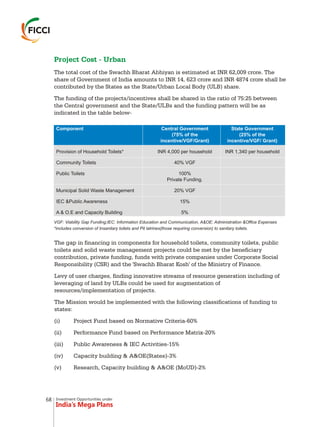
India’s Mega Plans
March 2015
Investment Opportunities under
India’s Mega Plans
March 2015
Investment Opportunities under
India’s Mega Plans
Contents
Current State of the Indian Economy 01
Major Policy Reforms by the GoI 05
Make in India Campaign 12
Automobiles 17
Automobile Components 18
Aviation 19
Biotechnology 21
Chemicals 23
Construction 24
Defence Manufacturing 25
Electrical Machinery 26
Electronic System 27
Food Processing 28
IT and BPM 29
Leather 30
Media and Entertainment 31
Mining 32
Oil and Gas 33
Pharmaceuticals 35
Ports 37
Railways 39
Renewable Energy 41
Roads and Highways 42
Space 43
Initiated
Textiles and Garments 44
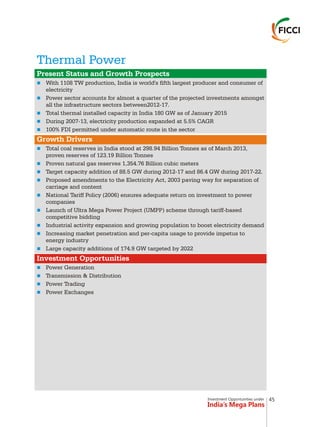
Thermal Power 45
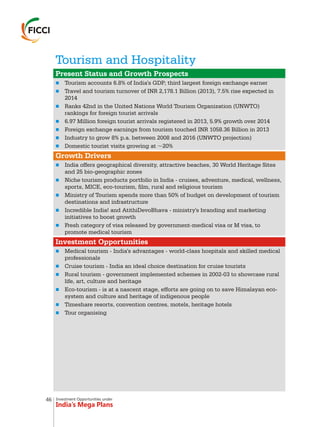
Tourism and Hospitality 46
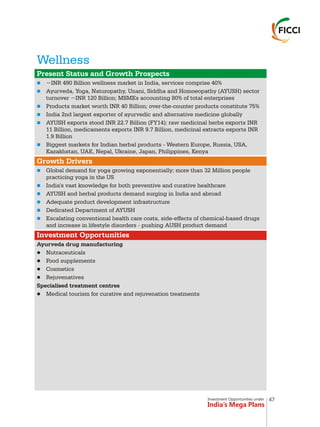
Wellness 47
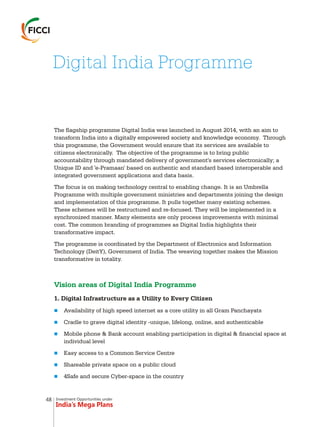
Digital India Programme 48
Smart Cities Project 54
Skill India Programme 59
Swachh Bharat Abhiyan 66
Clean Ganga Mission 70
Possible Areas for Indo-UK Cooperation 75
Contents
Investment Opportunities under
India’s Mega Plans
Current State of the
Indian Economy
Signs of optimism on the anvil…
Key macro economic parameters: broad trend reflects recovery
n
n
n
n
n
The current prognosis with regard to India's economic prospects is certainly more
optimistic when compared to the situation a year ago. Some of the predominant
risk factors - on account of fiscal deficit, current account deficit and high inflation -
stand alleviated to a great extent. The latest GDP numbers have been
encouraging and the overall macro-economic situation is by and large stable
supported by the confidence being lent by a strong and progressive government
at the Centre.
Since it has assumed office, the new government has attempted to give a clear
direction on reforms with an emphasis on long-term socio economic development.
In addition, assuring a conducive environment for businesses remains a key
priority for the government. Some of the announcements made to address critical
and long pending policy reforms in areas such as labor, taxation, and
infrastructure have been very encouraging.
In addition, the recently announced Union Budget 2015-16 was a balanced one
and laid down the roadmap for taking India to double digit growth trajectory. The
Budget not only indicated a clear direction in which the economy is going to be
steered but also the key milestones that we need to cross on the way. The Budget
announced several positives not just for the industry but for every section of
society.
The budget also indicated clear national targets being set for the year 2022 that
would mark 75 years of India's independence. Thus the announcements made by
the government both in the budget as well as outside of it provide for a concerted
effort to move towards these socio-economic targets.
Gross Domestic Product
According to the latest data, GDP at market prices is expected to grow at 7.4% in
the fiscal year 2014-15, vis-à-vis 6.9% growth in 2013-14. This estimate is based on
Investment Opportunities under
India’s Mega Plans
01
Investment Opportunities under
India’s Mega Plans
the new methodology adopted for computing India's GDP which has now been
aligned with internationally accepted system of national accounts.
Agriculture sector output is expected to witness a growth of 1.1% in 2014-15, vis-à-
vis 3.7% growth recorded in 2013-14. The slowdown in the sector's growth can be
attributed to the deficiency in the monsoon rainfall during the year. The industry
and the services sector are estimated to grow by 5.9% and 10.6% respectively in
2014-15.
Economic Survey 2014-15 projects GDP growth at market prices to be in range of
8.1% to 8.5% in the fiscal year 2015-16. Lower oil prices, monetary easing with
softening in price levels and forecasts of normal monsoon is likely to give a boost
to growth.
Inflation
Inflation numbers have significantly improved over the past few months. In fact,
the latest data point for Wholesale Price Index (WPI) reported negative 0.4%
inflation rate for January 2015. This decline comes at the back of fall in prices of
fuel and manufactured goods. However, food prices continued to remain elevated.
Further, Consumer Price Inflation rate which is the new anchor for monetary policy
was reported at 5.1% in January 2015. This is in sync with Reserve Bank's
indicative trajectory, which had targeted achieving 8.0% inflation by January 2015
and 6.0% inflation by January 2016.
With subdued global commodity prices and a stable exchange rate, overall
inflation is expected to remain benign going ahead.
Current Account Deficit
There are no significant upside risks to our external position at present and the
current account deficit is expected to remain range bound this fiscal year. In fact,
CAD to GDP ratio for Q1 2014-15 has been reported at 1.7% and at 2.1% in Q2 2014-
15. For the whole fiscal year CAD to GDP ratio is expected to be around 2.0%.
Crude oil, which is a major import item for India, has seen a visible softening in
prices. The country's trade deficit touched eleven month low of USD 8.3 billion in
January 2015, a 12.0 percent decline on a year-on-year basis. The narrowing of
trade deficit in January 2015 was led by a sharper decline in both imports than
exports.
Exports in the month of January 2015 plunged by 11.2 percent, its second
consecutive decline reflecting that external demand is yet to pick up. This is the
sharpest fall witnessed in about two and half years. Imports also fell by 11.4
percent in January 2015, following a 5.1 percent decline in December 2014.
Imports of oil fell by 37.5 percent, whereas non-oil imports grew by 3.4 percent in
January 2015.
n
n
n
n
n
n
n
n
02
Investment Opportunities under
India’s Mega Plans
n
n
n
n
n
n
n
Regular policy interventions are required for curbing imports of indigenously
available resources (coal) and economizing imports of oil through conservation
plans and push to domestic production of items like capital goods and electronics
to improve our trade balance over the long term. Moreover, exports revival should
be given a thrust.
Foreign Investment Inflows
Over the cumulative period April-December 2014, total foreign investment flows
increased by more than four times to USD 52.7 billion when compared to the same
period previous year. During the period April-December 2014 foreign direct
investment (net) were at USD 24.2 billion vis-à-vis USD 20.6 billion during the
corresponding period previous year. Portfolio investments (net) over the same
period amounted to USD 28.4 billion as against (-) USD 4.4 billion in Apr-Dec 2013.
Fiscal Deficit
The fiscal deficit target for the year 2014-15 has been maintained (at 4.1%) and the
fiscal deficit to GDP ratio for 2015-16 has been pegged at 3.9%. The government is
committed towards moving back on the path of fiscal consolidation. Even though
the target of achieving 3.0% deficit to GDP ratio has been rolled over by another
year - now to be achieved by 2017-18; the additional fiscal space created is being
utilized to give a thrust to public investments in the infrastructure sector.
The government is making an earnest effort to ensure fiscal prudence by bringing
greater efficacy in the expenditure management system and pruning down
unnecessary expenses.
The manufacturing sector growth has been a persistent worry and has remained
volatile for more than two years now. Manufacturing sector, which has a
weightage of 75% in the IIP index, registered a growth of 3.9% in the first quarter
of this fiscal year. However, the growth in sector, once again slipped to 0.4% in Q2
2014-15 and (-) 0.8% in Q3 2014-15.
The domestic capex cycle remains lackadaisical and is yet to show any firm signs
of turn around. The growth in the capital goods segment was reported at double
digit level of 13.6% in Q1 2014-15. However despite initial signs of recovery, the
growth in the capital goods segment fell to (-) 0.5% in Q2 2014-15 before
marginally improving to 2.5% in Q3 2014-15.
The companies are yet to come out full throttle as far as undertaking fresh
investments is concerned. The demand situation has been subdued and the
capacity utilization levels across sectors have not changed much over last six
months.
Major downside risk…manufacturing sector growth
03
Investment Opportunities under
India’s Mega Plans
The path ahead…
nThe government is conscious that pushing investments will be imperative to move
towards a sustainable growth path and is definitely taking measures to support
the domestic capex cycle. However, it remains extremely critical that government
lays emphasis on implementation of the policy measures announced and creates
conditions for a sustained pick-up in demand in the economy.
04
Investment Opportunities under
India’s Mega Plans
Ease of doing business
Measures have been taken to cut down red tape, and to lay down the red carpet,
diminish human interface and make the system efficient with technology. There has
been considerable action on administrative and procedural reforms which will provide
comfort for setting of new business and improve confidence of all investors. With
simplified procedures and rules, industry will save much time and costs which will
also improve competitiveness. Some of the key administrative reforms that have been
introduced include:
A. Bureaucratic overhaul for effective decision making
More centralized decision making with PMO playing bigger role
Decision making process restricted to four layers (no files will be signed by
more than 4 officials)
Two week deadline to answer queries
7-slide presentations by bureaucrats to Ministers in place of lengthy
reports
Self-certification of documents
B. Simplification of procedures
reduction in regulatory compliance returns
relaxation of environmental clearances
no inspection to be undertaken without requisite approval
Self-certification and Third Party Certification for Boilers Act
De-licensing of many defence products
extended the 24x7 customs clearance facility to 13 more airports and 14
more sea- ports
n
n
n
n
n
n
n
n
n
n
n
Major Policy Reforms
Initiated by the GoI
05
Investment Opportunities under
India’s Mega Plans
C. Digitisation for e-governance (through e-Biz and Digital India)
Online application for Industrial Licensing introduced with 24*7 basis
accessibility
Introduction of online returns for business through a single form
Online tracking of environmental and forest clearances
All registers required to be maintained by the business to be replaced with
a single electronic register
Goods and Services Tax
The new Government has acknowledged that the introduction of a Goods and
Services Tax (GST) will streamline tax administration, avoid harassment of the
business and result in higher revenue collection for the Centre and the States.
Government has tabled the Constitution Amendment Bill on GST in the Parliament.
In the Union Budget for 2015-16, the government has reiterated that GST
operational will be madeoperational from 1st April, 2016.
Direction of Tax Reforms - allowing for ease of doing business
Government has given a commitment in the Parliament that it will not ordinarily
bring about any change retrospectively which creates a fresh liability. As regards
the tax cases which have come up in various courts and other legal fora, these are
at different stages of pendency and will be allowed to reach their logical
conclusion.
Government has also conveyed to the Parliament that it is committed to provide a
stable and predictable taxation regime that would be investor friendly and spur
growth.
The Government has announced several measures for reform in the tax
administration as a part of Union Budget 2015-16 presented in the Parliament in
the last week of February 2015.
The composite cap of foreign exchange in defence manufacturing as well as
insurance sector has been raised to 49% with full Indian management and control
through the FIPB route.
n
n
n
n
n
n
n
n
n
n
Taxation
Foreign Direct Investment
06
Investment Opportunities under
India’s Mega Plans
n
n
n
n
n
n
The revision of cap in the defence sector will enable setting up of a robust Defence
Industrial Base (DIB) - allowing for indigenously designed & manufactured
Defence & Aerospace products customised to the needs of Indian armed forces,
while creating employment opportunities in the country. This will pave way for
indigenous production of certain high technology products such as aircraft
engines, advanced missile guidance systems, seekers, production of smart
materials, high strength carbon fibre etc. In fact, companies are undertaking joint
ventures with their international counterparts and a spurt in domestic
manufacturing is on the anvil.
Further, the cabinet's approval in raising the FDI limit in the insurance sector will
provide the capital starved sector access to foreign capital. At present millions of
Indians are under-insured. The move is expected to improve life and health
insurance coverage and provide long term savings vehicles.
There has been a relaxation of FDI norms for the construction sector, to encourage
development of Smart Cities.
Further, manufacturing units (with FDI) will now be allowed to sell products
through retail including e-commerce platforms.
The Central government has proposed amendments to Factories Act,
Apprenticeship Act and Labour Laws (Exemption from Furnishing Returns and
Maintaining Registers by Certain Establishment) Act. Of these, the Apprenticeship
Amendment Bill has been passed by both the houses, while the other two have
been passed only in the Lok Sabha.
Some of the salient features of the amendments proposed by Government include:
l500 new trades to be included in the Apprenticeship Act.This will give a boost
to skill development initiative of the government.
lCompanies employing less than 40 workers need not comply with some of the
stringent labour regulations
lRemoval of restriction on women working night shift (useful for textiles and IT)
lOvertime limit increased to 100 hours from 50 hours earlier - this will provide
greater flexibility to employers
Labour ministry has introduced a web portal where enterprises can file their
compliance returns for 16 of the 44 central labour laws in the country. The Labour
Ministry has also come up with a single return format for the 16 labour laws.
Labour reforms
07
Investment Opportunities under
India’s Mega Plans
Fiscal measures
Mitigating food inflation and raising agri-productivity
n
n
n
n
n
n
n
n
The government has set up an Expenditure Management Commission headed by
Dr.BimalJalan to look into expenditure reforms. The Commission has submitted an
initial report to the government, providing a roadmap for rationalization of
subsidies.
The government has plans to revamp the Mahatma Gandhi National Rural
Employment Guarantee Act (MGNREGA) and make it more productive by linking it
to agriculture activity and rural development.
The government recently deregulated diesel prices and formalized a price formula
for domestic natural gas, which was a much awaited move. This is expected to
ease the government's huge subsidy burden.
Various measures have been adopted by the government to mitigate inflation viz.
outlined contingency plans for 500 districts; crack down on hoarders, imposition of
minimum export price on onions and potatoes, line of credit for import of pulses &
edible oil and advisory to states to delist fruits and vegetables from APMC Act.
Also, in the Union Budget the government announced creation of a Price
Stabilisation Fund to mitigate farmers' woes due to price volatility.
In the recent Union Budget, the government has announced creation of a Unified
National Agriculture Market, which will help in reining food inflation.
The Government has decided to set up a High Level Committee (HLC) of
distinguished persons and experts to recommend restructuring of FCI after
considering various aspects of present structure and functional areas of the
organization and consulting various stakeholders.
A series of steps were announced in the budget such as introduction of soil health
cards, setting up of agri-tech infrastructure fund, launch of a technology driven
second green revolution including 'protein revolution' and greater focus on
irrigation. All these measures will help in improving agri-productivity and provide
a permanent solution to the issue of food security.
The government has also planned to create a food road map to identify food
clusters across the country. This will aid in identifying the strengths in terms of
crop strength, production, processing and also help the ministry to ensure the
desired intervention to expand the food export market.
08
Investment Opportunities under
India’s Mega Plans
Financial reforms
n
n
n
To meet the requirement of banks to raise equity in lines with Basel III norms by
2018, the government has allowed public sector banks to raise capital by
increasing the shareholding of the people in a phased manner.
The government has launched financial inclusion scheme called 'Pradhan Mantri
Jan-DhanYojana' (PMJDY), envisaged as a combination of savings, loans and
insurance products. The scheme launch was hugely successful with over 1.8 crore
bank accounts being opened on the first day. Linking financial literacy and direct
cash transfer with this program is expected to increase awareness, induce demand
and ensure sustainability of the model. Till February 2015, 136.8 million bank
accounts have been opened under PMJDY.
Several new initiatives have been introduced in the latest Union Budget, including
the move towards a social security system, setting up of Bank Board Bureau,
Monetary policy Committee, etc. These are detailed briefly in the following section
providing key highlights of the Union Budget 2015-16.
Key Highlights of the Union Budget 2015-16
n
n
n
The broad highlights of the Union Budget 2015-16 are as under-
Unified National Agriculture Market: The Government has announced
creation of a Unified National Agriculture Market. Move towards a single
national market for agri-produce will help rein in the inflationary pressure in
case of food commodities as well as provide better prices to farmers for their
produce.
Make in India: There has been a reduction in rates of basic customs duty on
certain inputs, raw materials, intermediates and components (in all 22 items)
to minimize the impact of duty inversion and reduce manufacturing cost in
several sectors. Government has allowed complete tax pass through for both
category 1 and category 2 Alternative Investment Funds. The latter action will
help mobilize higher resources for investments in manufacturing sector.
Infrastructure: The Government announced an additional Rs. 70,000 crore
spend on the infrastructure sector. This is expected to provide a huge impetus
to overall growth and should help encourage private sector investments in due
course. The setting of the National Investment and Infrastructure Fund in the
form of a trust to raise debt funding in various forms and in turn invest as
equity in infrastructure finance companies is a welcome move. This would be
an additional avenue to support infrastructure financing and hopefully lessen
some of the pressure on the public sector banking system. Further, the
09
Investment Opportunities under
India’s Mega Plans
clarification on tax related matters on REITs and InvITs, which are the key
instruments announced in the last budget for channeling funds into the real
estate and infrastructure sectors, is also welcome.
In addition to the above, tax-free infrastructure bonds for rail, road and
irrigation projects were reintroduced. Government has also indicated adoption
of 'Plug and play' approach in case of UMPPs, plan for corporatization of ports
and steps towards revitalizing Public Private Partnerships.
Micro Small and Medium Enterprise (MSMEs): An electronic trade receivables
discounting system (TReDS) has been established to tackle the problem of long
receivables realization cycle of the MSMEs. The related move of setting up of
the Micro Units Development Refinance Agency (MUDRA) bank will help meet
the funding requirements of micro enterprises in the informal sector and
provide a boost to entrepreneurship.
In addition, establishment of a Self Employment and Talent Utilization (SETU)
mechanism was announced to support start up businesses and other self
employment activities.
Gold Monetization: The Budget for the first time has announced several
measures to monetize gold. FICCI had recently submitted a report on this
subject and some of the suggestions contained therein such as developing an
Indian Gold Coin, having a Sovereign Gold Bond and revamping the Gold
Deposit and Gold Metal Loans scheme have been taken up by the government.
These measures should help in more effective utilization of domestic gold
reserves through recycling and thus help reduce the imports of gold that have
put pressure on the current account in the past.
Black Money: The Government announced introduction of a new
comprehensive law on black money held abroad in the current session of the
Parliament along with a new and more comprehensive benami transactions
(prohibition) bill to curb domestic black money. The issue of black money has
been a grave concern for the Indian economy. The existing legal and
administrative framework has been ineffective in dealing with this issue and
thus there is an urgent need to put in place an efficient legal framework.
Corporate Bond market: The Government announced to set up a Public Debt
Management Agency. This is important in the context of deepening the Indian
bond market. This will help in reducing over dependence on banks for long
term funding.
Bank Board Bureau: The Government plans to set up a Bank Board Bureau
with the objective of improving governance of Public Sector Banks. The Bureau
will pick heads of Public Sector banks and help them device differentiated
strategies and capital raising plans through innovative financial methods and
instruments.
Monetary Policy Framework: The Budget announced that the RBI Act will be
n
n
n
n
n
n
n
n
10
Investment Opportunities under
India’s Mega Plans
amended this year to provide for a Monetary Policy Committee. The Monetary
Policy Committee will be set up to reinforce the partnership between the
government and the Central Bank with the objective of managing inflation
dynamics.
'Act East' policy: The Budget announced setting up of a Project Development
Company, which through separate Special Purpose Vehicles (SPVs) will
facilitate establishment of manufacturing hubs in CLMV countries -Cambodia,
Laos, Myanmar, and Vietnam. This is to drive the interest of Indian private
sector to undertake investments in these countries and deepen economic and
strategic relations with the South East Asian region.
Ease of Doing Business: Assuring ease of doing business has been a key
priority for the Government. Some of the announcements in the Budget towards
improving the business environment included -
lSetting up commercial divisions in various courts: The Government has
proposed to set up exclusive commercial divisions in various courts in India
based on the recommendations of the 253rd Report of the Law Commission.
In this regard, the Government has proposed to introduce a Bill in the
Parliament after consulting stakeholders. This would help curtail the
overstretched litigation and ensure speedy disposal of monetary suits at
reasonable cost to the litigant. This is definitely a stepping-stone to reform
the civil justice system in India.
lBankruptcy Code: The budget announced introduction of the much needed
comprehensive bankruptcy code in the fiscal year 2015-16. This will bring
about legal certainty and speed and is an important measure in improving
the ease of doing business in India.
lProcurement Law: Malfeasance in public procurement can be contained by
having a procurement law and an institutional structure consistent with the
UNCITRAL model. This would help contain possible avenues of B2G
corruption and along with an effective Prevention of Corruption Act, act as
a deterrent. We hope that the Parliament will soon take a view on it.
lExpert Committee on regulatory mechanism: The government indicated
that it intends to appoint an Expert Committee to examine the possibility
and prepare draft legislation where the need for multiple prior permissions
can be replaced with a pre-existing regulatory mechanism.Implementation
of such a mechanism would cut down time and cost spent for seeking
regulatory approvals and will be a big boost to ease of doing business in
India and establishing India as an Investment Destination.
National targets for the year 2022: The government reiterated its resolve to
provide for basic amenities to all Indian citizens especially the underprivileged
by the year 2022, which marks 75 years of India's independence. These include
housing for all, assured water and power supply, substantial reduction in
poverty, provision of medical services and education facilities.
n
n
n
11
Investment Opportunities under
India’s Mega Plans
With a vision to develop India as a global manufacturing hub, Honourable Prime
Minister of India Shri Narendra Modi unveiled 'Make in India' campaign in September
this year. The programme aims to create a robust manufacturing sector by facilitating
investment, fostering innovation, protecting intellectual property, and building best-
in-class manufacturing infrastructure.
The manufacturing sector assumes great importance for the Indian economy as it
contributes close to 15% of the country's GDP and provides employment to around 12%
of its total work force or about 6 million people. Over the years, India has emerged as a
prominent global manufacturing player and is the 9th largest manufacturing nation
presently. It is a leading producer of some of the key manufactured products such as
textiles, chemicals, pharmaceuticals, basic metals, general machinery and equipment,
and electrical machinery. India exports manufactured products worth about USD 50
billion to different parts of the world. The 2013 Global Manufacturing Competitiveness
Index (GMCI) developed by Deloitte has ranked India the fourth most competitive
manufacturing nation among the 38 nations considered for ranking.
The sector has immense growth potential and has been a priority of the Indian
government. The National Manufacturing Policy (NMP) announced in year 2011 has
charted out some ambitious plans for the sector. It has proposed to drive the sector's
growth to 12-14% in the medium term, raise the sector's contribution in national GDP
to 25%, and thereby create additional employment opportunity for 100 million people
by year 2022. The NMP further plans to attain inclusive growth by imparting
appropriate skill sets among the underprivileged unskilled rural and urban work force,
increase domestic value addition, enhance technological depth in manufacturing, and
make the sector globally competitive.
Through the Make in India campaign, the government has shown its commitment
towards achieving these important goals and convert India's manufacturing sector
into the engine of growth of the economy. It has announced several measures to
improve the business environment in the country which will further strengthen India's
position as an attractive investment destination. New processes have been
introduced to cut down bureaucracy, reduce human interface and enhance ease of
doing business in India.
New Initiatives
Make in India Campaign
12
Investment Opportunities under
India’s Mega Plans
With a view to project India as a promising country for investment and as a strong
business partner, the Department of Industrial Policy and Promotion (DIPP),
Government of India has created a special team - Invest India, in association with
FICCI, to attend to all investment queries and for providing handholding and liasoning
services to domestic and global investors. The cell, launched as part of the Make in
India campaign, has received over 3000 facilitation requests since the launch.
New Processes
New de-licensing and deregulation measures have been announced to ensure
reduction in complexity across all processes in obtaining clearances for starting and
running businesses by following a transparent and efficient system. Some of these
measures include:
The process of applying for Industrial License (IL) and Industrial Entrepreneur
Memorandum (IEM) has been made online on 24×7 basis through eBiz, a single
window IT platform. Further, services of all Central Government Departments &
Ministries are to be integrated with the eBiz portal by 31st December, 2014.
Process of obtaining environmental clearances has also been made online.
The Defence products' list for industrial licensing now excludes a large number of
parts/components, castings/forgings etc. from the purview of industrial licensing;
Similarly dual use items, having military as well as civilian applications (unless
classified as defence item) have also been excluded from the list.
Initial validity period of Industrial License has been increased to three years from
two years earlier.
A maximum timeline of 12 weeks has been finalised for grant of security clearance
on Industrial Licence Applications.
All returns to be filed on-line through a unified form
A check-list of required compliances to be placed on Ministry's/Department's web
portal.
All registers required to be maintained by the business to be replaced with a
single electronic register
No inspection to be undertaken without the approval of the Head of the
Department
For all non-risk, non-hazardous businesses a system of self-certification to be
introduced.
In case of labour, major amendments have been proposed under various Acts and
at the same time Government has announced introduction of a transparent Labour
Inspection Scheme for random selection of units for inspection which would end
undue harassment of the "Inspector Raj," while ensuring better compliance.
n
n
n
n
n
n
n
n
n
n
n
13
Investment Opportunities under
India’s Mega Plans
Besides, the government is actively working on other priority areas like introduction of
Goods and Services Tax (GST) to streamline tax administration, easing land
acquisition process, simplifying number of business related compliances and
procedures, etc. which will further make business operations easier in the country.
Foreign Direct Investment (FDI) limit has also been revised in some of the sectors in
the recent past to stimulate investment. The composite cap of foreign exchange in
defence manufacturing as well as insurance sector has been raised to 49% with full
Indian management and control through the FIPB route. The revision of cap in the
defence sector will enable setting up of a robust Defence Industrial Base (DIB) -
allowing for indigenously designed & manufactured Defence & Aerospace products
customised to the needs of Indian armed forces, while creating employment
opportunities in the country. There has been a relaxation of FDI norms for the
construction sector as well, to encourage development of Smart Cities.
New Infrastructure
Improvement of the manufacturing infrastructure has also been a key focus area for
the government. In order to boost manufacturing growth, creation of Industrial
Corridors by integrating infrastructure and industry has been envisaged. The USD 90
billion Delhi-Mumbai Industrial Corridor (DMIC), which is being developed by the
Indian government in partnership and collaboration with the Government of Japan, is
one such major project which was announced in year 2006. Under this project, the
government is developing Industrial Corridors along the high capacity western
Dedicated Freight Corridor (DFC) between Delhi and Mumbai, covering an overall
length of 1483km, passing through the States of Uttar Pradesh, NCR of Delhi, Haryana,
Rajasthan, Gujarat and Maharashtra.
The objective of the project is to create strong economic base in this band with
globally competitive environment and state-of-the-art infrastructure to activate local
commerce, enhance foreign investments and attain sustainable development.
Development of requisite feeder rail/road connectivity to hinterland/markets and
select ports along the western coast also forms a part of DMIC. Further, the project
proposes to develop new industrial cities as "Smart Cities" and converge next
generation technologies across infrastructure sectors. Infrastructure linkages like
power plants, assured water supply, high capacity transportation and logistics
facilities as well as softer interventions like skill development programme for
employment of the local populace are included in the project.
Twenty four manufacturing cities are envisaged in the perspective plan of the DMIC
project. In the first phase, seven cities are being developed, one each in the states of
Uttar Pradesh, Haryana, Rajasthan, Madhya Pradesh and Gujarat and two in
Maharashtra. The manufacturing cities will provide international and domestic
investors with a diverse set of vast investment opportunities. The initial phase of the
new cities is expected to be completed by 2019.
The government has also conceptualised four other corridors which are Bengaluru-
Mumbai Economic Corridor (BMEC); Amritsar-Kolkata Industrial Development
Corridor (AKIC); Chennai-Bengaluru Industrial Corridor (CBIC), and East Coast
14
Investment Opportunities under
India’s Mega Plans
Economic Corridor (ECEC) with Chennai Vizag Industrial Corridor as the first phase of
the project (CVIC). A new 'National Industrial Corridor Development Authority' has
been created to coordinate, integrate, monitor and supervise development of these
Industrial Corridors. Work on the following corridors is underway:
Delhi-Mumbai Industrial Corridor: Work on 5 smart cities is in progress namely
Dholera, Shendra-Bidkin, Greater Noida, Ujjain and Gurgaon.
Chennai-Bengaluru Industrial Corridor: Master planning for 3 new Industrial
Nodes [Ponneri (TN), Krishnapatnam (AP), Tumkur (Karnataka)] is under progress.
The East Coast Economic Corridor (ECEC) with Chennai-Vizag Industrial Corridor:
Feasibility Study has been commissioned by Asian Development Bank.
Amritsar-Kolkata Industrial Corridor: Delhi-Mumbai Industrial Corridor
Development Corporation Limited (DMICDC) which is selected as the Nodal
Agency is conducting the feasibility study.
North-eastern part of India is planned to be linked with other Industrial Corridors
in cooperation with government of Japan.
New Industrial Clusters will be developed for promoting advance practices in
manufacturing.
21 Industrial projects have been approval under Modified Industrial Infrastructure
Upgradation Scheme with an emphasis on:
Use of recycled water through zero liquid discharging systems.
Central Effluent Treatment plants.
17 National Investment and Manufacturing zones have been approved
n
n
n
n
n
n
n
n
n
n
Bengaluru-
Mumbai
Economic
Corridor
(BMEC)
Chennai-
Bengaluru
Industrial
Corridor
(CBIC)
East Coast
Industrial
Corridor
(ECEC)
Amritsar-
Delhi-Kolkata
Insdustrial
Corridor
(AKIC)
Delhi-Mumbai
Industrial
Corridor
(DMIC)
Industrial
Corridors
15
Investment Opportunities under
India’s Mega Plans
Driving Innovation
Skill Development
Sectors for Development
To encourage innovation, the government has announced the following measures to
strengthen the intellectual property regime in the country:
Creation of 1,033 posts.
Further upgradation of IT facilities.
Compliance with global standards.
Application processes made online.
The National Institute of Design (NID), Ahmedabad, has been notified as an institute
of National Importance, and four similar NIDs will be developed in future.
Major impetus has been given to skill development through Indian Leather
Development Programme:
Training imparted to 51,216 youth in the last 100 days.
It is further planned to train 1, 44, 000 youth annually.
For augmentation of training infrastructure, funds released for establishment of 4
new branches of Footwear Design & Development Institute at Hyderabad, Patna,
Banur (Punjab) and Ankleshwar (Gujarat).
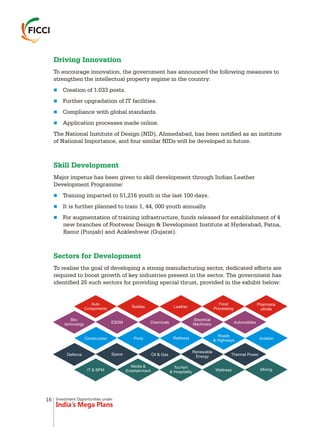
To realise the goal of developing a strong manufacturing sector, dedicated efforts are
required to boost growth of key industries present in the sector. The government has
identified 25 such sectors for providing special thrust, provided in the exhibit below:
n
n
n
n
n
n
n
Auto
Components Textiles
ESDM Chemicals
Leather
Electrical
Machinery
Food
Processing
Pharmace
uticals
Automobiles
Aviation
Roads
& Highways
Thermal Power
Renewable
Energy
Wellness Mining
Tourism
& Hospitality
Oil & Gas
RailwaysPorts
Space
IT & BPM
Defence
Construction
Bio-
technology
Media &
Entertainment
16
Investment Opportunities under
India’s Mega Plans
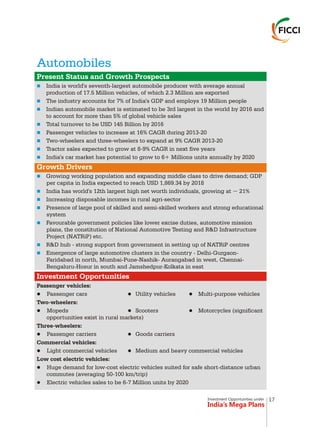
Automobiles
n
n
n
n
n
n
n
n
n
n
n
n
n
n
n
Present Status and Growth Prospects
Growth Drivers
Investment Opportunities
India is world's seventh-largest automobile producer with average annual
production of 17.5 Million vehicles, of which 2.3 Million are exported
The industry accounts for 7% of India's GDP and employs 19 Million people
Indian automobile market is estimated to be 3rd largest in the world by 2016 and
to account for more than 5% of global vehicle sales
Total turnover to be USD 145 Billion by 2016
Passenger vehicles to increase at 16% CAGR during 2013-20
Two-wheelers and three-wheelers to expand at 9% CAGR 2013-20
Tractor sales expected to grow at 8-9% CAGR in next five years
India's car market has potential to grow to 6+ Millions units annually by 2020
Growing working population and expanding middle class to drive demand; GDP
per capita in India expected to reach USD 1,869.34 by 2018
India has world's 12th largest high net worth individuals, growing at ~ 21%
Increasing disposable incomes in rural agri-sector
Presence of large pool of skilled and semi-skilled workers and strong educational
system
Favourable government policies like lower excise duties, automotive mission
plans, the constitution of National Automotive Testing and R&D Infrastructure
Project (NATRiP) etc.
R&D hub - strong support from government in setting up of NATRiP centres
Emergence of large automotive clusters in the country - Delhi-Gurgaon-
Faridabad in north, Mumbai-Pune-Nashik- Aurangabad in west, Chennai-
Bengaluru-Hosur in south and Jamshedpur-Kolkata in east
Passenger vehicles:
lPassenger cars lUtility vehicles lMulti-purpose vehicles
Two-wheelers:
lMopeds lScooters lMotorcycles (significant
opportunities exist in rural markets)
Three-wheelers:
lPassenger carriers lGoods carriers
Commercial vehicles:
lLight commercial vehicles lMedium and heavy commercial vehicles
Low cost electric vehicles:
lHuge demand for low-cost electric vehicles suited for safe short-distance urban
commutes (averaging 50-100 km/trip)
lElectric vehicles sales to be 6-7 Million units by 2020
17
Investment Opportunities under
India’s Mega Plans
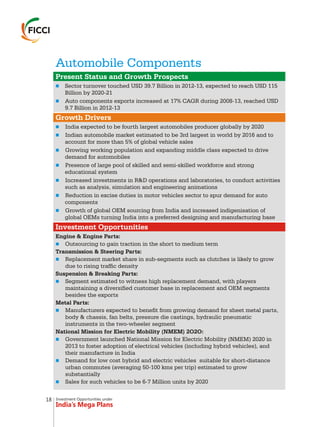
Automobile Components
n
n
n
n
n
n
n
n
n
n
n
n
n
n
n
n
Present Status and Growth Prospects
Growth Drivers
Investment Opportunities
Sector turnover touched USD 39.7 Billion in 2012-13, expected to reach USD 115
Billion by 2020-21
Auto components exports increased at 17% CAGR during 2008-13, reached USD
9.7 Billion in 2012-13
India expected to be fourth largest automobiles producer globally by 2020
Indian automobile market estimated to be 3rd largest in world by 2016 and to
account for more than 5% of global vehicle sales
Growing working population and expanding middle class expected to drive
demand for automobiles
Presence of large pool of skilled and semi-skilled workforce and strong
educational system
Increased investments in R&D operations and laboratories, to conduct activities
such as analysis, simulation and engineering animations
Reduction in excise duties in motor vehicles sector to spur demand for auto
components
Growth of global OEM sourcing from India and increased indigenisation of
global OEMs turning India into a preferred designing and manufacturing base
Engine & Engine Parts:
Outsourcing to gain traction in the short to medium term
Transmission & Steering Parts:
Replacement market share in sub-segments such as clutches is likely to grow
due to rising traffic density
Suspension & Breaking Parts:
Segment estimated to witness high replacement demand, with players
maintaining a diversified customer base in replacement and OEM segments
besides the exports
Metal Parts:
Manufacturers expected to benefit from growing demand for sheet metal parts,
body & chassis, fan belts, pressure die castings, hydraulic pneumatic
instruments in the two-wheeler segment
National Mission for Electric Mobility (NMEM) 2O2O:
Government launched National Mission for Electric Mobility (NMEM) 2020 in
2013 to foster adoption of electrical vehicles (including hybrid vehicles), and
their manufacture in India
Demand for low cost hybrid and electric vehicles suitable for short-distance
urban commutes (averaging 50-100 kms per trip) estimated to grow
substantially
Sales for such vehicles to be 6-7 Million units by 2020
18
Investment Opportunities under
India’s Mega Plans
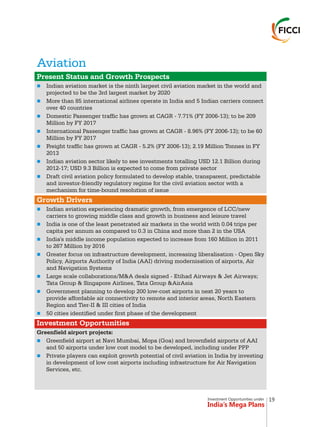
Aviation
n
n
n
n
n
n
n
n
n
n
n
n
n
n
n
n
Present Status and Growth Prospects
Growth Drivers
Investment Opportunities
Indian aviation market is the ninth largest civil aviation market in the world and
projected to be the 3rd largest market by 2020
More than 85 international airlines operate in India and 5 Indian carriers connect
over 40 countries
Domestic Passenger traffic has grown at CAGR - 7.71% (FY 2006-13); to be 209
Million by FY 2017
International Passenger traffic has grown at CAGR - 8.96% (FY 2006-13); to be 60
Million by FY 2017
Freight traffic has grown at CAGR - 5.2% (FY 2006-13); 2.19 Million Tonnes in FY
2013
Indian aviation sector likely to see investments totalling USD 12.1 Billion during
2012-17; USD 9.3 Billion is expected to come from private sector
Draft civil aviation policy formulated to develop stable, transparent, predictable
and investor-friendly regulatory regime for the civil aviation sector with a
mechanism for time-bound resolution of issue
Indian aviation experiencing dramatic growth, from emergence of LCC/new
carriers to growing middle class and growth in business and leisure travel
India is one of the least penetrated air markets in the world with 0.04 trips per
capita per annum as compared to 0.3 in China and more than 2 in the USA
India's middle income population expected to increase from 160 Million in 2011
to 267 Million by 2016
Greater focus on infrastructure development, increasing liberalisation - Open Sky
Policy, Airports Authority of India (AAI) driving modernisation of airports, Air
and Navigation Systems
Large scale collaborations/M&A deals signed - Etihad Airways & Jet Airways;
Tata Group & Singapore Airlines, Tata Group &AirAsia
Government planning to develop 200 low-cost airports in next 20 years to
provide affordable air connectivity to remote and interior areas, North Eastern
Region and Tier-II & III cities of India
50 cities identified under first phase of the development
Greenfield airport projects:
Greenfield airport at Navi Mumbai, Mopa (Goa) and brownfield airports of AAI
and 50 airports under low cost model to be developed, including under PPP
Private players can exploit growth potential of civil aviation in India by investing
in development of low cost airports including infrastructure for Air Navigation
Services, etc.
19
Investment Opportunities under
India’s Mega Plans
Airport Modernization projects:
Indian aerospace market offers long term opportunities for augmenting and
modernizing existing airports
AAI plans to spend USD 1.3 Billion on non-metro projects between 2013 and
2017, focusing on modernisation and upgradation of airports
MRO (maintenance, repair and overhaul) services:
Demand for MRO facilities increasing with growth in aviation
300 business jets, 300 small aircraft and 250 helicopters expected to be added to
current fleet in next 5 years
Airspace & air traffic management system:
Security & surveillance services
Ground handling services
Air cargo services
n
n
n
n
n
n
n
20
Investment Opportunities under
India’s Mega Plans
Biotechnology
n
n
n
n
n
n
n
n
n
n
n
n
n
n
n
n
n
Present Status and Growth Prospects
India is amongst top 12 biotech destinations in the world and ranks third in
Asia-Pacific region
Indian bio-economy grew to USD 4.3 Billion by end 2013, up from USD 530 Million
in 2003
Bio-pharma exports reached USD 2.2 Billion in 2013, accounting for 64% of
biotech industry revenues
Indian biotech industry to grow at average growth of 30% and reach USD 100
Billion by 2025
Market size of the sector expected to rise up to USD 11.6 Billion by 2017
Indian companies manufacture an increasingly wide range of
biopharmaceuticals
Vaccines are the fastest growing sector in Biopharmaceuticals industry. India is
the largest producer of recombinant Hepatitis B vaccine
The growth of the biotech sector is concentrated in relatively small number of
companies and biotech clusters.
India has potential to become major producer of transgenic rice and several
genetically modified (GM) or engineered vegetables
Growth Drivers
Increasing investments, outsourcing activities, exports and government's focus
on the sector to drive growth
Government aims to spend USD 3.7 Billion on biotechnology between 2012-17
India has strong pool of scientists and engineers
India offers cost-effective manufacturing capabilities
India has set up national research laboratories, centres of academic excellence in
biosciences, several medical colleges, educational and training institutes
offering degrees and diplomas in biotechnology, bio-informatics and biological
sciences
Rich Biodiversity: India's human gene pools offer an exciting opportunity for
genomics
Department of Biotechnology has been instrumental in providing impetus to the
sector. The department has forged creation of biotech parks/clusters in various
parts to facilitate product development, research and innovation, industry
partnerships and establishment of institutional infrastructure
Biotech parks offer investors incubator facilities, pilot plant facilities for solvent
extraction and laboratory and office spaces
21
Investment Opportunities under
India’s Mega Plans
Investment Opportunities
Biotech Products:
FDI investment upto 100% is permitted via the automatic route
lOutsourcing to India projected to spike up after discovery and manufacture of
formulations
lOutsourcing to lower cost economies results in cost arbitrage of more than 50%
for global players
lThe R&D sector has huge potential; many opportunities have been created with
a number of foreign companies investing in the sector
Generic products:
lIndia constitutes around 8% of total global generics market by volume, indicating
huge untapped opportunity in the sector
New Products:
lHybrid seeds - Genetically Modified seeds
22
Investment Opportunities under
India’s Mega Plans
Chemicals
n
n
n
n
n
n
n
n
n
n
n
n
n
n
n
Present Status and Growth Prospects
Growth Drivers
Investment Opportunities
India is third largest producer of chemicals in Asia and sixth by output, in the
world
Total production of Indian chemicals industry was 19,308 Thousand Metric
Tonnes in 2013-14
Chemicals industry accounts for 2.11% of the nation's GDP
Estimated size of the market is USD 144 Billion
Current production of polymers in India is around 9 Million Tonnes with imports of
around 2.8 Million Tonnes
India currently the world's third largest consumer of polymers and third largest
producer of agro-chemicals
Polymer demand expected to grow by 8-10%
Polymers and agro-chemicals industries in India present immense growth
opportunities
Large population, dependence on agriculture, and strong export demand are key
growth drivers for the industry
Global shift towards Asia as world's chemicals manufacturing hub
Per capita consumption of chemicals in India is lower as compared to western
countries
Rise in GDP and purchasing power generates huge growth potential for the
domestic market
Focus on new segments such as specialty and knowledge chemicals
Presence of enabling factors like low-cost manufacturing and pool of skilled
science professionals
World-class engineering and strong R&D capabilities4
Agro-Chemicals:
lIndia is third largest producer of agro-chemicals globally and exports about 50%
of the production.
lExports likely to remain a key component of the industry
Specialty Chemicals:
lSpecialty chemicals market witnessed 14% growth in last five years; market size
expected to reach USD 70 Billion by 2020
lGrowth in plastic demand to drive consumption of specialty chemicals in future
lImmense growth potential owing to growing construction industry and adoption
of advanced coating, ceiling and polymer-based reinforcing material in
construction as well as plastics, paints and coatings for the automotive sector
Colourant Chemicals:
lIndian colourant industry valued at USD 6.8 Billion, with exports accounting for
nearly 75%
lIndia accounts for 16% of global industry share, to increase further.
lOther segments include petrochemicals, bio-pharma, bio-agri, and bio-industrial
products
23
Investment Opportunities under
India’s Mega Plans
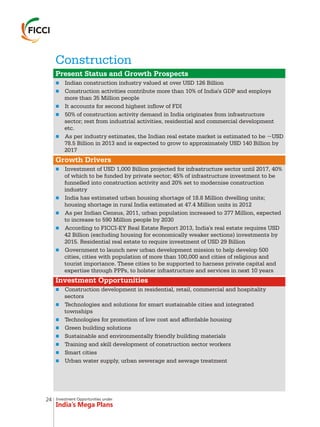
Construction
n
n
n
n
n
n
n
n
n
n
n
n
n
n
n
n
n
n
Present Status and Growth Prospects
Growth Drivers
Investment Opportunities
Indian construction industry valued at over USD 126 Billion
Construction activities contribute more than 10% of India's GDP and employs
more than 35 Million people
It accounts for second highest inflow of FDI
50% of construction activity demand in India originates from infrastructure
sector; rest from industrial activities, residential and commercial development
etc.
As per industry estimates, the Indian real estate market is estimated to be ~USD
78.5 Billion in 2013 and is expected to grow to approximately USD 140 Billion by
2017
Investment of USD 1,000 Billion projected for infrastructure sector until 2017, 40%
of which to be funded by private sector; 45% of infrastructure investment to be
funnelled into construction activity and 20% set to modernise construction
industry
India has estimated urban housing shortage of 18.8 Million dwelling units;
housing shortage in rural India estimated at 47.4 Million units in 2012
As per Indian Census, 2011, urban population increased to 377 Million, expected
to increase to 590 Million people by 2030
According to FICCI-EY Real Estate Report 2013, India's real estate requires USD
42 Billion (excluding housing for economically weaker sections) investments by
2015. Residential real estate to require investment of USD 29 Billion
Government to launch new urban development mission to help develop 500
cities, cities with population of more than 100,000 and cities of religious and
tourist importance. These cities to be supported to harness private capital and
expertise through PPPs, to holster infrastructure and services in next 10 years
Construction development in residential, retail, commercial and hospitality
sectors
Technologies and solutions for smart sustainable cities and integrated
townships
Technologies for promotion of low cost and affordable housing
Green building solutions
Sustainable and environmentally friendly building materials
Training and skill development of construction sector workers
Smart cities
Urban water supply, urban sewerage and sewage treatment
24
Investment Opportunities under
India’s Mega Plans
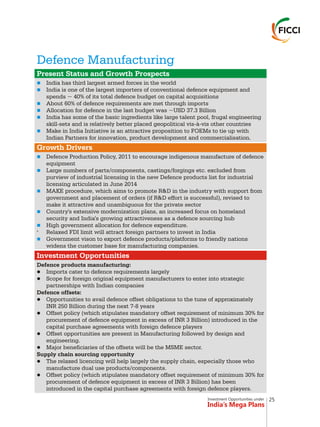
Defence Manufacturing
n
n
n
n
n
n
n
n
n
n
n
n
Present Status and Growth Prospects
Growth Drivers
Investment Opportunities
India has third largest armed forces in the world
India is one of the largest importers of conventional defence equipment and
spends ~ 40% of its total defence budget on capital acquisitions
About 60% of defence requirements are met through imports
Allocation for defence in the last budget was ~USD 37.3 Billion
India has some of the basic ingredients like large talent pool, frugal engineering
skill-sets and is relatively better placed geopolitical vis-à-vis other countries
Make in India Initiative is an attractive proposition to FOEMs to tie up with
Indian Partners for innovation, product development and commercialisation.
Defence Production Policy, 2011 to encourage indigenous manufacture of defence
equipment
Large numbers of parts/components, castings/forgings etc. excluded from
purview of industrial licensing in the new Defence products list for industrial
licensing articulated in June 2014
MAKE procedure, which aims to promote R&D in the industry with support from
government and placement of orders (if R&D effort is successful), revised to
make it attractive and unambiguous for the private sector
Country's extensive modernization plans, an increased focus on homeland
security and India's growing attractiveness as a defence sourcing hub
High government allocation for defence expenditure.
" Relaxed FDI limit will attract foreign partners to invest in India
Government vison to export defence products/platforms to friendly nations
widens the customer base for manufacturing companies.
Defence products manufacturing:
lImports cater to defence requirements largely
lScope for foreign original equipment manufacturers to enter into strategic
partnerships with Indian companies
Defence offsets:
lOpportunities to avail defence offset obligations to the tune of approximately
INR 250 Billion during the next 7-8 years
lOffset policy (which stipulates mandatory offset requirement of minimum 30% for
procurement of defence equipment in excess of INR 3 Billion) introduced in the
capital purchase agreements with foreign defence players
lOffset opportunities are present in Manufacturing followed by design and
engineering.
lMajor beneficiaries of the offsets will be the MSME sector.
Supply chain sourcing opportunity
lThe relaxed licencing will help largely the supply chain, especially those who
manufacture dual use products/components.
lOffset policy (which stipulates mandatory offset requirement of minimum 30% for
procurement of defence equipment in excess of INR 3 Billion) has been
introduced in the capital purchase agreements with foreign defence players.
25
Investment Opportunities under
India’s Mega Plans
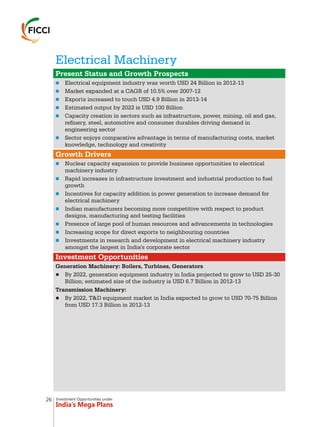
Electrical Machinery
n
n
n
n
n
n
n
n
n
n
n
n
n
Present Status and Growth Prospects
Growth Drivers
Investment Opportunities
Electrical equipment industry was worth USD 24 Billion in 2012-13
Market expanded at a CAGR of 10.5% over 2007-12
Exports increased to touch USD 4.9 Billion in 2013-14
Estimated output by 2022 is USD 100 Billion
Capacity creation in sectors such as infrastructure, power, mining, oil and gas,
refinery, steel, automotive and consumer durables driving demand in
engineering sector
Sector enjoys comparative advantage in terms of manufacturing costs, market
knowledge, technology and creativity
Nuclear capacity expansion to provide business opportunities to electrical
machinery industry
Rapid increases in infrastructure investment and industrial production to fuel
growth
Incentives for capacity addition in power generation to increase demand for
electrical machinery
Indian manufacturers becoming more competitive with respect to product
designs, manufacturing and testing facilities
Presence of large pool of human resources and advancements in technologies
Increasing scope for direct exports to neighbouring countries
Investments in research and development in electrical machinery industry
amongst the largest in India's corporate sector
Generation Machinery: Boilers, Turbines, Generators
lBy 2022, generation equipment industry in India projected to grow to USD 25-30
Billion; estimated size of the industry is USD 6.7 Billion in 2012-13
Transmission Machinery:
lBy 2022, T&D equipment market in India expected to grow to USD 70-75 Billion
from USD 17.3 Billion in 2012-13
26
Investment Opportunities under
India’s Mega Plans
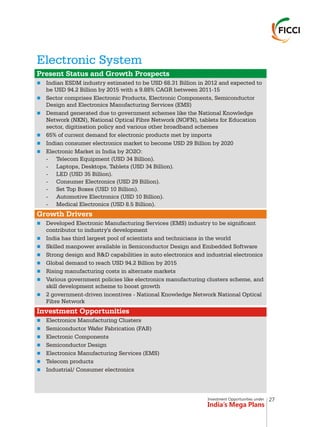
Electronic System
n
n
n
n
n
n
n
n
n
n
n
n
n
n
n
n
n
n
n
n
n
Present Status and Growth Prospects
Growth Drivers
Investment Opportunities
Indian ESDM industry estimated to be USD 68.31 Billion in 2012 and expected to
be USD 94.2 Billion by 2015 with a 9.88% CAGR between 2011-15
Sector comprises Electronic Products, Electronic Components, Semiconductor
Design and Electronics Manufacturing Services (EMS)
Demand generated due to government schemes like the National Knowledge
Network (NKN), National Optical Fibre Network (NOFN), tablets for Education
sector, digitisation policy and various other broadband schemes
65% of current demand for electronic products met by imports
Indian consumer electronics market to become USD 29 Billion by 2020
Electronic Market in India by 2O2O:
- Telecom Equipment (USD 34 Billion).
- Laptops, Desktops, Tablets (USD 34 Billion).
- LED (USD 35 Billion).
- Consumer Electronics (USD 29 Billion).
- Set Top Boxes (USD 10 Billion).
- Automotive Electronics (USD 10 Billion).
- Medical Electronics (USD 8.5 Billion).
Developed Electronic Manufacturing Services (EMS) industry to be significant
contributor to industry's development
India has third largest pool of scientists and technicians in the world
Skilled manpower available in Semiconductor Design and Embedded Software
Strong design and R&D capabilities in auto electronics and industrial electronics
Global demand to reach USD 94.2 Billion by 2015
Rising manufacturing costs in alternate markets
Various government policies like electronics manufacturing clusters scheme, and
skill development scheme to boost growth
2 government-driven incentives - National Knowledge Network National Optical
Fibre Network
Electronics Manufacturing Clusters
Semiconductor Wafer Fabrication (FAB)
Electronic Components
Semiconductor Design
Electronics Manufacturing Services (EMS)
Telecom products
Industrial/ Consumer electronics
27
Investment Opportunities under
India’s Mega Plans
Food Processing
n
n
n
n
n
n
n
n
n
n
n
n
n
n
n
n
n
n
n
n
n
n
n
n
n
Present Status and Growth Prospects
Growth Drivers
Investment Opportunities
India's food processing sector ranks fifth in the world in exports, production and
consumption
Industry amounted to INR 845.22 Billion in 2012-13 and contributed 9.8% of GDP
Grown annually at 8.4% for the last 5 years, up to 2012-13
Food accounts for ~39% of total consumption expenditure of households in India;
total expenditure on food by households in 2012-13 was INR 11 Trillion
Processed food exports and related products rising steadily, main destinations
are Middle East and Southeast Asia
42 mega food parks set up in PPP with an investment of INR 98 Billion
Extensive network of food processing training, academic and research institutes
spans the country
121 cold chain projects set up to develop supply chain infrastructure
Liberalization, growth of organized retail in India, rising income levels and
growing middle class; 1/3rd of population to live in urban areas by 2020
India emerging as sourcing hub of processed food - due to large agricultural
sector, abundant livestock and cost competitiveness
Consumption in India driven towards packaged and ready-to-eat foods
Awareness and concern for wellness and health, for high protein, low-fat,
wholegrain, organic food
Fruits and vegetables: preserved, candied, glazed and crystallized fruits and
vegetables
Processed fruits and vegetables: juices, jams, jellies, purees, soups, powders,
dehydrated vegetables, flakes, shreds and ready-to-eat curries
Food preservation by fermentation: wine, beer, vinegar, the preparation of yeast,
alcoholic beverages
Beverages: fruit-based, cereal-based
Dairy: liquid milk, curd, flavoured yoghurt, processed cheese, cottage cheese,
swiss cheese, blue cheese, ice cream, milk-based sweets
Food additives and nutraceuticals
Confectionery and bakery: cookies and crackers, biscuits, breads, cakes and
frozen dough
Meat and poultry: eggs, egg powder, cut meats, sausages, other value added
products
Fish, seafood and fish processing: processing and freezing units
Grain processing: oil milling sector, rice, pulse milling and flour milling sectors
Food processing equipment: canning, dairy and food processing, specialty
processing, packaging, frozen food/refrigeration and thermo-processing
Consumer food: packaged food, aerated soft drinks, packaged drinking water
Spice pastes
28
Investment Opportunities under
India’s Mega Plans
IT and BPM
n
n
n
n
n
n
n
n
n
n
n
n
n
n
n
Present Status and Growth Prospects
Growth Drivers
Investment Opportunities
IT-BPM sector constitutes 8.1% of India's GDP, accounts for 38% of India's services
exports
Largest private sector employer - delivering 3.1 Million jobs
Sector projected to touch USD 118 Billion by 2014 and expected to reach USD 225
Billion by 2020
Exports from the IT-BPM industry expected to reach USD 86Billion in 2014
India's IT industry amounts to 7% of global market, largely due to exports, IT
Services exports are USD 52 Billion.
Indian IT industry has saved clients USD 200 Billion in the past five years
The BPM industry exports are USD 23 Billion
Emerging geographies and verticals, non-linear growth due to platforms,
products and automation
Revival in demand for IT services from US and Europe
Increasing adoption of technology and telecom by consumers and focused
government initiatives - leading to increased ICT adoption
High value client additions bigger than USD 1 Million -highest in the last 5 years,
registering 13.5% growth
Emerging verticals (retail, healthcare, utilities) driving growth above 14%
SMAC (social, mobility, analytics, cloud) market expected to grow to USD 225
Billion by 2020
USD 1.6 Billion spent annually on training workforce and growing R&D spend
National Optical Fibre Network (NOFN) laid down in phases to connect 250,000
gram panchayats in the country
IT Services solutions and services around SMAC
lIS outsourcing
lIT consulting
lsoftware testing
BPM knowledge services
lData analytics
lLegal services
lBusiness Process as a Service (BPaaS)
lCloud-based services
Software product companies
Shared service centres
Engineering and R&D
lTelecom & semiconductors
29
Investment Opportunities under
India’s Mega Plans
Leather
n
n
n
n
n
n
n
n
n
n
n
n
n
n
n
Present Status and Growth Prospects
Growth Drivers
Investment Opportunities
Total production of Indian leather industry stands at USD 11 Billion
Exports have grown from USD 1.42 Billion in 1990-91 to USD 6 Billion in 2013-14
India produces 2 Billion sq. feet of leather, accounting for 10% of the world
leather requirements
Domestic market expected to double in next five years
Exports projected to grow at 24% per annum over next five years
Sector has comparative advantages in cost of production and labour costs
With 55% of workforce below age of 35, Indian leather industry has one of the
youngest and most productive workforces
Ready availability of leather, abundance of essential raw materials and rapid
strides in the areas of capacity modernization and expansion, skill development
and environment management to be key growth drivers
Indian government initiated skill development and skill upgradation measures
Under National Skill Certification and Monetary Reward Scheme of National Skill
Development Corporation, financial assistance given for training and
certification of existing and new workers
Human Resources Development sub-scheme under the Indian Leather
Development Programme (ILDP) implemented by Department of Industrial Policy
and Promotion, provides skill development training to unemployed for leather
industry placement
1,44,000 workers to be trained annually
Footwear Design and Development Institute (FDDI) provides skilled manpower
in leather industry; four new branches are set up in addition to 53 training
centres across the country including eight branches
Leather identified as special focus sector under National Manufacturing Policy
released in Nov. 2011
Mega Leather Clusters (MLCs) sub-scheme notified by DIPP; aims to create new
production centres for leather industry with required infrastructure and support
services
30
Investment Opportunities under
India’s Mega Plans
Media and Entertainment
n
n
n
n
n
n
n
n
n
n
Present Status and Growth Prospects
Growth Drivers
Investment Opportunities
Total market size of the Indian entertainment industry stood at INR 918 Billion in
2013, growing by 11.8% over 2012, and industry to reach INR 1785.8 Billion in 2018
Size of television industry in India estimated at INR 417 Billion in 2013, with
projected 16% CAGR between 2013-18
India is world's third largest TV market, after China and the US, with 161 Million
TV households
By 2018, digital advertising projected to have the highest CAGR of 27.7%, while
all other sub-sectors are expected to grow at CAGR between 9% and 18%
TV penetration in India is ~65% and expected to reach 72% by 2017, digitisation
of cable TV in India, set for four phases, to be completed by end of 2014, direct-to
-home (DTH) subscriptions growing rapidly, driven by content innovation and
product offerings
Growth in number and spread of multiplexes
Increasing liberalization and tariff relaxation
Digitisation of cable distribution to improve profitability and ease of institutional
finance
Rising incomes and evolving lifestyles driving aspirational products and services
demand
Higher penetration and rapidly-growing young population coupled with increased
usage of 3G and portable devices to augment demand
Television:
lTelevision projected to garner half of media and entertainment pie by 2015 (as
addressable digitisation is expected to cover the entire country by then)
lTelevision advertisement revenue expected to witness robust growth and
increase from INR 125 Billion in 2012 to INR 253 Billion by 2018
Print:
lNewspapers and niche magazines likely to drive industry growth
lAccelerated growth is forecast in regional print and local news segments
Films:
lSize of Indian film industry expected to reach INR 219.8 Billion by 2018, up from
INR 125.3 Billion in 2013
lJoint productions promoted, co-production agreements signed with Italy,
Germany, Brazil, UK, France, New Zealand, Poland, Spain and Canada.
Radio:
lSize of Indian radio industry expected to reach INR 33.6 Billion by 2018, up from
INR 8.4 Billion in 2008
Music:
lSize of music industry expected to grow to INR 17.8 Billion by 2018, growing at a
CAGR of 13.2% over the period 2013-18
lMobile VAS and arrival of 3G likely to lead to surge in paid digital downloads
Animation:
lIndian animation industry was worth INR 39.7 Million in 2013 and expected to
expand at 15.9% CAGR to INR 82.9 Billion by 2018
31
Investment Opportunities under
India’s Mega Plans
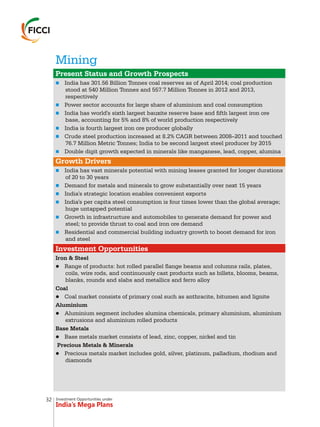
Mining
n
n
n
n
n
n
n
n
n
n
n
n
Present Status and Growth Prospects
Growth Drivers
Investment Opportunities
India has 301.56 Billion Tonnes coal reserves as of April 2014; coal production
stood at 540 Million Tonnes and 557.7 Million Tonnes in 2012 and 2013,
respectively
Power sector accounts for large share of aluminium and coal consumption
India has world's sixth largest bauxite reserve base and fifth largest iron ore
base, accounting for 5% and 8% of world production respectively
India is fourth largest iron ore producer globally
Crude steel production increased at 8.2% CAGR between 2008–2011 and touched
76.7 Million Metric Tonnes; India to be second largest steel producer by 2015
Double digit growth expected in minerals like manganese, lead, copper, alumina
India has vast minerals potential with mining leases granted for longer durations
of 20 to 30 years
Demand for metals and minerals to grow substantially over next 15 years
India's strategic location enables convenient exports
India's per capita steel consumption is four times lower than the global average;
huge untapped potential
Growth in infrastructure and automobiles to generate demand for power and
steel; to provide thrust to coal and iron ore demand
Residential and commercial building industry growth to boost demand for iron
and steel
Iron & Steel
lRange of products: hot rolled parallel flange beams and columns rails, plates,
coils, wire rods, and continuously cast products such as billets, blooms, beams,
blanks, rounds and slabs and metallics and ferro alloy
Coal
lCoal market consists of primary coal such as anthracite, bitumen and lignite
Aluminium
lAluminium segment includes alumina chemicals, primary aluminium, aluminium
extrusions and aluminium rolled products
Base Metals
lBase metals market consists of lead, zinc, copper, nickel and tin
Precious Metals & Minerals
lPrecious metals market includes gold, silver, platinum, palladium, rhodium and
diamonds
32
Investment Opportunities under
India’s Mega Plans
Oil and Gas
n
n
n
n
n
n
n
n
n
n
n
n
n
n
n
n
n
n
n
n
n
Present Status and Growth Prospects
Growth Drivers
Investment Opportunities
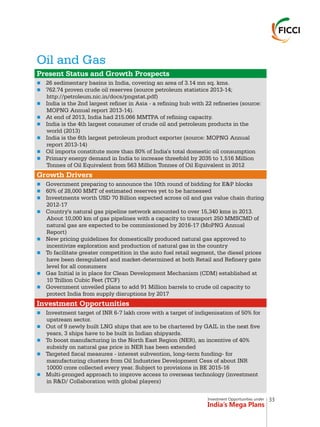
26 sedimentary basins in India, covering an area of 3.14 mn sq. kms.
762.74 proven crude oil reserves (source petroleum statistics 2013-14;
http://petroleum.nic.in/docs/pngstat.pdf)
India is the 2nd largest refiner in Asia - a refining hub with 22 refineries (source:
MOPNG Annual report 2013-14).
At end of 2013, India had 215.066 MMTPA of refining capacity.
India is the 4th largest consumer of crude oil and petroleum products in the
world (2013)
India is the 6th largest petroleum product exporter (source: MOPNG Annual
report 2013-14)
Oil imports constitute more than 80% of India's total domestic oil consumption
Primary energy demand in India to increase threefold by 2035 to 1,516 Million
Tonnes of Oil Equivalent from 563 Million Tonnes of Oil Equivalent in 2012
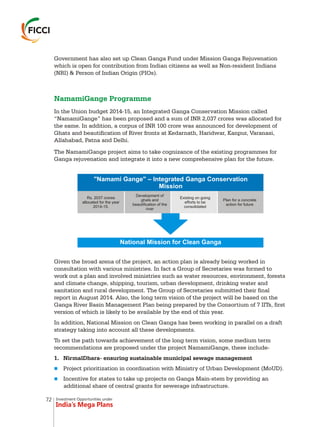
Government preparing to announce the 10th round of bidding for E&P blocks
60% of 28,000 MMT of estimated reserves yet to be harnessed
Investments worth USD 70 Billion expected across oil and gas value chain during
2012-17
Country's natural gas pipeline network amounted to over 15,340 kms in 2013.
About 10,000 km of gas pipelines with a capacity to transport 250 MMSCMD of
natural gas are expected to be commissioned by 2016-17 (MoPNG Annual
Report)
New pricing guidelines for domestically produced natural gas approved to
incentivize exploration and production of natural gas in the country
To facilitate greater competition in the auto fuel retail segment, the diesel prices
have been deregulated and market-determined at both Retail and Refinery gate
level for all consumers
Gas Initial is in place for Clean Development Mechanism (CDM) established at
10 Trillion Cubic Feet (TCF)
Government unveiled plans to add 91 Million barrels to crude oil capacity to
protect India from supply disruptions by 2017
Investment target of INR 6-7 lakh crore with a target of indigenisation of 50% for
upstream sector.
Out of 9 newly built LNG ships that are to be chartered by GAIL in the next five
years, 3 ships have to be built in Indian shipyards.
To boost manufacturing in the North East Region (NER), an incentive of 40%
subsidy on natural gas price in NER has been extended
Targeted fiscal measures - interest subvention, long-term funding- for
manufacturing clusters from Oil Industries Development Cess of about INR
10000 crore collected every year. Subject to provisions in BE 2015-16
Multi-pronged approach to improve access to overseas technology (investment
in R&D/ Collaboration with global players)
33
Investment Opportunities under
India’s Mega Plans
UPSTREAM
Shale:
lIndia has technically recoverable shale gas resources of nearly 96 Trillion Cubic
Feet.
Underground Coal Gasification:
lCoal gasification identified as one of the end uses under the government's
captive mining policy
Coal Bed Methane (CBM):
lEstimated resources of 2600 billion cubic meters (BCM) or 91.8 TCF. Impetus to
boost CBM production & exploitation
E&P Services and Equipment Manufacturing:
lAn area of 1.50 mnsq km awarded (48% of the total sedimentary area) (source:
DGH presentation during PETROTECH 2014)
lIn the upstream oil business, more than 60% of the E&P expenditure is on
specialised Oil Field drilling & services.
lDeep water and ultra-deep water oil and gas exploration activity to be explored
in future to boost production; will create opportunities for strategic investors
having relevant technical expertise and financial strength
lThrust to set up dedicated manufacturing zones/clusters catering to Oil Field
Services (Ship-building/ Offshore platform building/ rigs)
Natural Gas
lGovernment's focus to expand the natural gas pipeline network and complete
the National Gas Grid
lOpportunities for cconstruction of LNG ships and terminals
lCity gas distribution sector offers huge opportunities. Petroleum and Natural Gas
Regulatory Board allows incentives to authorized entities:
- Infrastructure exclusivity to authorized entity for a period of 25 years
- Exclusivity for natural gas marketing activity for a 5 year period
- For incumbents, marketing exclusivity extends to a period of 3 years
Pipeline Transportation
lSignificant opportunities for growth in both crude and petroleum product
pipelines
lIn India, only 35% of product movement is through pipelines as compared to 60%
in advanced economies
Refining Sector
lExpansions planned for developing export-oriented infrastructure, including
product pipelines and export terminals
lNew grassroots refineries coming up in the future
Downstream Retailing
lFuel pricing reforms, have thrown open opportunities for the private sector
player to re-enter and compete with the state-owned Oil Marketing Companies
Storage Infrastructure
lStrong thrust on the infrastructure of storage tanks within the country.
34
Investment Opportunities under
India’s Mega Plans
35
Pharmaceuticals
n
n
n
n
n
n
n
n
n
n
n
n
n
n
n
n
n
n
n
n
n
n
n
Present Status and Growth Prospects
Growth Drivers
Globally, the Indian pharmaceutical industry is ranked 3rd largest in volume
terms and 10th largest in value terms.
India's pharmaceuticals industry accounts for 2.4% of global pharma industry by
value and 10% by volume
India is sixth largest market globally in terms of size
India's drugs and pharmaceuticals industry is expected to grow at a compound
annual growth rate (CAGR) of 14% to reach a turnover of INR 2.91 Trillion (US$
47.06 Billion) by 2018.
India exports pharmaceutical products to more than 200 countries.
Pharmaceutical exports are expected to cross the INR 1 Trillion (US$ 16.17
billion) mark this year.
Generic drugs account for 20% of global exports in terms of volume, India the
largest provider of generic medicines globally
India's cost of production lower than the US and half of Europe
India possesses skilled workforce with high managerial and technical
competence
Expected to rank amongst top three pharmaceutical markets by 2020
Industry revenues to expand at 12.1% CAGR during 2012-20 and reach USD 45
Billion
Generics market to grow to USD 26.1 Billion by 2016 from USD 11.3 Billion in 2011
OTC drug market to grow to USD 6.6 Billion by 2016
Healthcare sector expected to grow to USD 250 Billion by 2020 from USD 65
Billion currently
Between 2011 and 2016, patent drugs worth USD 255 Billion estimated to go off-
patent - huge surge in generic product
Product patents introduction in India to see launch of patented drugs in the
country
Rising lifestyle diseases in India expected to create demand
Over USD 200 Billion to be spent on medical infrastructure in the next decade
Rising levels of education set to increase acceptability of pharmaceuticals
Economic prosperity likely to improve affordability for generic drugs
India's patient pool expected to increase over 20% in next 10 years
Pharma companies increased spending to tap rural markets and develop better
infrastructure
Approval time for new facilities drastically reduced
OTC drugs expected to be readily available
Investment Opportunities under
India’s Mega Plans
Investment Opportunities
Generics and Patented Drugs manufacturing:
lIndia expected to be third largest global market for active pharmaceutical
ingredients by 2016, with 7.2% increase in market share
Contract Research and Manufacturing Services industry (CRAMS)
lEstimated to be USD 8 Billion in 2015, from USD 3.8 Billion in 2012
Formulations manufacturing:
lDouble-digit growth expected over the next five years
36
Investment Opportunities under
India’s Mega Plans
Ports
n
n
n
n
n
n
n
n
n
n
n
n
n
n
Present Status and Growth Prospects
Growth Drivers
Investment opportunities
India has over 7500 kilometres of coastline with 12 major and 60 operational non-
major ports
90% of country's trade by volume and 70% by value moved through maritime
transport
12 major ports in India handle 58% of cargo traffic
Cargo traffic increased by 3.9% CAGR at major ports and 13.7% at non-major
ports during 2007-12
Cargo-handling capacity increased to 800 Million Metric Tonnes in February
2014, from 575 Million Metric Tonnes in 2009.
Cargo capacity to increase to 2289 Million Metric Tonnes by 2017 from 1235
Million Metric Tonnes in 2012
Container demand to increase to 21 Million T.E.U by 2017, from 6.5 Million T.E.U
in 2012
Increasing trade activities and private participation in port infrastructure
development
Rising cargo traffic and increase in number of non-major ports
Existing ports investing on improving draft depth
Focus on development of terminals that deal with a particular type of cargo, for
eg. LNG.
SEZa developed in close proximity to several ports - comprising coal-based
power plants, steel plants and oil refineries
Government evaluating prospects for shipbuilding facilities in coastal states like
Gujarat, Kerala, Andhra Pradesh, Karnataka, Maharashtra and Tamil Nadu.
Dedicated INR 1,500 crore funds being set up by EXIM Bank of India to provide
finance for construction, refitting and repair of ships
Port development and Port-led Development:
lGovernment planning to launch 'Prime Minister Jal Marg Yojna' to develop strong
inland waterways network, set up dry and satellite ports, and converting
riverways into waterways.
lGovernment formulating bill to allow converting any river into waterway to
enable goods transportation through them
lGovernment has conceived 'Sagarmala', an ambitious project for maritime states,
working out to integrate components viz. port facilities, coastal ferry services,
tourism infrastructure and inland water transportation and focusing on Port
Towns/Cities.
37
Investment Opportunities under
India’s Mega Plans
lProject envisages port development, and port-led development; would include
ports, SEZs, and rail, road, air and waterway connectivity with the hinterland,
including linkages of cold storage and warehousing facilities
Shipbuilding:
lGovernment encouraging shipbuilding industry in tune with Make in India
Programme
lProjects require expertise from foreign shipyards
Ship repair facilities:
lDemand for ship repair services to increase, providing opportunities to build new
dry docks and set up ancillary repair facilities
Port support services:
lOperation and maintenance services such as pilotage, dredging, harbouring and
provision of marine assets such as barges and dredgers
38
Investment Opportunities under
India’s Mega Plans
Railways
n
n
n
n
n
n
n
n
n
n
n
n
Present Status and Growth Prospects
Growth Drivers
Investment Opportunities
Indian Railways network spanning more than 64,600 kms, is world's third-largest
rail network
The largest passenger carrier and the fourth-largest rail freight carrier in the
world
Passenger and freight traffic volumes increasing steadily; passenger and freight
traffic grew at 5.2% CAGR and 4.9% CAGR during 2008-13
100% FDI in the railway infrastructure segment allowed recently
Ministry of Railways to construct six high-capacity, high-speed dedicated freight
corridors along the Golden Quadrilateral and its diagonals.
Development of identified stations to international standards with modern
facilities and passenger amenities on the lines of newly developed airports
To modernize logistics operations by setting up logistic parks that provide for
warehousing, packaging, labelling, distribution, door-to-door delivery and
consignment tracking
During the period of 2012-17, Plan for Mass Rapid Transit Systems (MRTS)
projects during 2012-17 through PPP model
Indian Railways aims to award projects worth USD 1,000 Billion through the PPP
route
Aims to boost passenger amenities by involving PPP investments in provision of
foot-over bridges, escalators and lifts at all major stations
Last-mile connectivity to boost business activity in and around ports and mines
proposed through formation of special purpose vehicle (SPV) companies under
the PPP model
Indian Railways aims to involve private equity to provide passenger amenities
such as battery-operated carts to facilitate movement for senior citizens and
differently abled, at stations
Investment opportunities exist in the following segments:
lHigh speed train projects.
lRailway lines to and from coal mines and ports.
lProjects relating to electrification, high-speed tracks and suburban corridors.
lDedicated freight corridors.
lThe re-development of railway stations.
39
Investment Opportunities under
India’s Mega Plans
40
lPower generation and energy-saving projects.
lFreight terminals operations.
lSetting up of wagon, coaches and locomotive units.
lGauge conversion.
lNetwork expansion.
Investment Opportunities under
India’s Mega Plans
Renewable Energy
n
n
n
n
n
n
n
n
n
n
n
n
n
Present Status and Growth Prospects
Growth Drivers
Investment Opportunities
India's total power installed capacity stands at 245 GW, renewable energy
capacity is 31.70 GW (March 2014)
Wind energy accounts for 70% (21.1 GW); India is world's fifth largest wind
energy producer
India to increase solar power capacity to 100 GW by 2020; USD 100 billion worth
investment required over 5 years ending 2019
Major programme to be launched to train 50,000 people to create Solar Army
Rooftop programme included as part of house loan and home improvement loan
by banks
Government actively promoting adoption of renewable energy resources, offering
various incentives,
- generation- based incentives (GBIs)
- capital and interest subsidies
- viability gap funding
- concessional finance
- fiscal incentives
Renewable energy becoming cost-competitive compared to fossil fuel-based
generation
Solar module prices declined by 80% and wind turbine prices declined by more
than 25% since 2008
Indian Renewable Energy Development Agency (IREDA) - a dedicated financial
institution established to provide financial assistance for renewable energy
projects
Government to launch National Wind Energy Mission
Development of 'Ultra Mega Solar Power Projects' (UMSP) and 'Solar Parks'
announced with an investment of INR 1,000 crores
25 solar parks, each with a capacity of 500 to 1000 MW to be established
Large scale solar plants or UMSP up to 4000 MW capacity to be developed in
desert lands
Wind Energy
lVast untapped potential of 102.8 GW compared to present capacity of 21.1 GW
Small hydro
lEstimated potential of 19.7 GW compared 3.8 GW present capacity
Bio-power (including biomass and bagasse co-generation)
lEstimated potential of 22.5 GW compared to 4.1GW capacity presently
Solar power
lPlan for 100 GW capacity increase compared to 1.7 GW present capacity
41
Investment Opportunities under
India’s Mega Plans
Roads and Highways
n
n
n
n
n
n
n
n
n
n
n
Present Status and Growth Prospects
Growth Drivers
Investment Opportunities
Transport sector constitutes 6% of country's GDP and 70% of roads sector
India has road network of 4.86 Million kms, second largest in the world
Road handles more than 60% of freight and 90% of passenger traffic in India
Roadways and bridge infrastructure value to grow at 17.4% CAGR between 2012-
17, to reach USD 10 Billion
National Highways length to grow from 92,850 kms in 2013-14 to 100,000 kms by
2017
8,470 kms of National Highways to be improved during 2014-15
NHAI aims to award 5,000 kms of projects in 2014-15 and another 400 kms by the
Ministry of Road Transport & Highways ( MoRT&H) directly
Investment through PPP expected to be USD 31 Billion for national highways in
next 5 years
GoI to develop 64,340 kms of National Highways under various programmes
Widening, upgradation and rehabilitation of 47,054 kms of National Highways
under a USD 60 Billion, seven-phase programme of the National Highway
Development Project (NHDP)
Rise in two-wheeler and four-wheeler vehicles, increasing freight traffic, strong
trade and tourist flows between states to augment growth
Highways:
lGovernment planning INR 5 lakh crore investment in the next five years, creating
500 ready-to-bid road projects worth INR 3 lakh crore
lPPP model will continue to be favoured way of executing NHDP phases
lPriority expressway project for implementation on the PPP Mode
Expressway
lEastern Peripheral Expressway - a 135 km-long, 6 lane expressway with a total
project cost of USD 750 Million
lDelhi - Meerut Expressway - a 150 km long project with project cost of USD 1
Billion
lVadodra-Mumbai Expressway, a 473 km expressway with project cost of USD 4.3
Billion
Special Accelerated Road Development Programme for North Eastern region:
lThree phase project
lAims to develop road connectivity between remote areas in the North-eastern
region with state capitals and district headquarters
42
Investment Opportunities under
India’s Mega Plans
Space
n
n
n
n
n
n
n
n
n
Present Status and Growth Prospects
Growth Drivers
Investment Opportunities
India's space programme one of the most cost-effective in the world
Indian Space Research Organization has formal co-operative arrangements with
33 countries and 3 multinational bodies
India has launched 40 satellites for 19 countries
India's heaviest communication satellite, GSAT-10, was successfully launched by
Ariane-5 VA 209 from Kourou, French Guiana on September 29, 2012
PSLV, in its twenty-third flight (PSLV-C20), successfully launched Indo-French
Satellite SARAL along with six smaller foreign satellites from Sriharikota on
February 25, 2013
India is the first nation to successfully put satellite Mangalayaan into orbit
around Mars on its first attempt on September 24, 2014; as part of one of the
cheapest interplanetary space missions
India successfully tested Geosynchronous Satellite Launch Vehicle (GSLV) Mark
III, most powerful satellite launch vehicle to put satellites weighing about 4
tonnes into orbit on December 18, 2014
With the ISRO undertaking the development of cutting edge technologies and
interplanetary exploratory missions, there is a tremendous scope in
contributions to the realization of operational missions and new areas such as
satellite navigation.
Government plans to develop India's 50-year-old space programme, increased
funding for space research by 50 percent to almost USD 1 billion in 2014-15
The Indian Space Research Organisation (ISRO):
lPrime objective of ISRO is to develop space technology and its application to
various national tasks
Space Commerce:
lAntrix Corporation Limited, commercial arm of Department of Space undertakes
global marketing of space products and services
lProvides TTC support to international customers
Launch Vehicles:
lSatellite Launch Vehicle (SLV)
lAugmented Satellite Launch Vehicle (ASLV):
lPolar Satellite Launch Vehicle (PSLV)
lGeosynchronous Satellite Launch Vehicle (GSLV)
Space Science Programme
43
Investment Opportunities under
India’s Mega Plans
Textiles and Garments
n
n
n
n
n
n
n
n
n
n
n
n
n
n
n
n
n
n
n
Present Status and Growth Prospects
Growth Drivers
Investment opportunities
India has second largest manufacturing capacity globally
Industry accounts for 24% of world's spindle capacity and 8% of global rotor
capacity
India has highest loom capacity (including hand looms) with 63% of world's
market share
India accounts 14% of world's textile fibre production and yarn; largest jute
producer; second largest silk and cotton producer
Comparative advantage in terms of skilled manpower and production cost
14% contribution to industrial production, 4% to India's GDP and 13% to export
Textile and apparel industry in India to reach USD 100 Billion by 2016-17 from
USD 67 Billion in 2013-14
Textiles exports to increase to USD 65 Billion by 2016-17 from USD 40 Billion in
2013-14
Fabric production expected to grow to 112 Billion square metres by 2016-17 from
64 Billion square metres in 2013-14
Strong production base of wide range of fibre/yarn from natural fibres like
cotton/jute, silk and wool to synthetic/man-made fibres like polyester, viscose,
nylon and acrylic
Increased penetration of organised retail, favourable demographics and rising
income levels
Abundant raw material and increasing demand for exports to boost fibre
production
Abundant availability of raw materials such as cotton, wool, silk and jute
Entire value chain of synthetics
Value added and speciality fabrics
Fabric processing set-ups for all kind of natural and synthetic textiles
Technical textiles
Garments
Retail brands
44
Investment Opportunities under
India’s Mega Plans
Thermal Power
n
n
n
n
n
n
n
n
n
n
n
n
n
n
n
n
n
n
Present Status and Growth Prospects
Growth Drivers
Investment Opportunities
With 1108 TW production, India is world's fifth largest producer and consumer of
electricity
Power sector accounts for almost a quarter of the projected investments amongst
all the infrastructure sectors between2012-17.
Total thermal installed capacity in India 180 GW as of January 2015
During 2007-13, electricity production expanded at 5.5% CAGR
100% FDI permitted under automatic route in the sector
Total coal reserves in India stood at 298.94 Billion Tonnes as of March 2013,
proven reserves of 123.19 Billion Tonnes
Proven natural gas reserves 1,354.76 Billion cubic meters
Target capacity addition of 88.5 GW during 2012-17 and 86.4 GW during 2017-22.
Proposed amendments to the Electricity Act, 2003 paving way for separation of
carriage and content
National Tariff Policy (2006) ensures adequate return on investment to power
companies
Launch of Ultra Mega Power Project (UMPP) scheme through tariff-based
competitive bidding
Industrial activity expansion and growing population to boost electricity demand
Increasing market penetration and per-capita usage to provide impetus to
energy industry
Large capacity additions of 174.9 GW targeted by 2022
Power Generation
Transmission & Distribution
Power Trading
Power Exchanges
45
Investment Opportunities under
India’s Mega Plans
Tourism and Hospitality
n
n
n
n
n
n
n
n
n
n
n
n
n
n
n
n
n
n
Present Status and Growth Prospects
Growth Drivers
Investment Opportunities
Tourism accounts 6.8% of India's GDP; third largest foreign exchange earner
Travel and tourism turnover of INR 2,178.1 Billion (2013), 7.5% rise expected in
2014
Ranks 42nd in the United Nations World Tourism Organization (UNWTO)
rankings for foreign tourist arrivals
6.97 Million foreign tourist arrivals registered in 2013, 5.9% growth over 2014
Foreign exchange earnings from tourism touched INR 1058.36 Billion in 2013
Industry to grow 8% p.a. between 2008 and 2016 (UNWTO projection)
Domestic tourist visits growing at ~20%
India offers geographical diversity, attractive beaches, 30 World Heritage Sites
and 25 bio-geographic zones
Niche tourism products portfolio in India - cruises, adventure, medical, wellness,
sports, MICE, eco-tourism, film, rural and religious tourism
Ministry of Tourism spends more than 50% of budget on development of tourism
destinations and infrastructure
Incredible India! and AtithiDevoBhava - ministry's branding and marketing
initiatives to boost growth
Fresh category of visa released by government-medical visa or M visa, to
promote medical tourism
Medical tourism - India's advantages - world-class hospitals and skilled medical
professionals
Cruise tourism - India an ideal choice destination for cruise tourists
Rural tourism - government implemented schemes in 2002-03 to showcase rural
life, art, culture and heritage
Eco-tourism - is at a nascent stage, efforts are going on to save Himalayan eco-
system and culture and heritage of indigenous people
Timeshare resorts, convention centres, motels, heritage hotels
Tour organising
46
Investment Opportunities under
India’s Mega Plans
Wellness
n
n
n
n
n
n
n
n
n
n
n
n
Present Status and Growth Prospects
Growth Drivers
Investment Opportunities
~INR 490 Billion wellness market in India, services comprise 40%
Ayurveda, Yoga, Naturopathy, Unani, Siddha and Homoeopathy (AYUSH) sector
turnover ~INR 120 Billion; MSMEs accounting 80% of total enterprises
Products market worth INR 40 Billion; over-the-counter products constitute 75%
India 2nd largest exporter of ayurvedic and alternative medicine globally
AYUSH exports stood INR 22.7 Billion (FY14); raw medicinal herbs exports INR
11 Billion, medicaments exports INR 9.7 Billion, medicinal extracts exports INR
1.9 Billion
Biggest markets for Indian herbal products - Western Europe, Russia, USA,
Kazakhstan, UAE, Nepal, Ukraine, Japan, Philippines, Kenya
Global demand for yoga growing exponentially; more than 32 Million people
practicing yoga in the US
India's vast knowledge for both preventive and curative healthcare
AYUSH and herbal products demand surging in India and abroad
Adequate product development infrastructure
Dedicated Department of AYUSH
Escalating conventional health care costs, side-effects of chemical-based drugs
and increase in lifestyle disorders - pushing AUSH product demand
Ayurveda drug manufacturing
lNutraceuticals
lFood supplements
lCosmetics
lRejuvenatives
Specialised treatment centres
lMedical tourism for curative and rejuvenation treatments
47
Investment Opportunities under
India’s Mega Plans
The flagship programme Digital India was launched in August 2014, with an aim to
transform India into a digitally empowered society and knowledge economy. Through
this programme, the Government would ensure that its services are available to
citizens electronically. The objective of the programme is to bring public
accountability through mandated delivery of government's services electronically; a
Unique ID and 'e-Pramaan' based on authentic and standard based interoperable and
integrated government applications and data basis.
The focus is on making technology central to enabling change. It is an Umbrella
Programme with multiple government ministries and departments joining the design
and implementation of this programme. It pulls together many existing schemes.
These schemes will be restructured and re-focused. They will be implemented in a
synchronized manner. Many elements are only process improvements with minimal
cost. The common branding of programmes as Digital India highlights their
transformative impact.
The programme is coordinated by the Department of Electronics and Information
Technology (DeitY), Government of India. The weaving together makes the Mission
transformative in totality.
1. Digital Infrastructure as a Utility to Every Citizen
Availability of high speed internet as a core utility in all Gram Panchayats
Cradle to grave digital identity -unique, lifelong, online, and authenticable
Mobile phone & Bank account enabling participation in digital & financial space at
individual level
Easy access to a Common Service Centre
Shareable private space on a public cloud
4Safe and secure Cyber-space in the country
Vision areas of Digital India Programme
n
n
n
n
n
n
Digital India Programme
48
Investment Opportunities under
India’s Mega Plans
2. Governance & Services on Demand
Seamless integration across departments or jurisdictions to provide easy and a
single window access to all persons.
Government services available in real time from online &mobile platform
Availability of all citizen entitlements on the cloud to ensure easy access
Digital transformation of all Government services for improving Ease of Doing
Business
Making financial transactions above a threshold, electronic & cashless
Leveraging GIS for decision support systems & development
3. Digital Empowerment of Citizens
Universal Digital Literacy
Universally accessible digital resources
All documents/ certificates to be available on cloud
Availability of digital resources / services in Indian languages
Collaborative digital platforms for participative governance
Portability of all entitlements through cloud
Digital India aims to provide the much needed thrust to the nine pillars of growth
areas, namely
1. Broadband Highways
2. Universal Access to Mobile Connectivity
3. Public Internet Access Programme
4. e-Governance - Reforming Government through Technology
5. e-Kranti - Electronic Delivery of Services
6. Information for All
7. Electronics Manufacturing
8. IT for Jobs
9. Early Harvest Programmes
n
n
n
n
n
n
n
n
n
n
n
n
Key goals to be achieved
49
Investment Opportunities under
India’s Mega Plans
Impact of Digital India by 2019
n
n
n
n
n
n
n
n
n
n
n
n
Broadband in 2.5 lakh villages
Universal access to mobile connectivity
Net Zero Imports by 2020
400,000 Public Internet Access Points
Wi-fi in 2.5 lakh schools, all universities; Public wi-fi hotspots for citizens
Digital Inclusion: 1.7 Cr trained for IT, Telecom and Electronics Jobs
Job creation: Direct 1.7 Cr. and Indirect at least 8.5 Cr.
e-Governance & e-Services: Across government
India to be leader in IT use in services - healthcare, education, financial inclusion,
agriculture, security, justice, planning, etc.
Digitally empowered citizens - public cloud, internet access
Project Cost
Overall Costs of Digital India would be
~ INR 100,000 Cr in ongoing schemes (only DeitY, DOT & not incl. those in other
line Ministries)
~ INR 13,000 Cr for new schemes & activities
Broadband
Highways
Universal
mobile
connectivity
Public
internet
access
E-
Governance
E-Kranti
Information
for all
Electronics
manufacturing
IT for Jobs
Early
harvest
programmes
9 pillars of growth
50
Investment Opportunities under
India’s Mega Plans
This includes the following estimated capex/costs:
* Government figures
Approach and Methodology
n
n
n
n
n
n
n
n
n
Ministries / Departments / States would fully leverage the Common and Support
ICT Infrastructure established by the Government of India.
The existing/ ongoing e-Governance initiatives would be revamped to align them
with the principles of Digital India. Scope enhancement, Process Reengineering,
use of integrated & interoperable systems and deployment of emerging
technologies like Cloud & mobile would be undertaken to enhance delivery of
Government services to citizens.
States would be given flexibility to identify for inclusion additional state-specific
projects, which are relevant to their socio-economic needs.
e-Governance would be promoted through a centralised initiative to the extent
necessary, to ensure citizen centric service orientation.
Successes would be identified and their replication promoted proactively.
Public Private Partnerships would be preferred wherever feasible.
Adoption of Unique ID would be promoted to facilitate identification,
authentication and delivery of benefits.
Restructuring of NIC would be undertaken to strengthen the IT support to all
government departments at the Centre and State levels.
The positions of Chief Information Officers (CIO) would be created in at least 10
key ministries so that various e-Governance projects could be designed,
developed and implemented faster.
51
Investment Opportunities under
India’s Mega Plans
n
n
DeitY would create necessary senior positions within the department for
managing the programme.
Central Ministries / Departments and State Governments would have the overall
responsibility for implementation of various Mission Mode and other projects
under this Programme. Considering the need for overall aggregation and
integration at the national level, it is considered appropriate to implement Digital
India as a programme with well-defined roles and responsibilities of each agency
involved.
A programme management structure is being established for monitoring
implementation. Key components of the management structure would consist of the
Cabinet Committee on Economic Affairs (CCEA) for according approval to projects, a
Monitoring Committee headed by the Prime Minister, a Digital India Advisory Group
chaired by the Minister of Communications and IT, an Apex Committee chaired by the
Cabinet Secretary and the Expenditure Finance Committee (EFC) / Committee on Non
Plan Expenditure (CNE).
Investment Opportunities
The Digital India Programme promises a number of new possibilities for India,
including a new level of engagement between the government, private sector and
citizens. Given that the goal of this project is to provide real-time services, it opens
doors for a large number of ICT industry players to develop platforms which can help
in providing government services and information to all the citizens of the country. To
enable this, data management and security solutions will have to be accounted for in
the deployment plan. Thus, the role and scope of the technology and communications
industry becomes critical at every stage of the Digital India Programme - project
development, execution and management.
Government of India has proposed a PPP model to roll out this programme. Global and
domestic companies can therefore hope to win contracts related to the Programme to
develop the infrastructure which has a proposed outlay of USD 17 billion.
Open access to broadband highways across India will give a big push to trade across
the country. This will result in amongst other benefits, a new surge in e-commerce.
Digital India Programme also provides an impetus to Indian manufacturing by
opening up a massive demand for internet-related equipment - routers, switches and
devices (most importantly affordable smartphones) - that will facilitate last mile
connectivity. Manufacturing clusters for electronic goods have already been approved
to be set up in Jharkhand, Maharashtra and Madhya Pradesh for products such as
Program Management Structure
52
Investment Opportunities under
India’s Mega Plans
mobile handsets, microchip and chip-less designs and set-top boxes. The government
is working towards establishing the first manufacturing cluster by March next year.
This will create jobs and will give a tremendous boost in the country's efforts in
developing an eco-system of local manufacturing and R&D in India.
The Digital India Programme has already generated huge interest nationally and
internationally. The private sector is showing its keenness to partner with the
government in achieving the Digital India vision.
Microsoft has already applied to roll out a pilot project to use "whitespace", the
unused spectrum between two analogue TV channels, to provide free internet
access. If successful, this can provide a fillip to the Digital India initiative.
In September 2014, Google India announced the roll out of various initiatives to
support the Digital India programme, making it one of the first companies to
endorse the programme. The initiatives include running a number of campaigns as
part of the programme.
Facebook CEO Mark Zuckerberg, during his first trip to India met with the Prime
Minister of India, Narendra Modi, and the Union Minister of Communications and
IT, Ravi Shankar Prasad where he expressed his willingness to join India's National
Optical Fibre Network as a partner and deploy out of the box alternative
technologies to roll out the Digital India programme.
Several network equipment manufacturers have shown a great level of interest in
accessing the benefits of cluster manufacturing.
Recent Developments
n
n
n
n
53
Investment Opportunities under
India’s Mega Plans
India is experiencing rapid urbanization and growth in cities. Boundaries of almost all
the major Indian cities are expanding, bringing larger population within the ambit of
Urban India. In 2001, about 286 million persons were living in urban areas of India and
it was the second largest urban population in the world. As per the Census of India
2011, the urban population has increased to 377 million thereby registering a growth
of around 32%. According to recent estimates, by the year 2030, nearly 590 million
people will live in Indian cities, which is nearly twice the population of the United
States today. To accommodate this massive urbanization, India needs to find smarter
ways to manage complexities, reduce expenses, increase efficiency and improve the
quality of life.
To meet the above challenges, the Government of India has allocated INR 70.6 billion
(USD 1.2 billion) for Smart Cities in Budget 2014-15. India plans 100 new smart cities
and will develop modern satellite towns around existing cities under the smart city
programme.
To encourage development of "Smart Cities", which will also provide habitation for the
neo-middle class, requirement of the built up area and capital conditions for FDI is
being reduced from 50,000 sq. mts. to 20,000 sq. mts. and from USD 10 million to USD
5 million respectively. To further encourage this, projects which commit at least 30% of
the total project cost for low cost affordable housing will be exempted from minimum
built up area and capitalisation requirements.
A National Industrial Corridor Authority, with its headquarters in Pune is being set up
to coordinate the development of Industrial Corridors with emphasis on Smart Cities
linked to transport connectivity to spur growth in manufacturing and urbanization.
Master Planning of Amritsar Kolkata Industrial Corridor will be completed
expeditiously for the development of Industrial Smart Cities in seven states of the
country. The seven states that will be covered in this project are Punjab, Haryana,
Uttar Pradesh, Uttarakhand, Bihar, Jharkhand and West Bengal.
Master planning of three new smart cities in the Chennai-Bengaluru Industrial
Corridor region, viz., Ponneri in Tamil Nadu, Krishnapatnam in Andhra Pradesh and
Tumkur in Karnataka will also be completed. The Perspective Plan for the Bengaluru
Mumbai Economic Corridor and Vizag-Chennai Corridor has been planned to be
completed with provision for 20 new industrial clusters.
Smart Cities Project
54
Investment Opportunities under
India’s Mega Plans
Investment Opportunities
Selection Criteria for Smart Cities
Rapid urbanization combined with the potential to develop cities presents a
significant opportunity to the diaspora of the Indian industry. Various state and local
governments are focused on developing and upgrading their cities, in addition a
massive agenda from the Central Government to develop 100 smart cities, redevelop
heritage cities and renew around 500 cities have boosted industry sentiments.
For promoting economic activity in India, five new Industrial Corridors are being
planned. These corridors include Delhi-Mumbai Industrial Corridor, Amritsar-Delhi-
Kolkata Industrial Corridor, Bengaluru-Mumbai Economic Corridor, East Coast
Industrial Corridor and Chennai-Bengaluru Industrial Corridor. Each Industrial
Corridor will have several key nodes developed on Smart City principles.
The private sector has to play an important role in developing the industrial corridors
(including the smart cities) announced by the Government. The Government would
provide the vision, direction and the initial capital to kick start the development
process. However, major investments would have to come from the private sector not
only in the form of funds but also in terms of technology, skills and expertise.
Private sector players may take up projects in PPP mode or they may also work as
contractors, consultants, O&M operators, equipment suppliers and rolling stock
suppliers apart from financing across the value chain.
The Government of India has indicated that they might consider the below mentioned
criteria in finalising cities under the "100 Smart Cities" initiative:
Criteria for Shortlisting of Cities (Indicative List)
Criteria Number of
Cities
Economic Criterion
Cities accounting for 54% of Incremental GDP till 2025
(Source: McKinsey Global Institute, "Understanding India's economic geography,", October 2014)
Geographic Inclusivity
All State Capitals (not included above) 12
Tourist/ Religious - Heritage (not included above) 8
Hill and Coastal Areas (not included above) 4
Mid-sized Cities (not included above) 7
Total 100
69
55
Investment Opportunities under
India’s Mega Plans
Key sectors to attract investment under the Smart Cities project
PHYSICAL INFRASTRUCTURE
Housing
Housing - For all socio-economic classes
Transport
Improvements in public transport - Metro Rail, BRT, LRT, Monorail, Trams etc.
Improvements in transport infrastructure of other motor vehicles - ring roads,
bypasses, underpasses, elevated roads, improvements in the existing road ways
Improvements in infrastructure for walking, cycling and waterways
Water Supply
Smart cities will be designed with availability of 24x7 piped water supply that meet
benchmarks of water quality, pressure, etc. across the city. The focus should be on
recycling & conserving water and also adoption of new methods especially smart
metering for reducing loss and energy consumption in water networks.
Sanitation
City wide sanitation plan will be implemented for all parts of the city based on the
concept of Decentralized Sewerage System. There is need for encouraging
technologies that result in 100% recycling in the sanitation system.
Solid Waste Management
Potential Areas:
Segregation of recyclable and non-recyclable waste as well as wet and dry waste
at the source so that there can be 100% recycling of solid waste
n
n
n
n
n
Some of the cities that have been chosen for being developed as smart cities are:
1. Delhi 2. Ajmer (Rajasthan)
3. Allahabad (Uttar Pradesh) 4. Visakhapatnam (Andhra Pradesh)
5. Gurgaon (Haryana) 6. Bengaluru (Karnataka)
7. Mumbai (Maharashtra) 8. Pune (Maharashtra)
9. Ludhiana (Punjab) 10. Indore (Madhya Pradesh)
11. Amaravati (Andhra Pradesh) 12. Badami (Karnataka)
13. Dwarka (Gujarat) 14. Gaya (Bihar)
15. Mathura (Uttar Pradesh) 16. Puri (Odisha)
17. Warangal (Telangana)
56
Investment Opportunities under
India’s Mega Plans
n
n
n
n
n
n
n
Appropriate technology should be adopted for treatment of waste at decentralized
locations
Putting in place an effective collection and disposal system
Encouraging use of products based on recycling of solid waste especially - power,
compost, building material (based on cycling of debris & construction materials)
Storm Water Drainage
Smart cities to adopt a storm water management approach which would include
preserving and maintaining the natural hydrological cycle, ground water recharge,
natural drainage system, etc. For this purpose appropriate technologies will be
adopted that improve the quality of water from storm water flows.
Electricity
Smart cities need to have universal access to electricity 24x7 which in India's case is
difficult with the existing supply and distribution system. Cities will therefore require
smart metering at the household level and establishment of smart grids and their
integration with renewable sources such as solar and wind energy to meet the
demand.
Internet & Telephone
A 100 Mbps internet backbone coupled with 100% coverage of the area by cell phone
towers and a high level of telephone penetration will be essential in a Smart City as
most services will have to be offered online.
Fibre Optic connectivity to each home, Wi-Fi in all public places and educational
institutions would also be important features of a Smart City.
SOCIAL INFRASTRUCTURE
Education - Quality educational facilities, both for schools and higher education in
every neighbourhood will be required. This can be achieved with e-education and
digital content.
Healthcare - High quality healthcare facilities are important factors in making a
city liveable and attractive for people and businesses. This would necessitate
creation of Electronic Health Record for every resident and adoption of
telemedicine in every neighbourhood.
Entertainment- Theatres, concert calls, auditoriums, cultural centres, open spaces
and plazas allow opportunities for recreation and are important for healthy and
happy living.
Good sports facilities - Children parks, stadiums, swimming pools, neighbourhood
sports complexes, golf courses, etc. in cities will be required.
57
Investment Opportunities under
India’s Mega Plans
Joint Working Group (JWG) on "Smart Cities" under India-UK
Joint Economic & Trade Committee
FICCI was designated by the Ministry of Commerce & Industry, Government of India
to coordinate the India-UK JWG on "Smart Cities" in the 10th meeting of India-United
Kingdom Joint Economic & Trade Committee (JETCO) held from 19-20 January 2015 at
London. This event had a sectoral focus and covered sectors viz. urban infrastructure,
urban planning, infrastructure, infrastructure financing, ICT, homeland security,
geospatial technology, energy, etc. from the point of view of smart cities.
The meeting was chaired by Ms. NirmalaSitharaman, Hon'ble Minister of State for
Commerce & Industry, Government of India and Rt. Hon. Dr. Vince Cable, the UK
Secretary of State for Business, Innovation and Skills.
The Joint Working Group has agreed to focus on the following areas:
1. Infrastructure Finance - Explore a finance model that empowers a local authority
whilst exploiting the opportunities presented by carbon reduction, climate change
and sustainability.
2. Governance - Exploration of an optimum framework for governance and best
practice standards as applied to smart city development frameworks.
3. Business to Business Workshop - Arrange a follow up business to business
workshop in India to delve deeper into some of the key themes and issues that
emerged around integrated planning and sectors in a nominated town/city for
exploring real life examples.
4. Education and skills - Engage with the JETCO education and skills working group
to identify any skills gap with a view to mobilise skills training providers and
higher education institutions to address the skills gap.
58
Investment Opportunities under
India’s Mega Plans
Skills and knowledge are the driving forces of economic growth and social
development of a country. In rapidly growing economies like India with a vast and
ever-increasing population, the problem is two-fold. On one hand, there is a severe
paucity of highly-trained, quality labour, while on the other hand large sections of the
population possess little or no job skills. As the Indian economy continues to
transform and mature, large scale sectoral shifts in the working population are
inevitable, particularly from agriculture to other sectors of the economy. These sectors,
however, require significantly different and often specialist skill sets, which require
training and skill development. This skill gap needs to be addressed through
comprehensive efforts, at various levels and catering to different needs of the society
and industry.
Against 12 million potential new entrants to the workforce every year, the existing
vocational training capacity is merely 3 million seats, which implies that nearly 75% of
the entrants cannot benefit from formal skill development. A concerted action is
required on supply side to ensure that Indian youth (wage and self-employed) gets
the opportunity to equip themselves with relevant and upgraded skills and
knowledge, enabling them obtain access to proper employment. It is also important to
empower workforce with globally acclaimed education and skills to make them
globally competitive. Thus, a critical task at hand is to extensively focus on skilling of
workforce, in terms of both quantity and quality.
Transforming the skill development ecosystem and making it responsive to needs of
both industry and citizens requires a scalable, efficient and comprehensive vocational
training ecosystem to meet the future requirements. The skill development efforts
need to be managed in a focused and coordinated manner. Currently, skill
development efforts are spread across approximately 20 separate ministries, 35 State
Governments and Union Territories and the private sector.
The government has listed Skill Development as one of its priorities and is committed
to address the issue in a holistic manner. It not only aims to enhance participation
from youth but also seeks greater inclusion of women, disabled and other
disadvantaged sections into the workforce. The government proposes to work along
with various sectors and improve the capability of the present system, making it
flexible to adapt to technological changes and demands emanating from the labour
market.
Skill India Programme
59
Investment Opportunities under
India’s Mega Plans
With these objectives in mind, a new Ministry of Skills development,
Entrepreneurship, Youth and Sports has been created. The newly created Department
of Skills Development and Entrepreneurship has been entrusted with coordination of
all stakeholders for evolving an appropriate skills development framework, removal of
disconnect between demand and supply of skilled manpower, skills upgradation,
building new skills, innovative thinking and talents not only for the existing jobs but
also the jobs that are to be created.
The new department under the skills ministry is also responsible for: mapping and
certification of skills, expansion of youth entrepreneurship education and capacity
building, market research, industry–institute linkages, building public-private
partnership, making broad policies for all other ministries/departments with regard to
market, requirements and skills development, and bringing in academic equivalence
of skill sets, and work related to Industrial Training Institutes (ITIs), National Skills
Development Corporation (NSDC), National Skills Development Agency (NSDA) and
the National Skills Development Trust.
The new government is planning to launch a special mission on Skill Development,
called 'Skill India' in March 2015. It is envisaged as a multi-skill development
programme for nationwide job creation and entrepreneurship. It would skill the youth
with an emphasis on employability and entrepreneur skills. It will also provide
training and support for traditional professions like welders, carpenters, cobblers,
masons, blacksmiths, weavers etc. Convergence of various schemes to attain this
objective is also proposed.
Skill Development Eco-System
Key Bodies Enablers
Implementing
Bodies
Beneficiaries
Existing Skill Development Schemes
The Modular Employable Skills (MES) by Ministry of Labour and
Employment
The Ministry of Labour and Employment undertook the development of a new
strategic framework, namely the MES, for skill development for early school leavers
and existing workers, especially in the unorganised sector in close consultation with
industry, micro enterprises in the unorganised sector, State Governments, experts and
60
Investment Opportunities under
India’s Mega Plans
academia. The main objective of the scheme is to provide employable skills to school
leavers, existing workers, ITI/ITC graduates, etc.
Integrated Skill Development Scheme by Ministry of Textiles
Ministry of Textiles to address the trained manpower needs of textiles and related
segments (including Handicrafts, Handlooms, Sericulture, Jute, Technical Textiles
etc.) has introduced this scheme for developing a cohesive and integrated framework
of training based on the industry needs.
Entrepreneurial Skill Development Programme by Ministry of Small Scale &
Medium Enterprises
Comprehensive training programmes are organized to upgrade skills of prospective
entrepreneurs, existing workforce and also develop skills of new workers and
technicians of MSEs by organising various technical cum skill development training
programmes. Specific tailor made programmes are also organized for the skill
development of socially disadvantaged groups (OBC, ST, ST, Minorities and women) in
various regions of the states, including the less developed areas. This programme
covers training across 60 disciplines.
Aajeevika Skills by Ministry of Rural Development
Aajeevika- National Rural Livelihood Mission (NRLM) is an initiative launched by
Ministry of Rural Development (MoRD), Government of India in June 2011. It has
evolved out of the need to cater to the occupational aspirations of the rural youth who
are poor and to diversify incomes of the rural poor. ASDP gives young people from
poor communities an opportunity to upgrade their skills and enter the skilled work
force in growing sectors of the economy. Training and placement schemes are run in
partnership with public, private, nongovernment and community organizations.
Skill Development by Ministry of Social Justice and Empowerment
Department of Social Justice and Empowerment is participating effectively in the
implementation of the skill development programme and enabling action at the grass
root level with the help of the three Finance Corporations which are promoting
economic empowerment of the target groups. These Corporations finance self-
employment oriented income generating schemes for their target groups and are
basically 'not for profit' Companies. They are also implementing the Skill Development
Programmes as per the targets assigned to them. These include:
i. National Scheduled Castes Finance and Development Corporation (NSFDC)
ii. National SafaiKarmacharis Finance and Development Corporation (NSKFDC)
iii. National Backward Classes Finance and Development Corporation (NBCFDC)
61
Investment Opportunities under
India’s Mega Plans
Skill Development by Ministry of Road Transport and Highways
For construction workers in the road sector, there is huge demand for trades like
surveyor, excavator operator, grader operator, stone crusher operator, laboratory
technician, road roller operator, skilled, semi-skilled and unskilled workers. The
Government of Andhra Pradesh took the initiative of setting up National Academy of
Construction in Hyderabad for training of construction workers a few years back. This
is a joint effort of the state government and contractors associations. This is an
excellent example for being replicated in several regions of the country with due focus
on road sector demands.
Skill Development by Ministry of Agriculture
Through this programme, the government is focusing on Training in use of
Agricultural Implements & machinery, Soil Conservation Training, Cooperative
Education and Training. There is one Central Agricultural University, thirty one State
Agricultural Universities (SAUs) and four National Institutes of Indian Council of
Agricultural Research having the status of Deemed University. ICAR also arranges
need based training programmes in any of State Agricultural University or ICAR
Institutes in new and emerging areas.
Skill Development by Ministry of Food Processing
Skill Development initiative taken by the Ministry of Food Processing in consultation
with National Skill Development Council has identified 7 sectors (Bakery, Dairy, Grain
Processing, Poultry, Refrigeration, Packaging, Quality Control) with the help of reputed
industry partners to train 10,000 persons. The Ministry has incorporated Indian
Institute of Crop Processing Technology and National Institute of Food Technology
Entrepreneurship and Management (NIFTEM) institutes which are imparting
specialized training in Food Processing Skills.
Skill Development by Ministry of Health and Family Welfare
The Ministry of Health and Family Welfare is engaged in Basic Training of
multipurpose health workers (Female & Male). Skill upgradation of all categories of
health care professionals and para-professionals is envisaged for improving the
quality of screening and management of persons with complications, including
referral as and when required. The Ministry is offering short term courses for the
semiskilled and unskilled work force at Hospital chains and mobile ambulances.
Skill Development by Ministry of Heavy Industries and Public Enterprises
The Ministry is focused on Counselling, Retraining and Redeployment of Rationalized
Workers of Central Public Service Enterprises and skill development for sectors like
Power equipment, Process Plant Machinery, Textiles Machinery, Machine Tools, Tool &
Die Making, Engineering Goods and Plastic Machinery
62
Investment Opportunities under
India’s Mega Plans
Skill Development by Ministry of Human Resource Development
Ministry of Human Resource Development is taking forward the skill development
agenda through following programmes:
Vocationalisation of Secondary Education covering (6800 schools covered)
Polytechnics (1244) +Institutions for diploma in pharmacy (415), hotel
management (63), architecture(25)
Community Polytechnic Scheme (675 CPs)
Jan ShikshanSansthan (157 Vocational Training Centres run by NGOs offering more
than 250 courses )
National Institute of Open Schooling- Distance Vocational Education Programmes
offering [Practical training through Accredited Vocational Institutes (AVIs)]
Skill Development by Ministry of Information Technology
The Ministry of Information technology has visualized creating skill development
facilities in deprived areas through strengthening of National Institute of Electronics
and Information Technology (NIELIT). Under this scheme, capacity building in the
areas of Electronic Product Design and Production Technology has been initiated for
development of human resource at various levels including Certificate, Diploma, Post
Graduate and Research Professionals with adequate competence levels. The
programme targets training of 11,515 candidates in five years. The project further
aims at upgrading the competence of working professional in Indian industries and
knowledge/ skills of faculty of technical institutions.
Skill Development by Ministry of Tourism
Under the Scheme of "Capacity Building for Service Providers", the Ministry of Tourism
has decided to provide assistance to sponsored institutes to conduct Skill
Development Programmes called "HUNAR SE ROZGAAR". The Programme would offer
short but quality training courses covering (i) Food & Beverage Service and (ii) Food
Production. The programme would target persons with minimal means and in need to
acquire skills for basic employment.
Skill Development by Ministry of Housing & Urban Poverty Alleviation
The Ministry of Housing & Urban Poverty Alleviation (MHUPA) has announced to
undertake necessary skill development programmes for urban poor under
'DeenDayalAntyodayaYojana (DAY)'. Under DAY, the Ministry of HUPA intends to
undertake skill development of five lakh urban poor per year based on identified
market needs. This scheme will help in reducing poverty and vulnerability of the
urban poor households by enabling them to access gainful self-employment and
skilled wage employment opportunities, resulting in an appreciable improvement in
their livelihoods on a sustainable basis, through building strong grassroots level
institutions for the poor.
n
n
n
n
n
63
Investment Opportunities under
India’s Mega Plans
FICCI Initiatives
FICCI in its own way has been encouraging industry participation through promoting
industry lead sector skill councils. As on date, 6 such councils for Capital Goods, Food
Processing, Media & Entertainment, Agriculture, Sports, and Chemical have been set
up with support of FICCI.
Opportunities in Skill Development
Employment by 2022 (in Mn) Current Employment (in Mn) in 2008
Textiles and Clothing
Building and Construction Industry
Auto and Auto Components
Real Estate Services
Organised Retail
BFSI
Gems and Jewellery
IT and ITES
Leather and Leather Goods
Furniture and Furnishings
Electronics and IT Hardware 0.9
4.2
1.4
4.8
2.5
7.0
2.2
7.5
3.3
8.0
4.3
8.5
0.3
17.6
11.0
25.0
13.0
25.0
48.0
58.0
35.4
61.6 26.2
33.0
35.0
14.0
17.3
4.3
4.7
5.3
4.5
3.4
3.3
0.0 10.0 20.0 30.0 40.0 50.0 60.0 70.0
Incremental human resource
requirement till 2022 (in million)
Note: The below chart depicts the Skill shortage in few high performance sectors as identified by NSDC in 2010.
India UK Partnership on Skill Development under JETCO
The Joint Working Group (JWG) on Education and Skills was formed with the
objective that the organizations in India and the UK can work together to address
India's skilled manpower challenge while maximizing these mutual business growth
opportunities in highly innovative and output driven ways. The Skills JWG has been
one of the most successful and consistent group under the JETCO. Recently the 10th
JWG meeting was organised in London on 14th January 2015. FICCI mounted a
business delegation comprising heads of 12 Skills Companies.
64
Investment Opportunities under
India’s Mega Plans
In the recently concluded JWG meeting, both sides agreed to focus on six on-going
areas - industry interfacing, integration of vocational skills in education, capacity
building, action research, cross sectoral collaboration and the skills fund. Mutual
recognition of qualifications and creation of structured pathways between Institutions
and levels, Framework to Framework mapping, the UK-India Skills Pledge and centres
of excellence were also taken forward as specific action points.
A special secretariat, referred to as the UK India Skills Forum (UKISF) supports the
work of the JWG in Education and Skills which is managed by FICCI and UKIBC.
UKISF is a means to implementation the recommendations and decisions of the JWG.
Today there is more opportunity for companies on both sides to discuss areas of
cooperation. The general understanding of the Indian vocational training system and
its complexity has also increased amongst the UK companies. Both sides have agreed
to encourage private sector partnerships and the building of business arrangements
between UK and Indian skills providers. The pace of B2B dialogue around skills and
training has increased since 2009 with many new companies being introduced into
the Indian market since the formation of JWG. This combination of opportunity
creation, exploration and facilitation resulted in different types of organizations on
both sides joining hands through MoUs. There are 11 Sector Skills Councils supported
under India UK partnership programme under UK India Education and Research
Initiative. More than 40 Institutional Partnerships facilitated on capacity building
65
Investment Opportunities under
India’s Mega Plans
With an overarching aim to make India a clean country, Honourable Prime Minister of
India Shri Narendra Modi launched one of the most important flagship programmes of
the government - the Clean India Mission or the Swachh Bharat Abhiyan. The
announcement was made on October 2, 2014 on the occasion of the birth anniversary
of Mahatma Gandhi, as the government plans to fulfil Bapu's vision of Clean India by
his 150th birth anniversary in 2019.
Cleanliness is an important prerequisite for developing a healthy and strong nation. A
clean country can only ensure that its citizens remain healthy, and only healthy
citizens can contribute positively towards the growth of an economy. However, the
scenario in India with respect to cleanliness is not very encouraging. At present,
about 600 million people in India defecate in open every day due to lack of availability
of toilets. This is 60% of the total open defecation in the world and also the highest.
According to Census 2011, only 32.7% people in rural areas had access to toilet
facilities. In fact, in rural India the percentage of households having access to
television and telephones exceeds the percentage of households with access to toilet
facilities.
Moreover, as fallout of economic development, we are today generating a large
amount of non-biodegradable waste products, which has a direct bearing on our
health. Unless an efficient waste management system is put in place, it will continue
to have negative impact on our lives. Lack of cleanliness and hygiene has also
adversely affected the growth of tourism in the country. It is important to project and
present India as a as a clean country to the rest of the world. As per a WHO report,
about INR 6500 per person gets lost on an average in India due to lack of cleanliness
and hygiene. It is thus imperative to allocate some serious time and investments in
assuring a clean environment. This would have a positive externality in terms of
public health and also in terms of the overall impact on national productivity.
In the past, cleanliness drives have taken various forms in India; however the
government's attempt to convert Swachh Bharat Abhiyan into a mass movement is a
laudable attempt. To achieve the tall task of cleaning a large and thickly populated
country like India, it is important that each citizen of the country participates in this
initiative and contribute towards this goal to the best of their capacity. Basic
cleanliness is a fundamental right as well as duty of all citizens. The campaign is thus
something which was most desirable.
Swachh Bharat Abhiyan
66
Investment Opportunities under
India’s Mega Plans
The Clean Indian Mission intends to extend assistance to all 4041 statutory
towns/cities as per the 2011 census. In addition, the cantonment boards in these
towns and the towns that subsequently acquire statutory status will also be eligible
for assistance under this mission.
In light of mission to move towards cleaner India, the key objectives of the Swachh
Bharat Abhiyan are –
(i) Eliminate open defecation.
(ii) Conversion of insanitary toilets to pour flush toilets
(iii) Eradication of manual scavenging.
(iv) 100% collection and scientific processing/disposal/reuse/recycle of Municipal
Solid Waste.
(v) To bring about a behavioural change in people regarding healthy sanitation
practices.
(vi) Generate awareness among the citizens about sanitation and its linkages with
public health.
(vii) Strengthening of urban local bodies to design, execute and operate systems.
(viii) To create enabling environment for private sector participation in Capital
expenditure and Operation and Maintenance expenditure (O&M).
Objectives of Clean India Mission
Cleanliness Pledge
I take this pledge that I will remain committed towards cleanliness and devote
time for this.
I will devote 100 hours per year that is two hours per week, to voluntarily work
for cleanliness.
I will neither litter nor let others litter.
I will initiate the quest for cleanliness with myself, my family, my locality, my
village and my work place.
I believe that the countries of the world that appear clean are so because their
citizens don't indulge in littering nor do they allow it to happen.
With this firm belief, I will propagate the message of Swachh Bharat Mission in
villages and towns.
I will encourage 100 other persons to take this pledge which I am taking today.
I will endeavour to make them devote their 100 hours for cleanliness.
I am confident that every step I take towards cleanliness will help in making
my country clean.
n
n
n
n
n
n
n
n
n
67
Investment Opportunities under
India’s Mega Plans
Project Cost - Urban
The total cost of the Swachh Bharat Abhiyan is estimated at INR 62,009 crore. The
share of Government of India amounts to INR 14, 623 crore and INR 4874 crore shall be
contributed by the States as the State/Urban Local Body (ULB) share.
The funding of the projects/incentives shall be shared in the ratio of 75:25 between
the Central government and the State/ULBs and the funding pattern will be as
indicated in the table below-
VGF: Viability Gap Funding;IEC: Information Education and Communication, A&OE: Administration &Office Expenses
*includes conversion of Insanitary toilets and Pit latrines(those requiring conversion) to sanitary toilets.
The gap in financing in components for household toilets, community toilets, public
toilets and solid waste management projects could be met by the beneficiary
contribution, private funding, funds with private companies under Corporate Social
Responsibility (CSR) and the 'Swachh Bharat Kosh' of the Ministry of Finance.
Levy of user charges, finding innovative streams of resource generation including of
leveraging of land by ULBs could be used for augmentation of
resources/implementation of projects.
The Mission would be implemented with the following classifications of funding to
states:
(i) Project Fund based on Normative Criteria-60%
(ii) Performance Fund based on Performance Matrix-20%
(iii) Public Awareness & IEC Activities-15%
(iv) Capacity building & A&OE(States)-3%
(v) Research, Capacity building & A&OE (MoUD)-2%
68
Investment Opportunities under
India’s Mega Plans
Investment Opportunities
Attaining the objective of a cleaner India over the next five years would entail a well-
planned and a cohesive approach. The mission requires huge investments towards
creation of key assets - household toilets/community toilets/public toilets/solid waste
management facilities - to attain the goal of eliminating open defecation. Also,
spreading public awareness through information-education-communication
campaigns will be one of the most important components.
The interest expressed by companies (both public and private) towards the mission
has been very encouraging. Some companies have already pledged good amounts of
money towards constructing toilets, cleaning slums or spreading awareness about
hygiene and sanitation. These companies are undertaking this expenditure over and
above their mandatory corporate social responsibility obligation.
For instance, Hindustan Unilever is in talks to take a piece of land on lease in Mumbai
and has proposed to construct a Hygiene Centre for a slum. The centre would have
toilets, bathrooms, laundry facility and water recycling facilities. Though the centre
would be using company products, this is an excellent example of creating shared
value and sustainable gains for both the company and the customers.
There are plenty of other examples as well. Oil & Natural Gas Company has
volunteered to adopt some historical monuments and keep them clean. Bharti
Foundation has pledged an amount of INR 100 crore for constructing girls' toilets in
Ludhiana in the next three years. Reckitt Benckiser in association with NDTV and
Facebook has come forward to spread awareness about sanitation and hygiene.
However, at present we are just at the tip of the iceberg and this campaign requires
continuous support both in terms of investments and action to transform it into a
sustainable movement with visible results.
69
Investment Opportunities under
India’s Mega Plans
The Ganges or river Ganga holds immense significance for the people of India. The
river has its origin in the Western Himalayan Ranges and is the longest river in India
having a length of 2,510 km. River Ganga is worshipped as the goddess Ganga in
Hinduism and is regarded as the most sacred of all rivers present in India. Therefore, it
plays an important role in religious ceremonies and rituals of Hindus. People have
great faith in the healing powers of the river, both physical as well as spiritual.
Usually, the followers of Hindu religion take bath in the holy river at least once during
their life time.
Besides religious significance, Ganga has social and economic importance as well.
The Ganga Basin is the largest river basin in India in terms of catchment area,
constituting 26% of the country's land mass (8,61,404 Sq. km) and supporting about
43% of its population (448.3 million as per 2001 census) spread across 11 states -
Uttarakhand, Uttar Pradesh, Madhya Pradesh, Rajasthan, Haryana, Himachal Pradesh,
Chhattisgarh, Jharkhand, Bihar, West Bengal and Delhi. The Ganga Basin is one of the
most fertile regions for agriculture and has played an instrumental role towards the
growth of the agriculture sector in the country. Some of the crops that are grown in
the region include rice, sugarcane, lentils, oil seeds, potatoes, and wheat. The river
also provides business opportunities like fishing to many and promotes tourism owing
to pilgrimages and festivities that are organised near the banks of the river. Moreover,
holy towns of Haridwar, Allahabad and Varansi also attract foreign tourists in large
numbers.
However, substantial growth in population in the cities situated in the Ganga Basin
coupled with rapid industrialisation in these areas has taken a toll on the state of the
river. The quality of Ganga water has deteriorated substantially over the years due to
dumping of industrial and domestic wastes into the river, posing problems for the
people dependent on the river for their livelihood and basic needs. Given this
scenario, the National Ganga River Basin Authority (constituted in the year 2009) has
decided to initiate 'Mission Clean Ganga' to bring back the old glory of the National
River of India - Ganga.
Ganga Rejuvenation has been indicated to be one of the top priorities by the
Government and several announcements to this end have already been made. The
aim is to rejuvenate Ganga over the next three years.
Clean Ganga Mission
70
Investment Opportunities under
India’s Mega Plans
Vision and Objective of Clean Ganga Mission
Projects Sanctioned under National Ganga River Basin Authority
Funding Mechanism
Vision:
The vision for Ganga Rejuvenation constitutes restoring the wholesomeness of the
river defined in terms of ensuring “AviralDhara” (Continuous Flow”), “NirmalDhara”
(“Unpolluted Flow”), Geologic and ecological integrity
Objective:
To ensure effective abatement of pollution and rejuvenation of the River Ganga by
adopting a river basin approach to promote inter-sectoral co-ordination for
comprehensive planning and management.
To maintain minimum ecological flows in River Ganga with the aim of ensuring
water quality and environmentally sustainable development.
National Ganga River Basin Authority (NGRBA) has so far sanctioned a total 72
projects in 47 towns in Ganga States costing INR 4607.82 crore under NGRBA
Program including Externally Aided Projects (EAP) component with the assistance of
Japan International Agency (JICA) and the World Bank of INR 2626.64 crore.
These include projects of INR 1914.36 crore in Uttar Pradesh, of INR 1160.38 crore in
Bihar, of INR 99.36 crore in Jharkhand, of INR 934.21 crore in West Bengal and of INR
251.21 crore in Uttarakhand for laying of sewage networks, treatment plants,
development of river fronts, etc.
These sanctioned projects also include three Centre Pollution Control Board (CPCB)
projects worth INR 198.48 crore on Pollution Inventorization, Assessment and
Surveillance (PIAS) on river Ganga Strengthening of Environmental Regulator (SER)-
CPCB and a project of setting up the Ganga Knowledge Centre (GKC) in NMCG (INR
48.54 crore) and Educating Schools and Communities for conserving habitat of Ganga
River Dolphin of (INR 1.28 crore). An amount of INR 838.76 crore (as on 31st March
2014) has been released by both Centre and the States for implementation of the
sanctioned projects.
The investments required to create the necessary treatment and sewerage
infrastructure would be shared between Centre and State Governments on 70:30
basis. The State Governments would be required to motivate Urban Local Bodies
(ULBs) for resource recovery and revenue generation. Also, the cost of Operations and
Maintenance (O&M) for the initial five years in NGRBA projects would be shared
between Centre and States in the ratio of 70:30 with a periodical review.
n
n
71
Investment Opportunities under
India’s Mega Plans
Government has also set up Clean Ganga Fund under Mission Ganga Rejuvenation
which is open for contribution from Indian citizens as well as Non-resident Indians
(NRI) & Person of Indian Origin (PIOs).
In the Union budget 2014-15, an Integrated Ganga Conservation Mission called
“NamamiGange” has been proposed and a sum of INR 2,037 crores was allocated for
the same. In addition, a corpus of INR 100 crore was announced for development of
Ghats and beautification of River fronts at Kedarnath, Haridwar, Kanpur, Varanasi,
Allahabad, Patna and Delhi.
The NamamiGange project aims to take cognizance of the existing programmes for
Ganga rejuvenation and integrate it into a new comprehensive plan for the future.
NamamiGange Programme
"Namami Gange" – Integrated Ganga Conservation
Mission
Rs. 2037 crores
allocated for the year
2014-15.
Development of
ghats and
beautification of the
river
Existing on going
efforts to be
consolidated
Plan for a concrete
action for future
National Mission for Clean Ganga
Given the broad arena of the project, an action plan is already being worked in
consultation with various ministries. In fact a Group of Secretaries was formed to
work out a plan and involved ministries such as water resources, environment, forests
and climate change, shipping, tourism, urban development, drinking water and
sanitation and rural development. The Group of Secretaries submitted their final
report in August 2014. Also, the long term vision of the project will be based on the
Ganga River Basin Management Plan being prepared by the Consortium of 7 IITs, first
version of which is likely to be available by the end of this year.
In addition, National Mission on Clean Ganga has been working in parallel on a draft
strategy taking into account all these developments.
To set the path towards achievement of the long term vision, some medium term
recommendations are proposed under the project NamamiGange, these include-
1. NirmalDhara- ensuring sustainable municipal sewage management
Project prioritization in coordination with Ministry of Urban Development (MoUD).
Incentive for states to take up projects on Ganga Main-stem by providing an
additional share of central grants for sewerage infrastructure.
n
n
72
Investment Opportunities under
India’s Mega Plans
n
n
n
n
n
n
n
n
n
Uniform standards for both MoUD scheme and NamamiGange programme, 10
years mandatory O&M by the same service provider at par with NGRBA
programme and PPP, Mandatory reuse of treated water.
Expanding coverage of sewerage infrastructure in 118 urban habitations on banks
of Ganga- estimated cost by MoUD is INR 51000 Crores.
2. NirmalDhara- managing sewage from Rural Areas
Ministry of Drinking Water Supply scheme for all Ganga bank Gram Panchayts
(1632) free from open defecation by 2022, at a cost of INR 1700 Crores as central
share.
3. NirmalDhara- managing industrial discharge
Making Zero Liquid Discharge mandatory
Rationalized water tariff to encourage reuse
Real time water quality monitoring
4. AviralDhara
Enforcing River Regulatory Zones on Ganga Banks
Rational agricultural practices, efficient irrigation methods
Restoration and conservation of wetlands
5. Ensuring ecological rejuvenation by conservation of aquatic life and
biodiversity
6. Promotion of Tourism and Shipping in a rational and sustainable manner
7. Knowledge Management on Ganga through Ganga Knowledge Centre
In addition, the Group of Secretaries identified the following activities for the short
term to arrest spreading of pollution and keeping it at manageable levels.
1. Scheme for rehabilitation and up-gradation of existing sewage treatment plants
(STPs) along Ganga.
2. Ensuring 100% sewerage infrastructure in identified town alongside Ganga
depending upon the previous investment etc.
3. In situ sewage treatment in open drains.
4. Support for preparation of detailed project report (DPRs) to keep a shelf of projects
ready.
5. River front management for Ghat's development in selected cities and towns.
6. Industrial pollution abatement in Kanpur and other cities.
7. Action plan for Char DhamYatra – Public amenities, waste disposal and sanitation.
8. Action Plan for Ganga Sagar.
9. Capacity building of urban local bodies.
73
Investment Opportunities under
India’s Mega Plans
10. Afforestation – Conservation of flora
11. Conservation of Aquatic life – special attention on Dolphin, Turtles Gharyals
12. Safe disposal of flowers and other puja material
13. Ganga task force (such as, through ex-servicemen, volunteers etc.)
14. GIS data and spatial Analysis for Ganga basin
15. Study of communities depending on Ganga for their traditional livelihood
16. Ganga monitoring centre
17. Guidelines for sand mining in Ganga
18. Feasibility study and diversion of a stream from suitable upstream location of
Bhagirathi
19. Assessment of special properties of Ganga Water
20. Communication and public outreach activities etc.
Ganga Rejuvenation is one of the most challenging projects. In the Ganga basin
approximately 12,000 million litres per day (mld) sewage is generated, for which
presently there is a treatment capacity of only around 4,000 mld. Approximately 3000
mld of sewage is discharged into the main stream of the river Ganga from the Class I
& II towns located along the banks, against which treatment capacity of about 1000
mld has been created till date. The contribution of industrial pollution, volume-wise, is
about 20 per cent but due to its toxic and non- biodegradable nature, this has much
greater significance.
It is apparent that cleaning the river would entail setting up of latest water and solid
waste management facilities in these cities. Also, the small and medium sized
manufacturing units will have to be sensitized and those without effluent treatment
facilities will have to be encouraged to install these facilities. This calls for huge
investments in technology as well infrastructure. Given the enormous investments
required the government is largely looking at PPP mode. Already several countries
–including Germany, Japan, Australia, Israel, Denmark - have expressed interest in
sharing their expertise in water management and recycling and conducting impact
studies. A consortium of Danish companies is already conducting a pilot project for
water management in Rajkot, Gujarat. Also, a dozen of Israeli desalination plants have
come up in Tamil Nadu and Hyderabad.
The project represents massive opportunity for companies involved in sectors such as
infrastructure, clean technology, solid waste management, waste water management,
sanitation and urban planning.
Investment Opportunities
74
Investment Opportunities under
India’s Mega Plans
The Indian government has taken several measures in the past few months (as
discussed in the previous sections of the note) to encourage foreign investment which
has created substantial business opportunities for global companies across various
sectors and areas. Some of the important industries in which India and the UK can
consider collaborating are highlighted as below:
The Indian government is committed to develop a world class infrastructure in the
country and has been inviting private participation through the Public Private
Partnership (PPP) model for infrastructure development. Huge investment
opportunities exist in the Indian infrastructure sector through PPPs for building ports,
airports, urban transportation, etc. Recently, the government has also taken
additional steps to further drive investment and offer level playing field to private
players in the sector, which has opened up new opportunities for private investors.
The UK companies are globally recognized for their vast experience in construction
activities and are considered as ideal partners for major construction projects world-
wide. The expertise of the UK companies in the area of planning, engineering and
project management can play an instrumental role towards development of India's
infrastructure. The UK companies can participate in the development of road
infrastructure by taking part in the planning, designing, project management,
construction, operations and maintenance activities.
In the railways sector, private investments are currently required in the field of
producing railway coaches, railway locomotives, wagons and various ancillary
components. There are ample opportunities for the UK companies to make
investments and facilitate development & expansion of Indian Railways. Moreover,
there is substantial scope for India-UK cooperation in expanding transportation
capacity by improving multimodal connectivity, port connectivity by improving road &
rail connections, construction of container terminals/ berths, inland water transport,
etc.
UK consultancy firms can also extend infrastructure consultancy services in the area
of designing, preparation of tenders and supervision of construction activities for
infrastructure projects in India. UK-based consultancy firms like Mott MacDonald,
Infrastructure Development
Possible Areas for Indo-UK
Cooperation
75
Investment Opportunities under
India’s Mega Plans
Balfour Beatty, have already executed several infrastructure projects for India; Mott
MacDonald has been working along with National Highway Authority of India (NHAI)
on a number of road construction projects.
The Indian Chemical sector offers good potential for cooperation with UK. The sector
can receive 100% FDI through automatic route and does not require industrial
licensing (except for three hazardous chemicals). Thus, India offers a conducive
environment for investment in the chemical industry.
India offers good opportunities in Speciality chemicals as well as plastics sectors. The
key growth drivers for specialty chemicals industry are increasing domestic demand
and exports based growth. The domestic demand is rapidly increasing due to growth
in end use industries and growth in applications (per capita consumption). In order to
improve quality of end products, product manufacturers need to consume more high-
end specialty chemicals. Similar is the case for polymers; per capita consumption of
polymers in India is only about 9.7 kg compared to 65 kg in Europe and 45 kg in China.
Moreover, application of polymers in food packaging is growing rapidly in the country.
Investment opportunities exist particularly in the following areas of the India
chemicals industry:
In terms of Petroleum, Chemicals and Petrochemicals Investment Regions (PCPIR)
Policy, of Department of Chemicals and Petrochemicals, Government of India,
dedicated mega clusters are planned to be developed at Dahej in Gujarat,
Paradeep in Orissa, Vishakhapatnam in Andhra Pradesh and Nagapatnam in Tamil
Nadu. (Two more clusters one each in Madhya Pradesh and Rajasthan are in the
pipeline). These offer good opportunities of investment as the integrated complex
would reap the benefits of co-siting, networking and greater efficiency through
use of common infrastructure and support services.
Oil & Gas
Chemicals
India and UK are net importers of energy and have strong demand for LNG. Given this
scenario, the two countries can consider to work closely to address this issue through
joint cooperation by forging partnerships, including commercial partnerships, to
diversify LNG supply sources and develop natural gas infrastructure in each other's
countries. The UK companies and the Indian Public Sector Units (PSUs) can enter into
joint venture partnerships with a view to share knowledge and information in E&P
sector including exploration and exploitation of Shale Gas/ Oil, Gas Hydrates and
Sand Oil. Both the countries can share best practices to reduce scale of process, thus
increasing efficacy.
n
76
Investment Opportunities under
India’s Mega Plans
n
n
n
Joint Venture opportunities exist in the production of Speciality, Fine Chemicals,
Dyes and Agrochemicals. The UK is importing most of its requirements of Dyes
and Agrochemicals, while India has a well-established base for production of
these chemicals.
There are possibilities of contract manufacturing in the sector, given the
availability of large talent pool, good infrastructure as well as aptitude. India can
also serve as a R&D hub for undertaking Research Projects as also for Application
Developments tasks.
Given the environmental concerns related to the chemical industry, the UK can
also consider to offer economical models of Common Effluent Treatment Plants
which could cater to clusters of chemical units.
Media and Entertainment (M&E) is one of the most rapidly growing sectors in India
due to its vast consumer reach. The sector is projected to grow at a healthy CAGR of
14.2% to reach INR 1,786 billion by 2018. While television continues to be the
dominant medium, sectors such as animation and VFX, digital advertising and
gaming are fast increasing their share in the overall pie. Radio is expected to display a
healthy growth rate after the implementation of Phase 3. Print, continues to be the
second largest medium in the Indian M&E industry with the growth rate of around
9%.
This sector has created immense interest among the global investors. It has immense
potential for expansion as media penetration is poor among the poorer sections of the
society in India. Technological innovations like animation, multiplexes, etc. and new
distribution channels like mobiles and internet have opened up the doors for new
opportunities in the sector.
India and the UK signed a co-production agreement in the area of film production in
2008. The UK has been one of the favourite shooting locations for Indian films. The
working group could assist and handhold the Indian producers to take the benefits of
co-production treaty. The Working group could assist Indian TV broadcasting and
distribution industry in the process of digitization by connecting them to their
counterparts in UK for sharing their experiences. Co-financing of feature films using
visual effects could be one of the focus areas for this working group as there is strong
potential for VFX work to be produced in partnership with firms in India.
There is a strong potential for co-producing animated television series as domestic
demand for animated content in India is growing as new television channels enter the
Indian market. In the new digital setup of TV distribution system that is soon going to
be a reality in India, there is an opportunity for niche channels to come up in India
which would again fuel demand for fresh contents. There is strong potential for
partnering between Indian and British firms on games development. There is a
Media & Entertainment
77
Investment Opportunities under
India’s Mega Plans
massive potential for games on mobile devices in India. There are possible
opportunities for web-based games development attached to social media in India.
There could be strong partnership between India and the UK in the field of skill
development in Media & Entertainment sector. As gap exists in demand and supply of
skilled workers in this sector, there is a need for imparting skills to the existing talent
base in India. FICCI along with the national Skills Development Corporation (NSCD)
established Media & entertainment Skills Council to work in this direction which
could be further enriched and strengthened with the help of British experiences.
Innovation is the key to enhance global competitiveness today. India is therefore
looking to strengthen its scientific expertise base and create incubation centres to
enable it to develop innovative ideas and convert them into commercial successes. On
the other hand, the UK has the advantage of having a large pool of scientists and
engineers and a world class research and academic infrastructure. The country has a
number of national research laboratories employing thousands of scientists; centres of
academic excellence in biosciences; several medical colleges, educational and
training institutes offering degrees and diplomas in biotechnology, bio-informatics
and biological sciences. Moreover, the country has cost effective manufacturing
capabilities as well. The UK and India can therefore cooperate in a manner which will
help the countries in translating research ideas into commercially viable projects.
The relationship between India and the UK in the field of Tourism is very important.
The UK accounted for the second highest number of tourists visiting India (11.44%) in
2014. Under the leadership of Hon'ble Prime Minister of India Shri Narendra Modi,
India's government is placing a significant focus on tourism, with the stated aim of
receiving 1% of global international tourism arrivals. Last year, India welcomed 7.5
million overseas tourists, which accounted for about 0.66% of the global total. Tourists
from 150 countries will be eligible to enter India using its new electronic visa-on-
arrival (VoA) service, after the government confirmed plans to expand the scheme in
phases. Five more countries including the UK will now be included under the
expanded scheme.
The UK can seek to invest and develop certain projects together with India such as
development of 9 identified heritage sites which will add value as travellers from UK
patronise Heritage Tourism in India, completion of 1 lakh km of road to improve
connectivity to tourist destinations, invest and develop ports to offer impetus to
Cruise Tourism and setting up 5 more All India Institute of Medical Sciences (AIIMS)
that will give a boost to Medical Tourism.
Biotechnology
Tourism
78
Investment Opportunities under
India’s Mega Plans
Education and Skills
Innovation
Healthcare and Medical Research
In order to achieve the twin targets of economic growth and inclusive development,
availability of skilled workforce is also one of the key requirements. Under the aegis of
India-UK JETCO Joint Working Group on Education and Skills, led by FICCI, both
countries have agreed to focus on- industry interfacing, integration of vocational skills
in education, capacity building, action research, cross sectoral collaboration and the
skills fund. Mutual recognition of qualifications and creation of structured pathways
between Institutions and levels, Framework to Framework mapping, the UK-India
Skills Pledge and centres of excellence were also taken forward as specific action
points.
UK was the partner country for the 10th FICCI Higher Education Summit 2014, held on
November 13 & 14, 2014 at New Delhi, which as addressed by Rt Hon Greg Clarke,
Minister of State for Universities, Science and Cities, UK.
There should be higher industry-academia linkages on innovation and
entrepreneurship between the two sides to enable technology transfer and capacity
building. Opportunities and incentives should be provided to Indian Start-ups to
incubate in incubation centers harboured in UK universities. These incubated
companies should then graduate and open businesses in UK hence creating jobs and
wealth for both nations.
DFID (UKAID) has joined hands in the Millennium Alliance (MA), a flagship innovation
program being implemented by FICCI and is contributing GBP 2 Million for this two
years program. A joint collaboration for incubation of Indian social innovation in UK
should be provided to customize innovation as per local requirement. FICCI also
supports Rolls-Royce announcement of the launch of its India Open Innovation pilot
programme (IOiN-RR), which is designed to help identify to buy or license
technologies or techniques outside Rolls-Royce's traditional areas of operation that are
new and potentially beneficial to Rolls-Royce.
There is a need for developing public-private partnerships using the experience of the
UK National Health Service which has always commissioned primary care from
independent contractors. Also, with its inherent strength of a diverse gene pool,
trained manpower and English speaking population, India could be the most
appropriate partner for UK on all types of medical research - basic, advanced and
clinical and encourage setting up of UK's premier medical institutions in India.
79
Investment Opportunities under
India’s Mega Plans
80
Industry's Voice for Policy Change
Federation of Indian Chambers of Commerce and Industry
Federation House, 1, Tansen Marg, New Delhi - 110 001
T: +91-11-2373 8760-70 F: +91-11-2332 9369 W: www.ficci.com

FICCI paper on Mega Plans

  • 1.
  • 3.
  • 5.
    Investment Opportunities under India’sMega Plans Contents Current State of the Indian Economy 01 Major Policy Reforms by the GoI 05 Make in India Campaign 12 Automobiles 17 Automobile Components 18 Aviation 19 Biotechnology 21 Chemicals 23 Construction 24 Defence Manufacturing 25 Electrical Machinery 26 Electronic System 27 Food Processing 28 IT and BPM 29 Leather 30 Media and Entertainment 31 Mining 32 Oil and Gas 33 Pharmaceuticals 35 Ports 37 Railways 39 Renewable Energy 41 Roads and Highways 42 Space 43 Initiated
  • 6.
    Textiles and Garments44 Thermal Power 45 Tourism and Hospitality 46 Wellness 47 Digital India Programme 48 Smart Cities Project 54 Skill India Programme 59 Swachh Bharat Abhiyan 66 Clean Ganga Mission 70 Possible Areas for Indo-UK Cooperation 75 Contents Investment Opportunities under India’s Mega Plans
  • 7.
    Current State ofthe Indian Economy Signs of optimism on the anvil… Key macro economic parameters: broad trend reflects recovery n n n n n The current prognosis with regard to India's economic prospects is certainly more optimistic when compared to the situation a year ago. Some of the predominant risk factors - on account of fiscal deficit, current account deficit and high inflation - stand alleviated to a great extent. The latest GDP numbers have been encouraging and the overall macro-economic situation is by and large stable supported by the confidence being lent by a strong and progressive government at the Centre. Since it has assumed office, the new government has attempted to give a clear direction on reforms with an emphasis on long-term socio economic development. In addition, assuring a conducive environment for businesses remains a key priority for the government. Some of the announcements made to address critical and long pending policy reforms in areas such as labor, taxation, and infrastructure have been very encouraging. In addition, the recently announced Union Budget 2015-16 was a balanced one and laid down the roadmap for taking India to double digit growth trajectory. The Budget not only indicated a clear direction in which the economy is going to be steered but also the key milestones that we need to cross on the way. The Budget announced several positives not just for the industry but for every section of society. The budget also indicated clear national targets being set for the year 2022 that would mark 75 years of India's independence. Thus the announcements made by the government both in the budget as well as outside of it provide for a concerted effort to move towards these socio-economic targets. Gross Domestic Product According to the latest data, GDP at market prices is expected to grow at 7.4% in the fiscal year 2014-15, vis-à-vis 6.9% growth in 2013-14. This estimate is based on Investment Opportunities under India’s Mega Plans 01
  • 8.
    Investment Opportunities under India’sMega Plans the new methodology adopted for computing India's GDP which has now been aligned with internationally accepted system of national accounts. Agriculture sector output is expected to witness a growth of 1.1% in 2014-15, vis-à- vis 3.7% growth recorded in 2013-14. The slowdown in the sector's growth can be attributed to the deficiency in the monsoon rainfall during the year. The industry and the services sector are estimated to grow by 5.9% and 10.6% respectively in 2014-15. Economic Survey 2014-15 projects GDP growth at market prices to be in range of 8.1% to 8.5% in the fiscal year 2015-16. Lower oil prices, monetary easing with softening in price levels and forecasts of normal monsoon is likely to give a boost to growth. Inflation Inflation numbers have significantly improved over the past few months. In fact, the latest data point for Wholesale Price Index (WPI) reported negative 0.4% inflation rate for January 2015. This decline comes at the back of fall in prices of fuel and manufactured goods. However, food prices continued to remain elevated. Further, Consumer Price Inflation rate which is the new anchor for monetary policy was reported at 5.1% in January 2015. This is in sync with Reserve Bank's indicative trajectory, which had targeted achieving 8.0% inflation by January 2015 and 6.0% inflation by January 2016. With subdued global commodity prices and a stable exchange rate, overall inflation is expected to remain benign going ahead. Current Account Deficit There are no significant upside risks to our external position at present and the current account deficit is expected to remain range bound this fiscal year. In fact, CAD to GDP ratio for Q1 2014-15 has been reported at 1.7% and at 2.1% in Q2 2014- 15. For the whole fiscal year CAD to GDP ratio is expected to be around 2.0%. Crude oil, which is a major import item for India, has seen a visible softening in prices. The country's trade deficit touched eleven month low of USD 8.3 billion in January 2015, a 12.0 percent decline on a year-on-year basis. The narrowing of trade deficit in January 2015 was led by a sharper decline in both imports than exports. Exports in the month of January 2015 plunged by 11.2 percent, its second consecutive decline reflecting that external demand is yet to pick up. This is the sharpest fall witnessed in about two and half years. Imports also fell by 11.4 percent in January 2015, following a 5.1 percent decline in December 2014. Imports of oil fell by 37.5 percent, whereas non-oil imports grew by 3.4 percent in January 2015. n n n n n n n n 02
  • 9.
    Investment Opportunities under India’sMega Plans n n n n n n n Regular policy interventions are required for curbing imports of indigenously available resources (coal) and economizing imports of oil through conservation plans and push to domestic production of items like capital goods and electronics to improve our trade balance over the long term. Moreover, exports revival should be given a thrust. Foreign Investment Inflows Over the cumulative period April-December 2014, total foreign investment flows increased by more than four times to USD 52.7 billion when compared to the same period previous year. During the period April-December 2014 foreign direct investment (net) were at USD 24.2 billion vis-à-vis USD 20.6 billion during the corresponding period previous year. Portfolio investments (net) over the same period amounted to USD 28.4 billion as against (-) USD 4.4 billion in Apr-Dec 2013. Fiscal Deficit The fiscal deficit target for the year 2014-15 has been maintained (at 4.1%) and the fiscal deficit to GDP ratio for 2015-16 has been pegged at 3.9%. The government is committed towards moving back on the path of fiscal consolidation. Even though the target of achieving 3.0% deficit to GDP ratio has been rolled over by another year - now to be achieved by 2017-18; the additional fiscal space created is being utilized to give a thrust to public investments in the infrastructure sector. The government is making an earnest effort to ensure fiscal prudence by bringing greater efficacy in the expenditure management system and pruning down unnecessary expenses. The manufacturing sector growth has been a persistent worry and has remained volatile for more than two years now. Manufacturing sector, which has a weightage of 75% in the IIP index, registered a growth of 3.9% in the first quarter of this fiscal year. However, the growth in sector, once again slipped to 0.4% in Q2 2014-15 and (-) 0.8% in Q3 2014-15. The domestic capex cycle remains lackadaisical and is yet to show any firm signs of turn around. The growth in the capital goods segment was reported at double digit level of 13.6% in Q1 2014-15. However despite initial signs of recovery, the growth in the capital goods segment fell to (-) 0.5% in Q2 2014-15 before marginally improving to 2.5% in Q3 2014-15. The companies are yet to come out full throttle as far as undertaking fresh investments is concerned. The demand situation has been subdued and the capacity utilization levels across sectors have not changed much over last six months. Major downside risk…manufacturing sector growth 03
  • 10.
    Investment Opportunities under India’sMega Plans The path ahead… nThe government is conscious that pushing investments will be imperative to move towards a sustainable growth path and is definitely taking measures to support the domestic capex cycle. However, it remains extremely critical that government lays emphasis on implementation of the policy measures announced and creates conditions for a sustained pick-up in demand in the economy. 04
  • 11.
    Investment Opportunities under India’sMega Plans Ease of doing business Measures have been taken to cut down red tape, and to lay down the red carpet, diminish human interface and make the system efficient with technology. There has been considerable action on administrative and procedural reforms which will provide comfort for setting of new business and improve confidence of all investors. With simplified procedures and rules, industry will save much time and costs which will also improve competitiveness. Some of the key administrative reforms that have been introduced include: A. Bureaucratic overhaul for effective decision making More centralized decision making with PMO playing bigger role Decision making process restricted to four layers (no files will be signed by more than 4 officials) Two week deadline to answer queries 7-slide presentations by bureaucrats to Ministers in place of lengthy reports Self-certification of documents B. Simplification of procedures reduction in regulatory compliance returns relaxation of environmental clearances no inspection to be undertaken without requisite approval Self-certification and Third Party Certification for Boilers Act De-licensing of many defence products extended the 24x7 customs clearance facility to 13 more airports and 14 more sea- ports n n n n n n n n n n n Major Policy Reforms Initiated by the GoI 05
  • 12.
    Investment Opportunities under India’sMega Plans C. Digitisation for e-governance (through e-Biz and Digital India) Online application for Industrial Licensing introduced with 24*7 basis accessibility Introduction of online returns for business through a single form Online tracking of environmental and forest clearances All registers required to be maintained by the business to be replaced with a single electronic register Goods and Services Tax The new Government has acknowledged that the introduction of a Goods and Services Tax (GST) will streamline tax administration, avoid harassment of the business and result in higher revenue collection for the Centre and the States. Government has tabled the Constitution Amendment Bill on GST in the Parliament. In the Union Budget for 2015-16, the government has reiterated that GST operational will be madeoperational from 1st April, 2016. Direction of Tax Reforms - allowing for ease of doing business Government has given a commitment in the Parliament that it will not ordinarily bring about any change retrospectively which creates a fresh liability. As regards the tax cases which have come up in various courts and other legal fora, these are at different stages of pendency and will be allowed to reach their logical conclusion. Government has also conveyed to the Parliament that it is committed to provide a stable and predictable taxation regime that would be investor friendly and spur growth. The Government has announced several measures for reform in the tax administration as a part of Union Budget 2015-16 presented in the Parliament in the last week of February 2015. The composite cap of foreign exchange in defence manufacturing as well as insurance sector has been raised to 49% with full Indian management and control through the FIPB route. n n n n n n n n n n Taxation Foreign Direct Investment 06
  • 13.
    Investment Opportunities under India’sMega Plans n n n n n n The revision of cap in the defence sector will enable setting up of a robust Defence Industrial Base (DIB) - allowing for indigenously designed & manufactured Defence & Aerospace products customised to the needs of Indian armed forces, while creating employment opportunities in the country. This will pave way for indigenous production of certain high technology products such as aircraft engines, advanced missile guidance systems, seekers, production of smart materials, high strength carbon fibre etc. In fact, companies are undertaking joint ventures with their international counterparts and a spurt in domestic manufacturing is on the anvil. Further, the cabinet's approval in raising the FDI limit in the insurance sector will provide the capital starved sector access to foreign capital. At present millions of Indians are under-insured. The move is expected to improve life and health insurance coverage and provide long term savings vehicles. There has been a relaxation of FDI norms for the construction sector, to encourage development of Smart Cities. Further, manufacturing units (with FDI) will now be allowed to sell products through retail including e-commerce platforms. The Central government has proposed amendments to Factories Act, Apprenticeship Act and Labour Laws (Exemption from Furnishing Returns and Maintaining Registers by Certain Establishment) Act. Of these, the Apprenticeship Amendment Bill has been passed by both the houses, while the other two have been passed only in the Lok Sabha. Some of the salient features of the amendments proposed by Government include: l500 new trades to be included in the Apprenticeship Act.This will give a boost to skill development initiative of the government. lCompanies employing less than 40 workers need not comply with some of the stringent labour regulations lRemoval of restriction on women working night shift (useful for textiles and IT) lOvertime limit increased to 100 hours from 50 hours earlier - this will provide greater flexibility to employers Labour ministry has introduced a web portal where enterprises can file their compliance returns for 16 of the 44 central labour laws in the country. The Labour Ministry has also come up with a single return format for the 16 labour laws. Labour reforms 07
  • 14.
    Investment Opportunities under India’sMega Plans Fiscal measures Mitigating food inflation and raising agri-productivity n n n n n n n n The government has set up an Expenditure Management Commission headed by Dr.BimalJalan to look into expenditure reforms. The Commission has submitted an initial report to the government, providing a roadmap for rationalization of subsidies. The government has plans to revamp the Mahatma Gandhi National Rural Employment Guarantee Act (MGNREGA) and make it more productive by linking it to agriculture activity and rural development. The government recently deregulated diesel prices and formalized a price formula for domestic natural gas, which was a much awaited move. This is expected to ease the government's huge subsidy burden. Various measures have been adopted by the government to mitigate inflation viz. outlined contingency plans for 500 districts; crack down on hoarders, imposition of minimum export price on onions and potatoes, line of credit for import of pulses & edible oil and advisory to states to delist fruits and vegetables from APMC Act. Also, in the Union Budget the government announced creation of a Price Stabilisation Fund to mitigate farmers' woes due to price volatility. In the recent Union Budget, the government has announced creation of a Unified National Agriculture Market, which will help in reining food inflation. The Government has decided to set up a High Level Committee (HLC) of distinguished persons and experts to recommend restructuring of FCI after considering various aspects of present structure and functional areas of the organization and consulting various stakeholders. A series of steps were announced in the budget such as introduction of soil health cards, setting up of agri-tech infrastructure fund, launch of a technology driven second green revolution including 'protein revolution' and greater focus on irrigation. All these measures will help in improving agri-productivity and provide a permanent solution to the issue of food security. The government has also planned to create a food road map to identify food clusters across the country. This will aid in identifying the strengths in terms of crop strength, production, processing and also help the ministry to ensure the desired intervention to expand the food export market. 08
  • 15.
    Investment Opportunities under India’sMega Plans Financial reforms n n n To meet the requirement of banks to raise equity in lines with Basel III norms by 2018, the government has allowed public sector banks to raise capital by increasing the shareholding of the people in a phased manner. The government has launched financial inclusion scheme called 'Pradhan Mantri Jan-DhanYojana' (PMJDY), envisaged as a combination of savings, loans and insurance products. The scheme launch was hugely successful with over 1.8 crore bank accounts being opened on the first day. Linking financial literacy and direct cash transfer with this program is expected to increase awareness, induce demand and ensure sustainability of the model. Till February 2015, 136.8 million bank accounts have been opened under PMJDY. Several new initiatives have been introduced in the latest Union Budget, including the move towards a social security system, setting up of Bank Board Bureau, Monetary policy Committee, etc. These are detailed briefly in the following section providing key highlights of the Union Budget 2015-16. Key Highlights of the Union Budget 2015-16 n n n The broad highlights of the Union Budget 2015-16 are as under- Unified National Agriculture Market: The Government has announced creation of a Unified National Agriculture Market. Move towards a single national market for agri-produce will help rein in the inflationary pressure in case of food commodities as well as provide better prices to farmers for their produce. Make in India: There has been a reduction in rates of basic customs duty on certain inputs, raw materials, intermediates and components (in all 22 items) to minimize the impact of duty inversion and reduce manufacturing cost in several sectors. Government has allowed complete tax pass through for both category 1 and category 2 Alternative Investment Funds. The latter action will help mobilize higher resources for investments in manufacturing sector. Infrastructure: The Government announced an additional Rs. 70,000 crore spend on the infrastructure sector. This is expected to provide a huge impetus to overall growth and should help encourage private sector investments in due course. The setting of the National Investment and Infrastructure Fund in the form of a trust to raise debt funding in various forms and in turn invest as equity in infrastructure finance companies is a welcome move. This would be an additional avenue to support infrastructure financing and hopefully lessen some of the pressure on the public sector banking system. Further, the 09
  • 16.
    Investment Opportunities under India’sMega Plans clarification on tax related matters on REITs and InvITs, which are the key instruments announced in the last budget for channeling funds into the real estate and infrastructure sectors, is also welcome. In addition to the above, tax-free infrastructure bonds for rail, road and irrigation projects were reintroduced. Government has also indicated adoption of 'Plug and play' approach in case of UMPPs, plan for corporatization of ports and steps towards revitalizing Public Private Partnerships. Micro Small and Medium Enterprise (MSMEs): An electronic trade receivables discounting system (TReDS) has been established to tackle the problem of long receivables realization cycle of the MSMEs. The related move of setting up of the Micro Units Development Refinance Agency (MUDRA) bank will help meet the funding requirements of micro enterprises in the informal sector and provide a boost to entrepreneurship. In addition, establishment of a Self Employment and Talent Utilization (SETU) mechanism was announced to support start up businesses and other self employment activities. Gold Monetization: The Budget for the first time has announced several measures to monetize gold. FICCI had recently submitted a report on this subject and some of the suggestions contained therein such as developing an Indian Gold Coin, having a Sovereign Gold Bond and revamping the Gold Deposit and Gold Metal Loans scheme have been taken up by the government. These measures should help in more effective utilization of domestic gold reserves through recycling and thus help reduce the imports of gold that have put pressure on the current account in the past. Black Money: The Government announced introduction of a new comprehensive law on black money held abroad in the current session of the Parliament along with a new and more comprehensive benami transactions (prohibition) bill to curb domestic black money. The issue of black money has been a grave concern for the Indian economy. The existing legal and administrative framework has been ineffective in dealing with this issue and thus there is an urgent need to put in place an efficient legal framework. Corporate Bond market: The Government announced to set up a Public Debt Management Agency. This is important in the context of deepening the Indian bond market. This will help in reducing over dependence on banks for long term funding. Bank Board Bureau: The Government plans to set up a Bank Board Bureau with the objective of improving governance of Public Sector Banks. The Bureau will pick heads of Public Sector banks and help them device differentiated strategies and capital raising plans through innovative financial methods and instruments. Monetary Policy Framework: The Budget announced that the RBI Act will be n n n n n n n n 10
  • 17.
    Investment Opportunities under India’sMega Plans amended this year to provide for a Monetary Policy Committee. The Monetary Policy Committee will be set up to reinforce the partnership between the government and the Central Bank with the objective of managing inflation dynamics. 'Act East' policy: The Budget announced setting up of a Project Development Company, which through separate Special Purpose Vehicles (SPVs) will facilitate establishment of manufacturing hubs in CLMV countries -Cambodia, Laos, Myanmar, and Vietnam. This is to drive the interest of Indian private sector to undertake investments in these countries and deepen economic and strategic relations with the South East Asian region. Ease of Doing Business: Assuring ease of doing business has been a key priority for the Government. Some of the announcements in the Budget towards improving the business environment included - lSetting up commercial divisions in various courts: The Government has proposed to set up exclusive commercial divisions in various courts in India based on the recommendations of the 253rd Report of the Law Commission. In this regard, the Government has proposed to introduce a Bill in the Parliament after consulting stakeholders. This would help curtail the overstretched litigation and ensure speedy disposal of monetary suits at reasonable cost to the litigant. This is definitely a stepping-stone to reform the civil justice system in India. lBankruptcy Code: The budget announced introduction of the much needed comprehensive bankruptcy code in the fiscal year 2015-16. This will bring about legal certainty and speed and is an important measure in improving the ease of doing business in India. lProcurement Law: Malfeasance in public procurement can be contained by having a procurement law and an institutional structure consistent with the UNCITRAL model. This would help contain possible avenues of B2G corruption and along with an effective Prevention of Corruption Act, act as a deterrent. We hope that the Parliament will soon take a view on it. lExpert Committee on regulatory mechanism: The government indicated that it intends to appoint an Expert Committee to examine the possibility and prepare draft legislation where the need for multiple prior permissions can be replaced with a pre-existing regulatory mechanism.Implementation of such a mechanism would cut down time and cost spent for seeking regulatory approvals and will be a big boost to ease of doing business in India and establishing India as an Investment Destination. National targets for the year 2022: The government reiterated its resolve to provide for basic amenities to all Indian citizens especially the underprivileged by the year 2022, which marks 75 years of India's independence. These include housing for all, assured water and power supply, substantial reduction in poverty, provision of medical services and education facilities. n n n 11
  • 18.
    Investment Opportunities under India’sMega Plans With a vision to develop India as a global manufacturing hub, Honourable Prime Minister of India Shri Narendra Modi unveiled 'Make in India' campaign in September this year. The programme aims to create a robust manufacturing sector by facilitating investment, fostering innovation, protecting intellectual property, and building best- in-class manufacturing infrastructure. The manufacturing sector assumes great importance for the Indian economy as it contributes close to 15% of the country's GDP and provides employment to around 12% of its total work force or about 6 million people. Over the years, India has emerged as a prominent global manufacturing player and is the 9th largest manufacturing nation presently. It is a leading producer of some of the key manufactured products such as textiles, chemicals, pharmaceuticals, basic metals, general machinery and equipment, and electrical machinery. India exports manufactured products worth about USD 50 billion to different parts of the world. The 2013 Global Manufacturing Competitiveness Index (GMCI) developed by Deloitte has ranked India the fourth most competitive manufacturing nation among the 38 nations considered for ranking. The sector has immense growth potential and has been a priority of the Indian government. The National Manufacturing Policy (NMP) announced in year 2011 has charted out some ambitious plans for the sector. It has proposed to drive the sector's growth to 12-14% in the medium term, raise the sector's contribution in national GDP to 25%, and thereby create additional employment opportunity for 100 million people by year 2022. The NMP further plans to attain inclusive growth by imparting appropriate skill sets among the underprivileged unskilled rural and urban work force, increase domestic value addition, enhance technological depth in manufacturing, and make the sector globally competitive. Through the Make in India campaign, the government has shown its commitment towards achieving these important goals and convert India's manufacturing sector into the engine of growth of the economy. It has announced several measures to improve the business environment in the country which will further strengthen India's position as an attractive investment destination. New processes have been introduced to cut down bureaucracy, reduce human interface and enhance ease of doing business in India. New Initiatives Make in India Campaign 12
  • 19.
    Investment Opportunities under India’sMega Plans With a view to project India as a promising country for investment and as a strong business partner, the Department of Industrial Policy and Promotion (DIPP), Government of India has created a special team - Invest India, in association with FICCI, to attend to all investment queries and for providing handholding and liasoning services to domestic and global investors. The cell, launched as part of the Make in India campaign, has received over 3000 facilitation requests since the launch. New Processes New de-licensing and deregulation measures have been announced to ensure reduction in complexity across all processes in obtaining clearances for starting and running businesses by following a transparent and efficient system. Some of these measures include: The process of applying for Industrial License (IL) and Industrial Entrepreneur Memorandum (IEM) has been made online on 24×7 basis through eBiz, a single window IT platform. Further, services of all Central Government Departments & Ministries are to be integrated with the eBiz portal by 31st December, 2014. Process of obtaining environmental clearances has also been made online. The Defence products' list for industrial licensing now excludes a large number of parts/components, castings/forgings etc. from the purview of industrial licensing; Similarly dual use items, having military as well as civilian applications (unless classified as defence item) have also been excluded from the list. Initial validity period of Industrial License has been increased to three years from two years earlier. A maximum timeline of 12 weeks has been finalised for grant of security clearance on Industrial Licence Applications. All returns to be filed on-line through a unified form A check-list of required compliances to be placed on Ministry's/Department's web portal. All registers required to be maintained by the business to be replaced with a single electronic register No inspection to be undertaken without the approval of the Head of the Department For all non-risk, non-hazardous businesses a system of self-certification to be introduced. In case of labour, major amendments have been proposed under various Acts and at the same time Government has announced introduction of a transparent Labour Inspection Scheme for random selection of units for inspection which would end undue harassment of the "Inspector Raj," while ensuring better compliance. n n n n n n n n n n n 13
  • 20.
    Investment Opportunities under India’sMega Plans Besides, the government is actively working on other priority areas like introduction of Goods and Services Tax (GST) to streamline tax administration, easing land acquisition process, simplifying number of business related compliances and procedures, etc. which will further make business operations easier in the country. Foreign Direct Investment (FDI) limit has also been revised in some of the sectors in the recent past to stimulate investment. The composite cap of foreign exchange in defence manufacturing as well as insurance sector has been raised to 49% with full Indian management and control through the FIPB route. The revision of cap in the defence sector will enable setting up of a robust Defence Industrial Base (DIB) - allowing for indigenously designed & manufactured Defence & Aerospace products customised to the needs of Indian armed forces, while creating employment opportunities in the country. There has been a relaxation of FDI norms for the construction sector as well, to encourage development of Smart Cities. New Infrastructure Improvement of the manufacturing infrastructure has also been a key focus area for the government. In order to boost manufacturing growth, creation of Industrial Corridors by integrating infrastructure and industry has been envisaged. The USD 90 billion Delhi-Mumbai Industrial Corridor (DMIC), which is being developed by the Indian government in partnership and collaboration with the Government of Japan, is one such major project which was announced in year 2006. Under this project, the government is developing Industrial Corridors along the high capacity western Dedicated Freight Corridor (DFC) between Delhi and Mumbai, covering an overall length of 1483km, passing through the States of Uttar Pradesh, NCR of Delhi, Haryana, Rajasthan, Gujarat and Maharashtra. The objective of the project is to create strong economic base in this band with globally competitive environment and state-of-the-art infrastructure to activate local commerce, enhance foreign investments and attain sustainable development. Development of requisite feeder rail/road connectivity to hinterland/markets and select ports along the western coast also forms a part of DMIC. Further, the project proposes to develop new industrial cities as "Smart Cities" and converge next generation technologies across infrastructure sectors. Infrastructure linkages like power plants, assured water supply, high capacity transportation and logistics facilities as well as softer interventions like skill development programme for employment of the local populace are included in the project. Twenty four manufacturing cities are envisaged in the perspective plan of the DMIC project. In the first phase, seven cities are being developed, one each in the states of Uttar Pradesh, Haryana, Rajasthan, Madhya Pradesh and Gujarat and two in Maharashtra. The manufacturing cities will provide international and domestic investors with a diverse set of vast investment opportunities. The initial phase of the new cities is expected to be completed by 2019. The government has also conceptualised four other corridors which are Bengaluru- Mumbai Economic Corridor (BMEC); Amritsar-Kolkata Industrial Development Corridor (AKIC); Chennai-Bengaluru Industrial Corridor (CBIC), and East Coast 14
  • 21.
    Investment Opportunities under India’sMega Plans Economic Corridor (ECEC) with Chennai Vizag Industrial Corridor as the first phase of the project (CVIC). A new 'National Industrial Corridor Development Authority' has been created to coordinate, integrate, monitor and supervise development of these Industrial Corridors. Work on the following corridors is underway: Delhi-Mumbai Industrial Corridor: Work on 5 smart cities is in progress namely Dholera, Shendra-Bidkin, Greater Noida, Ujjain and Gurgaon. Chennai-Bengaluru Industrial Corridor: Master planning for 3 new Industrial Nodes [Ponneri (TN), Krishnapatnam (AP), Tumkur (Karnataka)] is under progress. The East Coast Economic Corridor (ECEC) with Chennai-Vizag Industrial Corridor: Feasibility Study has been commissioned by Asian Development Bank. Amritsar-Kolkata Industrial Corridor: Delhi-Mumbai Industrial Corridor Development Corporation Limited (DMICDC) which is selected as the Nodal Agency is conducting the feasibility study. North-eastern part of India is planned to be linked with other Industrial Corridors in cooperation with government of Japan. New Industrial Clusters will be developed for promoting advance practices in manufacturing. 21 Industrial projects have been approval under Modified Industrial Infrastructure Upgradation Scheme with an emphasis on: Use of recycled water through zero liquid discharging systems. Central Effluent Treatment plants. 17 National Investment and Manufacturing zones have been approved n n n n n n n n n n Bengaluru- Mumbai Economic Corridor (BMEC) Chennai- Bengaluru Industrial Corridor (CBIC) East Coast Industrial Corridor (ECEC) Amritsar- Delhi-Kolkata Insdustrial Corridor (AKIC) Delhi-Mumbai Industrial Corridor (DMIC) Industrial Corridors 15
  • 22.
    Investment Opportunities under India’sMega Plans Driving Innovation Skill Development Sectors for Development To encourage innovation, the government has announced the following measures to strengthen the intellectual property regime in the country: Creation of 1,033 posts. Further upgradation of IT facilities. Compliance with global standards. Application processes made online. The National Institute of Design (NID), Ahmedabad, has been notified as an institute of National Importance, and four similar NIDs will be developed in future. Major impetus has been given to skill development through Indian Leather Development Programme: Training imparted to 51,216 youth in the last 100 days. It is further planned to train 1, 44, 000 youth annually. For augmentation of training infrastructure, funds released for establishment of 4 new branches of Footwear Design & Development Institute at Hyderabad, Patna, Banur (Punjab) and Ankleshwar (Gujarat). To realise the goal of developing a strong manufacturing sector, dedicated efforts are required to boost growth of key industries present in the sector. The government has identified 25 such sectors for providing special thrust, provided in the exhibit below: n n n n n n n Auto Components Textiles ESDM Chemicals Leather Electrical Machinery Food Processing Pharmace uticals Automobiles Aviation Roads & Highways Thermal Power Renewable Energy Wellness Mining Tourism & Hospitality Oil & Gas RailwaysPorts Space IT & BPM Defence Construction Bio- technology Media & Entertainment 16
  • 23.
    Investment Opportunities under India’sMega Plans Automobiles n n n n n n n n n n n n n n n Present Status and Growth Prospects Growth Drivers Investment Opportunities India is world's seventh-largest automobile producer with average annual production of 17.5 Million vehicles, of which 2.3 Million are exported The industry accounts for 7% of India's GDP and employs 19 Million people Indian automobile market is estimated to be 3rd largest in the world by 2016 and to account for more than 5% of global vehicle sales Total turnover to be USD 145 Billion by 2016 Passenger vehicles to increase at 16% CAGR during 2013-20 Two-wheelers and three-wheelers to expand at 9% CAGR 2013-20 Tractor sales expected to grow at 8-9% CAGR in next five years India's car market has potential to grow to 6+ Millions units annually by 2020 Growing working population and expanding middle class to drive demand; GDP per capita in India expected to reach USD 1,869.34 by 2018 India has world's 12th largest high net worth individuals, growing at ~ 21% Increasing disposable incomes in rural agri-sector Presence of large pool of skilled and semi-skilled workers and strong educational system Favourable government policies like lower excise duties, automotive mission plans, the constitution of National Automotive Testing and R&D Infrastructure Project (NATRiP) etc. R&D hub - strong support from government in setting up of NATRiP centres Emergence of large automotive clusters in the country - Delhi-Gurgaon- Faridabad in north, Mumbai-Pune-Nashik- Aurangabad in west, Chennai- Bengaluru-Hosur in south and Jamshedpur-Kolkata in east Passenger vehicles: lPassenger cars lUtility vehicles lMulti-purpose vehicles Two-wheelers: lMopeds lScooters lMotorcycles (significant opportunities exist in rural markets) Three-wheelers: lPassenger carriers lGoods carriers Commercial vehicles: lLight commercial vehicles lMedium and heavy commercial vehicles Low cost electric vehicles: lHuge demand for low-cost electric vehicles suited for safe short-distance urban commutes (averaging 50-100 km/trip) lElectric vehicles sales to be 6-7 Million units by 2020 17
  • 24.
    Investment Opportunities under India’sMega Plans Automobile Components n n n n n n n n n n n n n n n n Present Status and Growth Prospects Growth Drivers Investment Opportunities Sector turnover touched USD 39.7 Billion in 2012-13, expected to reach USD 115 Billion by 2020-21 Auto components exports increased at 17% CAGR during 2008-13, reached USD 9.7 Billion in 2012-13 India expected to be fourth largest automobiles producer globally by 2020 Indian automobile market estimated to be 3rd largest in world by 2016 and to account for more than 5% of global vehicle sales Growing working population and expanding middle class expected to drive demand for automobiles Presence of large pool of skilled and semi-skilled workforce and strong educational system Increased investments in R&D operations and laboratories, to conduct activities such as analysis, simulation and engineering animations Reduction in excise duties in motor vehicles sector to spur demand for auto components Growth of global OEM sourcing from India and increased indigenisation of global OEMs turning India into a preferred designing and manufacturing base Engine & Engine Parts: Outsourcing to gain traction in the short to medium term Transmission & Steering Parts: Replacement market share in sub-segments such as clutches is likely to grow due to rising traffic density Suspension & Breaking Parts: Segment estimated to witness high replacement demand, with players maintaining a diversified customer base in replacement and OEM segments besides the exports Metal Parts: Manufacturers expected to benefit from growing demand for sheet metal parts, body & chassis, fan belts, pressure die castings, hydraulic pneumatic instruments in the two-wheeler segment National Mission for Electric Mobility (NMEM) 2O2O: Government launched National Mission for Electric Mobility (NMEM) 2020 in 2013 to foster adoption of electrical vehicles (including hybrid vehicles), and their manufacture in India Demand for low cost hybrid and electric vehicles suitable for short-distance urban commutes (averaging 50-100 kms per trip) estimated to grow substantially Sales for such vehicles to be 6-7 Million units by 2020 18
  • 25.
    Investment Opportunities under India’sMega Plans Aviation n n n n n n n n n n n n n n n n Present Status and Growth Prospects Growth Drivers Investment Opportunities Indian aviation market is the ninth largest civil aviation market in the world and projected to be the 3rd largest market by 2020 More than 85 international airlines operate in India and 5 Indian carriers connect over 40 countries Domestic Passenger traffic has grown at CAGR - 7.71% (FY 2006-13); to be 209 Million by FY 2017 International Passenger traffic has grown at CAGR - 8.96% (FY 2006-13); to be 60 Million by FY 2017 Freight traffic has grown at CAGR - 5.2% (FY 2006-13); 2.19 Million Tonnes in FY 2013 Indian aviation sector likely to see investments totalling USD 12.1 Billion during 2012-17; USD 9.3 Billion is expected to come from private sector Draft civil aviation policy formulated to develop stable, transparent, predictable and investor-friendly regulatory regime for the civil aviation sector with a mechanism for time-bound resolution of issue Indian aviation experiencing dramatic growth, from emergence of LCC/new carriers to growing middle class and growth in business and leisure travel India is one of the least penetrated air markets in the world with 0.04 trips per capita per annum as compared to 0.3 in China and more than 2 in the USA India's middle income population expected to increase from 160 Million in 2011 to 267 Million by 2016 Greater focus on infrastructure development, increasing liberalisation - Open Sky Policy, Airports Authority of India (AAI) driving modernisation of airports, Air and Navigation Systems Large scale collaborations/M&A deals signed - Etihad Airways & Jet Airways; Tata Group & Singapore Airlines, Tata Group &AirAsia Government planning to develop 200 low-cost airports in next 20 years to provide affordable air connectivity to remote and interior areas, North Eastern Region and Tier-II & III cities of India 50 cities identified under first phase of the development Greenfield airport projects: Greenfield airport at Navi Mumbai, Mopa (Goa) and brownfield airports of AAI and 50 airports under low cost model to be developed, including under PPP Private players can exploit growth potential of civil aviation in India by investing in development of low cost airports including infrastructure for Air Navigation Services, etc. 19
  • 26.
    Investment Opportunities under India’sMega Plans Airport Modernization projects: Indian aerospace market offers long term opportunities for augmenting and modernizing existing airports AAI plans to spend USD 1.3 Billion on non-metro projects between 2013 and 2017, focusing on modernisation and upgradation of airports MRO (maintenance, repair and overhaul) services: Demand for MRO facilities increasing with growth in aviation 300 business jets, 300 small aircraft and 250 helicopters expected to be added to current fleet in next 5 years Airspace & air traffic management system: Security & surveillance services Ground handling services Air cargo services n n n n n n n 20
  • 27.
    Investment Opportunities under India’sMega Plans Biotechnology n n n n n n n n n n n n n n n n n Present Status and Growth Prospects India is amongst top 12 biotech destinations in the world and ranks third in Asia-Pacific region Indian bio-economy grew to USD 4.3 Billion by end 2013, up from USD 530 Million in 2003 Bio-pharma exports reached USD 2.2 Billion in 2013, accounting for 64% of biotech industry revenues Indian biotech industry to grow at average growth of 30% and reach USD 100 Billion by 2025 Market size of the sector expected to rise up to USD 11.6 Billion by 2017 Indian companies manufacture an increasingly wide range of biopharmaceuticals Vaccines are the fastest growing sector in Biopharmaceuticals industry. India is the largest producer of recombinant Hepatitis B vaccine The growth of the biotech sector is concentrated in relatively small number of companies and biotech clusters. India has potential to become major producer of transgenic rice and several genetically modified (GM) or engineered vegetables Growth Drivers Increasing investments, outsourcing activities, exports and government's focus on the sector to drive growth Government aims to spend USD 3.7 Billion on biotechnology between 2012-17 India has strong pool of scientists and engineers India offers cost-effective manufacturing capabilities India has set up national research laboratories, centres of academic excellence in biosciences, several medical colleges, educational and training institutes offering degrees and diplomas in biotechnology, bio-informatics and biological sciences Rich Biodiversity: India's human gene pools offer an exciting opportunity for genomics Department of Biotechnology has been instrumental in providing impetus to the sector. The department has forged creation of biotech parks/clusters in various parts to facilitate product development, research and innovation, industry partnerships and establishment of institutional infrastructure Biotech parks offer investors incubator facilities, pilot plant facilities for solvent extraction and laboratory and office spaces 21
  • 28.
    Investment Opportunities under India’sMega Plans Investment Opportunities Biotech Products: FDI investment upto 100% is permitted via the automatic route lOutsourcing to India projected to spike up after discovery and manufacture of formulations lOutsourcing to lower cost economies results in cost arbitrage of more than 50% for global players lThe R&D sector has huge potential; many opportunities have been created with a number of foreign companies investing in the sector Generic products: lIndia constitutes around 8% of total global generics market by volume, indicating huge untapped opportunity in the sector New Products: lHybrid seeds - Genetically Modified seeds 22
  • 29.
    Investment Opportunities under India’sMega Plans Chemicals n n n n n n n n n n n n n n n Present Status and Growth Prospects Growth Drivers Investment Opportunities India is third largest producer of chemicals in Asia and sixth by output, in the world Total production of Indian chemicals industry was 19,308 Thousand Metric Tonnes in 2013-14 Chemicals industry accounts for 2.11% of the nation's GDP Estimated size of the market is USD 144 Billion Current production of polymers in India is around 9 Million Tonnes with imports of around 2.8 Million Tonnes India currently the world's third largest consumer of polymers and third largest producer of agro-chemicals Polymer demand expected to grow by 8-10% Polymers and agro-chemicals industries in India present immense growth opportunities Large population, dependence on agriculture, and strong export demand are key growth drivers for the industry Global shift towards Asia as world's chemicals manufacturing hub Per capita consumption of chemicals in India is lower as compared to western countries Rise in GDP and purchasing power generates huge growth potential for the domestic market Focus on new segments such as specialty and knowledge chemicals Presence of enabling factors like low-cost manufacturing and pool of skilled science professionals World-class engineering and strong R&D capabilities4 Agro-Chemicals: lIndia is third largest producer of agro-chemicals globally and exports about 50% of the production. lExports likely to remain a key component of the industry Specialty Chemicals: lSpecialty chemicals market witnessed 14% growth in last five years; market size expected to reach USD 70 Billion by 2020 lGrowth in plastic demand to drive consumption of specialty chemicals in future lImmense growth potential owing to growing construction industry and adoption of advanced coating, ceiling and polymer-based reinforcing material in construction as well as plastics, paints and coatings for the automotive sector Colourant Chemicals: lIndian colourant industry valued at USD 6.8 Billion, with exports accounting for nearly 75% lIndia accounts for 16% of global industry share, to increase further. lOther segments include petrochemicals, bio-pharma, bio-agri, and bio-industrial products 23
  • 30.
    Investment Opportunities under India’sMega Plans Construction n n n n n n n n n n n n n n n n n n Present Status and Growth Prospects Growth Drivers Investment Opportunities Indian construction industry valued at over USD 126 Billion Construction activities contribute more than 10% of India's GDP and employs more than 35 Million people It accounts for second highest inflow of FDI 50% of construction activity demand in India originates from infrastructure sector; rest from industrial activities, residential and commercial development etc. As per industry estimates, the Indian real estate market is estimated to be ~USD 78.5 Billion in 2013 and is expected to grow to approximately USD 140 Billion by 2017 Investment of USD 1,000 Billion projected for infrastructure sector until 2017, 40% of which to be funded by private sector; 45% of infrastructure investment to be funnelled into construction activity and 20% set to modernise construction industry India has estimated urban housing shortage of 18.8 Million dwelling units; housing shortage in rural India estimated at 47.4 Million units in 2012 As per Indian Census, 2011, urban population increased to 377 Million, expected to increase to 590 Million people by 2030 According to FICCI-EY Real Estate Report 2013, India's real estate requires USD 42 Billion (excluding housing for economically weaker sections) investments by 2015. Residential real estate to require investment of USD 29 Billion Government to launch new urban development mission to help develop 500 cities, cities with population of more than 100,000 and cities of religious and tourist importance. These cities to be supported to harness private capital and expertise through PPPs, to holster infrastructure and services in next 10 years Construction development in residential, retail, commercial and hospitality sectors Technologies and solutions for smart sustainable cities and integrated townships Technologies for promotion of low cost and affordable housing Green building solutions Sustainable and environmentally friendly building materials Training and skill development of construction sector workers Smart cities Urban water supply, urban sewerage and sewage treatment 24
  • 31.
    Investment Opportunities under India’sMega Plans Defence Manufacturing n n n n n n n n n n n n Present Status and Growth Prospects Growth Drivers Investment Opportunities India has third largest armed forces in the world India is one of the largest importers of conventional defence equipment and spends ~ 40% of its total defence budget on capital acquisitions About 60% of defence requirements are met through imports Allocation for defence in the last budget was ~USD 37.3 Billion India has some of the basic ingredients like large talent pool, frugal engineering skill-sets and is relatively better placed geopolitical vis-à-vis other countries Make in India Initiative is an attractive proposition to FOEMs to tie up with Indian Partners for innovation, product development and commercialisation. Defence Production Policy, 2011 to encourage indigenous manufacture of defence equipment Large numbers of parts/components, castings/forgings etc. excluded from purview of industrial licensing in the new Defence products list for industrial licensing articulated in June 2014 MAKE procedure, which aims to promote R&D in the industry with support from government and placement of orders (if R&D effort is successful), revised to make it attractive and unambiguous for the private sector Country's extensive modernization plans, an increased focus on homeland security and India's growing attractiveness as a defence sourcing hub High government allocation for defence expenditure. " Relaxed FDI limit will attract foreign partners to invest in India Government vison to export defence products/platforms to friendly nations widens the customer base for manufacturing companies. Defence products manufacturing: lImports cater to defence requirements largely lScope for foreign original equipment manufacturers to enter into strategic partnerships with Indian companies Defence offsets: lOpportunities to avail defence offset obligations to the tune of approximately INR 250 Billion during the next 7-8 years lOffset policy (which stipulates mandatory offset requirement of minimum 30% for procurement of defence equipment in excess of INR 3 Billion) introduced in the capital purchase agreements with foreign defence players lOffset opportunities are present in Manufacturing followed by design and engineering. lMajor beneficiaries of the offsets will be the MSME sector. Supply chain sourcing opportunity lThe relaxed licencing will help largely the supply chain, especially those who manufacture dual use products/components. lOffset policy (which stipulates mandatory offset requirement of minimum 30% for procurement of defence equipment in excess of INR 3 Billion) has been introduced in the capital purchase agreements with foreign defence players. 25
  • 32.
    Investment Opportunities under India’sMega Plans Electrical Machinery n n n n n n n n n n n n n Present Status and Growth Prospects Growth Drivers Investment Opportunities Electrical equipment industry was worth USD 24 Billion in 2012-13 Market expanded at a CAGR of 10.5% over 2007-12 Exports increased to touch USD 4.9 Billion in 2013-14 Estimated output by 2022 is USD 100 Billion Capacity creation in sectors such as infrastructure, power, mining, oil and gas, refinery, steel, automotive and consumer durables driving demand in engineering sector Sector enjoys comparative advantage in terms of manufacturing costs, market knowledge, technology and creativity Nuclear capacity expansion to provide business opportunities to electrical machinery industry Rapid increases in infrastructure investment and industrial production to fuel growth Incentives for capacity addition in power generation to increase demand for electrical machinery Indian manufacturers becoming more competitive with respect to product designs, manufacturing and testing facilities Presence of large pool of human resources and advancements in technologies Increasing scope for direct exports to neighbouring countries Investments in research and development in electrical machinery industry amongst the largest in India's corporate sector Generation Machinery: Boilers, Turbines, Generators lBy 2022, generation equipment industry in India projected to grow to USD 25-30 Billion; estimated size of the industry is USD 6.7 Billion in 2012-13 Transmission Machinery: lBy 2022, T&D equipment market in India expected to grow to USD 70-75 Billion from USD 17.3 Billion in 2012-13 26
  • 33.
    Investment Opportunities under India’sMega Plans Electronic System n n n n n n n n n n n n n n n n n n n n n Present Status and Growth Prospects Growth Drivers Investment Opportunities Indian ESDM industry estimated to be USD 68.31 Billion in 2012 and expected to be USD 94.2 Billion by 2015 with a 9.88% CAGR between 2011-15 Sector comprises Electronic Products, Electronic Components, Semiconductor Design and Electronics Manufacturing Services (EMS) Demand generated due to government schemes like the National Knowledge Network (NKN), National Optical Fibre Network (NOFN), tablets for Education sector, digitisation policy and various other broadband schemes 65% of current demand for electronic products met by imports Indian consumer electronics market to become USD 29 Billion by 2020 Electronic Market in India by 2O2O: - Telecom Equipment (USD 34 Billion). - Laptops, Desktops, Tablets (USD 34 Billion). - LED (USD 35 Billion). - Consumer Electronics (USD 29 Billion). - Set Top Boxes (USD 10 Billion). - Automotive Electronics (USD 10 Billion). - Medical Electronics (USD 8.5 Billion). Developed Electronic Manufacturing Services (EMS) industry to be significant contributor to industry's development India has third largest pool of scientists and technicians in the world Skilled manpower available in Semiconductor Design and Embedded Software Strong design and R&D capabilities in auto electronics and industrial electronics Global demand to reach USD 94.2 Billion by 2015 Rising manufacturing costs in alternate markets Various government policies like electronics manufacturing clusters scheme, and skill development scheme to boost growth 2 government-driven incentives - National Knowledge Network National Optical Fibre Network Electronics Manufacturing Clusters Semiconductor Wafer Fabrication (FAB) Electronic Components Semiconductor Design Electronics Manufacturing Services (EMS) Telecom products Industrial/ Consumer electronics 27
  • 34.
    Investment Opportunities under India’sMega Plans Food Processing n n n n n n n n n n n n n n n n n n n n n n n n n Present Status and Growth Prospects Growth Drivers Investment Opportunities India's food processing sector ranks fifth in the world in exports, production and consumption Industry amounted to INR 845.22 Billion in 2012-13 and contributed 9.8% of GDP Grown annually at 8.4% for the last 5 years, up to 2012-13 Food accounts for ~39% of total consumption expenditure of households in India; total expenditure on food by households in 2012-13 was INR 11 Trillion Processed food exports and related products rising steadily, main destinations are Middle East and Southeast Asia 42 mega food parks set up in PPP with an investment of INR 98 Billion Extensive network of food processing training, academic and research institutes spans the country 121 cold chain projects set up to develop supply chain infrastructure Liberalization, growth of organized retail in India, rising income levels and growing middle class; 1/3rd of population to live in urban areas by 2020 India emerging as sourcing hub of processed food - due to large agricultural sector, abundant livestock and cost competitiveness Consumption in India driven towards packaged and ready-to-eat foods Awareness and concern for wellness and health, for high protein, low-fat, wholegrain, organic food Fruits and vegetables: preserved, candied, glazed and crystallized fruits and vegetables Processed fruits and vegetables: juices, jams, jellies, purees, soups, powders, dehydrated vegetables, flakes, shreds and ready-to-eat curries Food preservation by fermentation: wine, beer, vinegar, the preparation of yeast, alcoholic beverages Beverages: fruit-based, cereal-based Dairy: liquid milk, curd, flavoured yoghurt, processed cheese, cottage cheese, swiss cheese, blue cheese, ice cream, milk-based sweets Food additives and nutraceuticals Confectionery and bakery: cookies and crackers, biscuits, breads, cakes and frozen dough Meat and poultry: eggs, egg powder, cut meats, sausages, other value added products Fish, seafood and fish processing: processing and freezing units Grain processing: oil milling sector, rice, pulse milling and flour milling sectors Food processing equipment: canning, dairy and food processing, specialty processing, packaging, frozen food/refrigeration and thermo-processing Consumer food: packaged food, aerated soft drinks, packaged drinking water Spice pastes 28
  • 35.
    Investment Opportunities under India’sMega Plans IT and BPM n n n n n n n n n n n n n n n Present Status and Growth Prospects Growth Drivers Investment Opportunities IT-BPM sector constitutes 8.1% of India's GDP, accounts for 38% of India's services exports Largest private sector employer - delivering 3.1 Million jobs Sector projected to touch USD 118 Billion by 2014 and expected to reach USD 225 Billion by 2020 Exports from the IT-BPM industry expected to reach USD 86Billion in 2014 India's IT industry amounts to 7% of global market, largely due to exports, IT Services exports are USD 52 Billion. Indian IT industry has saved clients USD 200 Billion in the past five years The BPM industry exports are USD 23 Billion Emerging geographies and verticals, non-linear growth due to platforms, products and automation Revival in demand for IT services from US and Europe Increasing adoption of technology and telecom by consumers and focused government initiatives - leading to increased ICT adoption High value client additions bigger than USD 1 Million -highest in the last 5 years, registering 13.5% growth Emerging verticals (retail, healthcare, utilities) driving growth above 14% SMAC (social, mobility, analytics, cloud) market expected to grow to USD 225 Billion by 2020 USD 1.6 Billion spent annually on training workforce and growing R&D spend National Optical Fibre Network (NOFN) laid down in phases to connect 250,000 gram panchayats in the country IT Services solutions and services around SMAC lIS outsourcing lIT consulting lsoftware testing BPM knowledge services lData analytics lLegal services lBusiness Process as a Service (BPaaS) lCloud-based services Software product companies Shared service centres Engineering and R&D lTelecom & semiconductors 29
  • 36.
    Investment Opportunities under India’sMega Plans Leather n n n n n n n n n n n n n n n Present Status and Growth Prospects Growth Drivers Investment Opportunities Total production of Indian leather industry stands at USD 11 Billion Exports have grown from USD 1.42 Billion in 1990-91 to USD 6 Billion in 2013-14 India produces 2 Billion sq. feet of leather, accounting for 10% of the world leather requirements Domestic market expected to double in next five years Exports projected to grow at 24% per annum over next five years Sector has comparative advantages in cost of production and labour costs With 55% of workforce below age of 35, Indian leather industry has one of the youngest and most productive workforces Ready availability of leather, abundance of essential raw materials and rapid strides in the areas of capacity modernization and expansion, skill development and environment management to be key growth drivers Indian government initiated skill development and skill upgradation measures Under National Skill Certification and Monetary Reward Scheme of National Skill Development Corporation, financial assistance given for training and certification of existing and new workers Human Resources Development sub-scheme under the Indian Leather Development Programme (ILDP) implemented by Department of Industrial Policy and Promotion, provides skill development training to unemployed for leather industry placement 1,44,000 workers to be trained annually Footwear Design and Development Institute (FDDI) provides skilled manpower in leather industry; four new branches are set up in addition to 53 training centres across the country including eight branches Leather identified as special focus sector under National Manufacturing Policy released in Nov. 2011 Mega Leather Clusters (MLCs) sub-scheme notified by DIPP; aims to create new production centres for leather industry with required infrastructure and support services 30
  • 37.
    Investment Opportunities under India’sMega Plans Media and Entertainment n n n n n n n n n n Present Status and Growth Prospects Growth Drivers Investment Opportunities Total market size of the Indian entertainment industry stood at INR 918 Billion in 2013, growing by 11.8% over 2012, and industry to reach INR 1785.8 Billion in 2018 Size of television industry in India estimated at INR 417 Billion in 2013, with projected 16% CAGR between 2013-18 India is world's third largest TV market, after China and the US, with 161 Million TV households By 2018, digital advertising projected to have the highest CAGR of 27.7%, while all other sub-sectors are expected to grow at CAGR between 9% and 18% TV penetration in India is ~65% and expected to reach 72% by 2017, digitisation of cable TV in India, set for four phases, to be completed by end of 2014, direct-to -home (DTH) subscriptions growing rapidly, driven by content innovation and product offerings Growth in number and spread of multiplexes Increasing liberalization and tariff relaxation Digitisation of cable distribution to improve profitability and ease of institutional finance Rising incomes and evolving lifestyles driving aspirational products and services demand Higher penetration and rapidly-growing young population coupled with increased usage of 3G and portable devices to augment demand Television: lTelevision projected to garner half of media and entertainment pie by 2015 (as addressable digitisation is expected to cover the entire country by then) lTelevision advertisement revenue expected to witness robust growth and increase from INR 125 Billion in 2012 to INR 253 Billion by 2018 Print: lNewspapers and niche magazines likely to drive industry growth lAccelerated growth is forecast in regional print and local news segments Films: lSize of Indian film industry expected to reach INR 219.8 Billion by 2018, up from INR 125.3 Billion in 2013 lJoint productions promoted, co-production agreements signed with Italy, Germany, Brazil, UK, France, New Zealand, Poland, Spain and Canada. Radio: lSize of Indian radio industry expected to reach INR 33.6 Billion by 2018, up from INR 8.4 Billion in 2008 Music: lSize of music industry expected to grow to INR 17.8 Billion by 2018, growing at a CAGR of 13.2% over the period 2013-18 lMobile VAS and arrival of 3G likely to lead to surge in paid digital downloads Animation: lIndian animation industry was worth INR 39.7 Million in 2013 and expected to expand at 15.9% CAGR to INR 82.9 Billion by 2018 31
  • 38.
    Investment Opportunities under India’sMega Plans Mining n n n n n n n n n n n n Present Status and Growth Prospects Growth Drivers Investment Opportunities India has 301.56 Billion Tonnes coal reserves as of April 2014; coal production stood at 540 Million Tonnes and 557.7 Million Tonnes in 2012 and 2013, respectively Power sector accounts for large share of aluminium and coal consumption India has world's sixth largest bauxite reserve base and fifth largest iron ore base, accounting for 5% and 8% of world production respectively India is fourth largest iron ore producer globally Crude steel production increased at 8.2% CAGR between 2008–2011 and touched 76.7 Million Metric Tonnes; India to be second largest steel producer by 2015 Double digit growth expected in minerals like manganese, lead, copper, alumina India has vast minerals potential with mining leases granted for longer durations of 20 to 30 years Demand for metals and minerals to grow substantially over next 15 years India's strategic location enables convenient exports India's per capita steel consumption is four times lower than the global average; huge untapped potential Growth in infrastructure and automobiles to generate demand for power and steel; to provide thrust to coal and iron ore demand Residential and commercial building industry growth to boost demand for iron and steel Iron & Steel lRange of products: hot rolled parallel flange beams and columns rails, plates, coils, wire rods, and continuously cast products such as billets, blooms, beams, blanks, rounds and slabs and metallics and ferro alloy Coal lCoal market consists of primary coal such as anthracite, bitumen and lignite Aluminium lAluminium segment includes alumina chemicals, primary aluminium, aluminium extrusions and aluminium rolled products Base Metals lBase metals market consists of lead, zinc, copper, nickel and tin Precious Metals & Minerals lPrecious metals market includes gold, silver, platinum, palladium, rhodium and diamonds 32
  • 39.
    Investment Opportunities under India’sMega Plans Oil and Gas n n n n n n n n n n n n n n n n n n n n n Present Status and Growth Prospects Growth Drivers Investment Opportunities 26 sedimentary basins in India, covering an area of 3.14 mn sq. kms. 762.74 proven crude oil reserves (source petroleum statistics 2013-14; http://petroleum.nic.in/docs/pngstat.pdf) India is the 2nd largest refiner in Asia - a refining hub with 22 refineries (source: MOPNG Annual report 2013-14). At end of 2013, India had 215.066 MMTPA of refining capacity. India is the 4th largest consumer of crude oil and petroleum products in the world (2013) India is the 6th largest petroleum product exporter (source: MOPNG Annual report 2013-14) Oil imports constitute more than 80% of India's total domestic oil consumption Primary energy demand in India to increase threefold by 2035 to 1,516 Million Tonnes of Oil Equivalent from 563 Million Tonnes of Oil Equivalent in 2012 Government preparing to announce the 10th round of bidding for E&P blocks 60% of 28,000 MMT of estimated reserves yet to be harnessed Investments worth USD 70 Billion expected across oil and gas value chain during 2012-17 Country's natural gas pipeline network amounted to over 15,340 kms in 2013. About 10,000 km of gas pipelines with a capacity to transport 250 MMSCMD of natural gas are expected to be commissioned by 2016-17 (MoPNG Annual Report) New pricing guidelines for domestically produced natural gas approved to incentivize exploration and production of natural gas in the country To facilitate greater competition in the auto fuel retail segment, the diesel prices have been deregulated and market-determined at both Retail and Refinery gate level for all consumers Gas Initial is in place for Clean Development Mechanism (CDM) established at 10 Trillion Cubic Feet (TCF) Government unveiled plans to add 91 Million barrels to crude oil capacity to protect India from supply disruptions by 2017 Investment target of INR 6-7 lakh crore with a target of indigenisation of 50% for upstream sector. Out of 9 newly built LNG ships that are to be chartered by GAIL in the next five years, 3 ships have to be built in Indian shipyards. To boost manufacturing in the North East Region (NER), an incentive of 40% subsidy on natural gas price in NER has been extended Targeted fiscal measures - interest subvention, long-term funding- for manufacturing clusters from Oil Industries Development Cess of about INR 10000 crore collected every year. Subject to provisions in BE 2015-16 Multi-pronged approach to improve access to overseas technology (investment in R&D/ Collaboration with global players) 33
  • 40.
    Investment Opportunities under India’sMega Plans UPSTREAM Shale: lIndia has technically recoverable shale gas resources of nearly 96 Trillion Cubic Feet. Underground Coal Gasification: lCoal gasification identified as one of the end uses under the government's captive mining policy Coal Bed Methane (CBM): lEstimated resources of 2600 billion cubic meters (BCM) or 91.8 TCF. Impetus to boost CBM production & exploitation E&P Services and Equipment Manufacturing: lAn area of 1.50 mnsq km awarded (48% of the total sedimentary area) (source: DGH presentation during PETROTECH 2014) lIn the upstream oil business, more than 60% of the E&P expenditure is on specialised Oil Field drilling & services. lDeep water and ultra-deep water oil and gas exploration activity to be explored in future to boost production; will create opportunities for strategic investors having relevant technical expertise and financial strength lThrust to set up dedicated manufacturing zones/clusters catering to Oil Field Services (Ship-building/ Offshore platform building/ rigs) Natural Gas lGovernment's focus to expand the natural gas pipeline network and complete the National Gas Grid lOpportunities for cconstruction of LNG ships and terminals lCity gas distribution sector offers huge opportunities. Petroleum and Natural Gas Regulatory Board allows incentives to authorized entities: - Infrastructure exclusivity to authorized entity for a period of 25 years - Exclusivity for natural gas marketing activity for a 5 year period - For incumbents, marketing exclusivity extends to a period of 3 years Pipeline Transportation lSignificant opportunities for growth in both crude and petroleum product pipelines lIn India, only 35% of product movement is through pipelines as compared to 60% in advanced economies Refining Sector lExpansions planned for developing export-oriented infrastructure, including product pipelines and export terminals lNew grassroots refineries coming up in the future Downstream Retailing lFuel pricing reforms, have thrown open opportunities for the private sector player to re-enter and compete with the state-owned Oil Marketing Companies Storage Infrastructure lStrong thrust on the infrastructure of storage tanks within the country. 34
  • 41.
    Investment Opportunities under India’sMega Plans 35 Pharmaceuticals n n n n n n n n n n n n n n n n n n n n n n n Present Status and Growth Prospects Growth Drivers Globally, the Indian pharmaceutical industry is ranked 3rd largest in volume terms and 10th largest in value terms. India's pharmaceuticals industry accounts for 2.4% of global pharma industry by value and 10% by volume India is sixth largest market globally in terms of size India's drugs and pharmaceuticals industry is expected to grow at a compound annual growth rate (CAGR) of 14% to reach a turnover of INR 2.91 Trillion (US$ 47.06 Billion) by 2018. India exports pharmaceutical products to more than 200 countries. Pharmaceutical exports are expected to cross the INR 1 Trillion (US$ 16.17 billion) mark this year. Generic drugs account for 20% of global exports in terms of volume, India the largest provider of generic medicines globally India's cost of production lower than the US and half of Europe India possesses skilled workforce with high managerial and technical competence Expected to rank amongst top three pharmaceutical markets by 2020 Industry revenues to expand at 12.1% CAGR during 2012-20 and reach USD 45 Billion Generics market to grow to USD 26.1 Billion by 2016 from USD 11.3 Billion in 2011 OTC drug market to grow to USD 6.6 Billion by 2016 Healthcare sector expected to grow to USD 250 Billion by 2020 from USD 65 Billion currently Between 2011 and 2016, patent drugs worth USD 255 Billion estimated to go off- patent - huge surge in generic product Product patents introduction in India to see launch of patented drugs in the country Rising lifestyle diseases in India expected to create demand Over USD 200 Billion to be spent on medical infrastructure in the next decade Rising levels of education set to increase acceptability of pharmaceuticals Economic prosperity likely to improve affordability for generic drugs India's patient pool expected to increase over 20% in next 10 years Pharma companies increased spending to tap rural markets and develop better infrastructure Approval time for new facilities drastically reduced OTC drugs expected to be readily available
  • 42.
    Investment Opportunities under India’sMega Plans Investment Opportunities Generics and Patented Drugs manufacturing: lIndia expected to be third largest global market for active pharmaceutical ingredients by 2016, with 7.2% increase in market share Contract Research and Manufacturing Services industry (CRAMS) lEstimated to be USD 8 Billion in 2015, from USD 3.8 Billion in 2012 Formulations manufacturing: lDouble-digit growth expected over the next five years 36
  • 43.
    Investment Opportunities under India’sMega Plans Ports n n n n n n n n n n n n n n Present Status and Growth Prospects Growth Drivers Investment opportunities India has over 7500 kilometres of coastline with 12 major and 60 operational non- major ports 90% of country's trade by volume and 70% by value moved through maritime transport 12 major ports in India handle 58% of cargo traffic Cargo traffic increased by 3.9% CAGR at major ports and 13.7% at non-major ports during 2007-12 Cargo-handling capacity increased to 800 Million Metric Tonnes in February 2014, from 575 Million Metric Tonnes in 2009. Cargo capacity to increase to 2289 Million Metric Tonnes by 2017 from 1235 Million Metric Tonnes in 2012 Container demand to increase to 21 Million T.E.U by 2017, from 6.5 Million T.E.U in 2012 Increasing trade activities and private participation in port infrastructure development Rising cargo traffic and increase in number of non-major ports Existing ports investing on improving draft depth Focus on development of terminals that deal with a particular type of cargo, for eg. LNG. SEZa developed in close proximity to several ports - comprising coal-based power plants, steel plants and oil refineries Government evaluating prospects for shipbuilding facilities in coastal states like Gujarat, Kerala, Andhra Pradesh, Karnataka, Maharashtra and Tamil Nadu. Dedicated INR 1,500 crore funds being set up by EXIM Bank of India to provide finance for construction, refitting and repair of ships Port development and Port-led Development: lGovernment planning to launch 'Prime Minister Jal Marg Yojna' to develop strong inland waterways network, set up dry and satellite ports, and converting riverways into waterways. lGovernment formulating bill to allow converting any river into waterway to enable goods transportation through them lGovernment has conceived 'Sagarmala', an ambitious project for maritime states, working out to integrate components viz. port facilities, coastal ferry services, tourism infrastructure and inland water transportation and focusing on Port Towns/Cities. 37
  • 44.
    Investment Opportunities under India’sMega Plans lProject envisages port development, and port-led development; would include ports, SEZs, and rail, road, air and waterway connectivity with the hinterland, including linkages of cold storage and warehousing facilities Shipbuilding: lGovernment encouraging shipbuilding industry in tune with Make in India Programme lProjects require expertise from foreign shipyards Ship repair facilities: lDemand for ship repair services to increase, providing opportunities to build new dry docks and set up ancillary repair facilities Port support services: lOperation and maintenance services such as pilotage, dredging, harbouring and provision of marine assets such as barges and dredgers 38
  • 45.
    Investment Opportunities under India’sMega Plans Railways n n n n n n n n n n n n Present Status and Growth Prospects Growth Drivers Investment Opportunities Indian Railways network spanning more than 64,600 kms, is world's third-largest rail network The largest passenger carrier and the fourth-largest rail freight carrier in the world Passenger and freight traffic volumes increasing steadily; passenger and freight traffic grew at 5.2% CAGR and 4.9% CAGR during 2008-13 100% FDI in the railway infrastructure segment allowed recently Ministry of Railways to construct six high-capacity, high-speed dedicated freight corridors along the Golden Quadrilateral and its diagonals. Development of identified stations to international standards with modern facilities and passenger amenities on the lines of newly developed airports To modernize logistics operations by setting up logistic parks that provide for warehousing, packaging, labelling, distribution, door-to-door delivery and consignment tracking During the period of 2012-17, Plan for Mass Rapid Transit Systems (MRTS) projects during 2012-17 through PPP model Indian Railways aims to award projects worth USD 1,000 Billion through the PPP route Aims to boost passenger amenities by involving PPP investments in provision of foot-over bridges, escalators and lifts at all major stations Last-mile connectivity to boost business activity in and around ports and mines proposed through formation of special purpose vehicle (SPV) companies under the PPP model Indian Railways aims to involve private equity to provide passenger amenities such as battery-operated carts to facilitate movement for senior citizens and differently abled, at stations Investment opportunities exist in the following segments: lHigh speed train projects. lRailway lines to and from coal mines and ports. lProjects relating to electrification, high-speed tracks and suburban corridors. lDedicated freight corridors. lThe re-development of railway stations. 39
  • 46.
    Investment Opportunities under India’sMega Plans 40 lPower generation and energy-saving projects. lFreight terminals operations. lSetting up of wagon, coaches and locomotive units. lGauge conversion. lNetwork expansion.
  • 47.
    Investment Opportunities under India’sMega Plans Renewable Energy n n n n n n n n n n n n n Present Status and Growth Prospects Growth Drivers Investment Opportunities India's total power installed capacity stands at 245 GW, renewable energy capacity is 31.70 GW (March 2014) Wind energy accounts for 70% (21.1 GW); India is world's fifth largest wind energy producer India to increase solar power capacity to 100 GW by 2020; USD 100 billion worth investment required over 5 years ending 2019 Major programme to be launched to train 50,000 people to create Solar Army Rooftop programme included as part of house loan and home improvement loan by banks Government actively promoting adoption of renewable energy resources, offering various incentives, - generation- based incentives (GBIs) - capital and interest subsidies - viability gap funding - concessional finance - fiscal incentives Renewable energy becoming cost-competitive compared to fossil fuel-based generation Solar module prices declined by 80% and wind turbine prices declined by more than 25% since 2008 Indian Renewable Energy Development Agency (IREDA) - a dedicated financial institution established to provide financial assistance for renewable energy projects Government to launch National Wind Energy Mission Development of 'Ultra Mega Solar Power Projects' (UMSP) and 'Solar Parks' announced with an investment of INR 1,000 crores 25 solar parks, each with a capacity of 500 to 1000 MW to be established Large scale solar plants or UMSP up to 4000 MW capacity to be developed in desert lands Wind Energy lVast untapped potential of 102.8 GW compared to present capacity of 21.1 GW Small hydro lEstimated potential of 19.7 GW compared 3.8 GW present capacity Bio-power (including biomass and bagasse co-generation) lEstimated potential of 22.5 GW compared to 4.1GW capacity presently Solar power lPlan for 100 GW capacity increase compared to 1.7 GW present capacity 41
  • 48.
    Investment Opportunities under India’sMega Plans Roads and Highways n n n n n n n n n n n Present Status and Growth Prospects Growth Drivers Investment Opportunities Transport sector constitutes 6% of country's GDP and 70% of roads sector India has road network of 4.86 Million kms, second largest in the world Road handles more than 60% of freight and 90% of passenger traffic in India Roadways and bridge infrastructure value to grow at 17.4% CAGR between 2012- 17, to reach USD 10 Billion National Highways length to grow from 92,850 kms in 2013-14 to 100,000 kms by 2017 8,470 kms of National Highways to be improved during 2014-15 NHAI aims to award 5,000 kms of projects in 2014-15 and another 400 kms by the Ministry of Road Transport & Highways ( MoRT&H) directly Investment through PPP expected to be USD 31 Billion for national highways in next 5 years GoI to develop 64,340 kms of National Highways under various programmes Widening, upgradation and rehabilitation of 47,054 kms of National Highways under a USD 60 Billion, seven-phase programme of the National Highway Development Project (NHDP) Rise in two-wheeler and four-wheeler vehicles, increasing freight traffic, strong trade and tourist flows between states to augment growth Highways: lGovernment planning INR 5 lakh crore investment in the next five years, creating 500 ready-to-bid road projects worth INR 3 lakh crore lPPP model will continue to be favoured way of executing NHDP phases lPriority expressway project for implementation on the PPP Mode Expressway lEastern Peripheral Expressway - a 135 km-long, 6 lane expressway with a total project cost of USD 750 Million lDelhi - Meerut Expressway - a 150 km long project with project cost of USD 1 Billion lVadodra-Mumbai Expressway, a 473 km expressway with project cost of USD 4.3 Billion Special Accelerated Road Development Programme for North Eastern region: lThree phase project lAims to develop road connectivity between remote areas in the North-eastern region with state capitals and district headquarters 42
  • 49.
    Investment Opportunities under India’sMega Plans Space n n n n n n n n n Present Status and Growth Prospects Growth Drivers Investment Opportunities India's space programme one of the most cost-effective in the world Indian Space Research Organization has formal co-operative arrangements with 33 countries and 3 multinational bodies India has launched 40 satellites for 19 countries India's heaviest communication satellite, GSAT-10, was successfully launched by Ariane-5 VA 209 from Kourou, French Guiana on September 29, 2012 PSLV, in its twenty-third flight (PSLV-C20), successfully launched Indo-French Satellite SARAL along with six smaller foreign satellites from Sriharikota on February 25, 2013 India is the first nation to successfully put satellite Mangalayaan into orbit around Mars on its first attempt on September 24, 2014; as part of one of the cheapest interplanetary space missions India successfully tested Geosynchronous Satellite Launch Vehicle (GSLV) Mark III, most powerful satellite launch vehicle to put satellites weighing about 4 tonnes into orbit on December 18, 2014 With the ISRO undertaking the development of cutting edge technologies and interplanetary exploratory missions, there is a tremendous scope in contributions to the realization of operational missions and new areas such as satellite navigation. Government plans to develop India's 50-year-old space programme, increased funding for space research by 50 percent to almost USD 1 billion in 2014-15 The Indian Space Research Organisation (ISRO): lPrime objective of ISRO is to develop space technology and its application to various national tasks Space Commerce: lAntrix Corporation Limited, commercial arm of Department of Space undertakes global marketing of space products and services lProvides TTC support to international customers Launch Vehicles: lSatellite Launch Vehicle (SLV) lAugmented Satellite Launch Vehicle (ASLV): lPolar Satellite Launch Vehicle (PSLV) lGeosynchronous Satellite Launch Vehicle (GSLV) Space Science Programme 43
  • 50.
    Investment Opportunities under India’sMega Plans Textiles and Garments n n n n n n n n n n n n n n n n n n n Present Status and Growth Prospects Growth Drivers Investment opportunities India has second largest manufacturing capacity globally Industry accounts for 24% of world's spindle capacity and 8% of global rotor capacity India has highest loom capacity (including hand looms) with 63% of world's market share India accounts 14% of world's textile fibre production and yarn; largest jute producer; second largest silk and cotton producer Comparative advantage in terms of skilled manpower and production cost 14% contribution to industrial production, 4% to India's GDP and 13% to export Textile and apparel industry in India to reach USD 100 Billion by 2016-17 from USD 67 Billion in 2013-14 Textiles exports to increase to USD 65 Billion by 2016-17 from USD 40 Billion in 2013-14 Fabric production expected to grow to 112 Billion square metres by 2016-17 from 64 Billion square metres in 2013-14 Strong production base of wide range of fibre/yarn from natural fibres like cotton/jute, silk and wool to synthetic/man-made fibres like polyester, viscose, nylon and acrylic Increased penetration of organised retail, favourable demographics and rising income levels Abundant raw material and increasing demand for exports to boost fibre production Abundant availability of raw materials such as cotton, wool, silk and jute Entire value chain of synthetics Value added and speciality fabrics Fabric processing set-ups for all kind of natural and synthetic textiles Technical textiles Garments Retail brands 44
  • 51.
    Investment Opportunities under India’sMega Plans Thermal Power n n n n n n n n n n n n n n n n n n Present Status and Growth Prospects Growth Drivers Investment Opportunities With 1108 TW production, India is world's fifth largest producer and consumer of electricity Power sector accounts for almost a quarter of the projected investments amongst all the infrastructure sectors between2012-17. Total thermal installed capacity in India 180 GW as of January 2015 During 2007-13, electricity production expanded at 5.5% CAGR 100% FDI permitted under automatic route in the sector Total coal reserves in India stood at 298.94 Billion Tonnes as of March 2013, proven reserves of 123.19 Billion Tonnes Proven natural gas reserves 1,354.76 Billion cubic meters Target capacity addition of 88.5 GW during 2012-17 and 86.4 GW during 2017-22. Proposed amendments to the Electricity Act, 2003 paving way for separation of carriage and content National Tariff Policy (2006) ensures adequate return on investment to power companies Launch of Ultra Mega Power Project (UMPP) scheme through tariff-based competitive bidding Industrial activity expansion and growing population to boost electricity demand Increasing market penetration and per-capita usage to provide impetus to energy industry Large capacity additions of 174.9 GW targeted by 2022 Power Generation Transmission & Distribution Power Trading Power Exchanges 45
  • 52.
    Investment Opportunities under India’sMega Plans Tourism and Hospitality n n n n n n n n n n n n n n n n n n Present Status and Growth Prospects Growth Drivers Investment Opportunities Tourism accounts 6.8% of India's GDP; third largest foreign exchange earner Travel and tourism turnover of INR 2,178.1 Billion (2013), 7.5% rise expected in 2014 Ranks 42nd in the United Nations World Tourism Organization (UNWTO) rankings for foreign tourist arrivals 6.97 Million foreign tourist arrivals registered in 2013, 5.9% growth over 2014 Foreign exchange earnings from tourism touched INR 1058.36 Billion in 2013 Industry to grow 8% p.a. between 2008 and 2016 (UNWTO projection) Domestic tourist visits growing at ~20% India offers geographical diversity, attractive beaches, 30 World Heritage Sites and 25 bio-geographic zones Niche tourism products portfolio in India - cruises, adventure, medical, wellness, sports, MICE, eco-tourism, film, rural and religious tourism Ministry of Tourism spends more than 50% of budget on development of tourism destinations and infrastructure Incredible India! and AtithiDevoBhava - ministry's branding and marketing initiatives to boost growth Fresh category of visa released by government-medical visa or M visa, to promote medical tourism Medical tourism - India's advantages - world-class hospitals and skilled medical professionals Cruise tourism - India an ideal choice destination for cruise tourists Rural tourism - government implemented schemes in 2002-03 to showcase rural life, art, culture and heritage Eco-tourism - is at a nascent stage, efforts are going on to save Himalayan eco- system and culture and heritage of indigenous people Timeshare resorts, convention centres, motels, heritage hotels Tour organising 46
  • 53.
    Investment Opportunities under India’sMega Plans Wellness n n n n n n n n n n n n Present Status and Growth Prospects Growth Drivers Investment Opportunities ~INR 490 Billion wellness market in India, services comprise 40% Ayurveda, Yoga, Naturopathy, Unani, Siddha and Homoeopathy (AYUSH) sector turnover ~INR 120 Billion; MSMEs accounting 80% of total enterprises Products market worth INR 40 Billion; over-the-counter products constitute 75% India 2nd largest exporter of ayurvedic and alternative medicine globally AYUSH exports stood INR 22.7 Billion (FY14); raw medicinal herbs exports INR 11 Billion, medicaments exports INR 9.7 Billion, medicinal extracts exports INR 1.9 Billion Biggest markets for Indian herbal products - Western Europe, Russia, USA, Kazakhstan, UAE, Nepal, Ukraine, Japan, Philippines, Kenya Global demand for yoga growing exponentially; more than 32 Million people practicing yoga in the US India's vast knowledge for both preventive and curative healthcare AYUSH and herbal products demand surging in India and abroad Adequate product development infrastructure Dedicated Department of AYUSH Escalating conventional health care costs, side-effects of chemical-based drugs and increase in lifestyle disorders - pushing AUSH product demand Ayurveda drug manufacturing lNutraceuticals lFood supplements lCosmetics lRejuvenatives Specialised treatment centres lMedical tourism for curative and rejuvenation treatments 47
  • 54.
    Investment Opportunities under India’sMega Plans The flagship programme Digital India was launched in August 2014, with an aim to transform India into a digitally empowered society and knowledge economy. Through this programme, the Government would ensure that its services are available to citizens electronically. The objective of the programme is to bring public accountability through mandated delivery of government's services electronically; a Unique ID and 'e-Pramaan' based on authentic and standard based interoperable and integrated government applications and data basis. The focus is on making technology central to enabling change. It is an Umbrella Programme with multiple government ministries and departments joining the design and implementation of this programme. It pulls together many existing schemes. These schemes will be restructured and re-focused. They will be implemented in a synchronized manner. Many elements are only process improvements with minimal cost. The common branding of programmes as Digital India highlights their transformative impact. The programme is coordinated by the Department of Electronics and Information Technology (DeitY), Government of India. The weaving together makes the Mission transformative in totality. 1. Digital Infrastructure as a Utility to Every Citizen Availability of high speed internet as a core utility in all Gram Panchayats Cradle to grave digital identity -unique, lifelong, online, and authenticable Mobile phone & Bank account enabling participation in digital & financial space at individual level Easy access to a Common Service Centre Shareable private space on a public cloud 4Safe and secure Cyber-space in the country Vision areas of Digital India Programme n n n n n n Digital India Programme 48
  • 55.
    Investment Opportunities under India’sMega Plans 2. Governance & Services on Demand Seamless integration across departments or jurisdictions to provide easy and a single window access to all persons. Government services available in real time from online &mobile platform Availability of all citizen entitlements on the cloud to ensure easy access Digital transformation of all Government services for improving Ease of Doing Business Making financial transactions above a threshold, electronic & cashless Leveraging GIS for decision support systems & development 3. Digital Empowerment of Citizens Universal Digital Literacy Universally accessible digital resources All documents/ certificates to be available on cloud Availability of digital resources / services in Indian languages Collaborative digital platforms for participative governance Portability of all entitlements through cloud Digital India aims to provide the much needed thrust to the nine pillars of growth areas, namely 1. Broadband Highways 2. Universal Access to Mobile Connectivity 3. Public Internet Access Programme 4. e-Governance - Reforming Government through Technology 5. e-Kranti - Electronic Delivery of Services 6. Information for All 7. Electronics Manufacturing 8. IT for Jobs 9. Early Harvest Programmes n n n n n n n n n n n n Key goals to be achieved 49
  • 56.
    Investment Opportunities under India’sMega Plans Impact of Digital India by 2019 n n n n n n n n n n n n Broadband in 2.5 lakh villages Universal access to mobile connectivity Net Zero Imports by 2020 400,000 Public Internet Access Points Wi-fi in 2.5 lakh schools, all universities; Public wi-fi hotspots for citizens Digital Inclusion: 1.7 Cr trained for IT, Telecom and Electronics Jobs Job creation: Direct 1.7 Cr. and Indirect at least 8.5 Cr. e-Governance & e-Services: Across government India to be leader in IT use in services - healthcare, education, financial inclusion, agriculture, security, justice, planning, etc. Digitally empowered citizens - public cloud, internet access Project Cost Overall Costs of Digital India would be ~ INR 100,000 Cr in ongoing schemes (only DeitY, DOT & not incl. those in other line Ministries) ~ INR 13,000 Cr for new schemes & activities Broadband Highways Universal mobile connectivity Public internet access E- Governance E-Kranti Information for all Electronics manufacturing IT for Jobs Early harvest programmes 9 pillars of growth 50
  • 57.
    Investment Opportunities under India’sMega Plans This includes the following estimated capex/costs: * Government figures Approach and Methodology n n n n n n n n n Ministries / Departments / States would fully leverage the Common and Support ICT Infrastructure established by the Government of India. The existing/ ongoing e-Governance initiatives would be revamped to align them with the principles of Digital India. Scope enhancement, Process Reengineering, use of integrated & interoperable systems and deployment of emerging technologies like Cloud & mobile would be undertaken to enhance delivery of Government services to citizens. States would be given flexibility to identify for inclusion additional state-specific projects, which are relevant to their socio-economic needs. e-Governance would be promoted through a centralised initiative to the extent necessary, to ensure citizen centric service orientation. Successes would be identified and their replication promoted proactively. Public Private Partnerships would be preferred wherever feasible. Adoption of Unique ID would be promoted to facilitate identification, authentication and delivery of benefits. Restructuring of NIC would be undertaken to strengthen the IT support to all government departments at the Centre and State levels. The positions of Chief Information Officers (CIO) would be created in at least 10 key ministries so that various e-Governance projects could be designed, developed and implemented faster. 51
  • 58.
    Investment Opportunities under India’sMega Plans n n DeitY would create necessary senior positions within the department for managing the programme. Central Ministries / Departments and State Governments would have the overall responsibility for implementation of various Mission Mode and other projects under this Programme. Considering the need for overall aggregation and integration at the national level, it is considered appropriate to implement Digital India as a programme with well-defined roles and responsibilities of each agency involved. A programme management structure is being established for monitoring implementation. Key components of the management structure would consist of the Cabinet Committee on Economic Affairs (CCEA) for according approval to projects, a Monitoring Committee headed by the Prime Minister, a Digital India Advisory Group chaired by the Minister of Communications and IT, an Apex Committee chaired by the Cabinet Secretary and the Expenditure Finance Committee (EFC) / Committee on Non Plan Expenditure (CNE). Investment Opportunities The Digital India Programme promises a number of new possibilities for India, including a new level of engagement between the government, private sector and citizens. Given that the goal of this project is to provide real-time services, it opens doors for a large number of ICT industry players to develop platforms which can help in providing government services and information to all the citizens of the country. To enable this, data management and security solutions will have to be accounted for in the deployment plan. Thus, the role and scope of the technology and communications industry becomes critical at every stage of the Digital India Programme - project development, execution and management. Government of India has proposed a PPP model to roll out this programme. Global and domestic companies can therefore hope to win contracts related to the Programme to develop the infrastructure which has a proposed outlay of USD 17 billion. Open access to broadband highways across India will give a big push to trade across the country. This will result in amongst other benefits, a new surge in e-commerce. Digital India Programme also provides an impetus to Indian manufacturing by opening up a massive demand for internet-related equipment - routers, switches and devices (most importantly affordable smartphones) - that will facilitate last mile connectivity. Manufacturing clusters for electronic goods have already been approved to be set up in Jharkhand, Maharashtra and Madhya Pradesh for products such as Program Management Structure 52
  • 59.
    Investment Opportunities under India’sMega Plans mobile handsets, microchip and chip-less designs and set-top boxes. The government is working towards establishing the first manufacturing cluster by March next year. This will create jobs and will give a tremendous boost in the country's efforts in developing an eco-system of local manufacturing and R&D in India. The Digital India Programme has already generated huge interest nationally and internationally. The private sector is showing its keenness to partner with the government in achieving the Digital India vision. Microsoft has already applied to roll out a pilot project to use "whitespace", the unused spectrum between two analogue TV channels, to provide free internet access. If successful, this can provide a fillip to the Digital India initiative. In September 2014, Google India announced the roll out of various initiatives to support the Digital India programme, making it one of the first companies to endorse the programme. The initiatives include running a number of campaigns as part of the programme. Facebook CEO Mark Zuckerberg, during his first trip to India met with the Prime Minister of India, Narendra Modi, and the Union Minister of Communications and IT, Ravi Shankar Prasad where he expressed his willingness to join India's National Optical Fibre Network as a partner and deploy out of the box alternative technologies to roll out the Digital India programme. Several network equipment manufacturers have shown a great level of interest in accessing the benefits of cluster manufacturing. Recent Developments n n n n 53
  • 60.
    Investment Opportunities under India’sMega Plans India is experiencing rapid urbanization and growth in cities. Boundaries of almost all the major Indian cities are expanding, bringing larger population within the ambit of Urban India. In 2001, about 286 million persons were living in urban areas of India and it was the second largest urban population in the world. As per the Census of India 2011, the urban population has increased to 377 million thereby registering a growth of around 32%. According to recent estimates, by the year 2030, nearly 590 million people will live in Indian cities, which is nearly twice the population of the United States today. To accommodate this massive urbanization, India needs to find smarter ways to manage complexities, reduce expenses, increase efficiency and improve the quality of life. To meet the above challenges, the Government of India has allocated INR 70.6 billion (USD 1.2 billion) for Smart Cities in Budget 2014-15. India plans 100 new smart cities and will develop modern satellite towns around existing cities under the smart city programme. To encourage development of "Smart Cities", which will also provide habitation for the neo-middle class, requirement of the built up area and capital conditions for FDI is being reduced from 50,000 sq. mts. to 20,000 sq. mts. and from USD 10 million to USD 5 million respectively. To further encourage this, projects which commit at least 30% of the total project cost for low cost affordable housing will be exempted from minimum built up area and capitalisation requirements. A National Industrial Corridor Authority, with its headquarters in Pune is being set up to coordinate the development of Industrial Corridors with emphasis on Smart Cities linked to transport connectivity to spur growth in manufacturing and urbanization. Master Planning of Amritsar Kolkata Industrial Corridor will be completed expeditiously for the development of Industrial Smart Cities in seven states of the country. The seven states that will be covered in this project are Punjab, Haryana, Uttar Pradesh, Uttarakhand, Bihar, Jharkhand and West Bengal. Master planning of three new smart cities in the Chennai-Bengaluru Industrial Corridor region, viz., Ponneri in Tamil Nadu, Krishnapatnam in Andhra Pradesh and Tumkur in Karnataka will also be completed. The Perspective Plan for the Bengaluru Mumbai Economic Corridor and Vizag-Chennai Corridor has been planned to be completed with provision for 20 new industrial clusters. Smart Cities Project 54
  • 61.
    Investment Opportunities under India’sMega Plans Investment Opportunities Selection Criteria for Smart Cities Rapid urbanization combined with the potential to develop cities presents a significant opportunity to the diaspora of the Indian industry. Various state and local governments are focused on developing and upgrading their cities, in addition a massive agenda from the Central Government to develop 100 smart cities, redevelop heritage cities and renew around 500 cities have boosted industry sentiments. For promoting economic activity in India, five new Industrial Corridors are being planned. These corridors include Delhi-Mumbai Industrial Corridor, Amritsar-Delhi- Kolkata Industrial Corridor, Bengaluru-Mumbai Economic Corridor, East Coast Industrial Corridor and Chennai-Bengaluru Industrial Corridor. Each Industrial Corridor will have several key nodes developed on Smart City principles. The private sector has to play an important role in developing the industrial corridors (including the smart cities) announced by the Government. The Government would provide the vision, direction and the initial capital to kick start the development process. However, major investments would have to come from the private sector not only in the form of funds but also in terms of technology, skills and expertise. Private sector players may take up projects in PPP mode or they may also work as contractors, consultants, O&M operators, equipment suppliers and rolling stock suppliers apart from financing across the value chain. The Government of India has indicated that they might consider the below mentioned criteria in finalising cities under the "100 Smart Cities" initiative: Criteria for Shortlisting of Cities (Indicative List) Criteria Number of Cities Economic Criterion Cities accounting for 54% of Incremental GDP till 2025 (Source: McKinsey Global Institute, "Understanding India's economic geography,", October 2014) Geographic Inclusivity All State Capitals (not included above) 12 Tourist/ Religious - Heritage (not included above) 8 Hill and Coastal Areas (not included above) 4 Mid-sized Cities (not included above) 7 Total 100 69 55
  • 62.
    Investment Opportunities under India’sMega Plans Key sectors to attract investment under the Smart Cities project PHYSICAL INFRASTRUCTURE Housing Housing - For all socio-economic classes Transport Improvements in public transport - Metro Rail, BRT, LRT, Monorail, Trams etc. Improvements in transport infrastructure of other motor vehicles - ring roads, bypasses, underpasses, elevated roads, improvements in the existing road ways Improvements in infrastructure for walking, cycling and waterways Water Supply Smart cities will be designed with availability of 24x7 piped water supply that meet benchmarks of water quality, pressure, etc. across the city. The focus should be on recycling & conserving water and also adoption of new methods especially smart metering for reducing loss and energy consumption in water networks. Sanitation City wide sanitation plan will be implemented for all parts of the city based on the concept of Decentralized Sewerage System. There is need for encouraging technologies that result in 100% recycling in the sanitation system. Solid Waste Management Potential Areas: Segregation of recyclable and non-recyclable waste as well as wet and dry waste at the source so that there can be 100% recycling of solid waste n n n n n Some of the cities that have been chosen for being developed as smart cities are: 1. Delhi 2. Ajmer (Rajasthan) 3. Allahabad (Uttar Pradesh) 4. Visakhapatnam (Andhra Pradesh) 5. Gurgaon (Haryana) 6. Bengaluru (Karnataka) 7. Mumbai (Maharashtra) 8. Pune (Maharashtra) 9. Ludhiana (Punjab) 10. Indore (Madhya Pradesh) 11. Amaravati (Andhra Pradesh) 12. Badami (Karnataka) 13. Dwarka (Gujarat) 14. Gaya (Bihar) 15. Mathura (Uttar Pradesh) 16. Puri (Odisha) 17. Warangal (Telangana) 56
  • 63.
    Investment Opportunities under India’sMega Plans n n n n n n n Appropriate technology should be adopted for treatment of waste at decentralized locations Putting in place an effective collection and disposal system Encouraging use of products based on recycling of solid waste especially - power, compost, building material (based on cycling of debris & construction materials) Storm Water Drainage Smart cities to adopt a storm water management approach which would include preserving and maintaining the natural hydrological cycle, ground water recharge, natural drainage system, etc. For this purpose appropriate technologies will be adopted that improve the quality of water from storm water flows. Electricity Smart cities need to have universal access to electricity 24x7 which in India's case is difficult with the existing supply and distribution system. Cities will therefore require smart metering at the household level and establishment of smart grids and their integration with renewable sources such as solar and wind energy to meet the demand. Internet & Telephone A 100 Mbps internet backbone coupled with 100% coverage of the area by cell phone towers and a high level of telephone penetration will be essential in a Smart City as most services will have to be offered online. Fibre Optic connectivity to each home, Wi-Fi in all public places and educational institutions would also be important features of a Smart City. SOCIAL INFRASTRUCTURE Education - Quality educational facilities, both for schools and higher education in every neighbourhood will be required. This can be achieved with e-education and digital content. Healthcare - High quality healthcare facilities are important factors in making a city liveable and attractive for people and businesses. This would necessitate creation of Electronic Health Record for every resident and adoption of telemedicine in every neighbourhood. Entertainment- Theatres, concert calls, auditoriums, cultural centres, open spaces and plazas allow opportunities for recreation and are important for healthy and happy living. Good sports facilities - Children parks, stadiums, swimming pools, neighbourhood sports complexes, golf courses, etc. in cities will be required. 57
  • 64.
    Investment Opportunities under India’sMega Plans Joint Working Group (JWG) on "Smart Cities" under India-UK Joint Economic & Trade Committee FICCI was designated by the Ministry of Commerce & Industry, Government of India to coordinate the India-UK JWG on "Smart Cities" in the 10th meeting of India-United Kingdom Joint Economic & Trade Committee (JETCO) held from 19-20 January 2015 at London. This event had a sectoral focus and covered sectors viz. urban infrastructure, urban planning, infrastructure, infrastructure financing, ICT, homeland security, geospatial technology, energy, etc. from the point of view of smart cities. The meeting was chaired by Ms. NirmalaSitharaman, Hon'ble Minister of State for Commerce & Industry, Government of India and Rt. Hon. Dr. Vince Cable, the UK Secretary of State for Business, Innovation and Skills. The Joint Working Group has agreed to focus on the following areas: 1. Infrastructure Finance - Explore a finance model that empowers a local authority whilst exploiting the opportunities presented by carbon reduction, climate change and sustainability. 2. Governance - Exploration of an optimum framework for governance and best practice standards as applied to smart city development frameworks. 3. Business to Business Workshop - Arrange a follow up business to business workshop in India to delve deeper into some of the key themes and issues that emerged around integrated planning and sectors in a nominated town/city for exploring real life examples. 4. Education and skills - Engage with the JETCO education and skills working group to identify any skills gap with a view to mobilise skills training providers and higher education institutions to address the skills gap. 58
  • 65.
    Investment Opportunities under India’sMega Plans Skills and knowledge are the driving forces of economic growth and social development of a country. In rapidly growing economies like India with a vast and ever-increasing population, the problem is two-fold. On one hand, there is a severe paucity of highly-trained, quality labour, while on the other hand large sections of the population possess little or no job skills. As the Indian economy continues to transform and mature, large scale sectoral shifts in the working population are inevitable, particularly from agriculture to other sectors of the economy. These sectors, however, require significantly different and often specialist skill sets, which require training and skill development. This skill gap needs to be addressed through comprehensive efforts, at various levels and catering to different needs of the society and industry. Against 12 million potential new entrants to the workforce every year, the existing vocational training capacity is merely 3 million seats, which implies that nearly 75% of the entrants cannot benefit from formal skill development. A concerted action is required on supply side to ensure that Indian youth (wage and self-employed) gets the opportunity to equip themselves with relevant and upgraded skills and knowledge, enabling them obtain access to proper employment. It is also important to empower workforce with globally acclaimed education and skills to make them globally competitive. Thus, a critical task at hand is to extensively focus on skilling of workforce, in terms of both quantity and quality. Transforming the skill development ecosystem and making it responsive to needs of both industry and citizens requires a scalable, efficient and comprehensive vocational training ecosystem to meet the future requirements. The skill development efforts need to be managed in a focused and coordinated manner. Currently, skill development efforts are spread across approximately 20 separate ministries, 35 State Governments and Union Territories and the private sector. The government has listed Skill Development as one of its priorities and is committed to address the issue in a holistic manner. It not only aims to enhance participation from youth but also seeks greater inclusion of women, disabled and other disadvantaged sections into the workforce. The government proposes to work along with various sectors and improve the capability of the present system, making it flexible to adapt to technological changes and demands emanating from the labour market. Skill India Programme 59
  • 66.
    Investment Opportunities under India’sMega Plans With these objectives in mind, a new Ministry of Skills development, Entrepreneurship, Youth and Sports has been created. The newly created Department of Skills Development and Entrepreneurship has been entrusted with coordination of all stakeholders for evolving an appropriate skills development framework, removal of disconnect between demand and supply of skilled manpower, skills upgradation, building new skills, innovative thinking and talents not only for the existing jobs but also the jobs that are to be created. The new department under the skills ministry is also responsible for: mapping and certification of skills, expansion of youth entrepreneurship education and capacity building, market research, industry–institute linkages, building public-private partnership, making broad policies for all other ministries/departments with regard to market, requirements and skills development, and bringing in academic equivalence of skill sets, and work related to Industrial Training Institutes (ITIs), National Skills Development Corporation (NSDC), National Skills Development Agency (NSDA) and the National Skills Development Trust. The new government is planning to launch a special mission on Skill Development, called 'Skill India' in March 2015. It is envisaged as a multi-skill development programme for nationwide job creation and entrepreneurship. It would skill the youth with an emphasis on employability and entrepreneur skills. It will also provide training and support for traditional professions like welders, carpenters, cobblers, masons, blacksmiths, weavers etc. Convergence of various schemes to attain this objective is also proposed. Skill Development Eco-System Key Bodies Enablers Implementing Bodies Beneficiaries Existing Skill Development Schemes The Modular Employable Skills (MES) by Ministry of Labour and Employment The Ministry of Labour and Employment undertook the development of a new strategic framework, namely the MES, for skill development for early school leavers and existing workers, especially in the unorganised sector in close consultation with industry, micro enterprises in the unorganised sector, State Governments, experts and 60
  • 67.
    Investment Opportunities under India’sMega Plans academia. The main objective of the scheme is to provide employable skills to school leavers, existing workers, ITI/ITC graduates, etc. Integrated Skill Development Scheme by Ministry of Textiles Ministry of Textiles to address the trained manpower needs of textiles and related segments (including Handicrafts, Handlooms, Sericulture, Jute, Technical Textiles etc.) has introduced this scheme for developing a cohesive and integrated framework of training based on the industry needs. Entrepreneurial Skill Development Programme by Ministry of Small Scale & Medium Enterprises Comprehensive training programmes are organized to upgrade skills of prospective entrepreneurs, existing workforce and also develop skills of new workers and technicians of MSEs by organising various technical cum skill development training programmes. Specific tailor made programmes are also organized for the skill development of socially disadvantaged groups (OBC, ST, ST, Minorities and women) in various regions of the states, including the less developed areas. This programme covers training across 60 disciplines. Aajeevika Skills by Ministry of Rural Development Aajeevika- National Rural Livelihood Mission (NRLM) is an initiative launched by Ministry of Rural Development (MoRD), Government of India in June 2011. It has evolved out of the need to cater to the occupational aspirations of the rural youth who are poor and to diversify incomes of the rural poor. ASDP gives young people from poor communities an opportunity to upgrade their skills and enter the skilled work force in growing sectors of the economy. Training and placement schemes are run in partnership with public, private, nongovernment and community organizations. Skill Development by Ministry of Social Justice and Empowerment Department of Social Justice and Empowerment is participating effectively in the implementation of the skill development programme and enabling action at the grass root level with the help of the three Finance Corporations which are promoting economic empowerment of the target groups. These Corporations finance self- employment oriented income generating schemes for their target groups and are basically 'not for profit' Companies. They are also implementing the Skill Development Programmes as per the targets assigned to them. These include: i. National Scheduled Castes Finance and Development Corporation (NSFDC) ii. National SafaiKarmacharis Finance and Development Corporation (NSKFDC) iii. National Backward Classes Finance and Development Corporation (NBCFDC) 61
  • 68.
    Investment Opportunities under India’sMega Plans Skill Development by Ministry of Road Transport and Highways For construction workers in the road sector, there is huge demand for trades like surveyor, excavator operator, grader operator, stone crusher operator, laboratory technician, road roller operator, skilled, semi-skilled and unskilled workers. The Government of Andhra Pradesh took the initiative of setting up National Academy of Construction in Hyderabad for training of construction workers a few years back. This is a joint effort of the state government and contractors associations. This is an excellent example for being replicated in several regions of the country with due focus on road sector demands. Skill Development by Ministry of Agriculture Through this programme, the government is focusing on Training in use of Agricultural Implements & machinery, Soil Conservation Training, Cooperative Education and Training. There is one Central Agricultural University, thirty one State Agricultural Universities (SAUs) and four National Institutes of Indian Council of Agricultural Research having the status of Deemed University. ICAR also arranges need based training programmes in any of State Agricultural University or ICAR Institutes in new and emerging areas. Skill Development by Ministry of Food Processing Skill Development initiative taken by the Ministry of Food Processing in consultation with National Skill Development Council has identified 7 sectors (Bakery, Dairy, Grain Processing, Poultry, Refrigeration, Packaging, Quality Control) with the help of reputed industry partners to train 10,000 persons. The Ministry has incorporated Indian Institute of Crop Processing Technology and National Institute of Food Technology Entrepreneurship and Management (NIFTEM) institutes which are imparting specialized training in Food Processing Skills. Skill Development by Ministry of Health and Family Welfare The Ministry of Health and Family Welfare is engaged in Basic Training of multipurpose health workers (Female & Male). Skill upgradation of all categories of health care professionals and para-professionals is envisaged for improving the quality of screening and management of persons with complications, including referral as and when required. The Ministry is offering short term courses for the semiskilled and unskilled work force at Hospital chains and mobile ambulances. Skill Development by Ministry of Heavy Industries and Public Enterprises The Ministry is focused on Counselling, Retraining and Redeployment of Rationalized Workers of Central Public Service Enterprises and skill development for sectors like Power equipment, Process Plant Machinery, Textiles Machinery, Machine Tools, Tool & Die Making, Engineering Goods and Plastic Machinery 62
  • 69.
    Investment Opportunities under India’sMega Plans Skill Development by Ministry of Human Resource Development Ministry of Human Resource Development is taking forward the skill development agenda through following programmes: Vocationalisation of Secondary Education covering (6800 schools covered) Polytechnics (1244) +Institutions for diploma in pharmacy (415), hotel management (63), architecture(25) Community Polytechnic Scheme (675 CPs) Jan ShikshanSansthan (157 Vocational Training Centres run by NGOs offering more than 250 courses ) National Institute of Open Schooling- Distance Vocational Education Programmes offering [Practical training through Accredited Vocational Institutes (AVIs)] Skill Development by Ministry of Information Technology The Ministry of Information technology has visualized creating skill development facilities in deprived areas through strengthening of National Institute of Electronics and Information Technology (NIELIT). Under this scheme, capacity building in the areas of Electronic Product Design and Production Technology has been initiated for development of human resource at various levels including Certificate, Diploma, Post Graduate and Research Professionals with adequate competence levels. The programme targets training of 11,515 candidates in five years. The project further aims at upgrading the competence of working professional in Indian industries and knowledge/ skills of faculty of technical institutions. Skill Development by Ministry of Tourism Under the Scheme of "Capacity Building for Service Providers", the Ministry of Tourism has decided to provide assistance to sponsored institutes to conduct Skill Development Programmes called "HUNAR SE ROZGAAR". The Programme would offer short but quality training courses covering (i) Food & Beverage Service and (ii) Food Production. The programme would target persons with minimal means and in need to acquire skills for basic employment. Skill Development by Ministry of Housing & Urban Poverty Alleviation The Ministry of Housing & Urban Poverty Alleviation (MHUPA) has announced to undertake necessary skill development programmes for urban poor under 'DeenDayalAntyodayaYojana (DAY)'. Under DAY, the Ministry of HUPA intends to undertake skill development of five lakh urban poor per year based on identified market needs. This scheme will help in reducing poverty and vulnerability of the urban poor households by enabling them to access gainful self-employment and skilled wage employment opportunities, resulting in an appreciable improvement in their livelihoods on a sustainable basis, through building strong grassroots level institutions for the poor. n n n n n 63
  • 70.
    Investment Opportunities under India’sMega Plans FICCI Initiatives FICCI in its own way has been encouraging industry participation through promoting industry lead sector skill councils. As on date, 6 such councils for Capital Goods, Food Processing, Media & Entertainment, Agriculture, Sports, and Chemical have been set up with support of FICCI. Opportunities in Skill Development Employment by 2022 (in Mn) Current Employment (in Mn) in 2008 Textiles and Clothing Building and Construction Industry Auto and Auto Components Real Estate Services Organised Retail BFSI Gems and Jewellery IT and ITES Leather and Leather Goods Furniture and Furnishings Electronics and IT Hardware 0.9 4.2 1.4 4.8 2.5 7.0 2.2 7.5 3.3 8.0 4.3 8.5 0.3 17.6 11.0 25.0 13.0 25.0 48.0 58.0 35.4 61.6 26.2 33.0 35.0 14.0 17.3 4.3 4.7 5.3 4.5 3.4 3.3 0.0 10.0 20.0 30.0 40.0 50.0 60.0 70.0 Incremental human resource requirement till 2022 (in million) Note: The below chart depicts the Skill shortage in few high performance sectors as identified by NSDC in 2010. India UK Partnership on Skill Development under JETCO The Joint Working Group (JWG) on Education and Skills was formed with the objective that the organizations in India and the UK can work together to address India's skilled manpower challenge while maximizing these mutual business growth opportunities in highly innovative and output driven ways. The Skills JWG has been one of the most successful and consistent group under the JETCO. Recently the 10th JWG meeting was organised in London on 14th January 2015. FICCI mounted a business delegation comprising heads of 12 Skills Companies. 64
  • 71.
    Investment Opportunities under India’sMega Plans In the recently concluded JWG meeting, both sides agreed to focus on six on-going areas - industry interfacing, integration of vocational skills in education, capacity building, action research, cross sectoral collaboration and the skills fund. Mutual recognition of qualifications and creation of structured pathways between Institutions and levels, Framework to Framework mapping, the UK-India Skills Pledge and centres of excellence were also taken forward as specific action points. A special secretariat, referred to as the UK India Skills Forum (UKISF) supports the work of the JWG in Education and Skills which is managed by FICCI and UKIBC. UKISF is a means to implementation the recommendations and decisions of the JWG. Today there is more opportunity for companies on both sides to discuss areas of cooperation. The general understanding of the Indian vocational training system and its complexity has also increased amongst the UK companies. Both sides have agreed to encourage private sector partnerships and the building of business arrangements between UK and Indian skills providers. The pace of B2B dialogue around skills and training has increased since 2009 with many new companies being introduced into the Indian market since the formation of JWG. This combination of opportunity creation, exploration and facilitation resulted in different types of organizations on both sides joining hands through MoUs. There are 11 Sector Skills Councils supported under India UK partnership programme under UK India Education and Research Initiative. More than 40 Institutional Partnerships facilitated on capacity building 65
  • 72.
    Investment Opportunities under India’sMega Plans With an overarching aim to make India a clean country, Honourable Prime Minister of India Shri Narendra Modi launched one of the most important flagship programmes of the government - the Clean India Mission or the Swachh Bharat Abhiyan. The announcement was made on October 2, 2014 on the occasion of the birth anniversary of Mahatma Gandhi, as the government plans to fulfil Bapu's vision of Clean India by his 150th birth anniversary in 2019. Cleanliness is an important prerequisite for developing a healthy and strong nation. A clean country can only ensure that its citizens remain healthy, and only healthy citizens can contribute positively towards the growth of an economy. However, the scenario in India with respect to cleanliness is not very encouraging. At present, about 600 million people in India defecate in open every day due to lack of availability of toilets. This is 60% of the total open defecation in the world and also the highest. According to Census 2011, only 32.7% people in rural areas had access to toilet facilities. In fact, in rural India the percentage of households having access to television and telephones exceeds the percentage of households with access to toilet facilities. Moreover, as fallout of economic development, we are today generating a large amount of non-biodegradable waste products, which has a direct bearing on our health. Unless an efficient waste management system is put in place, it will continue to have negative impact on our lives. Lack of cleanliness and hygiene has also adversely affected the growth of tourism in the country. It is important to project and present India as a as a clean country to the rest of the world. As per a WHO report, about INR 6500 per person gets lost on an average in India due to lack of cleanliness and hygiene. It is thus imperative to allocate some serious time and investments in assuring a clean environment. This would have a positive externality in terms of public health and also in terms of the overall impact on national productivity. In the past, cleanliness drives have taken various forms in India; however the government's attempt to convert Swachh Bharat Abhiyan into a mass movement is a laudable attempt. To achieve the tall task of cleaning a large and thickly populated country like India, it is important that each citizen of the country participates in this initiative and contribute towards this goal to the best of their capacity. Basic cleanliness is a fundamental right as well as duty of all citizens. The campaign is thus something which was most desirable. Swachh Bharat Abhiyan 66
  • 73.
    Investment Opportunities under India’sMega Plans The Clean Indian Mission intends to extend assistance to all 4041 statutory towns/cities as per the 2011 census. In addition, the cantonment boards in these towns and the towns that subsequently acquire statutory status will also be eligible for assistance under this mission. In light of mission to move towards cleaner India, the key objectives of the Swachh Bharat Abhiyan are – (i) Eliminate open defecation. (ii) Conversion of insanitary toilets to pour flush toilets (iii) Eradication of manual scavenging. (iv) 100% collection and scientific processing/disposal/reuse/recycle of Municipal Solid Waste. (v) To bring about a behavioural change in people regarding healthy sanitation practices. (vi) Generate awareness among the citizens about sanitation and its linkages with public health. (vii) Strengthening of urban local bodies to design, execute and operate systems. (viii) To create enabling environment for private sector participation in Capital expenditure and Operation and Maintenance expenditure (O&M). Objectives of Clean India Mission Cleanliness Pledge I take this pledge that I will remain committed towards cleanliness and devote time for this. I will devote 100 hours per year that is two hours per week, to voluntarily work for cleanliness. I will neither litter nor let others litter. I will initiate the quest for cleanliness with myself, my family, my locality, my village and my work place. I believe that the countries of the world that appear clean are so because their citizens don't indulge in littering nor do they allow it to happen. With this firm belief, I will propagate the message of Swachh Bharat Mission in villages and towns. I will encourage 100 other persons to take this pledge which I am taking today. I will endeavour to make them devote their 100 hours for cleanliness. I am confident that every step I take towards cleanliness will help in making my country clean. n n n n n n n n n 67
  • 74.
    Investment Opportunities under India’sMega Plans Project Cost - Urban The total cost of the Swachh Bharat Abhiyan is estimated at INR 62,009 crore. The share of Government of India amounts to INR 14, 623 crore and INR 4874 crore shall be contributed by the States as the State/Urban Local Body (ULB) share. The funding of the projects/incentives shall be shared in the ratio of 75:25 between the Central government and the State/ULBs and the funding pattern will be as indicated in the table below- VGF: Viability Gap Funding;IEC: Information Education and Communication, A&OE: Administration &Office Expenses *includes conversion of Insanitary toilets and Pit latrines(those requiring conversion) to sanitary toilets. The gap in financing in components for household toilets, community toilets, public toilets and solid waste management projects could be met by the beneficiary contribution, private funding, funds with private companies under Corporate Social Responsibility (CSR) and the 'Swachh Bharat Kosh' of the Ministry of Finance. Levy of user charges, finding innovative streams of resource generation including of leveraging of land by ULBs could be used for augmentation of resources/implementation of projects. The Mission would be implemented with the following classifications of funding to states: (i) Project Fund based on Normative Criteria-60% (ii) Performance Fund based on Performance Matrix-20% (iii) Public Awareness & IEC Activities-15% (iv) Capacity building & A&OE(States)-3% (v) Research, Capacity building & A&OE (MoUD)-2% 68
  • 75.
    Investment Opportunities under India’sMega Plans Investment Opportunities Attaining the objective of a cleaner India over the next five years would entail a well- planned and a cohesive approach. The mission requires huge investments towards creation of key assets - household toilets/community toilets/public toilets/solid waste management facilities - to attain the goal of eliminating open defecation. Also, spreading public awareness through information-education-communication campaigns will be one of the most important components. The interest expressed by companies (both public and private) towards the mission has been very encouraging. Some companies have already pledged good amounts of money towards constructing toilets, cleaning slums or spreading awareness about hygiene and sanitation. These companies are undertaking this expenditure over and above their mandatory corporate social responsibility obligation. For instance, Hindustan Unilever is in talks to take a piece of land on lease in Mumbai and has proposed to construct a Hygiene Centre for a slum. The centre would have toilets, bathrooms, laundry facility and water recycling facilities. Though the centre would be using company products, this is an excellent example of creating shared value and sustainable gains for both the company and the customers. There are plenty of other examples as well. Oil & Natural Gas Company has volunteered to adopt some historical monuments and keep them clean. Bharti Foundation has pledged an amount of INR 100 crore for constructing girls' toilets in Ludhiana in the next three years. Reckitt Benckiser in association with NDTV and Facebook has come forward to spread awareness about sanitation and hygiene. However, at present we are just at the tip of the iceberg and this campaign requires continuous support both in terms of investments and action to transform it into a sustainable movement with visible results. 69
  • 76.
    Investment Opportunities under India’sMega Plans The Ganges or river Ganga holds immense significance for the people of India. The river has its origin in the Western Himalayan Ranges and is the longest river in India having a length of 2,510 km. River Ganga is worshipped as the goddess Ganga in Hinduism and is regarded as the most sacred of all rivers present in India. Therefore, it plays an important role in religious ceremonies and rituals of Hindus. People have great faith in the healing powers of the river, both physical as well as spiritual. Usually, the followers of Hindu religion take bath in the holy river at least once during their life time. Besides religious significance, Ganga has social and economic importance as well. The Ganga Basin is the largest river basin in India in terms of catchment area, constituting 26% of the country's land mass (8,61,404 Sq. km) and supporting about 43% of its population (448.3 million as per 2001 census) spread across 11 states - Uttarakhand, Uttar Pradesh, Madhya Pradesh, Rajasthan, Haryana, Himachal Pradesh, Chhattisgarh, Jharkhand, Bihar, West Bengal and Delhi. The Ganga Basin is one of the most fertile regions for agriculture and has played an instrumental role towards the growth of the agriculture sector in the country. Some of the crops that are grown in the region include rice, sugarcane, lentils, oil seeds, potatoes, and wheat. The river also provides business opportunities like fishing to many and promotes tourism owing to pilgrimages and festivities that are organised near the banks of the river. Moreover, holy towns of Haridwar, Allahabad and Varansi also attract foreign tourists in large numbers. However, substantial growth in population in the cities situated in the Ganga Basin coupled with rapid industrialisation in these areas has taken a toll on the state of the river. The quality of Ganga water has deteriorated substantially over the years due to dumping of industrial and domestic wastes into the river, posing problems for the people dependent on the river for their livelihood and basic needs. Given this scenario, the National Ganga River Basin Authority (constituted in the year 2009) has decided to initiate 'Mission Clean Ganga' to bring back the old glory of the National River of India - Ganga. Ganga Rejuvenation has been indicated to be one of the top priorities by the Government and several announcements to this end have already been made. The aim is to rejuvenate Ganga over the next three years. Clean Ganga Mission 70
  • 77.
    Investment Opportunities under India’sMega Plans Vision and Objective of Clean Ganga Mission Projects Sanctioned under National Ganga River Basin Authority Funding Mechanism Vision: The vision for Ganga Rejuvenation constitutes restoring the wholesomeness of the river defined in terms of ensuring “AviralDhara” (Continuous Flow”), “NirmalDhara” (“Unpolluted Flow”), Geologic and ecological integrity Objective: To ensure effective abatement of pollution and rejuvenation of the River Ganga by adopting a river basin approach to promote inter-sectoral co-ordination for comprehensive planning and management. To maintain minimum ecological flows in River Ganga with the aim of ensuring water quality and environmentally sustainable development. National Ganga River Basin Authority (NGRBA) has so far sanctioned a total 72 projects in 47 towns in Ganga States costing INR 4607.82 crore under NGRBA Program including Externally Aided Projects (EAP) component with the assistance of Japan International Agency (JICA) and the World Bank of INR 2626.64 crore. These include projects of INR 1914.36 crore in Uttar Pradesh, of INR 1160.38 crore in Bihar, of INR 99.36 crore in Jharkhand, of INR 934.21 crore in West Bengal and of INR 251.21 crore in Uttarakhand for laying of sewage networks, treatment plants, development of river fronts, etc. These sanctioned projects also include three Centre Pollution Control Board (CPCB) projects worth INR 198.48 crore on Pollution Inventorization, Assessment and Surveillance (PIAS) on river Ganga Strengthening of Environmental Regulator (SER)- CPCB and a project of setting up the Ganga Knowledge Centre (GKC) in NMCG (INR 48.54 crore) and Educating Schools and Communities for conserving habitat of Ganga River Dolphin of (INR 1.28 crore). An amount of INR 838.76 crore (as on 31st March 2014) has been released by both Centre and the States for implementation of the sanctioned projects. The investments required to create the necessary treatment and sewerage infrastructure would be shared between Centre and State Governments on 70:30 basis. The State Governments would be required to motivate Urban Local Bodies (ULBs) for resource recovery and revenue generation. Also, the cost of Operations and Maintenance (O&M) for the initial five years in NGRBA projects would be shared between Centre and States in the ratio of 70:30 with a periodical review. n n 71
  • 78.
    Investment Opportunities under India’sMega Plans Government has also set up Clean Ganga Fund under Mission Ganga Rejuvenation which is open for contribution from Indian citizens as well as Non-resident Indians (NRI) & Person of Indian Origin (PIOs). In the Union budget 2014-15, an Integrated Ganga Conservation Mission called “NamamiGange” has been proposed and a sum of INR 2,037 crores was allocated for the same. In addition, a corpus of INR 100 crore was announced for development of Ghats and beautification of River fronts at Kedarnath, Haridwar, Kanpur, Varanasi, Allahabad, Patna and Delhi. The NamamiGange project aims to take cognizance of the existing programmes for Ganga rejuvenation and integrate it into a new comprehensive plan for the future. NamamiGange Programme "Namami Gange" – Integrated Ganga Conservation Mission Rs. 2037 crores allocated for the year 2014-15. Development of ghats and beautification of the river Existing on going efforts to be consolidated Plan for a concrete action for future National Mission for Clean Ganga Given the broad arena of the project, an action plan is already being worked in consultation with various ministries. In fact a Group of Secretaries was formed to work out a plan and involved ministries such as water resources, environment, forests and climate change, shipping, tourism, urban development, drinking water and sanitation and rural development. The Group of Secretaries submitted their final report in August 2014. Also, the long term vision of the project will be based on the Ganga River Basin Management Plan being prepared by the Consortium of 7 IITs, first version of which is likely to be available by the end of this year. In addition, National Mission on Clean Ganga has been working in parallel on a draft strategy taking into account all these developments. To set the path towards achievement of the long term vision, some medium term recommendations are proposed under the project NamamiGange, these include- 1. NirmalDhara- ensuring sustainable municipal sewage management Project prioritization in coordination with Ministry of Urban Development (MoUD). Incentive for states to take up projects on Ganga Main-stem by providing an additional share of central grants for sewerage infrastructure. n n 72
  • 79.
    Investment Opportunities under India’sMega Plans n n n n n n n n n Uniform standards for both MoUD scheme and NamamiGange programme, 10 years mandatory O&M by the same service provider at par with NGRBA programme and PPP, Mandatory reuse of treated water. Expanding coverage of sewerage infrastructure in 118 urban habitations on banks of Ganga- estimated cost by MoUD is INR 51000 Crores. 2. NirmalDhara- managing sewage from Rural Areas Ministry of Drinking Water Supply scheme for all Ganga bank Gram Panchayts (1632) free from open defecation by 2022, at a cost of INR 1700 Crores as central share. 3. NirmalDhara- managing industrial discharge Making Zero Liquid Discharge mandatory Rationalized water tariff to encourage reuse Real time water quality monitoring 4. AviralDhara Enforcing River Regulatory Zones on Ganga Banks Rational agricultural practices, efficient irrigation methods Restoration and conservation of wetlands 5. Ensuring ecological rejuvenation by conservation of aquatic life and biodiversity 6. Promotion of Tourism and Shipping in a rational and sustainable manner 7. Knowledge Management on Ganga through Ganga Knowledge Centre In addition, the Group of Secretaries identified the following activities for the short term to arrest spreading of pollution and keeping it at manageable levels. 1. Scheme for rehabilitation and up-gradation of existing sewage treatment plants (STPs) along Ganga. 2. Ensuring 100% sewerage infrastructure in identified town alongside Ganga depending upon the previous investment etc. 3. In situ sewage treatment in open drains. 4. Support for preparation of detailed project report (DPRs) to keep a shelf of projects ready. 5. River front management for Ghat's development in selected cities and towns. 6. Industrial pollution abatement in Kanpur and other cities. 7. Action plan for Char DhamYatra – Public amenities, waste disposal and sanitation. 8. Action Plan for Ganga Sagar. 9. Capacity building of urban local bodies. 73
  • 80.
    Investment Opportunities under India’sMega Plans 10. Afforestation – Conservation of flora 11. Conservation of Aquatic life – special attention on Dolphin, Turtles Gharyals 12. Safe disposal of flowers and other puja material 13. Ganga task force (such as, through ex-servicemen, volunteers etc.) 14. GIS data and spatial Analysis for Ganga basin 15. Study of communities depending on Ganga for their traditional livelihood 16. Ganga monitoring centre 17. Guidelines for sand mining in Ganga 18. Feasibility study and diversion of a stream from suitable upstream location of Bhagirathi 19. Assessment of special properties of Ganga Water 20. Communication and public outreach activities etc. Ganga Rejuvenation is one of the most challenging projects. In the Ganga basin approximately 12,000 million litres per day (mld) sewage is generated, for which presently there is a treatment capacity of only around 4,000 mld. Approximately 3000 mld of sewage is discharged into the main stream of the river Ganga from the Class I & II towns located along the banks, against which treatment capacity of about 1000 mld has been created till date. The contribution of industrial pollution, volume-wise, is about 20 per cent but due to its toxic and non- biodegradable nature, this has much greater significance. It is apparent that cleaning the river would entail setting up of latest water and solid waste management facilities in these cities. Also, the small and medium sized manufacturing units will have to be sensitized and those without effluent treatment facilities will have to be encouraged to install these facilities. This calls for huge investments in technology as well infrastructure. Given the enormous investments required the government is largely looking at PPP mode. Already several countries –including Germany, Japan, Australia, Israel, Denmark - have expressed interest in sharing their expertise in water management and recycling and conducting impact studies. A consortium of Danish companies is already conducting a pilot project for water management in Rajkot, Gujarat. Also, a dozen of Israeli desalination plants have come up in Tamil Nadu and Hyderabad. The project represents massive opportunity for companies involved in sectors such as infrastructure, clean technology, solid waste management, waste water management, sanitation and urban planning. Investment Opportunities 74
  • 81.
    Investment Opportunities under India’sMega Plans The Indian government has taken several measures in the past few months (as discussed in the previous sections of the note) to encourage foreign investment which has created substantial business opportunities for global companies across various sectors and areas. Some of the important industries in which India and the UK can consider collaborating are highlighted as below: The Indian government is committed to develop a world class infrastructure in the country and has been inviting private participation through the Public Private Partnership (PPP) model for infrastructure development. Huge investment opportunities exist in the Indian infrastructure sector through PPPs for building ports, airports, urban transportation, etc. Recently, the government has also taken additional steps to further drive investment and offer level playing field to private players in the sector, which has opened up new opportunities for private investors. The UK companies are globally recognized for their vast experience in construction activities and are considered as ideal partners for major construction projects world- wide. The expertise of the UK companies in the area of planning, engineering and project management can play an instrumental role towards development of India's infrastructure. The UK companies can participate in the development of road infrastructure by taking part in the planning, designing, project management, construction, operations and maintenance activities. In the railways sector, private investments are currently required in the field of producing railway coaches, railway locomotives, wagons and various ancillary components. There are ample opportunities for the UK companies to make investments and facilitate development & expansion of Indian Railways. Moreover, there is substantial scope for India-UK cooperation in expanding transportation capacity by improving multimodal connectivity, port connectivity by improving road & rail connections, construction of container terminals/ berths, inland water transport, etc. UK consultancy firms can also extend infrastructure consultancy services in the area of designing, preparation of tenders and supervision of construction activities for infrastructure projects in India. UK-based consultancy firms like Mott MacDonald, Infrastructure Development Possible Areas for Indo-UK Cooperation 75
  • 82.
    Investment Opportunities under India’sMega Plans Balfour Beatty, have already executed several infrastructure projects for India; Mott MacDonald has been working along with National Highway Authority of India (NHAI) on a number of road construction projects. The Indian Chemical sector offers good potential for cooperation with UK. The sector can receive 100% FDI through automatic route and does not require industrial licensing (except for three hazardous chemicals). Thus, India offers a conducive environment for investment in the chemical industry. India offers good opportunities in Speciality chemicals as well as plastics sectors. The key growth drivers for specialty chemicals industry are increasing domestic demand and exports based growth. The domestic demand is rapidly increasing due to growth in end use industries and growth in applications (per capita consumption). In order to improve quality of end products, product manufacturers need to consume more high- end specialty chemicals. Similar is the case for polymers; per capita consumption of polymers in India is only about 9.7 kg compared to 65 kg in Europe and 45 kg in China. Moreover, application of polymers in food packaging is growing rapidly in the country. Investment opportunities exist particularly in the following areas of the India chemicals industry: In terms of Petroleum, Chemicals and Petrochemicals Investment Regions (PCPIR) Policy, of Department of Chemicals and Petrochemicals, Government of India, dedicated mega clusters are planned to be developed at Dahej in Gujarat, Paradeep in Orissa, Vishakhapatnam in Andhra Pradesh and Nagapatnam in Tamil Nadu. (Two more clusters one each in Madhya Pradesh and Rajasthan are in the pipeline). These offer good opportunities of investment as the integrated complex would reap the benefits of co-siting, networking and greater efficiency through use of common infrastructure and support services. Oil & Gas Chemicals India and UK are net importers of energy and have strong demand for LNG. Given this scenario, the two countries can consider to work closely to address this issue through joint cooperation by forging partnerships, including commercial partnerships, to diversify LNG supply sources and develop natural gas infrastructure in each other's countries. The UK companies and the Indian Public Sector Units (PSUs) can enter into joint venture partnerships with a view to share knowledge and information in E&P sector including exploration and exploitation of Shale Gas/ Oil, Gas Hydrates and Sand Oil. Both the countries can share best practices to reduce scale of process, thus increasing efficacy. n 76
  • 83.
    Investment Opportunities under India’sMega Plans n n n Joint Venture opportunities exist in the production of Speciality, Fine Chemicals, Dyes and Agrochemicals. The UK is importing most of its requirements of Dyes and Agrochemicals, while India has a well-established base for production of these chemicals. There are possibilities of contract manufacturing in the sector, given the availability of large talent pool, good infrastructure as well as aptitude. India can also serve as a R&D hub for undertaking Research Projects as also for Application Developments tasks. Given the environmental concerns related to the chemical industry, the UK can also consider to offer economical models of Common Effluent Treatment Plants which could cater to clusters of chemical units. Media and Entertainment (M&E) is one of the most rapidly growing sectors in India due to its vast consumer reach. The sector is projected to grow at a healthy CAGR of 14.2% to reach INR 1,786 billion by 2018. While television continues to be the dominant medium, sectors such as animation and VFX, digital advertising and gaming are fast increasing their share in the overall pie. Radio is expected to display a healthy growth rate after the implementation of Phase 3. Print, continues to be the second largest medium in the Indian M&E industry with the growth rate of around 9%. This sector has created immense interest among the global investors. It has immense potential for expansion as media penetration is poor among the poorer sections of the society in India. Technological innovations like animation, multiplexes, etc. and new distribution channels like mobiles and internet have opened up the doors for new opportunities in the sector. India and the UK signed a co-production agreement in the area of film production in 2008. The UK has been one of the favourite shooting locations for Indian films. The working group could assist and handhold the Indian producers to take the benefits of co-production treaty. The Working group could assist Indian TV broadcasting and distribution industry in the process of digitization by connecting them to their counterparts in UK for sharing their experiences. Co-financing of feature films using visual effects could be one of the focus areas for this working group as there is strong potential for VFX work to be produced in partnership with firms in India. There is a strong potential for co-producing animated television series as domestic demand for animated content in India is growing as new television channels enter the Indian market. In the new digital setup of TV distribution system that is soon going to be a reality in India, there is an opportunity for niche channels to come up in India which would again fuel demand for fresh contents. There is strong potential for partnering between Indian and British firms on games development. There is a Media & Entertainment 77
  • 84.
    Investment Opportunities under India’sMega Plans massive potential for games on mobile devices in India. There are possible opportunities for web-based games development attached to social media in India. There could be strong partnership between India and the UK in the field of skill development in Media & Entertainment sector. As gap exists in demand and supply of skilled workers in this sector, there is a need for imparting skills to the existing talent base in India. FICCI along with the national Skills Development Corporation (NSCD) established Media & entertainment Skills Council to work in this direction which could be further enriched and strengthened with the help of British experiences. Innovation is the key to enhance global competitiveness today. India is therefore looking to strengthen its scientific expertise base and create incubation centres to enable it to develop innovative ideas and convert them into commercial successes. On the other hand, the UK has the advantage of having a large pool of scientists and engineers and a world class research and academic infrastructure. The country has a number of national research laboratories employing thousands of scientists; centres of academic excellence in biosciences; several medical colleges, educational and training institutes offering degrees and diplomas in biotechnology, bio-informatics and biological sciences. Moreover, the country has cost effective manufacturing capabilities as well. The UK and India can therefore cooperate in a manner which will help the countries in translating research ideas into commercially viable projects. The relationship between India and the UK in the field of Tourism is very important. The UK accounted for the second highest number of tourists visiting India (11.44%) in 2014. Under the leadership of Hon'ble Prime Minister of India Shri Narendra Modi, India's government is placing a significant focus on tourism, with the stated aim of receiving 1% of global international tourism arrivals. Last year, India welcomed 7.5 million overseas tourists, which accounted for about 0.66% of the global total. Tourists from 150 countries will be eligible to enter India using its new electronic visa-on- arrival (VoA) service, after the government confirmed plans to expand the scheme in phases. Five more countries including the UK will now be included under the expanded scheme. The UK can seek to invest and develop certain projects together with India such as development of 9 identified heritage sites which will add value as travellers from UK patronise Heritage Tourism in India, completion of 1 lakh km of road to improve connectivity to tourist destinations, invest and develop ports to offer impetus to Cruise Tourism and setting up 5 more All India Institute of Medical Sciences (AIIMS) that will give a boost to Medical Tourism. Biotechnology Tourism 78
  • 85.
    Investment Opportunities under India’sMega Plans Education and Skills Innovation Healthcare and Medical Research In order to achieve the twin targets of economic growth and inclusive development, availability of skilled workforce is also one of the key requirements. Under the aegis of India-UK JETCO Joint Working Group on Education and Skills, led by FICCI, both countries have agreed to focus on- industry interfacing, integration of vocational skills in education, capacity building, action research, cross sectoral collaboration and the skills fund. Mutual recognition of qualifications and creation of structured pathways between Institutions and levels, Framework to Framework mapping, the UK-India Skills Pledge and centres of excellence were also taken forward as specific action points. UK was the partner country for the 10th FICCI Higher Education Summit 2014, held on November 13 & 14, 2014 at New Delhi, which as addressed by Rt Hon Greg Clarke, Minister of State for Universities, Science and Cities, UK. There should be higher industry-academia linkages on innovation and entrepreneurship between the two sides to enable technology transfer and capacity building. Opportunities and incentives should be provided to Indian Start-ups to incubate in incubation centers harboured in UK universities. These incubated companies should then graduate and open businesses in UK hence creating jobs and wealth for both nations. DFID (UKAID) has joined hands in the Millennium Alliance (MA), a flagship innovation program being implemented by FICCI and is contributing GBP 2 Million for this two years program. A joint collaboration for incubation of Indian social innovation in UK should be provided to customize innovation as per local requirement. FICCI also supports Rolls-Royce announcement of the launch of its India Open Innovation pilot programme (IOiN-RR), which is designed to help identify to buy or license technologies or techniques outside Rolls-Royce's traditional areas of operation that are new and potentially beneficial to Rolls-Royce. There is a need for developing public-private partnerships using the experience of the UK National Health Service which has always commissioned primary care from independent contractors. Also, with its inherent strength of a diverse gene pool, trained manpower and English speaking population, India could be the most appropriate partner for UK on all types of medical research - basic, advanced and clinical and encourage setting up of UK's premier medical institutions in India. 79
  • 86.
  • 88.
    Industry's Voice forPolicy Change Federation of Indian Chambers of Commerce and Industry Federation House, 1, Tansen Marg, New Delhi - 110 001 T: +91-11-2373 8760-70 F: +91-11-2332 9369 W: www.ficci.com