Understanding Fibre
Channel Transceivers
A Deep Dive into Fibre Channel Transceiver
Technology
What is Fibre Channel?
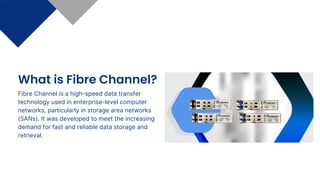
Fibre Channel is a high-speed data transfer
technology used in enterprise-level computer
networks, particularly in storage area networks
(SANs). It was developed to meet the increasing
demand for fast and reliable data storage and
retrieval.
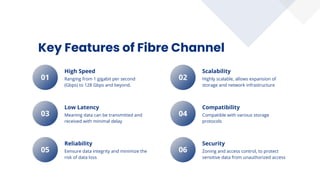
Ranging from 1 gigabit per second
(Gbps) to 128 Gbps and beyond.
01
High Speed
Highly scalable, allows expansion of
storage and network infrastructure
02
Scalability
Meaning data can be transmitted and
received with minimal delay
03
Low Latency
Compatible with various storage
protocols
04
Compatibility
Key Features of Fibre Channel
Eensure data integrity and minimize the
risk of data loss
05
Reliability
Zoning and access control, to protect
sensitive data from unauthorized access
06
Security
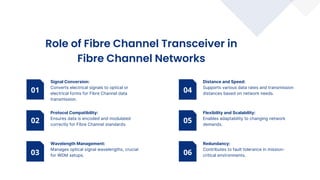
Role of Fibre Channel Transceiver in
Fibre Channel Networks
Signal Conversion:
Converts electrical signals to optical or
electrical forms for Fibre Channel data
transmission.
Distance and Speed:
Supports various data rates and transmission
distances based on network needs.
Protocol Compatibility:
Ensures data is encoded and modulated
correctly for Fibre Channel standards.
Flexibility and Scalability:
Enables adaptability to changing network
demands.
Wavelength Management:
Manages optical signal wavelengths, crucial
for WDM setups.
Redundancy:
Contributes to fault tolerance in mission-
critical environments.
01
02
03
04
05
06
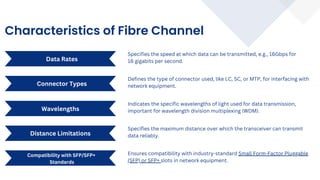
Characteristics of Fibre Channel
Compatibility with SFP/SFP+
Standards
Distance Limitations
Wavelengths
Connector Types
Data Rates
Specifies the speed at which data can be transmitted, e.g., 16Gbps for
16 gigabits per second.
Defines the type of connector used, like LC, SC, or MTP, for interfacing with
network equipment.
Indicates the specific wavelengths of light used for data transmission,
important for wavelength division multiplexing (WDM).
Specifies the maximum distance over which the transceiver can transmit
data reliably.
Ensures compatibility with industry-standard Small Form-Factor Pluggable
(SFP) or SFP+ slots in network equipment.
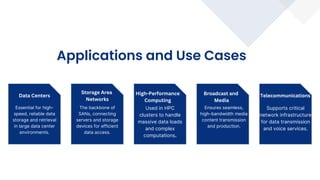
Applications and Use Cases
Essential for high-
speed, reliable data
storage and retrieval
in large data center
environments.
Used in HPC
clusters to handle
massive data loads
and complex
computations.
Ensures seamless,
high-bandwidth media
content transmission
and production.
Supports critical
network infrastructure
for data transmission
and voice services.
The backbone of
SANs, connecting
servers and storage
devices for efficient
data access.
Data Centers
Storage Area
Networks
High-Performance
Computing
Broadcast and
Media
Telecommunications
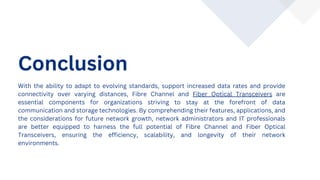
Conclusion
With the ability to adapt to evolving standards, support increased data rates and provide
connectivity over varying distances, Fibre Channel and Fiber Optical Transceivers are
essential components for organizations striving to stay at the forefront of data
communication and storage technologies. By comprehending their features, applications, and
the considerations for future network growth, network administrators and IT professionals
are better equipped to harness the full potential of Fibre Channel and Fiber Optical
Transceivers, ensuring the efficiency, scalability, and longevity of their network
environments.
Contact Us
1-800-537-2296
sales@versitron.com
www.versitron.com

Fibre Channel Transceivers

  • 1.
    Understanding Fibre Channel Transceivers ADeep Dive into Fibre Channel Transceiver Technology
  • 2.
    What is FibreChannel? Fibre Channel is a high-speed data transfer technology used in enterprise-level computer networks, particularly in storage area networks (SANs). It was developed to meet the increasing demand for fast and reliable data storage and retrieval.
  • 3.
    Ranging from 1gigabit per second (Gbps) to 128 Gbps and beyond. 01 High Speed Highly scalable, allows expansion of storage and network infrastructure 02 Scalability Meaning data can be transmitted and received with minimal delay 03 Low Latency Compatible with various storage protocols 04 Compatibility Key Features of Fibre Channel Eensure data integrity and minimize the risk of data loss 05 Reliability Zoning and access control, to protect sensitive data from unauthorized access 06 Security
  • 4.
    Role of FibreChannel Transceiver in Fibre Channel Networks Signal Conversion: Converts electrical signals to optical or electrical forms for Fibre Channel data transmission. Distance and Speed: Supports various data rates and transmission distances based on network needs. Protocol Compatibility: Ensures data is encoded and modulated correctly for Fibre Channel standards. Flexibility and Scalability: Enables adaptability to changing network demands. Wavelength Management: Manages optical signal wavelengths, crucial for WDM setups. Redundancy: Contributes to fault tolerance in mission- critical environments. 01 02 03 04 05 06
  • 5.
    Characteristics of FibreChannel Compatibility with SFP/SFP+ Standards Distance Limitations Wavelengths Connector Types Data Rates Specifies the speed at which data can be transmitted, e.g., 16Gbps for 16 gigabits per second. Defines the type of connector used, like LC, SC, or MTP, for interfacing with network equipment. Indicates the specific wavelengths of light used for data transmission, important for wavelength division multiplexing (WDM). Specifies the maximum distance over which the transceiver can transmit data reliably. Ensures compatibility with industry-standard Small Form-Factor Pluggable (SFP) or SFP+ slots in network equipment.
  • 6.
    Applications and UseCases Essential for high- speed, reliable data storage and retrieval in large data center environments. Used in HPC clusters to handle massive data loads and complex computations. Ensures seamless, high-bandwidth media content transmission and production. Supports critical network infrastructure for data transmission and voice services. The backbone of SANs, connecting servers and storage devices for efficient data access. Data Centers Storage Area Networks High-Performance Computing Broadcast and Media Telecommunications
  • 7.
    Conclusion With the abilityto adapt to evolving standards, support increased data rates and provide connectivity over varying distances, Fibre Channel and Fiber Optical Transceivers are essential components for organizations striving to stay at the forefront of data communication and storage technologies. By comprehending their features, applications, and the considerations for future network growth, network administrators and IT professionals are better equipped to harness the full potential of Fibre Channel and Fiber Optical Transceivers, ensuring the efficiency, scalability, and longevity of their network environments.
  • 8.