Presented By:
Pramod Metri
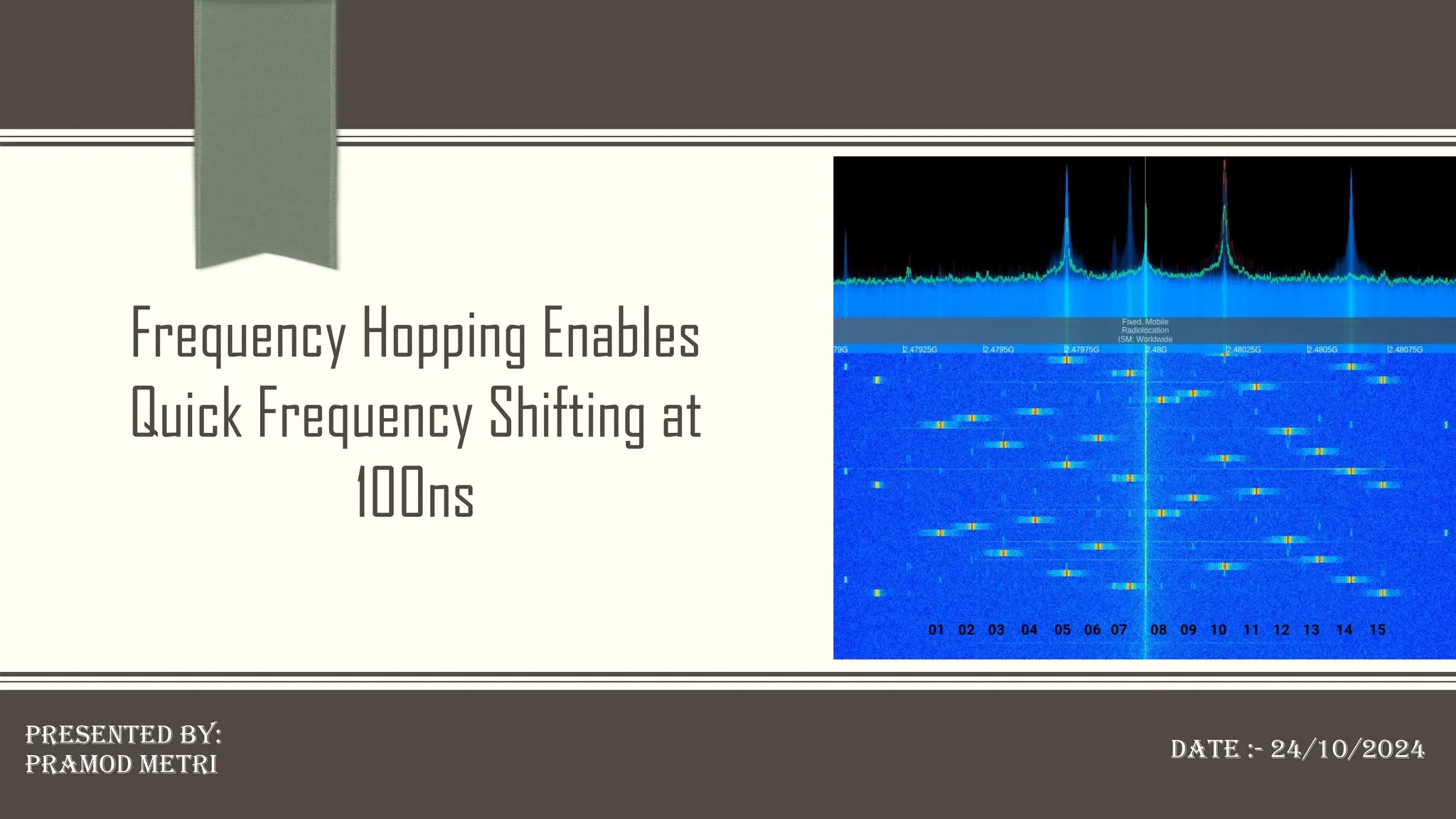
Frequency Hopping Enables
Quick Frequency Shifting at
100ns
Date :- 24/10/2024
Contents
 Introduction
 Block Diagram of FHSS
 Types of FHSS
 Fast Frequency Hopping Spread Spectrum (FHSS)
 Theoretical Calculations for Fast FHSS
 Problem Statement (from PARAS)
 Applications
Introduction
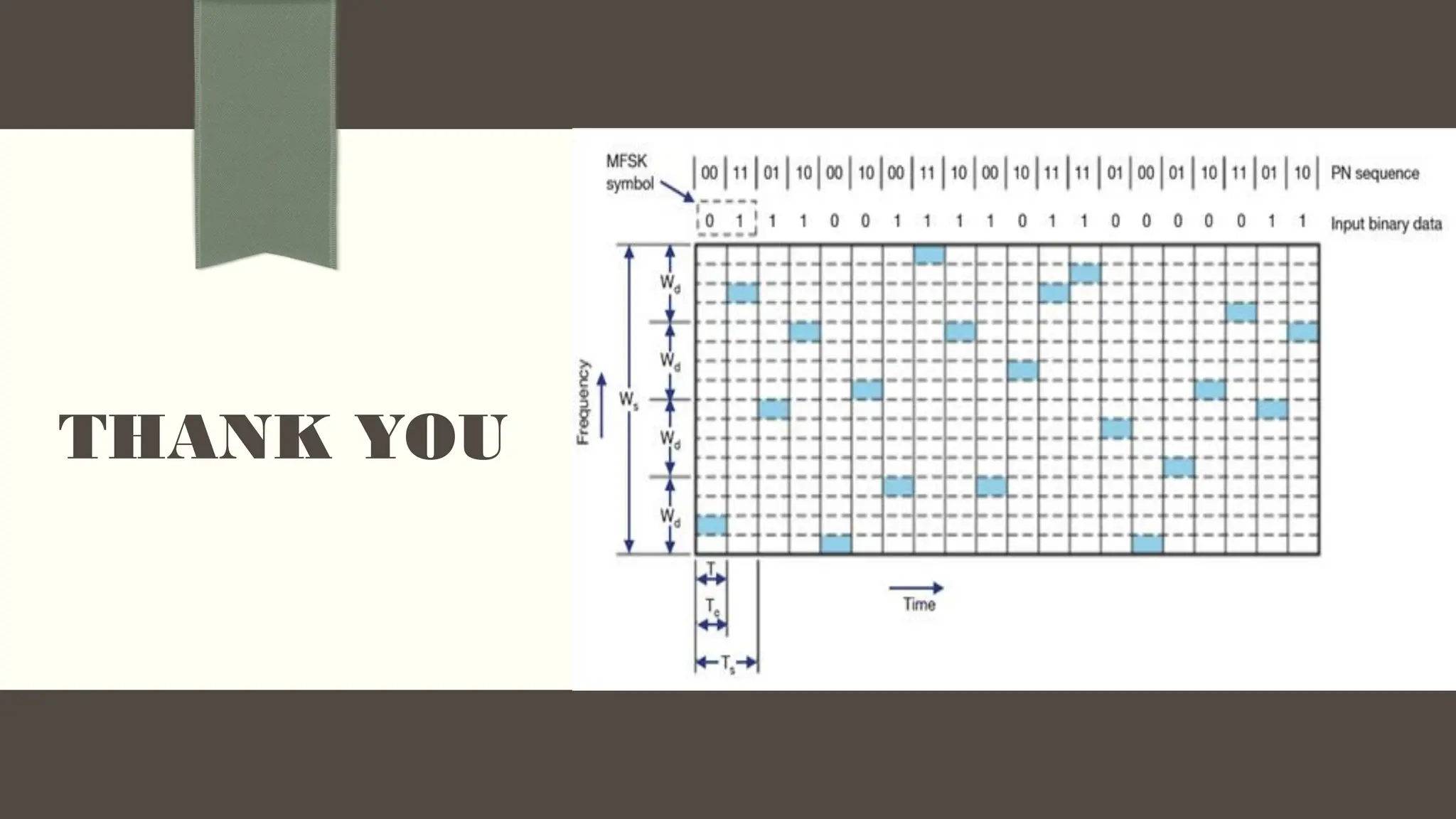
 Frequency Hopping Spread Spectrum (FHSS) is a method of transmitting radio signals by
rapidly switching a carrier among many frequency channels, using a pseudorandom
sequence known to both transmitter and receiver.
 The data signal is modulated with a narrowband carrier signal that "hops" in a random but
predictable sequence from frequency to frequency as a function of time over a wide band of
frequencies.
 It is used as a multiple access method in the frequency-hopping code division multiple access
(FH-CDMA) scheme.
 A pseudo-noise code or PN generator provides a table of frequencies and also indexes it.
Each of the K bits makes particular mention of the 2K frequencies.
Block Diagram of FHSS
Types of HFSS
There are two types of frequency hopping:
1. Slow Frequency Hopping Spread Spectrum
2. Fast Frequency Hopping Spread Spectrum
Fast Frequency Hopping Spread Spectrum (FHSS)
FHSS is a technique used in wireless communication where the carrier frequency rapidly hops
among many frequency channels during transmission. This method improves resistance to
interference and eavesdropping, enhances signal security, and allows for better use of the
available spectrum.
Key features include:
• Speed: The frequency changes quickly, often multiple times per second, which helps in
avoiding interference and jamming.
Fast Frequency Hopping Spread Spectrum (FHSS)
• Robustness: By spreading the signal over a wide range of frequencies, FHSS is less
susceptible to narrowband interference.
• Security: Rapidly changing frequencies make it difficult for unauthorized listeners to intercept
the signal.
Theoretical Calculations for Fast FHSS
Calculating parameters for Fast Frequency Hopping Spread Spectrum (FHSS)
involves several key metrics, including hop rate, bandwidth, and processing gain. Here’s
a brief overview of some important calculations:
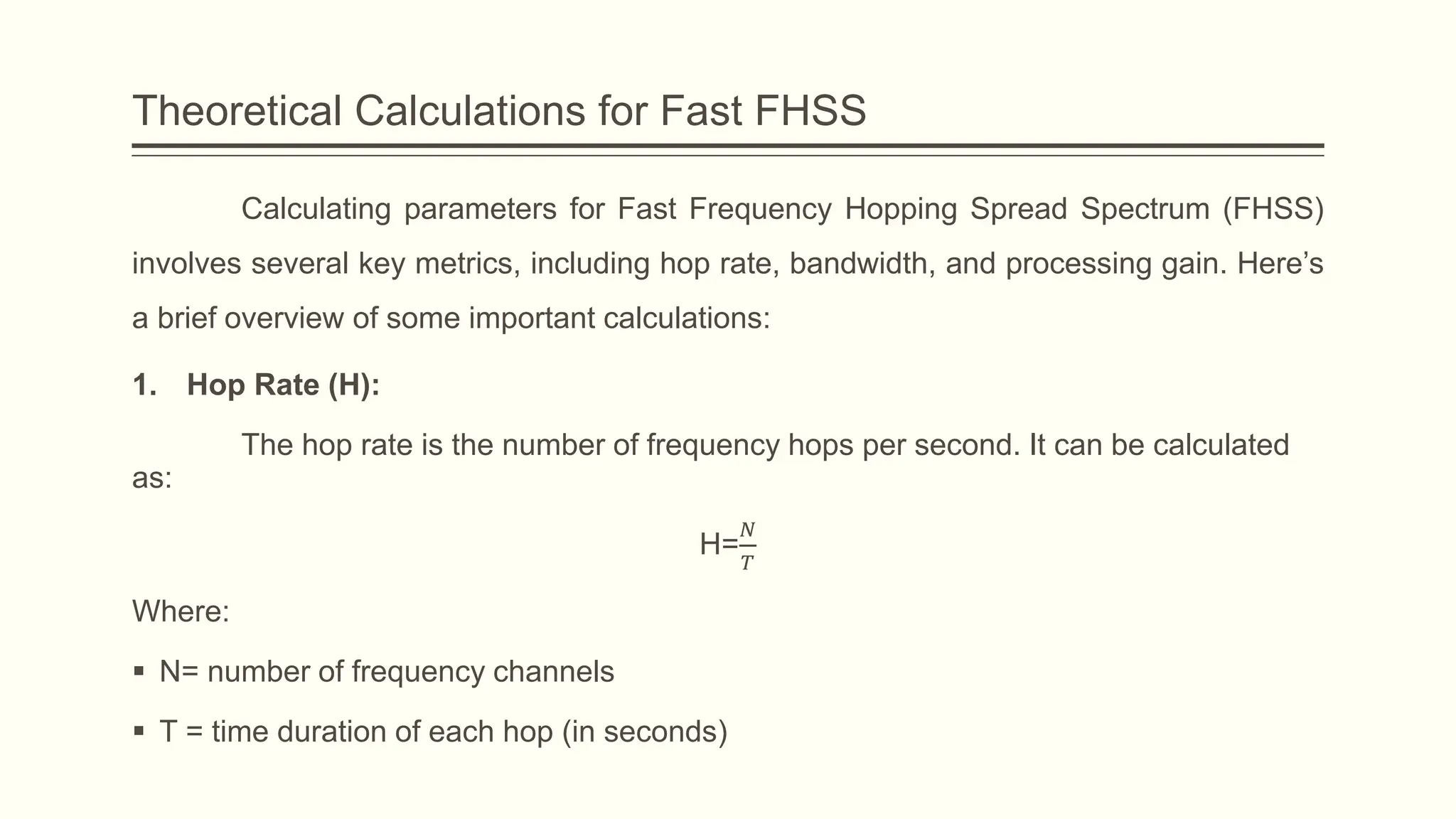
1. Hop Rate (H):
The hop rate is the number of frequency hops per second. It can be calculated
as:
H=
𝑁
𝑇
Where:
 N= number of frequency channels
 T = time duration of each hop (in seconds)
Theoretical Calculations for Fast FHSS
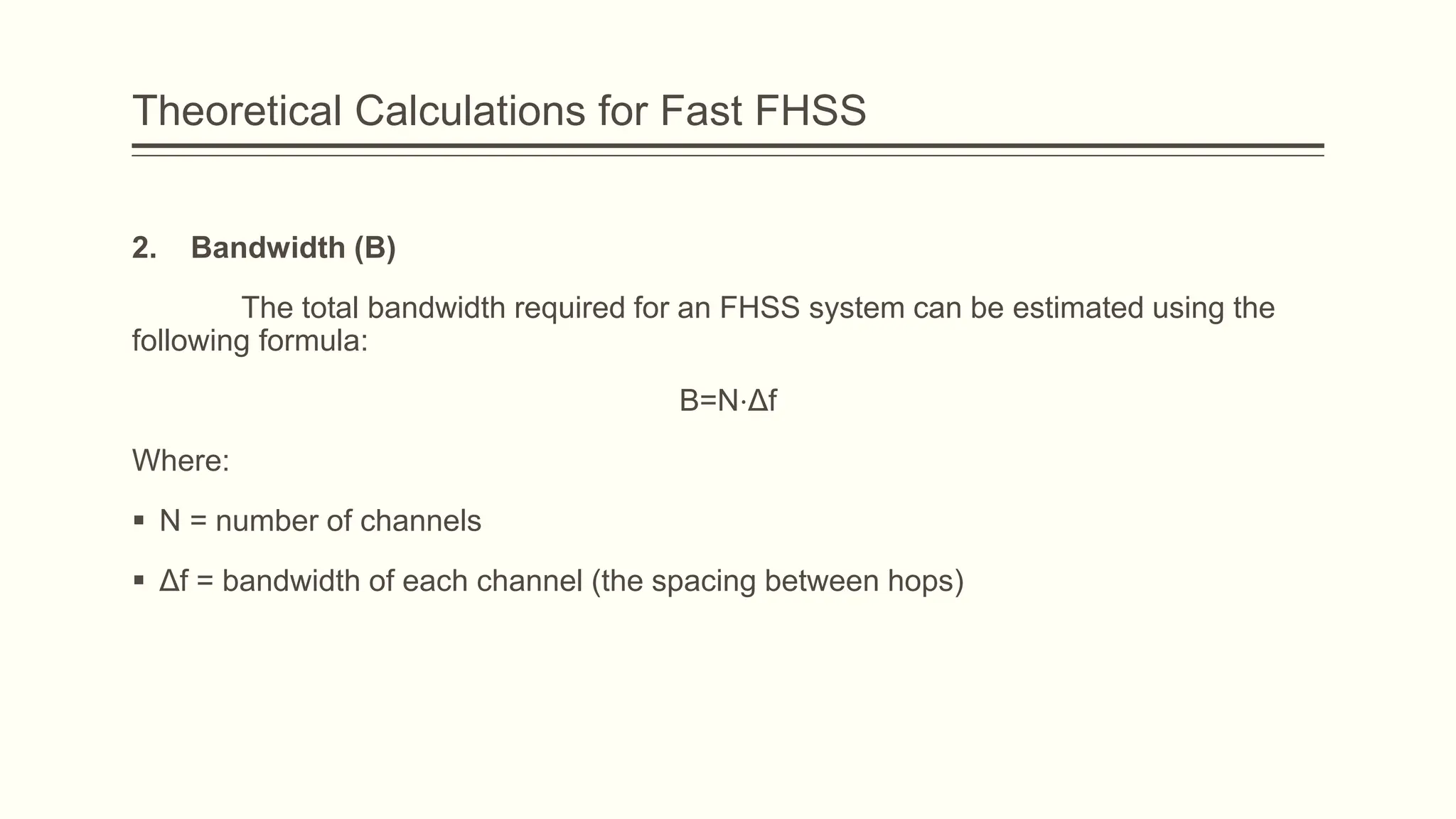
2. Bandwidth (B)
The total bandwidth required for an FHSS system can be estimated using the
following formula:
B=N⋅Δf
Where:
 N = number of channels
 Δf = bandwidth of each channel (the spacing between hops)
Theoretical Calculations for Fast FHSS
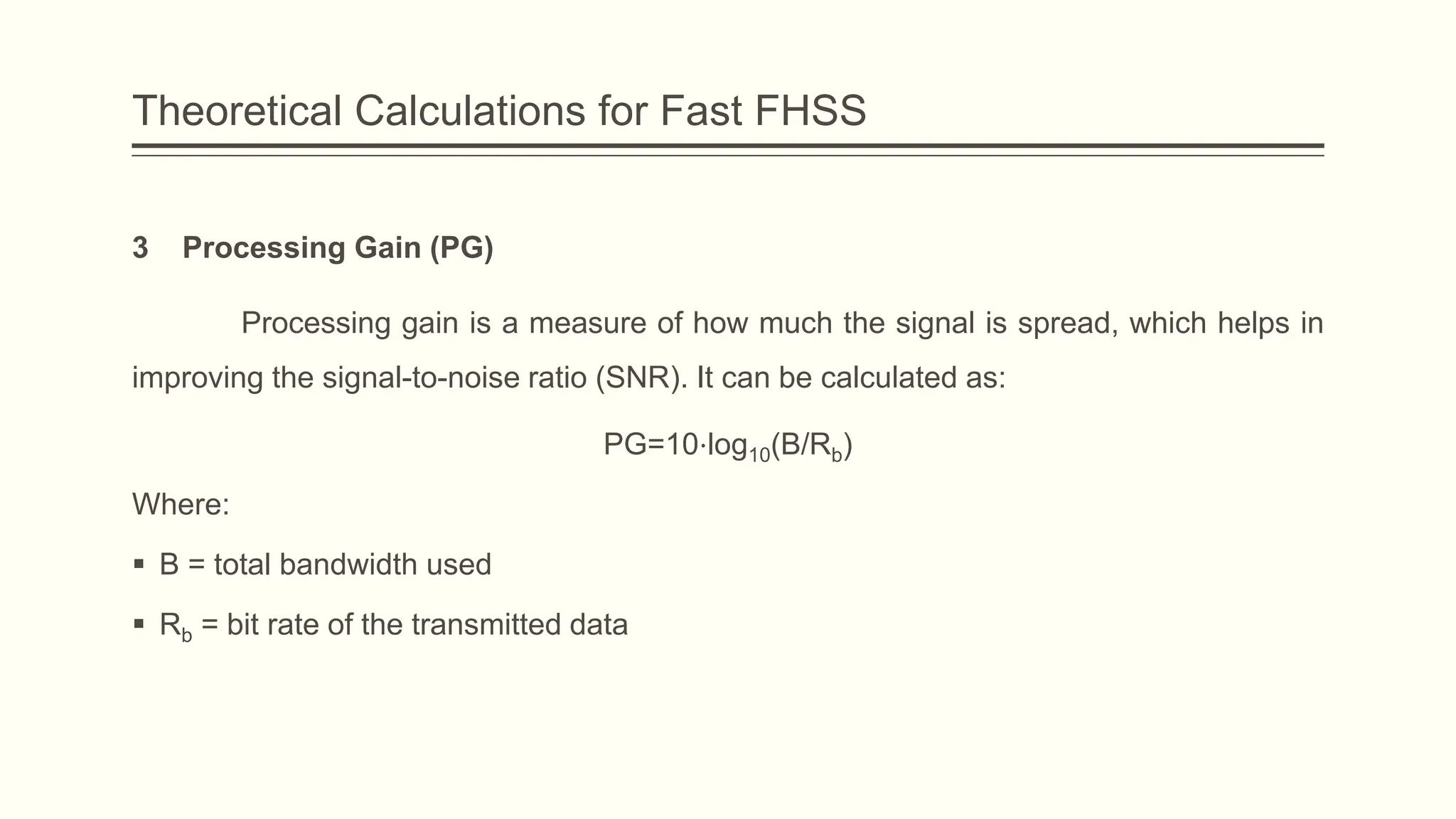
3 Processing Gain (PG)
Processing gain is a measure of how much the signal is spread, which helps in
improving the signal-to-noise ratio (SNR). It can be calculated as:
PG=10⋅log10(B/Rb)
Where:
 B = total bandwidth used
 Rb​ = bit rate of the transmitted data
Theoretical Calculations for Fast FHSS
4 Time Bandwidth Product (TBP)
The time-bandwidth product is an important parameter that defines the spread of
the signal:
TBP=B⋅T
Where, T is the duration of the signal.
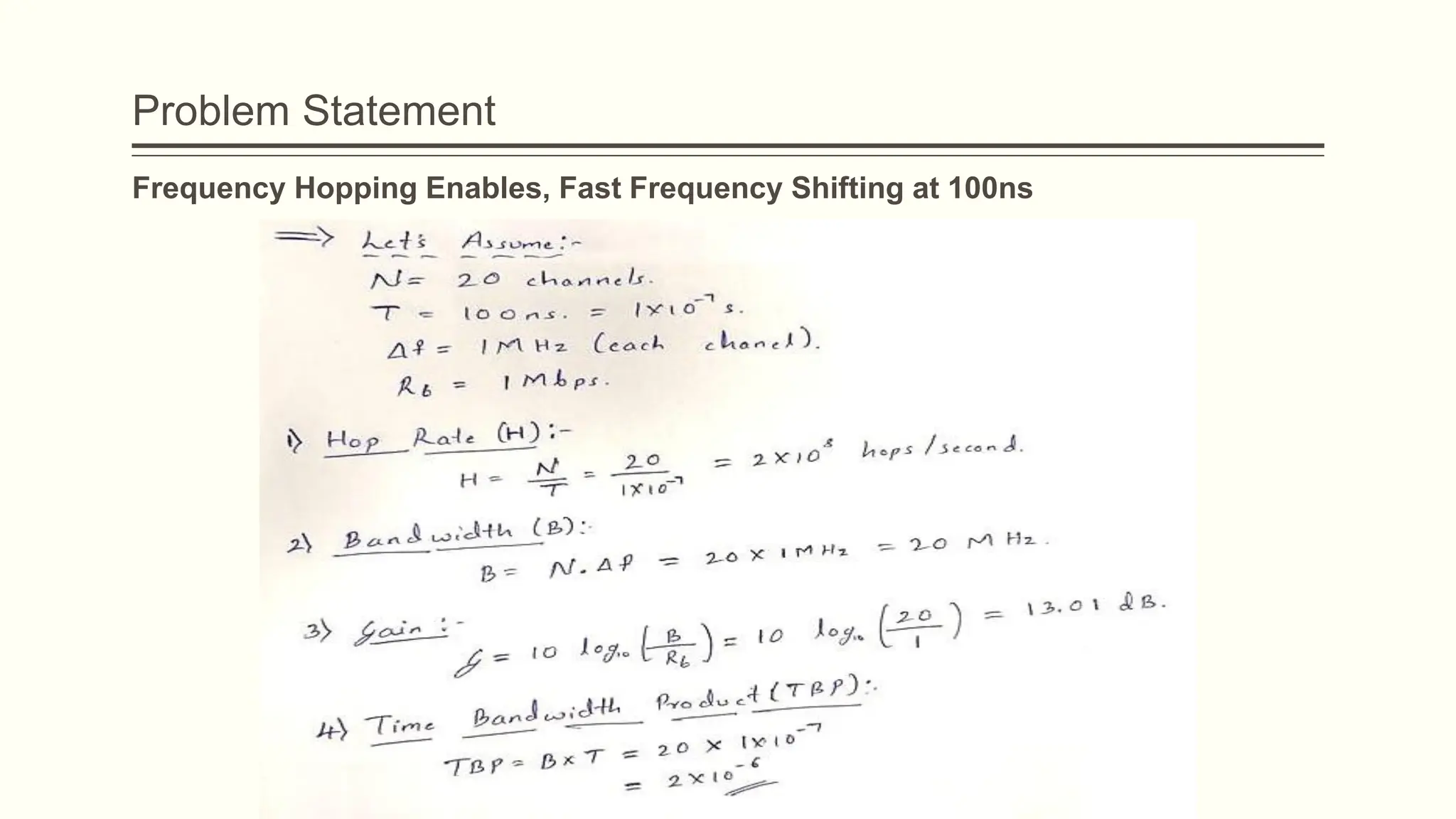
Problem Statement
Frequency Hopping Enables, Fast Frequency Shifting at 100ns
APPLICATION
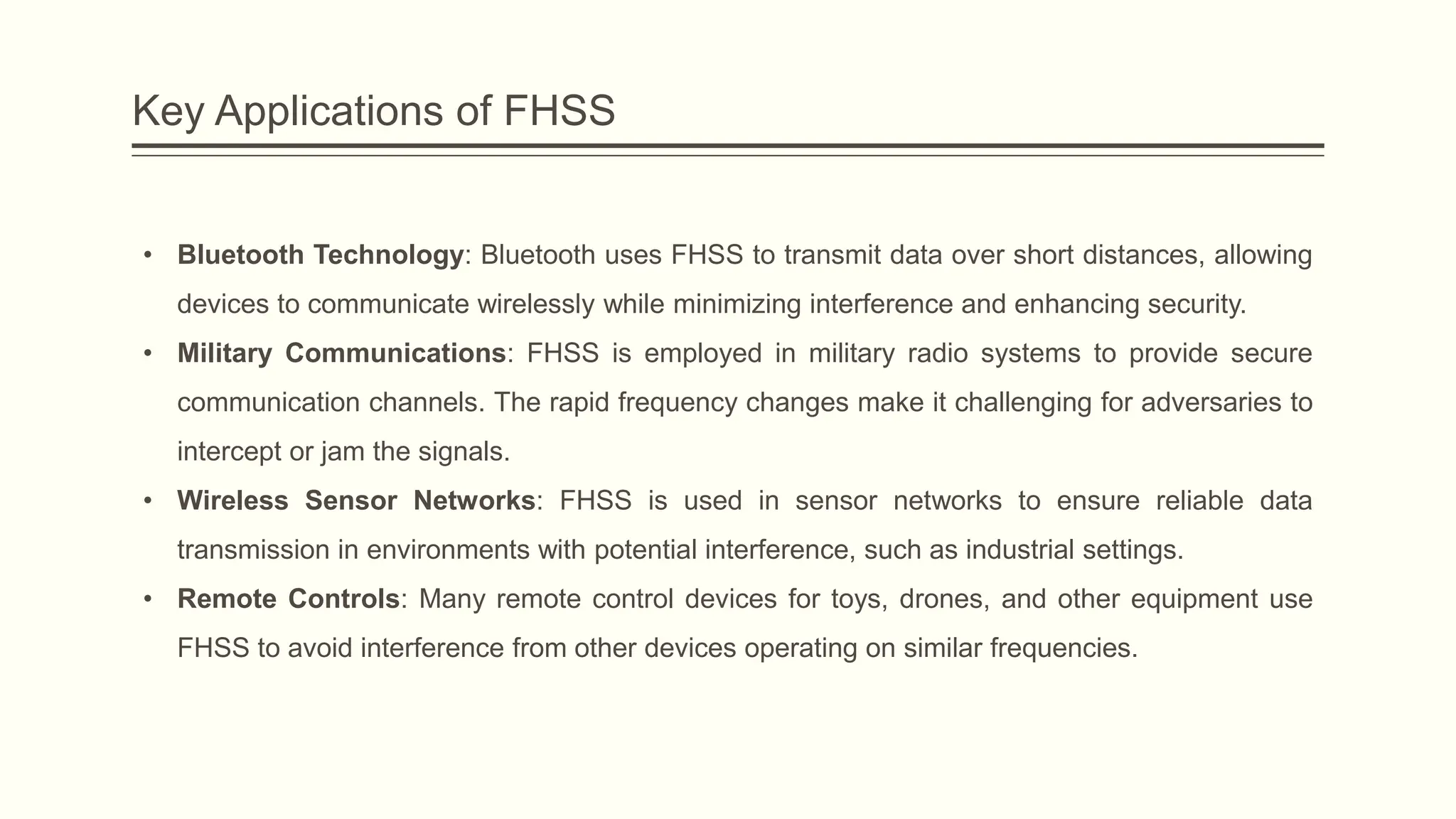
Key Applications of FHSS
• Bluetooth Technology: Bluetooth uses FHSS to transmit data over short distances, allowing
devices to communicate wirelessly while minimizing interference and enhancing security.
• Military Communications: FHSS is employed in military radio systems to provide secure
communication channels. The rapid frequency changes make it challenging for adversaries to
intercept or jam the signals.
• Wireless Sensor Networks: FHSS is used in sensor networks to ensure reliable data
transmission in environments with potential interference, such as industrial settings.
• Remote Controls: Many remote control devices for toys, drones, and other equipment use
FHSS to avoid interference from other devices operating on similar frequencies.
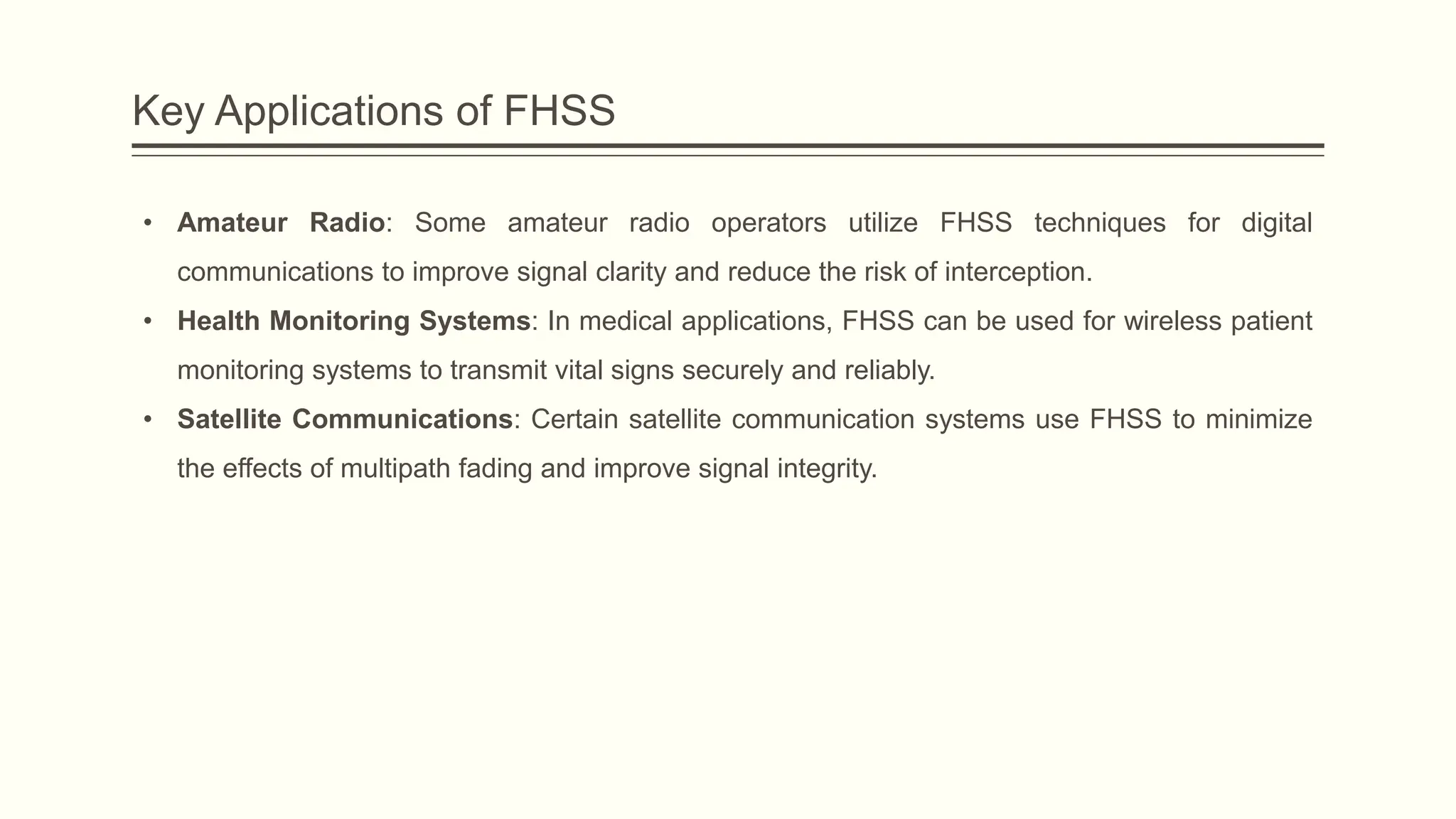
Key Applications of FHSS
• Amateur Radio: Some amateur radio operators utilize FHSS techniques for digital
communications to improve signal clarity and reduce the risk of interception.
• Health Monitoring Systems: In medical applications, FHSS can be used for wireless patient
monitoring systems to transmit vital signs securely and reliably.
• Satellite Communications: Certain satellite communication systems use FHSS to minimize
the effects of multipath fading and improve signal integrity.
THANK YOU

FHSS (Fast Frequency Hopping )..........

  • 1.
    Presented By: Pramod Metri FrequencyHopping Enables Quick Frequency Shifting at 100ns Date :- 24/10/2024
  • 2.
    Contents  Introduction  BlockDiagram of FHSS  Types of FHSS  Fast Frequency Hopping Spread Spectrum (FHSS)  Theoretical Calculations for Fast FHSS  Problem Statement (from PARAS)  Applications
  • 3.
    Introduction  Frequency HoppingSpread Spectrum (FHSS) is a method of transmitting radio signals by rapidly switching a carrier among many frequency channels, using a pseudorandom sequence known to both transmitter and receiver.  The data signal is modulated with a narrowband carrier signal that "hops" in a random but predictable sequence from frequency to frequency as a function of time over a wide band of frequencies.  It is used as a multiple access method in the frequency-hopping code division multiple access (FH-CDMA) scheme.  A pseudo-noise code or PN generator provides a table of frequencies and also indexes it. Each of the K bits makes particular mention of the 2K frequencies.
  • 4.
  • 5.
    Types of HFSS Thereare two types of frequency hopping: 1. Slow Frequency Hopping Spread Spectrum 2. Fast Frequency Hopping Spread Spectrum
  • 6.
    Fast Frequency HoppingSpread Spectrum (FHSS) FHSS is a technique used in wireless communication where the carrier frequency rapidly hops among many frequency channels during transmission. This method improves resistance to interference and eavesdropping, enhances signal security, and allows for better use of the available spectrum. Key features include: • Speed: The frequency changes quickly, often multiple times per second, which helps in avoiding interference and jamming.
  • 7.
    Fast Frequency HoppingSpread Spectrum (FHSS) • Robustness: By spreading the signal over a wide range of frequencies, FHSS is less susceptible to narrowband interference. • Security: Rapidly changing frequencies make it difficult for unauthorized listeners to intercept the signal.
  • 8.
    Theoretical Calculations forFast FHSS Calculating parameters for Fast Frequency Hopping Spread Spectrum (FHSS) involves several key metrics, including hop rate, bandwidth, and processing gain. Here’s a brief overview of some important calculations: 1. Hop Rate (H): The hop rate is the number of frequency hops per second. It can be calculated as: H= 𝑁 𝑇 Where:  N= number of frequency channels  T = time duration of each hop (in seconds)
  • 9.
    Theoretical Calculations forFast FHSS 2. Bandwidth (B) The total bandwidth required for an FHSS system can be estimated using the following formula: B=N⋅Δf Where:  N = number of channels  Δf = bandwidth of each channel (the spacing between hops)
  • 10.
    Theoretical Calculations forFast FHSS 3 Processing Gain (PG) Processing gain is a measure of how much the signal is spread, which helps in improving the signal-to-noise ratio (SNR). It can be calculated as: PG=10⋅log10(B/Rb) Where:  B = total bandwidth used  Rb​ = bit rate of the transmitted data
  • 11.
    Theoretical Calculations forFast FHSS 4 Time Bandwidth Product (TBP) The time-bandwidth product is an important parameter that defines the spread of the signal: TBP=B⋅T Where, T is the duration of the signal.
  • 12.
    Problem Statement Frequency HoppingEnables, Fast Frequency Shifting at 100ns
  • 13.
  • 14.
    Key Applications ofFHSS • Bluetooth Technology: Bluetooth uses FHSS to transmit data over short distances, allowing devices to communicate wirelessly while minimizing interference and enhancing security. • Military Communications: FHSS is employed in military radio systems to provide secure communication channels. The rapid frequency changes make it challenging for adversaries to intercept or jam the signals. • Wireless Sensor Networks: FHSS is used in sensor networks to ensure reliable data transmission in environments with potential interference, such as industrial settings. • Remote Controls: Many remote control devices for toys, drones, and other equipment use FHSS to avoid interference from other devices operating on similar frequencies.
  • 15.
    Key Applications ofFHSS • Amateur Radio: Some amateur radio operators utilize FHSS techniques for digital communications to improve signal clarity and reduce the risk of interception. • Health Monitoring Systems: In medical applications, FHSS can be used for wireless patient monitoring systems to transmit vital signs securely and reliably. • Satellite Communications: Certain satellite communication systems use FHSS to minimize the effects of multipath fading and improve signal integrity.
  • 16.