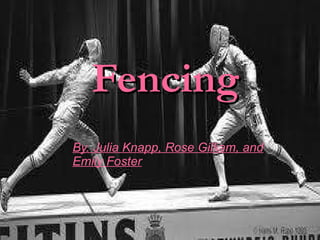
Fencing By. Julia Knapp, Rose Gilliam, and Emily Foster
Fencing is an age old sport using swords to ‘poke’ your opponent and gain a point. Fencing has been around since about 1400 AD, but fencing schools have only been dated back to the 12 th  century. Modern fencing is based on 18 th  century dueling with small swords and dueling sabers, particularly French and Italian systems. What is fencing? Where did it originate? When did it start?
Why do people fence?   There are various reasons you might fence: Exercise.  With all the jumping, thrusting and stabbing, it can be a real work out. Competition.  While there isn’t a lot of professional competitions in America, in many European countries, fencing is rather popular. Learning to handle a sword.  Perhaps you would like to learn to sword fight (different than fencing). Fencing can teach you to handle a sword like a pro. Fun.   Maybe you enjoy fencing a lot. Many people will fence just for fun. Or maybe you just enjoy a combination of them all.
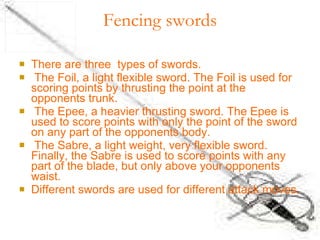
Fencing swords There are three  types of swords. The Foil, a light flexible sword. The Foil is used for scoring points by thrusting the point at the opponents trunk. The Epee, a heavier thrusting sword. The Epee is used to score points with only the point of the sword on any part of the opponents body. The Sabre, a light weight, very flexible sword. Finally, the Sabre is used to score points with any part of the blade, but only above your opponents waist. Different swords are used for different attack moves.
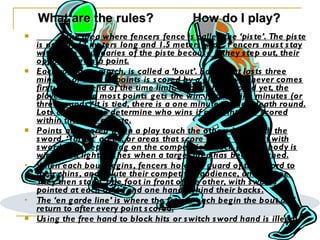
The area where fencers fence is called the ‘piste’. The piste is usually 14 meters long and 1.5 meters wide. Fencers must stay within the boundaries of the piste because if they step out, their opponent gets a point. Each round, or match, is called a ‘bout’. Each bout lasts three minutes or until 15 points is scored by a player, whichever comes first. If at the end of the time limit, nobody has scored yet, the player with the most points gets the win. If after nine minutes (or three rounds) it is tied, there is a one minute sudden death round. Lots are drawn to determine who wins if no points are scored within that one minute. Points are scored when a play touch the others body with the sword. ‘Target’ areas, or areas that score points when hit with sword, vary depending on the competition. Each players body is wired so a light flashes when a target area has been touched. When each bout begins, fencers hold the guard of the sword to their chins, and salute their competitor, audience, and referee. They then stand, one foot in front of the other, with swords pointed at each other and one hand behind their backs. The ‘en garde line’ is where the fences each begin the bout and return to after every point scored. Using the free hand to block hits or switch sword hand is illegal. What are the rules? How do I play?
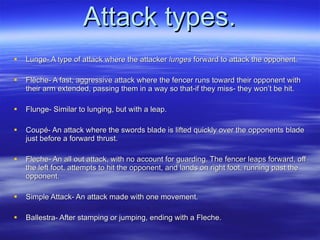
Attack types. Lunge- A type of attack where the attacker  lunges  forward to attack the opponent. Flèche- A fast, aggressive attack where the fencer runs toward their opponent with their arm extended, passing them in a way so that-if they miss- they won’t be hit. Flunge- Similar to lunging, but with a leap. Coup é- An attack where the swords blade is lifted quickly over the opponents blade just before a forward thrust. Fleche- An all out attack, with no account for guarding. The fencer leaps forward, off the left foot, attempts to hit the opponent, and lands on right foot, running past the opponent. Simple Attack- An attack made with one movement. Ballestra- After stamping or jumping, ending with a Fleche.
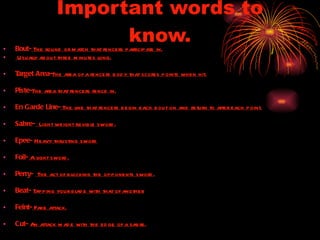
Important words to know. Bout-  The round or match that fencers participate in. Usually about three minutes long. Target Area- The area of a fencers body that scores points when hit. Piste- The area that fencers fence in. En Garde Line-  The line that fencers begin each bout on and return to after each point. Sabre-   Light weight flexible sword. Epee-  Heavy thrusting sword Foil-  A light sword. Perry-  The act of blocking the opponents sword. Beat-  Tapping your blade with that of another. Feint-  Fake attack. Cut-  An attack made with the edge of a sabre.
Thank You We- Julia Knapp, Rose Gilliam and Emily Foster, that is- thank you.  We hope you enjoyed our PowerPoint and, most of all,  found it informative. The information we had found was from various sources including Wikipedia, Answers.com, Yahoo.answers.com and others.

Fencing

  • 1.
    Fencing By. JuliaKnapp, Rose Gilliam, and Emily Foster
  • 2.
    Fencing is anage old sport using swords to ‘poke’ your opponent and gain a point. Fencing has been around since about 1400 AD, but fencing schools have only been dated back to the 12 th century. Modern fencing is based on 18 th century dueling with small swords and dueling sabers, particularly French and Italian systems. What is fencing? Where did it originate? When did it start?
  • 3.
    Why do peoplefence? There are various reasons you might fence: Exercise. With all the jumping, thrusting and stabbing, it can be a real work out. Competition. While there isn’t a lot of professional competitions in America, in many European countries, fencing is rather popular. Learning to handle a sword. Perhaps you would like to learn to sword fight (different than fencing). Fencing can teach you to handle a sword like a pro. Fun. Maybe you enjoy fencing a lot. Many people will fence just for fun. Or maybe you just enjoy a combination of them all.
  • 4.
    Fencing swords Thereare three types of swords. The Foil, a light flexible sword. The Foil is used for scoring points by thrusting the point at the opponents trunk. The Epee, a heavier thrusting sword. The Epee is used to score points with only the point of the sword on any part of the opponents body. The Sabre, a light weight, very flexible sword. Finally, the Sabre is used to score points with any part of the blade, but only above your opponents waist. Different swords are used for different attack moves.
  • 5.
    The area wherefencers fence is called the ‘piste’. The piste is usually 14 meters long and 1.5 meters wide. Fencers must stay within the boundaries of the piste because if they step out, their opponent gets a point. Each round, or match, is called a ‘bout’. Each bout lasts three minutes or until 15 points is scored by a player, whichever comes first. If at the end of the time limit, nobody has scored yet, the player with the most points gets the win. If after nine minutes (or three rounds) it is tied, there is a one minute sudden death round. Lots are drawn to determine who wins if no points are scored within that one minute. Points are scored when a play touch the others body with the sword. ‘Target’ areas, or areas that score points when hit with sword, vary depending on the competition. Each players body is wired so a light flashes when a target area has been touched. When each bout begins, fencers hold the guard of the sword to their chins, and salute their competitor, audience, and referee. They then stand, one foot in front of the other, with swords pointed at each other and one hand behind their backs. The ‘en garde line’ is where the fences each begin the bout and return to after every point scored. Using the free hand to block hits or switch sword hand is illegal. What are the rules? How do I play?
  • 6.
    Attack types. Lunge-A type of attack where the attacker lunges forward to attack the opponent. Flèche- A fast, aggressive attack where the fencer runs toward their opponent with their arm extended, passing them in a way so that-if they miss- they won’t be hit. Flunge- Similar to lunging, but with a leap. Coup é- An attack where the swords blade is lifted quickly over the opponents blade just before a forward thrust. Fleche- An all out attack, with no account for guarding. The fencer leaps forward, off the left foot, attempts to hit the opponent, and lands on right foot, running past the opponent. Simple Attack- An attack made with one movement. Ballestra- After stamping or jumping, ending with a Fleche.
  • 7.
    Important words toknow. Bout- The round or match that fencers participate in. Usually about three minutes long. Target Area- The area of a fencers body that scores points when hit. Piste- The area that fencers fence in. En Garde Line- The line that fencers begin each bout on and return to after each point. Sabre- Light weight flexible sword. Epee- Heavy thrusting sword Foil- A light sword. Perry- The act of blocking the opponents sword. Beat- Tapping your blade with that of another. Feint- Fake attack. Cut- An attack made with the edge of a sabre.
  • 8.
    Thank You We-Julia Knapp, Rose Gilliam and Emily Foster, that is- thank you. We hope you enjoyed our PowerPoint and, most of all, found it informative. The information we had found was from various sources including Wikipedia, Answers.com, Yahoo.answers.com and others.