dr subha/8th sem pbl 1
PERMANENT METHOD
OF FAMILY PLANNING
Dr. Subha Shrestha
Obgy dept.
COMS
dr subha/8th sem pbl 2
Learning objectives:
• Female Sterilization Overview
• Methods of Female Sterilization
• Studies and Findings: Sterilization failure rate, Ectopic
pregnancy rate with failure
• Other Considerations
• Summary of Female Sterilization
dr subha/8th sem pbl 3
Overview:
• Younger women (ages 20-29) are more likely to
undergo postpartum sterilization procedures
• Approximately 50% of the tubal ligations
performed annually are postpartum
• Most postpartum procedures are performed
within 24 hours
• Older women (ages 35-49) are more likely to
undergo interval procedures
dr subha/8th sem pbl 4
Overview:
• Younger women (ages 20-29) are more likely to undergo
postpartum sterilization procedures
• Approximately 50% of the tubal ligations performed
annually are postpartum
• Most postpartum procedures are performed within 24
hours
• Older women (ages 35-49) are more likely to undergo
interval procedures
dr subha/8th sem pbl 5
The History of Female Sterilization
• 1823 – First proposed by James Brundell in
London
• 1880 – First published report of procedure by
Lungren in Toledo, Ohio
• 1930 – First publication of the Pomeroy
Technique, Pomeroy, New York State Journal
of Medicine
• 1936 – Bosch performed the first laparoscopic
tubal occlusion in Switzerland
dr subha/8th sem pbl 6
• Increased interest in family planning coupled
with safer and more effective methods
allowed sterilization to become a viable
method of contraception.
• Widespread acceptance of laparoscopy led
to the development of several methods
• Electrocautery (mono-polar and bi-polar)
• Clips (Hulka and Filshie)
• Bands (Yoon Band, Falope Ring)
dr subha/8th sem pbl 7
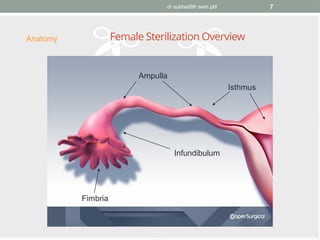
Female Sterilization Overview
Anatomy
Ampulla
Isthmus
Fimbria
Infundibulum
dr subha/8th sem pbl 8
Methods of Female Sterilization
Interval
• Laparoscopic
• Electrocoagulation (Mono
and Bi -Polar)
• Falope Ring
• Hulka Clip
• Filshie Tubal Ligation
System
• Hysteroscopy
• Essure
• Adiana
Post Partum/ Labor & Delivery
• Pomeroy
• Parkland
• Irving
• Uchida
• Filshie Tubal Ligation System
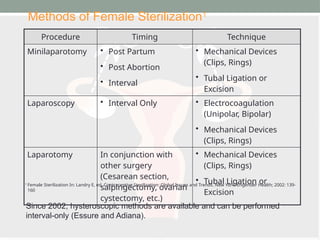
Procedure Timing Technique
Minilaparotomy • Post Partum
• Post Abortion
• Interval
• Mechanical Devices
(Clips, Rings)
• Tubal Ligation or
Excision
Laparoscopy • Interval Only • Electrocoagulation
(Unipolar, Bipolar)
• Mechanical Devices
(Clips, Rings)
Laparotomy In conjunction with
other surgery
(Cesarean section,
salpingectomy, ovarian
cystectomy, etc.)
• Mechanical Devices
(Clips, Rings)
• Tubal Ligation or
Excision
1
Female Sterilization In: Landry E, ed. Contraceptive Sterilization: Global Issues and Trends. New York: Engender Health; 2002: 139-
160
Methods of Female Sterilization1
Since 2002, hysteroscopic methods are available and can be performed
interval-only (Essure and Adiana).
Methods of Female Sterilization
Laparoscopic
• Proposed in 1937 by
Anderson
• Complications
• Bowel Burn
• Bleeding
• Longer portion of tube is
damaged
• Failures and ectopic
pregnancy
• Transection is frequent
1
Peterson LS Contraceptive use in the United States: 1982 -90. Advance Data: From Vital Health
Statistics February 1995; 260 1-8
Failure Rate: 7.5/1000 (.07-.75%)1
Monopolar Coagulation
Methods of Female Sterilization
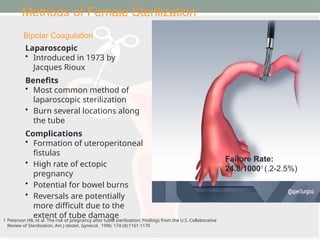
Laparoscopic
• Introduced in 1973 by
Jacques Rioux
Benefits
• Most common method of
laparoscopic sterilization
• Burn several locations along
the tube
Complications
• Formation of uteroperitoneal
fistulas
• High rate of ectopic
pregnancy
• Potential for bowel burns
• Reversals are potentially
more difficult due to the
extent of tube damage
1 Peterson HB, et al. The risk of pregnancy after tubal sterilization: Findings from the U.S. Collaborative
Review of Sterilization. Am J obstet. Gynecol. 1996; 174 (4):1161-1170
Failure Rate:
24.8/10001
(.2-2.5%)
Bipolar Coagulation
dr subha/8th sem pbl 12
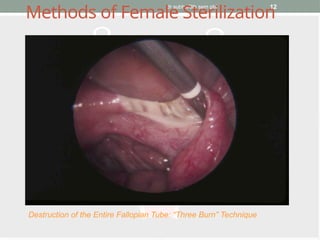
Methods of Female Sterilization
Destruction of the Entire Fallopian Tube: “Three Burn” Technique
Methods of Female Sterilization
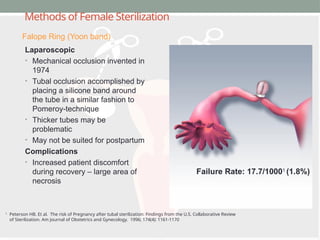
Laparoscopic
• Mechanical occlusion invented in
1974
• Tubal occlusion accomplished by
placing a silicone band around
the tube in a similar fashion to
Pomeroy-technique
• Thicker tubes may be
problematic
• May not be suited for postpartum
Complications
• Increased patient discomfort
during recovery – large area of
necrosis
1
Peterson HB. Et al. The risk of Pregnancy after tubal sterilization: Findings from the U.S. Collaborative Review
of Sterilization. Am Journal of Obstetrics and Gynecology. 1996; 174(4): 1161-1170
Falope Ring (Yoon band)
Failure Rate: 17.7/10001
(1.8%)
dr subha/8th sem pbl 14
Methods of Female Sterilization
Falope Ring/Yoon Band
Methods of Female Sterilization
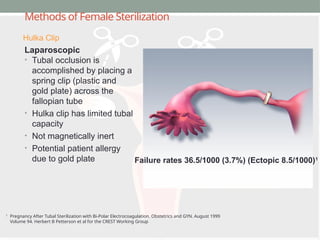
Laparoscopic
• Tubal occlusion is
accomplished by placing a
spring clip (plastic and
gold plate) across the
fallopian tube
• Hulka clip has limited tubal
capacity
• Not magnetically inert
• Potential patient allergy
due to gold plate
1
Pregnancy After Tubal Sterilization with Bi-Polar Electrocoagulation. Obstetrics and GYN. August 1999
Volume 94. Herbert B Petterson et al for the CREST Working Group
Failure rates 36.5/1000 (3.7%) (Ectopic 8.5/1000)1
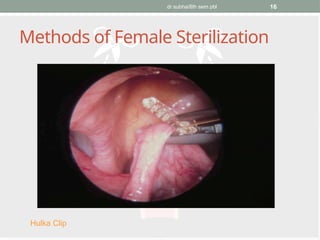
Hulka Clip
dr subha/8th sem pbl 16
Methods of Female Sterilization
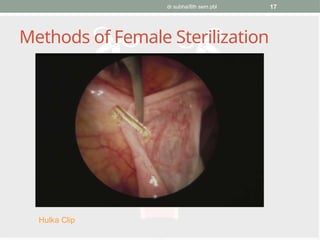
Hulka Clip
dr subha/8th sem pbl 17
Methods of Female Sterilization
Hulka Clip
dr subha/8th sem pbl 18
Laparoscopic and Minilapararotomy
• FDA approved in 1996 (post CREST
study)
• Tubal occlusion accomplished by placing
a titanium hinge clip lined with silicone
rubber across the fallopian tube
• Large tubal capacity
• Magnetically inert (okay for MRI)
• Minimal post operative pain
• Designed for use interval and post
partum (post vaginal birth and at the
time of C-section)
• Clip migration rare but possible
Methods of Female Sterilization
1 A Penfield, MD. The Filshie Clip for Female Sterilization: A Review of World Experience. American Journal of
Obstetrics and Gynecology, March 2000
2 Failure Rates from Family Health International, used in the initial FDA PMA Submission for the Filshie Clip
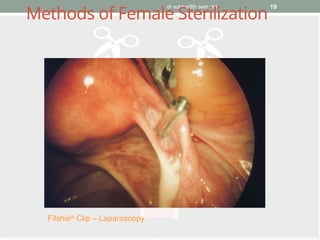
Filshie®
Tubal Ligation System
Failure rate of 2.7/1,000 (.27%)1,2
dr subha/8th sem pbl 19
Methods of Female Sterilization
Filshie®
Clip – Laparoscopy
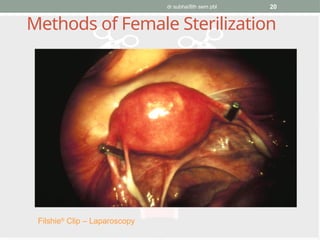
dr subha/8th sem pbl 20
Methods of Female Sterilization
Filshie®
Clip – Laparoscopy
Methods of Female Sterilization
Hysteroscopic (Hospital and Office-based
procedure)
• Approved in 2002
• Micro-insert placed into each tube, PET fibers
stimulate in-growth over several weeks
• 86% Success Rate for 1st
time placements of
micro-inserts
• 3 months of alternative contraception until
HSG procedure confirms occlusion
• Not suitable for patients with known allergies
to contrast media or hypersensitivity to nickel
• Irreversible
• May limit a patients ability to have in vitro
fertilization, should patient change her mind
• May limit the ability to perform endometrial
ablation in the future
• ACOG does not recommend
concomitant endometrial ablation
FDA. Essure System: Summary of Safety and Effectiveness. November 4, 2002 available at
http://www.fda.gov/cdrh/pdf2/p020014b.pdf 1
UpToDate – Hysteroscopic Sterilization; Jan 2010
Essure®
Failure rate .26%1
(5 year rate)
Methods of Female Sterilization
Hysteroscopic (Hospital and
Office-based procedure)
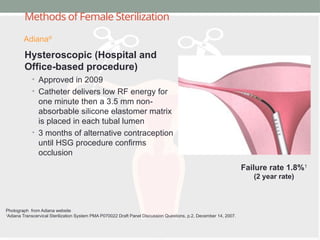
• Approved in 2009
• Catheter delivers low RF energy for
one minute then a 3.5 mm non-
absorbable silicone elastomer matrix
is placed in each tubal lumen
• 3 months of alternative contraception
until HSG procedure confirms
occlusion
Photograph from Adiana website
1
Adiana Transcervical Sterilization System PMA P070022 Draft Panel Discussion Questions, p.2, December 14, 2007.
Adiana®
Failure rate 1.8%1
(2 year rate)
dr subha/8th sem pbl 23
Methods of Female Sterilization
Postpartum
• Pomeroy
• Parkland
• Irving
• Uchida
• Filshie®
Tubal Ligation System
Methods of Female Sterilization
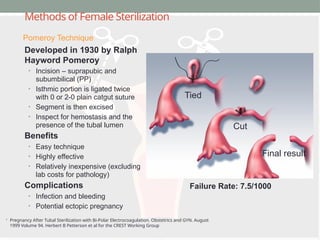
Developed in 1930 by Ralph
Hayword Pomeroy
• Incision – suprapubic and
subumbilical (PP)
• Isthmic portion is ligated twice
with 0 or 2-0 plain catgut suture
• Segment is then excised
• Inspect for hemostasis and the
presence of the tubal lumen
Benefits
• Easy technique
• Highly effective
• Relatively inexpensive (excluding
lab costs for pathology)
Complications
• Infection and bleeding
• Potential ectopic pregnancy
1
Pregnancy After Tubal Sterilization with Bi-Polar Electrocoagulation. Obstetrics and GYN. August
1999 Volume 94. Herbert B Petterson et al for the CREST Working Group
Pomeroy Technique
Tied
Cut
Final result
Failure Rate: 7.5/1000
Methods of Female Sterilization
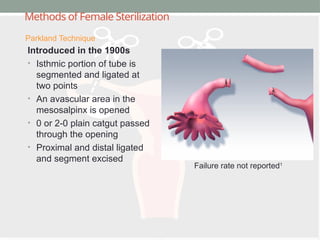
Introduced in the 1900s
• Isthmic portion of tube is
segmented and ligated at
two points
• An avascular area in the
mesosalpinx is opened
• 0 or 2-0 plain catgut passed
through the opening
• Proximal and distal ligated
and segment excised
Parkland Technique
Failure rate not reported1
Methods of Female Sterilization
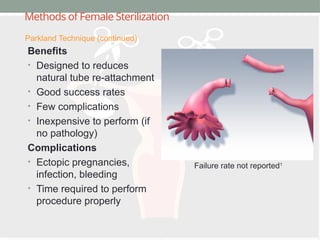
Benefits
• Designed to reduces
natural tube re-attachment
• Good success rates
• Few complications
• Inexpensive to perform (if
no pathology)
Complications
• Ectopic pregnancies,
infection, bleeding
• Time required to perform
procedure properly
Parkland Technique (continued)
Failure rate not reported1
Methods of Female Sterilization
Method published in 1924
• Was developed for sterilization
at C/S
• Bury the proximal tubal stump
within the myometrium
• Original description – distal tube
buried in the broad ligament
Benefits
• Used in conjunction with
cesarean delivery
Complications
• Moderate level of difficulty to
perform
• Pomeroy and Parkland are
quicker
1. Sterilization. The University of Kentucky Department of OB-GYN Women’s Health Curriculum.
Irving Technique
Failure rate: 1/10001
1 Up to Date – Sept 2010, Stovall T. et al. Surgical Sterilization of Women
Methods of Female Sterilization
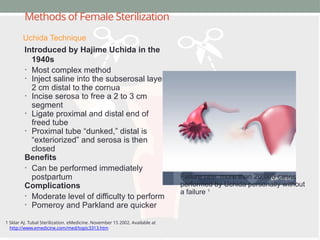
Introduced by Hajime Uchida in the
1940s
• Most complex method
• Inject saline into the subserosal layer
2 cm distal to the cornua
• Incise serosa to free a 2 to 3 cm
segment
• Ligate proximal and distal end of
freed tube
• Proximal tube “dunked,” distal is
“exteriorized” and serosa is then
closed
Benefits
• Can be performed immediately
postpartum
Complications
• Moderate level of difficulty to perform
• Pomeroy and Parkland are quicker
1 Sklar AJ. Tubal Sterilization. eMedicine. November 15 2002. Available at
http://www.emedicine.com/med/topic3313.htm
Failure rate: more than 20,000 cases
performed by Uchida personally without
a failure 1
Uchida Technique
dr subha/8th sem pbl 29
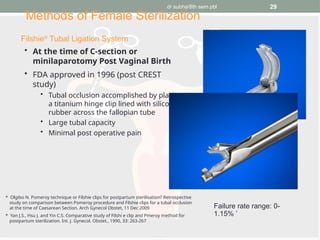
• At the time of C-section or
minilaparotomy Post Vaginal Birth
• FDA approved in 1996 (post CREST
study)
• Tubal occlusion accomplished by placing
a titanium hinge clip lined with silicone
rubber across the fallopian tube
• Large tubal capacity
• Minimal post operative pain
Methods of Female Sterilization
Filshie®
Tubal Ligation System
Failure rate range: 0-
1.15% *
* Olgibo N. Pomeroy technique or Filshie clips for postpartum sterilisation? Retrospective
study on comparison between Pomeroy procedure and Filshie clips for a tubal occlusion
at the time of Caesarean Section. Arch Gynecol Obstet, 11 Dec 2009
* Yan J.S., Hsu J. and Yin C.S. Comparative study of Filshi e clip and Pmeroy method for
postpartum sterilization. Int. J. Gynecol. Obstet., 1990, 33: 263-267
Methods of Female Sterilization
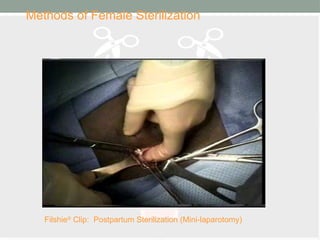
Filshie®
Clip: Postpartum Sterilization (Mini-laparotomy)
Methods of Female
Sterilization
Filshie®
Clip: Postpartum Sterilization (Cesarean)
dr subha/8th sem pbl 32
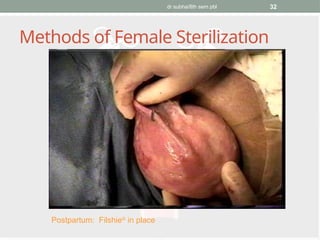
Methods of Female Sterilization
Postpartum: Filshie®
in place
dr subha/8th sem pbl 33
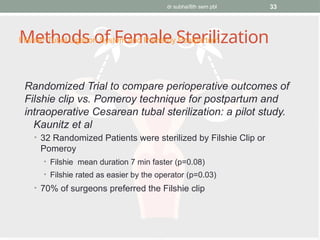
Methods of Female Sterilization
Randomized Trial to compare perioperative outcomes of
Filshie clip vs. Pomeroy technique for postpartum and
intraoperative Cesarean tubal sterilization: a pilot study.
Kaunitz et al
• 32 Randomized Patients were sterilized by Filshie Clip or
Pomeroy
• Filshie mean duration 7 min faster (p=0.08)
• Filshie rated as easier by the operator (p=0.03)
• 70% of surgeons preferred the Filshie clip
Filshie®
Tubal Ligation System and Pomeroy Postpartum
dr subha/8th sem pbl 34
Studies and Findings
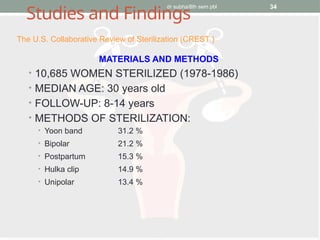
MATERIALS AND METHODS
• 10,685 WOMEN STERILIZED (1978-1986)
• MEDIAN AGE: 30 years old
• FOLLOW-UP: 8-14 years
• METHODS OF STERILIZATION:
• Yoon band 31.2 %
• Bipolar 21.2 %
• Postpartum 15.3 %
• Hulka clip 14.9 %
• Unipolar 13.4 %
The U.S. Collaborative Review of Sterilization (CREST )
dr subha/8th sem pbl 35
Studies and Findings
RESULTS: Failure Rates
• 34 Luteal phase pregnancies
• 143/10,685 True failures (1.34%)
• 15% Spontaneous abortion
• 18% Induced abortion
• 29% Deliveries
• 3% Ongoing pregnancy at time of study
• 33% Ectopic pregnancy
• 2% Status unknown
Findings from CREST
Studies and Findings
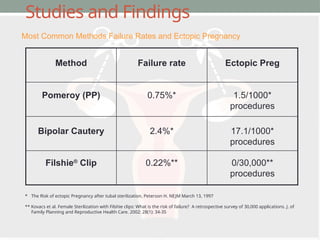
0/30,000**
procedures
0.22%**
Filshie®
Clip
17.1/1000*
procedures
2.4%*
Bipolar Cautery
1.5/1000*
procedures
0.75%*
Pomeroy (PP)
Ectopic Preg
Failure rate
Method
* The Risk of ectopic Pregnancy after tubal sterilization, Peterson H. NEJM March 13, 1997
** Kovacs et al. Female Sterilization with Filshie clips: What is the risk of failure? A retrospective survey of 30,000 applications. J. of
Family Planning and Reproductive Health Care. 2002: 28(1): 34-35
Most Common Methods Failure Rates and Ectopic Pregnancy
dr subha/8th sem pbl 37
Studies and Findings
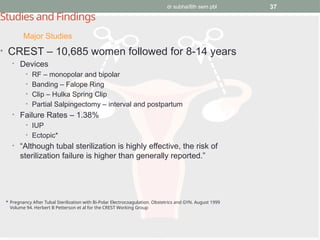
• CREST – 10,685 women followed for 8-14 years
• Devices
• RF – monopolar and bipolar
• Banding – Falope Ring
• Clip – Hulka Spring Clip
• Partial Salpingectomy – interval and postpartum
• Failure Rates – 1.38%
• IUP
• Ectopic*
• “Although tubal sterilization is highly effective, the risk of
sterilization failure is higher than generally reported.”
Major Studies
* Pregnancy After Tubal Sterilization with Bi-Polar Electrocoagulation. Obstetrics and GYN. August 1999
Volume 94. Herbert B Petterson et al for the CREST Working Group
dr subha/8th sem pbl 38
Other Considerations
Discussion with patient must take place and cover the following
details:
• It must be a voluntary decision
• Discussion of other options
• Discussion of method of sterilization
• Sterilization is permanent
• Must be 21 years of age or older
• Probability of failure
• Discussion about methods of contraception for prevention of STDs
• Special consideration for women with mental disabilities
Informed Consent
Information taken from the Dept. of Health and Human Services Form: http://www.hhs.gov/forms/HHS-687.pdf
dr subha/8th sem pbl 39
Other Considerations
Women may experience regret post-procedure
• 2-26% of women express regret post-sterilization
• 1-2% will seek reversal
• Sterilization is permanent
• Association with age at time of sterilization, change in
marital status and future regret
• Requests for reversals and/or IVF possible
Regret
* Chi, I.C., Jones D.B. Incidence, risk factors, and prevention of poststerilization regret: an updated international review
from an epidemiological perspective. Obstet Gynecol Surv 1994;49:722-32
* Van Voorhis BJ. Comparison of tubal ligation reversal procedures. Clin Obstet Gynecol 2000;43:641-9 Curtis, K.,
Mohllajee, A.P., and Peterson, H.B. Regret Following Female Sterilization at a Young Age: A Systematic Review.
Contracep 2006;73:2. P 205-210
Other Considerations
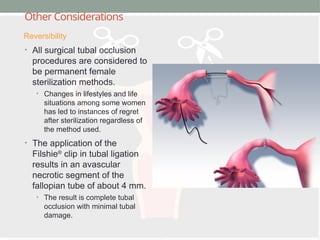
• All surgical tubal occlusion
procedures are considered to
be permanent female
sterilization methods.
• Changes in lifestyles and life
situations among some women
has led to instances of regret
after sterilization regardless of
the method used.
• The application of the
Filshie®
clip in tubal ligation
results in an avascular
necrotic segment of the
fallopian tube of about 4 mm.
• The result is complete tubal
occlusion with minimal tubal
damage.
Reversibility
dr subha/8th sem pbl 41
Summary of Female Sterilization
• Tubal occlusion is an effective method of female
sterilization regardless of method chosen
• Failures will occur in some percentage female
sterilization procedures regardless of method utilized.
• IUP
• Ectopic Pregnancy
dr subha/8th sem pbl 42
Male Sterilization
• Safe and permanent birth control procedure
• US: 1 of 5 men over age 35 has had a vasectomy
• 500,000 vasectomies in the US each year
• 4 million world wide each year
• Cost (US) of procedure $500-$1000
Vasectomy
dr subha/8th sem pbl 43
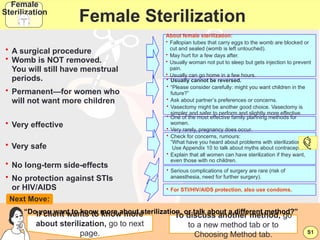
Female Sterilization
• A surgical procedure
About female sterilization:
• Fallopian tubes that carry eggs to the womb are blocked or
cut and sealed (womb is left untouched).
• May hurt for a few days after.
• Usually woman not put to sleep but gets injection to prevent
pain.
• Usually can go home in a few hours.
• Usually cannot be reversed.
• “Please consider carefully: might you want children in the
future?”
• Ask about partner’s preferences or concerns.
• Vasectomy might be another good choice. Vasectomy is
simpler and safer to perform and slightly more effective.
• One of the most effective family planning methods for
women.
• Very rarely, pregnancy does occur.
• For STI/HIV/AIDS protection, also use condoms.
• Serious complications of surgery are rare (risk of
anaesthesia, need for further surgery).
“Do you want to know more about sterilization, or talk about a different method?”
If client wants to know more
about sterilization, go to next
page.
Next Move:
• Permanent—for women who
will not want more children
• Very effective
• No long-term side-effects
• No protection against STIs
or HIV/AIDS
• Very safe
• Check for concerns, rumours:
“What have you heard about problems with sterilization?”
Use Appendix 10 to talk about myths about contraception.
• Explain that all women can have sterilization if they want,
even those with no children.
• Womb is NOT removed.
You will still have menstrual
periods.
S1
Female
Sterilization
To discuss another method, go
to a new method tab or to
Choosing Method tab.
dr subha/8th sem pbl 44
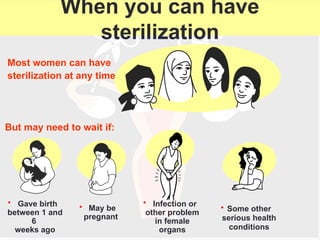
When you can have
sterilization
But may need to wait if:
Most women can have
sterilization at any time
• May be
pregnant
• Gave birth
between 1 and
6
weeks ago
• Infection or
other problem
in female
organs
• Some other
serious health
conditions
dr subha/8th sem pbl 45
Thank you
for
your
attention

female permanen sterilization 8th sem.pptx

  • 1.
    dr subha/8th sempbl 1 PERMANENT METHOD OF FAMILY PLANNING Dr. Subha Shrestha Obgy dept. COMS
  • 2.
    dr subha/8th sempbl 2 Learning objectives: • Female Sterilization Overview • Methods of Female Sterilization • Studies and Findings: Sterilization failure rate, Ectopic pregnancy rate with failure • Other Considerations • Summary of Female Sterilization
  • 3.
    dr subha/8th sempbl 3 Overview: • Younger women (ages 20-29) are more likely to undergo postpartum sterilization procedures • Approximately 50% of the tubal ligations performed annually are postpartum • Most postpartum procedures are performed within 24 hours • Older women (ages 35-49) are more likely to undergo interval procedures
  • 4.
    dr subha/8th sempbl 4 Overview: • Younger women (ages 20-29) are more likely to undergo postpartum sterilization procedures • Approximately 50% of the tubal ligations performed annually are postpartum • Most postpartum procedures are performed within 24 hours • Older women (ages 35-49) are more likely to undergo interval procedures
  • 5.
    dr subha/8th sempbl 5 The History of Female Sterilization • 1823 – First proposed by James Brundell in London • 1880 – First published report of procedure by Lungren in Toledo, Ohio • 1930 – First publication of the Pomeroy Technique, Pomeroy, New York State Journal of Medicine • 1936 – Bosch performed the first laparoscopic tubal occlusion in Switzerland
  • 6.
    dr subha/8th sempbl 6 • Increased interest in family planning coupled with safer and more effective methods allowed sterilization to become a viable method of contraception. • Widespread acceptance of laparoscopy led to the development of several methods • Electrocautery (mono-polar and bi-polar) • Clips (Hulka and Filshie) • Bands (Yoon Band, Falope Ring)
  • 7.
    dr subha/8th sempbl 7 Female Sterilization Overview Anatomy Ampulla Isthmus Fimbria Infundibulum
  • 8.
    dr subha/8th sempbl 8 Methods of Female Sterilization Interval • Laparoscopic • Electrocoagulation (Mono and Bi -Polar) • Falope Ring • Hulka Clip • Filshie Tubal Ligation System • Hysteroscopy • Essure • Adiana Post Partum/ Labor & Delivery • Pomeroy • Parkland • Irving • Uchida • Filshie Tubal Ligation System
  • 9.
    Procedure Timing Technique Minilaparotomy• Post Partum • Post Abortion • Interval • Mechanical Devices (Clips, Rings) • Tubal Ligation or Excision Laparoscopy • Interval Only • Electrocoagulation (Unipolar, Bipolar) • Mechanical Devices (Clips, Rings) Laparotomy In conjunction with other surgery (Cesarean section, salpingectomy, ovarian cystectomy, etc.) • Mechanical Devices (Clips, Rings) • Tubal Ligation or Excision 1 Female Sterilization In: Landry E, ed. Contraceptive Sterilization: Global Issues and Trends. New York: Engender Health; 2002: 139- 160 Methods of Female Sterilization1 Since 2002, hysteroscopic methods are available and can be performed interval-only (Essure and Adiana).
  • 10.
    Methods of FemaleSterilization Laparoscopic • Proposed in 1937 by Anderson • Complications • Bowel Burn • Bleeding • Longer portion of tube is damaged • Failures and ectopic pregnancy • Transection is frequent 1 Peterson LS Contraceptive use in the United States: 1982 -90. Advance Data: From Vital Health Statistics February 1995; 260 1-8 Failure Rate: 7.5/1000 (.07-.75%)1 Monopolar Coagulation
  • 11.
    Methods of FemaleSterilization Laparoscopic • Introduced in 1973 by Jacques Rioux Benefits • Most common method of laparoscopic sterilization • Burn several locations along the tube Complications • Formation of uteroperitoneal fistulas • High rate of ectopic pregnancy • Potential for bowel burns • Reversals are potentially more difficult due to the extent of tube damage 1 Peterson HB, et al. The risk of pregnancy after tubal sterilization: Findings from the U.S. Collaborative Review of Sterilization. Am J obstet. Gynecol. 1996; 174 (4):1161-1170 Failure Rate: 24.8/10001 (.2-2.5%) Bipolar Coagulation
  • 12.
    dr subha/8th sempbl 12 Methods of Female Sterilization Destruction of the Entire Fallopian Tube: “Three Burn” Technique
  • 13.
    Methods of FemaleSterilization Laparoscopic • Mechanical occlusion invented in 1974 • Tubal occlusion accomplished by placing a silicone band around the tube in a similar fashion to Pomeroy-technique • Thicker tubes may be problematic • May not be suited for postpartum Complications • Increased patient discomfort during recovery – large area of necrosis 1 Peterson HB. Et al. The risk of Pregnancy after tubal sterilization: Findings from the U.S. Collaborative Review of Sterilization. Am Journal of Obstetrics and Gynecology. 1996; 174(4): 1161-1170 Falope Ring (Yoon band) Failure Rate: 17.7/10001 (1.8%)
  • 14.
    dr subha/8th sempbl 14 Methods of Female Sterilization Falope Ring/Yoon Band
  • 15.
    Methods of FemaleSterilization Laparoscopic • Tubal occlusion is accomplished by placing a spring clip (plastic and gold plate) across the fallopian tube • Hulka clip has limited tubal capacity • Not magnetically inert • Potential patient allergy due to gold plate 1 Pregnancy After Tubal Sterilization with Bi-Polar Electrocoagulation. Obstetrics and GYN. August 1999 Volume 94. Herbert B Petterson et al for the CREST Working Group Failure rates 36.5/1000 (3.7%) (Ectopic 8.5/1000)1 Hulka Clip
  • 16.
    dr subha/8th sempbl 16 Methods of Female Sterilization Hulka Clip
  • 17.
    dr subha/8th sempbl 17 Methods of Female Sterilization Hulka Clip
  • 18.
    dr subha/8th sempbl 18 Laparoscopic and Minilapararotomy • FDA approved in 1996 (post CREST study) • Tubal occlusion accomplished by placing a titanium hinge clip lined with silicone rubber across the fallopian tube • Large tubal capacity • Magnetically inert (okay for MRI) • Minimal post operative pain • Designed for use interval and post partum (post vaginal birth and at the time of C-section) • Clip migration rare but possible Methods of Female Sterilization 1 A Penfield, MD. The Filshie Clip for Female Sterilization: A Review of World Experience. American Journal of Obstetrics and Gynecology, March 2000 2 Failure Rates from Family Health International, used in the initial FDA PMA Submission for the Filshie Clip Filshie® Tubal Ligation System Failure rate of 2.7/1,000 (.27%)1,2
  • 19.
    dr subha/8th sempbl 19 Methods of Female Sterilization Filshie® Clip – Laparoscopy
  • 20.
    dr subha/8th sempbl 20 Methods of Female Sterilization Filshie® Clip – Laparoscopy
  • 21.
    Methods of FemaleSterilization Hysteroscopic (Hospital and Office-based procedure) • Approved in 2002 • Micro-insert placed into each tube, PET fibers stimulate in-growth over several weeks • 86% Success Rate for 1st time placements of micro-inserts • 3 months of alternative contraception until HSG procedure confirms occlusion • Not suitable for patients with known allergies to contrast media or hypersensitivity to nickel • Irreversible • May limit a patients ability to have in vitro fertilization, should patient change her mind • May limit the ability to perform endometrial ablation in the future • ACOG does not recommend concomitant endometrial ablation FDA. Essure System: Summary of Safety and Effectiveness. November 4, 2002 available at http://www.fda.gov/cdrh/pdf2/p020014b.pdf 1 UpToDate – Hysteroscopic Sterilization; Jan 2010 Essure® Failure rate .26%1 (5 year rate)
  • 22.
    Methods of FemaleSterilization Hysteroscopic (Hospital and Office-based procedure) • Approved in 2009 • Catheter delivers low RF energy for one minute then a 3.5 mm non- absorbable silicone elastomer matrix is placed in each tubal lumen • 3 months of alternative contraception until HSG procedure confirms occlusion Photograph from Adiana website 1 Adiana Transcervical Sterilization System PMA P070022 Draft Panel Discussion Questions, p.2, December 14, 2007. Adiana® Failure rate 1.8%1 (2 year rate)
  • 23.
    dr subha/8th sempbl 23 Methods of Female Sterilization Postpartum • Pomeroy • Parkland • Irving • Uchida • Filshie® Tubal Ligation System
  • 24.
    Methods of FemaleSterilization Developed in 1930 by Ralph Hayword Pomeroy • Incision – suprapubic and subumbilical (PP) • Isthmic portion is ligated twice with 0 or 2-0 plain catgut suture • Segment is then excised • Inspect for hemostasis and the presence of the tubal lumen Benefits • Easy technique • Highly effective • Relatively inexpensive (excluding lab costs for pathology) Complications • Infection and bleeding • Potential ectopic pregnancy 1 Pregnancy After Tubal Sterilization with Bi-Polar Electrocoagulation. Obstetrics and GYN. August 1999 Volume 94. Herbert B Petterson et al for the CREST Working Group Pomeroy Technique Tied Cut Final result Failure Rate: 7.5/1000
  • 25.
    Methods of FemaleSterilization Introduced in the 1900s • Isthmic portion of tube is segmented and ligated at two points • An avascular area in the mesosalpinx is opened • 0 or 2-0 plain catgut passed through the opening • Proximal and distal ligated and segment excised Parkland Technique Failure rate not reported1
  • 26.
    Methods of FemaleSterilization Benefits • Designed to reduces natural tube re-attachment • Good success rates • Few complications • Inexpensive to perform (if no pathology) Complications • Ectopic pregnancies, infection, bleeding • Time required to perform procedure properly Parkland Technique (continued) Failure rate not reported1
  • 27.
    Methods of FemaleSterilization Method published in 1924 • Was developed for sterilization at C/S • Bury the proximal tubal stump within the myometrium • Original description – distal tube buried in the broad ligament Benefits • Used in conjunction with cesarean delivery Complications • Moderate level of difficulty to perform • Pomeroy and Parkland are quicker 1. Sterilization. The University of Kentucky Department of OB-GYN Women’s Health Curriculum. Irving Technique Failure rate: 1/10001 1 Up to Date – Sept 2010, Stovall T. et al. Surgical Sterilization of Women
  • 28.
    Methods of FemaleSterilization Introduced by Hajime Uchida in the 1940s • Most complex method • Inject saline into the subserosal layer 2 cm distal to the cornua • Incise serosa to free a 2 to 3 cm segment • Ligate proximal and distal end of freed tube • Proximal tube “dunked,” distal is “exteriorized” and serosa is then closed Benefits • Can be performed immediately postpartum Complications • Moderate level of difficulty to perform • Pomeroy and Parkland are quicker 1 Sklar AJ. Tubal Sterilization. eMedicine. November 15 2002. Available at http://www.emedicine.com/med/topic3313.htm Failure rate: more than 20,000 cases performed by Uchida personally without a failure 1 Uchida Technique
  • 29.
    dr subha/8th sempbl 29 • At the time of C-section or minilaparotomy Post Vaginal Birth • FDA approved in 1996 (post CREST study) • Tubal occlusion accomplished by placing a titanium hinge clip lined with silicone rubber across the fallopian tube • Large tubal capacity • Minimal post operative pain Methods of Female Sterilization Filshie® Tubal Ligation System Failure rate range: 0- 1.15% * * Olgibo N. Pomeroy technique or Filshie clips for postpartum sterilisation? Retrospective study on comparison between Pomeroy procedure and Filshie clips for a tubal occlusion at the time of Caesarean Section. Arch Gynecol Obstet, 11 Dec 2009 * Yan J.S., Hsu J. and Yin C.S. Comparative study of Filshi e clip and Pmeroy method for postpartum sterilization. Int. J. Gynecol. Obstet., 1990, 33: 263-267
  • 30.
    Methods of FemaleSterilization Filshie® Clip: Postpartum Sterilization (Mini-laparotomy)
  • 31.
    Methods of Female Sterilization Filshie® Clip:Postpartum Sterilization (Cesarean)
  • 32.
    dr subha/8th sempbl 32 Methods of Female Sterilization Postpartum: Filshie® in place
  • 33.
    dr subha/8th sempbl 33 Methods of Female Sterilization Randomized Trial to compare perioperative outcomes of Filshie clip vs. Pomeroy technique for postpartum and intraoperative Cesarean tubal sterilization: a pilot study. Kaunitz et al • 32 Randomized Patients were sterilized by Filshie Clip or Pomeroy • Filshie mean duration 7 min faster (p=0.08) • Filshie rated as easier by the operator (p=0.03) • 70% of surgeons preferred the Filshie clip Filshie® Tubal Ligation System and Pomeroy Postpartum
  • 34.
    dr subha/8th sempbl 34 Studies and Findings MATERIALS AND METHODS • 10,685 WOMEN STERILIZED (1978-1986) • MEDIAN AGE: 30 years old • FOLLOW-UP: 8-14 years • METHODS OF STERILIZATION: • Yoon band 31.2 % • Bipolar 21.2 % • Postpartum 15.3 % • Hulka clip 14.9 % • Unipolar 13.4 % The U.S. Collaborative Review of Sterilization (CREST )
  • 35.
    dr subha/8th sempbl 35 Studies and Findings RESULTS: Failure Rates • 34 Luteal phase pregnancies • 143/10,685 True failures (1.34%) • 15% Spontaneous abortion • 18% Induced abortion • 29% Deliveries • 3% Ongoing pregnancy at time of study • 33% Ectopic pregnancy • 2% Status unknown Findings from CREST
  • 36.
    Studies and Findings 0/30,000** procedures 0.22%** Filshie® Clip 17.1/1000* procedures 2.4%* BipolarCautery 1.5/1000* procedures 0.75%* Pomeroy (PP) Ectopic Preg Failure rate Method * The Risk of ectopic Pregnancy after tubal sterilization, Peterson H. NEJM March 13, 1997 ** Kovacs et al. Female Sterilization with Filshie clips: What is the risk of failure? A retrospective survey of 30,000 applications. J. of Family Planning and Reproductive Health Care. 2002: 28(1): 34-35 Most Common Methods Failure Rates and Ectopic Pregnancy
  • 37.
    dr subha/8th sempbl 37 Studies and Findings • CREST – 10,685 women followed for 8-14 years • Devices • RF – monopolar and bipolar • Banding – Falope Ring • Clip – Hulka Spring Clip • Partial Salpingectomy – interval and postpartum • Failure Rates – 1.38% • IUP • Ectopic* • “Although tubal sterilization is highly effective, the risk of sterilization failure is higher than generally reported.” Major Studies * Pregnancy After Tubal Sterilization with Bi-Polar Electrocoagulation. Obstetrics and GYN. August 1999 Volume 94. Herbert B Petterson et al for the CREST Working Group
  • 38.
    dr subha/8th sempbl 38 Other Considerations Discussion with patient must take place and cover the following details: • It must be a voluntary decision • Discussion of other options • Discussion of method of sterilization • Sterilization is permanent • Must be 21 years of age or older • Probability of failure • Discussion about methods of contraception for prevention of STDs • Special consideration for women with mental disabilities Informed Consent Information taken from the Dept. of Health and Human Services Form: http://www.hhs.gov/forms/HHS-687.pdf
  • 39.
    dr subha/8th sempbl 39 Other Considerations Women may experience regret post-procedure • 2-26% of women express regret post-sterilization • 1-2% will seek reversal • Sterilization is permanent • Association with age at time of sterilization, change in marital status and future regret • Requests for reversals and/or IVF possible Regret * Chi, I.C., Jones D.B. Incidence, risk factors, and prevention of poststerilization regret: an updated international review from an epidemiological perspective. Obstet Gynecol Surv 1994;49:722-32 * Van Voorhis BJ. Comparison of tubal ligation reversal procedures. Clin Obstet Gynecol 2000;43:641-9 Curtis, K., Mohllajee, A.P., and Peterson, H.B. Regret Following Female Sterilization at a Young Age: A Systematic Review. Contracep 2006;73:2. P 205-210
  • 40.
    Other Considerations • Allsurgical tubal occlusion procedures are considered to be permanent female sterilization methods. • Changes in lifestyles and life situations among some women has led to instances of regret after sterilization regardless of the method used. • The application of the Filshie® clip in tubal ligation results in an avascular necrotic segment of the fallopian tube of about 4 mm. • The result is complete tubal occlusion with minimal tubal damage. Reversibility
  • 41.
    dr subha/8th sempbl 41 Summary of Female Sterilization • Tubal occlusion is an effective method of female sterilization regardless of method chosen • Failures will occur in some percentage female sterilization procedures regardless of method utilized. • IUP • Ectopic Pregnancy
  • 42.
    dr subha/8th sempbl 42 Male Sterilization • Safe and permanent birth control procedure • US: 1 of 5 men over age 35 has had a vasectomy • 500,000 vasectomies in the US each year • 4 million world wide each year • Cost (US) of procedure $500-$1000 Vasectomy
  • 43.
    dr subha/8th sempbl 43 Female Sterilization • A surgical procedure About female sterilization: • Fallopian tubes that carry eggs to the womb are blocked or cut and sealed (womb is left untouched). • May hurt for a few days after. • Usually woman not put to sleep but gets injection to prevent pain. • Usually can go home in a few hours. • Usually cannot be reversed. • “Please consider carefully: might you want children in the future?” • Ask about partner’s preferences or concerns. • Vasectomy might be another good choice. Vasectomy is simpler and safer to perform and slightly more effective. • One of the most effective family planning methods for women. • Very rarely, pregnancy does occur. • For STI/HIV/AIDS protection, also use condoms. • Serious complications of surgery are rare (risk of anaesthesia, need for further surgery). “Do you want to know more about sterilization, or talk about a different method?” If client wants to know more about sterilization, go to next page. Next Move: • Permanent—for women who will not want more children • Very effective • No long-term side-effects • No protection against STIs or HIV/AIDS • Very safe • Check for concerns, rumours: “What have you heard about problems with sterilization?” Use Appendix 10 to talk about myths about contraception. • Explain that all women can have sterilization if they want, even those with no children. • Womb is NOT removed. You will still have menstrual periods. S1 Female Sterilization To discuss another method, go to a new method tab or to Choosing Method tab.
  • 44.
    dr subha/8th sempbl 44 When you can have sterilization But may need to wait if: Most women can have sterilization at any time • May be pregnant • Gave birth between 1 and 6 weeks ago • Infection or other problem in female organs • Some other serious health conditions
  • 45.
    dr subha/8th sempbl 45 Thank you for your attention