An Overview of Federal Student Aid
What is Federal Student Aid?
 Federal Student Aid (FSA) is provided by the US Department of Education and
helps students pay for expenses at post-secondary institutions
 FSA covers expenses such as tuition, room and board, books and supplies,
transportation, computers, and dependent care
 There is more than $150BN worth of FSA available to qualifying students
 FSA is granted to students that meet basic eligibility requirements
 FSA falls into one of three categories: grants, loans, or work-study
 The FAFSA (Free Application for Federal Student Aid) must be completed in
order to qualify for FSA (~22MM FAFSAs are submitted each year)
 The FAFSA is available beginning January 1st of the year that the student plans
to enroll in school
 Visit www.fafsa.gov to fill out the FAFSA form and begin the financial aid
process.
Prerequisites to Receiving Federal
Student Aid
 A high school diploma or a General Educational Development
(GED) certificate
 A valid social security number

 Must be a US citizen or eligible non-citizen
 Must meet satisfactory academic progress requirements
 Compliance with Selective Service registration

 Must be enrolled or accepted as a student and be on the path
to a degree or certificate in an eligible program
Types of Federal Student Aid

 Grants: Funds that are not required to be repaid
 Loans: Funds that are borrowed from the school and must be paid
back with interest
 Work-Study: Funds that a student earns by working part-time while
attending school
Federal Grant Programs
 Federal Pell Grants: Available almost exclusively to undergraduates (UG’s)
 Federal Supplemental Educational Opportunity Grant (FSEOG): Available to UG’s

that have a very low estimated financial contribution (EFC)
 Teacher Education Assistance for College and Higher Education Grant (TEACH):
For UG’s, post baccalaureates, and graduate students that are willing to teach
full-time in designated teacher shortage areas for four (4) years after graduation

 Iraq and Afghanistan Service Grant: Available to non Pell-eligible students whose
parent/guardian died as a result of military service in Iraq or Afghanistan after the
events of 9/11; and who, at the time of death, were younger than 24 years of
age and/or enrolled at least part-time at an institution of higher education
Federal vs. Private Loans
 A federal loan is supported by the federal government and allows
students to borrow money to help pay for school
 Benefits of a federal loan include: low-fixed interest rates, incomebased repayment plans, cancellations for certain employment, and
deferment options
 There are two (2) types of federal loan programs: The Federal
Perkins Loan Program and The Direct Loan Program

 A private student loan is a non-federal loan issued by a lender such
as a bank or a credit union and commonly requires a credit check
Federal Perkins Loan Program
 Federal Perkins loans are low interest loans that help need-based undergraduate
and graduate students finance the cost of post-secondary education

 School is the lender; approximately 1700 schools participate
 Interest rate = 5%
 Amount received depends on financial need, amount of other aid, and
availability of funds at school

 Repaying a Federal Perkins Loan begins after the grace period has expired. The
grace period begins on the day that the student graduates and lasts for nine (9)
months
 During the grace period, the student does not pay principal and is not charged

interest. If a student is attending school less than half-time (typically defined as
less than six (6) credit hours), his/her grace period may be affected
 A student has up to ten (10) years to repay a Federal Perkins loan
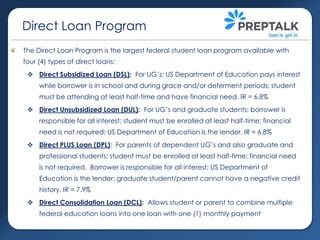
Direct Loan Program
The Direct Loan Program is the largest federal student loan program available with
four (4) types of direct loans:
 Direct Subsidized Loan (DSL): For UG’s; US Department of Education pays interest

while borrower is in school and during grace and/or deferment periods; student
must be attending at least half-time and have financial need. IR = 6.8%
 Direct Unsubsidized Loan (DUL): For UG’s and graduate students; borrower is
responsible for all interest; student must be enrolled at least half-time; financial
need is not required; US Department of Education is the lender. IR = 6.8%
 Direct PLUS Loan (DPL): For parents of dependent UG’s and also graduate and
professional students; student must be enrolled at least half-time; financial need
is not required. Borrower is responsible for all interest; US Department of
Education is the lender; graduate student/parent cannot have a negative credit
history. IR = 7.9%
 Direct Consolidation Loan (DCL): Allows student or parent to combine multiple
federal education loans into one loan with one (1) monthly payment
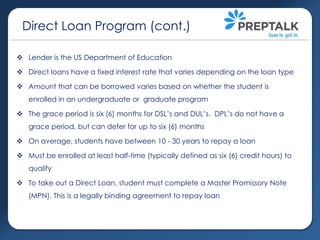
Direct Loan Program (cont.)
 Lender is the US Department of Education
 Direct loans have a fixed interest rate that varies depending on the loan type
 Amount that can be borrowed varies based on whether the student is
enrolled in an undergraduate or graduate program

 The grace period is six (6) months for DSL’s and DUL’s. DPL’s do not have a
grace period, but can defer for up to six (6) months
 On average, students have between 10 - 30 years to repay a loan
 Must be enrolled at least half-time (typically defined as six (6) credit hours) to

qualify
 To take out a Direct Loan, student must complete a Master Promissory Note
(MPN). This is a legally binding agreement to repay loan
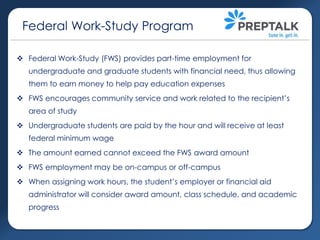
Federal Work-Study Program
 Federal Work-Study (FWS) provides part-time employment for
undergraduate and graduate students with financial need, thus allowing
them to earn money to help pay education expenses
 FWS encourages community service and work related to the recipient’s

area of study
 Undergraduate students are paid by the hour and will receive at least
federal minimum wage
 The amount earned cannot exceed the FWS award amount

 FWS employment may be on-campus or off-campus
 When assigning work hours, the student’s employer or financial aid
administrator will consider award amount, class schedule, and academic
progress
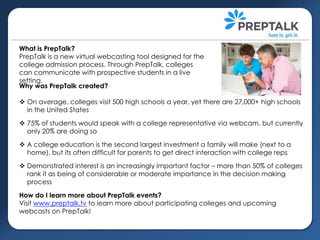
What is PrepTalk?
PrepTalk is a new virtual webcasting tool designed for the
college admission process. Through PrepTalk, colleges
can communicate with prospective students in a live
setting.
Why was PrepTalk created?
 On average, colleges visit 500 high schools a year, yet there are 27,000+ high schools
in the United States
 75% of students would speak with a college representative via webcam, but currently
only 20% are doing so
 A college education is the second largest investment a family will make (next to a
home), but its often difficult for parents to get direct interaction with college reps
 Demonstrated interest is an increasingly important factor – more than 50% of colleges
rank it as being of considerable or moderate importance in the decision making
process
How do I learn more about PrepTalk events?
Visit www.preptalk.tv to learn more about participating colleges and upcoming
webcasts on PrepTalk!

Federal student aid / FAFSA

  • 1.
    An Overview ofFederal Student Aid
  • 2.
    What is FederalStudent Aid?  Federal Student Aid (FSA) is provided by the US Department of Education and helps students pay for expenses at post-secondary institutions  FSA covers expenses such as tuition, room and board, books and supplies, transportation, computers, and dependent care  There is more than $150BN worth of FSA available to qualifying students  FSA is granted to students that meet basic eligibility requirements  FSA falls into one of three categories: grants, loans, or work-study  The FAFSA (Free Application for Federal Student Aid) must be completed in order to qualify for FSA (~22MM FAFSAs are submitted each year)  The FAFSA is available beginning January 1st of the year that the student plans to enroll in school  Visit www.fafsa.gov to fill out the FAFSA form and begin the financial aid process.
  • 3.
    Prerequisites to ReceivingFederal Student Aid  A high school diploma or a General Educational Development (GED) certificate  A valid social security number  Must be a US citizen or eligible non-citizen  Must meet satisfactory academic progress requirements  Compliance with Selective Service registration  Must be enrolled or accepted as a student and be on the path to a degree or certificate in an eligible program
  • 4.
    Types of FederalStudent Aid  Grants: Funds that are not required to be repaid  Loans: Funds that are borrowed from the school and must be paid back with interest  Work-Study: Funds that a student earns by working part-time while attending school
  • 5.
    Federal Grant Programs Federal Pell Grants: Available almost exclusively to undergraduates (UG’s)  Federal Supplemental Educational Opportunity Grant (FSEOG): Available to UG’s that have a very low estimated financial contribution (EFC)  Teacher Education Assistance for College and Higher Education Grant (TEACH): For UG’s, post baccalaureates, and graduate students that are willing to teach full-time in designated teacher shortage areas for four (4) years after graduation  Iraq and Afghanistan Service Grant: Available to non Pell-eligible students whose parent/guardian died as a result of military service in Iraq or Afghanistan after the events of 9/11; and who, at the time of death, were younger than 24 years of age and/or enrolled at least part-time at an institution of higher education
  • 6.
    Federal vs. PrivateLoans  A federal loan is supported by the federal government and allows students to borrow money to help pay for school  Benefits of a federal loan include: low-fixed interest rates, incomebased repayment plans, cancellations for certain employment, and deferment options  There are two (2) types of federal loan programs: The Federal Perkins Loan Program and The Direct Loan Program  A private student loan is a non-federal loan issued by a lender such as a bank or a credit union and commonly requires a credit check
  • 7.
    Federal Perkins LoanProgram  Federal Perkins loans are low interest loans that help need-based undergraduate and graduate students finance the cost of post-secondary education  School is the lender; approximately 1700 schools participate  Interest rate = 5%  Amount received depends on financial need, amount of other aid, and availability of funds at school  Repaying a Federal Perkins Loan begins after the grace period has expired. The grace period begins on the day that the student graduates and lasts for nine (9) months  During the grace period, the student does not pay principal and is not charged interest. If a student is attending school less than half-time (typically defined as less than six (6) credit hours), his/her grace period may be affected  A student has up to ten (10) years to repay a Federal Perkins loan
  • 8.
    Direct Loan Program TheDirect Loan Program is the largest federal student loan program available with four (4) types of direct loans:  Direct Subsidized Loan (DSL): For UG’s; US Department of Education pays interest while borrower is in school and during grace and/or deferment periods; student must be attending at least half-time and have financial need. IR = 6.8%  Direct Unsubsidized Loan (DUL): For UG’s and graduate students; borrower is responsible for all interest; student must be enrolled at least half-time; financial need is not required; US Department of Education is the lender. IR = 6.8%  Direct PLUS Loan (DPL): For parents of dependent UG’s and also graduate and professional students; student must be enrolled at least half-time; financial need is not required. Borrower is responsible for all interest; US Department of Education is the lender; graduate student/parent cannot have a negative credit history. IR = 7.9%  Direct Consolidation Loan (DCL): Allows student or parent to combine multiple federal education loans into one loan with one (1) monthly payment
  • 9.
    Direct Loan Program(cont.)  Lender is the US Department of Education  Direct loans have a fixed interest rate that varies depending on the loan type  Amount that can be borrowed varies based on whether the student is enrolled in an undergraduate or graduate program  The grace period is six (6) months for DSL’s and DUL’s. DPL’s do not have a grace period, but can defer for up to six (6) months  On average, students have between 10 - 30 years to repay a loan  Must be enrolled at least half-time (typically defined as six (6) credit hours) to qualify  To take out a Direct Loan, student must complete a Master Promissory Note (MPN). This is a legally binding agreement to repay loan
  • 10.
    Federal Work-Study Program Federal Work-Study (FWS) provides part-time employment for undergraduate and graduate students with financial need, thus allowing them to earn money to help pay education expenses  FWS encourages community service and work related to the recipient’s area of study  Undergraduate students are paid by the hour and will receive at least federal minimum wage  The amount earned cannot exceed the FWS award amount  FWS employment may be on-campus or off-campus  When assigning work hours, the student’s employer or financial aid administrator will consider award amount, class schedule, and academic progress
  • 11.
    What is PrepTalk? PrepTalkis a new virtual webcasting tool designed for the college admission process. Through PrepTalk, colleges can communicate with prospective students in a live setting. Why was PrepTalk created?  On average, colleges visit 500 high schools a year, yet there are 27,000+ high schools in the United States  75% of students would speak with a college representative via webcam, but currently only 20% are doing so  A college education is the second largest investment a family will make (next to a home), but its often difficult for parents to get direct interaction with college reps  Demonstrated interest is an increasingly important factor – more than 50% of colleges rank it as being of considerable or moderate importance in the decision making process How do I learn more about PrepTalk events? Visit www.preptalk.tv to learn more about participating colleges and upcoming webcasts on PrepTalk!