Submitted By – Avik Kalsa
B.TECH (ElectricalEngineering),5th
Sem
University Roll No.-14801623020
Academic Year: 2024-25
FUTURE INSTITUTE OF ENGINEERING & MANAGEMENT
[CC – 148]
UNDER MAKAUT, WB
ONTINUOUS ASSESSMENT#1
bject Oriented Programming (OE-EE-501B)
Features of Object Oriented Programming
What is OOP?
Object Oriented Programming (OOP)
is a programming technique in which
programs are written on the basis of objects.
Examples:
 C++
 PHP
 Java
Classes(Classification Of Objects)
A class is a group of objects with same attributes and
behavior.
A class is user define derived class that combines both
data and function and function and manipulate the
data.
Object is a class type variable. Objects are also called instance of
the class. Each object contains all members(variables and
functions) declared in the class :
 Identity
 State
 Behaviour
What is Object?
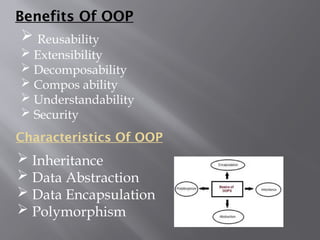
Benefits Of OOP
 Reusability
 Extensibility
 Decomposability
 Compos ability
 Understandability
 Security
Characteristics Of OOP
 Inheritance
 Data Abstraction
 Data Encapsulation
 Polymorphism
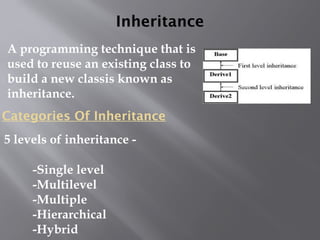
Inheritance
A programming technique that is
used to reuse an existing class to
build a new classis known as
inheritance.
Categories Of Inheritance
5 levels of inheritance -
-Single level
-Multilevel
-Multiple
-Hierarchical
-Hybrid
Data Abstraction
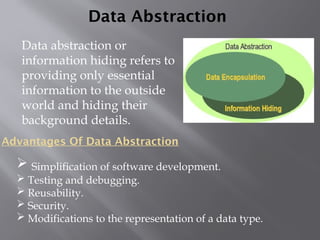
Data abstraction or
information hiding refers to
providing only essential
information to the outside
world and hiding their
background details.
Advantages Of Data Abstraction
 Simplification of software development.
 Testing and debugging.
 Reusability.
 Security.
 Modifications to the representation of a data type.
Data Encapsulation
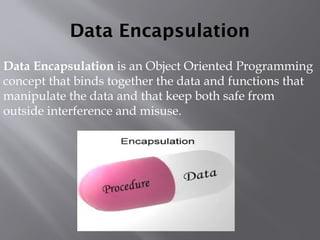
Data Encapsulation is an Object Oriented Programming
concept that binds together the data and functions that
manipulate the data and that keep both safe from
outside interference and misuse.
Polymorphism
The word polymorphism is a combination of two words
poly and morphism. Poly means many and morphism means
form.
In object-oriented programming, polymorphism is the
ability of objects of different types to respond to functions of the
same name. The user does not have to know the exact type of the
object in advance. The behavior of the object can be implemented
at run time.
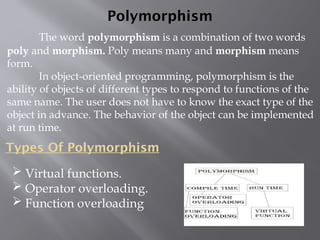
Types Of Polymorphism
 Virtual functions.
 Operator overloading.
 Function overloading
Thank you

Features of Object Oriented Programming.pptx

  • 1.
    Submitted By –Avik Kalsa B.TECH (ElectricalEngineering),5th Sem University Roll No.-14801623020 Academic Year: 2024-25 FUTURE INSTITUTE OF ENGINEERING & MANAGEMENT [CC – 148] UNDER MAKAUT, WB ONTINUOUS ASSESSMENT#1 bject Oriented Programming (OE-EE-501B) Features of Object Oriented Programming
  • 2.
    What is OOP? ObjectOriented Programming (OOP) is a programming technique in which programs are written on the basis of objects. Examples:  C++  PHP  Java
  • 3.
    Classes(Classification Of Objects) Aclass is a group of objects with same attributes and behavior. A class is user define derived class that combines both data and function and function and manipulate the data. Object is a class type variable. Objects are also called instance of the class. Each object contains all members(variables and functions) declared in the class :  Identity  State  Behaviour What is Object?
  • 4.
    Benefits Of OOP Reusability  Extensibility  Decomposability  Compos ability  Understandability  Security Characteristics Of OOP  Inheritance  Data Abstraction  Data Encapsulation  Polymorphism
  • 5.
    Inheritance A programming techniquethat is used to reuse an existing class to build a new classis known as inheritance. Categories Of Inheritance 5 levels of inheritance - -Single level -Multilevel -Multiple -Hierarchical -Hybrid
  • 6.
    Data Abstraction Data abstractionor information hiding refers to providing only essential information to the outside world and hiding their background details. Advantages Of Data Abstraction  Simplification of software development.  Testing and debugging.  Reusability.  Security.  Modifications to the representation of a data type.
  • 7.
    Data Encapsulation Data Encapsulationis an Object Oriented Programming concept that binds together the data and functions that manipulate the data and that keep both safe from outside interference and misuse.
  • 8.
    Polymorphism The word polymorphismis a combination of two words poly and morphism. Poly means many and morphism means form. In object-oriented programming, polymorphism is the ability of objects of different types to respond to functions of the same name. The user does not have to know the exact type of the object in advance. The behavior of the object can be implemented at run time. Types Of Polymorphism  Virtual functions.  Operator overloading.  Function overloading
  • 9.