FDI IN MEDIA
FDI....?
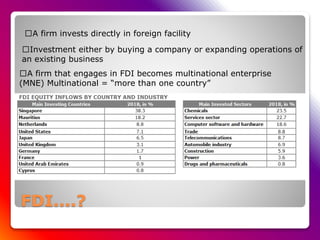
A firm invests directly in foreign facility
Investment either by buying a company or expanding operations of
an existing business
A firm that engages in FDI becomes multinational enterprise
(MNE) Multinational = “more than one country”
FDI includes – mergers and acquisitions – building new facilities –
reinvesting profits earned from overseas operations – Intra company
loans
Involves ownership of entity abroad for – Production –
Marketing/service – R & D – Access of raw materials and other
resource
The company has direct managerial control – Depending on its
extent of ownership and – On other contractual terms of the FDI
No managerial involvement = portfolio investment Most FDI flow
has been to developed countries from developed countries FDI
increase to developing countries since ‘85
FDI....?
HISTORY OF FDI IN INDIA
The FDI scenario in India is currently witnessing a gradual shift with liberalized
reforms over last few years and an attractive investment climate making a
positive impact on the inflow. With a steady increase in volume of FDI, India
has attracted more than 90 countries till 2010 (29 countries in 1991) across
the globe to invest in India making it upstages US in the list of top investment
destinations in the world in the UNCTAD WIP Report
FDI in MEDIA Industry
The enormous positive role that FDI plays in a nation’s development is
undeniable and empirically established. The massive growth of the services
sector in India bears testimony to the fact that public interests have been
eminently sub served by infusion of global capital with appropriate checks and
balances. The time has come for the removal of artificial FDI caps in all
sectors including news media.
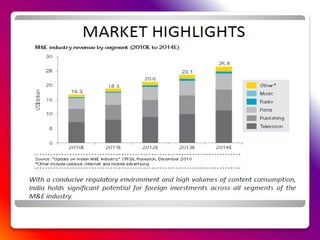
Entertainment and media industry is gaining lot of importance in India. India's
media and entertainment industry is projected to grow by 18 per cent over the
next five years and is expected to become a 1.157 trillion industry by 2012.
Further, online entertainment is the next big thing for studios and
broadcasters. The biggest changes are expected in the Internet, television
distribution, video games and casinos sectors.
Media and entertainment such as film, television, advertising, prints media
and music industry among others are growing rapidly in India. The media and
entertainment industry in India is likely to grow 12.5 per cent per annum over
the next five years and touch US$ 20.09 billion by 2013.
Foreign Direct Investment upto 100 percent is
allowed in most of the sectors,
more specifically,
-
FOREIGN DIRECT INVESTMENT IN INDIAN MEDIA &
ENTERTAINMENT INDUSTRIES
FDI IN BROADCASTING
74% FDI: Under the Broadcasting Carriage Service’s investment policy, 74 %
FDI is permissible for
– Teleports, Direct – to – home (DTH), Cable Networks, Mobile TV & Head end-in-the Sky
Broadcasting Services (HITS).
There is automatic route up to 49% investment and government route beyond 49% and
up to 74%. 49% FDI: Under the Broadcasting Carriage Service’s investment policy, 49%
FDI is permissible for Cable Networks under the Automatic route.
26% FDI: Under the Broadcasting Content Services’ investment policy, 26%
FDI is permissible for Terrestrial Broadcasting FM (FM Radio) and Up-linking
of News & Current Affairs’ TV Channels with the Government approval.
FDI IN PRINT MEDIA
FDI up to 100% is permitted in publishing/printing scientific and technical
magazines, periodicals and journals.
In the news and current affairs category, such asNewspapers , FDI has been
allowed up to 26% subject to certain conditions including:
– The largest shareholder must hold at least 51% equity·
– Three-fourths of directors and all executive and editorial staff have to be resident
Indians
Upto 74% publishing scientific/technical and specialty
magazines/periodicals/journals
FDI IN FILMS
FDI in all film-related activities such as film financing,
production, distribution, exhibition, marketing etc. is
permitted up to 100% for all companies under the automatic route
FDI IN ADVERTISEMENTS
Government has permitted 100% foreign direct
investment (FDI) in the advertising sector through the
automatic route
FDI FOR RADIO
Total foreign investment including FDI by OCB/NRI/PIO etc, is permitted to
the extent of not more than 20% of the paid up equity subject to the
following conditions:
– One Indian individual or company owns more than 50% of the paid-up
equity excluding the equity held by banks and other lending institutions
– The majority shareholder exercises management control over the applicant
company
– Has only resident Indians as directors on the board·
– All key executive officers of the applicant entity are
resident Indians
Theatre/ Multiplex Infrastructure
Television Segment
Film Entertainment
Animation Segment
Print Media
Mobile Entertainment
Television Software Content
Advertising
INVESTMENT OPPORTUNITIES
Foreign corporations are permitted to open liaison/representative
offices in India subject to approval by the Reserve Bank of India
(RBI).
Foreign corporations may open branch offices to conduct activities
permitted by the RBI after obtaining approval from the RBI.
Foreign corporations can set up subsidiary companies in India,
subject to FDI guidelines.
Limited liability partnership (LLP) Provides more flexibility in
operations compared with a subsidiary. Recently, FDI has been
permitted in LLPs subject to prescribed conditions.
HOW TO ENTER INTO INDIAN
MARKET
Allowing 49 per cent foreign holding in cable TV and DTH.
The government has allowed 100 per cent FDI in fax editions of
magazines and newspapers.
Recently, the government has allowed companies with core business
in news segment but ved off non-news business, to raise funds from
overseas beyond the stipulated FDI limit of 26 per cent. Such
companies can raise and route funds from overseas through its non-
news arm, which will not be calculated as foreign investment.
Permitting setting up of up linking hubs for satellite up linking by
private TV broadcasters from Indian soil.
Giving industry status to the films segment.
Opening FM Radio operations to the private sector.
The government has allotted US$ 50.13 million in the current Five-
Year-Plan for various development projects of the film industry. The
funds will be utilized to set up a centre for excellence in animation,
gaming and visual effects among others.
RECENT STEPS FOR THE IMPROVEMENTS OF
MEDIA & ENTERTAINMENT INDUSTRY
Equity share capital is a conventional method of funding a local
Indian subsidiary company.
Foreign investments through convertible preference shares that
are fully and mandatorily convertible into equity shares are treated
as FDI.
Like preference shares, the treatment of debentures as FDI or
External Commercial Borrowing (ECB) depends on their convertibility
into equity shares. ECBs can be accessed under two routes: the
automatic route (without RBI approval) and the approval route (with
RBI approval).
Other forms of funding include the issue of American Depository
Receipts, Global Depository Receipts, and Foreign Currency
Convertible Bonds.
FUNDING OF BUSINESS IN INDIA
Attrative Points ……
The net foreign direct investment stood at US$ 2.15 billion in
October 2019 and US$ 1.93. billion in September 2019.
(1,52,36,72,75,000.00 Indian Rupee)
In 2019, India ranked 77th out of 190 countries in the Doing
Business report published by the World Bank
The current population of India is 1,369,699,147 as of
Saturday, July 27, 2019, based on the latest United Nations
estimates. India population is equivalent to 17.74% of
the total world population.
There are 195 countries in the world today. This total comprises
193 countries that are member states of the United Nations and
2 countries that are non-member observer states: the Holy See
and the State of Palestine
INDIA RANKS 19th in the Term of FDI Received Countries out of 128
Fdi in media

Fdi in media

  • 1.
  • 2.
    FDI....? A firm investsdirectly in foreign facility Investment either by buying a company or expanding operations of an existing business A firm that engages in FDI becomes multinational enterprise (MNE) Multinational = “more than one country”
  • 3.
    FDI includes –mergers and acquisitions – building new facilities – reinvesting profits earned from overseas operations – Intra company loans Involves ownership of entity abroad for – Production – Marketing/service – R & D – Access of raw materials and other resource The company has direct managerial control – Depending on its extent of ownership and – On other contractual terms of the FDI No managerial involvement = portfolio investment Most FDI flow has been to developed countries from developed countries FDI increase to developing countries since ‘85 FDI....?
  • 4.
    HISTORY OF FDIIN INDIA The FDI scenario in India is currently witnessing a gradual shift with liberalized reforms over last few years and an attractive investment climate making a positive impact on the inflow. With a steady increase in volume of FDI, India has attracted more than 90 countries till 2010 (29 countries in 1991) across the globe to invest in India making it upstages US in the list of top investment destinations in the world in the UNCTAD WIP Report
  • 5.
    FDI in MEDIAIndustry The enormous positive role that FDI plays in a nation’s development is undeniable and empirically established. The massive growth of the services sector in India bears testimony to the fact that public interests have been eminently sub served by infusion of global capital with appropriate checks and balances. The time has come for the removal of artificial FDI caps in all sectors including news media.
  • 6.
    Entertainment and mediaindustry is gaining lot of importance in India. India's media and entertainment industry is projected to grow by 18 per cent over the next five years and is expected to become a 1.157 trillion industry by 2012. Further, online entertainment is the next big thing for studios and broadcasters. The biggest changes are expected in the Internet, television distribution, video games and casinos sectors. Media and entertainment such as film, television, advertising, prints media and music industry among others are growing rapidly in India. The media and entertainment industry in India is likely to grow 12.5 per cent per annum over the next five years and touch US$ 20.09 billion by 2013. Foreign Direct Investment upto 100 percent is allowed in most of the sectors, more specifically, - FOREIGN DIRECT INVESTMENT IN INDIAN MEDIA & ENTERTAINMENT INDUSTRIES
  • 8.
    FDI IN BROADCASTING 74%FDI: Under the Broadcasting Carriage Service’s investment policy, 74 % FDI is permissible for – Teleports, Direct – to – home (DTH), Cable Networks, Mobile TV & Head end-in-the Sky Broadcasting Services (HITS). There is automatic route up to 49% investment and government route beyond 49% and up to 74%. 49% FDI: Under the Broadcasting Carriage Service’s investment policy, 49% FDI is permissible for Cable Networks under the Automatic route. 26% FDI: Under the Broadcasting Content Services’ investment policy, 26% FDI is permissible for Terrestrial Broadcasting FM (FM Radio) and Up-linking of News & Current Affairs’ TV Channels with the Government approval.
  • 9.
    FDI IN PRINTMEDIA FDI up to 100% is permitted in publishing/printing scientific and technical magazines, periodicals and journals. In the news and current affairs category, such asNewspapers , FDI has been allowed up to 26% subject to certain conditions including: – The largest shareholder must hold at least 51% equity· – Three-fourths of directors and all executive and editorial staff have to be resident Indians Upto 74% publishing scientific/technical and specialty magazines/periodicals/journals
  • 10.
    FDI IN FILMS FDIin all film-related activities such as film financing, production, distribution, exhibition, marketing etc. is permitted up to 100% for all companies under the automatic route FDI IN ADVERTISEMENTS Government has permitted 100% foreign direct investment (FDI) in the advertising sector through the automatic route
  • 11.
    FDI FOR RADIO Totalforeign investment including FDI by OCB/NRI/PIO etc, is permitted to the extent of not more than 20% of the paid up equity subject to the following conditions: – One Indian individual or company owns more than 50% of the paid-up equity excluding the equity held by banks and other lending institutions – The majority shareholder exercises management control over the applicant company – Has only resident Indians as directors on the board· – All key executive officers of the applicant entity are resident Indians
  • 12.
    Theatre/ Multiplex Infrastructure TelevisionSegment Film Entertainment Animation Segment Print Media Mobile Entertainment Television Software Content Advertising INVESTMENT OPPORTUNITIES
  • 13.
    Foreign corporations arepermitted to open liaison/representative offices in India subject to approval by the Reserve Bank of India (RBI). Foreign corporations may open branch offices to conduct activities permitted by the RBI after obtaining approval from the RBI. Foreign corporations can set up subsidiary companies in India, subject to FDI guidelines. Limited liability partnership (LLP) Provides more flexibility in operations compared with a subsidiary. Recently, FDI has been permitted in LLPs subject to prescribed conditions. HOW TO ENTER INTO INDIAN MARKET
  • 14.
    Allowing 49 percent foreign holding in cable TV and DTH. The government has allowed 100 per cent FDI in fax editions of magazines and newspapers. Recently, the government has allowed companies with core business in news segment but ved off non-news business, to raise funds from overseas beyond the stipulated FDI limit of 26 per cent. Such companies can raise and route funds from overseas through its non- news arm, which will not be calculated as foreign investment. Permitting setting up of up linking hubs for satellite up linking by private TV broadcasters from Indian soil. Giving industry status to the films segment. Opening FM Radio operations to the private sector. The government has allotted US$ 50.13 million in the current Five- Year-Plan for various development projects of the film industry. The funds will be utilized to set up a centre for excellence in animation, gaming and visual effects among others. RECENT STEPS FOR THE IMPROVEMENTS OF MEDIA & ENTERTAINMENT INDUSTRY
  • 15.
    Equity share capitalis a conventional method of funding a local Indian subsidiary company. Foreign investments through convertible preference shares that are fully and mandatorily convertible into equity shares are treated as FDI. Like preference shares, the treatment of debentures as FDI or External Commercial Borrowing (ECB) depends on their convertibility into equity shares. ECBs can be accessed under two routes: the automatic route (without RBI approval) and the approval route (with RBI approval). Other forms of funding include the issue of American Depository Receipts, Global Depository Receipts, and Foreign Currency Convertible Bonds. FUNDING OF BUSINESS IN INDIA
  • 17.
    Attrative Points …… Thenet foreign direct investment stood at US$ 2.15 billion in October 2019 and US$ 1.93. billion in September 2019. (1,52,36,72,75,000.00 Indian Rupee) In 2019, India ranked 77th out of 190 countries in the Doing Business report published by the World Bank The current population of India is 1,369,699,147 as of Saturday, July 27, 2019, based on the latest United Nations estimates. India population is equivalent to 17.74% of the total world population. There are 195 countries in the world today. This total comprises 193 countries that are member states of the United Nations and 2 countries that are non-member observer states: the Holy See and the State of Palestine INDIA RANKS 19th in the Term of FDI Received Countries out of 128