Foreign Direct Investment (FDI) Attracting
Strategies of Vietnam
PresnetedBy
GolamMohammed Bhuiyan
DeputySecretary
Preface
After independence and pre doi moi period (1975-86): communist
economy, Vietnam could understand by looking at the fall of
socialist economy of (central planning economy) things had to
changed; their GDP was found stagnant for 5 years(roughly around
100 billion, 1977~1981).
Doi Moi (1986) process detected weakness of central planning
economy & started reform on
* bureaucratic decision process
* Lessening incentives on SOEs, co-operatives, farmers
* voluntarism in economic planning &
* GRADUAL movement to market economy.
* Emphasis given on grass root level.
After fall of USSR & intl. Embargo on East European countries,
Vietnam found that they have only 3 months of fuel stock, economy
was in total darkness. They then adopted shock-therapy for FDI
(very aggressive advantage offered for FDI) at the same time got
tremendous support from Libya, Iraq, Indonesia & also from India.
market incentives introduced to unfold the dynamism, creativeness
& savings. FDI law liberated many things, even pvt. Companies
were allowed to export & import directly. Given limited shock
therapy on price-reform, exchange rate, trade liberalization of crop
trading, hard budget constraint for SOEs. FDI law liberated many
things, even pvt. Companies were allowed to export & import
directly.
Chronology of Legal Propogation
• 1977: Government of Vietnam promulgated Decree 115
on FDI.
• 1987: National Asembly promulgated Law on FDI
• 1990 - 2017: Unifying Law on FDI with Law on
Investing Abroad.
• Amended on 1990, 1992, 1996, 2005, 2017
• Buy shares form SOEs and Private company
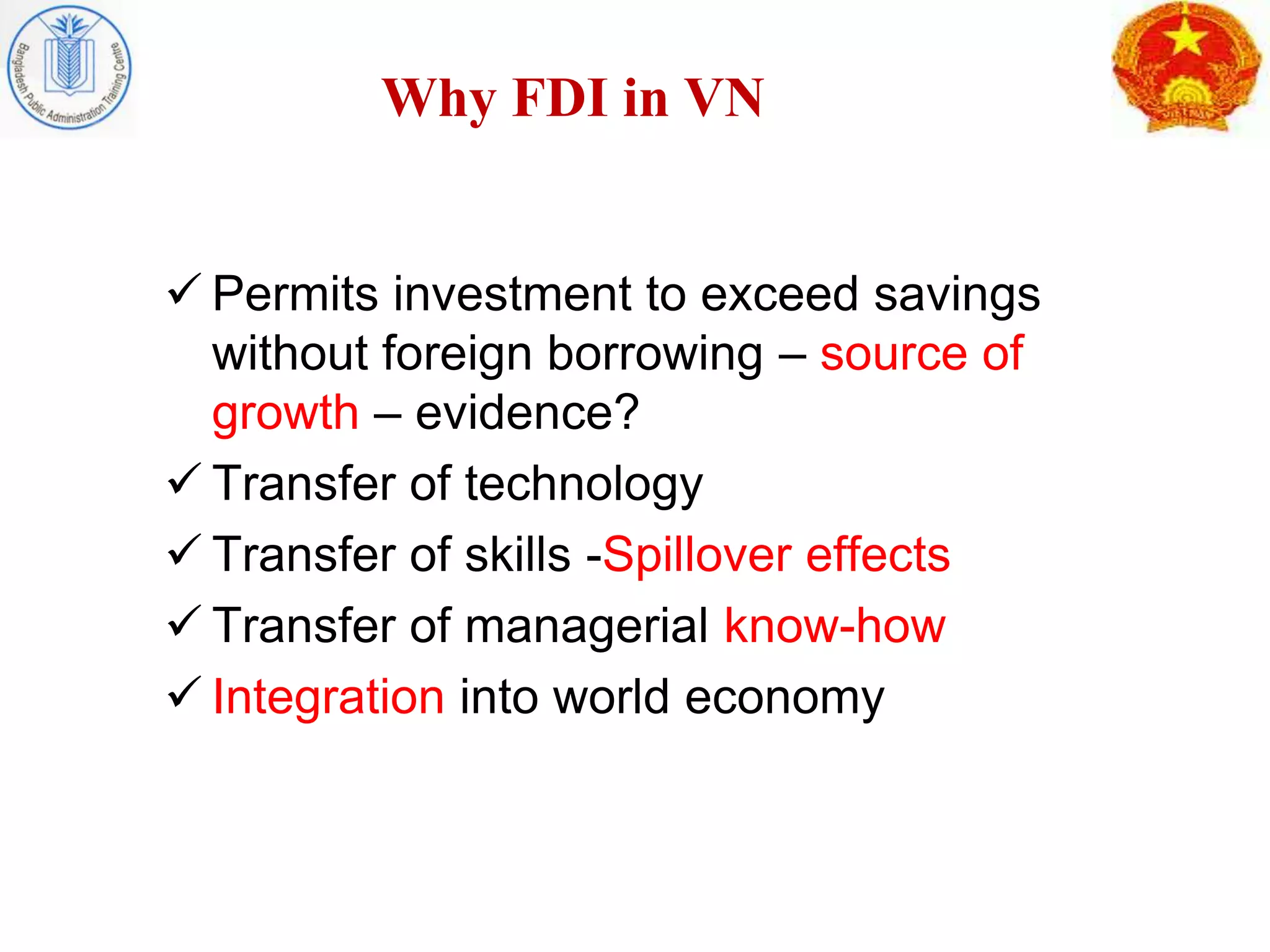
Why FDI in VN
 Permits investment to exceed savings
without foreign borrowing – source of
growth – evidence?
 Transfer of technology
 Transfer of skills -Spillover effects
 Transfer of managerial know-how
 Integration into world economy
2009 2010 2011 2012 Sep - 13 2018 (F)
GDP 5.32% 6.78% 5.89% 5.03% 5.14% 7.28%
CPI 6.52% 11.75% 18.13% 6.81% 6.3% 3.54 %
Vietnam Economic Indicator
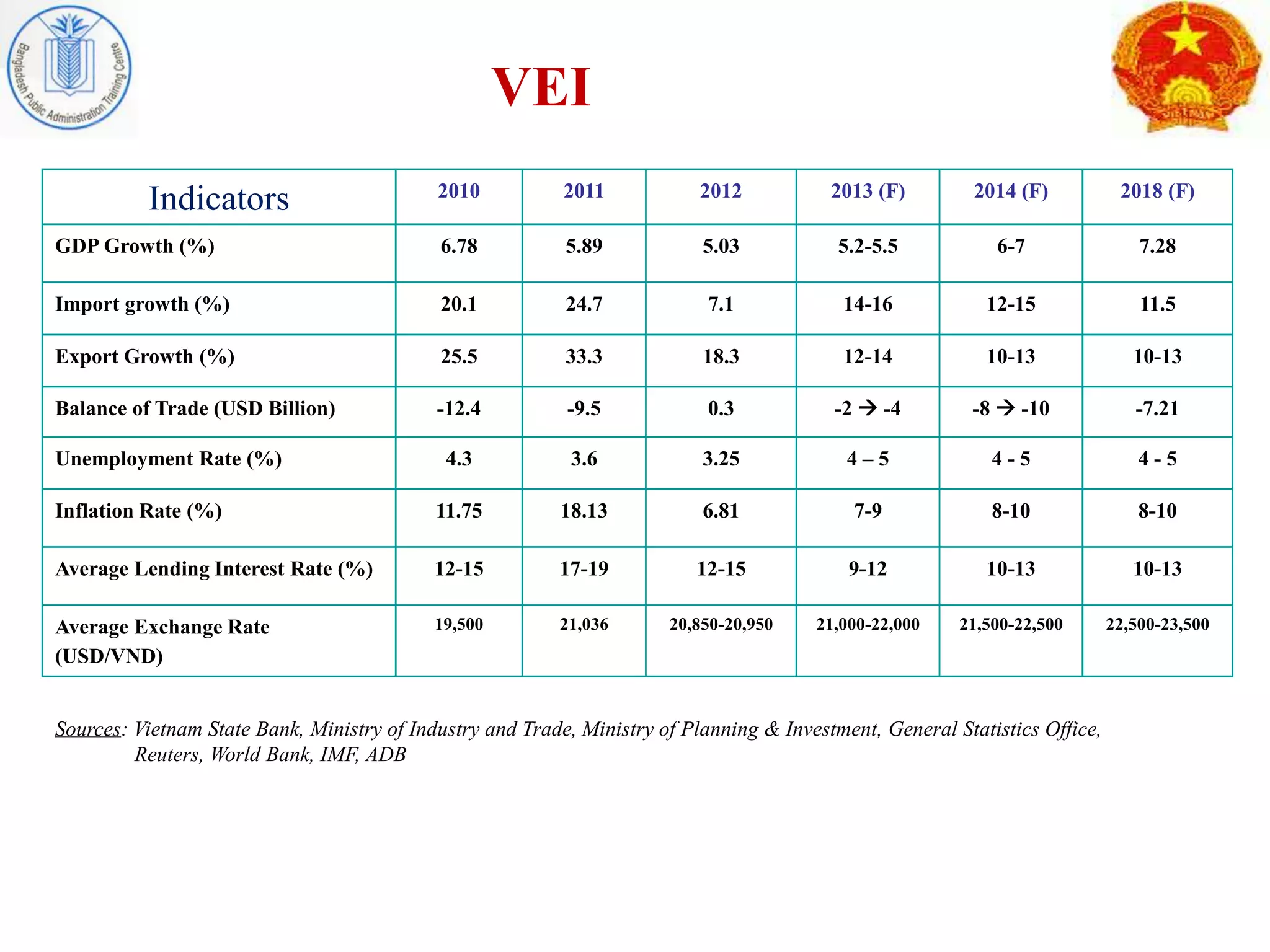
VEI
Indicators 2010 2011 2012 2013 (F) 2014 (F) 2018 (F)
GDP Growth (%) 6.78 5.89 5.03 5.2-5.5 6-7 7.28
Import growth (%) 20.1 24.7 7.1 14-16 12-15 11.5
Export Growth (%) 25.5 33.3 18.3 12-14 10-13 10-13
Balance of Trade (USD Billion) -12.4 -9.5 0.3 -2  -4 -8  -10 -7.21
Unemployment Rate (%) 4.3 3.6 3.25 4 – 5 4 - 5 4 - 5
Inflation Rate (%) 11.75 18.13 6.81 7-9 8-10 8-10
Average Lending Interest Rate (%) 12-15 17-19 12-15 9-12 10-13 10-13
Average Exchange Rate
(USD/VND)
19,500 21,036 20,850-20,950 21,000-22,000 21,500-22,500 22,500-23,500
Sources: Vietnam State Bank, Ministry of Industry and Trade, Ministry of Planning & Investment, General Statistics Office,
Reuters, World Bank, IMF, ADB
GDP Growth in Asia
Vietnam’s Integration Process
Startofthe“Đổimới”
1986 1992
Textile-Agreement
withEU
1995
StartthenegotiationtojoinWTO
FrameworkAgreementwithEU
2001
BilateralTrade
AgreementwithUS
2004
AgreementonMarket
OpeningwithEU
2008
FTAVietnam-Japan-
ASEAN-
2010-
2011
Vietnam-EU;Vietnam-
ChileFTAs;TPP
1993
AFTA,ASEANFree
TradeAgreement
FreeTradeAgreementChina-
ASEAN
2005 2007
WTO-membership
FTAKorea-ASEAN
2009
FTAASEAN-Australia-New
Zealand
FTAIndia-ASEAN
Ease of Doing Business
World Bank 2010
Nation Rank
Singapore 1
Thailand 17
Malaysia 18
Taiwan 25
Sri Lanka 89
China 91
Vietnam 98
Bangladesh 122
Indonesia 129
India 132
Philippines 136
Cambodia 138
Myanmar / Burma -
12
ranked 69
Ranked 69
among 190
countries in
2018
Facilities for FDI
• Foreign investor may
- Invest jointly with Vietnamese company
- Invest in 100% foreign-owned company
- buy shares from Vietnamese SOE and private compan
- BOT for foreign investors
- Legal protection for foreign ownership
• Decree on investing abroad
Incentives for FDI
• Extra-legal incentives for big FDI projects
• 17 Economic Zones & 3 Special Economic Zones
• Tax Facilities
- Timely limited exemption of Business Income Tax
- Land access & reduction of land tax
- Import duty exemption for fixed assets
• Vietnam signed 14 FTAs including CPTPP, EVFTA
and soon RCEP.
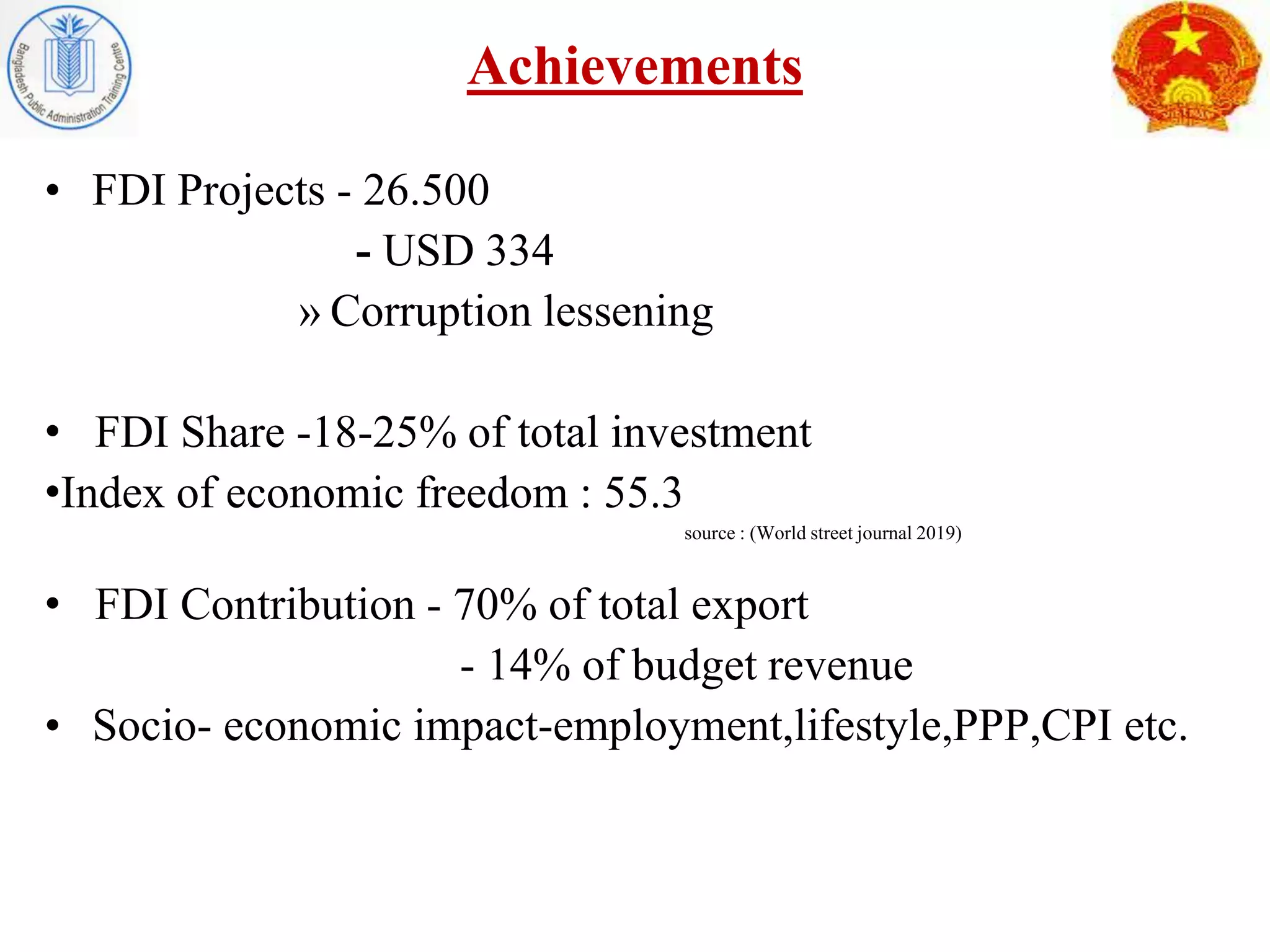
Achievements
• FDI Projects - 26.500
- USD 334
» Corruption lessening
• FDI Share -18-25% of total investment
•Index of economic freedom : 55.3
source : (World street journal 2019)
• FDI Contribution - 70% of total export
- 14% of budget revenue
• Socio- economic impact-employment,lifestyle,PPP,CPI etc.
Challenges
• Environment and
• Corruption
Reasons for Sustainability
i) single party govt. (easy to take decision on
reforms of law for facilitating FDI
ii) as Land owner is the Govt., so investors
faces practically no problem in finding place
and space for setting up the industry.
CONCLUSION
i) key learning points, best practices and process relevant to Bangladesh:
a) great combination of peoples demand through legislators,elected representatives
and govt. institutions (what we call holistic approach)
b) solidarity of peoples of Vietnam due to their very long struggle for freedom and
unquestionable love & respect for the great leader Ho Chi Minh
ii) Policy Implication and replicability of those learnings in Bangladesh:
Development is meaningless if section of people stay hungry or living with poverty,
resources of state is enjoyed by all the people . All policy is for the people and
Vietnam approached steadily to alleviate poverty, hunger, want of education and
galloped toward development as what the world see today.
Regarding (i) and (ii) we've great similarity and if experiences of Vietnam can be
shared it will aid us implementing a speedy understanding and amendments of
procedure for development and reaching SDG by 2030.
FDI attracting in Vietnam

FDI attracting in Vietnam

  • 1.
    Foreign Direct Investment(FDI) Attracting Strategies of Vietnam PresnetedBy GolamMohammed Bhuiyan DeputySecretary
  • 2.
    Preface After independence andpre doi moi period (1975-86): communist economy, Vietnam could understand by looking at the fall of socialist economy of (central planning economy) things had to changed; their GDP was found stagnant for 5 years(roughly around 100 billion, 1977~1981). Doi Moi (1986) process detected weakness of central planning economy & started reform on * bureaucratic decision process * Lessening incentives on SOEs, co-operatives, farmers * voluntarism in economic planning & * GRADUAL movement to market economy. * Emphasis given on grass root level.
  • 3.
    After fall ofUSSR & intl. Embargo on East European countries, Vietnam found that they have only 3 months of fuel stock, economy was in total darkness. They then adopted shock-therapy for FDI (very aggressive advantage offered for FDI) at the same time got tremendous support from Libya, Iraq, Indonesia & also from India. market incentives introduced to unfold the dynamism, creativeness & savings. FDI law liberated many things, even pvt. Companies were allowed to export & import directly. Given limited shock therapy on price-reform, exchange rate, trade liberalization of crop trading, hard budget constraint for SOEs. FDI law liberated many things, even pvt. Companies were allowed to export & import directly.
  • 4.
    Chronology of LegalPropogation • 1977: Government of Vietnam promulgated Decree 115 on FDI. • 1987: National Asembly promulgated Law on FDI • 1990 - 2017: Unifying Law on FDI with Law on Investing Abroad. • Amended on 1990, 1992, 1996, 2005, 2017 • Buy shares form SOEs and Private company
  • 5.
    Why FDI inVN  Permits investment to exceed savings without foreign borrowing – source of growth – evidence?  Transfer of technology  Transfer of skills -Spillover effects  Transfer of managerial know-how  Integration into world economy
  • 6.
    2009 2010 20112012 Sep - 13 2018 (F) GDP 5.32% 6.78% 5.89% 5.03% 5.14% 7.28% CPI 6.52% 11.75% 18.13% 6.81% 6.3% 3.54 % Vietnam Economic Indicator
  • 7.
    VEI Indicators 2010 20112012 2013 (F) 2014 (F) 2018 (F) GDP Growth (%) 6.78 5.89 5.03 5.2-5.5 6-7 7.28 Import growth (%) 20.1 24.7 7.1 14-16 12-15 11.5 Export Growth (%) 25.5 33.3 18.3 12-14 10-13 10-13 Balance of Trade (USD Billion) -12.4 -9.5 0.3 -2  -4 -8  -10 -7.21 Unemployment Rate (%) 4.3 3.6 3.25 4 – 5 4 - 5 4 - 5 Inflation Rate (%) 11.75 18.13 6.81 7-9 8-10 8-10 Average Lending Interest Rate (%) 12-15 17-19 12-15 9-12 10-13 10-13 Average Exchange Rate (USD/VND) 19,500 21,036 20,850-20,950 21,000-22,000 21,500-22,500 22,500-23,500 Sources: Vietnam State Bank, Ministry of Industry and Trade, Ministry of Planning & Investment, General Statistics Office, Reuters, World Bank, IMF, ADB
  • 8.
  • 11.
    Vietnam’s Integration Process Startofthe“Đổimới” 19861992 Textile-Agreement withEU 1995 StartthenegotiationtojoinWTO FrameworkAgreementwithEU 2001 BilateralTrade AgreementwithUS 2004 AgreementonMarket OpeningwithEU 2008 FTAVietnam-Japan- ASEAN- 2010- 2011 Vietnam-EU;Vietnam- ChileFTAs;TPP 1993 AFTA,ASEANFree TradeAgreement FreeTradeAgreementChina- ASEAN 2005 2007 WTO-membership FTAKorea-ASEAN 2009 FTAASEAN-Australia-New Zealand FTAIndia-ASEAN
  • 12.
    Ease of DoingBusiness World Bank 2010 Nation Rank Singapore 1 Thailand 17 Malaysia 18 Taiwan 25 Sri Lanka 89 China 91 Vietnam 98 Bangladesh 122 Indonesia 129 India 132 Philippines 136 Cambodia 138 Myanmar / Burma - 12 ranked 69 Ranked 69 among 190 countries in 2018
  • 13.
    Facilities for FDI •Foreign investor may - Invest jointly with Vietnamese company - Invest in 100% foreign-owned company - buy shares from Vietnamese SOE and private compan - BOT for foreign investors - Legal protection for foreign ownership • Decree on investing abroad
  • 14.
    Incentives for FDI •Extra-legal incentives for big FDI projects • 17 Economic Zones & 3 Special Economic Zones • Tax Facilities - Timely limited exemption of Business Income Tax - Land access & reduction of land tax - Import duty exemption for fixed assets • Vietnam signed 14 FTAs including CPTPP, EVFTA and soon RCEP.
  • 15.
    Achievements • FDI Projects- 26.500 - USD 334 » Corruption lessening • FDI Share -18-25% of total investment •Index of economic freedom : 55.3 source : (World street journal 2019) • FDI Contribution - 70% of total export - 14% of budget revenue • Socio- economic impact-employment,lifestyle,PPP,CPI etc.
  • 16.
  • 17.
    Reasons for Sustainability i)single party govt. (easy to take decision on reforms of law for facilitating FDI ii) as Land owner is the Govt., so investors faces practically no problem in finding place and space for setting up the industry.
  • 18.
    CONCLUSION i) key learningpoints, best practices and process relevant to Bangladesh: a) great combination of peoples demand through legislators,elected representatives and govt. institutions (what we call holistic approach) b) solidarity of peoples of Vietnam due to their very long struggle for freedom and unquestionable love & respect for the great leader Ho Chi Minh ii) Policy Implication and replicability of those learnings in Bangladesh: Development is meaningless if section of people stay hungry or living with poverty, resources of state is enjoyed by all the people . All policy is for the people and Vietnam approached steadily to alleviate poverty, hunger, want of education and galloped toward development as what the world see today. Regarding (i) and (ii) we've great similarity and if experiences of Vietnam can be shared it will aid us implementing a speedy understanding and amendments of procedure for development and reaching SDG by 2030.