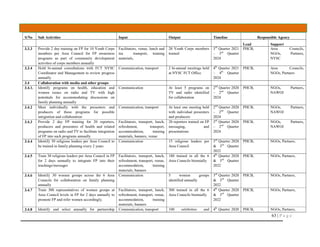
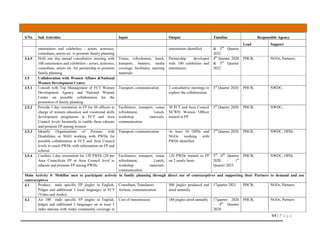
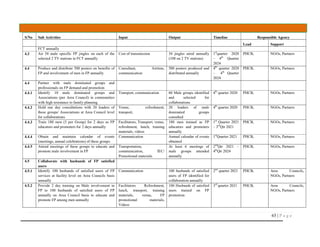
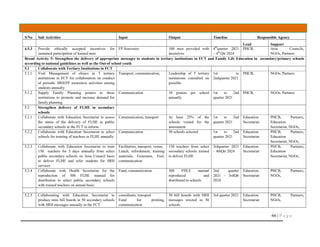
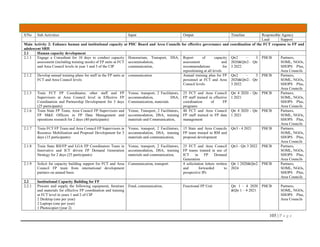
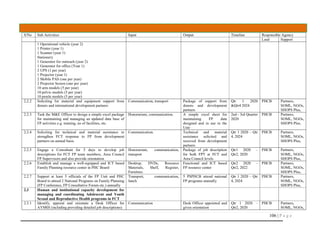
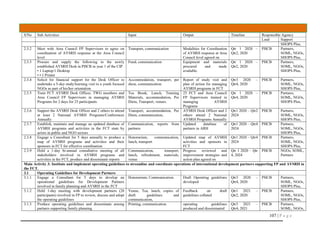
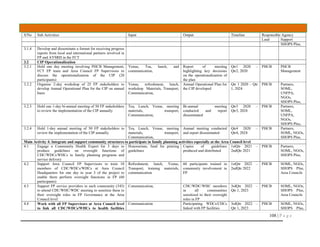
Costed Implementation Plan for Family
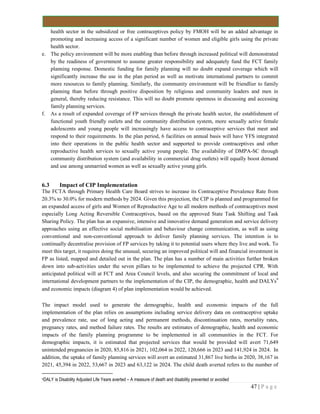
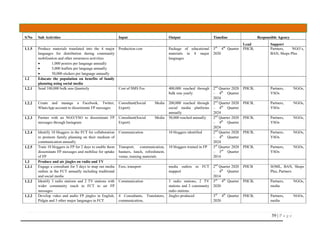
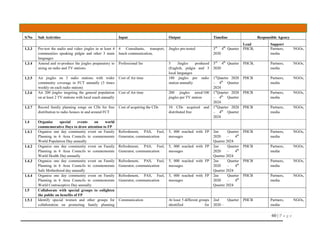
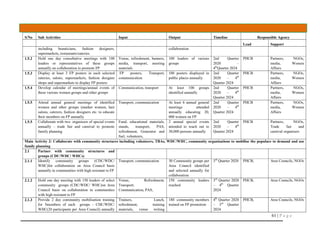
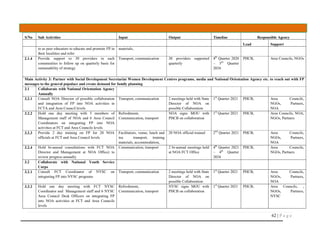
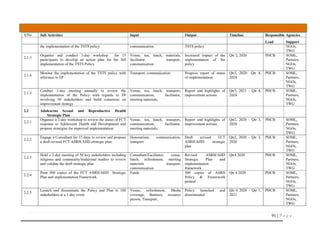
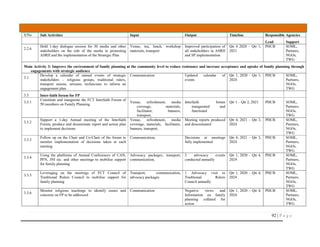
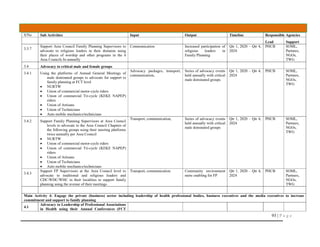
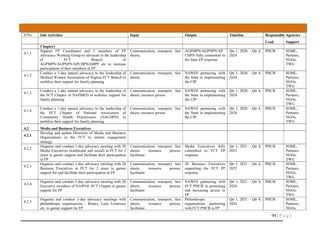
Planning for the
Federal Capital Territory (FCT)
(2020
Costed Implementation Plan for Family
Planning for the
Federal Capital Territory (FCT)
(2020 – 2024)
Costed Implementation Plan for Family
iii | P a g e
Contents
List of Boxes ..................................................................................................................................vii
Table of Figures..............................................................................................................................vii
ACKNOWLEDGEMENTS .........................................................................................................ix
LIST OF CONTRIBUTORS.........................................................................................................x
SECTION ONE: INTRODUCTION.....................................................................................................1
1.1 Global Context............................................................................................................................1
1.2 Family Planning 2020 and Sustainable Development Goals ........................................................2
1.3 Nigeria’s context.........................................................................................................................2
2.1 Brief on Federal Capital Territory. ..............................................................................................7
2.2 Thematic analysis of Family Planning situation ..........................................................................8
2.2.1 Behaviour Change Communication and Demand Creation................................................8
2.2.2 Service Delivery and Access...........................................................................................10
Type of training ................................................................................................................................10
Year...................................................................................................................................................10
Category of personnel trained..........................................................................................................10
Number trained ................................................................................................................................10
Sponsor .............................................................................................................................................10
2009 ...................................................................................................................................................10
Nurses/Midwives................................................................................................................................10
30 10
FCTA.................................................................................................................................................10
2011 ...................................................................................................................................................10
Nurses/Midwives................................................................................................................................10
31 10
NURHI...............................................................................................................................................10
2011 ...................................................................................................................................................10
Doctors and Nurses/ Midwives ...........................................................................................................10
6 10
NURHI...............................................................................................................................................10
2011 ...................................................................................................................................................10
Nurses/ Midwives...............................................................................................................................10
79 10
UNFPA ..............................................................................................................................................10
2011 ...................................................................................................................................................10
CBDs .................................................................................................................................................10
iv | P a g e
30 10
UNFPA ..............................................................................................................................................10
2012 ...................................................................................................................................................10
30 10
UNFPA ..............................................................................................................................................10
2011&2012 ........................................................................................................................................10
Nurses/Midwives...............................................................................................................................10
31 10
NURHI...............................................................................................................................................10
2013 ...................................................................................................................................................10
Doctors &Nurses...............................................................................................................................10
26 10
NURHI...............................................................................................................................................10
2012 ...................................................................................................................................................10
FP Supervisors..................................................................................................................................10
10 10
NURHI...............................................................................................................................................10
2012 ...................................................................................................................................................10
FP Providers.....................................................................................................................................10
37 10
NURHI...............................................................................................................................................10
2012 ...................................................................................................................................................10
Clinical and non- clinical providers ....................................................................................................10
54 10
NURHI...............................................................................................................................................10
2013 ...................................................................................................................................................10
Clinical Service providers...................................................................................................................10
21 10
UNFPA ..............................................................................................................................................10
2014 ...................................................................................................................................................10
Nurses/Midwives...............................................................................................................................10
24 10
UNFPA & ..........................................................................................................................................10
ARFH.................................................................................................................................................10
Private Doctors.................................................................................................................................10
SHOPS Plus, UNFPA, Rotary ............................................................................................................10
v | P a g e
Public and private Nurses & Midwives ...........................................................................................10
SCHEWs in public and private HFs................................................................................................10
M&E Officers ...................................................................................................................................10
2.2.3 Contraceptive commodities and supplies ........................................................................12
2.2.4 Policy and Environment..................................................................................................13
2.2.5 Family Planning Financing.............................................................................................15
2.2.6 Coordination and Partnership Management.....................................................................16
2.2.7 Research, Monitoring, Data Management and Evaluation...............................................18
SECTION THREE: INTEGRATED COSTED FAMILY PLANNING IMPLEMENTATION PLAN 21
3.1 Justification for the CIP ............................................................................................................21
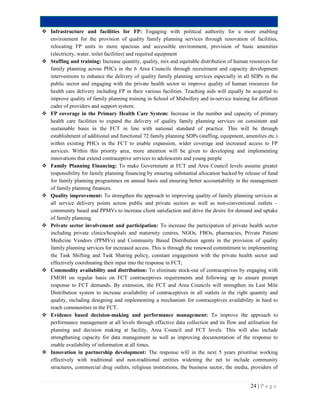
3.2 Vision, Goal and Strategic Objectives.......................................................................................23
3.2.1 Vision.............................................................................................................................23
3.2.2 Goal ...............................................................................................................................23
3.2.3 Strategic Objectives........................................................................................................23
3.3 Strategic Priorities ....................................................................................................................23
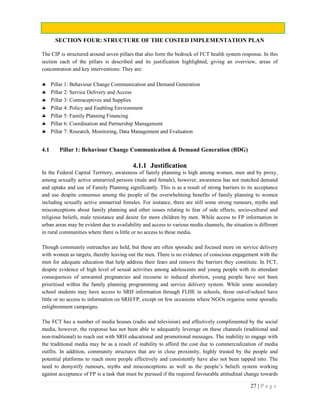
SECTION FOUR: STRUCTURE OF THE COSTED IMPLEMENTATION PLAN ..........................27
4.1 Pillar 1: Behaviour Change Communication & Demand Generation (BDG)..............................27
4.1.1 Justification....................................................................................................................27
4.1.2 Overview of the Pillar.....................................................................................................28
4.1.3 Main Activities...............................................................................................................28
4.2 Pillar 2: Service Delivery and Access........................................................................................30
4.2.1 Justification....................................................................................................................30
4.2.2 Overview of the pillar.....................................................................................................30
4.2.3 Main activities................................................................................................................31
4.3 Pillar 3: Contraceptives Security and Supplies ..........................................................................32
4.3.1 Justification:...................................................................................................................32
4.3.2 Overview of the pillar.....................................................................................................32
4.3.3 Broad Activities..............................................................................................................33
4.4 Pillar 4: Policy and Enabling Environment................................................................................33
4.4.1 Justification....................................................................................................................33
4.4.2 Overview of the pillar.....................................................................................................34
4.4.3 Main Activities...............................................................................................................34
4.5 Pillar 5: Family Planning Financing..........................................................................................35
4.5.1 Justification....................................................................................................................35
4.5.2 Overview of the pillar.....................................................................................................35
4.5.3 Broad Activities..............................................................................................................37
vi | P a g e
4.6 Pillar 6: Coordination and Partnership Management..................................................................37
4.6.1 Justification....................................................................................................................37
4.6.2 Overview of the pillar.....................................................................................................38
4.6.3 Main Activities...............................................................................................................39
4.7 Pillar 7: Research, Monitoring, data management and evaluation..............................................39
4.7.1 Justification....................................................................................................................39
4.7.2 Overview of the pillar.....................................................................................................40
4.7.3 Main Activities...............................................................................................................40
SECTION FIVE: COSTING, PROJECTED METHOD MIX AND IMPACT ....................................42
6.1 CIP Cost Summary ...................................................................................................................42
6.2 Rationale and cost elements ......................................................................................................43
6.2.1 Assumptions...................................................................................................................43
6.2.2 Method Mix....................................................................................................................44
6.3 Impact of CIP Implementation..................................................................................................47
SECTION SIX: THE PATH FORWARD...........................................................................................50
7.1 Stakeholders’ Participation .......................................................................................................50
7.2 CIP Financing and Resource Mobilisation ................................................................................51
7.3 Ensuring Progress through Performance Management...............................................................53
7.4 Operationalisation of the CIP....................................................................................................54
ANNEXES.........................................................................................................................................58
ANNEX 1: ACTIVITY FRAMEWORK ............................................................................................58
Pillar 1: Behaviour Change Communication &Demand Generation ................................................58
Pillar 3: Contraceptives and Supplies..............................................................................................82
Pillar 4: Policy and Enabling Environment .....................................................................................88
Pillar 5: Family Planning Financing (FPF)......................................................................................96
Pillar 6: Coordination and Partnership Management .....................................................................103
Pillar 7: Research, Monitoring, Data Management and Evaluation................................................111
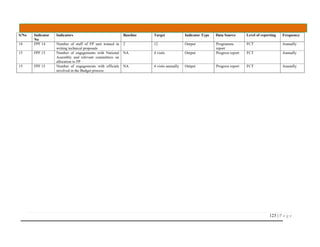
ANNEX 2: CIP Results Framework .................................................................................................115
Pillar 1: Behaviour Change Communication/Demand Generation.................................................115
Pillar 2: Service Delivery and Access ...........................................................................................117
Pillar 3: Contraceptives safety and supplies ..................................................................................120
Pillar 4: Policy and Enabling Environment ...................................................................................121
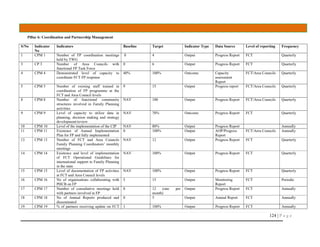
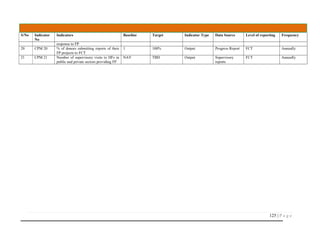
Pillar 6: Coordination and Partnership Management .....................................................................124
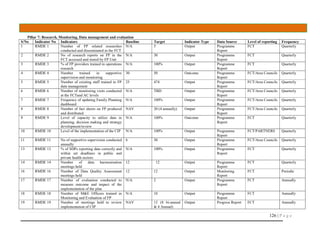
Pillar 7: Research, Monitoring, Data management and evaluation.................................................126
vii | P a g e
List of Boxes
Box1: FCT Health Profile……………………………………………………………………………………6
Box 2: Training and beneficiaries……………………………………………………………………………9
Box 3: Challenges facing FP access in FCT…………………………………………………………………10
Box 4: FP financing in FCT and Area Councils……………………………………………………………..14
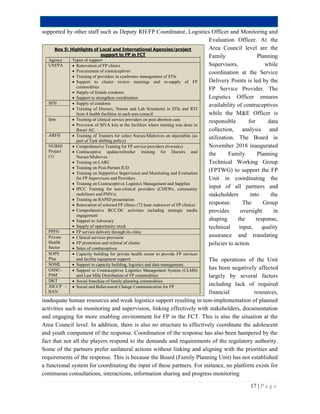
Box 5: Highlights of Local and International Agencies/Project support to FP in FCT……………………...16
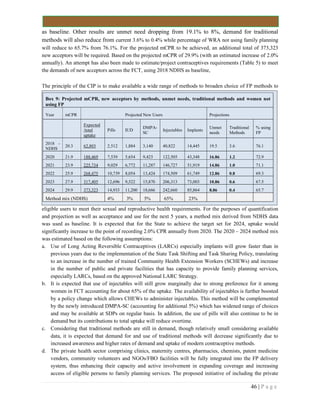
Box 6: Contraceptive prevalence (assuming CPR decreases/increases linearly and annually…..…………..40
Box 7: Service uptake requirements based on projected mCPR and usage by method……………………...40
Box 8: Contraceptives requirements based on projected mCPR and usage by method……………………..40
Box 9: Projected mCPR new acceptors by methods, unmet needs, traditional methods and women
not using FP………………………………………………………………………………………….41
Box 10: Stakeholders’ participation in implementing the CIP………………………………………………44
Table of Figures
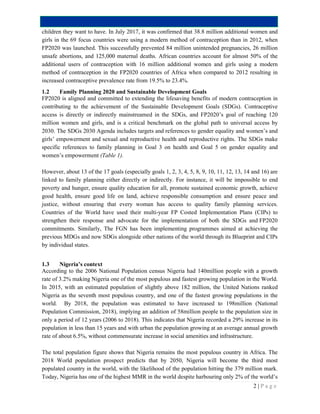
Figure 1: Sustainable Development Goals.......................................................................................1
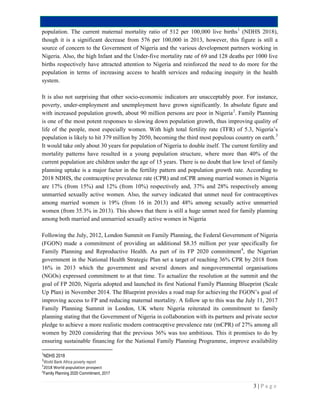
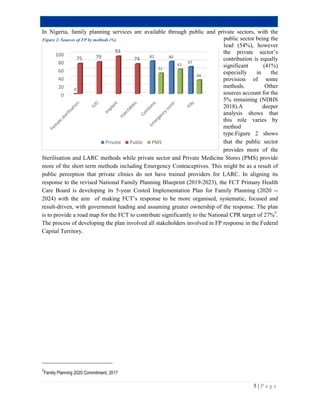
Figure 2: Sources of FP by methods (%).........................................................................................5
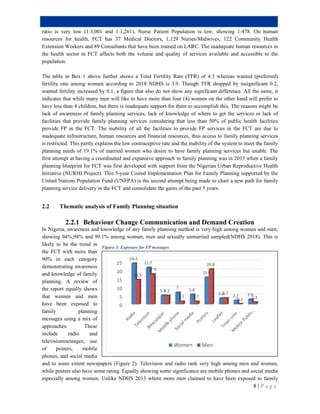
Figure 3: Exposure for FP messages ...............................................................................................7
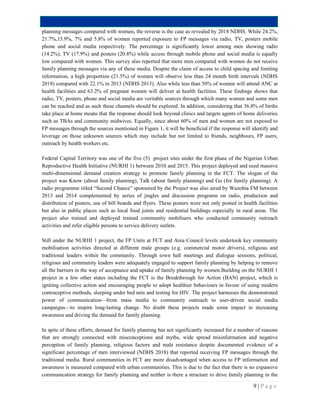
Figure 4: FP Uptake in FCT in 2019 ...............................................................................................9
Figure 5: Illustration of challenges to LMD of contraceptives in FCT...........................................12
Figure 6: Decision on Family Planning.........................................................................................14
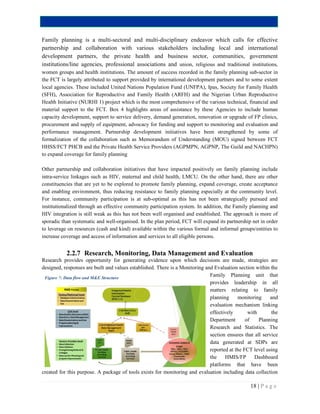
Figure 7: Data flow and M & E Structure......................................................................................17
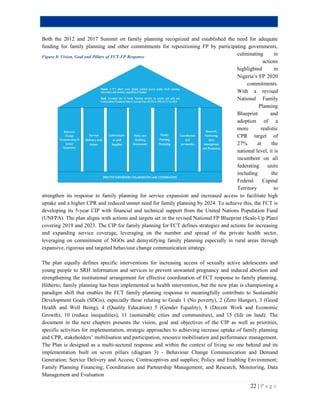
Figure 8: Vision, Goal and Pillars of FCT-FP Response................................................................20
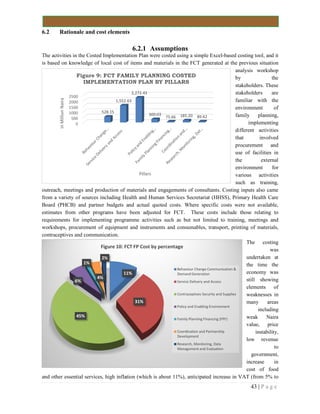
Figure 9: FCT Family Planing Costed Implementation Plan by Pillars..........................................38
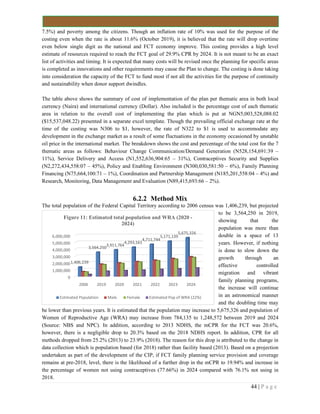
Figure 10: FCT-FP Cost by percentage .........................................................................................38
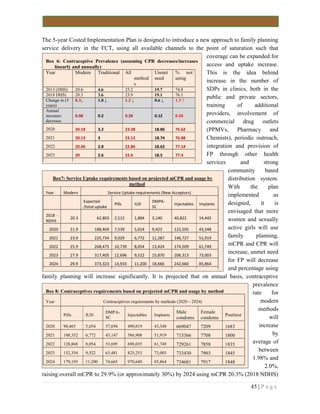
Figure 11: Estimated total population and WRA (2020-2024) ...................................................... 39
Figure 12: CIP Impact……………………………………………………………….…………….. 43
Figure 13: Cost Distribution by Pillars……………………………………………………………. 45
viii | P a g e
PREFACE
It was noted that, despite efforts, progress on enabling women and girls to access contraception
were stalled as over 200 million women and girls in developing countries who wanted to delay or
avoid becoming pregnant did not have access to modern methods of contraception. For many of
these women, the inability to choose and access family planning would cost them their lives.
Avoiding unintended pregnancies is known to reduce the number of unsafe deliveries and unsafe
abortions – two of the main causes of maternal deaths hence action was needed urgently.
Therefore, In July 2012 The UK Government and the Bill & Melinda Gates Foundation, with the
support of UNFPA and other partners hosted the London Summit on Family Planning. The
Summit was to seek a range of policy, financing and delivery commitments from developing
countries, donors, the private sector and civil society that together would enable an additional 120
million women in the world’s poorest countries to have access to modern methods of family
planning by 2020. Nigeria renewed its commitment to further improve child and maternal health
through resources support for improving family planning (FP) services.
FCT, as an integral part of Nigeria, has achieved some increase in the state’s contraceptive
prevalence rate (CPR) with the current efforts, however, we need to significantly accelerate our
progress to meet our targets and contribute to National and Global aspirations while maintaining a
commitment to supporting the rights of women and girls to decide freely, for themselves, whether,
when, and how many children they want to have. We cannot achieve this goal as a government
alone.
Therefore, this FCT Family Planning Costed Implementation Plan (CIP) is a detailed roadmap for
achieving our goals and emanates from our responsibility for and the necessity to improve maternal
and child health and survival in the FCT Abuja. It details the progress we have made, what we are
committed to doing, and how we will collaborate with partners to achieve these laudable goals.
We need a coalition of committed public and private sectors partners to continue to join hands with
us to achieve the goals of this laudable plan, which has been modeled to avert more than 700,000
child deaths. Almost 1,000 maternal deaths and 1.6million unintended pregnancies will be averted
by achieving the CPR goal of 30% between now and the end of 2024. We need to have multi-sector
collaboration with clear accountability mechanisms to ensure that we are actually delivering on our
commitments.
I appreciate all our stakeholders who throughout the process of finalizing the FCT CIP provided
significant inputs to ensure that the plan represents the best interests of all women and residents of
Abuja. The FCT FP Technical Working Group, consisting of FCT PHCB officials, Development
Partners, Implementing Partners, and advocates, advised the entire CIP development process.
As a Government, we are committed to this effort, and I want to thank all those, especially
UNFPA, who have contributed to the realization of the FCT Family Planning Costed
Implementation Plan.
I know that with sustained passion and commitments we can achieve the targets as agreed and set
in this plan.
DR. IWOT Ndaeyo
Ag. Executive Secretary (FCT PHCB)
ix | P a g e
ACKNOWLEDGEMENTS
The FCT Primary Health Care Board (FCT PHCB) on behalf of the Federal Capital Territory
Authority (FCTA) is extremely grateful to the United Nations Population Fund (UNFPA) for both
the technical and financial support provided to the development of the 5-year FCT Costed
Implementation Plan CIP) for Family Planning. This support is a strong demonstration of UNFPA
to the social and economic well-being of residents of the Federal Capital Territory but most
especially women and children. With this plan, FCT is moving in the direction of a more organized,
strategic and systematic approach to increasing access of all eligible persons to quality family
planning information and services working with other stakeholders, the outcome of which is
reduced maternal morbidity and mortality.
We acknowledge the role played by the International Cooperation Unit, FCT Economic Planning
and Research in contributing to the process that produced this plan. It’s a demonstration of team
work and synergy between two Governmental agencies. We are equally grateful to our stakeholders
from public, private and NGO sectors as well as communities for participating actively and
contributing ideas that produced a CIP which we consider innovative, expansive and result based.
We are extremely optimistic that we will commit to the implementation of this plan individually
and collectively, addressing areas that fall within our areas of focus. We expect all stakeholders and
partners to align their programmes and responses to family planning in the FCT with the Costed
Implementation Plan to strengthen our collective effort and common goal of increased
contraceptive prevalence rate to achieve reduction in maternal morbidity and mortality
Finally, our immense gratitude goes to the Consultant, ’Yemi Osanyin and his team for the
hardwork, the organised and systematic approach adopted in guiding the process. The process was
not only about producing a plan but also the capacity of participants that was either built or
strengthened in planning and programming.
We call on our stakeholders and partners not to see the plan as an end but a means to an end. It is
important that we work together to operationalize this plan in a vigorous manner, doing more than
we have been doing to achieve the goal of the plan
Director,
Primary Health Care
FCT Primary Health Care Board
x | P a g e
LIST OF CONTRIBUTORS
S/N NAMES Position & Organisation Thematic Area Worked
1 Dr. Ndaeyo Iwot Ag ES,FCT PHCB Family Planning Financing
2 Dr. RuqayyatWamako Director PHCB Policy & Enabling Environment
3 Mrs. Momoh Mariam Family Planning Coordinator Coordination and Partnership
4 Muhammad A. Lawal Director EPRS Family Planning Financing
5 Mrs. Ajoke Alao Data Officer[Family Planning] Contraceptives & Supplies
6 Evelyn Max Egba Npower FP Coordinating Unit Family Planning Financing
7 Victoria Aleoghena Education Secretariat Family Planning Financing
8 Fatigun Olusegun FCT/UNFPA Programme Coordinator Policy & Enabling Environment
9 Dr. Dan-Gadzama M and E Officer PHCB Research, Monitoring & Evaluation
10 Mrs. Kanu Felicia Provider, Luingi Barracks Service Delivery and Access
11 Mrs. Daghuje Florence School of Midwifery, Gwagwalada Service Delivery and Access
12 Mrs. Attah Elizabeth Deputy FP Coordinator Coordination and Partnership
13 Iyabo Balogun Area council FP/RH Coordinator Research, Monitoring & Evaluation
14 Mrs. Eniola Awoniyi Provider Family Health Clinic Area 2 Service Delivery and Access
15 Mosunmola Adefila Npower FP Coordinating Unit BCC/Demand Generation
16 Pharm Peter Ibrahim Pharmacist PHCB Policy & Enabling Environment
17 Peter Alfa Budget Officer PHCB Policy & Enabling Environment
18 Mrs. Carol Ibrahim PRS Family Planning Financing
19 Hajia Halima Gero LMCU Coordinator Contraceptives & Supplies
20 Mrs. Munirat Usman Provider Nyanya General Hospital Family Planning Financing
21 Dr. M.O.D Abonyi Chairman AGPMPN Coordination and Partnership
22 Dr. Joachim Chijide FP/RHCS Specialist, UNFPA Research, Monitoring & Evaluation
23 Dr. Ismail A. Mohammed SHOPS Plus USAID Coordination and Partnership
24 Shafa Ahmed Salihu Community Health Practitioner BCC/Demand Generation
25 HakeematAliyu NTA BCC/Demand Generation
26 Miss Rita Anene Program Officer, PPFN Service Delivery and Access
27 Dr. Isah Vasta Director PRS PHCB Research, Monitoring & Evaluation
28 Mr Eze Josephat Secretary AGPNP Family Planning Financing
29 Omolewa Yemisi Education Secretary BCC/Demand Generation
30 Hajara Onubaiye Family Planning Coordinating Unit Policy & Enabling Environment
31 Emilene Anakhuekha FCT Focal Person, UNFPA Coordination and Partnership
32 Dr. Hadley Ikwe FP Analyst, UNFPA BCC/Demand Generation
xi | P a g e
ABBREVIATIONS
AGPMPN – Association of General Private Medical Practitioners of Nigeria
AGPNPN - Association of General Nursing Practitioners of Nigeria
AMAC – Abuja Municipal Area Council
ARFH – Association for Reproductive and Family Health
BAN - Breakthrough Action Nigeria
BCC/DG – Behaviour Change Communication/Demand Generation
CBD – Community Based Distribution
CHEWs – Community Health Extension Workers
CIP - Costed Implementation Plan
CLMS – Contraceptive Logistics Management Supply
CPM - Coordination and Partnership Management
CPR – Contraceptive Prevalence Rate
mCPR – Modern Contraceptive Prevalence Rate
CSOs – Civil Society Organisations
DALYs - Daily Adjusted Life Years
DCR – Daily Consumption Register
DFID – Department for International Development
FBOs – Faith Based Organisations
FCT/A – Federal Capital Territory Administration
FCT-SACA – FCT Agency for the Control of AIDS
FGN - Federal Government of Nigeria
FHC – Family Health Clinic
FLHE – Family Life and HIV Education
FMOH – Federal Ministry of Health
FPF - Family Planning Financing
GHSCM-PSM- Global Health Supply Chain-Procurement &Supply Management Program
HCT – HIV Counselling and Testing
HHSS – Health and Human Services Secretariat
IPCC – Interpersonal Communication and Counselling
LARC – Long Acting Reversible Contraceptives
LMCU - Logistics Management Coordinating Unit
LMD - Last Mile Distribution
MDGs – Millennium Development Goals
MEC – Medical Eligibility Criteria
M&E – Monitoring and Evaluation
MIS – Management Information System
MMR - Maternal Mortality Ratio
MNCH – Maternal and Neo-natal Child Health
NANNM – National Association of Nigerian Nurses and Midwives
NAWOJ - National Association of Women Journalist
NDHS – Nigeria Demographic and Health Survey
NHLMIS - National Health Logistics Management Information System
NGOs – Non Governmental Organisations
NMA – Nigeria Medical Association
NOA - National Orientation Agency
xii | P a g e
NPHCDA – National Primary Health Care Development Agency
NRHCS – National Reproductive Health Commodity Security
NURHI – Nigerian Urban Reproductive Health Initiative
NURTW - National Union of Road Transport Workers
OPDs - Organisation of Persons with Disability
PAC – Post Abortion Care
PEE - Policy & Enabling Environment
PHC – Primary Health Care
PHCB – Primary Health Care Board
PNC – Post Natal Care
PPFN – Planned Parenthood Federation of Nigeria
PPIUD – Post Partum IUD
PPMVs – Proprietary and Patient Medicine Vendors
RIRF – Requisition, Issue & Return Forms
RMDE - Research, Monitoring, Data Management and Evaluation
SDGs - Sustainable Development Goals
SDPs – Service Delivery Points
SFH – Society for Family Health
SHOPS Plus - Strengthening Health Outcomes through the Private Sector
SRH - Sexual and Reproductive Health
UNFPA – United Nations Population Fund
WRA - Women of Reproductive Age
xiii | P a g e
SECTION ONE: INTRODUCTION
1.1 Global Context
Global Maternal Mortality Ratio (MMR)
and 214 million Women of Reproductive Age (WRA), especially among young, poor and
unmarried female population who want to avoid pregnancy are not using any modern contraceptive
method due to limited awareness and inadequate access
unmet need is compounded by a growing population, cultural, traditional and religious beliefs, and
a dearth of quality and accessible family planning (FP) services.
as one of the most cost-effective and beneficial investmen
needs by providing quality FP to women who do not wish to become pregnant, reduc
of unwanted pregnancies and abortions among women and young girls. This in turn decrea
maternal and child mortality, the spread of HIV while it increases women empowerment, thus,
improving the overall health and well
On July 11, 2012, a global community of FP stakeholders
family planning to deliberate on the renewal and revitalization of the global commitment to ensure
that women and girls, particularly those living in low resource settings have access to contraceptive
information, services and supplies. It was held wit
Development (DFID), and Bill and Melinda Gates Foundation in partnership with United Nations
additional 120 million women and girls in developing co
without discrimination and coercion by 2020. The Summit was held in
ensuring 120 million additional women and girls in the world’s 69 poorest countries have access to
effective family planning information and services by the year 2020. The achievement of this goal
would prevent 100 million unintended pregnancies, 50 million abortions, 200,000
pregnancy/childbirth-related maternal deaths, and 3 million infant deaths.
As an outcome of this commitment, a global partnership ‘Family Planning 2020’ (FP2020) was
formed to support the rights of women and girls to decide freely, whether, when, and the number of
Figure 1: Sustainable Development Goals
SECTION ONE: INTRODUCTION
atio (MMR) declined in 2017 from 342 to 211 per 100
and 214 million Women of Reproductive Age (WRA), especially among young, poor and
unmarried female population who want to avoid pregnancy are not using any modern contraceptive
method due to limited awareness and inadequate access to contraceptives. This high MMR and
s compounded by a growing population, cultural, traditional and religious beliefs, and
a dearth of quality and accessible family planning (FP) services. Family planning is globally known
effective and beneficial investments in global health. Addressing unmet
needs by providing quality FP to women who do not wish to become pregnant, reduc
of unwanted pregnancies and abortions among women and young girls. This in turn decrea
maternal and child mortality, the spread of HIV while it increases women empowerment, thus,
improving the overall health and well-being of women, children, and their families.
a global community of FP stakeholders came together at the London Summit on
the renewal and revitalization of the global commitment to ensure
that women and girls, particularly those living in low resource settings have access to contraceptive
information, services and supplies. It was held with support from the Department for Int
Development (DFID), and Bill and Melinda Gates Foundation in partnership with United Nations
Population Fund (UNFPA). The
Summit was attended by
stakeholders worldwide
including leaders from national
governments, donors, civil
society, the priva
research and development
community and other interest
groups. The objective
mobilise global policy,
financing, commodity and
service delivery commitments
to support the rights of
llion women and girls in developing countries of the world to use contraceptives
without discrimination and coercion by 2020. The Summit was held in pursuit of the goal of
ensuring 120 million additional women and girls in the world’s 69 poorest countries have access to
ng information and services by the year 2020. The achievement of this goal
would prevent 100 million unintended pregnancies, 50 million abortions, 200,000
related maternal deaths, and 3 million infant deaths.
As an outcome of this commitment, a global partnership ‘Family Planning 2020’ (FP2020) was
formed to support the rights of women and girls to decide freely, whether, when, and the number of
1 | P a g e
per 100 000 live births
and 214 million Women of Reproductive Age (WRA), especially among young, poor and
unmarried female population who want to avoid pregnancy are not using any modern contraceptive
to contraceptives. This high MMR and
s compounded by a growing population, cultural, traditional and religious beliefs, and
Family planning is globally known
ddressing unmet
needs by providing quality FP to women who do not wish to become pregnant, reduces the number
of unwanted pregnancies and abortions among women and young girls. This in turn decreases
maternal and child mortality, the spread of HIV while it increases women empowerment, thus,
being of women, children, and their families.
came together at the London Summit on
the renewal and revitalization of the global commitment to ensure
that women and girls, particularly those living in low resource settings have access to contraceptive
h support from the Department for International
Development (DFID), and Bill and Melinda Gates Foundation in partnership with United Nations
Population Fund (UNFPA). The
Summit was attended by
stakeholders worldwide
including leaders from national
nts, donors, civil
society, the private sector, the
research and development
and other interest
he objective was to
mobilise global policy,
financing, commodity and
service delivery commitments
to support the rights of
untries of the world to use contraceptives
pursuit of the goal of
ensuring 120 million additional women and girls in the world’s 69 poorest countries have access to
ng information and services by the year 2020. The achievement of this goal
would prevent 100 million unintended pregnancies, 50 million abortions, 200,000
As an outcome of this commitment, a global partnership ‘Family Planning 2020’ (FP2020) was
formed to support the rights of women and girls to decide freely, whether, when, and the number of
2 | P a g e
children they want to have. In July 2017, it was confirmed that 38.8 million additional women and
girls in the 69 focus countries were using a modern method of contraception than in 2012, when
FP2020 was launched. This successfully prevented 84 million unintended pregnancies, 26 million
unsafe abortions, and 125,000 maternal deaths. African countries account for almost 50% of the
additional users of contraception with 16 million additional women and girls using a modern
method of contraception in the FP2020 countries of Africa when compared to 2012 resulting in
increased contraceptive prevalence rate from 19.5% to 23.4%.
1.2 Family Planning 2020 and Sustainable Development Goals
FP2020 is aligned and committed to extending the lifesaving benefits of modern contraception in
contributing to the achievement of the Sustainable Development Goals (SDGs). Contraceptive
access is directly or indirectly mainstreamed in the SDGs, and FP2020’s goal of reaching 120
million women and girls, and is a critical benchmark on the global path to universal access by
2030. The SDGs 2030 Agenda includes targets and references to gender equality and women’s and
girls’ empowerment and sexual and reproductive health and reproductive rights. The SDGs make
specific references to family planning in Goal 3 on health and Goal 5 on gender equality and
women’s empowerment (Table 1).
However, about 13 of the 17 goals (especially goals 1, 2, 3, 4, 5, 8, 9, 10, 11, 12, 13, 14 and 16) are
linked to family planning either directly or indirectly. For instance, it will be impossible to end
poverty and hunger, ensure quality education for all, promote sustained economic growth, achieve
good health, ensure good life on land, achieve responsible consumption and ensure peace and
justice, without ensuring that every woman has access to quality family planning services.
Countries of the World have used their multi-year FP Costed Implementation Plans (CIPs) to
strengthen their response and advocate for the implementation of both the SDGs and FP2020
commitments. Similarly, The FGN has been implementing programmes aimed at achieving the
previous MDGs and now SDGs alongside other nations of the world through its Blueprint and CIPs
by individual states.
1.3 Nigeria’s context
According to the 2006 National Population census Nigeria had 140million people with a growth
rate of 3.2% making Nigeria one of the most populous and fastest growing population in the World.
In 2015, with an estimated population of slightly above 182 million, the United Nations ranked
Nigeria as the seventh most populous country, and one of the fastest growing populations in the
world. By 2018, the population was estimated to have increased to 198million (National
Population Commission, 2018), implying an addition of 58million people to the population size in
only a period of 12 years (2006 to 2018). This indicates that Nigeria recorded a 29% increase in its
population in less than 15 years and with urban the population growing at an average annual growth
rate of about 6.5%, without commensurate increase in social amenities and infrastructure.
The total population figure shows that Nigeria remains the most populous country in Africa. The
2018 World population prospect predicts that by 2050, Nigeria will become the third most
populated country in the world, with the likelihood of the population hitting the 379 million mark.
Today, Nigeria has one of the highest MMR in the world despite harbouring only 2% of the world’s
3 | P a g e
population. The current maternal mortality ratio of 512 per 100,000 live births1
(NDHS 2018),
though it is a significant decrease from 576 per 100,000 in 2013, however, this figure is still a
source of concern to the Government of Nigeria and the various development partners working in
Nigeria. Also, the high Infant and the Under-five mortality rate of 69 and 128 deaths per 1000 live
births respectively have attracted attention to Nigeria and reinforced the need to do more for the
population in terms of increasing access to health services and reducing inequity in the health
system.
It is also not surprising that other socio-economic indicators are unacceptably poor. For instance,
poverty, under-employment and unemployment have grown significantly. In absolute figure and
with increased population growth, about 90 million persons are poor in Nigeria2
. Family Planning
is one of the most potent responses to slowing down population growth, thus improving quality of
life of the people, most especially women. With high total fertility rate (TFR) of 5.3, Nigeria’s
population is likely to hit 379 million by 2050, becoming the third most populous country on earth.3
It would take only about 30 years for population of Nigeria to double itself. The current fertility and
mortality patterns have resulted in a young population structure, where more than 40% of the
current population are children under the age of 15 years. There is no doubt that low level of family
planning uptake is a major factor in the fertility pattern and population growth rate. According to
2018 NDHS, the contraceptive prevalence rate (CPR) and mCPR among married women in Nigeria
are 17% (from 15%) and 12% (from 10%) respectively and, 37% and 28% respectively among
unmarried sexually active women. Also, the survey indicated that unmet need for contraceptives
among married women is 19% (from 16 in 2013) and 48% among sexually active unmarried
women (from 35.3% in 2013). This shows that there is still a huge unmet need for family planning
among both married and unmarried sexually active women in Nigeria
Following the July, 2012, London Summit on Family Planning, the Federal Government of Nigeria
(FGON) made a commitment of providing an additional $8.35 million per year specifically for
Family Planning and Reproductive Health. As part of its FP 2020 commitment4
, the Nigerian
government in the National Health Strategic Plan set a target of reaching 36% CPR by 2018 from
16% in 2013 which the government and several donors and nongovernmental organisations
(NGOs) expressed commitment to at that time. To actualize the resolution at the summit and the
goal of FP 2020, Nigeria adopted and launched its first National Family Planning Blueprint (Scale
Up Plan) in November 2014. The Blueprint provides a road map for achieving the FGON’s goal of
improving access to FP and reducing maternal mortality. A follow up to this was the July 11, 2017
Family Planning Summit in London, UK where Nigeria reiterated its commitment to family
planning stating that the Government of Nigeria in collaboration with its partners and private sector
pledge to achieve a more realistic modern contraceptive prevalence rate (mCPR) of 27% among all
women by 2020 considering that the previous 36% was too ambitious. This it promises to do by
ensuring sustainable financing for the National Family Planning Programme, improve availability
1
NDHS 2018
2
World Bank Africa poverty report
3
2018 World population prospect
4
Family Planning 2020 Commitment, 2017
4 | P a g e
of services and commodities, taking measures that improve access and create the enabling
environment for sexual and reproductive health services across Nigeria, and contribute to improved
preparedness and response where humanitarian crises occur and build partnerships to improve
access. The critical actions to accomplish the commitments are
 Approval of the Federal Executive Council to Federal Ministry of Health (FMoH) to renew the
Memorandum of Understanding with UNFPA which will ensure provision of US$4million
annually from 2017 to 2020 for procurement of contraceptives for the public sector (an increase
from the US$3 mil committed from 2011 to 2014).
 The Federal Ministry of Health commits to ensuring the disbursement of US$56 million to the
States through the International Development Assistance (World Bank) loans and Global
Financing Facility from 2017 to 2020. The FMoH is working with State governments, donors
and other stakeholders programme including health insurance programs through the Basic
Health Care Provision Fund (BHCPF) to make family planning expenses by households to be
reimbursable in the public and private sectors.
 Nigeria also plans to realize the health financing goals laid out under the National Strategic
Health Development Plan II (2018 – 2022), the institutionalization of the support for primary
health services provided by the Subsidy Reinvestment and Empowerment Program (SURE P)
and meet or exceed the Abuja Declaration health financing commitments.
 Nigeria stands by the commitment to achieving the goal of a contraceptive prevalence rate of
27% mCPR by 2020 based on the FP Country Implementation Plan (revised 2019-2023
national FP blue print); by investing in increasing the number of health facilities providing FP
services in the 36 States + FCT from 9,500 as at 2016 to 20,000 by 2020 and to reach the target
of 13.5 million current users of family planning by 2020
 Reforming and expanding the Task-Shifting policy implementation to include Patent Medicine
Vendors (PPMBVs) and Community Resource Persons (CORPs) to expand access in hard to
reach areas and amongst disadvantaged populations. Deliberate efforts to be made to scale up
access to new contraceptive methods including Depot Medroxyprogesterone Acetate (DMPA)
Sub Cutaneous injection (DMPA-SC) in the public and private sectors including removal of
regulatory barriers that impede access.
 Continue to invest in and expedite the transformation of the public health sector Last Mile
Distribution (LMD) of health commodities using integrated informed pull models through
involvement of the private sector capacity for optimization of transportation, haulage and
tracking of commodities using electronic logistics management solutions.
 Invest in working with local and international NGOs, CSOs, FBOs, Traditional and Religious
leaders as well as other Government line ministries and parastatals to address socio-cultural
barriers and limitations to family planning services in communities.
 Leveraging community structures such as Ward Development Committees around the 10,000-
functional primary health care centres to promote Behavioural Change Communication
messages to foster positive perceptions about family planning.
 Working with the Ministry of Youth and Ministry of Education to ensure that age appropriate
information on sexual reproductive health is provided to young people though implementation
of the Family Life Health Education Curriculum in and out of schools including investments in
provision of youth friendly services in traditional and non-traditional outlets
In Nigeria, family planning services are availa
Sterilisation and LARC methods while private sector and
more of the short term methods including E
public perception that private clinics
response to the revised National Family
Care Board is developing its 5-year Costed Implementation Plan for Family Planning (2020
2024) with the aim of making FCT’s response to be more organised, systematic, focused and
result-driven, with government leading and assuming greater ownership of
is to provide a road map for the FCT to contribute significantly to the National CPR target of 27%
The process of developing the plan involved all stakeholders involved in FP response in the Federal
Capital Territory.
5
Family Planning 2020 Commitment, 2017
0
20
40
60
80
100
0
75 79
93
Private
Figure 2: Sources of FP by methods (%)
In Nigeria, family planning services are available through public and private sectors
public sector being the
lead (5
the private sector’s
contribution is equally
significant (41%)
especially in the
provision of some
methods. Other
sources account for the
5% remaining
2018).
analysis shows that
this role varies by
method
type.Figure
that the public sector
provides more of the
while private sector and Private Medicine Stores (
including Emergency Contraceptives. This might be as a result of
clinics do not have trained providers for LARC.
amily Planning Blueprint (2019-2023), the FCT Primary Health
year Costed Implementation Plan for Family Planning (2020
2024) with the aim of making FCT’s response to be more organised, systematic, focused and
driven, with government leading and assuming greater ownership of the response. The plan
is to provide a road map for the FCT to contribute significantly to the National CPR target of 27%
The process of developing the plan involved all stakeholders involved in FP response in the Federal
81 80
67
74
51
61
34
Public PMS
5 | P a g e
ble through public and private sectors, with the
public sector being the
lead (54%), however
the private sector’s
contribution is equally
significant (41%)
especially in the
provision of some
methods. Other
sources account for the
% remaining (NDHS
.A deeper
analysis shows that
this role varies by
method
Figure 2 shows
that the public sector
provides more of the
Private Medicine Stores (PMS) provide
. This might be as a result of
. In aligning its
2023), the FCT Primary Health
year Costed Implementation Plan for Family Planning (2020 --
2024) with the aim of making FCT’s response to be more organised, systematic, focused and
the response. The plan
is to provide a road map for the FCT to contribute significantly to the National CPR target of 27%5
.
The process of developing the plan involved all stakeholders involved in FP response in the Federal
6 | P a g e
7 | P a g e
SECTION TWO: SITUATION ANALYSIS OF FCT FAMILY PLANNING LANDSCAPE
2.1 Brief on Federal Capital Territory.
The Federal Capital Territory (FCT) was created on 5th February 1976 to be managed by the Federal Capital
Territory Authority (FCTA). The population of the FCT according to 2006 population census was
1.406,239.However, according to World Population Report, this is estimated to have grown to 3,095,118 in
2019, representing an increase of 1,688,879; which is more than double of the 2006 figure, over a 13 year
period. Though this increase may be attributed largely to migration, the contribution of high fertility rate of
4.8 cannot be discountenanced especially in rural areas.
The FCTA has the responsibility for planning and developing theFCT. The law establishing it vested the
ownership, control and governance of the territory in the hands of the Federal Government. The FCT covers
an area of 8,000 sq. km. Prior to 1996, the FCT had four Area Councils, namely Abaji, Gwagwalada, Kuje
and Municipal. In 1996, two additional Area councils were created, namely Kwali (from Gwagwalada) and
Bwari (from Abuja Municipal Area Council). The President is vested with the power to govern the FCT, a
power that is often delegated to the Minister of the FCT in the Presidency and constitutionally, it has one
Senatorial seat and two House of Representatives constituencies. In place of Ministries and Commissioners,
the FCT Administration is organised around Secretariats headed by Secretaries and these include Education,
Health, Social Services, Legal, Agriculture and Transport. The Health Secretariat is responsible for
coordinating the implementation of health programs and delivery of health including family planning
services in the FCT.
The FCT Administration is committed to increasing access to quality health services and improving quality
of life of the resident which explains investment in developing health infrastructure, staffing and capacity
building for health staff, provision of
required supplies and construction and
renovation of health facilities. The FCT
Administration has also put in place
relevant policies and strategic plans to
sharpen the focus of interventions as well
as chart a new direction for health care
delivery in FCT. The Primary Health Care
Development Board was thus created to
ensure coordination of planning,
budgetary provision and monitoring of all
primary healthcare services in the Federal
Capital Territory and also advice the
Minister of Federal Capital Territory and
Area Council health authorities in the
Federal Capital Territory on any matter
regarding primary healthcare services in
the Federal Capital Territory. However,
available indices (Box 1) show that the
desired result has not been obtained. For instance, maternal, infant and under-5 mortality and fertility rate in
FCT are still high. In addition about one-third (36.5%) of pregnant women still deliver at home where family
planning information, counselling and services are not available, talked about and provided. Also
contraceptive rate is low while unmet need for FP is high. In addition, Doctor Population and Doctor Patient
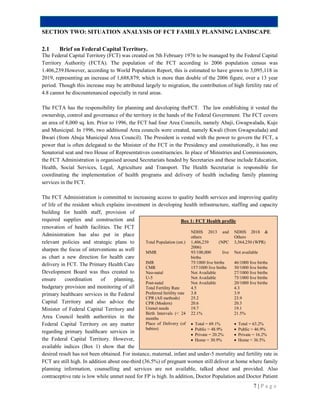
Box 1: FCT Health profile
NDHS 2013 and
others
NDHS 2018 &
Others
Total Population (est.) 1,406,239 (NPC
2006)
3,564,250 (WPR)
MMR 93/100,000 live
births
Not available
IMR 75/1000 live births 46/1000 live births
CMR 157/1000 live births 30/1000 live births
Neo-natal Not Available 27/1000 live births
U-5 Not Available 75/1000 live births
Post-natal Not Available 20/1000 live births
Total Fertility Rate 4.5 4.3
Preferred fertility rate 3.8 3.9
CPR (All methods) 25.2 23.9
CPR (Modern) 20.6 20.3
Unmet needs 19.7 19.1
Birth Intervals (< 24
months
22.1% 21.5%
Place of Delivery (of
babies)
 Total = 69.1%
 Public = 48.9%
 Private = 20.2%
 Home = 30.9%
 Total = 63.2%
 Public = 46.9%
 Private = 16.2%
 Home = 36.5%
ratio is very low (1:3,001 and 1:1,261), Nurse Patient Population is low, showing
resources for health, FCT has 37 Medical Doctors, 1,129 Nurses/Midwives, 122 Community Health
Extension Workers and 89 Consultants
the health sector in FCT affects both the v
population.
The table in Box 1 above further shows a Total Fertility Rate (TFR) of 4.
fertility rate among women according to 201
wanted fertility increased by 0.1, a figure that also do not show any significant difference. All the same, it
indicates that while many men will like to have more than four (4)
have less than 4 children, but there is inadequate support for them to accomplish this. The reasons might be
lack of awareness of family planning services, lack of knowledge of where to get the services or lack of
facilities that provide family planning services considering that less than
provide FP in the FCT. The inability of all the facilities to provide FP services in the FCT are due to
inadequate infrastructure, human resources and financial resources
is restricted. This partly explains the low contraceptive rate and the inability of the system to meet the family
planning needs of 19.1% of married women who desire to have family planning services
first attempt at having a coordinated and expansive approach to family planning was in 2015 when a family
planning blueprint for FCT was first developed with support from the Nigerian Urban Reproductive Health
Initiative (NURHI Project). This 5-year Costed Imp
United Nations Population Fund (UNFPA) is the second attempt being made to chart a new path for family
planning service delivery in the FCT and consolidate the gains of the past 5 years.
2.2 Thematic analysis of Family Planning
2.2.1 Behaviour Change Communication
In Nigeria, awareness and knowledge of any family planning method is
showing 94%,98% and 99.1% among
likely to be the trend in
the FCT with more than
90% in each category
demonstrating awareness
and knowledge of family
planning. A review of
the report equally shows
that women and men
have been exposed to
family planning
messages using a mix of
approaches. These
include radio and
televisionmessages, use
of posters, mobile
phones, and social media
and to some extent newspapers (Figure
while posters also have some rating. Equally showing som
especially among women. Unlike NDHS 2013
0
5
10
15
20
25
Figure 3: Exposure for FP messages
ratio is very low (1:3,001 and 1:1,261), Nurse Patient Population is low, showing 1:478. On human
resources for health, FCT has 37 Medical Doctors, 1,129 Nurses/Midwives, 122 Community Health
Extension Workers and 89 Consultants that have been trained on LARC. The inadequate human resources in
the health sector in FCT affects both the volume and quality of services available and accessible to the
further shows a Total Fertility Rate (TFR) of 4.3 whereas wanted (preferred)
fertility rate among women according to 2018 NDHS is 3.9. Though TFR dropped by insignificant 0.2
wanted fertility increased by 0.1, a figure that also do not show any significant difference. All the same, it
men will like to have more than four (4) women on the other hand
there is inadequate support for them to accomplish this. The reasons might be
lack of awareness of family planning services, lack of knowledge of where to get the services or lack of
ily planning services considering that less than 50% of public health facilities
inability of all the facilities to provide FP services in the FCT are due to
inadequate infrastructure, human resources and financial resources, thus access to family planning services
. This partly explains the low contraceptive rate and the inability of the system to meet the family
women who desire to have family planning services
t attempt at having a coordinated and expansive approach to family planning was in 2015 when a family
planning blueprint for FCT was first developed with support from the Nigerian Urban Reproductive Health
year Costed Implementation Plan for Family Planning supported by
United Nations Population Fund (UNFPA) is the second attempt being made to chart a new path for family
planning service delivery in the FCT and consolidate the gains of the past 5 years.
analysis of Family Planning situation
Change Communication and Demand Creation
nowledge of any family planning method is very high among women and men,
and 99.1% among women, men and sexually unmarried sampled(NDHS 201
(Figure 2). Television and radio rank very high among men and women
Equally showing some significance are mobile phones and social media
especially among women. Unlike NDHS 2013 where more men claimed to have been exposed to family
24.2
21.7
5.3
7 5.8
15.9
3.6
2.2
14.5
17.9
5.2
1.7 1.7
20.8
3.7
0.2
Women Men
: Exposure for FP messages
8 | P a g e
1:478. On human
resources for health, FCT has 37 Medical Doctors, 1,129 Nurses/Midwives, 122 Community Health
The inadequate human resources in
olume and quality of services available and accessible to the
whereas wanted (preferred)
y insignificant 0.2,
wanted fertility increased by 0.1, a figure that also do not show any significant difference. All the same, it
on the other hand will prefer to
there is inadequate support for them to accomplish this. The reasons might be
lack of awareness of family planning services, lack of knowledge of where to get the services or lack of
0% of public health facilities
inability of all the facilities to provide FP services in the FCT are due to
family planning services
. This partly explains the low contraceptive rate and the inability of the system to meet the family
women who desire to have family planning services but unable. The
t attempt at having a coordinated and expansive approach to family planning was in 2015 when a family
planning blueprint for FCT was first developed with support from the Nigerian Urban Reproductive Health
lanning supported by the
United Nations Population Fund (UNFPA) is the second attempt being made to chart a new path for family
reation
very high among women and men,
NDHS 2018). This is
radio rank very high among men and women,
e significance are mobile phones and social media
exposed to family
2.2 2.9
0.2 1.2
9 | P a g e
planning messages compared with women, the reverse is the case as revealed by 2018 NDHS. While 24.2%,
21.7%,15.9%, 7% and 5.8% of women reported exposure to FP messages via radio, TV, posters mobile
phone and social media respectively. The percentage is significantly lower among men showing radio
(14.2%), TV (17.9%) and posters (20.8%) while access through mobile phone and social media is equally
low compared with women. This survey also reported that more men compared with women do not receive
family planning messages via any of these media. Despite the claim of access to child spacing and limiting
information, a high proportion (21.5%) of women will observe less than 24 month birth intervals (NDHS
2018) compared with 22.1% in 2013 (NDHS 2013). Also while less than 50% of women will attend ANC at
health facilities and 63.2% of pregnant women will deliver at health facilities. These findings shows that
radio, TV, posters, phone and social media are veritable sources through which many women and some men
can be reached and as such these channels should be explored. In addition, considering that 36.8% of births
take place at home means that the response should look beyond clinics and targets agents of home deliveries
such as TBAs and community midwives. Equally, since about 60% of men and women are not exposed to
FP messages through the sources mentioned in Figure 1, it will be beneficial if the response will identify and
leverage on those unknown sources which may include but not limited to friends, neighbours, FP users,
outreach by health workers etc.
Federal Capital Territory was one of the five (5) project sites under the first phase of the Nigerian Urban
Reproductive Health Initiative (NURHI 1) between 2010 and 2015. This project deployed and used massive
multi-dimensional demand creation strategy to promote family planning in the FCT. The slogan of the
project was Know (about family planning), Talk (about family planning) and Go (for family planning). A
radio programme titled “Second Chance” sponsored by the Project was also aired by Wazobia FM between
2013 and 2014 complemented by series of jingles and discussion programs on radio, production and
distribution of posters, use of bill boards and flyers. These posters were not only posted in health facilities
but also in public places such as local food joints and residential buildings especially in rural areas. The
project also trained and deployed trained community mobilisers who conducted community outreach
activities and refer eligible persons to service delivery outlets.
Still under the NURHI 1 project, the FP Units at FCT and Area Council levels undertook key community
mobilisation activities directed at different male groups (e.g. commercial motor drivers), religious and
traditional leaders within the community. Through town hall meetings and dialogue sessions, political,
religious and community leaders were adequately engaged to support family planning by helping to remove
all the barriers in the way of acceptance and uptake of family planning by women.Building on the NURHI 1
project in a few other states including the FCT is the Breakthrough for Action (BAN) project, which is
igniting collective action and encouraging people to adopt healthier behaviours in favour of using modern
contraceptive methods, sleeping under bed nets and testing for HIV. The project harnesses the demonstrated
power of communication—from mass media to community outreach to user-driven social media
campaigns—to inspire long-lasting change. No doubt these projects made some impact in increasing
awareness and driving the demand for family planning.
In spite of these efforts, demand for family planning has not significantly increased for a number of reasons
that are strongly connected with misconceptions and myths, wide spread misinformation and negative
perception of family planning, religious factors and male resistance despite documented evidence of a
significant percentage of men interviewed (NDHS 2018) that reported receiving FP messages through the
traditional media. Rural communities in FCT are more disadvantaged when access to FP information and
awareness is measured compared with urban communities. This is due to the fact that there is no expansive
communication strategy for family planning and neither is there a structure to drive family planning in the
0
5000
10000
15000
20000
25000
30000
35000 30034
3959 5007 2655
16409
31292
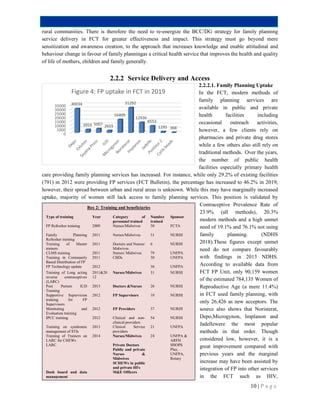
Figure 4: FP uptake in FCT in 2019
rural communities. There is therefore the need to re
service delivery in FCT for greater effectiveness and impact.
sensitization and awareness creation, t
behaviour change in favour of family planningas a critical health service that improves the health and quality
of life of mothers, children and family generally.
2.2.2
care providing family planning services has increased. For instance, while only 29.2% of existing facilities
(791) in 2012 were providing FP services (FCT Bulletin), the percentage has increased to 46.2% in 2019;
however, their spread between urban and rural areas is unknown. While this may have marginally increased
uptake, majority of women still lack access to
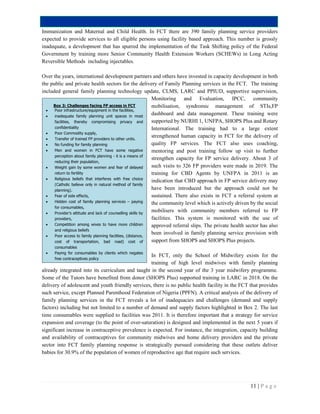
Box 2: Training and beneficiaries
Type of training Year Category of
personnel trained
FP Refresher training 2009 Nurses/Midwives
Family Planning
Refresher training
2011 Nurses/Midwives
Training of Master
trainers
2011 Doctors and Nurses/
Midwives
CLMS training 2011 Nurses/ Midwives
Training in Community
Based Distribution of FP
2011 CBDs
FP Technology update 2012
Training of Long acting
reverse contraceptives
(LARC)
2011&20
12
Nurses/Midwives
Post Partum IUD
Training
2013 Doctors
Supportive Supervision
training for FP
Supervisors
2012 FP Supervisors
Monitoring and
Evaluation training
2012 FP Providers
IPCC training 2012 Clinical and non
clinical providers
Training on syndromic
management of STIs
2013 Clinical Service
providers
Training of Trainers on
LARC for CHEWs
2014 Nurses/Midwives
LARC Private Doctors
Public and private
Nurses &
Midwives
SCHEWs in public
and private HFs
Dash board and data
management
M&E Officers
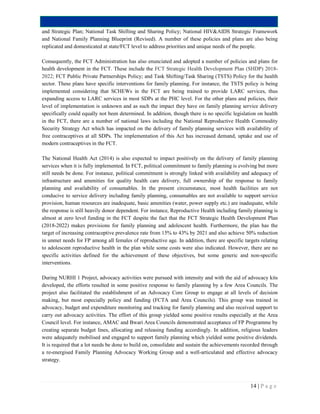
31292
12936
8553
1295 368
Figure 4: FP uptake in FCT in 2019
There is therefore the need to re-energize the BCC/DG strategy for family planning
service delivery in FCT for greater effectiveness and impact. This strategy must go beyond
to the approach that increases knowledge and enable attitudinal and
change in favour of family planningas a critical health service that improves the health and quality
children and family generally.
Service Delivery and Access
2.2.2.1. Family Planning Uptake
In the FCT, modern methods of
family planning services are
available in public and private
health facilities including
occasional outreach
however, a few clients rely on
pharmacies and private drug s
while a few others also still rely on
traditional methods. Over the years,
the number of public health
facilities especially primary health
care providing family planning services has increased. For instance, while only 29.2% of existing facilities
(791) in 2012 were providing FP services (FCT Bulletin), the percentage has increased to 46.2% in 2019;
however, their spread between urban and rural areas is unknown. While this may have marginally increased
uptake, majority of women still lack access to family planning services. This position is validated by
Contraceptive Prevalence Rate of
23.9% (all methods),
modern methods and a high unmet
need of 19.1% and 76.1% not using
family planning.
2018).These figures except unmet
need do not compar
with findings in 2013 NDHS.
According to available data from
FCT FP Unit, only 90,159 women
of the estimated 7
Reproductive Age (a mere 1
in FCT used family planning, with
only 26,426 as new acceptors. The
source also shows
Depo,Microgynon, Implanon and
Jadellewere the most popular
methods in that order. Though
considered low, however, it is a
great improvement compared with
previous years and the marginal
increase may have been assisted by
integration of FP into other services
in the FCT such as HIV,
raining and beneficiaries
Category of
personnel trained
Number
trained
Sponsor
Nurses/Midwives 30 FCTA
Nurses/Midwives 31 NURHI
Doctors and Nurses/
Midwives
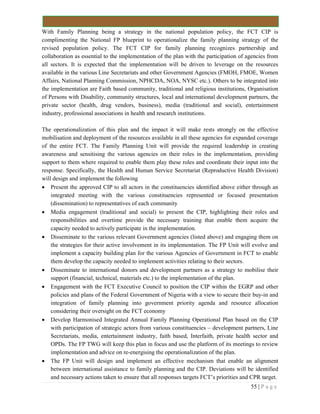
6 NURHI
Nurses/ Midwives 79 UNFPA
30 UNFPA
30 UNFPA
Nurses/Midwives 31 NURHI
Doctors &Nurses 26 NURHI
FP Supervisors 10 NURHI
FP Providers 37 NURHI
Clinical and non-
clinical providers
54 NURHI
Clinical Service
providers
21 UNFPA
Nurses/Midwives 24 UNFPA &
ARFH
Private Doctors SHOPS
Plus,
UNFPA,
Rotary
Public and private
Nurses &
Midwives
SCHEWs in public
and private HFs
M&E Officers
10 | P a g e
strategy for family planning
This strategy must go beyond mere
the approach that increases knowledge and enable attitudinal and
change in favour of family planningas a critical health service that improves the health and quality
2.2.2.1. Family Planning Uptake
In the FCT, modern methods of
family planning services are
available in public and private
health facilities including
outreach activities,
however, a few clients rely on
pharmacies and private drug stores
while a few others also still rely on
traditional methods. Over the years,
the number of public health
facilities especially primary health
care providing family planning services has increased. For instance, while only 29.2% of existing facilities
(791) in 2012 were providing FP services (FCT Bulletin), the percentage has increased to 46.2% in 2019;
however, their spread between urban and rural areas is unknown. While this may have marginally increased
family planning services. This position is validated by
Contraceptive Prevalence Rate of
% (all methods), 20.3%
modern methods and a high unmet
and 76.1% not using
family planning. (NDHS
These figures except unmet
need do not compare favourably
with findings in 2013 NDHS.
According to available data from
only 90,159 women
784,135 Women of
Reproductive Age (a mere 11.4%)
in FCT used family planning, with
only 26,426 as new acceptors. The
o shows that Noristerat,
icrogynon, Implanon and
were the most popular
methods in that order. Though
considered low, however, it is a
great improvement compared with
previous years and the marginal
increase may have been assisted by
into other services
in the FCT such as HIV,
11 | P a g e
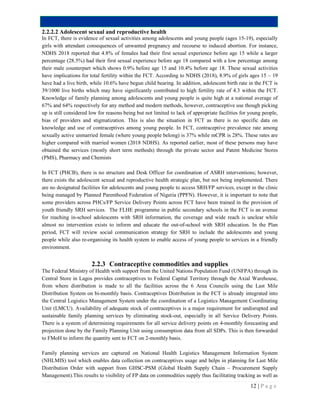
Immunization and Maternal and Child Health. In FCT there are 390 family planning service providers
expected to provide services to all eligible persons using facility based approach. This number is grossly
inadequate, a development that has spurred the implementation of the Task Shifting policy of the Federal
Government by training more Senior Community Health Extension Workers (SCHEWs) in Long Acting
Reversible Methods including injectables.
Over the years, international development partners and others have invested in capacity development in both
the public and private health sectors for the delivery of Family Planning services in the FCT. The training
included general family planning technology update, CLMS, LARC and PPIUD, supportive supervision,
Monitoring and Evaluation, IPCC, community
mobilisation, syndromic management of STIs,FP
dashboard and data management. These training were
supported by NURHI 1, UNFPA, SHOPS Plus and Rotary
International. The training had to a large extent
strengthened human capacity in FCT for the delivery of
quality FP services. The FCT also uses coaching,
mentoring and post training follow up visit to further
strengthen capacity for FP service delivery. About 3 of
such visits to 326 FP providers were made in 2019. The
training for CBD Agents by UNFPA in 2011 is an
indication that CBD approach in FP service delivery may
have been introduced but the approach could not be
sustained. There also exists in FCT a referral system at
the community level which is actively driven by the social
mobilisers with community members referred to FP
facilities. This system is monitored with the use of
approved referral slips. The private health sector has also
been involved in family planning service provision with
support from SHOPS and SHOPS Plus projects.
In FCT, only the School of Midwifery exists for the
training of high level midwives with family planning
already integrated into its curriculum and taught in the second year of the 3 year midwifery programme.
Some of the Tutors have benefited from donor (SHOPS Plus) supported training in LARC in 2018. On the
delivery of adolescent and youth friendly services, there is no public health facility in the FCT that provides
such service, except Planned Parenthood Federation of Nigeria (PPFN). A critical analysis of the delivery of
family planning services in the FCT reveals a lot of inadequacies and challenges (demand and supply
factors) including but not limited to a number of demand and supply factors highlighted in Box 2. The last
time consumables were supplied to facilities was 2011. It is therefore important that a strategy for service
expansion and coverage (to the point of over-saturation) is designed and implemented in the next 5 years if
significant increase in contraceptive prevalence is expected. For instance, the integration, capacity building
and availability of contraceptives for community midwives and home delivery providers and the private
sector into FCT family planning response is strategically pursued considering that these outlets deliver
babies for 30.9% of the population of women of reproductive age that require such services.
Box 3: Challenges facing FP access in FCT
 Poor infrastructure/equipment in the facilities,
 inadequate family planning unit spaces in most
facilities, thereby compromising privacy and
confidentiality
 Poor Commodity supply,
 Transfer of trained FP providers to other units.
 No funding for family planning
 Men and women in FCT have some negative
perception about family planning - it is a means of
reducing their population,
 Weight gain by some women and fear of delayed
return to fertility
 Religious beliefs that interferes with free choice
(Catholic believe only in natural method of family
planning).
 Fear of side effects,
 Hidden cost of family planning services – paying
for consumables,
 Provider’s attitude and lack of counselling skills by
providers,
 Competition among wives to have more children
and religious beliefs
 Poor access to family planning facilities, (distance,
cost of transportation, bad road) cost of
consumables
 Paying for consumables by clients which negates
free contraceptives policy
12 | P a g e
2.2.2.2 Adolescent sexual and reproductive health
In FCT, there is evidence of sexual activities among adolescents and young people (ages 15-19), especially
girls with attendant consequences of unwanted pregnancy and recourse to induced abortion. For instance,
NDHS 2018 reported that 4.8% of females had their first sexual experience before age 15 while a larger
percentage (28.5%) had their first sexual experience before age 18 compared with a low percentage among
their male counterpart which shows 0.9% before age 15 and 10.4% before age 18. These sexual activities
have implications for total fertility within the FCT. According to NDHS (2018), 8.9% of girls ages 15 – 19
have had a live birth, while 10.6% have begun child bearing. In addition, adolescent birth rate in the FCT is
39/1000 live births which may have significantly contributed to high fertility rate of 4.3 within the FCT.
Knowledge of family planning among adolescents and young people is quite high at a national average of
67% and 64% respectively for any method and modern methods, however, contraceptive use though picking
up is still considered low for reasons being but not limited to lack of appropriate facilities for young people,
bias of providers and stigmatization. This is also the situation in FCT as there is no specific data on
knowledge and use of contraceptives among young people. In FCT, contraceptive prevalence rate among
sexually active unmarried female (where young people belong) is 37% while mCPR is 28%. These rates are
higher compared with married women (2018 NDHS). As reported earlier, most of these persons may have
obtained the services (mostly short term methods) through the private sector and Patent Medicine Stores
(PMS), Pharmacy and Chemists
In FCT (PHCB), there is no structure and Desk Officer for coordination of ASRH interventions; however,
there exists the adolescent sexual and reproductive health strategic plan, but not being implemented. There
are no designated facilities for adolescents and young people to access SRH/FP services, except in the clinic
being managed by Planned Parenthood Federation of Nigeria (PPFN). However, it is important to note that
some providers across PHCs/FP Service Delivery Points across FCT have been trained in the provision of
youth friendly SRH services. The FLHE programme in public secondary schools in the FCT is an avenue
for reaching in-school adolescents with SRH information, the coverage and wide reach is unclear while
almost no intervention exists to inform and educate the out-of-school with SRH education. In the Plan
period, FCT will review social communication strategy for SRH to include the adolescents and young
people while also re-organising its health system to enable access of young people to services in a friendly
environment.
2.2.3 Contraceptive commodities and supplies
The Federal Ministry of Health with support from the United Nations Population Fund (UNFPA) through its
Central Store in Lagos provides contraceptives to Federal Capital Territory through the Axial Warehouse,
from where distribution is made to all the facilities across the 6 Area Councils using the Last Mile
Distribution System on bi-monthly basis. Contraceptives Distribution in the FCT is already integrated into
the Central Logistics Management System under the coordination of a Logistics Management Coordinating
Unit (LMCU). Availability of adequate stock of contraceptives is a major requirement for undisrupted and
sustainable family planning services by eliminating stock-out, especially in all Service Delivery Points.
There is a system of determining requirements for all service delivery points on 4-monthly forecasting and
projection done by the Family Planning Unit using consumption data from all SDPs. This is then forwarded
to FMoH to inform the quantity sent to FCT on 2-monthly basis.
Family planning services are captured on National Health Logistics Management Information System
(NHLMIS) tool which enables data collection on contraceptives usage and helps in planning for Last Mile
Distribution Order with support from GHSC-PSM (Global Health Supply Chain – Procurement Supply
Management).This results to visibility of FP data on commodities supply thus facilitating tracking as well as
13 | P a g e
preventing wastages and expiration of commodities. Training on Contraceptives Logistics Management
System (CLMS) has been on-going in FCT over the years supported by UNFPA and GHSC-PSM. In 2011
for instance, 79 FP Service Providers were trained by UNFPA while over 230 were trained by GHSC-PSM
in March 2018. In addition, Monitoring and Evaluation Officers in the Area Councils were also trained on
the use of National Health Logistics Management Information Systems (NHLMIS) tool for proper data
entry. All these have strengthened capacity in contraceptives management and data collection especially at
Service Delivery Points.
In addition to contraceptives are consumables which are expected to be provided by the Government at FCT
and Area Council levels. The FCT Administration had in few instances procured and supplied consumables
and needed equipment when fund was available to enable access to free FP services in line with the free
Contraceptives Policy of
the Federal Government. It
is on record that the last
supplies of consumables to
enable free provision of FP
services was in 2011. In
FCT, there are still a
number of challenges
militating against the full
functionality and
effectiveness of existing
contraceptives and supplies
management system all of
which may have caused
service disruption in
facilities especially those existing in hard to reach areas. These include late distribution, inadequate supplies,
inaccessible SDPs, attrition of trained staff and late transmission of report online due to poor internet
coverage. There is also the challenge associated with non-availability of consumables at SDPs, a
development that has introduced hidden cost as clients have to pay for the consumables used in the process
of providing them the service required. The effects of stock-out are lack of access, client frustration and loss
of confidence, high drop-out or discontinuation rate, dissatisfied providers and decline in contraceptive
uptake and prevalence rate. A major threat to contraceptive supply and distribution in the FCT is its donor
dependence, a development that may disrupt and cause a set-back for FP service delivery in the event of the
withdrawal of international funding. The inserted diagram (Figure 5) illustrates the challenges militating
against LMD of contraceptives and implications on service delivery and clients. There is therefore the need
for a more innovative, resilient and sustainable approach in responding to them in the CIP period to remove
barriers associated with stock-out of commodities. For instance what approaches are required to reach the
hard to reach areas and inadequate supplies of commodities and how can the government take over and
assume full ownership of the Last Mile Distribution after donor funding?
2.2.4 Policy and Environment
The Federal Ministry of Health has rolled out a number of policies and plans whose provisions addressed
specific issues at the state level including Federal Capital Territory. These included the National Health
Policy; National Policy on Population and Sustainable Development; National Strategic Health
Development Plan; National Reproductive Health Policy; National Free Contraceptives policy; National
Sexual and Reproductive Health Policy for Persons with Disability; the National Adolescence Health Policy
Figure 5: Illustration of challenges to LMD of Contraceptives in FCT
14 | P a g e
and Strategic Plan; National Task Shifting and Sharing Policy; National HIV&AIDS Strategic Framework
and National Family Planning Blueprint (Revised). A number of these policies and plans are also being
replicated and domesticated at state/FCT level to address priorities and unique needs of the people.
Consequently, the FCT Administration has also enunciated and adopted a number of policies and plans for
health development in the FCT. These include the FCT Strategic Health Development Plan (SHDP) 2018-
2022; FCT Public Private Partnerships Policy; and Task Shifting/Task Sharing (TSTS) Policy for the health
sector. These plans have specific interventions for family planning. For instance, the TSTS policy is being
implemented considering that SCHEWs in the FCT are being trained to provide LARC services, thus
expanding access to LARC services in most SDPs at the PHC level. For the other plans and policies, their
level of implementation is unknown and as such the impact they have on family planning service delivery
specifically could equally not been determined. In addition, though there is no specific legislation on health
in the FCT, there are a number of national laws including the National Reproductive Health Commodity
Security Strategy Act which has impacted on the delivery of family planning services with availability of
free contraceptives at all SDPs. The implementation of this Act has increased demand, uptake and use of
modern contraceptives in the FCT.
The National Health Act (2014) is also expected to impact positively on the delivery of family planning
services when it is fully implemented. In FCT, political commitment to family planning is evolving but more
still needs be done. For instance, political commitment is strongly linked with availability and adequacy of
infrastructure and amenities for quality health care delivery, full ownership of the response to family
planning and availability of consumables. In the present circumstance, most health facilities are not
conducive to service delivery including family planning, consumables are not available to support service
provision, human resources are inadequate, basic amenities (water, power supply etc.) are inadequate, while
the response is still heavily donor dependent. For instance, Reproductive Health including family planning is
almost at zero level funding in the FCT despite the fact that the FCT Strategic Health Development Plan
(2018-2022) makes provisions for family planning and adolescent health. Furthermore, the plan has the
target of increasing contraceptive prevalence rate from 15% to 43% by 2021 and also achieve 50% reduction
in unmet needs for FP among all females of reproductive age. In addition, there are specific targets relating
to adolescent reproductive health in the plan while some costs were also indicated. However, there are no
specific activities defined for the achievement of these objectives, but some generic and non-specific
interventions.
During NURHI 1 Project, advocacy activities were pursued with intensity and with the aid of advocacy kits
developed, the efforts resulted in some positive response to family planning by a few Area Councils. The
project also facilitated the establishment of an Advocacy Core Group to engage at all levels of decision
making, but most especially policy and funding (FCTA and Area Councils). This group was trained in
advocacy, budget and expenditure monitoring and tracking for family planning and also received support to
carry out advocacy activities. The effort of this group yielded some positive results especially at the Area
Council level. For instance, AMAC and Bwari Area Councils demonstrated acceptance of FP Programme by
creating separate budget lines, allocating and releasing funding accordingly. In addition, religious leaders
were adequately mobilised and engaged to support family planning which yielded some positive dividends.
It is required that a lot needs be done to build on, consolidate and sustain the achievements recorded through
a re-energised Family Planning Advocacy Working Group and a well-articulated and effective advocacy
strategy.
15 | P a g e
At the community level, especially in rural areas, there are still widely held religious beliefs that are resistant
to the use of family planning and
modern contraceptives in particular. In
addition, negative socio-cultural
practices, low status of women and
their inability to take decisions on
FPand negative disposition of the men
towards family planning are other
factors that militate against uptake and
use of family planning. Though about
one third (31.3%) of married women
using and not using family planning
reported taking the decision alone,
however, 58.5% of married and using
and 52.0% married but not using
reported it to be a joint decision (Wife and Husband) while 10.3% of married and using and 15.5% of
married but not using reported that the decision rested with their husbands6
. These findings still show that
men are critical in the decision making process regarding the use of family planning by their partners. The
religious, traditional and community leadership is dominated by men and their stand on family planning is a
strong factor in acceptance or rejection by women. Specifically, due to inadequate knowledge and
understanding of family planning among men, coupled with low spousal communication on reproductive
health, men are a major factor to demand and use of FP services by women. This is fuelled by desire to have
more children, especially male children, thereby increasing fertility rate to 4.3 whereas preferred fertility rate
among women is 3.8. In addition, all decision making platforms (family, community, politics, policy,
legislation, religion etc.) are dominated by men, a development that makes engagement with the men at all
levels very compelling.
2.2.5 Family Planning Financing
In FCT health programs and services including family planning are funded through annual budget allocation
in addition to financial support from local and international development agencies. Though fund has not
been available for family planning through
the regular budget allocation, however, there
has been some funding support from Save
One Million Lives (SOML) and BHCPF. In
FCT, there is a budget code (22040105) for
Reproductive Health (where family planning
is expected to draw fund from). At FCT level,
between 2010 and 2014, there has been no
fund for family planning but from 2016 to
2019, N5m was allocated annually to
Reproductive Health but there has been no
release due to inadequate resources to fully fund the budget. This development has made family planning
activities and service delivery to be heavily dependent on international development partners’ support. Some
opinions have it that availability of donor support has given impetus to government neglect of this
6
NDHS 2018
Box 4: FP financing in FCT and Area Councils
Agency/
Department
2010 2011 2012 2013 2014
FCT-HHSS 0 0 0
FCT-PHCDB 0 0 0
AMAC 0 80,000 0 0 8m
Bwari AC 700,000 1.7m 4.9m 7m 5.7m
Abaji 0 0 0
Gwagwalada 0 0 0
Kuje 0 0 0
Kwali 0 0 0
Figure 6: Decision on Family Planning
16 | P a g e
component of health in annual resource allocation. The effect of this development is that areas of family
planning not covered by donor assistance receive no attention.
At the Area Council level, some funding efforts were noticeable in 2 Area Councils (AMAC and
Bwari) between 2010 and 2014. This was strongly linked with the NURHI 1 project with very
strong advocacy component at FCT, Area Councils and Community levels. For instance, AMAC
provided the sum of 80,000 in 2011 and N8m in 2014, Bwari on the other hand provided N700,000,
N1.7m, N4.9m, N7m and N5.7m in 2010, 2011, 2012, 2013 and 2014 respectively. There was no
evidence that the other 4 Area Councils provided any fund for family planning. There is no
information to prove if this funding is sustained till date in the 2 Area Councils, and perhaps if the
other Area Councils in the FCT have also made any effort at providing any form of funding for
family planning. The FCT Strategic Health Development Plan (2018-2022) indicated costs against
each pillar and intervention area with Reproductive Health accounting for 20.1% and adolescent
health 2.7% over a 5-year period. However, there is no information to show how much of the fund
has been made available as detailed in the plan. The major issue that has bedeviled the adolescent
and school health services have been that of non-release of fund. The annual budgetary allocation
to the unit in 2016, 2017, 2018 and 2019 was N5M. Despite the allocation, less than 20% was
released and utilized annually.
The implication of this inadequate government funding scenario is that, there has been a wide
funding gap for family planning in the FCT and this explains heavy reliance on international
development agencies. On resource mobilisation, there is no known strategy adopted by FP
stakeholders in FCT to mobilise resources for family planning as donor support to family planning
in FCT has been at the discretion of the agencies and providing such funding. It is therefore
important for the FCTA as well as the Area Councils to be more pro-active and strategic in taking
ownership of the response by way of direct fund allocation to family planning while still leveraging
on funding from international development partners and to the extent possible, the private business
sector.
2.2.6 Coordination and Partnership Management
Effective coordination is required for a high impact family planning response considering its
capacity for providing direction and ensuring that available resources (human, material and
financial) are adequately harnessed, deployed, managed and maximized. The availability of the
required leadership and functional management systems are drivers of a multi-disciplinary or multi-
sectoral response to programme such as family planning. At FCT and Area Council levels, family
planning units exist to coordinate all the activities and been provide the required leadership and
direction despite all the challenges being experienced.
Some of the roles and responsibilities of the Units include facilitating training of providers;
coordination of input of all actors; coordinating the implementation of related policies and plans;
documentation; supervision and monitoring; projecting and ordering for contraceptives and other
supplies; provision of required supplies, interacting with and coordinating input of the partners into
the response; resource management; use of data for planning and decision making; and linking with
national coordinating structure. Within the Board is a team headed by the FP Coordinator and
17 | P a g e
supported by other staff such as Deputy RH/FP Coordinator, Logistics Officer and Monitoring and
Evaluation Officer. At the
Area Council level are the
Family Planning
Supervisors, while
coordination at the Service
Delivery Points is led by the
FP Service Provider. The
Logistics Officer ensures
availability of contraceptives
while the M&E Officer is
responsible for data
collection, analysis and
utilization. The Board in
November 2018 inaugurated
the Family Planning
Technical Working Group
(FPTWG) to support the FP
Unit in coordinating the
input of all partners and
stakeholders into the
response. The Group
provides oversight in
shaping the response,
technical input, quality
assurance and translating
policies to action.
The operations of the Unit
has been negatively affected
largely by several factors
including lack of required
financial resources,
inadequate human resources and weak logistics support resulting in non-implementation of planned
activities such as monitoring and supervision, linking effectively with stakeholders, documentation
and engaging for more enabling environment for FP in the FCT. This is also the situation at the
Area Council level. In addition, there is also no structure to effectively coordinate the adolescent
and youth component of the response. Coordination of the response has also been hampered by the
fact that not all the players respond to the demands and requirements of the regulatory authority.
Some of the partners prefer unilateral actions without linking and aligning with the priorities and
requirements of the response. This is because the Board (Family Planning Unit) has not established
a functional system for coordinating the input of these partners. For instance, no platform exists for
continuous consultations, interactions, information sharing and progress monitoring
Box 5: Highlights of Local and International Agencies/project
support to FP in FCT
Agency Types of support
UNFPA  Renovation of FP clinics
 Procurement of contraceptives
 Training of providers in syndromic management of STIs
 Support to cluster review meetings and re-supply of FP
commodities
 Supply of female condoms
 Support to strengthen coordination
SFH  Supply of condoms
 Training of Doctors, Nurses and Lab Scientists) in STIs and RTI
from 4 health facilities in each area council.
Ipas  Training of clinical service providers on post abortion care
 Provision of MVA kits at the facilities where training was done in
Bwari AC.
ARFH  Training of Trainers for select Nurses/Midwives on injectables (as
part of Task shifting policy)
NURHI
Project
(1)
 Comprehensive Training for FP service providers (6-weeks)
 Contraceptive update/refresher training for Doctors and
Nurses/Midwives
 Training on LARC
 Training on Post-Partum IUD
 Training on Supportive Supervision and Monitoring and Evaluation
for FP Supervisors and Providers
 Training on Contraceptives Logistics Management and Supplies
 IPCC Training for non-clinical providers (CHEWs, community
mobilisers and PMVs)
 Training on RAPID presentation
 Renovation of selected FP clinics (72 hour makeover of FP clinics)
 Comprehensive BCC/DC activities including strategic media
engagement
 Support to Advocacy
 Supply of opportunity stock
PPFN  FP service delivery through its clinic
Private
Health
Sector
 Clinical services provision
 FP promotion and referral of clients
 Sales of contraceptives
SOPS
Plus
 Capacity building for private health sector to provide FP services
and facility equipment support
SOML  Support to capacity building, logistics and data management,
GHSC-
PSM
 Support to Contraceptives Logistics Management System (CLMS)
and Last Mile Distribution of FP commodities
DKT  Social franchise of family planning commodities
JHCCP –
BAN
 Social and Behavioural Change Communication for FP
18 | P a g e
Family planning is a multi-sectoral and multi-disciplinary endeavor which calls for effective
partnership and collaboration with various stakeholders including local and international
development partners, the private health and business sector, communities, government
institutions/line agencies, professional associations and union, religious and traditional institutions,
women groups and health institutions. The amount of success recorded in the family planning sub-sector in
the FCT is largely attributed to support provided by international development partners and to some extent
local agencies. These included United Nations Population Fund (UNFPA), Ipas, Society for Family Health
(SFH), Association for Reproductive and Family Health (ARFH) and the Nigerian Urban Reproductive
Health Initiative (NURHI 1) project which is the most comprehensive of the various technical, financial and
material support to the FCT. Box 4 highlights areas of assistance by these Agencies to include human
capacity development, support to service delivery, demand generation, renovation or upgrade of FP clinics,
procurement and supply of equipment, advocacy for funding and support to monitoring and evaluation and
performance management. Partnership development initiatives have been strengthened by some of
formalization of the collaboration such as Memorandum of Understanding (MOU) signed between FCT
HHSS/FCT PHCB and the Private Health Service Providers (AGPMPN, AGPNP, The Guild and NACHPN)
to expand coverage for family planning
Other partnership and collaboration initiatives that have impacted positively on family planning include
intra-service linkages such as HIV, maternal and child health, LMCU. On the other hand, there are other
constituencies that are yet to be explored to promote family planning, expand coverage, create acceptance
and enabling environment, thus reducing resistance to family planning especially at the community level.
For instance, community participation is at sub-optimal as this has not been strategically pursued and
institutionalized through an effective community participation system. In addition, the Family planning and
HIV integration is still weak as this has not been well organised and established. The approach is more of
sporadic than systematic and well-organised. In the plan period, FCT will expand its partnership net in order
to leverage on resources (cash and kind) available within the various formal and informal groups/entities to
increase coverage and access of information and services to all eligible persons.
2.2.7 Research, Monitoring, Data Management and Evaluation
Research provides opportunity for generating evidence upon which decisions are made, strategies are
designed, responses are built and values established. There is a Monitoring and Evaluation section within the
Family Planning unit that
provides leadership in all
matters relating to family
planning monitoring and
evaluation mechanism linking
effectively with the
Department of Planning
Research and Statistics. The
section ensures that all service
data generated at SDPs are
reported at the FCT level using
the HMIS/FP Dashboard
platforms that have been
created for this purpose. A package of tools exists for monitoring and evaluation including data collection
Figure 7: Data flow and M&E Structure
19 | P a g e
and reporting activities at service delivery points and Area Council levels. The reporting tools at SDPs are
daily consumption records (DCR), HMIS registers, RIRF (Requisition, Issue & Reporting Form) Daily
Client Register and integrated summary forms.
The reporting system starts from the service delivery points to the Area Councils and finally to the FCT and
FMOH. Commodity data is collated and harmonized at FCT level using approved form for submission to the
FMOH. Data thus generated from these mechanisms are used to make informed decisions on FP activities
such as forecasting, restocking, and distribution of commodities to ACs and finally to SDPs. FCT has
established a family planning dashboard for data management and has also instituted data quality
management system. In the past one year, 20 rounds of data validation meetings were conducted, and 3
rounds of post training follow-ups for 326 providers were also conducted. Service providers were also
trained in data management to enable them use data generated at SDP level for decision making. These
providers were followed up and mentored by trained Coaches for on the job skills building through on-going
technical assistance. Also data consultative meeting takes place monthly at the Area Councils and quarterly
at the State level where matters relating to data from generation to utilization are discussed. Some of the
challenges facing data collection and management, monitoring and evaluation activities are inadequate
funding for routine data collection, attrition of trained data officers, stock out of data collection tools, the use
of paper based data collection tool as against electronic based and shortage of health workers at SDPs. In the
plan period, it is important and urgent for monitoring and evaluation and data management to be
strengthened. It is equally important that capacity is built across all levels in the use of data for performance
management, planning and decision making on the response.
20 | P a g e
21 | P a g e
SECTION THREE: INTEGRATED COSTED FAMILY PLANNING IMPLEMENTATION
PLAN
3.1 Justification for the CIP
The Federal Capital Territory CIP for Family Planning is a response to the need to reposition the
intervention for more effectiveness and impact. The health and demographic indices of the FCT calls for
urgent action for a more coordinated and organised approach to the delivery of family planning services, the
purpose of which is to improve the health and general well-being of the people especially women and their
children, and ultimately reduce maternal mortality and morbidity. There is overwhelming evidence that the
population of the FCT is growing at an alarming rate, recording an increase of 1,688,879(from 1.406,239 in
2006)7
a figure that shows that the population has more than doubled over a 13 year period. This increase
may be attributed largely to migration of people from other states to FCT.However, the contribution of high
fertility rate of 4.8 and adolescent birth rate of 39/1000 live births cannot be discountenanced especially in
rural areas. The FCT demography is characterized by a relatively high maternal mortality ratio8
, high
fertility rate, low contraceptive usage and high unmet need for family planning (NDHS 2018). In addition,
22% of Women of Reproductive Age observe less than 24 months (2 years) birth interval which has been
scientifically proven to be sufficient for a woman to rest and recuperate significantly from the previous
pregnancy and child birth.
According to 2018 NDHS, wanted or preferred fertility rate (3.9) among women in FCT is relatively low
compared with the current rate of 4.3, an indication that women desire to have smaller and manageable
family size and will embrace means that enable them achieve lower fertility rate. The use of family
planning/contraceptives has proven to be one of such means as it has the capacity to prevent unwanted
pregnancy, reduce recourse to induced abortion, reduce maternal mortality, reduce teenage pregnancy and
enable women live productive lives. Many women and sexually active young females desire family
planning/contraceptives services, but they lack the means to do so especially in rural areas for various
reasons which explains the high unmet need for family planning in the FCT. Factors responsible for low use
of FP services include but not limited to inadequate spread of facilities providing FP services, lack of access
to services by women and sexually active unmarried females especially in rural areas, wide spread myths
and misconceptions about family planning, socio-cultural and religious factors, fear of side effects of
contraceptives and opposition to family planning by men/partners. In addition are challenges relating to
distribution of commodities such as delay in the supply system, inadequacy of the quantity supplied, poor
access to some facilities due to bad terrain and security challenges as well as lack of effective system for
scale up and availability through the private health sector system. The need for family planning in the FCT is
huge, but the sustainable system for adequate coverage, expansion and access is weak
In the FCT, the required political will to own and provide the required financial resources for family
planning in a sustainable manner is not significantly evident. For instance, in the last 10 years in the FCT,
there has been no release of allocated fund (N5million) to the Reproductive Health programme (where FP
draws resources from), thereby validating the widely known dependence of government on international
assistance to finance family planning. It is also not evident that Area Councils have adequately prioritised
family planning considering the challenges that FP service delivery face at PHC level. It is therefore more
urgent than before to prioritise family planning, by removing it from the list of accidental service to essential
health service for its delivery to be more intense, wide spread and ultimately achieve the intended result.
7
World Population Report, 2018
8
FCT HHSS 2016
22 | P a g e
Both the 2012 and 2017 Summit on family planning recognized and established the need for adequate
funding for family planning and other commitments for repositioning FP by participating governments,
culminating in
actions
highlighted in
Nigeria’s FP 2020
commitments.
With a revised
National Family
Planning
Blueprint and
adoption of a
more realistic
CPR target of
27% at the
national level, it is
incumbent on all
federating units
including the
Federal Capital
Territory to
strengthen its response to family planning for service expansion and increased access to facilitate high
uptake and a higher CPR and reduced unmet need for family planning by 2024. To achieve this, the FCT is
developing its 5-year CIP with financial and technical support from the United Nations Population Fund
(UNFPA). The plan aligns with actions and targets set in the revised National FP Blueprint (Scale-Up Plan)
covering 2019 and 2023. The CIP for family planning for FCT defines strategies and actions for increasing
and expanding service coverage, leveraging on the number and spread of the private health sector,
leveraging on commitment of NGOs and demystifying family planning especially in rural areas through
expansive, rigorous and targeted behaviour change communication strategy.
The plan equally defines specific interventions for increasing access of sexually active adolescents and
young people to SRH information and services to prevent unwanted pregnancy and induced abortion and
strengthening the institutional arrangement for effective coordination of FCT response to family planning.
Hitherto, family planning has been implemented as health intervention, but the new plan is championing a
paradigm shift that enables the FCT family planning response to meaningfully contribute to Sustainable
Development Goals (SDGs), especially those relating to Goals 1 (No poverty), 2 (Zero Hunger), 3 (Good
Health and Well Being), 4 (Quality Education) 5 (Gender Equality), 8 (Decent Work and Economic
Growth), 10 (reduce inequalities), 11 (sustainable cities and communities), and 15 (life on land). The
document in the next chapters presents the vision, goal and objectives of the CIP as well as priorities,
specific activities for implementation, strategic approaches to achieving increase uptake of family planning
and CPR, stakeholders’ mobilisation and participation, resource mobilisation and performance management.
The Plan is designed as a multi-sectoral response and within the context of living no one behind and its
implementation built on seven pillars (diagram 3) - Behaviour Change Communication and Demand
Generation; Service Delivery and Access; Contraceptives and supplies; Policy and Enabling Environment;
Family Planning Financing; Coordination and Partnership Management; and Research, Monitoring, Data
Management and Evaluation
Figure 8: Vision, Goal and Pillars of FCT-FP Response
23 | P a g e
3.2 Vision, Goal and Strategic Objectives
3.2.1 Vision
 An FCT where every eligible resident access quality family planning information and services,
regardless of location.
3.2.2 Goal
 Increased use of family planning services by women and girls (Contraceptive Prevalence Rate to
increase from 20.3% to 29.9%) in FCT by 2024
3.2.3 Strategic Objectives
1. To enhance comprehensive knowledge of FP methods among the population especially those in rural
areas through easily accessible channels to generate demand and change behaviour.
2. To increase by 20% the number of public and private health facilities (including PHCs and private and
faith-based clinics) with capacity to provide LARC services throughout FCT according to National
Family Planning Guidelines.
3. To strengthen Contraceptive Logistics Management Systems to ensure continuous and sustainable
contraceptive/consumables availability at all public and private service delivery points across the FCT.
4. To enhance local funding by FCT Administration through provision of 50% of financial resources
required for family planning annually.
5. To improve coordination of family planning in the FCT for effectiveness, efficiency, impact and
sustainability
6. To improve routine data management (including collection, collation, reporting, and use) at all levels of
healthcare delivery system in the FCT to allow for smooth tracking of FP progress and results
3.3 Strategic Priorities
The comprehensive situation analysis undertaken by family planning stakeholders as part of the process of
developing the Costed Implementation Plan for family Planning for FCT identified the strengths and
weaknesses as well as opportunities and threats to be explored and minimised respectively. From this
analysis, the stakeholders identified issues considered to be priority areas of the response in the period
covered by the CIP (2020 – 2024). These areas were considered to be most relevant and critical to achieving
the FCT’s CPR target of 30% by 2024. Consequent upon this, the following seven (7) priorities have been
identified and they are those areas that FCT will focus attention on in the next 5 years. These strategies align
with the National Family Planning Blueprint and seek to contribute to the achievement of FGON’s revised
target of 27% Contraceptive Prevalence Rate (CPR) by 2023.In addition, the plan aligns with the overall
goal of the FCT Strategic Health Development Plan II and most especially the Strategic goal of Pillar 2
(increased utilization of essential package of health care services (Reproductive, Maternal, Newborn, Child,
and Adolescent Health Services & Nutrition). The following strategic priorities are intended to help align
activities across the family planning landscape going forward
 Behaviour Change Communication/Demand Creation: Increasing awareness and knowledge of
family planning issues among various target and beneficiary groups using a combination of approaches
including partnership with community structures for effective coverage of rural areas, correcting
misinformation and projecting the benefits of family planning among the populace. The expected
outcome of this positive attitude and behaviour towards FP and ultimately generate and increase demand
and uptake of family planning services by all eligible persons in rural, semi-urban and urban areas;
24 | P a g e
 Infrastructure and facilities for FP: Engaging with political authority for a more enabling
environment for the provision of quality family planning services through renovation of facilities,
relocating FP units to more spacious and accessible environment, provision of basic amenities
(electricity, water, toilet facilities) and required equipment
 Staffing and training: Increase quantity, quality, mix and equitable distribution of human resources for
family planning across PHCs in the 6 Area Councils through recruitment and capacity development
interventions to enhance the delivery of quality family planning services especially in all SDPs in the
public sector and engaging with the private health sector to improve quality of human resources for
health care delivery including FP in their various facilities. Teaching aids will equally be acquired to
improve quality of family planning training in School of Midwifery and in-service training for different
cadre of providers and support system;
 FP coverage in the Primary Health Care System: Increase in the number and capacity of primary
health care facilities to expand the delivery of quality family planning services on consistent and
sustainable basis in the FCT in line with national standard of practice. This will be through
establishment of additional and functional 72 family planning SDPs (staffing, equipment, amenities etc.)
within existing PHCs in the FCT to enable expansion, wider coverage and increased access to FP
services. Within this priority area, more attention will be given to developing and implementing
innovations that extend contraceptive services to adolescents and young people
 Family Planning Financing: To make Government at FCT and Area Council levels assume greater
responsibility for family planning financing by ensuring substantial allocation backed by release of fund
for family planning programmes on annual basis and ensuring better accountability in the management
of family planning finances.
 Quality improvement: To strengthen the approach to improving quality of family planning services at
all service delivery points across public and private sectors as well as non-conventional outlets –
community based and PPMVs to increase client satisfaction and drive the desire for demand and uptake
of family planning.
 Private sector involvement and participation: To increase the participation of private health sector
including private clinics/hospitals and maternity centres, NGOs, FBOs, pharmacies, Private Patient
Medicine Vendors (PPMVs) and Community Based Distribution agents in the provision of quality
family planning services for increased access. This is through the renewed commitment to implementing
the Task Shifting and Task Sharing policy, constant engagement with the private health sector and
effectively coordinating their input into the response in FCT;
 Commodity availability and distribution: To eliminate stock-out of contraceptives by engaging with
FMOH on regular basis on FCT contraceptives requirements and following up to ensure prompt
response to FCT demands. By extension, the FCT and Area Councils will strengthen its Last Mile
Distribution system to increase availability of contraceptives in all outlets in the right quantity and
quality, including designing and implementing a mechanism for contraceptives availability in hard to
reach communities in the FCT.
 Evidence based decision-making and performance management: To improve the approach to
performance management at all levels through effective data collection and its flow and utilisation for
planning and decision making at facility, Area Council and FCT levels. This will also include
strengthening capacity for data management as well as improving documentation of the response to
enable availability of information at all times.
 Innovation in partnership development: The response will in the next 5 years prioritise working
effectively with traditional and non-traditional entities widening the net to include community
structures, commercial drug outlets, religious institutions, the business sector, the media, providers of
25 | P a g e
essential services and other service components within the heath sector for collaboration that promotes
family planning, increase acceptance and demand.
26 | P a g e
27 | P a g e
SECTION FOUR: STRUCTURE OF THE COSTED IMPLEMENTATION PLAN
The CIP is structured around seven pillars that also form the bedrock of FCT health system response. In this
section each of the pillars is described and its justification highlighted, giving an overview, areas of
concentration and key interventions: They are:
 Pillar 1: Behaviour Change Communication and Demand Generation
 Pillar 2: Service Delivery and Access
 Pillar 3: Contraceptives and Supplies
 Pillar 4: Policy and Enabling Environment
 Pillar 5: Family Planning Financing
 Pillar 6: Coordination and Partnership Management
 Pillar 7: Research, Monitoring, Data Management and Evaluation
4.1 Pillar 1: Behaviour Change Communication & Demand Generation (BDG)
4.1.1 Justification
In the Federal Capital Territory, awareness of family planning is high among women, men and by proxy,
among sexually active unmarried persons (male and female), however, awareness has not matched demand
and uptake and use of Family Planning significantly. This is as a result of strong barriers to its acceptance
and use despite consensus among the people of the overwhelming benefits of family planning to women
including sexually active unmarried females. For instance, there are still some strong rumours, myths and
misconceptions about family planning and other issues relating to fear of side effects, socio-cultural and
religious beliefs, male resistance and desire for more children by men. While access to FP information in
urban areas may be evident due to availability and access to various media channels, the situation is different
in rural communities where there is little or no access to these media.
Though community outreaches are held, but these are often sporadic and focused more on service delivery
with women as targets, thereby leaving out the men. There is no evidence of conscious engagement with the
men for adequate education that help address their fears and remove the barriers they constitute. In FCT,
despite evidence of high level of sexual activities among adolescents and young people with its attendant
consequences of unwanted pregnancies and recourse to induced abortion, young people have not been
prioritised within the family planning programming and service delivery system. While some secondary
school students may have access to SRH information through FLHE in schools, those out-of-school have
little or no access to information on SRH/FP, except on few occasions where NGOs organise some sporadic
enlightenment campaigns.
The FCT has a number of media houses (radio and television) and effectively complimented by the social
media, however, the response has not been able to adequately leverage on these channels (traditional and
non-traditional) to reach out with SRH educational and promotional messages. The inability to engage with
the traditional media may be as a result of inability to afford the cost due to commercialization of media
outfits. In addition, community structures that are in close proximity, highly trusted by the people and
potential platforms to reach more people effectively and consistently have also not been tapped into. The
need to demystify rumours, myths and misconceptions as well as the people’s beliefs system working
against acceptance of FP is a task that must be pursued if the required favourable attitudinal change towards
28 | P a g e
family planning is expected. In view of the above, an innovative and effective multi-purpose and multi-
dimensional Behaviour Change Communication and Demand Generation strategy is key in improving
knowledge, behaviour change and driving uptake of family planning services.
4.1.2 Overview of the Pillar
The Behaviour Change Communication and Demand Creation strategy of this CIP is designed to achieve
effective coverage and saturation of both urban and rural environment with correct information and
knowledge that drives the acceptance and uptake of family planning in the FCT. The strategy will
innovatively, comprehensively and creatively target men, women and sexually active unmarried male and
females using appropriate channels that are acceptable and accessible to the target audience. The
implementation of the strategy will be to drive a paradigm shift from awareness to knowledge building,
thereby enabling the people to make informed decisions and choices on family planning and contraceptives
usage.
In addition to the use of conventional mass media and printed educational materials, enlightenment
campaigns will be held through community and compound meetings and special community events. The
traditional structures and methods of mobilisation especially in rural communities will be extensively
explored. These will be media that people have confidence in and can relate with such as the use of male
motivators, satisfied users of contraceptives, Ward Health Committees, Traditional Birth Attendants, young
people as peer educators, religious leaders and other community volunteers to disseminate, mobilise and
refer community members to service delivery points. In aligning with the mood of the moment, the use of
social media in reaching out to young people and adults will be comprehensively explored. The approach
will be to saturate the space, break the jinx around contraceptives, make family planning a subject of open
discussion in families and at the community level and build the confidence of people in openly demanding
for and using family planning without any restraint.
Under this strategy, an effective partnership will be built with Education Secretariat, structures for youth and
sports, Social Development Secretariat, National Orientation Agency, the media, worship centres,
community based and social organisations and trade groups to use their platforms to reach out to men,
women, adolescents and youths in communities with family planning messages. The avenues of special
community festivals, carnivals, health related campaigns, special commemoration of national and world
events will be used to create massive awareness on benefits of FP and drive massive demand. Specific
demand generation interventions shall be targeted at high priority segments such as adolescents and young
people, unmarried women, women and men living with HIV and persons with disabilities. The goal of this
pillar is improved understanding of family planning and its benefits, driving increased demand by the people
in urban and rural areas in the FCT
4.1.3 Main Activities
a) MA# 1: Develop and roll out multimedia approach to increase knowledge and demand for family
planning/ contraceptive services
b) MA# 2: Collaborate with community structures including volunteers, TBAs, WDC/WHC, community
organisations to mobilise the populace to demand and use family planning
c) MA#3: Partner with Social Development Secretariat,, Women Development Centres, media and
National Orientation Agency etc. to reach out with FP messages to the general populace and create
demand for family planning
d) MA# 4: Mobilise men to participate actively in family planning through direct use of contraceptives and
supporting their Partners to demand and use contraceptives
29 | P a g e
e) Main Activity 5: Strengthen the delivery of appropriate messages to students in tertiary institutions in
FCT and Family Life HIV/AIDS Education in secondary/primary schools according to national
guidelines as well as the out-of-school youth
30 | P a g e
4.2 Pillar 2: Service Delivery and Access
4.2.1 Justification
A combination of high fertility and migration is driving population growth in the Federal Capital Territory
with the overall population estimated to have doubled within a space of 13 years. The demographic profile
is equally characterised by high maternal mortality ratio, low use of family planning/contraceptive services
and a huge 21.5% of women will deliver their babies less than 2-year interval. Total Fertility Rate in the
FCT is 4.3 but the women show preference for a lower rate of 3.8 and therefore will require support to
achieve a lower TFR. Despite high awareness, contraceptive uptake and prevalence (modern) is only 20.3%
with high unmet need of 19.1% for family planning. There is still evidence of the use of traditional methods
in some communities perhaps due to factors relating to non-availability of FP services. Among adolescents
and young people, sexual activities are high and it is almost sure that the sex may be unprotected with some
adverse consequences. Among sexually active unmarried women, unmet need for family planning is 48%
For instance, NDHS 2018 reported that 4.8% of females had their first sexual experience before age 15
while a larger percentage (28.5%) had their first sexual experience before age 18. These sexual activities
being largely unprotected and without use of contraceptives have implications for total fertility within the
FCT. According to NDHS (2018) 8.9% of girls ages 15 – 19 have had a live birth while 10.2% and 9.2%
have begun child bearing. It is not surprising that adolescent birth rate in the FCT is 39/1000 live births
which may have significantly contributed to high fertility rate of 4.3 within the FCT. It is certain that
adolescent girls will prefer to use contraceptives to prevent unwanted pregnancy rather than resorting to
induced abortion which exposes them to many risks including death. Regrettably, existing facilities are
unsuitable for young people while no effort has been made to establish SDPs that could cater for the needs
of young people.
Low demand and uptake of family planning in the FCT is explained by many factors including but not
limited to inadequate facilities especially in rural areas, dearth of skilled manpower, lack of consumables
and fear of side effects. Others are cost of services due to non-availability of consumables, providers’
attitude and bias, especially towards young people, shortage of contraceptives and poor amenities at health
facilities which compromises quality of service including clients’ comfort, privacy and confidentiality. Most
of these facilities are also ill-equipped while providers with skills to deliver FP are not equitably distributed.
Though the School of Midwifery has received some support to enable effective teaching of family planning,
however, the school still requires additional teaching aid and increase capacity of the Tutors in view of new
advances in FP.
In FCT, delivery of FP is still predominantly a public health sector affair despite the high number and spread
of private clinics. In addition, there is over-concentration of services in traditional outlets that are not
accessible for reasons of cost and others. This plan is therefore designed to address all the issues raised
above to remove all barriers, expand service coverage and increase access to family planning services,
thereby enabling the achievement of 30% CPR target, reduce unmet need for family planning, reduce
unwanted pregnancy and induced abortion among young people and significantly contribute to reduction in
maternal morbidity and mortality in the FCT.
4.2.2 Overview of the pillar
This strategy aims at expanding coverage and increase access to quality family planning services at all levels
of health care delivery including the private health sector. It is intended to achieve a saturation of the
31 | P a g e
environment using both the conventional and non-conventional approaches that enable eligible users wide
range of choices for equitable access. In addition to increasing the number of SDPs in both the public and
private health sectors to provide quality FP and most especially LARC, community based distribution and
mobile services approach will also be strengthened to increase coverage especially in hard to reach and
underserved communities. Also more facilities providing HIV, immunisation, malaria ante-natal, post-natal
and delivery services will be supported with needed capacity and commodities to integrate family planning
into these services. Also the capacity of Private Patent Medicine Vendors (PPMVs) and private clinics will
be strengthened and their operations monitored to enable them provide family planning services according to
approved national guidelines. Efforts will also be made to mobilise satisfied users to demystify family
planning and build the confidence of eligible users in demanding for and using family planning.
Furthermore, the implementation of the Task Shifting and Task Sharing Policy will be energised and
enhanced through training and supportive supervision of SCHEWs and CHOs to provide LARC services and
the capacity of the private health sector strengthened to assume greater participation in FP service delivery at
affordable costs. Efforts will also be made to ensure availability of consumables to eliminate service charge
imposed on clients. There will be high investment in capacity development for providers not only for
proficiency in service provision but also improve their interpersonal skills to enable them treat clients with
respect, dignity and without any form of stigma and discrimination, especially for special groups such as
adolescents, women and girls with disabilities and those living with HIV. There will be stakeholders’
engagement to agree on the best approach to reaching young people with services while agreement reached
on creating outlets for service delivery to adolescents implemented.
Advocacy will be intensified at appropriate levels to draw attention to the current shortage of high level
health workers and engage for recruitment on incremental basis at PHC level while also strongly canvassing
for equitable distribution of available human resources for health. Training as a strategy to increase
knowledge and skills in FP service delivery will be extensively used to reposition the public and private
sector facilities to deliver quality family planning/LARC services. The strategy will also invest in improving
quality of services at all levels of family planning service delivery through training and provision of needed
materials and equipment. The goal of this strategy is to increase access to modern contraceptives to achieve
higher prevalence rate of 30% within the plan period.
4.2.3 Main activities
a) MA#1: Enhance the capacity of existing and new public and private health facilities to deliver quality
FP services and most especially LARC
b) MA#2: Standardize the training of health personnel, volunteers and community based family planning
service providers by producing and updating family planning training manuals
c) MA#3: Improve quality of family planning service delivery in both public and private health sector
including commercial drug outlets in the FCT
d) MA#4: Establish and equip functional mobile and community based distribution outlets in hard to reach
communities to provide and resupply pills, condoms and DMPA-SC
e) MA#5: Strengthen the delivery of integrated family planning and other services in public health sector
in collaboration with other service components
f) MA#6: Establish and manage facilities to provide adolescent and youth friendly contraceptives and
other SRH services in an environment that is enabling.
32 | P a g e
4.3 Pillar 3: Contraceptives Security and Supplies
4.3.1 Justification:
The provision of a wide range of choice of FP methods to meet the growing needs of clients throughout their
reproductive lives increases overall levels of contraceptive use and enables eligible individuals and couples
to meet their sexual and reproductive goals. The method mix available influences not only successful client
use and satisfaction, but also has implications for providers’ skills, competence and confidence. The Federal
Capital Territory like other federating units has guaranteed supply of contraceptives through the Free
Contraceptives policy of the Federal Government of Nigeria through the Federal Ministry of Health. In order
to strengthen commodity supplies and logistics, a centralized Commodity Logistics and Management
System as well as a Logistics Management Coordinating Unit (LMCU) to harmonise and coordinate
commodity supplies and distribution system in the health sector.
This gave birth to an integrated Last Mile Distribution system when all health products are moved at the
same time to SDPs. Training in Contraceptives Logistics Management System (CLMS) has been provided to
relevant personnel at all levels including training of M&E Officers. However, there are still some challenges
associated with availability and distribution such that stock-out at SDPs especially those located in hard to
reach areas is still a common occurrence. These inadequacies in the supply and distribution system are
linked with delays in the supply system, shortage in the quantity supplied, poor terrain and security
challenges, delays in distribution and inadequate funding.
In addition, some of the SDPs lack the required basic equipment and materials that enable them perform
optimally while non-availability of consumables puts additional burden on the clients as they are charged for
consumables. Considering that no standard price for consumables needed by clients has been adopted, this
has been variously abused by providers who often charge excessively beyond the financial capacity of
clients. The private health sector including PPMVs sources its contraceptives needs from social marketers
and open market such as Pharmacies and Chemists, however, the major concern is the absence of an
effective mechanism for monitoring and ensuring quality control. There is therefore the need for a strong
linkage between the public and private sector supply and distribution system for greater efficiency and
effectiveness. The goal of this strategy is increased availability of contraceptives at clinic and non-clinic
outlets in the right quantity and quality in a sustainable manner, reducing stock-out of commodities.
4.3.2 Overview of the pillar
The focus of this strategy will be to resolve in a sustainable manner challenges associated with the supply
and distribution of contraceptives and consumables by improving the distribution of commodities through
the strengthening of the Last Mile Distribution system. The ultimate is the emergence and
institutionalization of an FCT owned, funded and directed distribution system that is effective, efficient and
sustainable. This will be a paradigm shift from the current arrangement that is donor dependent without any
back up plan in the event of any uncertainty arising from donor withdrawal of support.
In the plan period, PHCB will engage with FMoH to address the issue of inadequacies in the quantity
supplied to FCT while also improving on its projection and forecast system using complete data from SDPs.
Family Planning stakeholders will also embark on intensive advocacy to FCT Administration to address all
issues relating to the logistics management system to ensure its maximum functionality. The advocacy will
also draw attention of the Authority at FCT and Area Council levels to lack of consumables and the need for
immediate and urgent action to remove one of the barriers to access. This strategy will also put in place
measures for monitoring availability of contraceptives in the private sector including commercial outlets to
ensure standard storage and preventing sales of expired contraceptives to unsuspecting clients. This may
33 | P a g e
include training of Proprietors and selected staff from Patent Medicine Stores, Pharmacies and Chemists in
contraceptives management.
The strategy will ensure that stock-out is minimised by ensuring that contraceptives are available at clinics
and community outlets for easy access. In addition, capacity of providers in both the public and private
health sectors will be built and strengthened in CLMS, focusing on skills to quantify, forecast and project,
complete the LMIS tools and using data generated for planning and decision making. Efforts will also be
made to reproduce and supply LMIS tools to all facilities providing FP services and a system of retrieval
established for regular data collection.
4.3.3 Broad Activities
a) MA#1: Improving availability of contraceptives and consumables at SDPs in the right quantity, quality
and mix, eliminating stock-out and service disruption.
b) MA2: Enhance the capacity of service providers in both public and private health facilities and
supervisors in CLMS including data management at SDPs and Area Council level
4.4 Pillar 4: Policy and Enabling Environment
4.4.1 Justification
The FCT Family Planning response is guided by various national health and reproductive health/family
planning policies and plans and a few already domesticated such as the Task Shifting and Task Sharing
(TSTS) policy, which is being implemented. There exists the Adolescent Health Strategic Plan but
implementation is low. Over the years, advocacy had been undertaken at FCT and Area Council levels by
various projects implemented in the FCT such as NURHI 1 Project with some measure of success. However,
it is yet to be seen how Government has assumed ownership and taken greater responsibility of the response.
In time past, an Advocacy Core Group for family planning was established and it led a number of advocacy
efforts with some measure of success especially at the Area Council level.
The Advocacy Core Group also led some efforts in monitoring and tracking budget allocation and family
planning expenditure. The group has also undertaken a number of advocacy activities and continues to draw
attention of FCT Administration to the need for improved support to the response. It is crystal clear that
family planning response in the FCT including but not limited to supplies, training of service providers,
distribution of commodities and data collection is still heavily dependent on international assistance and the
measure of success could be attributed to this support. Advocacy materials developed were evidence-based
and were produced in the past to support advocacy activities by NURHI 1 Project. However, these have not
been reproduced adequately to support FP advocacy efforts over the years due to inadequate funding.
Family Planning response in the FCT is faced by a myriad of challenges, the solution of which lies with the
political leadership at FCTA and Area Council levels. These are inadequate infrastructure and human
resources for the delivery of health/family planning services; inadequate funding; lack of consumables at
health facilities and sub-optimal contraceptives distribution system. In addition, it is not evident that
religious and community leaders, media executives, the private (business) sector (Captains of Industry) have
strong commitment and contributions to the family planning response in the FCT. Specifically, inadequate
involvement of men have been identified as constituting hindrance to family planning as they dominate
decision making at all levels that are critical to family planning – family, community, political, religious and
traditional.
34 | P a g e
Over the years, there has been little or no effort made to strategically engage men at various levels and their
stands have continued to weigh heavily against family planning especially in rural areas. From all
indications, family planning is not a priority in the health sector or social development sector in the FCT.
This strategy is to influence the policy and political space to be more supportive and elevate family planning
to the front burner in the FCT as an intervention that has capacity to affect infrastructure development,
security, poverty, employment, agriculture and food security, economy and general well-being of the people
and most especially, women.
4.4.2 Overview of the pillar
To make the policy, legislative and community environment more enabling for family planning, policy-
makers, law makers, community and religious leaders will be engaged through evidence-based advocacy in
a consistent and sustainable manner. The FCT FP team and stakeholders will collaboratively undertake
advocacy activities to draw attention to challenges and requirements for repositioning FP in the FCT. The
approaches to be used will include seminars, meetings, presentations and visits supported with advocacy
tools including policy briefs, memoranda and human angle success stories. The tools will also demonstrate
how family planning will not only significantly contribute to reduction in maternal and child morbidity and
mortality, but also other social vices – insecurity, poverty, hunger and inequality among others.
Under this strategy, stakeholders will forge the required partnership to engage with FCT Administration to
ensure that FP services are fully integrated into FCT macro-economic development plan and budget process
of the government at both FCT and Area Council levels. Specific advocacy will be undertaken to ensure that
policies and guidelines for FP promote rather than hinder access to it. The PHCB working with the Health
Secretariat with support from international donors will create, support and advocate at all levels to
stakeholders who can play key roles; both publicly and behind the scene thereby ensuring FP remains in the
limelight for both policy making and domestic funding. In addition, owners and managers of media houses
will be targeted for a robust partnership that enable them use their media to draw attention of decision
makers to the need for adequate support for family planning because of the multiplier effect it has on other
social lives.
Also, community advocacy targeting religious, community and traditional leaders and men groups will be
intensified to increase support of leaders and men generally at the community level to family planning,
reduce barriers and increase community involvement and participation in promoting family planning.
Advocacy efforts will also target principal actors in the private health sector including owners of private
clinics and executives of professional associations in the private health sector to establish linkages and
explore sustainable partnership that increase access to family planning through the private health sector.
Similarly, Proprietors of Patent Medicine Dealers will be engaged for buy in and active participation by
integrating PPMVs into the FP service delivery system. Equally, practitioners and leaders in the
entertainment industry and social media will be targets of advocacy to enable them use their platforms to
reach and influence decisions and actions in favour of family planning.
4.4.3 Main Activities
1. MA#1: Strategically engaging with FCTA and Area Councils to increase political support for family
planning through targeted evidence-based advocacy
2. MA#2: Strengthen the implementation of the FCT Task Shifting and Task Sharing Policy and other
family planning related policies and plans
3. MA#3: Improve the environment of family planning at the community level to reduce resistance and
increase acceptance and uptake of family planning through engagements with strategic audience
35 | P a g e
4. MA#4: Engage the private (business) sector including leadership of health professional bodies, business
executives and the media executives to increase commitment and support to family planning
5. MA#5: Integrate family planning into the FCT Macro Socio-economic development policies and plans
as a priority social and economic development agenda
4.5 Pillar 5: Family Planning Financing
4.5.1 Justification
The FCT Administration and Area Councils often categorise health as a priority area and efforts are being
made to translate the intention to actions. However, family planning which is a critical component of health
care to improve health of mothers and their children have not received the desired attention and action. The
level of political support and commitment to family planning is below average with clear evidence of many
inadequacies. For instance, though a budget line/code for Reproductive Health (which also houses funding
for family planning), had a mere N5m allocated on annual basis. However, since 2010, no release has been
effected. This is also the situation in many Area Councils with the exception of Bwari and AMAC between
2010 and 2014 that allocated and released some fund to FP.( This was one of the outcomes of series of
advocacy efforts by the FCT Advocacy Core Group midwifed by NURHI Project 1).
But it is unclear if this effort is sustained as there is no information on family planning financing at this
level. As a result of no funding, Family planning activities at FCT and Area Council levels are often not
implemented and where implemented, such is made possible by donor funding. Consequently, family
planning is heavily dependent on support from local and international development agencies. On the overall,
the resources available to family planning from FCT Administration (if any at all) is grossly inadequate, an
indication of low government commitment to family planning. For instance, what is the basis for the N5m
allocated on annual basis to RH and if released what can such money possibly do for Reproductive Health?
However, in recent times, the Save One Million Lives (SOML) financing scheme has provided some support
to family planning. Though a special funding, it is possible that this is considered as government funding for
family planning and other health services. Within the health sector, family planning is the most marginalized
considering that fund (within the health sector funding basket) is always not available for planned activities,
perhaps due to lack of management support. The situation is further worsened by lack of conscious efforts
over the years to engage the budget process and even the National Assembly to secure funding for family
planning.
Due to lack of government funding, clinics are unable to procure consumables leaving the SDPs with the
option of charging clients fees for the purpose of purchase of consumables to avoid disruption in service
delivery, despite the claim that FP service is free. This is one of the barriers to access family planning
services in addition to other factors. Again, PHCs/Family Planning clinics lack basic amenities such as
water, electricity, and toilets etc. that make service delivery environment conducive. The Last Mile
Distribution arrangement has its own challenges that are fund related while funding constraints also explains
the core reason for low community education and social mobilisation for family planning. The FCT response
to family planning is highly vulnerable owing to over dependence on donor support and if this trend
continues, achieving the goal of the CIP will be a mirage. It is therefore important to innovatively engage
with the government at FCT and Area Council levels to increase their commitments and assume greater
responsibility for funding family planning programmes in the FCT.
4.5.2 Overview of the pillar
The family planning financing strategy aims at increasing government ownership of the response by taking
on greater responsibility in providing the resources (financial, materials and human) that drive the response
36 | P a g e
towards its goal and objectives. More funding for family planning will enable the implementation of Last
Mile Distribution of FP commodities, procurement and supply of consumables, establishment and equipping
additional 72 SDPs, provision of basic amenities and infrastructure, training of health workers,
implementation of high impact behaviour change and demand generation activities, printing and distribution
of various tools and conduct of supportive supervision. One of the strategic objectives of this plan is for
government to provide at least 50% of financial resources required for the response on annual basis.
Consequently, Intensive advocacy will be directed at all state actors involved in resource distribution and
management to prioritise family planning on annual basis.
Using evidence, policy and law makers and others involved in decision making at formal and informal levels
will be exposed to the effects of viable and vibrant family planning programme on the well-being and
quality of life of the people, economy and its contributions to poverty reduction, peace promotion, improved
security and reduction in the number of street children etc. The attempt will be to demystify family planning,
projecting it as a critical and viable response to the myriad of socio-economic challenges facing the FCT.
The Board will in the plan period engage with the budget process to enable a buying in of all critical
stakeholders to make them understand the strategic importance and benefits of family planning especially its
contributions to improve maternal and child health and ultimately health outcomes at family and community
levels.
The integration and involvement of the civil society will be further strengthened to enable them strongly
influence decision making process on improving resources to family planning. The efforts of stakeholders
will look beyond allocation to influencing releases at established intervals. The Family Planning Unit will
support and engage more with the FCT Family Planning Advocacy Working Group for a more rigorous
funding advocacy. Its capacity will be strengthened to enable it engage with the private sector and other
constituencies with resources that can be accessed to support family planning activities. The FCT political
leadership will be mobilised to engage with international development constituency to prioritise the FCT in
their support to family planning especially projects that could target the disadvantaged rural communities in
the FCT. The FCT Administration will also be engaged to continually make the environment enabling for
development partners that may wish to support family planning by honouring agreements, paying
counterpart contributions and implementing recommendations arising from various consultative meetings.
Similarly, the Board in collaboration with family planning stakeholders will engage with private business
sector to provide support based on their areas of interest. Such could be support to procure and provide
consumables to FP clinics, production of FP posters, placement of FP jingles in the media and erection of
mini bill boards with FLE/FP messages in secondary schools and other public places. Through these support,
the organisations will advertise their products, an action that will increase clientele and income on long term
basis. In order to motivate the private business sector to support FP, the PHCB will advocate to tax
authorities in the FCT to grant some form of tax incentives to private sector organisations that are supportive
of the FCT FP programme.
Budget and Resource Monitoring and tracking mechanisms will also be put in place to increase
accountability by ensuring that funds released are utilized for the purpose they are meant for by the FP
Management Team, ensuring prudence and increasing value for money. The State FP Team will conduct a
resource mapping survey to enable it identify resources available for family planning within and outside the
FCT and take steps to access such resources by way of presenting fundable technical proposals. As may be
necessary, the State and LGA FP Management Teams and select members of the State Advocacy Working
Group will have their capacity built and or strengthened in resource mobilisation through training and
technical assistance.
37 | P a g e
4.5.3 Broad Activities
a) MA# 1: Strategic engagement with the budget process and principal actors in state resource management
process to facilitate annual allocation and release of fund to FP
b) MA#2: Collaborate with FCT FP Advocacy Working Group and other CSOs to strengthen
accountability in the management of FP resources through effective FP budget and expenditure tracking
and monitoring at FCT and Area Council levels
c) MA3: Engage International Development Partners, Private Sector Organisations, individuals and
philanthropic organisations to attract financial, material and technical support to FP response in the FCT
4.6 Pillar 6: Coordination and Partnership Management
4.6.1 Justification
The FP Unit within the FCT-PHCB is responsible for coordinating the activities of FP while the Area
Council FP Units similar such roles at the Area Council levels. There is also the Technical Working Group
that supports the coordination function. However, there are challenges associated with their operations such
as lack of resources to implement planned activities owing to little or no allocation to family planning. In a
situation where no framework or guidelines are in place for activities of partners, the chances are high that
they could operate in a parallel manner, not aligning with the preference and priorities of the response in the
FCT. The need to coordinate the input of all actors including development partners, the private health sector,
NGOs and FBOs and private patent medicine practitioners is very critical to the effectiveness and impact of
the response.
For instance, it is beneficial that the spread and reach of the private health sector, PPMVs and NGOs are
maximised for the purpose of expanding coverage and increasing access to family planning services in both
rural and urban communities. This will require an understanding of the orientation, the work culture and
mode of operations of the practitioners in this sector for effective management and leveraging for the
purpose of creating a win-win situation. It is also important that an effective mechanism is established to be
able to access data that is generated from this sector. Currently, there seems to be no platform for engaging
with development partners as well as other stakeholders involved in family planning and this may have
introduced an uncoordinated effort to the response with all actors working in silos and not linking up with
one another. This fuels duplication of efforts, wastages and minimizing the impact of large pool of actors
whose work are comprehensive but not wide spread enough. There is also absence of some coordination
tools that could help the work of the Unit such as, but not limited to, partners’ project map, data base of
various interventions and partners’ work plans. There are also issues with documentation and archiving of
materials (researches, plans, policies etc.) relating directly or indirectly to family planning in addition to
inadequate scanning of the environment to track and document specific family planning activities in the
FCT.
The Coordination of the response may have also not been well linked with the general health system as
provided for in the FCT Strategic Health Development Plan (2018-2022). For community involvement and
participation, the various structures at the community level such as CDC, WDC, WHC etc. needs to be
integrated into the response to enable them play their roles effectively. An effective partnership and
collaboration between the FCTA/PHCB and other stakeholders involved in family planning across the
public, private and NGO sectors has the capacity to expand coverage and increase access to quality family
planning services in the FCT. The achievement of the target of 30% contraceptive prevalence rate by 2024
will only be achieved if the FCT is able to tap into the resources available among these partners. Key among
38 | P a g e
these partners are other Government Agencies (Federal and FCT), private clinics and maternity centres, civil
society organisations involved in promotion and service delivery, Professional Associations in the health
sector, international development partners, Patent Medicine Vendors, Community Based Distribution
Agents, the media and private business sector. It is therefore important that these partners are mobilised and
their input coordinated in a more organised manner to enable the FCT leverage on their availability and
commitment.
4.6.2 Overview of the pillar
The aim of this strategy is to reposition the Family Planning coordination architecture mostly at FCT level
and also Area Councils to effectively and efficiently drive the family planning response towards greater
impact creating linkages, alliances and building strategic partnerships. This will enable the FP Unit take
charge and direct the response in such a way that it addresses the priorities of FCT and ensure that all
communities are adequately covered. This will involve human and institutional capacity development
through training, technical assistance and provision of other institutional support. The capacity to be
provided will enable the two levels perform their core and oversight roles including supervision and
monitoring, quality control, coordination of the inputs of all partners, documentation and accountability,
information sharing with all stakeholders and mobilising local resources for family planning. The
Coordinating structure will also ensure full implementation of the CIP through the instrumentality of Annual
Operational Plan developed in collaboration with all partners and stakeholders. At the Area Council level,
the capacity of the Family Planning unit will be strengthened to perform similar functions, especially at the
community level.
In addition, a functional structure for coordinating the adolescent health component of the response will be
put in place and necessary capacity given to operationalize existing policies and plans relating to adolescent
health and to ensure better performance. In addition, moribund coordination platforms will be resuscitated
and made functional while new ones in response to emerging needs will be put in place and made functional.
This strategy will provide guidelines and framework to align partners’ activities with government priorities
placing on them demands for greater accountability. Mapping of donor assistance will be done on annual
basis to guide and regulate citing and location of projects in order to eliminate duplications and achieve
equitable distribution of interventions in family planning. The coordination mechanism will periodically
conduct assessment for human resources for family planning to advice the management of the Board on
achieving spread of skilled providers available in the FCT. The operating environment will equally be
monitored to enable identification of issues to be responded to, document emerging trend that will inform
priority redefinition (if need be), strategy development and new opportunities to be explored.
The Board will initiate and sustain effective partnership and collaboration with major stakeholders involved
in family planning for coordinated action, thereby using this approach to expand coverage and increasing
access to FP services. Platforms for information sharing and coordinating the inputs of these partners into
family planning service delivery in the FCT will be established and made functional. Efforts will be made to
widen the partnership net to look beyond the traditional constituencies bringing on board organisations and
groups outside the traditional partnership structure. The Board will engage with Professional Associations of
private medical and health practitioners (Physician and Nurse/Midwife owned) to explore meaningful and
sustainable collaboration that are mutually beneficial. Equally, the Board will tap into the resources
available with local and international development partners to boost availability and access to FP services in
the FCT. Efforts will also be made to engage with Media Executives (owners and managers if Radio and TV
39 | P a g e
stations in the FCT) for effective collaboration that will see these stations provide air time for the promotion
of family planning information and services as part of their corporate social responsibility.
In addition the Board will strengthen working relationship with relevant government agencies for effective
collaboration. These agencies are Education Secretariat, youth and sports, National Orientation Agency,
National Youth Service Corps and others such as Organisation of Persons with Disabilities, male dominated
Unions, the security agencies and others as may be identified. The Board through FP Unit will adopt and
utilise advocacy, dialogues and consultative meetings in reaching out and consolidating relationships with
the stakeholders in various sectors. The community leaders, including the religious leaders hold the key to
removing the socio-cultural and other barriers and sensitivities to FP. Therefore this important audience will
be engaged for the community environment (especially in rural communities) to be more enabling for FP for
the attainment if the desired goal by 2024 would be achieved.
4.6.3 Main Activities
a) MA#1: Establishing, expanding and managing platforms for effective coordination of FCT’s FP
response.
b) MA#2: Enhance human and institutional capacity at PHC Board and Area Councils for effective
governance and coordination of the FCT response to FP and adolescent SRH
c) MA3: Institute and implement operating guidelines to streamline and coordinate operations of
international development partners supporting FP and AYSRH in the FCT.
d) MA#4: Integrate and support community structures to participate in family planning activities especially
at the Area Council level
e) MA#5: Strengthen service delivery through regular monitoring and supportive supervision of family
planning services including tracking the operationalisation of the CIP
4.7 Pillar 7: Research, Monitoring, data management and evaluation
4.7.1 Justification
The availability of information through research and a good data flow and information management system
are critical to measuring the overall performance and impact of FCT family planning programme and
services. While data from most facilities in the public sector is captured on the DHIS 2, data from other
sources such as private health sector, NGOs, FBOs and PPMVs are not accessible, thereby denying the
response the true position of uptake of family planning in the FCT. Consequently, linkages and FP data flow
in the FCT cannot achieve 100% reporting rate. It is therefore imperative that an effective mechanism is
established to be able to access data that is generated from these sectors while also taking steps to improve
data quality leveraging on available technology.
In FCT, a number of surveys and assessment were conducted, unfortunately these reports had not being
harvested and disseminated locally neither had it been used in determining priorities to strengthen the
response. There are a number of challenges in this area including low quality of data from some SDPs, lack
of resources for monitoring and data collection, late transmission of data, lack of computers for data related
functions, non-availability of data collection tools, data collection activities are still paper based, shortage of
record officers at SDPs and transfer of trained M&E staff. There is also low utilization of data at Area
Council level and Service Delivery Points for planning and decision making.
40 | P a g e
4.7.2 Overview of the pillar
Under this pillar, family planning data flow and management structure and system will be expanded to
enable it capture the entire response to family planning including data generated in the private health sector,
NGOs and FBOs as well as PPMVs. Where required, orientation or training will be provided to operators in
this sector while MIS tools will be made available in sufficient quantity. The FCT (Board) is in the process
of developing and introducing an electronic version that makes data collection and submission more
convenient for these non-State actors providing FP services. The M&E Unit in the Family Planning section
as well as in the Board will design and implement a mechanism for data collection from all sources
especially private clinics through regular visits which also provides opportunity for technical assistance on
data quality.
The response will also establish an effective system of partnering with tertiary institutions and individual
social researchers to generate information through research and special studies upon which learning and
performance of the response are based and repositioning efforts anchored. Reports of various researches,
surveys and studies conducted in the FCT will also be monitored, harvested, stored and used for strategic
decision making. The capacity of service providers will be built in the use of data for micro-level decisions
and actions especially using such data to deal with recurring issues working against family planning in the
FCT. The implementation of the CIP will also be monitored on bi-annual basis and findings documented and
shared with partners and stakeholders while annual joint review meetings involving stakeholders will also be
held for progress monitoring and improvement actions agreed on. On evaluation, the implementation of the
plan will be evaluated at mid-term and final plan expiration in 2024.
4.7.3 Main Activities
a) MA#1: Improve collection and management of Family Planning data in both public and private health
sectors in the FCT
b) MA#2: Promoting, supporting and coordinating research efforts including assessments and special
studies in Family Planning as well as disseminate and utilize findings as appropriate.
c) MA#3: Documenting and disseminating the process, outcome and impact of the implementation of the
CIP
41 | P a g e
42 | P a g e
SECTION FIVE: COSTING, PROJECTED METHOD MIX AND IMPACT
6.1 CIP Cost Summary
2020 2021 2022 2023 2024 TOTAL
DOLLAR
EQUIVALENT
N N N N N N
Pillar 1: Behaviour Change
Communication & Demand
Generation 73,368,300.00 102,193,315.50 111,237,129.86 120,682,370.16 120,673,575.88 528,154,691.39 1,640,231.96
Pillar 2: Service Delivery and
Access 189,549,000.00 351,494,542.50 380,426,337.86 366,932,220.26 263,553,754.04 1,552,626,904.65 4,821,822.69
Pillar 3: Contraceptives Security
and Supplies 363,361,740.00 413,910,486.30 465,714,757.89 492,393,848.77 537,053,725.10 2,272,434,558.07 7,057,250.18
Pillar 4: Policy and Enabling
Environment 5,045,000.00 33,401,565.00 31,619,998.35 220,795,581.50 13,267,111.65 300,030,581.50 930,484.81
Pillar 5: Family Planning
Financing (FPF) 12,387,100.00 21,061,140.00 12,672,394.92 17,348,253.02 12,232,054.77 75,664,100.71 234,409.97
Pillar 6: Coordination and
PartnershipDevelopment 25,647,900.00 57,277,665.00 50,868,973.44 24,988,559.90 26,801,409.70 185,201,558.04 575,160.12
Pillar 7: Research, Monitoring,
Data Management and
Evaluation 15,703,400.00 19,435,767.00 19,349,760.87 15,720,419.93 19,206,345.86 89,415,693.66 277,688.49
GRAND TOTAL 685,062,440.00 998,774,481.30 1,071,889,353.18 1,258,861,253.53 992,787,977.00 5,003,528,088.02 15,537,048.22$
SUMMARY OF FCT COSTED IMPLEMENTATION PLAN 2020-2024
PILLAR
6.2 Rationale and cost elements
The activities in the Costed Implementation Plan were costed using a simple Excel
is based on knowledge of local cost of items and materials in the FCT generated at the previous situation
outreach, meetings and production of materials and enga
from a variety of sources including Health and Human Services Secretariat (HHSS), Primary Health Care
Board (PHCB) and partner budgets and actual quoted costs. Where specific costs were not available,
estimates from other programs have been adjusted for FCT.
requirements for implementing programme
workshops, procurement of equipment and instruments and consumables, transport, printing of materials,
contraceptives and communication.
and other essential services, high inflation (which is about 11%), anticipated increase in VAT (from 5% to
0
500
1000
1500
2000
2500
528.15
1,552.63
InMillionNaira
Figure 9: FCT FAMILY PLANNING COSTED
IMPLEMENTATION PLAN BY PILLARS
11%
45%
6%
1%
4%
2%
Figure 10: FCT FP Cost by percentage
Rationale and cost elements
6.2.1 Assumptions
Costed Implementation Plan were costed using a simple Excel-based costing tool, and it
is based on knowledge of local cost of items and materials in the FCT generated at the previous situation
analysis workshop
by the
stakeholders. These
stakeholders are
familiar with the
environment of
family planning,
different activities
that involved
procurement and
use of facilities in
the external
environment for
various activities
such as training,
production of materials and engagements of consultants. Costing inputs also came
from a variety of sources including Health and Human Services Secretariat (HHSS), Primary Health Care
Board (PHCB) and partner budgets and actual quoted costs. Where specific costs were not available,
tes from other programs have been adjusted for FCT. These costs include those relating to
programme activities such as but not limited to training, meetings and
workshops, procurement of equipment and instruments and consumables, transport, printing of materials,
and other essential services, high inflation (which is about 11%), anticipated increase in VAT (from 5% to
1,552.63
2,272.43
300.03
75.66 185.20 89.42
Pillars
Figure 9: FCT FAMILY PLANNING COSTED
IMPLEMENTATION PLAN BY PILLARS
11%
31%
Figure 10: FCT FP Cost by percentage
Behaviour Change Communication &
Demand Generation
Service Delivery and Access
Contraceptives Security and Supplies
Policy and Enabling Environment
Family Planning Financing (FPF)
Coordination and Partnership
Development
Research, Monitoring, Data
Management and Evaluation
43 | P a g e
based costing tool, and it
is based on knowledge of local cost of items and materials in the FCT generated at the previous situation
analysis workshop
by the
stakeholders. These
stakeholders are
familiar with the
environment of
family planning,
implementing
different activities
that involved
procurement and
use of facilities in
the external
environment for
various activities
such as training,
Costing inputs also came
from a variety of sources including Health and Human Services Secretariat (HHSS), Primary Health Care
Board (PHCB) and partner budgets and actual quoted costs. Where specific costs were not available,
These costs include those relating to
activities such as but not limited to training, meetings and
workshops, procurement of equipment and instruments and consumables, transport, printing of materials,
The costing
was
undertaken at
the time the
economy was
still showing
elements of
weaknesses in
many areas
including
weak Naira
value, price
instability,
low revenue
to
government,
increase in
cost of food
and other essential services, high inflation (which is about 11%), anticipated increase in VAT (from 5% to
7.5%) and poverty among the citizens. Though an inflation rate of 10% was used for the purpose of the
costing even when the rate is about 11
even below single digit as the national and FCT
estimate of resources required to reach the FCT goal of 2
list of activities and timing. It is expected that many costs will be revised once the planning f
is completed as innovations and other requirements may cause the Plan to change.
into consideration the capacity of the FCT to fund most if not all the activities for the purpose of continuity
and sustainability when donor support dwindles.
The table above shows the summary of cost of implementation of the plan per thematic area in both local
currency (Naira) and international currency (Dollar). Also included is the percentage cost of each thematic
area in relation to the overall cost of implementing the plan which is put at NGN
($15,537,048.22) presented in a separate excel template. Though the prevailing official exchange rate at the
time of the costing was N306 to $1, however, the rate of N322 to $1 is used to accommodate any
development in the exchange market as a result of some fluctuations in the economy occasioned by unstable
oil price in the international market. The breakdown shows the cost and percentage
thematic areas as follows: Behaviour Change Communication/Demand Generation (N
11%), Service Delivery and Access (N
(N2,272,434,558:07 – 45%), Policy and Enabling Environment (N
Financing (N75,664,100:71 – 1%), Coordination and Partnership
Research, Monitoring, Data Management and Evaluation
The total population of the Federal Capital Territory according to 2006 census was 1,406,239, but projected
be lower than previous years. It is estimated that the population may increase to 5,675,32
Women of Reproductive Age (WRA) may increase from 784,135 to 1,248,572 between 2019 and 2024
(Source: NBS and NPC). In addition, according to 2013 NDHS, the mCPR for the FCT was 20.6%,
however, there is a negligible drop to 20.3% based
methods dropped from 25.2% (2013) to 23.9% (2018). The reason for this drop is attributed to the change in
data collection which is population based (for 2018) rather than facility based (2013). Based on a
undertaken as part of the development of the CIP, if FCT family planning service provision and coverage
remains at pre-2018, level, there is the likelihood of a further drop in the mCPR to 19.94% and increase in
the percentage of women not using contraceptives (77.66%) in 2024 compared with 76.1% not using in
2018.
0
1,000,000
2,000,000
3,000,000
4,000,000
5,000,000
6,000,000
2006 2019 2020
1,406,239
3,564,250
3,911,764
4,293,161
Figure 11: Estimated total population and WRA (2020
2024)
Estimated Population Male
7.5%) and poverty among the citizens. Though an inflation rate of 10% was used for the purpose of the
costing even when the rate is about 11.6% (October 2019), it is believed that the rate will drop overtime
even below single digit as the national and FCT economy improve. This costing provides a high level
estimate of resources required to reach the FCT goal of 29.9% CPR by 2024. It is not meant to be an exact
list of activities and timing. It is expected that many costs will be revised once the planning f
is completed as innovations and other requirements may cause the Plan to change. The costing is done taking
into consideration the capacity of the FCT to fund most if not all the activities for the purpose of continuity
when donor support dwindles.
shows the summary of cost of implementation of the plan per thematic area in both local
currency (Naira) and international currency (Dollar). Also included is the percentage cost of each thematic
ion to the overall cost of implementing the plan which is put at NGN
presented in a separate excel template. Though the prevailing official exchange rate at the
to $1, however, the rate of N322 to $1 is used to accommodate any
development in the exchange market as a result of some fluctuations in the economy occasioned by unstable
The breakdown shows the cost and percentage of the total cost for the 7
thematic areas as follows: Behaviour Change Communication/Demand Generation (N
), Service Delivery and Access (N1,552,636,904:65 – 31%), Contraceptives Security and Supplies
nd Enabling Environment (N300,030,581:50 – 6%), Family Planning
), Coordination and Partnership Management (N185,201,
Research, Monitoring, Data Management and Evaluation (N89,415,693:66 – 2%).
6.2.2 Method Mix
The total population of the Federal Capital Territory according to 2006 census was 1,406,239, but projected
to be 3,564,250 in 2019,
showing that the
population was more than
double in a space of 13
years. However, if nothing
is done to slow down the
growth through an
effective controlled
migration and vibrant
family planning programs,
the increase will continue
in an astronomical manner
and the doubling time may
be lower than previous years. It is estimated that the population may increase to 5,675,326 and population of
Women of Reproductive Age (WRA) may increase from 784,135 to 1,248,572 between 2019 and 2024
(Source: NBS and NPC). In addition, according to 2013 NDHS, the mCPR for the FCT was 20.6%,
however, there is a negligible drop to 20.3% based on the 2018 NDHS report. In addition, CPR for all
methods dropped from 25.2% (2013) to 23.9% (2018). The reason for this drop is attributed to the change in
data collection which is population based (for 2018) rather than facility based (2013). Based on a
undertaken as part of the development of the CIP, if FCT family planning service provision and coverage
2018, level, there is the likelihood of a further drop in the mCPR to 19.94% and increase in
contraceptives (77.66%) in 2024 compared with 76.1% not using in
2021 2022 2023 2024
4,293,161
4,711,744
5,171,139
5,675,326
Figure 11: Estimated total population and WRA (2020 -
2024)
Female Estimated Pop of WRA (22%)
44 | P a g e
7.5%) and poverty among the citizens. Though an inflation rate of 10% was used for the purpose of the
, it is believed that the rate will drop overtime
This costing provides a high level
. It is not meant to be an exact
list of activities and timing. It is expected that many costs will be revised once the planning for specific areas
The costing is done taking
into consideration the capacity of the FCT to fund most if not all the activities for the purpose of continuity
shows the summary of cost of implementation of the plan per thematic area in both local
currency (Naira) and international currency (Dollar). Also included is the percentage cost of each thematic
ion to the overall cost of implementing the plan which is put at NGN5,003,528,088.02
presented in a separate excel template. Though the prevailing official exchange rate at the
to $1, however, the rate of N322 to $1 is used to accommodate any
development in the exchange market as a result of some fluctuations in the economy occasioned by unstable
of the total cost for the 7
thematic areas as follows: Behaviour Change Communication/Demand Generation (N528,154,691:39 –
), Contraceptives Security and Supplies
), Family Planning
,558:04 – 4%) and
The total population of the Federal Capital Territory according to 2006 census was 1,406,239, but projected
to be 3,564,250 in 2019,
showing that the
population was more than
double in a space of 13
years. However, if nothing
is done to slow down the
growth through an
effective controlled
migration and vibrant
family planning programs,
the increase will continue
in an astronomical manner
and the doubling time may
6 and population of
Women of Reproductive Age (WRA) may increase from 784,135 to 1,248,572 between 2019 and 2024
(Source: NBS and NPC). In addition, according to 2013 NDHS, the mCPR for the FCT was 20.6%,
on the 2018 NDHS report. In addition, CPR for all
methods dropped from 25.2% (2013) to 23.9% (2018). The reason for this drop is attributed to the change in
data collection which is population based (for 2018) rather than facility based (2013). Based on a projection
undertaken as part of the development of the CIP, if FCT family planning service provision and coverage
2018, level, there is the likelihood of a further drop in the mCPR to 19.94% and increase in
contraceptives (77.66%) in 2024 compared with 76.1% not using in
45 | P a g e
The 5-year Costed Implementation Plan is designed to introduce a new approach to family planning
service delivery in the FCT, using all available channels to the point of saturation such that
coverage can be expanded for
access and uptake increase.
This is the idea behind
increase in the number of
SDPs in clinics, both in the
public and private sectors,
training of additional
providers, involvement of
commercial drug outlets
(PPMVs, Pharmacy and
Chemists), periodic outreach,
integration and provision of
FP through other health
services and strong
community based
distribution system.
With the plan
implemented as
designed, it is
envisaged that more
women and sexually
active girls will use
family planning,
mCPR and CPR will
increase, unmet need
for FP will decrease
and percentage using
family planning will increase significantly. It is projected that on annual basis, contraceptive
prevalence
rate for
modern
methods
will
increase
by
average of
between
1.98% and
2.0%,
raising overall mCPR to 29.9% (or approximately 30%) by 2024 using mCPR 20.3% (2018 NDHS)
Box7: Service Uptake requirements based on projected mCPR and usage by
method
Year Modern Service Uptake requirements (New Acceptors)
Expected
/total uptake
Pills IUD
DMPA-
SC
Injectables Implants
2018 -
NDHS
20.3 62,803 2,512 1,884 3,140 40,822 14,445
2020 21.9 188,469 7,539 5,654 9,423 122,505 43,348
2021 23.9 225,734 9,029 6,772 11,287 146,727 51,919
2022 25.9 268,475 10,739 8,054 13,424 174,509 61,749
2023 27.9 317,405 12,696 9,522 15,870 206,313 73,003
2024 29.9 373,323 14,933 11,200 18,666 242,660 85,864
Box 8: Contraceptives requirements based on projected mCPR and usage by method
Year Contraceptives requirements by methods (2020 – 2024)
Pills IUD
DMPA-
SC
Injectables Implants
Male
condoms
Female
condoms
Postinor
2020 90,465 5,654 37,694 490,019 43,348 669047 7209 1683
2021 108,352 6,772 45,147 586,908 51,919 715366 7708 1800
2022 128,868 8,054 53,695 698,035 61,749 729261 7858 1835
2023 152,354 9,522 63,481 825,253 73,003 733430 7903 1845
2024 179,195 11,200 74,665 970,640 85,864 734681 7917 1848
Box 6: Contraceptive Prevalence (assuming CPR decreases/increases
linearly and annually)
Year Modern Traditional All
method
s
Unmet
need
% not
using
2013 (DHS) 20.6 4.6 25.2 19.7 74.8
2018 DHS) 20.3 3.6 23.9 19.1 76.1
Change in (5
years)
0.3↓ 1.0 ↓ 1.3 ↓ 0.6 ↓ 1.3 ↑
Annual
increase/
decrease
0.06 0.2 0.26 0.12 0.26
2020 20.18 3.2 23.38 18.86 76.62
2021 20.12 3 23.12 18.74 76.88
2022 20.06 2.8 22.86 18.62 77.14
2023 20 2.6 22.6 18.5 77.4
2024 19.94 2.4 22.34 18.38 77.66
46 | P a g e
as baseline. Other results are unmet need dropping from 19.1% to 8%, demand for traditional
methods will also reduce from current 3.6% to 0.4% while percentage of WRA not using family planning
will reduce to 65.7% from 76.1%. For the projected mCPR to be achieved, an additional total of 373,323
new acceptors will be required. Based on the projected mCPR of 29.9% (with an estimated increase of 2.0%
annually). An attempt has also been made to estimate/project contraceptives requirements (Table 5) to meet
the demands of new acceptors across the FCT, using 2018 NDHS as baseline,
The principle of the CIP is to make available a wide range of methods to broaden choice of FP methods to
eligible users to meet their sexual and reproductive health requirements. For the purposes of quantification
and projection as well as acceptance and use for the next 5 years, a method mix derived from NDHS data
was used as baseline. It is expected that for the State to achieve the target set for 2024, uptake would
significantly increase to the point of recording 2.0% CPR annually from 2020. The 2020 – 2024 method mix
was estimated based on the following assumptions:
a. Use of Long Acting Reversible Contraceptives (LARCs) especially implants will grow faster than in
previous years due to the implementation of the State Task Shifting and Task Sharing Policy, translating
to an increase in the number of trained Community Health Extension Workers (SCHEWs) and increase
in the number of public and private facilities that has capacity to provide family planning services,
especially LARCs, based on the approved National LARC Strategy.
b. It is expected that use of injectables will still grow marginally due to strong preference for it among
women in FCT accounting for about 65% of the uptake. The availability of injectables is further boosted
by a policy change which allows CHEWs to administer injectables. This method will be complemented
by the newly introduced DMPA-SC (accounting for additional 5%) which has widened range of choices
and may be available at SDPs on regular basis. In addition, the use of pills will also continue to be in
demand but its contributions to total uptake will reduce overtime.
c. Considering that traditional methods are still in demand, though relatively small considering available
data, it is expected that demand for and use of traditional methods will decrease significantly due to
increased awareness and higher rates of demand and uptake of modern contraceptive methods.
d. The private health sector comprising clinics, maternity centres, pharmacies, chemists, patent medicine
vendors, community volunteers and NGOs/FBO facilities will be fully integrated into the FP delivery
system, thus enhancing their capacity and active involvement in expanding coverage and increasing
access of eligible persons to family planning services. The proposed initiative of including the private
Box 9: Projected mCPR, new acceptors by methods, unmet needs, traditional methods and women not
using FP
Year mCPR Projected New Users Projections
Expected
/total
uptake
Pills IUD
DMPA-
SC
Injectables Implants
Unmet
needs
Traditional
Methods
% using
FP
2018 -
NDHS
20.3 62,803 2,512 1,884 3,140 40,822 14,445 19.5 3.6 76.1
2020 21.9 188,469 7,539 5,654 9,423 122,505 43,348 16.86 1.2 72.9
2021 23.9 225,734 9,029 6,772 11,287 146,727 51,919 14.86 1.0 71.1
2022 25.9 268,475 10,739 8,054 13,424 174,509 61,749 12.86 0.8 69.3
2023 27.9 317,405 12,696 9,522 15,870 206,313 73,003 10.86 0.6 67.5
2024 29.9 373,323 14,933 11,200 18,666 242,660 85,864 8.86 0.4 65.7
Method mix (NDHS) 4% 3% 5% 65% 23%
47 | P a g e
health sector in the subsidized or free contraceptives policy by FMOH will be an added advantage in
promoting and increasing access of a significant number of women and eligible girls using the private
health sector.
e. The policy environment will be more enabling than before through increased political will demonstrated
by the readiness of government to assume greater responsibility and adequately fund the FCT family
planning response. Domestic funding for family planning will no doubt expand coverage which will
significantly increase the use in the plan period as well as motivate international partners to commit
more resources to family planning. Similarly, the community environment will be friendlier to family
planning than before through positive disposition by religious and community leaders and men in
general, thereby reducing resistance. This will no doubt promote openness in discussing and accessing
family planning services.
f. As a result of expanded coverage of FP services through the private health sector, the establishment of
functional youth friendly outlets and the community distribution system, more sexually active female
adolescents and young people will increasingly have access to contraceptive services that meet and
respond to their requirements. In the plan period, 6 facilities on annual basis will have YFS integrated
into their operations in the public health sector and supported to provide contraceptives and other
reproductive health services to sexually active young people. The availability of DMPA-SC through
community distribution system (and availability in commercial drug outlets) will equally boost demand
and use among unmarried women as well as sexually active young girls.
6.3 Impact of CIP Implementation
The FCTA through Primary Health Care Board strives to increase its Contraceptive Prevalence Rate from
20.3% to 30.0% for modern methods by 2024. Given this projection, the CIP is planned and programmed for
an expanded access of girls and Women of Reproductive Age to all modern methods of contraceptives most
especially Long Acting Reversible Contraceptives, based on the approved State Task Shifting and Task
Sharing Policy. The plan has an expansive, intensive and innovative demand generation and service delivery
approaches using an effective social mobilisation and behaviour change communication, as well as using
conventional and non-conventional approach to deliver family planning services. The intention is to
continually decentralise provision of FP services by taking it to potential users where they live and work. To
meet this target, it requires doing the unusual, securing an improved political will and financial investment in
FP as listed, mapped and detailed out in the plan. The plan has a number of main activities further broken
down into sub-activities under the seven pillars to be implemented to achieve the projected CPR. With
anticipated political will at FCT and Area Council levels, and also securing the commitment of local and
international development partners to the implementation of the CIP, the demographic, health and DALYs9
and economic impacts (diagram 4) of plan implementation would be achieved.
The impact model used to generate the demographic, health and economic impacts of the full
implementation of the plan relies on assumptions including service delivery data on contraceptive uptake
and prevalence rate, use of long acting and permanent methods, discontinuation rates, mortality rates,
pregnancy rates, and method failure rates. The results are estimates of demographic, health and economic
impacts of the family planning programme to be implemented in all communities in the FCT. For
demographic impacts, it is estimated that projected services that would be provided will avert 71,649
unintended pregnancies in 2020, 85,816 in 2021, 102,064 in 2022, 120,666 in 2023 and 141,924 in 2024. In
addition, the uptake of family planning services will avert an estimated 31,867 live births in 2020, 38,167 in
2021, 45,394 in 2022, 53,667 in 2023 and 63,122 in 2024. The child death averted refers to the number of
9DALY is Disability Adjusted Life Years averted – A measure of death and disability prevented or avoided
48 | P a g e
child death that will not occur because women use contraception; as a result, they are likely to have longer
pregnancy and birth spacing which improves the health of children in the family. Also 29,675 abortions will
be averted in 2020, 35,543 in 2021, 42,272 in 2022, 49,976 in 2023 and 58,781in 2024. On the health
impact, over the 5-year period, a cumulative total of 2,544 maternal deaths will be averted. The estimated
maternal deaths averted refer to maternal death that will not happen because women and sexually active girls
do not
experience
unintended
pregnancies.
Furthermore,
25,238 unsafe
abortions will be
averted in 2020,
30,228 in 2021,
35,951 in 2022,
42,503 in 2023
and 49,991 as a
result of
continued and
sustained use of
both short and
long acting and
permanent
methods of
contraceptives.
On the other
hand, DALYs
and economic
impact, will result in huge savings in health expenditure which can be used to develop other sectors of the
economy. On the overall, huge Couple Year Protection will be achieved over the 5-year period with
157,654 in 2020, 188,827 in 2021, 224,578 in 2022, 265,508 in 2023 and 312,285 in 2024.
Total service lifespan
impacts 2020 2021 2022 2023 2024
Demographic impacts
Unintended pregnancies
averted 71,649 85,816 102,064 120,666 141,924
Live births averted 31,867 38,167 45,394 53,667 63,122
Abortions averted 29,675 35,543 42,272 49,976 58,781
Health impacts
Maternal deaths averted 361 426 500 582 675
Child deaths averted* 1,786 2,139 2,544 3,008 3,538
Unsafe abortions averted 25,238 30,228 35,951 42,503 49,991
DALYs and economic
impacts
Maternal DALYs averted
(mortality and morbidity) 20,936 24,721 28,979 33,762 39,123
Child DALYs averted (mortality)* 151,000 180,856 215,098 254,301 299,104
Total DALYs averted 171,935 205,577 244,077 288,063 338,227
Direct healthcare costs saved
(2018 GBP)** 3,204,734 3,838,399 4,565,125 5,397,144 6,348,013
Couple Years of Protection
(CYPs)
Total CYPs (FP only) 157,654 188,827 224,578 265,508 312,285
Figure 12: CIP Impact
49 | P a g e
50 | P a g e
SECTION SIX: THE PATH FORWARD
7.1 Stakeholders’ Participation
The FCT Costed Implementation Plan for Family Planning (2020 – 2024) was an outcome of a
participatory approach involving major stakeholders directly or indirectly in various aspects of the
family planning response in the FCT. They included representatives of Government institutions,
NGOs, Partners, the private health sector and the Media. It is a plan designed to provide a
framework and road map for reaching FCT goal of increased contraceptive prevalence rate (mCPR)
target of 30.0% by 2024, thereby contributing to significant reduction in maternal and infant
mortality by 2024. The PHCB through the Family Planning unit will leverage and convert the
spread of these stakeholders, their capacity, their reach and the resources available to them
individually and collectively to an advantage to expand coverage and increase access to family
planning information and services in addition to working with them to make the environment
enabling especially in rural areas where level of resistance is high
The Family Planning Unit in the FCT Primary Health Care Board will provide the leadership,
manage and coordinate the implementation of the CIP while the various partners will implement
Box 10: Stakeholders’ participation in implementing the CIP
Behaviour
Change
Communication/D
emand Generation
PHCB, Education Secretariat, Social Services, Youth and Sports, Media (traditional and
social), FCT SACA, Health Facilities , PPFN, Traditional Rulers, Youth Organisations,
Religious Organisations, National Orientation Program, Community Development
Committee, TBAs, Community volunteers, Teachers, Development Partners. Multi-
national corporations. Area Councils, CDC/WHC, Association of Market Women and
Men, NYSC, Organisation of Persons with Disabilities, Business organisations,
FBOs/religious institutions
Service Delivery
and Access
PHCB, HMB, Private Health Providers, AGPMPN, PPMVs, Private Nurses Association,
Implementing Partners, NGOs involved in Health Care Delivery, NANNM, Community
Health Practitioner Association of Nigeria, TBAs, Health Institutions (Nursing and
Midwifery,) Area Councils, PPFN, NAPMED, Armed Forces and Police
Contraceptives
and supplies
FMOH, PHCB, EDP, Pharmaceutical Society of Nigeria, NAFDAC, Implementing
Partners, Community Pharm Association, LMCU, Private Health Providers, UNFPA,
DFID, USAID, AGPMPN, Social marketers of contraceptives, Area Councils, security
agencies, NAPMED
Policy and
Enabling
Environment
Health Secretariat, PHCB, FCT SACA, Budget and Economic Planning, Social Services
Secretariat, Education Secretariat, FCT Health Insurance Agency, National Assembly,
Media Executives, FCT FPAWG, CDC/WHC, Private Business Sector, Budget Office,
IPs/donors, Area Councils
Family Planning
Financing
PHCB, Health Secretariat, Fed Min of Health, Budget and Economic Planning, Acct Gen
Office, Budget Office, National Assembly, Auditor General, IPs and donors, FCT Health
Insurance Agency, FCT FPAWG, FPTWG, CSOs, Private Business Sector, Area Councils
Coordination and
Partnership
IPs, AGPMPN, AGNPN, NGOs/CSOs, NOA, NYSC, NAPMED, WDCs, CDCs, WHCs,
Media, Philanthropists, Private Sector, Professional Associations, Other community based
organised groups, Line Secretariats, Area Councils, traditional and religious institutions,
Armed Forces and Police
Research,
Monitoring, Data
Management and
Evaluation
Health Secretariat, PHCB, Budget and Planning, Bureau of Statistics, IPs, FCT Health
Insurance Agency, AGPMPN, Tertiary/Research Institutions, CDC/WHC, National
Population Commission
activities under various pillars as applicable to their projects or pro
the various Area Councils will coordinate the response at that level linking up with the private
health sector, CBOs, and community structures to translate strategies in the plan to actions.
these stakeholders as presented above
of the plan. At the community level, groups such as CDCs/WDCs, NURTW (vehicles and
motorcycles), community associations, Faith Based Organisations, worship centres, women and
youth groups will participate in plan implementation in different areas. Despite anticipated
challenges facing the national and FCT economy, Government at these levels commits to owning
the response as well as providing the required leadership and resources.
In addition, current international development partners in the FCT will be engaged and
support the implementation of the various aspects of the plan by providing financial, material and
technical assistance to the response while new funders will al
integration of family planning into other services such as immunization
postnatal services will also be vigorously and diligently pursued to expand coverage and increase
access to family planning services by engaging agencies and departments that manage these
programs.
7.2 CIP Financing and Resource
The CIP is a tool for determining financial requirements for an accelerated response to family
planning, developing annual budget estimates,
funding at FCTA and Area Council levels. It is a home grown
readiness and determination to own the response and align it with its macro
development plan for a better management of its population growth. The total financial requirement
for implementing the plan between 2020 and 2024 is
the exchange rate of N322 to $1, though exchan
2,272,434,558
300,030,581
75,664,100
Figure 13: Cost Distribution by Pillars
BCC/DG
activities under various pillars as applicable to their projects or programs. Similarly, the FP Unit in
the various Area Councils will coordinate the response at that level linking up with the private
health sector, CBOs, and community structures to translate strategies in the plan to actions.
ted above will play strategic roles in implementing various components
of the plan. At the community level, groups such as CDCs/WDCs, NURTW (vehicles and
motorcycles), community associations, Faith Based Organisations, worship centres, women and
ps will participate in plan implementation in different areas. Despite anticipated
challenges facing the national and FCT economy, Government at these levels commits to owning
the required leadership and resources.
dition, current international development partners in the FCT will be engaged and
support the implementation of the various aspects of the plan by providing financial, material and
technical assistance to the response while new funders will also be identified and engaged. The
family planning into other services such as immunization, HIV&AIDS, ante natal and
natal services will also be vigorously and diligently pursued to expand coverage and increase
services by engaging agencies and departments that manage these
CIP Financing and Resource Mobilisation
The CIP is a tool for determining financial requirements for an accelerated response to family
eveloping annual budget estimates, mobilising resources and advocating for increased
funding at FCTA and Area Council levels. It is a home grown-plan that demonstrates government
ess and determination to own the response and align it with its macro social and economic
development plan for a better management of its population growth. The total financial requirement
for implementing the plan between 2020 and 2024 is NGN5,003,528,088.02 ($15,537,048.22
the exchange rate of N322 to $1, though exchange rate at the time of developing this plan was
528,154,691
1,552,626,904
2,272,434,558
185,201,558
89,415,693
Figure 13: Cost Distribution by Pillars
BCC/DG SDA CS PE FPF C&P RMDE
51 | P a g e
grams. Similarly, the FP Unit in
the various Area Councils will coordinate the response at that level linking up with the private
health sector, CBOs, and community structures to translate strategies in the plan to actions. All
will play strategic roles in implementing various components
of the plan. At the community level, groups such as CDCs/WDCs, NURTW (vehicles and
motorcycles), community associations, Faith Based Organisations, worship centres, women and
ps will participate in plan implementation in different areas. Despite anticipated
challenges facing the national and FCT economy, Government at these levels commits to owning
dition, current international development partners in the FCT will be engaged and mobilised to
support the implementation of the various aspects of the plan by providing financial, material and
so be identified and engaged. The
, HIV&AIDS, ante natal and
natal services will also be vigorously and diligently pursued to expand coverage and increase
services by engaging agencies and departments that manage these
The CIP is a tool for determining financial requirements for an accelerated response to family
ing resources and advocating for increased
plan that demonstrates government
social and economic
development plan for a better management of its population growth. The total financial requirement
$15,537,048.22) at
ge rate at the time of developing this plan was
52 | P a g e
N306/$1. The additional N16 is to take care of possible devaluation of the Naira before the
expiration of the plan.
The breakdown shows the total as well as thematic costs of implementing the plan as follows:
Behaviour Change Communication/Demand Generation (N528,154,691:39 – 11%), Service
Delivery and Access (N1,552,636,904.65 – 31%), Contraceptives Security and Supplies
(N2,272,434,558:07 – 45%), Policy and Enabling Environment (N300,030,581:50 – 6%), Family
Planning Financing (N75,664,100:71–1%), Coordination and Partnership Management
(N185,201,558:04 – 4%) and Research, Monitoring, Data Management and Evaluation
(N89,415,693:66 – 2%). Over the years, there has always been a huge gap in what is required to
fund FCT response to family planning and what is available at all levels. Out of the total cost of
implementing the plan in the next 5 years an estimated sum of N2,272,434,558:07 (all things being
equal) representing 31% of the total implementation cost is the expected from the Federal
Government of Nigeria (FGN), UNFPA and DFID who are the key contributors to the National
basket Fund for Family Planning. This is the total cost of contraceptives to be supplied to the
Federal Capital Territory in the next 5 years in line with the Free Contraceptives Policy of the
Federal Government. In addition, it is expected that an estimated N441,813,600:00, representing
8% of the total cost will come from the USAID-supported Global Health Supply Chain-
Procurement and Supply Management System managed by Chemonics. This represents the
estimated cost of the Last Mile Distribution of Contraceptives besides other fund to be expended on
training and activities relating to Contraceptives Logistics Management System (CLMS).
Though, the estimated commitment of other agencies could not be determined at the time this plan
was being developed, however, there are positive indications that a number of organisations and
projects will support the implementation of the plan in the next 5 years. These are but not limited to
Save One Million Lives (SOML), the private sector, (cash and kind), Strengthening Health
Outcomes through the Private Sector (SHOPS Project), United Nations Population Fund (UNFPA)
and Breakthrough Action Nigeria (BAN). Others are Chemonics implementing USAID-supported
Global Health Supply Chain-Procurement and Supply Management System, Planned Parenthood
Federation of Nigeria (PPFN) and Integrated Health Programme (IHP). These agencies will support
different components of the CIP with capacity building for FP service providers, behaviour change
and demand generation related activities as common areas of intervention while other areas may
include Adolescent and young people’s sexual and reproductive health, supportive supervision,
supply of consumables and printing of MIS tools. The inclusion of cost of procuring and supplying
free contraceptives as well as its distribution is to capture and put on record the contributions of the
Federal Government of Nigeria, UNFPA, DFID and USAID supported Global Health Supply
Chain-Procurement and Supply Management System to the implementation of the Plan.
With the sum of N2,040,130,029.29 (representing 38.8% of the total cost of implementing the CIP)
estimated to be likely available from Federal Government and GHSC-PSM project, a huge
gap/deficit of N2,963,398,058.73 (representing 60.3% of the total resource requirements for the
plan over the next 5 years) still exists which FCTA is expected to provide and mobilise from
various sources, including existing and new partners to implement the CIP. It is hoped that
53 | P a g e
stakeholders will engage with the FCTA and those who could influence its policies, decisions and
actions to significantly increase allocation to family planning. With this plan, it is envisaged that
the era of meagre allocation of N5m or less to family planning will be far gone and Area Councils
will also demonstrate commitment by allocating resources to reproductive health, even if for the
procurement and supply of consumables; community outreaches; training of CBDs and community
volunteers; and local coordination activities.
Though this plan is coming into existence at the time the economy at both national and sub-national
levels are still facing some challenges, but there is hope that with some of the policies in place and
other initiatives the economy will stabilize overtime and recover. It is believed that the FCTA will
see and implement the CIP as part of FCT economic recovery, stability and growth strategy. With
declining fertility rate and ultimately lower population growth, FCT will be able to revise her
economic downturn and also meet her obligations towards the people. It is expected that FCTA will
prioritise and incrementally increase her domestic funding for family planning based on long term
impact of government resources that could be saved through a vibrant family planning programme
and ploughed them back into other sectors. It is also hoped that FCTA will sustain the interest of
current funders while searching for, courting, attracting and mobilising new partners to support the
response to FP. As critical stakeholders, the partners will continue to engage with policy organs and
members of the National Assembly to adequately make financial provisions for family planning in
FCT Annual budget, while also ensuring that counterpart contributions are provided as a condition
for securing and accessing some international funding/assistance to family planning.
The FCT will also endeavour to align donor funding and activities on family planning in the FCT
with provisions in the plan, ensuring that donor assistance (projects) is fairly and evenly distributed
across the 6 Area Councils to forestall duplication and some communities being disadvantaged.
Proposals and other requests for assistance will be made by the FCT FP Team to potential funders
in line with activities and anticipated results as captured in the plan. In addition, transparency and
accountability for FP will be strengthened to build the confidence of potential funders in the FP
response. The resource mobilisation sub-committee of the FCT Family Planning Advocacy
Working Group will provide support to the FCT FP Team to mobilise resources creatively through
strategic engagement with resource providers, including the business sector in the FCT. In order to
ensure application of fund allocated to family planning, a budget and expenditure monitoring and
tracking system will be put in place to track the utilization of family planning fund at FCT and Area
Council levels.
7.3 Ensuring Progress through Performance Management
The overarching goal of the Integrated CIP is increased use of FP services by women and other
eligible persons to achieve an increase in mCPR from 20.3% to 29.9%, and contribute significantly
to the reduction of unwanted pregnancies, unsafe abortion and maternal mortality in the FCT by
2024. The strategies and the activities articulated in the plan are to accelerate the achievement of
the set target by 2024. The CIP sets direction and guides the process of measuring progress towards
concrete milestones, outcomes and impacts against defined interventions and targets. To ensure that
proper information is collected to measure the effectiveness and results achieved, the results
54 | P a g e
framework attached as appendix 2 will serve as a guide. This framework is consistent with ongoing
M&E functions to serve as the blueprint for performance measurement. It provides information on
baseline, target (to be met), indicators to be measured, and indicator type, sources of data, and level
and frequency of reporting.
The framework will allow the FCT track her performance against goal, objectives and targets, and
provide data that will contribute to the achievement of national goal and CPR target of 27% by
2020. The information available will enable the PHCB and other stakeholders determine and reflect
on what is working and not working, and the required actions to address challenges, and also
document best practices and success stories. The FCT Family Planning Team and the stakeholders
will on annual basis organise themselves to prepare annual operational plan derived from the CIP in
order to make the implementation participatory, systematic, organised, and result-driven. The
annual operational plan will ensure that sub activities are further broken down into tasks for easy
implementation and to ensure that activities slated for implementation in a particular year but not
implemented are rolled over to the following year.
The FCT Family Planning Programme will strengthen her data collection and management system
to ensure timely collection of quality data (from all SDPs in both public and private health sectors
including PPMVs, NGOs and FBOs-owned facilities and community volunteers) and analyse and
use what is generated in planning, strategy review and decision making. In addition, an effective
system will be instituted to receive feedback from stakeholders, implementers and clients on
regular and sustainable basis to identify and implement improvement actions. Monitoring and
evaluation system will also be established and implemented for the purpose of tracking and
documenting results to enable comparison with the planned/intended and the actual. The various
coordination platforms will be re-energised for progress monitoring and feedback provided to aid
the design and implementation of improvement actions across board. The FCT FP Team will
institute an Annual Performance Consultative and Appraisal Forum involving partners and other
stakeholders to review performance, identify gaps and build consensus on key actions for
improving performance. Annual reports will be produced to provide feedback to all stakeholders on
progress made and plans for the following year.
7.4 Operationalisation of the CIP
The FCT CIP for family planning is coming at a time that the Nigeria’s economy is growing at less
than 2% and from the pronouncements of government, it is evident that there is a serious concern
on the growth of Nigeria’s population and the need for a concerted effort to avoid a population
explosion. Consequently, the Government in the Economic Recovery and Growth Plan (ERGP)
highlighted strategies for addressing population growth considering that even in a situation of
positive economic growth, the achieved GDP may be unable to keep pace with the needs of a
population that is expanding exponentially. The Federal Government commits to the review and
implementation of the National Population Policy with National Planning Commission and Federal
Ministry of Health as responsible agencies for the review.
55 | P a g e
With Family Planning being a strategy in the national population policy, the FCT CIP is
complimenting the National FP blueprint to operationalize the family planning strategy of the
revised population policy. The FCT CIP for family planning recognizes partnership and
collaboration as essential to the implementation of the plan with the participation of agencies from
all sectors. It is expected that the implementation will be driven to leverage on the resources
available in the various Line Secretariats and other Government Agencies (FMOH, FMOE, Women
Affairs, National Planning Commission, NPHCDA, NOA, NYSC etc.). Others to be integrated into
the implementation are Faith based community, traditional and religious institutions, Organisation
of Persons with Disability, community structures, local and international development partners, the
private sector (health, drug vendors, business), media (traditional and social), entertainment
industry, professional associations in health and research institutions.
The operationalization of this plan and the impact it will make rests strongly on the effective
mobilisation and deployment of the resources available in all these agencies for expanded coverage
of the entire FCT. The Family Planning Unit will provide the required leadership in creating
awareness and sensitising the various agencies on their roles in the implementation, providing
support to them where required to enable them play these roles and coordinate their input into the
response. Specifically, the Health and Human Service Secretariat (Reproductive Health Division)
will design and implement the following
 Present the approved CIP to all actors in the constituencies identified above either through an
integrated meeting with the various constituencies represented or focused presentation
(dissemination) to representatives of each community
 Media engagement (traditional and social) to present the CIP, highlighting their roles and
responsibilities and overtime provide the necessary training that enable them acquire the
capacity needed to actively participate in the implementation.
 Disseminate to the various relevant Government agencies (listed above) and engaging them on
the strategies for their active involvement in its implementation. The FP Unit will evolve and
implement a capacity building plan for the various Agencies of Government in FCT to enable
them develop the capacity needed to implement activities relating to their sectors.
 Disseminate to international donors and development partners as a strategy to mobilise their
support (financial, technical, materials etc.) to the implementation of the plan.
 Engagement with the FCT Executive Council to position the CIP within the EGRP and other
policies and plans of the Federal Government of Nigeria with a view to secure their buy-in and
integration of family planning into government priority agenda and resource allocation
considering their oversight on the FCT economy
 Develop Harmonised Integrated Annual Family Planning Operational Plan based on the CIP
with participation of strategic actors from various constituencies – development partners, Line
Secretariats, media, entertainment industry, faith based, Interfaith, private health sector and
OPDs. The FP TWG will keep this plan in focus and use the platform of its meetings to review
implementation and advice on re-energising the operationalization of the plan.
 The FP Unit will design and implement an effective mechanism that enable an alignment
between international assistance to family planning and the CIP. Deviations will be identified
and necessary actions taken to ensure that all responses targets FCT’s priorities and CPR target.
56 | P a g e
 The FP Unit and FP TWG will undertake a bi-annual review of the implementation of the plan
while an Expanded 2-day Annual Review meeting with strategic partners and stakeholders in
attendance to review the implementation of the blueprint and develop operational plan for the
following year
 Annual Performance Report/Score card will be developed and disseminated to provide update
on progress and impact to enable various partners keep track, design and implement their
improved response strategies
 The operationalization strategy of the plan will also include mid-term and end-line evaluation of
the plan with the M&E unit and DPRS leading the process
 The various reviews will also include using available data to determine progress and the extent
to which the blueprint is achieving the desired results.
57 | P a g e
58 | P a g e
ANNEXES
ANNEX 1: ACTIVITY FRAMEWORK
Pillar 1: Behaviour Change Communication &Demand Generation
S/No Sub Activities Input Output Timeline Responsible Agency
Lead Support
Main Activity 1: Develop and roll out multimedia approach to increase knowledge and demand for family planning/ contraceptive services
1.1 Produce Family Planning educational
materials
1.1.1 Hold 2-day material review and adaption and
message material development workshop for 30
participants
Consultant’s fees, venue,
transport, refreshment, lunch,
communication, and
workshop materials
 1 message
adapted for TV and radio
jingles
 4 leaflets adapted
 4 posters adapted
 1 sticker adapted
1st
– 2nd Quarter
2020
PHCB SOML, Education
Secretariat, Social
Development
Secretariat, Partners,
NGOs, BAN, Shops
Plus
1.1.2 Hire 4 Consultants to translate the messages and
other materials to pidgin English and 3 other
major local languages,
Consultants’ fees  Messages and
materials in Pidgin
English
 Messages and
materials in 3 major
languages
1st
– 2nd Quarter
2020
PHCB Partners, NGO’s,
BAN, Shops Plus
1.1.3 Pre-test the messages and materials in select
communities in one day, amend as necessary and
packaged for production
Consultants’’ fees, transport,
communication, lunch,
 Revised
messages and materials
1st
– 2nd Quarter
2020
PHCB Partners, NGO’s,
BAN, Shops Plus
1.1.4 Produce English version of the materials for
distribution during community mobilisation and
other awareness activities annually
 3,000 posters annually
 20,000 leaflets annually
 20,000 stickers annually
 20,000 family planning logo
Production cost Package of educational
materials
3rd -
4th
Quarter
2020
PHCB, Partners, NGO’s,
BAN, Shops Plus
59 | P a g e
S/No Sub Activities Input Output Timeline Responsible Agency
Lead Support
1.1.5 Produce materials translated into the 4 major
languages for distribution during community
mobilisation and other awareness activities
 1,000 posters per language annually
 5,000 leaflets per language annually
 50,000 stickers per language annually
Production cost Package of educational
materials in 4 major
languages
3rd -
4th
Quarter
2020
PHCB, Partners, NGO’s,
BAN, Shops Plus
1.2 Educate the population on benefits of family
planning using social media
1.2.1 Send 100,000 bulk sms Quarterly Cost of SMS Fee 400,000 reached through
bulk sms yearly
2nd
Quarter 2020
– 4th
Quarter
2024
PHCB, Partners, NGOs,
YSOs
1.2.2 Create and manage a Facebook, Twitter,
WhatsApp account to disseminate FP messages
Consultant(Social Media
Expert)
200,000 reached through
social media platforms
annually
2nd
Quarter 2020
– 4th
Quarter
2024
PHCB, Partners, NGOs,
YSOs
1.2.3 Partner with an NGO/YSO to disseminate FP
messages through Instagram
Consultant(Social Media
Expert)
50,000 reached annually 2nd
Quarter 2020
– 4th
Quarter
2024
PHCB, Partners, NGOs,
YSOs
1.2.4 Identify 10 bloggers in the FCT for collaboration
to promote family planning on their medium of
communication annually
Communication 10 bloggers identified 2nd
Quarter 2020
– 4th
Quarter
2024
PHCB, Partners, NGOs,
YSOs
1.2.5 Train 10 bloggers in FP for 2 days to enable them
disseminate FP messages and mobilise for uptake
of FP
Transport, communication,
banners, lunch, refreshment,
venue, training materials
10 bloggers trained in FP 3rd
Quarter 2020
– 3rd
Quarter
2014
PHCB, Partners, NGOs,
YSOs
1.3 Produce and air jingles on radio and TV
1.3.1 Engage a consultant for 5 days to map out media
outlets in the FCT annually including traditional
and social media
Fees, transport media outlets in FCT
mapped
2nd
Quarter 2020
– 4th
Quarter
2014
PHCB SOML, BAN, Shops
Plus, Partners
1.3.2 Identify 3 radio stations and 2 TV stations with
wider community reach in FCT to air FP
messages
Communication 3 radio stations, 2 TV
stations and 2 community
radio stations
3rd –
4th
Quarter
2020
PHCB, Partners, NGOs,
media
1.3.2 Develop video and audio FP jingles in English,
Pidgin and 3 other major languages in FCT
4 Consultants, Translators,
communication,
Jingles produced 3rd –
4th
Quarter
2020
PHCB, Partners, NGOs,
media
60 | P a g e
S/No Sub Activities Input Output Timeline Responsible Agency
Lead Support
1.3.3 Pre-test the audio and video jingles in at least 4
communities speaking pidgin and other 3 main
languages
4 Consultants, transport,
lunch communication,
Jingles pre-tested 3rd –
4th
Quarter
2020
PHCB, Partners, NGOs,
media
1.3.4 Amend and re-produce the jingles preparatory to
airing on radio and TV stations
Professional fee 5 Jingles produced
(English, pidgin and 3
local languages
3rd –
4th
Quarter
2020
PHCB, Partners, NGOs,
media
1.3.5 Air jingles on 3 radio stations with wider
community coverage in FCT annually (3 times
weekly on each radio station)
Cost of Air time 180 jingles per radio
station annually
1st
Quarter 2020
– 4th
Quarter
2024
PHCB Partners, NGOs,
media
1.3.6 Air 200 jingles targeting the general population
on at least 2 TV stations with local reach annually
Cost of Air time 200 jingles aired/100
jingles per TV station
1st
Quarter 2020
– 4th
Quarter
2024
PHCB Partners, NGOs,
media
1.3.7 Record family planning songs on CDs for free
distribution to radio houses in and around FCT
Cost of acquiring the CDs 10 CDs acquired and
distributed free
1st
Quarter 2020
– 4th
Quarter
2024
PHCB Partners, NGOs,
media
1.4 Organise special events on world
commemorative Days to draw attention to FP
1.4.1 Organise one day community event on Family
Planning in 6 Area Councils to commemorate
World Population Day annually
Refreshment, PAS, Fuel,
Generator, communication
5, 000 reached with FP
messages
2ne Quarter
2020 – 4th
Quarter 2024
PHCB Partners, NGOs,
media
1.4.2 Organise one day community event on Family
Planning in 6 Area Councils to commemorate
World Health Day annually
Refreshment, PAS, Fuel,
Generator, communication
5, 000 reached with FP
messages
2ne Quarter
2020 – 4th
Quarter 2024
PHCB Partners, NGOs,
media
1.4.3 Organise one day community event on Family
Planning in 6 Area Councils to commemorate
Safe Motherhood day annually
Refreshment, PAS, Fuel,
Generator, communication
5, 000 reached with FP
messages
2ne Quarter
2020 – 4th
Quarter 2024
PHCB Partners, NGOs,
media
1.4.4 Organise one day community event on Family
Planning in 6 Area Councils to commemorate
World Contraceptive Day annually
Refreshment, PAS, Fuel,
Generator, communication
5, 000 reached with FP
messages
2ne Quarter
2020 – 4th
Quarter 2024
PHCB Partners, NGOs,
media
1.5 Collaborate with special groups to enlighten
the public on benefits of FP
1.5.1 Identify special women and other groups for
collaboration on promoting family planning
Communication At least 5 different groups
identified for
2nd Quarter
2020 –
PHCB Partners, NGOs,
media
61 | P a g e
S/No Sub Activities Input Output Timeline Responsible Agency
Lead Support
including beauticians, fashion designers,
supermarkets, restaurants/eateries
collaboration
1.5.2 Hold one day consultative meetings with 100
leaders or representatives of these groups
annually on collaboration to promote FP
Venue, refreshment, banners,
media, transport, meeting
materials
100 leaders of various
groups
2nd Quarter
2020 –
4th
Quarter 2024
PHCB Partners, NGOs,
media, Women
Affairs
1.5.3 Display at least 3 FP posters in each selected
eateries, salons, supermarkets, fashion designer
shops and supermarkets to display FP posters
FP posters, Transport,
communication
100 posters displayed in
public places annually
2nd Quarter
2020 – 4th
Quarter 2024
PHCB Partners, NGOs,
media, Women
Affairs
1.5.4 Develop calendar of meetings/annual events of
these various women groups and other groups
Communication, transport At least 100 groups
identified annually
2nd Quarter
2020 – 4th
Quarter 2024
PHCB Partners, NGOs,
media, Women
Affairs
1.5.5 Attend annual general meetings of identified
women and other groups (market women, hair
salons, caterers, fashion designers etc. to educate
their members on FP annually
Transport, communication At least 6 annual general
meetings attended
annually educating 20,
000 women on FP
2nd Quarter
2020 – 4th
Quarter 2024
PHCB Partners, NGOs,
media, Women
Affairs
1.5.5 Collaborate with two organisers of special events
annually – trade fair and carnival to promote
family planning
Fund, educational materials,
stands, transport, PAS,
refreshment, Generator and
fuel, volunteers,
2 annual special events
attended to reach out to
30,000 persons annually
2nd Quarter
2020 – 4th
Quarter 2024
PHCB Partners, NGOs,
Trade fair and
carnival organisers
Main Activity 2: Collaborate with community structures including volunteers, TBAs, WDC/WHC, community organisations to mobilise the populace to demand and use
family planning
2.1 Partner with community structures and
groups (CDC/WDC/ WHCs)
2.1.1 Identify community groups (CDC/WDC/
WHC)for collaboration on Area Council basis
annually in communities with high resistant to FP
Transport, communication 30 Community groups per
Area Council identified
and selected annually for
collaboration
3rd
Quarter 2020 PHCB, Area Councils, NGOs
2.1.2 Hold one day meeting with 150 leaders of select
community groups (CDC/WDC/ WHC)on Area
Council basis on collaboration in communities
with high resistant to FP
Venue, Refreshment,
Transport,
Communication, PAS,
150 community leaders
reached
3rd
Quarter 2020
– 4th
Quarter
2024
PHCB, Area Councils, NGOs
2.1.3 Provide 2 day community mobilisation training
for 5members of each groups - CDC/WDC/
WHC(20 participants per Area Council) annually
Trainers, Lunch,
refreshment, training
materials, venue writing
180 community members
trained on FP promotion
4th
Quarter 2020
– 3rd
Quarter
2024
PHCB, Area Councils, NGOs
62 | P a g e
S/No Sub Activities Input Output Timeline Responsible Agency
Lead Support
to as peer educators to educate and promote FP in
their localities and refer
materials,
2.1.4 Provide support to 30 providers in such
communities to follow up on quarterly basis for
sustainability of strategy
Transport, communication 30 providers supported
quarterly
4th
Quarter 2020
– 3rd
Quarter
2024
PHCB, Area Councils, NGOs
Main Activity 3: Partner with Social Development Secretariat Women Development Centres programs, media and National Orientation Agency etc. to reach out with FP
messages to the general populace and create demand for family planning
3.1 Collaborate with National Orientation Agency
Annually
3.2.1 Consult NOA Director of possible collaboration
and integration of FP into NOA activities in
FCTA and Area Council levels
Transport, communication 2 meetings held with State
Director of NOA on
possible Collaboration
1st
Quarter 2021 PHCB, Area Councils,
NGOs, Partners,
NOA
3.2.2 Hold one day meeting with 5 members of
Management staff of NOA and 6 Area Council
Coordinators on integrating FP into NOA
activities at FCT and Area Councils levels
Refreshment,
Communication, transport
NOA signs MOU with
PHCB on collaboration
1st
Quarter 2021 PHCB, Area Councils, NOA,
NGOs, Partners
3.2.3 Provide 2 day training on FP for 20 NOA
officials at FCT and Area Council levels
Facilitators, venue, lunch and
tea transport, training
materials, accommodation,
20 NOA official trained 2nd
Quarter 2021 PHCB, Area Councils,
NGOs, Partners,
NOA
3.2.4 Hold bi-annual consultations with FCT NOA
Director and Management at NOA Office) to
review progress annually
Communication, transport 2 bi-annual meetings held
at NOA FCT Office
4th
Quarter 2021
– 4th
Quarter
2024
PHCB, Area Councils,
NGOs, Partners
3.2 Collaborate with National Youth Service
Corps
3.2.1 Consult FCT Coordinator of NYSC on
integrating FP into NYSC programs
Transport, communication 2 meetings held with State
Director of NOA on
possible Collaboration
1st
Quarter 2021 PHCB, Area Councils,
NGOs, Partners,
NOA
3.3.2 Hold one day meeting with FCT NYSC
Coordinator and Management staff and 6 NYSC
Area Council Desk Officers on integrating FP
into NOA activities at FCT and Area Councils
levels
Refreshment,
Communication, transport
NYSC signs MOU with
PHCB on collaboration
1st
Quarter 2021 PHCB, Area Councils, ,
NGOs, Partners,
NYSC
63 | P a g e
S/No Sub Activities Input Output Timeline Responsible Agency
Lead Support
3.3.3 Provide 2 day training on FP for 10 Youth Corps
members per Area Council for FP awareness
programs as part of community development
activities of corps members annually
Facilitators, venue, lunch and
tea transport, training
materials,
20 Youth Corps members
trained
3rd
Quarter 2021
– 3rd
Quarter
2024
PHCB, Area Councils,
NGOs, Partners,
NYSC
3.3.4 Hold bi-annual consultations with FCT NYSC
Coordinator and Management to review progress
annually
Communication, transport 2 bi-annual meetings held
at NYSC FCT Office
4th
Quarter 2021
– 4th
Quarter
2024
PHCB, Area Councils,
NGOs, Partners
3.4 Collaboration with media and other groups
3.4.1. Identify programs on health, education and
women issues on radio and TV with high
potentials for accommodating discussions on
family planning annually
Communication At least 5 programs on
TV and radio identified
for collaboration
2nd
Quarter 2020
– 2nd
Quarter
2024
PHCB, NGOs, Partners,
NAWOJ
3.4.2 Meet individually with the presenters and
producers of these programs for possible
integration and collaboration
Communication, transport At least one meeting held
with individual presenters
and producers
2nd
Quarter 2020
– 2nd
Quarter
2024
PHCB, NGOs, Partners,
NAWOJ
3.4.3 Provide 2 day FP training for 20 reporters,
producers and presenters of health and related
programs on radio and TV to facilitate integration
of FP into such programs annually
Facilitators, transport, lunch,
refreshment, transport,
accommodation, training
materials, banners, venue
20 reporters trained on FP
messaging, and
presentations
3rd
Quarter 2020
– 2nd
Quarter
2024
PHCB, NGOs, Partners,
NAWOJ
3.4.4 Identify 30 religious leaders per Area Council to
be trained in family planning every 2 years
Communication 15 religious leaders per
Area Council
3rd
Quarter 2020
& 3rd
Quarter
2022
PHCB, NGOs, Partners,
3.4.5 Train 30 religious leaders per Area Council in FP
for 2 days annually to integrate FP into their
teachings/messages
Facilitators, transport, lunch,
refreshment, transport, venue,
accommodation, training
materials, banners
180 trained in all the 6
Area Councils biennially
4th
Quarter 2020
& 3rd
Quarter
2022
PHCB, NGOs, Partners,
3.4.6 Identify 30 women groups across the 6 Area
Councils for collaboration on family planning
annually
Communication 5 women groups
identified annually
3rd
Quarter 2020
& 3rd
Quarter
2022
PHCB, NGOs, Partners,
3.4.7 Train 300 representatives of women groups at
Area Council levels in FP for 2 days annually to
promote FP and refer women accordingly.
Facilitators, transport, lunch,
refreshment, transport, venue,
accommodation, training
materials, banners
300 trained in all the 6
Area Councils biennially
4th
Quarter 2020
& 3rd
Quarter
2022
PHCB, NGOs, Partners,
3.4.8 Identify and select annually for partnership Communication, transport 100 celebrities and 4th
Quarter 2020 PHCB, NGOs, Partners,
64 | P a g e
S/No Sub Activities Input Output Timeline Responsible Agency
Lead Support
entertainers and celebrities - actors, actresses,
comedians, artists etc. to promote family planning
entertainers identified & 3rd
Quarter
2022
3.4.9 Hold one day annual consultative meeting with
100 entertainers and celebrities - actors, actresses,
comedians, artists etc. for partnership to promote
family planning
Venue, refreshment, lunch,
transport, banners, media
coverage, facilitator, meeting
materials
Partnership developed
with 100 celebrities and
entertainers
4th
Quarter 2020
& 3rd
Quarter
2022
PHCB, NGOs, Partners,
3.5 Collaboration with Women Affairs &National
Women Development Centre
3.5.1 Consult with Top Management of FCT Women
Development Agency and National Women
Centre on possible collaboration for the
promotion of family planning
Transport, communication 2 consultative meetings to
explore the collaboration
3rd
Quarter 2020 PHCB, NWDC,
3.5.2 Provide 1 day orientation in FP for 30 officers in
charge of women education and vocational skills
development programme at FCT and Area
Council levels biennially to enable them educate
and promote FP among women
Facilitators, transport, venue
refreshment, Lunch,
workshop materials,
communication
30 FCT and Area Council
NCWD Women Officer
trained in FP
3rd
Quarter 2020 PHCB, NWDC,
3.5.3 Identify Organisations of Persons with
Disabilities or NGO working with PWDs for
possible collaboration at FCT and Area Council
levels to reach PWDs with information on FP and
referral
Transport, communication At least 10 OPDs and
NGOs working with
PWDs identified
3rd
Quarter 2020 PHCB, NWDC, OPDs
3.5.4 Conduct 1-day orientation for 120 PWDs (20 per
Area Councils)in FP at Area Council level to
educate and promote FP among PWDs
Facilitators, transport, venue
refreshment, Lunch,
workshop materials,
communication
120 PWDs trained in FP
on 2 yearly basis
3rd
/4th
Quarter
2020 – 1st
Quarter 2023
PHCB, NWDC, OPDs
Main Activity 4: Mobilise men to participate actively in family planning through direct use of contraceptives and supporting their Partners to demand and use
contraceptives
4.1 Produce male specific FP jingles in English,
Pidgin and additional 3 local languages in FCT
(Video and Audio)
Consultant, Translators
Airtime, communication
500 jingles produced and
aired annually
1st
quarter 2021 PHCB, NGOs, Partners
4.2 Air 180 male specific FP jingles in English,
pidgin and additional 3 languages on at least 3
radio stations with wider community coverage in
Cost of transmission 180 jingles aired annually 1st
quarter 2020
– 4th
Quarter
2024
PHCB, NGOs, Partners
65 | P a g e
S/No Sub Activities Input Output Timeline Responsible Agency
Lead Support
FCT annually
4.3 Air 54 male specific FP jingles on each of the
selected 2 TV stations in FCT annually
Cost of transmission 54 jingles aired annually
(108 on 2 TV stations)
1st
quarter 2020
– 4th
Quarter
2024
PHCB, NGOs, Partners
4.4 Produce and distribute 500 posters on benefits of
FP and involvement of men in FP annually
Consultant, Airtime,
communication
500 posters produced and
distributed annually
4th
quarter 2020
- 4th
Quarter
2024
PHCB, NGOs, Partners
4.4 Partner with male dominated groups and
professionals on FP demand and promotion
4.4.1 Identify 10 male dominated groups and
Associations (per Area Council) in communities
with high resistance to family planning
Transport, communication 60 Male groups identified
and selected for
collaborations
4th
quarter 2020 PHCB, NGOs, Partners
4.4.2 Hold one day consultations with 20 leaders of
these groups/ Associations at Area Council level
for collaborations
Venue, refreshment,
transport,
20 leaders of male
dominated groups
consulted
4th
quarter 2020 PHCB, NGOs, Partners
4.4.3 Train 180 men (3 per Group) for 2 days as FP
educators and promoters for 2 days annually
Facilitators, Transport, venue,
refreshment, lunch, training
materials, videos
180 men trained as FP
educators and promoters
annually
1st
Quarter 2021
– 3rd
Qtr 2021
PHCB, NGOs, Partners
4.4.4 Obtain and maintain calendar of events
(meetings, annual celebrations) of these groups
Communication Annual calendar of events
obtained
1st
Quarter 2021 PHCB, NGOs, Partners
4.4.5 Attend meetings of these groups to educate and
promote male involvement in FP
Transportation,
communication, IEC/
Promotional materials
At least 6 meetings of
male groups attended
annually
2nd
Qtr 2021 –
4th
Qtr 2024
PHCB, NGOs, Partners
4.5 Collaborate with husbands of FP satisfied
users
4.5.1 Identify 100 husbands of satisfied users of FP
services at facility level on Area Councils basis
annually
Communication 100 husbands of satisfied
users of FP identified for
collaboration annually
2nd
quarter 2021 PHCB, Area Councils,
NGOs, Partners
4.5.2 Provide 2 day training on Male involvement in
FP to 100 husbands of satisfied users of FP
annually on Area Council basis to educate and
promote FP among men annually
Facilitators Refreshment,
lunch, transport, training
materials, venue, FP
promotional materials,
Videos
100 Husbands of satisfied
users trained on FP
promotion
3rd
quarter 2021 PHCB, Area Councils,
NGOs, Partners
66 | P a g e
S/No Sub Activities Input Output Timeline Responsible Agency
Lead Support
4.5.3 Provide ethically accepted incentives for
sustained participation of trained men
FP Souvenirs 100 men provided with
incentives
4th
quarter 2021
– 4th
Qtr 2024
PHCB, Area Councils,
NGOs, Partners
Broad Activity 5: Strengthen the delivery of appropriate messages to students in tertiary institutions in FCT and Family Life Education in secondary/primary schools
according to national guidelines as well as the Out-of school youth
5.1 Collaborate with Tertiary Institutions in FCT
5.1.1 Visit Management of clinics in 5 tertiary
institutions in FCT for collaboration on conduct
of periodic SRH/FP awareness activities among
students annually
Transport, communication, Leadership of 5 tertiary
institutions consulted on
possible
1st to
2ndquarter 2021
PHCB, NGOs, Partners
5.1.2 Supply Family Planning posters to these
institutions to promote and increase demand for
family planning
Communication 10 posters per school
annually
1st to 2nd
quarter 2021
PHCB, NGOs, Partners
5.2 Strengthen delivery of FLHE in secondary
schools
5.2.1 Collaborate with Education Secretariat to assess
the status of the delivery of FLHE in public
secondary schools in the FCT to inform
Communication, transport At least 25% of the
schools visited for the
assessment
1st to 2nd
quarter 2021
Education
Secretariat
PHCB, Partners,
Education
Secretariat, NGOs,
5.2.2 Collaborate with Education Secretariat to select
schools for training of teachers in FLHE annually
Communication 50 schools selected 1st to 2nd
quarter 2021
Education
Secretariat
PHCB, Partners,
Education
Secretariat, NGOs,
5.2.3 Collaborate with Education Secretariat to train
150 teachers for 3 days annually from select
public secondary schools on Area Council basis
to deliver FLHE and refer students for SRH
services
Facilitators, transport, venue,
Lunch, refreshment, training
materials, Generator, Fuel,
communication
150 teachers from select
secondary schools trained
to deliver FLHE
3rdquarter 2021
– 4thQtr 2024
Education
Secretariat
PHCB, Partners,
Education
Secretariat, NGOs,
5.2.4 Collaborate with Health Secretariat for the
reproduction of 300 FLHE manual for
distribution to select public secondary schools
with trained teachers on annual basis
Fund, communication 300 FHLE manual
reproduced and
distributed to schools
2nd quarter
2021 – 3rdQtr
2024
Education
Secretariat
PHCB, Partners,
NGOs,
5.2.5 Collaborating with Education Secretariat to
produce mini bill boards in 50 secondary schools
with SRH messages annually in the FCT
consultants, transport
Fund for printing,
communication
50 bill boards with SRH
messages erected in 50
schools
3rd quarter 2021 Education
Secretariat
PHCB, Partners,
NGOs,
67 | P a g e
S/No Sub Activities Input Output Timeline Responsible Agency
Lead Support
5.2.6 Collaborating with an Education focused NGO in
creating and managing social media accounts
(twitter, Facebook, snap chat etc.) to engage
young people on discussions around SRH/FLHE
IT Consultant, fund, data, Social media account
created and managed and
used to engage youth
3rd quarter 2021 Education
Secretariat
PHCB, Partners,
NGOs,
5.2.7 Deploying providers to visit proximal school to
give talks on abstinence/ASRH on monthly basis
Transport, communication At least 50 schools visited
monthly
1stquarter 2021
– 4thQtr 2024
Area Councils
(FP
Coordinator)
Partners, Education
Secretariat, PHCB
5.3 Production of messages and educational
materials to educate adolescents and young
people
5.3.1. Collaborate with the Education Secretariat to
organise a message and SRH educational material
development workshop for 30 persons for 2 days
Venue, transport, lunch,
refreshment, workshop
materials, banners,
Facilitator’s fees
Package of messages and
educational materials
2nd – 3rd
Quarter 2021
Education
Secretariat
PHCB, NGOs,
Partners
5.3.2 Collaborate with Education Secretariat in
engaging a Consultant for 5 days to develop
gender sensitive posters with abstinence and SRH
messages generated from the workshop
Consultant’s fees Package of posters 2nd – 3rd
Quarter 2021
Education
Secretariat
PHCB, NGOs,
Partners
5.3.3 Pre-test the materials in some select schools for 2
2days, obtain feedback and amend
Consultant’s fees, transport, 4
Field Assistants,
communication, lunch
Package of feedback on
the draft posters
2nd – 3rd
Quarter 2021
Education
Secretariat
PHCB, NGOs,
Partners
5.3.4 Print 1000 posters with SRH messages for
distribution to public secondary schools in the
FCT annually
Production cost 1000 gender sensitive
posters annually
4th Quarter
2021 – 3rd
Quarter 2024
Education
Secretariat
PHCB, NGOs,
Partners
5.4 SRH/FP for out-of-school youth
5.3.1 Partner with Women Affairs/NCWD to identify
at least 30 NGOs (5 per Area Council) across all
the Area Council level for partnership to reach
out of school adolescents and young people
Transport
Communication
30 NGOs identified and
engaged for partnership
across the 6 ACs
2nd – 3rd
Quarter 2021
Women
Affairs/
NCWD
PHCB, NGOs,
Partners
5.3.2 Hold 2-day consultative meeting/FP orientation
for 450 representatives of the NGOs/CBOs at
Area Council level (30 per Area Council)
Facilitator, Transport, tea
lunch, meeting materials
450 representatives of
NGOs/CBO strained in
FP
2nd – 3rd
Quarter 2021
Women
Affairs/
NCWD
PHCB, NGOs,
Partners
5.3.3 Provide support to the NGOs to educate, promote
and refer out of school married and sexually
Fund, promotional materials,
communication
17 representatives of
NGO supported for
2nd quarter
2019
PHCB Partners, NGOs,
NCWD/Women
68 | P a g e
S/No Sub Activities Input Output Timeline Responsible Agency
Lead Support
active unmarried adolescents and young people
for family planning
collaboration Affairs
69 | P a g e
Pillar 2: Service Delivery and Access
S/No Sub Activities Input Output Timeline Responsible Agency
Lead Support
Main Activity 1: Enhance the capacity of existing and new public and private health facilities to deliver quality FP services and most especially LARC
1.1 Conduct assessment document findings and equip
facilities for FP services
1.1.1 Select FP Supervisors at Area Council level to
conduct assessment of 100 public and 60 high volume
private health facilities annually to determine their
suitability for FP/LARC services in their domains
using approved checklist/assessment tool
Assessment tools, transport,
feeding, communication
Report of facility capacity
assessment
Qtr 1 2020 –
Qtr2 2020
PHCB Partners
1.1.2 Engage Area Council FP Supervisors to select
additional 50 PHCs and 22 private clinics to be
supported annually to provide FP/LARC services
Communication 50 PHCs and 22 Private
HFs supported to provide
FP/LARC services
Qtr 1 2020 –
Qtr020
PHCB Partners
1.1.3 Hold one day consultative meetings annually with
owners of 22 private HFs newly designated FP clinics
on expectations of their integration into FCT FP
response
Venue, refreshment, transport,
LCD, meeting materials,
communication
22 owners of PHFs
commits to providing
quality FP/LARC services
Qtr2– Qtr 3
2020-2024
PHCB Partners
1.1.4 Procure and supply FP equipment to 72 new
PHCs/Private clinics to provide FP/LARC services
between Year 1 and 3 of the plan (on the basis of 24
SDPs) annually
Fund, compliment of equipment
etc.
Family planning equipment
purchased and distributed
to 72 HC’s
Qtr3 2020 – Qtr3
2024
PHCB Partners
1.1.5 Engage with Health Secretariat
Management/Authority for recruitment/deployment of
providers to the newly established FP clinics
Transport, communication 72 newly established FP
clinics fully staffed and
functional
2nd Quarter
2020 – 3rd
Quarter 2022
PHCB Partners
1.2 Training in 6-weeks family planning for fresh
providers
1.2.1 Commission FP Supervisors at Area Council levels to
identify and select health workers (Nurses and
Midwives) from public and private health sectors for
fresh 6-weeks FP training annually
Transport, communication 60 Nurses and Midwives
selected for 6-week FP
training annually
3rd quarter
2020–3rdquarter
2024
PHCB Partners
1.2.2 Hold 2-day meeting of 5 Master Trainers/TOTs to
plan the 6-wk FP training annually
Venue, refreshment, transport,
writing materials
Planning meeting report
with decisions reached
2ndquarter
2020–3rdquarter
PHCB Partners
70 | P a g e
S/No Sub Activities Input Output Timeline Responsible Agency
Lead Support
2024
1.2.3 Procure and provide necessary contraceptives and
consumables for 6 designated practical sites annually
Fund, consumables,
contraceptives, transport,
communication, honorarium for
preceptors
4 practical sites prepared
for practical sessions
2ndquarter
2020–3rdquarter
2024
PHCB Partners
1.2.4 Conduct two(2) weeks FP training on LARC for 30
SCHEWs from public and private and public health
facilities annually
Accommodation, Per Diem,
transport, communication, tea,
lunch, honorarium for trainers,
training materials,
30 SCHEWs trained IN
LARC
3rd quarter 2020
– 4th Quarter
2024
PHCB Partners
1.2.5 Designate 8 Trainers to monitor and supervise
participants for the 6-weeks training annually
Fund, transport,, feeding,
honorarium, check list
Report of monitoring and
supervision annually
3rd quarter 2020
– 4th Quarter
2024
PHCB Partners
1.3 Re-training in LARC for 5 days annually
1.3.1 Identify and select 180 service providers from public
and private HFs to be re-trained in LARC
Communication, transport 60 Service providers
selected for LARC/
DMPA-SC training
annually
3rd quarter 2020
– 4th Quarter
2024
PHCB Partners
1.3.2 Hold 2-day meeting of 5 Master Trainers to plan the
5-day LARC training annually
Venue, refreshment,
communication, stationeries,
transport
Report of planning meeting 3rdQuarter 2020
– 3rd Quarter
2024
PHCB Partners
1.3.3 Procure and provide necessary contraceptives and
consumables for 6 designated practical sites annually
Fund, for FP consumables and
contraceptives, Transport fare for
distribution
Contraceptives and
consumables procured and
distributed
3rdQuarter 2020
– 3rd Quarter
2024
PHCB Partners
1.3.4 Conduct 10-day training for 180 service providers in
batches in LARC/DMPA-SC annually
Honorarium for trainers, tea, lunch,
Venue, transport, sample
contraceptives, consumables,
training materials
60 service providers
trained annually
3rdQuarter 2020
– 3rd Quarter
2024
PHCB Partners
1.3.5 Monitor and Supervise participants for the 5-day
training
Fund, transport, feeding,
honorarium, check list
Report of monitoring and
supervision
3rdQuarter 2020
– 3rd Quarter
2024
PHCB Partners
1.4 Training in DMPA-SC
1.4.1 Identify and select 100 providers from public and
private HFs to be trained in DMPA-SC annually
Transport and communication 100 FP service providers
identified and selected for
3rdQuarter 2020
– 3rd Quarter
PHCB Partners
71 | P a g e
S/No Sub Activities Input Output Timeline Responsible Agency
Lead Support
training 2024
1.4.2 Hold 1-day meeting of Master Trainers to plan the 2-
day DMPA-SC annually
Venue, refreshment, transport,
materials
Planning meeting report 3rdQuarter 2020
– 3rd Quarter
2024
PHCB Partners
1.4.3 Conduct 2-day DMPA-SC training for 100 providers
from public and private health facilities annually
Venue, transport, lunch,
refreshment, accommodation, per
diem, writing materials, DMPA-
SC samples
100 FP service providers
trained annually
3rdQuarter 2020
– 3rd Quarter
2024
PHCB Partners
1.5 Training of Doctors in FP/LARC
1.5.1 Identify and select Doctors from 35 public and 20
private HFs for fresh FP training annually
Communication, transport, 55 Doctors identified and
selected for training
annually
3rdQuarter 2020
– 3rd Quarter
2024
PHCB Partners
1.5.2 Hold 1-day meeting of Master Trainers to plan and
prepare for the training annually
Venue, refreshment, materials,
training manuals
Report of planning meeting 3rdQuarter 2020
– 3rd Quarter
2024
PHCB Partners
1.5.3 Train 55 Doctors from public and private HFs for 5
days in FP/LARC annually
Honorarium, communication, tea,
lunch, training materials, transport,
sample contraceptives,
consumables
55 Doctors trained and
providing FP/ LARC
annually
3rdQuarter 2020
– 3rd Quarter
2024
PHCB Partners
1.5.4 Support Master Trainers for on site visit and
supportive supervision to trained Doctors
Fund, transport, refreshment,
honorarium, check list
Supervision and
Monitoring report
3rdQuarter 2020
– 3rd Quarter
2024
PHCB Partners
1.6 Training of PPMVs based on approved
guidelines/manual
1.6.1 Support Area Council Family Planning Coordinators
to undertake a mapping of PPMVs in their localities
selling contraceptives annually
Transport Data base of PPMVs
selling contraceptives
2nd Quarter
2020 – 2nd
Quarter 2024
PHCB Area
Councils,
SOML
1.6.2 Engage a Consultant for 3 days to produce a map of
PPMVs selling contraceptives across the 6 Area
Councils in the FCT
Consultancy Fees, Map of PPMVs selling
contraceptives in the FCT
2nd Quarter
2020 – 2nd
Quarter 2024
PHCB Area
Councils,
SOML
1.6.3 Select 120 PPMVs selling contraceptives to be trained
in FP on Area Council basis annually
Transportation, communication 120 PPMVs identified and
selected annually for
training.
3rd /4thQtr 2020
– 2nd Quarter
2024
PHCB, NAPMED,
Area
Councils,
72 | P a g e
S/No Sub Activities Input Output Timeline Responsible Agency
Lead Support
1.6.4 Hold one day meeting to plan and prepare for the
training
Venue, refreshment, transport,
materials, communication
Planning meeting report 4thQtr 2018 –
3rd quarter
PHCB, NAPMED,
Area
Councils,
1.6.5 Engage a Consultant for 3 days to develop guidelines
for provision of FP by PPMVs across FCT
Honorarium for Consultant Guidelines produced for
review and approval
4thQtr 2020 PHCB, Area
Councils
NAPMED,
State
Trainers.
1.6.6 Train 120 PPMVs for 2 days in FP on Area Council
basis annually
Honorarium, communication, tea,
lunch, training materials, transport,
120 PPMVs trained and
providing FP according to
national guidelines
4thQtr 2020 –
3rd quarter 2024
PHCB, Area
Councils
NAPMED,
State
Trainers.
1.6.7 Hold a one day meeting of 20 participants to review,
revise, validate and approve the guidelines for
providing FP by PPMVs
Venue, Refreshment, Lunch,
transport, copies of guidelines,
materials, Facilitator
Approved Guidelines for
provision of FP by PPMVs
in FCT
4thQtr 2020 PHCB, Partners,
NAPMED,
Area Council
1.6.7 Produce and distribute through Area Councils 200
copies of the Guidelines to PPMVs on annual basis
Cost of production 200 copies of guidelines
annually
4thQtr 2020 –
3rd quarter 2024
PHCB, Area
Councils
NAPMED,
Partners
1.6.8 Directing FP Supervisors at Area Council level to
monitor compliance with the guidelines FP by
PPMVs and provide feedback
Transport, communication, Monitoring reports 1stQtr 2021 –
4thquarter 2024
PHCB, Area
Councils
NAPMED.
1.7 Refresher training in FP
1.7.1 Conduct a one day pre-training meeting for planning
and preparation annually
Training manuals, training tools,
lunch, transport, LCD, materials
venue
Minutes of meeting and
attendance produced.
1stQtr 2021 –
4thquarter 2024
PHCB, Partners,
SOML, BAN.
1.7.2 Conduct 3-day Contraceptive Update training for 90
FP Service Providers in batches annually on Area
Council basis (15 per Area Council)
Trainers’’ honorarium, tea, lunch,
venue, materials, Accommodation,
per diem, transport, refreshment
Improved knowledge and
skills among 150 FP
service providers
1stQtr 2021 –
4thquarter 2024
PHCB, Partners,
SOML, BAN.
1.7.3 Provide 2 days training on Emergency Contraception
for 40 Doctors and 100 Nurses/Midwives and
CHEWs in PHCs and private HFs annually on Area
Council basis (70 annually for 2 years)
Trainers honorarium, tea, lunch,
venue, samples of contraceptives,
materials, accommodation, per
diem, transport
14’0 service providers
trained on EC annually
1stQtr 2021 –
4thquarter 2024
PHCB, Partners,
SOML, BAN.
73 | P a g e
S/No Sub Activities Input Output Timeline Responsible Agency
Lead Support
1.8 Family Planning Charts
1.8.1 Produce and distribute the following to SDPs in the
first 2 years of the CIP
350 Know Your Methods
350 FP Charts
350counselling charts
350 Eligibility wheel/MEC Wheel
350 updated FP Logo,
350counselling cards (BCS cards, Method brochure,
Effectiveness Card, Algorithm, BCS Guide and Male
involvement Card
500 Frequently Asked Questions
Funds for production,
communication
350copies of each of these
materials produced and
distributed annually
1stQtr 2021 –
4thquarter 2024
PHCB, Partners,
SOML, BAN.
1.9 Strengthen the teaching of Family Planning in School of Midwifery in FCT
1.9.1 Engage a Consultant for 3 days to undertake needs
assessment of the School of Midwifery to document
status of teaching of FP and availability and adequacy
of teaching aids
Consultant (honorarium),
transportation, tools,
communication
Status report of teaching of
FP in School of Midwifery
3rdQtr 2020 PHCB, Partners,
SOML
1.9.2 Engage a curriculum expert to develop and provide
addendum (manual) on FP update to the School based
on new developments in FP on regular basis
Consultant’s, honorarium, copies
of addendum
Updated FP course outline 3rdQtr 2020 PHCB, Partners,
SOML,
School of
Midwifery
1.9.3 Procure and distribute the following to School of
Nursing and Midwifery to improve quality of teaching
of FP:
4 different categories of Teaching models (5 pelvic
models,10 arm models,10 penile and 10breast models,
5 IUD phantom insertion models),
10 infection prevention charts
10 step by step IUD and Implant insertion procedure
manual
1 projector, 1 Laptop
2 DVD Players
2 Flat screen television
3copies of SOP
Funds for procurement and
distribution of materials, transport,
School of Midwifery
equipped to provide quality
FP Teaching
1st– 3rdquarter
2021
PHCB, Partners,
SOML,
School of
Midwifery
74 | P a g e
S/No Sub Activities Input Output Timeline Responsible Agency
Lead Support
500 MEC Wheel
2 Autoclaves
5 Drums
10 Implant and IUD packs, 200 placebo implant parks
10 Drapes
2 tables/beds for demonstration
1.9.4 Provide 2-day update training for 10 FP and other
Tutors on new developments (Knowledge, skills etc.)
in FP annually
Trainers (Honorarium), tea, lunch,
samples of contraceptives, training
materials, transport
10 Tutors updated in FP
annually
4th Q 2020 – 3rd
Quarter 2024
PHCB Partners,
SOML. BAN,
1.9.6 Providing resource materials to support teaching of
Family Planning to School of Midwifery on annual
basis
Books (hard & e-books),
publications, CDs, Audio CDs,
Charts, SOPs
Improved quality of
teaching of FP
1stQ 2021 – 4th
Quarter 2024
PHCB Partners,
SOML. BAN,
Main Activity 2: Standardize the training of health personnel, volunteers and community based family planning service providers by producing and updating family
planning training manuals
2.1 Training Manuals
2.1.1 Engage a consultant for 3 days to produce manual for
the day training of PPMVs in FP
Honorarium, communication Draft manual for training
of PPMVs
2nd quarter of
2020
PHCB Partners,
SOML. BAN,
2.1.2 Engage a consultant for 5 days to produce manual
including tools, charts and training aids for the
training of volunteers in FP (Youth Corpers, NOA
Officials, community members, WDC/WHC members
etc.
honorarium communication, Draft manual for training
of volunteers
2nd quarter of
2020
PHCB Partners,
SOML. BAN,
2.1.3 Engage a consultant for 5 days to produce manual
including tools and training aids on Male Involvement
in FP
Honorarium communication, Draft manual for male
involvement in FP
2nd quarter of
2020
PHCB Partners,
SOML. BAN,
2.1.4 Engage 1 expert for 5 days to develop manual
including tools and teaching aids for training youth
volunteers promoting and supporting YFSs
Honorarium communication, Draft manual for youth
volunteers and
participation in FP/SRH
2nd quarter of
2020
PHCB Partners,
SOML. BAN,
2.1.5 Engage 1 expert for 5 days to develop manual
including tools and teaching aids for training TBAs in
Family planning
Honorarium, accommodation Draft manual for training
of TBAs in FP
2nd quarter of
2020
PHCB Partners,
SOML. BAN,
2.1.6 Organise 2-day stakeholders meeting of 30
participants to review and adopt all the training
manuals developed
Venue, transportation, refreshment
and lunch, copies of draft manuals
Package of manuals
refined and approved
3rdquarter of
2020
PHCB Partners,
SOML. BAN,
75 | P a g e
S/No Sub Activities Input Output Timeline Responsible Agency
Lead Support
2.1.7 Produce by spiral binding 10 copies of each of the
following manuals for the training of PPMVs, TBAs,
other Volunteers and Male involvement
Stationeries 10 copies of each manual
produced and in use
annually
4thQuarter 2020
– 2ndQtr 2021
PHCB Partners,
SOML. BAN,
Main Activity 3: Improve quality of family planning service delivery in both public and private health sector including commercial drug outlets in the
FCT
3.1 Assessment of quality
3.1.1 Engage 3 consultants for 5 days each to conduct an
assessment of quality of service in sampled FP clinics
– PHCs, secondary and private HFs
Honorarium), transport, per diem,
accommodation, communication
Report of assessment on
quality of FP services
1st quarter of
2021
PHCB Partners,
SOML. BAN,
3.1.2 Organise 1-day meeting of 50 participants to
disseminate findings of the assessment and propose
improvement actions
Honorarium, Venue, refreshment,
lunch, transport, communication,
LCD, writing materials
Report of dissemination
highlighting decisions and
Plan of action
2nd quarter of
2021 – 3rd
Quarter 2021
PHCB Partners,
SOML. BAN,
3.1.3 Establish and inaugurate a 10-person FCT FP Quality
Improvement Team
Venue, refreshment, TOR, LCD,
transportation,
10 person FP Quality
Improvement Team
inaugurated
1st – 2nd quarter
2020
PHCB Partners,
SOML. BAN,
3.1.4 Provide 2-day training in Continuous Quality
Improvement for FP for 10 members of FCT QIT on
2-yearly basis
2 Trainers (honorarium), tea,
lunch, venue, Training materials,
accommodation, per diem,
transport LCD.
10 members of SQIT
trained in Quality
Improvement.
2nd quarter 2021
– 4th Quarter
2024
PHCB Partners,
SOML. BAN,
3.1.5 Support the bi-annual meetings FCT Family Planning
Quality Improvement Team
Venue, tea, lunch ,communication,
transport writing materials, LCD
Meeting report and QI plan
of action
1stQrt 2021 –
4thQtr 2024
PHCB Partners,
SOML. BAN,
3.2 Training in FP Continuous Quality Improvement
annually
3.2.1 Train 40 Doctors from public and Private HFs for 2
days in FP Quality Improvement annually
2 Trainers (honorarium) venue, tea
and lunch, LCD, training materials,
per diem accommodation, transport
40 Doctors trained in FP
Quality Improvement
annually.
3rdQrt 2021 –
4thQtr 2024
PHCB Partners,
SOML. BAN,
3.2.2 Train 120 Providers (Nurse/ Midwives) from public
and Private HFs for 2 days in FP Quality
Improvement annually
2 Trainers (honorarium) venue, tea
and lunch, LCD, training materials,
per diem accommodation, transport
120 Providers (Nurse/
Midwives) trained in FP
Quality Improvement
annually
3rdQrt 2021 –
4thQtr 2024
PHCB Partners,
SOML. BAN,
3.2.3 Train 150 CHEWs providing FP from public and
Private HFs for 2 days in 3 batches in FP Quality
Improvement annually
2 Trainers (honorarium) venue, tea
and lunch, LCD, training materials,
per diem accommodation, transport
150 CHEWs trained in FP
Quality Improvement
annually
3rdQrt 2021 –
4thQtr 2024
PHCB Partners,
SOML. BAN,
76 | P a g e
S/No Sub Activities Input Output Timeline Responsible Agency
Lead Support
3.3 Quality Improvement/Quality of Service Charts
and counselling materials
3.3.1 Requesting for and distributing 500 copies of
Standard of Practice annually to public and private
HFs providing FP services
Communication 500 copies of SOP
produced and distributed
annually
1st quarter 2020
– 3rd Quarter
2024
PHCB Partners,
SOML. BAN,
3.3.2 Follow up to monitor the use of SOPs in all public
and private HFs providing FP
Communication, Monitoring reports 1st quarter 2020
– 3rd Quarter
2024
PHCB Partners,
SOML. BAN,
3.3.3 Acquire 2 dedicated toll free phone lines for Family
Planning Customer Care Services - for feedback,
customer care and problem solving
Fund for purchase of phones 2 free toll available for
effective communication
with the public
1st– 4thquarter
2020
PHCB Partners,
SOML. BAN,
GSM Service
Provider
3.3.4 Produce and distribute the following to SDPs in
public and private HFs in the first 2 years of the plan
300 copies of Quality Assurance/ Improvement
Guidelines
200 SOPs on Implants and IUD insertion and
Removal,
200 Guidelines on Infection prevention and control,
200 Clients Rights in English
200 Quality of Care Checklist,
200 FP compliance Charts,
200 MEC Wheel,
200 Counselling Charts
200 Counselling charts (GATHER)
50 Guidelines for providing ASRH services
Infection prevention chart
Funds for printing,
communication.
Package of Quality
Improvement materials
available in all public and
private HFs providing FP
services
3rdquarter 2020
– 3rd Quarter
2023
PHCB Partners,
SOML. BAN,
3.3.5 Provide 100 Family Planning facilities with basic
amenities as determined by needs assessment.
Provision will be based on
25 in Year 1
25 in Year 2
25 in Year 3
25 in Year 4
6 Storage tanks for water annually
2 bore holes annually
10 dug out Wells annually
15. water system Toilets annually
10. squatting pan toilets annually
25. Rechargeable lamps annually
25. Head lamps annually
100 SDPs with all required
amenities for full
functionality
2nd Quarter
2020 – 4th
Quarter 2024
PHCB Partners,
SOML. BAN,
77 | P a g e
S/No Sub Activities Input Output Timeline Responsible Agency
Lead Support
3.3.6 Provide 100 Family Planning facilities with basic
amenities as determined by needs assessment.
Provision will be based on
25 in Year 1
25 in Year 2
25 in Year 3
25 in Year 4
25 Weighing scale annually
25. BP Apparatus annually
25. Insertion couch annually
25. Autoclaves annually
125. I.U.D Insertion kits annually
125. Implant Insertion and removal
kit annually
50. Trolleys annually
50. Tables and chairs annually
250. Drapes annually
250. Instrument trays annually
4 computers annually
Well-equipped and fully
functional FP clinics
2nd Quarter
2020 –
4thQuarter 2024
PHCB Partners,
SOML. BAN,
Main Activity 4: Establish and equip functional mobile and community based distribution outlets in hard to reach communities to provide and resupply pills, condoms
and DMPA-SC.
4.1 Mobile Family Planning services
4.1.1 Purchase and distribute on annual basis the following
to SDPs to facilitate conduct of mobile and
community outreach activities
50 Collapsible stands
50 Mobile couch
50 disposable speculum
Fund for procurement 50 clinics have facilities to
conduct FP outreach for
increased access
1stquarter 2021 –
3rd Quarter 2023
PHCB Partners,
SOML. BAN,
4.1.2 Mobilise and support all PHCs to undertake and
conduct outreach to proximal and hard to reach
communities to provide FP on monthly basis
Contraceptives, Transport,
consumables, communication
Additional new acceptors
reached with FP services
2ndquarter 2021
– 4thQtr 2024
PHCB Partners,
SOML. BAN,
Area
Councils
4.1.3 Liaise with organisers of special events - trade fairs,
cultural festival etc. to explore provision of FP
services at such events annually
Communication, refreshment, and
transport
Additional new acceptors
reached with FP services
3rd quarter 2020
– 4th Quarter
2024
PHCB Partners,
SOML. BAN,
Area
Councils
4.1.4 Train 60 community members from disadvantaged
communities on Area Council basis for 3 days
annually as providers or suppliers of DMPA-SC and
other non-prescriptive methods
Refreshment, lunch. Transport,
training materials
Increased access to
DMPA-SC contraceptives
1st Quarter 2022
– 3rd Quarter
2024
PHCB Partners,
SOML. BAN,
Area
Councils
4.2 Traditional Birth Attendants/ Community
78 | P a g e
S/No Sub Activities Input Output Timeline Responsible Agency
Lead Support
Midwives Annually
4.2.1 Working with FP Supervisors at Area Council level to
conduct mapping of TBAs in their domains
Communication Map of TBAs on Area
Council basis
2nd Quarter
2020
PHCB Area
Councils,
NGOs/CBOs
4.2.2 Identify and select 60TBAs/ Community Midwives
from hard to reach communities for training in FP
annually
Communication, 60TBAs/ Community
Midwives identified and
selected for training
4TH Quarter
2020 – 4th
Quarter 2024
PHCB Area
Councils,
NGOs/CBOs
4.2.3 Conduct 3dayFP training for 60TBAs /community
midwives based on approved national guidelines on
Area Council basis annually
Trainers honorarium, venue, tea,
lunch, Training materials,
communication, transport
60TBAs/community
midwives trained and
providing short term
methods
4TH Quarter
2020 – 4th
Quarter 2024
PHCB Area
Councils,
NGOs/CBOs
4.2.4 Conduct visits to TBAs/Community Midwives by FP
Supervisors at Area Council level to supervise and
mentor the TBAs and resupply and collecting service
data
Transport, communication Improved capacity of
TBAs to provide FP
services
4TH Quarter
2020 – 4th
Quarter 2024
PHCB Area
Councils,
NGOs/CBOs
Main Activity 5: Strengthen the delivery of integrated family planning and other services in public health sector in collaboration with other service
components
5.1 Hold one day consultative meeting annually involving
50 stakeholders on strengthening integration of FP
into all health and related services
Venue , transportation, lunch, flip
charts , LCD, transportation
Effective strategy for
integrated services
developed
3rdquarter 2020 PHCB, Partners,
NGOs,
SACA,
5.2 Provide 2-week day FP training to 120 health workers
providing other health services in 4 batches annually
to facilitate provision of integrated services.
2 Trainers (honorarium), venue,
tea, lunch, transport,
communication, training materials
120 health workers trained
in integrated services
annually
1stquarter 2022 –
4thQtr 2024
PHCB, Partners,
NGOs,
SACA,
5.3 Supply contraceptives to 60HFs providing other
health services and retrieve returns on monthly basis
annually
Transport, communication, tools 60 HFs providing
integrated health services
annually
1stquarter 2022 –
4thQtr 2024
PHCB, Partners,
NGOs,
SACA,
5.4 Conduct 2-day update on post-partum family planning
training for 40 Doctors from high volume facilities in
public and private clinics over a 3 year period (2021 –
2023)
Trainers honorarium, tea, lunch,
venue, samples of contraceptives,
materials, accommodation, per
diem, transport
150 service providers
trained on Post-Partum FP
1stQtr 2021 –
4thquarter 2024
PHCB, Partners,
SOML, BAN.
5.5 Conduct 5-day post-partum family planning (PPIUD)
training for 100 CHEWs from high volume sites
providing delivery services at Secondary, PHCs and
private HFs annually
Trainers honorarium, tea, lunch,
venue, samples of contraceptives,
materials, accommodation, per
diem, transport
150 service providers
trained on Post-Partum FP
1stQtr 2021 –
4thquarter 2024
PHCB, Partners,
SOML, BAN.
79 | P a g e
S/No Sub Activities Input Output Timeline Responsible Agency
Lead Support
5.6 Conduct 5-day post-partum family planning (PPIUD)
training for 60 Nurses/Midwives from high volume
sites providing delivery services at Secondary, PHCs
and private HFs annually
Trainers honorarium, tea, lunch,
venue, samples of contraceptives,
materials, accommodation, per
diem, transport
150 service providers
trained on Post-Partum FP
1stQtr 2021 –
4thquarter 2024
PHCB, Partners,
SOML, BAN.
5.7 Conduct 2-day family planning training for 60
providers of HIV/AIDS services annually
Trainers honorarium, tea, lunch,
venue, samples of contraceptives,
materials, accommodation, per
diem, transport
150 service providers
trained on Post-Partum FP
1stQtr 2021 –
4thquarter 2024
PHCB, Partners,
SOML, BAN.
5.8 Hold one day bi-annual meetings with 60 stakeholders
to review delivery and impact of integrated services
Venue, lunch, tea, transport,
writing materials, facilitator
(honorarium),
Report of review meeting
highlighting success and
areas for improvement
4thQtr, 2020,
4thQtr, 2024
PHCB, Partners,
SOML, BAN,
Area
Councils.
Main Activity 6: Establish and manage facilities to provide adolescent and youth friendly contraceptives and other SRH services in an environment that is enabling.
6.1 Service Delivery approach
6.1.1 Hold one day consultative meeting with 60
stakeholders including young people on the most
effective and cost saving AYFHS delivery approach
Venue , transportation, tea, lunch,
flip charts , LCD, transport,
facilitator, communication,
meeting materials
Meeting report
highlighting agreed
strategies
Qtr2 – Qtr3,
2020
PHCB, PPFN,
Partners,
SOML, BAN
6.1.2 Undertake an assessment of 25 public and private
health facilities to determine the suitability of a select
number for providing AYFH Services
Consultant (honorarium), transport,
per diem, accommodation,
communication, tools
24 public and private
health facilities identified
and selected for AYFHS
4th quarter 2020 PHCB, PPFN,
Partners,
SOML, BAN
6.1.3 Establish 6 pilot AYFHS service delivery points (1
per Area Council) within existing public and private
HFs as experimental sites
Basic equipment and instruments,
materials, counselling aids, space
within facilities, IEC materials
6 AYFHS established
within existing HFs in
public and private sectors
Quarter 1 – 2,
2021
PHCB, PPFN,
Partners,
SOML, BAN
6.1.4 Procure equipment for the setting up of the 6 pilot
youth friendly clinics in the 6 Area Councils
Couch
Weighing scale
BP apparatus
Screen
Table
Chairs
Counselling Chart (for youth)
A set of equipment
Fund for procurement 6 functional youth friendly
clinics in the 6 Area
Councils
1st to 2nd
Quarter 2021
PHCB, PPFN,
Partners,
SOML, BAN
80 | P a g e
S/No Sub Activities Input Output Timeline Responsible Agency
Lead Support
Filing Cabinet
6.1.5 Establish a 15 person FCT Master Trainers for
AYSRH programs and services and provide TOT for
5 days
Venue, accommodation, Trainers
(Honorarium), tea, lunch,
materials, communication,
transport
FCT 15 person team
Master Trainers for
AYSRH established
2ndQtr 2021 –
3rdQtr 2021
PHCB, PPFN,
Partners,
SOML, BAN
6.1.5 Train 12 health workers from the 6 model youth
friendly clinics for 5 days to provide services to
young people and adolescents
Honorarium (2), venue, tea, lunch,
accommodation, per diem, training
materials, transport, LCD,
communication
12 health workers trained
in AYFHS
2nd quarter 2021
– 4thQtr 2021
PHCB, PPFN,
Partners,
SOML, BAN
6.1.6 Establish additional 6 AYFH service delivery points
in Year 3 of the Plan (1 per Area Council) within
existing public HFs
Basic equipment and instruments,
(like 6.1.4. above)
6 AYFHS established
within existing HFs in
public and private sectors
1st to 2nd
Quarter 2023
PHCB, PPFN,
Partners,
SOML, BAN
6.1.7 Train additional 12 health workers from the 6 new
youth friendly clinics for 5 days to provide services to
young people and adolescents
Honorarium (2), venue, tea, lunch,
accommodation, per diem, training
materials, transport, LCD,
communication
12 health workers trained
in AYFHS
2nd quarter 2023 PHCB, PPFN,
Partners,
SOML, BAN
6.1.8 Organise a one day meeting of 50 stakeholders
annually to review implementation and impact and
consensus building on strategies for scale up
Venue, lunch, transportation, LCD
Flip charts and flip chart stand,
writing materials, media coverage
Report highlighting
success, areas of
improvement and strategies
for scale up
4thQtr 2021 –
4thQtr 2024
PHCB, PPFN,
Partners,
SOML, BAN
6.1.9 Meet with Medical Officers of 2 Tertiary institutions
in FCT for collaboration on integration of AYFHS
into their facilities to provide SRH/FP services to
students
Transport, communication Meeting report
highlighting strategies for
integration of friendly
AYSRH services
4th quarter 2022 PHCB, IPs, Tertiary
institutions
NGOs/YSOs,
6.1.10 Train at least 10 service providers from the 2 tertiary
institutions in AYFHS for 5 days and provide support
for setting up the youth friendly sections within the
school clinics
Honorarium (2), venue, tea, lunch,
accommodation, per diem, training
materials, transport, LCD,
communication
2 clinics within tertiary
institutions providing
friendly AYSRH services
1st to 2nd
Quarter 2023
PHCB, PPFN,
Partners,
SOML, BAN
6.1.11 Provide free contraceptives on monthly basis to the
youth friendly clinics within the 2 tertiary institutions
Communication RIRF, Report
tools
Contraceptives always
available
1st Quarter 2023
– 4th Quarter
2024
PHCB, PPFN,
Partners,
SOML, BAN
6.1.12 Collect and manage AYSRH service data from all
youth friendly service delivery sites
MIS tools, transport,
communication
All AYSRH service
centres submitting data
1st quarter 2021
– 4thQtr 2024
1st to
2nd
Quarter
PHCB,
81 | P a g e
S/No Sub Activities Input Output Timeline Responsible Agency
Lead Support
2023
6.2 Awareness creation
6.2.1 Produce and update list of AYFHS in the state and
upload on Facebook for young people
Fee for IT consultant Information on service
points available and
accessible to
adolescents/young people
2ndQtr 2021 –
3rdQtr 2024
PHCB, PPFN,
Partners,
SOML, BAN
6.2.2 Create awareness on availability of AYFHS at
designated points on Facebook and twitter
Fee for IT consultant More adolescents and
young people demanding
for AYSRH services
2ndQtr 2021 –
3rdQtr 2024
PHCB, PPFN,
Partners,
SOML, BAN
6.2.3 Collaborate with PPFN and 10 other YSOs/NGOs to
create awareness on available AYFHS service
delivery points
Transport , communication, venue,
refreshment,
4 quarterly meetings held
annually between PSPCHB
and collaborating CSOs
2ndQtr 2021 –
3rdQtr 2024
PHCB, PPFN,
Partners,
SOML, BAN
82 | P a g e
Pillar 3: Contraceptives and Supplies
S/No Sub Activities Input Output Timeline Responsible Agency
Lead Support
Main Activity 1: Improving availability of contraceptives and consumables at SDPs in the right quantity, quality and mix, eliminating stock-out and service disruption.
1.1 Capacity in Quantification and forecasting
1.1.1 Conduct 2-day quantification and forecasting training or
retraining for 6 FP Supervisors, 6 M&E Officers at
Area Council levels, 5 LMCU staff and 5 staff of FCT
FP Unit using monthly service data
Trainers (Honorarium), Venue,
Transport, Tea, lunch, Training
DSA, Communication,
accommodation, per diem
22 trained personnel on
contraceptive
quantification
1st –2nd. Qtr
2020
PHCB, Partners,
FMOH,
UNFPA,
LMCU, PPFN
1.1.2 Conduct 2-day refresher forecasting and quantification
workshop for 434 Heads of FP facilities and 50 private
facilities on Area Council basis.
162 in Year 1
162 in Year 2
162 in Year 3
Trainers (Honorarium), Venue,
Transport, Tea, lunch, Training
Materials, Communication, Per
Diem, LCD, accommodation,
per diem
484 trained in
contraceptive
quantification over 3
years
Qtr 3 2020 –
Qtr3-2022
PHCB, Partners,
FMOH,
UNFPA,
LMCU, PPFN
1.1.3 Quantify and project contraceptive requirements and
cost for SDPs annually covering the Plan period
260,400 Oral pills
620169 Depo
260,400Noristerat
130,200IUD
260,400Implanon
260,400Jadelle
130,200DMPA-SC
5000 Postinor (EC)
520,800 Male Condoms
104,280 Female condoms
130,200 cycle beads
3 year commodity
quantified and adopted
Qtr 1 2020 – Qtr
1 2024
PHCB, Partners,
FMOH,
UNFPA,
LMCU, PPFN
1.1.4 Organise 1-day meeting for 20 participants to undertake
quantification and projection of contraceptive and
consumable requirements of SDPs annually using
service data generated at clinic level to inform planning
and decision making
Venue, communication,
Transportation and Lunch
Availability of
contraceptives and
consumables in
required quantity
Qtr 1 2021 - Qtr
1 2023
PHCB, Partners,
FMOH,
UNFPA,
LMCU, PPFN
83 | P a g e
S/No Sub Activities Input Output Timeline Responsible Agency
Lead Support
1.1.5 Procure and distribute consumables to 474 SDPs
providing FP across the 6 Area Councils
2604Povidone iodine
78120 JIK
7812 Surgical Gloves
7812 Examination Gloves
1,041,600 Needles & syringes
25400 Needles 21G
13020 wool 1500g
5208 Detergents 500g
25400 Water for injection
130200 Surgical blades size 11
65300 Soaps
25400 Alcohol swabs
25400 Elastoplast
25400 Plain Xylocaine (1% or
2%)
2604 Savlon (4 lit)
2604 Izals
2604 Methylated spirit (4 litres)
5472 packs PT test strips
13020 roll gauze(500 pm)
10000 disposable towels
1000 Brush
400 Mops
400 brooms
1500 mackintosh
No stock-out of
consumables
Qtr 1 2020 - Qtr
1 2024
PHCB, Partners,
FMOH,
UNFPA,
LMCU, PPFN
1.1.6 Undertake Last Mile Distribution to SDPs Delivery Trucks ( Contract Third
Party Logistics)
Qtr 1 2020 - Qtr
1 2024
PHCB, Partners,
FMOH,
UNFPA,
GHSC_PSM,
LMCU, PPFN
1.1.7 Monitor the use of contraceptives at SDPs to prevent
expiration and wastages.
Costed as part of supervision in
pillar 6
Contraceptives
available at SDPs in
right quantity
Qtr3 2020 – Qtr3
2024
PHCB, Partners,
FMOH,
UNFPA,
LMCU, PPFN
84 | P a g e
S/No Sub Activities Input Output Timeline Responsible Agency
Lead Support
1.1.8 Collecting LMIS report from SDPs by FP Supervisors
at Area Council level every 2month by FCT
Contraceptives Logistics Officer
Transport, lunch,
communication
Data available from all
SDPs
Qtr3 2020 – Qtr3
2024
PHCB, Partners,
FMOH,
LMCU, PPFN
1.1.9 Hold 2-day LMIS data validation meeting with 6 Area
Council FP Supervisors, 2 LMCU staff and 3 FP unit
staff) annually
Venue, Tea and Lunch, DSA,
Transport, communication,
meeting materials,
Improved quality of
LMIS report/data
Qtr4 2020 – Qtr
4, 2023
PHCB, Partners,
FMOH,
UNFPA,
LMCU, PPFN
1.2 Contraceptives supplies to private HFs providing FP
1.2.1 Engage a consultant for 5 days to conduct an assessment
of selected private health facilities providing FPs
services to determine uptake of contraceptives
Transport, Feeding (Lunch)
Checklist, transport,
communication, accommodation
Assessment report
highlighting uptake of
FP in private HFs
Qtr4 2020 – Qtr
1-2021
PHCB, Partners,
FMOH,
LMCU, PPFN,
AGPMPN
1.2.2 Hold 1-day consultative meeting with 25participants
including 15 Executive members of AGPMPN and
Association of Association of General Private Nursing
Practitioners (AGPNP)on the proposed supply of
free/subsidized contraceptives to private health sector
Venue, Transport, Refreshment,
Lunch, LCD, meeting materials
transport, communication
Meeting report Qtr4 2020 – Qtr
1-2021
PHCB, Partners,
FMOH,
UNFPA,
LMCU, PPFN,
AGPMPN
1.2.3 Hold 1-day meeting on the guidelines free/subsidized
contraceptives policy to the private health sector
Venue, Transport, Tea, Lunch,
MIS forms, communication,
meeting materials, copies of the
guidelines
Report of meeting with
owners of private clinic
highlighting major
decisions
Qtr1 – Qtr2 2021 PHCB, Partners,
FMOH,
UNFPA,
LMCU, PPFN
1.2.4 Sign MOU with Executive members of AGPMPN and
AGPNP on the subsidized contraceptives for their
members
Venue, Transport
refreshment
Signed MOU of
subsidized
contraceptives
Qtr2 2021 PHCB, Partners,
FMOH,
LMCU, PPFN,
AGPMPN
1.2.5 Produce and distribute 100 copies of guidelines on
implementation of subsidized contraceptives to private
health facilities
Fund for producing the
Guidelines, communication
Guidelines available in
participating HFs
Qtr 2 2021 – Qtr
4 2021
PHCB, Partners,
FMOH,
LMCU, PPFN,
AGPMPN
85 | P a g e
S/No Sub Activities Input Output Timeline Responsible Agency
Lead Support
1.2.6 Monitor the implementation and compliance with the
free or subsidized contraceptives policy in private health
facilities in the FCT
Transport, checklist, feeding,
communication
Full implementation of
the guidelines by
participating HFs
Qtr2, 2022 – Qtr
4 2024
PHCB, Partners,
FMOH,
UNFPA,
LMCU, PPFN,
AGPMPN
1.2.7 Engage a consultant for 5 days to conduct an assessment
of implementation of free/subsidized contraceptives in
selected private health facilities providing FP services in
the FCT
Honorarium, accommodation,
Per Diem, transport, tools,
communication
Report of assessment Qtr 4 2022 PHCB, Partners,
FMOH,
LMCU, PPFN,
AGPMPN
1.2.9 Hold 1-day Annual Review Meeting with 50
stakeholders to review the implementation of
subsidized contraceptives policy for the private health
sector
Venue, Transport, Tea, lunch,
Facilitator, transport, meeting
materials, communication, LCD
Report of review
meeting highlighting
improvement actions
Qtr 4 2022 and
Qtr1 2023
PHCB, Partners,
FMOH,
UNFPA,
LMCU, PPFN,
AGPMPN
1.3 Production and availability of CLMS tools
1.3.1 Produce and distribute CLMS tools annually
500 booklets of request form
500 booklets of daily summary (DCR)
500 booklets of monthly summary
500 booklets of RIRF
8400 tally cards
Fund, communication 100% SDPs with
complete CLMS tools
in the required quantity
Qtr 1, 2021 –
Qtr1, 20234
PHCB, Partners,
FMOH,UNFP
A, LMCU,
PPFN,
AGPMPN
1.3.2 Provide 1-day orientation to 434 Providers annually in
public, private facilities and PPMVs on use of forms on
Area Council basis
Facilitators, venue, Transport,
refreshment, communication,
materials, MIS forms
Accuracy in data from
SDPs
Qtr 1 2021 PHCB, Partners,
FMOH,
LMCU, PPFN,
AGPMPN
Broad Activity 2: Enhance the capacity of service providers in both public and private health facilities and supervisors in CLMS including data management at SDPs
and Area Council level
2..1 Train 400 SPs from both public and private health
facilities in CLMS/NHLMIS and data management for
SDP level decision making for 2 days in batches (over a
3-year period on the basis of 140 SPs annually at Area
Council level)
Trainers, Venue, Transport
Tea, Lunch, LCD, Training
materials, communication
400 FP service
providers trained on
CLMS
Qtr 1 2020 –
Qtr4, 2022
PHCB, Partners,
FMOH,
LMCU, PPFN,
AGPMPN
2.2 Hold one day every 2 months integrated validation
meeting of data generated and received from SDPs
Venue, Transport, Refreshment,
Lunch, communication
Improved data quality Qtr 2, 2020 – Qtr
3 2024
PHCB,
LMCU
GHSC-PSM
86 | P a g e
S/No Sub Activities Input Output Timeline Responsible Agency
Lead Support
attended by 20 participants including Area Council FP
Supervisors and M&E Officer
2.3 Conduct 2-day annual family planning data review
meeting attended by 30 participants
Venue, Transport, Refreshment,
lunch, meeting materials,
communication
Improved data quality Qtr 4 2020 – Q
4, 2024
PHCB,
LMCU
GHSC-PSM,
SHOPS Plus ,
UNFPA, Area
Councils
2.4 Hold 2-day LMIS data validation meeting with 6 Area
Council FP Supervisors, 2 LMCU staff and 3 FP unit
staff) annually
Venue, Tea and Lunch, DSA,
Transport, communication,
meeting materials,
Improved quality of
LMIS report/data
Qtr4 2020 – Qtr
4, 2023
PHCB, Partners,
FMOH,
LMCU, PPFN
2.5 Undertake quarterly visits to at least 50 SDPs (facing
challenges in CLMS/ NHLMIS) to provide technical
assistance
Transport, Lunch,
communication
SDPs reporting
accurately and promptly
statistics
Qtr 1 2019 – Qtr
1 2020
PSPHCB,
IPs, LMCU
Main Activity 3: Strengthen the systems for effective distribution and storage of contraceptives and consumables at all Service Delivery Points in the FCT
3.1. Directing Area Council Family Planning Supervisors to
conduct assessment of FP Storage facilities at Area
Council and SDP levels and submit reports
Transport, communication Information available
for decision making
Qtr12020 – Qtr 4
2021
PHCB, Area Councils
3.2 Procure 50 cupboards for distribution to SDPs with
inadequate facilities to store FP commodities and
consumables.
Fund for procurement,
communication
50 cupboards procured
and distributed annually
Qtr1 2021 –
Qtr1, 2024
PSPHCB Partners,
SOML
3.3 Conduct 2 day meeting annually to forecast and project
required contraceptives and consumables and develop
distribution plan to be attended by 20 participants
Venue, Tea and Lunch, DSA,
Transport, communication,
meeting materials,
Improved quality of
LMIS report/data
Qtr4 2020 – Qtr
4, 2023
PHCB,
LMCU
Area Councils,
UNFPA,
SHOPS PLUS,
GHSC-PSM
3.4 Conduct a day visit to at least select 30 SDPs quarterly
to monitor the Last Mile Distribution (LMD)
Transport, communication Contraceptives and
consumables
Qtr 1 2020 – Qtr
4, 2024
PHCB,
LMCU
Area Councils,
UNFPA,
SHOPS PLUS,
GHSC-PSM
3.5 Hold one day meeting attended by 20 participants to
develop MSV plan using the generated data base of the
sites
Venue, Tea and Lunch, DSA,
Transport, communication,
meeting materials,
MSV plan developed Qtr 1 2020 – Qtr
1, 2024
PHCB,
LMCU
Area Councils,
UNFPA,
SHOPS PLUS,
GHSC-PSM
3.6 Undertake quarterly collection, collation and analysis of
family planning commodities and consumables stocks
Refreshment, communication Improved quality of
decisions
Qtr 1 2020 – Qtr
1, 2024
PHCB,
LMCU
Area Councils,
UNFPA,
87 | P a g e
S/No Sub Activities Input Output Timeline Responsible Agency
Lead Support
status through a one day meeting attended by 15
participants
SHOPS PLUS,
GHSC-PSM
3.7 Conduct quarterly visits to monitor contraceptives
storage in at least 40 private HFs and PPMVs and
provide technical assistance in achieving better storage
Transport, communication Storage meets required
standard
Qtr 1 2020 – Qtr
4 2024
PHCB,
LMCU
Area Councils,
UNFPA,
SHOPS PLUS,
GHSC-PSM
3.8 Hold 1 day joint consultative meeting with FCT
chapters of PSN and NAFDAC for 30 stakeholders on
monitoring contraceptives (watching for expiration and
right storage) and provide feedback to PHCB
periodically
88 | P a g e
Pillar 4: Policy and Enabling Environment
S/No Sub Activities Input Output Timeline Responsible Agencies
Lead Support
Main Activity 1: Strategically engaging with FCTA and Area Councils to increase political support for family planning through targeted evidence based advocacy
1.1 Advocacy kits and materials Lead
1.1.1
Engage 2 Advocacy Consultants for 10 working days to
develop package of advocacy materials using available
evidence
 Policy brief
 Fact sheets – maternal health, family planning,
adolescent health, abortion, family planning funding
and impact
Consultants (honorarium),
communication
Package of advocacy kits
developed
Qtr2 – Qtr3 2020 PHCB, NGOs,
Partners,
TWG
1.1.2
Organise one day workshop of 15 stakeholders to
review, validate and approve the advocacy packages
Venue, tea, Lunch, Workshop
materials, transport, facilitator
Validated and approved
advocacy Package
Qtr2 – Qtr3 2020 PHCB, NGOs,
Partners
1.1.3 Produce 1000 copies of advocacy packages for
continuous advocacy activities
Funds, communication. 1000 copies of advocacy
package produced
Qtr2 – Qtr3 2020 PHCB, NGOs,
Partners
1.1.4 Design and produce the following souvenirs annually
for use for family planning advocacy activities
 200 plaque for FP Champions/ Advocates
 500 Family Planning Logo (Lapels and in form of
flags)
 500 Certificates of honours
 1000 Memo pads
Funds Package of souvenirs for
advocacy
3rdQtr 2020 –
4thQtr 2020
PHCB, SOML,IPs,
TWG
1.1.5 Engage a Communication Consultant for 15 days to
produce a 15 minutes documentary on maternal health
and FP in FCT
Consultants, fund, transport, Draft documentary
produced
Qtr 1 2021 – Qtr 2,
2021
PHCB, SOML,IPs,
TWG
1.1.6
Hold a one day meeting of 20 participants to preview
and provide feedback for the finalization of the
documentary
Venue, LCD and screen,
refreshment, transport
Feedback collated to
inform revision
Qtr 1 2021 – Qtr 2,
2021
PHCB,
SOML,IPs,
TWG
1.1.7
Revise and finalise the documentary based on feedback
from review meeting
Revised edition produced Qtr 1 2021 – Qtr 2,
2021
PHCB,
SOML,IPs,
TWG
1.1.8
Organise 1-day meeting for final preview and approval
of revised edition by the Consultant
Venue, refreshment, LCD and
screen, transport
Finalised version of
documentary
Qtr 1 2021 – Qtr 2,
2021
PHCB,
SOML,IPs,
TWG
1.1.9
Air 15-minute FP documentary on 2 TV stations/ 2 radio
stations.
Fund, communication Environment becomes
more enabling for FP
Qtr3, 2022 – Qtr4,
2022
PHCB, SOML,IPs,
TWG
1.1.10 Produce the following as materials for advocacy to
Funds Copies of Christian and Qtr 1 2021 – Qtr2, PHCB, SOML,IPs,
89 | P a g e
S/No Sub Activities Input Output Timeline Responsible Agencies
Lead Support
religious leaders
 1000 copies of Christian perspectives on FP (250
copies annually from 2020 - 2023
 1000 copies of Islamic perspectives on FP (500
copies (250 copies annually from 2020 - 2023
Islamic perspective on FP
available for advocacy
2022 TWG
Advocacy for political support to FP at FCTA,
National Assembly and Area Council levels
1.2.1
Constitute a 10-person team of technical experts and
stakeholders to meet with the Hon Minister on
increasing political support to family planning annually
Funds, refreshment, advocacy
packages
Hon Minister makes
strong supportive
commitment to family
planning
Qtr2, 2020 – Qtr 3
2024
PHCB, SOML,
Partners,
NGOs,
TWG
1.2.2
Mobilise Family Planning stakeholders twice annually
to advocate to FCT Administration for increased
political support for family planning – renovation of
health facilities, provision of infrastructure, recruitment
and deployment of human resources, support to LMD
etc.
Venue, transportation, tea, lunch,
LCD, workshop materials,
advocacy packages
LGA Chairmen
supporting FP with funds
Qtr2, 2020 – Qtr 3
2024
PHCB, SOML,
Partners,
NGOs,
TWG
1.2.3
Organise annual advocacy seminar for Chairmen,
Heads of Administration and Directors of Finance at
Area Council levels for political support for family
planning – renovation of health facilities, provision of
infrastructure, deployment of human resources
Venue, transportation, tea, lunch,
LCD, workshop materials,
advocacy packages
LGA Chairmen
supporting FP with funds
Qtr2, 2020 – Qtr 3
2024
PHCB, SOML,
Partners,
NGOs,
TWG
1.3 Supportive law for family planning
1.3.1
Organise a one day dialogue among 30 stakeholders on
the prospect, relevance and possible impact of the law
and establish a steering committee to interface with the
National Assembly
Venue, transportation, tea, lunch,
LCD, workshop materials,
Strategy for engaging for
an enabling law for FP
1stQtr 2021 –
2ndQtr 2021
PHCB, SOML,
Partners,
NGOs,
TWG
1.3.2
Hold one day consultative meeting with Chairmen,
Committees on FCT on an enabling law for family
planning and maternal and child health in the FCT
Transport, Communication,
Souvenirs
Law makers positively
disposed to enactment of
an enabling law
2ndQtr 2021 –
3rdQtr 2021
PHCB, SOML,
Partners,
NGOs,
TWG
1.3.3
Hold a one day residential joint sessions with 40 Senate
and House Committees on FCT, Health, Women
Affairs on an enabling law for FP in the FCT
Venue, accommodation, per
diem, refreshment, lunch,
meeting materials, facilitator
Commitment of the law
makers to the enactment
of the law obtained
2ndQtr 2021 –
3rdQtr 2021
PHCB, SOML,
Partners,
NGOs,
TWG
1.3.4
Engage a Consultant for 20 days to support the 2
Houses in drafting the law and reviewing it with the law
Lunch, fees, transport,
communication
High quality content of
the enabling law
2ndQtr 2021 –
3rdQtr 2021
PHCB, SOML,
Partners,
90 | P a g e
S/No Sub Activities Input Output Timeline Responsible Agencies
Lead Support
makers NGOs,
TWG
1.3.5
Support the public hearing on the draft law by
providing refreshments, banners, media coverage,
transport for stakeholders and T shirts
refreshment, banners, media
coverage, transport, T shirts
Public support for the
enabling law secured
2ndQtr 2021 –
3rdQtr 2021
PHCB, SOML,
Partners,
NGOs,
TWG
1.3.6
Engage a liaison for 20 days to periodically follow up
and monitor progress and give feedback to stakeholders
Lunch, fees, transport,
communication
Strong and sustained
momentum for the law
making process
3rdQtr 2021 –
3rdQtr 2022
PHCB, SOML,
Partners,
NGOs,
TWG
1.3.7
Hold one day post passage review and strategy
development meeting of 30 participants for the
implementation of the law
Lunch, fees, transport,
communication
Strategy and
implementation plan for
the law
4thQtr 2022 – 1stQtr
2023
PHCB, SOML,
Partners,
NGOs,
TWG
1.4 Capacity development for Advocacy
1.4.1
Conduct a 3-day residential training on strategic policy
and legislative advocacy for FP for 20 members of
Family Planning Technical Working Group biennially.
Venue, refreshment, lunch,
workshop materials, transport,
accommodation,
communication, Facilitators (2)
Members of the TWG
trained in strategic policy
and legislative advocacy
Qtr2 2020 – Qtr3
2020
PHCB, SOML,
Partners,
NGOs,
TWG
1.4.2
Train 30 stakeholders in family planning advocacy for 2
days
Accommodation, Venue, per
diem, refreshment, lunch,
transport, workshop materials,
facilitators (2)
Increased capacity of FP
stakeholders in FP
advocacy
Qtr2 2020 – Qtr3
2020
PHCB, SOML,
Partners,
NGOs,
TWG
1.4.3
Train 20 members of the Governing Board of FCT
PHCB on Strategic FP Advocacy for 2 days to enable
them advocate for FP at the highest political level in the
FCT
Venue, tea, lunch, workshop
materials, transport,
accommodation, per diem
20 Board members of
FCT PHCB trained in FP
Advocacy
Qtr3 2020 – Qtr4
2020
PHCB, SOML,
Partners,
NGOs,
TWG
Main Activity 2: Strengthen the implementation of the FCT Task Shifting and Sharing Policy and other family planning related policies and plans
2.1 Task Shifting and Task Sharing policy
2.1.1
Engage a Consultant for 10 days to assess the extent of
the implementation of the TSTS policy with regards to
family planning
Honorarium, lunch, transport,
communication
Documented
implementation level
of the TSTS
2nd
Qtr 2020 PHCB SOML,
Partners,
NGOs,
TWG
2.1.2
Organise 1 day stakeholders meeting of 50 participants
for dissemination of the findings of the assessment of
Venue, tea, lunch, materials,
facilitator, LCD, transport,
Improved strategy for full
implementation of the
2ndQtr 2020 PHCB SOML,
Partners,
91 | P a g e
S/No Sub Activities Input Output Timeline Responsible Agencies
Lead Support
the implementation of the TSTS policy communication TSTS policy NGOs,
TWG
2.1.3
Organise and conduct 1-day workshop for 15
participants to develop an action plan for the full
implementation of the TSTS Policy
Venue, tea, lunch, materials,
facilitator, transport,
communication
Increased impact of the
implementation of the
policy
Qtr 2, 2020 PHCB SOML,
Partners,
NGOs,
TWG
2.1.4
Monitor the implementation of the TSTS policy with
reference to FP
Transport, communication Progress report of status
of implementation
Qtr3, 2020 –Qtr 4,
2024
PHCB SOML,
Partners,
NGOs,
TWG
2.1.5
Conduct 1-day meeting annually to review the
implementation of the Policy with regards to FP
involving 50 stakeholders and build consensus on
improvement strategy
Venue, tea, lunch, transport,
communication, facilitator,
meeting materials,
Report and highlights of
improvement actions
Qtr3, 2021 – Qtr 4,
2024
PHCB SOML,
Partners,
NGOs,
TWG
2.2 Adolescent Sexual and Reproductive Health
Strategic Plan
2.2.1
Organise a 2-day workshop to review the status of FCT
response to Adolescent Health and Development and
propose strategies for improved implementation
Venue, tea, lunch, transport,
communication, facilitator,
meeting materials,
Report and highlights of
improvement actions
Qtr2, 2020 – Qtr 3,
2020
PHCB SOML,
Partners,
NGOs,
TWG
2.2.2
Engage a Consultant for 15 days to review and propose
a draft revised FCT ASRH/AHD strategic plan
Honorarium, communication,
transport
Draft revised FCT
ASRH/AHD strategic
plan
Qtr2, 2020 – Qtr 3,
2020
PHCB SOML,
Partners,
NGOs,
TWG
2.2.3
Hold a 2-day meeting of 50 key stakeholders including
religious and community/traditional leaders to review
and validate the draft strategic plan
Consultant/Facilitator, venue,
lunch, refreshment, meeting
materials transport,
communication
Revised ASRH/AHD
Strategic Plan and
implementation
framework
Qtr4 2020 PHCB SOML,
Partners,
NGOs,
TWG
2.2.4
Print 500 copies of the FCT ASRH/AHD Strategic
Plan and implementation Framework
Funds 500 copies of ASRH
Policy & Framework
printed
Qtr 4 2020 PHCB SOML,
Partners,
NGOs,
TWG
2.2.5
Launch and disseminate the Policy and Plan to 100
stakeholders at a 1-day event
Venue, refreshment, Media
coverage, Banners, resource
person, Transport,
Policy launched and
disseminated
Qtr 4 2020 – Qtr 1,
2021
PHCB SOML,
Partners,
NGOs,
TWG
92 | P a g e
S/No Sub Activities Input Output Timeline Responsible Agencies
Lead Support
2.2.6
Hold 1-day dialogue session for 30 media and other
stakeholders on the role of the media in promoting
ASRH and the implementation of the Strategic Plan
Venue, tea, lunch, workshop
materials, transport
Improved participation of
all stakeholders in ASRH
and SP implementation
Qtr 4 2020 – Qtr 1,
2021
PHCB SOML,
Partners,
NGOs,
TWG
Main Activity 3: Improve the environment of family planning at the community level to reduce resistance and increase acceptance and uptake of family planning through
engagements with strategic audience
3.1
Develop a calendar of annual events of strategic
stakeholders – religious groups, traditional rulers,
transport unions, artisans, technicians to inform an
engagement plan
Communication Updated calendar of
events
Qtr 1, 2020 – Qtr 1,
2024
PHCB SOML,
Partners,
NGOs,
TWG
3.3 Inter-faith forum for FP
3.3.1
Constitute and inaugurate the FCT Interfaith Forum of
50 members on Family Planning
Venue, refreshment, media
coverage, materials,
facilitator, banners,
transport,
Interfaith forum
inaugurated and
functional
Qtr 1 – Qtr 2, 2021 PHCB SOML,
Partners,
NGOs,
TWG
3.3.2
Support a 1-day Annual meeting of the Interfaith
Forum, produce and disseminate report and action plan
to implement decisions
Venue, refreshment, media
coverage, materials, facilitator,
banners, transport,
Meeting reports produced
and disseminated
Qtr 4, 2021 – Qtr 3,
2024
PHCB SOML,
Partners,
NGOs,
TWG
3.3.3
Follow up on the Chair and Co-Chair of the forum to
monitor implementation of decisions taken at each
meeting
Communication, Decisions at meetings
fully implemented
Qtr 4, 2021 – Qtr 3,
2024
PHCB SOML,
Partners,
NGOs,
TWG
3.3.4
Using the platforms of Annual Conferences of CAN,
PFN, JNI etc. and other meetings to mobilise support
for family planning
Advocacy packages, transport,
communication,
2 advocacy events
conducted annually
Qtr 1, 2020 – Qtr 4,
2024
PHCB SOML,
Partners,
NGOs,
TWG
3.3.5
Leveraging on the meetings of FCT Council of
Traditional Rulers Council to mobilise support for
family planning
Transport, communication,
advocacy packages
1 Advocacy visit to
Traditional Rulers
Council annually
Qtr 1, 2020 – Qtr 4,
2024
PHCB SOML,
Partners,
NGOs,
TWG
3.3.6
Monitor religious teachings to identify issues and
concerns on FP to be addressed
Communication Negative views and
Information on family
planning collated for
action
Qtr 1, 2020 – Qtr 4,
2024
PHCB SOML,
Partners,
NGOs,
TWG
93 | P a g e
S/No Sub Activities Input Output Timeline Responsible Agencies
Lead Support
3.3.7
Support Area Council Family Planning Supervisors to
advocate to religious leaders in their domains using
their places of worship and other programs in the 6
Area Councils bi-annually
Communication Increased participation of
religious leaders in
Family Planning
Qtr 1, 2020 – Qtr 4,
2024
PHCB SOML,
Partners,
NGOs,
TWG
3.4 Advocacy to critical male and female groups
3.4.1 Using the platforms of Annual General Meetings of
male dominated groups to advocate for support to
family planning at FCT level
 NURTW
 Union of commercial motor-cycle riders
 Union of commercial Tri-cycle (KEKE NAPEP)
riders
 Union of Artisans
 Union of Technicians
 Auto mobile mechanics/technicians
Advocacy packages, transport,
communication,
Series of advocacy events
held annually with critical
male dominated groups
Qtr 1, 2020 – Qtr 4,
2024
PHCB SOML,
Partners,
NGOs,
TWG
3.4.2 Support Family Planning Supervisors at Area Council
levels to advocate to the Area Council Chapters of
the following groups using their meeting platforms
twice annually per Area Council
 NURTW
 Union of commercial motor-cycle riders
 Union of commercial Tri-cycle (KEKE NAPEP)
riders
 Union of Artisans
 Union of Technicians
 Auto mobile mechanics/technicians
Transport, communication, Series of advocacy events
held annually with critical
male dominated groups
Qtr 1, 2020 – Qtr 4,
2024
PHCB SOML,
Partners,
NGOs,
TWG
3.4.3
Support FP Supervisors at the Area Council level to
advocate to traditional and religious leaders and
CDC/WDC/WHC in their localities to support family
planning using the avenue of their meetings
Transport, communication Community environment
more enabling for FP
Qtr 1, 2020 – Qtr 4,
2024
PHCB SOML,
Partners,
NGOs,
TWG
Main Activity 4: Engage the private (business) sector including leadership of health professional bodies, business executives and the media executives to increase
commitment and support to family planning
4.1
Advocacy to Leadership of Professional Associations
in Health using their Annual Conferences (FCT
94 | P a g e
S/No Sub Activities Input Output Timeline Responsible Agencies
Lead Support
Chapter)
4.1.1
Support FP Coordinator and 3 members of FP
Advocacy Working Group to advocate to the leadership
of FCT Branch of
AGPMPN/AGPNPN/APCHPNAMPP etc to increase
participation of their members in FP
Communication, transport, fact
sheets,
AGPMPN/AGPNPN/AP
CHPN fully committed to
the State FP response
Qtr 1, 2020 – Qtr 4,
2024
PHCB SOML,
Partners,
NGOs,
TWG
4.1.2
Conduct a 1-day annual advocacy to the leadership of
Medical Women Association of Nigeria FCT Branch to
mobilise their support for family planning
Communication, transport, fact
sheets,
NAWOJ partnering with
the State in implementing
the CIP
Qtr 1, 2020 – Qtr 4,
2024
PHCB SOML,
Partners,
NGOs,
TWG
4.1.3
Conduct a 1-day annual advocacy to the leadership of
the FCT Chapter of NAPMED to mobilise support for
family planning
Communication, transport, fact
sheets, resource person
NAWOJ partnering with
the State in implementing
the CIP
Qtr 1, 2020 – Qtr 4,
2024
PHCB SOML,
Partners,
NGOs,
TWG
4.1.4
Conduct a 1-day annual advocacy to the leadership of
the FCT Chapter of National Association of
Community Health Practitioners (NACHPN) to
mobilise their support for family planning
Communication, transport, fact
sheets, resource person
NAWOJ partnering with
the State in implementing
the CIP
Qtr 1, 2020 – Qtr 4,
2024
PHCB SOML,
Partners,
NGOs,
TWG
4.2 Media and Business Executives
4.2.1
Develop and update Directory of Media and Business
Organisations in the FCT to inform engagement
strategy
4.2.2
Organise and conduct 1-day advocacy meeting with 20
Media Executives (traditional and social) in FCT for 2
years to garner support and facilitate their participation
in FP
Communication, transport, fact
sheets, resource person,
facilitator
Media Executives fully
committed to FCT FP
response
Qtr 1, 2021 – Qtr 4,
2023
PHCB SOML,
Partners,
NGOs,
TWG
4.2.3
Organise and conduct 1-day advocacy meeting with 20
Business Executives in FCT for 2 years to garner
support for and facilitate their participation in FP
Communication, transport, fact
sheets, resource person,
facilitator
20 Business Executives
supporting the FCT FP
response
Qtr 1, 2021 – Qtr 4,
2023
PHCB SOML,
Partners,
NGOs,
TWG
4.2.4
Organise and conduct 1-day advocacy meeting with 20
Executive members of NAWOJ, FCT Chapter to garner
support for FP
Communication, transport, fact
sheets, resource person,
facilitator
NAWOJ partnering with
FCT PHCB in promoting
and increasing access to
FP
Qtr 1, 2021 – Qtr 4,
2024
PHCB SOML,
Partners,
NGOs,
TWG
4.2.5
Organise and conduct 1-day advocacy meetings with
philanthropic organisations – Rotary, Lion, Lionesses
etc. to garner support for FP
Communication, transport, fact
sheets, resource person,
facilitator
Philanthropic
organisations partnering
with FCT PHCB in FP
Qtr 1, 2021 – Qtr 4,
2024
PHCB SOML,
Partners,
NGOs,
95 | P a g e
S/No Sub Activities Input Output Timeline Responsible Agencies
Lead Support
TWG
Main Activity 5: Integrate family planning into the FCT Macro Socio-economic development policies and plans as a priority social and economic development agenda
5.1
Constitute and support a 3-person technical committee
to interface with the process of developing FCT Macro
Social and Economic Development Plan
Data/fact sheets, transport,
communication,
Technical Committee
interfacing with the
Economic Planning
Department
Qtr 1 2021 – Qtr 4,
2022
PHCB SOML,
NGOs,
Partners,
TWG, FCT
Economic
Planning
Department
5.2
Support the technical committee to write and submit
memorandum on integrating FP into FCT Macro Social
and Economic Development Plan
Data/fact sheets, transport,
communication,
Memo submitted by the
Technical Committee
Qtr 1 2021 – Qtr 4,
2022
PHCB SOML,
NGOs,
Partners,
TWG, FCT
Economic
Planning
Department
5.3
Support the technical committee to facilitate the
inclusion of FP into the FCT Macro Social and
Economic Development Plan
Data/fact sheets, transport,
communication,
FP integrated into FCT
Macro Social and
Economic Development
Plan
Qtr 1 2021 – Qtr 4,
2022
PHCB SOML,
NGOs,
Partners,
TWG, FCT
Economic
Planning
Department
5.4
Support the technical committee to monitor the
finalization and production of the FCT Macro Social
and Economic Development Plan to ensure that issues
of FP in the plan are not deleted
Transport, communication FP issues included in the
final FCT Macro Social
and Economic
Development Plan
Qtr 1 2021 – Qtr 4,
2022
PHCB SOML,
NGOs,
Partners,
TWG, FCT
Economic
Planning
Department
96 | P a g e
Pillar 5: Family Planning Financing (FPF)
S/No Sub Activities Input Output Timeline Responsible Agency
Lead Support
Main Activity 1: Strategic engagement with the budget process and principal actors in state resource management process to facilitate annual allocation and release of
fund to FP
1.1 Material for Family planning funding advocacy
1.1.1 Engage 1Expert for 5 days to develop funding
advocacy material as a tool for advocating
increased funding for FP at FCT and Area Council
levels
Consultant Transport,
communication, Refreshment
Package of FP Advocacy
Kit
1stQtr2020 – Q 2,
2020
PHCB, Partners,
SOML,
NGOs
1.1.2 Hold two day meeting of 10 major stakeholders to
review, revise and validate the draft funding
advocacy material
Consultant, communication,
refreshment, transport
Evidence based advocacy
material available for
funding advocacy
activities
1stQtr2020 – Q 2,
2020
PHCB, Partners,
SOML,
NGOs
1.1.3 Produce 300 copies of the material for intensive
advocacy at all levels of decision making on
resource allocation
Production and distribution
cost
Evidence based advocacy
material available for
funding advocacy
activities
1stQtr2020 – Q 2,
2020
PHCB, Partners,
SOML,
NGOs
1.2 Prioritizing Family planning for funding
1.2.1
Commission a Consultant for 5 days to undertake a
study of the budgeting process including identifying
the key players
Consultant Transport,
communication, Refreshment
Budget process Study
report
1stQtr2020 – Q 2,
2020
PHCB, Partners,
SOML,
NGOs
1.2.2.
Organise a 1-day meeting of 25 stakeholders to
discuss the findings of the study, agree strategy and
draw implementation plan
Consultant, Transport,
Communication and
refreshment
Report of the meeting Q2 2020 PHCB Partners,
SOML,
NGOs
1.2.2
Conduct one day advocacy workshop for 20
participants involved in the FCT Budget process to
engage them on improved funding for FP by
Government
Venue, transport, refreshment,
lunch, LCD, workshop
materials,
Report of the meeting and
strategies for engaging
with the budget process in
the FCT
1stQtr 2020 –
4thQtr 2024
PHCB Partners,
OPDs,
NGOs,
NAWOJ,
Women
Affairs
FPAWG,
Media
1.2.3
Support 5 members of the FCT FPTWG &FPAWG
to hold 1-day advocacy meeting with Chair, House
Committees on FCT, Health and Women Affairs to
Transport, Communication,
Lunch
FP prioritised in budget
allocation
1stQtr 2020 –
4thQtr 2024
PHCB Partners,
OPDs,
NGOs,
97 | P a g e
S/No Sub Activities Input Output Timeline Responsible Agency
Lead Support
prioritize family planning in resource allocation NAWOJ,
Women
Affairs
FPAWG,
Media
1.2.4
Support 5 members of the FCT FPTWG &FPAWG
to meet with strategic Aides to the Hon Minister of
State, FCT on prioritizing family planning for
funding
Transport, communication FP prioritised in budget
allocation
1stQtr 2020 –
4thQtr 2024
PHCB Partners,
OPDs,
NGOs,
NAWOJ,
Women
Affairs
FPAWG,
Media
1.2.5
Support 5 members of FP AWG to participate and
make input into the FP budget proposal at the
PHCB level before submission annually
Refreshment, Transport
Communication
FP adequately provided
for in PHCB Budget
annually
1stQtr 2020 –
4thQtr 2024
PHCB Partners,
OPDs,
NGOs,
NAWOJ,
Women
Affairs
FPAWG,
Media
1.2.6
Conduct 3 advocacy visits by 5 FP
stakeholders/Advocates to FCT Economic Planning
and Budget Office to canvass for allocation to FP
annually.
Transportation
Communication
3 Advocacy visits
conducted to Budget
Office
1stQtr 2020 –
4thQtr 2024
PHCB Partners,
OPDs,
NGOs,
NAWOJ,
Women
Affairs
FPAWG,
Media
1.2.7
Conduct at least 3 follow up Advocacy visits by 5
members of FCT FP AWG to Senate and House
Committees on Finance and Appropriation to
prioritize FP in the budget
Transportation,
Communication
3 Advocacy visits
conducted to State Budget
Office
1stQtr 2020 –
4thQtr 2024
PHCB Partners,
OPDs,
NGOs,
NAWOJ,
Women
Affairs
FPAWG,
Media
98 | P a g e
S/No Sub Activities Input Output Timeline Responsible Agency
Lead Support
1.2.8
Advocacy by 5 members of FCT FPAWG to
Chairmen and Councillors of Area Councils for
budget line/item, allocation and release for FP
annually
Transportation, refreshment
and communication
Area Council political
leadership commits to
creating budget line and
funding FP
1stQtr 2020 –
4thQtr 2024
PHCB Partners,
OPDs,
NGOs,
NAWOJ,
FPAWG,
Media
1.3 Recognition and awards for FP Champions
1.3.1
Constitute a 5-person recognition and award
committee on FP promoters, supporters, advocates
and influencers
Communication, Guidelines
for the Committee
5-person Committee
constituted
1stQtr 2020 –
2ndQtr 2020
PHCB Partners,
NGOs,
FPAWG
1.3.2
Support committee to identify and select
individuals/groups within and outside government
for honours and awards for their outstanding
support to FP
Communication, At least 15 FP
champions/groups for
honours identified
Qtr 22020 – Qtr4
2024
PHCB Partners,
NGOs,
FPAWG
1.3.3
Produce 50 certificates and 50 plaques for
presentation to the awardees
Fund Certificates and plaques
produced
Qtr 22020 – Qtr4
2024
PHCB Partners,
NGOs,
FPAWG
1.3.4
Hold 1-day ceremony annually to confer
recognition and award on individuals/groups that
have influenced FP landscape
Venue, refreshment
Banner, media coverage,
At least 15 FP
champions/groups
honoured annually
Qtr 42020,– Qtr4
2024
PHCB Partners,
NGOs,
FPAWG
1.4 Budget/Fund release for Family Planning
1.4.1
Hold series of meetings with PHCB Top
Management by FP stakeholders (FP AWG) on the
distribution of allocation to Reproductive Health to
various programme areas
Communication, transport Fund allocated to FP Annually PHCB FP
stakeholders
(FP AWG)
1.4.2
Engage a Consultant for 5 days to conduct
operations research on the reasons for poor
allocation to and non-release of FP budget at FCT
and Area Council levels
Honorarium, communication,
transport, accommodation,
per diem
Report of operations
research
Qtr 3 – Qtr4 2020 PHCB Partners,
NGOs,
FPAWG
1.4.3 Hold 1-day meeting of 30 FP stakeholders to
disseminate the findings of the operations research
and strategize on engaging the Executive and
legislative arms at FCT and Area Council levels on
improved funding for FP
Venue, lunch, refreshment,
Consultant, transport,
Materials, LCD,
Report of dissemination
meeting
Qtr4 2020 – Qtr1,
2021
PHCB Partners,
NGOs,
FPAWG
1.4.4 Conduct 3 advocacy visits by 5FP
stakeholders/Advocates to the Budget Office for the
Transport, communication Increased fund release for
FP activities
Qtr12020 – Qtr4
2024
PHCB Partners,
NGOs,
99 | P a g e
S/No Sub Activities Input Output Timeline Responsible Agency
Lead Support
release of fund allocated to RH/FP in the budget
annually.
FPAWG
1.4.5 Support 5 FP stakeholders to conduct 2 Advocacy
visits to the First Lady of FRN/Founder Future
Assured to solicit for her support for FP especially
funding
Transport, Communication,
souvenir
Increased political support
including funding to FP
annually
Qtr1 2020 – Qtr4
2024
PHCB Partners,
NGOs,
FPAWG
1.4.6 Support 5 members of FP AWG to conduct 2
Advocacy visits annually to Senior Aides of the
Hon Minister of State for FCT to solicit for their
support for the release of FP/RH Budget
Transport
Communication, souvenir
At least 2 Advocacy visits
to Senior Aides of the Hon
Minister of State for FCT
Qtr1 2020 – Qtr4
2024
PHCB Partners,
NGOs,
FPAWG
1.4.7 Support 3 members of FPAWGs to engage with
political leadership at Area Council level to release
fund for FP activities
Transport, refreshment
Communication
At least 3 visits annually
are made at the Area
Council level by
Advocacy Group
Qtr1 2020 – Qtr4
2024
PHCB Partners,
NGOs,
FPAWG
1.4.8 Support 5 members of FPAWG to reach out to
women in the National Assembly to solicit for their
intervention in funding family planning and
securing release of FP budget
Transport, souvenir
refreshment, communication
At least 3 visits are made
to the National Assembly
Qtr1 2020 – Qtr4
2024
PHCB Partners,
NGOs,
FPAWG
Main Activity 2: Collaborate with FCT FP Advocacy Working Group and other CSOs to strengthen accountability in the management of FP resources through effective
FP budget and expenditure tracking and monitoring at FCT and Area Council levels
2.1 Organise 2-day training for 25 members of FCT
FPAWG and other CSOs on the Budget Process at
FCT level to strengthen their capacity in engaging
with the process
Venue, refreshment, lunch, ,
per diem, materials, transport,
facilitators, LCD,
communication,
accommodation
Increased capacity of FP
AWG and other NGOs to
engage with the Budget
Process at FCT and Area
Council levels
Qtr 1 – Qtr 2 2021 PHCB Partners,
NGOs,
FPAWG
2.2 Hold 3-day training on accountability and budget
and expenditure monitoring and tracking for family
planning for 20 members of FCT FPAWG and
other CSOs
Venue, lunch, refreshment,
transport, materials
communication, facilitators
20members of FP AWG
and other NGOs trained in
tracking FP budget and
expenditure
Qtr3 – Qtr4 2021 PHCB Partners,
NGOs,
FPAWG
2.3 Conduct 10-day quarterly visits to monitor and
Track FP budget releases and utilization in the
PHCB and 6 Area Councils and present the report
at next TWG meeting
Transport, feeding,
communication, template,
materials
Report of budget tracking Qtr3 – Qtr4 2021 PHCB Partners,
NGOs,
FPAWG
2.4 Hold 1-day annual meeting to present reports of
budget and expenditure tracking meeting of 50 FP
stakeholders and re-strategize on achieving
improved funding for FP in following years
Venue, refreshment, lunch
transport, meeting materials
communication, media
Meeting held, report
highlighting action points
Qtr1 2021 PHCB Partners,
NGOs,
FPAWG
100 | P a g e
S/No Sub Activities Input Output Timeline Responsible Agency
Lead Support
2.5 Train 30 members of CDC/WDC/WHC (5 per Area
Council) for 2 days in funding advocacy and budget
and expenditure tracking to enable them engage at
Area Council level
Venue, refreshment, lunch,
per diem, accommodation,
training materials, transport,
facilitators,
communication
30CDC/WDC/WHC
trained and advocating for
and tracking FP
expenditure
Qtr2– Qtr 3 2021 PHCB Partners,
NGOs,
FPAWG
Main Activity 3: Engage International Development Partners, Private Sector Organisations, individuals and philanthropic organisations to attract financial, material
and technical support to FP response in the FCT
3.1 Donor engagement
3.1.1 Engage a Consultant for 5 days annually to conduct
a survey on international development partners with
or without presence in Nigeria with fund for FP
Consultant Honorarium Survey report produced Qtr1 2020 – Qtr1,
2024
PHCB NGOs,
FPAWG,
OPDs
3.1.2 Mobilise Chairman and members of the Governing
Board on annual basis to visit Develoment Partners
in Abuja to solicit for financial and technical
assistance to FCT response to family planning
Transport, communication
and refreshment
Reports of visits to donors Qtr1 2020 – Qtr1,
2024
PHCB NGOs,
FPAWG,
OPDs
3.1.3 Hold consultations on bi-annual basis with current
Development Partners in FCT to solicit for renewal
or extension of current support to FCT response to
FP
Communication, letters of
request, proposal
At least 2 of such
consultations held
Qtr1 2020 – Qtr1,
2024
PHCB NGOs,
FPAWG,
OPDs
3.1.4 Develop and send proposals to international
development partners for support to FCT response
to FP
Consultant (honorarium)
communication,
At least 2 fundable
proposals annually
Qtr2 2020 – Qtr 4
2024
PHCB NGOs,
FPAWG,
OPDs
3.1.5 Engage a Consultant for 5 days annually to conduct
a FP resource mapping (all sources) and suggest
access strategy to mobilise fund for CIP
Implementation
Consultant honorarium Resource mapping report Qtr2 2020 – Qtr 4
2024
PHCB NGOs,
FPAWG,
OPDs
3.1.6 Soliciting for material and technical support from
international development partners
Communication Material and technical
support available for FCT
response to family
planning
Qtr2 2020 – Qtr 4
2024
PHCB NGOs,
FPAWG,
OPDs
3.2 Capacity in Resource Mobilisation
3.2.1 Provide 5 day integrated resource mobilisation and
proposal writing training to FCT FP team, TWG
and AWG members (20 participants)
Venue, refreshers, lunch, per
diem, Transport, writing
materials, facilitators,
communication,
accommodation
20 participants trained in
resource mobilisation and
proposal writing
Qtr3 – Qtr 4 2024 PHCB NGOs,
FPAWG,
OPDs
3.2.2 Train FCT FP Team, 6Area Council FP Supervisors Venue, tea, lunch, Transport, 20 participants trained in Qtr1 2020 – Qtr 2 PHCB NGOs,
101 | P a g e
S/No Sub Activities Input Output Timeline Responsible Agency
Lead Support
and FPAWG in budgeting for family planning and
memo writing (20 participants)
LCD, Per Diem, writing
materials, facilitators,
communication,
Accommodation, Resource
persons
budgeting for family
planning and memo
writing
2020 FPAWG,
OPDs
3.2.3 Print and distribute 500 copies of the CIP and use it
to mobilise resources from international
development partners with or without presence in
Nigeria
Printing costs CIP Printed Qtr1 2020 – Qtr4
2024
PHCB NGOs,
FPAWG,
OPDs
3.2.4 Produce and disseminate 100 copies of annual
reports of FCT FP response to development
partners and other stakeholders
Communication
Printing Cost
Hard and soft copies of FP
Annual report produced
and disseminated
Qtr4 2020 – Qtr4
2024
PHCB NGOs,
FPAWG,
OPDs
3.3 Engaging the Private (Business Sector) for
resource mobilisation
3.3.1 Engage a Consultant for 5 days to identify and
produce a directory of Medium and Large Scale
business organisations that could support FP
including sponsoring jingles on radio and TV,
printing of posters and erection of mini bill boards
in secondary schools
Consultant (honorarium)
transport, communication, re
Directory of medium and
large scale businesses with
prospect of supporting FP
Qtr2 2020 – Qtr3
2020
PHCB NGOs,
FPAWG,
OPDs
3.3.2 Engage a Consultant for 5 days to undertake a
mapping of local organisations (Foundations,
Companies etc.) with prospects of supporting FP
Consultant (Honorarium) Mapping report produced Qtr2 2020 – Qtr3
2020
PHCB NGOs,
FPAWG,
OPDs
3.3.3 Hold 1-day consultative meeting with 20 private
business outfits to launch a small giving programme
for family planning consumables annually
Refreshment, venue, lunch, ,
refreshment, Communication,
meeting materials
20 business organisations
giving support to FP
Qtr2 2020 – Qtr3
2024
PHCB NGOs,
FPAWG,
OPDs
3.3.4 Conduct 10 visits annually to private businesses to
solicit for sponsorship of printing of FP posters,
erection of bill boards, radio and TV jingles,
carnivals/road shows etc.
Transportation, Refreshment,
communication
10 visits conducted
annually to business
organisations to mobilise
material support for FP
Qtr2 2020 – Qtr3
2024
PHCB NGOs,
FPAWG,
OPDs
3.3.5 Conducts 10 visits annually to private businesses
including pharmaceutical companies to solicit for
consumables etc.
Transport, communication 10 visits conducted
annually to pharmaceutical
companies to mobilise
material support for FP
Qtr2 2020 – Qtr3
2024
PHCB NGOs,
FPAWG,
OPDs
3.3.6 Engage with the elected Senators and members of
House of Representatives in FCT to include support
to FP in their individual constituency projects -
Transport, communication Elected representatives
providing support to
family planning
Qtr2 2020 – Qtr3
2024
PHCB NGOs,
FPAWG,
OPDs
102 | P a g e
S/No Sub Activities Input Output Timeline Responsible Agency
Lead Support
supply of consumables, provision of infrastructure,
renovation of FP units,
3.3.6 Engage with the philanthropic and social
organisations such as Rotary etc. in FCT to provide
financial or material support to FP - supply of
consumables, provision of infrastructure, renovation
of FP units,
Transport, communication Elected representatives
providing support to
family planning
Qtr2 2020 – Qtr3
2024
PHCB NGOs,
FPAWG,
OPDs
3.3.7 Negotiate with PPFN on training of family planning
service providers at subsidized rates
Communication, transport MOU signed with PPFN
to provide training in FP at
subsidized fees
Qtr2 2020 – Qtr4
2020
PHCB NGOs,
FPAWG,
OPDs
103 | P a g e
Pillar 6: Coordination and Partnership Management
S/No Sub Activities Input Output Timeline Responsible Agency
Lead Support
Main Activity 1: Establishing, expanding and managing platforms for effective coordination of FCT response to Family Planning.
1.1. Effective coordination of FP response in the FCT
1.1.1 Review and expand the membership of the FP Technical
Working Group to include excluded groups – People
With Disability, PLHIV and private health sector etc.
Communication All inclusive TWG 1stQtr 2020 PHCB Partners,
SOML, NGOs,
SHOPS Plus
1.1.2 Organise 2-day orientation on the roles and
responsibilities of the FCT FP TWG
Venue, transport, refreshment,
accommodation, per diem,
materials, facilitator
(honorarium)
FP TWG members given
orientation
1stQtr – 2ndQtr
2020
PHCB Partners,
SOML, NGOs,
SHOPS Plus
1.1.3 Support quarterly Family Planning TWG coordination
meetings and , disseminate reports and implement
decisions
Refreshment, transport, meeting
materials
4 Quarterly meetings held 2ndQtr 2020 -
Qtr 4 2024
PHCB Partners,
SOML, NGOs,
SHOPS Plus
1.1.4 Establish and hold monthly FP coordination meeting
involving FCT FP Team and Area Councils FP
Supervisors
Transport, refreshment, Venue,
materials
12 monthly meetings held 1stQtr 2020 -
Qtr 4 of 2024
PHCB Partners,
SOML, NGOs,
SHOPS Plus,
Area Councils
1.1.5 Develop, map and maintain an updated database of
partners and their activities on FP in the FCT.
Communication Updated database
maintained
1stQtr 2020 -
Qtr 4 of 2024
PHCB Partners,
SOML,
UNFPA.
NGOs,
SHOPS Plus,
Area Councils
1.1.6 Establish and hold 1-day coordination meeting with
national/international development partners working on
FP on bi-annual basis
Refreshment, meeting materials,
communication
2 meetings held annually 1stQtr 2020 -
Qtr 4 of 2024
PHCB Partners,
SOML,
UNFPA,NGOs
, SHOPS Plus,
Area Councils
1.1.7 Establish and hold 1-day bi-annual coordination meeting
with representatives of the private health sector,
pharmacies and PPMVs providing FP services
Refreshment, Transport,
communication
2 bi-annual meeting held. 1stQtr 2020 -
Qtr 4 of 2024
PHCB Partners,
SOML, NGOs,
SHOPS Plus,
Area Councils
1.1.8 Engage a Consultant for 7 days annually to produce an
updated map of projects by donors/development partners
across the FCT
Honorarium, communication,
transport
Updated map of donor
projects in the FCT
1stQtr 2020 -
Qtr 4 of 2024
PHCB Partners,
SOML, NGOs,
SHOPS Plus,
Area Councils
104 | P a g e
S/No Sub Activities Input Output Timeline Responsible Agency
Lead Support
1.1.9 Produce and disseminate e-copies of Quarterly FP
bulletin to all stakeholders and partners online
Communication 4 Quarterly FP bulletin
produced and disseminated
1stQtr 2020 -
Qtr 4 of 2024
PHCB Partners,
SOML, NGOs,
SHOPS Plus,
Area Councils
1.2 Partnership Development and Management
1.2.1 Identify prospective organisations and groups for
possible partnership – media (NUJ, NAWOJ, Social
media) professional groups, office of First Lady,
Government Agencies (NOA, NYSC etc.), community
groups, Unions, private sector, philanthropists etc.
Communication Compendium of
organisations and groups for
possible partnership or
collaboration
1stQtr 2020 -
Qtr 4 of 2024
PHCB Partners,
SOML, NGOs,
SHOPS Plus,
Area Councils
1.2.2 Engage a Consultant for 5 days to undertake analysis
and segmentation of these organisations using relevance
and level of prospect
Honorarium, communication,
transport
Report of audience
segmentation to inform
follow up actions
1stQtr 2020 -
Qtr 4 of 2024
PHCB Partners,
SOML, NGOs,
SHOPS Plus,
Area Councils
1.2.3 Engage the leadership of these organisations and groups
twice annually for possible or renewal of partnership
using their platforms/offices
Communication, transport Reports of series of
engagement
1stQtr 2020 -
Qtr 4 of 2024
PHCB Partners,
SOML, NGOs,
SHOPS Plus,
Area Councils
1.2.4 Sign Memorandum of Understanding (MOU) or enter
into informal arrangement with various groups (if
required)
Communication, transport Signed MOU with various
organisations and groups
1stQtr 2020 -
Qtr 4 of 2024
PHCB Partners,
SOML, NGOs,
SHOPS Plus,
Area Councils
1.2.5 Invite the organisations and groups to family planning
activities at FCT and Area Council levels from time to
time
Communication List of organisations and
groups attending FP
activities
1stQtr 2020 -
Qtr 4 of 2024
PHCB Partners,
SOML, NGOs,
SHOPS Plus,
Area Councils
1.2.6 Attend and participate in the programs of the groups
using their platforms or facilities to disseminate family
planning information and messages
Communication and transport Reports of
groups/organisations
activities submitted
1stQtr 2020 -
Qtr 4 of 2024
PHCB Partners,
SOML, NGOs,
SHOPS Plus,
Area Councils
1.2.7 Identify radio and TV programs on health and socio-
economic development issues and engage producers and
presenters for possible integration of FP discussions
Communication, transport List of radio and TV
programs for possible
collaboration
1stQtr 2020 -
Qtr 4 of 2024
PHCB Partners,
SOML, NGOs,
SHOPS Plus,
Area Councils
1.2.8 Solicit for support (cash and in-kind) from the groups
and organisations from time to time
Communication, transport Solicitation letters and
response from these groups
and organisations
1stQtr 2020 -
Qtr 4 of 2024
PHCB Partners,
SOML, NGOs,
SHOPS Plus,
Area Councils
105 | P a g e
S/No Sub Activities Input Output Timeline Responsible Agency
Lead Support
Main Activity 2: Enhance human and institutional capacity at PHC Board and Area Councils for effective governance and coordination of the FCT response to FP and
adolescent SRH
2.1 Human capacity development
2.1.1 Engage a Consultant for 10 days to conduct capacity
assessment (including training needs) of FP units at FCT
and Area Council levels in year 1 and 3 of the CIP
Honorarium, Transport, DSA,
accommodation,
communication,
Report of capacity
assessment and
recommendations for
repositioning at all levels
Qtr2 – 3
2020&Qtr2– Qtr
3 2022
PHCB Partners,
SOML, NGOs,
SHOPS Plus,
Area Councils
2.1.2 Develop annual training plans for staff in the FP units at
FCT and Area Council levels
communication Annual training plan for FP
personnel at FCT and Area
Council levels
Qtr2 – 3
2020&Qtr2– Qtr
3 2022
PHCB Partners,
SOML, NGOs,
SHOPS Plus,
Area Councils
2.1.3 Train FCT FP Coordinator, other staff and FP
Supervisors at Area Council level in Effective FP
Coordination and Partnership Development for 3 days
(25 participants)
Venue, transport, 2 Facilitators,
accommodation, DSA,
Communication, materials
25 FCT and Area Council
FP staff trained in effective
coordination of FP
programs
Qtr 4 2020 - Qtr
1 2021
PHCB Partners,
SOML, NGOs,
SHOPS Plus,
Area Councils
2.1.6 Train State FP Team, Area Council FP Supervisors and
FP M&E Officers in FP Data Management and
operations research for 2 days (40 participants)
Venue, Transport, 2 Facilitators,
accommodation, DSA, training
materials and Communication,
40 FCT and Area Council
FP staff trained in FP data
management
Qtr 4 2020 - Qtr
1 2021
PHCB Partners,
SOML, NGOs,
SHOPS Plus,
Area Councils
2.1.7 Train FCT FP Team and Area Council FP Supervisors in
Resource Mobilisation and Proposal Development for 5
days (15 participants)
Venue, transport, 2 Facilitators,
accommodation, DSA, training
materials and communication,
15 State and Area Councils
FP team trained in RM and
proposal development
Qtr3 - 4 2021 PHCB Partners,
SOML, NGOs,
SHOPS Plus,
Area Councils
2.1.8 Train State RH/FP and LGA FP Coordinators Team in
Innovative and ICT driven FP Demand Generation
Strategy for 2 days (25 participants)
Venue, transport, 2 Facilitators,
accommodation, DSA, training
materials and communication,
25 FCT and Area Council
FP teams trained in use of
ICT in FP Demand
Generation
Qtr1– Qtr 3 2022 PHCB Partners,
SOML, NGOs,
SHOPS Plus,
Area Councils
2.1.9 Solicit for capacity building support for FCT and Area
Council FP team from international development
partners on annual basis
Communication, transport 4 solicitation letters written
and forwarded to
prospective IPs
Qtr 1 2020&Qtr2
2024
PHCB Partners,
SOML, NGOs,
SHOPS Plus,
Area Councils
2.2 Institutional Capacity Building for FP
2.2.1 Procure and supply the following equipment, furniture
and materials for effective FP coordination and training
at FCT level in years 1 and 2 of CIP
2 Desktop (one per year)
2 Laptops (one per year)
1 Photocopier (year 2)
Fund, communication, Functional FP Unit Qtr 1 - 4 2020
&Qtr 1 – 4 2021
PHCB Partners,
SOML, NGOs,
SHOPS Plus,
Area Councils
106 | P a g e
S/No Sub Activities Input Output Timeline Responsible Agency
Lead Support
1 Operational vehicle (year 2)
1 Printer (year 1)
1 Scanner (year 1)
Stationery
1 Generator for outreach (year 2)
1 Generator for office (Year 1)
2 UPS (1 per year)
1 Projector (year 1)
2 Mobile PAS (one per year)
2 Projector Screen (one per year)
10 arm models (5 per year)
10 pelvic models (5 per year)
10 penile models (5 per year)
2.2.2 Soliciting for material and equipment support from
donors and international development partners
Communication, transport Package of support from
donors and development
partners
Qtr 1 2020
&Qtr4 2024
PHCB Partners,
SOML, NGOs,
SHOPS Plus,
2.2.3 Task the M&E Officer to design a simple excel package
for maintaining and managing an updated data base of
FP activities e.g. training, no of facilities, etc.
Honorarium, communication. A simple excel sheet for
maintaining FP data
designed and in use in the
Unit
2nd - 3rd Quarter
2020
PHCB Partners,
SOML, NGOs,
SHOPS Plus,
2.2.4 Soliciting for technical and material assistance to
strengthen FCT response to FP from development
partners on annual basis
Communication. Technical and material
assistance solicited and
received from development
partners
Qtr 1 2020 – Qtr
4, 2024
PHCB Partners,
SOML, NGOs,
SHOPS Plus,
2.2.5 Engage a Consultant for 5 days to develop job
descriptions for FCT FP team members, Area Council
FP Supervisors and also provide orientation
Honorarium, communication,
transport
Package of job description
for both FPT at FCT and
Area Council levels
Qtr1 2020 –
Qtr2, 2020
PHCB Partners,
SOML, NGOs,
SHOPS Plus,
2.2.6 Establish and manage a well-equipped and ICT based
Family Planning resource center in PHC Board
Desktop, DVDs, Resource
Materials, Shelf, Register,
Furniture.
Functional and ICT based
FP resource center
Qtr2 2020 –
Qtr2, 2022
PHCB Partners,
SOML, NGOs,
SHOPS Plus,
2.2.7 Support at least 5 officials of the FP Unit and PHC
Board to attend 2 National Programs on Family Planning
(FP Conference, FP Consultative Forum etc.) annually
Transport, communication,
lunch
5 PSPHCB attend national
FP programs annually
Qtr 1 2020 – Qtr
4, 2024
PHCB Partners,
SOML, NGOs,
SHOPS Plus,
2.3 Human and institutional capacity development for
managing and coordinating Adolescent and Youth
Sexual and Reproductive Health programs in FCT
2.3.1 Identify, appoint and orientate a Desk Officer for
AYSRH (including providing detailed job descriptions)
Communication Desk Officer appointed and
given orientation
Qtr 1 2020 –
Qtr2, 2020
PHCB Partners,
SOML, NGOs,
107 | P a g e
S/No Sub Activities Input Output Timeline Responsible Agency
Lead Support
SHOPS Plus,
2.3.2 Meet with Area Council FP Supervisors to agree on
coordination of AYSRH response at the Area Council
level
Transport, communication Modalities for Coordination
of AYSRH response at Area
Council level agreed on
Qtr 1 2020 –
Qtr2, 2020
PHCB Partners,
SOML, NGOs,
SHOPS Plus,
2.3.3 Procure and supply the following to the newly
established AYSRH Desk in PHCB in year 1 of the CIP
• 1 Laptop/1 Desktop
• • 1 Printer
Fund, communication Equipment and materials
procured and made
available.
Qtr 1 2020 –
Qtr2, 2020
PHCB Partners,
SOML, NGOs,
SHOPS Plus,
2.3.4 Solicit for financial support for the Desk Officer to
undertake a 5-day study/learning visit to a youth focused
NGOs as part of his/her orientation
Accommodation, transport, per
diem, communication
Report of study visit and
plan of action for managing
AYSRH programs in FCT
Qtr3 2020 –
Qtr4, 2020
PHCB Partners,
SOML, NGOs,
SHOPS Plus,
2.3.5 Train FCT AYSRH Desk Officer, TWG members and
Area Council FP Supervisors in managing AYSRH
Programs for 2 days for 25 participants
Tea Break, Lunch, Training
Materials, accommodation, Per
Diem, Transport, venues.
25 FCT and Area Council
FP Supervisors trained in
managing AYSRH
Programs
Qtr 1 2020 –
Qtr4, 2020
PHCB Partners,
SOML, NGOs,
SHOPS Plus,
2.3.6 Support the AYSRH Desk Officer and 2 others to attend
at least 2 National AYSRH Programs/Conferences
Annually
Transport, accommodation, Per
Diem, communication,
AYSRH Desk Officer and 2
others attend 2 National
AYSRH Programs Annually
Qtr1 2020 – Qtr2
2024
PHCB Partners,
SOML, NGOs,
SHOPS Plus,
2.3.7 Establish, maintain and manage an updated database of
AYSRH programs and activities in the FCT state by
actors in public and NGO sectors
Communication, reports from
partners
Updated database of
partners in ARH
Qtr1 2020 – Qtr4
2024
PHCB Partners,
SOML, NGOs,
SHOPS Plus,
2.3.8 Engage a Consultant for 5 days annually to produce a
map of AYSRH programs and activities and their
sponsors in FCT for effective coordination
Honorarium, communication,
lunch, transport
Updated map of AYSRH
activities and sponsors in
FCT
Qtr1 2020 – Qtr4
2024
PHCB Partners,
SOML, NGOs,
SHOPS Plus,
2.3.9 Hold a 1-day bi-annual consultative meeting of all
stakeholders involved in AYSRH programs and
activities in the FCT, produce and disseminate reports
Communication, transport,
lunch, refreshment, materials,
venue
Progress reviewed and
improvement strategies and
action plan agreed on
Qtr 1 2020 – Qtr
4, 2024
PHCB NGOs, SOML,
Partners
Main Activity 3: Institute and implement operating guidelines to streamline and coordinate operations of international development partners supporting FP and AYSRH in
the FCT.
3.1 Operating Guidelines for Development Partners
3.1.1 Engage a Consultant for 5 days to develop an
operational guidelines for Development Partners
involved in family planning and AYSRH in the FCT
Honorarium, Communication. Draft Operating guidelines
developed
Qtr3 2020 –
Qtr4, 2020
PHCB Partners,
SOML, NGOs,
SHOPS Plus,
3.1.2 Hold 1-day meeting with development partners (20
participants) involved in FP to review, discuss and adopt
the operating guidelines
Venue, Tea, lunch, copies of
draft guidelines and
communication,
Feedback on draft
guidelines collated
Qtr1 2021 –
Qtr2, 2020
PHCB Partners,
SOML, NGOs,
SHOPS Plus,
3.1.3 Produce operating guidelines and disseminate among
partners supporting family planning
Printing, communication. operating guidelines
produced and disseminated
Qtr3 2021 –
Qtr4, 2021
PHCB Partners,
SOML, NGOs,
108 | P a g e
S/No Sub Activities Input Output Timeline Responsible Agency
Lead Support
SHOPS Plus,
3.1.4 Develop and disseminate a format for receiving progress
reports from local and international partners involved in
FP and AYSRH in the FCT
3.2 CIP Operationalization
3.2.1 Hold one day meeting involving PHCB Management,
FCT FP team and Area Council FP Supervisors to
discuss the operationalization of the CIP (20
participants)
Venue, Tea, lunch, and
communication,
Report of meeting
highlighting key decisions
on the operationalization of
the plan
Qtr1 2020 –
Qtr2, 2020
PHCB PHCB
Management
3.2.2 Organise 2-day workshop of 25 FP stakeholders to
develop Annual Operational Plan for the CIP on annual
basis
Venue, refreshment, lunch,
workshop Materials, Transport,
Communication,
Annual Operational Plan for
the CIP developed
Qtr 1 2020 – Qtr
1, 2024
PHCB Partners,
SOML,
UNFPA,
NGOs,
SHOPS Plus,
3.2.3 Hold one 1-day bi-annual meeting of 50 FP stakeholders
to review the implementation of the CIP annually
Tea, Lunch, Venue, meeting
materials, transport,
Communication,
Bi-annual meeting
conducted and report
disseminated
Qtr3 2020 –
Qtr3, 2024
PHCB Partners,
SOML,
UNFPA,
NGOs,
SHOPS Plus,
3.2.4 Hold 1-day annual meeting of 50 FP stakeholders to
review the implementation of the CIP annually
Tea, Lunch, Venue, meeting
materials, transport,
Communication,
Annual meeting conducted
and report disseminated
Qtr4 2020 –
Qtr4, 2024
PHCB Partners,
SOML, NGOs,
SHOPS Plus,
Main Activity 4: Integrate and support community structures to participate in family planning activities especially at the Area Council level
4.1 Engage a Community Health Expert for 3 days to
produce guidelines on oversight functions of
CDC/WDCs/WHCs in family planning programs and
service delivery
Honorarium, fund for printing
guidelines
Copies of guidelines
produced and distributed
1stQtr 2021 –
2ndQtr 2021
PHCB Partners,
SOML, NGOs,
SHOPS Plus,
4.2 Support Area Council FP Supervisors to train 10
members of CDC/WDCs/WHCs at Area Council
Headquarters for one day in year 3 of the project to
enable them perform oversight functions in FP (60
participants)
Refreshment, lunch, Venue,
Transport, training materials,
communication
60 participants trained in
community involvement in
FP
1stQtr 2022 –
2ndQtr 2022
PHCB SOML, NGOs,
SHOPS Plus,
Area Councils
4.3 Support FP service providers in each community (343)
to attend CDC/WHC/WDC meeting to sensitize them to
their oversight roles in FP Governance at the Area
Council level
Communication, CDC/WDC/WHC members
in all communities
sensitized to their oversight
roles in FP
3rdQtr 2022 –
Qtr 1, 2023
PHCB SOML, NGOs,
SHOPS Plus,
Area Councils
4.4 Work with all FP Supervisors at Area Council level
to link all CDC/WDCs/WHCs to health facilities
Communication Participating WDCs/CDCs
linked with FP facilities
3rdQtr 2022 –
Qtr 1, 2023
PHCB SOML, NGOs,
SHOPS Plus,
109 | P a g e
S/No Sub Activities Input Output Timeline Responsible Agency
Lead Support
providing FP Area Councils
4.5 Establish a functional feedback mechanism that enable
FP clients provide feedback to CDC/WDCs/WHCs on
their experiences and attitude of providers
Communication Participating WDCs/ CDCs
acting on feedback received
from clients
2ndQtr 2022 –
Qtr 1, 2024
PHCB SOML, NGOs,
SHOPS Plus,
Area Councils
4.6 Support quarterly meetings of CDC/WDC/WHCs and
FP providers to discuss issues and solve identified
problems
Refreshment, communication,
fuelling/transportation
4 meetings of participating
WDCs/ CDCs held
annually across
communities in the 6 Area
Councils
1stQtr 2021–
4thQtr 2024
PHCB SOML, NGOs,
SHOPS Plus,
Area Councils
4.7 Identify, select and decorate select religious and
traditional leaders as FP Champions to promote and
advocate for Family Planning using their platforms
Banners, Media coverage,
souvenirs and certificates,
refreshment, transport
FP Champions identified
and decorated annually
4th Quarter 2020
4th Quarter 2024
PHCB SOML, NGOs,
SHOPS Plus,
Area Councils
Main Activity 5: Strengthen service delivery through regular monitoring and supportive supervision of family planning services including tracking the operationalization of
the CIP
5.1 Conducting and documenting outcomes of
Supportive Supervision
5.1.1 Procure 1 operational vehicle for carrying out
monitoring and supportive supervision of family
planning activities
Fund, communication. Functional operational
vehicle.
Qtr 1 2021 –
Qtr3, 2021
PHCB SOML,
SHOPS Plus,
5.1.2 Fuels and maintain the vehicle for monitoring and
supportive supervision of FP activities
Fund Functional operational
vehicle.
Qtr3 2019 –
Qtr4, 2024
PHCB SOML,
SHOPS Plus,
5.1.3 Monitor and document responses and outcomes of FP
advocacy activities through environmental scanning,
documents review and media monitoring
Communication FP advocacy results tracked Qtr 1 2020– Qtr
4, 2024
PHCB, NGOs, Media
5.1.4 Support the conduct of monthly Integrated Supportive
Supervision to at least 30% of SDPs at PHCs and SHF
levels quarterly.
Refreshment, transport,
communication,
30% of SDPs visited
monthly
Qtr 1 2020– Qtr
4, 2024
PHCB, PRS, NGOs,
5.1.5 Conducting quarterly supervisory visits to private health
facilities and PPMVs providing and selling
contraceptives for technical support
Refreshment, materials,
transport, communication
20% of private providers
visited quarterly
Qtr 1 2021 – Qtr
4, 2024
PHCB, PRS, NGOs,
5.1.6 Supporting Area Council FP Supervisors to conducting
supervisory visits to TBAs and community based
providers of DMPA-SC.
Transport, communication TBAs and community
volunteers supervised and
provided technical
assistance
Qtr 1 2021 – Qtr
4, 2024
PHCB, PRS, NGOs,
5.2 Reporting and documentation
5.2,1 Train FP teams at FCT and Area Council levels in report
writing and documentation (15 participants)
Communication,
transport,venue, ,training
Training report Qtr 1 2021 – Qtr
4, 2024
PHCB, Partners,
SOML,
110 | P a g e
S/No Sub Activities Input Output Timeline Responsible Agency
Lead Support
materials, refreshment SHOPS Plus
NGOs,
5.2.2 Set up and maintain an effective documentation system
in the unit for storage of pictures and videos
Communication Functional documentation
system
Qtr 1 2021 – Qtr
4, 2024
PHCB, Partners,
SOML,
SHOPS Plus
NGOs,
5.2.3 Acquire a multi-purpose high tech digital camera for
pictures and videos of FP activities
Cost of procuring camera Equipment available for
documentation
Qtr 1 2021 – Qtr
4, 2024
PHCB, Partners,
SOML,
SHOPS Plus
NGOs,
5.2.4 Design and disseminate a simple reporting format to
receive reports of FP activities from Area Councils,
NGOs and other development partners on quarterly basis
Communication All stakeholders submitting
report regularly
Qtr 1 2021 – Qtr
4, 2024
PHCB, Partners,
SOML,
SHOPS Plus
NGOs,
5.2.5 Producing highlight of activities/news briefs on FP in
FCT and disseminate to stakeholders on quarterly basis
Communication 4 Quarterly Highlights of
activities/news briefs
produced and disseminated
Qtr 1 2021 – Qtr
4, 2024
PHCB, Partners,
SOML,
SHOPS Plus
NGOs,
111 | P a g e
Pillar 7: Research, Monitoring, Data Management and Evaluation
S/No Sub Activities Input Output Timeline Responsible Agency
Lead Support
Main Activity 1: Improve collection and management of Family Planning data in both public and private health sectors in the FCT
1.1 Data Management at SDPs in public sector
1.1.1 Conduct 2-day training for FCT FPC, AYSRH Desk
Officer, FP M&E Officer and 6 Area Council FP
Supervisors and M&E Officers on data management for
performance management, planning and decision
making
Refreshment, Lunch, DSA, 2
Facilitators, Hall, Transport,
Training materials,
accommodation
20 trained in Data
management
Qtr2 2020 –
Qtr3 2020
PHCB Partners,
SHOPS
Plus, NGOs
1.1.2 Conduct 1-day orientation for 25 Proprietors of private
health facilities providing FP services on data flow, data
collection and FP information management system
annually
Venue, Refreshment, Lunch,
Facilitators (2), Transport,
meeting materials,
communication
25 Owners of private HFs
orientated in FP data flow,
tools and data management
Q2 2020 – Q 3
2020
PHCB Partners,
SHOPS
Plus, NGOs,
Area
Councils
1.1.3 Conduct 1-day training for 150 FP service providers in
public health facilities in FP data collection and
management on Area Council basis annually in the first
3 year of CIP implementation
Refreshment, Lunch, Facilitators
(2), Transport, meeting materials
150 FP providers in public
HFs trained in data
management
Q3 2020 – Q 4
2020
PHCB Partners,
UNFPA.SH
OPS Plus,
NGOs, Area
Councils
1.1.4 Collating and analyzing data from SDPs on monthly
basis, drawing conclusions and providing feedback to
the FP Unit for decision making
Communication Q1 2020 – Q 4
2024
PHCB Partners,
UNFPA,SH
OPS Plus,
NGOs, Area
Councils
1.1.5 Conduct quarterly data mop up meetings at Area
Council level by AC M&E Officers and AC FP
Supervisors (14 participants)
Transport, refreshment,
communication
4 Quarterly mop up
meetings conducted
Q1 2020 – Q 4
2024
PHCB Partners,
SHOPS
Plus, NGOs,
Area
Councils
1.1.6 Train 12programme officers on DHIS 2 and FP
Dashboard for 2 days
Refreshment, Lunch, Facilitators
(2), Transport, meeting materials
12programme officers
trained in DHIS 2 and
dashboard
Q3 2020 – Q 4
2020
PHCB Partners,
UNFPA,SH
OPS Plus,
Area
Councils
1.1.7 Capturing monthly data summary in all facilities using
electronic medical records
Communication Monthly summary captured
electronically
Q1 2020 – Q 4
2024
PHCB Partners,
SHOPS
Plus, Area
112 | P a g e
S/No Sub Activities Input Output Timeline Responsible Agency
Lead Support
Councils
1.2 Data collection in SDPs in private health sector
including pharmacies and PPMVs
1.2.1. Engage a Consultant for 5 days to design a package of
simple form for use of HFs, PPMVs, pharmacies and
TBAs and other volunteers providing FP services
Honorarium, communication, Package of MIS tools for
PPMVs, pharmacies and
TBAs
Qtr1 2020 PHCB Area
Councils,
NGOs
1.2.2 Hold 1 day sensitization meeting with 100 owners of
private HFs and Pharmacies and PPMVs providing FP
on data collection annually for 3 years (2021 – 2023)
Tea Break, Lunch, Transport
Facilitator, Hall, Training
materials, Communication,
340 owners of private HFs
sensitized on FP data
collection
Q 1 2021 – Q 4,
2023
PHCB Area
Councils,
NGOs
1.2.3 Produce booklets of the forms for distribution to TBAs,
Pharmacies, PPMVs and other volunteers providing FP
services at the community level
Fund for Printing. Package of MIS forms for
TBAs, PPMVs and
volunteers
Q 1 2021 – Q 4,
2023
PHCB Area
Councils,
NGOs
1.2.4 Visiting private HFs, Pharmacies and PPMVs on
monthly basis to collect statistics of FP services
provided/contraceptives sold
Transport, communication Private FP providers
submitting service statistics
Q 1 2021 – Q 4,
2024
PHCB Area
Councils,
NGOs
1.2.5 Design a simple phone based format for transmission of
data by private HFs, Pharmacies, and PPMVs providing
FP services or selling contraceptives on monthly basis
Communication All PPMVs, private HFs
and Pharmacies submitting
data promptly
Qtrs 1 – 2, 2021 PHCB Area
Councils,
NGOs
1.3 Data Collection tools and accessories and data
quality management
1.3.1 Procure 1000 FP registers annually for distribution to
362 existing and proposed 72 SDPs annually
Fund for procurement and
distribution
FP Registers procured and
distributed
Qtr 1 2020 – Q
3 2020
PHCB Area
Councils,
NGOs
1.3.2 Procure and deploy 10 laptops and accessories including
softwaresto M&E Officers at FCT and Area Council
levels in 2021
Fund Laptops available to M&E
Officers for M&E activities
Qtr1 2021 –
Qtr2, 2021
PHCB Area
Councils,
NGOs
1.3.3 Procure and install appropriate software on the 10
laptops
Fund Software procured and
installed
Qtr1 2021 –
Qtr2, 2021
PHCB Area
Councils,
NGOs
1.3.4 Develop and update FCT Family Planning Dashboard on
monthly basis
Communication Functional and updated
Family Planning dashboard
Qtr 1 2020 – Q
3 2020
PHCB DPRS,
Partners
1.3.5 Conduct 3-day Family Planning Data Quality
Assessment (DQA) 15 participants on bi-annual basis
Venue, Refreshment, lunch,
transport, communication
2 DQA conducted Qtr 1 2020 – Q
3 2024
PHCB DPRS,
UNFPA,
Partners
1.3.6 Conduct 2-day Family Planning Data Quality validation
meeting of 40 participants on bi-annual basis
Venue, Refreshment, lunch,
transport, communication
2 data validation meetings
conducted and reported
Qtr 1 2020 – Q
3 2024
PHCB DPRS,
UNFPA,
Partners
Main Activity 2: Promoting, supporting and coordinating research efforts including assessments and special studies in Family Planning as well as disseminate
113 | P a g e
S/No Sub Activities Input Output Timeline Responsible Agency
Lead Support
and utilize findings as appropriate.
2.1 Conduct 1-day consultative meeting with 25 heads of
tertiary institutions and social researchers in FCT in
years 2 and 3 on collaborating in the areas of researches
and studies in FP
Venue, facilitator, tea break,
lunch,
Transport, meeting materials and
communication.
Consultative meeting report Qtr 1 2021 –
Qtr 2 2022
PHCB DPRS,
Partners,
Tertiary and
research
institutions
2.2 Develop guidelines on conduct of researches, surveys
and special studies on FP in the FCT by individuals,
institutions and groups
Consultant,Honorarium,
Communication.
Approved Guidelines on
conduct of researches
Qtr3 – Qtr4
2020
PHCB DPRS,
Partners,
Tertiary
institutions
2.3 Establish effective mechanism for tracking and storing
researches, surveys and special studies on FP conducted
in the FCT
Communication Mechanism for tracking FP
researches etc. established.
Qtr2 – Qtr3
2020
PHCB DPRS,
Partners,
Tertiary
institutions
2.4 Conduct a Desk Review of all FP and related researches
conducted in the FCT and file electronically
Communication All FP researches conducted
annually tracked and filled
Qtr22020 –
Qtr4 2024
PHCB DPRS,
Partners,
Tertiary
institutions
2.5 Review findings of researches and Surveys to inform
response and improvement actions in FP and SRH
service delivery in the FCT
Communication Reviewed research and
survey findings
Qtr22020 –
Qtr4 2024
PHCB DPRS,
Partners,
Tertiary
institutions
Main Activity 3: Documenting the process, outcome and impact of the implementation of the CIP
3.1 Engage 1 Consultant and 2 Field Staff for 10 days to
undertake mid-term (Quarter 3 2022) review of
implementation of the CIP
Honorarium, Transport, 5 days
Per Diem, 5 days
accommodation,
Report of mid-term
evaluation of CIP
implementation
Qtr3 2022 PHCB Partners, ,
NGOs,
SHOPS
Plus,
3.2 Hold 1-day meeting of 60 stakeholders to disseminate
the findings of the mid-term review of CIP
implementation
Honorarium, transport, Per Diem,
accommodation, tools
Tea, lunch, communication
Report of Mid Tem
evaluation of CIP
implementation and
strategies for effectiveness
Qtr 4 2022 PHCB Partners, ,
NGOs,
UNFPA,
SHOPS
Plus,
3.3 Engage 2 Consultants and Field Staff for 10 days to
conduct end point evaluation of the Plan in the
4thQuarter of the 5th (final year)
Honorarium, transport, Per Diem,
accommodation, Tea, lunch,
communication
Report of End point
evaluation of CIP
implementation
Qtr 4 2024 PHCB Partners, ,
NGOs,
UNFPA,
SHOPS
Plus,
3.4 Hold 1-day meeting of 100 stakeholders to disseminate Honorarium, transport, Per Diem, Report of End point Qtr 4 2024 PHCB Partners, ,
114 | P a g e
S/No Sub Activities Input Output Timeline Responsible Agency
Lead Support
and discuss the findings of the end point evaluation of
CIP implementation
accommodation, tools, tea, lunch,
communication
evaluation of CIP
implementation
NGOs,
SHOPS
Plus,
115 | P a g e
ANNEX 2: CIP Results Framework
S/No Indicator
No
Indicators Baseline Target Indicator
Type
Data Source Level of
reporting
Frequency
CIP 1 Contraceptive Prevalence rate (All methods) 23.9% 33.5 (FCT)
CIP 2 Modern contraceptive prevalence (mCPR] 20.3% 29.9% (for FCT) Impact NDHS/MICS State Annually/5 years
CIP 3 Contraceptive continuation rates (Revisit) Impact Special Studies FCT/Area
Councils
Annually/5 years
CIP 4 Maternal Mortality Ratio NAV TBD Impact NDHS/MICS State Annually/5 years
CIP 5 Total Fertility Rate 4.3 3.8 Impact NDHS/MICS State Annually/5 years
CIP 6 Preferred Fertility 3.8 3.8 Impact NDHS/MICS State Annually/5years
CIP 7 Unmet Need for Family Planning 19.1 8.86 Impact NDHS/MICS State Annually/5 years
CIP 8 Adolescent Fertility/Teenage Motherhood 39 30 Impact NDHS/MICS State Annually/5 years
CIP 9 Adolescent/Sexually Active Unmarried Women
Contraceptive Rate (mCPR)
28% 37.9 Impact NDHS/MICS State Annually/5 years
CIP 10 Contraceptive Prevalence Rate (Traditional) 3.6 0.4 Impact NDHS/MICS State Annually/5 years
Pillar 1: Behaviour Change Communication/Demand Generation
BDG 1 Percentage of Women and Men of Reproductive
Age who have heard about (at least three methods
of) Family Planning
NAV 80% Outcome NDHS/NARHS
/ MICS
FCT Annually/5 years
BDG 2 Percentage of the population who know of at least
one source of modern contraceptive services
NAV 80% Outcome NDHS/NARHS
/ MICS
FCT 5 years/Annually
BDG 3 Percentage of men and women with favourable
attitude towards FP, its acceptance and use
NAV 80% Outcome NDHS/NARHS
/ MICS
FCT 5 years/Annually
BDG 4 Number of FP champions actively mobilising
support for FP in FCT
NAV 200 Output Programs report FCT/Area
Councils
Quarterly
BDG 5 Number of notable community/religious leaders
who have spoken in favour and mobilising for FP
NAV 400 Outcome Programs report FCT/Area
Councils
Quarterly
BDG 6 % of schools implementing FLHE according to
approved national guidelines
NAV 70% Output Programs report FCT/Area
Councils
Quarterly
BDG 7 % of teachers trained and teaching FLHE in public
Schools
NAV 50% Output Programs report FCT/Area
Councils
Quarterly
BDG 8 Number of students trained and operating as peer
educators in FLHE, educating and referring their
peers
NAV TBD Output Programs report FCT/Area
Councils
Quarterly
9 BDG 9 Percentage of women who make FP decisions alone 31%/58.5 40%/70% Outcome NDHS/NARHS FCT 5 years/Annually
116 | P a g e
S/No Indicator
No
Indicators Baseline Target Indicator
Type
Data Source Level of
reporting
Frequency
or jointly with husband/partner/provider
10 BDG 10 % of media houses promoting Family Planning in
the FCT
NAV 80% Outcome Programs report FCT/Area
Councils
Quarterly
11 BDG 11 Number of media practitioners/journalists trained
and promoting Family Planning in the FCT
NAV 150 Output Programs report FCT/Area
Councils
12 BDG 12 % of satisfied users (women) promoting and
referring women to SDPs
NAV 70% Output Programs report Area
Councils
/Community
Quarterly
13 BDG 12 Number of religious leaders talking about Family
Planning during preaching/interactions with
followers
NAV 400 Output Programs report Area
Councils
/Community
Quarterly
14 BDG 13 % of communities with effective Family Planning
promotional and referral activities by CDCs/WDCs
NAV 50% Output Programs report Area
Councils
/Community
Quarterly
15 BDG 14 Number of trained TBAs providing information and
referring women for Family Planning
NAV 300 Output Programs report Area
Councils
/Community
Quarterly
16 BDG 15 Number of youth reached with family life education
through social media
NAV 1500 Output Programs report Area
Councils
/Community
Quarterly
17 BDG 16 % of men supporting their partners to use family
planning
NAV 70% Outcome NDHS/MICS FCT Annually/5 years
18 BDG 17 Percentage of women demonstrating knowledge of
family planning
NAV 60% Outcome NDHS/MICS FCT Annually/5 years
19 BDG 18 Number of Government Agencies collaborating
actively with FCT PHCB to promote FP
NAV 10 Output Programme
Report
FCT Annually
117 | P a g e
Pillar 2: Service Delivery and Access
S/No Indicator
No
Indicators Baseline Target Indicator Type Data Source Level of reporting Frequency
1 SDA 1 Couple Year of Protection (CYP) NAV 312,285 Outcome NHMIS FCT/AreaCouncils Quarterly/
Annually/ 5
years
2 SDA 2 Percentage/total number of modern
method users (all women)
90,159 373.323 Output NHMIS/MICS FCT/AreaCouncils Quarterly
3 SDA 3 Percentage of women whose demand for
contraception is satisfied by modern
methods
47.2 60% Outcome NARHS/NDHS Annually/5
years
4 SDA 4 Percentage of women with an unmet
need for contraception
19.1% 8.86% Outcome NARHS/NDHS FCT/AreaCouncils Annually/5
years
5 SDA 5 Number of unintended pregnancies
averted due to contraceptive use
NAV 141,924 Impact NARHS/NDHS FCT/AreaCouncils Annually
6 SDA 6 Number of unsafe abortions averted due
to contraceptive use
NAV 49,991 Impact NARHS/NDHS FCT/AreaCouncils Annually
7 SDA 7 Number of maternal deaths averted due
to contraceptive use
NAV 2544 Impact NARHS/NDHS FCT/AreaCouncils Annually
8 SDA 8 Number of FP trainers trained in updated
pre-service training curriculum,
? 30 Output Programme
report
FCT/AreaCouncils Quarterly
9 SDA 9 Number of trainers trained in in-service
FP practices
37 45 Output Programme
report
FCT/AreaCouncils Quarterly
10 SDA 10 Proportion of CHEWs trained on
comprehensive FP (emphasis on
injectables) training,
NAV 256 Output Programme
report
FCT/Area Councils Quarterly
11 SDA 11 Proportion/number of Nurses and
Midwives trained in comprehensive
Family Planning (emphasis on LARC
methods)
159 339 Output Programme
report
FCT/Area Councils Quarterly
12 SDA 12 Proportion of CHEWs trained and
skilled in LARC
225 240 Output Programme
report
FCT/Area Councils Quarterly
13 SDA 13 Number/Percentage of trained CHEWs
providing LARC
225 240 Outcome Programme
report
FCT/Area Councils Quarterly
14 SDA 14 Number of volunteers providing DMPA-
SC
NAV 100 Output Programme
Report
Area Councils
/Community
Annually
15 SDA 15 Number of staff of commercial drug
outlets trained in FP
NAV 120 Output Programme
report
FCT/Area Councils Quarterly
16 SDA 16 Number of pharmacies where at least NAV 50 Output Programme FCT/Area Councils Quarterly
118 | P a g e
S/No Indicator
No
Indicators Baseline Target Indicator Type Data Source Level of reporting Frequency
one person has been trained in FP
methods and counselling,
report
17 SDA 17 Number of new access points for FP
service provision (hospital, clinic
outreach, mobile FP clinics) in FCT
NAV 72 Output Programme &
M&E report
FCT/Area Councils Quarterly
18 SDA 18 Number of facilities providing integrated
services (i.e., sites where Family
Planning is integrated with routine
immunization, HIV counselling and
testing, PMTCT, ART, and STI
services)
0 459 Output Programme
report
FCT/Area Councils Quarterly
19 SDA 19 Number of facilities meeting quality
improvement standards
NAV 234 Output Programme
report
FCT/Area Councils Quarterly
20 SDA 20 Number of Clinics (Public and Private)
providing quality Youth Friendly SRH
services
0 12 Output Programme
report
FCT/Area Councils Quarterly
21 SDA 21 Number of providers in public and
private HFs trained in Youth Friendly
Service Provision
NAV 25 Output Programme
report
FCT/Area Councils Quarterly
22 SDA 22 Number of adolescents/young people
using Youth Friendly Service Delivery
Points
NAV 5000 FCT/Area Councils
23 SDA 23 % of FP satisfied mobilising and
referring other women for FP
NAV 100% Output Programme/clini
c report
FCT/Area Councils Quarterly
24 SDA 24 Percentage of adolescents and young
people (15-19) accessing FP/RH
services
28% (proxy) 37.9% Outcome NDHS FCT/Area Councils Quarterly
25 SDA 25 Number of private health facilities
providing FP services with emphasis on
LARC including PPIUD
572 600 Output Programme
report
FCT/Area Councils Quarterly
26 SDA 26 Number of functional adolescents/ youth
friendly clinics by LGA
NAV 12 Output Programme
report
FCT/Area Councils Quarterly
27 SDA 27 % of public health facilities with
improved equipment and infrastructure
to provide LARC
NAV 100% Output Programme
report
FCT/Area Councils Quarterly
28 SDA 28 Level of capacity of School of
Midwifery to teach FP effectively
40% 70% Output Observation
session
FCT/Area Councils Annually
29 SDA 29 Percentage of SDPs in the public health NAV 100% Output Programme FCT/Area Councils Quarterly
119 | P a g e
S/No Indicator
No
Indicators Baseline Target Indicator Type Data Source Level of reporting Frequency
sector (PHCs) with minimum staffing
requirements for FP
report
30 SDA 31 % of clients using private health
facilities for their Family Planning needs
NAV At least 30% of
all users
Outcome Clinic report FCT Monthly
31 SDA 32 % of clients not paying for Family
Planning services (consumables) in
public HFs
None 100% Output Programme
Report
FCT Annually
120 | P a g e
Pillar 3: Contraceptives safety and supplies
S/No Indicator
No
Indicators Baseline Target Indicator Type Data Source Level of
reporting
Frequency
1 CSS 1 Percentage difference between
forecasted consumption and actual
contraceptives
NAV 0% Output Clinic report FCT/Area
Councils
Annually
2 CSS 2 % of SDPs recording no stock out of
commodities
83% (NHLMIS
dash board)
100% Output Programme/
Monitoring reports
FCT/Area
Councils
Annually
3 CSS 3 Proportion of SDPs receiving
consumables as required
0% 100% Out put Programme/
Monitoring reports
FCT/Area
Councils
Annually
4 CSS 5 Number trained in CLMS in both public
and private SDPs
230 400 Output Programme report FCT/Area
Council
Annually
5 CSS 6 Level of ownership of LMD by
Government
0 100% Output Special
Survey/MICS
FCT/Area
Councils
Annually
6 CSS 8 Proportion of SDPs with appropriate
storage facilities
NAV 95 Output Programme/
Monitoring reports
FCT/Area
Councils
Annually
7 CSS 9 Number of private health facilities
receiving free/ subsidized contraceptives
122 100% Output Monitoring reports FCT/Area
Councils
Annually
8 CSS 10 Level of implementation of the national
guidelines for distribution of free/
subsidized contraceptives to private
health facilities
NAV 90 Output Programme/
Monitoring report
FCT/Area
Councils
Annually
9 CSS 11 Number of LMD undertaken annually 4 6 Output Programme report FCT/Area
Councils
Annually
10 CSS 13 % of SDPs with basic equipment to
provide quality FP services
NAV 100% Output Assessment/
monitoring report
FCT/Area
Councils
Annually
11 CSS 14 Number of private facilities with
standard storage facilities for family
planning
NAV 100% Output Assessment/
monitoring report
FCT/Area
Councils
Annually
12 CSS 15 Number of providers trained in CLMS 230 401 Output Programs Report FCT/Area
Councils
Annually
13 CSS 16 % of facilities with no expired
contraceptives
NAV 0% Output Assessment report FCT/Area
Councils
Quarterly
121 | P a g e
Pillar 4: Policy and Enabling Environment
S/No Indicator
No
Indicators Baseline Target Indicator Type Data Source Level of
reporting
Frequency
1 PEE 1 Family Planning included/ integrated into
FCT Macro Strategic Development Plan
as a cardinal strategy
NAV FP included in
FCT Macro plan
Output FCT Economic
Development Plan
FCT Annually
2 PEE 2 Level of political commitment and
ownership of the FCT FP response by the
Government
NAV 100% Output Programme
Report/Special
Survey
FCT 5-yearly
3 PEE 3 % Budgetary allocation and release for
FP
NAV 100% Output Budget tracking
reports
FCT/Area
Councils
Annually
4 PEE 4 Level of implementation of the Task
shifting and task sharing policy
NAV 90% Output Programme/
Assessment
Reports
FCT Quarterly
5 PEE 5 Availability of Advocacy kits to support
advocacy efforts
0 300 packages Output Advocacy kits FCT Annually
6 PEE 6 Number of FCT inter-faith forum
meetings held
0 5 Output Meeting reports FCT Annually
7 PEE 7 Number of political leaders and others at
FCT and Area Council levels openly
speaking in favour of FP
NAV 200 Output Programme Report FCT/Area
Councils
On-going
8 PEE 8 Number of
community/traditional/religious leaders
openly speaking and canvassing in favour
of Family Planning
NAV 400 Output Programme Report FCT/Area
Councils/Comm
unity
On-going
10 PEE 9 Existence and level of implementation of
FCT policy or guidelines on delivery of
integrated health services
0 70% Output Integration Policy
or Guidelines
FCT Quarterly
10 PEE 10 % of Area Councils with functional FP
Advocacy Group
0 100% Output Programme Report Area Councils Quarterly
11 PEE 11 % of Area Councils with demonstrable
political support to FP
0 100% Outcome Special Survey Area Councils Annually
12 PEE 12 Number of law makers speaking openly
in support of family planning
NAV 75% Output Programme Report FCT Annually
13 PEE 13 % of female law makers speaking openly
and canvassing support for family
planning
NAV 100% Output Programme Report FCT Annually
14 PEE 14 Number of partners involved in FP 1 6
122 | P a g e
S/No Indicator
No
Indicators Baseline Target Indicator Type Data Source Level of
reporting
Frequency
advocacy in the FCT
Pillar 5: Family Planning Financing
S/No Indicator
No
Indicators Baseline Target Indicator Type Data Source Level of reporting Frequency
1 FPF 1 Annual release for FP from FCT/ FCT
RH Budget
0 100% Outcome Budget and
expenditure
tracking report
FCT Annually
2 FPF 2 Number of ACs with Family Planning
costed operational plan
0 6 A/C Output Budget and
expenditure
tracking report
Area Councils Annually
3 FPF 3 Number of Area Councils with FP
budget lines or budget code
0 6 A/C Output Budget and
expenditure
tracking report
Area Councils Annually
4 FPF 4 Number of Private organisations
providing financial, technical and
material resources to the FCTFP
response
0 8 Output Progress report FCT Annually
5 FPF 5 Number of Donors and or Implementing
Partners supporting FP in FCT
7 10 Output Programs report FCT Annually
6 FPF 6 Number of Area Councils providing
financial resources annually to FP
2 6 A/C Output BMET Report Area Councils Annually
7 FPF 7 % of required finances for FP provided
by FCT Administration
NAV 50% Output BMET Report FCT Annually
8 FPF 8 Percentage of Family Planning budget
released at the FCT level
NAV 80% Outcome Financial report FCT Annually
9 FPF 9 Percentage of Area Councils with
records of FP expenditure
2 6 AC Output Financial report Area Councils Annually
10 FPF 10 Level of record keeping for FP
expenditure at the FCT level
NAV 100% Output Progress Report FCT Quarterly
11 FPF 11 Level of effectiveness of Family
Planning budget and expenditure
tracking team
NA 100% Output Progress Report FCT Quarterly
12 FPF 12 Number of proposals written to raise
resources for FP
NAV 4 Annually Output Progress Report FCT Quarterly
13 FPF 13 Amount of resources raised for family
planning from the private sector (cash
and kind)
NAV N20m Outcome Progress report FCT Annually
123 | P a g e
S/No Indicator
No
Indicators Baseline Target Indicator Type Data Source Level of reporting Frequency
14 FPF 14 Number of staff of FP unit trained in
writing technical proposals
2 12 Output Programme
report
FCT Annually
15 FPF 15 Number of engagements with National
Assembly and relevant committees on
allocation to FP
NA 4 visits Output Progress report FCT Annually
15 FPF 15 Number of engagements with officials
involved in the Budget process
NA 4 visits annually Output Progress report FCT Annually
124 | P a g e
Pillar 6: Coordination and Partnership Management
S/No Indicator
No
Indicators Baseline Target Indicator Type Data Source Level of reporting Frequency
1 CPM 1 Number of FP coordination meetings
held by TWG
0 4 Output Progress Report FCT Quarterly
3 CP 3 Number of Area Councils with
functional FP Task Force
0 6 Output Progress Report FCT Quarterly
4 CPM 4 Demonstrated level of capacity to
coordinate FCT FP response
40% 100% Outcome Capacity
assessment
Report
FCT/Area Councils Quarterly
5 CPM 5 Number of existing staff trained in
coordination of FP programme at the
FCT and Area Council levels
9 15 Output Progress report FCT/Area Councils Quarterly
8 CPM 8 Number of functional community
structures involved in Family Planning
activities
NAV 100 Output Progress Report FCT/Area Councils Quarterly
9 CPM 9 Level of capacity to utilize data in
planning, decision making and strategy
development/review
NAV 70% Outcome Progress Report FCT Quarterly
10 CPM 10 Level of the implementation of the CIP NAV 80% Output Progress Report Annually
11 CPM 11 Existence of Annual Implementation
Plan for FP and fully implemented
0 100% Output AOP/Progress
Report
FCT/Area Councils Annually
13 CPM 13 Number of FCT and Area Councils
Family Planning Coordinators’ monthly
meetings
NAV 12 Output Progress Report FCT Quarterly
14 CPM 14 Existence and level of implementation
of FCT Operational Guidelines for
international support to Family Planning
in the state
NAV 100% Output Progress Report FCT Quarterly
15 CPM 15 Level of documentation of FP activities
at FCT and Area Council levels
NAV 100% Output Progress Report FCT Quarterly
16 CPM 16 No of organisations collaborating with
PHCB on FP
5 15 Output Monitoring
Report
FCT Periodic
17 CPM 17 Number of consultative meetings held
with partners involved in FP
0 12 (one per
month)
Output Progress Report FCT Annually
18 CPM 18 No of Annual Reports produced and
disseminated
0 5 Output Annual Report FCT Annually
19 CPM 19 % of partners receiving update on FCT 1 100% Output Progress Report FCT Annually
125 | P a g e
S/No Indicator
No
Indicators Baseline Target Indicator Type Data Source Level of reporting Frequency
response to FP
20 CPM 20 % of donors submitting reports of their
FP projects to FCT
1 100% Output Progress Report FCT Annually
21 CPM 21 Number of supervisory visits to HFs in
public and private sectors providing FP
NAV TBD Output Supervisory
reports
FCT Annually
126 | P a g e
Pillar 7: Research, Monitoring, Data management and evaluation
S/No Indicator No Indicators Baseline Target Indicator Type Data Source Level of reporting Frequency
1 RMDE 1 Number of FP related researches
conducted and disseminated in the FCT
N/A 5 Output Programme
Report
FCT Quarterly
2 RMDE 2 No of research reports on FP in the
FCT accessed and stored by FP Unit
N/A 30 Output Programme
Report
FCT Quarterly
3 RMDE 3 % of FP providers trained in operations
research
N/A 100% Output Programme
Report
FCT Quarterly
4 RMDE 4 Number trained in supportive
supervision and monitoring
30 50 Outcome Programme
Report
FCT/Area Councils Quarterly
5 RMDE 5 Number of existing staff trained in FP
data management
25 474 Output Programme
Report
FCT/Area Councils Quarterly
6 RMDE 6 Number of monitoring visits conducted
at the FCTand AC levels
N/A TBD Output Programme
Report
FCT/Area Councils Quarterly
7 RMDE 7 Frequency of updating Family Planning
dashboard
N/A 100% Output Programme
Report
FCT/Area Councils Quarterly
8 RMDE 8 Number of fact sheets on FP produced
and distributed
NAV 20 (4 annually) Output Programme
Report
FCT/Area Councils Quarterly
9 RMDE 9 Level of capacity to utilize data in
planning, decision making and strategy
development/review
N/A 100% Outcome Programme
Report
FCT Quarterly
10 RMDE 10 Level of the implementation of the CIP N/A 100% Output Programme
Report
FCT/PARTNERS Quarterly
11 RMDE 11 No of supportive supervision conducted
annually
6 30 Output Programme
Report
FCT/Area Councils Quarterly
13 RMDE 13 % of SDPs reporting data correctly and
within set deadlines in public and
private health sectors
N/A 100% Output Programme
Report
FCT Quarterly
14 RMDE 14 Number of data harmonisation
meetings held
12 12 Output Programme
Report
FCT Quarterly
16 RMDE 16 Number of Data Quality Assessment
meetings held
12 12 Output Monitoring
Report
FCT Periodic
17 RMDE 17 Number of evaluation conducted to
measure outcome and impact of the
implementation of the plan
N/A 2 Output Programme
Report
FCT Annually
18 RMDE 18 Number of M&E Officers trained in
Monitoring and Evaluation of FP
N/A 10 Output Programme
Report
FCT Annually
19 RMDE 19 Number of meetings held to review
implementation of CIP
NAV 12 (8 bi-annual
& 4 Annual)
Output Progress Report FCT Annually
0 | P a g e

FCT Family Planning Costed implementation Plan

  • 2.
    Costed Implementation Planfor Family Planning for the Federal Capital Territory (FCT) (2020 Costed Implementation Plan for Family Planning for the Federal Capital Territory (FCT) (2020 – 2024) Costed Implementation Plan for Family
  • 3.
    iii | Pa g e Contents List of Boxes ..................................................................................................................................vii Table of Figures..............................................................................................................................vii ACKNOWLEDGEMENTS .........................................................................................................ix LIST OF CONTRIBUTORS.........................................................................................................x SECTION ONE: INTRODUCTION.....................................................................................................1 1.1 Global Context............................................................................................................................1 1.2 Family Planning 2020 and Sustainable Development Goals ........................................................2 1.3 Nigeria’s context.........................................................................................................................2 2.1 Brief on Federal Capital Territory. ..............................................................................................7 2.2 Thematic analysis of Family Planning situation ..........................................................................8 2.2.1 Behaviour Change Communication and Demand Creation................................................8 2.2.2 Service Delivery and Access...........................................................................................10 Type of training ................................................................................................................................10 Year...................................................................................................................................................10 Category of personnel trained..........................................................................................................10 Number trained ................................................................................................................................10 Sponsor .............................................................................................................................................10 2009 ...................................................................................................................................................10 Nurses/Midwives................................................................................................................................10 30 10 FCTA.................................................................................................................................................10 2011 ...................................................................................................................................................10 Nurses/Midwives................................................................................................................................10 31 10 NURHI...............................................................................................................................................10 2011 ...................................................................................................................................................10 Doctors and Nurses/ Midwives ...........................................................................................................10 6 10 NURHI...............................................................................................................................................10 2011 ...................................................................................................................................................10 Nurses/ Midwives...............................................................................................................................10 79 10 UNFPA ..............................................................................................................................................10 2011 ...................................................................................................................................................10 CBDs .................................................................................................................................................10
  • 4.
    iv | Pa g e 30 10 UNFPA ..............................................................................................................................................10 2012 ...................................................................................................................................................10 30 10 UNFPA ..............................................................................................................................................10 2011&2012 ........................................................................................................................................10 Nurses/Midwives...............................................................................................................................10 31 10 NURHI...............................................................................................................................................10 2013 ...................................................................................................................................................10 Doctors &Nurses...............................................................................................................................10 26 10 NURHI...............................................................................................................................................10 2012 ...................................................................................................................................................10 FP Supervisors..................................................................................................................................10 10 10 NURHI...............................................................................................................................................10 2012 ...................................................................................................................................................10 FP Providers.....................................................................................................................................10 37 10 NURHI...............................................................................................................................................10 2012 ...................................................................................................................................................10 Clinical and non- clinical providers ....................................................................................................10 54 10 NURHI...............................................................................................................................................10 2013 ...................................................................................................................................................10 Clinical Service providers...................................................................................................................10 21 10 UNFPA ..............................................................................................................................................10 2014 ...................................................................................................................................................10 Nurses/Midwives...............................................................................................................................10 24 10 UNFPA & ..........................................................................................................................................10 ARFH.................................................................................................................................................10 Private Doctors.................................................................................................................................10 SHOPS Plus, UNFPA, Rotary ............................................................................................................10
  • 5.
    v | Pa g e Public and private Nurses & Midwives ...........................................................................................10 SCHEWs in public and private HFs................................................................................................10 M&E Officers ...................................................................................................................................10 2.2.3 Contraceptive commodities and supplies ........................................................................12 2.2.4 Policy and Environment..................................................................................................13 2.2.5 Family Planning Financing.............................................................................................15 2.2.6 Coordination and Partnership Management.....................................................................16 2.2.7 Research, Monitoring, Data Management and Evaluation...............................................18 SECTION THREE: INTEGRATED COSTED FAMILY PLANNING IMPLEMENTATION PLAN 21 3.1 Justification for the CIP ............................................................................................................21 3.2 Vision, Goal and Strategic Objectives.......................................................................................23 3.2.1 Vision.............................................................................................................................23 3.2.2 Goal ...............................................................................................................................23 3.2.3 Strategic Objectives........................................................................................................23 3.3 Strategic Priorities ....................................................................................................................23 SECTION FOUR: STRUCTURE OF THE COSTED IMPLEMENTATION PLAN ..........................27 4.1 Pillar 1: Behaviour Change Communication & Demand Generation (BDG)..............................27 4.1.1 Justification....................................................................................................................27 4.1.2 Overview of the Pillar.....................................................................................................28 4.1.3 Main Activities...............................................................................................................28 4.2 Pillar 2: Service Delivery and Access........................................................................................30 4.2.1 Justification....................................................................................................................30 4.2.2 Overview of the pillar.....................................................................................................30 4.2.3 Main activities................................................................................................................31 4.3 Pillar 3: Contraceptives Security and Supplies ..........................................................................32 4.3.1 Justification:...................................................................................................................32 4.3.2 Overview of the pillar.....................................................................................................32 4.3.3 Broad Activities..............................................................................................................33 4.4 Pillar 4: Policy and Enabling Environment................................................................................33 4.4.1 Justification....................................................................................................................33 4.4.2 Overview of the pillar.....................................................................................................34 4.4.3 Main Activities...............................................................................................................34 4.5 Pillar 5: Family Planning Financing..........................................................................................35 4.5.1 Justification....................................................................................................................35 4.5.2 Overview of the pillar.....................................................................................................35 4.5.3 Broad Activities..............................................................................................................37
  • 6.
    vi | Pa g e 4.6 Pillar 6: Coordination and Partnership Management..................................................................37 4.6.1 Justification....................................................................................................................37 4.6.2 Overview of the pillar.....................................................................................................38 4.6.3 Main Activities...............................................................................................................39 4.7 Pillar 7: Research, Monitoring, data management and evaluation..............................................39 4.7.1 Justification....................................................................................................................39 4.7.2 Overview of the pillar.....................................................................................................40 4.7.3 Main Activities...............................................................................................................40 SECTION FIVE: COSTING, PROJECTED METHOD MIX AND IMPACT ....................................42 6.1 CIP Cost Summary ...................................................................................................................42 6.2 Rationale and cost elements ......................................................................................................43 6.2.1 Assumptions...................................................................................................................43 6.2.2 Method Mix....................................................................................................................44 6.3 Impact of CIP Implementation..................................................................................................47 SECTION SIX: THE PATH FORWARD...........................................................................................50 7.1 Stakeholders’ Participation .......................................................................................................50 7.2 CIP Financing and Resource Mobilisation ................................................................................51 7.3 Ensuring Progress through Performance Management...............................................................53 7.4 Operationalisation of the CIP....................................................................................................54 ANNEXES.........................................................................................................................................58 ANNEX 1: ACTIVITY FRAMEWORK ............................................................................................58 Pillar 1: Behaviour Change Communication &Demand Generation ................................................58 Pillar 3: Contraceptives and Supplies..............................................................................................82 Pillar 4: Policy and Enabling Environment .....................................................................................88 Pillar 5: Family Planning Financing (FPF)......................................................................................96 Pillar 6: Coordination and Partnership Management .....................................................................103 Pillar 7: Research, Monitoring, Data Management and Evaluation................................................111 ANNEX 2: CIP Results Framework .................................................................................................115 Pillar 1: Behaviour Change Communication/Demand Generation.................................................115 Pillar 2: Service Delivery and Access ...........................................................................................117 Pillar 3: Contraceptives safety and supplies ..................................................................................120 Pillar 4: Policy and Enabling Environment ...................................................................................121 Pillar 6: Coordination and Partnership Management .....................................................................124 Pillar 7: Research, Monitoring, Data management and evaluation.................................................126
  • 7.
    vii | Pa g e List of Boxes Box1: FCT Health Profile……………………………………………………………………………………6 Box 2: Training and beneficiaries……………………………………………………………………………9 Box 3: Challenges facing FP access in FCT…………………………………………………………………10 Box 4: FP financing in FCT and Area Councils……………………………………………………………..14 Box 5: Highlights of Local and International Agencies/Project support to FP in FCT……………………...16 Box 6: Contraceptive prevalence (assuming CPR decreases/increases linearly and annually…..…………..40 Box 7: Service uptake requirements based on projected mCPR and usage by method……………………...40 Box 8: Contraceptives requirements based on projected mCPR and usage by method……………………..40 Box 9: Projected mCPR new acceptors by methods, unmet needs, traditional methods and women not using FP………………………………………………………………………………………….41 Box 10: Stakeholders’ participation in implementing the CIP………………………………………………44 Table of Figures Figure 1: Sustainable Development Goals.......................................................................................1 Figure 2: Sources of FP by methods (%).........................................................................................5 Figure 3: Exposure for FP messages ...............................................................................................7 Figure 4: FP Uptake in FCT in 2019 ...............................................................................................9 Figure 5: Illustration of challenges to LMD of contraceptives in FCT...........................................12 Figure 6: Decision on Family Planning.........................................................................................14 Figure 7: Data flow and M & E Structure......................................................................................17 Figure 8: Vision, Goal and Pillars of FCT-FP Response................................................................20 Figure 9: FCT Family Planing Costed Implementation Plan by Pillars..........................................38 Figure 10: FCT-FP Cost by percentage .........................................................................................38 Figure 11: Estimated total population and WRA (2020-2024) ...................................................... 39 Figure 12: CIP Impact……………………………………………………………….…………….. 43 Figure 13: Cost Distribution by Pillars……………………………………………………………. 45
  • 8.
    viii | Pa g e PREFACE It was noted that, despite efforts, progress on enabling women and girls to access contraception were stalled as over 200 million women and girls in developing countries who wanted to delay or avoid becoming pregnant did not have access to modern methods of contraception. For many of these women, the inability to choose and access family planning would cost them their lives. Avoiding unintended pregnancies is known to reduce the number of unsafe deliveries and unsafe abortions – two of the main causes of maternal deaths hence action was needed urgently. Therefore, In July 2012 The UK Government and the Bill & Melinda Gates Foundation, with the support of UNFPA and other partners hosted the London Summit on Family Planning. The Summit was to seek a range of policy, financing and delivery commitments from developing countries, donors, the private sector and civil society that together would enable an additional 120 million women in the world’s poorest countries to have access to modern methods of family planning by 2020. Nigeria renewed its commitment to further improve child and maternal health through resources support for improving family planning (FP) services. FCT, as an integral part of Nigeria, has achieved some increase in the state’s contraceptive prevalence rate (CPR) with the current efforts, however, we need to significantly accelerate our progress to meet our targets and contribute to National and Global aspirations while maintaining a commitment to supporting the rights of women and girls to decide freely, for themselves, whether, when, and how many children they want to have. We cannot achieve this goal as a government alone. Therefore, this FCT Family Planning Costed Implementation Plan (CIP) is a detailed roadmap for achieving our goals and emanates from our responsibility for and the necessity to improve maternal and child health and survival in the FCT Abuja. It details the progress we have made, what we are committed to doing, and how we will collaborate with partners to achieve these laudable goals. We need a coalition of committed public and private sectors partners to continue to join hands with us to achieve the goals of this laudable plan, which has been modeled to avert more than 700,000 child deaths. Almost 1,000 maternal deaths and 1.6million unintended pregnancies will be averted by achieving the CPR goal of 30% between now and the end of 2024. We need to have multi-sector collaboration with clear accountability mechanisms to ensure that we are actually delivering on our commitments. I appreciate all our stakeholders who throughout the process of finalizing the FCT CIP provided significant inputs to ensure that the plan represents the best interests of all women and residents of Abuja. The FCT FP Technical Working Group, consisting of FCT PHCB officials, Development Partners, Implementing Partners, and advocates, advised the entire CIP development process. As a Government, we are committed to this effort, and I want to thank all those, especially UNFPA, who have contributed to the realization of the FCT Family Planning Costed Implementation Plan. I know that with sustained passion and commitments we can achieve the targets as agreed and set in this plan. DR. IWOT Ndaeyo Ag. Executive Secretary (FCT PHCB)
  • 9.
    ix | Pa g e ACKNOWLEDGEMENTS The FCT Primary Health Care Board (FCT PHCB) on behalf of the Federal Capital Territory Authority (FCTA) is extremely grateful to the United Nations Population Fund (UNFPA) for both the technical and financial support provided to the development of the 5-year FCT Costed Implementation Plan CIP) for Family Planning. This support is a strong demonstration of UNFPA to the social and economic well-being of residents of the Federal Capital Territory but most especially women and children. With this plan, FCT is moving in the direction of a more organized, strategic and systematic approach to increasing access of all eligible persons to quality family planning information and services working with other stakeholders, the outcome of which is reduced maternal morbidity and mortality. We acknowledge the role played by the International Cooperation Unit, FCT Economic Planning and Research in contributing to the process that produced this plan. It’s a demonstration of team work and synergy between two Governmental agencies. We are equally grateful to our stakeholders from public, private and NGO sectors as well as communities for participating actively and contributing ideas that produced a CIP which we consider innovative, expansive and result based. We are extremely optimistic that we will commit to the implementation of this plan individually and collectively, addressing areas that fall within our areas of focus. We expect all stakeholders and partners to align their programmes and responses to family planning in the FCT with the Costed Implementation Plan to strengthen our collective effort and common goal of increased contraceptive prevalence rate to achieve reduction in maternal morbidity and mortality Finally, our immense gratitude goes to the Consultant, ’Yemi Osanyin and his team for the hardwork, the organised and systematic approach adopted in guiding the process. The process was not only about producing a plan but also the capacity of participants that was either built or strengthened in planning and programming. We call on our stakeholders and partners not to see the plan as an end but a means to an end. It is important that we work together to operationalize this plan in a vigorous manner, doing more than we have been doing to achieve the goal of the plan Director, Primary Health Care FCT Primary Health Care Board
  • 10.
    x | Pa g e LIST OF CONTRIBUTORS S/N NAMES Position & Organisation Thematic Area Worked 1 Dr. Ndaeyo Iwot Ag ES,FCT PHCB Family Planning Financing 2 Dr. RuqayyatWamako Director PHCB Policy & Enabling Environment 3 Mrs. Momoh Mariam Family Planning Coordinator Coordination and Partnership 4 Muhammad A. Lawal Director EPRS Family Planning Financing 5 Mrs. Ajoke Alao Data Officer[Family Planning] Contraceptives & Supplies 6 Evelyn Max Egba Npower FP Coordinating Unit Family Planning Financing 7 Victoria Aleoghena Education Secretariat Family Planning Financing 8 Fatigun Olusegun FCT/UNFPA Programme Coordinator Policy & Enabling Environment 9 Dr. Dan-Gadzama M and E Officer PHCB Research, Monitoring & Evaluation 10 Mrs. Kanu Felicia Provider, Luingi Barracks Service Delivery and Access 11 Mrs. Daghuje Florence School of Midwifery, Gwagwalada Service Delivery and Access 12 Mrs. Attah Elizabeth Deputy FP Coordinator Coordination and Partnership 13 Iyabo Balogun Area council FP/RH Coordinator Research, Monitoring & Evaluation 14 Mrs. Eniola Awoniyi Provider Family Health Clinic Area 2 Service Delivery and Access 15 Mosunmola Adefila Npower FP Coordinating Unit BCC/Demand Generation 16 Pharm Peter Ibrahim Pharmacist PHCB Policy & Enabling Environment 17 Peter Alfa Budget Officer PHCB Policy & Enabling Environment 18 Mrs. Carol Ibrahim PRS Family Planning Financing 19 Hajia Halima Gero LMCU Coordinator Contraceptives & Supplies 20 Mrs. Munirat Usman Provider Nyanya General Hospital Family Planning Financing 21 Dr. M.O.D Abonyi Chairman AGPMPN Coordination and Partnership 22 Dr. Joachim Chijide FP/RHCS Specialist, UNFPA Research, Monitoring & Evaluation 23 Dr. Ismail A. Mohammed SHOPS Plus USAID Coordination and Partnership 24 Shafa Ahmed Salihu Community Health Practitioner BCC/Demand Generation 25 HakeematAliyu NTA BCC/Demand Generation 26 Miss Rita Anene Program Officer, PPFN Service Delivery and Access 27 Dr. Isah Vasta Director PRS PHCB Research, Monitoring & Evaluation 28 Mr Eze Josephat Secretary AGPNP Family Planning Financing 29 Omolewa Yemisi Education Secretary BCC/Demand Generation 30 Hajara Onubaiye Family Planning Coordinating Unit Policy & Enabling Environment 31 Emilene Anakhuekha FCT Focal Person, UNFPA Coordination and Partnership 32 Dr. Hadley Ikwe FP Analyst, UNFPA BCC/Demand Generation
  • 11.
    xi | Pa g e ABBREVIATIONS AGPMPN – Association of General Private Medical Practitioners of Nigeria AGPNPN - Association of General Nursing Practitioners of Nigeria AMAC – Abuja Municipal Area Council ARFH – Association for Reproductive and Family Health BAN - Breakthrough Action Nigeria BCC/DG – Behaviour Change Communication/Demand Generation CBD – Community Based Distribution CHEWs – Community Health Extension Workers CIP - Costed Implementation Plan CLMS – Contraceptive Logistics Management Supply CPM - Coordination and Partnership Management CPR – Contraceptive Prevalence Rate mCPR – Modern Contraceptive Prevalence Rate CSOs – Civil Society Organisations DALYs - Daily Adjusted Life Years DCR – Daily Consumption Register DFID – Department for International Development FBOs – Faith Based Organisations FCT/A – Federal Capital Territory Administration FCT-SACA – FCT Agency for the Control of AIDS FGN - Federal Government of Nigeria FHC – Family Health Clinic FLHE – Family Life and HIV Education FMOH – Federal Ministry of Health FPF - Family Planning Financing GHSCM-PSM- Global Health Supply Chain-Procurement &Supply Management Program HCT – HIV Counselling and Testing HHSS – Health and Human Services Secretariat IPCC – Interpersonal Communication and Counselling LARC – Long Acting Reversible Contraceptives LMCU - Logistics Management Coordinating Unit LMD - Last Mile Distribution MDGs – Millennium Development Goals MEC – Medical Eligibility Criteria M&E – Monitoring and Evaluation MIS – Management Information System MMR - Maternal Mortality Ratio MNCH – Maternal and Neo-natal Child Health NANNM – National Association of Nigerian Nurses and Midwives NAWOJ - National Association of Women Journalist NDHS – Nigeria Demographic and Health Survey NHLMIS - National Health Logistics Management Information System NGOs – Non Governmental Organisations NMA – Nigeria Medical Association NOA - National Orientation Agency
  • 12.
    xii | Pa g e NPHCDA – National Primary Health Care Development Agency NRHCS – National Reproductive Health Commodity Security NURHI – Nigerian Urban Reproductive Health Initiative NURTW - National Union of Road Transport Workers OPDs - Organisation of Persons with Disability PAC – Post Abortion Care PEE - Policy & Enabling Environment PHC – Primary Health Care PHCB – Primary Health Care Board PNC – Post Natal Care PPFN – Planned Parenthood Federation of Nigeria PPIUD – Post Partum IUD PPMVs – Proprietary and Patient Medicine Vendors RIRF – Requisition, Issue & Return Forms RMDE - Research, Monitoring, Data Management and Evaluation SDGs - Sustainable Development Goals SDPs – Service Delivery Points SFH – Society for Family Health SHOPS Plus - Strengthening Health Outcomes through the Private Sector SRH - Sexual and Reproductive Health UNFPA – United Nations Population Fund WRA - Women of Reproductive Age
  • 13.
    xiii | Pa g e
  • 14.
    SECTION ONE: INTRODUCTION 1.1Global Context Global Maternal Mortality Ratio (MMR) and 214 million Women of Reproductive Age (WRA), especially among young, poor and unmarried female population who want to avoid pregnancy are not using any modern contraceptive method due to limited awareness and inadequate access unmet need is compounded by a growing population, cultural, traditional and religious beliefs, and a dearth of quality and accessible family planning (FP) services. as one of the most cost-effective and beneficial investmen needs by providing quality FP to women who do not wish to become pregnant, reduc of unwanted pregnancies and abortions among women and young girls. This in turn decrea maternal and child mortality, the spread of HIV while it increases women empowerment, thus, improving the overall health and well On July 11, 2012, a global community of FP stakeholders family planning to deliberate on the renewal and revitalization of the global commitment to ensure that women and girls, particularly those living in low resource settings have access to contraceptive information, services and supplies. It was held wit Development (DFID), and Bill and Melinda Gates Foundation in partnership with United Nations additional 120 million women and girls in developing co without discrimination and coercion by 2020. The Summit was held in ensuring 120 million additional women and girls in the world’s 69 poorest countries have access to effective family planning information and services by the year 2020. The achievement of this goal would prevent 100 million unintended pregnancies, 50 million abortions, 200,000 pregnancy/childbirth-related maternal deaths, and 3 million infant deaths. As an outcome of this commitment, a global partnership ‘Family Planning 2020’ (FP2020) was formed to support the rights of women and girls to decide freely, whether, when, and the number of Figure 1: Sustainable Development Goals SECTION ONE: INTRODUCTION atio (MMR) declined in 2017 from 342 to 211 per 100 and 214 million Women of Reproductive Age (WRA), especially among young, poor and unmarried female population who want to avoid pregnancy are not using any modern contraceptive method due to limited awareness and inadequate access to contraceptives. This high MMR and s compounded by a growing population, cultural, traditional and religious beliefs, and a dearth of quality and accessible family planning (FP) services. Family planning is globally known effective and beneficial investments in global health. Addressing unmet needs by providing quality FP to women who do not wish to become pregnant, reduc of unwanted pregnancies and abortions among women and young girls. This in turn decrea maternal and child mortality, the spread of HIV while it increases women empowerment, thus, improving the overall health and well-being of women, children, and their families. a global community of FP stakeholders came together at the London Summit on the renewal and revitalization of the global commitment to ensure that women and girls, particularly those living in low resource settings have access to contraceptive information, services and supplies. It was held with support from the Department for Int Development (DFID), and Bill and Melinda Gates Foundation in partnership with United Nations Population Fund (UNFPA). The Summit was attended by stakeholders worldwide including leaders from national governments, donors, civil society, the priva research and development community and other interest groups. The objective mobilise global policy, financing, commodity and service delivery commitments to support the rights of llion women and girls in developing countries of the world to use contraceptives without discrimination and coercion by 2020. The Summit was held in pursuit of the goal of ensuring 120 million additional women and girls in the world’s 69 poorest countries have access to ng information and services by the year 2020. The achievement of this goal would prevent 100 million unintended pregnancies, 50 million abortions, 200,000 related maternal deaths, and 3 million infant deaths. As an outcome of this commitment, a global partnership ‘Family Planning 2020’ (FP2020) was formed to support the rights of women and girls to decide freely, whether, when, and the number of 1 | P a g e per 100 000 live births and 214 million Women of Reproductive Age (WRA), especially among young, poor and unmarried female population who want to avoid pregnancy are not using any modern contraceptive to contraceptives. This high MMR and s compounded by a growing population, cultural, traditional and religious beliefs, and Family planning is globally known ddressing unmet needs by providing quality FP to women who do not wish to become pregnant, reduces the number of unwanted pregnancies and abortions among women and young girls. This in turn decreases maternal and child mortality, the spread of HIV while it increases women empowerment, thus, being of women, children, and their families. came together at the London Summit on the renewal and revitalization of the global commitment to ensure that women and girls, particularly those living in low resource settings have access to contraceptive h support from the Department for International Development (DFID), and Bill and Melinda Gates Foundation in partnership with United Nations Population Fund (UNFPA). The Summit was attended by stakeholders worldwide including leaders from national nts, donors, civil society, the private sector, the research and development and other interest he objective was to mobilise global policy, financing, commodity and service delivery commitments to support the rights of untries of the world to use contraceptives pursuit of the goal of ensuring 120 million additional women and girls in the world’s 69 poorest countries have access to ng information and services by the year 2020. The achievement of this goal would prevent 100 million unintended pregnancies, 50 million abortions, 200,000 As an outcome of this commitment, a global partnership ‘Family Planning 2020’ (FP2020) was formed to support the rights of women and girls to decide freely, whether, when, and the number of
  • 15.
    2 | Pa g e children they want to have. In July 2017, it was confirmed that 38.8 million additional women and girls in the 69 focus countries were using a modern method of contraception than in 2012, when FP2020 was launched. This successfully prevented 84 million unintended pregnancies, 26 million unsafe abortions, and 125,000 maternal deaths. African countries account for almost 50% of the additional users of contraception with 16 million additional women and girls using a modern method of contraception in the FP2020 countries of Africa when compared to 2012 resulting in increased contraceptive prevalence rate from 19.5% to 23.4%. 1.2 Family Planning 2020 and Sustainable Development Goals FP2020 is aligned and committed to extending the lifesaving benefits of modern contraception in contributing to the achievement of the Sustainable Development Goals (SDGs). Contraceptive access is directly or indirectly mainstreamed in the SDGs, and FP2020’s goal of reaching 120 million women and girls, and is a critical benchmark on the global path to universal access by 2030. The SDGs 2030 Agenda includes targets and references to gender equality and women’s and girls’ empowerment and sexual and reproductive health and reproductive rights. The SDGs make specific references to family planning in Goal 3 on health and Goal 5 on gender equality and women’s empowerment (Table 1). However, about 13 of the 17 goals (especially goals 1, 2, 3, 4, 5, 8, 9, 10, 11, 12, 13, 14 and 16) are linked to family planning either directly or indirectly. For instance, it will be impossible to end poverty and hunger, ensure quality education for all, promote sustained economic growth, achieve good health, ensure good life on land, achieve responsible consumption and ensure peace and justice, without ensuring that every woman has access to quality family planning services. Countries of the World have used their multi-year FP Costed Implementation Plans (CIPs) to strengthen their response and advocate for the implementation of both the SDGs and FP2020 commitments. Similarly, The FGN has been implementing programmes aimed at achieving the previous MDGs and now SDGs alongside other nations of the world through its Blueprint and CIPs by individual states. 1.3 Nigeria’s context According to the 2006 National Population census Nigeria had 140million people with a growth rate of 3.2% making Nigeria one of the most populous and fastest growing population in the World. In 2015, with an estimated population of slightly above 182 million, the United Nations ranked Nigeria as the seventh most populous country, and one of the fastest growing populations in the world. By 2018, the population was estimated to have increased to 198million (National Population Commission, 2018), implying an addition of 58million people to the population size in only a period of 12 years (2006 to 2018). This indicates that Nigeria recorded a 29% increase in its population in less than 15 years and with urban the population growing at an average annual growth rate of about 6.5%, without commensurate increase in social amenities and infrastructure. The total population figure shows that Nigeria remains the most populous country in Africa. The 2018 World population prospect predicts that by 2050, Nigeria will become the third most populated country in the world, with the likelihood of the population hitting the 379 million mark. Today, Nigeria has one of the highest MMR in the world despite harbouring only 2% of the world’s
  • 16.
    3 | Pa g e population. The current maternal mortality ratio of 512 per 100,000 live births1 (NDHS 2018), though it is a significant decrease from 576 per 100,000 in 2013, however, this figure is still a source of concern to the Government of Nigeria and the various development partners working in Nigeria. Also, the high Infant and the Under-five mortality rate of 69 and 128 deaths per 1000 live births respectively have attracted attention to Nigeria and reinforced the need to do more for the population in terms of increasing access to health services and reducing inequity in the health system. It is also not surprising that other socio-economic indicators are unacceptably poor. For instance, poverty, under-employment and unemployment have grown significantly. In absolute figure and with increased population growth, about 90 million persons are poor in Nigeria2 . Family Planning is one of the most potent responses to slowing down population growth, thus improving quality of life of the people, most especially women. With high total fertility rate (TFR) of 5.3, Nigeria’s population is likely to hit 379 million by 2050, becoming the third most populous country on earth.3 It would take only about 30 years for population of Nigeria to double itself. The current fertility and mortality patterns have resulted in a young population structure, where more than 40% of the current population are children under the age of 15 years. There is no doubt that low level of family planning uptake is a major factor in the fertility pattern and population growth rate. According to 2018 NDHS, the contraceptive prevalence rate (CPR) and mCPR among married women in Nigeria are 17% (from 15%) and 12% (from 10%) respectively and, 37% and 28% respectively among unmarried sexually active women. Also, the survey indicated that unmet need for contraceptives among married women is 19% (from 16 in 2013) and 48% among sexually active unmarried women (from 35.3% in 2013). This shows that there is still a huge unmet need for family planning among both married and unmarried sexually active women in Nigeria Following the July, 2012, London Summit on Family Planning, the Federal Government of Nigeria (FGON) made a commitment of providing an additional $8.35 million per year specifically for Family Planning and Reproductive Health. As part of its FP 2020 commitment4 , the Nigerian government in the National Health Strategic Plan set a target of reaching 36% CPR by 2018 from 16% in 2013 which the government and several donors and nongovernmental organisations (NGOs) expressed commitment to at that time. To actualize the resolution at the summit and the goal of FP 2020, Nigeria adopted and launched its first National Family Planning Blueprint (Scale Up Plan) in November 2014. The Blueprint provides a road map for achieving the FGON’s goal of improving access to FP and reducing maternal mortality. A follow up to this was the July 11, 2017 Family Planning Summit in London, UK where Nigeria reiterated its commitment to family planning stating that the Government of Nigeria in collaboration with its partners and private sector pledge to achieve a more realistic modern contraceptive prevalence rate (mCPR) of 27% among all women by 2020 considering that the previous 36% was too ambitious. This it promises to do by ensuring sustainable financing for the National Family Planning Programme, improve availability 1 NDHS 2018 2 World Bank Africa poverty report 3 2018 World population prospect 4 Family Planning 2020 Commitment, 2017
  • 17.
    4 | Pa g e of services and commodities, taking measures that improve access and create the enabling environment for sexual and reproductive health services across Nigeria, and contribute to improved preparedness and response where humanitarian crises occur and build partnerships to improve access. The critical actions to accomplish the commitments are  Approval of the Federal Executive Council to Federal Ministry of Health (FMoH) to renew the Memorandum of Understanding with UNFPA which will ensure provision of US$4million annually from 2017 to 2020 for procurement of contraceptives for the public sector (an increase from the US$3 mil committed from 2011 to 2014).  The Federal Ministry of Health commits to ensuring the disbursement of US$56 million to the States through the International Development Assistance (World Bank) loans and Global Financing Facility from 2017 to 2020. The FMoH is working with State governments, donors and other stakeholders programme including health insurance programs through the Basic Health Care Provision Fund (BHCPF) to make family planning expenses by households to be reimbursable in the public and private sectors.  Nigeria also plans to realize the health financing goals laid out under the National Strategic Health Development Plan II (2018 – 2022), the institutionalization of the support for primary health services provided by the Subsidy Reinvestment and Empowerment Program (SURE P) and meet or exceed the Abuja Declaration health financing commitments.  Nigeria stands by the commitment to achieving the goal of a contraceptive prevalence rate of 27% mCPR by 2020 based on the FP Country Implementation Plan (revised 2019-2023 national FP blue print); by investing in increasing the number of health facilities providing FP services in the 36 States + FCT from 9,500 as at 2016 to 20,000 by 2020 and to reach the target of 13.5 million current users of family planning by 2020  Reforming and expanding the Task-Shifting policy implementation to include Patent Medicine Vendors (PPMBVs) and Community Resource Persons (CORPs) to expand access in hard to reach areas and amongst disadvantaged populations. Deliberate efforts to be made to scale up access to new contraceptive methods including Depot Medroxyprogesterone Acetate (DMPA) Sub Cutaneous injection (DMPA-SC) in the public and private sectors including removal of regulatory barriers that impede access.  Continue to invest in and expedite the transformation of the public health sector Last Mile Distribution (LMD) of health commodities using integrated informed pull models through involvement of the private sector capacity for optimization of transportation, haulage and tracking of commodities using electronic logistics management solutions.  Invest in working with local and international NGOs, CSOs, FBOs, Traditional and Religious leaders as well as other Government line ministries and parastatals to address socio-cultural barriers and limitations to family planning services in communities.  Leveraging community structures such as Ward Development Committees around the 10,000- functional primary health care centres to promote Behavioural Change Communication messages to foster positive perceptions about family planning.  Working with the Ministry of Youth and Ministry of Education to ensure that age appropriate information on sexual reproductive health is provided to young people though implementation of the Family Life Health Education Curriculum in and out of schools including investments in provision of youth friendly services in traditional and non-traditional outlets
  • 18.
    In Nigeria, familyplanning services are availa Sterilisation and LARC methods while private sector and more of the short term methods including E public perception that private clinics response to the revised National Family Care Board is developing its 5-year Costed Implementation Plan for Family Planning (2020 2024) with the aim of making FCT’s response to be more organised, systematic, focused and result-driven, with government leading and assuming greater ownership of is to provide a road map for the FCT to contribute significantly to the National CPR target of 27% The process of developing the plan involved all stakeholders involved in FP response in the Federal Capital Territory. 5 Family Planning 2020 Commitment, 2017 0 20 40 60 80 100 0 75 79 93 Private Figure 2: Sources of FP by methods (%) In Nigeria, family planning services are available through public and private sectors public sector being the lead (5 the private sector’s contribution is equally significant (41%) especially in the provision of some methods. Other sources account for the 5% remaining 2018). analysis shows that this role varies by method type.Figure that the public sector provides more of the while private sector and Private Medicine Stores ( including Emergency Contraceptives. This might be as a result of clinics do not have trained providers for LARC. amily Planning Blueprint (2019-2023), the FCT Primary Health year Costed Implementation Plan for Family Planning (2020 2024) with the aim of making FCT’s response to be more organised, systematic, focused and driven, with government leading and assuming greater ownership of the response. The plan is to provide a road map for the FCT to contribute significantly to the National CPR target of 27% The process of developing the plan involved all stakeholders involved in FP response in the Federal 81 80 67 74 51 61 34 Public PMS 5 | P a g e ble through public and private sectors, with the public sector being the lead (54%), however the private sector’s contribution is equally significant (41%) especially in the provision of some methods. Other sources account for the % remaining (NDHS .A deeper analysis shows that this role varies by method Figure 2 shows that the public sector provides more of the Private Medicine Stores (PMS) provide . This might be as a result of . In aligning its 2023), the FCT Primary Health year Costed Implementation Plan for Family Planning (2020 -- 2024) with the aim of making FCT’s response to be more organised, systematic, focused and the response. The plan is to provide a road map for the FCT to contribute significantly to the National CPR target of 27%5 . The process of developing the plan involved all stakeholders involved in FP response in the Federal
  • 19.
    6 | Pa g e
  • 20.
    7 | Pa g e SECTION TWO: SITUATION ANALYSIS OF FCT FAMILY PLANNING LANDSCAPE 2.1 Brief on Federal Capital Territory. The Federal Capital Territory (FCT) was created on 5th February 1976 to be managed by the Federal Capital Territory Authority (FCTA). The population of the FCT according to 2006 population census was 1.406,239.However, according to World Population Report, this is estimated to have grown to 3,095,118 in 2019, representing an increase of 1,688,879; which is more than double of the 2006 figure, over a 13 year period. Though this increase may be attributed largely to migration, the contribution of high fertility rate of 4.8 cannot be discountenanced especially in rural areas. The FCTA has the responsibility for planning and developing theFCT. The law establishing it vested the ownership, control and governance of the territory in the hands of the Federal Government. The FCT covers an area of 8,000 sq. km. Prior to 1996, the FCT had four Area Councils, namely Abaji, Gwagwalada, Kuje and Municipal. In 1996, two additional Area councils were created, namely Kwali (from Gwagwalada) and Bwari (from Abuja Municipal Area Council). The President is vested with the power to govern the FCT, a power that is often delegated to the Minister of the FCT in the Presidency and constitutionally, it has one Senatorial seat and two House of Representatives constituencies. In place of Ministries and Commissioners, the FCT Administration is organised around Secretariats headed by Secretaries and these include Education, Health, Social Services, Legal, Agriculture and Transport. The Health Secretariat is responsible for coordinating the implementation of health programs and delivery of health including family planning services in the FCT. The FCT Administration is committed to increasing access to quality health services and improving quality of life of the resident which explains investment in developing health infrastructure, staffing and capacity building for health staff, provision of required supplies and construction and renovation of health facilities. The FCT Administration has also put in place relevant policies and strategic plans to sharpen the focus of interventions as well as chart a new direction for health care delivery in FCT. The Primary Health Care Development Board was thus created to ensure coordination of planning, budgetary provision and monitoring of all primary healthcare services in the Federal Capital Territory and also advice the Minister of Federal Capital Territory and Area Council health authorities in the Federal Capital Territory on any matter regarding primary healthcare services in the Federal Capital Territory. However, available indices (Box 1) show that the desired result has not been obtained. For instance, maternal, infant and under-5 mortality and fertility rate in FCT are still high. In addition about one-third (36.5%) of pregnant women still deliver at home where family planning information, counselling and services are not available, talked about and provided. Also contraceptive rate is low while unmet need for FP is high. In addition, Doctor Population and Doctor Patient Box 1: FCT Health profile NDHS 2013 and others NDHS 2018 & Others Total Population (est.) 1,406,239 (NPC 2006) 3,564,250 (WPR) MMR 93/100,000 live births Not available IMR 75/1000 live births 46/1000 live births CMR 157/1000 live births 30/1000 live births Neo-natal Not Available 27/1000 live births U-5 Not Available 75/1000 live births Post-natal Not Available 20/1000 live births Total Fertility Rate 4.5 4.3 Preferred fertility rate 3.8 3.9 CPR (All methods) 25.2 23.9 CPR (Modern) 20.6 20.3 Unmet needs 19.7 19.1 Birth Intervals (< 24 months 22.1% 21.5% Place of Delivery (of babies)  Total = 69.1%  Public = 48.9%  Private = 20.2%  Home = 30.9%  Total = 63.2%  Public = 46.9%  Private = 16.2%  Home = 36.5%
  • 21.
    ratio is verylow (1:3,001 and 1:1,261), Nurse Patient Population is low, showing resources for health, FCT has 37 Medical Doctors, 1,129 Nurses/Midwives, 122 Community Health Extension Workers and 89 Consultants the health sector in FCT affects both the v population. The table in Box 1 above further shows a Total Fertility Rate (TFR) of 4. fertility rate among women according to 201 wanted fertility increased by 0.1, a figure that also do not show any significant difference. All the same, it indicates that while many men will like to have more than four (4) have less than 4 children, but there is inadequate support for them to accomplish this. The reasons might be lack of awareness of family planning services, lack of knowledge of where to get the services or lack of facilities that provide family planning services considering that less than provide FP in the FCT. The inability of all the facilities to provide FP services in the FCT are due to inadequate infrastructure, human resources and financial resources is restricted. This partly explains the low contraceptive rate and the inability of the system to meet the family planning needs of 19.1% of married women who desire to have family planning services first attempt at having a coordinated and expansive approach to family planning was in 2015 when a family planning blueprint for FCT was first developed with support from the Nigerian Urban Reproductive Health Initiative (NURHI Project). This 5-year Costed Imp United Nations Population Fund (UNFPA) is the second attempt being made to chart a new path for family planning service delivery in the FCT and consolidate the gains of the past 5 years. 2.2 Thematic analysis of Family Planning 2.2.1 Behaviour Change Communication In Nigeria, awareness and knowledge of any family planning method is showing 94%,98% and 99.1% among likely to be the trend in the FCT with more than 90% in each category demonstrating awareness and knowledge of family planning. A review of the report equally shows that women and men have been exposed to family planning messages using a mix of approaches. These include radio and televisionmessages, use of posters, mobile phones, and social media and to some extent newspapers (Figure while posters also have some rating. Equally showing som especially among women. Unlike NDHS 2013 0 5 10 15 20 25 Figure 3: Exposure for FP messages ratio is very low (1:3,001 and 1:1,261), Nurse Patient Population is low, showing 1:478. On human resources for health, FCT has 37 Medical Doctors, 1,129 Nurses/Midwives, 122 Community Health Extension Workers and 89 Consultants that have been trained on LARC. The inadequate human resources in the health sector in FCT affects both the volume and quality of services available and accessible to the further shows a Total Fertility Rate (TFR) of 4.3 whereas wanted (preferred) fertility rate among women according to 2018 NDHS is 3.9. Though TFR dropped by insignificant 0.2 wanted fertility increased by 0.1, a figure that also do not show any significant difference. All the same, it men will like to have more than four (4) women on the other hand there is inadequate support for them to accomplish this. The reasons might be lack of awareness of family planning services, lack of knowledge of where to get the services or lack of ily planning services considering that less than 50% of public health facilities inability of all the facilities to provide FP services in the FCT are due to inadequate infrastructure, human resources and financial resources, thus access to family planning services . This partly explains the low contraceptive rate and the inability of the system to meet the family women who desire to have family planning services t attempt at having a coordinated and expansive approach to family planning was in 2015 when a family planning blueprint for FCT was first developed with support from the Nigerian Urban Reproductive Health year Costed Implementation Plan for Family Planning supported by United Nations Population Fund (UNFPA) is the second attempt being made to chart a new path for family planning service delivery in the FCT and consolidate the gains of the past 5 years. analysis of Family Planning situation Change Communication and Demand Creation nowledge of any family planning method is very high among women and men, and 99.1% among women, men and sexually unmarried sampled(NDHS 201 (Figure 2). Television and radio rank very high among men and women Equally showing some significance are mobile phones and social media especially among women. Unlike NDHS 2013 where more men claimed to have been exposed to family 24.2 21.7 5.3 7 5.8 15.9 3.6 2.2 14.5 17.9 5.2 1.7 1.7 20.8 3.7 0.2 Women Men : Exposure for FP messages 8 | P a g e 1:478. On human resources for health, FCT has 37 Medical Doctors, 1,129 Nurses/Midwives, 122 Community Health The inadequate human resources in olume and quality of services available and accessible to the whereas wanted (preferred) y insignificant 0.2, wanted fertility increased by 0.1, a figure that also do not show any significant difference. All the same, it on the other hand will prefer to there is inadequate support for them to accomplish this. The reasons might be lack of awareness of family planning services, lack of knowledge of where to get the services or lack of 0% of public health facilities inability of all the facilities to provide FP services in the FCT are due to family planning services . This partly explains the low contraceptive rate and the inability of the system to meet the family women who desire to have family planning services but unable. The t attempt at having a coordinated and expansive approach to family planning was in 2015 when a family planning blueprint for FCT was first developed with support from the Nigerian Urban Reproductive Health lanning supported by the United Nations Population Fund (UNFPA) is the second attempt being made to chart a new path for family reation very high among women and men, NDHS 2018). This is radio rank very high among men and women, e significance are mobile phones and social media exposed to family 2.2 2.9 0.2 1.2
  • 22.
    9 | Pa g e planning messages compared with women, the reverse is the case as revealed by 2018 NDHS. While 24.2%, 21.7%,15.9%, 7% and 5.8% of women reported exposure to FP messages via radio, TV, posters mobile phone and social media respectively. The percentage is significantly lower among men showing radio (14.2%), TV (17.9%) and posters (20.8%) while access through mobile phone and social media is equally low compared with women. This survey also reported that more men compared with women do not receive family planning messages via any of these media. Despite the claim of access to child spacing and limiting information, a high proportion (21.5%) of women will observe less than 24 month birth intervals (NDHS 2018) compared with 22.1% in 2013 (NDHS 2013). Also while less than 50% of women will attend ANC at health facilities and 63.2% of pregnant women will deliver at health facilities. These findings shows that radio, TV, posters, phone and social media are veritable sources through which many women and some men can be reached and as such these channels should be explored. In addition, considering that 36.8% of births take place at home means that the response should look beyond clinics and targets agents of home deliveries such as TBAs and community midwives. Equally, since about 60% of men and women are not exposed to FP messages through the sources mentioned in Figure 1, it will be beneficial if the response will identify and leverage on those unknown sources which may include but not limited to friends, neighbours, FP users, outreach by health workers etc. Federal Capital Territory was one of the five (5) project sites under the first phase of the Nigerian Urban Reproductive Health Initiative (NURHI 1) between 2010 and 2015. This project deployed and used massive multi-dimensional demand creation strategy to promote family planning in the FCT. The slogan of the project was Know (about family planning), Talk (about family planning) and Go (for family planning). A radio programme titled “Second Chance” sponsored by the Project was also aired by Wazobia FM between 2013 and 2014 complemented by series of jingles and discussion programs on radio, production and distribution of posters, use of bill boards and flyers. These posters were not only posted in health facilities but also in public places such as local food joints and residential buildings especially in rural areas. The project also trained and deployed trained community mobilisers who conducted community outreach activities and refer eligible persons to service delivery outlets. Still under the NURHI 1 project, the FP Units at FCT and Area Council levels undertook key community mobilisation activities directed at different male groups (e.g. commercial motor drivers), religious and traditional leaders within the community. Through town hall meetings and dialogue sessions, political, religious and community leaders were adequately engaged to support family planning by helping to remove all the barriers in the way of acceptance and uptake of family planning by women.Building on the NURHI 1 project in a few other states including the FCT is the Breakthrough for Action (BAN) project, which is igniting collective action and encouraging people to adopt healthier behaviours in favour of using modern contraceptive methods, sleeping under bed nets and testing for HIV. The project harnesses the demonstrated power of communication—from mass media to community outreach to user-driven social media campaigns—to inspire long-lasting change. No doubt these projects made some impact in increasing awareness and driving the demand for family planning. In spite of these efforts, demand for family planning has not significantly increased for a number of reasons that are strongly connected with misconceptions and myths, wide spread misinformation and negative perception of family planning, religious factors and male resistance despite documented evidence of a significant percentage of men interviewed (NDHS 2018) that reported receiving FP messages through the traditional media. Rural communities in FCT are more disadvantaged when access to FP information and awareness is measured compared with urban communities. This is due to the fact that there is no expansive communication strategy for family planning and neither is there a structure to drive family planning in the
  • 23.
    0 5000 10000 15000 20000 25000 30000 35000 30034 3959 50072655 16409 31292 Figure 4: FP uptake in FCT in 2019 rural communities. There is therefore the need to re service delivery in FCT for greater effectiveness and impact. sensitization and awareness creation, t behaviour change in favour of family planningas a critical health service that improves the health and quality of life of mothers, children and family generally. 2.2.2 care providing family planning services has increased. For instance, while only 29.2% of existing facilities (791) in 2012 were providing FP services (FCT Bulletin), the percentage has increased to 46.2% in 2019; however, their spread between urban and rural areas is unknown. While this may have marginally increased uptake, majority of women still lack access to Box 2: Training and beneficiaries Type of training Year Category of personnel trained FP Refresher training 2009 Nurses/Midwives Family Planning Refresher training 2011 Nurses/Midwives Training of Master trainers 2011 Doctors and Nurses/ Midwives CLMS training 2011 Nurses/ Midwives Training in Community Based Distribution of FP 2011 CBDs FP Technology update 2012 Training of Long acting reverse contraceptives (LARC) 2011&20 12 Nurses/Midwives Post Partum IUD Training 2013 Doctors Supportive Supervision training for FP Supervisors 2012 FP Supervisors Monitoring and Evaluation training 2012 FP Providers IPCC training 2012 Clinical and non clinical providers Training on syndromic management of STIs 2013 Clinical Service providers Training of Trainers on LARC for CHEWs 2014 Nurses/Midwives LARC Private Doctors Public and private Nurses & Midwives SCHEWs in public and private HFs Dash board and data management M&E Officers 31292 12936 8553 1295 368 Figure 4: FP uptake in FCT in 2019 There is therefore the need to re-energize the BCC/DG strategy for family planning service delivery in FCT for greater effectiveness and impact. This strategy must go beyond to the approach that increases knowledge and enable attitudinal and change in favour of family planningas a critical health service that improves the health and quality children and family generally. Service Delivery and Access 2.2.2.1. Family Planning Uptake In the FCT, modern methods of family planning services are available in public and private health facilities including occasional outreach however, a few clients rely on pharmacies and private drug s while a few others also still rely on traditional methods. Over the years, the number of public health facilities especially primary health care providing family planning services has increased. For instance, while only 29.2% of existing facilities (791) in 2012 were providing FP services (FCT Bulletin), the percentage has increased to 46.2% in 2019; however, their spread between urban and rural areas is unknown. While this may have marginally increased uptake, majority of women still lack access to family planning services. This position is validated by Contraceptive Prevalence Rate of 23.9% (all methods), modern methods and a high unmet need of 19.1% and 76.1% not using family planning. 2018).These figures except unmet need do not compar with findings in 2013 NDHS. According to available data from FCT FP Unit, only 90,159 women of the estimated 7 Reproductive Age (a mere 1 in FCT used family planning, with only 26,426 as new acceptors. The source also shows Depo,Microgynon, Implanon and Jadellewere the most popular methods in that order. Though considered low, however, it is a great improvement compared with previous years and the marginal increase may have been assisted by integration of FP into other services in the FCT such as HIV, raining and beneficiaries Category of personnel trained Number trained Sponsor Nurses/Midwives 30 FCTA Nurses/Midwives 31 NURHI Doctors and Nurses/ Midwives 6 NURHI Nurses/ Midwives 79 UNFPA 30 UNFPA 30 UNFPA Nurses/Midwives 31 NURHI Doctors &Nurses 26 NURHI FP Supervisors 10 NURHI FP Providers 37 NURHI Clinical and non- clinical providers 54 NURHI Clinical Service providers 21 UNFPA Nurses/Midwives 24 UNFPA & ARFH Private Doctors SHOPS Plus, UNFPA, Rotary Public and private Nurses & Midwives SCHEWs in public and private HFs M&E Officers 10 | P a g e strategy for family planning This strategy must go beyond mere the approach that increases knowledge and enable attitudinal and change in favour of family planningas a critical health service that improves the health and quality 2.2.2.1. Family Planning Uptake In the FCT, modern methods of family planning services are available in public and private health facilities including outreach activities, however, a few clients rely on pharmacies and private drug stores while a few others also still rely on traditional methods. Over the years, the number of public health facilities especially primary health care providing family planning services has increased. For instance, while only 29.2% of existing facilities (791) in 2012 were providing FP services (FCT Bulletin), the percentage has increased to 46.2% in 2019; however, their spread between urban and rural areas is unknown. While this may have marginally increased family planning services. This position is validated by Contraceptive Prevalence Rate of % (all methods), 20.3% modern methods and a high unmet and 76.1% not using family planning. (NDHS These figures except unmet need do not compare favourably with findings in 2013 NDHS. According to available data from only 90,159 women 784,135 Women of Reproductive Age (a mere 11.4%) in FCT used family planning, with only 26,426 as new acceptors. The o shows that Noristerat, icrogynon, Implanon and were the most popular methods in that order. Though considered low, however, it is a great improvement compared with previous years and the marginal increase may have been assisted by into other services in the FCT such as HIV,
  • 24.
    11 | Pa g e Immunization and Maternal and Child Health. In FCT there are 390 family planning service providers expected to provide services to all eligible persons using facility based approach. This number is grossly inadequate, a development that has spurred the implementation of the Task Shifting policy of the Federal Government by training more Senior Community Health Extension Workers (SCHEWs) in Long Acting Reversible Methods including injectables. Over the years, international development partners and others have invested in capacity development in both the public and private health sectors for the delivery of Family Planning services in the FCT. The training included general family planning technology update, CLMS, LARC and PPIUD, supportive supervision, Monitoring and Evaluation, IPCC, community mobilisation, syndromic management of STIs,FP dashboard and data management. These training were supported by NURHI 1, UNFPA, SHOPS Plus and Rotary International. The training had to a large extent strengthened human capacity in FCT for the delivery of quality FP services. The FCT also uses coaching, mentoring and post training follow up visit to further strengthen capacity for FP service delivery. About 3 of such visits to 326 FP providers were made in 2019. The training for CBD Agents by UNFPA in 2011 is an indication that CBD approach in FP service delivery may have been introduced but the approach could not be sustained. There also exists in FCT a referral system at the community level which is actively driven by the social mobilisers with community members referred to FP facilities. This system is monitored with the use of approved referral slips. The private health sector has also been involved in family planning service provision with support from SHOPS and SHOPS Plus projects. In FCT, only the School of Midwifery exists for the training of high level midwives with family planning already integrated into its curriculum and taught in the second year of the 3 year midwifery programme. Some of the Tutors have benefited from donor (SHOPS Plus) supported training in LARC in 2018. On the delivery of adolescent and youth friendly services, there is no public health facility in the FCT that provides such service, except Planned Parenthood Federation of Nigeria (PPFN). A critical analysis of the delivery of family planning services in the FCT reveals a lot of inadequacies and challenges (demand and supply factors) including but not limited to a number of demand and supply factors highlighted in Box 2. The last time consumables were supplied to facilities was 2011. It is therefore important that a strategy for service expansion and coverage (to the point of over-saturation) is designed and implemented in the next 5 years if significant increase in contraceptive prevalence is expected. For instance, the integration, capacity building and availability of contraceptives for community midwives and home delivery providers and the private sector into FCT family planning response is strategically pursued considering that these outlets deliver babies for 30.9% of the population of women of reproductive age that require such services. Box 3: Challenges facing FP access in FCT  Poor infrastructure/equipment in the facilities,  inadequate family planning unit spaces in most facilities, thereby compromising privacy and confidentiality  Poor Commodity supply,  Transfer of trained FP providers to other units.  No funding for family planning  Men and women in FCT have some negative perception about family planning - it is a means of reducing their population,  Weight gain by some women and fear of delayed return to fertility  Religious beliefs that interferes with free choice (Catholic believe only in natural method of family planning).  Fear of side effects,  Hidden cost of family planning services – paying for consumables,  Provider’s attitude and lack of counselling skills by providers,  Competition among wives to have more children and religious beliefs  Poor access to family planning facilities, (distance, cost of transportation, bad road) cost of consumables  Paying for consumables by clients which negates free contraceptives policy
  • 25.
    12 | Pa g e 2.2.2.2 Adolescent sexual and reproductive health In FCT, there is evidence of sexual activities among adolescents and young people (ages 15-19), especially girls with attendant consequences of unwanted pregnancy and recourse to induced abortion. For instance, NDHS 2018 reported that 4.8% of females had their first sexual experience before age 15 while a larger percentage (28.5%) had their first sexual experience before age 18 compared with a low percentage among their male counterpart which shows 0.9% before age 15 and 10.4% before age 18. These sexual activities have implications for total fertility within the FCT. According to NDHS (2018), 8.9% of girls ages 15 – 19 have had a live birth, while 10.6% have begun child bearing. In addition, adolescent birth rate in the FCT is 39/1000 live births which may have significantly contributed to high fertility rate of 4.3 within the FCT. Knowledge of family planning among adolescents and young people is quite high at a national average of 67% and 64% respectively for any method and modern methods, however, contraceptive use though picking up is still considered low for reasons being but not limited to lack of appropriate facilities for young people, bias of providers and stigmatization. This is also the situation in FCT as there is no specific data on knowledge and use of contraceptives among young people. In FCT, contraceptive prevalence rate among sexually active unmarried female (where young people belong) is 37% while mCPR is 28%. These rates are higher compared with married women (2018 NDHS). As reported earlier, most of these persons may have obtained the services (mostly short term methods) through the private sector and Patent Medicine Stores (PMS), Pharmacy and Chemists In FCT (PHCB), there is no structure and Desk Officer for coordination of ASRH interventions; however, there exists the adolescent sexual and reproductive health strategic plan, but not being implemented. There are no designated facilities for adolescents and young people to access SRH/FP services, except in the clinic being managed by Planned Parenthood Federation of Nigeria (PPFN). However, it is important to note that some providers across PHCs/FP Service Delivery Points across FCT have been trained in the provision of youth friendly SRH services. The FLHE programme in public secondary schools in the FCT is an avenue for reaching in-school adolescents with SRH information, the coverage and wide reach is unclear while almost no intervention exists to inform and educate the out-of-school with SRH education. In the Plan period, FCT will review social communication strategy for SRH to include the adolescents and young people while also re-organising its health system to enable access of young people to services in a friendly environment. 2.2.3 Contraceptive commodities and supplies The Federal Ministry of Health with support from the United Nations Population Fund (UNFPA) through its Central Store in Lagos provides contraceptives to Federal Capital Territory through the Axial Warehouse, from where distribution is made to all the facilities across the 6 Area Councils using the Last Mile Distribution System on bi-monthly basis. Contraceptives Distribution in the FCT is already integrated into the Central Logistics Management System under the coordination of a Logistics Management Coordinating Unit (LMCU). Availability of adequate stock of contraceptives is a major requirement for undisrupted and sustainable family planning services by eliminating stock-out, especially in all Service Delivery Points. There is a system of determining requirements for all service delivery points on 4-monthly forecasting and projection done by the Family Planning Unit using consumption data from all SDPs. This is then forwarded to FMoH to inform the quantity sent to FCT on 2-monthly basis. Family planning services are captured on National Health Logistics Management Information System (NHLMIS) tool which enables data collection on contraceptives usage and helps in planning for Last Mile Distribution Order with support from GHSC-PSM (Global Health Supply Chain – Procurement Supply Management).This results to visibility of FP data on commodities supply thus facilitating tracking as well as
  • 26.
    13 | Pa g e preventing wastages and expiration of commodities. Training on Contraceptives Logistics Management System (CLMS) has been on-going in FCT over the years supported by UNFPA and GHSC-PSM. In 2011 for instance, 79 FP Service Providers were trained by UNFPA while over 230 were trained by GHSC-PSM in March 2018. In addition, Monitoring and Evaluation Officers in the Area Councils were also trained on the use of National Health Logistics Management Information Systems (NHLMIS) tool for proper data entry. All these have strengthened capacity in contraceptives management and data collection especially at Service Delivery Points. In addition to contraceptives are consumables which are expected to be provided by the Government at FCT and Area Council levels. The FCT Administration had in few instances procured and supplied consumables and needed equipment when fund was available to enable access to free FP services in line with the free Contraceptives Policy of the Federal Government. It is on record that the last supplies of consumables to enable free provision of FP services was in 2011. In FCT, there are still a number of challenges militating against the full functionality and effectiveness of existing contraceptives and supplies management system all of which may have caused service disruption in facilities especially those existing in hard to reach areas. These include late distribution, inadequate supplies, inaccessible SDPs, attrition of trained staff and late transmission of report online due to poor internet coverage. There is also the challenge associated with non-availability of consumables at SDPs, a development that has introduced hidden cost as clients have to pay for the consumables used in the process of providing them the service required. The effects of stock-out are lack of access, client frustration and loss of confidence, high drop-out or discontinuation rate, dissatisfied providers and decline in contraceptive uptake and prevalence rate. A major threat to contraceptive supply and distribution in the FCT is its donor dependence, a development that may disrupt and cause a set-back for FP service delivery in the event of the withdrawal of international funding. The inserted diagram (Figure 5) illustrates the challenges militating against LMD of contraceptives and implications on service delivery and clients. There is therefore the need for a more innovative, resilient and sustainable approach in responding to them in the CIP period to remove barriers associated with stock-out of commodities. For instance what approaches are required to reach the hard to reach areas and inadequate supplies of commodities and how can the government take over and assume full ownership of the Last Mile Distribution after donor funding? 2.2.4 Policy and Environment The Federal Ministry of Health has rolled out a number of policies and plans whose provisions addressed specific issues at the state level including Federal Capital Territory. These included the National Health Policy; National Policy on Population and Sustainable Development; National Strategic Health Development Plan; National Reproductive Health Policy; National Free Contraceptives policy; National Sexual and Reproductive Health Policy for Persons with Disability; the National Adolescence Health Policy Figure 5: Illustration of challenges to LMD of Contraceptives in FCT
  • 27.
    14 | Pa g e and Strategic Plan; National Task Shifting and Sharing Policy; National HIV&AIDS Strategic Framework and National Family Planning Blueprint (Revised). A number of these policies and plans are also being replicated and domesticated at state/FCT level to address priorities and unique needs of the people. Consequently, the FCT Administration has also enunciated and adopted a number of policies and plans for health development in the FCT. These include the FCT Strategic Health Development Plan (SHDP) 2018- 2022; FCT Public Private Partnerships Policy; and Task Shifting/Task Sharing (TSTS) Policy for the health sector. These plans have specific interventions for family planning. For instance, the TSTS policy is being implemented considering that SCHEWs in the FCT are being trained to provide LARC services, thus expanding access to LARC services in most SDPs at the PHC level. For the other plans and policies, their level of implementation is unknown and as such the impact they have on family planning service delivery specifically could equally not been determined. In addition, though there is no specific legislation on health in the FCT, there are a number of national laws including the National Reproductive Health Commodity Security Strategy Act which has impacted on the delivery of family planning services with availability of free contraceptives at all SDPs. The implementation of this Act has increased demand, uptake and use of modern contraceptives in the FCT. The National Health Act (2014) is also expected to impact positively on the delivery of family planning services when it is fully implemented. In FCT, political commitment to family planning is evolving but more still needs be done. For instance, political commitment is strongly linked with availability and adequacy of infrastructure and amenities for quality health care delivery, full ownership of the response to family planning and availability of consumables. In the present circumstance, most health facilities are not conducive to service delivery including family planning, consumables are not available to support service provision, human resources are inadequate, basic amenities (water, power supply etc.) are inadequate, while the response is still heavily donor dependent. For instance, Reproductive Health including family planning is almost at zero level funding in the FCT despite the fact that the FCT Strategic Health Development Plan (2018-2022) makes provisions for family planning and adolescent health. Furthermore, the plan has the target of increasing contraceptive prevalence rate from 15% to 43% by 2021 and also achieve 50% reduction in unmet needs for FP among all females of reproductive age. In addition, there are specific targets relating to adolescent reproductive health in the plan while some costs were also indicated. However, there are no specific activities defined for the achievement of these objectives, but some generic and non-specific interventions. During NURHI 1 Project, advocacy activities were pursued with intensity and with the aid of advocacy kits developed, the efforts resulted in some positive response to family planning by a few Area Councils. The project also facilitated the establishment of an Advocacy Core Group to engage at all levels of decision making, but most especially policy and funding (FCTA and Area Councils). This group was trained in advocacy, budget and expenditure monitoring and tracking for family planning and also received support to carry out advocacy activities. The effort of this group yielded some positive results especially at the Area Council level. For instance, AMAC and Bwari Area Councils demonstrated acceptance of FP Programme by creating separate budget lines, allocating and releasing funding accordingly. In addition, religious leaders were adequately mobilised and engaged to support family planning which yielded some positive dividends. It is required that a lot needs be done to build on, consolidate and sustain the achievements recorded through a re-energised Family Planning Advocacy Working Group and a well-articulated and effective advocacy strategy.
  • 28.
    15 | Pa g e At the community level, especially in rural areas, there are still widely held religious beliefs that are resistant to the use of family planning and modern contraceptives in particular. In addition, negative socio-cultural practices, low status of women and their inability to take decisions on FPand negative disposition of the men towards family planning are other factors that militate against uptake and use of family planning. Though about one third (31.3%) of married women using and not using family planning reported taking the decision alone, however, 58.5% of married and using and 52.0% married but not using reported it to be a joint decision (Wife and Husband) while 10.3% of married and using and 15.5% of married but not using reported that the decision rested with their husbands6 . These findings still show that men are critical in the decision making process regarding the use of family planning by their partners. The religious, traditional and community leadership is dominated by men and their stand on family planning is a strong factor in acceptance or rejection by women. Specifically, due to inadequate knowledge and understanding of family planning among men, coupled with low spousal communication on reproductive health, men are a major factor to demand and use of FP services by women. This is fuelled by desire to have more children, especially male children, thereby increasing fertility rate to 4.3 whereas preferred fertility rate among women is 3.8. In addition, all decision making platforms (family, community, politics, policy, legislation, religion etc.) are dominated by men, a development that makes engagement with the men at all levels very compelling. 2.2.5 Family Planning Financing In FCT health programs and services including family planning are funded through annual budget allocation in addition to financial support from local and international development agencies. Though fund has not been available for family planning through the regular budget allocation, however, there has been some funding support from Save One Million Lives (SOML) and BHCPF. In FCT, there is a budget code (22040105) for Reproductive Health (where family planning is expected to draw fund from). At FCT level, between 2010 and 2014, there has been no fund for family planning but from 2016 to 2019, N5m was allocated annually to Reproductive Health but there has been no release due to inadequate resources to fully fund the budget. This development has made family planning activities and service delivery to be heavily dependent on international development partners’ support. Some opinions have it that availability of donor support has given impetus to government neglect of this 6 NDHS 2018 Box 4: FP financing in FCT and Area Councils Agency/ Department 2010 2011 2012 2013 2014 FCT-HHSS 0 0 0 FCT-PHCDB 0 0 0 AMAC 0 80,000 0 0 8m Bwari AC 700,000 1.7m 4.9m 7m 5.7m Abaji 0 0 0 Gwagwalada 0 0 0 Kuje 0 0 0 Kwali 0 0 0 Figure 6: Decision on Family Planning
  • 29.
    16 | Pa g e component of health in annual resource allocation. The effect of this development is that areas of family planning not covered by donor assistance receive no attention. At the Area Council level, some funding efforts were noticeable in 2 Area Councils (AMAC and Bwari) between 2010 and 2014. This was strongly linked with the NURHI 1 project with very strong advocacy component at FCT, Area Councils and Community levels. For instance, AMAC provided the sum of 80,000 in 2011 and N8m in 2014, Bwari on the other hand provided N700,000, N1.7m, N4.9m, N7m and N5.7m in 2010, 2011, 2012, 2013 and 2014 respectively. There was no evidence that the other 4 Area Councils provided any fund for family planning. There is no information to prove if this funding is sustained till date in the 2 Area Councils, and perhaps if the other Area Councils in the FCT have also made any effort at providing any form of funding for family planning. The FCT Strategic Health Development Plan (2018-2022) indicated costs against each pillar and intervention area with Reproductive Health accounting for 20.1% and adolescent health 2.7% over a 5-year period. However, there is no information to show how much of the fund has been made available as detailed in the plan. The major issue that has bedeviled the adolescent and school health services have been that of non-release of fund. The annual budgetary allocation to the unit in 2016, 2017, 2018 and 2019 was N5M. Despite the allocation, less than 20% was released and utilized annually. The implication of this inadequate government funding scenario is that, there has been a wide funding gap for family planning in the FCT and this explains heavy reliance on international development agencies. On resource mobilisation, there is no known strategy adopted by FP stakeholders in FCT to mobilise resources for family planning as donor support to family planning in FCT has been at the discretion of the agencies and providing such funding. It is therefore important for the FCTA as well as the Area Councils to be more pro-active and strategic in taking ownership of the response by way of direct fund allocation to family planning while still leveraging on funding from international development partners and to the extent possible, the private business sector. 2.2.6 Coordination and Partnership Management Effective coordination is required for a high impact family planning response considering its capacity for providing direction and ensuring that available resources (human, material and financial) are adequately harnessed, deployed, managed and maximized. The availability of the required leadership and functional management systems are drivers of a multi-disciplinary or multi- sectoral response to programme such as family planning. At FCT and Area Council levels, family planning units exist to coordinate all the activities and been provide the required leadership and direction despite all the challenges being experienced. Some of the roles and responsibilities of the Units include facilitating training of providers; coordination of input of all actors; coordinating the implementation of related policies and plans; documentation; supervision and monitoring; projecting and ordering for contraceptives and other supplies; provision of required supplies, interacting with and coordinating input of the partners into the response; resource management; use of data for planning and decision making; and linking with national coordinating structure. Within the Board is a team headed by the FP Coordinator and
  • 30.
    17 | Pa g e supported by other staff such as Deputy RH/FP Coordinator, Logistics Officer and Monitoring and Evaluation Officer. At the Area Council level are the Family Planning Supervisors, while coordination at the Service Delivery Points is led by the FP Service Provider. The Logistics Officer ensures availability of contraceptives while the M&E Officer is responsible for data collection, analysis and utilization. The Board in November 2018 inaugurated the Family Planning Technical Working Group (FPTWG) to support the FP Unit in coordinating the input of all partners and stakeholders into the response. The Group provides oversight in shaping the response, technical input, quality assurance and translating policies to action. The operations of the Unit has been negatively affected largely by several factors including lack of required financial resources, inadequate human resources and weak logistics support resulting in non-implementation of planned activities such as monitoring and supervision, linking effectively with stakeholders, documentation and engaging for more enabling environment for FP in the FCT. This is also the situation at the Area Council level. In addition, there is also no structure to effectively coordinate the adolescent and youth component of the response. Coordination of the response has also been hampered by the fact that not all the players respond to the demands and requirements of the regulatory authority. Some of the partners prefer unilateral actions without linking and aligning with the priorities and requirements of the response. This is because the Board (Family Planning Unit) has not established a functional system for coordinating the input of these partners. For instance, no platform exists for continuous consultations, interactions, information sharing and progress monitoring Box 5: Highlights of Local and International Agencies/project support to FP in FCT Agency Types of support UNFPA  Renovation of FP clinics  Procurement of contraceptives  Training of providers in syndromic management of STIs  Support to cluster review meetings and re-supply of FP commodities  Supply of female condoms  Support to strengthen coordination SFH  Supply of condoms  Training of Doctors, Nurses and Lab Scientists) in STIs and RTI from 4 health facilities in each area council. Ipas  Training of clinical service providers on post abortion care  Provision of MVA kits at the facilities where training was done in Bwari AC. ARFH  Training of Trainers for select Nurses/Midwives on injectables (as part of Task shifting policy) NURHI Project (1)  Comprehensive Training for FP service providers (6-weeks)  Contraceptive update/refresher training for Doctors and Nurses/Midwives  Training on LARC  Training on Post-Partum IUD  Training on Supportive Supervision and Monitoring and Evaluation for FP Supervisors and Providers  Training on Contraceptives Logistics Management and Supplies  IPCC Training for non-clinical providers (CHEWs, community mobilisers and PMVs)  Training on RAPID presentation  Renovation of selected FP clinics (72 hour makeover of FP clinics)  Comprehensive BCC/DC activities including strategic media engagement  Support to Advocacy  Supply of opportunity stock PPFN  FP service delivery through its clinic Private Health Sector  Clinical services provision  FP promotion and referral of clients  Sales of contraceptives SOPS Plus  Capacity building for private health sector to provide FP services and facility equipment support SOML  Support to capacity building, logistics and data management, GHSC- PSM  Support to Contraceptives Logistics Management System (CLMS) and Last Mile Distribution of FP commodities DKT  Social franchise of family planning commodities JHCCP – BAN  Social and Behavioural Change Communication for FP
  • 31.
    18 | Pa g e Family planning is a multi-sectoral and multi-disciplinary endeavor which calls for effective partnership and collaboration with various stakeholders including local and international development partners, the private health and business sector, communities, government institutions/line agencies, professional associations and union, religious and traditional institutions, women groups and health institutions. The amount of success recorded in the family planning sub-sector in the FCT is largely attributed to support provided by international development partners and to some extent local agencies. These included United Nations Population Fund (UNFPA), Ipas, Society for Family Health (SFH), Association for Reproductive and Family Health (ARFH) and the Nigerian Urban Reproductive Health Initiative (NURHI 1) project which is the most comprehensive of the various technical, financial and material support to the FCT. Box 4 highlights areas of assistance by these Agencies to include human capacity development, support to service delivery, demand generation, renovation or upgrade of FP clinics, procurement and supply of equipment, advocacy for funding and support to monitoring and evaluation and performance management. Partnership development initiatives have been strengthened by some of formalization of the collaboration such as Memorandum of Understanding (MOU) signed between FCT HHSS/FCT PHCB and the Private Health Service Providers (AGPMPN, AGPNP, The Guild and NACHPN) to expand coverage for family planning Other partnership and collaboration initiatives that have impacted positively on family planning include intra-service linkages such as HIV, maternal and child health, LMCU. On the other hand, there are other constituencies that are yet to be explored to promote family planning, expand coverage, create acceptance and enabling environment, thus reducing resistance to family planning especially at the community level. For instance, community participation is at sub-optimal as this has not been strategically pursued and institutionalized through an effective community participation system. In addition, the Family planning and HIV integration is still weak as this has not been well organised and established. The approach is more of sporadic than systematic and well-organised. In the plan period, FCT will expand its partnership net in order to leverage on resources (cash and kind) available within the various formal and informal groups/entities to increase coverage and access of information and services to all eligible persons. 2.2.7 Research, Monitoring, Data Management and Evaluation Research provides opportunity for generating evidence upon which decisions are made, strategies are designed, responses are built and values established. There is a Monitoring and Evaluation section within the Family Planning unit that provides leadership in all matters relating to family planning monitoring and evaluation mechanism linking effectively with the Department of Planning Research and Statistics. The section ensures that all service data generated at SDPs are reported at the FCT level using the HMIS/FP Dashboard platforms that have been created for this purpose. A package of tools exists for monitoring and evaluation including data collection Figure 7: Data flow and M&E Structure
  • 32.
    19 | Pa g e and reporting activities at service delivery points and Area Council levels. The reporting tools at SDPs are daily consumption records (DCR), HMIS registers, RIRF (Requisition, Issue & Reporting Form) Daily Client Register and integrated summary forms. The reporting system starts from the service delivery points to the Area Councils and finally to the FCT and FMOH. Commodity data is collated and harmonized at FCT level using approved form for submission to the FMOH. Data thus generated from these mechanisms are used to make informed decisions on FP activities such as forecasting, restocking, and distribution of commodities to ACs and finally to SDPs. FCT has established a family planning dashboard for data management and has also instituted data quality management system. In the past one year, 20 rounds of data validation meetings were conducted, and 3 rounds of post training follow-ups for 326 providers were also conducted. Service providers were also trained in data management to enable them use data generated at SDP level for decision making. These providers were followed up and mentored by trained Coaches for on the job skills building through on-going technical assistance. Also data consultative meeting takes place monthly at the Area Councils and quarterly at the State level where matters relating to data from generation to utilization are discussed. Some of the challenges facing data collection and management, monitoring and evaluation activities are inadequate funding for routine data collection, attrition of trained data officers, stock out of data collection tools, the use of paper based data collection tool as against electronic based and shortage of health workers at SDPs. In the plan period, it is important and urgent for monitoring and evaluation and data management to be strengthened. It is equally important that capacity is built across all levels in the use of data for performance management, planning and decision making on the response.
  • 33.
    20 | Pa g e
  • 34.
    21 | Pa g e SECTION THREE: INTEGRATED COSTED FAMILY PLANNING IMPLEMENTATION PLAN 3.1 Justification for the CIP The Federal Capital Territory CIP for Family Planning is a response to the need to reposition the intervention for more effectiveness and impact. The health and demographic indices of the FCT calls for urgent action for a more coordinated and organised approach to the delivery of family planning services, the purpose of which is to improve the health and general well-being of the people especially women and their children, and ultimately reduce maternal mortality and morbidity. There is overwhelming evidence that the population of the FCT is growing at an alarming rate, recording an increase of 1,688,879(from 1.406,239 in 2006)7 a figure that shows that the population has more than doubled over a 13 year period. This increase may be attributed largely to migration of people from other states to FCT.However, the contribution of high fertility rate of 4.8 and adolescent birth rate of 39/1000 live births cannot be discountenanced especially in rural areas. The FCT demography is characterized by a relatively high maternal mortality ratio8 , high fertility rate, low contraceptive usage and high unmet need for family planning (NDHS 2018). In addition, 22% of Women of Reproductive Age observe less than 24 months (2 years) birth interval which has been scientifically proven to be sufficient for a woman to rest and recuperate significantly from the previous pregnancy and child birth. According to 2018 NDHS, wanted or preferred fertility rate (3.9) among women in FCT is relatively low compared with the current rate of 4.3, an indication that women desire to have smaller and manageable family size and will embrace means that enable them achieve lower fertility rate. The use of family planning/contraceptives has proven to be one of such means as it has the capacity to prevent unwanted pregnancy, reduce recourse to induced abortion, reduce maternal mortality, reduce teenage pregnancy and enable women live productive lives. Many women and sexually active young females desire family planning/contraceptives services, but they lack the means to do so especially in rural areas for various reasons which explains the high unmet need for family planning in the FCT. Factors responsible for low use of FP services include but not limited to inadequate spread of facilities providing FP services, lack of access to services by women and sexually active unmarried females especially in rural areas, wide spread myths and misconceptions about family planning, socio-cultural and religious factors, fear of side effects of contraceptives and opposition to family planning by men/partners. In addition are challenges relating to distribution of commodities such as delay in the supply system, inadequacy of the quantity supplied, poor access to some facilities due to bad terrain and security challenges as well as lack of effective system for scale up and availability through the private health sector system. The need for family planning in the FCT is huge, but the sustainable system for adequate coverage, expansion and access is weak In the FCT, the required political will to own and provide the required financial resources for family planning in a sustainable manner is not significantly evident. For instance, in the last 10 years in the FCT, there has been no release of allocated fund (N5million) to the Reproductive Health programme (where FP draws resources from), thereby validating the widely known dependence of government on international assistance to finance family planning. It is also not evident that Area Councils have adequately prioritised family planning considering the challenges that FP service delivery face at PHC level. It is therefore more urgent than before to prioritise family planning, by removing it from the list of accidental service to essential health service for its delivery to be more intense, wide spread and ultimately achieve the intended result. 7 World Population Report, 2018 8 FCT HHSS 2016
  • 35.
    22 | Pa g e Both the 2012 and 2017 Summit on family planning recognized and established the need for adequate funding for family planning and other commitments for repositioning FP by participating governments, culminating in actions highlighted in Nigeria’s FP 2020 commitments. With a revised National Family Planning Blueprint and adoption of a more realistic CPR target of 27% at the national level, it is incumbent on all federating units including the Federal Capital Territory to strengthen its response to family planning for service expansion and increased access to facilitate high uptake and a higher CPR and reduced unmet need for family planning by 2024. To achieve this, the FCT is developing its 5-year CIP with financial and technical support from the United Nations Population Fund (UNFPA). The plan aligns with actions and targets set in the revised National FP Blueprint (Scale-Up Plan) covering 2019 and 2023. The CIP for family planning for FCT defines strategies and actions for increasing and expanding service coverage, leveraging on the number and spread of the private health sector, leveraging on commitment of NGOs and demystifying family planning especially in rural areas through expansive, rigorous and targeted behaviour change communication strategy. The plan equally defines specific interventions for increasing access of sexually active adolescents and young people to SRH information and services to prevent unwanted pregnancy and induced abortion and strengthening the institutional arrangement for effective coordination of FCT response to family planning. Hitherto, family planning has been implemented as health intervention, but the new plan is championing a paradigm shift that enables the FCT family planning response to meaningfully contribute to Sustainable Development Goals (SDGs), especially those relating to Goals 1 (No poverty), 2 (Zero Hunger), 3 (Good Health and Well Being), 4 (Quality Education) 5 (Gender Equality), 8 (Decent Work and Economic Growth), 10 (reduce inequalities), 11 (sustainable cities and communities), and 15 (life on land). The document in the next chapters presents the vision, goal and objectives of the CIP as well as priorities, specific activities for implementation, strategic approaches to achieving increase uptake of family planning and CPR, stakeholders’ mobilisation and participation, resource mobilisation and performance management. The Plan is designed as a multi-sectoral response and within the context of living no one behind and its implementation built on seven pillars (diagram 3) - Behaviour Change Communication and Demand Generation; Service Delivery and Access; Contraceptives and supplies; Policy and Enabling Environment; Family Planning Financing; Coordination and Partnership Management; and Research, Monitoring, Data Management and Evaluation Figure 8: Vision, Goal and Pillars of FCT-FP Response
  • 36.
    23 | Pa g e 3.2 Vision, Goal and Strategic Objectives 3.2.1 Vision  An FCT where every eligible resident access quality family planning information and services, regardless of location. 3.2.2 Goal  Increased use of family planning services by women and girls (Contraceptive Prevalence Rate to increase from 20.3% to 29.9%) in FCT by 2024 3.2.3 Strategic Objectives 1. To enhance comprehensive knowledge of FP methods among the population especially those in rural areas through easily accessible channels to generate demand and change behaviour. 2. To increase by 20% the number of public and private health facilities (including PHCs and private and faith-based clinics) with capacity to provide LARC services throughout FCT according to National Family Planning Guidelines. 3. To strengthen Contraceptive Logistics Management Systems to ensure continuous and sustainable contraceptive/consumables availability at all public and private service delivery points across the FCT. 4. To enhance local funding by FCT Administration through provision of 50% of financial resources required for family planning annually. 5. To improve coordination of family planning in the FCT for effectiveness, efficiency, impact and sustainability 6. To improve routine data management (including collection, collation, reporting, and use) at all levels of healthcare delivery system in the FCT to allow for smooth tracking of FP progress and results 3.3 Strategic Priorities The comprehensive situation analysis undertaken by family planning stakeholders as part of the process of developing the Costed Implementation Plan for family Planning for FCT identified the strengths and weaknesses as well as opportunities and threats to be explored and minimised respectively. From this analysis, the stakeholders identified issues considered to be priority areas of the response in the period covered by the CIP (2020 – 2024). These areas were considered to be most relevant and critical to achieving the FCT’s CPR target of 30% by 2024. Consequent upon this, the following seven (7) priorities have been identified and they are those areas that FCT will focus attention on in the next 5 years. These strategies align with the National Family Planning Blueprint and seek to contribute to the achievement of FGON’s revised target of 27% Contraceptive Prevalence Rate (CPR) by 2023.In addition, the plan aligns with the overall goal of the FCT Strategic Health Development Plan II and most especially the Strategic goal of Pillar 2 (increased utilization of essential package of health care services (Reproductive, Maternal, Newborn, Child, and Adolescent Health Services & Nutrition). The following strategic priorities are intended to help align activities across the family planning landscape going forward  Behaviour Change Communication/Demand Creation: Increasing awareness and knowledge of family planning issues among various target and beneficiary groups using a combination of approaches including partnership with community structures for effective coverage of rural areas, correcting misinformation and projecting the benefits of family planning among the populace. The expected outcome of this positive attitude and behaviour towards FP and ultimately generate and increase demand and uptake of family planning services by all eligible persons in rural, semi-urban and urban areas;
  • 37.
    24 | Pa g e  Infrastructure and facilities for FP: Engaging with political authority for a more enabling environment for the provision of quality family planning services through renovation of facilities, relocating FP units to more spacious and accessible environment, provision of basic amenities (electricity, water, toilet facilities) and required equipment  Staffing and training: Increase quantity, quality, mix and equitable distribution of human resources for family planning across PHCs in the 6 Area Councils through recruitment and capacity development interventions to enhance the delivery of quality family planning services especially in all SDPs in the public sector and engaging with the private health sector to improve quality of human resources for health care delivery including FP in their various facilities. Teaching aids will equally be acquired to improve quality of family planning training in School of Midwifery and in-service training for different cadre of providers and support system;  FP coverage in the Primary Health Care System: Increase in the number and capacity of primary health care facilities to expand the delivery of quality family planning services on consistent and sustainable basis in the FCT in line with national standard of practice. This will be through establishment of additional and functional 72 family planning SDPs (staffing, equipment, amenities etc.) within existing PHCs in the FCT to enable expansion, wider coverage and increased access to FP services. Within this priority area, more attention will be given to developing and implementing innovations that extend contraceptive services to adolescents and young people  Family Planning Financing: To make Government at FCT and Area Council levels assume greater responsibility for family planning financing by ensuring substantial allocation backed by release of fund for family planning programmes on annual basis and ensuring better accountability in the management of family planning finances.  Quality improvement: To strengthen the approach to improving quality of family planning services at all service delivery points across public and private sectors as well as non-conventional outlets – community based and PPMVs to increase client satisfaction and drive the desire for demand and uptake of family planning.  Private sector involvement and participation: To increase the participation of private health sector including private clinics/hospitals and maternity centres, NGOs, FBOs, pharmacies, Private Patient Medicine Vendors (PPMVs) and Community Based Distribution agents in the provision of quality family planning services for increased access. This is through the renewed commitment to implementing the Task Shifting and Task Sharing policy, constant engagement with the private health sector and effectively coordinating their input into the response in FCT;  Commodity availability and distribution: To eliminate stock-out of contraceptives by engaging with FMOH on regular basis on FCT contraceptives requirements and following up to ensure prompt response to FCT demands. By extension, the FCT and Area Councils will strengthen its Last Mile Distribution system to increase availability of contraceptives in all outlets in the right quantity and quality, including designing and implementing a mechanism for contraceptives availability in hard to reach communities in the FCT.  Evidence based decision-making and performance management: To improve the approach to performance management at all levels through effective data collection and its flow and utilisation for planning and decision making at facility, Area Council and FCT levels. This will also include strengthening capacity for data management as well as improving documentation of the response to enable availability of information at all times.  Innovation in partnership development: The response will in the next 5 years prioritise working effectively with traditional and non-traditional entities widening the net to include community structures, commercial drug outlets, religious institutions, the business sector, the media, providers of
  • 38.
    25 | Pa g e essential services and other service components within the heath sector for collaboration that promotes family planning, increase acceptance and demand.
  • 39.
    26 | Pa g e
  • 40.
    27 | Pa g e SECTION FOUR: STRUCTURE OF THE COSTED IMPLEMENTATION PLAN The CIP is structured around seven pillars that also form the bedrock of FCT health system response. In this section each of the pillars is described and its justification highlighted, giving an overview, areas of concentration and key interventions: They are:  Pillar 1: Behaviour Change Communication and Demand Generation  Pillar 2: Service Delivery and Access  Pillar 3: Contraceptives and Supplies  Pillar 4: Policy and Enabling Environment  Pillar 5: Family Planning Financing  Pillar 6: Coordination and Partnership Management  Pillar 7: Research, Monitoring, Data Management and Evaluation 4.1 Pillar 1: Behaviour Change Communication & Demand Generation (BDG) 4.1.1 Justification In the Federal Capital Territory, awareness of family planning is high among women, men and by proxy, among sexually active unmarried persons (male and female), however, awareness has not matched demand and uptake and use of Family Planning significantly. This is as a result of strong barriers to its acceptance and use despite consensus among the people of the overwhelming benefits of family planning to women including sexually active unmarried females. For instance, there are still some strong rumours, myths and misconceptions about family planning and other issues relating to fear of side effects, socio-cultural and religious beliefs, male resistance and desire for more children by men. While access to FP information in urban areas may be evident due to availability and access to various media channels, the situation is different in rural communities where there is little or no access to these media. Though community outreaches are held, but these are often sporadic and focused more on service delivery with women as targets, thereby leaving out the men. There is no evidence of conscious engagement with the men for adequate education that help address their fears and remove the barriers they constitute. In FCT, despite evidence of high level of sexual activities among adolescents and young people with its attendant consequences of unwanted pregnancies and recourse to induced abortion, young people have not been prioritised within the family planning programming and service delivery system. While some secondary school students may have access to SRH information through FLHE in schools, those out-of-school have little or no access to information on SRH/FP, except on few occasions where NGOs organise some sporadic enlightenment campaigns. The FCT has a number of media houses (radio and television) and effectively complimented by the social media, however, the response has not been able to adequately leverage on these channels (traditional and non-traditional) to reach out with SRH educational and promotional messages. The inability to engage with the traditional media may be as a result of inability to afford the cost due to commercialization of media outfits. In addition, community structures that are in close proximity, highly trusted by the people and potential platforms to reach more people effectively and consistently have also not been tapped into. The need to demystify rumours, myths and misconceptions as well as the people’s beliefs system working against acceptance of FP is a task that must be pursued if the required favourable attitudinal change towards
  • 41.
    28 | Pa g e family planning is expected. In view of the above, an innovative and effective multi-purpose and multi- dimensional Behaviour Change Communication and Demand Generation strategy is key in improving knowledge, behaviour change and driving uptake of family planning services. 4.1.2 Overview of the Pillar The Behaviour Change Communication and Demand Creation strategy of this CIP is designed to achieve effective coverage and saturation of both urban and rural environment with correct information and knowledge that drives the acceptance and uptake of family planning in the FCT. The strategy will innovatively, comprehensively and creatively target men, women and sexually active unmarried male and females using appropriate channels that are acceptable and accessible to the target audience. The implementation of the strategy will be to drive a paradigm shift from awareness to knowledge building, thereby enabling the people to make informed decisions and choices on family planning and contraceptives usage. In addition to the use of conventional mass media and printed educational materials, enlightenment campaigns will be held through community and compound meetings and special community events. The traditional structures and methods of mobilisation especially in rural communities will be extensively explored. These will be media that people have confidence in and can relate with such as the use of male motivators, satisfied users of contraceptives, Ward Health Committees, Traditional Birth Attendants, young people as peer educators, religious leaders and other community volunteers to disseminate, mobilise and refer community members to service delivery points. In aligning with the mood of the moment, the use of social media in reaching out to young people and adults will be comprehensively explored. The approach will be to saturate the space, break the jinx around contraceptives, make family planning a subject of open discussion in families and at the community level and build the confidence of people in openly demanding for and using family planning without any restraint. Under this strategy, an effective partnership will be built with Education Secretariat, structures for youth and sports, Social Development Secretariat, National Orientation Agency, the media, worship centres, community based and social organisations and trade groups to use their platforms to reach out to men, women, adolescents and youths in communities with family planning messages. The avenues of special community festivals, carnivals, health related campaigns, special commemoration of national and world events will be used to create massive awareness on benefits of FP and drive massive demand. Specific demand generation interventions shall be targeted at high priority segments such as adolescents and young people, unmarried women, women and men living with HIV and persons with disabilities. The goal of this pillar is improved understanding of family planning and its benefits, driving increased demand by the people in urban and rural areas in the FCT 4.1.3 Main Activities a) MA# 1: Develop and roll out multimedia approach to increase knowledge and demand for family planning/ contraceptive services b) MA# 2: Collaborate with community structures including volunteers, TBAs, WDC/WHC, community organisations to mobilise the populace to demand and use family planning c) MA#3: Partner with Social Development Secretariat,, Women Development Centres, media and National Orientation Agency etc. to reach out with FP messages to the general populace and create demand for family planning d) MA# 4: Mobilise men to participate actively in family planning through direct use of contraceptives and supporting their Partners to demand and use contraceptives
  • 42.
    29 | Pa g e e) Main Activity 5: Strengthen the delivery of appropriate messages to students in tertiary institutions in FCT and Family Life HIV/AIDS Education in secondary/primary schools according to national guidelines as well as the out-of-school youth
  • 43.
    30 | Pa g e 4.2 Pillar 2: Service Delivery and Access 4.2.1 Justification A combination of high fertility and migration is driving population growth in the Federal Capital Territory with the overall population estimated to have doubled within a space of 13 years. The demographic profile is equally characterised by high maternal mortality ratio, low use of family planning/contraceptive services and a huge 21.5% of women will deliver their babies less than 2-year interval. Total Fertility Rate in the FCT is 4.3 but the women show preference for a lower rate of 3.8 and therefore will require support to achieve a lower TFR. Despite high awareness, contraceptive uptake and prevalence (modern) is only 20.3% with high unmet need of 19.1% for family planning. There is still evidence of the use of traditional methods in some communities perhaps due to factors relating to non-availability of FP services. Among adolescents and young people, sexual activities are high and it is almost sure that the sex may be unprotected with some adverse consequences. Among sexually active unmarried women, unmet need for family planning is 48% For instance, NDHS 2018 reported that 4.8% of females had their first sexual experience before age 15 while a larger percentage (28.5%) had their first sexual experience before age 18. These sexual activities being largely unprotected and without use of contraceptives have implications for total fertility within the FCT. According to NDHS (2018) 8.9% of girls ages 15 – 19 have had a live birth while 10.2% and 9.2% have begun child bearing. It is not surprising that adolescent birth rate in the FCT is 39/1000 live births which may have significantly contributed to high fertility rate of 4.3 within the FCT. It is certain that adolescent girls will prefer to use contraceptives to prevent unwanted pregnancy rather than resorting to induced abortion which exposes them to many risks including death. Regrettably, existing facilities are unsuitable for young people while no effort has been made to establish SDPs that could cater for the needs of young people. Low demand and uptake of family planning in the FCT is explained by many factors including but not limited to inadequate facilities especially in rural areas, dearth of skilled manpower, lack of consumables and fear of side effects. Others are cost of services due to non-availability of consumables, providers’ attitude and bias, especially towards young people, shortage of contraceptives and poor amenities at health facilities which compromises quality of service including clients’ comfort, privacy and confidentiality. Most of these facilities are also ill-equipped while providers with skills to deliver FP are not equitably distributed. Though the School of Midwifery has received some support to enable effective teaching of family planning, however, the school still requires additional teaching aid and increase capacity of the Tutors in view of new advances in FP. In FCT, delivery of FP is still predominantly a public health sector affair despite the high number and spread of private clinics. In addition, there is over-concentration of services in traditional outlets that are not accessible for reasons of cost and others. This plan is therefore designed to address all the issues raised above to remove all barriers, expand service coverage and increase access to family planning services, thereby enabling the achievement of 30% CPR target, reduce unmet need for family planning, reduce unwanted pregnancy and induced abortion among young people and significantly contribute to reduction in maternal morbidity and mortality in the FCT. 4.2.2 Overview of the pillar This strategy aims at expanding coverage and increase access to quality family planning services at all levels of health care delivery including the private health sector. It is intended to achieve a saturation of the
  • 44.
    31 | Pa g e environment using both the conventional and non-conventional approaches that enable eligible users wide range of choices for equitable access. In addition to increasing the number of SDPs in both the public and private health sectors to provide quality FP and most especially LARC, community based distribution and mobile services approach will also be strengthened to increase coverage especially in hard to reach and underserved communities. Also more facilities providing HIV, immunisation, malaria ante-natal, post-natal and delivery services will be supported with needed capacity and commodities to integrate family planning into these services. Also the capacity of Private Patent Medicine Vendors (PPMVs) and private clinics will be strengthened and their operations monitored to enable them provide family planning services according to approved national guidelines. Efforts will also be made to mobilise satisfied users to demystify family planning and build the confidence of eligible users in demanding for and using family planning. Furthermore, the implementation of the Task Shifting and Task Sharing Policy will be energised and enhanced through training and supportive supervision of SCHEWs and CHOs to provide LARC services and the capacity of the private health sector strengthened to assume greater participation in FP service delivery at affordable costs. Efforts will also be made to ensure availability of consumables to eliminate service charge imposed on clients. There will be high investment in capacity development for providers not only for proficiency in service provision but also improve their interpersonal skills to enable them treat clients with respect, dignity and without any form of stigma and discrimination, especially for special groups such as adolescents, women and girls with disabilities and those living with HIV. There will be stakeholders’ engagement to agree on the best approach to reaching young people with services while agreement reached on creating outlets for service delivery to adolescents implemented. Advocacy will be intensified at appropriate levels to draw attention to the current shortage of high level health workers and engage for recruitment on incremental basis at PHC level while also strongly canvassing for equitable distribution of available human resources for health. Training as a strategy to increase knowledge and skills in FP service delivery will be extensively used to reposition the public and private sector facilities to deliver quality family planning/LARC services. The strategy will also invest in improving quality of services at all levels of family planning service delivery through training and provision of needed materials and equipment. The goal of this strategy is to increase access to modern contraceptives to achieve higher prevalence rate of 30% within the plan period. 4.2.3 Main activities a) MA#1: Enhance the capacity of existing and new public and private health facilities to deliver quality FP services and most especially LARC b) MA#2: Standardize the training of health personnel, volunteers and community based family planning service providers by producing and updating family planning training manuals c) MA#3: Improve quality of family planning service delivery in both public and private health sector including commercial drug outlets in the FCT d) MA#4: Establish and equip functional mobile and community based distribution outlets in hard to reach communities to provide and resupply pills, condoms and DMPA-SC e) MA#5: Strengthen the delivery of integrated family planning and other services in public health sector in collaboration with other service components f) MA#6: Establish and manage facilities to provide adolescent and youth friendly contraceptives and other SRH services in an environment that is enabling.
  • 45.
    32 | Pa g e 4.3 Pillar 3: Contraceptives Security and Supplies 4.3.1 Justification: The provision of a wide range of choice of FP methods to meet the growing needs of clients throughout their reproductive lives increases overall levels of contraceptive use and enables eligible individuals and couples to meet their sexual and reproductive goals. The method mix available influences not only successful client use and satisfaction, but also has implications for providers’ skills, competence and confidence. The Federal Capital Territory like other federating units has guaranteed supply of contraceptives through the Free Contraceptives policy of the Federal Government of Nigeria through the Federal Ministry of Health. In order to strengthen commodity supplies and logistics, a centralized Commodity Logistics and Management System as well as a Logistics Management Coordinating Unit (LMCU) to harmonise and coordinate commodity supplies and distribution system in the health sector. This gave birth to an integrated Last Mile Distribution system when all health products are moved at the same time to SDPs. Training in Contraceptives Logistics Management System (CLMS) has been provided to relevant personnel at all levels including training of M&E Officers. However, there are still some challenges associated with availability and distribution such that stock-out at SDPs especially those located in hard to reach areas is still a common occurrence. These inadequacies in the supply and distribution system are linked with delays in the supply system, shortage in the quantity supplied, poor terrain and security challenges, delays in distribution and inadequate funding. In addition, some of the SDPs lack the required basic equipment and materials that enable them perform optimally while non-availability of consumables puts additional burden on the clients as they are charged for consumables. Considering that no standard price for consumables needed by clients has been adopted, this has been variously abused by providers who often charge excessively beyond the financial capacity of clients. The private health sector including PPMVs sources its contraceptives needs from social marketers and open market such as Pharmacies and Chemists, however, the major concern is the absence of an effective mechanism for monitoring and ensuring quality control. There is therefore the need for a strong linkage between the public and private sector supply and distribution system for greater efficiency and effectiveness. The goal of this strategy is increased availability of contraceptives at clinic and non-clinic outlets in the right quantity and quality in a sustainable manner, reducing stock-out of commodities. 4.3.2 Overview of the pillar The focus of this strategy will be to resolve in a sustainable manner challenges associated with the supply and distribution of contraceptives and consumables by improving the distribution of commodities through the strengthening of the Last Mile Distribution system. The ultimate is the emergence and institutionalization of an FCT owned, funded and directed distribution system that is effective, efficient and sustainable. This will be a paradigm shift from the current arrangement that is donor dependent without any back up plan in the event of any uncertainty arising from donor withdrawal of support. In the plan period, PHCB will engage with FMoH to address the issue of inadequacies in the quantity supplied to FCT while also improving on its projection and forecast system using complete data from SDPs. Family Planning stakeholders will also embark on intensive advocacy to FCT Administration to address all issues relating to the logistics management system to ensure its maximum functionality. The advocacy will also draw attention of the Authority at FCT and Area Council levels to lack of consumables and the need for immediate and urgent action to remove one of the barriers to access. This strategy will also put in place measures for monitoring availability of contraceptives in the private sector including commercial outlets to ensure standard storage and preventing sales of expired contraceptives to unsuspecting clients. This may
  • 46.
    33 | Pa g e include training of Proprietors and selected staff from Patent Medicine Stores, Pharmacies and Chemists in contraceptives management. The strategy will ensure that stock-out is minimised by ensuring that contraceptives are available at clinics and community outlets for easy access. In addition, capacity of providers in both the public and private health sectors will be built and strengthened in CLMS, focusing on skills to quantify, forecast and project, complete the LMIS tools and using data generated for planning and decision making. Efforts will also be made to reproduce and supply LMIS tools to all facilities providing FP services and a system of retrieval established for regular data collection. 4.3.3 Broad Activities a) MA#1: Improving availability of contraceptives and consumables at SDPs in the right quantity, quality and mix, eliminating stock-out and service disruption. b) MA2: Enhance the capacity of service providers in both public and private health facilities and supervisors in CLMS including data management at SDPs and Area Council level 4.4 Pillar 4: Policy and Enabling Environment 4.4.1 Justification The FCT Family Planning response is guided by various national health and reproductive health/family planning policies and plans and a few already domesticated such as the Task Shifting and Task Sharing (TSTS) policy, which is being implemented. There exists the Adolescent Health Strategic Plan but implementation is low. Over the years, advocacy had been undertaken at FCT and Area Council levels by various projects implemented in the FCT such as NURHI 1 Project with some measure of success. However, it is yet to be seen how Government has assumed ownership and taken greater responsibility of the response. In time past, an Advocacy Core Group for family planning was established and it led a number of advocacy efforts with some measure of success especially at the Area Council level. The Advocacy Core Group also led some efforts in monitoring and tracking budget allocation and family planning expenditure. The group has also undertaken a number of advocacy activities and continues to draw attention of FCT Administration to the need for improved support to the response. It is crystal clear that family planning response in the FCT including but not limited to supplies, training of service providers, distribution of commodities and data collection is still heavily dependent on international assistance and the measure of success could be attributed to this support. Advocacy materials developed were evidence-based and were produced in the past to support advocacy activities by NURHI 1 Project. However, these have not been reproduced adequately to support FP advocacy efforts over the years due to inadequate funding. Family Planning response in the FCT is faced by a myriad of challenges, the solution of which lies with the political leadership at FCTA and Area Council levels. These are inadequate infrastructure and human resources for the delivery of health/family planning services; inadequate funding; lack of consumables at health facilities and sub-optimal contraceptives distribution system. In addition, it is not evident that religious and community leaders, media executives, the private (business) sector (Captains of Industry) have strong commitment and contributions to the family planning response in the FCT. Specifically, inadequate involvement of men have been identified as constituting hindrance to family planning as they dominate decision making at all levels that are critical to family planning – family, community, political, religious and traditional.
  • 47.
    34 | Pa g e Over the years, there has been little or no effort made to strategically engage men at various levels and their stands have continued to weigh heavily against family planning especially in rural areas. From all indications, family planning is not a priority in the health sector or social development sector in the FCT. This strategy is to influence the policy and political space to be more supportive and elevate family planning to the front burner in the FCT as an intervention that has capacity to affect infrastructure development, security, poverty, employment, agriculture and food security, economy and general well-being of the people and most especially, women. 4.4.2 Overview of the pillar To make the policy, legislative and community environment more enabling for family planning, policy- makers, law makers, community and religious leaders will be engaged through evidence-based advocacy in a consistent and sustainable manner. The FCT FP team and stakeholders will collaboratively undertake advocacy activities to draw attention to challenges and requirements for repositioning FP in the FCT. The approaches to be used will include seminars, meetings, presentations and visits supported with advocacy tools including policy briefs, memoranda and human angle success stories. The tools will also demonstrate how family planning will not only significantly contribute to reduction in maternal and child morbidity and mortality, but also other social vices – insecurity, poverty, hunger and inequality among others. Under this strategy, stakeholders will forge the required partnership to engage with FCT Administration to ensure that FP services are fully integrated into FCT macro-economic development plan and budget process of the government at both FCT and Area Council levels. Specific advocacy will be undertaken to ensure that policies and guidelines for FP promote rather than hinder access to it. The PHCB working with the Health Secretariat with support from international donors will create, support and advocate at all levels to stakeholders who can play key roles; both publicly and behind the scene thereby ensuring FP remains in the limelight for both policy making and domestic funding. In addition, owners and managers of media houses will be targeted for a robust partnership that enable them use their media to draw attention of decision makers to the need for adequate support for family planning because of the multiplier effect it has on other social lives. Also, community advocacy targeting religious, community and traditional leaders and men groups will be intensified to increase support of leaders and men generally at the community level to family planning, reduce barriers and increase community involvement and participation in promoting family planning. Advocacy efforts will also target principal actors in the private health sector including owners of private clinics and executives of professional associations in the private health sector to establish linkages and explore sustainable partnership that increase access to family planning through the private health sector. Similarly, Proprietors of Patent Medicine Dealers will be engaged for buy in and active participation by integrating PPMVs into the FP service delivery system. Equally, practitioners and leaders in the entertainment industry and social media will be targets of advocacy to enable them use their platforms to reach and influence decisions and actions in favour of family planning. 4.4.3 Main Activities 1. MA#1: Strategically engaging with FCTA and Area Councils to increase political support for family planning through targeted evidence-based advocacy 2. MA#2: Strengthen the implementation of the FCT Task Shifting and Task Sharing Policy and other family planning related policies and plans 3. MA#3: Improve the environment of family planning at the community level to reduce resistance and increase acceptance and uptake of family planning through engagements with strategic audience
  • 48.
    35 | Pa g e 4. MA#4: Engage the private (business) sector including leadership of health professional bodies, business executives and the media executives to increase commitment and support to family planning 5. MA#5: Integrate family planning into the FCT Macro Socio-economic development policies and plans as a priority social and economic development agenda 4.5 Pillar 5: Family Planning Financing 4.5.1 Justification The FCT Administration and Area Councils often categorise health as a priority area and efforts are being made to translate the intention to actions. However, family planning which is a critical component of health care to improve health of mothers and their children have not received the desired attention and action. The level of political support and commitment to family planning is below average with clear evidence of many inadequacies. For instance, though a budget line/code for Reproductive Health (which also houses funding for family planning), had a mere N5m allocated on annual basis. However, since 2010, no release has been effected. This is also the situation in many Area Councils with the exception of Bwari and AMAC between 2010 and 2014 that allocated and released some fund to FP.( This was one of the outcomes of series of advocacy efforts by the FCT Advocacy Core Group midwifed by NURHI Project 1). But it is unclear if this effort is sustained as there is no information on family planning financing at this level. As a result of no funding, Family planning activities at FCT and Area Council levels are often not implemented and where implemented, such is made possible by donor funding. Consequently, family planning is heavily dependent on support from local and international development agencies. On the overall, the resources available to family planning from FCT Administration (if any at all) is grossly inadequate, an indication of low government commitment to family planning. For instance, what is the basis for the N5m allocated on annual basis to RH and if released what can such money possibly do for Reproductive Health? However, in recent times, the Save One Million Lives (SOML) financing scheme has provided some support to family planning. Though a special funding, it is possible that this is considered as government funding for family planning and other health services. Within the health sector, family planning is the most marginalized considering that fund (within the health sector funding basket) is always not available for planned activities, perhaps due to lack of management support. The situation is further worsened by lack of conscious efforts over the years to engage the budget process and even the National Assembly to secure funding for family planning. Due to lack of government funding, clinics are unable to procure consumables leaving the SDPs with the option of charging clients fees for the purpose of purchase of consumables to avoid disruption in service delivery, despite the claim that FP service is free. This is one of the barriers to access family planning services in addition to other factors. Again, PHCs/Family Planning clinics lack basic amenities such as water, electricity, and toilets etc. that make service delivery environment conducive. The Last Mile Distribution arrangement has its own challenges that are fund related while funding constraints also explains the core reason for low community education and social mobilisation for family planning. The FCT response to family planning is highly vulnerable owing to over dependence on donor support and if this trend continues, achieving the goal of the CIP will be a mirage. It is therefore important to innovatively engage with the government at FCT and Area Council levels to increase their commitments and assume greater responsibility for funding family planning programmes in the FCT. 4.5.2 Overview of the pillar The family planning financing strategy aims at increasing government ownership of the response by taking on greater responsibility in providing the resources (financial, materials and human) that drive the response
  • 49.
    36 | Pa g e towards its goal and objectives. More funding for family planning will enable the implementation of Last Mile Distribution of FP commodities, procurement and supply of consumables, establishment and equipping additional 72 SDPs, provision of basic amenities and infrastructure, training of health workers, implementation of high impact behaviour change and demand generation activities, printing and distribution of various tools and conduct of supportive supervision. One of the strategic objectives of this plan is for government to provide at least 50% of financial resources required for the response on annual basis. Consequently, Intensive advocacy will be directed at all state actors involved in resource distribution and management to prioritise family planning on annual basis. Using evidence, policy and law makers and others involved in decision making at formal and informal levels will be exposed to the effects of viable and vibrant family planning programme on the well-being and quality of life of the people, economy and its contributions to poverty reduction, peace promotion, improved security and reduction in the number of street children etc. The attempt will be to demystify family planning, projecting it as a critical and viable response to the myriad of socio-economic challenges facing the FCT. The Board will in the plan period engage with the budget process to enable a buying in of all critical stakeholders to make them understand the strategic importance and benefits of family planning especially its contributions to improve maternal and child health and ultimately health outcomes at family and community levels. The integration and involvement of the civil society will be further strengthened to enable them strongly influence decision making process on improving resources to family planning. The efforts of stakeholders will look beyond allocation to influencing releases at established intervals. The Family Planning Unit will support and engage more with the FCT Family Planning Advocacy Working Group for a more rigorous funding advocacy. Its capacity will be strengthened to enable it engage with the private sector and other constituencies with resources that can be accessed to support family planning activities. The FCT political leadership will be mobilised to engage with international development constituency to prioritise the FCT in their support to family planning especially projects that could target the disadvantaged rural communities in the FCT. The FCT Administration will also be engaged to continually make the environment enabling for development partners that may wish to support family planning by honouring agreements, paying counterpart contributions and implementing recommendations arising from various consultative meetings. Similarly, the Board in collaboration with family planning stakeholders will engage with private business sector to provide support based on their areas of interest. Such could be support to procure and provide consumables to FP clinics, production of FP posters, placement of FP jingles in the media and erection of mini bill boards with FLE/FP messages in secondary schools and other public places. Through these support, the organisations will advertise their products, an action that will increase clientele and income on long term basis. In order to motivate the private business sector to support FP, the PHCB will advocate to tax authorities in the FCT to grant some form of tax incentives to private sector organisations that are supportive of the FCT FP programme. Budget and Resource Monitoring and tracking mechanisms will also be put in place to increase accountability by ensuring that funds released are utilized for the purpose they are meant for by the FP Management Team, ensuring prudence and increasing value for money. The State FP Team will conduct a resource mapping survey to enable it identify resources available for family planning within and outside the FCT and take steps to access such resources by way of presenting fundable technical proposals. As may be necessary, the State and LGA FP Management Teams and select members of the State Advocacy Working Group will have their capacity built and or strengthened in resource mobilisation through training and technical assistance.
  • 50.
    37 | Pa g e 4.5.3 Broad Activities a) MA# 1: Strategic engagement with the budget process and principal actors in state resource management process to facilitate annual allocation and release of fund to FP b) MA#2: Collaborate with FCT FP Advocacy Working Group and other CSOs to strengthen accountability in the management of FP resources through effective FP budget and expenditure tracking and monitoring at FCT and Area Council levels c) MA3: Engage International Development Partners, Private Sector Organisations, individuals and philanthropic organisations to attract financial, material and technical support to FP response in the FCT 4.6 Pillar 6: Coordination and Partnership Management 4.6.1 Justification The FP Unit within the FCT-PHCB is responsible for coordinating the activities of FP while the Area Council FP Units similar such roles at the Area Council levels. There is also the Technical Working Group that supports the coordination function. However, there are challenges associated with their operations such as lack of resources to implement planned activities owing to little or no allocation to family planning. In a situation where no framework or guidelines are in place for activities of partners, the chances are high that they could operate in a parallel manner, not aligning with the preference and priorities of the response in the FCT. The need to coordinate the input of all actors including development partners, the private health sector, NGOs and FBOs and private patent medicine practitioners is very critical to the effectiveness and impact of the response. For instance, it is beneficial that the spread and reach of the private health sector, PPMVs and NGOs are maximised for the purpose of expanding coverage and increasing access to family planning services in both rural and urban communities. This will require an understanding of the orientation, the work culture and mode of operations of the practitioners in this sector for effective management and leveraging for the purpose of creating a win-win situation. It is also important that an effective mechanism is established to be able to access data that is generated from this sector. Currently, there seems to be no platform for engaging with development partners as well as other stakeholders involved in family planning and this may have introduced an uncoordinated effort to the response with all actors working in silos and not linking up with one another. This fuels duplication of efforts, wastages and minimizing the impact of large pool of actors whose work are comprehensive but not wide spread enough. There is also absence of some coordination tools that could help the work of the Unit such as, but not limited to, partners’ project map, data base of various interventions and partners’ work plans. There are also issues with documentation and archiving of materials (researches, plans, policies etc.) relating directly or indirectly to family planning in addition to inadequate scanning of the environment to track and document specific family planning activities in the FCT. The Coordination of the response may have also not been well linked with the general health system as provided for in the FCT Strategic Health Development Plan (2018-2022). For community involvement and participation, the various structures at the community level such as CDC, WDC, WHC etc. needs to be integrated into the response to enable them play their roles effectively. An effective partnership and collaboration between the FCTA/PHCB and other stakeholders involved in family planning across the public, private and NGO sectors has the capacity to expand coverage and increase access to quality family planning services in the FCT. The achievement of the target of 30% contraceptive prevalence rate by 2024 will only be achieved if the FCT is able to tap into the resources available among these partners. Key among
  • 51.
    38 | Pa g e these partners are other Government Agencies (Federal and FCT), private clinics and maternity centres, civil society organisations involved in promotion and service delivery, Professional Associations in the health sector, international development partners, Patent Medicine Vendors, Community Based Distribution Agents, the media and private business sector. It is therefore important that these partners are mobilised and their input coordinated in a more organised manner to enable the FCT leverage on their availability and commitment. 4.6.2 Overview of the pillar The aim of this strategy is to reposition the Family Planning coordination architecture mostly at FCT level and also Area Councils to effectively and efficiently drive the family planning response towards greater impact creating linkages, alliances and building strategic partnerships. This will enable the FP Unit take charge and direct the response in such a way that it addresses the priorities of FCT and ensure that all communities are adequately covered. This will involve human and institutional capacity development through training, technical assistance and provision of other institutional support. The capacity to be provided will enable the two levels perform their core and oversight roles including supervision and monitoring, quality control, coordination of the inputs of all partners, documentation and accountability, information sharing with all stakeholders and mobilising local resources for family planning. The Coordinating structure will also ensure full implementation of the CIP through the instrumentality of Annual Operational Plan developed in collaboration with all partners and stakeholders. At the Area Council level, the capacity of the Family Planning unit will be strengthened to perform similar functions, especially at the community level. In addition, a functional structure for coordinating the adolescent health component of the response will be put in place and necessary capacity given to operationalize existing policies and plans relating to adolescent health and to ensure better performance. In addition, moribund coordination platforms will be resuscitated and made functional while new ones in response to emerging needs will be put in place and made functional. This strategy will provide guidelines and framework to align partners’ activities with government priorities placing on them demands for greater accountability. Mapping of donor assistance will be done on annual basis to guide and regulate citing and location of projects in order to eliminate duplications and achieve equitable distribution of interventions in family planning. The coordination mechanism will periodically conduct assessment for human resources for family planning to advice the management of the Board on achieving spread of skilled providers available in the FCT. The operating environment will equally be monitored to enable identification of issues to be responded to, document emerging trend that will inform priority redefinition (if need be), strategy development and new opportunities to be explored. The Board will initiate and sustain effective partnership and collaboration with major stakeholders involved in family planning for coordinated action, thereby using this approach to expand coverage and increasing access to FP services. Platforms for information sharing and coordinating the inputs of these partners into family planning service delivery in the FCT will be established and made functional. Efforts will be made to widen the partnership net to look beyond the traditional constituencies bringing on board organisations and groups outside the traditional partnership structure. The Board will engage with Professional Associations of private medical and health practitioners (Physician and Nurse/Midwife owned) to explore meaningful and sustainable collaboration that are mutually beneficial. Equally, the Board will tap into the resources available with local and international development partners to boost availability and access to FP services in the FCT. Efforts will also be made to engage with Media Executives (owners and managers if Radio and TV
  • 52.
    39 | Pa g e stations in the FCT) for effective collaboration that will see these stations provide air time for the promotion of family planning information and services as part of their corporate social responsibility. In addition the Board will strengthen working relationship with relevant government agencies for effective collaboration. These agencies are Education Secretariat, youth and sports, National Orientation Agency, National Youth Service Corps and others such as Organisation of Persons with Disabilities, male dominated Unions, the security agencies and others as may be identified. The Board through FP Unit will adopt and utilise advocacy, dialogues and consultative meetings in reaching out and consolidating relationships with the stakeholders in various sectors. The community leaders, including the religious leaders hold the key to removing the socio-cultural and other barriers and sensitivities to FP. Therefore this important audience will be engaged for the community environment (especially in rural communities) to be more enabling for FP for the attainment if the desired goal by 2024 would be achieved. 4.6.3 Main Activities a) MA#1: Establishing, expanding and managing platforms for effective coordination of FCT’s FP response. b) MA#2: Enhance human and institutional capacity at PHC Board and Area Councils for effective governance and coordination of the FCT response to FP and adolescent SRH c) MA3: Institute and implement operating guidelines to streamline and coordinate operations of international development partners supporting FP and AYSRH in the FCT. d) MA#4: Integrate and support community structures to participate in family planning activities especially at the Area Council level e) MA#5: Strengthen service delivery through regular monitoring and supportive supervision of family planning services including tracking the operationalisation of the CIP 4.7 Pillar 7: Research, Monitoring, data management and evaluation 4.7.1 Justification The availability of information through research and a good data flow and information management system are critical to measuring the overall performance and impact of FCT family planning programme and services. While data from most facilities in the public sector is captured on the DHIS 2, data from other sources such as private health sector, NGOs, FBOs and PPMVs are not accessible, thereby denying the response the true position of uptake of family planning in the FCT. Consequently, linkages and FP data flow in the FCT cannot achieve 100% reporting rate. It is therefore imperative that an effective mechanism is established to be able to access data that is generated from these sectors while also taking steps to improve data quality leveraging on available technology. In FCT, a number of surveys and assessment were conducted, unfortunately these reports had not being harvested and disseminated locally neither had it been used in determining priorities to strengthen the response. There are a number of challenges in this area including low quality of data from some SDPs, lack of resources for monitoring and data collection, late transmission of data, lack of computers for data related functions, non-availability of data collection tools, data collection activities are still paper based, shortage of record officers at SDPs and transfer of trained M&E staff. There is also low utilization of data at Area Council level and Service Delivery Points for planning and decision making.
  • 53.
    40 | Pa g e 4.7.2 Overview of the pillar Under this pillar, family planning data flow and management structure and system will be expanded to enable it capture the entire response to family planning including data generated in the private health sector, NGOs and FBOs as well as PPMVs. Where required, orientation or training will be provided to operators in this sector while MIS tools will be made available in sufficient quantity. The FCT (Board) is in the process of developing and introducing an electronic version that makes data collection and submission more convenient for these non-State actors providing FP services. The M&E Unit in the Family Planning section as well as in the Board will design and implement a mechanism for data collection from all sources especially private clinics through regular visits which also provides opportunity for technical assistance on data quality. The response will also establish an effective system of partnering with tertiary institutions and individual social researchers to generate information through research and special studies upon which learning and performance of the response are based and repositioning efforts anchored. Reports of various researches, surveys and studies conducted in the FCT will also be monitored, harvested, stored and used for strategic decision making. The capacity of service providers will be built in the use of data for micro-level decisions and actions especially using such data to deal with recurring issues working against family planning in the FCT. The implementation of the CIP will also be monitored on bi-annual basis and findings documented and shared with partners and stakeholders while annual joint review meetings involving stakeholders will also be held for progress monitoring and improvement actions agreed on. On evaluation, the implementation of the plan will be evaluated at mid-term and final plan expiration in 2024. 4.7.3 Main Activities a) MA#1: Improve collection and management of Family Planning data in both public and private health sectors in the FCT b) MA#2: Promoting, supporting and coordinating research efforts including assessments and special studies in Family Planning as well as disseminate and utilize findings as appropriate. c) MA#3: Documenting and disseminating the process, outcome and impact of the implementation of the CIP
  • 54.
    41 | Pa g e
  • 55.
    42 | Pa g e SECTION FIVE: COSTING, PROJECTED METHOD MIX AND IMPACT 6.1 CIP Cost Summary 2020 2021 2022 2023 2024 TOTAL DOLLAR EQUIVALENT N N N N N N Pillar 1: Behaviour Change Communication & Demand Generation 73,368,300.00 102,193,315.50 111,237,129.86 120,682,370.16 120,673,575.88 528,154,691.39 1,640,231.96 Pillar 2: Service Delivery and Access 189,549,000.00 351,494,542.50 380,426,337.86 366,932,220.26 263,553,754.04 1,552,626,904.65 4,821,822.69 Pillar 3: Contraceptives Security and Supplies 363,361,740.00 413,910,486.30 465,714,757.89 492,393,848.77 537,053,725.10 2,272,434,558.07 7,057,250.18 Pillar 4: Policy and Enabling Environment 5,045,000.00 33,401,565.00 31,619,998.35 220,795,581.50 13,267,111.65 300,030,581.50 930,484.81 Pillar 5: Family Planning Financing (FPF) 12,387,100.00 21,061,140.00 12,672,394.92 17,348,253.02 12,232,054.77 75,664,100.71 234,409.97 Pillar 6: Coordination and PartnershipDevelopment 25,647,900.00 57,277,665.00 50,868,973.44 24,988,559.90 26,801,409.70 185,201,558.04 575,160.12 Pillar 7: Research, Monitoring, Data Management and Evaluation 15,703,400.00 19,435,767.00 19,349,760.87 15,720,419.93 19,206,345.86 89,415,693.66 277,688.49 GRAND TOTAL 685,062,440.00 998,774,481.30 1,071,889,353.18 1,258,861,253.53 992,787,977.00 5,003,528,088.02 15,537,048.22$ SUMMARY OF FCT COSTED IMPLEMENTATION PLAN 2020-2024 PILLAR
  • 56.
    6.2 Rationale andcost elements The activities in the Costed Implementation Plan were costed using a simple Excel is based on knowledge of local cost of items and materials in the FCT generated at the previous situation outreach, meetings and production of materials and enga from a variety of sources including Health and Human Services Secretariat (HHSS), Primary Health Care Board (PHCB) and partner budgets and actual quoted costs. Where specific costs were not available, estimates from other programs have been adjusted for FCT. requirements for implementing programme workshops, procurement of equipment and instruments and consumables, transport, printing of materials, contraceptives and communication. and other essential services, high inflation (which is about 11%), anticipated increase in VAT (from 5% to 0 500 1000 1500 2000 2500 528.15 1,552.63 InMillionNaira Figure 9: FCT FAMILY PLANNING COSTED IMPLEMENTATION PLAN BY PILLARS 11% 45% 6% 1% 4% 2% Figure 10: FCT FP Cost by percentage Rationale and cost elements 6.2.1 Assumptions Costed Implementation Plan were costed using a simple Excel-based costing tool, and it is based on knowledge of local cost of items and materials in the FCT generated at the previous situation analysis workshop by the stakeholders. These stakeholders are familiar with the environment of family planning, different activities that involved procurement and use of facilities in the external environment for various activities such as training, production of materials and engagements of consultants. Costing inputs also came from a variety of sources including Health and Human Services Secretariat (HHSS), Primary Health Care Board (PHCB) and partner budgets and actual quoted costs. Where specific costs were not available, tes from other programs have been adjusted for FCT. These costs include those relating to programme activities such as but not limited to training, meetings and workshops, procurement of equipment and instruments and consumables, transport, printing of materials, and other essential services, high inflation (which is about 11%), anticipated increase in VAT (from 5% to 1,552.63 2,272.43 300.03 75.66 185.20 89.42 Pillars Figure 9: FCT FAMILY PLANNING COSTED IMPLEMENTATION PLAN BY PILLARS 11% 31% Figure 10: FCT FP Cost by percentage Behaviour Change Communication & Demand Generation Service Delivery and Access Contraceptives Security and Supplies Policy and Enabling Environment Family Planning Financing (FPF) Coordination and Partnership Development Research, Monitoring, Data Management and Evaluation 43 | P a g e based costing tool, and it is based on knowledge of local cost of items and materials in the FCT generated at the previous situation analysis workshop by the stakeholders. These stakeholders are familiar with the environment of family planning, implementing different activities that involved procurement and use of facilities in the external environment for various activities such as training, Costing inputs also came from a variety of sources including Health and Human Services Secretariat (HHSS), Primary Health Care Board (PHCB) and partner budgets and actual quoted costs. Where specific costs were not available, These costs include those relating to activities such as but not limited to training, meetings and workshops, procurement of equipment and instruments and consumables, transport, printing of materials, The costing was undertaken at the time the economy was still showing elements of weaknesses in many areas including weak Naira value, price instability, low revenue to government, increase in cost of food and other essential services, high inflation (which is about 11%), anticipated increase in VAT (from 5% to
  • 57.
    7.5%) and povertyamong the citizens. Though an inflation rate of 10% was used for the purpose of the costing even when the rate is about 11 even below single digit as the national and FCT estimate of resources required to reach the FCT goal of 2 list of activities and timing. It is expected that many costs will be revised once the planning f is completed as innovations and other requirements may cause the Plan to change. into consideration the capacity of the FCT to fund most if not all the activities for the purpose of continuity and sustainability when donor support dwindles. The table above shows the summary of cost of implementation of the plan per thematic area in both local currency (Naira) and international currency (Dollar). Also included is the percentage cost of each thematic area in relation to the overall cost of implementing the plan which is put at NGN ($15,537,048.22) presented in a separate excel template. Though the prevailing official exchange rate at the time of the costing was N306 to $1, however, the rate of N322 to $1 is used to accommodate any development in the exchange market as a result of some fluctuations in the economy occasioned by unstable oil price in the international market. The breakdown shows the cost and percentage thematic areas as follows: Behaviour Change Communication/Demand Generation (N 11%), Service Delivery and Access (N (N2,272,434,558:07 – 45%), Policy and Enabling Environment (N Financing (N75,664,100:71 – 1%), Coordination and Partnership Research, Monitoring, Data Management and Evaluation The total population of the Federal Capital Territory according to 2006 census was 1,406,239, but projected be lower than previous years. It is estimated that the population may increase to 5,675,32 Women of Reproductive Age (WRA) may increase from 784,135 to 1,248,572 between 2019 and 2024 (Source: NBS and NPC). In addition, according to 2013 NDHS, the mCPR for the FCT was 20.6%, however, there is a negligible drop to 20.3% based methods dropped from 25.2% (2013) to 23.9% (2018). The reason for this drop is attributed to the change in data collection which is population based (for 2018) rather than facility based (2013). Based on a undertaken as part of the development of the CIP, if FCT family planning service provision and coverage remains at pre-2018, level, there is the likelihood of a further drop in the mCPR to 19.94% and increase in the percentage of women not using contraceptives (77.66%) in 2024 compared with 76.1% not using in 2018. 0 1,000,000 2,000,000 3,000,000 4,000,000 5,000,000 6,000,000 2006 2019 2020 1,406,239 3,564,250 3,911,764 4,293,161 Figure 11: Estimated total population and WRA (2020 2024) Estimated Population Male 7.5%) and poverty among the citizens. Though an inflation rate of 10% was used for the purpose of the costing even when the rate is about 11.6% (October 2019), it is believed that the rate will drop overtime even below single digit as the national and FCT economy improve. This costing provides a high level estimate of resources required to reach the FCT goal of 29.9% CPR by 2024. It is not meant to be an exact list of activities and timing. It is expected that many costs will be revised once the planning f is completed as innovations and other requirements may cause the Plan to change. The costing is done taking into consideration the capacity of the FCT to fund most if not all the activities for the purpose of continuity when donor support dwindles. shows the summary of cost of implementation of the plan per thematic area in both local currency (Naira) and international currency (Dollar). Also included is the percentage cost of each thematic ion to the overall cost of implementing the plan which is put at NGN presented in a separate excel template. Though the prevailing official exchange rate at the to $1, however, the rate of N322 to $1 is used to accommodate any development in the exchange market as a result of some fluctuations in the economy occasioned by unstable The breakdown shows the cost and percentage of the total cost for the 7 thematic areas as follows: Behaviour Change Communication/Demand Generation (N ), Service Delivery and Access (N1,552,636,904:65 – 31%), Contraceptives Security and Supplies nd Enabling Environment (N300,030,581:50 – 6%), Family Planning ), Coordination and Partnership Management (N185,201, Research, Monitoring, Data Management and Evaluation (N89,415,693:66 – 2%). 6.2.2 Method Mix The total population of the Federal Capital Territory according to 2006 census was 1,406,239, but projected to be 3,564,250 in 2019, showing that the population was more than double in a space of 13 years. However, if nothing is done to slow down the growth through an effective controlled migration and vibrant family planning programs, the increase will continue in an astronomical manner and the doubling time may be lower than previous years. It is estimated that the population may increase to 5,675,326 and population of Women of Reproductive Age (WRA) may increase from 784,135 to 1,248,572 between 2019 and 2024 (Source: NBS and NPC). In addition, according to 2013 NDHS, the mCPR for the FCT was 20.6%, however, there is a negligible drop to 20.3% based on the 2018 NDHS report. In addition, CPR for all methods dropped from 25.2% (2013) to 23.9% (2018). The reason for this drop is attributed to the change in data collection which is population based (for 2018) rather than facility based (2013). Based on a undertaken as part of the development of the CIP, if FCT family planning service provision and coverage 2018, level, there is the likelihood of a further drop in the mCPR to 19.94% and increase in contraceptives (77.66%) in 2024 compared with 76.1% not using in 2021 2022 2023 2024 4,293,161 4,711,744 5,171,139 5,675,326 Figure 11: Estimated total population and WRA (2020 - 2024) Female Estimated Pop of WRA (22%) 44 | P a g e 7.5%) and poverty among the citizens. Though an inflation rate of 10% was used for the purpose of the , it is believed that the rate will drop overtime This costing provides a high level . It is not meant to be an exact list of activities and timing. It is expected that many costs will be revised once the planning for specific areas The costing is done taking into consideration the capacity of the FCT to fund most if not all the activities for the purpose of continuity shows the summary of cost of implementation of the plan per thematic area in both local currency (Naira) and international currency (Dollar). Also included is the percentage cost of each thematic ion to the overall cost of implementing the plan which is put at NGN5,003,528,088.02 presented in a separate excel template. Though the prevailing official exchange rate at the to $1, however, the rate of N322 to $1 is used to accommodate any development in the exchange market as a result of some fluctuations in the economy occasioned by unstable of the total cost for the 7 thematic areas as follows: Behaviour Change Communication/Demand Generation (N528,154,691:39 – ), Contraceptives Security and Supplies ), Family Planning ,558:04 – 4%) and The total population of the Federal Capital Territory according to 2006 census was 1,406,239, but projected to be 3,564,250 in 2019, showing that the population was more than double in a space of 13 years. However, if nothing is done to slow down the growth through an effective controlled migration and vibrant family planning programs, the increase will continue in an astronomical manner and the doubling time may 6 and population of Women of Reproductive Age (WRA) may increase from 784,135 to 1,248,572 between 2019 and 2024 (Source: NBS and NPC). In addition, according to 2013 NDHS, the mCPR for the FCT was 20.6%, on the 2018 NDHS report. In addition, CPR for all methods dropped from 25.2% (2013) to 23.9% (2018). The reason for this drop is attributed to the change in data collection which is population based (for 2018) rather than facility based (2013). Based on a projection undertaken as part of the development of the CIP, if FCT family planning service provision and coverage 2018, level, there is the likelihood of a further drop in the mCPR to 19.94% and increase in contraceptives (77.66%) in 2024 compared with 76.1% not using in
  • 58.
    45 | Pa g e The 5-year Costed Implementation Plan is designed to introduce a new approach to family planning service delivery in the FCT, using all available channels to the point of saturation such that coverage can be expanded for access and uptake increase. This is the idea behind increase in the number of SDPs in clinics, both in the public and private sectors, training of additional providers, involvement of commercial drug outlets (PPMVs, Pharmacy and Chemists), periodic outreach, integration and provision of FP through other health services and strong community based distribution system. With the plan implemented as designed, it is envisaged that more women and sexually active girls will use family planning, mCPR and CPR will increase, unmet need for FP will decrease and percentage using family planning will increase significantly. It is projected that on annual basis, contraceptive prevalence rate for modern methods will increase by average of between 1.98% and 2.0%, raising overall mCPR to 29.9% (or approximately 30%) by 2024 using mCPR 20.3% (2018 NDHS) Box7: Service Uptake requirements based on projected mCPR and usage by method Year Modern Service Uptake requirements (New Acceptors) Expected /total uptake Pills IUD DMPA- SC Injectables Implants 2018 - NDHS 20.3 62,803 2,512 1,884 3,140 40,822 14,445 2020 21.9 188,469 7,539 5,654 9,423 122,505 43,348 2021 23.9 225,734 9,029 6,772 11,287 146,727 51,919 2022 25.9 268,475 10,739 8,054 13,424 174,509 61,749 2023 27.9 317,405 12,696 9,522 15,870 206,313 73,003 2024 29.9 373,323 14,933 11,200 18,666 242,660 85,864 Box 8: Contraceptives requirements based on projected mCPR and usage by method Year Contraceptives requirements by methods (2020 – 2024) Pills IUD DMPA- SC Injectables Implants Male condoms Female condoms Postinor 2020 90,465 5,654 37,694 490,019 43,348 669047 7209 1683 2021 108,352 6,772 45,147 586,908 51,919 715366 7708 1800 2022 128,868 8,054 53,695 698,035 61,749 729261 7858 1835 2023 152,354 9,522 63,481 825,253 73,003 733430 7903 1845 2024 179,195 11,200 74,665 970,640 85,864 734681 7917 1848 Box 6: Contraceptive Prevalence (assuming CPR decreases/increases linearly and annually) Year Modern Traditional All method s Unmet need % not using 2013 (DHS) 20.6 4.6 25.2 19.7 74.8 2018 DHS) 20.3 3.6 23.9 19.1 76.1 Change in (5 years) 0.3↓ 1.0 ↓ 1.3 ↓ 0.6 ↓ 1.3 ↑ Annual increase/ decrease 0.06 0.2 0.26 0.12 0.26 2020 20.18 3.2 23.38 18.86 76.62 2021 20.12 3 23.12 18.74 76.88 2022 20.06 2.8 22.86 18.62 77.14 2023 20 2.6 22.6 18.5 77.4 2024 19.94 2.4 22.34 18.38 77.66
  • 59.
    46 | Pa g e as baseline. Other results are unmet need dropping from 19.1% to 8%, demand for traditional methods will also reduce from current 3.6% to 0.4% while percentage of WRA not using family planning will reduce to 65.7% from 76.1%. For the projected mCPR to be achieved, an additional total of 373,323 new acceptors will be required. Based on the projected mCPR of 29.9% (with an estimated increase of 2.0% annually). An attempt has also been made to estimate/project contraceptives requirements (Table 5) to meet the demands of new acceptors across the FCT, using 2018 NDHS as baseline, The principle of the CIP is to make available a wide range of methods to broaden choice of FP methods to eligible users to meet their sexual and reproductive health requirements. For the purposes of quantification and projection as well as acceptance and use for the next 5 years, a method mix derived from NDHS data was used as baseline. It is expected that for the State to achieve the target set for 2024, uptake would significantly increase to the point of recording 2.0% CPR annually from 2020. The 2020 – 2024 method mix was estimated based on the following assumptions: a. Use of Long Acting Reversible Contraceptives (LARCs) especially implants will grow faster than in previous years due to the implementation of the State Task Shifting and Task Sharing Policy, translating to an increase in the number of trained Community Health Extension Workers (SCHEWs) and increase in the number of public and private facilities that has capacity to provide family planning services, especially LARCs, based on the approved National LARC Strategy. b. It is expected that use of injectables will still grow marginally due to strong preference for it among women in FCT accounting for about 65% of the uptake. The availability of injectables is further boosted by a policy change which allows CHEWs to administer injectables. This method will be complemented by the newly introduced DMPA-SC (accounting for additional 5%) which has widened range of choices and may be available at SDPs on regular basis. In addition, the use of pills will also continue to be in demand but its contributions to total uptake will reduce overtime. c. Considering that traditional methods are still in demand, though relatively small considering available data, it is expected that demand for and use of traditional methods will decrease significantly due to increased awareness and higher rates of demand and uptake of modern contraceptive methods. d. The private health sector comprising clinics, maternity centres, pharmacies, chemists, patent medicine vendors, community volunteers and NGOs/FBO facilities will be fully integrated into the FP delivery system, thus enhancing their capacity and active involvement in expanding coverage and increasing access of eligible persons to family planning services. The proposed initiative of including the private Box 9: Projected mCPR, new acceptors by methods, unmet needs, traditional methods and women not using FP Year mCPR Projected New Users Projections Expected /total uptake Pills IUD DMPA- SC Injectables Implants Unmet needs Traditional Methods % using FP 2018 - NDHS 20.3 62,803 2,512 1,884 3,140 40,822 14,445 19.5 3.6 76.1 2020 21.9 188,469 7,539 5,654 9,423 122,505 43,348 16.86 1.2 72.9 2021 23.9 225,734 9,029 6,772 11,287 146,727 51,919 14.86 1.0 71.1 2022 25.9 268,475 10,739 8,054 13,424 174,509 61,749 12.86 0.8 69.3 2023 27.9 317,405 12,696 9,522 15,870 206,313 73,003 10.86 0.6 67.5 2024 29.9 373,323 14,933 11,200 18,666 242,660 85,864 8.86 0.4 65.7 Method mix (NDHS) 4% 3% 5% 65% 23%
  • 60.
    47 | Pa g e health sector in the subsidized or free contraceptives policy by FMOH will be an added advantage in promoting and increasing access of a significant number of women and eligible girls using the private health sector. e. The policy environment will be more enabling than before through increased political will demonstrated by the readiness of government to assume greater responsibility and adequately fund the FCT family planning response. Domestic funding for family planning will no doubt expand coverage which will significantly increase the use in the plan period as well as motivate international partners to commit more resources to family planning. Similarly, the community environment will be friendlier to family planning than before through positive disposition by religious and community leaders and men in general, thereby reducing resistance. This will no doubt promote openness in discussing and accessing family planning services. f. As a result of expanded coverage of FP services through the private health sector, the establishment of functional youth friendly outlets and the community distribution system, more sexually active female adolescents and young people will increasingly have access to contraceptive services that meet and respond to their requirements. In the plan period, 6 facilities on annual basis will have YFS integrated into their operations in the public health sector and supported to provide contraceptives and other reproductive health services to sexually active young people. The availability of DMPA-SC through community distribution system (and availability in commercial drug outlets) will equally boost demand and use among unmarried women as well as sexually active young girls. 6.3 Impact of CIP Implementation The FCTA through Primary Health Care Board strives to increase its Contraceptive Prevalence Rate from 20.3% to 30.0% for modern methods by 2024. Given this projection, the CIP is planned and programmed for an expanded access of girls and Women of Reproductive Age to all modern methods of contraceptives most especially Long Acting Reversible Contraceptives, based on the approved State Task Shifting and Task Sharing Policy. The plan has an expansive, intensive and innovative demand generation and service delivery approaches using an effective social mobilisation and behaviour change communication, as well as using conventional and non-conventional approach to deliver family planning services. The intention is to continually decentralise provision of FP services by taking it to potential users where they live and work. To meet this target, it requires doing the unusual, securing an improved political will and financial investment in FP as listed, mapped and detailed out in the plan. The plan has a number of main activities further broken down into sub-activities under the seven pillars to be implemented to achieve the projected CPR. With anticipated political will at FCT and Area Council levels, and also securing the commitment of local and international development partners to the implementation of the CIP, the demographic, health and DALYs9 and economic impacts (diagram 4) of plan implementation would be achieved. The impact model used to generate the demographic, health and economic impacts of the full implementation of the plan relies on assumptions including service delivery data on contraceptive uptake and prevalence rate, use of long acting and permanent methods, discontinuation rates, mortality rates, pregnancy rates, and method failure rates. The results are estimates of demographic, health and economic impacts of the family planning programme to be implemented in all communities in the FCT. For demographic impacts, it is estimated that projected services that would be provided will avert 71,649 unintended pregnancies in 2020, 85,816 in 2021, 102,064 in 2022, 120,666 in 2023 and 141,924 in 2024. In addition, the uptake of family planning services will avert an estimated 31,867 live births in 2020, 38,167 in 2021, 45,394 in 2022, 53,667 in 2023 and 63,122 in 2024. The child death averted refers to the number of 9DALY is Disability Adjusted Life Years averted – A measure of death and disability prevented or avoided
  • 61.
    48 | Pa g e child death that will not occur because women use contraception; as a result, they are likely to have longer pregnancy and birth spacing which improves the health of children in the family. Also 29,675 abortions will be averted in 2020, 35,543 in 2021, 42,272 in 2022, 49,976 in 2023 and 58,781in 2024. On the health impact, over the 5-year period, a cumulative total of 2,544 maternal deaths will be averted. The estimated maternal deaths averted refer to maternal death that will not happen because women and sexually active girls do not experience unintended pregnancies. Furthermore, 25,238 unsafe abortions will be averted in 2020, 30,228 in 2021, 35,951 in 2022, 42,503 in 2023 and 49,991 as a result of continued and sustained use of both short and long acting and permanent methods of contraceptives. On the other hand, DALYs and economic impact, will result in huge savings in health expenditure which can be used to develop other sectors of the economy. On the overall, huge Couple Year Protection will be achieved over the 5-year period with 157,654 in 2020, 188,827 in 2021, 224,578 in 2022, 265,508 in 2023 and 312,285 in 2024. Total service lifespan impacts 2020 2021 2022 2023 2024 Demographic impacts Unintended pregnancies averted 71,649 85,816 102,064 120,666 141,924 Live births averted 31,867 38,167 45,394 53,667 63,122 Abortions averted 29,675 35,543 42,272 49,976 58,781 Health impacts Maternal deaths averted 361 426 500 582 675 Child deaths averted* 1,786 2,139 2,544 3,008 3,538 Unsafe abortions averted 25,238 30,228 35,951 42,503 49,991 DALYs and economic impacts Maternal DALYs averted (mortality and morbidity) 20,936 24,721 28,979 33,762 39,123 Child DALYs averted (mortality)* 151,000 180,856 215,098 254,301 299,104 Total DALYs averted 171,935 205,577 244,077 288,063 338,227 Direct healthcare costs saved (2018 GBP)** 3,204,734 3,838,399 4,565,125 5,397,144 6,348,013 Couple Years of Protection (CYPs) Total CYPs (FP only) 157,654 188,827 224,578 265,508 312,285 Figure 12: CIP Impact
  • 62.
    49 | Pa g e
  • 63.
    50 | Pa g e SECTION SIX: THE PATH FORWARD 7.1 Stakeholders’ Participation The FCT Costed Implementation Plan for Family Planning (2020 – 2024) was an outcome of a participatory approach involving major stakeholders directly or indirectly in various aspects of the family planning response in the FCT. They included representatives of Government institutions, NGOs, Partners, the private health sector and the Media. It is a plan designed to provide a framework and road map for reaching FCT goal of increased contraceptive prevalence rate (mCPR) target of 30.0% by 2024, thereby contributing to significant reduction in maternal and infant mortality by 2024. The PHCB through the Family Planning unit will leverage and convert the spread of these stakeholders, their capacity, their reach and the resources available to them individually and collectively to an advantage to expand coverage and increase access to family planning information and services in addition to working with them to make the environment enabling especially in rural areas where level of resistance is high The Family Planning Unit in the FCT Primary Health Care Board will provide the leadership, manage and coordinate the implementation of the CIP while the various partners will implement Box 10: Stakeholders’ participation in implementing the CIP Behaviour Change Communication/D emand Generation PHCB, Education Secretariat, Social Services, Youth and Sports, Media (traditional and social), FCT SACA, Health Facilities , PPFN, Traditional Rulers, Youth Organisations, Religious Organisations, National Orientation Program, Community Development Committee, TBAs, Community volunteers, Teachers, Development Partners. Multi- national corporations. Area Councils, CDC/WHC, Association of Market Women and Men, NYSC, Organisation of Persons with Disabilities, Business organisations, FBOs/religious institutions Service Delivery and Access PHCB, HMB, Private Health Providers, AGPMPN, PPMVs, Private Nurses Association, Implementing Partners, NGOs involved in Health Care Delivery, NANNM, Community Health Practitioner Association of Nigeria, TBAs, Health Institutions (Nursing and Midwifery,) Area Councils, PPFN, NAPMED, Armed Forces and Police Contraceptives and supplies FMOH, PHCB, EDP, Pharmaceutical Society of Nigeria, NAFDAC, Implementing Partners, Community Pharm Association, LMCU, Private Health Providers, UNFPA, DFID, USAID, AGPMPN, Social marketers of contraceptives, Area Councils, security agencies, NAPMED Policy and Enabling Environment Health Secretariat, PHCB, FCT SACA, Budget and Economic Planning, Social Services Secretariat, Education Secretariat, FCT Health Insurance Agency, National Assembly, Media Executives, FCT FPAWG, CDC/WHC, Private Business Sector, Budget Office, IPs/donors, Area Councils Family Planning Financing PHCB, Health Secretariat, Fed Min of Health, Budget and Economic Planning, Acct Gen Office, Budget Office, National Assembly, Auditor General, IPs and donors, FCT Health Insurance Agency, FCT FPAWG, FPTWG, CSOs, Private Business Sector, Area Councils Coordination and Partnership IPs, AGPMPN, AGNPN, NGOs/CSOs, NOA, NYSC, NAPMED, WDCs, CDCs, WHCs, Media, Philanthropists, Private Sector, Professional Associations, Other community based organised groups, Line Secretariats, Area Councils, traditional and religious institutions, Armed Forces and Police Research, Monitoring, Data Management and Evaluation Health Secretariat, PHCB, Budget and Planning, Bureau of Statistics, IPs, FCT Health Insurance Agency, AGPMPN, Tertiary/Research Institutions, CDC/WHC, National Population Commission
  • 64.
    activities under variouspillars as applicable to their projects or pro the various Area Councils will coordinate the response at that level linking up with the private health sector, CBOs, and community structures to translate strategies in the plan to actions. these stakeholders as presented above of the plan. At the community level, groups such as CDCs/WDCs, NURTW (vehicles and motorcycles), community associations, Faith Based Organisations, worship centres, women and youth groups will participate in plan implementation in different areas. Despite anticipated challenges facing the national and FCT economy, Government at these levels commits to owning the response as well as providing the required leadership and resources. In addition, current international development partners in the FCT will be engaged and support the implementation of the various aspects of the plan by providing financial, material and technical assistance to the response while new funders will al integration of family planning into other services such as immunization postnatal services will also be vigorously and diligently pursued to expand coverage and increase access to family planning services by engaging agencies and departments that manage these programs. 7.2 CIP Financing and Resource The CIP is a tool for determining financial requirements for an accelerated response to family planning, developing annual budget estimates, funding at FCTA and Area Council levels. It is a home grown readiness and determination to own the response and align it with its macro development plan for a better management of its population growth. The total financial requirement for implementing the plan between 2020 and 2024 is the exchange rate of N322 to $1, though exchan 2,272,434,558 300,030,581 75,664,100 Figure 13: Cost Distribution by Pillars BCC/DG activities under various pillars as applicable to their projects or programs. Similarly, the FP Unit in the various Area Councils will coordinate the response at that level linking up with the private health sector, CBOs, and community structures to translate strategies in the plan to actions. ted above will play strategic roles in implementing various components of the plan. At the community level, groups such as CDCs/WDCs, NURTW (vehicles and motorcycles), community associations, Faith Based Organisations, worship centres, women and ps will participate in plan implementation in different areas. Despite anticipated challenges facing the national and FCT economy, Government at these levels commits to owning the required leadership and resources. dition, current international development partners in the FCT will be engaged and support the implementation of the various aspects of the plan by providing financial, material and technical assistance to the response while new funders will also be identified and engaged. The family planning into other services such as immunization, HIV&AIDS, ante natal and natal services will also be vigorously and diligently pursued to expand coverage and increase services by engaging agencies and departments that manage these CIP Financing and Resource Mobilisation The CIP is a tool for determining financial requirements for an accelerated response to family eveloping annual budget estimates, mobilising resources and advocating for increased funding at FCTA and Area Council levels. It is a home grown-plan that demonstrates government ess and determination to own the response and align it with its macro social and economic development plan for a better management of its population growth. The total financial requirement for implementing the plan between 2020 and 2024 is NGN5,003,528,088.02 ($15,537,048.22 the exchange rate of N322 to $1, though exchange rate at the time of developing this plan was 528,154,691 1,552,626,904 2,272,434,558 185,201,558 89,415,693 Figure 13: Cost Distribution by Pillars BCC/DG SDA CS PE FPF C&P RMDE 51 | P a g e grams. Similarly, the FP Unit in the various Area Councils will coordinate the response at that level linking up with the private health sector, CBOs, and community structures to translate strategies in the plan to actions. All will play strategic roles in implementing various components of the plan. At the community level, groups such as CDCs/WDCs, NURTW (vehicles and motorcycles), community associations, Faith Based Organisations, worship centres, women and ps will participate in plan implementation in different areas. Despite anticipated challenges facing the national and FCT economy, Government at these levels commits to owning dition, current international development partners in the FCT will be engaged and mobilised to support the implementation of the various aspects of the plan by providing financial, material and so be identified and engaged. The , HIV&AIDS, ante natal and natal services will also be vigorously and diligently pursued to expand coverage and increase services by engaging agencies and departments that manage these The CIP is a tool for determining financial requirements for an accelerated response to family ing resources and advocating for increased plan that demonstrates government social and economic development plan for a better management of its population growth. The total financial requirement $15,537,048.22) at ge rate at the time of developing this plan was
  • 65.
    52 | Pa g e N306/$1. The additional N16 is to take care of possible devaluation of the Naira before the expiration of the plan. The breakdown shows the total as well as thematic costs of implementing the plan as follows: Behaviour Change Communication/Demand Generation (N528,154,691:39 – 11%), Service Delivery and Access (N1,552,636,904.65 – 31%), Contraceptives Security and Supplies (N2,272,434,558:07 – 45%), Policy and Enabling Environment (N300,030,581:50 – 6%), Family Planning Financing (N75,664,100:71–1%), Coordination and Partnership Management (N185,201,558:04 – 4%) and Research, Monitoring, Data Management and Evaluation (N89,415,693:66 – 2%). Over the years, there has always been a huge gap in what is required to fund FCT response to family planning and what is available at all levels. Out of the total cost of implementing the plan in the next 5 years an estimated sum of N2,272,434,558:07 (all things being equal) representing 31% of the total implementation cost is the expected from the Federal Government of Nigeria (FGN), UNFPA and DFID who are the key contributors to the National basket Fund for Family Planning. This is the total cost of contraceptives to be supplied to the Federal Capital Territory in the next 5 years in line with the Free Contraceptives Policy of the Federal Government. In addition, it is expected that an estimated N441,813,600:00, representing 8% of the total cost will come from the USAID-supported Global Health Supply Chain- Procurement and Supply Management System managed by Chemonics. This represents the estimated cost of the Last Mile Distribution of Contraceptives besides other fund to be expended on training and activities relating to Contraceptives Logistics Management System (CLMS). Though, the estimated commitment of other agencies could not be determined at the time this plan was being developed, however, there are positive indications that a number of organisations and projects will support the implementation of the plan in the next 5 years. These are but not limited to Save One Million Lives (SOML), the private sector, (cash and kind), Strengthening Health Outcomes through the Private Sector (SHOPS Project), United Nations Population Fund (UNFPA) and Breakthrough Action Nigeria (BAN). Others are Chemonics implementing USAID-supported Global Health Supply Chain-Procurement and Supply Management System, Planned Parenthood Federation of Nigeria (PPFN) and Integrated Health Programme (IHP). These agencies will support different components of the CIP with capacity building for FP service providers, behaviour change and demand generation related activities as common areas of intervention while other areas may include Adolescent and young people’s sexual and reproductive health, supportive supervision, supply of consumables and printing of MIS tools. The inclusion of cost of procuring and supplying free contraceptives as well as its distribution is to capture and put on record the contributions of the Federal Government of Nigeria, UNFPA, DFID and USAID supported Global Health Supply Chain-Procurement and Supply Management System to the implementation of the Plan. With the sum of N2,040,130,029.29 (representing 38.8% of the total cost of implementing the CIP) estimated to be likely available from Federal Government and GHSC-PSM project, a huge gap/deficit of N2,963,398,058.73 (representing 60.3% of the total resource requirements for the plan over the next 5 years) still exists which FCTA is expected to provide and mobilise from various sources, including existing and new partners to implement the CIP. It is hoped that
  • 66.
    53 | Pa g e stakeholders will engage with the FCTA and those who could influence its policies, decisions and actions to significantly increase allocation to family planning. With this plan, it is envisaged that the era of meagre allocation of N5m or less to family planning will be far gone and Area Councils will also demonstrate commitment by allocating resources to reproductive health, even if for the procurement and supply of consumables; community outreaches; training of CBDs and community volunteers; and local coordination activities. Though this plan is coming into existence at the time the economy at both national and sub-national levels are still facing some challenges, but there is hope that with some of the policies in place and other initiatives the economy will stabilize overtime and recover. It is believed that the FCTA will see and implement the CIP as part of FCT economic recovery, stability and growth strategy. With declining fertility rate and ultimately lower population growth, FCT will be able to revise her economic downturn and also meet her obligations towards the people. It is expected that FCTA will prioritise and incrementally increase her domestic funding for family planning based on long term impact of government resources that could be saved through a vibrant family planning programme and ploughed them back into other sectors. It is also hoped that FCTA will sustain the interest of current funders while searching for, courting, attracting and mobilising new partners to support the response to FP. As critical stakeholders, the partners will continue to engage with policy organs and members of the National Assembly to adequately make financial provisions for family planning in FCT Annual budget, while also ensuring that counterpart contributions are provided as a condition for securing and accessing some international funding/assistance to family planning. The FCT will also endeavour to align donor funding and activities on family planning in the FCT with provisions in the plan, ensuring that donor assistance (projects) is fairly and evenly distributed across the 6 Area Councils to forestall duplication and some communities being disadvantaged. Proposals and other requests for assistance will be made by the FCT FP Team to potential funders in line with activities and anticipated results as captured in the plan. In addition, transparency and accountability for FP will be strengthened to build the confidence of potential funders in the FP response. The resource mobilisation sub-committee of the FCT Family Planning Advocacy Working Group will provide support to the FCT FP Team to mobilise resources creatively through strategic engagement with resource providers, including the business sector in the FCT. In order to ensure application of fund allocated to family planning, a budget and expenditure monitoring and tracking system will be put in place to track the utilization of family planning fund at FCT and Area Council levels. 7.3 Ensuring Progress through Performance Management The overarching goal of the Integrated CIP is increased use of FP services by women and other eligible persons to achieve an increase in mCPR from 20.3% to 29.9%, and contribute significantly to the reduction of unwanted pregnancies, unsafe abortion and maternal mortality in the FCT by 2024. The strategies and the activities articulated in the plan are to accelerate the achievement of the set target by 2024. The CIP sets direction and guides the process of measuring progress towards concrete milestones, outcomes and impacts against defined interventions and targets. To ensure that proper information is collected to measure the effectiveness and results achieved, the results
  • 67.
    54 | Pa g e framework attached as appendix 2 will serve as a guide. This framework is consistent with ongoing M&E functions to serve as the blueprint for performance measurement. It provides information on baseline, target (to be met), indicators to be measured, and indicator type, sources of data, and level and frequency of reporting. The framework will allow the FCT track her performance against goal, objectives and targets, and provide data that will contribute to the achievement of national goal and CPR target of 27% by 2020. The information available will enable the PHCB and other stakeholders determine and reflect on what is working and not working, and the required actions to address challenges, and also document best practices and success stories. The FCT Family Planning Team and the stakeholders will on annual basis organise themselves to prepare annual operational plan derived from the CIP in order to make the implementation participatory, systematic, organised, and result-driven. The annual operational plan will ensure that sub activities are further broken down into tasks for easy implementation and to ensure that activities slated for implementation in a particular year but not implemented are rolled over to the following year. The FCT Family Planning Programme will strengthen her data collection and management system to ensure timely collection of quality data (from all SDPs in both public and private health sectors including PPMVs, NGOs and FBOs-owned facilities and community volunteers) and analyse and use what is generated in planning, strategy review and decision making. In addition, an effective system will be instituted to receive feedback from stakeholders, implementers and clients on regular and sustainable basis to identify and implement improvement actions. Monitoring and evaluation system will also be established and implemented for the purpose of tracking and documenting results to enable comparison with the planned/intended and the actual. The various coordination platforms will be re-energised for progress monitoring and feedback provided to aid the design and implementation of improvement actions across board. The FCT FP Team will institute an Annual Performance Consultative and Appraisal Forum involving partners and other stakeholders to review performance, identify gaps and build consensus on key actions for improving performance. Annual reports will be produced to provide feedback to all stakeholders on progress made and plans for the following year. 7.4 Operationalisation of the CIP The FCT CIP for family planning is coming at a time that the Nigeria’s economy is growing at less than 2% and from the pronouncements of government, it is evident that there is a serious concern on the growth of Nigeria’s population and the need for a concerted effort to avoid a population explosion. Consequently, the Government in the Economic Recovery and Growth Plan (ERGP) highlighted strategies for addressing population growth considering that even in a situation of positive economic growth, the achieved GDP may be unable to keep pace with the needs of a population that is expanding exponentially. The Federal Government commits to the review and implementation of the National Population Policy with National Planning Commission and Federal Ministry of Health as responsible agencies for the review.
  • 68.
    55 | Pa g e With Family Planning being a strategy in the national population policy, the FCT CIP is complimenting the National FP blueprint to operationalize the family planning strategy of the revised population policy. The FCT CIP for family planning recognizes partnership and collaboration as essential to the implementation of the plan with the participation of agencies from all sectors. It is expected that the implementation will be driven to leverage on the resources available in the various Line Secretariats and other Government Agencies (FMOH, FMOE, Women Affairs, National Planning Commission, NPHCDA, NOA, NYSC etc.). Others to be integrated into the implementation are Faith based community, traditional and religious institutions, Organisation of Persons with Disability, community structures, local and international development partners, the private sector (health, drug vendors, business), media (traditional and social), entertainment industry, professional associations in health and research institutions. The operationalization of this plan and the impact it will make rests strongly on the effective mobilisation and deployment of the resources available in all these agencies for expanded coverage of the entire FCT. The Family Planning Unit will provide the required leadership in creating awareness and sensitising the various agencies on their roles in the implementation, providing support to them where required to enable them play these roles and coordinate their input into the response. Specifically, the Health and Human Service Secretariat (Reproductive Health Division) will design and implement the following  Present the approved CIP to all actors in the constituencies identified above either through an integrated meeting with the various constituencies represented or focused presentation (dissemination) to representatives of each community  Media engagement (traditional and social) to present the CIP, highlighting their roles and responsibilities and overtime provide the necessary training that enable them acquire the capacity needed to actively participate in the implementation.  Disseminate to the various relevant Government agencies (listed above) and engaging them on the strategies for their active involvement in its implementation. The FP Unit will evolve and implement a capacity building plan for the various Agencies of Government in FCT to enable them develop the capacity needed to implement activities relating to their sectors.  Disseminate to international donors and development partners as a strategy to mobilise their support (financial, technical, materials etc.) to the implementation of the plan.  Engagement with the FCT Executive Council to position the CIP within the EGRP and other policies and plans of the Federal Government of Nigeria with a view to secure their buy-in and integration of family planning into government priority agenda and resource allocation considering their oversight on the FCT economy  Develop Harmonised Integrated Annual Family Planning Operational Plan based on the CIP with participation of strategic actors from various constituencies – development partners, Line Secretariats, media, entertainment industry, faith based, Interfaith, private health sector and OPDs. The FP TWG will keep this plan in focus and use the platform of its meetings to review implementation and advice on re-energising the operationalization of the plan.  The FP Unit will design and implement an effective mechanism that enable an alignment between international assistance to family planning and the CIP. Deviations will be identified and necessary actions taken to ensure that all responses targets FCT’s priorities and CPR target.
  • 69.
    56 | Pa g e  The FP Unit and FP TWG will undertake a bi-annual review of the implementation of the plan while an Expanded 2-day Annual Review meeting with strategic partners and stakeholders in attendance to review the implementation of the blueprint and develop operational plan for the following year  Annual Performance Report/Score card will be developed and disseminated to provide update on progress and impact to enable various partners keep track, design and implement their improved response strategies  The operationalization strategy of the plan will also include mid-term and end-line evaluation of the plan with the M&E unit and DPRS leading the process  The various reviews will also include using available data to determine progress and the extent to which the blueprint is achieving the desired results.
  • 70.
    57 | Pa g e
  • 71.
    58 | Pa g e ANNEXES ANNEX 1: ACTIVITY FRAMEWORK Pillar 1: Behaviour Change Communication &Demand Generation S/No Sub Activities Input Output Timeline Responsible Agency Lead Support Main Activity 1: Develop and roll out multimedia approach to increase knowledge and demand for family planning/ contraceptive services 1.1 Produce Family Planning educational materials 1.1.1 Hold 2-day material review and adaption and message material development workshop for 30 participants Consultant’s fees, venue, transport, refreshment, lunch, communication, and workshop materials  1 message adapted for TV and radio jingles  4 leaflets adapted  4 posters adapted  1 sticker adapted 1st – 2nd Quarter 2020 PHCB SOML, Education Secretariat, Social Development Secretariat, Partners, NGOs, BAN, Shops Plus 1.1.2 Hire 4 Consultants to translate the messages and other materials to pidgin English and 3 other major local languages, Consultants’ fees  Messages and materials in Pidgin English  Messages and materials in 3 major languages 1st – 2nd Quarter 2020 PHCB Partners, NGO’s, BAN, Shops Plus 1.1.3 Pre-test the messages and materials in select communities in one day, amend as necessary and packaged for production Consultants’’ fees, transport, communication, lunch,  Revised messages and materials 1st – 2nd Quarter 2020 PHCB Partners, NGO’s, BAN, Shops Plus 1.1.4 Produce English version of the materials for distribution during community mobilisation and other awareness activities annually  3,000 posters annually  20,000 leaflets annually  20,000 stickers annually  20,000 family planning logo Production cost Package of educational materials 3rd - 4th Quarter 2020 PHCB, Partners, NGO’s, BAN, Shops Plus
  • 72.
    59 | Pa g e S/No Sub Activities Input Output Timeline Responsible Agency Lead Support 1.1.5 Produce materials translated into the 4 major languages for distribution during community mobilisation and other awareness activities  1,000 posters per language annually  5,000 leaflets per language annually  50,000 stickers per language annually Production cost Package of educational materials in 4 major languages 3rd - 4th Quarter 2020 PHCB, Partners, NGO’s, BAN, Shops Plus 1.2 Educate the population on benefits of family planning using social media 1.2.1 Send 100,000 bulk sms Quarterly Cost of SMS Fee 400,000 reached through bulk sms yearly 2nd Quarter 2020 – 4th Quarter 2024 PHCB, Partners, NGOs, YSOs 1.2.2 Create and manage a Facebook, Twitter, WhatsApp account to disseminate FP messages Consultant(Social Media Expert) 200,000 reached through social media platforms annually 2nd Quarter 2020 – 4th Quarter 2024 PHCB, Partners, NGOs, YSOs 1.2.3 Partner with an NGO/YSO to disseminate FP messages through Instagram Consultant(Social Media Expert) 50,000 reached annually 2nd Quarter 2020 – 4th Quarter 2024 PHCB, Partners, NGOs, YSOs 1.2.4 Identify 10 bloggers in the FCT for collaboration to promote family planning on their medium of communication annually Communication 10 bloggers identified 2nd Quarter 2020 – 4th Quarter 2024 PHCB, Partners, NGOs, YSOs 1.2.5 Train 10 bloggers in FP for 2 days to enable them disseminate FP messages and mobilise for uptake of FP Transport, communication, banners, lunch, refreshment, venue, training materials 10 bloggers trained in FP 3rd Quarter 2020 – 3rd Quarter 2014 PHCB, Partners, NGOs, YSOs 1.3 Produce and air jingles on radio and TV 1.3.1 Engage a consultant for 5 days to map out media outlets in the FCT annually including traditional and social media Fees, transport media outlets in FCT mapped 2nd Quarter 2020 – 4th Quarter 2014 PHCB SOML, BAN, Shops Plus, Partners 1.3.2 Identify 3 radio stations and 2 TV stations with wider community reach in FCT to air FP messages Communication 3 radio stations, 2 TV stations and 2 community radio stations 3rd – 4th Quarter 2020 PHCB, Partners, NGOs, media 1.3.2 Develop video and audio FP jingles in English, Pidgin and 3 other major languages in FCT 4 Consultants, Translators, communication, Jingles produced 3rd – 4th Quarter 2020 PHCB, Partners, NGOs, media
  • 73.
    60 | Pa g e S/No Sub Activities Input Output Timeline Responsible Agency Lead Support 1.3.3 Pre-test the audio and video jingles in at least 4 communities speaking pidgin and other 3 main languages 4 Consultants, transport, lunch communication, Jingles pre-tested 3rd – 4th Quarter 2020 PHCB, Partners, NGOs, media 1.3.4 Amend and re-produce the jingles preparatory to airing on radio and TV stations Professional fee 5 Jingles produced (English, pidgin and 3 local languages 3rd – 4th Quarter 2020 PHCB, Partners, NGOs, media 1.3.5 Air jingles on 3 radio stations with wider community coverage in FCT annually (3 times weekly on each radio station) Cost of Air time 180 jingles per radio station annually 1st Quarter 2020 – 4th Quarter 2024 PHCB Partners, NGOs, media 1.3.6 Air 200 jingles targeting the general population on at least 2 TV stations with local reach annually Cost of Air time 200 jingles aired/100 jingles per TV station 1st Quarter 2020 – 4th Quarter 2024 PHCB Partners, NGOs, media 1.3.7 Record family planning songs on CDs for free distribution to radio houses in and around FCT Cost of acquiring the CDs 10 CDs acquired and distributed free 1st Quarter 2020 – 4th Quarter 2024 PHCB Partners, NGOs, media 1.4 Organise special events on world commemorative Days to draw attention to FP 1.4.1 Organise one day community event on Family Planning in 6 Area Councils to commemorate World Population Day annually Refreshment, PAS, Fuel, Generator, communication 5, 000 reached with FP messages 2ne Quarter 2020 – 4th Quarter 2024 PHCB Partners, NGOs, media 1.4.2 Organise one day community event on Family Planning in 6 Area Councils to commemorate World Health Day annually Refreshment, PAS, Fuel, Generator, communication 5, 000 reached with FP messages 2ne Quarter 2020 – 4th Quarter 2024 PHCB Partners, NGOs, media 1.4.3 Organise one day community event on Family Planning in 6 Area Councils to commemorate Safe Motherhood day annually Refreshment, PAS, Fuel, Generator, communication 5, 000 reached with FP messages 2ne Quarter 2020 – 4th Quarter 2024 PHCB Partners, NGOs, media 1.4.4 Organise one day community event on Family Planning in 6 Area Councils to commemorate World Contraceptive Day annually Refreshment, PAS, Fuel, Generator, communication 5, 000 reached with FP messages 2ne Quarter 2020 – 4th Quarter 2024 PHCB Partners, NGOs, media 1.5 Collaborate with special groups to enlighten the public on benefits of FP 1.5.1 Identify special women and other groups for collaboration on promoting family planning Communication At least 5 different groups identified for 2nd Quarter 2020 – PHCB Partners, NGOs, media
  • 74.
    61 | Pa g e S/No Sub Activities Input Output Timeline Responsible Agency Lead Support including beauticians, fashion designers, supermarkets, restaurants/eateries collaboration 1.5.2 Hold one day consultative meetings with 100 leaders or representatives of these groups annually on collaboration to promote FP Venue, refreshment, banners, media, transport, meeting materials 100 leaders of various groups 2nd Quarter 2020 – 4th Quarter 2024 PHCB Partners, NGOs, media, Women Affairs 1.5.3 Display at least 3 FP posters in each selected eateries, salons, supermarkets, fashion designer shops and supermarkets to display FP posters FP posters, Transport, communication 100 posters displayed in public places annually 2nd Quarter 2020 – 4th Quarter 2024 PHCB Partners, NGOs, media, Women Affairs 1.5.4 Develop calendar of meetings/annual events of these various women groups and other groups Communication, transport At least 100 groups identified annually 2nd Quarter 2020 – 4th Quarter 2024 PHCB Partners, NGOs, media, Women Affairs 1.5.5 Attend annual general meetings of identified women and other groups (market women, hair salons, caterers, fashion designers etc. to educate their members on FP annually Transport, communication At least 6 annual general meetings attended annually educating 20, 000 women on FP 2nd Quarter 2020 – 4th Quarter 2024 PHCB Partners, NGOs, media, Women Affairs 1.5.5 Collaborate with two organisers of special events annually – trade fair and carnival to promote family planning Fund, educational materials, stands, transport, PAS, refreshment, Generator and fuel, volunteers, 2 annual special events attended to reach out to 30,000 persons annually 2nd Quarter 2020 – 4th Quarter 2024 PHCB Partners, NGOs, Trade fair and carnival organisers Main Activity 2: Collaborate with community structures including volunteers, TBAs, WDC/WHC, community organisations to mobilise the populace to demand and use family planning 2.1 Partner with community structures and groups (CDC/WDC/ WHCs) 2.1.1 Identify community groups (CDC/WDC/ WHC)for collaboration on Area Council basis annually in communities with high resistant to FP Transport, communication 30 Community groups per Area Council identified and selected annually for collaboration 3rd Quarter 2020 PHCB, Area Councils, NGOs 2.1.2 Hold one day meeting with 150 leaders of select community groups (CDC/WDC/ WHC)on Area Council basis on collaboration in communities with high resistant to FP Venue, Refreshment, Transport, Communication, PAS, 150 community leaders reached 3rd Quarter 2020 – 4th Quarter 2024 PHCB, Area Councils, NGOs 2.1.3 Provide 2 day community mobilisation training for 5members of each groups - CDC/WDC/ WHC(20 participants per Area Council) annually Trainers, Lunch, refreshment, training materials, venue writing 180 community members trained on FP promotion 4th Quarter 2020 – 3rd Quarter 2024 PHCB, Area Councils, NGOs
  • 75.
    62 | Pa g e S/No Sub Activities Input Output Timeline Responsible Agency Lead Support to as peer educators to educate and promote FP in their localities and refer materials, 2.1.4 Provide support to 30 providers in such communities to follow up on quarterly basis for sustainability of strategy Transport, communication 30 providers supported quarterly 4th Quarter 2020 – 3rd Quarter 2024 PHCB, Area Councils, NGOs Main Activity 3: Partner with Social Development Secretariat Women Development Centres programs, media and National Orientation Agency etc. to reach out with FP messages to the general populace and create demand for family planning 3.1 Collaborate with National Orientation Agency Annually 3.2.1 Consult NOA Director of possible collaboration and integration of FP into NOA activities in FCTA and Area Council levels Transport, communication 2 meetings held with State Director of NOA on possible Collaboration 1st Quarter 2021 PHCB, Area Councils, NGOs, Partners, NOA 3.2.2 Hold one day meeting with 5 members of Management staff of NOA and 6 Area Council Coordinators on integrating FP into NOA activities at FCT and Area Councils levels Refreshment, Communication, transport NOA signs MOU with PHCB on collaboration 1st Quarter 2021 PHCB, Area Councils, NOA, NGOs, Partners 3.2.3 Provide 2 day training on FP for 20 NOA officials at FCT and Area Council levels Facilitators, venue, lunch and tea transport, training materials, accommodation, 20 NOA official trained 2nd Quarter 2021 PHCB, Area Councils, NGOs, Partners, NOA 3.2.4 Hold bi-annual consultations with FCT NOA Director and Management at NOA Office) to review progress annually Communication, transport 2 bi-annual meetings held at NOA FCT Office 4th Quarter 2021 – 4th Quarter 2024 PHCB, Area Councils, NGOs, Partners 3.2 Collaborate with National Youth Service Corps 3.2.1 Consult FCT Coordinator of NYSC on integrating FP into NYSC programs Transport, communication 2 meetings held with State Director of NOA on possible Collaboration 1st Quarter 2021 PHCB, Area Councils, NGOs, Partners, NOA 3.3.2 Hold one day meeting with FCT NYSC Coordinator and Management staff and 6 NYSC Area Council Desk Officers on integrating FP into NOA activities at FCT and Area Councils levels Refreshment, Communication, transport NYSC signs MOU with PHCB on collaboration 1st Quarter 2021 PHCB, Area Councils, , NGOs, Partners, NYSC
  • 76.
    63 | Pa g e S/No Sub Activities Input Output Timeline Responsible Agency Lead Support 3.3.3 Provide 2 day training on FP for 10 Youth Corps members per Area Council for FP awareness programs as part of community development activities of corps members annually Facilitators, venue, lunch and tea transport, training materials, 20 Youth Corps members trained 3rd Quarter 2021 – 3rd Quarter 2024 PHCB, Area Councils, NGOs, Partners, NYSC 3.3.4 Hold bi-annual consultations with FCT NYSC Coordinator and Management to review progress annually Communication, transport 2 bi-annual meetings held at NYSC FCT Office 4th Quarter 2021 – 4th Quarter 2024 PHCB, Area Councils, NGOs, Partners 3.4 Collaboration with media and other groups 3.4.1. Identify programs on health, education and women issues on radio and TV with high potentials for accommodating discussions on family planning annually Communication At least 5 programs on TV and radio identified for collaboration 2nd Quarter 2020 – 2nd Quarter 2024 PHCB, NGOs, Partners, NAWOJ 3.4.2 Meet individually with the presenters and producers of these programs for possible integration and collaboration Communication, transport At least one meeting held with individual presenters and producers 2nd Quarter 2020 – 2nd Quarter 2024 PHCB, NGOs, Partners, NAWOJ 3.4.3 Provide 2 day FP training for 20 reporters, producers and presenters of health and related programs on radio and TV to facilitate integration of FP into such programs annually Facilitators, transport, lunch, refreshment, transport, accommodation, training materials, banners, venue 20 reporters trained on FP messaging, and presentations 3rd Quarter 2020 – 2nd Quarter 2024 PHCB, NGOs, Partners, NAWOJ 3.4.4 Identify 30 religious leaders per Area Council to be trained in family planning every 2 years Communication 15 religious leaders per Area Council 3rd Quarter 2020 & 3rd Quarter 2022 PHCB, NGOs, Partners, 3.4.5 Train 30 religious leaders per Area Council in FP for 2 days annually to integrate FP into their teachings/messages Facilitators, transport, lunch, refreshment, transport, venue, accommodation, training materials, banners 180 trained in all the 6 Area Councils biennially 4th Quarter 2020 & 3rd Quarter 2022 PHCB, NGOs, Partners, 3.4.6 Identify 30 women groups across the 6 Area Councils for collaboration on family planning annually Communication 5 women groups identified annually 3rd Quarter 2020 & 3rd Quarter 2022 PHCB, NGOs, Partners, 3.4.7 Train 300 representatives of women groups at Area Council levels in FP for 2 days annually to promote FP and refer women accordingly. Facilitators, transport, lunch, refreshment, transport, venue, accommodation, training materials, banners 300 trained in all the 6 Area Councils biennially 4th Quarter 2020 & 3rd Quarter 2022 PHCB, NGOs, Partners, 3.4.8 Identify and select annually for partnership Communication, transport 100 celebrities and 4th Quarter 2020 PHCB, NGOs, Partners,
  • 77.
    64 | Pa g e S/No Sub Activities Input Output Timeline Responsible Agency Lead Support entertainers and celebrities - actors, actresses, comedians, artists etc. to promote family planning entertainers identified & 3rd Quarter 2022 3.4.9 Hold one day annual consultative meeting with 100 entertainers and celebrities - actors, actresses, comedians, artists etc. for partnership to promote family planning Venue, refreshment, lunch, transport, banners, media coverage, facilitator, meeting materials Partnership developed with 100 celebrities and entertainers 4th Quarter 2020 & 3rd Quarter 2022 PHCB, NGOs, Partners, 3.5 Collaboration with Women Affairs &National Women Development Centre 3.5.1 Consult with Top Management of FCT Women Development Agency and National Women Centre on possible collaboration for the promotion of family planning Transport, communication 2 consultative meetings to explore the collaboration 3rd Quarter 2020 PHCB, NWDC, 3.5.2 Provide 1 day orientation in FP for 30 officers in charge of women education and vocational skills development programme at FCT and Area Council levels biennially to enable them educate and promote FP among women Facilitators, transport, venue refreshment, Lunch, workshop materials, communication 30 FCT and Area Council NCWD Women Officer trained in FP 3rd Quarter 2020 PHCB, NWDC, 3.5.3 Identify Organisations of Persons with Disabilities or NGO working with PWDs for possible collaboration at FCT and Area Council levels to reach PWDs with information on FP and referral Transport, communication At least 10 OPDs and NGOs working with PWDs identified 3rd Quarter 2020 PHCB, NWDC, OPDs 3.5.4 Conduct 1-day orientation for 120 PWDs (20 per Area Councils)in FP at Area Council level to educate and promote FP among PWDs Facilitators, transport, venue refreshment, Lunch, workshop materials, communication 120 PWDs trained in FP on 2 yearly basis 3rd /4th Quarter 2020 – 1st Quarter 2023 PHCB, NWDC, OPDs Main Activity 4: Mobilise men to participate actively in family planning through direct use of contraceptives and supporting their Partners to demand and use contraceptives 4.1 Produce male specific FP jingles in English, Pidgin and additional 3 local languages in FCT (Video and Audio) Consultant, Translators Airtime, communication 500 jingles produced and aired annually 1st quarter 2021 PHCB, NGOs, Partners 4.2 Air 180 male specific FP jingles in English, pidgin and additional 3 languages on at least 3 radio stations with wider community coverage in Cost of transmission 180 jingles aired annually 1st quarter 2020 – 4th Quarter 2024 PHCB, NGOs, Partners
  • 78.
    65 | Pa g e S/No Sub Activities Input Output Timeline Responsible Agency Lead Support FCT annually 4.3 Air 54 male specific FP jingles on each of the selected 2 TV stations in FCT annually Cost of transmission 54 jingles aired annually (108 on 2 TV stations) 1st quarter 2020 – 4th Quarter 2024 PHCB, NGOs, Partners 4.4 Produce and distribute 500 posters on benefits of FP and involvement of men in FP annually Consultant, Airtime, communication 500 posters produced and distributed annually 4th quarter 2020 - 4th Quarter 2024 PHCB, NGOs, Partners 4.4 Partner with male dominated groups and professionals on FP demand and promotion 4.4.1 Identify 10 male dominated groups and Associations (per Area Council) in communities with high resistance to family planning Transport, communication 60 Male groups identified and selected for collaborations 4th quarter 2020 PHCB, NGOs, Partners 4.4.2 Hold one day consultations with 20 leaders of these groups/ Associations at Area Council level for collaborations Venue, refreshment, transport, 20 leaders of male dominated groups consulted 4th quarter 2020 PHCB, NGOs, Partners 4.4.3 Train 180 men (3 per Group) for 2 days as FP educators and promoters for 2 days annually Facilitators, Transport, venue, refreshment, lunch, training materials, videos 180 men trained as FP educators and promoters annually 1st Quarter 2021 – 3rd Qtr 2021 PHCB, NGOs, Partners 4.4.4 Obtain and maintain calendar of events (meetings, annual celebrations) of these groups Communication Annual calendar of events obtained 1st Quarter 2021 PHCB, NGOs, Partners 4.4.5 Attend meetings of these groups to educate and promote male involvement in FP Transportation, communication, IEC/ Promotional materials At least 6 meetings of male groups attended annually 2nd Qtr 2021 – 4th Qtr 2024 PHCB, NGOs, Partners 4.5 Collaborate with husbands of FP satisfied users 4.5.1 Identify 100 husbands of satisfied users of FP services at facility level on Area Councils basis annually Communication 100 husbands of satisfied users of FP identified for collaboration annually 2nd quarter 2021 PHCB, Area Councils, NGOs, Partners 4.5.2 Provide 2 day training on Male involvement in FP to 100 husbands of satisfied users of FP annually on Area Council basis to educate and promote FP among men annually Facilitators Refreshment, lunch, transport, training materials, venue, FP promotional materials, Videos 100 Husbands of satisfied users trained on FP promotion 3rd quarter 2021 PHCB, Area Councils, NGOs, Partners
  • 79.
    66 | Pa g e S/No Sub Activities Input Output Timeline Responsible Agency Lead Support 4.5.3 Provide ethically accepted incentives for sustained participation of trained men FP Souvenirs 100 men provided with incentives 4th quarter 2021 – 4th Qtr 2024 PHCB, Area Councils, NGOs, Partners Broad Activity 5: Strengthen the delivery of appropriate messages to students in tertiary institutions in FCT and Family Life Education in secondary/primary schools according to national guidelines as well as the Out-of school youth 5.1 Collaborate with Tertiary Institutions in FCT 5.1.1 Visit Management of clinics in 5 tertiary institutions in FCT for collaboration on conduct of periodic SRH/FP awareness activities among students annually Transport, communication, Leadership of 5 tertiary institutions consulted on possible 1st to 2ndquarter 2021 PHCB, NGOs, Partners 5.1.2 Supply Family Planning posters to these institutions to promote and increase demand for family planning Communication 10 posters per school annually 1st to 2nd quarter 2021 PHCB, NGOs, Partners 5.2 Strengthen delivery of FLHE in secondary schools 5.2.1 Collaborate with Education Secretariat to assess the status of the delivery of FLHE in public secondary schools in the FCT to inform Communication, transport At least 25% of the schools visited for the assessment 1st to 2nd quarter 2021 Education Secretariat PHCB, Partners, Education Secretariat, NGOs, 5.2.2 Collaborate with Education Secretariat to select schools for training of teachers in FLHE annually Communication 50 schools selected 1st to 2nd quarter 2021 Education Secretariat PHCB, Partners, Education Secretariat, NGOs, 5.2.3 Collaborate with Education Secretariat to train 150 teachers for 3 days annually from select public secondary schools on Area Council basis to deliver FLHE and refer students for SRH services Facilitators, transport, venue, Lunch, refreshment, training materials, Generator, Fuel, communication 150 teachers from select secondary schools trained to deliver FLHE 3rdquarter 2021 – 4thQtr 2024 Education Secretariat PHCB, Partners, Education Secretariat, NGOs, 5.2.4 Collaborate with Health Secretariat for the reproduction of 300 FLHE manual for distribution to select public secondary schools with trained teachers on annual basis Fund, communication 300 FHLE manual reproduced and distributed to schools 2nd quarter 2021 – 3rdQtr 2024 Education Secretariat PHCB, Partners, NGOs, 5.2.5 Collaborating with Education Secretariat to produce mini bill boards in 50 secondary schools with SRH messages annually in the FCT consultants, transport Fund for printing, communication 50 bill boards with SRH messages erected in 50 schools 3rd quarter 2021 Education Secretariat PHCB, Partners, NGOs,
  • 80.
    67 | Pa g e S/No Sub Activities Input Output Timeline Responsible Agency Lead Support 5.2.6 Collaborating with an Education focused NGO in creating and managing social media accounts (twitter, Facebook, snap chat etc.) to engage young people on discussions around SRH/FLHE IT Consultant, fund, data, Social media account created and managed and used to engage youth 3rd quarter 2021 Education Secretariat PHCB, Partners, NGOs, 5.2.7 Deploying providers to visit proximal school to give talks on abstinence/ASRH on monthly basis Transport, communication At least 50 schools visited monthly 1stquarter 2021 – 4thQtr 2024 Area Councils (FP Coordinator) Partners, Education Secretariat, PHCB 5.3 Production of messages and educational materials to educate adolescents and young people 5.3.1. Collaborate with the Education Secretariat to organise a message and SRH educational material development workshop for 30 persons for 2 days Venue, transport, lunch, refreshment, workshop materials, banners, Facilitator’s fees Package of messages and educational materials 2nd – 3rd Quarter 2021 Education Secretariat PHCB, NGOs, Partners 5.3.2 Collaborate with Education Secretariat in engaging a Consultant for 5 days to develop gender sensitive posters with abstinence and SRH messages generated from the workshop Consultant’s fees Package of posters 2nd – 3rd Quarter 2021 Education Secretariat PHCB, NGOs, Partners 5.3.3 Pre-test the materials in some select schools for 2 2days, obtain feedback and amend Consultant’s fees, transport, 4 Field Assistants, communication, lunch Package of feedback on the draft posters 2nd – 3rd Quarter 2021 Education Secretariat PHCB, NGOs, Partners 5.3.4 Print 1000 posters with SRH messages for distribution to public secondary schools in the FCT annually Production cost 1000 gender sensitive posters annually 4th Quarter 2021 – 3rd Quarter 2024 Education Secretariat PHCB, NGOs, Partners 5.4 SRH/FP for out-of-school youth 5.3.1 Partner with Women Affairs/NCWD to identify at least 30 NGOs (5 per Area Council) across all the Area Council level for partnership to reach out of school adolescents and young people Transport Communication 30 NGOs identified and engaged for partnership across the 6 ACs 2nd – 3rd Quarter 2021 Women Affairs/ NCWD PHCB, NGOs, Partners 5.3.2 Hold 2-day consultative meeting/FP orientation for 450 representatives of the NGOs/CBOs at Area Council level (30 per Area Council) Facilitator, Transport, tea lunch, meeting materials 450 representatives of NGOs/CBO strained in FP 2nd – 3rd Quarter 2021 Women Affairs/ NCWD PHCB, NGOs, Partners 5.3.3 Provide support to the NGOs to educate, promote and refer out of school married and sexually Fund, promotional materials, communication 17 representatives of NGO supported for 2nd quarter 2019 PHCB Partners, NGOs, NCWD/Women
  • 81.
    68 | Pa g e S/No Sub Activities Input Output Timeline Responsible Agency Lead Support active unmarried adolescents and young people for family planning collaboration Affairs
  • 82.
    69 | Pa g e Pillar 2: Service Delivery and Access S/No Sub Activities Input Output Timeline Responsible Agency Lead Support Main Activity 1: Enhance the capacity of existing and new public and private health facilities to deliver quality FP services and most especially LARC 1.1 Conduct assessment document findings and equip facilities for FP services 1.1.1 Select FP Supervisors at Area Council level to conduct assessment of 100 public and 60 high volume private health facilities annually to determine their suitability for FP/LARC services in their domains using approved checklist/assessment tool Assessment tools, transport, feeding, communication Report of facility capacity assessment Qtr 1 2020 – Qtr2 2020 PHCB Partners 1.1.2 Engage Area Council FP Supervisors to select additional 50 PHCs and 22 private clinics to be supported annually to provide FP/LARC services Communication 50 PHCs and 22 Private HFs supported to provide FP/LARC services Qtr 1 2020 – Qtr020 PHCB Partners 1.1.3 Hold one day consultative meetings annually with owners of 22 private HFs newly designated FP clinics on expectations of their integration into FCT FP response Venue, refreshment, transport, LCD, meeting materials, communication 22 owners of PHFs commits to providing quality FP/LARC services Qtr2– Qtr 3 2020-2024 PHCB Partners 1.1.4 Procure and supply FP equipment to 72 new PHCs/Private clinics to provide FP/LARC services between Year 1 and 3 of the plan (on the basis of 24 SDPs) annually Fund, compliment of equipment etc. Family planning equipment purchased and distributed to 72 HC’s Qtr3 2020 – Qtr3 2024 PHCB Partners 1.1.5 Engage with Health Secretariat Management/Authority for recruitment/deployment of providers to the newly established FP clinics Transport, communication 72 newly established FP clinics fully staffed and functional 2nd Quarter 2020 – 3rd Quarter 2022 PHCB Partners 1.2 Training in 6-weeks family planning for fresh providers 1.2.1 Commission FP Supervisors at Area Council levels to identify and select health workers (Nurses and Midwives) from public and private health sectors for fresh 6-weeks FP training annually Transport, communication 60 Nurses and Midwives selected for 6-week FP training annually 3rd quarter 2020–3rdquarter 2024 PHCB Partners 1.2.2 Hold 2-day meeting of 5 Master Trainers/TOTs to plan the 6-wk FP training annually Venue, refreshment, transport, writing materials Planning meeting report with decisions reached 2ndquarter 2020–3rdquarter PHCB Partners
  • 83.
    70 | Pa g e S/No Sub Activities Input Output Timeline Responsible Agency Lead Support 2024 1.2.3 Procure and provide necessary contraceptives and consumables for 6 designated practical sites annually Fund, consumables, contraceptives, transport, communication, honorarium for preceptors 4 practical sites prepared for practical sessions 2ndquarter 2020–3rdquarter 2024 PHCB Partners 1.2.4 Conduct two(2) weeks FP training on LARC for 30 SCHEWs from public and private and public health facilities annually Accommodation, Per Diem, transport, communication, tea, lunch, honorarium for trainers, training materials, 30 SCHEWs trained IN LARC 3rd quarter 2020 – 4th Quarter 2024 PHCB Partners 1.2.5 Designate 8 Trainers to monitor and supervise participants for the 6-weeks training annually Fund, transport,, feeding, honorarium, check list Report of monitoring and supervision annually 3rd quarter 2020 – 4th Quarter 2024 PHCB Partners 1.3 Re-training in LARC for 5 days annually 1.3.1 Identify and select 180 service providers from public and private HFs to be re-trained in LARC Communication, transport 60 Service providers selected for LARC/ DMPA-SC training annually 3rd quarter 2020 – 4th Quarter 2024 PHCB Partners 1.3.2 Hold 2-day meeting of 5 Master Trainers to plan the 5-day LARC training annually Venue, refreshment, communication, stationeries, transport Report of planning meeting 3rdQuarter 2020 – 3rd Quarter 2024 PHCB Partners 1.3.3 Procure and provide necessary contraceptives and consumables for 6 designated practical sites annually Fund, for FP consumables and contraceptives, Transport fare for distribution Contraceptives and consumables procured and distributed 3rdQuarter 2020 – 3rd Quarter 2024 PHCB Partners 1.3.4 Conduct 10-day training for 180 service providers in batches in LARC/DMPA-SC annually Honorarium for trainers, tea, lunch, Venue, transport, sample contraceptives, consumables, training materials 60 service providers trained annually 3rdQuarter 2020 – 3rd Quarter 2024 PHCB Partners 1.3.5 Monitor and Supervise participants for the 5-day training Fund, transport, feeding, honorarium, check list Report of monitoring and supervision 3rdQuarter 2020 – 3rd Quarter 2024 PHCB Partners 1.4 Training in DMPA-SC 1.4.1 Identify and select 100 providers from public and private HFs to be trained in DMPA-SC annually Transport and communication 100 FP service providers identified and selected for 3rdQuarter 2020 – 3rd Quarter PHCB Partners
  • 84.
    71 | Pa g e S/No Sub Activities Input Output Timeline Responsible Agency Lead Support training 2024 1.4.2 Hold 1-day meeting of Master Trainers to plan the 2- day DMPA-SC annually Venue, refreshment, transport, materials Planning meeting report 3rdQuarter 2020 – 3rd Quarter 2024 PHCB Partners 1.4.3 Conduct 2-day DMPA-SC training for 100 providers from public and private health facilities annually Venue, transport, lunch, refreshment, accommodation, per diem, writing materials, DMPA- SC samples 100 FP service providers trained annually 3rdQuarter 2020 – 3rd Quarter 2024 PHCB Partners 1.5 Training of Doctors in FP/LARC 1.5.1 Identify and select Doctors from 35 public and 20 private HFs for fresh FP training annually Communication, transport, 55 Doctors identified and selected for training annually 3rdQuarter 2020 – 3rd Quarter 2024 PHCB Partners 1.5.2 Hold 1-day meeting of Master Trainers to plan and prepare for the training annually Venue, refreshment, materials, training manuals Report of planning meeting 3rdQuarter 2020 – 3rd Quarter 2024 PHCB Partners 1.5.3 Train 55 Doctors from public and private HFs for 5 days in FP/LARC annually Honorarium, communication, tea, lunch, training materials, transport, sample contraceptives, consumables 55 Doctors trained and providing FP/ LARC annually 3rdQuarter 2020 – 3rd Quarter 2024 PHCB Partners 1.5.4 Support Master Trainers for on site visit and supportive supervision to trained Doctors Fund, transport, refreshment, honorarium, check list Supervision and Monitoring report 3rdQuarter 2020 – 3rd Quarter 2024 PHCB Partners 1.6 Training of PPMVs based on approved guidelines/manual 1.6.1 Support Area Council Family Planning Coordinators to undertake a mapping of PPMVs in their localities selling contraceptives annually Transport Data base of PPMVs selling contraceptives 2nd Quarter 2020 – 2nd Quarter 2024 PHCB Area Councils, SOML 1.6.2 Engage a Consultant for 3 days to produce a map of PPMVs selling contraceptives across the 6 Area Councils in the FCT Consultancy Fees, Map of PPMVs selling contraceptives in the FCT 2nd Quarter 2020 – 2nd Quarter 2024 PHCB Area Councils, SOML 1.6.3 Select 120 PPMVs selling contraceptives to be trained in FP on Area Council basis annually Transportation, communication 120 PPMVs identified and selected annually for training. 3rd /4thQtr 2020 – 2nd Quarter 2024 PHCB, NAPMED, Area Councils,
  • 85.
    72 | Pa g e S/No Sub Activities Input Output Timeline Responsible Agency Lead Support 1.6.4 Hold one day meeting to plan and prepare for the training Venue, refreshment, transport, materials, communication Planning meeting report 4thQtr 2018 – 3rd quarter PHCB, NAPMED, Area Councils, 1.6.5 Engage a Consultant for 3 days to develop guidelines for provision of FP by PPMVs across FCT Honorarium for Consultant Guidelines produced for review and approval 4thQtr 2020 PHCB, Area Councils NAPMED, State Trainers. 1.6.6 Train 120 PPMVs for 2 days in FP on Area Council basis annually Honorarium, communication, tea, lunch, training materials, transport, 120 PPMVs trained and providing FP according to national guidelines 4thQtr 2020 – 3rd quarter 2024 PHCB, Area Councils NAPMED, State Trainers. 1.6.7 Hold a one day meeting of 20 participants to review, revise, validate and approve the guidelines for providing FP by PPMVs Venue, Refreshment, Lunch, transport, copies of guidelines, materials, Facilitator Approved Guidelines for provision of FP by PPMVs in FCT 4thQtr 2020 PHCB, Partners, NAPMED, Area Council 1.6.7 Produce and distribute through Area Councils 200 copies of the Guidelines to PPMVs on annual basis Cost of production 200 copies of guidelines annually 4thQtr 2020 – 3rd quarter 2024 PHCB, Area Councils NAPMED, Partners 1.6.8 Directing FP Supervisors at Area Council level to monitor compliance with the guidelines FP by PPMVs and provide feedback Transport, communication, Monitoring reports 1stQtr 2021 – 4thquarter 2024 PHCB, Area Councils NAPMED. 1.7 Refresher training in FP 1.7.1 Conduct a one day pre-training meeting for planning and preparation annually Training manuals, training tools, lunch, transport, LCD, materials venue Minutes of meeting and attendance produced. 1stQtr 2021 – 4thquarter 2024 PHCB, Partners, SOML, BAN. 1.7.2 Conduct 3-day Contraceptive Update training for 90 FP Service Providers in batches annually on Area Council basis (15 per Area Council) Trainers’’ honorarium, tea, lunch, venue, materials, Accommodation, per diem, transport, refreshment Improved knowledge and skills among 150 FP service providers 1stQtr 2021 – 4thquarter 2024 PHCB, Partners, SOML, BAN. 1.7.3 Provide 2 days training on Emergency Contraception for 40 Doctors and 100 Nurses/Midwives and CHEWs in PHCs and private HFs annually on Area Council basis (70 annually for 2 years) Trainers honorarium, tea, lunch, venue, samples of contraceptives, materials, accommodation, per diem, transport 14’0 service providers trained on EC annually 1stQtr 2021 – 4thquarter 2024 PHCB, Partners, SOML, BAN.
  • 86.
    73 | Pa g e S/No Sub Activities Input Output Timeline Responsible Agency Lead Support 1.8 Family Planning Charts 1.8.1 Produce and distribute the following to SDPs in the first 2 years of the CIP 350 Know Your Methods 350 FP Charts 350counselling charts 350 Eligibility wheel/MEC Wheel 350 updated FP Logo, 350counselling cards (BCS cards, Method brochure, Effectiveness Card, Algorithm, BCS Guide and Male involvement Card 500 Frequently Asked Questions Funds for production, communication 350copies of each of these materials produced and distributed annually 1stQtr 2021 – 4thquarter 2024 PHCB, Partners, SOML, BAN. 1.9 Strengthen the teaching of Family Planning in School of Midwifery in FCT 1.9.1 Engage a Consultant for 3 days to undertake needs assessment of the School of Midwifery to document status of teaching of FP and availability and adequacy of teaching aids Consultant (honorarium), transportation, tools, communication Status report of teaching of FP in School of Midwifery 3rdQtr 2020 PHCB, Partners, SOML 1.9.2 Engage a curriculum expert to develop and provide addendum (manual) on FP update to the School based on new developments in FP on regular basis Consultant’s, honorarium, copies of addendum Updated FP course outline 3rdQtr 2020 PHCB, Partners, SOML, School of Midwifery 1.9.3 Procure and distribute the following to School of Nursing and Midwifery to improve quality of teaching of FP: 4 different categories of Teaching models (5 pelvic models,10 arm models,10 penile and 10breast models, 5 IUD phantom insertion models), 10 infection prevention charts 10 step by step IUD and Implant insertion procedure manual 1 projector, 1 Laptop 2 DVD Players 2 Flat screen television 3copies of SOP Funds for procurement and distribution of materials, transport, School of Midwifery equipped to provide quality FP Teaching 1st– 3rdquarter 2021 PHCB, Partners, SOML, School of Midwifery
  • 87.
    74 | Pa g e S/No Sub Activities Input Output Timeline Responsible Agency Lead Support 500 MEC Wheel 2 Autoclaves 5 Drums 10 Implant and IUD packs, 200 placebo implant parks 10 Drapes 2 tables/beds for demonstration 1.9.4 Provide 2-day update training for 10 FP and other Tutors on new developments (Knowledge, skills etc.) in FP annually Trainers (Honorarium), tea, lunch, samples of contraceptives, training materials, transport 10 Tutors updated in FP annually 4th Q 2020 – 3rd Quarter 2024 PHCB Partners, SOML. BAN, 1.9.6 Providing resource materials to support teaching of Family Planning to School of Midwifery on annual basis Books (hard & e-books), publications, CDs, Audio CDs, Charts, SOPs Improved quality of teaching of FP 1stQ 2021 – 4th Quarter 2024 PHCB Partners, SOML. BAN, Main Activity 2: Standardize the training of health personnel, volunteers and community based family planning service providers by producing and updating family planning training manuals 2.1 Training Manuals 2.1.1 Engage a consultant for 3 days to produce manual for the day training of PPMVs in FP Honorarium, communication Draft manual for training of PPMVs 2nd quarter of 2020 PHCB Partners, SOML. BAN, 2.1.2 Engage a consultant for 5 days to produce manual including tools, charts and training aids for the training of volunteers in FP (Youth Corpers, NOA Officials, community members, WDC/WHC members etc. honorarium communication, Draft manual for training of volunteers 2nd quarter of 2020 PHCB Partners, SOML. BAN, 2.1.3 Engage a consultant for 5 days to produce manual including tools and training aids on Male Involvement in FP Honorarium communication, Draft manual for male involvement in FP 2nd quarter of 2020 PHCB Partners, SOML. BAN, 2.1.4 Engage 1 expert for 5 days to develop manual including tools and teaching aids for training youth volunteers promoting and supporting YFSs Honorarium communication, Draft manual for youth volunteers and participation in FP/SRH 2nd quarter of 2020 PHCB Partners, SOML. BAN, 2.1.5 Engage 1 expert for 5 days to develop manual including tools and teaching aids for training TBAs in Family planning Honorarium, accommodation Draft manual for training of TBAs in FP 2nd quarter of 2020 PHCB Partners, SOML. BAN, 2.1.6 Organise 2-day stakeholders meeting of 30 participants to review and adopt all the training manuals developed Venue, transportation, refreshment and lunch, copies of draft manuals Package of manuals refined and approved 3rdquarter of 2020 PHCB Partners, SOML. BAN,
  • 88.
    75 | Pa g e S/No Sub Activities Input Output Timeline Responsible Agency Lead Support 2.1.7 Produce by spiral binding 10 copies of each of the following manuals for the training of PPMVs, TBAs, other Volunteers and Male involvement Stationeries 10 copies of each manual produced and in use annually 4thQuarter 2020 – 2ndQtr 2021 PHCB Partners, SOML. BAN, Main Activity 3: Improve quality of family planning service delivery in both public and private health sector including commercial drug outlets in the FCT 3.1 Assessment of quality 3.1.1 Engage 3 consultants for 5 days each to conduct an assessment of quality of service in sampled FP clinics – PHCs, secondary and private HFs Honorarium), transport, per diem, accommodation, communication Report of assessment on quality of FP services 1st quarter of 2021 PHCB Partners, SOML. BAN, 3.1.2 Organise 1-day meeting of 50 participants to disseminate findings of the assessment and propose improvement actions Honorarium, Venue, refreshment, lunch, transport, communication, LCD, writing materials Report of dissemination highlighting decisions and Plan of action 2nd quarter of 2021 – 3rd Quarter 2021 PHCB Partners, SOML. BAN, 3.1.3 Establish and inaugurate a 10-person FCT FP Quality Improvement Team Venue, refreshment, TOR, LCD, transportation, 10 person FP Quality Improvement Team inaugurated 1st – 2nd quarter 2020 PHCB Partners, SOML. BAN, 3.1.4 Provide 2-day training in Continuous Quality Improvement for FP for 10 members of FCT QIT on 2-yearly basis 2 Trainers (honorarium), tea, lunch, venue, Training materials, accommodation, per diem, transport LCD. 10 members of SQIT trained in Quality Improvement. 2nd quarter 2021 – 4th Quarter 2024 PHCB Partners, SOML. BAN, 3.1.5 Support the bi-annual meetings FCT Family Planning Quality Improvement Team Venue, tea, lunch ,communication, transport writing materials, LCD Meeting report and QI plan of action 1stQrt 2021 – 4thQtr 2024 PHCB Partners, SOML. BAN, 3.2 Training in FP Continuous Quality Improvement annually 3.2.1 Train 40 Doctors from public and Private HFs for 2 days in FP Quality Improvement annually 2 Trainers (honorarium) venue, tea and lunch, LCD, training materials, per diem accommodation, transport 40 Doctors trained in FP Quality Improvement annually. 3rdQrt 2021 – 4thQtr 2024 PHCB Partners, SOML. BAN, 3.2.2 Train 120 Providers (Nurse/ Midwives) from public and Private HFs for 2 days in FP Quality Improvement annually 2 Trainers (honorarium) venue, tea and lunch, LCD, training materials, per diem accommodation, transport 120 Providers (Nurse/ Midwives) trained in FP Quality Improvement annually 3rdQrt 2021 – 4thQtr 2024 PHCB Partners, SOML. BAN, 3.2.3 Train 150 CHEWs providing FP from public and Private HFs for 2 days in 3 batches in FP Quality Improvement annually 2 Trainers (honorarium) venue, tea and lunch, LCD, training materials, per diem accommodation, transport 150 CHEWs trained in FP Quality Improvement annually 3rdQrt 2021 – 4thQtr 2024 PHCB Partners, SOML. BAN,
  • 89.
    76 | Pa g e S/No Sub Activities Input Output Timeline Responsible Agency Lead Support 3.3 Quality Improvement/Quality of Service Charts and counselling materials 3.3.1 Requesting for and distributing 500 copies of Standard of Practice annually to public and private HFs providing FP services Communication 500 copies of SOP produced and distributed annually 1st quarter 2020 – 3rd Quarter 2024 PHCB Partners, SOML. BAN, 3.3.2 Follow up to monitor the use of SOPs in all public and private HFs providing FP Communication, Monitoring reports 1st quarter 2020 – 3rd Quarter 2024 PHCB Partners, SOML. BAN, 3.3.3 Acquire 2 dedicated toll free phone lines for Family Planning Customer Care Services - for feedback, customer care and problem solving Fund for purchase of phones 2 free toll available for effective communication with the public 1st– 4thquarter 2020 PHCB Partners, SOML. BAN, GSM Service Provider 3.3.4 Produce and distribute the following to SDPs in public and private HFs in the first 2 years of the plan 300 copies of Quality Assurance/ Improvement Guidelines 200 SOPs on Implants and IUD insertion and Removal, 200 Guidelines on Infection prevention and control, 200 Clients Rights in English 200 Quality of Care Checklist, 200 FP compliance Charts, 200 MEC Wheel, 200 Counselling Charts 200 Counselling charts (GATHER) 50 Guidelines for providing ASRH services Infection prevention chart Funds for printing, communication. Package of Quality Improvement materials available in all public and private HFs providing FP services 3rdquarter 2020 – 3rd Quarter 2023 PHCB Partners, SOML. BAN, 3.3.5 Provide 100 Family Planning facilities with basic amenities as determined by needs assessment. Provision will be based on 25 in Year 1 25 in Year 2 25 in Year 3 25 in Year 4 6 Storage tanks for water annually 2 bore holes annually 10 dug out Wells annually 15. water system Toilets annually 10. squatting pan toilets annually 25. Rechargeable lamps annually 25. Head lamps annually 100 SDPs with all required amenities for full functionality 2nd Quarter 2020 – 4th Quarter 2024 PHCB Partners, SOML. BAN,
  • 90.
    77 | Pa g e S/No Sub Activities Input Output Timeline Responsible Agency Lead Support 3.3.6 Provide 100 Family Planning facilities with basic amenities as determined by needs assessment. Provision will be based on 25 in Year 1 25 in Year 2 25 in Year 3 25 in Year 4 25 Weighing scale annually 25. BP Apparatus annually 25. Insertion couch annually 25. Autoclaves annually 125. I.U.D Insertion kits annually 125. Implant Insertion and removal kit annually 50. Trolleys annually 50. Tables and chairs annually 250. Drapes annually 250. Instrument trays annually 4 computers annually Well-equipped and fully functional FP clinics 2nd Quarter 2020 – 4thQuarter 2024 PHCB Partners, SOML. BAN, Main Activity 4: Establish and equip functional mobile and community based distribution outlets in hard to reach communities to provide and resupply pills, condoms and DMPA-SC. 4.1 Mobile Family Planning services 4.1.1 Purchase and distribute on annual basis the following to SDPs to facilitate conduct of mobile and community outreach activities 50 Collapsible stands 50 Mobile couch 50 disposable speculum Fund for procurement 50 clinics have facilities to conduct FP outreach for increased access 1stquarter 2021 – 3rd Quarter 2023 PHCB Partners, SOML. BAN, 4.1.2 Mobilise and support all PHCs to undertake and conduct outreach to proximal and hard to reach communities to provide FP on monthly basis Contraceptives, Transport, consumables, communication Additional new acceptors reached with FP services 2ndquarter 2021 – 4thQtr 2024 PHCB Partners, SOML. BAN, Area Councils 4.1.3 Liaise with organisers of special events - trade fairs, cultural festival etc. to explore provision of FP services at such events annually Communication, refreshment, and transport Additional new acceptors reached with FP services 3rd quarter 2020 – 4th Quarter 2024 PHCB Partners, SOML. BAN, Area Councils 4.1.4 Train 60 community members from disadvantaged communities on Area Council basis for 3 days annually as providers or suppliers of DMPA-SC and other non-prescriptive methods Refreshment, lunch. Transport, training materials Increased access to DMPA-SC contraceptives 1st Quarter 2022 – 3rd Quarter 2024 PHCB Partners, SOML. BAN, Area Councils 4.2 Traditional Birth Attendants/ Community
  • 91.
    78 | Pa g e S/No Sub Activities Input Output Timeline Responsible Agency Lead Support Midwives Annually 4.2.1 Working with FP Supervisors at Area Council level to conduct mapping of TBAs in their domains Communication Map of TBAs on Area Council basis 2nd Quarter 2020 PHCB Area Councils, NGOs/CBOs 4.2.2 Identify and select 60TBAs/ Community Midwives from hard to reach communities for training in FP annually Communication, 60TBAs/ Community Midwives identified and selected for training 4TH Quarter 2020 – 4th Quarter 2024 PHCB Area Councils, NGOs/CBOs 4.2.3 Conduct 3dayFP training for 60TBAs /community midwives based on approved national guidelines on Area Council basis annually Trainers honorarium, venue, tea, lunch, Training materials, communication, transport 60TBAs/community midwives trained and providing short term methods 4TH Quarter 2020 – 4th Quarter 2024 PHCB Area Councils, NGOs/CBOs 4.2.4 Conduct visits to TBAs/Community Midwives by FP Supervisors at Area Council level to supervise and mentor the TBAs and resupply and collecting service data Transport, communication Improved capacity of TBAs to provide FP services 4TH Quarter 2020 – 4th Quarter 2024 PHCB Area Councils, NGOs/CBOs Main Activity 5: Strengthen the delivery of integrated family planning and other services in public health sector in collaboration with other service components 5.1 Hold one day consultative meeting annually involving 50 stakeholders on strengthening integration of FP into all health and related services Venue , transportation, lunch, flip charts , LCD, transportation Effective strategy for integrated services developed 3rdquarter 2020 PHCB, Partners, NGOs, SACA, 5.2 Provide 2-week day FP training to 120 health workers providing other health services in 4 batches annually to facilitate provision of integrated services. 2 Trainers (honorarium), venue, tea, lunch, transport, communication, training materials 120 health workers trained in integrated services annually 1stquarter 2022 – 4thQtr 2024 PHCB, Partners, NGOs, SACA, 5.3 Supply contraceptives to 60HFs providing other health services and retrieve returns on monthly basis annually Transport, communication, tools 60 HFs providing integrated health services annually 1stquarter 2022 – 4thQtr 2024 PHCB, Partners, NGOs, SACA, 5.4 Conduct 2-day update on post-partum family planning training for 40 Doctors from high volume facilities in public and private clinics over a 3 year period (2021 – 2023) Trainers honorarium, tea, lunch, venue, samples of contraceptives, materials, accommodation, per diem, transport 150 service providers trained on Post-Partum FP 1stQtr 2021 – 4thquarter 2024 PHCB, Partners, SOML, BAN. 5.5 Conduct 5-day post-partum family planning (PPIUD) training for 100 CHEWs from high volume sites providing delivery services at Secondary, PHCs and private HFs annually Trainers honorarium, tea, lunch, venue, samples of contraceptives, materials, accommodation, per diem, transport 150 service providers trained on Post-Partum FP 1stQtr 2021 – 4thquarter 2024 PHCB, Partners, SOML, BAN.
  • 92.
    79 | Pa g e S/No Sub Activities Input Output Timeline Responsible Agency Lead Support 5.6 Conduct 5-day post-partum family planning (PPIUD) training for 60 Nurses/Midwives from high volume sites providing delivery services at Secondary, PHCs and private HFs annually Trainers honorarium, tea, lunch, venue, samples of contraceptives, materials, accommodation, per diem, transport 150 service providers trained on Post-Partum FP 1stQtr 2021 – 4thquarter 2024 PHCB, Partners, SOML, BAN. 5.7 Conduct 2-day family planning training for 60 providers of HIV/AIDS services annually Trainers honorarium, tea, lunch, venue, samples of contraceptives, materials, accommodation, per diem, transport 150 service providers trained on Post-Partum FP 1stQtr 2021 – 4thquarter 2024 PHCB, Partners, SOML, BAN. 5.8 Hold one day bi-annual meetings with 60 stakeholders to review delivery and impact of integrated services Venue, lunch, tea, transport, writing materials, facilitator (honorarium), Report of review meeting highlighting success and areas for improvement 4thQtr, 2020, 4thQtr, 2024 PHCB, Partners, SOML, BAN, Area Councils. Main Activity 6: Establish and manage facilities to provide adolescent and youth friendly contraceptives and other SRH services in an environment that is enabling. 6.1 Service Delivery approach 6.1.1 Hold one day consultative meeting with 60 stakeholders including young people on the most effective and cost saving AYFHS delivery approach Venue , transportation, tea, lunch, flip charts , LCD, transport, facilitator, communication, meeting materials Meeting report highlighting agreed strategies Qtr2 – Qtr3, 2020 PHCB, PPFN, Partners, SOML, BAN 6.1.2 Undertake an assessment of 25 public and private health facilities to determine the suitability of a select number for providing AYFH Services Consultant (honorarium), transport, per diem, accommodation, communication, tools 24 public and private health facilities identified and selected for AYFHS 4th quarter 2020 PHCB, PPFN, Partners, SOML, BAN 6.1.3 Establish 6 pilot AYFHS service delivery points (1 per Area Council) within existing public and private HFs as experimental sites Basic equipment and instruments, materials, counselling aids, space within facilities, IEC materials 6 AYFHS established within existing HFs in public and private sectors Quarter 1 – 2, 2021 PHCB, PPFN, Partners, SOML, BAN 6.1.4 Procure equipment for the setting up of the 6 pilot youth friendly clinics in the 6 Area Councils Couch Weighing scale BP apparatus Screen Table Chairs Counselling Chart (for youth) A set of equipment Fund for procurement 6 functional youth friendly clinics in the 6 Area Councils 1st to 2nd Quarter 2021 PHCB, PPFN, Partners, SOML, BAN
  • 93.
    80 | Pa g e S/No Sub Activities Input Output Timeline Responsible Agency Lead Support Filing Cabinet 6.1.5 Establish a 15 person FCT Master Trainers for AYSRH programs and services and provide TOT for 5 days Venue, accommodation, Trainers (Honorarium), tea, lunch, materials, communication, transport FCT 15 person team Master Trainers for AYSRH established 2ndQtr 2021 – 3rdQtr 2021 PHCB, PPFN, Partners, SOML, BAN 6.1.5 Train 12 health workers from the 6 model youth friendly clinics for 5 days to provide services to young people and adolescents Honorarium (2), venue, tea, lunch, accommodation, per diem, training materials, transport, LCD, communication 12 health workers trained in AYFHS 2nd quarter 2021 – 4thQtr 2021 PHCB, PPFN, Partners, SOML, BAN 6.1.6 Establish additional 6 AYFH service delivery points in Year 3 of the Plan (1 per Area Council) within existing public HFs Basic equipment and instruments, (like 6.1.4. above) 6 AYFHS established within existing HFs in public and private sectors 1st to 2nd Quarter 2023 PHCB, PPFN, Partners, SOML, BAN 6.1.7 Train additional 12 health workers from the 6 new youth friendly clinics for 5 days to provide services to young people and adolescents Honorarium (2), venue, tea, lunch, accommodation, per diem, training materials, transport, LCD, communication 12 health workers trained in AYFHS 2nd quarter 2023 PHCB, PPFN, Partners, SOML, BAN 6.1.8 Organise a one day meeting of 50 stakeholders annually to review implementation and impact and consensus building on strategies for scale up Venue, lunch, transportation, LCD Flip charts and flip chart stand, writing materials, media coverage Report highlighting success, areas of improvement and strategies for scale up 4thQtr 2021 – 4thQtr 2024 PHCB, PPFN, Partners, SOML, BAN 6.1.9 Meet with Medical Officers of 2 Tertiary institutions in FCT for collaboration on integration of AYFHS into their facilities to provide SRH/FP services to students Transport, communication Meeting report highlighting strategies for integration of friendly AYSRH services 4th quarter 2022 PHCB, IPs, Tertiary institutions NGOs/YSOs, 6.1.10 Train at least 10 service providers from the 2 tertiary institutions in AYFHS for 5 days and provide support for setting up the youth friendly sections within the school clinics Honorarium (2), venue, tea, lunch, accommodation, per diem, training materials, transport, LCD, communication 2 clinics within tertiary institutions providing friendly AYSRH services 1st to 2nd Quarter 2023 PHCB, PPFN, Partners, SOML, BAN 6.1.11 Provide free contraceptives on monthly basis to the youth friendly clinics within the 2 tertiary institutions Communication RIRF, Report tools Contraceptives always available 1st Quarter 2023 – 4th Quarter 2024 PHCB, PPFN, Partners, SOML, BAN 6.1.12 Collect and manage AYSRH service data from all youth friendly service delivery sites MIS tools, transport, communication All AYSRH service centres submitting data 1st quarter 2021 – 4thQtr 2024 1st to 2nd Quarter PHCB,
  • 94.
    81 | Pa g e S/No Sub Activities Input Output Timeline Responsible Agency Lead Support 2023 6.2 Awareness creation 6.2.1 Produce and update list of AYFHS in the state and upload on Facebook for young people Fee for IT consultant Information on service points available and accessible to adolescents/young people 2ndQtr 2021 – 3rdQtr 2024 PHCB, PPFN, Partners, SOML, BAN 6.2.2 Create awareness on availability of AYFHS at designated points on Facebook and twitter Fee for IT consultant More adolescents and young people demanding for AYSRH services 2ndQtr 2021 – 3rdQtr 2024 PHCB, PPFN, Partners, SOML, BAN 6.2.3 Collaborate with PPFN and 10 other YSOs/NGOs to create awareness on available AYFHS service delivery points Transport , communication, venue, refreshment, 4 quarterly meetings held annually between PSPCHB and collaborating CSOs 2ndQtr 2021 – 3rdQtr 2024 PHCB, PPFN, Partners, SOML, BAN
  • 95.
    82 | Pa g e Pillar 3: Contraceptives and Supplies S/No Sub Activities Input Output Timeline Responsible Agency Lead Support Main Activity 1: Improving availability of contraceptives and consumables at SDPs in the right quantity, quality and mix, eliminating stock-out and service disruption. 1.1 Capacity in Quantification and forecasting 1.1.1 Conduct 2-day quantification and forecasting training or retraining for 6 FP Supervisors, 6 M&E Officers at Area Council levels, 5 LMCU staff and 5 staff of FCT FP Unit using monthly service data Trainers (Honorarium), Venue, Transport, Tea, lunch, Training DSA, Communication, accommodation, per diem 22 trained personnel on contraceptive quantification 1st –2nd. Qtr 2020 PHCB, Partners, FMOH, UNFPA, LMCU, PPFN 1.1.2 Conduct 2-day refresher forecasting and quantification workshop for 434 Heads of FP facilities and 50 private facilities on Area Council basis. 162 in Year 1 162 in Year 2 162 in Year 3 Trainers (Honorarium), Venue, Transport, Tea, lunch, Training Materials, Communication, Per Diem, LCD, accommodation, per diem 484 trained in contraceptive quantification over 3 years Qtr 3 2020 – Qtr3-2022 PHCB, Partners, FMOH, UNFPA, LMCU, PPFN 1.1.3 Quantify and project contraceptive requirements and cost for SDPs annually covering the Plan period 260,400 Oral pills 620169 Depo 260,400Noristerat 130,200IUD 260,400Implanon 260,400Jadelle 130,200DMPA-SC 5000 Postinor (EC) 520,800 Male Condoms 104,280 Female condoms 130,200 cycle beads 3 year commodity quantified and adopted Qtr 1 2020 – Qtr 1 2024 PHCB, Partners, FMOH, UNFPA, LMCU, PPFN 1.1.4 Organise 1-day meeting for 20 participants to undertake quantification and projection of contraceptive and consumable requirements of SDPs annually using service data generated at clinic level to inform planning and decision making Venue, communication, Transportation and Lunch Availability of contraceptives and consumables in required quantity Qtr 1 2021 - Qtr 1 2023 PHCB, Partners, FMOH, UNFPA, LMCU, PPFN
  • 96.
    83 | Pa g e S/No Sub Activities Input Output Timeline Responsible Agency Lead Support 1.1.5 Procure and distribute consumables to 474 SDPs providing FP across the 6 Area Councils 2604Povidone iodine 78120 JIK 7812 Surgical Gloves 7812 Examination Gloves 1,041,600 Needles & syringes 25400 Needles 21G 13020 wool 1500g 5208 Detergents 500g 25400 Water for injection 130200 Surgical blades size 11 65300 Soaps 25400 Alcohol swabs 25400 Elastoplast 25400 Plain Xylocaine (1% or 2%) 2604 Savlon (4 lit) 2604 Izals 2604 Methylated spirit (4 litres) 5472 packs PT test strips 13020 roll gauze(500 pm) 10000 disposable towels 1000 Brush 400 Mops 400 brooms 1500 mackintosh No stock-out of consumables Qtr 1 2020 - Qtr 1 2024 PHCB, Partners, FMOH, UNFPA, LMCU, PPFN 1.1.6 Undertake Last Mile Distribution to SDPs Delivery Trucks ( Contract Third Party Logistics) Qtr 1 2020 - Qtr 1 2024 PHCB, Partners, FMOH, UNFPA, GHSC_PSM, LMCU, PPFN 1.1.7 Monitor the use of contraceptives at SDPs to prevent expiration and wastages. Costed as part of supervision in pillar 6 Contraceptives available at SDPs in right quantity Qtr3 2020 – Qtr3 2024 PHCB, Partners, FMOH, UNFPA, LMCU, PPFN
  • 97.
    84 | Pa g e S/No Sub Activities Input Output Timeline Responsible Agency Lead Support 1.1.8 Collecting LMIS report from SDPs by FP Supervisors at Area Council level every 2month by FCT Contraceptives Logistics Officer Transport, lunch, communication Data available from all SDPs Qtr3 2020 – Qtr3 2024 PHCB, Partners, FMOH, LMCU, PPFN 1.1.9 Hold 2-day LMIS data validation meeting with 6 Area Council FP Supervisors, 2 LMCU staff and 3 FP unit staff) annually Venue, Tea and Lunch, DSA, Transport, communication, meeting materials, Improved quality of LMIS report/data Qtr4 2020 – Qtr 4, 2023 PHCB, Partners, FMOH, UNFPA, LMCU, PPFN 1.2 Contraceptives supplies to private HFs providing FP 1.2.1 Engage a consultant for 5 days to conduct an assessment of selected private health facilities providing FPs services to determine uptake of contraceptives Transport, Feeding (Lunch) Checklist, transport, communication, accommodation Assessment report highlighting uptake of FP in private HFs Qtr4 2020 – Qtr 1-2021 PHCB, Partners, FMOH, LMCU, PPFN, AGPMPN 1.2.2 Hold 1-day consultative meeting with 25participants including 15 Executive members of AGPMPN and Association of Association of General Private Nursing Practitioners (AGPNP)on the proposed supply of free/subsidized contraceptives to private health sector Venue, Transport, Refreshment, Lunch, LCD, meeting materials transport, communication Meeting report Qtr4 2020 – Qtr 1-2021 PHCB, Partners, FMOH, UNFPA, LMCU, PPFN, AGPMPN 1.2.3 Hold 1-day meeting on the guidelines free/subsidized contraceptives policy to the private health sector Venue, Transport, Tea, Lunch, MIS forms, communication, meeting materials, copies of the guidelines Report of meeting with owners of private clinic highlighting major decisions Qtr1 – Qtr2 2021 PHCB, Partners, FMOH, UNFPA, LMCU, PPFN 1.2.4 Sign MOU with Executive members of AGPMPN and AGPNP on the subsidized contraceptives for their members Venue, Transport refreshment Signed MOU of subsidized contraceptives Qtr2 2021 PHCB, Partners, FMOH, LMCU, PPFN, AGPMPN 1.2.5 Produce and distribute 100 copies of guidelines on implementation of subsidized contraceptives to private health facilities Fund for producing the Guidelines, communication Guidelines available in participating HFs Qtr 2 2021 – Qtr 4 2021 PHCB, Partners, FMOH, LMCU, PPFN, AGPMPN
  • 98.
    85 | Pa g e S/No Sub Activities Input Output Timeline Responsible Agency Lead Support 1.2.6 Monitor the implementation and compliance with the free or subsidized contraceptives policy in private health facilities in the FCT Transport, checklist, feeding, communication Full implementation of the guidelines by participating HFs Qtr2, 2022 – Qtr 4 2024 PHCB, Partners, FMOH, UNFPA, LMCU, PPFN, AGPMPN 1.2.7 Engage a consultant for 5 days to conduct an assessment of implementation of free/subsidized contraceptives in selected private health facilities providing FP services in the FCT Honorarium, accommodation, Per Diem, transport, tools, communication Report of assessment Qtr 4 2022 PHCB, Partners, FMOH, LMCU, PPFN, AGPMPN 1.2.9 Hold 1-day Annual Review Meeting with 50 stakeholders to review the implementation of subsidized contraceptives policy for the private health sector Venue, Transport, Tea, lunch, Facilitator, transport, meeting materials, communication, LCD Report of review meeting highlighting improvement actions Qtr 4 2022 and Qtr1 2023 PHCB, Partners, FMOH, UNFPA, LMCU, PPFN, AGPMPN 1.3 Production and availability of CLMS tools 1.3.1 Produce and distribute CLMS tools annually 500 booklets of request form 500 booklets of daily summary (DCR) 500 booklets of monthly summary 500 booklets of RIRF 8400 tally cards Fund, communication 100% SDPs with complete CLMS tools in the required quantity Qtr 1, 2021 – Qtr1, 20234 PHCB, Partners, FMOH,UNFP A, LMCU, PPFN, AGPMPN 1.3.2 Provide 1-day orientation to 434 Providers annually in public, private facilities and PPMVs on use of forms on Area Council basis Facilitators, venue, Transport, refreshment, communication, materials, MIS forms Accuracy in data from SDPs Qtr 1 2021 PHCB, Partners, FMOH, LMCU, PPFN, AGPMPN Broad Activity 2: Enhance the capacity of service providers in both public and private health facilities and supervisors in CLMS including data management at SDPs and Area Council level 2..1 Train 400 SPs from both public and private health facilities in CLMS/NHLMIS and data management for SDP level decision making for 2 days in batches (over a 3-year period on the basis of 140 SPs annually at Area Council level) Trainers, Venue, Transport Tea, Lunch, LCD, Training materials, communication 400 FP service providers trained on CLMS Qtr 1 2020 – Qtr4, 2022 PHCB, Partners, FMOH, LMCU, PPFN, AGPMPN 2.2 Hold one day every 2 months integrated validation meeting of data generated and received from SDPs Venue, Transport, Refreshment, Lunch, communication Improved data quality Qtr 2, 2020 – Qtr 3 2024 PHCB, LMCU GHSC-PSM
  • 99.
    86 | Pa g e S/No Sub Activities Input Output Timeline Responsible Agency Lead Support attended by 20 participants including Area Council FP Supervisors and M&E Officer 2.3 Conduct 2-day annual family planning data review meeting attended by 30 participants Venue, Transport, Refreshment, lunch, meeting materials, communication Improved data quality Qtr 4 2020 – Q 4, 2024 PHCB, LMCU GHSC-PSM, SHOPS Plus , UNFPA, Area Councils 2.4 Hold 2-day LMIS data validation meeting with 6 Area Council FP Supervisors, 2 LMCU staff and 3 FP unit staff) annually Venue, Tea and Lunch, DSA, Transport, communication, meeting materials, Improved quality of LMIS report/data Qtr4 2020 – Qtr 4, 2023 PHCB, Partners, FMOH, LMCU, PPFN 2.5 Undertake quarterly visits to at least 50 SDPs (facing challenges in CLMS/ NHLMIS) to provide technical assistance Transport, Lunch, communication SDPs reporting accurately and promptly statistics Qtr 1 2019 – Qtr 1 2020 PSPHCB, IPs, LMCU Main Activity 3: Strengthen the systems for effective distribution and storage of contraceptives and consumables at all Service Delivery Points in the FCT 3.1. Directing Area Council Family Planning Supervisors to conduct assessment of FP Storage facilities at Area Council and SDP levels and submit reports Transport, communication Information available for decision making Qtr12020 – Qtr 4 2021 PHCB, Area Councils 3.2 Procure 50 cupboards for distribution to SDPs with inadequate facilities to store FP commodities and consumables. Fund for procurement, communication 50 cupboards procured and distributed annually Qtr1 2021 – Qtr1, 2024 PSPHCB Partners, SOML 3.3 Conduct 2 day meeting annually to forecast and project required contraceptives and consumables and develop distribution plan to be attended by 20 participants Venue, Tea and Lunch, DSA, Transport, communication, meeting materials, Improved quality of LMIS report/data Qtr4 2020 – Qtr 4, 2023 PHCB, LMCU Area Councils, UNFPA, SHOPS PLUS, GHSC-PSM 3.4 Conduct a day visit to at least select 30 SDPs quarterly to monitor the Last Mile Distribution (LMD) Transport, communication Contraceptives and consumables Qtr 1 2020 – Qtr 4, 2024 PHCB, LMCU Area Councils, UNFPA, SHOPS PLUS, GHSC-PSM 3.5 Hold one day meeting attended by 20 participants to develop MSV plan using the generated data base of the sites Venue, Tea and Lunch, DSA, Transport, communication, meeting materials, MSV plan developed Qtr 1 2020 – Qtr 1, 2024 PHCB, LMCU Area Councils, UNFPA, SHOPS PLUS, GHSC-PSM 3.6 Undertake quarterly collection, collation and analysis of family planning commodities and consumables stocks Refreshment, communication Improved quality of decisions Qtr 1 2020 – Qtr 1, 2024 PHCB, LMCU Area Councils, UNFPA,
  • 100.
    87 | Pa g e S/No Sub Activities Input Output Timeline Responsible Agency Lead Support status through a one day meeting attended by 15 participants SHOPS PLUS, GHSC-PSM 3.7 Conduct quarterly visits to monitor contraceptives storage in at least 40 private HFs and PPMVs and provide technical assistance in achieving better storage Transport, communication Storage meets required standard Qtr 1 2020 – Qtr 4 2024 PHCB, LMCU Area Councils, UNFPA, SHOPS PLUS, GHSC-PSM 3.8 Hold 1 day joint consultative meeting with FCT chapters of PSN and NAFDAC for 30 stakeholders on monitoring contraceptives (watching for expiration and right storage) and provide feedback to PHCB periodically
  • 101.
    88 | Pa g e Pillar 4: Policy and Enabling Environment S/No Sub Activities Input Output Timeline Responsible Agencies Lead Support Main Activity 1: Strategically engaging with FCTA and Area Councils to increase political support for family planning through targeted evidence based advocacy 1.1 Advocacy kits and materials Lead 1.1.1 Engage 2 Advocacy Consultants for 10 working days to develop package of advocacy materials using available evidence  Policy brief  Fact sheets – maternal health, family planning, adolescent health, abortion, family planning funding and impact Consultants (honorarium), communication Package of advocacy kits developed Qtr2 – Qtr3 2020 PHCB, NGOs, Partners, TWG 1.1.2 Organise one day workshop of 15 stakeholders to review, validate and approve the advocacy packages Venue, tea, Lunch, Workshop materials, transport, facilitator Validated and approved advocacy Package Qtr2 – Qtr3 2020 PHCB, NGOs, Partners 1.1.3 Produce 1000 copies of advocacy packages for continuous advocacy activities Funds, communication. 1000 copies of advocacy package produced Qtr2 – Qtr3 2020 PHCB, NGOs, Partners 1.1.4 Design and produce the following souvenirs annually for use for family planning advocacy activities  200 plaque for FP Champions/ Advocates  500 Family Planning Logo (Lapels and in form of flags)  500 Certificates of honours  1000 Memo pads Funds Package of souvenirs for advocacy 3rdQtr 2020 – 4thQtr 2020 PHCB, SOML,IPs, TWG 1.1.5 Engage a Communication Consultant for 15 days to produce a 15 minutes documentary on maternal health and FP in FCT Consultants, fund, transport, Draft documentary produced Qtr 1 2021 – Qtr 2, 2021 PHCB, SOML,IPs, TWG 1.1.6 Hold a one day meeting of 20 participants to preview and provide feedback for the finalization of the documentary Venue, LCD and screen, refreshment, transport Feedback collated to inform revision Qtr 1 2021 – Qtr 2, 2021 PHCB, SOML,IPs, TWG 1.1.7 Revise and finalise the documentary based on feedback from review meeting Revised edition produced Qtr 1 2021 – Qtr 2, 2021 PHCB, SOML,IPs, TWG 1.1.8 Organise 1-day meeting for final preview and approval of revised edition by the Consultant Venue, refreshment, LCD and screen, transport Finalised version of documentary Qtr 1 2021 – Qtr 2, 2021 PHCB, SOML,IPs, TWG 1.1.9 Air 15-minute FP documentary on 2 TV stations/ 2 radio stations. Fund, communication Environment becomes more enabling for FP Qtr3, 2022 – Qtr4, 2022 PHCB, SOML,IPs, TWG 1.1.10 Produce the following as materials for advocacy to Funds Copies of Christian and Qtr 1 2021 – Qtr2, PHCB, SOML,IPs,
  • 102.
    89 | Pa g e S/No Sub Activities Input Output Timeline Responsible Agencies Lead Support religious leaders  1000 copies of Christian perspectives on FP (250 copies annually from 2020 - 2023  1000 copies of Islamic perspectives on FP (500 copies (250 copies annually from 2020 - 2023 Islamic perspective on FP available for advocacy 2022 TWG Advocacy for political support to FP at FCTA, National Assembly and Area Council levels 1.2.1 Constitute a 10-person team of technical experts and stakeholders to meet with the Hon Minister on increasing political support to family planning annually Funds, refreshment, advocacy packages Hon Minister makes strong supportive commitment to family planning Qtr2, 2020 – Qtr 3 2024 PHCB, SOML, Partners, NGOs, TWG 1.2.2 Mobilise Family Planning stakeholders twice annually to advocate to FCT Administration for increased political support for family planning – renovation of health facilities, provision of infrastructure, recruitment and deployment of human resources, support to LMD etc. Venue, transportation, tea, lunch, LCD, workshop materials, advocacy packages LGA Chairmen supporting FP with funds Qtr2, 2020 – Qtr 3 2024 PHCB, SOML, Partners, NGOs, TWG 1.2.3 Organise annual advocacy seminar for Chairmen, Heads of Administration and Directors of Finance at Area Council levels for political support for family planning – renovation of health facilities, provision of infrastructure, deployment of human resources Venue, transportation, tea, lunch, LCD, workshop materials, advocacy packages LGA Chairmen supporting FP with funds Qtr2, 2020 – Qtr 3 2024 PHCB, SOML, Partners, NGOs, TWG 1.3 Supportive law for family planning 1.3.1 Organise a one day dialogue among 30 stakeholders on the prospect, relevance and possible impact of the law and establish a steering committee to interface with the National Assembly Venue, transportation, tea, lunch, LCD, workshop materials, Strategy for engaging for an enabling law for FP 1stQtr 2021 – 2ndQtr 2021 PHCB, SOML, Partners, NGOs, TWG 1.3.2 Hold one day consultative meeting with Chairmen, Committees on FCT on an enabling law for family planning and maternal and child health in the FCT Transport, Communication, Souvenirs Law makers positively disposed to enactment of an enabling law 2ndQtr 2021 – 3rdQtr 2021 PHCB, SOML, Partners, NGOs, TWG 1.3.3 Hold a one day residential joint sessions with 40 Senate and House Committees on FCT, Health, Women Affairs on an enabling law for FP in the FCT Venue, accommodation, per diem, refreshment, lunch, meeting materials, facilitator Commitment of the law makers to the enactment of the law obtained 2ndQtr 2021 – 3rdQtr 2021 PHCB, SOML, Partners, NGOs, TWG 1.3.4 Engage a Consultant for 20 days to support the 2 Houses in drafting the law and reviewing it with the law Lunch, fees, transport, communication High quality content of the enabling law 2ndQtr 2021 – 3rdQtr 2021 PHCB, SOML, Partners,
  • 103.
    90 | Pa g e S/No Sub Activities Input Output Timeline Responsible Agencies Lead Support makers NGOs, TWG 1.3.5 Support the public hearing on the draft law by providing refreshments, banners, media coverage, transport for stakeholders and T shirts refreshment, banners, media coverage, transport, T shirts Public support for the enabling law secured 2ndQtr 2021 – 3rdQtr 2021 PHCB, SOML, Partners, NGOs, TWG 1.3.6 Engage a liaison for 20 days to periodically follow up and monitor progress and give feedback to stakeholders Lunch, fees, transport, communication Strong and sustained momentum for the law making process 3rdQtr 2021 – 3rdQtr 2022 PHCB, SOML, Partners, NGOs, TWG 1.3.7 Hold one day post passage review and strategy development meeting of 30 participants for the implementation of the law Lunch, fees, transport, communication Strategy and implementation plan for the law 4thQtr 2022 – 1stQtr 2023 PHCB, SOML, Partners, NGOs, TWG 1.4 Capacity development for Advocacy 1.4.1 Conduct a 3-day residential training on strategic policy and legislative advocacy for FP for 20 members of Family Planning Technical Working Group biennially. Venue, refreshment, lunch, workshop materials, transport, accommodation, communication, Facilitators (2) Members of the TWG trained in strategic policy and legislative advocacy Qtr2 2020 – Qtr3 2020 PHCB, SOML, Partners, NGOs, TWG 1.4.2 Train 30 stakeholders in family planning advocacy for 2 days Accommodation, Venue, per diem, refreshment, lunch, transport, workshop materials, facilitators (2) Increased capacity of FP stakeholders in FP advocacy Qtr2 2020 – Qtr3 2020 PHCB, SOML, Partners, NGOs, TWG 1.4.3 Train 20 members of the Governing Board of FCT PHCB on Strategic FP Advocacy for 2 days to enable them advocate for FP at the highest political level in the FCT Venue, tea, lunch, workshop materials, transport, accommodation, per diem 20 Board members of FCT PHCB trained in FP Advocacy Qtr3 2020 – Qtr4 2020 PHCB, SOML, Partners, NGOs, TWG Main Activity 2: Strengthen the implementation of the FCT Task Shifting and Sharing Policy and other family planning related policies and plans 2.1 Task Shifting and Task Sharing policy 2.1.1 Engage a Consultant for 10 days to assess the extent of the implementation of the TSTS policy with regards to family planning Honorarium, lunch, transport, communication Documented implementation level of the TSTS 2nd Qtr 2020 PHCB SOML, Partners, NGOs, TWG 2.1.2 Organise 1 day stakeholders meeting of 50 participants for dissemination of the findings of the assessment of Venue, tea, lunch, materials, facilitator, LCD, transport, Improved strategy for full implementation of the 2ndQtr 2020 PHCB SOML, Partners,
  • 104.
    91 | Pa g e S/No Sub Activities Input Output Timeline Responsible Agencies Lead Support the implementation of the TSTS policy communication TSTS policy NGOs, TWG 2.1.3 Organise and conduct 1-day workshop for 15 participants to develop an action plan for the full implementation of the TSTS Policy Venue, tea, lunch, materials, facilitator, transport, communication Increased impact of the implementation of the policy Qtr 2, 2020 PHCB SOML, Partners, NGOs, TWG 2.1.4 Monitor the implementation of the TSTS policy with reference to FP Transport, communication Progress report of status of implementation Qtr3, 2020 –Qtr 4, 2024 PHCB SOML, Partners, NGOs, TWG 2.1.5 Conduct 1-day meeting annually to review the implementation of the Policy with regards to FP involving 50 stakeholders and build consensus on improvement strategy Venue, tea, lunch, transport, communication, facilitator, meeting materials, Report and highlights of improvement actions Qtr3, 2021 – Qtr 4, 2024 PHCB SOML, Partners, NGOs, TWG 2.2 Adolescent Sexual and Reproductive Health Strategic Plan 2.2.1 Organise a 2-day workshop to review the status of FCT response to Adolescent Health and Development and propose strategies for improved implementation Venue, tea, lunch, transport, communication, facilitator, meeting materials, Report and highlights of improvement actions Qtr2, 2020 – Qtr 3, 2020 PHCB SOML, Partners, NGOs, TWG 2.2.2 Engage a Consultant for 15 days to review and propose a draft revised FCT ASRH/AHD strategic plan Honorarium, communication, transport Draft revised FCT ASRH/AHD strategic plan Qtr2, 2020 – Qtr 3, 2020 PHCB SOML, Partners, NGOs, TWG 2.2.3 Hold a 2-day meeting of 50 key stakeholders including religious and community/traditional leaders to review and validate the draft strategic plan Consultant/Facilitator, venue, lunch, refreshment, meeting materials transport, communication Revised ASRH/AHD Strategic Plan and implementation framework Qtr4 2020 PHCB SOML, Partners, NGOs, TWG 2.2.4 Print 500 copies of the FCT ASRH/AHD Strategic Plan and implementation Framework Funds 500 copies of ASRH Policy & Framework printed Qtr 4 2020 PHCB SOML, Partners, NGOs, TWG 2.2.5 Launch and disseminate the Policy and Plan to 100 stakeholders at a 1-day event Venue, refreshment, Media coverage, Banners, resource person, Transport, Policy launched and disseminated Qtr 4 2020 – Qtr 1, 2021 PHCB SOML, Partners, NGOs, TWG
  • 105.
    92 | Pa g e S/No Sub Activities Input Output Timeline Responsible Agencies Lead Support 2.2.6 Hold 1-day dialogue session for 30 media and other stakeholders on the role of the media in promoting ASRH and the implementation of the Strategic Plan Venue, tea, lunch, workshop materials, transport Improved participation of all stakeholders in ASRH and SP implementation Qtr 4 2020 – Qtr 1, 2021 PHCB SOML, Partners, NGOs, TWG Main Activity 3: Improve the environment of family planning at the community level to reduce resistance and increase acceptance and uptake of family planning through engagements with strategic audience 3.1 Develop a calendar of annual events of strategic stakeholders – religious groups, traditional rulers, transport unions, artisans, technicians to inform an engagement plan Communication Updated calendar of events Qtr 1, 2020 – Qtr 1, 2024 PHCB SOML, Partners, NGOs, TWG 3.3 Inter-faith forum for FP 3.3.1 Constitute and inaugurate the FCT Interfaith Forum of 50 members on Family Planning Venue, refreshment, media coverage, materials, facilitator, banners, transport, Interfaith forum inaugurated and functional Qtr 1 – Qtr 2, 2021 PHCB SOML, Partners, NGOs, TWG 3.3.2 Support a 1-day Annual meeting of the Interfaith Forum, produce and disseminate report and action plan to implement decisions Venue, refreshment, media coverage, materials, facilitator, banners, transport, Meeting reports produced and disseminated Qtr 4, 2021 – Qtr 3, 2024 PHCB SOML, Partners, NGOs, TWG 3.3.3 Follow up on the Chair and Co-Chair of the forum to monitor implementation of decisions taken at each meeting Communication, Decisions at meetings fully implemented Qtr 4, 2021 – Qtr 3, 2024 PHCB SOML, Partners, NGOs, TWG 3.3.4 Using the platforms of Annual Conferences of CAN, PFN, JNI etc. and other meetings to mobilise support for family planning Advocacy packages, transport, communication, 2 advocacy events conducted annually Qtr 1, 2020 – Qtr 4, 2024 PHCB SOML, Partners, NGOs, TWG 3.3.5 Leveraging on the meetings of FCT Council of Traditional Rulers Council to mobilise support for family planning Transport, communication, advocacy packages 1 Advocacy visit to Traditional Rulers Council annually Qtr 1, 2020 – Qtr 4, 2024 PHCB SOML, Partners, NGOs, TWG 3.3.6 Monitor religious teachings to identify issues and concerns on FP to be addressed Communication Negative views and Information on family planning collated for action Qtr 1, 2020 – Qtr 4, 2024 PHCB SOML, Partners, NGOs, TWG
  • 106.
    93 | Pa g e S/No Sub Activities Input Output Timeline Responsible Agencies Lead Support 3.3.7 Support Area Council Family Planning Supervisors to advocate to religious leaders in their domains using their places of worship and other programs in the 6 Area Councils bi-annually Communication Increased participation of religious leaders in Family Planning Qtr 1, 2020 – Qtr 4, 2024 PHCB SOML, Partners, NGOs, TWG 3.4 Advocacy to critical male and female groups 3.4.1 Using the platforms of Annual General Meetings of male dominated groups to advocate for support to family planning at FCT level  NURTW  Union of commercial motor-cycle riders  Union of commercial Tri-cycle (KEKE NAPEP) riders  Union of Artisans  Union of Technicians  Auto mobile mechanics/technicians Advocacy packages, transport, communication, Series of advocacy events held annually with critical male dominated groups Qtr 1, 2020 – Qtr 4, 2024 PHCB SOML, Partners, NGOs, TWG 3.4.2 Support Family Planning Supervisors at Area Council levels to advocate to the Area Council Chapters of the following groups using their meeting platforms twice annually per Area Council  NURTW  Union of commercial motor-cycle riders  Union of commercial Tri-cycle (KEKE NAPEP) riders  Union of Artisans  Union of Technicians  Auto mobile mechanics/technicians Transport, communication, Series of advocacy events held annually with critical male dominated groups Qtr 1, 2020 – Qtr 4, 2024 PHCB SOML, Partners, NGOs, TWG 3.4.3 Support FP Supervisors at the Area Council level to advocate to traditional and religious leaders and CDC/WDC/WHC in their localities to support family planning using the avenue of their meetings Transport, communication Community environment more enabling for FP Qtr 1, 2020 – Qtr 4, 2024 PHCB SOML, Partners, NGOs, TWG Main Activity 4: Engage the private (business) sector including leadership of health professional bodies, business executives and the media executives to increase commitment and support to family planning 4.1 Advocacy to Leadership of Professional Associations in Health using their Annual Conferences (FCT
  • 107.
    94 | Pa g e S/No Sub Activities Input Output Timeline Responsible Agencies Lead Support Chapter) 4.1.1 Support FP Coordinator and 3 members of FP Advocacy Working Group to advocate to the leadership of FCT Branch of AGPMPN/AGPNPN/APCHPNAMPP etc to increase participation of their members in FP Communication, transport, fact sheets, AGPMPN/AGPNPN/AP CHPN fully committed to the State FP response Qtr 1, 2020 – Qtr 4, 2024 PHCB SOML, Partners, NGOs, TWG 4.1.2 Conduct a 1-day annual advocacy to the leadership of Medical Women Association of Nigeria FCT Branch to mobilise their support for family planning Communication, transport, fact sheets, NAWOJ partnering with the State in implementing the CIP Qtr 1, 2020 – Qtr 4, 2024 PHCB SOML, Partners, NGOs, TWG 4.1.3 Conduct a 1-day annual advocacy to the leadership of the FCT Chapter of NAPMED to mobilise support for family planning Communication, transport, fact sheets, resource person NAWOJ partnering with the State in implementing the CIP Qtr 1, 2020 – Qtr 4, 2024 PHCB SOML, Partners, NGOs, TWG 4.1.4 Conduct a 1-day annual advocacy to the leadership of the FCT Chapter of National Association of Community Health Practitioners (NACHPN) to mobilise their support for family planning Communication, transport, fact sheets, resource person NAWOJ partnering with the State in implementing the CIP Qtr 1, 2020 – Qtr 4, 2024 PHCB SOML, Partners, NGOs, TWG 4.2 Media and Business Executives 4.2.1 Develop and update Directory of Media and Business Organisations in the FCT to inform engagement strategy 4.2.2 Organise and conduct 1-day advocacy meeting with 20 Media Executives (traditional and social) in FCT for 2 years to garner support and facilitate their participation in FP Communication, transport, fact sheets, resource person, facilitator Media Executives fully committed to FCT FP response Qtr 1, 2021 – Qtr 4, 2023 PHCB SOML, Partners, NGOs, TWG 4.2.3 Organise and conduct 1-day advocacy meeting with 20 Business Executives in FCT for 2 years to garner support for and facilitate their participation in FP Communication, transport, fact sheets, resource person, facilitator 20 Business Executives supporting the FCT FP response Qtr 1, 2021 – Qtr 4, 2023 PHCB SOML, Partners, NGOs, TWG 4.2.4 Organise and conduct 1-day advocacy meeting with 20 Executive members of NAWOJ, FCT Chapter to garner support for FP Communication, transport, fact sheets, resource person, facilitator NAWOJ partnering with FCT PHCB in promoting and increasing access to FP Qtr 1, 2021 – Qtr 4, 2024 PHCB SOML, Partners, NGOs, TWG 4.2.5 Organise and conduct 1-day advocacy meetings with philanthropic organisations – Rotary, Lion, Lionesses etc. to garner support for FP Communication, transport, fact sheets, resource person, facilitator Philanthropic organisations partnering with FCT PHCB in FP Qtr 1, 2021 – Qtr 4, 2024 PHCB SOML, Partners, NGOs,
  • 108.
    95 | Pa g e S/No Sub Activities Input Output Timeline Responsible Agencies Lead Support TWG Main Activity 5: Integrate family planning into the FCT Macro Socio-economic development policies and plans as a priority social and economic development agenda 5.1 Constitute and support a 3-person technical committee to interface with the process of developing FCT Macro Social and Economic Development Plan Data/fact sheets, transport, communication, Technical Committee interfacing with the Economic Planning Department Qtr 1 2021 – Qtr 4, 2022 PHCB SOML, NGOs, Partners, TWG, FCT Economic Planning Department 5.2 Support the technical committee to write and submit memorandum on integrating FP into FCT Macro Social and Economic Development Plan Data/fact sheets, transport, communication, Memo submitted by the Technical Committee Qtr 1 2021 – Qtr 4, 2022 PHCB SOML, NGOs, Partners, TWG, FCT Economic Planning Department 5.3 Support the technical committee to facilitate the inclusion of FP into the FCT Macro Social and Economic Development Plan Data/fact sheets, transport, communication, FP integrated into FCT Macro Social and Economic Development Plan Qtr 1 2021 – Qtr 4, 2022 PHCB SOML, NGOs, Partners, TWG, FCT Economic Planning Department 5.4 Support the technical committee to monitor the finalization and production of the FCT Macro Social and Economic Development Plan to ensure that issues of FP in the plan are not deleted Transport, communication FP issues included in the final FCT Macro Social and Economic Development Plan Qtr 1 2021 – Qtr 4, 2022 PHCB SOML, NGOs, Partners, TWG, FCT Economic Planning Department
  • 109.
    96 | Pa g e Pillar 5: Family Planning Financing (FPF) S/No Sub Activities Input Output Timeline Responsible Agency Lead Support Main Activity 1: Strategic engagement with the budget process and principal actors in state resource management process to facilitate annual allocation and release of fund to FP 1.1 Material for Family planning funding advocacy 1.1.1 Engage 1Expert for 5 days to develop funding advocacy material as a tool for advocating increased funding for FP at FCT and Area Council levels Consultant Transport, communication, Refreshment Package of FP Advocacy Kit 1stQtr2020 – Q 2, 2020 PHCB, Partners, SOML, NGOs 1.1.2 Hold two day meeting of 10 major stakeholders to review, revise and validate the draft funding advocacy material Consultant, communication, refreshment, transport Evidence based advocacy material available for funding advocacy activities 1stQtr2020 – Q 2, 2020 PHCB, Partners, SOML, NGOs 1.1.3 Produce 300 copies of the material for intensive advocacy at all levels of decision making on resource allocation Production and distribution cost Evidence based advocacy material available for funding advocacy activities 1stQtr2020 – Q 2, 2020 PHCB, Partners, SOML, NGOs 1.2 Prioritizing Family planning for funding 1.2.1 Commission a Consultant for 5 days to undertake a study of the budgeting process including identifying the key players Consultant Transport, communication, Refreshment Budget process Study report 1stQtr2020 – Q 2, 2020 PHCB, Partners, SOML, NGOs 1.2.2. Organise a 1-day meeting of 25 stakeholders to discuss the findings of the study, agree strategy and draw implementation plan Consultant, Transport, Communication and refreshment Report of the meeting Q2 2020 PHCB Partners, SOML, NGOs 1.2.2 Conduct one day advocacy workshop for 20 participants involved in the FCT Budget process to engage them on improved funding for FP by Government Venue, transport, refreshment, lunch, LCD, workshop materials, Report of the meeting and strategies for engaging with the budget process in the FCT 1stQtr 2020 – 4thQtr 2024 PHCB Partners, OPDs, NGOs, NAWOJ, Women Affairs FPAWG, Media 1.2.3 Support 5 members of the FCT FPTWG &FPAWG to hold 1-day advocacy meeting with Chair, House Committees on FCT, Health and Women Affairs to Transport, Communication, Lunch FP prioritised in budget allocation 1stQtr 2020 – 4thQtr 2024 PHCB Partners, OPDs, NGOs,
  • 110.
    97 | Pa g e S/No Sub Activities Input Output Timeline Responsible Agency Lead Support prioritize family planning in resource allocation NAWOJ, Women Affairs FPAWG, Media 1.2.4 Support 5 members of the FCT FPTWG &FPAWG to meet with strategic Aides to the Hon Minister of State, FCT on prioritizing family planning for funding Transport, communication FP prioritised in budget allocation 1stQtr 2020 – 4thQtr 2024 PHCB Partners, OPDs, NGOs, NAWOJ, Women Affairs FPAWG, Media 1.2.5 Support 5 members of FP AWG to participate and make input into the FP budget proposal at the PHCB level before submission annually Refreshment, Transport Communication FP adequately provided for in PHCB Budget annually 1stQtr 2020 – 4thQtr 2024 PHCB Partners, OPDs, NGOs, NAWOJ, Women Affairs FPAWG, Media 1.2.6 Conduct 3 advocacy visits by 5 FP stakeholders/Advocates to FCT Economic Planning and Budget Office to canvass for allocation to FP annually. Transportation Communication 3 Advocacy visits conducted to Budget Office 1stQtr 2020 – 4thQtr 2024 PHCB Partners, OPDs, NGOs, NAWOJ, Women Affairs FPAWG, Media 1.2.7 Conduct at least 3 follow up Advocacy visits by 5 members of FCT FP AWG to Senate and House Committees on Finance and Appropriation to prioritize FP in the budget Transportation, Communication 3 Advocacy visits conducted to State Budget Office 1stQtr 2020 – 4thQtr 2024 PHCB Partners, OPDs, NGOs, NAWOJ, Women Affairs FPAWG, Media
  • 111.
    98 | Pa g e S/No Sub Activities Input Output Timeline Responsible Agency Lead Support 1.2.8 Advocacy by 5 members of FCT FPAWG to Chairmen and Councillors of Area Councils for budget line/item, allocation and release for FP annually Transportation, refreshment and communication Area Council political leadership commits to creating budget line and funding FP 1stQtr 2020 – 4thQtr 2024 PHCB Partners, OPDs, NGOs, NAWOJ, FPAWG, Media 1.3 Recognition and awards for FP Champions 1.3.1 Constitute a 5-person recognition and award committee on FP promoters, supporters, advocates and influencers Communication, Guidelines for the Committee 5-person Committee constituted 1stQtr 2020 – 2ndQtr 2020 PHCB Partners, NGOs, FPAWG 1.3.2 Support committee to identify and select individuals/groups within and outside government for honours and awards for their outstanding support to FP Communication, At least 15 FP champions/groups for honours identified Qtr 22020 – Qtr4 2024 PHCB Partners, NGOs, FPAWG 1.3.3 Produce 50 certificates and 50 plaques for presentation to the awardees Fund Certificates and plaques produced Qtr 22020 – Qtr4 2024 PHCB Partners, NGOs, FPAWG 1.3.4 Hold 1-day ceremony annually to confer recognition and award on individuals/groups that have influenced FP landscape Venue, refreshment Banner, media coverage, At least 15 FP champions/groups honoured annually Qtr 42020,– Qtr4 2024 PHCB Partners, NGOs, FPAWG 1.4 Budget/Fund release for Family Planning 1.4.1 Hold series of meetings with PHCB Top Management by FP stakeholders (FP AWG) on the distribution of allocation to Reproductive Health to various programme areas Communication, transport Fund allocated to FP Annually PHCB FP stakeholders (FP AWG) 1.4.2 Engage a Consultant for 5 days to conduct operations research on the reasons for poor allocation to and non-release of FP budget at FCT and Area Council levels Honorarium, communication, transport, accommodation, per diem Report of operations research Qtr 3 – Qtr4 2020 PHCB Partners, NGOs, FPAWG 1.4.3 Hold 1-day meeting of 30 FP stakeholders to disseminate the findings of the operations research and strategize on engaging the Executive and legislative arms at FCT and Area Council levels on improved funding for FP Venue, lunch, refreshment, Consultant, transport, Materials, LCD, Report of dissemination meeting Qtr4 2020 – Qtr1, 2021 PHCB Partners, NGOs, FPAWG 1.4.4 Conduct 3 advocacy visits by 5FP stakeholders/Advocates to the Budget Office for the Transport, communication Increased fund release for FP activities Qtr12020 – Qtr4 2024 PHCB Partners, NGOs,
  • 112.
    99 | Pa g e S/No Sub Activities Input Output Timeline Responsible Agency Lead Support release of fund allocated to RH/FP in the budget annually. FPAWG 1.4.5 Support 5 FP stakeholders to conduct 2 Advocacy visits to the First Lady of FRN/Founder Future Assured to solicit for her support for FP especially funding Transport, Communication, souvenir Increased political support including funding to FP annually Qtr1 2020 – Qtr4 2024 PHCB Partners, NGOs, FPAWG 1.4.6 Support 5 members of FP AWG to conduct 2 Advocacy visits annually to Senior Aides of the Hon Minister of State for FCT to solicit for their support for the release of FP/RH Budget Transport Communication, souvenir At least 2 Advocacy visits to Senior Aides of the Hon Minister of State for FCT Qtr1 2020 – Qtr4 2024 PHCB Partners, NGOs, FPAWG 1.4.7 Support 3 members of FPAWGs to engage with political leadership at Area Council level to release fund for FP activities Transport, refreshment Communication At least 3 visits annually are made at the Area Council level by Advocacy Group Qtr1 2020 – Qtr4 2024 PHCB Partners, NGOs, FPAWG 1.4.8 Support 5 members of FPAWG to reach out to women in the National Assembly to solicit for their intervention in funding family planning and securing release of FP budget Transport, souvenir refreshment, communication At least 3 visits are made to the National Assembly Qtr1 2020 – Qtr4 2024 PHCB Partners, NGOs, FPAWG Main Activity 2: Collaborate with FCT FP Advocacy Working Group and other CSOs to strengthen accountability in the management of FP resources through effective FP budget and expenditure tracking and monitoring at FCT and Area Council levels 2.1 Organise 2-day training for 25 members of FCT FPAWG and other CSOs on the Budget Process at FCT level to strengthen their capacity in engaging with the process Venue, refreshment, lunch, , per diem, materials, transport, facilitators, LCD, communication, accommodation Increased capacity of FP AWG and other NGOs to engage with the Budget Process at FCT and Area Council levels Qtr 1 – Qtr 2 2021 PHCB Partners, NGOs, FPAWG 2.2 Hold 3-day training on accountability and budget and expenditure monitoring and tracking for family planning for 20 members of FCT FPAWG and other CSOs Venue, lunch, refreshment, transport, materials communication, facilitators 20members of FP AWG and other NGOs trained in tracking FP budget and expenditure Qtr3 – Qtr4 2021 PHCB Partners, NGOs, FPAWG 2.3 Conduct 10-day quarterly visits to monitor and Track FP budget releases and utilization in the PHCB and 6 Area Councils and present the report at next TWG meeting Transport, feeding, communication, template, materials Report of budget tracking Qtr3 – Qtr4 2021 PHCB Partners, NGOs, FPAWG 2.4 Hold 1-day annual meeting to present reports of budget and expenditure tracking meeting of 50 FP stakeholders and re-strategize on achieving improved funding for FP in following years Venue, refreshment, lunch transport, meeting materials communication, media Meeting held, report highlighting action points Qtr1 2021 PHCB Partners, NGOs, FPAWG
  • 113.
    100 | Pa g e S/No Sub Activities Input Output Timeline Responsible Agency Lead Support 2.5 Train 30 members of CDC/WDC/WHC (5 per Area Council) for 2 days in funding advocacy and budget and expenditure tracking to enable them engage at Area Council level Venue, refreshment, lunch, per diem, accommodation, training materials, transport, facilitators, communication 30CDC/WDC/WHC trained and advocating for and tracking FP expenditure Qtr2– Qtr 3 2021 PHCB Partners, NGOs, FPAWG Main Activity 3: Engage International Development Partners, Private Sector Organisations, individuals and philanthropic organisations to attract financial, material and technical support to FP response in the FCT 3.1 Donor engagement 3.1.1 Engage a Consultant for 5 days annually to conduct a survey on international development partners with or without presence in Nigeria with fund for FP Consultant Honorarium Survey report produced Qtr1 2020 – Qtr1, 2024 PHCB NGOs, FPAWG, OPDs 3.1.2 Mobilise Chairman and members of the Governing Board on annual basis to visit Develoment Partners in Abuja to solicit for financial and technical assistance to FCT response to family planning Transport, communication and refreshment Reports of visits to donors Qtr1 2020 – Qtr1, 2024 PHCB NGOs, FPAWG, OPDs 3.1.3 Hold consultations on bi-annual basis with current Development Partners in FCT to solicit for renewal or extension of current support to FCT response to FP Communication, letters of request, proposal At least 2 of such consultations held Qtr1 2020 – Qtr1, 2024 PHCB NGOs, FPAWG, OPDs 3.1.4 Develop and send proposals to international development partners for support to FCT response to FP Consultant (honorarium) communication, At least 2 fundable proposals annually Qtr2 2020 – Qtr 4 2024 PHCB NGOs, FPAWG, OPDs 3.1.5 Engage a Consultant for 5 days annually to conduct a FP resource mapping (all sources) and suggest access strategy to mobilise fund for CIP Implementation Consultant honorarium Resource mapping report Qtr2 2020 – Qtr 4 2024 PHCB NGOs, FPAWG, OPDs 3.1.6 Soliciting for material and technical support from international development partners Communication Material and technical support available for FCT response to family planning Qtr2 2020 – Qtr 4 2024 PHCB NGOs, FPAWG, OPDs 3.2 Capacity in Resource Mobilisation 3.2.1 Provide 5 day integrated resource mobilisation and proposal writing training to FCT FP team, TWG and AWG members (20 participants) Venue, refreshers, lunch, per diem, Transport, writing materials, facilitators, communication, accommodation 20 participants trained in resource mobilisation and proposal writing Qtr3 – Qtr 4 2024 PHCB NGOs, FPAWG, OPDs 3.2.2 Train FCT FP Team, 6Area Council FP Supervisors Venue, tea, lunch, Transport, 20 participants trained in Qtr1 2020 – Qtr 2 PHCB NGOs,
  • 114.
    101 | Pa g e S/No Sub Activities Input Output Timeline Responsible Agency Lead Support and FPAWG in budgeting for family planning and memo writing (20 participants) LCD, Per Diem, writing materials, facilitators, communication, Accommodation, Resource persons budgeting for family planning and memo writing 2020 FPAWG, OPDs 3.2.3 Print and distribute 500 copies of the CIP and use it to mobilise resources from international development partners with or without presence in Nigeria Printing costs CIP Printed Qtr1 2020 – Qtr4 2024 PHCB NGOs, FPAWG, OPDs 3.2.4 Produce and disseminate 100 copies of annual reports of FCT FP response to development partners and other stakeholders Communication Printing Cost Hard and soft copies of FP Annual report produced and disseminated Qtr4 2020 – Qtr4 2024 PHCB NGOs, FPAWG, OPDs 3.3 Engaging the Private (Business Sector) for resource mobilisation 3.3.1 Engage a Consultant for 5 days to identify and produce a directory of Medium and Large Scale business organisations that could support FP including sponsoring jingles on radio and TV, printing of posters and erection of mini bill boards in secondary schools Consultant (honorarium) transport, communication, re Directory of medium and large scale businesses with prospect of supporting FP Qtr2 2020 – Qtr3 2020 PHCB NGOs, FPAWG, OPDs 3.3.2 Engage a Consultant for 5 days to undertake a mapping of local organisations (Foundations, Companies etc.) with prospects of supporting FP Consultant (Honorarium) Mapping report produced Qtr2 2020 – Qtr3 2020 PHCB NGOs, FPAWG, OPDs 3.3.3 Hold 1-day consultative meeting with 20 private business outfits to launch a small giving programme for family planning consumables annually Refreshment, venue, lunch, , refreshment, Communication, meeting materials 20 business organisations giving support to FP Qtr2 2020 – Qtr3 2024 PHCB NGOs, FPAWG, OPDs 3.3.4 Conduct 10 visits annually to private businesses to solicit for sponsorship of printing of FP posters, erection of bill boards, radio and TV jingles, carnivals/road shows etc. Transportation, Refreshment, communication 10 visits conducted annually to business organisations to mobilise material support for FP Qtr2 2020 – Qtr3 2024 PHCB NGOs, FPAWG, OPDs 3.3.5 Conducts 10 visits annually to private businesses including pharmaceutical companies to solicit for consumables etc. Transport, communication 10 visits conducted annually to pharmaceutical companies to mobilise material support for FP Qtr2 2020 – Qtr3 2024 PHCB NGOs, FPAWG, OPDs 3.3.6 Engage with the elected Senators and members of House of Representatives in FCT to include support to FP in their individual constituency projects - Transport, communication Elected representatives providing support to family planning Qtr2 2020 – Qtr3 2024 PHCB NGOs, FPAWG, OPDs
  • 115.
    102 | Pa g e S/No Sub Activities Input Output Timeline Responsible Agency Lead Support supply of consumables, provision of infrastructure, renovation of FP units, 3.3.6 Engage with the philanthropic and social organisations such as Rotary etc. in FCT to provide financial or material support to FP - supply of consumables, provision of infrastructure, renovation of FP units, Transport, communication Elected representatives providing support to family planning Qtr2 2020 – Qtr3 2024 PHCB NGOs, FPAWG, OPDs 3.3.7 Negotiate with PPFN on training of family planning service providers at subsidized rates Communication, transport MOU signed with PPFN to provide training in FP at subsidized fees Qtr2 2020 – Qtr4 2020 PHCB NGOs, FPAWG, OPDs
  • 116.
    103 | Pa g e Pillar 6: Coordination and Partnership Management S/No Sub Activities Input Output Timeline Responsible Agency Lead Support Main Activity 1: Establishing, expanding and managing platforms for effective coordination of FCT response to Family Planning. 1.1. Effective coordination of FP response in the FCT 1.1.1 Review and expand the membership of the FP Technical Working Group to include excluded groups – People With Disability, PLHIV and private health sector etc. Communication All inclusive TWG 1stQtr 2020 PHCB Partners, SOML, NGOs, SHOPS Plus 1.1.2 Organise 2-day orientation on the roles and responsibilities of the FCT FP TWG Venue, transport, refreshment, accommodation, per diem, materials, facilitator (honorarium) FP TWG members given orientation 1stQtr – 2ndQtr 2020 PHCB Partners, SOML, NGOs, SHOPS Plus 1.1.3 Support quarterly Family Planning TWG coordination meetings and , disseminate reports and implement decisions Refreshment, transport, meeting materials 4 Quarterly meetings held 2ndQtr 2020 - Qtr 4 2024 PHCB Partners, SOML, NGOs, SHOPS Plus 1.1.4 Establish and hold monthly FP coordination meeting involving FCT FP Team and Area Councils FP Supervisors Transport, refreshment, Venue, materials 12 monthly meetings held 1stQtr 2020 - Qtr 4 of 2024 PHCB Partners, SOML, NGOs, SHOPS Plus, Area Councils 1.1.5 Develop, map and maintain an updated database of partners and their activities on FP in the FCT. Communication Updated database maintained 1stQtr 2020 - Qtr 4 of 2024 PHCB Partners, SOML, UNFPA. NGOs, SHOPS Plus, Area Councils 1.1.6 Establish and hold 1-day coordination meeting with national/international development partners working on FP on bi-annual basis Refreshment, meeting materials, communication 2 meetings held annually 1stQtr 2020 - Qtr 4 of 2024 PHCB Partners, SOML, UNFPA,NGOs , SHOPS Plus, Area Councils 1.1.7 Establish and hold 1-day bi-annual coordination meeting with representatives of the private health sector, pharmacies and PPMVs providing FP services Refreshment, Transport, communication 2 bi-annual meeting held. 1stQtr 2020 - Qtr 4 of 2024 PHCB Partners, SOML, NGOs, SHOPS Plus, Area Councils 1.1.8 Engage a Consultant for 7 days annually to produce an updated map of projects by donors/development partners across the FCT Honorarium, communication, transport Updated map of donor projects in the FCT 1stQtr 2020 - Qtr 4 of 2024 PHCB Partners, SOML, NGOs, SHOPS Plus, Area Councils
  • 117.
    104 | Pa g e S/No Sub Activities Input Output Timeline Responsible Agency Lead Support 1.1.9 Produce and disseminate e-copies of Quarterly FP bulletin to all stakeholders and partners online Communication 4 Quarterly FP bulletin produced and disseminated 1stQtr 2020 - Qtr 4 of 2024 PHCB Partners, SOML, NGOs, SHOPS Plus, Area Councils 1.2 Partnership Development and Management 1.2.1 Identify prospective organisations and groups for possible partnership – media (NUJ, NAWOJ, Social media) professional groups, office of First Lady, Government Agencies (NOA, NYSC etc.), community groups, Unions, private sector, philanthropists etc. Communication Compendium of organisations and groups for possible partnership or collaboration 1stQtr 2020 - Qtr 4 of 2024 PHCB Partners, SOML, NGOs, SHOPS Plus, Area Councils 1.2.2 Engage a Consultant for 5 days to undertake analysis and segmentation of these organisations using relevance and level of prospect Honorarium, communication, transport Report of audience segmentation to inform follow up actions 1stQtr 2020 - Qtr 4 of 2024 PHCB Partners, SOML, NGOs, SHOPS Plus, Area Councils 1.2.3 Engage the leadership of these organisations and groups twice annually for possible or renewal of partnership using their platforms/offices Communication, transport Reports of series of engagement 1stQtr 2020 - Qtr 4 of 2024 PHCB Partners, SOML, NGOs, SHOPS Plus, Area Councils 1.2.4 Sign Memorandum of Understanding (MOU) or enter into informal arrangement with various groups (if required) Communication, transport Signed MOU with various organisations and groups 1stQtr 2020 - Qtr 4 of 2024 PHCB Partners, SOML, NGOs, SHOPS Plus, Area Councils 1.2.5 Invite the organisations and groups to family planning activities at FCT and Area Council levels from time to time Communication List of organisations and groups attending FP activities 1stQtr 2020 - Qtr 4 of 2024 PHCB Partners, SOML, NGOs, SHOPS Plus, Area Councils 1.2.6 Attend and participate in the programs of the groups using their platforms or facilities to disseminate family planning information and messages Communication and transport Reports of groups/organisations activities submitted 1stQtr 2020 - Qtr 4 of 2024 PHCB Partners, SOML, NGOs, SHOPS Plus, Area Councils 1.2.7 Identify radio and TV programs on health and socio- economic development issues and engage producers and presenters for possible integration of FP discussions Communication, transport List of radio and TV programs for possible collaboration 1stQtr 2020 - Qtr 4 of 2024 PHCB Partners, SOML, NGOs, SHOPS Plus, Area Councils 1.2.8 Solicit for support (cash and in-kind) from the groups and organisations from time to time Communication, transport Solicitation letters and response from these groups and organisations 1stQtr 2020 - Qtr 4 of 2024 PHCB Partners, SOML, NGOs, SHOPS Plus, Area Councils
  • 118.
    105 | Pa g e S/No Sub Activities Input Output Timeline Responsible Agency Lead Support Main Activity 2: Enhance human and institutional capacity at PHC Board and Area Councils for effective governance and coordination of the FCT response to FP and adolescent SRH 2.1 Human capacity development 2.1.1 Engage a Consultant for 10 days to conduct capacity assessment (including training needs) of FP units at FCT and Area Council levels in year 1 and 3 of the CIP Honorarium, Transport, DSA, accommodation, communication, Report of capacity assessment and recommendations for repositioning at all levels Qtr2 – 3 2020&Qtr2– Qtr 3 2022 PHCB Partners, SOML, NGOs, SHOPS Plus, Area Councils 2.1.2 Develop annual training plans for staff in the FP units at FCT and Area Council levels communication Annual training plan for FP personnel at FCT and Area Council levels Qtr2 – 3 2020&Qtr2– Qtr 3 2022 PHCB Partners, SOML, NGOs, SHOPS Plus, Area Councils 2.1.3 Train FCT FP Coordinator, other staff and FP Supervisors at Area Council level in Effective FP Coordination and Partnership Development for 3 days (25 participants) Venue, transport, 2 Facilitators, accommodation, DSA, Communication, materials 25 FCT and Area Council FP staff trained in effective coordination of FP programs Qtr 4 2020 - Qtr 1 2021 PHCB Partners, SOML, NGOs, SHOPS Plus, Area Councils 2.1.6 Train State FP Team, Area Council FP Supervisors and FP M&E Officers in FP Data Management and operations research for 2 days (40 participants) Venue, Transport, 2 Facilitators, accommodation, DSA, training materials and Communication, 40 FCT and Area Council FP staff trained in FP data management Qtr 4 2020 - Qtr 1 2021 PHCB Partners, SOML, NGOs, SHOPS Plus, Area Councils 2.1.7 Train FCT FP Team and Area Council FP Supervisors in Resource Mobilisation and Proposal Development for 5 days (15 participants) Venue, transport, 2 Facilitators, accommodation, DSA, training materials and communication, 15 State and Area Councils FP team trained in RM and proposal development Qtr3 - 4 2021 PHCB Partners, SOML, NGOs, SHOPS Plus, Area Councils 2.1.8 Train State RH/FP and LGA FP Coordinators Team in Innovative and ICT driven FP Demand Generation Strategy for 2 days (25 participants) Venue, transport, 2 Facilitators, accommodation, DSA, training materials and communication, 25 FCT and Area Council FP teams trained in use of ICT in FP Demand Generation Qtr1– Qtr 3 2022 PHCB Partners, SOML, NGOs, SHOPS Plus, Area Councils 2.1.9 Solicit for capacity building support for FCT and Area Council FP team from international development partners on annual basis Communication, transport 4 solicitation letters written and forwarded to prospective IPs Qtr 1 2020&Qtr2 2024 PHCB Partners, SOML, NGOs, SHOPS Plus, Area Councils 2.2 Institutional Capacity Building for FP 2.2.1 Procure and supply the following equipment, furniture and materials for effective FP coordination and training at FCT level in years 1 and 2 of CIP 2 Desktop (one per year) 2 Laptops (one per year) 1 Photocopier (year 2) Fund, communication, Functional FP Unit Qtr 1 - 4 2020 &Qtr 1 – 4 2021 PHCB Partners, SOML, NGOs, SHOPS Plus, Area Councils
  • 119.
    106 | Pa g e S/No Sub Activities Input Output Timeline Responsible Agency Lead Support 1 Operational vehicle (year 2) 1 Printer (year 1) 1 Scanner (year 1) Stationery 1 Generator for outreach (year 2) 1 Generator for office (Year 1) 2 UPS (1 per year) 1 Projector (year 1) 2 Mobile PAS (one per year) 2 Projector Screen (one per year) 10 arm models (5 per year) 10 pelvic models (5 per year) 10 penile models (5 per year) 2.2.2 Soliciting for material and equipment support from donors and international development partners Communication, transport Package of support from donors and development partners Qtr 1 2020 &Qtr4 2024 PHCB Partners, SOML, NGOs, SHOPS Plus, 2.2.3 Task the M&E Officer to design a simple excel package for maintaining and managing an updated data base of FP activities e.g. training, no of facilities, etc. Honorarium, communication. A simple excel sheet for maintaining FP data designed and in use in the Unit 2nd - 3rd Quarter 2020 PHCB Partners, SOML, NGOs, SHOPS Plus, 2.2.4 Soliciting for technical and material assistance to strengthen FCT response to FP from development partners on annual basis Communication. Technical and material assistance solicited and received from development partners Qtr 1 2020 – Qtr 4, 2024 PHCB Partners, SOML, NGOs, SHOPS Plus, 2.2.5 Engage a Consultant for 5 days to develop job descriptions for FCT FP team members, Area Council FP Supervisors and also provide orientation Honorarium, communication, transport Package of job description for both FPT at FCT and Area Council levels Qtr1 2020 – Qtr2, 2020 PHCB Partners, SOML, NGOs, SHOPS Plus, 2.2.6 Establish and manage a well-equipped and ICT based Family Planning resource center in PHC Board Desktop, DVDs, Resource Materials, Shelf, Register, Furniture. Functional and ICT based FP resource center Qtr2 2020 – Qtr2, 2022 PHCB Partners, SOML, NGOs, SHOPS Plus, 2.2.7 Support at least 5 officials of the FP Unit and PHC Board to attend 2 National Programs on Family Planning (FP Conference, FP Consultative Forum etc.) annually Transport, communication, lunch 5 PSPHCB attend national FP programs annually Qtr 1 2020 – Qtr 4, 2024 PHCB Partners, SOML, NGOs, SHOPS Plus, 2.3 Human and institutional capacity development for managing and coordinating Adolescent and Youth Sexual and Reproductive Health programs in FCT 2.3.1 Identify, appoint and orientate a Desk Officer for AYSRH (including providing detailed job descriptions) Communication Desk Officer appointed and given orientation Qtr 1 2020 – Qtr2, 2020 PHCB Partners, SOML, NGOs,
  • 120.
    107 | Pa g e S/No Sub Activities Input Output Timeline Responsible Agency Lead Support SHOPS Plus, 2.3.2 Meet with Area Council FP Supervisors to agree on coordination of AYSRH response at the Area Council level Transport, communication Modalities for Coordination of AYSRH response at Area Council level agreed on Qtr 1 2020 – Qtr2, 2020 PHCB Partners, SOML, NGOs, SHOPS Plus, 2.3.3 Procure and supply the following to the newly established AYSRH Desk in PHCB in year 1 of the CIP • 1 Laptop/1 Desktop • • 1 Printer Fund, communication Equipment and materials procured and made available. Qtr 1 2020 – Qtr2, 2020 PHCB Partners, SOML, NGOs, SHOPS Plus, 2.3.4 Solicit for financial support for the Desk Officer to undertake a 5-day study/learning visit to a youth focused NGOs as part of his/her orientation Accommodation, transport, per diem, communication Report of study visit and plan of action for managing AYSRH programs in FCT Qtr3 2020 – Qtr4, 2020 PHCB Partners, SOML, NGOs, SHOPS Plus, 2.3.5 Train FCT AYSRH Desk Officer, TWG members and Area Council FP Supervisors in managing AYSRH Programs for 2 days for 25 participants Tea Break, Lunch, Training Materials, accommodation, Per Diem, Transport, venues. 25 FCT and Area Council FP Supervisors trained in managing AYSRH Programs Qtr 1 2020 – Qtr4, 2020 PHCB Partners, SOML, NGOs, SHOPS Plus, 2.3.6 Support the AYSRH Desk Officer and 2 others to attend at least 2 National AYSRH Programs/Conferences Annually Transport, accommodation, Per Diem, communication, AYSRH Desk Officer and 2 others attend 2 National AYSRH Programs Annually Qtr1 2020 – Qtr2 2024 PHCB Partners, SOML, NGOs, SHOPS Plus, 2.3.7 Establish, maintain and manage an updated database of AYSRH programs and activities in the FCT state by actors in public and NGO sectors Communication, reports from partners Updated database of partners in ARH Qtr1 2020 – Qtr4 2024 PHCB Partners, SOML, NGOs, SHOPS Plus, 2.3.8 Engage a Consultant for 5 days annually to produce a map of AYSRH programs and activities and their sponsors in FCT for effective coordination Honorarium, communication, lunch, transport Updated map of AYSRH activities and sponsors in FCT Qtr1 2020 – Qtr4 2024 PHCB Partners, SOML, NGOs, SHOPS Plus, 2.3.9 Hold a 1-day bi-annual consultative meeting of all stakeholders involved in AYSRH programs and activities in the FCT, produce and disseminate reports Communication, transport, lunch, refreshment, materials, venue Progress reviewed and improvement strategies and action plan agreed on Qtr 1 2020 – Qtr 4, 2024 PHCB NGOs, SOML, Partners Main Activity 3: Institute and implement operating guidelines to streamline and coordinate operations of international development partners supporting FP and AYSRH in the FCT. 3.1 Operating Guidelines for Development Partners 3.1.1 Engage a Consultant for 5 days to develop an operational guidelines for Development Partners involved in family planning and AYSRH in the FCT Honorarium, Communication. Draft Operating guidelines developed Qtr3 2020 – Qtr4, 2020 PHCB Partners, SOML, NGOs, SHOPS Plus, 3.1.2 Hold 1-day meeting with development partners (20 participants) involved in FP to review, discuss and adopt the operating guidelines Venue, Tea, lunch, copies of draft guidelines and communication, Feedback on draft guidelines collated Qtr1 2021 – Qtr2, 2020 PHCB Partners, SOML, NGOs, SHOPS Plus, 3.1.3 Produce operating guidelines and disseminate among partners supporting family planning Printing, communication. operating guidelines produced and disseminated Qtr3 2021 – Qtr4, 2021 PHCB Partners, SOML, NGOs,
  • 121.
    108 | Pa g e S/No Sub Activities Input Output Timeline Responsible Agency Lead Support SHOPS Plus, 3.1.4 Develop and disseminate a format for receiving progress reports from local and international partners involved in FP and AYSRH in the FCT 3.2 CIP Operationalization 3.2.1 Hold one day meeting involving PHCB Management, FCT FP team and Area Council FP Supervisors to discuss the operationalization of the CIP (20 participants) Venue, Tea, lunch, and communication, Report of meeting highlighting key decisions on the operationalization of the plan Qtr1 2020 – Qtr2, 2020 PHCB PHCB Management 3.2.2 Organise 2-day workshop of 25 FP stakeholders to develop Annual Operational Plan for the CIP on annual basis Venue, refreshment, lunch, workshop Materials, Transport, Communication, Annual Operational Plan for the CIP developed Qtr 1 2020 – Qtr 1, 2024 PHCB Partners, SOML, UNFPA, NGOs, SHOPS Plus, 3.2.3 Hold one 1-day bi-annual meeting of 50 FP stakeholders to review the implementation of the CIP annually Tea, Lunch, Venue, meeting materials, transport, Communication, Bi-annual meeting conducted and report disseminated Qtr3 2020 – Qtr3, 2024 PHCB Partners, SOML, UNFPA, NGOs, SHOPS Plus, 3.2.4 Hold 1-day annual meeting of 50 FP stakeholders to review the implementation of the CIP annually Tea, Lunch, Venue, meeting materials, transport, Communication, Annual meeting conducted and report disseminated Qtr4 2020 – Qtr4, 2024 PHCB Partners, SOML, NGOs, SHOPS Plus, Main Activity 4: Integrate and support community structures to participate in family planning activities especially at the Area Council level 4.1 Engage a Community Health Expert for 3 days to produce guidelines on oversight functions of CDC/WDCs/WHCs in family planning programs and service delivery Honorarium, fund for printing guidelines Copies of guidelines produced and distributed 1stQtr 2021 – 2ndQtr 2021 PHCB Partners, SOML, NGOs, SHOPS Plus, 4.2 Support Area Council FP Supervisors to train 10 members of CDC/WDCs/WHCs at Area Council Headquarters for one day in year 3 of the project to enable them perform oversight functions in FP (60 participants) Refreshment, lunch, Venue, Transport, training materials, communication 60 participants trained in community involvement in FP 1stQtr 2022 – 2ndQtr 2022 PHCB SOML, NGOs, SHOPS Plus, Area Councils 4.3 Support FP service providers in each community (343) to attend CDC/WHC/WDC meeting to sensitize them to their oversight roles in FP Governance at the Area Council level Communication, CDC/WDC/WHC members in all communities sensitized to their oversight roles in FP 3rdQtr 2022 – Qtr 1, 2023 PHCB SOML, NGOs, SHOPS Plus, Area Councils 4.4 Work with all FP Supervisors at Area Council level to link all CDC/WDCs/WHCs to health facilities Communication Participating WDCs/CDCs linked with FP facilities 3rdQtr 2022 – Qtr 1, 2023 PHCB SOML, NGOs, SHOPS Plus,
  • 122.
    109 | Pa g e S/No Sub Activities Input Output Timeline Responsible Agency Lead Support providing FP Area Councils 4.5 Establish a functional feedback mechanism that enable FP clients provide feedback to CDC/WDCs/WHCs on their experiences and attitude of providers Communication Participating WDCs/ CDCs acting on feedback received from clients 2ndQtr 2022 – Qtr 1, 2024 PHCB SOML, NGOs, SHOPS Plus, Area Councils 4.6 Support quarterly meetings of CDC/WDC/WHCs and FP providers to discuss issues and solve identified problems Refreshment, communication, fuelling/transportation 4 meetings of participating WDCs/ CDCs held annually across communities in the 6 Area Councils 1stQtr 2021– 4thQtr 2024 PHCB SOML, NGOs, SHOPS Plus, Area Councils 4.7 Identify, select and decorate select religious and traditional leaders as FP Champions to promote and advocate for Family Planning using their platforms Banners, Media coverage, souvenirs and certificates, refreshment, transport FP Champions identified and decorated annually 4th Quarter 2020 4th Quarter 2024 PHCB SOML, NGOs, SHOPS Plus, Area Councils Main Activity 5: Strengthen service delivery through regular monitoring and supportive supervision of family planning services including tracking the operationalization of the CIP 5.1 Conducting and documenting outcomes of Supportive Supervision 5.1.1 Procure 1 operational vehicle for carrying out monitoring and supportive supervision of family planning activities Fund, communication. Functional operational vehicle. Qtr 1 2021 – Qtr3, 2021 PHCB SOML, SHOPS Plus, 5.1.2 Fuels and maintain the vehicle for monitoring and supportive supervision of FP activities Fund Functional operational vehicle. Qtr3 2019 – Qtr4, 2024 PHCB SOML, SHOPS Plus, 5.1.3 Monitor and document responses and outcomes of FP advocacy activities through environmental scanning, documents review and media monitoring Communication FP advocacy results tracked Qtr 1 2020– Qtr 4, 2024 PHCB, NGOs, Media 5.1.4 Support the conduct of monthly Integrated Supportive Supervision to at least 30% of SDPs at PHCs and SHF levels quarterly. Refreshment, transport, communication, 30% of SDPs visited monthly Qtr 1 2020– Qtr 4, 2024 PHCB, PRS, NGOs, 5.1.5 Conducting quarterly supervisory visits to private health facilities and PPMVs providing and selling contraceptives for technical support Refreshment, materials, transport, communication 20% of private providers visited quarterly Qtr 1 2021 – Qtr 4, 2024 PHCB, PRS, NGOs, 5.1.6 Supporting Area Council FP Supervisors to conducting supervisory visits to TBAs and community based providers of DMPA-SC. Transport, communication TBAs and community volunteers supervised and provided technical assistance Qtr 1 2021 – Qtr 4, 2024 PHCB, PRS, NGOs, 5.2 Reporting and documentation 5.2,1 Train FP teams at FCT and Area Council levels in report writing and documentation (15 participants) Communication, transport,venue, ,training Training report Qtr 1 2021 – Qtr 4, 2024 PHCB, Partners, SOML,
  • 123.
    110 | Pa g e S/No Sub Activities Input Output Timeline Responsible Agency Lead Support materials, refreshment SHOPS Plus NGOs, 5.2.2 Set up and maintain an effective documentation system in the unit for storage of pictures and videos Communication Functional documentation system Qtr 1 2021 – Qtr 4, 2024 PHCB, Partners, SOML, SHOPS Plus NGOs, 5.2.3 Acquire a multi-purpose high tech digital camera for pictures and videos of FP activities Cost of procuring camera Equipment available for documentation Qtr 1 2021 – Qtr 4, 2024 PHCB, Partners, SOML, SHOPS Plus NGOs, 5.2.4 Design and disseminate a simple reporting format to receive reports of FP activities from Area Councils, NGOs and other development partners on quarterly basis Communication All stakeholders submitting report regularly Qtr 1 2021 – Qtr 4, 2024 PHCB, Partners, SOML, SHOPS Plus NGOs, 5.2.5 Producing highlight of activities/news briefs on FP in FCT and disseminate to stakeholders on quarterly basis Communication 4 Quarterly Highlights of activities/news briefs produced and disseminated Qtr 1 2021 – Qtr 4, 2024 PHCB, Partners, SOML, SHOPS Plus NGOs,
  • 124.
    111 | Pa g e Pillar 7: Research, Monitoring, Data Management and Evaluation S/No Sub Activities Input Output Timeline Responsible Agency Lead Support Main Activity 1: Improve collection and management of Family Planning data in both public and private health sectors in the FCT 1.1 Data Management at SDPs in public sector 1.1.1 Conduct 2-day training for FCT FPC, AYSRH Desk Officer, FP M&E Officer and 6 Area Council FP Supervisors and M&E Officers on data management for performance management, planning and decision making Refreshment, Lunch, DSA, 2 Facilitators, Hall, Transport, Training materials, accommodation 20 trained in Data management Qtr2 2020 – Qtr3 2020 PHCB Partners, SHOPS Plus, NGOs 1.1.2 Conduct 1-day orientation for 25 Proprietors of private health facilities providing FP services on data flow, data collection and FP information management system annually Venue, Refreshment, Lunch, Facilitators (2), Transport, meeting materials, communication 25 Owners of private HFs orientated in FP data flow, tools and data management Q2 2020 – Q 3 2020 PHCB Partners, SHOPS Plus, NGOs, Area Councils 1.1.3 Conduct 1-day training for 150 FP service providers in public health facilities in FP data collection and management on Area Council basis annually in the first 3 year of CIP implementation Refreshment, Lunch, Facilitators (2), Transport, meeting materials 150 FP providers in public HFs trained in data management Q3 2020 – Q 4 2020 PHCB Partners, UNFPA.SH OPS Plus, NGOs, Area Councils 1.1.4 Collating and analyzing data from SDPs on monthly basis, drawing conclusions and providing feedback to the FP Unit for decision making Communication Q1 2020 – Q 4 2024 PHCB Partners, UNFPA,SH OPS Plus, NGOs, Area Councils 1.1.5 Conduct quarterly data mop up meetings at Area Council level by AC M&E Officers and AC FP Supervisors (14 participants) Transport, refreshment, communication 4 Quarterly mop up meetings conducted Q1 2020 – Q 4 2024 PHCB Partners, SHOPS Plus, NGOs, Area Councils 1.1.6 Train 12programme officers on DHIS 2 and FP Dashboard for 2 days Refreshment, Lunch, Facilitators (2), Transport, meeting materials 12programme officers trained in DHIS 2 and dashboard Q3 2020 – Q 4 2020 PHCB Partners, UNFPA,SH OPS Plus, Area Councils 1.1.7 Capturing monthly data summary in all facilities using electronic medical records Communication Monthly summary captured electronically Q1 2020 – Q 4 2024 PHCB Partners, SHOPS Plus, Area
  • 125.
    112 | Pa g e S/No Sub Activities Input Output Timeline Responsible Agency Lead Support Councils 1.2 Data collection in SDPs in private health sector including pharmacies and PPMVs 1.2.1. Engage a Consultant for 5 days to design a package of simple form for use of HFs, PPMVs, pharmacies and TBAs and other volunteers providing FP services Honorarium, communication, Package of MIS tools for PPMVs, pharmacies and TBAs Qtr1 2020 PHCB Area Councils, NGOs 1.2.2 Hold 1 day sensitization meeting with 100 owners of private HFs and Pharmacies and PPMVs providing FP on data collection annually for 3 years (2021 – 2023) Tea Break, Lunch, Transport Facilitator, Hall, Training materials, Communication, 340 owners of private HFs sensitized on FP data collection Q 1 2021 – Q 4, 2023 PHCB Area Councils, NGOs 1.2.3 Produce booklets of the forms for distribution to TBAs, Pharmacies, PPMVs and other volunteers providing FP services at the community level Fund for Printing. Package of MIS forms for TBAs, PPMVs and volunteers Q 1 2021 – Q 4, 2023 PHCB Area Councils, NGOs 1.2.4 Visiting private HFs, Pharmacies and PPMVs on monthly basis to collect statistics of FP services provided/contraceptives sold Transport, communication Private FP providers submitting service statistics Q 1 2021 – Q 4, 2024 PHCB Area Councils, NGOs 1.2.5 Design a simple phone based format for transmission of data by private HFs, Pharmacies, and PPMVs providing FP services or selling contraceptives on monthly basis Communication All PPMVs, private HFs and Pharmacies submitting data promptly Qtrs 1 – 2, 2021 PHCB Area Councils, NGOs 1.3 Data Collection tools and accessories and data quality management 1.3.1 Procure 1000 FP registers annually for distribution to 362 existing and proposed 72 SDPs annually Fund for procurement and distribution FP Registers procured and distributed Qtr 1 2020 – Q 3 2020 PHCB Area Councils, NGOs 1.3.2 Procure and deploy 10 laptops and accessories including softwaresto M&E Officers at FCT and Area Council levels in 2021 Fund Laptops available to M&E Officers for M&E activities Qtr1 2021 – Qtr2, 2021 PHCB Area Councils, NGOs 1.3.3 Procure and install appropriate software on the 10 laptops Fund Software procured and installed Qtr1 2021 – Qtr2, 2021 PHCB Area Councils, NGOs 1.3.4 Develop and update FCT Family Planning Dashboard on monthly basis Communication Functional and updated Family Planning dashboard Qtr 1 2020 – Q 3 2020 PHCB DPRS, Partners 1.3.5 Conduct 3-day Family Planning Data Quality Assessment (DQA) 15 participants on bi-annual basis Venue, Refreshment, lunch, transport, communication 2 DQA conducted Qtr 1 2020 – Q 3 2024 PHCB DPRS, UNFPA, Partners 1.3.6 Conduct 2-day Family Planning Data Quality validation meeting of 40 participants on bi-annual basis Venue, Refreshment, lunch, transport, communication 2 data validation meetings conducted and reported Qtr 1 2020 – Q 3 2024 PHCB DPRS, UNFPA, Partners Main Activity 2: Promoting, supporting and coordinating research efforts including assessments and special studies in Family Planning as well as disseminate
  • 126.
    113 | Pa g e S/No Sub Activities Input Output Timeline Responsible Agency Lead Support and utilize findings as appropriate. 2.1 Conduct 1-day consultative meeting with 25 heads of tertiary institutions and social researchers in FCT in years 2 and 3 on collaborating in the areas of researches and studies in FP Venue, facilitator, tea break, lunch, Transport, meeting materials and communication. Consultative meeting report Qtr 1 2021 – Qtr 2 2022 PHCB DPRS, Partners, Tertiary and research institutions 2.2 Develop guidelines on conduct of researches, surveys and special studies on FP in the FCT by individuals, institutions and groups Consultant,Honorarium, Communication. Approved Guidelines on conduct of researches Qtr3 – Qtr4 2020 PHCB DPRS, Partners, Tertiary institutions 2.3 Establish effective mechanism for tracking and storing researches, surveys and special studies on FP conducted in the FCT Communication Mechanism for tracking FP researches etc. established. Qtr2 – Qtr3 2020 PHCB DPRS, Partners, Tertiary institutions 2.4 Conduct a Desk Review of all FP and related researches conducted in the FCT and file electronically Communication All FP researches conducted annually tracked and filled Qtr22020 – Qtr4 2024 PHCB DPRS, Partners, Tertiary institutions 2.5 Review findings of researches and Surveys to inform response and improvement actions in FP and SRH service delivery in the FCT Communication Reviewed research and survey findings Qtr22020 – Qtr4 2024 PHCB DPRS, Partners, Tertiary institutions Main Activity 3: Documenting the process, outcome and impact of the implementation of the CIP 3.1 Engage 1 Consultant and 2 Field Staff for 10 days to undertake mid-term (Quarter 3 2022) review of implementation of the CIP Honorarium, Transport, 5 days Per Diem, 5 days accommodation, Report of mid-term evaluation of CIP implementation Qtr3 2022 PHCB Partners, , NGOs, SHOPS Plus, 3.2 Hold 1-day meeting of 60 stakeholders to disseminate the findings of the mid-term review of CIP implementation Honorarium, transport, Per Diem, accommodation, tools Tea, lunch, communication Report of Mid Tem evaluation of CIP implementation and strategies for effectiveness Qtr 4 2022 PHCB Partners, , NGOs, UNFPA, SHOPS Plus, 3.3 Engage 2 Consultants and Field Staff for 10 days to conduct end point evaluation of the Plan in the 4thQuarter of the 5th (final year) Honorarium, transport, Per Diem, accommodation, Tea, lunch, communication Report of End point evaluation of CIP implementation Qtr 4 2024 PHCB Partners, , NGOs, UNFPA, SHOPS Plus, 3.4 Hold 1-day meeting of 100 stakeholders to disseminate Honorarium, transport, Per Diem, Report of End point Qtr 4 2024 PHCB Partners, ,
  • 127.
    114 | Pa g e S/No Sub Activities Input Output Timeline Responsible Agency Lead Support and discuss the findings of the end point evaluation of CIP implementation accommodation, tools, tea, lunch, communication evaluation of CIP implementation NGOs, SHOPS Plus,
  • 128.
    115 | Pa g e ANNEX 2: CIP Results Framework S/No Indicator No Indicators Baseline Target Indicator Type Data Source Level of reporting Frequency CIP 1 Contraceptive Prevalence rate (All methods) 23.9% 33.5 (FCT) CIP 2 Modern contraceptive prevalence (mCPR] 20.3% 29.9% (for FCT) Impact NDHS/MICS State Annually/5 years CIP 3 Contraceptive continuation rates (Revisit) Impact Special Studies FCT/Area Councils Annually/5 years CIP 4 Maternal Mortality Ratio NAV TBD Impact NDHS/MICS State Annually/5 years CIP 5 Total Fertility Rate 4.3 3.8 Impact NDHS/MICS State Annually/5 years CIP 6 Preferred Fertility 3.8 3.8 Impact NDHS/MICS State Annually/5years CIP 7 Unmet Need for Family Planning 19.1 8.86 Impact NDHS/MICS State Annually/5 years CIP 8 Adolescent Fertility/Teenage Motherhood 39 30 Impact NDHS/MICS State Annually/5 years CIP 9 Adolescent/Sexually Active Unmarried Women Contraceptive Rate (mCPR) 28% 37.9 Impact NDHS/MICS State Annually/5 years CIP 10 Contraceptive Prevalence Rate (Traditional) 3.6 0.4 Impact NDHS/MICS State Annually/5 years Pillar 1: Behaviour Change Communication/Demand Generation BDG 1 Percentage of Women and Men of Reproductive Age who have heard about (at least three methods of) Family Planning NAV 80% Outcome NDHS/NARHS / MICS FCT Annually/5 years BDG 2 Percentage of the population who know of at least one source of modern contraceptive services NAV 80% Outcome NDHS/NARHS / MICS FCT 5 years/Annually BDG 3 Percentage of men and women with favourable attitude towards FP, its acceptance and use NAV 80% Outcome NDHS/NARHS / MICS FCT 5 years/Annually BDG 4 Number of FP champions actively mobilising support for FP in FCT NAV 200 Output Programs report FCT/Area Councils Quarterly BDG 5 Number of notable community/religious leaders who have spoken in favour and mobilising for FP NAV 400 Outcome Programs report FCT/Area Councils Quarterly BDG 6 % of schools implementing FLHE according to approved national guidelines NAV 70% Output Programs report FCT/Area Councils Quarterly BDG 7 % of teachers trained and teaching FLHE in public Schools NAV 50% Output Programs report FCT/Area Councils Quarterly BDG 8 Number of students trained and operating as peer educators in FLHE, educating and referring their peers NAV TBD Output Programs report FCT/Area Councils Quarterly 9 BDG 9 Percentage of women who make FP decisions alone 31%/58.5 40%/70% Outcome NDHS/NARHS FCT 5 years/Annually
  • 129.
    116 | Pa g e S/No Indicator No Indicators Baseline Target Indicator Type Data Source Level of reporting Frequency or jointly with husband/partner/provider 10 BDG 10 % of media houses promoting Family Planning in the FCT NAV 80% Outcome Programs report FCT/Area Councils Quarterly 11 BDG 11 Number of media practitioners/journalists trained and promoting Family Planning in the FCT NAV 150 Output Programs report FCT/Area Councils 12 BDG 12 % of satisfied users (women) promoting and referring women to SDPs NAV 70% Output Programs report Area Councils /Community Quarterly 13 BDG 12 Number of religious leaders talking about Family Planning during preaching/interactions with followers NAV 400 Output Programs report Area Councils /Community Quarterly 14 BDG 13 % of communities with effective Family Planning promotional and referral activities by CDCs/WDCs NAV 50% Output Programs report Area Councils /Community Quarterly 15 BDG 14 Number of trained TBAs providing information and referring women for Family Planning NAV 300 Output Programs report Area Councils /Community Quarterly 16 BDG 15 Number of youth reached with family life education through social media NAV 1500 Output Programs report Area Councils /Community Quarterly 17 BDG 16 % of men supporting their partners to use family planning NAV 70% Outcome NDHS/MICS FCT Annually/5 years 18 BDG 17 Percentage of women demonstrating knowledge of family planning NAV 60% Outcome NDHS/MICS FCT Annually/5 years 19 BDG 18 Number of Government Agencies collaborating actively with FCT PHCB to promote FP NAV 10 Output Programme Report FCT Annually
  • 130.
    117 | Pa g e Pillar 2: Service Delivery and Access S/No Indicator No Indicators Baseline Target Indicator Type Data Source Level of reporting Frequency 1 SDA 1 Couple Year of Protection (CYP) NAV 312,285 Outcome NHMIS FCT/AreaCouncils Quarterly/ Annually/ 5 years 2 SDA 2 Percentage/total number of modern method users (all women) 90,159 373.323 Output NHMIS/MICS FCT/AreaCouncils Quarterly 3 SDA 3 Percentage of women whose demand for contraception is satisfied by modern methods 47.2 60% Outcome NARHS/NDHS Annually/5 years 4 SDA 4 Percentage of women with an unmet need for contraception 19.1% 8.86% Outcome NARHS/NDHS FCT/AreaCouncils Annually/5 years 5 SDA 5 Number of unintended pregnancies averted due to contraceptive use NAV 141,924 Impact NARHS/NDHS FCT/AreaCouncils Annually 6 SDA 6 Number of unsafe abortions averted due to contraceptive use NAV 49,991 Impact NARHS/NDHS FCT/AreaCouncils Annually 7 SDA 7 Number of maternal deaths averted due to contraceptive use NAV 2544 Impact NARHS/NDHS FCT/AreaCouncils Annually 8 SDA 8 Number of FP trainers trained in updated pre-service training curriculum, ? 30 Output Programme report FCT/AreaCouncils Quarterly 9 SDA 9 Number of trainers trained in in-service FP practices 37 45 Output Programme report FCT/AreaCouncils Quarterly 10 SDA 10 Proportion of CHEWs trained on comprehensive FP (emphasis on injectables) training, NAV 256 Output Programme report FCT/Area Councils Quarterly 11 SDA 11 Proportion/number of Nurses and Midwives trained in comprehensive Family Planning (emphasis on LARC methods) 159 339 Output Programme report FCT/Area Councils Quarterly 12 SDA 12 Proportion of CHEWs trained and skilled in LARC 225 240 Output Programme report FCT/Area Councils Quarterly 13 SDA 13 Number/Percentage of trained CHEWs providing LARC 225 240 Outcome Programme report FCT/Area Councils Quarterly 14 SDA 14 Number of volunteers providing DMPA- SC NAV 100 Output Programme Report Area Councils /Community Annually 15 SDA 15 Number of staff of commercial drug outlets trained in FP NAV 120 Output Programme report FCT/Area Councils Quarterly 16 SDA 16 Number of pharmacies where at least NAV 50 Output Programme FCT/Area Councils Quarterly
  • 131.
    118 | Pa g e S/No Indicator No Indicators Baseline Target Indicator Type Data Source Level of reporting Frequency one person has been trained in FP methods and counselling, report 17 SDA 17 Number of new access points for FP service provision (hospital, clinic outreach, mobile FP clinics) in FCT NAV 72 Output Programme & M&E report FCT/Area Councils Quarterly 18 SDA 18 Number of facilities providing integrated services (i.e., sites where Family Planning is integrated with routine immunization, HIV counselling and testing, PMTCT, ART, and STI services) 0 459 Output Programme report FCT/Area Councils Quarterly 19 SDA 19 Number of facilities meeting quality improvement standards NAV 234 Output Programme report FCT/Area Councils Quarterly 20 SDA 20 Number of Clinics (Public and Private) providing quality Youth Friendly SRH services 0 12 Output Programme report FCT/Area Councils Quarterly 21 SDA 21 Number of providers in public and private HFs trained in Youth Friendly Service Provision NAV 25 Output Programme report FCT/Area Councils Quarterly 22 SDA 22 Number of adolescents/young people using Youth Friendly Service Delivery Points NAV 5000 FCT/Area Councils 23 SDA 23 % of FP satisfied mobilising and referring other women for FP NAV 100% Output Programme/clini c report FCT/Area Councils Quarterly 24 SDA 24 Percentage of adolescents and young people (15-19) accessing FP/RH services 28% (proxy) 37.9% Outcome NDHS FCT/Area Councils Quarterly 25 SDA 25 Number of private health facilities providing FP services with emphasis on LARC including PPIUD 572 600 Output Programme report FCT/Area Councils Quarterly 26 SDA 26 Number of functional adolescents/ youth friendly clinics by LGA NAV 12 Output Programme report FCT/Area Councils Quarterly 27 SDA 27 % of public health facilities with improved equipment and infrastructure to provide LARC NAV 100% Output Programme report FCT/Area Councils Quarterly 28 SDA 28 Level of capacity of School of Midwifery to teach FP effectively 40% 70% Output Observation session FCT/Area Councils Annually 29 SDA 29 Percentage of SDPs in the public health NAV 100% Output Programme FCT/Area Councils Quarterly
  • 132.
    119 | Pa g e S/No Indicator No Indicators Baseline Target Indicator Type Data Source Level of reporting Frequency sector (PHCs) with minimum staffing requirements for FP report 30 SDA 31 % of clients using private health facilities for their Family Planning needs NAV At least 30% of all users Outcome Clinic report FCT Monthly 31 SDA 32 % of clients not paying for Family Planning services (consumables) in public HFs None 100% Output Programme Report FCT Annually
  • 133.
    120 | Pa g e Pillar 3: Contraceptives safety and supplies S/No Indicator No Indicators Baseline Target Indicator Type Data Source Level of reporting Frequency 1 CSS 1 Percentage difference between forecasted consumption and actual contraceptives NAV 0% Output Clinic report FCT/Area Councils Annually 2 CSS 2 % of SDPs recording no stock out of commodities 83% (NHLMIS dash board) 100% Output Programme/ Monitoring reports FCT/Area Councils Annually 3 CSS 3 Proportion of SDPs receiving consumables as required 0% 100% Out put Programme/ Monitoring reports FCT/Area Councils Annually 4 CSS 5 Number trained in CLMS in both public and private SDPs 230 400 Output Programme report FCT/Area Council Annually 5 CSS 6 Level of ownership of LMD by Government 0 100% Output Special Survey/MICS FCT/Area Councils Annually 6 CSS 8 Proportion of SDPs with appropriate storage facilities NAV 95 Output Programme/ Monitoring reports FCT/Area Councils Annually 7 CSS 9 Number of private health facilities receiving free/ subsidized contraceptives 122 100% Output Monitoring reports FCT/Area Councils Annually 8 CSS 10 Level of implementation of the national guidelines for distribution of free/ subsidized contraceptives to private health facilities NAV 90 Output Programme/ Monitoring report FCT/Area Councils Annually 9 CSS 11 Number of LMD undertaken annually 4 6 Output Programme report FCT/Area Councils Annually 10 CSS 13 % of SDPs with basic equipment to provide quality FP services NAV 100% Output Assessment/ monitoring report FCT/Area Councils Annually 11 CSS 14 Number of private facilities with standard storage facilities for family planning NAV 100% Output Assessment/ monitoring report FCT/Area Councils Annually 12 CSS 15 Number of providers trained in CLMS 230 401 Output Programs Report FCT/Area Councils Annually 13 CSS 16 % of facilities with no expired contraceptives NAV 0% Output Assessment report FCT/Area Councils Quarterly
  • 134.
    121 | Pa g e Pillar 4: Policy and Enabling Environment S/No Indicator No Indicators Baseline Target Indicator Type Data Source Level of reporting Frequency 1 PEE 1 Family Planning included/ integrated into FCT Macro Strategic Development Plan as a cardinal strategy NAV FP included in FCT Macro plan Output FCT Economic Development Plan FCT Annually 2 PEE 2 Level of political commitment and ownership of the FCT FP response by the Government NAV 100% Output Programme Report/Special Survey FCT 5-yearly 3 PEE 3 % Budgetary allocation and release for FP NAV 100% Output Budget tracking reports FCT/Area Councils Annually 4 PEE 4 Level of implementation of the Task shifting and task sharing policy NAV 90% Output Programme/ Assessment Reports FCT Quarterly 5 PEE 5 Availability of Advocacy kits to support advocacy efforts 0 300 packages Output Advocacy kits FCT Annually 6 PEE 6 Number of FCT inter-faith forum meetings held 0 5 Output Meeting reports FCT Annually 7 PEE 7 Number of political leaders and others at FCT and Area Council levels openly speaking in favour of FP NAV 200 Output Programme Report FCT/Area Councils On-going 8 PEE 8 Number of community/traditional/religious leaders openly speaking and canvassing in favour of Family Planning NAV 400 Output Programme Report FCT/Area Councils/Comm unity On-going 10 PEE 9 Existence and level of implementation of FCT policy or guidelines on delivery of integrated health services 0 70% Output Integration Policy or Guidelines FCT Quarterly 10 PEE 10 % of Area Councils with functional FP Advocacy Group 0 100% Output Programme Report Area Councils Quarterly 11 PEE 11 % of Area Councils with demonstrable political support to FP 0 100% Outcome Special Survey Area Councils Annually 12 PEE 12 Number of law makers speaking openly in support of family planning NAV 75% Output Programme Report FCT Annually 13 PEE 13 % of female law makers speaking openly and canvassing support for family planning NAV 100% Output Programme Report FCT Annually 14 PEE 14 Number of partners involved in FP 1 6
  • 135.
    122 | Pa g e S/No Indicator No Indicators Baseline Target Indicator Type Data Source Level of reporting Frequency advocacy in the FCT Pillar 5: Family Planning Financing S/No Indicator No Indicators Baseline Target Indicator Type Data Source Level of reporting Frequency 1 FPF 1 Annual release for FP from FCT/ FCT RH Budget 0 100% Outcome Budget and expenditure tracking report FCT Annually 2 FPF 2 Number of ACs with Family Planning costed operational plan 0 6 A/C Output Budget and expenditure tracking report Area Councils Annually 3 FPF 3 Number of Area Councils with FP budget lines or budget code 0 6 A/C Output Budget and expenditure tracking report Area Councils Annually 4 FPF 4 Number of Private organisations providing financial, technical and material resources to the FCTFP response 0 8 Output Progress report FCT Annually 5 FPF 5 Number of Donors and or Implementing Partners supporting FP in FCT 7 10 Output Programs report FCT Annually 6 FPF 6 Number of Area Councils providing financial resources annually to FP 2 6 A/C Output BMET Report Area Councils Annually 7 FPF 7 % of required finances for FP provided by FCT Administration NAV 50% Output BMET Report FCT Annually 8 FPF 8 Percentage of Family Planning budget released at the FCT level NAV 80% Outcome Financial report FCT Annually 9 FPF 9 Percentage of Area Councils with records of FP expenditure 2 6 AC Output Financial report Area Councils Annually 10 FPF 10 Level of record keeping for FP expenditure at the FCT level NAV 100% Output Progress Report FCT Quarterly 11 FPF 11 Level of effectiveness of Family Planning budget and expenditure tracking team NA 100% Output Progress Report FCT Quarterly 12 FPF 12 Number of proposals written to raise resources for FP NAV 4 Annually Output Progress Report FCT Quarterly 13 FPF 13 Amount of resources raised for family planning from the private sector (cash and kind) NAV N20m Outcome Progress report FCT Annually
  • 136.
    123 | Pa g e S/No Indicator No Indicators Baseline Target Indicator Type Data Source Level of reporting Frequency 14 FPF 14 Number of staff of FP unit trained in writing technical proposals 2 12 Output Programme report FCT Annually 15 FPF 15 Number of engagements with National Assembly and relevant committees on allocation to FP NA 4 visits Output Progress report FCT Annually 15 FPF 15 Number of engagements with officials involved in the Budget process NA 4 visits annually Output Progress report FCT Annually
  • 137.
    124 | Pa g e Pillar 6: Coordination and Partnership Management S/No Indicator No Indicators Baseline Target Indicator Type Data Source Level of reporting Frequency 1 CPM 1 Number of FP coordination meetings held by TWG 0 4 Output Progress Report FCT Quarterly 3 CP 3 Number of Area Councils with functional FP Task Force 0 6 Output Progress Report FCT Quarterly 4 CPM 4 Demonstrated level of capacity to coordinate FCT FP response 40% 100% Outcome Capacity assessment Report FCT/Area Councils Quarterly 5 CPM 5 Number of existing staff trained in coordination of FP programme at the FCT and Area Council levels 9 15 Output Progress report FCT/Area Councils Quarterly 8 CPM 8 Number of functional community structures involved in Family Planning activities NAV 100 Output Progress Report FCT/Area Councils Quarterly 9 CPM 9 Level of capacity to utilize data in planning, decision making and strategy development/review NAV 70% Outcome Progress Report FCT Quarterly 10 CPM 10 Level of the implementation of the CIP NAV 80% Output Progress Report Annually 11 CPM 11 Existence of Annual Implementation Plan for FP and fully implemented 0 100% Output AOP/Progress Report FCT/Area Councils Annually 13 CPM 13 Number of FCT and Area Councils Family Planning Coordinators’ monthly meetings NAV 12 Output Progress Report FCT Quarterly 14 CPM 14 Existence and level of implementation of FCT Operational Guidelines for international support to Family Planning in the state NAV 100% Output Progress Report FCT Quarterly 15 CPM 15 Level of documentation of FP activities at FCT and Area Council levels NAV 100% Output Progress Report FCT Quarterly 16 CPM 16 No of organisations collaborating with PHCB on FP 5 15 Output Monitoring Report FCT Periodic 17 CPM 17 Number of consultative meetings held with partners involved in FP 0 12 (one per month) Output Progress Report FCT Annually 18 CPM 18 No of Annual Reports produced and disseminated 0 5 Output Annual Report FCT Annually 19 CPM 19 % of partners receiving update on FCT 1 100% Output Progress Report FCT Annually
  • 138.
    125 | Pa g e S/No Indicator No Indicators Baseline Target Indicator Type Data Source Level of reporting Frequency response to FP 20 CPM 20 % of donors submitting reports of their FP projects to FCT 1 100% Output Progress Report FCT Annually 21 CPM 21 Number of supervisory visits to HFs in public and private sectors providing FP NAV TBD Output Supervisory reports FCT Annually
  • 139.
    126 | Pa g e Pillar 7: Research, Monitoring, Data management and evaluation S/No Indicator No Indicators Baseline Target Indicator Type Data Source Level of reporting Frequency 1 RMDE 1 Number of FP related researches conducted and disseminated in the FCT N/A 5 Output Programme Report FCT Quarterly 2 RMDE 2 No of research reports on FP in the FCT accessed and stored by FP Unit N/A 30 Output Programme Report FCT Quarterly 3 RMDE 3 % of FP providers trained in operations research N/A 100% Output Programme Report FCT Quarterly 4 RMDE 4 Number trained in supportive supervision and monitoring 30 50 Outcome Programme Report FCT/Area Councils Quarterly 5 RMDE 5 Number of existing staff trained in FP data management 25 474 Output Programme Report FCT/Area Councils Quarterly 6 RMDE 6 Number of monitoring visits conducted at the FCTand AC levels N/A TBD Output Programme Report FCT/Area Councils Quarterly 7 RMDE 7 Frequency of updating Family Planning dashboard N/A 100% Output Programme Report FCT/Area Councils Quarterly 8 RMDE 8 Number of fact sheets on FP produced and distributed NAV 20 (4 annually) Output Programme Report FCT/Area Councils Quarterly 9 RMDE 9 Level of capacity to utilize data in planning, decision making and strategy development/review N/A 100% Outcome Programme Report FCT Quarterly 10 RMDE 10 Level of the implementation of the CIP N/A 100% Output Programme Report FCT/PARTNERS Quarterly 11 RMDE 11 No of supportive supervision conducted annually 6 30 Output Programme Report FCT/Area Councils Quarterly 13 RMDE 13 % of SDPs reporting data correctly and within set deadlines in public and private health sectors N/A 100% Output Programme Report FCT Quarterly 14 RMDE 14 Number of data harmonisation meetings held 12 12 Output Programme Report FCT Quarterly 16 RMDE 16 Number of Data Quality Assessment meetings held 12 12 Output Monitoring Report FCT Periodic 17 RMDE 17 Number of evaluation conducted to measure outcome and impact of the implementation of the plan N/A 2 Output Programme Report FCT Annually 18 RMDE 18 Number of M&E Officers trained in Monitoring and Evaluation of FP N/A 10 Output Programme Report FCT Annually 19 RMDE 19 Number of meetings held to review implementation of CIP NAV 12 (8 bi-annual & 4 Annual) Output Progress Report FCT Annually
  • 140.
    0 | Pa g e