THE 2ND
COMMANDMENT
THEOLOGY 3
TOP 8 MOST FOLLOWED NAMES ON TWITTER
1
8
7
62
3
4
5
THE 2ND COMMANDMENT
A. Basis in the Bible
B. The Name of the Lord is Holy
C. Taking the Name of the Lord in Vain
D. The Christian Name
BASIS IN THE BIBLE
The 2nd Commandment
BASIS IN THE BIBLE
“Thou shalt not take the name of the Lord thy God in vain,
for the Lord will not hold him guiltless that shall take the
name of the Lord in vain.” (Exodus 20:7)
BASIS IN THE BIBLE
“You shall not misuse the name of the Lord your God, for
the Lord will not hold anyone guiltless who misuses His
name.” (Deuteronomy 5:11)
BASIS IN THE BIBLE
“You have heard that it was said to the men of old,
You shall not swear falsely…But I say to you, do not
swear at all.” (Matthew 5:33-34)
THE NAME OF THE
LORD IS HOLY
The 2nd Commandment
THE NAME OF THE LORD IS HOLY
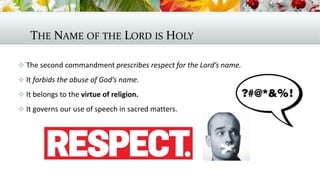
 The second commandment prescribes respect for the Lord’s name.
 It forbids the abuse of God’s name.
 It belongs to the virtue of religion.
 It governs our use of speech in sacred matters.
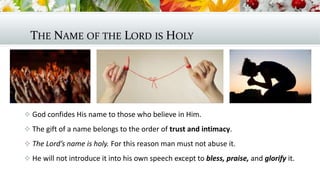
THE NAME OF THE LORD IS HOLY
 God confides His name to those who believe in Him.
 The gift of a name belongs to the order of trust and intimacy.
 The Lord’s name is holy. For this reason man must not abuse it.
 He will not introduce it into his own speech except to bless, praise, and glorify it.
THE NAME OF THE LORD IS HOLY
 Respect for his name is an expression of the respect owed to the mystery of
God himself and to the whole sacred reality it evokes.
 Preaching and catechizing should be permeated with adoration and respect
for the name of our Lord Jesus Christ.
 In proportion as we believe that He is present, we shall have these feelings of
fear and awe; and not to have them, is not to realize, not to believe that He is
present.
TAKING THE NAME OF
THE LORD IN VAIN
(PROHIBITIONS)
The 2nd Commandment
PROMISES (PLEDGES) VS. OATHS VS. VOW
According to the Rabbis, the vow refers to the object, the oath to the person.
For instance, a man may place a ban on wine for a given period, perhaps as a
means of controlling his drinking habits that seem to be getting out of control.
This ban on the object, the wine, is said to constitute a vow. If, on the other
hand, he swears that he will not drink wine, this constitutes an oath. In both
instances for the man to break his word is a religious rather than an ethical
offense. The idea behind it all is that the man has given to God his word,
which he must not break. It is only a verbal declaration that constitutes a vow.
A vow “taken in the heart,” as the Rabbis call it, a mental resolve, has no
binding force.
PROMISES & “TO SWEAR”
"To swear in the Old Testament was to give one’s sacred unbreakable
word in testimony that the one swearing would faithfully perform
some promised deed, or that he would faithfully refrain from some evil
act (Gen 21:23, “swear... that thou will not deal falsely with me”)....
"Often [but certainly not always] one would swear by another who was tacitly
and mutually assumed to be greater or more precious than the one making
the oath.... In such cases God, or a false deity, would be invoked to witness
the truth and sincerity of that which was sworn, and by implication, to judge
the one swearing if he should either be lying or fail to live up to his pledge in
the days and years to come..."
OATHS & COVENANTS
 "An oath should be contrasted to a covenant, in order to better understand
both. An oath in the OT is a solemn verbal statement or pledge that is
affirmed, while the covenant is the substance of an agreement itself.
"Oaths were made by Jehovah to show the absolute certainty of his
performance of that which he promised.... They are a teaching method of
God, a gracious instrument to help the weak faith of every generation to
believe that God will someday absolutely accomplish his promises to his
people, despite discouraging external circumstances."
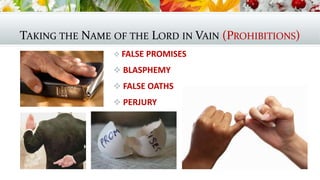
TAKING THE NAME OF THE LORD IN VAIN (PROHIBITIONS)
 FALSE PROMISES
 BLASPHEMY
 FALSE OATHS
 PERJURY
FALSE PROMISES
 Promises made to others in God's name engage
the divine honour, fidelity, truthfulness, and
authority.
 They must be respected in justice.
 To be unfaithful to them is to misuse God's name and in
some way to make God out to be a liar.
BLASPHEMY
Blasphemy is directly opposed to the second
commandment. It consists in uttering against God -
inwardly or outwardly - words of hatred, reproach, or
defiance; in speaking ill of God; in failing in respect
toward him in one's speech; in misusing God's name.
BLASPHEMY
St. James condemns those "who blaspheme that
honourable name of Jesus by which you are
called." The prohibition of blasphemy extends to
language against Christ's Church, the saints, and
sacred things.
BLASPHEMY
It is also blasphemous to make use of God's name to
cover up criminal practices, to reduce peoples to
servitude, to torture persons or put them to death.
The misuse of God's name to commit a crime can
provoke others to repudiate religion.
Blasphemy is contrary to the respect due God and
His holy name. It is in itself a grave sin.
FALSE OATHS
The second commandment forbids false oaths.
Taking an oath or swearing is to take God as witness
to what one affirms. It is to invoke the divine
truthfulness as a pledge of one's own truthfulness.
An oath engages the Lord's name. "You shall fear the
LORD your God; you shall serve him, and swear by his
name."
FALSE OATHS
Rejection of false oaths is a duty toward God. As
Creator and Lord, God is the norm of all truth.
Human speech is either in accord with or in
opposition to God who is Truth itself. When it is
truthful and legitimate, an oath highlights the
relationship of human speech with God's truth. A
false oath calls on God to be witness to a lie.
PERJURY
A person commits perjury when he makes a promise
under oath with no intention of keeping it, or when
after promising on oath he does not keep it. Perjury
is a grave lack of respect for the Lord of all speech.
Pledging oneself by oath to commit an evil deed is
contrary to the holiness of the divine name.
THE CHRISTIAN
NAME
The 2nd Commandment
THE CHRISTIAN NAME
The sacrament of Baptism is conferred "in the name of the
Father and of the Son and of the Holy Spirit." In Baptism, the
Lord's name sanctifies man, and the Christian receives his
name in the Church. This can be the name of a saint, that is,
of a disciple who has lived a life of exemplary fidelity to the
Lord. The patron saint provides a model of charity; we are
assured of his intercession. The "baptismal name" can also
express a Christian mystery or Christian virtue. "Parents,
sponsors, and the pastor are to see that a name is not given
which is foreign to Christian sentiment."
THE CHRISTIAN NAME
The Christian begins his day, his prayers, and his
activities with the Sign of the Cross: "in the name of
the Father and of the Son and of the Holy Spirit.
Amen." The baptized person dedicates the day to the
glory of God and calls on the Saviour's grace which
lets him act in the Spirit as a child of the Father. The
sign of the cross strengthens us in temptations and
difficulties.
THE CHRISTIAN NAME
God calls each one by
name. Everyone's name
is sacred. The name is
the icon of the person.
It demands respect as a
sign of the dignity of
the one who bears it.
THE CHRISTIAN NAME
The name one receives is a name for eternity. In the
kingdom, the mysterious and unique character of each
person marked with God's name will shine forth in
splendour. "To him who conquers . . . I will give a white
stone, with a new name written on the stone which no one
knows except him who receives it. (Rev 2:17) Then I looked,
and Lo, on Mount Zion stood the Lamb, and with him a
hundred and forty- four thousand who had his name and
his Father's name written on their foreheads.“ (Rev 14:1)
THE 2ND
COMMANDMENT
THEOLOGY 3
KATY PERRY
92, 277, 913 FOLLOWERS
JUSTIN BIEBER
87, 131, 454 FOLLOWERS
TAYLOR SWIFT
80, 722, 664 FOLLOWERS
BARACK OBAMA
77, 037, 577 FOLLOWERS
RIHANNA
64, 997, 296 FOLLOWERS
LADY GAGA
62, 950, 202 FOLLOWERS
ELLEN DEGENERES
61, 772, 012 FOLLOWERS
JUSTIN TIMBERLAKE
56, 496, 341 FOLLOWERS

The 2nd Commandment

  • 1.
  • 2.
    TOP 8 MOSTFOLLOWED NAMES ON TWITTER 1 8 7 62 3 4 5
  • 3.
    THE 2ND COMMANDMENT A.Basis in the Bible B. The Name of the Lord is Holy C. Taking the Name of the Lord in Vain D. The Christian Name
  • 4.
    BASIS IN THEBIBLE The 2nd Commandment
  • 5.
    BASIS IN THEBIBLE “Thou shalt not take the name of the Lord thy God in vain, for the Lord will not hold him guiltless that shall take the name of the Lord in vain.” (Exodus 20:7)
  • 6.
    BASIS IN THEBIBLE “You shall not misuse the name of the Lord your God, for the Lord will not hold anyone guiltless who misuses His name.” (Deuteronomy 5:11)
  • 7.
    BASIS IN THEBIBLE “You have heard that it was said to the men of old, You shall not swear falsely…But I say to you, do not swear at all.” (Matthew 5:33-34)
  • 8.
    THE NAME OFTHE LORD IS HOLY The 2nd Commandment
  • 9.
    THE NAME OFTHE LORD IS HOLY  The second commandment prescribes respect for the Lord’s name.  It forbids the abuse of God’s name.  It belongs to the virtue of religion.  It governs our use of speech in sacred matters.
  • 10.
    THE NAME OFTHE LORD IS HOLY  God confides His name to those who believe in Him.  The gift of a name belongs to the order of trust and intimacy.  The Lord’s name is holy. For this reason man must not abuse it.  He will not introduce it into his own speech except to bless, praise, and glorify it.
  • 11.
    THE NAME OFTHE LORD IS HOLY  Respect for his name is an expression of the respect owed to the mystery of God himself and to the whole sacred reality it evokes.  Preaching and catechizing should be permeated with adoration and respect for the name of our Lord Jesus Christ.  In proportion as we believe that He is present, we shall have these feelings of fear and awe; and not to have them, is not to realize, not to believe that He is present.
  • 12.
    TAKING THE NAMEOF THE LORD IN VAIN (PROHIBITIONS) The 2nd Commandment
  • 13.
    PROMISES (PLEDGES) VS.OATHS VS. VOW According to the Rabbis, the vow refers to the object, the oath to the person. For instance, a man may place a ban on wine for a given period, perhaps as a means of controlling his drinking habits that seem to be getting out of control. This ban on the object, the wine, is said to constitute a vow. If, on the other hand, he swears that he will not drink wine, this constitutes an oath. In both instances for the man to break his word is a religious rather than an ethical offense. The idea behind it all is that the man has given to God his word, which he must not break. It is only a verbal declaration that constitutes a vow. A vow “taken in the heart,” as the Rabbis call it, a mental resolve, has no binding force.
  • 14.
    PROMISES & “TOSWEAR” "To swear in the Old Testament was to give one’s sacred unbreakable word in testimony that the one swearing would faithfully perform some promised deed, or that he would faithfully refrain from some evil act (Gen 21:23, “swear... that thou will not deal falsely with me”).... "Often [but certainly not always] one would swear by another who was tacitly and mutually assumed to be greater or more precious than the one making the oath.... In such cases God, or a false deity, would be invoked to witness the truth and sincerity of that which was sworn, and by implication, to judge the one swearing if he should either be lying or fail to live up to his pledge in the days and years to come..."
  • 15.
    OATHS & COVENANTS "An oath should be contrasted to a covenant, in order to better understand both. An oath in the OT is a solemn verbal statement or pledge that is affirmed, while the covenant is the substance of an agreement itself. "Oaths were made by Jehovah to show the absolute certainty of his performance of that which he promised.... They are a teaching method of God, a gracious instrument to help the weak faith of every generation to believe that God will someday absolutely accomplish his promises to his people, despite discouraging external circumstances."
  • 16.
    TAKING THE NAMEOF THE LORD IN VAIN (PROHIBITIONS)  FALSE PROMISES  BLASPHEMY  FALSE OATHS  PERJURY
  • 17.
    FALSE PROMISES  Promisesmade to others in God's name engage the divine honour, fidelity, truthfulness, and authority.  They must be respected in justice.  To be unfaithful to them is to misuse God's name and in some way to make God out to be a liar.
  • 18.
    BLASPHEMY Blasphemy is directlyopposed to the second commandment. It consists in uttering against God - inwardly or outwardly - words of hatred, reproach, or defiance; in speaking ill of God; in failing in respect toward him in one's speech; in misusing God's name.
  • 19.
    BLASPHEMY St. James condemnsthose "who blaspheme that honourable name of Jesus by which you are called." The prohibition of blasphemy extends to language against Christ's Church, the saints, and sacred things.
  • 20.
    BLASPHEMY It is alsoblasphemous to make use of God's name to cover up criminal practices, to reduce peoples to servitude, to torture persons or put them to death. The misuse of God's name to commit a crime can provoke others to repudiate religion. Blasphemy is contrary to the respect due God and His holy name. It is in itself a grave sin.
  • 21.
    FALSE OATHS The secondcommandment forbids false oaths. Taking an oath or swearing is to take God as witness to what one affirms. It is to invoke the divine truthfulness as a pledge of one's own truthfulness. An oath engages the Lord's name. "You shall fear the LORD your God; you shall serve him, and swear by his name."
  • 22.
    FALSE OATHS Rejection offalse oaths is a duty toward God. As Creator and Lord, God is the norm of all truth. Human speech is either in accord with or in opposition to God who is Truth itself. When it is truthful and legitimate, an oath highlights the relationship of human speech with God's truth. A false oath calls on God to be witness to a lie.
  • 23.
    PERJURY A person commitsperjury when he makes a promise under oath with no intention of keeping it, or when after promising on oath he does not keep it. Perjury is a grave lack of respect for the Lord of all speech. Pledging oneself by oath to commit an evil deed is contrary to the holiness of the divine name.
  • 24.
  • 25.
    THE CHRISTIAN NAME Thesacrament of Baptism is conferred "in the name of the Father and of the Son and of the Holy Spirit." In Baptism, the Lord's name sanctifies man, and the Christian receives his name in the Church. This can be the name of a saint, that is, of a disciple who has lived a life of exemplary fidelity to the Lord. The patron saint provides a model of charity; we are assured of his intercession. The "baptismal name" can also express a Christian mystery or Christian virtue. "Parents, sponsors, and the pastor are to see that a name is not given which is foreign to Christian sentiment."
  • 26.
    THE CHRISTIAN NAME TheChristian begins his day, his prayers, and his activities with the Sign of the Cross: "in the name of the Father and of the Son and of the Holy Spirit. Amen." The baptized person dedicates the day to the glory of God and calls on the Saviour's grace which lets him act in the Spirit as a child of the Father. The sign of the cross strengthens us in temptations and difficulties.
  • 27.
    THE CHRISTIAN NAME Godcalls each one by name. Everyone's name is sacred. The name is the icon of the person. It demands respect as a sign of the dignity of the one who bears it.
  • 28.
    THE CHRISTIAN NAME Thename one receives is a name for eternity. In the kingdom, the mysterious and unique character of each person marked with God's name will shine forth in splendour. "To him who conquers . . . I will give a white stone, with a new name written on the stone which no one knows except him who receives it. (Rev 2:17) Then I looked, and Lo, on Mount Zion stood the Lamb, and with him a hundred and forty- four thousand who had his name and his Father's name written on their foreheads.“ (Rev 14:1)
  • 29.
  • 30.
    KATY PERRY 92, 277,913 FOLLOWERS
  • 31.
  • 32.
    TAYLOR SWIFT 80, 722,664 FOLLOWERS
  • 33.
    BARACK OBAMA 77, 037,577 FOLLOWERS
  • 34.
  • 35.
    LADY GAGA 62, 950,202 FOLLOWERS
  • 36.
  • 37.