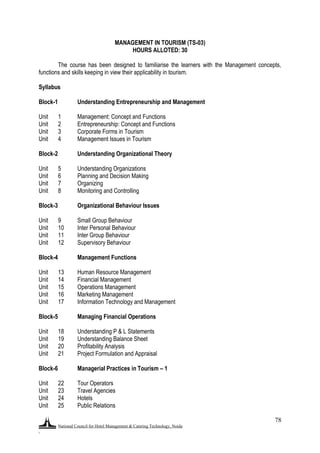
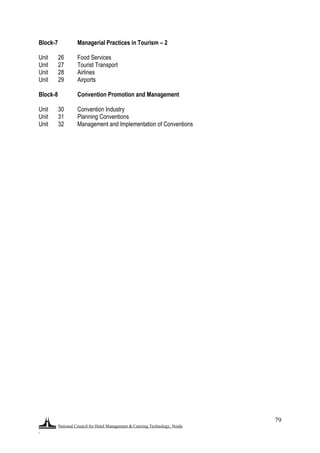
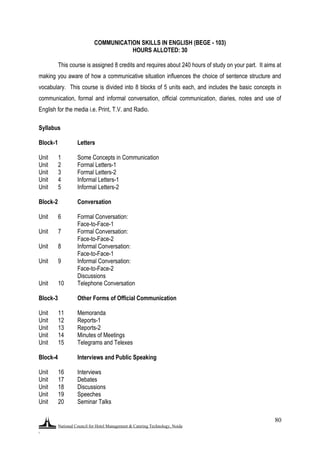
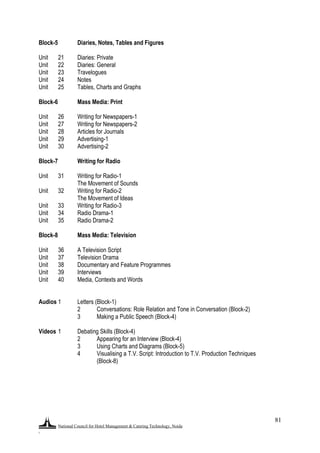
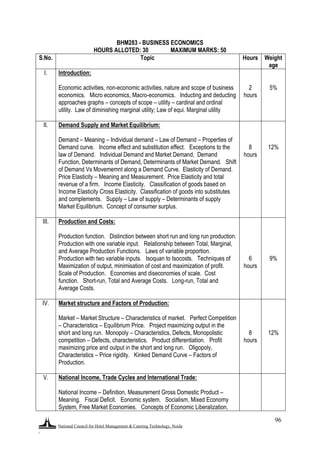
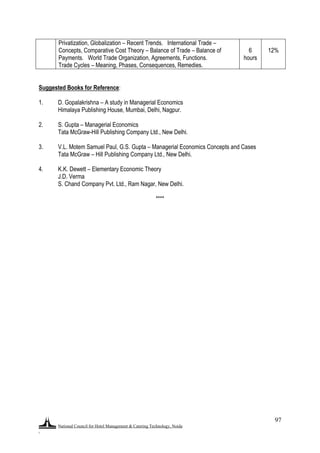
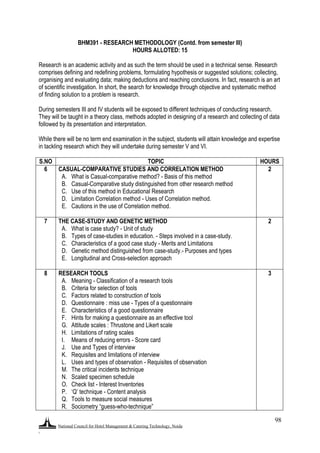
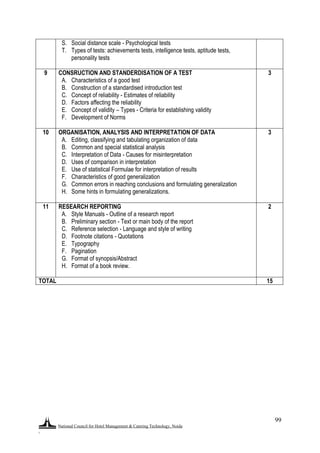
National Council for Hotel Management & Catering Technology, Noida
.
1
3 – YEAR B.Sc. DEGREE
IN
HOSPITALITY & HOTEL ADMINISTRATION
WITH SPECIALISATION (MAJORS)
FOOD & BEVERAGE MANAGEMENT
CURRICULUM
JOINTLY OFFERED BY:
NATIONAL COUNCIL FOR HOTEL MANAGEMENT
AND CATERING TECHNOLOGY
NOIDA
(NCHM&CT)
AND
INDIRA GANDHI NATIONAL OPEN UNIVERSITY
(IGNOU)
2009-2012 ACADEMIC SESSION
National Council for Hotel Management & Catering Technology, Noida
.
2
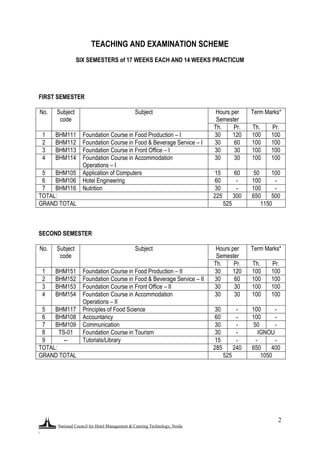
TEACHING AND EXAMINATION SCHEME
SIX SEMESTERS of 17 WEEKS EACH AND 14 WEEKS PRACTICUM
FIRST SEMESTER
No. Subject
code
Subject Hours per
Semester
Term Marks*
Th. Pr. Th. Pr.
1 BHM111 Foundation Course in Food Production – I 30 120 100 100
2 BHM112 Foundation Course in Food & Beverage Service – I 30 60 100 100
3 BHM113 Foundation Course in Front Office – I 30 30 100 100
4 BHM114 Foundation Course in Accommodation
Operations – I
30 30 100 100
5 BHM105 Application of Computers 15 60 50 100
6 BHM106 Hotel Engineering 60 - 100 -
7 BHM116 Nutrition 30 - 100 -
TOTAL: 225 300 650 500
GRAND TOTAL 525 1150
SECOND SEMESTER
No. Subject
code
Subject Hours per
Semester
Term Marks*
Th. Pr. Th. Pr.
1 BHM151 Foundation Course in Food Production – II 30 120 100 100
2 BHM152 Foundation Course in Food & Beverage Service – II 30 60 100 100
3 BHM153 Foundation Course in Front Office – II 30 30 100 100
4 BHM154 Foundation Course in Accommodation
Operations – II
30 30 100 100
5 BHM117 Principles of Food Science 30 - 100 -
6 BHM108 Accountancy 60 - 100 -
7 BHM109 Communication 30 - 50 -
8 TS-01 Foundation Course in Tourism 30 - IGNOU
9 -- Tutorials/Library 15 - - -
TOTAL: 285 240 650 400
GRAND TOTAL 525 1050
National Council for Hotel Management & Catering Technology, Noida
.
3
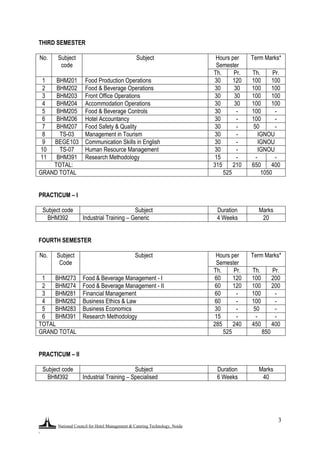
THIRD SEMESTER
No. Subject
code
Subject Hours per
Semester
Term Marks*
Th. Pr. Th. Pr.
1 BHM201 Food Production Operations 30 120 100 100
2 BHM202 Food & Beverage Operations 30 30 100 100
3 BHM203 Front Office Operations 30 30 100 100
4 BHM204 Accommodation Operations 30 30 100 100
5 BHM205 Food & Beverage Controls 30 - 100 -
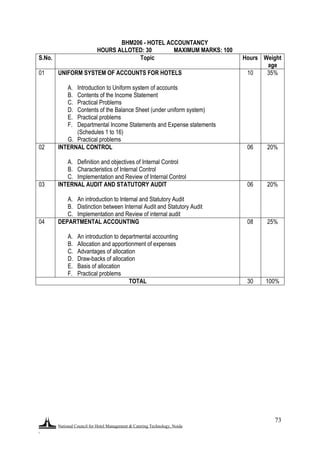
6 BHM206 Hotel Accountancy 30 - 100 -
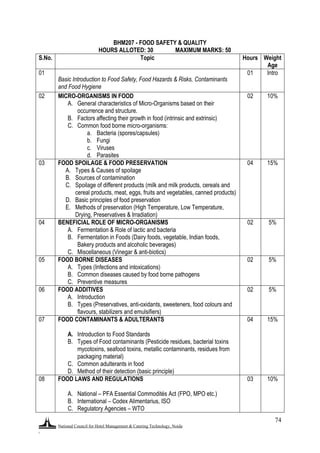
7 BHM207 Food Safety & Quality 30 - 50 -
8 TS-03 Management in Tourism 30 - IGNOU
9 BEGE103 Communication Skills in English 30 - IGNOU
10 TS-07 Human Resource Management 30 - IGNOU
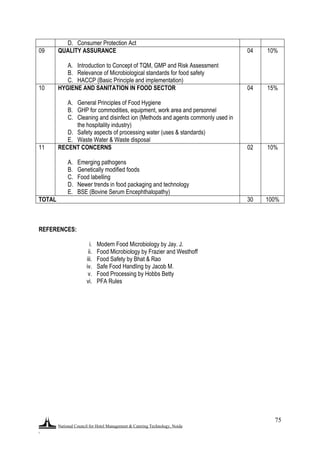
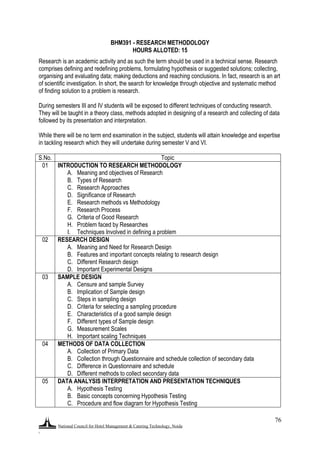
11 BHM391 Research Methodology 15 - - -
TOTAL: 315 210 650 400
GRAND TOTAL 525 1050
PRACTICUM – I
Subject code Subject Duration Marks
BHM392 Industrial Training – Generic 4 Weeks 20
FOURTH SEMESTER
No. Subject
Code
Subject Hours per
Semester
Term Marks*
Th. Pr. Th. Pr.
1 BHM273 Food & Beverage Management - I 60 120 100 200
2 BHM274 Food & Beverage Management - II 60 120 100 200
3 BHM281 Financial Management 60 - 100 -
4 BHM282 Business Ethics & Law 60 - 100 -
5 BHM283 Business Economics 30 - 50 -
6 BHM391 Research Methodology 15 - - -
TOTAL 285 240 450 400
GRAND TOTAL 525 850
PRACTICUM – II
Subject code Subject Duration Marks
BHM392 Industrial Training – Specialised 6 Weeks 40
National Council for Hotel Management & Catering Technology, Noida
.
4
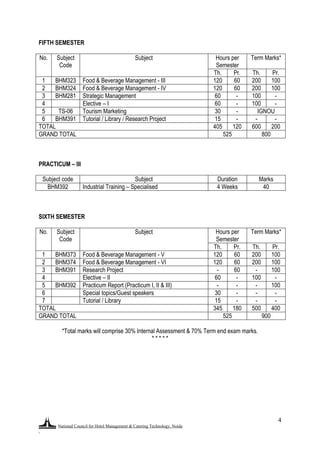
FIFTH SEMESTER
No. Subject
Code
Subject Hours per
Semester
Term Marks*
Th. Pr. Th. Pr.
1 BHM323 Food & Beverage Management - III 120 60 200 100
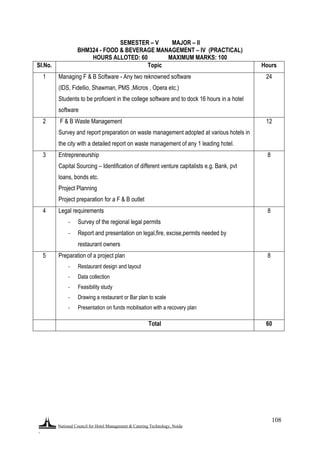
2 BHM324 Food & Beverage Management - IV 120 60 200 100
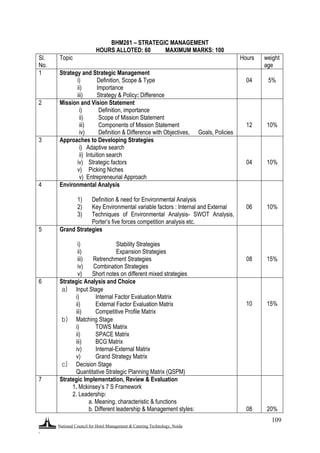
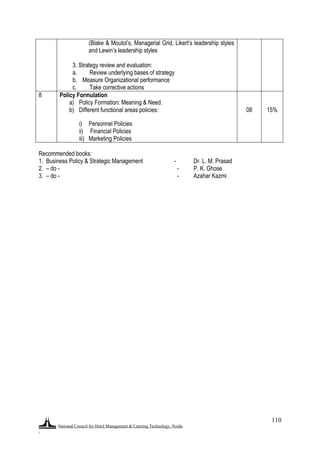
3 BHM281 Strategic Management 60 - 100 -
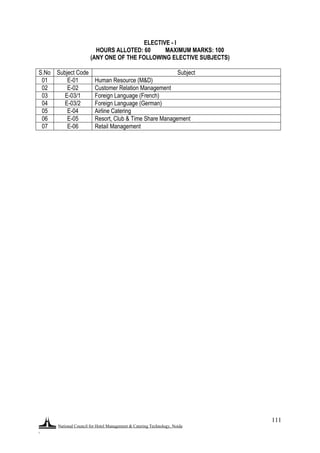
4 Elective – I 60 - 100 -
5 TS-06 Tourism Marketing 30 - IGNOU
6 BHM391 Tutorial / Library / Research Project 15 - - -
TOTAL 405 120 600 200
GRAND TOTAL 525 800
PRACTICUM – III
Subject code Subject Duration Marks
BHM392 Industrial Training – Specialised 4 Weeks 40
SIXTH SEMESTER
No. Subject
Code
Subject Hours per
Semester
Term Marks*
Th. Pr. Th. Pr.
1 BHM373 Food & Beverage Management - V 120 60 200 100
2 BHM374 Food & Beverage Management - VI 120 60 200 100
3 BHM391 Research Project - 60 - 100
4 Elective – II 60 - 100 -
5 BHM392 Practicum Report (Practicum I, II & III) - - - 100
6 Special topics/Guest speakers 30 - - -
7 Tutorial / Library 15 - - -
TOTAL 345 180 500 400
GRAND TOTAL 525 900
*Total marks will comprise 30% Internal Assessment & 70% Term end exam marks.
* * * * *
National Council for Hotel Management & Catering Technology, Noida
.
5
SEMESTER – I
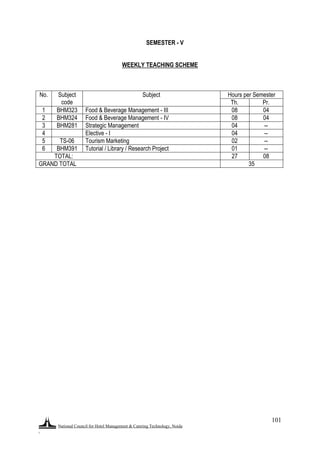
WEEKLY TEACHING SCHEME
No. Subject
code
Subject Hours per week
Th. Pr.
1 BHM111 Foundation Course in Food Production – I 02 08
2 BHM112 Foundation Course in Food & Beverage Service – I 02 04
3 BHM113 Foundation Course in Front Office – I 02 02
4 BHM114 Foundation Course in Accommodation Operations – I 02 02
5 BHM105 Application of Computers 01 04
6 BHM106 Hotel Engineering 04 -
7 BHM116 Nutrition 02 -
TOTAL: 15 20
GRAND TOTAL 35
National Council for Hotel Management & Catering Technology, Noida
.
6
BHM111 – FOUNDATION COURSE IN FOOD PRODUCTION – I (THEORY)
HOURS ALLOTED: 30 MAXIMUM MARKS: 100
S.No. Topic Hours Weight
age
01 INTRODUCTION TO COOKERY
A. Levels of skills and experiences
B. Attitudes and behaviour in the kitchen
C. Personal hygiene
D. Uniforms & protective clothing
E. Safety procedure in handling equipment
02 5%
02 CULINARY HISTORY
A. Origin of modern cookery
01 Intro
only
03 HIERARCHY AREA OF DEPARTMENT AND KITCHEN
A. Classical Brigade
B. Modern staffing in various category hotels
C. Roles of executive chef
D. Duties and responsibilities of various chefs
E. Co-operation with other departments
03 10%
04 CULINARY TERMS
A. List of culinary (common and basic) terms
B. Explanation with examples
02 5%
05 AIMS & OBJECTS OF COOKING FOOD
A. Aims and objectives of cooking food
B. Various textures
C. Various consistencies
D. Techniques used in pre-preparation
E. Techniques used in preparation
02 10%
06 BASIC PRINCIPLES OF FOOD PRODUCTION – I
A. VEGETABLE AND FRUIT COOKERY
A. Introduction – classification of vegetables
B. Pigments and colour changes
C. Effects of heat on vegetables
D. Cuts of vegetables
E. Classification of fruits
F. Uses of fruit in cookery
G. Salads and salad dressings
ii) STOCKS
A. Definition of stock
B. Types of stock
C. Preparation of stock
D. Recipes
E. Storage of stocks
F. Uses of stocks
03
03
15%
5%
National Council for Hotel Management & Catering Technology, Noida
.
7
G. Care and precautions
iii) SAUCES
A. Classification of sauces
B. Recipes for mother sauces
C. Storage & precautions
02 10%
07 METHODS OF COOKING FOOD
A. Roasting
B. Grilling
C. Frying
D. Baking
E. Broiling
F. Poaching
G. Boiling
 Principles of each of the above
 Care and precautions to be taken
 Selection of food for each type of cooking
04 15%
08 SOUPS
A. Classification with examples
B. Basic recipes of Consommé with 10 Garnishes
2 10%
09 EGG COOKERY
A. Introduction to egg cookery
B. Structure of an egg
C. Selection of egg
D. Uses of egg in cookery
2 5%
10 COMMODITIES:
B. Shortenings (Fats & Oils)
A. Role of Shortenings
B. Varieties of Shortenings
C. Advantages and Disadvantages of using various Shortenings
D. Fats & Oil – Types, varieties
ii) Raising Agents
A. Classification of Raising Agents
B. Role of Raising Agents
C. Actions and Reactions
iii) Thickening Agents
A. Classification of thickening agents
B. Role of Thickening agents
iv) Sugar
A. Importance of Sugar
B. Types of Sugar
C. Cooking of Sugar – various
4 10%
TOTAL 30 100%
National Council for Hotel Management & Catering Technology, Noida
.
8
BHM111 - FOUNDATION COURSE IN FOOD PRODUCTION – I (PRACTICALS)
PART ‘A’ – COOKERY
HOURS ALLOTED: 60 MAXIMUM MARKS: 50
S.No Topic Method Hours
1  i) Equipments – Identification, Description, Uses & handling
 ii) Hygiene – Kitchen etiquettes, Practices & knife handling
 iii) Safety and security in kitchen
Demonstrations &
simple applications
04
2 C. Vegetables – classification
ii) Cuts – julienne, jardinière, macedoines, brunoise, payssane,
mignonnete, dices, cubes, shred, mirepoix
iii) Preparation of salad dressings
Demonstrations &
simple applications
by students
04
3 Identification and Selection of Ingredients – Qualitative and
quantitative measures.
Market survey/tour 04
4 D. Basic Cooking methods and pre-preparations
ii) Blanching of Tomatoes and Capsicum
iii) Preparation of concasse
iv) Boiling (potatoes, Beans, Cauliflower, etc)
v) Frying – (deep frying, shallow frying, sautéing)
Aubergines, Potatoes, etc.
vi) Braising – Onions, Leeks, Cabbage
vii) Starch cooking (Rice, Pasta, Potatoes)
Demonstrations &
simple applications
by students
04
5 E. Stocks – Types of stocks (White and Brown stock)
ii) Fish stock
iii) Emergency stock
iv) Fungi stock
Demonstrations &
simple applications
by students
04
6 Sauces – Basic mother sauces
 Béchamel
 Espagnole
 Veloute
 Hollandaise
 Mayonnaise
 Tomato
Demonstrations &
simple applications
04
7 Egg cookery – Preparation of variety of egg dishes
 Boiled ( Soft & Hard)
 Fried ( Sunny side up, Single fried, Bull‟s Eye, Double
fried)
 Poaches
 Scrambled
 Omelette (Plain, Stuffed, Spanish)
 En cocotte (eggs Benedict)
Demonstrations &
simple applications
by students
04
8 Demonstration & Preparation of simple menu Demonstrations &
simple applications
by students
04
9 Simple Salads & Soups:
 Cole slaw,
 Potato salad,
Demonstration by
instructor and
applications by
28
National Council for Hotel Management & Catering Technology, Noida
.
9
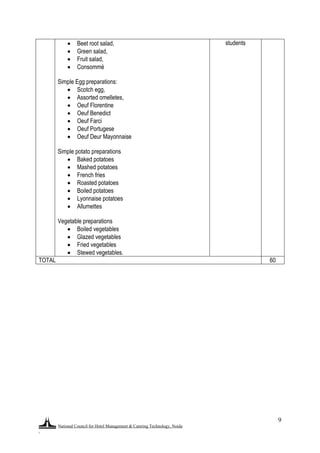
 Beet root salad,
 Green salad,
 Fruit salad,
 Consommé
Simple Egg preparations:
 Scotch egg,
 Assorted omelletes,
 Oeuf Florentine
 Oeuf Benedict
 Oeuf Farci
 Oeuf Portugese
 Oeuf Deur Mayonnaise
Simple potato preparations
 Baked potatoes
 Mashed potatoes
 French fries
 Roasted potatoes
 Boiled potatoes
 Lyonnaise potatoes
 Allumettes
Vegetable preparations
 Boiled vegetables
 Glazed vegetables
 Fried vegetables
 Stewed vegetables.
students
TOTAL 60
National Council for Hotel Management & Catering Technology, Noida
.
10
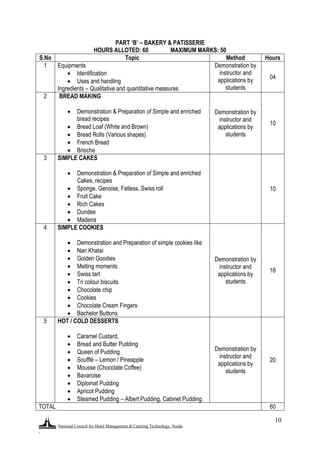
PART ‘B’ – BAKERY & PATISSERIE
HOURS ALLOTED: 60 MAXIMUM MARKS: 50
S.No Topic Method Hours
1 Equipments
 Identification
 Uses and handling
Ingredients – Qualitative and quantitative measures
Demonstration by
instructor and
applications by
students
04
2 BREAD MAKING
 Demonstration & Preparation of Simple and enriched
bread recipes
 Bread Loaf (White and Brown)
 Bread Rolls (Various shapes)
 French Bread
 Brioche
Demonstration by
instructor and
applications by
students
10
3 SIMPLE CAKES
 Demonstration & Preparation of Simple and enriched
Cakes, recipes
 Sponge, Genoise, Fatless, Swiss roll
 Fruit Cake
 Rich Cakes
 Dundee
 Madeira
10
4 SIMPLE COOKIES
 Demonstration and Preparation of simple cookies like
 Nan Khatai
 Golden Goodies
 Melting moments
 Swiss tart
 Tri colour biscuits
 Chocolate chip
 Cookies
 Chocolate Cream Fingers
 Bachelor Buttons.
Demonstration by
instructor and
applications by
students
16
5 HOT / COLD DESSERTS
 Caramel Custard,
 Bread and Butter Pudding
 Queen of Pudding
 Soufflé – Lemon / Pineapple
 Mousse (Chocolate Coffee)
 Bavaroise
 Diplomat Pudding
 Apricot Pudding
 Steamed Pudding – Albert Pudding, Cabinet Pudding.
Demonstration by
instructor and
applications by
students
20
TOTAL 60
National Council for Hotel Management & Catering Technology, Noida
.
11
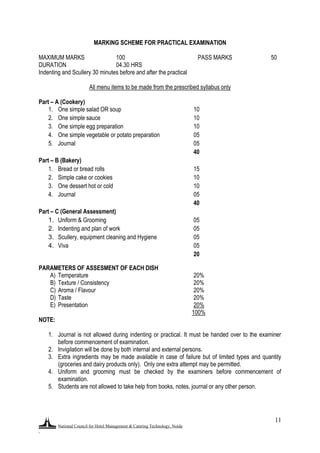
MARKING SCHEME FOR PRACTICAL EXAMINATION
MAXIMUM MARKS 100 PASS MARKS 50
DURATION 04.30 HRS
Indenting and Scullery 30 minutes before and after the practical
All menu items to be made from the prescribed syllabus only
Part – A (Cookery)
1. One simple salad OR soup 10
2. One simple sauce 10
3. One simple egg preparation 10
4. One simple vegetable or potato preparation 05
5. Journal 05
40
Part – B (Bakery)
1. Bread or bread rolls 15
2. Simple cake or cookies 10
3. One dessert hot or cold 10
4. Journal 05
40
Part – C (General Assessment)
1. Uniform & Grooming 05
2. Indenting and plan of work 05
3. Scullery, equipment cleaning and Hygiene 05
4. Viva 05
20
PARAMETERS OF ASSESMENT OF EACH DISH
A) Temperature 20%
B) Texture / Consistency 20%
C) Aroma / Flavour 20%
D) Taste 20%
E) Presentation 20%
100%
NOTE:
1. Journal is not allowed during indenting or practical. It must be handed over to the examiner
before commencement of examination.
2. Invigilation will be done by both internal and external persons.
3. Extra ingredients may be made available in case of failure but of limited types and quantity
(groceries and dairy products only). Only one extra attempt may be permitted.
4. Uniform and grooming must be checked by the examiners before commencement of
examination.
5. Students are not allowed to take help from books, notes, journal or any other person.
National Council for Hotel Management & Catering Technology, Noida
.
12
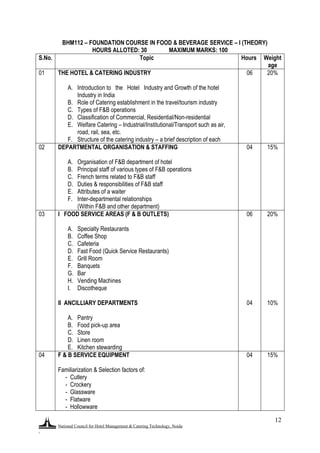
BHM112 – FOUNDATION COURSE IN FOOD & BEVERAGE SERVICE – I (THEORY)
HOURS ALLOTED: 30 MAXIMUM MARKS: 100
S.No. Topic Hours Weight
age
01 THE HOTEL & CATERING INDUSTRY
A. Introduction to the Hotel Industry and Growth of the hotel
Industry in India
B. Role of Catering establishment in the travel/tourism industry
C. Types of F&B operations
D. Classification of Commercial, Residential/Non-residential
E. Welfare Catering – Industrial/Institutional/Transport such as air,
road, rail, sea, etc.
F. Structure of the catering industry – a brief description of each
06 20%
02 DEPARTMENTAL ORGANISATION & STAFFING
A. Organisation of F&B department of hotel
B. Principal staff of various types of F&B operations
C. French terms related to F&B staff
D. Duties & responsibilities of F&B staff
E. Attributes of a waiter
F. Inter-departmental relationships
(Within F&B and other department)
04 15%
03 I FOOD SERVICE AREAS (F & B OUTLETS)
A. Specialty Restaurants
B. Coffee Shop
C. Cafeteria
D. Fast Food (Quick Service Restaurants)
E. Grill Room
F. Banquets
G. Bar
H. Vending Machines
I. Discotheque
II ANCILLIARY DEPARTMENTS
A. Pantry
B. Food pick-up area
C. Store
D. Linen room
E. Kitchen stewarding
06
04
20%
10%
04 F & B SERVICE EQUIPMENT
Familiarization & Selection factors of:
- Cutlery
- Crockery
- Glassware
- Flatware
- Hollowware
04 15%
National Council for Hotel Management & Catering Technology, Noida
.
13
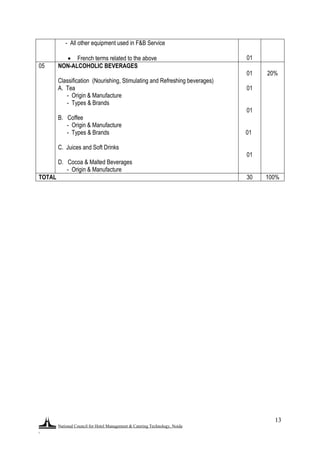
- All other equipment used in F&B Service
 French terms related to the above 01
05 NON-ALCOHOLIC BEVERAGES
Classification (Nourishing, Stimulating and Refreshing beverages)
A. Tea
- Origin & Manufacture
- Types & Brands
B. Coffee
- Origin & Manufacture
- Types & Brands
C. Juices and Soft Drinks
D. Cocoa & Malted Beverages
- Origin & Manufacture
01
01
01
01
01
20%
TOTAL 30 100%
National Council for Hotel Management & Catering Technology, Noida
.
14
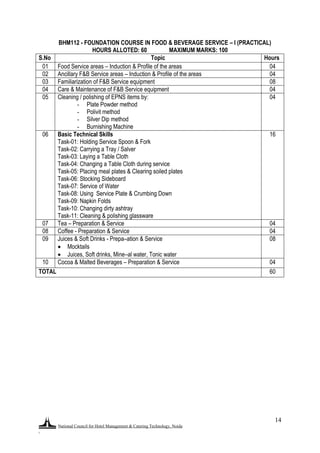
BHM112 - FOUNDATION COURSE IN FOOD & BEVERAGE SERVICE – I (PRACTICAL)
HOURS ALLOTED: 60 MAXIMUM MARKS: 100
S.No Topic Hours
01 Food Service areas – Induction & Profile of the areas 04
02 Ancillary F&B Service areas – Induction & Profile of the areas 04
03 Familiarization of F&B Service equipment 08
04 Care & Maintenance of F&B Service equipment 04
05 Cleaning / polishing of EPNS items by:
- Plate Powder method
- Polivit method
- Silver Dip method
- Burnishing Machine
04
06 Basic Technical Skills
Task-01: Holding Service Spoon & Fork
Task-02: Carrying a Tray / Salver
Task-03: Laying a Table Cloth
Task-04: Changing a Table Cloth during service
Task-05: Placing meal plates & Clearing soiled plates
Task-06: Stocking Sideboard
Task-07: Service of Water
Task-08: Using Service Plate & Crumbing Down
Task-09: Napkin Folds
Task-10: Changing dirty ashtray
Task-11: Cleaning & polishing glassware
16
07 Tea – Preparation & Service 04
08 Coffee - Preparation & Service 04
09 Juices & Soft Drinks - Prepa–ation & Service
 Mocktails
 Juices, Soft drinks, Mine–al water, Tonic water
08
10 Cocoa & Malted Beverages – Preparation & Service 04
TOTAL 60
National Council for Hotel Management & Catering Technology, Noida
.
15
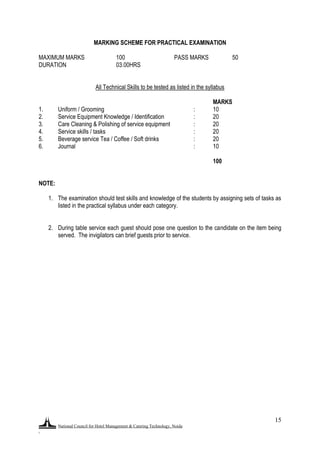
MARKING SCHEME FOR PRACTICAL EXAMINATION
MAXIMUM MARKS 100 PASS MARKS 50
DURATION 03.00HRS
All Technical Skills to be tested as listed in the syllabus
MARKS
1. Uniform / Grooming : 10
2. Service Equipment Knowledge / Identification : 20
3. Care Cleaning & Polishing of service equipment : 20
4. Service skills / tasks : 20
5. Beverage service Tea / Coffee / Soft drinks : 20
6. Journal : 10
100
NOTE:
1. The examination should test skills and knowledge of the students by assigning sets of tasks as
listed in the practical syllabus under each category.
2. During table service each guest should pose one question to the candidate on the item being
served. The invigilators can brief guests prior to service.
National Council for Hotel Management & Catering Technology, Noida
.
16
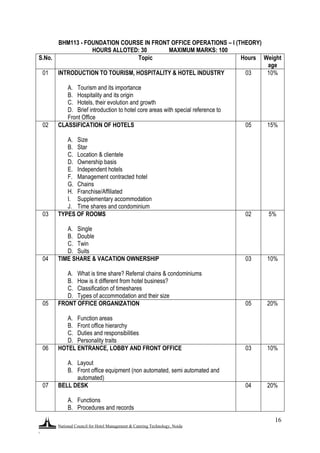
BHM113 - FOUNDATION COURSE IN FRONT OFFICE OPERATIONS – I (THEORY)
HOURS ALLOTED: 30 MAXIMUM MARKS: 100
S.No. Topic Hours Weight
age
01 INTRODUCTION TO TOURISM, HOSPITALITY & HOTEL INDUSTRY
A. Tourism and its importance
B. Hospitality and its origin
C. Hotels, their evolution and growth
D. Brief introduction to hotel core areas with special reference to
Front Office
03 10%
02 CLASSIFICATION OF HOTELS
A. Size
B. Star
C. Location & clientele
D. Ownership basis
E. Independent hotels
F. Management contracted hotel
G. Chains
H. Franchise/Affiliated
I. Supplementary accommodation
J. Time shares and condominium
05 15%
03 TYPES OF ROOMS
A. Single
B. Double
C. Twin
D. Suits
02 5%
04 TIME SHARE & VACATION OWNERSHIP
A. What is time share? Referral chains & condominiums
B. How is it different from hotel business?
C. Classification of timeshares
D. Types of accommodation and their size
03 10%
05 FRONT OFFICE ORGANIZATION
A. Function areas
B. Front office hierarchy
C. Duties and responsibilities
D. Personality traits
05 20%
06 HOTEL ENTRANCE, LOBBY AND FRONT OFFICE
A. Layout
B. Front office equipment (non automated, semi automated and
automated)
03 10%
07 BELL DESK
A. Functions
B. Procedures and records
04 20%
National Council for Hotel Management & Catering Technology, Noida
.
17
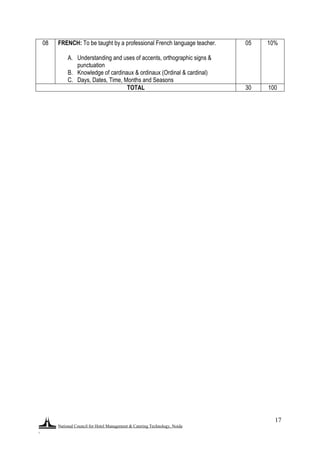
08 FRENCH: To be taught by a professional French language teacher.
A. Understanding and uses of accents, orthographic signs &
punctuation
B. Knowledge of cardinaux & ordinaux (Ordinal & cardinal)
C. Days, Dates, Time, Months and Seasons
05 10%
TOTAL 30 100
National Council for Hotel Management & Catering Technology, Noida
.
18
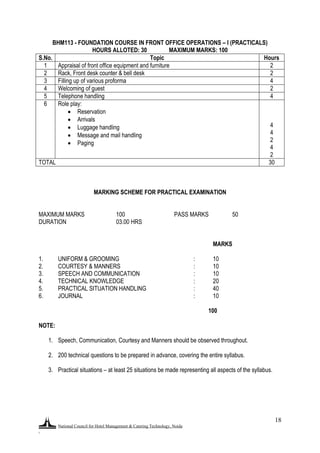
BHM113 - FOUNDATION COURSE IN FRONT OFFICE OPERATIONS – I (PRACTICALS)
HOURS ALLOTED: 30 MAXIMUM MARKS: 100
S.No. Topic Hours
1 Appraisal of front office equipment and furniture 2
2 Rack, Front desk counter & bell desk 2
3 Filling up of various proforma 4
4 Welcoming of guest 2
5 Telephone handling 4
6 Role play:
 Reservation
 Arrivals
 Luggage handling
 Message and mail handling
 Paging
4
4
2
4
2
TOTAL 30
MARKING SCHEME FOR PRACTICAL EXAMINATION
MAXIMUM MARKS 100 PASS MARKS 50
DURATION 03.00 HRS
MARKS
1. UNIFORM & GROOMING : 10
2. COURTESY & MANNERS : 10
3. SPEECH AND COMMUNICATION : 10
4. TECHNICAL KNOWLEDGE : 20
5. PRACTICAL SITUATION HANDLING : 40
6. JOURNAL : 10
100
NOTE:
1. Speech, Communication, Courtesy and Manners should be observed throughout.
2. 200 technical questions to be prepared in advance, covering the entire syllabus.
3. Practical situations – at least 25 situations be made representing all aspects of the syllabus.
National Council for Hotel Management & Catering Technology, Noida
.
19
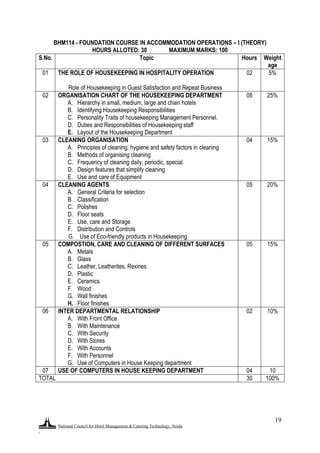
BHM114 - FOUNDATION COURSE IN ACCOMMODATION OPERATIONS – I (THEORY)
HOURS ALLOTED: 30 MAXIMUM MARKS: 100
S.No. Topic Hours Weight
age
01 THE ROLE OF HOUSEKEEPING IN HOSPITALITY OPERATION
Role of Housekeeping in Guest Satisfaction and Repeat Business
02 5%
02 ORGANISATION CHART OF THE HOUSEKEEPING DEPARTMENT
A. Hierarchy in small, medium, large and chain hotels
B. Identifying Housekeeping Responsibilities
C. Personality Traits of housekeeping Management Personnel.
D. Duties and Responsibilities of Housekeeping staff
E. Layout of the Housekeeping Department
08 25%
03 CLEANING ORGANISATION
A. Principles of cleaning, hygiene and safety factors in cleaning
B. Methods of organising cleaning
C. Frequency of cleaning daily, periodic, special
D. Design features that simplify cleaning
E. Use and care of Equipment
04 15%
04 CLEANING AGENTS
A. General Criteria for selection
B. Classification
C. Polishes
D. Floor seats
E. Use, care and Storage
F. Distribution and Controls
G. Use of Eco-friendly products in Housekeeping
05 20%
05 COMPOSTION, CARE AND CLEANING OF DIFFERENT SURFACES
A. Metals
B. Glass
C. Leather, Leatherites, Rexines
D. Plastic
E. Ceramics
F. Wood
G. Wall finishes
H. Floor finishes
05 15%
06 INTER DEPARTMENTAL RELATIONSHIP
A. With Front Office
B. With Maintenance
C. With Security
D. With Stores
E. With Accounts
F. With Personnel
G. Use of Computers in House Keeping department
02 10%
07 USE OF COMPUTERS IN HOUSE KEEPING DEPARTMENT 04 10
TOTAL 30 100%
National Council for Hotel Management & Catering Technology, Noida
.
20
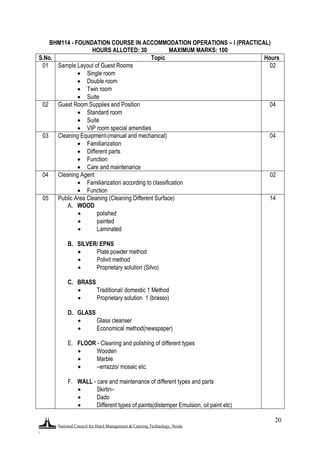
BHM114 - FOUNDATION COURSE IN ACCOMMODATION OPERATIONS – I (PRACTICAL)
HOURS ALLOTED: 30 MAXIMUM MARKS: 100
S.No. Topic Hours
01 Sample Layout of Guest Rooms
 Single room
 Double room
 Twin room
 Suite
02
02 Guest Room Supplies and Position
 Standard room
 Suite
 VIP room special amenities
04
03 Cleaning Equipment-(manual and mechanical)
 Familiarization
 Different parts
 Function
 Care and maintenance
04
04 Cleaning Agent
 Familiarization according to classification
 Function
02
05 Public Area Cleaning (Cleaning Different Surface)
A. WOOD
 polished
 painted
 Laminated
B. SILVER/ EPNS
 Plate powder method
 Polivit method
 Proprietary solution (Silvo)
C. BRASS
 Traditional/ domestic 1 Method
 Proprietary solution 1 (brasso)
D. GLASS
 Glass cleanser
 Economical method(newspaper)
E. FLOOR - Cleaning and polishing of different types
 Wooden
 Marble
 –errazzo/ mosaic etc.
F. WALL - care and maintenance of different types and parts
 Skirtin–
 Dado
 Different types of paints(distemper Emulsion, oil paint etc)
14
National Council for Hotel Management & Catering Technology, Noida
.
21
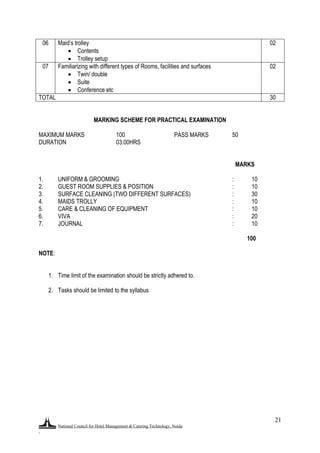
06 Maid‟s trolley
 Contents
 Trolley setup
02
07 Familiarizing with different types of Rooms, facilities and surfaces
 Twin/ double
 Suite
 Conference etc
02
TOTAL 30
MARKING SCHEME FOR PRACTICAL EXAMINATION
MAXIMUM MARKS 100 PASS MARKS 50
DURATION 03.00HRS
MARKS
1. UNIFORM & GROOMING : 10
2. GUEST ROOM SUPPLIES & POSITION : 10
3. SURFACE CLEANING (TWO DIFFERENT SURFACES) : 30
4. MAIDS TROLLY : 10
5. CARE & CLEANING OF EQUIPMENT : 10
6. VIVA : 20
7. JOURNAL : 10
100
NOTE:
1. Time limit of the examination should be strictly adhered to.
2. Tasks should be limited to the syllabus
National Council for Hotel Management & Catering Technology, Noida
.
22
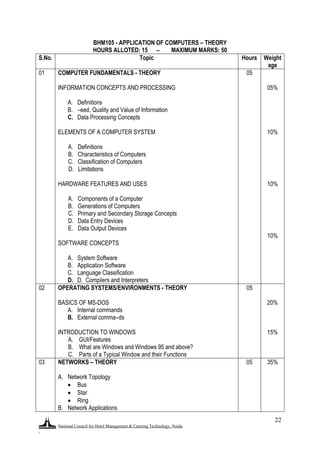
BHM105 - APPLICATION OF COMPUTERS – THEORY
HOURS ALLOTED: 15 – MAXIMUM MARKS: 50
S.No. Topic Hours Weight
age
01 COMPUTER FUNDAMENTALS - THEORY
INFORMATION CONCEPTS AND PROCESSING
A. Definitions
B. –eed, Quality and Value of Information
C. Data Processing Concepts
ELEMENTS OF A COMPUTER SYSTEM
A. Definitions
B. Characteristics of Computers
C. Classification of Computers
D. Limitations
HARDWARE FEATURES AND USES
A. Components of a Computer
B. Generations of Computers
C. Primary and Secondary Storage Concepts
D. Data Entry Devices
E. Data Output Devices
SOFTWARE CONCEPTS
A. System Software
B. Application Software
C. Language Classification
D. D. Compilers and Interpreters
05
05%
10%
10%
10%
02 OPERATING SYSTEMS/ENVIRONMENTS - THEORY
BASICS OF MS-DOS
A. Internal commands
B. External comma–ds
INTRODUCTION TO WINDOWS
A. GUI/Features
B. What are Windows and Windows 95 and above?
C. Parts of a Typical Window and their Functions
05
20%
15%
03 NETWORKS – THEORY
A. Network Topology
 Bus
 Star
 Ring
B. Network Applications
05 35%
National Council for Hotel Management & Catering Technology, Noida
.
23
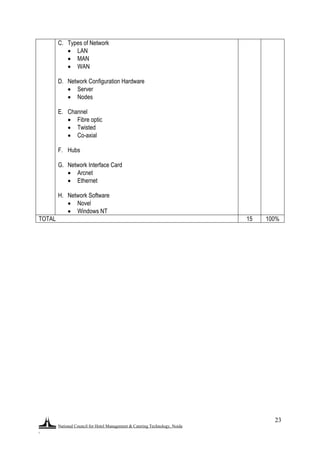
C. Types of Network
 LAN
 MAN
 WAN
D. Network Configuration Hardware
 Server
 Nodes
E. Channel
 Fibre optic
 Twisted
 Co-axial
F. Hubs
G. Network Interface Card
 Arcnet
 Ethernet
H. Network Software
 Novel
 Windows NT
TOTAL 15 100%
National Council for Hotel Management & Catering Technology, Noida
.
24
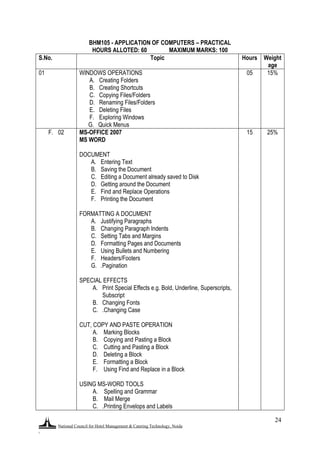
BHM105 - APPLICATION OF COMPUTERS – PRACTICAL
HOURS ALLOTED: 60 MAXIMUM MARKS: 100
S.No. Topic Hours Weight
age
01 WINDOWS OPERATIONS
A. Creating Folders
B. Creating Shortcuts
C. Copying Files/Folders
D. Renaming Files/Folders
E. Deleting Files
F. Exploring Windows
G. Quick Menus
05 15%
F. 02 MS-OFFICE 2007
MS WORD
DOCUMENT
A. Entering Text
B. Saving the Document
C. Editing a Document already saved to Disk
D. Getting around the Document
E. Find and Replace Operations
F. Printing the Document
FORMATTING A DOCUMENT
A. Justifying Paragraphs
B. Changing Paragraph Indents
C. Setting Tabs and Margins
D. Formatting Pages and Documents
E. Using Bullets and Numbering
F. Headers/Footers
G. .Pagination
SPECIAL EFFECTS
A. Print Special Effects e.g. Bold, Underline, Superscripts,
Subscript
B. Changing Fonts
C. .Changing Case
CUT, COPY AND PASTE OPERATION
A. Marking Blocks
B. Copying and Pasting a Block
C. Cutting and Pasting a Block
D. Deleting a Block
E. Formatting a Block
F. Using Find and Replace in a Block
USING MS-WORD TOOLS
A. Spelling and Grammar
B. Mail Merge
C. .Printing Envelops and Labels
15 25%
National Council for Hotel Management & Catering Technology, Noida
.
25
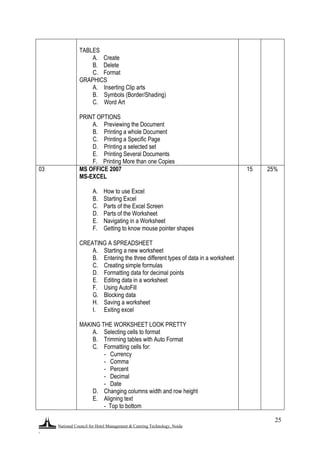
TABLES
A. Create
B. Delete
C. Format
GRAPHICS
A. Inserting Clip arts
B. Symbols (Border/Shading)
C. Word Art
PRINT OPTIONS
A. Previewing the Document
B. Printing a whole Document
C. Printing a Specific Page
D. Printing a selected set
E. Printing Several Documents
F. Printing More than one Copies
03 MS OFFICE 2007
MS-EXCEL
A. How to use Excel
B. Starting Excel
C. Parts of the Excel Screen
D. Parts of the Worksheet
E. Navigating in a Worksheet
F. Getting to know mouse pointer shapes
CREATING A SPREADSHEET
A. Starting a new worksheet
B. Entering the three different types of data in a worksheet
C. Creating simple formulas
D. Formatting data for decimal points
E. Editing data in a worksheet
F. Using AutoFill
G. Blocking data
H. Saving a worksheet
I. Exiting excel
MAKING THE WORKSHEET LOOK PRETTY
A. Selecting cells to format
B. Trimming tables with Auto Format
C. Formatting cells for:
- Currency
- Comma
- Percent
- Decimal
- Date
D. Changing columns width and row height
E. Aligning text
- Top to bottom
15 25%
National Council for Hotel Management & Catering Technology, Noida
.
26
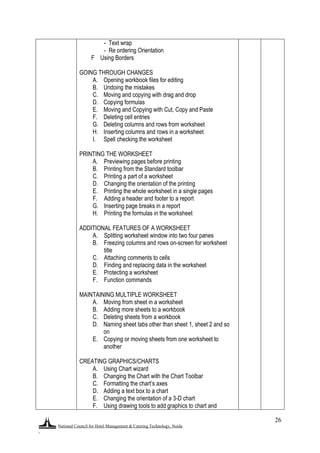
- Text wrap
- Re ordering Orientation
F Using Borders
GOING THROUGH CHANGES
A. Opening workbook files for editing
B. Undoing the mistakes
C. Moving and copying with drag and drop
D. Copying formulas
E. Moving and Copying with Cut, Copy and Paste
F. Deleting cell entries
G. Deleting columns and rows from worksheet
H. Inserting columns and rows in a worksheet
I. Spell checking the worksheet
PRINTING THE WORKSHEET
A. Previewing pages before printing
B. Printing from the Standard toolbar
C. Printing a part of a worksheet
D. Changing the orientation of the printing
E. Printing the whole worksheet in a single pages
F. Adding a header and footer to a report
G. Inserting page breaks in a report
H. Printing the formulas in the worksheet
ADDITIONAL FEATURES OF A WORKSHEET
A. Splitting worksheet window into two four panes
B. Freezing columns and rows on-screen for worksheet
title
C. Attaching comments to cells
D. Finding and replacing data in the worksheet
E. Protecting a worksheet
F. Function commands
MAINTAINING MULTIPLE WORKSHEET
A. Moving from sheet in a worksheet
B. Adding more sheets to a workbook
C. Deleting sheets from a workbook
D. Naming sheet tabs other than sheet 1, sheet 2 and so
on
E. Copying or moving sheets from one worksheet to
another
CREATING GRAPHICS/CHARTS
A. Using Chart wizard
B. Changing the Chart with the Chart Toolbar
C. Formatting the chart‟s axes
D. Adding a text box to a chart
E. Changing the orientation of a 3-D chart
F. Using drawing tools to add graphics to chart and
National Council for Hotel Management & Catering Technology, Noida
.
27
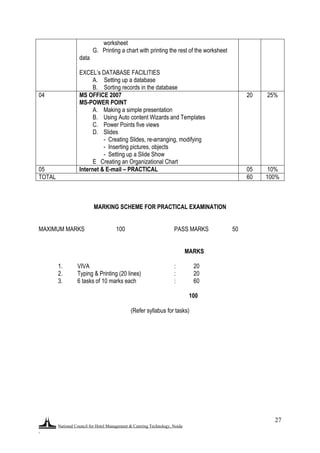
worksheet
G. Printing a chart with printing the rest of the worksheet
data
EXCEL‟s DATABASE FACILITIES
A. Setting up a database
B. Sorting records in the database
04 MS OFFICE 2007
MS-POWER POINT
A. Making a simple presentation
B. Using Auto content Wizards and Templates
C. Power Points five views
D. Slides
- Creating Slides, re-arranging, modifying
- Inserting pictures, objects
- Setting up a Slide Show
E Creating an Organizational Chart
20 25%
05 Internet & E-mail – PRACTICAL 05 10%
TOTAL 60 100%
MARKING SCHEME FOR PRACTICAL EXAMINATION
MAXIMUM MARKS 100 PASS MARKS 50
MARKS
1. VIVA : 20
2. Typing & Printing (20 lines) : 20
3. 6 tasks of 10 marks each : 60
100
(Refer syllabus for tasks)
National Council for Hotel Management & Catering Technology, Noida
.
28
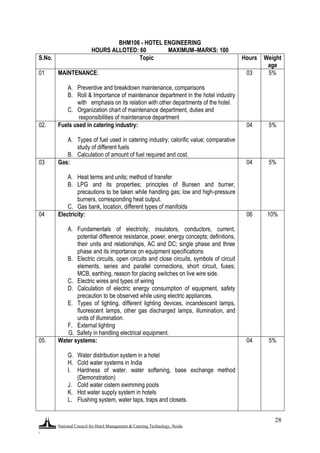
BHM106 - HOTEL ENGINEERING
HOURS ALLOTED: 60 MAXIMUM–MARKS: 100
S.No. Topic Hours Weight
age
01 MAINTENANCE:
A. Preventive and breakdown maintenance, comparisons
B. Roll & Importance of maintenance department in the hotel industry
with emphasis on its relation with other departments of the hotel.
C. Organization chart of maintenance department, duties and
responsibilities of maintenance department
03 5%
02. Fuels used in catering industry:
A. Types of fuel used in catering industry; calorific value; comparative
study of different fuels
B. Calculation of amount of fuel required and cost.
04 5%
03 Gas:
A. Heat terms and units; method of transfer
B. LPG and its properties; principles of Bunsen and burner,
precautions to be taken while handling gas; low and high-pressure
burners, corresponding heat output.
C. Gas bank, location, different types of manifolds
04 5%
04 Electricity:
A. Fundamentals of electricity, insulators, conductors, current,
potential difference resistance, power, energy concepts; definitions,
their units and relationships, AC and DC; single phase and three
phase and its importance on equipment specifications
B. Electric circuits, open circuits and close circuits, symbols of circuit
elements, series and parallel connections, short circuit, fuses;
MCB, earthing, reason for placing switches on live wire side.
C. Electric wires and types of wiring
D. Calculation of electric energy consumption of equipment, safety
precaution to be observed while using electric appliances.
E. Types of lighting, different lighting devices, incandescent lamps,
fluorescent lamps, other gas discharged lamps, illumination, and
units of illumination.
F. External lighting
G. Safety in handling electrical equipment.
06 10%
05. Water systems:
G. Water distribution system in a hotel
H. Cold water systems in India
I. Hardness of water, water softening, base exchange method
(Demonstration)
J. Cold water cistern swimming pools
K. Hot water supply system in hotels
L. Flushing system, water taps, traps and closets.
04 5%
National Council for Hotel Management & Catering Technology, Noida
.
29
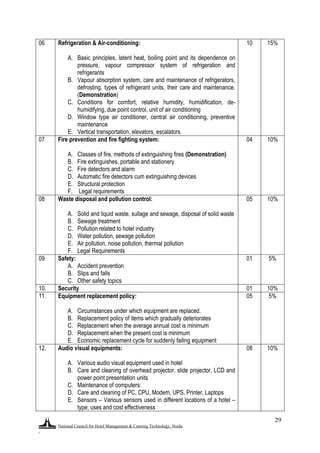
06 Refrigeration & Air-conditioning:
A. Basic principles, latent heat, boiling point and its dependence on
pressure, vapour compressor system of refrigeration and
refrigerants
B. Vapour absorption system, care and maintenance of refrigerators,
defrosting, types of refrigerant units, their care and maintenance.
(Demonstration)
C. Conditions for comfort, relative humidity, humidification, de-
humidifying, due point control, unit of air conditioning
D. Window type air conditioner, central air conditioning, preventive
maintenance
E. Vertical transportation, elevators, escalators.
10 15%
07 Fire prevention and fire fighting system:
A. Classes of fire, methods of extinguishing fires (Demonstration)
B. Fire extinguishes, portable and stationery
C. Fire detectors and alarm
D. Automatic fire detectors cum extinguishing devices
E. Structural protection
F. Legal requirements
04 10%
08 Waste disposal and pollution control:
A. Solid and liquid waste, sullage and sewage, disposal of solid waste
B. Sewage treatment
C. Pollution related to hotel industry
D. Water pollution, sewage pollution
E. Air pollution, noise pollution, thermal pollution
F. Legal Requirements
05 10%
09 Safety:
A. Accident prevention
B. Slips and falls
C. Other safety topics
01 5%
10. Security 01 10%
11. Equipment replacement policy:
A. Circumstances under which equipment are replaced.
B. Replacement policy of items which gradually deteriorates
C. Replacement when the average annual cost is minimum
D. Replacement when the present cost is minimum
E. Economic replacement cycle for suddenly failing equipment
05 5%
12. Audio visual equipments:
A. Various audio visual equipment used in hotel
B. Care and cleaning of overhead projector, slide projector, LCD and
power point presentation units
C. Maintenance of computers:
D. Care and cleaning of PC, CPU, Modem, UPS, Printer, Laptops
E. Sensors – Various sensors used in different locations of a hotel –
type, uses and cost effectiveness
08 10%
National Council for Hotel Management & Catering Technology, Noida
.
30
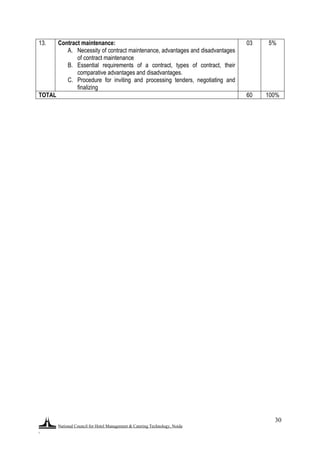
13. Contract maintenance:
A. Necessity of contract maintenance, advantages and disadvantages
of contract maintenance
B. Essential requirements of a contract, types of contract, their
comparative advantages and disadvantages.
C. Procedure for inviting and processing tenders, negotiating and
finalizing
03 5%
TOTAL 60 100%
National Council for Hotel Management & Catering Technology, Noida
.
31
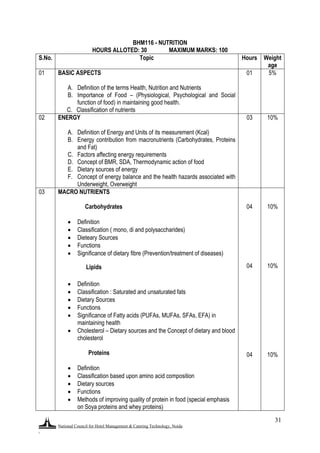
BHM116 - NUTRITION
HOURS ALLOTED: 30 MAXIMUM MARKS: 100
S.No. Topic Hours Weight
age
01 BASIC ASPECTS
A. Definition of the terms Health, Nutrition and Nutrients
B. Importance of Food – (Physiological, Psychological and Social
function of food) in maintaining good health.
C. Classification of nutrients
01 5%
02 ENERGY
A. Definition of Energy and Units of its measurement (Kcal)
B. Energy contribution from macronutrients (Carbohydrates, Proteins
and Fat)
C. Factors affecting energy requirements
D. Concept of BMR, SDA, Thermodynamic action of food
E. Dietary sources of energy
F. Concept of energy balance and the health hazards associated with
Underweight, Overweight
03 10%
03 MACRO NUTRIENTS
Carbohydrates
 Definition
 Classification ( mono, di and polysaccharides)
 Dieteary Sources
 Functions
 Significance of dietary fibre (Prevention/treatment of diseases)
Lipids
 Definition
 Classification : Saturated and unsaturated fats
 Dietary Sources
 Functions
 Significance of Fatty acids (PUFAs, MUFAs, SFAs, EFA) in
maintaining health
 Cholesterol – Dietary sources and the Concept of dietary and blood
cholesterol
Proteins
 Definition
 Classification based upon amino acid composition
 Dietary sources
 Functions
 Methods of improving quality of protein in food (special emphasis
on Soya proteins and whey proteins)
04
04
04
10%
10%
10%
National Council for Hotel Management & Catering Technology, Noida
.
32
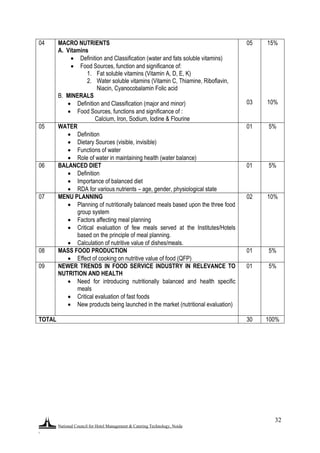
04 MACRO NUTRIENTS
A. Vitamins
 Definition and Classification (water and fats soluble vitamins)
 Food Sources, function and significance of:
1. Fat soluble vitamins (Vitamin A, D, E, K)
2. Water soluble vitamins (Vitamin C, Thiamine, Riboflavin,
Niacin, Cyanocobalamin Folic acid
B. MINERALS
 Definition and Classification (major and minor)
 Food Sources, functions and significance of :
Calcium, Iron, Sodium, Iodine & Flourine
05
03
15%
10%
05 WATER
 Definition
 Dietary Sources (visible, invisible)
 Functions of water
 Role of water in maintaining health (water balance)
01 5%
06 BALANCED DIET
 Definition
 Importance of balanced diet
 RDA for various nutrients – age, gender, physiological state
01 5%
07 MENU PLANNING
 Planning of nutritionally balanced meals based upon the three food
group system
 Factors affecting meal planning
 Critical evaluation of few meals served at the Institutes/Hotels
based on the principle of meal planning.
 Calculation of nutritive value of dishes/meals.
02 10%
08 MASS FOOD PRODUCTION
 Effect of cooking on nutritive value of food (QFP)
01 5%
09 NEWER TRENDS IN FOOD SERVICE INDUSTRY IN RELEVANCE TO
NUTRITION AND HEALTH
 Need for introducing nutritionally balanced and health specific
meals
 Critical evaluation of fast foods
 New products being launched in the market (nutritional evaluation)
01 5%
TOTAL 30 100%
National Council for Hotel Management & Catering Technology, Noida
.
33
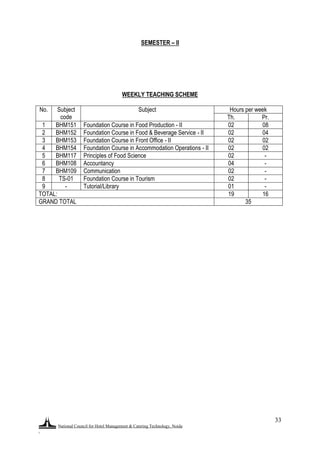
SEMESTER – II
WEEKLY TEACHING SCHEME
No. Subject
code
Subject Hours per week
Th. Pr.
1 BHM151 Foundation Course in Food Production - II 02 08
2 BHM152 Foundation Course in Food & Beverage Service - II 02 04
3 BHM153 Foundation Course in Front Office - II 02 02
4 BHM154 Foundation Course in Accommodation Operations - II 02 02
5 BHM117 Principles of Food Science 02 -
6 BHM108 Accountancy 04 -
7 BHM109 Communication 02 -
8 TS-01 Foundation Course in Tourism 02 -
9 - Tutorial/Library 01 -
TOTAL: 19 16
GRAND TOTAL 35
National Council for Hotel Management & Catering Technology, Noida
.
34
BHM151 - FOUNDATION COURSE IN FOOD PRODUCTION – II (THEORY)
HOURS ALLOTED: 30 MAXIMUM MARKS: 100
S.No. Topic Hours Weight
age
01 SOUPS
C. Basic recipes other than consommé with menu examples
a. Broths
b. Bouillon
c. Puree
d. Cream
e. Veloute
f. Chowder
g. Bisque etc
D. Garnishes and accompaniments
E. International soups
02 10%
02 SAUCES & GRAVIES
D. Difference between sauce and gravy
E. Derivatives of mother sauces
F. Contemporary & Proprietary
03 10%
03 MEAT COOKERY
A. Introduction to meat cookery
B. Cuts of beef/veal
C. Cuts of lamb/mutton
D. Cuts of pork
E. Variety meats (offals)
F. Poultry
(With menu examples of each)
04 15%
04 FISH COOKERY
A. Introduction to fish cookery
B. Classification of fish with examples
C. Cuts of fish with menu examples
D. Selection of fish and shell fish
E. Cooking of fish (effects of heat)
03 10%
05 RICE, CEREALS & PULSES
A. Introduction
B. Classification and identification
C. Cooking of rice, cereals and pulses
D. Varieties of rice and other cereals
01 5%
06 i) PASTRY
A. Short crust
B. Laminated
C. Choux
D. Hot water/Rough puff
 Recipes and methods of preparation
 Differences
 Uses of each pastry
 Care to be taken while preparing pastry
 Role of each ingredient
 Temperature of baking pastry
ii) Flour
02
03
5%
10%
National Council for Hotel Management & Catering Technology, Noida
.
35
A. Structure of wheat
B. Types of Wheat
C. Types of Flour
D. Processing of Wheat – Flour
E. Uses of Flour in Food Production
F. Cooking of Flour (Starch)
iii) SIMPLE BREADS
A. Principles of bread making
B. Simple yeast breads
C. Role of each ingredient in break making
D. Baking temperature and its importance
07 PASTRY CREAMS
A. Basic pastry creams
B. Uses in confectionery
C. Preparation and care in production
02 5%
08 BASIC COMMODITIES:
i) Milk
A. Introduction
B. Processing of Milk
C. Pasteurisation – Homogenisation
D. Types of Milk – Skimmed and Condensed
E. Nutritive Value
ii) Cream
A. Introduction
B. Processing of Cream
C. Types of Cream
iii) Cheese
A. Introduction
B. Processing of Cheese
C. Types of Cheese
D. Classification of Cheese
E. Curing of Cheese
F. Uses of Cheese
iv) Butter
A. Introduction
B. Processing of Butter
C. Types of Butter
02
01
02
01
15%
09 BASIC INDIAN COOKERY
i) CONDIMENTS & SPICES
A. Introduction to Indian food
B. Spices used in Indian cookery
C. Role of spices in Indian cookery
D. Indian equivalent of spices (names)
ii) MASALAS
02 5%
National Council for Hotel Management & Catering Technology, Noida
.
36
A. Blending of spices
B. Different masalas used in Indian cookery
 Wet masalas
 Dry masalas
C. Composition of different masalas
D. Varieties of masalas available in regional areas
E. Special masala blends
10 KITCHEN ORGANIZATION AND LAYOUT
A. General layout of the kitchen in various organisations
B. Layout of receiving areas
C. Layout of service and wash up
02 10%
TOTAL 30 100%
National Council for Hotel Management & Catering Technology, Noida
.
37
BHM151 - FOUNDATION COURSE IN FOOD PRODUCTION – II (PRACTICAL)
PART A - COOKERY
HOURS ALLOTED: 60 MAXIMUM MARKS: 50
S.No Topic Method Hours
1  Meat – Identification of various cuts, Carcass
demonstration
 Preparation of basic cuts-Lamb and Pork
Chops , Tornado, Fillet, Steaks and Escalope
 Fish-Identification & Classification
 Cuts and Folds of fish
Demonstrations &
simple applications
04
2  Identification, Selection and processing of
Meat, Fish and poultry.
 Slaughtering and dressing
Demonstrations at
the site in local
Area/Slaughtering
house/Market
04
3 Preparation of menu
Salads & soups- waldrof salad, Fruit salad, Russian
salad, salade nicoise,
Cream (Spinach, Vegetable, Tomato),
Puree (Lentil, Peas Carrot)
International soups
Chicken, Mutton and Fish Preparations-
Fish orly, a la anglaise, colbert, meuniere, poached,
baked
Entrée-Lamb stew, hot pot, shepherd‟s pie, grilled
steaks & lamb/Pork chops, Roast chicken, grilled
chicken, Leg of Lamb, Beef
Simple potato preparations-
Basic potato dishes
Vegetable preparations-
Basic vegetable dishes
Indian cookery-
Rice dishes, Breads, Main course, Basic Vegetables,
Paneer Preparations
Demonstration by
instructor and
applications by
students
52
TOTAL 60
National Council for Hotel Management & Catering Technology, Noida
.
38
PART B - BAKERY & PATISSERIE
HOURS ALLOTED: 60 MAXIMUM MARKS: 50
S.No Topic Method Hours
1 PASTRY:
Demonstration and Preparation of dishes using
varieties of Pastry
 Short Crust – Jam tarts, Turnovers
 Laminated – Palmiers, Khara Biscuits, Danish
Pastry, Cream Horns
 Choux Paste – Eclairs, Profiteroles
Demonstration by
instructor and
applications by
students
20
2 COLD SWEET
 Honeycomb mould
 Butterscotch sponge
 Coffee mousse
 Lemon sponge
 Trifle
 Blancmange
 Chocolate mousse
 Lemon soufflé
Demonstration by
instructor and
applications by
students
20
3 HOT SWEET
 Bread & butter pudding
 Caramel custard
 Albert pudding
 Christmas pudding
Demonstration by
instructor and
applications by
students
12
4 INDIAN SWEETS
Simple ones such as chicoti, gajjar halwa, kheer
Demonstration by
instructor and
applications by
students
08
TOTAL 60
National Council for Hotel Management & Catering Technology, Noida
.
39
152 - FOUNDATION COURSE IN FOOD & BEVERAGE SERVICE – II (THEORY)
HOURS ALLOTED: 30 MAXIMUM MARKS: 100
S.No. Topic Hours Weight
age
01 MEALS & MENU PLANNING:
A. Origin of Menu
B. Objectives of Menu Planning
C. Types of Menu
D. Courses of French Classical Menu
 Sequence
 Examples from each course
 Cover of each course
 Accompaniments
E. French Names of dishes
F. Types of Meals
 Early Morning Tea
 Breakfast (English, American Continental, Indian)
 Brunch
 Lunch
 Afternoon/High Tea
 Dinner
 Supper
01
02
01
05
03
03
02 I PREPARATION FOR SERVICE
A. Organising Mise-en-scene
B. Organising Mise en place
II TYPES OF FOOD SERVICE
A. Silver service
B. Pre-plated service
C. Cafeteria service
D. Room service
E. Buffet service
F. Gueridon service
G. Lounge service
02
04
03 SALE CONTROL SYSTEM
A. KOT/Bill Control System (Manual)
 Triplicate Checking System
 Duplicate Checking System
 Single Order Sheet
 Quick Service Menu & Customer Bill
B. Making bill
C. Cash handling equipment
D. Record keeping (Restaurant Cashier)
06
National Council for Hotel Management & Catering Technology, Noida
.
40
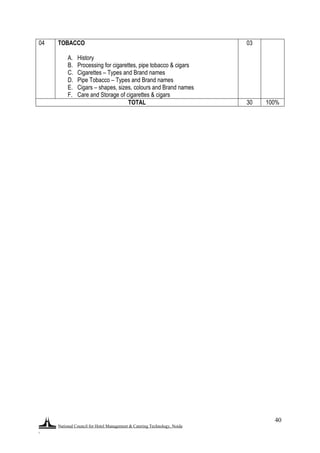
04 TOBACCO
A. History
B. Processing for cigarettes, pipe tobacco & cigars
C. Cigarettes – Types and Brand names
D. Pipe Tobacco – Types and Brand names
E. Cigars – shapes, sizes, colours and Brand names
F. Care and Storage of cigarettes & cigars
03
TOTAL 30 100%
National Council for Hotel Management & Catering Technology, Noida
.
41
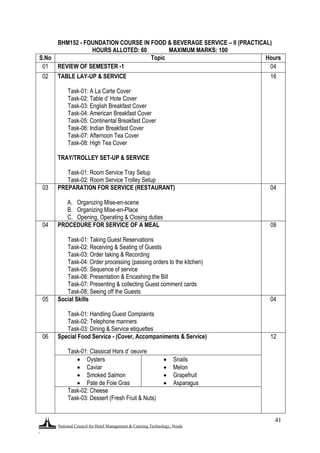
BHM152 - FOUNDATION COURSE IN FOOD & BEVERAGE SERVICE – II (PRACTICAL)
HOURS ALLOTED: 60 MAXIMUM MARKS: 100
S.No Topic Hours
01 REVIEW OF SEMESTER -1 04
02 TABLE LAY-UP & SERVICE
Task-01: A La Carte Cover
Task-02: Table d‟ Hote Cover
Task-03: English Breakfast Cover
Task-04: American Breakfast Cover
Task-05: Continental Breakfast Cover
Task-06: Indian Breakfast Cover
Task-07: Afternoon Tea Cover
Task-08: High Tea Cover
TRAY/TROLLEY SET-UP & SERVICE
Task-01: Room Service Tray Setup
Task-02: Room Service Trolley Setup
16
03 PREPARATION FOR SERVICE (RESTAURANT)
A. Organizing Mise-en-scene
B. Organizing Mise-en-Place
C. Opening, Operating & Closing duties
04
04 PROCEDURE FOR SERVICE OF A MEAL
Task-01: Taking Guest Reservations
Task-02: Receiving & Seating of Guests
Task-03: Order taking & Recording
Task-04: Order processing (passing orders to the kitchen)
Task-05: Sequence of service
Task-06: Presentation & Encashing the Bill
Task-07: Presenting & collecting Guest comment cards
Task-08: Seeing off the Guests
08
05 Social Skills
Task-01: Handling Guest Complaints
Task-02: Telephone manners
Task-03: Dining & Service etiquettes
04
06 Special Food Service - (Cover, Accompaniments & Service)
Task-01: Classical Hors d‟ oeuvre
12
 Oysters
 Caviar
 Smoked Salmon
 Pate de Foie Gras
 Snails
 Melon
 Grapefruit
 Asparagus
Task-02: Cheese
Task-03: Dessert (Fresh Fruit & Nuts)
National Council for Hotel Management & Catering Technology, Noida
.
42
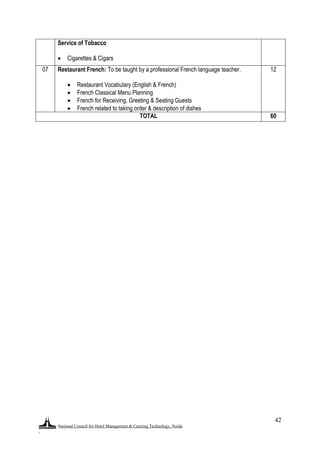
Service of Tobacco
 Cigarettes & Cigars
07 Restaurant French: To be taught by a professional French language teacher.
 Restaurant Vocabulary (English & French)
 French Classical Menu Planning
 French for Receiving, Greeting & Seating Guests
 French related to taking order & description of dishes
12
TOTAL 60
National Council for Hotel Management & Catering Technology, Noida
.
43
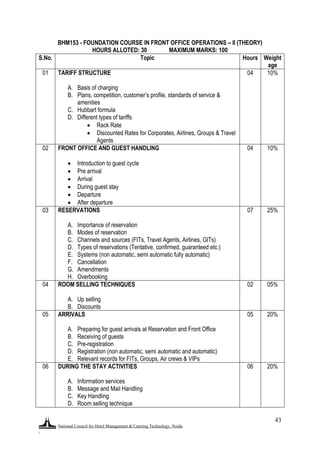
BHM153 - FOUNDATION COURSE IN FRONT OFFICE OPERATIONS – II (THEORY)
HOURS ALLOTED: 30 MAXIMUM MARKS: 100
S.No. Topic Hours Weight
age
01 TARIFF STRUCTURE
A. Basis of charging
B. Plans, competition, customer‟s profile, standards of service &
amenities
C. Hubbart formula
D. Different types of tariffs
 Rack Rate
 Discounted Rates for Corporates, Airlines, Groups & Travel
Agents
04 10%
02 FRONT OFFICE AND GUEST HANDLING
 Introduction to guest cycle
 Pre arrival
 Arrival
 During guest stay
 Departure
 After departure
04 10%
03 RESERVATIONS
A. Importance of reservation
B. Modes of reservation
C. Channels and sources (FITs, Travel Agents, Airlines, GITs)
D. Types of reservations (Tentative, confirmed, guaranteed etc.)
E. Systems (non automatic, semi automatic fully automatic)
F. Cancellation
G. Amendments
H. Overbooking
07 25%
04 ROOM SELLING TECHNIQUES
A. Up selling
B. Discounts
02 05%
05 ARRIVALS
A. Preparing for guest arrivals at Reservation and Front Office
B. Receiving of guests
C. Pre-registration
D. Registration (non automatic, semi automatic and automatic)
E. Relevant records for FITs, Groups, Air crews & VIPs
05 20%
06 DURING THE STAY ACTIVITIES
A. Information services
B. Message and Mail Handling
C. Key Handling
D. Room selling technique
06 20%
National Council for Hotel Management & Catering Technology, Noida
.
44
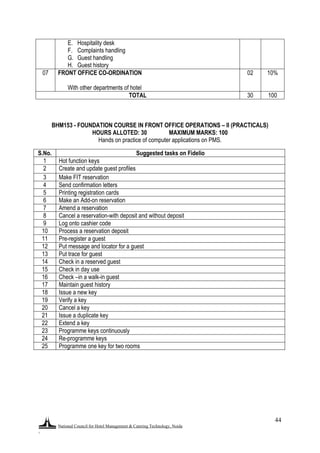
E. Hospitality desk
F. Complaints handling
G. Guest handling
H. Guest history
07 FRONT OFFICE CO-ORDINATION
With other departments of hotel
02 10%
TOTAL 30 100
BHM153 - FOUNDATION COURSE IN FRONT OFFICE OPERATIONS – II (PRACTICALS)
HOURS ALLOTED: 30 MAXIMUM MARKS: 100
Hands on practice of computer applications on PMS.
S.No. Suggested tasks on Fidelio
1 Hot function keys
2 Create and update guest profiles
3 Make FIT reservation
4 Send confirmation letters
5 Printing registration cards
6 Make an Add-on reservation
7 Amend a reservation
8 Cancel a reservation-with deposit and without deposit
9 Log onto cashier code
10 Process a reservation deposit
11 Pre-register a guest
12 Put message and locator for a guest
13 Put trace for guest
14 Check in a reserved guest
15 Check in day use
16 Check –in a walk-in guest
17 Maintain guest history
18 Issue a new key
19 Verify a key
20 Cancel a key
21 Issue a duplicate key
22 Extend a key
23 Programme keys continuously
24 Re-programme keys
25 Programme one key for two rooms
National Council for Hotel Management & Catering Technology, Noida
.
45
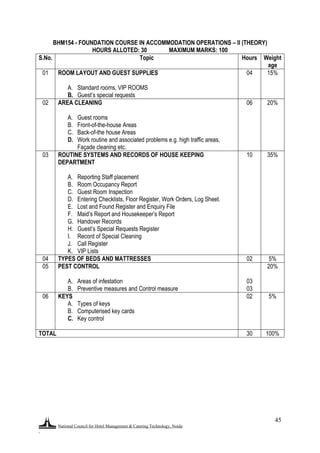
BHM154 - FOUNDATION COURSE IN ACCOMMODATION OPERATIONS – II (THEORY)
HOURS ALLOTED: 30 MAXIMUM MARKS: 100
S.No. Topic Hours Weight
age
01 ROOM LAYOUT AND GUEST SUPPLIES
A. Standard rooms, VIP ROOMS
B. Guest‟s special requests
04 15%
02 AREA CLEANING
A. Guest rooms
B. Front-of-the-house Areas
C. Back-of-the house Areas
D. Work routine and associated problems e.g. high traffic areas,
Façade cleaning etc.
06 20%
03 ROUTINE SYSTEMS AND RECORDS OF HOUSE KEEPING
DEPARTMENT
A. Reporting Staff placement
B. Room Occupancy Report
C. Guest Room Inspection
D. Entering Checklists, Floor Register, Work Orders, Log Sheet.
E. Lost and Found Register and Enquiry File
F. Maid‟s Report and Housekeeper‟s Report
G. Handover Records
H. Guest‟s Special Requests Register
I. Record of Special Cleaning
J. Call Register
K. VIP Lists
10 35%
04 TYPES OF BEDS AND MATTRESSES 02 5%
05 PEST CONTROL
A. Areas of infestation
B. Preventive measures and Control measure
03
03
20%
06 KEYS
A. Types of keys
B. Computerised key cards
C. Key control
02 5%
TOTAL 30 100%
National Council for Hotel Management & Catering Technology, Noida
.
46
BHM154 - FOUNDATION COURSE IN ACCOMMODATION OPERATIONS – II (PRACTICAL)
HOURS ALLOTED: 30 MAXIMUM MARKS: 100
S.No. Topic Hours
01 Review of semester 1 2
02 Servicing guest room(checkout/ occupied and vacant)
ROOM
Task 1- open curtain and adjust lighting
Task 2-clean ash and remove trays if any
Task 3- strip and make bed
Task 4- dust and clean drawers and replenish supplies
Task 5-dust and clean furniture, clockwise or anticlockwise
Task 6- clean mirror
Task 7- replenish all supplies
Task 8-clean and replenish minibar
Task 9-vaccum clean carpet
Task 10- check for stains and spot cleaning
BATHROOM
Task 1-disposed soiled linen
Task 2-clean ashtray
Task 3-clean WC
Task 4-clean bath and bath area
Task 5-wipe and clean shower curtain
Task 6- clean mirror
Task 7-clean tooth glass
Task 8-clean vanitory unit
Task 9- replenish bath supplies
Task 10- mop the floor
6
03 Bed making supplies (day bed/ night bed)
Step 1-spread the first sheet(from one side)
Step 2-make miter corner (on both corner of your side)
Step 3- spread second sheet (upside down)
Step 4-spread blanket
Step 5- Spread crinkle sheet
Step 6- make two folds on head side with all three (second sheet, blanket and crinkle
sheet)
Step 7- tuck the folds on your side
Step 8- make miter corner with all three on your side
Step 9- change side and finish the bed in the same way
Step 10- spread the bed spread and place pillow
8
04 Records
 Room occupancy report
 Checklist
 Floor register
 Work/ maintenance order]
 Lost and found
 Maid‟s report
 Housekeeper‟s report
 Log book
4
National Council for Hotel Management & Catering Technology, Noida
.
47
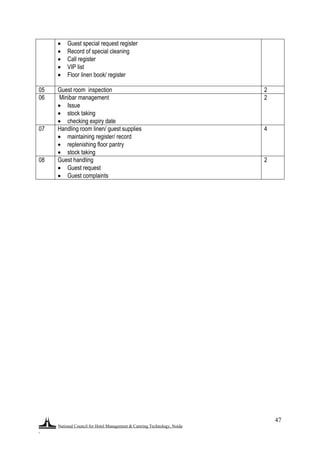
 Guest special request register
 Record of special cleaning
 Call register
 VIP list
 Floor linen book/ register
05 Guest room inspection 2
06 Minibar management
 Issue
 stock taking
 checking expiry date
2
07 Handling room linen/ guest supplies
 maintaining register/ record
 replenishing floor pantry
 stock taking
4
08 Guest handling
 Guest request
 Guest complaints
2
National Council for Hotel Management & Catering Technology, Noida
.
48
BHM117 - PRINCIPLES OF FOOD SCIENCE
HOURS ALLOTED: 30 MAXIMUM MARKS: 100
S.No. Topic Hours Weight
age
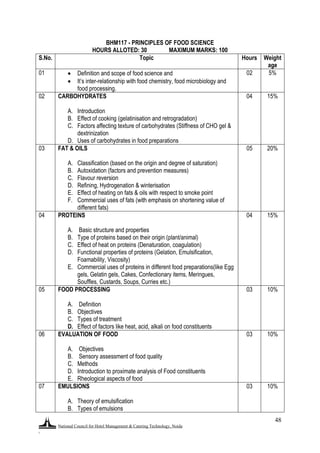
01  Definition and scope of food science and
 It‟s inter-relationship with food chemistry, food microbiology and
food processing.
02 5%
02 CARBOHYDRATES
A. Introduction
B. Effect of cooking (gelatinisation and retrogradation)
C. Factors affecting texture of carbohydrates (Stiffness of CHO gel &
dextrinization
D. Uses of carbohydrates in food preparations
04 15%
03 FAT & OILS
A. Classification (based on the origin and degree of saturation)
B. Autoxidation (factors and prevention measures)
C. Flavour reversion
D. Refining, Hydrogenation & winterisation
E. Effect of heating on fats & oils with respect to smoke point
F. Commercial uses of fats (with emphasis on shortening value of
different fats)
05 20%
04 PROTEINS
A. Basic structure and properties
B. Type of proteins based on their origin (plant/animal)
C. Effect of heat on proteins (Denaturation, coagulation)
D. Functional properties of proteins (Gelation, Emulsification,
Foamability, Viscosity)
E. Commercial uses of proteins in different food preparations(like Egg
gels, Gelatin gels, Cakes, Confectionary items, Meringues,
Souffles, Custards, Soups, Curries etc.)
04 15%
05 FOOD PROCESSING
A. Definition
B. Objectives
C. Types of treatment
D. Effect of factors like heat, acid, alkali on food constituents
03 10%
06 EVALUATION OF FOOD
A. Objectives
B. Sensory assessment of food quality
C. Methods
D. Introduction to proximate analysis of Food constituents
E. Rheological aspects of food
03 10%
07 EMULSIONS
A. Theory of emulsification
B. Types of emulsions
03 10%
National Council for Hotel Management & Catering Technology, Noida
.
49
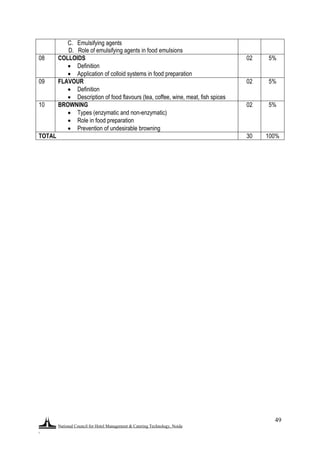
C. Emulsifying agents
D. Role of emulsifying agents in food emulsions
08 COLLOIDS
 Definition
 Application of colloid systems in food preparation
02 5%
09 FLAVOUR
 Definition
 Description of food flavours (tea, coffee, wine, meat, fish spices
02 5%
10 BROWNING
 Types (enzymatic and non-enzymatic)
 Role in food preparation
 Prevention of undesirable browning
02 5%
TOTAL 30 100%
National Council for Hotel Management & Catering Technology, Noida
.
50
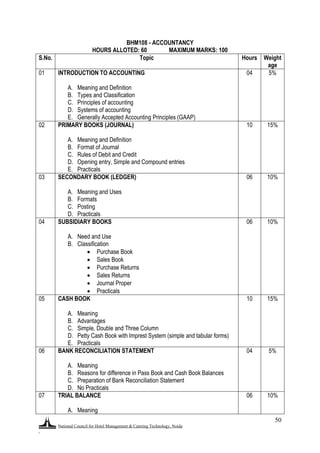
BHM108 - ACCOUNTANCY
HOURS ALLOTED: 60 MAXIMUM MARKS: 100
S.No. Topic Hours Weight
age
01 INTRODUCTION TO ACCOUNTING
A. Meaning and Definition
B. Types and Classification
C. Principles of accounting
D. Systems of accounting
E. Generally Accepted Accounting Principles (GAAP)
04 5%
02 PRIMARY BOOKS (JOURNAL)
A. Meaning and Definition
B. Format of Journal
C. Rules of Debit and Credit
D. Opening entry, Simple and Compound entries
E. Practicals
10 15%
03 SECONDARY BOOK (LEDGER)
A. Meaning and Uses
B. Formats
C. Posting
D. Practicals
06 10%
04 SUBSIDIARY BOOKS
A. Need and Use
B. Classification
 Purchase Book
 Sales Book
 Purchase Returns
 Sales Returns
 Journal Proper
 Practicals
06 10%
05 CASH BOOK
A. Meaning
B. Advantages
C. Simple, Double and Three Column
D. Petty Cash Book with Imprest System (simple and tabular forms)
E. Practicals
10 15%
06 BANK RECONCILIATION STATEMENT
A. Meaning
B. Reasons for difference in Pass Book and Cash Book Balances
C. Preparation of Bank Reconciliation Statement
D. No Practicals
04 5%
07 TRIAL BALANCE
A. Meaning
06 10%
National Council for Hotel Management & Catering Technology, Noida
.
51
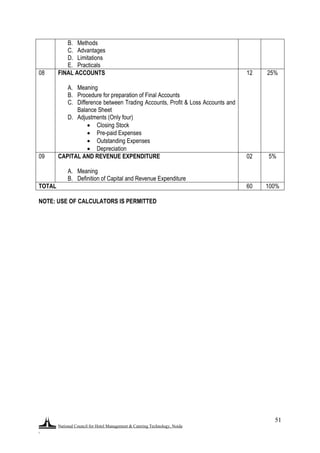
B. Methods
C. Advantages
D. Limitations
E. Practicals
08 FINAL ACCOUNTS
A. Meaning
B. Procedure for preparation of Final Accounts
C. Difference between Trading Accounts, Profit & Loss Accounts and
Balance Sheet
D. Adjustments (Only four)
 Closing Stock
 Pre-paid Expenses
 Outstanding Expenses
 Depreciation
12 25%
09 CAPITAL AND REVENUE EXPENDITURE
A. Meaning
B. Definition of Capital and Revenue Expenditure
02 5%
TOTAL 60 100%
NOTE: USE OF CALCULATORS IS PERMITTED
National Council for Hotel Management & Catering Technology, Noida
.
52
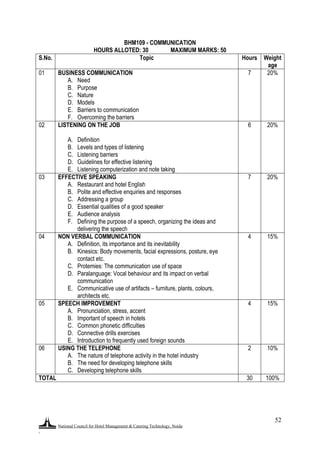
BHM109 - COMMUNICATION
HOURS ALLOTED: 30 MAXIMUM MARKS: 50
S.No. Topic Hours Weight
age
01 BUSINESS COMMUNICATION
A. Need
B. Purpose
C. Nature
D. Models
E. Barriers to communication
F. Overcoming the barriers
7 20%
02 LISTENING ON THE JOB
A. Definition
B. Levels and types of listening
C. Listening barriers
D. Guidelines for effective listening
E. Listening computerization and note taking
6 20%
03 EFFECTIVE SPEAKING
A. Restaurant and hotel English
B. Polite and effective enquiries and responses
C. Addressing a group
D. Essential qualities of a good speaker
E. Audience analysis
F. Defining the purpose of a speech, organizing the ideas and
delivering the speech
7 20%
04 NON VERBAL COMMUNICATION
A. Definition, its importance and its inevitability
B. Kinesics: Body movements, facial expressions, posture, eye
contact etc.
C. Protemies: The communication use of space
D. Paralanguage: Vocal behaviour and its impact on verbal
communication
E. Communicative use of artifacts – furniture, plants, colours,
architects etc.
4 15%
05 SPEECH IMPROVEMENT
A. Pronunciation, stress, accent
B. Important of speech in hotels
C. Common phonetic difficulties
D. Connective drills exercises
E. Introduction to frequently used foreign sounds
4 15%
06 USING THE TELEPHONE
A. The nature of telephone activity in the hotel industry
B. The need for developing telephone skills
C. Developing telephone skills
2 10%
TOTAL 30 100%
National Council for Hotel Management & Catering Technology, Noida
.
53
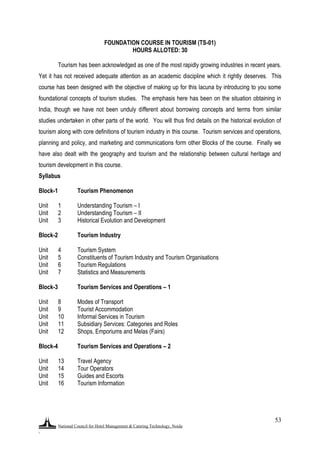
FOUNDATION COURSE IN TOURISM (TS-01)
HOURS ALLOTED: 30
Tourism has been acknowledged as one of the most rapidly growing industries in recent years.
Yet it has not received adequate attention as an academic discipline which it rightly deserves. This
course has been designed with the objective of making up for this lacuna by introducing to you some
foundational concepts of tourism studies. The emphasis here has been on the situation obtaining in
India, though we have not been unduly different about borrowing concepts and terms from similar
studies undertaken in other parts of the world. You will thus find details on the historical evolution of
tourism along with core definitions of tourism industry in this course. Tourism services and operations,
planning and policy, and marketing and communications form other Blocks of the course. Finally we
have also dealt with the geography and tourism and the relationship between cultural heritage and
tourism development in this course.
Syllabus
Block-1 Tourism Phenomenon
Unit 1 Understanding Tourism – I
Unit 2 Understanding Tourism – II
Unit 3 Historical Evolution and Development
Block-2 Tourism Industry
Unit 4 Tourism System
Unit 5 Constituents of Tourism Industry and Tourism Organisations
Unit 6 Tourism Regulations
Unit 7 Statistics and Measurements
Block-3 Tourism Services and Operations – 1
Unit 8 Modes of Transport
Unit 9 Tourist Accommodation
Unit 10 Informal Services in Tourism
Unit 11 Subsidiary Services: Categories and Roles
Unit 12 Shops, Emporiums and Melas (Fairs)
Block-4 Tourism Services and Operations – 2
Unit 13 Travel Agency
Unit 14 Tour Operators
Unit 15 Guides and Escorts
Unit 16 Tourism Information
National Council for Hotel Management & Catering Technology, Noida
.
54
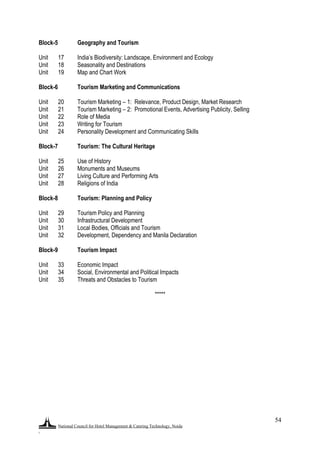
Block-5 Geography and Tourism
Unit 17 India‟s Biodiversity: Landscape, Environment and Ecology
Unit 18 Seasonality and Destinations
Unit 19 Map and Chart Work
Block-6 Tourism Marketing and Communications
Unit 20 Tourism Marketing – 1: Relevance, Product Design, Market Research
Unit 21 Tourism Marketing – 2: Promotional Events, Advertising Publicity, Selling
Unit 22 Role of Media
Unit 23 Writing for Tourism
Unit 24 Personality Development and Communicating Skills
Block-7 Tourism: The Cultural Heritage
Unit 25 Use of History
Unit 26 Monuments and Museums
Unit 27 Living Culture and Performing Arts
Unit 28 Religions of India
Block-8 Tourism: Planning and Policy
Unit 29 Tourism Policy and Planning
Unit 30 Infrastructural Development
Unit 31 Local Bodies, Officials and Tourism
Unit 32 Development, Dependency and Manila Declaration
Block-9 Tourism Impact
Unit 33 Economic Impact
Unit 34 Social, Environmental and Political Impacts
Unit 35 Threats and Obstacles to Tourism
*****
National Council for Hotel Management & Catering Technology, Noida
.
55
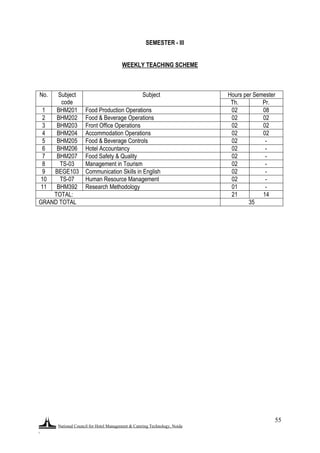
SEMESTER - III
WEEKLY TEACHING SCHEME
No. Subject
code
Subject Hours per Semester
Th. Pr.
1 BHM201 Food Production Operations 02 08
2 BHM202 Food & Beverage Operations 02 02
3 BHM203 Front Office Operations 02 02
4 BHM204 Accommodation Operations 02 02
5 BHM205 Food & Beverage Controls 02 -
6 BHM206 Hotel Accountancy 02 -
7 BHM207 Food Safety & Quality 02 -
8 TS-03 Management in Tourism 02 -
9 BEGE103 Communication Skills in English 02 -
10 TS-07 Human Resource Management 02 -
11 BHM392 Research Methodology 01 -
TOTAL: 21 14
GRAND TOTAL 35
National Council for Hotel Management & Catering Technology, Noida
.
56
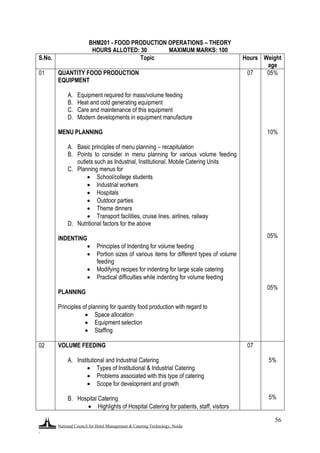
BHM201 - FOOD PRODUCTION OPERATIONS – THEORY
HOURS ALLOTED: 30 MAXIMUM MARKS: 100
S.No. Topic Hours Weight
age
01 QUANTITY FOOD PRODUCTION
EQUIPMENT
A. Equipment required for mass/volume feeding
B. Heat and cold generating equipment
C. Care and maintenance of this equipment
D. Modern developments in equipment manufacture
MENU PLANNING
A. Basic principles of menu planning – recapitulation
B. Points to consider in menu planning for various volume feeding
outlets such as Industrial, Institutional, Mobile Catering Units
C. Planning menus for
 School/college students
 Industrial workers
 Hospitals
 Outdoor parties
 Theme dinners
 Transport facilities, cruise lines, airlines, railway
D. Nutritional factors for the above
INDENTING
 Principles of Indenting for volume feeding
 Portion sizes of various items for different types of volume
feeding
 Modifying recipes for indenting for large scale catering
 Practical difficulties while indenting for volume feeding
PLANNING
Principles of planning for quantity food production with regard to
 Space allocation
 Equipment selection
 Staffing
07 05%
10%
05%
05%
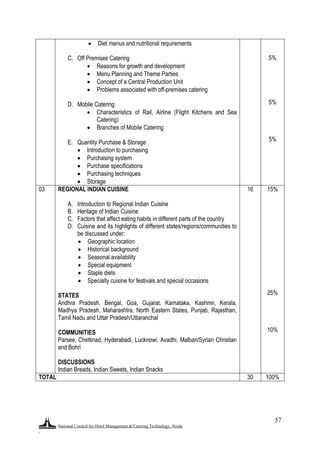
02 VOLUME FEEDING
A. Institutional and Industrial Catering
 Types of Institutional & Industrial Catering
 Problems associated with this type of catering
 Scope for development and growth
B. Hospital Catering
 Highlights of Hospital Catering for patients, staff, visitors
07
5%
5%
National Council for Hotel Management & Catering Technology, Noida
.
57
 Diet menus and nutritional requirements
C. Off Premises Catering
 Reasons for growth and development
 Menu Planning and Theme Parties
 Concept of a Central Production Unit
 Problems associated with off-premises catering
D. Mobile Catering
 Characteristics of Rail, Airline (Flight Kitchens and Sea
Catering)
 Branches of Mobile Catering
E. Quantity Purchase & Storage
 Introduction to purchasing
 Purchasing system
 Purchase specifications
 Purchasing techniques
 Storage
5%
5%
5%
03 REGIONAL INDIAN CUISINE
A. Introduction to Regional Indian Cuisine
B. Heritage of Indian Cuisine
C. Factors that affect eating habits in different parts of the country
D. Cuisine and its highlights of different states/regions/communities to
be discussed under:
 Geographic location
 Historical background
 Seasonal availability
 Special equipment
 Staple diets
 Specialty cuisine for festivals and special occasions
STATES
Andhra Pradesh, Bengal, Goa, Gujarat, Karnataka, Kashmir, Kerala,
Madhya Pradesh, Maharashtra, North Eastern States, Punjab, Rajasthan,
Tamil Nadu and Uttar Pradesh/Uttaranchal
COMMUNITIES
Parsee, Chettinad, Hyderabadi, Lucknowi, Avadhi, Malbari/Syrian Christian
and Bohri
DISCUSSIONS
Indian Breads, Indian Sweets, Indian Snacks
16 15%
25%
10%
TOTAL 30 100%
National Council for Hotel Management & Catering Technology, Noida
.
58
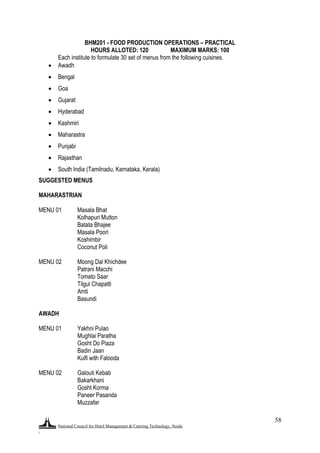
BHM201 - FOOD PRODUCTION OPERATIONS – PRACTICAL
HOURS ALLOTED: 120 MAXIMUM MARKS: 100
Each institute to formulate 30 set of menus from the following cuisines.
 Awadh
 Bengal
 Goa
 Gujarat
 Hyderabad
 Kashmiri
 Maharastra
 Punjabi
 Rajasthan
 South India (Tamilnadu, Karnataka, Kerala)
SUGGESTED MENUS
MAHARASTRIAN
MENU 01 Masala Bhat
Kolhapuri Mutton
Batata Bhajee
Masala Poori
Koshimbir
Coconut Poli
MENU 02 Moong Dal Khichdee
Patrani Macchi
Tomato Saar
Tilgul Chapatti
Amti
Basundi
AWADH
MENU 01 Yakhni Pulao
Mughlai Paratha
Gosht Do Piaza
Badin Jaan
Kulfi with Falooda
MENU 02 Galouti Kebab
Bakarkhani
Gosht Korma
Paneer Pasanda
Muzzafar
National Council for Hotel Management & Catering Technology, Noida
.
59
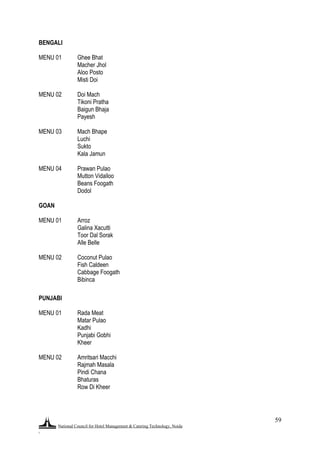
BENGALI
MENU 01 Ghee Bhat
Macher Jhol
Aloo Posto
Misti Doi
MENU 02 Doi Mach
Tikoni Pratha
Baigun Bhaja
Payesh
MENU 03 Mach Bhape
Luchi
Sukto
Kala Jamun
MENU 04 Prawan Pulao
Mutton Vidalloo
Beans Foogath
Dodol
GOAN
MENU 01 Arroz
Galina Xacutti
Toor Dal Sorak
Alle Belle
MENU 02 Coconut Pulao
Fish Caldeen
Cabbage Foogath
Bibinca
PUNJABI
MENU 01 Rada Meat
Matar Pulao
Kadhi
Punjabi Gobhi
Kheer
MENU 02 Amritsari Macchi
Rajmah Masala
Pindi Chana
Bhaturas
Row Di Kheer
National Council for Hotel Management & Catering Technology, Noida
.
60
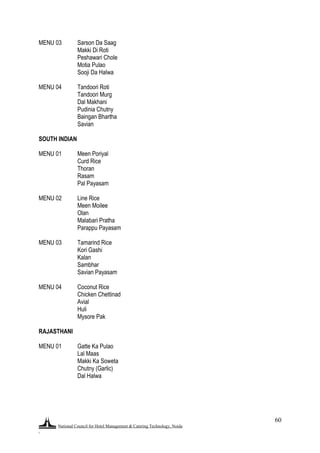
MENU 03 Sarson Da Saag
Makki Di Roti
Peshawari Chole
Motia Pulao
Sooji Da Halwa
MENU 04 Tandoori Roti
Tandoori Murg
Dal Makhani
Pudinia Chutny
Baingan Bhartha
Savian
SOUTH INDIAN
MENU 01 Meen Poriyal
Curd Rice
Thoran
Rasam
Pal Payasam
MENU 02 Line Rice
Meen Moilee
Olan
Malabari Pratha
Parappu Payasam
MENU 03 Tamarind Rice
Kori Gashi
Kalan
Sambhar
Savian Payasam
MENU 04 Coconut Rice
Chicken Chettinad
Avial
Huli
Mysore Pak
RAJASTHANI
MENU 01 Gatte Ka Pulao
Lal Maas
Makki Ka Soweta
Chutny (Garlic)
Dal Halwa
National Council for Hotel Management & Catering Technology, Noida
.
61
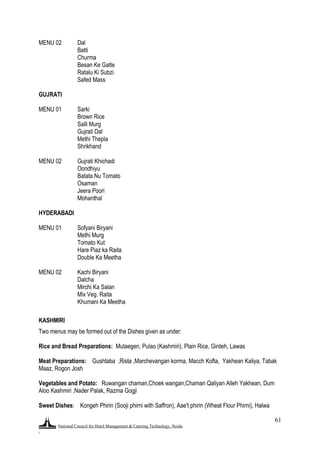
MENU 02 Dal
Batti
Churma
Besan Ke Gatte
Ratalu Ki Subzi
Safed Mass
GUJRATI
MENU 01 Sarki
Brown Rice
Salli Murg
Gujrati Dal
Methi Thepla
Shrikhand
MENU 02 Gujrati Khichadi
Oondhiyu
Batata Nu Tomato
Osaman
Jeera Poori
Mohanthal
HYDERABADI
MENU 01 Sofyani Biryani
Methi Murg
Tomato Kut
Hare Piaz ka Raita
Double Ka Meetha
MENU 02 Kachi Biryani
Dalcha
Mirchi Ka Salan
Mix Veg. Raita
Khumani Ka Meetha
KASHMIRI
Two menus may be formed out of the Dishes given as under:
Rice and Bread Preparations: Mutaegen, Pulao (Kashmiri), Plain Rice, Girdeh, Lawas
Meat Preparations: Gushtaba ,Rista ,Marchevangan korma, Macch Kofta, Yakhean Kaliya, Tabak
Maaz, Rogon Josh
Vegetables and Potato: Ruwangan chaman,Choek wangan,Chaman Qaliyan Alleh Yakhean, Dum
Aloo Kashmiri ,Nader Palak, Razma Gogji
Sweet Dishes: Kongeh Phirin (Sooji phirni with Saffron), Aae't phirin (Wheat Flour Phirni), Halwa
National Council for Hotel Management & Catering Technology, Noida
.
62
Chutneys: Mujeh cheten, Ganda Cheten, Dueen cheten, Aleh cheten (pumpkin chutney)
Note: In addition to above each institute to formulate 08 (eight) set of regional menus including snacks,
sweets etc.
National Council for Hotel Management & Catering Technology, Noida
.
63
BHM202 - FOOD & BEVERAGE SERVICE OPERATIONS – THEORY
HOURS ALLOTED: 30 MAXIMUM MARKS: 100
S.No. Topic Hours Weight
age
01 ALCOHOLIC BEVERAGE
A. Introduction and definition
B. Production of Alcohol
 Fermentation process
 Distillation process
C. Classification with examples
03 7%
02 DISPENSE BAR
A. Introduction and definition
B. Bar layout – physical layout of bar
C. Bar stock – alcohol & non alcoholic beverages
D. Bar equipment
02 07%
03 WINES
A. Definition & History
B. Classification with examples
 Table/Still/Natural
 Sparkling
 Fortified
 Aromatized
C. Production of each classification
D. Old World wines (Principal wine regions, wine laws, grape varieties,
production and brand names)
 France
 Germany
 Italy
 Spain
 Portugal
E. New World Wines (Principal wine regions, wine laws, grape
varieties, production and brand names)
 USA
 Australia
 India
 Chile
 South Africa
 Algeria
 New Zealand
F. Food & Wine Harmony
G. Storage of wines
H. Wine terminology (English & French)
08 30%
04 BEER
A. Introduction & Definition
B. Types of Beer
C. Production of Beer
D. Storage
04 15%
05 SPIRITS 07 25
National Council for Hotel Management & Catering Technology, Noida
.
64
A. Introduction & Definition
B. Production of Spirit
 Pot-still method
 Patent still method
C. Production of
 Whisky
 Rum
 Gin
 Brandy
 Vodka
 Tequilla
D. Different Proof Spirits
 American Proof
 British Proof (Sikes scale)
 Gay Lussac (OIML Scale)
06 APERITIFS
A. Introduction and Definition
B. Types of Aperitifs
 Vermouth (Definition, Types & Brand names)
 Bitters (Definition, Types & Brand names)
03 08%
07 LIQUEURS
A. Definition & History
B. Production of Liqueurs
C. Broad Categories of Liqueurs (Herb, Citrus, Fruit/Egg, Bean &
Kernel)
D. Popular Liqueurs (Name, colour, predominant flavour & country of
origin)
03 08%
TOTAL 30 100%
National Council for Hotel Management & Catering Technology, Noida
.
65
BHM202 - FOOD & BEVERAGE SERVICE OPERATIONS - PRACTICAL
HOURS ALLOTED: 30 MAXIMUM MARKS: 100
S.No Topic Hours
01 Dispense Bar – Organizing Mise-en-place
Task-01 Wine service equipment
Task-02 Beer service equipment
Task-03 Cocktail bar equipment
Task-04 Liqueur / Wine Trolley
Task-05 Bar stock - alcoholic & non-alcoholic beverages
Task-06 Bar accompaniments & garnishes
Task-07 Bar accessories & disposables
05
02 Service of Wines
Task-01 Service of Red Wine
Task-02 Service of White/Rose Wine
Task-03 Service of Sparkling Wines
Task-04 Service of Fortified Wines
Task-05 Service of Aromatized Wines
Task-06 Service of Cider, Perry & Sake
05
03 Service of Aperitifs
Task-01 Service of Bitters
Task-02 Service of Vermouths
03
04 Service of Beer
Task-01 Service of Bottled & canned Beers
Task-02 Service of Draught Beers
02
05 Service of Spirits
Task-01 Service styles – neat/on-the-rocks/with appropriate mixers
Task-02 Service of Whisky
Task-03 Service of Vodka
Task-04 Service of Rum
Task-05 Service of Gin
Task-06 Service of Brandy
Task-07 Service of Tequila
04
06 Service of Liqueurs
Task-01 Service styles – neat/on-the-rocks/with cream/en frappe
Task-02 Service from the Bar
Task-03 Service from Liqueur Trolley
03
07 Wine & Drinks List
Task-01 Wine Bar
Task-02 Beer Bar
Task-03 Cocktail Bar
04
08 Matching Wines with Food
Task-01 Menu Planning with accompanying Wines
 Continental Cuisine
 Indian Regional Cuisine
Task-02 Table laying & Service of menu with accompanying Wines
 Continental Cuisine
 Indian Regional Cuisine
04
TOTAL 30
National Council for Hotel Management & Catering Technology, Noida
.
66
BHM203 - FRONT OFFICE OPERATIONS – THEORY
HOURS ALLOTED: 30 MAXIMUM MARKS: 100
S.No. Topic Hours Weight
age
01 COMPUTER APPLICATION IN FRONT OFFICE OPERATION
A. Role of information technology in the hospitality industry
B. Factors for need of a PMS in the hotel
C. Factors for purchase of PMS by the hotel
D. Introduction to Fidelio & Amadeus
02 5%
02 FRONT OFFICE (ACCOUNTING)
A. Accounting Fundamentals
B. Guest and non guest accounts
C. Accounting system
 Non automated – Guest weekly bill, Visitors tabular ledger
 Semi automated
 Fully automated
06 20%
03 CHECK OUT PROCEDURES
 Guest accounts settlement
- Cash and credit
- Indian currency and foreign currency
- Transfer of guest accounts
- Express check out
04 20%
04 CONTROL OF CASH AND CREDIT 04 15%
05 NIGHT AUDITING
A. Functions
B. Audit procedures (Non automated, semi automated and fully
automated)
04 15%
06 FRONT OFFICE & GUEST SAFETY AND SECURITY
A. Importance of security systems
B. Safe deposit
C. Key control
D. Emergency situations (Accident, illness, theft, fire, bomb)
05 20%
07 FRENCH
A. Expressions de politesse et les commander et Expressions
d‟encouragement
B. Basic conversation related to Front Office activities such as
 Reservations (personal and telephonic)
 Reception (Doorman, Bell Boys, Receptionist etc.)
 Cleaning of Room & change of Room etc.
05 5%
TOTAL 30 100%
National Council for Hotel Management & Catering Technology, Noida
.
67
BHM203 - FRONT OFFICE OPERATIONS - PRACTICAL
HOURS ALLOTED: 30 MAXIMUM MARKS: 100
A. Hands on practice of computer applications related to Front Office procedures such as
 Reservation,
 Registration,
 Guest History,
 Telephones,
 Housekeeping,
 Daily transactions
B. Front office accounting procedures
o Manual accounting
o Machine accounting
o Payable, Accounts Receivable, Guest History, Yield Management
C. Role Play
D. Situation Handling
SUGGESTIVE LIST OF TASKS FOR FRONT OFFICE OPERATION SYSTEM
S.No Topic
1 Hot function keys
2 Create and update guest profiles
3 Send confirmation letters
4 Print registration cards
5 Make FIT reservation & group reservation
6 Make an Add-on reservation
7 Amend a reservation
8 Cancel a reservation-with deposit and without deposit
9 Log onto cahier code
10 Process a reservation deposit
11 Pre-register a guest
12 Put message and locator for a guest
13 Put trace for guest
14 Check in a reserved guest
15 Check in day use
16 Check –in a walk-in guest
17 Maintain guest history
18 Make sharer reservation
19 Add a sharer to a reservation
20 Make A/R account
21 Take reservation through Travel Agent/Company/ Individual or Source
22 Make room change
23 Make check and update guest folios
24 Process charges for in-house guests and non-resident guests.
25 Handle allowances and discounts and packages
National Council for Hotel Management & Catering Technology, Noida
.
68
26 Process advance for in-house guest
27 Put routing instructions
28 Print guest folios during stay
29 Processing foreign currency exchange/ cheque exchange
30 Process guest check out by cash and credit card
31 Check out without closing folio-Skipper accounts
32 Handle paymaster folios
33 Check out using city ledger
34 Print guest folio during check out
35 Close bank at end of each shift
36 Check room rate and variance report
37 Tally Allowances for the day at night
38 Tally paid outs for the day at night
39 Tally forex for the day at night
40 Credit check report
National Council for Hotel Management & Catering Technology, Noida
.
69
BHM204 - ACCOMMODATION OPERATIONS - THEORY
HOURS ALLOTED: 30 MAXIMUM MARKS: 100
S.No. Topic Hours Weight
age
01. LINEN ROOM
Activities of the Linen Room
Layout and equipment in the Linen Room
Selection criteria for various Linen Items & fabrics suitable for this
purpose
Purchase of Linen
Calculation of Linen requirements
Linen control-procedures and records
Stocktaking-procedures and records
Recycling of discarded linen
Linen Hire
10 35%
02. UNIFORMS
A. Advantages of providing uniforms to staff
B. Issuing and exchange of uniforms; type of uniforms
C. Selection and designing of uniforms
D. Layout of the Uniform room
03 10%
03. SEWING ROOM
A. Activities and areas to be provided
B. Equipment provided
02 5%
04. LAUNDRY
A. Commercial and On-site Laundry
B. Flow process of Industrial Laundering-OPL
C. Stages in the Wash Cycle
D. Laundry Equipment and Machines
E. Layout of the Laundry
F. Laundry Agents
G. Dry Cleaning
H. Guest Laundry/Valet service
I. Stain removal
10 35%
05. FLOWER ARRANGEMENT
A. Flower arrangement in Hotels
B. Equipment and material required for flower arrangement
C. Conditioning of plant material
D. Styles of flower arrangements
E. Principles of design as applied to flower arrangement
03 10%
06. INDOOR PLANTS
Selection and care
02 5%
TOTAL 30 100%
National Council for Hotel Management & Catering Technology, Noida
.
70
BHM204 - ACCOMMODATION OPERATIONS - PRACTICAL
HOURS ALLOTED: 30 MAXIMUM MARKS: 100
S.No. Topic Hours
01 Layout of Linen and Uniform Room/Laundry 03
02 Laundry Machinery and Equipment 10
03 Stain Removal 06
04 Flower Arrangement 08
05 Selection and Designing of Uniforms 03
TOTAL 30
National Council for Hotel Management & Catering Technology, Noida
.
71
BHM205 - FOOD & BEVERAGE CONTROLS
HOURS ALLOTED: 30 MAXIMUM MARKS: 100
S.No. Topic Hours Weight
age
01 FOOD COST CONTROL
A. Introduction to Cost Control
B. Define Cost Control
C. The Objectives and Advantages of Cost Control
D. Basic costing
E. Food costing
02 5%
02 FOOD CONTROL CYCLE
A. Purchasing Control
B. Aims of Purchasing Policy
C. Job Description of Purchase Manager/Personnel
D. Types of Food Purchase
E. Quality Purchasing
F. Food Quality Factors for different commodities
G. Definition of Yield
H. Tests to arrive at standard yield
I. Definition of Standard Purchase Specification
J. Advantages of Standard Yield and Standard Purchase
Specification
K. Purchasing Procedure
L. Different Methods of Food Purchasing
M. Sources of Supply
N. Purchasing by Contract
O. Periodical Purchasing
P. Open Market Purchasing
Q. Standing Order Purchasing
R. Centralised Purchasing
S. Methods of Purchasing in Hotels
T. Purchase Order Forms
U. Ordering Cost
V. Carrying Cost
W. Economic Order Quantity
X. Practical Problems
07 25%
03 RECEIVING CONTROL
A. Aims of Receiving
B. Job Description of Receiving Clerk/Personnel
C. Equipment required for receiving
D. Documents by the Supplier (including format)
E. Delivery Notes
F. Bills/Invoices
G. Credit Notes
H. Statements
I. Records maintained in the Receiving Department
J. Goods Received Book
K. Daily Receiving Report
L. Meat Tags
M. Receiving Procedure
05 15
National Council for Hotel Management & Catering Technology, Noida
.
72
N. Blind Receiving
O. Assessing the performance and efficiency of receiving department
P. Frauds in the Receiving Department
Q. Hygiene and cleanliness of area
04 STORING & ISSUING CONTROL
A. Storing Control
B. Aims of Store Control
C. Job Description of Food Store Room Clerk/personnel
D. Storing Control
E. Conditions of facilities and equipment
F. Arrangements of Food
G. Location of Storage Facilities
H. Security
I. Stock Control
J. Two types of foods received – direct stores (Perishables/non-
perishables)
K. Stock Records Maintained Bin Cards (Stock Record Cards/Books)
L. Issuing Control
M. Requisitions
N. Transfer Notes
O. Perpetual Inventory Method
P. Monthly Inventory/Stock Taking
Q. Pricing of Commodities
R. Stock taking and comparison of actual physical inventory and Book
value
S. Stock levels
T. Practical Problems
U. Hygiene & Cleanliness of area
08 25
05 PROUCTION CONTROL
A. Aims and Objectives
B. Forecasting
C. Fixing of Standards
 Definition of standards (Quality & Quantity)
 Standard Recipe (Definition, Objectives and various tests)
 Standard Portion Size (Definition, Objectives and
equipment used)
 Standard Portion Cost (Objectives & Cost Cards)
D. Computation of staff meals
04 15
06 SALES CONTROL
A. Sales – ways of expressing selling, determining sales price,
Calculation of selling price, factors to be considered while fixing
selling price
B. Matching costs with sales
C. Billing procedure – cash and credit sales
D. Cashier‟s Sales summary sheet
04 15
TOTAL 30 100%
National Council for Hotel Management & Catering Technology, Noida
.
73
BHM206 - HOTEL ACCOUNTANCY
HOURS ALLOTED: 30 MAXIMUM MARKS: 100
S.No. Topic Hours Weight
age
01 UNIFORM SYSTEM OF ACCOUNTS FOR HOTELS
A. Introduction to Uniform system of accounts
B. Contents of the Income Statement
C. Practical Problems
D. Contents of the Balance Sheet (under uniform system)
E. Practical problems
F. Departmental Income Statements and Expense statements
(Schedules 1 to 16)
G. Practical problems
10 35%
02 INTERNAL CONTROL
A. Definition and objectives of Internal Control
B. Characteristics of Internal Control
C. Implementation and Review of Internal Control
06 20%
03 INTERNAL AUDIT AND STATUTORY AUDIT
A. An introduction to Internal and Statutory Audit
B. Distinction between Internal Audit and Statutory Audit
C. Implementation and Review of internal audit
06 20%
04 DEPARTMENTAL ACCOUNTING
A. An introduction to departmental accounting
B. Allocation and apportionment of expenses
C. Advantages of allocation
D. Draw-backs of allocation
E. Basis of allocation
F. Practical problems
08 25%
TOTAL 30 100%
National Council for Hotel Management & Catering Technology, Noida
.
74
BHM207 - FOOD SAFETY & QUALITY
HOURS ALLOTED: 30 MAXIMUM MARKS: 50
S.No. Topic Hours Weight
Age
01
Basic Introduction to Food Safety, Food Hazards & Risks, Contaminants
and Food Hygiene
01 Intro
02 MICRO-ORGANISMS IN FOOD
A. General characteristics of Micro-Organisms based on their
occurrence and structure.
B. Factors affecting their growth in food (intrinsic and extrinsic)
C. Common food borne micro-organisms:
a. Bacteria (spores/capsules)
b. Fungi
c. Viruses
d. Parasites
02 10%
03 FOOD SPOILAGE & FOOD PRESERVATION
A. Types & Causes of spoilage
B. Sources of contamination
C. Spoilage of different products (milk and milk products, cereals and
cereal products, meat, eggs, fruits and vegetables, canned products)
D. Basic principles of food preservation
E. Methods of preservation (High Temperature, Low Temperature,
Drying, Preservatives & Irradiation)
04 15%
04 BENEFICIAL ROLE OF MICRO-ORGANISMS
A. Fermentation & Role of lactic and bacteria
B. Fermentation in Foods (Dairy foods, vegetable, Indian foods,
Bakery products and alcoholic beverages)
C. Miscellaneous (Vinegar & anti-biotics)
02 5%
05 FOOD BORNE DISEASES
A. Types (Infections and intoxications)
B. Common diseases caused by food borne pathogens
C. Preventive measures
02 5%
06 FOOD ADDITIVES
A. Introduction
B. Types (Preservatives, anti-oxidants, sweeteners, food colours and
flavours, stabilizers and emulsifiers)
02 5%
07 FOOD CONTAMINANTS & ADULTERANTS
A. Introduction to Food Standards
B. Types of Food contaminants (Pesticide residues, bacterial toxins
mycotoxins, seafood toxins, metallic contaminants, residues from
packaging material)
C. Common adulterants in food
D. Method of their detection (basic principle)
04 15%
08 FOOD LAWS AND REGULATIONS
A. National – PFA Essential Commodités Act (FPO, MPO etc.)
B. International – Codex Alimentarius, ISO
C. Regulatory Agencies – WTO
03 10%
National Council for Hotel Management & Catering Technology, Noida
.
75
D. Consumer Protection Act
09 QUALITY ASSURANCE
A. Introduction to Concept of TQM, GMP and Risk Assessment
B. Relevance of Microbiological standards for food safety
C. HACCP (Basic Principle and implementation)
04 10%
10 HYGIENE AND SANITATION IN FOOD SECTOR
A. General Principles of Food Hygiene
B. GHP for commodities, equipment, work area and personnel
C. Cleaning and disinfect ion (Methods and agents commonly used in
the hospitality industry)
D. Safety aspects of processing water (uses & standards)
E. Waste Water & Waste disposal
04 15%
11 RECENT CONCERNS
A. Emerging pathogens
B. Genetically modified foods
C. Food labelling
D. Newer trends in food packaging and technology
E. BSE (Bovine Serum Encephthalopathy)
02 10%
TOTAL 30 100%
REFERENCES:
i. Modern Food Microbiology by Jay. J.
ii. Food Microbiology by Frazier and Westhoff
iii. Food Safety by Bhat & Rao
iv. Safe Food Handling by Jacob M.
v. Food Processing by Hobbs Betty
vi. PFA Rules
National Council for Hotel Management & Catering Technology, Noida
.
76
BHM391 - RESEARCH METHODOLOGY
HOURS ALLOTED: 15
Research is an academic activity and as such the term should be used in a technical sense. Research
comprises defining and redefining problems, formulating hypothesis or suggested solutions; collecting,
organising and evaluating data; making deductions and reaching conclusions. In fact, research is an art
of scientific investigation. In short, the search for knowledge through objective and systematic method
of finding solution to a problem is research.
During semesters III and IV students will be exposed to different techniques of conducting research.
They will be taught in a theory class, methods adopted in designing of a research and collecting of data
followed by its presentation and interpretation.
While there will be no term end examination in the subject, students will attain knowledge and expertise
in tackling research which they will undertake during semester V and VI.
S.No. Topic
01 INTRODUCTION TO RESEARCH METHODOLOGY
A. Meaning and objectives of Research
B. Types of Research
C. Research Approaches
D. Significance of Research
E. Research methods vs Methodology
F. Research Process
G. Criteria of Good Research
H. Problem faced by Researches
I. Techniques Involved in defining a problem
02 RESEARCH DESIGN
A. Meaning and Need for Research Design
B. Features and important concepts relating to research design
C. Different Research design
D. Important Experimental Designs
03 SAMPLE DESIGN
A. Censure and sample Survey
B. Implication of Sample design
C. Steps in sampling design
D. Criteria for selecting a sampling procedure
E. Characteristics of a good sample design
F. Different types of Sample design
G. Measurement Scales
H. Important scaling Techniques
04 METHODS OF DATA COLLECTION
A. Collection of Primary Data
B. Collection through Questionnaire and schedule collection of secondary data
C. Difference in Questionnaire and schedule
D. Different methods to collect secondary data
05 DATA ANALYSIS INTERPRETATION AND PRESENTATION TECHNIQUES
A. Hypothesis Testing
B. Basic concepts concerning Hypothesis Testing
C. Procedure and flow diagram for Hypothesis Testing
National Council for Hotel Management & Catering Technology, Noida
.
77
D. Test of Significance
E. Chi-Square Analysis
F. Report Presentation Techniques
National Council for Hotel Management & Catering Technology, Noida
.
78
MANAGEMENT IN TOURISM (TS-03)
HOURS ALLOTED: 30
The course has been designed to familiarise the learners with the Management concepts,
functions and skills keeping in view their applicability in tourism.
Syllabus
Block-1 Understanding Entrepreneurship and Management
Unit 1 Management: Concept and Functions
Unit 2 Entrepreneurship: Concept and Functions
Unit 3 Corporate Forms in Tourism
Unit 4 Management Issues in Tourism
Block-2 Understanding Organizational Theory
Unit 5 Understanding Organizations
Unit 6 Planning and Decision Making
Unit 7 Organizing
Unit 8 Monitoring and Controlling
Block-3 Organizational Behaviour Issues
Unit 9 Small Group Behaviour
Unit 10 Inter Personal Behaviour
Unit 11 Inter Group Behaviour
Unit 12 Supervisory Behaviour
Block-4 Management Functions
Unit 13 Human Resource Management
Unit 14 Financial Management
Unit 15 Operations Management
Unit 16 Marketing Management
Unit 17 Information Technology and Management
Block-5 Managing Financial Operations
Unit 18 Understanding P & L Statements
Unit 19 Understanding Balance Sheet
Unit 20 Profitability Analysis
Unit 21 Project Formulation and Appraisal
Block-6 Managerial Practices in Tourism – 1
Unit 22 Tour Operators
Unit 23 Travel Agencies
Unit 24 Hotels
Unit 25 Public Relations
National Council for Hotel Management & Catering Technology, Noida
.
79
Block-7 Managerial Practices in Tourism – 2
Unit 26 Food Services
Unit 27 Tourist Transport
Unit 28 Airlines
Unit 29 Airports
Block-8 Convention Promotion and Management
Unit 30 Convention Industry
Unit 31 Planning Conventions
Unit 32 Management and Implementation of Conventions
National Council for Hotel Management & Catering Technology, Noida
.
80
COMMUNICATION SKILLS IN ENGLISH (BEGE - 103)
HOURS ALLOTED: 30
This course is assigned 8 credits and requires about 240 hours of study on your part. It aims at
making you aware of how a communicative situation influences the choice of sentence structure and
vocabulary. This course is divided into 8 blocks of 5 units each, and includes the basic concepts in
communication, formal and informal conversation, official communication, diaries, notes and use of
English for the media i.e. Print, T.V. and Radio.
Syllabus
Block-1 Letters
Unit 1 Some Concepts in Communication
Unit 2 Formal Letters-1
Unit 3 Formal Letters-2
Unit 4 Informal Letters-1
Unit 5 Informal Letters-2
Block-2 Conversation
Unit 6 Formal Conversation:
Face-to-Face-1
Unit 7 Formal Conversation:
Face-to-Face-2
Unit 8 Informal Conversation:
Face-to-Face-1
Unit 9 Informal Conversation:
Face-to-Face-2
Discussions
Unit 10 Telephone Conversation
Block-3 Other Forms of Official Communication
Unit 11 Memoranda
Unit 12 Reports-1
Unit 13 Reports-2
Unit 14 Minutes of Meetings
Unit 15 Telegrams and Telexes
Block-4 Interviews and Public Speaking
Unit 16 Interviews
Unit 17 Debates
Unit 18 Discussions
Unit 19 Speeches
Unit 20 Seminar Talks
National Council for Hotel Management & Catering Technology, Noida
.
81
Block-5 Diaries, Notes, Tables and Figures
Unit 21 Diaries: Private
Unit 22 Diaries: General
Unit 23 Travelogues
Unit 24 Notes
Unit 25 Tables, Charts and Graphs
Block-6 Mass Media: Print
Unit 26 Writing for Newspapers-1
Unit 27 Writing for Newspapers-2
Unit 28 Articles for Journals
Unit 29 Advertising-1
Unit 30 Advertising-2
Block-7 Writing for Radio
Unit 31 Writing for Radio-1
The Movement of Sounds
Unit 32 Writing for Radio-2
The Movement of Ideas
Unit 33 Writing for Radio-3
Unit 34 Radio Drama-1
Unit 35 Radio Drama-2
Block-8 Mass Media: Television
Unit 36 A Television Script
Unit 37 Television Drama
Unit 38 Documentary and Feature Programmes
Unit 39 Interviews
Unit 40 Media, Contexts and Words
Audios 1 Letters (Block-1)
2 Conversations: Role Relation and Tone in Conversation (Block-2)
3 Making a Public Speech (Block-4)
Videos 1 Debating Skills (Block-4)
2 Appearing for an Interview (Block-4)
3 Using Charts and Diagrams (Block-5)
4 Visualising a T.V. Script: Introduction to T.V. Production Techniques
(Block-8)
National Council for Hotel Management & Catering Technology, Noida
.
82
HUMAN RESOURCE MANAGEMENT (TS-07)
HOURS ALLOTED: 30
S.No. Topic
01 Human Resource Planning
A. Micro
B. Macro
02 HRD applications in Hotel Industry
03 Relevance of HRD in Hotel Industry
04 Personnel Office
A. Functions
B. Operations
05 Hotel Environment and Culture
06 HRD System
07 Job Evaluation
A. Concepts
B. Scope
C. Limitations
08 Job Analysis and Job Description
09 Job Evaluation Methods
10 Task Analysis
11 Demand and Supply Forecasting
12 Human Resource Information System
13 Human Resource Audit
14 Human Resource Accounting Practices
15 Recruitment and Selection
16 Attracting and Retaining Talents
 Strategic Interventions
17 Induction and Placement
18 Staff Training and Development
19 Training Methods and Evaluation
20 Motivation and Productivity
21 Motivation and Job Enrichment
22 Career Planning
23 Employee Counselling
24 Performance Monitoring and Appraisal
25 Transfer, Promotion and Reward Policy
26 Disciplinary Issues
27 Employees‟ Grievance Handling
28 Compensation and Salary Administration
29 Employee Benefits and Welfare Schemes
30 Labour Laws and Regulations Related to Hotel Industry
31 Gender Sensitivities
32 Emerging Trends and Perspectives
33 Impacts of Mergers and Acquisitions on Human Resource Practices
National Council for Hotel Management & Catering Technology, Noida
.
83
BHM392 - PRACTICUM
During the BSc. in H&HA with Specialisation, students are to undertake industrial exposure thrice
ie. for four weeks after semester III in Generic stream, for six weeks after semester IV in Specialised
field and again for four weeks after semester V in Specialised field. Final examination / presentation will
be done only during Term End examinations of Semester VI. Weightage to each practicum shall be as
under:
Practicum I: 20 marks
Practicum II: 40 marks
Practicum III: 40 marks
BHM392 - PRACTICUM – I
GENERIC
Student will essentially attend a large hotel to get an overview of the functioning of key
departments. They will be exposed to the working environment and assess job expectations, skill and
knowledge requirements of each function at different levels. An opportunity will be provided to the
candidate to analyse their strengths, weaknesses and passion in relation to the different functions.
Trainees must assess and evaluate the role they are most likely to perform in the hospitality industry,
based on their interest quickly, for which four weeks have been provided.
National Council for Hotel Management & Catering Technology, Noida
.
84
SEMESTER - IV
WEEKLY TEACHING SCHEME
No. Subject
code
Subject Hours per Semester
Th. Pr.
1 BHM273 Food & Beverage Management - I 04 08
2 BHM274 Food & Beverage Management - II 04 08
3 BHM281 Financial Management 04 --
4 BHM282 Business Ethics & Law 04 --
5 BHM283 Business Economics 02 -
6 BHM391 Research Methodology 01 -
TOTAL: 19 16
GRAND TOTAL 35
National Council for Hotel Management & Catering Technology, Noida
.
85
SEMESTER - IV MAJOR I – I
BHM273 - FOOD AND BEVERAGE MANAGEMENT- I (THEORY + PRACTICAL)
THEORY - HOURS ALLOTED: 60 MAXIMUM MARKS: 100
PRACTICAL - HOURS ALLOTED: 120 MAXIMUM MARKS: 200
S. No. Topic Hours
01 PLANNING & OPERATING VARIOUS F&B OUTLET
A. Physical layout of functional and ancillary areas
B. Objective of a good layout
C. Steps in planning
D. Factors to be considered while planning
E. Calculating space requirement
F. Various set ups for seating
G. Planning staff requirement
H. Menu planning
I. Constraints of menu planning
J. Selecting and planning of heavy duty and light equipment
K. Requirement of quantities of equipment required like crockery,
Glassware, steel or silver etc.
L. Suppliers & manufacturers
M. Approximate cost
N. Planning Décor, furnishing fixture etc.
PRACTICAL
10
12
02 F & B STAFF ORGANISATION
A. Categories of staff
B. Hierarchy
C. Job description and specification
D. Duty roaster
PRACTICAL
 Making of Duty Roster and writing job description & specification
04
06
03 MANAGING F&B OUTLET
A. Supervisory skills
B. Developing efficiency
C. Standard Operating Procedure
PRACTICAL
Supervising F&B outlets
04
06
04 FUNCTION CATERING
BANQUETS
A. History
B. Types
C. Organisation of Banquet department
D. Duties & responsibilities
E. Sales
10
National Council for Hotel Management & Catering Technology, Noida
.
86
F. Booking procedure
G. Banquet menus
BANQUET PROTOCOL
 Space Area requirement
 Table plans/arrangement
 Misc-en-place
 Service
 Toasting
INFORMAL BANQUET
 Réception
 Cocktail parties
 Convention
 Seminar
 Exhibition
 Fashion shows
 Trade Fair
 Wedding
 Outdoor catering
PRACTICAL
Calculation of Space for Banquets, Banquet Menu & Service
16
05 FUNCTION CATERING
BUFFETS
A. Introduction
B. Factors to plan buffets
C. Area requirement
D. Planning and organisation
E. Sequence of food
F. Menu planning
G. Types of Buffet
H. Display
I. Sit down
J. Fork, Finger, Cold Buffet
K. Breakfast Buffets
L. Equipment
M. Supplies
N. Check list
PRACTICAL
Setting of various types of Buffet
12
10
06 GUERIDON SERVICE
A. History of gueridon
B. Definition
08
National Council for Hotel Management & Catering Technology, Noida
.
87
C. General consideration of operations
D. Advantages .Dis-advantages
E. Types of trolleys
F. Factor to create impulse, Buying – Trolley, open kitchen
G. Gueridon equipment
H. Gueridon ingredients
PRACTICAL
Preparing items on Gueridon trolley
 Crêpe Suzette
 Banana au Rhum
 Peach Flambé
 Rum Omlette
 Ceasar Salad
 Pepper Steak
20
07 BAR OPERATIONS
A. Types of Bar
 Cocktail
 Dispense
B. Area of Bar
C. Front Bar
D. Back Bar
E. Under Bar (Speed Rack, Garnish Container, Ice well etc.)
F. Bar Stock
G. Bar Control
H. Bar Staffing
I. Opening and closing duties
PRACTICAL
Designing and setting the bar for above sub-topics
06
16
08 COCKTAILS & MIXED DRINKS
A. Definition and History
B. Classification
C. Recipe, Preparation and Service of Popular Cocktails
- Martini – Dry & Sweet
- Manhattan – Dry & Sweet
- Dubonnet
- Roy-Roy
- Bronx
- White Lady
- Pink Lady
- Side Car
- Bacardi
- Alexandra
- John Collins
- Tom Collins
- Gin FIZZ
- Pimm‟s Cup – no. 1,2,3,4,5
06
National Council for Hotel Management & Catering Technology, Noida
.
88
- Flips
- Noggs
- Champagne Cocktail
- Between the Sheets
- Daiquiri
- Bloody Mary
- Screw Driver
- Tequilla Sunrise
- Gin-Sling
- Planters Punch
- Singapore Sling
- Pinacolada
- Rusty Nail
- B&B
- Black Russian
- Margarita
- Gimlet – Dry & Sweet
- Cuba Libre
- Whisky Sour
- Blue Lagoon
- Harvey Wall Banger
- Bombay Cocktail
PRACTICAL
Preparation of Cocktails 20
07. KITCHEN STEWARDING
A. Importance
B. Opportunities in kitchen stewarding
C. Record maintaining
D. Machine used for cleaning and polishing
E. Inventory
PRACTICAL
OPERATING KITCHEN STEWARDING DEPT,POLISHING SILVER/FIELD
VISIT
02
14
National Council for Hotel Management & Catering Technology, Noida
.
89
SEMESTER – IV MAJOR – II
BHM274 - FOOD AND BEVERAGE MANAGEMNT – II (THEORY)
HOURS ALLOTED: 60 MAXIMUM MARKS: 100
S. No Topic Hours
01 COST DYNAMICS
A. Elements of Cost
B. Classification of Cost
02
02 SALES CONCEPTS
A. Various Sales Concept
B. Uses of Sales Concept
02
03 INVENTORY CONTROL
A. Importance
B. Objective
C. Method
D. Levels and Technique
E. Perpetual Inventory
F. Monthly Inventory
G. Pricing of Commodities
H. Comparison of Physical and Perpetual Inventory
10
04 BEVERAGE CONTROL
A. Purchasing
B. Receiving
C. Storing
D. Issuing
E. Production Control
F. Standard Recipe
G. Standard Portion Size
H. Bar Frauds
I. Books maintained
J. Beverage Control
10
05 SALES CONTROL
A. Procedure of Cash Control
B. Machine System
C. ECR
D. NCR
E. Preset Machines
F. POS
G. Reports
H. Thefts
I. Cash Handling
05
06 BUDGETARY CONTROL
A. Define Budget
B. Define Budgetary Control
C. Objectives
05
National Council for Hotel Management & Catering Technology, Noida
.
90
D. Frame Work
E. Key Factors
F. Types of Budget
G. Budgetary Control
07 VARIANCE ANALYSIS
A. Standard Cost
B. Standard Costing
C. Cost Variances
D. Material Variances
E. Labour Variances
F. Overhead Variance
G. Fixed Overhead Variance
H. Sales Variance
I. Profit Variance
06
08 BREAKEVEN ANALYSIS
A. Breakeven Chart
B. P V Ratio
C. Contribution
D. Marginal Cost
E. Graphs
06
09 MENU MERCHANDISING
A. Menu Control
B. Menu Structure
C. Planning
D. Pricing of Menus
E. Types of Menus
F. Menu as Marketing Tool
G. Layout
H. Constraints of Menu Planning
06
10. MENU ENGINEERING
A. Definition and Objectives
B. Methods
C. Advantages
04
11. MIS
A. Reports
B. Calculation of actual cost
C. Daily Food Cost
D. Monthly Food Cost
E. Statistical Revenue Reports
F. Cumulative and non-cumulative
04
National Council for Hotel Management & Catering Technology, Noida
.
91
BHM274 - FOOD & BEVERAGE MANAGEMENT – II (PRACTICAL)
HOURS ALLOTED: 120 MAXIMUM MARKS: 200
S.No. Topic Hours
1 Purchase Controls:-
A. Preparing SPS
Each Student to prepare and submit SPS for one each
a. Vegetable b. Diary Product c. Meat Product d. bakery product
B. Vendor Identification / Interactions with any one supplier of the institute and
submission of a report thereafter
C. EOQ
D. Field Visit/ Assignments / Role Play.
E. Exercise in Institute Stores.
F. Each student to Log compulsory hours at the institute store or a store
at a hotel
20
05
2 Inventory Controls:-
Par stock Calculations-Each student to prepare Par stock level of at least 3 Grocery
items.
Stock Taking- exercises at the institute store/ at a hotel/restaurant.
LIFO & FIFO, Storage Procedures , Store Layout
Storage Specifications (Temp / Hyg)- an assignment at least 15 items storage
specification.
Each student to Log compulsory hours at the institute store or a store at a
hotel
20
05
3 Menu Planning / Designing & Pricing
Assignment- Design and pricing of any one of the following by each student-
a. Coffee shop menu
b. Multicuisine restaurant menu
c. Table d hote menu
d. Bar Menu
16
4 Preparing following forms & Formats –
-Bin Card
- Meat Tag
- GRB
- Stock Register
- Purchase Order
-Indent Sheet
Each student to Log compulsory hours at the institute store or a store at a
hotel
20
05
5 Receiving Exercises ---
-receiving procedure at a hotel/Restaurant store
- Equipments found in the receiving area and the manufacturers of such
equipments-assignment
- lighting, flooring, ventilation and layout of a receiving area.-Assignment
Each student to Log compulsory hours at the institute store or a store at a
hotel
20
05
6 Report and assignment presentation 04
National Council for Hotel Management & Catering Technology, Noida
.
92
BHM281 - FINANCIAL MANAGEMENT
HOURS ALLOTED: 60 MAXIMUM MARKS: 100
S.No. Topic Hours
01 FINANCIAL MANAGEMENT
MEANING & SCOPE
A. Meaning of business finance
B. Meaning of financial management
C. Objectives of financial management
02
02 FINANCIAL STATEMENT
ANALYSIS AND INTERPRETATION
A. Meaning and types of financial statements
B. Techniques of financial analysis
C. Limitations of financial analysis
D. Practical problems
05
03 RATIO ANALYSIS
A. Meaning of ratio
B. Classification of ratios
C. Profitability ratios
D. Turnover ratios
E. Financial ratios
F. Du Pent Control Chart
G. Practical Problems
12
04 FUNDS FLOW ANALYSIS
A. Meaning of funds flow statement
B. Uses of funds flow statement
C. Preparation of funds flow statement
D. Treatment of provision for taxation and proposed dividends (as non-current
liabilities
E. Practical problems
10
05 CASH FLOW ANALYSIS
A. Meaning of cash flow statement
B. Preparation of cash flow statement
C. Difference between cash flow and funds flow analysis
D. Practical problems
12
06 FINANCIAL PLANNING
MEANING & SCOPE
A. Meaning of Financial Planning
B. Meaning of Financial Plan
C. Capitalisation
D. Practical problems
06
07 CAPITAL EXPENDITURE
A. Meaning of Capital Structure
B. Factors determining capital structure
05
National Council for Hotel Management & Catering Technology, Noida
.
93
C. Point of indifference
D. Practical problems
08 WORKING CAPITAL MANAGEMENT
A. Concept of working capital
B. Factors determining working capital needs
C. Over trading and under trading
02
09 BASICS OF CAPITAL BUDGETING
A. Importance of Capital Budgeting
B. Capital Budgeting appraising methods
C. Payback period
D. Average rate f return
E. Net Present Value
F. Profitability index
G. Internal rate of return
H. Practical problems
06
National Council for Hotel Management & Catering Technology, Noida
.
94
BHM282 - BUSINESS ETHICS AND LAW
HOURS ALLOTED: 60 MAXIMUM MARKS: 100
S.No. Topic Hours Weight
age
1. BUSINESS ETHICS
Definition of business ethics
Need for ethics in hotel business
Ethics and moral values
Theories of moral development
Lawrence Kohlberg‟s theory
Carol Gilligan theory
6
20
2. AREAS OF ETHICS IN HOTEL INDUSTRY
Dealing with a staff
Dealing with guests and their belongings
Following duty hours
Safety and security in the hotel
Dealing with lady guests
Code of ethics
6
10
3. BUSINESS LAW
Introduction to law
Evolution of law
Classification of law 4
5
4. INDIAN CONTRACT LAW
Definition of contract, proposal, agreement, consideration etc.,
Essentials of valid contract
Competent parties
Types of parties – valid, void and voidable
Performance of contract
Discharge of contract
Remedies for breach of contract
Indemnity and guarantee
8
10
5 CONSUMER PROTECTION ACT
Definitions – Consumer, complaint, defect in goods, deficiency in service,
unfair trade practice, restricted trade practice
Procedure for redressal of grievances before district forum, state
commission and national commission
Other related provisions
6 10
6 SALE OF GOODS ACT
Essentials of valid sale
3 5
National Council for Hotel Management & Catering Technology, Noida
.
95
Conditions and warranties
Unpaid seller and his rights
Rights and duties of seller and buyer
7 FOOD ADULTERATION ACT
Principles of food laws regarding prevention of food adulteration, definition,
authorities under the act
Powers of various authorities under the act
Procedure of taking a sample purchase right, warranties, guest control
order or food services order in force from time to time. Essential
commodities and AGMARK etc.,
5
10
8 SHOPS AND ESTABLISHMENTS ACT
Procedure relating to registration of hotels, lodges, eating houses,
restaurants and other related provisions 2 5
9 ENVIRONMENTAL PROTECTION ACT – IMPORTANT PROVISIONS
The water (Prevention and control of pollution)Act
The air (Prevention and control of pollution) Act 2
5
10 LICENSES AND PERMITS
Licenses and permits for hotels and catering establishments
Procedure for procurement, buy laws of hotels and restaurant under
municipal corporation
Renewal suspension and termination of licenses
6
10
11 INDUSTRIAL LEGISLATION
Factory Act – Definition of factory, worker, health safety and welfare
provisions
Industrial disputes act – definition of industry, manufacturing process,
industrial dispute, provisions relating to strike, lock-out, retrenchment, lay-
off and authorities for settlement of industrial disputes
Payment of wages act- definition of wages, authorized deductions from
wages
Workmen‟s compensation act – definition of dependent, disablement,
occupational disease, liability of the employer to pay compensation and
amount of compensation
12
10
National Council for Hotel Management & Catering Technology, Noida
.
96
BHM283 - BUSINESS ECONOMICS
HOURS ALLOTED: 30 MAXIMUM MARKS: 50
S.No. Topic Hours Weight
age
I. Introduction:
Economic activities, non-economic activities, nature and scope of business
economics. Micro economics, Macro-economics. Inducting and deducting
approaches graphs – concepts of scope – utility – cardinal and ordinal
utility. Law of diminishing marginal utility; Law of equi. Marginal utility
2
hours
5%
II. Demand Supply and Market Equilibrium:
Demand – Meaning – Individual demand – Law of Demand – Properties of
Demand curve. Income effect and substitution effect. Exceptions to the
law of Demand. Individual Demand and Market Demand, Demand
Function, Determinants of Demand, Determinants of Market Demand. Shift
of Demand Vs Movememnt along a Demand Curve. Elasticity of Demand.
Price Elasticity – Meaning and Measurement. Price Elasticity and total
revenue of a firm. Income Elasticity. Classification of goods based on
Income Elasticity Cross Elasticity. Classification of goods into substitutes
and complements. Supply – Law of supply – Determinants of supply
Market Equilibrium. Concept of consumer surplus.
8
hours
12%
III. Production and Costs:
Production function. Distinction between short run and long run production.
Production with one variable input. Relationship between Total, Marginal,
and Average Production Functions. Laws of variable proportion.
Production with two variable inputs. Isoquan to Isocosts. Techniques of
Maximization of output, minimisation of cost and maximization of profit.
Scale of Production. Economies and diseconomies of scale. Cost
function. Short-run, Total and Average Costs. Long-run, Total and
Average Costs.
6
hours
9%
IV. Market structure and Factors of Production:
Market – Market Structure – Characteristics of market. Perfect Competition
– Characteristics – Equilibrium Price. Project maximizing output in the
short and long run. Monopoly – Characteristics, Defects, Monopolistic
competition – Defects, characteristics. Product differentiation. Profit
maximizing price and output in the short and long run. Oligopoly,
Characteristics – Price rigidity. Kinked Demand Curve – Factors of
Production.
8
hours
12%
V. National Income, Trade Cycles and International Trade:
National Income – Definition, Measurement Gross Domestic Product –
Meaning. Fiscal Deficit. Eonomic system. Socialism, Mixed Economy
System, Free Market Economies. Concepts of Economic Liberalization,
National Council for Hotel Management & Catering Technology, Noida
.
97
Privatization, Globalization – Recent Trends. International Trade –
Concepts, Comparative Cost Theory – Balance of Trade – Balance of
Payments. World Trade Organization, Agreements, Functions.
Trade Cycles – Meaning, Phases, Consequences, Remedies.
6
hours
12%
Suggested Books for Reference:
1. D. Gopalakrishna – A study in Managerial Economics
Himalaya Publishing House, Mumbai, Delhi, Nagpur.
2. S. Gupta – Managerial Economics
Tata McGraw-Hill Publishing Company Ltd., New Delhi.
3. V.L. Motem Samuel Paul, G.S. Gupta – Managerial Economics Concepts and Cases
Tata McGraw – Hill Publishing Company Ltd., New Delhi.
4. K.K. Dewett – Elementary Economic Theory
J.D. Verma
S. Chand Company Pvt. Ltd., Ram Nagar, New Delhi.
****
National Council for Hotel Management & Catering Technology, Noida
.
98
BHM391 - RESEARCH METHODOLOGY (Contd. from semester III)
HOURS ALLOTED: 15
Research is an academic activity and as such the term should be used in a technical sense. Research
comprises defining and redefining problems, formulating hypothesis or suggested solutions; collecting,
organising and evaluating data; making deductions and reaching conclusions. In fact, research is an art
of scientific investigation. In short, the search for knowledge through objective and systematic method
of finding solution to a problem is research.
During semesters III and IV students will be exposed to different techniques of conducting research.
They will be taught in a theory class, methods adopted in designing of a research and collecting of data
followed by its presentation and interpretation.
While there will be no term end examination in the subject, students will attain knowledge and expertise
in tackling research which they will undertake during semester V and VI.
S.NO TOPIC HOURS
6 CASUAL-COMPARATIVE STUDIES AND CORRELATION METHOD
A. What is Casual-comparative method? - Basis of this method
B. Casual-Comparative study distinguished from other research method
C. Use of this method in Educational Research
D. Limitation Correlation method - Uses of Correlation method.
E. Cautions in the use of Correlation method.
2
7 THE CASE-STUDY AND GENETIC METHOD
A. What is case study? - Unit of study
B. Types of case-studies in education. - Steps involved in a case-study.
C. Characteristics of a good case study - Merits and Limitations
D. Genetic method distinguished from case-study.- Purposes and types
E. Longitudinal and Cross-selection approach
2
8 RESEARCH TOOLS
A. Meaning - Classification of a research tools
B. Criteria for selection of tools
C. Factors related to construction of tools
D. Questionnaire : miss use - Types of a questionnaire
E. Characteristics of a good questionnaire
F. Hints for making a questionnaire as an effective tool
G. Attitude scales : Thrustone and Likert scale
H. Limitations of rating scales
I. Means of reducing errors - Score card
J. Use and Types of interview
K. Requisites and limitations of interview
L. Uses and types of observation - Requisites of observation
M. The critical incidents technique
N. Scaled specimen schedule
O. Check list - Interest Inventories
P. „Q‟ technique - Content analysis
Q. Tools to measure social measures
R. Sociometry “guess-who-technique”
3
National Council for Hotel Management & Catering Technology, Noida
.
99
S. Social distance scale - Psychological tests
T. Types of tests: achievements tests, intelligence tests, aptitude tests,
personality tests
9 CONSRUCTION AND STANDERDISATION OF A TEST
A. Characteristics of a good test
B. Construction of a standardised introduction test
C. Concept of reliability - Estimates of reliability
D. Factors affecting the reliability
E. Concept of validity – Types - Criteria for establishing validity
F. Development of Norms
3
10 ORGANISATION, ANALYSIS AND INTERPRETATION OF DATA
A. Editing, classifying and tabulating organization of data
B. Common and special statistical analysis
C. Interpretation of Data - Causes for misinterpretation
D. Uses of comparison in interpretation
E. Use of statistical Formulae for interpretation of results
F. Characteristics of good generalization
G. Common errors in reaching conclusions and formulating generalization
H. Some hints in formulating generalizations.
3
11 RESEARCH REPORTING
A. Style Manuals - Outline of a research report
B. Preliminary section - Text or main body of the report
C. Reference selection - Language and style of writing
D. Footnote citations - Quotations
E. Typography
F. Pagination
G. Format of synopsis/Abstract
H. Format of a book review.
2
TOTAL 15
National Council for Hotel Management & Catering Technology, Noida
.
100
BHM392 - PRACTICUM – II
SPECIALISED
From their initial industry exposure during Practicum - I, student must be able to identify their area of
specialisation based on which they will spend the next six weeks in an organisation of choice. Training
can be acquired in a hotel, restaurant, fast food outlet, bar, food courts, institutions or any other
specialised hospitality enterprise that would provide enhanced exposure for the trainee to acquire
special skills.
The objective of this practicum is that skilled workers learn best with their hands. In today's competitive
business environment, it is imperative that all training yield results guaranteeing proficiency by allowing
the student to "learn by doing". Through discovery, repetition and ultimately testing the student learns,
reinforces and proves the good habits and knowledge that creates highest standards, attitude and
behaviour. Effective F&B training will sharpen showmanship skill, diplomacy skill and social skills.
Successful industrial training would involve the students to have an open inquisitive mind, so that they
not just observe but also learn, work and improve.
National Council for Hotel Management & Catering Technology, Noida
.
101
SEMESTER - V
WEEKLY TEACHING SCHEME
No. Subject
code
Subject Hours per Semester
Th. Pr.
1 BHM323 Food & Beverage Management - III 08 04
2 BHM324 Food & Beverage Management - IV 08 04
3 BHM281 Strategic Management 04 --
4 Elective - I 04 --
5 TS-06 Tourism Marketing 02 --
6 BHM391 Tutorial / Library / Research Project 01 --
TOTAL: 27 08
GRAND TOTAL 35
National Council for Hotel Management & Catering Technology, Noida
.
102
SEMESTER – V MAJOR – I
BHM323 - FOOD & BEVERAGE MANAGEMENT – III (THEORY)
HOURS ALLOTED: 120 MAXIMUM MARKS: 200
S.No PARTICULARS HOURS
1 Pantry Operations –
(a) Non-Alcoholic Beverages- Tea Coffee, Cocoa, malt, Juices, milk and
waters
(b) Sandwiches / Canapés
(c) Ice cream and cold sweets
(d) Layout & Planning of Pantry
(e) Modern Pantry Equipments and their care
10
2 Room Service Operations –
(a) Introduction and types of room service
(b) Layout of Department
(c) Mis-en-place for each shift
(d) Equipment used
(e) Forms and Order Taking
(f) Butler Service – Importance, Attributes, duties & responsibilities,
multitasking.
10
3 Quick Service Restaurant Operations -
(a) Front of the House operations
(b) Middle of the House operations
(c) Back of the House operations
(d) Door Delivery
(e) Take away operations
(f) “Drive In” outlets
(g) Students to prepare a report after docking 12 hours ( practical exposure
in QSR)
20
4 Meal Management –
(a) EMT – Service (Early Morning Tea)
(b) Breakfast – Different types and their service with Menu Planning,
breakfast buffet
(c) Brunch – Menu Planning and Service
(d) Lunch – Service and Menu Planning, lunch buffet
4
National Council for Hotel Management & Catering Technology, Noida
.
103
(e) High Tea – Service and Menu Planning
(f) Dinner – Service and Menu Planning
(g) Supper – Service and Menu Planning
(h) Lounge service
5 International Cuisine – Each student to choose any two from the following:
(Popular Dishes and Service Involved)- Restaurant Theme, salient features of the
cuisine, food and alcoholic beverage harmony
(a) USA
(b) Italy
(c) Mexico
(d) France
(e) China
(f) Spain
(g) Thailand
(h) Vietnam
(i) Japan
(j) UK
Students to submit assignments on any two cuisines with a PPT
presentation
24
6 Food & Beverage facility planning & design
 Feasibility study
o Operational data collection
o Projected financial statement
o Project plan
o Capital Structuring- Mode of ownership
o Funds Management
 Principles of design
o Architectural considerations
o Site selection
o Façade
o Green structure concept
16
7 Layout and planning of a restaurant
 Systematic layout planning
 Flow process and flow diagram
16
National Council for Hotel Management & Catering Technology, Noida
.
104
 Space consideration
 HVAC, Plumbing and electric consideration
 Water, gas and energy consideration
 Kitchen stewarding
 Equipment planning
o Standard purchase specification
o Operating manual
o Manufacturers of industrial equipment
o Care and maintenance
o Cost and efficiency
8 Seminar and Workshops
 Institute to organise a workshop on international cuisine
 Guest lecture on types of QSR
20
TOTAL… 120
National Council for Hotel Management & Catering Technology, Noida
.
105
SEMESTER – V MAJOR – I
BHM323 - FOOD & BEVERAGE MANAGEMENT – III (PRACTICAL)
HOURS ALLOTED: 60 MAXIMUM MARKS: 100
S. No PARTICULARS HOURS
1 B/F Service - Mis-en-place, Buffet Set up, Popular B/F Menus, Serving B/F cereal
rolls, juices, hot beverages. Contemporary B/F setups for Health B/F with calorie
count of dishes on offer, Regional B/F service.
Students to submit 2 assignments 1.On breakfast buffet setup 2. On Trends
in health breakfast
12
2 International Cuisine Service. Spl. Equipments, accompaniments, garnishes,
service methodology, menu terminology.
Students to dock at least 24 hours in a Speciality restaurant (international)
and submit a report on the above defined aspects.
26
3 Pantry Operation, Preparation and service of Non-alcoholic beverages, - Tea,
flavoured tea, Coffee, laced coffee, Machine dispensed coffee, Juices- fresh,
canned, tetra pack, waters- still/sparkling. Preparation of sandwich / canapés.
Service of frozen dessert.
6
4 R/S Operation – Mis-en-place for different shift, Breakfast, Lunch, Dinner, snacks,
Hi tea and Midnight snacks. Tray and Trolley exercises, telephone handling.
4
5 QSR – Students to dock at least 10 hrs in a QSR and submit a report on
Front Of House (FOH) operations
Middle Of House (MOH) operations
Back Of House (BOH) operations
12
TOTAL… 60
National Council for Hotel Management & Catering Technology, Noida
.
106
SEMESTER – V MAJOR – II
BHM324 - FOOD & BEVERAGE MANAGEMENT – IV (THEORY)
HOURS ALLOTED: 120 MAXIMUM MARKS: 200
Sl.No
.
Topic Hours
1 Food and Beverage POS Software
- Concept
- Advantages
- Popular software used in the industry students to be proficient in at least
2 popular software
14
2 F & B Waste Management
- Definition
- Types of waste
- Collection and disposal systems
10
3 Hospitality Entrepreneurship
- Introduction
- Strategic Management of a new venture
: SWOT Analysis
: Market Segmentation
:Break even Analysis
:Capital sourcing
: Project Planning
20
4 Project Management
- Introduction to network analysis
- Basic rules and procedures used for network analysis
- CPM & PERT
- Comparison between CPM & PERT
- Network crashing and determining crash cost, normal cost
- Classroom exercises
24
4 Legal Requirements for setting up a hotel/QSR/ Bar/ Restaurant
- Municipal – Police – Fire – Excise – Phonographic
- Copyright – others
12
National Council for Hotel Management & Catering Technology, Noida
.
107
- Criteria for star classification of a hotel ( 5/4/3/2/1/Heritage)
5 MICE
- Introduction
- Recent developments
8
6. Event management
- Introduction to event management
- Role of F&B Service in successful event management
- Out door catering – catering at stadiums, camps, food fairs, festivals, aero show
- Preparing checklists for an ODC
- Challenges and infrastructural requirements for taking up- Events, ODC
16
7. Promotional Costing
- Introduction
- Different forms of promotions used by F&B outlets
- Expenditure and revenue analysis
- Numerical
16
TOTAL… 120
National Council for Hotel Management & Catering Technology, Noida
.
108
SEMESTER – V MAJOR – II
BHM324 - FOOD & BEVERAGE MANAGEMENT – IV (PRACTICAL)
HOURS ALLOTED: 60 MAXIMUM MARKS: 100
Sl.No. Topic Hours
1 Managing F & B Software - Any two reknowned software
(IDS, Fidellio, Shawman, PMS ,Micros , Opera etc.)
Students to be proficient in the college software and to dock 16 hours in a hotel
software
24
2 F & B Waste Management
Survey and report preparation on waste management adopted at various hotels in
the city with a detailed report on waste management of any 1 leading hotel.
12
3 Entrepreneurship
Capital Sourcing – Identification of different venture capitalists e.g. Bank, pvt
loans, bonds etc.
Project Planning
Project preparation for a F & B outlet
8
4 Legal requirements
- Survey of the regional legal permits
- Report and presentation on legal,fire, excise,permits needed by
restaurant owners
8
5 Preparation of a project plan
- Restaurant design and layout
- Data collection
- Feasibility study
- Drawing a restaurant or Bar plan to scale
- Presentation on funds mobilisation with a recovery plan
8
Total 60
National Council for Hotel Management & Catering Technology, Noida
.
109
BHM281 – STRATEGIC MANAGEMENT
HOURS ALLOTED: 60 MAXIMUM MARKS: 100
Sl.
No.
Topic Hours weight
age
1 Strategy and Strategic Management
i) Definition, Scope & Type
ii) Importance
iii) Strategy & Policy: Difference
04 5%
2 Mission and Vision Statement
i) Definition, importance
ii) Scope of Mission Statement
iii) Components of Mission Statement
iv) Definition & Difference with Objectives, Goals, Policies
12 10%
3 Approaches to Developing Strategies
i) Adaptive search
ii) Intuition search
iv) Strategic factors
v) Picking Niches
v) Entrepreneurial Approach
04 10%
4 Environmental Analysis
1) Definition & need for Environmental Analysis
2) Key Environmental variable factors : Internal and External
3) Techniques of Environmental Analysis- SWOT Analysis,
Porter‟s five forces competition analysis etc.
06 10%
5 Grand Strategies
i) Stability Strategies
ii) Expansion Strategies
iii) Retrenchment Strategies
iv) Combination Strategies
v) Short notes on different mixed strategies
0
3
08 15%
6 Strategic Analysis and Choice
a) Input Stage
i) Internal Factor Evaluation Matrix
ii) External Factor Evaluation Matrix
iii) Competitive Profile Matrix
b) Matching Stage
i) TOWS Matrix
ii) SPACE Matrix
iii) BCG Matrix
iv) Internal-External Matrix
v) Grand Strategy Matrix
c) Decision Stage
Quantitative Strategic Planning Matrix (QSPM)
10 15%
7 Strategic Implementation, Review & Evaluation
a) 1. Mckinsey‟s 7 S Framework
b) 2. Leadership:
c) a. Meaning, characteristic & functions
d) b. Different leadership & Management styles: 08 20%
National Council for Hotel Management & Catering Technology, Noida
.
110
e) (Blake & Moutol‟s, Managerial Grid, Likert‟s leadership styles
and Lewin‟s leadership styles
f)
g) 3. Strategy review and evaluation:
a. Review underlying bases of strategy
b. Measure Organizational performance
c. Take corrective actions
8 Policy Formulation
a) Policy Formation: Meaning & Need.
b) Different functional areas policies:
i) Personnel Policies
ii) Financial Policies
iii) Marketing Policies
08 15%
Recommended books:
1. Business Policy & Strategic Management - Dr. L. M. Prasad
2. – do - - P. K. Ghose
3. – do - - Azahar Kazmi
National Council for Hotel Management & Catering Technology, Noida
.
111
ELECTIVE - I
HOURS ALLOTED: 60 MAXIMUM MARKS: 100
(ANY ONE OF THE FOLLOWING ELECTIVE SUBJECTS)
S.No Subject Code Subject
01 E-01 Human Resource (M&D)
02 E-02 Customer Relation Management
03 E-03/1 Foreign Language (French)
04 E-03/2 Foreign Language (German)
05 E-04 Airline Catering
06 E-05 Resort, Club & Time Share Management
07 E-06 Retail Management
National Council for Hotel Management & Catering Technology, Noida
.
112
TOURISM MARKETING (TS-06)
HOURS ALLOTED: 30
This course familiarises the students with Marketing concepts, techniques and skills as
required in the marketing of tourism products and attractions.
Syllabus
Block-1 Understanding Entrepreneurship and Management
Unit 1 Introduction to Tourism Marketing – Approaches, Relevance and Role
Unit 2 Market Segmentation
Unit 3 Tourism Markets: International and Domestic
Block-2 Market Analysis
Unit 4 Marketing Research
Unit 5 Competitive Analysis and Strategies
Unit 6 Forecasting for Tourism and its Products
Unit 7 Role of Technology in Tourism Marketing
Block-3 Developmental Role of Marketing
Unit 8 Role of Public Organizations
Unit 9 Role of Local Bodies
Unit 10 Role of NGOs
Unit 11 Socially Responsible Marketing
Unit 12 Social Marketing
Block-4 Marketing Mix
Unit 13 Product Designing
Unit 14 Pricing Strategies
Unit 15 Promotion Strategies
Unit 16 Distribution Strategies
Unit 17 The Fifth P: People, Process and Physical Evidence
Block-5 Marketing Mix: Specific Situations
Unit 18 Familiarization Tours
Unit 19 Seasonal Marketing
Unit 20 Tourism Fairs and Travel Markets
Block-6 Destination Marketing
Unit 21 Regions, Cities, Leisure Spots
Unit 22 Events, Activities, Individuals
Unit 23 Shopping, Education and Culture
Unit 24 Marketing Local Foods
National Council for Hotel Management & Catering Technology, Noida
.
113
Block-7 Accommodation Marketing
Unit 25 Star Category Hotels
Unit 26 Alternate‟ Accommodation
Unit 27 Supplementary Accommodations
Unit 28 Linkages in the Trade
Block-8 Transport and Travel Services Marketing
Unit 29 Air lines Marketing
Unit 30 Tourist Transport Marketing
Unit 31 Travel Agency Marketing
Unit 32 Tour Operators Marketing
National Council for Hotel Management & Catering Technology, Noida
.
114
BHM391 - RESEARCH PROJECT
HOURS ALLOTED: 15
In semester V, students will work closely with their supervisor and develop mutually working
relationship to initiate the research which would involve preparing an outline and preliminary collection.
Based on their learning during semester III and IV, the supervisor will guide the student in identification
of a topic, framing and planning the research project and the methodology to be adopted in collection of
data, through interviews, telephones, mailers, etc. while the students on their part will expose
themselves to research of the topic through meetings, interviews, internet search, library, etc. The
research should be planned to minimise time wastage and a clear time scale should be put in place.
The research should spell out the objectives, its findings, the methodology adopted, its conclusions and
recommendations. The students and the supervisor will work together to prepare synopsis of the
research.
One hour per week has been allotted for the purpose during semester V.
National Council for Hotel Management & Catering Technology, Noida
.
115
BHM392 - PRACTICUM – III
SPECIALISED
By now student should have acquired expertise in the fundamental disciplines of their choice and
should be able to apply this knowledge to a wide range of hospitality contexts. In practicum – III
involving four weeks students learn about the foremost developments in theory and practice and then
apply this knowledge to hospitality industry-specific systems and processes.
Students demonstrate skills required to lead in the global hospitality industry through a range of
exercises, self learning opportunities and simulations. They must be able to work individually and in a
team, professionally. Their transformation as food service personnel must lead them to be responsible
and ethical in delivery of guest services.
As faculty and trainers, focus is placed on helping students to acquire self knowledge and self
leadership in support of their continuing professional and personal development. Students learn to
continuously gather and analyze information in order to prepare and serve food and beverages to meet
and excel customer expectation. This is achieved through effective decision making and exercising
internal and external control.
After conclusion of the three Practicum of 14 weeks, students will prepare a report and present it before
a panel during Term End examinations of Semester VI.
National Council for Hotel Management & Catering Technology, Noida
.
116
SEMESTER - VI
WEEKLY TEACHING SCHEME
No. Subject
code
Subject Hours per Semester
Th. Pr.
1 BHM373 Food & Beverage Management - V 08 04
2 BHM374 Food & Beverage Management - VI 08 04
3 BHM391 Research Project -- 04
4 Elective - II 04 --
5 Special Topics / Guest Speakers 02 --
6 Tutorial / Library 01
TOTAL: 23 12
GRAND TOTAL 35
National Council for Hotel Management & Catering Technology, Noida
.
117
SEMESTER – VI MAJOR – I
BHM373 - FOOD & BEVERAGE MANAGEMENT – V (THEORY)
HOURS ALLOTED: 120 MAXIMUM MARKS: 200
NO PARTICULARS TEACHING
HOURS
1 Cellar Operations –
(a) The Cellar
(b) Cellar Products
(c) Refrigeration Systems & Storage Conditions
(d) Safety & Maintenance
(e) Stock Management
(f) Gas Systems
(g) Keys – Handling & Storage
(h) Safety Procedures
20
2 Advance Bar Layout & Design –
(a) Types of Bar
(b) Design of Bar
(c) Major Bar Equipments
(d) Bar Accessories
(e) Consumable Supplies
(f) Glassware – commonly used
(g) Storage & Handling of Glassware
20
3. Managing a Bar Business
a. Creating a business plan
b. Marketing the bar business
c. Marketing tools to attract customers to a bar
d. Pricing as a promotional tool in bars
e. Protecting and expanding a bar bar concept
16
4. Mixology beyond cocktails
a. About mixed drinks
b. Drink families
c. Hot libations and coffee drinks
d. Non alcoholic cocktails
14
5. Sanitation and Bar setup 14
National Council for Hotel Management & Catering Technology, Noida
.
118
a. Liquor supplies
b. Garnishes and condiments
c. Ice
d. Opening and closing duties of a bartender
e. Sanitation and food hazards in a bar
6. Quality control:
a. Introduction
b. Concepts
c. TQM
d. 6 Sigma concept
This module to be entrusted to a certified faculty with either TQM
or 6 sigma to be compulsorily covered for every batch
24
7. Seminars and workshop by
1. A hospitality consultant on set up of a bar
2. Hotel maintenance engineer and F&B Manager on set up of a
cellar
12
TOTAL … 120
National Council for Hotel Management & Catering Technology, Noida
.
119
SEMESTER – VI MAJOR – I
BHM373 - FOOD & BEVERAGE MANAGEMENT – V (PRACTICAL)
HOURS ALLOTED: 60 MAXIMUM MARKS: 100
SR NO PARTICULARS TEACHING HOURS
1 Cellar Operations
- Planning the layout of a cellar
- HVAC( heating , ventilation, air conditioning ) requirement in a
cellar
Preparation of a report on cellar operations by docking 16
hours in a hotel
20
2 Bar Layout and Design
- Students to submit an assignment on bar layout to scale
- Prepare an appropriate Bar menu for the outlet
- To design the interiors like flooring, lighting, A/v setup etc
12
3 Mixology
- The art of mixology
- Workshop/ competition with an industry judge to be
arranged for the students
12
4 Managing and Supervising Restaurant
- Students to manage the institute restaurant operations during
lunch
- Briefing and debriefing activities
- Preparation of SOPs for the institute restaurant operations
10
5 Managing and Supervising Cafeteria
- Students to manage the institute cafeteria operations during
lunch
- Briefing and debriefing activities
- Preparation of SOPs for the institute cafeteria operations
6
TOTAL … 60
National Council for Hotel Management & Catering Technology, Noida
.
120
SEMESTER – VI MAJOR – II
BHM374 - FOOD & BEVERAGE MANAGEMENT – VI (THEORY)
HOURS ALLOTED: 120 MAXIMUM MARKS: 200
Sl.No. Topic Hours
1 HACCP
- Introduction
- Critical Control Points
- The HACCP process, Principles, Terminology
- Some Hazards
- Monitoring CCPs
- Corrective action
- Verification
- Record Keeping
Institutes to utilise only a Certified HACCP / trainer to cover this
module
24
2 Safety and Security
- Sanitation
- Energy
- Security
- Technology
10
3 F & B Marketing
- Introduction
- F & B Marketing Mix
- Techniques of F & B Marketing
: Promotions
: Festivals
: Sponsorship
: Live Counter
: Value additions
: Space hiring
16
4 Human Resources Management in F & B Operation
- Introduction
- Typicality of F & B Operations
- Hiring process
- T & D
- PA & feedback
- Compensation
- Staff Grievance redressal
16
5. Hospital catering
- Introduction
- Modern forms of catering at new age hospitals
- Invalid catering
- Medical tourism the next boom in India and the role of F&B in ensuring
the success of medical tourism
Institutes to organise a guest lecture on Medical tourism for the
benefit of students
12
6. Contemporary concepts in F&B Service
1. Molecular gastronomy
2. Cigar bars
20
National Council for Hotel Management & Catering Technology, Noida
.
121
3. Health cuisine
4. Planning F&B Service for the differently abled guests
5. Green hoteliering- a. Use of renewable energy in hotels
b. Sewerage treatment & Rain water harvesting in hotels.
c. Vertical gardens and the green building concept
7. Customer relationship management
- Customer profiling
- Customer feedback and grievance handling procedure
- Ensuring the WOW effect at every moment of truth
10
5 Workshops on any two of the following to be conducted at the institute
1. Molecular gastronomy or sous vide
2. CRM- customer relationship management
3. Green building
4. Use of technology in ensuring the safety of guests at modern hotels.
12
Total 120
National Council for Hotel Management & Catering Technology, Noida
.
122
SEMESTER – VI MAJOR – II
BHM374 - FOOD & BEVERAGE MANAGEMENT – VI (PRACTICAL)
HOURS ALLOTED: 60 MAXIMUM MARKS: 100
S.No. Topic Hours
1 HACCP
- Survey and Report Preparation for (any one)
a) Road side restaurant
b) Star hotel
c) Institute Q.T.K
Under the guidance of a certified HACCP trainer/practitioner
20
2 Safety and Security
- Fire drill
- Project on different technology in security system with Industrial
manufacturers
10
3 F & B Marketing
- Theme Lunch Promotion a theme lunch to be compulsorily organised by
students in any one of the following:
1. Indian regional cuisine
2. International cuisine
Preparation of promotional material, PPT, brochure, Press release, and feedback
forms to be all done as a group activity by the students.
- Out door event management
- Preparation of questionnaire
12
4 F & B HR
- Preparation of Job description and
Job specification
- Training module Preparation in any
F & B area
- Performance Appraisal preparation
6
5 Preparation of a report with a PPT on hospital catering facilities in a modern new
age hospital.
12
Total 60
National Council for Hotel Management & Catering Technology, Noida
.
123
BHM391 - RESEARCH PROJECT (PRACTICAL)
HOURS ALLOTED: 60 MAXIMUM MARKS: 100
During semester VI Once you have finalised the first draft or synopsis in consultation with your
supervisor during SEM-V, plan to writing the final research paper during SEM-VI. Keep in mind the
following:
1. Statement of purpose: tell the reader what you‟re going to say.
2. Main body of the paper: say it
3. Summary and conclusion: tell the reader what you‟ve said.
4. Stick to the point, avoid digression. State each major idea quickly and then develop it through
examples and explanations.
5. Include concrete examples, illustrations, and factual details to back up your generalizations.
6. Criticize, evaluate, illustrate, attack, or defend where appropriate to your topic. Show you‟ve
been thinking.
7. As you write, indicate your information source (by # of card or author‟s name) in the margin
beside ideas. You can return later to complete the documenting of your references.
8. Unless your professor has specified otherwise, be sure to introduce quotations and show how
they fit in with your position. Don‟t use them as filler.
9. Read it out loud to check for flow and awkward language. Read for clarity and logical
progression and smooth transitions.
10. Find alternate words for ones you are using too often (check a Thesaurus).
11. Check for mechanical errors such as misspelled words, inaccurate punctuation, incorrect
grammar, etc.
12. Watch carefully to prevent plagiarism. Be absolutely certain that your documentation gives full
credit for all materials used not only in quotations but in paraphrased form.
13. Revise and polish your tentative draft for final project
14. Type the final version of your report. Double space and allow for proper margins.
15. Follow the exact format prescribed by your instructor for the title page, bibliography and
documentation. This may vary from course to course, so be sure to check if you‟re in doubt.
16. Double check your documentation against your Alphabetized bibliography. Make certain that all
of your documentation is accurately tied to the references listed in your bibliography.
17. After typing, be sure to proofread for typos and other errors.
18. Hand your paper in!!
A total of 60 hours for the subject have been provided in the practical class for the subject with a
term end examination. Remember all research is expected to show originality as it provides significant
contribution to enhancing knowledge. Do give reference of ideas, quotes etc. in your paper from
wherever it has been borrowed. The research paper must be accompanied by a certificate to the affect
that it is an original piece of work. If at any stage it is found that the research paper has been copied, in
part or full, it is likely to be cancelled and the student failed in the subject.
National Council for Hotel Management & Catering Technology, Noida
.
124
ELECTIVE - II
HOURS ALLOTED: 60 MAXIMUM MARKS: 100
(ANY ONE OF THE FOLLOWING ELECTIVE SUBJECTS)
S.No Subject Code Subject
01 E-07 Sales & Marketing
02 E-08 Bar Management
03 E-09 Entrepreneurship
04 E-10 Facility Planning
05 E-11 Event Management
06 E-12 Quality Standards
07 E-13 MICE (Meetings, Incentives, Conferences and Exhibitions)
National Council for Hotel Management & Catering Technology, Noida
.
125
SPECIAL TOPICS
USING EXTERNAL GUEST AND EXPERT SPEAKERS
HOURS ALLOTED: 30
As per teaching scheme, two hours per week have been allocated for External Guests as
Expert Speakers to create a good academic interface with the industry. This is an important activity to
complement our existing faculty through inviting renowned industry experts to address specialised
disciplines and investigate emerging business trends, techniques and innovative case-studies.
GUIDELINES FOR USING EXTERNAL EXPERT SPEAKERS
1. Before inviting the Speaker, make sure that they really are experts in the relevant subject.
2. Invite, if possible, Speakers who are not only experts in subjects but are also capable
speakers.
3. If, although they are eminently suitable because of their expertise, they have poor presentation
skills, offer them support.
4. Inform them in writing, and in clear unambiguous terms, of the aims and objectives of the
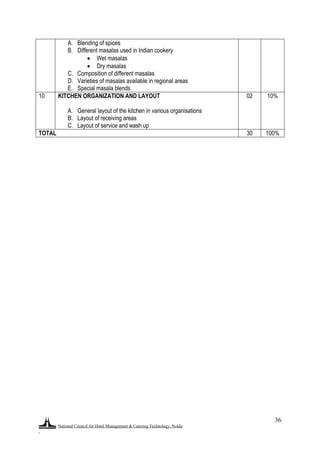
session.
5. Discuss with them, then confirm in writing, specifically what you want them to cover: exactly
how long they have to speak: and what questioning techniques will be employed – during and
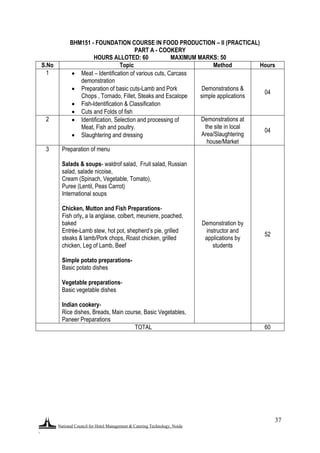
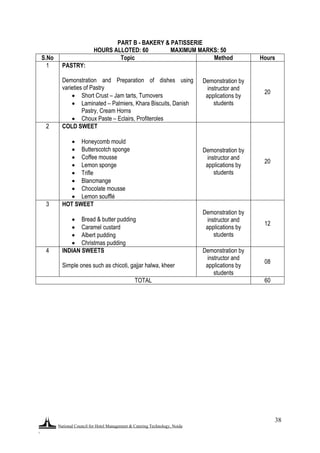
after the session.
6. Give them full information, in writing, about the starting time, the location, and the size and level
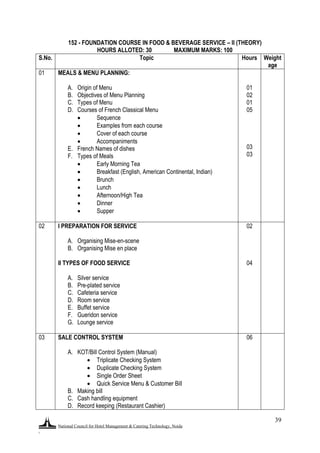
of the participants.
7. Confirm whether they will use aids and, if so, of what type(s) and how many. Do they already
have them, are they of acceptable quality: do they want any help in procuring them: do they
want to use aids available with you.
8. Confirm whether they intend to use hand-outs: do they have them available: do they want any
support in their production: when do they intent to use them.
9. Seek and confirm their views on the room layout – what type they would prefer or whether they
have to accept the existing room layout.
10. Arrange a feed-back session with the participants – as you may want to use them again.
Maintain a record of the date, duration of the session and contact details of the Guest Speakers for
future references which may be required by your institute and the NCHMCT.
*****

F&b curriculum

  • 1.
    National Council forHotel Management & Catering Technology, Noida . 1 3 – YEAR B.Sc. DEGREE IN HOSPITALITY & HOTEL ADMINISTRATION WITH SPECIALISATION (MAJORS) FOOD & BEVERAGE MANAGEMENT CURRICULUM JOINTLY OFFERED BY: NATIONAL COUNCIL FOR HOTEL MANAGEMENT AND CATERING TECHNOLOGY NOIDA (NCHM&CT) AND INDIRA GANDHI NATIONAL OPEN UNIVERSITY (IGNOU) 2009-2012 ACADEMIC SESSION
  • 2.
    National Council forHotel Management & Catering Technology, Noida . 2 TEACHING AND EXAMINATION SCHEME SIX SEMESTERS of 17 WEEKS EACH AND 14 WEEKS PRACTICUM FIRST SEMESTER No. Subject code Subject Hours per Semester Term Marks* Th. Pr. Th. Pr. 1 BHM111 Foundation Course in Food Production – I 30 120 100 100 2 BHM112 Foundation Course in Food & Beverage Service – I 30 60 100 100 3 BHM113 Foundation Course in Front Office – I 30 30 100 100 4 BHM114 Foundation Course in Accommodation Operations – I 30 30 100 100 5 BHM105 Application of Computers 15 60 50 100 6 BHM106 Hotel Engineering 60 - 100 - 7 BHM116 Nutrition 30 - 100 - TOTAL: 225 300 650 500 GRAND TOTAL 525 1150 SECOND SEMESTER No. Subject code Subject Hours per Semester Term Marks* Th. Pr. Th. Pr. 1 BHM151 Foundation Course in Food Production – II 30 120 100 100 2 BHM152 Foundation Course in Food & Beverage Service – II 30 60 100 100 3 BHM153 Foundation Course in Front Office – II 30 30 100 100 4 BHM154 Foundation Course in Accommodation Operations – II 30 30 100 100 5 BHM117 Principles of Food Science 30 - 100 - 6 BHM108 Accountancy 60 - 100 - 7 BHM109 Communication 30 - 50 - 8 TS-01 Foundation Course in Tourism 30 - IGNOU 9 -- Tutorials/Library 15 - - - TOTAL: 285 240 650 400 GRAND TOTAL 525 1050
  • 3.
    National Council forHotel Management & Catering Technology, Noida . 3 THIRD SEMESTER No. Subject code Subject Hours per Semester Term Marks* Th. Pr. Th. Pr. 1 BHM201 Food Production Operations 30 120 100 100 2 BHM202 Food & Beverage Operations 30 30 100 100 3 BHM203 Front Office Operations 30 30 100 100 4 BHM204 Accommodation Operations 30 30 100 100 5 BHM205 Food & Beverage Controls 30 - 100 - 6 BHM206 Hotel Accountancy 30 - 100 - 7 BHM207 Food Safety & Quality 30 - 50 - 8 TS-03 Management in Tourism 30 - IGNOU 9 BEGE103 Communication Skills in English 30 - IGNOU 10 TS-07 Human Resource Management 30 - IGNOU 11 BHM391 Research Methodology 15 - - - TOTAL: 315 210 650 400 GRAND TOTAL 525 1050 PRACTICUM – I Subject code Subject Duration Marks BHM392 Industrial Training – Generic 4 Weeks 20 FOURTH SEMESTER No. Subject Code Subject Hours per Semester Term Marks* Th. Pr. Th. Pr. 1 BHM273 Food & Beverage Management - I 60 120 100 200 2 BHM274 Food & Beverage Management - II 60 120 100 200 3 BHM281 Financial Management 60 - 100 - 4 BHM282 Business Ethics & Law 60 - 100 - 5 BHM283 Business Economics 30 - 50 - 6 BHM391 Research Methodology 15 - - - TOTAL 285 240 450 400 GRAND TOTAL 525 850 PRACTICUM – II Subject code Subject Duration Marks BHM392 Industrial Training – Specialised 6 Weeks 40
  • 4.
    National Council forHotel Management & Catering Technology, Noida . 4 FIFTH SEMESTER No. Subject Code Subject Hours per Semester Term Marks* Th. Pr. Th. Pr. 1 BHM323 Food & Beverage Management - III 120 60 200 100 2 BHM324 Food & Beverage Management - IV 120 60 200 100 3 BHM281 Strategic Management 60 - 100 - 4 Elective – I 60 - 100 - 5 TS-06 Tourism Marketing 30 - IGNOU 6 BHM391 Tutorial / Library / Research Project 15 - - - TOTAL 405 120 600 200 GRAND TOTAL 525 800 PRACTICUM – III Subject code Subject Duration Marks BHM392 Industrial Training – Specialised 4 Weeks 40 SIXTH SEMESTER No. Subject Code Subject Hours per Semester Term Marks* Th. Pr. Th. Pr. 1 BHM373 Food & Beverage Management - V 120 60 200 100 2 BHM374 Food & Beverage Management - VI 120 60 200 100 3 BHM391 Research Project - 60 - 100 4 Elective – II 60 - 100 - 5 BHM392 Practicum Report (Practicum I, II & III) - - - 100 6 Special topics/Guest speakers 30 - - - 7 Tutorial / Library 15 - - - TOTAL 345 180 500 400 GRAND TOTAL 525 900 *Total marks will comprise 30% Internal Assessment & 70% Term end exam marks. * * * * *
  • 5.
    National Council forHotel Management & Catering Technology, Noida . 5 SEMESTER – I WEEKLY TEACHING SCHEME No. Subject code Subject Hours per week Th. Pr. 1 BHM111 Foundation Course in Food Production – I 02 08 2 BHM112 Foundation Course in Food & Beverage Service – I 02 04 3 BHM113 Foundation Course in Front Office – I 02 02 4 BHM114 Foundation Course in Accommodation Operations – I 02 02 5 BHM105 Application of Computers 01 04 6 BHM106 Hotel Engineering 04 - 7 BHM116 Nutrition 02 - TOTAL: 15 20 GRAND TOTAL 35
  • 6.
    National Council forHotel Management & Catering Technology, Noida . 6 BHM111 – FOUNDATION COURSE IN FOOD PRODUCTION – I (THEORY) HOURS ALLOTED: 30 MAXIMUM MARKS: 100 S.No. Topic Hours Weight age 01 INTRODUCTION TO COOKERY A. Levels of skills and experiences B. Attitudes and behaviour in the kitchen C. Personal hygiene D. Uniforms & protective clothing E. Safety procedure in handling equipment 02 5% 02 CULINARY HISTORY A. Origin of modern cookery 01 Intro only 03 HIERARCHY AREA OF DEPARTMENT AND KITCHEN A. Classical Brigade B. Modern staffing in various category hotels C. Roles of executive chef D. Duties and responsibilities of various chefs E. Co-operation with other departments 03 10% 04 CULINARY TERMS A. List of culinary (common and basic) terms B. Explanation with examples 02 5% 05 AIMS & OBJECTS OF COOKING FOOD A. Aims and objectives of cooking food B. Various textures C. Various consistencies D. Techniques used in pre-preparation E. Techniques used in preparation 02 10% 06 BASIC PRINCIPLES OF FOOD PRODUCTION – I A. VEGETABLE AND FRUIT COOKERY A. Introduction – classification of vegetables B. Pigments and colour changes C. Effects of heat on vegetables D. Cuts of vegetables E. Classification of fruits F. Uses of fruit in cookery G. Salads and salad dressings ii) STOCKS A. Definition of stock B. Types of stock C. Preparation of stock D. Recipes E. Storage of stocks F. Uses of stocks 03 03 15% 5%
  • 7.
    National Council forHotel Management & Catering Technology, Noida . 7 G. Care and precautions iii) SAUCES A. Classification of sauces B. Recipes for mother sauces C. Storage & precautions 02 10% 07 METHODS OF COOKING FOOD A. Roasting B. Grilling C. Frying D. Baking E. Broiling F. Poaching G. Boiling  Principles of each of the above  Care and precautions to be taken  Selection of food for each type of cooking 04 15% 08 SOUPS A. Classification with examples B. Basic recipes of Consommé with 10 Garnishes 2 10% 09 EGG COOKERY A. Introduction to egg cookery B. Structure of an egg C. Selection of egg D. Uses of egg in cookery 2 5% 10 COMMODITIES: B. Shortenings (Fats & Oils) A. Role of Shortenings B. Varieties of Shortenings C. Advantages and Disadvantages of using various Shortenings D. Fats & Oil – Types, varieties ii) Raising Agents A. Classification of Raising Agents B. Role of Raising Agents C. Actions and Reactions iii) Thickening Agents A. Classification of thickening agents B. Role of Thickening agents iv) Sugar A. Importance of Sugar B. Types of Sugar C. Cooking of Sugar – various 4 10% TOTAL 30 100%
  • 8.
    National Council forHotel Management & Catering Technology, Noida . 8 BHM111 - FOUNDATION COURSE IN FOOD PRODUCTION – I (PRACTICALS) PART ‘A’ – COOKERY HOURS ALLOTED: 60 MAXIMUM MARKS: 50 S.No Topic Method Hours 1  i) Equipments – Identification, Description, Uses & handling  ii) Hygiene – Kitchen etiquettes, Practices & knife handling  iii) Safety and security in kitchen Demonstrations & simple applications 04 2 C. Vegetables – classification ii) Cuts – julienne, jardinière, macedoines, brunoise, payssane, mignonnete, dices, cubes, shred, mirepoix iii) Preparation of salad dressings Demonstrations & simple applications by students 04 3 Identification and Selection of Ingredients – Qualitative and quantitative measures. Market survey/tour 04 4 D. Basic Cooking methods and pre-preparations ii) Blanching of Tomatoes and Capsicum iii) Preparation of concasse iv) Boiling (potatoes, Beans, Cauliflower, etc) v) Frying – (deep frying, shallow frying, sautéing) Aubergines, Potatoes, etc. vi) Braising – Onions, Leeks, Cabbage vii) Starch cooking (Rice, Pasta, Potatoes) Demonstrations & simple applications by students 04 5 E. Stocks – Types of stocks (White and Brown stock) ii) Fish stock iii) Emergency stock iv) Fungi stock Demonstrations & simple applications by students 04 6 Sauces – Basic mother sauces  Béchamel  Espagnole  Veloute  Hollandaise  Mayonnaise  Tomato Demonstrations & simple applications 04 7 Egg cookery – Preparation of variety of egg dishes  Boiled ( Soft & Hard)  Fried ( Sunny side up, Single fried, Bull‟s Eye, Double fried)  Poaches  Scrambled  Omelette (Plain, Stuffed, Spanish)  En cocotte (eggs Benedict) Demonstrations & simple applications by students 04 8 Demonstration & Preparation of simple menu Demonstrations & simple applications by students 04 9 Simple Salads & Soups:  Cole slaw,  Potato salad, Demonstration by instructor and applications by 28
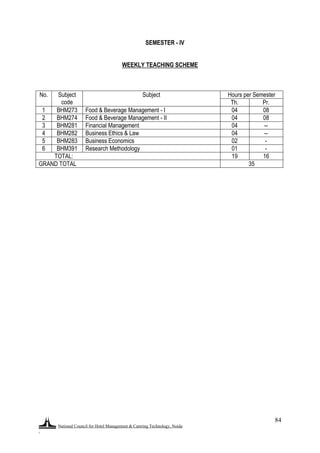
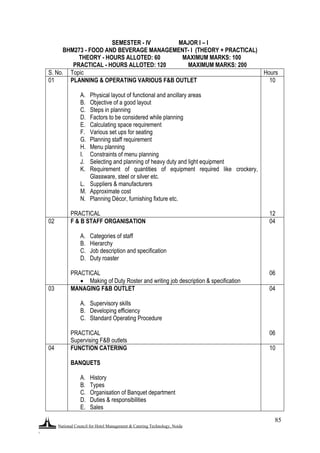
  • 9.
    National Council forHotel Management & Catering Technology, Noida . 9  Beet root salad,  Green salad,  Fruit salad,  Consommé Simple Egg preparations:  Scotch egg,  Assorted omelletes,  Oeuf Florentine  Oeuf Benedict  Oeuf Farci  Oeuf Portugese  Oeuf Deur Mayonnaise Simple potato preparations  Baked potatoes  Mashed potatoes  French fries  Roasted potatoes  Boiled potatoes  Lyonnaise potatoes  Allumettes Vegetable preparations  Boiled vegetables  Glazed vegetables  Fried vegetables  Stewed vegetables. students TOTAL 60
  • 10.
    National Council forHotel Management & Catering Technology, Noida . 10 PART ‘B’ – BAKERY & PATISSERIE HOURS ALLOTED: 60 MAXIMUM MARKS: 50 S.No Topic Method Hours 1 Equipments  Identification  Uses and handling Ingredients – Qualitative and quantitative measures Demonstration by instructor and applications by students 04 2 BREAD MAKING  Demonstration & Preparation of Simple and enriched bread recipes  Bread Loaf (White and Brown)  Bread Rolls (Various shapes)  French Bread  Brioche Demonstration by instructor and applications by students 10 3 SIMPLE CAKES  Demonstration & Preparation of Simple and enriched Cakes, recipes  Sponge, Genoise, Fatless, Swiss roll  Fruit Cake  Rich Cakes  Dundee  Madeira 10 4 SIMPLE COOKIES  Demonstration and Preparation of simple cookies like  Nan Khatai  Golden Goodies  Melting moments  Swiss tart  Tri colour biscuits  Chocolate chip  Cookies  Chocolate Cream Fingers  Bachelor Buttons. Demonstration by instructor and applications by students 16 5 HOT / COLD DESSERTS  Caramel Custard,  Bread and Butter Pudding  Queen of Pudding  Soufflé – Lemon / Pineapple  Mousse (Chocolate Coffee)  Bavaroise  Diplomat Pudding  Apricot Pudding  Steamed Pudding – Albert Pudding, Cabinet Pudding. Demonstration by instructor and applications by students 20 TOTAL 60
  • 11.
    National Council forHotel Management & Catering Technology, Noida . 11 MARKING SCHEME FOR PRACTICAL EXAMINATION MAXIMUM MARKS 100 PASS MARKS 50 DURATION 04.30 HRS Indenting and Scullery 30 minutes before and after the practical All menu items to be made from the prescribed syllabus only Part – A (Cookery) 1. One simple salad OR soup 10 2. One simple sauce 10 3. One simple egg preparation 10 4. One simple vegetable or potato preparation 05 5. Journal 05 40 Part – B (Bakery) 1. Bread or bread rolls 15 2. Simple cake or cookies 10 3. One dessert hot or cold 10 4. Journal 05 40 Part – C (General Assessment) 1. Uniform & Grooming 05 2. Indenting and plan of work 05 3. Scullery, equipment cleaning and Hygiene 05 4. Viva 05 20 PARAMETERS OF ASSESMENT OF EACH DISH A) Temperature 20% B) Texture / Consistency 20% C) Aroma / Flavour 20% D) Taste 20% E) Presentation 20% 100% NOTE: 1. Journal is not allowed during indenting or practical. It must be handed over to the examiner before commencement of examination. 2. Invigilation will be done by both internal and external persons. 3. Extra ingredients may be made available in case of failure but of limited types and quantity (groceries and dairy products only). Only one extra attempt may be permitted. 4. Uniform and grooming must be checked by the examiners before commencement of examination. 5. Students are not allowed to take help from books, notes, journal or any other person.
  • 12.
    National Council forHotel Management & Catering Technology, Noida . 12 BHM112 – FOUNDATION COURSE IN FOOD & BEVERAGE SERVICE – I (THEORY) HOURS ALLOTED: 30 MAXIMUM MARKS: 100 S.No. Topic Hours Weight age 01 THE HOTEL & CATERING INDUSTRY A. Introduction to the Hotel Industry and Growth of the hotel Industry in India B. Role of Catering establishment in the travel/tourism industry C. Types of F&B operations D. Classification of Commercial, Residential/Non-residential E. Welfare Catering – Industrial/Institutional/Transport such as air, road, rail, sea, etc. F. Structure of the catering industry – a brief description of each 06 20% 02 DEPARTMENTAL ORGANISATION & STAFFING A. Organisation of F&B department of hotel B. Principal staff of various types of F&B operations C. French terms related to F&B staff D. Duties & responsibilities of F&B staff E. Attributes of a waiter F. Inter-departmental relationships (Within F&B and other department) 04 15% 03 I FOOD SERVICE AREAS (F & B OUTLETS) A. Specialty Restaurants B. Coffee Shop C. Cafeteria D. Fast Food (Quick Service Restaurants) E. Grill Room F. Banquets G. Bar H. Vending Machines I. Discotheque II ANCILLIARY DEPARTMENTS A. Pantry B. Food pick-up area C. Store D. Linen room E. Kitchen stewarding 06 04 20% 10% 04 F & B SERVICE EQUIPMENT Familiarization & Selection factors of: - Cutlery - Crockery - Glassware - Flatware - Hollowware 04 15%
  • 13.
    National Council forHotel Management & Catering Technology, Noida . 13 - All other equipment used in F&B Service  French terms related to the above 01 05 NON-ALCOHOLIC BEVERAGES Classification (Nourishing, Stimulating and Refreshing beverages) A. Tea - Origin & Manufacture - Types & Brands B. Coffee - Origin & Manufacture - Types & Brands C. Juices and Soft Drinks D. Cocoa & Malted Beverages - Origin & Manufacture 01 01 01 01 01 20% TOTAL 30 100%
  • 14.
    National Council forHotel Management & Catering Technology, Noida . 14 BHM112 - FOUNDATION COURSE IN FOOD & BEVERAGE SERVICE – I (PRACTICAL) HOURS ALLOTED: 60 MAXIMUM MARKS: 100 S.No Topic Hours 01 Food Service areas – Induction & Profile of the areas 04 02 Ancillary F&B Service areas – Induction & Profile of the areas 04 03 Familiarization of F&B Service equipment 08 04 Care & Maintenance of F&B Service equipment 04 05 Cleaning / polishing of EPNS items by: - Plate Powder method - Polivit method - Silver Dip method - Burnishing Machine 04 06 Basic Technical Skills Task-01: Holding Service Spoon & Fork Task-02: Carrying a Tray / Salver Task-03: Laying a Table Cloth Task-04: Changing a Table Cloth during service Task-05: Placing meal plates & Clearing soiled plates Task-06: Stocking Sideboard Task-07: Service of Water Task-08: Using Service Plate & Crumbing Down Task-09: Napkin Folds Task-10: Changing dirty ashtray Task-11: Cleaning & polishing glassware 16 07 Tea – Preparation & Service 04 08 Coffee - Preparation & Service 04 09 Juices & Soft Drinks - Prepa–ation & Service  Mocktails  Juices, Soft drinks, Mine–al water, Tonic water 08 10 Cocoa & Malted Beverages – Preparation & Service 04 TOTAL 60
  • 15.
    National Council forHotel Management & Catering Technology, Noida . 15 MARKING SCHEME FOR PRACTICAL EXAMINATION MAXIMUM MARKS 100 PASS MARKS 50 DURATION 03.00HRS All Technical Skills to be tested as listed in the syllabus MARKS 1. Uniform / Grooming : 10 2. Service Equipment Knowledge / Identification : 20 3. Care Cleaning & Polishing of service equipment : 20 4. Service skills / tasks : 20 5. Beverage service Tea / Coffee / Soft drinks : 20 6. Journal : 10 100 NOTE: 1. The examination should test skills and knowledge of the students by assigning sets of tasks as listed in the practical syllabus under each category. 2. During table service each guest should pose one question to the candidate on the item being served. The invigilators can brief guests prior to service.
  • 16.
    National Council forHotel Management & Catering Technology, Noida . 16 BHM113 - FOUNDATION COURSE IN FRONT OFFICE OPERATIONS – I (THEORY) HOURS ALLOTED: 30 MAXIMUM MARKS: 100 S.No. Topic Hours Weight age 01 INTRODUCTION TO TOURISM, HOSPITALITY & HOTEL INDUSTRY A. Tourism and its importance B. Hospitality and its origin C. Hotels, their evolution and growth D. Brief introduction to hotel core areas with special reference to Front Office 03 10% 02 CLASSIFICATION OF HOTELS A. Size B. Star C. Location & clientele D. Ownership basis E. Independent hotels F. Management contracted hotel G. Chains H. Franchise/Affiliated I. Supplementary accommodation J. Time shares and condominium 05 15% 03 TYPES OF ROOMS A. Single B. Double C. Twin D. Suits 02 5% 04 TIME SHARE & VACATION OWNERSHIP A. What is time share? Referral chains & condominiums B. How is it different from hotel business? C. Classification of timeshares D. Types of accommodation and their size 03 10% 05 FRONT OFFICE ORGANIZATION A. Function areas B. Front office hierarchy C. Duties and responsibilities D. Personality traits 05 20% 06 HOTEL ENTRANCE, LOBBY AND FRONT OFFICE A. Layout B. Front office equipment (non automated, semi automated and automated) 03 10% 07 BELL DESK A. Functions B. Procedures and records 04 20%
  • 17.
    National Council forHotel Management & Catering Technology, Noida . 17 08 FRENCH: To be taught by a professional French language teacher. A. Understanding and uses of accents, orthographic signs & punctuation B. Knowledge of cardinaux & ordinaux (Ordinal & cardinal) C. Days, Dates, Time, Months and Seasons 05 10% TOTAL 30 100
  • 18.
    National Council forHotel Management & Catering Technology, Noida . 18 BHM113 - FOUNDATION COURSE IN FRONT OFFICE OPERATIONS – I (PRACTICALS) HOURS ALLOTED: 30 MAXIMUM MARKS: 100 S.No. Topic Hours 1 Appraisal of front office equipment and furniture 2 2 Rack, Front desk counter & bell desk 2 3 Filling up of various proforma 4 4 Welcoming of guest 2 5 Telephone handling 4 6 Role play:  Reservation  Arrivals  Luggage handling  Message and mail handling  Paging 4 4 2 4 2 TOTAL 30 MARKING SCHEME FOR PRACTICAL EXAMINATION MAXIMUM MARKS 100 PASS MARKS 50 DURATION 03.00 HRS MARKS 1. UNIFORM & GROOMING : 10 2. COURTESY & MANNERS : 10 3. SPEECH AND COMMUNICATION : 10 4. TECHNICAL KNOWLEDGE : 20 5. PRACTICAL SITUATION HANDLING : 40 6. JOURNAL : 10 100 NOTE: 1. Speech, Communication, Courtesy and Manners should be observed throughout. 2. 200 technical questions to be prepared in advance, covering the entire syllabus. 3. Practical situations – at least 25 situations be made representing all aspects of the syllabus.
  • 19.
    National Council forHotel Management & Catering Technology, Noida . 19 BHM114 - FOUNDATION COURSE IN ACCOMMODATION OPERATIONS – I (THEORY) HOURS ALLOTED: 30 MAXIMUM MARKS: 100 S.No. Topic Hours Weight age 01 THE ROLE OF HOUSEKEEPING IN HOSPITALITY OPERATION Role of Housekeeping in Guest Satisfaction and Repeat Business 02 5% 02 ORGANISATION CHART OF THE HOUSEKEEPING DEPARTMENT A. Hierarchy in small, medium, large and chain hotels B. Identifying Housekeeping Responsibilities C. Personality Traits of housekeeping Management Personnel. D. Duties and Responsibilities of Housekeeping staff E. Layout of the Housekeeping Department 08 25% 03 CLEANING ORGANISATION A. Principles of cleaning, hygiene and safety factors in cleaning B. Methods of organising cleaning C. Frequency of cleaning daily, periodic, special D. Design features that simplify cleaning E. Use and care of Equipment 04 15% 04 CLEANING AGENTS A. General Criteria for selection B. Classification C. Polishes D. Floor seats E. Use, care and Storage F. Distribution and Controls G. Use of Eco-friendly products in Housekeeping 05 20% 05 COMPOSTION, CARE AND CLEANING OF DIFFERENT SURFACES A. Metals B. Glass C. Leather, Leatherites, Rexines D. Plastic E. Ceramics F. Wood G. Wall finishes H. Floor finishes 05 15% 06 INTER DEPARTMENTAL RELATIONSHIP A. With Front Office B. With Maintenance C. With Security D. With Stores E. With Accounts F. With Personnel G. Use of Computers in House Keeping department 02 10% 07 USE OF COMPUTERS IN HOUSE KEEPING DEPARTMENT 04 10 TOTAL 30 100%
  • 20.
    National Council forHotel Management & Catering Technology, Noida . 20 BHM114 - FOUNDATION COURSE IN ACCOMMODATION OPERATIONS – I (PRACTICAL) HOURS ALLOTED: 30 MAXIMUM MARKS: 100 S.No. Topic Hours 01 Sample Layout of Guest Rooms  Single room  Double room  Twin room  Suite 02 02 Guest Room Supplies and Position  Standard room  Suite  VIP room special amenities 04 03 Cleaning Equipment-(manual and mechanical)  Familiarization  Different parts  Function  Care and maintenance 04 04 Cleaning Agent  Familiarization according to classification  Function 02 05 Public Area Cleaning (Cleaning Different Surface) A. WOOD  polished  painted  Laminated B. SILVER/ EPNS  Plate powder method  Polivit method  Proprietary solution (Silvo) C. BRASS  Traditional/ domestic 1 Method  Proprietary solution 1 (brasso) D. GLASS  Glass cleanser  Economical method(newspaper) E. FLOOR - Cleaning and polishing of different types  Wooden  Marble  –errazzo/ mosaic etc. F. WALL - care and maintenance of different types and parts  Skirtin–  Dado  Different types of paints(distemper Emulsion, oil paint etc) 14
  • 21.
    National Council forHotel Management & Catering Technology, Noida . 21 06 Maid‟s trolley  Contents  Trolley setup 02 07 Familiarizing with different types of Rooms, facilities and surfaces  Twin/ double  Suite  Conference etc 02 TOTAL 30 MARKING SCHEME FOR PRACTICAL EXAMINATION MAXIMUM MARKS 100 PASS MARKS 50 DURATION 03.00HRS MARKS 1. UNIFORM & GROOMING : 10 2. GUEST ROOM SUPPLIES & POSITION : 10 3. SURFACE CLEANING (TWO DIFFERENT SURFACES) : 30 4. MAIDS TROLLY : 10 5. CARE & CLEANING OF EQUIPMENT : 10 6. VIVA : 20 7. JOURNAL : 10 100 NOTE: 1. Time limit of the examination should be strictly adhered to. 2. Tasks should be limited to the syllabus
  • 22.
    National Council forHotel Management & Catering Technology, Noida . 22 BHM105 - APPLICATION OF COMPUTERS – THEORY HOURS ALLOTED: 15 – MAXIMUM MARKS: 50 S.No. Topic Hours Weight age 01 COMPUTER FUNDAMENTALS - THEORY INFORMATION CONCEPTS AND PROCESSING A. Definitions B. –eed, Quality and Value of Information C. Data Processing Concepts ELEMENTS OF A COMPUTER SYSTEM A. Definitions B. Characteristics of Computers C. Classification of Computers D. Limitations HARDWARE FEATURES AND USES A. Components of a Computer B. Generations of Computers C. Primary and Secondary Storage Concepts D. Data Entry Devices E. Data Output Devices SOFTWARE CONCEPTS A. System Software B. Application Software C. Language Classification D. D. Compilers and Interpreters 05 05% 10% 10% 10% 02 OPERATING SYSTEMS/ENVIRONMENTS - THEORY BASICS OF MS-DOS A. Internal commands B. External comma–ds INTRODUCTION TO WINDOWS A. GUI/Features B. What are Windows and Windows 95 and above? C. Parts of a Typical Window and their Functions 05 20% 15% 03 NETWORKS – THEORY A. Network Topology  Bus  Star  Ring B. Network Applications 05 35%
  • 23.
    National Council forHotel Management & Catering Technology, Noida . 23 C. Types of Network  LAN  MAN  WAN D. Network Configuration Hardware  Server  Nodes E. Channel  Fibre optic  Twisted  Co-axial F. Hubs G. Network Interface Card  Arcnet  Ethernet H. Network Software  Novel  Windows NT TOTAL 15 100%
  • 24.
    National Council forHotel Management & Catering Technology, Noida . 24 BHM105 - APPLICATION OF COMPUTERS – PRACTICAL HOURS ALLOTED: 60 MAXIMUM MARKS: 100 S.No. Topic Hours Weight age 01 WINDOWS OPERATIONS A. Creating Folders B. Creating Shortcuts C. Copying Files/Folders D. Renaming Files/Folders E. Deleting Files F. Exploring Windows G. Quick Menus 05 15% F. 02 MS-OFFICE 2007 MS WORD DOCUMENT A. Entering Text B. Saving the Document C. Editing a Document already saved to Disk D. Getting around the Document E. Find and Replace Operations F. Printing the Document FORMATTING A DOCUMENT A. Justifying Paragraphs B. Changing Paragraph Indents C. Setting Tabs and Margins D. Formatting Pages and Documents E. Using Bullets and Numbering F. Headers/Footers G. .Pagination SPECIAL EFFECTS A. Print Special Effects e.g. Bold, Underline, Superscripts, Subscript B. Changing Fonts C. .Changing Case CUT, COPY AND PASTE OPERATION A. Marking Blocks B. Copying and Pasting a Block C. Cutting and Pasting a Block D. Deleting a Block E. Formatting a Block F. Using Find and Replace in a Block USING MS-WORD TOOLS A. Spelling and Grammar B. Mail Merge C. .Printing Envelops and Labels 15 25%
  • 25.
    National Council forHotel Management & Catering Technology, Noida . 25 TABLES A. Create B. Delete C. Format GRAPHICS A. Inserting Clip arts B. Symbols (Border/Shading) C. Word Art PRINT OPTIONS A. Previewing the Document B. Printing a whole Document C. Printing a Specific Page D. Printing a selected set E. Printing Several Documents F. Printing More than one Copies 03 MS OFFICE 2007 MS-EXCEL A. How to use Excel B. Starting Excel C. Parts of the Excel Screen D. Parts of the Worksheet E. Navigating in a Worksheet F. Getting to know mouse pointer shapes CREATING A SPREADSHEET A. Starting a new worksheet B. Entering the three different types of data in a worksheet C. Creating simple formulas D. Formatting data for decimal points E. Editing data in a worksheet F. Using AutoFill G. Blocking data H. Saving a worksheet I. Exiting excel MAKING THE WORKSHEET LOOK PRETTY A. Selecting cells to format B. Trimming tables with Auto Format C. Formatting cells for: - Currency - Comma - Percent - Decimal - Date D. Changing columns width and row height E. Aligning text - Top to bottom 15 25%
  • 26.
    National Council forHotel Management & Catering Technology, Noida . 26 - Text wrap - Re ordering Orientation F Using Borders GOING THROUGH CHANGES A. Opening workbook files for editing B. Undoing the mistakes C. Moving and copying with drag and drop D. Copying formulas E. Moving and Copying with Cut, Copy and Paste F. Deleting cell entries G. Deleting columns and rows from worksheet H. Inserting columns and rows in a worksheet I. Spell checking the worksheet PRINTING THE WORKSHEET A. Previewing pages before printing B. Printing from the Standard toolbar C. Printing a part of a worksheet D. Changing the orientation of the printing E. Printing the whole worksheet in a single pages F. Adding a header and footer to a report G. Inserting page breaks in a report H. Printing the formulas in the worksheet ADDITIONAL FEATURES OF A WORKSHEET A. Splitting worksheet window into two four panes B. Freezing columns and rows on-screen for worksheet title C. Attaching comments to cells D. Finding and replacing data in the worksheet E. Protecting a worksheet F. Function commands MAINTAINING MULTIPLE WORKSHEET A. Moving from sheet in a worksheet B. Adding more sheets to a workbook C. Deleting sheets from a workbook D. Naming sheet tabs other than sheet 1, sheet 2 and so on E. Copying or moving sheets from one worksheet to another CREATING GRAPHICS/CHARTS A. Using Chart wizard B. Changing the Chart with the Chart Toolbar C. Formatting the chart‟s axes D. Adding a text box to a chart E. Changing the orientation of a 3-D chart F. Using drawing tools to add graphics to chart and
  • 27.
    National Council forHotel Management & Catering Technology, Noida . 27 worksheet G. Printing a chart with printing the rest of the worksheet data EXCEL‟s DATABASE FACILITIES A. Setting up a database B. Sorting records in the database 04 MS OFFICE 2007 MS-POWER POINT A. Making a simple presentation B. Using Auto content Wizards and Templates C. Power Points five views D. Slides - Creating Slides, re-arranging, modifying - Inserting pictures, objects - Setting up a Slide Show E Creating an Organizational Chart 20 25% 05 Internet & E-mail – PRACTICAL 05 10% TOTAL 60 100% MARKING SCHEME FOR PRACTICAL EXAMINATION MAXIMUM MARKS 100 PASS MARKS 50 MARKS 1. VIVA : 20 2. Typing & Printing (20 lines) : 20 3. 6 tasks of 10 marks each : 60 100 (Refer syllabus for tasks)
  • 28.
    National Council forHotel Management & Catering Technology, Noida . 28 BHM106 - HOTEL ENGINEERING HOURS ALLOTED: 60 MAXIMUM–MARKS: 100 S.No. Topic Hours Weight age 01 MAINTENANCE: A. Preventive and breakdown maintenance, comparisons B. Roll & Importance of maintenance department in the hotel industry with emphasis on its relation with other departments of the hotel. C. Organization chart of maintenance department, duties and responsibilities of maintenance department 03 5% 02. Fuels used in catering industry: A. Types of fuel used in catering industry; calorific value; comparative study of different fuels B. Calculation of amount of fuel required and cost. 04 5% 03 Gas: A. Heat terms and units; method of transfer B. LPG and its properties; principles of Bunsen and burner, precautions to be taken while handling gas; low and high-pressure burners, corresponding heat output. C. Gas bank, location, different types of manifolds 04 5% 04 Electricity: A. Fundamentals of electricity, insulators, conductors, current, potential difference resistance, power, energy concepts; definitions, their units and relationships, AC and DC; single phase and three phase and its importance on equipment specifications B. Electric circuits, open circuits and close circuits, symbols of circuit elements, series and parallel connections, short circuit, fuses; MCB, earthing, reason for placing switches on live wire side. C. Electric wires and types of wiring D. Calculation of electric energy consumption of equipment, safety precaution to be observed while using electric appliances. E. Types of lighting, different lighting devices, incandescent lamps, fluorescent lamps, other gas discharged lamps, illumination, and units of illumination. F. External lighting G. Safety in handling electrical equipment. 06 10% 05. Water systems: G. Water distribution system in a hotel H. Cold water systems in India I. Hardness of water, water softening, base exchange method (Demonstration) J. Cold water cistern swimming pools K. Hot water supply system in hotels L. Flushing system, water taps, traps and closets. 04 5%
  • 29.
    National Council forHotel Management & Catering Technology, Noida . 29 06 Refrigeration & Air-conditioning: A. Basic principles, latent heat, boiling point and its dependence on pressure, vapour compressor system of refrigeration and refrigerants B. Vapour absorption system, care and maintenance of refrigerators, defrosting, types of refrigerant units, their care and maintenance. (Demonstration) C. Conditions for comfort, relative humidity, humidification, de- humidifying, due point control, unit of air conditioning D. Window type air conditioner, central air conditioning, preventive maintenance E. Vertical transportation, elevators, escalators. 10 15% 07 Fire prevention and fire fighting system: A. Classes of fire, methods of extinguishing fires (Demonstration) B. Fire extinguishes, portable and stationery C. Fire detectors and alarm D. Automatic fire detectors cum extinguishing devices E. Structural protection F. Legal requirements 04 10% 08 Waste disposal and pollution control: A. Solid and liquid waste, sullage and sewage, disposal of solid waste B. Sewage treatment C. Pollution related to hotel industry D. Water pollution, sewage pollution E. Air pollution, noise pollution, thermal pollution F. Legal Requirements 05 10% 09 Safety: A. Accident prevention B. Slips and falls C. Other safety topics 01 5% 10. Security 01 10% 11. Equipment replacement policy: A. Circumstances under which equipment are replaced. B. Replacement policy of items which gradually deteriorates C. Replacement when the average annual cost is minimum D. Replacement when the present cost is minimum E. Economic replacement cycle for suddenly failing equipment 05 5% 12. Audio visual equipments: A. Various audio visual equipment used in hotel B. Care and cleaning of overhead projector, slide projector, LCD and power point presentation units C. Maintenance of computers: D. Care and cleaning of PC, CPU, Modem, UPS, Printer, Laptops E. Sensors – Various sensors used in different locations of a hotel – type, uses and cost effectiveness 08 10%
  • 30.
    National Council forHotel Management & Catering Technology, Noida . 30 13. Contract maintenance: A. Necessity of contract maintenance, advantages and disadvantages of contract maintenance B. Essential requirements of a contract, types of contract, their comparative advantages and disadvantages. C. Procedure for inviting and processing tenders, negotiating and finalizing 03 5% TOTAL 60 100%
  • 31.
    National Council forHotel Management & Catering Technology, Noida . 31 BHM116 - NUTRITION HOURS ALLOTED: 30 MAXIMUM MARKS: 100 S.No. Topic Hours Weight age 01 BASIC ASPECTS A. Definition of the terms Health, Nutrition and Nutrients B. Importance of Food – (Physiological, Psychological and Social function of food) in maintaining good health. C. Classification of nutrients 01 5% 02 ENERGY A. Definition of Energy and Units of its measurement (Kcal) B. Energy contribution from macronutrients (Carbohydrates, Proteins and Fat) C. Factors affecting energy requirements D. Concept of BMR, SDA, Thermodynamic action of food E. Dietary sources of energy F. Concept of energy balance and the health hazards associated with Underweight, Overweight 03 10% 03 MACRO NUTRIENTS Carbohydrates  Definition  Classification ( mono, di and polysaccharides)  Dieteary Sources  Functions  Significance of dietary fibre (Prevention/treatment of diseases) Lipids  Definition  Classification : Saturated and unsaturated fats  Dietary Sources  Functions  Significance of Fatty acids (PUFAs, MUFAs, SFAs, EFA) in maintaining health  Cholesterol – Dietary sources and the Concept of dietary and blood cholesterol Proteins  Definition  Classification based upon amino acid composition  Dietary sources  Functions  Methods of improving quality of protein in food (special emphasis on Soya proteins and whey proteins) 04 04 04 10% 10% 10%
  • 32.
    National Council forHotel Management & Catering Technology, Noida . 32 04 MACRO NUTRIENTS A. Vitamins  Definition and Classification (water and fats soluble vitamins)  Food Sources, function and significance of: 1. Fat soluble vitamins (Vitamin A, D, E, K) 2. Water soluble vitamins (Vitamin C, Thiamine, Riboflavin, Niacin, Cyanocobalamin Folic acid B. MINERALS  Definition and Classification (major and minor)  Food Sources, functions and significance of : Calcium, Iron, Sodium, Iodine & Flourine 05 03 15% 10% 05 WATER  Definition  Dietary Sources (visible, invisible)  Functions of water  Role of water in maintaining health (water balance) 01 5% 06 BALANCED DIET  Definition  Importance of balanced diet  RDA for various nutrients – age, gender, physiological state 01 5% 07 MENU PLANNING  Planning of nutritionally balanced meals based upon the three food group system  Factors affecting meal planning  Critical evaluation of few meals served at the Institutes/Hotels based on the principle of meal planning.  Calculation of nutritive value of dishes/meals. 02 10% 08 MASS FOOD PRODUCTION  Effect of cooking on nutritive value of food (QFP) 01 5% 09 NEWER TRENDS IN FOOD SERVICE INDUSTRY IN RELEVANCE TO NUTRITION AND HEALTH  Need for introducing nutritionally balanced and health specific meals  Critical evaluation of fast foods  New products being launched in the market (nutritional evaluation) 01 5% TOTAL 30 100%
  • 33.
    National Council forHotel Management & Catering Technology, Noida . 33 SEMESTER – II WEEKLY TEACHING SCHEME No. Subject code Subject Hours per week Th. Pr. 1 BHM151 Foundation Course in Food Production - II 02 08 2 BHM152 Foundation Course in Food & Beverage Service - II 02 04 3 BHM153 Foundation Course in Front Office - II 02 02 4 BHM154 Foundation Course in Accommodation Operations - II 02 02 5 BHM117 Principles of Food Science 02 - 6 BHM108 Accountancy 04 - 7 BHM109 Communication 02 - 8 TS-01 Foundation Course in Tourism 02 - 9 - Tutorial/Library 01 - TOTAL: 19 16 GRAND TOTAL 35
  • 34.
    National Council forHotel Management & Catering Technology, Noida . 34 BHM151 - FOUNDATION COURSE IN FOOD PRODUCTION – II (THEORY) HOURS ALLOTED: 30 MAXIMUM MARKS: 100 S.No. Topic Hours Weight age 01 SOUPS C. Basic recipes other than consommé with menu examples a. Broths b. Bouillon c. Puree d. Cream e. Veloute f. Chowder g. Bisque etc D. Garnishes and accompaniments E. International soups 02 10% 02 SAUCES & GRAVIES D. Difference between sauce and gravy E. Derivatives of mother sauces F. Contemporary & Proprietary 03 10% 03 MEAT COOKERY A. Introduction to meat cookery B. Cuts of beef/veal C. Cuts of lamb/mutton D. Cuts of pork E. Variety meats (offals) F. Poultry (With menu examples of each) 04 15% 04 FISH COOKERY A. Introduction to fish cookery B. Classification of fish with examples C. Cuts of fish with menu examples D. Selection of fish and shell fish E. Cooking of fish (effects of heat) 03 10% 05 RICE, CEREALS & PULSES A. Introduction B. Classification and identification C. Cooking of rice, cereals and pulses D. Varieties of rice and other cereals 01 5% 06 i) PASTRY A. Short crust B. Laminated C. Choux D. Hot water/Rough puff  Recipes and methods of preparation  Differences  Uses of each pastry  Care to be taken while preparing pastry  Role of each ingredient  Temperature of baking pastry ii) Flour 02 03 5% 10%
  • 35.
    National Council forHotel Management & Catering Technology, Noida . 35 A. Structure of wheat B. Types of Wheat C. Types of Flour D. Processing of Wheat – Flour E. Uses of Flour in Food Production F. Cooking of Flour (Starch) iii) SIMPLE BREADS A. Principles of bread making B. Simple yeast breads C. Role of each ingredient in break making D. Baking temperature and its importance 07 PASTRY CREAMS A. Basic pastry creams B. Uses in confectionery C. Preparation and care in production 02 5% 08 BASIC COMMODITIES: i) Milk A. Introduction B. Processing of Milk C. Pasteurisation – Homogenisation D. Types of Milk – Skimmed and Condensed E. Nutritive Value ii) Cream A. Introduction B. Processing of Cream C. Types of Cream iii) Cheese A. Introduction B. Processing of Cheese C. Types of Cheese D. Classification of Cheese E. Curing of Cheese F. Uses of Cheese iv) Butter A. Introduction B. Processing of Butter C. Types of Butter 02 01 02 01 15% 09 BASIC INDIAN COOKERY i) CONDIMENTS & SPICES A. Introduction to Indian food B. Spices used in Indian cookery C. Role of spices in Indian cookery D. Indian equivalent of spices (names) ii) MASALAS 02 5%
  • 36.
    National Council forHotel Management & Catering Technology, Noida . 36 A. Blending of spices B. Different masalas used in Indian cookery  Wet masalas  Dry masalas C. Composition of different masalas D. Varieties of masalas available in regional areas E. Special masala blends 10 KITCHEN ORGANIZATION AND LAYOUT A. General layout of the kitchen in various organisations B. Layout of receiving areas C. Layout of service and wash up 02 10% TOTAL 30 100%
  • 37.
    National Council forHotel Management & Catering Technology, Noida . 37 BHM151 - FOUNDATION COURSE IN FOOD PRODUCTION – II (PRACTICAL) PART A - COOKERY HOURS ALLOTED: 60 MAXIMUM MARKS: 50 S.No Topic Method Hours 1  Meat – Identification of various cuts, Carcass demonstration  Preparation of basic cuts-Lamb and Pork Chops , Tornado, Fillet, Steaks and Escalope  Fish-Identification & Classification  Cuts and Folds of fish Demonstrations & simple applications 04 2  Identification, Selection and processing of Meat, Fish and poultry.  Slaughtering and dressing Demonstrations at the site in local Area/Slaughtering house/Market 04 3 Preparation of menu Salads & soups- waldrof salad, Fruit salad, Russian salad, salade nicoise, Cream (Spinach, Vegetable, Tomato), Puree (Lentil, Peas Carrot) International soups Chicken, Mutton and Fish Preparations- Fish orly, a la anglaise, colbert, meuniere, poached, baked Entrée-Lamb stew, hot pot, shepherd‟s pie, grilled steaks & lamb/Pork chops, Roast chicken, grilled chicken, Leg of Lamb, Beef Simple potato preparations- Basic potato dishes Vegetable preparations- Basic vegetable dishes Indian cookery- Rice dishes, Breads, Main course, Basic Vegetables, Paneer Preparations Demonstration by instructor and applications by students 52 TOTAL 60
  • 38.
    National Council forHotel Management & Catering Technology, Noida . 38 PART B - BAKERY & PATISSERIE HOURS ALLOTED: 60 MAXIMUM MARKS: 50 S.No Topic Method Hours 1 PASTRY: Demonstration and Preparation of dishes using varieties of Pastry  Short Crust – Jam tarts, Turnovers  Laminated – Palmiers, Khara Biscuits, Danish Pastry, Cream Horns  Choux Paste – Eclairs, Profiteroles Demonstration by instructor and applications by students 20 2 COLD SWEET  Honeycomb mould  Butterscotch sponge  Coffee mousse  Lemon sponge  Trifle  Blancmange  Chocolate mousse  Lemon soufflé Demonstration by instructor and applications by students 20 3 HOT SWEET  Bread & butter pudding  Caramel custard  Albert pudding  Christmas pudding Demonstration by instructor and applications by students 12 4 INDIAN SWEETS Simple ones such as chicoti, gajjar halwa, kheer Demonstration by instructor and applications by students 08 TOTAL 60
  • 39.
    National Council forHotel Management & Catering Technology, Noida . 39 152 - FOUNDATION COURSE IN FOOD & BEVERAGE SERVICE – II (THEORY) HOURS ALLOTED: 30 MAXIMUM MARKS: 100 S.No. Topic Hours Weight age 01 MEALS & MENU PLANNING: A. Origin of Menu B. Objectives of Menu Planning C. Types of Menu D. Courses of French Classical Menu  Sequence  Examples from each course  Cover of each course  Accompaniments E. French Names of dishes F. Types of Meals  Early Morning Tea  Breakfast (English, American Continental, Indian)  Brunch  Lunch  Afternoon/High Tea  Dinner  Supper 01 02 01 05 03 03 02 I PREPARATION FOR SERVICE A. Organising Mise-en-scene B. Organising Mise en place II TYPES OF FOOD SERVICE A. Silver service B. Pre-plated service C. Cafeteria service D. Room service E. Buffet service F. Gueridon service G. Lounge service 02 04 03 SALE CONTROL SYSTEM A. KOT/Bill Control System (Manual)  Triplicate Checking System  Duplicate Checking System  Single Order Sheet  Quick Service Menu & Customer Bill B. Making bill C. Cash handling equipment D. Record keeping (Restaurant Cashier) 06
  • 40.
    National Council forHotel Management & Catering Technology, Noida . 40 04 TOBACCO A. History B. Processing for cigarettes, pipe tobacco & cigars C. Cigarettes – Types and Brand names D. Pipe Tobacco – Types and Brand names E. Cigars – shapes, sizes, colours and Brand names F. Care and Storage of cigarettes & cigars 03 TOTAL 30 100%
  • 41.
    National Council forHotel Management & Catering Technology, Noida . 41 BHM152 - FOUNDATION COURSE IN FOOD & BEVERAGE SERVICE – II (PRACTICAL) HOURS ALLOTED: 60 MAXIMUM MARKS: 100 S.No Topic Hours 01 REVIEW OF SEMESTER -1 04 02 TABLE LAY-UP & SERVICE Task-01: A La Carte Cover Task-02: Table d‟ Hote Cover Task-03: English Breakfast Cover Task-04: American Breakfast Cover Task-05: Continental Breakfast Cover Task-06: Indian Breakfast Cover Task-07: Afternoon Tea Cover Task-08: High Tea Cover TRAY/TROLLEY SET-UP & SERVICE Task-01: Room Service Tray Setup Task-02: Room Service Trolley Setup 16 03 PREPARATION FOR SERVICE (RESTAURANT) A. Organizing Mise-en-scene B. Organizing Mise-en-Place C. Opening, Operating & Closing duties 04 04 PROCEDURE FOR SERVICE OF A MEAL Task-01: Taking Guest Reservations Task-02: Receiving & Seating of Guests Task-03: Order taking & Recording Task-04: Order processing (passing orders to the kitchen) Task-05: Sequence of service Task-06: Presentation & Encashing the Bill Task-07: Presenting & collecting Guest comment cards Task-08: Seeing off the Guests 08 05 Social Skills Task-01: Handling Guest Complaints Task-02: Telephone manners Task-03: Dining & Service etiquettes 04 06 Special Food Service - (Cover, Accompaniments & Service) Task-01: Classical Hors d‟ oeuvre 12  Oysters  Caviar  Smoked Salmon  Pate de Foie Gras  Snails  Melon  Grapefruit  Asparagus Task-02: Cheese Task-03: Dessert (Fresh Fruit & Nuts)
  • 42.
    National Council forHotel Management & Catering Technology, Noida . 42 Service of Tobacco  Cigarettes & Cigars 07 Restaurant French: To be taught by a professional French language teacher.  Restaurant Vocabulary (English & French)  French Classical Menu Planning  French for Receiving, Greeting & Seating Guests  French related to taking order & description of dishes 12 TOTAL 60
  • 43.
    National Council forHotel Management & Catering Technology, Noida . 43 BHM153 - FOUNDATION COURSE IN FRONT OFFICE OPERATIONS – II (THEORY) HOURS ALLOTED: 30 MAXIMUM MARKS: 100 S.No. Topic Hours Weight age 01 TARIFF STRUCTURE A. Basis of charging B. Plans, competition, customer‟s profile, standards of service & amenities C. Hubbart formula D. Different types of tariffs  Rack Rate  Discounted Rates for Corporates, Airlines, Groups & Travel Agents 04 10% 02 FRONT OFFICE AND GUEST HANDLING  Introduction to guest cycle  Pre arrival  Arrival  During guest stay  Departure  After departure 04 10% 03 RESERVATIONS A. Importance of reservation B. Modes of reservation C. Channels and sources (FITs, Travel Agents, Airlines, GITs) D. Types of reservations (Tentative, confirmed, guaranteed etc.) E. Systems (non automatic, semi automatic fully automatic) F. Cancellation G. Amendments H. Overbooking 07 25% 04 ROOM SELLING TECHNIQUES A. Up selling B. Discounts 02 05% 05 ARRIVALS A. Preparing for guest arrivals at Reservation and Front Office B. Receiving of guests C. Pre-registration D. Registration (non automatic, semi automatic and automatic) E. Relevant records for FITs, Groups, Air crews & VIPs 05 20% 06 DURING THE STAY ACTIVITIES A. Information services B. Message and Mail Handling C. Key Handling D. Room selling technique 06 20%
  • 44.
    National Council forHotel Management & Catering Technology, Noida . 44 E. Hospitality desk F. Complaints handling G. Guest handling H. Guest history 07 FRONT OFFICE CO-ORDINATION With other departments of hotel 02 10% TOTAL 30 100 BHM153 - FOUNDATION COURSE IN FRONT OFFICE OPERATIONS – II (PRACTICALS) HOURS ALLOTED: 30 MAXIMUM MARKS: 100 Hands on practice of computer applications on PMS. S.No. Suggested tasks on Fidelio 1 Hot function keys 2 Create and update guest profiles 3 Make FIT reservation 4 Send confirmation letters 5 Printing registration cards 6 Make an Add-on reservation 7 Amend a reservation 8 Cancel a reservation-with deposit and without deposit 9 Log onto cashier code 10 Process a reservation deposit 11 Pre-register a guest 12 Put message and locator for a guest 13 Put trace for guest 14 Check in a reserved guest 15 Check in day use 16 Check –in a walk-in guest 17 Maintain guest history 18 Issue a new key 19 Verify a key 20 Cancel a key 21 Issue a duplicate key 22 Extend a key 23 Programme keys continuously 24 Re-programme keys 25 Programme one key for two rooms
  • 45.
    National Council forHotel Management & Catering Technology, Noida . 45 BHM154 - FOUNDATION COURSE IN ACCOMMODATION OPERATIONS – II (THEORY) HOURS ALLOTED: 30 MAXIMUM MARKS: 100 S.No. Topic Hours Weight age 01 ROOM LAYOUT AND GUEST SUPPLIES A. Standard rooms, VIP ROOMS B. Guest‟s special requests 04 15% 02 AREA CLEANING A. Guest rooms B. Front-of-the-house Areas C. Back-of-the house Areas D. Work routine and associated problems e.g. high traffic areas, Façade cleaning etc. 06 20% 03 ROUTINE SYSTEMS AND RECORDS OF HOUSE KEEPING DEPARTMENT A. Reporting Staff placement B. Room Occupancy Report C. Guest Room Inspection D. Entering Checklists, Floor Register, Work Orders, Log Sheet. E. Lost and Found Register and Enquiry File F. Maid‟s Report and Housekeeper‟s Report G. Handover Records H. Guest‟s Special Requests Register I. Record of Special Cleaning J. Call Register K. VIP Lists 10 35% 04 TYPES OF BEDS AND MATTRESSES 02 5% 05 PEST CONTROL A. Areas of infestation B. Preventive measures and Control measure 03 03 20% 06 KEYS A. Types of keys B. Computerised key cards C. Key control 02 5% TOTAL 30 100%
  • 46.
    National Council forHotel Management & Catering Technology, Noida . 46 BHM154 - FOUNDATION COURSE IN ACCOMMODATION OPERATIONS – II (PRACTICAL) HOURS ALLOTED: 30 MAXIMUM MARKS: 100 S.No. Topic Hours 01 Review of semester 1 2 02 Servicing guest room(checkout/ occupied and vacant) ROOM Task 1- open curtain and adjust lighting Task 2-clean ash and remove trays if any Task 3- strip and make bed Task 4- dust and clean drawers and replenish supplies Task 5-dust and clean furniture, clockwise or anticlockwise Task 6- clean mirror Task 7- replenish all supplies Task 8-clean and replenish minibar Task 9-vaccum clean carpet Task 10- check for stains and spot cleaning BATHROOM Task 1-disposed soiled linen Task 2-clean ashtray Task 3-clean WC Task 4-clean bath and bath area Task 5-wipe and clean shower curtain Task 6- clean mirror Task 7-clean tooth glass Task 8-clean vanitory unit Task 9- replenish bath supplies Task 10- mop the floor 6 03 Bed making supplies (day bed/ night bed) Step 1-spread the first sheet(from one side) Step 2-make miter corner (on both corner of your side) Step 3- spread second sheet (upside down) Step 4-spread blanket Step 5- Spread crinkle sheet Step 6- make two folds on head side with all three (second sheet, blanket and crinkle sheet) Step 7- tuck the folds on your side Step 8- make miter corner with all three on your side Step 9- change side and finish the bed in the same way Step 10- spread the bed spread and place pillow 8 04 Records  Room occupancy report  Checklist  Floor register  Work/ maintenance order]  Lost and found  Maid‟s report  Housekeeper‟s report  Log book 4
  • 47.
    National Council forHotel Management & Catering Technology, Noida . 47  Guest special request register  Record of special cleaning  Call register  VIP list  Floor linen book/ register 05 Guest room inspection 2 06 Minibar management  Issue  stock taking  checking expiry date 2 07 Handling room linen/ guest supplies  maintaining register/ record  replenishing floor pantry  stock taking 4 08 Guest handling  Guest request  Guest complaints 2
  • 48.
    National Council forHotel Management & Catering Technology, Noida . 48 BHM117 - PRINCIPLES OF FOOD SCIENCE HOURS ALLOTED: 30 MAXIMUM MARKS: 100 S.No. Topic Hours Weight age 01  Definition and scope of food science and  It‟s inter-relationship with food chemistry, food microbiology and food processing. 02 5% 02 CARBOHYDRATES A. Introduction B. Effect of cooking (gelatinisation and retrogradation) C. Factors affecting texture of carbohydrates (Stiffness of CHO gel & dextrinization D. Uses of carbohydrates in food preparations 04 15% 03 FAT & OILS A. Classification (based on the origin and degree of saturation) B. Autoxidation (factors and prevention measures) C. Flavour reversion D. Refining, Hydrogenation & winterisation E. Effect of heating on fats & oils with respect to smoke point F. Commercial uses of fats (with emphasis on shortening value of different fats) 05 20% 04 PROTEINS A. Basic structure and properties B. Type of proteins based on their origin (plant/animal) C. Effect of heat on proteins (Denaturation, coagulation) D. Functional properties of proteins (Gelation, Emulsification, Foamability, Viscosity) E. Commercial uses of proteins in different food preparations(like Egg gels, Gelatin gels, Cakes, Confectionary items, Meringues, Souffles, Custards, Soups, Curries etc.) 04 15% 05 FOOD PROCESSING A. Definition B. Objectives C. Types of treatment D. Effect of factors like heat, acid, alkali on food constituents 03 10% 06 EVALUATION OF FOOD A. Objectives B. Sensory assessment of food quality C. Methods D. Introduction to proximate analysis of Food constituents E. Rheological aspects of food 03 10% 07 EMULSIONS A. Theory of emulsification B. Types of emulsions 03 10%
  • 49.
    National Council forHotel Management & Catering Technology, Noida . 49 C. Emulsifying agents D. Role of emulsifying agents in food emulsions 08 COLLOIDS  Definition  Application of colloid systems in food preparation 02 5% 09 FLAVOUR  Definition  Description of food flavours (tea, coffee, wine, meat, fish spices 02 5% 10 BROWNING  Types (enzymatic and non-enzymatic)  Role in food preparation  Prevention of undesirable browning 02 5% TOTAL 30 100%
  • 50.
    National Council forHotel Management & Catering Technology, Noida . 50 BHM108 - ACCOUNTANCY HOURS ALLOTED: 60 MAXIMUM MARKS: 100 S.No. Topic Hours Weight age 01 INTRODUCTION TO ACCOUNTING A. Meaning and Definition B. Types and Classification C. Principles of accounting D. Systems of accounting E. Generally Accepted Accounting Principles (GAAP) 04 5% 02 PRIMARY BOOKS (JOURNAL) A. Meaning and Definition B. Format of Journal C. Rules of Debit and Credit D. Opening entry, Simple and Compound entries E. Practicals 10 15% 03 SECONDARY BOOK (LEDGER) A. Meaning and Uses B. Formats C. Posting D. Practicals 06 10% 04 SUBSIDIARY BOOKS A. Need and Use B. Classification  Purchase Book  Sales Book  Purchase Returns  Sales Returns  Journal Proper  Practicals 06 10% 05 CASH BOOK A. Meaning B. Advantages C. Simple, Double and Three Column D. Petty Cash Book with Imprest System (simple and tabular forms) E. Practicals 10 15% 06 BANK RECONCILIATION STATEMENT A. Meaning B. Reasons for difference in Pass Book and Cash Book Balances C. Preparation of Bank Reconciliation Statement D. No Practicals 04 5% 07 TRIAL BALANCE A. Meaning 06 10%
  • 51.
    National Council forHotel Management & Catering Technology, Noida . 51 B. Methods C. Advantages D. Limitations E. Practicals 08 FINAL ACCOUNTS A. Meaning B. Procedure for preparation of Final Accounts C. Difference between Trading Accounts, Profit & Loss Accounts and Balance Sheet D. Adjustments (Only four)  Closing Stock  Pre-paid Expenses  Outstanding Expenses  Depreciation 12 25% 09 CAPITAL AND REVENUE EXPENDITURE A. Meaning B. Definition of Capital and Revenue Expenditure 02 5% TOTAL 60 100% NOTE: USE OF CALCULATORS IS PERMITTED
  • 52.
    National Council forHotel Management & Catering Technology, Noida . 52 BHM109 - COMMUNICATION HOURS ALLOTED: 30 MAXIMUM MARKS: 50 S.No. Topic Hours Weight age 01 BUSINESS COMMUNICATION A. Need B. Purpose C. Nature D. Models E. Barriers to communication F. Overcoming the barriers 7 20% 02 LISTENING ON THE JOB A. Definition B. Levels and types of listening C. Listening barriers D. Guidelines for effective listening E. Listening computerization and note taking 6 20% 03 EFFECTIVE SPEAKING A. Restaurant and hotel English B. Polite and effective enquiries and responses C. Addressing a group D. Essential qualities of a good speaker E. Audience analysis F. Defining the purpose of a speech, organizing the ideas and delivering the speech 7 20% 04 NON VERBAL COMMUNICATION A. Definition, its importance and its inevitability B. Kinesics: Body movements, facial expressions, posture, eye contact etc. C. Protemies: The communication use of space D. Paralanguage: Vocal behaviour and its impact on verbal communication E. Communicative use of artifacts – furniture, plants, colours, architects etc. 4 15% 05 SPEECH IMPROVEMENT A. Pronunciation, stress, accent B. Important of speech in hotels C. Common phonetic difficulties D. Connective drills exercises E. Introduction to frequently used foreign sounds 4 15% 06 USING THE TELEPHONE A. The nature of telephone activity in the hotel industry B. The need for developing telephone skills C. Developing telephone skills 2 10% TOTAL 30 100%
  • 53.
    National Council forHotel Management & Catering Technology, Noida . 53 FOUNDATION COURSE IN TOURISM (TS-01) HOURS ALLOTED: 30 Tourism has been acknowledged as one of the most rapidly growing industries in recent years. Yet it has not received adequate attention as an academic discipline which it rightly deserves. This course has been designed with the objective of making up for this lacuna by introducing to you some foundational concepts of tourism studies. The emphasis here has been on the situation obtaining in India, though we have not been unduly different about borrowing concepts and terms from similar studies undertaken in other parts of the world. You will thus find details on the historical evolution of tourism along with core definitions of tourism industry in this course. Tourism services and operations, planning and policy, and marketing and communications form other Blocks of the course. Finally we have also dealt with the geography and tourism and the relationship between cultural heritage and tourism development in this course. Syllabus Block-1 Tourism Phenomenon Unit 1 Understanding Tourism – I Unit 2 Understanding Tourism – II Unit 3 Historical Evolution and Development Block-2 Tourism Industry Unit 4 Tourism System Unit 5 Constituents of Tourism Industry and Tourism Organisations Unit 6 Tourism Regulations Unit 7 Statistics and Measurements Block-3 Tourism Services and Operations – 1 Unit 8 Modes of Transport Unit 9 Tourist Accommodation Unit 10 Informal Services in Tourism Unit 11 Subsidiary Services: Categories and Roles Unit 12 Shops, Emporiums and Melas (Fairs) Block-4 Tourism Services and Operations – 2 Unit 13 Travel Agency Unit 14 Tour Operators Unit 15 Guides and Escorts Unit 16 Tourism Information
  • 54.
    National Council forHotel Management & Catering Technology, Noida . 54 Block-5 Geography and Tourism Unit 17 India‟s Biodiversity: Landscape, Environment and Ecology Unit 18 Seasonality and Destinations Unit 19 Map and Chart Work Block-6 Tourism Marketing and Communications Unit 20 Tourism Marketing – 1: Relevance, Product Design, Market Research Unit 21 Tourism Marketing – 2: Promotional Events, Advertising Publicity, Selling Unit 22 Role of Media Unit 23 Writing for Tourism Unit 24 Personality Development and Communicating Skills Block-7 Tourism: The Cultural Heritage Unit 25 Use of History Unit 26 Monuments and Museums Unit 27 Living Culture and Performing Arts Unit 28 Religions of India Block-8 Tourism: Planning and Policy Unit 29 Tourism Policy and Planning Unit 30 Infrastructural Development Unit 31 Local Bodies, Officials and Tourism Unit 32 Development, Dependency and Manila Declaration Block-9 Tourism Impact Unit 33 Economic Impact Unit 34 Social, Environmental and Political Impacts Unit 35 Threats and Obstacles to Tourism *****
  • 55.
    National Council forHotel Management & Catering Technology, Noida . 55 SEMESTER - III WEEKLY TEACHING SCHEME No. Subject code Subject Hours per Semester Th. Pr. 1 BHM201 Food Production Operations 02 08 2 BHM202 Food & Beverage Operations 02 02 3 BHM203 Front Office Operations 02 02 4 BHM204 Accommodation Operations 02 02 5 BHM205 Food & Beverage Controls 02 - 6 BHM206 Hotel Accountancy 02 - 7 BHM207 Food Safety & Quality 02 - 8 TS-03 Management in Tourism 02 - 9 BEGE103 Communication Skills in English 02 - 10 TS-07 Human Resource Management 02 - 11 BHM392 Research Methodology 01 - TOTAL: 21 14 GRAND TOTAL 35
  • 56.
    National Council forHotel Management & Catering Technology, Noida . 56 BHM201 - FOOD PRODUCTION OPERATIONS – THEORY HOURS ALLOTED: 30 MAXIMUM MARKS: 100 S.No. Topic Hours Weight age 01 QUANTITY FOOD PRODUCTION EQUIPMENT A. Equipment required for mass/volume feeding B. Heat and cold generating equipment C. Care and maintenance of this equipment D. Modern developments in equipment manufacture MENU PLANNING A. Basic principles of menu planning – recapitulation B. Points to consider in menu planning for various volume feeding outlets such as Industrial, Institutional, Mobile Catering Units C. Planning menus for  School/college students  Industrial workers  Hospitals  Outdoor parties  Theme dinners  Transport facilities, cruise lines, airlines, railway D. Nutritional factors for the above INDENTING  Principles of Indenting for volume feeding  Portion sizes of various items for different types of volume feeding  Modifying recipes for indenting for large scale catering  Practical difficulties while indenting for volume feeding PLANNING Principles of planning for quantity food production with regard to  Space allocation  Equipment selection  Staffing 07 05% 10% 05% 05% 02 VOLUME FEEDING A. Institutional and Industrial Catering  Types of Institutional & Industrial Catering  Problems associated with this type of catering  Scope for development and growth B. Hospital Catering  Highlights of Hospital Catering for patients, staff, visitors 07 5% 5%
  • 57.
    National Council forHotel Management & Catering Technology, Noida . 57  Diet menus and nutritional requirements C. Off Premises Catering  Reasons for growth and development  Menu Planning and Theme Parties  Concept of a Central Production Unit  Problems associated with off-premises catering D. Mobile Catering  Characteristics of Rail, Airline (Flight Kitchens and Sea Catering)  Branches of Mobile Catering E. Quantity Purchase & Storage  Introduction to purchasing  Purchasing system  Purchase specifications  Purchasing techniques  Storage 5% 5% 5% 03 REGIONAL INDIAN CUISINE A. Introduction to Regional Indian Cuisine B. Heritage of Indian Cuisine C. Factors that affect eating habits in different parts of the country D. Cuisine and its highlights of different states/regions/communities to be discussed under:  Geographic location  Historical background  Seasonal availability  Special equipment  Staple diets  Specialty cuisine for festivals and special occasions STATES Andhra Pradesh, Bengal, Goa, Gujarat, Karnataka, Kashmir, Kerala, Madhya Pradesh, Maharashtra, North Eastern States, Punjab, Rajasthan, Tamil Nadu and Uttar Pradesh/Uttaranchal COMMUNITIES Parsee, Chettinad, Hyderabadi, Lucknowi, Avadhi, Malbari/Syrian Christian and Bohri DISCUSSIONS Indian Breads, Indian Sweets, Indian Snacks 16 15% 25% 10% TOTAL 30 100%
  • 58.
    National Council forHotel Management & Catering Technology, Noida . 58 BHM201 - FOOD PRODUCTION OPERATIONS – PRACTICAL HOURS ALLOTED: 120 MAXIMUM MARKS: 100 Each institute to formulate 30 set of menus from the following cuisines.  Awadh  Bengal  Goa  Gujarat  Hyderabad  Kashmiri  Maharastra  Punjabi  Rajasthan  South India (Tamilnadu, Karnataka, Kerala) SUGGESTED MENUS MAHARASTRIAN MENU 01 Masala Bhat Kolhapuri Mutton Batata Bhajee Masala Poori Koshimbir Coconut Poli MENU 02 Moong Dal Khichdee Patrani Macchi Tomato Saar Tilgul Chapatti Amti Basundi AWADH MENU 01 Yakhni Pulao Mughlai Paratha Gosht Do Piaza Badin Jaan Kulfi with Falooda MENU 02 Galouti Kebab Bakarkhani Gosht Korma Paneer Pasanda Muzzafar
  • 59.
    National Council forHotel Management & Catering Technology, Noida . 59 BENGALI MENU 01 Ghee Bhat Macher Jhol Aloo Posto Misti Doi MENU 02 Doi Mach Tikoni Pratha Baigun Bhaja Payesh MENU 03 Mach Bhape Luchi Sukto Kala Jamun MENU 04 Prawan Pulao Mutton Vidalloo Beans Foogath Dodol GOAN MENU 01 Arroz Galina Xacutti Toor Dal Sorak Alle Belle MENU 02 Coconut Pulao Fish Caldeen Cabbage Foogath Bibinca PUNJABI MENU 01 Rada Meat Matar Pulao Kadhi Punjabi Gobhi Kheer MENU 02 Amritsari Macchi Rajmah Masala Pindi Chana Bhaturas Row Di Kheer
  • 60.
    National Council forHotel Management & Catering Technology, Noida . 60 MENU 03 Sarson Da Saag Makki Di Roti Peshawari Chole Motia Pulao Sooji Da Halwa MENU 04 Tandoori Roti Tandoori Murg Dal Makhani Pudinia Chutny Baingan Bhartha Savian SOUTH INDIAN MENU 01 Meen Poriyal Curd Rice Thoran Rasam Pal Payasam MENU 02 Line Rice Meen Moilee Olan Malabari Pratha Parappu Payasam MENU 03 Tamarind Rice Kori Gashi Kalan Sambhar Savian Payasam MENU 04 Coconut Rice Chicken Chettinad Avial Huli Mysore Pak RAJASTHANI MENU 01 Gatte Ka Pulao Lal Maas Makki Ka Soweta Chutny (Garlic) Dal Halwa
  • 61.
    National Council forHotel Management & Catering Technology, Noida . 61 MENU 02 Dal Batti Churma Besan Ke Gatte Ratalu Ki Subzi Safed Mass GUJRATI MENU 01 Sarki Brown Rice Salli Murg Gujrati Dal Methi Thepla Shrikhand MENU 02 Gujrati Khichadi Oondhiyu Batata Nu Tomato Osaman Jeera Poori Mohanthal HYDERABADI MENU 01 Sofyani Biryani Methi Murg Tomato Kut Hare Piaz ka Raita Double Ka Meetha MENU 02 Kachi Biryani Dalcha Mirchi Ka Salan Mix Veg. Raita Khumani Ka Meetha KASHMIRI Two menus may be formed out of the Dishes given as under: Rice and Bread Preparations: Mutaegen, Pulao (Kashmiri), Plain Rice, Girdeh, Lawas Meat Preparations: Gushtaba ,Rista ,Marchevangan korma, Macch Kofta, Yakhean Kaliya, Tabak Maaz, Rogon Josh Vegetables and Potato: Ruwangan chaman,Choek wangan,Chaman Qaliyan Alleh Yakhean, Dum Aloo Kashmiri ,Nader Palak, Razma Gogji Sweet Dishes: Kongeh Phirin (Sooji phirni with Saffron), Aae't phirin (Wheat Flour Phirni), Halwa
  • 62.
    National Council forHotel Management & Catering Technology, Noida . 62 Chutneys: Mujeh cheten, Ganda Cheten, Dueen cheten, Aleh cheten (pumpkin chutney) Note: In addition to above each institute to formulate 08 (eight) set of regional menus including snacks, sweets etc.
  • 63.
    National Council forHotel Management & Catering Technology, Noida . 63 BHM202 - FOOD & BEVERAGE SERVICE OPERATIONS – THEORY HOURS ALLOTED: 30 MAXIMUM MARKS: 100 S.No. Topic Hours Weight age 01 ALCOHOLIC BEVERAGE A. Introduction and definition B. Production of Alcohol  Fermentation process  Distillation process C. Classification with examples 03 7% 02 DISPENSE BAR A. Introduction and definition B. Bar layout – physical layout of bar C. Bar stock – alcohol & non alcoholic beverages D. Bar equipment 02 07% 03 WINES A. Definition & History B. Classification with examples  Table/Still/Natural  Sparkling  Fortified  Aromatized C. Production of each classification D. Old World wines (Principal wine regions, wine laws, grape varieties, production and brand names)  France  Germany  Italy  Spain  Portugal E. New World Wines (Principal wine regions, wine laws, grape varieties, production and brand names)  USA  Australia  India  Chile  South Africa  Algeria  New Zealand F. Food & Wine Harmony G. Storage of wines H. Wine terminology (English & French) 08 30% 04 BEER A. Introduction & Definition B. Types of Beer C. Production of Beer D. Storage 04 15% 05 SPIRITS 07 25
  • 64.
    National Council forHotel Management & Catering Technology, Noida . 64 A. Introduction & Definition B. Production of Spirit  Pot-still method  Patent still method C. Production of  Whisky  Rum  Gin  Brandy  Vodka  Tequilla D. Different Proof Spirits  American Proof  British Proof (Sikes scale)  Gay Lussac (OIML Scale) 06 APERITIFS A. Introduction and Definition B. Types of Aperitifs  Vermouth (Definition, Types & Brand names)  Bitters (Definition, Types & Brand names) 03 08% 07 LIQUEURS A. Definition & History B. Production of Liqueurs C. Broad Categories of Liqueurs (Herb, Citrus, Fruit/Egg, Bean & Kernel) D. Popular Liqueurs (Name, colour, predominant flavour & country of origin) 03 08% TOTAL 30 100%
  • 65.
    National Council forHotel Management & Catering Technology, Noida . 65 BHM202 - FOOD & BEVERAGE SERVICE OPERATIONS - PRACTICAL HOURS ALLOTED: 30 MAXIMUM MARKS: 100 S.No Topic Hours 01 Dispense Bar – Organizing Mise-en-place Task-01 Wine service equipment Task-02 Beer service equipment Task-03 Cocktail bar equipment Task-04 Liqueur / Wine Trolley Task-05 Bar stock - alcoholic & non-alcoholic beverages Task-06 Bar accompaniments & garnishes Task-07 Bar accessories & disposables 05 02 Service of Wines Task-01 Service of Red Wine Task-02 Service of White/Rose Wine Task-03 Service of Sparkling Wines Task-04 Service of Fortified Wines Task-05 Service of Aromatized Wines Task-06 Service of Cider, Perry & Sake 05 03 Service of Aperitifs Task-01 Service of Bitters Task-02 Service of Vermouths 03 04 Service of Beer Task-01 Service of Bottled & canned Beers Task-02 Service of Draught Beers 02 05 Service of Spirits Task-01 Service styles – neat/on-the-rocks/with appropriate mixers Task-02 Service of Whisky Task-03 Service of Vodka Task-04 Service of Rum Task-05 Service of Gin Task-06 Service of Brandy Task-07 Service of Tequila 04 06 Service of Liqueurs Task-01 Service styles – neat/on-the-rocks/with cream/en frappe Task-02 Service from the Bar Task-03 Service from Liqueur Trolley 03 07 Wine & Drinks List Task-01 Wine Bar Task-02 Beer Bar Task-03 Cocktail Bar 04 08 Matching Wines with Food Task-01 Menu Planning with accompanying Wines  Continental Cuisine  Indian Regional Cuisine Task-02 Table laying & Service of menu with accompanying Wines  Continental Cuisine  Indian Regional Cuisine 04 TOTAL 30
  • 66.
    National Council forHotel Management & Catering Technology, Noida . 66 BHM203 - FRONT OFFICE OPERATIONS – THEORY HOURS ALLOTED: 30 MAXIMUM MARKS: 100 S.No. Topic Hours Weight age 01 COMPUTER APPLICATION IN FRONT OFFICE OPERATION A. Role of information technology in the hospitality industry B. Factors for need of a PMS in the hotel C. Factors for purchase of PMS by the hotel D. Introduction to Fidelio & Amadeus 02 5% 02 FRONT OFFICE (ACCOUNTING) A. Accounting Fundamentals B. Guest and non guest accounts C. Accounting system  Non automated – Guest weekly bill, Visitors tabular ledger  Semi automated  Fully automated 06 20% 03 CHECK OUT PROCEDURES  Guest accounts settlement - Cash and credit - Indian currency and foreign currency - Transfer of guest accounts - Express check out 04 20% 04 CONTROL OF CASH AND CREDIT 04 15% 05 NIGHT AUDITING A. Functions B. Audit procedures (Non automated, semi automated and fully automated) 04 15% 06 FRONT OFFICE & GUEST SAFETY AND SECURITY A. Importance of security systems B. Safe deposit C. Key control D. Emergency situations (Accident, illness, theft, fire, bomb) 05 20% 07 FRENCH A. Expressions de politesse et les commander et Expressions d‟encouragement B. Basic conversation related to Front Office activities such as  Reservations (personal and telephonic)  Reception (Doorman, Bell Boys, Receptionist etc.)  Cleaning of Room & change of Room etc. 05 5% TOTAL 30 100%
  • 67.
    National Council forHotel Management & Catering Technology, Noida . 67 BHM203 - FRONT OFFICE OPERATIONS - PRACTICAL HOURS ALLOTED: 30 MAXIMUM MARKS: 100 A. Hands on practice of computer applications related to Front Office procedures such as  Reservation,  Registration,  Guest History,  Telephones,  Housekeeping,  Daily transactions B. Front office accounting procedures o Manual accounting o Machine accounting o Payable, Accounts Receivable, Guest History, Yield Management C. Role Play D. Situation Handling SUGGESTIVE LIST OF TASKS FOR FRONT OFFICE OPERATION SYSTEM S.No Topic 1 Hot function keys 2 Create and update guest profiles 3 Send confirmation letters 4 Print registration cards 5 Make FIT reservation & group reservation 6 Make an Add-on reservation 7 Amend a reservation 8 Cancel a reservation-with deposit and without deposit 9 Log onto cahier code 10 Process a reservation deposit 11 Pre-register a guest 12 Put message and locator for a guest 13 Put trace for guest 14 Check in a reserved guest 15 Check in day use 16 Check –in a walk-in guest 17 Maintain guest history 18 Make sharer reservation 19 Add a sharer to a reservation 20 Make A/R account 21 Take reservation through Travel Agent/Company/ Individual or Source 22 Make room change 23 Make check and update guest folios 24 Process charges for in-house guests and non-resident guests. 25 Handle allowances and discounts and packages
  • 68.
    National Council forHotel Management & Catering Technology, Noida . 68 26 Process advance for in-house guest 27 Put routing instructions 28 Print guest folios during stay 29 Processing foreign currency exchange/ cheque exchange 30 Process guest check out by cash and credit card 31 Check out without closing folio-Skipper accounts 32 Handle paymaster folios 33 Check out using city ledger 34 Print guest folio during check out 35 Close bank at end of each shift 36 Check room rate and variance report 37 Tally Allowances for the day at night 38 Tally paid outs for the day at night 39 Tally forex for the day at night 40 Credit check report
  • 69.
    National Council forHotel Management & Catering Technology, Noida . 69 BHM204 - ACCOMMODATION OPERATIONS - THEORY HOURS ALLOTED: 30 MAXIMUM MARKS: 100 S.No. Topic Hours Weight age 01. LINEN ROOM Activities of the Linen Room Layout and equipment in the Linen Room Selection criteria for various Linen Items & fabrics suitable for this purpose Purchase of Linen Calculation of Linen requirements Linen control-procedures and records Stocktaking-procedures and records Recycling of discarded linen Linen Hire 10 35% 02. UNIFORMS A. Advantages of providing uniforms to staff B. Issuing and exchange of uniforms; type of uniforms C. Selection and designing of uniforms D. Layout of the Uniform room 03 10% 03. SEWING ROOM A. Activities and areas to be provided B. Equipment provided 02 5% 04. LAUNDRY A. Commercial and On-site Laundry B. Flow process of Industrial Laundering-OPL C. Stages in the Wash Cycle D. Laundry Equipment and Machines E. Layout of the Laundry F. Laundry Agents G. Dry Cleaning H. Guest Laundry/Valet service I. Stain removal 10 35% 05. FLOWER ARRANGEMENT A. Flower arrangement in Hotels B. Equipment and material required for flower arrangement C. Conditioning of plant material D. Styles of flower arrangements E. Principles of design as applied to flower arrangement 03 10% 06. INDOOR PLANTS Selection and care 02 5% TOTAL 30 100%
  • 70.
    National Council forHotel Management & Catering Technology, Noida . 70 BHM204 - ACCOMMODATION OPERATIONS - PRACTICAL HOURS ALLOTED: 30 MAXIMUM MARKS: 100 S.No. Topic Hours 01 Layout of Linen and Uniform Room/Laundry 03 02 Laundry Machinery and Equipment 10 03 Stain Removal 06 04 Flower Arrangement 08 05 Selection and Designing of Uniforms 03 TOTAL 30
  • 71.
    National Council forHotel Management & Catering Technology, Noida . 71 BHM205 - FOOD & BEVERAGE CONTROLS HOURS ALLOTED: 30 MAXIMUM MARKS: 100 S.No. Topic Hours Weight age 01 FOOD COST CONTROL A. Introduction to Cost Control B. Define Cost Control C. The Objectives and Advantages of Cost Control D. Basic costing E. Food costing 02 5% 02 FOOD CONTROL CYCLE A. Purchasing Control B. Aims of Purchasing Policy C. Job Description of Purchase Manager/Personnel D. Types of Food Purchase E. Quality Purchasing F. Food Quality Factors for different commodities G. Definition of Yield H. Tests to arrive at standard yield I. Definition of Standard Purchase Specification J. Advantages of Standard Yield and Standard Purchase Specification K. Purchasing Procedure L. Different Methods of Food Purchasing M. Sources of Supply N. Purchasing by Contract O. Periodical Purchasing P. Open Market Purchasing Q. Standing Order Purchasing R. Centralised Purchasing S. Methods of Purchasing in Hotels T. Purchase Order Forms U. Ordering Cost V. Carrying Cost W. Economic Order Quantity X. Practical Problems 07 25% 03 RECEIVING CONTROL A. Aims of Receiving B. Job Description of Receiving Clerk/Personnel C. Equipment required for receiving D. Documents by the Supplier (including format) E. Delivery Notes F. Bills/Invoices G. Credit Notes H. Statements I. Records maintained in the Receiving Department J. Goods Received Book K. Daily Receiving Report L. Meat Tags M. Receiving Procedure 05 15
  • 72.
    National Council forHotel Management & Catering Technology, Noida . 72 N. Blind Receiving O. Assessing the performance and efficiency of receiving department P. Frauds in the Receiving Department Q. Hygiene and cleanliness of area 04 STORING & ISSUING CONTROL A. Storing Control B. Aims of Store Control C. Job Description of Food Store Room Clerk/personnel D. Storing Control E. Conditions of facilities and equipment F. Arrangements of Food G. Location of Storage Facilities H. Security I. Stock Control J. Two types of foods received – direct stores (Perishables/non- perishables) K. Stock Records Maintained Bin Cards (Stock Record Cards/Books) L. Issuing Control M. Requisitions N. Transfer Notes O. Perpetual Inventory Method P. Monthly Inventory/Stock Taking Q. Pricing of Commodities R. Stock taking and comparison of actual physical inventory and Book value S. Stock levels T. Practical Problems U. Hygiene & Cleanliness of area 08 25 05 PROUCTION CONTROL A. Aims and Objectives B. Forecasting C. Fixing of Standards  Definition of standards (Quality & Quantity)  Standard Recipe (Definition, Objectives and various tests)  Standard Portion Size (Definition, Objectives and equipment used)  Standard Portion Cost (Objectives & Cost Cards) D. Computation of staff meals 04 15 06 SALES CONTROL A. Sales – ways of expressing selling, determining sales price, Calculation of selling price, factors to be considered while fixing selling price B. Matching costs with sales C. Billing procedure – cash and credit sales D. Cashier‟s Sales summary sheet 04 15 TOTAL 30 100%
  • 73.
    National Council forHotel Management & Catering Technology, Noida . 73 BHM206 - HOTEL ACCOUNTANCY HOURS ALLOTED: 30 MAXIMUM MARKS: 100 S.No. Topic Hours Weight age 01 UNIFORM SYSTEM OF ACCOUNTS FOR HOTELS A. Introduction to Uniform system of accounts B. Contents of the Income Statement C. Practical Problems D. Contents of the Balance Sheet (under uniform system) E. Practical problems F. Departmental Income Statements and Expense statements (Schedules 1 to 16) G. Practical problems 10 35% 02 INTERNAL CONTROL A. Definition and objectives of Internal Control B. Characteristics of Internal Control C. Implementation and Review of Internal Control 06 20% 03 INTERNAL AUDIT AND STATUTORY AUDIT A. An introduction to Internal and Statutory Audit B. Distinction between Internal Audit and Statutory Audit C. Implementation and Review of internal audit 06 20% 04 DEPARTMENTAL ACCOUNTING A. An introduction to departmental accounting B. Allocation and apportionment of expenses C. Advantages of allocation D. Draw-backs of allocation E. Basis of allocation F. Practical problems 08 25% TOTAL 30 100%
  • 74.
    National Council forHotel Management & Catering Technology, Noida . 74 BHM207 - FOOD SAFETY & QUALITY HOURS ALLOTED: 30 MAXIMUM MARKS: 50 S.No. Topic Hours Weight Age 01 Basic Introduction to Food Safety, Food Hazards & Risks, Contaminants and Food Hygiene 01 Intro 02 MICRO-ORGANISMS IN FOOD A. General characteristics of Micro-Organisms based on their occurrence and structure. B. Factors affecting their growth in food (intrinsic and extrinsic) C. Common food borne micro-organisms: a. Bacteria (spores/capsules) b. Fungi c. Viruses d. Parasites 02 10% 03 FOOD SPOILAGE & FOOD PRESERVATION A. Types & Causes of spoilage B. Sources of contamination C. Spoilage of different products (milk and milk products, cereals and cereal products, meat, eggs, fruits and vegetables, canned products) D. Basic principles of food preservation E. Methods of preservation (High Temperature, Low Temperature, Drying, Preservatives & Irradiation) 04 15% 04 BENEFICIAL ROLE OF MICRO-ORGANISMS A. Fermentation & Role of lactic and bacteria B. Fermentation in Foods (Dairy foods, vegetable, Indian foods, Bakery products and alcoholic beverages) C. Miscellaneous (Vinegar & anti-biotics) 02 5% 05 FOOD BORNE DISEASES A. Types (Infections and intoxications) B. Common diseases caused by food borne pathogens C. Preventive measures 02 5% 06 FOOD ADDITIVES A. Introduction B. Types (Preservatives, anti-oxidants, sweeteners, food colours and flavours, stabilizers and emulsifiers) 02 5% 07 FOOD CONTAMINANTS & ADULTERANTS A. Introduction to Food Standards B. Types of Food contaminants (Pesticide residues, bacterial toxins mycotoxins, seafood toxins, metallic contaminants, residues from packaging material) C. Common adulterants in food D. Method of their detection (basic principle) 04 15% 08 FOOD LAWS AND REGULATIONS A. National – PFA Essential Commodités Act (FPO, MPO etc.) B. International – Codex Alimentarius, ISO C. Regulatory Agencies – WTO 03 10%
  • 75.
    National Council forHotel Management & Catering Technology, Noida . 75 D. Consumer Protection Act 09 QUALITY ASSURANCE A. Introduction to Concept of TQM, GMP and Risk Assessment B. Relevance of Microbiological standards for food safety C. HACCP (Basic Principle and implementation) 04 10% 10 HYGIENE AND SANITATION IN FOOD SECTOR A. General Principles of Food Hygiene B. GHP for commodities, equipment, work area and personnel C. Cleaning and disinfect ion (Methods and agents commonly used in the hospitality industry) D. Safety aspects of processing water (uses & standards) E. Waste Water & Waste disposal 04 15% 11 RECENT CONCERNS A. Emerging pathogens B. Genetically modified foods C. Food labelling D. Newer trends in food packaging and technology E. BSE (Bovine Serum Encephthalopathy) 02 10% TOTAL 30 100% REFERENCES: i. Modern Food Microbiology by Jay. J. ii. Food Microbiology by Frazier and Westhoff iii. Food Safety by Bhat & Rao iv. Safe Food Handling by Jacob M. v. Food Processing by Hobbs Betty vi. PFA Rules
  • 76.
    National Council forHotel Management & Catering Technology, Noida . 76 BHM391 - RESEARCH METHODOLOGY HOURS ALLOTED: 15 Research is an academic activity and as such the term should be used in a technical sense. Research comprises defining and redefining problems, formulating hypothesis or suggested solutions; collecting, organising and evaluating data; making deductions and reaching conclusions. In fact, research is an art of scientific investigation. In short, the search for knowledge through objective and systematic method of finding solution to a problem is research. During semesters III and IV students will be exposed to different techniques of conducting research. They will be taught in a theory class, methods adopted in designing of a research and collecting of data followed by its presentation and interpretation. While there will be no term end examination in the subject, students will attain knowledge and expertise in tackling research which they will undertake during semester V and VI. S.No. Topic 01 INTRODUCTION TO RESEARCH METHODOLOGY A. Meaning and objectives of Research B. Types of Research C. Research Approaches D. Significance of Research E. Research methods vs Methodology F. Research Process G. Criteria of Good Research H. Problem faced by Researches I. Techniques Involved in defining a problem 02 RESEARCH DESIGN A. Meaning and Need for Research Design B. Features and important concepts relating to research design C. Different Research design D. Important Experimental Designs 03 SAMPLE DESIGN A. Censure and sample Survey B. Implication of Sample design C. Steps in sampling design D. Criteria for selecting a sampling procedure E. Characteristics of a good sample design F. Different types of Sample design G. Measurement Scales H. Important scaling Techniques 04 METHODS OF DATA COLLECTION A. Collection of Primary Data B. Collection through Questionnaire and schedule collection of secondary data C. Difference in Questionnaire and schedule D. Different methods to collect secondary data 05 DATA ANALYSIS INTERPRETATION AND PRESENTATION TECHNIQUES A. Hypothesis Testing B. Basic concepts concerning Hypothesis Testing C. Procedure and flow diagram for Hypothesis Testing
  • 77.
    National Council forHotel Management & Catering Technology, Noida . 77 D. Test of Significance E. Chi-Square Analysis F. Report Presentation Techniques
  • 78.
    National Council forHotel Management & Catering Technology, Noida . 78 MANAGEMENT IN TOURISM (TS-03) HOURS ALLOTED: 30 The course has been designed to familiarise the learners with the Management concepts, functions and skills keeping in view their applicability in tourism. Syllabus Block-1 Understanding Entrepreneurship and Management Unit 1 Management: Concept and Functions Unit 2 Entrepreneurship: Concept and Functions Unit 3 Corporate Forms in Tourism Unit 4 Management Issues in Tourism Block-2 Understanding Organizational Theory Unit 5 Understanding Organizations Unit 6 Planning and Decision Making Unit 7 Organizing Unit 8 Monitoring and Controlling Block-3 Organizational Behaviour Issues Unit 9 Small Group Behaviour Unit 10 Inter Personal Behaviour Unit 11 Inter Group Behaviour Unit 12 Supervisory Behaviour Block-4 Management Functions Unit 13 Human Resource Management Unit 14 Financial Management Unit 15 Operations Management Unit 16 Marketing Management Unit 17 Information Technology and Management Block-5 Managing Financial Operations Unit 18 Understanding P & L Statements Unit 19 Understanding Balance Sheet Unit 20 Profitability Analysis Unit 21 Project Formulation and Appraisal Block-6 Managerial Practices in Tourism – 1 Unit 22 Tour Operators Unit 23 Travel Agencies Unit 24 Hotels Unit 25 Public Relations
  • 79.
    National Council forHotel Management & Catering Technology, Noida . 79 Block-7 Managerial Practices in Tourism – 2 Unit 26 Food Services Unit 27 Tourist Transport Unit 28 Airlines Unit 29 Airports Block-8 Convention Promotion and Management Unit 30 Convention Industry Unit 31 Planning Conventions Unit 32 Management and Implementation of Conventions
  • 80.
    National Council forHotel Management & Catering Technology, Noida . 80 COMMUNICATION SKILLS IN ENGLISH (BEGE - 103) HOURS ALLOTED: 30 This course is assigned 8 credits and requires about 240 hours of study on your part. It aims at making you aware of how a communicative situation influences the choice of sentence structure and vocabulary. This course is divided into 8 blocks of 5 units each, and includes the basic concepts in communication, formal and informal conversation, official communication, diaries, notes and use of English for the media i.e. Print, T.V. and Radio. Syllabus Block-1 Letters Unit 1 Some Concepts in Communication Unit 2 Formal Letters-1 Unit 3 Formal Letters-2 Unit 4 Informal Letters-1 Unit 5 Informal Letters-2 Block-2 Conversation Unit 6 Formal Conversation: Face-to-Face-1 Unit 7 Formal Conversation: Face-to-Face-2 Unit 8 Informal Conversation: Face-to-Face-1 Unit 9 Informal Conversation: Face-to-Face-2 Discussions Unit 10 Telephone Conversation Block-3 Other Forms of Official Communication Unit 11 Memoranda Unit 12 Reports-1 Unit 13 Reports-2 Unit 14 Minutes of Meetings Unit 15 Telegrams and Telexes Block-4 Interviews and Public Speaking Unit 16 Interviews Unit 17 Debates Unit 18 Discussions Unit 19 Speeches Unit 20 Seminar Talks
  • 81.
    National Council forHotel Management & Catering Technology, Noida . 81 Block-5 Diaries, Notes, Tables and Figures Unit 21 Diaries: Private Unit 22 Diaries: General Unit 23 Travelogues Unit 24 Notes Unit 25 Tables, Charts and Graphs Block-6 Mass Media: Print Unit 26 Writing for Newspapers-1 Unit 27 Writing for Newspapers-2 Unit 28 Articles for Journals Unit 29 Advertising-1 Unit 30 Advertising-2 Block-7 Writing for Radio Unit 31 Writing for Radio-1 The Movement of Sounds Unit 32 Writing for Radio-2 The Movement of Ideas Unit 33 Writing for Radio-3 Unit 34 Radio Drama-1 Unit 35 Radio Drama-2 Block-8 Mass Media: Television Unit 36 A Television Script Unit 37 Television Drama Unit 38 Documentary and Feature Programmes Unit 39 Interviews Unit 40 Media, Contexts and Words Audios 1 Letters (Block-1) 2 Conversations: Role Relation and Tone in Conversation (Block-2) 3 Making a Public Speech (Block-4) Videos 1 Debating Skills (Block-4) 2 Appearing for an Interview (Block-4) 3 Using Charts and Diagrams (Block-5) 4 Visualising a T.V. Script: Introduction to T.V. Production Techniques (Block-8)
  • 82.
    National Council forHotel Management & Catering Technology, Noida . 82 HUMAN RESOURCE MANAGEMENT (TS-07) HOURS ALLOTED: 30 S.No. Topic 01 Human Resource Planning A. Micro B. Macro 02 HRD applications in Hotel Industry 03 Relevance of HRD in Hotel Industry 04 Personnel Office A. Functions B. Operations 05 Hotel Environment and Culture 06 HRD System 07 Job Evaluation A. Concepts B. Scope C. Limitations 08 Job Analysis and Job Description 09 Job Evaluation Methods 10 Task Analysis 11 Demand and Supply Forecasting 12 Human Resource Information System 13 Human Resource Audit 14 Human Resource Accounting Practices 15 Recruitment and Selection 16 Attracting and Retaining Talents  Strategic Interventions 17 Induction and Placement 18 Staff Training and Development 19 Training Methods and Evaluation 20 Motivation and Productivity 21 Motivation and Job Enrichment 22 Career Planning 23 Employee Counselling 24 Performance Monitoring and Appraisal 25 Transfer, Promotion and Reward Policy 26 Disciplinary Issues 27 Employees‟ Grievance Handling 28 Compensation and Salary Administration 29 Employee Benefits and Welfare Schemes 30 Labour Laws and Regulations Related to Hotel Industry 31 Gender Sensitivities 32 Emerging Trends and Perspectives 33 Impacts of Mergers and Acquisitions on Human Resource Practices
  • 83.
    National Council forHotel Management & Catering Technology, Noida . 83 BHM392 - PRACTICUM During the BSc. in H&HA with Specialisation, students are to undertake industrial exposure thrice ie. for four weeks after semester III in Generic stream, for six weeks after semester IV in Specialised field and again for four weeks after semester V in Specialised field. Final examination / presentation will be done only during Term End examinations of Semester VI. Weightage to each practicum shall be as under: Practicum I: 20 marks Practicum II: 40 marks Practicum III: 40 marks BHM392 - PRACTICUM – I GENERIC Student will essentially attend a large hotel to get an overview of the functioning of key departments. They will be exposed to the working environment and assess job expectations, skill and knowledge requirements of each function at different levels. An opportunity will be provided to the candidate to analyse their strengths, weaknesses and passion in relation to the different functions. Trainees must assess and evaluate the role they are most likely to perform in the hospitality industry, based on their interest quickly, for which four weeks have been provided.
  • 84.
    National Council forHotel Management & Catering Technology, Noida . 84 SEMESTER - IV WEEKLY TEACHING SCHEME No. Subject code Subject Hours per Semester Th. Pr. 1 BHM273 Food & Beverage Management - I 04 08 2 BHM274 Food & Beverage Management - II 04 08 3 BHM281 Financial Management 04 -- 4 BHM282 Business Ethics & Law 04 -- 5 BHM283 Business Economics 02 - 6 BHM391 Research Methodology 01 - TOTAL: 19 16 GRAND TOTAL 35
  • 85.
    National Council forHotel Management & Catering Technology, Noida . 85 SEMESTER - IV MAJOR I – I BHM273 - FOOD AND BEVERAGE MANAGEMENT- I (THEORY + PRACTICAL) THEORY - HOURS ALLOTED: 60 MAXIMUM MARKS: 100 PRACTICAL - HOURS ALLOTED: 120 MAXIMUM MARKS: 200 S. No. Topic Hours 01 PLANNING & OPERATING VARIOUS F&B OUTLET A. Physical layout of functional and ancillary areas B. Objective of a good layout C. Steps in planning D. Factors to be considered while planning E. Calculating space requirement F. Various set ups for seating G. Planning staff requirement H. Menu planning I. Constraints of menu planning J. Selecting and planning of heavy duty and light equipment K. Requirement of quantities of equipment required like crockery, Glassware, steel or silver etc. L. Suppliers & manufacturers M. Approximate cost N. Planning Décor, furnishing fixture etc. PRACTICAL 10 12 02 F & B STAFF ORGANISATION A. Categories of staff B. Hierarchy C. Job description and specification D. Duty roaster PRACTICAL  Making of Duty Roster and writing job description & specification 04 06 03 MANAGING F&B OUTLET A. Supervisory skills B. Developing efficiency C. Standard Operating Procedure PRACTICAL Supervising F&B outlets 04 06 04 FUNCTION CATERING BANQUETS A. History B. Types C. Organisation of Banquet department D. Duties & responsibilities E. Sales 10
  • 86.
    National Council forHotel Management & Catering Technology, Noida . 86 F. Booking procedure G. Banquet menus BANQUET PROTOCOL  Space Area requirement  Table plans/arrangement  Misc-en-place  Service  Toasting INFORMAL BANQUET  Réception  Cocktail parties  Convention  Seminar  Exhibition  Fashion shows  Trade Fair  Wedding  Outdoor catering PRACTICAL Calculation of Space for Banquets, Banquet Menu & Service 16 05 FUNCTION CATERING BUFFETS A. Introduction B. Factors to plan buffets C. Area requirement D. Planning and organisation E. Sequence of food F. Menu planning G. Types of Buffet H. Display I. Sit down J. Fork, Finger, Cold Buffet K. Breakfast Buffets L. Equipment M. Supplies N. Check list PRACTICAL Setting of various types of Buffet 12 10 06 GUERIDON SERVICE A. History of gueridon B. Definition 08
  • 87.
    National Council forHotel Management & Catering Technology, Noida . 87 C. General consideration of operations D. Advantages .Dis-advantages E. Types of trolleys F. Factor to create impulse, Buying – Trolley, open kitchen G. Gueridon equipment H. Gueridon ingredients PRACTICAL Preparing items on Gueridon trolley  Crêpe Suzette  Banana au Rhum  Peach Flambé  Rum Omlette  Ceasar Salad  Pepper Steak 20 07 BAR OPERATIONS A. Types of Bar  Cocktail  Dispense B. Area of Bar C. Front Bar D. Back Bar E. Under Bar (Speed Rack, Garnish Container, Ice well etc.) F. Bar Stock G. Bar Control H. Bar Staffing I. Opening and closing duties PRACTICAL Designing and setting the bar for above sub-topics 06 16 08 COCKTAILS & MIXED DRINKS A. Definition and History B. Classification C. Recipe, Preparation and Service of Popular Cocktails - Martini – Dry & Sweet - Manhattan – Dry & Sweet - Dubonnet - Roy-Roy - Bronx - White Lady - Pink Lady - Side Car - Bacardi - Alexandra - John Collins - Tom Collins - Gin FIZZ - Pimm‟s Cup – no. 1,2,3,4,5 06
  • 88.
    National Council forHotel Management & Catering Technology, Noida . 88 - Flips - Noggs - Champagne Cocktail - Between the Sheets - Daiquiri - Bloody Mary - Screw Driver - Tequilla Sunrise - Gin-Sling - Planters Punch - Singapore Sling - Pinacolada - Rusty Nail - B&B - Black Russian - Margarita - Gimlet – Dry & Sweet - Cuba Libre - Whisky Sour - Blue Lagoon - Harvey Wall Banger - Bombay Cocktail PRACTICAL Preparation of Cocktails 20 07. KITCHEN STEWARDING A. Importance B. Opportunities in kitchen stewarding C. Record maintaining D. Machine used for cleaning and polishing E. Inventory PRACTICAL OPERATING KITCHEN STEWARDING DEPT,POLISHING SILVER/FIELD VISIT 02 14
  • 89.
    National Council forHotel Management & Catering Technology, Noida . 89 SEMESTER – IV MAJOR – II BHM274 - FOOD AND BEVERAGE MANAGEMNT – II (THEORY) HOURS ALLOTED: 60 MAXIMUM MARKS: 100 S. No Topic Hours 01 COST DYNAMICS A. Elements of Cost B. Classification of Cost 02 02 SALES CONCEPTS A. Various Sales Concept B. Uses of Sales Concept 02 03 INVENTORY CONTROL A. Importance B. Objective C. Method D. Levels and Technique E. Perpetual Inventory F. Monthly Inventory G. Pricing of Commodities H. Comparison of Physical and Perpetual Inventory 10 04 BEVERAGE CONTROL A. Purchasing B. Receiving C. Storing D. Issuing E. Production Control F. Standard Recipe G. Standard Portion Size H. Bar Frauds I. Books maintained J. Beverage Control 10 05 SALES CONTROL A. Procedure of Cash Control B. Machine System C. ECR D. NCR E. Preset Machines F. POS G. Reports H. Thefts I. Cash Handling 05 06 BUDGETARY CONTROL A. Define Budget B. Define Budgetary Control C. Objectives 05
  • 90.
    National Council forHotel Management & Catering Technology, Noida . 90 D. Frame Work E. Key Factors F. Types of Budget G. Budgetary Control 07 VARIANCE ANALYSIS A. Standard Cost B. Standard Costing C. Cost Variances D. Material Variances E. Labour Variances F. Overhead Variance G. Fixed Overhead Variance H. Sales Variance I. Profit Variance 06 08 BREAKEVEN ANALYSIS A. Breakeven Chart B. P V Ratio C. Contribution D. Marginal Cost E. Graphs 06 09 MENU MERCHANDISING A. Menu Control B. Menu Structure C. Planning D. Pricing of Menus E. Types of Menus F. Menu as Marketing Tool G. Layout H. Constraints of Menu Planning 06 10. MENU ENGINEERING A. Definition and Objectives B. Methods C. Advantages 04 11. MIS A. Reports B. Calculation of actual cost C. Daily Food Cost D. Monthly Food Cost E. Statistical Revenue Reports F. Cumulative and non-cumulative 04
  • 91.
    National Council forHotel Management & Catering Technology, Noida . 91 BHM274 - FOOD & BEVERAGE MANAGEMENT – II (PRACTICAL) HOURS ALLOTED: 120 MAXIMUM MARKS: 200 S.No. Topic Hours 1 Purchase Controls:- A. Preparing SPS Each Student to prepare and submit SPS for one each a. Vegetable b. Diary Product c. Meat Product d. bakery product B. Vendor Identification / Interactions with any one supplier of the institute and submission of a report thereafter C. EOQ D. Field Visit/ Assignments / Role Play. E. Exercise in Institute Stores. F. Each student to Log compulsory hours at the institute store or a store at a hotel 20 05 2 Inventory Controls:- Par stock Calculations-Each student to prepare Par stock level of at least 3 Grocery items. Stock Taking- exercises at the institute store/ at a hotel/restaurant. LIFO & FIFO, Storage Procedures , Store Layout Storage Specifications (Temp / Hyg)- an assignment at least 15 items storage specification. Each student to Log compulsory hours at the institute store or a store at a hotel 20 05 3 Menu Planning / Designing & Pricing Assignment- Design and pricing of any one of the following by each student- a. Coffee shop menu b. Multicuisine restaurant menu c. Table d hote menu d. Bar Menu 16 4 Preparing following forms & Formats – -Bin Card - Meat Tag - GRB - Stock Register - Purchase Order -Indent Sheet Each student to Log compulsory hours at the institute store or a store at a hotel 20 05 5 Receiving Exercises --- -receiving procedure at a hotel/Restaurant store - Equipments found in the receiving area and the manufacturers of such equipments-assignment - lighting, flooring, ventilation and layout of a receiving area.-Assignment Each student to Log compulsory hours at the institute store or a store at a hotel 20 05 6 Report and assignment presentation 04
  • 92.
    National Council forHotel Management & Catering Technology, Noida . 92 BHM281 - FINANCIAL MANAGEMENT HOURS ALLOTED: 60 MAXIMUM MARKS: 100 S.No. Topic Hours 01 FINANCIAL MANAGEMENT MEANING & SCOPE A. Meaning of business finance B. Meaning of financial management C. Objectives of financial management 02 02 FINANCIAL STATEMENT ANALYSIS AND INTERPRETATION A. Meaning and types of financial statements B. Techniques of financial analysis C. Limitations of financial analysis D. Practical problems 05 03 RATIO ANALYSIS A. Meaning of ratio B. Classification of ratios C. Profitability ratios D. Turnover ratios E. Financial ratios F. Du Pent Control Chart G. Practical Problems 12 04 FUNDS FLOW ANALYSIS A. Meaning of funds flow statement B. Uses of funds flow statement C. Preparation of funds flow statement D. Treatment of provision for taxation and proposed dividends (as non-current liabilities E. Practical problems 10 05 CASH FLOW ANALYSIS A. Meaning of cash flow statement B. Preparation of cash flow statement C. Difference between cash flow and funds flow analysis D. Practical problems 12 06 FINANCIAL PLANNING MEANING & SCOPE A. Meaning of Financial Planning B. Meaning of Financial Plan C. Capitalisation D. Practical problems 06 07 CAPITAL EXPENDITURE A. Meaning of Capital Structure B. Factors determining capital structure 05
  • 93.
    National Council forHotel Management & Catering Technology, Noida . 93 C. Point of indifference D. Practical problems 08 WORKING CAPITAL MANAGEMENT A. Concept of working capital B. Factors determining working capital needs C. Over trading and under trading 02 09 BASICS OF CAPITAL BUDGETING A. Importance of Capital Budgeting B. Capital Budgeting appraising methods C. Payback period D. Average rate f return E. Net Present Value F. Profitability index G. Internal rate of return H. Practical problems 06
  • 94.
    National Council forHotel Management & Catering Technology, Noida . 94 BHM282 - BUSINESS ETHICS AND LAW HOURS ALLOTED: 60 MAXIMUM MARKS: 100 S.No. Topic Hours Weight age 1. BUSINESS ETHICS Definition of business ethics Need for ethics in hotel business Ethics and moral values Theories of moral development Lawrence Kohlberg‟s theory Carol Gilligan theory 6 20 2. AREAS OF ETHICS IN HOTEL INDUSTRY Dealing with a staff Dealing with guests and their belongings Following duty hours Safety and security in the hotel Dealing with lady guests Code of ethics 6 10 3. BUSINESS LAW Introduction to law Evolution of law Classification of law 4 5 4. INDIAN CONTRACT LAW Definition of contract, proposal, agreement, consideration etc., Essentials of valid contract Competent parties Types of parties – valid, void and voidable Performance of contract Discharge of contract Remedies for breach of contract Indemnity and guarantee 8 10 5 CONSUMER PROTECTION ACT Definitions – Consumer, complaint, defect in goods, deficiency in service, unfair trade practice, restricted trade practice Procedure for redressal of grievances before district forum, state commission and national commission Other related provisions 6 10 6 SALE OF GOODS ACT Essentials of valid sale 3 5
  • 95.
    National Council forHotel Management & Catering Technology, Noida . 95 Conditions and warranties Unpaid seller and his rights Rights and duties of seller and buyer 7 FOOD ADULTERATION ACT Principles of food laws regarding prevention of food adulteration, definition, authorities under the act Powers of various authorities under the act Procedure of taking a sample purchase right, warranties, guest control order or food services order in force from time to time. Essential commodities and AGMARK etc., 5 10 8 SHOPS AND ESTABLISHMENTS ACT Procedure relating to registration of hotels, lodges, eating houses, restaurants and other related provisions 2 5 9 ENVIRONMENTAL PROTECTION ACT – IMPORTANT PROVISIONS The water (Prevention and control of pollution)Act The air (Prevention and control of pollution) Act 2 5 10 LICENSES AND PERMITS Licenses and permits for hotels and catering establishments Procedure for procurement, buy laws of hotels and restaurant under municipal corporation Renewal suspension and termination of licenses 6 10 11 INDUSTRIAL LEGISLATION Factory Act – Definition of factory, worker, health safety and welfare provisions Industrial disputes act – definition of industry, manufacturing process, industrial dispute, provisions relating to strike, lock-out, retrenchment, lay- off and authorities for settlement of industrial disputes Payment of wages act- definition of wages, authorized deductions from wages Workmen‟s compensation act – definition of dependent, disablement, occupational disease, liability of the employer to pay compensation and amount of compensation 12 10
  • 96.
    National Council forHotel Management & Catering Technology, Noida . 96 BHM283 - BUSINESS ECONOMICS HOURS ALLOTED: 30 MAXIMUM MARKS: 50 S.No. Topic Hours Weight age I. Introduction: Economic activities, non-economic activities, nature and scope of business economics. Micro economics, Macro-economics. Inducting and deducting approaches graphs – concepts of scope – utility – cardinal and ordinal utility. Law of diminishing marginal utility; Law of equi. Marginal utility 2 hours 5% II. Demand Supply and Market Equilibrium: Demand – Meaning – Individual demand – Law of Demand – Properties of Demand curve. Income effect and substitution effect. Exceptions to the law of Demand. Individual Demand and Market Demand, Demand Function, Determinants of Demand, Determinants of Market Demand. Shift of Demand Vs Movememnt along a Demand Curve. Elasticity of Demand. Price Elasticity – Meaning and Measurement. Price Elasticity and total revenue of a firm. Income Elasticity. Classification of goods based on Income Elasticity Cross Elasticity. Classification of goods into substitutes and complements. Supply – Law of supply – Determinants of supply Market Equilibrium. Concept of consumer surplus. 8 hours 12% III. Production and Costs: Production function. Distinction between short run and long run production. Production with one variable input. Relationship between Total, Marginal, and Average Production Functions. Laws of variable proportion. Production with two variable inputs. Isoquan to Isocosts. Techniques of Maximization of output, minimisation of cost and maximization of profit. Scale of Production. Economies and diseconomies of scale. Cost function. Short-run, Total and Average Costs. Long-run, Total and Average Costs. 6 hours 9% IV. Market structure and Factors of Production: Market – Market Structure – Characteristics of market. Perfect Competition – Characteristics – Equilibrium Price. Project maximizing output in the short and long run. Monopoly – Characteristics, Defects, Monopolistic competition – Defects, characteristics. Product differentiation. Profit maximizing price and output in the short and long run. Oligopoly, Characteristics – Price rigidity. Kinked Demand Curve – Factors of Production. 8 hours 12% V. National Income, Trade Cycles and International Trade: National Income – Definition, Measurement Gross Domestic Product – Meaning. Fiscal Deficit. Eonomic system. Socialism, Mixed Economy System, Free Market Economies. Concepts of Economic Liberalization,
  • 97.
    National Council forHotel Management & Catering Technology, Noida . 97 Privatization, Globalization – Recent Trends. International Trade – Concepts, Comparative Cost Theory – Balance of Trade – Balance of Payments. World Trade Organization, Agreements, Functions. Trade Cycles – Meaning, Phases, Consequences, Remedies. 6 hours 12% Suggested Books for Reference: 1. D. Gopalakrishna – A study in Managerial Economics Himalaya Publishing House, Mumbai, Delhi, Nagpur. 2. S. Gupta – Managerial Economics Tata McGraw-Hill Publishing Company Ltd., New Delhi. 3. V.L. Motem Samuel Paul, G.S. Gupta – Managerial Economics Concepts and Cases Tata McGraw – Hill Publishing Company Ltd., New Delhi. 4. K.K. Dewett – Elementary Economic Theory J.D. Verma S. Chand Company Pvt. Ltd., Ram Nagar, New Delhi. ****
  • 98.
    National Council forHotel Management & Catering Technology, Noida . 98 BHM391 - RESEARCH METHODOLOGY (Contd. from semester III) HOURS ALLOTED: 15 Research is an academic activity and as such the term should be used in a technical sense. Research comprises defining and redefining problems, formulating hypothesis or suggested solutions; collecting, organising and evaluating data; making deductions and reaching conclusions. In fact, research is an art of scientific investigation. In short, the search for knowledge through objective and systematic method of finding solution to a problem is research. During semesters III and IV students will be exposed to different techniques of conducting research. They will be taught in a theory class, methods adopted in designing of a research and collecting of data followed by its presentation and interpretation. While there will be no term end examination in the subject, students will attain knowledge and expertise in tackling research which they will undertake during semester V and VI. S.NO TOPIC HOURS 6 CASUAL-COMPARATIVE STUDIES AND CORRELATION METHOD A. What is Casual-comparative method? - Basis of this method B. Casual-Comparative study distinguished from other research method C. Use of this method in Educational Research D. Limitation Correlation method - Uses of Correlation method. E. Cautions in the use of Correlation method. 2 7 THE CASE-STUDY AND GENETIC METHOD A. What is case study? - Unit of study B. Types of case-studies in education. - Steps involved in a case-study. C. Characteristics of a good case study - Merits and Limitations D. Genetic method distinguished from case-study.- Purposes and types E. Longitudinal and Cross-selection approach 2 8 RESEARCH TOOLS A. Meaning - Classification of a research tools B. Criteria for selection of tools C. Factors related to construction of tools D. Questionnaire : miss use - Types of a questionnaire E. Characteristics of a good questionnaire F. Hints for making a questionnaire as an effective tool G. Attitude scales : Thrustone and Likert scale H. Limitations of rating scales I. Means of reducing errors - Score card J. Use and Types of interview K. Requisites and limitations of interview L. Uses and types of observation - Requisites of observation M. The critical incidents technique N. Scaled specimen schedule O. Check list - Interest Inventories P. „Q‟ technique - Content analysis Q. Tools to measure social measures R. Sociometry “guess-who-technique” 3
  • 99.
    National Council forHotel Management & Catering Technology, Noida . 99 S. Social distance scale - Psychological tests T. Types of tests: achievements tests, intelligence tests, aptitude tests, personality tests 9 CONSRUCTION AND STANDERDISATION OF A TEST A. Characteristics of a good test B. Construction of a standardised introduction test C. Concept of reliability - Estimates of reliability D. Factors affecting the reliability E. Concept of validity – Types - Criteria for establishing validity F. Development of Norms 3 10 ORGANISATION, ANALYSIS AND INTERPRETATION OF DATA A. Editing, classifying and tabulating organization of data B. Common and special statistical analysis C. Interpretation of Data - Causes for misinterpretation D. Uses of comparison in interpretation E. Use of statistical Formulae for interpretation of results F. Characteristics of good generalization G. Common errors in reaching conclusions and formulating generalization H. Some hints in formulating generalizations. 3 11 RESEARCH REPORTING A. Style Manuals - Outline of a research report B. Preliminary section - Text or main body of the report C. Reference selection - Language and style of writing D. Footnote citations - Quotations E. Typography F. Pagination G. Format of synopsis/Abstract H. Format of a book review. 2 TOTAL 15
  • 100.
    National Council forHotel Management & Catering Technology, Noida . 100 BHM392 - PRACTICUM – II SPECIALISED From their initial industry exposure during Practicum - I, student must be able to identify their area of specialisation based on which they will spend the next six weeks in an organisation of choice. Training can be acquired in a hotel, restaurant, fast food outlet, bar, food courts, institutions or any other specialised hospitality enterprise that would provide enhanced exposure for the trainee to acquire special skills. The objective of this practicum is that skilled workers learn best with their hands. In today's competitive business environment, it is imperative that all training yield results guaranteeing proficiency by allowing the student to "learn by doing". Through discovery, repetition and ultimately testing the student learns, reinforces and proves the good habits and knowledge that creates highest standards, attitude and behaviour. Effective F&B training will sharpen showmanship skill, diplomacy skill and social skills. Successful industrial training would involve the students to have an open inquisitive mind, so that they not just observe but also learn, work and improve.
  • 101.
    National Council forHotel Management & Catering Technology, Noida . 101 SEMESTER - V WEEKLY TEACHING SCHEME No. Subject code Subject Hours per Semester Th. Pr. 1 BHM323 Food & Beverage Management - III 08 04 2 BHM324 Food & Beverage Management - IV 08 04 3 BHM281 Strategic Management 04 -- 4 Elective - I 04 -- 5 TS-06 Tourism Marketing 02 -- 6 BHM391 Tutorial / Library / Research Project 01 -- TOTAL: 27 08 GRAND TOTAL 35
  • 102.
    National Council forHotel Management & Catering Technology, Noida . 102 SEMESTER – V MAJOR – I BHM323 - FOOD & BEVERAGE MANAGEMENT – III (THEORY) HOURS ALLOTED: 120 MAXIMUM MARKS: 200 S.No PARTICULARS HOURS 1 Pantry Operations – (a) Non-Alcoholic Beverages- Tea Coffee, Cocoa, malt, Juices, milk and waters (b) Sandwiches / Canapés (c) Ice cream and cold sweets (d) Layout & Planning of Pantry (e) Modern Pantry Equipments and their care 10 2 Room Service Operations – (a) Introduction and types of room service (b) Layout of Department (c) Mis-en-place for each shift (d) Equipment used (e) Forms and Order Taking (f) Butler Service – Importance, Attributes, duties & responsibilities, multitasking. 10 3 Quick Service Restaurant Operations - (a) Front of the House operations (b) Middle of the House operations (c) Back of the House operations (d) Door Delivery (e) Take away operations (f) “Drive In” outlets (g) Students to prepare a report after docking 12 hours ( practical exposure in QSR) 20 4 Meal Management – (a) EMT – Service (Early Morning Tea) (b) Breakfast – Different types and their service with Menu Planning, breakfast buffet (c) Brunch – Menu Planning and Service (d) Lunch – Service and Menu Planning, lunch buffet 4
  • 103.
    National Council forHotel Management & Catering Technology, Noida . 103 (e) High Tea – Service and Menu Planning (f) Dinner – Service and Menu Planning (g) Supper – Service and Menu Planning (h) Lounge service 5 International Cuisine – Each student to choose any two from the following: (Popular Dishes and Service Involved)- Restaurant Theme, salient features of the cuisine, food and alcoholic beverage harmony (a) USA (b) Italy (c) Mexico (d) France (e) China (f) Spain (g) Thailand (h) Vietnam (i) Japan (j) UK Students to submit assignments on any two cuisines with a PPT presentation 24 6 Food & Beverage facility planning & design  Feasibility study o Operational data collection o Projected financial statement o Project plan o Capital Structuring- Mode of ownership o Funds Management  Principles of design o Architectural considerations o Site selection o Façade o Green structure concept 16 7 Layout and planning of a restaurant  Systematic layout planning  Flow process and flow diagram 16
  • 104.
    National Council forHotel Management & Catering Technology, Noida . 104  Space consideration  HVAC, Plumbing and electric consideration  Water, gas and energy consideration  Kitchen stewarding  Equipment planning o Standard purchase specification o Operating manual o Manufacturers of industrial equipment o Care and maintenance o Cost and efficiency 8 Seminar and Workshops  Institute to organise a workshop on international cuisine  Guest lecture on types of QSR 20 TOTAL… 120
  • 105.
    National Council forHotel Management & Catering Technology, Noida . 105 SEMESTER – V MAJOR – I BHM323 - FOOD & BEVERAGE MANAGEMENT – III (PRACTICAL) HOURS ALLOTED: 60 MAXIMUM MARKS: 100 S. No PARTICULARS HOURS 1 B/F Service - Mis-en-place, Buffet Set up, Popular B/F Menus, Serving B/F cereal rolls, juices, hot beverages. Contemporary B/F setups for Health B/F with calorie count of dishes on offer, Regional B/F service. Students to submit 2 assignments 1.On breakfast buffet setup 2. On Trends in health breakfast 12 2 International Cuisine Service. Spl. Equipments, accompaniments, garnishes, service methodology, menu terminology. Students to dock at least 24 hours in a Speciality restaurant (international) and submit a report on the above defined aspects. 26 3 Pantry Operation, Preparation and service of Non-alcoholic beverages, - Tea, flavoured tea, Coffee, laced coffee, Machine dispensed coffee, Juices- fresh, canned, tetra pack, waters- still/sparkling. Preparation of sandwich / canapés. Service of frozen dessert. 6 4 R/S Operation – Mis-en-place for different shift, Breakfast, Lunch, Dinner, snacks, Hi tea and Midnight snacks. Tray and Trolley exercises, telephone handling. 4 5 QSR – Students to dock at least 10 hrs in a QSR and submit a report on Front Of House (FOH) operations Middle Of House (MOH) operations Back Of House (BOH) operations 12 TOTAL… 60
  • 106.
    National Council forHotel Management & Catering Technology, Noida . 106 SEMESTER – V MAJOR – II BHM324 - FOOD & BEVERAGE MANAGEMENT – IV (THEORY) HOURS ALLOTED: 120 MAXIMUM MARKS: 200 Sl.No . Topic Hours 1 Food and Beverage POS Software - Concept - Advantages - Popular software used in the industry students to be proficient in at least 2 popular software 14 2 F & B Waste Management - Definition - Types of waste - Collection and disposal systems 10 3 Hospitality Entrepreneurship - Introduction - Strategic Management of a new venture : SWOT Analysis : Market Segmentation :Break even Analysis :Capital sourcing : Project Planning 20 4 Project Management - Introduction to network analysis - Basic rules and procedures used for network analysis - CPM & PERT - Comparison between CPM & PERT - Network crashing and determining crash cost, normal cost - Classroom exercises 24 4 Legal Requirements for setting up a hotel/QSR/ Bar/ Restaurant - Municipal – Police – Fire – Excise – Phonographic - Copyright – others 12
  • 107.
    National Council forHotel Management & Catering Technology, Noida . 107 - Criteria for star classification of a hotel ( 5/4/3/2/1/Heritage) 5 MICE - Introduction - Recent developments 8 6. Event management - Introduction to event management - Role of F&B Service in successful event management - Out door catering – catering at stadiums, camps, food fairs, festivals, aero show - Preparing checklists for an ODC - Challenges and infrastructural requirements for taking up- Events, ODC 16 7. Promotional Costing - Introduction - Different forms of promotions used by F&B outlets - Expenditure and revenue analysis - Numerical 16 TOTAL… 120
  • 108.
    National Council forHotel Management & Catering Technology, Noida . 108 SEMESTER – V MAJOR – II BHM324 - FOOD & BEVERAGE MANAGEMENT – IV (PRACTICAL) HOURS ALLOTED: 60 MAXIMUM MARKS: 100 Sl.No. Topic Hours 1 Managing F & B Software - Any two reknowned software (IDS, Fidellio, Shawman, PMS ,Micros , Opera etc.) Students to be proficient in the college software and to dock 16 hours in a hotel software 24 2 F & B Waste Management Survey and report preparation on waste management adopted at various hotels in the city with a detailed report on waste management of any 1 leading hotel. 12 3 Entrepreneurship Capital Sourcing – Identification of different venture capitalists e.g. Bank, pvt loans, bonds etc. Project Planning Project preparation for a F & B outlet 8 4 Legal requirements - Survey of the regional legal permits - Report and presentation on legal,fire, excise,permits needed by restaurant owners 8 5 Preparation of a project plan - Restaurant design and layout - Data collection - Feasibility study - Drawing a restaurant or Bar plan to scale - Presentation on funds mobilisation with a recovery plan 8 Total 60
  • 109.
    National Council forHotel Management & Catering Technology, Noida . 109 BHM281 – STRATEGIC MANAGEMENT HOURS ALLOTED: 60 MAXIMUM MARKS: 100 Sl. No. Topic Hours weight age 1 Strategy and Strategic Management i) Definition, Scope & Type ii) Importance iii) Strategy & Policy: Difference 04 5% 2 Mission and Vision Statement i) Definition, importance ii) Scope of Mission Statement iii) Components of Mission Statement iv) Definition & Difference with Objectives, Goals, Policies 12 10% 3 Approaches to Developing Strategies i) Adaptive search ii) Intuition search iv) Strategic factors v) Picking Niches v) Entrepreneurial Approach 04 10% 4 Environmental Analysis 1) Definition & need for Environmental Analysis 2) Key Environmental variable factors : Internal and External 3) Techniques of Environmental Analysis- SWOT Analysis, Porter‟s five forces competition analysis etc. 06 10% 5 Grand Strategies i) Stability Strategies ii) Expansion Strategies iii) Retrenchment Strategies iv) Combination Strategies v) Short notes on different mixed strategies 0 3 08 15% 6 Strategic Analysis and Choice a) Input Stage i) Internal Factor Evaluation Matrix ii) External Factor Evaluation Matrix iii) Competitive Profile Matrix b) Matching Stage i) TOWS Matrix ii) SPACE Matrix iii) BCG Matrix iv) Internal-External Matrix v) Grand Strategy Matrix c) Decision Stage Quantitative Strategic Planning Matrix (QSPM) 10 15% 7 Strategic Implementation, Review & Evaluation a) 1. Mckinsey‟s 7 S Framework b) 2. Leadership: c) a. Meaning, characteristic & functions d) b. Different leadership & Management styles: 08 20%
  • 110.
    National Council forHotel Management & Catering Technology, Noida . 110 e) (Blake & Moutol‟s, Managerial Grid, Likert‟s leadership styles and Lewin‟s leadership styles f) g) 3. Strategy review and evaluation: a. Review underlying bases of strategy b. Measure Organizational performance c. Take corrective actions 8 Policy Formulation a) Policy Formation: Meaning & Need. b) Different functional areas policies: i) Personnel Policies ii) Financial Policies iii) Marketing Policies 08 15% Recommended books: 1. Business Policy & Strategic Management - Dr. L. M. Prasad 2. – do - - P. K. Ghose 3. – do - - Azahar Kazmi
  • 111.
    National Council forHotel Management & Catering Technology, Noida . 111 ELECTIVE - I HOURS ALLOTED: 60 MAXIMUM MARKS: 100 (ANY ONE OF THE FOLLOWING ELECTIVE SUBJECTS) S.No Subject Code Subject 01 E-01 Human Resource (M&D) 02 E-02 Customer Relation Management 03 E-03/1 Foreign Language (French) 04 E-03/2 Foreign Language (German) 05 E-04 Airline Catering 06 E-05 Resort, Club & Time Share Management 07 E-06 Retail Management
  • 112.
    National Council forHotel Management & Catering Technology, Noida . 112 TOURISM MARKETING (TS-06) HOURS ALLOTED: 30 This course familiarises the students with Marketing concepts, techniques and skills as required in the marketing of tourism products and attractions. Syllabus Block-1 Understanding Entrepreneurship and Management Unit 1 Introduction to Tourism Marketing – Approaches, Relevance and Role Unit 2 Market Segmentation Unit 3 Tourism Markets: International and Domestic Block-2 Market Analysis Unit 4 Marketing Research Unit 5 Competitive Analysis and Strategies Unit 6 Forecasting for Tourism and its Products Unit 7 Role of Technology in Tourism Marketing Block-3 Developmental Role of Marketing Unit 8 Role of Public Organizations Unit 9 Role of Local Bodies Unit 10 Role of NGOs Unit 11 Socially Responsible Marketing Unit 12 Social Marketing Block-4 Marketing Mix Unit 13 Product Designing Unit 14 Pricing Strategies Unit 15 Promotion Strategies Unit 16 Distribution Strategies Unit 17 The Fifth P: People, Process and Physical Evidence Block-5 Marketing Mix: Specific Situations Unit 18 Familiarization Tours Unit 19 Seasonal Marketing Unit 20 Tourism Fairs and Travel Markets Block-6 Destination Marketing Unit 21 Regions, Cities, Leisure Spots Unit 22 Events, Activities, Individuals Unit 23 Shopping, Education and Culture Unit 24 Marketing Local Foods
  • 113.
    National Council forHotel Management & Catering Technology, Noida . 113 Block-7 Accommodation Marketing Unit 25 Star Category Hotels Unit 26 Alternate‟ Accommodation Unit 27 Supplementary Accommodations Unit 28 Linkages in the Trade Block-8 Transport and Travel Services Marketing Unit 29 Air lines Marketing Unit 30 Tourist Transport Marketing Unit 31 Travel Agency Marketing Unit 32 Tour Operators Marketing
  • 114.
    National Council forHotel Management & Catering Technology, Noida . 114 BHM391 - RESEARCH PROJECT HOURS ALLOTED: 15 In semester V, students will work closely with their supervisor and develop mutually working relationship to initiate the research which would involve preparing an outline and preliminary collection. Based on their learning during semester III and IV, the supervisor will guide the student in identification of a topic, framing and planning the research project and the methodology to be adopted in collection of data, through interviews, telephones, mailers, etc. while the students on their part will expose themselves to research of the topic through meetings, interviews, internet search, library, etc. The research should be planned to minimise time wastage and a clear time scale should be put in place. The research should spell out the objectives, its findings, the methodology adopted, its conclusions and recommendations. The students and the supervisor will work together to prepare synopsis of the research. One hour per week has been allotted for the purpose during semester V.
  • 115.
    National Council forHotel Management & Catering Technology, Noida . 115 BHM392 - PRACTICUM – III SPECIALISED By now student should have acquired expertise in the fundamental disciplines of their choice and should be able to apply this knowledge to a wide range of hospitality contexts. In practicum – III involving four weeks students learn about the foremost developments in theory and practice and then apply this knowledge to hospitality industry-specific systems and processes. Students demonstrate skills required to lead in the global hospitality industry through a range of exercises, self learning opportunities and simulations. They must be able to work individually and in a team, professionally. Their transformation as food service personnel must lead them to be responsible and ethical in delivery of guest services. As faculty and trainers, focus is placed on helping students to acquire self knowledge and self leadership in support of their continuing professional and personal development. Students learn to continuously gather and analyze information in order to prepare and serve food and beverages to meet and excel customer expectation. This is achieved through effective decision making and exercising internal and external control. After conclusion of the three Practicum of 14 weeks, students will prepare a report and present it before a panel during Term End examinations of Semester VI.
  • 116.
    National Council forHotel Management & Catering Technology, Noida . 116 SEMESTER - VI WEEKLY TEACHING SCHEME No. Subject code Subject Hours per Semester Th. Pr. 1 BHM373 Food & Beverage Management - V 08 04 2 BHM374 Food & Beverage Management - VI 08 04 3 BHM391 Research Project -- 04 4 Elective - II 04 -- 5 Special Topics / Guest Speakers 02 -- 6 Tutorial / Library 01 TOTAL: 23 12 GRAND TOTAL 35
  • 117.
    National Council forHotel Management & Catering Technology, Noida . 117 SEMESTER – VI MAJOR – I BHM373 - FOOD & BEVERAGE MANAGEMENT – V (THEORY) HOURS ALLOTED: 120 MAXIMUM MARKS: 200 NO PARTICULARS TEACHING HOURS 1 Cellar Operations – (a) The Cellar (b) Cellar Products (c) Refrigeration Systems & Storage Conditions (d) Safety & Maintenance (e) Stock Management (f) Gas Systems (g) Keys – Handling & Storage (h) Safety Procedures 20 2 Advance Bar Layout & Design – (a) Types of Bar (b) Design of Bar (c) Major Bar Equipments (d) Bar Accessories (e) Consumable Supplies (f) Glassware – commonly used (g) Storage & Handling of Glassware 20 3. Managing a Bar Business a. Creating a business plan b. Marketing the bar business c. Marketing tools to attract customers to a bar d. Pricing as a promotional tool in bars e. Protecting and expanding a bar bar concept 16 4. Mixology beyond cocktails a. About mixed drinks b. Drink families c. Hot libations and coffee drinks d. Non alcoholic cocktails 14 5. Sanitation and Bar setup 14
  • 118.
    National Council forHotel Management & Catering Technology, Noida . 118 a. Liquor supplies b. Garnishes and condiments c. Ice d. Opening and closing duties of a bartender e. Sanitation and food hazards in a bar 6. Quality control: a. Introduction b. Concepts c. TQM d. 6 Sigma concept This module to be entrusted to a certified faculty with either TQM or 6 sigma to be compulsorily covered for every batch 24 7. Seminars and workshop by 1. A hospitality consultant on set up of a bar 2. Hotel maintenance engineer and F&B Manager on set up of a cellar 12 TOTAL … 120
  • 119.
    National Council forHotel Management & Catering Technology, Noida . 119 SEMESTER – VI MAJOR – I BHM373 - FOOD & BEVERAGE MANAGEMENT – V (PRACTICAL) HOURS ALLOTED: 60 MAXIMUM MARKS: 100 SR NO PARTICULARS TEACHING HOURS 1 Cellar Operations - Planning the layout of a cellar - HVAC( heating , ventilation, air conditioning ) requirement in a cellar Preparation of a report on cellar operations by docking 16 hours in a hotel 20 2 Bar Layout and Design - Students to submit an assignment on bar layout to scale - Prepare an appropriate Bar menu for the outlet - To design the interiors like flooring, lighting, A/v setup etc 12 3 Mixology - The art of mixology - Workshop/ competition with an industry judge to be arranged for the students 12 4 Managing and Supervising Restaurant - Students to manage the institute restaurant operations during lunch - Briefing and debriefing activities - Preparation of SOPs for the institute restaurant operations 10 5 Managing and Supervising Cafeteria - Students to manage the institute cafeteria operations during lunch - Briefing and debriefing activities - Preparation of SOPs for the institute cafeteria operations 6 TOTAL … 60
  • 120.
    National Council forHotel Management & Catering Technology, Noida . 120 SEMESTER – VI MAJOR – II BHM374 - FOOD & BEVERAGE MANAGEMENT – VI (THEORY) HOURS ALLOTED: 120 MAXIMUM MARKS: 200 Sl.No. Topic Hours 1 HACCP - Introduction - Critical Control Points - The HACCP process, Principles, Terminology - Some Hazards - Monitoring CCPs - Corrective action - Verification - Record Keeping Institutes to utilise only a Certified HACCP / trainer to cover this module 24 2 Safety and Security - Sanitation - Energy - Security - Technology 10 3 F & B Marketing - Introduction - F & B Marketing Mix - Techniques of F & B Marketing : Promotions : Festivals : Sponsorship : Live Counter : Value additions : Space hiring 16 4 Human Resources Management in F & B Operation - Introduction - Typicality of F & B Operations - Hiring process - T & D - PA & feedback - Compensation - Staff Grievance redressal 16 5. Hospital catering - Introduction - Modern forms of catering at new age hospitals - Invalid catering - Medical tourism the next boom in India and the role of F&B in ensuring the success of medical tourism Institutes to organise a guest lecture on Medical tourism for the benefit of students 12 6. Contemporary concepts in F&B Service 1. Molecular gastronomy 2. Cigar bars 20
  • 121.
    National Council forHotel Management & Catering Technology, Noida . 121 3. Health cuisine 4. Planning F&B Service for the differently abled guests 5. Green hoteliering- a. Use of renewable energy in hotels b. Sewerage treatment & Rain water harvesting in hotels. c. Vertical gardens and the green building concept 7. Customer relationship management - Customer profiling - Customer feedback and grievance handling procedure - Ensuring the WOW effect at every moment of truth 10 5 Workshops on any two of the following to be conducted at the institute 1. Molecular gastronomy or sous vide 2. CRM- customer relationship management 3. Green building 4. Use of technology in ensuring the safety of guests at modern hotels. 12 Total 120
  • 122.
    National Council forHotel Management & Catering Technology, Noida . 122 SEMESTER – VI MAJOR – II BHM374 - FOOD & BEVERAGE MANAGEMENT – VI (PRACTICAL) HOURS ALLOTED: 60 MAXIMUM MARKS: 100 S.No. Topic Hours 1 HACCP - Survey and Report Preparation for (any one) a) Road side restaurant b) Star hotel c) Institute Q.T.K Under the guidance of a certified HACCP trainer/practitioner 20 2 Safety and Security - Fire drill - Project on different technology in security system with Industrial manufacturers 10 3 F & B Marketing - Theme Lunch Promotion a theme lunch to be compulsorily organised by students in any one of the following: 1. Indian regional cuisine 2. International cuisine Preparation of promotional material, PPT, brochure, Press release, and feedback forms to be all done as a group activity by the students. - Out door event management - Preparation of questionnaire 12 4 F & B HR - Preparation of Job description and Job specification - Training module Preparation in any F & B area - Performance Appraisal preparation 6 5 Preparation of a report with a PPT on hospital catering facilities in a modern new age hospital. 12 Total 60
  • 123.
    National Council forHotel Management & Catering Technology, Noida . 123 BHM391 - RESEARCH PROJECT (PRACTICAL) HOURS ALLOTED: 60 MAXIMUM MARKS: 100 During semester VI Once you have finalised the first draft or synopsis in consultation with your supervisor during SEM-V, plan to writing the final research paper during SEM-VI. Keep in mind the following: 1. Statement of purpose: tell the reader what you‟re going to say. 2. Main body of the paper: say it 3. Summary and conclusion: tell the reader what you‟ve said. 4. Stick to the point, avoid digression. State each major idea quickly and then develop it through examples and explanations. 5. Include concrete examples, illustrations, and factual details to back up your generalizations. 6. Criticize, evaluate, illustrate, attack, or defend where appropriate to your topic. Show you‟ve been thinking. 7. As you write, indicate your information source (by # of card or author‟s name) in the margin beside ideas. You can return later to complete the documenting of your references. 8. Unless your professor has specified otherwise, be sure to introduce quotations and show how they fit in with your position. Don‟t use them as filler. 9. Read it out loud to check for flow and awkward language. Read for clarity and logical progression and smooth transitions. 10. Find alternate words for ones you are using too often (check a Thesaurus). 11. Check for mechanical errors such as misspelled words, inaccurate punctuation, incorrect grammar, etc. 12. Watch carefully to prevent plagiarism. Be absolutely certain that your documentation gives full credit for all materials used not only in quotations but in paraphrased form. 13. Revise and polish your tentative draft for final project 14. Type the final version of your report. Double space and allow for proper margins. 15. Follow the exact format prescribed by your instructor for the title page, bibliography and documentation. This may vary from course to course, so be sure to check if you‟re in doubt. 16. Double check your documentation against your Alphabetized bibliography. Make certain that all of your documentation is accurately tied to the references listed in your bibliography. 17. After typing, be sure to proofread for typos and other errors. 18. Hand your paper in!! A total of 60 hours for the subject have been provided in the practical class for the subject with a term end examination. Remember all research is expected to show originality as it provides significant contribution to enhancing knowledge. Do give reference of ideas, quotes etc. in your paper from wherever it has been borrowed. The research paper must be accompanied by a certificate to the affect that it is an original piece of work. If at any stage it is found that the research paper has been copied, in part or full, it is likely to be cancelled and the student failed in the subject.
  • 124.
    National Council forHotel Management & Catering Technology, Noida . 124 ELECTIVE - II HOURS ALLOTED: 60 MAXIMUM MARKS: 100 (ANY ONE OF THE FOLLOWING ELECTIVE SUBJECTS) S.No Subject Code Subject 01 E-07 Sales & Marketing 02 E-08 Bar Management 03 E-09 Entrepreneurship 04 E-10 Facility Planning 05 E-11 Event Management 06 E-12 Quality Standards 07 E-13 MICE (Meetings, Incentives, Conferences and Exhibitions)
  • 125.
    National Council forHotel Management & Catering Technology, Noida . 125 SPECIAL TOPICS USING EXTERNAL GUEST AND EXPERT SPEAKERS HOURS ALLOTED: 30 As per teaching scheme, two hours per week have been allocated for External Guests as Expert Speakers to create a good academic interface with the industry. This is an important activity to complement our existing faculty through inviting renowned industry experts to address specialised disciplines and investigate emerging business trends, techniques and innovative case-studies. GUIDELINES FOR USING EXTERNAL EXPERT SPEAKERS 1. Before inviting the Speaker, make sure that they really are experts in the relevant subject. 2. Invite, if possible, Speakers who are not only experts in subjects but are also capable speakers. 3. If, although they are eminently suitable because of their expertise, they have poor presentation skills, offer them support. 4. Inform them in writing, and in clear unambiguous terms, of the aims and objectives of the session. 5. Discuss with them, then confirm in writing, specifically what you want them to cover: exactly how long they have to speak: and what questioning techniques will be employed – during and after the session. 6. Give them full information, in writing, about the starting time, the location, and the size and level of the participants. 7. Confirm whether they will use aids and, if so, of what type(s) and how many. Do they already have them, are they of acceptable quality: do they want any help in procuring them: do they want to use aids available with you. 8. Confirm whether they intend to use hand-outs: do they have them available: do they want any support in their production: when do they intent to use them. 9. Seek and confirm their views on the room layout – what type they would prefer or whether they have to accept the existing room layout. 10. Arrange a feed-back session with the participants – as you may want to use them again. Maintain a record of the date, duration of the session and contact details of the Guest Speakers for future references which may be required by your institute and the NCHMCT. *****