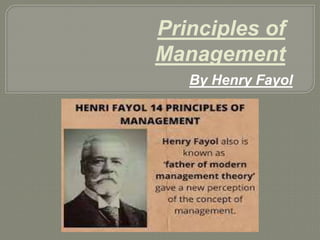
Principles of
Management
By Henry Fayol
About Henry Fayol (1841-
1925)
 He is also known as ‘The Father of
Principles of Management’.
 He was born in 1841 at Constantinople in
France and graduated as a mining
engineer in 1860 from the National School
of Mining at St. Etienne.
 In 1860 he joined the Famous French
combine- the Commantry- Fourchambauly
Company- as an Engineer.
 By the age of 47, he was appointed as a
 He retired after thirty years. During this time
the company had expanded into a large coal
steel combine with a strong financial
position.
 As an Industrial Manager Mr. Fayol tried to
probe into the bottom of the Principles of
Administration and Management.
 He proposed 14 Principles of Management
Let us learn about :
Principal of Division of Work
 Authority and Responsibility
 Discipline
 Unity of Command
 Unity of Direction
Principle Of Division of
Work
 This is the principle of specialization which
is so well expressed by economists as
being necessary to efficiency in the
utilization of labour.
 Its advantages are widely recognized and
it can be applied to any kind of work
employing large number of workers of
varying abilities.
 It has its limits and the work should not be
sub-divided beyond these limits.
Authority and Responsibility
 The concepts of Authority and
Responsibility are closely related.
 Authority was defined by Fayol as the right
to give orders and the power to exact
obedience.
 Responsibility involves being accountable,
and is therefore naturally associated with
authority.
 Whoever assumes authority also assumes
responsibility.
Discipline
 Discipline is “ respect for agreements
which are directed at achieving obedience,
application, energy and the outwards
marks of respect”.
 It requires good superiors at all levels.
A successful organization requires the
common efforts of workers.
 Penalty should be applied judiciously to
encourage this common effort.
Unity of Command
 This is the principle that an employee
should receives orders from one superiors
only.
 It provides quick decisions, coordination
and team work.
 It boosts moral of employees
Unity of Direction
 According to Fayol, unity of direction is the
principle that each group of activities
having the same objective must have one
hand and one plan.
fayol.pptx

fayol.pptx

  • 1.
  • 2.
    About Henry Fayol(1841- 1925)  He is also known as ‘The Father of Principles of Management’.  He was born in 1841 at Constantinople in France and graduated as a mining engineer in 1860 from the National School of Mining at St. Etienne.  In 1860 he joined the Famous French combine- the Commantry- Fourchambauly Company- as an Engineer.  By the age of 47, he was appointed as a
  • 3.
     He retiredafter thirty years. During this time the company had expanded into a large coal steel combine with a strong financial position.  As an Industrial Manager Mr. Fayol tried to probe into the bottom of the Principles of Administration and Management.  He proposed 14 Principles of Management
  • 5.
    Let us learnabout : Principal of Division of Work  Authority and Responsibility  Discipline  Unity of Command  Unity of Direction
  • 6.
    Principle Of Divisionof Work  This is the principle of specialization which is so well expressed by economists as being necessary to efficiency in the utilization of labour.  Its advantages are widely recognized and it can be applied to any kind of work employing large number of workers of varying abilities.  It has its limits and the work should not be sub-divided beyond these limits.
  • 8.
    Authority and Responsibility The concepts of Authority and Responsibility are closely related.  Authority was defined by Fayol as the right to give orders and the power to exact obedience.  Responsibility involves being accountable, and is therefore naturally associated with authority.  Whoever assumes authority also assumes responsibility.
  • 10.
    Discipline  Discipline is“ respect for agreements which are directed at achieving obedience, application, energy and the outwards marks of respect”.  It requires good superiors at all levels. A successful organization requires the common efforts of workers.  Penalty should be applied judiciously to encourage this common effort.
  • 12.
    Unity of Command This is the principle that an employee should receives orders from one superiors only.  It provides quick decisions, coordination and team work.  It boosts moral of employees
  • 14.
    Unity of Direction According to Fayol, unity of direction is the principle that each group of activities having the same objective must have one hand and one plan.