10.1
Chapter 10
Error Detection
and
Correction
Copyright © The McGraw-Hill Companies, Inc. Permission required for reproduction or display.
10.2
Data can be corrupted
during transmission.
Some applications require that
errors be detected and corrected.
Note
10.3
10-1 INTRODUCTION
10-1 INTRODUCTION
Let us first discuss some issues related, directly or
indirectly, to error detection and correction.
Types of Errors
Redundancy
Detection Versus Correction
Forward Error Correction Versus Retransmission
Coding
Modular Arithmetic
Topics discussed in this section:
10.4
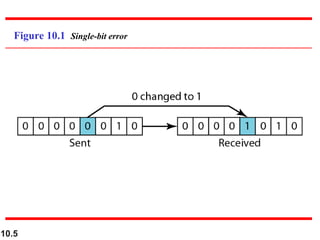
In a single-bit error, only 1 bit in the data
unit has changed.
Note
10.5
Figure 10.1 Single-bit error
10.6
A burst error means that 2 or more bits
in the data unit have changed.
Note
10.7
Figure 10.2 Burst error of length 8
10.8
To detect or correct errors, we need to
send extra (redundant) bits with data.
Note
10.9
Figure 10.3 The structure of encoder and decoder
10.10
In this book, we concentrate on block
codes; we leave convolution codes
to advanced texts.
Note
10.11
In modulo-N arithmetic, we use only the
integers in the range 0 to N −1,
inclusive.
Note
10.12
Figure 10.4 XORing of two single bits or two words
10.13
10-2 BLOCK CODING
10-2 BLOCK CODING
In block coding, we divide our message into blocks,
each of k bits, called
each of k bits, called datawords
datawords. We add r redundant
. We add r redundant
bits to each block to make the length n = k + r. The
resulting n-bit blocks are called
resulting n-bit blocks are called codewords
codewords.
.
Error Detection
Error Correction
Hamming Distance
Minimum Hamming Distance
Topics discussed in this section:
10.14
Figure 10.5 Datawords and codewords in block coding
10.15
The 4B/5B block coding discussed in Chapter 4 is a good
example of this type of coding. In this coding scheme,
k = 4 and n = 5. As we saw, we have 2k
= 16 datawords
and 2n
= 32 codewords. We saw that 16 out of 32
codewords are used for message transfer and the rest are
either used for other purposes or unused.
Example 10.1
10.16
Error Detection
 Enough redundancy is added to
detect an error.
 The receiver knows an error occurred
but does not know which bit(s) is(are)
in error.
 Has less overhead than error
correction.
10.17
Figure 10.6 Process of error detection in block coding
10.18
Let us assume that k = 2 and n = 3. Table 10.1 shows the
list of datawords and codewords. Later, we will see
how to derive a codeword from a dataword.
Assume the sender encodes the dataword 01 as 011 and
sends it to the receiver. Consider the following cases:
1. The receiver receives 011. It is a valid codeword. The
receiver extracts the dataword 01 from it.
Example 10.2
10.19
2. The codeword is corrupted during transmission, and
111 is received. This is not a valid codeword and is
discarded.
3. The codeword is corrupted during transmission, and
000 is received. This is a valid codeword. The receiver
incorrectly extracts the dataword 00. Two corrupted
bits have made the error undetectable.
Example 10.2 (continued)
10.20
Table 10.1 A code for error detection (Example 10.2)
10.21
An error-detecting code can detect
only the types of errors for which it is
designed; other types of errors may
remain undetected.
Note
10.22
Figure 10.7 Structure of encoder and decoder in error correction
10.23
Let us add more redundant bits to Example 10.2 to see if
the receiver can correct an error without knowing what
was actually sent. We add 3 redundant bits to the 2-bit
dataword to make 5-bit codewords. Table 10.2 shows the
datawords and codewords. Assume the dataword is 01.
The sender creates the codeword 01011. The codeword is
corrupted during transmission, and 01001 is received.
First, the receiver finds that the received codeword is not
in the table. This means an error has occurred. The
receiver, assuming that there is only 1 bit corrupted, uses
the following strategy to guess the correct dataword.
Example 10.3
10.24
1. Comparing the received codeword with the first
codeword in the table (01001 versus 00000), the
receiver decides that the first codeword is not the one
that was sent because there are two different bits.
2. By the same reasoning, the original codeword cannot
be the third or fourth one in the table.
3. The original codeword must be the second one in the
table because this is the only one that differs from the
received codeword by 1 bit. The receiver replaces
01001 with 01011 and consults the table to find the
dataword 01.
Example 10.3 (continued)
10.25
Table 10.2 A code for error correction (Example 10.3)

Faurozen Computer Networks Chapter Error Detection and Correction C N.ppt

  • 1.
    10.1 Chapter 10 Error Detection and Correction Copyright© The McGraw-Hill Companies, Inc. Permission required for reproduction or display.
  • 2.
    10.2 Data can becorrupted during transmission. Some applications require that errors be detected and corrected. Note
  • 3.
    10.3 10-1 INTRODUCTION 10-1 INTRODUCTION Letus first discuss some issues related, directly or Let us first discuss some issues related, directly or indirectly, to error detection and correction. indirectly, to error detection and correction. Types of Errors Redundancy Detection Versus Correction Forward Error Correction Versus Retransmission Coding Modular Arithmetic Topics discussed in this section: Topics discussed in this section:
  • 4.
    10.4 In a single-biterror, only 1 bit in the data unit has changed. Note
  • 5.
  • 6.
    10.6 A burst errormeans that 2 or more bits in the data unit have changed. Note
  • 7.
    10.7 Figure 10.2 Bursterror of length 8
  • 8.
    10.8 To detect orcorrect errors, we need to send extra (redundant) bits with data. Note
  • 9.
    10.9 Figure 10.3 Thestructure of encoder and decoder
  • 10.
    10.10 In this book,we concentrate on block codes; we leave convolution codes to advanced texts. Note
  • 11.
    10.11 In modulo-N arithmetic,we use only the integers in the range 0 to N −1, inclusive. Note
  • 12.
    10.12 Figure 10.4 XORingof two single bits or two words
  • 13.
    10.13 10-2 BLOCK CODING 10-2BLOCK CODING In block coding, we divide our message into blocks, In block coding, we divide our message into blocks, each of k bits, called each of k bits, called datawords datawords. We add r redundant . We add r redundant bits to each block to make the length n = k + r. The bits to each block to make the length n = k + r. The resulting n-bit blocks are called resulting n-bit blocks are called codewords codewords. . Error Detection Error Correction Hamming Distance Minimum Hamming Distance Topics discussed in this section: Topics discussed in this section:
  • 14.
    10.14 Figure 10.5 Datawordsand codewords in block coding
  • 15.
    10.15 The 4B/5B blockcoding discussed in Chapter 4 is a good example of this type of coding. In this coding scheme, k = 4 and n = 5. As we saw, we have 2k = 16 datawords and 2n = 32 codewords. We saw that 16 out of 32 codewords are used for message transfer and the rest are either used for other purposes or unused. Example 10.1
  • 16.
    10.16 Error Detection  Enoughredundancy is added to detect an error.  The receiver knows an error occurred but does not know which bit(s) is(are) in error.  Has less overhead than error correction.
  • 17.
    10.17 Figure 10.6 Processof error detection in block coding
  • 18.
    10.18 Let us assumethat k = 2 and n = 3. Table 10.1 shows the list of datawords and codewords. Later, we will see how to derive a codeword from a dataword. Assume the sender encodes the dataword 01 as 011 and sends it to the receiver. Consider the following cases: 1. The receiver receives 011. It is a valid codeword. The receiver extracts the dataword 01 from it. Example 10.2
  • 19.
    10.19 2. The codewordis corrupted during transmission, and 111 is received. This is not a valid codeword and is discarded. 3. The codeword is corrupted during transmission, and 000 is received. This is a valid codeword. The receiver incorrectly extracts the dataword 00. Two corrupted bits have made the error undetectable. Example 10.2 (continued)
  • 20.
    10.20 Table 10.1 Acode for error detection (Example 10.2)
  • 21.
    10.21 An error-detecting codecan detect only the types of errors for which it is designed; other types of errors may remain undetected. Note
  • 22.
    10.22 Figure 10.7 Structureof encoder and decoder in error correction
  • 23.
    10.23 Let us addmore redundant bits to Example 10.2 to see if the receiver can correct an error without knowing what was actually sent. We add 3 redundant bits to the 2-bit dataword to make 5-bit codewords. Table 10.2 shows the datawords and codewords. Assume the dataword is 01. The sender creates the codeword 01011. The codeword is corrupted during transmission, and 01001 is received. First, the receiver finds that the received codeword is not in the table. This means an error has occurred. The receiver, assuming that there is only 1 bit corrupted, uses the following strategy to guess the correct dataword. Example 10.3
  • 24.
    10.24 1. Comparing thereceived codeword with the first codeword in the table (01001 versus 00000), the receiver decides that the first codeword is not the one that was sent because there are two different bits. 2. By the same reasoning, the original codeword cannot be the third or fourth one in the table. 3. The original codeword must be the second one in the table because this is the only one that differs from the received codeword by 1 bit. The receiver replaces 01001 with 01011 and consults the table to find the dataword 01. Example 10.3 (continued)
  • 25.
    10.25 Table 10.2 Acode for error correction (Example 10.3)