Fashion Distribution
1
Chapter 10
Fashion Distribution
Buying Fashion
Selling Fashion
Fashion Distribution
2
Chapter Objectives
Explain the role of the fashion buyer.
Discuss the steps in the buying process or
merchandising cycle.
Identify the types of fashion retailers.
Discuss buying motives.
Identify the difference between personal and non-
personal selling.
Fashion Distribution
3
Fashion Buyer’s Job
Buyers make sure merchandise consumers want is available in stores
Buyers purchase goods from vendors
Must be able to predict what consumers want six months to a year
before the goods reach stores
Monitor styles and trends and which items are selling – like those
featured in Vogue and Bazaar
Read trade publications like Women’s Wear Daily
Must have good fashion sense and keen business skills
Fashion Distribution
4
What problems do you think occur for
retailers like Walmart or Goodys when
buyers make inaccurate predictions
about what consumers want to
purchase?
Fashion Distribution
5
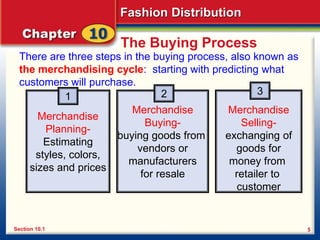
The Buying Process
There are three steps in the buying process, also known as
the merchandising cycle: starting with predicting what
customers will purchase.
Section 10.1
Merchandise
Planning-
Estimating
styles, colors,
sizes and prices
Merchandise
Buying-
buying goods from
vendors or
manufacturers
for resale
Merchandise
Selling-
exchanging of
goods for
money from
retailer to
customer
1 2 3
Fashion Distribution
6
Merchandise Planning
Sales Records – The main resource which is past
records of goods sold. This tells quantities and
styles.
Vendor Information – Vendors sales
representatives keep on tope of current trends
and can advise buyers about making purchases.
Market Week Previews – Buyers attend these to
preview the upcoming season’s merchandise and
to buy merchandise.
Fashion Distribution
7
Do you think it would be hard for buyers
to separate their personal likes and
dislikes from the current trends and
consumer desires for which they are
making purchases?
Fashion Distribution
8
What recent fashion item do you think
would be the wrong choice because it is
about to go out of style?
Fashion Distribution
9
Types of Fashion Retailers
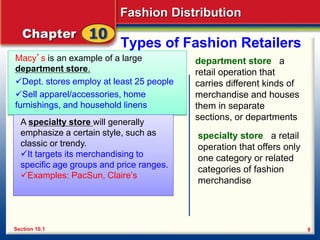
Macy’s is an example of a large
department store.
Dept. stores employ at least 25 people
Sell apparel/accessories, home
furnishings, and household linens
department store a
retail operation that
carries different kinds of
merchandise and houses
them in separate
sections, or departments
Section 10.1
A specialty store will generally
emphasize a certain style, such as
classic or trendy.
It targets its merchandising to
specific age groups and price ranges.
Examples: PacSun, Claire’s
specialty store a retail
operation that offers only
one category or related
categories of fashion
merchandise
Fashion Distribution
10
Types of Fashion Retailers
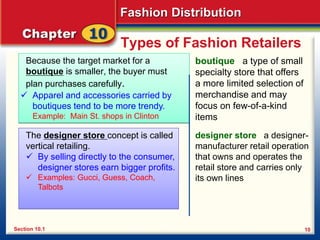
Because the target market for a
boutique is smaller, the buyer must
plan purchases carefully.
boutique a type of small
specialty store that offers
a more limited selection of
merchandise and may
focus on few-of-a-kind
items
Section 10.1
 Apparel and accessories carried by
boutiques tend to be more trendy.
Example: Main St. shops in Clinton
The designer store concept is called
vertical retailing.
 By selling directly to the consumer,
designer stores earn bigger profits.
 Examples: Gucci, Guess, Coach,
Talbots
designer store a designer-
manufacturer retail operation
that owns and operates the
retail store and carries only
its own lines
Fashion Distribution
11
Types of Fashion Retailers
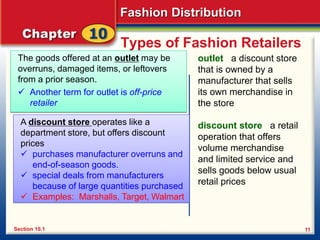
The goods offered at an outlet may be
overruns, damaged items, or leftovers
from a prior season.
 Another term for outlet is off-price
retailer
outlet a discount store
that is owned by a
manufacturer that sells
its own merchandise in
the store
discount store a retail
operation that offers
volume merchandise
and limited service and
sells goods below usual
retail prices
Section 10.1
A discount store operates like a
department store, but offers discount
prices
 purchases manufacturer overruns and
end-of-season goods.
 special deals from manufacturers
because of large quantities purchased
 Examples: Marshalls, Target, Walmart
Fashion Distribution
12
Top Retailers
Walmart
Target
Jc penney
Gap
May department stores
Tj max
Fashion Distribution
13
Would you rather shop at a department
store or speciality store?
Fashion Distribution
14
Types of Fashion Retailers
Mail-order, or direct-mail, marketing is a type of retail operation in which
a business sells merchandise in a catalog and sends it by mail to
consumers who purchase it.
 People use catalogs because of convenience.
Online shopping, or Internet shopping, is a fast-growing trend.
Customers are able to shop at any time of the day or night, seven days
a week, and have the merchandise shipped directly to their homes.
 Some retailers offer discounts for online shopping
Section 10.1
Fashion Distribution
15
Why People Buy Fashion
Cultural, social, and
psychological factors affect
buying behavior.
Section 10.2
buying behavior the
way consumers react to
satisfying a need or want
when making a purchase
 Buying behavior can be
rational or emotional.
 Which type of behavior do
you think marketing is
trying to influence?
Fashion Distribution
16
Remember!!!! The Main
Categories used to group
merchandise:
Women’s wear
Juniors
Children’s Wear
Men’s Wear
Fashion Distribution
17
Buyer’s Questions:
What problems occur when fashion buyers make inaccurate
predictions?
Do you think it is difficult for buyers to separate their personal
likes and dislikes from the trends and consumer desires they
need to purchase?
What recent fashion item do you think would be a wrong choice
because it may be about to go out of style?
Do you like stores with sales associates or ones with no help?
Do you find most are trained and helpful? What is important to
you?
Describe some of your online purchase experiences
Fashion Distribution
18
Complete:
Handout on “Types of Fashion Retailers”
On paper, begin to create a design plan for layout
for your, “Ideal department store.”
– This plan must include at least 3 groups of general
merchandise.
The plan must include at least 3 groups of
general merchandise
The plan must be creative, color, and neat
The plan must be detailed with explanations of where various areas
of merchandise are located within each group. For example: Jewelry
and handbags, hosiery, undergarments and sleepwear, plus sized
clothing, etc.
Fashion Distribution
19
Do you think that the media is an
important influence on fashion? Why
or Why not?
Fashion Distribution
20
Influences on Fashion
The role of fashion in popular culture has a
significant impact on people’s lives and the
purchases they make.
Section 10.2
People are influenced by:
Television
Films
Magazines
Street fashions
Fashion Distribution
21
Personal Selling
Advertising, sales, promotion, and
publicity are types of nonpersonal
selling.
Section 10.2
nonpersonal selling
the type of selling that
does not involve
interaction between
people
The selling process occurs when sales
associates communicate through
personal selling. (see page 212)
 Suggestion selling techniques:
 Add-on
 Trading up
 More than one
 Special offer
personal selling the
type of selling that
involves direct interaction
between sales associates
and potential buyers by
telephone or in person
Fashion Distribution
22
How are sales people similar to
teachers?
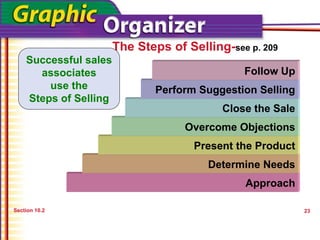
The Steps of Selling-see p. 209
Section 10.2
Approach
Successful sales
associates
use the
Steps of Selling
Determine Needs
Present the Product
Overcome Objections
Close the Sale
Perform Suggestion Selling
Follow Up
23
Fashion Distribution
24
Selling Questions:
What selling step do you think is most important? Why?
What new or emerging technology can a sales staff use to
improve and increase business
What does “closing the sale” meaning
Describe a situation in which you made additional purchases
because the sales associate made suggestions to do so…
Fashion Distribution
25
Steps of Selling Role Play:
At your tables: *See page 209-210 in book
Now assume you are being sent to Chicago for a sales training
seminar. Your are a salesperson who gets commission. You are
going to role play the 7 steps of selling in your groups.
Think of 3 open ended questions that would help you learn
about your customers preference.
Then outline and write down scripts for all the 7 steps of the
selling process, assuming you are selling a particular item to a
client (You can choose an item at your tables).
Be ready to discuss some of your questions and scripts at the
end of class.
Fashion Distribution
26
What is the job of the fashion buyer?
What are the three steps of the buying
process or merchandising cycle?
Compare and contrast at least two different
types of retailers.
1.
2.
3.
Section 10.1
10.1
Fashion Distribution
27
What are the two types of buying behavior?
What are the seven steps in the selling
process?
Describe the difference between personal
selling and nonpersonal selling.
4.
5.
6.
Section 10.2
10.2

Fashion Ch10 PPT (2).ppt

  • 1.
    Fashion Distribution 1 Chapter 10 FashionDistribution Buying Fashion Selling Fashion
  • 2.
    Fashion Distribution 2 Chapter Objectives Explainthe role of the fashion buyer. Discuss the steps in the buying process or merchandising cycle. Identify the types of fashion retailers. Discuss buying motives. Identify the difference between personal and non- personal selling.
  • 3.
    Fashion Distribution 3 Fashion Buyer’sJob Buyers make sure merchandise consumers want is available in stores Buyers purchase goods from vendors Must be able to predict what consumers want six months to a year before the goods reach stores Monitor styles and trends and which items are selling – like those featured in Vogue and Bazaar Read trade publications like Women’s Wear Daily Must have good fashion sense and keen business skills
  • 4.
    Fashion Distribution 4 What problemsdo you think occur for retailers like Walmart or Goodys when buyers make inaccurate predictions about what consumers want to purchase?
  • 5.
    Fashion Distribution 5 The BuyingProcess There are three steps in the buying process, also known as the merchandising cycle: starting with predicting what customers will purchase. Section 10.1 Merchandise Planning- Estimating styles, colors, sizes and prices Merchandise Buying- buying goods from vendors or manufacturers for resale Merchandise Selling- exchanging of goods for money from retailer to customer 1 2 3
  • 6.
    Fashion Distribution 6 Merchandise Planning SalesRecords – The main resource which is past records of goods sold. This tells quantities and styles. Vendor Information – Vendors sales representatives keep on tope of current trends and can advise buyers about making purchases. Market Week Previews – Buyers attend these to preview the upcoming season’s merchandise and to buy merchandise.
  • 7.
    Fashion Distribution 7 Do youthink it would be hard for buyers to separate their personal likes and dislikes from the current trends and consumer desires for which they are making purchases?
  • 8.
    Fashion Distribution 8 What recentfashion item do you think would be the wrong choice because it is about to go out of style?
  • 9.
    Fashion Distribution 9 Types ofFashion Retailers Macy’s is an example of a large department store. Dept. stores employ at least 25 people Sell apparel/accessories, home furnishings, and household linens department store a retail operation that carries different kinds of merchandise and houses them in separate sections, or departments Section 10.1 A specialty store will generally emphasize a certain style, such as classic or trendy. It targets its merchandising to specific age groups and price ranges. Examples: PacSun, Claire’s specialty store a retail operation that offers only one category or related categories of fashion merchandise
  • 10.
    Fashion Distribution 10 Types ofFashion Retailers Because the target market for a boutique is smaller, the buyer must plan purchases carefully. boutique a type of small specialty store that offers a more limited selection of merchandise and may focus on few-of-a-kind items Section 10.1  Apparel and accessories carried by boutiques tend to be more trendy. Example: Main St. shops in Clinton The designer store concept is called vertical retailing.  By selling directly to the consumer, designer stores earn bigger profits.  Examples: Gucci, Guess, Coach, Talbots designer store a designer- manufacturer retail operation that owns and operates the retail store and carries only its own lines
  • 11.
    Fashion Distribution 11 Types ofFashion Retailers The goods offered at an outlet may be overruns, damaged items, or leftovers from a prior season.  Another term for outlet is off-price retailer outlet a discount store that is owned by a manufacturer that sells its own merchandise in the store discount store a retail operation that offers volume merchandise and limited service and sells goods below usual retail prices Section 10.1 A discount store operates like a department store, but offers discount prices  purchases manufacturer overruns and end-of-season goods.  special deals from manufacturers because of large quantities purchased  Examples: Marshalls, Target, Walmart
  • 12.
    Fashion Distribution 12 Top Retailers Walmart Target Jcpenney Gap May department stores Tj max
  • 13.
    Fashion Distribution 13 Would yourather shop at a department store or speciality store?
  • 14.
    Fashion Distribution 14 Types ofFashion Retailers Mail-order, or direct-mail, marketing is a type of retail operation in which a business sells merchandise in a catalog and sends it by mail to consumers who purchase it.  People use catalogs because of convenience. Online shopping, or Internet shopping, is a fast-growing trend. Customers are able to shop at any time of the day or night, seven days a week, and have the merchandise shipped directly to their homes.  Some retailers offer discounts for online shopping Section 10.1
  • 15.
    Fashion Distribution 15 Why PeopleBuy Fashion Cultural, social, and psychological factors affect buying behavior. Section 10.2 buying behavior the way consumers react to satisfying a need or want when making a purchase  Buying behavior can be rational or emotional.  Which type of behavior do you think marketing is trying to influence?
  • 16.
    Fashion Distribution 16 Remember!!!! TheMain Categories used to group merchandise: Women’s wear Juniors Children’s Wear Men’s Wear
  • 17.
    Fashion Distribution 17 Buyer’s Questions: Whatproblems occur when fashion buyers make inaccurate predictions? Do you think it is difficult for buyers to separate their personal likes and dislikes from the trends and consumer desires they need to purchase? What recent fashion item do you think would be a wrong choice because it may be about to go out of style? Do you like stores with sales associates or ones with no help? Do you find most are trained and helpful? What is important to you? Describe some of your online purchase experiences
  • 18.
    Fashion Distribution 18 Complete: Handout on“Types of Fashion Retailers” On paper, begin to create a design plan for layout for your, “Ideal department store.” – This plan must include at least 3 groups of general merchandise. The plan must include at least 3 groups of general merchandise The plan must be creative, color, and neat The plan must be detailed with explanations of where various areas of merchandise are located within each group. For example: Jewelry and handbags, hosiery, undergarments and sleepwear, plus sized clothing, etc.
  • 19.
    Fashion Distribution 19 Do youthink that the media is an important influence on fashion? Why or Why not?
  • 20.
    Fashion Distribution 20 Influences onFashion The role of fashion in popular culture has a significant impact on people’s lives and the purchases they make. Section 10.2 People are influenced by: Television Films Magazines Street fashions
  • 21.
    Fashion Distribution 21 Personal Selling Advertising,sales, promotion, and publicity are types of nonpersonal selling. Section 10.2 nonpersonal selling the type of selling that does not involve interaction between people The selling process occurs when sales associates communicate through personal selling. (see page 212)  Suggestion selling techniques:  Add-on  Trading up  More than one  Special offer personal selling the type of selling that involves direct interaction between sales associates and potential buyers by telephone or in person
  • 22.
    Fashion Distribution 22 How aresales people similar to teachers?
  • 23.
    The Steps ofSelling-see p. 209 Section 10.2 Approach Successful sales associates use the Steps of Selling Determine Needs Present the Product Overcome Objections Close the Sale Perform Suggestion Selling Follow Up 23
  • 24.
    Fashion Distribution 24 Selling Questions: Whatselling step do you think is most important? Why? What new or emerging technology can a sales staff use to improve and increase business What does “closing the sale” meaning Describe a situation in which you made additional purchases because the sales associate made suggestions to do so…
  • 25.
    Fashion Distribution 25 Steps ofSelling Role Play: At your tables: *See page 209-210 in book Now assume you are being sent to Chicago for a sales training seminar. Your are a salesperson who gets commission. You are going to role play the 7 steps of selling in your groups. Think of 3 open ended questions that would help you learn about your customers preference. Then outline and write down scripts for all the 7 steps of the selling process, assuming you are selling a particular item to a client (You can choose an item at your tables). Be ready to discuss some of your questions and scripts at the end of class.
  • 26.
    Fashion Distribution 26 What isthe job of the fashion buyer? What are the three steps of the buying process or merchandising cycle? Compare and contrast at least two different types of retailers. 1. 2. 3. Section 10.1 10.1
  • 27.
    Fashion Distribution 27 What arethe two types of buying behavior? What are the seven steps in the selling process? Describe the difference between personal selling and nonpersonal selling. 4. 5. 6. Section 10.2 10.2