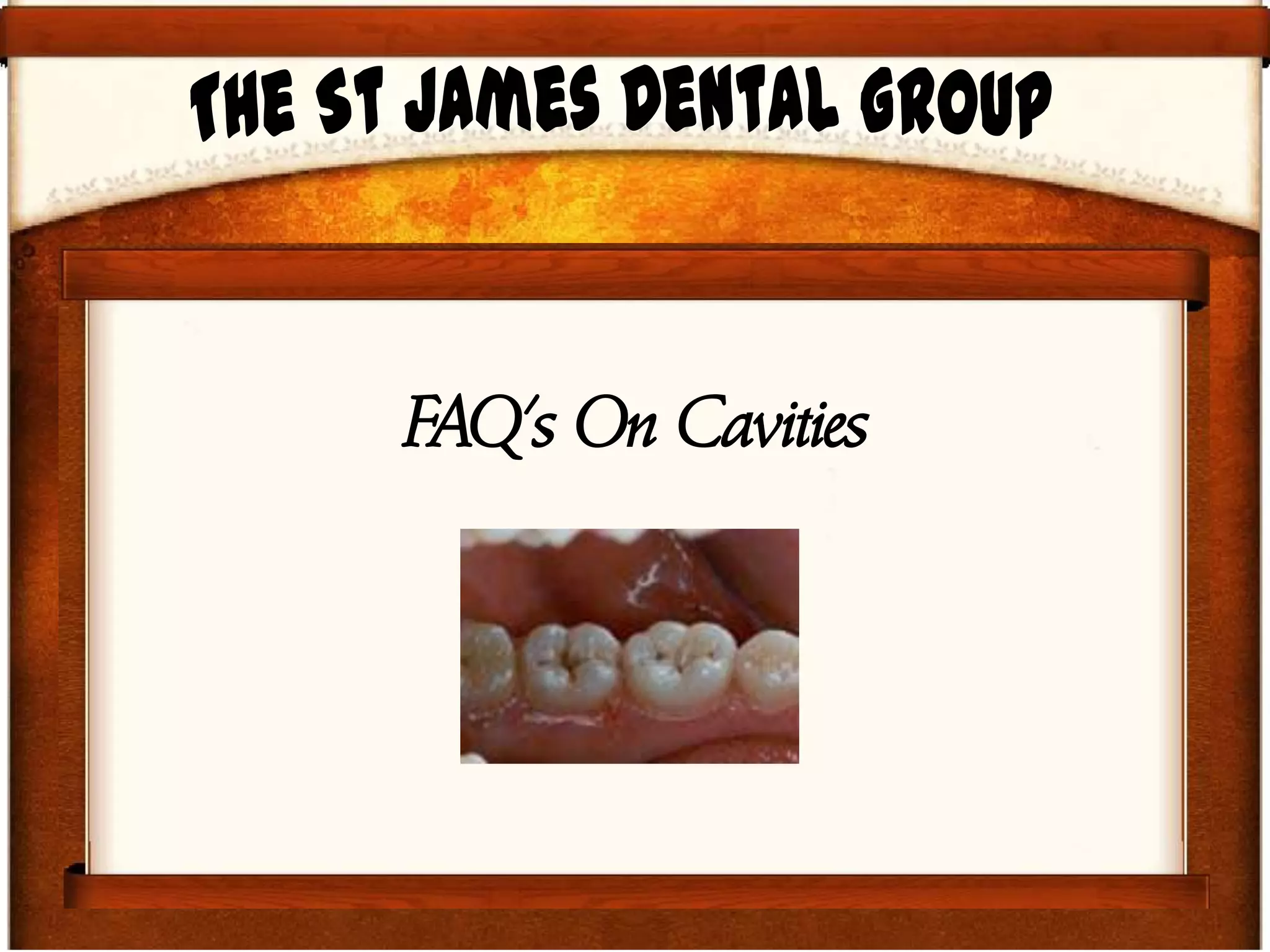
FAQ's On Cavities
http://www.dentistcudahyca.com
Did you know
• Did you know cavities is the #1 disease that
has children missing school? Most people
have had cavities at some point in their
lives. The reason for the occurrence of
cavities is not at all that mysterious.
The St James Dental Group
http://www.dentistcudahyca.com
Not brushing and flossing
• Not brushing and flossing your teeth are the
primary reasons why you get it. Not going to
the dentist every six months is another.
Oftentimes, individuals do not give much
importance to visiting their dentists.
The St James Dental Group
http://www.dentistcudahyca.com
Eating sugary snacks
• Another reason is eating sugary snacks and
drinking sugary sodas. It’s best to get well
informed than suffer the consequences
later..
The St James Dental Group
http://www.dentistcudahyca.com
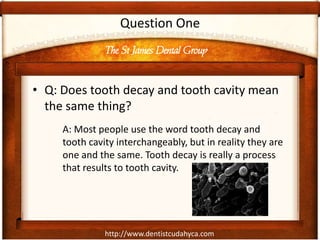
Question One
• Q: Does tooth decay and tooth cavity mean
the same thing?
A: Most people use the word tooth decay and
tooth cavity interchangeably, but in reality they are
one and the same. Tooth decay is really a process
that results to tooth cavity.
The St James Dental Group
http://www.dentistcudahyca.com
Tooth decay is the gradual damaging
• Tooth decay is the gradual damaging of the
teeth caused by bacterial acids as they eat
the food debris and plaque on the teeth.
The St James Dental Group
http://www.dentistcudahyca.com
As the enamel get damaged
• As the enamel get damaged (eaten away by
bacteria), it creates an opening or a hole in
the tooth surface which in turn is called
cavity. This hole or cavity starts quite small
that is not even seen by naked eye and little
by little keeps getting bigger.
The St James Dental Group
http://www.dentistcudahyca.com
Question Two
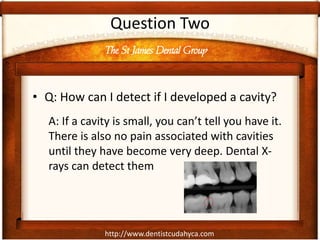
• Q: How can I detect if I developed a cavity?
A: If a cavity is small, you can’t tell you have it.
There is also no pain associated with cavities
until they have become very deep. Dental X-
rays can detect them
The St James Dental Group
http://www.dentistcudahyca.com
Regular dental checkups
• That’s why it is recommended to have your
regular dental checkups. Your dental care
provider can also measure the extent of the
damage (how big the cavity is by the use of
X-rays. During your dental check up, your
dentist inspects your teeth for the signs of
any cavity development.
The St James Dental Group
http://www.dentistcudahyca.com
Seen with the naked eye
• If the cavities have become bigger, they can
be seen with the naked eye. They usually
appear as a black spot or hole in your tooth.
Sensitivity and toothache are also reliable
signs, but at this point the cavity is probably
very large.
The St James Dental Group
http://www.dentistcudahyca.com
Question Three
• Q: When is the best time to treat dental
cavities?
A: The best time is when they are small,
before they cause any more damage and
destroy more of the tooth structure.
The St James Dental Group
http://www.dentistcudahyca.com
Question Four
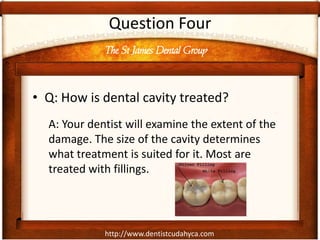
• Q: How is dental cavity treated?
A: Your dentist will examine the extent of the
damage. The size of the cavity determines
what treatment is suited for it. Most are
treated with fillings.
The St James Dental Group
http://www.dentistcudahyca.com
Destroyed more of the tooth structure
• Sometime if the cavity has become bigger
and destroyed more of the tooth structure,
an inlay or an onlay maybe recommended.
The St James Dental Group
http://www.dentistcudahyca.com
Tooth structure has weakened
• If the damage has been extended where the
tooth structure has weakened to the point
of near fracture or has actually fractured, a
dental crown is recommended.
The St James Dental Group
http://www.dentistcudahyca.com
If it is extensive and has reached the nerve
• When the cavity is too extensive and has
reached the nerve, then a root canal is
needed.
The St James Dental Group
http://www.dentistcudahyca.com
Question Five
• Q: Are there any ways you can prevent
cavities?
A: Aside from a good oral hygiene which
means a good home care, brushing 2-3
times per day and flossing once per day.
The St James Dental Group
http://www.dentistcudahyca.com
Getting your teeth professionally cleaned
• Getting your teeth professionally cleaned
by your dentist or dental hygienist, dental
sealants are a great way to protect teeth.
The St James Dental Group
http://www.dentistcudahyca.com
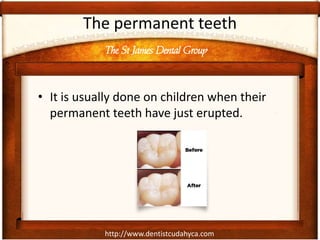
The permanent teeth
• It is usually done on children when their
permanent teeth have just erupted.
The St James Dental Group
http://www.dentistcudahyca.com
Well-balanced diet
• But it can be done at any time and at any
age, as long as the teeth are cavity free
and don’t have fillings on them. Also you
should have a well-balanced diet. Avoid
sugary foods and drinks as much as
possible.
The St James Dental Group
http://www.dentistcudahyca.com
Question Six
• Q: Are cavities contagious?
A: According to studies, the bacteria that cause
cavities can be transmitted from one person to
another. Click here to read more about this.
The St James Dental Group
http://www.dentistcudahyca.com
If you have any more questions
• If you have any more questions about
dental cavities, we will be happy to answer
them for you. If you need a dental check up
to keep your teeth in perfect condition,
please call us for an appointment
The St James Dental Group
http://www.dentistcudahyca.com
Ask a professional
FAQ's On Cavities
The St James Dental Group
323-771-7254
Contact Us
http://www.dentistcudahyca.com
Thank You!

FAQ On Dental Cavities

  • 1.
  • 2.
    http://www.dentistcudahyca.com Did you know •Did you know cavities is the #1 disease that has children missing school? Most people have had cavities at some point in their lives. The reason for the occurrence of cavities is not at all that mysterious. The St James Dental Group
  • 3.
    http://www.dentistcudahyca.com Not brushing andflossing • Not brushing and flossing your teeth are the primary reasons why you get it. Not going to the dentist every six months is another. Oftentimes, individuals do not give much importance to visiting their dentists. The St James Dental Group
  • 4.
    http://www.dentistcudahyca.com Eating sugary snacks •Another reason is eating sugary snacks and drinking sugary sodas. It’s best to get well informed than suffer the consequences later.. The St James Dental Group
  • 5.
    http://www.dentistcudahyca.com Question One • Q:Does tooth decay and tooth cavity mean the same thing? A: Most people use the word tooth decay and tooth cavity interchangeably, but in reality they are one and the same. Tooth decay is really a process that results to tooth cavity. The St James Dental Group
  • 6.
    http://www.dentistcudahyca.com Tooth decay isthe gradual damaging • Tooth decay is the gradual damaging of the teeth caused by bacterial acids as they eat the food debris and plaque on the teeth. The St James Dental Group
  • 7.
    http://www.dentistcudahyca.com As the enamelget damaged • As the enamel get damaged (eaten away by bacteria), it creates an opening or a hole in the tooth surface which in turn is called cavity. This hole or cavity starts quite small that is not even seen by naked eye and little by little keeps getting bigger. The St James Dental Group
  • 8.
    http://www.dentistcudahyca.com Question Two • Q:How can I detect if I developed a cavity? A: If a cavity is small, you can’t tell you have it. There is also no pain associated with cavities until they have become very deep. Dental X- rays can detect them The St James Dental Group
  • 9.
    http://www.dentistcudahyca.com Regular dental checkups •That’s why it is recommended to have your regular dental checkups. Your dental care provider can also measure the extent of the damage (how big the cavity is by the use of X-rays. During your dental check up, your dentist inspects your teeth for the signs of any cavity development. The St James Dental Group
  • 10.
    http://www.dentistcudahyca.com Seen with thenaked eye • If the cavities have become bigger, they can be seen with the naked eye. They usually appear as a black spot or hole in your tooth. Sensitivity and toothache are also reliable signs, but at this point the cavity is probably very large. The St James Dental Group
  • 11.
    http://www.dentistcudahyca.com Question Three • Q:When is the best time to treat dental cavities? A: The best time is when they are small, before they cause any more damage and destroy more of the tooth structure. The St James Dental Group
  • 12.
    http://www.dentistcudahyca.com Question Four • Q:How is dental cavity treated? A: Your dentist will examine the extent of the damage. The size of the cavity determines what treatment is suited for it. Most are treated with fillings. The St James Dental Group
  • 13.
    http://www.dentistcudahyca.com Destroyed more ofthe tooth structure • Sometime if the cavity has become bigger and destroyed more of the tooth structure, an inlay or an onlay maybe recommended. The St James Dental Group
  • 14.
    http://www.dentistcudahyca.com Tooth structure hasweakened • If the damage has been extended where the tooth structure has weakened to the point of near fracture or has actually fractured, a dental crown is recommended. The St James Dental Group
  • 15.
    http://www.dentistcudahyca.com If it isextensive and has reached the nerve • When the cavity is too extensive and has reached the nerve, then a root canal is needed. The St James Dental Group
  • 16.
    http://www.dentistcudahyca.com Question Five • Q:Are there any ways you can prevent cavities? A: Aside from a good oral hygiene which means a good home care, brushing 2-3 times per day and flossing once per day. The St James Dental Group
  • 17.
    http://www.dentistcudahyca.com Getting your teethprofessionally cleaned • Getting your teeth professionally cleaned by your dentist or dental hygienist, dental sealants are a great way to protect teeth. The St James Dental Group
  • 18.
    http://www.dentistcudahyca.com The permanent teeth •It is usually done on children when their permanent teeth have just erupted. The St James Dental Group
  • 19.
    http://www.dentistcudahyca.com Well-balanced diet • Butit can be done at any time and at any age, as long as the teeth are cavity free and don’t have fillings on them. Also you should have a well-balanced diet. Avoid sugary foods and drinks as much as possible. The St James Dental Group
  • 20.
    http://www.dentistcudahyca.com Question Six • Q:Are cavities contagious? A: According to studies, the bacteria that cause cavities can be transmitted from one person to another. Click here to read more about this. The St James Dental Group
  • 21.
    http://www.dentistcudahyca.com If you haveany more questions • If you have any more questions about dental cavities, we will be happy to answer them for you. If you need a dental check up to keep your teeth in perfect condition, please call us for an appointment The St James Dental Group
  • 22.
    http://www.dentistcudahyca.com Ask a professional FAQ'sOn Cavities The St James Dental Group 323-771-7254 Contact Us http://www.dentistcudahyca.com Thank You!