Families Making Changes
       Parent Project
Problem
       In today’s society,
 changing social and economic
patterns limits family’s ability to
 promote family togetherness.
Purpose
    To prepare families to
 consciously develop family
rituals/traditions that can be
    transmitted to future
         generations.
Objectives
        Give families the tools to:

• Define family rituals

• Describe the benefits of family rituals

• Describe the three (3) types of family rituals

• Create a family tradition
Dr. Barbara H. Fiese
                        Research
                         suggested that families that carry
discovered that          out regular patterned interactions
                          that fluctuate over time,
 rituals make people         produce well-adjusted
  feel happier,              children

  better loved and             with greater self-
                                 esteem and
  strongly a part of            confidence to go
    families.                    out into the world.
Penny Game
                Ice Breaker


Work together in a group and describe a
 penny
                  Such as
    Who is on the penny?
    Is it his head or his head and
     shoulders?
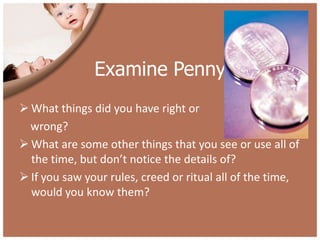
Examine Penny
 What things did you have right or
  wrong?
 What are some other things that you see or use all of
  the time, but don’t notice the details of?
 If you saw your rules, creed or ritual all of the time,
  would you know them?
Share POSITIVE
        childhood experiences

Did you classify these experiences as rituals or
 traditions?


Define family rituals
Family Rituals
Behaviors or activities involving most or
all members of the family
    occur occasionally,
    have a symbolic meaning for family members and
    are valued by the participants
    so that they would like the activity to be carried on
    in the future.
Benefits of
   Family Traditions
A Way to Enact Values
Connection
Identity
Predictability
A Way to Enact Values
 Allow families to demonstrate
    what they believe and
    hold dear.
 Provide families with an opportunity
    to make their values concrete
    to express them regularly
     with one another.
Connection
 Provide a planned content and
  time to connect
    emotionally and
    physically
   with other members of the family,
    sharing time,
    caring and
    conversation.
Identity
• A sense of
   – who belongs to the family,
   – what is special about the family and
   – where one belongs in the family.

• Allow families to form a unique family identity
   – that helps them to feel they belong in a special
     way.
Predictability
Families need; especially children
 A sense of regularity and order
   – Bedtime rituals or time to talk with a spouse each
      day become
     meaningful events to
     look forward to.
   .
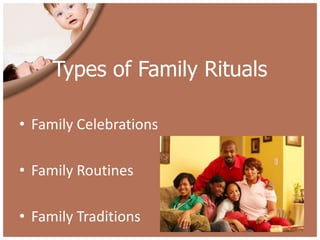
Types of Family Rituals

• Family Celebrations

• Family Routines

• Family Traditions
Family Celebrations
 Rituals in which the family observes holidays or occasions
    are widely practiced and observed broadly by the cultural
      groups and
    are special in the family.
 They provide an opportunity for
  larger group identification.
Family Celebrations
   New Years
   Fourth of July
   Thanksgiving
   Religions holiday (i.e.
    Christmas, Easter and the
    Passover Seder)
   Funerals
   Weddings
   Baptisms
   Bar mitzvahs
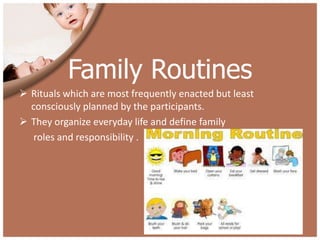
Family Routines
 Rituals which are most frequently enacted but least
  consciously planned by the participants.
 They organize everyday life and define family
   roles and responsibility .
Family Routines
Bedtime routines for children
Customary treatment of mutual request
Discipline of children
Everyday greetings and goodbyes
Leisure activities
Regular meals
Family Traditions
 Activities which are less culture-specific,
    moderately organized and
    more unique to each family.
 Gives the family the
  responsibility of determining
  how they will celebrate.
Family Traditions
•   Activities with kin
•   Anniversary
•   Birthday customs
•   Parties with special food and music
•   Participation in community events
•   Summer vacations
•   Visits to and from extended family members
Creating Family Rituals
         Video Clip
Create a Family Tradition
             Reminder – It’s not about winning an award on having the most
      Too many traditions dilute the importance and jeopardize true meaning and value.


1. Think of spiritual-based traditions
    Praying for meals
    Family Bible study
2. Think of meaningful routines/rituals that currently exist
    Favorite holidays
    It’s okay to have silly traditions (i.e., Backwards Day)
3. Think of other families traditions that you have admired
    Feel free to borrow and edit them
Debrief
        What did you learn about your family rituals and
    traditions?

       Do you have any current family routines that you will
    implement into family rituals and traditions?

        What goals would you like to set for building your family
    tradition?

Families making changes

  • 1.
  • 2.
    Problem In today’s society, changing social and economic patterns limits family’s ability to promote family togetherness.
  • 3.
    Purpose To prepare families to consciously develop family rituals/traditions that can be transmitted to future generations.
  • 4.
    Objectives Give families the tools to: • Define family rituals • Describe the benefits of family rituals • Describe the three (3) types of family rituals • Create a family tradition
  • 5.
    Dr. Barbara H.Fiese Research  suggested that families that carry discovered that out regular patterned interactions that fluctuate over time, rituals make people  produce well-adjusted feel happier, children better loved and with greater self- esteem and strongly a part of confidence to go families. out into the world.
  • 6.
    Penny Game Ice Breaker Work together in a group and describe a penny Such as Who is on the penny? Is it his head or his head and shoulders?
  • 7.
    Examine Penny  Whatthings did you have right or wrong?  What are some other things that you see or use all of the time, but don’t notice the details of?  If you saw your rules, creed or ritual all of the time, would you know them?
  • 8.
    Share POSITIVE childhood experiences Did you classify these experiences as rituals or traditions? Define family rituals
  • 9.
    Family Rituals Behaviors oractivities involving most or all members of the family occur occasionally, have a symbolic meaning for family members and are valued by the participants so that they would like the activity to be carried on in the future.
  • 10.
    Benefits of Family Traditions A Way to Enact Values Connection Identity Predictability
  • 11.
    A Way toEnact Values  Allow families to demonstrate  what they believe and  hold dear.  Provide families with an opportunity  to make their values concrete  to express them regularly with one another.
  • 12.
    Connection  Provide aplanned content and time to connect  emotionally and  physically with other members of the family,  sharing time,  caring and  conversation.
  • 13.
    Identity • A senseof – who belongs to the family, – what is special about the family and – where one belongs in the family. • Allow families to form a unique family identity – that helps them to feel they belong in a special way.
  • 14.
    Predictability Families need; especiallychildren  A sense of regularity and order – Bedtime rituals or time to talk with a spouse each day become meaningful events to look forward to. .
  • 15.
    Types of FamilyRituals • Family Celebrations • Family Routines • Family Traditions
  • 16.
    Family Celebrations  Ritualsin which the family observes holidays or occasions  are widely practiced and observed broadly by the cultural groups and  are special in the family.  They provide an opportunity for larger group identification.
  • 17.
    Family Celebrations  New Years  Fourth of July  Thanksgiving  Religions holiday (i.e. Christmas, Easter and the Passover Seder)  Funerals  Weddings  Baptisms  Bar mitzvahs
  • 18.
    Family Routines  Ritualswhich are most frequently enacted but least consciously planned by the participants.  They organize everyday life and define family roles and responsibility .
  • 19.
    Family Routines Bedtime routinesfor children Customary treatment of mutual request Discipline of children Everyday greetings and goodbyes Leisure activities Regular meals
  • 20.
    Family Traditions  Activitieswhich are less culture-specific,  moderately organized and  more unique to each family.  Gives the family the responsibility of determining how they will celebrate.
  • 21.
    Family Traditions • Activities with kin • Anniversary • Birthday customs • Parties with special food and music • Participation in community events • Summer vacations • Visits to and from extended family members
  • 22.
  • 23.
    Create a FamilyTradition Reminder – It’s not about winning an award on having the most Too many traditions dilute the importance and jeopardize true meaning and value. 1. Think of spiritual-based traditions  Praying for meals  Family Bible study 2. Think of meaningful routines/rituals that currently exist  Favorite holidays  It’s okay to have silly traditions (i.e., Backwards Day) 3. Think of other families traditions that you have admired  Feel free to borrow and edit them
  • 24.
    Debrief  What did you learn about your family rituals and traditions?  Do you have any current family routines that you will implement into family rituals and traditions?  What goals would you like to set for building your family tradition?