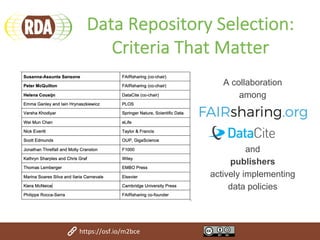
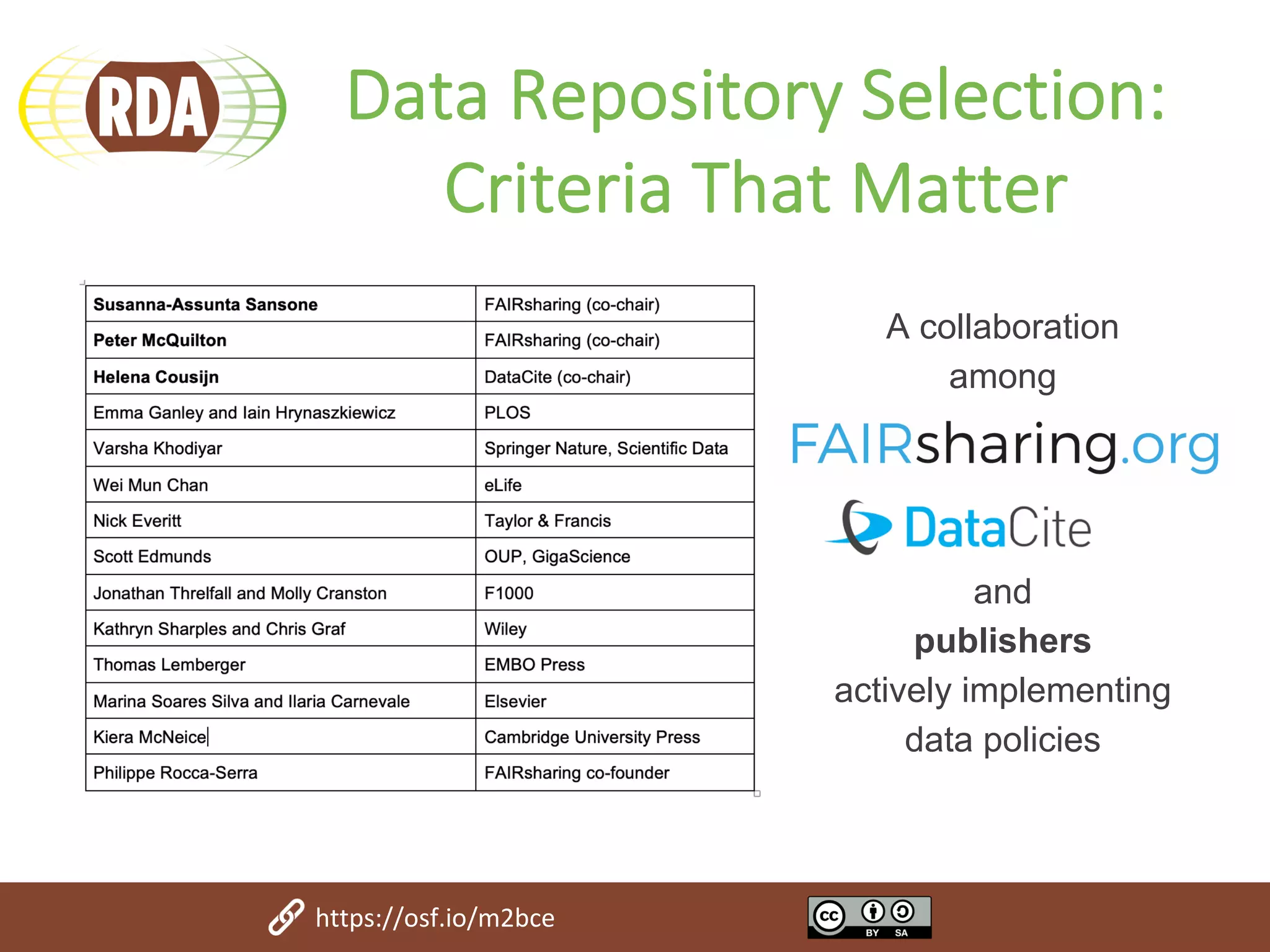
Data Repository Selection:
Criteria That Matter
https://osf.io/m2bce
and
publishers
actively implementing
data policies
A collaboration
among
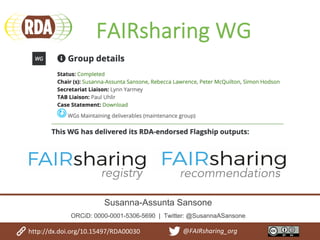
FAIRsharing WG
registry recommendations
http://dx.doi.org/10.15497/RDA00030 @FAIRsharing_org
Susanna-Assunta Sansone
ORCiD: 0000-0001-5306-5690 | Twitter: @SusannaASansone
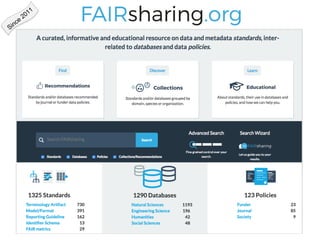
Since
2011
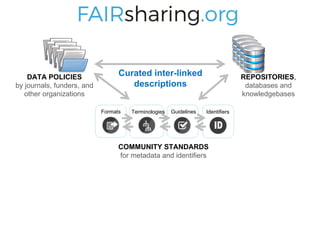
Formats Terminologies Guidelines Identifiers
ID
REPOSITORIES,
databases and
knowledgebases
DATA POLICIES
by journals, funders, and
other organizations
COMMUNITY STANDARDS
for metadata and identifiers
Curated inter-linked
descriptions
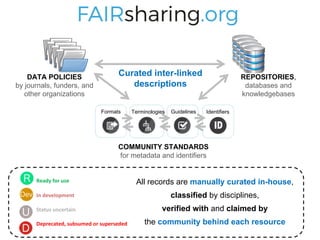
Formats Terminologies Guidelines Identifiers
ID
Curated inter-linked
descriptions
All records are manually curated in-house,
classified by disciplines,
verified with and claimed by
the community behind each resource
Ready for use
In development
Status uncertain
Deprecated, subsumed or superseded
REPOSITORIES,
databases and
knowledgebases
DATA POLICIES
by journals, funders, and
other organizations
COMMUNITY STANDARDS
for metadata and identifiers
Formats Terminologies Guidelines Identifiers
ID
REPOSITORIES,
databases and
knowledgebases
DATA POLICIES
by journals, funders, and
other organizations
COMMUNITY STANDARDS
for metadata and identifiers
Curated inter-linked
descriptions
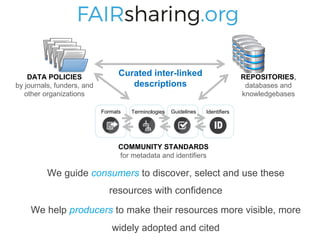
We guide consumers to discover, select and use these
resources with confidence
We help producers to make their resources more visible, more
widely adopted and cited
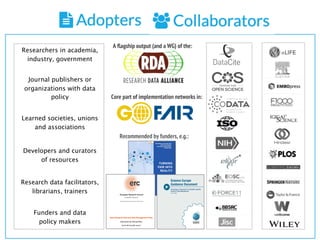
Researchers in academia,
industry, government
Developers and curators
of resources
Journal publishers or
organizations with data
policy
Research data facilitators,
librarians, trainers
Learned societies, unions
and associations
Funders and data
policy makers
A flagship output (and a WG) of the:
Recommended by funders, e.g.:
Core part of implementation networks in:
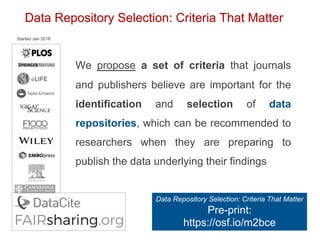
We propose a set of criteria that journals
and publishers believe are important for the
identification and selection of data
repositories, which can be recommended to
researchers when they are preparing to
publish the data underlying their findings
Data Repository Selection: Criteria That Matter
Pre-print:
https://osf.io/m2bce
Started Jan 2018
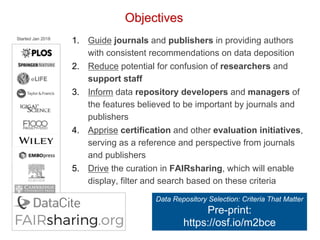
Objectives
1. Guide journals and publishers in providing authors
with consistent recommendations on data deposition
2. Reduce potential for confusion of researchers and
support staff
3. Inform data repository developers and managers of
the features believed to be important by journals and
publishers
4. Apprise certification and other evaluation initiatives,
serving as a reference and perspective from journals
and publishers
5. Drive the curation in FAIRsharing, which will enable
display, filter and search based on these criteria
Data Repository Selection: Criteria That Matter
Pre-print:
https://osf.io/m2bce
Started Jan 2018
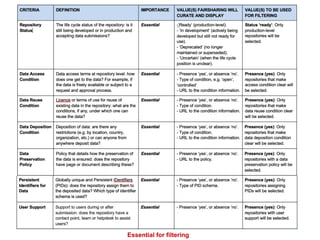
Essential for filtering
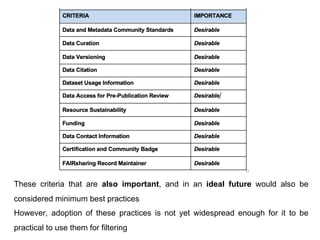
These criteria that are also important, and in an ideal future would also be
considered minimum best practices
However, adoption of these practices is not yet widespread enough for it to be
practical to use them for filtering
Foreseen impact and next steps
Our work will also drive changes by:
• Defining a common language across publishers;
• Helping publishers to maintain this information in a more
automated way;
• Making the process for selection of recommended
repositories more transparent to all stakeholders
Planning a strategy to collect feedback and reach out to
repositories developers and managers; as well as curate
and add the criteria in FAIRsharing
Data Repository Selection: Criteria That Matter
Pre-print:
https://osf.io/m2bce
Started Jan 2018

FAIRsharing and DataCite: Data Repository Selection- Criteria That Matter

  • 1.
    Data Repository Selection: CriteriaThat Matter https://osf.io/m2bce and publishers actively implementing data policies A collaboration among
  • 2.
    FAIRsharing WG registry recommendations http://dx.doi.org/10.15497/RDA00030@FAIRsharing_org Susanna-Assunta Sansone ORCiD: 0000-0001-5306-5690 | Twitter: @SusannaASansone
  • 3.
  • 4.
    Formats Terminologies GuidelinesIdentifiers ID REPOSITORIES, databases and knowledgebases DATA POLICIES by journals, funders, and other organizations COMMUNITY STANDARDS for metadata and identifiers Curated inter-linked descriptions
  • 5.
    Formats Terminologies GuidelinesIdentifiers ID Curated inter-linked descriptions All records are manually curated in-house, classified by disciplines, verified with and claimed by the community behind each resource Ready for use In development Status uncertain Deprecated, subsumed or superseded REPOSITORIES, databases and knowledgebases DATA POLICIES by journals, funders, and other organizations COMMUNITY STANDARDS for metadata and identifiers
  • 6.
    Formats Terminologies GuidelinesIdentifiers ID REPOSITORIES, databases and knowledgebases DATA POLICIES by journals, funders, and other organizations COMMUNITY STANDARDS for metadata and identifiers Curated inter-linked descriptions We guide consumers to discover, select and use these resources with confidence We help producers to make their resources more visible, more widely adopted and cited
  • 7.
    Researchers in academia, industry,government Developers and curators of resources Journal publishers or organizations with data policy Research data facilitators, librarians, trainers Learned societies, unions and associations Funders and data policy makers A flagship output (and a WG) of the: Recommended by funders, e.g.: Core part of implementation networks in:
  • 8.
    We propose aset of criteria that journals and publishers believe are important for the identification and selection of data repositories, which can be recommended to researchers when they are preparing to publish the data underlying their findings Data Repository Selection: Criteria That Matter Data Repository Selection: Criteria That Matter Pre-print: https://osf.io/m2bce Started Jan 2018
  • 9.
    Objectives 1. Guide journalsand publishers in providing authors with consistent recommendations on data deposition 2. Reduce potential for confusion of researchers and support staff 3. Inform data repository developers and managers of the features believed to be important by journals and publishers 4. Apprise certification and other evaluation initiatives, serving as a reference and perspective from journals and publishers 5. Drive the curation in FAIRsharing, which will enable display, filter and search based on these criteria Data Repository Selection: Criteria That Matter Pre-print: https://osf.io/m2bce Started Jan 2018
  • 10.
  • 11.
    These criteria thatare also important, and in an ideal future would also be considered minimum best practices However, adoption of these practices is not yet widespread enough for it to be practical to use them for filtering
  • 12.
    Foreseen impact andnext steps Our work will also drive changes by: • Defining a common language across publishers; • Helping publishers to maintain this information in a more automated way; • Making the process for selection of recommended repositories more transparent to all stakeholders Planning a strategy to collect feedback and reach out to repositories developers and managers; as well as curate and add the criteria in FAIRsharing Data Repository Selection: Criteria That Matter Pre-print: https://osf.io/m2bce Started Jan 2018