www.globalbigdataconference.com
Twitter : @bigdataconf
#GlobalBD
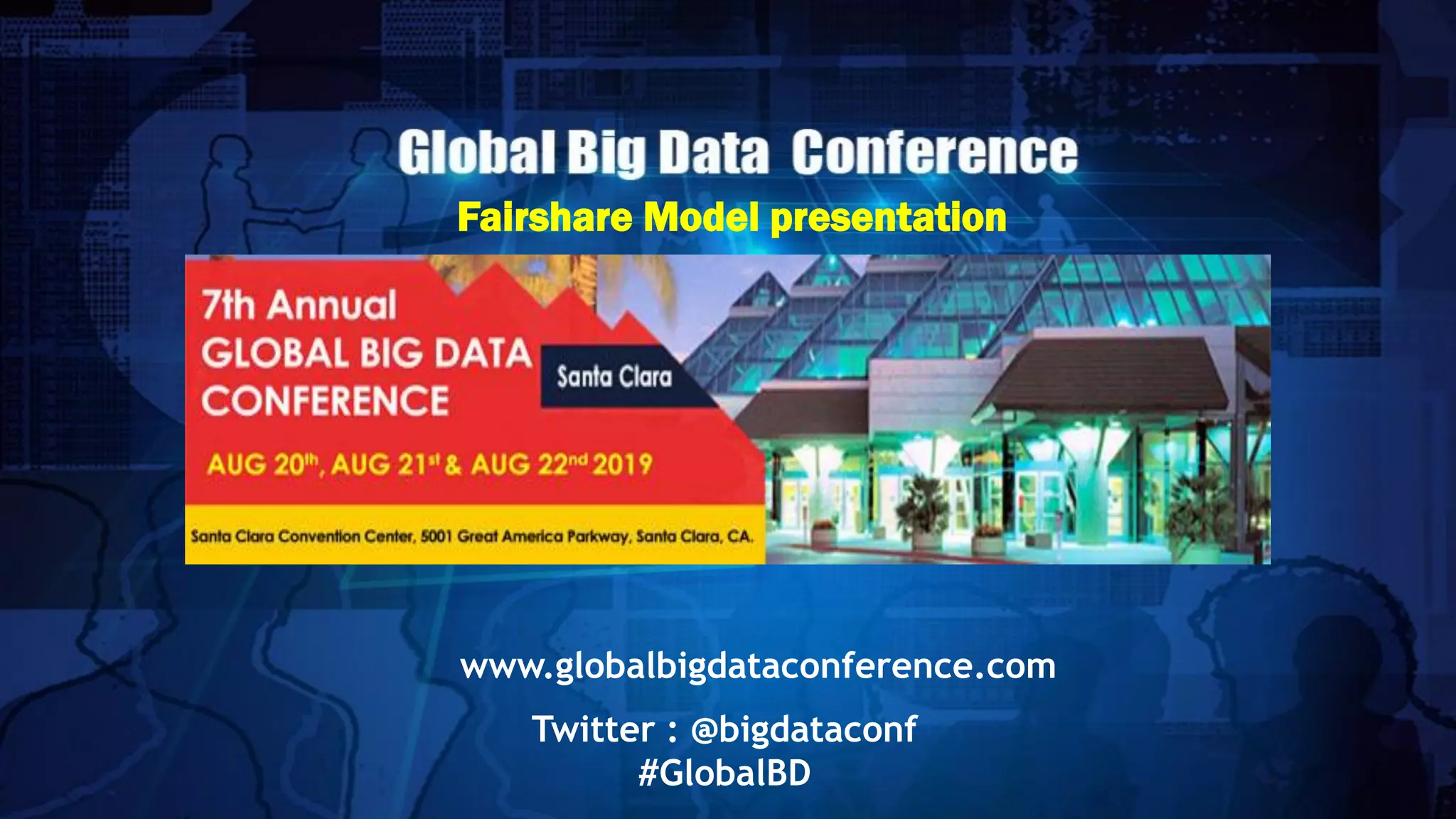
Fairshare Model presentation
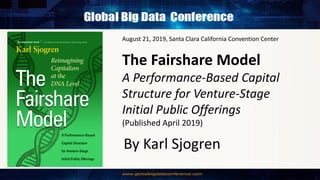
The Fairshare Model
A Performance-Based Capital
Structure for Venture-Stage
Initial Public Offerings
(Published April 2019)
August 21, 2019, Santa Clara California Convention Center
By Karl Sjogren
My Background
• BA and MBA (Michigan State University)
• CPA (inactive)
• Established companies, startups and turnarounds
• > 30 years as consulting CFO/Controller in SF Bay Area
• Co-founder & CEO of Fairshare, Inc. (1996-2001)
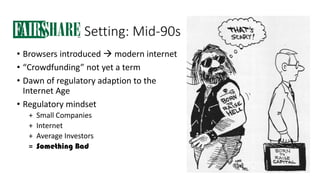
Setting: Mid-90s
• Browsers introduced → modern internet
• “Crowdfunding” not yet a term
• Dawn of regulatory adaption to the
Internet Age
• Regulatory mindset
+ Small Companies
+ Internet
+ Average Investors
= Something Bad
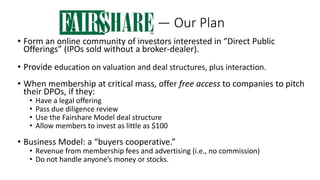
— Our Plan
• Form an online community of investors interested in “Direct Public
Offerings” (IPOs sold without a broker-dealer).
• Provide education on valuation and deal structures, plus interaction.
• When membership at critical mass, offer free access to companies to pitch
their DPOs, if they:
• Have a legal offering
• Pass due diligence review
• Use the Fairshare Model deal structure
• Allow members to invest as little as $100
• Business Model: a “buyers cooperative.”
• Revenue from membership fees and advertising (i.e., no commission)
• Do not handle anyone’s money or stocks.
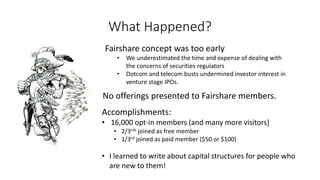
What Happened?
Fairshare concept was too early
• We underestimated the time and expense of dealing with
the concerns of securities regulators
• Dotcom and telecom busts undermined investor interest in
venture stage IPOs.
Accomplishments:
• 16,000 opt-in members (and many more visitors)
• 2/3rds joined as free member
• 1/3rd joined as paid member ($50 or $100)
• I learned to write about capital structures for people who
are new to them!
No offerings presented to Fairshare members.
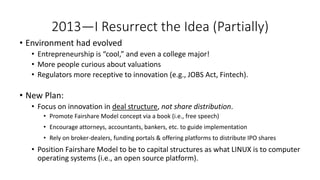
2013—I Resurrect the Idea (Partially)
• Environment had evolved
• Entrepreneurship is “cool,” and even a college major!
• More people curious about valuations
• Regulators more receptive to innovation (e.g., JOBS Act, Fintech).
• New Plan:
• Focus on innovation in deal structure, not share distribution.
• Promote Fairshare Model concept via a book (i.e., free speech)
• Encourage attorneys, accountants, bankers, etc. to guide implementation
• Rely on broker-dealers, funding portals & offering platforms to distribute IPO shares
• Position Fairshare Model to be to capital structures as what LINUX is to computer
operating systems (i.e., an open source platform).
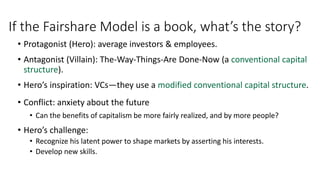
If the Fairshare Model is a book, what’s the story?
• Protagonist (Hero): average investors & employees.
• Antagonist (Villain): The-Way-Things-Are Done-Now (a conventional capital
structure).
• Hero’s inspiration: VCs—they use a modified conventional capital structure.
• Conflict: anxiety about the future
• Can the benefits of capitalism be more fairly realized, and by more people?
• Hero’s challenge:
• Recognize his latent power to shape markets by asserting his interests.
• Develop new skills.
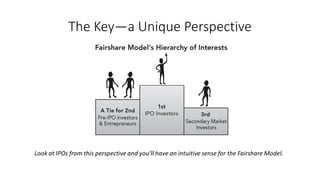
The Key—a Unique Perspective
Vision
Average investors can invest in venture-stage companies on terms
comparable to those that venture capitalists get in a private offering.
Goals
1. For IPO investors: Reduce valuation risk.
2. For companies: An attractive alternative to a VC round.
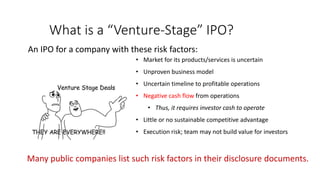
What is a “Venture-Stage” IPO?
An IPO for a company with these risk factors:
• Market for its products/services is uncertain
• Unproven business model
• Uncertain timeline to profitable operations
• Negative cash flow from operations
• Thus, it requires investor cash to operate
• Little or no sustainable competitive advantage
• Execution risk; team may not build value for investors
Many public companies list such risk factors in their disclosure documents.
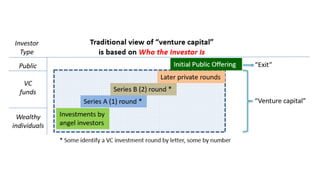
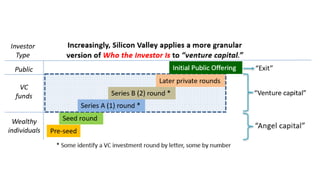
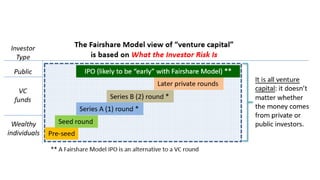
3 Perspectives on “Venture Capital”
1. Traditional view
2. Silicon Valley view
3. Fairshare Model view
A 2:3 Paradigm for Venture-Stage Investors
Two Fundamental Risks
1. Failure risk
• Hard to control
2. Valuation risk
• Controllable
Three Equity Capital Structures
1. Conventional
2. Modified Conventional
3. Fairshare Model
* Fraud = [Failure Risk + Valuation Risk] X False and/or Inadequate Disclosure
*
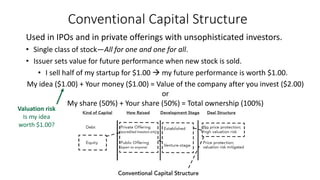
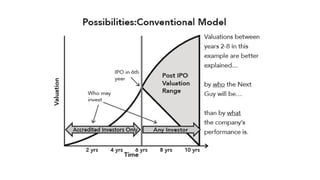
Conventional Capital Structure
Used in IPOs and in private offerings with unsophisticated investors.
• Single class of stock—All for one and one for all.
• Issuer sets value for future performance when new stock is sold.
• I sell half of my startup for $1.00 → my future performance is worth $1.00.
My idea ($1.00) + Your money ($1.00) = Value of the company after you invest ($2.00)
or
My share (50%) + Your share (50%) = Total ownership (100%)
Valuation risk
Is my idea
worth $1.00?
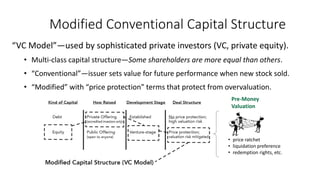
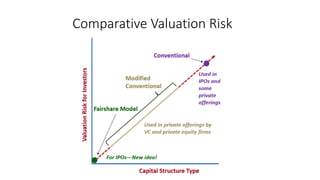
Modified Conventional Capital Structure
“VC Model”—used by sophisticated private investors (VC, private equity).
• Multi-class capital structure—Some shareholders are more equal than others.
• “Conventional”—issuer sets value for future performance when new stock sold.
• “Modified” with “price protection” terms that protect from overvaluation.
• price ratchet
• liquidation preference
• redemption rights, etc.
Pre-Money
Valuation
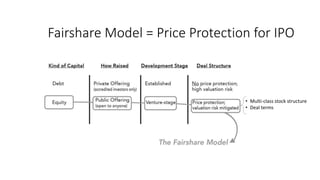
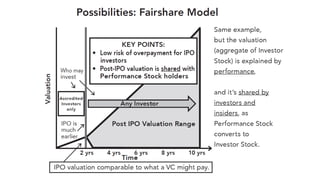
Fairshare Model = Price Protection for IPO
• Multi-class stock structure
• Deal terms
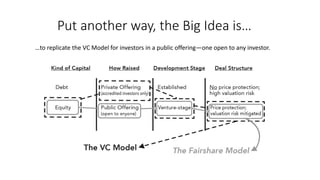
Put another way, the Big Idea is…
…to replicate the VC Model for investors in a public offering—one open to any investor.
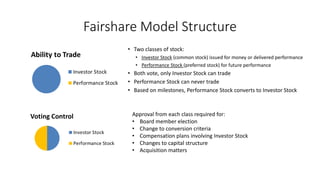
Fairshare Model Structure
• Two classes of stock:
• Investor Stock (common stock) issued for money or delivered performance
• Performance Stock (preferred stock) for future performance
• Both vote, only Investor Stock can trade
• Performance Stock can never trade
• Based on milestones, Performance Stock converts to Investor Stock
Approval from each class required for:
• Board member election
• Change to conversion criteria
• Compensation plans involving Investor Stock
• Changes to capital structure
• Acquisition matters
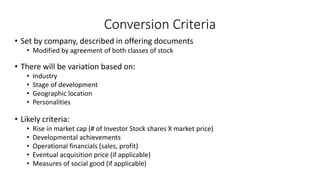
Conversion Criteria
• Set by company, described in offering documents
• Modified by agreement of both classes of stock
• There will be variation based on:
• Industry
• Stage of development
• Geographic location
• Personalities
• Likely criteria:
• Rise in market cap (# of Investor Stock shares X market price)
• Developmental achievements
• Operational financials (sales, profit)
• Eventual acquisition price (if applicable)
• Measures of social good (if applicable)
Comparative Valuation Risk
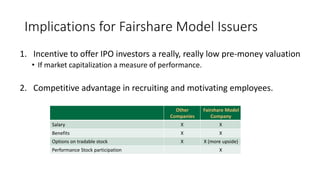
Implications for Fairshare Model Issuers
1. Incentive to offer IPO investors a really, really low pre-money valuation
• If market capitalization a measure of performance.
2. Competitive advantage in recruiting and motivating employees.
Other
Companies
Fairshare Model
Company
Salary X X
Benefits X X
Options on tradable stock X X (more upside)
Performance Stock participation X
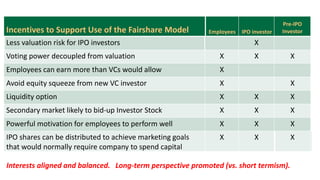
Interests aligned and balanced. Long-term perspective promoted (vs. short termism).
Incentives to Support Use of the Fairshare Model Employees IPO investor
Pre-IPO
Investor
Less valuation risk for IPO investors X
Voting power decoupled from valuation X X X
Employees can earn more than VCs would allow X
Avoid equity squeeze from new VC investor X X
Liquidity option X X X
Secondary market likely to bid-up Investor Stock X X X
Powerful motivation for employees to perform well X X X
IPO shares can be distributed to achieve marketing goals
that would normally require company to spend capital
X X X
How does the Fairshare Model story end?
• Challenges
1. A critical mass of investor support for it must be apparent.
2. Fine tuning by experts in the capital eco-system.
3. Time and experience: companies that use it must like it.
• Yet to be written.
• It’s just an idea now.
• Chicken vs. Egg conundrum
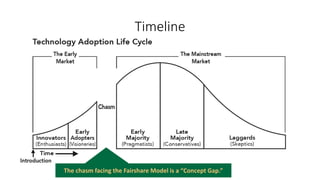
Timeline
The chasm facing the Fairshare Model is a “Concept Gap.”
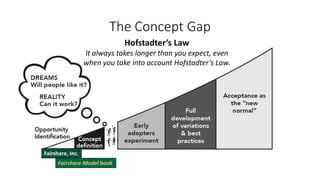
The Concept Gap
Hofstadter’s Law
It always takes longer than you expect, even
when you take into account Hofstadter’s Law.
Fairshare, Inc.
Fairshare Model book
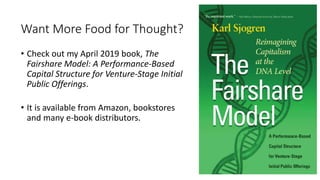
Want More Food for Thought?
• Check out my April 2019 book, The
Fairshare Model: A Performance-Based
Capital Structure for Venture-Stage Initial
Public Offerings.
• It is available from Amazon, bookstores
and many e-book distributors.
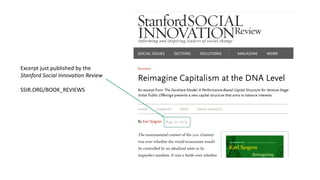
Excerpt just published by the
Stanford Social Innovation Review
SSIR.ORG/BOOK_REVIEWS
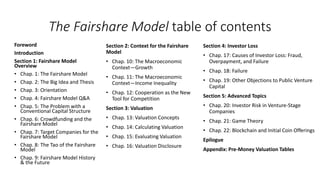
The Fairshare Model table of contents
Foreword
Introduction
Section 1: Fairshare Model
Overview
• Chap. 1: The Fairshare Model
• Chap. 2: The Big Idea and Thesis
• Chap. 3: Orientation
• Chap. 4: Fairshare Model Q&A
• Chap. 5: The Problem with a
Conventional Capital Structure
• Chap. 6: Crowdfunding and the
Fairshare Model
• Chap. 7: Target Companies for the
Fairshare Model
• Chap. 8: The Tao of the Fairshare
Model
• Chap. 9: Fairshare Model History
& the Future
Section 2: Context for the Fairshare
Model
• Chap. 10: The Macroeconomic
Context—Growth
• Chap. 11: The Macroeconomic
Context—Income Inequality
• Chap. 12: Cooperation as the New
Tool for Competition
Section 3: Valuation
• Chap. 13: Valuation Concepts
• Chap. 14: Calculating Valuation
• Chap. 15: Evaluating Valuation
• Chap. 16: Valuation Disclosure
Section 4: Investor Loss
• Chap. 17: Causes of Investor Loss: Fraud,
Overpayment, and Failure
• Chap. 18: Failure
• Chap. 19: Other Objections to Public Venture
Capital
Section 5: Advanced Topics
• Chap. 20: Investor Risk in Venture-Stage
Companies
• Chap. 21: Game Theory
• Chap. 22: Blockchain and Initial Coin Offerings
Epilogue
Appendix: Pre-Money Valuation Tables
“An important work.”
—Ken Wilcox, Chairman Emeritus, Silicon Valley Bank
“Why not reimagine the relationship between investors and
company employees to be one that is fairer and benefits both?”
—Po-Chi Wu, Senior Partner, Futurelab Consulting
“It’s time to reassess the alignment of interests in early-stage
companies. How do you get everyday people to share in the
benefits of capitalism? How do you avoid insane valuations of
companies going public? I may be time to look at the ideas set
out in The Fairshare Model.”
—Sara Hanks, Managing Partner, CrowdCheck Law
“I highly recommend [The Fairshare Model] for entrepreneurs,
practitioners, academics and investors who are committed to
the common good for all.”
—Gregory Wendt, Stakeholders Capital
Advance Praise

Fairshare Model presentation, Global Big Data conf 8.21.19

  • 1.
  • 2.
    The Fairshare Model APerformance-Based Capital Structure for Venture-Stage Initial Public Offerings (Published April 2019) August 21, 2019, Santa Clara California Convention Center By Karl Sjogren
  • 3.
    My Background • BAand MBA (Michigan State University) • CPA (inactive) • Established companies, startups and turnarounds • > 30 years as consulting CFO/Controller in SF Bay Area • Co-founder & CEO of Fairshare, Inc. (1996-2001)
  • 4.
    Setting: Mid-90s • Browsersintroduced → modern internet • “Crowdfunding” not yet a term • Dawn of regulatory adaption to the Internet Age • Regulatory mindset + Small Companies + Internet + Average Investors = Something Bad
  • 5.
    — Our Plan •Form an online community of investors interested in “Direct Public Offerings” (IPOs sold without a broker-dealer). • Provide education on valuation and deal structures, plus interaction. • When membership at critical mass, offer free access to companies to pitch their DPOs, if they: • Have a legal offering • Pass due diligence review • Use the Fairshare Model deal structure • Allow members to invest as little as $100 • Business Model: a “buyers cooperative.” • Revenue from membership fees and advertising (i.e., no commission) • Do not handle anyone’s money or stocks.
  • 6.
    What Happened? Fairshare conceptwas too early • We underestimated the time and expense of dealing with the concerns of securities regulators • Dotcom and telecom busts undermined investor interest in venture stage IPOs. Accomplishments: • 16,000 opt-in members (and many more visitors) • 2/3rds joined as free member • 1/3rd joined as paid member ($50 or $100) • I learned to write about capital structures for people who are new to them! No offerings presented to Fairshare members.
  • 7.
    2013—I Resurrect theIdea (Partially) • Environment had evolved • Entrepreneurship is “cool,” and even a college major! • More people curious about valuations • Regulators more receptive to innovation (e.g., JOBS Act, Fintech). • New Plan: • Focus on innovation in deal structure, not share distribution. • Promote Fairshare Model concept via a book (i.e., free speech) • Encourage attorneys, accountants, bankers, etc. to guide implementation • Rely on broker-dealers, funding portals & offering platforms to distribute IPO shares • Position Fairshare Model to be to capital structures as what LINUX is to computer operating systems (i.e., an open source platform).
  • 8.
    If the FairshareModel is a book, what’s the story? • Protagonist (Hero): average investors & employees. • Antagonist (Villain): The-Way-Things-Are Done-Now (a conventional capital structure). • Hero’s inspiration: VCs—they use a modified conventional capital structure. • Conflict: anxiety about the future • Can the benefits of capitalism be more fairly realized, and by more people? • Hero’s challenge: • Recognize his latent power to shape markets by asserting his interests. • Develop new skills.
  • 9.
    The Key—a UniquePerspective
  • 10.
    Vision Average investors caninvest in venture-stage companies on terms comparable to those that venture capitalists get in a private offering. Goals 1. For IPO investors: Reduce valuation risk. 2. For companies: An attractive alternative to a VC round.
  • 11.
    What is a“Venture-Stage” IPO? An IPO for a company with these risk factors: • Market for its products/services is uncertain • Unproven business model • Uncertain timeline to profitable operations • Negative cash flow from operations • Thus, it requires investor cash to operate • Little or no sustainable competitive advantage • Execution risk; team may not build value for investors Many public companies list such risk factors in their disclosure documents.
  • 12.
    3 Perspectives on“Venture Capital” 1. Traditional view 2. Silicon Valley view 3. Fairshare Model view
  • 16.
    A 2:3 Paradigmfor Venture-Stage Investors Two Fundamental Risks 1. Failure risk • Hard to control 2. Valuation risk • Controllable Three Equity Capital Structures 1. Conventional 2. Modified Conventional 3. Fairshare Model * Fraud = [Failure Risk + Valuation Risk] X False and/or Inadequate Disclosure *
  • 17.
    Conventional Capital Structure Usedin IPOs and in private offerings with unsophisticated investors. • Single class of stock—All for one and one for all. • Issuer sets value for future performance when new stock is sold. • I sell half of my startup for $1.00 → my future performance is worth $1.00. My idea ($1.00) + Your money ($1.00) = Value of the company after you invest ($2.00) or My share (50%) + Your share (50%) = Total ownership (100%) Valuation risk Is my idea worth $1.00?
  • 18.
    Modified Conventional CapitalStructure “VC Model”—used by sophisticated private investors (VC, private equity). • Multi-class capital structure—Some shareholders are more equal than others. • “Conventional”—issuer sets value for future performance when new stock sold. • “Modified” with “price protection” terms that protect from overvaluation. • price ratchet • liquidation preference • redemption rights, etc. Pre-Money Valuation
  • 19.
    Fairshare Model =Price Protection for IPO • Multi-class stock structure • Deal terms
  • 20.
    Put another way,the Big Idea is… …to replicate the VC Model for investors in a public offering—one open to any investor.
  • 21.
    Fairshare Model Structure •Two classes of stock: • Investor Stock (common stock) issued for money or delivered performance • Performance Stock (preferred stock) for future performance • Both vote, only Investor Stock can trade • Performance Stock can never trade • Based on milestones, Performance Stock converts to Investor Stock Approval from each class required for: • Board member election • Change to conversion criteria • Compensation plans involving Investor Stock • Changes to capital structure • Acquisition matters
  • 22.
    Conversion Criteria • Setby company, described in offering documents • Modified by agreement of both classes of stock • There will be variation based on: • Industry • Stage of development • Geographic location • Personalities • Likely criteria: • Rise in market cap (# of Investor Stock shares X market price) • Developmental achievements • Operational financials (sales, profit) • Eventual acquisition price (if applicable) • Measures of social good (if applicable)
  • 23.
  • 24.
    Implications for FairshareModel Issuers 1. Incentive to offer IPO investors a really, really low pre-money valuation • If market capitalization a measure of performance. 2. Competitive advantage in recruiting and motivating employees. Other Companies Fairshare Model Company Salary X X Benefits X X Options on tradable stock X X (more upside) Performance Stock participation X
  • 25.
    Interests aligned andbalanced. Long-term perspective promoted (vs. short termism). Incentives to Support Use of the Fairshare Model Employees IPO investor Pre-IPO Investor Less valuation risk for IPO investors X Voting power decoupled from valuation X X X Employees can earn more than VCs would allow X Avoid equity squeeze from new VC investor X X Liquidity option X X X Secondary market likely to bid-up Investor Stock X X X Powerful motivation for employees to perform well X X X IPO shares can be distributed to achieve marketing goals that would normally require company to spend capital X X X
  • 28.
    How does theFairshare Model story end? • Challenges 1. A critical mass of investor support for it must be apparent. 2. Fine tuning by experts in the capital eco-system. 3. Time and experience: companies that use it must like it. • Yet to be written. • It’s just an idea now. • Chicken vs. Egg conundrum
  • 29.
    Timeline The chasm facingthe Fairshare Model is a “Concept Gap.”
  • 30.
    The Concept Gap Hofstadter’sLaw It always takes longer than you expect, even when you take into account Hofstadter’s Law. Fairshare, Inc. Fairshare Model book
  • 31.
    Want More Foodfor Thought? • Check out my April 2019 book, The Fairshare Model: A Performance-Based Capital Structure for Venture-Stage Initial Public Offerings. • It is available from Amazon, bookstores and many e-book distributors.
  • 32.
    Excerpt just publishedby the Stanford Social Innovation Review SSIR.ORG/BOOK_REVIEWS
  • 33.
    The Fairshare Modeltable of contents Foreword Introduction Section 1: Fairshare Model Overview • Chap. 1: The Fairshare Model • Chap. 2: The Big Idea and Thesis • Chap. 3: Orientation • Chap. 4: Fairshare Model Q&A • Chap. 5: The Problem with a Conventional Capital Structure • Chap. 6: Crowdfunding and the Fairshare Model • Chap. 7: Target Companies for the Fairshare Model • Chap. 8: The Tao of the Fairshare Model • Chap. 9: Fairshare Model History & the Future Section 2: Context for the Fairshare Model • Chap. 10: The Macroeconomic Context—Growth • Chap. 11: The Macroeconomic Context—Income Inequality • Chap. 12: Cooperation as the New Tool for Competition Section 3: Valuation • Chap. 13: Valuation Concepts • Chap. 14: Calculating Valuation • Chap. 15: Evaluating Valuation • Chap. 16: Valuation Disclosure Section 4: Investor Loss • Chap. 17: Causes of Investor Loss: Fraud, Overpayment, and Failure • Chap. 18: Failure • Chap. 19: Other Objections to Public Venture Capital Section 5: Advanced Topics • Chap. 20: Investor Risk in Venture-Stage Companies • Chap. 21: Game Theory • Chap. 22: Blockchain and Initial Coin Offerings Epilogue Appendix: Pre-Money Valuation Tables
  • 34.
    “An important work.” —KenWilcox, Chairman Emeritus, Silicon Valley Bank “Why not reimagine the relationship between investors and company employees to be one that is fairer and benefits both?” —Po-Chi Wu, Senior Partner, Futurelab Consulting “It’s time to reassess the alignment of interests in early-stage companies. How do you get everyday people to share in the benefits of capitalism? How do you avoid insane valuations of companies going public? I may be time to look at the ideas set out in The Fairshare Model.” —Sara Hanks, Managing Partner, CrowdCheck Law “I highly recommend [The Fairshare Model] for entrepreneurs, practitioners, academics and investors who are committed to the common good for all.” —Gregory Wendt, Stakeholders Capital Advance Praise