SEVERE ACUTE MALNUTRITION
MANAGEMENT AND PROGNOSIS
Dr.S.N.SIVARAJ ,Post Graduate.
PROF.DR.G.DURAIARASAN.
DR.K.BAKYALAKSHMI.
DR.M.LINGESWARAN.
DR.C.R.VIGNESH KUMARAN.
M2 UNIT.ICH.
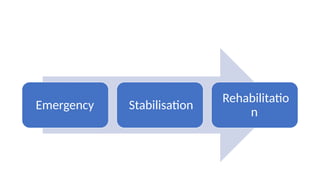
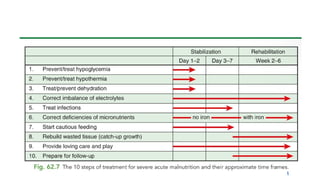
Emergency Stabilisation
Rehabilitatio
n
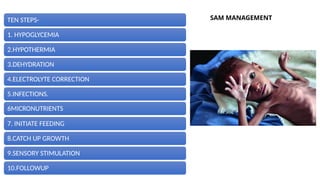
SAM MANAGEMENT
TEN STEPS-
1. HYPOGLYCEMIA
2.HYPOTHERMIA
3.DEHYDRATION
4.ELECTROLYTE CORRECTION
5.INFECTIONS.
6MICRONUTRIENTS
7. INITIATE FEEDING
8.CATCH UP GROWTH
9.SENSORY STIMULATION
10.FOLLOWUP
EMERGENCY TREATMENT-
SHOCK
• Lethargic or unconscious
• Cold hands
Plus either:
• CRT >3 sec or
• Weak pulse.
Hypoglycemia and hypothermia
and infection often coexist .
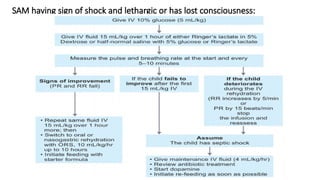
SAM having sign of shock and lethargic or has lost consciousness:
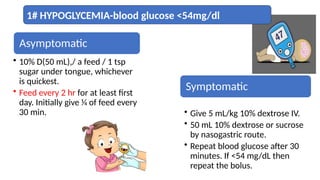
Asymptomatic
• 10% D(50 mL),/ a feed / 1 tsp
sugar under tongue, whichever
is quickest.
• Feed every 2 hr for at least first
day. Initially give 1⁄4 of feed every
30 min.
Symptomatic
• Give 5 mL/kg 10% dextrose IV.
• 50 mL 10% dextrose or sucrose
by nasogastric route.
• Repeat blood glucose after 30
minutes. If <54 mg/dL then
repeat the bolus.
1# HYPOGLYCEMIA-blood glucose <54mg/dl
• Feed every 3 hr day and night
(2 hr if ill).
• Feed on time.
• Keep warm.
• Treat infections
Prevention-
Avoid long
gaps without
food and
minimize
need for
glucose.
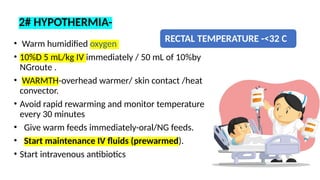
RECTAL TEMPERATURE -<32 C
• Warm humidified oxygen
• 10%D 5 mL/kg IV immediately / 50 mL of 10%by
NGroute .
• WARMTH-overhead warmer/ skin contact /heat
convector.
• Avoid rapid rewarming and monitor temperature
every 30 minutes
• Give warm feeds immediately-oral/NG feeds.
• Start maintenance IV fluids (prewarmed).
• Start intravenous antibiotics
2# HYPOTHERMIA-
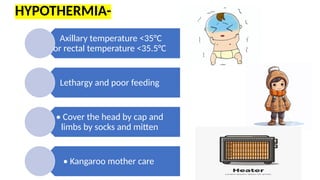
HYPOTHERMIA-
Axillary temperature <35°C
or rectal temperature <35.5°C
Lethargy and poor feeding
• Cover the head by cap and
limbs by socks and mitten
• Kangaroo mother care
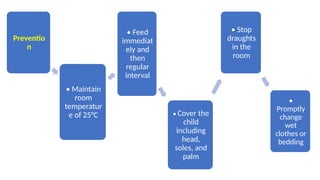
Preventio
n
• Maintain
room
temperatur
e of 25°C
• Feed
immediat
ely and
then
regular
interval
• Cover the
child
including
head,
soles, and
palm
• Stop
draughts
in the
room
•
Promptly
change
wet
clothes or
bedding
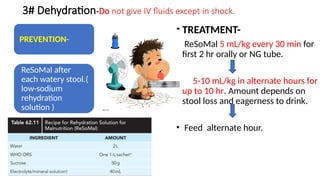
3# Dehydration-Do not give IV fluids except in shock.
PREVENTION-
ReSoMal after
each watery stool.(
low-sodium
rehydration
solution )
• TREATMENT-
• ReSoMal 5 mL/kg every 30 min for
first 2 hr orally or NG tube.
• 5-10 mL/kg in alternate hours for
up to 10 hr. Amount depends on
stool loss and eagerness to drink.
• Feed alternate hour.
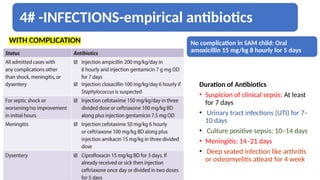
4# -INFECTIONS-empirical antibiotics
WITH COMPLICATION No complication in SAM child: Oral
amoxicillin 15 mg/kg 8 hourly for 5 days
Duration of Antibiotics
• Suspicion of clinical sepsis: At least
for 7 days
• Urinary tract infections (UTI) for 7–
10 days
• Culture positive sepsis: 10–14 days
• Meningitis: 14–21 days
• Deep seated infection like arthritis
or osteomyelitis atleast for 4 week
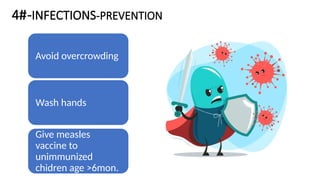
4#-INFECTIONS-PREVENTION
Avoid overcrowding
Wash hands
Give measles
vaccine to
unimmunized
chidren age >6mon.
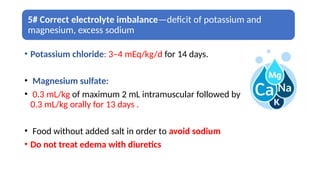
5# Correct electrolyte imbalance—deficit of potassium and
magnesium, excess sodium
• Potassium chloride: 3–4 mEq/kg/d for 14 days.
• Magnesium sulfate:
• 0.3 mL/kg of maximum 2 mL intramuscular followed by
0.3 mL/kg orally for 13 days .
• Food without added salt in order to avoid sodium
• Do not treat edema with diuretics
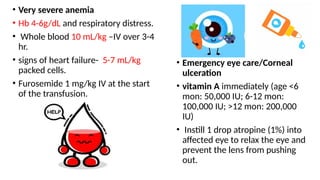
• Very severe anemia
• Hb 4-6g/dL and respiratory distress.
• Whole blood 10 mL/kg –IV over 3-4
hr.
• signs of heart failure- 5-7 mL/kg
packed cells.
• Furosemide 1 mg/kg IV at the start
of the transfusion.
• Emergency eye care/Corneal
ulceration
• vitamin A immediately (age <6
mon: 50,000 IU; 6-12 mon:
100,000 IU; >12 mon: 200,000
IU)
• Instill 1 drop atropine (1%) into
affected eye to relax the eye and
prevent the lens from pushing
out.
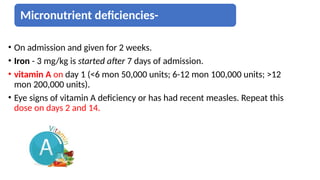
Micronutrient deficiencies-
• On admission and given for 2 weeks.
• Iron - 3 mg/kg is started after 7 days of admission.
• vitamin A on day 1 (<6 mon 50,000 units; 6-12 mon 100,000 units; >12
mon 200,000 units).
• Eye signs of vitamin A deficiency or has had recent measles. Repeat this
dose on days 2 and 14.
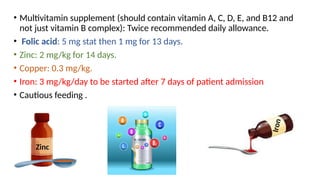
• Multivitamin supplement (should contain vitamin A, C, D, E, and B12 and
not just vitamin B complex): Twice recommended daily allowance.
• Folic acid: 5 mg stat then 1 mg for 13 days.
• Zinc: 2 mg/kg for 14 days.
• Copper: 0.3 mg/kg.
• Iron: 3 mg/kg/day to be started after 7 days of patient admission
• Cautious feeding .
Zinc
I
r
o
n
Stabilisation phase:
• Aim- achieve weight for height.
• Calories - 150–200 kcal/kg/day. 4 g protein and 100–150 mL/kg of
water per day.
• Calorie requirements - actual weight.
• Initially liquid diet started-divided into 6–8 feeds/day including a late
night and an early morning feed to prevent hypoglycaemia in night.
• Tube feeds -severe anorexia and apathy.
• Vitamins and micronutrients .
• Deworming .
• Family pot feeding.
Starter Diet:
• 8-12 small feeds -130mL/kg/day, F75- 75kcal/100ML, 1-1.5g
protein/kg/day.
• Edema-100 mL/kg/day.
• Keep a 24-hr intake chart. Measure feeds carefully. Record leftovers.
• If child has poor appetite, encourage to finish the feed.
• If unfinished, reoffer later.
NG tube if eating ≤80% .
Encourage continued breastfeeding /F75.
• Daily wg monitoring.
Rehabilitation phase
• Aim- weight for age/food supplementation along with
rehabilitation.
• To prevent -back to PEM again by maintaining adequate
nutrition/ periodic growth monitoring/
immunization/routine medical care.
• Health education.
• Reduced or minimal edema and return of appetite.
• F75 F100 ( 100 kcal and 3 g protein per 100 mL),
or ready-to-use therapeutic food RUTF.
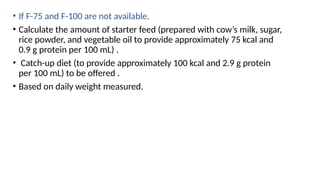
• If F-75 and F-100 are not available.
• Calculate the amount of starter feed (prepared with cow’s milk, sugar,
rice powder, and vegetable oil to provide approximately 75 kcal and
0.9 g protein per 100 mL) .
• Catch-up diet (to provide approximately 100 kcal and 2.9 g protein
per 100 mL) to be offered .
• Based on daily weight measured.
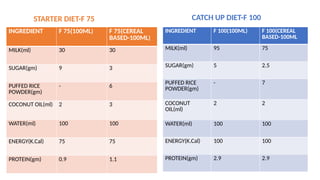
STARTER DIET-F 75
INGREDIENT F 75(100ML) F 75(CEREAL
BASED-100ML)
MILK(ml) 30 30
SUGAR(gm) 9 3
PUFFED RICE
POWDER(gm)
- 6
COCONUT OIL(ml) 2 3
WATER(ml) 100 100
ENERGY(K.Cal) 75 75
PROTEIN(gm) 0.9 1.1
CATCH UP DIET-F 100
INGREDIENT F 100(100ML) F 100(CEREAL
BASED-100ML
MILK(ml) 95 75
SUGAR(gm) 5 2.5
PUFFED RICE
POWDER(gm)
- 7
COCONUT
OIL(ml)
2 2
WATER(ml) 100 100
ENERGY(K.Cal) 100 100
PROTEIN(gm) 2.9 2.9
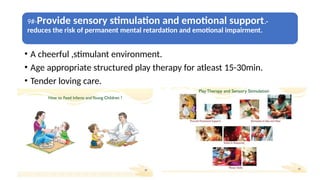
9#-Provide sensory stimulation and emotional support.-
reduces the risk of permanent mental retardation and emotional impairment.
• A cheerful ,stimulant environment.
• Age appropriate structured play therapy for atleast 15-30min.
• Tender loving care.
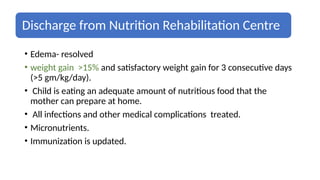
Discharge from Nutrition Rehabilitation Centre
• Edema- resolved
• weight gain >15% and satisfactory weight gain for 3 consecutive days
(>5 gm/kg/day).
• Child is eating an adequate amount of nutritious food that the
mother can prepare at home.
• All infections and other medical complications treated.
• Micronutrients.
• Immunization is updated.
• Failure criteria of SAM
management:
• Day 4.
• Failure to gain appetite.
• Failure to start to lose edema.
• Day 10
• Edema still present
• Failure to gain at least 5 g/day
for 3 successive days.
• After feeding freely on catch-up
diet.
• Look for the cause of failure:
• Insufficient food given.
• Vitamin or mineral deficiency.
• unrecognized infections.
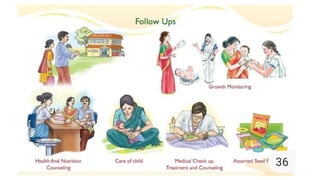
• Mother/caregiver:
 To prepare appropriate foods and to feed the child.
 Give prescribed medications, vitamins, folic acid and iron at home.
 To make appropriate toys and play with the child.
 To give home treatment for diarrhoea, fever and acute respiratory
infections .
 To recognize the signs for which medical assistance needed.
 Follow-up plan is discussed and understood.
 community based program is well functioning, child can be
transferred from facility based care to community based care for
achieving target weight gain of 15 %.
Outcome and prognosis
• Long term effects-stature,developmental,cognitive function.
• 1st
6month-stunted despite treatment-25-60%
• Early diagnosis and intervention –needed to prevent long term
effects.
Take home message!
• Be Slow and steady ,No aggressive treatment.
• No diuretics for edema
• No iv fluids for dehydration(except in shock).
• No high protein diet in early phase of treatment.
• Low sodium diet .
• No iron therapy in stabilisation phase.
References
-Nelson text book of pediatrics
22nd
edition.
-Guideline for IP treatment of
SAM-WHO.
-ICMR ,NIN guideline.
-STG-IAP.
THANK YOU

FAILURE TO THRIVE 4 presentations paediatric.pptx

  • 1.
    SEVERE ACUTE MALNUTRITION MANAGEMENTAND PROGNOSIS Dr.S.N.SIVARAJ ,Post Graduate. PROF.DR.G.DURAIARASAN. DR.K.BAKYALAKSHMI. DR.M.LINGESWARAN. DR.C.R.VIGNESH KUMARAN. M2 UNIT.ICH.
  • 2.
  • 3.
    SAM MANAGEMENT TEN STEPS- 1.HYPOGLYCEMIA 2.HYPOTHERMIA 3.DEHYDRATION 4.ELECTROLYTE CORRECTION 5.INFECTIONS. 6MICRONUTRIENTS 7. INITIATE FEEDING 8.CATCH UP GROWTH 9.SENSORY STIMULATION 10.FOLLOWUP
  • 4.
    EMERGENCY TREATMENT- SHOCK • Lethargicor unconscious • Cold hands Plus either: • CRT >3 sec or • Weak pulse. Hypoglycemia and hypothermia and infection often coexist .
  • 5.
    SAM having signof shock and lethargic or has lost consciousness:
  • 6.
    Asymptomatic • 10% D(50mL),/ a feed / 1 tsp sugar under tongue, whichever is quickest. • Feed every 2 hr for at least first day. Initially give 1⁄4 of feed every 30 min. Symptomatic • Give 5 mL/kg 10% dextrose IV. • 50 mL 10% dextrose or sucrose by nasogastric route. • Repeat blood glucose after 30 minutes. If <54 mg/dL then repeat the bolus. 1# HYPOGLYCEMIA-blood glucose <54mg/dl
  • 7.
    • Feed every3 hr day and night (2 hr if ill). • Feed on time. • Keep warm. • Treat infections Prevention- Avoid long gaps without food and minimize need for glucose.
  • 8.
    RECTAL TEMPERATURE -<32C • Warm humidified oxygen • 10%D 5 mL/kg IV immediately / 50 mL of 10%by NGroute . • WARMTH-overhead warmer/ skin contact /heat convector. • Avoid rapid rewarming and monitor temperature every 30 minutes • Give warm feeds immediately-oral/NG feeds. • Start maintenance IV fluids (prewarmed). • Start intravenous antibiotics 2# HYPOTHERMIA-
  • 9.
    HYPOTHERMIA- Axillary temperature <35°C orrectal temperature <35.5°C Lethargy and poor feeding • Cover the head by cap and limbs by socks and mitten • Kangaroo mother care
  • 10.
    Preventio n • Maintain room temperatur e of25°C • Feed immediat ely and then regular interval • Cover the child including head, soles, and palm • Stop draughts in the room • Promptly change wet clothes or bedding
  • 11.
    3# Dehydration-Do notgive IV fluids except in shock. PREVENTION- ReSoMal after each watery stool.( low-sodium rehydration solution ) • TREATMENT- • ReSoMal 5 mL/kg every 30 min for first 2 hr orally or NG tube. • 5-10 mL/kg in alternate hours for up to 10 hr. Amount depends on stool loss and eagerness to drink. • Feed alternate hour.
  • 13.
    4# -INFECTIONS-empirical antibiotics WITHCOMPLICATION No complication in SAM child: Oral amoxicillin 15 mg/kg 8 hourly for 5 days Duration of Antibiotics • Suspicion of clinical sepsis: At least for 7 days • Urinary tract infections (UTI) for 7– 10 days • Culture positive sepsis: 10–14 days • Meningitis: 14–21 days • Deep seated infection like arthritis or osteomyelitis atleast for 4 week
  • 14.
    4#-INFECTIONS-PREVENTION Avoid overcrowding Wash hands Givemeasles vaccine to unimmunized chidren age >6mon.
  • 15.
    5# Correct electrolyteimbalance—deficit of potassium and magnesium, excess sodium • Potassium chloride: 3–4 mEq/kg/d for 14 days. • Magnesium sulfate: • 0.3 mL/kg of maximum 2 mL intramuscular followed by 0.3 mL/kg orally for 13 days . • Food without added salt in order to avoid sodium • Do not treat edema with diuretics
  • 16.
    • Very severeanemia • Hb 4-6g/dL and respiratory distress. • Whole blood 10 mL/kg –IV over 3-4 hr. • signs of heart failure- 5-7 mL/kg packed cells. • Furosemide 1 mg/kg IV at the start of the transfusion. • Emergency eye care/Corneal ulceration • vitamin A immediately (age <6 mon: 50,000 IU; 6-12 mon: 100,000 IU; >12 mon: 200,000 IU) • Instill 1 drop atropine (1%) into affected eye to relax the eye and prevent the lens from pushing out.
  • 17.
    Micronutrient deficiencies- • Onadmission and given for 2 weeks. • Iron - 3 mg/kg is started after 7 days of admission. • vitamin A on day 1 (<6 mon 50,000 units; 6-12 mon 100,000 units; >12 mon 200,000 units). • Eye signs of vitamin A deficiency or has had recent measles. Repeat this dose on days 2 and 14.
  • 18.
    • Multivitamin supplement(should contain vitamin A, C, D, E, and B12 and not just vitamin B complex): Twice recommended daily allowance. • Folic acid: 5 mg stat then 1 mg for 13 days. • Zinc: 2 mg/kg for 14 days. • Copper: 0.3 mg/kg. • Iron: 3 mg/kg/day to be started after 7 days of patient admission • Cautious feeding . Zinc I r o n
  • 19.
    Stabilisation phase: • Aim-achieve weight for height. • Calories - 150–200 kcal/kg/day. 4 g protein and 100–150 mL/kg of water per day. • Calorie requirements - actual weight. • Initially liquid diet started-divided into 6–8 feeds/day including a late night and an early morning feed to prevent hypoglycaemia in night. • Tube feeds -severe anorexia and apathy. • Vitamins and micronutrients . • Deworming . • Family pot feeding.
  • 20.
    Starter Diet: • 8-12small feeds -130mL/kg/day, F75- 75kcal/100ML, 1-1.5g protein/kg/day. • Edema-100 mL/kg/day. • Keep a 24-hr intake chart. Measure feeds carefully. Record leftovers. • If child has poor appetite, encourage to finish the feed. • If unfinished, reoffer later. NG tube if eating ≤80% . Encourage continued breastfeeding /F75. • Daily wg monitoring.
  • 21.
    Rehabilitation phase • Aim-weight for age/food supplementation along with rehabilitation. • To prevent -back to PEM again by maintaining adequate nutrition/ periodic growth monitoring/ immunization/routine medical care. • Health education. • Reduced or minimal edema and return of appetite. • F75 F100 ( 100 kcal and 3 g protein per 100 mL), or ready-to-use therapeutic food RUTF.
  • 22.
    • If F-75and F-100 are not available. • Calculate the amount of starter feed (prepared with cow’s milk, sugar, rice powder, and vegetable oil to provide approximately 75 kcal and 0.9 g protein per 100 mL) . • Catch-up diet (to provide approximately 100 kcal and 2.9 g protein per 100 mL) to be offered . • Based on daily weight measured.
  • 23.
    STARTER DIET-F 75 INGREDIENTF 75(100ML) F 75(CEREAL BASED-100ML) MILK(ml) 30 30 SUGAR(gm) 9 3 PUFFED RICE POWDER(gm) - 6 COCONUT OIL(ml) 2 3 WATER(ml) 100 100 ENERGY(K.Cal) 75 75 PROTEIN(gm) 0.9 1.1 CATCH UP DIET-F 100 INGREDIENT F 100(100ML) F 100(CEREAL BASED-100ML MILK(ml) 95 75 SUGAR(gm) 5 2.5 PUFFED RICE POWDER(gm) - 7 COCONUT OIL(ml) 2 2 WATER(ml) 100 100 ENERGY(K.Cal) 100 100 PROTEIN(gm) 2.9 2.9
  • 24.
    9#-Provide sensory stimulationand emotional support.- reduces the risk of permanent mental retardation and emotional impairment. • A cheerful ,stimulant environment. • Age appropriate structured play therapy for atleast 15-30min. • Tender loving care.
  • 26.
    Discharge from NutritionRehabilitation Centre • Edema- resolved • weight gain >15% and satisfactory weight gain for 3 consecutive days (>5 gm/kg/day). • Child is eating an adequate amount of nutritious food that the mother can prepare at home. • All infections and other medical complications treated. • Micronutrients. • Immunization is updated.
  • 27.
    • Failure criteriaof SAM management: • Day 4. • Failure to gain appetite. • Failure to start to lose edema. • Day 10 • Edema still present • Failure to gain at least 5 g/day for 3 successive days. • After feeding freely on catch-up diet. • Look for the cause of failure: • Insufficient food given. • Vitamin or mineral deficiency. • unrecognized infections.
  • 28.
    • Mother/caregiver:  Toprepare appropriate foods and to feed the child.  Give prescribed medications, vitamins, folic acid and iron at home.  To make appropriate toys and play with the child.  To give home treatment for diarrhoea, fever and acute respiratory infections .  To recognize the signs for which medical assistance needed.  Follow-up plan is discussed and understood.  community based program is well functioning, child can be transferred from facility based care to community based care for achieving target weight gain of 15 %.
  • 30.
    Outcome and prognosis •Long term effects-stature,developmental,cognitive function. • 1st 6month-stunted despite treatment-25-60% • Early diagnosis and intervention –needed to prevent long term effects.
  • 32.
    Take home message! •Be Slow and steady ,No aggressive treatment. • No diuretics for edema • No iv fluids for dehydration(except in shock). • No high protein diet in early phase of treatment. • Low sodium diet . • No iron therapy in stabilisation phase.
  • 33.
    References -Nelson text bookof pediatrics 22nd edition. -Guideline for IP treatment of SAM-WHO. -ICMR ,NIN guideline. -STG-IAP.
  • 34.