International Journal of Business Marketing and Management (IJBMM)
Volume 3 Issue 8 August 2018, P.P. 61-66
ISSN: 2456-4559
www.ijbmm.com
International Journal of Business Marketing and Management (IJBMM) Page 61
Factors Affecting Prevalence of Reverse Mentoring in India
Dr. Manoj K. Sharma, Ms. Muskan Nagi,
Professor, University Business School, Panjab University, Chandigarh
SRF, University Business School, Panjab University, Chandigarh
Abstract- Reverse Mentoring is an emerging program in maximum of developing organizations. Reverse
Mentoring is highly practiced and appreciated by mentors, mentees and also the organizations. In this paper an
attempt has been made to study what factors among Organization Factors, Job Condition Factor, Rewards and
Benefit Factor, Career Development Factor, of respondents are affecting for the prevalence of Reverse
Mentoring. The number of respondents in the paper is 530 and is from selected companies of North India.
I. Introduction
The term “mentor” originates from Greek Mythology. The practice of mentoring even dates back to
earlier times. As per the Greek mythology Mentor was Odysseus‟s trusted counselor who also guided and taught
his son Telemachus.
Today, mentoring is a process in which an experienced individual helps another person develops his or her goals
and skills through a series of time-limited confidential, one-on-one conversations and other learning activities.
Mentors also draw benefits from the mentoring relationship. As a mentor, you will have the opportunity to share
your wisdom and experiences, evolve your own thinking, develop a new relationship, and deepen your skills as
a mentor. Mentoring is usually understood to involve a more senior or experienced person (the mentor) helping
one who is younger or less experienced (the mentee).
On the contrary, reverse mentoring is the mentoring of a senior person (in terms of age, experience or position)
by a junior (in terms of age, experience or position) individual. Reverse mentoring aims to help older, more
senior people learn from the knowledge of younger people, usually in the field of information technology,
computing, and Internet communications. The key to success in reverse mentoring is the ability to create and
maintain an attitude of openness to the experience and dissolve the barriers of status, power and position.
The concept of reverse mentoring was introduced by Jack Welch in 1999, former chief executive of the General
Electric Company. It is a formal mentoring program in which a young, junior employee with something to teach
is partnered with a senior manager who has something to learn. Jack Welch undertook pairing of employees in
their 20s and 30s who were knowledgeable about the Internet and interested in new technology with executives,
who were beginners in that realm. Reverse mentoring is a mutual learning experience. As the concept is a
deviation from the traditional approach, it is essential to seek support from top management and line managers
in order to implement it. With the technological advancement at such a fast pace and the growth of social media,
the youngsters in the organization are the best people who can be the mentors of the boomers. In order to grow
and sustain in a today‟s organization, it is essential to have a strong technological know-how. The concept of
reverse mentoring provides a platform wherein the younger employee provides insights on the technological
know-how to the industry experts and pioneers. They also guide them in the use of various social media
applications, such as, facebook , twitter, LinkedIn etc., as they have become important means of communication
not only for the purpose of inside flow of information, but also with the outside world. The scope of reverse
mentoring however, is not limited to imparting of technological know-how. It also facilitates the understanding
of changing work- culture, increasing diversity, growing need for maintaining work-life balance, changes in
global scenario etc. This helps them to keep pace with the changing world and thus, may enhance the level of
employee engagement in the organization.
The objective of reverse mentoring is to "push each other outside of their usual ranges of familiarity and attempt
better approaches for considering, working and being". For a reverse mentoring relationship to be gainful, a few
elements must be in place. Each gathering must be completely dedicated to the mentoring relationship and
Factors Affecting Prevalence of Reverse Mentoring in India
International Journal of Business Marketing and Management (IJBMM) Page 62
concur upon the tenets that will be taken after. This study, therefore, has been conducted to study the
antecedents to reverse mentoring or the factors which promote reverse mentoring in an organization
II. Literature Review
Today‟s workforce is marked by a phenomenon which we never witnessed earlier: five generations are
working simultaneously (Mister and Willyerd, 2009). They are the Traditionalists (born prior to 1946), the Baby
Boomers (born between 1946 and 1964), the Gen X (born between 1965 and 1976), the Millennials (born
between 1977 and 1997), and the Gen 2020 (born after 1997).
Chaudhuri & Ghosh (2012) shows how powerful a tool reverse mentoring can be in such a scenario. The article
establishes reverse mentoring as a mechanism for social exchange, which has the potential to garner the ability
of the different generations, especially the Boomers and the Millennials, individually, by being discerning of
their distinctive needs and esteem frameworks. The Boomers‟ need for hands-on experience in new technology
is fulfilled by reverse mentoring from the Millennials and the Millennials‟ need for recognition is fulfilled by
their supervisors in return. This social exchange through reverse mentoring helps both the generations remain
engaged and committed to the organization. It therefore becomes important to understand the antecedents to
reverse mentoring or the factors which promote reverse mentoring in an organization. The factors considered for
this study include organizational factors, job conditions, rewards and benefits, and career development factors.
One of the organizational factors which foster reverse mentoring is having clarity about the organizational goals.
The employees having clarity about the company goals and objectives will tend to co-operate with each other
for the attainment of those goals and objectives. If the organization encourages such teamwork and co-operation
among the employees, reverse mentoring will be more prevalent among them. Strong work ethics of the
organization and trust on the supervisors and management further the cause of reverse mentoring for the
organizations. Furthermore, it can be expected of the employees to share their knowledge and expertise with
each other only if they remain committed for their organization. Therefore, it is also important that the
organizations retain their employees and their commitment. As these employees continue to better their skills
and share them with each other, they become the historians of the successes of their organizations.
Favorable job conditions form the second factor which promotes reverse mentoring in an organization.
Favorable job conditions include employee empowerment to the optimum level. Empowered employees
question existing processes and procedures and make way for efficient processes to set in. Empowerment of the
employees holds them accountable and responsible for the successes and failures of the organization and
therefore they work in the best interests of the organization. With the known benefits of reverse mentoring, the
empowered employees will be more inclined to adopt reverse mentoring in their organization. Also, employee
engagement to the optimum level provides a potential for the employees to participate in important decision
areas and provide them with strong platform to perform. This increased participation motivates the employees
and therefore promote the prevalence of reverse mentoring among them. Role clarity and challenging and
exciting work, combined with stress-free work environment, further promote reverse mentoring because the
employees are clear about the performance parameters which require them to collaborate with each other. The
management pressure forcing employees to adopt reverse mentoring will no longer be necessary in such job
conditions.
The inclination of the employee rewards and benefits with the organization goals align the employee activities
towards attainment of these goals (Stewart et al., 1993). The rewards can be both intrinsic and extrinsic (Ozutku,
2012). The extrinsic rewards are factors which rely on extrinsic motivation outside of an individual‟s personal
motives and can be in terms of salary, promotions, performance appraisals, and job security (Mottaz, 1995).
Intrinsic rewards rely on intrinsic motivation factors like job satisfaction which reward the personal self of the
individual (Mahaney & Lederer, 2006). It can, therefore, be proposed that rewards and benefits will have a
positive impact on the prevalence or reverse mentoring if they are inclined as per the company goals and
objectives as they influence employee motivation to work in the desired direction.
The fourth factor includes the career development factors. Employees stay with their company if the path of
their career progression within the organization is clear to them (Chamberlain, 2017). They continue with their
organization if the management supports their overall development, and, if they find the organization‟s career
development programs to be beneficial and motivating. If the employees are retained, the chances of prevalence
of reverse mentoring within the organization are increased as discussed earlier. Therefore, it can be proposed
that career development factors have a positive influence on the prevalence of reverse mentoring.
Factors Affecting Prevalence of Reverse Mentoring in India
International Journal of Business Marketing and Management (IJBMM) Page 63
The null hypotheses to test these relationships are:
H01: There is no statistically significant impact of Organizational factors on Prevalence of Reverse Mentoring.
H02: There is no statistically significant impact of Job conditions on Prevalence of Reverse Mentoring.
H03: There is no statistically significant impact of Rewards and Benefits on Prevalence of Reverse Mentoring.
H04: There is no statistically significant impact of Career factors on Prevalence of Reverse Mentoring.
III. Research Methodology
Research Design
This study has makes use of cross-sectional research design in which data is collected from more than one case
at a single point of time. It is a descriptive research study and is empirical in nature.
Scale
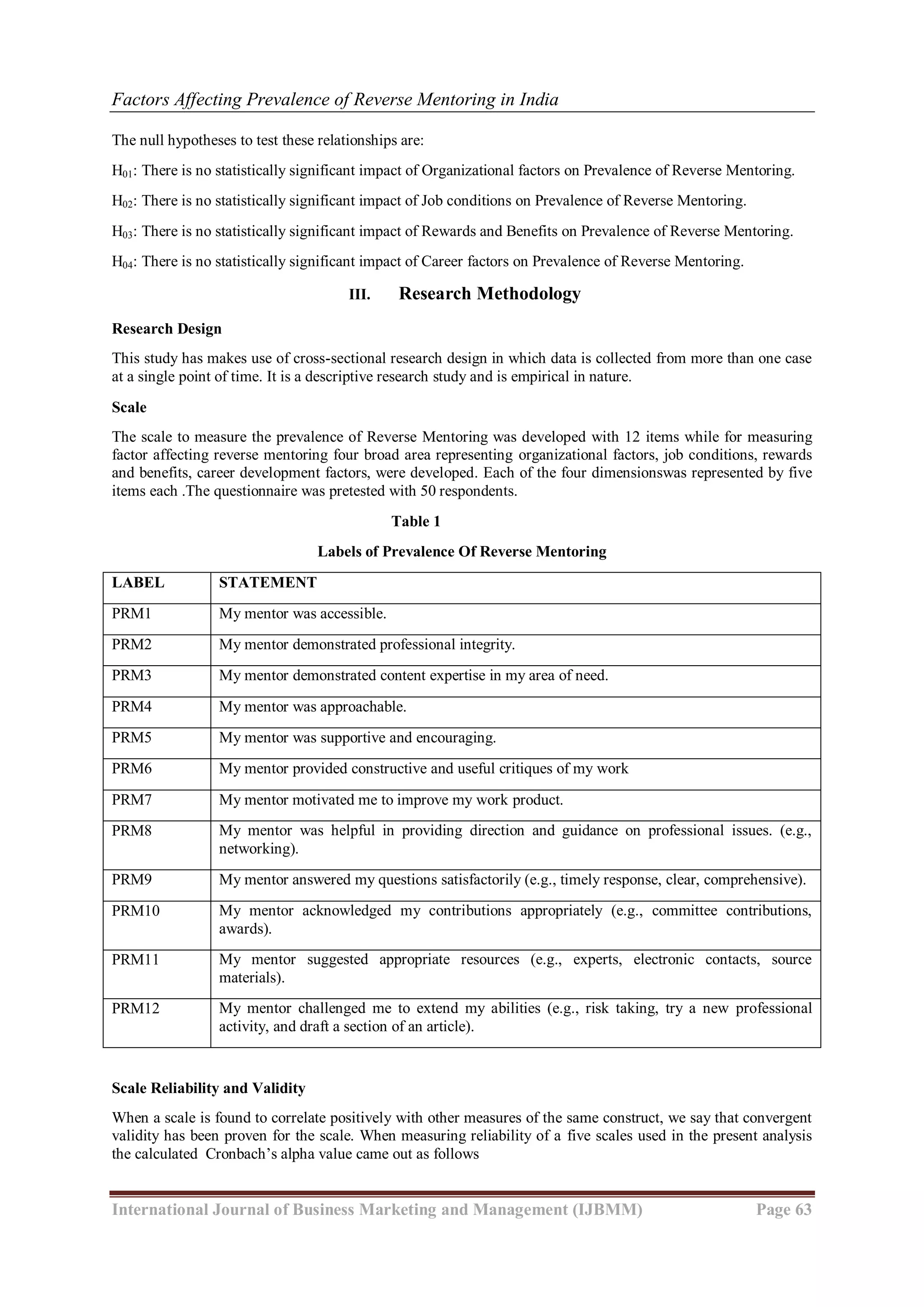
The scale to measure the prevalence of Reverse Mentoring was developed with 12 items while for measuring
factor affecting reverse mentoring four broad area representing organizational factors, job conditions, rewards
and benefits, career development factors, were developed. Each of the four dimensionswas represented by five
items each .The questionnaire was pretested with 50 respondents.
Table 1
Labels of Prevalence Of Reverse Mentoring
LABEL STATEMENT
PRM1 My mentor was accessible.
PRM2 My mentor demonstrated professional integrity.
PRM3 My mentor demonstrated content expertise in my area of need.
PRM4 My mentor was approachable.
PRM5 My mentor was supportive and encouraging.
PRM6 My mentor provided constructive and useful critiques of my work
PRM7 My mentor motivated me to improve my work product.
PRM8 My mentor was helpful in providing direction and guidance on professional issues. (e.g.,
networking).
PRM9 My mentor answered my questions satisfactorily (e.g., timely response, clear, comprehensive).
PRM10 My mentor acknowledged my contributions appropriately (e.g., committee contributions,
awards).
PRM11 My mentor suggested appropriate resources (e.g., experts, electronic contacts, source
materials).
PRM12 My mentor challenged me to extend my abilities (e.g., risk taking, try a new professional
activity, and draft a section of an article).
Scale Reliability and Validity
When a scale is found to correlate positively with other measures of the same construct, we say that convergent
validity has been proven for the scale. When measuring reliability of a five scales used in the present analysis
the calculated Cronbach‟s alpha value came out as follows
Factors Affecting Prevalence of Reverse Mentoring in India
International Journal of Business Marketing and Management (IJBMM) Page 64
For PRM Cronbach‟s alpha value is 0.979
For OF Cronbach‟s alpha value is 0.958
For JC Cronbach‟s alpha value is 0.949
For RB Cronbach‟s alpha value is 0.901
For CF Cronbach‟s alpha value is 0.818
The degree of cohesiveness existing among the different items of the five scale is established and as a result,
Cronbach‟s alpha also reflects convergent validity, though indirectly.
Sampling
A sample of 530 selected mentor and mentees from various companies from the cities of India to represent the
target population.
IV. Results and Discussion
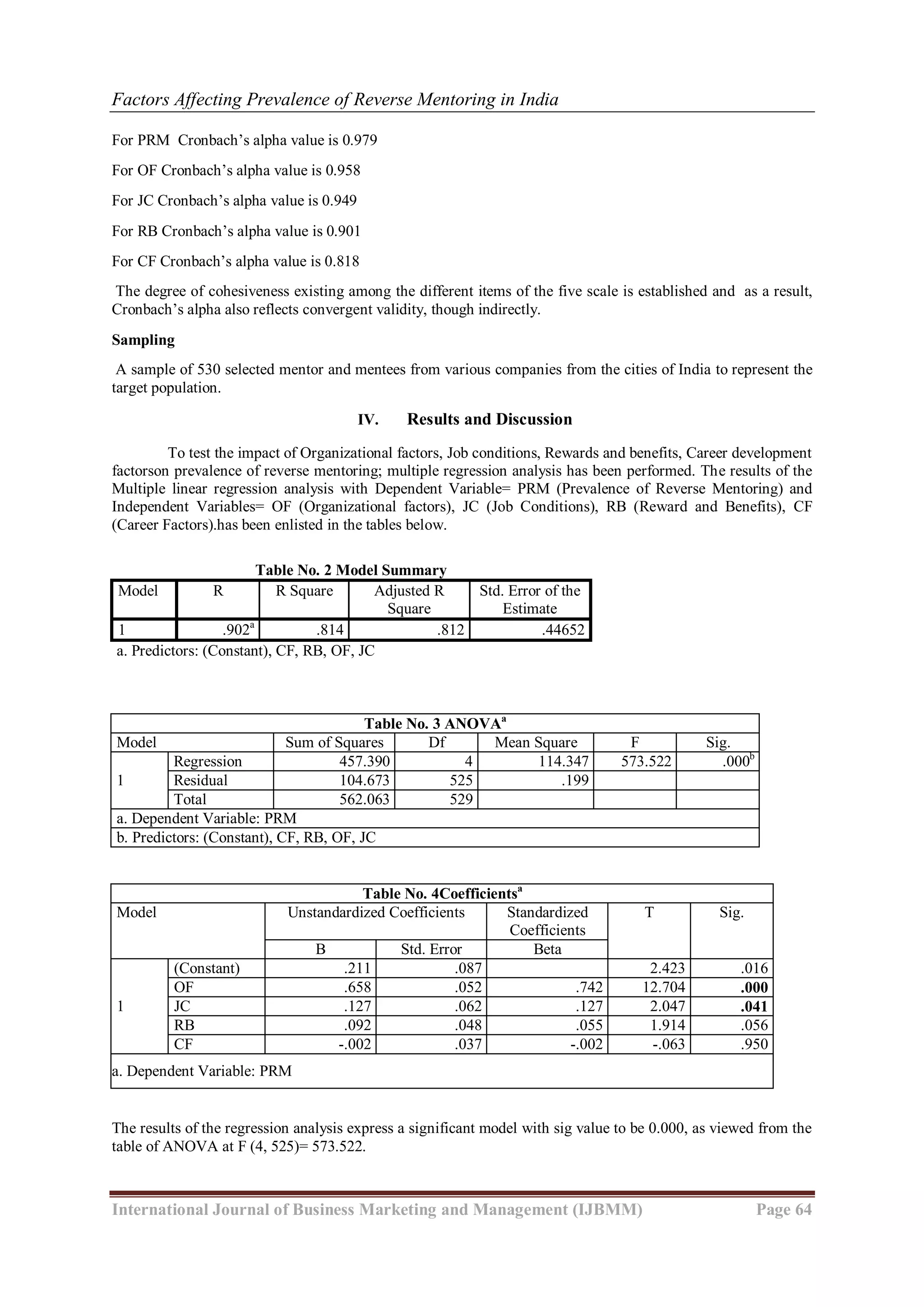
To test the impact of Organizational factors, Job conditions, Rewards and benefits, Career development
factorson prevalence of reverse mentoring; multiple regression analysis has been performed. The results of the
Multiple linear regression analysis with Dependent Variable= PRM (Prevalence of Reverse Mentoring) and
Independent Variables= OF (Organizational factors), JC (Job Conditions), RB (Reward and Benefits), CF
(Career Factors).has been enlisted in the tables below.
Table No. 4Coefficientsa
Model Unstandardized Coefficients Standardized
Coefficients
T Sig.
B Std. Error Beta
1
(Constant) .211 .087 2.423 .016
OF .658 .052 .742 12.704 .000
JC .127 .062 .127 2.047 .041
RB .092 .048 .055 1.914 .056
CF -.002 .037 -.002 -.063 .950
a. Dependent Variable: PRM
The results of the regression analysis express a significant model with sig value to be 0.000, as viewed from the
table of ANOVA at F (4, 525)= 573.522.
Table No. 2 Model Summary
Model R R Square Adjusted R
Square
Std. Error of the
Estimate
1 .902a
.814 .812 .44652
a. Predictors: (Constant), CF, RB, OF, JC
Table No. 3 ANOVAa
Model Sum of Squares Df Mean Square F Sig.
1
Regression 457.390 4 114.347 573.522 .000b
Residual 104.673 525 .199
Total 562.063 529
a. Dependent Variable: PRM
b. Predictors: (Constant), CF, RB, OF, JC
Factors Affecting Prevalence of Reverse Mentoring in India
International Journal of Business Marketing and Management (IJBMM) Page 65
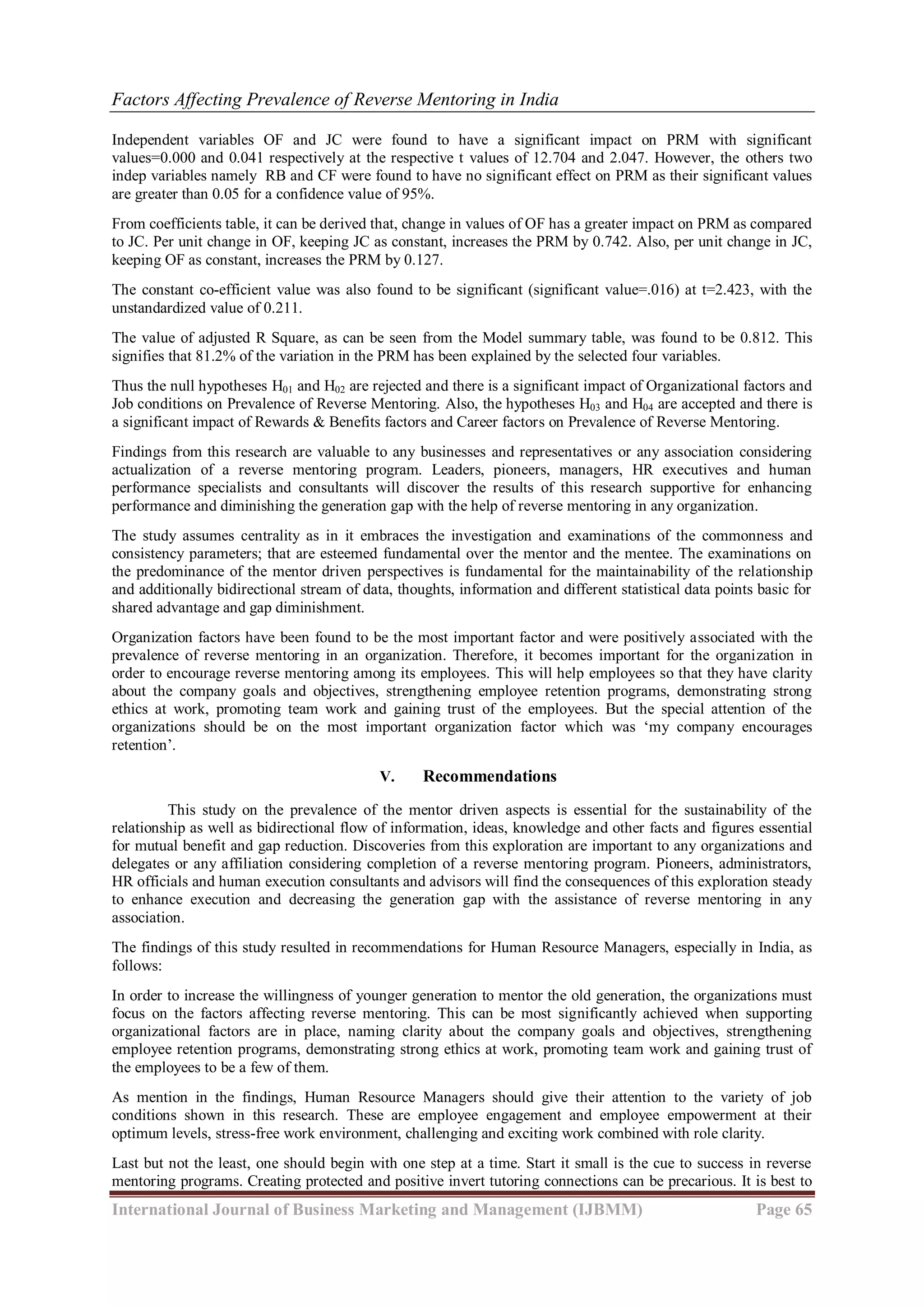
Independent variables OF and JC were found to have a significant impact on PRM with significant
values=0.000 and 0.041 respectively at the respective t values of 12.704 and 2.047. However, the others two
indep variables namely RB and CF were found to have no significant effect on PRM as their significant values
are greater than 0.05 for a confidence value of 95%.
From coefficients table, it can be derived that, change in values of OF has a greater impact on PRM as compared
to JC. Per unit change in OF, keeping JC as constant, increases the PRM by 0.742. Also, per unit change in JC,
keeping OF as constant, increases the PRM by 0.127.
The constant co-efficient value was also found to be significant (significant value=.016) at t=2.423, with the
unstandardized value of 0.211.
The value of adjusted R Square, as can be seen from the Model summary table, was found to be 0.812. This
signifies that 81.2% of the variation in the PRM has been explained by the selected four variables.
Thus the null hypotheses H01 and H02 are rejected and there is a significant impact of Organizational factors and
Job conditions on Prevalence of Reverse Mentoring. Also, the hypotheses H03 and H04 are accepted and there is
a significant impact of Rewards & Benefits factors and Career factors on Prevalence of Reverse Mentoring.
Findings from this research are valuable to any businesses and representatives or any association considering
actualization of a reverse mentoring program. Leaders, pioneers, managers, HR executives and human
performance specialists and consultants will discover the results of this research supportive for enhancing
performance and diminishing the generation gap with the help of reverse mentoring in any organization.
The study assumes centrality as in it embraces the investigation and examinations of the commonness and
consistency parameters; that are esteemed fundamental over the mentor and the mentee. The examinations on
the predominance of the mentor driven perspectives is fundamental for the maintainability of the relationship
and additionally bidirectional stream of data, thoughts, information and different statistical data points basic for
shared advantage and gap diminishment.
Organization factors have been found to be the most important factor and were positively associated with the
prevalence of reverse mentoring in an organization. Therefore, it becomes important for the organization in
order to encourage reverse mentoring among its employees. This will help employees so that they have clarity
about the company goals and objectives, strengthening employee retention programs, demonstrating strong
ethics at work, promoting team work and gaining trust of the employees. But the special attention of the
organizations should be on the most important organization factor which was „my company encourages
retention‟.
V. Recommendations
This study on the prevalence of the mentor driven aspects is essential for the sustainability of the
relationship as well as bidirectional flow of information, ideas, knowledge and other facts and figures essential
for mutual benefit and gap reduction. Discoveries from this exploration are important to any organizations and
delegates or any affiliation considering completion of a reverse mentoring program. Pioneers, administrators,
HR officials and human execution consultants and advisors will find the consequences of this exploration steady
to enhance execution and decreasing the generation gap with the assistance of reverse mentoring in any
association.
The findings of this study resulted in recommendations for Human Resource Managers, especially in India, as
follows:
In order to increase the willingness of younger generation to mentor the old generation, the organizations must
focus on the factors affecting reverse mentoring. This can be most significantly achieved when supporting
organizational factors are in place, naming clarity about the company goals and objectives, strengthening
employee retention programs, demonstrating strong ethics at work, promoting team work and gaining trust of
the employees to be a few of them.
As mention in the findings, Human Resource Managers should give their attention to the variety of job
conditions shown in this research. These are employee engagement and employee empowerment at their
optimum levels, stress-free work environment, challenging and exciting work combined with role clarity.
Last but not the least, one should begin with one step at a time. Start it small is the cue to success in reverse
mentoring programs. Creating protected and positive invert tutoring connections can be precarious. It is best to
Factors Affecting Prevalence of Reverse Mentoring in India
International Journal of Business Marketing and Management (IJBMM) Page 66
begin with little experimental runs projects and after that, utilization of pilot members as a controlling board of
trustees for take-off of the program on a more extensive scale.
Bibliography
[1.] Chamberlain, A. (2017). Why Do Employees Stay? A Clear Career Path and Good Pay, for Starters.
Harvard Business Review, Retrieved from https://hbr.org/2017/03/why-do-employees-stay-a-clear-
career-path-and-good-pay-for-starters
[2.] Chaudhuri, S., & Ghosh, R. (2012). Reverse Mentoring: A Social Exchange Tool for Keeping the
Boomers Engaged and Millennials Committed. Human Resource Development Review, 117(5), 55-76.
[3.] Mahaney, R.C., & Lederer, A.L. (2006). The effect of intrinsic and extrinsic rewards for developers on
information systems project success. Project Management Journal, 37(4), 42-54.
[4.] Mister, J.C. & Willyerd, K. (2009). Are You Ready to Manage Five Generations of Workers?. Harvard
Business Review. Retrieved from https://hbr.org/2009/10/are-you-ready-to-manage-five-g
[5.] Mottaz, C.J. (1985). The relative importance of intrinsic and extrinsic rewards as determinants of work.
The Sociological Quarterly, 26(3), 365-385.
[6.] Ozutku, H. (2012). The Influence of Intrinsic and Extrinsic Rewards on Employee Results: An
Empirical Analysis in Turkish Manufacturing Industry. Business and Economics Research Journal,
3(3), 29-48.
[7.] Stewart, B., Appelbaum, E., Lebby, A.M., Amabile, T., McAdams, J., Kozlowski, L.D., Baker III,
G.P., Wolters, D.S., & Beer, M. (1993). Rethinking Rewards. Harvard Business Review, 71(6), 37-49.

Factors Affecting Prevalence of Reverse Mentoring in India

  • 1.
    International Journal ofBusiness Marketing and Management (IJBMM) Volume 3 Issue 8 August 2018, P.P. 61-66 ISSN: 2456-4559 www.ijbmm.com International Journal of Business Marketing and Management (IJBMM) Page 61 Factors Affecting Prevalence of Reverse Mentoring in India Dr. Manoj K. Sharma, Ms. Muskan Nagi, Professor, University Business School, Panjab University, Chandigarh SRF, University Business School, Panjab University, Chandigarh Abstract- Reverse Mentoring is an emerging program in maximum of developing organizations. Reverse Mentoring is highly practiced and appreciated by mentors, mentees and also the organizations. In this paper an attempt has been made to study what factors among Organization Factors, Job Condition Factor, Rewards and Benefit Factor, Career Development Factor, of respondents are affecting for the prevalence of Reverse Mentoring. The number of respondents in the paper is 530 and is from selected companies of North India. I. Introduction The term “mentor” originates from Greek Mythology. The practice of mentoring even dates back to earlier times. As per the Greek mythology Mentor was Odysseus‟s trusted counselor who also guided and taught his son Telemachus. Today, mentoring is a process in which an experienced individual helps another person develops his or her goals and skills through a series of time-limited confidential, one-on-one conversations and other learning activities. Mentors also draw benefits from the mentoring relationship. As a mentor, you will have the opportunity to share your wisdom and experiences, evolve your own thinking, develop a new relationship, and deepen your skills as a mentor. Mentoring is usually understood to involve a more senior or experienced person (the mentor) helping one who is younger or less experienced (the mentee). On the contrary, reverse mentoring is the mentoring of a senior person (in terms of age, experience or position) by a junior (in terms of age, experience or position) individual. Reverse mentoring aims to help older, more senior people learn from the knowledge of younger people, usually in the field of information technology, computing, and Internet communications. The key to success in reverse mentoring is the ability to create and maintain an attitude of openness to the experience and dissolve the barriers of status, power and position. The concept of reverse mentoring was introduced by Jack Welch in 1999, former chief executive of the General Electric Company. It is a formal mentoring program in which a young, junior employee with something to teach is partnered with a senior manager who has something to learn. Jack Welch undertook pairing of employees in their 20s and 30s who were knowledgeable about the Internet and interested in new technology with executives, who were beginners in that realm. Reverse mentoring is a mutual learning experience. As the concept is a deviation from the traditional approach, it is essential to seek support from top management and line managers in order to implement it. With the technological advancement at such a fast pace and the growth of social media, the youngsters in the organization are the best people who can be the mentors of the boomers. In order to grow and sustain in a today‟s organization, it is essential to have a strong technological know-how. The concept of reverse mentoring provides a platform wherein the younger employee provides insights on the technological know-how to the industry experts and pioneers. They also guide them in the use of various social media applications, such as, facebook , twitter, LinkedIn etc., as they have become important means of communication not only for the purpose of inside flow of information, but also with the outside world. The scope of reverse mentoring however, is not limited to imparting of technological know-how. It also facilitates the understanding of changing work- culture, increasing diversity, growing need for maintaining work-life balance, changes in global scenario etc. This helps them to keep pace with the changing world and thus, may enhance the level of employee engagement in the organization. The objective of reverse mentoring is to "push each other outside of their usual ranges of familiarity and attempt better approaches for considering, working and being". For a reverse mentoring relationship to be gainful, a few elements must be in place. Each gathering must be completely dedicated to the mentoring relationship and
  • 2.
    Factors Affecting Prevalenceof Reverse Mentoring in India International Journal of Business Marketing and Management (IJBMM) Page 62 concur upon the tenets that will be taken after. This study, therefore, has been conducted to study the antecedents to reverse mentoring or the factors which promote reverse mentoring in an organization II. Literature Review Today‟s workforce is marked by a phenomenon which we never witnessed earlier: five generations are working simultaneously (Mister and Willyerd, 2009). They are the Traditionalists (born prior to 1946), the Baby Boomers (born between 1946 and 1964), the Gen X (born between 1965 and 1976), the Millennials (born between 1977 and 1997), and the Gen 2020 (born after 1997). Chaudhuri & Ghosh (2012) shows how powerful a tool reverse mentoring can be in such a scenario. The article establishes reverse mentoring as a mechanism for social exchange, which has the potential to garner the ability of the different generations, especially the Boomers and the Millennials, individually, by being discerning of their distinctive needs and esteem frameworks. The Boomers‟ need for hands-on experience in new technology is fulfilled by reverse mentoring from the Millennials and the Millennials‟ need for recognition is fulfilled by their supervisors in return. This social exchange through reverse mentoring helps both the generations remain engaged and committed to the organization. It therefore becomes important to understand the antecedents to reverse mentoring or the factors which promote reverse mentoring in an organization. The factors considered for this study include organizational factors, job conditions, rewards and benefits, and career development factors. One of the organizational factors which foster reverse mentoring is having clarity about the organizational goals. The employees having clarity about the company goals and objectives will tend to co-operate with each other for the attainment of those goals and objectives. If the organization encourages such teamwork and co-operation among the employees, reverse mentoring will be more prevalent among them. Strong work ethics of the organization and trust on the supervisors and management further the cause of reverse mentoring for the organizations. Furthermore, it can be expected of the employees to share their knowledge and expertise with each other only if they remain committed for their organization. Therefore, it is also important that the organizations retain their employees and their commitment. As these employees continue to better their skills and share them with each other, they become the historians of the successes of their organizations. Favorable job conditions form the second factor which promotes reverse mentoring in an organization. Favorable job conditions include employee empowerment to the optimum level. Empowered employees question existing processes and procedures and make way for efficient processes to set in. Empowerment of the employees holds them accountable and responsible for the successes and failures of the organization and therefore they work in the best interests of the organization. With the known benefits of reverse mentoring, the empowered employees will be more inclined to adopt reverse mentoring in their organization. Also, employee engagement to the optimum level provides a potential for the employees to participate in important decision areas and provide them with strong platform to perform. This increased participation motivates the employees and therefore promote the prevalence of reverse mentoring among them. Role clarity and challenging and exciting work, combined with stress-free work environment, further promote reverse mentoring because the employees are clear about the performance parameters which require them to collaborate with each other. The management pressure forcing employees to adopt reverse mentoring will no longer be necessary in such job conditions. The inclination of the employee rewards and benefits with the organization goals align the employee activities towards attainment of these goals (Stewart et al., 1993). The rewards can be both intrinsic and extrinsic (Ozutku, 2012). The extrinsic rewards are factors which rely on extrinsic motivation outside of an individual‟s personal motives and can be in terms of salary, promotions, performance appraisals, and job security (Mottaz, 1995). Intrinsic rewards rely on intrinsic motivation factors like job satisfaction which reward the personal self of the individual (Mahaney & Lederer, 2006). It can, therefore, be proposed that rewards and benefits will have a positive impact on the prevalence or reverse mentoring if they are inclined as per the company goals and objectives as they influence employee motivation to work in the desired direction. The fourth factor includes the career development factors. Employees stay with their company if the path of their career progression within the organization is clear to them (Chamberlain, 2017). They continue with their organization if the management supports their overall development, and, if they find the organization‟s career development programs to be beneficial and motivating. If the employees are retained, the chances of prevalence of reverse mentoring within the organization are increased as discussed earlier. Therefore, it can be proposed that career development factors have a positive influence on the prevalence of reverse mentoring.
  • 3.
    Factors Affecting Prevalenceof Reverse Mentoring in India International Journal of Business Marketing and Management (IJBMM) Page 63 The null hypotheses to test these relationships are: H01: There is no statistically significant impact of Organizational factors on Prevalence of Reverse Mentoring. H02: There is no statistically significant impact of Job conditions on Prevalence of Reverse Mentoring. H03: There is no statistically significant impact of Rewards and Benefits on Prevalence of Reverse Mentoring. H04: There is no statistically significant impact of Career factors on Prevalence of Reverse Mentoring. III. Research Methodology Research Design This study has makes use of cross-sectional research design in which data is collected from more than one case at a single point of time. It is a descriptive research study and is empirical in nature. Scale The scale to measure the prevalence of Reverse Mentoring was developed with 12 items while for measuring factor affecting reverse mentoring four broad area representing organizational factors, job conditions, rewards and benefits, career development factors, were developed. Each of the four dimensionswas represented by five items each .The questionnaire was pretested with 50 respondents. Table 1 Labels of Prevalence Of Reverse Mentoring LABEL STATEMENT PRM1 My mentor was accessible. PRM2 My mentor demonstrated professional integrity. PRM3 My mentor demonstrated content expertise in my area of need. PRM4 My mentor was approachable. PRM5 My mentor was supportive and encouraging. PRM6 My mentor provided constructive and useful critiques of my work PRM7 My mentor motivated me to improve my work product. PRM8 My mentor was helpful in providing direction and guidance on professional issues. (e.g., networking). PRM9 My mentor answered my questions satisfactorily (e.g., timely response, clear, comprehensive). PRM10 My mentor acknowledged my contributions appropriately (e.g., committee contributions, awards). PRM11 My mentor suggested appropriate resources (e.g., experts, electronic contacts, source materials). PRM12 My mentor challenged me to extend my abilities (e.g., risk taking, try a new professional activity, and draft a section of an article). Scale Reliability and Validity When a scale is found to correlate positively with other measures of the same construct, we say that convergent validity has been proven for the scale. When measuring reliability of a five scales used in the present analysis the calculated Cronbach‟s alpha value came out as follows
  • 4.
    Factors Affecting Prevalenceof Reverse Mentoring in India International Journal of Business Marketing and Management (IJBMM) Page 64 For PRM Cronbach‟s alpha value is 0.979 For OF Cronbach‟s alpha value is 0.958 For JC Cronbach‟s alpha value is 0.949 For RB Cronbach‟s alpha value is 0.901 For CF Cronbach‟s alpha value is 0.818 The degree of cohesiveness existing among the different items of the five scale is established and as a result, Cronbach‟s alpha also reflects convergent validity, though indirectly. Sampling A sample of 530 selected mentor and mentees from various companies from the cities of India to represent the target population. IV. Results and Discussion To test the impact of Organizational factors, Job conditions, Rewards and benefits, Career development factorson prevalence of reverse mentoring; multiple regression analysis has been performed. The results of the Multiple linear regression analysis with Dependent Variable= PRM (Prevalence of Reverse Mentoring) and Independent Variables= OF (Organizational factors), JC (Job Conditions), RB (Reward and Benefits), CF (Career Factors).has been enlisted in the tables below. Table No. 4Coefficientsa Model Unstandardized Coefficients Standardized Coefficients T Sig. B Std. Error Beta 1 (Constant) .211 .087 2.423 .016 OF .658 .052 .742 12.704 .000 JC .127 .062 .127 2.047 .041 RB .092 .048 .055 1.914 .056 CF -.002 .037 -.002 -.063 .950 a. Dependent Variable: PRM The results of the regression analysis express a significant model with sig value to be 0.000, as viewed from the table of ANOVA at F (4, 525)= 573.522. Table No. 2 Model Summary Model R R Square Adjusted R Square Std. Error of the Estimate 1 .902a .814 .812 .44652 a. Predictors: (Constant), CF, RB, OF, JC Table No. 3 ANOVAa Model Sum of Squares Df Mean Square F Sig. 1 Regression 457.390 4 114.347 573.522 .000b Residual 104.673 525 .199 Total 562.063 529 a. Dependent Variable: PRM b. Predictors: (Constant), CF, RB, OF, JC
  • 5.
    Factors Affecting Prevalenceof Reverse Mentoring in India International Journal of Business Marketing and Management (IJBMM) Page 65 Independent variables OF and JC were found to have a significant impact on PRM with significant values=0.000 and 0.041 respectively at the respective t values of 12.704 and 2.047. However, the others two indep variables namely RB and CF were found to have no significant effect on PRM as their significant values are greater than 0.05 for a confidence value of 95%. From coefficients table, it can be derived that, change in values of OF has a greater impact on PRM as compared to JC. Per unit change in OF, keeping JC as constant, increases the PRM by 0.742. Also, per unit change in JC, keeping OF as constant, increases the PRM by 0.127. The constant co-efficient value was also found to be significant (significant value=.016) at t=2.423, with the unstandardized value of 0.211. The value of adjusted R Square, as can be seen from the Model summary table, was found to be 0.812. This signifies that 81.2% of the variation in the PRM has been explained by the selected four variables. Thus the null hypotheses H01 and H02 are rejected and there is a significant impact of Organizational factors and Job conditions on Prevalence of Reverse Mentoring. Also, the hypotheses H03 and H04 are accepted and there is a significant impact of Rewards & Benefits factors and Career factors on Prevalence of Reverse Mentoring. Findings from this research are valuable to any businesses and representatives or any association considering actualization of a reverse mentoring program. Leaders, pioneers, managers, HR executives and human performance specialists and consultants will discover the results of this research supportive for enhancing performance and diminishing the generation gap with the help of reverse mentoring in any organization. The study assumes centrality as in it embraces the investigation and examinations of the commonness and consistency parameters; that are esteemed fundamental over the mentor and the mentee. The examinations on the predominance of the mentor driven perspectives is fundamental for the maintainability of the relationship and additionally bidirectional stream of data, thoughts, information and different statistical data points basic for shared advantage and gap diminishment. Organization factors have been found to be the most important factor and were positively associated with the prevalence of reverse mentoring in an organization. Therefore, it becomes important for the organization in order to encourage reverse mentoring among its employees. This will help employees so that they have clarity about the company goals and objectives, strengthening employee retention programs, demonstrating strong ethics at work, promoting team work and gaining trust of the employees. But the special attention of the organizations should be on the most important organization factor which was „my company encourages retention‟. V. Recommendations This study on the prevalence of the mentor driven aspects is essential for the sustainability of the relationship as well as bidirectional flow of information, ideas, knowledge and other facts and figures essential for mutual benefit and gap reduction. Discoveries from this exploration are important to any organizations and delegates or any affiliation considering completion of a reverse mentoring program. Pioneers, administrators, HR officials and human execution consultants and advisors will find the consequences of this exploration steady to enhance execution and decreasing the generation gap with the assistance of reverse mentoring in any association. The findings of this study resulted in recommendations for Human Resource Managers, especially in India, as follows: In order to increase the willingness of younger generation to mentor the old generation, the organizations must focus on the factors affecting reverse mentoring. This can be most significantly achieved when supporting organizational factors are in place, naming clarity about the company goals and objectives, strengthening employee retention programs, demonstrating strong ethics at work, promoting team work and gaining trust of the employees to be a few of them. As mention in the findings, Human Resource Managers should give their attention to the variety of job conditions shown in this research. These are employee engagement and employee empowerment at their optimum levels, stress-free work environment, challenging and exciting work combined with role clarity. Last but not the least, one should begin with one step at a time. Start it small is the cue to success in reverse mentoring programs. Creating protected and positive invert tutoring connections can be precarious. It is best to
  • 6.
    Factors Affecting Prevalenceof Reverse Mentoring in India International Journal of Business Marketing and Management (IJBMM) Page 66 begin with little experimental runs projects and after that, utilization of pilot members as a controlling board of trustees for take-off of the program on a more extensive scale. Bibliography [1.] Chamberlain, A. (2017). Why Do Employees Stay? A Clear Career Path and Good Pay, for Starters. Harvard Business Review, Retrieved from https://hbr.org/2017/03/why-do-employees-stay-a-clear- career-path-and-good-pay-for-starters [2.] Chaudhuri, S., & Ghosh, R. (2012). Reverse Mentoring: A Social Exchange Tool for Keeping the Boomers Engaged and Millennials Committed. Human Resource Development Review, 117(5), 55-76. [3.] Mahaney, R.C., & Lederer, A.L. (2006). The effect of intrinsic and extrinsic rewards for developers on information systems project success. Project Management Journal, 37(4), 42-54. [4.] Mister, J.C. & Willyerd, K. (2009). Are You Ready to Manage Five Generations of Workers?. Harvard Business Review. Retrieved from https://hbr.org/2009/10/are-you-ready-to-manage-five-g [5.] Mottaz, C.J. (1985). The relative importance of intrinsic and extrinsic rewards as determinants of work. The Sociological Quarterly, 26(3), 365-385. [6.] Ozutku, H. (2012). The Influence of Intrinsic and Extrinsic Rewards on Employee Results: An Empirical Analysis in Turkish Manufacturing Industry. Business and Economics Research Journal, 3(3), 29-48. [7.] Stewart, B., Appelbaum, E., Lebby, A.M., Amabile, T., McAdams, J., Kozlowski, L.D., Baker III, G.P., Wolters, D.S., & Beer, M. (1993). Rethinking Rewards. Harvard Business Review, 71(6), 37-49.