Initiation of Act
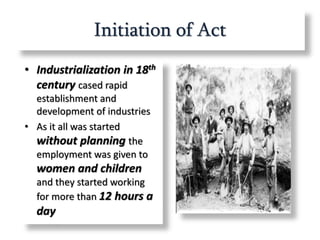
• Industrialization in 18th
century cased rapid
establishment and
development of industries
• As it all was started
without planning the
employment was given to
women and children
and they started working
for more than 12 hours a
day
Critical Conditions
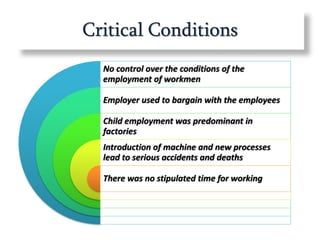
No control over the conditions of the
employment of workmen
Employer used to bargain with the employees
Child employment was predominant in
factories
Introduction of machine and new processes
lead to serious accidents and deaths
There was no stipulated time for working
Act in India
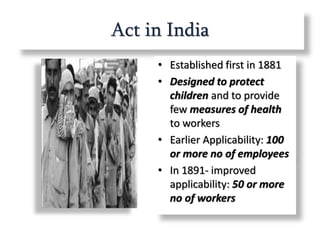
• Established first in 1881
• Designed to protect
children and to provide
few measures of health
to workers
• Earlier Applicability: 100
or more no of employees
• In 1891- improved
applicability: 50 or more
no of workers
• Noble and comprehensive labour legislations
• Covers all aspects related to workers employed in
factories…
Secures-Safety and Health
Regulates- Working Hours
Ensures- Annual leaves with wages
Provides- Additional protection
» from hazardous processes;
» to women workers
» Prohibition of employment of children
Factories Act,1948
• Came into force on 1st April, 1949 in India
 Dadra & Nagar Haveli, Pondicherry- 1963
 Goa- 1965
 Jammu & Kashmir- 1970
• The Act was amended several times in 1949,
1950, 1954, 1956, 1976, 1989.
 major amendment were caused because of
BHOPAL GAS TRAGEDY occurred on 3rd
December, 1984.
Factories Act,1948
Factories Act,1948
Provisions based on ILO conventions and recommendations
120 provision covered under 11 chapters
Constitutional provision; fundamental rights and directive
principles
3 schedules
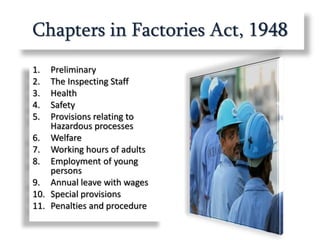
Chapters in Factories Act, 1948
1. Preliminary
2. The Inspecting Staff
3. Health
4. Safety
5. Provisions relating to
Hazardous processes
6. Welfare
7. Working hours of adults
8. Employment of young
persons
9. Annual leave with wages
10. Special provisions
11. Penalties and procedure
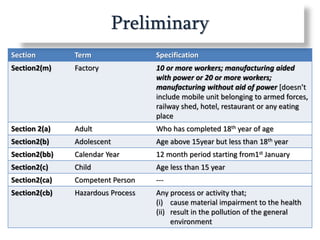
Section Term Specification
Section2(m) Factory 10 or more workers; manufacturing aided
with power or 20 or more workers;
manufacturing without aid of power [doesn’t
include mobile unit belonging to armed forces,
railway shed, hotel, restaurant or any eating
place
Section 2(a) Adult Who has completed 18th year of age
Section2(b) Adolescent Age above 15year but less than 18th year
Section2(bb) Calendar Year 12 month period starting from1st January
Section2(c) Child Age less than 15 year
Section2(ca) Competent Person ---
Section2(cb) Hazardous Process Any process or activity that;
(i) cause material impairment to the health
(ii) result in the pollution of the general
environment
Preliminary
Preliminary
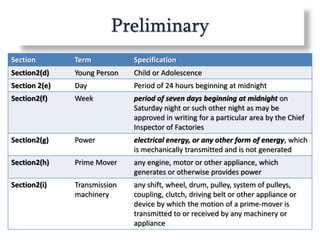
Section Term Specification
Section2(d) Young Person Child or Adolescence
Section 2(e) Day Period of 24 hours beginning at midnight
Section2(f) Week period of seven days beginning at midnight on
Saturday night or such other night as may be
approved in writing for a particular area by the Chief
Inspector of Factories
Section2(g) Power electrical energy, or any other form of energy, which
is mechanically transmitted and is not generated
Section2(h) Prime Mover any engine, motor or other appliance, which
generates or otherwise provides power
Section2(i) Transmission
machinery
any shift, wheel, drum, pulley, system of pulleys,
coupling, clutch, driving belt or other appliance or
device by which the motion of a prime-mover is
transmitted to or received by any machinery or
appliance
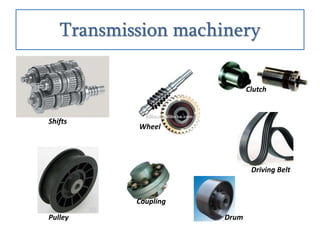
Transmission machinery
Shifts
Wheel
Pulley
Coupling
Drum
Driving Belt
Clutch
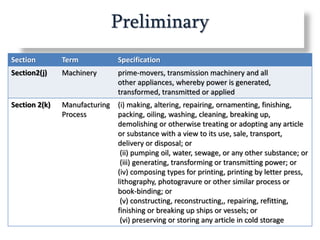
Preliminary
Section Term Specification
Section2(j) Machinery prime-movers, transmission machinery and all
other appliances, whereby power is generated,
transformed, transmitted or applied
Section 2(k) Manufacturing
Process
(i) making, altering, repairing, ornamenting, finishing,
packing, oiling, washing, cleaning, breaking up,
demolishing or otherwise treating or adopting any article
or substance with a view to its use, sale, transport,
delivery or disposal; or
(ii) pumping oil, water, sewage, or any other substance; or
(iii) generating, transforming or transmitting power; or
(iv) composing types for printing, printing by letter press,
lithography, photogravure or other similar process or
book-binding; or
(v) constructing, reconstructing,, repairing, refitting,
finishing or breaking up ships or vessels; or
(vi) preserving or storing any article in cold storage
Preliminary
Section Term Specification
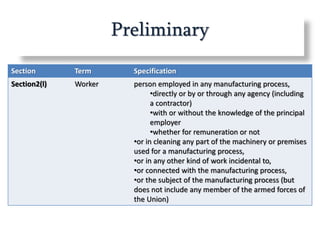
Section2(l) Worker person employed in any manufacturing process,
•directly or by or through any agency (including
a contractor)
•with or without the knowledge of the principal
employer
•whether for remuneration or not
•or in cleaning any part of the machinery or premises
used for a manufacturing process,
•or in any other kind of work incidental to,
•or connected with the manufacturing process,
•or the subject of the manufacturing process (but
does not include any member of the armed forces of
the Union)
Preliminary
Section Term Specification
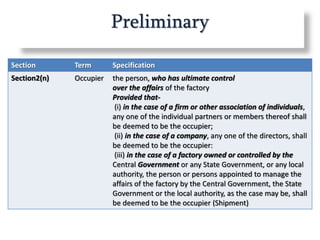
Section2(n) Occupier the person, who has ultimate control
over the affairs of the factory
Provided that-
(i) in the case of a firm or other association of individuals,
any one of the individual partners or members thereof shall
be deemed to be the occupier;
(ii) in the case of a company, any one of the directors, shall
be deemed to be the occupier:
(iii) in the case of a factory owned or controlled by the
Central Government or any State Government, or any local
authority, the person or persons appointed to manage the
affairs of the factory by the Central Government, the State
Government or the local authority, as the case may be, shall
be deemed to be the occupier (Shipment)
Preliminary
Section Term Specification
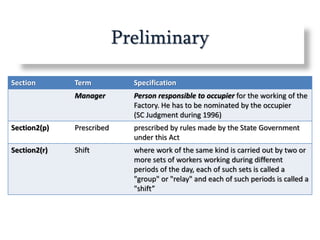
Manager Person responsible to occupier for the working of the
Factory. He has to be nominated by the occupier
(SC Judgment during 1996)
Section2(p) Prescribed prescribed by rules made by the State Government
under this Act
Section2(r) Shift where work of the same kind is carried out by two or
more sets of workers working during different
periods of the day, each of such sets is called a
"group" or "relay" and each of such periods is called a
"shift”
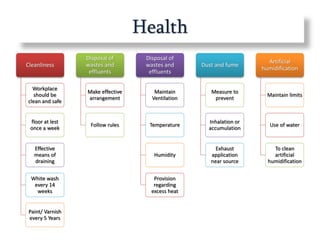
Health
Cleanliness
Workplace
should be
clean and safe
floor at lest
once a week
Effective
means of
draining
White wash
every 14
weeks
Paint/ Varnish
every 5 Years
Disposal of
wastes and
effluents
Make effective
arrangement
Follow rules
Disposal of
wastes and
effluents
Maintain
Ventilation
Temperature
Humidity
Provision
regarding
excess heat
Dust and fume
Measure to
prevent
Inhalation or
accumulation
Exhaust
application
near source
Artificial
humidification
Maintain limits
Use of water
To clean
artificial
humidification
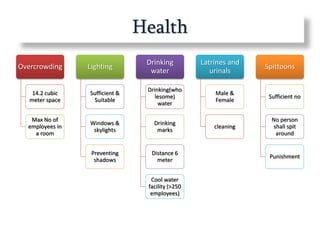
Overcrowding
14.2 cubic
meter space
Max No of
employees in
a room
Lighting
Sufficient &
Suitable
Windows &
skylights
Preventing
shadows
Drinking
water
Drinking(who
lesome)
water
Drinking
marks
Distance 6
meter
Cool water
facility (>250
employees)
Latrines and
urinals
Male &
Female
cleaning
Spittoons
Sufficient no
No person
shall spit
around
Punishment
Health
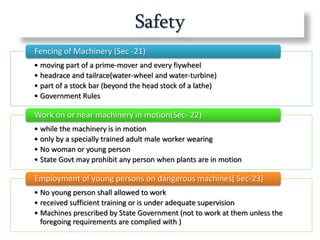
Safety
• moving part of a prime-mover and every fiywheel
• headrace and tailrace(water-wheel and water-turbine)
• part of a stock bar (beyond the head stock of a lathe)
• Government Rules
Fencing of Machinery (Sec -21)
• while the machinery is in motion
• only by a specially trained adult male worker wearing
• No woman or young person
• State Govt may prohibit any person when plants are in motion
Work on or near machinery in motion(Sec- 22)
• No young person shall allowed to work
• received sufficient training or is under adequate supervision
• Machines prescribed by State Government (not to work at them unless the
foregoing requirements are complied with )
Employment of young persons on dangerous machines( Sec-23)
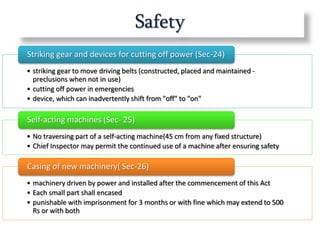
Safety
• striking gear to move driving belts (constructed, placed and maintained -
preclusions when not in use)
• cutting off power in emergencies
• device, which can inadvertently shift from "off" to "on"
Striking gear and devices for cutting off power (Sec-24)
• No traversing part of a self-acting machine(45 cm from any fixed structure)
• Chief Inspector may permit the continued use of a machine after ensuring safety
Self-acting machines (Sec- 25)
• machinery driven by power and installed after the commencement of this Act
• Each small part shall encased
• punishable with imprisonment for 3 months or with fine which may extend to 500
Rs or with both
Casing of new machinery( Sec-26)
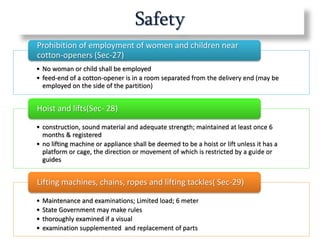
Safety
• No woman or child shall be employed
• feed-end of a cotton-opener is in a room separated from the delivery end (may be
employed on the side of the partition)
Prohibition of employment of women and children near
cotton-openers (Sec-27)
• construction, sound material and adequate strength; maintained at least once 6
months & registered
• no lifting machine or appliance shall be deemed to be a hoist or lift unless it has a
platform or cage, the direction or movement of which is restricted by a guide or
guides
Hoist and lifts(Sec- 28)
• Maintenance and examinations; Limited load; 6 meter
• State Government may make rules
• thoroughly examined if a visual
• examination supplemented and replacement of parts
Lifting machines, chains, ropes and lifting tackles( Sec-29)
Safety
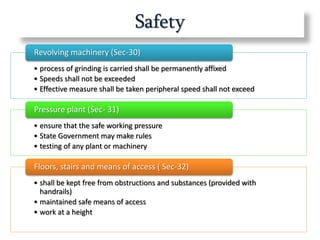
• process of grinding is carried shall be permanently affixed
• Speeds shall not be exceeded
• Effective measure shall be taken peripheral speed shall not exceed
Revolving machinery (Sec-30)
• ensure that the safe working pressure
• State Government may make rules
• testing of any plant or machinery
Pressure plant (Sec- 31)
• shall be kept free from obstructions and substances (provided with
handrails)
• maintained safe means of access
• work at a height
Floors, stairs and means of access ( Sec-32)
Safety
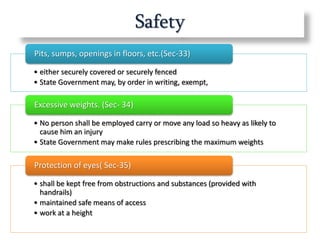
• either securely covered or securely fenced
• State Government may, by order in writing, exempt,
Pits, sumps, openings in floors, etc.(Sec-33)
• No person shall be employed carry or move any load so heavy as likely to
cause him an injury
• State Government may make rules prescribing the maximum weights
Excessive weights. (Sec- 34)
• shall be kept free from obstructions and substances (provided with
handrails)
• maintained safe means of access
• work at a height
Protection of eyes( Sec-35)
Safety
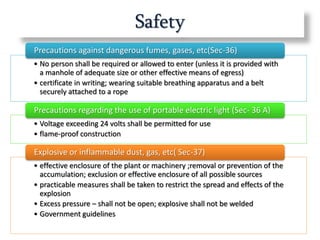
• No person shall be required or allowed to enter (unless it is provided with
a manhole of adequate size or other effective means of egress)
• certificate in writing; wearing suitable breathing apparatus and a belt
securely attached to a rope
Precautions against dangerous fumes, gases, etc(Sec-36)
• Voltage exceeding 24 volts shall be permitted for use
• flame-proof construction
Precautions regarding the use of portable electric light (Sec- 36 A)
• effective enclosure of the plant or machinery ;removal or prevention of the
accumulation; exclusion or effective enclosure of all possible sources
• practicable measures shall be taken to restrict the spread and effects of the
explosion
• Excess pressure – shall not be open; explosive shall not be welded
• Government guidelines
Explosive or inflammable dust, gas, etc( Sec-37)
Safety
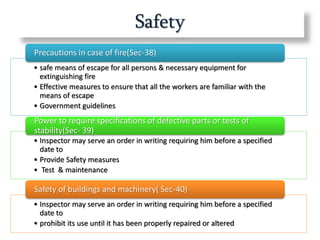
• safe means of escape for all persons & necessary equipment for
extinguishing fire
• Effective measures to ensure that all the workers are familiar with the
means of escape
• Government guidelines
Precautions in case of fire(Sec-38)
• Inspector may serve an order in writing requiring him before a specified
date to
• Provide Safety measures
• Test & maintenance
Power to require specifications of defective parts or tests of
stability(Sec- 39)
• Inspector may serve an order in writing requiring him before a specified
date to
• prohibit its use until it has been properly repaired or altered
Safety of buildings and machinery( Sec-40)
Safety
• measures which in his(Inspectors) opinion should be taken and
requiring the same to be carried out
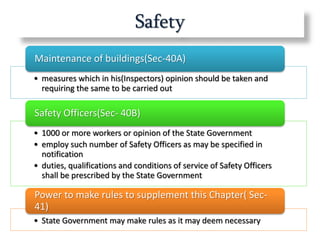
Maintenance of buildings(Sec-40A)
• 1000 or more workers or opinion of the State Government
• employ such number of Safety Officers as may be specified in
notification
• duties, qualifications and conditions of service of Safety Officers
shall be prescribed by the State Government
Safety Officers(Sec- 40B)
• State Government may make rules as it may deem necessary
Power to make rules to supplement this Chapter( Sec-
41)
Welfare
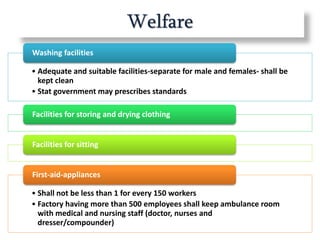
• Adequate and suitable facilities-separate for male and females- shall be
kept clean
• Stat government may prescribes standards
Washing facilities
Facilities for storing and drying clothing
Facilities for sitting
• Shall not be less than 1 for every 150 workers
• Factory having more than 500 employees shall keep ambulance room
with medical and nursing staff (doctor, nurses and
dresser/compounder)
First-aid-appliances
Welfare
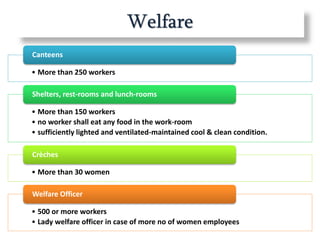
• More than 250 workers
Canteens
• More than 150 workers
• no worker shall eat any food in the work-room
• sufficiently lighted and ventilated-maintained cool & clean condition.
Shelters, rest-rooms and lunch-rooms
• More than 30 women
Crèches
• 500 or more workers
• Lady welfare officer in case of more no of women employees
Welfare Officer
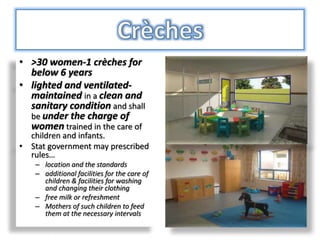
• >30 women-1 crèches for
below 6 years
• lighted and ventilated-
maintained in a clean and
sanitary condition and shall
be under the charge of
women trained in the care of
children and infants.
• Stat government may prescribed
rules…
– location and the standards
– additional facilities for the care of
children & facilities for washing
and changing their clothing
– free milk or refreshment
– Mothers of such children to feed
them at the necessary intervals
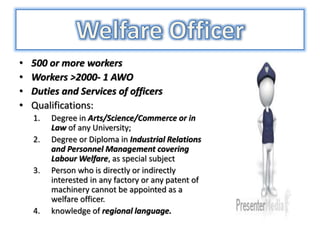
• 500 or more workers
• Workers >2000- 1 AWO
• Duties and Services of officers
• Qualifications:
1. Degree in Arts/Science/Commerce or in
Law of any University;
2. Degree or Diploma in Industrial Relations
and Personnel Management covering
Labour Welfare, as special subject
3. Person who is directly or indirectly
interested in any factory or any patent of
machinery cannot be appointed as a
welfare officer.
4. knowledge of regional language.
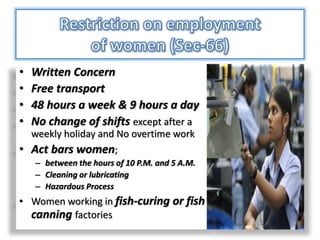
• Written Concern
• Free transport
• 48 hours a week & 9 hours a day
• No change of shifts except after a
weekly holiday and No overtime work
• Act bars women;
– between the hours of 10 P.M. and 5 A.M.
– Cleaning or lubricating
– Hazardous Process
• Women working in fish-curing or fish
canning factories
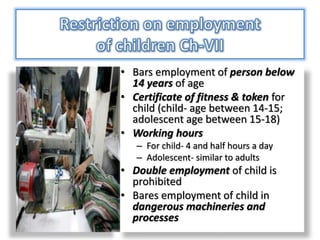
• Bars employment of person below
14 years of age
• Certificate of fitness & token for
child (child- age between 14-15;
adolescent age between 15-18)
• Working hours
– For child- 4 and half hours a day
– Adolescent- similar to adults
• Double employment of child is
prohibited
• Bares employment of child in
dangerous machineries and
processes
• One day for every 20/15 day
• Eligibility:
– 240 days in calendar year(beginning of his/her services)
– 2/3rd of calendar year
– Issue of leave book
– Maintenance of register
– In case of discharge/dismissal benefit shall be settled immediately
• ½ day or more would be consider full day of working if less
than ½ day work is omitted
• Un-availed leave- carry forward (not exceeding 30/40)
• More than 48 hours a week or
9 hours a day- twice the rate of
ordinary wages
– Ordinary wages include basic wage
plus allowances but not bonus
• Piece rate basis
• Advantages equivalent to cash
(quantity- admissible to a standard
family )
• During overtime also inclusive
intervals shall be provided
• Work hours 60 per week
• Overtime 50 per quarter(75
special case)
• Work overtime-> 7 days stretch
1. "Standard family" means a
family consisting of the worker,
his or her spouse and two
children below the age of
fourteen years requiring in all
three adult consumption units.
2. "Adult consumption unit"
means the consumption units of
a male above the age of fourteen
years, and the consumption unit
of a female above the age of
fourteen years and that of a child
below the age of fourteen years
shall be calculated at the rates of
8 and 6, respectively of one adult
consumption unit.
Factories act

Factories act

  • 2.
    Initiation of Act •Industrialization in 18th century cased rapid establishment and development of industries • As it all was started without planning the employment was given to women and children and they started working for more than 12 hours a day
  • 3.
    Critical Conditions No controlover the conditions of the employment of workmen Employer used to bargain with the employees Child employment was predominant in factories Introduction of machine and new processes lead to serious accidents and deaths There was no stipulated time for working
  • 4.
    Act in India •Established first in 1881 • Designed to protect children and to provide few measures of health to workers • Earlier Applicability: 100 or more no of employees • In 1891- improved applicability: 50 or more no of workers
  • 5.
    • Noble andcomprehensive labour legislations • Covers all aspects related to workers employed in factories… Secures-Safety and Health Regulates- Working Hours Ensures- Annual leaves with wages Provides- Additional protection » from hazardous processes; » to women workers » Prohibition of employment of children Factories Act,1948
  • 6.
    • Came intoforce on 1st April, 1949 in India  Dadra & Nagar Haveli, Pondicherry- 1963  Goa- 1965  Jammu & Kashmir- 1970 • The Act was amended several times in 1949, 1950, 1954, 1956, 1976, 1989.  major amendment were caused because of BHOPAL GAS TRAGEDY occurred on 3rd December, 1984. Factories Act,1948
  • 7.
    Factories Act,1948 Provisions basedon ILO conventions and recommendations 120 provision covered under 11 chapters Constitutional provision; fundamental rights and directive principles 3 schedules
  • 8.
    Chapters in FactoriesAct, 1948 1. Preliminary 2. The Inspecting Staff 3. Health 4. Safety 5. Provisions relating to Hazardous processes 6. Welfare 7. Working hours of adults 8. Employment of young persons 9. Annual leave with wages 10. Special provisions 11. Penalties and procedure
  • 9.
    Section Term Specification Section2(m)Factory 10 or more workers; manufacturing aided with power or 20 or more workers; manufacturing without aid of power [doesn’t include mobile unit belonging to armed forces, railway shed, hotel, restaurant or any eating place Section 2(a) Adult Who has completed 18th year of age Section2(b) Adolescent Age above 15year but less than 18th year Section2(bb) Calendar Year 12 month period starting from1st January Section2(c) Child Age less than 15 year Section2(ca) Competent Person --- Section2(cb) Hazardous Process Any process or activity that; (i) cause material impairment to the health (ii) result in the pollution of the general environment Preliminary
  • 10.
    Preliminary Section Term Specification Section2(d)Young Person Child or Adolescence Section 2(e) Day Period of 24 hours beginning at midnight Section2(f) Week period of seven days beginning at midnight on Saturday night or such other night as may be approved in writing for a particular area by the Chief Inspector of Factories Section2(g) Power electrical energy, or any other form of energy, which is mechanically transmitted and is not generated Section2(h) Prime Mover any engine, motor or other appliance, which generates or otherwise provides power Section2(i) Transmission machinery any shift, wheel, drum, pulley, system of pulleys, coupling, clutch, driving belt or other appliance or device by which the motion of a prime-mover is transmitted to or received by any machinery or appliance
  • 11.
  • 12.
    Preliminary Section Term Specification Section2(j)Machinery prime-movers, transmission machinery and all other appliances, whereby power is generated, transformed, transmitted or applied Section 2(k) Manufacturing Process (i) making, altering, repairing, ornamenting, finishing, packing, oiling, washing, cleaning, breaking up, demolishing or otherwise treating or adopting any article or substance with a view to its use, sale, transport, delivery or disposal; or (ii) pumping oil, water, sewage, or any other substance; or (iii) generating, transforming or transmitting power; or (iv) composing types for printing, printing by letter press, lithography, photogravure or other similar process or book-binding; or (v) constructing, reconstructing,, repairing, refitting, finishing or breaking up ships or vessels; or (vi) preserving or storing any article in cold storage
  • 13.
    Preliminary Section Term Specification Section2(l)Worker person employed in any manufacturing process, •directly or by or through any agency (including a contractor) •with or without the knowledge of the principal employer •whether for remuneration or not •or in cleaning any part of the machinery or premises used for a manufacturing process, •or in any other kind of work incidental to, •or connected with the manufacturing process, •or the subject of the manufacturing process (but does not include any member of the armed forces of the Union)
  • 14.
    Preliminary Section Term Specification Section2(n)Occupier the person, who has ultimate control over the affairs of the factory Provided that- (i) in the case of a firm or other association of individuals, any one of the individual partners or members thereof shall be deemed to be the occupier; (ii) in the case of a company, any one of the directors, shall be deemed to be the occupier: (iii) in the case of a factory owned or controlled by the Central Government or any State Government, or any local authority, the person or persons appointed to manage the affairs of the factory by the Central Government, the State Government or the local authority, as the case may be, shall be deemed to be the occupier (Shipment)
  • 15.
    Preliminary Section Term Specification ManagerPerson responsible to occupier for the working of the Factory. He has to be nominated by the occupier (SC Judgment during 1996) Section2(p) Prescribed prescribed by rules made by the State Government under this Act Section2(r) Shift where work of the same kind is carried out by two or more sets of workers working during different periods of the day, each of such sets is called a "group" or "relay" and each of such periods is called a "shift”
  • 16.
    Health Cleanliness Workplace should be clean andsafe floor at lest once a week Effective means of draining White wash every 14 weeks Paint/ Varnish every 5 Years Disposal of wastes and effluents Make effective arrangement Follow rules Disposal of wastes and effluents Maintain Ventilation Temperature Humidity Provision regarding excess heat Dust and fume Measure to prevent Inhalation or accumulation Exhaust application near source Artificial humidification Maintain limits Use of water To clean artificial humidification
  • 17.
    Overcrowding 14.2 cubic meter space MaxNo of employees in a room Lighting Sufficient & Suitable Windows & skylights Preventing shadows Drinking water Drinking(who lesome) water Drinking marks Distance 6 meter Cool water facility (>250 employees) Latrines and urinals Male & Female cleaning Spittoons Sufficient no No person shall spit around Punishment Health
  • 18.
    Safety • moving partof a prime-mover and every fiywheel • headrace and tailrace(water-wheel and water-turbine) • part of a stock bar (beyond the head stock of a lathe) • Government Rules Fencing of Machinery (Sec -21) • while the machinery is in motion • only by a specially trained adult male worker wearing • No woman or young person • State Govt may prohibit any person when plants are in motion Work on or near machinery in motion(Sec- 22) • No young person shall allowed to work • received sufficient training or is under adequate supervision • Machines prescribed by State Government (not to work at them unless the foregoing requirements are complied with ) Employment of young persons on dangerous machines( Sec-23)
  • 19.
    Safety • striking gearto move driving belts (constructed, placed and maintained - preclusions when not in use) • cutting off power in emergencies • device, which can inadvertently shift from "off" to "on" Striking gear and devices for cutting off power (Sec-24) • No traversing part of a self-acting machine(45 cm from any fixed structure) • Chief Inspector may permit the continued use of a machine after ensuring safety Self-acting machines (Sec- 25) • machinery driven by power and installed after the commencement of this Act • Each small part shall encased • punishable with imprisonment for 3 months or with fine which may extend to 500 Rs or with both Casing of new machinery( Sec-26)
  • 20.
    Safety • No womanor child shall be employed • feed-end of a cotton-opener is in a room separated from the delivery end (may be employed on the side of the partition) Prohibition of employment of women and children near cotton-openers (Sec-27) • construction, sound material and adequate strength; maintained at least once 6 months & registered • no lifting machine or appliance shall be deemed to be a hoist or lift unless it has a platform or cage, the direction or movement of which is restricted by a guide or guides Hoist and lifts(Sec- 28) • Maintenance and examinations; Limited load; 6 meter • State Government may make rules • thoroughly examined if a visual • examination supplemented and replacement of parts Lifting machines, chains, ropes and lifting tackles( Sec-29)
  • 21.
    Safety • process ofgrinding is carried shall be permanently affixed • Speeds shall not be exceeded • Effective measure shall be taken peripheral speed shall not exceed Revolving machinery (Sec-30) • ensure that the safe working pressure • State Government may make rules • testing of any plant or machinery Pressure plant (Sec- 31) • shall be kept free from obstructions and substances (provided with handrails) • maintained safe means of access • work at a height Floors, stairs and means of access ( Sec-32)
  • 22.
    Safety • either securelycovered or securely fenced • State Government may, by order in writing, exempt, Pits, sumps, openings in floors, etc.(Sec-33) • No person shall be employed carry or move any load so heavy as likely to cause him an injury • State Government may make rules prescribing the maximum weights Excessive weights. (Sec- 34) • shall be kept free from obstructions and substances (provided with handrails) • maintained safe means of access • work at a height Protection of eyes( Sec-35)
  • 23.
    Safety • No personshall be required or allowed to enter (unless it is provided with a manhole of adequate size or other effective means of egress) • certificate in writing; wearing suitable breathing apparatus and a belt securely attached to a rope Precautions against dangerous fumes, gases, etc(Sec-36) • Voltage exceeding 24 volts shall be permitted for use • flame-proof construction Precautions regarding the use of portable electric light (Sec- 36 A) • effective enclosure of the plant or machinery ;removal or prevention of the accumulation; exclusion or effective enclosure of all possible sources • practicable measures shall be taken to restrict the spread and effects of the explosion • Excess pressure – shall not be open; explosive shall not be welded • Government guidelines Explosive or inflammable dust, gas, etc( Sec-37)
  • 24.
    Safety • safe meansof escape for all persons & necessary equipment for extinguishing fire • Effective measures to ensure that all the workers are familiar with the means of escape • Government guidelines Precautions in case of fire(Sec-38) • Inspector may serve an order in writing requiring him before a specified date to • Provide Safety measures • Test & maintenance Power to require specifications of defective parts or tests of stability(Sec- 39) • Inspector may serve an order in writing requiring him before a specified date to • prohibit its use until it has been properly repaired or altered Safety of buildings and machinery( Sec-40)
  • 25.
    Safety • measures whichin his(Inspectors) opinion should be taken and requiring the same to be carried out Maintenance of buildings(Sec-40A) • 1000 or more workers or opinion of the State Government • employ such number of Safety Officers as may be specified in notification • duties, qualifications and conditions of service of Safety Officers shall be prescribed by the State Government Safety Officers(Sec- 40B) • State Government may make rules as it may deem necessary Power to make rules to supplement this Chapter( Sec- 41)
  • 26.
    Welfare • Adequate andsuitable facilities-separate for male and females- shall be kept clean • Stat government may prescribes standards Washing facilities Facilities for storing and drying clothing Facilities for sitting • Shall not be less than 1 for every 150 workers • Factory having more than 500 employees shall keep ambulance room with medical and nursing staff (doctor, nurses and dresser/compounder) First-aid-appliances
  • 27.
    Welfare • More than250 workers Canteens • More than 150 workers • no worker shall eat any food in the work-room • sufficiently lighted and ventilated-maintained cool & clean condition. Shelters, rest-rooms and lunch-rooms • More than 30 women Crèches • 500 or more workers • Lady welfare officer in case of more no of women employees Welfare Officer
  • 28.
    • >30 women-1crèches for below 6 years • lighted and ventilated- maintained in a clean and sanitary condition and shall be under the charge of women trained in the care of children and infants. • Stat government may prescribed rules… – location and the standards – additional facilities for the care of children & facilities for washing and changing their clothing – free milk or refreshment – Mothers of such children to feed them at the necessary intervals
  • 29.
    • 500 ormore workers • Workers >2000- 1 AWO • Duties and Services of officers • Qualifications: 1. Degree in Arts/Science/Commerce or in Law of any University; 2. Degree or Diploma in Industrial Relations and Personnel Management covering Labour Welfare, as special subject 3. Person who is directly or indirectly interested in any factory or any patent of machinery cannot be appointed as a welfare officer. 4. knowledge of regional language.
  • 30.
    • Written Concern •Free transport • 48 hours a week & 9 hours a day • No change of shifts except after a weekly holiday and No overtime work • Act bars women; – between the hours of 10 P.M. and 5 A.M. – Cleaning or lubricating – Hazardous Process • Women working in fish-curing or fish canning factories
  • 31.
    • Bars employmentof person below 14 years of age • Certificate of fitness & token for child (child- age between 14-15; adolescent age between 15-18) • Working hours – For child- 4 and half hours a day – Adolescent- similar to adults • Double employment of child is prohibited • Bares employment of child in dangerous machineries and processes
  • 32.
    • One dayfor every 20/15 day • Eligibility: – 240 days in calendar year(beginning of his/her services) – 2/3rd of calendar year – Issue of leave book – Maintenance of register – In case of discharge/dismissal benefit shall be settled immediately • ½ day or more would be consider full day of working if less than ½ day work is omitted • Un-availed leave- carry forward (not exceeding 30/40)
  • 33.
    • More than48 hours a week or 9 hours a day- twice the rate of ordinary wages – Ordinary wages include basic wage plus allowances but not bonus • Piece rate basis • Advantages equivalent to cash (quantity- admissible to a standard family ) • During overtime also inclusive intervals shall be provided • Work hours 60 per week • Overtime 50 per quarter(75 special case) • Work overtime-> 7 days stretch 1. "Standard family" means a family consisting of the worker, his or her spouse and two children below the age of fourteen years requiring in all three adult consumption units. 2. "Adult consumption unit" means the consumption units of a male above the age of fourteen years, and the consumption unit of a female above the age of fourteen years and that of a child below the age of fourteen years shall be calculated at the rates of 8 and 6, respectively of one adult consumption unit.