

By
A1355905161
Kumar Supratik
RICS School of Built Environment,
Noida
Sub group – 4, Group – 2
Sec - A
Background
 2nd half of 18th century , a period of rapid industrial growth in Great
Britain
 It was total mess, people use to work regardless of time, age, gender
etc
 Initiatives were taken and it came into existence in 1819
 After modifications final Factories Act came into existence in 1948
 India, 1st factories law passed in 1881
 Designed to protect children and to provide measures for health and
safety of the workers
 Applicable to factories with 100 or more workers
 Later modified law came with applicability extending to factories
with 50 or more workers
 Factories act 1948 extends to all of India
 Came into effect from 1st April 1949
Factories Act Object And Scope
 This act extends to whole of India
 The main object of this act is to ensure adequate safety
measures and to promote the health & welfare of workers
employed in factories
 The act also make provisions regarding employment of
women & young person (including children & adolescents),
annual leave with wages etc
Highlights
 The Factories Act, 1948 came into force on the 1st day of April,1949 and extends to
the whole of India. It was, in fact, extended to Dadra & Nagar Haveli, Pondicherry in
1963, to Goa in 1965 and to the State of Jammu & Kashmir in 1970
 The Factories Act was amended in 1949, 1950, 1954, 1956, 1976 and 1989
 Latest amendment in 2014
 106 sections, 11 Chapters
Chapter -1, Preliminary
Definitions
 Adult – 18 years and above
 Adolescent – between 15 to 18 years
 Child – Less than 15 years
 Calendar Year – 12 months beginning with 1st Jan
 Competent Person – Any person or an institution recognized by Chief Inspector to
carry out ,Tests, Examinations and Inspections
 Hazardous Process – Any process where raw material, intermediate product, final
product, or bye-product can;
Cause material impairment to the person involved.
Result in pollution of general environment.
 Young Person – A person either child or adolescent
 Day – 24 hours starting from midnight
 Week – 7 days period starting from any midnight as specified
 Power – Any form of energy, mechanically transmitted and not produced by any
human or animal agency
 Prime mover - Any engine, motor or other appliance which generates or otherwise
provides power
 Machinery - Prime movers, transmission machinery and all other appliances
whereby power is generated, transformed, transmitted or applied
 Manufacturing Process - making, altering, repairing ornamenting, finishing,
packing, oiling, washing, cleaning, breaking up, demolishing, or otherwise treating
or adapting any article or substance with a view to its use sale, transport, delivery or
disposal or;
Pumping oil, water, sewage or any other substance or;
Generating, transforming or transmitting power or;
Composing types for printing by letter press, lithography, photogravure or;
Preserving or storing any article in cold storage or;
Constructing, reconstructing, repairing, refitting, finishing or breaking up ships or
vessels.
 Factories - It means any premises including the precincts there of
- Whereon 10 or more workers are working, or were working on any
day of the preceding 12 months, and in any part of which a
manufacturing process is being carried on with the aid of power, or
is ordinarily so carried on; or
But does not include a mine subject to the operation of the Mines Act,
1952 or a mobile unit belonging to the Armed forces of the Union, a railway running
shed or a hotel, restaurant or eating place
 Worker - Person employed, directly or by or through any agency (including a
contractor) with or without the knowledge of the principal employer
 Occupier - Person who has ultimate control over the affairs of the factory
 Time of day will be as per IST
 Power to declare different departments to be separate factories or two or
more factories to be a single factory
 National Public Emergency and validity of act and concerned authorities during that
period
 Approval, licensing and registration of factories and the authorities responsible for
the same
 Occupier needs to give notice at least 15 days prior to occupy any premises as
factory
 Inspector and his appointment at different levels and powers lying with those
inspectors to enforce and monitor the proper enforcement of Act
 Certification of Surgeons (Medical Practitioners), processes, regulations and
authorities responsible and authorize to certify
Sec 3 to Sec 10
Chapter – 3 HEALTH
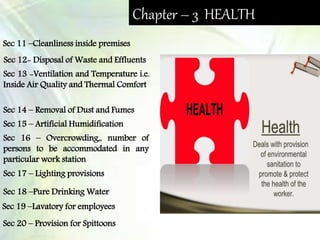
Sec 11 –Cleanliness inside premises
Sec 12- Disposal of Waste and Effluents
Sec 13 -Ventilation and Temperature i.e.
Inside Air Quality and Thermal Comfort
Sec 14 – Removal of Dust and Fumes
Sec 15 – Artificial Humidification
Sec 16 – Overcrowding,, number of
persons to be accommodated in any
particular work station
Sec 17 – Lighting provisions
Sec 18 –Pure Drinking Water
Sec 19 –Lavatory for employees
Sec 20 – Provision for Spittoons
Chapter – 4 SAFETY
Sec 21 – Fencing of Machineries
Sec 22 - Working on or near
machineries in motion
Sec 23 –Employment of young
persons on dangerous machines
Sec 24 –Striking gear and devices for
cutting off power
Sec 25 – Self acting Machines
Sec 26 – Casing of new machineries
Sec 27 - Prohibition of employment
of women and children near
cotton-openers
Sec 28 – Hoists and Lifts
Sec 29 - Lifting machines, chains,
ropes and lifting tackles
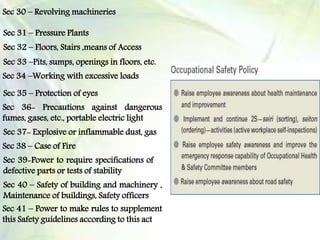
Sec 30 – Revolving machineries
Sec 31 – Pressure Plants
Sec 32 – Floors, Stairs ,means of Access
Sec 33 –Pits, sumps, openings in floors, etc.
Sec 34 –Working with excessive loads
Sec 35 – Protection of eyes
Sec 36- Precautions against dangerous
fumes, gases, etc., portable electric light
Sec 37- Explosive or inflammable dust, gas
Sec 38 – Case of Fire
Sec 39-Power to require specifications of
defective parts or tests of stability
Sec 40 – Safety of building and machinery ,
Maintenance of buildings, Safety officers
Sec 41 – Power to make rules to supplement
this Safety guidelines according to this act
Chapter–4A PROVISIONS RELATING HAZARDOUS
PROCESSES(41A-41H)
 Constitution of Site Appraisal Committee
 Compulsory Disclosure of Information
 Special Responsibility of the occupier in
relation to Hazardous processes:
 Maintaining accurate and up-to-date health
and medical records of workers exposed to
any chemical, toxic or any other harmful
substances manufactured, stored, handled
or transported
 Appointing qualified, experienced &
compete persons in handling such
substances to supervise handling and for
protecting the workers from the hazard
 Providing for medical examination of every
worker at intervals
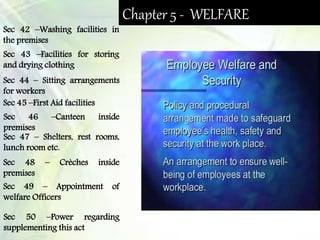
Chapter 5 - WELFARE
Sec 42 –Washing facilities in
the premises
Sec 43 –Facilities for storing
and drying clothing
Sec 44 – Sitting arrangements
for workers
Sec 45 –First Aid facilities
Sec 46 –Canteen inside
premises
Sec 47 – Shelters, rest rooms,
lunch room etc.
Sec 48 – Crèches inside
premises
Sec 49 – Appointment of
welfare Officers
Sec 50 –Power regarding
supplementing this act
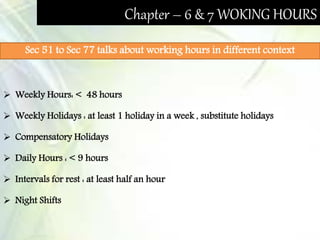
Chapter – 6 & 7 WOKING HOURS
Sec 51 to Sec 77 talks about working hours in different context
 Weekly Hours: < 48 hours
 Weekly Holidays : at least 1 holiday in a week , substitute holidays
 Compensatory Holidays
 Daily Hours : < 9 hours
 Intervals for rest : at least half an hour
 Night Shifts
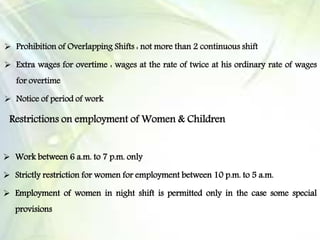
 Prohibition of Overlapping Shifts : not more than 2 continuous shift
 Extra wages for overtime : wages at the rate of twice at his ordinary rate of wages
for overtime
 Notice of period of work
Restrictions on employment of Women & Children
 Work between 6 a.m. to 7 p.m. only
 Strictly restriction for women for employment between 10 p.m. to 5 a.m.
 Employment of women in night shift is permitted only in the case some special
provisions
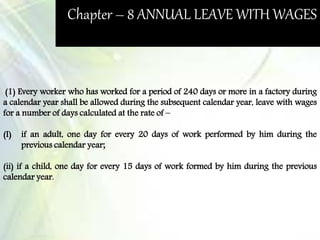
Chapter – 8 ANNUAL LEAVE WITH WAGES
(1) Every worker who has worked for a period of 240 days or more in a factory during
a calendar year shall be allowed during the subsequent calendar year, leave with wages
for a number of days calculated at the rate of –
(I) if an adult, one day for every 20 days of work performed by him during the
previous calendar year;
(ii) if a child, one day for every 15 days of work formed by him during the previous
calendar year.
Offences & Penalties (sec. 92 to 106)
 Court will take cognizance of the
offence only when the complaint
is made within 3 months of the
date on which the alleged
commission of the offence came to
the knowledge of the inspector,
but where the offence consist of
disobeying a written order made
by an Inspector, complaint may be
made within 6 months of the
commission of the offence
Offence
Penalties
 General penalties for offence
 Penalty for the contravention of Provisions
Relating to Hazardous process
 Penalty for obstructing Inspector
 Penalty for wrongfully Disclosing Results
of Analysis
 Penalty relating to casing of new
machinery
 Penalties for Offences by workers &
Parents
 Penalty for offence by a medical
practitioner
 Penalty for employing child labor
Thank You

Factories act

  • 1.
    By A1355905161 Kumar Supratik RICS Schoolof Built Environment, Noida Sub group – 4, Group – 2 Sec - A
  • 2.
    Background  2nd halfof 18th century , a period of rapid industrial growth in Great Britain  It was total mess, people use to work regardless of time, age, gender etc  Initiatives were taken and it came into existence in 1819  After modifications final Factories Act came into existence in 1948  India, 1st factories law passed in 1881  Designed to protect children and to provide measures for health and safety of the workers  Applicable to factories with 100 or more workers  Later modified law came with applicability extending to factories with 50 or more workers  Factories act 1948 extends to all of India  Came into effect from 1st April 1949
  • 3.
    Factories Act ObjectAnd Scope  This act extends to whole of India  The main object of this act is to ensure adequate safety measures and to promote the health & welfare of workers employed in factories  The act also make provisions regarding employment of women & young person (including children & adolescents), annual leave with wages etc
  • 4.
    Highlights  The FactoriesAct, 1948 came into force on the 1st day of April,1949 and extends to the whole of India. It was, in fact, extended to Dadra & Nagar Haveli, Pondicherry in 1963, to Goa in 1965 and to the State of Jammu & Kashmir in 1970  The Factories Act was amended in 1949, 1950, 1954, 1956, 1976 and 1989  Latest amendment in 2014  106 sections, 11 Chapters
  • 5.
    Chapter -1, Preliminary Definitions Adult – 18 years and above  Adolescent – between 15 to 18 years  Child – Less than 15 years  Calendar Year – 12 months beginning with 1st Jan  Competent Person – Any person or an institution recognized by Chief Inspector to carry out ,Tests, Examinations and Inspections  Hazardous Process – Any process where raw material, intermediate product, final product, or bye-product can; Cause material impairment to the person involved. Result in pollution of general environment.  Young Person – A person either child or adolescent  Day – 24 hours starting from midnight  Week – 7 days period starting from any midnight as specified
  • 6.
     Power –Any form of energy, mechanically transmitted and not produced by any human or animal agency  Prime mover - Any engine, motor or other appliance which generates or otherwise provides power  Machinery - Prime movers, transmission machinery and all other appliances whereby power is generated, transformed, transmitted or applied  Manufacturing Process - making, altering, repairing ornamenting, finishing, packing, oiling, washing, cleaning, breaking up, demolishing, or otherwise treating or adapting any article or substance with a view to its use sale, transport, delivery or disposal or; Pumping oil, water, sewage or any other substance or; Generating, transforming or transmitting power or; Composing types for printing by letter press, lithography, photogravure or; Preserving or storing any article in cold storage or; Constructing, reconstructing, repairing, refitting, finishing or breaking up ships or vessels.
  • 7.
     Factories -It means any premises including the precincts there of - Whereon 10 or more workers are working, or were working on any day of the preceding 12 months, and in any part of which a manufacturing process is being carried on with the aid of power, or is ordinarily so carried on; or But does not include a mine subject to the operation of the Mines Act, 1952 or a mobile unit belonging to the Armed forces of the Union, a railway running shed or a hotel, restaurant or eating place  Worker - Person employed, directly or by or through any agency (including a contractor) with or without the knowledge of the principal employer  Occupier - Person who has ultimate control over the affairs of the factory
  • 8.
     Time ofday will be as per IST  Power to declare different departments to be separate factories or two or more factories to be a single factory  National Public Emergency and validity of act and concerned authorities during that period  Approval, licensing and registration of factories and the authorities responsible for the same  Occupier needs to give notice at least 15 days prior to occupy any premises as factory  Inspector and his appointment at different levels and powers lying with those inspectors to enforce and monitor the proper enforcement of Act  Certification of Surgeons (Medical Practitioners), processes, regulations and authorities responsible and authorize to certify Sec 3 to Sec 10
  • 9.
    Chapter – 3HEALTH Sec 11 –Cleanliness inside premises Sec 12- Disposal of Waste and Effluents Sec 13 -Ventilation and Temperature i.e. Inside Air Quality and Thermal Comfort Sec 14 – Removal of Dust and Fumes Sec 15 – Artificial Humidification Sec 16 – Overcrowding,, number of persons to be accommodated in any particular work station Sec 17 – Lighting provisions Sec 18 –Pure Drinking Water Sec 19 –Lavatory for employees Sec 20 – Provision for Spittoons
  • 10.
    Chapter – 4SAFETY Sec 21 – Fencing of Machineries Sec 22 - Working on or near machineries in motion Sec 23 –Employment of young persons on dangerous machines Sec 24 –Striking gear and devices for cutting off power Sec 25 – Self acting Machines Sec 26 – Casing of new machineries Sec 27 - Prohibition of employment of women and children near cotton-openers Sec 28 – Hoists and Lifts Sec 29 - Lifting machines, chains, ropes and lifting tackles
  • 11.
    Sec 30 –Revolving machineries Sec 31 – Pressure Plants Sec 32 – Floors, Stairs ,means of Access Sec 33 –Pits, sumps, openings in floors, etc. Sec 34 –Working with excessive loads Sec 35 – Protection of eyes Sec 36- Precautions against dangerous fumes, gases, etc., portable electric light Sec 37- Explosive or inflammable dust, gas Sec 38 – Case of Fire Sec 39-Power to require specifications of defective parts or tests of stability Sec 40 – Safety of building and machinery , Maintenance of buildings, Safety officers Sec 41 – Power to make rules to supplement this Safety guidelines according to this act
  • 12.
    Chapter–4A PROVISIONS RELATINGHAZARDOUS PROCESSES(41A-41H)  Constitution of Site Appraisal Committee  Compulsory Disclosure of Information  Special Responsibility of the occupier in relation to Hazardous processes:  Maintaining accurate and up-to-date health and medical records of workers exposed to any chemical, toxic or any other harmful substances manufactured, stored, handled or transported  Appointing qualified, experienced & compete persons in handling such substances to supervise handling and for protecting the workers from the hazard  Providing for medical examination of every worker at intervals
  • 13.
    Chapter 5 -WELFARE Sec 42 –Washing facilities in the premises Sec 43 –Facilities for storing and drying clothing Sec 44 – Sitting arrangements for workers Sec 45 –First Aid facilities Sec 46 –Canteen inside premises Sec 47 – Shelters, rest rooms, lunch room etc. Sec 48 – Crèches inside premises Sec 49 – Appointment of welfare Officers Sec 50 –Power regarding supplementing this act
  • 14.
    Chapter – 6& 7 WOKING HOURS Sec 51 to Sec 77 talks about working hours in different context  Weekly Hours: < 48 hours  Weekly Holidays : at least 1 holiday in a week , substitute holidays  Compensatory Holidays  Daily Hours : < 9 hours  Intervals for rest : at least half an hour  Night Shifts
  • 15.
     Prohibition ofOverlapping Shifts : not more than 2 continuous shift  Extra wages for overtime : wages at the rate of twice at his ordinary rate of wages for overtime  Notice of period of work Restrictions on employment of Women & Children  Work between 6 a.m. to 7 p.m. only  Strictly restriction for women for employment between 10 p.m. to 5 a.m.  Employment of women in night shift is permitted only in the case some special provisions
  • 16.
    Chapter – 8ANNUAL LEAVE WITH WAGES (1) Every worker who has worked for a period of 240 days or more in a factory during a calendar year shall be allowed during the subsequent calendar year, leave with wages for a number of days calculated at the rate of – (I) if an adult, one day for every 20 days of work performed by him during the previous calendar year; (ii) if a child, one day for every 15 days of work formed by him during the previous calendar year.
  • 17.
    Offences & Penalties(sec. 92 to 106)  Court will take cognizance of the offence only when the complaint is made within 3 months of the date on which the alleged commission of the offence came to the knowledge of the inspector, but where the offence consist of disobeying a written order made by an Inspector, complaint may be made within 6 months of the commission of the offence Offence
  • 18.
    Penalties  General penaltiesfor offence  Penalty for the contravention of Provisions Relating to Hazardous process  Penalty for obstructing Inspector  Penalty for wrongfully Disclosing Results of Analysis  Penalty relating to casing of new machinery  Penalties for Offences by workers & Parents  Penalty for offence by a medical practitioner  Penalty for employing child labor
  • 21.