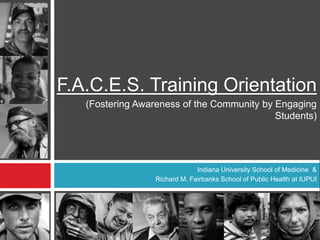
F.A.C.E.S. Training Orientation
(Fostering Awareness of the Community by Engaging
Students)
Indiana University School of Medicine &
Richard M. Fairbanks School of Public Health at IUPUI
Goals of F.A.C.E.S.
 Primary Objectives:
 Community engagement within medical
student population
 Medical student exposure to vulnerable
population
 Self-advocacy within homeless adult
population
Benefits of participating in
F.A.C.E.S.
Better understand the needs of
individuals who are homeless
Fulfill IU School of Medicine competencies
 Social and Community Context of Health Care (VI)
 Moral Reasoning and Ethical Judgment (VII)
F.A.C.E.S. Training Overview
Module 1:
Homeless
Populatio
n
&
Mental
Health
Module 2:
Safety
Guideline
s
Module 3:
Informatio
n
Delivery
Module 1: Homeless Population
On any
given night,
there are
633,782
people
experiencing
homelessne
ss in the
United
States.
 Leading Determinants
 Socioeconomic Deficits
 Traumatic Experiences
 Access to Treatment
 Social Seclusion
Module 1: Homeless Population
 Chronic Homelessness (1+ year)
 Mental Illness, Substance Abuse
Disorder
 Veterans
 Physical and Mental Disabilities
 Families
 Single-parent, working with low
income
 Youth
 Aging out of foster care
 Re-Entry
 Leaving correctional system
Module 1: Mental Health
Module 2: Safety
Module 2: Information Delivery

Faces training

  • 1.
    F.A.C.E.S. Training Orientation (FosteringAwareness of the Community by Engaging Students) Indiana University School of Medicine & Richard M. Fairbanks School of Public Health at IUPUI
  • 2.
    Goals of F.A.C.E.S. Primary Objectives:  Community engagement within medical student population  Medical student exposure to vulnerable population  Self-advocacy within homeless adult population
  • 3.
    Benefits of participatingin F.A.C.E.S. Better understand the needs of individuals who are homeless Fulfill IU School of Medicine competencies  Social and Community Context of Health Care (VI)  Moral Reasoning and Ethical Judgment (VII)
  • 4.
    F.A.C.E.S. Training Overview Module1: Homeless Populatio n & Mental Health Module 2: Safety Guideline s Module 3: Informatio n Delivery
  • 5.
    Module 1: HomelessPopulation On any given night, there are 633,782 people experiencing homelessne ss in the United States.  Leading Determinants  Socioeconomic Deficits  Traumatic Experiences  Access to Treatment  Social Seclusion
  • 6.
    Module 1: HomelessPopulation  Chronic Homelessness (1+ year)  Mental Illness, Substance Abuse Disorder  Veterans  Physical and Mental Disabilities  Families  Single-parent, working with low income  Youth  Aging out of foster care  Re-Entry  Leaving correctional system
  • 7.
  • 8.
  • 9.