Framing Facebook use Dr. Jan Schmidt Senior Researcher  for Digital Interactive Media  and Political Communication Facebook Developer Garage, Hamburg, 14.05.2008
What I‘m interested in  Using facebook
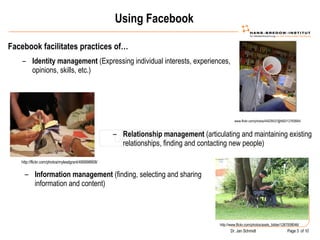
Using Facebook Facebook facilitates practices of… Using facebook www.flickr.com/photos/44029537@N00/12760664/ Identity management  (Expressing individual interests, experiences, opinions, skills, etc.) http://flickr.com/photos/mylesdgrant/495698908/ Relationship management  (articulating and maintaining existing relationships, finding and contacting new people) http://www.flickr.com/photos/axels_bilder/1267008046/ Information management  (finding, selecting and sharing information and content)
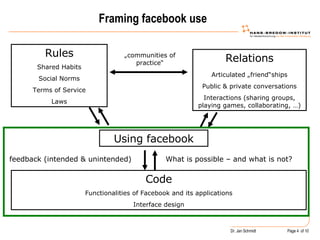
Framing facebook use  Using facebook Code Functionalities of Facebook and its applications Interface design Relations Articulated „friend“ships Public & private conversations Interactions (sharing groups, playing games, collaborating, …) Rules Shared Habits Social Norms Terms of Service Laws What is possible – and what is not? „ communities of practice“ feedback (intended & unintended)
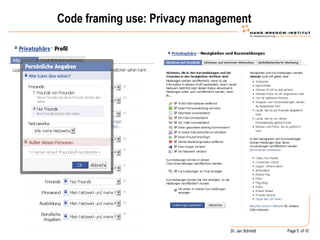
Code framing use: Privacy management
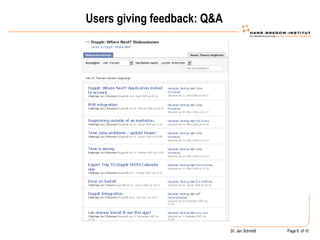
Users giving feedback: Q&A
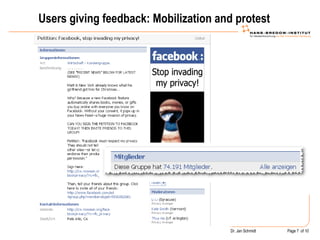
Users giving feedback: Mobilization and protest
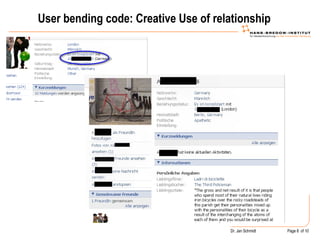
User bending code: Creative Use of relationship
Code & Facebook use - some open questions To which degree is code regulating specific actions?  What is determining if and to which extent users actually follow the „suggestions“ of code?  When do users „rebel“ by articulating and mobilizing protest („voice“), when do they abandon a platform or application („exit“)? Who is shaping and regulating the code itself?  How are the networks shaped in which code is developed and improved? What are the power (im)balances between Facebook, external developers and the different user communities?  How can code in general (and interface design in particular) assist nuanced identity-, relationship- and information management without  being too complicated to comprehend and  giving way for unintended consequences (e.g. with respect to privacy)?
Thank You! Dr. Jan Schmidt Hans-Bredow-Institut Warburgstr. 8-10, 20354 Hamburg [email_address] www.hans-bredow-institut.de www.schmidtmitdete.de twitter.com/JanSchmidt
Further Reading Schmidt, Jan (2007):  Social Software: Facilitating information-, identity- and relationship management . In: Burg, Thomas N.  / Jan Schmidt (Eds.): BlogTalks Reloaded. Social Software -  Research and Cases. Vienna/Norderstedt: Books on Demand. 2007.  31-49. Online: http://www.bamberg-gewinnt.de/wordpress/wp-content/pdf/blogtalksreloaded_3_schmidt.pdf .

Facebook_Developer_Garage_Hamburg_2008

  • 1.
    Framing Facebook useDr. Jan Schmidt Senior Researcher for Digital Interactive Media and Political Communication Facebook Developer Garage, Hamburg, 14.05.2008
  • 2.
    What I‘m interestedin Using facebook
  • 3.
    Using Facebook Facebookfacilitates practices of… Using facebook www.flickr.com/photos/44029537@N00/12760664/ Identity management (Expressing individual interests, experiences, opinions, skills, etc.) http://flickr.com/photos/mylesdgrant/495698908/ Relationship management (articulating and maintaining existing relationships, finding and contacting new people) http://www.flickr.com/photos/axels_bilder/1267008046/ Information management (finding, selecting and sharing information and content)
  • 4.
    Framing facebook use Using facebook Code Functionalities of Facebook and its applications Interface design Relations Articulated „friend“ships Public & private conversations Interactions (sharing groups, playing games, collaborating, …) Rules Shared Habits Social Norms Terms of Service Laws What is possible – and what is not? „ communities of practice“ feedback (intended & unintended)
  • 5.
    Code framing use:Privacy management
  • 6.
  • 7.
    Users giving feedback:Mobilization and protest
  • 8.
    User bending code:Creative Use of relationship
  • 9.
    Code & Facebookuse - some open questions To which degree is code regulating specific actions? What is determining if and to which extent users actually follow the „suggestions“ of code? When do users „rebel“ by articulating and mobilizing protest („voice“), when do they abandon a platform or application („exit“)? Who is shaping and regulating the code itself? How are the networks shaped in which code is developed and improved? What are the power (im)balances between Facebook, external developers and the different user communities? How can code in general (and interface design in particular) assist nuanced identity-, relationship- and information management without being too complicated to comprehend and giving way for unintended consequences (e.g. with respect to privacy)?
  • 10.
    Thank You! Dr.Jan Schmidt Hans-Bredow-Institut Warburgstr. 8-10, 20354 Hamburg [email_address] www.hans-bredow-institut.de www.schmidtmitdete.de twitter.com/JanSchmidt
  • 11.
    Further Reading Schmidt,Jan (2007): Social Software: Facilitating information-, identity- and relationship management . In: Burg, Thomas N.  / Jan Schmidt (Eds.): BlogTalks Reloaded. Social Software -  Research and Cases. Vienna/Norderstedt: Books on Demand. 2007.  31-49. Online: http://www.bamberg-gewinnt.de/wordpress/wp-content/pdf/blogtalksreloaded_3_schmidt.pdf .

Editor's Notes