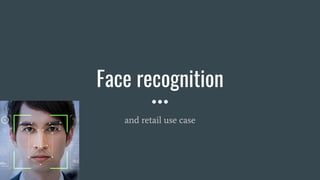
Face recognition
and retail use case
About me
● 10 + working with data in different roles and domains;
● Finalist of 2 Hackathons;
● Specialization: Face recognition, customer behaviour prediction, recommendation
engine;
Overview
Advances in face recognition
General approach
State of the art method
Use case
Brief history
- Starts from 1964 at this time operators annotated 40 pictures per hour;
- 1997 ZN-Face developed through funding by US Army research laboratory used
by Deutsche bank and some airports;
- 2006 performance is evaluated in Face Recognition Grand Challenge. The results
indicated that the new algorithms are 10 times more accurate than the face
recognition algorithms of 2002 and 100 times more accurate than those of 1995
Available datasets
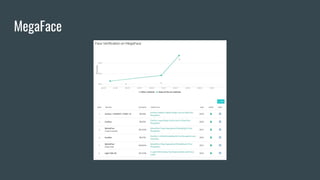
- MegaFace (4.7 m train dataset, 1m test dataset, 7 Mean photos / person (3 min,
2469 max)
- LFW Labeled Faces in the Wild (13,000 images of faces collected from the web)
- YouTube Faces DB (3,425 videos of 1,595 different people)
- IJB (A, B, C) set of up to 138000 face images, 11000 face videos, and 10000
non-face images
MegaFace
General approach
Face location
Face alignment and scaling
Feature extraction
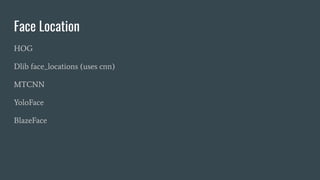
Face Location
HOG
Dlib face_locations (uses cnn)
MTCNN
YoloFace
BlazeFace
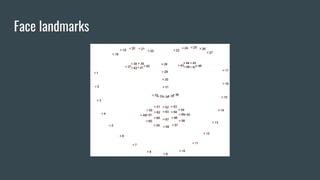
Face landmarks
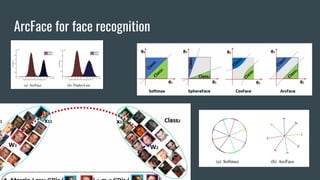
ArcFace for face recognition
Retail use case
- Substitution of loyalty cards
- Know your customer before he comes to cashier
Links
- http://megaface.cs.washington.edu/
- http://vis-www.cs.umass.edu/lfw/
- https://www.cs.tau.ac.il/~wolf/ytfaces/
- https://paperswithcode.com/sota/face-verification-on-megaface
- https://www.pyimagesearch.com/2017/04/03/facial-landmarks-dlib-opencv-python/

Face recognition usecase. Igor Lakoza

  • 1.
  • 2.
    About me ● 10+ working with data in different roles and domains; ● Finalist of 2 Hackathons; ● Specialization: Face recognition, customer behaviour prediction, recommendation engine;
  • 3.
    Overview Advances in facerecognition General approach State of the art method Use case
  • 4.
    Brief history - Startsfrom 1964 at this time operators annotated 40 pictures per hour; - 1997 ZN-Face developed through funding by US Army research laboratory used by Deutsche bank and some airports; - 2006 performance is evaluated in Face Recognition Grand Challenge. The results indicated that the new algorithms are 10 times more accurate than the face recognition algorithms of 2002 and 100 times more accurate than those of 1995
  • 5.
    Available datasets - MegaFace(4.7 m train dataset, 1m test dataset, 7 Mean photos / person (3 min, 2469 max) - LFW Labeled Faces in the Wild (13,000 images of faces collected from the web) - YouTube Faces DB (3,425 videos of 1,595 different people) - IJB (A, B, C) set of up to 138000 face images, 11000 face videos, and 10000 non-face images
  • 6.
  • 7.
    General approach Face location Facealignment and scaling Feature extraction
  • 8.
    Face Location HOG Dlib face_locations(uses cnn) MTCNN YoloFace BlazeFace
  • 9.
  • 10.
    ArcFace for facerecognition
  • 11.
    Retail use case -Substitution of loyalty cards - Know your customer before he comes to cashier
  • 12.
    Links - http://megaface.cs.washington.edu/ - http://vis-www.cs.umass.edu/lfw/ -https://www.cs.tau.ac.il/~wolf/ytfaces/ - https://paperswithcode.com/sota/face-verification-on-megaface - https://www.pyimagesearch.com/2017/04/03/facial-landmarks-dlib-opencv-python/